WO2020196751A1 - シラノール基の脱水縮合反応抑制剤及び抑制方法、並びに、シラノール基含有ポリオルガノシロキサンの製造方法及びその組成物 - Google Patents
シラノール基の脱水縮合反応抑制剤及び抑制方法、並びに、シラノール基含有ポリオルガノシロキサンの製造方法及びその組成物 Download PDFInfo
- Publication number
- WO2020196751A1 WO2020196751A1 PCT/JP2020/013658 JP2020013658W WO2020196751A1 WO 2020196751 A1 WO2020196751 A1 WO 2020196751A1 JP 2020013658 W JP2020013658 W JP 2020013658W WO 2020196751 A1 WO2020196751 A1 WO 2020196751A1
- Authority
- WO
- WIPO (PCT)
- Prior art keywords
- compound
- polyorganosiloxane
- group
- silanol group
- dehydration condensation
- Prior art date
- Legal status (The legal status is an assumption and is not a legal conclusion. Google has not performed a legal analysis and makes no representation as to the accuracy of the status listed.)
- Ceased
Links
Classifications
-
- C—CHEMISTRY; METALLURGY
- C08—ORGANIC MACROMOLECULAR COMPOUNDS; THEIR PREPARATION OR CHEMICAL WORKING-UP; COMPOSITIONS BASED THEREON
- C08G—MACROMOLECULAR COMPOUNDS OBTAINED OTHERWISE THAN BY REACTIONS ONLY INVOLVING UNSATURATED CARBON-TO-CARBON BONDS
- C08G77/00—Macromolecular compounds obtained by reactions forming a linkage containing silicon with or without sulfur, nitrogen, oxygen or carbon in the main chain of the macromolecule
- C08G77/04—Polysiloxanes
- C08G77/06—Preparatory processes
- C08G77/08—Preparatory processes characterised by the catalysts used
-
- C—CHEMISTRY; METALLURGY
- C08—ORGANIC MACROMOLECULAR COMPOUNDS; THEIR PREPARATION OR CHEMICAL WORKING-UP; COMPOSITIONS BASED THEREON
- C08G—MACROMOLECULAR COMPOUNDS OBTAINED OTHERWISE THAN BY REACTIONS ONLY INVOLVING UNSATURATED CARBON-TO-CARBON BONDS
- C08G77/00—Macromolecular compounds obtained by reactions forming a linkage containing silicon with or without sulfur, nitrogen, oxygen or carbon in the main chain of the macromolecule
- C08G77/04—Polysiloxanes
- C08G77/14—Polysiloxanes containing silicon bound to oxygen-containing groups
- C08G77/16—Polysiloxanes containing silicon bound to oxygen-containing groups to hydroxy groups
Definitions
- the present invention relates to a silanol group-containing dehydration condensation reaction inhibitor and method, a method for producing a silanol group-containing polyorganosiloxane, and a composition thereof.
- the most common method for synthesizing polyorganosiloxane is to use organoalkoxysilane as a starting material and hydrolyze / dehydrate-condensate it in the presence of water from the viewpoint of cost and handleability.
- polyorganosiloxane synthesized using organotrialkoxysilane as a main raw material is preferably used in consideration of compatibility with an organic resin and reactivity.
- the polyorganosiloxane obtained by the above method retains a silanol group which is a functional group exhibiting condensability and also contains residual water, the condensation reaction of the silanol group easily proceeds with time, whereby the condensation reaction of the silanol group easily proceeds. Storage stability becomes a problem because the physical properties fluctuate.
- the silanol group is converted into an alkoxy group by reacting the synthesized polyorganosiloxane with an organoalkoxysilane to improve the storage stability.
- the technique is known (see, for example, Patent Document 1).
- the present invention comprises a silanol group dehydration condensation reaction inhibitor used to suppress the progress of the silanol group dehydration condensation reaction without converting the silanol group to another functional group, and the inhibition thereof. It is an object of the present invention to provide a method for suppressing a dehydration condensation reaction of a silanol group using an agent, a method for producing a silanol group-containing polyorganosiloxane having improved storage stability, and a composition thereof.
- the present invention relates to a silanol group dehydration condensation reaction inhibitor composed of a ⁇ -dicarbonyl compound and / or a sulfonyl isocyanate compound.
- the present invention also relates to a method for suppressing the progress of the dehydration condensation reaction of the silanol group by adding a ⁇ -dicarbonyl compound and / or a sulfonyl isocyanate compound to a system containing a compound having a silanol group.
- the present invention is a step of hydrolyzing and dehydrating and condensing a monoorganotrialkoxysilane and / or an alkoxysilane component containing a diorganodialkoxysilane in the presence of water to form a polyorganosiloxane having a silanol group. It also relates to a method for producing a polyorganosiloxane having a silanol group, which comprises a step of adding a ⁇ -dicarbonyl compound and / or a sulfonyl isocyanate compound as a silanol group dehydration condensation reaction inhibitor to the polyorganosiloxane.
- the amount of the water added is 30 mol% or more and 60 mol% or less with respect to 100% of the total number of moles of the alkoxy groups directly bonded to the silicon atom contained in the alkoxysilane component.
- the hydrolysis and dehydration condensation reaction is carried out in the presence of a basic compound and / or a neutral salt as a condensation catalyst, and the reaction inhibitor is a ⁇ -dicarbonyl compound.
- the hydrolysis and dehydration condensation reaction is carried out in the absence of a condensation catalyst or in the presence of an acidic compound as a condensation catalyst, and the reaction inhibitor is a sulfonyl isocyanate compound.
- the sulfonyl isocyanate compound is added after removing 80 mol% or more of the alcohol generated by the hydrolysis reaction.
- the present invention is a hydrolysis condensate of an alkoxysilane component containing 70 mol% or more and 100 mol% or less of monoorganotrialkoxysilane and 0 mol% or more and 30 mol% or less of diorganodialkoxysilane.
- the structural unit derived from the organotrialkoxysilane is the structural unit T1 that forms one siloxane bond, the structural unit T2 that forms two siloxane bonds, and the structural unit that forms three siloxane bonds.
- the ratio of the number of moles of T3 to the total number of moles of T1, T2, and T3 measured by 29 Si-NMR is 10% or more and 70% or less, and polyorganosiloxane having a silanol group, and It also relates to a composition containing 0.1 part by weight or more and 10 parts by weight or less of ⁇ -dicarbonyl compound and / or sulfonylisocyanate compound with respect to 100 parts by weight of the polyorganosiloxane. Preferably, before and after holding the composition at 50 ° C.
- the present invention may be a two-component composition composed of a liquid A containing the composition and a liquid B containing a condensation catalyst. Furthermore, the present invention comprises 0.5 parts by weight or more based on 100 parts by weight of the compound having a silanol group in a composition containing a compound having a silanol group and a ⁇ -dicarbonyl compound and / or a sulfonyl isocyanate compound. It also relates to a method of accelerating the dehydration condensation reaction of the silanol group by adding the condensation catalyst of the above.
- a silanol group dehydration condensation reaction inhibitor used for suppressing the progress of the silanol group dehydration condensation reaction without converting the silanol group to another functional group, and the inhibitor are used. It is possible to provide a method for suppressing a dehydration condensation reaction of a silanol group, a method for producing a silanol group-containing polyorganosiloxane having improved storage stability, and a composition thereof.
- the first invention relates to a silanol group dehydration condensation reaction inhibitor, which is composed of a ⁇ -dicarbonyl compound and / or a sulfonyl isocyanate compound.
- the reaction inhibitor suppresses the progress of the dehydration condensation reaction in which water molecules are desorbed from two silanol groups to form a siloxane bond (Si—O—Si).
- the reaction inhibitor according to the present invention does not convert the hydroxyl group in the silanol group into another functional group such as an alkoxy group, and can suppress the dehydration condensation reaction while maintaining the form of the silanol group. Therefore, there is an advantage that good storage stability can be achieved without changing the original physical properties of the compound having a silanol group.
- the ⁇ -dicarbonyl compound is a compound having a structure in which two carbonyl groups are bonded with one carbon atom sandwiched between them.
- Specific examples of the ⁇ -dicarbonyl compound are not particularly limited, and examples thereof include acetylacetone, dimedone, cyclohexane-1,3-dione, methyl acetoacetate, ethyl acetoacetate, dimethyl malonate, diethyl malonate, and meldrum's acid. Be done.
- the ⁇ -carbonyl compound has a high effect of suppressing the dehydration condensation reaction of the silanol group, particularly when the basic compound and / or the neutral salt is present in the system containing the silanol group-containing compound.
- acetylacetone is preferable because it has a boiling point of around 140 ° C. and is easily volatilized after coating, and the dehydration condensation reaction proceeds due to the volatilization of the compound and the coating film is easily
- Sulfonyl isocyanate compounds have the effect of suppressing the progress of dehydration condensation reaction of silanol groups by dehydration action, and in addition, sulfonylamide groups are generated by reaction with water. Therefore, in the case of ordinary isocyanate compounds, amino groups It is presumed that the effect of suppressing the progress of the dehydration condensation reaction is enhanced as compared with the case where the compound is generated and the basicity is enhanced.
- the sulfonyl isocyanate compound is not particularly limited, and examples thereof include tosyl isocyanate, benzenesulfonyl isocyanate, and chlorosulfonyl isocyanate. Among them, a monofunctional sulfonyl isocyanate compound is preferable, and an aromatic monosulfonyl isocyanate is more preferable because of its high solubility.
- the sulfonyl isocyanate compound is a silanol group-containing compound when an acidic compound is present in the system containing a silanol group-containing compound, or when none of the basic compound, the neutral salt, and the acidic compound is present. Highly effective in suppressing dehydration condensation reaction.
- the dehydration condensation reaction suppression of the present invention can achieve the effect of suppressing the progress of the dehydration condensation reaction of silanol groups by adding it to a system containing a compound having a silanol group.
- the compound having a silanol group is not particularly limited, and examples thereof include polyorganosiloxane having a silanol group, acrylic resin having a silanol group, and polyoxyalkylene having a silanol group.
- the amount of the dehydration condensation reaction inhibitor added is not particularly limited and can be appropriately determined in consideration of the content of silanol groups in the system, the temperature of the system, etc., but as an example, 100 parts by weight of the compound having a silanol group On the other hand, it is preferably 0.1 parts by weight or more and 10 parts by weight or less, more preferably 0.2 parts by weight or more and 4 parts by weight or less, and further preferably 0.3 parts by weight or more and 3 parts by weight or less.
- the system containing the compound having a silanol group may be composed of only the compound having a silanol group, or in addition to the compound having a silanol group, a solvent other than water and other components. May be included.
- the solvent is not particularly limited, and an organic solvent described later can be used.
- a ⁇ -dicarbonyl compound and / or a sulfonyl isocyanate compound is added to a system containing a compound having a silanol group, the progress of the dehydration condensation reaction of the silanol group can be suppressed, but thereafter, the silanol group
- a catalyst for the dehydration condensation reaction of the above By adding the catalyst for the dehydration condensation reaction of the above, the suppression of the dehydration condensation reaction can be released and the dehydration condensation reaction can be promoted.
- a condensation catalyst such as an acidic compound, a basic compound, or a neutral salt, which will be described later, can be appropriately used.
- the amount of the condensation catalyst added to release the suppression of the dehydration condensation reaction is preferably 0.5 parts by weight or more with respect to 100 parts by weight of the compound having a silanol group. It is more preferably 1 part by weight or more, and further preferably 2 parts by weight or more.
- the upper limit value can be appropriately set by those skilled in the art in consideration of the effect of the condensation catalyst, but for example, it is preferably 10 parts by weight or less, and more preferably 5 parts by weight or less.
- the dehydration condensation reaction inhibitor of the present invention can be used in a method for producing a polyorganosiloxane having a silanol group.
- a silanol group dehydration condensation reaction inhibitor is added to the polyorganosiloxane.
- a polyorganosiloxane having a silanol group is produced by hydrolyzing and dehydrating the condensation reaction of the alkoxysilane component with water in the presence of a condensation catalyst, if necessary.
- a condensation catalyst if necessary.
- some of the alkoxy groups contained in the alkoxysilane component remain unreacted, or after the alkoxy group undergoes a hydrolysis reaction, the dehydration condensation reaction does not proceed and remains as a silanol group.
- the produced polyorganosiloxane can have an alkoxysilyl group and / or a silanol group.
- the alkoxysilane component which is a raw material of polyorganosiloxane contains 70 mol% or more and 100 mol% or less of monoorganotrialkoxysilane and 0 mol% or more and 30 mol% or less of diorganodialkoxysilane.
- the monoorganotrialkoxysilane refers to a silane compound having one organic group and three alkoxy groups as a substituent on the silicon atom, and the diorganodialkoxysilane is on the silicon atom.
- a substituent it refers to a silane compound having two organic groups and two alkoxy groups.
- the monoorganotrialkoxysilane is an essential component, but the diorganodialkoxysilane may or may not be used.
- the proportion of diorganodialkoxysilane in the alkoxysilane component is 30 mol% or less, preferably 20 mol% or less, more preferably 10 mol% or less, further preferably 5 mol% or less, and 1 mol% or less. Even more preferable.
- alkoxysilane The organic group that monoorganotrialkoxysilane and diorganodialkoxysilane (hereinafter collectively referred to as alkoxysilane) have as a substituent on the silicon atom refers to an organic group other than the alkoxy group. Specific examples thereof are not particularly limited, and examples thereof include an alkyl group having 1 to 6 carbon atoms and an aryl group having 6 to 12 carbon atoms such as a phenyl group.
- the alkyl group or aryl group may be an unsubstituted group, or may have an epoxy group as a substituent, such as a glycidyloxy group or an epoxycyclohexyl group.
- the alkyl group having 1 to 6 carbon atoms is a methyl group, an ethyl group, a propyl group, a butyl group, a pentyl group, or a hexyl group.
- the alkyl group preferably has 1 to 5 carbon atoms, more preferably 1 to 4 carbon atoms, still more preferably 1 to 3 carbon atoms, and even more preferably 1 to 2 carbon atoms.
- As the organic group only one type may be used, or two or more types may be mixed.
- the organic group contained in the alkoxysilane one selected from the group consisting of a methyl group, an ethyl group, a propyl group, and a phenyl group is preferable.
- the ratio of the total of the ethyl group, the propyl group, and the phenyl group to the total organic group contained in the alkoxysilane is preferably 50% by weight or more, more preferably 70% by weight or more, and more preferably 80% by weight or more. More preferred.
- the organic group contained in the alkoxysilane contains an ethyl group and / or a propyl group because the storage stability of the coating liquid becomes high when the produced polyorganosiloxane is used as a component of the coating liquid.
- alkoxy group that the alkoxysilane has as a substituent on the silicon atom examples include an alkoxy group having 1 to 3 carbon atoms. Specifically, it is a methoxy group, an ethoxy group, or a propoxy group, preferably a methoxy group or an ethoxy group, and more preferably a methoxy group.
- alkoxy group only one type may be used, or two or more types may be mixed.
- monoorganotrialkoxysilane are not particularly limited, but for example, methyltrimethoxysilane, methyltriethoxysilane, methyltriisopropoxysilane, ethyltrimethoxysilane, ethyltriethoxysilane, ethyltriisopropoxysilane, and propyl.
- diorganodialkoxysilane are not particularly limited, but for example, dimethyldimethoxysilane, dimethyldiethoxysilane, methylphenyldimethoxysilane, methylphenyldiethoxysilane, diphenyldimethoxysilane, diphenyldiethoxysilane, and vinylmethyldimethoxysilane. , Vinylmethyldiethoxysilane, cyclohexylmethyldimethoxysilane, cyclohexylmethyldiethoxysilane and the like.
- the alkoxysilane may be either a monoorganotrialkoxysilane or a diorganodialkoxysilane.
- alkoxysilanes include, for example, 3-glycidyloxypropyltrimethoxysilane, 3-glycidyloxypropyltriethoxysilane, 3-glycidyloxypropylmethyldimethoxysilane, 8-glycidyloxyoctyltrimethoxysilane, 2 -(3,4-epoxycyclohexyl) ethyltrimethoxysilane and the like can be mentioned.
- an alkoxysilane having such an epoxy group the storage stability of the produced polyorganosiloxane is improved.
- the alkoxysilane component may be composed only of an alkoxysilane having an epoxy group.
- the alkoxysilane component contains both an alkoxysilane having an epoxy group and an alkoxysilane having no epoxy group.
- the alkoxysilane component is preferably composed of 50 mol% or more and 100 mol% or less of an alkoxysilane having an epoxy group and 0 mol% or more and 50 mol% or less of an alkoxysilane having no epoxy group.
- an alkoxysilane having an epoxy group and an alkoxysilane not having an epoxy group in combination at such a ratio it becomes easy to produce a polyorganosiloxane having a silanol group and improved storage stability. ..
- the amount of alkoxysilane having an epoxy group is 60 mol% or more and 100 mol% or less, and the amount of alkoxysilane having no epoxy group is 0 mol% or more and 40 mol% or less, and even more preferably 70 mol of alkoxysilane having an epoxy group. % Or more and 100 mol% or less, and 0 mol% or more and 30 mol% or less of alkoxysilane having no epoxy group.
- the alkoxysilane component may be composed of only monoorganotrialkoxysilane, or may be composed of only monoorganotrialkoxysilane and diorganodialkoxysilane.
- other alkoxysilanes that do not belong to either monoorganotrialkoxysilane or diorganodialkoxysilane may be further contained.
- examples of other alkoxysilanes include an alkoxysilane having a (meth) acryloyl group, an alkoxysilane having a vinyl group, a triorganomonoalkoxysilane, and a tetraalkoxysilane.
- the amount used may be determined within a range that does not impair the effects of the present invention.
- the ratio of the alkoxysilane component to the whole is 10 It is preferably mol% or less, more preferably 5 mol% or less, and even more preferably 1 mol% or less.
- the amount of water used is preferably 30 mol% or more and 60 mol% or less, with the total number of moles of the alkoxy groups directly bonded to the silicon atoms contained in the alkoxysilane component being 100%. If the amount of water used is less than this, the reaction does not proceed sufficiently, and the product tends to contain a large amount of unreacted components or low molecular weight components.
- the amount of water used is more preferably 30 mol% or more and 50 mol% or less, and further preferably 40 mol% or more and 50 mol% or less.
- an organic solvent other than water may be used in addition to water.
- a water-soluble organic solvent is preferable because it is used in combination with water.
- an organic solvent having 4 or more carbon atoms is preferable.
- preferred organic solvents include, for example, propylene glycol methyl ether acetate, diethylene glycol monomethyl ether, triethylene glycol monomethyl ether, polyethylene glycol monomethyl ether, ethylene glycol monoethyl ether, ethylene glycol monoisopropyl ether, and diethylene glycol monoisopropyl ether.
- Ethylene glycol monobutyl ether diethylene glycol monobutyl ether, triethylene glycol monobutyl ether, ethylene glycol monoisobutyl ether, diethylene glycol monoisobutyl ether, propylene glycol monomethyl ether, propylene glycol dimethyl ether, dipropylene glycol monomethyl ether, tripropylene glycol monomethyl ether, propylene glycol Monoethyl ether, propylene glycol monopropyl ether, ethylene glycol dimethyl ether, diethylene glycol dimethyl ether, triethylene glycol dimethyl ether, diethylene glycol methyl ethyl ether, diethylene glycol diethyl ether, ethylene glycol diethyl ether, tetrahydrofuran, acetone, methyl ethyl ketone, methyl acetate, ethyl acetate, methanol, Examples thereof include, but are not limited to, ethanol, 1-propanol, ethylene
- an organic solvent having a boiling point of 150 ° C. or lower under atmospheric pressure is preferable.
- ethylene glycol monoethyl ether and ethylene are used.
- Glycol monoisopropyl ether, propylene glycol monomethyl ether, propylene glycol monopropyl ether, propylene glycol monoethyl ether and propylene glycol dimethyl ether are particularly preferable.
- the hydrolysis and dehydration condensation reaction can be carried out in the presence of a condensation catalyst to promote the reaction.
- a condensation catalyst a known one can be used.
- Condensation catalysts are roughly classified into basic catalysts and acidic catalysts.
- the acidic catalyst has an action of accelerating hydrolysis compared to condensation, and as a result, the obtained polyorganosiloxane has a relatively large number of silanol groups. Since the silanol group is stabilized in the solvent, the storage stability of the obtained polyorganosiloxane is likely to be improved. Therefore, it is preferable to carry out the hydrolysis and dehydration condensation steps in the presence of an acidic catalyst as the condensation catalyst.
- an organic acid is preferable, and a phosphoric acid ester or a carboxylic acid is more preferable, because of compatibility with an alkoxysilane component and an organic solvent.
- organic acids include ethyl acid phosphate, butyl acid phosphate, dibutyl pyrophosphate, butoxyethyl acid phosphate, 2-ethylhexyl acid phosphate, isotridecyl acid phosphate, dibutyl phosphate, bis (2-ethylhexyl) phosphate, and formic acid. Examples thereof include acetic acid, butyric acid and isobutyric acid.
- Examples of the basic catalyst include N-ethylmorpholine, N-methyldiethanolamine, N-ethyldiethanolamine, Nn-butyldiethanolamine, Nt-butyldiethanolamine, triethylamine, n-butylamine, hexylamine, and triethanolamine.
- Examples thereof include amine compounds such as diazabicycloundecene and ammonia, and metal hydroxides such as sodium hydroxide and potassium hydroxide.
- a neutral salt can also be used as the condensation catalyst. Even if a neutral salt is used, the same effect as when an acidic catalyst is used can be obtained.
- the neutral salt is a normal salt composed of a strong acid and a strong base, and is, for example, a group consisting of a group 1 element ion, a group 2 element ion, a tetraalkylammonium ion, and a guanidium ion as cations. It is a salt composed of a combination of any one selected from the above and one selected from the group consisting of Group 17 element ions excluding fluoride ions, sulfate ions, nitrate ions, and perchlorate ions as anions.
- the anion is preferably a group 17 element ion because it has high nucleophilicity
- the cation is a group 1 element ion or a group 2 ion as a non-bulky ion so as not to inhibit the nucleophilic action.
- Element ions are preferred.
- the specific compound of the neutral salt is not particularly limited, but for example, preferred neutral salts include lithium chloride, sodium chloride, potassium chloride, ravidium chloride, cesium chloride, magnesium chloride, calcium chloride, strontium chloride, lithium bromide, and the like.
- Examples include magnesium, calcium iodide, and strontium iodide.
- the amount of the condensation catalyst added can be adjusted as appropriate, but may be, for example, about 50 ppm to 3% by weight with respect to the alkoxysilane component.
- the smaller the amount of the condensation catalyst used the more suitable it is within the range in which the effect of shortening the reaction time by the condensation catalyst is achieved.
- reaction temperature when carrying out the hydrolysis and dehydration condensation steps, but for example, it is preferable to heat the reaction solution in the range of 50 to 110 ° C.
- the hydrolysis and dehydration condensation reaction is carried out at a temperature of 110 ° C. or lower, the polyorganosiloxane of the present invention can be easily produced.
- the reaction time when carrying out the hydrolysis and dehydration condensation steps can be appropriately set by those skilled in the art, but may be, for example, about 10 minutes to 12 hours.
- the alcohol removal step can be carried out by subjecting the reaction solution after the hydrolysis and dehydration condensation steps to vacuum distillation to distill off the alcohol.
- the conditions for vacuum distillation can be appropriately set by those skilled in the art, but the temperature at this time is preferably 50 to 110 ° C. for the same reason as described above.
- the ratio of the number of moles of T3 to the total number of moles of T1, T2, and T3 measured by 29 Si-NMR as described later in polyorganosiloxane is When 10% or more and 70% or less are satisfied, the progress of the hydrolysis and dehydration condensation reaction is stopped, and specifically, the alcohol removal step is stopped to synthesize a polyorganosiloxane having a silanol group. be able to.
- ⁇ -dicarbonyl compound and / or sulfonyl isocyanate compound which are the above-mentioned dehydration condensation reaction inhibitors
- storage stability is achieved while having a silanol group.
- An improved polyorganosiloxane can be produced.
- the amount of the dehydration condensation reaction inhibitor added can be based on the above-mentioned numerical values.
- ⁇ -dicarbonyl when the hydrolysis and dehydration condensation reaction is carried out in the presence of a basic compound and / or a neutral salt as a condensation catalyst, ⁇ -dicarbonyl as a dehydration condensation reaction inhibitor. It is preferable to use a compound. This is because the ⁇ -dicarbonyl compound has a high effect of suppressing the dehydration condensation reaction of the silanol group in the presence of the basic compound or the neutral salt.
- dehydration condensation when the hydrolysis and dehydration condensation reaction is carried out without the addition of a condensation catalyst, or when it is carried out in the presence of an acidic compound as a condensation catalyst, dehydration condensation It is preferable to use a sulfonyl isocyanate compound as a reaction inhibitor. This is because the sulfonyl isocyanate compound has a high effect of suppressing the dehydration condensation reaction of the silanol group in the absence of a condensation catalyst or in the presence of an acidic compound.
- the sulfonyl isocyanate compound has high reactivity with alcohol, it is desirable to add it after removing most of the alcohol from the system in order to exert the effect of the sulfonyl isocyanate compound. Therefore, when a sulfonyl isocyanate compound is used as a dehydration condensation reaction inhibitor, a step of removing the alcohol as described above from the reaction solution is carried out to remove 80 mol% or more of the total alcohol generated in the hydrolysis reaction. After that, it is preferable to add the sulfonyl isocyanate compound to the reaction system. More preferably, 85 mol% or more of the total alcohol generated in the hydrolysis reaction is removed, and more preferably 90 mol% or more is removed, and then the sulfonyl isocyanate compound is added.
- the polyorganosiloxane produced in the present invention has a silanol group, but may have an alkoxysilyl group in addition to the silanol group (both groups are also collectively referred to as a reactive silicon group).
- the silanol group contained in the polyorganosiloxane of the present invention is one in which the alkoxy group contained in the alkoxysilane component undergoes a hydrolysis reaction and then the dehydration condensation reaction does not proceed and remains.
- the alkoxysilyl group that the polyorganosiloxane of the present invention may have is a part of the alkoxy group contained in the alkoxysilane component that remains unreacted without undergoing a hydrolysis reaction. ..
- the presence of such a silanol group and / or an alkoxysilyl group enables the polyorganosiloxane to exhibit curability by a hydrolysis / dehydration condensation reaction.
- the ratio of the number of moles of the structural unit T3 forming three siloxane bonds (hereinafter, also referred to as the molar ratio of T3) among the monoorganotrialkoxysilanes is less than 100%. It is necessary.
- the molar ratio of T3 is based on the total number of moles of the structural units T1, T2, and T3 forming one, two, or three siloxane bonds among the monoorganotrialkoxysilanes contained in the raw material of the polyorganosiloxane.
- the molar ratio of T3 is the structural unit derived from monoorganotrialkoxysilane, the structural unit T1 forming one siloxane bond, the structural unit T2 forming two siloxane bonds, and the siloxane bond. Based on the peak areas of the peaks derived from T1, T2, and T3, which are classified into the three constituent units T3 and measured by 29 Si-NMR, the peaks derived from T3 with respect to the total peak area of these. Calculated as an area ratio (%).
- the polyorganosiloxane produced by the present invention preferably has a molar ratio of T3 of 10% or more and 70% or less. More preferably, it is 10% or more and 66% or less, and further preferably 10% or more and 60% or less.
- the molar ratio of T3 can be adjusted by adjusting the amount of water used during the hydrolysis / dehydration condensation reaction for forming polyorganosiloxane, the type / amount of catalyst, the reaction temperature, etc., or using epoxy-containing alkoxysilane. It can be adjusted by using it.
- the weight average molecular weight (MW) of the polyorganosiloxane produced by the present invention is not particularly limited, but is 500 or more and 20000 from the viewpoints of storage stability, compatibility with the organic resin, and the effect of improving the physical properties of the organic resin. It is preferably less than or equal to, more preferably 1000 or more and 10000 or less, and further preferably 3000 or more and 10000 or less.
- the weight average molecular weight of the polyorganosiloxane can be determined by the method described in the section of Examples.
- the polyorganosiloxane of the present invention does not refer to a composite resin in which organopolysiloxane and acrylic silicon are composited, as disclosed in, for example, International Publication No. 2017/1649459, and is not bonded to an organic resin. It refers to polyorganosiloxane.
- the polyorganosiloxane produced according to the present invention may be in the form of a solution containing an organic solvent.
- an organic solvent those described above can be used.
- the composition containing a polyorganosiloxane having a silanol group and a dehydration condensation reaction inhibitor according to the present invention exhibits excellent storage stability.
- the above-mentioned increase rate of the molar ratio of T3 before and after storing the composition containing the polyorganosiloxane at 50 ° C. for 2 weeks is used, and the increase rate is used. It is preferably 15% or less. The smaller the value of this increase rate, the more difficult it is for the structural unit T3 forming three siloxane bonds during storage to increase, and the better the storage stability.
- the rate of increase is more preferably 12% or less, still more preferably 10% or less.
- composition for paint The composition according to the present invention can constitute a composition for paints. By using the composition according to the present invention, it is possible to provide a composition for a coating material having improved storage stability.
- the coating composition only the polyorganosiloxane may be a component that functions as a curable resin, or a curable organic resin may be further blended in addition to the polyorganosiloxane.
- the weather resistance and scratch resistance of the cured coating film can be enhanced by the polyorganosiloxane.
- the polyorganosiloxane produced by the present invention has a silanol group, it has high compatibility with an organic resin, and according to a preferred embodiment, it is simply added to the organic resin and stirred at room temperature. A uniform resin mixture can be obtained.
- the curable organic resin is not particularly limited, but at least one selected from the group consisting of acrylic resin, polyester, and polyether is preferable.
- the organic resin may be only one kind, or two or more kinds may be used in combination. Acrylic resin is particularly preferable.
- the organic resin is preferably a resin having a functional group capable of reacting with the reactive silicon group of the polyorganosiloxane of the present invention.
- a functional group include a hydroxyl group and a reactive silicon group.
- the acrylic resin having a hydroxyl group for example, a resin obtained by radical polymerization of an acrylic monomer and a monomer having a hydroxyl group can be used.
- the acrylic monomer is not particularly limited, but for example, methyl (meth) acrylate, ethyl (meth) acrylate, n-butyl (meth) acrylate, isobutyl (meth) acrylate, t-butyl (meth) acrylate, 2 -Alkyl (meth) acrylate having 1 to 20 carbon atoms such as ethylhexyl (meth) acrylate; Cycloalkyl having 4 to 20 carbon atoms such as cyclohexyl (meth) acrylate, isobornyl (meth) acrylate and dicyclopentanyl (meth) acrylate.
- Examples thereof include aralkyl (meth) acrylate having 3 to 20 carbon atoms such as (meth) acrylate; allyl (meth) acrylate; dicyclopentenyl (meth) acrylate; and benzyl (meth) acrylate.
- the monomer having a hydroxyl group is not particularly limited, but for example, 2-hydroxyethyl (meth) acrylate, 2-hydroxypropyl (meth) acrylate, 3-hydroxypropyl (meth) acrylate, 2-hydroxybutyl (meth) acrylate. , 4-Hydroxybutyl (meth) acrylate, glycerol mono (meth) acrylate, cyclohexanedimethanol mono (meth) acrylate, 2-hydroxyethyl vinyl ether, N-methylol (meth) acrylamide, 4-hydroxystyrene vinyl toluene, etc.
- Modified lactone or polyester having a polymerizable carbon-carbon double bond at the end such as PlaccelFA-1, PlaccelFA-4, PlaccelFM-1, PlaccelFM-4 (all manufactured by Daicel Chemical Co., Ltd.); Blemmer PP series, Blemmer PE series, Blemmer PEP series (manufactured by Nichiyu Co., Ltd.), MA-30, MA-50, MA-100, MA-150, RA-1120, RA-2614, RMA-564, RMA- Examples thereof include polyoxyalkylenes having a polymerizable carbon-carbon double bond at the end, such as 568, RMA-1114, and MPG130-MA (all manufactured by Nippon Emulsifier Co., Ltd.).
- a compound having two or more isocyanate groups as a cross-linking agent together with an acrylic resin having a hydroxyl group.
- Specific examples of compounds having two or more isocyanate groups include hexamethylene diisocyanate, dicyclohexylmethane 4,4'-isocyanate, 2,2,4-trimethyl-1,6-diisocyanate, and isophorondi.
- Aliphatic polyisocyanates such as isocyanate; 2,4-tolylene diisocyanate, 2,6-tolylene diisocyanate, diphenylmethane-4,4'-diisocyanate, xylene diisocyanate, polymethylene-polyphenylel-polyisocyanate
- aromatic polyisocyanates such as nat.
- the structure of the compound having two or more isocyanate groups includes a monomer, a burette type, an adduct type, and an isocyanurate type. These compounds can be used for room temperature curing. In addition, those in which these isocyanate groups are masked with a blocking agent can also be used.
- the organic resin and the polyorganosiloxane are crosslinked with a structure represented by CO-Si, so that the polyorganosiloxane can be added to the organic resin. It is preferable because the effect of the compounding can be easily obtained.
- the acrylic resin having a reactive silicon group for example, a resin obtained by radical copolymerizing an acrylic monomer and a monomer having a reactive silicon group can be used.
- the acrylic monomer the above-mentioned acrylic monomer can be used.
- the monomer having a reactive silicon group is not particularly limited, and for example, vinyltrimethoxysilane, vinyltriethoxysilane, vinyltri (n-propoxy) silane, vinyltriisopropoxysilane, vinyltributoxysilane, vinyltris ( ⁇ ).
- -Methoxyethoxy) silane allyltriethoxysilane, trimethoxysilylpropylallylamine, ⁇ - (meth) acryloxypropyltrimethoxysilane, ⁇ - (meth) acryloxipropyltriethoxysilane, ⁇ - (meth) acryloxipropyltri Isopropoxysilane, ⁇ - (meth) acryloxipropyltris ( ⁇ -methoxyethoxy) silane, ⁇ - (meth) acryloxipropylmethyldimethoxysilane, ⁇ - (meth) acryloxipropylmethyldiethoxysilane, ⁇ - (meth) ) Acryloxypropyl dimethylmethoxysilane, ⁇ - (meth) acryloxipropyl dimethylethoxysilane, N-vinylbenzyl- ⁇ -aminopropyltrimethoxysilane, 2-styrylethyltrime
- paint compositions of the present invention include pigments, plasticizers, dispersants, antisettling agents, anti-skinning agents, desiccants, anti-dripping agents, matting agents, antistatic agents, conductive agents, flame retardants and the like. Additives for paint can be appropriately blended.
- the coating composition of the present invention can be used as any coating liquid, but since it has excellent weather resistance and high transparency, it is a pigment-free coating liquid for clear coating films or a coating liquid for clear coating films. It can also be suitably used as a colored coating liquid containing a pigment or dye.
- the coating composition of the present invention contains a curing agent or a curing agent because the curing reaction of the coating film is promoted in the presence of the curing agent and the working time at the time of forming the coating film can be shortened.
- a curing agent or a curing agent because the curing reaction of the coating film is promoted in the presence of the curing agent and the working time at the time of forming the coating film can be shortened.
- a curing agent known as a curing agent used for a curable resin composition utilizing a hydrolysis reaction and a dehydration condensation reaction of a reactive silicon group can be appropriately used.
- the above-mentioned condensation catalyst can be used as the curing agent.
- the amount of the condensation catalyst added is preferably 0.5 parts by weight or more with respect to 100 parts by weight of the polyorganosiloxane having a silanol group. It is more preferably 1 part by weight or more, and further preferably 2 parts by weight or more.
- the upper limit value can be appropriately set by those skilled in the art in consideration of the effect of the condensation catalyst, but for example, it is preferably 10 parts by weight or less, and more preferably 5 parts by weight or less.
- an organic tin compound a titanium chelate compound, an aluminum chelate compound, an organic amine compound and the like can also be used.
- organic tin compounds include dioctyl tin bis (2-ethylhexyl malate), dioctyl tin oxide or a condensate of dibutyl tin oxide and silicate, dibutyl tin dioctate, dibutyl tin dilaurate, dibutyl tin distearate, and dibutyl tin diacetyl.
- Acetonate, dibutyltin bis (ethylmalate), dibutyltin bis (butylmalate), dibutyltin bis (2-ethylhexylmalate), dibutyltin bis (oleylmalate), stanas octoate, tin stearate, di-n- Examples include butyltin laurate oxide.
- Specific examples of the organotin compound having an S atom in the molecule include dibutyltin bisisononyl-3-mercaptopropionate, dioctyltin bisisononyl-3-mercaptopropionate, and octylbutyltin bisisononyl-3-mercaptopropio.
- titanium chelate compound examples include titanium acetylacetonate, titaniumtetraacetylacetonate, titanium ethylacetate, titanium phosphate compound, titanium octylene glycolate, titanium ethylacetate acetate and the like.
- the aluminum chelate compound examples include ethyl acetoacetate aluminum diisopropylate, aluminum tris (acetylacetone), aluminum tris (ethylacetate acetate), aluminum monoacetylacetate bis (ethylacetate acetate), and alkylacetylacetate aluminum diisopropi. The rate etc. can be mentioned.
- organic amine compound examples include triethylamine, triethylenediamine, trimethylamine, tetramethylenediamine, N-methylmorpholine, N-ethylmorpholine, N, N'-diethyl-2-methylpiperazine, laurylamine, dimethyllaurylamine and the like. Can be mentioned.
- the amount of the curing agent used can be appropriately adjusted according to the curing temperature and the curing time. For example, it is preferably about 0.01 part by weight or more and 20 parts by weight or less with respect to 100 parts by weight of the polyorganosiloxane, and is 0.1. It is more preferably about 10 parts by weight or more by weight.
- the composition of the present invention when configured as a one-component curable composition, the composition of the present invention preferably contains a photocation generator. Since the photocation initiator generates cations by irradiating with light, the initiation of curing can be controlled by irradiating with light.
- the photocation initiator is not particularly limited, and examples thereof include aromatic diazonium salts, aromatic sulfonium salts, and aromatic iodonium salts. More specifically, for example, diphenyliodonium-hexafluorophosphate, bis (p-alkylphenyl) iodonium-hexafluorophosphate, bis (p-alkylphenyl) iodonium-hexafluoroantimonate, triphenylsulfonium-hexafluoro.
- Phosphate tris (p-alkylphenyl) sulfonium-hexafluorophosphate, tris (p-alkylphenyl) sulfonium-hexafluoroantimonate and the like can be mentioned.
- the amount of the photocation generator added is preferably 0.25 parts by weight or more and 4 parts by weight or less with respect to 100 parts by weight of the polyorganosiloxane. It is preferably 5 parts by weight or more and 3 parts by weight or less.
- the coating composition of the present invention can be applied to a base material and cured to form a coating film.
- the conditions for coating and curing are not particularly limited, but it is preferable to use a heat source to promote the evaporation of the solvent during curing.
- the thickness of the coating film formed is not particularly limited, but in the present invention, the thickness after drying is preferably 5 ⁇ m or more and 100 ⁇ m or less. If the thickness is thinner than 5 ⁇ m, the water resistance and moisture resistance of the coating film may be insufficient. If the thickness exceeds 100 ⁇ m, cracks may occur due to curing shrinkage during formation of the coating film. It is more preferably 5 ⁇ m or more and 50 ⁇ m or less, and further preferably 10 ⁇ m or more and 40 ⁇ m or less.
- the base material to which the composition for coating of the present invention can be applied is not particularly limited, and for example, an organic base material such as polycarbonate (PC), acrylic, ABS, ABS / PC, polyethylene terephthalate (PET), glass, aluminum, etc.
- organic base material such as polycarbonate (PC), acrylic, ABS, ABS / PC, polyethylene terephthalate (PET), glass, aluminum, etc.
- Inorganic substrates such as SUS, copper, iron and stone can be used.
- Condensation catalyst DBP (manufactured by Johoku Chemical Industry Co., Ltd., dibutyl phosphate, molecular weight 210.2).
- LiCl (manufactured by Tokyo Kasei Co., Ltd., lithium chloride, molecular weight 42.4).
- MgCl 2 (manufactured by Tokyo Kasei Co., Ltd., magnesium chloride hexahydrate, molecular weight 203.3).
- TEA manufactured by Tokyo Kasei Co., Ltd., triethylamine, molecular weight 101.2
- Reaction inhibitor AcAc (manufactured by Tokyo Kasei Co., Ltd., acetylacetone, molecular weight 100.1)
- TI manufactured by Tokyo Kasei Co., Ltd., tosyl isocyanate, molecular weight 197.2
- Solvent PMA (manufactured by Tokyo Kasei Co., Ltd., propylene glycol methyl ether acetate, molecular weight 132.2)
- the resin solution obtained by reacting for 4 hours is composed of polyorganosiloxane, alcohol generated in the reaction process, and a small amount of residual water.
- the resin solution is heated in an oil bath heated to 105 ° C. and volatilized at about 450 Torr for about 2 hours.
- the amounts of methanol and water listed in each table were removed to obtain the amounts of polyorganosiloxane listed in each table.
- reaction inhibitor After cooling the distilled polyorganosiloxane to about 50 ° C., the reaction inhibitors listed in each table were added to the polyorganosiloxane.
- the amount of the reaction inhibitor added was 100 parts by weight of the calculated resin obtained assuming that the hydrolysis / dehydration condensation reaction of all the organoalkoxylans used had theoretically completely proceeded. The amount was set so as to be 3 parts by weight. The amount was set to 2 parts by weight in Example 12 and 1 part by weight in Example 13. In each comparative example, no reaction inhibitor was added.
- the calculated resin amount was calculated according to the following formula.
- the calculated resin amount is the sum of the values obtained for each organoalkoxysilane according to the following formula.
- Weight of organoalkoxysilane x molecular weight of the organoalkoxysilane-69
- NV of polyorganosiloxane 0.2 g of the obtained polyorganosiloxane and 2 g of acetone were placed in an aluminum cup to prepare a uniform polyorganosiloxane solution, and then the cup was placed in a hot air dryer heated to 105 ° C. for 1 hour, and after cooling. The weight was measured.
- the non-volatile content (NV) of the polyorganosiloxane was measured from the value obtained by subtracting the weight of the aluminum cup from the weight and the weight of the polyorganosiloxane before drying.
- Example 1 Synthesis of polyorganosiloxane 20.3 g of methyltrimethoxysilane, 127.1 g of 3-glycidyloxypropyltrimethoxysilane, 0.020 g of dibutyl phosphate and 18.5 g of pure water are placed in a 300 ml 4-neck flask at 90 ° C. It was heated in an oil bath set in 1 and reacted for 4 hours. Then, using an evaporator and an oil bath set at 105 ° C., the generated methanol and residual water were removed, and then 3.0 g of tosyl isocyanate was added as a reaction inhibitor, and the mixture was stirred until uniform and silanol.
- a polyorganosiloxane solution having a group was obtained.
- the NV of the obtained polyorganosiloxane was measured and found to be 88%, a weight average molecular weight of 3200, and a condensation rate of 50%.
- Example 2 to 13 and Comparative Examples 1 to 8 A polyorganosiloxane solution was obtained in the same manner as in Example 1 except that the amount of the raw material used and the reaction conditions were as described in each table. In each table, the unit of the blending amount of each component is gram (g).
- Weight average molecular weight The weight average molecular weight of polyorganosiloxane was measured by GPC. GPC was carried out using HLC-8320GPC manufactured by Tosoh Corporation as a liquid feeding system, TSK-GEL H type manufactured by Tosoh Corporation as a column, and THF as a solvent, and the weight average molecular weight was calculated in terms of polystyrene. did.
- the structural units derived from the monoorganotrialkoxysilane are the structural unit T1 forming one siloxane bond, the structural unit T2 forming two siloxane bonds, and the structural unit T2 forming three siloxane bonds. It is classified into the unit T3.
- AVANCE III HD500 manufactured by BRUKER 29 Si-NMR of polyorganosiloxane was measured using deuterated chloroform as a solvent, and the ratio of each peak area to the total peak area of the peaks derived from T1, T2, and T3 was calculated. , The molar ratio (%) of T1, T2, and T3 contained in polyorganosiloxane.
Landscapes
- Chemical & Material Sciences (AREA)
- Health & Medical Sciences (AREA)
- Chemical Kinetics & Catalysis (AREA)
- Medicinal Chemistry (AREA)
- Polymers & Plastics (AREA)
- Organic Chemistry (AREA)
- Silicon Polymers (AREA)
Abstract
β-ジカルボニル化合物及び/又はスルフォニルイソシアネート化合物からなる、シラノール基の脱水縮合反応抑制剤。シラノール基を有する化合物を含む系に、β-ジカルボニル化合物及び/又はスルフォニルイソシアネート化合物を添加することによって、前記シラノール基の脱水縮合反応の進行を抑制する方法。モノオルガノトリアルコキシシラン及び/又はジオルガノジアルコキシシランを含有するアルコキシシラン成分を水の存在下、加水分解及び脱水縮合反応させて、シラノール基を有するポリオルガノシロキサンを形成し、シラノール基の脱水縮合反応抑制剤としてβ-ジカルボニル化合物及び/又はスルフォニルイソシアネート化合物を前記ポリオルガノシロキサンに添加して、シラノール基を有するポリオルガノシロキサンを製造する。
Description
本発明は、シラノール基の脱水縮合反応抑制剤及び抑制方法、並びに、シラノール基含有ポリオルガノシロキサンの製造方法及びその組成物に関する。
近年、有機樹脂の高性能化に対する要求が高まってきており、有機樹脂の耐候性や耐傷性などを改善する添加剤として、ポリオルガノシロキサンを実用化しようとする検討が活発になっている。
ポリオルガノシロキサンを合成する手法としては、コスト、取り扱い性などの観点から、オルガノアルコキシシランを出発原料とし、これを水の存在下で加水分解・脱水縮合させる方法が最も一般的である。一般には、有機樹脂との相溶性や反応性を考慮して、オルガノトリアルコキシシランを主原料として合成されるポリオルガノシロキサンが好適に使用されている。
しかし、上記手法により得られたポリオルガノシロキサンは、縮合性を示す官能基であるシラノール基を保持し、残存水分も含有するため、該シラノール基の縮合反応が経時的に進行しやすく、これによって物性が変動するため貯蔵安定性が問題となる。
このようなポリオルガノシロキサンの貯蔵安定性の問題に対処するため、合成されたポリオルガノシロキサンに対し、オルガノアルコキシシランを反応させることで、シラノール基をアルコキシ基に変換し、貯蔵安定性を改良する技術が知られている(例えば特許文献1を参照)。
しかし、特許文献1に記載されているようなシラノール基をアルコキシ基に変換する方法によると、ポリオルガノシロキサンの貯蔵安定性は改良されるものの、有機樹脂との相溶性や反応性といった、ポリオルガノシロキサンが本来有する物性が損なわれる場合があった。
本発明は、上記現状に鑑み、シラノール基を他の官能基に変換することなく、シラノール基の脱水縮合反応の進行を抑制するために用いられるシラノール基の脱水縮合反応抑制剤、及び、該抑制剤を用いたシラノール基の脱水縮合反応の抑制方法、並びに、貯蔵安定性が改良されたシラノール基含有ポリオルガノシロキサンの製造方法及びその組成物を提供することを目的とする。
本発明者らが上記課題を解決すべく鋭意検討したところ、特定の化合物がシラノール基の脱水縮合反応の進行を抑制する作用を有することを見出し、本発明に至った。
すなわち本発明は、β-ジカルボニル化合物及び/又はスルフォニルイソシアネート化合物からなる、シラノール基の脱水縮合反応抑制剤に関する。
また本発明は、シラノール基を有する化合物を含む系に、β-ジカルボニル化合物及び/又はスルフォニルイソシアネート化合物を添加することによって、前記シラノール基の脱水縮合反応の進行を抑制する方法にも関する。
さらに本発明は、モノオルガノトリアルコキシシラン及び/又はジオルガノジアルコキシシランを含有するアルコキシシラン成分を水の存在下、加水分解及び脱水縮合反応させて、シラノール基を有するポリオルガノシロキサンを形成する工程、シラノール基の脱水縮合反応抑制剤としてβ-ジカルボニル化合物及び/又はスルフォニルイソシアネート化合物を前記ポリオルガノシロキサンに添加する工程、を含む、シラノール基を有するポリオルガノシロキサンの製造方法にも関する。好ましくは、前記水の添加量が、前記アルコキシシラン成分に含まれる、ケイ素原子に直結したアルコキシ基の合計モル数100%に対して、30モル%以上60モル%以下である。好ましくは、前記加水分解及び脱水縮合反応を、縮合触媒として塩基性化合物及び/又は中性塩の存在下で実施し、前記反応抑制剤がβ-ジカルボニル化合物である。好ましくは、前記加水分解及び脱水縮合反応を、縮合触媒の不在下、又は、縮合触媒として酸性化合物の存在下で実施し、前記反応抑制剤がスルフォニルイソシアネート化合物である。好ましくは、前記加水分解反応により発生したアルコールのうち80モル%以上を除去した後に、前記スルフォニルイソシアネート化合物を添加する。
さらにまた、本発明は、モノオルガノトリアルコキシシラン70モル%以上100モル%以下及びジオルガノジアルコキシシラン0モル%以上30モル%以下を含有するアルコキシシラン成分の加水分解縮合物であり、前記モノオルガノトリアルコキシシランに由来する構成単位を、シロキサン結合を1個形成している構成単位T1、シロキサン結合を2個形成している構成単位T2、及び、シロキサン結合を3個形成している構成単位T3に分類した時、29Si-NMRにより測定されたT1、T2、及びT3の合計モル数に対するT3のモル数の割合が10%以上70%以下で、かつシラノール基を有するポリオルガノシロキサン、並びに、前記ポリオルガノシロキサン100重量部に対して、0.1重量部以上10重量部以下のβ-ジカルボニル化合物及び/又はスルフォニルイソシアネート化合物、を含有する、組成物にも関する。好ましくは、前記組成物を50℃で2週間保持する前後で、29Si-NMRにより測定されたT1、T2、及びT3の合計モル数に対するT3のモル数の割合の増加率が15%以下である。本発明は、前記組成物を含むA液と、縮合触媒を含むB液から構成される、2液型の組成物であってもよい。
さらにまた、本発明は、シラノール基を有する化合物、並びに、β-ジカルボニル化合物及び/又はスルフォニルイソシアネート化合物を含む組成物に、前記シラノール基を有する化合物100重量部に対して0.5重量部以上の縮合触媒を添加することによって、前記シラノール基の脱水縮合反応を促進する方法にも関する。
また本発明は、シラノール基を有する化合物を含む系に、β-ジカルボニル化合物及び/又はスルフォニルイソシアネート化合物を添加することによって、前記シラノール基の脱水縮合反応の進行を抑制する方法にも関する。
さらに本発明は、モノオルガノトリアルコキシシラン及び/又はジオルガノジアルコキシシランを含有するアルコキシシラン成分を水の存在下、加水分解及び脱水縮合反応させて、シラノール基を有するポリオルガノシロキサンを形成する工程、シラノール基の脱水縮合反応抑制剤としてβ-ジカルボニル化合物及び/又はスルフォニルイソシアネート化合物を前記ポリオルガノシロキサンに添加する工程、を含む、シラノール基を有するポリオルガノシロキサンの製造方法にも関する。好ましくは、前記水の添加量が、前記アルコキシシラン成分に含まれる、ケイ素原子に直結したアルコキシ基の合計モル数100%に対して、30モル%以上60モル%以下である。好ましくは、前記加水分解及び脱水縮合反応を、縮合触媒として塩基性化合物及び/又は中性塩の存在下で実施し、前記反応抑制剤がβ-ジカルボニル化合物である。好ましくは、前記加水分解及び脱水縮合反応を、縮合触媒の不在下、又は、縮合触媒として酸性化合物の存在下で実施し、前記反応抑制剤がスルフォニルイソシアネート化合物である。好ましくは、前記加水分解反応により発生したアルコールのうち80モル%以上を除去した後に、前記スルフォニルイソシアネート化合物を添加する。
さらにまた、本発明は、モノオルガノトリアルコキシシラン70モル%以上100モル%以下及びジオルガノジアルコキシシラン0モル%以上30モル%以下を含有するアルコキシシラン成分の加水分解縮合物であり、前記モノオルガノトリアルコキシシランに由来する構成単位を、シロキサン結合を1個形成している構成単位T1、シロキサン結合を2個形成している構成単位T2、及び、シロキサン結合を3個形成している構成単位T3に分類した時、29Si-NMRにより測定されたT1、T2、及びT3の合計モル数に対するT3のモル数の割合が10%以上70%以下で、かつシラノール基を有するポリオルガノシロキサン、並びに、前記ポリオルガノシロキサン100重量部に対して、0.1重量部以上10重量部以下のβ-ジカルボニル化合物及び/又はスルフォニルイソシアネート化合物、を含有する、組成物にも関する。好ましくは、前記組成物を50℃で2週間保持する前後で、29Si-NMRにより測定されたT1、T2、及びT3の合計モル数に対するT3のモル数の割合の増加率が15%以下である。本発明は、前記組成物を含むA液と、縮合触媒を含むB液から構成される、2液型の組成物であってもよい。
さらにまた、本発明は、シラノール基を有する化合物、並びに、β-ジカルボニル化合物及び/又はスルフォニルイソシアネート化合物を含む組成物に、前記シラノール基を有する化合物100重量部に対して0.5重量部以上の縮合触媒を添加することによって、前記シラノール基の脱水縮合反応を促進する方法にも関する。
本発明によれば、シラノール基を他の官能基に変換することなく、シラノール基の脱水縮合反応の進行を抑制するために用いられるシラノール基の脱水縮合反応抑制剤、及び、該抑制剤を用いたシラノール基の脱水縮合反応の抑制方法、並びに、貯蔵安定性が改良されたシラノール基含有ポリオルガノシロキサンの製造方法及びその組成物を提供することができる。
以下、本発明の実施形態を詳細に説明するが、本発明はこれらの実施形態に限定されない。
(脱水縮合反応抑制剤及び抑制方法)
第一の本発明は、シラノール基の脱水縮合反応抑制剤に関し、該反応抑制剤は、β-ジカルボニル化合物及び/又はスルフォニルイソシアネート化合物から構成されるものである。該反応抑制剤は、2つのシラノール基から水分子が脱離してシロキサン結合(Si-O-Si)が形成される脱水縮合反応の進行を抑制するものである。本発明に係る反応抑制剤は、シラノール基中の水酸基をアルコキシ基など他の官能基に変換するものではなく、シラノール基の形態を維持したまま脱水縮合反応を抑制することができる。そのため、シラノール基を有する化合物本来の物性を変えることなく、良好な貯蔵安定性を達成できるという利点がある。
第一の本発明は、シラノール基の脱水縮合反応抑制剤に関し、該反応抑制剤は、β-ジカルボニル化合物及び/又はスルフォニルイソシアネート化合物から構成されるものである。該反応抑制剤は、2つのシラノール基から水分子が脱離してシロキサン結合(Si-O-Si)が形成される脱水縮合反応の進行を抑制するものである。本発明に係る反応抑制剤は、シラノール基中の水酸基をアルコキシ基など他の官能基に変換するものではなく、シラノール基の形態を維持したまま脱水縮合反応を抑制することができる。そのため、シラノール基を有する化合物本来の物性を変えることなく、良好な貯蔵安定性を達成できるという利点がある。
β-ジカルボニル化合物とは、2個のカルボニル基が1個の炭素原子を挟んで結合している構造を有する化合物のことをいう。β-ジカルボニル化合物の具体例としては特に限定されないが、例えば、アセチルアセトン、ジメドン、シクロヘキサン-1,3-ジオン、アセト酢酸メチル、アセト酢酸エチル、マロン酸ジメチル、マロン酸ジエチル、メルドラム酸等が挙げられる。β-カルボニル化合物は、特に、シラノール基含有化合物を含む系中に塩基性化合物及び/又は中性塩が存在している場合に、シラノール基の脱水縮合反応を抑制する効果が高い。なかでも、アセチルアセトンは、沸点が140℃付近であるため、塗装後に揮発しやすく、該化合物の揮発によって脱水縮合反応が進行し塗膜が硬化しやすくなるため好ましい。
スルフォニルイソシアネート化合物とは、スルフォニル基に-N=C=O基が結合した化合物である。スルフォニルイソシアネート化合物は、脱水作用によって、シラノール基の脱水縮合反応の進行を抑制する効果があることに加えて、水との反応によってスルフォニルアミド基が生成するため、通常のイソシアネート化合物の場合にアミノ基が生成して塩基性が高まる場合と比べて、前記脱水縮合反応の進行を抑制する効果が高まるものと推測される。スルフォニルイソシアネート化合物としては特に限定されないが、例えば、トシルイソシアネート、ベンゼンスルフォニルイソシアネート、クロロスルフォニルイソシアネート等が挙げられる。なかでも、溶解性が高いため、単官能スルフォニルイソシアネート化合物が好ましく、芳香族モノスルフォニルイソシアネートがより好ましい。スルフォニルイソシアネート化合物は、シラノール基含有化合物を含む系中に酸性化合物が存在している場合に、又は、塩基性化合物、中性塩、酸性化合物のいずれもが存在していない場合に、シラノール基の脱水縮合反応を抑制する効果が高い。
本発明の脱水縮合反応抑制は、シラノール基を有する化合物を含む系に添加することによって、シラノール基の脱水縮合反応の進行を抑制する効果を達成することができる。
前記シラノール基を有する化合物とは、特に限定されないが、例えば、シラノール基を有するポリオルガノシロキサン、シラノール基を有するアクリル樹脂、シラノール基を有するポリオキシアルキレン等が挙げられる。
脱水縮合反応抑制の添加量は特に限定されず、系中のシラノール基の含有量や系の温度などを考慮して適宜決定することができるが、一例として、シラノール基を有する化合物100重量部に対して、0.1重量部以上10重量部以下であることが好ましく、0.2重量部以上4重量部以下がより好ましく、0.3重量部以上3重量部以下がさらに好ましい。
前記シラノール基を有する化合物を含む系とは、前記シラノール基を有する化合物のみから構成されるものであってもよいし、前記シラノール基を有する化合物に加えて、水以外の溶媒や、他の成分を含むものであってもよい。前記溶媒としては特に限定されず、後述する有機溶剤などを使用することができる。
以上のように、シラノール基を有する化合物を含む系に、β-ジカルボニル化合物及び/又はスルフォニルイソシアネート化合物を添加すると、シラノール基の脱水縮合反応の進行を抑制することができるが、その後、シラノール基の脱水縮合反応の触媒を添加することで、前記脱水縮合反応の抑制を解除し、該脱水縮合反応を促進することができる。このような触媒としては、後述する酸性化合物、塩基性化合物、中性塩といった縮合触媒を適宜使用することができる。
脱水縮合反応の抑制を解除するための縮合触媒の添加量としては、シラノール基を有する化合物100重量部に対し、0.5重量部以上であることが好ましい。より好ましくは1重量部以上、さらに好ましくは2重量部以上である。上限値は縮合触媒による効果を考慮して当業者が適宜設定できるが、例えば10重量部以下が好ましく、5重量部以下がより好ましい。
(ポリオルガノシロキサンの製造方法)
本発明の好適な実施形態によると、本発明の脱水縮合反応抑制剤は、シラノール基を有するポリオルガノシロキサンを製造する方法において使用することができる。該製造方法によると、まず、モノオルガノトリアルコキシシラン及び/又はジオルガノジアルコキシシランを含有するアルコキシシラン成分を水の存在下、加水分解及び脱水縮合反応させて、シラノール基を有するポリオルガノシロキサンを形成した後、シラノール基の脱水縮合反応抑制剤を前記ポリオルガノシロキサンに添加する。これによって、ポリオルガノシロキサンが有するシラノール基間で脱水縮合反応が進行するのを抑制し、シラノール基を有するポリオルガノシロキサンの貯蔵安定性を向上させることができる。
本発明の好適な実施形態によると、本発明の脱水縮合反応抑制剤は、シラノール基を有するポリオルガノシロキサンを製造する方法において使用することができる。該製造方法によると、まず、モノオルガノトリアルコキシシラン及び/又はジオルガノジアルコキシシランを含有するアルコキシシラン成分を水の存在下、加水分解及び脱水縮合反応させて、シラノール基を有するポリオルガノシロキサンを形成した後、シラノール基の脱水縮合反応抑制剤を前記ポリオルガノシロキサンに添加する。これによって、ポリオルガノシロキサンが有するシラノール基間で脱水縮合反応が進行するのを抑制し、シラノール基を有するポリオルガノシロキサンの貯蔵安定性を向上させることができる。
本発明の製造方法においては、まず、アルコキシシラン成分を、水と、必要に応じて縮合触媒の存在下で、加水分解及び脱水縮合反応させることによって、シラノール基を有するポリオルガノシロキサンを製造する。当該反応時に、アルコキシシラン成分に含まれていた一部のアルコキシ基が未反応で残留し、または、該アルコキシ基が加水分解反応を受けた後、脱水縮合反応は進行せずにシラノール基として残留することで、製造されたポリオルガノシロキサンは、アルコキシシリル基及び/又はシラノール基を有することができる。
ポリオルガノシロキサンの原料であるアルコキシシラン成分は、モノオルガノトリアルコキシシラン70モル%以上100モル%以下及びジオルガノジアルコキシシラン0モル%以上30モル%以下を含有する。ここで、モノオルガノトリアルコキシシランとは、ケイ素原子上の置換基として、1個の有機基と、3個のアルコキシ基を有するシラン化合物を指し、ジオルガノジアルコキシシランとは、ケイ素原子上の置換基として、2個の有機基と、2個のアルコキシ基を有するシラン化合物を指す。モノオルガノトリアルコキシシランは必須成分であるが、ジオルガノジアルコキシシランは使用してもよいし、使用しなくてもよい。
アルコキシシラン成分のうちジオルガノジアルコキシシランが占める割合は30モル%以下であるが、20モル%以下が好ましく、10モル%以下がより好ましく、5モル%以下がさらに好ましく、1モル%以下がより更に好ましい。
モノオルガノトリアルコキシシラン及びジオルガノジアルコキシシラン(以下、まとめてアルコキシシランともいう)がケイ素原子上の置換基として有する有機基とは、アルコキシ基以外の有機基を指す。その具体例は特に限定されないが、例えば、炭素数1~6のアルキル基や、フェニル基等の炭素数6~12のアリール基等が挙げられる。前記アルキル基やアリール基は、無置換の基であってもよいし、グリシジルオキシ基、エポキシシクロヘキシル基等の、エポキシ基を置換基として有するものであっても良い。前記炭素数1~6のアルキル基とは、メチル基、エチル基、プロピル基、ブチル基、ペンチル基、又は、ヘキシル基である。前記アルキル基の炭素数は、好ましくは1~5であり、より好ましくは1~4であり、さらに好ましくは1~3であり、より更に好ましくは1~2である。前記有機基としては1種類のみであってもよいし、2種以上が混在していてもよい。
アルコキシシランが有する有機基としては、メチル基、エチル基、プロピル基、及びフェニル基からなる群より選択される1種が好ましい。この場合、アルコキシシランが有する有機基の全体に対するエチル基、プロピル基、及びフェニル基の合計が占める割合は50重量%以上であることが好ましく、70重量%以上がより好ましく、80重量%以上がさらに好ましい。製造されるポリオルガノシロキサンを塗液の成分として用いる時に塗液の貯蔵安定性が高くなることから、アルコキシシランが有する有機基は、エチル基及び/又はプロピル基を含むことがより好ましい。
アルコキシシランがケイ素原子上の置換基として有するアルコキシ基としては、例えば、炭素数1~3のアルコキシ基等が挙げられる。具体的には、メトキシ基、エトキシ基、プロポキシ基であり、メトキシ基、エトキシ基が好ましく、メトキシ基がより好ましい。前記アルコキシ基としては1種類のみであってもよいし、2種以上が混在していてもよい。
モノオルガノトリアルコキシシランの具体例としては特に限定されないが、例えば、メチルトリメトキシシラン、メチルトリエトキシシラン、メチルトリイソプロポキシシラン、エチルトリメトキシシラン、エチルトリエトキシシラン、エチルトリイソプロポキシシラン、プロピルトリメトキシシラン、プロピルトリエトキシシラン、プロピルトリイソプロポキシシラン、ブチルトリメトキシシラン、ブチルトリエトキシシラン、ブチルトリイソプロポキシシラン、ヘキシルトリメトキシシラン、ヘキシルトリエトキシシラン、ヘキシルトリイソプロポキシシラン等が挙げられる。なかでも、メチルトリアルコキシランが好ましい。
ジオルガノジアルコキシシランの具体例としては特に限定されないが、例えば、ジメチルジメトキシシラン、ジメチルジエトキシシラン、メチルフェニルジメトキシシラン、メチルフェニルジエトキシシラン、ジフェニルジメトキシシラン、ジフェニルジエトキシシラン、ビニルメチルジメトキシシラン、ビニルメチルジエトキシシラン、シクロヘキシルメチルジメトキシシラン、シクロヘキシルメチルジエトキシシラン等が挙げられる。
ケイ素原子上の有機基が、上述したグリシジルオキシ基、エポキシシクロヘキシル基等の、エポキシ基を有する場合のアルコキシシランは、モノオルガノトリアルコキシシラン、ジオルガノジアルコキシシランのいずれであってもよい。そのようなアルコキシシランの具体例としては、例えば、3-グリシジルオキシプロピルトリメトキシシラン、3-グリシジルオキシプロピルトリエトキシシラン、3-グリシジルオキシプロピルメチルジメトキシシラン、8-グリシジルオキシオクチルトリメトキシシラン、2-(3,4-エポキシシクロヘキシル)エチルトリメトキシシラン等が挙げられる。このようなエポキシ基を有するアルコキシシランを使用することで、製造されるポリオルガノシロキサンの貯蔵安定性が改善される。
ポリオルガノシロキサンの貯蔵安定性の観点からは、アルコキシシラン成分中のエポキシ基を有するアルコキシシランの割合は高いほど好ましい。前記アルコキシシラン成分は、エポキシ基を有するアルコキシシランのみから構成されても良い。しかし、ポリオルガノシロキサンを各種塗料用樹脂として使用する際の相溶性や、ポリオルガノシロキサンが有する反応性ケイ素基の反応性、屈折率等を考慮したポリオルガノシロキサンの設計の自由度を確保する観点からは、前記アルコキシシラン成分は、エポキシ基を有するアルコキシシランと、エポキシ基を有しないアルコキシシランの双方を含有することが好ましい。
具体的には、前記アルコキシシラン成分は、エポキシ基を有するアルコキシシラン50モル%以上100モル%以下と、エポキシ基を有しないアルコキシシラン0モル%以上50モル%以下から構成されることが好ましい。このような比率で、エポキシ基を有するアルコキシシランとエポキシ基を有しないアルコキシシランを併用することで、シラノール基を有しながら貯蔵安定性が改善されたポリオルガノシロキサンを製造することが容易になる。より好ましくは、エポキシ基を有するアルコキシシラン60モル%以上100モル%以下と、エポキシ基を有しないアルコキシシラン0モル%以上40モル%以下であり、さらに好ましくは、エポキシ基を有するアルコキシシラン70モル%以上100モル%以下と、エポキシ基を有しないアルコキシシラン0モル%以上30モル%以下である。
アルコキシシラン成分は、モノオルガノトリアルコキシシランのみから構成されるものであってよいし、モノオルガノトリアルコキシシランとジオルガノジアルコキシシランのみから構成されるものであってもよい。また、これらに加えて、モノオルガノトリアルコキシシランとジオルガノジアルコキシシランのいずれにも属しない他のアルコキシシランをさらに含有してもよい。他のアルコキシシランとしては、例えば、(メタ)アクリロイル基を有するアルコキシシランや、ビニル基を有するアルコキシシラン、トリオルガノモノアルコキシシラン、テトラアルコキシシラン等が挙げられる。他のアルコキシシランは使用しなくともよいが、他のアルコキシシランを使用する場合、その使用量は本発明の効果を阻害しない範囲で決定すればよく、例えば、アルコキシシラン成分の全体に対する割合として10モル%以下が好ましく、5モル%以下がより好ましく、1モル%以下がさらに好ましい。
前記アルコキシシラン成分の加水分解及び脱水縮合反応では水を添加して該反応を進行させる。この時、水の使用量を制御することによって、得られるポリオルガノシロキサンの貯蔵安定性を改善することができる。この観点から、水の使用量は、アルコキシシラン成分に含まれるケイ素原子に直結したアルコキシ基の合計モル数を100%とし、これに対して30モル%以上60モル%以下であることが好ましい。水の使用量がこれよりも少なくなると、前記反応が充分に進行せず、生成物に未反応成分または低分子量成分が多く含まれる傾向がある。前記水の使用量は、30モル%以上50モル%以下がより好ましく、40モル%以上50モル%以下がさらに好ましい。
前記加水分解および脱水縮合工程では、水に加えて、水以外の有機溶剤を使用してもよい。このような有機溶剤としては、水と併用するため水溶性の有機溶剤が好ましい。また、アルコキシシラン成分の溶解性を確保するため、炭素数が4以上の有機溶剤が好ましい。以上の観点から、好ましい有機溶剤としては、例えば、プロピレングリコールメチルエーテルアセテート、ジエチレングリコールモノメチルエーテル、トリエチレングリコールモノメチルエーテル、ポリエチレングリコールモノメチルエーテル、エチレングリコールモノエチルエーテル、エチレングリコールモノイソプロピルエーテル、ジエチレングリコールモノイソプロピルエーテル、エチレングリコールモノブチルエーテル、ジエチレングリコールモノブチルエーテル、トリエチレングリコールモノブチルエーテル、エチレングリコールモノイソブチルエーテル、ジエチレングリコールモノイソブチルエーテル、プロピレングリコールモノメチルエーテル、プロピレングリコールジメチルエーテル、ジプロピレングリコールモノメチルエーテル、トリプロピレングリコールモノメチルエーテル、プロピレングリコールモノエチルエーテル、プロピレングリコールモノプロピルエーテル、エチレングリコールジメチルエーテル、ジエチレングリコールジメチルエーテル、トリエチレングリコールジメチルエーテル、ジエチレングリコールメチルエチルエーテル、ジエチレングリコールジエチルエーテル、エチレングリコールジエチルエーテル、テトラヒドロフラン、アセトン、メチルエチルケトン、酢酸メチル、酢酸エチル、メタノール、エタノール、1-プロパノール、2-プロパノール等が挙げられるが、これらに限定されるものではない。
ポリオルガノシロキサンの製造後や、塗膜の形成時に有機溶剤を揮発させることになるため、大気圧下における沸点が150℃以下の有機溶剤が好ましく、具体的には、エチレングリコールモノエチルエーテル、エチレングリコールモノイソプロピルエーテル、プロピレングリコールモノメチルエーテル、プロピレングリコールモノプロピルエーテル、プロピレングリコールモノエチルエーテル、プロピレングリコールジメチルエーテルが特に好ましい。
前記加水分解及び脱水縮合反応は、反応促進のため、縮合触媒の存在下で行うことができる。縮合触媒としては公知のものを使用することができる。縮合触媒には、大別して塩基性触媒と酸性触媒とがあるが、酸性触媒は縮合よりも加水分解を速める作用を有し、結果、得られるポリオルガノシロキサンがシラノール基を比較的多く有することとなり、シラノール基は溶剤中で安定化するため、得られるポリオルガノシロキサンの貯蔵安定性が向上しやすい。そのため、縮合触媒として酸性触媒の存在下で前記加水分解および脱水縮合工程を実施することが好ましい。
酸性触媒としては、アルコキシシラン成分や有機溶剤との相溶性から、有機酸が好ましく、リン酸エステルやカルボン酸がより好ましい。有機酸の具体例としては、エチルアシッドホスフェート、ブチルアシッドホスフェート、ジブチルピロホスフェート、ブトキシエチルアシッドホスフェート、2-エチルヘキシルアシッドホスフェート、イソトリデシルアシッドホスフェート、ジブチルホスフェート、ビス(2-エチルヘキシル)ホスフェート、ギ酸、酢酸、酪酸、イソ酪酸等が挙げられる。
塩基性触媒としては、例えば、N-エチルモルホリン、N-メチルジエタノールアミン、N-エチルジエタノールアミン、N-n-ブチルジエタノールアミン、N-t-ブチルジエタノールアミン、トリエチルアミン、n-ブチルアミン、ヘキシルアミン、トリエタノールアミン、ジアザビシクロウンデセン、アンモニア等のアミン系化合物や、水酸化ナトリウム、水酸化カリウム等の金属水酸化物等が挙げられる。
また、縮合触媒として、中性塩を使用することもできる。中性塩を使用しても、酸性触媒を使用した場合と同等の効果を得ることができる。ここで、中性塩とは、強酸と強塩基からなる正塩のことであり、例えば、カチオンとして第一族元素イオン、第二族元素イオン、テトラアルキルアンモニウムイオン、グアニジウムイオンよりなる群から選ばれるいずれかと、アニオンとしてフッ化物イオンを除く第十七族元素イオン、硫酸イオン、硝酸イオン、過塩素酸イオンよりなる群から選ばれるいずれかとの組合せからなる塩のことである。特に、アニオンとしては、求核性が高いため、第十七族元素イオンが好ましく、カチオンとしては、求核作用を阻害しないように、嵩高くないイオンとして、第一族元素イオン、第二族元素イオンが好ましい。
中性塩の具体的な化合物は特に限定されないが、例えば、好ましい中性塩として、塩化リチウム、塩化ナトリウム、塩化カリウム、塩化ラビジウム、塩化セシウム、塩化マグネシウム、塩化カルシウム、塩化ストロンチウム、臭化リチウム、臭化ナトリウム、臭化カリウム、臭化ラビジウム、臭化セシウム、臭化マグネシウム、臭化カルシウム、臭化ストロンチウム、ヨウ化リチウム、ヨウ化ナトリウム、ヨウ化カリウム、ヨウ化ラビジウム、ヨウ化セシウム、ヨウ化マグネシウム、ヨウ化カルシウム、ヨウ化ストロンチウムが挙げられる。
縮合触媒の添加量は適宜調節できるが、例えば、アルコキシシラン成分に対して50ppm~3重量%程度であってよい。しかし、ポリオルガノシロキサンの貯蔵安定性を改善するため、縮合触媒による反応時間短縮の効果が達成される範囲内で、縮合触媒の使用量は少ないほど好適である。
前記加水分解および脱水縮合工程を実施する際の反応温度は当業者が適宜設定できるが、例えば反応液を50~110℃の範囲に加熱することが好ましい。加水分解及び脱水縮合反応を110℃以下の温度で行うと、本発明のポリオルガノシロキサンを製造することが容易になる。また、前記加水分解および脱水縮合工程を実施する際の反応時間は、当業者が適宜設定できるが、例えば10分間~12時間程度であってよい。
前記加水分解反応で発生したアルコールを反応液から除去する工程を実施することが好ましい。アルコールを除去することによって、アルコールを副生するアルコキシシリル基の加水分解反応をより進めることができる。当該アルコールの除去工程は、加水分解および脱水縮合工程後の反応液を減圧蒸留に付してアルコールを留去することで実施できる。減圧蒸留の条件は当業者が適宜設定することが可能であるが、この時の温度は、上述と同じ理由により、50~110℃であることが好ましい。
以上のように加水分解および脱水縮合反応を進行させて、ポリオルガノシロキサンが、後述するように29Si-NMRにより測定されたT1、T2、及びT3の合計モル数に対するT3のモル数の割合が10%以上70%以下を満足する時点で、加水分解及び脱水縮合反応の進行を停止して、具体的には、アルコールの除去工程を停止することで、シラノール基を有するポリオルガノシロキサンを合成することができる。
このようにして合成されたポリオルガノシロキサンに対して、前述した脱水縮合反応抑制剤であるβ-ジカルボニル化合物及び/又はスルフォニルイソシアネート化合物を添加することによって、シラノール基を有しながら貯蔵安定性の改善されたポリオルガノシロキサンを製造することができる。脱水縮合反応抑制剤の添加量は、上述した数値に準じることができる。
本発明の好適な実施形態によると、加水分解及び脱水縮合反応を、縮合触媒として塩基性化合物及び/又は中性塩の存在下で実施した場合には、脱水縮合反応抑制剤としてβ-ジカルボニル化合物を用いることが好ましい。β-ジカルボニル化合物は、塩基性化合物又は中性塩の存在下においてシラノール基の脱水縮合反応を抑制する効果が高いためである。
本発明の別の好適な実施形態によると、加水分解及び脱水縮合反応を、縮合触媒を添加せずに実施した場合、又は、縮合触媒として酸性化合物の存在下で実施した場合には、脱水縮合反応抑制剤としてスルフォニルイソシアネート化合物を用いることが好ましい。スルフォニルイソシアネート化合物は、縮合触媒の不在下又は酸性化合物の存在下においてシラノール基の脱水縮合反応を抑制する効果が高いためである。
また、スルフォニルイソシアネート化合物はアルコールとの反応性が高いため、アルコールの大部分を系から除去した後に添加することが、スルフォニルイソシアネート化合物による効果を発揮するうえで望ましい。そのため、脱水縮合反応抑制剤としてスルフォニルイソシアネート化合物を使用する場合には、上述したようなアルコールを反応液から除去する工程を実施し、加水分解反応で発生した全アルコールのうち80モル%以上を除去した後に、該スルフォニルイソシアネート化合物を反応系に添加することが好ましい。より好ましくは、加水分解反応で発生した全アルコールのうち85モル%以上を除去し、さらに好ましくは90モル%以上を除去した後に、スルフォニルイソシアネート化合物を添加することである。
本発明において製造されるポリオルガノシロキサンは、シラノール基を有するものであるが、シラノール基に加えて、アルコキシシリル基を有していてもよい(両基をまとめて反応性ケイ素基ともいう)。本発明のポリオルガノシロキサンが有するシラノール基は、アルコキシシラン成分に含まれていたアルコキシ基が加水分解反応を受けた後、脱水縮合反応は進行せずに残留したものである。また、本発明のポリオルガノシロキサンが有していてもよいアルコキシシリル基は、アルコキシシラン成分に含まれていたアルコキシ基の一部が加水分解反応を受けずに、未反応で残留したものである。このようなシラノール基及び/又はアルコキシシリル基が存在することで、ポリオルガノシロキサンは加水分解・脱水縮合反応による硬化性を示すことができる。
ポリオルガノシロキサンがシラノール基を持つ場合、モノオルガノトリアルコキシシランのうちシロキサン結合を3個形成している構成単位T3のモル数の割合(以下、T3のモル割合ともいう)が100%未満であることが必要である。当該T3のモル割合は、ポリオルガノシロキサンの原料に含まれるモノオルガノトリアルコキシシランのうちシロキサン結合を1個、2個、又は3個形成している構成単位T1、T2及びT3の合計モル数に対する、シロキサン結合を3個形成している構成単位T3のモル数の割合[(T3)/(T1+T2+T3)]×100を示すものである。モノオルガノトリアルコキシシランが有する全てのアルコキシ基がシロキサン結合を形成している場合は、前記T3のモル割合は100%になる。
前記T3のモル割合は、モノオルガノトリアルコキシシランに由来する構成単位を、シロキサン結合を1個形成している構成単位T1、シロキサン結合を2個形成している構成単位T2、及び、シロキサン結合を3個形成している構成単位T3に分類し、29Si-NMRによって測定された、T1、T2、及びT3それぞれに由来するピークのピーク面積に基づき、これらの合計ピーク面積に対するT3に由来するピーク面積の割合(%)として算出される。
前記T3のモル割合が100%に近い値であると、ほぼ全てのアルコキシ基がシロキサン結合に変換されていることになるため、ポリオルガノシロキサンが持つシラノール基の数が少なくなる。逆に前記T3のモル割合が0%であると、シロキサン結合を3個形成している構成単位T3が存在しておらず、ポリオルガノシロキサンによる物性を発現しにくくなる。以上の観点から、本発明により製造されるポリオルガノシロキサンは、前記T3のモル割合が10%以上70%以下であることが好ましい。より好ましくは、10%以上66%以下であり、さらに好ましくは10%以上60%以下である。
なお、前記T3のモル割合は、ポリオルガノシロキサンを形成するための加水分解・脱水縮合反応時に使用する水の使用量や触媒の種類・量、反応温度などを調節したり、エポキシ含有アルコキシシランを使用したりすることで調節できる。
本発明により製造されるポリオルガノシロキサンの重量平均分子量(MW)は、特に限定されないが、貯蔵安定性や、有機樹脂との相溶性、有機樹脂の物性の改善効果等の観点から、500以上20000以下であることが好ましく、より好ましくは1000以上10000以下であり、さらに好ましくは3000以上10000以下である。なお、ポリオルガノシロキサンの重量平均分子量は、実施例の項に記載した方法によって決定できる。
なお、本発明のポリオルガノシロキサンは、例えば国際公開第2017/169459号に開示されているようなオルガノポリシロキサンとアクリルシリコンを複合化した複合樹脂を指すものではなく、有機樹脂と結合していないポリオルガノシロキサンを指すものである。
本発明により製造されるポリオルガノシロキサンは、有機溶剤を含む溶液の形態であってもよい。有機溶剤としては前述したものを使用することができる。
本発明に係る、シラノール基を有するポリオルガノシロキサンと脱水縮合反応抑制剤を含有する組成物は、優れた貯蔵安定性を示すものである。本発明では、優れた貯蔵安定性を示す指標として、前記ポリオルガノシロキサンを含む組成物を50℃で2週間保存する前後における、前述したT3のモル割合の増加率を使用し、該増加率が15%以下であることが好ましい。この増加率の値が小さいほど、保存中にシロキサン結合を3個形成している構成単位T3が増加しにくく、貯蔵安定性が良好であることを意味する。前記増加率は、より好ましくは12%以下であり、さらに好ましくは10%以下である。
(塗料用組成物)
本発明に係る組成物は、塗料用組成物を構成することができる。本発明に係る組成物を使用することで、貯蔵安定性の改善された塗料用組成物を提供することができる。該塗料用組成物においては、前記ポリオルガノシロキサンのみが硬化性樹脂として機能する成分であっても良いし、前記ポリオルガノシロキサンに加えて、硬化性有機樹脂がさらに配合されてもよい。
本発明に係る組成物は、塗料用組成物を構成することができる。本発明に係る組成物を使用することで、貯蔵安定性の改善された塗料用組成物を提供することができる。該塗料用組成物においては、前記ポリオルガノシロキサンのみが硬化性樹脂として機能する成分であっても良いし、前記ポリオルガノシロキサンに加えて、硬化性有機樹脂がさらに配合されてもよい。
前記ポリオルガノシロキサンと前記硬化性有機樹脂を併用する場合には、前記ポリオルガノシロキサンによって、硬化塗膜の耐候性や耐傷性を高めることができる。また、本発明により製造されるポリオルガノシロキサンはシラノール基を有するものであるため、有機樹脂との相溶性が高く、好適な態様によると、これを有機樹脂に添加して常温で撹拌するだけで均一な樹脂混合物を得ることができる。前記硬化性有機樹脂としては特に限定されないが、アクリル樹脂、ポリエステル、及びポリエーテルからなる群より選択される少なくとも1種が好ましい。該有機樹脂は1種のみであってもよいし、2種以上を併用してもよい。特に、アクリル樹脂が好ましい。
前記有機樹脂は、本発明のポリオルガノシロキサンが有する反応性ケイ素基と反応し得る官能基を有する樹脂が好ましい。このような官能基としては、例えば、水酸基、反応性ケイ素基等が挙げられる。有機樹脂が官能基を有する場合、この官能基と、本発明のポリオルガノシロキサンが有する反応性ケイ素基が硬化膜中で反応し架橋構造が形成され、有機樹脂とポリオルガノシロキサンが結合することになるため、両樹脂を含む塗膜の透明性及び耐候性をより高めることができる。
水酸基を有するアクリル樹脂としては、例えば、アクリル系単量体と、水酸基を有する単量体等をラジカル重合することにより得られるものを使用できる。前記アクリル系単量体としては特に限定されないが、例えば、メチル(メタ)アクリレート、エチル(メタ)アクリレート、n-ブチル(メタ)アクリレート、イソブチル(メタ)アクリレート、t-ブチル(メタ)アクリレート、2-エチルヘキシル(メタ)アクリレート等の炭素数1~20のアルキル(メタ)アクリレート;シクロヘキシル(メタ)アクリレート、イソボルニル(メタ)アクリレート、ジシクロペンタニル(メタ)アクリレート等の炭素数4~20のシクロアルキル(メタ)アクリレート;アリル(メタ)アクリレート;ジシクロペンテニル(メタ)アクリレート;ベンジル(メタ)アクリレート等の炭素数3~20のアラルキル(メタ)アクリレート等が挙げられる。
水酸基を有する単量体としては特に限定されないが、例えば、2-ヒドロキシエチル(メタ)アクリレート、2-ヒドロキシプロピル(メタ)アクリレート、3-ヒドロキシプロピル(メタ)アクリレート、2-ヒドロキシブチル(メタ)アクリレート、4-ヒドロキシブチル(メタ)アクリレート、グリセロールモノ(メタ)アクリレート、シクロヘキサンジメタノールモノ(メタ)アクリレート、2-ヒドロキシエチルビニルエーテル、N-メチロール(メタ)アクリルアミド、4-ヒドロキシスチレンビニルトルエンなど水酸基含有ビニル系単量体;PlaccelFA-1、PlaccelFA-4、PlaccelFM-1、PlaccelFM-4(以上ダイセル化学(株)製)などの重合可能な炭素-炭素二重結合を末端に有する変性ラクトンまたはポリエステル;ブレンマーPPシリーズ、ブレンマーPEシリーズ、ブレンマーPEPシリーズ(以上日油(株)製)、MA-30、MA-50、MA-100、MA-150、RA-1120、RA-2614、RMA-564、RMA-568、RMA-1114、MPG130-MA(以上、日本乳化剤(株)製)などの重合可能な炭素-炭素二重結合を末端に有するポリオキシアルキレン等が挙げられる。
また、水酸基を有するアクリル樹脂と共に、架橋剤として、イソシアナート基を2個以上有する化合物を配合することが好ましい。イソシアナート基を2個以上有する化合物の具体例としては、ヘキサメチレンジイソシアナート、ジシクロヘキシルメタン4,4’-イソシアナート、2,2,4-トリメチル-1,6-ジイソシアナート、イソフォロンジイソシアナート等の脂肪族ポリイソシアナート; 2,4-トリレンジイソシアナート、2,6-トリレンジイソシアナート、ジフェニルメタン-4,4’-ジイソシアナート、キシレンジイソシアナート、ポリメチレン-ポリフェニレル-ポリイソシアナート等の芳香族ポリイソシアナート等が挙げられる。これらイソシアナート基を2個以上有する化合物の構造としては、単量体、ビュレット型、アダクト型、イソシアヌレート型がある。これらの化合物は常温硬化用に用いることができる。また、これらのイソシアナート基をブロック剤でマスクしたものを用いることもできる。
水酸基を有するアクリル樹脂を本発明のポリオルガノシロキサンと併用すると、有機樹脂とポリオルガノシロキサンが、C-O-Siで表される構造で架橋することになるため、ポリオルガノシロキサンの有機樹脂への配合による効果を容易に得ることができ好ましい。
また、反応性ケイ素基を有するアクリル樹脂としては、例えば、アクリル系単量体と、反応性ケイ素基を有する単量体等をラジカル共重合することにより得られるものを使用できる。前記アクリル系単量体としては上述のものを使用することができる。
反応性ケイ素基を有する単量体としては特に限定されず、例えば、ビニルトリメトキシシラン、ビニルトリエトキシシラン、ビニルトリ(n-プロポキシ)シラン、ビニルトリイソプロポキシシラン、ビニルトリブトキシシラン、ビニルトリス(β-メトキシエトキシ)シラン、アリルトリエトキシシラン、トリメトキシシリルプロピルアリルアミン、γ-(メタ)アクリロキシプロピルトリメトキシシラン、γ-(メタ)アクリロキシプロピルトリエトキシシラン、γ-(メタ)アクリロキシプロピルトリイソプロポキシシラン、γ-(メタ)アクリロキシプロピルトリス(β-メトキシエトキシ)シラン、γ-(メタ)アクリロキシプロピルメチルジメトキシシラン、γ-(メタ)アクリロキシプロピルメチルジエトキシシラン、γ-(メタ)アクリロキシプロピルジメチルメトキシシラン、γ-(メタ)アクリロキシプロピルジメチルエトキシシラン、N-ビニルベンジル-γ-アミノプロピルトリメトキシシラン、2-スチリルエチルトリメトキシシラン、3-(N-スチリルメチル-2-アミノエチルアミノ)プロピルトリメトキシシラン、(メタ)アクリロキシエチルジメチル(3-トリメトキシシリルプロピル)アンモニウムクロライド、ビニルトリアセトキシシラン、ビニルトリクロルシラン等が挙げられる。
本発明の塗料用組成物には、顔料、可塑剤、分散剤、沈降防止剤、皮張り防止剤、乾燥剤、たれ防止剤、つや消し剤、帯電防止剤、導電剤、難燃剤など、公知の塗料用添加物を適宜配合できる。本発明の塗料用組成物は、あらゆる塗液として使用することが可能であるが、耐候性に優れ、透明性が高いものであることから、顔料を含まないクリア塗膜用塗液、又は、顔料や染料を含んだ着色塗液としても好適に使用できる。
本発明の塗料用組成物は、硬化剤の存在下で塗膜の硬化反応が促進され、塗膜形成時の作業時間を短縮することができるので、硬化剤を含有するか、または、硬化剤を別のパッケージで含む2液の形態の組成物または塗液であることが好ましい。
当該硬化剤としては、反応性ケイ素基の加水分解反応および脱水縮合反応を利用した硬化性樹脂組成物に対して用いる硬化剤として公知の硬化剤を適宜使用することができる。具体的には、硬化剤として、上述した縮合触媒を使用することができる。
シラノール基を有するポリオルガノシロキサン、並びに、β-ジカルボニル化合物及び/又はスルフォニルイソシアネート化合物を含む組成物に対し、縮合触媒を添加することによって、前記β-ジカルボニル化合物及び/又はスルフォニルイソシアネート化合物によって抑制されていた脱水縮合反応が促進されて硬化物を形成することができる。この場合、縮合触媒の添加量としては、シラノール基を有するポリオルガノシロキサン100重量部に対し、0.5重量部以上であることが好ましい。より好ましくは1重量部以上、さらに好ましくは2重量部以上である。上限値は縮合触媒による効果を考慮して当業者が適宜設定できるが、例えば10重量部以下が好ましく、5重量部以下がより好ましい。
また、前記硬化剤として、有機錫化合物、チタンキレート化合物、アルミニウムキレート化合物、有機アミン化合物などを使用することもできる。
上記有機錫化合物の具体例としては、ジオクチル錫ビス(2-エチルヘキシルマレート)、ジオクチル錫オキサイドまたはジブチル錫オキサイドとシリケートとの縮合物、ジブチル錫ジオクトエート、ジブチル錫ジラウレート、ジブチル錫ジステアレート、ジブチル錫ジアセチルアセトナート、ジブチル錫ビス(エチルマレート)、ジブチル錫ビス(ブチルマレート)、ジブチル錫ビス(2-エチルヘキシルマレート)、ジブチル錫ビス(オレイルマレート)、スタナスオクトエート、ステアリン酸錫、ジ-n-ブチル錫ラウレートオキサイドが挙げられる。また、分子内にS原子を有する有機錫化合物の具体例としては、ジブチル錫ビスイソノニル-3-メルカプトプロピオネート、ジオクチル錫ビスイソノニル-3-メルカプトプロピオネート、オクチルブチル錫ビスイソノニル-3-メルカプトプロピオネート、ジブチル錫ビスイソオクチルチオグルコレート、ジオクチル錫ビスイソオクチルチオグルコレート、オクチルブチル錫ビスイソオクチルチオグルコレート等が挙げられる。
チタンキレート化合物の具体例としては、チタンアセチルアセトネート、チタンテトラアセチルアセトネート、チタンエチルアセトアセテート、リン酸チタン化合物、チタンオクチレングリコレート、チタンエチルアセトアセテート等が挙げられる。
アルミニウムキレート化合物の具体例としては、エチルアセトアセテートアルミニウムジイソプロピレート、アルミニウムトリス(アセチルアセテート)、アルミニウムトリス(エチルアセトアセテート)、アルミニウムモノアセチルアセトネートビス(エチルアセトアセテート)、アルキルアセチルアセテートアルミニウムジイソプロピレート等が挙げられる。
有機アミン化合物の具体例としては、トリエチルアミン、トリエチレンジアミン、トリメチルアミン、テトラメチレンジアミン、N-メチルモルホリン、N-エチルモルホリン、N,N’-ジエチル-2-メチルピペラジン、ラウリルアミン、ジメチルラウリルアミン等が挙げられる。
硬化剤の使用量は、硬化温度と硬化時間とに応じて適宜調整できるが、例えば、前記ポリオルガノシロキサン100重量部に対して0.01重量部以上20重量部以下程度が好ましく、0.1重量部以上10重量部以下程度がより好ましい。
本発明の組成物を1液型の硬化性組成物として構成する場合には、本発明の組成物は、光カチオン発生剤を含むことが好ましい。光カチオン開始剤は、光を照射することでカチオンを発生させるものであるため、光の照射によって硬化の開始を制御することができる。
光カチオン開始剤としては特に限定されず、例えば、芳香族ジアゾニウム塩、芳香族スルホニウム塩、芳香族ヨードニウム塩等が挙げられる。より具体的には、例えば、ジフェニルヨードニウム-ヘキサフルオロフォスフェート、ビス(p-アルキルフェニル)ヨードニウム-ヘキサフルオロフォスフェート、ビス(p-アルキルフェニル)ヨードニウム-ヘキサフルオロアンチモネート、トリフェニルスルホニウム-ヘキサフルオロフォスフェート、トリス(p-アルキルフェニル)スルホニウム-ヘキサフルオロフォスフェート、トリス(p-アルキルフェニル)スルホニウム-ヘキサフルオロアンチモネート等が挙げられる。
光カチオン発生剤の添加量は、硬化性と硬化物の物性のバランスの観点から、前記ポリオルガノシロキサン100重量部に対して0.25重量部以上4重量部以下であることが好ましく、0.5重量部以上3重量部以下であることが好ましい。
本発明の塗料用組成物は、基材に塗布し、硬化させることで塗膜を形成することができる。塗布や硬化の条件は特に限定されないが、硬化させる際には、熱源を用いて溶剤の蒸発を促進することが好ましい。
形成される塗膜の厚みは特に限定されないが、本発明では乾燥後の厚みとして5μm以上100μm以下が好ましい。厚みが5μmより薄くなると、塗膜の耐水性や耐湿性が不十分になる場合がある。厚みが100μmを超えると、塗膜の形成時における硬化収縮によってクラックを生じる場合がある。より好ましくは5μm以上50μm以下、さらに好ましくは10μm以上40μm以下である。
本発明の塗料用組成物を塗布できる基材としては特に限定されず、例えば、ポリカーボネート(PC)、アクリル、ABS、ABS/PC、ポリエチレンテレフタレート(PET)等の有機基材や、ガラス、アルミニウム、SUS、銅、鉄、石材などの無機基材を使用できる。
以下に実施例を掲げて本発明をさらに詳細に説明するが、本発明はこれら実施例に限定されるものではない。
実施例および比較例で用いた物質は、以下のとおりである。
オルガノアルコキシシラン
Me(OFS-6070:ダウ・東レ株式会社製、メチルトリメトキシシラン、分子量136.2)
Ge(OFS-6040:ダウ・東レ株式会社製、3-グリシジルオキシプロピルトリメトキシシラン、分子量236.3)
EC(KBM-303:信越化学株式会社製、2-(3,4-エポキシシクロヘキシル)エチルトリメトキシシラン、分子量246.3)
Ph(Z-6124:ダウ・東レ株式会社製、フェニルトリメキシシラン、分子量198.3)
オルガノアルコキシシラン
Me(OFS-6070:ダウ・東レ株式会社製、メチルトリメトキシシラン、分子量136.2)
Ge(OFS-6040:ダウ・東レ株式会社製、3-グリシジルオキシプロピルトリメトキシシラン、分子量236.3)
EC(KBM-303:信越化学株式会社製、2-(3,4-エポキシシクロヘキシル)エチルトリメトキシシラン、分子量246.3)
Ph(Z-6124:ダウ・東レ株式会社製、フェニルトリメキシシラン、分子量198.3)
縮合触媒
DBP(城北化学工業株式会社製、ジブチルホスフェート、分子量210.2)。
LiCl(東京化成株式会社製、塩化リチウム、分子量42.4)。
MgCl2(東京化成株式会社製、塩化マグネシウム・6水和物、分子量203.3)。
TEA(東京化成株式会社製、トリエチルアミン、分子量101.2)
DBP(城北化学工業株式会社製、ジブチルホスフェート、分子量210.2)。
LiCl(東京化成株式会社製、塩化リチウム、分子量42.4)。
MgCl2(東京化成株式会社製、塩化マグネシウム・6水和物、分子量203.3)。
TEA(東京化成株式会社製、トリエチルアミン、分子量101.2)
反応抑制剤
AcAc(東京化成株式会社製、アセチルアセトン、分子量100.1)
TI(東京化成株式会社製、トシルイソシアネート、分子量197.2)
AcAc(東京化成株式会社製、アセチルアセトン、分子量100.1)
TI(東京化成株式会社製、トシルイソシアネート、分子量197.2)
溶剤
PMA(東京化成株式会社製、プロピレングリコールメチルエーテルアセテート、分子量132.2)
PMA(東京化成株式会社製、プロピレングリコールメチルエーテルアセテート、分子量132.2)
(ポリオルガノシロキサン反応時間)
室温下においてオルガノアルコキシシラン、縮合触媒、及び、水を混合した後、該混合物を、90℃に昇温したオイルバスで加熱し、内温が70℃に達した時を開始点とし、その後90℃オイルバスにて加熱した時間を反応時間とし、4時間反応させた。
室温下においてオルガノアルコキシシラン、縮合触媒、及び、水を混合した後、該混合物を、90℃に昇温したオイルバスで加熱し、内温が70℃に達した時を開始点とし、その後90℃オイルバスにて加熱した時間を反応時間とし、4時間反応させた。
(ポリオルガノシロキサン合成における脱アルコール)
上記の通り4時間反応させて得られた樹脂溶液は、ポリオルガノシロキサン、反応の過程で発生したアルコール、及び、僅かに残った水から構成されている。ポリオルガノシロキサン以外の揮発成分をエバポレーターとアスピレーターを用いた減圧脱揮により除去するため、105℃に加熱したオイルバスで前記樹脂溶液を加熱しながら、約450Torrにて約2時間脱揮を行って、各表に記載の量のメタノール及び水を除去し、各表に記載の払出量のポリオルガノシロキサンを得た。
上記の通り4時間反応させて得られた樹脂溶液は、ポリオルガノシロキサン、反応の過程で発生したアルコール、及び、僅かに残った水から構成されている。ポリオルガノシロキサン以外の揮発成分をエバポレーターとアスピレーターを用いた減圧脱揮により除去するため、105℃に加熱したオイルバスで前記樹脂溶液を加熱しながら、約450Torrにて約2時間脱揮を行って、各表に記載の量のメタノール及び水を除去し、各表に記載の払出量のポリオルガノシロキサンを得た。
(反応抑制剤の投入)
蒸留後のポリオルガノシロキサンを約50℃まで冷却した後、該ポリオルガノシロキサンに、各表に記載した反応抑制剤を添加した。なお、反応抑制剤の添加量は、使用した全てのオルガノアルコキシランの加水分解・脱水縮合反応が理論上完全に進行したとして得られる計算樹脂量100重量部に対して、実施例1~11では3重量部になるような量に設定した。実施例12では2重量部、実施例13では1重量部になるような量に設定した。なお、各比較例では反応抑制剤は添加しなかった。
蒸留後のポリオルガノシロキサンを約50℃まで冷却した後、該ポリオルガノシロキサンに、各表に記載した反応抑制剤を添加した。なお、反応抑制剤の添加量は、使用した全てのオルガノアルコキシランの加水分解・脱水縮合反応が理論上完全に進行したとして得られる計算樹脂量100重量部に対して、実施例1~11では3重量部になるような量に設定した。実施例12では2重量部、実施例13では1重量部になるような量に設定した。なお、各比較例では反応抑制剤は添加しなかった。
前記計算樹脂量は下記の式に従い算出した。なお、2種以上のオルガノアルコキシシランを併用する時は、各オルガノアルコキシシランについて下記式に従い得た値を、合計したものが、計算樹脂量となる。
オルガノアルコキシシランの重量×(該オルガノアルコキシシランの分子量-69)÷該オルガノアルコキシシランの分子量
オルガノアルコキシシランの重量×(該オルガノアルコキシシランの分子量-69)÷該オルガノアルコキシシランの分子量
(ポリオルガノシロキサンのNV)
得られたポリオルガノシロキサン0.2gと、アセトン2gをアルミカップに入れて、均一なポリオルガノシロキサン溶液とした後、該カップを、105℃に昇温した熱風乾燥機内に1時間入れ、冷却後に重量を計測した。該重量からアルミカップの重量を差し引いた値と、乾燥前のポリオルガノシロキサン重量から、ポリオルガノシロキサンの不揮発分(NV)を測定した。
得られたポリオルガノシロキサン0.2gと、アセトン2gをアルミカップに入れて、均一なポリオルガノシロキサン溶液とした後、該カップを、105℃に昇温した熱風乾燥機内に1時間入れ、冷却後に重量を計測した。該重量からアルミカップの重量を差し引いた値と、乾燥前のポリオルガノシロキサン重量から、ポリオルガノシロキサンの不揮発分(NV)を測定した。
(実施例1)ポリオルガノシロキサンの合成
300ml4口フラスコにメチルトリメトキシシラン20.3g、3-グリシジルオキシプロピルトリメトキシシラン127.1g、ジブチルホスフェート0.020g、純水18.5gを入れ、90℃に設定したオイルバスで加熱し、4時間反応させた。その後、エバポレーター、及び105℃に設定したオイルバスを用いて、発生したメタノール、及び残存水を除去し、その後、反応抑制剤としてトシルイソシアネートを3.0g添加し、均一になるまで撹拌し、シラノール基を有するポリオルガノシロキサン溶液109.9gを得た。得られたポリオルガノシロキサンのNVを測定すると、88%であり、重量平均分子量は3200、縮合率は50%だった。
300ml4口フラスコにメチルトリメトキシシラン20.3g、3-グリシジルオキシプロピルトリメトキシシラン127.1g、ジブチルホスフェート0.020g、純水18.5gを入れ、90℃に設定したオイルバスで加熱し、4時間反応させた。その後、エバポレーター、及び105℃に設定したオイルバスを用いて、発生したメタノール、及び残存水を除去し、その後、反応抑制剤としてトシルイソシアネートを3.0g添加し、均一になるまで撹拌し、シラノール基を有するポリオルガノシロキサン溶液109.9gを得た。得られたポリオルガノシロキサンのNVを測定すると、88%であり、重量平均分子量は3200、縮合率は50%だった。
(実施例2~13及び比較例1~8)
原料の使用量及び反応条件を各表の記載に従った以外は実施例1と同様にしてポリオルガノシロキサン溶液を得た。なお、各表中、各成分の配合量の単位はグラム(g)である。
原料の使用量及び反応条件を各表の記載に従った以外は実施例1と同様にしてポリオルガノシロキサン溶液を得た。なお、各表中、各成分の配合量の単位はグラム(g)である。
(重量平均分子量)
ポリオルガノシロキサンの重量平均分子量をGPCで測定した。GPCは、送液システムとして東ソー(株)製HLC-8320GPCを用い、カラムとして東ソー(株)製TSK-GEL Hタイプを用い、溶媒としてTHFを用いて行い、重量平均分子量は、ポリスチレン換算で算出した。
ポリオルガノシロキサンの重量平均分子量をGPCで測定した。GPCは、送液システムとして東ソー(株)製HLC-8320GPCを用い、カラムとして東ソー(株)製TSK-GEL Hタイプを用い、溶媒としてTHFを用いて行い、重量平均分子量は、ポリスチレン換算で算出した。
(29Si-NMR)
モノオルガノトリアルコキシシランに由来する構成単位は、シロキサン結合を1個形成している構成単位T1、シロキサン結合を2個形成している構成単位T2、及び、シロキサン結合を3個形成している構成単位T3に分類される。BRUKER社製AVANCEIIIHD500を用いて、重水素化クロロホルムを溶媒としてポリオルガノシロキサンの29Si-NMRを測定し、T1、T2、及びT3それぞれに由来するピークのピーク面積の合計に対する各ピーク面積の割合を、ポリオルガノシロキサンに含まれるT1、T2、及びT3のモル割合(%)とした。
モノオルガノトリアルコキシシランに由来する構成単位は、シロキサン結合を1個形成している構成単位T1、シロキサン結合を2個形成している構成単位T2、及び、シロキサン結合を3個形成している構成単位T3に分類される。BRUKER社製AVANCEIIIHD500を用いて、重水素化クロロホルムを溶媒としてポリオルガノシロキサンの29Si-NMRを測定し、T1、T2、及びT3それぞれに由来するピークのピーク面積の合計に対する各ピーク面積の割合を、ポリオルガノシロキサンに含まれるT1、T2、及びT3のモル割合(%)とした。
(縮合率)
T1、T2、及びT3のモル割合(%)をX、Y、Zとした時、
式:(1×X+2×Y+3×Z)/3
によって算出された値を、縮合率(シロキサン結合形成率)とした。但し、X+Y+Z=100(%)である。
T1、T2、及びT3のモル割合(%)をX、Y、Zとした時、
式:(1×X+2×Y+3×Z)/3
によって算出された値を、縮合率(シロキサン結合形成率)とした。但し、X+Y+Z=100(%)である。
(貯蔵安定性の評価)
測定したポリオルガノシロキサンのNVを基に、溶剤PMAでNV70%となるようにポリオルガノシロキサンを希釈し、ガラス瓶内に密封して、50℃に設定した乾燥機内に入れた。該乾燥機内で2週間又は4週間静置したポリオルガノシロキサンについて、上記のように、GPC及び29Si-NMRにて、重量平均分子量、T1、T2、及びT3のモル割合、及び縮合率を算出した。また、50℃で2週間貯蔵によるT3のモル割合の増加率を、式:100×[(50℃で2週間貯蔵後のT3のモル割合)/(貯蔵前のT3のモル割合)]-100により算出した。
測定したポリオルガノシロキサンのNVを基に、溶剤PMAでNV70%となるようにポリオルガノシロキサンを希釈し、ガラス瓶内に密封して、50℃に設定した乾燥機内に入れた。該乾燥機内で2週間又は4週間静置したポリオルガノシロキサンについて、上記のように、GPC及び29Si-NMRにて、重量平均分子量、T1、T2、及びT3のモル割合、及び縮合率を算出した。また、50℃で2週間貯蔵によるT3のモル割合の増加率を、式:100×[(50℃で2週間貯蔵後のT3のモル割合)/(貯蔵前のT3のモル割合)]-100により算出した。

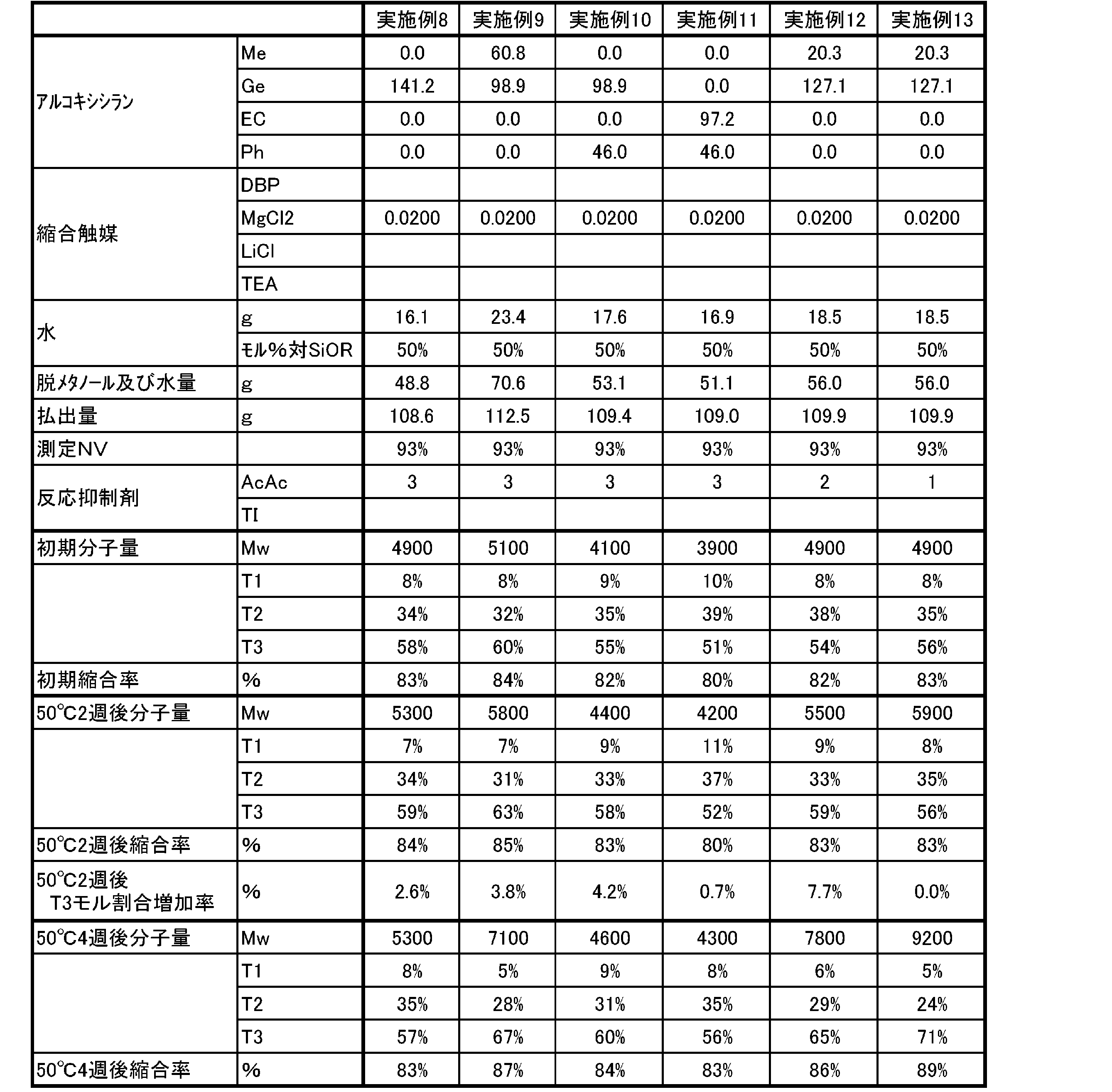
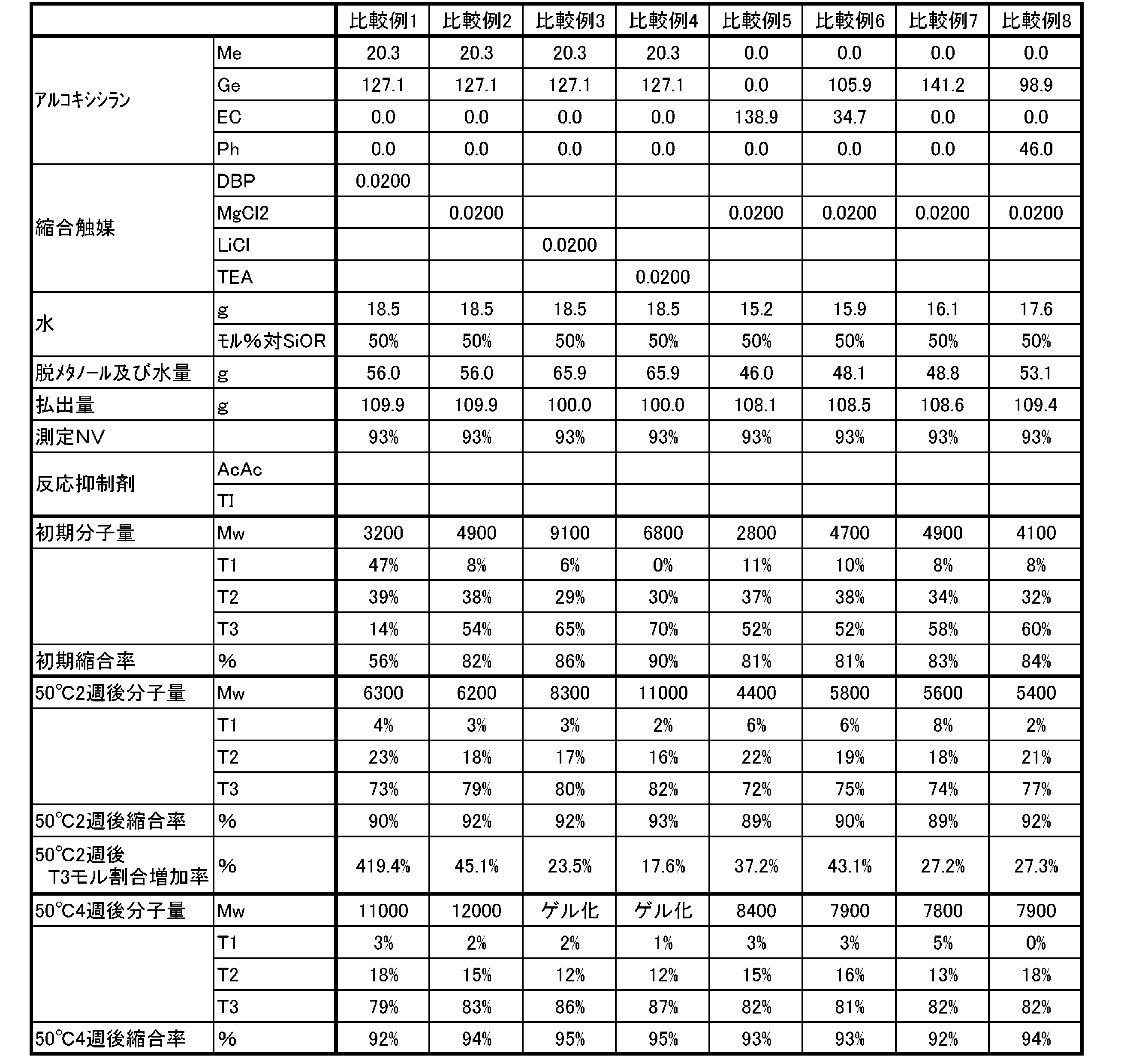
ポリオルガノシロキサンに対して本発明の脱水縮合反応抑制剤を添加した各実施例では、50℃で2週間貯蔵によるT3のモル割合の増加率が小さく、シラノール基の脱水縮合反応の進行が抑制されていた。一方、該反応抑制剤を添加しなかった各比較例では、50℃で2週間貯蔵によるT3のモル割合の増加率が大きく、シラノール基の脱水縮合反応の進行が充分に抑制されていなかった。また、比較例のなかで、50℃で2週間貯蔵によるT3のモル割合の増加率が比較的小さかった比較例3及び4でさえも、50℃で4週間貯蔵によりポリオルガノシロキサンがゲル化したことから、シラノール基の脱水縮合反応の進行が充分に抑制されていなかったことが分かる。
Claims (11)
- β-ジカルボニル化合物及び/又はスルフォニルイソシアネート化合物からなる、シラノール基の脱水縮合反応抑制剤。
- シラノール基を有する化合物を含む系に、β-ジカルボニル化合物及び/又はスルフォニルイソシアネート化合物を添加することによって、前記シラノール基の脱水縮合反応の進行を抑制する方法。
- モノオルガノトリアルコキシシラン及び/又はジオルガノジアルコキシシランを含有するアルコキシシラン成分を水の存在下、加水分解及び脱水縮合反応させて、シラノール基を有するポリオルガノシロキサンを形成する工程、
シラノール基の脱水縮合反応抑制剤としてβ-ジカルボニル化合物及び/又はスルフォニルイソシアネート化合物を前記ポリオルガノシロキサンに添加する工程、を含む、シラノール基を有するポリオルガノシロキサンの製造方法。 - 前記水の添加量が、前記アルコキシシラン成分に含まれる、ケイ素原子に直結したアルコキシ基の合計モル数100%に対して、30モル%以上60モル%以下である、請求項3に記載の製造方法。
- 前記加水分解及び脱水縮合反応を、縮合触媒として塩基性化合物及び/又は中性塩の存在下で実施し、前記反応抑制剤がβ-ジカルボニル化合物である、請求項3又は4に記載の製造方法。
- 前記加水分解及び脱水縮合反応を、縮合触媒の不在下、又は、縮合触媒として酸性化合物の存在下で実施し、前記反応抑制剤がスルフォニルイソシアネート化合物である、請求項3又は4に記載の製造方法。
- 前記加水分解反応により発生したアルコールのうち80モル%以上を除去した後に、前記スルフォニルイソシアネート化合物を添加する、請求項6に記載の製造方法。
- モノオルガノトリアルコキシシラン70モル%以上100モル%以下及びジオルガノジアルコキシシラン0モル%以上30モル%以下を含有するアルコキシシラン成分の加水分解縮合物であり、
前記モノオルガノトリアルコキシシランに由来する構成単位を、シロキサン結合を1個形成している構成単位T1、シロキサン結合を2個形成している構成単位T2、及び、シロキサン結合を3個形成している構成単位T3に分類した時、29Si-NMRにより測定されたT1、T2、及びT3の合計モル数に対するT3のモル数の割合が10%以上70%以下で、かつ
シラノール基を有するポリオルガノシロキサン、並びに
前記ポリオルガノシロキサン100重量部に対して、0.1重量部以上10重量部以下のβ-ジカルボニル化合物及び/又はスルフォニルイソシアネート化合物、を含有する、組成物。 - 前記組成物を50℃で2週間保持する前後で、29Si-NMRにより測定されたT1、T2、及びT3の合計モル数に対するT3のモル数の割合の増加率が15%以下である、請求項8に記載の組成物。
- 請求項8又は9に記載の組成物を含むA液と、縮合触媒を含むB液から構成される、2液型の組成物。
- シラノール基を有する化合物、並びに、β-ジカルボニル化合物及び/又はスルフォニルイソシアネート化合物を含む組成物に、前記シラノール基を有する化合物100重量部に対して0.5重量部以上の縮合触媒を添加することによって、前記シラノール基の脱水縮合反応を促進する方法。
Priority Applications (2)
| Application Number | Priority Date | Filing Date | Title |
|---|---|---|---|
| CN202080022585.0A CN113631637A (zh) | 2019-03-28 | 2020-03-26 | 硅烷醇基的脱水缩合反应抑制剂及抑制方法、以及含硅烷醇基的聚有机硅氧烷的制造方法及其组合物 |
| JP2021509587A JP7418411B2 (ja) | 2019-03-28 | 2020-03-26 | シラノール基含有ポリオルガノシロキサンの製造方法及びその組成物 |
Applications Claiming Priority (2)
| Application Number | Priority Date | Filing Date | Title |
|---|---|---|---|
| JP2019064114 | 2019-03-28 | ||
| JP2019-064114 | 2019-03-28 |
Publications (1)
| Publication Number | Publication Date |
|---|---|
| WO2020196751A1 true WO2020196751A1 (ja) | 2020-10-01 |
Family
ID=72611639
Family Applications (1)
| Application Number | Title | Priority Date | Filing Date |
|---|---|---|---|
| PCT/JP2020/013658 Ceased WO2020196751A1 (ja) | 2019-03-28 | 2020-03-26 | シラノール基の脱水縮合反応抑制剤及び抑制方法、並びに、シラノール基含有ポリオルガノシロキサンの製造方法及びその組成物 |
Country Status (3)
| Country | Link |
|---|---|
| JP (1) | JP7418411B2 (ja) |
| CN (1) | CN113631637A (ja) |
| WO (1) | WO2020196751A1 (ja) |
Families Citing this family (1)
| Publication number | Priority date | Publication date | Assignee | Title |
|---|---|---|---|---|
| CN115215898B (zh) * | 2022-07-29 | 2024-12-27 | 山东阳谷华泰化工股份有限公司 | 一种生产巯丙基三乙氧基硅烷的方法 |
Citations (3)
| Publication number | Priority date | Publication date | Assignee | Title |
|---|---|---|---|---|
| JPS58108227A (ja) * | 1981-10-29 | 1983-06-28 | ゼネラル・エレクトリツク・カンパニイ | アルコキシシランの加水分解法 |
| JPH09279046A (ja) * | 1995-12-23 | 1997-10-28 | Ara Werk Kraemer Gmbh | 水分の存在下で架橋可能なシリコーン系組成物 |
| JP2017186544A (ja) * | 2016-03-31 | 2017-10-12 | Koa株式会社 | 熱硬化型シリコーンレジンペースト組成物およびその使用 |
Family Cites Families (3)
| Publication number | Priority date | Publication date | Assignee | Title |
|---|---|---|---|---|
| EP0819749B8 (en) * | 1996-07-18 | 2008-02-13 | Bostik B.V. | Adhesive composition |
| KR20100058458A (ko) * | 2007-07-06 | 2010-06-03 | 요툰 에이/에스 | 분지된 폴리머 및 상기 폴리머를 포함하는 방오 코팅 조성물 |
| DE102016111590A1 (de) * | 2016-06-24 | 2017-12-28 | Delo Industrie Klebstoffe Gmbh & Co. Kgaa | Einkomponentenmasse auf Basis von Alkoxysilanen und Verfahren zum Fügen oder Vergießen von Bauteilen unter Verwendung der Masse |
-
2020
- 2020-03-26 JP JP2021509587A patent/JP7418411B2/ja active Active
- 2020-03-26 CN CN202080022585.0A patent/CN113631637A/zh active Pending
- 2020-03-26 WO PCT/JP2020/013658 patent/WO2020196751A1/ja not_active Ceased
Patent Citations (3)
| Publication number | Priority date | Publication date | Assignee | Title |
|---|---|---|---|---|
| JPS58108227A (ja) * | 1981-10-29 | 1983-06-28 | ゼネラル・エレクトリツク・カンパニイ | アルコキシシランの加水分解法 |
| JPH09279046A (ja) * | 1995-12-23 | 1997-10-28 | Ara Werk Kraemer Gmbh | 水分の存在下で架橋可能なシリコーン系組成物 |
| JP2017186544A (ja) * | 2016-03-31 | 2017-10-12 | Koa株式会社 | 熱硬化型シリコーンレジンペースト組成物およびその使用 |
Also Published As
| Publication number | Publication date |
|---|---|
| JPWO2020196751A1 (ja) | 2020-10-01 |
| CN113631637A (zh) | 2021-11-09 |
| JP7418411B2 (ja) | 2024-01-19 |
Similar Documents
| Publication | Publication Date | Title |
|---|---|---|
| US7193026B2 (en) | Organosilicon compound-curing composition and silicone-base coating composition | |
| WO1996011988A1 (en) | Powder coating resin composition | |
| KR20210046021A (ko) | 오가노폴리실록산 화합물을 함유하는 조성물, 그 제조 방법, 코팅제 및 피복 물품 | |
| JP7401977B2 (ja) | ポリオルガノシロキサン及びその製造方法、並びに塗料用組成物 | |
| US6541562B1 (en) | Aqueous paint composition | |
| JP7418411B2 (ja) | シラノール基含有ポリオルガノシロキサンの製造方法及びその組成物 | |
| US12319815B2 (en) | Resin composition, method for producing same, and multi-liquid curable resin composition | |
| CN115461412B (zh) | 含有有机聚硅氧烷的组合物、其制造方法、涂覆剂和被覆物品 | |
| JP7433295B2 (ja) | 有機無機複合樹脂の製造方法 | |
| WO2019151469A1 (ja) | 硬化性樹脂組成物、及びその製造方法 | |
| JP5804636B2 (ja) | 塗料用樹脂組成物及び塗料 | |
| JP7548060B2 (ja) | 塗料組成物および被覆物品 | |
| JP2021172707A (ja) | オルガノポリシロキサン、該オルガノポリシロキサンを含有する組成物、その製造方法、コーティング剤および被覆物品 | |
| CN115667371B (zh) | 有机聚硅氧烷及其制造方法、硬化性组合物、硬化物、涂布剂、具有被覆层的物品 | |
| JP7686465B2 (ja) | ポリシロキサンの製造方法、およびポリシロキサンの利用 | |
| CA1187239A (en) | Coating composition and primer | |
| WO2021145064A1 (ja) | 樹脂組成物、その製造方法、及び、多液型硬化性樹脂組成物 | |
| WO2020152976A1 (ja) | オルガノポリシロキサン化合物を含有する組成物 | |
| JP7528887B2 (ja) | 塗料組成物、被覆物品および硬化膜の形成方法 | |
| JP3017970B2 (ja) | 有機無機複合樹脂の製造方法 | |
| WO2022202173A1 (ja) | 硬化性樹脂組成物およびその利用 | |
| JP3900453B2 (ja) | 有機無機複合樹脂の製造方法及びコーティング組成物 | |
| JP2001122971A (ja) | 有機無機複合樹脂水性エマルジョンの製造方法及びコーティング組成物 | |
| JP2019178277A (ja) | 硬化性樹脂組成物、及びその製造方法 | |
| JP2013127028A (ja) | 塗料用樹脂組成物及び塗料 |
Legal Events
| Date | Code | Title | Description |
|---|---|---|---|
| 121 | Ep: the epo has been informed by wipo that ep was designated in this application |
Ref document number: 20778091 Country of ref document: EP Kind code of ref document: A1 |
|
| ENP | Entry into the national phase |
Ref document number: 2021509587 Country of ref document: JP Kind code of ref document: A |
|
| NENP | Non-entry into the national phase |
Ref country code: DE |
|
| 122 | Ep: pct application non-entry in european phase |
Ref document number: 20778091 Country of ref document: EP Kind code of ref document: A1 |