WO2020195003A1 - モータ - Google Patents
モータ Download PDFInfo
- Publication number
- WO2020195003A1 WO2020195003A1 PCT/JP2020/000562 JP2020000562W WO2020195003A1 WO 2020195003 A1 WO2020195003 A1 WO 2020195003A1 JP 2020000562 W JP2020000562 W JP 2020000562W WO 2020195003 A1 WO2020195003 A1 WO 2020195003A1
- Authority
- WO
- WIPO (PCT)
- Prior art keywords
- radial
- magnetizing
- rotor magnet
- magnetized
- rotor
- Prior art date
- Legal status (The legal status is an assumption and is not a legal conclusion. Google has not performed a legal analysis and makes no representation as to the accuracy of the status listed.)
- Ceased
Links
Images

Classifications
-
- H—ELECTRICITY
- H02—GENERATION; CONVERSION OR DISTRIBUTION OF ELECTRIC POWER
- H02K—DYNAMO-ELECTRIC MACHINES
- H02K1/00—Details of the magnetic circuit
- H02K1/06—Details of the magnetic circuit characterised by the shape, form or construction
- H02K1/22—Rotating parts of the magnetic circuit
- H02K1/27—Rotor cores with permanent magnets
- H02K1/2706—Inner rotors
- H02K1/272—Inner rotors the magnetisation axis of the magnets being perpendicular to the rotor axis
- H02K1/274—Inner rotors the magnetisation axis of the magnets being perpendicular to the rotor axis the rotor consisting of two or more circumferentially positioned magnets
- H02K1/2753—Inner rotors the magnetisation axis of the magnets being perpendicular to the rotor axis the rotor consisting of two or more circumferentially positioned magnets the rotor consisting of magnets or groups of magnets arranged with alternating polarity
- H02K1/278—Surface mounted magnets; Inset magnets
- H02K1/2783—Surface mounted magnets; Inset magnets with magnets arranged in Halbach arrays
-
- H—ELECTRICITY
- H02—GENERATION; CONVERSION OR DISTRIBUTION OF ELECTRIC POWER
- H02K—DYNAMO-ELECTRIC MACHINES
- H02K11/00—Structural association of dynamo-electric machines with electric components or with devices for shielding, monitoring or protection
- H02K11/20—Structural association of dynamo-electric machines with electric components or with devices for shielding, monitoring or protection for measuring, monitoring, testing, protecting or switching
- H02K11/21—Devices for sensing speed or position, or actuated thereby
- H02K11/215—Magnetic effect devices, e.g. Hall-effect or magneto-resistive elements
-
- H—ELECTRICITY
- H02—GENERATION; CONVERSION OR DISTRIBUTION OF ELECTRIC POWER
- H02K—DYNAMO-ELECTRIC MACHINES
- H02K21/00—Synchronous motors having permanent magnets; Synchronous generators having permanent magnets
- H02K21/12—Synchronous motors having permanent magnets; Synchronous generators having permanent magnets with stationary armatures and rotating magnets
- H02K21/14—Synchronous motors having permanent magnets; Synchronous generators having permanent magnets with stationary armatures and rotating magnets with magnets rotating within the armatures
- H02K21/16—Synchronous motors having permanent magnets; Synchronous generators having permanent magnets with stationary armatures and rotating magnets with magnets rotating within the armatures having annular armature cores with salient poles
Definitions
- the present invention relates to a motor.
- the permanent magnets described in Patent Document 1 include an N-pole magnet in which the radial outer magnetic pole is an N-pole, an S-pole magnet in which the radial outer magnetic pole is an S-pole, and an N-pole magnet and an S-pole magnet. It is composed of an auxiliary magnet located between the magnets and magnetized so that the magnetization direction is from the S pole magnet to the N pole magnet, and the Halbach arrangement is formed.
- the permanent magnets arranged in the Halbach array like the permanent magnets of Patent Document 1 have a stronger magnetic field strength on the outer side in the radial direction.
- a magnetic sensor for detecting the magnetic field of the permanent magnet fixed to the rotor core may be provided.
- the magnetic sensor in order to avoid interference with the magnetic field generated from the coil, the magnetic sensor may be arranged on the side opposite to the side where the stator is arranged with respect to the permanent magnet, that is, on the radial inside of the permanent magnet.
- the permanent magnets are arranged in a Halbach array, the magnetic field strength of the permanent magnets is strengthened on the radial outer side where the stator is arranged, while it is weaker on the radial inner side. Therefore, it is difficult for the magnetic sensor to detect the magnetic field of the permanent magnet inside the radial direction of the permanent magnet, and there is a problem that the detection accuracy of the magnetic sensor is lowered.
- one of the objects of the present invention is to provide a motor having a structure capable of suppressing a decrease in detection accuracy of a magnetic sensor.
- One embodiment of the motor of the present invention includes a rotor core, a rotor having a rotor magnet fixed to the rotor core and rotatable about a central axis, a stator located on one side in the radial direction of the rotor, and the like. It includes a magnetic sensor capable of detecting the magnetic field of the rotor magnet.
- the rotor magnet has a plurality of magnetized portions arranged along the circumferential direction in a Halbach array that strengthens the magnetic field strength on one side in the radial direction.
- the plurality of magnetized portions include a plurality of radial magnetized portions whose magnetization direction is the radial direction, and a plurality of non-radial magnetized portions whose magnetization directions are different from the radial direction.
- the radial magnetizing portion includes a first radial magnetizing portion and a second radial magnetizing portion in which magnetic poles on both sides in the radial direction are arranged in reverse with respect to the first radial magnetizing portion.
- the first radial magnetizing portion and the second radial magnetizing portion are alternately arranged along the circumferential direction with at least one non-radial magnetizing portion interposed therebetween.
- the magnetic sensor is located on the other side in the radial direction with respect to the rotor magnet.
- a non-magnetizing portion is provided in the axial portion of the rotor magnet in which the magnetic field is detected by the magnetic sensor.
- the non-magnetized portion is located between the first radial magnetized portion and the second radial magnetized portion in the circumferential direction.
- FIG. 1 is a cross-sectional view showing a rotary wing device of the present embodiment.
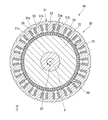
- FIG. 2 is a cross-sectional view showing the rotor and the stator of the present embodiment, and is a cross-sectional view taken along the line II-II in FIG.
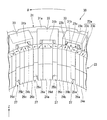
- FIG. 3 is a perspective view showing a part of the rotor magnet and a part of the stator of the present embodiment.
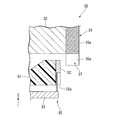
- FIG. 4 is a cross-sectional view showing a part of the motor of the present embodiment.
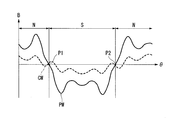
- FIG. 5 is a graph showing an example of the detection result by the magnetic sensor of the present embodiment.
- the Z-axis direction appropriately shown in each figure is a vertical direction in which the positive side is the "upper side” and the negative side is the “lower side”.
- the central axis J appropriately shown in each figure is a virtual line that is parallel to the Z-axis direction and extends in the vertical direction.
- the axial direction of the central axis J that is, the direction parallel to the vertical direction
- the radial direction centered on the central axis J is simply referred to as "radial direction”.
- the circumferential direction centered on is simply called the "circumferential direction”.
- the side that advances counterclockwise in the circumferential direction when viewed from the upper side to the lower side is called “one side in the circumferential direction”.
- the side that moves clockwise in the circumferential direction when viewed from the upper side to the lower side is called the “other side in the circumferential direction”.
- One side in the circumferential direction is the side that advances in the direction of the arrow indicating the rotation angle ⁇ in FIGS. 2 and 3.
- the other side in the circumferential direction is the side that advances in the direction opposite to the direction of the arrow indicating the rotation angle ⁇ in FIGS. 2 and 3.
- the lower side corresponds to one side in the axial direction
- the upper side corresponds to the other side in the axial direction
- the outer side in the radial direction corresponds to one side in the radial direction
- the inner side in the radial direction corresponds to the other side in the radial direction.
- the vertical direction, the upper side, and the lower side are names for simply explaining the arrangement relationship of each part, and the actual arrangement relationship, etc. is an arrangement relationship other than the arrangement relationship, etc. indicated by these names. You may.
- the motor 10 of this embodiment is mounted on the rotary blade device 1.
- the rotary wing device 1 is mounted on an unmanned aerial vehicle, for example.
- the rotary blade device 1 includes a motor 10 and a propeller 2.
- the motor 10 is an inner rotor type motor.
- the motor 10 includes a housing 40, a stator 30, a bus bar assembly 60, a rotor 20, a first bearing 71, a second bearing 72, a propeller mounting portion 80, and a sensor assembly 50.
- the housing 40 internally houses the rotor 20, the stator 30, the sensor assembly 50, the bus bar assembly 60, the first bearing 71, and the second bearing 72.
- a plurality of fins 45 arranged along the circumferential direction are provided on the outer peripheral surface of the housing 40.
- the stator 30 is located radially outside the rotor 20.
- the stator 30 has a stator core 31, an insulator 32, and a plurality of coils 33.
- the stator core 31 has a core back 31a and a plurality of teeth 31b.
- the core back 31a is an annular shape surrounding the central axis J.
- the core back 31a is, for example, an annular shape centered on the central axis J.
- the plurality of teeth 31b extend radially inward from the core back 31a.
- the plurality of teeth 31b are arranged at equal intervals along the circumferential direction. For example, 18 teeth 31b are provided.
- the plurality of coils 33 are mounted on the stator core 31 via the insulator 32. More specifically, the plurality of coils 33 are respectively mounted on the plurality of teeth 31b via the insulator 32. In addition, in FIGS. 2 and 3, the insulator 32 is not shown.
- the bus bar assembly 60 is located below the stator 30.
- the bus bar assembly 60 is located radially outside the sensor assembly 50.
- the bus bar assembly 60 has a bus bar holder 61 and a bus bar 62.
- the bus bar holder 61 holds the bus bar 62.
- the bus bar 62 is electrically connected to the coil 33.
- the rotor 20 can rotate about the central axis J.
- the rotor 20 is located inside the stator 30 in the radial direction.
- the rotor 20 includes a shaft 21, a rotor core 22, and a rotor magnet 23.
- the shaft 21 is arranged along the central axis J.
- the shaft 21 is a columnar shape extending in the axial direction about the central axis J. The upper end of the shaft 21 projects upward from the housing 40.
- the rotor core 22 is fixed to the outer peripheral surface of the shaft 21.
- the rotor core 22 is an annular shape surrounding the central axis J.
- the rotor core 22 is an annular shape centered on the central axis J.
- the rotor magnet 23 is fixed to the rotor core 22.
- the rotor magnet 23 has a tubular shape that surrounds the rotor core 22.
- the rotor magnet 23 has, for example, a cylindrical shape extending in the axial direction about the central axis J and opening on both sides in the axial direction.
- the inner peripheral surface of the rotor magnet 23 is fixed to the outer peripheral surface of the rotor core 22 with, for example, an adhesive.
- the lower end of the rotor magnet 23 is located below the lower end of the rotor core 22 and the lower end of the stator core 31.
- the upper end portion of the rotor magnet 23 is located at the same position in the axial direction as the upper end portion of the rotor core 22.
- the rotor magnet 23 has a plurality of magnetized portions 23a.
- the plurality of magnetized portions 23a are magnets that are separate members from each other.
- the rotor magnet 23 is configured by connecting a plurality of magnetizing portions 23a along the circumferential direction.
- the plurality of magnetized portions 23a are, for example, square pillars extending in the axial direction.
- Each of the magnetized portions 23a is configured, for example, by connecting two magnets in the axial direction.
- the circumferential dimension of the magnetized portion 23a is smaller than the circumferential dimension of the teeth 31b.
- four or five magnetized portions 23a can simultaneously face each other in the radial direction with respect to one tooth 31b.
- 80 magnetized portions 23a are provided.
- the plurality of magnetized portions 23a are arranged along the circumferential direction in a Halbach array that strengthens the magnetic field strength on the outer side in the radial direction.
- the plurality of magnetizing portions 23a include a plurality of radial magnetizing portions 23b and a plurality of non-radial magnetizing portions 23c.
- the radial magnetization portion 23b is a magnetization portion 23a whose magnetization direction is the radial direction.
- the non-radial magnetization portion 23c is a magnetization portion 23a whose magnetization direction is different from that in the radial direction.
- the magnetization direction of the magnetized portion 23a is virtually indicated by an arrow on the upper end face of the magnetized portion 23a.
- the direction of the arrow virtually shown indicates the direction from the S pole to the N pole in the magnetized portion 23a. That is, the magnetic pole of the magnetized portion 23a has an north pole on the side to which the virtually indicated arrow points, and an south pole on the side opposite to the side to which the virtually indicated arrow points.
- the direction of the arrow virtually shown that is, the direction from the S pole to the N pole in the magnetizing portion 23a is simply referred to as "the direction of the magnetization direction”.
- the radial magnetization portion 23b includes a first radial magnetization portion 24a and a second radial magnetization portion 24b.
- the direction of the magnetization direction of the first radial magnetization portion 24a is the radial inward direction. That is, the magnetic pole of the first radial magnetizing portion 24a has an N pole on the inner side in the radial direction and an S pole on the outer side in the radial direction.
- the direction of the magnetizing direction of the second radial magnetizing portion 24b is outward in the radial direction. That is, the magnetic pole of the second radial magnetizing portion 24b has an N pole on the outer side in the radial direction and an S pole on the inner side in the radial direction.
- the magnetic poles on both sides in the radial direction are arranged in reverse with respect to the first radial magnetizing portion 24a.
- the first radial magnetizing portion 24a and the second radial magnetizing portion 24b are alternately arranged along the circumferential direction with at least one non-radial magnetizing portion 23c sandwiched between them.
- the first radial magnetizing portion 24a and the second radial magnetizing portion 24b are alternately arranged along the circumferential direction with the three non-radial magnetizing portions 23c sandwiched between them.
- the non-diameter magnetizing portion 23c includes a first non-diameter magnetizing portion 25a, 25b and a second non-diameter magnetizing portion 26a, 26b, 26c, 26d.
- the magnetization directions of the first non-radial magnetization portions 25a and 25b are circumferential directions.
- the direction of the magnetization direction of the first non-radial magnetization portion 25a is one side (+ ⁇ side) in the circumferential direction. That is, the magnetic poles of the first non-diameter magnetizing portion 25a have an N pole on one side in the circumferential direction and an S pole on the other side ( ⁇ side) in the circumferential direction.
- the direction of the first non-radial magnetization portion 25b in the magnetization direction is the other side in the circumferential direction. That is, the magnetic poles of the first non-diameter magnetizing portion 25b have an N pole on the other side in the circumferential direction and an S pole on one side in the circumferential direction. In the first non-radial magnetizing portion 25b, the magnetic poles on both sides in the circumferential direction are arranged in reverse with respect to the first non-radial magnetizing portion 25a.
- the first non-radial magnetized portions 25a and 25b are located between the first radial magnetized portion 24a and the second radial magnetized portion 24b, respectively.
- the first non-diameter magnetizing portion 25a and the first non-diameter magnetizing portion 25b sandwich each other of the first radial magnetizing portion 24a and the second radial magnetizing portion 24b in the circumferential direction. Arranged alternately.
- the first non-radial magnetization portion 25a is located on one side (+ ⁇ side) of the first radial magnetization portion 24a in the circumferential direction between the first radial magnetization portion 24a and the second radial magnetization portion 24b.
- the first non-radial magnetized portion 25b is located on the other side of the first radial magnetized portion 24a in the circumferential direction between the circumferential direction of the first radial magnetized portion 24a and the second radial magnetized portion 24b. It is located on one side of the circumferential magnetization portion 24b in the radial direction.
- the north poles of the first non-radial magnetized portions 25a and 25b are located on the side where the second radial magnetized portion 24b is located between the circumferential direction of the first radial magnetized portion 24a and the second radial magnetized portion 24b. Be placed.
- the S poles of the first non-radial magnetized portions 25a and 25b are located on the side where the first radial magnetized portion 24a is located between the circumferential direction of the first radial magnetized portion 24a and the second radial magnetized portion 24b. Be placed.
- the magnetization directions of the second non-radial magnetization portions 26a, 26b, 26c, and 26d are directions that intersect both the radial direction and the circumferential direction.
- the magnetization directions of the second non-radial magnetization portions 26a, 26b, 26c, and 26d are orthogonal to the axial direction.
- the magnetization directions of the second non-radial magnetization portions 26a, 26b, 26c, and 26d are in a direction inclined by 45 ° in the circumferential direction with respect to the radial direction.
- the magnetization directions of the second non-radial magnetization portions 26a and 26c are directions that are located on one side (+ ⁇ side) in the circumferential direction toward the inner side in the radial direction.
- the magnetization directions of the second non-radial magnetization portions 26b and 26d are directions that are located on the other side ( ⁇ side) in the circumferential direction toward the inner side in the radial direction.
- the direction of the magnetization direction of the second non-radial magnetization portions 26a, 26b, 26c, 26d is the circumferential direction with respect to the direction of the magnetization direction of the magnetizing portions 23a adjacent to one side (+ ⁇ side) of the circumferential direction.
- the magnetization portion 23a adjacent to the other side ( ⁇ side) is inclined by 45 ° toward the magnetization direction.
- the direction of the second non-radial magnetization portion 26a in the magnetization direction is one side (+ ⁇ side) in the radial inner diagonal circumferential direction. That is, the second non-radial magnetizing portion 26a has an N pole on the inner side in the radial direction and one side in the circumferential direction, and an S pole on the outer side in the radial direction and the other side in the circumferential direction ( ⁇ side).
- the direction of the magnetizing direction of the second non-radial magnetization portion 26b is one side in the radial outer diagonal circumferential direction.
- the second non-radial magnetizing portion 26b has an N pole on the outer side in the radial direction and one side in the circumferential direction, and an S pole on the inner side in the radial direction and the other side in the circumferential direction.
- the direction of the magnetizing direction of the second non-radial magnetization portion 26c is the radial outer diagonal circumferential direction opposite side. That is, the second non-radial magnetizing portion 26c has an N pole on the outer side in the radial direction and the other side in the circumferential direction, and an S pole on the inner side in the radial direction and one side in the circumferential direction.
- the direction of the second non-radial magnetization portion 26d in the magnetization direction is the other side in the radial inner diagonal circumferential direction. That is, the second non-radial magnetizing portion 26d has an N pole on the inner side in the radial direction and the other side in the circumferential direction, and an S pole on the outer side in the radial direction and one side in the circumferential direction.
- the second non-diameter magnetizing portions 26a and 26b are arranged adjacent to each other on both sides of the first non-diameter magnetizing portion 25a in the circumferential direction.
- the second non-diameter magnetizing portions 26c and 26d are arranged adjacent to each other on both sides of the first non-diameter magnetizing portion 25b in the circumferential direction.
- the second non-radial magnetizing portions 26a and 26d are arranged adjacent to each other on both sides of the first radial magnetizing portion 24a in the circumferential direction.
- the second non-radial magnetizing portions 26b and 26c are arranged adjacent to each other on both sides of the second radial magnetizing portion 24b in the circumferential direction.
- the second non-diameter magnetizing portion 26a is located between the first radial magnetizing portion 24a and the first non-diameter magnetizing portion 25a in the circumferential direction.
- the second non-diameter magnetizing portion 26b is located between the second radial magnetizing portion 24b and the first non-diameter magnetizing portion 25a in the circumferential direction.
- the second non-diameter magnetizing portion 26c is located between the second radial magnetizing portion 24b and the first non-diameter magnetizing portion 25b in the circumferential direction.
- the second non-diameter magnetizing portion 26d is located between the first radial magnetizing portion 24a and the first non-diameter magnetizing portion 25b in the circumferential direction.
- the second non-diameter magnetized portions 26a, 26b, 26c, 26d are located between the radial magnetizing portions 23b and the first non-diameter magnetizing portions 25a, 25b in the circumferential direction.
- a plurality of arrangement patterns in which a plurality of magnetized portions 23a are arranged along the circumferential direction are continuously formed over one circumference.
- the arrangement pattern of the magnetized portions 23a constituting the rotor magnet 23 is as follows: a first radial magnetized portion 24a, a second non-radial magnetized portion 26a, a first non-radial magnetized portion 25a, and a second non-radial magnetized portion.
- the 26b, the second radial magnetizing portion 24b, the second non-radial magnetizing portion 26c, the first non-radial magnetizing portion 25b, and the second non-radial magnetizing portion 26d are oriented toward one side in the circumferential direction. It is an arrangement pattern arranged in order.
- the rotor magnets 23 are arranged in a Halbach array that strengthens the magnetic field strength on the outer side in the radial direction. Therefore, the magnetic force generated between the rotor 20 and the stator 30 can be increased, and the output of the motor 10 can be improved.
- the axial dimension of the radial magnetizing portion 23b and the axial dimension of the second non-radial magnetizing portion 26a, 26b, 26c, 26d are the same as each other.
- the axial dimensions of the first non-radial magnetized portions 25a, 25b are larger than the axial dimensions of the radial magnetized portions 23b and the axial dimensions of the second non-radial magnetized portions 26a, 26b, 26c, 26d. small.
- the upper end of the second non-radial magnetized portion 26a, 26b, 26c, 26d is located at the same axial position as the upper end of the radial magnetized portion 23b.
- the lower end of the second non-radial magnetized portion 26a, 26b, 26c, 26d is located at the same axial position as the lower end of the radial magnetized portion 23b.
- the upper ends of the first non-radial magnetized portions 25a and 25b are the upper ends of the radial magnetized portions 23b and the upper ends of the second non-radial magnetized portions 26a, 26b, 26c and 26d in the axial direction. Is located in the same position.
- first non-radial magnetized portions 25a, 25b are the lower end of the radial magnetized portion 23b and the lower end of the second non-radial magnetized portions 26a, 26b, 26c, 26d. Located above. Therefore, void portions 27 are provided below the first non-radial magnetization portions 25a and 25b, respectively.
- the gap portion 27 is provided at the lower end portion of the rotor magnet 23.
- the upper end portion of the gap portion 27, that is, the lower end portion of the first non-radial magnetization portions 25a and 25b is, for example, the same as the lower end portion of the rotor core 22 in the axial direction.
- the lower end portion of the rotor magnet 23 is the lower end portion of the first radial magnetization portion 24a and the lower end portion of the second radial magnetization portion 24b. It is composed of a portion and a lower end portion of the second non-radial magnetized portion 26a, 26b, 26c, 26d.
- the plurality of gaps 27 are arranged at equal intervals over one circumference along the circumferential direction.
- Each gap 27 is located between the first radial magnetization portion 24a and the second radial magnetization portion 24b in the circumferential direction.
- the gap portion 27 is a gap between the lower ends of the second non-radial magnetization portions 26a and 26b adjacent to each other on both sides of the first non-radial magnetization portion 25a in the circumferential direction, or the gap between the lower ends of the first non-radial magnetization portion 25b. It is a gap between the lower ends of the second non-radial magnetized portions 26c and 26d adjacent to each other on both sides in the circumferential direction.
- the lower end portion of the second non-diameter magnetizing portion 26a and the lower end portion of the second non-diameter magnetizing portion 26b face each other in the circumferential direction via the gap portion 27.
- the lower end of the second non-diameter magnetizing portion 26c and the lower end of the second non-diameter magnetizing portion 26d face each other in the circumferential direction via the gap 27.
- the void portion 27 corresponds to a non-magnetized portion.
- the "non-magnetized portion” may be a portion having no magnetic pole. That is, the non-magnetized portion may be a void portion as in the present embodiment, may be another unmagnetized member, or may be an unmagnetized portion of the rotor magnet. .. When the non-magnetized portion is an unmagnetized member, the unmagnetized member may be arranged in the gap provided as in the present embodiment.
- the first bearing 71 and the second bearing 72 rotatably support the rotor 20.
- the first bearing 71 and the second bearing 72 are, for example, ball bearings.
- the propeller mounting portion 80 is a portion to which the propeller 2 is mounted.
- the propeller mounting portion 80 is fixed to the upper end portion of the shaft 21.
- the propeller mounting portion 80 is located outside the housing 40.
- the sensor assembly 50 is located below the rotor core 22.
- the sensor assembly 50 includes a sensor holder 51, a circuit board 53, and a magnetic sensor 52. That is, the motor 10 includes a sensor holder 51, a circuit board 53, and a magnetic sensor 52.
- the circuit board 53 is fixed to the sensor holder 51.
- the circuit board 53 has a plate shape in which the plate surface faces the axial direction.
- the magnetic sensor 52 is located above the circuit board 53. As shown in FIG. 4, the magnetic sensor 52 has a terminal 52a extending downward. The terminal 52a is connected to the upper surface of the circuit board 53. As a result, the magnetic sensor 52 is electrically connected to the circuit board 53.
- the magnetic sensor 52 is held by the sensor holder 51.
- the magnetic sensor 52 is located below the rotor core 22.
- the magnetic sensor 52 is located radially inside the rotor magnet 23.
- the magnetic sensor 52 is located radially inside the lower end of the rotor magnet 23.
- the lower end portion of the rotor magnet 23 is located below the lower end portion of the rotor core 22. Therefore, the magnetic sensor 52 can be easily arranged inside the lower end portion of the rotor magnet 23 in the radial direction.
- the upper portion of the magnetic sensor 52 is located radially inside the lower end portion of the rotor magnet 23.
- the magnetic sensor 52 faces the lower end portion or the gap portion 27 of the rotor magnet 23 in the radial direction via a gap.
- the magnetic sensor 52 can detect the magnetic field of the rotor magnet 23.
- the magnetic sensor 52 can detect the magnetic field at the lower end of the rotor magnet 23 that faces the magnetic sensor 52 in the radial direction. That is, in the present embodiment, the axial portion of the rotor magnet 23 in which the magnetic field is detected by the magnetic sensor 52 is the lower end portion of the rotor magnet 23. Further, in the present embodiment, the gap portion 27 is provided in the axial portion of the rotor magnet 23 in which the magnetic field is detected by the magnetic sensor 52.
- the part of the rotor magnet in which the magnetic field is detected by the magnetic sensor means that when at least a part of the magnetic sensor is arranged at the same axial position as a part of the rotor magnet, the rotor Includes a portion of the magnet whose axial position is the same as the axial position of the magnetic sensor. That is, in the present embodiment, the lower end portion of the rotor magnet 23 has the same axial position as the upper portion of the magnetic sensor 52, and is included in the portion where the magnetic field is detected by the magnetic sensor 52.
- the portion of the rotor magnet in which the magnetic field is detected by the magnetic sensor is closer to the magnetic sensor of the rotor magnet when the magnetic sensor is located above or below the rotor magnet. Includes the axial end of the side. That is, when the magnetic sensor 52 is located below the rotor magnet 23, for example, the lower end of the rotor magnet 23, which is close to the magnetic sensor 52, receives a magnetic field by the magnetic sensor 52. It is included in the detected part.
- the magnetic sensor 52 is a Hall element such as a Hall IC.
- a plurality of magnetic sensors 52 are provided along the circumferential direction.
- the rotation of the rotor 20 can be detected by detecting the magnetic field of the rotor magnet 23 with the magnetic sensor 52.
- the rotation of the rotor 20 may be detected by the magnetic sensor 52 itself, or may be detected by another part based on the detection result of the magnetic sensor 52.
- the other portion is, for example, a control unit (not shown) provided on the circuit board 53.
- a magnet for detection by the magnetic sensor 52 is not separately provided in addition to the rotor magnet 23.
- the rotation of the rotor 20 can be detected. Therefore, the number of parts of the motor 10 can be reduced. Further, it is not necessary to consider the mounting accuracy of the magnet provided separately, and the motor 10 can be easily assembled.
- the rotor magnets have a Halbach array that strengthens the magnetic field strength on the radial outer side like the rotor magnet 23 of the present embodiment, magnetic flux does not easily flow on the radial inner side of the rotor magnet, and the magnetic field strength on the radial inner side of the rotor magnet. Becomes smaller. Therefore, it is difficult for the magnetic sensor to detect the magnetic field of the rotor magnet inside the rotor magnet in the radial direction.
- the waveform of the magnetic flux density B detected by the magnetic sensor on the inner side in the radial direction of the rotor magnet is The rotor magnet vibrates in a cycle shorter than the cycle in which the magnetic poles are switched while changing in the cycle in which the magnetic poles of the rotor magnet are switched between the N pole and the S pole. Therefore, the polarity of the magnetic flux density B is likely to be reversed before and after the points P1 and P2 where the magnetic poles of the rotor magnet are switched.
- the horizontal axis represents the rotation angle ⁇ of the rotor
- the vertical axis represents the magnetic flux density B detected by the magnetic sensor inside the rotor magnet in the radial direction.
- the magnetic flux density B is a positive value
- the magnetic pole on the inner side in the radial direction of the rotor magnet facing the magnetic sensor is the N pole
- the magnetic flux density B is a negative value.
- the magnetic pole on the inner side in the radial direction of the rotor magnet facing the magnetic sensor is the S pole.
- the waveform PW shown by the solid line in FIG. 5 is an example of the waveform of the magnetic flux density B when the magnetic field of the rotor magnet 23 of the present embodiment is detected by the magnetic sensor 52.
- the waveform CW shown by the broken line in FIG. 5 is an example of the waveform of the magnetic flux density B when the magnetic field of the rotor magnet in the comparative form is detected by the magnetic sensor 52.
- the rotor magnet of the comparative embodiment is the same as that of the rotor magnet 23 of the present embodiment except that the gap portion 27 is not provided.
- the first radial magnetization portion 24a and the second radial magnetization portion 24b A gap portion 27 is provided as a non-magnetizing portion located between the two. Since the gap portion 27 is a non-magnetized portion having no magnetic pole, the magnetic flux of the rotor magnet 23 tends to flow inward in the gap portion 27 in the radial direction. As a result, the amount of magnetic flux passing through the magnetic sensor 52 located radially inside the rotor magnet 23 can be increased, and the value of the magnetic flux density B detected by the magnetic sensor 52 can be increased. Therefore, the magnetic sensor 52 can easily detect the magnetic field of the rotor magnet 23.
- the vibration having a period shorter than the period in which the magnetic poles are switched can be suppressed as compared with the waveform CW in the comparative form.
- the non-magnetized portion is located between the circumferential direction of the first radial magnetized portion 24a and the second radial magnetized portion 24b in which the magnetizing directions are radial and the magnetic poles are arranged opposite to each other.
- the magnetic flux can be easily flowed in the radial direction between the portion where the magnetic pole on the inner side of the rotor magnet 23 is the N pole and the portion where the magnetic pole is the S pole, and the period is shorter than the period in which the magnetic poles are switched. It is especially easy to suppress the vibration of the magnet. As a result, it is possible to suppress the reversal of the polarity of the magnetic flux density B before and after the points P1 and P2 where the magnetic poles of the rotor magnet 23 are switched.
- the rotor magnet 23 is arranged in a Halbach array that strengthens the magnetic field strength on the outer side in the radial direction, by providing a non-magnetizing portion in the axial portion of the rotor magnet 23 in which the magnetic field is detected by the magnetic sensor 52, the rotor magnet 23 is more than the rotor magnet 23. It is possible to suppress a decrease in the detection accuracy of the magnetic sensor 52 in the radial direction. Therefore, according to the present embodiment, the rotor magnets 23 can be arranged in a Halbach array to improve the output of the motor 10, and the accuracy of detecting the rotational position of the rotor 20 can be improved.
- the points P1 and P2 at which the magnetic poles of the rotor magnet 23 are switched are, for example, the rotation angle ⁇ of the rotor 20 when the gap portion 27 faces the magnetic sensor 52 in the radial direction.
- the axial portion of the rotor magnet 23 in which the magnetic field is detected by the magnetic sensor 52 is the lower end portion of the rotor magnet 23, and the void portion 27 which is the non-magnetized portion is , Provided at the lower end of the rotor magnet 23. Therefore, it is easier to arrange the magnetic sensor 52 so as to face the rotor magnet 23 as compared with the case where the axial portion of the rotor magnet 23 in which the magnetic field is detected by the magnetic sensor 52 is the central portion in the axial direction. As a result, the magnetic field of the rotor magnet 23 can be suitably detected by the magnetic sensor 52 while suppressing the structure of the motor 10 from becoming complicated.
- the non-magnetizing portion is a gap portion 27 provided below the first non-radial magnetizing portions 25a and 25b. Therefore, for example, the non-magnetized portion can be easily provided by partially shortening the axial dimension of the magnetized portion 23a constituting the rotor magnet 23 as in the present embodiment. Therefore, the motor 10 can be easily manufactured.
- the axial dimensions of the first non-radial magnetized portions 25a and 25b are smaller than the axial dimensions of the radial magnetized portions 23b. Therefore, while providing the gaps 27 below the first non-diameter magnetized portions 25a and 25b, the upper ends of the first non-diameter magnetized portions 25a and 25b project upward from the radial magnetized portions 23b. Can be suppressed. As a result, it is possible to prevent the rotor 20 from increasing in size in the axial direction, and it is possible to prevent the motor 10 from increasing in size in the axial direction.
- the magnetization directions of the first non-radial magnetization portions 25a and 25b are the circumferential direction. Therefore, the first non-radial magnetization portions 25a and 25b guide the magnetic flux flowing between the first radial magnetization portion 24a and the second radial magnetization portion 24b in the circumferential direction in the rotor magnet 23, and the magnetic flux is radial. Leakage to the inside can be suitably suppressed. As a result, by providing the first non-radial magnetization portions 25a and 25b, the amount of magnetic flux on the radial outer side of the rotor magnets 23 arranged in the Halbach array can be suitably increased. Therefore, the output of the motor 10 can be further improved.
- the magnetic sensor 52 to detect the magnetic field of the rotor magnet 23 inside the axial portion of the rotor magnet 23 where the first non-radial magnetized portions 25a and 25b are provided, and the magnetic sensor 52 The detection accuracy tends to decrease.
- the lower end portion of the first non-radial magnetization portions 25a and 25b whose magnetization direction is the circumferential direction is higher than the lower end portion of the radial magnetization portion 23b.
- a gap portion 27, which is a non-magnetizing portion, is provided below the first non-magnetizing portions 25a and 25b. Therefore, at the lower end of the rotor magnet 23, the first non-magnetized portions 25a and 25b are not provided, but instead a gap portion 27 as a non-magnetized portion is provided.
- magnetic flux can be suitably flowed in the radial direction of the rotor magnet 23 at the lower end portion of the rotor magnet 23. Therefore, by detecting the magnetic field at the lower end of the rotor magnet 23 by the magnetic sensor 52, it is possible to further suppress the decrease in the detection accuracy of the magnetic sensor 52 in the radial direction inside the rotor magnet 23.
- the lower end portions of the second non-radial magnetization portions 26a, 26b, 26c, 26d whose magnetization directions intersect both the radial direction and the circumferential direction are the radial magnetization portions 23b. It is located at the same position in the axial direction as the lower end. Therefore, it is easy to increase the axial dimensions of the second non-radial magnetized portions 26a, 26b, 26c, 26d, and it is easy to increase the volume of the entire rotor magnet 23. Therefore, it is easy to increase the magnetic field strength on the outer side in the radial direction of the rotor magnet 23, and the output of the motor 10 can be further improved.
- the second non-diameter magnetized portions 26a, 26b, 26c, 26d have a smaller influence on the magnetic field strengthened by the Halbach array than the first non-diameter magnetized portions 25a, 25b whose magnetization direction is the circumferential direction. Therefore, if the first non-diameter magnetizing portions 25a and 25b are not provided by the gap portion 27, the second non-diameter magnetizing portions 26a, 26b, 26c and 26d are provided at the lower end portion of the rotor magnet 23. Also, the magnetic flux can be sufficiently flowed inward in the radial direction of the rotor magnet 23. Therefore, the second non-diameter magnetizing portions 26a, 26b, 26c, and 26d can further improve the output of the motor 10 and maintain the detection accuracy of the magnetic field by the magnetic sensor 52.
- the magnetic sensor 52 is located radially inside the lower end of the rotor magnet 23. Therefore, the magnetic sensor 52 can more easily detect the magnetic field at the lower end of the rotor magnet 23. Therefore, the detection accuracy of the magnetic sensor 52 can be further improved.
- the lower end portion of the rotor magnet 23 is located below the lower end portion of the stator core 31. Therefore, even if the gap portion 27 is provided as a non-magnetizing portion at the lower end portion of the rotor magnet 23, it is possible to suppress a decrease in the amount of magnetic flux flowing between the rotor 20 and the stator 30. Therefore, it is possible to suppress a decrease in the output of the motor 10.
- the present invention is not limited to the above-described embodiment, and the following configurations can also be adopted.
- the Halbach array applied to the rotor magnet is not particularly limited as long as it is a Halbach array that enhances the magnetic field strength on the outer side in the radial direction (one side in the radial direction).
- a Halbach array in which the second non-radial magnetizing portions 26a, 26b, 26c, 26d are not provided may be applied to the Halbach array of the above-described embodiment.
- Magnetized portions adjacent to each other in the circumferential direction may be arranged with a gap. The magnetized portions do not have to be separate members from each other. In this case, the rotor magnet may be a single member.
- the lower end (one side in the axial direction) of the rotor magnet may be positioned at the same position in the axial direction as the lower end of the rotor core, or at the same position in the axial direction as the lower end of the stator core. It may be located in.
- the non-magnetized portion is not particularly limited as long as it is provided in the axial portion of the rotor magnet where the magnetic field is detected by the magnetic sensor.
- the non-magnetized portion may be a void portion provided below the second non-radial magnetized portion 26a, 26b, 26c, 26d.
- the gap portion may be provided in place of the gap portion 27 provided below the first non-radial magnetizing portions 25a and 25b, or may be provided together with the gap portion 27.
- the number of non-magnetized portions is not particularly limited as long as it is one or more.
- the axial dimension of the first non-radial magnetized portion may be the same as the axial dimension of the radial magnetized portion.
- the void portion as the non-magnetized portion is placed below the first non-radial magnetized portion (one side in the axial direction). It may be provided in. According to this configuration, all the magnetized portions can have the same shape, so that a plurality of magnetized portions can be easily manufactured.
- the position of the magnetic sensor is not particularly limited as long as it is on the other side in the radial direction from the rotor magnet.
- the entire magnetic sensor may be arranged at an axial position different from that of the rotor magnet.
- the magnetic sensor 52 of the above-described embodiment may be located below the position shown in FIG. 4 and below the rotor magnet 23.
- the magnetic sensor may be located on the other side in the radial direction of the axially central portion of the rotor magnet.
- the number of magnetic sensors is not particularly limited as long as it is one or more.
- the magnetic sensor may be a magnetoresistive element.
- the inner rotor type motor 10 is adopted as a configuration in which one side in the radial direction is the outer side in the radial direction and the other side in the radial direction is the inner side in the radial direction, but the present invention is not limited to this.
- One side in the radial direction may be inside in the radial direction, and the other side in the radial direction may be outside in the radial direction.
- an outer rotor type motor can be adopted.
- the application of the motor is not particularly limited.
- the motor may be mounted on a vehicle or the like, for example.
Landscapes
- Engineering & Computer Science (AREA)
- Power Engineering (AREA)
- Microelectronics & Electronic Packaging (AREA)
- Permanent Field Magnets Of Synchronous Machinery (AREA)
Priority Applications (3)
| Application Number | Priority Date | Filing Date | Title |
|---|---|---|---|
| US17/442,621 US11863022B2 (en) | 2019-03-25 | 2020-01-10 | Motor |
| JP2021508095A JPWO2020195003A1 (https=) | 2019-03-25 | 2020-01-10 | |
| CN202080023888.4A CN113632341B (zh) | 2019-03-25 | 2020-01-10 | 马达 |
Applications Claiming Priority (2)
| Application Number | Priority Date | Filing Date | Title |
|---|---|---|---|
| JP2019057285 | 2019-03-25 | ||
| JP2019-057285 | 2019-03-25 |
Publications (1)
| Publication Number | Publication Date |
|---|---|
| WO2020195003A1 true WO2020195003A1 (ja) | 2020-10-01 |
Family
ID=72611308
Family Applications (1)
| Application Number | Title | Priority Date | Filing Date |
|---|---|---|---|
| PCT/JP2020/000562 Ceased WO2020195003A1 (ja) | 2019-03-25 | 2020-01-10 | モータ |
Country Status (4)
| Country | Link |
|---|---|
| US (1) | US11863022B2 (https=) |
| JP (1) | JPWO2020195003A1 (https=) |
| CN (1) | CN113632341B (https=) |
| WO (1) | WO2020195003A1 (https=) |
Families Citing this family (2)
| Publication number | Priority date | Publication date | Assignee | Title |
|---|---|---|---|---|
| US20230348087A1 (en) * | 2022-04-30 | 2023-11-02 | Beta Air, Llc | Systems and methods for locking an electric propulsion system |
| US11691745B1 (en) * | 2022-04-30 | 2023-07-04 | Beta Air, Llc | Systems and methods for locking an electric propulsion system |
Citations (4)
| Publication number | Priority date | Publication date | Assignee | Title |
|---|---|---|---|---|
| JPS60137374U (ja) * | 1984-02-23 | 1985-09-11 | 株式会社東芝 | 回転体の回転検出装置 |
| JP2006187116A (ja) * | 2004-12-27 | 2006-07-13 | Denso Corp | 電動車輪 |
| JP2018064371A (ja) * | 2016-10-12 | 2018-04-19 | 株式会社アテック | デュアルハルバッハ配列界磁 |
| JP2019022393A (ja) * | 2017-07-20 | 2019-02-07 | 株式会社デンソー | モータ |
Family Cites Families (14)
| Publication number | Priority date | Publication date | Assignee | Title |
|---|---|---|---|---|
| US7598646B2 (en) * | 2007-02-26 | 2009-10-06 | The Boeing Company | Electric motor with Halbach arrays |
| JP2010098891A (ja) | 2008-10-17 | 2010-04-30 | Asmo Co Ltd | モータ |
| EP2330724B1 (de) * | 2009-12-02 | 2012-08-29 | Ringfeder Power-Transmission GmbH | Permanentmagnetkupplung |
| CN102315707A (zh) * | 2010-07-06 | 2012-01-11 | 李贵祥 | 一种基于Halbach阵列的混合励磁高效电动机 |
| EP2693609B1 (en) * | 2011-03-28 | 2017-05-03 | Thoratec Corporation | Rotation and drive device and centrifugal pump device using same |
| EP2697895B1 (en) * | 2011-04-13 | 2019-09-04 | Boulder Wind Power, Inc. | Flux focusing arrangement for permanent magnets, methods of fabricating such arrangements, and machines including such arrangements |
| CN104185938B (zh) * | 2012-03-13 | 2018-01-02 | 博泽沃尔兹堡汽车零部件有限公司 | 电机 |
| US9245677B2 (en) * | 2012-08-06 | 2016-01-26 | Correlated Magnetics Research, Llc. | System for concentrating and controlling magnetic flux of a multi-pole magnetic structure |
| DE112014000526B4 (de) * | 2013-01-23 | 2018-03-01 | Mitsubishi Electric Corporation | Rotor und drehende elektrische Maschine, die diesen Rotor enthält |
| JP6349506B2 (ja) | 2014-04-28 | 2018-07-04 | 多摩川精機株式会社 | ハルバッハ配列及び磁性リングによるdq比を用いた円筒リニアモータの位置検出装置及び方法 |
| DE102015115347A1 (de) * | 2015-09-11 | 2017-03-16 | Beckhoff Automation Gmbh | Magnetanordnung für einen elektrischen Motor |
| US20180269729A1 (en) * | 2015-12-03 | 2018-09-20 | Asmo Co., Ltd. | Motor and method for manufacturing stator |
| GB2563518B (en) * | 2016-04-01 | 2022-03-16 | Mitsubishi Electric Corp | Sensor magnet, rotor, electric motor, and air conditioner |
| CA3064867A1 (en) * | 2017-05-26 | 2018-11-29 | Indigo Technologies, Inc. | Magnetic rotor assembly |
-
2020
- 2020-01-10 JP JP2021508095A patent/JPWO2020195003A1/ja active Pending
- 2020-01-10 US US17/442,621 patent/US11863022B2/en active Active
- 2020-01-10 CN CN202080023888.4A patent/CN113632341B/zh active Active
- 2020-01-10 WO PCT/JP2020/000562 patent/WO2020195003A1/ja not_active Ceased
Patent Citations (4)
| Publication number | Priority date | Publication date | Assignee | Title |
|---|---|---|---|---|
| JPS60137374U (ja) * | 1984-02-23 | 1985-09-11 | 株式会社東芝 | 回転体の回転検出装置 |
| JP2006187116A (ja) * | 2004-12-27 | 2006-07-13 | Denso Corp | 電動車輪 |
| JP2018064371A (ja) * | 2016-10-12 | 2018-04-19 | 株式会社アテック | デュアルハルバッハ配列界磁 |
| JP2019022393A (ja) * | 2017-07-20 | 2019-02-07 | 株式会社デンソー | モータ |
Also Published As
| Publication number | Publication date |
|---|---|
| CN113632341A (zh) | 2021-11-09 |
| JPWO2020195003A1 (https=) | 2020-10-01 |
| CN113632341B (zh) | 2024-07-16 |
| US11863022B2 (en) | 2024-01-02 |
| US20220173628A1 (en) | 2022-06-02 |
Similar Documents
| Publication | Publication Date | Title |
|---|---|---|
| CN102223051B (zh) | 直动旋转致动器 | |
| JP6128419B2 (ja) | 回転電機 | |
| JP6385672B2 (ja) | モータ | |
| US8933610B2 (en) | Rotor and motor | |
| JP6511137B2 (ja) | ブラシレスモータ | |
| US8928313B2 (en) | Magnetic encoder with improved resolution | |
| JP2014137233A (ja) | モータ | |
| JP5672507B2 (ja) | 回転電機 | |
| JP6221676B2 (ja) | エンジン制御用信号出力機能付き始動発電機 | |
| JP5133765B2 (ja) | 埋込磁石型モータ及びその設計方法 | |
| WO2020195003A1 (ja) | モータ | |
| JP5869306B2 (ja) | ロータ及びモータ | |
| JP6165480B2 (ja) | Pm型ステッピングモータ | |
| WO2020195005A1 (ja) | ロータの製造方法、およびモータの製造方法 | |
| JP2008199895A (ja) | アキシャルギャップモータ構造 | |
| WO2020195006A1 (ja) | ロータ、およびモータ | |
| KR20160033630A (ko) | 직동 회전 액추에이터 | |
| JP2003262537A (ja) | 回転角センサ | |
| JP5973370B2 (ja) | ロータ、及びブラシレスモータ | |
| JP4645279B2 (ja) | 回転検出器 | |
| JP5952102B2 (ja) | 回転速度検出機能付き電動機 | |
| JP2013198321A (ja) | ロータ及びモータ | |
| JP2013170895A (ja) | 磁歪式トルク検出装置 | |
| JP2021023000A (ja) | モータ | |
| JP2016063602A (ja) | バーニアモータ |
Legal Events
| Date | Code | Title | Description |
|---|---|---|---|
| 121 | Ep: the epo has been informed by wipo that ep was designated in this application |
Ref document number: 20777300 Country of ref document: EP Kind code of ref document: A1 |
|
| ENP | Entry into the national phase |
Ref document number: 2021508095 Country of ref document: JP Kind code of ref document: A |
|
| NENP | Non-entry into the national phase |
Ref country code: DE |
|
| 122 | Ep: pct application non-entry in european phase |
Ref document number: 20777300 Country of ref document: EP Kind code of ref document: A1 |