WO2020194388A1 - マイクロled紫外放射源及びその製造方法 - Google Patents
マイクロled紫外放射源及びその製造方法 Download PDFInfo
- Publication number
- WO2020194388A1 WO2020194388A1 PCT/JP2019/012154 JP2019012154W WO2020194388A1 WO 2020194388 A1 WO2020194388 A1 WO 2020194388A1 JP 2019012154 W JP2019012154 W JP 2019012154W WO 2020194388 A1 WO2020194388 A1 WO 2020194388A1
- Authority
- WO
- WIPO (PCT)
- Prior art keywords
- layer
- μled
- light emitting
- radiation source
- emitting element
- Prior art date
- Legal status (The legal status is an assumption and is not a legal conclusion. Google has not performed a legal analysis and makes no representation as to the accuracy of the status listed.)
- Ceased
Links
Images














Classifications
-
- H—ELECTRICITY
- H10—SEMICONDUCTOR DEVICES; ELECTRIC SOLID-STATE DEVICES NOT OTHERWISE PROVIDED FOR
- H10H—INORGANIC LIGHT-EMITTING SEMICONDUCTOR DEVICES HAVING POTENTIAL BARRIERS
- H10H29/00—Integrated devices, or assemblies of multiple devices, comprising at least one light-emitting semiconductor element covered by group H10H20/00
- H10H29/10—Integrated devices comprising at least one light-emitting semiconductor component covered by group H10H20/00
- H10H29/14—Integrated devices comprising at least one light-emitting semiconductor component covered by group H10H20/00 comprising multiple light-emitting semiconductor components
- H10H29/142—Two-dimensional arrangements, e.g. asymmetric LED layout
-
- H—ELECTRICITY
- H10—SEMICONDUCTOR DEVICES; ELECTRIC SOLID-STATE DEVICES NOT OTHERWISE PROVIDED FOR
- H10H—INORGANIC LIGHT-EMITTING SEMICONDUCTOR DEVICES HAVING POTENTIAL BARRIERS
- H10H20/00—Individual inorganic light-emitting semiconductor devices having potential barriers, e.g. light-emitting diodes [LED]
- H10H20/80—Constructional details
- H10H20/85—Packages
- H10H20/855—Optical field-shaping means, e.g. lenses
- H10H20/856—Reflecting means
-
- H—ELECTRICITY
- H10—SEMICONDUCTOR DEVICES; ELECTRIC SOLID-STATE DEVICES NOT OTHERWISE PROVIDED FOR
- H10H—INORGANIC LIGHT-EMITTING SEMICONDUCTOR DEVICES HAVING POTENTIAL BARRIERS
- H10H20/00—Individual inorganic light-emitting semiconductor devices having potential barriers, e.g. light-emitting diodes [LED]
- H10H20/01—Manufacture or treatment
- H10H20/011—Manufacture or treatment of bodies, e.g. forming semiconductor layers
- H10H20/018—Bonding of wafers
-
- H—ELECTRICITY
- H10—SEMICONDUCTOR DEVICES; ELECTRIC SOLID-STATE DEVICES NOT OTHERWISE PROVIDED FOR
- H10H—INORGANIC LIGHT-EMITTING SEMICONDUCTOR DEVICES HAVING POTENTIAL BARRIERS
- H10H20/00—Individual inorganic light-emitting semiconductor devices having potential barriers, e.g. light-emitting diodes [LED]
- H10H20/80—Constructional details
- H10H20/85—Packages
- H10H20/857—Interconnections, e.g. lead-frames, bond wires or solder balls
-
- H—ELECTRICITY
- H10—SEMICONDUCTOR DEVICES; ELECTRIC SOLID-STATE DEVICES NOT OTHERWISE PROVIDED FOR
- H10W—GENERIC PACKAGES, INTERCONNECTIONS, CONNECTORS OR OTHER CONSTRUCTIONAL DETAILS OF DEVICES COVERED BY CLASS H10
- H10W90/00—Package configurations
Definitions
- This disclosure relates to a micro LED ultraviolet radiation source and a method for manufacturing the same.
- Patent Document 1 discloses a sterilizer in which deep ultraviolet LEDs are arranged side by side on a metal heat radiating substrate and the outside thereof is covered with a quartz glass package.
- the present disclosure provides a novel ultraviolet radiation source that can solve the above problems.
- the micro LED ultraviolet radiation sources of the present disclosure are a crystal growth substrate and a front plane on the crystal growth substrate, which are a first semiconductor layer and a second conductive type, respectively.
- a plurality of microLEDs having the second semiconductor layer of the above and emitting ultraviolet rays, and an element separation region located between the plurality of microLEDs, and the element separation region electrically attaches to the second semiconductor layer.
- a front plane having at least one connected metal plug and an intermediate layer supported by the front plane, each of which is electrically connected to the first semiconductor layer of the plurality of microLEDs.
- a back plane having an electrical circuit electrically connected to the plurality of micro LEDs via the at least one second contact electrode.
- the crystal growth substrate, the front plane, the intermediate layer, and the back plane are divided into a plurality of light emitting element units.
- Each of the plurality of light emitting element units includes at least one of the plurality of micro LEDs, and the ultraviolet rays emitted from the plurality of micro LEDs are transmitted to the outside through the crystal growth substrate, and the plurality of light emitting element units are emitted to the outside.
- the light emitting element unit is supported by a flexible film.
- the backplane comprises a layer of metal, semiconductor, and / or insulating material grown on the intermediate layer.
- the element separation region includes a reflector that reflects ultraviolet rays radiated from each of the plurality of micro LEDs toward the crystal growth substrate.
- At least the reflective surface of the reflector is made of aluminum (Al) or rhodium (Rh).
- the wavelength of the ultraviolet rays is 200 nm or more and 380 nm or less.
- At least a portion of the at least one metal plug functions as the reflector.
- each of the plurality of micro LEDs has a forward tapered side surface, and the at least one metal plug is in contact with the side surface of each of the plurality of micro LEDs.
- the crystal growth substrate is a sapphire substrate.
- a member having a curved surface or a corner portion is further provided, and the flexible film is attached to the curved surface or the corner portion.
- the member has a semimajor portion having an inner surface and an outer surface, the semimajor portion extends in a predetermined direction, and the flexible film is an inner surface of the semimajor portion. And / or attached to the outer surface.
- each of the plurality of light emitting element units includes the plurality of the micro LEDs arranged in the predetermined direction.
- the electrical circuit comprises a thin film transistor.
- the element separation region of the front plane has an insulator covering the side surfaces of the plurality of micro LEDs, and the insulator is the metal plug. Has at least one through hole for.
- the flexible film has a wiring layer that electrically connects the backplanes of the plurality of light emitting element units.
- the method for producing a micro LED ultraviolet radiation source of the present disclosure is, in an exemplary embodiment, a crystal growth substrate and a front plane supported by the crystal growth substrate, each of which is a first conductive type first semiconductor layer.
- a plurality of micro LEDs having a second conductive type second semiconductor layer and emitting ultraviolet rays, and an element separation region located between the plurality of micro LEDs are included, and the element separation region is the second semiconductor.
- a front plane having at least one metal plug electrically connected to the layer, and an intermediate layer supported by the front plane, each of which is on the first semiconductor layer of the plurality of microLEDs.
- the step of transferring the plurality of light emitting element units to the flexible film is to attach the expansion film to the crystal growth substrate and expand the expansion film to obtain the plurality of light emitting element units.
- the step of increasing the interval and the step of adhering the plurality of light emitting element units on the expanded expansion film to the flexible film are included.
- the step of transferring the plurality of light emitting element units to the flexible film is such that an expansion film is attached to the backplane and the expansion film is expanded so that the plurality of light emitting element units are spaced apart from each other.
- the step of widening the film and the expanded film are further attached to a member having a curved surface or a corner portion while the plurality of light emitting element units are still attached.
- a micro LED ultraviolet radiation source that solves the above-mentioned problems is provided.
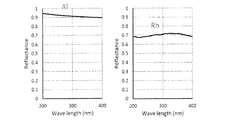
- FIG. 5 is a cross-sectional view showing still another configuration example of the front plane in the ⁇ LED-UV source 1000. It is sectional drawing which shows typically how the ultraviolet rays are reflected by a metal plug 24. It is another cross-sectional view schematically showing how ultraviolet rays are reflected by a metal plug 24. It is a graph which shows the relationship between the reflectance and the wavelength of the reflector metal in the embodiment of this disclosure.
- the "micro LED” in the present disclosure means a light emitting diode (LED) having a size of an occupied area included in a region of 1000 ⁇ m ⁇ 1000 ⁇ m or a striped region having a width of 1000 ⁇ m or less.
- the electromagnetic wave emitted by the micro LED in the present disclosure is ultraviolet light having a wavelength of 380 nm or less.
- ⁇ LED light emitting diode
- the ⁇ LED has a first conductive type first semiconductor layer and a second conductive type second semiconductor layer.
- the first conductive type is one of the p-type and the n-type
- the second conductive type is the other of the p-type and the n-type.
- the first conductive type is p-type
- the second conductive type is n-type
- the first conductive type is n-type
- the second conductive type is p-type.
- Each of the first semiconductor layer and the second semiconductor layer may have a single layer structure or a multilayer structure.
- a light emitting layer having at least one quantum well (or double heterostructure) is formed between the first semiconductor layer and the second semiconductor layer.
- the "micro LED ultraviolet radiation source ( ⁇ LED-UV source)" in the present disclosure is a device including a plurality of ⁇ LEDs, each of which emits ultraviolet rays.
- a plurality of ⁇ LEDs in a ⁇ LED-UV source may be referred to as a “ ⁇ LED array”.
- the ⁇ LED-UV source can be used in various applications requiring ultraviolet irradiation, such as UV curing of resins, exposure of resists, and sterilization.
- the ⁇ LED-UV source of the present disclosure can realize an arbitrary irradiation pattern without a mask.
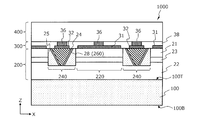
- FIG. 1A is a cross-sectional view showing a part of the ⁇ LED-UV source 1000.
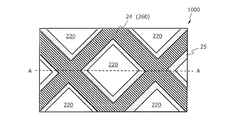
- FIG. 1B is a plan view showing an arrangement example of the ⁇ LED array in the ⁇ LED-UV source 1000.
- the cross section of the ⁇ LED-UV source 1000 shown in FIG. 1A corresponds to the cross section taken along line AA of FIG. 1B.
- the ⁇ LED-UV source 1000 may include a large number of ⁇ LEDs, for example, hundreds to thousands, or more than 10,000. 1A and 1B show only a portion of the ⁇ LED-UV source 1000 containing a few ⁇ LEDs. The entire ⁇ LED-UV source 1000 comprises a configuration in which the illustrated portions are arranged, for example, periodically or in a particular pattern.
- the ⁇ LED-UV source 1000 ultraviolet rays are radiated from a plurality of ⁇ LEDs divided into small pieces, instead of radiating ultraviolet rays from one continuous light emitting layer included in one large conventional LED element. Therefore, how to utilize the ultraviolet radiation from the end face of the light emitting layer contained in each ⁇ LED becomes important. This is because as the size of the ⁇ LEDs decreases and the number of ⁇ LEDs contained in the ⁇ LED-UV source 1000 increases, the ratio of the area of the end face to the area perpendicular to the stacking direction of the semiconductor layers in the light emitting layer increases. In the embodiment of the present disclosure, by providing the reflector described later in the region between the individual ⁇ LEDs (element separation region), it is possible to effectively utilize the ultraviolet rays radiated laterally from the light emitting layer.
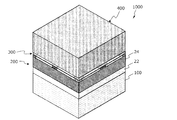
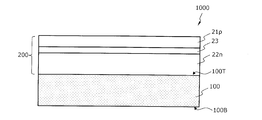
- the ⁇ LED-UV source 1000 includes a crystal growth substrate 100, a front plane 200 supported by the crystal growth substrate 100, an intermediate layer 300 supported by the front plane 200, and a backplane 400 supported by the intermediate layer. ing.
- each component such as ⁇ LED does not necessarily reflect the actual ratio in the embodiment.
- each component is described in a ratio that prioritizes clarity.
- the orientation of each component in the drawing does not limit the orientation when the ⁇ LED-UV source is actually manufactured and the orientation when used.
- FIGS. 1A and 1B show coordinate axes of the X-axis, Y-axis, and Z-axis that are orthogonal to each other.
- the crystal growth substrate 100 is a substrate on which semiconductor crystals constituting the ⁇ LED grow epitaxially.
- the crystal growth substrate 100 is a sapphire substrate.
- the crystal growth substrate 100 formed of sapphire is simply referred to as a "substrate”.
- the surface 100T on which crystal growth occurs on the substrate 100 is referred to as an "upper surface” or “crystal growth surface”, and the surface 100B on the opposite side of the substrate 100 is referred to as a "lower surface”.
- the terms “top” and “bottom” are used independently of the actual orientation of the substrate 100.
- a typical example of a semiconductor crystal that can be used in the embodiment of the present disclosure is a gallium nitride based compound semiconductor.
- the gallium nitride based compound semiconductor may be referred to as “GaN”.
- a part of the gallium (Ga) atom in GaN may be replaced by an aluminum (Al) atom or an indium (In) atom.
- GaN in which a part of Ga atom is replaced with Al atom may be referred to as "AlGaN”.
- GaN in which a part of Ga atom is replaced with In atom may be referred to as "InGaN".
- GaN in which a part of Ga atom is replaced with Al atom and In atom may be referred to as "AlInGaN” or “InAlGaN".
- the bandgap of GaN is smaller than the bandgap of AlGaN and larger than the bandgap of InGaN.
- gallium nitride based compound semiconductors in which some of the constituent atoms are replaced with other atoms may be generically referred to as “GaN”.
- GaN can be doped with n-type impurities and / or p-type impurities as impurity ions.
- the semiconductor crystal constituting the ⁇ LED is not limited to the GaN-based semiconductor, and may be formed of a nitride semiconductor such as AlN, InN, or AlInN, or another semiconductor.
- the substrate 100 is a component of the final ⁇ LED-UV source 1000.
- the thickness of the substrate 100 can be, for example, 30 ⁇ m or more and 1000 ⁇ m or less, preferably 500 ⁇ m or less.
- the role of the substrate 100 is to serve as a base for crystal growth and to be an optical member for improving the ultraviolet extraction efficiency during operation. Therefore, the rigidity of the ⁇ LED-UV source 1000 may be supplemented by a rigidity member other than the substrate 100.
- a rigid member can be fixed to, for example, the backplane 400.
- a support substrate (not shown) that supplements the rigidity of the substrate 100 may be fixed to the lower surface 100B of the substrate 100. Such a support substrate can be removed from the final ⁇ LED-UV source 1000.
- the upper surface (crystal growth surface) 100T of the substrate 100 may be provided with a structure such as a groove or a ridge that alleviates the crystal lattice strain. Further, a buffer layer for reducing crystal lattice distortion may be formed on the upper surface 100T of the substrate 100.
- the lower surface 100B of the substrate 100 may be formed with fine irregularities for further improving the extraction efficiency of ultraviolet rays radiated from the ⁇ LED array and transmitted through the substrate 100, or for diffusing the ultraviolet rays. Examples of fine irregularities include a moth-eye structure. Since the moth-eye structure continuously changes the effective refractive index on the lower surface 100B of the substrate 100, the ratio (reflectance) reflected inside the substrate 100 on the lower surface 100B of the substrate 100 is significantly reduced (substantially). Can be zero).
- the positive direction of the Z axis (direction of the arrow) shown in FIG. 1A may be referred to as “crystal growth direction” or “semiconductor lamination direction”.
- the lower surface 100B and the upper surface 100T of the substrate 100 may be referred to as “front” and “back” of the substrate 100, respectively.
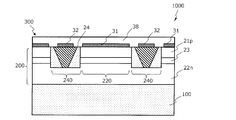
- the front plane 200 includes a plurality of ⁇ LEDs 220 and an element separation region 240 located between the plurality of ⁇ LEDs 220.
- the plurality of ⁇ LED 220s can be arranged in rows and columns in a two-dimensional plane (XY plane) parallel to the upper surface 100T of the substrate 100.
- Each of the plurality of ⁇ LED 220s has a first conductive type first semiconductor layer 21 and a second conductive type second semiconductor layer 22, as shown in FIG. 1A.
- the second semiconductor layer 22 is located closer to the substrate 100 than the first semiconductor layer 21.
- each ⁇ LED 220 has a light emitting layer 23 capable of emitting light independently of the other ⁇ LED 220.
- the light emitting layer 23 is located between the first semiconductor layer 21 and the second semiconductor layer 22.
- the element separation region 240 has at least one metal plug 24 electrically connected to the second semiconductor layer 22.
- the metal plug 24 functions as a substrate-side electrode of the ⁇ LED 220.
- a typical example of the first conductive type first semiconductor layer 21 is a p-GaN layer.
- a typical example of the second conductive type second semiconductor layer 22 is an n-GaN layer.
- the p-GaN layer and the n-GaN layer do not have to have the same composition along the direction perpendicular to the upper surface 100T of the substrate 100 (semiconductor stacking direction: positive direction of the Z axis), and have a multilayer structure.
- Ga in GaN can be at least partially replaced by Al and / or In. Such substitutions may be made to adjust the bandgap and / or index of refraction of the GaN.
- the concentrations of n-type impurities and p-type impurities, that is, the doping levels need not be uniform along the semiconductor stacking direction (positive direction of the Z axis).
- a typical example of the light emitting layer 23 includes at least one AlGaN or InAlGaN well layer because it emits ultraviolet rays.
- a barrier layer having a band gap larger than that of the well layer may be arranged between the well layers.
- the bandgap of the AlGaN well layer can be adjusted according to the Al composition ratio in the AlGaN well layer.
- the plurality of semiconductor layers constituting each ⁇ LED 220 are single crystal layers (epitaxial layers) epitaxially grown on the substrate 100, respectively.
- the element separation region 240 is defined by a trench-shaped recess (hereinafter, referred to as “trench”) formed by partially etching a plurality of semiconductor layers epitaxially grown on the substrate 100.
- the occupied area of each ⁇ LED 220 separated by the trench has a size (eg, 100 ⁇ m ⁇ 100 ⁇ m area or less) contained within the 1000 ⁇ m ⁇ 1000 ⁇ m area.
- the occupied area of the ⁇ LED 220 is defined by the contour of the first semiconductor layer 21 and / or the light emitting layer 23 divided by the element separation area 240.
- the element separation region 240 surrounds each ⁇ LED 220 and separates each ⁇ LED 220 from the other ⁇ LED 220. More specifically, the element separation region 240 electrically and spatially separates the first semiconductor layer 21 and the light emitting layer 23 of each ⁇ LED 220 from the first semiconductor layer 21 and the light emitting layer 23 of the other ⁇ LED 220. ing.
- the second semiconductor layer 22 does not have to be completely separated for each ⁇ LED 220.
- the second semiconductor layer 22 included in each of the plurality of ⁇ LED 220s is formed of one continuous semiconductor layer and is shared by the plurality of ⁇ LED 220s.
- the second semiconductor layer 22 functions as a common electrode on the second conductive side with respect to the plurality of ⁇ LEDs 220.
- the second semiconductor layer 22 of each ⁇ LED 220 is separated from each other and the second semiconductor layer 22 is individually connected to the electrode (wiring) on the second conductive side in the backplane 400, the second conductive If a disconnection defect occurs in a part of the electrode or the wiring on the side, an energization failure occurs in a part of the ⁇ LED 220.
- the second semiconductor layer 22 of each of the plurality of ⁇ LED 220s is formed of one continuous semiconductor layer, the occurrence of such defects can be suppressed.
- the embodiments of the present disclosure are not limited to such examples.
- the second semiconductor layer 22 of each ⁇ LED 220 may be separated from the second semiconductor layer 22 of the other ⁇ LED 220 as long as it is appropriately connected to the metal plug 24, the TiN buffer layer described later, or the like.
- the element separation region 240 has an embedded insulator 25 that fills the space between the plurality of ⁇ LEDs 220.
- the embedded insulator 25 has one or more through holes for the metal plug 24. The through holes are filled with the metal material constituting the metal plug 24.
- the metal plug 24 may have a structure in which different metal layers are stacked.
- the upper surface of the front plane 200 is flattened as shown in FIG. 1A.
- Such flattening is realized by the level of the upper surface of the metal plug 24 and the embedded insulator 25 in the element separation region 240 substantially matching the level of the upper surface of the first semiconductor layer 21 in the ⁇ LED 220.
- the element separation region 240 of the ⁇ LED-UV source 1000 includes a reflector 260 that reflects ultraviolet rays emitted from each of the plurality of ⁇ LED 220s toward the crystal growth substrate 100. More specifically, the element separation region 240 has an embedded insulator 25 that fills the space between the plurality of ⁇ LEDs 220, and the embedded insulator 25 has a V-shaped groove (through hole) for the metal plug 24. Have. The embedded insulator 25 is formed of a material that transmits ultraviolet rays emitted from the ⁇ LED 220.
- the metal plug 24 is in contact with the second semiconductor layer 22 at the bottom of the V-shaped groove.
- the metal plug 24 not only functions as a conductor for electrically connecting each ⁇ LED 220 to the backplane 400, but also functions as a reflector 260.
- the side surface (reflection surface 260S) of the metal plug 24 is not orthogonal to the upper surface 100T of the crystal growth substrate 100 and is inclined. It is desirable that the metal plug 24 is formed of a material that realizes ohmic contact at least in a portion that contacts the second semiconductor layer 22. However, other parts can be formed from various metallic materials.
- the metal plug 24 is Al. It is desirable that it is formed from.
- the reflecting surface 260S of the reflector 260 is preferably formed of Al, Ag or Rh.
- Al or Rh is desirable as the reflecting surface 260S of the reflector 260 for ultraviolet rays having a wavelength of 300 nm or less.
- the reflectance of ultraviolet rays having a wavelength of 350 nm has a relationship of Al> Ag> Rh >> Cu ⁇ Ti.
- the reflectance of ultraviolet rays having a wavelength of 300 nm or less has a relationship of Al> Rh >> Ti> Cu> Ag.
- the metal plug 24 which functions as the reflector 260, surrounds each ⁇ LED 220, as shown in FIG. 1B. Therefore, the ultraviolet rays radiated from the ⁇ LED 220 in all directions are reflected in the direction of the crystal growth substrate 100 by the inclined side surface (reflection surface 260S) of the metal plug 24.
- the metal plug 24 does not have to be a single conductor having a lattice shape, and may be separated into a plurality of portions.
- the metal plug 24 has a reflective layer 28 on the side surface, and the reflective layer 28 functions as a reflector 260.
- the reflective layer 28 may be formed of a material different from that of the metal plug 24, such as Al or Rh.
- the thickness of the reflective layer 28 is, for example, 30 nm or more and 50 nm or less.
- the reflective layer 28 may be formed of a material other than metal.
- the reflective layer 28 may be formed, for example, from a dielectric material having a refractive index different from that of the embedded insulator 25.
- Ultraviolet rays radiated from the ⁇ LED 220 can be reflected by utilizing the difference in refractive index existing at the interface between the reflective layer 28 and the embedded insulator 25. Ultraviolet rays that have passed through this interface and entered the metal plug 24 can be reflected by the metal plug 24 itself.
- FIG. 3 is a cross-sectional view showing another configuration example of the ⁇ LED-UV source 1000.
- Each of the plurality of ⁇ LEDs 220 in this example has an inclined side surface 220S.
- the metal plug 24 is in contact with the side surface 220S of each ⁇ LED 220.
- the metal plug 24 has a reflective surface 260S that contacts the side surface 220S of each ⁇ LED 220 and functions as a reflector 260.
- the tilt angle ⁇ of the reflective surface 260S defines the tilt angle of the side surface 220S of each ⁇ LED 220.
- the inclination angle ⁇ of the reflecting surface 260S is less than 90 degrees (for example, 30 to 60 degrees).
- the side surface 220S of the ⁇ LED 220 forms a forward taper.
- the surface of the metal plug 24 is preferably formed of a material capable of achieving ohmic contact with the second semiconductor layer 22.
- the second semiconductor layer 22 is formed of n-GaN
- the second semiconductor layer 22 and the metal plug 24 are formed by using a metal (for example, Ti) having a work function ⁇ m smaller than the work function ⁇ n of n-GaN.
- a high resistance layer can be formed between the first semiconductor layer 21 formed of p-GaN and the metal plug 24.
- the step of forming the embedded insulator 25 in the element separation region 240 and the step of forming the through hole in the embedded insulator 25 can be omitted.
- the configuration of the metal plug 24 is not limited to the above example, and may have a laminated structure (upper layer metal and lower layer metal).
- the material of the upper metal is selected so that a high resistance or insulating interface is formed between the upper metal and the first semiconductor layer 21, and the material of the upper metal is low between the lower metal and the second semiconductor layer 22.
- the material of the underlying metal is selected so that a resistant ohmic contact is formed. At this time, as described below, it is preferable that a material having a high reflectance to ultraviolet rays is in contact with at least the light emitting layer 23.
- the first semiconductor layer 21 is formed of p-GaN, it is generally difficult to form ohmic contact, and the resistance due to etching due to element separation is the resistance between p-GaN and the metal plug 24. To form. Therefore, as shown in FIG. 3, the problem that the first semiconductor layer 21 and the second semiconductor layer 22 are electrically short-circuited by the metal plug 24 is avoided.
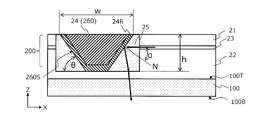
- ⁇ Reflector tilt angle and material> 4A and 4B schematically show how the ultraviolet rays generated in the light emitting layer 23 are reflected by the metal plug 24.
- the high reflectance layer 24R is provided in the region of the metal plug 24 that reflects ultraviolet rays.
- the high reflectance layer 24R functions as a reflector 260.
- Ultraviolet rays generated in the light emitting layer 23 in the ⁇ LED are basically emitted isotropically, but are radiated laterally along the light emitting layer 23 having a relatively large bandgap and a high refractive index. Cheap. Therefore, the inclination angle of the reflector 260 with respect to the light emitting layer 23 is important in order to realize high reflectance and to allow ultraviolet rays to enter the substrate 100 at an appropriate angle.
- the reflecting surface 260S of the reflector 260 shown in FIGS. 4A and 4B reflects the ultraviolet rays received from the light emitting layer 23 downward (in the negative direction of the Z axis).
- the ultraviolet rays reflected by the reflecting surface 260S travel in a direction forming an angle of
- degrees with respect to the negative direction of the Z axis will be referred to as the "board incident angle".
- the side surfaces of the semiconductor layers 21, 22, and 23 are inclined at an inclination angle ⁇ to form a forward taper.
- the incident angle of the substrate is 25 degrees or less in order to realize the light extraction of ultraviolet rays, preferably 15. It was found that the temperature was less than or equal to 10 degrees, more preferably 10 degrees or less. Therefore, the inclination angle ⁇ of the reflecting surface 260S of the reflector 260 needs to be in the range of 32.5 to 57.5 degrees, and the angle ⁇ is preferably 37.5 to 52.5 degrees. It is preferably in the range of 40 to 50 degrees.
- the angle ⁇ is in the range of 40 to 50 degrees, a high light extraction efficiency of about 90% is realized.
- the substrate 100 is made of sapphire and not when it is made of another material, such as GaN.
- ultraviolet rays having a wavelength of 375 nm or less cannot be extracted even if the substrate incident angle is 0 degrees.
- a titanium nitride (TiN) layer may be formed on the upper surface 100T of the substrate 100.
- the TiN layer contributes to crystal growth, but affects the transmission of ultraviolet light. According to the study of the present inventor, if the incident angle of the substrate is 23 degrees or less, ultraviolet rays can be extracted.
- the substrate incident angle is preferably 10 degrees or less. When the substrate incident angle is 10 degrees or less, a light extraction efficiency of 60% or more can be realized.
- the material of the reflective surface 260S of the metal plug 24 (reflector 260) is preferably Al or Rh, which has a high reflectance with respect to ultraviolet rays.
- the inside of the metal plug 24 (reflector 260) may be formed of other metals such as Cu, Ag, Ti, TiN and the like. It was also found that the ultraviolet reflectance tends to increase as the Al layer or the Rh layer becomes thicker up to about 50 nm.
- the preferred thickness of the Al layer or Rh layer that functions as a reflector is, for example, 30 nm or more.
- a metal showing a relatively high reflectance in the wavelength range of visible light can be a metal other than Al and Rh in the wavelength range of 200 nm or more and 300 nm or less used for sterilization, for example. It was found that the reflectance was significantly reduced.
- the reflectance of Al has a wide wavelength of 200 to 380 nm as shown in FIG. 4C. In the range, it is almost 90% or more.
- the reflectance of Rh is also about 68% or more in a wide range of wavelengths of 200 to 380 nm.
- the reflectance of Ag is about 85% at a wavelength of 350 nm, but decreases to 37% at a wavelength of 295 nm, as shown in FIG. 4D.
- the reflectance of Cu is 50% or more at a wavelength of 380 nm and about 40% at a wavelength of 260 to 280 nm. Comparing Cu and Ag in detail, the reflectance in the wavelength range of 200 nm to 280 nm is Cu ⁇ Ag, whereas the reflectance in the wavelength range of 280 nm to 305 nm is Cu> Ag, and when it exceeds 305 nm, Ag >> Cu. It becomes.
- Ag is preferable in the region where the wavelength is larger than 305 nm
- Cu is preferable in the region where the wavelength is around 300 nm.
- Al exhibits a higher reflectance than Ag and Cu in the entire wavelength range.
- Rh is lower than Ag at 318 nm or more, but exhibits higher reflectance than Ag and Cu at other temperatures of 300 nm or less.
- the ⁇ LED ultraviolet radiation light source of the present disclosure when used for sterilization (wavelength: 200 nm or more and 300 nm or less, typically 250 nm or more and 300 nm or less), at least the reflecting surface 260S of the reflector 260 It is preferably formed from Al or Rh.
- the layer thickness of Al or Rh constituting the reflective surface 260S is about 30 nm or more. Even if this layer thickness is increased to 50 nm or more, the increase in reflectance is saturated. Therefore, the layer thickness of Al or R in the portion that functions as the reflector 260 is preferably 30 to 50 nm.
- another metal is selected from the viewpoint of reducing electrical resistivity or contact resistance without considering ultraviolet reflectance. can do.
- the contact portion of the metal plug 24 it is preferable to use TiN for the contact portion of the metal plug 24, but when the TiN layer is present on the reflective surface 260S, the reflectance with respect to ultraviolet rays is lowered.
- the angle ⁇ is preferably 40 degrees or less. The smaller each ⁇ , the better the reflectance.
- the size (width W) of the metal plug 24 (reflector 260) in the X-axis direction (or Y-axis direction) may be larger than the size (height h) of the metal plug 24 in the Z-axis direction.
- a typical example of the width ratio (W / h) to the height of the metal plug 24 can be 0.5 or more and 10 or less.
- the cross section of the metal plug 24 (reflector 260) of FIGS. 4A and 4B has an inverted trapezoidal shape or an inverted triangular shape, and the cross-sectional shape of the metal plug 24 (reflector 260) is such an example.
- the side surface 220S of each ⁇ LED 220 does not have to be flat.
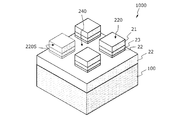
- FIG. 5 is a perspective view showing an example in which the side surface 220S of the ⁇ LED 220 is formed from the side surface of the truncated cone.
- the shape of each ⁇ LED 220 can be formed from any frustum with a polygonal, circular or elliptical bottom.
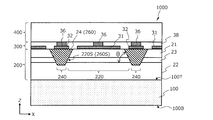
- FIG. 6 is a cross-sectional view showing still another configuration example of the ⁇ LED-UV source 1000.
- Each of the plurality of ⁇ LED 220s in this example also has a forward tapered side surface 220S.
- the metal plug 24 is not in contact with the side surface 220S of each ⁇ LED.
- the metal plug 24 is located in a through hole formed in the embedded insulator 25.
- the reflector 260 that reflects the ultraviolet rays emitted from each ⁇ LED 220 toward the crystal growth substrate 100 is the interface (side surface 220S) between the embedded insulator 25 and the ⁇ LED 220.
- Such interfacial reflection is Fresnel reflection caused by the difference between the refractive index of the embedded insulator 25 and the refractive index of ⁇ LED 220.
- the refractive index of the semiconductor that can form the ⁇ LED 220 is, for example, in the range of 2.1 or more and 3.0 or less.
- the embedded insulator 25 is formed from a dielectric having a refractive index lower than these refractive indexes, it is possible to generate total reflection of the ultraviolet rays emitted from the light emitting layer 23 by adjusting the inclination angle of the reflecting surface. Is.
- the refractive index of the embedded insulating material 25 may be higher than that of the ⁇ LED 220.
- FIG. 7 is a cross-sectional view showing still another configuration example of the ⁇ LED-UV source 1000.
- Each of the plurality of ⁇ LED 220s in this example also has a forward tapered side surface 220S.
- the reflector 260 is formed of a reflective layer 28 in contact with the side surface 220S of the ⁇ LED 220.
- the reflective layer 28 may be a dielectric multilayer film in which a plurality of dielectric layers having different refractive indexes are alternately laminated.
- the reflectance of the dielectric multilayer film can be set to 95% or more by adjusting the film thickness of each and laminating them for 5 cycles or more.
- Such ultraviolet rays can be used for various purposes.
- the intermediate layer 300 includes a plurality of first contact electrodes 31 and a second contact electrode 32 (see FIG. 1A). Each of the plurality of first contact electrodes 31 is electrically connected to the first semiconductor layer 21 of the plurality of ⁇ LED 220s. At least one second contact electrode 32 is connected to the metal plug 24.
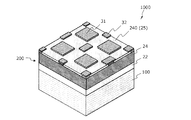
- FIG. 8 is a perspective view showing an arrangement example of the first contact electrode 31 and the second contact electrode 32.
- the description of the backplane 400 is omitted.
- the structure shown in FIG. 8 is only a part of the ⁇ LED-UV source 1000, and as described above, the embodiment of the ⁇ LED-UV source 1000 includes a large number of ⁇ LED 220s.
- the second contact electrode 32 shown in FIG. 8 is electrically connected to the second semiconductor layer 22 via the metal plug 24.
- the shape and size of the second contact electrode 32 are not limited to the examples shown. As described above, since the metal plug 24 can take various shapes, the degree of freedom in arranging the second contact electrode 32 is high as long as it is electrically connected to the second semiconductor layer 22 via the metal plug 24.
- the first contact electrode 31 is independently electrically connected to the first semiconductor layer 21 of the plurality of ⁇ LED 220s. When viewed from a direction perpendicular to the upper surface 100T of the substrate 100, the shape and size of the first contact electrode 31 need not match the shape and size of the first semiconductor layer 21.
- the distance from the substrate 100 to the first contact electrode 31 and the second contact electrode 32 in other words, the “height” of these contact electrodes 31 and 32.
- “Or” level are equal to each other. This facilitates the formation of the backplane 400, which will be described later, using semiconductor manufacturing technology.
- the "semiconductor manufacturing technique" in the present disclosure includes a step of depositing a thin film of a semiconductor, an insulator, or a conductor, and a step of patterning the thin film by a lithography and etching steps.
- the "flattened surface” means a surface having a step difference of 300 nm or less due to a convex portion or a concave portion existing on the surface. In a preferred embodiment, this step is 100 nm or less.
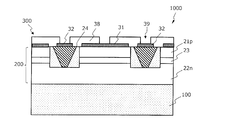
- the intermediate layer 300 includes an interlayer insulating layer 38 having a flat surface.
- the interlayer insulating layer 38 has a plurality of contact holes for connecting the first and second contact electrodes 31 and 32 to the electric circuit of the backplane 400, respectively.
- the contact hole is filled with the via electrode 36.
- CMP chemical mechanical polishing
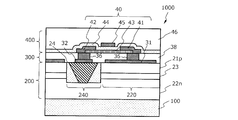
- the backplane 400 has an electrical circuit (not shown) in FIG. 1A.
- the electric circuit is electrically connected to the plurality of ⁇ LED 220s via the plurality of first contact electrodes 31 and at least one second contact electrode 32.
- the electrical circuit comprises a plurality of thin film transistors (TFTs) and other circuit elements.
- TFTs thin film transistors
- each of the TFTs has a semiconductor layer grown on the front plane 200 and / or the intermediate layer 300 supported by the substrate 100.
- TFTs thin film transistors
- each of the TFTs has a semiconductor layer grown on the front plane 200 and / or the intermediate layer 300 supported by the substrate 100.
- the electrical circuit of the backplane 400 does not need to include a TFT.
- the electrical circuit of the backplane 400 does not include a TFT
- the electrical circuit is made of metal, semiconductor, and / or insulating material grown directly on the intermediate layer 300 by physical or chemical vapor deposition. Contains layers (growth or sedimentary layers). These layers are patterned by lithographic techniques.
- FIG. 9 is a basic equivalent circuit diagram when the ⁇ LED-UV source 1000 emits ultraviolet rays in units of ⁇ LED.
- the electric circuit of the backplane 400 has a selection TFT element Tr1, a driving TFT element Tr2, and a holding capacitance CH.
- the ⁇ LED shown in FIG. 9 resides in the front plane 200 rather than in the backplane 400.
- the selection TFT element Tr1 is connected to the intensity signal line DL and the selection line SL.
- the intensity signal line DL is a wiring that carries a signal that defines the intensity of ultraviolet radiation.
- the intensity signal line DL is electrically connected to the gate of the driving TFT element Tr2 via the selection TFT element Tr1.
- the selection line SL is a wiring that carries a signal for controlling on / off of the selection TFT element Tr1.
- the driving TFT element Tr2 controls the conduction state between the power line PL and the ⁇ LED. When the driving TFT element Tr2 is turned on, a current flows from the power line PL to the ground line GL via the ⁇ LED. This current causes the ⁇ LED to emit light. Even if the selection TFT element Tr1 is turned off, the driving TFT element Tr2 is maintained in the ON state due to the holding capacitance CH.
- the backplane 400 having the above configuration, it is possible to control the radiation intensity of ultraviolet rays in units of ⁇ LED.
- the intensity distribution of ultraviolet irradiation can be easily changed according to the input intensity signal.
- the electric circuit of the backplane 400 may include a selection TFT element Tr1, a drive TFT element Tr2, an intensity signal line DL, a selection line SL, and the like, but the configuration of the electric circuit is not limited to such an example.
- FIG. 10A a substrate 100 having an upper surface (crystal growth surface) 100T is prepared.
- FIG. 10A shows only a part of the substrate 100 extending along a plane parallel to the upper surface 100T.
- Each semiconductor layer is a single crystal epitaxial growth layer of a gallium nitride based compound semiconductor.
- the gallium nitride based compound semiconductor can be grown by, for example, the MOCVD (Metal Organic Chemical Vapor Deposition) method. Impurities defining each conductive type can be doped from the gas phase during crystal growth.
- the mask M1 is formed on the first semiconductor layer 21 as shown in FIG. 10B.
- the mask M1 has an opening that defines the shape and position of the element separation region 240.
- the mask M1 defines the shape and position of the ⁇ LED 220.
- a trench defining the element separation region 240 is formed by etching the portion of the semiconductor laminated structure 280 that is not covered by the mask M1 from the upper surface. This etching (mesa etching) can be performed by, for example, an inductively coupled plasma (ICP) etching method or a reactive ion etching (RIE) method.
- ICP inductively coupled plasma
- RIE reactive ion etching
- the etching depth is determined so that the second semiconductor layer 22 appears at the bottom of the trench.
- the depth of the trench formed by etching can be, for example, 0.5 ⁇ m or more and 5 ⁇ m or less, and the width of the trench can be, for example, 5 ⁇ m or more and 100 ⁇ m or less. From the viewpoint of increasing the in-plane uniformity of the ultraviolet irradiation intensity, the width of the trench is preferably small.
- the width of each ⁇ LED 220 can be, for example, 5 ⁇ m or more and 1000 ⁇ m or less, for example, 10 to 100 ⁇ m.
- each two-dimensionally arranged ⁇ LED 220 is reduced (for example, within a region of 100 ⁇ m ⁇ 100 ⁇ m or less, or a width of 100 ⁇ m. It is preferable that the size fits within the stripe area of.
- the side surface 220S of the ⁇ LED 220 is exposed by etching. In other words, each ⁇ LED 220 has etched side surfaces 220S. In the example of FIG. 10C, the side surface 220S is not inclined, but the above-mentioned forward taper can be formed by adjusting the material and etching conditions of the mask M1.
- the first contact electrode 31 and the second contact electrode 32 are formed as shown in FIG. 8 described above.
- the interlayer insulating layer (thickness: 500 nm to 1500 nm) 38 of the intermediate layer 300 a plurality of contact holes for connecting the electric circuit of the backplane 400 to the ⁇ LED 220 of the frontplane 200 (in FIG. 8). (Not shown) is formed on the interlayer insulating layer 38.
- the contact hole is formed so as to reach the contact electrodes 31 and 32 located in the lower layer.
- the contact hole is filled with via electrodes.
- the upper surface of the interlayer insulating layer 38 can be smoothed by CMP treatment.
- the backplane 400 is formed on the intermediate layer 300.
- the characteristic point in the present disclosure is that the backplane 400 is not attached on the intermediate layer 300, but the various electronic elements and wirings constituting the backplane 400 are mounted on the front plane 200 and the intermediate layer 300 by semiconductor manufacturing technology. It is to be formed directly on the laminated structure containing.
- each of the plurality of TFTs included in the backplane 400 has a semiconductor layer grown on a laminated structure composed of a front plane 200 and an intermediate layer 300 supported by the substrate 100.
- the backplane 400 including the TFT when the upper surface of the front plane 200 and the upper surface of the intermediate layer 300 are flattened, it becomes easy to manufacture the backplane 400 including the TFT by the semiconductor manufacturing technology.
- a TFT is formed by a semiconductor manufacturing technique, it is necessary to pattern the deposited semiconductor layer, insulating layer, and metal layer. Such patterning is realized by a lithography process involving exposure. If there is a large step on the base of the deposited semiconductor layer, insulating layer, and metal layer, the focus will not be achieved during exposure, and highly accurate fine patterning will not be realized.
- the intermediate layer 300 is also flattened, and the backplane 400 can be easily formed by the semiconductor manufacturing technique.
- the shape of the ⁇ LED 220 is substantially a rectangular parallelepiped, but the shape of the ⁇ LED 220 may be a cylinder, a polygonal column such as a hexagonal column, or an ellipse. It may be a pillar. Further, as shown in FIG. 4B, it may have an inclined side surface.
- the ⁇ LED-UV source 1000 in the present embodiment is an ultraviolet radiation source having the same configuration as the above-mentioned basic configuration example.
- the ⁇ LED-UV source 1000 is formed on a substrate 100 formed of sapphire, a front plane 200 formed on the substrate 100, an intermediate layer 300 formed on the front plane 200, and an intermediate layer 300. It is equipped with a backplane 400.
- the substrate 100 is placed in the reaction chamber of the MOCVD apparatus, and various gases are supplied to perform epitaxial growth of the gallium nitride (GaN) -based compound semiconductor.
- the substrate 100 in this embodiment is, for example, a sapphire substrate having a thickness of about 50 to 600 ⁇ m.
- the upper surface 100T of the substrate 100 is typically a C surface (0001), but may have a non-polar surface or a semi-polar surface such as an m surface, an a surface, or an r surface on the upper surface. Further, the upper surface 100T may be inclined by about several degrees from these crystal planes.
- the substrate 100 is typically disc-shaped, and its diameter can be, for example, 1 to 8 inches.
- the shape and size of the substrate 100 are not limited to this example, and may be rectangular. Further, the manufacturing process may be advanced using the disk-shaped substrate 100, and finally the periphery of the substrate 100 may be cut and processed into a rectangular shape. Further, the manufacturing process may be advanced using the relatively large substrate 100, and finally one substrate 100 may be divided to form a plurality of ⁇ LED-UV sources (singulation).
- TMG trimethylgallium
- TAG triethylgallium
- H 2 hydrogen
- N 2 nitrogen
- NH 3 ammonia
- SiH 4 silane Supply.
- the substrate 100 is heated to about 1100 ° C. to grow an n-GaN layer (thickness: for example, 2 ⁇ m) 22n.
- Silane is a raw material gas that supplies Si, which is an n-type dopant.
- the doping concentration of n-type impurities can be, for example, 5 ⁇ 10 17 cm -3 .
- the supply of SiH 4 is stopped, and the temperature of the substrate 100 is lowered to less than 800 ° C. to form the light emitting layer 23. More specifically, first, Al x In y Ga z N (0 ⁇ x ⁇ 1,0 ⁇ y ⁇ 1,0 ⁇ z ⁇ 1) growing a barrier layer. Further starts supply of trimethylindium (TMI) Al x 'In y ' Ga z 'N (0 ⁇ x' ⁇ 1,0 ⁇ y' ⁇ 1,0 ⁇ z' ⁇ 1) is grown the well layer. By alternately growing the barrier layer and the well layer in two or more cycles, a light emitting layer (thickness: for example, 100 nm) 23 having multiple quantum wells functioning as a light emitting portion can be formed.
- TMI trimethylindium
- One light emitting layer 23 may have a single well layer sandwiched between two barrier layers.
- a well layer may be formed directly on the n-GaN layer 22n, and a barrier layer may be formed on the well layer.
- TMI trimethylaluminum
- Mg trimethylaluminum
- Pentazienyl magnesium (Cp 2 Mg) may be supplied to grow the overflow suppression layer.
- the supply of TMA is stopped, and the p-GaN layer (thickness: for example, 0.5 ⁇ m) 21p is grown.
- the doping concentration of p-type impurities can be, for example, 5 ⁇ 10 17 cm -3 .
- An n-AlGaN layer may be provided between the n-GaN layer 22n and the light emitting layer 23, or an n-AlGaN layer may be used instead of the n-GaN layer 22n. Further, a p-AlGaN layer may be formed between the light emitting layer 23 and the p-GaN layer 21p.
- predetermined regions (element separation region 240) of the p-GaN layer 21p and the light emitting layer 23 are performed. (For example, 1.5 ⁇ m) is removed to expose a part of the n-GaN layer 22n. Etching of the gallium nitride based semiconductor can be performed using a chlorine-based gas plasma as described later.
- the space defining the element separation region 240 is filled with the embedded insulating material 25.
- the material and the forming method of the embedded insulating material 25 are arbitrary as long as they are selected from the material transmitting ultraviolet rays and the forming method thereof.
- the top surface of the embedded insulator 25 is flattened and located at the same level as the top surface of the p-GaN layer 21p.
- a through hole 26 reaching the n-GaN layer 22n is formed in a part of the embedded insulator 25.
- the through hole 26 defines the position and shape of the metal plug 24.
- the side surfaces of the through holes 26 are tilted so that the metal plug 24 functions as a reflector.
- the through hole 26 accommodates a metal plug 24 having a shape as shown in FIG. 1B.
- a metal plug 24 that fills the through hole 26 is formed, and the upper surface of the front plane 200 is flattened. After that, the first contact electrode 31 and the second contact electrode 32 are formed. Flattening can be done by various processes such as etchback, selective growth, or lift-off.
- the metal plug 24 makes ohmic contact with the n-GaN layer 22n, it can be formed of a metal such as titanium (Ti) and / or aluminum (Al).
- the metal plug 24 preferably has a metal layer containing Ti (for example, a TiN layer) at a portion in contact with the n—GaN layer 22n.
- Ti titanium
- Al aluminum
- the presence of the TiN layer contributes to the realization of low resistance n-type ohmic contact.
- the TiN layer can be formed by forming a Ti layer in contact with the n—GaN layer 22n and then performing a heat treatment at, for example, about 600 ° C. for 30 seconds. As described above, it is desirable that Al or Rh is present in the portion that reflects ultraviolet rays.
- the first and second contact electrodes 31 and 32 can be formed by depositing and patterning a metal layer.
- a metal-semiconductor interface is formed between the first contact electrode 31 and the p-GaN layer 21p of the ⁇ LED 220.
- the material of the first contact electrode 31 can be selected from metals with a high work function, such as platinum (Pt) and / or palladium (Pd). After forming the Pt or Pd layer (thickness: about 50 nm), heat treatment can be performed, for example, at a temperature of 350 ° C. or higher and 400 ° C. or lower for about 30 seconds.
- a Pt or Pd layer is present in the portion that is in direct contact with the p-GaN layer 21p, another metal such as a Ti layer (thickness: about 50 nm) and / or an Au layer (thickness: about 50 nm) and / or Au layer Thickness: about 200 nm) may be laminated.
- a region in which p-type impurities are doped at a relatively high concentration may be formed on the upper portion of the p-GaN layer 21p.
- the second contact electrode 32 is electrically connected to the metal plug 24 instead of the semiconductor. Therefore, the material of the second contact electrode 32 can be selected from a wide range.
- the first contact electrode 31 and the second contact electrode 32 may be formed by patterning one continuous metal layer. This patterning also includes lift-off. When the thicknesses of the first contact electrode 31 and the second contact electrode 32 are equal to each other, it becomes easy to connect to an electric circuit in the backplane 400 such as the TFT 40 described later.
- first and second contact electrodes 31, 32 After forming the first and second contact electrodes 31, 32, they are covered with an interlayer insulating layer (thickness: for example, 1000 nm to 1500 nm) 38.
- the upper surface of the interlayer insulating layer 38 can be flattened by CMP treatment or the like.
- the thickness of the interlayer insulating layer 38 whose upper surface is flattened means "average thickness".
- a contact hole 39 is formed in the interlayer insulating layer 38.
- the contact hole 39 is used to electrically connect the electrical circuit of the backplane 400 to the ⁇ LED 220 of the frontplane 200.
- the TFT 40 is a semiconductor that contacts at least a part of the upper surfaces of the drain electrode 41 and the source electrode 42 formed on the interlayer insulating layer 38 and the drain electrode 41 and the source electrode 42, respectively. It has a thin film 43, a gate insulating film 44 formed on the semiconductor thin film 43, and a gate electrode 45 formed on the gate insulating film 44.
- the drain electrode 41 and the source electrode 42 are connected to the first contact electrode 31 and the second contact electrode 32 by the via electrode 36, respectively.
- the components of these TFTs 40 are formed by known semiconductor manufacturing techniques.
- the semiconductor thin film 43 can be formed from polycrystalline silicon, amorphous silicon, oxide semiconductors, and / or gallium nitride based semiconductors.
- the polycrystalline silicon can be formed, for example, by depositing amorphous silicon on the interlayer insulating layer 38 of the intermediate layer 300 by a thin film deposition technique, and then crystallizing the amorphous silicon with a laser beam.
- the polycrystalline silicon formed in this way is called LTPS (Low-Temperature Poly Silicon).
- the polycrystalline silicon is patterned into the desired shape in the lithography and etching steps.
- the TFT 40 in FIG. 11 is covered with an insulating layer (thickness: for example, 500 nm to 3000 nm) 46.
- the insulating layer 46 is provided with an opening hole (not shown), which makes it possible to connect the TFT 40, for example, the gate electrode 45 to an external driver integrated circuit element or the like. It is preferable that the upper surface of the insulating layer 46 is also flattened.
- the electrical circuit of the backplane 400 may include circuit elements such as TFTs, capacitors, and diodes (not shown). Therefore, the insulating layer 46 may have a structure in which a plurality of insulating layers are laminated, and in that case, each insulating layer may be provided with a via electrode for connecting circuit elements, if necessary. Further, wiring may be formed on each insulating layer as needed.
- the backplane 400 in this embodiment can have the same configuration as a known backplane (for example, a TFT substrate) used in a display device.
- the backplane 400 of the present disclosure is characterized in that it is formed by semiconductor manufacturing technology on the ⁇ LED 220 located in the lower layer. Therefore, for example, the drain electrode 41 and the source electrode 42 of the TFT 40 can be formed by patterning a metal layer deposited so as to cover the front plane 200. Such patterning enables highly accurate alignment by lithographic techniques.
- the front plane 200 and / or the intermediate layer 300 are both flattened, it is possible to increase the resolution of lithography.
- the configuration of the TFT 40 shown in FIG. 11 is an example.
- the drain electrode 41 of the TFT 40 may be another circuit element in the backplane 400 or It may be connected to the wiring.
- the source electrode 42 of the TFT 40 does not need to be electrically connected to the second contact electrode 32.
- the second contact electrode 32 may be connected to a wiring (for example, a ground wiring) that commonly gives a predetermined potential to the n-GaN layer 22n of the ⁇ LED 220.
- the electric circuit of the backplane 400 has a plurality of metal layers (metal layers functioning as the drain electrode 41 and the source electrode 42) connected to the first contact electrode 31 and the second contact electrode 32, respectively. ing.
- the plurality of first contact electrodes 31 each cover the p-GaN layer 21p of the plurality of ⁇ LED 220s and function as a light-shielding layer or a reflective layer.
- the individual first contact electrodes 31 do not have to completely cover the upper surface of the ⁇ LED 220, that is, the entire upper surface of the p-GaN layer 21p.
- the shape, size, and position of the first contact electrode 31 are determined to achieve a sufficiently low contact resistance and to sufficiently suppress the ultraviolet rays emitted from the light emitting layer 23 from entering the channel region of the TFT 40. Will be done. It should be noted that preventing the ultraviolet rays radiated from the light emitting layer 23 from entering the channel region of the TFT 40 can also be realized by arranging another metal layer at an appropriate position.
- the intermediate layer 300 having a flattened upper surface is formed on the front plane 200 having a flat upper surface realized by embedding the element separation region 240 with the metal plug 24 and the embedded insulating material 25.
- These structures (substructures) function as a base for forming circuit elements such as TFTs on the structures.
- the above-mentioned substructure is treated at a temperature of, for example, 350 ° C. or higher.
- the embedded insulating material 25 in the element separation region 240 and the interlayer insulating layer 38 contained in the intermediate layer 300 are formed of a material that does not deteriorate even by heat treatment at 350 ° C. or higher.
- polyimide and SOG Spin-on Glass
- the configuration of the TFT included in the electric circuit in the backplane 400 is not limited to the above example.
- FIG. 13 is a cross-sectional view schematically showing another example of the TFT.
- FIG. 14 is a cross-sectional view schematically showing still another example of the TFT.
- the TFT 40 includes a drain electrode 41, a source electrode 42, and a gate electrode 45 formed on the interlayer insulating layer 38, a gate insulating film 44 formed on the gate electrode 45, and a gate insulating film 44. It has a semiconductor thin film 43 formed on the top and in contact with at least a part of the upper surface of each of the drain electrode 41 and the source electrode 42.
- the drain electrode 41 and the source electrode 42 are connected to the first contact electrode 31 and the second contact electrode 32 by the via electrode 36, respectively.
- the TFT 40 has a semiconductor thin film 43 formed on the interlayer insulating layer 38, and a drain electrode 41 and a source electrode 42 formed on the interlayer insulating layer 38 and in contact with a part of the semiconductor thin film 43, respectively. And a gate insulating film 44 formed on the semiconductor thin film 43, and a gate electrode 45 formed on the gate insulating film 44.
- the drain electrode 41 and the source electrode 42 are connected to the first contact electrode 31 and the second contact electrode 32 by the via electrode 36, respectively.
- the configuration of the TFT 40 is not limited to the above example.
- it in the initial stage of the process of forming the TFT 40, it is connected to the first and second contact electrodes 31 and 32 of the front plane 200 via the contact hole 39 of the interlayer insulating layer 38 in the intermediate layer 300.
- Multiple metal layers are formed. These metal layers can be, but are not limited to, the drain electrode 41 or the source electrode 42 of the TFT 40.
- the drain electrode 41 and the source electrode 42 in this embodiment are patterned by a photolithography and etching step after depositing a metal layer on the interlayer insulating layer 38 in the flattened intermediate layer 300. Therefore, there is no misalignment between the front plane 200 (intermediate layer 300) and the back plane 400 that causes a decrease in yield.
- FIG. 15 is a cross-sectional view schematically showing a part of a ⁇ LED-UV source having a titanium nitride (TiN) layer 50 located between the substrate 100 and the n-GaN layer 22n of each ⁇ LED 220.
- the thickness of the TiN layer 50 can be, for example, 5 nm or more and 20 nm or less.
- the TiN layer 50 can be suitably used in combination with the substrate 100 formed of sapphire.
- the TiN layer 50 has electrical conductivity.
- a large number of ⁇ LED 220s are arranged over a wide range, and at least one metal plug 24 connects the n-GaN layer 22n of the ⁇ LED 220 to the electrical circuit of the backplane 400. Therefore, if the electric resistance component (sheet resistance) with respect to the current flowing from the n-GaN layer 22n to the metal plug 24 is too high, the power consumption will increase.
- the TiN layer 50 functions as a buffer layer for alleviating lattice mismatch during crystal growth and contributes to reducing the crystal defect density, and also contributes to reducing the above-mentioned electrical resistance component during operation of the device.
- the thickness of the TiN layer 50 is preferably 10 nm or more, and more preferably 12 nm or more, from the viewpoint of reducing the electric resistance component and functioning as the substrate side electrode. On the other hand, from the viewpoint of transmitting the ultraviolet rays radiated from the ⁇ LED 220, the thickness of the TiN layer 50 is preferably, for example, 20 nm or less, and more preferably 5 to 15 nm.
- one continuous n-GaN layer 22n (second semiconductor layer) is shared by a plurality of ⁇ LED 220s.
- the n-GaN layer 22n may be separated for each ⁇ LED 220.
- the bottom of the trench defining the element separation region 240 reaches the upper surface of the TiN layer 50, and the metal plug 24 comes into contact with the TiN layer 50. Since one continuous TiN layer 50 is electrically connected to the n-GaN layer 22n of all ⁇ LED 220s, electrical continuity between the metal plug 24 and the n-GaN layer 22n of each ⁇ LED 220 is ensured. ..
- the TiN layer 50 functions as an n-side common electrode of the plurality of ⁇ LED 220s.
- the second conductive side electrode of the plurality of ⁇ LED 220s is shared by the semiconductor layer or the TiN layer, the problem that some ⁇ LED 220s have poor continuity due to disconnection is avoided. To.
- the above embodiment includes a configuration in which a plurality of ⁇ LED 220s are arranged on one continuous substrate 100, but the ⁇ LED ultraviolet radiation source of the present disclosure is not limited to such an example.
- FIGS. 1A and 1B are divided into a plurality of light emitting element units and supported by a flexible film (flexible substrate) will be described.
- the ⁇ LED ultraviolet radiation source 2000 in the present embodiment basically has the configuration of the ⁇ LED ultraviolet radiation source 1000 described above. The difference is that in the ⁇ LED ultraviolet radiation source 2000, the configuration divided into a plurality of light emitting element units 10 is supported by the flexible film (flexible film) 520. More specifically, the crystal growth substrate 100, the front plane 200, the intermediate layer 300, and the backplane 400 are divided into a plurality of light emitting element units 10, and each of the plurality of light emitting element units 10 has a plurality of ⁇ LED 220s. Contains at least one of.
- Ultraviolet rays radiated from the plurality of ⁇ LED 220s pass through the crystal growth substrate 100 and are emitted to the outside.
- the ⁇ LED ultraviolet radiation source 1000 in the above-described first embodiment include a reflector
- the ⁇ LED ultraviolet radiation source 2000 in the second embodiment does not necessarily have to include a reflector.
- by providing the reflector around the ⁇ LED 220 not only the effect of improving the extraction efficiency of ultraviolet rays and reducing the optical loss, but also the effect of controlling the directivity of ultraviolet radiation in units of ⁇ LED 220 can be obtained.
- the flexible film allows the individual ⁇ LED 220s to be directed in different directions, so increasing the directivity of UV radiation from the individual ⁇ LEDs with a reflector can be achieved by the flexible ⁇ LED ultraviolet radiation source 2000 radiation pattern. Allows for improved flexibility and controllability. It is desirable that all the ⁇ LED 220s included in the divided individual light emitting element units 10 are surrounded by reflectors, but this is not essential.
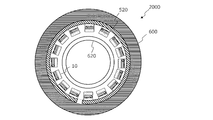
- the ⁇ LED ultraviolet radiation source 2000 includes a member 600 having a curved surface or a corner portion, and the flexible film 520 is attached to the member 600.
- This member 600 has a semimajor portion having an inner surface and an outer surface in the example of FIG.
- the member 60 has a cylindrical shape extending in a direction perpendicular to the paper surface in the drawing.
- the flexible film 520 equipped with a plurality of individualized ⁇ LED 220s is attached to the inner surface of such a long axis portion.
- Each of the plurality of light emitting element units 10 may include a plurality of ⁇ LEDs 220 arranged in a predetermined direction.
- a material to be irradiated with ultraviolet rays for example, a fluid such as water containing an object to be sterilized, flows inside a pipe 620 located at a central portion.
- the pipe 620 is made of a material that transmits ultraviolet rays well, such as quartz.
- the plurality of light emitting element units 10 arranged so as to surround the circumference of the pipe 620 each have one or a plurality of ⁇ LEDs 220 that emit ultraviolet rays. Further, it is preferable that at least the inner wall surface of the member 600 surrounding the light emitting element unit 10 is made of a material or a film that reflects ultraviolet rays.
- the ultraviolet rays radiated from a large number of ⁇ LED 220s efficiently collect inside the pipe 620, so that the irradiation intensity required for processing such as sterilization can be achieved in a short time.
- a film formed of a material having a photocatalytic effect is deposited on the inner wall of the pipe 620, it is possible to prevent the adhesion of dirt.
- a typical example of such a film is a TiO 2 film.
- the thickness of the film is preferably such that it does not interfere with the transmission of ultraviolet rays (for example, 5 to 20 nm).
- the irradiation intensity and irradiation time of ultraviolet rays can be set in units of light emitting element units or in units of ⁇ LED.
- a simple electric circuit for connecting each light emitting element unit or each ⁇ LED unit to a common power supply line may be provided in the backplane 400.
- an electric circuit including a TFT for driving an active matrix may be provided on the backplane 400.
- the form of the ⁇ LED ultraviolet radiation source 2000 is not limited to an example having a configuration in which ultraviolet rays are emitted in a closed space as shown in FIG.
- the flexible film 520 in which a plurality of light emitting element units 10 are arranged is attached to the surface of an object having a complicated outer shape, and can also radiate ultraviolet rays outward.
- the effect that the directivity of ultraviolet radiation can be freely controlled can be obtained. Even if the same effect is obtained by the conventional pickup-and-place method, it is practically impossible to mount a large number of ⁇ LEDs on a non-planar surface while adjusting the orientation.
- a structure similar to the ⁇ LED ultraviolet radiation source 1000 shown in FIGS. 1A and 1B is produced by the method described above.
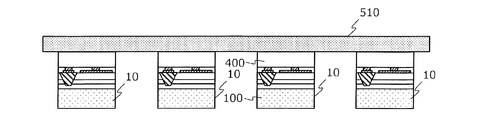
- a step of dividing the crystal growth substrate 100 and the laminated structure on the crystal growth substrate 100 into a plurality of light emitting element units 10 is performed. Specifically, for example, as shown in FIG. 17A, after the backplane 400 is fixed on the expansion film 510, the boundary positions of the plurality of light emitting element units 10 are cut by a laser beam or a dicing blade. In this way, a cutting groove is formed between the adjacent light emitting element units 10.
- the distance between the centers of the plurality of light emitting element units 10 is increased as shown in FIG. 17B.
- the distance between the centers before expansion can be expanded to, for example, 1.2 to 2.5 times or more (about 5 times) after expansion.
- a plurality of light emitting element units 10 are simultaneously or sequentially moved (transferred) to the flexible film 520 as shown in FIG. 17B. After transfer, the expansion film 510 can be peeled off.
- the flexible film 520 can be flexibly deformed according to the surface shape of the object to be fixed.
- electrode pads and wiring for electrically connecting to the backplane 400 are provided on the surface of the flexible film 520 facing the backplane 400.
- the wiring may have materials and structures that can be extended with the flexible film 520.
- An example of such a material is a resin in which conductive particles are dispersed, or a conductive polymer (conductive polymer) which itself has conductivity.
- An example of such a structure is a meandering or bent wiring pattern, which has a shape that does not break even when the flexible film 520 expands.
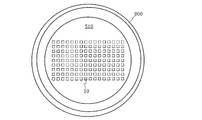
- the expansion device 800 shown in FIG. 19A can be used.
- the expansion device 800 grips the circumferential portion of the circular expansion film 510, and the upper surface of the columnar movable stage (not shown) is in contact with the back surface of the expansion film 510.
- the expansion device 800 pushes the movable stage toward the front of the drawing while heating the expansion film 510 on the upper surface of the movable stage while maintaining the circumferential portion of the expansion film 510 in a predetermined position.
- the expansion film 510 can be expanded from the center to the outside in the radial direction.
- FIG. 19B shows a state in which the expansion device 800 moves the movable stage toward the front side of the drawing and expands the expansion film 510 from the center to the outside in the radial direction.
- the plurality of light emitting element units 10 supported by the expansion film 510 each shift their positions to increase the distance between them. For example, after fixing the flexible film 520 shown in FIG. 17B to the expansion film 510 in such a state, the expansion film 510 may be removed from the expansion device 800.
- each light emitting element unit 10 is cut and separated so as to have a size smaller than, for example, 1000 ⁇ m ⁇ 1000 m (for example, 100 ⁇ m ⁇ 100 m) and separated into individual pieces.
- the form is not limited to such an example.
- Each light emitting element unit 10 may have a striped shape extending in a predetermined direction. For example, when the flexible film 520 is deformed along the cylindrical surface as shown in FIG. 16, the fact that the light emitting element unit 10 extends in the long axis direction does not hinder the deformation.
- the expansion film 510 does not function as a component of the final ⁇ LED ultraviolet radiation source 2000, but the embodiments of the present disclosure are not limited to such examples.
- FIG. 18A in a state where the backplane 400 of the divided plurality of light emitting element units 10 is fixed to the expansion film 510, the distance between the centers of the plurality of light emitting element units 10 is widened, and the state shown in FIG. 18B. It may be transformed into.
- the adhesive layer provided on the expansion film 510 may be formed from an adhesive whose adhesive strength is not reduced by ultraviolet irradiation. preferable.
- a functional layer such as a wiring layer or a printed circuit board may be attached to the back surface of the flexible film 520 of FIG. 17B or the back surface of the expansion film 510 of FIG. 18B.
- the cutting for division is executed from the backplane 400 side, whereas in the example shown in FIG. 18A, such cutting is executed from the substrate 100 side. become.
- another film such as a dicing film is attached to the substrate 100 or the backplane 400 at the time of cutting, and the dicing film is expanded after cutting. It may be transferred to the film 510.
- Each light emitting device unit 10 may include one or more ⁇ LED 220s.
- the ⁇ LED ultraviolet radiation source 2000 shown in FIG. 16 includes a flexible film 520 fixed to the inner wall surface of the cylindrical member 600, but the flexible film 520 is fixed to the outer wall surface of the cylindrical member 600. It may be used by being fixed to any other member having various shapes.
- Embodiments of the present invention provide a new micro LED ultraviolet radiation source.
- the micro LED ultraviolet radiation source can be used in various applications requiring irradiation with ultraviolet rays, such as ultraviolet curing of a resin, exposure of a resist, lift-off of a resin film, and sterilization. In particular, it is useful in an apparatus that requires selective irradiation of a predetermined area with ultraviolet rays.
Landscapes
- Led Devices (AREA)
Priority Applications (4)
| Application Number | Priority Date | Filing Date | Title |
|---|---|---|---|
| JP2021508371A JPWO2020194388A1 (https=) | 2019-03-22 | 2019-03-22 | |
| CN201980094444.7A CN113614935A (zh) | 2019-03-22 | 2019-03-22 | 微型led紫外辐射源及其制造方法 |
| US17/440,988 US20220165925A1 (en) | 2019-03-22 | 2019-03-22 | Micro-led uv radiation source and method for manufacturing same |
| PCT/JP2019/012154 WO2020194388A1 (ja) | 2019-03-22 | 2019-03-22 | マイクロled紫外放射源及びその製造方法 |
Applications Claiming Priority (1)
| Application Number | Priority Date | Filing Date | Title |
|---|---|---|---|
| PCT/JP2019/012154 WO2020194388A1 (ja) | 2019-03-22 | 2019-03-22 | マイクロled紫外放射源及びその製造方法 |
Publications (1)
| Publication Number | Publication Date |
|---|---|
| WO2020194388A1 true WO2020194388A1 (ja) | 2020-10-01 |
Family
ID=72610387
Family Applications (1)
| Application Number | Title | Priority Date | Filing Date |
|---|---|---|---|
| PCT/JP2019/012154 Ceased WO2020194388A1 (ja) | 2019-03-22 | 2019-03-22 | マイクロled紫外放射源及びその製造方法 |
Country Status (4)
| Country | Link |
|---|---|
| US (1) | US20220165925A1 (https=) |
| JP (1) | JPWO2020194388A1 (https=) |
| CN (1) | CN113614935A (https=) |
| WO (1) | WO2020194388A1 (https=) |
Families Citing this family (3)
| Publication number | Priority date | Publication date | Assignee | Title |
|---|---|---|---|---|
| FR3105879B1 (fr) * | 2019-12-26 | 2023-11-03 | Thales Sa | Afficheur à microLEDs à émission au travers de la matrice active |
| TW202512546A (zh) * | 2020-12-28 | 2025-03-16 | 大陸商上海顯耀顯示科技有限公司 | 微發光二極體結構及包括該結構之微發光二極體晶片 |
| TWI811810B (zh) * | 2021-10-13 | 2023-08-11 | 錼創顯示科技股份有限公司 | 微型發光二極體顯示面板 |
Citations (9)
| Publication number | Priority date | Publication date | Assignee | Title |
|---|---|---|---|---|
| JP2007305621A (ja) * | 2006-05-08 | 2007-11-22 | New Paradigm Technology Inc | 発光構造物 |
| JP2011198997A (ja) * | 2010-03-19 | 2011-10-06 | Toyoda Gosei Co Ltd | Iii族窒化物半導体発光素子 |
| JP2012156288A (ja) * | 2011-01-26 | 2012-08-16 | Showa Denko Kk | 半導体チップの製造方法および半導体チップの実装方法 |
| JP2015174026A (ja) * | 2014-03-14 | 2015-10-05 | 日機装株式会社 | 光照射装置 |
| US20150325598A1 (en) * | 2012-12-14 | 2015-11-12 | Osram Opto Semiconductors Gmbh | Display device and method for producing a display device |
| JP2016143735A (ja) * | 2015-01-30 | 2016-08-08 | 日亜化学工業株式会社 | 発光装置の製造方法 |
| US20180211991A1 (en) * | 2017-01-26 | 2018-07-26 | Acer Incorporated | Light emitting diode display and fabricating method thereof |
| JP2018533220A (ja) * | 2015-11-10 | 2018-11-08 | オスラム オプト セミコンダクターズ ゲゼルシャフト ミット ベシュレンクテル ハフツングOsram Opto Semiconductors GmbH | オプトエレクトロニクス半導体部品およびオプトエレクトロニクス半導体部品の製造方法 |
| JP2019009449A (ja) * | 2016-06-30 | 2019-01-17 | 日亜化学工業株式会社 | Ledモジュール |
-
2019
- 2019-03-22 JP JP2021508371A patent/JPWO2020194388A1/ja active Pending
- 2019-03-22 US US17/440,988 patent/US20220165925A1/en not_active Abandoned
- 2019-03-22 WO PCT/JP2019/012154 patent/WO2020194388A1/ja not_active Ceased
- 2019-03-22 CN CN201980094444.7A patent/CN113614935A/zh active Pending
Patent Citations (9)
| Publication number | Priority date | Publication date | Assignee | Title |
|---|---|---|---|---|
| JP2007305621A (ja) * | 2006-05-08 | 2007-11-22 | New Paradigm Technology Inc | 発光構造物 |
| JP2011198997A (ja) * | 2010-03-19 | 2011-10-06 | Toyoda Gosei Co Ltd | Iii族窒化物半導体発光素子 |
| JP2012156288A (ja) * | 2011-01-26 | 2012-08-16 | Showa Denko Kk | 半導体チップの製造方法および半導体チップの実装方法 |
| US20150325598A1 (en) * | 2012-12-14 | 2015-11-12 | Osram Opto Semiconductors Gmbh | Display device and method for producing a display device |
| JP2015174026A (ja) * | 2014-03-14 | 2015-10-05 | 日機装株式会社 | 光照射装置 |
| JP2016143735A (ja) * | 2015-01-30 | 2016-08-08 | 日亜化学工業株式会社 | 発光装置の製造方法 |
| JP2018533220A (ja) * | 2015-11-10 | 2018-11-08 | オスラム オプト セミコンダクターズ ゲゼルシャフト ミット ベシュレンクテル ハフツングOsram Opto Semiconductors GmbH | オプトエレクトロニクス半導体部品およびオプトエレクトロニクス半導体部品の製造方法 |
| JP2019009449A (ja) * | 2016-06-30 | 2019-01-17 | 日亜化学工業株式会社 | Ledモジュール |
| US20180211991A1 (en) * | 2017-01-26 | 2018-07-26 | Acer Incorporated | Light emitting diode display and fabricating method thereof |
Also Published As
| Publication number | Publication date |
|---|---|
| US20220165925A1 (en) | 2022-05-26 |
| JPWO2020194388A1 (https=) | 2020-10-01 |
| CN113614935A (zh) | 2021-11-05 |
Similar Documents
| Publication | Publication Date | Title |
|---|---|---|
| US10431714B2 (en) | Engineered substrates for semiconductor devices and associated systems and methods | |
| US9515224B2 (en) | Semiconductor light-emitting device | |
| US8124985B2 (en) | Semiconductor light emitting device and method for manufacturing the same | |
| JPWO2020157811A1 (ja) | マイクロledデバイスおよびその製造方法 | |
| US10326050B2 (en) | Light-emitting device with improved light extraction efficiency | |
| US10103301B2 (en) | Semiconductor light emitting device | |
| JP7448994B2 (ja) | 垂直共振器型面発光レーザのための共振空洞および分布ブラッグ反射器鏡をエピタキシャル側方過成長領域のウイング上に製作する方法 | |
| CN1950957A (zh) | 形成于碳化硅基板上的氮化镓膜的剥离方法及使用该方法制造的装置 | |
| JPWO2020115851A1 (ja) | マイクロledデバイスおよびその製造方法 | |
| CN103578926A (zh) | 半导体缓冲结构、半导体器件和制造半导体器件的方法 | |
| CN105280773A (zh) | 半导体发光器件 | |
| US9543474B2 (en) | Manufacture method of making semiconductor optical device | |
| KR102555828B1 (ko) | 고 해상도 마이크로 led 표시 장치 및 그 제조 방법 | |
| WO2020194388A1 (ja) | マイクロled紫外放射源及びその製造方法 | |
| US20220029059A1 (en) | Micro led device, and method for manufacturing micro led device | |
| KR20190050201A (ko) | 반도체 소자 어레이 및 그 제조방법 | |
| CN108431970B (zh) | 发光元件 | |
| US20220013689A1 (en) | Micro-led device and manufacturing method thereof | |
| TW202123488A (zh) | 併入應變鬆弛結構的led前驅物 | |
| WO2020194387A1 (ja) | マイクロled紫外放射源 | |
| US10374123B2 (en) | UV light emitting device | |
| TW201711222A (zh) | 發光元件及其製造方法 | |
| JPWO2020136846A1 (ja) | マイクロledデバイスおよびその製造方法 | |
| CN110581207A (zh) | 发光组件及其制造方法 | |
| KR101681573B1 (ko) | 발광소자의 제조방법 |
Legal Events
| Date | Code | Title | Description |
|---|---|---|---|
| 121 | Ep: the epo has been informed by wipo that ep was designated in this application |
Ref document number: 19922122 Country of ref document: EP Kind code of ref document: A1 |
|
| ENP | Entry into the national phase |
Ref document number: 2021508371 Country of ref document: JP Kind code of ref document: A |
|
| NENP | Non-entry into the national phase |
Ref country code: DE |
|
| 122 | Ep: pct application non-entry in european phase |
Ref document number: 19922122 Country of ref document: EP Kind code of ref document: A1 |