WO2020188641A1 - エポキシ樹脂組成物、電子部品装置及び電子部品装置の製造方法 - Google Patents
エポキシ樹脂組成物、電子部品装置及び電子部品装置の製造方法 Download PDFInfo
- Publication number
- WO2020188641A1 WO2020188641A1 PCT/JP2019/010896 JP2019010896W WO2020188641A1 WO 2020188641 A1 WO2020188641 A1 WO 2020188641A1 JP 2019010896 W JP2019010896 W JP 2019010896W WO 2020188641 A1 WO2020188641 A1 WO 2020188641A1
- Authority
- WO
- WIPO (PCT)
- Prior art keywords
- group
- epoxy resin
- resin composition
- electronic component
- composition according
- Prior art date
- Legal status (The legal status is an assumption and is not a legal conclusion. Google has not performed a legal analysis and makes no representation as to the accuracy of the status listed.)
- Ceased
Links
Classifications
-
- C—CHEMISTRY; METALLURGY
- C08—ORGANIC MACROMOLECULAR COMPOUNDS; THEIR PREPARATION OR CHEMICAL WORKING-UP; COMPOSITIONS BASED THEREON
- C08G—MACROMOLECULAR COMPOUNDS OBTAINED OTHERWISE THAN BY REACTIONS ONLY INVOLVING UNSATURATED CARBON-TO-CARBON BONDS
- C08G59/00—Polycondensates containing more than one epoxy group per molecule; Macromolecules obtained by polymerising compounds containing more than one epoxy group per molecule using curing agents or catalysts which react with the epoxy groups
- C08G59/18—Macromolecules obtained by polymerising compounds containing more than one epoxy group per molecule using curing agents or catalysts which react with the epoxy groups ; e.g. general methods of curing
- C08G59/40—Macromolecules obtained by polymerising compounds containing more than one epoxy group per molecule using curing agents or catalysts which react with the epoxy groups ; e.g. general methods of curing characterised by the curing agents used
- C08G59/42—Polycarboxylic acids; Anhydrides, halides or low molecular weight esters thereof
-
- C—CHEMISTRY; METALLURGY
- C08—ORGANIC MACROMOLECULAR COMPOUNDS; THEIR PREPARATION OR CHEMICAL WORKING-UP; COMPOSITIONS BASED THEREON
- C08G—MACROMOLECULAR COMPOUNDS OBTAINED OTHERWISE THAN BY REACTIONS ONLY INVOLVING UNSATURATED CARBON-TO-CARBON BONDS
- C08G59/00—Polycondensates containing more than one epoxy group per molecule; Macromolecules obtained by polymerising compounds containing more than one epoxy group per molecule using curing agents or catalysts which react with the epoxy groups
- C08G59/18—Macromolecules obtained by polymerising compounds containing more than one epoxy group per molecule using curing agents or catalysts which react with the epoxy groups ; e.g. general methods of curing
- C08G59/40—Macromolecules obtained by polymerising compounds containing more than one epoxy group per molecule using curing agents or catalysts which react with the epoxy groups ; e.g. general methods of curing characterised by the curing agents used
- C08G59/62—Alcohols or phenols
-
- H—ELECTRICITY
- H10—SEMICONDUCTOR DEVICES; ELECTRIC SOLID-STATE DEVICES NOT OTHERWISE PROVIDED FOR
- H10W—GENERIC PACKAGES, INTERCONNECTIONS, CONNECTORS OR OTHER CONSTRUCTIONAL DETAILS OF DEVICES COVERED BY CLASS H10
- H10W74/00—Encapsulations, e.g. protective coatings
- H10W74/10—Encapsulations, e.g. protective coatings characterised by their shape or disposition
-
- H—ELECTRICITY
- H10—SEMICONDUCTOR DEVICES; ELECTRIC SOLID-STATE DEVICES NOT OTHERWISE PROVIDED FOR
- H10W—GENERIC PACKAGES, INTERCONNECTIONS, CONNECTORS OR OTHER CONSTRUCTIONAL DETAILS OF DEVICES COVERED BY CLASS H10
- H10W74/00—Encapsulations, e.g. protective coatings
- H10W74/40—Encapsulations, e.g. protective coatings characterised by their materials
Definitions
- the present invention relates to an epoxy resin composition, an electronic component device, and a method for manufacturing the electronic component device.
- the mainstream of wireless communication will be communication in such a high frequency band, so low dielectric loss tangent is required for the material of the communication member.
- the amount of transmission loss caused by thermal conversion of radio waves transmitted for communication in a dielectric is expressed as the product of the square root of frequency and relative permittivity and the dielectric loss tangent. That is, since the transmission signal is easily converted into heat in proportion to the frequency, the material of the communication member is required to have low dielectric properties in the high frequency band in order to suppress the transmission loss.
- Patent Documents 1 and 2 disclose thermosetting resin compositions containing an active ester compound as a curing agent for epoxy resins, and it is said that the dielectric loss tangent of the cured product can be suppressed to a low level. ..
- An object of the present invention is to provide an electronic component device and a method for manufacturing the electronic component device.
- R 1 represents a single bond or an alkylene group
- R 2 and R 3 each independently represent a hydrogen atom or an alkyl group
- R 4 independently represents an alkyl group, an alkoxy group, and fluorine.
- N indicates an integer of 0 to 2. * Indicates a bond.
- ⁇ 4> The epoxy resin composition according to any one of ⁇ 1> to ⁇ 3>, which contains at least two types of phenolic resins having different structural units containing the alkenyl group as the phenolic resin.
- ⁇ 5> The epoxy according to ⁇ 4>, wherein the phenol resin contains a first phenol resin having a structural unit containing an allyl group and a second phenol resin having a structural unit containing a 1-propenyl group.
- ⁇ 6> The epoxy resin composition according to any one of ⁇ 1> to ⁇ 5>, which further contains an active ester compound.
- ⁇ 7> The epoxy resin composition according to any one of ⁇ 1> to ⁇ 6>, which is solid at 25 ° C.
- a substrate having a circuit layer and Electronic components placed on the substrate and electrically connected to the circuit layer The cured product of the epoxy resin composition according to any one of ⁇ 1> to ⁇ 7>, which is arranged at least in the gap between the substrate and the electronic component.
- an epoxy resin composition capable of forming a cured product having a low dielectric loss tangent and a high glass transition temperature, and an electronic component device and a method for manufacturing the electronic component device using the epoxy resin composition. be able to.
- the present invention is not limited to the following embodiments.
- the components including element steps and the like are not essential unless otherwise specified.
- the term "process” includes not only a process independent of other processes but also the process if the purpose of the process is achieved even if the process cannot be clearly distinguished from the other process. ..
- the numerical range indicated by using "-" includes the numerical values before and after "-" as the minimum value and the maximum value, respectively.
- each component may contain a plurality of applicable substances.
- the content or content of each component is the total content or content of the plurality of substances present in the composition unless otherwise specified.
- the particles corresponding to each component may include a plurality of types of particles.
- the particle size of each component means a value for a mixture of the plurality of particles present in the composition unless otherwise specified.
- the term "layer” is used not only when the area where the layer exists is observed, but also when the layer is formed in the entire area or only a part of the area. included.
- the "(meth) acryloyloxy group” means at least one of an acryloyloxy group and a methacryloyloxy group.
- the epoxy resin composition of the present disclosure contains an epoxy resin and a phenol resin having a structural unit containing an alkenyl group (hereinafter, may be referred to as a specific phenol resin). According to the epoxy resin composition of the present disclosure, it is possible to form a cured product having a low dielectric loss tangent and a high glass transition temperature. Hereinafter, each component constituting the epoxy resin composition will be described.
- the epoxy resin composition contains an epoxy resin and a specific phenol resin, and may further contain other components such as an active ester compound and an inorganic filler, if necessary.
- Epoxy resin The epoxy resin composition contains an epoxy resin.
- the type of epoxy resin is not particularly limited, and known epoxy resins can be used. Specifically, for example, it is selected from the group consisting of phenol compounds (eg, phenol, cresol, xylenol, resorcin, catechol, bisphenol A and bisphenol F) and naphthol compounds (eg, ⁇ -naphthol, ⁇ -naphthol and dihydroxynaphthalene).
- aldehyde compound eg, formaldehyde, acetaldehyde, propionaldehyde, benzaldehyde and salicylaldehyde
- an acidic catalyst eg, phenol
- Novolak type epoxy resin and orthocresol novolak type epoxy resin at least selected from the group consisting of bisphenol (eg, bisphenol A, bisphenol AD, bisphenol F and bisphenol S) and biphenol (eg, alkyl-substituted or unsubstituted biphenol).
- One diglycidyl ether an epoxie of a phenol / aralkyl resin; an epoxidate of an adduct or a heavy adduct of a phenol compound and at least one selected from the group consisting of dicyclopentadiene and terpen compounds;
- a glycidyl ester type epoxy resin obtained by reacting phthalic acid and dimer acid) with epichlorohydrin
- a glycidylamine type epoxy resin obtained by reacting polyamine (eg, diaminodiphenylmethane and isocyanuric acid) with epichlorohydrin
- polyamine eg, diaminodiphenylmethane and isocyanuric acid
- Examples thereof include linear aliphatic epoxy resins obtained by oxidation with an acid (for example, peracetic acid); alicyclic epoxy resins; and tris (hydroxyphenyl) methane type epoxy resins.
- One type of epoxy resin may be used
- the epoxy equivalent of the epoxy resin is preferably 80 g / eq to 400 g / eq, more preferably 85 g / eq to 350 g / eq, and 90 g / eq to 320 g from the viewpoint of adjusting the viscosity of the epoxy resin composition. It is more preferably / eq.
- the epoxy equivalent of the epoxy resin is measured by dissolving the weighed epoxy resin in a solvent such as methyl ethyl ketone, adding acetic acid and a tetraethylammonium bromide acetic acid solution, and then potentiometric titration with an acetic acid perchlorate standard solution. An indicator may be used for this titration.
- the amount of hydrolyzable chlorine is preferably 500 ppm or less on a mass basis.
- the amount of hydrolyzable chlorine is a value obtained by dissolving 1 g of the epoxy resin of the sample in 30 ml of dioxane, adding 5 ml of a 1N-KOH methanol solution, refluxing for 30 minutes, and then performing potentiometric titration.
- the content of the epoxy resin in the epoxy resin composition is preferably 2.5% by mass to 10% by mass, more preferably 3.5% by mass to 8% by mass, and 3.5% by mass to It is more preferably 6% by mass.
- the content of the epoxy resin in the epoxy resin composition excluding the inorganic filler used as needed is preferably 25% by mass to 70% by mass, more preferably 30% by mass to 64% by mass. , 35% by mass to 55% by mass, more preferably.
- the epoxy resin composition contains a specific phenolic resin.
- the specific phenolic resin functions as a curing agent for the epoxy resin.
- the epoxy resin composition may contain other curing agents other than the specific phenol resin such as an active ester compound.
- the specific phenol resin is not particularly limited as long as it is a phenol resin containing a structural unit containing an alkenyl group.
- the structural unit containing an alkenyl group may or may not contain a phenolic hydroxyl group.
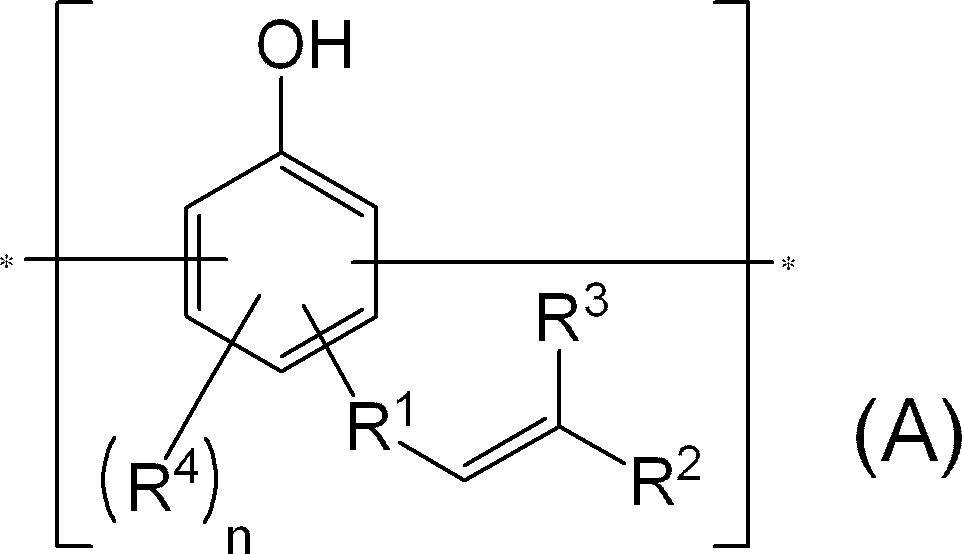
- the structural unit containing the alkenyl group contained in the specific phenol resin may include the structural unit represented by the following formula (A).
- R 1 represents a single bond or an alkylene group
- R 2 and R 3 each independently represent a hydrogen atom or an alkyl group
- R 4 independently represents an alkyl group, an alkoxy group, and a fluorine atom.
- n represents an integer of 0 to 2. * Indicates a bonder.
- Examples of the alkylene group represented by R 1 include an alkylene group having 1 to 30 carbon atoms, and specifically, a methylene group, an ethylene group, a propylene group, a butylene group, a pentylene group, a hexylene group and an octylene group. , Decylene group, dodecylene group and the like.
- R 1 a single bond or an alkylene group having 1 to 3 carbon atoms is preferable, a single bond, a methylene group or an ethylene group is more preferable, and a single bond or a methylene group is further preferable.
- Examples of the alkyl group represented by R 2 and R 3 include an alkyl group having 1 to 30 carbon atoms, and specifically, a methyl group, an ethyl group, a propyl group, an isopropyl group, an n-butyl group, and the like.
- Alkyl groups such as sec-butyl group, t-butyl group, pentyl group, hexyl group, octyl group, decyl group, dodecyl group, and hydrogen atom of alkyl group are alkoxy group, aryl group, hydroxyl group, amino group, halogen atom, Examples thereof include those substituted with a substituent such as (meth) acryloyloxy group, mercapto group, imino group, ureido group and isocyanate group.
- a hydrogen atom or an alkyl group having 1 to 3 carbon atoms is preferable, a hydrogen atom, a methyl group or an ethyl group is more preferable, and a hydrogen atom or a methyl group is further preferable.
- Examples of the alkyl group represented by R 4 include an alkyl group having 1 to 30 carbon atoms, and specific examples thereof are the same as those of the alkyl groups represented by R 2 and R 3 .
- the alkoxy group represented by R 4 for example, include an alkoxy group having a carbon number of 1 to 30, specifically, methoxy group, an ethoxy group, a propoxy group, isopropoxy group, n- butoxy group, sec- Examples thereof include a butoxy group, a t-butoxy group, a pentyloxy group, a hexyloxy group, an octyloxy group, a decyloxy group, a dodecyloxy group and the like.
- n 0 or 1 is preferable, and 0 is more preferable.
- the alkenyl group contained in the structural unit represented by the formula (A) is preferably at least one of an allyl group (2-propenyl group) and a 1-propenyl group.
- the hydroxyl value of the specific phenol resin is preferably 100 mgKOH / g to 400 mgKOH / g, more preferably 120 mgKOH / g to 350 mgKOH / g, and even more preferably 140 mgKOH / g to 300 mgKOH / g.
- the hydroxyl value refers to a value measured in accordance with JIS K0700: 1992.
- the epoxy resin composition may contain at least two types of phenol resins containing alkenyl groups having different structural units as the specific phenol resin.
- the epoxy resin composition contains two types of phenolic resins as the specific phenolic resin, the first one having a structural unit containing an allyl group as the specific phenolic resin in order to improve the curability of the alkenyl group of the specific phenolic resin. It is preferable to contain a phenol resin and a second phenol resin having a structural unit containing a 1-propenyl group.
- the specific phenol resin may contain other structural units other than the structural unit containing an alkenyl group.
- other structural units include structural units containing an arylene group.
- the arylene group include a phenylene group, a naphthylene group, a biphenylylene group, a triphenylylene group and the like, and among these, a biphenylylene group is preferable.
- Structural units containing an alkenyl group and, if necessary, other structural units may be linked by an alkylene group.
- alkylene group connecting each structural unit include a methylene group, an ethylene group, a methine group, a methylmethylene group, a dimethylmethylene group and the like.
- one of the two bonds in the structural unit represented by the formula (A) may be bonded to a hydrogen atom.
- Specific examples of the specific phenol resin include SBA, APG-1, LVA01 and the like as specific phenol resins containing an allyl group, and PPN-80, APG-2, BPN01, etc. as specific phenol resins containing a 1-propenyl group.
- TPMP and the like both are Gunei Chemical Industry Co., Ltd. can be mentioned.
- the epoxy resin composition may contain other phenolic resins other than the specific phenolic resin.
- Other phenolic resins include, for example, a group consisting of phenolic compounds (eg, phenol, cresol, xylenol, resorcin, catechol, bisphenol A and bisphenol F) and naphthol compounds (eg, ⁇ -naphthol, ⁇ -naphthol and dihydroxynaphthalene).
- Novolac resin obtained by condensing or co-condensing at least one selected from the above and an aldehyde compound (for example, formaldehyde, acetaldehyde, propionaldehyde, benzaldehyde and salicylaldehyde) under an acidic catalyst; phenol-aralkyl resin; biphenyl. -Aralkyl resin; and naphthol-aralkyl resin;
- the ratio of the specific phenolic resin to the total phenolic resin is preferably 70% by mass or more, more preferably 90% by mass or more, and 95% by mass or more. It is more preferable to have.
- the epoxy resin composition may further contain an active ester compound as a curing agent.
- the type of the active ester compound is not particularly limited as long as it is a compound having one or more ester groups in the molecule that react with the epoxy group.
- a high glass transition temperature can be realized by a curing reaction between the epoxy group of the epoxy resin and the phenolic hydroxyl group of the specific phenol resin and a curing reaction between the alkenyl groups. .. Further, in the curing reaction between alkenyl groups, polar groups such as alcoholic hydroxyl groups, which are considered to be one of the factors for increasing the dielectric loss tangent of the cured product, are not generated, so that the dielectric loss tangent of the cured product can be lowered.
- an alcoholic hydroxyl group is generated by the reaction between the epoxy group and the phenolic hydroxyl group, the alcoholic hydroxyl group may affect the dielectric loss tangent of the cured product of the epoxy resin composition of the present disclosure. Therefore, it is desirable to further reduce the dielectric loss tangent of the cured product of the epoxy resin composition by using a curing agent other than the specific phenol resin in combination.
- a curing agent other than the specific phenol resin in combination.
- Examples of the active ester compound include phenol ester compounds, thiophenol ester compounds, N-hydroxyamine ester compounds, and esterified products of heterocyclic hydroxy compounds.
- Examples of the active ester compound include ester compounds obtained from at least one of an aliphatic carboxylic acid and an aromatic carboxylic acid and at least one of an aliphatic hydroxy compound and an aromatic hydroxy compound.
- Ester compounds containing an aliphatic compound as a component of polycondensation tend to have excellent compatibility with an epoxy resin because they have an aliphatic chain.
- Ester compounds containing an aromatic compound as a component of polycondensation tend to have excellent heat resistance due to having an aromatic ring.
- the active ester compound include aromatic esters obtained by a condensation reaction between an aromatic carboxylic acid and a phenolic hydroxyl group.
- aromatic carboxylic acid component in which 2 to 4 hydrogen atoms of an aromatic ring such as benzene, naphthalene, biphenyl, diphenylpropane, diphenylmethane, diphenyl ether, and diphenylsulfone are substituted with a carboxy group, and the hydrogen atom of the aromatic ring described above.
- an aromatic carboxylic acid and a phenolic hydroxyl group are used.
- the aromatic ester obtained by the condensation reaction of the above is preferable. That is, an aromatic ester having a structural unit derived from the aromatic carboxylic acid component, a structural unit derived from the monohydric phenol, and a structural unit derived from the polyhydric phenol is preferable.
- the active ester compound examples include a phenol resin having a molecular structure in which a phenol compound is knotted via an aliphatic cyclic hydrocarbon group described in JP2012-246367, and an aromatic dicarboxylic acid or Examples thereof include an active ester compound having a structure obtained by reacting the halide with an aromatic monohydroxy compound.
- the active ester compound a compound represented by the following structural formula (1) is preferable.
- R 1 is an alkyl group having 1 to 4 carbon atoms
- X is a benzene ring, a naphthalene ring, a benzene ring or a naphthalene ring substituted with an alkyl group having 1 to 4 carbon atoms, or a biphenyl group
- Y is a benzene ring, a naphthalene ring, or a benzene ring or a naphthalene ring substituted with an alkyl group having 1 to 4 carbon atoms
- k is 0 or 1
- n represents the average number of repetitions. It is 25 to 1.5.
- Specific examples of the compound represented by the structural formula (1) include the following exemplified compounds (1-1) to (1-10).
- T-Bu in the structural formula is a tert-butyl group.
- n and k in the following exemplified compounds (1-1) to (1-10) are synonymous with n and k in the structural formula (1).
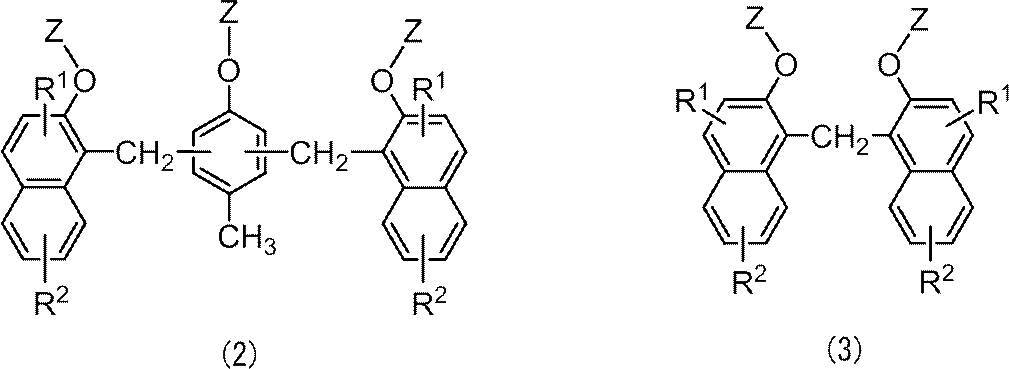
- the compound represented by the following structural formula (2) and the compound represented by the following structural formula (3) described in JP-A-2014-114352 can be used. Can be mentioned.
- R 1 and R 2 are independently hydrogen atoms, alkyl groups having 1 to 4 carbon atoms, or alkoxy groups having 1 to 4 carbon atoms
- Z is a benzoyl group, a naphthoyl group, and carbon.
- R 1 and R 2 are independently hydrogen atoms, alkyl groups having 1 to 4 carbon atoms, or alkoxy groups having 1 to 4 carbon atoms
- Z is a benzoyl group, a naphthoyl group, and carbon.
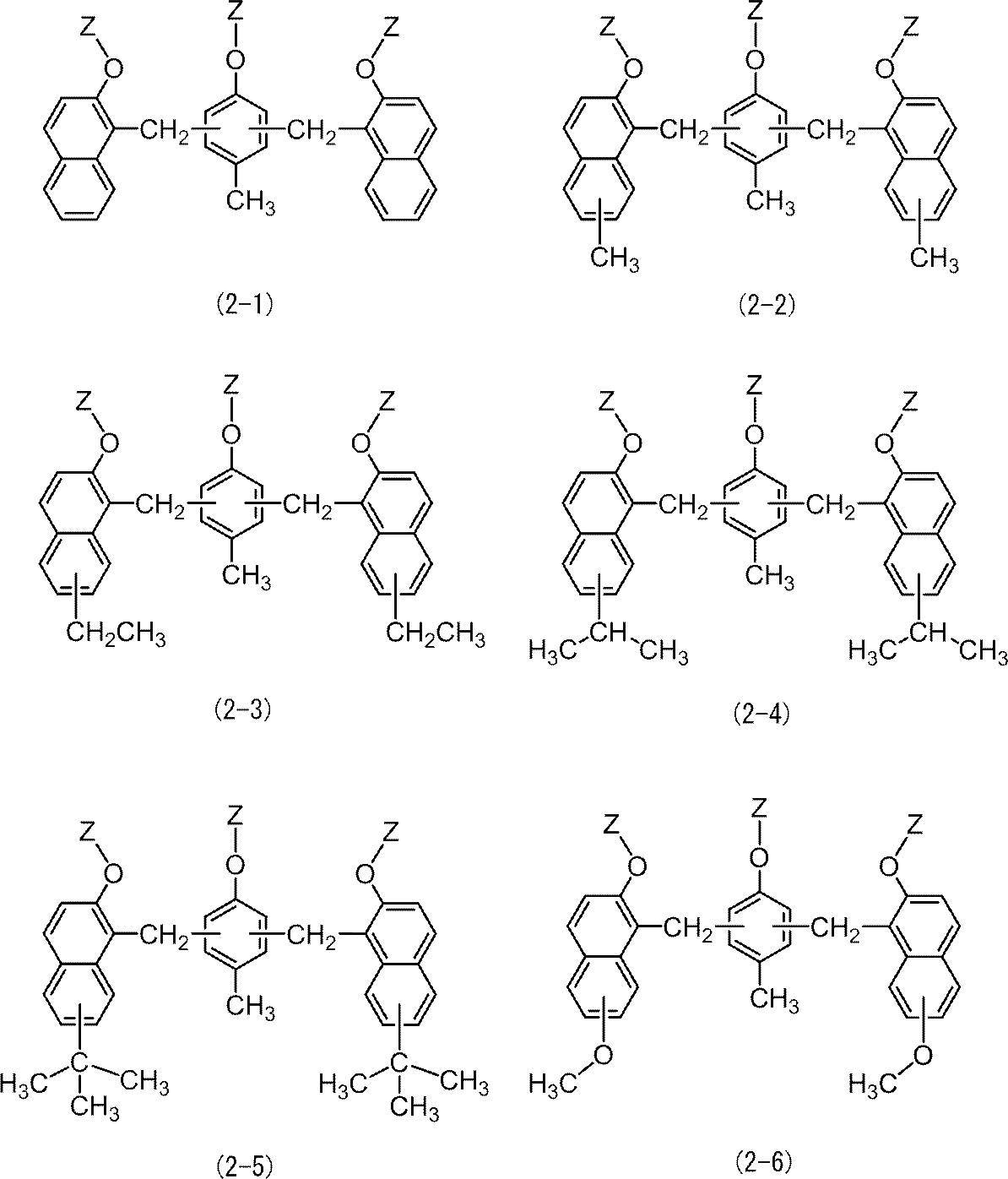
- Specific examples of the compound represented by the structural formula (2) include the following exemplified compounds (2-1) to (2-6).
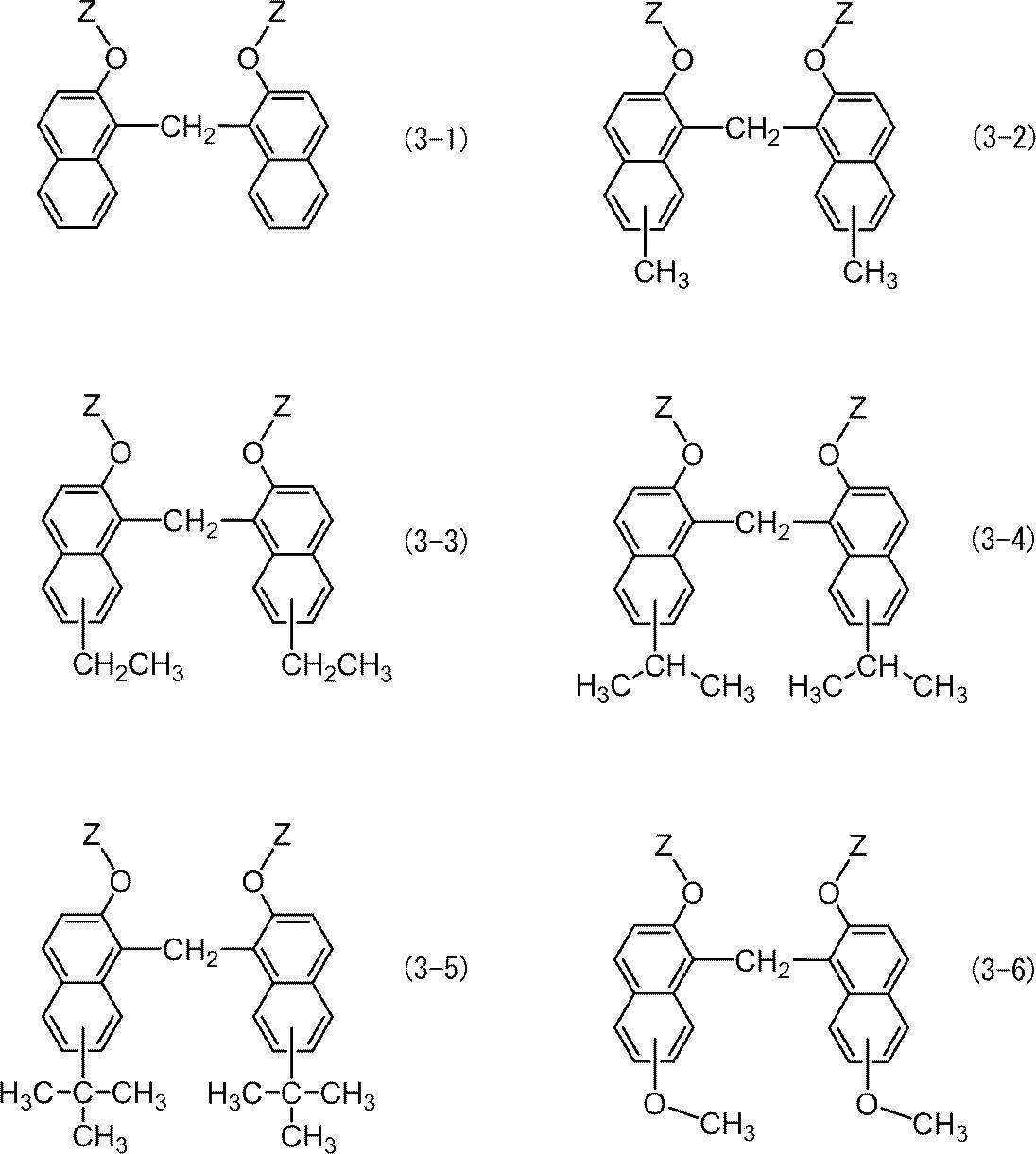
- Specific examples of the compound represented by the structural formula (3) include the following exemplified compounds (3-1) to (3-6).
- the active ester compound As the active ester compound, a commercially available product may be used. Commercially available products of the active ester compound include "EXB9451”, “EXB9460”, “EXB9460S”, “HPC-8000-65T”, etc. (manufactured by DIC Co., Ltd.) as active ester compounds containing a dicyclopentadiene type diphenol structure; “EXB9416-70BK”, “EXB-8", “EXB-9425”, etc. as active ester compounds containing a group structure (manufactured by DIC Co., Ltd.); “DC808", etc.
- active ester compounds containing an acetylated product of phenol novolac Mitsubishi Chemical Co., Ltd.
- examples of the active ester compound containing a benzoylated product of phenol novolac include “YLH1026” and the like (manufactured by Mitsubishi Chemical Co., Ltd.).
- the active ester compound may be used alone or in combination of two or more.
- the ester group equivalent of the active ester compound is not particularly limited. From the viewpoint of balancing various characteristics such as moldability, reflow resistance, and electrical reliability, 150 g / eq to 400 g / eq is preferable, 170 g / eq to 300 g / eq is more preferable, and 200 g / eq to 250 g / eq is preferable. More preferred.
- the ester group equivalent of the active ester compound shall be a value measured by a method according to JIS K 0070: 1992.
- the epoxy resin composition may contain other curing agents other than the phenolic resin and the active ester compound used as needed.
- examples of other curing agents include acid anhydride-based curing agents and amine-based curing agents.
- the content of the curing agent is not particularly limited, and the equivalent of the functional group of the curing agent (for example, the sum of the phenolic hydroxyl group of the specific phenol resin and the ester group of the active ester compound used in combination as necessary) is epoxy. It is preferable that the curing agent is blended so as to be 0.5 equivalent to 1.5 equivalents with respect to 1 equivalent of the epoxy group of the resin, and the curing agent is blended so as to be 0.7 equivalents to 1.2 equivalents. It is more preferable to be done.
- the equivalent of the functional group of the curing agent for example, the sum of the phenolic hydroxyl group of the specific phenol resin and the ester group of the active ester compound used in combination as necessary
- the curing agent is blended so as to be 0.5 equivalent to 1.5 equivalents with respect to 1 equivalent of the epoxy group of the resin, and the curing agent is blended so as to be 0.7 equivalents to 1.2 equivalents. It is more preferable to be done.
- the ratio of the hydroxyl group equivalent of the specific phenol resin to the ester group equivalent of the active ester compound is 0.5 to 1.5. It is preferably 0.7 to 1.2, and more preferably 0.7 to 1.2.
- the epoxy resin composition may contain a curing accelerator.
- the curing accelerator accelerates the curing reaction between the epoxy resin and the curing agent.
- the curing accelerator used together with the epoxy resin and the curing agent is not particularly limited, and may be one usually used in the art.
- 1,8-diaza-bicyclo (5,4,0) undecene-7 1,5-diaza-bicyclo (4,3,0) nonene, 5,6-dibutylamino-1,8 -Diaza-bicyclo (5,4,0) undecene-7
- benzyldimethylamine triethanolamine, dimethylaminoethanol, tris (dimethylaminomethyl) phenol and other tertiary amines and their derivatives
- 2-methylimidazole Anhydrous to imidazoles such as 2-phenylimidazole and 2-phenyl-4-methylimidazole and their derivatives, organic phosphines such as triphenylphosphine, methyldiphenylphosphine, triphenylphosphine, diphenylphosphine, phenylphosphine and these phosphines.
- the curing accelerator one type may be used alone, or two or more types may be used in combination.
- the mixing ratio of the curing accelerator is preferably set to a ratio of 0.1% by mass to 5.0% by mass of the entire epoxy resin composition. Further, considering the fluidity of the epoxy resin composition, it is more preferably 0.15% by mass to 0.35% by mass
- the epoxy resin composition may contain a radical polymerization initiator.
- the radical polymerization initiator promotes the curing reaction between the alkenyl groups.
- the radical polymerization initiator is not particularly limited, and a conventionally known radical polymerization initiator can be used.
- examples of the radical polymerization initiator include radical polymerization initiators that generate free radicals by heat, and specific examples thereof include inorganic peroxides, organic peroxides, and azo compounds.
- examples of the inorganic peroxide include potassium persulfate (dipotassium peroxosulfate), sodium persulfate, ammonium persulfate and the like.
- organic peroxide examples include ketone peroxides such as methyl ethyl ketone peroxide and cyclohexanone peroxide, 1,1-di (t-butylperoxy) cyclohexane, and 2,2-di (4,5-di (t-butylper)).
- ketone peroxides such as methyl ethyl ketone peroxide and cyclohexanone peroxide, 1,1-di (t-butylperoxy) cyclohexane, and 2,2-di (4,5-di (t-butylper)).
- Oxy) cyclohexyl) peroxyketal such as propane, p-menthan hydroperoxide, diisopropylbenzene hydroperoxide, 1,1,3,3-tetramethylbutylhydroperoxide, cumenehydroperoxide, t-butylhydroperoxide Hydroperoxide, ⁇ , ⁇ '-di (t-butylperoxy) diisopropylbenzene, dicumyl peroxide, 2,5-dimethyl-2,5-di (t-butylperoxy) hexane, t-butylkumi Dialkyl peroxides such as ruperoxide, di-t-hexyl peroxide, 2,5-dimethyl-2,5-di (t-butylperoxy) hexin-3, di-t-butyl peroxide, dibenzoylper Diacyl peroxides such as oxides and di (4-methylbenzoyl) peroxides,
- azo compound examples include azobisisobutyronitrile, azobis-4-methoxy-2,4-dimethylvaleronitrile, azobiscyclohexanone-1-carbonitrile, and azodibenzoyl.
- a dialkyl peroxide having a phenyl group in the organic peroxide is preferable, and a dicumyl peroxide is more preferable, particularly from the viewpoint of temperature stability in a medium temperature region.
- the content of the radical polymerization initiator in the epoxy resin composition is not particularly limited.
- the content of the radical polymerization initiator is preferably 0.1 part by mass to 20 parts by mass with respect to 100 parts by mass of the specific phenol resin, and from the viewpoint of curability, 0.5 parts by mass to 10 parts by mass. Is more preferable.
- the content of the radical polymerization initiator is 20 parts by mass or less with respect to 100 parts by mass of the specific phenol resin, volatile components are less likely to be generated, and the generation of voids in the cured product tends to be suppressed.
- the content of the radical polymerization initiator is 0.1 part by mass or more with respect to 100 parts by mass of the specific phenol resin, the curability tends to be improved.
- the epoxy resin composition of the present disclosure may contain a coupling agent.
- the type of coupling agent is not particularly limited, and known coupling agents can be used. Examples of the coupling agent include a silane coupling agent and a titanium coupling agent. One type of coupling agent may be used alone, or two or more types may be used in combination.
- silane coupling agent examples include vinyltrichlorosilane, vinyltriethoxysilane, vinyltris ( ⁇ -methoxyethoxy) silane, ⁇ -methacryloxypropyltrimethoxysilane, and ⁇ - (3,4-epoxycyclohexyl) ethyltrimethoxysilane.
- ⁇ -Glysidoxypropyltrimethoxysilane Vinyltriacetoxysilane, ⁇ -Mercaptopropyltrimethoxysilane, ⁇ -Aminopropyltriethoxysilane, ⁇ - [bis ( ⁇ -hydroxyethyl)] aminopropyltriethoxysilane, N -( ⁇ -Aminoethyl) - ⁇ -aminopropyltrimethoxysilane, ⁇ - ( ⁇ -aminoethylamino) propyldimethoxymethylsilane, N- (dimethoxymethylsilylisopropyl) ethylenediamine, methyltrimethoxysilane, methyltriethoxysilane, N- ( ⁇ - (N-vinylbenzylamino) ethyl) - ⁇ -aminopropyltrimethoxysilane, ⁇ -chloropropyltrimethoxysilane, he
- titanium coupling agent examples include isopropyltriisostearoyl titanate, isopropyltris (dioctylpyrophosphate) titanate, isopropyltri (N-aminoethyl-aminoethyl) titanate, tetraoctylbis (ditridecylphosphite) titanate, and tetra (ditridecylphosphite) titanate.
- the content of the coupling agent is preferably 10% by mass or less with respect to the entire epoxy resin composition, and from the viewpoint of exerting the effect, it is 0. It is preferably 1% by mass or more.
- the epoxy resin composition may contain an inorganic filler.
- the inorganic filler is not particularly limited, and may be one usually used in the art.
- Examples of the inorganic filler include powders of fused silica, crystalline silica, alumina, zircon, calcium silicate, calcium carbonate, silicon carbide, boron nitride, berylia, zirconia, titanium dioxide and the like, or spherical beads, hollow particles and titanium. Examples thereof include single crystal fibers such as potassium acid, silicon carbide, silicon nitride and alumina, and glass fibers.
- Preferred examples of the inorganic filler include spherical molten silica powder and crushed silica powder.
- the inorganic filler one type may be used alone, or two or more types may be used in combination.
- the blending ratio of the inorganic filler is preferably set to 70% by mass to 95% by mass of the entire epoxy resin composition, and more preferably 75% by mass to 90% by mass.
- the average particle size of the inorganic filler is preferably 1 ⁇ m to 150 ⁇ m, more preferably 5 ⁇ m to 75 ⁇ m.
- the average particle size of the inorganic filler is measured using a laser diffraction method, and corresponds to the particle size at which the volume accumulation is 50% when the volume cumulative particle size distribution curve is drawn from the small particle size side.
- the particle size distribution measurement using the laser diffraction method can be performed using a laser diffraction scattering particle size distribution measuring device (for example, LS230 manufactured by Beckman Coulter).
- the epoxy resin composition of the present disclosure may contain a mold release agent.
- the type of release agent is not particularly limited, and a known release agent can be used. Specific examples thereof include higher fatty acids, higher fatty acid esters, carnauba wax and polyethylene wax.
- As the release agent one type may be used alone, or two or more types may be used in combination.
- the content of the mold release agent is preferably 10% by mass or less with respect to the total amount of the epoxy resin and the curing agent, and from the viewpoint of exerting the effect. Is preferably 0.2% by mass or more.
- the epoxy resin composition of the present disclosure may contain a colorant (for example, carbon black).
- the epoxy resin composition may contain a modifier (for example, silicone resin and silicone rubber).
- the epoxy resin composition may contain a dispersant (for example, a maleic acid-based copolymer resin).
- a colorant for example, carbon black
- the epoxy resin composition may contain a modifier (for example, silicone resin and silicone rubber).
- the epoxy resin composition may contain a dispersant (for example, a maleic acid-based copolymer resin).
- the colorant, the dispersant and the modifier one type may be used alone or two or more types may be used in combination.
- the content of the conductive particles is preferably 1% by mass or less of particles having a particle diameter of 10 ⁇ m or more.
- the content of the conductive particles is preferably 3% by mass or less with respect to the total amount of the epoxy resin and the curing agent.
- the method for preparing the epoxy resin composition is not particularly limited, and a known method can be used. For example, it can be prepared by sufficiently mixing a mixture of raw materials in a predetermined blending amount with a mixer or the like, kneading with a hot roll, an extruder or the like, and subjecting the treatment to cooling, pulverization or the like.
- the state of the epoxy resin composition is not particularly limited, and may be in the form of powder, solid, liquid, or the like. From the viewpoint of handling, the epoxy resin composition is preferably solid at 25 ° C.
- the electronic component device of the present disclosure is arranged at least in a gap between a substrate having a circuit layer, an electronic component arranged on the substrate and electrically connected to the circuit layer, and the substrate and the electronic component.
- a cured product of the epoxy resin composition of the present disclosure is arranged at least in the gap between the substrate and the electronic component, and the entire electronic component may be covered with the cured product.
- the electronic component device of the present disclosure can be obtained by sealing the electronic component with the epoxy resin composition of the present disclosure.
- the electronic component device of the present disclosure is excellent in reliability because the electronic component is sealed by the epoxy resin composition of the present disclosure.
- Electronic component devices include lead frames, pre-wired tape carriers, rigid wiring boards, flexible wiring boards, glass, silicon wafers, and other circuit boards, and active elements such as semiconductor chips, transistors, diodes, and thyristors; capacitors.
- An electronic component device obtained by mounting electronic components such as a resistor, a resistor array, a coil, a switch, etc., and sealing a necessary portion with the epoxy resin composition of the present disclosure.
- a semiconductor device in which a semiconductor element is flip-chip bonded by bump connection to a rigid wiring board, a flexible wiring board, or a wiring formed on glass is mentioned as one of the objects to which the epoxy resin composition of the present disclosure can be applied. ..
- Specific examples include electronic component devices such as flip-chip BGA (Ball Grid Array), LGA (Land Grid Array), and COF (Chip On Film).
- the epoxy resin composition of the present disclosure is suitable as a solid encapsulant having excellent reliability.
- the field of flip chips to which the epoxy resin composition of the present disclosure is particularly preferably applied is not limited to the case where the bump material connecting the wiring board and the semiconductor element is a conventional lead-containing solder, but also a Sn-Ag-Cu system. There is also a case where it is a flip chip semiconductor component using lead-free solder such as.
- the epoxy resin composition of the present disclosure tends to maintain good reliability even for flip chips in which bump connections are made using lead-free solder, which is physically fragile as compared with conventional lead solder. Further, when a chip scale package such as a wafer level CSP (Chip Size Package) is mounted on a substrate, the reliability tends to be improved by applying the epoxy resin composition of the present disclosure.
- a substrate having a circuit layer and an electronic component arranged on the substrate and electrically connected to the circuit layer are formed by using the epoxy resin composition of the present disclosure. It has a sealing step.
- the step of sealing the substrate having the circuit layer and the electronic component by using the epoxy resin composition of the present disclosure is not particularly limited.
- the transfer molding method is generally used, but a compression molding method, an injection molding method, or the like may be used.
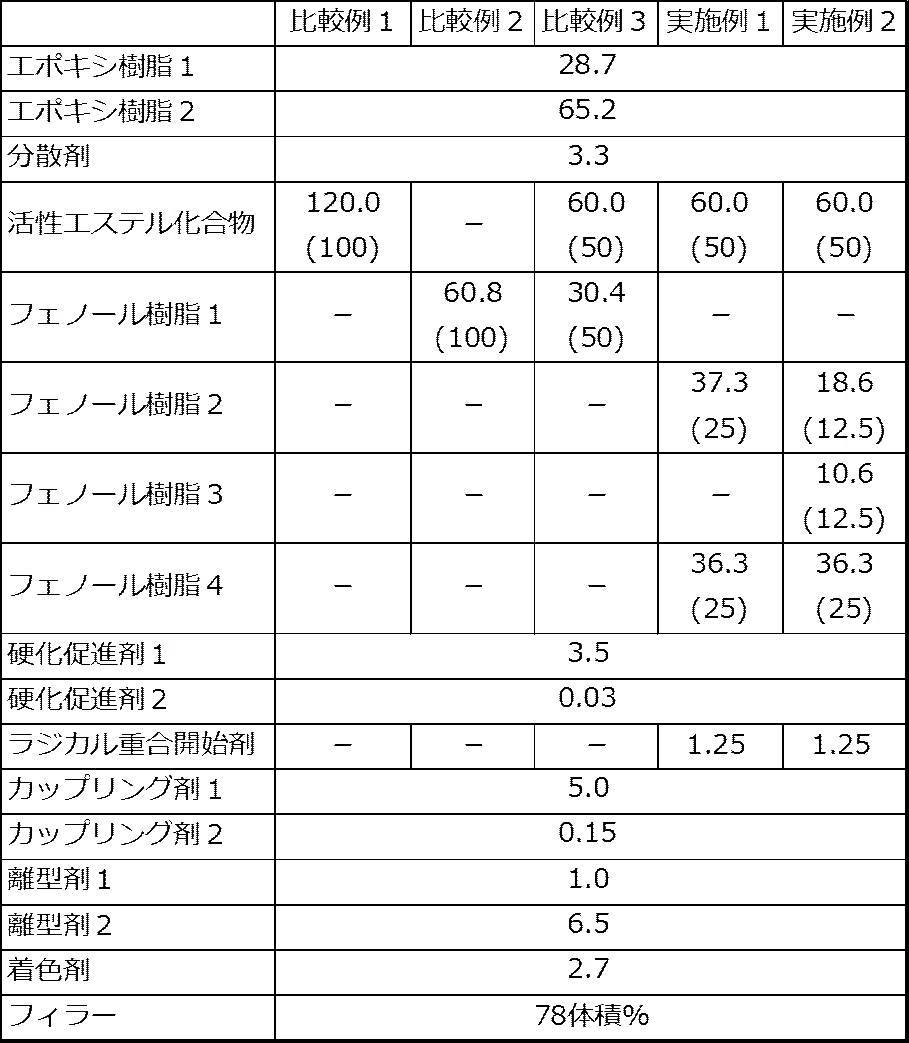
- Examples 1 and 2 and Comparative Examples 1 to 3 Each component is blended so as to have the composition shown in Table 1, kneaded with a three-roll machine and a vacuum raikai machine, and dispersed to form an epoxy resin composition of Examples 1 to 2 and Comparative Examples 1 to 3. The thing was prepared.
- the compounding unit in Table 1 is a part by mass excluding the filler, and "-" indicates "no compounding".
- the curing agent was blended so that the total of the epoxy equivalent of the epoxy resin and the functional group (hydroxyl group and ester group) equivalent of the curing agent was in a ratio of 1: 1.
- the numerical values in parentheses in the column of the curing agent in Table 1 represent the equivalent ratio of each curing agent.
- the curing agent A is 50 and the curing agent B is 50, it means that the curing agent A and the curing agent B are blended in an equivalent ratio of 50:50.
- the content of the filler in the epoxy resin composition was 78% by volume on a volume basis (volume%). 78% by volume corresponds to 87% by mass.
- -Epoxy resin- -Epoxy resin 1 Tris (hydroxyphenyl) methane type epoxy resin, epoxy equivalent: 167 g / eq -Epoxy resin 2: Biphenyl type epoxy resin, epoxy equivalent: 186 g / eq -Hardener- -Phenolic resin 1: Phenolic novolak resin, hydroxyl value: 103 mgKOH / g -Phenolic resin 2: Allyl-modified phenolic resin (having a structural unit containing an allyl group and a biphenylene group), hydroxyl value: 260 mgKOH / g -Phenolic resin 3: Allyl-modified phenolic resin (having a structural unit containing an allyl group), hydroxyl value: 148 mgKOH / g -Phenolic resin 4: Propenyl-modified phenolic resin (having
- the liquidity was evaluated by the Spiral Flow test.
- the epoxy resin composition was molded using a mold for measuring spiral flow according to EMMI-1-66, and the flow distance (inch) of the molded product of the epoxy resin composition was measured.
- the epoxy resin composition was molded using a transfer molding machine under the conditions of a mold temperature of 180 ° C., a molding pressure of 6.9 MPa, and a curing time of 90 seconds.
- the viscosity was evaluated by a high-grade flow tester (manufactured by Shimadzu Corporation). The minimum melt viscosity of the epoxy resin composition at 175 ° C. was measured using an enhanced flow tester.
- the degree of hardening was evaluated by a curast meter (manufactured by JSR Trading Co., Ltd.).
- the gel time of the epoxy resin composition was measured using a curastometer (manufactured by JSR Trading Co., Ltd.) under the conditions of a sample volume of 1.5 ml and 175 ° C.
- the time at which the torque of the obtained chart started to rise was defined as the gel time.
- the heat resistance and reliability were evaluated for the cured product of the epoxy resin composition.
- the cured product of the epoxy resin composition was prepared by heating and curing at 175 ° C. for 360 minutes.
- the glass transition temperature (Tg) of the cured product of the epoxy resin composition was measured by the DMA (Dynamic Mechanical Analysis, dynamic viscoelasticity measurement) method using DMS6100 manufactured by SII.
- the heating rate was 3 ° C./min and the measurement frequency was 10 Hz.
- the coefficient of thermal expansion in the temperature range below Tg was set to ⁇ 1
- the coefficient of thermal expansion in the temperature range above Tg was set to ⁇ 2 .
- the resin plate used for the evaluation of the dielectric property was produced by the following procedure.
- the epoxy resin compositions were crushed, placed in a mold and placed in a press.
- the hot plate temperature of the press was maintained at 175 ° C., and the press was pressed at a pressure of 7 MPa for 30 minutes while reducing the pressure.
- the cured product of the epoxy resin composition was taken out from the mold and used as a resin plate for dielectric loss tangent measurement.
- the resin plate produced as described above is cut into a test piece having a width of 2 mm and a length of 70 mm, and a PNA network analyzer (manufactured by Keysight Technology Co., Ltd., N5227A) and a split cylinder cavity resonator (Keysight Technology) are cut out.
- the dielectric loss tangent (Df) and the dielectric constant (Dk) at 60 GHz were measured using a product manufactured by Co., Ltd.
- the measurement temperature was 25 ° C.
- the cured product of the epoxy resin composition of Comparative Example 1 has a low dielectric loss tangent but a low glass transition temperature. Further, it can be seen that the cured products of the epoxy resin compositions of Comparative Examples 2 and 3 have a high glass transition temperature but a high dielectric loss tangent. On the other hand, in the cured products having the epoxy resin compositions of Examples 1 and 2, the glass transition temperature is higher than that of Comparative Example 1, and the dielectric loss tangent is lower than that of Comparative Example 2 and Comparative Example 3. It can be seen that the cured products having the epoxy resin compositions of Examples 1 and 2 have both a high glass transition temperature and a low dielectric loss tangent.
Landscapes
- Chemical & Material Sciences (AREA)
- Health & Medical Sciences (AREA)
- Chemical Kinetics & Catalysis (AREA)
- Medicinal Chemistry (AREA)
- Polymers & Plastics (AREA)
- Organic Chemistry (AREA)
- Epoxy Resins (AREA)
- Structures Or Materials For Encapsulating Or Coating Semiconductor Devices Or Solid State Devices (AREA)
Abstract
Description
通信のために発信された電波が誘電体において熱変換されることで発生する伝送損失の量は、周波数と比誘電率の平方根と誘電正接との積として表される。つまり伝送信号は周波数に比例して熱に変わりやすいので、伝送損失を抑制するために高周波帯ほど通信部材の材料に低誘電特性が要求される。
例えば特許文献1~特許文献2には、エポキシ樹脂用硬化剤として活性エステル化合物を含有する熱硬化性樹脂組成物が開示されており、硬化物の誘電正接を低く抑えることができるとされている。
そのため、低誘電正接でありながら高ガラス転移温度の硬化物を形成可能な樹脂組成物が求められている。
本開示は上記従来の事情に鑑みてなされたものであり、本開示の一形態は、低誘電正接且つ高ガラス転移温度の硬化物を形成可能なエポキシ樹脂組成物並びにこのエポキシ樹脂組成物を用いた電子部品装置及び電子部品装置の製造方法を提供することを目的とする。
<1> エポキシ樹脂と、アルケニル基を含む構造単位を有するフェノール樹脂と、を含有するエポキシ樹脂組成物。
<2> 前記アルケニル基を含む構造単位が、下記式(A)で表される構造単位を含む<1>に記載のエポキシ樹脂組成物。
<3> 前記アルケニル基が、アリル基及び1-プロペニル基の少なくとも一方を含む<1>又は<2>に記載のエポキシ樹脂組成物。
<4> 前記フェノール樹脂として、前記アルケニル基を含む構造単位が互いに異なる少なくとも2種類のフェノール樹脂を含有する<1>~<3>のいずれか1項に記載のエポキシ樹脂組成物。
<5> 前記フェノール樹脂として、アリル基を含む構造単位を有する第一のフェノール樹脂と、1-プロペニル基を含む構造単位を有する第二のフェノール樹脂と、を含有する<4>に記載のエポキシ樹脂組成物。
<6> 活性エステル化合物をさらに含有する<1>~<5>のいずれか1項に記載のエポキシ樹脂組成物。
<7> 25℃で固体である<1>~<6>のいずれか1項に記載のエポキシ樹脂組成物。
<8> 回路層を有する基板と、
前記基板上に配置され、前記回路層と電気的に接続された電子部品と、
前記基板と前記電子部品との間隙に少なくとも配置された<1>~<7>のいずれか1項に記載のエポキシ樹脂組成物の硬化物と、
を備える電子部品装置。
<9> 回路層を有する基板と、前記基板上に配置され、前記回路層と電気的に接続された電子部品とを、<1>~<7>のいずれか1項に記載のエポキシ樹脂組成物を用いて封止する工程を有する電子部品装置の製造方法。
本開示において「工程」との語には、他の工程から独立した工程に加え、他の工程と明確に区別できない場合であってもその工程の目的が達成されれば、当該工程も含まれる。
本開示において「~」を用いて示された数値範囲には、「~」の前後に記載される数値がそれぞれ最小値及び最大値として含まれる。
本開示中に段階的に記載されている数値範囲において、一つの数値範囲で記載された上限値又は下限値は、他の段階的な記載の数値範囲の上限値又は下限値に置き換えてもよい。また、本開示中に記載されている数値範囲において、その数値範囲の上限値又は下限値は、実施例に示されている値に置き換えてもよい。
本開示において、各成分には、該当する物質が複数種含まれていてもよい。組成物中に各成分に該当する物質が複数種存在する場合、各成分の含有率又は含有量は、特に断らない限り、組成物中に存在する当該複数種の物質の合計の含有率又は含有量を意味する。
本開示において、各成分に該当する粒子には、複数種の粒子が含まれていてもよい。組成物中に各成分に該当する粒子が複数種存在する場合、各成分の粒子径は、特に断らない限り、組成物中に存在する当該複数種の粒子の混合物についての値を意味する。
本開示において「層」との語には、当該層が存在する領域を観察したときに、当該領域の全体に形成されている場合に加え、当該領域の一部にのみ形成されている場合も含まれる。
本開示において「(メタ)アクリロイルオキシ基」とは、アクリロイルオキシ基及びメタクリロイルオキシ基の少なくとも一方を意味する。
本開示のエポキシ樹脂組成物は、エポキシ樹脂と、アルケニル基を含む構造単位を有するフェノール樹脂(以下、特定フェノール樹脂と称することがある。)と、を含有する。
本開示のエポキシ樹脂組成物によれば、低誘電正接且つ高ガラス転移温度の硬化物を形成可能となる。
以下、エポキシ樹脂組成物を構成する各成分について説明する。エポキシ樹脂組成物は、エポキシ樹脂と特定フェノール樹脂とを含有し、必要に応じて活性エステル化合物、無機充填材等のその他の成分をさらに含有してもよい。
エポキシ樹脂組成物は、エポキシ樹脂を含有する。エポキシ樹脂の種類は特に限定されず、公知のエポキシ樹脂を使用することができる。
具体的には、例えば、フェノール化合物(例えば、フェノール、クレゾール、キシレノール、レゾルシン、カテコール、ビスフェノールA及びビスフェノールF)及びナフトール化合物(例えば、α-ナフトール、β-ナフトール及びジヒドロキシナフタレン)からなる群より選択される少なくとも1種と、アルデヒド化合物(例えば、ホルムアルデヒド、アセトアルデヒド、プロピオンアルデヒド、ベンズアルデヒド及びサリチルアルデヒド)とを、酸性触媒下で縮合又は共縮合させて得られるノボラック樹脂をエポキシ化した樹脂(例えば、フェノールノボラック型エポキシ樹脂及びオルソクレゾールノボラック型エポキシ樹脂);ビスフェノール(例えば、ビスフェノールA、ビスフェノールAD、ビスフェノールF及びビスフェノールS)及びビフェノール(例えば、アルキル置換又は非置換のビフェノール)からなる群より選択される少なくとも1種のジグリシジルエーテル;フェノール・アラルキル樹脂のエポキシ化物;フェノール化合物とジシクロペンタジエン及びテルペン化合物からなる群より選択される少なくとも1種との付加物又は重付加物のエポキシ化物;多塩基酸(例えば、フタル酸及びダイマー酸)とエピクロルヒドリンとの反応により得られるグリシジルエステル型エポキシ樹脂;ポリアミン(例えば、ジアミノジフェニルメタン及びイソシアヌル酸)とエピクロルヒドリンとの反応により得られるグリシジルアミン型エポキシ樹脂;オレフィン結合を過酸(例えば、過酢酸)で酸化して得られる線状脂肪族エポキシ樹脂;脂環族エポキシ樹脂;並びに;トリス(ヒドロキシフェニル)メタン型エポキシ樹脂が挙げられる。エポキシ樹脂は、1種類を単独で使用しても、2種類以上を併用してもよい。
エポキシ樹脂のエポキシ当量は、秤量したエポキシ樹脂をメチルエチルケトン等の溶媒に溶解させ、酢酸と臭化テトラエチルアンモニウム酢酸溶液を加えた後、過塩素酸酢酸標準液によって電位差滴定することにより測定される。この滴定には、指示薬を用いてもよい。
必要に応じて用いられる無機充填材を除くエポキシ樹脂組成物に占めるエポキシ樹脂の含有率は、25質量%~70質量%であることが好ましく、30質量%~64質量%であることがより好ましく、35質量%~55質量%であることがさらに好ましい。
エポキシ樹脂組成物は、特定フェノール樹脂を含有する。特定フェノール樹脂は、エポキシ樹脂の硬化剤として機能する。エポキシ樹脂組成物は、活性エステル化合物等の特定フェノール樹脂以外のその他の硬化剤を含有してもよい。
特定フェノール樹脂は、アルケニル基を含む構造単位を含むフェノール樹脂であれば特に限定されるものではない。アルケニル基を含む構造単位には、フェノール性水酸基が含まれていてもよいし、含まれていなくともよい。
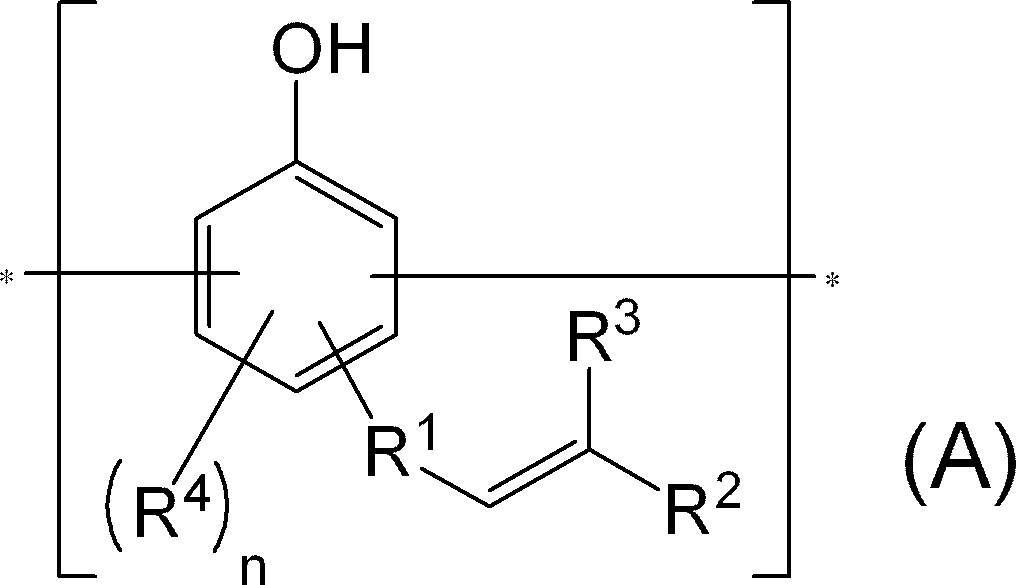
R1としては、単結合又は炭素数が1~3のアルキレン基が好ましく、単結合、メチレン基又はエチレン基がより好ましく、単結合又はメチレン基がさらに好ましい。
R2及びR3としては、水素原子又は炭素数が1~3のアルキル基が好ましく、水素原子、メチル基又はエチル基がより好ましく、水素原子又はメチル基がさらに好ましい。
本開示において、水酸基価は、JIS K0700:1992に準拠して測定された値をいう。
エポキシ樹脂組成物が特定フェノール樹脂として2種類のフェノール樹脂を含有する場合、特定フェノール樹脂が有するアルケニル基の硬化性を向上するため、特定フェノール樹脂として、アリル基を含む構造単位を有する第一のフェノール樹脂と、1-プロペニル基を含む構造単位を有する第二のフェノール樹脂と、を含有することが好ましい。
また、式(A)で表される構造単位における2つ結合手の一方は、水素原子と結合していてもよい。
エポキシ樹脂組成物は、特定フェノール樹脂以外のその他のフェノール樹脂を含有してもよい。その他のフェノール樹脂としては、例えば、フェノール化合物(例えば、フェノール、クレゾール、キシレノール、レゾルシン、カテコール、ビスフェノールA及びビスフェノールF)及びナフトール化合物(例えば、α-ナフトール、β-ナフトール及びジヒドロキシナフタレン)からなる群より選択される少なくとも1種と、アルデヒド化合物(例えば、ホルムアルデヒド、アセトアルデヒド、プロピオンアルデヒド、ベンズアルデヒド及びサリチルアルデヒド)とを、酸性触媒下で縮合又は共縮合させて得られるノボラック樹脂;フェノール・アラルキル樹脂;ビフェニル・アラルキル樹脂;並びにナフトール・アラルキル樹脂;が挙げられる。
硬化剤としてその他のフェノール樹脂を併用する場合、全フェノール樹脂に占める特定フェノール樹脂の割合は、70質量%以上であることが好ましく、90質量%以上であることがより好ましく、95質量%以上であることがさらに好ましい。
エポキシ樹脂組成物は、硬化剤として活性エステル化合物をさらに含有してもよい。活性エステル化合物は、エポキシ基と反応するエステル基を分子中に1個以上有する化合物であればその種類は特に制限されない。
エポキシ樹脂組成物の硬化剤として活性エステル化合物を併用することで、エポキシ樹脂と活性エステル化合物が反応した場合にアルコール性水酸基が生じないため、硬化物の誘電正接が低くなりやすい傾向にある。



エポキシ樹脂組成物は、フェノール樹脂及び必要に応じて用いられる活性エステル化合物以外のその他の硬化剤を含有してもよい。その他の硬化剤としては、酸無水物系硬化剤、アミン系硬化剤等が挙げられる。
硬化剤の含有率は特に限定されるものではなく、硬化剤の官能基(例えば、特定フェノール樹脂のフェノール性水酸基及び必要に応じて併用される活性エステル化合物のエステル基の合計)の当量がエポキシ樹脂のエポキシ基1当量に対して0.5当量~1.5当量になるように、硬化剤が配合されることが好ましく、0.7当量~1.2当量になるように硬化剤が配合されることがより好ましい。
エポキシ樹脂組成物は、硬化促進剤を含有してもよい。硬化促進剤は、エポキシ樹脂と硬化剤との硬化反応を促進する。
エポキシ樹脂及び硬化剤と共に用いられる硬化促進剤としては、特に限定されるものではなく、当技術分野で通常用いられているものでよい。
硬化促進剤としては、1,8-ジアザ-ビシクロ(5,4,0)ウンデセン-7、1,5-ジアザ-ビシクロ(4,3,0)ノネン、5,6-ジブチルアミノ-1,8-ジアザ-ビシクロ(5,4,0)ウンデセン-7、ベンジルジメチルアミン、トリエタノールアミン、ジメチルアミノエタノール、トリス(ジメチルアミノメチル)フェノール等の3級アミン類及びこれらの誘導体、2-メチルイミダゾール、2-フェニルイミダゾール、2-フェニル-4-メチルイミダゾール等のイミダゾール類及びそれらの誘導体、トリブチルホスフィン、メチルジフェニルホスフィン、トリフェニルホスフィン、ジフェニルホスフィン、フェニルホスフィン等の有機ホスフィン類及びこれらのホスフィン類に無水マレイン酸、ベンゾキノン、ジアゾフェニルメタン等のπ結合をもつ化合物を付加してなる分子内分極を有するリン化合物、テトラフェニルホスホニウムテトラフェニルボレート、トリフェニルホスフィンテトラフェニルボレート、2-エチル-4-メチルイミダゾールテトラフェニルボレート、N-メチルテトラフェニルホスホニウム-テトラフェニルボレート、トリフェニルホスフィンとベンゾキノンとの付加物、トリフェニルホスホニウム-トリフェニルボランなどが挙げられる。硬化促進剤は、1種類を単独で使用しても、2種類以上を併用してもよい。
硬化促進剤の配合割合は、エポキシ樹脂組成物全体の0.1質量%~5.0質量%の割合に設定することが好ましい。さらに、エポキシ樹脂組成物の流動性を考慮すると、より好ましくは、0.15質量%~0.35質量%である。
エポキシ樹脂組成物は、ラジカル重合開始剤を含有してもよい。ラジカル重合開始剤は、アルケニル基同士の硬化反応を促進する。
ラジカル重合開始剤は特に限定されず、従来から公知のラジカル重合開始剤を用いることができる。ラジカル重合開始剤としては、熱により遊離ラジカルを発生させるラジカル重合開始剤等が挙げられ、具体的には、無機過酸化物、有機過酸化物、アゾ化合物等が挙げられる。
無機過酸化物としては、過硫酸カリウム(ペルオキソ硫酸二カリウム)、過硫酸ナトリウム、過硫酸アンモニウム等が挙げられる。
有機過酸化物としては、メチルエチルケトンパーオキサイド、シクロヘキサノンパーオキサイド等のケトンパーオキサイド、1,1-ジ(t-ブチルパーオキシ)シクロヘキサン、2,2-ジ(4,4-ジ(t-ブチルパーオキシ)シクロヘキシル)プロパン等のパーオキシケタール、p-メンタンハイドロパーオキサイド、ジイソプロピルベンゼンハイドロパーオキサイド、1,1,3,3-テトラメチルブチルハイドロパーオキサイド、クメンハイドロパーオキサイド、t-ブチルハイドロパーオキサイド等のハイドロパーオキサイド、α、α’-ジ(t-ブチルペルオキシ)ジイソプロピルベンゼン、ジクミルパーオキサイド、2,5-ジメチル-2,5-ジ(t-ブチルパーオキシ)ヘキサン、t-ブチルクミルパーオキサイド、ジ-t-へキシルパーオキサイド、2,5-ジメチル-2,5-ジ(t-ブチルパーオキシ)ヘキシン-3、ジ-t-ブチルパーオキサイド等のジアルキルパーオキサイド、ジベンゾイルパーオキサイド、ジ(4-メチルベンゾイル)パーオキサイド等のジアシルパーオキサイド、ジ-n-プロピルパーオキシジカーボネート、ジイソプロピルパーオキシジカーボネート等のパーオキシジカーボネート、2,5-ジメチル-2,5-ジ(ベンゾイルパーオキシ)ヘキサン、t-へキシルパーオキシベンゾエート、t-ブチルパーオキシベンゾエート、t-ブチルパーオキシ2-エチルヘキサノネート等のパーオキシエステルなどが挙げられる。
アゾ化合物としては、アゾビスイソブチロニトリル、アゾビス-4-メトキシ-2,4-ジメチルバレロニトリル、アゾビスシクロヘキサノン-1-カルボニトリル、アゾジベンゾイル等が挙げられる。
本開示のエポキシ樹脂組成物は、カップリング剤を含有してもよい。カップリング剤の種類は、特に制限されず、公知のカップリング剤を使用することができる。カップリング剤としては、例えば、シランカップリング剤及びチタンカップリング剤が挙げられる。カップリング剤は、1種類を単独で使用しても、2種類以上を併用してもよい。
エポキシ樹脂組成物は、無機充填材を含有してもよい。
無機充填材としては、特に限定されるものではなく、当技術分野で通常用いられているものでよい。
無機充填材としては、溶融シリカ、結晶シリカ、アルミナ、ジルコン、珪酸カルシウム、炭酸カルシウム、炭化珪素、窒化ホウ素、ベリリア、ジルコニア、二酸化チタン等の粉体又はこれらを球形化したビーズ、中空粒子、チタン酸カリウム、炭化珪素、窒化珪素、アルミナ等の単結晶繊維、ガラス繊維等が挙げられる。無機充填材としては、好ましくは、球状溶融シリカ粉末、破砕シリカ粉末等が挙げられる。無機充填材は、1種類を単独で使用しても、2種類以上を併用してもよい。
無機充填材の配合割合は、エポキシ樹脂組成物全体の70質量%~95質量%の割合に設定することが好ましく、より好ましくは、75質量%~90質量%である。
無機充填材の平均粒子径は、1μm~150μmであることが好ましく、より好ましくは、5μm~75μmである。
無機充填材の平均粒子径は、レーザー回折法を用いて測定され、体積累積粒度分布曲線を小粒径側から描いた場合に、体積累積が50%となる粒子径に対応する。レーザー回折法を用いた粒度分布測定は、レーザー回折散乱粒度分布測定装置(例えば、ベックマン・コールター社製、LS230)を用いて行なうことができる。
本開示のエポキシ樹脂組成物は、離型剤を含有してもよい。離型剤の種類は特に制限されず、公知の離型剤を使用することができる。具体的には、例えば、高級脂肪酸、高級脂肪酸エステル、カルナバワックス及びポリエチレン系ワックスが挙げられる。離型剤は、1種類を単独で使用しても、2種類以上を併用してもよい。
エポキシ樹脂組成物が離型剤を含有する場合、離型剤の含有率は、エポキシ樹脂と硬化剤の合計量に対して、10質量%以下であることが好ましく、その効果を発揮させる観点からは、0.2質量%以上であることが好ましい。
本開示のエポキシ樹脂組成物は、着色剤(例えば、カーボンブラック)を含有してもよい。また、エポキシ樹脂組成物は、改質剤(例えば、シリコーン樹脂及びシリコーンゴム)を含有してもよい。また、エポキシ樹脂組成物は、分散剤(例えば、マレイン酸系共重合樹脂)を含有してもよい。着色剤、分散剤及び改質剤は、それぞれ、1種類を単独で使用しても、2種類以上を併用してもよい。
エポキシ樹脂組成物が導電性粒子を含有する場合、導電性粒子の含有率は、エポキシ樹脂と硬化剤の合計量に対して3質量%以下であることが好ましい。
エポキシ樹脂組成物の調製方法は特に制限されず、公知の方法により行うことができる。例えば、所定の配合量の原材料の混合物をミキサー等によって充分混合した後、熱ロール、押出機等によって混練し、冷却、粉砕等の処理を経ることによって調製することができる。エポキシ樹脂組成物の状態は特に制限されず、粉末状、固形状、液体状等であってよい。
エポキシ樹脂組成物は、ハンドリングの観点から、25℃で固体であることが好ましい。
本開示の電子部品装置は、回路層を有する基板と、前記基板上に配置され、前記回路層と電気的に接続された電子部品と、前記基板と前記電子部品との間隙に少なくとも配置された本開示のエポキシ樹脂組成物の硬化物と、を備える。本開示のエポキシ樹脂組成物の硬化物は、基板と電子部品との間隙に少なくとも配置されており、電子部品の全体が硬化物により覆われていてもよい。
本開示の電子部品装置は、本開示のエポキシ樹脂組成物により電子部品を封止して得ることができる。電子部品が本開示のエポキシ樹脂組成物によって封止されることで、本開示の電子部品装置は、信頼性に優れる。
特に、リジッド配線板、フレキシブル配線板又はガラス上に形成した配線に、半導体素子をバンプ接続によりフリップチップボンディングした半導体装置が、本開示のエポキシ樹脂組成物を適応しうる対象の1つとして挙げられる。具体的な例としては、フリップチップBGA(Ball Grid Array)、LGA(Land Grid Array)、COF(Chip On Film)等の電子部品装置が挙げられる。
本開示の電子部品装置の製造方法は、回路層を有する基板と、前記基板上に配置され、前記回路層と電気的に接続された電子部品とを、本開示のエポキシ樹脂組成物を用いて封止する工程を有する。
本開示のエポキシ樹脂組成物を用いて回路層を有する基板と電子部品とを封止する工程に特に限定はない。例えば、トランスファーモールド法が一般的であるが、コンプレッションモールド法、インジェクション成形法等を用いてもよい。
表1に示す組成となるように各成分を配合し、三本ロール及び真空ライカイ機にて混練し、分散して、実施例1~実施例2及び比較例1~比較例3のエポキシ樹脂組成物を調製した。なお、表1中の配合単位はフィラーを除き質量部であり、また「-」は「配合無し」を表す。
なお、硬化剤は、エポキシ樹脂のエポキシ当量と硬化剤の官能基(水酸基及びエステル基)当量の合計とが1:1の比率となるように配合した。また、表1における硬化剤の欄の括弧書きの数値は、各硬化剤の当量比を表す。例えば、硬化剤Aが50で硬化剤Bが50である場合、硬化剤Aと硬化剤Bとを50:50の当量比で配合したことを表す。
エポキシ樹脂組成物に占めるフィラーの含有率は、体積基準の割合(体積%)で78体積%とした。78体積%は、87質量%に相当する。
-エポキシ樹脂-
・エポキシ樹脂1:トリス(ヒドロキシフェニル)メタン型エポキシ樹脂、エポキシ当量:167g/eq
・エポキシ樹脂2:ビフェニル型エポキシ樹脂、エポキシ当量:186g/eq
-硬化剤-
・フェノール樹脂1:フェノールノボラック樹脂、水酸基価:103mgKOH/g
・フェノール樹脂2:アリル変性フェノール樹脂(アリル基を含む構造単位及びビフェニレン基を有する)、水酸基価:260mgKOH/g
・フェノール樹脂3:アリル変性フェノール樹脂(アリル基を含む構造単位を有する)、水酸基価:148mgKOH/g
・フェノール樹脂4:プロペニル変性フェノール樹脂(1-プロペニル基を含む構造単位及びビフェニレン基を有する)、水酸基価:253mgKOH/g
・活性エステル化合物:エステル基当量:209g/eq
-硬化促進剤-
・硬化促進剤1:p-ベンゾキノンとトリ-n-ブチルホスフィンとの付加体
・硬化促進剤2:ジアザビシクロウンデセン
-ラジカル重合開始剤-
・ジクミルパーオキサイド(40%希釈品)
-カップリング剤-
・カップリング剤1:N-フェニル-3-アミノプロピルトリメトキシシラン
・カップリング剤2:γ-メルカプトプロピルトリメトキシシラン
-その他の成分-
・離型剤1:モンタン酸エステル
・離型剤2:酸化ポリエチレンワックス
・着色剤:カーボンブラック
・分散剤:無水マレイン酸-α-オレフィン共重合体
・フィラー:球状溶融シリカ(平均粒子径:53μm)
調製した各エポキシ樹脂組成物を用いて下記評価を実施した。
流動性の評価は、スパイラルフロー試験により行った。EMMI-1-66に準じたスパイラルフロー測定用金型を用いてエポキシ樹脂組成物を成形し、エポキシ樹脂組成物の成形物の流動距離(インチ)を測定した。エポキシ樹脂組成物の成形は、トランスファー成形機を用い、金型温度180℃、成形圧力6.9MPa、硬化時間90秒の条件下で行った。
粘度の評価は、高化式フローテスター(株式会社島津製作所製)により行った。エポキシ樹脂組成物の175℃における最低溶融粘度を、高化式フローテスターを用いて測定した。
硬化度の評価は、キュラストメータ(JSRトレーディング株式会社製)により行った。エポキシ樹脂組成物のゲルタイムを、キュラストメータ(JSRトレーディング株式会社製)を用い、試料量1.5ml、175℃の条件で測定した。得られたチャートのトルクの立ち上がり開始の時間をゲルタイムとした。
耐熱性及び信頼性の評価は、エポキシ樹脂組成物の硬化物に対して行った。エポキシ樹脂組成物の硬化物は、175℃、360分間加熱硬化して作製した。
エポキシ樹脂組成物の硬化物について、SII社のDMS6100を用いてDMA(Dynamic Mechanical Analysis、動的粘弾性測定)法によりガラス転移温度(Tg)を測定した。昇温速度を3℃/minとし、測定周波数を10Hzとした。
またTg以下の温度範囲における熱膨張係数をα1とし、Tg以上の温度範囲における熱膨張係数をα2とした。
誘電特性の評価に用いた樹脂板は、以下の手順により作製した。
エポキシ樹脂組成物を粉砕し、それらを型の中にいれ、プレス機に投入した。プレス機の熱板温度を175℃に保持し、減圧しながら圧力7MPaで30分間プレスした。その後、型からエポキシ樹脂組成物の硬化物を取り出し、それを誘電正接測定用の樹脂板とした。
上記のようにして作製された樹脂板を、幅2mm、長さ70mmの試験片に切り出し、PNAネットワークアナライザ(キーサイト・テクノロジー株式会社製、N5227A)とスプリット・シリンダー空洞共振器(キーサイト・テクノロジー株式会社製)とを用いて、60GHzでの誘電正接(Df)及び誘電率(Dk)を測定した。測定温度は25℃とした。
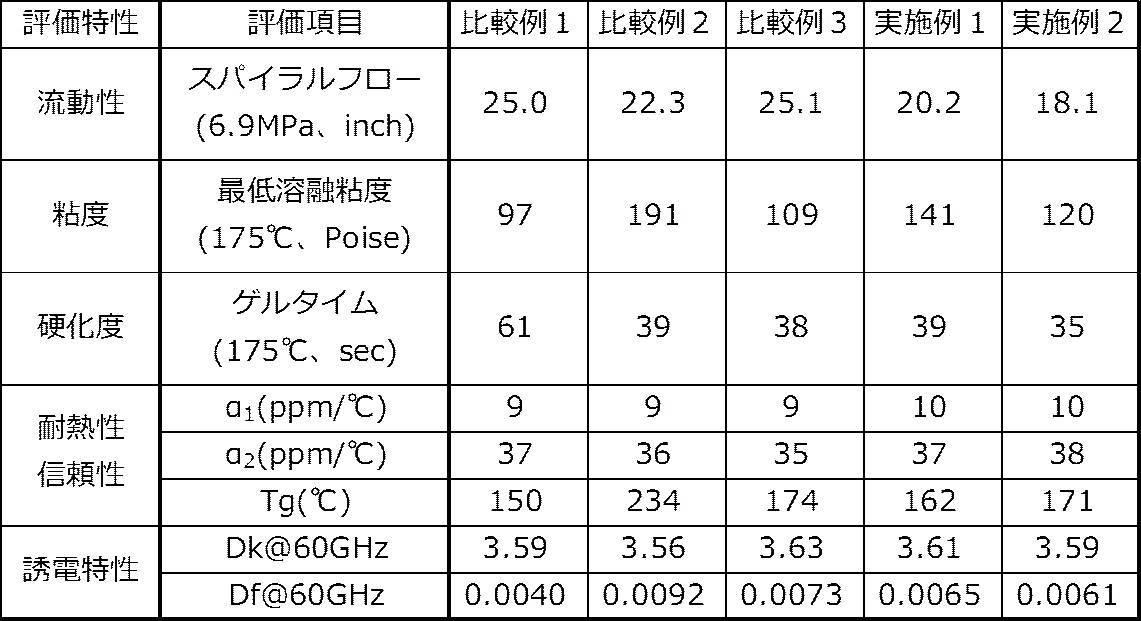
一方、実施例1及び実施例2のエポキシ樹脂組成の硬化物は、ガラス転移温度が比較例1に比較して高く、且つ誘電正接が比較例2及び比較例3に比較して低い。実施例1及び実施例2のエポキシ樹脂組成の硬化物は高いガラス転移温度と低い誘電正接とを両立していることがわかる。
Claims (9)
- エポキシ樹脂と、アルケニル基を含む構造単位を有するフェノール樹脂と、を含有するエポキシ樹脂組成物。
- 前記アルケニル基を含む構造単位が、下記式(A)で表される構造単位を含む請求項1に記載のエポキシ樹脂組成物。

(式(A)において、R1は単結合又はアルキレン基を示し、R2及びR3は各々独立に、水素原子又はアルキル基を示し、R4はそれぞれ独立に、アルキル基、アルコキシ基、フッ素原子、塩素原子、臭素原子、ヨウ素原子、シアノ基、又はニトロ基を示す。nは0~2の整数を示す。*は、結合手を示す。) - 前記アルケニル基が、アリル基及び1-プロペニル基の少なくとも一方を含む請求項1又は請求項2に記載のエポキシ樹脂組成物。
- 前記フェノール樹脂として、前記アルケニル基を含む構造単位が互いに異なる少なくとも2種類のフェノール樹脂を含有する請求項1~請求項3のいずれか1項に記載のエポキシ樹脂組成物。
- 前記フェノール樹脂として、アリル基を含む構造単位を有する第一のフェノール樹脂と、1-プロペニル基を含む構造単位を有する第二のフェノール樹脂と、を含有する請求項4に記載のエポキシ樹脂組成物。
- 活性エステル化合物をさらに含有する請求項1~請求項5のいずれか1項に記載のエポキシ樹脂組成物。
- 25℃で固体である請求項1~請求項6のいずれか1項に記載のエポキシ樹脂組成物。
- 回路層を有する基板と、
前記基板上に配置され、前記回路層と電気的に接続された電子部品と、
前記基板と前記電子部品との間隙に少なくとも配置された請求項1~請求項7のいずれか1項に記載のエポキシ樹脂組成物の硬化物と、
を備える電子部品装置。 - 回路層を有する基板と、前記基板上に配置され、前記回路層と電気的に接続された電子部品とを、請求項1~請求項7のいずれか1項に記載のエポキシ樹脂組成物を用いて封止する工程を有する電子部品装置の製造方法。
Priority Applications (2)
| Application Number | Priority Date | Filing Date | Title |
|---|---|---|---|
| JP2021506805A JPWO2020188641A1 (ja) | 2019-03-15 | 2019-03-15 | |
| PCT/JP2019/010896 WO2020188641A1 (ja) | 2019-03-15 | 2019-03-15 | エポキシ樹脂組成物、電子部品装置及び電子部品装置の製造方法 |
Applications Claiming Priority (1)
| Application Number | Priority Date | Filing Date | Title |
|---|---|---|---|
| PCT/JP2019/010896 WO2020188641A1 (ja) | 2019-03-15 | 2019-03-15 | エポキシ樹脂組成物、電子部品装置及び電子部品装置の製造方法 |
Publications (1)
| Publication Number | Publication Date |
|---|---|
| WO2020188641A1 true WO2020188641A1 (ja) | 2020-09-24 |
Family
ID=72519248
Family Applications (1)
| Application Number | Title | Priority Date | Filing Date |
|---|---|---|---|
| PCT/JP2019/010896 Ceased WO2020188641A1 (ja) | 2019-03-15 | 2019-03-15 | エポキシ樹脂組成物、電子部品装置及び電子部品装置の製造方法 |
Country Status (2)
| Country | Link |
|---|---|
| JP (1) | JPWO2020188641A1 (ja) |
| WO (1) | WO2020188641A1 (ja) |
Cited By (2)
| Publication number | Priority date | Publication date | Assignee | Title |
|---|---|---|---|---|
| CN115505313A (zh) * | 2021-06-23 | 2022-12-23 | 味之素株式会社 | 树脂组合物 |
| CN116063897A (zh) * | 2021-11-02 | 2023-05-05 | 味之素株式会社 | 树脂组合物 |
Citations (5)
| Publication number | Priority date | Publication date | Assignee | Title |
|---|---|---|---|---|
| JPH03229717A (ja) * | 1990-02-02 | 1991-10-11 | Shin Etsu Chem Co Ltd | プロペニル基含有フェノール樹脂 |
| JPH04314723A (ja) * | 1991-04-15 | 1992-11-05 | Fujitsu Ltd | エポキシ樹脂組成物 |
| JPH07138201A (ja) * | 1993-11-17 | 1995-05-30 | Dai Ichi Kogyo Seiyaku Co Ltd | モノアリルナフトール化合物、該化合物を含有するエポキシ樹脂用硬化剤およびエポキシ樹脂組成物 |
| JP2010077310A (ja) * | 2008-09-26 | 2010-04-08 | Sumitomo Bakelite Co Ltd | 回路基板用樹脂組成物、プリプレグおよび積層板 |
| WO2016125664A1 (ja) * | 2015-02-05 | 2016-08-11 | 味の素株式会社 | 樹脂組成物 |
Family Cites Families (1)
| Publication number | Priority date | Publication date | Assignee | Title |
|---|---|---|---|---|
| JP5181769B2 (ja) * | 2008-03-26 | 2013-04-10 | Dic株式会社 | エポキシ樹脂組成物、及びその硬化物 |
-
2019
- 2019-03-15 JP JP2021506805A patent/JPWO2020188641A1/ja active Pending
- 2019-03-15 WO PCT/JP2019/010896 patent/WO2020188641A1/ja not_active Ceased
Patent Citations (5)
| Publication number | Priority date | Publication date | Assignee | Title |
|---|---|---|---|---|
| JPH03229717A (ja) * | 1990-02-02 | 1991-10-11 | Shin Etsu Chem Co Ltd | プロペニル基含有フェノール樹脂 |
| JPH04314723A (ja) * | 1991-04-15 | 1992-11-05 | Fujitsu Ltd | エポキシ樹脂組成物 |
| JPH07138201A (ja) * | 1993-11-17 | 1995-05-30 | Dai Ichi Kogyo Seiyaku Co Ltd | モノアリルナフトール化合物、該化合物を含有するエポキシ樹脂用硬化剤およびエポキシ樹脂組成物 |
| JP2010077310A (ja) * | 2008-09-26 | 2010-04-08 | Sumitomo Bakelite Co Ltd | 回路基板用樹脂組成物、プリプレグおよび積層板 |
| WO2016125664A1 (ja) * | 2015-02-05 | 2016-08-11 | 味の素株式会社 | 樹脂組成物 |
Cited By (3)
| Publication number | Priority date | Publication date | Assignee | Title |
|---|---|---|---|---|
| CN115505313A (zh) * | 2021-06-23 | 2022-12-23 | 味之素株式会社 | 树脂组合物 |
| CN116063897A (zh) * | 2021-11-02 | 2023-05-05 | 味之素株式会社 | 树脂组合物 |
| JP2023068373A (ja) * | 2021-11-02 | 2023-05-17 | 味の素株式会社 | 樹脂組成物 |
Also Published As
| Publication number | Publication date |
|---|---|
| JPWO2020188641A1 (ja) | 2020-09-24 |
Similar Documents
| Publication | Publication Date | Title |
|---|---|---|
| JP4793565B2 (ja) | 半導体封止用エポキシ樹脂組成物及び半導体装置 | |
| JP7485088B2 (ja) | 成形用樹脂組成物及び電子部品装置 | |
| TW201842021A (zh) | 密封用環氧樹脂組成物及電子零件裝置 | |
| TW202222888A (zh) | 成形用樹脂組成物及電子零件裝置 | |
| TWI816887B (zh) | 密封用樹脂組成物、電子零件裝置及電子零件裝置的製造方法 | |
| WO2020188641A1 (ja) | エポキシ樹脂組成物、電子部品装置及び電子部品装置の製造方法 | |
| JP2021116331A (ja) | 封止用樹脂組成物、電子部品装置、及び電子部品装置の製造方法 | |
| TWI894154B (zh) | 密封用樹脂組成物、電子零件裝置及電子零件裝置的製造方法 | |
| CN114402029B (zh) | 压缩成形用密封材及电子零件装置 | |
| JP5924757B2 (ja) | カリックスアレーン系化合物、カリックスアレーン系化合物の製造方法、エポキシ樹脂用硬化剤、エポキシ樹脂組成物及び電子部品装置 | |
| JP2022093030A (ja) | 樹脂組成物及び高周波デバイス | |
| JP7396290B2 (ja) | 封止用樹脂組成物、電子部品装置及び電子部品装置の製造方法 | |
| JP2022107396A (ja) | 熱硬化性樹脂組成物の製造方法及び電子部品装置の製造方法 | |
| JP2022011184A (ja) | 封止用樹脂組成物及び電子部品装置 | |
| JPWO2020158851A1 (ja) | 封止用樹脂組成物、電子部品装置及び電子部品装置の製造方法 | |
| JP2021084980A (ja) | 封止用樹脂組成物、電子部品装置及び電子部品装置の製造方法 | |
| JP2021113253A (ja) | 封止用樹脂組成物、電子部品装置、及び電子部品装置の製造方法 | |
| JP2020193293A (ja) | 封止用樹脂組成物、硬化物、及び電子部品装置 | |
| WO2020189309A1 (ja) | 封止用樹脂組成物、電子部品装置及び電子部品装置の製造方法 | |
| WO2022149603A1 (ja) | 熱硬化性樹脂組成物の製造方法及び電子部品装置の製造方法 | |
| CN121548598A (zh) | 树脂组合物及电子零件装置 | |
| WO2025022963A1 (ja) | 樹脂組成物及び電子部品装置 | |
| JP2024015914A (ja) | 封止用樹脂組成物、電子部品装置及び電子部品装置の製造方法 | |
| WO2022149602A1 (ja) | 熱硬化性樹脂組成物及び電子部品装置 | |
| JP2020172607A (ja) | 重合体、エポキシ樹脂組成物、エポキシ樹脂硬化物及び電子部品装置 |
Legal Events
| Date | Code | Title | Description |
|---|---|---|---|
| 121 | Ep: the epo has been informed by wipo that ep was designated in this application |
Ref document number: 19920030 Country of ref document: EP Kind code of ref document: A1 |
|
| ENP | Entry into the national phase |
Ref document number: 2021506805 Country of ref document: JP Kind code of ref document: A |
|
| NENP | Non-entry into the national phase |
Ref country code: DE |
|
| 32PN | Ep: public notification in the ep bulletin as address of the adressee cannot be established |
Free format text: NOTING OF LOSS OF RIGHTS PURSUANT TO RULE 112(1) EPC (EPO FORM 1205 DATED 05/01/2022) |
|
| 32PN | Ep: public notification in the ep bulletin as address of the adressee cannot be established |
Free format text: NOTING OF LOSS OF RIGHTS PURSUANT TO RULE 112(1) EPC (EPO FORM 1205A DATED 03/02/2022) |
|
| 122 | Ep: pct application non-entry in european phase |
Ref document number: 19920030 Country of ref document: EP Kind code of ref document: A1 |