WO2020184944A1 - 위치특이적 항체 콘쥬게이션 및 이의 구체예로서의 항체-약물 콘쥬게이트 - Google Patents
위치특이적 항체 콘쥬게이션 및 이의 구체예로서의 항체-약물 콘쥬게이트 Download PDFInfo
- Publication number
- WO2020184944A1 WO2020184944A1 PCT/KR2020/003282 KR2020003282W WO2020184944A1 WO 2020184944 A1 WO2020184944 A1 WO 2020184944A1 KR 2020003282 W KR2020003282 W KR 2020003282W WO 2020184944 A1 WO2020184944 A1 WO 2020184944A1
- Authority
- WO
- WIPO (PCT)
- Prior art keywords
- antibody
- formula
- alkylene
- cancer
- functional group
- Prior art date
- Legal status (The legal status is an assumption and is not a legal conclusion. Google has not performed a legal analysis and makes no representation as to the accuracy of the status listed.)
- Ceased
Links
- 0 *C(CC(*1)C(C2)C(*)=*)C12C(*=C)P Chemical compound *C(CC(*1)C(C2)C(*)=*)C12C(*=C)P 0.000 description 12
- BOJJWTIGMMEKKG-UHFFFAOYSA-N CC(C)C(C(CCCCNC([IH]BN)=O)NC(C)C)=O Chemical compound CC(C)C(C(CCCCNC([IH]BN)=O)NC(C)C)=O BOJJWTIGMMEKKG-UHFFFAOYSA-N 0.000 description 2
- MXFFXGIQBBYSEG-UHFFFAOYSA-N CC(C)NC(CCCCNC(I)=O)[NH+](C(C)C)[O-] Chemical compound CC(C)NC(CCCCNC(I)=O)[NH+](C(C)C)[O-] MXFFXGIQBBYSEG-UHFFFAOYSA-N 0.000 description 1
- HXUYVXXHBKFMQK-NTXGFPLRSA-N C[C@H]1C2C=CC1CC2COCC(SCCC(ON(C(CC1)=O)C1=O)=O)=O Chemical compound C[C@H]1C2C=CC1CC2COCC(SCCC(ON(C(CC1)=O)C1=O)=O)=O HXUYVXXHBKFMQK-NTXGFPLRSA-N 0.000 description 1
Images


Classifications
-
- A—HUMAN NECESSITIES
- A61—MEDICAL OR VETERINARY SCIENCE; HYGIENE
- A61K—PREPARATIONS FOR MEDICAL, DENTAL OR TOILETRY PURPOSES
- A61K47/00—Medicinal preparations characterised by the non-active ingredients used, e.g. carriers or inert additives; Targeting or modifying agents chemically bound to the active ingredient
- A61K47/50—Medicinal preparations characterised by the non-active ingredients used, e.g. carriers or inert additives; Targeting or modifying agents chemically bound to the active ingredient the non-active ingredient being chemically bound to the active ingredient, e.g. polymer-drug conjugates
- A61K47/51—Medicinal preparations characterised by the non-active ingredients used, e.g. carriers or inert additives; Targeting or modifying agents chemically bound to the active ingredient the non-active ingredient being chemically bound to the active ingredient, e.g. polymer-drug conjugates the non-active ingredient being a modifying agent
- A61K47/68—Medicinal preparations characterised by the non-active ingredients used, e.g. carriers or inert additives; Targeting or modifying agents chemically bound to the active ingredient the non-active ingredient being chemically bound to the active ingredient, e.g. polymer-drug conjugates the non-active ingredient being a modifying agent the modifying agent being an antibody, an immunoglobulin or a fragment thereof, e.g. an Fc-fragment
- A61K47/6801—Drug-antibody or immunoglobulin conjugates defined by the pharmacologically or therapeutically active agent
- A61K47/6803—Drugs conjugated to an antibody or immunoglobulin, e.g. cisplatin-antibody conjugates
- A61K47/6811—Drugs conjugated to an antibody or immunoglobulin, e.g. cisplatin-antibody conjugates the drug being a protein or peptide, e.g. transferrin or bleomycin
-
- C—CHEMISTRY; METALLURGY
- C07—ORGANIC CHEMISTRY
- C07D—HETEROCYCLIC COMPOUNDS
- C07D498/00—Heterocyclic compounds containing in the condensed system at least one hetero ring having nitrogen and oxygen atoms as the only ring hetero atoms
- C07D498/12—Heterocyclic compounds containing in the condensed system at least one hetero ring having nitrogen and oxygen atoms as the only ring hetero atoms in which the condensed system contains three hetero rings
- C07D498/18—Bridged systems
-
- A—HUMAN NECESSITIES
- A61—MEDICAL OR VETERINARY SCIENCE; HYGIENE
- A61K—PREPARATIONS FOR MEDICAL, DENTAL OR TOILETRY PURPOSES
- A61K47/00—Medicinal preparations characterised by the non-active ingredients used, e.g. carriers or inert additives; Targeting or modifying agents chemically bound to the active ingredient
- A61K47/50—Medicinal preparations characterised by the non-active ingredients used, e.g. carriers or inert additives; Targeting or modifying agents chemically bound to the active ingredient the non-active ingredient being chemically bound to the active ingredient, e.g. polymer-drug conjugates
- A61K47/51—Medicinal preparations characterised by the non-active ingredients used, e.g. carriers or inert additives; Targeting or modifying agents chemically bound to the active ingredient the non-active ingredient being chemically bound to the active ingredient, e.g. polymer-drug conjugates the non-active ingredient being a modifying agent
- A61K47/62—Medicinal preparations characterised by the non-active ingredients used, e.g. carriers or inert additives; Targeting or modifying agents chemically bound to the active ingredient the non-active ingredient being chemically bound to the active ingredient, e.g. polymer-drug conjugates the non-active ingredient being a modifying agent the modifying agent being a protein, peptide or polyamino acid
- A61K47/64—Drug-peptide, drug-protein or drug-polyamino acid conjugates, i.e. the modifying agent being a peptide, protein or polyamino acid which is covalently bonded or complexed to a therapeutically active agent
-
- A—HUMAN NECESSITIES
- A61—MEDICAL OR VETERINARY SCIENCE; HYGIENE
- A61K—PREPARATIONS FOR MEDICAL, DENTAL OR TOILETRY PURPOSES
- A61K47/00—Medicinal preparations characterised by the non-active ingredients used, e.g. carriers or inert additives; Targeting or modifying agents chemically bound to the active ingredient
- A61K47/50—Medicinal preparations characterised by the non-active ingredients used, e.g. carriers or inert additives; Targeting or modifying agents chemically bound to the active ingredient the non-active ingredient being chemically bound to the active ingredient, e.g. polymer-drug conjugates
- A61K47/51—Medicinal preparations characterised by the non-active ingredients used, e.g. carriers or inert additives; Targeting or modifying agents chemically bound to the active ingredient the non-active ingredient being chemically bound to the active ingredient, e.g. polymer-drug conjugates the non-active ingredient being a modifying agent
- A61K47/62—Medicinal preparations characterised by the non-active ingredients used, e.g. carriers or inert additives; Targeting or modifying agents chemically bound to the active ingredient the non-active ingredient being chemically bound to the active ingredient, e.g. polymer-drug conjugates the non-active ingredient being a modifying agent the modifying agent being a protein, peptide or polyamino acid
- A61K47/65—Peptidic linkers, binders or spacers, e.g. peptidic enzyme-labile linkers
-
- A—HUMAN NECESSITIES
- A61—MEDICAL OR VETERINARY SCIENCE; HYGIENE
- A61K—PREPARATIONS FOR MEDICAL, DENTAL OR TOILETRY PURPOSES
- A61K47/00—Medicinal preparations characterised by the non-active ingredients used, e.g. carriers or inert additives; Targeting or modifying agents chemically bound to the active ingredient
- A61K47/50—Medicinal preparations characterised by the non-active ingredients used, e.g. carriers or inert additives; Targeting or modifying agents chemically bound to the active ingredient the non-active ingredient being chemically bound to the active ingredient, e.g. polymer-drug conjugates
- A61K47/51—Medicinal preparations characterised by the non-active ingredients used, e.g. carriers or inert additives; Targeting or modifying agents chemically bound to the active ingredient the non-active ingredient being chemically bound to the active ingredient, e.g. polymer-drug conjugates the non-active ingredient being a modifying agent
- A61K47/68—Medicinal preparations characterised by the non-active ingredients used, e.g. carriers or inert additives; Targeting or modifying agents chemically bound to the active ingredient the non-active ingredient being chemically bound to the active ingredient, e.g. polymer-drug conjugates the non-active ingredient being a modifying agent the modifying agent being an antibody, an immunoglobulin or a fragment thereof, e.g. an Fc-fragment
- A61K47/6801—Drug-antibody or immunoglobulin conjugates defined by the pharmacologically or therapeutically active agent
-
- A—HUMAN NECESSITIES
- A61—MEDICAL OR VETERINARY SCIENCE; HYGIENE
- A61K—PREPARATIONS FOR MEDICAL, DENTAL OR TOILETRY PURPOSES
- A61K47/00—Medicinal preparations characterised by the non-active ingredients used, e.g. carriers or inert additives; Targeting or modifying agents chemically bound to the active ingredient
- A61K47/50—Medicinal preparations characterised by the non-active ingredients used, e.g. carriers or inert additives; Targeting or modifying agents chemically bound to the active ingredient the non-active ingredient being chemically bound to the active ingredient, e.g. polymer-drug conjugates
- A61K47/51—Medicinal preparations characterised by the non-active ingredients used, e.g. carriers or inert additives; Targeting or modifying agents chemically bound to the active ingredient the non-active ingredient being chemically bound to the active ingredient, e.g. polymer-drug conjugates the non-active ingredient being a modifying agent
- A61K47/68—Medicinal preparations characterised by the non-active ingredients used, e.g. carriers or inert additives; Targeting or modifying agents chemically bound to the active ingredient the non-active ingredient being chemically bound to the active ingredient, e.g. polymer-drug conjugates the non-active ingredient being a modifying agent the modifying agent being an antibody, an immunoglobulin or a fragment thereof, e.g. an Fc-fragment
- A61K47/6801—Drug-antibody or immunoglobulin conjugates defined by the pharmacologically or therapeutically active agent
- A61K47/6803—Drugs conjugated to an antibody or immunoglobulin, e.g. cisplatin-antibody conjugates
- A61K47/68031—Drugs conjugated to an antibody or immunoglobulin, e.g. cisplatin-antibody conjugates the drug being an auristatin
-
- A—HUMAN NECESSITIES
- A61—MEDICAL OR VETERINARY SCIENCE; HYGIENE
- A61K—PREPARATIONS FOR MEDICAL, DENTAL OR TOILETRY PURPOSES
- A61K47/00—Medicinal preparations characterised by the non-active ingredients used, e.g. carriers or inert additives; Targeting or modifying agents chemically bound to the active ingredient
- A61K47/50—Medicinal preparations characterised by the non-active ingredients used, e.g. carriers or inert additives; Targeting or modifying agents chemically bound to the active ingredient the non-active ingredient being chemically bound to the active ingredient, e.g. polymer-drug conjugates
- A61K47/51—Medicinal preparations characterised by the non-active ingredients used, e.g. carriers or inert additives; Targeting or modifying agents chemically bound to the active ingredient the non-active ingredient being chemically bound to the active ingredient, e.g. polymer-drug conjugates the non-active ingredient being a modifying agent
- A61K47/68—Medicinal preparations characterised by the non-active ingredients used, e.g. carriers or inert additives; Targeting or modifying agents chemically bound to the active ingredient the non-active ingredient being chemically bound to the active ingredient, e.g. polymer-drug conjugates the non-active ingredient being a modifying agent the modifying agent being an antibody, an immunoglobulin or a fragment thereof, e.g. an Fc-fragment
- A61K47/6801—Drug-antibody or immunoglobulin conjugates defined by the pharmacologically or therapeutically active agent
- A61K47/6803—Drugs conjugated to an antibody or immunoglobulin, e.g. cisplatin-antibody conjugates
- A61K47/68033—Drugs conjugated to an antibody or immunoglobulin, e.g. cisplatin-antibody conjugates the drug being a maytansine
-
- A—HUMAN NECESSITIES
- A61—MEDICAL OR VETERINARY SCIENCE; HYGIENE
- A61K—PREPARATIONS FOR MEDICAL, DENTAL OR TOILETRY PURPOSES
- A61K47/00—Medicinal preparations characterised by the non-active ingredients used, e.g. carriers or inert additives; Targeting or modifying agents chemically bound to the active ingredient
- A61K47/50—Medicinal preparations characterised by the non-active ingredients used, e.g. carriers or inert additives; Targeting or modifying agents chemically bound to the active ingredient the non-active ingredient being chemically bound to the active ingredient, e.g. polymer-drug conjugates
- A61K47/51—Medicinal preparations characterised by the non-active ingredients used, e.g. carriers or inert additives; Targeting or modifying agents chemically bound to the active ingredient the non-active ingredient being chemically bound to the active ingredient, e.g. polymer-drug conjugates the non-active ingredient being a modifying agent
- A61K47/68—Medicinal preparations characterised by the non-active ingredients used, e.g. carriers or inert additives; Targeting or modifying agents chemically bound to the active ingredient the non-active ingredient being chemically bound to the active ingredient, e.g. polymer-drug conjugates the non-active ingredient being a modifying agent the modifying agent being an antibody, an immunoglobulin or a fragment thereof, e.g. an Fc-fragment
- A61K47/6801—Drug-antibody or immunoglobulin conjugates defined by the pharmacologically or therapeutically active agent
- A61K47/6803—Drugs conjugated to an antibody or immunoglobulin, e.g. cisplatin-antibody conjugates
- A61K47/68037—Drugs conjugated to an antibody or immunoglobulin, e.g. cisplatin-antibody conjugates the drug being a camptothecin [CPT] or derivatives
-
- A—HUMAN NECESSITIES
- A61—MEDICAL OR VETERINARY SCIENCE; HYGIENE
- A61K—PREPARATIONS FOR MEDICAL, DENTAL OR TOILETRY PURPOSES
- A61K47/00—Medicinal preparations characterised by the non-active ingredients used, e.g. carriers or inert additives; Targeting or modifying agents chemically bound to the active ingredient
- A61K47/50—Medicinal preparations characterised by the non-active ingredients used, e.g. carriers or inert additives; Targeting or modifying agents chemically bound to the active ingredient the non-active ingredient being chemically bound to the active ingredient, e.g. polymer-drug conjugates
- A61K47/51—Medicinal preparations characterised by the non-active ingredients used, e.g. carriers or inert additives; Targeting or modifying agents chemically bound to the active ingredient the non-active ingredient being chemically bound to the active ingredient, e.g. polymer-drug conjugates the non-active ingredient being a modifying agent
- A61K47/68—Medicinal preparations characterised by the non-active ingredients used, e.g. carriers or inert additives; Targeting or modifying agents chemically bound to the active ingredient the non-active ingredient being chemically bound to the active ingredient, e.g. polymer-drug conjugates the non-active ingredient being a modifying agent the modifying agent being an antibody, an immunoglobulin or a fragment thereof, e.g. an Fc-fragment
- A61K47/6835—Medicinal preparations characterised by the non-active ingredients used, e.g. carriers or inert additives; Targeting or modifying agents chemically bound to the active ingredient the non-active ingredient being chemically bound to the active ingredient, e.g. polymer-drug conjugates the non-active ingredient being a modifying agent the modifying agent being an antibody, an immunoglobulin or a fragment thereof, e.g. an Fc-fragment the modifying agent being an antibody or an immunoglobulin bearing at least one antigen-binding site
- A61K47/6851—Medicinal preparations characterised by the non-active ingredients used, e.g. carriers or inert additives; Targeting or modifying agents chemically bound to the active ingredient the non-active ingredient being chemically bound to the active ingredient, e.g. polymer-drug conjugates the non-active ingredient being a modifying agent the modifying agent being an antibody, an immunoglobulin or a fragment thereof, e.g. an Fc-fragment the modifying agent being an antibody or an immunoglobulin bearing at least one antigen-binding site the antibody targeting a determinant of a tumour cell
- A61K47/6855—Medicinal preparations characterised by the non-active ingredients used, e.g. carriers or inert additives; Targeting or modifying agents chemically bound to the active ingredient the non-active ingredient being chemically bound to the active ingredient, e.g. polymer-drug conjugates the non-active ingredient being a modifying agent the modifying agent being an antibody, an immunoglobulin or a fragment thereof, e.g. an Fc-fragment the modifying agent being an antibody or an immunoglobulin bearing at least one antigen-binding site the antibody targeting a determinant of a tumour cell the tumour determinant being from breast cancer cell
-
- A—HUMAN NECESSITIES
- A61—MEDICAL OR VETERINARY SCIENCE; HYGIENE
- A61K—PREPARATIONS FOR MEDICAL, DENTAL OR TOILETRY PURPOSES
- A61K47/00—Medicinal preparations characterised by the non-active ingredients used, e.g. carriers or inert additives; Targeting or modifying agents chemically bound to the active ingredient
- A61K47/50—Medicinal preparations characterised by the non-active ingredients used, e.g. carriers or inert additives; Targeting or modifying agents chemically bound to the active ingredient the non-active ingredient being chemically bound to the active ingredient, e.g. polymer-drug conjugates
- A61K47/51—Medicinal preparations characterised by the non-active ingredients used, e.g. carriers or inert additives; Targeting or modifying agents chemically bound to the active ingredient the non-active ingredient being chemically bound to the active ingredient, e.g. polymer-drug conjugates the non-active ingredient being a modifying agent
- A61K47/68—Medicinal preparations characterised by the non-active ingredients used, e.g. carriers or inert additives; Targeting or modifying agents chemically bound to the active ingredient the non-active ingredient being chemically bound to the active ingredient, e.g. polymer-drug conjugates the non-active ingredient being a modifying agent the modifying agent being an antibody, an immunoglobulin or a fragment thereof, e.g. an Fc-fragment
- A61K47/6889—Conjugates wherein the antibody being the modifying agent and wherein the linker, binder or spacer confers particular properties to the conjugates, e.g. peptidic enzyme-labile linkers or acid-labile linkers, providing for an acid-labile immuno conjugate wherein the drug may be released from its antibody conjugated part in an acidic, e.g. tumoural or environment
-
- A—HUMAN NECESSITIES
- A61—MEDICAL OR VETERINARY SCIENCE; HYGIENE
- A61P—SPECIFIC THERAPEUTIC ACTIVITY OF CHEMICAL COMPOUNDS OR MEDICINAL PREPARATIONS
- A61P35/00—Antineoplastic agents
-
- C—CHEMISTRY; METALLURGY
- C07—ORGANIC CHEMISTRY
- C07D—HETEROCYCLIC COMPOUNDS
- C07D207/00—Heterocyclic compounds containing five-membered rings not condensed with other rings, with one nitrogen atom as the only ring hetero atom
- C07D207/46—Heterocyclic compounds containing five-membered rings not condensed with other rings, with one nitrogen atom as the only ring hetero atom with hetero atoms directly attached to the ring nitrogen atom
-
- C—CHEMISTRY; METALLURGY
- C07—ORGANIC CHEMISTRY
- C07K—PEPTIDES
- C07K16/00—Immunoglobulins [IG], e.g. monoclonal or polyclonal antibodies
- C07K16/18—Immunoglobulins [IG], e.g. monoclonal or polyclonal antibodies against material from animals or humans
- C07K16/32—Immunoglobulins [IG], e.g. monoclonal or polyclonal antibodies against material from animals or humans against translation products of oncogenes
-
- C—CHEMISTRY; METALLURGY
- C07—ORGANIC CHEMISTRY
- C07K—PEPTIDES
- C07K16/00—Immunoglobulins [IG], e.g. monoclonal or polyclonal antibodies
- C07K16/42—Immunoglobulins [IG], e.g. monoclonal or polyclonal antibodies against immunoglobulins
-
- C—CHEMISTRY; METALLURGY
- C07—ORGANIC CHEMISTRY
- C07K—PEPTIDES
- C07K7/00—Peptides having 5 to 20 amino acids in a fully defined sequence; Derivatives thereof
- C07K7/04—Linear peptides containing only normal peptide links
- C07K7/08—Linear peptides containing only normal peptide links having 12 to 20 amino acids
-
- C—CHEMISTRY; METALLURGY
- C07—ORGANIC CHEMISTRY
- C07K—PEPTIDES
- C07K2317/00—Immunoglobulins specific features
- C07K2317/20—Immunoglobulins specific features characterized by taxonomic origin
- C07K2317/24—Immunoglobulins specific features characterized by taxonomic origin containing regions, domains or residues from different species, e.g. chimeric, humanized or veneered
Definitions
- the present application is intended to selectively label substances (low molecular compounds, synthetic polymers, biopolymers (peptides, carbohydrates, proteins, etc.)) on specific amino acid residues of antibodies or to be transported to specific target cells or tissues (hereinafter referred to as "cargo"). Designation) to the antibody. Furthermore, the present application relates to a technology for labeling a desired number of substances at a specific position of an antibody or linking a desired number of cargos to a specific amino acid residue of an antibody. In addition, the present application includes a method of using the antibody complex or fragment complex of the antibody prepared by the above method.
- Antibodies are biomolecules having a function of recognizing specific molecules and are used for various industrial applications. For example, specific substances can be detected or searched (screened) using antibodies, and the paths that specific substances move within the body or cells can be identified, and they can also be used for therapeutic purposes by inducing an immune response to specific substances. have.
- the antibody consists of a Fab domain containing an antigen-binding domain that recognizes an antigen and an Fc domain that is involved in the crystallization of the antibody.
- the random labeling greatly reduced the recognition effect of the antibody by binding foreign substances to the antigen binding domain of the antibody or a position adjacent thereto.
- the present application provides a technique for delivering a chemical functional group specifically to a specific location of an antibody.
- the present application provides a technique for specifically delivering a chemical functional group to lysine 246 of an antibody.
- the present application provides a technique for specifically delivering a chemical functional group to lysine 248 of an antibody.
- the present application provides a technique for specifically delivering a chemical functional group to lysine 246 and lysine 248 of an antibody.
- the present application provides a technology capable of linking a desired number of chemical functional groups to an antibody.
- the present application provides an antibody or fragment thereof to which two specific moieties are bound.
- the present application provides an antibody or fragment thereof to which four specific moieties are attached.
- the present application provides a technique for specifically linking a cargo moiety to a specific position of an antibody. In one embodiment, the present application provides a technique for specifically linking a cargo moiety to lysine 246 of an antibody. In another embodiment, the present application provides a technique for specifically linking a cargo moiety to lysine 248 of an antibody. In another embodiment, the present application provides a technique for specifically linking a cargo moiety to lysine 246 and lysine 248 of an antibody.
- the present application provides a technology capable of linking a desired number of cargo moieties to an antibody.
- the present application provides an antibody or fragment thereof to which two cargo moieties are linked.
- the present application provides an antibody or fragment thereof to which four cargo moieties are linked.
- the present application provides a method of using the above antibodies or antibody fragments. In one embodiment, the present application provides a method of treating a specific disease using an antibody-drug complex.
- H 1 is the first click chemical functional group
- D 1 is any selected from a covalent bond, C 1-4 alkylene, C 2-4 alkenylene, C 2-4 alkynylene, and C 3-8 cycloalkylene one and, and X 1 is S
- D 2 is a C 1 ⁇ 7 alkylene, C 2 ⁇ 7 alkenylene, C 2 ⁇ 7 alkynylene, and C 3 ⁇ 8 cycloalkylene any one selected from
- X 2 is O and R 2 ′ is N-succinimide, p-nitrophenyl, or pentafluorophenyl.
- the present application provides the compound, wherein H 1 is any one selected from terminal alkyne, azide, strained alkyne, diene, diene, alkene, thiol, and tetrazine. Furthermore, the present application provides the above compound, wherein H 1 is any one selected from norbornene, tetrazine, azide and dibenzocyclooxin-amine.
- R 2 ' provides the compound, characterized in that N- seats shinny imide.
- each Xaa is independently any amino acid other than cysteine, C is cysteine, H is histidine, G is glycine, Xa 2 is glutamic acid or asparagine, L is leucine, V is valine, Xa 3 is selected from tryptophan, naphthylalanine, and phenylalanine, and
- Xa 1 is In this case, D 3 is a covalent bond or C 1-3 alkylene, and X 3 is NH 2 , and the peptide consists of 13 or more and 17 or less amino acid residues, and the peptide is human immunoglobulin G (IgG) Cysteine that exhibits binding activity to and is 2 to 4 amino acids away from the N-terminal and 2 to 4 amino acids away from the C-terminus are selectively linked to each other.
- IgG human immunoglobulin G
- the present application provides the peptide, characterized in that D 3 is a covalent bond, methylene, or ethylene.
- the present application provides the peptide, characterized in that the formula 4-2 is the same as the following formula 4-6:
- D is aspartic acid
- A is alanine
- E is glutamic acid
- W is tryptophan
- T is threonine
- the present application provides a peptide-compound conjugate having the structure of the following formula 6-2:
- each Xaa is independently any amino acid other than cysteine, C is cysteine, H is histidine, G is glycine, Xa 2 is glutamic acid or asparagine, L is leucine, V is valine, and Xa 3 is selected from tryptophan, naphthylalanine, and phenylalanine, and
- H 1 is a first click chemical functional group
- D 1 is any one selected from a covalent bond, C 1-4 alkylene, C 2-4 alkenylene, C 2-4 alkynylene, and C 3-8 cycloalkylene.
- X 1 is S
- D 2 is a C 1 ⁇ 7 alkylene, C 2 ⁇ 7 alkenylene, C 2 ⁇ 7 is alkynylene, and C 3 ⁇ 8 cycloalkylene any selected one of a
- D 3 is a covalent bond Or C 1-3 alkylene and X 3 is NH
- the peptide is composed of 13 or more and 17 or less number of amino acid residues
- the peptide shows binding activity to human immunoglobulin G (IgG)
- N-terminal Cysteine 2 to 4 amino acids away from and cysteine 2 to 4 amino acids away from the C terminus are selectively linked to each other.
- the present application provides the peptide-compound conjugate, characterized in that the distance from the beta carbon of (Xa 1 )'to the first carbonyl carbon is less than about 11.668 ⁇ .
- D 2 is C y alkylene, C y alkenylene, or C y alkynylene
- D 3 is C x alkylene, where y is an integer greater than or equal to 1, 1 ⁇ x+y ⁇ It provides the peptide-compound conjugate, characterized in that it is 5.
- the present application provides the peptide-compound conjugate, characterized in that the distance from the beta carbon of (Xa 1 )'to the first carbonyl carbon is greater than about 16.208 ⁇ .
- D 2 is C y alkylene, C y alkenylene, or C y alkynylene
- D 3 is C x alkylene, where y is an integer greater than or equal to 1, 9 ⁇ x+y ⁇ It provides a peptide-compound conjugate, characterized in that 12.
- the present application provides the peptide-compound conjugate, characterized in that D 2 is C y alkenylene, or C y alkynylene.
- the present application provides the peptide-compound conjugate, characterized in that the distance from the beta carbon of (Xa 1 )′ to the first carbonyl carbon is about 11.668 ⁇ or more and about 16.208 ⁇ or less.
- D 2 is C y alkylene, C y alkenylene, or C y alkynylene
- D 3 is C x alkylene, in which case y is an integer greater than or equal to 1, and 6 ⁇ x+y ⁇ It provides the peptide-compound conjugate, characterized in that it is 8.
- D is aspartic acid
- A is alanine
- E is glutamic acid
- W is tryptophan
- T is threonine
- the present application provides the peptide-compound conjugate, characterized in that D 1 is a covalent bond and D 2 is methylene.
- H 1 is the first click chemical functional group
- D 1 is any selected from a covalent bond, C 1-4 alkylene, C 2-4 alkenylene, C 2-4 alkynylene, and C 3-8 cycloalkylene one and, and X 1 is S
- D 2 is a C 1 ⁇ 7 alkylene, C 2 ⁇ 7 alkenylene, C 2 ⁇ 7 alkynylene, and C 3 ⁇ 8 cycloalkylene any one selected from
- X 2 is O and R 2 ′ is N-succinimide, p-nitrophenyl, or pentafluorophenyl, and a peptide having the structure of Formula 4-2:
- each Xaa is independently any amino acid other than cysteine, C is cysteine, H is histidine, G is glycine, Xa 2 is glutamic acid or asparagine, L is leucine, V is valine, Xa 3 is selected from tryptophan, naphthylalanine, and phenylalanine, and
- Xa 1 is In this case, D 3 is a covalent bond or C 1-3 alkylene, and X 3 is NH 2 , and the peptide consists of 13 or more and 17 or less amino acid residues, and the peptide is human immunoglobulin G (IgG)
- a formulation for delivery of a first click chemical functional group to an antibody comprising reacting a cysteine 2 to 4 amino acids away from the N-terminus and a cysteine 2 to 4 amino acids away from the C-terminus selectively linked to each other. It provides a method of manufacturing.
- D 2 is C y alkylene, C y alkenylene, or C y alkynylene
- D 3 is C x alkylene, in which case y is an integer greater than or equal to 1, 1 ⁇ x+y ⁇ 5
- the agent for delivering the first click chemical functional group to the antibody prepared by the above method reacts with the antibody to specifically deliver the first click chemical functional group to lysine 248 of the Fc domain of the antibody. It provides a method for producing a first click chemical functional group delivery formulation for.
- D 2 is C y alkylene, C y alkenylene, or C y alkynylene
- D 3 is C x alkylene, where y is an integer greater than or equal to 1, 1 ⁇ x+y ⁇ 5, wherein the preparation for delivery of the first click chemical functional group to the antibody prepared by the present method reacts with the antibody to specifically deliver the first click chemical functional group to lysine 248 of the Fc domain of the antibody. It provides a method of preparing a preparation for delivery of a first click chemical functional group to an antibody.
- D 2 is C y alkylene, C y alkenylene, or C y alkynylene
- D 3 is C x alkylene, where y is an integer greater than or equal to 1, 9 ⁇ x+y ⁇ 12, wherein the preparation for delivery of the first click chemical functional group to the antibody prepared by the present method reacts with the antibody to specifically deliver the first click chemical functional group to lysine 246 of the Fc domain of the antibody. It provides a method of preparing a preparation for delivery of a first click chemical functional group to an antibody.
- D 2 is C y alkylene, C y alkenylene, or C y alkynylene
- D 3 is C x alkylene, in which case y is an integer greater than or equal to 1, and 6 ⁇ x+y ⁇ 8, characterized in that the preparation for delivery of the first click chemical functional group to the antibody prepared by the present method reacts with the antibody to selectively deliver the first click chemical functional group to lysine 246 or lysine 248 of the Fc domain of the antibody. It provides a method of preparing a preparation for delivery of the first click chemical functional group to the antibody.
- H 1 is the first click chemical functional group
- D 1 is any selected from a covalent bond, C 1-4 alkylene, C 2-4 alkenylene, C 2-4 alkynylene, and C 3-8 cycloalkylene one and, and X 1 is S
- D 2 is a C 1 ⁇ 7 alkylene, C 2 ⁇ 7 alkenylene, C 2 ⁇ 7 alkynylene, and C 3 ⁇ 8 cycloalkylene any one selected from, X 2 is O and R 2 ′ is N-succinimide, p-nitrophenyl, or pentafluorophenyl;
- D 1 is any selected from a covalent bond, C 1-4 alkylene, C 2-4 alkenylene, C 2-4 alkynylene, and C 3-8 cycloalkylene one and, and X 1 is S
- D 2 is a C 1 ⁇ 7 alkylene, C 2 ⁇ 7 alkenylene, C 2 ⁇ 7 alkynylene, and C
- each Xaa is independently any amino acid other than cysteine, C is cysteine, H is histidine, G is glycine, Xa 2 is glutamic acid or asparagine, L is leucine, V is valine, Xa 3 is selected from tryptophan, naphthylalanine, and phenylalanine, and
- Xa 1 is In this case, D 3 is a covalent bond or C 1-3 alkylene, and X 3 is NH 2 , and the peptide consists of 13 or more and 17 or less amino acid residues, and the peptide is human immunoglobulin G (IgG)
- the present application provides an antibody or fragment thereof comprising at least one amino acid sequence selected from Formula 8-1, Formula 8-2, and Formula 8-3:
- G is glycine
- P proline
- S serine
- V valine
- F is phenylalanine
- L leucine
- K lysine
- D aspartic acid
- T threonine
- M Methionine
- I is isoleucine
- H 1 is a first click chemical functional group
- D 1 is selected from a covalent bond, C 1-4 alkylene, C 2-4 alkenylene, C 2-4 alkynylene, and C 3-8 cycloalkylene Which one.
- the present application provides the antibody or fragment thereof, characterized in that D 1 is a covalent bond.
- the present application provides the antibody or fragment thereof, characterized in that it includes only the amino acid sequence of Formula 8-1 and does not include the amino acid sequence of Formulas 8-2 and 8-3. Furthermore, the present application provides the antibody or fragment thereof, characterized in that it comprises the amino acid sequence of Formula 8-1 in both of the two Fc domains.
- the present application provides the antibody or fragment thereof, characterized in that it includes only the amino acid sequence of Formula 8-2 and does not include the amino acid sequence of Formulas 8-1 and 8-3. Furthermore, the present application provides the antibody or fragment thereof, characterized in that it comprises the amino acid sequence of Formula 8-2 in both of the two Fc domains.
- the present application provides the antibody or fragment thereof, which comprises only the amino acid sequence of Formula 8-3 and does not include the amino acid sequence of Formulas 8-1 and 8-2. Furthermore, the present application provides the antibody or fragment thereof, characterized in that it comprises the amino acid sequence of Formula 8-3 in both of the two Fc domains.
- the present application is a peptide-compound conjugate having the structure of the following formula 6-2:
- each Xaa is independently any amino acid other than cysteine, C is cysteine, H is histidine, G is glycine, Xa 2 is glutamic acid or asparagine, L is leucine, V is valine, and Xa 3 is selected from tryptophan, naphthylalanine, and phenylalanine, and
- H 1 is a first click chemical functional group
- D 1 is selected from a covalent bond, C 1-4 alkylene, C 2-4 alkenylene, C 2-4 alkynylene, and C 3-8 cycloalkylene Any one, X 1 is S, D 2 is any one selected from C 1-7 alkylene, C 2-7 alkenylene, C 2-7 alkynylene, and C 3-8 cycloalkylene, D 3 Is a covalent bond or C 1 to 3 alkylene and X 3 is NH, the peptide is composed of 13 or more and 17 or less number of amino acid residues, and the peptide shows binding activity to human immunoglobulin G (IgG).
- IgG human immunoglobulin G
- Cysteine 2 to 4 amino acids away from the N-terminus and cysteine 2 to 4 amino acids away from the C-terminus are selectively linked to each other, and an antibody or fragment thereof comprising a first click chemical functional group comprising reacting the antibody or fragment thereof It provides a method of manufacturing.
- the present application is a peptide-compound conjugate having the structure of the following formula 6-2:
- each Xaa is independently any amino acid other than cysteine, C is cysteine, H is histidine, G is glycine, Xa 2 is glutamic acid or asparagine, L is leucine, V is valine, and W is tryptophan, and
- H 1 is a first click chemical functional group
- D 1 is selected from a covalent bond, C 1-4 alkylene, C 2-4 alkenylene, C 2-4 alkynylene, and C 3-8 cycloalkylene Any one, X 1 is S, D 2 is any one selected from C 1-7 alkylene, C 2-7 alkenylene, C 2-7 alkynylene, and C 3-8 cycloalkylene, D 3 Is a covalent bond or C 1 to 3 alkylene and X 3 is NH, the peptide is composed of 13 or more and 17 or less number of amino acid residues, and the peptide shows binding activity to human immunoglobulin G (IgG).
- IgG human immunoglobulin G
- Cysteine 2 to 4 amino acids away from the N-terminus and cysteine 2 to 4 amino acids away from the C-terminus are optionally linked to each other; And it provides a kit for producing an antibody or fragment thereof comprising a first click chemical functional group comprising the antibody or fragment thereof.
- C m is a cargo moiety
- H 2 is a second click chemical functional group
- the present application provides an antibody or fragment thereof comprising at least one amino acid sequence selected from Formula 8-1, Formula 8-2, and Formula 8-3:
- G is glycine
- P proline
- S serine
- V valine
- F is phenylalanine
- L leucine
- K lysine
- D aspartic acid
- T threonine
- M Methionine
- I is isoleucine
- H 1 is a first click chemical functional group
- D 1 is selected from a covalent bond, C 1-4 alkylene, C 2-4 alkenylene, C 2-4 alkynylene, and C 3-8 cycloalkylene Which one is
- C m is a cargo moiety
- H 2 It provides a method for producing an antibody-drug conjugate comprising reacting a second click chemical functional group complementary to the first click chemical functional group.
- the present application is an antibody or fragment thereof comprising at least one amino acid sequence selected from the following Formula 8-1, Formula 8-2, and Formula 8-3:
- G is glycine
- P proline
- S serine
- V valine
- F is phenylalanine
- L leucine
- K lysine
- D aspartic acid
- T threonine
- M Methionine
- I is isoleucine
- H 1 is a first click chemical functional group
- D 1 is selected from a covalent bond, C 1-4 alkylene, C 2-4 alkenylene, C 2-4 alkynylene, and C 3-8 cycloalkylene Any one
- C m is a cargo moiety
- H 2 is a second click chemical functional group complementary to the first click chemical functional group provides an antibody-drug conjugate preparation kit comprising that.
- the present application provides an antibody or fragment thereof comprising one or more amino acid sequences selected from the following Formulas 10-1, 10-2, and 10-3:
- G is glycine
- P proline
- S serine
- V valine
- F is phenylalanine
- L leucine
- K lysine
- D aspartic acid
- T threonine
- M Methionine
- I is isoleucine
- (K)' is Where C m is the cargo moiety, and B is , , , , , , And It is any one selected from, wherein A 1 and A 2 are both connected to the cargo moiety or D 1 so as not to be connected to the same thing, and R x is selected from H, halogen, and C 1 to 3 alkyl, and D 1 Is any one selected from a covalent bond, C 1-4 alkylene, C 2-4 alkenylene, C 2-4 alkynylene, and C 3-8 cycloalkylene.
- the present application provides the antibody or fragment thereof, which comprises only the amino acid sequence of Formula 10-1 and does not include the amino acid sequence of Formulas 10-2 and 10-3. Furthermore, the present application provides an antibody or fragment thereof, characterized in that it comprises the amino acid sequence of Formula 10-1 in both of the two Fc domains.
- the present application provides the antibody or fragment thereof, which comprises only the amino acid sequence of Formula 10-2 and does not include the amino acid sequence of Formulas 10-1 and 10-3. Furthermore, the present application provides an antibody or fragment thereof, characterized in that it comprises the amino acid sequence of Formula 10-2 in both of the two Fc domains.
- the present application provides an antibody or fragment thereof, which comprises only the amino acid sequence of Formula 10-3 and does not include the amino acid sequence of Formulas 10-1 and 10-2. Furthermore, the present application provides the antibody or fragment thereof, characterized in that it comprises the amino acid sequence of Formula 10-3 in both of the two Fc domains.
- the present application provides the antibody or fragment thereof, characterized in that the cargo moiety comprises a drug moiety. Furthermore, the present application provides the antibody or fragment thereof, characterized in that the cargo moiety comprises two or more drug moieties. Or further, the present application provides the antibody or fragment thereof, characterized in that the drug moiety is an anticancer agent.
- the present application relates to the anticancer agent DM1, DM3, DM4, Abrin, Lichin A, Pseudomonas exotoxin, cholera toxin, diphtheria toxin, tumor necrosis factor, ⁇ interferon, ⁇ interferon, nerve growth factor, platelet-derived growth factor , Tissue plasminogen activator, cytokine, apoptosis inducing agent, anti-neovascularization agent, lymphokine, taxane, DNA-alkylating agent, anthracycline, tubulin analogue, duocarmycin analogue, oristatin E, auristatin F, mytansinoid, cytotoxic agent containing reactive polyethylene glycol moieties, taxon, cytocalacin B, gramicidin D, ethidium bromide, emetine, mitomycin, etoposide, tenofoside, Vincristine, Vinblastine, t.
- Colchicine doxorubicin, donorubicin, dihydroxy anthracene dione, mitoxantrone, mitramicin, actinomycin D, 1-dihydrotestosterone, glucocorticoid, procaine, tetracaine, lidocaine, propranolol, puromycin, methotrexate , 6-mercaptopurine, 6-thioguanine, cytarabine, 5-fluorouracil dicarbazine, mechloretamine, thiotepachlorambucil, maypalan, carmustine, lomustine, cyclophosphamide, Busulfan, Dibromomannitol, Streptozotocin, Mitomycin C, Cisplatin, Dactinomycin, Bleomycin, Anthramycin, Calichiamicin, Abiraterone, Bendamustine, Bortezomib, Carboplatin, Cabazitaxel
- the present application provides a composition for treatment of cancer comprising the antibody-drug conjugate.
- the present application is the cancer is bladder cancer, bone cancer, brain cancer, breast cancer, heart cancer, cervical cancer, colon cancer, rectal cancer, esophageal cancer, fibrosarcoma, gastric cancer, gastrointestinal cancer, head and neck cancer, Kaposi's sarcoma, kidney cancer, leukemia, liver cancer, It provides a composition for the treatment of cancer, characterized in that any one selected from lung cancer, lymphoma, melanoma, myeloma, ovarian cancer, pancreatic cancer, penile cancer, prostate cancer, testicular germ cell cancer, thymoma and thymic cancer.
- the present application provides a composition for treating cancer, characterized in that the cancer is breast cancer.
- the present application provides a method of treating cancer comprising administering to a subject a pharmaceutical composition containing the antibody-drug conjugate.
- the present application is the cancer is bladder cancer, bone cancer, brain cancer, breast cancer, heart cancer, cervical cancer, colon cancer, rectal cancer, esophageal cancer, fibrosarcoma, gastric cancer, gastrointestinal cancer, head and neck cancer, Kaposi's sarcoma, kidney cancer, leukemia, liver cancer, Lung cancer, lymphoma, melanoma, myeloma, ovarian cancer, pancreatic cancer, penile cancer, prostate cancer, testicular germ cell carcinoma, thymoma, and thymic cancer, characterized in that any one selected from the treatment method is provided.
- the present application provides a method of treating cancer, wherein the cancer is breast cancer.
- Antibody products according to the present application may be labeled with a specific number of chemical functional groups or cargo moieties at specific positions. For this reason, the present application can provide an antibody product having high uniformity. Furthermore, the present application may provide an antibody product that does not degrade the function of the antibody. That is, it is possible to provide an antibody product that does not decrease antibody binding ability and half-life. This application is meaningful as the first technology that enables site-specific labeling of antibodies without a complicated process.
- 1 is a sequence of a portion of the Fc domain and sequence numbers according to the EU numbering system.
- Figure 2 shows the location of lysine residues on the Fc domain including lysine 246 and lysine 248.
- 3 and 4 show the positional relationship between the SSFI and the Fc domain.
- Figure 5 shows the Xa 1 of SSFI and lysine 246 and lysine 248 of the Fc domain.
- FIG. 13 shows the FcRn binding site and lysine 246 and lysine 248 in the Fc domain.
- Figure 42 shows the reaction of the compound III-SSFI (6Dap, Dab, Orn, Lys) and the antibody.
- 49 and 50 show the molecular weight increase spectrum due to antibody-norbornene binding.
- 51 to 54 are MS/MS chromatogram results of trastuzumab and antibody-norbornene complex.
- trastuzumab-azide 56 is a mass spectrum of trastuzumab measured to confirm the structure of trastuzumab-azide.
- 57 is a mass spectrum of a trastuzumab-azide complex measured to confirm the structure of trastuzumab-azide.
- 58 is a result of confirming the structure of tetrazine-DM1 through mass spectrometry.
- Figure 59 shows the structure of the compound III-SSFI (6Dap) based trastuzumab-DM1 conjugate.
- Figure 60 is an observation result of the reaction of generating trastuzumab-DM1 conjugate through HIC-HPLC.
- 61 and 62 show the molecular weight increase spectrum of trastuzumab by norbornene-tetrazine-DM1 binding.
- 63 shows the structure of three types of payloads bound to norbornene-labeled antibodies.
- Figure 64 shows the results of analysis of antigen binding ability of an antibody-drug conjugate.
- 65 to 67 are results of plasma stability analysis of the antibody-drug conjugate.
- a chemical structure is disclosed with a corresponding chemical name. In the event of a dispute, it should take precedence over the chemical name and grasp the meaning by its chemical structure.
- hetero refers to a compound or group containing at least one heteroatom.
- heteroatom refers to an atom other than carbon or hydrogen, for example, B, Si, N, P, O, S, and Se, of which polyvalent elements such as N, O, and S are preferred, or F, Cl , Br, and monovalent elements such as I, but are not limited thereto.
- lower as used in the present application is a term for modifying a hydrocarbon, for example, alkylene, and the like, and means that the hydrocarbon has 6 or fewer carbon atoms.
- C 1 to 6 chain-shaped or branched alkyl groups are referred to by other names as “lower alkyl” groups.
- oxy as used in the present application is a secondary radical of an oxygen atom and means -O-.
- Alkyl or “alkane” is a chain or branched non-aromatic hydrocarbon that is fully saturated. Typically, chain-shaped or branched alkyl groups have 1 to about 20, preferably 1 to about 10 carbon atoms, unless otherwise defined. Chain-shaped and branched alkyl groups include methyl, ethyl, n-propyl, iso-propyl, n-butyl, sec-butyl, tert-butyl, pentyl, hexyl, pentyl and octyl.
- Alkenyl or “alkene” is a chain or branched non-aromatic hydrocarbon containing at least one double bond. Typically, chain-shaped or branched alkenyl groups have from 1 to about 20, preferably from 1 to about 10 carbon atoms, unless otherwise defined.
- Alkynyl or “alkyne” is a chain-shaped or branched non-aromatic hydrocarbon containing at least one triple bond. Typically, chain-shaped or branched alkynyl groups have 1 to about 20, preferably 1 to about 10 carbon atoms, unless otherwise defined.
- cycloalkane or “cycloalkyl” group is a fully saturated cyclic hydrocarbon.
- Cycloalkyl includes monocyclic and polycyclic rings. In general, unless defined otherwise, monocyclic cycloalkyl groups have 3 to about 10 carbon atoms, more generally 3 to 8 carbon atoms. Rings other than the first ring of polycyclic cycloalkyl may be selected from saturated, unsaturated and aromatic rings. Cycloalkyl is a bicyclic molecule that includes one, two or three or more atoms shared between two rings.
- the term “fused cycloalkyl” is a polycyclic cycloalkyl meaning that each ring shares two adjacent atoms with the other ring. Rings other than the first ring of the fused polycyclic cycloalkyl may be selected from saturated, unsaturated and aromatic rings.
- cycloalkyne or “cycloalkynyl” is a cyclic hydrocarbon containing at least one triple bond, also referred to as “strained alkyne”.
- Cycloalkynyl includes monocyclic and polycyclic rings. In general, unless defined otherwise, monocyclic cycloalkynyl has 3 to about 10 carbon atoms, and more generally 3 to 8 carbon atoms. Rings other than the first ring of polycyclic cycloalkynyl may be selected from saturated, unsaturated and aromatic rings. Cycloalkynyl is a bicyclic molecule that includes one, two or three or more atoms shared between two rings.
- fused cycloalkynyl is a polycyclic cycloalkynyl, meaning that each ring shares two adjacent atoms with the other ring. Rings other than the first ring of the fused polycyclic cycloalkynyl may be selected from saturated, unsaturated and aromatic rings.
- alkylene used as a molecule itself or used as part of another molecule means a divalent radical derived from an alkane.
- the group includes, but is not limited to, -CH 2 CH 2 -and-CH 2 CH 2 CH 2 CH 2 -having 10 or less carbon atoms.
- “Lower alkylene” is a short alkylene group, generally meant to have 6 or fewer carbon atoms.
- the term “alkylene” is intended to include groups represented in this application as “heteroalkylene” unless otherwise stated.
- heteroalkylene refers to a divalent radical derived from heteroalkyl, illustratively -CH 2 -CH 2 -S-CH 2 -CH 2 -and -CH 2 -S-CH 2 -CH 2- NH-CH 2 -includes, but is not limited to.
- the same or different heteroatoms may be present at each or all ends of the chain (including alkyleneoxy, alkylenedioxy, alkyleneamino, alkylenediamino, aminooxyalkylene, etc.) Not limited to this).
- the linkage marks at both ends are independent of the arrangement of the chemical formula of the group.
- the formula -C(O) 2 R'- means both -C(O) 2 R'- and -R'(O) 2 C-.
- alkenylene used as a molecule itself or as part of another molecule means a divalent radical derived from an alkene.
- alkenylene is intended to include heteroalkenylene in this application, unless otherwise noted.
- alkynylene used as a molecule itself or used as part of another molecule means a divalent radical derived from an alkyne.
- the group includes, but is not limited to, -C ⁇ C-, -CH 2 C ⁇ CCH 2 -, and -C ⁇ CC ⁇ C- having 10 or less carbon atoms.
- alkynylene is intended to include heteroalkynylene in this application, unless otherwise noted.
- cycloalkylene used as a molecule itself or used as part of another molecule means a divalent radical derived from a cycloalkene.
- cycloalkylene is intended to include heterocycloalkylene in this application, unless otherwise noted.
- alkylene as used throughout the specification, examples, and claims is intended to include both "unsubstituted alkylene” and “substituted alkylene”, the latter of which is an alkylene group of the hydrocarbon It is meant to have a substituent for hydrogen on one or more carbons.
- substituents are illustratively halogen, hydroxyl, carbonyl (e.g. carboxyl, alkoxycarbonyl, formyl, or acyl), thiocarbonyl (e.g.
- thioester thio Acetate, or thioformate
- alkoxy phosphoryl, phosphate, phosphonate, phosphinate, amino, amido, amidine, imine, cyano, nitro, azido, sulfhydryl, alkylthio, sulfate, Sulfonate, sulfamoyl, sulfonamido, sulfonyl, heterocyclyl, aralkyl, or aromatic or heteroaromatic groups. If it is appropriate to substitute, it will be understood by those skilled in the art that the substituted moiety on the hydrocarbon chain may itself be substituted.
- the substituent of a substituted alkylene group is amino, azido, imino, amido, phosphoryl (including phosphonates and phosphinates), sulfonyl (sulfate) in substituted and unsubstituted forms. , Sulfonamido, sulfamoyl and sulfonates), and silyl groups, and ethers, alkylthios, carbonyls (including ketones, aldehydes, carboxylates, and esters), -CF3,- CN and the like may likewise be included. Exemplary substituted alkyls are described below.
- Cycloalkylene may be further substituted with alkyl, alkenyl, alkoxy, alkylthio, aminoalkyl, carbonyl-substituted alkyl, -CF3, -CN, and the like. The same applies to alkenylene and alkynylene.
- C x ⁇ y is intended to include moieties containing x to y carbons in the chain when used with moieties such as, for example, alkylene, alkenylene, or alkynylene.
- C x ⁇ y alkylene includes substituted or unsubstituted, chain-shaped alkylene and branched alkylene groups containing x to y carbons in the chain, and illustratively difluoro It is meant to include methylene and haloalkylene groups such as 2,2,2-trifluoroethylene, etc.
- C 0 alkylene means a covalent bond
- C 2-y alkenylene and "C 2-y”
- alkynylene is a substituted or unsubstituted unsaturated aliphatic moiety to which the definition of length and possible substitution applies as described in the definition for alkylene above, but each containing at least one double or triple bond. Means that.
- click-chemistry is a chemical reaction introduced by K. Barry Sharpless of the Scripps Research Institute to describe a chemical reaction and complementary chemical groups designed to quickly and stably form a covalent bond. It is a concept. Click chemical reaction does not mean a specific reaction, but refers to the concept of such a fast and stable reaction. In some embodiments, the click chemistry reaction is modular, broad in range, has a high yield, has no significant by-products, is stereospecific, physiologically stable, has a large thermodynamic force (e.g., >84 kJ/ mol), and/or should have high atomic economy.
- Several reactions are known to satisfy the above conditions:
- Huisgen 1,3-dipolar cycloaddition (Example, including Cu(I)-catalyzed cyclization reaction, often referred to as "click reaction )"; see Tornoe et al., Journal of Organic Chemistry (2002) 67: 3057-3064, etc.): copper or ruthenium is generally used as catalyst;
- Diels-Alder reaction such as normal electron-demand Diels-Alder reaction and inverse electron-demand Diels-Alder reaction -demand Diels-Alder reaction), including, but not limited to, cycloaddition reactions (eg, strain-promoted cycloaddition (SPAAC));
- cycloaddition reactions eg, strain-promoted cycloaddition (SPAAC)
- click-chemistry functional group means a functional group involved in a click chemical reaction.
- strained alkynes such as cyclooctin
- click chemical functional groups correspond to click chemical functional groups.
- a click chemical reaction requires at least two molecules each containing a click chemical functional group complementary to each other. Pairs of these mutually reactive click-chemical functional groups are often referred to in the present application as "partner click-chemistry functional groups".
- partners click-chemistry functional groups For example, in the strain-promoted cycloaddition of azide and cyclooctin, the azide is the click chemical group of the partner of cyclooctin and other alkynes.
- click chemical functional groups used in the present application are terminal alkyne, azide, strained alkyne, diene, dienophile, trans cyclooctin. -cyclooctene), alkene, thiol, and tetrazine, but are not limited thereto.
- Other click chemical functional groups are known to those skilled in the art.
- leaving group as used in this application is the same as a concept well known to those skilled in the art (Advanced Organic Chemistry: reactions, mechanisms and structure- Fourth Edition of Jerry March, John Wiley and Sons Ed.; 1992, pages) 351-357), a chemical functional group linked to an arbitrary reactant, which means that the reactant moves when it undergoes a displacement reaction, such as a nucleophilic substitution reaction.
- a good leaving group means a leaving group that moves well in a nucleophilic substitution reaction.
- Exemplary good leaving groups are halogen (F, Cl, Br, and I), tosylate, mesylate, triflate, acetate, trifluoromethylacetate, camphorsulfonate, 2-thioxobenzo[d]thia Zol-3(2H)-yl (2-thioxobenzo[d]thiazol-3(2H)-yl), N-hydrosuccinimide, N-aryl oxide, and at least one electron withdrawing group (electron withdrawing group; EWG) substituted aryl oxide, but is not limited thereto.
- halogen F, Cl, Br, and I
- tosylate mesylate, triflate, acetate, trifluoromethylacetate, camphorsulfonate
- 2-thioxobenzo[d]thia Zol-3(2H)-yl (2-thioxobenzo[d]thiazol-3(2H)-yl
- N-hydrosuccinimide N-ary
- the aryl oxide substituted with one or more electron withdrawing groups is illustratively 2-nitrophenoxide, 4-nitrophenoxide, 2,4-dinitrophenoxide, pentafluorophenoxide, 2-chloro-4-nitrophenoxide, 2,4-dichlorophenoxide, and 2,4,6-chlorophenoxide, and electron withdrawing groups are illustratively halogen (F, Cl, Br, or I), -NO 2 , -CN, -C( O)(C 1-6 alkyl), -C(O)(aryl), -C(O)O(C 1-6 alkyl), -C(O)O(aryl), and the like.
- electron withdrawing groups are illustratively halogen (F, Cl, Br, or I), -NO 2 , -CN, -C( O)(C 1-6 alkyl), -C(O)(aryl), -C(O)O(C 1-6 alkyl), -C(O
- interactome used in the present application means a protein or peptide involved in the protein-protein interaction when there is a protein-protein interaction (PPI) between proteins or peptides.
- PPI protein-protein interaction
- the chaperone protein and its passenger protein are mutually interactive.
- Protein-protein interaction means that two or more protein or peptide molecules make physical contact with high specificity by interaction. In this case, the causative interaction includes, but is not limited to, electromagnetic force, hydrogen bonding, and hydrophobic interaction.
- antibody interactome as used in the present application means an interactome for an antibody containing an immunoglobulin.
- Exemplary antibody interactomes are shown in Table 1.
- peptides such as Fc-III are known to have binding activity to the Fc domain of immunoglobulins, and in this case, the peptide is also referred to as "Fc interactome”.
- antibody refers to an immunoglobulin molecule or fragment thereof. Immunoglobulins are generally well known and have the ability to specifically bind to specific antigens. However, since the antibody according to the present application is a concept that also encompasses fragments thereof, it is irrelevant even if there is no binding ability to a specific antigen as in the case of an Fc fragment. Furthermore, the antibody is intended to include all of the recombinant proteins, fusion proteins, chimeric proteins, human immunoglobulins, and immunoglobulins of non-human animals, in addition to naturally derived immunoglobulins. Became.
- conjugate means a heterogeneous molecule made by covalent bonds between conjugate partners.
- the covalent bond may preferably be formed by a click chemical reaction.
- conjugation partner refers to each molecule that is intended to form a conjugate.
- target molecule or target protein
- conjugate partner refers to each molecule that is intended to form a conjugate.
- target molecule or target protein
- any of the other molecules above may be collectively referred to as “cargo molecule” or “cargo moiety”.
- carrier moiety refers to a molecule that functions to increase plasma stability or increase half-life of a linked molecule as a part constituting a conjugate.
- Molecules that can be used as carrier moieties are well known in the art. Examples of representative carrier moieties are albumin, gelatin, elastin (including topoelastin), elastin-derived polypeptides ( ⁇ -elastin and elastin-like polypeptides (ELPs)), gliadin. , Legumin, zein, soy protein (e.g., soy protein isolate (SPI)), milk protein, whey protein, and bilirubin, etc. It is not limited thereto.
- fluorescent moiety in the present application is intended to encompass a dye, or a dye reagent, for use in fluorescence applications.
- Molecules that can be used as dyes and dye reagents are well known in the art. Examples of representative fluorescent moieties are shown in Table 2, but are not limited thereto (Immunotech-Coulter Corp. catalog, "Cytometry Monoclonal Reagent Guide,” 8/95, p.3).
- drug moiety refers to a molecule having therapeutic efficacy against any disease.
- the drug moieties according to the present application include those known to be effective against any disease to the skilled person.
- Representative drug moieties with anticancer efficacy are DM1, DM3, DM4, Abrin, Lichin A, Pseudomonas exotoxin, cholera toxin, diphtheria toxin, tumor necrosis factor, ⁇ interferon, ⁇ interferon, nerve growth factor, platelet-derived growth factor , Tissue plasminogen activator, cytokine, apoptosis inducing agent, anti-neoangiogenic agent, lymphokine, taxane, DNA-alkylating agent, anthracycline, tubulin analogue, duocarmycin analogue, oristatin E, auristatin F, mytansinoid, cytotoxic agent containing reactive polyethylene glycol moieties, taxon, cytocal
- Colchicine doxorubicin, donorubicin, dihydroxy anthracene dione, mitoxantrone, mitramicin, actinomycin D, 1-dihydrotestosterone, glucocorticoid, procaine, tetracaine, lidocaine, propranolol, puromycin, methotrexate , 6-mercaptopurine, 6-thioguanine, cytarabine, 5-fluorouracil dicarbazine, mechloretamine, thiotepachlorambucil, maypalan, carmustine, lomustine, cyclophosphamide, Busulfan, Dibromomannitol, Streptozotocin, Mitomycin C, Cisplatin, Dactinomycin, Bleomycin, Anthramycin, Calichiamicin, Abiraterone, Bendamustine, Bortezomib, Carboplatin, Cabazitaxel
- radioactive moiety means a moiety including a radioactive isotope. Radiolabeling is useful for diagnostic imaging and radiotherapy. Representative radioactive moieties include, but are not limited to, 18 F, 11 C, 125 I, 123 I, 124 I, 131 I, and 99m Tc.
- the term "Pharmaceutically acceptable carrier” is used in the sense including excipients, diluents or adjuvants.
- the carrier is, for example, lactose, dextrose, sucrose, sorbitol, mannitol, xylitol, erythritol, maltitol, starch, gum acacia, alginate, gelatin, calcium phosphate, calcium silicate, cellulose, methyl cellulose, polyvinyl blood. It may be selected from the group consisting of rolidone, water, physiological saline, a buffer such as PBS, methylhydroxy benzoate, propylhydroxy benzoate, talc, magnesium stearate, and mineral oil.
- the carrier may include a filler, an anti-aggregating agent, a lubricant, a wetting agent, a flavoring agent, an emulsifying agent, a preservative, or a combination thereof.
- the term “Pharmaceutically acceptable salt” refers to a salt in which the biological effectiveness and properties of the proteomic bodies and compounds of the present application are maintained and is not biologically or otherwise undesirable.
- the proteomic agents and compounds of the invention are capable of forming acid and/or base salts by the presence of charged groups, e.g., charged amino and/or carboxyl groups or similar groups.
- Pharmaceutically acceptable acid addition salts can be prepared from inorganic and organic acids, and pharmaceutically acceptable base addition salts can be prepared from inorganic and organic bases.
- treatment refers to an approach to obtaining beneficial or desirable clinical outcomes.
- beneficial or desirable clinical outcomes include, but are not limited to, alleviation of symptoms, reduction of disease range, stabilization of disease state (i.e., not exacerbation), delay or decrease in disease progression, disease state Amelioration or temporal alleviation and alleviation of (partially or entirely), detectable or undetectable.
- the treatment refers to both therapeutic treatment and prophylactic or preventative measures. Such treatments include the disorder to be prevented as well as the treatment required for a disorder that has already occurred. "Palliating" the disease is a reduction in the extent of the disease state and/or undesirable clinical signs and/or a delayed or prolonged time course of progression compared to untreated. Means to lose.
- “Therapeutically effective amount” refers to an amount of an active ingredient sufficient to achieve treatment when administered to a subject or patient, eg, an agent according to the invention.
- a “therapeutically effective amount” refers to an increase or decrease in the expression of one or more genes associated with an ocular disease or condition, induction of apoptosis or other cell death pathways, clinical improvement in symptoms, abnormal angiogenesis or It is an amount that causes an objectively measured change in one or more parameters related to the treatment of an eye disease or condition, including a reduction in inflammation, and the like.
- the therapeutically effective amount will vary depending on the specific subject and condition to be treated, the body weight and age of the subject, the severity of the disease condition, the specific compound selected, the subsequent dosing regimen, the administration time adjustment, the mode of administration, etc. Can be determined.
- constituting a therapeutically effective amount of a particular active ingredient may differ from constituting a therapeutically effective amount of an active ingredient administered as monotherapy (i.e., a treatment regimen using only one chemical body as the active ingredient). It will be understood that there is.
- Subject or “patient” refers to an animal in need of a treatment that can be achieved by the molecules of the invention.
- Animals that can be treated according to the invention include vertebrates, and mammals such as bovine, canine, equine, feline, sheep, porcine and primate (including human and non-human primate) animals are particularly preferred examples.
- the term “about” refers to 30, 25, 20, 25, 10, 9, 8, 7, 6, 5, or 30, 25, 20, 25, 10, 9, 8, 7, 6, 5, or relative to a reference amount, level, value, number, frequency, percentage, dimension, size, amount, weight or length. It means an amount, level, value, number, frequency, percentage, dimension, size, amount, weight or length varying by 4, 3, 2 or 1%.
- Antibodies consist of two heavy chains and two light chains. Functionally, the antibody is simply divided into a fragment antigen-binding variable region (Fab) containing a light chain and a fragment crystallizable region consisting of a part of the heavy chain. Fab contains a paratope that binds to an antigen, and, as is known, is a site that allows an antibody to have a specific binding activity to an antigen.
- the Fc domain is a ligand for the Fc receptor (FcR) of cells, and plays an important role in inducing an immune response. In addition, the Fc domain plays an important role in increasing the half-life of the antibody by binding to the neonatal Fc receptor and allowing the antibody to be repeatedly internalized in cells.
- FcR Fc receptor
- the labeling is performed in a place separated from the paratope of the antibody. If labeling is made at or near the paratope, the ability of the antibody to bind to the antigen may be greatly reduced.
- the labeling is performed at a location spaced apart from the recognition site of FcR including FcRn. If the labeling is performed at or near the recognition site of the receptor, the immune-inducing function of the antibody may be reduced or the half-life of the antibody may be greatly reduced.
- the binding activity motif of the Fc domain see DeLano, W. L. (2000). Convergent Solutions to Binding at a Protein-Protein Interface. Science, 287(5456), 1279-1283., and W. Lance Martin et al. (2001), Molecular Cell, Vol. 7, 867-877, April, 2001, etc.
- sequence numbering is according to the EU numbering system, unless otherwise stated.
- the EU numbering system is based on Edelman GM, et al., The covalent structure of an entire gammaG immunoglobulin molecule, Proc Natl Acad Sci US A., 1969 May; 63(1):78-85. It is widely used as a sequence system for domains.
- the labeling site of the antibody may be designed in consideration of the criteria of the labeling position, that is, (1) a place separated from the paratope and (2) a place separated from the recognition site of FcR including FcRn.
- the amino acids lysine, cysteine, and tyrosine are typically used for bioconjugate reaction.
- Lysine 246 (Lys 246 , or lysine 246) and lysine 248 (Lys 248 , or lysine 248) present in the Fc domain of the antibody are one of the preferred labeling positions as residues that satisfy all of the above conditions.
- the sequence of the Fc region containing the positions of Lys 246 and Lys 248 is GPSVFLFPPKPKDTLMI, and the sequence and sequence number according to the EU numbering system are as shown in FIG. 1 (FIG. 1, SEQ ID NO: 1).
- the antibody according to the present application may comprise SEQ ID NO: 1 or derivatives thereof. Furthermore, the antibody according to the present application may include a derivative of SEQ ID NO: 1 in which lysine 246 is substituted. Or further, the antibody according to the present application may include a derivative of SEQ ID NO: 1 in which lysine 248 is substituted. Furthermore, the antibody according to the present application may include a derivative of SEQ ID NO: 1 in which lysine 246 and lysine 248 are substituted.
- the SEQ ID NO: 1 or a derivative thereof includes those mutated within an acceptable range.
- the modified sequence may have about 90%, about 85%, about 80%, about 75%, or about 70% or more homology to SEQ ID NO: 1 or a derivative thereof.
- derivatives of SEQ ID NO: 1, such as Formulas 7-1 to 7-3, 8-1 to 8-3, and 10-1 to 10-3 are also mutated within an acceptable range. It should be understood as doing.
- FIG. 2 shows the location of lysine residues on the fc domain including lysine 246 and lysine 248.
- the present application discloses a novel compound that can be used for antibody labeling. And herein, in the names of these compounds as linkers for convenience, the symbols are as indicated by R 1 '-L 1.
- R 1 ′ is the first chemical functional group
- D 1 is any alkylene, alkenylene, or alkynylene
- X 1 is an element with a higher electronegativity than carbon
- D 2 is any alkylene, alkenylene, or alkynylene
- X 2 is an element with a higher electronegativity than carbon
- R 2 ′ is a second chemical functional group.
- the carbonyl group connected to D 1 is referred to as a first carbonyl group.
- the carbonyl group connected to D 2 is referred to as a second carbonyl group.
- R 1 ′ may include a click chemical functional group.
- the click chemical functional group may be at least one selected from alkyne, azide, strained alkyne, diene, dienophile, alkene, thiol, and tetrazine.
- the click chemical functional group may be selected from azide or strained alkynes.
- the click chemical functional group may be selected from azide or dibenzocyclooxine-amine.
- the click chemical functional group may be selected from diene or diene.
- the click chemical functional group may be selected from tetrazine or norbornene.
- the click chemical functional group may be selected from tetrazine or transcyclooctene.
- R 1 ′ may include two or more click chemical functional groups.
- R 1 ′ may comprise a carrier moiety, a fluorescent moiety, a drug moiety, or a radioactive moiety.
- R 1 ′ may include a drug moiety.
- R 1 ′ may include a VC linker.
- R 1 ′ may include an antibody or analog thereof comprising a paratope.
- D 1 may be any one selected from a covalent bond, C 1-4 alkylene, C 2-4 alkenylene, C 2-4 alkynylene, and C 3-8 cycloalkylene. Furthermore, D 1 may be -CH 2 OCH 2 -. Or further, D 1 may be a covalent bond. When D 1 is a covalent bond, R 1 ′ and the carbon of the first carbonyl group are directly connected.
- alkylene, alkenylene, alkynylene, and cycloalkylene are all concepts including heteroalkylene, heteroalkenylene, heteroalkynylene, and heterocycloalkylene, respectively, and this is'definition'. It is also specified in the section.
- X 1 may be NR 1 , S or O, wherein R 1 may be H, halogen, or substituted or unsubstituted C 1-3 alkylene. Furthermore, X 1 may be S. X 1 may activate the first carbonyl group by attracting electrons of the first carbonyl group carbon.
- D 2 can be a C 1 ⁇ 7 alkylene, C 2 ⁇ 7 alkenylene, C 2 ⁇ 7 alkynylene, and C 3 ⁇ 8 cycloalkyl, any one selected from alkylene.
- D 2 may be C 1 to 2 alkylene.
- D 2 may be methylene.
- X 2 may be NR 1 , S or O, wherein R 1 may be H, halogen, or substituted or unsubstituted C 1-3 alkylene. Furthermore, X 2 may be O. X 2 can activate the second carbonyl group by attracting electrons of the second carbonyl group carbon.
- R 2 ′ can be halogen, N-succinimide, p-nitrophenyl, or pentafluorophenyl.
- R 2 ′ and X 2 may together form a leaving group.
- X 2 is O
- R 2 ′ may be N-succinimide, p-nitrophenyl, or pentafluorophenyl.
- R 2 ′ may be N-succinimide.
- N-hydroxysuccinimide ester (NHS ester) is known to have very high reactivity.
- R 1 ′ is the first chemical functional group
- D 1 is any alkylene, alkenylene, or alkynylene
- R 2 ′ is a second chemical functional group.
- R 1 ′ may include a click chemical functional group.
- the click chemical functional group may be at least one selected from alkyne, azide, strained alkyne, diene, dienophile, alkene, thiol, and tetrazine.
- the click chemical functional group may be selected from azide or strained alkynes.
- the click chemical functional group may be selected from azide or dibenzocyclooxine-amine.
- the click chemical functional group may be selected from diene or diene.
- the click chemical functional group may be selected from tetrazine or norbornene.
- the click chemical functional group may be selected from tetrazine or transcyclooctene.
- R 1 ′ may include two or more click chemical functional groups.
- R 1 ′ may comprise a carrier moiety, a fluorescent moiety, a drug moiety, or a radioactive moiety.
- R 1 ′ may include a drug moiety.
- R 1 ′ may include a VC linker.
- R 1 ′ may include an antibody or analog thereof comprising a paratope.
- D 1 may be a C 1 ⁇ 7 alkylene, C 2 ⁇ 7 alkenylene, C 2 ⁇ 7 alkynylene, and C 3 ⁇ 8 cycloalkyl, any one selected from alkylene. Furthermore, D 1 may be C 1 to 2 alkylene. Furthermore, D 1 may be methylene.
- R 2 ′ and O may be taken together to form a leaving group.
- R 2 ′ may be N-succinimide, p-nitrophenyl, or pentafluorophenyl.
- R 2 ′ may be N-succinimide.
- the compound represented by Formula 1-2 may have a structure represented by Formula 1-3:
- Linker comprising first click-chemistry functional group
- H 1 is a first click chemical functional group
- D 1 is any alkylene, alkenylene, or alkynylene
- X 1 is an element with a higher electronegativity than carbon
- D 2 is any alkylene, alkenylene, or alkynylene
- X 2 is an element with a higher electronegativity than carbon
- R 2 ′ is a second chemical functional group.
- the linker having the structure of Formula 2 is referred to as'linker comprising first click-chemistry functional group', and is represented by H 1 -L 1 as a symbol.
- the carbonyl group linked to D 1 is referred to as a first carbonyl group.
- the carbonyl group connected to D 2 is referred to as a second carbonyl group.
- H 1 may be any one selected from an alkyne, azide, strained alkyne, diene, dienophile, alkene, thiol, and tetrazine.
- H 1 may be an azide, or a strained alkyne.
- H 1 may be an azide or dibenzocyclooxin-amine.
- H 1 may be a diene or a diene body.
- H 1 may be tetrazine or norbornene.
- H 1 may be tetrazine or transcyclooctene.
- D 1 may be any one selected from a covalent bond, C 1-4 alkylene, C 2-4 alkenylene, C 2-4 alkynylene, and C 3-8 cycloalkylene. Furthermore, D 1 may be -CH 2 OCH 2 -. Or further, D 1 may be a covalent bond.
- X 1 may be NR 1 , S or O, wherein R 1 may be H, halogen, or substituted or unsubstituted C 1-3 alkylene. Furthermore, X 1 may be S.
- D 2 can be a C 1 ⁇ 7 alkylene, C 2 ⁇ 7 alkenylene, C 2 ⁇ 7 alkynylene, and C 3 ⁇ 8 cycloalkyl, any one selected from alkylene.
- D 2 may be C 1 to 2 alkylene.
- D 2 may be methylene.
- X 2 may be NR 1 , S or O, wherein R 1 may be H, halogen, or substituted or unsubstituted C 1-3 alkylene. Furthermore, X 2 may be O.
- R 2 ′ can be halogen, N-succinimide, p-nitrophenyl, or pentafluorophenyl.
- R 2 ′ and X 2 may together form a leaving group.
- X 2 is O
- R 2 ′ may be N-succinimide, p-nitrophenyl, or pentafluorophenyl.
- R 2 ′ may be N-succinimide.
- the compound represented by Formula 2 may have a structure of any one of Formulas 2-1 to 2-3 below:
- Occurring position of a disposition reaction may be determined by the difference of reactivity of first carbonyl group and second carbonyl group according to the difference in reactivity between the first carbonyl group and the second carbonyl group.
- the position of the substitution reaction may be specified according to the design of X 1 , X 2 , and R 2 ′.
- the linker disclosed in the present application functions to transfer R 1 ′ to a target molecule through a substitution reaction occurring in the activated first carbonyl group and/or the second carbonyl group. Schematic of such a substitution reaction is shown in Scheme 1 below.
- the target molecule is represented by'Nu:'.
- Nu: which functions as a nucleophile because it has a non-shared electron pair, undergoes a nucleophilic acyl substitution reaction with a first carbonyl group and/or a second carbonyl group to form a bond with a linker.
- the reactivity of the carbonyl group is determined by the basicity of the leaving group. Accordingly, the reactivity of the carbonyl group is
- X 1 and X 2 may be elements having a higher electronegativity than carbon. Further, X 1 and X 2 may be NR 1 , S or O, wherein R 1 may be H, halogen, or substituted or unsubstituted C 1 to 3 alkylene. Since X 1 and X 2 can form a leaving group together with the moiety linked to them, the carbonyl group can be activated.
- Nu may be made to react preferentially with i) a first carbonyl group or ii) preferentially react with a second carbonyl group.
- the tendency of this reaction may be determined according to a difference in reactivity between the first carbonyl group and the second carbonyl group.
- the first carbonyl group may react first.
- the second carbonyl group may react first.
- the reactivity of the second carbonyl group in the linker according to the present application is greater than that of the first carbonyl group.
- X 2 -R 2 ′ connected to the second carbonyl group formed a good leaving group, and the first carbonyl group was designed as an amide, thioester, or ester having moderate reactivity, thereby enabling a selective reaction.
- the linker of Formula 1-3 since the second carbonyl group is an NHS ester, a reaction may occur before the first carbonyl group (thioester).
- the present application discloses a novel peptide for bringing a molecule to be labeled close to a specific position of an antibody.
- a novel peptide for bringing a molecule to be labeled close to a specific position of an antibody.
- such a peptide is referred to as a site-specific antibody interactome for convenience, and SSAI is indicated as a symbol.
- SSAI provided by the present application may have binding activity to a specific position of the antibody.
- the SSAI may have binding activity to the Fab domain of the antibody. At this time, it may be desirable that the SSAI antibody has a binding activity to a position separated from the paratope.
- SSAI may have binding activity to the Fc domain of an antibody. At this time, it may be desirable that the SSAI has a binding activity to the FcRn binding site of the antibody or a position separated from the residue that affects it.
- a peptide having a specific binding activity to an Fc domain is referred to as a'site-specific Fc interactome', and is indicated by SSFI as a symbol.
- SSFI may comprise an amino acid sequence of Formula 3:
- Each Xaa is independently any amino acid other than cysteine
- H is histidine
- G is glycine
- Xa 2 is glutamic acid or asparagine
- L is leucine
- V is valine
- Xa 3 is selected from tryptophan, naphthylalanine, and phenylalanine
- Xa 1 is And, at this time, D 3 is a covalent bond or C 1 to 3 alkylene, and X 3 is NH 2 , OH, or SH.
- the sequence is Dias, RLA, et al (2006). Protein Ligand Design: From Phage Display to Synthetic Protein Epitope Mimetics in Human Antibody Fc-Binding Peptidomimetics. Journal of the American Chemical Society, 128(8), 2726-2732. And DeLano.WL, et al., Convergent solutions to binding at a protein-protein interface, Science 2000, 287, 1279-1283.
- AWHLGELVW As an analogue of AWHLGELVW (SEQ ID NO: 2), a sequence found to exhibit binding activity to the Fc domain in the paper of et al., it has binding activity to the Fc domain.
- the Fc-binding activity motif according to the present application has the following characteristics. 1) First, key residues to have Fc binding activity were specified. 2) In addition, by changing the fourth leucine of SEQ ID NO: 2 to Xa 1 having a free electron pair, it was designed to perform a nucleophilic substitution reaction with a linker.
- (X) n means that it is composed of n X
- (X) n to m means that it is composed of n or more and m or less of X.
- the carbon connected to D 3 is referred to as “beta carbon” of Xa 1 .
- amino acid sequence of Formula 3 may have a structure such as the following Formula 3-1:
- A is alanine
- H is histidine
- G is glycine
- Xa 2 is glutamic acid or asparagine
- L is leucine
- V is valine
- Xa 3 is selected from tryptophan, naphthylalanine, and phenylalanine
- Xa 1 is And, at this time, D 3 is a covalent bond or C 1 to 3 alkylene, and X 3 is NH 2 , OH, or SH.
- X 3 may be NH 2 .
- Xa 2 may be glutamic acid.
- Xa 3 may be tryptophan.
- Peptides containing the amino acid sequence of Formula 3 and its sub-examples are known to have better binding activity when the internal residues are in the form of a cyclic peptide linked to each other.
- the present application provides a cyclic peptide comprising the amino acid sequence of Chemical Formula 3.
- L P and D P at the N-terminus form a D-proline-L-proline template
- Each Xaa is independently any amino acid other than cysteine, H is histidine, G is glycine, Xa 2 is glutamic acid or asparagine, L is leucine, V is valine, Xa 3 is tryptophan, naphthylalanine. , And phenylalanine,
- Xa 1 is And, at this time, D 3 is a covalent bond or C 1 to 3 alkylene, and X 3 is NH 2 , OH, or SH.
- X 3 can be NH 2 .
- (X) 2 may be AW.
- Xa 2 can be glutamic acid.
- Xa 3 can be tryptophan.
- Each Xaa is independently any amino acid other than cysteine
- C is cysteine
- H is histidine
- G is glycine
- Xa 2 is glutamic acid or asparagine
- L is leucine
- V is valine
- Xa 3 is selected from tryptophan, naphthylalanine, and phenylalanine
- Xa 1 is And, at this time, D 3 is a covalent bond or C 1 to 3 alkylene, and X 3 is NH 2 , OH, or SH.
- the peptide may consist of 13 or more and 17 or less amino acid residues.
- cysteines 2 to 4 amino acids away from the N terminus and cysteines 2 to 4 amino acids away from the C terminus may be selectively linked to each other.
- X 3 can be NH 2 .
- (X) 2 may be AW.
- Xa 2 can be glutamic acid.
- Xa 3 can be tryptophan.
- residues that make up one of the residues constituting the (X) 1 ⁇ 3 of the N-terminal and (X) 1 ⁇ 3 of the C-terminal may be bonded to each other.
- the peptide of Formula 4-2 may have a structure of Formula 4-3:
- L P and D P at the N-terminus may form a D-proline-L-proline template.
- the peptide of Formula 4-2 may have a structure of Formula 4-4 below.
- cysteine at the N-terminal and the cysteine at the C-terminal may be connected to each other.
- D is aspartic acid
- T is threonine
- Each Xaa is independently any amino acid other than cysteine
- C is cysteine
- H is histidine
- G is glycine
- Xa 2 is glutamic acid or asparagine
- L is leucine
- V is valine
- Xa 3 is selected from tryptophan, naphthylalanine, and phenylalanine
- Xa 1 is And, at this time, D 3 is a covalent bond or C 1 to 3 alkylene, and X 3 is NH 2 , OH, or SH.
- the peptide may consist of 13 or more and 17 or less amino acid residues.
- cysteine 2 amino acids away from the N terminus and cysteine 2 amino acids away from the C terminus may be selectively linked together.
- X 3 can be NH 2 .
- (X) 2 may be AW.
- Xa 2 can be glutamic acid.
- Xa 3 can be tryptophan.
- Formula 4-5 may be the same as Formula 4-6:
- A is alanine and E is glutamic acid.
- Peptides having the structures of Formulas 4-1 to 4-6 may exhibit binding activity to antibodies. Furthermore, the peptide may exhibit binding activity to immunoglobulin G (IgG). Or further, the peptide may exhibit binding activity to the Fc domain of the antibody.
- IgG immunoglobulin G
- the SSFI according to the present application may be succinylated at the N-terminus.
- the SSFI according to the present application may include a polar amino acid residue in (X) 1-3 of the N-terminus.
- the SSFI according to the present application may include polar amino acid residues at (X) 1-3 of the C-terminus.
- the polar amino acid residue includes an acidic amino acid and a basic amino acid.
- the polar amino acid residue may include glutamic acid or aspartic acid.
- Site-specific Fc interactome according to the present application may be arranged with an Fc domain of an antibody, forming a site-specific Fc interactome according to the present application may be arranged according to the present application a specific topology).
- SSFI As described above, SSFI according to the present application has binding activity with the Fc of an antibody. At this time, the SSFI and the Fc domain may be arranged while forming a specific positional relationship by interaction between amino acid residues.
- Representative interactions between the SSFI sequence and the Fc domain according to the present application include (1) salt linkage of the Fc domain with histidine at No. 433, (2) hydrogen bonding with asparagine at No. 434, (3) 380 Salt linkages with glutamic acid burnt and (4) salt linkages with arginine at number 255. These interactions and their specific positional relationships can be identified through known research results (see DeLano.W.L., et al., Convergent solutions to binding at a protein-protein interface, Science 2000, 287, 1279-1283).
- SSFI according to Formula 4-6 has the following structure:
- glutamic acid residue 8 was found to have an important influence on the positional relationship between SSFI and Fc domain by forming a salt linkage with arginine 255 of the electrically positive Fc domain as an electrically negative residue (Fig. See dotted line). Therefore, the corresponding residue is preferably an acidic amino acid capable of corresponding to glutamic acid, and may be replaced with asparagine (see Xa 2 in Formulas 3, 3-1, 4-1 to 4-6). If the amino acid residues are changed to other amino acid residues or substituted with arbitrary functional groups, the interaction between molecules will be affected, thereby affecting the positional relationship between SSFI and the Fc domain.
- glycine 7 of SEQ ID NO: 10 is an amino acid having a small volume and is required to form the folded structure of SSFI. Therefore, it is preferable not to change glycine and its position in the design of SSFI (see G between Xa 1 and Xa 2 in Formulas 3, 3-1, 4-1 to 4-6).
- Figure 5 shows the positional relationship between the lysine residues and SSFI of the Fc domain.
- the lysine of the Fc domain located closest to Xa 1 was lysine 246 and lysine 248 (FIG. 5).
- the minimum distance is about 11.668 ⁇ (hereinafter D 246,min ), and the maximum distance is about 20.765 ⁇ ( Hereinafter, it was confirmed as D248,max ) (FIG. 6).
- the distance relationship may be an important consideration in the design of a linker and SSFI, and a formulation for delivering the first chemical functional group to the antibody.
- Agent for delivering first functional group to an antibody R 1 '-L 1 conjugate of the SSAI (conjugate of R 1' -L 1 and SSAI; R 1 '-L 2 -SSAI)
- the present application discloses an agent for delivering first functional group to an antibody.
- R 1 '-L 2 -SSAI such a compound by the symbol.
- R 1 'to a conjugate of -L 1 and SSAI conjugate of R 1' -L 1 and SSAI, depending on the geometry.
- the present application provides the R 1 '-L 2 -SSAI having a structure of the following formula 5:
- R 1 ′ is the first chemical functional group
- D 1 is any alkylene, alkenylene, or alkynylene
- X 1 is an element with a higher electronegativity than carbon
- D 2 is any alkylene, alkenylene, or alkynylene
- D 3 is a covalent bond or C 1-3 alkylene
- X 3 is NH, O, or S
- SSAI is a site-specific antibody interactome.
- R 1 ′ may include a click chemical functional group.
- the click chemical functional group may be at least one selected from alkyne, azide, strained alkyne, diene, dienophile, alkene, thiol, and tetrazine.
- the click chemical functional group may be selected from azide or strained alkynes.
- the click chemical functional group may be selected from azide or dibenzocyclooxine-amine.
- the click chemical functional group may be selected from diene or diene.
- the click chemical functional group may be selected from tetrazine or norbornene.
- the click chemical functional group may be selected from tetrazine or transcyclooctene.
- R 1 ′ may include two or more click chemical functional groups.
- R 1 ′ may comprise a carrier moiety, a fluorescent moiety, a drug moiety, or a radioactive moiety.
- R 1 ′ may include a drug moiety.
- R 1 ′ may include a VC linker.
- R 1 ′ may include an antibody or analog thereof comprising a paratope.
- D 1 may be any one selected from a covalent bond, C 1-4 alkylene, C 2-4 alkenylene, C 2-4 alkynylene, and C 3-8 cycloalkylene. Furthermore, D 1 may be -CH 2 OCH 2 -. Or further, D 1 may be a covalent bond.
- X 1 may be NR 1 , S or O, wherein R 1 may be H, halogen, or substituted or unsubstituted C 1-3 alkylene. Furthermore, X 1 may be S.
- D 2 can be a C 1 ⁇ 7 alkylene, C 2 ⁇ 7 alkenylene, C 2 ⁇ 7 alkynylene, and C 3 ⁇ 8 cycloalkyl, any one selected from alkylene.
- D 2 may be C 1 to 2 alkylene.
- D 2 may be methylene.
- X 3 can be NH.
- SSAI may be a peptide sequence having binding activity to Fab. In another specific embodiment, the SSAI may be a peptide sequence having binding activity to an Fc domain.
- R 1 is a -L 2 -SSFI Xa 1 of SSFI R 1 according to the present application, it is generated by causing a second carbonyl group and nucleophilic substitution reactions of -L 1 (to 4-2, and See Scheme 2).
- R 1 according to the present application '-L 2 -SSFI the formula (3), Xa is 1 of the formula 3-1) and (4-1 to 4-6 (Xa 1)' include those that are substituted by, for example to It is not limited only to exemplary embodiments.
- the present application provides the R 1 '-L 2 -SSFI comprising the amino acid sequence of the formula 5-1 to:
- Each Xaa is independently any amino acid other than cysteine
- H is histidine
- G is glycine
- Xa 2 is glutamic acid or asparagine
- L is leucine
- V is valine
- Xa 3 is selected from tryptophan, naphthylalanine, and phenylalanine
- R 1 ′ is the first chemical functional group
- D 1 is any alkylene, alkenylene, or alkynylene
- X 1 is an element with a higher electronegativity than carbon
- D 2 is any alkylene, alkenylene, or alkynylene
- D 3 is a covalent bond or C 1-3 alkylene
- X 3 is NH, O, or S.
- R 1 ′ may include a click chemical functional group.
- the click chemical functional group may be at least one selected from alkyne, azide, strained alkyne, diene, dienophile, alkene, thiol, and tetrazine.
- the click chemical functional group may be selected from azide or strained alkynes.
- the click chemical functional group may be selected from azide or dibenzocyclooxine-amine.
- the click chemical functional group may be selected from diene or diene.
- the click chemical functional group may be selected from tetrazine or norbornene.
- the click chemical functional group may be selected from tetrazine or transcyclooctene.
- R 1 ′ may include two or more click chemical functional groups.
- R 1 ′ may comprise a carrier moiety, a fluorescent moiety, a drug moiety, or further, R 1 ′ may comprise a VC linker. (radioactive moiety) may be included. Furthermore, R 1 ′ may include a drug moiety. In other specific embodiments, R 1 ′ may include an antibody or analog thereof comprising a paratope.
- D 1 may be any one selected from a covalent bond, C 1-4 alkylene, C 2-4 alkenylene, C 2-4 alkynylene, and C 3-8 cycloalkylene. Furthermore, D 1 may be -CH 2 OCH 2 -. Or further, D 1 may be a covalent bond.
- X 1 may be NR 1 , S or O, wherein R 1 may be H, halogen, or substituted or unsubstituted C 1-3 alkylene.
- D 2 can be a C 1 ⁇ 7 alkylene, C 2 ⁇ 7 alkenylene, C 2 ⁇ 7 alkynylene, and C 3 ⁇ 8 cycloalkyl, any one selected from alkylene.
- D 2 may be C 1 to 2 alkylene.
- D 2 may be methylene.
- X 3 can be NH.
- (X) 2 may be AW.
- Xa 2 can be glutamic acid.
- Xa 3 can be tryptophan.
- the present application provides the R 1 '-L 2 -SSFI having the structure of Formula 5-2 to:
- Each Xaa is independently any amino acid other than cysteine
- C is cysteine
- H is histidine
- G is glycine
- Xa 2 is glutamic acid or asparagine
- L is leucine
- V is valine
- Xa 3 is selected from tryptophan, naphthylalanine, and phenylalanine
- R 1 ′ is the first chemical functional group
- D 1 is any alkylene, alkenylene, or alkynylene
- X 1 is an element with a higher electronegativity than carbon
- D 2 is any alkylene, alkenylene, or alkynylene
- D 3 is a covalent bond or C 1-3 alkylene
- X 3 is NH, O, or S.
- R 1 ′ may include a click chemical functional group.
- the click chemical functional group may be at least one selected from alkyne, azide, strained alkyne, diene, dienophile, alkene, thiol, and tetrazine.
- the click chemical functional group may be selected from azide or strained alkynes.
- the click chemical functional group may be selected from azide or dibenzocyclooxine-amine.
- the click chemical functional group may be selected from diene or diene.
- the click chemical functional group may be selected from tetrazine or norbornene.
- the click chemical functional group may be selected from tetrazine or transcyclooctene.
- R 1 ′ may include two or more click chemical functional groups.
- R 1 ′ may comprise a carrier moiety, a fluorescent moiety, a drug moiety, or a radioactive moiety.
- R 1 ′ may include a drug moiety.
- R 1 ′ may include a VC linker.
- R 1 ′ may include an antibody or analog thereof comprising a paratope.
- D 1 may be any one selected from a covalent bond, C 1-4 alkylene, C 2-4 alkenylene, C 2-4 alkynylene, and C 3-8 cycloalkylene. Furthermore, D 1 may be -CH 2 OCH 2 -. Or further, D 1 may be a covalent bond.
- X 1 may be NR 1 , S or O, wherein R 1 may be H, halogen, or substituted or unsubstituted C 1-3 alkylene.
- D 2 can be a C 1 ⁇ 7 alkylene, C 2 ⁇ 7 alkenylene, C 2 ⁇ 7 alkynylene, and C 3 ⁇ 8 cycloalkyl, any one selected from alkylene.
- D 2 may be C 1 to 2 alkylene.
- D 2 may be methylene.
- Formula 5-2 may consist of 13 or more and 17 or less number of amino acid residues (including (Xa 1 )').
- cysteines 2 to 4 amino acids away from the N terminus and cysteines 2 to 4 amino acids away from the C terminus may be selectively linked to each other.
- X 3 can be NH. In certain embodiments, (X) 2 may be AW. In certain embodiments, Xa 2 can be glutamic acid. In certain embodiments, Xa 3 can be tryptophan.
- residues that make up one of the residues constituting the (X) 1 ⁇ 3 of the N-terminal and (X) 1 ⁇ 3 of the C-terminal may be bonded to each other.
- Formula 5-2 may be equivalent to Formula 5-3:
- A is alanine and E is glutamic acid.
- R 1 ′-L 2 -SSAI or R 1 ′-L 2 -SSFI having the structures of Formulas 5 and 5-1 to 5-3 may exhibit binding activity to an antibody. Further, the R 1 ′-L 2 -SSAI or R 1 ′-L 2 -SSFI may exhibit binding activity to immunoglobulin G (IgG). Or Further, the R 1 '-L 2 -SSAI or R 1' -L 2 -SSFI can show a binding activity to the Fc domain of the antibody.
- the present application discloses an agent for delivering first click-chemistry functional group to an antibody.
- such compounds are represented by the symbol H 1 -L 2 -SSAI.
- H 1 -L 1 and the conjugate of SSAI conjugate of H 1 -L 1 and SSAI
- SSAI conjugate of H 1 -L 1 and SSAI
- R 1 ' in the formulation for delivering the first chemical functional group to the antibody, R 1 'includes those in which R 1'is a click chemical functional group, and is not limited to the following exemplary embodiments.
- H 1 -L 2 -SSFI comprising the amino acid sequence of Formula 6-1:
- Each Xaa is independently any amino acid other than cysteine
- H is histidine
- G is glycine
- Xa 2 is glutamic acid or asparagine
- L is leucine
- V is valine
- Xa 3 is selected from tryptophan, naphthylalanine, and phenylalanine
- H 1 is a first click chemical functional group
- D 1 is any alkylene, alkenylene, or alkynylene
- X 1 is an element with a higher electronegativity than carbon
- D 2 is any alkylene, alkenylene, or alkynylene
- D 3 is a covalent bond or C 1-3 alkylene
- X 3 is NH, O, or S.
- H 1 may be any one selected from an alkyne, azide, strained alkyne, diene, dienophile, alkene, thiol, and tetrazine.
- H 1 may be an azide, or a strained alkyne.
- H 1 may be an azide or dibenzocyclooxin-amine.
- H 1 may be a diene or a diene body.
- H 1 may be tetrazine or norbornene.
- H 1 may be tetrazine or transcyclooctene.
- D 1 may be any one selected from a covalent bond, C 1-4 alkylene, C 2-4 alkenylene, C 2-4 alkynylene, and C 3-8 cycloalkylene. Furthermore, D 1 may be -CH 2 OCH 2 -. Or further, D 1 may be a covalent bond.
- X 1 may be NR 1 , S or O, wherein R 1 may be H, halogen, or substituted or unsubstituted C 1-3 alkylene.
- D 2 can be a C 1 ⁇ 7 alkylene, C 2 ⁇ 7 alkenylene, C 2 ⁇ 7 alkynylene, and C 3 ⁇ 8 cycloalkyl, any one selected from alkylene.
- D 2 may be C 1 to 2 alkylene.
- D 2 may be methylene.
- X 3 can be NH.
- (X) 2 may be AW.
- Xa 2 can be glutamic acid.
- Xa 3 can be tryptophan.
- Each Xaa is independently any amino acid other than cysteine
- C is cysteine
- H is histidine
- G is glycine
- Xa 2 is glutamic acid or asparagine
- L is leucine
- V is valine
- Xa 3 is selected from tryptophan, naphthylalanine, and phenylalanine
- H 1 is a first click chemical functional group
- D 1 is any alkylene, alkenylene, or alkynylene
- X 1 is an element with a higher electronegativity than carbon
- D 2 is any alkylene, alkenylene, or alkynylene
- D 3 is a covalent bond or C 1-3 alkylene
- X 3 is NH, O, or S.
- H 1 may be any one selected from an alkyne, azide, strained alkyne, diene, dienophile, alkene, thiol, and tetrazine.
- H 1 may be an azide, or a strained alkyne.
- H 1 may be an azide or dibenzocyclooxin-amine.
- H 1 may be a diene or a diene body.
- H 1 may be tetrazine or norbornene.
- H 1 may be tetrazine or transcyclooctene.
- D 1 may be any one selected from a covalent bond, C 1-4 alkylene, C 2-4 alkenylene, C 2-4 alkynylene, and C 3-8 cycloalkylene. Furthermore, D 1 may be -CH 2 OCH 2 -. Or further, D 1 may be a covalent bond.
- X 1 may be NR 1 , S or O, wherein R 1 may be H, halogen, or substituted or unsubstituted C 1-3 alkylene.
- D 2 can be a C 1 ⁇ 7 alkylene, C 2 ⁇ 7 alkenylene, C 2 ⁇ 7 alkynylene, and C 3 ⁇ 8 cycloalkyl, any one selected from alkylene.
- D 2 may be C 1 to 2 alkylene.
- D 2 may be methylene.
- Formula 5-2 may consist of 13 or more and 17 or less number of amino acid residues (including (Xa 1 )').
- cysteines 2 to 4 amino acids away from the N terminus and cysteines 2 to 4 amino acids away from the C terminus may be selectively linked to each other.
- X 3 can be NH. In certain embodiments, (X) 2 may be AW. In certain embodiments, Xa 2 can be glutamic acid. In certain embodiments, Xa 3 can be tryptophan.
- residues that make up one of the residues constituting the (X) 1 ⁇ 3 of the N-terminal and (X) 1 ⁇ 3 of the C-terminal may be bonded to each other.
- Formula 6-2 may be equivalent to Formula 6-3:
- A is alanine and E is glutamic acid.
- H 1 -L 2 -SSAI or H 1 -L 2 -SSFI having the structures of Formulas 6-1 to 6-3 may exhibit binding activity to an antibody. Furthermore, the H 1 -L 2 -SSAI or H 1 -L 2 -SSFI may exhibit binding activity to immunoglobulin G (IgG). Or further, the H 1 -L 2 -SSAI or H 1 -L 2 -SSFI may exhibit binding activity to the Fc domain of the antibody.
- IgG immunoglobulin G
- R 1 '-L 2 -SSAI By the present application to the R 1 '-L 2 -SSAI, R 1' -L 2 -SSFI, H 1 -L 2 -SSAI, and H 1 -L 2 -SSFI (hereinafter R 1 '-L 2 -SSAI A manufacturing method of (collectively) is disclosed. It should be noted that the following description of the manufacturing method is intended to aid understanding of the invention.
- the compound of Formula 5 may be prepared by the reaction of Scheme 2 below.
- R 1 according to the present application '-L 2 -SSAI linker is (R 1 according to the present application' -L 1) and the location - can be prepared by reacting the specific antibody inteorek Tom (SSAI).
- SSAI according to the present application is designed to include X 3 which is a nucleophile. X 3 may cause a nucleophilic substitution reaction by attacking the activated carbonyl group included in the linker. At this time, X 3 is 2 when attacking the carbonyl carbon is produced R 1 '-L 2 -SSAI according to the present application.
- the compound of Formula 6-3 may be prepared by the reaction of Scheme 3 below.
- SSAI containing the amino acid sequence of Chemical Formula 3 or 3-1 or having the structure of Chemical Formula 4-1 to 4-6 according to the present application contains the Xa 1 residue including X 3 , a nucleophile.
- X 3 is an attack, so the second carbonyl group included in the linker, and is produced R 1 '-L 2 -SSAI according to the present application.
- the basicity of the leaving group including X 2 in the linker according to the present application may be smaller than the leaving group including X 1 .
- X 2 -R 2 ′ linked to the second carbonyl group may be formed to form a good leaving group.
- X 2 is O
- R 2 ′ may be N-succinimide, p-nitrophenyl, or pentafluorophenyl.
- the reactivity of the second carbonyl group is greater than that of the first carbonyl group. Therefore, X 3 of SSAI can specifically attack the second carbonyl group of the linker.
- the present application discloses a method of preparing a preparation for delivering a first chemical functional group to an antibody.
- This application is a linker
- R 1 ' provides a method for producing -L 2 -SSAI.
- the linker may be any one selected from Formulas 1, 2, 2-1 to 2-3.
- the site-specific antibody interactome may include or have any one structure selected from Formulas 3, 3-1, 4-1 to 4-6.
- the linker may have the structure of Formula 2
- the position-specific antibody interactome may have any one structure selected from Formulas 4-2 to 4-6.
- the position-specific antibody interactome may have the structure of Formula 4-6.
- a method of preparing a preparation for delivering a first click chemical functional group to an antibody is disclosed.
- This application is a linker
- the linker may be any one selected from Formulas 2, 2-1 to 2-3.
- the site-specific antibody interactome may include or have any one structure selected from Formulas 3, 3-1, 4-1 to 4-6.
- the linker may have the structure of Formula 2
- the position-specific antibody interactome may have any one structure selected from Formulas 4-2 to 4-6.
- the position-specific antibody interactome may have the structure of Formula 4-6.
- the present application discloses a kit for preparing a preparation for delivering a first chemical functional group to an antibody.
- the present application provides a kit for preparing a preparation for delivery of a first chemical functional group to an antibody comprising the linker according to the present application and the site-specific antibody interactome according to the present application.
- the linker may be any one selected from Formulas 1, 2, 2-1 to 2-3.
- the site-specific antibody interactome may include or have any one structure selected from Formulas 3, 3-1, 4-1 to 4-6.
- the linker may have the structure of Formula 2
- the position-specific antibody interactome may have any one structure selected from Formulas 4-2 to 4-6.
- the position-specific antibody interactome may have the structure of Formula 4-6.
- a kit for preparing a preparation for delivering a first click chemical functional group to an antibody is disclosed.
- the present application provides a kit for preparing a preparation for delivery of a first click chemical functional group to an antibody comprising a linker including a first click chemical functional group and a site-specific antibody interactome according to the present application.
- the linker may be any one selected from Formulas 2, 2-1 to 2-3.
- the site-specific antibody interactome may include or have any one structure selected from Formulas 3, 3-1, 4-1 to 4-6.
- the linker may have the structure of Formula 2
- the position-specific antibody interactome may have any one structure selected from Formulas 4-2 to 4-6.
- the position-specific antibody interactome may have the structure of Formula 4-6.
- the antibody of claim 1 comprises a chemical functional group (antibody comprising first functional group; R 1 '-Ab)
- an antibody comprising a first functional group is disclosed.
- R 1 '-Ab such a compound by the symbol.
- R 1 '-Ab represented by the following formula (7):
- R 1 ′ is a first chemical functional group
- D 1 is any alkylene, alkenylene, or alkynylene
- X 4 is NH, O, or S
- Ab is an antibody.
- R 1 ′ may be a click chemical functional group.
- R 1 ′ may be any one selected from alkyne, azide, strained alkyne, diene, dienophile, alkene, thiol, and tetrazine.
- R 1 ′ may be an azide or a strained alkyne.
- R 1 ′ may be an azide or dibenzocyclooxine-amine.
- R 1 ′ may be a diene or a diene body.
- R 1 ′ may be tetrazine or norbornene.
- R 1 ′ may be tetrazine or transcyclooctene.
- R 1 ′ may comprise a carrier moiety, a fluorescent moiety, a drug moiety, or a radioactive moiety.
- R 1 ′ may include a drug moiety.
- R 1 ′ may include a VC linker.
- R 1 ′ may include an antibody or analog thereof comprising a paratope.
- D 1 may be any one selected from a covalent bond, C 1-4 alkylene, C 2-4 alkenylene, C 2-4 alkynylene, and C 3-8 cycloalkylene. Furthermore, D 1 may be -CH 2 OCH 2 -. Or further, D 1 may be a covalent bond.
- X 4 can be NH.
- the Ab can be a human antibody. In another specific embodiment, the Ab can be a non-human animal antibody. In certain embodiments, Ab can be immunoglobulin G (IgG). In certain embodiments, Ab may be a whole antibody. In other specific examples, Ab can be a fragment of an antibody.
- IgG immunoglobulin G
- X 4 and Ab can be linked through the Fab domain of the Ab. In another specific embodiment, X 4 and Ab can be linked through the Fc domain of Ab. Furthermore, X 4 and Ab may be linked through lysine 246 or lysine 248 of the Fc domain. Furthermore, X 4 and Ab may be linked through lysine 246 of the Fc domain. Alternatively, X 4 and Ab may be linked through lysine 248 of the Fc domain. Alternatively, X 4 and Ab may be linked through lysine 246 and lysine 248 of the Fc domain. In certain embodiments, X 4 and Ab may be linked through only one of the two Fc domains of Ab. In another specific embodiment, X 4 and Ab may be linked through both of the two Fc domains of Ab.
- the present application provides an antibody or fragment thereof comprising the amino acid sequence of Formula 7-1:
- G is glycine
- P proline
- S serine
- V valine
- F is phenylalanine
- L leucine
- K lysine
- D aspartic acid
- T threonine
- M methionine.
- I is isoleucine
- R 1 ′ is the first chemical functional group
- D 1 is any alkylene, alkenylene, or alkynylene.
- the antibody or fragment thereof is that R 1 'is connected via the position 246 lysine or the corresponding times of the Fc domain.
- R 1 ′ may include a click chemical functional group.
- the click chemical functional group may be at least one selected from alkyne, azide, strained alkyne, diene, dienophile, alkene, thiol, and tetrazine.
- the click chemical functional group may be selected from azide or strained alkynes.
- the click chemical functional group may be selected from azide or dibenzocyclooxine-amine.
- the click chemical functional group may be selected from diene or diene.
- the click chemical functional group may be selected from tetrazine or norbornene.
- the click chemical functional group may be selected from tetrazine or transcyclooctene.
- R 1 ′ may include two or more click chemical functional groups.
- R 1 ′ may comprise a carrier moiety, a fluorescent moiety, a drug moiety, or a radioactive moiety.
- R 1 ′ may include a drug moiety.
- R 1 ′ may include a VC linker.
- R 1 ′ may include an antibody or analog thereof comprising a paratope.
- D 1 may be any one selected from a covalent bond, C 1-4 alkylene, C 2-4 alkenylene, C 2-4 alkynylene, and C 3-8 cycloalkylene. Furthermore, D 1 may be -CH 2 OCH 2 -. Or further, D 1 may be a covalent bond.
- the antibody may be a human antibody. In another specific embodiment, the antibody may be a non-human animal antibody. In a specific embodiment, the antibody may be immunoglobulin G (IgG). In a specific embodiment, the antibody may be a whole antibody. In another specific embodiment, the antibody may be a fragment of an antibody.
- IgG immunoglobulin G
- the antibody may comprise the amino acid sequence of Formula 7-1 only in one of the two Fc domains. In another specific embodiment, the antibody may comprise the amino acid sequence of Formula 7-1 in both of the two Fc domains.
- the present application provides an antibody or fragment thereof comprising the amino acid sequence of Formula 7-2:
- G is glycine
- P proline
- S serine
- V valine
- F is phenylalanine
- L leucine
- K lysine
- D aspartic acid
- T threonine
- M methionine.
- I is isoleucine
- R 1 ′ is the first chemical functional group
- D 1 is any alkylene, alkenylene, or alkynylene.
- the antibody or fragment thereof is to which R 1 ′ is linked through lysine 248 of the Fc domain or a position corresponding thereto.
- R 1 ′ may include a click chemical functional group.
- the click chemical functional group may be at least one selected from alkyne, azide, strained alkyne, diene, dienophile, alkene, thiol, and tetrazine.
- the click chemical functional group may be selected from azide or strained alkynes.
- the click chemical functional group may be selected from azide or dibenzocyclooxine-amine.
- the click chemical functional group may be selected from diene or diene.
- the click chemical functional group may be selected from tetrazine or norbornene.
- the click chemical functional group may be selected from tetrazine or transcyclooctene.
- R 1 ′ may include two or more click chemical functional groups.
- R 1 ′ may comprise a carrier moiety, a fluorescent moiety, a drug moiety, or a radioactive moiety.
- R 1 ′ may include a drug moiety.
- R 1 ′ may include a VC linker.
- R 1 ′ may include an antibody or analog thereof comprising a paratope.
- D 1 may be any one selected from a covalent bond, C 1-4 alkylene, C 2-4 alkenylene, C 2-4 alkynylene, and C 3-8 cycloalkylene. Furthermore, D 1 may be -CH 2 OCH 2 -. Or further, D 1 may be a covalent bond.
- the antibody may be a human antibody. In another specific embodiment, the antibody may be a non-human animal antibody. In a specific embodiment, the antibody may be immunoglobulin G (IgG). In a specific embodiment, the antibody may be a whole antibody. In another specific embodiment, the antibody may be a fragment of an antibody.
- IgG immunoglobulin G
- the antibody may comprise the amino acid sequence of Formula 7-2 only in one of the two Fc domains. In another specific embodiment, the antibody may comprise the amino acid sequence of Formula 7-2 in both of the two Fc domains.
- the present application provides an antibody or fragment thereof comprising the amino acid sequence of Formula 7-3:
- G is glycine
- P proline
- S serine
- V valine
- F is phenylalanine
- L leucine
- K lysine
- D aspartic acid
- T threonine
- M methionine.
- I is isoleucine
- R 1 ′ is the first chemical functional group
- D 1 is any alkylene, alkenylene, or alkynylene.
- the antibody or fragment thereof is that R 1 'is connected through the position corresponding to 246 times and 248 times, lysine-lysine of the Fc domain, or equivalent.
- R 1 ′ may include a click chemical functional group.
- the click chemical functional group may be at least one selected from alkyne, azide, strained alkyne, diene, dienophile, alkene, thiol, and tetrazine.
- the click chemical functional group may be selected from azide or strained alkynes.
- the click chemical functional group may be selected from azide or dibenzocyclooxine-amine.
- the click chemical functional group may be selected from diene or diene.
- the click chemical functional group may be selected from tetrazine or norbornene.
- the click chemical functional group may be selected from tetrazine or transcyclooctene.
- R 1 ′ may include two or more click chemical functional groups.
- R 1 ′ may comprise a carrier moiety, a fluorescent moiety, a drug moiety, or a radioactive moiety.
- R 1 ′ may include a drug moiety.
- R 1 ′ may include a VC linker.
- R 1 ′ may include an antibody or analog thereof comprising a paratope.
- D 1 may be any one selected from a covalent bond, C 1-4 alkylene, C 2-4 alkenylene, C 2-4 alkynylene, and C 3-8 cycloalkylene. Furthermore, D 1 may be -CH 2 OCH 2 -. Or further, D 1 may be a covalent bond.
- the antibody may be a human antibody. In another specific embodiment, the antibody may be a non-human animal antibody. In a specific embodiment, the antibody may be immunoglobulin G (IgG). In a specific embodiment, the antibody may be a whole antibody. In another specific embodiment, the antibody may be a fragment of an antibody.
- IgG immunoglobulin G
- the antibody may comprise the amino acid sequence of Formula 7-3 only in one of the two Fc domains. In another specific embodiment, the antibody may comprise the amino acid sequence of Formula 7-3 in both of the two Fc domains.
- the present application provides an antibody or fragment thereof comprising at least one amino acid sequence selected from Formulas 7-1, 7-2 and 7-3. At this time, the contents of Chemical Formulas 7-1 to 7-3 are as described above.
- D 1 may be a covalent bond.
- the antibody or fragment thereof may include only the amino acid sequence of Formula 7-1 and may not include the amino acid sequence of Formulas 7-2 and 7-3. Furthermore, the antibody or fragment thereof may include the amino acid sequence of Formula 7-1 only in one of the two Fc domains, or further, the antibody may contain the amino acid sequence of Formula 7-1 in both of the two Fc domains. Sequence.
- the antibody or fragment thereof may include only the amino acid sequence of Formula 7-2 and may not include the amino acid sequence of Formulas 7-1 and 7-3. Furthermore, the antibody or fragment thereof may include the amino acid sequence of Formula 7-2 only in one of the two Fc domains or further, the antibody may contain the amino acid sequence of Formula 7-2 in both of the two Fc domains. Sequence.
- the antibody or fragment thereof may include only the amino acid sequence of Formula 7-3 and may not include the amino acid sequence of Formulas 7-1 and 7-2. Furthermore, the antibody or fragment thereof may include the amino acid sequence of Formula 7-3 only in one of the two Fc domains, or further, the antibody may contain the amino acid sequence of Formula 7-3 in both of the two Fc domains. Sequence.
- an antibody comprising first click-chemistry functional group is disclosed.
- these compounds are denoted by the symbol H 1 -Ab.
- H 1 is the first click chemical functional group
- D 1 is any alkylene, alkenylene, or alkynylene
- X 4 is NH, O, or S
- Ab is an antibody.
- H 1 may be any one selected from an alkyne, azide, strained alkyne, diene, dienophile, alkene, thiol, and tetrazine.
- H 1 may be an azide, or a strained alkyne.
- H 1 may be an azide or dibenzocyclooxin-amine.
- H 1 may be a diene or a diene body.
- H 1 may be tetrazine or norbornene.
- H 1 may be tetrazine or transcyclooctene.
- D 1 may be any one selected from a covalent bond, C 1-4 alkylene, C 2-4 alkenylene, C 2-4 alkynylene, and C 3-8 cycloalkylene. Furthermore, D 1 may be -CH 2 OCH 2 -. Or further, D 1 may be a covalent bond.
- X 4 can be NH.
- the Ab can be a human antibody. In another specific embodiment, the Ab can be a non-human animal antibody. In certain embodiments, Ab can be immunoglobulin G (IgG). In certain embodiments, Ab may be a whole antibody. In other specific examples, Ab can be a fragment of an antibody. In certain embodiments, Ab may be a wild-type antibody. In other specific examples, the Ab can be a manipulated antibody.
- IgG immunoglobulin G
- Ab may be a whole antibody. In other specific examples, Ab can be a fragment of an antibody. In certain embodiments, Ab may be a wild-type antibody. In other specific examples, the Ab can be a manipulated antibody.
- X 4 and Ab can be linked through the Fab domain of the Ab. In another specific embodiment, X 4 and Ab can be linked through the Fc domain of Ab. Furthermore, X 4 and Ab may be linked through lysine 246 or lysine 248 of the Fc domain. Furthermore, X 4 and Ab may be linked through lysine 246 of the Fc domain. Alternatively, X 4 and Ab may be linked through lysine 248 of the Fc domain. Alternatively, X 4 and Ab may be linked through lysine 246 and lysine 248 of the Fc domain. In certain embodiments, X 4 and Ab may be linked through only one of the two Fc domains of Ab. In another specific embodiment, X 4 and Ab may be linked through both of the two Fc domains of Ab.
- the present application provides an antibody or fragment thereof comprising the amino acid sequence of Formula 8-1:
- G is glycine
- P proline
- S serine
- V valine
- F is phenylalanine
- L leucine
- K lysine
- D aspartic acid
- T threonine
- M methionine.
- I is isoleucine
- H 1 is a first click chemical functional group
- D 1 is any alkylene, alkenylene, or alkynylene.
- the antibody or fragment thereof is to which H 1 is linked through lysine 246 of the Fc domain or a position corresponding thereto.
- H 1 may be any one selected from an alkyne, azide, strained alkyne, diene, dienophile, alkene, thiol, and tetrazine.
- H 1 may be an azide, or a strained alkyne.
- H 1 may be an azide or dibenzocyclooxin-amine.
- H 1 may be a diene or a diene body.
- H 1 may be tetrazine or norbornene.
- H 1 may be tetrazine or transcyclooctene.
- D 1 may be any one selected from a covalent bond, C 1-4 alkylene, C 2-4 alkenylene, C 2-4 alkynylene, and C 3-8 cycloalkylene. Furthermore, D 1 may be -CH 2 OCH 2 -. Or further, D 1 may be a covalent bond.
- the antibody may be a human antibody. In another specific embodiment, the antibody may be a non-human animal antibody. In a specific embodiment, the antibody may be immunoglobulin G (IgG). In a specific embodiment, the antibody may be a whole antibody. In another specific embodiment, the antibody may be a fragment of an antibody. In a specific embodiment, the antibody may be a wild-type antibody. In another specific embodiment, the antibody may be a manipulated antibody.
- IgG immunoglobulin G
- the antibody may be a whole antibody. In another specific embodiment, the antibody may be a fragment of an antibody. In a specific embodiment, the antibody may be a wild-type antibody. In another specific embodiment, the antibody may be a manipulated antibody.
- the antibody may comprise the amino acid sequence of Formula 8-1 only in one of the two Fc domains. In another specific embodiment, the antibody may comprise the amino acid sequence of Formula 8-1 in both of the two Fc domains.
- the present application provides an antibody or fragment thereof comprising the amino acid sequence of Formula 8-2:
- G is glycine
- P proline
- S serine
- V valine
- F is phenylalanine
- L leucine
- K lysine
- D aspartic acid
- T threonine
- M methionine.
- I is isoleucine
- H 1 is a first click chemical functional group
- D 1 is any alkylene, alkenylene, or alkynylene.
- the antibody or fragment thereof is to which H 1 is linked through lysine 248 of the Fc domain or a position corresponding thereto.
- H 1 may be any one selected from an alkyne, azide, strained alkyne, diene, dienophile, alkene, thiol, and tetrazine.
- H 1 may be an azide, or a strained alkyne.
- H 1 may be an azide or dibenzocyclooxin-amine.
- H 1 may be a diene or a diene body.
- H 1 may be tetrazine or norbornene.
- H 1 may be tetrazine or transcyclooctene.
- D 1 may be any one selected from a covalent bond, C 1-4 alkylene, C 2-4 alkenylene, C 2-4 alkynylene, and C 3-8 cycloalkylene. Furthermore, D 1 may be -CH 2 OCH 2 -. Or further, D 1 may be a covalent bond.
- the antibody may be a human antibody. In another specific embodiment, the antibody may be a non-human animal antibody. In a specific embodiment, the antibody may be immunoglobulin G (IgG). In a specific embodiment, the antibody may be a whole antibody. In another specific embodiment, the antibody may be a fragment of an antibody. In a specific embodiment, the antibody may be a wild-type antibody. In another specific embodiment, the antibody may be a manipulated antibody.
- IgG immunoglobulin G
- the antibody may be a whole antibody. In another specific embodiment, the antibody may be a fragment of an antibody. In a specific embodiment, the antibody may be a wild-type antibody. In another specific embodiment, the antibody may be a manipulated antibody.
- the antibody may comprise the amino acid sequence of Formula 8-2 only in one of the two Fc domains. In another specific embodiment, the antibody may comprise the amino acid sequence of Formula 8-2 in both of the two Fc domains.
- the present application provides an antibody or fragment thereof comprising the amino acid sequence of Formula 8-3:
- G is glycine
- P proline
- S serine
- V valine
- F is phenylalanine
- L leucine
- K lysine
- D aspartic acid
- T threonine
- M methionine.
- I is isoleucine
- H 1 is a first click chemical functional group
- D 1 is any alkylene, alkenylene, or alkynylene.
- the antibody or fragment thereof is H 1 linked through lysine 246 and lysine 248 of the Fc domain, or positions corresponding thereto.
- H 1 may be any one selected from an alkyne, azide, strained alkyne, diene, dienophile, alkene, thiol, and tetrazine.
- H 1 may be an azide, or a strained alkyne.
- H 1 may be an azide or dibenzocyclooxin-amine.
- H 1 may be a diene or a diene body.
- H 1 may be tetrazine or norbornene.
- H 1 may be tetrazine or transcyclooctene.
- D 1 may be any one selected from a covalent bond, C 1-4 alkylene, C 2-4 alkenylene, C 2-4 alkynylene, and C 3-8 cycloalkylene. Furthermore, D 1 may be -CH 2 OCH 2 -. Or further, D 1 may be a covalent bond.
- the antibody may be a human antibody. In another specific embodiment, the antibody may be a non-human animal antibody. In a specific embodiment, the antibody may be immunoglobulin G (IgG). In a specific embodiment, the antibody may be a whole antibody. In another specific embodiment, the antibody may be a fragment of an antibody. In a specific embodiment, the antibody may be a wild-type antibody. In another specific embodiment, the antibody may be a manipulated antibody.
- IgG immunoglobulin G
- the antibody may be a whole antibody. In another specific embodiment, the antibody may be a fragment of an antibody. In a specific embodiment, the antibody may be a wild-type antibody. In another specific embodiment, the antibody may be a manipulated antibody.
- the antibody may comprise the amino acid sequence of Formula 8-3 only in one of the two Fc domains. In another specific embodiment, the antibody may comprise the amino acid sequence of Formula 8-3 in both of the two Fc domains.
- the present application provides an antibody or fragment thereof comprising at least one amino acid sequence selected from Formulas 8-1, 8-2 and 8-3. At this time, the contents of Chemical Formulas 8-1 to 8-3 are as described above.
- D 1 may be a covalent bond.
- the antibody or fragment thereof may include only the amino acid sequence of Formula 8-1 and may not include the amino acid sequence of Formulas 8-2 and 8-3. Furthermore, the antibody or fragment thereof may include the amino acid sequence of Formula 8-1 only in one of the two Fc domains, or further, the antibody may contain the amino acid sequence of Formula 8-1 in both of the two Fc domains. Sequence.
- the antibody or fragment thereof may include only the amino acid sequence of Formula 8-2 and may not include the amino acid sequence of Formulas 8-1 and 8-3. Furthermore, the antibody or fragment thereof may include the amino acid sequence of Formula 8-2 only in one of the two Fc domains or further, the antibody may contain the amino acid sequence of Formula 8-2 in both of the two Fc domains. Sequence.
- the antibody or fragment thereof may include only the amino acid sequence of Formula 8-3 and may not include the amino acid sequence of Formulas 8-1 and 8-2. Furthermore, the antibody or fragment thereof may include the amino acid sequence of Formula 8-3 only in one of the two Fc domains or further, the antibody may contain the amino acid sequence of Formula 8-3 in both of the two Fc domains. Sequence.
- the antibody may be a human antibody. In another specific embodiment, the antibody may be a non-human animal antibody. In a specific embodiment, the antibody may be immunoglobulin G (IgG). In a specific embodiment, the antibody may be a whole antibody. In another specific embodiment, the antibody may be a fragment of an antibody. In a specific embodiment, the antibody may be a wild-type antibody. In another specific embodiment, the antibody may be a manipulated antibody.
- IgG immunoglobulin G
- the antibody may be a whole antibody. In another specific embodiment, the antibody may be a fragment of an antibody. In a specific embodiment, the antibody may be a wild-type antibody. In another specific embodiment, the antibody may be a manipulated antibody.
- R 1'-Ab The method for producing the R 1 '-Ab, and H 1 -Ab (hereinafter R 1' collectively -Ab) by the present application is disclosed. It should be noted that the following description of the manufacturing method is intended to aid understanding of the invention.
- the compound of Formula 7 may be prepared by the reaction of Scheme 4 below.
- the first carbonyl group of the linker has moderate reactivity, crosslinking may be performed when it has a close positional relationship with the amine group of the antibody.
- the composition of the environment in which R 1 '-L 2 -SSAI by the formula (5) can cause a reaction in close proximity to the particular location of the antibody.
- R 1 '-L 2 -SSAI according to the present application may lead to nucleophilic substitution reactions it has a carbonyl group (carbonyl group associated with the X 1) activating corresponding groups of the first carbonyl linker.
- the compound of Formula 7 can be prepared by attacking the carbonyl group by an atom (X 4 ) having a free electron pair present in the antibody acting as a nucleophile.
- the site-specific antibody interactome is included in the leaving group to leave, and SSAI is removed from the final product.
- X 4 may be NH 2 . Furthermore, X 4 may be NH 2 of a lysine residue. In another specific embodiment, X 4 may be SH. Furthermore, X 4 may be an SH of a cysteine residue. In another specific embodiment, X 4 may be OH.
- the compound comprising the amino acid sequence of Formula 8-3 may be prepared by the reaction of Scheme 5 below.
- a compound having the structure of Formula 6-3 (optionally a structure in which two cysteine electricity are connected) has a sequence of SSFI and is thus induced into the Fc domain of an antibody (see 3.2).
- the antibody comprising the amino acid sequence of SEQ ID NO: 1 contains a lysine residue in the Fc domain, and such a lysine residue can act as a nucleophile.
- lysine 246 or a corresponding residue hereinafter lysine 246) acts as a nucleophile.
- the amine group of lysine 246 attacks the first carbonyl group of Formula 6-3, thereby generating the compound of Formula 8-1.
- H 1 or R 1 may be delivered to the lysine residue of the Fc domain of the antibody.
- As described in and 5.4 can be determined according to the design of the linker, SSAI, and R 1 '-L 2 -SSAI.
- the present application discloses a method for producing an antibody comprising a first chemical functional group for the antibody.
- the present application is a formulation for delivery of a first chemical functional group to an antibody according to the present application
- R 1 ' provides a process for the preparation of -Ab.
- the first chemical functional group delivery solvent for the antibody may be any one selected from Formulas 5, 5-1 to 5-3, and 6-1 to 6-3.
- the antibody or fragment thereof may be a human antibody. In another specific embodiment, the antibody or fragment thereof may be a non-human animal antibody. In a specific embodiment, the antibody or fragment thereof may be immunoglobulin G (IgG). In a specific embodiment, the antibody or fragment thereof may be a whole antibody. In another specific embodiment, the antibody or fragment thereof may be a fragment of an antibody. In a specific embodiment, the antibody or fragment thereof may be a wild-type antibody. In another specific embodiment, the antibody or fragment thereof may be a manipulated antibody.
- IgG immunoglobulin G
- the present application provides a method of preparing an antibody in which a first chemical functional group is transferred to a lysine residue of a specific Fc domain.
- a first chemical functional group is transferred to a lysine residue of a specific Fc domain.
- the agent for delivering the first chemical functional group to the antibody those of the embodiments described in 5.4 below may be used.
- the present application discloses a method of preparing an antibody comprising a first click chemical functional group for the antibody.
- This application relates to a formulation for delivery of a first click chemical functional group to an antibody according to the present application
- the first click chemical functional group delivery solvent for the antibody may be any one selected from Formulas 6-1 to 6-3. Furthermore, the first click chemical functional group delivery solvent for the antibody may have the structure of Formula 6-3.
- the antibody or fragment thereof may be a human antibody. In another specific embodiment, the antibody or fragment thereof may be a non-human animal antibody. In a specific embodiment, the antibody or fragment thereof may be immunoglobulin G (IgG). In a specific embodiment, the antibody or fragment thereof may be a whole antibody. In another specific embodiment, the antibody or fragment thereof may be a fragment of an antibody. In a specific embodiment, the antibody or fragment thereof may be a wild-type antibody. In another specific embodiment, the antibody or fragment thereof may be a manipulated antibody.
- IgG immunoglobulin G
- the present application provides a method of preparing an antibody in which a first click chemical functional group is transferred to a lysine residue of a specific Fc domain.
- a first click chemical functional group is transferred to a lysine residue of a specific Fc domain.
- the agent for delivery of the first click chemical functional group to the antibody those of the embodiments described in 5.4 below may be used.
- kits for preparing an antibody or fragment thereof containing a first chemical functional group for the antibody is disclosed.
- the present application provides a kit for preparing an antibody or fragment thereof comprising a first chemical functional group including the first chemical functional group delivery agent to the antibody according to the present application, and the antibody or fragment thereof.
- the first chemical functional group delivery solvent for the antibody may be any one selected from Formulas 5, 5-1 to 5-3, and 6-1 to 6-3.
- the antibody or fragment thereof may be a human antibody. In another specific embodiment, the antibody or fragment thereof may be a non-human animal antibody. In a specific embodiment, the antibody or fragment thereof may be immunoglobulin G (IgG). In a specific embodiment, the antibody or fragment thereof may be a whole antibody. In another specific embodiment, the antibody or fragment thereof may be a fragment of an antibody. In a specific embodiment, the antibody or fragment thereof may be a wild-type antibody. In another specific embodiment, the antibody or fragment thereof may be a manipulated antibody.
- IgG immunoglobulin G
- the present application is a linker (R 1 '-L 1) according to the present application;
- the site-specific antibody interactome according to the present application.
- kit for preparing an antibody or fragment thereof comprising a first chemical functional group comprising the antibody or fragment thereof.
- the linker may be any one selected from Formulas 1, 2, and 2-1 to 2-3.
- the site-specific antibody interactome may be any one selected from Formulas 3, 3-1, and 4-1 to 4-6.
- the antibody or fragment thereof may be a human antibody. In another specific embodiment, the antibody or fragment thereof may be a non-human animal antibody. In a specific embodiment, the antibody or fragment thereof may be immunoglobulin G (IgG). In a specific embodiment, the antibody or fragment thereof may be a whole antibody. In another specific embodiment, the antibody or fragment thereof may be a fragment of an antibody. In a specific embodiment, the antibody or fragment thereof may be a wild-type antibody. In another specific embodiment, the antibody or fragment thereof may be a manipulated antibody.
- IgG immunoglobulin G
- the present application provides a kit for preparing an antibody in which a first chemical functional group is transferred to a lysine residue of a specific Fc domain.
- a first chemical functional group is transferred to a lysine residue of a specific Fc domain.
- the linker, and the site-specific antibody interactome those of the embodiments described in 5.4.
- kits for preparing an antibody or fragment thereof containing a first click chemical functional group is disclosed.
- the present application provides a kit for preparing an antibody or fragment thereof comprising a first click chemical functional group including a first click chemical functional group, and a first click chemical functional group including the antibody or fragment thereof, for the antibody according to the present application.
- the first click chemical functional group delivery solvent for the antibody may be any one selected from Formulas 6-1 to 6-3. Furthermore, the first click chemical functional group delivery solvent for the antibody may have the structure of Formula 6-3.
- the antibody or fragment thereof may be a human antibody. In another specific embodiment, the antibody or fragment thereof may be a non-human animal antibody. In a specific embodiment, the antibody or fragment thereof may be immunoglobulin G (IgG). In a specific embodiment, the antibody or fragment thereof may be a whole antibody. In another specific embodiment, the antibody or fragment thereof may be a fragment of an antibody. In a specific embodiment, the antibody or fragment thereof may be a wild-type antibody. In another specific embodiment, the antibody or fragment thereof may be a manipulated antibody.
- IgG immunoglobulin G
- the present application is a linker according to the present application (H 1 -L 1 );
- the site-specific antibody interactome according to the present application.
- It provides a kit for preparing an antibody or fragment thereof comprising the first click chemical functional group comprising the antibody or fragment thereof.
- the linker may be any one selected from Formula 2 and 2-1 to 2-3.
- the site-specific antibody interactome may be any one selected from Formulas 3, 3-1, and 4-1 to 4-6.
- the antibody or fragment thereof may be a human antibody. In another specific embodiment, the antibody or fragment thereof may be a non-human animal antibody. In a specific embodiment, the antibody or fragment thereof may be immunoglobulin G (IgG). In a specific embodiment, the antibody or fragment thereof may be a whole antibody. In another specific embodiment, the antibody or fragment thereof may be a fragment of an antibody. In a specific embodiment, the antibody or fragment thereof may be a wild-type antibody. In another specific embodiment, the antibody or fragment thereof may be a manipulated antibody.
- IgG immunoglobulin G
- the present application provides a kit for preparing an antibody in which a first click chemical functional group is transferred to a lysine residue of a specific Fc domain.
- the agent for delivery of the first click chemical functional group to the antibody the linker and the site-specific antibody interactome, those of the embodiments described in 5.4.
- the 5.2 A R 1 '-L 2 -SSFI (Xa 1) of the "as described in the review functions to pass to the R 1' via a nucleophilic substitution reaction the antibody.
- the present application in a condition to take place well nucleophilic substitution reaction (1) (Xa 1) is the lysine direction "is adjacent to the lysine residue of an Fc domain, and, (2) R 1 'side chain (side chain) of a combining It was assumed that it should be directed towards the residue. It was expected that the yield and uniformity of the process would decrease as the position of (Xa 1 )'and the direction of the side chain were further away from the lysine residue of the Fc domain. In addition, (3) the substitution position of (Xa 1 )′ would preferably not have a significant influence on the interaction of the SSFI and the Fc domain (see 3.2.).
- the histidine corresponding to position 5 is a residue that forms a salt linkage with glutamic acid 380 of the Fc domain, and if changed, it may affect the interaction between SSFI and the Fc domain, and thus deviate from (3).
- the direction of its side chain is not close to lysine 246 and lysine 248, which deviates from (2). Since the glycine corresponding to the 7 position helps to form the bent structure of SSFI, it is not preferable to change it to a bulky (Xa 1 )'residue.
- Glutamic acid corresponding to position 8 is a residue that forms a salt linkage with arginine at position 255 of the Fc domain, and when altered, it may affect the interaction between SSFI and the Fc domain, which is contrary to (3) (see 3.2.).
- the 6-position is the above-mentioned (1), (2) and (3) as a position to satisfy the condition of (Xa 1) 'has been determined that the most suitable position, according to the present application by this R 1' -L 2 -SSFI could be completed.
- R 1 ' according to D 2, and D 3 of the length of the SSFI -L 1 R 1' has a location that is passed to the antibody may vary (The position of R 1 'on an antibody may differ by the length of D 2 on R 1 '-L 1, and D 3 on SSFI)
- the table of contents is for explaining the principle of a preferred design of the R 1 '-L 2 -SSFI according to the present application.
- R1′-L2-SSFI it may be possible to specifically deliver R 1 ′ to a specific lysine group of the Fc domain.
- an object of the present invention to describe the preferred R 1 -L 1, and the design principle of SSFI 'R 1 for the manufacture of a -L 2 -SSFI'.
- D 3 , X 3 , carbon atoms, D 2 , and X 1 are located between the beta carbon of (Xa 1 )'and the first carbonyl carbon, of which D 3 and X 3 are the design of SSFI and D 2 and X 1 are related to the design of L 1 -R 1 '.
- D 3 is C x alkylene
- X 3 is N
- D 2 is C y alkylene
- X 1 is S, where y is an integer greater than or equal to 1
- FIG. 9 illustrates a positional relationship between the -SSFI -L 2 and Fc domain (Xa 1), R 1 direction (the dotted arrow) of the side chain of a to be parallel with the x axis in the figure. 9, it can be seen that the side chain of (Xa 1 )' is directed to the amine group of lysine 246 and 248 (see 5.3), and reacts specifically to lysine 246 or lysine 248 depending on the length of L c It can be confirmed through the drawing that it can be done. 10 to 12 below are views of FIG. 9 in a direction parallel to the y-axis of the drawing (a thick solid arrow) along the length of an exemplary L c .
- (Xa 1 )' has been mentioned about the distance between the beta carbon and the amine group of lysine at 246 and 248 of the Fc domain (D 246,min , D 246,max , D 248,min , D 248,max ).
- the beta carbon of (Xa 1 )' is closer to lysine 248 than lysine 246 of the Fc domain. Therefore, if the value of L c is less than D 246,min , the first carbonyl carbon will react better with lysine 248 (Fig. 10), and if the value of L c is greater than D 248,max , the first carbonyl Carbon will react better with lysine 246 (FIG. 11), and if the value of L c is more than D 246,min and less than D 248,max, it is expected to selectively react to lysine 246 and lysine 248 (FIG. 12) I did.
- the present application is a formulation for delivering a first chemical functional group to an antibody, characterized in that the distance (L c ) from the beta carbon of (Xa 1 )'to the first carbonyl carbon is less than D 246,min (about 11.668 ⁇ ) Provides. At this time, L c may have a value of about 6.5, about 7, about 8, about 9, about 10, about 11, or about 11.5 ⁇ .
- D 3 is C x alkylene
- X 3 is N
- D 2 is C y alkylene
- X 1 is S, where y is an integer greater than or equal to 1, and 1 ⁇ x+y ⁇ 5 have.
- x+y may be 1, 2, 3, 4, or 5.
- x 0 and 1 ⁇ y ⁇ 5.
- x 1 and 1 ⁇ y ⁇ 4.
- x 2 and 1 ⁇ y ⁇ 3.
- x 3 and 1 ⁇ y ⁇ 2. The numerical range was determined based on Table 3.
- the R 1 '-L 2 -SSFI for specifically to the 246 times the lysine of the Fc domain to deliver a first chemical functional group is disclosed by the present application.
- the present application is a first chemistry for an antibody, characterized in that the distance (L c ) from the beta carbon of (Xa 1 )'to the first carbonyl carbon is greater than D 248,max (about 16.208 ⁇ ) as an aspect thereof. It provides a formulation for delivery of functional groups.
- L c may have a value of about 16.5, about 17, about 18, about 19, about 20, or about 20.5 ⁇ .
- D 3 is C x alkylene
- X 3 is N
- D 2 is C y alkylene
- X 1 is S, where y is an integer greater than or equal to 1, and x+y ⁇ 9.
- x+y may be 9, 10, 11, or 12.
- x 0 and 9 ⁇ y ⁇ 12.
- x 2 and 7 ⁇ y ⁇ 10.
- x 3 and 6 ⁇ y ⁇ 9.
- D 2 can be an alkynylene.
- the R 1 '-L 2 -SSFI for selectively passing the first chemical functional group on a lysine, or 246 times 248 times lysine of the Fc domain is disclosed by the present application.
- the present application is an aspect thereof, in which the distance (L c ) from the beta carbon of (Xa 1 )′ to the first carbonyl carbon is D 246,min (about 11.668 ⁇ ) or more and D 248,max (about 16.208 ⁇ ) or less. It provides a formulation for delivery of a first chemical functional group to an antibody, characterized in that it has a value.
- L c may have a value of about 11.668, about 12, about 13, about 14, about 15, about 15,5, about 16, or about 16.208 ⁇ .
- D 3 is C x alkylene
- X 3 is N
- D 2 is C y alkylene
- X 1 is S, where y is an integer greater than or equal to 1, and may be 6 ⁇ x+y ⁇ 8 have. In this case, x+y may be 6, 7, or 8.
- x 0 and 6 ⁇ y ⁇ 8.
- x 1 and 5 ⁇ y ⁇ 7.
- x 2 and 4 ⁇ y ⁇ 6.
- x 3 and 3 ⁇ y ⁇ 5.
- the R 1 '-L 2 -SSFI method of for delivering a first chemical functional group specifically to the 248 times the lysine of the Fc domain is disclosed by the present application.
- D 2 is C y alkylene, C y alkenylene, or C y alkynylene,
- D 3 is C x alkylene
- y is provides a process for the preparation of R 1 '-L 2 -SSAI, characterized in that an integer greater than 1, 1 ⁇ x + y ⁇ 5. Furthermore, the R 1 '-L 2 -SSAI prepared by the above method may be reacted with the antibody to deliver a first chemical functional group specifically to the 248 times the lysine of the Fc domain of the antibody.
- Is 248 times the specific lysine typically R 1 '-L 2 for producing the kit of -SSFI for transmitting a first chemical functional group of the Fc domain is disclosed by the present application.
- This application is in the manufacturing kit of 4.2.
- D 2 is C y alkylene, C y alkenylene, or C y alkynylene,
- D 3 is C x alkylene
- y is an integer greater than or equal to 1, and provides a kit for manufacturing R 1'-L 2 -SSAI, characterized in that 1 ⁇ x+y ⁇ 5.
- the R 1 '-L 2 -SSFI method of for delivering a first chemical functional group specifically to the 246 times the lysine of the Fc domain is disclosed by the present application.
- D 2 is C y alkylene, C y alkenylene, or C y alkynylene,
- D 3 is C x alkylene
- y is provides a process for the preparation of R 1 '-L 2 -SSAI, characterized in that an integer greater than 1, 9 ⁇ x + y ⁇ 12. Furthermore, the R 1 '-L 2 -SSAI prepared by the above method may be reacted with the antibody to deliver a first chemical functional group specifically to the 246 times the lysine of the Fc domain of the antibody.
- Is 246 times the specific lysine typically R 1 '-L 2 for producing the kit of -SSFI for transmitting a first chemical functional group of the Fc domain is disclosed by the present application.
- This application is in the manufacturing kit of 4.2.
- D 2 is C y alkylene, C y alkenylene, or C y alkynylene,
- D 3 is C x alkylene
- y is an integer greater than 1 provides, 9 ⁇ x + y ⁇ 12 of R 1 '-L 2 -SSAI preparative kit of according to claim.
- D 2 is C y alkylene, C y alkenylene, or C y alkynylene,
- D 3 is C x alkylene
- y is provides a process for the preparation of R 1 '-L 2 -SSAI, characterized in that an integer greater than 1, 6 ⁇ x + y ⁇ 8. Furthermore, the R 1 '-L 2 -SSAI prepared by the above method may be reacted with an antibody selectively pass a first chemical functional group on a lysine, or 246 times 248 times lysine of the Fc domain of the antibody.
- R 1 '-L 2 for producing the kit of -SSFI for selectively passing the first chemical functional group on a lysine, or 246 times 248 times lysine of the Fc domain is disclosed by.
- This application is in the manufacturing kit of 4.2.
- D 2 is C y alkylene, C y alkenylene, or C y alkynylene,
- D 3 is C x alkylene
- y is an integer greater than 1 provides, 6 ⁇ x + y ⁇ 8 of R 1 '-L 2 -SSAI preparative kit of according to claim.
- the present application discloses a method for producing an antibody in which a first chemical functional group is specifically transferred to lysine 248 of the Fc domain.
- formulations for chemical functional groups on the antibody delivered (Xa. 1) of the "distance to the first carbonyl carbon from the beta carbon of the (L c) R 1 is characterized in that less than about 11.668 ⁇ , -Ab Provides a manufacturing method.
- D 3 is C x alkylene
- D 2 is C y alkylene, C y alkenylene, or C y alkynylene
- y is an integer greater than or equal to 1, and may be 1 ⁇ x+y ⁇ 5.
- kits for preparing an antibody to which a first chemical functional group is specifically transferred to lysine 248 of the Fc domain is disclosed.
- formulations for chemical functional groups on the antibody delivered (Xa. 1) of the "distance to the first carbonyl carbon from the beta carbon of the (L c) R 1 is characterized in that less than about 11.668 ⁇ '-Ab Provides a kit for manufacturing.
- D 3 is C x alkylene
- D 2 is C y alkylene, C y alkenylene, or C y alkynylene
- y is an integer greater than or equal to 1, and may be 1 ⁇ x+y ⁇ 5.
- the present application is in the production kit of 5.2,
- the site-specific antibody interactome according to the present application.
- D 2 is C y alkylene, C y alkenylene, or C y alkynylene,
- D 3 is C x alkylene
- y is an integer greater than or equal to 1, and provides a kit for manufacturing R 1'-Ab, characterized in that 1 ⁇ x+y ⁇ 5.
- the present application discloses a method for producing an antibody in which a first chemical functional group is specifically transferred to lysine 246 of the Fc domain.
- D 3 is C x alkylene
- D 2 is C y alkylene, C y alkenylene, or C y alkynylene
- y is an integer greater than or equal to 1, and may be 9 ⁇ x+y ⁇ 12.
- kits for producing an antibody to which a first chemical functional group is specifically transferred to lysine 246 of the Fc domain is disclosed.
- formulations for chemical functional groups on the antibody delivered (Xa. 1) of the "distance to the first carbonyl carbon from the beta carbon of the (L c) that R 1 is larger than about 16.208 ⁇ '-Ab Provides a kit for manufacturing.
- D 3 is C x alkylene
- D 2 is C y alkylene, C y alkenylene, or C y alkynylene
- y is an integer greater than or equal to 1, and may be 9 ⁇ x+y ⁇ 12.
- the present application is in the production kit of 5.2,
- the site-specific antibody interactome according to the present application.
- D 2 is C y alkylene, C y alkenylene, or C y alkynylene,
- D 3 is C x alkylene
- the y provides the R 1 '-Ab the manufacture of kit, characterized in that an integer greater than 1, 9 ⁇ x + y ⁇ 12.
- the present application discloses a method for producing an antibody in which a first chemical functional group is selectively transferred to lysine 246 or lysine 248 of the Fc domain.
- R 1 ' characterized in that the distance (L c ) from the beta carbon of (Xa 1 )'to the first carbonyl carbon of the antibody for delivery of the first chemical functional group is about 11.668 ⁇ or more and about 16.208 ⁇ or less.
- D 3 is C x alkylene
- D 2 is C y alkylene, C y alkenylene, or C y alkynylene
- y is an integer greater than or equal to 1, and may be 6 ⁇ x+y ⁇ 8.
- kits for preparing an antibody in which a first chemical functional group is selectively transferred to lysine 246 or lysine 248 of the Fc domain is disclosed.
- R 1 ' characterized in that the distance (L c ) from the beta carbon of (Xa 1 )'to the first carbonyl carbon of the antibody for delivery of the first chemical functional group is about 11.668 ⁇ or more and about 16.208 ⁇ or less.
- -Ab's manufacturing kit is provided.
- D 3 is C x alkylene
- D 2 is C y alkylene, C y alkenylene, or C y alkynylene
- y is an integer greater than or equal to 1, and may be 6 ⁇ x+y ⁇ 8.
- the present application is in the production kit of 5.2,
- the site-specific antibody interactome according to the present application.
- D 2 is C y alkylene, C y alkenylene, or C y alkynylene,
- D 3 is C x alkylene
- the y provides the R 1 '-Ab the manufacture of kit, characterized in that an integer greater than 1, 6 ⁇ x + y ⁇ 8.
- the present application discloses a method for preparing an antibody in which a first chemical functional group is transferred to both lysine 246 and lysine 248 of the Fc domain.
- the present application reacts with an antibody or a fragment thereof with a first agent for delivering first functional group to an antibody
- R 1 ' provides a process for the preparation of -Ab.
- the antibody the formulation for the first chemical functional group for the second pass may be an R 1 '-L 2 -SSFI for transmitting a first chemical functional group specifically to the 246 times the lysine of the Fc domain, as disclosed above.
- the antibody the formulation for the first chemical functional group for the second pass may be an R 1 '-L 2 -SSFI for transmitting a first chemical functional group specifically to the 248 times the lysine of the Fc domain, as disclosed above.
- reacting the antibody or fragment thereof with an agent for primary delivery of a first chemical functional group to the antibody; And reacting the antibody or fragment thereof with the agent for secondary delivery of the first chemical functional group to the antibody may be performed sequentially.
- kits for preparing an antibody in which a first chemical functional group is transferred to both lysine 246 and lysine 248 of the Fc domain is disclosed.
- the present application relates to an agent for first delivery of a first chemical functional group to an antibody
- R 1 provides a '-Ab the manufacture of the kit.
- the antibody the formulation for the first chemical functional group for the second pass may be an R 1 '-L 2 -SSFI for transmitting a first chemical functional group specifically to the 246 times the lysine of the Fc domain, as disclosed above.
- the antibody the formulation for the first chemical functional group for the second pass may be an R 1 '-L 2 -SSFI for transmitting a first chemical functional group specifically to the 248 times the lysine of the Fc domain, as disclosed above.
- a second antibody which includes a first chemical functional groups as described in.
- Is a nucleophile of the antibody are prepared by an attack of a first carbonyl group R 1 '-L 2 -SSFI.
- the first carbonyl group is characterized by having moderate reactivity than the second carbonyl group of the linker (see 2.2.).
- the reactivity of the first carbonyl group is adjusted so that a reaction can occur only when a specific amine group of the antibody is in an adjacent positional relationship (in vicinity).
- the present application prevents the first carbonyl group from reacting well with any amine group and enables high site specificity of the reaction through the vicinity condition for reaction.
- the technology of Publication Nos. US20180141976A1 and WO2018199337A1 aims to regioselectively regulate lysine 246 or lysine 248 of the Fc domain using an Fc-III analog.
- the disclosed technologies use a disuccinimidyl crosslinker, so the reactivity of the first carbonyl group and the second carbonyl group is equally high (see 2.2.). Accordingly, the reactivity of the first carbonyl group is high, and since there is no adjacency condition for the reaction, there is a high possibility that any lysine group is labeled.
- the antibody comprising the first functional group prepared according to the present invention has high uniformity and yield.
- the high uniformity of the conjugate product through antibody labeling means that (1) the function of the antibody conjugate conjugate is uniformly guaranteed, (2) the effect is predictable, so it is safe, and (3) There is an advantage in that it is possible to label by avoiding the functional site of the antibody, thereby avoiding the reduction of the function of the antibody.
- the first carbonyl group of the crosslinker according to the open technology has high reactivity, it does not have an adjacency condition for the reaction (see 5.5.). For this reason, there is a high possibility that the first carbonyl group will react with any lysine group. Therefore, there is a disadvantage that the uniformity and yield of the antibody-labeled product is lower than that of the present application.
- the antibody comprising the first functional group according to the present invention does not have its FcRn binding site shielded, by the antibody comprising the first chemical functional group according to the present application because the FcRn binding site is not blocked. which functions of the antibody are not decreased)
- FcRn has various functions, it is known to play an important function in increasing the half-life of antibodies, particularly by engaging in IgG recycling.
- the antibody is used in the body, that is, when used as a therapeutic agent, contrast agent, etc., if the interaction between the FcRn and the antibody does not occur smoothly, the half-life of the antibody is shortened and thus it may not function properly.
- Lysine 246 and Lysine 248 are separated from the FcRn binding site of the antibody (Lys246 and Lys248 are detached from the FcRn binding site of the antibody)
- the method for producing the antibody comprising the first functional group according to the present invention is characterized in that SSAI leaves during the method according to the present invention.
- the antibody comprising the first click-chemistry functional group according to the present application does not contain a highly bioreactive chemical functional group, so that side reactions other than the conjugate formation reaction do not occur (the antibody comprising first click-chemistry functional group according to the present invention does not comprise highly bioreactive functional group, by which no side reaction other than the conjugate forming reaction occurs)
- the antibodies produced by the production method of the R 1 '-Ab of the present application has the same structure as the general formula (7):
- R 1 ′ is delivered to lysine 246, or lysine 248, X 4 will be NH and D 1 will be any alkylene, alkenylene, or alkynylene.
- -NH-(CO)- linked to the antibody is an amide bond, which is generally a stable bond in the body, and D 1 is also a structure that is not highly bioreactive.
- R 1 is manufactured by the present application '-Ab is a labeled molecule (R 1' has to be expected High is not a highly reactive biological structure except part) safety (safety).
- R 1 ' if -Ab is a click chemistry moiety is a 1 H -Ab transfer, not have high bio-reactive structure part, a click on the secondary reaction other than a chemical reaction does not occur to improve the yield of a click chemistry reaction.
- the technology of Publication No. WO2018199337A1 aims to regioselectively modulate lysine 246 or lysine 248 of the Fc domain using an Fc-III analog, and has the purpose of using a bio-orthogonal functional group.
- the antibody product by this technology is a step of breaking the "a cleavable linker that is a divalent group" to provide additional chemical functional groups such as thiol, hydroxy, carboxylic acid, phosphoric acid, and amine. It is different from the present application in that it has. These additional chemical functional groups are functional groups with bioreactivity and thus may affect the safety of the antibody product.
- Payload is disclosed by the present application.
- such compounds are denoted by the symbol C m -H 2 .
Landscapes
- Health & Medical Sciences (AREA)
- Chemical & Material Sciences (AREA)
- Engineering & Computer Science (AREA)
- Bioinformatics & Cheminformatics (AREA)
- Life Sciences & Earth Sciences (AREA)
- Organic Chemistry (AREA)
- Medicinal Chemistry (AREA)
- General Health & Medical Sciences (AREA)
- Animal Behavior & Ethology (AREA)
- Veterinary Medicine (AREA)
- Public Health (AREA)
- Pharmacology & Pharmacy (AREA)
- Immunology (AREA)
- Epidemiology (AREA)
- Proteomics, Peptides & Aminoacids (AREA)
- Molecular Biology (AREA)
- Cell Biology (AREA)
- Genetics & Genomics (AREA)
- Biophysics (AREA)
- Biochemistry (AREA)
- Oncology (AREA)
- Nuclear Medicine, Radiotherapy & Molecular Imaging (AREA)
- General Chemical & Material Sciences (AREA)
- Chemical Kinetics & Catalysis (AREA)
- Peptides Or Proteins (AREA)
- Medicines Containing Antibodies Or Antigens For Use As Internal Diagnostic Agents (AREA)
- Medicinal Preparation (AREA)
- Pharmaceuticals Containing Other Organic And Inorganic Compounds (AREA)
- Pyrrole Compounds (AREA)
- Preparation Of Compounds By Using Micro-Organisms (AREA)
Abstract
Description


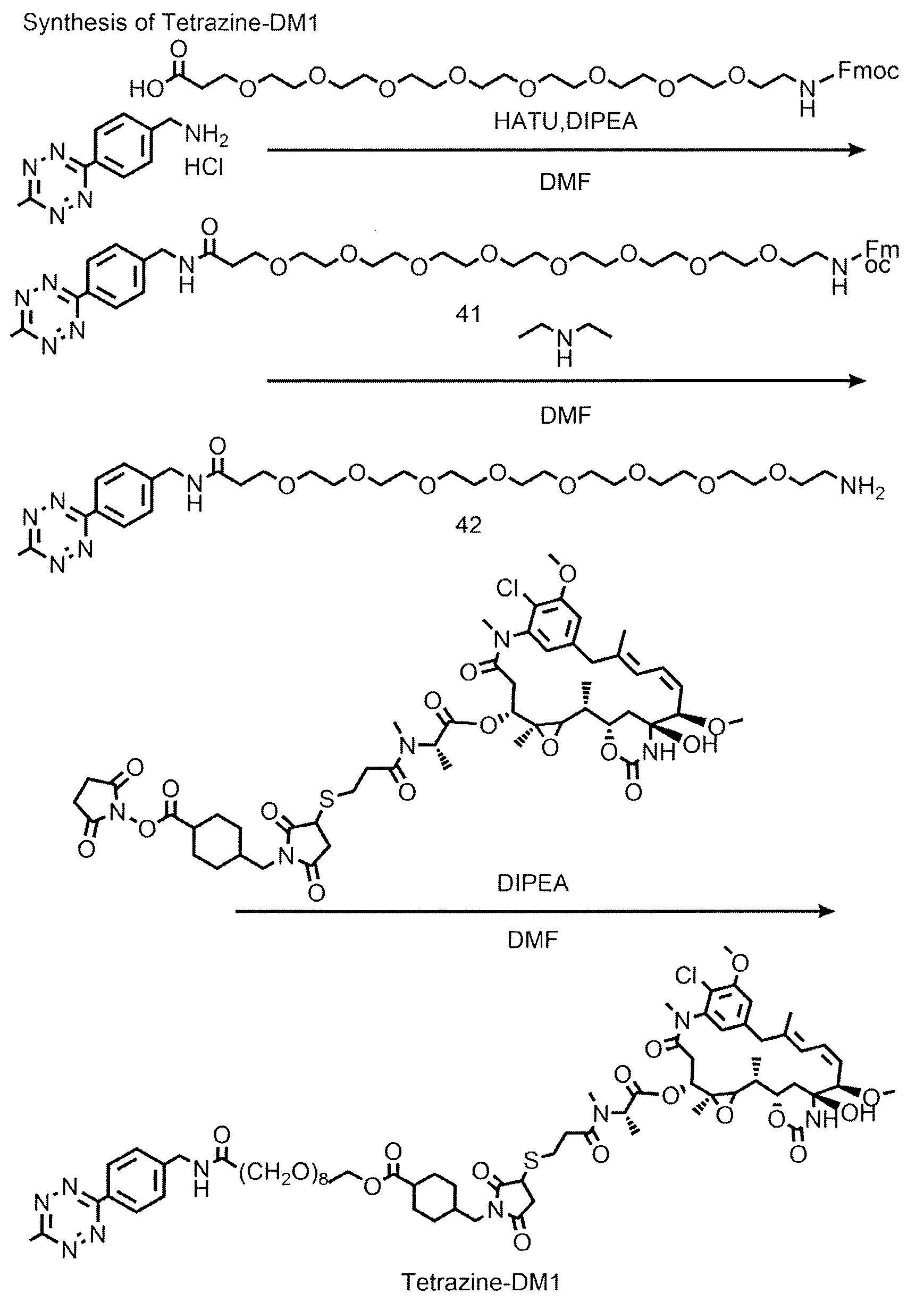


Claims (53)
- 하기 화학식 2의 구조를 갖는 화합물:[화학식 2]
 이때,H1은 제1 클릭화학작용기이고,D1은 공유결합, C1~4알킬렌, C2~4알케닐렌, C2~4알키닐렌, 및 C3~8시클로알킬렌 중 선택된 어느 하나이며,X1은 S이고,D2는 C1~7알킬렌, C2~7알케닐렌, C2~7알키닐렌, 및 C3~8시클로알킬렌 중 선택된 어느 하나이며,X2는 O이고, R2'은 N-석시니미드, p-니트로페닐, 또는 펜타플루오로페닐임.
 - 제1항에 있어서,H1은 말단 알킨, 아자이드, 스트레인된 알킨, 다이엔, 친다이엔체, 알켄, 티올, 및 테트라진 중 선택된 어느 하나인 것을 특징으로 하는 화합물.
- 제2항에 있어서,H1은 노르보넨, 테트라진, 아자이드 및 디벤조시클로옥신-아민 중 선택된 어느 하나인 것을 특징으로 하는 화합물.
- 제1항에 있어서,R2'은 N-석시니미드인 것을 특징으로 하는 화합물.
- 제1항에 있어서,상기 화학식 2는 하기 화학식 2-1, 2-2, 또는 2-3과 같은 것을 특징으로 하는 화합물:[화학식 2-1]
 [화학식 2-2]
 [화학식 2-3]
- 하기 화학식 4-2의 구조를 갖는 펩타이드:[화학식 4-2]
 이때,각각의 Xaa는 독립적으로 시스테인이 아닌 임의의 아미노산이고,C는 시스테인이며, H는 히스티딘이고, G는 글리신이며, Xa2는 글루탐산 또는 아스파라긴이고, L은 류신이며, V는 발린이고, Xa3는 트립토판, 나프틸알라닌, 및 페닐알라닌으로부터 선택되며, 또한Xa1은이고, 이때 D3는 공유결합 또는 C1~3알킬렌이며 또한 X3는 NH2이고,
 상기 펩타이드는 13 이상 17 이하 개수의 아미노산 잔기로 구성되며,상기 펩타이드는 인간 이뮤노글로불린 G (IgG)에 대한 결합 활성을 보이고,N 말단으로부터 2 내지 4 아미노산만큼 떨어진 시스테인과 C 말단으로부터 2 내지 4 아미노산만큼 떨어진 시스테인은 선택적으로 서로 연결됨.
 - 제6항에 있어서,D3는 공유결합, 메틸렌, 또는 에틸렌인 것을 특징으로 하는 펩타이드.
- 제6항에 있어서,상기 화학식 4-2는 하기 화학식 4-6과 같은 것을 특징으로 하는 펩타이드:[화학식 4-6]
 이때,D는 아스파르트산이고, A는 알라닌이며, E는 글루탐산이고, W는 트립토판이며, T는 트레오닌임.
 - 하기 화학식 6-2의 구조를 갖는 펩타이드-화합물 콘쥬게이트:[화학식 6-2]
 이때,각각의 Xaa는 독립적으로 시스테인이 아닌 임의의 아미노산이고, C는 시스테인이며, H는 히스티딘이고, G는 글리신이고, Xa2는 글루탐산 또는 아스파라긴이며, L은 류신이고, V는 발린이며, 또한 Xa3는 트립토판, 나프틸알라닌, 및 페닐알라닌으로부터 선택되고, 또한(Xa1)'은이며, 이때
 H1은 제1 클릭화학작용기이고,D1은 공유결합, C1~4알킬렌, C2~4알케닐렌, C2~4알키닐렌, 및 C3~8시클로알킬렌 중 선택된 어느 하나이며,X1은 S이고, D2는 C1~7알킬렌, C2~7알케닐렌, C2~7알키닐렌, 및 C3~8시클로알킬렌 중 선택된 어느 하나이며, D3는 공유결합 또는 C1~3알킬렌이고 또한 X3는 NH이며,상기 펩타이드는 13 이상 17 이하 개수의 아미노산 잔기로 구성되고,상기 펩타이드는 인간 이뮤노글로불린 G (IgG)에 대한 결합 활성을 보이며,N 말단으로부터 2 내지 4 아미노산만큼 떨어진 시스테인과 C 말단으로부터 2 내지 4 아미노산만큼 떨어진 시스테인은 선택적으로 서로 연결됨.
 - 제9항에 있어서,(Xa1)'의 베타 탄소로부터 제1 카보닐 탄소까지의 거리가 약 11.668Å 보다 작은 것을 특징으로 하는 펩타이드-화합물 콘쥬게이트.
- 제9항에 있어서,D2는 Cy알킬렌, Cy알케닐렌, 또는 Cy알키닐렌이고,D3는 Cx알킬렌이며,이때, y는 1 이상인 정수이고, 1≤x+y≤5인 것을 특징으로 하는 펩타이드-화합물 콘쥬게이트.
- 제9항에 있어서,(Xa1)'의 베타 탄소로부터 제1 카보닐 탄소까지의 거리가 약 16.208Å 보다 큰 것을 특징으로 하는 펩타이드-화합물 콘쥬게이트.
- 제9항에 있어서,D2는 Cy알킬렌, Cy알케닐렌, 또는 Cy알키닐렌이고,D3는 Cx알킬렌이며,이때, y는 1 이상인 정수이고, 9≤x+y≤12인 것을 특징으로 하는 펩타이드-화합물 콘쥬게이트.
- 제13항에 있어서,D2는 Cy알케닐렌, 또는 Cy알키닐렌인 것을 특징으로 하는 펩타이드-화합물 콘쥬게이트.
- 제9항에 있어서,(Xa1)'의 베타 탄소로부터 제1 카보닐 탄소까지의 거리가 약 11.668Å 이상이고 약 16.208Å 이하인 것을 특징으로 하는 펩타이드-화합물 콘쥬게이트.
- 제9항에 있어서,D2는 Cy알킬렌, Cy알케닐렌, 또는 Cy알키닐렌이고,D3는 Cx알킬렌이며,이때, y는 1 이상인 정수이고, 6≤x+y≤8인 것을 특징으로 하는 펩타이드-화합물 콘쥬게이트.
- 제9항에 있어서,상기 화학식 6-2는 하기 화학식 6-3과 같은 것을 특징으로 하는 펩타이드-화합물 콘쥬게이트:[화학식 6-3]
 이때,D는 아스파르트산이고, A는 알라닌이며, E는 글루탐산이고, W는 트립토판이며, T는 트레오닌임.
 - 제9항에 있어서,D1은 공유결합이고 D2는 메틸렌인 것을 특징으로 하는 펩타이드-화합물 콘쥬게이트.
- 하기 화학식 2의 구조를 갖는 화합물:[화학식 2]
 이때,H1은 제1 클릭화학작용기이고,D1은 공유결합, C1~4알킬렌, C2~4알케닐렌, C2~4알키닐렌, 및 C3~8시클로알킬렌 중 선택된 어느 하나이며,X1은 S이고, D2는 C1~7알킬렌, C2~7알케닐렌, C2~7알키닐렌, 및 C3~8시클로알킬렌 중 선택된 어느 하나이며,X2는 O이고, R2'은 N-석시니미드, p-니트로페닐, 또는 펜타플루오로페닐인 것과하기 화학식 4-2의 구조를 갖는 펩타이드:[화학식 4-2]
 이때,각각의 Xaa는 독립적으로 시스테인이 아닌 임의의 아미노산이고,C는 시스테인이며, H는 히스티딘이고, G는 글리신이며, Xa2는 글루탐산 또는 아스파라긴이고, L은 류신이며, V는 발린이고, Xa3는 트립토판, 나프틸알라닌, 및 페닐알라닌으로부터 선택되며, 또한Xa1은이고, 이때 D3는 공유결합 또는 C1~3알킬렌이며 또한 X3는 NH2이고,
 상기 펩타이드는 13 이상 17 이하 개수의 아미노산 잔기로 구성되며,상기 펩타이드는 인간 이뮤노글로불린 G (IgG)에 대한 결합 활성을 보이고,N 말단으로부터 2 내지 4 아미노산만큼 떨어진 시스테인과 C 말단으로부터 2 내지 4 아미노산만큼 떨어진 시스테인은 선택적으로 서로 연결된 것을 반응시킴을 포함하는항체에 대한 제1 클릭화학작용기 전달용 제제의 제조 방법.
 - 제19항에 있어서,D2는 Cy알킬렌, Cy알케닐렌, 또는 Cy알키닐렌이고,D3는 Cx알킬렌이며,이때, y는 1 이상인 정수이고, 1≤x+y≤5이며,본 방법으로 제조된 항체에 대한 제1 클릭화학작용기 전달용 제제는 항체와 반응하여 상기 항체의 Fc 도메인의 248번 라이신에 특이적으로 제1 클릭화학작용기를 전달하는 것을 특징으로 하는항체에 대한 제1 클릭화학작용기 전달용 제제의 제조 방법.
- 제19항에 있어서,D2는 Cy알킬렌, Cy알케닐렌, 또는 Cy알키닐렌이고,D3는 Cx알킬렌이며,이때, y는 1 이상인 정수이고, 9≤x+y≤12이며,본 방법으로 제조된 항체에 대한 제1 클릭화학작용기 전달용 제제는 항체와 반응하여 상기 항체의 Fc 도메인의 246번 라이신에 특이적으로 제1 클릭화학작용기를 전달하는 것을 특징으로 하는항체에 대한 제1 클릭화학작용기 전달용 제제의 제조 방법.
- 제19항에 있어서,D2는 Cy알킬렌, Cy알케닐렌, 또는 Cy알키닐렌이고,D3는 Cx알킬렌이며,이때, y는 1 이상인 정수이고, 6≤x+y≤8이며,본 방법으로 제조된 항체에 대한 제1 클릭화학작용기 전달용 제제는 항체와 반응하여 상기 항체의 Fc 도메인의 246번 라이신 또는 248번 라이신에 선택적으로 제1 클릭화학작용기를 전달하는 것을 특징으로 하는항체에 대한 제1 클릭화학작용기 전달용 제제의 제조 방법.
- 하기 화학식 2의 구조를 갖는 화합물:[화학식 2]
 이때,H1은 제1 클릭화학작용기이고,D1은 공유결합, C1~4알킬렌, C2~4알케닐렌, C2~4알키닐렌, 및 C3~8시클로알킬렌 중 선택된 어느 하나이며,X1은 S이고,D2는 C1~7알킬렌, C2~7알케닐렌, C2~7알키닐렌, 및 C3~8시클로알킬렌 중 선택된 어느 하나이며,X2는 O이며, R2'은 N-석시니미드, p-니트로페닐, 또는 펜타플루오로페닐인 것; 및하기 화학식 4-2의 구조를 갖는 펩타이드:[화학식 4-2]
 이때,각각의 Xaa는 독립적으로 시스테인이 아닌 임의의 아미노산이고,C는 시스테인이며, H는 히스티딘이고, G는 글리신이며, Xa2는 글루탐산 또는 아스파라긴이고, L은 류신이며, V는 발린이고, Xa3는 트립토판, 나프틸알라닌, 및 페닐알라닌으로부터 선택되며, 또한Xa1은이고, 이때 D3는 공유결합 또는 C1~3알킬렌이며 또한 X3는 NH2이고,
 상기 펩타이드는 13 이상 17 이하 개수의 아미노산 잔기로 구성되며,상기 펩타이드는 인간 이뮤노글로불린 G (IgG)에 대한 결합 활성을 보이고,N 말단으로부터 2 내지 4 아미노산만큼 떨어진 시스테인과 C 말단으로부터 2 내지 4 아미노산만큼 떨어진 시스테인은 선택적으로 서로 연결된 것을 포함하는항체에 대한 제1 클릭화학작용기 전달용 제제 제조용 키트.
 - 하기 화학식 8-1, 화학식 8-2, 및 화학식 8-3 중 선택된 하나 이상의 아미노산 서열을 포함하는 항체 또는 이의 단편:[화학식 8-1]
 [화학식 8-2]
 [화학식 8-3]
 이때,G는 글리신이고, P는 프롤린이며, S는 세린이고, V는 발린이며, F는 페닐알라닌이고, L은 류신이며, K는 라이신이고, D는 아스파르트산이며, T는 트레오닌이고, M은 메티오닌이며, I는 이소류신이고, 또한(K)'은이며, 이때
 H1은 제1 클릭화학작용기이고,D1은 공유결합, C1~4알킬렌, C2~4알케닐렌, C2~4알키닐렌, 및 C3~8시클로알킬렌 중 선택된 어느 하나임.
 - 제24항에 있어서,D1은 공유결합인 것을 특징으로 하는 항체 또는 이의 단편.
- 제24항에 있어서,상기 화학식 8-1의 아미노산 서열 만을 포함하고 상기 화학식 8-2 및 8-3의 아미노산 서열을 포함하지 않는 것을 특징으로 하는 항체 또는 이의 단편.
- 제26항에 있어서,두 개의 Fc 도메인 중 두 개 모두에서 상기 화학식 8-1의 아미노산 서열을 포함하는 것을 특징으로 하는 항체 또는 이의 단편.
- 제24항에 있어서,상기 화학식 8-2의 아미노산 서열 만을 포함하고 상기 화학식 8-1 및 8-3의 아미노산 서열을 포함하지 않는 것을 특징으로 하는 항체 또는 이의 단편.
- 제28항에 있어서,두 개의 Fc 도메인 중 두 개 모두에서 상기 화학식 8-2의 아미노산 서열을 포함하는 것을 특징으로 하는 항체 또는 이의 단편.
- 제24항에 있어서,상기 화학식 8-3의 아미노산 서열 만을 포함하고 상기 화학식 8-1 및 8-2의 아미노산 서열을 포함하지 않는 것을 특징으로 하는 항체 또는 이의 단편.
- 제30항에 있어서,두 개의 Fc 도메인 중 두 개 모두에서 상기 화학식 8-3의 아미노산 서열을 포함하는 것을 특징으로 하는 항체 또는 이의 단편.
- 하기 화학식 6-2의 구조를 갖는 펩타이드-화합물 콘쥬게이트:[화학식 6-2]
 이때,각각의 Xaa는 독립적으로 시스테인이 아닌 임의의 아미노산이고, C는 시스테인이며, H는 히스티딘이고, G는 글리신이고, Xa2는 글루탐산 또는 아스파라긴이며, L은 류신이고, V는 발린이며, 또한 Xa3는 트립토판, 나프틸알라닌, 및 페닐알라닌으로부터 선택되며, 또한(Xa1)'은이며, 이때
 H1은 제1 클릭화학작용기이고,D1은 공유결합, C1~4알킬렌, C2~4알케닐렌, C2~4알키닐렌, 및 C3~8시클로알킬렌 중 선택된 어느 하나이며,X1은 S이고,D2는 C1~7알킬렌, C2~7알케닐렌, C2~7알키닐렌, 및 C3~8시클로알킬렌 중 선택된 어느 하나이며,D3는 공유결합 또는 C1~3알킬렌이고 또한 X3는 NH이며,상기 펩타이드는 13 이상 17 이하 개수의 아미노산 잔기로 구성되고,상기 펩타이드는 인간 이뮤노글로불린 G (IgG)에 대한 결합 활성을 보이며,N 말단으로부터 2 내지 4 아미노산만큼 떨어진 시스테인과 C 말단으로부터 2 내지 4 아미노산만큼 떨어진 시스테인은 선택적으로 서로 연결된 것과항체 또는 이의 단편을 반응시킴을 포함하는제1 클릭화학작용기를 포함하는 항체 또는 이의 단편의 제조 방법.
 - 하기 화학식 6-2의 구조를 갖는 펩타이드-화합물 콘쥬게이트:[화학식 6-2]
 이때,각각의 Xaa는 독립적으로 시스테인이 아닌 임의의 아미노산이고, C는 시스테인이며, H는 히스티딘이고, G는 글리신이고, Xa2는 글루탐산 또는 아스파라긴이며, L은 류신이고, V는 발린이며, 또한 W는 트립토판이고, 또한(Xa1)'은이며, 이때
 H1은 제1 클릭화학작용기이고,D1은 공유결합, C1~4알킬렌, C2~4알케닐렌, C2~4알키닐렌, 및 C3~8시클로알킬렌 중 선택된 어느 하나이며,X1은 S이고,D2는 C1~7알킬렌, C2~7알케닐렌, C2~7알키닐렌, 및 C3~8시클로알킬렌 중 선택된 어느 하나이며,D3는 공유결합 또는 C1~3알킬렌이고 또한 X3는 NH이며,상기 펩타이드는 13 이상 17 이하 개수의 아미노산 잔기로 구성되고,상기 펩타이드는 인간 이뮤노글로불린 G (IgG)에 대한 결합 활성을 보이며,N 말단으로부터 2 내지 4 아미노산만큼 떨어진 시스테인과 C 말단으로부터 2 내지 4 아미노산만큼 떨어진 시스테인은 선택적으로 서로 연결된 것; 및항체 또는 이의 단편을 포함하는제1 클릭화학작용기를 포함하는 항체 또는 이의 단편의 제조용 키트.
 - 하기 화학식 9의 구조를 갖는 화합물:[화학식 9]
 이때,Cm은 카고 모이어티이고,H2는 제2 클릭화학작용기임.
 - 하기 화학식 8-1, 화학식 8-2, 및 화학식 8-3 중 선택된 하나 이상의 아미노산 서열을 포함하는 항체 또는 이의 단편:[화학식 8-1]
 [화학식 8-2]
 [화학식 8-3]
 이때,G는 글리신이고, P는 프롤린이며, S는 세린이고, V는 발린이며, F는 페닐알라닌이고, L은 류신이며, K는 라이신이고, D는 아스파르트산이며, T는 트레오닌이고, M은 메티오닌이며, I는 이소류신이고, 또한(K)'은이며, 이때
 H1은 제1 클릭화학작용기이고,D1은 공유결합, C1~4알킬렌, C2~4알케닐렌, C2~4알키닐렌, 및 C3~8시클로알킬렌 중 선택된 어느 하나인 것과하기 화학식 9의 구조를 갖는 화합물:[화학식 9]
 이때,Cm은 카고 모이어티이고,H2는 상기 제1 클릭화학작용기와 상보적인 제2 클릭화학작용기인 것을 반응시킴을 포함하는항체-약물 콘쥬게이트의 제조 방법.
 - 하기 화학식 8-1, 화학식 8-2, 및 화학식 8-3 중 선택된 하나 이상의 아미노산 서열을 포함하는 항체 또는 이의 단편:[화학식 8-1]
 [화학식 8-2]
 [화학식 8-3]
 이때,G는 글리신이고, P는 프롤린이며, S는 세린이고, V는 발린이며, F는 페닐알라닌이고, L은 류신이며, K는 라이신이고, D는 아스파르트산이며, T는 트레오닌이고, M은 메티오닌이며, I는 이소류신이고, 또한(K)'은이며, 이때
 H1은 제1 클릭화학작용기이고,D1은 공유결합, C1~4알킬렌, C2~4알케닐렌, C2~4알키닐렌, 및 C3~8시클로알킬렌 중 선택된 어느 하나인 것; 및하기 화학식 9의 구조를 갖는 화합물:[화학식 9]
 이때,Cm은 카고 모이어티이고,H2는 상기 제1 클릭화학작용기와 상보적인 제2 클릭화학작용기인 것을 포함하는 항체-약물 콘쥬게이트 제조용 키트.
 - 하기 화학식 10-1, 화학식 10-2, 및 화학식 10-3 중 선택된 하나 이상의 아미노산 서열을 포함하는 항체 또는 이의 단편:[화학식 10-1]
 [화학식 10-2]
 [화학식 10-3]
 이때,G는 글리신이고, P는 프롤린이며, S는 세린이고, V는 발린이며, F는 페닐알라닌이고, L은 류신이며, K는 라이신이고, D는 아스파르트산이며, T는 트레오닌이고, M은 메티오닌이며, I는 이소류신이고, 또한(K)''은이며, 이때
 Cm은 카고 모이어티이고,B는,
 ,
, ,
, ,
, ,
, , 및
, 및 중 선택된 어느 하나이며, 이때 A1과 A2는 둘 다 같은 것과 연결되지 않도록 상기 카고 모이어티 또는 D1과 연결되고, Rx는 H, 할로겐, 및 C1~3알킬로부터 선택되며,
 D1은 공유결합, C1~4알킬렌, C2~4알케닐렌, C2~4알키닐렌, 및 C3~8시클로알킬렌 중 선택된 어느 하나임.
 - 제37항에 있어서,상기 화학식 10-1의 아미노산 서열 만을 포함하고 상기 화학식 10-2 및 10-3의 아미노산 서열을 포함하지 않는 것을 특징으로 하는 항체 또는 이의 단편.
- 제38항에 있어서,두 개의 Fc 도메인 중 두 개 모두에서 상기 화학식 10-1의 아미노산 서열을 포함하는 것을 특징으로 하는 항체 또는 이의 단편.
- 제37항에 있어서,상기 화학식 10-2의 아미노산 서열 만을 포함하고 상기 화학식 10-1 및 10-3의 아미노산 서열을 포함하지 않는 것을 특징으로 하는 항체 또는 이의 단편.
- 제40항에 있어서,두 개의 Fc 도메인 중 두 개 모두에서 상기 화학식 10-2의 아미노산 서열을 포함하는 것을 특징으로 하는 항체 또는 이의 단편.
- 제37항에 있어서,상기 화학식 10-3의 아미노산 서열 만을 포함하고 상기 화학식 10-1 및 10-2의 아미노산 서열을 포함하지 않는 것을 특징으로 하는 항체 또는 이의 단편.
- 제42항에 있어서,두 개의 Fc 도메인 중 두 개 모두에서 상기 화학식 10-3의 아미노산 서열을 포함하는 것을 특징으로 하는 항체 또는 이의 단편.
- 제37항에 있어서,상기 카고 모이어티는 약물 모이어티를 포함하는 것을 특징으로 하는 항체 또는 이의 단편.
- 제44항에 있어서,상기 카고 모이어티는 2개 이상의 약물 모이어티를 포함하는 것을 특징으로 하는 항체 또는 이의 단편.
- 제44항에 있어서,상기 약물 모이어티는 항암제인 것을 특징으로 하는 항체 또는 이의 단편.
- 제46항에 있어서,상기 항암제는 DM1, DM3, DM4, 아브린, 리친 A, 슈도모나스 엑소톡신, 콜레라 독소, 디프테리아 독소, 종양 괴사 인자, α 인터페론, β 인터페론, 신경 성장 인자, 혈소판 유래 성장 인자, 조직 플라스미노겐 활성화제, 사이토카인, 아폽토시스 유도 제제, 항-신혈관형성 제제, 림포카인, 탁세인, DNA-알킬화 제제, 안트라시클린, 튜불리신 유사체, 듀오카르마이신 유사체, 오리스타틴 E, 오리스타틴 F, 마이탄시노이드, 반응성 폴리에틸렌글리콜 잔기를 포함하는 세포독성 제제, 탁손, 사이토칼라신 B, 그라미시딘 D, 에티디움 브로마이드, 에메틴, 미토마이신, 에토포사이드, 테노포사이드, 빈크리스틴, 빈블라스틴, t. 콜키신, 독소루비신, 도노루비신, 디히드록시 안트라신 디온, 미톡산트론, 미트라마이신, 악티노마이신 D, 1-디히드로테스토스테론, 글루코코르티코이드, 프로카인, 테트라카인, 리도카인, 프로프라놀롤, 퓨로마이신, 메토트렉세이트, 6-머캅토퓨린, 6-티오구아닌, 시타라빈, 5-플루오로우라실 디카르바진, 메클로레타민, 티오테파클로람부실, 메이팔란, 카르무스틴, 로무스틴, 시클로포스파미드, 부설판, 디브로모마니톨, 스트렙토조토신, 미토마이신 C, 시스플라틴, 닥티노마이신, 블레오마이신, 안트라마이신, 칼리키아마이신, 아비라테론, 벤다무스틴, 보르테조밉, 카르보플라틴, 카바지탁셀, 다사티닙, 도세탁셀, 에피루비신, 엘로티닙, 에베롤리무스, 젬시타빈, 제피티닙, 이다루비신, 이마티닙, 히드록시유레아, 라파티닙, 류프로레린, 멜팔란, 네다플라틴, 닐로티닙, 옥살리플라틴, 파조파닙, 페메트렉세드, 피코플라틴, 로미뎁신, 사트라플라틴, 소라페닙, 베무라페닙, 수니티닙, 테니포사이트, 트리플라틴, 및 비노렐빈 중에서 선택된 하나 이상인 것을 특징으로 하는 항체 또는 이의 단편.
- 제46항에 의한 항체-약물 콘쥬게이트를 포함하는 암 치료용 조성물.
- 제48항에 있어서,상기 암은 방광암, 골암, 뇌암, 유방암, 심장암, 자궁경부암, 대장암, 직장암, 식도암, 섬유육종, 위암, 위장암, 두경부암, 카포시 육종, 신장암, 백혈병, 간암, 폐암, 림프종, 흑색종, 골수종, 난소암, 췌장암, 음경암, 전립선암, 고환 생식세포 암, 흉선종 및 흉선암 중 선택된 어느 하나인 것을 특징으로 하는 암 치료용 조성물.
- 제49항에 있어서,상기 암은 유방암인 것을 특징으로 하는 암 치료용 조성물.
- 제46항에 의한 항체-약물 콘쥬게이트를 포함하는 약학적 조성물을 대상에 투여함을 포함하는 암의 치료 방법.
- 제51항에 있어서,상기 암은 방광암, 골암, 뇌암, 유방암, 심장암, 자궁경부암, 대장암, 직장암, 식도암, 섬유육종, 위암, 위장암, 두경부암, 카포시 육종, 신장암, 백혈병, 간암, 폐암, 림프종, 흑색종, 골수종, 난소암, 췌장암, 음경암, 전립선암, 고환 생식세포 암, 흉선종 및 흉선암 중 선택된 어느 하나인 것을 특징으로 하는 암의 치료 방법.
- 제52항에 있어서,상기 암은 유방암인 것을 특징으로 하는 암의 치료 방법.
Priority Applications (14)
| Application Number | Priority Date | Filing Date | Title |
|---|---|---|---|
| EP25222702.0A EP4711386A2 (en) | 2019-03-08 | 2020-03-09 | Site-specific antibody conjugation and antibody-drug conjugate as specific example thereof |
| EP20770235.8A EP3936501B1 (en) | 2019-03-08 | 2020-03-09 | SITE-SPECIFIC ANTIBODY CONJUGATION AND ANTIBODY-DRUG conjugate serving as a specific example thereof |
| CN202411825369.6A CN119613317A (zh) | 2019-03-08 | 2020-03-09 | 位点特异性的抗体偶联和作为其具体实例的抗体-药物偶联物 |
| CN202080019814.3A CN113557228B (zh) | 2019-03-08 | 2020-03-09 | 位点特异性的抗体偶联和作为其具体实例的抗体-药物偶联物 |
| JP2021553121A JP7393810B2 (ja) | 2019-03-08 | 2020-03-09 | 部位特異的抗体コンジュゲーション及びその具体例としての抗体-薬物コンジュゲート |
| CN202411826239.4A CN119613555A (zh) | 2019-03-08 | 2020-03-09 | 位点特异性的抗体偶联和作为其具体实例的抗体-药物偶联物 |
| AU2020234394A AU2020234394B2 (en) | 2019-03-08 | 2020-03-09 | Site-specific antibody conjugation and antibody-drug conjugate as specific example thereof |
| CA3132959A CA3132959A1 (en) | 2019-03-08 | 2020-03-09 | Site-specific antibody conjugation and antibody-drug conjugate as specific embodiment thereof |
| US16/980,503 US20230158167A1 (en) | 2019-03-08 | 2020-03-09 | Site-specific antibody conjugation and antibody-drug conjugate as specific embodiment thereof |
| US18/154,998 US11896675B2 (en) | 2019-03-08 | 2023-01-16 | Site-specific antibody conjugation and antibody-drug conjugate as specific embodiment thereof |
| JP2023196070A JP7744104B2 (ja) | 2019-03-08 | 2023-11-17 | 部位特異的抗体コンジュゲーション及びその具体例としての抗体-薬物コンジュゲート |
| AU2024203071A AU2024203071B2 (en) | 2019-03-08 | 2024-05-09 | Site-specific antibody conjugation and antibody-drug conjugate as specific example thereof |
| JP2025149498A JP2025179205A (ja) | 2019-03-08 | 2025-09-09 | 部位特異的抗体コンジュゲーション及びその具体例としての抗体-薬物コンジュゲート |
| AU2026200213A AU2026200213A1 (en) | 2019-03-08 | 2026-01-14 | Site-specific antibody conjugation and antibody-drug conjugate as specific example thereof |
Applications Claiming Priority (2)
| Application Number | Priority Date | Filing Date | Title |
|---|---|---|---|
| US201962815557P | 2019-03-08 | 2019-03-08 | |
| US62/815,557 | 2019-03-08 |
Related Child Applications (2)
| Application Number | Title | Priority Date | Filing Date |
|---|---|---|---|
| US16/980,503 A-371-Of-International US20230158167A1 (en) | 2019-03-08 | 2020-03-09 | Site-specific antibody conjugation and antibody-drug conjugate as specific embodiment thereof |
| US18/154,998 Continuation US11896675B2 (en) | 2019-03-08 | 2023-01-16 | Site-specific antibody conjugation and antibody-drug conjugate as specific embodiment thereof |
Publications (1)
| Publication Number | Publication Date |
|---|---|
| WO2020184944A1 true WO2020184944A1 (ko) | 2020-09-17 |
Family
ID=72427518
Family Applications (1)
| Application Number | Title | Priority Date | Filing Date |
|---|---|---|---|
| PCT/KR2020/003282 Ceased WO2020184944A1 (ko) | 2019-03-08 | 2020-03-09 | 위치특이적 항체 콘쥬게이션 및 이의 구체예로서의 항체-약물 콘쥬게이트 |
Country Status (8)
| Country | Link |
|---|---|
| US (2) | US20230158167A1 (ko) |
| EP (2) | EP3936501B1 (ko) |
| JP (3) | JP7393810B2 (ko) |
| KR (2) | KR102563319B1 (ko) |
| CN (3) | CN113557228B (ko) |
| AU (3) | AU2020234394B2 (ko) |
| CA (1) | CA3132959A1 (ko) |
| WO (1) | WO2020184944A1 (ko) |
Cited By (12)
| Publication number | Priority date | Publication date | Assignee | Title |
|---|---|---|---|---|
| EP3915973A4 (en) * | 2019-01-23 | 2023-02-01 | ABTIS Co., Ltd. | COMPOUND FOR THE PRODUCTION OF AN ANTIBODY-PAYLOAD CONJUGATE AND ITS USE |
| CN116635408A (zh) * | 2020-10-12 | 2023-08-22 | 德彪药业国际股份公司 | 反应性偶联物 |
| WO2023167564A1 (ko) | 2022-03-04 | 2023-09-07 | 앱티스 주식회사 | 티올 반응성 에디티브를 이용한 항체-약물 컨쥬게이트의 제조 수율을 높이는 방법 |
| US11896675B2 (en) | 2019-03-08 | 2024-02-13 | AbTis Co., Ltd. | Site-specific antibody conjugation and antibody-drug conjugate as specific embodiment thereof |
| WO2024096577A1 (ko) | 2022-11-01 | 2024-05-10 | 앱티스 주식회사 | Fc 결합성 유닛을 포함하는 화합물 및 이를 이용하여 제조된 컨쥬게이트 |
| WO2025076127A1 (en) | 2023-10-05 | 2025-04-10 | Capstan Therapeutics, Inc. | Constrained ionizable cationic lipids and lipid nanoparticles |
| WO2025076113A1 (en) | 2023-10-05 | 2025-04-10 | Capstan Therapeutics, Inc. | Ionizable cationic lipids with conserved spacing and lipid nanoparticles |
| WO2025096878A1 (en) | 2023-11-02 | 2025-05-08 | Capstan Therapeutics, Inc. | Rna for in vivo transfection with increased expression |
| WO2025129201A1 (en) | 2023-12-15 | 2025-06-19 | Capstan Therapeutics, Inc. | Humanized anti-cd8 antibodies and uses thereof |
| WO2025179294A2 (en) | 2024-02-22 | 2025-08-28 | Capstan Therapeutics, Inc. | Immune engineering amplification |
| WO2025217452A1 (en) | 2024-04-11 | 2025-10-16 | Capstan Therapeutics, Inc. | Constrained ionizable cationic lipids and lipid nanoparticles |
| WO2025217454A2 (en) | 2024-04-11 | 2025-10-16 | Capstan Therapeutics, Inc. | Ionizable cationic lipids and lipid nanoparticles |
Families Citing this family (4)
| Publication number | Priority date | Publication date | Assignee | Title |
|---|---|---|---|---|
| WO2024168199A1 (en) * | 2023-02-09 | 2024-08-15 | Regeneron Pharmaceuticals, Inc. | Antibody-drug conjugates via inverse electron demand diels-alder reactions |
| EP4442282A1 (en) | 2023-04-07 | 2024-10-09 | POSTECH Research and Business Development Foundation | Preparation of site-specific polypeptide conjugates |
| CN116370650B (zh) * | 2023-04-14 | 2024-03-22 | 四川大学华西医院 | 基于四嗪连接子的多肽药物偶联物及其制备方法、应用 |
| KR20250045545A (ko) | 2023-09-25 | 2025-04-02 | 앱티스 주식회사 | 항체-킬레이터 콘쥬게이트 |
Citations (29)
| Publication number | Priority date | Publication date | Assignee | Title |
|---|---|---|---|---|
| US4522811A (en) | 1982-07-08 | 1985-06-11 | Syntex (U.S.A.) Inc. | Serial injection of muramyldipeptides and liposomes enhances the anti-infective activity of muramyldipeptides |
| US4526938A (en) | 1982-04-22 | 1985-07-02 | Imperial Chemical Industries Plc | Continuous release formulations |
| US4880078A (en) | 1987-06-29 | 1989-11-14 | Honda Giken Kogyo Kabushiki Kaisha | Exhaust muffler |
| WO1991005548A1 (en) | 1989-10-10 | 1991-05-02 | Pitman-Moore, Inc. | Sustained release composition for macromolecular proteins |
| US5128326A (en) | 1984-12-06 | 1992-07-07 | Biomatrix, Inc. | Drug delivery systems based on hyaluronans derivatives thereof and their salts and methods of producing same |
| WO1992019244A2 (en) | 1991-05-01 | 1992-11-12 | Henry M. Jackson Foundation For The Advancement Of Military Medicine | A method for treating infectious respiratory diseases |
| US5374548A (en) | 1986-05-02 | 1994-12-20 | Genentech, Inc. | Methods and compositions for the attachment of proteins to liposomes using a glycophospholipid anchor |
| US5399331A (en) | 1985-06-26 | 1995-03-21 | The Liposome Company, Inc. | Method for protein-liposome coupling |
| US5416016A (en) | 1989-04-03 | 1995-05-16 | Purdue Research Foundation | Method for enhancing transmembrane transport of exogenous molecules |
| WO1996020698A2 (en) | 1995-01-05 | 1996-07-11 | The Board Of Regents Acting For And On Behalf Of The University Of Michigan | Surface-modified nanoparticles and method of making and using same |
| WO1997032572A2 (en) | 1996-03-04 | 1997-09-12 | The Penn State Research Foundation | Materials and methods for enhancing cellular internalization |
| US5679377A (en) | 1989-11-06 | 1997-10-21 | Alkermes Controlled Therapeutics, Inc. | Protein microspheres and methods of using them |
| WO1997044013A1 (en) | 1996-05-24 | 1997-11-27 | Massachusetts Institute Of Technology | Aerodynamically light particles for pulmonary drug delivery |
| WO1998031346A1 (en) | 1997-01-16 | 1998-07-23 | Massachusetts Institute Of Technology | Preparation of particles for inhalation |
| US5855913A (en) | 1997-01-16 | 1999-01-05 | Massachusetts Instite Of Technology | Particles incorporating surfactants for pulmonary drug delivery |
| WO1999015154A1 (en) | 1997-09-24 | 1999-04-01 | Alkermes Controlled Therapeutics, Inc. | Methods for fabricating polymer-based controlled release preparations |
| WO1999020253A1 (en) | 1997-10-23 | 1999-04-29 | Bioglan Therapeutics Ab | Encapsulation method |
| US5912015A (en) | 1992-03-12 | 1999-06-15 | Alkermes Controlled Therapeutics, Inc. | Modulated release from biocompatible polymers |
| US5916597A (en) | 1995-08-31 | 1999-06-29 | Alkermes Controlled Therapeutics, Inc. | Composition and method using solid-phase particles for sustained in vivo release of a biologically active agent |
| US5934272A (en) | 1993-01-29 | 1999-08-10 | Aradigm Corporation | Device and method of creating aerosolized mist of respiratory drug |
| US5985309A (en) | 1996-05-24 | 1999-11-16 | Massachusetts Institute Of Technology | Preparation of particles for inhalation |
| WO1999066903A2 (en) | 1998-06-24 | 1999-12-29 | Advanced Inhalation Research, Inc. | Large porous particles emitted from an inhaler |
| US6019968A (en) | 1995-04-14 | 2000-02-01 | Inhale Therapeutic Systems, Inc. | Dispersible antibody compositions and methods for their preparation and use |
| US6316024B1 (en) | 1996-10-11 | 2001-11-13 | Sequus Pharmaceuticals, Inc. | Therapeutic liposome composition and method of preparation |
| US6350466B1 (en) | 1994-08-05 | 2002-02-26 | Targesome, Inc. | Targeted polymerized liposome diagnostic and treatment agents |
| US20120172575A1 (en) * | 2007-11-21 | 2012-07-05 | University Of Georgia Research Foundation, Inc. | Alkynes and methods of reacting alkynes with 1,3-dipole-functional compounds |
| CN107496978A (zh) * | 2017-10-01 | 2017-12-22 | 刘云晖 | 一种双组份可溶性水凝胶敷料及其制备方法 |
| KR20180002734A (ko) * | 2015-05-20 | 2018-01-08 | 가고시마 유니버시티 | IgG 결합 펩타이드에 의한 항체의 특이적 변형 |
| WO2018199337A1 (ja) | 2017-04-28 | 2018-11-01 | 味の素株式会社 | 可溶性タンパク質に対する親和性物質、切断性部分および反応性基を有する化合物またはその塩 |
Family Cites Families (3)
| Publication number | Priority date | Publication date | Assignee | Title |
|---|---|---|---|---|
| JPWO2019240288A1 (ja) | 2018-06-14 | 2021-07-26 | 味の素株式会社 | 抗体に対する親和性物質、および生体直交性官能基を有する化合物またはその塩 |
| AU2020210506B2 (en) * | 2019-01-23 | 2025-02-13 | AbTis Co., Ltd. | Compound for preparation of antibody-payload conjugate and use thereof |
| EP3936501B1 (en) | 2019-03-08 | 2025-12-31 | ABTIS Co., Ltd. | SITE-SPECIFIC ANTIBODY CONJUGATION AND ANTIBODY-DRUG conjugate serving as a specific example thereof |
-
2020
- 2020-03-09 EP EP20770235.8A patent/EP3936501B1/en active Active
- 2020-03-09 CN CN202080019814.3A patent/CN113557228B/zh active Active
- 2020-03-09 CA CA3132959A patent/CA3132959A1/en active Pending
- 2020-03-09 WO PCT/KR2020/003282 patent/WO2020184944A1/ko not_active Ceased
- 2020-03-09 CN CN202411825369.6A patent/CN119613317A/zh active Pending
- 2020-03-09 JP JP2021553121A patent/JP7393810B2/ja active Active
- 2020-03-09 KR KR1020200029224A patent/KR102563319B1/ko active Active
- 2020-03-09 CN CN202411826239.4A patent/CN119613555A/zh active Pending
- 2020-03-09 US US16/980,503 patent/US20230158167A1/en active Pending
- 2020-03-09 EP EP25222702.0A patent/EP4711386A2/en active Pending
- 2020-03-09 AU AU2020234394A patent/AU2020234394B2/en active Active
-
2023
- 2023-01-16 US US18/154,998 patent/US11896675B2/en active Active
- 2023-07-31 KR KR1020230099296A patent/KR20230118780A/ko active Pending
- 2023-11-17 JP JP2023196070A patent/JP7744104B2/ja active Active
-
2024
- 2024-05-09 AU AU2024203071A patent/AU2024203071B2/en active Active
-
2025
- 2025-09-09 JP JP2025149498A patent/JP2025179205A/ja active Pending
-
2026
- 2026-01-14 AU AU2026200213A patent/AU2026200213A1/en active Pending
Patent Citations (34)
| Publication number | Priority date | Publication date | Assignee | Title |
|---|---|---|---|---|
| US4526938A (en) | 1982-04-22 | 1985-07-02 | Imperial Chemical Industries Plc | Continuous release formulations |
| US4522811A (en) | 1982-07-08 | 1985-06-11 | Syntex (U.S.A.) Inc. | Serial injection of muramyldipeptides and liposomes enhances the anti-infective activity of muramyldipeptides |
| US5128326A (en) | 1984-12-06 | 1992-07-07 | Biomatrix, Inc. | Drug delivery systems based on hyaluronans derivatives thereof and their salts and methods of producing same |
| US5399331A (en) | 1985-06-26 | 1995-03-21 | The Liposome Company, Inc. | Method for protein-liposome coupling |
| US5374548A (en) | 1986-05-02 | 1994-12-20 | Genentech, Inc. | Methods and compositions for the attachment of proteins to liposomes using a glycophospholipid anchor |
| US4880078A (en) | 1987-06-29 | 1989-11-14 | Honda Giken Kogyo Kabushiki Kaisha | Exhaust muffler |
| US5416016A (en) | 1989-04-03 | 1995-05-16 | Purdue Research Foundation | Method for enhancing transmembrane transport of exogenous molecules |
| WO1991005548A1 (en) | 1989-10-10 | 1991-05-02 | Pitman-Moore, Inc. | Sustained release composition for macromolecular proteins |
| US5679377A (en) | 1989-11-06 | 1997-10-21 | Alkermes Controlled Therapeutics, Inc. | Protein microspheres and methods of using them |
| WO1992019244A2 (en) | 1991-05-01 | 1992-11-12 | Henry M. Jackson Foundation For The Advancement Of Military Medicine | A method for treating infectious respiratory diseases |
| US5290540A (en) | 1991-05-01 | 1994-03-01 | Henry M. Jackson Foundation For The Advancement Of Military Medicine | Method for treating infectious respiratory diseases |
| US5912015A (en) | 1992-03-12 | 1999-06-15 | Alkermes Controlled Therapeutics, Inc. | Modulated release from biocompatible polymers |
| US5934272A (en) | 1993-01-29 | 1999-08-10 | Aradigm Corporation | Device and method of creating aerosolized mist of respiratory drug |
| US6350466B1 (en) | 1994-08-05 | 2002-02-26 | Targesome, Inc. | Targeted polymerized liposome diagnostic and treatment agents |
| WO1996020698A2 (en) | 1995-01-05 | 1996-07-11 | The Board Of Regents Acting For And On Behalf Of The University Of Michigan | Surface-modified nanoparticles and method of making and using same |
| US6019968A (en) | 1995-04-14 | 2000-02-01 | Inhale Therapeutic Systems, Inc. | Dispersible antibody compositions and methods for their preparation and use |
| US5916597A (en) | 1995-08-31 | 1999-06-29 | Alkermes Controlled Therapeutics, Inc. | Composition and method using solid-phase particles for sustained in vivo release of a biologically active agent |
| US5985320A (en) | 1996-03-04 | 1999-11-16 | The Penn State Research Foundation | Materials and methods for enhancing cellular internalization |
| WO1997032572A2 (en) | 1996-03-04 | 1997-09-12 | The Penn State Research Foundation | Materials and methods for enhancing cellular internalization |
| US5874064A (en) | 1996-05-24 | 1999-02-23 | Massachusetts Institute Of Technology | Aerodynamically light particles for pulmonary drug delivery |
| US5985309A (en) | 1996-05-24 | 1999-11-16 | Massachusetts Institute Of Technology | Preparation of particles for inhalation |
| WO1997044013A1 (en) | 1996-05-24 | 1997-11-27 | Massachusetts Institute Of Technology | Aerodynamically light particles for pulmonary drug delivery |
| US6316024B1 (en) | 1996-10-11 | 2001-11-13 | Sequus Pharmaceuticals, Inc. | Therapeutic liposome composition and method of preparation |
| WO1998031346A1 (en) | 1997-01-16 | 1998-07-23 | Massachusetts Institute Of Technology | Preparation of particles for inhalation |
| US5855913A (en) | 1997-01-16 | 1999-01-05 | Massachusetts Instite Of Technology | Particles incorporating surfactants for pulmonary drug delivery |
| US5989463A (en) | 1997-09-24 | 1999-11-23 | Alkermes Controlled Therapeutics, Inc. | Methods for fabricating polymer-based controlled release devices |
| WO1999015154A1 (en) | 1997-09-24 | 1999-04-01 | Alkermes Controlled Therapeutics, Inc. | Methods for fabricating polymer-based controlled release preparations |
| WO1999020253A1 (en) | 1997-10-23 | 1999-04-29 | Bioglan Therapeutics Ab | Encapsulation method |
| WO1999066903A2 (en) | 1998-06-24 | 1999-12-29 | Advanced Inhalation Research, Inc. | Large porous particles emitted from an inhaler |
| US20120172575A1 (en) * | 2007-11-21 | 2012-07-05 | University Of Georgia Research Foundation, Inc. | Alkynes and methods of reacting alkynes with 1,3-dipole-functional compounds |
| KR20180002734A (ko) * | 2015-05-20 | 2018-01-08 | 가고시마 유니버시티 | IgG 결합 펩타이드에 의한 항체의 특이적 변형 |
| US20180141976A1 (en) | 2015-05-20 | 2018-05-24 | Kagoshima University | Specific modification of antibody with igg-binding peptide |
| WO2018199337A1 (ja) | 2017-04-28 | 2018-11-01 | 味の素株式会社 | 可溶性タンパク質に対する親和性物質、切断性部分および反応性基を有する化合物またはその塩 |
| CN107496978A (zh) * | 2017-10-01 | 2017-12-22 | 刘云晖 | 一种双组份可溶性水凝胶敷料及其制备方法 |
Non-Patent Citations (45)
| Title |
|---|
| "Advanced Organic Chemistry: reactions, mechanisms and structure", 1992, JOHN WILEY AND SONS, pages: 351 - 357 |
| "Medical Applications of Controlled Release", 1974, CRC PRES. |
| "Monoclonal Antibodies and Peptide Therapy in Autoimmune Diseases", 1993, MARCEL DEKKER |
| "Protein Ligand Design: From Phage Display to Synthetic Protein Epitope Mimetics in Human Antibody Fc-Binding Peptidomimetics", JOURNAL OF THE AMERICAN CHEMICAL SOCIETY, vol. 128, no. 8, 2006, pages 2726 - 2732 |
| BENIAMINOVITZ ET AL., NEW ENGL. J. MED., vol. 343, 2000, pages 1594 - 1602 |
| BIOMED. MATER. RES., vol. 15, 1981, pages 167 - 277 |
| BLOEMAN ET AL., FEBS LETT, vol. 357, 1995, pages 140 |
| BRISCOE ET AL., AM. J. PHYSIOL., vol. 1233, 1995, pages 134 |
| BUCHWALD ET AL., SURGERY, vol. 88, 1980, pages 507 |
| CLEEK ET AL., PRO. INT'L. SYMP. CONTROL. REL. BIOACT. MATER., vol. 24, 1997, pages 853 - 854 |
| DELANO, W.L. ET AL.: "Convergent solutions to binding at a protein-protein interface", SCIENCE, vol. 287, 2000, pages 1279 - 1283, XP002211313, DOI: 10.1126/science.287.5456.1279 |
| DELANO, W.L.: "Convergent Solutions to Binding at a Protein-Protein Interface", SCIENCE, vol. 287, no. 5456, 2000, pages 1279 - 1283, XP002211313, DOI: 10.1126/science.287.5456.1279 |
| DENT: "Pharmacotherapeutics for Advanced Practice:A Practical Approach", 2001, LIPPINCOTT, WILLIAMS & WILKINS |
| DURING ET AL., ANN. NEUROL., vol. 25, 1989, pages 351 |
| EDELMAN GM ET AL.: "The covalent structure of an entire gamma-G immunoglobulin molecule", PROC. NATL. ACAD. SCI. USA., vol. 63, no. 1, May 1969 (1969-05-01), pages 78 - 85 |
| EPSTEIN ET AL., PROC. NATL. ACAD. SCI. USA, vol. 82, 1985, pages 3688 - 3692 |
| GHOSH ET AL., NEW ENGL. J. MED., vol. 348, 2003, pages 601 - 608 |
| GOODSON, MEDICAL APPLICATIONS OF CONTROLLED RELEASE, vol. 2, 1984, pages 115 - 138 |
| HALEMARHAM: "Monoclonal Antibodies, Cytokines and Arthritis", 1991, SPRINGER VERLAG |
| HOWARD ET AL., J. NEUROSURG., vol. 7 1, 1989, pages 105 |
| HWANG ET AL., PROC. NATL. ACAD. SCI. USA, vol. 77, 1980, pages 4030 - 4034 |
| J. J. KILLIONI. J. FIDLER, IMMUNOMETHODS, vol. 4, 1994, pages 273 |
| K. KEINANENM. L. LAUKKANEN, FEBS LETT., vol. 346, 1994, pages 123 |
| LAM ET AL., PROC. INT'L. SYMP. CONTROL REL. BIOACT. MATER., vol. 24, 1997, pages 759 - 760 |
| LANGER, CHEM. TECH., vol. 12, 1982, pages 98 - 105 |
| LANGER, SCIENCE, vol. 249, 1990, pages 1527 - 1533 |
| LEVY ET AL., SCIENCE, vol. 228, 1985, pages 190 |
| MILGROM ET AL., NEW ENGL. J. MED., vol. 341, 1999, pages 1966 - 1973 |
| MONNET CJORIEUX SURBAIN R ET AL.: "Selection of IgG Variants with Increased FcRn Binding Using Random and Directed Mutagenesis: Impact on Effector Functions", FRONT IMMUNOL, vol. 6, 2015, pages 39 |
| NING ET AL., RADIOTHERAPY & ONCOLOGY, vol. 39, 1996, pages 179 - 189 |
| OWAIS ET AL., ANTIMICROB. AGENTS CHEMOTHER, vol. 39, 1995, pages 180 |
| RANADE, J. CLIN. PHARMACOL., vol. 29, 1989, pages 685 |
| RANGERPEPPAS, J. MACROMOL. SCI. REV. MACROMOL. CHEM., vol. 23, 1983, pages 61 |
| SAUDEK ET AL., N. ENGL. J. MED., vol. 321, 1989, pages 574 |
| SCHREIER ET AL., J. BIOL. CHEM., vol. 269, 1994, pages 9090 |
| SEFTON, CRC CRIT. REF BIOMED. ENG., vol. 14, 1987, pages 20 |
| SIDMAN ET AL., BIOPOLYMERS, vol. 22, 1983, pages 547 - 556 |
| SLAMON ET AL., NEW ENGL. J. MED., vol. 344, 2001, pages 783 - 792 |
| SONG ET AL., PDA JOURNAL OF PHARMACEUTICAL SCIENCE & TECHNOLOGY, vol. 50, 1995, pages 372 - 397 |
| TORNOE ET AL., JOURNAL OF ORGANIC CHEMISTRY, vol. 67, 2002, pages 3057 - 3064 |
| UMEZAWA ET AL., BIOCHEM. BIOPHYS. RES. COMMUN., vol. 153, 1988, pages 1038 |
| VAN GEEL, R. ET AL.: "Chemoenzymatic conjugation of toxic payloads to the globally conserved N-glycan of native mAbs provides homogeneous and highly efficacious antibody-drug conjugates", BIOCONJUGATE CHEMISTRY, vol. 26, 2015, pages 2233 - 2242, XP055249394, DOI: 10.1021/acs.bioconjchem.5b00224 * |
| W. LANCE MARTIN ET AL., MOLECULAR CELL, vol. 7, April 2001 (2001-04-01), pages 867 - 877 |
| XAI, FORMULAS, vol. 3, pages 3 - 1 |
| YING TJU TWWANG YPRABAKARAN PDIMITROV DS.: "Interactions of IgG1 CH2 and CH3 Domains with FcRn", FRONT IMMUNOL, vol. 5, 2014, pages 146 |
Cited By (18)
| Publication number | Priority date | Publication date | Assignee | Title |
|---|---|---|---|---|
| US12296019B2 (en) | 2019-01-23 | 2025-05-13 | AbTis Co., Ltd. | Compound for preparation of antibody-payload conjugate and use thereof |
| EP3915973A4 (en) * | 2019-01-23 | 2023-02-01 | ABTIS Co., Ltd. | COMPOUND FOR THE PRODUCTION OF AN ANTIBODY-PAYLOAD CONJUGATE AND ITS USE |
| US11896675B2 (en) | 2019-03-08 | 2024-02-13 | AbTis Co., Ltd. | Site-specific antibody conjugation and antibody-drug conjugate as specific embodiment thereof |
| CN116635408A (zh) * | 2020-10-12 | 2023-08-22 | 德彪药业国际股份公司 | 反应性偶联物 |
| JP2023545871A (ja) * | 2020-10-12 | 2023-10-31 | デバイオファーム リサーチ アンド マニュファクチュアリング エス.エー. | 反応性共役体 |
| WO2023167564A1 (ko) | 2022-03-04 | 2023-09-07 | 앱티스 주식회사 | 티올 반응성 에디티브를 이용한 항체-약물 컨쥬게이트의 제조 수율을 높이는 방법 |
| US12296020B2 (en) | 2022-11-01 | 2025-05-13 | AbTis Co., Ltd. | Compound comprising Fc-binding unit, and conjugate prepared using same |
| KR20240117111A (ko) * | 2022-11-01 | 2024-07-31 | 앱티스 주식회사 | Fc 결합성 유닛을 포함하는 화합물 및 이를 이용하여 제조된 컨쥬게이트 |
| WO2024096564A1 (ko) | 2022-11-01 | 2024-05-10 | 앱티스 주식회사 | 항-클라우딘18.2 항체를 포함하는 항체-약물 컨쥬게이트 및 이의 암에 대한 치료용도 |
| WO2024096577A1 (ko) | 2022-11-01 | 2024-05-10 | 앱티스 주식회사 | Fc 결합성 유닛을 포함하는 화합물 및 이를 이용하여 제조된 컨쥬게이트 |
| KR102912812B1 (ko) | 2022-11-01 | 2026-01-16 | 앱티스 주식회사 | Fc 결합성 유닛을 포함하는 화합물 및 이를 이용하여 제조된 컨쥬게이트 |
| WO2025076127A1 (en) | 2023-10-05 | 2025-04-10 | Capstan Therapeutics, Inc. | Constrained ionizable cationic lipids and lipid nanoparticles |
| WO2025076113A1 (en) | 2023-10-05 | 2025-04-10 | Capstan Therapeutics, Inc. | Ionizable cationic lipids with conserved spacing and lipid nanoparticles |
| WO2025096878A1 (en) | 2023-11-02 | 2025-05-08 | Capstan Therapeutics, Inc. | Rna for in vivo transfection with increased expression |
| WO2025129201A1 (en) | 2023-12-15 | 2025-06-19 | Capstan Therapeutics, Inc. | Humanized anti-cd8 antibodies and uses thereof |
| WO2025179294A2 (en) | 2024-02-22 | 2025-08-28 | Capstan Therapeutics, Inc. | Immune engineering amplification |
| WO2025217452A1 (en) | 2024-04-11 | 2025-10-16 | Capstan Therapeutics, Inc. | Constrained ionizable cationic lipids and lipid nanoparticles |
| WO2025217454A2 (en) | 2024-04-11 | 2025-10-16 | Capstan Therapeutics, Inc. | Ionizable cationic lipids and lipid nanoparticles |
Also Published As
| Publication number | Publication date |
|---|---|
| US20230158167A1 (en) | 2023-05-25 |
| AU2020234394B2 (en) | 2024-02-15 |
| JP7744104B2 (ja) | 2025-09-25 |
| JP2024023332A (ja) | 2024-02-21 |
| CN113557228A (zh) | 2021-10-26 |
| CA3132959A1 (en) | 2020-09-17 |
| AU2020234394A1 (en) | 2021-09-16 |
| CN113557228B (zh) | 2024-12-31 |
| EP3936501C0 (en) | 2025-12-31 |
| CN119613317A (zh) | 2025-03-14 |
| AU2026200213A1 (en) | 2026-02-05 |
| KR20200107875A (ko) | 2020-09-16 |
| KR102563319B1 (ko) | 2023-08-03 |
| JP2025179205A (ja) | 2025-12-09 |
| JP7393810B2 (ja) | 2023-12-07 |
| US11896675B2 (en) | 2024-02-13 |
| EP4711386A2 (en) | 2026-03-18 |
| EP3936501B1 (en) | 2025-12-31 |
| CN119613555A (zh) | 2025-03-14 |
| KR20230118780A (ko) | 2023-08-14 |
| AU2024203071A1 (en) | 2024-05-30 |
| EP3936501A1 (en) | 2022-01-12 |
| JP2022525590A (ja) | 2022-05-18 |
| AU2024203071B2 (en) | 2025-10-23 |
| EP3936501A4 (en) | 2022-11-09 |
| US20230248842A1 (en) | 2023-08-10 |
Similar Documents
| Publication | Publication Date | Title |
|---|---|---|
| WO2020184944A1 (ko) | 위치특이적 항체 콘쥬게이션 및 이의 구체예로서의 항체-약물 콘쥬게이트 | |
| WO2020153774A1 (ko) | 항체-페이로드 컨쥬게이트 제조용 화합물, 이의 용도 | |
| WO2022211508A1 (ko) | 인간 cldn18.2에 대한 항체를 포함하는 항체 약물 접합체 및 이의 용도 | |
| WO2022245186A1 (ko) | Ror1 및 b7-h3에 결합하는 항체-약물 접합체 및 그 용도 | |
| WO2014208987A1 (ko) | 안정성이 개선된 항체-약물 결합체 및 이의 용도 | |
| WO2020180121A1 (ko) | 인간 dlk1에 대한 항체를 포함하는 항체 약물 접합체 및 이의 용도 | |
| WO2020141923A2 (ko) | 안전성이 향상된 피롤로벤조디아제핀 이량체 화합물 및 이의 용도 | |
| WO2020080854A1 (ko) | Lrig-1 단백질에 특이적인 결합 분자 및 이의 용도 | |
| WO2010047509A9 (ko) | 친화도와 안정성이 향상된 항 dr5 항체, 및 이를 포함하는 암 예방 또는 치료용 조성물 | |
| WO2018124758A2 (ko) | 베타-갈락토사이드가 도입된 자가-희생 기를 포함하는 화합물 | |
| CN117298291A (zh) | Fc结合肽偶联物、靶向TROP2的定点偶联ADC及其制备方法和应用 | |
| WO2020222573A1 (ko) | 트리스 구조를 가지는 링커를 포함하는 리간드-약물 접합체 | |
| WO2021101349A1 (ko) | Ror1 및 b7-h3에 결합하는 항체, 이를 포함하는 항체-약물 접합체 및 그 용도 | |
| WO2025264040A1 (ko) | 항-클라우딘18.2 항체, 항-클라우딘18.2 항체-약물접합체 및 이의 용도 | |
| WO2024107014A1 (en) | Anti-basal cell adhesion molecule antibody-drug conjugate | |
| WO2020209645A1 (ko) | 프로그램화된 세포 사멸 단백질 리간드-1 (pd-l1)에 대한 항체 및 이의 용도 | |
| WO2021006714A1 (ko) | 면역체크포인트 억제제 저항성 암의 예방, 개선 또는 치료용 조성물 | |
| WO2024005461A1 (ko) | 신규한 링커 화합물 및 이의 리간드-약물 접합체 | |
| WO2025230314A1 (ko) | Fc 결합성 유닛을 포함하는 화합물 및 이를 이용하여 제조된 컨쥬게이트 | |
| WO2024025396A1 (ko) | 신규 오리스타틴 전구약물 | |
| WO2022245136A1 (ko) | 뉴클레오린-결합 펩타이드를 포함하는 항바이러스 조성물 | |
| WO2025053366A1 (ko) | Fc 결합성 유닛을 포함하는 화합물 및 이를 이용하여 제조된 컨쥬게이트 | |
| WO2024096564A1 (ko) | 항-클라우딘18.2 항체를 포함하는 항체-약물 컨쥬게이트 및 이의 암에 대한 치료용도 | |
| WO2025211773A1 (ko) | 항-cntn4 항체를 포함하는 컨쥬게이트 및 이의 용도 | |
| WO2026038910A1 (ko) | 벤조셀레노펜계 화합물을 포함하는 부위 특이적 항체-약물 접합체 및 이의 용도 |
Legal Events
| Date | Code | Title | Description |
|---|---|---|---|
| 121 | Ep: the epo has been informed by wipo that ep was designated in this application |
Ref document number: 20770235 Country of ref document: EP Kind code of ref document: A1 |
|
| ENP | Entry into the national phase |
Ref document number: 2021553121 Country of ref document: JP Kind code of ref document: A |
|
| ENP | Entry into the national phase |
Ref document number: 3132959 Country of ref document: CA |
|
| NENP | Non-entry into the national phase |
Ref country code: DE |
|
| ENP | Entry into the national phase |
Ref document number: 2020234394 Country of ref document: AU Date of ref document: 20200309 Kind code of ref document: A |
|
| WWE | Wipo information: entry into national phase |
Ref document number: 2020770235 Country of ref document: EP |
|
| WWD | Wipo information: divisional of initial pct application |
Ref document number: 202418102248 Country of ref document: IN |
|
| WWG | Wipo information: grant in national office |
Ref document number: 202080019814.3 Country of ref document: CN |
|
| WWP | Wipo information: published in national office |
Ref document number: 202418102248 Country of ref document: IN |
|
| WWG | Wipo information: grant in national office |
Ref document number: 2020770235 Country of ref document: EP |