WO2020184675A1 - タイヤ用ゴム組成物およびそれを用いた空気入りタイヤ - Google Patents
タイヤ用ゴム組成物およびそれを用いた空気入りタイヤ Download PDFInfo
- Publication number
- WO2020184675A1 WO2020184675A1 PCT/JP2020/010903 JP2020010903W WO2020184675A1 WO 2020184675 A1 WO2020184675 A1 WO 2020184675A1 JP 2020010903 W JP2020010903 W JP 2020010903W WO 2020184675 A1 WO2020184675 A1 WO 2020184675A1
- Authority
- WO
- WIPO (PCT)
- Prior art keywords
- mass
- parts
- tire
- rubber composition
- rubber
- Prior art date
- Legal status (The legal status is an assumption and is not a legal conclusion. Google has not performed a legal analysis and makes no representation as to the accuracy of the status listed.)
- Ceased
Links
Classifications
-
- B—PERFORMING OPERATIONS; TRANSPORTING
- B60—VEHICLES IN GENERAL
- B60C—VEHICLE TYRES; TYRE INFLATION; TYRE CHANGING; CONNECTING VALVES TO INFLATABLE ELASTIC BODIES IN GENERAL; DEVICES OR ARRANGEMENTS RELATED TO TYRES
- B60C1/00—Tyres characterised by the chemical composition or the physical arrangement or mixture of the composition
-
- C—CHEMISTRY; METALLURGY
- C08—ORGANIC MACROMOLECULAR COMPOUNDS; THEIR PREPARATION OR CHEMICAL WORKING-UP; COMPOSITIONS BASED THEREON
- C08K—Use of inorganic or non-macromolecular organic substances as compounding ingredients
- C08K3/00—Use of inorganic substances as compounding ingredients
- C08K3/01—Use of inorganic substances as compounding ingredients characterized by their specific function
- C08K3/013—Fillers, pigments or reinforcing additives
-
- C—CHEMISTRY; METALLURGY
- C08—ORGANIC MACROMOLECULAR COMPOUNDS; THEIR PREPARATION OR CHEMICAL WORKING-UP; COMPOSITIONS BASED THEREON
- C08K—Use of inorganic or non-macromolecular organic substances as compounding ingredients
- C08K3/00—Use of inorganic substances as compounding ingredients
- C08K3/02—Elements
- C08K3/04—Carbon
-
- C—CHEMISTRY; METALLURGY
- C08—ORGANIC MACROMOLECULAR COMPOUNDS; THEIR PREPARATION OR CHEMICAL WORKING-UP; COMPOSITIONS BASED THEREON
- C08K—Use of inorganic or non-macromolecular organic substances as compounding ingredients
- C08K3/00—Use of inorganic substances as compounding ingredients
- C08K3/34—Silicon-containing compounds
- C08K3/36—Silica
-
- C—CHEMISTRY; METALLURGY
- C08—ORGANIC MACROMOLECULAR COMPOUNDS; THEIR PREPARATION OR CHEMICAL WORKING-UP; COMPOSITIONS BASED THEREON
- C08K—Use of inorganic or non-macromolecular organic substances as compounding ingredients
- C08K9/00—Use of pretreated ingredients
- C08K9/04—Ingredients treated with organic substances
-
- C—CHEMISTRY; METALLURGY
- C08—ORGANIC MACROMOLECULAR COMPOUNDS; THEIR PREPARATION OR CHEMICAL WORKING-UP; COMPOSITIONS BASED THEREON
- C08L—COMPOSITIONS OF MACROMOLECULAR COMPOUNDS
- C08L101/00—Compositions of unspecified macromolecular compounds
-
- C—CHEMISTRY; METALLURGY
- C08—ORGANIC MACROMOLECULAR COMPOUNDS; THEIR PREPARATION OR CHEMICAL WORKING-UP; COMPOSITIONS BASED THEREON
- C08L—COMPOSITIONS OF MACROMOLECULAR COMPOUNDS
- C08L9/00—Compositions of homopolymers or copolymers of conjugated diene hydrocarbons
Definitions
- the present invention relates to a rubber composition for a tire and a pneumatic tire using the same.
- the present invention is excellent in dispersibility of a filler, achieves high strength, low heat generation and high elastic modulus, and is electric.
- the present invention relates to a rubber composition for a tire having excellent conductivity and a pneumatic tire using the same.
- the present invention also relates to a rubber composition for a tire and a pneumatic tire using the same.
- the rubber composition for a tire having excellent filler dispersibility, wear resistance and electrical conductivity and the like It relates to a pneumatic tire using.
- Pneumatic tires are mainly composed of a pair of left and right bead parts and sidewall parts, and a tread part that is connected to both sidewall parts and consists of a cap tread and an under tread.
- a carcass layer is provided on the inside of the tire, and both ends of the carcass layer are folded back so as to wrap the bead core from the inside to the outside of the tire.
- the compound for tire under tread is required to have the following characteristics. (1) To improve durability by increasing strength while maintaining tire manufacturing workability. (2) To reduce tire rolling resistance by reducing heat generation. (3) To improve tire steering stability by increasing the elastic modulus.
- Earth Red may be used to improve electrical conductivity.
- Earth red is conductive rubber that is embedded in tread rubber and exposed to the tire contact patch.
- an under tread may be used instead of the earth red. In such a form, it is necessary for the undertread compound to maintain a certain level of electrical conductivity or higher.
- tire cap tread compounds containing high silica are widely used in order to improve wet performance and low rolling performance.
- a compound for a tire cap tread containing a high silica content is required to have the following characteristics. (4) Excellent wear resistance. (5) To improve electrical conductivity.
- Patent Documents 1 to 3 disclose rubber compositions for tires using carbon nanotubes, neither disclosure nor suggestion is made of the carbon nanotube-polymer composite of the present invention described below.
- an object of the present invention is a rubber composition for a tire which has excellent filler dispersibility, high strength, low heat generation and high elastic modulus, and excellent electrical conductivity, and a pneumatic tire using the same. Is to provide. Another object of the present invention is to provide a rubber composition for a tire having excellent dispersibility of a filler, excellent wear resistance and electrical conductivity, and a pneumatic tire using the same.
- the present invention comprises 0.1 to 150 parts by mass of carbon black and / or silica and 0.1 to 0.1 to 150 parts by mass of carbon nanotube-polymer composite in which a polymer is adhered to at least one part of carbon nanotubes with respect to 100 parts by mass of diene rubber.
- a rubber composition for a tire which is characterized by blending 10 parts by mass.
- the present invention also provides the rubber composition for a tire, which comprises 40 to 150 parts by mass of silica blended with 100 parts by mass of a diene rubber.
- the present invention also provides the rubber composition for a tire, wherein the amount of the polymer attached to the carbon nanotube-polymer composite is 5 to 20% by mass.
- the present invention also provides the rubber composition for a tire, characterized in that the average particle size of the carbon nanotube-polymer composite is 0.1 mm to 3 mm.
- the present invention also provides the rubber composition for a tire, wherein the carbon black has a nitrogen adsorption specific surface area (N 2 SA) of 30 to 140 m 2 / g.
- N 2 SA nitrogen adsorption specific surface area
- the present invention also provides the rubber composition for tires, characterized in that the average glass transition temperature (Tg) of the rubber composition for tires is ⁇ 20 ° C. or lower.
- Tg average glass transition temperature
- the present invention also provides the rubber composition for a tire, characterized in that the CTAB specific surface area (N 2 SA) of the silica is 100 to 300 m 2 / g.
- the present invention also provides a pneumatic tire using the rubber composition for a tire as an under tread.
- the present invention also provides a pneumatic tire using the rubber composition for a tire as a cap tread.
- the present invention also provides a method of use characterized in that the rubber composition for a tire is used as a tire cap tread earth.
- the present invention 1 to 150 parts by mass of carbon black and 0.1 to 10 parts by mass of a carbon nanotube-polymer composite in which a polymer is attached to at least one part of carbon nanotubes are blended with respect to 100 parts by mass of diene rubber. Therefore, it has excellent dispersibility of the filler, achieves high strength, low heat generation and high elastic modulus, and has excellent electrical conductivity and a rubber composition for tires. Pneumatic tires can be provided. Further, the present invention provides a carbon nanotube-polymer composite in which 1 to 150 parts by mass of silica, preferably 40 to 150 parts by mass, and at least one part of carbon nanotubes are adhered with a polymer with respect to 100 parts by mass of diene rubber. Since it is characterized by blending 0.1 to 10 parts by mass, a rubber composition for tires having excellent filler dispersibility, excellent wear resistance and electrical conductivity, and pneumatic tires having the same characteristics can be obtained. Can be provided.
- diene rubber As the diene rubber used in the present invention, any diene rubber that can be blended in a normal rubber composition can be used, and for example, natural rubber (NR), isoprene rubber (IR), and butadiene rubber ( BR), styrene-butadiene copolymer rubber (SBR), acrylonitrile-butadiene copolymer rubber (NBR) and the like. These may be used alone or in combination of two or more. Further, its molecular weight and microstructure are not particularly limited, and may be terminal-modified with an amine, amide, silyl, alkoxysilyl, carboxyl, hydroxyl group or the like, or may be epoxidized.
- NR natural rubber
- IR isoprene rubber
- BR butadiene rubber
- SBR styrene-butadiene copolymer rubber
- NBR acrylonitrile-butadiene copolymer rubber
- the diene rubber of the present invention is used for the undertread, it is preferable that the natural rubber is 40 parts by mass or more and the styrene-butadiene copolymer rubber is 50 parts by mass or less in 100 parts by mass of the diene rubber.
- the carbon black used in the present invention preferably has a nitrogen adsorption specific surface area (N 2 SA) of 30 to 140 m 2 / g.
- N 2 SA nitrogen adsorption specific surface area
- the nitrogen adsorption specific surface area (N 2 SA) is 30 m 2 / g or more, the strength can be increased.
- the nitrogen adsorption specific surface area (N 2 SA) is 140 m 2 / g or less, good dispersibility of the filler and low heat generation can be achieved.
- the nitrogen adsorption specific surface area (N 2 SA) is preferably 30 to 100 m 2 / g.
- the nitrogen adsorption specific surface area (N 2 SA) is a value obtained in accordance with JIS K6217-2.
- the silica used in the present invention is not particularly limited, and for example, any conventionally known silica blended in a rubber composition for tire applications can be used. Specific examples of silica include wet silica, dry silica, fumed silica and the like. As the silica, one type of silica may be used alone, or two or more types of silica may be used in combination. From the viewpoint of improving the effect of the present invention, particularly from the viewpoint of improving wear resistance, the CTAB specific surface area of silica is preferably 100 to 300 m 2 / g, and more preferably 150 to 260 m 2 / g. .. The CTAB specific surface area of silica is measured according to ISO5794 / 1.
- Carbon nanotube-polymer composite The carbon nanotube-polymer composite used in the present invention is obtained by adhering a polymer to at least one part of carbon nanotubes.
- polymer examples include diene rubbers such as NR and SBR; olefin resins such as polyethylene and poly ⁇ -olefins; silicone resins; fluororesins such as polyvinylidene fluoride; silicone resins; oils such as liquid paraffins; poly Examples include vinyl chloride; polyvinyl acetate; polystyrene and the like.
- the amount of the polymer attached is preferably, for example, 5 to 20% by mass from the viewpoint of improving the effect of the present invention.
- a more preferable amount of the attachment is 5 to 15% by mass.
- the carbon nanotube-polymer composite used in the present invention has high electrical conductivity and high strength.
- the dispersibility in the diene rubber is also good, and from these facts, the rubber composition has excellent dispersibility of the filler, achieves high strength, low heat generation and high elastic modulus, and has excellent electrical conductivity. Can be provided.
- a plurality of single carbon nanotubes are assembled (secondary structure), and the secondary structured carbon nanotubes are further assembled (tertiary structure).
- the polymer can be adhered to at least one or all of the tertiary-structured carbon nanotubes to form beads.
- adhered can be a state in which the polymer is usually attached to at least one part of the cubicly structured carbon nanotubes, or the polymer is coated on the whole, and the carbon nanotubes can be referred to.
- the polymer may be fixed, and it does not matter whether the bond between the two is a mechanical bond or a chemical bond.
- the average particle size of the beads is, for example, 0.1 mm to 3 mm.
- the average particle size can be grasped by, for example, observing the carbon nanotube-polymer composite under a microscope and calculating the average particle size of the composites per 100 pieces.
- Such a carbon nanotube-polymer composite can be prepared by a known means. For example, a single carbon nanotube (primary structure) is dispersed in water to prepare a dispersion solution, and the polymer is separately dissolved in a solvent. A carbon nanotube-polymer composite can be obtained by preparing a solution, stirring the dispersion and the solution in the same container, granulating, and drying. Such a carbon nanotube-polymer composite has electrical conductivity equivalent to that of a single carbon nanotube (primary structure).
- the method for producing a carbon nanotube-polymer composite will be described in more detail.
- the carbon nanotube-polymer composite can be produced, for example, according to the methods disclosed in Japanese Patent No. 4787892 and Japanese Patent No. 5767466.
- the polymer is a thermoplastic resin other than rubber
- the resin binder solution was added to the suspension obtained in the suspension step to prepare a mixed solution, and (4) the mixed solution obtained in the mixing step was stirred.
- the carbon nanotube height is increased by a stirring step of transferring the carbon nanotubes from the aqueous phase to the resin phase, and (5) separation and removal of the aqueous phase and the resin phase from the mixed solution obtained in the stirring step, and drying of the resin phase.
- a carbon nanotube-polymer composite can be obtained by going through a separation / drying step of obtaining a compounded resin granule.
- the raw material carbon nanotube (CNT) is not particularly limited, but for example, one having a fiber diameter of 1 to 200 nm and a fiber length of 1 to 100 ⁇ m can be used.
- the (1) dissolution step is a step of dissolving the thermoplastic resin in a water-insoluble solvent.
- a water-soluble solvent can be used in addition to the water-insoluble solvent.
- any kind of water-insoluble solvent capable of dissolving the thermoplastic resin can be used.
- As a simple method for checking the degree of dissolution the extent to which all the liquid can be filtered with the circular filter paper # 5C manufactured by Advantech Co., Ltd. is a guide, and if there is even a small amount of filtration residue, it is necessary to change the solvent.
- water-insoluble solvents include organic solvents such as toluene, xylene, hexane, tetrohydrofuran, benzene and cyclohexane.
- CNT corresponding to 100 to 1500 parts by mass, preferably 200 to 1000 parts by mass is added to water with respect to 100 parts by mass of the thermoplastic resin, and the mixture is uniformly suspended.
- the CNT concentration in the suspension is preferably 0.1 to 10% by mass, more preferably 0.5 to 5% by mass.
- To determine the degree of dispersion of CNTs in water take the suspension on a glass plate with a dropper, spread the color with a spatula, visually and finger-inspect the undispersed mass, and suspend until the texture and feel are no longer rough. Let me. By this treatment, the CNTs are sufficiently loosened from the agglomerate state.
- the suspension method is preferably carried out by mechanically stirring CNTs in a dispersion medium such as water. Moreover, ultrasonic irradiation may be used together.
- the mixing step (3) it is necessary to add the resin-dissolving solvent under a uniform addition rate such as 60 cc / min, and if the resin-dissolving solvent is mixed non-uniformly, the adsorption of the thermoplastic resin to the CNT becomes non-uniform. This adversely affects the final performance.
- the dropping is preferably performed by a tube pump, a diagram pump, a gear pump or the like, and the temperature of the suspension of CNT and water is 50 ° C. or lower, preferably 25 ° C. or lower. Regarding the dropping situation, the droplet shape does not necessarily have to be granular. Depending on the stirring speed, a thin liquid column may be continuously dropped. At this time, the temperature of the additive liquid is not particularly limited and may be in the temperature range near room temperature.
- the stirring step it is preferable to complete the stirring within 30 minutes, although it depends on the liquid temperature of the suspension solution. If stirring is continued for 30 minutes or more, the produced resin granules tend to be crushed into a slurry.
- the resin binder solution is added in the form of droplets or thin liquid columns during stirring of a uniform suspension of CNT and water, two phases, a resin phase and an aqueous phase, are formed. Initially, CNTs are mainly present in the aqueous phase, but when stirring is continued, the CNTs in the aqueous phase move into the resin phase (flushing action). At this time, if a solvent is present, resin granules composed of CNT and resin can be obtained under stirring.
- the separation operation can be easily performed using a sieve. Drying can be performed by a method such as steam drying or vacuum drying.
- the temperature at this time is preferably 200 ° C. or lower in the case of a steam dryer or 150 ° C. or lower in the case of vacuum drying.
- the aqueous phase and the rubber phase are separated and removed from the mixed solution, and the rubber phase is dried to obtain carbon nanotube-rich rubber granules.
- the carbon nanotube-polymer composite is obtained through a separation / drying step. Can be obtained.
- solvents examples include toluene, xylene, hexane, tetrahydrofuran, benzene, cyclohexane, naphthylamine, isooctane, isopropyl ether, ethylbenzene, cresol, chlorosulfonic acid, chlorotoluene, chloronaphthalene, chloroform, diethyl ether, dioxane, cyclohexane, dichlorobenzene.
- organic solvent such as carbon.
- the amount of the solvent added is preferably 0.8 to 1.5 times the amount of the carbon nanotube (CNT) absorbed by DBP.
- the amount of DBP absorbed by carbon nanotubes was measured by the JIS K 6221A method.
- the (B) suspension step, the (C) separation / drying step, the (D) transition step, and the (E) separation / drying step are the (2) suspension step and the (3), respectively. It can be carried out in the same manner as the mixing step, the (4) stirring step and the above (5) separation / drying step (“resin” is read as “rubber”).
- carbon nanotube-polymer composite used in the present invention a commercially available one can also be used.
- the amount of the carbon black blended is more preferably 30 to 100 parts by mass with respect to 100 parts by mass of the diene rubber.
- a more preferable amount of the carbon nanotube-polymer composite is 0.5 to 7 parts by mass with respect to 100 parts by mass of the diene rubber.
- silica can be used in combination in the range of 1 to 150 parts by mass, if necessary, as described below.
- 1 to 150 parts by mass of silica and 0.1 to 0.1 to 100 parts by mass of the carbon nanotube-polymer composite are used with respect to 100 parts by mass of the diene rubber. It is characterized by blending 10 parts by mass. If the blending amount of silica is less than 1 part by mass, the addition amount is too small to achieve the effect of the present invention. On the contrary, if it exceeds 150 parts by mass, the wear resistance deteriorates. If the blending amount of the carbon nanotube-polymer composite is less than 0.1 parts by mass, the addition amount is too small to achieve the effect of the present invention. On the contrary, if it exceeds 10 parts by mass, the filler dispersibility deteriorates, and there is a concern that the rolling resistance deteriorates.
- the blending amount of the silica is more preferably 40 to 150 parts by mass, particularly preferably 60 to 130 parts by mass with respect to 100 parts by mass of the diene rubber.
- the amount of the silica compounded is 40 parts by mass or more, many of the merits of the silica compounding system can be enjoyed (for example, rolling resistance is improved).
- the blending amount of the carbon nanotube-polymer composite is more preferably 0.5 to 7 parts by mass with respect to 100 parts by mass of the diene rubber.
- the rubber composition for tires of the present invention includes rubber compositions such as vulcanization or cross-linking agents, vulcanization or cross-linking accelerators, various fillers, various oils, anti-aging agents, and plasticizers.
- rubber compositions such as vulcanization or cross-linking agents, vulcanization or cross-linking accelerators, various fillers, various oils, anti-aging agents, and plasticizers.
- Various commonly blended additives can be blended, and such additives can be kneaded by a general method to form a composition, which can be used for vulcanization or cross-linking.
- the blending amount of these additives can also be a conventional general blending amount as long as it does not contradict the object of the present invention.
- the rubber composition for a tire of the present invention has excellent filler dispersibility, achieves high strength, low heat generation and high elastic modulus, and is excellent in electrical conductivity. Therefore, it is particularly preferable to use it for under tread.
- the composition of the diene-based rubber is 10 to 100 parts by mass, preferably 40 to 80 parts by mass, and 0 to 70 parts by mass of the styrene-butadiene rubber, when the entire diene-based rubber is 100 parts by mass. It is preferably 20 to 50 parts by mass, and butadiene rubber is preferably 0 to 40 parts by mass, preferably 5 to 30 parts by mass.
- silica When silica is used, it is preferably less than 40 parts by mass with respect to 100 parts by mass of the diene rubber. It is also a preferable form to use the rubber composition for a tire of the present invention as a tire cap tread ground in which a part of the underdread is penetrated through the cap tread and exposed on the outer surface of the cap tread.
- the tire rubber composition of the present invention preferably has an average glass transition temperature (average Tg) of ⁇ 20 ° C. or lower.
- the average Tg referred to in the present specification is a value calculated based on the total product of the glass transition temperature of each component multiplied by the weight fraction of each component, that is, a weighted average. At the time of calculation, the total weight fraction of each component is 1.0.
- the glass transition temperature is set to the midpoint temperature of the transition region by measuring the thermogram under the condition of a heating rate of 20 ° C./min by differential scanning calorimetry (DSC).
- each of the above-mentioned components means a diene-based rubber, an oil, and a resin. The oil and resin may not be contained in the rubber composition.
- a more preferable average Tg is, for example, ⁇ 20 ° C. to ⁇ 80 ° C.
- the rubber composition for a tire of the present invention is particularly preferable to be used for a cap tread because it has excellent filler dispersibility, wear resistance and electrical conductivity.
- the composition of the diene-based rubber is such that the styrene-butadiene copolymer rubber is 30 to 100 parts by mass, preferably 50 to 80 parts by mass, and the butadiene rubber is 0, when the entire diene-based rubber is 100 parts by mass. It is preferably about 60 parts by mass, preferably 10 to 50 parts by mass, and 0 to 100 parts by mass, preferably 0 to 50 parts by mass of natural rubber or isoprene rubber.
- the rubber composition for a tire of the present invention can manufacture a pneumatic tire according to a conventional method for manufacturing a pneumatic tire.
- the rubber compositions prepared in Examples 1 to 6 have 1 to 150 parts by mass of carbon black and at least 1 part of carbon nanotubes with respect to 100 parts by mass of diene rubber. Since 0.1 to 10 parts by mass of a carbon nanotube-polymer composite in which a polymer is impregnated is blended, the dispersibility of the filler is excellent as compared with Standard Example 1 or 2, and the strength is increased, the heat generation is reduced, and the elastic modulus is increased. Achieves rate and has excellent electrical conductivity. Since Comparative Example 1 did not contain a carbon nanotube or a carbon nanotube-polymer composite, the results were inferior in breaking strength, storage elastic modulus, and electrical conductivity as compared with Standard Example 1.
- Abrasion resistance The abrasion resistance of the vulcanized rubber test piece was evaluated using a lambourn abrasion tester in accordance with JIS K6264. The results obtained were expressed as an index with the value of Standard Example 3 as 100. The larger the index, the better the wear resistance.
- Electrical conductivity The electrical resistance value was measured according to JIS K6911. The results were exponentially displayed with the value of Standard Example 3 as 100. The smaller the index, the higher the electrical conductivity. The results are also shown in Table 2.
- the rubber compositions prepared in Examples 7 to 13 contain 40 to 150 parts by mass of silica and at least one part of carbon nanotubes with respect to 100 parts by mass of diene rubber. Since 0.1 to 10 parts by mass of the carbon nanotube-polymer composite impregnated with the polymer is blended, the dispersibility of the filler is excellent, and the abrasion resistance and the electric conductivity are excellent as compared with Standard Example 3. Since Comparative Example 3 did not contain a carbon nanotube or a carbon nanotube-polymer composite, no improvement in wear resistance was observed as compared with Standard Example 3, and the result was that the electrical conductivity was inferior.
- Comparative Example 4 since the blending amount of the carbon nanotube-polymer composite exceeds the upper limit specified in the present invention, the dispersibility of the filler is deteriorated as compared with Standard Example 3, and there is a concern that the rolling resistance may be deteriorated. .. In Comparative Example 5, since the blending amount of silica exceeded the upper limit specified in the present invention, the dispersibility of the filler was deteriorated and the wear resistance was deteriorated as compared with Standard Example 3.
Landscapes
- Chemical & Material Sciences (AREA)
- Health & Medical Sciences (AREA)
- Chemical Kinetics & Catalysis (AREA)
- Medicinal Chemistry (AREA)
- Polymers & Plastics (AREA)
- Organic Chemistry (AREA)
- Engineering & Computer Science (AREA)
- Mechanical Engineering (AREA)
- Compositions Of Macromolecular Compounds (AREA)
Abstract
本発明は、フィラーの分散性に優れ、高強度化、低発熱化および高弾性率化を達成し、かつ電気伝導性に優れたタイヤ用ゴム組成物を提供するために、ジエン系ゴム100質量部に対し、カーボンブラックおよび/またはシリカを1~150質量部、および、カーボンナノチューブの少なくとも1部にポリマーが添着したカーボンナノチューブ-ポリマー複合体を0.1~10質量部配合した。
Description
本発明は、タイヤ用ゴム組成物およびそれを用いた空気入りタイヤに関するものであり、詳しくは、フィラーの分散性に優れ、高強度化、低発熱化および高弾性率化を達成し、かつ電気伝導性に優れたタイヤ用ゴム組成物およびそれを用いた空気入りタイヤに関するものである。
また本発明は、タイヤ用ゴム組成物およびそれを用いた空気入りタイヤに関するものであり、詳しくは、フィラーの分散性に優れ、耐摩耗性および電気伝導性に優れたタイヤ用ゴム組成物およびそれを用いた空気入りタイヤに関するものである。
また本発明は、タイヤ用ゴム組成物およびそれを用いた空気入りタイヤに関するものであり、詳しくは、フィラーの分散性に優れ、耐摩耗性および電気伝導性に優れたタイヤ用ゴム組成物およびそれを用いた空気入りタイヤに関するものである。
空気入りタイヤは左右一対のビード部およびサイドウォール部と、両サイドウォール部に連なるとともにキャップトレッドとアンダートレッドとからなるトレッド部から主に構成されている。タイヤの内側にはカーカス層が設けられ、カーカス層の両端部はビードコアをタイヤ内側から外側へ包みこむように折り返されている。
タイヤアンダートレッド用コンパウンドには、次のような特性が求められている。
(1)タイヤ製造加工性を維持しながら、高強度化による耐久性を向上させること。
(2)低発熱化によりタイヤ転がり抵抗を低減させること。
(3)高弾性率化によりタイヤ操縦安定性を向上させること。
(1)タイヤ製造加工性を維持しながら、高強度化による耐久性を向上させること。
(2)低発熱化によりタイヤ転がり抵抗を低減させること。
(3)高弾性率化によりタイヤ操縦安定性を向上させること。
しかし、前記(1)において、高強度化のためには、天然ゴムの配合量を増量させたり、高比表面積カーボンブラックを使用する等の手法があるが、低発熱化との両立に課題がある。
また、前記(2)において、低発熱化のためには、シリカのようなフィラーを配合したり低比表面積カーボンブラックを使用する等の手法があるが、高強度化との両立に課題がある。また、フィラーの分散性に難がある。
また、前記(3)において、高弾性率化のためには、高比表面積のカーボンブラックを使用したり、高Tgポリマーを使用する等の手法があるが、低発熱化との両立に課題がある。
また、前記(2)において、低発熱化のためには、シリカのようなフィラーを配合したり低比表面積カーボンブラックを使用する等の手法があるが、高強度化との両立に課題がある。また、フィラーの分散性に難がある。
また、前記(3)において、高弾性率化のためには、高比表面積のカーボンブラックを使用したり、高Tgポリマーを使用する等の手法があるが、低発熱化との両立に課題がある。
一方、特に高シリカ配合のタイヤでは、電気伝導度向上のためにアーストレッドを使用することがある。アーストレッドとは、トレッドゴムに埋設されてタイヤ接地面に露出する導電ゴムである。しかし、タイヤにアーストレッドを設置することは、タイヤ製造工数の増加を招くため、アーストレッドの代用にアンダートレッドを用いることがある。このような形態では、アンダートレッドコンパウンドに一定以上の電気伝導度を維持させる必要がある。
また現在、ウェット性能や低転がり性能を向上させるために、高シリカ配合のタイヤキャップトレッド用コンパウンドが広く利用されている。
一方、高シリカ配合のタイヤキャップトレッド用コンパウンドには、次のような特性が求められている。
(4)耐摩耗性に優れること。
(5)電気伝導性を向上させること。
一方、高シリカ配合のタイヤキャップトレッド用コンパウンドには、次のような特性が求められている。
(4)耐摩耗性に優れること。
(5)電気伝導性を向上させること。
しかし前記(4)において、耐摩耗性を向上させるには、例えばシリカの粒子径や比表面積を調整する等の手法が検討されているが、それでも十分な耐摩耗性が得られていない。
また、前記(5)において、電気伝導性を向上させるには、アーストレッド構造の採用が挙げられる。アーストレッドとは、トレッドゴムに埋設されてタイヤ接地面に露出する導電ゴムである。しかし、タイヤにアーストレッドを設置することは、タイヤ製造工数の増加を招くという問題点がある。
また、前記(5)において、電気伝導性を向上させるには、アーストレッド構造の採用が挙げられる。アーストレッドとは、トレッドゴムに埋設されてタイヤ接地面に露出する導電ゴムである。しかし、タイヤにアーストレッドを設置することは、タイヤ製造工数の増加を招くという問題点がある。
なお、特許文献1~3には、カーボンナノチューブを使用したタイヤ用ゴム組成物が開示されているが、下記で説明する本発明のカーボンナノチューブ-ポリマー複合体については開示も示唆もされていない。
したがって本発明の目的は、フィラーの分散性に優れ、高強度化、低発熱化および高弾性率化を達成し、かつ電気伝導性に優れたタイヤ用ゴム組成物およびそれを用いた空気入りタイヤを提供することにある。
また本発明の別の目的は、フィラーの分散性に優れ、耐摩耗性および電気伝導性に優れたタイヤ用ゴム組成物およびそれを用いた空気入りタイヤを提供することにある。
また本発明の別の目的は、フィラーの分散性に優れ、耐摩耗性および電気伝導性に優れたタイヤ用ゴム組成物およびそれを用いた空気入りタイヤを提供することにある。
本発明は、ジエン系ゴム100質量部に対し、カーボンブラックおよび/またはシリカを1~150質量部、および、カーボンナノチューブの少なくとも1部にポリマーが添着したカーボンナノチューブ-ポリマー複合体を0.1~10質量部配合してなることを特徴とするタイヤ用ゴム組成物を提供するものである。
また本発明は、ジエン系ゴム100質量部に対し、シリカを40~150質量部配合してなることを特徴とする前記タイヤ用ゴム組成物を提供するものである。
また本発明は、前記カーボンナノチューブ-ポリマー複合体中、前記ポリマーの添着量が5~20質量%であることを特徴とする前記タイヤ用ゴム組成物を提供するものである。
また本発明は、前記カーボンナノチューブ-ポリマー複合体の平均粒径が、0.1mm~3mmであることを特徴とする前記タイヤ用ゴム組成物を提供するものである。
また本発明は、前記カーボンブラックの窒素吸着比表面積(N2SA)が、30~140m2/gであることを特徴とする前記タイヤ用ゴム組成物を提供するものである。
また本発明は、前記タイヤ用ゴム組成物の平均ガラス転移温度(Tg)が、-20℃以下であることを特徴とする前記タイヤ用ゴム組成物を提供するものである。
また本発明は、前記シリカのCTAB比表面積(N2SA)が、100~300m2/gであることを特徴とする前記タイヤ用ゴム組成物を提供するものである。
また本発明は、前記タイヤ用ゴム組成物をアンダートレッドに用いた空気入りタイヤを提供するものである。
また本発明は、前記タイヤ用ゴム組成物をキャップトレッドに用いた空気入りタイヤを提供するものである。
また本発明は、前記タイヤ用ゴム組成物をタイヤキャップトレッドアースとして使用することを特徴とする使用方法を提供するものである。
また本発明は、ジエン系ゴム100質量部に対し、シリカを40~150質量部配合してなることを特徴とする前記タイヤ用ゴム組成物を提供するものである。
また本発明は、前記カーボンナノチューブ-ポリマー複合体中、前記ポリマーの添着量が5~20質量%であることを特徴とする前記タイヤ用ゴム組成物を提供するものである。
また本発明は、前記カーボンナノチューブ-ポリマー複合体の平均粒径が、0.1mm~3mmであることを特徴とする前記タイヤ用ゴム組成物を提供するものである。
また本発明は、前記カーボンブラックの窒素吸着比表面積(N2SA)が、30~140m2/gであることを特徴とする前記タイヤ用ゴム組成物を提供するものである。
また本発明は、前記タイヤ用ゴム組成物の平均ガラス転移温度(Tg)が、-20℃以下であることを特徴とする前記タイヤ用ゴム組成物を提供するものである。
また本発明は、前記シリカのCTAB比表面積(N2SA)が、100~300m2/gであることを特徴とする前記タイヤ用ゴム組成物を提供するものである。
また本発明は、前記タイヤ用ゴム組成物をアンダートレッドに用いた空気入りタイヤを提供するものである。
また本発明は、前記タイヤ用ゴム組成物をキャップトレッドに用いた空気入りタイヤを提供するものである。
また本発明は、前記タイヤ用ゴム組成物をタイヤキャップトレッドアースとして使用することを特徴とする使用方法を提供するものである。
本発明は、ジエン系ゴム100質量部に対し、カーボンブラックを1~150質量部、および、カーボンナノチューブの少なくとも1部にポリマーが添着したカーボンナノチューブ-ポリマー複合体を0.1~10質量部配合してなることを特徴としているので、フィラーの分散性に優れ、高強度化、低発熱化および高弾性率化を達成し、かつ電気伝導性に優れたタイヤ用ゴム組成物および当該特性を兼ね備えた空気入りタイヤを提供することができる。
また本発明は、ジエン系ゴム100質量部に対し、シリカを1~150質量部、好ましくは40~150質量部、および、カーボンナノチューブの少なくとも1部にポリマーが添着したカーボンナノチューブ-ポリマー複合体を0.1~10質量部配合してなることを特徴としているので、フィラーの分散性に優れ、耐摩耗性および電気伝導性に優れたタイヤ用ゴム組成物および当該特性を兼ね備えた空気入りタイヤを提供することができる。
また本発明は、ジエン系ゴム100質量部に対し、シリカを1~150質量部、好ましくは40~150質量部、および、カーボンナノチューブの少なくとも1部にポリマーが添着したカーボンナノチューブ-ポリマー複合体を0.1~10質量部配合してなることを特徴としているので、フィラーの分散性に優れ、耐摩耗性および電気伝導性に優れたタイヤ用ゴム組成物および当該特性を兼ね備えた空気入りタイヤを提供することができる。
以下、本発明をさらに詳細に説明する。
(ジエン系ゴム)
本発明で使用されるジエン系ゴムは、通常のゴム組成物に配合することができる任意のジエン系ゴムを用いることができ、例えば、天然ゴム(NR)、イソプレンゴム(IR)、ブタジエンゴム(BR)、スチレン-ブタジエン共重合体ゴム(SBR)、アクリロニトリル-ブタジエン共重合体ゴム(NBR)等が挙げられる。これらは、単独で用いてもよく、2種以上を併用してもよい。また、その分子量やミクロ構造はとくに制限されず、アミン、アミド、シリル、アルコキシシリル、カルボキシル、ヒドロキシル基等で末端変性されていても、エポキシ化されていてもよい。
本発明のジエン系ゴムをアンダートレッドに使用する場合には、ジエン系ゴム100質量部中、天然ゴムが40質量部以上、スチレン-ブタジエン共重合体ゴムが50質量部以下であることが好ましい。
本発明で使用されるジエン系ゴムは、通常のゴム組成物に配合することができる任意のジエン系ゴムを用いることができ、例えば、天然ゴム(NR)、イソプレンゴム(IR)、ブタジエンゴム(BR)、スチレン-ブタジエン共重合体ゴム(SBR)、アクリロニトリル-ブタジエン共重合体ゴム(NBR)等が挙げられる。これらは、単独で用いてもよく、2種以上を併用してもよい。また、その分子量やミクロ構造はとくに制限されず、アミン、アミド、シリル、アルコキシシリル、カルボキシル、ヒドロキシル基等で末端変性されていても、エポキシ化されていてもよい。
本発明のジエン系ゴムをアンダートレッドに使用する場合には、ジエン系ゴム100質量部中、天然ゴムが40質量部以上、スチレン-ブタジエン共重合体ゴムが50質量部以下であることが好ましい。
(カーボンブラック)
本発明で使用するカーボンブラックは、窒素吸着比表面積(N2SA)が30~140m2/gであることが好ましい。窒素吸着比表面積(N2SA)が30m2/g以上であることにより、高強度化が図れる。また窒素吸着比表面積(N2SA)が140m2/g以下であることにより、フィラーの良好な分散性および低発熱化が図れる。また、本発明の効果が向上するという観点から、該窒素吸着比表面積(N2SA)は30~100m2/gであることが好ましい。なお、窒素吸着比表面積(N2SA)はJIS K6217-2に準拠して求めた値である。
本発明で使用するカーボンブラックは、窒素吸着比表面積(N2SA)が30~140m2/gであることが好ましい。窒素吸着比表面積(N2SA)が30m2/g以上であることにより、高強度化が図れる。また窒素吸着比表面積(N2SA)が140m2/g以下であることにより、フィラーの良好な分散性および低発熱化が図れる。また、本発明の効果が向上するという観点から、該窒素吸着比表面積(N2SA)は30~100m2/gであることが好ましい。なお、窒素吸着比表面積(N2SA)はJIS K6217-2に準拠して求めた値である。
(シリカ)
本発明で使用するシリカは特に限定されず、例えばタイヤ用途でゴム組成物に配合されている従来公知の任意のシリカを用いることができる。
シリカの具体例としては、湿式シリカ、乾式シリカ、ヒュームドシリカ等が挙げられる。シリカは、1種のシリカを単独で用いても、2種以上のシリカを併用してもよい。
なお、本発明の効果向上の観点、とくに耐摩耗性向上の観点から、シリカのCTAB比表面積は、100~300m2/gであることが好ましく、150~260m2/gであることがさらに好ましい。なおシリカのCTAB比表面積は、ISO5794/1に準拠して測定される。
本発明で使用するシリカは特に限定されず、例えばタイヤ用途でゴム組成物に配合されている従来公知の任意のシリカを用いることができる。
シリカの具体例としては、湿式シリカ、乾式シリカ、ヒュームドシリカ等が挙げられる。シリカは、1種のシリカを単独で用いても、2種以上のシリカを併用してもよい。
なお、本発明の効果向上の観点、とくに耐摩耗性向上の観点から、シリカのCTAB比表面積は、100~300m2/gであることが好ましく、150~260m2/gであることがさらに好ましい。なおシリカのCTAB比表面積は、ISO5794/1に準拠して測定される。
(カーボンナノチューブ-ポリマー複合体)
本発明で使用されるカーボンナノチューブ-ポリマー複合体は、カーボンナノチューブの少なくとも1部にポリマーが添着したものである。
本発明で使用されるカーボンナノチューブ-ポリマー複合体は、カーボンナノチューブの少なくとも1部にポリマーが添着したものである。
前記ポリマーとしては、例えば、NR、SBR等のジエン系ゴム;ポリエチレン、ポリα-オレフィン等のオレフィン系樹脂;シリコーン樹脂;ポリフッ化ビニリデン等のフッ素系樹脂;シリコーン樹脂;流動パラフィン等のオイル;ポリ塩化ビニル;ポリ酢酸ビニル;ポリスチレン等が挙げられる。
また、カーボンナノチューブ-ポリマー複合体中、前記ポリマーの添着量は例えば5~20質量%であることが、本発明の効果向上の観点から好ましい。
さらに好ましい前記添着量は、5~15質量%である。
さらに好ましい前記添着量は、5~15質量%である。
本発明で使用されるカーボンナノチューブ-ポリマー複合体は、高い電気伝導性を有し、高強度をも兼ね備える。またジエン系ゴム中への分散性も良好であり、これらのことからフィラーの分散性に優れ、高強度化、低発熱化および高弾性率化を達成し、かつ電気伝導性に優れるゴム組成物を提供できる。
本発明で使用されるカーボンナノチューブ-ポリマー複合体は、単体のカーボンナノチューブ(一次構造)が複数個集合し(二次構造)、この二次構造化したカーボンナノチューブがさらに集合し(三次構造)、この三次構造化したカーボンナノチューブの少なくとも1部または全部に前記ポリマーが添着し、ビーズ状となったものであることができる。ここで、「添着」とは、通常、三次構造化したカーボンナノチューブの少なくとも1部に前記ポリマーが付着しているか、全体に前記ポリマーがコーティングされた状態であることができ、前記カーボンナノチューブに対し前記ポリマーが固定されていればよく、両者間の結合が機械的結合であるか化学的結合であるか否かを問わない。また、該ビーズの平均粒径は例えば0.1mm~3mmである。なお、平均粒径は、例えばカーボンナノチューブ-ポリマー複合体を顕微鏡観察し、100個あたりの複合体の粒径の平均を算出することにより把握できる。このようなカーボンナノチューブ-ポリマー複合体は公知の手段により作製することができ、例えば水中に単体のカーボンナノチューブ(一次構造)を分散させ分散液を調製し、これとは別に前記ポリマーを溶媒に溶解させ溶液を調製し、該分散液と該溶液とを同じ容器中で攪拌し造粒し、乾燥することにより、カーボンナノチューブ-ポリマー複合体を得ることができる。このようなカーボンナノチューブ-ポリマー複合体は、単体のカーボンナノチューブ(一次構造)と同等の電気伝導性を有する。
カーボンナノチューブ-ポリマー複合体の製造方法についてさらに詳しく説明する。
カーボンナノチューブ-ポリマー複合体は、例えば特許第4787892号公報や特許第5767466号公報に開示された方法に従い、製造することができる。
カーボンナノチューブ-ポリマー複合体は、例えば特許第4787892号公報や特許第5767466号公報に開示された方法に従い、製造することができる。
前記ポリマーがゴム以外の熱可塑性樹脂である場合は、(1)非水溶性の溶剤に該熱可塑性樹脂を溶解させて樹脂バインダー溶液を調製する溶解工程と、(2)前記樹脂バインダー溶液中の前記熱可塑性樹脂100質量部に対して100~1500質量部に相当するカーボンナノチューブを水へ添加させ、均一に懸濁して懸濁液を得る懸濁工程と、(3)前記溶解工程で得られた前記樹脂バインダー溶液を前記懸濁工程で得られた前記懸濁液に添加して混合液を調製する混合工程と、(4)前記混合工程で得られた前記混合液を撹拌することで前記カーボンナノチューブを水相から樹脂相へ移行させる撹拌工程と、(5)前記撹拌工程で得られた前記混合液から水相と樹脂相とを分離除去し、樹脂相を乾燥することでカーボンナノチューブ高配合樹脂粒状物を得る、分離・乾燥工程と、を経ることにより、カーボンナノチューブ-ポリマー複合体を得ることができる。
原料のカーボンナノチューブ(CNT)としては、とくに制限されないが、例えば繊維径が1~200nm、繊維長が1~100μmであるものを使用できる。
前記(1)溶解工程は、熱可塑性樹脂を非水溶性の溶剤に溶解させる工程である。ここで使用する溶媒は非水溶性の溶剤の他に、水溶性の溶剤を使用することもできる。
溶剤は、熱可塑性樹脂を溶解し得る非水溶性の種々任意のものを使用できる。溶解の程度を簡易的に調べる方法としては、アドバンテック社製の円形ろ紙#5Cで全ての液がろ過できる程度が目安となり、ろ過残が少しでも存在する場合は溶剤を変更する必要がある。
非水溶性溶剤の例としては、トルエン、キシレン、ヘキサン、テトロヒドロフラン、ベンゼン、シクロヘキサン等の有機溶剤等がある。
溶剤は、熱可塑性樹脂を溶解し得る非水溶性の種々任意のものを使用できる。溶解の程度を簡易的に調べる方法としては、アドバンテック社製の円形ろ紙#5Cで全ての液がろ過できる程度が目安となり、ろ過残が少しでも存在する場合は溶剤を変更する必要がある。
非水溶性溶剤の例としては、トルエン、キシレン、ヘキサン、テトロヒドロフラン、ベンゼン、シクロヘキサン等の有機溶剤等がある。
前記(2)懸濁工程では、前記熱可塑性樹脂100質量部に対し、100~1500質量部、好ましくは200~1000質量部に相当するCNTを水へ配合し、均一に懸濁する。懸濁液中のCNT濃度は、0.1~10質量%が好ましく、より好ましくは0.5~5質量%である。
CNTの水への分散の程度は、懸濁液をスポイトで硝子板上に取り、ヘラで展色し、未分散塊を目視と指で調べて、ザラザラとした質感・感触がなくなるまで懸濁させる。この処理によりCNTは凝集塊の状態から十分に解きほぐされた状態になる。
懸濁方法は、水等の分散媒に、CNTを機械的撹拌によって行うのが好ましい。また、超音波照射を併用してもよい。
CNTの水への分散の程度は、懸濁液をスポイトで硝子板上に取り、ヘラで展色し、未分散塊を目視と指で調べて、ザラザラとした質感・感触がなくなるまで懸濁させる。この処理によりCNTは凝集塊の状態から十分に解きほぐされた状態になる。
懸濁方法は、水等の分散媒に、CNTを機械的撹拌によって行うのが好ましい。また、超音波照射を併用してもよい。
前記(3)混合工程では、樹脂溶解溶剤を、例えば60cc/分などの添加速度が均一の条件下で行う必要があり、不均一に混合するとCNTへの熱可塑性樹脂の吸着が不均一になって、最終性能に悪影響を及ぼす。
また、滴下はチューブポンプ、ダイアグラムポンプ、ギアポンプ等で行い、CNTと水との懸濁液の温度が50℃以下、好ましくは25℃以下の温度条件で行うのがよい。
滴下状況に関して、液滴形状は必ずしも粒状でなくても良い。撹拌速度に応じて細い液柱状で連続した滴下状況であってもよい。
この際、添加液の温度には特に制限はなく、常温付近の温度範囲であればよい。
また、滴下はチューブポンプ、ダイアグラムポンプ、ギアポンプ等で行い、CNTと水との懸濁液の温度が50℃以下、好ましくは25℃以下の温度条件で行うのがよい。
滴下状況に関して、液滴形状は必ずしも粒状でなくても良い。撹拌速度に応じて細い液柱状で連続した滴下状況であってもよい。
この際、添加液の温度には特に制限はなく、常温付近の温度範囲であればよい。
前記(4)撹拌工程では、懸濁溶液の液温にもよるが30分以内で撹拌を終了させるのが好ましい。30分以上撹拌を続けると、生成された樹脂粒状物が破砕されスラリー状になる傾向がある。
CNTと水との均一懸濁液の撹拌中に、樹脂バインダー溶液を液滴状あるいは細い液柱状で添加すると樹脂相と水相の二相が形成される。CNTは初め、主に水相中に存在するが、さらに撹拌を続けると、水相中のCNTは樹脂相中に移行(フラッシング作用)する。このとき溶剤が存在すると、撹拌下でCNTと樹脂とからなる樹脂粒状物を得ることができる。
CNTと水との均一懸濁液の撹拌中に、樹脂バインダー溶液を液滴状あるいは細い液柱状で添加すると樹脂相と水相の二相が形成される。CNTは初め、主に水相中に存在するが、さらに撹拌を続けると、水相中のCNTは樹脂相中に移行(フラッシング作用)する。このとき溶剤が存在すると、撹拌下でCNTと樹脂とからなる樹脂粒状物を得ることができる。
前記(5)分離・乾燥工程では、分離作業は篩を使用して簡単に行うことができる。乾燥は蒸気乾燥や真空乾燥などの方法で行うことができる。この際の温度としては蒸気乾燥器の場合は200℃以下または真空乾燥は150℃以下が好ましい。
前記ポリマーがゴムである場合は、(A)溶剤に固形状ゴムを溶解させてゴムバインダー溶液を調製する溶解工程と、(B)前記ゴムバインダー溶液中の前記固形状ゴム100質量部に対して100~1500質量部に相当するカーボンナノチューブを水に添加し、均一に懸濁して懸濁液を得る懸濁工程と、(C)前記溶解工程で得られた前記ゴムバインダー溶液を前記懸濁工程で得られた前記懸濁液に添加して混合液を調製する混合工程と、(D)前記混合液を撹拌することで前記カーボンナノチューブを水相からゴム相へ移行させる移行工程と、(E)その後前記混合液から水相とゴム相とを分離除去し、ゴム相を乾燥することでカーボンナノチューブ高配合ゴム粒状物を得る分離・乾燥工程と、を経ることにより、カーボンナノチューブ-ポリマー複合体を得ることができる。
(A)前記溶解工程において、溶剤は、固形状ゴムを溶解し得る種々任意のものを使用できる。溶解の程度を簡易的に調べる方法としては、アドバンテック社製の円形ろ紙#5Cで全ての液がろ過できる程度が目安となり、ろ過残が少しでも存在する場合は溶剤を変更する必要がある。
溶剤の例としては、トルエン、キシレン、ヘキサン、テトラヒドロフラン、ベンゼン、シクロヘキサン、ナフチルアミン、イソオクタン、イソプロピルエーテル、エチルベンゼン、クレゾール、クロロスルホン酸、クロロトルエン、クロロナフタレン、クロロホルム、ジエチルエーテル、ジオキサン、シクロヘキサン、ジクロロベンゼン、フタル酸ジブチル、ジベンジルエーテル、ジペンテン、テトラリン、テルピネオール、トリクロロエチレン、ジクロロメタン、ジクロロエタン、ニトロベンゼン、二硫化炭素、テトラクロロエチレン、ピネン、ピペリジン、ピリジン、フラン、ベンジン、チオール、モノクロロベンゼン、メタクリル酸メチル、四塩化炭素等の有機溶剤等がある
溶剤の添加量は、前記カーボンナノチューブ(CNT)の対DBP吸収量比の0.8~1.5倍容量添加することが好ましい。カーボンナノチューブのDBP吸収量は、JIS K 6221A法によって測定した。
溶剤の例としては、トルエン、キシレン、ヘキサン、テトラヒドロフラン、ベンゼン、シクロヘキサン、ナフチルアミン、イソオクタン、イソプロピルエーテル、エチルベンゼン、クレゾール、クロロスルホン酸、クロロトルエン、クロロナフタレン、クロロホルム、ジエチルエーテル、ジオキサン、シクロヘキサン、ジクロロベンゼン、フタル酸ジブチル、ジベンジルエーテル、ジペンテン、テトラリン、テルピネオール、トリクロロエチレン、ジクロロメタン、ジクロロエタン、ニトロベンゼン、二硫化炭素、テトラクロロエチレン、ピネン、ピペリジン、ピリジン、フラン、ベンジン、チオール、モノクロロベンゼン、メタクリル酸メチル、四塩化炭素等の有機溶剤等がある
溶剤の添加量は、前記カーボンナノチューブ(CNT)の対DBP吸収量比の0.8~1.5倍容量添加することが好ましい。カーボンナノチューブのDBP吸収量は、JIS K 6221A法によって測定した。
なお、前記(B)懸濁工程、前記(C)分離・乾燥工程、前記(D)移行工程および前記(E)分離・乾燥工程は、それぞれ、前記(2)懸濁工程、前記(3)混合工程、前記(4)撹拌工程および前記(5)分離・乾燥工程と同様に行うことができる(「樹脂」は「ゴム」に読み替える)。
本発明で使用されるカーボンナノチューブ-ポリマー複合体は、市販されているものを利用することもでき、例えば
三菱商事株式会社製Durobeads、品番=DP5210(使用ポリマー=NR、ポリマーの添着量=10質量%、平均粒径=0.5mm~2mm)、
三菱商事株式会社製Durobeads、品番=DP4210(使用ポリマー=SBR、ポリマーの添着量=10質量%、平均粒径=0.5mm~2mm)、
三菱商事株式会社製Durobeads、品番=DP1210(使用ポリマー=ポリエチレン、ポリマーの添着量=10質量%、平均粒径=0.5mm~2mm)、
三菱商事株式会社製Durobeads、品番=DP7210(使用ポリマー=ポリフッ化ビニリデン、ポリマーの添着量=10質量%、平均粒径=0.5mm~2mm)、
三菱商事株式会社製Durobeads、品番=DR3110(使用ポリマー=シリコーン樹脂、ポリマーの添着量=10質量%、平均粒径=0.5mm~2mm)、
三菱商事株式会社製Durobeads、品番=DP2210(使用ポリマー=流動パラフィンオイル、ポリマーの添着量=10質量%、平均粒径=0.5mm~2mm)、
等が挙げられる。
三菱商事株式会社製Durobeads、品番=DP5210(使用ポリマー=NR、ポリマーの添着量=10質量%、平均粒径=0.5mm~2mm)、
三菱商事株式会社製Durobeads、品番=DP4210(使用ポリマー=SBR、ポリマーの添着量=10質量%、平均粒径=0.5mm~2mm)、
三菱商事株式会社製Durobeads、品番=DP1210(使用ポリマー=ポリエチレン、ポリマーの添着量=10質量%、平均粒径=0.5mm~2mm)、
三菱商事株式会社製Durobeads、品番=DP7210(使用ポリマー=ポリフッ化ビニリデン、ポリマーの添着量=10質量%、平均粒径=0.5mm~2mm)、
三菱商事株式会社製Durobeads、品番=DR3110(使用ポリマー=シリコーン樹脂、ポリマーの添着量=10質量%、平均粒径=0.5mm~2mm)、
三菱商事株式会社製Durobeads、品番=DP2210(使用ポリマー=流動パラフィンオイル、ポリマーの添着量=10質量%、平均粒径=0.5mm~2mm)、
等が挙げられる。
(タイヤ用ゴム組成物の配合割合)
本発明のタイヤ用ゴム組成物の実施形態(A)において、前記ジエン系ゴム100質量部に対し、カーボンブラックを1~150質量部、および、前記カーボンナノチューブ-ポリマー複合体を0.1~10質量部配合してなることを特徴とする。
カーボンブラックの配合量が1質量部未満であると、補強性能が発現せず、逆に150質量部を超えると転がり抵抗性が悪化する。
カーボンナノチューブ-ポリマー複合体の配合量が0.1質量部未満であると、添加量が少なすぎて本発明の効果を奏することができない。逆に10質量部を超えるとフィラー分散性、強度、発熱性が悪化する。
本発明のタイヤ用ゴム組成物の実施形態(A)において、前記ジエン系ゴム100質量部に対し、カーボンブラックを1~150質量部、および、前記カーボンナノチューブ-ポリマー複合体を0.1~10質量部配合してなることを特徴とする。
カーボンブラックの配合量が1質量部未満であると、補強性能が発現せず、逆に150質量部を超えると転がり抵抗性が悪化する。
カーボンナノチューブ-ポリマー複合体の配合量が0.1質量部未満であると、添加量が少なすぎて本発明の効果を奏することができない。逆に10質量部を超えるとフィラー分散性、強度、発熱性が悪化する。
該実施形態(A)において、さらに好ましい前記カーボンブラックの配合量は、ジエン系ゴム100質量部に対し、30~100質量部である。
該実施形態(A)において、さらに好ましい前記カーボンナノチューブ-ポリマー複合体の配合量は、ジエン系ゴム100質量部に対し、0.5~7質量部である。
また該実施形態(A)において、下記で説明するように必要に応じてシリカを1~150質量部の範囲で併用することもできる。
該実施形態(A)において、さらに好ましい前記カーボンナノチューブ-ポリマー複合体の配合量は、ジエン系ゴム100質量部に対し、0.5~7質量部である。
また該実施形態(A)において、下記で説明するように必要に応じてシリカを1~150質量部の範囲で併用することもできる。
本発明のタイヤ用ゴム組成物の別の実施形態(B)において、前記ジエン系ゴム100質量部に対し、シリカを1~150質量部、および、前記カーボンナノチューブ-ポリマー複合体を0.1~10質量部配合してなることを特徴とする。
シリカの配合量が1質量部未満であると、添加量が少なすぎて本発明の効果を奏することができない。逆に150質量部を超えると耐摩耗性が悪化する。
カーボンナノチューブ-ポリマー複合体の配合量が0.1質量部未満であると、添加量が少なすぎて本発明の効果を奏することができない。逆に10質量部を超えるとフィラー分散性が悪化し、転がり抵抗性の悪化等の懸念がある。
シリカの配合量が1質量部未満であると、添加量が少なすぎて本発明の効果を奏することができない。逆に150質量部を超えると耐摩耗性が悪化する。
カーボンナノチューブ-ポリマー複合体の配合量が0.1質量部未満であると、添加量が少なすぎて本発明の効果を奏することができない。逆に10質量部を超えるとフィラー分散性が悪化し、転がり抵抗性の悪化等の懸念がある。
該実施形態(B)において、さらに好ましい前記シリカの配合量は、ジエン系ゴム100質量部に対し、40~150質量部であり、とくに好ましくは60~130質量部である。前記シリカの配合量が40質量部以上であることにより、シリカ配合系のメリットの多くを享受できる(例えば転がり抵抗性が改善する等)。
該実施形態(B)において、さらに好ましい前記カーボンナノチューブ-ポリマー複合体の配合量は、ジエン系ゴム100質量部に対し、0.5~7質量部である。
該実施形態(B)において、さらに好ましい前記カーボンナノチューブ-ポリマー複合体の配合量は、ジエン系ゴム100質量部に対し、0.5~7質量部である。
本発明のタイヤ用ゴム組成物には、前記した成分に加えて、加硫又は架橋剤、加硫又は架橋促進剤、各種充填剤、各種オイル、老化防止剤、可塑剤などのゴム組成物に一般的に配合されている各種添加剤を配合することができ、かかる添加剤は一般的な方法で混練して組成物とし、加硫又は架橋するのに使用することができる。これらの添加剤の配合量も、本発明の目的に反しない限り、従来の一般的な配合量とすることができる。
また前記実施形態(A)において、本発明のタイヤ用ゴム組成物は、フィラーの分散性に優れ、高強度化、低発熱化および高弾性率化を達成し、かつ電気伝導性に優れていることから、とくにアンダートレッド用として使用するのが好ましい。この形態において、ジエン系ゴムの組成は、ジエン系ゴム全体を100質量部としたときに、天然ゴムを10~100質量部、好ましくは40~80質量部、スチレンブタジエンゴムを0~70質量部、好ましくは20~50質量部、ブタジエンゴムを0~40質量部、好ましくは5~30質量部とすることが好ましい。また、シリカを使用する場合は、ジエン系ゴム100質量部に対し、40質量部未満であることが好ましい。また、アンダードレッドの1部をキャップトレッドを貫通させ、キャップトレッドの外面に露出させたタイヤキャップトレッドアースとして、本発明のタイヤ用ゴム組成物を使用するのも好ましい形態である。
また前記実施形態(B)において、本発明のタイヤゴム組成物は、平均ガラス転移温度(平均Tg)が-20℃以下であることが好ましい。
なお本明細書で言う平均Tgは、各成分のガラス転移温度に、各成分の重量分率を乗じた積の合計、すなわち加重平均に基づき算出される値である。なお計算時には各成分の重量分率の合計を1.0とする。またガラス転移温度は、示差走査熱量測定(DSC)により20℃/分の昇温速度条件によりサーモグラムを測定し、転移域の中点の温度とする。
また、前記各成分とは、ジエン系ゴム、オイルおよび樹脂を意味する。なお、オイルおよび樹脂は、ゴム組成物に含まれない場合もあり得る。
さらに好ましい平均Tgは、例えば-20℃~-80℃である。
なお本明細書で言う平均Tgは、各成分のガラス転移温度に、各成分の重量分率を乗じた積の合計、すなわち加重平均に基づき算出される値である。なお計算時には各成分の重量分率の合計を1.0とする。またガラス転移温度は、示差走査熱量測定(DSC)により20℃/分の昇温速度条件によりサーモグラムを測定し、転移域の中点の温度とする。
また、前記各成分とは、ジエン系ゴム、オイルおよび樹脂を意味する。なお、オイルおよび樹脂は、ゴム組成物に含まれない場合もあり得る。
さらに好ましい平均Tgは、例えば-20℃~-80℃である。
また本発明のタイヤ用ゴム組成物は、フィラーの分散性に優れ、耐摩耗性および電気伝導性に優れていることから、とくにキャップトレッド用として使用するのが好ましい。この形態において、ジエン系ゴムの組成は、ジエン系ゴム全体を100質量部としたときに、スチレン-ブタジエン共重合体ゴムを30~100質量部、好ましくは50~80質量部、ブタジエンゴムを0~60質量部、好ましくは10~50質量部、天然ゴムまたはイソプレンゴムを0~100質量部、好ましくは0~50質量部とすることが好ましい。
また本発明のタイヤ用ゴム組成物は、従来の空気入りタイヤの製造方法に従って空気入りタイヤを製造することができる。
以下、本発明を実施例および比較例によりさらに説明するが、本発明は下記例に制限されるものではない。
標準例1~2、実施例1~6、比較例1~2
表1に示す配合(質量部)において、加硫促進剤と硫黄を除く成分を1.7リットルの密閉式バンバリーミキサーで5分間混練し、ゴムをミキサー外に放出して室温冷却した。次いで、該ゴムを同ミキサーに再度入れ、加硫促進剤および硫黄を加えてさらに混練し、ゴム組成物を得た。次に得られたゴム組成物を所定の金型中で160℃、20分間プレス加硫して加硫ゴム試験片を得、以下に示す試験法で未加硫のゴム組成物および加硫ゴム試験片の物性を測定した。
表1に示す配合(質量部)において、加硫促進剤と硫黄を除く成分を1.7リットルの密閉式バンバリーミキサーで5分間混練し、ゴムをミキサー外に放出して室温冷却した。次いで、該ゴムを同ミキサーに再度入れ、加硫促進剤および硫黄を加えてさらに混練し、ゴム組成物を得た。次に得られたゴム組成物を所定の金型中で160℃、20分間プレス加硫して加硫ゴム試験片を得、以下に示す試験法で未加硫のゴム組成物および加硫ゴム試験片の物性を測定した。
フィラー分散性ΔG’:未加硫のゴム組成物を用いて160℃で20分間の加硫を行い、歪率0.28%~30.0%の歪せん断応力G’を測定した(単位:MPa)。測定には、粘弾性測定装置RPA2000(アルファテクノロジーズ社製)を使用した。歪率0.28%時のG’(G’0.28)と歪30.0%時のG’(G’30.0)との差ΔG’=(G’0.28-G’30.0)を計算した。結果は、標準例1または2の値を100として指数表示した。指数が小さいほどフィラー(カーボンブラック、カーボンナノチューブ-ポリマー複合体、シリカ)の分散性が良好であることを示す。
引張強度(TB):JIS K6251(JIS 3号ダンベル)に基づき、100℃にて引張試験を実施した。結果は、標準例1または2の値を100として指数表示した。指数が大きいほど高強度であることを示す。
貯蔵弾性率E’:JIS K6394に準拠し、東洋精機製作所製粘弾性スペクトロメータを用い、初期歪10%、振幅±2%、周波数20Hzの条件下で、20℃における貯蔵弾性率(E’)を求めた。結果は、標準例1または2の値を100として指数表示した。指数が大きいほど高弾性率であることを示す。
電気伝導度:JIS K6911に準拠して電気抵抗値を測定した。結果は、標準例1の値を100として指数表示した。指数が小さいほど電気伝導性が高いことを示す。
tanδ(60℃):(株)東洋精機製作所製、粘弾性スペクトロメーターを用い、初期歪10%、振幅±2%、周波数20Hz、温度60℃の条件で、tanδ(60℃)を測定した。結果は、標準例1または2の値を100として指数表示した。指数が小さいほど低発熱性であることを示す。
結果を表1に併せて示す。なお、実施例1~4および比較例1~2の各結果は、標準例1の結果と比較され、実施例5~6の各結果は、標準例2の結果と比較される。
引張強度(TB):JIS K6251(JIS 3号ダンベル)に基づき、100℃にて引張試験を実施した。結果は、標準例1または2の値を100として指数表示した。指数が大きいほど高強度であることを示す。
貯蔵弾性率E’:JIS K6394に準拠し、東洋精機製作所製粘弾性スペクトロメータを用い、初期歪10%、振幅±2%、周波数20Hzの条件下で、20℃における貯蔵弾性率(E’)を求めた。結果は、標準例1または2の値を100として指数表示した。指数が大きいほど高弾性率であることを示す。
電気伝導度:JIS K6911に準拠して電気抵抗値を測定した。結果は、標準例1の値を100として指数表示した。指数が小さいほど電気伝導性が高いことを示す。
tanδ(60℃):(株)東洋精機製作所製、粘弾性スペクトロメーターを用い、初期歪10%、振幅±2%、周波数20Hz、温度60℃の条件で、tanδ(60℃)を測定した。結果は、標準例1または2の値を100として指数表示した。指数が小さいほど低発熱性であることを示す。
結果を表1に併せて示す。なお、実施例1~4および比較例1~2の各結果は、標準例1の結果と比較され、実施例5~6の各結果は、標準例2の結果と比較される。

*1:NR(PT. KIRANA SAPTA製SIR20)
*2:SBR(日本ゼオン(株)製Nipol 1502)
*3:BR(日本ゼオン(株)製Nipol BR 1220)
*4:カーボンブラック(Cabot Japan製シヨウブラックN339、N2SA=90m2/g)
*5:カーボンナノチューブ(昭和電工(株)製VGCF、CVD法で合成された気相法炭素繊維(黒鉛化処理有り)、繊維径=150nm、繊維長=10~20μm、嵩密度=0.04g/cm3)
*6:カーボンナノチューブ-ポリマー複合体1(三菱商事(株)製Durobeads、品番=DP2210、使用ポリマー=流動パラフィンオイル)
*7:カーボンナノチューブ-ポリマー複合体2(三菱商事(株)製Durobeads、品番=DP4210、使用ポリマー=SBR)
*8:カーボンナノチューブ-ポリマー複合体3(三菱商事(株)製Durobeads、品番=DP5210、使用ポリマー=NR)
*9:酸化亜鉛(正同化学工業(株)製酸化亜鉛3種)
*10:ステアリン酸(日油(株)製ビーズステアリン酸YR)
*11:老化防止剤(EASTMAN製6PPD)
*12:オイル(昭和シェル(株)製エクストラクト4号S)
*13:硫黄(四国化成工業(株)製ミュークロンOT-20)
*14:加硫促進剤(三新化学工業(株)製サンセラーCM-G)
*15:シリカ(EVONIK社製ULTRASIL VN3GR)
*16:シランカップリング剤(EVONIK社製Si69)
*2:SBR(日本ゼオン(株)製Nipol 1502)
*3:BR(日本ゼオン(株)製Nipol BR 1220)
*4:カーボンブラック(Cabot Japan製シヨウブラックN339、N2SA=90m2/g)
*5:カーボンナノチューブ(昭和電工(株)製VGCF、CVD法で合成された気相法炭素繊維(黒鉛化処理有り)、繊維径=150nm、繊維長=10~20μm、嵩密度=0.04g/cm3)
*6:カーボンナノチューブ-ポリマー複合体1(三菱商事(株)製Durobeads、品番=DP2210、使用ポリマー=流動パラフィンオイル)
*7:カーボンナノチューブ-ポリマー複合体2(三菱商事(株)製Durobeads、品番=DP4210、使用ポリマー=SBR)
*8:カーボンナノチューブ-ポリマー複合体3(三菱商事(株)製Durobeads、品番=DP5210、使用ポリマー=NR)
*9:酸化亜鉛(正同化学工業(株)製酸化亜鉛3種)
*10:ステアリン酸(日油(株)製ビーズステアリン酸YR)
*11:老化防止剤(EASTMAN製6PPD)
*12:オイル(昭和シェル(株)製エクストラクト4号S)
*13:硫黄(四国化成工業(株)製ミュークロンOT-20)
*14:加硫促進剤(三新化学工業(株)製サンセラーCM-G)
*15:シリカ(EVONIK社製ULTRASIL VN3GR)
*16:シランカップリング剤(EVONIK社製Si69)
上記の表1から明らかなように、実施例1~6で調製されたゴム組成物は、ジエン系ゴム100質量部に対し、カーボンブラックを1~150質量部、および、カーボンナノチューブの少なくとも1部にポリマーが添着したカーボンナノチューブ-ポリマー複合体を0.1~10質量部配合してなるので、標準例1または2に比べ、フィラーの分散性に優れ、高強度化、低発熱化および高弾性率化を達成し、かつ電気伝導性に優れる。
比較例1は、カーボンナノチューブまたはカーボンナノチューブ-ポリマー複合体を配合していないので、標準例1に比べ、破断強度、貯蔵弾性率、電気伝導性に劣る結果となった。
比較例2は、カーボンナノチューブ-ポリマー複合体の配合量が本発明で規定する上限を超えているので、標準例1に比べ、フィラーの分散性、破断強度、tanδ(60℃)が悪化した。
比較例1は、カーボンナノチューブまたはカーボンナノチューブ-ポリマー複合体を配合していないので、標準例1に比べ、破断強度、貯蔵弾性率、電気伝導性に劣る結果となった。
比較例2は、カーボンナノチューブ-ポリマー複合体の配合量が本発明で規定する上限を超えているので、標準例1に比べ、フィラーの分散性、破断強度、tanδ(60℃)が悪化した。
標準例3、実施例7~13、比較例3~5
表2に示す配合(質量部)において、加硫促進剤と硫黄を除く成分を1.7リットルの密閉式バンバリーミキサーで5分間混練し、ゴムをミキサー外に放出して室温冷却した。次いで、該ゴムを同ミキサーに再度入れ、加硫促進剤および硫黄を加えてさらに混練し、ゴム組成物を得た。次に得られたゴム組成物を所定の金型中で160℃、20分間プレス加硫して加硫ゴム試験片を得、以下に示す試験法で未加硫のゴム組成物および加硫ゴム試験片の物性を測定した。
表2に示す配合(質量部)において、加硫促進剤と硫黄を除く成分を1.7リットルの密閉式バンバリーミキサーで5分間混練し、ゴムをミキサー外に放出して室温冷却した。次いで、該ゴムを同ミキサーに再度入れ、加硫促進剤および硫黄を加えてさらに混練し、ゴム組成物を得た。次に得られたゴム組成物を所定の金型中で160℃、20分間プレス加硫して加硫ゴム試験片を得、以下に示す試験法で未加硫のゴム組成物および加硫ゴム試験片の物性を測定した。
フィラー分散性ΔG’:未加硫のゴム組成物を用いて160℃で20分間の加硫を行い、歪率0.28%~30.0%の歪せん断応力G’を測定した(単位:MPa)。測定には、粘弾性測定装置RPA2000(アルファテクノロジーズ社製)を使用した。歪率0.28%時のG’(G’0.28)と歪30.0%時のG’(G’30.0)との差ΔG’=(G’0.28-G’30.0)を計算した。結果は、標準例3の値を100として指数表示した。指数が小さいほどフィラー(カーボンブラック、カーボンナノチューブ-ポリマー複合体、シリカ)の分散性が良好であることを示す。
耐摩耗性:前記加硫ゴム試験片の耐摩耗性を、JIS K6264に準拠してランボーン摩耗試験機を用いて評価した。得られた結果は標準例3の値を100とする指数で表した。指数が大きいものほど耐摩耗性に優れることを示す。
電気伝導度:JIS K6911に準拠して電気抵抗値を測定した。結果は、標準例3の値を100として指数表示した。指数が小さいほど電気伝導性が高いことを示す。
結果を表2に併せて示す。
耐摩耗性:前記加硫ゴム試験片の耐摩耗性を、JIS K6264に準拠してランボーン摩耗試験機を用いて評価した。得られた結果は標準例3の値を100とする指数で表した。指数が大きいものほど耐摩耗性に優れることを示す。
電気伝導度:JIS K6911に準拠して電気抵抗値を測定した。結果は、標準例3の値を100として指数表示した。指数が小さいほど電気伝導性が高いことを示す。
結果を表2に併せて示す。
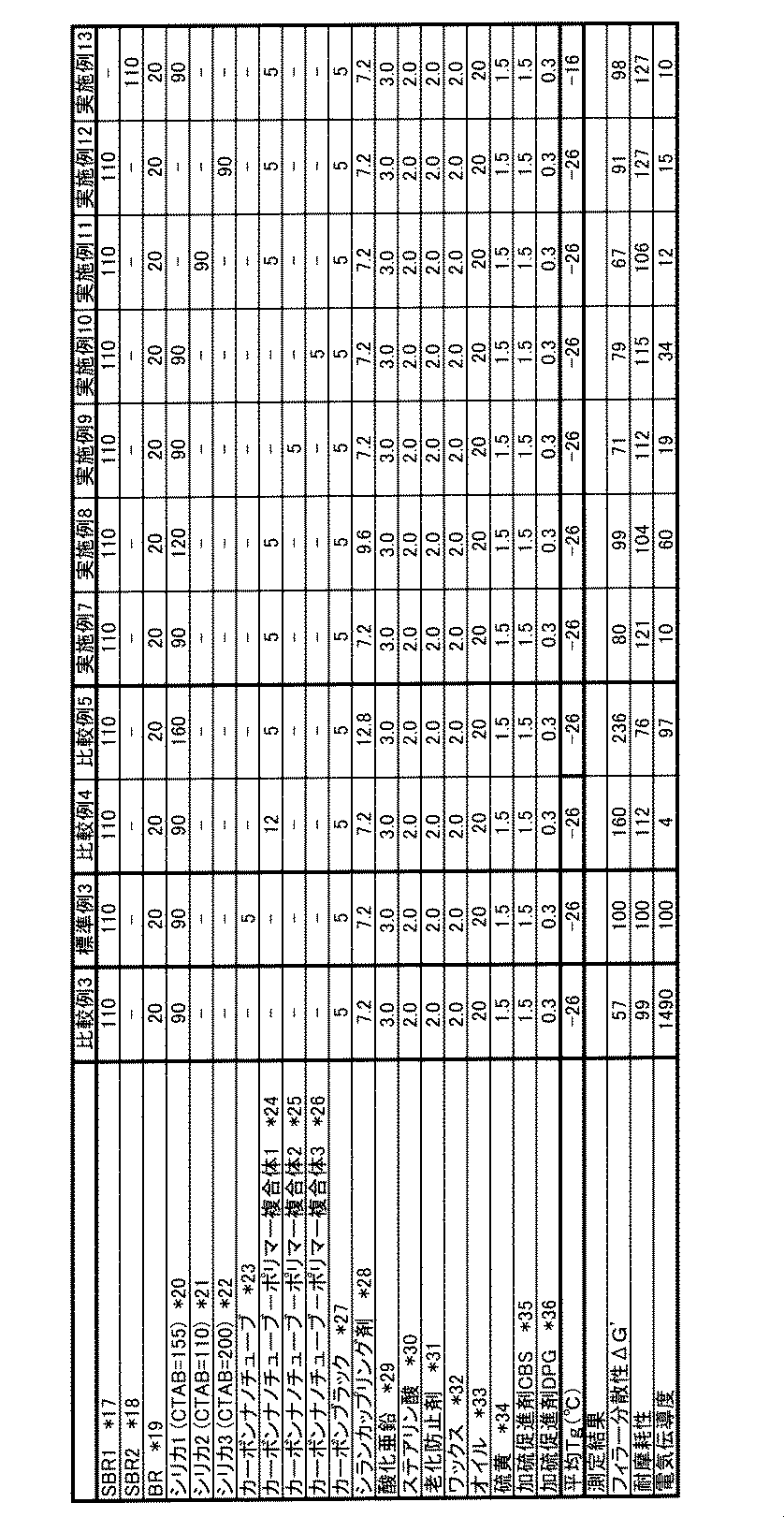
*17:SBR1(日本ゼオン(株)製Nipol 1739、油展量=SBR100質量部あたり37.5質量部)
*18:SBR2(JSR(株)製HP755B、油展量=SBR100質量部あたり37.5質量部)
*19:BR(日本ゼオン(株)製Nipol BR 1220)
*20:シリカ1(Solvay製ZEOSIL1165MP、CTAB比表面積=155m2/g)
*21:シリカ2(Solvay製ZEOSIL1115MP、CTAB比表面積=110m2/g)
*22:シリカ3(Solvay製ZEOSIL Premium 200MP、CTAB比表面積=200m2/g)
*23:カーボンナノチューブ(昭和電工(株)製VGCF、CVD法で合成された気相法炭素繊維(黒鉛化処理有り)、繊維径=150nm、繊維長=10~20μm、嵩密度=0.04g/cm3)
*24:カーボンナノチューブ-ポリマー複合体1(三菱商事(株)製Durobeads、品番=DP2210、使用ポリマー=流動パラフィンオイル)
*25:カーボンナノチューブ-ポリマー複合体2(三菱商事(株)製Durobeads、品番=DP4210、使用ポリマー=SBR)
*26:カーボンナノチューブ-ポリマー複合体3(三菱商事(株)製Durobeads、品番=DP5210、使用ポリマー=NR)
*27:カーボンブラック(Cabot Japan製シヨウブラックN339)
*28:シランカップリング剤(エボニック社製Si69)
*29:酸化亜鉛(正同化学工業(株)製酸化亜鉛3種)
*30:ステアリン酸(日油(株)製ビーズステアリン酸YR)
*31:老化防止剤(EASTMAN製6PPD)
*32:ワックス(大内新興化学工業(株)製パラフィンワックス)
*33:オイル(昭和シェル(株)製エクストラクト4号S)
*34:硫黄(細井化学工業(株)製油処理イオウ)
*35:加硫促進剤CBS(三新化学工業(株)製サンセラーCM-G)
*36:加硫促進剤DPG(住友化学(株)製ソクシールD-G)
*18:SBR2(JSR(株)製HP755B、油展量=SBR100質量部あたり37.5質量部)
*19:BR(日本ゼオン(株)製Nipol BR 1220)
*20:シリカ1(Solvay製ZEOSIL1165MP、CTAB比表面積=155m2/g)
*21:シリカ2(Solvay製ZEOSIL1115MP、CTAB比表面積=110m2/g)
*22:シリカ3(Solvay製ZEOSIL Premium 200MP、CTAB比表面積=200m2/g)
*23:カーボンナノチューブ(昭和電工(株)製VGCF、CVD法で合成された気相法炭素繊維(黒鉛化処理有り)、繊維径=150nm、繊維長=10~20μm、嵩密度=0.04g/cm3)
*24:カーボンナノチューブ-ポリマー複合体1(三菱商事(株)製Durobeads、品番=DP2210、使用ポリマー=流動パラフィンオイル)
*25:カーボンナノチューブ-ポリマー複合体2(三菱商事(株)製Durobeads、品番=DP4210、使用ポリマー=SBR)
*26:カーボンナノチューブ-ポリマー複合体3(三菱商事(株)製Durobeads、品番=DP5210、使用ポリマー=NR)
*27:カーボンブラック(Cabot Japan製シヨウブラックN339)
*28:シランカップリング剤(エボニック社製Si69)
*29:酸化亜鉛(正同化学工業(株)製酸化亜鉛3種)
*30:ステアリン酸(日油(株)製ビーズステアリン酸YR)
*31:老化防止剤(EASTMAN製6PPD)
*32:ワックス(大内新興化学工業(株)製パラフィンワックス)
*33:オイル(昭和シェル(株)製エクストラクト4号S)
*34:硫黄(細井化学工業(株)製油処理イオウ)
*35:加硫促進剤CBS(三新化学工業(株)製サンセラーCM-G)
*36:加硫促進剤DPG(住友化学(株)製ソクシールD-G)
上記の表2から明らかなように、実施例7~13で調製されたゴム組成物は、ジエン系ゴム100質量部に対し、シリカを40~150質量部、および、カーボンナノチューブの少なくとも1部にポリマーが添着したカーボンナノチューブ-ポリマー複合体を0.1~10質量部配合してなるので、標準例3に比べ、フィラーの分散性に優れ、耐摩耗性および電気伝導性に優れる。
比較例3は、カーボンナノチューブまたはカーボンナノチューブ-ポリマー複合体を配合していないので、標準例3に比べ、耐摩耗性の向上が見られず、また電気伝導性に劣る結果となった。
比較例4は、カーボンナノチューブ-ポリマー複合体の配合量が本発明で規定する上限を超えているので、標準例3に比べ、フィラーの分散性が悪化し、転がり抵抗性の悪化が懸念される。
比較例5は、シリカの配合量が本発明で規定する上限を超えているので、標準例3に比べ、フィラーの分散性が悪化し、耐摩耗性が悪化した。
比較例3は、カーボンナノチューブまたはカーボンナノチューブ-ポリマー複合体を配合していないので、標準例3に比べ、耐摩耗性の向上が見られず、また電気伝導性に劣る結果となった。
比較例4は、カーボンナノチューブ-ポリマー複合体の配合量が本発明で規定する上限を超えているので、標準例3に比べ、フィラーの分散性が悪化し、転がり抵抗性の悪化が懸念される。
比較例5は、シリカの配合量が本発明で規定する上限を超えているので、標準例3に比べ、フィラーの分散性が悪化し、耐摩耗性が悪化した。
Claims (10)
- ジエン系ゴム100質量部に対し、カーボンブラックおよび/またはシリカを1~150質量部、および、カーボンナノチューブの少なくとも1部にポリマーが添着したカーボンナノチューブ-ポリマー複合体を0.1~10質量部配合してなることを特徴とするタイヤ用ゴム組成物。
- ジエン系ゴム100質量部に対し、シリカを40~150質量部配合してなることを特徴とする請求項1に記載のタイヤ用ゴム組成物。
- 前記カーボンナノチューブ-ポリマー複合体中、前記ポリマーの添着量が5~20質量%であることを特徴とする請求項1に記載のタイヤ用ゴム組成物。
- 前記カーボンナノチューブ-ポリマー複合体の平均粒径が、0.1mm~3mmであることを特徴とする請求項1に記載のタイヤ用ゴム組成物。
- 前記カーボンブラックの窒素吸着比表面積(N2SA)が、30~140m2/gであることを特徴とする請求項1に記載のタイヤ用ゴム組成物。
- 前記タイヤ用ゴム組成物の平均ガラス転移温度(Tg)が、-20℃以下であることを特徴とする請求項1に記載のタイヤ用ゴム組成物。
- 前記シリカのCTAB比表面積(N2SA)が、100~300m2/gであることを特徴とする請求項1に記載のタイヤ用ゴム組成物。
- 請求項1に記載のタイヤ用ゴム組成物をアンダートレッドに用いた空気入りタイヤ。
- 請求項1に記載のタイヤ用ゴム組成物をキャップトレッドに用いた空気入りタイヤ。
- 請求項1に記載のタイヤ用ゴム組成物をタイヤキャップトレッドアースとして使用することを特徴とする使用方法。
Applications Claiming Priority (4)
| Application Number | Priority Date | Filing Date | Title |
|---|---|---|---|
| JP2019-045596 | 2019-03-13 | ||
| JP2019045596A JP7151563B2 (ja) | 2019-03-13 | 2019-03-13 | タイヤ用ゴム組成物およびそれを用いた空気入りタイヤ |
| JP2019070036A JP7151595B2 (ja) | 2019-04-01 | 2019-04-01 | タイヤ用ゴム組成物およびそれを用いた空気入りタイヤ |
| JP2019-070036 | 2019-04-01 |
Publications (1)
| Publication Number | Publication Date |
|---|---|
| WO2020184675A1 true WO2020184675A1 (ja) | 2020-09-17 |
Family
ID=72427040
Family Applications (1)
| Application Number | Title | Priority Date | Filing Date |
|---|---|---|---|
| PCT/JP2020/010903 Ceased WO2020184675A1 (ja) | 2019-03-13 | 2020-03-12 | タイヤ用ゴム組成物およびそれを用いた空気入りタイヤ |
Country Status (1)
| Country | Link |
|---|---|
| WO (1) | WO2020184675A1 (ja) |
Citations (7)
| Publication number | Priority date | Publication date | Assignee | Title |
|---|---|---|---|---|
| JP2014501290A (ja) * | 2010-12-14 | 2014-01-20 | スティロン ヨーロッパ ゲゼルシャフト ミット ベシュレンクテル ハフツング | 改良型エラストマー調合物 |
| JP2015107720A (ja) * | 2013-12-04 | 2015-06-11 | 横浜ゴム株式会社 | 空気入りタイヤ |
| JP2016056230A (ja) * | 2014-09-05 | 2016-04-21 | 日本ゼオン株式会社 | カーボンナノチューブ含有樹脂組成物の製造方法、カーボンナノチューブ含有樹脂組成物、および複合材料 |
| KR101661155B1 (ko) * | 2015-08-07 | 2016-09-29 | 금호타이어 주식회사 | 탄소나노튜브를 함유한 타이어트레드 고무조성물 |
| JP2017008244A (ja) * | 2015-06-24 | 2017-01-12 | 昭和電工株式会社 | エラストマー組成物の製造方法、エラストマー組成物、マスターバッチ、エラストマー混合物及びエラストマー混合物の製造方法 |
| KR20170042931A (ko) * | 2015-10-12 | 2017-04-20 | 현대자동차주식회사 | 마모 및 제동 성능이 향상된 타이어 트레드용 조성물, 타이어 트레드용 마스터 배치 조성물 및 이의 제조방법 |
| WO2018070449A1 (ja) * | 2016-10-11 | 2018-04-19 | 株式会社ブリヂストン | ゴム組成物及びその製造方法、並びにタイヤ |
-
2020
- 2020-03-12 WO PCT/JP2020/010903 patent/WO2020184675A1/ja not_active Ceased
Patent Citations (7)
| Publication number | Priority date | Publication date | Assignee | Title |
|---|---|---|---|---|
| JP2014501290A (ja) * | 2010-12-14 | 2014-01-20 | スティロン ヨーロッパ ゲゼルシャフト ミット ベシュレンクテル ハフツング | 改良型エラストマー調合物 |
| JP2015107720A (ja) * | 2013-12-04 | 2015-06-11 | 横浜ゴム株式会社 | 空気入りタイヤ |
| JP2016056230A (ja) * | 2014-09-05 | 2016-04-21 | 日本ゼオン株式会社 | カーボンナノチューブ含有樹脂組成物の製造方法、カーボンナノチューブ含有樹脂組成物、および複合材料 |
| JP2017008244A (ja) * | 2015-06-24 | 2017-01-12 | 昭和電工株式会社 | エラストマー組成物の製造方法、エラストマー組成物、マスターバッチ、エラストマー混合物及びエラストマー混合物の製造方法 |
| KR101661155B1 (ko) * | 2015-08-07 | 2016-09-29 | 금호타이어 주식회사 | 탄소나노튜브를 함유한 타이어트레드 고무조성물 |
| KR20170042931A (ko) * | 2015-10-12 | 2017-04-20 | 현대자동차주식회사 | 마모 및 제동 성능이 향상된 타이어 트레드용 조성물, 타이어 트레드용 마스터 배치 조성물 및 이의 제조방법 |
| WO2018070449A1 (ja) * | 2016-10-11 | 2018-04-19 | 株式会社ブリヂストン | ゴム組成物及びその製造方法、並びにタイヤ |
Similar Documents
| Publication | Publication Date | Title |
|---|---|---|
| TWI586733B (zh) | 改良之彈性體調配物(一) | |
| JP5214886B2 (ja) | 空気入りタイヤ | |
| JP4521923B2 (ja) | サイドウォールゴムインサートを有するタイヤ | |
| JP5376008B2 (ja) | タイヤ用ゴム組成物 | |
| CN102884120B (zh) | 轮胎胎面用橡胶组合物 | |
| JP5658142B2 (ja) | 樹脂伸展イソプレンゴムの製造方法、その方法で得られたゴム組成物及び空気入りタイヤ | |
| CN102421836A (zh) | 橡胶组合物及使用该组合物的轮胎 | |
| CN110023394B (zh) | 无钉轮胎用橡胶组合物及无钉轮胎 | |
| JP6433415B2 (ja) | 空気入りタイヤ | |
| JP6924200B2 (ja) | 実質的に球状の比較的構造化されていないシリカを含むゴム組成物 | |
| JP2014080550A (ja) | 高性能ウェットタイヤのトレッド用ゴム組成物及び高性能ウェットタイヤ | |
| KR20170042931A (ko) | 마모 및 제동 성능이 향상된 타이어 트레드용 조성물, 타이어 트레드용 마스터 배치 조성물 및 이의 제조방법 | |
| CN105992798A (zh) | 包含聚苯醚树脂作为增塑剂的橡胶组合物 | |
| CN105829434A (zh) | 包含作为塑化剂的聚苯醚树脂的橡胶组合物 | |
| JP2012126852A (ja) | タイヤ用ゴム組成物及び競技用タイヤ | |
| JP6084947B2 (ja) | タイヤ用ゴム組成物及び空気入りタイヤ | |
| JP6540263B2 (ja) | ゴム組成物 | |
| JP7151595B2 (ja) | タイヤ用ゴム組成物およびそれを用いた空気入りタイヤ | |
| CN110023396B (zh) | 轮胎胎面用橡胶组合物及充气轮胎 | |
| WO2017111019A1 (ja) | ゴム組成物、その製造方法及び空気入りタイヤ | |
| JP7151563B2 (ja) | タイヤ用ゴム組成物およびそれを用いた空気入りタイヤ | |
| JP6686362B2 (ja) | タイヤ用ゴム組成物 | |
| CN107922675B (zh) | 轮胎用橡胶组合物和充气轮胎 | |
| JP7590175B2 (ja) | タイヤ用ゴム組成物及びタイヤ | |
| JP2005194418A (ja) | 空気入りタイヤ用ゴム組成物 |
Legal Events
| Date | Code | Title | Description |
|---|---|---|---|
| 121 | Ep: the epo has been informed by wipo that ep was designated in this application |
Ref document number: 20769229 Country of ref document: EP Kind code of ref document: A1 |
|
| NENP | Non-entry into the national phase |
Ref country code: DE |
|
| 122 | Ep: pct application non-entry in european phase |
Ref document number: 20769229 Country of ref document: EP Kind code of ref document: A1 |