WO2020184437A1 - 液状組成物、パウダー、及び、パウダーの製造方法 - Google Patents
液状組成物、パウダー、及び、パウダーの製造方法 Download PDFInfo
- Publication number
- WO2020184437A1 WO2020184437A1 PCT/JP2020/009684 JP2020009684W WO2020184437A1 WO 2020184437 A1 WO2020184437 A1 WO 2020184437A1 JP 2020009684 W JP2020009684 W JP 2020009684W WO 2020184437 A1 WO2020184437 A1 WO 2020184437A1
- Authority
- WO
- WIPO (PCT)
- Prior art keywords
- powder
- liquid composition
- polymer
- resin
- aromatic
- Prior art date
- Legal status (The legal status is an assumption and is not a legal conclusion. Google has not performed a legal analysis and makes no representation as to the accuracy of the status listed.)
- Ceased
Links
Classifications
-
- C—CHEMISTRY; METALLURGY
- C08—ORGANIC MACROMOLECULAR COMPOUNDS; THEIR PREPARATION OR CHEMICAL WORKING-UP; COMPOSITIONS BASED THEREON
- C08L—COMPOSITIONS OF MACROMOLECULAR COMPOUNDS
- C08L27/00—Compositions of homopolymers or copolymers of compounds having one or more unsaturated aliphatic radicals, each having only one carbon-to-carbon double bond, and at least one being terminated by a halogen; Compositions of derivatives of such polymers
- C08L27/02—Compositions of homopolymers or copolymers of compounds having one or more unsaturated aliphatic radicals, each having only one carbon-to-carbon double bond, and at least one being terminated by a halogen; Compositions of derivatives of such polymers not modified by chemical after-treatment
- C08L27/12—Compositions of homopolymers or copolymers of compounds having one or more unsaturated aliphatic radicals, each having only one carbon-to-carbon double bond, and at least one being terminated by a halogen; Compositions of derivatives of such polymers not modified by chemical after-treatment containing fluorine atoms
- C08L27/18—Homopolymers or copolymers or tetrafluoroethene
-
- B—PERFORMING OPERATIONS; TRANSPORTING
- B32—LAYERED PRODUCTS
- B32B—LAYERED PRODUCTS, i.e. PRODUCTS BUILT-UP OF STRATA OF FLAT OR NON-FLAT, e.g. CELLULAR OR HONEYCOMB, FORM
- B32B15/00—Layered products comprising a layer of metal
- B32B15/04—Layered products comprising a layer of metal comprising metal as the main or only constituent of a layer, which is next to another layer of the same or of a different material
- B32B15/08—Layered products comprising a layer of metal comprising metal as the main or only constituent of a layer, which is next to another layer of the same or of a different material of synthetic resin
-
- B—PERFORMING OPERATIONS; TRANSPORTING
- B32—LAYERED PRODUCTS
- B32B—LAYERED PRODUCTS, i.e. PRODUCTS BUILT-UP OF STRATA OF FLAT OR NON-FLAT, e.g. CELLULAR OR HONEYCOMB, FORM
- B32B15/00—Layered products comprising a layer of metal
- B32B15/04—Layered products comprising a layer of metal comprising metal as the main or only constituent of a layer, which is next to another layer of the same or of a different material
- B32B15/08—Layered products comprising a layer of metal comprising metal as the main or only constituent of a layer, which is next to another layer of the same or of a different material of synthetic resin
- B32B15/082—Layered products comprising a layer of metal comprising metal as the main or only constituent of a layer, which is next to another layer of the same or of a different material of synthetic resin comprising vinyl resins; comprising acrylic resins
-
- B—PERFORMING OPERATIONS; TRANSPORTING
- B32—LAYERED PRODUCTS
- B32B—LAYERED PRODUCTS, i.e. PRODUCTS BUILT-UP OF STRATA OF FLAT OR NON-FLAT, e.g. CELLULAR OR HONEYCOMB, FORM
- B32B15/00—Layered products comprising a layer of metal
- B32B15/04—Layered products comprising a layer of metal comprising metal as the main or only constituent of a layer, which is next to another layer of the same or of a different material
- B32B15/08—Layered products comprising a layer of metal comprising metal as the main or only constituent of a layer, which is next to another layer of the same or of a different material of synthetic resin
- B32B15/088—Layered products comprising a layer of metal comprising metal as the main or only constituent of a layer, which is next to another layer of the same or of a different material of synthetic resin comprising polyamides
-
- B—PERFORMING OPERATIONS; TRANSPORTING
- B32—LAYERED PRODUCTS
- B32B—LAYERED PRODUCTS, i.e. PRODUCTS BUILT-UP OF STRATA OF FLAT OR NON-FLAT, e.g. CELLULAR OR HONEYCOMB, FORM
- B32B15/00—Layered products comprising a layer of metal
- B32B15/04—Layered products comprising a layer of metal comprising metal as the main or only constituent of a layer, which is next to another layer of the same or of a different material
- B32B15/08—Layered products comprising a layer of metal comprising metal as the main or only constituent of a layer, which is next to another layer of the same or of a different material of synthetic resin
- B32B15/09—Layered products comprising a layer of metal comprising metal as the main or only constituent of a layer, which is next to another layer of the same or of a different material of synthetic resin comprising polyesters
-
- B—PERFORMING OPERATIONS; TRANSPORTING
- B32—LAYERED PRODUCTS
- B32B—LAYERED PRODUCTS, i.e. PRODUCTS BUILT-UP OF STRATA OF FLAT OR NON-FLAT, e.g. CELLULAR OR HONEYCOMB, FORM
- B32B27/00—Layered products comprising a layer of synthetic resin
- B32B27/30—Layered products comprising a layer of synthetic resin comprising vinyl (co)polymers; comprising acrylic (co)polymers
-
- C—CHEMISTRY; METALLURGY
- C08—ORGANIC MACROMOLECULAR COMPOUNDS; THEIR PREPARATION OR CHEMICAL WORKING-UP; COMPOSITIONS BASED THEREON
- C08F—MACROMOLECULAR COMPOUNDS OBTAINED BY REACTIONS ONLY INVOLVING CARBON-TO-CARBON UNSATURATED BONDS
- C08F14/00—Homopolymers and copolymers of compounds having one or more unsaturated aliphatic radicals, each having only one carbon-to-carbon double bond, and at least one being terminated by a halogen
- C08F14/18—Monomers containing fluorine
- C08F14/26—Tetrafluoroethene
-
- C—CHEMISTRY; METALLURGY
- C08—ORGANIC MACROMOLECULAR COMPOUNDS; THEIR PREPARATION OR CHEMICAL WORKING-UP; COMPOSITIONS BASED THEREON
- C08J—WORKING-UP; GENERAL PROCESSES OF COMPOUNDING; AFTER-TREATMENT NOT COVERED BY SUBCLASSES C08B, C08C, C08F, C08G or C08H
- C08J3/00—Processes of treating or compounding macromolecular substances
- C08J3/12—Powdering or granulating
-
- C—CHEMISTRY; METALLURGY
- C08—ORGANIC MACROMOLECULAR COMPOUNDS; THEIR PREPARATION OR CHEMICAL WORKING-UP; COMPOSITIONS BASED THEREON
- C08J—WORKING-UP; GENERAL PROCESSES OF COMPOUNDING; AFTER-TREATMENT NOT COVERED BY SUBCLASSES C08B, C08C, C08F, C08G or C08H
- C08J3/00—Processes of treating or compounding macromolecular substances
- C08J3/12—Powdering or granulating
- C08J3/16—Powdering or granulating by coagulating dispersions
-
- C—CHEMISTRY; METALLURGY
- C08—ORGANIC MACROMOLECULAR COMPOUNDS; THEIR PREPARATION OR CHEMICAL WORKING-UP; COMPOSITIONS BASED THEREON
- C08J—WORKING-UP; GENERAL PROCESSES OF COMPOUNDING; AFTER-TREATMENT NOT COVERED BY SUBCLASSES C08B, C08C, C08F, C08G or C08H
- C08J5/00—Manufacture of articles or shaped materials containing macromolecular substances
- C08J5/04—Reinforcing macromolecular compounds with loose or coherent fibrous material
-
- C—CHEMISTRY; METALLURGY
- C08—ORGANIC MACROMOLECULAR COMPOUNDS; THEIR PREPARATION OR CHEMICAL WORKING-UP; COMPOSITIONS BASED THEREON
- C08J—WORKING-UP; GENERAL PROCESSES OF COMPOUNDING; AFTER-TREATMENT NOT COVERED BY SUBCLASSES C08B, C08C, C08F, C08G or C08H
- C08J5/00—Manufacture of articles or shaped materials containing macromolecular substances
- C08J5/24—Impregnating materials with prepolymers which can be polymerised in situ, e.g. manufacture of prepregs
-
- C—CHEMISTRY; METALLURGY
- C08—ORGANIC MACROMOLECULAR COMPOUNDS; THEIR PREPARATION OR CHEMICAL WORKING-UP; COMPOSITIONS BASED THEREON
- C08K—Use of inorganic or non-macromolecular organic substances as compounding ingredients
- C08K5/00—Use of organic ingredients
- C08K5/54—Silicon-containing compounds
-
- C—CHEMISTRY; METALLURGY
- C08—ORGANIC MACROMOLECULAR COMPOUNDS; THEIR PREPARATION OR CHEMICAL WORKING-UP; COMPOSITIONS BASED THEREON
- C08L—COMPOSITIONS OF MACROMOLECULAR COMPOUNDS
- C08L101/00—Compositions of unspecified macromolecular compounds
-
- C—CHEMISTRY; METALLURGY
- C08—ORGANIC MACROMOLECULAR COMPOUNDS; THEIR PREPARATION OR CHEMICAL WORKING-UP; COMPOSITIONS BASED THEREON
- C08L—COMPOSITIONS OF MACROMOLECULAR COMPOUNDS
- C08L101/00—Compositions of unspecified macromolecular compounds
- C08L101/02—Compositions of unspecified macromolecular compounds characterised by the presence of specified groups, e.g. terminal or pendant functional groups
-
- C—CHEMISTRY; METALLURGY
- C08—ORGANIC MACROMOLECULAR COMPOUNDS; THEIR PREPARATION OR CHEMICAL WORKING-UP; COMPOSITIONS BASED THEREON
- C08L—COMPOSITIONS OF MACROMOLECULAR COMPOUNDS
- C08L65/00—Compositions of macromolecular compounds obtained by reactions forming a carbon-to-carbon link in the main chain; Compositions of derivatives of such polymers
- C08L65/02—Polyphenylenes
-
- C—CHEMISTRY; METALLURGY
- C09—DYES; PAINTS; POLISHES; NATURAL RESINS; ADHESIVES; COMPOSITIONS NOT OTHERWISE PROVIDED FOR; APPLICATIONS OF MATERIALS NOT OTHERWISE PROVIDED FOR
- C09D—COATING COMPOSITIONS, e.g. PAINTS, VARNISHES OR LACQUERS; FILLING PASTES; CHEMICAL PAINT OR INK REMOVERS; INKS; CORRECTING FLUIDS; WOODSTAINS; PASTES OR SOLIDS FOR COLOURING OR PRINTING; USE OF MATERIALS THEREFOR
- C09D127/00—Coating compositions based on homopolymers or copolymers of compounds having one or more unsaturated aliphatic radicals, each having only one carbon-to-carbon double bond, and at least one being terminated by a halogen; Coating compositions based on derivatives of such polymers
- C09D127/02—Coating compositions based on homopolymers or copolymers of compounds having one or more unsaturated aliphatic radicals, each having only one carbon-to-carbon double bond, and at least one being terminated by a halogen; Coating compositions based on derivatives of such polymers not modified by chemical after-treatment
- C09D127/12—Coating compositions based on homopolymers or copolymers of compounds having one or more unsaturated aliphatic radicals, each having only one carbon-to-carbon double bond, and at least one being terminated by a halogen; Coating compositions based on derivatives of such polymers not modified by chemical after-treatment containing fluorine atoms
- C09D127/18—Homopolymers or copolymers of tetrafluoroethene
-
- C—CHEMISTRY; METALLURGY
- C08—ORGANIC MACROMOLECULAR COMPOUNDS; THEIR PREPARATION OR CHEMICAL WORKING-UP; COMPOSITIONS BASED THEREON
- C08J—WORKING-UP; GENERAL PROCESSES OF COMPOUNDING; AFTER-TREATMENT NOT COVERED BY SUBCLASSES C08B, C08C, C08F, C08G or C08H
- C08J2327/00—Characterised by the use of homopolymers or copolymers of compounds having one or more unsaturated aliphatic radicals, each having only one carbon-to-carbon double bond, and at least one being terminated by a halogen; Derivatives of such polymers
- C08J2327/02—Characterised by the use of homopolymers or copolymers of compounds having one or more unsaturated aliphatic radicals, each having only one carbon-to-carbon double bond, and at least one being terminated by a halogen; Derivatives of such polymers not modified by chemical after-treatment
- C08J2327/12—Characterised by the use of homopolymers or copolymers of compounds having one or more unsaturated aliphatic radicals, each having only one carbon-to-carbon double bond, and at least one being terminated by a halogen; Derivatives of such polymers not modified by chemical after-treatment containing fluorine atoms
- C08J2327/18—Homopolymers or copolymers of tetrafluoroethylene
Definitions
- the present invention relates to a liquid composition, a powder, and a method for producing a powder.
- a metal foil with a resin layer having a metal foil and an insulating resin layer is used as a printed wiring substrate by forming a metal conductor wiring (transmission circuit) by processing the metal foil.
- a printed wiring board used for transmitting a high-frequency signal is required to have excellent transmission characteristics, and an insulating resin layer having a low relative permittivity and a low dielectric loss tangent is required.
- a liquid composition for forming such an insulating resin layer a liquid composition containing an aromatic epoxy resin and a powder of a tetrafluoroethylene-based polymer (see Patent Document 1) is a polyphenylene ether resin and a tetrafluoroethylene-based polymer. Liquid compositions containing the powder (see Patent Document 2) have been proposed.
- addition polymerization type or polycondensation type aromatic resins having oxygen atoms such as polyimide, polyamide, polyether, epoxy resin, polyester and polycarbonate, and tetrafluoroethylene resins such as polytetrafluoroethylene are various. It has excellent physical properties and is also called super engineering plastic. Therefore, the usage mode is expanding, and the molecular structure (monomer structure such as monomer type and combination thereof, polymer structure such as stereoregularity and molecular weight distribution) is improved, and its precursor is used.
- a liquid composition containing a resin or a precursor thereof is increasingly prepared and used as a coating agent (see Patent Documents 3 to 6).
- tetrafluoroethylene-based polymers such as polytetrafluoroethylene (PTFE), a copolymer of tetrafluoroethylene and perfluoro (alkyl vinyl ether) (PFA), and a copolymer of tetrafluoroethylene and hexafluoropropylene (FEP) are demolded. It has excellent physical properties such as properties, electrical properties, water and oil repellency, chemical resistance, weather resistance, and heat resistance, and is used in various industrial applications.
- PTFE polytetrafluoroethylene
- PFA perfluoro (alkyl vinyl ether)
- FEP hexafluoropropylene
- Patent Document 9 describes a powder prepared from a liquid composition containing a tetrafluoroethylene polymer powder, a predetermined solvent, and a polymer insoluble in this solvent, in which a solvent-insoluble polymer is attached to the surface of powder particles. Proposed.
- the liquid composition of Patent Document 1 or 2 contains an aromatic resin known as an electrically insulating resin or a precursor thereof, and a tetrafluoroethylene-based polymer having a low relative permittivity and dielectric loss tangent, a molded product thereof (
- the present inventors have found that while the electrical characteristics of the prepreg, the metal plate with the resin layer, the printed wiring substrate, etc.) can be expected to be improved, there are the following problems. That is, when the content ratio of the aromatic resin among the components of the liquid composition is increased, the liquid composition becomes thickened and difficult to handle, and the physical properties of the obtained molded product tend to deteriorate.
- Aromatic resins or precursors thereof often contain oxygen atoms such as ester bonds, ether bonds, and imide bonds as bonders in the main skeleton of the resin. If the oxygen atom content and the aromatic ring content of the resin material are increased in order to express these resin physical properties to a high degree, the flame retardancy of the obtained liquid composition and its molded product will decrease. .. Even if a known flame retardant is added to the liquid composition in order to eliminate such inconvenience, the liquid composition is not homogeneously dispersed, the flame retardancy is not improved, and the original physical properties of the liquid composition or the molded product are easily impaired.
- the molded product formed from the liquid composition also has a problem that the surface smoothness, processability and adhesiveness are poor. .. Further, in the preparation of such a liquid composition, when the powder of the tetrafluoroethylene polymer is directly added to the varnish (liquid composition) of the aromatic resin, the liquid composition is easily denatured due to thickening or the like. The present inventors are also aware of this problem. Further, the present inventors have also found that it is difficult to sufficiently improve the physical properties (processability, flame retardancy, electrical characteristics, etc.) of the molded product formed from the liquid composition in this case.
- the tetrafluoroethylene polymer is a non-fibrillar heat-meltable polymer (PFA, FEP, etc.)
- the polymer insoluble in the liquid medium does not easily adhere to the surface of the powder particles. The effect is not yet sufficient (see paragraph number 0104, etc. of the same document).
- An object of the present invention is to provide a liquid composition having a viscosity excellent in handleability, which comprises a tetrafluoroethylene polymer powder having a good dispersion state and a high-concentration aromatic resin.
- INDUSTRIAL APPLICABILITY According to the present invention, even when added to a liquid composition containing a tetrafluoroethylene resin or an aromatic resin, deterioration such as thickening is suppressed and a liquid composition having high homogeneity can be formed.
- the purpose is to provide powder. It is also an object of the present invention to provide a method for producing such a powder.
- the liquid composition according to [1] wherein the ratio of the content ratio of the tetrafluoroethylene-based polymer to the content ratio of the aromatic resin is 0.1 to 0.5.
- the aromatic resin is an aromatic polyimide resin, an aromatic polycarbonate resin, an aromatic polyamide resin, an aromatic polyester resin, an aromatic polyether sulfone resin, an aromatic maleimide resin, a polyphenylene ether resin, a polyphenylene sulfide resin, and an aromatic resin.
- tetrafluoroethylene polymer powder is the following powder (1), the following powder (2), or the following powder (3).
- Powder (1) A powder of a heat-meltable tetrafluoroethylene-based polymer composed of a unit based on tetrafluoroethylene and a unit based on perfluoro (alkyl vinyl ether), the volume-based cumulative 50% diameter of which is 10 to 60 ⁇ m. powder.
- Powder (2) Thermo-meltable tetrafluoro containing 90 to 99 mol% of units based on tetrafluoroethylene, 1 to 3 mol% of units based on perfluoro (alkyl vinyl ether), and units based on a monomer having an oxygen-containing polar group.
- the powder (1) is a heat-meltable tetrafluoroethylene polymer powder containing 92 to 98 mol% of units based on tetrafluoroethylene and 2 to 8 mol% of units based on perfluoro (alkyl vinyl ether).
- the liquid composition according to [5] which is a powder having a volume-based cumulative 50% diameter of 10 to 60 ⁇ m.
- the liquid composition according to [5] or [6], wherein the volume-based cumulative 50% diameter of the powder (1) is 16 to 40 ⁇ m.
- the powder (1) contains a first powder having a volume-based cumulative 50% diameter of 8 ⁇ m or less and a second powder having a volume-based cumulative 50% diameter of 16 to 40 ⁇ m, relative to the content ratio of the second powder.
- the liquid composition according to any one of [1] to [9] is applied to the surface of a metal plate and heated to form a resin layer containing a dried product of the liquid composition.
- a method for manufacturing a metal plate with a resin layer which obtains a metal plate with a resin layer having the metal plate and the resin layer.
- Powder (1) A powder of a heat-meltable tetrafluoroethylene-based polymer composed of a unit based on tetrafluoroethylene and a unit based on perfluoro (alkyl vinyl ether), the volume-based cumulative 50% diameter of which is 10 to 60 ⁇ m. powder.
- Powder (2) Thermo-meltable tetrafluoro containing 90 to 99 mol% of units based on tetrafluoroethylene, 1 to 3 mol% of units based on perfluoro (alkyl vinyl ether), and units based on a monomer having an oxygen-containing polar group.
- the surface treatment agent is a surfactant or a silane coupling agent.
- the liquid composition of the present invention contains a powder of a heat-meltable tetrafluoroethylene polymer having a good dispersed state and an aromatic resin at a high concentration, and is excellent in handleability.
- a prepreg in which a fiber base material is impregnated with a resin component at a high concentration and held, or a base material having an insulating resin having an arbitrary thickness.
- a liquid composition containing at least one resin material selected from the group consisting of a non-meltable tetrafluoroethylene polymer and an aromatic resin and a liquid medium is provided. It is possible to provide an additive containing a powder of a heat-meltable tetrafluoroethylene-based polymer, which can improve the physical properties (surface smoothness, flame retardancy, processability, etc.) of the molded product formed from the above. Further, according to the method for producing a powder of the present invention, a powder containing a hot-meltable tetrafluoroethylene-based polymer can be obtained.
- the "viscosity of the liquid composition” is the viscosity of the liquid composition measured at 25 ° C. and a rotation speed of 30 rpm using a B-type viscometer. The measurement is repeated 3 times, and the average value of the measured values for 3 times is used.
- the "thixotropy of the liquid composition” is a value calculated by dividing the viscosity ⁇ 1 measured under the condition of rotation speed of 30 rpm at 25 ° C. by the viscosity ⁇ 2 measured under the condition of rotation speed of 60 rpm ( ⁇ 1 / ⁇ 2 ).
- Thermal meltable polymer means a polymer exhibiting melt fluidity, and the melt flow rate is 0.1 to 1000 g / 10 minutes at a temperature 20 ° C. or higher higher than the melt temperature of the polymer under the condition of a load of 49 N. It means a polymer in which a temperature is present.
- the "melt flow rate” means the melt mass flow rate (MFR) of the polymer defined in JIS K 7210: 1999 (ISO 1133: 1997).
- the "polymer melting temperature (melting point)” is the temperature corresponding to the maximum value of the polymer melting peak measured by the differential scanning calorimetry (DSC) method.
- the “melt viscosity of the polymer” is based on ASTM D 1238, and a polymer sample (2 g) that has been preheated at the measurement temperature for 5 minutes using a flow tester and a 2 ⁇ -8L die is loaded with 0.7 MPa. It is a value measured by holding it at the measured temperature.
- the “polymer storage modulus” is a value measured based on ISO 6721-4: 1994 (JIS K7244-4: 1999).
- the “ten-point average roughness (Rzjis) of the substrate or metal plate” is a value specified in Annex JA of JIS B 0601: 2013.
- "Powder volume-based cumulative 50% diameter (D50)” is a powder particle size using a laser diffraction / scattering type particle size distribution measuring device (LA-920 measuring device manufactured by HORIBA, Ltd.) by dispersing the powder in water. The distribution is measured, the cumulative curve is obtained with the total volume of the powder particle population as 100%, and the particle size is the point at which the cumulative volume is 50% on the cumulative curve.
- the “powder volume-based cumulative 90% diameter (D90)” is the particle size at the point where the cumulative volume is 90% on the similarly obtained cumulative curve.
- the “powder volume-based cumulative 100% diameter (D100)” is the particle size at the point where the cumulative volume is 100% on the similarly obtained cumulative curve.
- the “unit” in the polymer may be an atomic group formed directly from one molecule of the monomer by the polymerization reaction, and the polymer obtained by the polymerization reaction is treated by a predetermined method to convert a part of the structure. It may be the atomic group.
- the unit based on the monomer A contained in the polymer is also simply referred to as "unit A".
- "(Meta) acrylate” is a general term for acrylate and methacrylate.
- liquid composition (1) is a powder (hereinafter, “F powder”) of a heat-meltable tetrafluoroethylene polymer (hereinafter, also referred to as “F polymer”). It is a liquid composition containing an aromatic resin and a liquid medium and having a viscosity at 25 ° C. of 10000 mPa ⁇ s or less.
- the liquid composition (1) is a powder dispersion in which F powder is dispersed in the liquid composition.
- the content ratio of the aromatic resin is 10% by mass or more, and the ratio (mass ratio) of the content ratio of the F polymer to the content ratio of the aromatic resin is 1.2 or less.
- the liquid composition (1) even if the content ratio of the aromatic resin is high, the F powder is in a good dispersed state, the viscosity of the liquid composition converges within a predetermined range, and the handleability (coatability, impregnation property, etc.) Is excellent. It is considered that this is because the ratio is in a predetermined range and the aromatic resin contained in a high concentration promotes the dispersion of the F powder both in solute and solvent. As a result, it is considered that the dispersion rate of the F powder in the liquid composition (1) is higher than the sedimentation rate, and the physical properties of the liquid composition (1) are less likely to be impaired.
- a molded product prepreg, a metal plate with a resin layer, a printed wiring board, etc.
- a molded product having excellent electrical characteristics can be formed even if the content ratio of the F polymer is relatively low. it is conceivable that.
- the content ratio of the aromatic resin in the liquid composition (1) is 10% by mass or more, preferably 20% by mass or more, and more preferably 40% by mass or more.
- the upper limit is preferably 80% by mass.
- the ratio of the content ratio of the F polymer to the content ratio of the aromatic resin in the liquid composition (1) is 1.2 or less, preferably less than 1, more preferably 0.1 to 0.5, and 0.1 to 0.1 to 0.5. 0.4 is particularly preferable.
- the liquid composition (1) can impart the physical properties of the F polymer, such as electrical properties, to the molded product even if the content ratio of the F polymer is relatively low.
- the viscosity of the liquid composition (1) is 10,000 mPa ⁇ s or less, preferably 100 to 5000 mPa ⁇ s, and more preferably 500 to 4000 mPa ⁇ s.
- the F polymer in the liquid composition (1) is a hot-meltable polymer having a unit based on tetrafluoroethylene (hereinafter, also referred to as “TFE”).
- TFE tetrafluoroethylene
- the F polymer may be a copolymer of TFE and a comonomer copolymerizable with TFE, or may be a polymer that can be said to be substantially a homopolymer of TFE as long as it is thermally meltable.
- the F polymer preferably has 90 to 100 mol% of TFE units with respect to all the units constituting the polymer.
- the fluorine content of the F polymer is preferably 70 to 76% by mass, more preferably 72 to 76% by mass.
- F polymer examples include heat-meltable polytetrafluoroethylene, a copolymer of TFE and ethylene (ETFE), a copolymer of TFE and propylene, and TFE and perfluoro (alkyl vinyl ether) (hereinafter, also referred to as "PAVE").
- PFA copolymer
- HFP Copolymer of TFE and hexafluoropropylene
- FEE fluoroalkylethylene
- chlorotri examples include copolymers with fluoroethylene.
- the copolymer may have a unit based on another comonomer.
- the F polymer is a hot meltable polymer, and an F polymer having a melting temperature of 260 to 320 ° C. is preferable.
- the F polymer is excellent in resistance to physical stress such as shearing force and processability, and is not easily deteriorated when the liquid composition (1) is prepared or used. As a result, it tends to be more excellent in dispersibility and homogeneity.
- the storage elastic modulus of the F polymer at 200 to 260 ° C. is preferably 0.1 to 5.0 MPa, more preferably 0.5 to 3.0 MPa. In this case, it is easy to suppress the warp of the laminated body formed from the liquid composition (1).
- the melt viscosity of the F polymer 1 ⁇ 10 2 ⁇ 1 ⁇ 10 6 Pa ⁇ s is preferably at 380 ° C., and more preferably 1 ⁇ 10 2 ⁇ 1 ⁇ 10 6 Pa ⁇ s at 300 ° C..
- the F powder is densely packed to easily form a highly smooth resin layer.
- the resin layer is likely to reduce damage (peeling, swelling, etc.) of other layers as a heat insulating layer in the solder reflow process.
- the F polymer include low molecular weight PTFE, modified PTFE, FEP and PFA.
- the low molecular weight PTFE and modified PTFE also include copolymers of TFE and trace amounts of comonomer (HFP, PAVE, FAE, etc.).
- the F polymer is preferably an F polymer having a TFE unit and a functional group.
- the functional group a carbonyl group-containing group, a hydroxy group, an epoxy group, an amide group, an amino group and an isocyanate group are preferable. Further, the oxygen-containing polar group described later is also preferable.
- the functional group may be contained in a unit in the F polymer, or may be contained in the terminal group of the main chain of the polymer.
- Examples of the latter polymer include polymers having a functional group as a terminal group derived from a polymerization initiator, a chain transfer agent, or the like. Further, an F polymer having a functional group obtained by subjecting the F polymer to plasma treatment or ionization wire treatment can also be mentioned.
- the F polymer having a functional group is preferably a TFE unit and an F polymer having a unit having a functional group from the viewpoint of dispersibility of the F powder in the liquid composition (1) and interaction with an aromatic resin.
- a unit based on a monomer having a functional group is preferable, and a unit based on a monomer having a carbonyl group-containing group, a hydroxy group, an epoxy group, an amide group, an amino group or an isocyanate group is more preferable.
- a cyclic monomer having an acid anhydride residue As the monomer having a carbonyl group-containing group, a cyclic monomer having an acid anhydride residue, a monomer having a carboxy group, a vinyl ester and a (meth) acrylate are preferable, and a cyclic monomer having an acid anhydride residue is more preferable.
- Cyclic monomers having an acid anhydride residue include itaconic anhydride, citraconic anhydride, 5-norbornene-2,3-dicarboxylic acid anhydride (also known as hymic anhydride, hereinafter also referred to as "NAH”) and anhydride.
- Maleic acid is particularly preferred.
- F polymer having a functional group examples include a TFE unit, an HFP unit, a PAVE unit or a FAE unit, and a unit based on a monomer having a functional group (hereinafter, also referred to as “functional unit”).
- F polymer can be mentioned.
- CF 2 CFOCF 3
- CF 2 CFOCF 2 CF 3
- CF 2 CFOCF 2 CF 2 CF 3
- PPVE also referred to as “PPVE”
- CF 2 CFOCF 2 CF 2 CF 2 CF 3
- CF 2 CFO (CF 2 ) 8 F.
- Such an F polymer has 90 to 99 mol% of TFE units, 0.5 to 9.97 mol% of HFP units, PAVE units or FAE units, and 0.01 to 0.01 to functional units with respect to all the units constituting the polymer. It is preferable to have 3 mol% each.
- Specific examples of such F-polymers include the polymers described in International Publication No. 2018/16644.
- the F powder in the liquid composition (1) may contain a component (aromatic resin or the like) other than the F polymer, but it is preferable that the F polymer is the main component.
- the content of the F polymer in the F powder is preferably 80% by mass or more, more preferably 100% by mass. Further, the surface of the F powder may be coated with silica.
- the D50 of the F powder is preferably 10 to 60 ⁇ m, more preferably 12 to 50 ⁇ m, and particularly preferably 16 to 40 ⁇ m. In this range, the F powder is less likely to settle and easily disperse without impairing the state (viscosity, etc.) of the liquid composition (1).
- a preferred embodiment of the F powder is a blended powder containing a first powder having a D50 of 8 ⁇ m or less and a second powder having a D50 of 16 to 50 ⁇ m.
- the D50 of the first powder is preferably 0.1 ⁇ m or more.
- the ratio (mass ratio) of the content ratio of the first powder to the content ratio of the second powder in the F powder is preferably 0.5 or less, more preferably 0.2 or less.
- the ratio is preferably 0.01 or more. If the first and second powders are included in such a mass ratio, these powders are highly packed and easily form a resin layer having high smoothness and few voids. Even when the F powder is composed of a plurality of types of powders having different D50s, the D50 as a whole may be 10 to 60 ⁇ m.
- the F powder is preferably the following powder (1), the following powder (2), or the following powder (3).
- Powder (1) A powder of an F polymer composed of TFE units and PAVE units, the D50 of which is 10 to 60 ⁇ m.
- Powder (2) An F polymer powder containing 90 to 99 mol% of TFE units, 1 to 3 mol% of PAVE units and a unit based on a monomer having an oxygen-containing polar group, the D100 of which is 8 ⁇ m or less. ,powder.
- Powder (3) A powder containing an F polymer and a surface treatment agent, the D50 of which is less than 25 ⁇ m. Details of the powders (1) to (3) will be described later.
- the aromatic resin in the liquid composition (1) is a resin different from the F polymer.
- the aromatic resin in the present invention also means a precursor of an aromatic resin that becomes an aromatic resin by heating or the like, and is an aromatic resin or a precursor thereof and a molecule of an aromatic resin such as a cross-linking agent or a curing agent. It also means a combination with components that form the skeleton.
- the precursor of the aromatic resin include a monomer forming the aromatic resin and a partial reaction product (also referred to as a prepolymer, a semi-reactant product, or a semi-cured product) of the monomer.
- the aromatic resin may be in a liquid state or in a solid state.
- the aromatic resin may be a non-curable resin or a curable resin. Examples of the non-curable resin include a thermosetting resin and a cured product of a thermosetting resin.
- the aromatic resin is selected from the group consisting of aromatic polyimide resin, aromatic polycarbonate resin, aromatic polyamide resin, aromatic polyester resin, aromatic polyether sulfone resin, polyphenylene ether resin, polyphenylene sulfide resin and aromatic epoxy resin.
- the aromatic resin and its precursor are preferable.
- the aromatic resin is further chemically modified with a reactive group (vinyl group, (meth) acryloyloxy group, hydroxy group, amino group, epoxy group, etc.) and a halogen atom (bromine atom, fluorine atom, etc.). May be good.
- the aromatic resin include an aromatic epoxy resin, an aromatic polyimide resin, a polyamic acid which is a precursor of the aromatic polyimide resin, an aromatic polyester resin, a polyphenylene ether resin, and a precursor thereof. ..
- the F polymer also functions as a flame retardant, and the flame retardancy of the molded product formed from the liquid composition of the present invention is likely to be improved.
- Aromatic epoxy resins include naphthalene type, cresol novolac type, bisphenol A type, bisphenol F type, bisphenol S type, cresol novolac type, phenol novolac type, alkylphenol novolac type, biphenol type, trishydroxyphenylmethane type and the like.
- Epoxy resin can be mentioned. Examples thereof include an epoxidized product of a condensate of phenol and an aromatic aldehyde having a phenolic hydroxy group, a diglycidyl ether of bisphenol, a diglycidyl ether of naphthalene diol, and a glycidyl ether of phenol.
- aromatic tetracarboxylic dianhydride that forms the aromatic polyimide resin or its precursor (polyamic acid)
- aromatic tetracarboxylic dianhydride that forms the aromatic polyimide resin or its precursor (polyamic acid)
- aromatic tetracarboxylic dianhydride that forms the aromatic polyimide resin or its precursor (polyamic acid)
- pyromellitic dianhydride 3,3'4,4'-biphenyltetracarboxylic dianhydride.
- aromatic diamines that form the aromatic polyimide resin or its precursor (polyamic acid) include o-phenylenediamine, m-phenylenediamine, p-phenylenediamine, 3,3'-diaminodiphenyl ether, and 4,4'.
- aromatic polyester resin examples include solvent-soluble liquid crystal aromatic polyesters.
- aromatic polyesters include the polymers described in paragraphs [0019] to [0042] of JP-A-2010-031256, and more specifically, 2-hydroxy-6-naphthoic acid, isophthalic acid and the like.
- examples thereof include a reaction product of diphenyl ether-4,4'-dicarboxylic acid, 4-hydroxyacetonilide, and acetic anhydride.
- polyphenylene ether resin or a precursor thereof include 2,6-dimethylphenol, a polyphenol derivative, and a reaction product of both.
- the liquid composition (1) contains an F polymer having poor interaction with other substances, the powder (F powder) is well dispersed without deterioration such as thickening. According to the present invention, it is also possible to provide a liquid composition containing a high concentration aromatic resin in which F powder is dispersed, which does not substantially contain a component that promotes dispersion of F powder.
- the component include a fluorine-based surfactant, a silicone-based surfactant, and a hydrocarbon-based surfactant. That is, the liquid composition (1) does not contain the fluorine-containing compound other than the component, particularly the F polymer, or when the liquid composition (1) contains the fluorine-containing compound, the content of the fluorine-containing compound with respect to the content ratio of the F polymer.
- the ratio of the ratio is preferably 0.05 or less.
- the ratio is more preferably 0.01 or less.
- the liquid composition (1) is easier to manufacture and adjust its physical properties.
- the aromatic resin having a fluorine atom is not included in the fluorine-containing compound.
- the liquid composition (1) contains a liquid medium.
- the content ratio of the liquid medium in the liquid composition (1) is preferably 40% by mass or less, more preferably 5 to 30% by mass.
- the content ratio of the aromatic resin and the content ratio of the F polymer to the content ratio are within a predetermined range, even if a liquid medium is contained, the deterioration of the F polymer due to the content ratio is suppressed and increased. Hard to stick.
- the aromatic resin is contained in a high concentration, the F powder does not easily settle even if a liquid medium is contained, and the dispersion stability is excellent.
- the liquid medium is a compound that is liquid at 25 ° C. and is appropriately selected depending on the type of aromatic resin.
- the liquid medium is preferably a compound having a lower boiling point than the other components contained in the liquid composition (1) and can be removed by volatilization. Two or more kinds of liquid media may be used in combination.
- liquid medium examples include water, alcohol (ethanol, 2-propanol, 1-butanol, etc.), nitrogen-containing compounds (N, N-dimethylformamide, N, N-dimethylacetamide, N-methyl-2-pyrrolidone, etc.).
- the liquid composition (1) preferably contains an inorganic filler from the viewpoint of further suppressing the warpage of the formed molded product.
- the inorganic filler include silica, alumina, and boehmite. Spherical silica is preferable from the viewpoint of improving workability in addition to suppressing warpage.
- the content ratio of the inorganic filler in the liquid composition (1) is preferably 25% by mass or less.
- the liquid composition (1) may further contain an agent other than the above-mentioned components.
- Such agents include thixotropic agents, defoamers, silane coupling agents, dehydrating agents, plasticizers, weathering agents, antioxidants, heat stabilizers, lubricants, antistatic agents, whitening agents, colorants, and conductive agents.
- thixotropic agents include thixotropic agents, defoamers, silane coupling agents, dehydrating agents, plasticizers, weathering agents, antioxidants, heat stabilizers, lubricants, antistatic agents, whitening agents, colorants, and conductive agents.
- examples include agents, mold release agents, surface treatment agents, viscosity modifiers, and flame retardants.
- the liquid composition (1) requires F powder and an aromatic resin under the condition that the content ratio of the aromatic resin is 10% by mass or more and the ratio of the content ratio of the F polymer to the liquid composition is 1.2 or less. Depending on the situation, it can be produced by mixing with other components, and it is preferable to add F powder to a liquid raw material composition containing an aromatic resin. As described above, since the F powder has high dispersibility in the aromatic resin, a liquid composition having a high content ratio of the aromatic resin can be easily produced.
- the liquid composition (1) contains F powder having a good dispersed state and an aromatic resin at a high concentration, and is excellent in handleability.
- a prepreg containing the dried product of the liquid composition (1) and the fiber base material can be obtained.
- the dried product is a solid product formed from the liquid composition (1).
- the liquid composition (1) is curable, it is a cured product formed from the liquid composition (1).
- 1) contains a liquid medium, it is a solidified product formed by removing the liquid medium from the liquid medium.
- these cured products also include aspects of semi-cured products.
- the prepreg is a prepreg containing a dried product of the liquid composition (1) and a fiber base material, and can be said to be a prepreg containing an F polymer and an aromatic resin as a matrix resin, and has high homogeneity of the F polymer. Moreover, it is a prepreg in which an aromatic resin is impregnated and maintained at a high concentration.
- the fiber base material includes a reinforcing fiber bundle composed of a plurality of reinforcing fibers, a cloth woven from the reinforcing fiber bundle, a unidirectional reinforcing fiber bundle in which a plurality of reinforcing fibers are aligned in one direction, and the unidirectional reinforcing fiber.
- a unidirectional cloth composed of bundles, a fiber bundle in which these are combined, and a fiber bundle in which a plurality of reinforcing fiber bundles are stacked.
- the reinforcing fiber continuous long fibers having a length of 10 mm or more are preferable.
- the reinforcing fibers need not be continuous over the entire length in the length direction or the entire width in the width direction of the reinforcing fiber sheet, and may be divided in the middle.
- Examples of the reinforcing fiber include inorganic fiber, metal fiber, and organic fiber.
- Examples of the inorganic fiber include carbon fiber, graphite fiber, glass fiber, silicon carbide fiber, silicon nitride fiber, alumina fiber, silicon carbide fiber, and boron fiber.
- Examples of the metal fiber include aluminum fiber, brass fiber, and stainless steel fiber.
- Examples of the organic fiber include aromatic polyamide fiber, polyaramid fiber, polyparaphenylene benzoxazole (PBO) fiber, polyphenylene sulfide fiber, polyester fiber, acrylic fiber, nylon fiber and polyethylene fiber.
- As the reinforcing fiber used for the prepreg for the printed circuit board glass fiber is preferable, and open fiber glass cloth is more preferable.
- the reinforcing fibers may be surface-treated. Two or more types of reinforcing fibers may be used in combination.
- the impregnated material may be heated.
- the heating conditions may be such that when the liquid composition (1) is curable, it may be heated at the curing temperature or higher, and when the liquid composition (1) contains a liquid medium, it may be above the boiling point of the liquid medium. And heat it. Drying may be carried out in one step at a constant temperature, or in two or more steps at different temperatures. Examples of the drying method include a method using an oven, a method using a ventilation drying furnace, and a method of irradiating heat rays such as infrared rays. Drying may be carried out under either normal pressure or reduced pressure.
- the dry atmosphere may be any of an oxidizing gas atmosphere (oxygen gas, etc.), a reducing gas atmosphere (hydrogen gas, etc.), and an inert gas atmosphere (helium gas, neon gas, argon gas, nitrogen gas, etc.). ..
- a metal plate and a resin layer are provided in this order, and the resin layer is a metal plate with a resin layer containing a dried product of the liquid composition (1) (hereinafter, also referred to as a metal plate with a resin layer (1)). (Note) can be provided.
- the above-mentioned prepreg can also be used as the dried product.
- the metal plate (1) with a resin layer contains an aromatic resin having electrical insulating properties and an F polymer having a low relative permittivity and dielectric loss tangent, and the F polymer has high homogeneity, excellent electrical characteristics, and is resistant to warping.
- the relative permittivity (20 GHz) of the metal plate (1) with a resin layer is preferably 3.6 or less, and more preferably 3.2 or less.
- the dielectric loss tangent (20 GHz) is preferably 0.009 or less, more preferably 0.003 or less.
- the coefficient of linear expansion of the metal plate (1) with a resin layer is preferably ⁇ 10 to +10 ppm / ° C.
- Examples of the material of the metal plate include copper, copper alloy, stainless steel, nickel, nickel alloy (including 42 alloy), aluminum, aluminum alloy, titanium, titanium alloy and the like.
- the thickness of the metal plate is preferably 1 to 30 ⁇ m.
- Examples of the metal plate include copper foils such as rolled copper foils and electrolytic copper foils.
- a rust preventive layer (oxide film such as chromate), a heat resistant layer, a roughening treatment layer, and a silane coupling agent treatment layer may be provided on the surface of the metal plate.
- the ten-point average roughness of the surface of the metal plate is preferably 0.2 to 2.5 ⁇ m. In this case, the adhesiveness between the metal plate and the resin layer tends to be good.
- the metal plate with a resin layer (1) may have a metal plate in contact with at least one surface of the resin layer.
- the layer structure include a metal plate / resin layer, a metal plate / resin layer / metal plate, a resin layer / metal plate / resin layer, and a metal plate / resin layer / other substrate / resin layer / metal plate.
- metal plate / resin layer means that the metal plate and the resin layer are laminated in this order, and the same applies to other layer configurations.
- the metal plate (1) with a resin layer is manufactured by superimposing the liquid composition (1) or a dried product of the liquid composition (1) (such as the prepreg described above) on the surface of the metal plate and further heating the metal plate (1).
- the heating conditions when the above-mentioned prepreg is used, it is preferable to heat at 160 to 220 ° C. Further, the heating at this time is preferably adopted by a hot pressing method. That is, it is preferable that the above-mentioned prepreg is superposed on the surface of the metal plate and thermocompression bonded at a pressure of 0.2 to 10 MPa.
- the hot press is preferably performed in a vacuum atmosphere of 20 kPa or less from the viewpoint of suppressing deterioration due to air bubble mixing and oxidation.
- the surface of the resin layer may be surface-treated in order to control the coefficient of linear expansion of the resin layer and further improve the adhesiveness of the resin layer.
- the surface treatment include annealing treatment, corona discharge treatment, atmospheric pressure plasma treatment, vacuum plasma treatment, UV ozone treatment, excimer treatment, chemical etching, silane coupling treatment, and fine roughening treatment.
- the temperature is preferably 80 to 190 ° C.
- the pressure is preferably 0.001 to 0.030 MPa
- the time is preferably 10 to 300 minutes.
- the metal plate (1) with a resin layer contains a high concentration of aromatic resin and uniformly contains an F polymer, so that it has excellent physical properties such as electrical characteristics and chemical resistance (etching resistance), and is a flexible printed wiring board.
- a printed wiring substrate can be manufactured from the metal plate (1) with a resin layer by a method of processing into a metal conductor wiring by a modified semi-additive method or the like.
- This printed wiring board has a metal conductor wiring and a resin layer in this order.
- the resin layer is a dried product of the liquid composition (1), and examples thereof include metal conductor wiring / resin layer and metal conductor wiring / resin layer / metal conductor wiring.
- an interlayer insulating film may be formed on the metal conductor wiring, and then the metal conductor wiring may be further formed on the interlayer insulating film.
- the interlayer insulating film may also be formed by the liquid composition (1).
- a solder resist or a coverlay film may be laminated on the metal conductor wiring.
- the solder resist and the coverlay film may be formed by the liquid composition (1).
- a multilayer printed wiring board in which the above-mentioned layer structure is multilayered can be mentioned.
- a preferred embodiment of the multilayer printed wiring board is that the outermost layer of the multilayer printed wiring board is a resin layer containing a dried product of the liquid composition (1), and has one or more layer configurations of metal conductor wiring / the resin layer.
- a part of the resin layer may be replaced with an F polymer layer containing F polymer as a main component, and specifically, metal conductor wiring / resin layer / metal conductor wiring / F polymer. It may have a layer structure such as a layer / a metal conductor wiring / the resin layer.
- the multilayer printed wiring board of this aspect has excellent heat resistance of the outermost layer, and the interface peeling between the metal conductor wiring and the resin layer is unlikely to occur even by heating during processing, for example, heating at 300 ° C. in the solder reflow process. ..
- the powder of the present invention is also referred to as a liquid composition (hereinafter, also referred to as "liquid composition (p)") containing at least one resin material selected from the group consisting of a non-meltable tetrafluoroethylene polymer and an aromatic resin. ) Is a powder used in addition to.
- the powder of the present invention will also be referred to as "additive (1)”.
- the additive (1) is the following powder (1), the following powder (2), or the following powder (3).
- Powder (1) A powder of an F polymer composed of TFE units and PAVE units, the D50 of which is 10 to 60 ⁇ m.
- Powder (2) An F polymer powder containing 90 to 99 mol% of TFE units, 1 to 3 mol% of PAVE units and a unit based on a monomer having an oxygen-containing polar group, the D100 of which is 8 ⁇ m or less.
- Powder (3) A powder containing an F polymer and a surface treatment agent, the D50 of which is less than 25 ⁇ m.
- the F polymer in the powder (1) a polymer containing 92 to 98 mol% of TFE units and 2 to 8 mol% of PAVE units is preferable.
- the F polymer in the powder (2) is referred to as a unit based on a monomer having an oxygen-containing polar group (hereinafter, also referred to as “polar monomer”) (hereinafter, “polar unit”) as compared with the F polymer in the powder (1). It is characterized by having (described).
- the F polymer in the powder (3) may be the same F polymer as the F polymer in the powder (1) or the powder (2), or may be another F polymer. Examples of the F polymer in the powder (3) include the F polymer constituting the F powder in the liquid composition (1).
- the F polymer in the powder (1) is referred to as “added polymer (1)”
- the F polymer in the powder (2) is referred to as “added polymer (2)”
- the F polymer in the powder (3) is referred to as “added polymer (3)”. Also written.
- each polymer is generically referred to, it is also referred to as “added polymer”
- each powder is generically referred to, it is also referred to as “added powder”.
- the ratio (mol%) of each unit in the added polymer is the ratio of each unit to all the units constituting the added polymer.
- the additive (1) has excellent dispersibility in the liquid composition (p) containing a resin material, and the molded product (including a molded part such as a resin layer; the same applies hereinafter) obtained from the additive is flame-retardant and processed. Physical properties such as sex can be imparted. In addition, the obtained molded product maintains or further improves its original physical properties. The reason is not always clear, but it is considered that the added powder contains the added polymer having a predetermined polymer composition and has a predetermined particle size.
- the powder (1) contains the added polymer (1) containing PAVE units, and its D50 is relatively large.
- the added polymer (1) preferably contains 2 to 8 mol% of PAVE units.
- the fluidity is high both chemically and physically.
- D50 is relatively large, the surface area per mass is reduced, and the contact with the components of the liquid composition (p) is relatively reduced, so that the low affinity between the components is alleviated and the dispersibility thereof is improved. It is also considered to improve.
- each particle constituting the powder (1) is regarded as an aggregate of the primary particles of the added polymer 1, it is considered that the bulk density of the powder (1) is lowered.
- the powder (1) added to the liquid composition (p) has a higher dispersion rate than the sedimentation rate, and is good without impairing the physical properties of the liquid composition (p). It is thought that it was dispersed in.
- the molded product formed from the liquid composition (p) to which the powder (1) is added has the original characteristics (weather resistance, heat resistance, chemical resistance, impact resistance, electrical characteristics, etc.) due to the resin material. It is presumed that the high physical properties due to the added polymer could be exhibited while maintaining the same.).
- the powder (2) contains the additive polymer (2) containing a polar unit, and is considered to have a strong interaction with the resin material of the liquid composition (p), but its D100 is relatively small, in other words. If so, it does not contain powder with a large particle size or its content is low. Therefore, thickening of the liquid composition (p) and sedimentation of the components due to the interaction between the resin material and the powder (2) are likely to be suppressed. As a result, the molded product formed from the liquid composition (p) to which the powder (2) is added can exhibit high physical properties due to the added polymer (2) while maintaining the original properties due to the resin material. It is presumed that it was.
- the powder (3) contains a surface treatment agent, even if its D50 is a small particle size of less than 25 ⁇ m, it is highly dispersed in the liquid composition (p) without thickening. Therefore, a relatively large amount of resin material can be stably dissolved or dispersed in the liquid composition (p). Further, the liquid composition (p) to which the powder (3) is added is not easily deteriorated.
- the amount of the powder (1) and the powder (2) added to the liquid composition (p) is preferably such that the ratio of the mass of the added polymer to the mass of the resin material is 0.1 to 1, preferably 0.2 to 1. An amount of 0.8 is more preferable, and an amount of 0.3 to 0.7 is even more preferable. In this case, it is easy to adjust the viscosity of the liquid composition (p) within a predetermined range. Specifically, the viscosity of the liquid composition (p) to which the powder is added at 25 ° C. is preferably less than 10000 mPa ⁇ s, more preferably 100 to 5000 mPa ⁇ s, still more preferably 500 to 4000 mPa ⁇ s.
- the amount of the powder (3) added to the liquid composition (p) is preferably such that the ratio of the mass of the added polymer to the mass of the resin material is 0.1 to 0.5, preferably 0.1 to 0.4. The amount is more preferred. In this case, since the amount of the resin material contained in the liquid composition (p) is sufficiently large, excellent physical properties (flame retardancy, processability, etc.) are imparted to the resin layer formed from the liquid composition (3). it can.
- the viscosity of the liquid composition (p) to which the powder (3) is added at 25 ° C. is preferably less than 10000 mPa ⁇ s, more preferably 50 to 5000 mPa ⁇ s, still more preferably 100 to 1000 mPa ⁇ s.
- the additive powder in the additive (1) preferably contains the added polymer as a main component.
- the content of the added polymer in the added powder is preferably 80% by mass or more, more preferably 100% by mass.
- the added powder may contain the above resin material itself.
- the components such as the surface treatment agent, which is a component other than the added polymer in the powder (3), the composition of the powder (3), and the like will be described later in the description of the method for producing the powder (3).
- the D50 of the powder (1) is preferably 10 to 50 ⁇ m, more preferably 12 to 40 ⁇ m, and even more preferably 14 to 30 ⁇ m. In this range, the powder (1) is particularly excellent in dispersibility in the liquid composition (p).
- the D100 of the powder (1) is preferably 100 ⁇ m or less.
- the D100 of the powder (2) is preferably 5 ⁇ m or less.
- the D100 of the powder (2) is preferably 0.3 ⁇ m or more, and more preferably 1 ⁇ m or more. In this range, the powder (2) is particularly excellent in dispersibility in the liquid composition (p).
- the D50 of the powder (2) is preferably 0.1 to 3 ⁇ m.
- the D50 of the powder (3) is less than 25 ⁇ m, preferably 10 ⁇ m or less, more preferably 0.05 to 8 ⁇ m, still more preferably 0.1 to 6 ⁇ m.
- the D90 of the powder (3) is preferably 40 ⁇ m or less, more preferably 15 ⁇ m or less. In D50 and D90 in this range, the fluidity and dispersibility of the powder become good, and the electrical characteristics (low dielectric constant, etc.) and heat resistance of the resin layer formed from the powder (3) are likely to be exhibited.
- the added powder may be corona treated, plasma treated, electron beam treated or radiation treated.
- Oxygen-containing polar groups > C (O), -C (O) F, etc.
- the dispersibility of the added powder and the surface of the molded product (resin layer) can be introduced. Adhesiveness is more likely to improve.
- oligomer functions as a dispersant or a plasticizer, it is easy to improve the dispersibility of the added powder and the processability of the molded product. Furthermore, when a molded product is formed from a liquid composition, the surface of the molded product to be formed is roughened by the gas generated by the decomposition and volatilization of the oligomer, and the molded product is physically (anchored) or chemically adhered. It can also be expected to improve sex. Further, it is considered that the added powder is physically brittle and easily disintegrated by electron beam treatment or radiation treatment. Therefore, in the molded product, the added polymer and the resin material are more likely to interact with each other, and physical properties such as flame retardancy due to the added polymer are likely to be remarkably exhibited.
- the powder (1) is preferably produced by subjecting a dispersion liquid containing primary particles of a copolymer of TFE and PAVE obtained by aqueous polymerization to a coagulation treatment or a freeze-drying treatment.
- each particle constituting the powder is an aggregate of primary particles of the added polymer (1), and the bulk density is lowered and the dispersibility is easily improved.
- the powder (2) for example, the powder described in International Publication No. 2016/017801 or International Publication No. 2019/098202 is preferable.
- the added polymer (1) preferably contains 92 to 98 mol% of TFE units and 2 to 8 mol% of PAVE units with respect to all the units constituting the polymer.
- the added polymer (1) may consist of only TFE units and PAVE units, and may further contain other units.
- the ratio of TFE units in the added polymer (1) is more preferably 94 mol% or more, further preferably 96 mol% or more.
- the ratio of TFE units is more preferably 97.8 mol% or less, still more preferably 97.7 mol% or less.
- the ratio of PAVE units in the added polymer (1) is more preferably 2.1 mol% or more, further preferably 2.3 mol% or more.
- the ratio of PAVE units is preferably 6 mol% or less, more preferably 4 mol% or less.
- the ratio of the other units is preferably 5.9 mol% or less, more preferably 3.7 mol% or less, still more preferably 1.7 mol%.
- the ratio of TFE units in the added polymer (2) is preferably 94 mol% or more, preferably 96 mol% or more.
- the ratio of TFE units is preferably 99 mol% or less, more preferably 98 mol% or less.
- the ratio of PAVE units in the added polymer (2) is preferably 1.2 mol% or more, more preferably 1.5 mol% or more.
- the ratio of PAVE units is preferably 2.7 mol% or less, and more preferably 2.4 mol% or less.
- the ratio of polar units in the added polymer (2) is preferably 0.01 mol% or more, more preferably 0.05 mol% or more.
- the ratio of PAVE units is preferably 3 mol% or less, more preferably 1 mol% or less.
- the added polymer (2) may consist of only TFE units, PAVE units and polar units, and may further contain other units.
- HFP units and FAE units are preferable.
- a hydroxyl group-containing group, a carbonyl group-containing group, an acetal group and a phosphono group (-OP (O) OH 2 ) are preferable, and a carbonyl group-containing group is more preferable.
- a hydroxyl group-containing group a group containing an alcoholic hydroxyl group is preferable, and -CF 2 CH 2 OH, -C (CF 3 ) 2 OH and 1,2-glycol group (-CH (OH) CH 2 OH) are more preferable. preferable.
- the carbonyl group-containing group is a group containing a carbonyl group (> C (O)), and the carbonyl group-containing group includes a carboxyl group, an alkoxycarbonyl group, an amide group, an isocyanate group, and a carbamate group (-OC (O) NH 2 ).
- Acid anhydride residues (-C (O) OC (O)-), imide residues (-C (O) NHC (O)-etc.) and carbonate groups (-OC (O) O-) are preferred.
- the polar monomer include itaconic anhydride, citraconic anhydride, 5-norbornene-2,3-dicarboxylic acid anhydride (NAH) and maleic anhydride.
- the melt viscosity of the added polymer at 380 ° C. is preferably 1 ⁇ 10 2 to 1 ⁇ 10 8 Pa ⁇ s, more preferably 1 ⁇ 10 3 to 1 ⁇ 10 6 Pa ⁇ s.
- the melting temperature of the added polymer is preferably 200 to 320 ° C, more preferably 260 to 320 ° C. In this case, when the substrate with the resin layer is produced, the adhesiveness of the resin layer to the substrate can be further improved.
- the added polymer may be treated with fluorine gas.
- Fluorine gas treatment introduces a fluorine-containing group such as -CF 3 at the end of the polymer chain of the added polymer. This makes it easier to adjust the dispersibility of the added powder.
- a part of the added polymer is decomposed by the fluorine gas treatment to form an oligomer.
- the added powder will contain an oligomer derived from the added polymer. Since such an oligomer functions as a dispersant or a plasticizer, it is easy to further improve the dispersibility of the added powder and the processability of the molded product.
- the surface of the molded product to be formed is roughened by the gas generated by the decomposition and volatilization of the oligomer, and the physical (anchor effect) of the molded product or Improvement of chemical adhesiveness can also be expected.
- the additive (1) may be used as a powder by adding it to the liquid composition (p) as it is, or by adding it to the liquid composition (p) as an additive liquid dispersed in the liquid. You may.
- the additive (1) preferably further contains a liquid medium as a polar solvent, and is one selected from the group consisting of water, esters, amides and ketones from the viewpoint of satisfactorily dispersing the added powder. It is preferable to contain the above polar solvent.
- the content of the added polymer in the additive liquid is preferably 20 to 50% by mass with respect to the polar solvent.
- the polar solvent can be appropriately selected depending on the type of the liquid composition (p).
- ester examples include ethyl lactate, ethyl acetate and butyl acetate.
- examples of the amide include N, N-dimethylformamide, N, N-dimethylacetamide and N-methyl-2-pyrrolidone.
- examples of the ketone include methyl ethyl ketone, methyl isopropyl ketone, cyclopentanone, and cyclohexanone.
- the additive liquid preferably further contains a surfactant from the viewpoint of further improving the dispersibility of the added powder.
- the content of the surfactant in the additive liquid is preferably 1 to 10% by mass with respect to the added polymer.
- the surfactant is not particularly limited as long as it is a compound having a hydrophilic group and a hydrophobic group, and a fluorine-based surfactant, a silicone-based surfactant or an acetylene-based surfactant is preferable, and a fluorine-based surfactant is preferable. Is preferable.
- the surfactant is preferably nonionic.
- fluorine-based surfactant fluoromonool, fluoropolyol, fluorosilicone and fluoropolyether are preferable.
- fluoropolyol a copolymer of fluoro (meth) acrylate and (meth) acrylate having a hydroxyl group is preferable, and (meth) acrylate having a polyfluoroalkyl group or a polyfluoroalkenyl group and (meth) having a polyoxyalkylene monool group. Acrylate is more preferred.
- the fluorosilicone is preferably a polyorganosiloxane having a CF bond in a part of the side chain.
- the fluoropolyether is preferably a compound in which a part of hydrogen atoms of the polyoxyalkylene alkyl ether is replaced with a fluorine atom.
- Suitable resin materials in the additive (1) include polyimide-based aromatic resins, polyamide-based aromatic resins, polyether-based aromatic resins, epoxy-based aromatic resins, polyimide-based aromatic resins, and polyester-based aromatic resins.
- aromatic resins selected from the group consisting of resins and polycarbonate-based aromatic resins. These resin materials are preferable because they are excellent in various physical properties and have a high affinity with the added polymer.
- a preferred embodiment of the aromatic resin is the same as that in the liquid composition (1).
- a liquid composition (hereinafter, also referred to as “liquid composition (2)”) containing the aromatic resin and the additive powder can be provided.
- the liquid composition (2) is a powder dispersion in which the added powder is dispersed in the liquid composition (2).
- the ratio of the mass of the added polymer to the mass of the aromatic resin in the liquid composition (2) is preferably 0.1 to 1, more preferably 0.2 to 0.8, and 0.3. An amount of about 0.7 is more preferable.
- the liquid composition (2) preferably contains 20% by mass or more of the aromatic resin, more preferably 40% by mass or more, and further preferably 50% by mass or more, based on the total mass thereof.
- the upper limit is preferably 80% by mass.
- the viscosity of the liquid composition (2) is preferably less than 10000 mPa ⁇ s, more preferably 100 to 5000 mPa ⁇ s, and even more preferably 500 to 4000 mPa ⁇ s.
- the liquid composition (2) preferably further contains a polar solvent.
- the content of the polar solvent in the liquid composition (2) is preferably 20% by mass or more, more preferably 40% by mass or more.
- the content is preferably 60% by mass or less.
- the viscosity of the obtained liquid composition (2) can be easily adjusted to the above range.
- the added polymer is a heat-meltable polymer with high fluidity and has excellent resistance to alteration with physical stress such as shearing force. Therefore, even if a polar solvent as a dispersion medium is contained, the liquid composition is altered (increased). It is easy to suppress stickiness etc.).
- the liquid composition (2) preferably further contains an inorganic filler. If an inorganic filler is contained, the warp of the substrate with a resin layer described later can be reduced.
- the coefficient of linear expansion (absolute value) of the resin layered substrate is preferably 40 ° C./ppm or less, more preferably 25 ° C./ppm or less, and even more preferably 10 ° C./ppm or less.
- Such a substrate with a resin layer having a low coefficient of linear expansion is suitable as a printed wiring board material.
- inorganic filler examples include silica, mica, talc, clay, bentonite, montmorillonite, kaolinite, wallastonite, calcium carbonate, titanium oxide, alumina, barium sulfate, potassium titanate, and glass.
- the inorganic filler may be in the form of particles or fibers.
- the specific surface area of the silica particles is preferably at least 6.5m 2 / g, more preferably 6.5 ⁇ 1000m 2 / g, more preferably 10 ⁇ 800m 2 / g, particularly preferably 20 ⁇ 700m 2 / g.
- the pore volume of the silica particles is preferably 0.05 to 3.0 mL / g, more preferably 0.1 to 2.0 mL / g.
- the D50 of the silica particles is preferably 0.005 to 100 ⁇ m, more preferably 0.02 to 20 ⁇ m.
- the base polymer or the added polymer does not easily penetrate into the silica particles, and the effect of forming an air phase in the resin layer makes it easy to improve the electrical characteristics of the molded product.
- silica particles include hollow silica particles having a mesoporous structure in the shell portion, hollow silica particles having a non-porous structure in the shell portion, and porous silica particles.
- the content of the inorganic filler in the liquid composition (2) is preferably 0.1 to 5% by mass, more preferably 0.3 to 1% by mass. In this case, it is easy to obtain a molded product having excellent electrical characteristics while reducing the coefficient of linear expansion.
- the liquid composition (2) of the present invention may further contain an agent other than the above-mentioned components. Examples of such an agent include an agent similar to that in the liquid composition (1).
- the substrate with a resin layer (2) When the liquid composition (2) is applied to the surface of the substrate and heated to form a resin layer, the substrate and the resin layer are laminated in this order (hereinafter, the substrate with a resin layer (2)). Also described.) Is obtained.
- the thickness of the substrate is preferably 1 to 30 ⁇ m.
- a copper foil such as a rolled copper foil or an electrolytic copper foil is preferable.
- a rust preventive layer (oxide film such as chromate), a heat resistant layer, a roughening treatment layer, and a silane coupling agent treatment layer may be provided on the surface of the substrate.
- the ten-point average roughness of the surface of the substrate is preferably 0.2 to 2.5 ⁇ m.
- the liquid composition can be applied by spray method, roll coating method, spin coating method, gravure coating method, micro gravure coating method, gravure offset method, knife coating method, kiss coating method, bar coating method, die coating method, fountain Mayer bar method, It can be carried out by a method such as the slot die coating method.
- the heating is the same as the heating mode in the metal plate (1) with a resin layer.
- the dispersibility of the added polymer (added powder) is high, and the homogeneity of the added polymer and the aromatic resin in the formed resin layer is high.
- the homogeneity of such components can be defined by the ratio of the amounts of fluorine atoms present on both surfaces of the resin layer of the substrate with the resin layer.
- the amount of fluorine atoms present on the surface of the polymer layer can be quantified by energy dispersive X-ray analysis.
- the substrate and the resin layer are laminated in this order, and the resin layer contains the aromatic resin and the added polymer, and is added to the mass of the aromatic resin contained in the resin layer.
- the ratio of the mass of the polymer is 0.1 to 1, and the ratio of the amount of fluorine atoms present on the other surface to the amount of fluorine atoms present on one surface of the resin layer is 0.8 to 1.2.
- a substrate with a resin layer can be provided.
- the amount ratio of fluorine atoms present on both surfaces of the resin layer is preferably 0.9 to 1.1.
- the substrate with a resin layer (2) may have a substrate in contact with at least one surface of the resin layer.
- the layer structure is the same as that of the metal plate (1) with a resin layer.
- the thickness of the resin layer in the substrate with the resin layer (2) is preferably 1 to 100 ⁇ m.
- the substrate with a resin layer (2) also has high peel strength between the resin layer and the substrate. The peel strength is preferably 7 N / cm or more, more preferably 10 N / cm or more, and even more preferably 13 N / cm or more.
- the substrate with a resin layer (2) is a substrate having a resin layer containing an aromatic resin, which is a super engineering plastic, and an additive polymer, and is excellent in physical properties such as flame retardancy, electrical properties, and chemical resistance (etching resistance). It is useful as a material for printed wiring boards such as flexible printed wiring boards and rigid printed wiring boards.
- a metal substrate such as a metal foil as a substrate
- a printed wiring board can be manufactured by a method of processing a metal conductor wiring by an electrolytic plating method (semi-additive method, modified semi-additive method, etc.). Therefore, such a printed wiring board has a metal conductor wiring and a resin layer in this order.
- the aspect of the printed wiring board is the same as the specific aspect of the printed wiring board in the metal plate (1) with a resin layer.
- a suitable mode of the resin material in the liquid composition (2) includes non-meltable PTFE.
- the non-meltable PTFE may be a fibril-forming ability, a PTFE (ultra high molecular weight PTFE), a low molecular weight PTFE, or a modified PTFE.
- the low molecular weight PTFE or modified PTFE also includes a copolymer of TFE and a trace amount of comonomer (HFP, PAVE, FAE, etc.).
- a treated powder is obtained by adding the additive (1) to a liquid composition containing a non-meltable PTFE powder and water to obtain a dispersion liquid, and further removing water from the dispersion liquid.
- the added polymer contained in the additive (1) is a heat-meltable polymer having high fluidity and has excellent alteration resistance to physical stress such as shearing force. Therefore, it is dispersed even if it contains water as a polar solvent. Easy to prepare liquid. Further, in the dispersion liquid, the respective powders interact with each other to a high degree, so that a highly homogeneous dispersion liquid is formed.
- a treated powder in which the added polymer is highly bound to the non-meltable PTFE can be obtained.
- a method for removing water from the prepared dispersion a method of freezing the dispersion and sublimating the water to remove the water, or a method of coagulating the dispersion to recover the powder can be adopted.
- the additive (1) is added to a liquid composition containing a non-meltable PTFE powder and a polar solvent to obtain a dispersion liquid, and the dispersion liquid is applied to the surface of a substrate and heated to form a resin layer. Then, a substrate with a resin layer in which the substrate and the resin layer are laminated in this order can be obtained. Since the resin layer of the substrate with the resin layer uniformly contains the melt-processable added polymer, it is excellent in processability.
- the substrate the same substrate as the above-mentioned substrate can be used, and a metal foil is preferable.
- the same method as the above-mentioned coating method can be adopted.
- the heating is preferably performed at a temperature equal to or higher than the melting temperature of the added polymer, and more preferably at a temperature at which the non-meltable PTFE is sintered.
- the specific temperature is 350 to 380 ° C.
- the same conditions as those described above can be adopted.
- This substrate with a resin layer is a substrate having a resin layer in which non-meltable PTFE and a melt-processable additive polymer are highly compatible with each other, and has physical properties such as processability, electrical characteristics, and chemical resistance (etching resistance). It is excellent and can be processed into printed wiring boards such as flexible printed wiring boards and rigid printed wiring boards. Further, the substrate may be removed from the substrate with the resin layer, and the resin layer may be recovered as a film (single film). Since the recovered film exhibits good stretched physical properties, various functional membrane materials (microfiltration membrane (MF membrane), ultrafiltration membrane (UF membrane), reverse osmosis membrane (RO membrane)) can be obtained by stretching. It is useful as a membrane material such as an ion exchange membrane (IE membrane), a diafiltration membrane (MD membrane), or a gas separation membrane).
- IE membrane ion exchange membrane
- MD membrane diafiltration membrane
- gas separation membrane ion exchange membrane
- the powder (3) is a powder having a D50 of less than 25 ⁇ m, which contains an F polymer and a surface treatment agent.
- the mass ratio of the surface treatment agent to the F polymer contained in the powder is preferably more than 0.01 and 0.25 or less.
- the present invention also comprises a powder having a D50 of less than 25 ⁇ m, which comprises an F polymer and a surface treatment agent, and the mass ratio of the surface treatment agent to the F polymer contained in the powder is more than 0.01 and 0.25 or less.
- the method for producing a powder of the present invention is a powder containing an F polymer and a surface treatment agent, which concentrates a powder dispersion containing an F polymer raw material powder, a surface treatment agent and a liquid medium, and further separates the liquid medium.
- the method for producing a powder wherein the mass ratio of the surface treatment agent to the F polymer contained in the produced powder is more than 0.01 and 0.25 or less.
- this method (1) the method for producing this powder will also be referred to as "this method (1)”.
- the powder obtained by the present method (1) is a powder having a mass ratio of the surface treatment agent to the F polymer of more than 0.01 and 0.25 or less among the powders (3) as described above.
- the F polymer in the present method (1) a polymer having a polar functional group is preferable, and a polymer having a carbonyl group-containing group is more preferable, from the viewpoint of enhancing the interaction with the surface treatment agent. Therefore, the F polymer in the powder (3) is also preferably a polymer having a polar functional group.
- the powder obtained by the present method (1) is a powder containing a highly interacting F polymer and a surface treatment agent, and is a powder included in the category of the powder (3).
- the reason why the powder obtained by this method (1) is excellent in dispersibility in the liquid composition is not always clear, but it is considered as follows.
- the interaction between the F polymer and the surface treatment agent is strengthened. It is considered that separation of the liquid medium from the concentrated powder dispersion promotes the formation of a powder containing the F polymer and the surface treatment agent while maintaining such an interaction.
- the particle size of the raw material powder is relatively small, for example, if the average particle size of the powder is less than 25 ⁇ m, the specific surface area of the raw material powder becomes large, and the interaction between the F polymer and the surface treatment agent is synergistic. It is easy to obtain a powder containing a highly surface treatment agent.
- the interaction between the surface treatment agent and the raw material powder may be a physical interaction caused by the surface treatment agent adhering to or binding to the surface of the raw material powder, and the F polymer of the raw material powder and the surface treatment agent may be used. It may be a chemical interaction caused by a chemical bond with.
- the D50 of the raw material powder in the present method (1) is preferably less than 25 ⁇ m, more preferably 0.05 to 8 ⁇ m. By using such a small raw material powder of D50, it is easy to obtain a powder having a D50 of less than 25 ⁇ m.
- the raw material powder may contain a resin other than the F polymer, but is preferably made of the F polymer.
- the amount of the F polymer contained in the powder is preferably 80% by mass or more, more preferably 100% by mass.
- the resin include aromatic polyester, polyamide-imide, thermoplastic polyimide, polyphenylene ether, and polyphenylene oxide.
- the surface treatment agent examples include a surfactant, a silane coupling agent, a hydrophilic agent and the like, and a surfactant and a silane coupling agent are preferable, and a surfactant is more preferable.
- a surfactant is a compound having a hydrophilic part and a hydrophobic part
- a silane coupling agent is a compound having a hydrolyzable group bonded to a silanol group or a silicon atom
- a hydrophilic agent is a compound having a hydrophilic part. .
- Examples of the hydrophilic portion of the surfactant and the hydrophilizing agent include a polyoxyethylene group, an alcohol hydroxyl group, an acetal group, a hemiacetal group and the like.
- hydrophobic portion of the surfactant examples include a fluorinated hydrocarbon group, a long-chain hydrocarbon group, an acetylene group, a polysiloxane group and the like.
- hydrophilizing agent examples include compounds containing a polyoxyethylene group, polyhydroxy compounds, polymers containing an acetal group or a hemiacetal group, and the like.
- a silicon compound represented by the general formula: R 4 p- Si- (OR 5 ) 4-p (in the formula, R 4 is an alkyl group having 1 to 12 carbon atoms, R 5 is an alkyl group having 1 to 4 carbon atoms, and p is an integer of 1 to 3).
- Specific examples of the compound containing a polyoxyethylene group include a compound represented by the general formula: H (OCH 2 CH 2 ) m (OR 2 ) n OH (in the formula, R 2 has 3 or 4 carbon atoms. M and n are independently integers of 1 to 5), and the compound represented by the general formula: R 3 O (CH 2 CH 2 O) O H (in the formula, R).
- Reference numeral 3 is an alkyl group having a hydrogen atom or an alkyl group having 10 to 15 carbon atoms, and O represents an average number of added moles, which is an integer of 1 to 15).
- the polyhydroxy compound include polyvinyl alcohol, polyethylene glycol, polyethylene oxide, hydroxyethyl cellulose, hydroxypropyl methyl cellulose, carboxymethyl cellulose, starch, agarose, and lactose.
- Specific examples of the polymer containing an acetal group or a hemiacetal group include a ternary polymer containing a unit based on vinyl butyral, a unit based on vinyl acetate, and a unit based on vinyl alcohol. The ratio of each unit may be set in consideration of the ease of interaction with the F polymer.
- the surfactant examples include a fluorine-based surfactant, a silicone-based surfactant, and an acetylene-based surfactant.
- a fluorine-based surfactant is preferable.
- Specific examples of the fluorine-based surfactant include compounds represented by the general formula: R f1- OY (in the formula, R f1 is a polyfluoroalkyl group having 1 to 12 carbon atoms, and Y is a polyfluoroalkyl group. -(CH 2 ) a OH or-(CH 2 CH 2 O) b (CH 2 CH (CH 3 ) O) c H, where a is an integer of 1 to 12 and b is 1 to 20. It is an integer, and c is an integer of 0 to 12).
- a perfluoroalkyl group, a perfluoroalkyl group having an etheric oxygen atom, or a perfluoroalkenyl group is preferable.
- the fluorine-based surfactant include polymers having a perfluoroalkyl group or a perfluoroalkenyl group and a polyoxyethylene group or an alcoholic hydroxyl group in their side chains, respectively.
- the polymer is preferably nonionic.
- the weight average molecular weight of the polymer is preferably 2000 to 80,000, more preferably 6000 to 20000.
- the fluorine content of the polymer is preferably 10 to 60% by mass, more preferably 20 to 50% by mass.
- the content of the oxyethylene group of the polymer is preferably 10 to 60% by mass, more preferably 20 to 50% by mass.
- the hydroxyl value of the polymer is preferably 10 to 300 mgKOH / g.
- the number of carbon atoms of the perfluoroalkyl group or the perfluoroalkenyl group is preferably 4 to 16. Further, an ether oxygen atom may be inserted between the carbon atoms of the perfluoroalkyl group or the perfluoroalkenyl group.
- the polyoxyethylene group may have an oxyalkylene group having 3 or more carbon atoms. In this case, the oxyethylene group and the oxyalkylene group having 3 or more carbon atoms may be randomly arranged or may be arranged in a block shape. As the oxyalkylene group having 3 or more carbon atoms, a polyoxypropylene group is preferable.
- the polymer include a copolymer of a (meth) acrylate having a perfluoroalkyl group or a perfluoroalkenyl group and a (meth) acrylate having a polyoxyethylene group or an alcoholic hydroxyl group.
- fluorine-based surfactants include the "Futergent” series (manufactured by Neos), the “Surflon” series (manufactured by AGC Seimi Chemical), the “Megafuck” series (manufactured by DIC), and the “Unidyne” series (manufactured by DIC). (Made by Daikin Industries, Ltd.).
- the liquid medium in this method (1) may be liquid at 25 ° C.
- the liquid medium preferably dissolves the surface treatment agent. That is, the surface treatment agent is preferably soluble in a liquid medium.
- the solubility of the surface treatment agent in the liquid medium at 25 ° C. is preferably 5 or more. The solubility is preferably 30 or less. If the surface treatment agent is soluble in the liquid medium, the interaction between the surface treatment agent and the F polymer in concentration is likely to be further improved.
- the liquid medium is preferably an aprotic polar solvent. In this case, the interaction between the surface treatment agent and the F polymer in concentration is likely to be further improved.
- As the liquid medium amides, alcohols, sulfoxides, esters or ketones are preferable, and ketones or amides are more preferable.
- liquid medium examples include water, methanol, ethanol, isopropanol, N, N-dimethylformamide, N, N-dimethylacetamide, N-methyl-2-pyrrolidone, dimethylsulfoxide, diethyl ether, dioxane, ethyl lactate, and acetate.
- examples thereof include ethyl, butyl acetate, methyl ethyl ketone, methyl isopropyl ketone, cyclopentanone, cyclohexanone, ethylene glycol monoisopropyl ether, and cellosolve (methyl cellosolve, ethyl cellosolve, etc.).
- Suitable specific liquid media include methyl ethyl ketone, cyclohexanone, and N-methyl-2-pyrrolidone. Two or more kinds of liquid media may be used in combination.
- the amount (ratio) of the F polymer contained in the powder dispersion in the method (1) is preferably 10% by mass or more, more preferably 20 to 50% by mass.
- the amount (ratio) of the liquid medium contained in the powder dispersion liquid in the present method (1) is preferably 15 to 55% by mass, more preferably 25 to 50% by mass.
- the amount (ratio) of the surface treatment agent contained in the powder dispersion in the method (1) is preferably 0.1 to 10% by mass, more preferably 0.5 to 5% by mass.
- the ratio of the amount (ratio) of the surface treatment agent to the amount (ratio) of the F polymer in the powder dispersion is preferably more than 0.01 and 0.25 or less.
- the powder may be forcibly precipitated by performing a precipitation treatment on the powder dispersion liquid.
- the precipitation treatment may be carried out by repeating heating and cooling of the powder dispersion, for example, the operation of heating the powder dispersion to a temperature of 100 ° C. and then cooling to a temperature of 0 ° C. may be repeated.
- the fluidity of the powder dispersion is increased by heating to facilitate the incorporation of the surface treatment agent into the raw material powder, and the raw material powder incorporating the surface treatment agent by cooling is likely to be precipitated in the powder dispersion as a powder.
- the precipitation treatment can also be performed by replacing the liquid medium of the powder dispersion liquid. Specifically, the concentration of the powder dispersion and the addition of the (high boiling point) poor solvent to the powder dispersion are repeated.
- the surface treatment agent is easily incorporated into the raw material powder by substituting the liquid medium with a poor solvent, and the raw material powder incorporating the surface treatment agent is precipitated as a powder in the powder dispersion.
- the precipitation treatment can also be performed by a salting out operation on the powder dispersion.
- a solute having a higher solubility in a liquid medium than the surface treatment agent is added to the powder dispersion to facilitate the incorporation of the surface treatment agent into the raw material powder, and the raw material powder incorporating the surface treatment agent is used as a powder. It can be deposited in the dispersion.
- F polymer powder may be added to the powder dispersion as seed crystals. In the above precipitation treatment, any two or more may be combined.
- the powder dispersion liquid may be subjected to a powder coagulation treatment to forcibly deposit the powder.
- the powder dispersion liquid to which the coagulant is added is stirred while being concentrated, and the raw material powder incorporating the surface treatment agent is precipitated in the powder dispersion liquid as a powder.
- the coagulant include nitric acid, hydrochloric acid, sulfuric acid, magnesium chloride, calcium chloride, sodium chloride, aluminum sulfate, magnesium sulfate, and barium sulfate.
- the liquid medium is separated from the powder dispersion in which the powder is precipitated. Examples of the method for separating the liquid medium include decantation, filtration, and centrifugation. By such an operation, the excess surface treatment agent that has not been incorporated into the powder is separated.
- the separated powder may be dried, or may be added to a resin-containing liquid described later to produce a liquid composition without drying.
- the D50 of the powder (3) which is the powder obtained by the present method (1), is as described above.
- the sparsely packed bulk density of the powder obtained by this method (1) is more preferably 0.08 to 0.5 g / mL.
- the densely packed bulk density of the powder obtained by this method (1) is more preferably 0.1 to 0.8 g / mL.
- the mass ratio of the amount of the surface treatment agent to the amount of the F polymer contained in the powder obtained by this method (1) is more than 0.01 and 0.25 or less. Yes, preferably 0.05 to 0.2. In this case, it is easy to produce a liquid composition while preventing deterioration regardless of the particle size.
- Polymer 4 Copolymer containing 98.3 mol% and 1.7 mol% of TFE units and PPVE units in this order (melting temperature 305 ° C).
- Polymer 5 A copolymer containing 98.0 mol%, 0.1 mol% and 1.9 mol% of TFE units, NAH units and PPVE units in this order and having a polar functional group (melting temperature 300 ° C.).
- Polymer 6 A copolymer containing 98.7 mol% and 1.3 mol% of TFE units and PPVE units in this order and having no polar functional group (melting temperature 305 ° C.).
- Powder 1 Powder consisting of polymer 1 with D50 of 26.4 ⁇ m
- Powder 2 Powder consisting of polymer 2 with D50 of 18.8 ⁇ m
- Powder 3 Powder consisting of polymer 2 with D50 of 2.3 ⁇ m
- Powder 4 Polymer 2 Powder with D50 of 66.2 ⁇ m
- Powder 5 Powder consisting of Polymer 1 with D50 of 1.7 ⁇ m and D100 of 4.9 ⁇ m.
- Powder 6 Powder of polymer 3 with D50 of 18.8 ⁇ m
- Powder 7 Powder of polymer 4 with D50 of 17.5 ⁇ m
- Powder 8 Powder of polymer 3 with D50 of 6.4 ⁇ m and D100 of 7.9 ⁇ m
- Powder powder 9 powder made of polymer 1 with D50 of 1.5 ⁇ m and D100 of 4.6 ⁇ m
- Powder powder 10 powder made of polymer 5 with D50 of 2.0 ⁇ m and D90 of 5.2 ⁇ m
- Powder powder 11 polymer 6 A powder having a D50 of 2.1 ⁇ m and a D90 of 5.5 ⁇ m. Manufactured in the same manner as the described powder.
- the D100 of powders 6, 7 and 8 is 100 ⁇ m or less, respectively.
- Raw Material Composition 1 A thermocurable resin containing a precursor of a polyphenylene ether-based resin and a curing agent, and further containing methyl ethyl ketone, in which the content ratio of the aromatic resin (hereinafter, also referred to as “WAR”) is 10% by mass or more.
- Liquid Composition Raw Material Composition 2 A thermocurable liquid composition containing a precursor of a polyphenylene ether resin and a curing agent, and further containing methyl ethyl ketone, having a WA of less than 10% by mass.
- Raw material composition 3 3, 3' NMP solution of precursor 1 of a polyimide aromatic resin containing 4,4'-biphenyltetracarboxylic acid dianhydride (BPDA), p-phenylenediamine (PPD) and a curing agent (total mass of precursor 1: 25).
- BPDA 4,4'-biphenyltetracarboxylic acid dianhydride
- PPD p-phenylenediamine
- curing agent total mass of precursor 1: 25.
- Surface treatment agent 1 A methacrylate-based polymer (fluorine content 35% by mass, hydroxyl value: 19 mgKOH) having a perfluoroalkyl group, a polyoxyalkylene group, and an alcoholic hydroxyl group in their side chains.
- the surface treatment agent 1 is a nonionic fluorine-based surfactant that is soluble in MEK.
- Metal plate Copper foil 1: Ultra-low roughness electrolytic copper foil (manufactured by Fukuda Metal Foil Powder Industry Co., Ltd., CF-T4X-SV, thickness: 18 ⁇ m, Rzjis: 1.2 ⁇ m)
- Example 1 Manufacturing / evaluation example (1)
- Example 1-1 Production example of liquid composition (liquid composition 1)
- the raw material composition 1 was filled in a horizontal ball mill container, then the powder 1 was added and mixed using a stirring blade to obtain a liquid composition 1 in which the powder 1 was dispersed (containing an aromatic resin).
- Ratio hereinafter, also referred to as “WAR”: 10% by mass or more
- content ratio of F polymer to content of aromatic resin hereinafter, also referred to as “WF / WAr”: 0.3
- the liquid composition 1 had a viscosity of 800 mPa ⁇ s, and the powder did not settle even after being allowed to stand at 25 ° C. for 3 days.
- Liquid composition 2 The raw material composition 1 was filled in a horizontal ball mill container, then the blended powder of powder 1 and powder 5 was added and mixed using a stirring blade to obtain a liquid composition 2 (WAR: 10 mass). % Or more, WF / WAr: 0.3). The blended powder contains 1 part by mass of powder 5 with respect to 5 parts by mass of powder 1.
- the liquid composition 2 had a viscosity of 1300 mPa ⁇ s, and the powder did not settle even after being allowed to stand at 25 ° C. for 3 days.
- Liquid compositions 3-7) Liquid compositions 3 to 7 were obtained in the same manner as in Liquid Composition 1 except that the types and mixing ratios of the powder and the raw material composition were changed as shown in Table 1. When the liquid compositions 6 and 7 were heated and the liquid medium was distilled off to increase the WAr value of the liquid composition, the viscosity was remarkably increased and a stable liquid composition could not be obtained. Table 1 summarizes the formulations and properties of the liquid compositions 1 to 7.
- prepreg 1 A fiber-spread glass cloth (average thickness 14 ⁇ m) treated with 3-aminopropylmethyldimethoxysilane was immersed in the liquid composition 1. The immersion material was heated at 150 ° C. for 10 minutes to obtain prepreg 1. (Prepreg 2 to prepreg 7) Prepregs 2 to 7, respectively, were obtained in the same manner except that the liquid compositions 2 to 7 were used instead of the liquid composition 1.
- Example 1-3 Production example and evaluation example of metal foil with resin (metal plate with resin layer) (metal foil with resin 1) The laminate of the copper foil 1 and the prepreg 1 is superposed and vacuum heat pressed under the heat pressing conditions of a temperature of 185 ° C., a pressure of 3.0 MPa, and a time of 60 minutes, and a solidified layer (liquid) of the copper foil 1 and the prepreg 1 is formed. A resin-attached metal foil 1 having a resin layer made of a dried product of the composition 1) was obtained in this order.
- the resin-attached metal foil 1 has a peel strength of 10 N / cm between the copper foil 1 and the resin layer, and can be subjected to a solder reflow test (a test in which a resin-attached metal foil is floated on solder at 288 ° C. for 5 seconds 5 times). , The phenomenon that the copper foil 1 floats from the resin layer (peeling phenomenon) did not occur.
- the relative permittivity (measurement frequency 20 GHz) of the resin layer was 3.05 or less, and the dielectric loss tangent was 0.016 or less.
- Metal foil with resin 2 to metal foil with resin 7 Metal foils 2 to 7 with resin were produced and evaluated in the same manner except that prepregs 2 to 7 were used instead of prepreg 1. The above results are summarized in Table 1.
- the metal foil with resin having excellent physical properties is obtained due to the significant decrease in thickening and dispersion stability. I could't get it.
- the homogeneity of the F polymer in the resin layer is impaired, and a metal foil with a resin having excellent electrical properties cannot be obtained. It was.
- the amount of the resin component held in the prepreg was insufficient, and a metal foil with a resin having excellent electrical properties could not be obtained.
- Example 2 Manufacturing / evaluation example (Part 2)
- Example 2-1 Preparation of liquid composition (liquid composition 8)
- a horizontal ball mill container is filled with 100 parts by mass of the raw material composition 3, then 5 parts by mass of powder 6 is added and mixed using zirconia balls having a diameter of 15 mm, and the liquid composition in which the powder 6 is dispersed. I got thing 8.
- the WAr (content of the precursor 1) in the liquid composition 8 is 24% by mass, and the WF / WAr is 0.2.
- liquid composition 9 The liquid composition 9 was prepared in the same manner as the liquid composition 8 except that the amount of the powder 6 added was 30 parts by mass.
- liquid composition 10 The liquid composition 10 was prepared in the same manner as the liquid composition 8 except that the powder 6 was changed to the powder 7.
- liquid composition 11 The liquid composition 11 was prepared in the same manner as the liquid composition 8 except that the powder 6 was changed to the powder 8.
- liquid composition 12 The liquid composition 12 was prepared in the same manner as the liquid composition 8 except that the powder 6 was changed to the powder 9.
- the surfaces of the resin layer of the copper foil with the resin layer obtained in the liquid composition 8 and Example 12 were excellent in surface smoothness with no visible bumps or stripes.
- the same result as above can be obtained by using a solvent-soluble liquid crystal polyester resin or a polyphenylene ether resin instead of the polyimide aromatic resin or its precursor.
- Example 3 Manufacturing / evaluation example (Part 3)
- Example 3-1 Preparation of modified powder
- the mass ratio of the amount of surface treatment agent to the amount of F polymer contained in the modified powder obtained below is the mass and surface of the F polymer added to the powder dispersion used.
- the mass of the treatment agent, the mass of the F polymer contained in the filtrate obtained by filtering the powder dispersion, and the mass of the surface treatment agent were measured and determined.
- Example 3-2 Preparation of liquid composition (liquid composition)
- the modified powder 1 was directly added to the raw material composition 4 to prepare a liquid composition 13.
- the mass of the powder 1 of the polymer 6 / the mass of the polyimide resin was 25 parts by mass / 75 parts by mass (WF / WAr: 0.33, WAr: more than 10% by mass).
- Example 2-2 The liquid composition 14 was obtained in the same manner except that the modified powder 1 was changed to the powder 10.
- ⁇ Thickening rate of liquid composition The thickening rate of each liquid composition with respect to the polyimide resin varnish was measured and evaluated according to the following criteria. [Evaluation criteria] ⁇ (excellent): The thickening rate was 100% or less. ⁇ (impossible): The thickening rate was more than 100%. As a result, the liquid composition 13 was " ⁇ " and the liquid composition 14 was "x".
- a resin-containing liquid containing a precursor of a polyphenylene ether resin, a cross-linking agent, and MEK was prepared.
- the total amount of the precursor of the polyphenylene ether resin and the cross-linking agent contained in this resin-containing liquid was 10% by mass or more.
- the above powder 1 was added and mixed using a stirring blade.
- a liquid composition 15 viscosity: 1000 mPa ⁇ s or less
- the liquid composition 15 was applied on the surface of a copper foil having a thickness of 18 ⁇ m by a roll-to-roll method by a gravure reverse method to form a liquid film.
- the copper foil on which the liquid film was formed was passed through a drying oven at 120 ° C. for 5 minutes and dried by heating. Then, the dry film was heated at 380 ° C. for 3 minutes in a far-infrared oven under a nitrogen atmosphere.
- the thickness of the resin layer was 8 ⁇ m.
- the liquid composition of the present invention is suitable for forming a prepreg in which a high-concentration resin component is impregnated and held in a fiber substrate or a thick insulating resin layer having high component homogeneity, and has excellent electrical characteristics and heat resistance. It is useful as a material for parts, printed wiring boards (flexible printed wiring boards, rigid printed wiring boards), coverlay films, solder resists, insulation layers for power semiconductors, aircraft parts, and automobile parts.
- the powder of the present invention is used as a component of a liquid composition for using antenna parts, printed wiring boards, aircraft parts, automobile parts, sports equipment, food industry supplies, saws, sliding bearings and other coated articles. it can.
- printed wiring boards are useful as substrates for electronic devices such as radars, network routers, backplanes, and wireless infrastructures that require high-frequency characteristics, substrates for various sensors for automobiles, and substrates for engine management sensors. It is suitable for applications aimed at reducing transmission loss in the millimeter wave band and improving flame retardancy.
- Japanese patent application No. 2019-044624 filed on March 12, 2019, Japanese patent application No. 2019-044627 filed on March 12, 2019, Japanese patent filed on May 23, 2019. Disclosure of the specification of the present invention is incorporated herein by reference to the entire contents of the specification, claims and abstract of Japanese Patent Application No. 2019-125278 filed on Application 2019-096837 and July 04, 2019. As a matter of fact.
Landscapes
- Chemical & Material Sciences (AREA)
- Organic Chemistry (AREA)
- Health & Medical Sciences (AREA)
- Chemical Kinetics & Catalysis (AREA)
- Medicinal Chemistry (AREA)
- Polymers & Plastics (AREA)
- Materials Engineering (AREA)
- Engineering & Computer Science (AREA)
- Manufacturing & Machinery (AREA)
- Life Sciences & Earth Sciences (AREA)
- Wood Science & Technology (AREA)
- Dispersion Chemistry (AREA)
- Compositions Of Macromolecular Compounds (AREA)
- Reinforced Plastic Materials (AREA)
- Laminated Bodies (AREA)
- Processes Of Treating Macromolecular Substances (AREA)
Abstract
分散状態が良好な熱溶融性テトラフルオロエチレン系ポリマーのパウダーと高濃度な芳香族樹脂とを含む、取扱性に優れた粘度を有する液状組成物の提供。 本発明の液状組成物は、熱溶融性のテトラフルオロエチレン系ポリマーのパウダーと芳香族樹脂と液状媒体とを含み、芳香族樹脂の含有割合が10質量%以上の液状組成物であって、芳香族樹脂の含有割合に対するテトラフルオロエチレン系ポリマーの含有割合の比が1.2以下であり、25℃における粘度が10000mPa・s以下である、液状組成物。及び、芳香族樹脂等の樹脂材料と液状媒体とを含有する液状組成物に添加してかかる液状組成物を得るための、熱溶融性テトラフルオロエチレン系ポリマーのパウダー。
Description
本発明は、液状組成物、パウダー、及び、パウダーの製造方法に関する。
金属箔と絶縁樹脂層とを有する樹脂層付金属箔は、金属箔の加工により金属導体配線(伝送回路)を形成してプリント配線基板として用いられる。高周波信号の伝送に用いられるプリント配線基板には、優れた伝送特性が要求されており、比誘電率及び誘電正接が低い絶縁樹脂層が求められている。
かかる絶縁樹脂層を形成するための液状組成物として、芳香族エポキシ樹脂とテトラフルオロエチレン系ポリマーのパウダーとを含む液状組成物(特許文献1参照)が、ポリフェニレンエーテル樹脂とテトラフルオロエチレン系ポリマーのパウダーとを含む液状組成物(特許文献2参照)が、それぞれ提案されている。
また、ポリイミド、ポリアミド、ポリエーテル、エポキシ樹脂、ポリエステル、ポリカーボネート等の、付加重合系又は重縮合系の、酸素原子を有する芳香族樹脂や、ポリテトラフルオロエチレン等のテトラフルオロエチレン系樹脂は、諸物性に優れており、スーパーエンジニアリングプラスチックとも称されている。
そのため、その使用態様は拡大しつつあり、分子構造(モノマー種類、その組み合せ等のモノマー構造や、立体規則性、分子量分布等のポリマー構造)を改良したり、その前駆体を使用したりして、樹脂又はその前駆体を含有する液状組成物を調製して、コーティング剤として使用するケースも増えている(特許文献3~6参照)。
かかる絶縁樹脂層を形成するための液状組成物として、芳香族エポキシ樹脂とテトラフルオロエチレン系ポリマーのパウダーとを含む液状組成物(特許文献1参照)が、ポリフェニレンエーテル樹脂とテトラフルオロエチレン系ポリマーのパウダーとを含む液状組成物(特許文献2参照)が、それぞれ提案されている。
また、ポリイミド、ポリアミド、ポリエーテル、エポキシ樹脂、ポリエステル、ポリカーボネート等の、付加重合系又は重縮合系の、酸素原子を有する芳香族樹脂や、ポリテトラフルオロエチレン等のテトラフルオロエチレン系樹脂は、諸物性に優れており、スーパーエンジニアリングプラスチックとも称されている。
そのため、その使用態様は拡大しつつあり、分子構造(モノマー種類、その組み合せ等のモノマー構造や、立体規則性、分子量分布等のポリマー構造)を改良したり、その前駆体を使用したりして、樹脂又はその前駆体を含有する液状組成物を調製して、コーティング剤として使用するケースも増えている(特許文献3~6参照)。
また、ポリテトラフルオロエチレン(PTFE)、テトラフルオロエチレンとペルフルオロ(アルキルビニルエーテル)とのコポリマー(PFA)、テトラフルオロエチレンとヘキサフルオロプロピレンとのコポリマー(FEP)等のテトラフルオロエチレン系ポリマーは、離型性、電気特性、撥水撥油性、耐薬品性、耐候性、耐熱性等の物性に優れており、種々の産業用途に利用されている。
テトラフルオロエチレン系ポリマーのパウダーを溶媒に分散させて液状組成物を調製し、各種基材の表面に被膜を形成するためのコーティング剤として使用する提案がされている(特許文献7及び8参照)。
特許文献9には、テトラフルオロエチレン系ポリマーのパウダーと所定の溶媒とこの溶媒に不溶なポリマーとを含む液状組成物から調製される、溶媒に不溶なポリマーをパウダー粒子表面に付着させたパウダーが提案されている。
テトラフルオロエチレン系ポリマーのパウダーを溶媒に分散させて液状組成物を調製し、各種基材の表面に被膜を形成するためのコーティング剤として使用する提案がされている(特許文献7及び8参照)。
特許文献9には、テトラフルオロエチレン系ポリマーのパウダーと所定の溶媒とこの溶媒に不溶なポリマーとを含む液状組成物から調製される、溶媒に不溶なポリマーをパウダー粒子表面に付着させたパウダーが提案されている。
特許文献1又は2の液状組成物は、電気絶縁性の樹脂として知られる芳香族樹脂又はその前駆体と、比誘電率及び誘電正接が低いテトラフルオロエチレン系ポリマーとを含むので、その成形品(プリプレグ、樹脂層付金属板、プリント配線基板等)の電気特性の向上が期待できる反面、以下の課題があることを、本発明者らは知見している。
すなわち、液状組成物の成分のうち、芳香族樹脂の含有割合を高めた場合、液状組成物が増粘して取扱にくくなり、かつ、得られる成形品の物性も低下しやすくなる。そのため、繊維基材に高濃度の樹脂成分が含浸保持されたプリプレグを効率的に製造できない。また、成分均質性が高く厚膜の絶縁樹脂層を効率的に成形できない。
すなわち、液状組成物の成分のうち、芳香族樹脂の含有割合を高めた場合、液状組成物が増粘して取扱にくくなり、かつ、得られる成形品の物性も低下しやすくなる。そのため、繊維基材に高濃度の樹脂成分が含浸保持されたプリプレグを効率的に製造できない。また、成分均質性が高く厚膜の絶縁樹脂層を効率的に成形できない。
また、かかる液状組成物には、下記の課題がそれぞれあることも、本発明者らは知見している。
芳香族樹脂又はその前駆体は、樹脂の主骨格に、結合手としてエステル結合、エーテル結合、イミド結合等の酸素原子を含有する場合が多い。これらの樹脂物性を高度に発現させるために、樹脂材料の酸素原子の含有量及び芳香環の含有量を高めると、得られる液状組成物と、その成形品との難燃性が低下してしまう。かかる不都合を解消すべく、液状組成物に公知の難燃剤を添加しても均質分散せず、難燃性が向上しないばかりか、液状組成物又は成形品の本来の物性も損なわれやすい。
テトラフルオロエチレン系樹脂には、表面張力が低く他の材料との相溶性が低いため、その液状組成物から形成される成形品は、表面平滑性、加工性及び接着性に乏しいという課題もある。
さらに、かかる液状組成物の調製において、テトラフルオロエチレン系ポリマーのパウダーを芳香族樹脂のワニス(液状組成物)に直接添加して調製する場合、液状組成物が増粘する等して変質し易いという課題も、本発明者らは知見している。さらに、この場合の液状組成物から形成される成形体の物性(加工性、難燃性、電気特性等)も充分に向上しにくくなるという課題も、本発明者らは知見している。
なお、特許文献9のパウダーは、テトラフルオロエチレン系ポリマーが非フィブリル性の熱溶融性ポリマー(PFA、FEP等)であると、そのパウダー粒子表面に、液状媒体に不溶なポリマーが付着しにくく、その効果は未だ充分ではない(同文献の段落番号0104等を参照)。
芳香族樹脂又はその前駆体は、樹脂の主骨格に、結合手としてエステル結合、エーテル結合、イミド結合等の酸素原子を含有する場合が多い。これらの樹脂物性を高度に発現させるために、樹脂材料の酸素原子の含有量及び芳香環の含有量を高めると、得られる液状組成物と、その成形品との難燃性が低下してしまう。かかる不都合を解消すべく、液状組成物に公知の難燃剤を添加しても均質分散せず、難燃性が向上しないばかりか、液状組成物又は成形品の本来の物性も損なわれやすい。
テトラフルオロエチレン系樹脂には、表面張力が低く他の材料との相溶性が低いため、その液状組成物から形成される成形品は、表面平滑性、加工性及び接着性に乏しいという課題もある。
さらに、かかる液状組成物の調製において、テトラフルオロエチレン系ポリマーのパウダーを芳香族樹脂のワニス(液状組成物)に直接添加して調製する場合、液状組成物が増粘する等して変質し易いという課題も、本発明者らは知見している。さらに、この場合の液状組成物から形成される成形体の物性(加工性、難燃性、電気特性等)も充分に向上しにくくなるという課題も、本発明者らは知見している。
なお、特許文献9のパウダーは、テトラフルオロエチレン系ポリマーが非フィブリル性の熱溶融性ポリマー(PFA、FEP等)であると、そのパウダー粒子表面に、液状媒体に不溶なポリマーが付着しにくく、その効果は未だ充分ではない(同文献の段落番号0104等を参照)。
本発明は、分散状態が良好なテトラフルオロエチレン系ポリマーのパウダーと高濃度な芳香族樹脂とを含む、取扱性に優れた粘度を有する液状組成物の提供を目的とする。
本発明は、テトラフルオロエチレン系樹脂や芳香族樹脂を含有する液状組成物に添加しても、増粘等の変質が抑制され、均質性が高い液状組成物を形成できる、所定のフルオロポリマーのパウダーの提供を目的とする。
本発明は、かかるパウダーの製造方法の提供も目的とする。
本発明は、テトラフルオロエチレン系樹脂や芳香族樹脂を含有する液状組成物に添加しても、増粘等の変質が抑制され、均質性が高い液状組成物を形成できる、所定のフルオロポリマーのパウダーの提供を目的とする。
本発明は、かかるパウダーの製造方法の提供も目的とする。
本発明は、下記の態様を有する。
[1]熱溶融性のテトラフルオロエチレン系ポリマーのパウダーと芳香族樹脂と液状媒体とを含み、前記芳香族樹脂の含有割合が10質量%以上の液状組成物であって、前記芳香族樹脂の含有割合に対する前記テトラフルオロエチレン系ポリマーの含有割合の比が1.2以下であり、25℃における粘度が10000mPa・s以下である、液状組成物。
[2]前記芳香族樹脂の含有割合に対する前記テトラフルオロエチレン系ポリマーの含有割合の比が、0.1~0.5である、[1]に記載の液状組成物。
[3]前記芳香族樹脂が、芳香族ポリイミド樹脂、芳香族ポリカーボネート樹脂、芳香族ポリアミド樹脂、芳香族ポリエステル樹脂、芳香族ポリエーテルスルホン樹脂、芳香族マレイミド樹脂、ポリフェニレンエーテル樹脂、ポリフェニレンサルファイド樹脂及び芳香族エポキシ樹脂からなる群から選ばれる芳香族樹脂又はその前駆体である、[1]又は[2]に記載の液状組成物。
[4]前記液状組成物の25℃における粘度が、100~5000mPa・sである、[1]~[3]のいずれかに記載の液状組成物。
[1]熱溶融性のテトラフルオロエチレン系ポリマーのパウダーと芳香族樹脂と液状媒体とを含み、前記芳香族樹脂の含有割合が10質量%以上の液状組成物であって、前記芳香族樹脂の含有割合に対する前記テトラフルオロエチレン系ポリマーの含有割合の比が1.2以下であり、25℃における粘度が10000mPa・s以下である、液状組成物。
[2]前記芳香族樹脂の含有割合に対する前記テトラフルオロエチレン系ポリマーの含有割合の比が、0.1~0.5である、[1]に記載の液状組成物。
[3]前記芳香族樹脂が、芳香族ポリイミド樹脂、芳香族ポリカーボネート樹脂、芳香族ポリアミド樹脂、芳香族ポリエステル樹脂、芳香族ポリエーテルスルホン樹脂、芳香族マレイミド樹脂、ポリフェニレンエーテル樹脂、ポリフェニレンサルファイド樹脂及び芳香族エポキシ樹脂からなる群から選ばれる芳香族樹脂又はその前駆体である、[1]又は[2]に記載の液状組成物。
[4]前記液状組成物の25℃における粘度が、100~5000mPa・sである、[1]~[3]のいずれかに記載の液状組成物。
[5]前記テトラフルオロエチレン系ポリマーのパウダーが、下記パウダー(1)、下記パウダー(2)又は下記パウダー(3)である、[1]~[4]のいずれかに記載の液状組成物。
パウダー(1):テトラフルオロエチレンに基づく単位及びペルフルオロ(アルキルビニルエーテル)に基づく単位からなる熱溶融性テトラフルオロエチレン系ポリマーのパウダーであって、その体積基準累積50%径が10~60μmである、パウダー。
パウダー(2):テトラフルオロエチレンに基づく単位を90~99モル%、ペルフルオロ(アルキルビニルエーテル)に基づく単位を1~3モル%及び酸素含有極性基を有するモノマーに基づく単位を含む熱溶融性テトラフルオロエチレン系ポリマーのパウダーであって、その体積基準累積100%径が8μm以下である、パウダー。
パウダー(3):熱溶融性テトラフルオロエチレン系ポリマーと表面処理剤とを含むパウダーであって、その体積基準累積50%径が25μm未満である、パウダー。
[6]前記パウダー(1)が、テトラフルオロエチレンに基づく単位を92~98モル%及びペルフルオロ(アルキルビニルエーテル)に基づく単位を2~8モル%含有する熱溶融性テトラフルオロエチレン系ポリマーのパウダーであって、その体積基準累積50%径が10~60μmのパウダーである、[5]に記載の液状組成物。
[7]前記パウダー(1)の体積基準累積50%径が、16~40μmである、[5]又は[6]に記載の液状組成物。
[8]前記パウダー(1)が、体積基準累積50%径が8μm以下の第1パウダーと体積基準累積50%径が16~40μmの第2パウダーとを含み、前記第2パウダーの含有割合に対する前記第1パウダーの含有割合の比が0.5以下のパウダーである、[5]~[7]のいずれかに記載の液状組成物。
[9]前記パウダー(3)が、前記熱溶融性テトラフルオロエチレン系ポリマーに対する前記表面処理剤の質量比が0.01超0.25以下のパウダーである、[5]に記載の液状組成物。
パウダー(1):テトラフルオロエチレンに基づく単位及びペルフルオロ(アルキルビニルエーテル)に基づく単位からなる熱溶融性テトラフルオロエチレン系ポリマーのパウダーであって、その体積基準累積50%径が10~60μmである、パウダー。
パウダー(2):テトラフルオロエチレンに基づく単位を90~99モル%、ペルフルオロ(アルキルビニルエーテル)に基づく単位を1~3モル%及び酸素含有極性基を有するモノマーに基づく単位を含む熱溶融性テトラフルオロエチレン系ポリマーのパウダーであって、その体積基準累積100%径が8μm以下である、パウダー。
パウダー(3):熱溶融性テトラフルオロエチレン系ポリマーと表面処理剤とを含むパウダーであって、その体積基準累積50%径が25μm未満である、パウダー。
[6]前記パウダー(1)が、テトラフルオロエチレンに基づく単位を92~98モル%及びペルフルオロ(アルキルビニルエーテル)に基づく単位を2~8モル%含有する熱溶融性テトラフルオロエチレン系ポリマーのパウダーであって、その体積基準累積50%径が10~60μmのパウダーである、[5]に記載の液状組成物。
[7]前記パウダー(1)の体積基準累積50%径が、16~40μmである、[5]又は[6]に記載の液状組成物。
[8]前記パウダー(1)が、体積基準累積50%径が8μm以下の第1パウダーと体積基準累積50%径が16~40μmの第2パウダーとを含み、前記第2パウダーの含有割合に対する前記第1パウダーの含有割合の比が0.5以下のパウダーである、[5]~[7]のいずれかに記載の液状組成物。
[9]前記パウダー(3)が、前記熱溶融性テトラフルオロエチレン系ポリマーに対する前記表面処理剤の質量比が0.01超0.25以下のパウダーである、[5]に記載の液状組成物。
[10]前記[1]~[9]のいずれかに記載の液状組成物を、繊維基材に含浸させ、さらに乾燥させる、前記液状組成物の乾燥物と前記繊維基材とを含むプリプレグの製造方法。
[11]前記[1]~[9]のいずれかに記載の液状組成物を、金属板の表面に塗布し、加熱して前記液状組成物の乾燥物を含む樹脂層を形成させて、前記金属板と前記樹脂層とを有する樹脂層付金属板を得る、樹脂層付金属板の製造方法。
[11]前記[1]~[9]のいずれかに記載の液状組成物を、金属板の表面に塗布し、加熱して前記液状組成物の乾燥物を含む樹脂層を形成させて、前記金属板と前記樹脂層とを有する樹脂層付金属板を得る、樹脂層付金属板の製造方法。
[12]非溶融性テトラフルオロエチレン系ポリマー及び芳香族樹脂からなる群から選ばれる少なくとも1種の樹脂材料と液状媒体とを含有する液状組成物に添加される、下記パウダー(1)、下記パウダー(2)又は下記パウダー(3)からなる、パウダー。
パウダー(1):テトラフルオロエチレンに基づく単位及びペルフルオロ(アルキルビニルエーテル)に基づく単位からなる熱溶融性テトラフルオロエチレン系ポリマーのパウダーであって、その体積基準累積50%径が10~60μmである、パウダー。
パウダー(2):テトラフルオロエチレンに基づく単位を90~99モル%、ペルフルオロ(アルキルビニルエーテル)に基づく単位を1~3モル%及び酸素含有極性基を有するモノマーに基づく単位を含む熱溶融性テトラフルオロエチレン系ポリマーのパウダーであって、その体積基準累積100%径が8μm以下である、パウダー。
パウダー(3):熱溶融性テトラフルオロエチレン系ポリマーと表面処理剤とを含むパウダーであって、その体積基準累積50%径が25μm未満である、パウダー。
[13]前記表面処理剤が、界面活性剤又はシランカップリング剤である、[12]に記載のパウダー。
パウダー(1):テトラフルオロエチレンに基づく単位及びペルフルオロ(アルキルビニルエーテル)に基づく単位からなる熱溶融性テトラフルオロエチレン系ポリマーのパウダーであって、その体積基準累積50%径が10~60μmである、パウダー。
パウダー(2):テトラフルオロエチレンに基づく単位を90~99モル%、ペルフルオロ(アルキルビニルエーテル)に基づく単位を1~3モル%及び酸素含有極性基を有するモノマーに基づく単位を含む熱溶融性テトラフルオロエチレン系ポリマーのパウダーであって、その体積基準累積100%径が8μm以下である、パウダー。
パウダー(3):熱溶融性テトラフルオロエチレン系ポリマーと表面処理剤とを含むパウダーであって、その体積基準累積50%径が25μm未満である、パウダー。
[13]前記表面処理剤が、界面活性剤又はシランカップリング剤である、[12]に記載のパウダー。
[14]熱溶融性テトラフルオロエチレン系ポリマーの原料パウダーと表面処理剤と液状媒体とを含むパウダー分散液を濃縮し、さらに前記液状媒体を分離する、前記熱溶融性テトラフルオロエチレン系ポリマーと前記表面処理剤とを含むパウダーの製造方法であって、製造されたパウダーに含まれる前記熱溶融性テトラフルオロエチレン系ポリマーに対する前記表面処理剤の質量比が0.01超0.25以下である、パウダーの製造方法。
[15]前記パウダーの体積基準累積50%径が、25μm未満である、[14]に記載の製造方法。
[15]前記パウダーの体積基準累積50%径が、25μm未満である、[14]に記載の製造方法。
本発明の液状組成物は、分散状態が良好な熱溶融性テトラフルオロエチレン系ポリマーのパウダーと高濃度に芳香族樹脂とを含み、取扱性に優れる。本発明の液状組成物を用いれば、繊維基材に樹脂成分を高濃度に含浸保持させたプリプレグや、任意の厚さの絶縁樹脂を有する基材を、容易に製造できる。これらのプリプレグや基材は、熱溶融性テトラフルオロエチレン系ポリマーの均質性が高いため、電気特性に優れている。
また、本発明によれば、非溶融性テトラフルオロエチレン系ポリマー及び芳香族樹脂からなる群から選ばれる少なくとも1種の樹脂材料と液状媒体とを含有する液状組成物に対して優れた分散性を示し、それから形成される成形品の物性(表面平滑性、難燃性、加工性等)を改善できる、熱溶融性テトラフルオロエチレン系ポリマーのパウダーを含む添加剤を提供できる。
さらに、本発明のパウダーの製造方法によれば、熱溶融性テトラフルオロエチレン系ポリマーを含むパウダーが得られる。
また、本発明によれば、非溶融性テトラフルオロエチレン系ポリマー及び芳香族樹脂からなる群から選ばれる少なくとも1種の樹脂材料と液状媒体とを含有する液状組成物に対して優れた分散性を示し、それから形成される成形品の物性(表面平滑性、難燃性、加工性等)を改善できる、熱溶融性テトラフルオロエチレン系ポリマーのパウダーを含む添加剤を提供できる。
さらに、本発明のパウダーの製造方法によれば、熱溶融性テトラフルオロエチレン系ポリマーを含むパウダーが得られる。
以下の用語は、以下の意味を有する。
「液状組成物の粘度」は、B型粘度計を用いて、25℃にて回転数が30rpmの条件下にて測定される、液状組成物の粘度である。測定は3回繰り返し、3回分の測定値の平均値とする。
「液状組成物のチキソ比」は、25℃にて回転数が30rpmの条件で測定される粘度η1を回転数が60rpmの条件で測定される粘度η2で除して算出される値(η1/η2)である。
「熱溶融性ポリマー」とは、溶融流動性を示すポリマーを意味し、荷重49Nの条件下、ポリマーの溶融温度よりも20℃以上高い温度において、溶融流れ速度が0.1~1000g/10分となる温度が存在するポリマーを意味する。なお、「溶融流れ速度」とは、JIS K 7210:1999(ISO 1133:1997)に規定される、ポリマーのメルトマスフローレート(MFR)を意味する。
「ポリマーの溶融温度(融点)」は、示差走査熱量測定(DSC)法で測定したポリマーの融解ピークの最大値に対応する温度である。
「ポリマーの溶融粘度」は、ASTM D 1238に準拠し、フローテスター及び2Φ-8Lのダイを用い、予め測定温度にて5分間加熱しておいたポリマー試料(2g)を0.7MPaの荷重にて測定温度に保持して測定される値である。
「ポリマーの貯蔵弾性率」は、ISO 6721-4:1994(JIS K7244-4:1999)に基づき測定される値である。
「液状組成物の粘度」は、B型粘度計を用いて、25℃にて回転数が30rpmの条件下にて測定される、液状組成物の粘度である。測定は3回繰り返し、3回分の測定値の平均値とする。
「液状組成物のチキソ比」は、25℃にて回転数が30rpmの条件で測定される粘度η1を回転数が60rpmの条件で測定される粘度η2で除して算出される値(η1/η2)である。
「熱溶融性ポリマー」とは、溶融流動性を示すポリマーを意味し、荷重49Nの条件下、ポリマーの溶融温度よりも20℃以上高い温度において、溶融流れ速度が0.1~1000g/10分となる温度が存在するポリマーを意味する。なお、「溶融流れ速度」とは、JIS K 7210:1999(ISO 1133:1997)に規定される、ポリマーのメルトマスフローレート(MFR)を意味する。
「ポリマーの溶融温度(融点)」は、示差走査熱量測定(DSC)法で測定したポリマーの融解ピークの最大値に対応する温度である。
「ポリマーの溶融粘度」は、ASTM D 1238に準拠し、フローテスター及び2Φ-8Lのダイを用い、予め測定温度にて5分間加熱しておいたポリマー試料(2g)を0.7MPaの荷重にて測定温度に保持して測定される値である。
「ポリマーの貯蔵弾性率」は、ISO 6721-4:1994(JIS K7244-4:1999)に基づき測定される値である。
「基板又は金属板の十点平均粗さ(Rzjis)」は、JIS B 0601:2013の附属書JAで規定される値である。
「パウダーの体積基準累積50%径(D50)」は、パウダーを水中に分散させ、レーザー回折・散乱式の粒度分布測定装置(堀場製作所社製、LA-920測定器)を用い、パウダーの粒度分布を測定し、パウダー粒子の集団の全体積を100%として累積カーブを求め、その累積カーブ上で累積体積が50%となる点の粒径である。
「パウダーの体積基準累計90%径(D90)」は、同様にして求められる累積カーブ上で累積体積が90%となる点の粒径である。
「パウダーの体積基準累積100%径(D100)」は、同様にして求められる累積カーブ上で累積体積が100%となる点の粒径である。
ポリマーにおける「単位」は、重合反応によってモノマー1分子から直接形成された原子団であってもよく、重合反応によって得られたポリマーを所定の方法で処理して、構造の一部が変換された前記原子団であってもよい。ポリマーに含まれる、モノマーAに基づく単位を、単に「単位A」とも記す。
「(メタ)アクリレート」は、アクリレートとメタクリレートの総称である。
「パウダーの体積基準累積50%径(D50)」は、パウダーを水中に分散させ、レーザー回折・散乱式の粒度分布測定装置(堀場製作所社製、LA-920測定器)を用い、パウダーの粒度分布を測定し、パウダー粒子の集団の全体積を100%として累積カーブを求め、その累積カーブ上で累積体積が50%となる点の粒径である。
「パウダーの体積基準累計90%径(D90)」は、同様にして求められる累積カーブ上で累積体積が90%となる点の粒径である。
「パウダーの体積基準累積100%径(D100)」は、同様にして求められる累積カーブ上で累積体積が100%となる点の粒径である。
ポリマーにおける「単位」は、重合反応によってモノマー1分子から直接形成された原子団であってもよく、重合反応によって得られたポリマーを所定の方法で処理して、構造の一部が変換された前記原子団であってもよい。ポリマーに含まれる、モノマーAに基づく単位を、単に「単位A」とも記す。
「(メタ)アクリレート」は、アクリレートとメタクリレートの総称である。
本発明の液状組成物(以下、「液状組成物(1)」とも記す。)は、熱溶融性テトラフルオロエチレン系ポリマー(以下、「Fポリマー」とも記す。)のパウダー(以下、「Fパウダー」とも記す。)と芳香族樹脂と液状媒体とを含み、25℃における粘度が10000mPa・s以下の液状組成物である。液状組成物(1)は、Fパウダーが液状組成物中に分散したパウダー分散液である。
液状組成物(1)は、芳香族樹脂の含有割合が10質量%以上であり、芳香族樹脂の含有割合に対するFポリマーの含有割合の比(質量比)が、1.2以下である。
液状組成物(1)は、芳香族樹脂の含有割合が10質量%以上であり、芳香族樹脂の含有割合に対するFポリマーの含有割合の比(質量比)が、1.2以下である。
液状組成物(1)は、芳香族樹脂の含有割合が高くとも、Fパウダーが良好な分散状態にあり、その粘度が所定の範囲に収束して、取扱性(塗工性、含浸性等)に優れている。
これは、前記比が所定の範囲にあり、高濃度に含まれる芳香族樹脂が、溶質的にも溶媒的にもFパウダーの分散を促すためと考えられる。その結果、Fパウダーは液状組成物(1)中での分散速度が沈降速度に比較して大きくなり、液状組成物(1)の物性が阻害されにくくなると考えられる。このため、液状組成物(1)を用いた場合、Fポリマーの含有割合が相対的に低くても、電気特性に優れる成形品(プリプレグ、樹脂層付金属板、プリント配線基板等)を形成できると考えられる。
これは、前記比が所定の範囲にあり、高濃度に含まれる芳香族樹脂が、溶質的にも溶媒的にもFパウダーの分散を促すためと考えられる。その結果、Fパウダーは液状組成物(1)中での分散速度が沈降速度に比較して大きくなり、液状組成物(1)の物性が阻害されにくくなると考えられる。このため、液状組成物(1)を用いた場合、Fポリマーの含有割合が相対的に低くても、電気特性に優れる成形品(プリプレグ、樹脂層付金属板、プリント配線基板等)を形成できると考えられる。
液状組成物(1)における芳香族樹脂の含有割合は、10質量%以上であり、20質量%以上が好ましく、40質量%以上がより好ましい。その上限は、80質量%が好ましい。
液状組成物(1)における芳香族樹脂の含有割合に対するFポリマーの含有割合の比は、1.2以下であり、1未満が好ましく、0.1~0.5がより好ましく、0.1~0.4が特に好ましい。上述した通り、液状組成物(1)は、Fポリマーの含有割合が相対的に低くても、電気特性等のFポリマーが有する物性を成形品に付与できる。
液状組成物(1)の粘度は、10000mPa・s以下であり、100~5000mPa・sが好ましく、500~4000mPa・sがより好ましい。
液状組成物(1)における芳香族樹脂の含有割合に対するFポリマーの含有割合の比は、1.2以下であり、1未満が好ましく、0.1~0.5がより好ましく、0.1~0.4が特に好ましい。上述した通り、液状組成物(1)は、Fポリマーの含有割合が相対的に低くても、電気特性等のFポリマーが有する物性を成形品に付与できる。
液状組成物(1)の粘度は、10000mPa・s以下であり、100~5000mPa・sが好ましく、500~4000mPa・sがより好ましい。
液状組成物(1)におけるFポリマーは、テトラフルオロエチレン(以下、「TFE」とも記す。)に基づく単位を有する熱溶融性のポリマーである。Fポリマーは、TFEと、TFEと共重合可能なコモノマーとのコポリマーであってもよく、熱溶融性である限り実質的にTFEのホモポリマーといえるポリマーであってもよい。Fポリマーは、ポリマーを構成する全単位に対して、TFE単位を90~100モル%有するのが好ましい。Fポリマーのフッ素含有量は、70~76質量%が好ましく、72~76質量%がより好ましい。
Fポリマーとしては、熱溶融性のポリテトラフルオロエチレン、TFEとエチレンとのコポリマー(ETFE)、TFEとプロピレンとのコポリマー、TFEとペルフルオロ(アルキルビニルエーテル)(以下、「PAVE」とも記す。)とのコポリマー(PFA)、TFEとヘキサフルオロプロピレン(以下、「HFP」とも記す。)とのコポリマー(FEP)、TFEとフルオロアルキルエチレン(以下、「FAE」とも記す。)とのコポリマー、TFEとクロロトリフルオロエチレンとのコポリマーが挙げられる。なお、コポリマーは、さらに他のコモノマーに基づく単位を有していてもよい。
Fポリマーとしては、熱溶融性のポリテトラフルオロエチレン、TFEとエチレンとのコポリマー(ETFE)、TFEとプロピレンとのコポリマー、TFEとペルフルオロ(アルキルビニルエーテル)(以下、「PAVE」とも記す。)とのコポリマー(PFA)、TFEとヘキサフルオロプロピレン(以下、「HFP」とも記す。)とのコポリマー(FEP)、TFEとフルオロアルキルエチレン(以下、「FAE」とも記す。)とのコポリマー、TFEとクロロトリフルオロエチレンとのコポリマーが挙げられる。なお、コポリマーは、さらに他のコモノマーに基づく単位を有していてもよい。
Fポリマーは、熱溶融性ポリマーであり、溶融温度が260~320℃のFポリマーが好ましい。Fポリマーは、せん断力等の物理的な応力に対する耐性や加工性に優れており、液状組成物(1)の調製又は使用に際して変質しにくい。その結果、分散性や均質性等に一層優れやすい。
Fポリマーの200~260℃における貯蔵弾性率は、0.1~5.0MPaが好ましく、0.5~3.0MPaがより好ましい。この場合、液状組成物(1)から形成される積層体の反りを抑制しやすい。例えば、液状組成物(1)から形成される樹脂層を有する樹脂層付金属板からプリント配線基板を製造する際に、はんだリフロー工程における樹脂層の反りによる剥離が抑制されやすい。
Fポリマーの溶融粘度は、380℃において1×10²~1×10⁶Pa・sが好ましく、300℃において1×10²~1×10⁶Pa・sがより好ましい。この場合、Fパウダーが密にパッキングして平滑性の高い樹脂層を形成しやすい。また、かかる樹脂層は、前記はんだリフロー工程における断熱層として、他の層のダメージ(剥離、膨れ等)をより軽減しやすい。
Fポリマーの200~260℃における貯蔵弾性率は、0.1~5.0MPaが好ましく、0.5~3.0MPaがより好ましい。この場合、液状組成物(1)から形成される積層体の反りを抑制しやすい。例えば、液状組成物(1)から形成される樹脂層を有する樹脂層付金属板からプリント配線基板を製造する際に、はんだリフロー工程における樹脂層の反りによる剥離が抑制されやすい。
Fポリマーの溶融粘度は、380℃において1×10²~1×10⁶Pa・sが好ましく、300℃において1×10²~1×10⁶Pa・sがより好ましい。この場合、Fパウダーが密にパッキングして平滑性の高い樹脂層を形成しやすい。また、かかる樹脂層は、前記はんだリフロー工程における断熱層として、他の層のダメージ(剥離、膨れ等)をより軽減しやすい。
Fポリマーの好適な具体例としては、低分子量PTFE、変性PTFE、FEP、PFAが挙げられる。なお、低分子量PTFE及び変性PTFEには、TFEと極微量のコモノマー(HFP、PAVE、FAE等)のコポリマーも包含される。
Fポリマーは、TFE単位及び官能基を有するFポリマーが好ましい。官能基としては、カルボニル基含有基、ヒドロキシ基、エポキシ基、アミド基、アミノ基及びイソシアネート基が好ましい。また、後述の酸素含有極性基も好ましい。官能基は、Fポリマー中の単位に含まれていてもよく、ポリマーの主鎖の末端基に含まれていてもよい。後者のポリマーとしては、重合開始剤、連鎖移動剤等に由来する末端基として官能基を有するポリマーが挙げられる。また、Fポリマーを、プラズマ処理や電離線処理して得られる、官能基を有するFポリマーも挙げられる。
Fポリマーは、TFE単位及び官能基を有するFポリマーが好ましい。官能基としては、カルボニル基含有基、ヒドロキシ基、エポキシ基、アミド基、アミノ基及びイソシアネート基が好ましい。また、後述の酸素含有極性基も好ましい。官能基は、Fポリマー中の単位に含まれていてもよく、ポリマーの主鎖の末端基に含まれていてもよい。後者のポリマーとしては、重合開始剤、連鎖移動剤等に由来する末端基として官能基を有するポリマーが挙げられる。また、Fポリマーを、プラズマ処理や電離線処理して得られる、官能基を有するFポリマーも挙げられる。
官能基を有するFポリマーは、Fパウダーの液状組成物(1)中での分散性、芳香族樹脂との相互作用の観点から、TFE単位及び官能基を有する単位を有するFポリマーが好ましい。官能基を有する単位としては、官能基を有するモノマーに基づく単位が好ましく、カルボニル基含有基、ヒドロキシ基、エポキシ基、アミド基、アミノ基又はイソシアネート基を有するモノマーに基づく単位がより好ましい。
カルボニル基含有基を有するモノマーとしては、酸無水物残基を有する環状モノマー、カルボキシ基を有するモノマー、ビニルエステル及び(メタ)アクリレートが好ましく、酸無水物残基を有する環状モノマーがより好ましい。酸無水物残基を有する環状モノマーとしては、無水イタコン酸、無水シトラコン酸、5-ノルボルネン-2,3-ジカルボン酸無水物(別称:無水ハイミック酸。以下、「NAH」とも記す。)及び無水マレイン酸が特に好ましい。
カルボニル基含有基を有するモノマーとしては、酸無水物残基を有する環状モノマー、カルボキシ基を有するモノマー、ビニルエステル及び(メタ)アクリレートが好ましく、酸無水物残基を有する環状モノマーがより好ましい。酸無水物残基を有する環状モノマーとしては、無水イタコン酸、無水シトラコン酸、5-ノルボルネン-2,3-ジカルボン酸無水物(別称:無水ハイミック酸。以下、「NAH」とも記す。)及び無水マレイン酸が特に好ましい。
官能基を有するFポリマーの好適な具体例としては、TFE単位と、HFP単位、PAVE単位又はFAE単位と、官能基を有するモノマーに基づく単位(以下、「官能単位」とも記す。)とを有するFポリマーが挙げられる。
PAVEとしては、CF2=CFOCF3、CF2=CFOCF2CF3、CF2=CFOCF2CF2CF3(以下、「PPVE」とも記す。)、CF2=CFOCF2CF2CF2CF3、CF2=CFO(CF2)8Fが挙げられる。
FAEとしては、CH2=CH(CF2)2F、CH2=CH(CF2)3F、CH2=CH(CF2)4F、CH2=CF(CF2)3H、CH2=CF(CF2)4Hが挙げられる。
かかるFポリマーは、ポリマーを構成する全単位に対して、TFE単位を90~99モル%、HFP単位、PAVE単位又はFAE単位を0.5~9.97モル%、官能単位を0.01~3モル%、それぞれ有するのが好ましい。かかるFポリマーの具体例としては、国際公開第2018/16644号に記載されるポリマーが挙げられる。
PAVEとしては、CF2=CFOCF3、CF2=CFOCF2CF3、CF2=CFOCF2CF2CF3(以下、「PPVE」とも記す。)、CF2=CFOCF2CF2CF2CF3、CF2=CFO(CF2)8Fが挙げられる。
FAEとしては、CH2=CH(CF2)2F、CH2=CH(CF2)3F、CH2=CH(CF2)4F、CH2=CF(CF2)3H、CH2=CF(CF2)4Hが挙げられる。
かかるFポリマーは、ポリマーを構成する全単位に対して、TFE単位を90~99モル%、HFP単位、PAVE単位又はFAE単位を0.5~9.97モル%、官能単位を0.01~3モル%、それぞれ有するのが好ましい。かかるFポリマーの具体例としては、国際公開第2018/16644号に記載されるポリマーが挙げられる。
液状組成物(1)におけるFパウダーは、Fポリマー以外の成分(芳香族樹脂等)を含んでいてもよいが、Fポリマーを主成分とするのが好ましい。FパウダーにおけるFポリマーの含有量は、80質量%以上が好ましく、100質量%がより好ましい。また、Fパウダーの表面が、シリカで被覆されていてもよい。
FパウダーのD50は、10~60μmが好ましく、12~50μmがより好ましく、16~40μmが特に好ましい。この範囲において、Fパウダーは、液状組成物(1)の状態(粘度等)を損なうことなく、より沈降しにくく分散しやすい。
FパウダーのD50は、10~60μmが好ましく、12~50μmがより好ましく、16~40μmが特に好ましい。この範囲において、Fパウダーは、液状組成物(1)の状態(粘度等)を損なうことなく、より沈降しにくく分散しやすい。
Fパウダーの好適な態様としては、D50が8μm以下の第1パウダーとD50が16~50μmの第2パウダーとを含むブレンドパウダーが挙げられる。
第1パウダーのD50は、0.1μm以上が好ましい。この場合、Fパウダーにおける、第2パウダーの含有割合に対する第1パウダーの含有割合の比(質量比)は、0.5以下が好ましく、0.2以下がより好ましい。前記比は0.01以上が好ましい。かかる質量比で第1及び第2パウダーを含めば、これらのパウダーが高度にパッキングして、平滑性が高く空隙の少ない樹脂層を形成しやすい。
なお、FパウダーがD50の異なる複数種のパウダーからなる場合であっても、Fパウダー全体として、D50が10~60μmであればよい。
第1パウダーのD50は、0.1μm以上が好ましい。この場合、Fパウダーにおける、第2パウダーの含有割合に対する第1パウダーの含有割合の比(質量比)は、0.5以下が好ましく、0.2以下がより好ましい。前記比は0.01以上が好ましい。かかる質量比で第1及び第2パウダーを含めば、これらのパウダーが高度にパッキングして、平滑性が高く空隙の少ない樹脂層を形成しやすい。
なお、FパウダーがD50の異なる複数種のパウダーからなる場合であっても、Fパウダー全体として、D50が10~60μmであればよい。
さらに、Fパウダーは、下記パウダー(1)、下記パウダー(2)又は下記パウダー(3)であることが好ましい。
パウダー(1):TFE単位及びPAVE単位からなるFポリマーのパウダーであって、そのD50が10~60μmである、パウダー。
パウダー(2):TFE単位を90~99モル%、PAVE単位を1~3モル%及び酸素含有極性基を有するモノマーに基づく単位を含むFポリマーのパウダーであって、そのD100が8μm以下である、パウダー。
パウダー(3):Fポリマーと表面処理剤とを含むパウダーであって、そのD50が25μm未満である、パウダー。
上記パウダー(1)~パウダー(3)の詳細は後述する。
パウダー(1):TFE単位及びPAVE単位からなるFポリマーのパウダーであって、そのD50が10~60μmである、パウダー。
パウダー(2):TFE単位を90~99モル%、PAVE単位を1~3モル%及び酸素含有極性基を有するモノマーに基づく単位を含むFポリマーのパウダーであって、そのD100が8μm以下である、パウダー。
パウダー(3):Fポリマーと表面処理剤とを含むパウダーであって、そのD50が25μm未満である、パウダー。
上記パウダー(1)~パウダー(3)の詳細は後述する。
液状組成物(1)における芳香族樹脂は、Fポリマーとは異なる樹脂である。本発明における芳香族樹脂とは、加熱等で芳香族樹脂となる芳香族樹脂の前駆体も意味し、また、芳香族樹脂又はその前駆体と、架橋剤、硬化剤等の芳香族樹脂の分子骨格を形成する成分との組合せも意味する。芳香族樹脂の前駆体としては、芳香族樹脂を形成するモノマー、前記モノマーの部分反応物(プレポリマー、半反応物、半硬化物とも呼称される。)が挙げられる。
芳香族樹脂は、液状であってもよく、固体状であってもよい。芳香族樹脂は、非硬化性樹脂であってもよく、硬化性樹脂であってもよい。非硬化性樹脂としては、熱溶融性樹脂、熱硬化性樹脂の硬化物が挙げられる。
芳香族樹脂は、液状であってもよく、固体状であってもよい。芳香族樹脂は、非硬化性樹脂であってもよく、硬化性樹脂であってもよい。非硬化性樹脂としては、熱溶融性樹脂、熱硬化性樹脂の硬化物が挙げられる。
芳香族樹脂としては、芳香族ポリイミド樹脂、芳香族ポリカーボネート樹脂、芳香族ポリアミド樹脂、芳香族ポリエステル樹脂、芳香族ポリエーテルスルホン樹脂、ポリフェニレンエーテル樹脂、ポリフェニレンサルファイド樹脂及び芳香族エポキシ樹脂からなる群から選ばれる芳香族樹脂、及びその前駆体が好ましい。
また、芳香族樹脂は、反応性基(ビニル基、(メタ)アクリロイルオキシ基、ヒドロキシ基、アミノ基、エポキシ基等)やハロゲン原子(臭素原子、フッ素原子等)で、さらに化学修飾されていてもよい。
芳香族樹脂の好適な具体例としては、芳香族エポキシ樹脂、芳香族ポリイミド樹脂、芳香族ポリイミド樹脂の前駆体であるポリアミック酸、芳香族ポリエステル樹脂、ポリフェニレンエーテル樹脂、及びそれらの前駆体が挙げられる。この場合、Fポリマーが難燃剤としても機能して、本発明の液状組成物から形成される成形品の難燃性がより向上しやすい。
また、芳香族樹脂は、反応性基(ビニル基、(メタ)アクリロイルオキシ基、ヒドロキシ基、アミノ基、エポキシ基等)やハロゲン原子(臭素原子、フッ素原子等)で、さらに化学修飾されていてもよい。
芳香族樹脂の好適な具体例としては、芳香族エポキシ樹脂、芳香族ポリイミド樹脂、芳香族ポリイミド樹脂の前駆体であるポリアミック酸、芳香族ポリエステル樹脂、ポリフェニレンエーテル樹脂、及びそれらの前駆体が挙げられる。この場合、Fポリマーが難燃剤としても機能して、本発明の液状組成物から形成される成形品の難燃性がより向上しやすい。
芳香族エポキシ樹脂としては、ナフタレン型、クレゾールノボラック型、ビスフェノールA型、ビスフェノールF型、ビスフェノールS型、クレゾールノボラック型、フェノールノボラック型、アルキルフェノールノボラック型、ビフェノール型、トリスヒドロキシフェニルメタン型等の各型のエポキシ樹脂が挙げられる。
また、フェノールとフェノール性ヒドロキシ基を有する芳香族アルデヒドとの縮合物のエポキシ化物、ビスフェノールのジグリシジルエーテル、ナフタレンジオールのジグリシジルエーテル化物、フェノールのグリシジルエーテル化物も挙げられる。
また、フェノールとフェノール性ヒドロキシ基を有する芳香族アルデヒドとの縮合物のエポキシ化物、ビスフェノールのジグリシジルエーテル、ナフタレンジオールのジグリシジルエーテル化物、フェノールのグリシジルエーテル化物も挙げられる。
芳香族ポリイミド樹脂又はその前駆体(ポリアミック酸)を形成する、芳香族テトラカルボン酸二無水物としては、ピロメリット酸二無水物、3,3’4,4’-ビフェニルテトラカルボン酸二無水物、2,2’,3,3’-ビフェニルテトラカルボン酸二無水物、2,3,3’,4’-ビフェニルテトラカルボン酸二無水物、3,3’,4,4’-ビフェニルエーテルテトラカルボン酸二無水物、3,3’,4,4’-ジフェニルスルホンテトラカルボン酸二無水物、2,2-ビス(3,4-ジカルボキシフェニル)プロパン二無水物、2,2-ビス(2,3-ジカルボキシフェニル)プロパン二無水物、1,1-ビス(2,3-ジカルボキシフェニル)エタン二無水物、1,1-ビス(3,4-ジカルボキシフェニル)エタン二無水物、ビス(2,3-ジカルボキシフェニル)メタン二無水物、ビス(3,4-ジカルボキシフェニル)メタン二無水物、ビス(3,4-ジカルボキシフェニル)スルホン二無水物、3,4,9,10-ペリレンテトラカルボン酸二無水物、ビス(3,4-ジカルボキシフェニル)エーテル二無水物、ベンゼン-1,2,3,4-テトラカルボン酸二無水物、3,3’,4,4’-ベンゾフェノンテトラカルボン酸二無水物、2,3,2’,3’-ベンゾフェノンテトラカルボン酸二無水物、2,3,3’,4’-ベンゾフェノンテトラカルボン酸二無水物、1,2,5,6-ナフタレンテトラカルボン酸二無水物、2,3,6,7-ナフタレンテトラカルボン酸二無水物、1,2,4,5-ナフタレンテトラカルボン酸二無水物、1,4,5,8-ナフタレンテトラカルボン酸二無水物、2,6-ジクロルナフタレン-1,4,5,8-テトラカルボン酸二無水物、2,7-ジクロルナフタレン-1,4,5,8-テトラカルボン酸二無水物、2,3,6,7-テトラクロルナフタレン-1,4,5,8-テトラカルボン酸二無水物、フェナントレン-1,8,9,10-テトラカルボン酸二無水物、ビス(3,4-ジカルボキシフェニル)ジメチルシラン二無水物、ビス(3,4-ジカルボキシフェニル)メチルフェニルシラン二無水物、ビス(3,4-ジカルボキシフェニル)ジフェニルシラン二無水物、1,4-ビス(3,4-ジカルボキシフェニルジメチルシリル)ベンゼン二無水物、1,3-ビス(3,4-ジカルボキシフェニル)-1,1,3,3-テトラメチルジシクロヘキサン二無水物、p-フェニレンビス(トリメリット酸モノエステル酸無水物)、2,2-ビス(3,4-ジカルボキシフェニル)ヘキサフルオロプロパン二無水物、2,2-ビス[4-(3,4-ジカルボキシフェノキシ)フェニル]ヘキサフルオロプロパン二無水物、2,2-ビス[4-(3,4-ジカルボキシフェノキシ)フェニル]プロパン二無水物、4,4-ビス(3,4-ジカルボキシフェノキシ)ジフェニルスルフィド二無水物が挙げられる。
また、芳香族ポリイミド樹脂又はその前駆体(ポリアミック酸)を形成する芳香族ジアミンとしては、o-フェニレンジアミン、m-フェニレンジアミン、p-フェニレンジアミン、3,3’-ジアミノジフェニルエーテル、4,4’-ジアミノジフェニルエーテル、3,4’-ジアミノジフェニルエーテル、3,3’-ジアミノジフェニルメタン、3,4’-ジアミノジフェニルメタン、4,4’-ジアミノジフェニルメタン、3,3’-ジアミノジフェニルジフルオロメタン、4,4’-ジアミノジフェニルジフルオロメタン、3,3’-ジアミノジフェニルスルホン、3,4’-ジアミノジフェニルスルホン、4,4’-ジアミノジフェニルスルホン、3,3’-ジアミノジフェニルスルフィド、3,4’-ジアミノジフェニルスルフィド、4,4’-ジアミノジフェニルスルフィド、3,3’-ジアミノジフェニルケトン、3,4’-ジアミノジフェニルケトン、4,4’-ジアミノジフェニルケトン、2,2-ビス(3-アミノフェニル)プロパン、2,2-(3,4’-ジアミノジフェニル)プロパン、2,2-ビス(4-アミノフェニル)プロパン、2,2-ビス(3-アミノフェニル)ヘキサフルオロプロパン、2,2-(3,4’-ジアミノジフェニル)ヘキサフルオロプロパン、2,2-ビス(4-アミノフェニル)ヘキサフルオロプロパン、1,3-ビス(3-アミノフェノキシ)ベンゼン、1,4-ビス(4-アミノフェノキシ)ベンゼン、3,3’-[1,4-フェニレンビス(1-メチルエチリデン)]ビスアニリン、3,4’-[1,4-フェニレンビス(1-メチルエチリデン)]ビスアニリン、4,4’-[1,4-フェニレンビス(1-メチルエチリデン)]ビスアニリン、2,2-ビス[4-(3-アミノフェノキシ)フェニル]プロパン、2,2-ビス[4-(4-アミノフェノキシ)フェニル]プロパン、2,2-ビス[4-(3-アミノフェノキシ)フェニル]ヘキサフルオロプロパン、2,2-ビス[4-(4-アミノフェノキシ)フェニル]ヘキサフルオロプロパン、ビス[4-(3-アミノフェノキシ)フェニル]スルフィド、ビス[4-(4-アミノフェノキシ)フェニル]スルフィド、ビス[4-(3-アミノフェノキシ)フェニル]スルホン、ビス[4-(4-アミノフェノキシ)フェニル]スルホン、1,3-ビス(4-アミノフェノキシ)プロパン、1,4-ビス(4-アミノフェノキシ)ブタン、1,5-ビス(4-アミノフェノキシ)ヘプタンが挙げられる。
芳香族ポリエステル樹脂としては、溶剤可溶型液晶性の芳香族ポリエステルが挙げられる。かかる芳香族ポリエステルとしては、特開2010-031256号公報の段落[0019]~[0042]に記載のポリマーが挙げられ、より具体的には、2-ヒドロキシ-6-ナフトエ酸と、イソフタル酸及びジフェニルエーテル-4,4’-ジカルボン酸と、4-ヒドロキシアセトニリドと、無水酢酸との反応物が挙げられる。
ポリフェニレンエーテル樹脂又はその前駆体としては、2,6-ジメチルフェノール、ポリフェノール誘導体、両者の反応物が挙げられる。
ポリフェニレンエーテル樹脂又はその前駆体としては、2,6-ジメチルフェノール、ポリフェノール誘導体、両者の反応物が挙げられる。
液状組成物(1)は、他の物質との相互作用に乏しいFポリマーを含みながらも、増粘等の変質することなく、そのパウダー(Fパウダー)が良好に分散する。本発明によれば、Fパウダーの分散を促す成分を実質的に含まない、Fパウダーが分散した、高濃度の芳香族樹脂を含む、液状組成物の提供も可能である。前記成分としては、フッ素系界面活性剤、シリコーン系界面活性剤、炭化水素系界面活性剤が挙げられる。
つまり、液状組成物(1)は、前記成分、特にFポリマー以外の含フッ素化合物を含まないか、あるいは、前記含フッ素化合物を含む場合において、前記Fポリマーの含有割合に対する前記含フッ素化合物の含有割合の比(質量比)が0.05以下であるのが好ましい。前記比は0.01以下がより好ましい。かかる液状組成物(1)は、その製造と物性調整がより容易である。
なお、フッ素原子を有する芳香族樹脂は、前記含フッ素化合物には包含されない。
つまり、液状組成物(1)は、前記成分、特にFポリマー以外の含フッ素化合物を含まないか、あるいは、前記含フッ素化合物を含む場合において、前記Fポリマーの含有割合に対する前記含フッ素化合物の含有割合の比(質量比)が0.05以下であるのが好ましい。前記比は0.01以下がより好ましい。かかる液状組成物(1)は、その製造と物性調整がより容易である。
なお、フッ素原子を有する芳香族樹脂は、前記含フッ素化合物には包含されない。
液状組成物(1)は、液状媒体を含む。液状組成物(1)における液状媒体の含有割合は、40質量%以下が好ましく、5~30質量%がより好ましい。
液状組成物(1)は、芳香族樹脂の含有割合と、それに対するFポリマーの含有割合の比とが所定の範囲にあるため、液状媒体を含んでも、それによるFポリマーの変質が抑制され増粘しにくい。また、芳香族樹脂を高濃度に含むため、液状媒体を含んでもFパウダーが沈降しにくく、分散安定性に優れる。
液状媒体は、25℃において液状の化合物であり、芳香族樹脂の種類によって、適宜選択される。液状媒体は、液状組成物(1)に含まれる他の成分よりも低沸点であり揮発により除去できる化合物が好ましい。液状媒体は、2種以上を併用してもよい。
液状組成物(1)は、芳香族樹脂の含有割合と、それに対するFポリマーの含有割合の比とが所定の範囲にあるため、液状媒体を含んでも、それによるFポリマーの変質が抑制され増粘しにくい。また、芳香族樹脂を高濃度に含むため、液状媒体を含んでもFパウダーが沈降しにくく、分散安定性に優れる。
液状媒体は、25℃において液状の化合物であり、芳香族樹脂の種類によって、適宜選択される。液状媒体は、液状組成物(1)に含まれる他の成分よりも低沸点であり揮発により除去できる化合物が好ましい。液状媒体は、2種以上を併用してもよい。
液状媒体の具体例としては、水、アルコール(エタノール、2-プロパノール、1-ブタノール等)、含窒素化合物(N,N-ジメチルホルムアミド、N,N-ジメチルアセトアミド、N-メチル-2-ピロリドン等)、含硫黄化合物(ジメチルスルホキシド等)、エーテル(ジブチルエーテル、ジオキサン等)、エステル(乳酸エチル、酢酸ブチル、γ-ブチロラクトン等)、ケトン(アセトン、メチルエチルケトン、ジエチルケトン、メチルイソプロピルケトン、2-ヘプタノン、シクロヘプタノン、シクロヘキサノン等)、炭化水素系化合物(ヘキサン、ヘプタン、オクタン、シクロヘキサン、メチルシクロヘキサン、エチルシクロヘキサン、トルエン、キシレン)、グリコールエーテル(エチレングリコールモノイソプロピルエーテル等)、セロソルブ(メチルセロソルブ、エチルセロソルブ等)等が挙げられる。
液状組成物(1)は、形成される成形品の反りをより抑制する観点から、無機フィラーを含むのが好ましい。無機フィラーとしては、シリカ、アルミナ、ベーマイトが挙げられる。反りの抑制に加えて、加工性も向上する観点から、球状シリカが好ましい。無機フィラーを含む場合、液状組成物(1)における無機フィラーの含有割合は、25質量%以下が好ましい。
液状組成物(1)は、上述した成分以外の剤を、さらに含んでいてもよい。かかる剤としては、チキソ性付与剤、消泡剤、シランカップリング剤、脱水剤、可塑剤、耐候剤、酸化防止剤、熱安定剤、滑剤、帯電防止剤、増白剤、着色剤、導電剤、離型剤、表面処理剤、粘度調節剤、難燃剤が挙げられる。
液状組成物(1)は、上述した成分以外の剤を、さらに含んでいてもよい。かかる剤としては、チキソ性付与剤、消泡剤、シランカップリング剤、脱水剤、可塑剤、耐候剤、酸化防止剤、熱安定剤、滑剤、帯電防止剤、増白剤、着色剤、導電剤、離型剤、表面処理剤、粘度調節剤、難燃剤が挙げられる。
液状組成物(1)は、芳香族樹脂の含有割合が10質量%以上となり、それに対するFポリマーの含有割合の比が1.2以下となる条件にて、Fパウダーと芳香族樹脂と必要に応じて他の成分とを混合して製造でき、芳香族樹脂を含む液状の原料組成物に、Fパウダーを添加して製造するのが好ましい。上述した通り、Fパウダーは芳香族樹脂に対する分散性が高いため、芳香族樹脂の含有割合が高い液状組成物を容易に製造できる。
液状組成物(1)は、分散状態が良好なFパウダーと、高濃度に芳香族樹脂とを含み、取扱性に優れている。
液状組成物(1)を繊維基材に含浸させ、さらに乾燥させれば、液状組成物(1)の乾燥物と前記繊維基材とを含むプリプレグが得られる。前記乾燥物は、液状組成物(1)から形成される固形物であり、例えば、液状組成物(1)が硬化性である場合には、それから形成される硬化物であり、液状組成物(1)が液状媒体を含む場合には、それから液状媒体が除去されて形成される固化物である。なお、これらの硬化物には半硬化物の態様も含まれる。
前記プリプレグは、液状組成物(1)の乾燥物と繊維基材とを含むプリプレグであり、Fポリマーと芳香族樹脂とをマトリックス樹脂とするプリプレグであるとも言え、Fポリマーの均質性が高く、かつ高濃度に芳香族樹脂が含浸保持されたプリプレグである。
液状組成物(1)を繊維基材に含浸させ、さらに乾燥させれば、液状組成物(1)の乾燥物と前記繊維基材とを含むプリプレグが得られる。前記乾燥物は、液状組成物(1)から形成される固形物であり、例えば、液状組成物(1)が硬化性である場合には、それから形成される硬化物であり、液状組成物(1)が液状媒体を含む場合には、それから液状媒体が除去されて形成される固化物である。なお、これらの硬化物には半硬化物の態様も含まれる。
前記プリプレグは、液状組成物(1)の乾燥物と繊維基材とを含むプリプレグであり、Fポリマーと芳香族樹脂とをマトリックス樹脂とするプリプレグであるとも言え、Fポリマーの均質性が高く、かつ高濃度に芳香族樹脂が含浸保持されたプリプレグである。
繊維基材としては、複数の強化繊維からなる強化繊維束、該強化繊維束を織成したクロス、複数の強化繊維が一方向に引き揃えられた一方向性強化繊維束、該一方向性強化繊維束から構成された一方向性クロス、これらを組み合わせた繊維束、複数の強化繊維束を積み重ねた繊維束が挙げられる。
強化繊維としては、長さが10mm以上の連続した長繊維が好ましい。強化繊維は、強化繊維シートの長さ方向の全長または幅方向の全幅にわたり連続している必要はなく、途中で分断されていてもよい。
強化繊維としては、無機繊維、金属繊維、有機繊維が挙げられる。
強化繊維としては、長さが10mm以上の連続した長繊維が好ましい。強化繊維は、強化繊維シートの長さ方向の全長または幅方向の全幅にわたり連続している必要はなく、途中で分断されていてもよい。
強化繊維としては、無機繊維、金属繊維、有機繊維が挙げられる。
無機繊維としては、炭素繊維、黒鉛繊維、ガラス繊維、シリコンカーバイト繊維、シリコンナイトライド繊維、アルミナ繊維、炭化珪素繊維、ボロン繊維が挙げられる。
金属繊維としては、アルミニウム繊維、黄銅繊維、ステンレス繊維が挙げられる。
有機繊維としては、芳香族ポリアミド繊維、ポリアラミド繊維、ポリパラフェニレンベンズオキサゾール(PBO)繊維、ポリフェニレンスルフィド繊維、ポリエステル繊維、アクリル繊維、ナイロン繊維、ポリエチレン繊維が挙げられる。
プリント基板用途のプリプレグに使用する強化繊維としては、ガラス繊維が好ましく、開繊ガラスクロスがより好ましい。
強化繊維は、表面処理が施されていてもよい。強化繊維は、2種以上を併用してもよい。
金属繊維としては、アルミニウム繊維、黄銅繊維、ステンレス繊維が挙げられる。
有機繊維としては、芳香族ポリアミド繊維、ポリアラミド繊維、ポリパラフェニレンベンズオキサゾール(PBO)繊維、ポリフェニレンスルフィド繊維、ポリエステル繊維、アクリル繊維、ナイロン繊維、ポリエチレン繊維が挙げられる。
プリント基板用途のプリプレグに使用する強化繊維としては、ガラス繊維が好ましく、開繊ガラスクロスがより好ましい。
強化繊維は、表面処理が施されていてもよい。強化繊維は、2種以上を併用してもよい。
液状組成物(1)を繊維基材に含浸させ、さらに乾燥させる際には、含浸物を加熱すればよい。加熱の条件は、液状組成物(1)が硬化性である場合にはその硬化温度以上にて加熱すればよく、液状組成物(1)が液状媒体を含む場合には液状媒体の沸点以上にて加熱すればよい。
乾燥は、一定温度にて1段階で行ってもよく、異なる温度にて2段階以上で行ってもよい。乾燥の方法としては、オーブンを用いる方法、通風乾燥炉を用いる方法、赤外線等の熱線を照射する方法が挙げられる。乾燥は、常圧下および減圧下のいずれの状態で行ってもよい。また、乾燥雰囲気は、酸化性ガス雰囲気(酸素ガス等)、還元性ガス雰囲気(水素ガス等)、不活性ガス雰囲気(ヘリウムガス、ネオンガス、アルゴンガス、窒素ガス等)のいずれであってもよい。
乾燥は、一定温度にて1段階で行ってもよく、異なる温度にて2段階以上で行ってもよい。乾燥の方法としては、オーブンを用いる方法、通風乾燥炉を用いる方法、赤外線等の熱線を照射する方法が挙げられる。乾燥は、常圧下および減圧下のいずれの状態で行ってもよい。また、乾燥雰囲気は、酸化性ガス雰囲気(酸素ガス等)、還元性ガス雰囲気(水素ガス等)、不活性ガス雰囲気(ヘリウムガス、ネオンガス、アルゴンガス、窒素ガス等)のいずれであってもよい。
本発明によれば、金属板と樹脂層とをこの順に有し、前記樹脂層が液状組成物(1)の乾燥物を含む樹脂層付金属板(以下、樹脂層付金属板(1)とも記す。)を提供できる。この際、前記乾燥物として、上述したプリプレグも使用できる。
樹脂層付金属板(1)は、電気絶縁性である芳香族樹脂と比誘電率及び誘電正接が低いFポリマーとを含み、Fポリマーの均質性が高く、電気特性に優れ、かつ反りにくい。
具体的には、樹脂層付金属板(1)の比誘電率(20GHz)は、3.6以下が好ましく、3.2以下がより好ましい。また、その誘電正接(20GHz)は、0.009以下が好ましく、0.003以下がより好ましい。
また、樹脂層付金属板(1)の線膨張係数は、-10~+10ppm/℃が好ましい。
樹脂層付金属板(1)は、電気絶縁性である芳香族樹脂と比誘電率及び誘電正接が低いFポリマーとを含み、Fポリマーの均質性が高く、電気特性に優れ、かつ反りにくい。
具体的には、樹脂層付金属板(1)の比誘電率(20GHz)は、3.6以下が好ましく、3.2以下がより好ましい。また、その誘電正接(20GHz)は、0.009以下が好ましく、0.003以下がより好ましい。
また、樹脂層付金属板(1)の線膨張係数は、-10~+10ppm/℃が好ましい。
金属板の材質としては、銅、銅合金、ステンレス鋼、ニッケル、ニッケル合金(42合金も含む)、アルミニウム、アルミニウム合金、チタン、チタン合金等が挙げられる。
金属板の厚さは、1~30μmが好ましい。
金属板としては、圧延銅箔、電解銅箔等の銅箔が挙げられる。金属板の表面には、防錆層(クロメート等の酸化物皮膜等)、耐熱層、粗化処理層、シランカップリング剤処理層が設けられていてもよい。
金属板の表面の十点平均粗さは、0.2~2.5μmが好ましい。この場合、金属板と樹脂層との接着性が良好となりやすい。
樹脂層付金属板(1)は、樹脂層の少なくとも一方の表面に接する金属板を有していれよい。その層構成としては、金属板/樹脂層、金属板/樹脂層/金属板、樹脂層/金属板/樹脂層、金属板/樹脂層/他の基板/樹脂層/金属板が挙げられる。
なお、「金属板/樹脂層」とは、金属板、樹脂層がこの順に積層されていることを示し、他の層構成においても同様である。
金属板の厚さは、1~30μmが好ましい。
金属板としては、圧延銅箔、電解銅箔等の銅箔が挙げられる。金属板の表面には、防錆層(クロメート等の酸化物皮膜等)、耐熱層、粗化処理層、シランカップリング剤処理層が設けられていてもよい。
金属板の表面の十点平均粗さは、0.2~2.5μmが好ましい。この場合、金属板と樹脂層との接着性が良好となりやすい。
樹脂層付金属板(1)は、樹脂層の少なくとも一方の表面に接する金属板を有していれよい。その層構成としては、金属板/樹脂層、金属板/樹脂層/金属板、樹脂層/金属板/樹脂層、金属板/樹脂層/他の基板/樹脂層/金属板が挙げられる。
なお、「金属板/樹脂層」とは、金属板、樹脂層がこの順に積層されていることを示し、他の層構成においても同様である。
樹脂層付金属板(1)は、金属板の表面に、液状組成物(1)、又は液状組成物(1)の乾燥物(上述したプリプレグ等)を重ね、さらに加熱して製造するのが好ましい。
加熱における条件は、上述したプリプレグを使用する場合には、160~220℃にて加熱するのが好ましい。また、この際の加熱は、熱プレス方法が採用するのが好ましい。すなわち、金属板の表面に、上述したプリプレグを重ね、0.2~10MPaの圧力にて熱圧着させるのが好ましい。
熱プレスは、気泡混入と酸化による劣化を抑制する観点から、20kPa以下の真空雰囲気にて実施するが好ましい。
加熱における条件は、上述したプリプレグを使用する場合には、160~220℃にて加熱するのが好ましい。また、この際の加熱は、熱プレス方法が採用するのが好ましい。すなわち、金属板の表面に、上述したプリプレグを重ね、0.2~10MPaの圧力にて熱圧着させるのが好ましい。
熱プレスは、気泡混入と酸化による劣化を抑制する観点から、20kPa以下の真空雰囲気にて実施するが好ましい。
樹脂層付金属板(1)においては、樹脂層の線膨張係数を制御したり、樹脂層の接着性をさらに向上させるために、樹脂層の表面を表面処理してもよい。
表面処理としては、アニール処理、コロナ放電処理、大気圧プラズマ処理、真空プラズマ処理、UVオゾン処理、エキシマ処理、ケミカルエッチング、シランカップリング処理、微粗面化処理が挙げられる。
アニール処理において、温度は80~190℃が好ましく、圧力は0.001~0.030MPaが好ましく、時間は10~300分間が好ましい。
表面処理としては、アニール処理、コロナ放電処理、大気圧プラズマ処理、真空プラズマ処理、UVオゾン処理、エキシマ処理、ケミカルエッチング、シランカップリング処理、微粗面化処理が挙げられる。
アニール処理において、温度は80~190℃が好ましく、圧力は0.001~0.030MPaが好ましく、時間は10~300分間が好ましい。
樹脂層付金属板(1)は、芳香族樹脂を高濃度に含み、かつFポリマーを均質に含むため、電気特性、耐薬品性(エッチング耐性)等の物性に優れており、フレキシブルプリント配線基板、リジッドプリント配線基板等のプリント配線基板に使用できる。
例えば、樹脂層付金属板(1)の金属板をエッチング処理して、所定パターンの金属導体配線(伝送回路)に加工する方法や、前記金属板(1)を電解めっき法(セミアディティブ法、モディファイドセミアディティブ法等。)によって金属導体配線に加工する方法によって、樹脂層付金属板(1)からプリント配線基板を製造できる。
このプリント配線基板は、金属導体配線と樹脂層とをこの順に有する。前記樹脂層は液状組成物(1)の乾燥物であり、その構成としては、金属導体配線/樹脂層、金属導体配線/樹脂層/金属導体配線が挙げられる。
例えば、樹脂層付金属板(1)の金属板をエッチング処理して、所定パターンの金属導体配線(伝送回路)に加工する方法や、前記金属板(1)を電解めっき法(セミアディティブ法、モディファイドセミアディティブ法等。)によって金属導体配線に加工する方法によって、樹脂層付金属板(1)からプリント配線基板を製造できる。
このプリント配線基板は、金属導体配線と樹脂層とをこの順に有する。前記樹脂層は液状組成物(1)の乾燥物であり、その構成としては、金属導体配線/樹脂層、金属導体配線/樹脂層/金属導体配線が挙げられる。
プリント配線基板の製造においては、金属導体配線を形成した後に、金属導体配線上に層間絶縁膜を形成し、層間絶縁膜上にさら金属導体配線を形成してもよい。層間絶縁膜は、液状組成物(1)によっても形成してもよい。
また、金属導体配線上にソルダーレジストやカバーレイフィルムを積層してもよい。ソルダーレジストやカバーレイフィルムは、液状組成物(1)によって形成してもよい。
プリント配線基板の具体的な態様としては、上述した層構成を多層化した多層プリント配線基板が挙げられる。
また、金属導体配線上にソルダーレジストやカバーレイフィルムを積層してもよい。ソルダーレジストやカバーレイフィルムは、液状組成物(1)によって形成してもよい。
プリント配線基板の具体的な態様としては、上述した層構成を多層化した多層プリント配線基板が挙げられる。
多層プリント配線基板の好適な態様としては、多層プリント配線基板の最外層が液状組成物(1)の乾燥物を含む樹脂層であり、金属導体配線/前記樹脂層の層構成を1以上有する態様が挙げられる。
前記態様においては、前記樹脂層の一部が、Fポリマーを主成分とするFポリマー層に置換されていてもよく、具体的には、金属導体配線/前記樹脂層/金属導体配線/Fポリマー層/金属導体配線/前記樹脂層、といった層構成であってもよい。
かかる態様の多層プリント配線基板は、最外層の耐熱性に優れており、加工時の加熱、例えば、はんだリフロー工程における300℃の加熱によっても、金属導体配線と樹脂層の界面剥離が発生しにくい。
前記態様においては、前記樹脂層の一部が、Fポリマーを主成分とするFポリマー層に置換されていてもよく、具体的には、金属導体配線/前記樹脂層/金属導体配線/Fポリマー層/金属導体配線/前記樹脂層、といった層構成であってもよい。
かかる態様の多層プリント配線基板は、最外層の耐熱性に優れており、加工時の加熱、例えば、はんだリフロー工程における300℃の加熱によっても、金属導体配線と樹脂層の界面剥離が発生しにくい。
本発明のパウダーは、非溶融性テトラフルオロエチレン系ポリマー及び芳香族樹脂からなる群から選ばれる少なくとも1種の樹脂材料を含有する液状組成物(以下、「液状組成物(p)」とも記す。)に添加して使用される、パウダーである。本発明のパウダーを、以下、「添加剤(1)」とも記す。
添加剤(1)は、下記パウダー(1)、下記パウダー(2)又は下記パウダー(3)である。
パウダー(1):TFE単位及びPAVE単位からなるFポリマーのパウダーであって、そのD50が10~60μmである、パウダー。
パウダー(2):TFE単位を90~99モル%、PAVE単位を1~3モル%及び酸素含有極性基を有するモノマーに基づく単位を含むFポリマーのパウダーであって、そのD100が8μm以下である、パウダー。
パウダー(3):Fポリマーと表面処理剤とを含むパウダーであって、そのD50が25μm未満である、パウダー。
添加剤(1)は、下記パウダー(1)、下記パウダー(2)又は下記パウダー(3)である。
パウダー(1):TFE単位及びPAVE単位からなるFポリマーのパウダーであって、そのD50が10~60μmである、パウダー。
パウダー(2):TFE単位を90~99モル%、PAVE単位を1~3モル%及び酸素含有極性基を有するモノマーに基づく単位を含むFポリマーのパウダーであって、そのD100が8μm以下である、パウダー。
パウダー(3):Fポリマーと表面処理剤とを含むパウダーであって、そのD50が25μm未満である、パウダー。
パウダー(1)におけるFポリマーとしては、TFE単位を92~98モル%及びPAVE単位を2~8モル%含有するポリマーが好ましい。
パウダー(2)におけるFポリマーは、パウダー(1)におけるFポリマーと対比して、酸素含有極性基を有するモノマー(以下、「極性モノマー」とも記す。)に基づく単位(以下、「極性単位」と記す。)を有する点が特徴である。
パウダー(3)におけるFポリマーは、上記パウダー(1)やパウダー(2)におけるFポリマーと同じFポリマーであってもよく、それら以外のFポリマーであってもよい。パウダー(3)におけるFポリマーとしては、前記液状組成物(1)におけるFパウダーを構成するFポリマーが挙げられる。
パウダー(2)におけるFポリマーは、パウダー(1)におけるFポリマーと対比して、酸素含有極性基を有するモノマー(以下、「極性モノマー」とも記す。)に基づく単位(以下、「極性単位」と記す。)を有する点が特徴である。
パウダー(3)におけるFポリマーは、上記パウダー(1)やパウダー(2)におけるFポリマーと同じFポリマーであってもよく、それら以外のFポリマーであってもよい。パウダー(3)におけるFポリマーとしては、前記液状組成物(1)におけるFパウダーを構成するFポリマーが挙げられる。
以下、パウダー(1)におけるFポリマーを「添加ポリマー(1)」、パウダー(2)におけるFポリマーを「添加ポリマー(2)」、パウダー(3)におけるFポリマーを「添加ポリマー(3)」、とも記す。また、それぞれのポリマーを総称する際は「添加ポリマー」、それぞれのパウダーを総称する際は「添加パウダー」とも記す。
添加ポリマーにおける各単位の割合(モル%)とは、添加ポリマーを構成する全単位に対する、それぞれの単位の占める割合である。
添加ポリマーにおける各単位の割合(モル%)とは、添加ポリマーを構成する全単位に対する、それぞれの単位の占める割合である。
添加剤(1)は、樹脂材料を含む液状組成物(p)に対する分散性に優れ、それから得られる成形品(樹脂層等の成形部位を含む。以下同様である。)に難燃性、加工性等の物性を付与できる。また、得られる成形品は、本来の物性が維持されるか、さらに向上する。
その理由は必ずしも明確ではないが、添加パウダーが、所定のポリマー組成の添加ポリマーを含有し、所定の粒径であるためと考えられる。
その理由は必ずしも明確ではないが、添加パウダーが、所定のポリマー組成の添加ポリマーを含有し、所定の粒径であるためと考えられる。
すなわち、パウダー(1)は、PAVE単位を含有する添加ポリマー(1)を含有し、そのD50が比較的大きい。また、添加ポリマー(1)は、好ましくはPAVE単位を2~8モル%含有する。その結果、化学的にも物理的にも流動性が高いと、まず考えられる。また、D50が比較的大きいため、質量あたりの表面積が低下し、液状組成物(p)の成分との接触が相対的に低下するので、成分間の低親和性が緩和され、その分散性が向上するとも考えられる。さらに、パウダー(1)を構成する各粒子が添加ポリマー1の一次粒子の集合物であると捉えれば、パウダー(1)の嵩密度が低下したためであるとも考えられる。
これらの相乗効果により、液状組成物(p)中に添加されたパウダー(1)は、沈降速度に比較して分散速度が大きくなり、液状組成物(p)の物性を阻害することなく、良好に分散したと考えられる。その結果、パウダー(1)を添加した液状組成物(p)から形成される成形品は、樹脂材料に起因する本来の特性(耐候性、耐熱性、耐薬品性、耐衝撃性、電気特性等。以下同様。)を維持しつつ、添加ポリマーに起因する高い物性を発揮できたと推察される。
これらの相乗効果により、液状組成物(p)中に添加されたパウダー(1)は、沈降速度に比較して分散速度が大きくなり、液状組成物(p)の物性を阻害することなく、良好に分散したと考えられる。その結果、パウダー(1)を添加した液状組成物(p)から形成される成形品は、樹脂材料に起因する本来の特性(耐候性、耐熱性、耐薬品性、耐衝撃性、電気特性等。以下同様。)を維持しつつ、添加ポリマーに起因する高い物性を発揮できたと推察される。
一方、パウダー(2)は、極性単位を含有する添加ポリマー(2)を含有し、液状組成物(p)の樹脂材料との相互作用が強いと考えられるが、そのD100が比較的小さい、換言すれば、粒径の大きいパウダーを含まないか、その含有量が少ない。このため、樹脂材料とパウダー(2)との相互作用による液状組成物(p)の増粘や成分の沈降が抑制されやすい。その結果、パウダー(2)を添加した液状組成物(p)から形成される成形品は、樹脂材料に起因する本来の特性を維持しつつ、添加ポリマー(2)に起因する高い物性を発揮できたと推察される。
さらに、パウダー(3)は、表面処理剤を含むため、そのD50が25μm未満である小粒径であっても、増粘を伴うことなく、液状組成物(p)に高度に分散する。このため、液状組成物(p)には、比較的多量の樹脂材料も安定的に溶解又は分散できる。また、パウダー(3)が添加された液状組成物(p)も変質しにくい。
パウダー(1)及びパウダー(2)の液状組成物(p)に対する添加量は、それぞれ、樹脂材料の質量に対する添加ポリマーの質量の比が0.1~1となる量が好ましく、0.2~0.8となる量がより好ましく、0.3~0.7となる量がさらに好ましい。この場合、液状組成物(p)の粘度を所定の範囲に調整しやすい。パウダーが添加された液状組成物(p)の25℃における粘度は、具体的には、10000mPa・s未満が好ましく、100~5000mPa・sがより好ましく、500~4000mPa・sがさらに好ましい。
パウダー(3)の液状組成物(p)に対する添加量は、樹脂材料の質量に対する添加ポリマーの質量の比が0.1~0.5となる量が好ましく、0.1~0.4となる量がより好ましい。この場合、液状組成物(p)に含まれる樹脂材料の量が充分に多くなるため、液状組成物(3)から形成される樹脂層に優れた物性(難燃性、加工性等)を付与できる。
パウダー(3)が添加された液状組成物(p)の25℃における粘度は、10000mPa・s未満が好ましく、50~5000mPa・sがより好ましく、100~1000mPa・sがさらに好ましい。
パウダー(3)が添加された液状組成物(p)の25℃における粘度は、10000mPa・s未満が好ましく、50~5000mPa・sがより好ましく、100~1000mPa・sがさらに好ましい。
添加剤(1)における添加パウダーは、添加ポリマーを主成分とするのが好ましい。添加パウダーにおける添加ポリマーの含有量は、80質量%以上が好ましく、100質量%がより好ましい。添加パウダーは、上記の樹脂材料自体を含んでいてもよい。なお、パウダー(3)における添加ポリマー以外の成分である表面処理剤等の成分やパウダー(3)の組成等については、後述のパウダー(3)の製造方法の説明において説明する。
パウダー(1)のD50は、10~50μmが好ましく、12~40μmがより好ましく、14~30μmがさらに好ましい。この範囲において、パウダー(1)は、液状組成物(p)への分散性に特に優れる。なお、パウダー(1)のD100は、100μm以下が好ましい。
パウダー(2)のD100は、5μm以下が好ましい。パウダー(2)のD100は、0.3μm以上が好ましく、1μm以上がより好ましい。この範囲において、パウダー(2)は、液状組成物(p)への分散性に特に優れる。なお、パウダー(2)のD50は、0.1~3μmが好ましい。
パウダー(3)のD50は、25μm未満であり、10μm以下が好ましく、0.05~8μmがより好ましく、0.1~6μmがさらに好ましい。また、パウダー(3)のD90は、40μm以下が好ましく、15μm以下がより好ましい。この範囲のD50及びD90において、パウダーの流動性と分散性とが良好となり、パウダー(3)から形成される樹脂層の電気特性(低誘電率等)や耐熱性が発現し易い。
パウダー(1)のD50は、10~50μmが好ましく、12~40μmがより好ましく、14~30μmがさらに好ましい。この範囲において、パウダー(1)は、液状組成物(p)への分散性に特に優れる。なお、パウダー(1)のD100は、100μm以下が好ましい。
パウダー(2)のD100は、5μm以下が好ましい。パウダー(2)のD100は、0.3μm以上が好ましく、1μm以上がより好ましい。この範囲において、パウダー(2)は、液状組成物(p)への分散性に特に優れる。なお、パウダー(2)のD50は、0.1~3μmが好ましい。
パウダー(3)のD50は、25μm未満であり、10μm以下が好ましく、0.05~8μmがより好ましく、0.1~6μmがさらに好ましい。また、パウダー(3)のD90は、40μm以下が好ましく、15μm以下がより好ましい。この範囲のD50及びD90において、パウダーの流動性と分散性とが良好となり、パウダー(3)から形成される樹脂層の電気特性(低誘電率等)や耐熱性が発現し易い。
添加パウダーは、コロナ処理、プラズマ処理、電子線処理又は放射線処理されていてもよい。
コロナ処理又はプラズマ処理により、添加パウダーの表面に酸素含有極性基(>C(O)、-C(O)F等)を導入でき、添加パウダーの分散性と、成形品(樹脂層)の表面の接着性とがより向上しやすい。
一方、電子線処理又は放射線処理によれば、添加ポリマーの一部が分解され、オリゴマーが生成すると考えられる。この場合、添加パウダー中には、添加ポリマーに由来するオリゴマーが含まれるようになる。かかるオリゴマーが、分散剤又は可塑剤として機能するので、添加パウダーの分散性と、成形品の加工性とをより向上させやすい。さらに、液状組成物から成形品を形成する際、オリゴマーの分解揮発により発生するガスにより、形成される成形品の表面が粗面化され、成形品の物理的(アンカー効果)又は化学的な接着性の向上も期待できる。また、電子線処理又は放射線処理により、添加パウダーが物理的に脆く、崩壊しやすい状態となっていると考えられる。したがって、成形品中では、添加ポリマーと樹脂材料とがより相互作用しやすい状態となり、添加ポリマーによる難燃性等の物性が顕著に発現しやすい。
コロナ処理又はプラズマ処理により、添加パウダーの表面に酸素含有極性基(>C(O)、-C(O)F等)を導入でき、添加パウダーの分散性と、成形品(樹脂層)の表面の接着性とがより向上しやすい。
一方、電子線処理又は放射線処理によれば、添加ポリマーの一部が分解され、オリゴマーが生成すると考えられる。この場合、添加パウダー中には、添加ポリマーに由来するオリゴマーが含まれるようになる。かかるオリゴマーが、分散剤又は可塑剤として機能するので、添加パウダーの分散性と、成形品の加工性とをより向上させやすい。さらに、液状組成物から成形品を形成する際、オリゴマーの分解揮発により発生するガスにより、形成される成形品の表面が粗面化され、成形品の物理的(アンカー効果)又は化学的な接着性の向上も期待できる。また、電子線処理又は放射線処理により、添加パウダーが物理的に脆く、崩壊しやすい状態となっていると考えられる。したがって、成形品中では、添加ポリマーと樹脂材料とがより相互作用しやすい状態となり、添加ポリマーによる難燃性等の物性が顕著に発現しやすい。
パウダー(1)は、水系重合により得られるTFEとPAVEのコポリマーの一次粒子を含む分散液を、凝析処理か凍結乾燥処理に供して製造するのが好ましい。かかる処理で得られるパウダー(1)は、パウダーを構成する各粒子が添加ポリマー(1)の一次粒子の集合物であり、嵩密度が低下して分散性が向上しやすい。
パウダー(2)は、例えば、国際公開2016/017801号又は国際公開2019/098202号に記載されるパウダーが好ましい。
パウダー(2)は、例えば、国際公開2016/017801号又は国際公開2019/098202号に記載されるパウダーが好ましい。
添加ポリマー(1)は、ポリマーを構成する全単位に対して、TFE単位を92~98モル%及びPAVE単位を2~8モル%含有することが好ましい。添加ポリマー(1)は、TFE単位及びPAVE単位のみからなっていてもよく、さらに他の単位を含有してもよい。
添加ポリマー(1)におけるTFE単位の割合は、94モル%以上がより好ましく、96モル%以上がさらに好ましい。TFE単位の割合は、97.8モル%以下がより好ましく、97.7モル%以下がさらに好ましい。
添加ポリマー(1)におけるPAVE単位の割合は、2.1モル%以上がより好ましく、2.3モル%以上がさらに好ましい。PAVE単位の割合は、6モル%以下が好ましく、4モル%以下がより好ましい。
添加ポリマー(1)が他の単位を含有する場合、他の単位の割合は、5.9モル%以下が好ましく、3.7モル%がより好ましく、1.7モル%がさらに好ましい。
添加ポリマー(1)におけるTFE単位の割合は、94モル%以上がより好ましく、96モル%以上がさらに好ましい。TFE単位の割合は、97.8モル%以下がより好ましく、97.7モル%以下がさらに好ましい。
添加ポリマー(1)におけるPAVE単位の割合は、2.1モル%以上がより好ましく、2.3モル%以上がさらに好ましい。PAVE単位の割合は、6モル%以下が好ましく、4モル%以下がより好ましい。
添加ポリマー(1)が他の単位を含有する場合、他の単位の割合は、5.9モル%以下が好ましく、3.7モル%がより好ましく、1.7モル%がさらに好ましい。
添加ポリマー(2)におけるTFE単位の割合は、94モル%以上が好ましく、96モル%以上が好ましい。TFE単位の割合は、99モル%以下が好ましく、98モル%以下がより好ましい。
添加ポリマー(2)におけるPAVE単位の割合は、1.2モル%以上が好ましく、1.5モル%以上がより好ましい。PAVE単位の割合は、2.7モル%以下が好ましく、2.4モル%以下がより好ましい。
添加ポリマー(2)における極性単位の割合は、0.01モル%以上が好ましく、0.05モル%以上がより好ましい。PAVE単位の割合は、3モル%以下が好ましく、1モル%以下がより好ましい。
添加ポリマー(2)は、TFE単位、PAVE単位及び極性単位のみからなっていてもよく、さらに他の単位を含有してもよい。
添加ポリマー(2)におけるPAVE単位の割合は、1.2モル%以上が好ましく、1.5モル%以上がより好ましい。PAVE単位の割合は、2.7モル%以下が好ましく、2.4モル%以下がより好ましい。
添加ポリマー(2)における極性単位の割合は、0.01モル%以上が好ましく、0.05モル%以上がより好ましい。PAVE単位の割合は、3モル%以下が好ましく、1モル%以下がより好ましい。
添加ポリマー(2)は、TFE単位、PAVE単位及び極性単位のみからなっていてもよく、さらに他の単位を含有してもよい。
添加ポリマー(1)、(2)におけるPAVEとしては、CF2=CFOCF3、CF2=CFOCF2CF3PPVEが好ましく、添加ポリマーの溶融粘度又は溶融温度を後述する範囲に調整しやすい観点から、PPVEがより好ましい。
添加ポリマー(1)、(2)における他の単位としては、HFP単位及びFAE単位が好ましい。FAEとしては、CH2=CH(CF2)2F、CH2=CH(CF2)4F、CH2=CF(CF2)2H及びCH2=CF(CF2)4Hが好ましい。
添加ポリマー(1)、(2)における他の単位としては、HFP単位及びFAE単位が好ましい。FAEとしては、CH2=CH(CF2)2F、CH2=CH(CF2)4F、CH2=CF(CF2)2H及びCH2=CF(CF2)4Hが好ましい。
添加ポリマー(2)における、極性モノマーが有する酸素含有極性基としては、水酸基含有基、カルボニル基含有基、アセタール基及びホスホノ基(-OP(O)OH2)が好ましく、カルボニル基含有基がより好ましい。
水酸基含有基としては、アルコール性水酸基を含有する基が好ましく、-CF2CH2OH、-C(CF3)2OH及び1,2-グリコール基(-CH(OH)CH2OH)がより好ましい。
カルボニル基含有基はカルボニル基(>C(O))を含む基であり、カルボニル基含有基としては、カルボキシル基、アルコキシカルボニル基、アミド基、イソシアネート基、カルバメート基(-OC(O)NH2)、酸無水物残基(-C(O)OC(O)-)、イミド残基(-C(O)NHC(O)-等)及びカーボネート基(-OC(O)O-)が好ましい。
極性モノマーとしては、無水イタコン酸、無水シトラコン酸、5-ノルボルネン-2,3-ジカルボン酸無水物(NAH)及び無水マレイン酸が挙げられる。
水酸基含有基としては、アルコール性水酸基を含有する基が好ましく、-CF2CH2OH、-C(CF3)2OH及び1,2-グリコール基(-CH(OH)CH2OH)がより好ましい。
カルボニル基含有基はカルボニル基(>C(O))を含む基であり、カルボニル基含有基としては、カルボキシル基、アルコキシカルボニル基、アミド基、イソシアネート基、カルバメート基(-OC(O)NH2)、酸無水物残基(-C(O)OC(O)-)、イミド残基(-C(O)NHC(O)-等)及びカーボネート基(-OC(O)O-)が好ましい。
極性モノマーとしては、無水イタコン酸、無水シトラコン酸、5-ノルボルネン-2,3-ジカルボン酸無水物(NAH)及び無水マレイン酸が挙げられる。
添加ポリマーの380℃における溶融粘度は、1×10²~1×10⁸Pa・sが好ましく、1×10³~1×10⁶Pa・sがより好ましい。
添加ポリマーの溶融温度は、200~320℃が好ましく、260~320℃がより好ましい。この場合、樹脂層付基板を作製した場合、樹脂層の基板に対する接着性を更に向上させやすい。
添加ポリマーの溶融温度は、200~320℃が好ましく、260~320℃がより好ましい。この場合、樹脂層付基板を作製した場合、樹脂層の基板に対する接着性を更に向上させやすい。
添加ポリマーは、フッ素ガス処理されていてもよい。フッ素ガス処理により、添加ポリマーのポリマー鎖の末端には-CF3等のフッ素含有基が導入される。これにより、添加パウダーの分散性をより調整しやすい。また、フッ素ガス処理により、添加ポリマーの一部が分解され、オリゴマーが生成すると考えられる。この場合、添加パウダー中には、添加ポリマーに由来するオリゴマーが含まれるようになる。かかるオリゴマーが分散剤又は可塑剤として機能するので、添加パウダーの分散性と成形品の加工性とをより向上させやすい。さらに、液状組成物(p)から成形品を形成する際、オリゴマーが分解揮発して発生するガスにより、形成される成形品の表面が粗面化され、成形品の物理的(アンカー効果)又は化学的な接着性の向上も期待できる。
添加剤(1)は、添加パウダーのまま粉体として液状組成物(p)に添加して使用してもよく、液中に分散させた添加液として液状組成物(p)に添加して使用してもよい。
後者の場合、添加剤(1)は、さらに極性溶媒である液状媒体を含有するのが好ましく、添加パウダーを良好に分散させる観点から、水、エステル、アミド及びケトンからなる群から選ばれる1種以上の極性溶媒を含有するのが好ましい。この場合、添加液における添加ポリマーの含有量は、極性溶媒に対して20~50質量%が好ましい。
極性溶媒は、液状組成物(p)の種類によって、適宜選択できる。
エステルとしては、乳酸エチル、酢酸エチル、酢酸ブチルが挙げられる。
アミドとしては、N,N-ジメチルホルムアミド、N,N-ジメチルアセトアミド、N-メチル-2-ピロリドンが挙げられる。
ケトンとしては、メチルエチルケトン、メチルイソプロピルケトン、シクロペンタノン、シクロヘキサノンが挙げられる。
後者の場合、添加剤(1)は、さらに極性溶媒である液状媒体を含有するのが好ましく、添加パウダーを良好に分散させる観点から、水、エステル、アミド及びケトンからなる群から選ばれる1種以上の極性溶媒を含有するのが好ましい。この場合、添加液における添加ポリマーの含有量は、極性溶媒に対して20~50質量%が好ましい。
極性溶媒は、液状組成物(p)の種類によって、適宜選択できる。
エステルとしては、乳酸エチル、酢酸エチル、酢酸ブチルが挙げられる。
アミドとしては、N,N-ジメチルホルムアミド、N,N-ジメチルアセトアミド、N-メチル-2-ピロリドンが挙げられる。
ケトンとしては、メチルエチルケトン、メチルイソプロピルケトン、シクロペンタノン、シクロヘキサノンが挙げられる。
また、添加液は、添加パウダーの分散性をより向上させる観点から、さらに界面活性剤を含有するのが好ましい。この場合、添加液における界面活性剤の含有量は、添加ポリマーに対して1~10質量%が好ましい。
界面活性剤は、親水性基と疎水性基とを有する化合物であれば、特に限定されず、フッ素系界面活性剤、シリコーン系界面活性剤又はアセチレン系界面活性剤が好ましく、フッ素系界面活性剤が好ましい。界面活性剤は、ノニオン性であるのが好ましい。
界面活性剤は、親水性基と疎水性基とを有する化合物であれば、特に限定されず、フッ素系界面活性剤、シリコーン系界面活性剤又はアセチレン系界面活性剤が好ましく、フッ素系界面活性剤が好ましい。界面活性剤は、ノニオン性であるのが好ましい。
フッ素系界面活性剤としては、フルオロモノオール、フルオロポリオール、フルオロシリコーン及びフルオロポリエーテルが好ましい。
フルオロポリオールとしては、フルオロ(メタ)アクリレートと水酸基を有する(メタ)アクリレートのコポリマーが好ましく、ポリフルオロアルキル基又はポリフルオロアルケニル基を有する(メタ)アクリレートとポリオキシアルキレンモノオール基を有する(メタ)アクリレートがより好ましい。
フルオロシリコーンは、側鎖の一部にC-F結合を含むポリオルガノシロキサンが好ましい。
フルオロポリエーテルは、ポリオキシアルキレンアルキルエーテルの水素原子の一部がフッ素原子に置換された化合物が好ましい。
フルオロポリオールとしては、フルオロ(メタ)アクリレートと水酸基を有する(メタ)アクリレートのコポリマーが好ましく、ポリフルオロアルキル基又はポリフルオロアルケニル基を有する(メタ)アクリレートとポリオキシアルキレンモノオール基を有する(メタ)アクリレートがより好ましい。
フルオロシリコーンは、側鎖の一部にC-F結合を含むポリオルガノシロキサンが好ましい。
フルオロポリエーテルは、ポリオキシアルキレンアルキルエーテルの水素原子の一部がフッ素原子に置換された化合物が好ましい。
添加剤(1)における好適な樹脂材料の態様としては、ポリイミド系芳香族樹脂、ポリアミド系芳香族樹脂、ポリエーテル系芳香族樹脂、エポキシ系芳香族樹脂、ポリイミド系芳香族樹脂、ポリエステル系芳香族樹脂及びポリカーボネート系芳香族樹脂からなる群から選ばれる芳香族樹脂が挙げられる。これらの樹脂材料は、各種物性に優れ、かつ添加ポリマーとの親和性も高いことから好ましい。
前記芳香族樹脂の好適な態様は、液状組成物(1)におけるそれと同様である。
前記芳香族樹脂の好適な態様は、液状組成物(1)におけるそれと同様である。
添加剤(1)によれば、前記芳香族樹脂と添加パウダーとを含有する、液状組成物(以下、「液状組成物(2)」とも記す。)が提供できる。液状組成物(2)は、液状組成物(2)中に添加パウダーが分散したパウダー分散液である。
液状組成物(2)における、芳香族樹脂の質量に対する添加ポリマーの質量の比は、0.1~1となる量が好ましく、0.2~0.8となる量がより好ましく、0.3~0.7となる量がさらに好ましい。
液状組成物(2)は、その総質量に対して、芳香族樹脂を20質量%以上含むのが好ましく、40質量%以上含むのがより好ましく、50質量%以上含むのがさらに好ましい。その上限は、80質量%が好ましい。
液状組成物(2)の粘度は、10000mPa・s未満が好ましく、100~5000mPa・sがより好ましく、500~4000mPa・sがさらに好ましい。
液状組成物(2)における、芳香族樹脂の質量に対する添加ポリマーの質量の比は、0.1~1となる量が好ましく、0.2~0.8となる量がより好ましく、0.3~0.7となる量がさらに好ましい。
液状組成物(2)は、その総質量に対して、芳香族樹脂を20質量%以上含むのが好ましく、40質量%以上含むのがより好ましく、50質量%以上含むのがさらに好ましい。その上限は、80質量%が好ましい。
液状組成物(2)の粘度は、10000mPa・s未満が好ましく、100~5000mPa・sがより好ましく、500~4000mPa・sがさらに好ましい。
液状組成物(2)は、さらに極性溶媒を含むのが好ましい。この場合、液状組成物(2)における極性溶媒の含有量は、20質量%以上が好ましく、40質量%以上がより好ましい。前記含有量は、60質量%以下が好ましい。この範囲において、得られる液状組成物(2)の粘度を上記範囲に調整しやすい。添加ポリマーが、上述したとおり流動性の高い熱溶融性ポリマーであり、せん断力等の物理的な応力に対する変質耐性に優れるため、分散媒である極性溶媒を含んでも、液状組成物の変質(増粘等)を抑制しやすい。
液状組成物(2)は、さらに無機フィラーを含有するのが好ましい。無機フィラーを含有すれば、後述する樹脂層付基板の反りを低減できる。たとえば、樹脂層付基板の線膨張係数(絶対値)は、40℃/ppm以下が好ましく、25℃/ppm以下がより好ましく、10℃/ppm以下がさらに好ましい。かかる線膨張係数の低い樹脂層付基板は、プリント配線基板材料に適する。
無機フィラーとしては、シリカ、マイカ、タルク、クレー、ベントナイト、モンモリロナイト、カオリナイト、ワラストナイト、炭酸カルシウム、酸化チタン、アルミナ、硫酸バリウム、チタン酸カリウム、ガラス等が挙げられる。
無機フィラーとしては、シリカ、マイカ、タルク、クレー、ベントナイト、モンモリロナイト、カオリナイト、ワラストナイト、炭酸カルシウム、酸化チタン、アルミナ、硫酸バリウム、チタン酸カリウム、ガラス等が挙げられる。
無機物フィラーは、粒子状であってもよく、繊維であってもよい。シリカ粒子の比表面積は、6.5m2/g以上が好ましく、6.5~1000m2/gがより好ましく、10~800m2/gがさらに好ましく、20~700m2/gが特に好ましい。
シリカ粒子の細孔容積は、0.05~3.0mL/gが好ましく、0.1~2.0mL/gがより好ましい。
シリカ粒子のD50は、0.005~100μmが好ましく、0.02~20μmがより好ましい。
かかるシリカ粒子は、その内部にベースポリマー又は添加ポリマーが浸透しにくく、樹脂層中に空気相が形成される効果により、成形品の電気特性をも向上させやすい。かかるシリカ粒子としては、シェル部分がメソポーラス構造である中空シリカ粒子、シェル部分がノンポーラス構造である中空シリカ粒子、多孔質シリカ粒子が挙げられる。
シリカ粒子の細孔容積は、0.05~3.0mL/gが好ましく、0.1~2.0mL/gがより好ましい。
シリカ粒子のD50は、0.005~100μmが好ましく、0.02~20μmがより好ましい。
かかるシリカ粒子は、その内部にベースポリマー又は添加ポリマーが浸透しにくく、樹脂層中に空気相が形成される効果により、成形品の電気特性をも向上させやすい。かかるシリカ粒子としては、シェル部分がメソポーラス構造である中空シリカ粒子、シェル部分がノンポーラス構造である中空シリカ粒子、多孔質シリカ粒子が挙げられる。
液状組成物(2)が無機フィラーを含有する場合、液状組成物(2)における無機フィラーの含有量は、0.1~5質量%が好ましく、0.3~1質量%がより好ましい。この場合、線膨張係数を低下させつつ、電気特性にも優れた、成形品が得られやすい。
本発明の液状組成物(2)は、上述した成分以外の剤を、さらに含んでいてもよい。かかる剤としては、液状組成物(1)におけるそれと同様の剤が挙げられる。
本発明の液状組成物(2)は、上述した成分以外の剤を、さらに含んでいてもよい。かかる剤としては、液状組成物(1)におけるそれと同様の剤が挙げられる。
液状組成物(2)を基板の表面に塗布し加熱して樹脂層を形成すれば、前記基板と前記樹脂層とがこの順に積層された樹脂層付基板(以下、樹脂層付基板(2)とも記す。)が得られる。
基板の厚さは、1~30μmが好ましい。
基板としては、圧延銅箔、電解銅箔等の銅箔が好ましい。基板の表面には、防錆層(クロメート等の酸化物皮膜等)、耐熱層、粗化処理層、シランカップリング剤処理層が設けられていてもよい。
基板の表面の十点平均粗さは、0.2~2.5μmが好ましい。この場合、基板と樹脂層の剥離強度(密着性)がさらに向上しやすい。
液状組成物の塗布は、スプレー法、ロールコート法、スピンコート法、グラビアコート法、マイクログラビアコート法、グラビアオフセット法、ナイフコート法、キスコート法、バーコート法、ダイコート法、ファウンテンメイヤーバー法、スロットダイコート法等の方法によって実施できる。
加熱は、樹脂層付金属板(1)における加熱の態様と同様である。
基板の厚さは、1~30μmが好ましい。
基板としては、圧延銅箔、電解銅箔等の銅箔が好ましい。基板の表面には、防錆層(クロメート等の酸化物皮膜等)、耐熱層、粗化処理層、シランカップリング剤処理層が設けられていてもよい。
基板の表面の十点平均粗さは、0.2~2.5μmが好ましい。この場合、基板と樹脂層の剥離強度(密着性)がさらに向上しやすい。
液状組成物の塗布は、スプレー法、ロールコート法、スピンコート法、グラビアコート法、マイクログラビアコート法、グラビアオフセット法、ナイフコート法、キスコート法、バーコート法、ダイコート法、ファウンテンメイヤーバー法、スロットダイコート法等の方法によって実施できる。
加熱は、樹脂層付金属板(1)における加熱の態様と同様である。
液状組成物(2)は、添加ポリマー(添加パウダー)の分散性が高く、形成される樹脂層における添加ポリマーと芳香族樹脂の均質性が高い。かかる成分の均質性は、樹脂層付基板の樹脂層の両表面に存在するフッ素原子の量の比で規定できる。なお、ポリマー層の表面に存在するフッ素原子の量は、エネルギー分散型X線分析により定量できる。
液状組成物(2)によれば、基板と樹脂層とがこの順に積層され、前記樹脂層が、芳香族樹脂と添加ポリマーとを含有し、樹脂層中に含まれる芳香族樹脂の質量に対する添加ポリマーの質量の比が0.1~1であり、前記樹脂層の一方の表面に存在するフッ素原子の量に対する他方の表面に存在するフッ素原子の量の比が0.8~1.2である、樹脂層付基板が提供できる。樹脂層の両表面に存在するフッ素原子の量比は、0.9~1.1が好ましい。
液状組成物(2)によれば、基板と樹脂層とがこの順に積層され、前記樹脂層が、芳香族樹脂と添加ポリマーとを含有し、樹脂層中に含まれる芳香族樹脂の質量に対する添加ポリマーの質量の比が0.1~1であり、前記樹脂層の一方の表面に存在するフッ素原子の量に対する他方の表面に存在するフッ素原子の量の比が0.8~1.2である、樹脂層付基板が提供できる。樹脂層の両表面に存在するフッ素原子の量比は、0.9~1.1が好ましい。
樹脂層付基板(2)は、樹脂層の少なくとも一方の表面に接する基板を有していればよい。その層構成は、樹脂層付金属板(1)の層構成と同様である。
樹脂層付基板(2)における樹脂層の厚さは、1~100μmが好ましい。
樹脂層付基板(2)は、樹脂層と基板との剥離強度も高い。前記剥離強度は、7N/cm以上が好ましく、10N/cm以上がより好ましく、13N/cm以上がさらに好ましい。
樹脂層付基板(2)における樹脂層の厚さは、1~100μmが好ましい。
樹脂層付基板(2)は、樹脂層と基板との剥離強度も高い。前記剥離強度は、7N/cm以上が好ましく、10N/cm以上がより好ましく、13N/cm以上がさらに好ましい。
樹脂層付基板(2)は、スーパーエンジニアリングプラスチックである芳香族樹脂と添加ポリマーとを含む樹脂層を備える基板であり、難燃性、電気特性、耐薬品性(エッチング耐性)等の物性に優れ、フレキシブルプリント配線基板、リジッドプリント配線基板等のプリント配線基板材料として有用である。
例えば、本発明の樹脂層付基板が、金属箔等の金属基板を基板として有する場合、その金属基板をエッチング処理して所定パターンの金属導体配線(伝送回路)に加工する方法や、前記金属基板を電解めっき法(セミアディティブ法、モディファイドセミアディティブ法等。)によって金属導体配線に加工する方法によって、プリント配線基板を製造できる。
したがって、かかるプリント配線基板は、金属導体配線と樹脂層とをこの順に有する。かかるプリント配線基板の態様は、樹脂層付金属板(1)におけるプリント配線基板の具体的な態様と同様である。
例えば、本発明の樹脂層付基板が、金属箔等の金属基板を基板として有する場合、その金属基板をエッチング処理して所定パターンの金属導体配線(伝送回路)に加工する方法や、前記金属基板を電解めっき法(セミアディティブ法、モディファイドセミアディティブ法等。)によって金属導体配線に加工する方法によって、プリント配線基板を製造できる。
したがって、かかるプリント配線基板は、金属導体配線と樹脂層とをこの順に有する。かかるプリント配線基板の態様は、樹脂層付金属板(1)におけるプリント配線基板の具体的な態様と同様である。
液状組成物(2)における好適な樹脂材料の態様としては、非溶融性のPTFEが挙げられる。非溶融性のPTFEは、フィブリル形成能を有するPTFE(高分子量PTFE)であっても、低分子量PTFEであっても、変性PTFEであってもよい。なお、低分子量PTFE又は変性PTFEには、TFEと極微量のコモノマー(HFP、PAVE、FAE等。)のコポリマーも包含される。
添加剤(1)を、非溶融性PTFEのパウダーと水とを含有する液状組成物に添加して分散液を得て、さらに分散液から水を除去することにより処理パウダーが得られる。
添加剤(1)に含まれる添加ポリマーが、上述した通り流動性の高い熱溶融性ポリマーであり、せん断力等の物理的な応力に対する変質耐性に優れるため、極性溶媒である水を含んでも分散液を調製しやすい。また、分散液中では、それぞれのパウダーが高度に相互作用するので、均質性の高い分散液が形成される。このため、かかる分散液から水を除去することにより、非溶融性PTFEに添加ポリマーが高度に結着した処理パウダーが得られる。
調製した分散液から水を除去する方法としては、分散液を凍結させ水を昇華させて除去する方法や、分散液を凝析させてパウダーを回収する方法を採用できる。
添加剤(1)に含まれる添加ポリマーが、上述した通り流動性の高い熱溶融性ポリマーであり、せん断力等の物理的な応力に対する変質耐性に優れるため、極性溶媒である水を含んでも分散液を調製しやすい。また、分散液中では、それぞれのパウダーが高度に相互作用するので、均質性の高い分散液が形成される。このため、かかる分散液から水を除去することにより、非溶融性PTFEに添加ポリマーが高度に結着した処理パウダーが得られる。
調製した分散液から水を除去する方法としては、分散液を凍結させ水を昇華させて除去する方法や、分散液を凝析させてパウダーを回収する方法を採用できる。
添加剤(1)を、非溶融性PTFEのパウダーと極性溶媒とを含有する液状組成物に添加して分散液を得て、前記分散液を基板の表面に塗布し加熱して樹脂層を形成すれば、基板と樹脂層とがこの順に積層された樹脂層付基板が得られる。かかる樹脂層付基板の樹脂層は、溶融加工性の添加ポリマーを均質に含むため、加工性に優れている。
基板としては、上述した基板と同じ基板を使用でき、金属箔が好ましい。
前記分散液の塗布は、上述した塗工方法と、同様の方法を採用できる。
加熱は、添加ポリマーの溶融温度以上の温度にて行うのが好ましく、非溶融性PTFEが焼結する温度にて行うのがより好ましい。かかる具体的な温度は、350~380℃である。
他の加熱条件は、上述した加熱条件と、同様の条件を採用できる。
基板としては、上述した基板と同じ基板を使用でき、金属箔が好ましい。
前記分散液の塗布は、上述した塗工方法と、同様の方法を採用できる。
加熱は、添加ポリマーの溶融温度以上の温度にて行うのが好ましく、非溶融性PTFEが焼結する温度にて行うのがより好ましい。かかる具体的な温度は、350~380℃である。
他の加熱条件は、上述した加熱条件と、同様の条件を採用できる。
この樹脂層付基板は、非溶融性PTFEと溶融加工性の添加ポリマーとが高度に相溶した樹脂層を備える基板であり、加工性、電気特性、耐薬品性(エッチング耐性)等の物性に優れており、フレキシブルプリント配線基板、リジッドプリント配線基板等のプリント配線基板に加工できる。
また、この樹脂層付基板から基板を除去して、前記樹脂層をフィルム(単独膜)として回収してもよい。回収されるフィルムは、良好な延伸物性を示すため、延伸加工すれば、各種の機能膜材料(精密濾過膜(MF膜)、限外濾過膜(UF膜)、逆浸透膜(RO膜)、イオン交換膜(IE膜)、透析膜(MD膜)又は気体分離膜等の膜材料)として有用である。
また、この樹脂層付基板から基板を除去して、前記樹脂層をフィルム(単独膜)として回収してもよい。回収されるフィルムは、良好な延伸物性を示すため、延伸加工すれば、各種の機能膜材料(精密濾過膜(MF膜)、限外濾過膜(UF膜)、逆浸透膜(RO膜)、イオン交換膜(IE膜)、透析膜(MD膜)又は気体分離膜等の膜材料)として有用である。
前記パウダー(3)は、Fポリマーと表面処理剤を含む、D50が25μm未満のパウダーである。パウダー(3)において、そのパウダーに含まれるFポリマーに対する表面処理剤の質量比は0.01超0.25以下であることが好ましい。
本発明は、また、Fポリマーと表面処理剤を含む、D50が25μm未満のパウダーであって、パウダーに含まれるFポリマーに対する表面処理剤の質量比は0.01超0.25以下であるパウダーの製造方法を提供する。
すなわち、本発明のパウダーの製造方法は、Fポリマーの原料パウダーと表面処理剤と液状媒体とを含むパウダー分散液を濃縮し、さらに液状媒体を分離する、Fポリマーと表面処理剤とを含むパウダーの製造方法であって、製造されたパウダーに含まれるFポリマーに対する表面処理剤の質量比が0.01超0.25以下である、パウダーの製造方法である。以下、このパウダーの製造方法を以下、「本法(1)」とも記す。また、本法(1)で得られるパウダーは、上記のようにパウダー(3)のうち、Fポリマーに対する表面処理剤の質量比が0.01超0.25以下であるパウダーである。
本法(1)におけるFポリマーとしては、表面処理剤との相互作用を高める観点から、極性官能基を有するポリマーが好ましく、カルボニル基含有基を有するポリマーがより好ましい。したがって、パウダー(3)におけるFポリマーもまた極性官能基を有するポリマーが好ましい。
本発明は、また、Fポリマーと表面処理剤を含む、D50が25μm未満のパウダーであって、パウダーに含まれるFポリマーに対する表面処理剤の質量比は0.01超0.25以下であるパウダーの製造方法を提供する。
すなわち、本発明のパウダーの製造方法は、Fポリマーの原料パウダーと表面処理剤と液状媒体とを含むパウダー分散液を濃縮し、さらに液状媒体を分離する、Fポリマーと表面処理剤とを含むパウダーの製造方法であって、製造されたパウダーに含まれるFポリマーに対する表面処理剤の質量比が0.01超0.25以下である、パウダーの製造方法である。以下、このパウダーの製造方法を以下、「本法(1)」とも記す。また、本法(1)で得られるパウダーは、上記のようにパウダー(3)のうち、Fポリマーに対する表面処理剤の質量比が0.01超0.25以下であるパウダーである。
本法(1)におけるFポリマーとしては、表面処理剤との相互作用を高める観点から、極性官能基を有するポリマーが好ましく、カルボニル基含有基を有するポリマーがより好ましい。したがって、パウダー(3)におけるFポリマーもまた極性官能基を有するポリマーが好ましい。
本法(1)により得られるパウダーは、高度に相互作用したFポリマーと表面処理剤とを含むパウダーであり、前記パウダー(3)の範疇に含まれるパウダーである。
本法(1)により得られるパウダーが、液状組成物への分散性に優れる理由は必ずしも明確ではないが、以下の様に考えられる。
本法(1)により得られるパウダーが、液状組成物への分散性に優れる理由は必ずしも明確ではないが、以下の様に考えられる。
本法(1)において、原料パウダーを含むパウダー分散液を濃縮すると、Fポリマーと表面処理剤との相互作用が強まる。この濃縮状態のパウダー分散液から液状媒体を分離すると、かかる相互作用が維持されたまま、Fポリマーと表面処理剤とを含むパウダーの形成が促されると考えられる。この際、原料パウダーの粒径が比較的小さいと、例えば、パウダーの平均粒子径が25μm未満であると、原料パウダーの比表面積が大きくなり、Fポリマーと表面処理剤との相互作用が相乗的に強まり、高度に表面処理剤を含むパウダーが得られやすい。
なお、表面処理剤と原料パウダーとの相互作用は、原料パウダーの表面に表面処理剤が付着又は結着して生じる物理的な相互作用であってもよく、原料パウダーのFポリマーと表面処理剤とが化学的に結合して生じる化学的な相互作用であってもよい。
なお、表面処理剤と原料パウダーとの相互作用は、原料パウダーの表面に表面処理剤が付着又は結着して生じる物理的な相互作用であってもよく、原料パウダーのFポリマーと表面処理剤とが化学的に結合して生じる化学的な相互作用であってもよい。
本法(1)における原料パウダーのD50は、25μm未満が好ましく、0.05~8μmがより好ましい。このように小さいD50の原料パウダーを使用すれば、D50が25μm未満であるパウダーを得やすい。
原料パウダーは、Fポリマー以外の樹脂を含んでいてもよいが、Fポリマーからなるのが好ましい。パウダーに含まれるFポリマーの量は、80質量%以上が好ましく、100質量%がより好ましい。
上記樹脂としては、芳香族ポリエステル、ポリアミドイミド、熱可塑性ポリイミド、ポリフェニレンエーテル、ポリフェニレンオキシドが挙げられる。
原料パウダーは、Fポリマー以外の樹脂を含んでいてもよいが、Fポリマーからなるのが好ましい。パウダーに含まれるFポリマーの量は、80質量%以上が好ましく、100質量%がより好ましい。
上記樹脂としては、芳香族ポリエステル、ポリアミドイミド、熱可塑性ポリイミド、ポリフェニレンエーテル、ポリフェニレンオキシドが挙げられる。
表面処理剤としては、界面活性剤、シランカップリング剤、親水化剤等が挙げられ、界面活性剤及びシランカップリング剤が好ましく、界面活性剤がより好ましい。
界面活性剤は親水部分と疎水部分とを有する化合物であり、シランカップリング剤はシラノール基又はケイ素原子に結合した加水分解性基を有する化合物であり、親水化剤は親水部分を有する化合物である。界面活性剤や親水化剤における親水部分としては、ポリオキシエチレン基、アルコール水酸基、アセタール基、ヘミアセタール基等が挙げられる。界面活性剤における疎水部分としては、フッ素化炭化水素基、長鎖炭化水素基、アセチレン基、ポリシロキサン基等が挙げられる。親水化剤としては、ポリオキシエチレン基を含有する化合物、ポリヒドロキシ化合物、アセタール基又はヘミアセタール基を含有するポリマー等が挙げられる。
界面活性剤は親水部分と疎水部分とを有する化合物であり、シランカップリング剤はシラノール基又はケイ素原子に結合した加水分解性基を有する化合物であり、親水化剤は親水部分を有する化合物である。界面活性剤や親水化剤における親水部分としては、ポリオキシエチレン基、アルコール水酸基、アセタール基、ヘミアセタール基等が挙げられる。界面活性剤における疎水部分としては、フッ素化炭化水素基、長鎖炭化水素基、アセチレン基、ポリシロキサン基等が挙げられる。親水化剤としては、ポリオキシエチレン基を含有する化合物、ポリヒドロキシ化合物、アセタール基又はヘミアセタール基を含有するポリマー等が挙げられる。
シランカップリング剤の具体例としては、一般式:R4
p-Si-(OR5)4-pで表されるケイ素化合物(式中、R4は、炭素原子数1~12のアルキル基、R5は、炭素原子数1~4のアルキル基であり、pは1~3の整数である。)が挙げられる。
ポリオキシエチレン基を含有する化合物の具体例としては、一般式:H(OCH2CH2)m(OR2)nOHで表される化合物(式中、R2は、炭素原子数3又は4のアルキレン基であり、m及びnは、それぞれ独立して1~5の整数である。)、一般式:R3O(CH2CH2O)OHで表される化合物(式中、R3は、水素原子又は炭素原子数10~15のアルキル基であり、Oは、平均付加モル数を表し、1~15の整数である。)が挙げられる。
ポリヒドロキシ化合物の具体例としては、ポリビニルアルコール、ポリエチレングリコール、ポリエチレンオキシド、ヒドロキシエチルセルロース、ヒドロキシプロピルメチルセルロース、カルボキシメチルセルロース、デンプン、アガロース、ラクトースが挙げられる。
アセタール基又はヘミアセタール基を含有するポリマーの具体例としては、ビニルブチラールに基づく単位と、酢酸ビニルに基づく単位と、ビニルアルコールに基づく単位とを含有する三元ポリマーが挙げられる。なお、各単位の比率は、Fポリマーとの相互作用のしやすさを考慮して設定すればよい。
ポリオキシエチレン基を含有する化合物の具体例としては、一般式:H(OCH2CH2)m(OR2)nOHで表される化合物(式中、R2は、炭素原子数3又は4のアルキレン基であり、m及びnは、それぞれ独立して1~5の整数である。)、一般式:R3O(CH2CH2O)OHで表される化合物(式中、R3は、水素原子又は炭素原子数10~15のアルキル基であり、Oは、平均付加モル数を表し、1~15の整数である。)が挙げられる。
ポリヒドロキシ化合物の具体例としては、ポリビニルアルコール、ポリエチレングリコール、ポリエチレンオキシド、ヒドロキシエチルセルロース、ヒドロキシプロピルメチルセルロース、カルボキシメチルセルロース、デンプン、アガロース、ラクトースが挙げられる。
アセタール基又はヘミアセタール基を含有するポリマーの具体例としては、ビニルブチラールに基づく単位と、酢酸ビニルに基づく単位と、ビニルアルコールに基づく単位とを含有する三元ポリマーが挙げられる。なお、各単位の比率は、Fポリマーとの相互作用のしやすさを考慮して設定すればよい。
界面活性剤としては、フッ素系界面活性剤、シリコーン系界面活性剤、アセチレン系界面活性剤が挙げられる。特に、フッ素系界面活性剤が好ましい。
フッ素系界面活性剤の具体例としては、一般式:Rf1-O-Yで表される化合物(式中、Rf1は、炭素原子数1~12のポリフルオロアルキル基であり、Yは、-(CH2)aOH又は-(CH2CH2O)b(CH2CH(CH3)O)cHであり、aは、1~12の整数であり、bは、1~20の整数であり、cは、0~12の整数である。)が挙げられる。
フッ素系界面活性剤の具体例としては、一般式:Rf1-O-Yで表される化合物(式中、Rf1は、炭素原子数1~12のポリフルオロアルキル基であり、Yは、-(CH2)aOH又は-(CH2CH2O)b(CH2CH(CH3)O)cHであり、aは、1~12の整数であり、bは、1~20の整数であり、cは、0~12の整数である。)が挙げられる。
フッ素系界面活性剤における疎水部分としては、ペルフルオロアルキル基、エーテル性酸素原子を有するペルフルオロアルキル基又はペルフルオロアルケニル基が好ましい。
フッ素系界面活性剤の好適な態様としては、ペルフルオロアルキル基又はペルフルオロアルケニル基とポリオキシエチレン基又はアルコール性水酸基とをそれぞれ側鎖に有するポリマーが挙げられる。
該ポリマーは、ノニオン性であるのが好ましい。
該ポリマーの重量平均分子量は、2000~80000が好ましく、6000~20000がより好ましい。
該ポリマーのフッ素含有量は、10~60質量%が好ましく、20~50質量%がより好ましい。
該ポリマーがオキシエチレン基を有する場合、該ポリマーのオキシエチレン基の含有量は、10~60質量%が好ましく、20~50質量%がより好ましい。
該ポリマーがアルコール性水酸基を有する場合、該ポリマーの水酸基価は、10~300mgKOH/gが好ましい。
フッ素系界面活性剤の好適な態様としては、ペルフルオロアルキル基又はペルフルオロアルケニル基とポリオキシエチレン基又はアルコール性水酸基とをそれぞれ側鎖に有するポリマーが挙げられる。
該ポリマーは、ノニオン性であるのが好ましい。
該ポリマーの重量平均分子量は、2000~80000が好ましく、6000~20000がより好ましい。
該ポリマーのフッ素含有量は、10~60質量%が好ましく、20~50質量%がより好ましい。
該ポリマーがオキシエチレン基を有する場合、該ポリマーのオキシエチレン基の含有量は、10~60質量%が好ましく、20~50質量%がより好ましい。
該ポリマーがアルコール性水酸基を有する場合、該ポリマーの水酸基価は、10~300mgKOH/gが好ましい。
前記ペルフルオロアルキル基又はペルフルオロアルケニル基の炭素数は、4~16が好ましい。また、前記ペルフルオロアルキル基又はペルフルオロアルケニル基の炭素原子-炭素原子間には、エーテル性酸素原子が挿入されていてもよい。
前記ポリオキシエチレン基は、炭素数3以上のオキシアルキレン基を有していてもよい。この場合、オキシエチレン基と炭素数3以上のオキシアルキレン基とは、ランダム状に配置されていてもよく、ブロック状に配置されていてもよい。
炭素数3以上のオキシアルキレン基としては、ポリオキシプロピレン基が好ましい。
前記ポリマーの好適な具体例としては、ペルフルオロアルキル基又はペルフルオロアルケニル基を有する(メタ)アクリレートとポリオキシエチレン基又はアルコール性水酸基を有する(メタ)アクリレートとのコポリマーが挙げられる。
前記ポリオキシエチレン基は、炭素数3以上のオキシアルキレン基を有していてもよい。この場合、オキシエチレン基と炭素数3以上のオキシアルキレン基とは、ランダム状に配置されていてもよく、ブロック状に配置されていてもよい。
炭素数3以上のオキシアルキレン基としては、ポリオキシプロピレン基が好ましい。
前記ポリマーの好適な具体例としては、ペルフルオロアルキル基又はペルフルオロアルケニル基を有する(メタ)アクリレートとポリオキシエチレン基又はアルコール性水酸基を有する(メタ)アクリレートとのコポリマーが挙げられる。
前者の(メタ)アクリレートの具体例としては、CH2=C(CH3)C(O)OCH2CH2(CF2)4F、CH2=CHC(O)OCH2CH2(CF2)6F、CH2=C(CH3)C(O)OCH2CH2(CF2)6F、CH2=CHC(O)OCH2CH2OCF(CF3)C(=C(CF3)2)(CF(CF3)2)、CH2=C(CH3)C(O)OCH2CH2OCF(CF3)C(=C(CF3)2)(CF(CF3)2)、CH2=CHC(O)OCH2CH2CH2CH2OCF(CF3)C(=C(CF3)2)(CF(CF3)2)、CH2=C(CH3)C(O)OCH2CH2CH2CH2OCF(CF3)C(=C(CF3)2)(CF(CF3)2)、CH2=C(CH3)C(O)CH2CF2(OCF2)f1・(OCF2CF2)f2OCF3が挙げられる(ただし、式中のf1とf2は、それぞれ自然数であり、その和は20である。)。
後者の(メタ)アクリレートの具体例としては、CH2=C(CH3)C(O)OCH2CH2OH、CH2=C(CH3)C(O)OCH2CH2CH2CH2OH、CH2=C(CH3)C(O)(OCH2CH2)4OH、CH2=C(CH3)C(O)(OCH2CH2)9OH、CH2=C(CH3)C(O)(OCH2CH2)23OH、CH2=C(CH3)C(O)(OCH2CH2)9OCH3、CH2=C(CH3)C(O)(OCH2CH2)23OCH3、CH2=C(CH3)C(O)(OCH2CH2)66OCH3、CH2=C(CH3)C(O)(OCH2CH2)120OCH3が挙げられる。
フッ素系界面活性剤の具体例としては、「フタージェント」シリーズ(ネオス社製)、「サーフロン」シリーズ(AGCセイミケミカル社製)、「メガファック」シリーズ(DIC社製)、「ユニダイン」シリーズ(ダイキン工業社製)が挙げられる。
本法(1)における液状媒体は、25℃で液体であればよい。
液状媒体は、表面処理剤を溶解するのが好ましい。すなわち、表面処理剤は、液状媒体に可溶であるのが好ましい。25℃における液状媒体に対する表面処理剤の溶解度(g/液状媒体100g)は、5以上が好ましい。前記溶解度は、30以下が好ましい。表面処理剤が液状媒体に可溶であれば濃縮における、表面処理剤とFポリマーの相互作用が一層向上しやすい。
液状媒体は、非プロトン性極性溶媒が好ましい。この場合、濃縮における、表面処理剤とFポリマーの相互作用が一層向上しやすい。
液状媒体は、アミド、アルコール、スルホキシド、エステル又はケトンが好ましく、ケトン又はアミドがより好ましい。
液状媒体は、表面処理剤を溶解するのが好ましい。すなわち、表面処理剤は、液状媒体に可溶であるのが好ましい。25℃における液状媒体に対する表面処理剤の溶解度(g/液状媒体100g)は、5以上が好ましい。前記溶解度は、30以下が好ましい。表面処理剤が液状媒体に可溶であれば濃縮における、表面処理剤とFポリマーの相互作用が一層向上しやすい。
液状媒体は、非プロトン性極性溶媒が好ましい。この場合、濃縮における、表面処理剤とFポリマーの相互作用が一層向上しやすい。
液状媒体は、アミド、アルコール、スルホキシド、エステル又はケトンが好ましく、ケトン又はアミドがより好ましい。
液状媒体の具体例としては、水、メタノール、エタノール、イソプロパノール、N,N-ジメチルホルムアミド、N,N-ジメチルアセトアミド、N-メチル-2-ピロリドン、ジメチルスルホキシド、ジエチルエーテル、ジオキサン、乳酸エチル、酢酸エチル、酢酸ブチル、メチルエチルケトン、メチルイソプロピルケトン、シクロペンタノン、シクロヘキサノン、エチレングリコールモノイソプロピルエーテル、セロソルブ(メチルセロソルブ、エチルセロソルブ等)が挙げられる。好適な具体的な液状媒体としては、メチルエチルケトン、シクロヘキサノン、N-メチル-2-ピロリドンが挙げられる。
液状媒体は、2種以上を併用してもよい。
液状媒体は、2種以上を併用してもよい。
本法(1)におけるパウダー分散液に含まれるFポリマーの量(割合)は、10質量%以上が好ましく、20~50質量%がより好ましい。
本法(1)におけるパウダー分散液に含まれる液状媒体の量(割合)は、15~55質量%が好ましく、25~50質量%がより好ましい。
本法(1)におけるパウダー分散液に含まれる表面処理剤の量(割合)は、0.1~10質量%が好ましく、0.5~5質量%がより好ましい。
また、パウダー分散液における、Fポリマーの量(割合)に対する表面処理剤の量(割合)の質量での比は、0.01超0.25以下が好ましい。
各成分を上記範囲で含めば、Fポリマーと表面処理剤との相互作用を充分に強められるとともに、パウダー分散液の取り扱い性が良好になり、その濃縮及び液状媒体の分離を円滑に行える。
本法(1)におけるパウダー分散液に含まれる液状媒体の量(割合)は、15~55質量%が好ましく、25~50質量%がより好ましい。
本法(1)におけるパウダー分散液に含まれる表面処理剤の量(割合)は、0.1~10質量%が好ましく、0.5~5質量%がより好ましい。
また、パウダー分散液における、Fポリマーの量(割合)に対する表面処理剤の量(割合)の質量での比は、0.01超0.25以下が好ましい。
各成分を上記範囲で含めば、Fポリマーと表面処理剤との相互作用を充分に強められるとともに、パウダー分散液の取り扱い性が良好になり、その濃縮及び液状媒体の分離を円滑に行える。
パウダー分散液を濃縮する際には、パウダーの晶析を伴ってもよい。
また、パウダー分散液に対しての析出処理を行って、パウダーを強制的に析出させてもよい。析出処理は、パウダー分散液の加熱及び冷却を繰り返して行えばよく、例えば、パウダー分散液を100℃の温度まで加熱した後、0℃の温度まで冷却する操作を繰り返し行えばよい。かかる方法では、加熱によりパウダー分散液の流動性を上昇させ、原料パウダーに表面処理剤を取り込ませやすくし、冷却により表面処理剤を取り込んだ原料パウダーをパウダーとしてパウダー分散液中に析出させやすい。
また、パウダー分散液に対しての析出処理を行って、パウダーを強制的に析出させてもよい。析出処理は、パウダー分散液の加熱及び冷却を繰り返して行えばよく、例えば、パウダー分散液を100℃の温度まで加熱した後、0℃の温度まで冷却する操作を繰り返し行えばよい。かかる方法では、加熱によりパウダー分散液の流動性を上昇させ、原料パウダーに表面処理剤を取り込ませやすくし、冷却により表面処理剤を取り込んだ原料パウダーをパウダーとしてパウダー分散液中に析出させやすい。
また、析出処理は、パウダー分散液の液状媒体を置換しても行える。具体的には、パウダー分散液の濃縮とパウダー分散液への(高沸点)貧溶媒の添加とを繰り返す。かかる方法では、液状媒体の貧溶媒への置換により、表面処理剤を原料パウダーに取り込ませやすくし、表面処理剤を取り込んだ原料パウダーをパウダーとしてパウダー分散液中に析出させる。
さらに、析出処理は、パウダー分散液に対する塩析操作によっても行える。具体的には、パウダー分散液に、液状媒体に対する溶解性が表面処理剤より高い溶質を添加し、表面処理剤を原料パウダーに取り込ませやすくし、表面処理剤を取り込んだ原料パウダーをパウダーとしてパウダー分散液中に析出できる。
なお、析出処理の際には、種晶としてFポリマーのパウダーをパウダー分散液に添加するようにしてもよい。
なお、以上の析出処理は、任意の2以上を組み合わせてもよい。
さらに、析出処理は、パウダー分散液に対する塩析操作によっても行える。具体的には、パウダー分散液に、液状媒体に対する溶解性が表面処理剤より高い溶質を添加し、表面処理剤を原料パウダーに取り込ませやすくし、表面処理剤を取り込んだ原料パウダーをパウダーとしてパウダー分散液中に析出できる。
なお、析出処理の際には、種晶としてFポリマーのパウダーをパウダー分散液に添加するようにしてもよい。
なお、以上の析出処理は、任意の2以上を組み合わせてもよい。
また、パウダー分散液に対してパウダーの凝析処理を行って、パウダーを強制的に析出せてもよい。具体的には、凝析剤が添加されたパウダー分散液を濃縮しつつ撹拌して、表面処理剤を取り込んだ原料パウダーをパウダーとしてパウダー分散液中に析出させる。
凝析剤としては、硝酸、塩酸、硫酸、塩化マグネシウム、塩化カルシウム、塩化ナトリウム、硫酸アルミニウム、硫酸マグネシウム、硫酸バリウムが挙げられる。
パウダーが析出したパウダー分散液から液状媒体を分離する。液状媒体を分離する方法としては、デカンテーション、ろ過、遠心分離が挙げられる。かかる操作により、パウダーに取り込まれなかった余剰の表面処理剤が分離される。
分離されたパウダーは、乾燥させてもよいし、乾燥させることなく、後述する樹脂含有液に添加して、液状組成物を製造してもよい。
凝析剤としては、硝酸、塩酸、硫酸、塩化マグネシウム、塩化カルシウム、塩化ナトリウム、硫酸アルミニウム、硫酸マグネシウム、硫酸バリウムが挙げられる。
パウダーが析出したパウダー分散液から液状媒体を分離する。液状媒体を分離する方法としては、デカンテーション、ろ過、遠心分離が挙げられる。かかる操作により、パウダーに取り込まれなかった余剰の表面処理剤が分離される。
分離されたパウダーは、乾燥させてもよいし、乾燥させることなく、後述する樹脂含有液に添加して、液状組成物を製造してもよい。
本法(1)で得られるパウダーであるパウダー(3)のD50は前記の通りである。
本法(1)で得られるパウダーの疎充填嵩密度は、0.08~0.5g/mLがより好ましい。本法(1)で得られるパウダーの密充填嵩密度は、0.1~0.8g/mLがより好ましい。疎充填嵩密度又は密充填嵩密度が上記範囲にある場合、パウダーのハンドリング性が優れる。
また、本法(1)で得られるパウダーに含まれるFポリマーの量に対する表面処理剤の量の質量比(表面処理剤の質量/Fポリマーの質量)は、0.01超0.25以下であり、0.05~0.2が好ましい。この場合、粒径によらず、変質を防止しつつ液状組成物を製造しやすい。
本法(1)で得られるパウダーの疎充填嵩密度は、0.08~0.5g/mLがより好ましい。本法(1)で得られるパウダーの密充填嵩密度は、0.1~0.8g/mLがより好ましい。疎充填嵩密度又は密充填嵩密度が上記範囲にある場合、パウダーのハンドリング性が優れる。
また、本法(1)で得られるパウダーに含まれるFポリマーの量に対する表面処理剤の量の質量比(表面処理剤の質量/Fポリマーの質量)は、0.01超0.25以下であり、0.05~0.2が好ましい。この場合、粒径によらず、変質を防止しつつ液状組成物を製造しやすい。
以下、実施例によって本発明を詳細に説明するが、本発明はこれらに限定されない。
原料としては、以下の材料を使用した。
[Fポリマー]
ポリマー1:TFEに基づく単位、NAHに基づく単位及びPPVEに基づく単位を、この順に97.9モル%、0.1モル%、2.0モル%含むコポリマー(融点300℃)
ポリマー2:TFEに基づく単位及びPPVEに基づく単位を、この順に97.5モル%、2.5モル%含むコポリマー(融点300℃)
ポリマー3:TFE単位及びPPVE単位を、この順に97.5モル%、2.5モル%含むコポリマー(溶融温度305℃)
ポリマー4:TFE単位及びPPVE単位を、この順に98.3モル%、1.7モル%含むコポリマー(溶融温度305℃)
ポリマー5:TFE単位、NAH単位及びPPVE単位を、この順に98.0モル%、0.1モル%、1.9モル%含み、極性官能基を有するコポリマー(溶融温度300℃)
ポリマー6:TFE単位及びPPVE単位を、この順に98.7モル%、1.3モル%含み、極性官能基を有しないコポリマー(溶融温度305℃)
原料としては、以下の材料を使用した。
[Fポリマー]
ポリマー1:TFEに基づく単位、NAHに基づく単位及びPPVEに基づく単位を、この順に97.9モル%、0.1モル%、2.0モル%含むコポリマー(融点300℃)
ポリマー2:TFEに基づく単位及びPPVEに基づく単位を、この順に97.5モル%、2.5モル%含むコポリマー(融点300℃)
ポリマー3:TFE単位及びPPVE単位を、この順に97.5モル%、2.5モル%含むコポリマー(溶融温度305℃)
ポリマー4:TFE単位及びPPVE単位を、この順に98.3モル%、1.7モル%含むコポリマー(溶融温度305℃)
ポリマー5:TFE単位、NAH単位及びPPVE単位を、この順に98.0モル%、0.1モル%、1.9モル%含み、極性官能基を有するコポリマー(溶融温度300℃)
ポリマー6:TFE単位及びPPVE単位を、この順に98.7モル%、1.3モル%含み、極性官能基を有しないコポリマー(溶融温度305℃)
[Fパウダー]
パウダー1:ポリマー1からなる、D50が26.4μmのパウダー
パウダー2:ポリマー2からなる、D50が18.8μmのパウダー
パウダー3:ポリマー2からなる、D50が2.3μmのパウダー
パウダー4:ポリマー2からなる、D50が66.2μmのパウダー
パウダー5:ポリマー1からなる、D50が1.7μm、かつD100が4.9μmのパウダー。
パウダー6:ポリマー3からなる、D50が18.8μmのパウダー
パウダー7:ポリマー4からなる、D50が17.5μmのパウダー
パウダー8:ポリマー3からなる、D50が6.4μm、かつD100が7.9μmのパウダー
パウダー9:ポリマー1からなる、D50が1.5μm、かつD100が4.6μmのパウダー
パウダー10:ポリマー5からなる、D50が2.0μm、D90が5.2μmのパウダー
パウダー11:ポリマー6からなる、D50が2.1μm、D90が5.5μmのパウダー
なお、パウダー9は、高効率精密気流分級機の回転速度を5000rpmに変更した以外は、国際公開2019/098202号の実施例1に記載のパウダーと同様にして製造した。また、パウダー6、7及び8のD100は、それぞれ100μm以下である。
パウダー1:ポリマー1からなる、D50が26.4μmのパウダー
パウダー2:ポリマー2からなる、D50が18.8μmのパウダー
パウダー3:ポリマー2からなる、D50が2.3μmのパウダー
パウダー4:ポリマー2からなる、D50が66.2μmのパウダー
パウダー5:ポリマー1からなる、D50が1.7μm、かつD100が4.9μmのパウダー。
パウダー6:ポリマー3からなる、D50が18.8μmのパウダー
パウダー7:ポリマー4からなる、D50が17.5μmのパウダー
パウダー8:ポリマー3からなる、D50が6.4μm、かつD100が7.9μmのパウダー
パウダー9:ポリマー1からなる、D50が1.5μm、かつD100が4.6μmのパウダー
パウダー10:ポリマー5からなる、D50が2.0μm、D90が5.2μmのパウダー
パウダー11:ポリマー6からなる、D50が2.1μm、D90が5.5μmのパウダー
なお、パウダー9は、高効率精密気流分級機の回転速度を5000rpmに変更した以外は、国際公開2019/098202号の実施例1に記載のパウダーと同様にして製造した。また、パウダー6、7及び8のD100は、それぞれ100μm以下である。
[液状媒体]
MEK:メチルエチルケトン
NMP:N-メチル-2-ピロリドン
[原料組成物]
原料組成物1:ポリフェニレンエーテル系樹脂の前駆体と硬化剤を含み、さらにメチルエチルケトンを含む、芳香族樹脂の含有割合(以下、「WAr」とも記す。)が10質量%以上である熱硬化性の液状組成物
原料組成物2:ポリフェニレンエーテル系樹脂の前駆体と硬化剤を含み、さらにメチルエチルケトンを含む、WArが10質量%未満である熱硬化性の液状組成物
原料組成物3:3,3’4,4’-ビフェニルテトラカルボン酸二無水物(BPDA)とp-フェニレンジアミン(PPD)と硬化剤とを含むポリイミド系芳香族樹脂の前駆体1のNMP溶液(前駆体1の総質量:25質量%)
原料組成物4:3、4、3’、4’-ベンゾフェノンテトラカルボン酸二無水物と、2、4-ジアミノトルエンと、3、4、3’、4’-ビフェニルテトラカルボン酸二無水物と、2、2-ビス{4-(4-アミノフェノキシ)フェニル}プロパンとのブロック共重合体(モル比1:1:1:1)のNMP溶液(固形分10質量%)
MEK:メチルエチルケトン
NMP:N-メチル-2-ピロリドン
[原料組成物]
原料組成物1:ポリフェニレンエーテル系樹脂の前駆体と硬化剤を含み、さらにメチルエチルケトンを含む、芳香族樹脂の含有割合(以下、「WAr」とも記す。)が10質量%以上である熱硬化性の液状組成物
原料組成物2:ポリフェニレンエーテル系樹脂の前駆体と硬化剤を含み、さらにメチルエチルケトンを含む、WArが10質量%未満である熱硬化性の液状組成物
原料組成物3:3,3’4,4’-ビフェニルテトラカルボン酸二無水物(BPDA)とp-フェニレンジアミン(PPD)と硬化剤とを含むポリイミド系芳香族樹脂の前駆体1のNMP溶液(前駆体1の総質量:25質量%)
原料組成物4:3、4、3’、4’-ベンゾフェノンテトラカルボン酸二無水物と、2、4-ジアミノトルエンと、3、4、3’、4’-ビフェニルテトラカルボン酸二無水物と、2、2-ビス{4-(4-アミノフェノキシ)フェニル}プロパンとのブロック共重合体(モル比1:1:1:1)のNMP溶液(固形分10質量%)
[表面処理剤]
表面処理剤1:ペルフルオロアルキル基とポリオキシアルキレン基及びアルコール性水酸基とそれぞれ側鎖に有するメタクリレート系ポリマー(フッ素含有量35質量%、水酸基価:19mgKOH)。なお、表面処理剤1は、MEKに可溶なノニオン性フッ素系界面活性剤である。
[金属板]
銅箔1:超低粗度電解銅箔(福田金属箔粉工業社製、CF-T4X-SV、厚さ:18μm、Rzjis:1.2μm)
表面処理剤1:ペルフルオロアルキル基とポリオキシアルキレン基及びアルコール性水酸基とそれぞれ側鎖に有するメタクリレート系ポリマー(フッ素含有量35質量%、水酸基価:19mgKOH)。なお、表面処理剤1は、MEKに可溶なノニオン性フッ素系界面活性剤である。
[金属板]
銅箔1:超低粗度電解銅箔(福田金属箔粉工業社製、CF-T4X-SV、厚さ:18μm、Rzjis:1.2μm)
[例1]製造・評価例(その1)
[例1-1]液状組成物の製造例
(液状組成物1)
横型のボールミル容器に、原料組成物1を充填し、つぎにパウダー1を添加して、撹拌翼を用いて混合して、パウダー1が分散した液状組成物1を得た(芳香族樹脂の含有割合(以下、「WAr」とも記す。):10質量%以上、芳香族樹脂の含有量に対するFポリマーの含有割合(以下、「WF/WAr」とも記す。):0.3)。
なお、液状組成物1は、粘度が800mPa・sであり、25℃にて3日間静置した後でもパウダーが沈降しなかった。
[例1-1]液状組成物の製造例
(液状組成物1)
横型のボールミル容器に、原料組成物1を充填し、つぎにパウダー1を添加して、撹拌翼を用いて混合して、パウダー1が分散した液状組成物1を得た(芳香族樹脂の含有割合(以下、「WAr」とも記す。):10質量%以上、芳香族樹脂の含有量に対するFポリマーの含有割合(以下、「WF/WAr」とも記す。):0.3)。
なお、液状組成物1は、粘度が800mPa・sであり、25℃にて3日間静置した後でもパウダーが沈降しなかった。
(液状組成物2)
横型のボールミル容器に、原料組成物1を充填し、つぎにパウダー1及びパウダー5のブレンドパウダーを添加して、撹拌翼を用いて混合して、液状組成物2を得た(WAr:10質量%以上、WF/WAr:0.3)。
なお、ブレンドパウダーは、パウダー1の5質量部に対してパウダー5の1質量部を含む。
なお、液状組成物2は、粘度が1300mPa・sであり、25℃にて3日間静置した後でもパウダーが沈降しなかった。
横型のボールミル容器に、原料組成物1を充填し、つぎにパウダー1及びパウダー5のブレンドパウダーを添加して、撹拌翼を用いて混合して、液状組成物2を得た(WAr:10質量%以上、WF/WAr:0.3)。
なお、ブレンドパウダーは、パウダー1の5質量部に対してパウダー5の1質量部を含む。
なお、液状組成物2は、粘度が1300mPa・sであり、25℃にて3日間静置した後でもパウダーが沈降しなかった。
(液状組成物3~7)
パウダー及び原料組成物の種類及び混合割合を、表1に示す通り変更した以外は、液状組成物1と同様にして、液状組成物3~7を得た。
なお、液状組成物6及び7を加熱し、液状媒体を留去して、液状組成物のWAr値を高めようとすると、粘度が著しく上昇して、安定した液状組成物が得られなかった。
液状組成物1~7の処方及び性状をまとめて表1に示す。
パウダー及び原料組成物の種類及び混合割合を、表1に示す通り変更した以外は、液状組成物1と同様にして、液状組成物3~7を得た。
なお、液状組成物6及び7を加熱し、液状媒体を留去して、液状組成物のWAr値を高めようとすると、粘度が著しく上昇して、安定した液状組成物が得られなかった。
液状組成物1~7の処方及び性状をまとめて表1に示す。
[例1-2]プリプレグの製造例
(プリプレグ1)
3-アミノプロピルメチルジメトキシシランで処理された開繊ガラスクロス(平均厚さ14μm)を液状組成物1中に浸漬させた。浸漬物を150℃にて10分間加熱して、プリプレグ1を得た。
(プリプレグ2~プリプレグ7)
液状組成物1にかえて液状組成物2~7を使用する以外は同様にして、プリプレグ2~7をそれぞれ得た。
(プリプレグ1)
3-アミノプロピルメチルジメトキシシランで処理された開繊ガラスクロス(平均厚さ14μm)を液状組成物1中に浸漬させた。浸漬物を150℃にて10分間加熱して、プリプレグ1を得た。
(プリプレグ2~プリプレグ7)
液状組成物1にかえて液状組成物2~7を使用する以外は同様にして、プリプレグ2~7をそれぞれ得た。
[例1-3]樹脂付金属箔(樹脂層付金属板)の製造例及び評価例
(樹脂付金属箔1)
銅箔1とプリプレグ1の積層物とを重ね、温度185℃、圧力3.0MPa、時間60分間の熱プレス条件にて、真空熱プレスして、銅箔1、プリプレグ1の固化物層(液状組成物1の乾燥物からなる樹脂層)をこの順に有する、樹脂付金属箔1を得た。
樹脂付金属箔1は、銅箔1と樹脂層との剥離強度が10N/cmであり、はんだリフロー試験(樹脂付金属箔を288℃のはんだに5秒間、5回浮かべる試験)に供しても、銅箔1が樹脂層から浮き上がる現象(剥離現象)が発生しなかった。
また、樹脂層の比誘電率(測定周波数20GHz)は、3.05以下であり、誘電正接は0.016以下であった。
(樹脂付金属箔2~樹脂付金属箔7)
プリプレグ1に代えてプリプレグ2~7を使用した以外は同様にして、樹脂付金属箔2~7をそれぞれ製造し、評価した。
以上の結果をまとめて、表1に示す。
(樹脂付金属箔1)
銅箔1とプリプレグ1の積層物とを重ね、温度185℃、圧力3.0MPa、時間60分間の熱プレス条件にて、真空熱プレスして、銅箔1、プリプレグ1の固化物層(液状組成物1の乾燥物からなる樹脂層)をこの順に有する、樹脂付金属箔1を得た。
樹脂付金属箔1は、銅箔1と樹脂層との剥離強度が10N/cmであり、はんだリフロー試験(樹脂付金属箔を288℃のはんだに5秒間、5回浮かべる試験)に供しても、銅箔1が樹脂層から浮き上がる現象(剥離現象)が発生しなかった。
また、樹脂層の比誘電率(測定周波数20GHz)は、3.05以下であり、誘電正接は0.016以下であった。
(樹脂付金属箔2~樹脂付金属箔7)
プリプレグ1に代えてプリプレグ2~7を使用した以外は同様にして、樹脂付金属箔2~7をそれぞれ製造し、評価した。
以上の結果をまとめて、表1に示す。

以上の結果から明らかなように、Fパウダーの平均粒子径が小さいパウダー3を使用した液状組成物4の例では、増粘及び分散安定性の著しい低下により、物性に優れた樹脂付金属箔が得られなかった。
また、Fパウダーの平均粒子径が大きいパウダー4を使用した液状組成物5の例では、樹脂層中のFポリマーの均質性が損なわれて、電気物性に優れた樹脂付金属箔が得られなかった。
さらに、WAr値が低い液状組成物6及び7の例では、プリプレグに保持される樹脂成分の量が不足して、電気物性に優れた樹脂付金属箔が得られなかった。
また、Fパウダーの平均粒子径が大きいパウダー4を使用した液状組成物5の例では、樹脂層中のFポリマーの均質性が損なわれて、電気物性に優れた樹脂付金属箔が得られなかった。
さらに、WAr値が低い液状組成物6及び7の例では、プリプレグに保持される樹脂成分の量が不足して、電気物性に優れた樹脂付金属箔が得られなかった。
[例2]製造・評価例(その2)
[例2-1]液状組成物の調製
(液状組成物8)
横型のボールミル容器に、100質量部の原料組成物3を充填し、次に5質量部のパウダー6を添加して、15mm径のジルコニアボールを用いて混合して、パウダー6が分散した液状組成物8を得た。液状組成物8中のWAr(前駆体1の含有量)は24質量%であり、WF/WArは0.2である。
[例2-1]液状組成物の調製
(液状組成物8)
横型のボールミル容器に、100質量部の原料組成物3を充填し、次に5質量部のパウダー6を添加して、15mm径のジルコニアボールを用いて混合して、パウダー6が分散した液状組成物8を得た。液状組成物8中のWAr(前駆体1の含有量)は24質量%であり、WF/WArは0.2である。
(液状組成物9)
パウダー6の添加量を30質量部とした以外は、液状組成物8と同様にして、液状組成物9を調製した。
(液状組成物10)
パウダー6をパウダー7に変更した以外は、液状組成物8と同様にして、液状組成物10を調製した。
(液状組成物11)
パウダー6をパウダー8に変更した以外は、液状組成物8と同様にして、液状組成物11を調製した。
(液状組成物12)
パウダー6をパウダー9に変更した以外は、液状組成物8と同様にして、液状組成物12を調製した。
パウダー6の添加量を30質量部とした以外は、液状組成物8と同様にして、液状組成物9を調製した。
(液状組成物10)
パウダー6をパウダー7に変更した以外は、液状組成物8と同様にして、液状組成物10を調製した。
(液状組成物11)
パウダー6をパウダー8に変更した以外は、液状組成物8と同様にして、液状組成物11を調製した。
(液状組成物12)
パウダー6をパウダー9に変更した以外は、液状組成物8と同様にして、液状組成物12を調製した。
<液状組成物の分散性評価>
液状組成物8~12のそれぞれの分散安定性を確認し、以下の基準に従って評価した。
優:25℃にて3日間静置しても沈降物がない。
可:25℃にて3日間静置すると沈降物がある。
液状組成物8~12のそれぞれの分散安定性を確認し、以下の基準に従って評価した。
優:25℃にて3日間静置しても沈降物がない。
可:25℃にて3日間静置すると沈降物がある。
<樹脂層の均質性評価>
液状組成物8~12のぞれぞれを、銅箔(厚さ12μm)の表面にバーコーターを用いて塗布して、180℃にて30分間で乾燥炉に通して加熱して乾燥させ、樹脂層(ドライ膜、厚さ20μm)を形成させ、銅箔と前記樹脂層とがこの順に積層された樹脂層付銅箔を得た。樹脂層付銅箔の銅箔を塩化第2鉄水溶液でエッチングして、単体の樹脂層を回収した。回収した樹脂層の各表面を分析して、それぞれのフッ素原子の量[質量%]を測定した。測定された値に基づいて、両表面に存在するフッ素原子の比を求め、以下の基準に従って評価した。
優 :1.0以上、1.2以下
良 :1.2超、1.6以下
不可:1.6超
液状組成物8~12のぞれぞれを、銅箔(厚さ12μm)の表面にバーコーターを用いて塗布して、180℃にて30分間で乾燥炉に通して加熱して乾燥させ、樹脂層(ドライ膜、厚さ20μm)を形成させ、銅箔と前記樹脂層とがこの順に積層された樹脂層付銅箔を得た。樹脂層付銅箔の銅箔を塩化第2鉄水溶液でエッチングして、単体の樹脂層を回収した。回収した樹脂層の各表面を分析して、それぞれのフッ素原子の量[質量%]を測定した。測定された値に基づいて、両表面に存在するフッ素原子の比を求め、以下の基準に従って評価した。
優 :1.0以上、1.2以下
良 :1.2超、1.6以下
不可:1.6超
<樹脂層の難燃性評価>
上記で回収した樹脂層に対して、UL94試験法に準拠した燃焼試験を行い、「不燃(V-0)」と「可燃」とで評価した。
以上の結果を、表2にまとめて示す。
上記で回収した樹脂層に対して、UL94試験法に準拠した燃焼試験を行い、「不燃(V-0)」と「可燃」とで評価した。
以上の結果を、表2にまとめて示す。
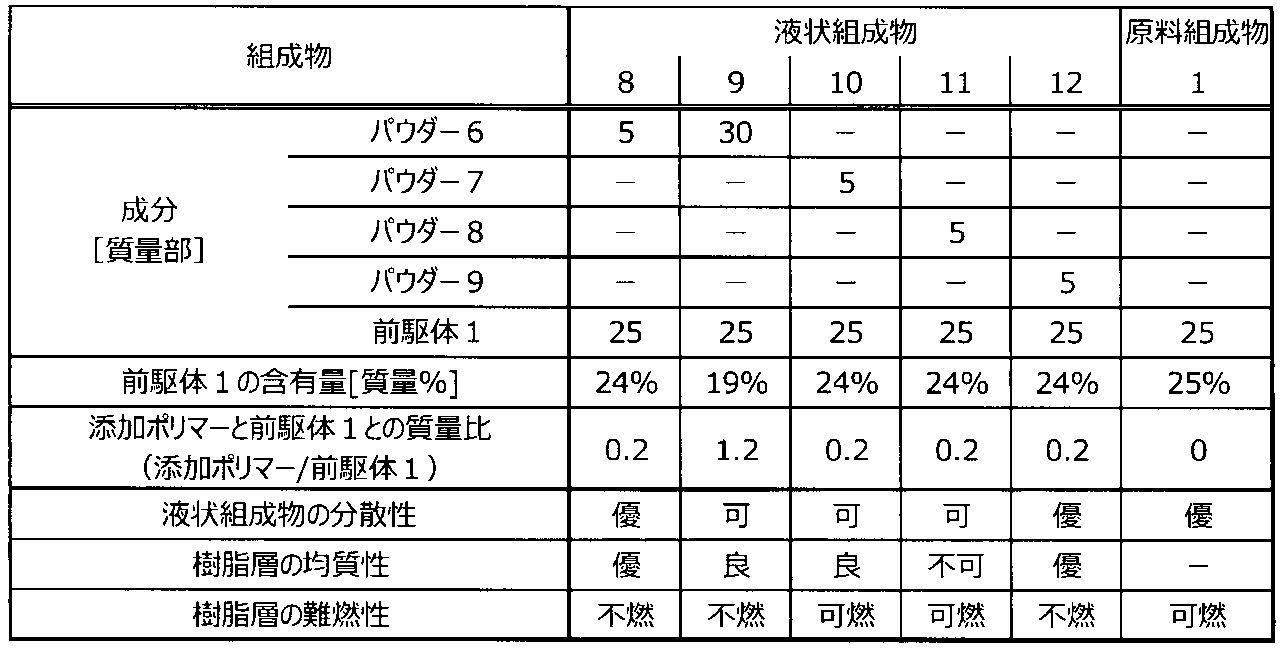
さらに、液状組成物8及び例12で得られる樹脂層付銅箔の樹脂層の表面は、ブツや縞が視認されず、表面平滑性に優れていた。
ポリイミド系芳香族樹脂又はその前駆体に代えて、溶剤可溶型液晶性のポリエステル系樹脂又はポリフェニレンエーテル樹脂を使用しても、上記と同様の結果が得られる。
ポリイミド系芳香族樹脂又はその前駆体に代えて、溶剤可溶型液晶性のポリエステル系樹脂又はポリフェニレンエーテル樹脂を使用しても、上記と同様の結果が得られる。
[例3]製造・評価例(その3)
[例3-1]改質パウダーの調製
以下で得られる改質パウダーに含まれるFポリマーの量に対する表面処理剤の量の質量比は、使用したパウダー分散液に添加したFポリマーの質量及び表面処理剤の質量と、パウダー分散液を濾過した濾液に含まれるFポリマーの質量及び表面処理剤の質量を測定して求めた。
(改質パウダー1)
まず、35質量部のパウダー10と、5質量部の表面処理剤1と、60質量部のMEKとを含むパウダー分散液を調製した。このパウダー分散液を減圧濃縮して、30質量部のMEKを留去した後、濾過した。次に、得られた濾渣を25℃にて真空乾燥して、改質パウダー1(表面処理剤1の質量/ポリマー5の質量=0.12)を得た。
[例3-1]改質パウダーの調製
以下で得られる改質パウダーに含まれるFポリマーの量に対する表面処理剤の量の質量比は、使用したパウダー分散液に添加したFポリマーの質量及び表面処理剤の質量と、パウダー分散液を濾過した濾液に含まれるFポリマーの質量及び表面処理剤の質量を測定して求めた。
(改質パウダー1)
まず、35質量部のパウダー10と、5質量部の表面処理剤1と、60質量部のMEKとを含むパウダー分散液を調製した。このパウダー分散液を減圧濃縮して、30質量部のMEKを留去した後、濾過した。次に、得られた濾渣を25℃にて真空乾燥して、改質パウダー1(表面処理剤1の質量/ポリマー5の質量=0.12)を得た。
(改質パウダー2)
パウダー10に代えてパウダー11を使用した以外は同様にして、改質パウダー2(表面処理剤1の質量/ポリマー6の質量=0.04)を得た。
(改質パウダー3)
パウダー10に代えてパウダー11を使用し、減圧濃縮に代えてパウダー分散液にホモジナイザー処理した以外は同様にして、改質パウダー3(表面処理剤1の質量/ポリマー6の質量=0.01未満)を得た。
パウダー10に代えてパウダー11を使用した以外は同様にして、改質パウダー2(表面処理剤1の質量/ポリマー6の質量=0.04)を得た。
(改質パウダー3)
パウダー10に代えてパウダー11を使用し、減圧濃縮に代えてパウダー分散液にホモジナイザー処理した以外は同様にして、改質パウダー3(表面処理剤1の質量/ポリマー6の質量=0.01未満)を得た。
<パウダーの貯蔵安定性>
それぞれの改質パウダーをトルエンに分散させて、評価用分散液を調製した。この評価用分散液を、温度5℃にて1週間貯蔵し、以下の基準に従って評価した。
[評価基準]
○(優):パウダーが評価用分散液中に均一に分散するか、又は沈殿しても手で振るだけで容易に再分散した。
△(良):パウダーが評価用分散液中で沈降し、再分散には超音波の付与が必要であった。
×(不可):パウダーが評価用分散液中で沈降し、超音波を付与しても再分散できなかった。
その結果、改質パウダー1が「○」、改質パウダー2が「△」、改質パウダー3が「×」であった。
それぞれの改質パウダーをトルエンに分散させて、評価用分散液を調製した。この評価用分散液を、温度5℃にて1週間貯蔵し、以下の基準に従って評価した。
[評価基準]
○(優):パウダーが評価用分散液中に均一に分散するか、又は沈殿しても手で振るだけで容易に再分散した。
△(良):パウダーが評価用分散液中で沈降し、再分散には超音波の付与が必要であった。
×(不可):パウダーが評価用分散液中で沈降し、超音波を付与しても再分散できなかった。
その結果、改質パウダー1が「○」、改質パウダー2が「△」、改質パウダー3が「×」であった。
[例3-2]液状組成物の調製
(液状組成物)
原料組成物4に、改質パウダー1を直接添加して、液状組成物13を調製した。なお、ポリマー6のパウダー1の質量/ポリイミド樹脂の質量を25質量部/75質量部(WF/WAr:0.33、WAr:10質量%超)とした。
(例2-2)
改質パウダー1をパウダー10に変更した以外は同様にして、液状組成物14を得た。
(液状組成物)
原料組成物4に、改質パウダー1を直接添加して、液状組成物13を調製した。なお、ポリマー6のパウダー1の質量/ポリイミド樹脂の質量を25質量部/75質量部(WF/WAr:0.33、WAr:10質量%超)とした。
(例2-2)
改質パウダー1をパウダー10に変更した以外は同様にして、液状組成物14を得た。
<液状組成物の増粘率>
各液状組成物のポリイミド樹脂ワニスに対する増粘率を測定し、以下の基準に従って評価した。
[評価基準]
○(優) :増粘率が100%以下であった。
×(不可):増粘率が100%超であった。
その結果、液状組成物13が「○」、液状組成物14が「×」であった。
各液状組成物のポリイミド樹脂ワニスに対する増粘率を測定し、以下の基準に従って評価した。
[評価基準]
○(優) :増粘率が100%以下であった。
×(不可):増粘率が100%超であった。
その結果、液状組成物13が「○」、液状組成物14が「×」であった。
<プリント配線基板の製造>
まず、ポリフェニレンエーテル樹脂の前駆体と、架橋剤と、MEKとを含む樹脂含有液を用意した。この樹脂含有液に含まれるポリフェニレンエーテル樹脂の前駆体及び架橋剤の量を、合計で10質量%以上とした。
次に、横型のボールミル容器に、樹脂含有液を充填した後、上記パウダー1を添加し、撹拌翼を用いて混合した。これにより、パウダー10が分散した液状組成物15(粘度:1000mPa・s以下)を得た。
次に、厚さ18μmの銅箔の表面に、液状組成物15をグラビアリバース法によりロールツーロールで塗工して、液状被膜を形成した。次いで、この液状被膜が形成された銅箔を、120℃の乾燥炉にて5分間、通し、加熱により乾燥させた。その後、窒素雰囲気下の遠赤外線オーブン中で、乾燥被膜を380℃にて3分間、加熱した。これにより、銅箔の表面に樹脂層が形成された樹脂付銅箔を製造した。なお、樹脂層の厚さは8μmであった。
樹脂付銅箔の銅箔をエッチングにより、所定の形状を有する伝送回路(回路パターン)に加工すると、電気特性、剥離強度等の物性に優れたプリント配線基板が得られる。
まず、ポリフェニレンエーテル樹脂の前駆体と、架橋剤と、MEKとを含む樹脂含有液を用意した。この樹脂含有液に含まれるポリフェニレンエーテル樹脂の前駆体及び架橋剤の量を、合計で10質量%以上とした。
次に、横型のボールミル容器に、樹脂含有液を充填した後、上記パウダー1を添加し、撹拌翼を用いて混合した。これにより、パウダー10が分散した液状組成物15(粘度:1000mPa・s以下)を得た。
次に、厚さ18μmの銅箔の表面に、液状組成物15をグラビアリバース法によりロールツーロールで塗工して、液状被膜を形成した。次いで、この液状被膜が形成された銅箔を、120℃の乾燥炉にて5分間、通し、加熱により乾燥させた。その後、窒素雰囲気下の遠赤外線オーブン中で、乾燥被膜を380℃にて3分間、加熱した。これにより、銅箔の表面に樹脂層が形成された樹脂付銅箔を製造した。なお、樹脂層の厚さは8μmであった。
樹脂付銅箔の銅箔をエッチングにより、所定の形状を有する伝送回路(回路パターン)に加工すると、電気特性、剥離強度等の物性に優れたプリント配線基板が得られる。
本発明の液状組成物は、繊維基材に高濃度の樹脂成分が含浸保持されたプリプレグや成分均質性が高く厚い絶縁樹脂層の形成に適しており、電気特性と耐熱性に優れた、アンテナ部品、プリント配線基板(フレキシブルプリント配線基板、リジッドプリント配線基板)、カバーレイフィルム、ソルダーレジスト、パワー半導体の絶縁層、航空機用部品、自動車用部品の材料として有用である。
本発明のパウダーは、アンテナ部品、プリント配線板、航空機用部品、自動車用部品、スポーツ用具や、食品工業用品、のこぎり、すべり軸受け等の被覆物品等を使用するための液状組成物の成分として使用できる。また、プリント配線板は、高周波特性が必要とされるレーダー、ネットワークのルーター、バックプレーン、無線インフラ等の電子機器用基板や自動車用各種センサ用基板、エンジンマネージメントセンサ用基板として有用であり、特にミリ波帯域の伝送損失低減と難燃性の向上を目的とする用途に好適である。
なお、2019年03月12日に出願された日本特許出願2019-044624号、2019年03月12日に出願された日本特許出願2019-044627号、2019年05月23日に出願された日本特許出願2019-096837号及び2019年07月04日に出願された日本特許出願2019-125278号の明細書、特許請求の範囲及び要約書の全内容をここに引用し、本発明の明細書の開示として、取り入れるものである。
本発明のパウダーは、アンテナ部品、プリント配線板、航空機用部品、自動車用部品、スポーツ用具や、食品工業用品、のこぎり、すべり軸受け等の被覆物品等を使用するための液状組成物の成分として使用できる。また、プリント配線板は、高周波特性が必要とされるレーダー、ネットワークのルーター、バックプレーン、無線インフラ等の電子機器用基板や自動車用各種センサ用基板、エンジンマネージメントセンサ用基板として有用であり、特にミリ波帯域の伝送損失低減と難燃性の向上を目的とする用途に好適である。
なお、2019年03月12日に出願された日本特許出願2019-044624号、2019年03月12日に出願された日本特許出願2019-044627号、2019年05月23日に出願された日本特許出願2019-096837号及び2019年07月04日に出願された日本特許出願2019-125278号の明細書、特許請求の範囲及び要約書の全内容をここに引用し、本発明の明細書の開示として、取り入れるものである。
Claims (15)
- 熱溶融性のテトラフルオロエチレン系ポリマーのパウダーと芳香族樹脂と液状媒体とを含み、前記芳香族樹脂の含有割合が10質量%以上の液状組成物であって、前記芳香族樹脂の含有割合に対する前記テトラフルオロエチレン系ポリマーの含有割合の比が1.2以下であり、25℃における粘度が10000mPa・s以下である、液状組成物。
- 前記芳香族樹脂の含有割合に対する前記テトラフルオロエチレン系ポリマーの含有割合の比が、0.1~0.5である、請求項1に記載の液状組成物。
- 前記芳香族樹脂が、芳香族ポリイミド樹脂、芳香族ポリカーボネート樹脂、芳香族ポリアミド樹脂、芳香族ポリエステル樹脂、芳香族ポリエーテルスルホン樹脂、芳香族マレイミド樹脂、ポリフェニレンエーテル樹脂、ポリフェニレンサルファイド樹脂及び芳香族エポキシ樹脂からなる群から選ばれる芳香族樹脂又はその前駆体である、請求項1又は2に記載の液状組成物。
- 前記液状組成物の25℃における粘度が、100~5000mPa・sである、請求項1~3のいずれか1項に記載の液状組成物。
- 前記テトラフルオロエチレン系ポリマーのパウダーが、下記パウダー(1)、下記パウダー(2)又は下記パウダー(3)である、請求項1~4のいずれか1項に記載の液状組成物。
パウダー(1):テトラフルオロエチレンに基づく単位及びペルフルオロ(アルキルビニルエーテル)に基づく単位からなる熱溶融性テトラフルオロエチレン系ポリマーのパウダーであって、その体積基準累積50%径が10~60μmである、パウダー。
パウダー(2):テトラフルオロエチレンに基づく単位を90~99モル%、ペルフルオロ(アルキルビニルエーテル)に基づく単位を1~3モル%及び酸素含有極性基を有するモノマーに基づく単位を含む熱溶融性テトラフルオロエチレン系ポリマーのパウダーであって、その体積基準累積100%径が8μm以下である、パウダー。
パウダー(3):熱溶融性テトラフルオロエチレン系ポリマーと表面処理剤とを含むパウダーであって、その体積基準累積50%径が25μm未満である、パウダー。 - 前記パウダー(1)が、テトラフルオロエチレンに基づく単位を92~98モル%及びペルフルオロ(アルキルビニルエーテル)に基づく単位を2~8モル%含有する熱溶融性テトラフルオロエチレン系ポリマーのパウダーであって、その体積基準累積50%径が10~60μmのパウダーである、請求項5に記載の液状組成物。
- 前記パウダー(1)の体積基準累積50%径が、16~40μmである、請求項5又は6に記載の液状組成物。
- 前記パウダー(1)が、体積基準累積50%径が8μm以下の第1パウダーと体積基準累積50%径が16~40μmの第2パウダーとを含み、前記第2パウダーの含有割合に対する前記第1パウダーの含有割合の比が0.5以下のパウダーである、請求項5~7のいずれか1項に記載の液状組成物。
- 前記パウダー(3)が、前記熱溶融性テトラフルオロエチレン系ポリマーに対する前記表面処理剤の質量比が0.01超0.25以下のパウダーである、請求項5に記載の液状組成物。
- 請求項1~9のいずれか一項に記載の液状組成物を、繊維基材に含浸させ、さらに乾燥させる、前記液状組成物の乾燥物と前記繊維基材とを含むプリプレグの製造方法。
- 請求項1~9のいずれか一項に記載の液状組成物を、金属板の表面に塗布し、加熱して前記液状組成物の乾燥物を含む樹脂層を形成させて、前記金属板と前記樹脂層とを有する樹脂層付金属板を得る、樹脂層付金属板の製造方法。
- 非溶融性テトラフルオロエチレン系ポリマー及び芳香族樹脂からなる群から選ばれる少なくとも1種の樹脂材料と液状媒体とを含有する液状組成物に添加される、下記パウダー(1)、下記パウダー(2)又は下記パウダー(3)からなる、パウダー。
パウダー(1):テトラフルオロエチレンに基づく単位及びペルフルオロ(アルキルビニルエーテル)に基づく単位からなる熱溶融性テトラフルオロエチレン系ポリマーのパウダーであって、その体積基準累積50%径が10~60μmである、パウダー。
パウダー(2):テトラフルオロエチレンに基づく単位を90~99モル%、ペルフルオロ(アルキルビニルエーテル)に基づく単位を1~3モル%及び酸素含有極性基を有するモノマーに基づく単位を含む熱溶融性テトラフルオロエチレン系ポリマーのパウダーであって、その体積基準累積100%径が8μm以下である、パウダー。
パウダー(3):熱溶融性テトラフルオロエチレン系ポリマーと表面処理剤とを含むパウダーであって、その体積基準累積50%径が25μm未満である、パウダー。 - 前記表面処理剤が、界面活性剤又はシランカップリング剤である、請求項12に記載のパウダー。
- 熱溶融性テトラフルオロエチレン系ポリマーの原料パウダーと表面処理剤と液状媒体とを含むパウダー分散液を濃縮し、さらに前記液状媒体を分離する、前記熱溶融性テトラフルオロエチレン系ポリマーと前記表面処理剤とを含むパウダーの製造方法であって、製造されたパウダーに含まれる前記熱溶融性テトラフルオロエチレン系ポリマーに対する前記表面処理剤の質量比が0.01超0.25以下である、パウダーの製造方法。
- 前記パウダーの体積基準累積50%径が、25μm未満である、請求項14に記載の製造方法。
Priority Applications (3)
| Application Number | Priority Date | Filing Date | Title |
|---|---|---|---|
| JP2021505026A JP7371681B2 (ja) | 2019-03-12 | 2020-03-06 | 液状組成物、パウダー、及び、パウダーの製造方法 |
| KR1020217020343A KR102871614B1 (ko) | 2019-03-12 | 2020-03-06 | 액상 조성물, 파우더, 및, 파우더의 제조 방법 |
| CN202080019920.1A CN113574118A (zh) | 2019-03-12 | 2020-03-06 | 液态组合物、粉末以及粉末的制造方法 |
Applications Claiming Priority (8)
| Application Number | Priority Date | Filing Date | Title |
|---|---|---|---|
| JP2019044627 | 2019-03-12 | ||
| JP2019044624 | 2019-03-12 | ||
| JP2019-044624 | 2019-03-12 | ||
| JP2019-044627 | 2019-03-12 | ||
| JP2019096837 | 2019-05-23 | ||
| JP2019-096837 | 2019-05-23 | ||
| JP2019-125278 | 2019-07-04 | ||
| JP2019125278 | 2019-07-04 |
Publications (1)
| Publication Number | Publication Date |
|---|---|
| WO2020184437A1 true WO2020184437A1 (ja) | 2020-09-17 |
Family
ID=72427845
Family Applications (1)
| Application Number | Title | Priority Date | Filing Date |
|---|---|---|---|
| PCT/JP2020/009684 Ceased WO2020184437A1 (ja) | 2019-03-12 | 2020-03-06 | 液状組成物、パウダー、及び、パウダーの製造方法 |
Country Status (5)
| Country | Link |
|---|---|
| JP (1) | JP7371681B2 (ja) |
| KR (1) | KR102871614B1 (ja) |
| CN (1) | CN113574118A (ja) |
| TW (1) | TWI856070B (ja) |
| WO (1) | WO2020184437A1 (ja) |
Cited By (5)
| Publication number | Priority date | Publication date | Assignee | Title |
|---|---|---|---|---|
| CN113372863A (zh) * | 2021-06-22 | 2021-09-10 | 深圳市汇海鑫科技有限公司 | 一种高导热高导电有机胶粘剂及其制备方法 |
| WO2022065274A1 (ja) * | 2020-09-28 | 2022-03-31 | 東レ株式会社 | 熱可塑性樹脂組成物およびそれからなる成形品 |
| WO2022215831A1 (ko) * | 2021-04-09 | 2022-10-13 | 주식회사 엘지화학 | 열경화성 수지 조성물, 그 경화물 및 프리프레그, 경화물 또는 프리프레그의 경화물을 구비한 적층판, 금속박 적층판, 그리고 프린트 배선판 |
| WO2022265033A1 (ja) * | 2021-06-18 | 2022-12-22 | Agc株式会社 | 粘弾性体の製造方法および粘弾性体 |
| CN116635161A (zh) * | 2020-12-28 | 2023-08-22 | Agc株式会社 | 水性分散液及其制造方法 |
Citations (3)
| Publication number | Priority date | Publication date | Assignee | Title |
|---|---|---|---|---|
| JP2018141053A (ja) * | 2017-02-27 | 2018-09-13 | 味の素株式会社 | 樹脂組成物 |
| JP2019019004A (ja) * | 2017-07-19 | 2019-02-07 | Agc株式会社 | 回転摺動部材 |
| WO2019031521A1 (ja) * | 2017-08-09 | 2019-02-14 | Agc株式会社 | 含フッ素共重合体組成物 |
Family Cites Families (11)
| Publication number | Priority date | Publication date | Assignee | Title |
|---|---|---|---|---|
| JP2639735B2 (ja) * | 1989-11-17 | 1997-08-13 | 新日本製鐵株式会社 | 塗装金属板 |
| US7767217B2 (en) | 2006-03-14 | 2010-08-03 | Foresight Biotherapeutics | Ophthalmic compositions comprising povidone-iodine |
| JP4983153B2 (ja) | 2006-08-24 | 2012-07-25 | ダイキン工業株式会社 | 含フッ素樹脂水性分散体 |
| JP5266711B2 (ja) * | 2007-05-23 | 2013-08-21 | ダイキン工業株式会社 | フッ素樹脂塗料組成物及び塗装物品 |
| CN101942180B (zh) * | 2010-09-08 | 2012-05-30 | 广东生益科技股份有限公司 | 环氧树脂组合物及使用其制作的覆铜板 |
| JP5732928B2 (ja) | 2011-03-09 | 2015-06-10 | 富士ゼロックス株式会社 | 含フッ素樹脂粒子分散液、含フッ素樹脂粒子分散液の製造方法、含フッ素樹脂粒子含有塗布液、含フッ素樹脂粒子含有被覆膜の製造方法、含フッ素樹脂粒子含有被覆膜および成形体 |
| CN102558858B (zh) * | 2011-12-22 | 2014-03-26 | 云南云天化股份有限公司 | 覆铜层压板用树脂组合物及半固化片 |
| US9307638B2 (en) | 2012-07-11 | 2016-04-05 | Lg Chem, Ltd. | Flexible metal laminate |
| JP6754999B2 (ja) | 2015-03-05 | 2020-09-16 | パナソニックIpマネジメント株式会社 | 樹脂組成物、低誘電率樹脂シート、プリプレグ、金属箔張り積層板、高周波回路基板および多層配線基板 |
| JP6904347B2 (ja) * | 2016-06-23 | 2021-07-14 | Agc株式会社 | フッ素樹脂パウダーを含む液状組成物の製造方法 |
| JP6998527B2 (ja) | 2017-06-19 | 2022-01-18 | パナソニックIpマネジメント株式会社 | 樹脂組成物、プリプレグ、金属張積層板及びプリント配線板 |
-
2020
- 2020-03-06 KR KR1020217020343A patent/KR102871614B1/ko active Active
- 2020-03-06 JP JP2021505026A patent/JP7371681B2/ja active Active
- 2020-03-06 WO PCT/JP2020/009684 patent/WO2020184437A1/ja not_active Ceased
- 2020-03-06 CN CN202080019920.1A patent/CN113574118A/zh active Pending
- 2020-03-10 TW TW109107805A patent/TWI856070B/zh active
Patent Citations (3)
| Publication number | Priority date | Publication date | Assignee | Title |
|---|---|---|---|---|
| JP2018141053A (ja) * | 2017-02-27 | 2018-09-13 | 味の素株式会社 | 樹脂組成物 |
| JP2019019004A (ja) * | 2017-07-19 | 2019-02-07 | Agc株式会社 | 回転摺動部材 |
| WO2019031521A1 (ja) * | 2017-08-09 | 2019-02-14 | Agc株式会社 | 含フッ素共重合体組成物 |
Cited By (11)
| Publication number | Priority date | Publication date | Assignee | Title |
|---|---|---|---|---|
| WO2022065274A1 (ja) * | 2020-09-28 | 2022-03-31 | 東レ株式会社 | 熱可塑性樹脂組成物およびそれからなる成形品 |
| CN116323797A (zh) * | 2020-09-28 | 2023-06-23 | 东丽株式会社 | 热塑性树脂组合物及由其形成的成型品 |
| CN116635161A (zh) * | 2020-12-28 | 2023-08-22 | Agc株式会社 | 水性分散液及其制造方法 |
| WO2022215831A1 (ko) * | 2021-04-09 | 2022-10-13 | 주식회사 엘지화학 | 열경화성 수지 조성물, 그 경화물 및 프리프레그, 경화물 또는 프리프레그의 경화물을 구비한 적층판, 금속박 적층판, 그리고 프린트 배선판 |
| JP2022161530A (ja) * | 2021-04-09 | 2022-10-21 | エルジー・ケム・リミテッド | 熱硬化性樹脂組成物、その硬化物及びプリプレグ、硬化物又はプリプレグの硬化物を備えた積層板、金属箔張積層板、並びにプリント配線板 |
| CN116075556A (zh) * | 2021-04-09 | 2023-05-05 | 株式会社Lg化学 | 热固性树脂组合物、其固化材料和预浸料、设置有固化材料或预浸料的固化材料的层合体、金属包层层合体、以及印刷电路板 |
| JP7621708B2 (ja) | 2021-04-09 | 2025-01-27 | エルジー・ケム・リミテッド | 熱硬化性樹脂組成物、その硬化物及びプリプレグ、硬化物又はプリプレグの硬化物を備えた積層板、金属箔張積層板、並びにプリント配線板 |
| WO2022265033A1 (ja) * | 2021-06-18 | 2022-12-22 | Agc株式会社 | 粘弾性体の製造方法および粘弾性体 |
| JPWO2022265033A1 (ja) * | 2021-06-18 | 2022-12-22 | ||
| CN117460763A (zh) * | 2021-06-18 | 2024-01-26 | Agc株式会社 | 粘弹性体的制造方法及粘弹性体 |
| CN113372863A (zh) * | 2021-06-22 | 2021-09-10 | 深圳市汇海鑫科技有限公司 | 一种高导热高导电有机胶粘剂及其制备方法 |
Also Published As
| Publication number | Publication date |
|---|---|
| CN113574118A (zh) | 2021-10-29 |
| TWI856070B (zh) | 2024-09-21 |
| JP7371681B2 (ja) | 2023-10-31 |
| TW202039678A (zh) | 2020-11-01 |
| JPWO2020184437A1 (ja) | 2020-09-17 |
| KR20210137426A (ko) | 2021-11-17 |
| KR102871614B1 (ko) | 2025-10-15 |
Similar Documents
| Publication | Publication Date | Title |
|---|---|---|
| JP7115589B2 (ja) | 液状組成物、並びに該液状組成物を使用した、フィルムおよび積層体の製造方法 | |
| KR102557635B1 (ko) | 불소계 수지 함유 비수계 분산체, 불소계 수지 함유 폴리이미드 전구체 용액 조성물, 이를 이용한 폴리이미드, 폴리이미드 필름, 회로기판용 접착제 조성물 및 그 제조 방법 | |
| KR102353963B1 (ko) | 불소 수지 파우더를 포함하는 액상 조성물의 제조 방법 | |
| JP7371681B2 (ja) | 液状組成物、パウダー、及び、パウダーの製造方法 | |
| CN113227232B (zh) | 粉末分散液、层叠体和印刷基板 | |
| WO2019131805A1 (ja) | 分散液、金属積層板及びプリント基板の製造方法 | |
| CN113348208B (zh) | 分散液 | |
| WO2021095662A1 (ja) | 非水系分散液、積層体の製造方法及び成形物 | |
| JP6491947B2 (ja) | フッ素系樹脂含有ポリイミド前駆体溶液組成物、それを用いたポリイミド、ポリイミドフィルム、およびそれらの製造方法 | |
| JP7511110B2 (ja) | 液状組成物及び積層体の製造方法 | |
| JP2020180245A (ja) | パウダー分散液、積層体の製造方法、積層体及びプリント基板の製造方法 | |
| TW202003235A (zh) | 附樹脂之金屬箔之製造方法、附樹脂之金屬箔、積層體及印刷基板 | |
| WO2021075504A1 (ja) | 非水系分散液及び積層体の製造方法 | |
| JP2020146970A (ja) | 積層体及び積層体の製造方法 | |
| CN113631669B (zh) | 液态组合物 | |
| TW202206290A (zh) | 多層膜、其製造方法、金屬箔積層體及印刷電路基板之製造方法 | |
| WO2021039735A1 (ja) | フィルム、フィルムの製造方法、金属張積層体、及び被覆金属導体 | |
| CN114729198B (zh) | 粉体组合物、膜和膜的制造方法 |
Legal Events
| Date | Code | Title | Description |
|---|---|---|---|
| 121 | Ep: the epo has been informed by wipo that ep was designated in this application |
Ref document number: 20771080 Country of ref document: EP Kind code of ref document: A1 |
|
| ENP | Entry into the national phase |
Ref document number: 2021505026 Country of ref document: JP Kind code of ref document: A |
|
| NENP | Non-entry into the national phase |
Ref country code: DE |
|
| 122 | Ep: pct application non-entry in european phase |
Ref document number: 20771080 Country of ref document: EP Kind code of ref document: A1 |