WO2020179732A1 - 粉体成形用塩化ビニル系樹脂組成物、塩化ビニル系樹脂成形体及び積層体 - Google Patents
粉体成形用塩化ビニル系樹脂組成物、塩化ビニル系樹脂成形体及び積層体 Download PDFInfo
- Publication number
- WO2020179732A1 WO2020179732A1 PCT/JP2020/008685 JP2020008685W WO2020179732A1 WO 2020179732 A1 WO2020179732 A1 WO 2020179732A1 JP 2020008685 W JP2020008685 W JP 2020008685W WO 2020179732 A1 WO2020179732 A1 WO 2020179732A1
- Authority
- WO
- WIPO (PCT)
- Prior art keywords
- vinyl chloride
- chloride resin
- mass
- less
- meth
- Prior art date
- Legal status (The legal status is an assumption and is not a legal conclusion. Google has not performed a legal analysis and makes no representation as to the accuracy of the status listed.)
- Ceased
Links
Classifications
-
- C—CHEMISTRY; METALLURGY
- C08—ORGANIC MACROMOLECULAR COMPOUNDS; THEIR PREPARATION OR CHEMICAL WORKING-UP; COMPOSITIONS BASED THEREON
- C08G—MACROMOLECULAR COMPOUNDS OBTAINED OTHERWISE THAN BY REACTIONS ONLY INVOLVING UNSATURATED CARBON-TO-CARBON BONDS
- C08G18/00—Polymeric products of isocyanates or isothiocyanates
- C08G18/06—Polymeric products of isocyanates or isothiocyanates with compounds having active hydrogen
- C08G18/08—Processes
- C08G18/16—Catalysts
- C08G18/18—Catalysts containing secondary or tertiary amines or salts thereof
- C08G18/20—Heterocyclic amines; Salts thereof
- C08G18/2045—Heterocyclic amines; Salts thereof containing condensed heterocyclic rings
- C08G18/2063—Heterocyclic amines; Salts thereof containing condensed heterocyclic rings having two nitrogen atoms in the condensed ring system
-
- B—PERFORMING OPERATIONS; TRANSPORTING
- B29—WORKING OF PLASTICS; WORKING OF SUBSTANCES IN A PLASTIC STATE IN GENERAL
- B29C—SHAPING OR JOINING OF PLASTICS; SHAPING OF MATERIAL IN A PLASTIC STATE, NOT OTHERWISE PROVIDED FOR; AFTER-TREATMENT OF THE SHAPED PRODUCTS, e.g. REPAIRING
- B29C41/00—Shaping by coating a mould, core or other substrate, i.e. by depositing material and stripping-off the shaped article; Apparatus therefor
- B29C41/003—Shaping by coating a mould, core or other substrate, i.e. by depositing material and stripping-off the shaped article; Apparatus therefor characterised by the choice of material
-
- B—PERFORMING OPERATIONS; TRANSPORTING
- B29—WORKING OF PLASTICS; WORKING OF SUBSTANCES IN A PLASTIC STATE IN GENERAL
- B29C—SHAPING OR JOINING OF PLASTICS; SHAPING OF MATERIAL IN A PLASTIC STATE, NOT OTHERWISE PROVIDED FOR; AFTER-TREATMENT OF THE SHAPED PRODUCTS, e.g. REPAIRING
- B29C41/00—Shaping by coating a mould, core or other substrate, i.e. by depositing material and stripping-off the shaped article; Apparatus therefor
- B29C41/02—Shaping by coating a mould, core or other substrate, i.e. by depositing material and stripping-off the shaped article; Apparatus therefor for making articles of definite length, i.e. discrete articles
- B29C41/18—Slush casting, i.e. pouring moulding material into a hollow mould with excess material being poured off
-
- B—PERFORMING OPERATIONS; TRANSPORTING
- B29—WORKING OF PLASTICS; WORKING OF SUBSTANCES IN A PLASTIC STATE IN GENERAL
- B29C—SHAPING OR JOINING OF PLASTICS; SHAPING OF MATERIAL IN A PLASTIC STATE, NOT OTHERWISE PROVIDED FOR; AFTER-TREATMENT OF THE SHAPED PRODUCTS, e.g. REPAIRING
- B29C41/00—Shaping by coating a mould, core or other substrate, i.e. by depositing material and stripping-off the shaped article; Apparatus therefor
- B29C41/34—Component parts, details or accessories; Auxiliary operations
- B29C41/36—Feeding the material on to the mould, core or other substrate
-
- B—PERFORMING OPERATIONS; TRANSPORTING
- B32—LAYERED PRODUCTS
- B32B—LAYERED PRODUCTS, i.e. PRODUCTS BUILT-UP OF STRATA OF FLAT OR NON-FLAT, e.g. CELLULAR OR HONEYCOMB, FORM
- B32B27/00—Layered products comprising a layer of synthetic resin
- B32B27/06—Layered products comprising a layer of synthetic resin as the main or only constituent of a layer, which is next to another layer of the same or of a different material
- B32B27/065—Layered products comprising a layer of synthetic resin as the main or only constituent of a layer, which is next to another layer of the same or of a different material of foam
-
- B—PERFORMING OPERATIONS; TRANSPORTING
- B32—LAYERED PRODUCTS
- B32B—LAYERED PRODUCTS, i.e. PRODUCTS BUILT-UP OF STRATA OF FLAT OR NON-FLAT, e.g. CELLULAR OR HONEYCOMB, FORM
- B32B27/00—Layered products comprising a layer of synthetic resin
- B32B27/30—Layered products comprising a layer of synthetic resin comprising vinyl (co)polymers; comprising acrylic (co)polymers
- B32B27/304—Layered products comprising a layer of synthetic resin comprising vinyl (co)polymers; comprising acrylic (co)polymers comprising vinyl halide (co)polymers, e.g. PVC, PVDC, PVF, PVDF
-
- B—PERFORMING OPERATIONS; TRANSPORTING
- B32—LAYERED PRODUCTS
- B32B—LAYERED PRODUCTS, i.e. PRODUCTS BUILT-UP OF STRATA OF FLAT OR NON-FLAT, e.g. CELLULAR OR HONEYCOMB, FORM
- B32B27/00—Layered products comprising a layer of synthetic resin
- B32B27/40—Layered products comprising a layer of synthetic resin comprising polyurethanes
-
- B—PERFORMING OPERATIONS; TRANSPORTING
- B32—LAYERED PRODUCTS
- B32B—LAYERED PRODUCTS, i.e. PRODUCTS BUILT-UP OF STRATA OF FLAT OR NON-FLAT, e.g. CELLULAR OR HONEYCOMB, FORM
- B32B5/00—Layered products characterised by the non- homogeneity or physical structure, i.e. comprising a fibrous, filamentary, particulate or foam layer; Layered products characterised by having a layer differing constitutionally or physically in different parts
- B32B5/18—Layered products characterised by the non- homogeneity or physical structure, i.e. comprising a fibrous, filamentary, particulate or foam layer; Layered products characterised by having a layer differing constitutionally or physically in different parts characterised by features of a layer of foamed material
-
- C—CHEMISTRY; METALLURGY
- C08—ORGANIC MACROMOLECULAR COMPOUNDS; THEIR PREPARATION OR CHEMICAL WORKING-UP; COMPOSITIONS BASED THEREON
- C08F—MACROMOLECULAR COMPOUNDS OBTAINED BY REACTIONS ONLY INVOLVING CARBON-TO-CARBON UNSATURATED BONDS
- C08F220/00—Copolymers of compounds having one or more unsaturated aliphatic radicals, each having only one carbon-to-carbon double bond, and only one being terminated by only one carboxyl radical or a salt, anhydride ester, amide, imide or nitrile thereof
- C08F220/02—Monocarboxylic acids having less than ten carbon atoms; Derivatives thereof
- C08F220/10—Esters
- C08F220/12—Esters of monohydric alcohols or phenols
- C08F220/14—Methyl esters, e.g. methyl (meth)acrylate
-
- C—CHEMISTRY; METALLURGY
- C08—ORGANIC MACROMOLECULAR COMPOUNDS; THEIR PREPARATION OR CHEMICAL WORKING-UP; COMPOSITIONS BASED THEREON
- C08G—MACROMOLECULAR COMPOUNDS OBTAINED OTHERWISE THAN BY REACTIONS ONLY INVOLVING UNSATURATED CARBON-TO-CARBON BONDS
- C08G18/00—Polymeric products of isocyanates or isothiocyanates
- C08G18/06—Polymeric products of isocyanates or isothiocyanates with compounds having active hydrogen
- C08G18/28—Polymeric products of isocyanates or isothiocyanates with compounds having active hydrogen characterised by the compounds used containing active hydrogen
- C08G18/40—High-molecular-weight compounds
- C08G18/48—Polyethers
-
- C—CHEMISTRY; METALLURGY
- C08—ORGANIC MACROMOLECULAR COMPOUNDS; THEIR PREPARATION OR CHEMICAL WORKING-UP; COMPOSITIONS BASED THEREON
- C08G—MACROMOLECULAR COMPOUNDS OBTAINED OTHERWISE THAN BY REACTIONS ONLY INVOLVING UNSATURATED CARBON-TO-CARBON BONDS
- C08G18/00—Polymeric products of isocyanates or isothiocyanates
- C08G18/06—Polymeric products of isocyanates or isothiocyanates with compounds having active hydrogen
- C08G18/28—Polymeric products of isocyanates or isothiocyanates with compounds having active hydrogen characterised by the compounds used containing active hydrogen
- C08G18/40—High-molecular-weight compounds
- C08G18/48—Polyethers
- C08G18/4829—Polyethers containing at least three hydroxy groups
-
- C—CHEMISTRY; METALLURGY
- C08—ORGANIC MACROMOLECULAR COMPOUNDS; THEIR PREPARATION OR CHEMICAL WORKING-UP; COMPOSITIONS BASED THEREON
- C08G—MACROMOLECULAR COMPOUNDS OBTAINED OTHERWISE THAN BY REACTIONS ONLY INVOLVING UNSATURATED CARBON-TO-CARBON BONDS
- C08G18/00—Polymeric products of isocyanates or isothiocyanates
- C08G18/06—Polymeric products of isocyanates or isothiocyanates with compounds having active hydrogen
- C08G18/70—Polymeric products of isocyanates or isothiocyanates with compounds having active hydrogen characterised by the isocyanates or isothiocyanates used
- C08G18/72—Polyisocyanates or polyisothiocyanates
- C08G18/74—Polyisocyanates or polyisothiocyanates cyclic
- C08G18/76—Polyisocyanates or polyisothiocyanates cyclic aromatic
- C08G18/7657—Polyisocyanates or polyisothiocyanates cyclic aromatic containing two or more aromatic rings
- C08G18/7664—Polyisocyanates or polyisothiocyanates cyclic aromatic containing two or more aromatic rings containing alkylene polyphenyl groups
- C08G18/7671—Polyisocyanates or polyisothiocyanates cyclic aromatic containing two or more aromatic rings containing alkylene polyphenyl groups containing only one alkylene bisphenyl group
-
- C—CHEMISTRY; METALLURGY
- C08—ORGANIC MACROMOLECULAR COMPOUNDS; THEIR PREPARATION OR CHEMICAL WORKING-UP; COMPOSITIONS BASED THEREON
- C08J—WORKING-UP; GENERAL PROCESSES OF COMPOUNDING; AFTER-TREATMENT NOT COVERED BY SUBCLASSES C08B, C08C, C08F, C08G or C08H
- C08J9/00—Working-up of macromolecular substances to porous or cellular articles or materials; After-treatment thereof
- C08J9/04—Working-up of macromolecular substances to porous or cellular articles or materials; After-treatment thereof using blowing gases generated by a previously added blowing agent
- C08J9/12—Working-up of macromolecular substances to porous or cellular articles or materials; After-treatment thereof using blowing gases generated by a previously added blowing agent by a physical blowing agent
- C08J9/125—Water, e.g. hydrated salts
-
- C—CHEMISTRY; METALLURGY
- C08—ORGANIC MACROMOLECULAR COMPOUNDS; THEIR PREPARATION OR CHEMICAL WORKING-UP; COMPOSITIONS BASED THEREON
- C08K—Use of inorganic or non-macromolecular organic substances as compounding ingredients
- C08K5/00—Use of organic ingredients
- C08K5/04—Oxygen-containing compounds
- C08K5/10—Esters; Ether-esters
-
- C—CHEMISTRY; METALLURGY
- C08—ORGANIC MACROMOLECULAR COMPOUNDS; THEIR PREPARATION OR CHEMICAL WORKING-UP; COMPOSITIONS BASED THEREON
- C08L—COMPOSITIONS OF MACROMOLECULAR COMPOUNDS
- C08L27/00—Compositions of homopolymers or copolymers of compounds having one or more unsaturated aliphatic radicals, each having only one carbon-to-carbon double bond, and at least one being terminated by a halogen; Compositions of derivatives of such polymers
- C08L27/02—Compositions of homopolymers or copolymers of compounds having one or more unsaturated aliphatic radicals, each having only one carbon-to-carbon double bond, and at least one being terminated by a halogen; Compositions of derivatives of such polymers not modified by chemical after-treatment
- C08L27/04—Compositions of homopolymers or copolymers of compounds having one or more unsaturated aliphatic radicals, each having only one carbon-to-carbon double bond, and at least one being terminated by a halogen; Compositions of derivatives of such polymers not modified by chemical after-treatment containing chlorine atoms
- C08L27/06—Homopolymers or copolymers of vinyl chloride
-
- C—CHEMISTRY; METALLURGY
- C08—ORGANIC MACROMOLECULAR COMPOUNDS; THEIR PREPARATION OR CHEMICAL WORKING-UP; COMPOSITIONS BASED THEREON
- C08L—COMPOSITIONS OF MACROMOLECULAR COMPOUNDS
- C08L67/00—Compositions of polyesters obtained by reactions forming a carboxylic ester link in the main chain; Compositions of derivatives of such polymers
- C08L67/02—Polyesters derived from dicarboxylic acids and dihydroxy compounds
-
- C—CHEMISTRY; METALLURGY
- C08—ORGANIC MACROMOLECULAR COMPOUNDS; THEIR PREPARATION OR CHEMICAL WORKING-UP; COMPOSITIONS BASED THEREON
- C08L—COMPOSITIONS OF MACROMOLECULAR COMPOUNDS
- C08L83/00—Compositions of macromolecular compounds obtained by reactions forming in the main chain of the macromolecule a linkage containing silicon with or without sulfur, nitrogen, oxygen or carbon only; Compositions of derivatives of such polymers
- C08L83/04—Polysiloxanes
-
- B—PERFORMING OPERATIONS; TRANSPORTING
- B29—WORKING OF PLASTICS; WORKING OF SUBSTANCES IN A PLASTIC STATE IN GENERAL
- B29K—INDEXING SCHEME ASSOCIATED WITH SUBCLASSES B29B, B29C OR B29D, RELATING TO MOULDING MATERIALS OR TO MATERIALS FOR MOULDS, REINFORCEMENTS, FILLERS OR PREFORMED PARTS, e.g. INSERTS
- B29K2027/00—Use of polyvinylhalogenides or derivatives thereof as moulding material
- B29K2027/06—PVC, i.e. polyvinylchloride
-
- B—PERFORMING OPERATIONS; TRANSPORTING
- B29—WORKING OF PLASTICS; WORKING OF SUBSTANCES IN A PLASTIC STATE IN GENERAL
- B29K—INDEXING SCHEME ASSOCIATED WITH SUBCLASSES B29B, B29C OR B29D, RELATING TO MOULDING MATERIALS OR TO MATERIALS FOR MOULDS, REINFORCEMENTS, FILLERS OR PREFORMED PARTS, e.g. INSERTS
- B29K2105/00—Condition, form or state of moulded material or of the material to be shaped
- B29K2105/0058—Liquid or visquous
-
- B—PERFORMING OPERATIONS; TRANSPORTING
- B29—WORKING OF PLASTICS; WORKING OF SUBSTANCES IN A PLASTIC STATE IN GENERAL
- B29L—INDEXING SCHEME ASSOCIATED WITH SUBCLASS B29C, RELATING TO PARTICULAR ARTICLES
- B29L2031/00—Other particular articles
- B29L2031/30—Vehicles, e.g. ships or aircraft, or body parts thereof
- B29L2031/3005—Body finishings
-
- B—PERFORMING OPERATIONS; TRANSPORTING
- B29—WORKING OF PLASTICS; WORKING OF SUBSTANCES IN A PLASTIC STATE IN GENERAL
- B29L—INDEXING SCHEME ASSOCIATED WITH SUBCLASS B29C, RELATING TO PARTICULAR ARTICLES
- B29L2031/00—Other particular articles
- B29L2031/30—Vehicles, e.g. ships or aircraft, or body parts thereof
- B29L2031/3005—Body finishings
- B29L2031/3008—Instrument panels
-
- B—PERFORMING OPERATIONS; TRANSPORTING
- B29—WORKING OF PLASTICS; WORKING OF SUBSTANCES IN A PLASTIC STATE IN GENERAL
- B29L—INDEXING SCHEME ASSOCIATED WITH SUBCLASS B29C, RELATING TO PARTICULAR ARTICLES
- B29L2031/00—Other particular articles
- B29L2031/30—Vehicles, e.g. ships or aircraft, or body parts thereof
- B29L2031/3055—Cars
-
- B—PERFORMING OPERATIONS; TRANSPORTING
- B32—LAYERED PRODUCTS
- B32B—LAYERED PRODUCTS, i.e. PRODUCTS BUILT-UP OF STRATA OF FLAT OR NON-FLAT, e.g. CELLULAR OR HONEYCOMB, FORM
- B32B2250/00—Layers arrangement
- B32B2250/02—2 layers
-
- B—PERFORMING OPERATIONS; TRANSPORTING
- B32—LAYERED PRODUCTS
- B32B—LAYERED PRODUCTS, i.e. PRODUCTS BUILT-UP OF STRATA OF FLAT OR NON-FLAT, e.g. CELLULAR OR HONEYCOMB, FORM
- B32B2250/00—Layers arrangement
- B32B2250/24—All layers being polymeric
-
- B—PERFORMING OPERATIONS; TRANSPORTING
- B32—LAYERED PRODUCTS
- B32B—LAYERED PRODUCTS, i.e. PRODUCTS BUILT-UP OF STRATA OF FLAT OR NON-FLAT, e.g. CELLULAR OR HONEYCOMB, FORM
- B32B2266/00—Composition of foam
- B32B2266/02—Organic
- B32B2266/0214—Materials belonging to B32B27/00
- B32B2266/0278—Polyurethane
-
- B—PERFORMING OPERATIONS; TRANSPORTING
- B32—LAYERED PRODUCTS
- B32B—LAYERED PRODUCTS, i.e. PRODUCTS BUILT-UP OF STRATA OF FLAT OR NON-FLAT, e.g. CELLULAR OR HONEYCOMB, FORM
- B32B2605/00—Vehicles
- B32B2605/003—Interior finishings
-
- C—CHEMISTRY; METALLURGY
- C08—ORGANIC MACROMOLECULAR COMPOUNDS; THEIR PREPARATION OR CHEMICAL WORKING-UP; COMPOSITIONS BASED THEREON
- C08G—MACROMOLECULAR COMPOUNDS OBTAINED OTHERWISE THAN BY REACTIONS ONLY INVOLVING UNSATURATED CARBON-TO-CARBON BONDS
- C08G2110/00—Foam properties
- C08G2110/0083—Foam properties prepared using water as the sole blowing agent
-
- C—CHEMISTRY; METALLURGY
- C08—ORGANIC MACROMOLECULAR COMPOUNDS; THEIR PREPARATION OR CHEMICAL WORKING-UP; COMPOSITIONS BASED THEREON
- C08J—WORKING-UP; GENERAL PROCESSES OF COMPOUNDING; AFTER-TREATMENT NOT COVERED BY SUBCLASSES C08B, C08C, C08F, C08G or C08H
- C08J2201/00—Foams characterised by the foaming process
- C08J2201/02—Foams characterised by the foaming process characterised by mechanical pre- or post-treatments
- C08J2201/022—Foams characterised by the foaming process characterised by mechanical pre- or post-treatments premixing or pre-blending a part of the components of a foamable composition, e.g. premixing the polyol with the blowing agent, surfactant and catalyst and only adding the isocyanate at the time of foaming
-
- C—CHEMISTRY; METALLURGY
- C08—ORGANIC MACROMOLECULAR COMPOUNDS; THEIR PREPARATION OR CHEMICAL WORKING-UP; COMPOSITIONS BASED THEREON
- C08J—WORKING-UP; GENERAL PROCESSES OF COMPOUNDING; AFTER-TREATMENT NOT COVERED BY SUBCLASSES C08B, C08C, C08F, C08G or C08H
- C08J2203/00—Foams characterized by the expanding agent
- C08J2203/10—Water or water-releasing compounds
-
- C—CHEMISTRY; METALLURGY
- C08—ORGANIC MACROMOLECULAR COMPOUNDS; THEIR PREPARATION OR CHEMICAL WORKING-UP; COMPOSITIONS BASED THEREON
- C08J—WORKING-UP; GENERAL PROCESSES OF COMPOUNDING; AFTER-TREATMENT NOT COVERED BY SUBCLASSES C08B, C08C, C08F, C08G or C08H
- C08J2375/00—Characterised by the use of polyureas or polyurethanes; Derivatives of such polymers
- C08J2375/04—Polyurethanes
- C08J2375/08—Polyurethanes from polyethers
-
- C—CHEMISTRY; METALLURGY
- C08—ORGANIC MACROMOLECULAR COMPOUNDS; THEIR PREPARATION OR CHEMICAL WORKING-UP; COMPOSITIONS BASED THEREON
- C08L—COMPOSITIONS OF MACROMOLECULAR COMPOUNDS
- C08L2203/00—Applications
- C08L2203/14—Applications used for foams
-
- C—CHEMISTRY; METALLURGY
- C08—ORGANIC MACROMOLECULAR COMPOUNDS; THEIR PREPARATION OR CHEMICAL WORKING-UP; COMPOSITIONS BASED THEREON
- C08L—COMPOSITIONS OF MACROMOLECULAR COMPOUNDS
- C08L2205/00—Polymer mixtures characterised by other features
- C08L2205/02—Polymer mixtures characterised by other features containing two or more polymers of the same C08L -group
- C08L2205/025—Polymer mixtures characterised by other features containing two or more polymers of the same C08L -group containing two or more polymers of the same hierarchy C08L, and differing only in parameters such as density, comonomer content, molecular weight, structure
-
- C—CHEMISTRY; METALLURGY
- C08—ORGANIC MACROMOLECULAR COMPOUNDS; THEIR PREPARATION OR CHEMICAL WORKING-UP; COMPOSITIONS BASED THEREON
- C08L—COMPOSITIONS OF MACROMOLECULAR COMPOUNDS
- C08L2205/00—Polymer mixtures characterised by other features
- C08L2205/03—Polymer mixtures characterised by other features containing three or more polymers in a blend
- C08L2205/035—Polymer mixtures characterised by other features containing three or more polymers in a blend containing four or more polymers in a blend
-
- C—CHEMISTRY; METALLURGY
- C08—ORGANIC MACROMOLECULAR COMPOUNDS; THEIR PREPARATION OR CHEMICAL WORKING-UP; COMPOSITIONS BASED THEREON
- C08L—COMPOSITIONS OF MACROMOLECULAR COMPOUNDS
- C08L2205/00—Polymer mixtures characterised by other features
- C08L2205/06—Polymer mixtures characterised by other features having improved processability or containing aids for moulding methods
Definitions
- the present invention relates to a vinyl chloride-based resin composition for powder molding, a vinyl chloride-based resin molded product, and a laminate, which are preferably used for powder slush molding.
- the vinyl chloride-based resin composition has excellent chemical resistance and durability, and the molded product obtained by molding the vinyl chloride-based resin composition containing a plasticizer has excellent flexibility and a good feel to the skin. In order to bring a sense of luxury, it is often used as a skin material for automobile interior parts such as instrument panels and door trims.
- a laminate of a molded product obtained by powder slush molding of a vinyl chloride resin composition and a foamed polyurethane resin or the like is preferably used as an automobile interior part.
- Patent Document 1 proposes to reduce the fluffing property and the bleeding property of the additive by further adding a hydroxyl group-modified silicone oil to the vinyl chloride resin composition containing the plasticizer.
- Patent Document 2 by using a vinyl chloride resin composition containing two kinds of vinyl chloride resin particles having different average particle sizes and modified polyorganosiloxane particles, the surface properties and flexibility of a molded article are improved. Has been proposed.
- the present invention provides a vinyl chloride-based resin composition for powder molding, a vinyl chloride-based resin molded product, and a laminated body, which can obtain a molded product having high flexibility at low temperatures and good surface characteristics.
- the present invention includes 100 parts by mass of vinyl chloride resin (A), 120 parts by mass or more and 200 parts by mass or less of polyester plasticizer, 4 parts by mass or more and 23 parts by mass or less of acrylic polymer, and vinyl chloride resin (A).
- the average particle size is 50 ⁇ m or more and 500 ⁇ m or less, and the average degree of polymerization is 1700 or more, and the acrylic polymer has a constituent unit derived from methyl (meth) acrylate of 40% by mass or more and 95% by mass or less.
- the present invention relates to a vinyl chloride-based resin composition for powder molding, which comprises% or more and 60% by mass or less.
- the acrylic polymer preferably has an average particle size of 0.01 ⁇ m or more and 10 ⁇ m or less.
- the acrylic polymer contains 40% by mass or more and 95% by mass or less of constituent units derived from methyl (meth)acrylate, n-butyl (meth)acrylate, isobutyl (meth)acrylate and tert (meth)acrylate. It is preferable that at least one structural unit derived from (meth)acrylic acid ester selected from the group consisting of -butyl is contained in an amount of 5% by mass or more and 60% by mass or less.
- the vinyl chloride resin composition for powder molding further contains a vinyl chloride resin (B) having an average particle size of 0.05 ⁇ m or more and less than 50 ⁇ m, and is based on 100 parts by mass of the vinyl chloride resin (A).
- the blending amount of the vinyl chloride resin (B) is preferably 36 parts by mass or less.
- the vinyl chloride resin composition for powder molding further contains an acrylic modified polyorganosiloxane, and the amount of the acrylic modified polyorganosiloxane blended is 5 parts by mass with respect to 100 parts by mass of the vinyl chloride resin (A). The following is preferable.
- the vinyl chloride resin composition for powder molding in powder slush molding.
- the present invention also relates to a vinyl chloride resin molded product obtained by powder slush molding the above-mentioned vinyl chloride resin composition for powder molding.
- the vinyl chloride resin molded product is preferably a skin for vehicle interior materials.
- the present invention also relates to a laminated body in which a polyurethane foam layer and the above-mentioned vinyl chloride resin molded body are laminated.
- the laminate is preferably a vehicle interior material.
- a vinyl chloride resin composition for powder molding which has high flexibility at low temperature and can obtain a molded article having good surface characteristics. Further, according to the present invention, it is possible to provide a vinyl chloride resin molded product having high flexibility at low temperature and having good surface characteristics, and a laminate using the same.
- the inventors of the present invention have made extensive studies to solve the above problems.
- the vinyl chloride resin (A) having an average degree of polymerization of 1700 or more and an average particle size of 50 ⁇ m or more and 500 ⁇ m or less, a polyester plasticizer, and methyl (meth) acrylate are derived.
- a vinyl chloride resin molded product obtained by molding the vinyl chloride resin composition by using a predetermined amount of an acrylic polymer containing 5% by mass or more and 60% by mass or less of a structural unit derived from a (meth)acrylic ester It was found that it has high flexibility at low temperature and has good surface properties (low dynamic friction coefficient). The lower the dynamic friction coefficient of the vinyl chloride resin molded product, the less sticky the vinyl chloride resin molded product is.
- the average degree of polymerization of the vinyl chloride resin (A) is not particularly limited as long as it is 1700 or more. From the viewpoint of facilitating the powdering of the vinyl chloride resin composition, the average degree of polymerization is preferably 2000 or more.
- the upper limit of the average degree of polymerization of the vinyl chloride resin (A) is not particularly limited, and may be, for example, 3800 or less, and the flexibility of the vinyl chloride resin molded product obtained by molding the vinyl chloride resin composition at low temperature.
- the average degree of polymerization is preferably 3500 or less, and more preferably 3000 or less, from the viewpoint of increasing the degree of polymerization.
- the average degree of polymerization of the vinyl chloride resin (A) is preferably 1700 or more and 3800 or less, more preferably 1700 or more and 3500 or less, and even more preferably 2000 or more and 3000 or less.
- the average degree of polymerization of the vinyl chloride resin (A) is measured according to JIS K 6720-2:1999.
- the average particle size of the vinyl chloride resin (A) is not particularly limited as long as it is 50 ⁇ m or more and 500 ⁇ m or less, but for example, it is preferably 100 ⁇ m or more, and more preferably 150 ⁇ m or more. Further, the average particle diameter of the vinyl chloride resin (A) is, for example, preferably 300 ⁇ m or less, and more preferably 200 ⁇ m or less. More specifically, the average particle size of the vinyl chloride resin (A) is, for example, preferably 100 ⁇ m or more and 300 ⁇ m or less, more preferably 100 ⁇ m or more and 200 ⁇ m or less, and 150 ⁇ m or more and 200 ⁇ m or less. More preferred.
- the average particle diameter of the vinyl chloride resin (A) is within the above range, the powder fluidity of the vinyl chloride resin composition is enhanced, and the vinyl chloride resin molded product obtained by molding the vinyl chloride resin composition And the adhesiveness with the foamed polyurethane layer are improved.
- the average particle size of the vinyl chloride resin (A) is measured according to JIS K 7369:2009.
- the vinyl chloride resin (A) is not particularly limited, but for example, a homopolymer of a vinyl chloride monomer or a copolymer of a vinyl chloride monomer and another copolymerizable monomer is used. it can.
- Other copolymerizable monomers are not particularly limited, and examples thereof include ethylene, propylene, vinyl acetate, allyl chloride, allyl glycidyl ether, acrylic acid ester, vinyl ether and the like.
- the vinyl chloride resin (A) one type may be used alone, or two or more types may be used in combination.
- the vinyl chloride resin (A) may be produced by any known polymerization method such as suspension polymerization method and bulk polymerization method, but from the viewpoint of low cost and excellent thermal stability, the suspension polymerization method is used. It is preferable to manufacture in.
- the vinyl chloride-based resin composition for powder molding is not particularly limited, but may contain, for example, 25% by mass or more of the vinyl chloride-based resin (A) or 30% by mass or more. Further, the vinyl chloride resin composition for powder molding may contain, for example, 60% by mass or less of the vinyl chloride resin (A), 55% by mass or less, 50% by mass or less, or 45% by mass. It may contain less than%. More specifically, the vinyl chloride resin composition for powder molding may contain, for example, 30% by mass or more and 60% by mass or less of the vinyl chloride resin (A), or 35% by mass or more and 55% by mass or less. Good.
- the vinyl chloride resin composition for powder molding contains a polyester plasticizer. Since the polyester plasticizer has a low migration property, it does not migrate to the surface of the vinyl chloride resin molded product, and the heat aging resistance is easily improved.
- the blending amount of the polyester-based plastic agent is not particularly limited as long as it is 120 parts by mass or more and 200 parts by mass or less with respect to 100 parts by mass of the vinyl chloride resin (A).
- the heat aging property of the vinyl chloride resin molded product From the viewpoint of increasing the amount it is preferably 130 parts by mass or more, more preferably 140 parts by mass or more, still more preferably 155 parts by mass or more.
- the blending amount of the polyester plasticizer is preferably 130 parts by mass or more and 200 parts by mass or less, and 140 parts by mass or more and 190 parts by mass or less with respect to 100 parts by mass of the vinyl chloride resin (A). It is more preferable that the amount is 155 parts by mass or more and 180 parts by mass or less.
- the polyester-based plasticizer is not particularly limited, but examples thereof include a polyester-based plasticizer (which may be end-treated) obtained by a polycondensation reaction of a polyvalent carboxylic acid and a polyhydric alcohol, and an ester exchange reaction. Examples thereof include polyester-based plasticizers.
- the polyvalent carboxylic acid include aliphatic dicarboxylic acids having 2 to 10 carbon atoms such as adipic acid, azelaic acid and sebacic acid, and dicarboxylic acids such as aromatic dicarboxylic acids such as phthalic acid, isophthalic acid and terephthalic acid. Can be mentioned.
- polyhydric alcohol examples include glycols having 2 to 10 carbon atoms such as ethylene glycol, propylene glycol, butylene glycol, neopentyl glycol, and hexanediol.
- dicarboxylic acid an aliphatic dicarboxylic acid such as adipic acid or sebacic acid is preferable, and adipic acid is particularly preferable in terms of versatility, price and stability over time.
- the glycol either linear or branched can be used and is appropriately selected as needed.
- the glycol preferably has 2 to 6 carbon atoms.
- adipic acid polyester-based plasticizer for example, a reaction product of adipic acid and one or more dihydric alcohols can be mentioned.
- dihydric alcohol include ethylene glycol, propylene glycol, butanediol, 1,6-hexanediol and the like.
- poly (propylene glycol, adipate) ester poly (butanediol, adipate) ester, poly (ethylene glycol, adipate) ester, poly (1,6-hexanediol, butanediol, adipate)
- esters poly (butanediol, ethylene glycol, adipate) esters, poly (ethylene glycol, propylene glycol, butanediol, adipate) esters and the like.
- the polyester plasticizer is not particularly limited, but the mass average molecular weight (Mw, also referred to as weight average molecular weight) is preferably 500 or more and 3000 or less, more preferably 800 or more and 2800 or less, and 1000 It is more preferably 2500 or less.
- Mw mass average molecular weight
- the mass average molecular weight is 500 or more, migration of the polyester plasticizer to the surface of the vinyl chloride resin molded product is easily suppressed.
- the mass average molecular weight is 3000 or less, the cold resistance is excellent.
- the mass average molecular weight of a compound is measured by GPC (gel permeation chromatography).
- the polyester-based plasticizer is not particularly limited, but at 25 ° C., the viscosity is preferably 100 mPa ⁇ s or more and 10000 mPa ⁇ s or less, more preferably 100 mPa ⁇ s or more and 6000 mPa ⁇ s or less, and 150 mPa ⁇ s. It is more preferably 5000 mPa ⁇ s or less.
- the viscosity is measured using a B-type viscometer at 25° C. according to JIS K 6901:1986.
- the polyester-based plasticizer may be used alone or in combination of two or more.
- the vinyl chloride resin composition for powder molding may contain, in addition to the polyester plasticizer, another plasticizer used as a plasticizer for the vinyl chloride resin, as long as the object of the present invention is not impaired. Good.
- other plasticizers include trimellitic acid ester plasticizers, phthalic acid plasticizers, pyromellitic acid plasticizers, epoxy plasticizers, fatty acid ester plasticizers, and the like.
- the other plasticizer may be used, for example, 80 parts by mass or less with respect to 100 parts by mass of the vinyl chloride resin (A).
- the blending amount of the acrylic polymer is not particularly limited as long as it is 4 parts by mass or more and 23 parts by mass or less with respect to 100 parts by mass of the vinyl chloride resin (A).
- the amount is preferably 5 parts by mass or more, more preferably 7 parts by mass or more. It is more preferably 9 parts by mass or more.
- the blending amount of the acrylic polymer is preferably 22 parts by mass or less, preferably 20 parts by mass or less, based on 100 parts by mass of the vinyl chloride resin (A). It is more preferable to have. More specifically, the blending amount of the acrylic polymer is preferably 5 parts by mass or more and 22 parts by mass or less, and 7 parts by mass or more and 20 parts by mass or less with respect to 100 parts by mass of the vinyl chloride resin (A). More preferably.
- the acrylic polymer has a constitutional unit derived from methyl (meth)acrylate of 40% by mass or more and 95% by mass or less, and a (meth)acrylic acid ester of an aliphatic alcohol having 2 or more carbon atoms and an aromatic alcohol ( 5% by mass or more and 60% by mass or less of at least one structural unit derived from a (meth)acrylic acid ester selected from the group consisting of (meth)acrylic acid esters.
- the compatibility between the acrylic polymer and the polyester plasticizer is increased, and the transfer of the polyester plasticizer to the surface of the vinyl chloride resin molded product can be suppressed.
- the aliphatic alcohol may be linear, branched chain or cyclic.
- “(meth) acrylic acid” means acrylic acid and / or methacrylic acid.
- “(meth) acrylic acid ester” means an acrylic acid ester and / or a methacrylic acid ester.
- the (meth)acrylic acid ester of an aliphatic alcohol having 2 or more carbon atoms that is, the (meth)acrylic acid ester having 2 or more carbon atoms in the alkyl group is not particularly limited, and examples thereof include (meth)acrylic acid.
- the (meth) acrylic acid ester of the aromatic alcohol is not particularly limited, and examples thereof include phenyl (meth) acrylic acid and benzyl (meth) acrylic acid. These may be used individually by 1 type, and may be used in combination of 2 or more type.
- the acrylic polymer is not particularly limited, but preferably contains a (meth) acrylic acid ester of an aliphatic alcohol having 2 or more carbon atoms from the viewpoint that a molded product having good surface properties can be easily obtained.
- the (meth)acrylic acid ester of an aliphatic alcohol having 2 or more carbon atoms is not particularly limited, but for example, from the viewpoint of easily obtaining a molded product having good surface characteristics, the carbon number is 2 or more and 24 or less. From the viewpoint of easy emulsion polymerization or fine suspension polymerization, it is more preferably 2 or more and 12 or less, and further preferably 2 or more and 8 or less.
- the (meth)acrylic acid ester of an aliphatic alcohol having 2 or more carbon atoms is n-butyl (meth)acrylate, isobutyl (meth)acrylate and ( At least one selected from the group consisting of tert-butyl (meth)acrylate is preferably a (meth)acrylic acid ester of an aliphatic alcohol having 4 carbon atoms, and n-butyl (meth)acrylate and (meth)acrylic More preferably, it is at least one (meth)acrylic acid ester of an aliphatic alcohol having 4 carbon atoms selected from the group consisting of isobutyl acid.
- the (meth)acrylic acid ester of the aliphatic alcohol having 2 or more carbon atoms may contain cyclohexyl (meth)acrylate.
- the (meth)acrylic acid ester of an aliphatic alcohol having 2 or more carbon atoms is one or more selected from the group consisting of isobutyl (meth)acrylate and cyclohexyl (meth)acrylate. Is preferable.
- the acrylic polymer contains, for example, 40% by mass or more of the structural unit derived from methyl (meth)acrylate 95 from the viewpoint of improving the surface properties of the vinyl chloride resin molding and improving the flexibility after heat aging. 5% by mass or less and at least one structural unit derived from (meth)acrylic acid ester selected from the group consisting of n-butyl (meth)acrylate, isobutyl (meth)acrylate and tert-butyl (meth)acrylate. It is preferable to contain% by mass or more and 60% by mass or less.
- the constituent units derived from methyl (meth) acrylate are 50% by mass or more and 95% by mass or less, and n-butyl (meth) acrylate.
- At least one structural unit derived from (meth)acrylic acid ester selected from the group consisting of isobutyl (meth)acrylate and tert-butyl (meth)acrylate is contained in an amount of 5% by mass or more and 50% by mass or less, ) 60% by mass or more and 95% by mass or less of constituent units derived from methyl acrylate, and at least selected from the group consisting of n-butyl (meth)acrylate, isobutyl (meth)acrylate and tert-butyl (meth)acrylate. It is more preferable to contain 5% by mass or more and 40% by mass or less of a structural unit derived from a kind of (meth) acrylic acid ester.
- the acrylic polymer may contain a structural unit derived from another monomer in addition to the structural unit derived from methyl (meth) acrylate and the structural unit derived from the (meth) acrylic acid ester described above.
- examples of other monomers include carboxyl group-containing monomers, sulfonic acid group-containing monomers, carbonyl group-containing (meth)acrylates, hydroxyl group-containing (meth)acrylates, epoxy group-containing (meth)acrylates, amide group-containing ( Examples thereof include meta) acrylates and amino group-containing (meth) acrylates.
- Examples of the carboxyl group-containing monomer include methacrylic acid, acrylic acid, itaconic acid, crotonic acid, maleic acid, fumaric acid, 2-succinoloyloxyethyl methacrylate, 2-maleinoyloxyethyl methacrylate, 2-methacrylic acid. Examples thereof include phthaloyloxyethyl and 2-hexahydrophthaloyloxyethyl methacrylate. Examples of the sulfonic acid group-containing monomer include allyl sulfonic acid. Examples of the carbonyl group-containing (meth) acrylates include acetoacetoxyethyl (meth) acrylates and the like.
- Examples of the hydroxyl group-containing (meth)acrylates include 2-hydroxyethyl (meth)acrylate and 2-hydroxypropyl (meth)acrylate.
- Examples of the epoxy group-containing (meth) acrylates include glycidyl (meth) acrylates and the like.
- Examples of the amide group-containing (meth) acrylates include (meth) acrylamide and the like.
- Examples of the amino group-containing (meth)acrylates include N-dimethylaminoethyl (meth)acrylate and N-diethylaminoethyl (meth)acrylate.
- methacrylic acid and acrylic acid are preferably used from the viewpoints of low cost and excellent polymerizability with (meth)acrylic acid ester.
- the content of the structural unit derived from other monomer components is preferably 5% by mass or less.
- the acrylic polymer is not particularly limited, but it is preferable that the average particle size (average primary particle size) is 0.01 ⁇ m or more and 10 ⁇ m or less.
- the acrylic polymer preferably has an average particle diameter of 0.1 ⁇ m or more, more preferably 0.5 ⁇ m or more.
- the average particle size of the acrylic polymer is, for example, preferably 5 ⁇ m or less, more preferably 2 ⁇ m or less. More specifically, the average particle diameter of the acrylic polymer is, for example, preferably 0.1 ⁇ m or more and 5 ⁇ m or less, and more preferably 0.5 ⁇ m or more and 2 ⁇ m or less.
- the average particle size of the acrylic polymer is within the above range, the powder fluidity of the vinyl chloride resin composition is increased, and the vinyl chloride resin composition for powder molding can be suitably used.
- the average particle size of the acrylic polymer is measured by a dynamic light scattering particle size distribution measuring device.
- the acrylic polymer is not particularly limited, but may have, for example, a mass average molecular weight of 50,000 or more and 2,500,000 or less, and has a weight average molecular weight of 150,000 or more from the viewpoint of enhancing flexibility after heat aging. It is preferable, it is more preferably 300,000 or more, and further preferably 350,000 or more. Further, from the viewpoint of enhancing flexibility after heat aging, the mass average molecular weight is preferably 1.35 million or less, more preferably 1.3 million or less, and further preferably 1.2 million or less.
- the acrylic polymer preferably has a mass average molecular weight of 150,000 or more and 1.35 million or less, more preferably 300,000 or more and 1.3 million or less, and 350,000 or more and 1.2 million or less. Is even more preferable.
- the mass average molecular weight of the acrylic polymer is measured by GPC (gel permeation chromatography).
- the acrylic polymer may be produced by any known polymerization method such as an emulsification polymerization method, a seed emulsification polymerization method, a fine suspension polymerization method, a seed fine suspension polymerization method, etc., but the molecular weight and particle structure may be used. It is preferable to use the emulsion polymerization method or the fine suspension polymerization method from the viewpoint of easy control of the particle size and suitable for industrial production. In the case of the above-mentioned polymerization method, a polymerization initiator, a surfactant (which functions as an emulsifier and/or a dispersant), a chain transfer agent and the like can be appropriately used.
- the polymerization initiator is not particularly limited, but for example, sodium persulfate, potassium persulfate, ammonium persulfate and the like can be used.
- the surfactant is not particularly limited, but examples thereof include fatty acid salts, alkyl sulfosuccinates, alkyl sarcosinates, alkyl sulfates, anionic surfactants such as alkyl benzene sulfonates, polyoxyethylene alkyl ethers, Nonionic surfactants such as polyoxyethylene fatty acid ester and glycerin fatty acid ester, cationic surfactants such as alkylamine salts and the like can be appropriately used.
- the chain transfer agent is not particularly limited, but preferred examples thereof include alkyl mercaptans having 2 to 12 carbon atoms in the main chain, mercapto alcohols and the like.
- alkyl mercaptan having 2 to 12 carbon atoms in the main chain include n-octyl mercaptan (also referred to as 1-octanethiol), t-octyl mercaptan, n-dodecyl mercaptan, t-dodecyl mercaptan, 2-ethylhexylthio.
- Glycol and the like are exemplified, and examples of the mercapto alcohol include 2-mercaptoethanol and the like.
- the acrylic polymer may be uniform structure particles or core shell particles having a core shell structure.
- the mass ratio of the core portion to the shell portion may be in the range of 10:90 to 90:10, although it is not particularly limited.
- the acrylic polymer When the acrylic polymer is particles having a uniform structure, the acrylic polymer can be produced by spray-drying a latex of a polymer obtained by polymerizing a monomer mixture (also referred to as one-step polymerization).
- the acrylic polymer When the acrylic polymer is a core-shell particle, the monomer mixture is further added to the latex of the polymer (core portion) obtained by polymerizing the monomer mixture, and the polymerization is continued to give a polymer (having a core-shell structure).
- An acrylic polymer can be produced by spray-drying after obtaining the latex (also referred to as two-stage polymerization).
- the core portion and / or the shell portion may be polymerized in two or more stages.
- the vinyl chloride resin composition for powder molding may further contain a vinyl chloride resin (B) having an average particle diameter of 0.01 ⁇ m or more and less than 50 ⁇ m, for example, from the viewpoint of further enhancing flexibility.
- the average particle size of the vinyl chloride resin (B) is not particularly limited, but is preferably 0.1 ⁇ m or more, and more preferably 0.5 ⁇ m or more, for example.
- the average particle diameter of the vinyl chloride resin (B) is, for example, preferably 20 ⁇ m or less, more preferably 10 ⁇ m or less.
- the average particle size of the vinyl chloride resin (B) is, for example, preferably 0.1 ⁇ m or more and 20 ⁇ m or less, and more preferably 0.5 ⁇ m or more and 10 ⁇ m or less.
- the average particle diameter of the vinyl chloride resin (B) is within the above range, the powder flowability of the vinyl chloride resin composition is enhanced.
- the average particle size of the vinyl chloride resin (B) is determined by a laser diffraction / scattering type particle size distribution measuring device, for example, a particle size distribution measuring device (MICROTRAC / HRA (9320-X100) manufactured by Nikkiso Co., Ltd.). Can be measured.
- the average degree of polymerization of the vinyl chloride resin (B) is not particularly limited, and may be, for example, 500 or more, or 800 or more.
- the upper limit of the average degree of polymerization of the vinyl chloride resin (B) is not particularly limited, but may be 2000 or less, or 1500 or less, for example. More specifically, the average degree of polymerization of the vinyl chloride resin (B) may be, for example, 500 or more and 2000 or less, or 800 or more and 1500 or less.
- the average degree of polymerization of the vinyl chloride resin (B) is within the above range, the powder fluidity of the vinyl chloride resin composition is increased and the molding processability is improved.
- the average degree of polymerization of the vinyl chloride resin (B) is measured according to JIS K 6720-2:1999.
- the vinyl chloride resin (B) is not particularly limited, but is, for example, a homopolymer of a vinyl chloride monomer and/or a copolymer of a vinyl chloride monomer and another copolymerizable monomer. Can be used.
- Other copolymerizable monomers are not particularly limited, and examples thereof include ethylene, propylene, vinyl acetate, allyl chloride, allyl glycidyl ether, acrylic acid ester, vinyl ether and the like.
- the vinyl chloride resin (B) may be produced by any known polymerization method such as an emulsification polymerization method, a seed emulsification polymerization method, a fine suspension polymerization method, a seed fine suspension polymerization method, etc. From the viewpoint of easy acquisition, it is preferable to produce by the fine suspension polymerization method.
- the blending amount of the vinyl chloride resin (B) is preferably 36 parts by mass or less with respect to 100 parts by mass of the vinyl chloride resin (A), and the dynamic friction coefficient. From the viewpoint of lowering the amount, it is more preferably 30 parts by mass or less, and further preferably 20 parts by mass or less. Further, the lower limit of the blending amount of the vinyl chloride resin (B) may be 3 parts by mass or more or 5 parts by mass or more from the viewpoint of enhancing the meltability. Further, when the blending amount of the vinyl chloride resin (B) with respect to the vinyl chloride resin (A) is within the above range, the powder fluidity of the vinyl chloride resin composition is enhanced.
- the total blending amount of the acrylic polymer and the vinyl chloride resin (B) is preferably 15 parts by mass or more and 40 parts by mass or less, more preferably 15 parts by mass or more and 35 parts by mass or less, and 15 parts by mass. It is more preferably more than 30 parts by mass and less.
- the vinyl chloride resin composition for powder molding may further contain an acrylic-modified polyorganosiloxane from the viewpoint of further reducing the dynamic friction coefficient of the molded product and improving the surface characteristics.
- a vinyl chloride resin (A) The amount of the acrylic modified polyorganosiloxane may be 0.5 part by mass or more, or 1 part by mass or more, relative to 100 parts by mass. From the viewpoint of increasing the flexibility after heat aging, the blending amount of the acrylic-modified polyorganosiloxane is preferably 5 parts by mass or less, preferably 4 parts by mass or less, based on 100 parts by mass of the vinyl chloride resin (A). Is more preferable.
- the amount of the acrylic-modified polyorganosiloxane may be 0.5 part by mass or more and 5 parts by mass or less, and 1 part by mass or more and 5 parts by mass with respect to 100 parts by mass of the vinyl chloride resin (A). It may be 1 part by mass or less and 4 parts by mass or less.
- the acrylic modified polyorganosiloxane has a silicone (polyorganosiloxane) content of 60% by mass or more.
- the acrylic-modified polyorganosiloxane also has a function as a lubricant.
- acrylic-modified polyorganosiloxane for example, an acrylic-modified polyorganosiloxane obtained by copolymerizing polyorganosiloxane and (meth) acrylic acid ester with an emulsified graft may be used.
- Examples of the polyorganosiloxane include compounds represented by the following general formula (I).
- R 1 , R 2 and R 3 are the same or different hydrocarbon groups having 1 to 20 carbon atoms or halogenated hydrocarbon groups.
- the hydrocarbon group may be, for example, an alkyl group or an aryl group (for example, an aryl group having 6 to 10 carbon atoms).
- the halogenated hydrocarbon group may be, for example, a halogenated alkyl group or a halogenated aryl group (for example, a halogenated aryl group having 6 to 10 carbon atoms).
- Y is a radical-reactive group, an SH group, an organic group containing a radical-reactive group, or an organic group containing an SH group.
- the radical reactive group may be, for example, a vinyl group, an allyl group, a ⁇ -acryloxypropyl group, a ⁇ -methacryloxypropyl group or a ⁇ -mercaptopropyl group.
- Z 1 and Z 2 are the same or different hydrogen atoms, lower alkyl groups or triorganosilyl groups, respectively.
- the lower alkyl group may be, for example, an alkyl group having 1 to 4 carbon atoms.
- the triorganosilyl group may be, for example, a triorganosilyl group represented by the following general formula (II).
- R 4 and R 5 are the same or different hydrocarbon groups having 1 to 20 carbon atoms or halogenated hydrocarbon groups.
- the hydrocarbon group may be, for example, an alkyl group or an aryl group (for example, an aryl group having 6 to 10 carbon atoms).
- the halogenated hydrocarbon group may be, for example, a halogenated alkyl group or a halogenated aryl group (for example, a halogenated aryl group having 6 to 10 carbon atoms).
- R 6 is a hydrocarbon group having 1 to 20 carbon atoms, a halogenated hydrocarbon group, a radical reactive group, an SH group, an organic group containing a radical reactive group, or an organic group containing an SH group.
- the hydrocarbon group having 1 to 20 carbon atoms may be, for example, an alkyl group or an aryl group (for example, an aryl group having 6 to 10 carbon atoms).
- the halogenated hydrocarbon group may be, for example, a halogenated alkyl group or a halogenated aryl group (for example, a halogenated aryl group having 6 to 10 carbon atoms).
- the radical reactive group may be, for example, a vinyl group, an allyl group, a ⁇ -acryloxypropyl group, a ⁇ -methacryloxypropyl group or a ⁇ -mercaptopropyl group.
- m is a positive integer of 10000 or less (for example, 500 to 8000), and n is an integer of 1 or more (for example, 1 to 500).
- the (meth) acrylic acid ester may be, for example, a (meth) acrylic acid ester represented by the following general formula (III).
- R 7 is a hydrogen atom or a methyl group
- R 8 is an alkyl group (eg, an alkyl group having 1 to 18 carbon atoms), an alkoxy-substituted alkyl group (eg, an alkyl group having 3 to 6 carbon atoms).
- the acrylic-modified polyorganosiloxane may have an average particle size of 0.1 ⁇ m or more and 100 ⁇ m or less, 1 ⁇ m or more and 100 ⁇ m or less, 5 ⁇ m or more and 100 ⁇ m or less, and 0.1 ⁇ m or more and 80 ⁇ m or less. It may be 0.1 ⁇ m or more and 50 ⁇ m or less.
- the average particle size of the acrylic-modified polyorganosiloxane is determined by a laser diffraction / scattering type particle size distribution measuring device, for example, a particle size distribution measuring device (MICROTRAC / HRA (9320-X100) manufactured by Nikkiso Co., Ltd.). Can be measured.
- acrylic-modified polyorganosiloxane for example, a commercially available product such as a silicone-acrylic hybrid resin (Charine (registered trademark)) manufactured by Nisshin Chemical Industry Co., Ltd. can be used.
- a silicone-acrylic hybrid resin (Charine (registered trademark)) manufactured by Nisshin Chemical Industry Co., Ltd.
- the vinyl chloride resin composition for powder molding may further contain a resin compounding agent such as a stabilizer, a colorant, an antioxidant, a filler, and an ultraviolet absorber. Further, a lubricant other than the acrylic-modified polyorganosiloxane may be appropriately contained.
- the stabilizer examples include an epoxy stabilizer, a barium stabilizer, a calcium stabilizer, a tin stabilizer, a zinc stabilizer, a hindered amine light stabilizer, a calcium-zinc (Ca-Zn) stabilizer, and A composite stabilizer such as barium-zinc type (Ba-Zn type) can also be used.
- the stabilizer may be used alone or in combination of two or more.
- the stabilizer is preferably blended in an amount of 0.01 part by mass or more and 8 parts by mass or less with respect to 100 parts by mass of the vinyl chloride resin (A).
- the colorant examples include titanium oxide, zinc oxide, carbon black and the like. Further, as the colorant, a commercially available pigment such as a blue pigment or a red pigment may be used. The colorant may be used alone or in combination of two or more.
- the vinyl chloride resin composition for powder molding is a vinyl chloride resin (A), an acrylic polymer, and a polyester plasticizer, and, if necessary, a vinyl chloride resin (B), an acrylic modified polyorgano. It can be produced by appropriately mixing siloxane and other resin compounding agents.
- the mixing method is not particularly limited, but for example, a dry blend method is preferable.
- the mixer is not particularly limited, but for example, a super mixer or the like can be used.
- the average particle diameter of the vinyl chloride resin composition for powder molding is not particularly limited, but may be, for example, 50 ⁇ m or more, 60 ⁇ m or more, 100 ⁇ m or more, 150 ⁇ m or more. It may be.
- the average particle size of the vinyl chloride resin composition for powder molding is not particularly limited, but may be, for example, 500 ⁇ m or less, 300 ⁇ m or less, or 200 ⁇ m or less. More specifically, the vinyl chloride resin composition for powder molding may have an average particle size of, for example, 50 ⁇ m or more and 500 ⁇ m or less, but from the viewpoint of powder fluidity, for example, 100 ⁇ m or more and 300 ⁇ m or less.
- the average particle diameter of the powder molding vinyl chloride resin composition can be measured according to JIS K 7369:2009.
- Said powder molding the vinyl chloride resin composition is not particularly limited, from the viewpoint of excellent blocking resistance, it is preferable that adhesion is less than 500gf / cm 2 (49kPa), is 300 gf / cm 2 or less Is more preferable, 250 gf/cm 2 or less is more preferable, 200 gf/cm 2 or less is still more preferable, and 150 gf/cm 2 or less is particularly preferable.
- the adhesive force is measured and calculated as described below.
- a vinyl chloride resin molded product can be obtained by powder slush molding the vinyl chloride resin composition for powder molding. Therefore, the vinyl chloride-based resin molded product has the same composition as the vinyl chloride-based resin composition for powder molding.
- the interface between the vinyl chloride resin composition for powder molding (vinyl chloride resin particles) used for powder slush molding was confirmed, and the molding was performed. It can be confirmed that the body is manufactured by powder slush molding, that is, the molded product is a powder slush molded product.
- the method of powder slush molding is not particularly limited.
- a slush molding machine equipped with a powder box and a slush molding die (hereinafter, also simply referred to as “die”)
- the powder molding is performed in the powder box.
- the vinyl chloride resin composition for use is charged, and the mold is heated to a predetermined temperature, for example, 230° C. or higher and 280° C. or lower, and then the slush molding machine is inverted to heat the mold to a predetermined temperature.
- the vinyl chloride resin composition for powder molding is brought into contact with the surface of the mold and held for a predetermined time, for example, 3 seconds or more and 15 seconds or less, and then the slash molding machine is inverted again to bring the mold to a predetermined temperature, for example.
- a method of cooling to 10 ° C. or higher and 60 ° C. or lower and peeling the molded product from the cooled mold can be used.
- the shape of the vinyl chloride resin molded product is not particularly limited, but it may be in the form of a sheet, for example.
- the thickness thereof is not particularly limited, but may be, for example, 3.0 mm or less. It may be 0.0 mm or less, or 1.6 mm or less. Further, for example, it may be 0.5 mm or more, 0.6 mm or more, or 0.8 mm or more.
- the thickness thereof may be, for example, 0.5 mm or more and 3.0 mm or less, and is 0.6 mm or more and 2.0 mm or less. It may be 0.8 mm or more and 1.6 mm or less.
- the vinyl chloride resin molded article has a dynamic friction coefficient of preferably 0.850 or less, more preferably 0.820 or less, measured according to JIS K 7125:1999. It is more preferably 0.800 or less, even more preferably 0.780 or less, even more preferably 0.740 or less, and particularly preferably 0.700 or less.
- the vinyl chloride resin molded product preferably has a tensile elongation at ⁇ 25 ° C. of 120% or more, more preferably 150% or more, and more preferably 200% or more. Is more preferable, 220% or more is still more preferable, and 230% or more is particularly preferable.
- the vinyl chloride resin molded body is not particularly limited, but for example, an instrument panel, a door trim, a trunk trim, a seat, a pillar cover, a ceiling material, a rear tray, a console box, an airbag cover, an armrest, etc. of a vehicle such as an automobile. It can be suitably used as a skin for vehicle interior materials such as headrests, meter covers, and crash pads.
- the vinyl chloride resin molded body and a foamed polyurethane layer can be laminated to be used as a laminated body.
- the lamination method is not particularly limited, and for example, a method in which a vinyl chloride resin molded body and a foamed polyurethane molded body are separately prepared and then bonded by heat fusion or heat bonding or a known adhesive or the like.
- a method of laminating on the vinyl chloride resin molded body by carrying out polymerization by reacting isocyanates and polyols, which are raw materials of the foamed polyurethane molded body, with each other, and foaming polyurethane by a known method. Can be mentioned. The latter is preferable because the process is simpler and the vinyl chloride resin molded body and the foamed polyurethane molded body can be reliably bonded even when a laminate having various shapes is obtained.
- the laminate was laminated on a foamed polyurethane layer, a vinyl chloride resin molded body (also referred to as a vinyl chloride resin layer) laminated on one surface of the foamed polyurethane layer, and on the other surface of the foamed polyurethane layer. It may have another resin layer.
- the other resin layer may be, for example, a layer of a polyolefin resin (for example, polypropylene and / or a polyethylene-polypropylene copolymer) or an ABS (acrylonitrile butadiene styrene) resin.
- a laminate can be produced, for example, by foam-molding polyurethane between the vinyl chloride-based resin layer and the other resin layer.
- the laminate is not particularly limited, but for example, an instrument panel, a door trim, a trunk trim, a seat, a pillar cover, a ceiling material, a rear tray, a console box, an airbag cover, an armrest, a headrest, and a meter cover of a vehicle such as an automobile.
- MMA methyl methacrylate
- iBMA isobutyl methacrylate
- di- (2-ethylhexyl) sodium sulfosuccinate 0.05 g of 1-octanethiol
- 230 deionized water 230 deionized water.
- the monomer emulsion prepared by mixing and stirring 0.0 g was added dropwise over 2 hours, and after the addition, stirring was continued at 80° C. for 2 hours to obtain a latex.
- the obtained latex is cooled to room temperature (about 23 ° C.), and using a spray dryer (Okawara Kakohki Co., Ltd.
- the inlet temperature is 130 ° C.
- the outlet temperature is 60 ° C.
- the atomizer disk rotation speed is 20000 rpm.
- spray-dried to produce an acrylic polymer A1.
- the obtained acrylic polymer A1 had an average particle size of 0.80 ⁇ m and a mass average molecular weight (Mw) of 520,000.
- Acrylic polymer A2 was produced in the same manner as in Production Example 1 except that methyl methacrylate (MMA) in the monomer emulsion was changed to 560.0 g and isobutyl methacrylate (iBMA) was changed to 140.0 g. ..
- the obtained acrylic polymer A2 had an average particle size of 0.82 ⁇ m and a mass average molecular weight (Mw) of 450,000.
- Acrylic polymer Z1 was produced in the same manner as in Production Example 1 except that methyl methacrylate (MMA) in the monomer emulsion was changed to 700.0 g and isobutyl methacrylate (iBMA) was removed.
- the obtained acrylic polymer Z1 had an average particle size of 0.82 ⁇ m and a mass average molecular weight (Mw) of 260,000.
- the average particle size of the acrylic polymer is measured using a dynamic light scattering type particle size distribution measuring device (“Nanotrac Wave-EX150” manufactured by Microtrac Bell), and the mass average molecular weight (Mw) is measured by a high-speed GPC device (Tosoh). Measurement was carried out with "HCL-8220” manufactured by HCL-8220 Co., Ltd., column: “TSKground particle HZ-H” and “TSKgelSuperHZM-H” manufactured by Toso Co., Ltd., GPC solvent: THF).
- Example 1 ⁇ Production of vinyl chloride resin composition for powder molding> 100 L of vinyl chloride resin (A) (vinyl chloride homopolymer, average degree of polymerization 2500, average particle size 177 ⁇ m, “KS-2500” manufactured by Kaneka Corporation) in 100 L super mixer (manufactured by Kawata Co., Ltd.), 130 parts by mass of polyester-based plasticizer (polyester adipic acid-based plasticizer, Mw 2000, viscosity 3000 mPa ⁇ s (25° C., “HPN-3130” manufactured by ADEKA Corporation), 5 parts by mass of zinc stearate as a stabilizer, perchloric acid Sodium 1.5 parts by mass, hindered amine light stabilizer (HALS) 0.3 parts by mass, epoxidized soybean oil 5 parts by mass, and pigment (black) 3 parts by mass were added, mixed at 80° C., and heated.
- A vinyl chloride resin
- HALS hindered amine light stabilizer
- the slush molding machine was turned over so that the vinyl chloride resin sheet (also referred to as a PVC sheet) had a thickness of 1.0 mm, and a vinyl chloride resin for powder molding was used.
- the slash molding machine was inverted. When 60 seconds had elapsed, the mold was cooled with cooling water to 50°C. Next, the PVC sheet was peeled off from the mold to obtain a vinyl chloride resin molded body.
- the PVC sheet obtained above was laid on the bottom surface of a foam molding die (length 190 mm ⁇ width 240 mm ⁇ depth 11 mm). Next, on the PVC sheet, 36 g of A liquid containing 4,4′-diphenylmethane-diisocyanate and 78 g of B liquid containing polyether polyol (containing 1.0% by mass of triethylenediamine and 1.6% by mass of water). The raw material liquid prepared by mixing was poured, and the mold was sealed.
- a laminate having a PVC sheet (skin) having a thickness of about 1 mm and a polyurethane foam layer (lining material) having a thickness of about 9 mm laminated on the PVC sheet was recovered from the mold.
- Example 2 The blending amount of the polyester plasticizer was changed to 145 parts by mass, the blending amount of the acrylic polymer A1 obtained in Production Example 1 was changed to 5 parts by mass, and the blending amount of the vinyl chloride resin (B1) was changed to 20 parts by mass.
- a vinyl chloride-based resin composition for powder molding, a vinyl chloride-based resin molded body, and a laminated body were produced in the same manner as in Example 1.
- Example 3 A vinyl chloride resin composition for powder molding, a vinyl chloride resin molding and a laminate were prepared in the same manner as in Example 1 except that the blending amount of the polyester plasticizer was changed to 145 parts by mass.
- Example 4 The compounding amount of the polyester-based plasticizer was changed to 145 parts by mass, and the acrylic polymer A2 obtained in Production Example 2 was used in place of the acrylic polymer A1 obtained in Production Example 1, and a vinyl chloride resin (vinyl chloride resin) was used. Same as Example 1 except that a vinyl chloride resin (B2) (vinyl chloride homopolymer, average degree of polymerization 1000, average particle size 10 ⁇ m, “PSL-31” manufactured by Kaneka Co., Ltd.) was used instead of B1). Then, a vinyl chloride-based resin composition for powder molding, a vinyl chloride-based resin molded product, and a laminate were produced.
- B2 vinyl chloride resin
- B2 vinyl chloride homopolymer, average degree of polymerization 1000, average particle size 10 ⁇ m, “PSL-31” manufactured by Kaneka Co., Ltd.
- Example 5 A vinyl chloride resin composition for powder molding, a vinyl chloride resin molding and a laminate were prepared in the same manner as in Example 1 except that the amount of the polyester plasticizer was changed to 160 parts by mass.
- Example 6 The blending amount of the polyester plasticizer was changed to 160 parts by mass, the blending amount of the acrylic polymer A1 obtained in Production Example 1 was changed to 15 parts by mass, and the blending amount of the vinyl chloride resin (B1) was changed to 10 parts by mass.
- a vinyl chloride-based resin composition for powder molding, a vinyl chloride-based resin molded body, and a laminated body were produced in the same manner as in Example 1.
- Example 7 The blending amount of the polyester plasticizer was changed to 160 parts by mass, the blending amount of the acrylic polymer A1 obtained in Production Example 1 was changed to 15 parts by mass, and the blending amount of the vinyl chloride resin (B1) was changed to 15 parts by mass.
- a vinyl chloride-based resin composition for powder molding, a vinyl chloride-based resin molded body, and a laminated body were produced in the same manner as in Example 1.
- Example 1 A vinyl chloride resin composition for powder molding, a vinyl chloride resin molding and a laminate were produced in the same manner as in Example 1 except that the blending amount of the polyester plasticizer was changed to 110 parts by mass.
- Example 2 The vinyl chloride resin composition for powder molding is the same as in Example 3 except that the acrylic polymer Z1 obtained in Production Example 3 is used instead of the acrylic polymer A1 obtained in Production Example 1. A product, a vinyl chloride resin molded product, and a laminated product were produced.
- Example 3 A vinyl chloride resin composition for powder molding and vinyl chloride were prepared in the same manner as in Example 5, except that the acrylic polymer was not used and the compounding amount of the vinyl chloride resin (B1) was changed to 25 parts by mass. A based resin molded body and a laminated body were produced.
- Example 4 A vinyl chloride resin composition for powder molding, a vinyl chloride resin molding and a laminate were prepared in the same manner as in Example 1 except that the blending amount of the polyester plasticizer was changed to 210 parts by mass.
- a cylindrical cell having an inner diameter of 5 cm was filled with 40 g of the vinyl chloride resin composition for powder molding, and then placed in a constant temperature bath at 30° C. and heated. After the temperature of the powder molding vinyl chloride resin composition was raised to 30° C., a 1.3 kg piston and a 5 kg weight (total load 0.32 kgf/cm 2 ) were placed. Then, it was kept in a constant temperature bath at 60 ° C. for 2 hours. After 2 hours, it was taken out under an environment of 23° C. and 50% RH, cooled for 1 hour, the weight and the piston were removed, and a cake of the vinyl chloride resin composition for powder molding was taken out from the cylindrical cell.
- the vinyl chloride resin molded articles of Examples 1 to 7 have high tensile elongation at -25°C and excellent flexibility at low temperatures.
- the vinyl chloride resin molded products of Examples 1 to 7 had a low coefficient of dynamic friction and good surface characteristics.
- the vinyl chloride resin compositions of Examples 1 to 7 had an adhesive force of 500 gf / cm 2 or less and had good blocking properties.
- the vinyl chloride resin molded article of Comparative Example 1 in which the blending amount of the polyester plasticizer was less than 120 parts by mass relative to 100 parts by mass of the vinyl chloride resin (A) was ⁇ 25.
- the tensile elongation at °C was low, and the flexibility at low temperature was inferior.
- the vinyl chloride resin molded product of Comparative Example 4 in which the blending amount of the polyester plasticizer exceeds 200 parts by mass with respect to 100 parts by mass of the vinyl chloride resin (A) has a high coefficient of dynamic friction, poor surface characteristics, and adhesive strength. It exceeded 500 gf/cm 2 and was inferior in blocking property.
- Comparative Example 2 using the acrylic polymer composed of 100% by mass of the structural unit derived from methyl (meth)acrylate, the dynamic friction coefficient was high and the surface characteristics were poor.
- Comparative Example 3 containing no acrylic polymer, the dynamic friction coefficient was high, the surface characteristics were poor, the adhesive force was more than 500 gf/cm 2 , and the blocking property was also poor.
Landscapes
- Chemical & Material Sciences (AREA)
- Health & Medical Sciences (AREA)
- Chemical Kinetics & Catalysis (AREA)
- Medicinal Chemistry (AREA)
- Polymers & Plastics (AREA)
- Organic Chemistry (AREA)
- Engineering & Computer Science (AREA)
- Mechanical Engineering (AREA)
- Materials Engineering (AREA)
- Compositions Of Macromolecular Compounds (AREA)
- Moulding By Coating Moulds (AREA)
- Laminated Bodies (AREA)
Abstract
本発明は、塩化ビニル系樹脂(A)100質量部、ポリエステル系可塑剤120質量部以上200質量部以下、アクリル系重合体4質量部以上23質量部以下を含み、塩化ビニル系樹脂(A)は、平均粒子径が50μm以上500μm以下であり、かつ平均重合度が1700以上であり、前記アクリル系重合体は、(メタ)アクリル酸メチル由来の構成単位を40質量%以上95質量%以下と、炭素数が2以上の脂肪族アルコールの(メタ)アクリル酸エステル及び芳香族アルコールの(メタ)アクリル酸エステルからなる群から選ばれる少なくとも一種の(メタ)アクリル酸エステル由来の構成単位を5質量%以上60質量%以下含む粉体成形用塩化ビニル系樹脂組成物に関する。
Description
本発明は、パウダースラッシュ成形に好適に用いる粉体成形用塩化ビニル系樹脂組成物、塩化ビニル系樹脂成形体及び積層体に関する。
塩化ビニル系樹脂組成物は、優れた耐薬品性や耐久性を有する上、可塑剤を配合した塩化ビニル系樹脂組成物を成形した成形体は、柔軟性に優れ、肌さわり感も良好であり、高級感をもたらすため、インストルメントパネル、ドアトリム等の自動車内装部品の表皮材として多く使用されている。特に、塩化ビニル系樹脂組成物をパウダースラッシュ成形した成形体と発泡ポリウレタン樹脂等との積層体等が自動車内装部品として好適に用いられている。
しかしながら、可塑剤を配合した塩化ビニル系樹脂組成物を成形した成形体は、熱や光等の影響により、可塑剤が表面に移行し、成形体が柔軟性を失いやすいという問題があることから、柔軟性を向上させるため、可塑剤の配合量を増加させることが行われているが、可塑剤の配合量が多いと、布で成形体表面の汚れをふき取る際に繊維が付着してしまう問題等があった。そこで、特許文献1では、可塑剤を配合した塩化ビニル系樹脂組成物にさらに水酸基変性シリコーンオイルを配合することで、毛羽付き性及び添加剤のブリード性を低減することが提案されている。特許文献2では、二種類の異なる平均粒径の塩化ビニル系樹脂粒子と、変性ポリオルガノシロキサン粒子を含む塩化ビニル系樹脂組成物を用いることで成形体の表面特性と柔軟性を良好にすることが提案されている。
しかしながら、特許文献1及び2に記載の塩化ビニル系樹脂組成物を用いた成形体では、低温における柔軟性を良好に保ちつつ、表面特性をさらに向上させることが求められていた。
本発明は、低温における柔軟性が高く、良好な表面特性を有する成形体が得られる粉体成形用塩化ビニル系樹脂組成物、塩化ビニル系樹脂成形体及び積層体を提供する。
本発明は、塩化ビニル系樹脂(A)100質量部、ポリエステル系可塑剤120質量部以上200質量部以下、アクリル系重合体4質量部以上23質量部以下を含み、塩化ビニル系樹脂(A)は、平均粒子径が50μm以上500μm以下であり、かつ平均重合度が1700以上であり、前記アクリル系重合体は、(メタ)アクリル酸メチル由来の構成単位を40質量%以上95質量%以下と、炭素数が2以上の脂肪族アルコールの(メタ)アクリル酸エステル及び芳香族アルコールの(メタ)アクリル酸エステルからなる群から選ばれる少なくとも一種の(メタ)アクリル酸エステル由来の構成単位を5質量%以上60質量%以下含むことを特徴とする、粉体成形用塩化ビニル系樹脂組成物に関する。
前記アクリル系重合体は、平均粒子径が0.01μm以上10μm以下であることが好ましい。前記アクリル系重合体は、(メタ)アクリル酸メチル由来の構成単位を40質量%以上95質量%以下と、(メタ)アクリル酸n-ブチル、(メタ)アクリル酸イソブチル及び(メタ)アクリル酸tert-ブチルからなる群から選ばれる少なくとも一種の(メタ)アクリル酸エステル由来の構成単位を5質量%以上60質量%以下含むことが好ましい。前記粉体成形用塩化ビニル系樹脂組成物は、さらに、平均粒子径が0.05μm以上50μm未満の塩化ビニル系樹脂(B)を含み、塩化ビニル系樹脂(A)100質量部に対して、塩化ビニル系樹脂(B)の配合量が36質量部以下であることが好ましい。前記粉体成形用塩化ビニル系樹脂組成物は、さらに、アクリル変性ポリオルガノシロキサンを含み、塩化ビニル系樹脂(A)100質量部に対して、前記アクリル変性ポリオルガノシロキサンの配合量が5質量部以下であることが好ましい。
本発明において、前記粉体成形用塩化ビニル系樹脂組成物をパウダースラッシュ成形に用いることが好ましい。
本発明は、また、前記の粉体成形用塩化ビニル系樹脂組成物をパウダースラッシュ成形してなる塩化ビニル系樹脂成形体に関する。
本発明において、前記塩化ビニル系樹脂成形体は、車両内装材用表皮であることが好ましい。
本発明は、また、発泡ポリウレタン層と、前記の塩化ビニル系樹脂成形体とが積層されてなる積層体に関する。
本発明において、前記積層体は車両内装材であることが好ましい。
本発明によれば、低温における柔軟性が高く、良好な表面特性を有する成形体が得られる粉体成形用塩化ビニル系樹脂組成物を提供することができる。また、本発明によれば、低温における柔軟性が高く、良好な表面特性を有する塩化ビニル系樹脂成形体及びそれを用いた積層体を提供することができる。
本発明の発明者らは、前記課題を解決するため鋭意検討を重ねた。その結果、塩化ビニル系樹脂組成物において、平均重合度が1700以上であり、平均粒子径が50μm以上500μm以下の塩化ビニル系樹脂(A)、ポリエステル系可塑剤、及び(メタ)アクリル酸メチル由来の構成単位を40質量%以上95質量%以下と、炭素数が2以上の脂肪族アルコールの(メタ)アクリル酸エステル及び芳香族アルコールの(メタ)アクリル酸エステルからなる群から選ばれる少なくとも一種の(メタ)アクリル酸エステル由来の構成単位を5質量%以上60質量%以下含むアクリル系重合体を所定量で併用することで、該塩化ビニル系樹脂組成物を成形した塩化ビニル系樹脂成形体は、低温における柔軟性が高く、かつ良好な表面特性を有する(動摩擦係数が低い)ことを見出した。塩化ビニル系樹脂成形体の動摩擦係数が低いほど、該塩化ビニル系樹脂成形体はべたつかないことを意味する。
塩化ビニル系樹脂(A)の平均重合度は1700以上であれば特に限定されない。塩化ビニル系樹脂組成物の粉体化をより容易にする観点から、平均重合度が2000以上であることが好ましい。また、塩化ビニル系樹脂(A)の平均重合度の上限は特に限定されず、例えば、3800以下であればよく、塩化ビニル系樹脂組成物を成形した塩化ビニル系樹脂成形体の低温における柔軟性を高める観点から、平均重合度が3500以下であることが好ましく、3000以下であることがより好ましい。より具体的には、塩化ビニル系樹脂(A)の平均重合度は1700以上3800以下であることが好ましく、1700以上3500以下であることがより好ましく、2000以上3000以下であることがさらに好ましい。本発明において、塩化ビニル系樹脂(A)の平均重合度は、JIS K 6720-2:1999に準じて測定する。
塩化ビニル系樹脂(A)の平均粒子径は50μm以上500μm以下であれば特に限られないが、例えば、100μm以上であることが好ましく、150μm以上であることがより好ましい。また、塩化ビニル系樹脂(A)の平均粒子径は、例えば、300μm以下であることが好ましく、200μm以下であることがより好ましい。より具体的には、塩化ビニル系樹脂(A)の平均粒子径は、例えば、100μm以上300μm以下であることが好ましく、100μm以上200μm以下であることがより好ましく、150μm以上200μm以下であることがさらに好ましい。塩化ビニル系樹脂(A)の平均粒子径が上述した範囲内であると、塩化ビニル系樹脂組成物の粉体流動性が高まるとともに、塩化ビニル系樹脂組成物を成形した塩化ビニル系樹脂成形体と発泡ポリウレタン層との接着性が向上する。本発明において、塩化ビニル系樹脂(A)の平均粒子径は、JIS K 7369:2009に準じて測定する。
塩化ビニル系樹脂(A)は、特に限定されないが、例えば、塩化ビニル単量体の単独重合体、塩化ビニル単量体と他の共重合可能な単量体との共重合体を用いることができる。他の共重合可能な単量体としては、特に限定されないが、例えば、エチレン、プロピレン、酢酸ビニル、塩化アリル、アリルグリシジルエーテル、アクリル酸エステル、ビニルエーテル等が挙げられる。塩化ビニル系樹脂(A)は、一種を単独で用いてもよく、二種以上を組み合わせて用いてもよい。
塩化ビニル系樹脂(A)は、例えば、懸濁重合法、塊状重合法等公知のいずれの重合法で製造してもよいが、コストが低く、熱安定性に優れる観点から、懸濁重合法にて製造することが好ましい。
前記粉体成形用塩化ビニル系樹脂組成物は、特に限定されないが、例えば、塩化ビニル系樹脂(A)を25質量%以上含んでもよく、30質量%以上含んでもよい。また、粉体成形用塩化ビニル系樹脂組成物は、例えば、塩化ビニル系樹脂(A)を60質量%以下含んでもよく、55質量%以下含んでもよく、50質量%以下含んでもよく、45質量%以下含んでもよい。より具体的に、前記粉体成形用塩化ビニル系樹脂組成物は、例えば、塩化ビニル系樹脂(A)を30質量%以上60質量%以下含んでもよく、35質量%以上55質量%以下含んでもよい。
前記粉体成形用塩化ビニル系樹脂組成物は、ポリエステル系可塑剤を含む。ポリエステル系可塑剤は移行性が低いことから、塩化ビニル系樹脂成形体の表面へ移行せず、耐熱老化性が向上しやすい。塩化ビニル系樹脂(A)100質量部に対して、ポリエステル系可塑剤の配合量は120質量部以上200質量部以下であれば特に限定されないが、例えば、塩化ビニル系樹脂成形体の耐熱老化性を高める観点から、130質量部以上であることが好ましく、140質量部以上であることがより好ましく、155質量部以上であることがさらに好ましい。また、塩化ビニル系樹脂組成物の粉体化を容易にする観点及び表面特性をより良好にする観点から190質量部以下であることが好ましく、180質量部以下であることがより好ましい。より具体的に、塩化ビニル系樹脂(A)100質量部に対して、ポリエステル系可塑剤の配合量は130質量部以上200質量部以下であることが好ましく、140質量部以上190質量部以下であることがより好ましく、155質量部以上180質量部以下であることがさらに好ましい。
前記ポリエステル系可塑剤としては、特に限定されないが、例えば、多価カルボン酸と多価アルコールとの重縮合反応により得られるポリエステル系可塑剤(末端処理されていてもよい)、エステル交換反応により得られるポリエステル系可塑剤等が挙げられる。多価カルボン酸としては、例えば、アジピン酸、アゼライン酸、セバシン酸等の炭素数2~10の脂肪族ジカルボン酸、フタル酸、イソフタル酸、テレフタル酸等の芳香族ジカルボン酸等のジカルボン酸等が挙げられる。多価アルコールとしては、例えば、エチレングリコール、プロピレングリコール、ブチレングリコール、ネオペンチルグリコール、ヘキサンジオール等のような炭素数2~10のグリコールが挙げられる。前記ジカルボン酸としては、アジピン酸、セバチン酸等の脂肪族ジカルボン酸が好ましく、特に汎用性、価格、経時安定性の点でアジピン酸が望ましい。グリコールとしては、直鎖状又は分岐状のいずれも使用でき必要に応じて適宜に選択される。前記グリコールは炭素数2~6のものが好ましい。
アジピン酸ポリエステル系可塑剤としては、例えば、アジピン酸と一種類又は二種類以上の二価アルコールとの反応物が挙げられる。二価アルコールとしては、例えば、エチレングリコール、プロピレングリコール、ブタンジオール、1、6-ヘキサンジオール等が挙げられる。具体的には、ポリ(プロピレングリコール、アジピン酸)エステル、ポリ(ブタンジオール、アジピン酸)エステル、ポリ(エチレングリコール、アジピン酸)エステル、ポリ(1、6-ヘキサンジオール、ブタンジオール、アジピン酸)エステル、ポリ(ブタンジオール、エチレングリコール、アジピン酸)エステル、ポリ(エチレングリコール、プロピレングリコール、ブタンジオール、アジピン酸)エステル等が挙げられる。
前記ポリエステル系可塑剤は、特に限定されないが、質量平均分子量(Mw、重量平均分子量とも称される。)が500以上3000以下であることが好ましく、800以上2800以下であることがより好ましく、1000以上2500以下であることがさらに好ましい。質量平均分子量が500以上であると、ポリエステル系可塑剤の塩化ビニル系樹脂成形体の表面への移行が抑制されやすい。質量平均分子量が3000以下であると、耐寒性に優れる。本発明において、化合物の質量平均分子量は、GPC(ゲル浸透クロマトグラフィー)にて測定する。
前記ポリエステル系可塑剤は、特に限定されないが、25℃において、粘度が100mPa・s以上10000mPa・s以下であることが好ましく、100mPa・s以上6000mPa・s以下であることがより好ましく、150mPa・s以上5000mPa・s以下であることがさらに好ましい。粘度が上述した範囲内であると、ポリエステル系可塑剤の塩化ビニル系樹脂成形体の表面への移行がより効果的に抑制されるとともに、流動性も良好である。本発明において、粘度は、B型粘度計を用いて25℃の条件において、JIS K 6901:1986に準じて測定する。
前記ポリエステル系可塑剤は、一種を単独で用いても良く、二種以上を組合わせて使用してもよい。
前記粉体成形用塩化ビニル系樹脂組成物は、本発明の目的を阻害しない範囲内において、ポリエステル系可塑剤に加えて、塩化ビニル系樹脂の可塑剤として使用される他の可塑剤を含んでもよい。他の可塑剤としては、例えば、トリメリット酸エステル系可塑剤、フタル酸系可塑剤、ピロメリット酸系可塑剤、エポキシ系可塑剤、脂肪酸エステル系可塑剤等が挙げられる。前記他の可塑剤は、例えば、塩化ビニル系樹脂(A)100質量部に対して80質量部以下用いてもよい。
前記粉体成形用塩化ビニル系樹脂組成物において、塩化ビニル系樹脂(A)100質量部に対して、前記アクリル系重合体の配合量は4質量部以上23質量部以下であれば特に限定されないが、例えば、動摩擦係数を低減して表面特性を高め、かつ熱老化による柔軟性の変化を抑制する観点から、5質量部以上であることが好ましく、7質量部以上であることがより好ましく、9質量部以上であることがさらに好ましい。柔軟性及び熱老化後の柔軟性を高める観点から塩化ビニル系樹脂(A)100質量部に対して、アクリル系重合体の配合量は22質量部以下であることが好ましく、20質量部以下であることがさらに好ましい。より具体的に、塩化ビニル系樹脂(A)100質量部に対して、アクリル系重合体の配合量は5質量部以上22質量部以下であることが好ましく、7質量部以上20質量部以下であることがより好ましい。
前記アクリル系重合体は、(メタ)アクリル酸メチル由来の構成単位を40質量%以上95質量%以下と、炭素数が2以上の脂肪族アルコールの(メタ)アクリル酸エステル及び芳香族アルコールの(メタ)アクリル酸エステルからなる群から選ばれる少なくとも一種の(メタ)アクリル酸エステル由来の構成単位を5質量%以上60質量%以下含む。このようなアクリル系重合体を用いることで、塩化ビニル系樹脂成形体の表面特性が良好になるとともに、熱老化後の柔軟性を高めることができる。また、アクリル系重合体とポリエステル系可塑剤の相溶性が高くなり、塩化ビニル系樹脂成形体の表面にポリエステル系可塑剤が移行することを抑制することができる。脂肪族アルコールの(メタ)アクリル酸エステルにおいて、脂肪族アルコールは、直鎖、分岐鎖及び環式のいずれであってもよい。本発明において、「(メタ)アクリル酸」とは、アクリル酸及び/又はメタクリル酸を意味する。また、「(メタ)アクリル酸エステル」とは、アクリル酸エステル及び/又はメタクリル酸エステルを意味する。
前記炭素数が2以上の脂肪族アルコールの(メタ)アクリル酸エステル、すなわち、アルキル基の炭素数が2以上の(メタ)アクリル酸エステルとしては、特に限定されないが、例えば、(メタ)アクリル酸エチル、(メタ)アクリル酸n-プロピル、(メタ)アクリル酸イソプロピル、(メタ)アクリル酸n-ブチル、(メタ)アクリル酸イソブチル、(メタ)アクリル酸tert-ブチル、(メタ)アクリル酸n-ペンチル、(メタ)アクリル酸n-ヘキシル、(メタ)アクリル酸n-ヘプチル、(メタ)アクリル酸n-オクチル、(メタ)アクリル酸2-エチルヘキシル、(メタ)アクリル酸ノニル、(メタ)アクリル酸デシル、(メタ)アクリル酸ドデシル、(メタ)アクリル酸ステアリル、(メタ)アクリル酸シクロヘキシル、及び(メタ)アクリル酸グリシジル等が挙げられる。前記芳香族アルコールの(メタ)アクリル酸エステルとしては、特に限定されないが、例えば、(メタ)アクリル酸フェニル、及び(メタ)アクリル酸ベンジル等が挙げられる。これらは、一種を単独で用いてもよく、二種以上を組み合わせて用いてもよい。前記アクリル系重合体は、特に限定されないが、良好な表面特性を有する成形体が得られやすい観点から、炭素数が2以上の脂肪族アルコールの(メタ)アクリル酸エステルを含むことが好ましい。
前記炭素数が2以上の脂肪族アルコールの(メタ)アクリル酸エステルにおいて、特に限定されないが、例えば、良好な表面特性を有する成形体が得られやすい観点から、炭素数は2以上24以下であることが好ましく、乳化重合又は微細懸濁重合しやすい観点から2以上12以下であることがより好ましく、2以上8以下であることがさらに好ましい。また、成形体の表面特性をより向上させる観点から、前記炭素数が2以上の脂肪族アルコールの(メタ)アクリル酸エステルは、(メタ)アクリル酸n-ブチル、(メタ)アクリル酸イソブチル及び(メタ)アクリル酸tert-ブチルからなる群から選ばれる少なくとも一種の炭素数が4の脂肪族アルコールの(メタ)アクリル酸エステルであることが好ましく、(メタ)アクリル酸n-ブチル及び(メタ)アクリル酸イソブチルからなる群から選ばれる少なくとも一種の炭素数が4の脂肪族アルコールの(メタ)アクリル酸エステルであることがより好ましい。また、成形体の表面特性をより向上させる観点から、前記炭素数が2以上の脂肪族アルコールの(メタ)アクリル酸エステルは、(メタ)アクリル酸シクロヘキシルを含んでもよい。また、粉体特性に優れる観点から、前記炭素数が2以上の脂肪族アルコールの(メタ)アクリル酸エステルは、(メタ)アクリル酸イソブチル及び(メタ)アクリル酸シクロヘキシルからなる群から選ばれる一種以上であることが好ましい。
前記アクリル系重合体は、例えば、塩化ビニル系樹脂成形体の表面特性をより良好にし、熱老化後の柔軟性を高める観点から、(メタ)アクリル酸メチル由来の構成単位を40質量%以上95質量%以下と、(メタ)アクリル酸n-ブチル、(メタ)アクリル酸イソブチル及び(メタ)アクリル酸tert-ブチルからなる群から選ばれる少なくとも一種の(メタ)アクリル酸エステル由来の構成単位を5質量%以上60質量%以下含むことが好ましい。さらに、塩化ビニル系樹脂組成物(粉体)のブロッキング性を高める観点から、(メタ)アクリル酸メチル由来の構成単位を50質量%以上95質量%以下と、(メタ)アクリル酸n-ブチル、(メタ)アクリル酸イソブチル及び(メタ)アクリル酸tert-ブチルからなる群から選ばれる少なくとも一種の(メタ)アクリル酸エステル由来の構成単位を5質量%以上50質量%以下含むことが好ましく、(メタ)アクリル酸メチル由来の構成単位を60質量%以上95質量%以下と、(メタ)アクリル酸n-ブチル、(メタ)アクリル酸イソブチル及び(メタ)アクリル酸tert-ブチルからなる群から選ばれる少なくとも一種の(メタ)アクリル酸エステル由来の構成単位を5質量%以上40質量%以下含むことがより好ましい。
前記アクリル系重合体は、(メタ)アクリル酸メチル由来の構成単位及び上述した(メタ)アクリル酸エステル由来の構成単位に加えて、他のモノマー由来の構成単位を含んでもよい。他のモノマーとしては、例えば、カルボキシル基含有モノマー、スルホン酸基含有モノマー、カルボニル基含有(メタ)アクリレート類、ヒドロキシル基含有(メタ)アクリレート類、エポキシ基含有(メタ)アクリレート類、アミド基含有(メタ)アクリレート類及びアミノ基含有(メタ)アクリレート類等が挙げられる。カルボキシル基含有モノマーとしては、例えば、メタクリル酸、アクリル酸、イタコン酸、クロトン酸、マレイン酸、フマル酸、メタクリル酸2-サクシノロイルオキシエチル、メタクリル酸2-マレイノイルオキシエチル、メタクリル酸2-フタロイルオキシエチル、及びメタクリル酸2-ヘキサヒドロフタロイルオキシエチル等が挙げられる。スルホン酸基含有モノマーとしては、例えば、アリルスルホン酸等が挙げられる。カルボニル基含有(メタ)アクリレート類としては、例えば、アセトアセトキエチル(メタ)アクリレート等が挙げられる。ヒドロキシル基含有(メタ)アクリレート類としては、例えば、2-ヒドロキシエチル(メタ)アクリレート、2ーヒドロキシプロピル(メタ)アクリレート等が挙げられる。エポキシ基含有(メタ)アクリレート類としては、例えば、グリシジル(メタ)アクリレート等が挙げられる。アミド基含有(メタ)アクリレート類としては、例えば、(メタ)アクリルアミド等が挙げられる。前記アミノ基含有(メタ)アクリレート類としては、例えば、N-ジメチルアミノエチル(メタ)アクリレート、N-ジエチルアミノエチル(メタ)アクリレート等が挙げられる。中でも、コストが安く、(メタ)アクリル酸エステルとの重合性に優れる観点から、メタクリル酸やアクリル酸が好適に用いられる。前記アクリル系重合体において、他のモノマー成分由来の構成単位の含有量は、5質量%以下であることが好ましい。
前記アクリル系重合体は、特に限定されないが、平均粒子径(平均一次粒子径)が0.01μm以上10μm以下であることが好ましい。また、前記アクリル系重合体は、例えば、平均粒子径が0.1μm以上であることが好ましく、0.5μm以上であることがより好ましい。また、前記アクリル系重合体の平均粒子径は、例えば、5μm以下であることが好ましく、2μm以下であることがより好ましい。より具体的に、前記アクリル系重合体の平均粒子径は、例えば、0.1μm以上5μm以下であることが好ましく、0.5μm以上2μm以下であることがより好ましい。前記アクリル系重合体の平均粒子径が上述した範囲内であると、塩化ビニル系樹脂組成物の粉体流動性が高まり、粉体成形用塩化ビニル系樹脂組成物として好適に用いることができる。本発明において、前記アクリル系重合体の平均粒子径は、動的光散乱法粒度分布測定器にて測定する。
前記アクリル系重合体は、特に限定されないが、例えば、質量平均分子量が5万以上250万以下であってもよく、熱老化後の柔軟性を高める観点から、質量平均分子量は15万以上であることが好ましく、30万以上であることがより好ましく、35万以上であることがさらに好ましい。また、熱老化後の柔軟性を高める観点から、質量平均分子量は135万以下であることが好ましく、130万以下であることがより好ましく、120万以下であることがさらに好ましい。より具体的に、前記アクリル系重合体は、質量平均分子量が15万以上135万以下であることが好ましく、30万以上130万以下であることがより好ましく、35万以上120万以下であることがさらに好ましい。本発明において、アクリル系重合体の質量平均分子量は、GPC(ゲル浸透クロマトグラフィー)にて測定する。
前記アクリル系重合体は、例えば、乳化重合法、シード乳化重合法、微細懸濁重合法、シード微細懸濁重合法等の公知のいずれの重合法で製造してもよいが、分子量、粒子構造、粒子径の制御が容易であり、工業的生産に適している観点から、乳化重合法又は微細懸濁重合法を用いることが好ましい。前記重合法の場合、重合開始剤、界面活性剤(乳化剤及び/又は分散剤として機能する)、連鎖移動剤等を適宜に用いることができる。
前記重合開始剤としては、特に限定されないが、例えば、過硫酸ナトリウム、過硫酸カリウム、過硫酸アンモニウム等を用いることができる。
前記界面活性剤としては、特に限定されないが、例えば、脂肪酸塩、アルキルスルホコハク酸塩、アルキルザルコシン酸塩、アルキル硫酸塩、アルキルベンゼンスルホン酸塩等のアニオン性界面活性剤、ポリオキシエチレンアルキルエーテル、ポリオキシエチレン脂肪酸エステル、グリセリン脂肪酸エステル等のノニオン性界面活性剤、アルキルアミン塩等のカチオン性界面活性剤等を適宜用いることができる。
前記連鎖移動剤としては、特に限定されないが、例えば、主鎖の炭素数が2~12のアルキルメルカプタン、メルカプトアルコール等を好適に例示できる。主鎖の炭素数が2~12のアルキルメルカプタンとしては、n-オクチルメルカプタン(1-オクタンチオールとも称される。)、t-オクチルメルカプタン、n-ドデシルメルカプタン、t-ドデシルメルカプタン、2-エチルヘキシルチオグリコール等が例示され、メルカプトアルコールとしては、2-メルカプトエタノール等が挙げられる。
前記アクリル系重合体は、均一構造粒子であってもよく、コアシェル構造を有するコアシェル粒子であってもよい。前記アクリル系重合体がコアシェル粒子の場合、特に限定されないが、例えば、コア部分とシェル部分の質量比は、10:90から90:10の範囲であってもよい。
前記アクリル系重合体が均一構造粒子の場合、モノマー混合物を重合して得られた重合体のラテックスを噴霧乾燥することでアクリル系重合体を作製することができる(一段重合とも記す。)。前記アクリル系重合体がコアシェル粒子の場合、モノマー混合物を重合して得られた重合体(コア部分)のラテックスに、さらにモノマー混合物を添加して重合を続けて重合体(コアシェル構造を有する)のラテックスを得た後、噴霧乾燥することでアクリル系重合体を作製することができる(二段重合とも記す。)。なお、コア部分及び/又はシェル部分を二段以上で重合してもよい。
前記粉体成形用塩化ビニル系樹脂組成物は、例えば、柔軟性をより高める観点から、さらに、平均粒子径が0.01μm以上50μm未満の塩化ビニル系樹脂(B)を含んでもよい。塩化ビニル系樹脂(B)の平均粒子径は、特に限定されないが、例えば、0.1μm以上であることが好ましく、0.5μm以上であることがより好ましい。また、塩化ビニル系樹脂(B)の平均粒子径は、例えば、20μm以下であることが好ましく、10μm以下であることがより好ましい。より具体的に、塩化ビニル系樹脂(B)の平均粒子径は、例えば、0.1μm以上20μm以下であることが好ましく、0.5μm以上10μm以下であることがより好ましい。塩化ビニル系樹脂(B)の平均粒子径が上述した範囲内であると、塩化ビニル系樹脂組成物の粉体流動性が高まる。本発明において、前記塩化ビニル系樹脂(B)の平均粒子径は、レーザー回折・散乱式の粒度分布測定装置、例えば、粒度分布測定装置(日機装株式会社製MICROTRAC/HRA(9320-X100))にて測定することができる。
塩化ビニル系樹脂(B)は、平均重合度が特に限られず、例えば、500以上であってもよく、800以上であってもよい。また、塩化ビニル系樹脂(B)の平均重合度の上限は特に限られないが、例えば、2000以下であってもよく、1500以下であってもよい。より具体的には、塩化ビニル系樹脂(B)の平均重合度は、例えば、500以上2000以下であってもよく、800以上1500以下であってもよい。塩化ビニル系樹脂(B)の平均重合度が上述した範囲内であると、塩化ビニル系樹脂組成物の粉体流動性が高まるとともに、成形加工性が良好になる。本明細書において、塩化ビニル系樹脂(B)の平均重合度は、JIS K 6720-2:1999に準じて測定される。
塩化ビニル系樹脂(B)は、特に限定されないが、例えば、塩化ビニル単量体の単独重合体、及び/又は、塩化ビニル単量体と他の共重合可能な単量体との共重合体を用いることができる。他の共重合可能な単量体としては、特に限定されないが、例えば、エチレン、プロピレン、酢酸ビニル、塩化アリル、アリルグリシジルエーテル、アクリル酸エステル、ビニルエーテル等が挙げられる。
塩化ビニル系樹脂(B)は、例えば、乳化重合法、シード乳化重合法、微細懸濁重合法、シード微細懸濁重合法等の公知のいずれの重合法で製造してもよいが、微粒子が得られやすい観点から、微細懸濁重合法より製造することが好ましい。
前記粉体成形用塩化ビニル系樹脂組成物において、塩化ビニル系樹脂(A)100質量部に対して、塩化ビニル系樹脂(B)の配合量は36質量部以下であることが好ましく、動摩擦係数を低くする観点から、30質量部以下であることがより好ましく、20質量部以下であることがさらに好ましい。また、塩化ビニル系樹脂(B)の配合量の下限は、溶融性を高める観点から、3質量部以上であってもよく、5質量部以上であってもよい。また、塩化ビニル系樹脂(A)に対する塩化ビニル系樹脂(B)の配合量が上述した範囲内であると、塩化ビニル系樹脂組成物の粉体流動性が高まる。
前記粉体成形用塩化ビニル系樹脂組成物において、塩化ビニル系樹脂成形体の動摩擦係数を低減し、熱老化後の柔軟性を高める観点から、塩化ビニル系樹脂(A)100質量部に対して、アクリル系重合体及び塩化ビニル系樹脂(B)の合計配合量は、15質量部以上40質量部以下であることが好ましく、15質量部以上35質量部以下であることがより好ましく、15質量部以上30質量部以下であることがさらに好ましい。
前記粉体成形用塩化ビニル系樹脂組成物は、成形体の動摩擦係数をさらに低減させ、表面特性を向上させる観点から、アクリル変性ポリオルガノシロキサンを含んでもよく、例えば、塩化ビニル系樹脂(A)100質量部に対して、アクリル変性ポリオルガノシロキサンの配合量は0.5質量部以上であってもよく、1質量部以上であってもよい。熱老化後の柔軟性を高める観点から、塩化ビニル系樹脂(A)100質量部に対して、アクリル変性ポリオルガノシロキサンの配合量は5質量部以下であることが好ましく、4質量部以下であることがより好ましい。より具体的に、塩化ビニル系樹脂(A)100質量部に対して、アクリル変性ポリオルガノシロキサンの配合量は0.5質量部以上5質量部以下であってもよく、1質量部以上5質量部以下であってもよく、1質量部以上4質量部以下であってもよい。
本発明において、アクリル変性ポリオルガノシロキサンは、シリコーン(ポリオルガノシロキサン)の含有量が60質量%以上である。前記アクリル変性ポリオルガノシロキサンは、滑剤としての機能も有する。
前記アクリル変性ポリオルガノシロキサンとしては、例えば、ポリオルガノシロキサンと(メタ)アクリル酸エステルを乳化グラフト共重合して得られたアクリル変性ポリオルガノシロキサンを用いてもよい。
ポリオルガノシロキサンとしては、例えば、下記一般式(I)で表される化合物が挙げられる。

前記一般式(I)において、R1、R2及びR3は、それぞれ同一又は異なる炭素数1~20の炭化水素基又はハロゲン化炭化水素基である。前記炭化水素基は、例えば、アルキル基又はアリール基(例えば、炭素数6~10のアリール基)であってもよい。前記ハロゲン化炭化水素基は、例えば、ハロゲン化アルキル基又はハロゲン化アリール基(例えば、炭素数6~10のハロゲン化アリール基)であってもよい。
前記一般式(I)において、Yは、ラジカル反応性基、SH基、ラジカル反応性基を含む有機基、又はSH基を含む有機基である。前記ラジカル反応性基は、例えば、ビニル基、アリル基、γ-アクリロキシプロピル基、γ-メタクリロキシプロピル基又はγ-メルカプトプロピル基であってもよい。
前記一般式(I)において、Z1及びZ2は、それぞれ同一又は異なる水素原子、低級アルキル基又はトリオルガノシリル基である。前記低級アルキル基は、例えば、炭素数1~4のアルキル基であってもよい。前記トリオルガノシリル基は、例えば、下記一般式(II)で表されるトリオルガノシリル基であってもよい。
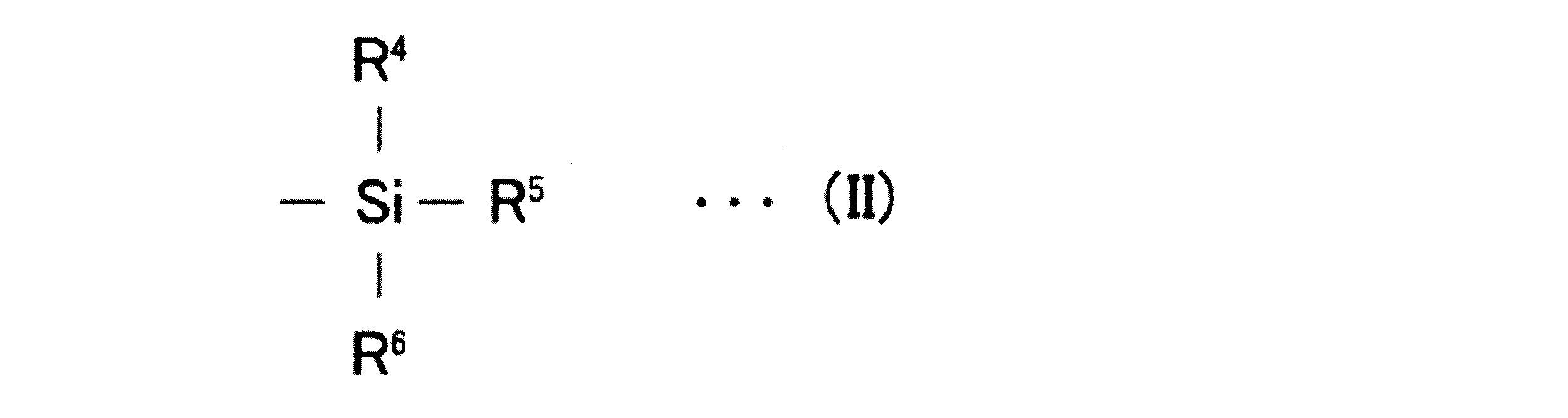
前記一般式(II)において、R4及びR5は、それぞれ同一又は異なる炭素数1~20の炭化水素基又はハロゲン化炭化水素基である。前記炭化水素基は、例えば、アルキル基又はアリール基(例えば、炭素数6~10のアリール基)であってもよい。前記ハロゲン化炭化水素基は、例えば、ハロゲン化アルキル基又はハロゲン化アリール基(例えば、炭素数6~10のハロゲン化アリール基)であってもよい。
前記一般式(II)において、R6は、炭素数1~20の炭化水素基、ハロゲン化炭化水素基、ラジカル反応性基、SH基、ラジカル反応性基含む有機基又はSH基を含む有機基である。前記炭素数1~20の炭化水素基は、例えば、アルキル基又はアリール基(例えば、炭素数6~10のアリール基)であってもよい。前記ハロゲン化炭化水素基は、例えば、ハロゲン化アルキル基又はハロゲン化アリール基(例えば、炭素数6~10のハロゲン化アリール基)であってもよい。前記ラジカル反応性基は、例えば、ビニル基、アリル基、γ-アクリロキシプロピル基、γ-メタクリロキシプロピル基又はγ-メルカプトプロピル基であってもよい。
前記一般式(I)において、mは10000以下の正の整数(例えば、500~8000)であり、nは1以上(例えば、1~500)の整数である。
前記前記アクリル変性ポリオルガノシロキサンにおいて、(メタ)アクリル酸エステルは、例えば、下記一般式(III)で表される(メタ)アクリル酸エステルであってもよい。

前記一般式(III)において、R7は水素原子又はメチル基であり、R8はアルキル基(例えば、炭素数1~18のアルキル基)、アルコキシ置換アルキル基(例えば、炭素数3~6のアルコキシ置換アルキル基)、シクロアルキル基(例えば、炭素数6又は7のシクロアルキル基)又はアリール基(例えば、炭素数6~10のアリール基)である。
前記アクリル変性ポリオルガノシロキサンは、平均粒子径が0.1μm以上100μm以下であってもよく、1μm以上100μm以下であってもよく、5μm以上100μm以下であってもよく、0.1μm以上80μm以下であってもよく、0.1μm以上50μm以下であってもよい。本発明において、前記アクリル変性ポリオルガノシロキサンの平均粒子径は、レーザー回折・散乱式の粒度分布測定装置、例えば、粒度分布測定装置(日機装株式会社社製MICROTRAC/HRA(9320-X100))にて測定することができる。
前記アクリル変性ポリオルガノシロキサンとしては、例えば、日信化学工業株式会社製のシリコーン・アクリル系ハイブリット樹脂(シャリーヌ(登録商標))等の市販品を用いることができる。
前記粉体成形用塩化ビニル系樹脂組成物は、さらに、安定剤、着色剤、酸化防止剤、充填剤、紫外線吸収剤等の樹脂配合剤を適宜含んでもよい。また、アクリル変性ポリオルガノシロキサンの以外の滑剤を適宜含んでもよい。
前記安定剤としては、例えば、エポキシ系安定剤、バリウム系安定剤、カルシウム系安定剤、スズ系安定剤、亜鉛系安定剤、ヒンダードアミン系光安定剤、カルシウム-亜鉛系(Ca-Zn系)及びバリウム-亜鉛系(Ba-Zn系)等の複合安定剤も使用することができる。前記安定剤は、一種を単独で用いてもよいし、二種以上を併用してもよい。前記安定剤は、塩化ビニル系樹脂(A)100質量部に対して、0.01質量部以上8質量部以下配合することが好ましい。
前記着色剤としては、例えば、酸化チタン、酸化亜鉛、カーボンブラック等を挙げることができる。また、前記着色剤としては、青顔料、赤顔料等の市販の顔料を用いてもよい。前記着色剤は、一種を単独で用いてもよいし、二種以上を併用してもよい。
前記粉体成形用塩化ビニル系樹脂組成物は、塩化ビニル系樹脂(A)、アクリル系重合体、及びポリエステル系可塑剤と、必要に応じて、塩化ビニル系樹脂(B)、アクリル変性ポリオルガノシロキサン、及びその他の樹脂配合剤を適宜混合することで、製造することができる。混合方法は、特に限定されないが、例えば、ドライブレンド法が好ましい。混合機としては、特に限定されないが、例えば、スーパーミキサー等を用いることができる。
前記粉体成形用塩化ビニル系樹脂組成物の平均粒子径は、特に限定されないが、例えば、50μm以上であってもよく、60μm以上であってもよく、100μm以上であってもよく、150μm以上であってもよい。また、前記粉体成形用塩化ビニル系樹脂組成物の平均粒子径は、特に限定されないが、例えば、500μm以下であってもよく、300μm以下であってもよく、200μm以下であってもよい。より具体的には、前記粉体成形用塩化ビニル系樹脂組成物の平均粒子径は、例えば、50μm以上500μm以下であってもよいが、粉体流動性の観点から、例えば、100μm以上300μm以下であることが好ましく、100μm以上200μm以下であることがより好ましく、150μm以上200μm以下であることがさらに好ましい。前記粉体成形用塩化ビニル系樹脂組成物の平均粒子径は、JIS K 7369:2009に準じて測定することができる。
前記粉体成形用塩化ビニル系樹脂組成物は、特に限定されないが、ブロッキング性に優れる観点から、付着力が500gf/cm2(49kPa)以下であることが好ましく、300gf/cm2以下であることがより好ましく、250gf/cm2以下であることがさらに好ましく、200gf/cm2以下であることがさらにより好ましく、150gf/cm2以下であることが特に好ましい。本発明において、付着力は、後述するとおりに測定算出する。
前記粉体成形用塩化ビニル系樹脂組成物をパウダースラッシュ成形することで塩化ビニル系樹脂成形体が得られる。そのため、塩化ビニル系樹脂成形体は、粉体成形用塩化ビニル系樹脂組成物と同様の組成を有することになる。なお、前記塩化ビニル系樹脂成形体の断面を観察すると、パウダースラッシュ成形に用いた粉体成形用塩化ビニル系樹脂組成物(塩化ビニル系樹脂粒子)間の界面が確認されることにより、当該成形体がパウダースラッシュ成形により製造されたものであること、すなわち当該成形体がパウダースラッシュ成形体であることを確認することができる。
パウダースラッシュ成形の方法は特に限定されないが、例えば、パウダーボックスとスラッシュ成形用金型(以下において、単に「金型」とも記す。)とを備えたスラッシュ成形機において、パウダーボックスに前記粉体成形用塩化ビニル系樹脂組成物を投入するとともに、金型を所定の温度、例えば、230℃以上280℃以下に加熱し、次いで、スラッシュ成形機を反転させて、所定の温度に加熱された金型の表面に前記粉体成形用塩化ビニル系樹脂組成物を接触させて所定時間、例えば、3秒以上15秒以下保持し、その後、スラッシュ成形機を再び反転させて金型を所定の温度、例えば、10℃以上60℃以下に冷却し、冷却された金型から成形体を剥離する方法を用いることができる。
前記塩化ビニル系樹脂成形体の形状は特に限られないが、例えば、シート状であってもよい。前記塩化ビニル系樹脂成形体がシート状である(以下において、塩化ビニル系樹脂シートとも記す。)場合、その厚さは、特に限定されないが、例えば、3.0mm以下であってもよく、2.0mm以下であってもよく、1.6mm以下であってもよい。また、例えば、0.5mm以上であってもよく、0.6mm以上であってもよく、0.8mm以上であってもよい。より具体的に、前記塩化ビニル系樹脂成形体がシート状である場合、その厚さは、例えば、0.5mm以上3.0mm以下であってもよく、0.6mm以上2.0mm以下であってもよく、0.8mm以上1.6mm以下であってもよい。
前記塩化ビニル系樹脂成形体は、表面特性に優れる観点から、例えば、JIS K 7125:1999に準じて測定した動摩擦係数が0.850以下であることが好ましく、0.820以下であることがより好ましく、0.800以下であることがさらに好ましく、0.780以下であることがさらにより好ましく、0.740以下であることがさらにより好ましく、0.700以下であることが特に好ましい。
前記塩化ビニル系樹脂成形体は、低温における柔軟性に優れる観点から、-25℃における引張伸びが120%以上であることが好ましく、150%以上であることがより好ましく、200%以上であることがさらに好ましく、220%以上であることがさらにより好ましく、230%以上であることが特に好ましい。
前記塩化ビニル系樹脂成形体は、特に限定されないが、例えば、自動車等の車両のインストルメントパネル、ドアトリム、トランクトリム、座席シート、ピラーカバー、天井材、リアトレイ、コンソールボックス、エアバッグカバー、アームレスト、ヘッドレスト、メーターカバー、クラッシュパッド等の車両内装材用表皮として好適に用いることができる。
前記塩化ビニル系樹脂成形体と、発泡ポリウレタン層(発泡ポリウレタン成形体とも記す。)を積層して積層体として用いることができる。積層方法としては、特に限定されず、例えば、塩化ビニル系樹脂成形体と、発泡ポリウレタン成形体とを別途作製した後に、熱融着又は熱接着或いは公知の接着剤等を用いることにより貼り合わせる方法;塩化ビニル系樹脂成形体上にて、発泡ポリウレタン成形体の原料となるイソシアネート類とポリオール類等を反応させて重合を行うとともに、公知の方法によりポリウレタンの発泡を行うことにより積層する方法等が挙げられる。後者の方が、工程が簡素であり、かつ、種々の形状の積層体を得る場合においても、塩化ビニル系樹脂成形体と発泡ポリウレタン成形体の接着を確実に行うことができるので好適である。
前記積層体は、発泡ポリウレタン層と、発泡ポリウレタン層の一方の表面に積層された塩化ビニル系樹脂成形体(塩化ビニル系樹脂層とも記す。)と、発泡ポリウレタン層の他方の表面に積層された他の樹脂層とを有してもよい。前記他の樹脂層は、例えば、ポリオレフィン系樹脂(例えば、ポリプロピレン及び/又はポリエチレン-ポリプロピレン共重合体)又はABS(アクリロニトリル・ブタジエン・スチレン)樹脂の層であってもよい。このような積層体は、例えば、当該塩化ビニル系樹脂層と、当該他の樹脂層との間で、ポリウレタンの発泡成形を行うことにより製造することができる。
前記積層体は、特に限定されないが、例えば、自動車等の車両のインストルメントパネル、ドアトリム、トランクトリム、座席シート、ピラーカバー、天井材、リアトレイ、コンソールボックス、エアバッグカバー、アームレスト、ヘッドレスト、メーターカバー、クラッシュパッド等の車両内装材として好適に用いることができる。
以下、実施例を用いて本発明をさらに具体的に説明する。なお、本発明は下記の実施例に限定されるものではない。
(アクリル系重合体の製造例1)
撹拌機、還流冷却器、温度計、窒素ガス導入管及びフィードポンプを備えた2L重合装置に、脱イオン水380gを入れ、窒素雰囲気下で撹拌しながら昇温し、内温が80℃に到達した時点で2質量%の過硫酸ナトリウムの水溶液23.5gを添加した。次に、メタクリル酸メチル(MMA)420.0g、メタクリル酸イソブチル(iBMA)280.0g、ジ-(2-エチルヘキシル)スルホコハク酸ナトリウム2.5g、1-オクタンチオール0.05g、及び脱イオン水230.0gを混合攪拌して作製したモノマー乳化液を2時間かけて滴下し、滴下後も80℃にて2時間攪拌を継続してラテックスを得た。得られたラテックスを室温(約23℃)まで冷却し、スプレードライヤー(大川原化工機株式会社L-12-LS型)を用いて、入口温度130℃、出口温度60℃、アトマイザーディスク回転速度20000rpmにて噴霧乾燥し、アクリル系重合体A1を製造した。得られたアクリル系重合体A1は、平均粒子径が0.80μmであり、質量平均分子量(Mw)が52万であった。
撹拌機、還流冷却器、温度計、窒素ガス導入管及びフィードポンプを備えた2L重合装置に、脱イオン水380gを入れ、窒素雰囲気下で撹拌しながら昇温し、内温が80℃に到達した時点で2質量%の過硫酸ナトリウムの水溶液23.5gを添加した。次に、メタクリル酸メチル(MMA)420.0g、メタクリル酸イソブチル(iBMA)280.0g、ジ-(2-エチルヘキシル)スルホコハク酸ナトリウム2.5g、1-オクタンチオール0.05g、及び脱イオン水230.0gを混合攪拌して作製したモノマー乳化液を2時間かけて滴下し、滴下後も80℃にて2時間攪拌を継続してラテックスを得た。得られたラテックスを室温(約23℃)まで冷却し、スプレードライヤー(大川原化工機株式会社L-12-LS型)を用いて、入口温度130℃、出口温度60℃、アトマイザーディスク回転速度20000rpmにて噴霧乾燥し、アクリル系重合体A1を製造した。得られたアクリル系重合体A1は、平均粒子径が0.80μmであり、質量平均分子量(Mw)が52万であった。
(アクリル系重合体の製造例2)
モノマー乳化液中のメタクリル酸メチル(MMA)を560.0gに変更し、メタクリル酸イソブチル(iBMA)を140.0gに変更した以外は、製造例1と同様にしてアクリル系重合体A2を製造した。得られたアクリル系重合体A2は、平均粒子径が0.82μmであり、質量平均分子量(Mw)が45万であった。
モノマー乳化液中のメタクリル酸メチル(MMA)を560.0gに変更し、メタクリル酸イソブチル(iBMA)を140.0gに変更した以外は、製造例1と同様にしてアクリル系重合体A2を製造した。得られたアクリル系重合体A2は、平均粒子径が0.82μmであり、質量平均分子量(Mw)が45万であった。
(アクリル系重合体の製造例3)
モノマー乳化液中のメタクリル酸メチル(MMA)を700.0gに変更し、メタクリル酸イソブチル(iBMA)を抜いた以外は、製造例1と同様にしてアクリル系重合体Z1を製造した。得られたアクリル系重合体Z1は、平均粒子径が0.82μmであり、質量平均分子量(Mw)が26万であった。
モノマー乳化液中のメタクリル酸メチル(MMA)を700.0gに変更し、メタクリル酸イソブチル(iBMA)を抜いた以外は、製造例1と同様にしてアクリル系重合体Z1を製造した。得られたアクリル系重合体Z1は、平均粒子径が0.82μmであり、質量平均分子量(Mw)が26万であった。
アクリル系重合体の平均粒子径を動的光散乱式粒度分布測定装置(マイクロトラック・ベル社製「Nanotrac Wave-EX150」)を用いて測定し、質量平均分子量(Mw)を高速GPC装置(東ソー(株)製「HCL-8220」、カラム:東ソー(株)製「TSKguardcolumnHZ-H」及び「TSKgelSuperHZM-H」、GPC溶媒:THF)にて測定した。
(実施例1)
<粉体成形用塩化ビニル系樹脂組成物の製造>
100Lのスーパーミキサー(株式会社カワタ製)に、塩化ビニル系樹脂(A)(塩化ビニル単独重合体、平均重合度2500、平均粒子径177μm、株式会社カネカ製「KS-2500」)100質量部、ポリエステル系可塑剤(アジピン酸ポリエステル系可塑剤、Mw2000、粘度3000mPa・s(25℃)、株式会社ADEKA製「HPN-3130」)130質量部、安定剤としてステアリン酸亜鉛5質量部、過塩素酸ナトリウム1.5質量部、ヒンダードアミン系光安定剤(HALS)0.3質量部及びエポキシ化大豆油5質量部、並びに顔料(黒)3質量部を添加し、80℃で混合し、昇温して混合物をドライアップした後、50℃以下に冷却した。得られた混合物に、製造例1で得られたアクリル系重合体A1を7質量部と塩化ビニル系樹脂(B1)(塩化ビニル単独重合体、平均重合度1300、平均粒子径10μm、株式会社カネカ製「PSM-31」)を18質量部添加して混合し、粉体成形用塩化ビニル系樹脂組成物(粉末状)を作製した。
<粉体成形用塩化ビニル系樹脂組成物の製造>
100Lのスーパーミキサー(株式会社カワタ製)に、塩化ビニル系樹脂(A)(塩化ビニル単独重合体、平均重合度2500、平均粒子径177μm、株式会社カネカ製「KS-2500」)100質量部、ポリエステル系可塑剤(アジピン酸ポリエステル系可塑剤、Mw2000、粘度3000mPa・s(25℃)、株式会社ADEKA製「HPN-3130」)130質量部、安定剤としてステアリン酸亜鉛5質量部、過塩素酸ナトリウム1.5質量部、ヒンダードアミン系光安定剤(HALS)0.3質量部及びエポキシ化大豆油5質量部、並びに顔料(黒)3質量部を添加し、80℃で混合し、昇温して混合物をドライアップした後、50℃以下に冷却した。得られた混合物に、製造例1で得られたアクリル系重合体A1を7質量部と塩化ビニル系樹脂(B1)(塩化ビニル単独重合体、平均重合度1300、平均粒子径10μm、株式会社カネカ製「PSM-31」)を18質量部添加して混合し、粉体成形用塩化ビニル系樹脂組成物(粉末状)を作製した。
<塩化ビニル系樹脂成形体の製造>
上記で得られた粉体成形用塩化ビニル系樹脂組成物を用い、シボ付平板(縦22cm×横31cm)を有するスラッシュ成形用金型とパウダーボックス(縦22cm×横31cm×深さ16cm)とを備えた箱型スラッシュ成形機を使用して、パウダースラッシュ成形を行った。具体的に、まず、パウダーボックスに粉体成形用塩化ビニル系樹脂組成物2kgを投入するとともに、280℃に加熱したスラッシュ成形用金型をスラッシュ成形機にセットした。次いで、金型が260℃となった時点で、スラッシュ成形機を反転させ、塩化ビニル系樹脂シート(PVCシートとも記す。)の厚みが1.0mmとなるように、粉体成形用塩化ビニル系樹脂組成物を当該金型内に約10~12秒間保持した後、スラッシュ成形機を反転させた。60秒間経過した時点で金型を冷却水で50℃になるまで冷却した。次に、PVCシートを金型から剥がし、塩化ビニル系樹脂成形体を得た。
上記で得られた粉体成形用塩化ビニル系樹脂組成物を用い、シボ付平板(縦22cm×横31cm)を有するスラッシュ成形用金型とパウダーボックス(縦22cm×横31cm×深さ16cm)とを備えた箱型スラッシュ成形機を使用して、パウダースラッシュ成形を行った。具体的に、まず、パウダーボックスに粉体成形用塩化ビニル系樹脂組成物2kgを投入するとともに、280℃に加熱したスラッシュ成形用金型をスラッシュ成形機にセットした。次いで、金型が260℃となった時点で、スラッシュ成形機を反転させ、塩化ビニル系樹脂シート(PVCシートとも記す。)の厚みが1.0mmとなるように、粉体成形用塩化ビニル系樹脂組成物を当該金型内に約10~12秒間保持した後、スラッシュ成形機を反転させた。60秒間経過した時点で金型を冷却水で50℃になるまで冷却した。次に、PVCシートを金型から剥がし、塩化ビニル系樹脂成形体を得た。
<積層体の製造>
発泡成形用金型(縦190mm×横240mm×深さ11mm)底面に、上記で得られたPVCシートを敷いた。次に、PVCシートの上に、4,4´-ジフェニルメタンージイソシアネートを含むA液36gと、ポリエーテルポリオールを含むB液(トリエチレンジアミン1.0質量%、水1.6質量%含有)78gとを混合して調製された原料液を注ぎ、金型を密閉した。所定の時間後、厚さ約1mmのPVCシート(表皮)と、当該PVCシートに積層された厚さ約9mmの発泡ポリウレタン層(裏打ち材)を有する積層体を金型から回収した。
発泡成形用金型(縦190mm×横240mm×深さ11mm)底面に、上記で得られたPVCシートを敷いた。次に、PVCシートの上に、4,4´-ジフェニルメタンージイソシアネートを含むA液36gと、ポリエーテルポリオールを含むB液(トリエチレンジアミン1.0質量%、水1.6質量%含有)78gとを混合して調製された原料液を注ぎ、金型を密閉した。所定の時間後、厚さ約1mmのPVCシート(表皮)と、当該PVCシートに積層された厚さ約9mmの発泡ポリウレタン層(裏打ち材)を有する積層体を金型から回収した。
(実施例2)
ポリエステル系可塑剤の配合量を145質量部に、製造例1で得られたアクリル系重合体A1の配合量を5質量部に、塩化ビニル系樹脂(B1)の配合量を20質量部に変更した以外は、実施例1と同様にして、粉体成形用塩化ビニル系樹脂組成物、塩化ビニル系樹脂成形体及び積層体を作製した。
ポリエステル系可塑剤の配合量を145質量部に、製造例1で得られたアクリル系重合体A1の配合量を5質量部に、塩化ビニル系樹脂(B1)の配合量を20質量部に変更した以外は、実施例1と同様にして、粉体成形用塩化ビニル系樹脂組成物、塩化ビニル系樹脂成形体及び積層体を作製した。
(実施例3)
ポリエステル系可塑剤の配合量を145質量部に変更した以外は、実施例1と同様にして、粉体成形用塩化ビニル系樹脂組成物、塩化ビニル系樹脂成形体及び積層体を作製した。
ポリエステル系可塑剤の配合量を145質量部に変更した以外は、実施例1と同様にして、粉体成形用塩化ビニル系樹脂組成物、塩化ビニル系樹脂成形体及び積層体を作製した。
(実施例4)
ポリエステル系可塑剤の配合量を145質量部に変更し、製造例1で得られたアクリル系重合体A1に代えて製造例2で得られたアクリル系重合体A2を用い、塩化ビニル系樹脂(B1)に代えて塩化ビニル系樹脂(B2)(塩化ビニル単独重合体、平均重合度1000、平均粒子径10μm、株式会社カネカ製「PSL-31」)を用いた以外は、実施例1と同様にして、粉体成形用塩化ビニル系樹脂組成物、塩化ビニル系樹脂成形体及び積層体を作製した。
ポリエステル系可塑剤の配合量を145質量部に変更し、製造例1で得られたアクリル系重合体A1に代えて製造例2で得られたアクリル系重合体A2を用い、塩化ビニル系樹脂(B1)に代えて塩化ビニル系樹脂(B2)(塩化ビニル単独重合体、平均重合度1000、平均粒子径10μm、株式会社カネカ製「PSL-31」)を用いた以外は、実施例1と同様にして、粉体成形用塩化ビニル系樹脂組成物、塩化ビニル系樹脂成形体及び積層体を作製した。
(実施例5)
ポリエステル系可塑剤の配合量を160質量部に変更した以外は、実施例1と同様にして、粉体成形用塩化ビニル系樹脂組成物、塩化ビニル系樹脂成形体及び積層体を作製した。
ポリエステル系可塑剤の配合量を160質量部に変更した以外は、実施例1と同様にして、粉体成形用塩化ビニル系樹脂組成物、塩化ビニル系樹脂成形体及び積層体を作製した。
(実施例6)
ポリエステル系可塑剤の配合量を160質量部に、製造例1で得られたアクリル系重合体A1の配合量を15質量部に、塩化ビニル系樹脂(B1)の配合量を10質量部に変更した以外は、実施例1と同様にして、粉体成形用塩化ビニル系樹脂組成物、塩化ビニル系樹脂成形体及び積層体を作製した。
ポリエステル系可塑剤の配合量を160質量部に、製造例1で得られたアクリル系重合体A1の配合量を15質量部に、塩化ビニル系樹脂(B1)の配合量を10質量部に変更した以外は、実施例1と同様にして、粉体成形用塩化ビニル系樹脂組成物、塩化ビニル系樹脂成形体及び積層体を作製した。
(実施例7)
ポリエステル系可塑剤の配合量を160質量部に、製造例1で得られたアクリル系重合体A1の配合量を15質量部に、塩化ビニル系樹脂(B1)の配合量を15質量部に変更した以外は、実施例1と同様にして、粉体成形用塩化ビニル系樹脂組成物、塩化ビニル系樹脂成形体及び積層体を作製した。
ポリエステル系可塑剤の配合量を160質量部に、製造例1で得られたアクリル系重合体A1の配合量を15質量部に、塩化ビニル系樹脂(B1)の配合量を15質量部に変更した以外は、実施例1と同様にして、粉体成形用塩化ビニル系樹脂組成物、塩化ビニル系樹脂成形体及び積層体を作製した。
(比較例1)
ポリエステル系可塑剤の配合量を110質量部に変更した以外は、実施例1と同様にして、粉体成形用塩化ビニル系樹脂組成物、塩化ビニル系樹脂成形体及び積層体を作製した。
ポリエステル系可塑剤の配合量を110質量部に変更した以外は、実施例1と同様にして、粉体成形用塩化ビニル系樹脂組成物、塩化ビニル系樹脂成形体及び積層体を作製した。
(比較例2)
製造例1で得られたアクリル系重合体A1に代えて製造例3で得られたアクリル系重合体Z1を用いた以外は、実施例3と同様にして、粉体成形用塩化ビニル系樹脂組成物、塩化ビニル系樹脂成形体及び積層体を作製した。
製造例1で得られたアクリル系重合体A1に代えて製造例3で得られたアクリル系重合体Z1を用いた以外は、実施例3と同様にして、粉体成形用塩化ビニル系樹脂組成物、塩化ビニル系樹脂成形体及び積層体を作製した。
(比較例3)
アクリル系重合体を使用せず、塩化ビニル系樹脂(B1)の配合量を25質量部に変更した以外は、実施例5と同様にして、粉体成形用塩化ビニル系樹脂組成物、塩化ビニル系樹脂成形体及び積層体を作製した。
アクリル系重合体を使用せず、塩化ビニル系樹脂(B1)の配合量を25質量部に変更した以外は、実施例5と同様にして、粉体成形用塩化ビニル系樹脂組成物、塩化ビニル系樹脂成形体及び積層体を作製した。
(比較例4)
ポリエステル系可塑剤の配合量を210質量部に変更した以外は、実施例1と同様にして、粉体成形用塩化ビニル系樹脂組成物、塩化ビニル系樹脂成形体及び積層体を作製した。
ポリエステル系可塑剤の配合量を210質量部に変更した以外は、実施例1と同様にして、粉体成形用塩化ビニル系樹脂組成物、塩化ビニル系樹脂成形体及び積層体を作製した。
実施例及び比較例において、粉体成形用塩化ビニル系樹脂組成物の付着力を下記のように測定し、ブロッキング性を評価した。また、実施例及び比較例において、塩化ビニル系樹脂成形体の動摩擦係数、低温における引張伸度を下記のように測定・評価した。これらの結果を下記表1に示した。下記表1において、「部」は「質量部」を意味する。
(付着力)
内径5cmの円筒状セルに粉体成形用塩化ビニル系樹脂組成物40gを充填した後、30℃の恒温槽に入れ加温した。粉体成形用塩化ビニル系樹脂組成物の温度が30℃に上昇した後、1.3kgのピストンと5kgの錘(荷重トータル0.32kgf/cm2)を乗せた。その後、60℃の恒温槽内に2時間保持した。2時間経過後、23℃、50%RHの環境下にて取り出して、1時間冷却して錘とピストンを取り外し、円筒状セルから粉体成形用塩化ビニル系樹脂組成物のケーキを取り出した。得られたケーキの圧壊強度をレオメーター(株式会社レオテック製RT-2010J-CW)で測定し、下記式で付着力を算出した。
付着力(gf/cm2)=2×B/(3.14×R×D)
B:圧壊試験における荷重(N)
R:ケーキの直径(mm)
D:ケーキの厚み(mm)
内径5cmの円筒状セルに粉体成形用塩化ビニル系樹脂組成物40gを充填した後、30℃の恒温槽に入れ加温した。粉体成形用塩化ビニル系樹脂組成物の温度が30℃に上昇した後、1.3kgのピストンと5kgの錘(荷重トータル0.32kgf/cm2)を乗せた。その後、60℃の恒温槽内に2時間保持した。2時間経過後、23℃、50%RHの環境下にて取り出して、1時間冷却して錘とピストンを取り外し、円筒状セルから粉体成形用塩化ビニル系樹脂組成物のケーキを取り出した。得られたケーキの圧壊強度をレオメーター(株式会社レオテック製RT-2010J-CW)で測定し、下記式で付着力を算出した。
付着力(gf/cm2)=2×B/(3.14×R×D)
B:圧壊試験における荷重(N)
R:ケーキの直径(mm)
D:ケーキの厚み(mm)
(動摩擦係数)
JIS K 7125:1999に準拠して測定した。具体的には、万能材料試験機(エー・アンド・デイ社製、テンシロン)を使用し、23℃、50%RH(相対湿度)の環境下にて、試験速度100mm/分、垂直荷重1.96N平面圧子仕様で相手材であるNBRゴムシート(黒ゴム)をPVCシートの上を滑らしてその動摩擦力を測定し、動摩擦係数を算出した。動摩擦係数が0.850以下を合格とした。
JIS K 7125:1999に準拠して測定した。具体的には、万能材料試験機(エー・アンド・デイ社製、テンシロン)を使用し、23℃、50%RH(相対湿度)の環境下にて、試験速度100mm/分、垂直荷重1.96N平面圧子仕様で相手材であるNBRゴムシート(黒ゴム)をPVCシートの上を滑らしてその動摩擦力を測定し、動摩擦係数を算出した。動摩擦係数が0.850以下を合格とした。
(引張伸度)
PVCシートを1号ダンベル形状に打ち抜いて、当該1号ダンベル形状の試料を得た。次いで、この試料の両端を一対のチャック(チャック間距離は40mm)で保持した。そして、-25℃のチャンバー内において、試料を3分間保持した後、引張速度200mm/分にて、引張試験を行い、破断伸度を測定し、引張伸度とした。
PVCシートを1号ダンベル形状に打ち抜いて、当該1号ダンベル形状の試料を得た。次いで、この試料の両端を一対のチャック(チャック間距離は40mm)で保持した。そして、-25℃のチャンバー内において、試料を3分間保持した後、引張速度200mm/分にて、引張試験を行い、破断伸度を測定し、引張伸度とした。
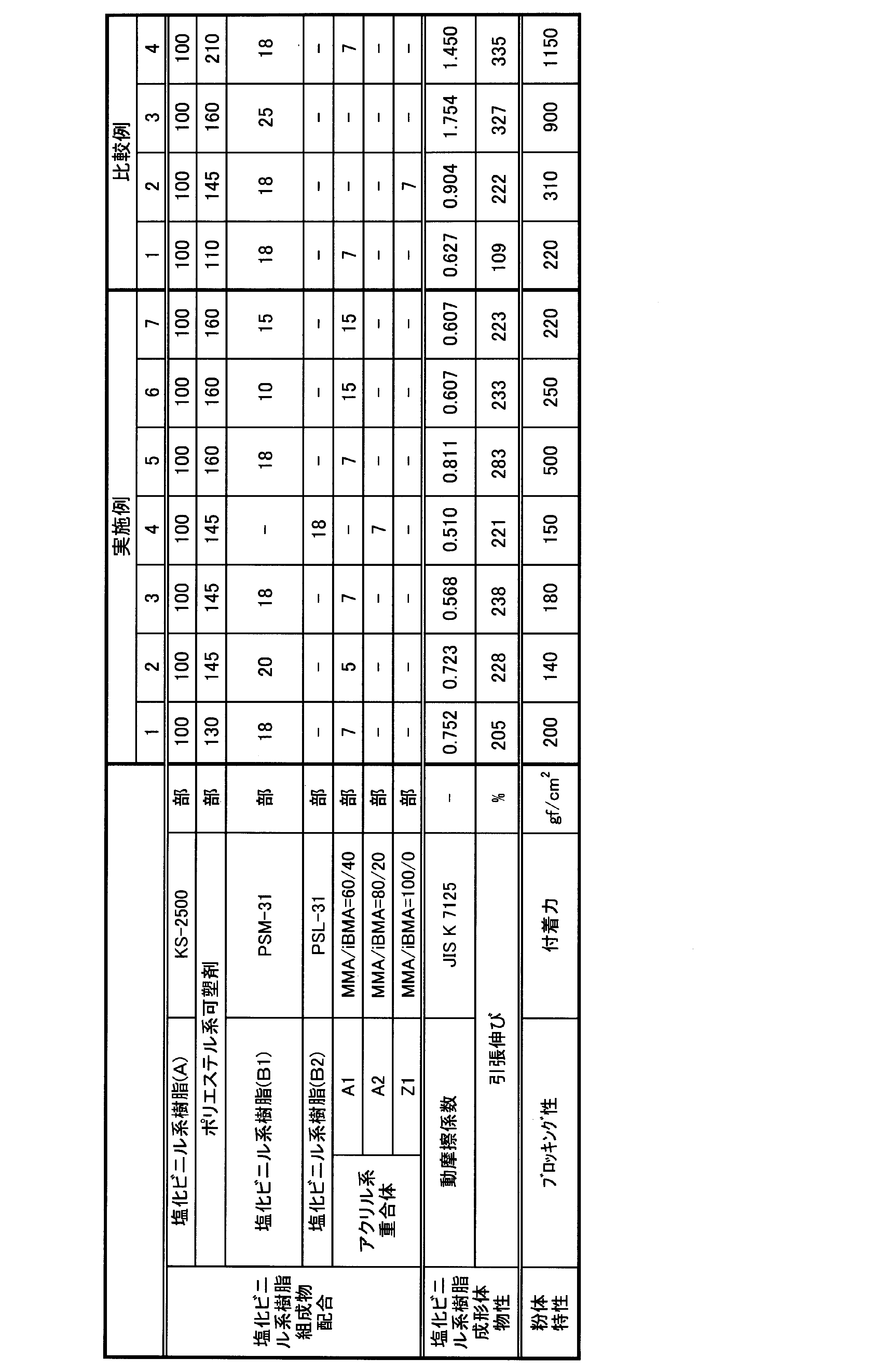
上記表1の結果から分かるように、実施例1~7の塩化ビニル系樹脂成形体は、-25℃における引張伸びが高く、低温における柔軟性に優れている。実施例1~7の塩化ビニル系樹脂成形体は、動摩擦係数が低く、表面特性が良好であった。また、実施例1~7の塩化ビニル系樹脂組成物は、付着力が500gf/cm2以下であり、ブロッキング性が良好であった。
一方、表1の結果から分かるように、塩化ビニル系樹脂(A)100質量部に対するポリエステル系可塑剤の配合量が120質量部未満である比較例1の塩化ビニル系樹脂成形体は、-25℃における引張伸びが低く、低温における柔軟性が劣っていた。塩化ビニル系樹脂(A)100質量部に対するポリエステル系可塑剤の配合量が200質量部を超える比較例4の塩化ビニル系樹脂成形体は、動摩擦係数が高く、表面特性が悪い上、付着力も500gf/cm2を超えており、ブロッキング性も劣っていた。(メタ)アクリル酸メチル由来の構成単位100質量%からなるアクリル系重合体を用いた比較例2では、動摩擦係数が高く、表面特性が悪かった。アクリル系重合体を含まない比較例3では、動摩擦係数が高く、表面特性が悪い上、付着力が500gf/cm2を超えており、ブロッキング性も劣っていた。
Claims (10)
- 塩化ビニル系樹脂(A)100質量部、ポリエステル系可塑剤120質量部以上200質量部以下、アクリル系重合体4質量部以上23質量部以下を含み、
塩化ビニル系樹脂(A)は、平均粒子径が50μm以上500μm以下であり、かつ平均重合度が1700以上であり、
前記アクリル系重合体は、(メタ)アクリル酸メチル由来の構成単位を40質量%以上95質量%以下と、炭素数が2以上の脂肪族アルコールの(メタ)アクリル酸エステル及び芳香族アルコールの(メタ)アクリル酸エステルからなる群から選ばれる少なくとも一種の(メタ)アクリル酸エステル由来の構成単位を5質量%以上60質量%以下含むことを特徴とする、粉体成形用塩化ビニル系樹脂組成物。 - 前記アクリル系重合体は、平均粒子径が0.01μm以上10μm以下である請求項1に記載の粉体成形用塩化ビニル系樹脂組成物。
- 前記アクリル系重合体は、(メタ)アクリル酸メチル由来の構成単位を40質量%以上95質量%以下と、(メタ)アクリル酸n-ブチル、(メタ)アクリル酸イソブチル及び(メタ)アクリル酸tert-ブチルからなる群から選ばれる少なくとも一種の(メタ)アクリル酸エステル由来の構成単位を5質量%以上60質量%以下含む請求項1又は2に記載の粉体成形用塩化ビニル系樹脂組成物。
- さらに、平均粒子径が0.05μm以上50μm未満の塩化ビニル系樹脂(B)を含み、塩化ビニル系樹脂(A)100質量部に対して、塩化ビニル系樹脂(B)の配合量が36質量部以下である、請求項1~3のいずれか1項に記載の粉体成形用塩化ビニル系樹脂組成物。
- さらに、アクリル変性ポリオルガノシロキサンを含み、塩化ビニル系樹脂(A)100質量部に対して、前記アクリル変性ポリオルガノシロキサンの配合量が5質量部以下である請求項1~4のいずれか1項に記載の粉体成形用塩化ビニル系樹脂組成物。
- パウダースラッシュ成形に用いる、請求項1~5のいずれか1項に記載の粉体成形用塩化ビニル系樹脂組成物。
- 請求項1~6のいずれか1項に記載の粉体成形用塩化ビニル系樹脂組成物をパウダースラッシュ成形してなる、塩化ビニル系樹脂成形体。
- 車両内装材用表皮である、請求項7に記載の塩化ビニル系樹脂成形体。
- 発泡ポリウレタン層と、請求項7又は8に記載の塩化ビニル系樹脂成形体とが積層されてなる、積層体。
- 車両内装材である、請求項9に記載の積層体。
Priority Applications (2)
| Application Number | Priority Date | Filing Date | Title |
|---|---|---|---|
| JP2021504078A JP7382390B2 (ja) | 2019-03-07 | 2020-03-02 | 粉体成形用塩化ビニル系樹脂組成物、塩化ビニル系樹脂成形体及び積層体 |
| US17/395,573 US20210363343A1 (en) | 2019-03-07 | 2021-08-06 | Vinyl chloride resin composition for powder molding, vinyl chloride resin molded body, and laminate |
Applications Claiming Priority (2)
| Application Number | Priority Date | Filing Date | Title |
|---|---|---|---|
| JP2019-041514 | 2019-03-07 | ||
| JP2019041514 | 2019-03-07 |
Related Child Applications (1)
| Application Number | Title | Priority Date | Filing Date |
|---|---|---|---|
| US17/395,573 Continuation US20210363343A1 (en) | 2019-03-07 | 2021-08-06 | Vinyl chloride resin composition for powder molding, vinyl chloride resin molded body, and laminate |
Publications (1)
| Publication Number | Publication Date |
|---|---|
| WO2020179732A1 true WO2020179732A1 (ja) | 2020-09-10 |
Family
ID=72338339
Family Applications (1)
| Application Number | Title | Priority Date | Filing Date |
|---|---|---|---|
| PCT/JP2020/008685 Ceased WO2020179732A1 (ja) | 2019-03-07 | 2020-03-02 | 粉体成形用塩化ビニル系樹脂組成物、塩化ビニル系樹脂成形体及び積層体 |
Country Status (3)
| Country | Link |
|---|---|
| US (1) | US20210363343A1 (ja) |
| JP (1) | JP7382390B2 (ja) |
| WO (1) | WO2020179732A1 (ja) |
Cited By (2)
| Publication number | Priority date | Publication date | Assignee | Title |
|---|---|---|---|---|
| CN117279994A (zh) * | 2021-06-30 | 2023-12-22 | 日本瑞翁株式会社 | 粉体成型用氯乙烯树脂组合物、氯乙烯树脂成型体以及层叠体 |
| US20240352244A1 (en) * | 2021-09-30 | 2024-10-24 | Zeon Corporation | Vinyl chloride resin composition, vinyl chloride resin molded product, and laminate |
Families Citing this family (3)
| Publication number | Priority date | Publication date | Assignee | Title |
|---|---|---|---|---|
| JP7201607B2 (ja) * | 2017-10-16 | 2023-01-10 | 株式会社カネカ | 粉体成形用塩化ビニル系樹脂組成物、塩化ビニル系樹脂成形体及び積層体 |
| CN118401604A (zh) * | 2021-12-27 | 2024-07-26 | 日本瑞翁株式会社 | 氯乙烯树脂组合物、氯乙烯树脂成型体以及层叠体 |
| WO2023127609A1 (ja) * | 2021-12-27 | 2023-07-06 | 日本ゼオン株式会社 | 可塑剤組成物、樹脂組成物、樹脂成形体および積層体 |
Citations (4)
| Publication number | Priority date | Publication date | Assignee | Title |
|---|---|---|---|---|
| JPH07268159A (ja) * | 1994-03-30 | 1995-10-17 | Zeon Kasei Co Ltd | 塩化ビニル系樹脂組成物およびそれを用いた積層体 |
| JPH08337700A (ja) * | 1995-06-12 | 1996-12-24 | Asahi Denka Kogyo Kk | 可塑剤組成物 |
| JP2001055477A (ja) * | 1999-08-19 | 2001-02-27 | Mitsubishi Chem Mkv Co | 粉体成形用塩化ビニル系樹脂組成物 |
| JP2002194126A (ja) * | 2000-12-26 | 2002-07-10 | Zeon Kasei Co Ltd | ブロー成形用塩化ビニル樹脂組成物、ブロー成形品および積層成形品 |
Family Cites Families (4)
| Publication number | Priority date | Publication date | Assignee | Title |
|---|---|---|---|---|
| JP3631360B2 (ja) * | 1997-12-04 | 2005-03-23 | 株式会社カネカ | 塩化ビニル系樹脂組成物 |
| JP4204305B2 (ja) * | 2002-11-08 | 2009-01-07 | 株式会社Adeka | ポリエステル系可塑剤及び塩素含有樹脂組成物 |
| JP6215685B2 (ja) * | 2013-12-18 | 2017-10-18 | 龍田化学株式会社 | 塩化ビニル系樹脂組成物、塩化ビニル系樹脂パウダースラッシュ成形体、樹脂積層体及びこれらの製造方法 |
| JP7201607B2 (ja) * | 2017-10-16 | 2023-01-10 | 株式会社カネカ | 粉体成形用塩化ビニル系樹脂組成物、塩化ビニル系樹脂成形体及び積層体 |
-
2020
- 2020-03-02 JP JP2021504078A patent/JP7382390B2/ja active Active
- 2020-03-02 WO PCT/JP2020/008685 patent/WO2020179732A1/ja not_active Ceased
-
2021
- 2021-08-06 US US17/395,573 patent/US20210363343A1/en not_active Abandoned
Patent Citations (4)
| Publication number | Priority date | Publication date | Assignee | Title |
|---|---|---|---|---|
| JPH07268159A (ja) * | 1994-03-30 | 1995-10-17 | Zeon Kasei Co Ltd | 塩化ビニル系樹脂組成物およびそれを用いた積層体 |
| JPH08337700A (ja) * | 1995-06-12 | 1996-12-24 | Asahi Denka Kogyo Kk | 可塑剤組成物 |
| JP2001055477A (ja) * | 1999-08-19 | 2001-02-27 | Mitsubishi Chem Mkv Co | 粉体成形用塩化ビニル系樹脂組成物 |
| JP2002194126A (ja) * | 2000-12-26 | 2002-07-10 | Zeon Kasei Co Ltd | ブロー成形用塩化ビニル樹脂組成物、ブロー成形品および積層成形品 |
Cited By (3)
| Publication number | Priority date | Publication date | Assignee | Title |
|---|---|---|---|---|
| CN117279994A (zh) * | 2021-06-30 | 2023-12-22 | 日本瑞翁株式会社 | 粉体成型用氯乙烯树脂组合物、氯乙烯树脂成型体以及层叠体 |
| EP4365233A4 (en) * | 2021-06-30 | 2025-06-11 | Zeon Corporation | VINYL CHLORIDE RESIN COMPOSITION FOR MOLDING FROM POWDER, VINYL CHLORIDE RESIN MOLDED BODY AND MULTILAYER BODY |
| US20240352244A1 (en) * | 2021-09-30 | 2024-10-24 | Zeon Corporation | Vinyl chloride resin composition, vinyl chloride resin molded product, and laminate |
Also Published As
| Publication number | Publication date |
|---|---|
| JPWO2020179732A1 (ja) | 2020-09-10 |
| JP7382390B2 (ja) | 2023-11-16 |
| US20210363343A1 (en) | 2021-11-25 |
Similar Documents
| Publication | Publication Date | Title |
|---|---|---|
| JP7382390B2 (ja) | 粉体成形用塩化ビニル系樹脂組成物、塩化ビニル系樹脂成形体及び積層体 | |
| US6433048B2 (en) | Acrylic polymer fine particles and plastisol using the same | |
| EP2805996B1 (en) | Thermoplastic elastomer composition | |
| JP7201607B2 (ja) | 粉体成形用塩化ビニル系樹脂組成物、塩化ビニル系樹脂成形体及び積層体 | |
| TW201602213A (zh) | 熱塑性樹脂組成物及其成形品 | |
| CN101589105A (zh) | (甲基)丙烯酸系聚合物粒子、其制造方法、使用(甲基)丙烯酸系聚合物粒子的增塑溶胶组合物以及使用其的物品 | |
| JP6215685B2 (ja) | 塩化ビニル系樹脂組成物、塩化ビニル系樹脂パウダースラッシュ成形体、樹脂積層体及びこれらの製造方法 | |
| CN115135716A (zh) | 氯乙烯树脂组合物、氯乙烯树脂成型体以及层叠体 | |
| CN111225949B (zh) | 氯乙烯系树脂组合物的粉末搪塑成型体及层叠体 | |
| JP2010254761A (ja) | 熱可塑性エラストマー組成物および成形体 | |
| JP7223618B2 (ja) | 車両部材用樹脂成形品 | |
| JPWO2015174372A1 (ja) | アクリル系重合体、その製造方法及びそのアクリル系重合体を含むプラスチゾル組成物 | |
| JPWO2007148636A1 (ja) | 熱可塑性エラストマー組成物 | |
| JP2002128936A (ja) | アクリルゾル組成物及びこれを用いた発泡体 | |
| JP2005023165A (ja) | 非晶質ポリエステル樹脂組成物 | |
| JP2002030193A (ja) | プラスチゾル組成物及びこれを用いた成形物 | |
| JP2009120665A (ja) | 粉体状熱可塑性エラストマー組成物および成形体 | |
| JP2004195863A (ja) | 車両内装用塩化ビニル系樹脂被覆層及びこれを用いた積層体 | |
| JP2005263996A (ja) | 非晶質ポリエステル系樹脂組成物及びその成形品 | |
| JPWO2009063719A1 (ja) | 熱可塑性エラストマー組成物および成形体 | |
| WO2024203560A1 (ja) | 塩化ビニル樹脂組成物、塩化ビニル樹脂成形体、積層体及び自動車インスツルメントパネル | |
| JP2024138976A (ja) | 粉体成形用塩化ビニル系樹脂組成物 | |
| WO2024070984A1 (ja) | 塩化ビニル樹脂組成物、塩化ビニル樹脂成形体および積層体 | |
| JP2013023540A (ja) | スラッシュ成形用樹脂粉末組成物 | |
| JPS60262843A (ja) | 改良された接着性を有するウレタン樹脂との複合体用軟質塩化ビニル樹脂組成物 |
Legal Events
| Date | Code | Title | Description |
|---|---|---|---|
| 121 | Ep: the epo has been informed by wipo that ep was designated in this application |
Ref document number: 20765611 Country of ref document: EP Kind code of ref document: A1 |
|
| ENP | Entry into the national phase |
Ref document number: 2021504078 Country of ref document: JP Kind code of ref document: A |
|
| NENP | Non-entry into the national phase |
Ref country code: DE |
|
| 122 | Ep: pct application non-entry in european phase |
Ref document number: 20765611 Country of ref document: EP Kind code of ref document: A1 |