WO2020179287A1 - 酸基含有(メタ)アクリレート樹脂、硬化性樹脂組成物、硬化物、絶縁材料、ソルダーレジスト用樹脂材料及びレジスト部材 - Google Patents
酸基含有(メタ)アクリレート樹脂、硬化性樹脂組成物、硬化物、絶縁材料、ソルダーレジスト用樹脂材料及びレジスト部材 Download PDFInfo
- Publication number
- WO2020179287A1 WO2020179287A1 PCT/JP2020/002901 JP2020002901W WO2020179287A1 WO 2020179287 A1 WO2020179287 A1 WO 2020179287A1 JP 2020002901 W JP2020002901 W JP 2020002901W WO 2020179287 A1 WO2020179287 A1 WO 2020179287A1
- Authority
- WO
- WIPO (PCT)
- Prior art keywords
- mass
- parts
- acid
- meth
- resin
- Prior art date
- Legal status (The legal status is an assumption and is not a legal conclusion. Google has not performed a legal analysis and makes no representation as to the accuracy of the status listed.)
- Ceased
Links
Classifications
-
- C—CHEMISTRY; METALLURGY
- C08—ORGANIC MACROMOLECULAR COMPOUNDS; THEIR PREPARATION OR CHEMICAL WORKING-UP; COMPOSITIONS BASED THEREON
- C08F—MACROMOLECULAR COMPOUNDS OBTAINED BY REACTIONS ONLY INVOLVING CARBON-TO-CARBON UNSATURATED BONDS
- C08F290/00—Macromolecular compounds obtained by polymerising monomers on to polymers modified by introduction of aliphatic unsaturated end or side groups
- C08F290/08—Macromolecular compounds obtained by polymerising monomers on to polymers modified by introduction of aliphatic unsaturated end or side groups on to polymers modified by introduction of unsaturated side groups
- C08F290/14—Polymers provided for in subclass C08G
- C08F290/144—Polymers containing more than one epoxy group per molecule
-
- C—CHEMISTRY; METALLURGY
- C08—ORGANIC MACROMOLECULAR COMPOUNDS; THEIR PREPARATION OR CHEMICAL WORKING-UP; COMPOSITIONS BASED THEREON
- C08F—MACROMOLECULAR COMPOUNDS OBTAINED BY REACTIONS ONLY INVOLVING CARBON-TO-CARBON UNSATURATED BONDS
- C08F2/00—Processes of polymerisation
- C08F2/46—Polymerisation initiated by wave energy or particle radiation
- C08F2/48—Polymerisation initiated by wave energy or particle radiation by ultraviolet or visible light
- C08F2/50—Polymerisation initiated by wave energy or particle radiation by ultraviolet or visible light with sensitising agents
-
- C—CHEMISTRY; METALLURGY
- C08—ORGANIC MACROMOLECULAR COMPOUNDS; THEIR PREPARATION OR CHEMICAL WORKING-UP; COMPOSITIONS BASED THEREON
- C08F—MACROMOLECULAR COMPOUNDS OBTAINED BY REACTIONS ONLY INVOLVING CARBON-TO-CARBON UNSATURATED BONDS
- C08F290/00—Macromolecular compounds obtained by polymerising monomers on to polymers modified by introduction of aliphatic unsaturated end or side groups
- C08F290/08—Macromolecular compounds obtained by polymerising monomers on to polymers modified by introduction of aliphatic unsaturated end or side groups on to polymers modified by introduction of unsaturated side groups
- C08F290/14—Polymers provided for in subclass C08G
-
- G—PHYSICS
- G03—PHOTOGRAPHY; CINEMATOGRAPHY; ANALOGOUS TECHNIQUES USING WAVES OTHER THAN OPTICAL WAVES; ELECTROGRAPHY; HOLOGRAPHY
- G03F—PHOTOMECHANICAL PRODUCTION OF TEXTURED OR PATTERNED SURFACES, e.g. FOR PRINTING, FOR PROCESSING OF SEMICONDUCTOR DEVICES; MATERIALS THEREFOR; ORIGINALS THEREFOR; APPARATUS SPECIALLY ADAPTED THEREFOR
- G03F7/00—Photomechanical, e.g. photolithographic, production of textured or patterned surfaces, e.g. printing surfaces; Materials therefor, e.g. comprising photoresists; Apparatus specially adapted therefor
- G03F7/004—Photosensitive materials
- G03F7/027—Non-macromolecular photopolymerisable compounds having carbon-to-carbon double bonds, e.g. ethylenic compounds
-
- G—PHYSICS
- G03—PHOTOGRAPHY; CINEMATOGRAPHY; ANALOGOUS TECHNIQUES USING WAVES OTHER THAN OPTICAL WAVES; ELECTROGRAPHY; HOLOGRAPHY
- G03F—PHOTOMECHANICAL PRODUCTION OF TEXTURED OR PATTERNED SURFACES, e.g. FOR PRINTING, FOR PROCESSING OF SEMICONDUCTOR DEVICES; MATERIALS THEREFOR; ORIGINALS THEREFOR; APPARATUS SPECIALLY ADAPTED THEREFOR
- G03F7/00—Photomechanical, e.g. photolithographic, production of textured or patterned surfaces, e.g. printing surfaces; Materials therefor, e.g. comprising photoresists; Apparatus specially adapted therefor
- G03F7/004—Photosensitive materials
- G03F7/027—Non-macromolecular photopolymerisable compounds having carbon-to-carbon double bonds, e.g. ethylenic compounds
- G03F7/028—Non-macromolecular photopolymerisable compounds having carbon-to-carbon double bonds, e.g. ethylenic compounds with photosensitivity-increasing substances, e.g. photoinitiators
-
- H—ELECTRICITY
- H01—ELECTRIC ELEMENTS
- H01B—CABLES; CONDUCTORS; INSULATORS; SELECTION OF MATERIALS FOR THEIR CONDUCTIVE, INSULATING OR DIELECTRIC PROPERTIES
- H01B3/00—Insulators or insulating bodies characterised by the insulating materials; Selection of materials for their insulating or dielectric properties
- H01B3/18—Insulators or insulating bodies characterised by the insulating materials; Selection of materials for their insulating or dielectric properties mainly consisting of organic substances
- H01B3/30—Insulators or insulating bodies characterised by the insulating materials; Selection of materials for their insulating or dielectric properties mainly consisting of organic substances plastics; resins; waxes
- H01B3/44—Insulators or insulating bodies characterised by the insulating materials; Selection of materials for their insulating or dielectric properties mainly consisting of organic substances plastics; resins; waxes vinyl resins; acrylic resins
-
- H—ELECTRICITY
- H05—ELECTRIC TECHNIQUES NOT OTHERWISE PROVIDED FOR
- H05K—PRINTED CIRCUITS; CASINGS OR CONSTRUCTIONAL DETAILS OF ELECTRIC APPARATUS; MANUFACTURE OF ASSEMBLAGES OF ELECTRICAL COMPONENTS
- H05K3/00—Apparatus or processes for manufacturing printed circuits
- H05K3/22—Secondary treatment of printed circuits
- H05K3/28—Applying non-metallic protective coatings
-
- H—ELECTRICITY
- H05—ELECTRIC TECHNIQUES NOT OTHERWISE PROVIDED FOR
- H05K—PRINTED CIRCUITS; CASINGS OR CONSTRUCTIONAL DETAILS OF ELECTRIC APPARATUS; MANUFACTURE OF ASSEMBLAGES OF ELECTRICAL COMPONENTS
- H05K3/00—Apparatus or processes for manufacturing printed circuits
- H05K3/22—Secondary treatment of printed circuits
- H05K3/28—Applying non-metallic protective coatings
- H05K3/285—Permanent coating compositions
- H05K3/287—Photosensitive compositions
Definitions
- the present invention has an acid group-containing (meth)acrylate resin having excellent alkali developability and high photosensitivity and having excellent elongation in a cured product, a curable resin composition containing the same, and the curable resin composition.
- the present invention relates to a cured product of an object, an insulating material, a resin material for a solder resist, and a resist member.
- solder resist resin materials include active energy ray curable products obtained by reacting a reaction product of a novolac type epoxy resin and an unsaturated monocarboxylic acid with a saturated or unsaturated polybasic acid anhydride.
- a resin is known (for example, refer to Patent Document 1 below)
- the elongation of the cured product does not satisfy the ever-increasing required properties and is not sufficient for the recent market demand. ..
- the problem to be solved by the present invention is to provide an acid group-containing (meth)acrylate resin having excellent alkali developability and high photosensitivity and having excellent elongation in a cured product, and a curable resin composition containing the same.
- a cured product made of the curable resin composition, an insulating material, a resin material for solder resist, and a resist member.
- an epoxy resin, a reaction product (I) of an unsaturated monobasic acid, and a polybasic acid anhydride, an epoxy resin, and an unsaturated monobasic acid The present invention has been completed by finding that the above-mentioned problems can be solved by using an acid group-containing (meth) acrylate resin characterized by using, as an essential reaction raw material.
- the present invention relates to a reaction product (I) of an epoxy resin (A), an unsaturated monobasic acid (B), and a polybasic acid anhydride (C), an epoxy resin (D), and an unsaturated monobasic acid.
- the acid group-containing (meth)acrylate resin of the present invention has excellent alkali developability and high photosensitivity and can form a cured product having excellent elongation, it is used as an insulating material, a resin material for solder resist and It can be suitably used for a resist member.
- the acid group-containing (meth)acrylate resin of the present invention is a reaction product (I) of an epoxy resin (A), an unsaturated monobasic acid (B), and a polybasic acid anhydride (C), and an epoxy resin (D). And unsaturated monobasic acid (E) as essential reaction raw materials.
- (meth)acrylate means acrylate and/or methacrylate.
- (meth) acryloyl means acryloyl and / or methacryloyl.
- (meth) acrylic means acrylic and / or methacrylic.
- the reaction product (I) is obtained by reacting an epoxy resin (A), an unsaturated monobasic acid (B), and a polybasic acid anhydride (C).
- epoxy resin (A) examples include bisphenol type epoxy resin, phenylene ether type epoxy resin, naphthylene ether type epoxy resin, biphenyl type epoxy resin, triphenylmethane type epoxy resin, phenol novolac type epoxy resin, cresol novolac type.
- Epoxy resin bisphenol novolac type epoxy resin, naphthol novolac type epoxy resin, naphthol-phenol co-contracting novolac type epoxy resin, naphthol-cresol co-contracting novolac type epoxy resin, phenol aralkyl type epoxy resin, naphthol aralkyl type epoxy resin, dicyclopentadiene -Phenol addition reaction type epoxy resin, biphenylaralkyl type epoxy resin, fluorene type epoxy resin, xanthene type epoxy resin, dihydroxybenzene type epoxy resin, trihydroxybenzene type epoxy resin, and the like. These epoxy resins can be used alone or in combination of two or more.
- the acid group-containing (meth)acrylate resin capable of forming a cured product having excellent alkali developability and high photosensitivity and having excellent elongation
- a bisphenol type epoxy resin Phenylene ether type epoxy resin, naphthylene ether type epoxy resin, biphenyl type epoxy resin and dihydroxybenzene type epoxy resin are preferable.
- the unsaturated monobasic acid (B) refers to a compound having an acid group and a polymerizable unsaturated bond in one molecule.
- the acid group include a carboxyl group, a sulfonic acid group, a phosphoric acid group and the like.
- the unsaturated monobasic acid (B) include acrylic acid, methacrylic acid, crotonic acid, cinnamic acid, ⁇ -cyanocinnamic acid, ⁇ -styrylacrylic acid and ⁇ -furfurylacrylic acid. Further, esterified products of unsaturated monobasic acids, acid halides, acid anhydrides and the like can also be used.
- unsaturated monobasic acids can be used alone or in combination of two or more kinds. Further, among these, since an acid group-containing (meth)acrylate resin capable of forming a cured product having excellent alkali developability and high photosensitivity and having excellent elongation is obtained, acrylic acid and methacrylic acid Is preferable.
- polybasic acid anhydride (C) examples include phthalic anhydride, succinic anhydride, trimellitic anhydride, pyromellitic anhydride, maleic anhydride, tetrahydrophthalic anhydride, methyltetrahydrophthalic anhydride, and methylnazic anhydride. Acid, hexahydrophthalic anhydride, methylhexahydrophthalic anhydride, octenyl succinic anhydride, tetrapropenyl succinic anhydride and the like can be mentioned. These polybasic acid anhydrides can be used alone or in combination of two or more.
- the method for producing the reaction product (I) is not particularly limited, and any method may be used. For example, it may be produced by a method of reacting all of the reaction raw materials at once, or by a method of sequentially reacting the reaction raw materials. Among them, since the reaction is easily controlled, the epoxy resin (A) is reacted with the unsaturated monobasic acid (B) (step A1), and the intermediate reaction product obtained in the step A1 and the above It is preferably produced by a method of reacting with a polybasic acid anhydride (C) (step A2).
- the step A1 is a step of reacting the epoxy resin (A) with the unsaturated monobasic acid (B).
- the reaction mainly reacts the epoxy group of the epoxy resin (A) with the acid group of the unsaturated monobasic acid (B).
- the reaction ratio of the reaction is such that an acid group-containing (meth) acrylate resin having excellent alkali developability and high photosensitivity and capable of forming a cured product having excellent elongation can be obtained.
- the number of moles of the acid group of the unsaturated monobasic acid (B) is preferably in the range of 0.9 to 1.1 with respect to 1 mol of the epoxy group of A). It is more preferable to use the ratio in the range of 95 to 1.05.
- the reaction in the step A1 can be carried out by heating and stirring under a temperature condition of about 80 to 150°C.
- the reaction in step A1 may be carried out in an organic solvent, if necessary, or a basic catalyst may be used.
- organic solvent examples include ketone solvents such as methyl ethyl ketone, acetone, dimethylformamide and methyl isobutyl ketone; cyclic ether solvents such as tetrahydrofuran and dioxolane; ester solvents such as methyl acetate, ethyl acetate and butyl acetate; toluene, xylene and solvent.
- ketone solvents such as methyl ethyl ketone, acetone, dimethylformamide and methyl isobutyl ketone
- cyclic ether solvents such as tetrahydrofuran and dioxolane
- ester solvents such as methyl acetate, ethyl acetate and butyl acetate
- toluene, xylene and solvent examples of the organic solvent.
- Aromatic solvents such as naphtha; Alicyclic solvents such as cyclohexane and methylcyclohexane; Alcohol solvents such as carbitol, cellosolve, methanol, isopropanol, butanol, propylene glycol monomethyl ether; alkylene glycol monoalkyl ether, dialkylene glycol monoalkyl ether And glycol ether solvents such as dialkylene glycol monoalkyl ether acetate; methoxypropanol, cyclohexanone, methyl cellosolve, diethylene glycol monoethyl ether acetate, propylene glycol monomethyl ether acetate and the like.
- These organic solvents can be used alone or in combination of two or more.
- the amount of the organic solvent used is preferably in the range of about 0.1 to 5 times the total mass of the reaction raw materials because the reaction efficiency becomes good.
- the step A2 is a step of reacting the intermediate reaction product obtained in the step A1 with the polybasic acid anhydride (C).
- the reaction mainly reacts the hydroxyl group contained in the intermediate reaction product with the polybasic acid anhydride (C).
- the intermediate reaction product has a hydroxyl group generated by ring opening of the epoxy group of the epoxy resin (A).
- the reaction ratio of the polybasic acid anhydride (C) is preferably adjusted so that the acid value of the reaction product (I) as a product is about 70 to 160 mgKOH/g.
- the reaction in the step A2 can be carried out, for example, in the presence of a suitable basic catalyst while heating and stirring under a temperature condition of about 70 to 140°C. Further, the reaction may be carried out in an organic solvent, if necessary.
- a suitable basic catalyst while heating and stirring under a temperature condition of about 70 to 140°C.
- the reaction may be carried out in an organic solvent, if necessary.
- the basic catalyst and the organic solvent the same basic catalysts and organic solvents as those described above can be used, and they can be used alone or in combination of two or more kinds.
- unsaturated monobasic acid (E) those exemplified above as the unsaturated monobasic acid (B) can be used, and the unsaturated monobasic acid (E) can be used alone or in two kinds. The above can also be used together.
- the unsaturated monobasic acid (B) and the unsaturated monobasic acid (E) may be the same or different.
- reaction product (II) may be produced by the method of reacting with I) (step 2b).
- the reaction product (II) since the acid group-containing (meth)acrylate resin capable of forming a cured product having excellent alkali developability and high photosensitivity and having excellent elongation is obtained, the reaction product (II) is previously prepared. It is preferable to obtain it, and then produce it by a method of reacting the reaction product (II) with the reaction product (I).
- the step 1a is a step of reacting the reaction product (I) with the epoxy resin (D).
- the reaction mainly reacts the acid group of the reaction product (I) with the epoxy group of the epoxy resin (D).
- the reaction ratio of the reaction is such that an acid group-containing (meth)acrylate resin capable of forming a cured product having excellent alkali developability and high photosensitivity and having excellent elongation can be obtained.
- the epoxy resin (D) is preferably used in such a ratio that the number of moles of the epoxy group contained in the epoxy resin (D) is in the range of 0.3 to 0.8 with respect to 1 mole of the acid group contained in I). It is more preferable to use it in a ratio of 0.8.
- reaction between the reaction product (I) and the epoxy resin (D) can be carried out by heating and stirring under a temperature condition of about 80 to 150 ° C. in the presence of a suitable basic catalyst. Moreover, the reaction may be carried out in an organic solvent if necessary.
- a suitable basic catalyst e.g., sodium bicarbonate, sodium bicarbonate, sodium bicarbonate, sodium bicarbonate, sodium bicarbonate, sodium bicarbonate, sodium bicarbonate, sodium sulfate, sodium bicarbonate, sodium sulfate, sodium bicarbonate, sodium sulfate, sodium bicarbonate, sodium bicarbonate, sodium bicarbonate, sodium bicarbonate, sodium bicarbonate, sodium bicarbonate, sodium bicarbonate, sodium bicarbonate, sodium bicarbonate, sodium bicarbonate, sodium bicarbonate, sodium bicarbonate, sodium bicarbonate, sodium bicarbonate, sodium bicarbonate, sodium bicarbonate, sodium bicarbonate, sodium bicarbonate, sodium bicarbonate, sodium sulfate, sodium bicarbonate, sodium sul
- the step 2a is a reaction between the product obtained in the step 1a and the unsaturated monobasic acid (E).
- the reaction mainly reacts the epoxy group of the product with the acid group of the unsaturated monobasic acid (E).
- the reaction ratio of the reaction is such that the number of moles of the acid group of the unsaturated monobasic acid (E) is in the range of 0.9 to 1.1 with respect to 1 mole of the epoxy group of the product. Is preferably used.
- the reaction in the step 2a can be carried out by heating and stirring in the presence of a suitable basic catalyst under a temperature condition of about 80 to 150°C.
- a suitable basic catalyst When step 1a and step 2a are carried out continuously, the basic catalyst may not be added or may be added as appropriate.
- the reaction may be carried out in an organic solvent if necessary.
- the basic catalyst and the organic solvent the same ones as those of the basic catalyst and the organic solvent can be used, and they can be used alone or in combination of two or more.
- the step 1b is a step of producing the reaction product (II).
- the reaction product (II) is obtained by reacting the epoxy resin (D) with the unsaturated monobasic acid (E).
- the reaction between the epoxy resin (D) and the unsaturated monobasic acid (E) contains an acid group capable of forming a cured product having excellent alkali developability and high photosensitivity and excellent elongation. Since the (meth) acrylate resin is obtained, the number of moles of the acid group of the unsaturated monobasic acid (E) is 0.25 to 0 with respect to 1 mol of the epoxy group of the epoxy resin (D). It is preferably used in a ratio of 0.75, and more preferably in a ratio of 0.3 to 0.7.
- the reaction of the above step 1b can be carried out by heating and stirring under a temperature condition of about 70 to 150°C.
- the reaction in step 1b may be carried out in an organic solvent, if necessary, or a basic catalyst may be used.
- a basic catalyst may be used as the basic catalyst and the organic solvent, the same ones as those of the basic catalyst and the organic solvent can be used, and they can be used alone or in combination of two or more.
- reaction product (II) an acid group-containing (meth) acrylate resin having excellent alkali developability and high photosensitivity and capable of forming a cured product having excellent elongation can be obtained, and thus the same molecule. It is preferable that it has an epoxy group and a (meth)acryloyl group.
- the step 2b is a step of reacting the reaction product (II) with the reaction product (I).
- the reaction mainly reacts the acid group of the reaction product (I) with the epoxy group of the reaction product (II).
- the reaction ratio of the reaction is such that an acid group-containing (meth)acrylate resin capable of forming a cured product having excellent alkali developability and high photosensitivity and having excellent elongation can be obtained.
- the number of moles of the epoxy group of the reaction product (II) is preferably in the range of 0.03 to 0.4 with respect to 1 mol of the acid group of I), preferably 0.05 to 0. It is more preferable to use the ratio in the range of 0.4.
- reaction of the step 2b can be carried out by heating and stirring under a temperature condition of about 90 to 150 ° C.
- the reaction in step 2b may be carried out in an organic solvent, if necessary, or a basic catalyst may be used.
- the basic catalyst and the organic solvent the same ones as those of the basic catalyst and the organic solvent can be used, and they can be used alone or in combination of two or more.
- the acid value of the acid group-containing (meth)acrylate resin of the present invention is such that the acid group-containing (meth)acrylate resin capable of forming a cured product having excellent alkali developability and high photosensitivity and excellent elongation is From the above, the range of 50 to 140 mgKOH / g is preferable, and the range of 60 to 120 mgKOH / g is more preferable.
- the acid value of the acid group-containing (meth) acrylate resin is a value measured by the neutralization titration method of JIS K0070 (1992).
- the weight average molecular weight (Mw) of the acid group-containing (meth)acrylate resin is preferably in the range of 1,000 to 20,000.
- a weight average molecular weight (Mw) shows the value measured by the gel permeation chromatography (GPC) method.
- the acid group-containing (meth)acrylate resin of the present invention has a polymerizable (meth)acryloyl group in its molecular structure, it can be used as a curable resin composition by adding a photopolymerization initiator, for example. You can
- the photopolymerization initiator an appropriate one may be selected and used according to the type of active energy ray to be irradiated. Further, it may be used in combination with a photosensitizer such as an amine compound, a urea compound, a sulfur-containing compound, a phosphorus-containing compound, a chlorine-containing compound and a nitrile compound.
- a photosensitizer such as an amine compound, a urea compound, a sulfur-containing compound, a phosphorus-containing compound, a chlorine-containing compound and a nitrile compound.
- Specific examples of the photopolymerization initiator include, for example, 1-hydroxy-cyclohexyl-phenyl-ketone, 2-benzyl-2-dimethylamino-1-(4-morpholinophenyl)-butanone-1,2-(dimethylamino).
- Alkylphenone-based photopolymerization initiators such as 2-[[4-methylphenyl)methyl]-1-[4-(4-morpholinyl)phenyl]-1-butanone; 2,4,6-trimethylbenzoyl-diphenyl- Examples thereof include acylphosphine oxide-based photopolymerization initiators such as phosphine oxide; and intramolecular hydrogen abstraction type photopolymerization initiators such as benzophenone compounds. These may be used alone or in combination of two or more.
- photopolymerization initiator examples include 1-hydroxycyclohexyl phenyl ketone, 2-hydroxy-2-methyl-1-phenylpropan-1-one, 1-[4-(2-hydroxyethoxy)phenyl]-2- Hydroxy-2-methyl-1-propan-1-one, thioxanthone and thioxanthone derivatives, 2,2′-dimethoxy-1,2-diphenylethan-1-one, diphenyl(2,4,6-trimethoxybenzoyl)phosphine Oxide, 2,4,6-trimethylbenzoyldiphenylphosphine oxide, bis(2,4,6-trimethylbenzoyl)phenylphosphine oxide, 2-methyl-1-(4-methylthiophenyl)-2-morpholinopropane-1- On, 2-benzyl-2-dimethylamino-1-(4-morpholinophenyl)-1-butanone and the like.
- Examples of commercial products of the other photopolymerization initiators include “Omnirad-1173”, “Omnirad-184", “Omnirad-127”, “Omnirad-2959”, “Omnirad-369”, and “Omnirad-379”. , “Omnirad-907”, “Omnirad-4265”, “Omnirad-1000”, “Omnirad-651”, “Omnirad-TPO", “Omnirad-819", “Omnirad-2022”, “Omnirad-2100", “Omnirad-2100”, “Omnirad-2100".
- photopolymerization initiators can be used alone or in combination of two or more.
- the amount of the photopolymerization initiator added is preferably in the range of 0.05 to 15% by mass, preferably in the range of 0.1 to 10% by mass, based on, for example, the total amount of the components other than the solvent in the curable resin composition. Is more preferable.
- the curable resin composition of the present invention may contain other resin components other than the acid group-containing (meth) acrylate resin described above.
- the other resin components include a resin (F) having an acid group and a polymerizable unsaturated bond, various (meth)acrylate monomers, and the like.
- the resin (F) having an acid group and a polymerizable unsaturated bond may be any resin (F) having an acid group and a polymerizable unsaturated bond in the resin, for example, an acid group and a polymerizable unsaturated bond.
- Examples of the acid group include a carboxyl group, a sulfonic acid group, a phosphoric acid group and the like.
- Examples of the epoxy resin having an acid group and a polymerizable unsaturated bond include, for example, an epoxy resin, an unsaturated monobasic acid, and an acid group-containing epoxy (meth)acrylate resin containing polybasic acid anhydride as an essential reaction raw material, , An epoxy resin, an unsaturated monobasic acid, a polybasic acid anhydride, a polyisocyanate compound, and an acid group- and urethane group-containing epoxy (meth)acrylate resin using a hydroxyl group-containing (meth)acrylate compound as a reaction raw material.
- unsaturated monobasic acid those exemplified as the above-mentioned unsaturated monobasic acid (B) can be used, and the unsaturated monobasic acid may be used alone or in combination of two or more kinds. it can.
- each R 1 is independently a hydrogen atom or a hydrocarbon group having 1 to 6 carbon atoms.
- Each R 2 is independently an alkyl group having 1 to 4 carbon atoms, or a bonding point connecting with the structural moiety represented by the structural formula (1) through a methylene group marked with *.
- l is an integer of 0 or 1 to 3
- m is an integer of 1 to 15.
- hydroxyl group-containing (meth)acrylate compound examples include hydroxyethyl (meth)acrylate, hydroxypropyl (meth)acrylate, trimethylolpropane (meth)acrylate, trimethylolpropane di(meth)acrylate, pentaerythritol (meth)acrylate.
- a (poly)oxyalkylene chain such as a (poly)oxyethylene chain, a (poly)oxypropylene chain, or a (poly)oxytetramethylene chain is introduced into the molecular structure of each of the various hydroxyl group-containing (meth)acrylate compounds
- a modified poly)oxyalkylene a modified lactone in which a (poly)lactone structure is introduced into the molecular structure of each of the various hydroxyl group-containing (meth)acrylate compounds.
- These hydroxyl group-containing (meth)acrylate compounds may be used alone or in combination of two or more.
- the method for producing the epoxy resin having the acid group and the polymerizable unsaturated bond is not particularly limited and may be produced by any method. In the production of the epoxy resin having an acid group and a polymerizable unsaturated bond, it may be carried out in an organic solvent if necessary, or a basic catalyst may be used if necessary.
- organic solvent the same one as the above-mentioned organic solvent can be used, and the organic solvent can be used alone or in combination of two or more.
- the basic catalyst the same one as the above-mentioned basic catalyst can be used, and the basic catalyst can be used alone or in combination of two or more.
- the urethane resin having an acid group and a polymerizable unsaturated bond for example, a polyisocyanate compound, a hydroxyl group-containing (meth) acrylate compound, a carboxyl group-containing polyol compound, and if necessary polybasic acid anhydride, the carboxyl group What was obtained by reacting with a polyol compound other than the containing polyol compound, a polyisocyanate compound, a hydroxyl group-containing (meth)acrylate compound, a polybasic acid anhydride, and a polyol compound other than the carboxyl group-containing polyol compound were reacted. And the like.
- polyisocyanate compound the same compound as the above-mentioned polyisocyanate compound can be used, and the polyisocyanate compound can be used alone or in combination of two or more.
- hydroxyl group-containing (meth)acrylate compound the same as the above-mentioned hydroxyl group-containing (meth)acrylate compound can be used, and the hydroxyl group-containing (meth)acrylate compound can be used alone or in combination of two or more kinds. You can also do it.
- carboxyl group-containing polyol compound examples include 2,2-dimethylolpropionic acid, 2,2-dimethylolbutanoic acid, and 2,2-dimethylolvaleric acid.
- the carboxyl group-containing polyol compound may be used alone or in combination of two or more kinds.
- polybasic acid anhydride those exemplified above as the polybasic acid anhydride (C) can be used, and the polybasic acid anhydride can be used alone or in combination of two or more kinds. it can.
- polyol compound other than the carboxyl group-containing polyol compound examples include aliphatic polyol compounds such as ethylene glycol, propylene glycol, butanediol, hexanediol, glycerin, trimethylolpropane, ditrimethylolpropane, pentaerythritol, and dipentaerythritol; Aromatic polyol compounds such as biphenols and bisphenols; (poly)oxyalkylene chains such as (poly)oxyethylene chains, (poly)oxypropylene chains, and (poly)oxytetramethylene chains in the molecular structures of the various polyol compounds.
- aliphatic polyol compounds such as ethylene glycol, propylene glycol, butanediol, hexanediol, glycerin, trimethylolpropane, ditrimethylolpropane, pentaerythritol, and dipentaerythr
- Modified (poly)oxyalkylene modified products lactone modified compounds in which a (poly)lactone structure is introduced into the molecular structures of the various polyol compounds are included.
- the polyol compounds other than the carboxyl group-containing polyol compound may be used alone or in combination of two or more kinds.
- the method for producing the urethane resin having an acid group and a polymerizable unsaturated bond is not particularly limited and may be produced by any method.
- the production of the urethane resin having an acid group and a polymerizable unsaturated bond may be carried out in an organic solvent if necessary, and a basic catalyst may be used if necessary.
- organic solvent the same one as the above-mentioned organic solvent can be used, and the organic solvent can be used alone or in combination of two or more.
- the basic catalyst the same one as the above-mentioned basic catalyst can be used, and the basic catalyst can be used alone or in combination of two or more.
- the acrylic resin having an acid group and a polymerizable unsaturated bond for example, a (meth)acrylate compound ( ⁇ ) having a reactive functional group such as a hydroxyl group, a carboxyl group, an isocyanate group, or a glycidyl group is polymerized as an essential component.
- the acrylic resin intermediate may be a copolymer of the (meth)acrylate compound ( ⁇ ) and, if necessary, other polymerizable unsaturated group-containing compound.
- the other polymerizable unsaturated group-containing compound include (meth)acrylates such as methyl(meth)acrylate, ethyl(meth)acrylate, propyl(meth)acrylate, butyl(meth)acrylate and 2-ethylhexyl(meth)acrylate.
- Acrylic acid alkyl ester alicyclic structure-containing (meth)acrylate such as cyclohexyl (meth)acrylate, isobornyl (meth)acrylate, dicyclopentanyl (meth)acrylate; phenyl (meth)acrylate, benzyl (meth)acrylate, phenoxy Examples thereof include aromatic ring-containing (meth)acrylates such as ethyl acrylate; silyl group-containing (meth)acrylates such as 3-methacryloxypropyltrimethoxysilane; styrene derivatives such as styrene, ⁇ -methylstyrene and chlorostyrene. These may be used alone or in combination of two or more.
- the (meth)acrylate compound ( ⁇ ) is not particularly limited as long as it can react with the reactive functional group contained in the (meth)acrylate compound ( ⁇ ), but from the viewpoint of reactivity, it is the following combination. Is preferred. That is, when a hydroxyl group-containing (meth)acrylate is used as the (meth)acrylate compound ( ⁇ ), it is preferable to use an isocyanate group-containing (meth)acrylate as the (meth)acrylate compound ( ⁇ ). When a carboxyl group-containing (meth)acrylate is used as the (meth)acrylate compound ( ⁇ ), it is preferable to use a glycidyl group-containing (meth)acrylate as the (meth)acrylate compound ( ⁇ ).
- an isocyanate group-containing (meth)acrylate is used as the (meth)acrylate compound ( ⁇ )
- a hydroxyl group-containing (meth)acrylate is preferably used as the (meth)acrylate compound ( ⁇ ).
- a glycidyl group-containing (meth)acrylate is used as the (meth)acrylate compound ( ⁇ )
- the (meth)acrylate compound ( ⁇ ) may be used alone or in combination of two or more kinds.
- polybasic acid anhydride those exemplified as the above-mentioned polybasic acid anhydride (C) can be used, and the polybasic acid anhydride can be used alone or in combination of two or more kinds. ..
- the method for producing the acrylic resin having the acid group and the polymerizable unsaturated bond is not particularly limited and may be produced by any method.
- the production of the acrylic resin having an acid group and a polymerizable unsaturated bond may be carried out in an organic solvent if necessary, and a basic catalyst may be used if necessary.
- organic solvent the same one as the above-mentioned organic solvent can be used, and the organic solvent can be used alone or in combination of two or more.
- the basic catalyst the same one as the above-mentioned basic catalyst can be used, and the basic catalyst can be used alone or in combination of two or more.
- Examples of the amideimide resin having an acid group and a polymerizable unsaturated bond include an amideimide resin having an acid group and/or an acid anhydride group, a hydroxyl group-containing (meth)acrylate compound and/or an epoxy group-containing (meth)acrylate.
- Examples thereof include those obtained by reacting a compound with a compound having one or more reactive functional groups selected from the group consisting of a hydroxyl group, a carboxyl group, an isocyanate group, a glycidyl group, and an acid anhydride group, if necessary. Be done.
- the compound having a reactive functional group may or may not have a (meth) acryloyl group.
- the amide-imide resin may have either an acid group or an acid anhydride group, or may have both. From the viewpoint of reactivity and reaction control with a hydroxyl group-containing (meth)acrylate compound or a (meth)acryloyl group-containing epoxy compound, it is preferable to have an acid anhydride group, and both an acid group and an acid anhydride group It is more preferable to have
- the acid value of the amide-imide resin is preferably in the range of 60 to 350 mgKOH/g measured under neutral conditions, that is, under conditions where the acid anhydride group is not ring-opened. On the other hand, the measured value under the condition that the acid anhydride group is opened, such as in the presence of water, is preferably in the range of 61 to 360 mgKOH/g.
- Examples of the amide-imide resin include those obtained by using a polyisocyanate compound and a polybasic acid anhydride as reaction raw materials.
- polyisocyanate compound the same compound as the above-mentioned polyisocyanate compound can be used, and the polyisocyanate compound can be used alone or in combination of two or more.
- polybasic acid anhydride those exemplified above as the polybasic acid anhydride (C) can be used, and the polybasic acid anhydride can be used alone or in combination of two or more kinds. it can.
- a polybasic acid can be used as a reaction raw material in addition to the polyisocyanate compound and the polybasic acid anhydride, if necessary.
- any compound can be used as long as it is a compound having two or more carboxyl groups in one molecule.
- oxalic acid, malonic acid, succinic acid, glutaric acid, adipic acid, pimelic acid, suberic acid, azelaic acid, sebacic acid maleic acid, fumaric acid, phthalic acid, isophthalic acid, terephthalic acid, tetrahydrophthalic acid, hexahydro Phthalic acid, methylhexahydrophthalic acid, citraconic acid, itaconic acid, glutaconic acid, 1,2,3,4-butanetetracarboxylic acid, cyclohexanetricarboxylic acid, cyclohexanetetracarboxylic acid, bicyclo[2.2.1]heptane- 2,3-dicarboxylic acid, methylbicyclo[2.2.1]heptane-2,3-dicarboxylic acid, 4-(2,
- polybasic acid for example, a copolymer of a conjugated diene vinyl monomer and acrylonitrile, which has a carboxyl group in its molecule, can also be used.
- These polybasic acids can be used alone or in combination of two or more.
- hydroxyl group-containing (meth)acrylate compound the same as the above-mentioned hydroxyl group-containing (meth)acrylate compound can be used, and the hydroxyl group-containing (meth)acrylate compound can be used alone or in combination of two or more kinds. You can also do it.
- epoxy group-containing (meth)acrylate compound examples include glycidyl group-containing (meth)acrylate monomers such as glycidyl (meth)acrylate, 4-hydroxybutyl (meth)acrylate glycidyl ether, and epoxycyclohexylmethyl (meth)acrylate; Examples thereof include mono(meth)acrylate compounds of diglycidyl ether compounds such as dihydroxybenzene diglycidyl ether, dihydroxynaphthalene diglycidyl ether, biphenol diglycidyl ether, and bisphenol diglycidyl ether. These epoxy group-containing (meth)acrylate compounds can be used alone or in combination of two or more kinds.
- the method for producing the amide-imide resin having the acid group and the polymerizable unsaturated bond is not particularly limited and may be produced by any method.
- the production of the amide-imide resin having an acid group and a polymerizable unsaturated bond may be carried out in an organic solvent, if necessary, and a basic catalyst may be used, if necessary.
- organic solvent the same organic solvents as described above can be used, and the organic solvent can be used alone or in combination of two or more kinds.
- the basic catalyst the same one as the above-mentioned basic catalyst can be used, and the basic catalyst can be used alone or in combination of two or more.
- Examples of the acrylamide resin having an acid group and a polymerizable unsaturated bond include a phenolic hydroxyl group-containing compound, an alkylene oxide or an alkylene carbonate, an N-alkoxyalkyl (meth)acrylamide compound, and a polybasic acid anhydride. Examples thereof include those obtained by reacting with unsaturated monobasic acid, if necessary.
- the above-mentioned phenolic hydroxyl group-containing compound means a compound having at least two phenolic hydroxyl groups in the molecule.
- Examples of the compound having at least two phenolic hydroxyl groups in the molecule include compounds represented by the following structural formulas (2-1) to (2-4).
- R 1 is any of an alkyl group having 1 to 20 carbon atoms, an alkoxy group having 1 to 20 carbon atoms, an aryl group and a halogen atom.
- R 2 are independently hydrogen atoms or methyl groups.
- p is 0 or an integer of 1 or more, preferably 0 or an integer of 1 to 3, more preferably 0 or 1, and further preferably 0.
- q is an integer of 2 or more, preferably 2 or 3.
- the position of the substituent on the aromatic ring in the above structural formula is arbitrary.
- the substituent in the naphthalene ring of the structural formula (2-2), the substituent may be substituted on any ring, and the structural formula ( In 2-3), it may be substituted on any ring of the benzene ring present in one molecule, and in structural formula (2-4), it may be substituted on any ring of the benzene ring present in one molecule. It indicates that it may be substituted, and the number of substituents in one molecule is p and q.
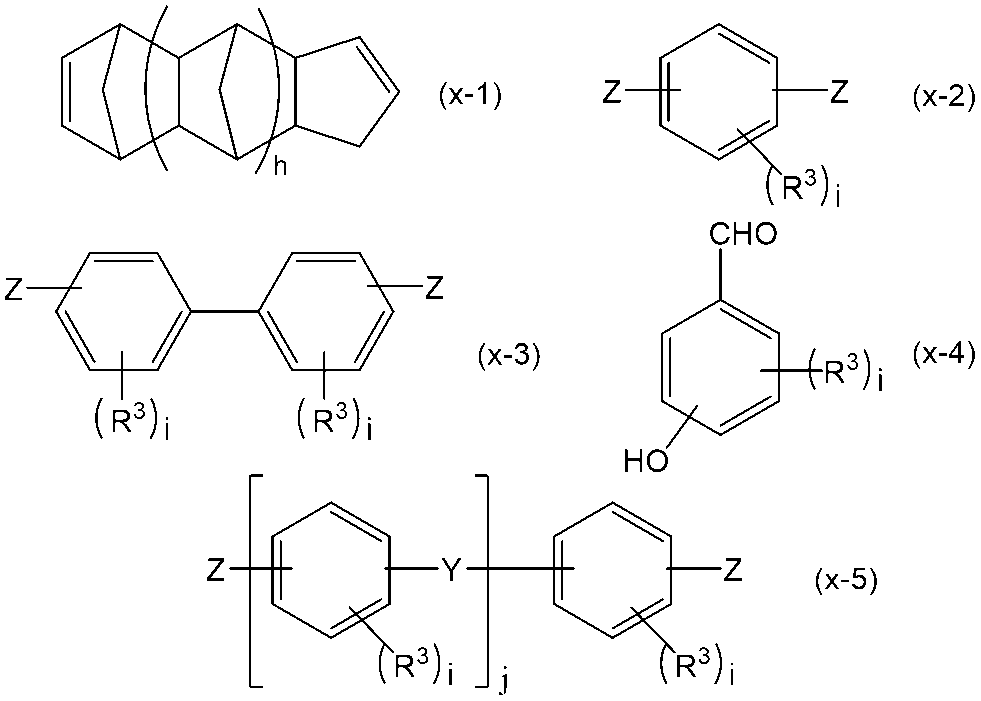
- phenolic hydroxyl group-containing compound for example, a compound having one phenolic hydroxyl group in the molecule and a compound represented by any of the following structural formulas (x-1) to (x-5) are indispensable.
- a novolac type phenol resin using one or more compounds having one phenolic hydroxyl group in the molecule as a reaction raw material, and one or more compounds having at least two phenolic hydroxyl groups in the molecule
- a novolak type phenol resin or the like as a reaction raw material can also be used.
- h is 0 or 1.
- R 3 is any of an alkyl group having 1 to 20 carbon atoms, an alkoxy group having 1 to 20 carbon atoms, an aryl group and a halogen atom, and i Is 0 or an integer of 1 to 4.
- Z is any of a vinyl group, a halomethyl group, a hydroxymethyl group and an alkyloxymethyl group.
- Y is any of an alkylene group having 1 to 4 carbon atoms, an oxygen atom, a sulfur atom, and a carbonyl group, and j is an integer of 1 to 4.
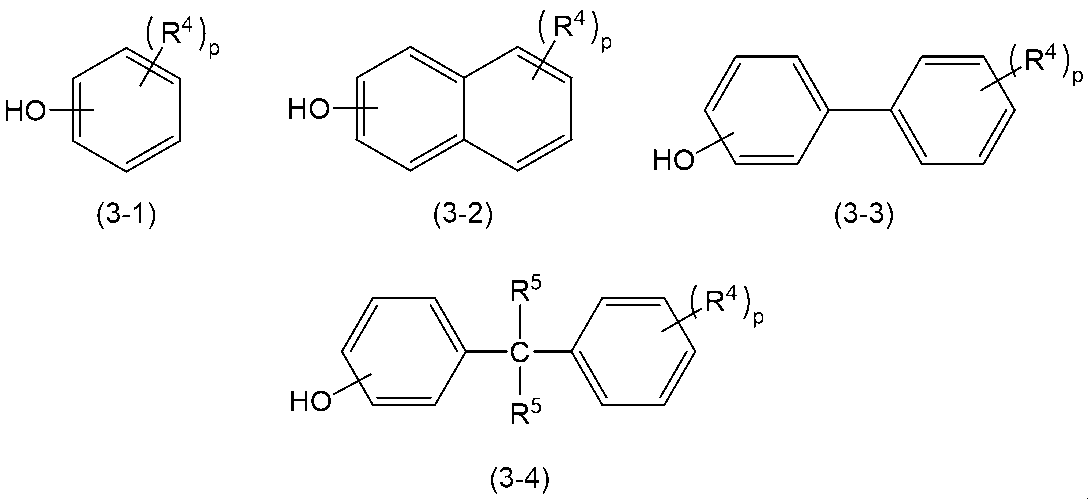
- Examples of the compound having one phenolic hydroxyl group in the molecule include compounds represented by the following structural formulas (3-1) to (3-4).
- R 4 is any of an alkyl group having 1 to 20 carbon atoms, an alkoxy group having 1 to 20 carbon atoms, an aryl group and a halogen atom.
- R 5 are independently hydrogen atoms or methyl groups.
- p is 0 or an integer of 1 or more, preferably 0 or an integer of 1 to 3, more preferably 0 or 1, and further preferably 0.
- the position of the substituent on the aromatic ring in the above structural formula is arbitrary. For example, in the naphthalene ring of the structural formula (3-2), it may be substituted on any ring, and the structural formula (3-2) may be substituted.
- the compounds represented by the above structural formulas (2-1) to (2-4) can be used.
- phenolic hydroxyl group-containing compounds can be used alone or in combination of two or more kinds.
- alkylene oxide examples include ethylene oxide, propylene oxide, butylene oxide, pentylene oxide and the like.
- ethylene oxide or propylene oxide is preferable because a curable resin composition having excellent alkali developability and high photosensitivity and capable of forming a cured product having excellent elongation can be obtained.
- the alkylene oxide can be used alone or in combination of two or more.
- alkylene carbonate examples include ethylene carbonate, propylene carbonate, butylene carbonate, pentylene carbonate and the like.
- ethylene carbonate or propylene carbonate is preferable because a curable resin composition having excellent alkali developability and high photosensitivity and capable of forming a cured product having excellent elongation can be obtained.
- the alkylene carbonate can be used alone or in combination of two or more.
- N-alkoxyalkyl(meth)acrylamide compound examples include N-methoxymethyl(meth)acrylamide, N-ethoxymethyl(meth)acrylamide, N-butoxymethyl(meth)acrylamide, N-methoxyethyl(meth)acrylamide. , N-ethoxyethyl (meth)acrylamide, N-butoxyethyl (meth)acrylamide and the like.
- the N-alkoxyalkyl(meth)acrylamide compounds may be used alone or in combination of two or more kinds.
- polybasic acid anhydride those exemplified above as the polybasic acid anhydride (C) can be used, and the polybasic acid anhydride can be used alone or in combination of two or more kinds. it can.
- unsaturated monobasic acid those exemplified as the above-mentioned unsaturated monobasic acid (B) can be used, and the unsaturated monobasic acid may be used alone or in combination of two or more kinds. it can.
- the method for producing the acrylamide resin having the acid group and the polymerizable unsaturated bond is not particularly limited and may be produced by any method.
- the production of the acrylamide resin having an acid group and a polymerizable unsaturated bond may be carried out in an organic solvent if necessary, and a basic catalyst and an acidic catalyst may be used if necessary.
- organic solvent the same organic solvents as described above can be used, and the organic solvent can be used alone or in combination of two or more kinds.
- the same basic catalysts as described above can be used, and the basic catalyst can be used alone or in combination of two or more kinds.
- the acidic catalyst examples include inorganic acids such as hydrochloric acid, sulfuric acid and phosphoric acid, organic acids such as methanesulfonic acid, p-toluenesulfonic acid and oxalic acid, Lewis acids such as boron trifluoride, anhydrous aluminum chloride and zinc chloride. And so on. These acidic catalysts can be used alone or in combination of two or more.
- the amount of the resin (F) having an acid group and a polymerizable unsaturated bond used is preferably in the range of 10 to 900 parts by mass with respect to 100 parts by mass of the acid group-containing (meth)acrylate resin of the present invention.
- Examples of the various (meth)acrylate monomers include methyl (meth)acrylate, ethyl (meth)acrylate, propyl (meth)acrylate, butyl (meth)acrylate, pentyl (meth)acrylate, hexyl (meth)acrylate, 2 -Aliphatic mono(meth)acrylate compounds such as ethylhexyl(meth)acrylate, octyl(meth)acrylate; cyclohexyl(meth)acrylate, isobornyl(meth)acrylate, adamantyl mono(meth)acrylate, etc.
- Acrylate compounds such as glycidyl (meth)acrylate and tetrahydrofurfuryl acrylate; benzyl (meth)acrylate, phenyl (meth)acrylate, phenylbenzyl (meth)acrylate, phenoxy (meth)acrylate, Phenoxyethyl (meth)acrylate, phenoxyethoxyethyl (meth)acrylate, 2-hydroxy-3-phenoxypropyl (meth)acrylate, phenoxybenzyl (meth)acrylate, benzylbenzyl (meth)acrylate, phenylphenoxyethyl (meth)acrylate, etc.
- (Meth)acrylate compounds such as aromatic mono(meth)acrylate compounds: (poly)oxyethylene chain, (poly)oxypropylene chain, (poly)oxy in the molecular structure of the various mono(meth)acrylate monomers
- An aliphatic poly(meth)acrylate compound of (poly)oxyethylene chain, (poly)oxypropylene chain, (poly)oxytetramethylene chain or the like in the molecular structure of the aliphatic poly(meth)acrylate compound A tetra- or higher functional (poly)oxyalkylene-modified poly(meth)acrylate compound having an oxyalkylene chain introduced; a tetra-functional or higher functional lactone having a (poly)lactone structure introduced into the molecular structure of the aliphatic poly(meth)acrylate compound Examples include modified poly(meth)acrylate compounds.
- the various (meth)acrylate monomers may be used alone or in combination of two or more.
- the curable resin composition of the present invention if necessary, a curing agent, a curing accelerator, an organic solvent, inorganic fine particles or polymer fine particles, a pigment, a defoaming agent, a viscosity modifier, a leveling agent, a flame retardant, It is also possible to contain various additives such as a storage stabilizer.
- the curing agent is not particularly limited as long as it has a functional group capable of reacting with the carboxy group in the acid group-containing (meth)acrylate resin, and examples thereof include an epoxy resin.
- the epoxy resin include bisphenol type epoxy resin, phenylene ether type epoxy resin, naphthylene ether type epoxy resin, biphenyl type epoxy resin, triphenylmethane type epoxy resin, phenol novolac type epoxy resin, cresol novolac type epoxy resin, Bisphenol novolac type epoxy resin, naphthol novolac type epoxy resin, naphthol-phenol co-contracting novolac type epoxy resin, naphthol-cresol co-contracting novolac type epoxy resin, phenol aralkyl type epoxy resin, naphthol aralkyl type epoxy resin, dicyclopentadiene-phenol addition
- epoxy resins can be used alone or in combination of two or more. Further, among these, a curable resin composition having excellent alkali developability and high photosensitivity and capable of forming a cured product having excellent elongation can be obtained, and therefore, a phenol novolac type epoxy resin, cresol novolac Type epoxy resin, bisphenol novolac type epoxy resin, naphthol novolac type epoxy resin, naphthol-phenol co-condensed novolac type epoxy resin, naphthol-cresol co-condensed novolac type epoxy resin and the like are preferable, and the softening point is 20 to 120. Those in the range of °C are particularly preferred.
- the curing accelerator is for promoting a curing reaction of the curing agent, and when an epoxy resin is used as the curing agent, a phosphorus compound, an amine compound, an imidazole, an organic acid metal salt, a Lewis acid, Examples thereof include amine complex salts. These curing accelerators can be used alone or in combination of two or more. The amount of the curing accelerator added is preferably within a range of 1 to 10 parts by mass with respect to 100 parts by mass of the curing agent.
- organic solvent the same organic solvents as described above can be used, and the organic solvent can be used alone or in combination of two or more kinds.
- the cured product of the present invention can be obtained by irradiating the curable resin composition with an active energy ray.
- the active energy rays include ionizing radiation such as ultraviolet rays, electron rays, ⁇ rays, ⁇ rays, and ⁇ rays.
- the irradiation may be performed in an atmosphere of an inert gas such as nitrogen gas or in an air atmosphere in order to efficiently carry out the curing reaction by the ultraviolet rays.
- ultraviolet lamps are generally used from the viewpoint of practicality and economy. Specific examples thereof include a low pressure mercury lamp, a high pressure mercury lamp, an ultrahigh pressure mercury lamp, a xenon lamp, a gallium lamp, a metal halide lamp, sunlight, and an LED.
- the cumulative light amount of the active energy rays is not particularly limited, but is preferably 10 to 5,000 mJ/cm 2 , and more preferably 50 to 1,000 mJ/cm 2 .
- the integrated light amount is within the above range, it is possible to prevent or suppress the generation of an uncured portion, which is preferable.
- the irradiation of the active energy rays may be performed in one step or in two or more steps.
- the resin material for solder resist of the present invention comprises the curable resin composition.
- Examples of the base material include metal foils such as copper foil and aluminum foil.
- the acid value of the acid group-containing (meth)acrylate resin was measured by the neutralization titration method of JIS K0070 (1992).
- the molecular weight of the acid group-containing (meth)acrylate resin was measured by GPC under the following conditions.
- reaction product (II-1) was 478 g / equivalent.
- the number of moles of acid groups contained in acrylic acid was 0.5 with respect to 1 mole of epoxy groups contained in the bisphenol A type epoxy resin (2).
- reaction product (II-3) was 241 g / equivalent.
- the number of moles of acid groups contained in acrylic acid was 0.15 with respect to 1 mole of epoxy groups contained in the bisphenol A type epoxy resin (2).
- reaction product (II-5) was 785 g / equivalent.
- the number of moles of acid groups contained in acrylic acid was 0.7 with respect to 1 mole of epoxy groups contained in the bisphenol A type epoxy resin (2).
- reaction product (II-6) was 1603 g / equivalent.
- the number of moles of the acid group of acrylic acid was 0.85 with respect to 1 mole of the epoxy group of the bisphenol A type epoxy resin (2).
- reaction product (II-8) was 388 g / equivalent.
- the number of moles of acid groups contained in acrylic acid was 0.5 with respect to 1 mole of epoxy groups contained in the naphthalene-type epoxy resin (1).
- the esterification reaction was carried out for 10 hours. Then, 311 parts by mass of diethylene glycol monomethyl ether acetate and 160 parts by mass of tetrahydrophthalic anhydride were added and reacted at 110° C. for 2.5 hours to obtain a target acid group-containing acrylate resin (P).
- the acid value of the solid content of this acid group-containing acrylate resin (P) was 85 mgKOH/g, and the weight average molecular weight was 8540.
- Example 1 Production of acid group-containing acrylate resin (1)
- a flask equipped with a thermometer, a stirrer, and a reflux condenser 188 parts by mass of bisphenol A type epoxy resin (1), 41 parts by mass of bisphenol A, and 0.5 parts by mass of triphenylphosphine were added, and the mixture was heated under a nitrogen atmosphere to 140 The reaction was carried out at ° C. for 2 hours.
- Resin (1) was obtained.
- the acid value of the solid content of the acid group-containing acrylate resin (1) was 89 mgKOH/g, and the weight average molecular weight was 5,670.
- the number of moles of the epoxy group of the bisphenol A type epoxy resin (2) was 0.56, relative to 1 mole of the acid group of the reaction product (I-1).
- Example 2 Production of acid group-containing acrylate resin (2)
- a flask equipped with a thermometer, a stirrer, and a reflux condenser 188 parts by mass of bisphenol A type epoxy resin (1), 41 parts by mass of bisphenol A, and 0.5 parts by mass of triphenylphosphine were added, and the mixture was heated under a nitrogen atmosphere to 140 The reaction was carried out at ° C. for 2 hours.
- the resin (2) was obtained.
- the solid acid value of the acid group-containing acrylate resin (2) was 69 mgKOH / g, and the weight average molecular weight was 6070.
- the number of moles of the epoxy group of the bisphenol A type epoxy resin (2) was 0.80, relative to 1 mole of the acid group of the reaction product (I-2).
- Example 3 Production of acid group-containing acrylate resin (3)
- a thermometer a thermometer
- a stirrer a stirrer
- a reflux condenser 188 parts by mass of bisphenol A type epoxy resin (1)
- 41 parts by mass of bisphenol A 41 parts by mass of bisphenol A
- 0.5 parts by mass of triphenylphosphine were added, and the mixture was heated under a nitrogen atmosphere to 140
- the reaction was carried out at 0°C for 2 hours.
- Resin (3) was obtained.
- the solid acid value of the acid group-containing acrylate resin (3) was 115 mgKOH / g, and the weight average molecular weight was 5180.
- the number of moles of the epoxy group of the bisphenol A type epoxy resin (2) was 0.28, relative to 1 mole of the acid group of the reaction product (I-3).
- Example 5 Production of acid group-containing acrylate resin (5)
- a flask equipped with a thermometer, a stirrer, and a reflux condenser 188 parts by mass of bisphenol A type epoxy resin (1), 41 parts by mass of bisphenol A, and 0.5 parts by mass of triphenylphosphine were added, and the mixture was heated under a nitrogen atmosphere to 140 The reaction was carried out at 0°C for 2 hours.
- the target acid group-containing acrylate resin (5) was obtained by 5 hours to obtain the target acid group-containing acrylate resin (5).
- the solid acid value of the acid group-containing acrylate resin (5) was 87 mgKOH / g, and the weight average molecular weight was 5090.
- the number of moles of the epoxy group contained in the reaction product (II-1) was 0.26 with respect to 1 mol of the acid group contained in the reaction product (I-5).
- Example 7 Production of acid group-containing acrylate resin (7)
- a flask equipped with a thermometer, a stirrer, and a reflux condenser 188 parts by mass of bisphenol A type epoxy resin (1), 41 parts by mass of bisphenol A, and 0.5 parts by mass of triphenylphosphine were added, and the mixture was heated under a nitrogen atmosphere to 140 The reaction was carried out at ° C. for 2 hours.
- the solid acid value of the acid group-containing acrylate resin (7) was 68 mgKOH / g, and the weight average molecular weight was 5880.
- the number of moles of the epoxy group of the reactant (II-2) was 0.37 with respect to 1 mole of the acid group of the reactant (I-7).
- Example 8 Production of acid group-containing acrylate resin (8)
- a flask equipped with a thermometer, a stirrer, and a reflux condenser 188 parts by mass of bisphenol A type epoxy resin (1), 41 parts by mass of bisphenol A, and 0.5 parts by mass of triphenylphosphine were added, and the mixture was heated under a nitrogen atmosphere to 140 The reaction was carried out at ° C. for 2 hours.
- the target acid group-containing acrylate resin (8) was obtained by 3 hours to obtain the target acid group-containing acrylate resin (8).
- the acid value of the solid content of the acid group-containing acrylate resin (8) was 116 mgKOH/g, and the weight average molecular weight was 5020.
- the number of moles of the epoxy group of the reactant (II-2) was 0.13 with respect to 1 mole of the acid group of the reactant (I-8).
- Example 9 Production of acid group-containing acrylate resin (9)
- a flask equipped with a thermometer, a stirrer, and a reflux condenser 188 parts by mass of bisphenol A type epoxy resin (1), 41 parts by mass of bisphenol A, and 0.5 parts by mass of triphenylphosphine were added, and the mixture was heated under a nitrogen atmosphere to 140 The reaction was carried out at 0°C for 2 hours.
- the target acid group-containing acrylate resin (9) was obtained by 6 hours to obtain the target acid group-containing acrylate resin (9).
- the acid value of the solid content of the acid group-containing acrylate resin (9) was 63 mgKOH/g, and the weight average molecular weight was 6,290.
- the number of moles of the epoxy group of the reactant (II-2) was 0.41 with respect to 1 mole of the acid group of the reactant (I-9).
- Example 10 Production of acid group-containing acrylate resin (10)
- a flask equipped with a thermometer, a stirrer, and a reflux condenser 188 parts by mass of bisphenol A type epoxy resin (1), 41 parts by mass of bisphenol A, and 0.5 parts by mass of triphenylphosphine were added, and the mixture was heated under a nitrogen atmosphere to 140 The reaction was carried out at ° C. for 2 hours.
- a target acid group-containing acrylate resin (10) The acid value of the solid content of this acid group-containing acrylate resin (10) was 98 mgKOH/g, and the weight average molecular weight was 6030. The number of moles of the epoxy group of the reactant (II-3) was 0.26 with respect to 1 mole of the acid group of the reactant (I-10).
- the solid acid value of the acid group-containing acrylate resin (11) was 95 mgKOH / g, and the weight average molecular weight was 5890.
- the number of moles of the epoxy group of the reaction product (II-4) was 0.26 with respect to 1 mole of the acid group of the reaction product (I-11).
- Example 12 Production of acid group-containing acrylate resin (12)
- a flask equipped with a thermometer, a stirrer, and a reflux condenser 188 parts by mass of bisphenol A type epoxy resin (1), 41 parts by mass of bisphenol A, and 0.5 parts by mass of triphenylphosphine were added, and the mixture was heated under a nitrogen atmosphere to 140 The reaction was carried out at ° C. for 2 hours.
- the solid acid value of the acid group-containing acrylate resin (12) was 75 mgKOH / g, and the weight average molecular weight was 5310.
- the number of moles of the epoxy group contained in the reaction product (II-5) was 0.26 with respect to 1 mol of the acid group contained in the reaction product (I-12).
- Example 13 Production of acid group-containing acrylate resin (13)
- a flask equipped with a thermometer, a stirrer, and a reflux condenser 188 parts by mass of bisphenol A type epoxy resin (1), 41 parts by mass of bisphenol A, and 0.5 parts by mass of triphenylphosphine were added, and the mixture was heated under a nitrogen atmosphere to 140 The reaction was carried out at ° C. for 2 hours.
- the solid acid value of the acid group-containing acrylate resin (13) was 73 mgKOH / g, and the weight average molecular weight was 5060.
- the number of moles of the epoxy group contained in the reaction product (II-6) was 0.18, relative to 1 mol of the acid group contained in the reaction product (I-13).
- Example 14 Production of acid group-containing acrylate resin (14)
- a bisphenol F type epoxy resin (“EPICLON 830-S” manufactured by DIC Corporation, epoxy equivalent 169 g/equivalent.
- bisphenol F type epoxy resin (2) 169 parts by mass, bisphenol F 42 parts by mass, and triphenylphosphine 0.4 parts by mass were added and reacted at 140° C. for 2 hours in a nitrogen atmosphere.
- the acid value of the solid content of this acid group-containing acrylate resin (14) was 94 mgKOH/g, and the weight average molecular weight was 4,880.
- the number of moles of the epoxy group contained in the reaction product (II-7) was 0.26, relative to 1 mol of the acid group contained in the reaction product (I-14).
- the target acid group-containing acrylate resin (15) was 86 mgKOH/g, and the weight average molecular weight was 4,890.
- the number of moles of the epoxy group contained in the reaction product (II-7) was 0.26 with respect to 1 mol of the acid group contained in the reaction product (I-15).
- the acid value of the solid content of the acid group-containing acrylate resin (17) was 92 mgKOH/g, and the weight average molecular weight was 49000.
- the number of moles of the epoxy group of the reaction product (II-2) was 0.26 with respect to 1 mole of the acid group of the reaction product (I-17).
- the target acid group-containing acrylate resin (18) was 94 mgKOH / g, and the weight average molecular weight was 4750.
- the number of moles of the epoxy group of the reactant (II-8) was 0.3 with respect to 1 mole of the acid group of the reactant (I-18).
- Example 19 Production of acid group-containing acrylate resin (19)
- a flask equipped with a thermometer, a stirrer, and a reflux condenser 188 parts by mass of bisphenol A type epoxy resin (1), 41 parts by mass of bisphenol A, and 0.5 parts by mass of triphenylphosphine were added, and the mixture was heated under a nitrogen atmosphere to 140 The reaction was carried out at ° C. for 2 hours.
- the target acid group-containing acrylate resin (19) was 90 mgKOH / g, and the weight average molecular weight was 4870.
- the number of moles of the epoxy group contained in the reaction product (II-8) was 0.26 with respect to 1 mol of the acid group contained in the reaction product (I-19).
- Example 20 Production of acid group-containing acrylate resin (20)
- a flask equipped with a thermometer, a stirrer, and a reflux condenser 188 parts by mass of bisphenol A type epoxy resin (1), 41 parts by mass of bisphenol A, and 0.5 parts by mass of triphenylphosphine were added, and the mixture was heated under a nitrogen atmosphere to 140 The reaction was carried out at ° C. for 2 hours.
- reaction product (II-2) obtained in Synthesis Example 2 23 parts by mass of the reaction product (II-2) obtained in Synthesis Example 2 and 35 parts by mass of the bisphenol A type epoxy resin (2) were added and reacted at 120 ° C. for 5 hours to obtain the desired acid group-containing acrylate resin. (21) was obtained.
- the acid value of the solid content of the acid group-containing acrylate resin (20) was 100 mgKOH/g, and the weight average molecular weight was 8200.
- the number of moles of the epoxy group of the reaction product (II-2) was 0.05 with respect to 1 mole of the acid group of the reaction product (I-21).
- Example 22 Production of acid group-containing methacrylate resin (1)
- a flask equipped with a thermometer, a stirrer, and a reflux condenser 188 parts by mass of bisphenol A type epoxy resin (1), 41 parts by mass of bisphenol A, and 0.5 parts by mass of triphenylphosphine were added, and the mixture was heated under a nitrogen atmosphere to 140 The reaction was carried out at ° C. for 2 hours.
- the solid acid value of the acid group-containing methacrylate resin (1) was 86 mgKOH / g, and the weight average molecular weight was 4840.
- the number of moles of the epoxy group of the reactant (II-2) was 0.26 with respect to 1 mole of the acid group of the reactant (I-22).
- Example 23 Preparation of curable resin composition (1)
- the acid group-containing acrylate resin (1) obtained in Example 1 an orthocresol novolac type epoxy resin (“EPICLON N-680” manufactured by DIC Corporation) as a curing agent, dipentaerythritol hexaacrylate, and diethylene glycol monoethyl ether acetate.
- a photopolymerization initiator (“Omnirad 907” manufactured by IGM), 2-ethyl-4-methylimidazole, and phthalocyanine green were mixed in a mass part shown in Table 1 and kneaded by a roll mill to prepare a curable resin.
- a composition (1) was obtained.
- Examples 24-42 Preparation of curable resin compositions (2)-(22)
- the acid group-containing acrylate resins (2) to (21) obtained in Examples 2 to 21 or the acid group-containing methacrylate obtained in Example 22 Curable resin compositions (2) to (22) were obtained in the same manner as in Example 23 except that the resin (1) was used.
- Example 43 Preparation of curable resin composition (23) Except that the acid group-containing acrylate resin obtained in Example 6 and the acid group-containing acrylate resin (P) obtained in Synthesis Example 9 were used instead of the acid group-containing acrylate resin (1) used in Example 23. , A curable resin composition (23) was obtained in the same manner as in Example 23.
- compositions and evaluation results of the curable resin compositions (1) to (23) prepared in Examples 21 to 43 and the curable resin compositions (C4) to (C6) prepared in Comparative Examples 4 to 6 are shown in Table 1. And shown in Table 2.
- Example 44 Preparation of curable resin composition (24)
- the acid group-containing acrylate resin (1) obtained in Example 1 an orthocresol novolac type epoxy resin (“EPICLON N-680” manufactured by DIC Corporation) as a curing agent, and 2-methyl-1-(4 as a photopolymerization initiator.
- -Methylthiophenyl)-2-morpholinopropan-1-one (“OMNIRAD-907” manufactured by IGM)
- diethylene glycol monomethyl ether acetate as an organic solvent in an amount of parts by mass shown in Table 3 to prepare a curable resin composition ( 24) was obtained.
- Example 45 to 65 Preparation of curable resin compositions (25) to (45)
- the acid group-containing acrylate resins (2) to (21) obtained in Examples 2 to 21 or the acid group-containing methacrylate obtained in Example 22 Curable resin compositions (25) to (45) were obtained in the same manner as in Example 42, except that the resin (1) was used.
- ⁇ Tensile test> The test piece 2 was cut into a size of 10 mm ⁇ 80 mm, and a tensile test of the test piece was performed under the following measurement conditions using a precision universal testing machine Autograph “AG-IS” manufactured by Shimadzu Corporation. The elongation (%) until the test piece broke was measured and evaluated according to the following criteria.
- Measurement conditions temperature 23°C, humidity 50%, distance between marked lines 20 mm, distance between fulcrums 20 mm, pulling speed 10 mm/min
- Examples 21 to 66 shown in Tables 1 to 4 are examples of curable resin compositions using the acid group-containing (meth)acrylate resin of the present invention. It was confirmed that this curable resin composition has excellent photosensitivity and alkali developability, and also has excellent elongation in the cured product.
- Comparative Examples 4 to 9 are examples of curable resin compositions that do not use the acid group-containing (meth)acrylate resin of the present invention. It was confirmed that this curable resin composition had remarkably insufficient photosensitivity and also had insufficient elongation in the cured product.
Landscapes
- Chemical & Material Sciences (AREA)
- Physics & Mathematics (AREA)
- Engineering & Computer Science (AREA)
- Chemical Kinetics & Catalysis (AREA)
- Medicinal Chemistry (AREA)
- Polymers & Plastics (AREA)
- Organic Chemistry (AREA)
- Health & Medical Sciences (AREA)
- Spectroscopy & Molecular Physics (AREA)
- Microelectronics & Electronic Packaging (AREA)
- Manufacturing & Machinery (AREA)
- General Physics & Mathematics (AREA)
- Materials For Photolithography (AREA)
- Macromonomer-Based Addition Polymer (AREA)
- Epoxy Resins (AREA)
- Organic Insulating Materials (AREA)
- Non-Metallic Protective Coatings For Printed Circuits (AREA)
Abstract
Description


カラム:東ソー株式会社製ガードカラム「HXL-L」
+東ソー株式会社製「TSK-GEL G2000HXL」
+東ソー株式会社製「TSK-GEL G2000HXL」
+東ソー株式会社製「TSK-GEL G3000HXL」
+東ソー株式会社製「TSK-GEL G4000HXL」
検出器: RI(示差屈折計)
データ処理:東ソー株式会社製「GPC-8020モデルIIバージョン4.10」
測定条件: カラム温度 40℃
展開溶媒 テトラヒドロフラン
流速 1.0ml/分
標準 : 前記「GPC-8020モデルIIバージョン4.10」の測定マニュアルに準拠して、分子量が既知の下記の単分散ポリスチレンを用いた。
(使用ポリスチレン)
東ソー株式会社製「A-500」
東ソー株式会社製「A-1000」
東ソー株式会社製「A-2500」
東ソー株式会社製「A-5000」
東ソー株式会社製「F-1」
東ソー株式会社製「F-2」
東ソー株式会社製「F-4」
東ソー株式会社製「F-10」
東ソー株式会社製「F-20」
東ソー株式会社製「F-40」
東ソー株式会社製「F-80」
東ソー株式会社製「F-128」
試料 : 樹脂固形分換算で1.0質量%のテトラヒドロフラン溶液をマイクロフィルターでろ過したもの(50μl)
温度計、撹拌機、及び還流冷却器を備えたフラスコに、ビスフェノールA型エポキシ樹脂(DIC株式会社製「EPICLON 850-S」、エポキシ当量188g/当量。以下、「ビスフェノールA型エポキシ樹脂(1)」と略記する。)376質量部を仕込み、酸化防止剤としてジブチルヒドロキシトルエン0.22質量部、熱重合禁止剤としてメトキノン0.22質量部加えた後、アクリル酸72質量部、トリフェニルホスフィン0.22質量部を添加し、空気を吹き込みながら100℃で10時間エステル化反応を行った。次いで、酸価が1mgKOH/g以下であることを確認した後、シュウ酸0.22質量部を添加し、70℃で3時間撹拌して反応物(II-1)を得た。この反応物(II-1)のエポキシ当量は478g/当量であった。また、ビスフェノールA型エポキシ樹脂(2)が有するエポキシ基1モルに対する、アクリル酸が有する酸基のモル数は、0.5であった。
温度計、撹拌機、及び還流冷却器を備えたフラスコに、ビスフェノールA型エポキシ樹脂(DIC株式会社製「EPICLON 850CRP」、エポキシ当量173g/当量。以下、「ビスフェノールA型エポキシ樹脂(2)」と略記する。)346質量部を仕込み、酸化防止剤としてジブチルヒドロキシトルエン0.21質量部、熱重合禁止剤としてメトキノン0.21質量部加えた後、アクリル酸72質量部、トリフェニルホスフィン0.21質量部を添加し、空気を吹き込みながら100℃で10時間エステル化反応を行った。次いで、酸価が1mgKOH/g以下であることを確認した後、シュウ酸0.21質量部を添加し、70℃で3時間撹拌して反応物(II-2)を得た。この反応物(II-2)のエポキシ当量は450g/当量であった。また、ビスフェノールA型エポキシ樹脂(2)が有するエポキシ基1モルに対する、アクリル酸が有する酸基のモル数は、0.5であった。
温度計、撹拌機、及び還流冷却器を備えたフラスコに、ビスフェノールA型エポキシ樹脂(2)346質量部を仕込み、酸化防止剤としてジブチルヒドロキシトルエン0.18質量部、熱重合禁止剤としてメトキノン0.18質量部加えた後、アクリル酸22質量部、トリフェニルホスフィン0.18質量部を添加し、空気を吹き込みながら100℃で5時間エステル化反応を行った。次いで、酸価が1mgKOH/g以下であることを確認した後、シュウ酸0.18質量部を添加し、70℃で3時間撹拌して反応物(II-3)を得た。この反応物(II-3)のエポキシ当量は241g/当量であった。また、ビスフェノールA型エポキシ樹脂(2)が有するエポキシ基1モルに対する、アクリル酸が有する酸基のモル数は、0.15であった。
温度計、撹拌機、及び還流冷却器を備えたフラスコに、ビスフェノールA型エポキシ樹脂(2)346質量部を仕込み、酸化防止剤としてジブチルヒドロキシトルエン0.19質量部、熱重合禁止剤としてメトキノン0.19質量部加えた後、アクリル酸43質量部、トリフェニルホスフィン0.19質量部を添加し、空気を吹き込みながら100℃で8時間エステル化反応を行った。次いで、酸価が1mgKOH/g以下であることを確認した後、シュウ酸0.19質量部を添加し、70℃で3時間撹拌して反応物(II-4)を得た。この反応物(II-4)のエポキシ当量は301g/当量であった。また、ビスフェノールA型エポキシ樹脂(2)が有するエポキシ基1モルに対する、アクリル酸が有する酸基のモル数は、0.3であった。
温度計、撹拌機、及び還流冷却器を備えたフラスコに、ビスフェノールA型エポキシ樹脂(2)346質量部を仕込み、酸化防止剤としてジブチルヒドロキシトルエン0.22質量部、熱重合禁止剤としてメトキノン0.22質量部加えた後、アクリル酸101質量部、トリフェニルホスフィン0.44質量部を添加し、空気を吹き込みながら100℃で10時間エステル化反応を行った。次いで、酸価が1mgKOH/g以下であることを確認した後、シュウ酸0.22質量部を添加し、70℃で3時間撹拌して反応物(II-5)を得た。この反応物(II-5)のエポキシ当量は785g/当量であった。また、ビスフェノールA型エポキシ樹脂(2)が有するエポキシ基1モルに対する、アクリル酸が有する酸基のモル数は、0.7であった。
温度計、撹拌機、及び還流冷却器を備えたフラスコに、ビスフェノールA型エポキシ樹脂(2)346質量部を仕込み、酸化防止剤としてジブチルヒドロキシトルエン0.23質量部、熱重合禁止剤としてメトキノン0.23質量部加えた後、アクリル酸122質量部、トリフェニルホスフィン0.46質量部を添加し、空気を吹き込みながら100℃で20時間エステル化反応を行った。次いで、酸価が1mgKOH/g以下であることを確認した後、シュウ酸0.23質量部を添加し、70℃で3時間撹拌して反応物(II-6)を得た。この反応物(II-6)のエポキシ当量は1603g/当量であった。また、ビスフェノールA型エポキシ樹脂(2)が有するエポキシ基1モルに対する、アクリル酸が有する酸基のモル数は、0.85であった。
温度計、撹拌機、及び還流冷却器を備えたフラスコに、ビスフェノールF型エポキシ樹脂(DIC株式会社製「EPICLON 830CRP」、エポキシ当量159g/当量。以下、「ビスフェノールF型エポキシ樹脂(1)」と略記する。)318質量部を仕込み、酸化防止剤としてジブチルヒドロキシトルエン0.2質量部、熱重合禁止剤としてメトキノン0.2質量部加えた後、アクリル酸72質量部、トリフェニルホスフィン0.2質量部を添加し、空気を吹き込みながら100℃で10時間エステル化反応を行った。次いで、酸価が1mgKOH/g以下であることを確認した後、シュウ酸0.2質量部を添加し、70℃で3時間撹拌して反応物(II-7)を得た。この反応物(II-7)のエポキシ当量は421g/当量であった。また、ビスフェノールF型エポキシ樹脂(1)が有するエポキシ基1モルに対する、アクリル酸が有する酸基のモル数は、0.5であった。
温度計、撹拌機、及び還流冷却器を備えたフラスコに、ナフタレン型エポキシ樹脂(DIC株式会社製「EPICLON 4032D」、エポキシ当量141g/当量。以下、「ナフタレン型エポキシ樹脂(1)」と略記する。)282質量部を仕込み、酸化防止剤としてジブチルヒドロキシトルエン0.18質量部、熱重合禁止剤としてメトキノン0.18質量部加えた後、アクリル酸72質量部、トリフェニルホスフィン0.18質量部を添加し、空気を吹き込みながら100℃で10時間エステル化反応を行った。次いで、酸価が1mgKOH/g以下であることを確認した後、シュウ酸0.18質量部を添加し、70℃で3時間撹拌して反応物(II-8)を得た。この反応物(II-8)のエポキシ当量は388g/当量であった。また、ナフタレン型エポキシ樹脂(1)が有するエポキシ基1モルに対する、アクリル酸が有する酸基のモル数は、0.5であった。
温度計、攪拌器、及び還流冷却器を備えたフラスコに、ジエチレングリコールモノメチルエーテルアセテート101質量部を入れ、オルソクレゾールノボラック型エポキシ樹脂(DIC株式会社製「EPICLON N-680」、エポキシ当量:214g/当量)428質量部を溶解し、ジブチルヒドロキシトルエン4質量部、メトキノン0.4質量部加えた後、アクリル酸144質量部、トリフェニルホスフィン1.6質量部を添加し、空気を吹き込みながら120℃で10時間エステル化反応を行なった。その後、ジエチレングリコールモノメチルエーテルアセテート311質量部、テトラヒドロ無水フタル酸160質量部を加え110℃で2.5時間反応し、目的の酸基含有アクリレート樹脂(P)を得た。この酸基含有アクリレート樹脂(P)の固形分酸価は85mgKOH/gであり、重量平均分子量は、8540であった。
温度計、攪拌器、及び還流冷却器を備えたフラスコに、ビスフェノールA型エポキシ樹脂(1)188質量部、ビスフェノールA41質量部、トリフェニルホスフィン0.5質量部を添加し、窒素雰囲気下、140℃で2時間反応させた。次いで、ジエチレングリコールモノメチルエーテルアセテート92質量部、ジブチルヒドロキシトルエン0.6質量部、メトキノン0.3質量部、アクリル酸46質量部、トリフェニルホスフィン1.4質量部を添加し、空気を吹き込みながら120℃で6時間反応させた。次いで、無水コハク酸100質量部、ジエチレングリコールモノメチルエーテルアセテート162質量部を添加し、110℃で3時間反応させ反応物(I-1)を得た。次いでビスフェノールA型エポキシ樹脂(2)97質量部を添加し、110℃で2時間反応させた後、アクリル酸20質量部を添加し、120℃で3時間反応させて、目的の酸基含有アクリレート樹脂(1)を得た。この酸基含有アクリレート樹脂(1)の固形分酸価は89mgKOH/gであり、重量平均分子量は、5670であった。また、反応物(I-1)が有する酸基1モルに対する、ビスフェノールA型エポキシ樹脂(2)が有するエポキシ基のモル数は、0.56であった。
温度計、攪拌器、及び還流冷却器を備えたフラスコに、ビスフェノールA型エポキシ樹脂(1)188質量部、ビスフェノールA41質量部、トリフェニルホスフィン0.5質量部を添加し、窒素雰囲気下、140℃で2時間反応させた。次いで、ジエチレングリコールモノメチルエーテルアセテート92質量部、ジブチルヒドロキシトルエン0.6質量部、メトキノン0.3質量部、アクリル酸46質量部、トリフェニルホスフィン1.4質量部を添加し、空気を吹き込みながら120℃で6時間反応させた。次いで、無水コハク酸100質量部、ジエチレングリコールモノメチルエーテルアセテート200質量部を添加し、110℃で3時間反応させ反応物(I-2)を得た。次いでビスフェノールA型エポキシ樹脂(2)138質量部を添加し、110℃で2時間反応させた後、アクリル酸28質量部を添加し、120℃で5時間反応させて、目的の酸基含有アクリレート樹脂(2)を得た。この酸基含有アクリレート樹脂(2)の固形分酸価は69mgKOH/gであり、重量平均分子量は、6070であった。また、反応物(I-2)が有する酸基1モルに対する、ビスフェノールA型エポキシ樹脂(2)が有するエポキシ基のモル数は、0.80であった。
温度計、攪拌器、及び還流冷却器を備えたフラスコに、ビスフェノールA型エポキシ樹脂(1)188質量部、ビスフェノールA41質量部、トリフェニルホスフィン0.5質量部を添加し、窒素雰囲気下、140℃で2時間反応させた。次いで、ジエチレングリコールモノメチルエーテルアセテート92質量部、ジブチルヒドロキシトルエン0.6質量部、メトキノン0.3質量部、アクリル酸46質量部、トリフェニルホスフィン1.4質量部を添加し、空気を吹き込みながら120℃で6時間反応させた。次いで、無水コハク酸100質量部、ジエチレングリコールモノメチルエーテルアセテート122質量部を添加し、110℃で3時間反応させ反応物(I-3)を得た。次いでビスフェノールA型エポキシ樹脂(2)49質量部を添加し、110℃で2時間反応させた後、アクリル酸10質量部を添加し、120℃で3時間反応させて、目的の酸基含有アクリレート樹脂(3)を得た。この酸基含有アクリレート樹脂(3)の固形分酸価は115mgKOH/gであり、重量平均分子量は、5180であった。また、反応物(I-3)が有する酸基1モルに対する、ビスフェノールA型エポキシ樹脂(2)が有するエポキシ基のモル数は、0.28であった。
温度計、攪拌器、及び還流冷却器を備えたフラスコに、ビスフェノールA型エポキシ樹脂(1)188質量部、ビスフェノールA41質量部、トリフェニルホスフィン0.5質量部を添加し、窒素雰囲気下、140℃で2時間反応させた。次いで、ジエチレングリコールモノメチルエーテルアセテート92質量部、ジブチルヒドロキシトルエン0.6質量部、メトキノン0.3質量部、アクリル酸46質量部、トリフェニルホスフィン1.4質量部を添加し、空気を吹き込みながら120℃で6時間反応させた。次いで、無水コハク酸100質量部、ジエチレングリコールモノメチルエーテルアセテート223質量部を添加し、110℃で3時間反応させ反応物(I-4)を得た。次いでビスフェノールA型エポキシ樹脂(2)153質量部を添加し、110℃で2時間反応させた後、アクリル酸31質量部を添加し、120℃で6時間反応させて、目的の酸基含有アクリレート樹脂(4)を得た。この酸基含有アクリレート樹脂(4)の固形分酸価は63mgKOH/gであり、重量平均分子量は、6410であった。また、反応物(I-4)が有する酸基1モルに対する、ビスフェノールA型エポキシ樹脂(2)が有するエポキシ基のモル数は、0.89であった。
温度計、攪拌器、及び還流冷却器を備えたフラスコに、ビスフェノールA型エポキシ樹脂(1)188質量部、ビスフェノールA41質量部、トリフェニルホスフィン0.5質量部を添加し、窒素雰囲気下、140℃で2時間反応させた。次いで、ジエチレングリコールモノメチルエーテルアセテート92質量部、ジブチルヒドロキシトルエン0.6質量部、メトキノン0.3質量部、アクリル酸46質量部、トリフェニルホスフィン1.4質量部を添加し、空気を吹き込みながら120℃で6時間反応させた。次いで、無水コハク酸100質量部、ジエチレングリコールモノメチルエーテルアセテート177質量部を添加し、110℃で3時間反応させ反応物(I-5)を得た。次いで、合成例1で得た反応物(II-1)124質量部を添加し、120℃で5時間反応させて、目的の酸基含有アクリレート樹脂(5)を得た。この酸基含有アクリレート樹脂(5)の固形分酸価は87mgKOH/gであり、重量平均分子量は、5090であった。また、反応物(I-5)が有する酸基1モルに対する、反応物(II-1)が有するエポキシ基のモル数は、0.26であった。
温度計、攪拌器、及び還流冷却器を備えたフラスコに、ビスフェノールA型エポキシ樹脂(1)188質量部、ビスフェノールA41質量部、トリフェニルホスフィン0.5質量部を添加し、窒素雰囲気下、140℃で2時間反応させた。次いで、ジエチレングリコールモノメチルエーテルアセテート92質量部、ジブチルヒドロキシトルエン0.6質量部、メトキノン0.3質量部、アクリル酸46質量部、トリフェニルホスフィン1.4質量部を添加し、空気を吹き込みながら120℃で6時間反応させた。次いで、無水コハク酸100質量部、ジエチレングリコールモノメチルエーテルアセテート162質量部を添加し、110℃で3時間反応させ反応物(I-6)を得た。次いで、合成例2で得た反応物(II-2)117質量部を添加し、120℃で5時間反応させて、目的の酸基含有アクリレート樹脂(6)を得た。この酸基含有アクリレート樹脂(6)の固形分酸価は87mgKOH/gであり、重量平均分子量は、4920であった。また、反応物(I-6)が有する酸基1モルに対する、反応物(II-2)が有するエポキシ基のモル数は、0.26であった。
温度計、攪拌器、及び還流冷却器を備えたフラスコに、ビスフェノールA型エポキシ樹脂(1)188質量部、ビスフェノールA41質量部、トリフェニルホスフィン0.5質量部を添加し、窒素雰囲気下、140℃で2時間反応させた。次いで、ジエチレングリコールモノメチルエーテルアセテート92質量部、ジブチルヒドロキシトルエン0.6質量部、メトキノン0.3質量部、アクリル酸46質量部、トリフェニルホスフィン1.4質量部を添加し、空気を吹き込みながら120℃で6時間反応させた。次いで、無水コハク酸100質量部、ジエチレングリコールモノメチルエーテルアセテート200質量部を添加し、110℃で3時間反応させ反応物(I-7)を得た。次いで、合成例2で得た反応物(II-2)167質量部を添加し、120℃で7時間反応させて、目的の酸基含有アクリレート樹脂(7)を得た。この酸基含有アクリレート樹脂(7)の固形分酸価は68mgKOH/gであり、重量平均分子量は、5880であった。また、反応物(I-7)が有する酸基1モルに対する、反応物(II-2)が有するエポキシ基のモル数は、0.37であった。
温度計、攪拌器、及び還流冷却器を備えたフラスコに、ビスフェノールA型エポキシ樹脂(1)188質量部、ビスフェノールA41質量部、トリフェニルホスフィン0.5質量部を添加し、窒素雰囲気下、140℃で2時間反応させた。次いで、ジエチレングリコールモノメチルエーテルアセテート92質量部、ジブチルヒドロキシトルエン0.6質量部、メトキノン0.3質量部、アクリル酸46質量部、トリフェニルホスフィン1.4質量部を添加し、空気を吹き込みながら120℃で6時間反応させた。次いで、無水コハク酸100質量部、ジエチレングリコールモノメチルエーテルアセテート122質量部を添加し、110℃で3時間反応させ反応物(I-8)を得た。次いで、合成例2で得た反応物(II-2)59質量部を添加し、120℃で3時間反応させて、目的の酸基含有アクリレート樹脂(8)を得た。この酸基含有アクリレート樹脂(8)の固形分酸価は116mgKOH/gであり、重量平均分子量は、5020であった。また、反応物(I-8)が有する酸基1モルに対する、反応物(II-2)が有するエポキシ基のモル数は、0.13であった。
温度計、攪拌器、及び還流冷却器を備えたフラスコに、ビスフェノールA型エポキシ樹脂(1)188質量部、ビスフェノールA41質量部、トリフェニルホスフィン0.5質量部を添加し、窒素雰囲気下、140℃で2時間反応させた。次いで、ジエチレングリコールモノメチルエーテルアセテート92質量部、ジブチルヒドロキシトルエン0.6質量部、メトキノン0.3質量部、アクリル酸46質量部、トリフェニルホスフィン1.4質量部を添加し、空気を吹き込みながら120℃で6時間反応させた。次いで、無水コハク酸100質量部、ジエチレングリコールモノメチルエーテルアセテート223質量部を添加し、110℃で3時間反応させ反応物(I-9)を得た。次いで、合成例2で得た反応物(II-2)185質量部を添加し、120℃で6時間反応させて、目的の酸基含有アクリレート樹脂(9)を得た。この酸基含有アクリレート樹脂(9)の固形分酸価は63mgKOH/gであり、重量平均分子量は、6290であった。また、反応物(I-9)が有する酸基1モルに対する、反応物(II-2)が有するエポキシ基のモル数は、0.41であった。
温度計、攪拌器、及び還流冷却器を備えたフラスコに、ビスフェノールA型エポキシ樹脂(1)188質量部、ビスフェノールA41質量部、トリフェニルホスフィン0.5質量部を添加し、窒素雰囲気下、140℃で2時間反応させた。次いで、ジエチレングリコールモノメチルエーテルアセテート92質量部、ジブチルヒドロキシトルエン0.6質量部、メトキノン0.3質量部、アクリル酸46質量部、トリフェニルホスフィン1.4質量部を添加し、空気を吹き込みながら120℃で6時間反応させた。次いで、無水コハク酸100質量部、ジエチレングリコールモノメチルエーテルアセテート165質量部を添加し、110℃で3時間反応させ反応物(I-10)を得た。次いで、合成例3で得た反応物(II-3)63質量部を添加し、120℃で6時間反応させて、目的の酸基含有アクリレート樹脂(10)を得た。この酸基含有アクリレート樹脂(10)の固形分酸価は98mgKOH/gであり、重量平均分子量は、6030であった。また、反応物(I-10)が有する酸基1モルに対する、反応物(II-3)が有するエポキシ基のモル数は、0.26であった。
温度計、攪拌器、及び還流冷却器を備えたフラスコに、ビスフェノールA型エポキシ樹脂(1)188質量部、ビスフェノールA41質量部、トリフェニルホスフィン0.5質量部を添加し、窒素雰囲気下、140℃で2時間反応させた。次いで、ジエチレングリコールモノメチルエーテルアセテート92質量部、ジブチルヒドロキシトルエン0.6質量部、メトキノン0.3質量部、アクリル酸46質量部、トリフェニルホスフィン1.4質量部を添加し、空気を吹き込みながら120℃で6時間反応させた。次いで、無水コハク酸100質量部、ジエチレングリコールモノメチルエーテルアセテート175質量部を添加し、110℃で3時間反応させ反応物(I-11)を得た。次いで、合成例4で得た反応物(II-4)78質量部を添加し、120℃で5時間反応させて、目的の酸基含有アクリレート樹脂(11)を得た。この酸基含有アクリレート樹脂(11)の固形分酸価は95mgKOH/gであり、重量平均分子量は、5890であった。また、反応物(I-11)が有する酸基1モルに対する、反応物(II-4)が有するエポキシ基のモル数は、0.26であった。
温度計、攪拌器、及び還流冷却器を備えたフラスコに、ビスフェノールA型エポキシ樹脂(1)188質量部、ビスフェノールA41質量部、トリフェニルホスフィン0.5質量部を添加し、窒素雰囲気下、140℃で2時間反応させた。次いで、ジエチレングリコールモノメチルエーテルアセテート92質量部、ジブチルヒドロキシトルエン0.6質量部、メトキノン0.3質量部、アクリル酸46質量部、トリフェニルホスフィン1.4質量部を添加し、空気を吹き込みながら120℃で6時間反応させた。次いで、無水コハク酸100質量部、ジエチレングリコールモノメチルエーテルアセテート249質量部を添加し、110℃で3時間反応させ反応物(I-12)を得た。次いで、合成例5で得た反応物(II-5)204質量部を添加し、120℃で5時間反応させて、目的の酸基含有アクリレート樹脂(12)を得た。この酸基含有アクリレート樹脂(12)の固形分酸価は75mgKOH/gであり、重量平均分子量は、5310であった。また、反応物(I-12)が有する酸基1モルに対する、反応物(II-5)が有するエポキシ基のモル数は、0.26であった。
温度計、攪拌器、及び還流冷却器を備えたフラスコに、ビスフェノールA型エポキシ樹脂(1)188質量部、ビスフェノールA41質量部、トリフェニルホスフィン0.5質量部を添加し、窒素雰囲気下、140℃で2時間反応させた。次いで、ジエチレングリコールモノメチルエーテルアセテート92質量部、ジブチルヒドロキシトルエン0.6質量部、メトキノン0.3質量部、アクリル酸46質量部、トリフェニルホスフィン1.4質量部を添加し、空気を吹き込みながら120℃で6時間反応させた。次いで、無水コハク酸100質量部、ジエチレングリコールモノメチルエーテルアセテート298質量部を添加し、110℃で3時間反応させ反応物(I-13)を得た。次いで、合成例6で得た反応物(II-6)289質量部を添加し、120℃で5時間反応させて、目的の酸基含有アクリレート樹脂(13)を得た。この酸基含有アクリレート樹脂(13)の固形分酸価は73mgKOH/gであり、重量平均分子量は、5060であった。また、反応物(I-13)が有する酸基1モルに対する、反応物(II-6)が有するエポキシ基のモル数は、0.18であった。
温度計、攪拌器、及び還流冷却器を備えたフラスコに、ビスフェノールF型エポキシ樹脂(DIC株式会社製「EPICLON 830-S」、エポキシ当量169g/当量。以下、「ビスフェノールF型エポキシ樹脂(2)」と略記する。)169質量部、ビスフェノールF42質量部、トリフェニルホスフィン0.4質量部を添加し、窒素雰囲気下、140℃で2時間反応させた。次いで、ジエチレングリコールモノメチルエーテルアセテート84質量部、ジブチルヒドロキシトルエン0.5質量部、メトキノン0.2質量部、アクリル酸42質量部、トリフェニルホスフィン1.3質量部を添加し、空気を吹き込みながら120℃で7時間反応させた。次いで、無水コハク酸100質量部、ジエチレングリコールモノメチルエーテルアセテート154質量部を添加し、110℃で3時間反応させ反応物(I-14)を得た。次いで、合成例7で得た反応物(II-7)110質量部を添加し、120℃で5時間反応させて、目的の酸基含有アクリレート樹脂(14)を得た。この酸基含有アクリレート樹脂(14)の固形分酸価は94mgKOH/gであり、重量平均分子量は、4880であった。また、反応物(I-14)が有する酸基1モルに対する、反応物(II-7)が有するエポキシ基のモル数は、0.26であった。
温度計、攪拌器、及び還流冷却器を備えたフラスコに、ビスフェノールA型エポキシ樹脂(1)188質量部、ビスフェノールA41質量部、トリフェニルホスフィン0.5質量部を添加し、窒素雰囲気下、140℃で2時間反応させた。次いで、ジエチレングリコールモノメチルエーテルアセテート92質量部、ジブチルヒドロキシトルエン0.6質量部、メトキノン0.3質量部、アクリル酸46質量部、トリフェニルホスフィン1.4質量部を添加し、空気を吹き込みながら120℃で6時間反応させた。次いで、無水コハク酸100質量部、ジエチレングリコールモノメチルエーテルアセテート161質量部を添加し、110℃で3時間反応させ反応物(I-15)を得た。次いで、合成例7で得た反応物(II-7)115質量部を添加し、120℃で5時間反応させて、目的の酸基含有アクリレート樹脂(15)を得た。この酸基含有アクリレート樹脂(15)の固形分酸価は86mgKOH/gであり、重量平均分子量は、4890であった。また、反応物(I-15)が有する酸基1モルに対する、反応物(II-7)が有するエポキシ基のモル数は、0.26であった。
温度計、攪拌器、及び還流冷却器を備えたフラスコに、ビスフェノールA型エポキシ樹脂(1)188質量部、ビスフェノールA41質量部、トリフェニルホスフィン0.5質量部を添加し、窒素雰囲気下、140℃で2時間反応させた。次いで、ジエチレングリコールモノメチルエーテルアセテート92質量部、ジブチルヒドロキシトルエン0.6質量部、メトキノン0.3質量部、アクリル酸46質量部、トリフェニルホスフィン1.4質量部を添加し、空気を吹き込みながら120℃で6時間反応させた。次いで、テトラヒドロ無水フタル酸152質量部、ジエチレングリコールモノメチルエーテルアセテート197質量部を添加し、110℃で4時間反応させ反応物(I-16)を得た。次いで、合成例2で得た反応物(II-2)108質量部を添加し、120℃で5時間反応させて、目的の酸基含有アクリレート樹脂(16)を得た。この酸基含有アクリレート樹脂(16)の固形分酸価は83mgKOH/gであり、重量平均分子量は、5010であった。また、反応物(I-16)が有する酸基1モルに対する、反応物(II-2)が有するエポキシ基のモル数は、0.24であった。
温度計、攪拌器、及び還流冷却器を備えたフラスコに、ビスフェノールF型エポキシ樹脂(2)169質量部、ビスフェノールF42質量部、トリフェニルホスフィン0.4質量部を添加し、窒素雰囲気下、140℃で2時間反応させた。次いで、ジエチレングリコールモノメチルエーテルアセテート84質量部、ジブチルヒドロキシトルエン0.5質量部、メトキノン0.2質量部、アクリル酸42質量部、トリフェニルホスフィン1.3質量部を添加し、空気を吹き込みながら120℃で7時間反応させた。次いで、無水コハク酸100質量部、ジエチレングリコールモノメチルエーテルアセテート158質量部を添加し、110℃で3時間反応させ反応物(I-17)を得た。次いで、合成例2で得た反応物(II-2)117質量部を添加し、120℃で5時間反応させて、目的の酸基含有アクリレート樹脂(17)を得た。この酸基含有アクリレート樹脂(17)の固形分酸価は92mgKOH/gであり、重量平均分子量は、49000であった。また、反応物(I-17)が有する酸基1モルに対する、反応物(II-2)が有するエポキシ基のモル数は、0.26であった。
温度計、攪拌器、及び還流冷却器を備えたフラスコに、ナフタレン型エポキシ樹脂(1)141質量部、2,7-ジヒドロキシナフタレン35質量部、トリフェニルホスフィン0.4質量部を添加し、窒素雰囲気下、140℃で2時間反応させた。次いで、ジエチレングリコールモノメチルエーテルアセテート72質量部、ジブチルヒドロキシトルエン0.4質量部、メトキノン0.2質量部、アクリル酸40質量部、トリフェニルホスフィン1.1質量部を添加し、空気を吹き込みながら120℃で7時間反応させた。次いで、無水コハク酸100質量部、ジエチレングリコールモノメチルエーテルアセテート161質量部を添加し、110℃で3時間反応させ反応物(I-18)を得た。次いで、合成例8で得た反応物(II-8)116質量部を添加し、120℃で5時間反応させて、目的の酸基含有アクリレート樹脂(18)を得た。この酸基含有アクリレート樹脂(18)の固形分酸価は94mgKOH/gであり、重量平均分子量は、4750であった。また、反応物(I-18)が有する酸基1モルに対する、反応物(II-8)が有するエポキシ基のモル数は、0.3であった。
温度計、攪拌器、及び還流冷却器を備えたフラスコに、ビスフェノールA型エポキシ樹脂(1)188質量部、ビスフェノールA41質量部、トリフェニルホスフィン0.5質量部を添加し、窒素雰囲気下、140℃で2時間反応させた。次いで、ジエチレングリコールモノメチルエーテルアセテート92質量部、ジブチルヒドロキシトルエン0.6質量部、メトキノン0.3質量部、アクリル酸46質量部、トリフェニルホスフィン1.4質量部を添加し、空気を吹き込みながら120℃で6時間反応させた。次いで、無水コハク酸100質量部、ジエチレングリコールモノメチルエーテルアセテート165質量部を添加し、110℃で3時間反応させ反応物(I-19)を得た。次いで、合成例8で得た反応物(II-8)101質量部を添加し、120℃で5時間反応させて、目的の酸基含有アクリレート樹脂(19)を得た。この酸基含有アクリレート樹脂(19)の固形分酸価は90mgKOH/gであり、重量平均分子量は、4870であった。また、反応物(I-19)が有する酸基1モルに対する、反応物(II-8)が有するエポキシ基のモル数は、0.26であった。
温度計、攪拌器、及び還流冷却器を備えたフラスコに、ビスフェノールA型エポキシ樹脂(1)188質量部、ビスフェノールA41質量部、トリフェニルホスフィン0.5質量部を添加し、窒素雰囲気下、140℃で2時間反応させた。次いで、ジエチレングリコールモノメチルエーテルアセテート92質量部、ジブチルヒドロキシトルエン0.6質量部、メトキノン0.3質量部、アクリル酸46質量部、トリフェニルホスフィン1.4質量部を添加し、空気を吹き込みながら120℃で6時間反応させた。次いで、無水コハク酸100質量部、ジエチレングリコールモノメチルエーテルアセテート77質量部を添加し、110℃で3時間反応させ反応物(I-20)を得た。次いで、合成例2で得た反応物(II-2)18質量部を添加し、120℃で3時間反応させて、目的の酸基含有アクリレート樹脂(20)を得た。この酸基含有アクリレート樹脂(20)の固形分酸価は140mgKOH/gであり、重量平均分子量は、4760であった。また、反応物(I-20)が有する酸基1モルに対する、反応物(II-2)が有するエポキシ基のモル数は、0.04であった。
温度計、攪拌器、及び還流冷却器を備えたフラスコに、ビスフェノールA型エポキシ樹脂(1)188質量部、ビスフェノールA41質量部、トリフェニルホスフィン0.5質量部を添加し、窒素雰囲気下、140℃で2時間反応させた。次いで、ジエチレングリコールモノメチルエーテルアセテート92質量部、ジブチルヒドロキシトルエン0.6質量部、メトキノン0.3質量部、アクリル酸46質量部、トリフェニルホスフィン1.4質量部を添加し、空気を吹き込みながら120℃で6時間反応させた。次いで、無水コハク酸100質量部、ジエチレングリコールモノメチルエーテルアセテート77質量部を添加し、110℃で3時間反応させ反応物(I-21)を得た。次いで、合成例2で得た反応物(II-2)23質量部、ビスフェノールA型エポキシ樹脂(2)35質量部を添加し、120℃で5時間反応させて、目的の酸基含有アクリレート樹脂(21)を得た。この酸基含有アクリレート樹脂(20)の固形分酸価は100mgKOH/gであり、重量平均分子量は、8200であった。また、反応物(I-21)が有する酸基1モルに対する、反応物(II-2)が有するエポキシ基のモル数は、0.05であった。
温度計、攪拌器、及び還流冷却器を備えたフラスコに、ビスフェノールA型エポキシ樹脂(1)188質量部、ビスフェノールA41質量部、トリフェニルホスフィン0.5質量部を添加し、窒素雰囲気下、140℃で2時間反応させた。次いで、ジエチレングリコールモノメチルエーテルアセテート92質量部、ジブチルヒドロキシトルエン0.6質量部、メトキノン0.3質量部、メタクリル酸55質量部、トリフェニルホスフィン1.4質量部を添加し、空気を吹き込みながら120℃で6時間反応させた。次いで、無水コハク酸100質量部、ジエチレングリコールモノメチルエーテルアセテート162質量部を添加し、110℃で3時間反応させ反応物(I-22)を得た。次いで、合成例2で得た反応物(II-2)117質量部を添加し、120℃で5時間反応させて、目的の酸基含有メタクリレート樹脂(1)を得た。この酸基含有メタクリレート樹脂(1)の固形分酸価は86mgKOH/gであり、重量平均分子量は、4840であった。また、反応物(I-22)が有する酸基1モルに対する、反応物(II-2)が有するエポキシ基のモル数は、0.26であった。
温度計、攪拌器、及び還流冷却器を備えたフラスコに、ビスフェノールA型エポキシ樹脂(1)188質量部、ジエチレングリコールモノメチルエーテルアセテート87質量部、ジブチルヒドロキシトルエン0.5質量部、メトキノン0.3質量部、アクリル酸72質量部、トリフェニルホスフィン1.3質量部を添加し、空気を吹き込みながら120℃で8時間反応させた。次いで、無水コハク酸100質量部、ジエチレングリコールモノメチルエーテルアセテート241質量部を添加し、110℃で3時間反応させた。次いで、ビスフェノールA型エポキシ樹脂(1)150質量部を添加し、120℃で8時間反応させた。次いで、無水コハク酸72質量部を添加し、110℃で3時間反応させ、目的の酸基含有アクリレート樹脂(C1)を得た。この酸基含有アクリレート樹脂(C1)の固形分酸価は91mgKOH/gであった。
温度計、攪拌器、及び還流冷却器を備えたフラスコに、ビスフェノールA型エポキシ樹脂(1)188質量部、ジエチレングリコールモノメチルエーテルアセテート87質量部、ジブチルヒドロキシトルエン0.5質量部、メトキノン0.3質量部、アクリル酸72質量部、トリフェニルホスフィン1.3質量部を添加し、空気を吹き込みながら120℃で8時間反応させた。次いで、無水コハク酸100質量部、ジエチレングリコールモノメチルエーテルアセテート232質量部を添加し、110℃で3時間反応させた。次いで、ビスフェノールF型エポキシ樹脂(2)135質量部を添加し、120℃で8時間反応させた。次いで、無水コハク酸72質量部を添加し、110℃で3時間反応させ、目的の酸基含有アクリレート樹脂(C2)を得た。この酸基含有アクリレート樹脂(C2)の固形分酸価は94mgKOH/gであった。
温度計、攪拌器、及び還流冷却器を備えたフラスコに、ビスフェノールA型エポキシ樹脂(1)188質量部、ジエチレングリコールモノメチルエーテルアセテート133質量部、ジブチルヒドロキシトルエン0.5質量部、メトキノン0.2質量部、アクリル酸72質量部、トリフェニルホスフィン1.3質量部を添加し、空気を吹き込みながら120℃で8時間反応させた。次いで、無水コハク酸50質量部を添加し、110℃で3時間反応させ、目的の酸基含有アクリレート樹脂(C3)を得た。この酸基含有アクリレート樹脂(C3)の固形分酸価は94mgKOH/gであった。
実施例1で得た酸基含有アクリレート樹脂(1)、硬化剤としてオルソクレゾールノボラック型エポキシ樹脂(DIC株式会社製「EPICLON N-680」)と、ジペンタエリスリトールヘキサアクリレートと、ジエチレングリコールモノエチルエーテルアセテートと、光重合開始剤(IGM社製「Omnirad 907」)と、2-エチル-4-メチルイミダゾールと、フタロシアニングリーンとを表1に示す質量部で配合し、ロールミルにより混錬して硬化性樹脂組成物(1)を得た。
実施例23で用いた酸基含有アクリレート樹脂(1)の代わりに、実施例2~21で得た酸基含有アクリレート樹脂(2)~(21)、または実施例22で得た酸基含有メタクリレート樹脂(1)をそれぞれ用いた以外は、実施例23と同様にして硬化性樹脂組成物(2)~(22)を得た。
実施例23で用いた酸基含有アクリレート樹脂(1)の代わりに、実施例6で得た酸基含有アクリレート樹脂、及び合成例9で得た酸基含有アクリレート樹脂(P)を用いた以外は、実施例23と同様にして硬化性樹脂組成物(23)を得た。
実施例21で用いた酸基含有アクリレート樹脂(1)の代わりに、比較例1~3で得た酸基含有アクリレート樹脂(C1)~(C3)をそれぞれ用いた以外は、実施例22と同様にして硬化性樹脂組成物(C4)~(C6)を得た。
各実施例及び比較例で得られた硬化性樹脂組成物を、アプリケーターを用いてガラス基材上に膜厚50μmとなるように塗布した後、80℃でそれぞれ30分間乾燥させた。次いで、コダック社製のステップタブレットNo.2を介し、メタルハライドランプを用いて1000mJ/cm2の紫外線を照射した。これを1質量%の炭酸ナトリウム水溶液で180秒現像し、残存した段数で評価した。なお、残存段数が多いほど光感度が高い。
各実施例及び比較例で得られた硬化性樹脂組成物を、アプリケーターを用いてガラス基材上に膜厚50μmとなるように塗布した後、80℃でそれぞれ30分間、40分間、50分間、60分間乾燥させ、乾燥時間が異なるサンプルを作成した。これらを1%炭酸ナトリウム水溶液で30℃180秒間現像し、基板上に残渣が残らなかったサンプルの80℃での乾燥時間を乾燥管理幅として評価した。なお、乾燥管理幅が長いほどアルカリ現像性が優れていることを示す。
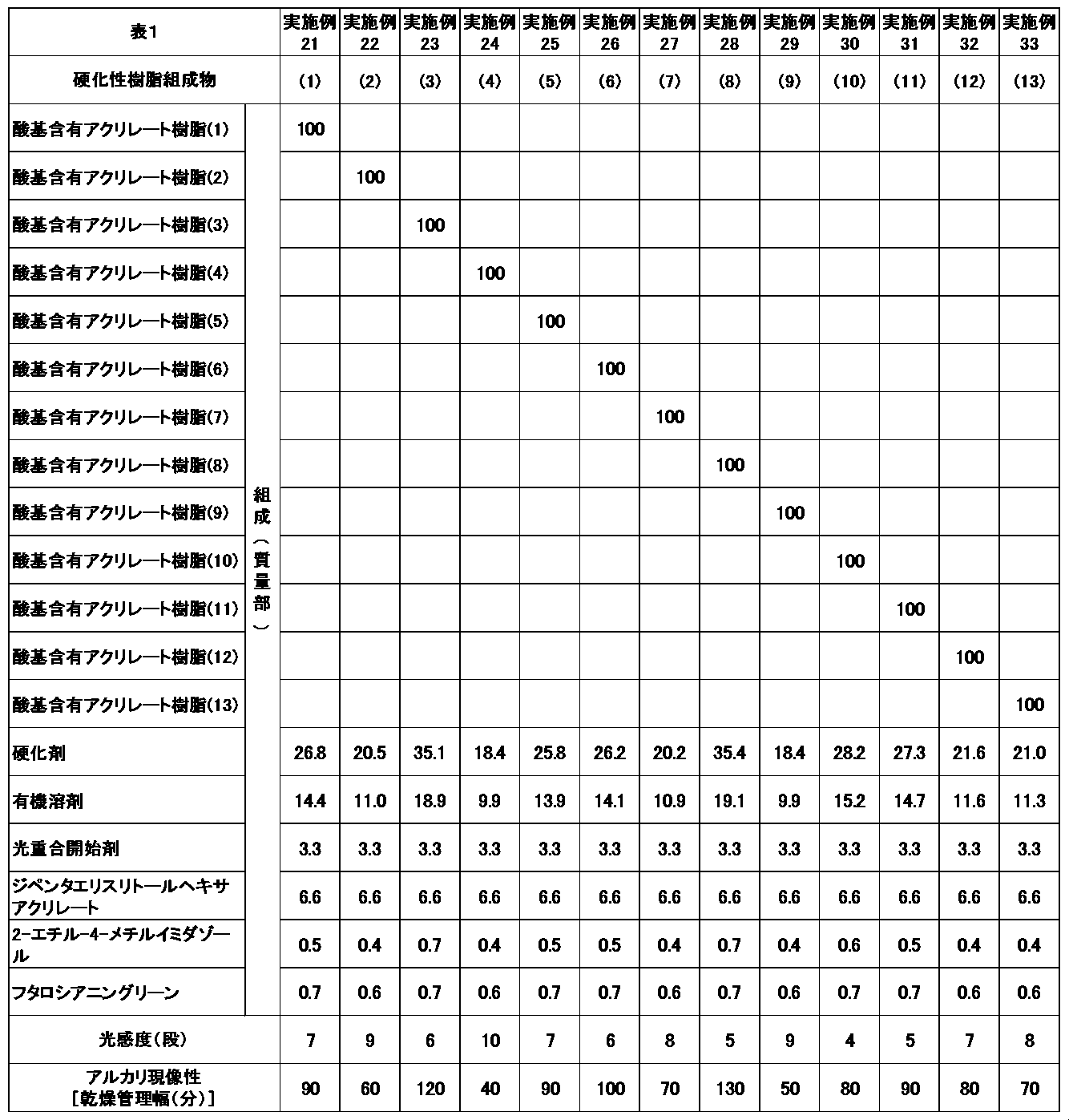
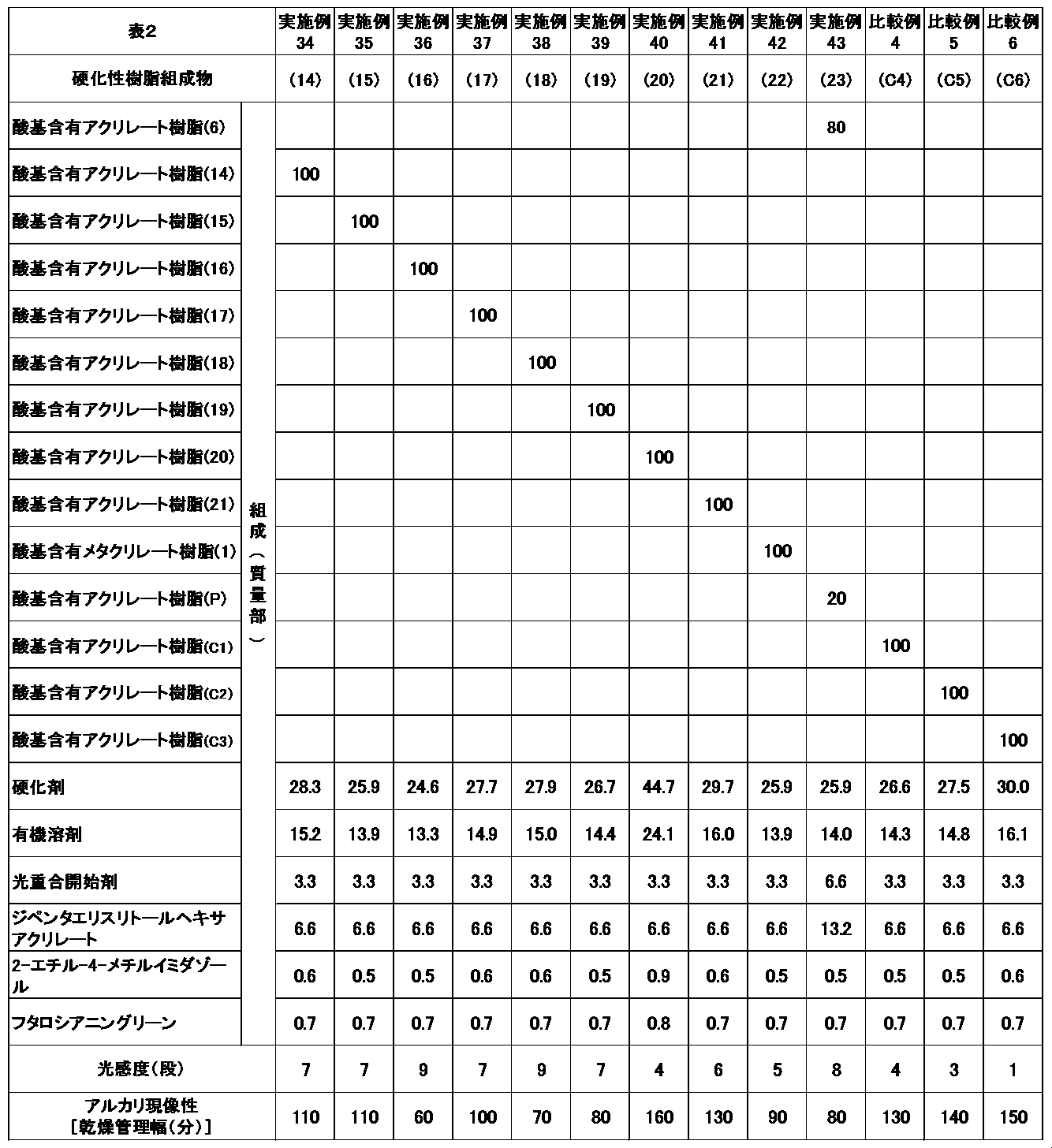
実施例1で得た酸基含有アクリレート樹脂(1)、硬化剤としてオルソクレゾールノボラック型エポキシ樹脂(DIC株式会社製「EPICLON N-680」)、光重合開始剤として2-メチル-1-(4-メチルチオフェニル)-2-モルフォリノプロパン-1-オン(IGM社製「Omnirad-907」)、有機溶剤としてジエチレングリコールモノメチルエーテルアセテートを表3に示す質量部で配合して、硬化性樹脂組成物(24)を得た。
実施例43で用いた酸基含有アクリレート樹脂(1)の代わりに、実施例2~21で得た酸基含有アクリレート樹脂(2)~(21)、または実施例22で得た酸基含有メタクリレート樹脂(1)をそれぞれ用いた以外は、実施例42と同様にして硬化性樹脂組成物(25)~(45)を得た。
実施例44で用いた酸基含有アクリレート樹脂(1)の代わりに、実施例6で得た酸基含有アクリレート樹脂、及び合成例9で得た酸基含有アクリレート樹脂(P)を用いた以外は、実施例44と同様にして硬化性樹脂組成物(46)を得た。
実施例44で用いた酸基含有アクリレート樹脂(1)の代わりに、比較例1~3で得た酸基含有アクリレート樹脂(C1)~(C3)をそれぞれ用いた以外は、実施例44と同様にして硬化性樹脂組成物(C7)~(C9)を得た。
伸度の測定は、引張試験に基づいて行った。
<試験片の作製>
ガラス基材上に実施例及び比較例で得られた硬化性樹脂組成物を50μmのアプリケーターで塗布し、80℃で30分間乾燥させた。メタルハライドランプを用いて1000mJ/cm2の紫外線を照射した後、160℃で1時間加熱した。ガラス基材から硬化物を剥離し、試験片(硬化物)を得た。
前記試験片2を10mm×80mmの大きさに切り出し、株式会社島津製作所製精密万能試験機オートグラフ「AG-IS」を用いて、下記の測定条件で試験片の引張試験を行った。試験片が破断するまでの伸度(%)を測定し、以下の基準に従い評価した。
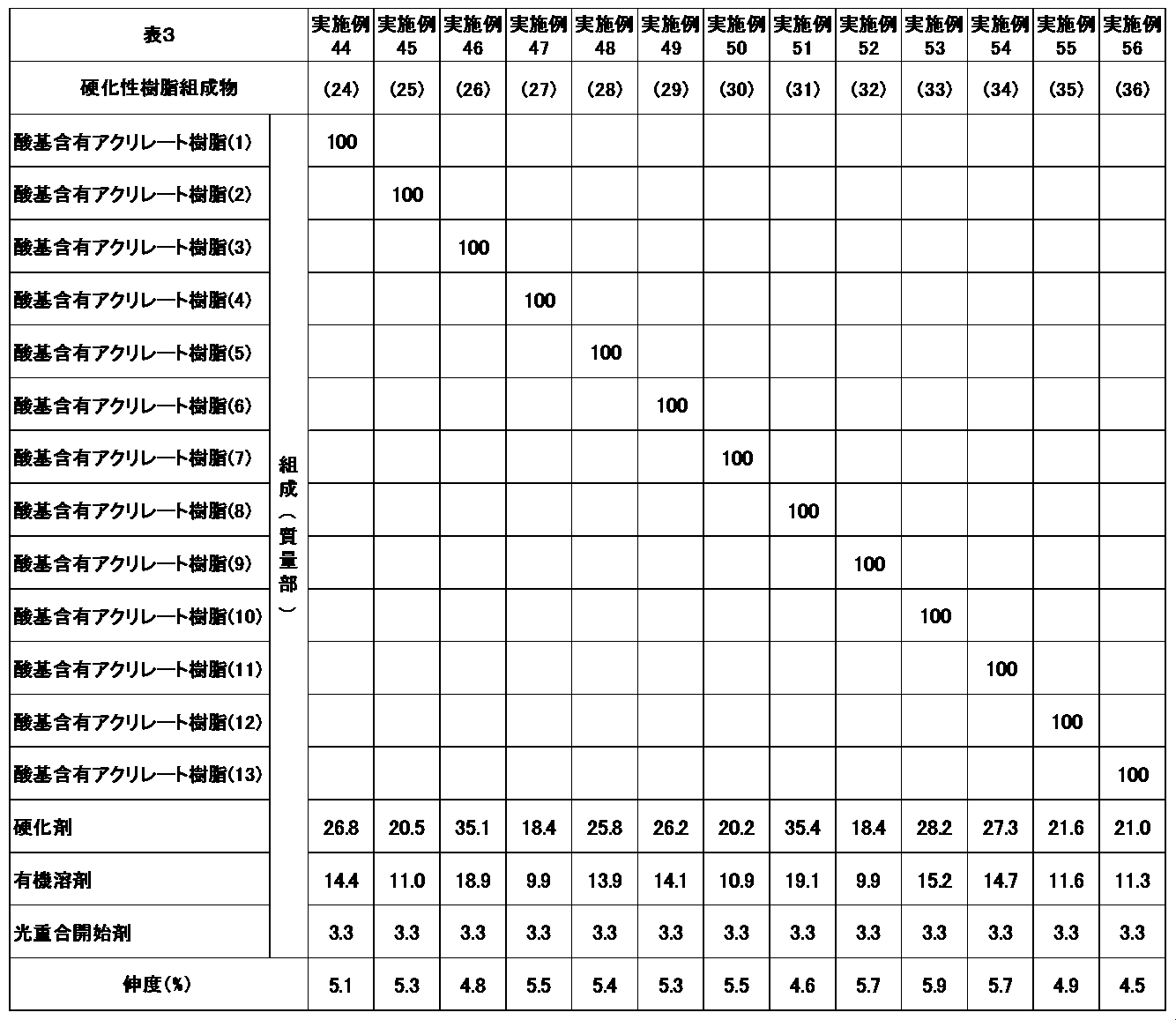
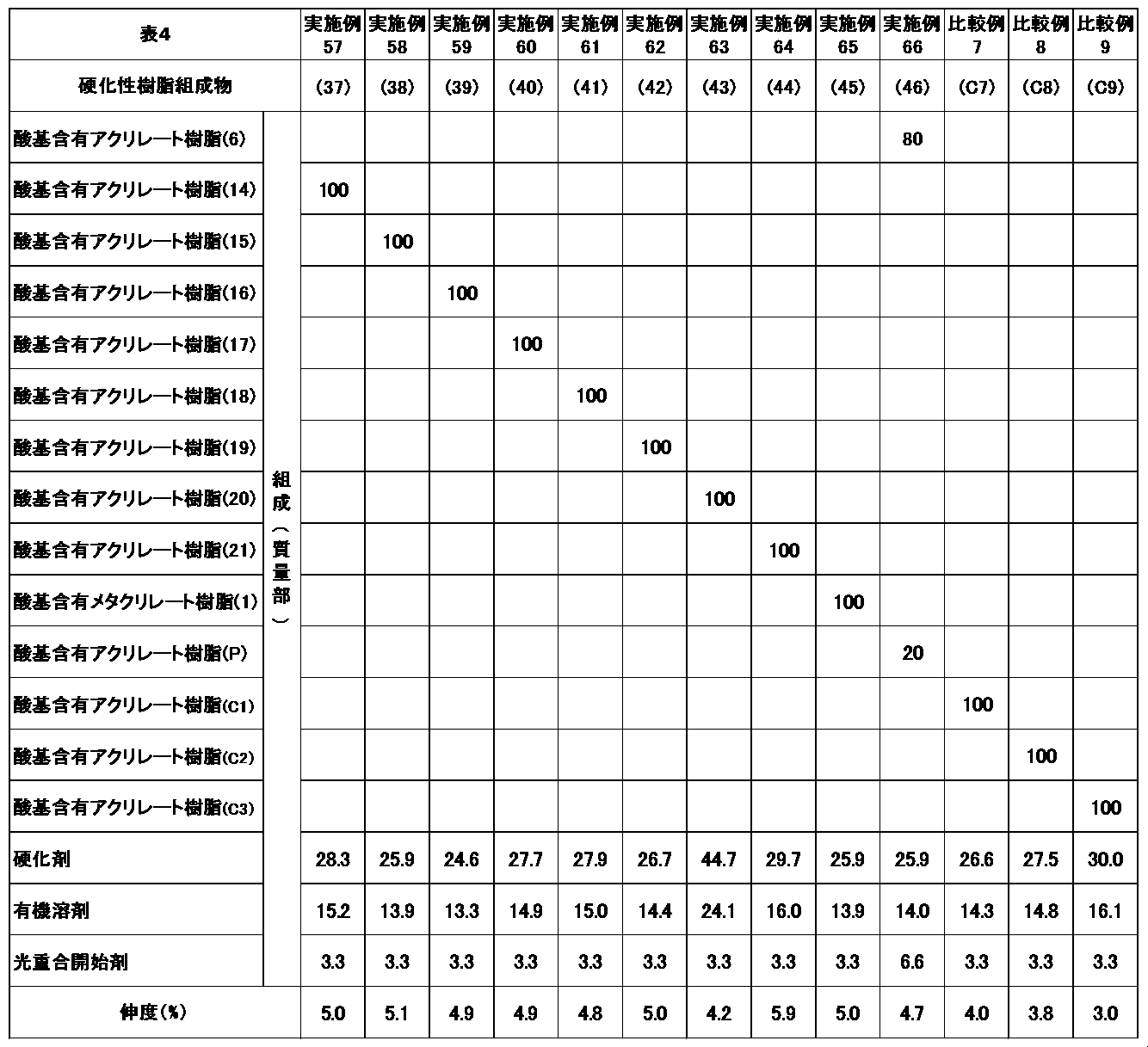
Claims (14)
- エポキシ樹脂(A)、不飽和一塩基酸(B)、及び多塩基酸無水物(C)の反応物(I)と、
エポキシ樹脂(D)と、
不飽和一塩基酸(E)と、
を必須の反応原料とすることを特徴とする酸基含有(メタ)アクリレート樹脂。 - 前記反応物(I)が有する酸基1モルに対して、前記エポキシ樹脂(D)が有するエポキシ基のモル数が、0.3~0.8の範囲である請求項1記載の酸基含有(メタ)アクリレート樹脂。
- 前記酸基含有(メタ)アクリレート樹脂が、前記反応物(I)と、前記エポキシ樹脂(D)及び前記不飽和一塩基酸(E)の反応物(II)とを必須の反応原料とするものである請求項1記載の酸基含有(メタ)アクリレート樹脂。
- 前記反応物(I)が有する酸基1モルに対して、前記反応物(II)が有するエポキシ基のモル数が、0.05~0.4の範囲である請求項3記載の酸基含有(メタ)アクリレート樹脂。
- 前記エポキシ樹脂(D)が有するエポキシ基1モルに対して、前記不飽和一塩基酸(E)が有する酸基のモル数が、0.25~0.75の範囲である請求項3記載の酸基含有(メタ)アクリレート樹脂。
- 前記反応物(II)が、同一分子内にエポキシ基及び(メタ)アクリロイル基を有するものである請求項3記載の酸基含有(メタ)アクリレート樹脂。
- 前記エポキシ樹脂(D)のエポキシ当量が、180g/当量以下である請求項1~6のいずれか1項記載の酸基含有(メタ)アクリレート樹脂。
- 請求項1~7のいずれか1項記載の酸基含有(メタ)アクリレート樹脂と、光重合開始剤とを含有することを特徴とする硬化性樹脂組成物。
- さらに、有機溶剤と、硬化剤とを含有するものである請求項8記載の硬化性樹脂組成物。
- さらに、請求項1~7のいずれか1項記載の酸基含有(メタ)アクリレート樹脂以外の酸基及び重合性不飽和結合を有する樹脂(F)を含有するものである請求項6記載の硬化性樹脂組成物。
- 請求項8~10のいずれか1項記載の硬化性樹脂組成物の硬化反応物であることを特徴とする硬化物。
- 請求項8~10のいずれか1項記載の硬化性樹脂組成物からなることを特徴とする絶縁材料。
- 請求項8~10のいずれか1項記載の硬化性樹脂組成物からなることを特徴とするソルダーレジスト用樹脂材料。
- 請求項13記載のソルダーレジスト用樹脂材料からなることを特徴とするレジスト部材。
Priority Applications (3)
| Application Number | Priority Date | Filing Date | Title |
|---|---|---|---|
| JP2020535670A JP6813135B1 (ja) | 2019-03-06 | 2020-01-28 | 酸基含有(メタ)アクリレート樹脂、硬化性樹脂組成物、硬化物、絶縁材料、ソルダーレジスト用樹脂材料及びレジスト部材 |
| CN202080018777.4A CN113544179B (zh) | 2019-03-06 | 2020-01-28 | 含酸基(甲基)丙烯酸酯树脂、固化性树脂组合物、固化物、绝缘材料、阻焊剂用树脂材料和抗蚀构件 |
| KR1020217020463A KR102516535B1 (ko) | 2019-03-06 | 2020-01-28 | 산기 함유 (메타)아크릴레이트 수지, 경화성 수지 조성물, 경화물, 절연 재료, 솔더 레지스트용 수지 재료 및 레지스트 부재 |
Applications Claiming Priority (2)
| Application Number | Priority Date | Filing Date | Title |
|---|---|---|---|
| JP2019-040532 | 2019-03-06 | ||
| JP2019040532 | 2019-03-06 |
Publications (1)
| Publication Number | Publication Date |
|---|---|
| WO2020179287A1 true WO2020179287A1 (ja) | 2020-09-10 |
Family
ID=72338280
Family Applications (1)
| Application Number | Title | Priority Date | Filing Date |
|---|---|---|---|
| PCT/JP2020/002901 Ceased WO2020179287A1 (ja) | 2019-03-06 | 2020-01-28 | 酸基含有(メタ)アクリレート樹脂、硬化性樹脂組成物、硬化物、絶縁材料、ソルダーレジスト用樹脂材料及びレジスト部材 |
Country Status (5)
| Country | Link |
|---|---|
| JP (1) | JP6813135B1 (ja) |
| KR (1) | KR102516535B1 (ja) |
| CN (1) | CN113544179B (ja) |
| TW (1) | TWI848061B (ja) |
| WO (1) | WO2020179287A1 (ja) |
Cited By (1)
| Publication number | Priority date | Publication date | Assignee | Title |
|---|---|---|---|---|
| JP2023177654A (ja) * | 2022-06-02 | 2023-12-14 | Dic株式会社 | 酸基及び重合性不飽和基を有する樹脂、硬化性樹脂組成物、硬化物、絶縁材料、並びに、レジスト部材 |
Families Citing this family (2)
| Publication number | Priority date | Publication date | Assignee | Title |
|---|---|---|---|---|
| JP2023003576A (ja) * | 2021-06-24 | 2023-01-17 | Dic株式会社 | 樹脂、硬化性樹脂組成物、硬化物、絶縁材料及びレジスト部材 |
| CN120230272A (zh) * | 2025-05-29 | 2025-07-01 | 广州昊毅新材料科技股份有限公司 | 一种碱溶性树脂及其制备方法、光敏树脂组合物及其应用 |
Citations (4)
| Publication number | Priority date | Publication date | Assignee | Title |
|---|---|---|---|---|
| JPH0987346A (ja) * | 1995-09-19 | 1997-03-31 | Dainippon Ink & Chem Inc | エネルギ−線硬化型エポキシアクリレ−ト樹脂組成物 |
| JP2000267275A (ja) * | 1999-03-15 | 2000-09-29 | Tamura Kaken Co Ltd | 感光性樹脂組成物及びプリント配線板 |
| JP2004131526A (ja) * | 2002-10-08 | 2004-04-30 | Great Eastern Resins Industrial Co Ltd | 感光性熱硬化型樹脂およびその製造方法ならびにその樹脂を含む耐ソルダー性インク組成物 |
| JP2007003590A (ja) * | 2005-06-21 | 2007-01-11 | Dainippon Ink & Chem Inc | レジストインキ組成物 |
Family Cites Families (4)
| Publication number | Priority date | Publication date | Assignee | Title |
|---|---|---|---|---|
| JPS61243869A (ja) | 1985-04-19 | 1986-10-30 | Taiyo Ink Seizo Kk | レジストインキ組成物 |
| JP4242010B2 (ja) * | 1999-06-30 | 2009-03-18 | 日本化薬株式会社 | 感光性樹脂組成物及びその硬化物 |
| ATE545671T1 (de) * | 2008-06-09 | 2012-03-15 | Goo Chemical Co Ltd | Carboxylgruppenhaltiges harz, carboxylgruppenhaltiges harz enthaltende härtbare zusammensetzung und gehärtetes produkt der zusammensetzung |
| CN110461900B (zh) * | 2017-04-06 | 2022-03-18 | Dic株式会社 | 含酸基的(甲基)丙烯酸酯树脂和阻焊剂用树脂材料 |
-
2020
- 2020-01-28 WO PCT/JP2020/002901 patent/WO2020179287A1/ja not_active Ceased
- 2020-01-28 CN CN202080018777.4A patent/CN113544179B/zh active Active
- 2020-01-28 KR KR1020217020463A patent/KR102516535B1/ko active Active
- 2020-01-28 JP JP2020535670A patent/JP6813135B1/ja active Active
- 2020-02-27 TW TW109106386A patent/TWI848061B/zh active
Patent Citations (4)
| Publication number | Priority date | Publication date | Assignee | Title |
|---|---|---|---|---|
| JPH0987346A (ja) * | 1995-09-19 | 1997-03-31 | Dainippon Ink & Chem Inc | エネルギ−線硬化型エポキシアクリレ−ト樹脂組成物 |
| JP2000267275A (ja) * | 1999-03-15 | 2000-09-29 | Tamura Kaken Co Ltd | 感光性樹脂組成物及びプリント配線板 |
| JP2004131526A (ja) * | 2002-10-08 | 2004-04-30 | Great Eastern Resins Industrial Co Ltd | 感光性熱硬化型樹脂およびその製造方法ならびにその樹脂を含む耐ソルダー性インク組成物 |
| JP2007003590A (ja) * | 2005-06-21 | 2007-01-11 | Dainippon Ink & Chem Inc | レジストインキ組成物 |
Cited By (2)
| Publication number | Priority date | Publication date | Assignee | Title |
|---|---|---|---|---|
| JP2023177654A (ja) * | 2022-06-02 | 2023-12-14 | Dic株式会社 | 酸基及び重合性不飽和基を有する樹脂、硬化性樹脂組成物、硬化物、絶縁材料、並びに、レジスト部材 |
| JP7819578B2 (ja) | 2022-06-02 | 2026-02-25 | Dic株式会社 | 酸基及び重合性不飽和基を有する樹脂、硬化性樹脂組成物、硬化物、絶縁材料、並びに、レジスト部材 |
Also Published As
| Publication number | Publication date |
|---|---|
| TW202043320A (zh) | 2020-12-01 |
| KR20210099068A (ko) | 2021-08-11 |
| JPWO2020179287A1 (ja) | 2021-03-18 |
| CN113544179B (zh) | 2024-02-02 |
| CN113544179A (zh) | 2021-10-22 |
| KR102516535B1 (ko) | 2023-04-03 |
| TWI848061B (zh) | 2024-07-11 |
| JP6813135B1 (ja) | 2021-01-13 |
Similar Documents
| Publication | Publication Date | Title |
|---|---|---|
| JP7151411B2 (ja) | 酸基含有(メタ)アクリレート樹脂、硬化性樹脂組成物、硬化物、絶縁材料、ソルダーレジスト用樹脂材料及びレジスト部材 | |
| JP6813135B1 (ja) | 酸基含有(メタ)アクリレート樹脂、硬化性樹脂組成物、硬化物、絶縁材料、ソルダーレジスト用樹脂材料及びレジスト部材 | |
| JP7310253B2 (ja) | アミドイミド樹脂組成物、硬化性樹脂組成物、硬化物、絶縁材料、ソルダーレジスト用樹脂材料及びレジスト部材 | |
| JP7275898B2 (ja) | 酸基含有(メタ)アクリレート樹脂、硬化性樹脂組成物、硬化物、絶縁材料、ソルダーレジスト用樹脂材料及びレジスト部材 | |
| JP7172555B2 (ja) | 酸基含有(メタ)アクリレート樹脂組成物、硬化性樹脂組成物、硬化物、絶縁材料、ソルダーレジスト用樹脂材料及びレジスト部材 | |
| JP7247862B2 (ja) | 酸基含有(メタ)アクリレート樹脂組成物、硬化性樹脂組成物、硬化物、絶縁材料、ソルダーレジスト用樹脂材料及びレジスト部材 | |
| JP7192521B2 (ja) | 酸基含有(メタ)アクリレート樹脂、硬化性樹脂組成物、硬化物、絶縁材料、ソルダーレジスト用樹脂材料及びレジスト部材 | |
| JP6780809B1 (ja) | 酸基含有(メタ)アクリレート樹脂、硬化性樹脂組成物、硬化物、絶縁材料、ソルダーレジスト用樹脂材料及びレジスト部材 | |
| JP7228101B2 (ja) | 酸基含有(メタ)アクリレート樹脂組成物、硬化性樹脂組成物、硬化物、絶縁材料、ソルダーレジスト用樹脂材料及びレジスト部材 | |
| JP7264004B2 (ja) | 酸基含有(メタ)アクリレート樹脂組成物、硬化性樹脂組成物、硬化物、絶縁材料、ソルダーレジスト用樹脂材料及びレジスト部材 | |
| JP7183761B2 (ja) | 酸基含有(メタ)アクリレート樹脂、硬化性樹脂組成物、硬化物、絶縁材料、ソルダーレジスト用樹脂材料及びレジスト部材 | |
| JP7188053B2 (ja) | 酸基含有(メタ)アクリレート樹脂、硬化性樹脂組成物、硬化物、絶縁材料、ソルダーレジスト用樹脂材料及びレジスト部材 | |
| JP6838692B1 (ja) | 酸基含有(メタ)アクリレート樹脂、酸基含有(メタ)アクリレート樹脂組成物、硬化性樹脂組成物、硬化物、絶縁材料、ソルダーレジスト用樹脂材料及びレジスト部材 | |
| JP7215105B2 (ja) | 酸基含有(メタ)アクリレート樹脂、硬化性樹脂組成物、硬化物、絶縁材料、ソルダーレジスト用樹脂材料及びレジスト部材 | |
| JP6797354B2 (ja) | 酸基含有(メタ)アクリレート樹脂、硬化性樹脂組成物、硬化物、絶縁材料、ソルダーレジスト用樹脂材料及びレジスト部材 | |
| TWI811384B (zh) | 含酸基之(甲基)丙烯酸酯樹脂組成物、硬化性樹脂組成物、硬化物、及阻焊劑用樹脂材料 | |
| JP7206782B2 (ja) | 酸基含有エポキシ(メタ)アクリレート樹脂、硬化性樹脂組成物、硬化物、絶縁材料、ソルダーレジスト用樹脂材料及びレジスト部材 | |
| JP7196587B2 (ja) | 酸基含有(メタ)アクリレート樹脂、硬化性樹脂組成物、硬化物、絶縁材料、ソルダーレジスト用樹脂材料及びレジスト部材 | |
| JP7228093B2 (ja) | 酸基含有(メタ)アクリレート樹脂、硬化性樹脂組成物、硬化物、絶縁材料、ソルダーレジスト用樹脂材料及びレジスト部材 | |
| JP7192480B2 (ja) | 硬化性樹脂組成物、硬化物、絶縁材料、ソルダーレジスト用樹脂材料及びレジスト部材 | |
| WO2021065318A1 (ja) | 酸基含有(メタ)アクリレート樹脂、酸基含有(メタ)アクリレート樹脂組成物、硬化性樹脂組成物、硬化物、絶縁材料、ソルダーレジスト用樹脂材料及びレジスト部材 |
Legal Events
| Date | Code | Title | Description |
|---|---|---|---|
| ENP | Entry into the national phase |
Ref document number: 2020535670 Country of ref document: JP Kind code of ref document: A |
|
| 121 | Ep: the epo has been informed by wipo that ep was designated in this application |
Ref document number: 20765951 Country of ref document: EP Kind code of ref document: A1 |
|
| ENP | Entry into the national phase |
Ref document number: 20217020463 Country of ref document: KR Kind code of ref document: A |
|
| NENP | Non-entry into the national phase |
Ref country code: DE |
|
| 122 | Ep: pct application non-entry in european phase |
Ref document number: 20765951 Country of ref document: EP Kind code of ref document: A1 |