WO2020171071A1 - 紫外線吸収性ポリマー、成形用樹脂組成物、及び成形体 - Google Patents
紫外線吸収性ポリマー、成形用樹脂組成物、及び成形体 Download PDFInfo
- Publication number
- WO2020171071A1 WO2020171071A1 PCT/JP2020/006299 JP2020006299W WO2020171071A1 WO 2020171071 A1 WO2020171071 A1 WO 2020171071A1 JP 2020006299 W JP2020006299 W JP 2020006299W WO 2020171071 A1 WO2020171071 A1 WO 2020171071A1
- Authority
- WO
- WIPO (PCT)
- Prior art keywords
- group
- carbon atoms
- general formula
- parts
- ultraviolet absorbing
- Prior art date
- Legal status (The legal status is an assumption and is not a legal conclusion. Google has not performed a legal analysis and makes no representation as to the accuracy of the status listed.)
- Ceased
Links
- 0 C*C(C(O*C)=O)=NC Chemical compound C*C(C(O*C)=O)=NC 0.000 description 4
- MUWCPDZYYGRKSO-UHFFFAOYSA-N CCCCCCCCCCCCCCCc(cc1)cc(O)c1-c1nc(-c2ccc(CCCCCCCCCCCCCCC)cc2O)nc(-c(ccc(CCCCCCCCCCCCCCC)c2)c2O)n1 Chemical compound CCCCCCCCCCCCCCCc(cc1)cc(O)c1-c1nc(-c2ccc(CCCCCCCCCCCCCCC)cc2O)nc(-c(ccc(CCCCCCCCCCCCCCC)c2)c2O)n1 MUWCPDZYYGRKSO-UHFFFAOYSA-N 0.000 description 1
- DFANMEUHPMJFDO-UHFFFAOYSA-N CCCCCCOc(c(C)c1O)ccc1-c1nc(-c(c(O)c2C)ccc2OCCCCCC)nc(-c(ccc(OCCCCCC)c2C)c2O)n1 Chemical compound CCCCCCOc(c(C)c1O)ccc1-c1nc(-c(c(O)c2C)ccc2OCCCCCC)nc(-c(ccc(OCCCCCC)c2C)c2O)n1 DFANMEUHPMJFDO-UHFFFAOYSA-N 0.000 description 1
Classifications
-
- C—CHEMISTRY; METALLURGY
- C08—ORGANIC MACROMOLECULAR COMPOUNDS; THEIR PREPARATION OR CHEMICAL WORKING-UP; COMPOSITIONS BASED THEREON
- C08F—MACROMOLECULAR COMPOUNDS OBTAINED BY REACTIONS ONLY INVOLVING CARBON-TO-CARBON UNSATURATED BONDS
- C08F212/00—Copolymers of compounds having one or more unsaturated aliphatic radicals, each having only one carbon-to-carbon double bond, and at least one being terminated by an aromatic carbocyclic ring
- C08F212/02—Monomers containing only one unsaturated aliphatic radical
- C08F212/04—Monomers containing only one unsaturated aliphatic radical containing one ring
- C08F212/06—Hydrocarbons
- C08F212/08—Styrene
-
- C—CHEMISTRY; METALLURGY
- C08—ORGANIC MACROMOLECULAR COMPOUNDS; THEIR PREPARATION OR CHEMICAL WORKING-UP; COMPOSITIONS BASED THEREON
- C08F—MACROMOLECULAR COMPOUNDS OBTAINED BY REACTIONS ONLY INVOLVING CARBON-TO-CARBON UNSATURATED BONDS
- C08F220/00—Copolymers of compounds having one or more unsaturated aliphatic radicals, each having only one carbon-to-carbon double bond, and only one being terminated by only one carboxyl radical or a salt, anhydride ester, amide, imide or nitrile thereof
- C08F220/02—Monocarboxylic acids having less than ten carbon atoms; Derivatives thereof
- C08F220/10—Esters
- C08F220/34—Esters containing nitrogen, e.g. N,N-dimethylaminoethyl (meth)acrylate
-
- C—CHEMISTRY; METALLURGY
- C08—ORGANIC MACROMOLECULAR COMPOUNDS; THEIR PREPARATION OR CHEMICAL WORKING-UP; COMPOSITIONS BASED THEREON
- C08F—MACROMOLECULAR COMPOUNDS OBTAINED BY REACTIONS ONLY INVOLVING CARBON-TO-CARBON UNSATURATED BONDS
- C08F220/00—Copolymers of compounds having one or more unsaturated aliphatic radicals, each having only one carbon-to-carbon double bond, and only one being terminated by only one carboxyl radical or a salt, anhydride ester, amide, imide or nitrile thereof
- C08F220/02—Monocarboxylic acids having less than ten carbon atoms; Derivatives thereof
- C08F220/10—Esters
- C08F220/12—Esters of monohydric alcohols or phenols
- C08F220/14—Methyl esters, e.g. methyl (meth)acrylate
-
- C—CHEMISTRY; METALLURGY
- C08—ORGANIC MACROMOLECULAR COMPOUNDS; THEIR PREPARATION OR CHEMICAL WORKING-UP; COMPOSITIONS BASED THEREON
- C08F—MACROMOLECULAR COMPOUNDS OBTAINED BY REACTIONS ONLY INVOLVING CARBON-TO-CARBON UNSATURATED BONDS
- C08F220/00—Copolymers of compounds having one or more unsaturated aliphatic radicals, each having only one carbon-to-carbon double bond, and only one being terminated by only one carboxyl radical or a salt, anhydride ester, amide, imide or nitrile thereof
- C08F220/02—Monocarboxylic acids having less than ten carbon atoms; Derivatives thereof
- C08F220/10—Esters
- C08F220/12—Esters of monohydric alcohols or phenols
- C08F220/16—Esters of monohydric alcohols or phenols of phenols or of alcohols containing two or more carbon atoms
- C08F220/18—Esters of monohydric alcohols or phenols of phenols or of alcohols containing two or more carbon atoms with acrylic or methacrylic acids
- C08F220/1804—C4-(meth)acrylate, e.g. butyl (meth)acrylate, isobutyl (meth)acrylate or tert-butyl (meth)acrylate
-
- C—CHEMISTRY; METALLURGY
- C08—ORGANIC MACROMOLECULAR COMPOUNDS; THEIR PREPARATION OR CHEMICAL WORKING-UP; COMPOSITIONS BASED THEREON
- C08F—MACROMOLECULAR COMPOUNDS OBTAINED BY REACTIONS ONLY INVOLVING CARBON-TO-CARBON UNSATURATED BONDS
- C08F220/00—Copolymers of compounds having one or more unsaturated aliphatic radicals, each having only one carbon-to-carbon double bond, and only one being terminated by only one carboxyl radical or a salt, anhydride ester, amide, imide or nitrile thereof
- C08F220/02—Monocarboxylic acids having less than ten carbon atoms; Derivatives thereof
- C08F220/10—Esters
- C08F220/12—Esters of monohydric alcohols or phenols
- C08F220/16—Esters of monohydric alcohols or phenols of phenols or of alcohols containing two or more carbon atoms
- C08F220/18—Esters of monohydric alcohols or phenols of phenols or of alcohols containing two or more carbon atoms with acrylic or methacrylic acids
- C08F220/1811—C10or C11-(Meth)acrylate, e.g. isodecyl (meth)acrylate, isobornyl (meth)acrylate or 2-naphthyl (meth)acrylate
-
- C—CHEMISTRY; METALLURGY
- C08—ORGANIC MACROMOLECULAR COMPOUNDS; THEIR PREPARATION OR CHEMICAL WORKING-UP; COMPOSITIONS BASED THEREON
- C08F—MACROMOLECULAR COMPOUNDS OBTAINED BY REACTIONS ONLY INVOLVING CARBON-TO-CARBON UNSATURATED BONDS
- C08F220/00—Copolymers of compounds having one or more unsaturated aliphatic radicals, each having only one carbon-to-carbon double bond, and only one being terminated by only one carboxyl radical or a salt, anhydride ester, amide, imide or nitrile thereof
- C08F220/02—Monocarboxylic acids having less than ten carbon atoms; Derivatives thereof
- C08F220/10—Esters
- C08F220/12—Esters of monohydric alcohols or phenols
- C08F220/16—Esters of monohydric alcohols or phenols of phenols or of alcohols containing two or more carbon atoms
- C08F220/18—Esters of monohydric alcohols or phenols of phenols or of alcohols containing two or more carbon atoms with acrylic or methacrylic acids
- C08F220/1818—C13or longer chain (meth)acrylate, e.g. stearyl (meth)acrylate
-
- C—CHEMISTRY; METALLURGY
- C08—ORGANIC MACROMOLECULAR COMPOUNDS; THEIR PREPARATION OR CHEMICAL WORKING-UP; COMPOSITIONS BASED THEREON
- C08F—MACROMOLECULAR COMPOUNDS OBTAINED BY REACTIONS ONLY INVOLVING CARBON-TO-CARBON UNSATURATED BONDS
- C08F220/00—Copolymers of compounds having one or more unsaturated aliphatic radicals, each having only one carbon-to-carbon double bond, and only one being terminated by only one carboxyl radical or a salt, anhydride ester, amide, imide or nitrile thereof
- C08F220/02—Monocarboxylic acids having less than ten carbon atoms; Derivatives thereof
- C08F220/10—Esters
- C08F220/34—Esters containing nitrogen, e.g. N,N-dimethylaminoethyl (meth)acrylate
- C08F220/36—Esters containing nitrogen, e.g. N,N-dimethylaminoethyl (meth)acrylate containing oxygen in addition to the carboxy oxygen, e.g. 2-N-morpholinoethyl (meth)acrylate or 2-isocyanatoethyl (meth)acrylate
-
- C—CHEMISTRY; METALLURGY
- C08—ORGANIC MACROMOLECULAR COMPOUNDS; THEIR PREPARATION OR CHEMICAL WORKING-UP; COMPOSITIONS BASED THEREON
- C08F—MACROMOLECULAR COMPOUNDS OBTAINED BY REACTIONS ONLY INVOLVING CARBON-TO-CARBON UNSATURATED BONDS
- C08F220/00—Copolymers of compounds having one or more unsaturated aliphatic radicals, each having only one carbon-to-carbon double bond, and only one being terminated by only one carboxyl radical or a salt, anhydride ester, amide, imide or nitrile thereof
- C08F220/02—Monocarboxylic acids having less than ten carbon atoms; Derivatives thereof
- C08F220/10—Esters
- C08F220/34—Esters containing nitrogen, e.g. N,N-dimethylaminoethyl (meth)acrylate
- C08F220/36—Esters containing nitrogen, e.g. N,N-dimethylaminoethyl (meth)acrylate containing oxygen in addition to the carboxy oxygen, e.g. 2-N-morpholinoethyl (meth)acrylate or 2-isocyanatoethyl (meth)acrylate
- C08F220/365—Esters containing nitrogen, e.g. N,N-dimethylaminoethyl (meth)acrylate containing oxygen in addition to the carboxy oxygen, e.g. 2-N-morpholinoethyl (meth)acrylate or 2-isocyanatoethyl (meth)acrylate containing further carboxylic moieties
-
- C—CHEMISTRY; METALLURGY
- C08—ORGANIC MACROMOLECULAR COMPOUNDS; THEIR PREPARATION OR CHEMICAL WORKING-UP; COMPOSITIONS BASED THEREON
- C08F—MACROMOLECULAR COMPOUNDS OBTAINED BY REACTIONS ONLY INVOLVING CARBON-TO-CARBON UNSATURATED BONDS
- C08F293/00—Macromolecular compounds obtained by polymerisation on to a macromolecule having groups capable of inducing the formation of new polymer chains bound exclusively at one or both ends of the starting macromolecule
-
- C—CHEMISTRY; METALLURGY
- C08—ORGANIC MACROMOLECULAR COMPOUNDS; THEIR PREPARATION OR CHEMICAL WORKING-UP; COMPOSITIONS BASED THEREON
- C08F—MACROMOLECULAR COMPOUNDS OBTAINED BY REACTIONS ONLY INVOLVING CARBON-TO-CARBON UNSATURATED BONDS
- C08F293/00—Macromolecular compounds obtained by polymerisation on to a macromolecule having groups capable of inducing the formation of new polymer chains bound exclusively at one or both ends of the starting macromolecule
- C08F293/005—Macromolecular compounds obtained by polymerisation on to a macromolecule having groups capable of inducing the formation of new polymer chains bound exclusively at one or both ends of the starting macromolecule using free radical "living" or "controlled" polymerisation, e.g. using a complexing agent
-
- C—CHEMISTRY; METALLURGY
- C08—ORGANIC MACROMOLECULAR COMPOUNDS; THEIR PREPARATION OR CHEMICAL WORKING-UP; COMPOSITIONS BASED THEREON
- C08L—COMPOSITIONS OF MACROMOLECULAR COMPOUNDS
- C08L23/00—Compositions of homopolymers or copolymers of unsaturated aliphatic hydrocarbons having only one carbon-to-carbon double bond; Compositions of derivatives of such polymers
-
- C—CHEMISTRY; METALLURGY
- C08—ORGANIC MACROMOLECULAR COMPOUNDS; THEIR PREPARATION OR CHEMICAL WORKING-UP; COMPOSITIONS BASED THEREON
- C08L—COMPOSITIONS OF MACROMOLECULAR COMPOUNDS
- C08L23/00—Compositions of homopolymers or copolymers of unsaturated aliphatic hydrocarbons having only one carbon-to-carbon double bond; Compositions of derivatives of such polymers
- C08L23/02—Compositions of homopolymers or copolymers of unsaturated aliphatic hydrocarbons having only one carbon-to-carbon double bond; Compositions of derivatives of such polymers not modified by chemical after-treatment
- C08L23/04—Homopolymers or copolymers of ethene
-
- C—CHEMISTRY; METALLURGY
- C08—ORGANIC MACROMOLECULAR COMPOUNDS; THEIR PREPARATION OR CHEMICAL WORKING-UP; COMPOSITIONS BASED THEREON
- C08L—COMPOSITIONS OF MACROMOLECULAR COMPOUNDS
- C08L23/00—Compositions of homopolymers or copolymers of unsaturated aliphatic hydrocarbons having only one carbon-to-carbon double bond; Compositions of derivatives of such polymers
- C08L23/02—Compositions of homopolymers or copolymers of unsaturated aliphatic hydrocarbons having only one carbon-to-carbon double bond; Compositions of derivatives of such polymers not modified by chemical after-treatment
- C08L23/04—Homopolymers or copolymers of ethene
- C08L23/06—Polyethylene
-
- C—CHEMISTRY; METALLURGY
- C08—ORGANIC MACROMOLECULAR COMPOUNDS; THEIR PREPARATION OR CHEMICAL WORKING-UP; COMPOSITIONS BASED THEREON
- C08L—COMPOSITIONS OF MACROMOLECULAR COMPOUNDS
- C08L23/00—Compositions of homopolymers or copolymers of unsaturated aliphatic hydrocarbons having only one carbon-to-carbon double bond; Compositions of derivatives of such polymers
- C08L23/02—Compositions of homopolymers or copolymers of unsaturated aliphatic hydrocarbons having only one carbon-to-carbon double bond; Compositions of derivatives of such polymers not modified by chemical after-treatment
- C08L23/10—Homopolymers or copolymers of propene
-
- C—CHEMISTRY; METALLURGY
- C08—ORGANIC MACROMOLECULAR COMPOUNDS; THEIR PREPARATION OR CHEMICAL WORKING-UP; COMPOSITIONS BASED THEREON
- C08L—COMPOSITIONS OF MACROMOLECULAR COMPOUNDS
- C08L33/00—Compositions of homopolymers or copolymers of compounds having one or more unsaturated aliphatic radicals, each having only one carbon-to-carbon double bond, and only one being terminated by only one carboxyl radical, or of salts, anhydrides, esters, amides, imides or nitriles thereof; Compositions of derivatives of such polymers
- C08L33/04—Homopolymers or copolymers of esters
- C08L33/06—Homopolymers or copolymers of esters of esters containing only carbon, hydrogen and oxygen, which oxygen atoms are present only as part of the carboxyl radical
- C08L33/08—Homopolymers or copolymers of acrylic acid esters
-
- C—CHEMISTRY; METALLURGY
- C08—ORGANIC MACROMOLECULAR COMPOUNDS; THEIR PREPARATION OR CHEMICAL WORKING-UP; COMPOSITIONS BASED THEREON
- C08L—COMPOSITIONS OF MACROMOLECULAR COMPOUNDS
- C08L33/00—Compositions of homopolymers or copolymers of compounds having one or more unsaturated aliphatic radicals, each having only one carbon-to-carbon double bond, and only one being terminated by only one carboxyl radical, or of salts, anhydrides, esters, amides, imides or nitriles thereof; Compositions of derivatives of such polymers
- C08L33/04—Homopolymers or copolymers of esters
- C08L33/06—Homopolymers or copolymers of esters of esters containing only carbon, hydrogen and oxygen, which oxygen atoms are present only as part of the carboxyl radical
- C08L33/10—Homopolymers or copolymers of methacrylic acid esters
- C08L33/12—Homopolymers or copolymers of methyl methacrylate
-
- C—CHEMISTRY; METALLURGY
- C08—ORGANIC MACROMOLECULAR COMPOUNDS; THEIR PREPARATION OR CHEMICAL WORKING-UP; COMPOSITIONS BASED THEREON
- C08L—COMPOSITIONS OF MACROMOLECULAR COMPOUNDS
- C08L33/00—Compositions of homopolymers or copolymers of compounds having one or more unsaturated aliphatic radicals, each having only one carbon-to-carbon double bond, and only one being terminated by only one carboxyl radical, or of salts, anhydrides, esters, amides, imides or nitriles thereof; Compositions of derivatives of such polymers
- C08L33/04—Homopolymers or copolymers of esters
- C08L33/14—Homopolymers or copolymers of esters of esters containing halogen, nitrogen, sulfur, or oxygen atoms in addition to the carboxy oxygen
-
- C—CHEMISTRY; METALLURGY
- C08—ORGANIC MACROMOLECULAR COMPOUNDS; THEIR PREPARATION OR CHEMICAL WORKING-UP; COMPOSITIONS BASED THEREON
- C08L—COMPOSITIONS OF MACROMOLECULAR COMPOUNDS
- C08L53/00—Compositions of block copolymers containing at least one sequence of a polymer obtained by reactions only involving carbon-to-carbon unsaturated bonds; Compositions of derivatives of such polymers
-
- C—CHEMISTRY; METALLURGY
- C08—ORGANIC MACROMOLECULAR COMPOUNDS; THEIR PREPARATION OR CHEMICAL WORKING-UP; COMPOSITIONS BASED THEREON
- C08F—MACROMOLECULAR COMPOUNDS OBTAINED BY REACTIONS ONLY INVOLVING CARBON-TO-CARBON UNSATURATED BONDS
- C08F2438/00—Living radical polymerisation
- C08F2438/03—Use of a di- or tri-thiocarbonylthio compound, e.g. di- or tri-thioester, di- or tri-thiocarbamate, or a xanthate as chain transfer agent, e.g . Reversible Addition Fragmentation chain Transfer [RAFT] or Macromolecular Design via Interchange of Xanthates [MADIX]
-
- C—CHEMISTRY; METALLURGY
- C08—ORGANIC MACROMOLECULAR COMPOUNDS; THEIR PREPARATION OR CHEMICAL WORKING-UP; COMPOSITIONS BASED THEREON
- C08L—COMPOSITIONS OF MACROMOLECULAR COMPOUNDS
- C08L2205/00—Polymer mixtures characterised by other features
- C08L2205/03—Polymer mixtures characterised by other features containing three or more polymers in a blend
Definitions
- the present invention relates to an ultraviolet absorbing polymer, a molding resin composition, and a molded body.
- Patent Documents 1 and 2 disclose a composition containing a polyolefin and a resin incorporating an ultraviolet absorber.
- Patent Document 3 discloses a polymer obtained by copolymerizing an ultraviolet absorbing monomer.
- Patent Documents 1 and 2 a resin composition obtained by polymerizing a polyolefin, an ultraviolet absorbing monomer, and the like in a twin-screw extruder has a large haze of a molded body, and the transparency increases as the number of ultraviolet absorbing monomer units increases. There was a problem of decline. Further, in Patent Document 3, a polymer obtained by randomly polymerizing an ultraviolet absorbing monomer has a wide molecular weight distribution and low compatibility with polyolefin, and there is a problem that transparency is insufficient especially when the thickness is increased.
- the present invention has good compatibility with polyolefins, can form a molded article having good transparency, and for example, provides a UV-absorbing polymer that can suppress UV deterioration of contents when forming a packaging material. To aim.
- One embodiment of the present invention is An ultraviolet absorbing polymer having a monomer unit represented by the following general formula (12) and a monomer unit represented by the following general formula (1).
- R 6 represents any one selected from the group consisting of a hydrogen atom and a methyl group
- U represents a hydrocarbon group
- the hydrocarbon group contains a skeleton that absorbs ultraviolet light. May include atoms
- R 16 represents any one selected from the group consisting of a hydrogen atom and a methyl group
- Z represents a chain hydrocarbon group or a polycyclic hydrocarbon group having 10 or more carbon atoms. Represents any selected from the group consisting of
- a block is a polymer block containing a monomer unit represented by the following general formula (12)
- the B block is a UV-absorbing polymer which is a polymer block containing a monomer unit represented by the following general formula (1) (however, it does not contain a monomer unit represented by the general formula (12)).
- R 6 represents any one selected from the group consisting of a hydrogen atom and a methyl group
- U represents a hydrocarbon group
- the hydrocarbon group contains a skeleton that absorbs ultraviolet light. May include atoms
- R 16 represents any one selected from the group consisting of a hydrogen atom and a methyl group
- Z represents a chain hydrocarbon group or a polycyclic hydrocarbon group having 10 or more carbon atoms. Represents any selected from the group consisting of
- Another embodiment of the present invention is Including a thermoplastic resin and the above-described ultraviolet absorbing polymer,
- the ultraviolet absorbing polymer is a molding resin composition having a weight average molecular weight of 5,000 to 100,000.
- Another embodiment of the present invention is a molded article containing the above-mentioned molding resin composition.
- the compatibility with polyolefin is good, it is possible to form a molded article having good transparency, for example, an ultraviolet absorbing polymer capable of suppressing the ultraviolet deterioration of the contents at the time of forming the packaging material, A resin composition for molding and a molded product can be provided.
- Embodiments of the present invention are as follows.
- R 6 represents any one selected from the group consisting of a hydrogen atom and a methyl group
- U represents a hydrocarbon group
- the hydrocarbon group contains a skeleton that absorbs ultraviolet light. May include atoms
- R 16 represents any one selected from the group consisting of a hydrogen atom and a methyl group
- Z represents a chain hydrocarbon group or a polycyclic hydrocarbon group having 10 or more carbon atoms. Represents any selected from the group consisting of
- a block and a B block are contained, the A block is a polymer block containing a monomer unit represented by the following general formula (12), and the B block is represented by the following general formula (1).
- An ultraviolet absorbing polymer which is a polymer block containing a monomer unit (however, containing no monomer unit represented by the general formula (12)).
- R 6 represents any one selected from the group consisting of a hydrogen atom and a methyl group
- U represents a hydrocarbon group
- the hydrocarbon group contains a skeleton that absorbs ultraviolet light. May include atoms
- R 16 represents any one selected from the group consisting of a hydrogen atom and a methyl group
- Z represents a chain hydrocarbon group or a polycyclic hydrocarbon group having 10 or more carbon atoms. Represents any selected from the group consisting of
- ⁇ 4> The ultraviolet ray according to any one of ⁇ 1> to ⁇ 3>, wherein the skeleton that absorbs the ultraviolet ray is one or more kinds selected from the group consisting of a benzotriazole skeleton, a triazine skeleton, and a benzophenone skeleton. Absorbent polymer.
- the ultraviolet-absorbing skeleton is one or more selected from the group consisting of the benzotriazole skeleton and the triazine skeleton, and the monomer unit having the benzotriazole skeleton is represented by the following general formula (a1- The monomer unit having one kind selected from the group consisting of the monomer unit represented by the formula (1) and the monomer unit represented by the following general formula (3), wherein the monomer unit having the triazine is represented by the following general formula (a1-4) ]
- the ultraviolet-absorbing polymer as described in ⁇ 4> containing the monomer unit shown by these.
- R 1 represents any one selected from the group consisting of a hydrogen atom and a hydrocarbon group having 1 to 8 carbon atoms
- R 2 represents an alkylene group having 1 to 6 carbon atoms and Represents one selected from the group consisting of —O—R 5
- R 5 represents an alkylene group having 1 to 6 carbon atoms
- R 3 represents any selected from the group consisting of hydrogen atom and methyl group
- X 1 represents any one selected from the group consisting of a hydrogen atom, a halogen atom, a hydrocarbon group having 1 to 8 carbon atoms, an alkoxy group having 1 to 6 carbon atoms, a cyano group, and a nitro group.
- R 1d represents any one selected from the group consisting of a hydrogen atom, an alkyl group having 1 to 20 carbon atoms, and a cycloalkyl group having 3 to 20 carbon atoms
- R 2d and R 3d Each independently represents a hydrogen atom, an alkyl group having 1 to 20 carbon atoms, a cycloalkyl having 3 to 20 carbon atoms, or an alkoxy group having 1 to 20 carbon atoms
- R 4d Represents any one selected from the group consisting of an alkylene group having 1 to 20 carbon atoms and a hydroxyalkylene group having 3 to 5 carbon atoms.
- R 41a , R 41b , and R 41c each independently represent a hydrogen atom, an alkyl group having 1 to 20 carbon atoms, an aryl group having 6 to 20 carbon atoms, or —OR 44a.
- R 45a —CO—O—R 46a
- R 44a and R 46a each independently represent an alkyl group having 1 to 20 carbon atoms and 6 to 6 carbon atoms.
- R 45a represents an alkylene group having 1 to 20 carbon atoms and an arylene having 6 to 20 carbon atoms.
- R 42a , R 42b , and R 42c each independently represent any one selected from the group consisting of a hydrogen atom and an alkyl group having 1 to 10 carbon atoms.
- R 43 is a group consisting of a hydrogen atom, a hydroxyl group, an alkyl group having 1 to 20 carbon atoms, an aryl group having 6 to 20 carbon atoms, —O—R 44b , and —O—R 45b —CO—O—R 46b.
- R 44b and R 46b each independently represent any one selected from the group consisting of an alkyl group having 1 to 20 carbon atoms and an aryl group having 6 to 20 carbon atoms, and The alkyl group may form a ring structure
- R 45b represents any one selected from the group consisting of an alkylene group having 1 to 20 carbon atoms and an arylene group having 6 to 20 carbon atoms
- the alkyl group is It may form a ring structure.
- P represents any one selected from the group consisting of —O— and —O—R 47 —O—
- R 47 represents an alkylene group having 1 to 20 carbon atoms
- the alkylene group has a hydroxyl group.
- Q represents any one selected from the group consisting of a hydrogen atom and a methyl group.
- a monomer unit represented by the general formula (12), a monomer unit represented by the general formula (1), and a monomer unit represented by the following general formula (5) are copolymerized, The ultraviolet absorbing polymer according to any one of 1> to ⁇ 5>.
- R 109 represents any one selected from the group consisting of a hydrogen atom and a cyano group
- R 110 and R 111 are each independently selected from the group consisting of a hydrogen atom and a methyl group.
- R 112 represents any one selected from the group consisting of a hydrogen atom and a hydrocarbon group
- Y 1 represents any one selected from the group consisting of an oxygen atom and an imino group.
- thermoplastic resin and the ultraviolet absorbing polymer according to any one of ⁇ 1> to ⁇ 6> are included, and the weight average molecular weight of the ultraviolet absorbing polymer is 5,000 to 100,000.
- a molding resin composition A thermoplastic resin and the ultraviolet absorbing polymer according to any one of ⁇ 1> to ⁇ 6> are included, and the weight average molecular weight of the ultraviolet absorbing polymer is 5,000 to 100,000.
- thermoplastic resin is a polyolefin.
- ⁇ 9> A molded article containing the molding resin composition according to ⁇ 7> or ⁇ 8>.
- (meth)acryl means “acryl or methacryl”, “acrylate or methacrylate” “acryloyl or methacryloyl” and the like.
- (meth)acrylic acid means “acrylic acid or methacrylic acid”.
- the unsaturated monomer or monomer means an ethylenically unsaturated group-containing compound, respectively.
- the ultraviolet absorbing polymer of the present embodiment has a monomer unit represented by the following general formula (12) and a monomer unit represented by the following general formula (1).
- the ultraviolet absorbing polymer may be a block polymer.
- R 6 represents any one selected from the group consisting of a hydrogen atom and a methyl group
- U represents a hydrocarbon group
- the hydrocarbon group contains a heterocycle containing a skeleton that absorbs ultraviolet rays. It may include atoms.
- the ultraviolet absorbing polymer has ultraviolet absorbing properties.
- the skeleton that absorbs ultraviolet rays include a hydrocarbon group that may contain a hetero atom.
- the monomer unit represented by the general formula (12) is a unit formed by polymerizing the monomer represented by the following general formula (16).
- R 6 represents any one selected from the group consisting of a hydrogen atom and a methyl group
- U represents a hydrocarbon group
- the hydrocarbon group contains a skeleton that absorbs ultraviolet light. It may include atoms.
- the monomer unit represented by the general formula (16) may be used alone or, if necessary, may be used in combination of two or more kinds.
- the content of the monomer unit represented by the general formula (16) is preferably 3 to 40% by mass, more preferably 3 to 30% by mass, and further preferably 5 to 25% by mass in 100% by mass of the monomer mixture. ..
- the UV-absorbing polymer when synthesized as a block polymer containing an A block for polymerizing a UV-absorbing unsaturated monomer and a B block for polymerizing other monomers, has a UV-absorbing property among the monomer components of the UV-absorbing polymer.
- the compatibility does not decrease even if the content of the unsaturated unsaturated monomer is 40% by mass or more.
- the upper limit of the ultraviolet absorbing unsaturated monomer in the monomer component of the block polymer is preferably 70% by mass or less, and more preferably 60% by mass or less.
- U represents a hydrocarbon group
- the hydrocarbon group may contain a hetero atom containing a skeleton that absorbs ultraviolet rays.
- the skeleton that absorbs ultraviolet rays is preferably, for example, one or more selected from the group consisting of a benzotriazole skeleton, a triazine skeleton, and a benzophenone skeleton.
- the monomer unit will be described for each skeleton that absorbs ultraviolet rays.
- R 1 represents any one selected from the group consisting of a hydrogen atom and a hydrocarbon group having 1 to 8 carbon atoms.
- R 2 represents any one selected from the group consisting of an alkylene group having 1 to 6 carbon atoms and —O—R 5
- R 5 represents an alkylene group having 1 to 6 carbon atoms.
- R 3 represents any one selected from the group consisting of a hydrogen atom and a methyl group.
- X 1 represents any one selected from the group consisting of a hydrogen atom, a halogen atom, a hydrocarbon group having 1 to 8 carbon atoms, an alkoxy group having 1 to 6 carbon atoms, a cyano group, and a nitro group.
- the hydrocarbon group having 1 to 8 carbon atoms is, for example, a methyl group, an ethyl group, a propyl group, an isopropyl group, a butyl group, an isobutyl group, a tert-butyl group, a pentyl group, a hexyl group, a heptyl group or an octyl group.
- hydrocarbon group alicyclic hydrocarbon group such as cyclopropyl group, cyclopentyl group, cyclohexyl group, cycloheptyl group, cyclooctyl group; aromatic carbon group such as phenyl group, tolyl group, xylyl group, benzyl group, phenethyl group A hydrogen group etc. are mentioned.
- the alkylene group having 1 to 6 carbon atoms is, for example, a linear alkylene group such as methylene group, ethylene group, trimethylene group, tetramethylene group; propylene group, 2-methyltrimethylene group, 2-methyltetramethylene group, etc.
- Examples thereof include branched alkylene groups.
- Examples of the halogen atom include a fluorine atom, a chlorine atom, a bromine atom and an iodine atom.
- Examples of the alkoxy group having 1 to 6 carbon atoms include methoxy group, ethoxy group, propoxy group, butoxy group, pentoxy group and heptoxy group.
- Examples of the monomer unit represented by the general formula (a1-1) include 2-[2'-hydroxy-5'-(methacryloyloxymethyl)phenyl]-2H-benzotriazole and 2-[2'-hydroxy-5. '-(Methacryloyloxyethyl)phenyl]-2H-benzotriazole, 2-[2'-hydroxy-5'-(methacryloyloxypropyl)phenyl]-2H-benzotriazole, 2-[2'-hydroxy-3'- tert-Butyl-5'-(methacryloyloxyethyl)phenyl]-2H-benzotriazole, 2-[2'-hydroxy-5'-tert-butyl-3'-(methacryloyloxyethyl)phenyl]-2H-benzotriazole , 2-[2′-hydroxy-5′-( ⁇ -methacryloyloxyethoxy)-3′-tert-butylphenyl]-4-tert-butyl
- the monomer unit represented by the general formula (a1-1) is derived from, for example, the following monomers.
- the monomer unit represented by the general formula (a1-1) may be used alone or in combination of two or more kinds if necessary.
- the content of the monomer represented by the general formula (a1-1) is preferably 1 to 30% by mass, and more preferably 5 to 25% by mass in the monomer unit constituting the ultraviolet absorbing polymer. By containing an appropriate amount, it is easy to achieve both ultraviolet absorption and compatibility with polyolefin.
- R 21 is selected from the group consisting of a hydrogen atom, an alkyl group having 1 to 20 carbon atoms, a cycloalkyl group having 3 to 20 carbon atoms, and an alkoxy group having 1 to 20 carbon atoms.
- R 22 is an alkylene group having 1 to 20 carbon atoms, —R 25 —O(CO)NH—R 26 —, —O—R 27 —, and —O—R 28 —O(CO)NH—R 29 —. It represents any one selected from the group consisting of, R 25, R 26, R 27, R 28, and R 29 each independently represents an alkylene group having 1 to 20 carbon atoms.
- R 23 represents any one selected from the group consisting of a hydrogen atom and a methyl group.
- R 24 represents any one selected from the group consisting of a hydrogen atom, an alkyl group having 1 to 20 carbon atoms, and a cycloalkyl group having 3 to 20 carbon atoms.
- the cycloalkyl group may further have a substituent.
- the alkyl group having 1 to 20 carbon atoms includes, for example, methyl group, ethyl group, propyl group, isopropyl group, butyl group, isobutyl group, tert-butyl group, pentyl group, hexyl group, heptyl group, octyl group, nonyl group, Examples thereof include decyl group, undecyl group, dodecyl group, tridecyl group, tetradecyl group, pentadecyl group, hexadecyl group, heptadecyl group, octadecyl group, nonadecyl group and icosyl group.
- Examples of the cycloalkyl group having 3 to 20 carbon atoms include a cycloalkyl group such as a cyclopropyl group, a cyclopentyl group, a cyclohexyl group, a cycloheptyl group and a cyclooctyl group.
- the alkoxy group having 1 to 20 carbon atoms is, for example, methoxy group, ethoxy group, propoxy group, isopropoxy group, butoxy group, isobutoxy group, tert-butoxy group, pentyloxy group, hexyloxy group, heptyloxy group, octyloxy group.
- nonyloxy group nonyloxy group, decyloxy group, undecyloxy group, dodecyloxy group, tridecyloxy group, tetradecyloxy group, pentadecyloxy group, hexadecyloxy group, heptadecyloxy group, octadecyloxy group, nonadecyloxy group, icosyloxy group Groups and the like.
- the hydrogen atom of the alkyl group having 1 to 20 carbon atoms can be replaced with a halogen atom.
- a halogen atom for example, 1-bromomethyl group, 2-bromoethyl group, 2-chloroethyl group, 2-iodoethyl group, 3-bromopropyl group, 4-bromobutyl group, 1-bromobutyl group, 5-bromopentyl group, 6-bromohexyl group, 7-bromoheptyl group, 8-bromooctyl group, 9-bromononyl group, 10-bromodecyl group, 11-bromoundecyl group, 12-bromododecyl group, 13-bromotridecyl group, 14-bromotetradecyl group, 15
- Examples include -bromopentadecyl group, 16-bromohexadecyl group, 17-bromoheptadecyl
- Examples of the cycloalkyl group having 3 to 20 carbon atoms include 2-bromocyclopropyl group, 2-bromocyclopentyl group and 4-bromocyclohexyl group.
- Examples of the alkoxy group having 1 to 20 carbon atoms include 1-bromomethoxy group, 2-bromoethoxy group and 3-chloropropoxy group.
- the alkylene group having 1 to 20 carbon atoms is, for example, a linear alkylene group such as methylene group, ethylene group, trimethylene group, tetramethylene group, pentamethylene group, hexamethylene group, heptamethylene group, octamethylene group; propylene group. And branched chain alkylene groups such as 2-methyltrimethylene group and 2-methyltetramethylene group.
- the hydrogen atom of an alkylene group having 1 to 20 carbon atoms can be replaced with halogen.
- monobromomethylene group for example, monobromomethylene group, monobromoethylene group, monochloroethylene group, monoiodoethylene group, dibromoethylene group, monobromotrimethylene group, monobromotetramethylene group, monobromopentamethylene group, monobromohexamethylene group, mono Examples thereof include a bromoheptamethylene group and a monobromooctamethylene group.
- the monomer unit represented by the general formula (a1-2) is derived from, for example, the following monomers.
- R 31 represents any one selected from the group consisting of a hydrogen atom, an alkyl group having 1 to 20 carbon atoms, and a cycloalkyl group having 3 to 20 carbon atoms
- R 32 and R 33's each independently represent one selected from the group consisting of a hydrogen atom, an alkyl group having 1 to 20 carbon atoms, a cycloalkyl group having 3 to 20 carbon atoms, and an alkoxy group having 1 to 20 carbon atoms.
- R 34 represents any one selected from the group consisting of an alkylene group having 1 to 20 carbon atoms and a hydroxyalkylene group having 3 to 5 carbon atoms
- R 35 represents any one selected from the group consisting of a hydrogen atom and a methyl group.
- the alkyl group having 1 to 20 carbon atoms includes, for example, methyl group, ethyl group, propyl group, isopropyl group, butyl group, isobutyl group, tert-butyl group, pentyl group, hexyl group, heptyl group, octyl group, nonyl group, Examples thereof include decyl group, undecyl group, dodecyl group, tridecyl group, tetradecyl group, pentadecyl group, hexadecyl group, heptadecyl group, octadecyl group, nonadecyl group and icosyl group.
- Examples of the cycloalkyl group having 3 to 20 carbon atoms include a cycloalkyl group such as a cyclopropyl group, a cyclopentyl group, a cyclohexyl group, a cycloheptyl group and a cyclooctyl group.
- the alkoxy group having 1 to 20 carbon atoms is, for example, methoxy group, ethoxy group, propoxy group, isopropoxy group, butoxy group, isobutoxy group, tert-butoxy group, pentyloxy group, hexyloxy group, heptyloxy group, octyloxy group.
- nonyloxy group nonyloxy group, decyloxy group, undecyloxy group, dodecyloxy group, tridecyloxy group, tetradecyloxy group, pentadecyloxy group, hexadecyloxy group, heptadecyloxy group, octadecyloxy group, nonadecyloxy group, icosyloxy group Groups and the like.
- the alkylene group having 1 to 20 carbon atoms is, for example, a linear alkylene group such as methylene group, ethylene group, trimethylene group, tetramethylene group, pentamethylene group, hexamethylene group, heptamethylene group, octamethylene group; propylene group. And branched chain alkylene groups such as 2-methyltrimethylene group and 2-methyltetramethylene group.
- the hydrogen atom of the alkylene group having 1 to 20 carbon atoms can be replaced with a halogen atom.
- monobromomethylene group For example, monobromomethylene group, monobromoethylene group, monochloroethylene group, monoiodoethylene group, dibromoethylene group, monobromotrimethylene group, monobromotetramethylene group, monobromopentamethylene group, monobromohexamethylene group, mono Examples thereof include a bromoheptamethylene group and a monobromooctamethylene group.
- the hydroxyalkylene group having 3 to 5 carbon atoms includes, for example, 2-hydroxypropylene group, 1-methyl-2-hydroxyethylene group, 2-hydroxybutylene group, 2-hydroxypentylene group, 1-methyl-2-hydroxypropylene group. Groups and the like.
- the hydrogen atom of the alkyl group, cycloalkyl group, alkoxy group, alkylene group, and hydroxyalkylene group can be replaced with a halogen atom.
- the alkyl group having 1 to 20 carbon atoms substituted with a halogen atom include 1-bromomethyl group, 2-bromoethyl group, 2-chloroethyl group, 2-iodoethyl group, 3-bromopropyl group, 4-bromobutyl group, 1- Bromobutyl group, 5-bromopentyl group, 6-bromohexyl group, 7-bromoheptyl group, 8-bromooctyl group, 9-bromononyl group, 10-bromodecyl group, 11-bromoundecyl group, 12-bromododecyl group, 13-bromotridecyl group, 14-bromotetradecyl group, 15-bromopentadecyl group
- Examples of the halogen atom-substituted cycloalkyl group having 3 to 20 carbon atoms include a 2-bromocyclopropyl group, a 2-bromocyclopentyl group, and a 4-bromocyclohexyl group.
- Examples of the halogen atom-substituted alkoxy group having 1 to 20 carbon atoms include a 1-bromomethoxy group, a 2-bromoethoxy group and a 3-chloropropoxy group.
- R 1d represents any one selected from the group consisting of a hydrogen atom, an alkyl group having 1 to 20 carbon atoms, and a cycloalkyl group having 3 to 20 carbon atoms
- R 2d and R 3d Each independently represents one selected from the group consisting of a hydrogen atom, an alkyl group having 1 to 20 carbon atoms, a cycloalkyl group having 3 to 20 carbon atoms, and an alkoxy group having 1 to 20 carbon atoms
- 4d represents any one selected from the group consisting of an alkylene group having 1 to 20 carbon atoms and a hydroxyalkylene group having 3 to 5 carbon atoms.
- the alkyl group having 1 to 20 carbon atoms, the cycloalkyl group having 3 to 20 carbon atoms, the alkoxy group having 1 to 20 carbon atoms, the alkylene group having 1 to 20 carbon atoms, and the hydroxyalkylene group having 3 to 5 carbon atoms have the general formula The description of (a1-3) can be incorporated.
- the monomer unit represented by the general formula (a1-3) is, for example, derived from the following monomers.
- the content of the monomer unit represented by the general formula (3) is preferably 2 to 50% by mass, more preferably 5 to 40% by mass in the monomer unit constituting the ultraviolet absorbing polymer.
- R 41a , R 41b , and R 41c are each independently hydrogen, an alkyl group having 1 to 20 carbon atoms, an aryl group having 6 to 20 carbon atoms, —O—R 44a , And —O—R 45a —CO—O—R 46a , wherein R 44a and R 46a each independently represent an alkyl group having 1 to 20 carbon atoms and a carbon number of 6 to 20.
- R 44a and R 46a each independently represent an alkyl group having 1 to 20 carbon atoms and a carbon number of 6 to 20.
- R 45 is an alkylene group having 1 to 20 carbon atoms, or an arylene group having 6 to 20 carbon atoms. It is represented by.
- R 42a , R 42b , and R 42c are each independently hydrogen or an alkyl group having 1 to 10 carbon atoms.
- R 43 is represented by hydrogen, a hydroxyl group, an alkyl group having 1 to 20 carbon atoms, an aryl group having 6 to 20 carbon atoms, —O—R 44 , or —O—R 45 —CO—O—R 46
- R 44 and R 46 are each independently represented by an alkyl group having 1 to 20 carbon atoms or an aryl group having 6 to 20 carbon atoms, and the alkyl group may form a ring structure
- R 45a is Represents any one selected from the group consisting of an alkylene group having 1 to 20 carbon atoms and an arylene group having 6 to 20 carbon atoms, and the alkyl group may form a ring structure.
- P represents any one selected from the group consisting of —O— and —O—R 47 —O—
- R 47 represents an alkylene group having 1 to 20 carbon atoms
- the hydrocarbon group has a hydroxyl group.
- Q represents any one selected from the group consisting of a hydrogen atom and a methyl group.
- the alkyl group having 1 to 20 carbon atoms includes, for example, methyl group, ethyl group, propyl group, isopropyl group, butyl group, isobutyl group, tert-butyl group, pentyl group, hexyl group, heptyl group, octyl group, nonyl group, Chain hydrocarbon groups such as decyl group, undecyl group, dodecyl group, tridecyl group, tetradecyl group, pentadecyl group, hexadecyl group, heptadecyl group, octadecyl group, nonadecyl group, icosyl group; cyclopropyl group, cyclopentyl group, cyclohexyl group, Examples thereof include alicyclic hydrocarbon groups such as cycloheptyl group and cyclooctyl group.
- the hydrogen atom of the alkyl group having 1 to 20 carbon atoms can be replaced with a halogen atom.
- a halogen atom for example, 1-bromomethyl group, 2-bromoethyl group, 2-chloroethyl group, 2-iodoethyl group, 3-bromopropyl group, 4-bromobutyl group, 1-bromobutyl group, 5-bromopentyl group, 6-bromohexyl group, 7-bromoheptyl group, 8-bromooctyl group, 9-bromononyl group, 10-bromodecyl group, 11-bromoundecyl group, 12-bromododecyl group, 13-bromotridecyl group, 14-bromotetradecyl group, 15 Chain hydrocarbon groups such as -bromopentadecyl group, 16-bromohexadecyl group, 17-bromoheptadec
- Examples of the aryl group having 6 to 20 carbon atoms include aromatic hydrocarbon groups such as phenyl group, tolyl group, xylyl group, benzyl group and phenethyl group. Even in an aryl group having 6 to 20 carbon atoms, its hydrogen atom can be replaced with a halogen atom. Examples thereof include aromatic hydrocarbon groups such as monobromophenyl group, dibromophenyl group, monochlorophenyl group, monobromotolyl group, monobromoxylyl group, monobromobenzyl group and monobromophenethyl group.
- alkylene group having 1 to 20 carbon atoms examples include linear alkylene groups such as methylene group, ethylene group, trimethylene group, tetramethylene group, pentamethylene group, hexamethylene group, heptamethylene group and octamethylene group; propylene.
- linear alkylene groups such as methylene group, ethylene group, trimethylene group, tetramethylene group, pentamethylene group, hexamethylene group, heptamethylene group and octamethylene group
- propylene Group, a branched alkylene group such as a 2-methyltrimethylene group and a 2-methyltetramethylene group.
- the hydrogen atom of the alkylene group having 1 to 20 carbon atoms can be replaced with a halogen atom.
- monobromomethylene group for example, monobromomethylene group, monobromoethylene group, monochloroethylene group, monoiodoethylene group, dibromoethylene group, monobromotrimethylene group, monobromotetramethylene group, monobromopentamethylene group, monobromohexamethylene group, mono Examples thereof include a bromoheptamethylene group and a monobromooctamethylene group.
- Examples of the arylene group having 6 to 20 carbon atoms include aromatic hydrocarbon groups such as phenylene group, tolylene group and xylylene group.
- the hydrogen atom of the arylene group having 6 to 20 carbon atoms can be replaced with a halogen atom.
- Examples thereof include aromatic hydrocarbon groups such as a monobromophenylene group, a monochlorophenylene group, a monobromotolylene group, and a monobromoxylylene group.
- R 47 represents an alkylene group having 1 to 20 carbon atoms
- the alkylene group has a hydroxyl group. May be.
- the alkylene group having 1 to 20 carbon atoms include methylene group, ethylene group, propylene group, butylene group, pentylene group, hexylene group, heptylene group, octylene group, nonylene group and decylene group.
- Examples include a unit represented by the following general formula (45) in which R 47 is a hydroxypropylene group, and a unit represented by the following general formula (46).
- P is preferably —O—.
- the alkylene group having 1 to 20 carbon atoms which may have a hydroxyl group further includes one having hydrogen substituted.
- the monomer unit represented by the general formula (a1-4) is, for example, derived from the following monomers.
- Examples of the monomer unit having a benzophenone skeleton include 4-acryloyloxybenzophenone, 4-methacryloyloxybenzophenone, 2-hydroxy-4-acryloyloxybenzophenone, 2-hydroxy-4-methacryloyloxybenzophenone, 2-hydroxy-4- (2-Acryloyloxy)ethoxybenzophenone, 2-hydroxy-4-(2-methacryloyloxy)ethoxybenzophenone, 2-hydroxy-4-(2-methyl-2- acryloyloxy)ethoxybenzophenone, 2,2'-dihydroxy- Derived from monomers such as 4-methacryloyloxybenzophenone.
- the monomer unit having a benzophenone skeleton may be used alone or in combination of two or more kinds, if necessary.
- the monomer unit having a benzophenone skeleton is preferably 0.1 to 30% by mass, more preferably 1 to 30% by mass in the monomer unit constituting the ultraviolet absorbing polymer.
- the ultraviolet absorptivity can be further improved while suppressing deterioration of other physical properties.
- the ultraviolet absorbing polymer has a block A which is a polymer block containing a monomer unit represented by the general formula (12) and a polymer block containing a monomer unit represented by the general formula (1)
- the content of the monomer unit represented by the general formula (12) is 30 to 100% by mass in the A block. Is preferable, and 50 to 100% by mass is more preferable.
- the B block contains a (meth)acrylic acid ester unit.
- the (meth)acrylic acid ester unit is formed by polymerizing a known (meth)acrylic acid ester.
- the B block improves the compatibility of the molded body with the resin.
- R 16 represents any one selected from the group consisting of a hydrogen atom and a methyl group
- Z represents a chain hydrocarbon group or a polycyclic hydrocarbon group having 10 or more carbon atoms. Represents any selected from the group consisting of
- the hydrophobicity is enhanced by the fact that Z is selected from the group consisting of C10 or more and polycyclic hydrocarbon groups. This improves the compatibility of the ultraviolet absorbing polymer with the highly hydrophobic polyolefin, and thus improves the compatibility of the two.
- the upper limit of the carbon number of Z is not limited, but if strongly cited, it is preferably 30 or less, more preferably 22 or less, and further preferably 20 or less.
- the chain hydrocarbon group having 10 or more carbon atoms may have a linear structure, a branched structure, or a cyclic structure.
- the chain hydrocarbon group is, for example, a decyl group, an undecyl group, a dodecyl group, a tridecyl group, a tetradecyl group, a pentadecyl group, a hexadecyl group, a heptadecyl group, an octadecyl group, a nonadecyl group, an icosyl group, a henoicosyl group, a docosyl group, a tricosyl group.
- the chain hydrocarbon group preferably has a branched structure, more preferably an isostearyl group.
- the number of carbon atoms in the hydrocarbon group having a linear structure or a branched structure is preferably 14 or more.
- the hydrocarbon group having a cyclic structure includes an alicyclic hydrocarbon group and a polycyclic hydrocarbon group.
- the alicyclic hydrocarbon group is a group having one saturated or unsaturated carbon ring having no aromaticity
- the polycyclic hydrocarbon group is a saturated or unsaturated carbon group having no aromaticity.
- Examples of the alicyclic hydrocarbon group include a cyclododecyl group and the like.
- Examples of the polycyclic hydrocarbon group include an isobornyl group, a dicyclopentanyl group, a dicyclopentenyl group, a 2-methyl-2-adamantyl group, a 2-ethyl-2-adamantyl group and the like.
- These alicyclic hydrocarbon groups and polycyclic hydrocarbon groups are preferably polycyclic hydrocarbon groups, and more preferably dicyclopentanyl groups.
- Examples of the monomer unit represented by the general formula (1) include lauryl (meth)acrylate, isobornyl (meth)acrylate, stearyl (meth)acrylate, isostearyl (meth)acrylate, behenyl (meth)acrylate, dicyclopentanyl. It is derived from monomers such as (meth)acrylate, dicyclopentenyl (meth)acrylate, isobornyl (meth)acrylate, 2-methyl-2-adamantyl (meth)acrylate and 2-ethyl-2-adamantyl (meth)acrylate.
- isostearyl (meth)acrylate, dicyclopentanyl (meth)acrylate, dicyclopentenyl (meth)acrylate and isobornyl (meth)acrylate are preferable, and dicyclopentanyl (meth)acrylate is more preferable.
- the monomer unit represented by the general formula (1) may be used alone or in combination of two or more kinds, if necessary.
- the content of the monomer unit represented by the general formula (1) is preferably 30 to 97% by mass, more preferably 40 to 80% by mass in the monomer mixture.
- the content of the monomer unit represented by the general formula (1) is preferably 30 to 100% by mass, and more preferably 35 to 80% by mass in the B block.
- the (meth)acrylic acid ester capable of forming a (meth)acrylic acid ester unit other than the monomer unit represented by the general formula (1) include, for example, methyl (meth)acrylate, ethyl (meth)acrylate, and (meth).
- N-Propyl acrylate isopropyl (meth)acrylate, n-butyl (meth)acrylate, isobutyl (meth)acrylate, t-butyl (meth)acrylate, n-hexyl (meth)acrylate, (meth) Cyclohexyl acrylate, t-butylcyclohexyl (meth)acrylate, 2-ethylhexyl (meth)acrylate, t-octyl (meth)acrylate, dodecyl (meth)acrylate, octadecyl (meth)acrylate, (meth)acrylic Acetoxyethyl acid, phenyl (meth)acrylate, 2-hydroxyethyl (meth)acrylate, 2-methoxyethyl (meth)acrylate, 2-ethoxyethyl (meth)acrylate, 2-(2) (meth)acrylate -Methoxyethoxy)ethy
- an aromatic vinyl monomer unit and other monomer units can be contained. If the monomer unit represented by the general formula (1) and the aromatic vinyl monomer unit are included, the compatibility with the polyolefin is further improved.
- the aromatic vinyl monomer forming the aromatic vinyl monomer unit include styrene, ⁇ -methylstyrene, vinyl benzoate, methyl vinylbenzoate, vinyltoluene, dimethylstyrene, trimethylstyrene, ethylstyrene and isopropylstyrene.
- acidic substances eg tert-butoxy carbonyl group (t-Boc), etc.
- the aromatic vinyl monomer may be used alone or in combination of two or more kinds, if necessary.
- the content of the aromatic vinyl monomer is preferably 10 to 80% by mass, more preferably 20 to 70% by mass in 100% by mass of the monomer mixture. Compatibility with polyolefin improves further by containing an appropriate amount.
- the other monomer unit is a monomer unit other than those exemplified above, and the monomer forming the other monomer unit is, for example, crotonic acid ester, vinyl ester, maleic acid diester, fumaric acid diester. , Itaconic acid diester, (meth)acrylamide, vinyl ether, vinyl alcohol ester, styrene, (meth)acrylonitrile, and acidic group-containing monomer.
- crotonic acid esters examples include butyl crotonic acid, hexyl crotonic acid, and the like.
- Examples of vinyl ester include vinyl acetate, vinyl propionate, vinyl butyrate, vinyl methoxyacetate and the like.
- Examples of maleic acid diesters include dimethyl maleate, diethyl maleate, and dibutyl maleate.
- fumaric acid diesters examples include dimethyl fumarate, diethyl fumarate, and dibutyl fumarate.
- the itaconic acid diester examples include dimethyl itaconic acid, diethyl itaconic acid, dibutyl itaconic acid and the like.
- (Meth)acrylamide is, for example, (meth)acrylamide, N-methyl(meth)acrylamide, N-ethyl(meth)acrylamide, N-propyl(meth)acrylamide, N-isopropyl(meth)acrylamide, Nn-butyl.
- vinyl ethers examples include methyl vinyl ether, butyl vinyl ether, hexyl vinyl ether, and methoxyethyl vinyl ether.
- Examples of the acid group-containing monomer include unsaturated monocarboxylic acids such as acrylic acid, methacrylic acid, crotonic acid, ⁇ -chloroacrylic acid and cinnamic acid; maleic acid, maleic anhydride, fumaric acid, itaconic acid, and anhydrous.
- unsaturated monocarboxylic acids such as acrylic acid, methacrylic acid, crotonic acid, ⁇ -chloroacrylic acid and cinnamic acid
- maleic acid maleic anhydride, fumaric acid, itaconic acid, and anhydrous.
- Unsaturated dicarboxylic acids such as itaconic acid, citraconic acid, citraconic anhydride, and mesaconic acid or acid anhydrides thereof; unsaturated polyvalent carboxylic acids having a valence of 3 or more or acid anhydrides thereof; monosuccinic acid (2-acryloyloxyethyl) ), mono(2-methacryloyloxyethyl) succinate, mono(2-acryloyloxyethyl) phthalate, mono(2-methacryloyloxyethyl) phthalate, etc.
- the other monomers forming the monomer unit may be used alone or in combination of two or more kinds, if necessary.
- Examples of the above-mentioned optional monomer unit include the monomer unit represented by the general formula (5). This further improves the photostability of the UV absorbing polymer.
- R 109 represents any one selected from the group consisting of a hydrogen atom and a cyano group
- R 110 and R 111 are each independently selected from the group consisting of a hydrogen atom and a methyl group.
- R 112 represents any one selected from the group consisting of a hydrogen atom and a hydrocarbon group
- Y 1 represents any one selected from the group consisting of an oxygen atom and an imino group.
- the photostability of the polymer synthesized using the monomer unit represented by the general formula (5) is improved by the nitrogen-containing heterocycle.
- Examples of the monomer unit represented by the general formula (5) include 4-(meth)acryloyloxy-2,2,6,6-tetramethylpiperidine and 4-(meth)acryloylamino-2,2,6,6. -Tetramethylpiperidine, pentamethylpiperidinyl methacrylate, pentamethylpiperidinyl acrylate, 4-(meth)acryloylamino-1,2,2,6,6-pentamethylpiperidine, 4-cyano-4-(meth) Acryloylamino-2,2,6,6-tetramethylpiperidine, 4-crotonoyloxy-2,2,6,6-tetramethylpiperidine, 4-crotonoylamino-2,2,6,6-tetramethylpiperidine And the like.
- the monomer unit represented by the general formula (5) may be used alone or in combination of two or more kinds as necessary.
- the content of the monomer unit represented by the general formula (5) is preferably 3 to 40% by mass, more preferably 3 to 30% by mass, and further preferably 5 to 25% by mass in 100% by mass of the monomer mixture. .. By containing an appropriate amount, it is easy to achieve both light stability and compatibility with polyolefin.
- the content of the monomer unit represented by the general formula (5) in each block is preferably 1 to 30% by mass, more preferably 5 to 25% by mass. ..
- photostability is improved and compatibility with polyolefin is further improved.
- the UV absorbing polymer is synthesized by radical polymerization of A block and B block.
- the ultraviolet absorbing polymer may be a block polymer having at least an A block and a B block, and for example, the structure such as AB, BAB, ABA is not limited.
- the proportion of A block in the total amount of A block and B block is preferably 10 to 70% by mass, more preferably 30 to 60% by mass.
- Living radical polymerization is the preferred method for synthesizing block polymers.
- the ultraviolet absorbing polymer may be a block polymer having an A block and a B block, and the synthesis method is not limited to living radical polymerization.
- the ultraviolet absorbing polymer has a monomer component represented by the general formula (4) as a monomer component. It is preferred to include units.
- R 17 represents any one selected from the group consisting of a hydrogen atom and a hydrocarbon group having 1 to 8 carbon atoms.
- the monomer unit represented by the general formula (4) plays a role of ensuring compatibility with the polyolefin.
- Styrene, vinyltoluene and the like are preferable as the monomer forming the monomer unit represented by the general formula (4).
- the total amount of the monomer units represented by the general formula (4) and the monomer units represented by (1) is preferably 30 to 97% by mass in the monomer components,
- the content is more preferably 30 to 90% by mass, further preferably 50 to 90% by mass.
- the synthetic method of the ultraviolet absorbing polymer includes anionic polymerization, living anionic polymerization, cationic polymerization, living cationic polymerization, free radical polymerization, living radical polymerization and the like.
- the ultraviolet absorbing polymer is a random copolymer or a block copolymer, preferably a block copolymer.
- the block copolymers those synthesized by free radical polymerization or living radical polymerization are preferable.
- the polymerization initiator is preferably, for example, an azo compound or a peroxide.
- the azo-based compound include 2,2′-azobisisobutyronitrile, 2,2′-azobis(2-methylbutyronitrile), 1,1′-azobis(cyclohexane1-carbonitrile), 2, 2'-azobis(2,4-dimethylvaleronitrile), 2,2'-azobis(2,4-dimethyl-4-methoxyvaleronitrile), dimethyl 2,2'-azobis(2-methylpropionate), 4,4'-azobis(4-cyanovaleric acid), 2,2'-azobis(2-hydroxymethylpropionitrile), or 2,2'-azobis[2-(2-imidazolin-2-yl) Propane] and the like.
- peroxide examples include benzoyl peroxide, t-butyl perbenzoate, cumene hydroperoxide, diisopropyl peroxydicarbonate, di-n-propyl peroxydicarbonate and di(2-ethoxyethyl)peroxydicarbonate.
- the polymerization initiators may be used alone or in combination of two or more kinds, if necessary.
- the reaction temperature for synthesis is preferably 40 to 150°C, more preferably 50 to 110°C.
- the reaction time is preferably 3 to 30 hours, more preferably 5 to 20 hours.
- Living radical polymerization uses an organic halide or a sulfonyl halide compound as an initiator, and the atom transfer radical polymerization method using a transition metal complex as a catalyst is applicable to a wide range of monomers and applicable to existing facilities. It is preferable in that the polymerization temperature can be adopted.
- the atom transfer radical polymerization method can be performed by the method described in the following references 1 to 8 and the like. (Reference 1) Fukuda et al., Prog. Polym. Sci. 2004, 29, 329 (Reference 2) Matyjaszewski et al., Chem. Rev. 2001, 101, 2921 (Reference 3) Matyjaszewski et al. Am. Chem. Soc.
- Living radical polymerization includes, for example, reversible addition-fragmentation chain transfer polymerization (hereinafter, RAFT polymerization), atom transfer radical polymerization (hereinafter, ATRP), living polymerization using an iodine compound, organic A method such as living polymerization (hereinafter, referred to as TERP) using a tellurium compound can be used.
- RAFT polymerization is preferable because the reaction operation is easy and a compound containing a heavy metal is not required.
- the RAFT agent used for RAFT polymerization has an effect of absorbing ultraviolet rays, the ultraviolet absorbing property of the ultraviolet absorbing polymer is further improved.
- the polymerization reaction temperature is preferably 40 to 150°C, more preferably 50 to 110°C.
- the reaction time is preferably 3 to 30 hours, more preferably 5 to 20 hours.
- RAFT polymerization is a method of radically polymerizing a monomer in the presence of a RAFT agent, and it is easy to control the molecular weight and molecular weight distribution of the polymer.
- the RAFT agent is a compound having a chain transfer effect and a polymerization initiation effect, and examples thereof include a dithiobenzoate type, a trithiocarbonate type, a dithiocarbamate type, a xanthate type, and a disulfide type which is a precursor thereof. ..
- Examples of the dithiobenzoate type include 2-cyano-2-propyl dithiobenzoate, 4-cyano-4-(thiobenzoylthio)pentanoic acid, and 2-phenyl-2-propyl benzodithioate.
- trithiocarbonate type examples include 4-[(2-carboxyethylsulfanylthiocarbonyl)sulfanyl]-4-cyanopentanoic acid, 2- ⁇ [(2-carboxyethyl)sulfanylthiocarbonyl]sulfanyl ⁇ propanoic acid, 4- Cyano-4-[(dodecylsulfanylthiocarbonyl)sulfanyl]pentanoic acid, 2-cyano-2-[(dodecylsulfanylthiocarbonyl)sulfanyl]propane, 2-[(dodecylsulfanylthiocarbonyl)sulfanyl]propanoic acid, 4-cyano Methyl-4-[(dodecylsulfanylthiocarbonyl)sulfanyl]pentanoate, 2-methyl-2-[(dodecylsulfanylthiocarbonyl)sulfanyl
- the dithiocarbamate type is, for example, 2-chloro-3,5-dimethylpyrazole-1-carbodithioic acid 2'-cyanobutan-2'-yl, 3,5-dimethylpyrazol-1-carbodithioic acid 2'-cyanobutane- 2′-yl, cyanomethyl 3,5-dimethylpyrazole-1-carbodithioate, cyanomethyl N-methyl-N-phenyldithiocarbamate and the like can be mentioned.
- the disulfide type include bis(dodecylsulfanylthiocarbonyl)disulfide and bis(thiobenzoyl)disulfide. These are preferred for the production of block copolymers.
- trithiocarbonate type compounds which are easy to control the reaction at the time of synthesis, are preferable, and 4-cyano-4-[(dodecylsulfanylthiocarbonyl)sulfanyl]pentanoic acid, 2-cyano-2-[(dodecylsulfanylthiocarbonyl) ) Sulfanyl]propane, 4-cyano-4-[(dodecylsulfanylthiocarbonyl)sulfanyl]pentanoate, bis ⁇ 4-[ethyl-(2-hydroxyethyl)carbamoyl]benzyl ⁇ trithiocarbonate, bis(dodecylsulfanylthiocarbonyl) ) Disulfide is more preferred.
- the amount of RAFT agent used is preferably 0.1 to 10 parts by mass with respect to 100 parts by mass of the monomer.
- an organic solvent for the synthesis of the ultraviolet absorbing polymer.
- the organic solvent include ethyl acetate, n-butyl acetate, isobutyl acetate, toluene, xylene, acetone, hexane, methyl ethyl ketone, cyclohexanone, propylene glycol monomethyl ether acetate, dipropylene glycol monomethyl ether acetate, ethylene glycol monoethyl ether acetate, ethylene.
- examples thereof include glycol monobutyl ether acetate, diethylene glycol monoethyl ether acetate, diethylene glycol monobutyl ether acetate, and the like.
- the organic solvent may be used alone or in combination of two or more kinds as needed.
- the mass average molecular weight of the ultraviolet absorbing polymer is preferably 1,000 to 500,000, more preferably 3,000 to 100,000, further preferably 5,000 to 100,000, and 6,000 to 50,000. Particularly preferred.
- the mass average molecular weight is a value measured by gel permeation chromatography (GPC).
- the ultraviolet absorbing polymer preferably contains 1% or less of the components having a weight average molecular weight of 1,000 or less in the whole.
- the molecular weight distribution (Mw/Mn) is preferably 1.5 or less. When the distribution is 1.5 or less, the compatibility with the polyolefin is improved and the transparency is further improved. Incidentally. Mn is a number average molecular weight.
- the method of reducing the content of the component having a weight average molecular weight of 1,000 or less to 1% or less in the whole ultraviolet absorbing polymer is, for example, (1) using living radical polymerization, synthesizing a polymer having a sharp molecular weight distribution, and averaging the weight.
- a method for suppressing a component having a molecular weight of 1,000 or less, (2) a method for suppressing a component having a weight average molecular weight of 1,000 or less by adding a poor solvent to a solution of an ultraviolet absorbing polymer, and separating (3) a poor solvent Examples include a method of suppressing the components having a weight average molecular weight of 1,000 or less by dropping an ultraviolet absorbing polymer solution, reprecipitating, filtering and drying.
- the method of reducing the amount of the polymer having a weight average molecular weight of 1,000 or less to 1% or less based on the entire ultraviolet absorbing polymer is not limited to the above method.
- the molding resin composition contains an ultraviolet absorbing polymer and a thermoplastic resin. If necessary, a colorant and other additives may be included.
- the thermoplastic resin include polyolefins such as polyethylene and polypropylene, polystyrene, polyphenylene ether, acrylonitrile-butadiene-styrene copolymer (ABS resin), polycarbonate, polyamide, polyacetal, polyester, polyvinyl chloride, polymethylmethacrylate and the like.
- ABS resin acrylonitrile-butadiene-styrene copolymer
- polycarbonate polyamide
- polyacetal polyacetal
- polyester polyvinyl chloride
- polymethylmethacrylate polymethylmethacrylate
- examples include polyacrylics and polyetherimides. Among these, even with a polyolefin in which it is difficult to obtain a molded product having good transparency, good moldability and mechanical strength of a molded product can be obtained.
- the polyolefin
- the blending amount of the ultraviolet absorbing polymer is preferably 0.01 to 10 parts by mass with respect to 100 parts by mass of the polyolefin contained in the molded product.
- polyolefin examples include polyethylene, polypropylene polyethylene, polypropylene, polybutene-1, and poly-4-methylpentene, and copolymers thereof.
- the number average molecular weight of the polyolefin is about 30,000 to 500,000, preferably 30,000 to 200,000.
- polyethylene examples include low-density polyethylene and high-density polyethylene.
- Polypropylene includes, for example, crystalline or amorphous polypropyne. These copolymers are, for example, ethylene-propylene random, block or graft copolymers, ⁇ -olefin and ethylene or propylene copolymers, ethylene-vinyl acetate copolymers, ethylene-methyl acrylate copolymers. , Ethylene-ethyl acrylate copolymer, ethylene-acrylic acid copolymer and the like.
- polypropylene is preferable from the viewpoint of being inexpensive and having a small specific gravity, so that the weight of the molded body can be reduced.
- the melt flow rate (MFR) of polyolefin is preferably 1 to 100 (g/10 minutes).
- the MFR is a numerical value determined according to JIS K-7210.
- the molding resin composition may contain wax.
- the wax examples include polyethylene wax and polypropylene wax.
- the melting point of the wax is preferably 50 to 180°C, more preferably 80 to 170°C.
- the melting point of the wax is measured in a nitrogen atmosphere using a differential scanning calorimeter.
- polyolefin is a compound that does not have a melting point but has a softening point.
- the number average molecular weight of the wax is preferably 500 to 25,000, more preferably 1,000 to 15,000.
- the number average molecular weight is a value measured according to JIS K2207:1996 (Japanese Industrial Standard).
- the blending amount of the wax is preferably 0.1 to 10 parts by mass with respect to 100 parts by mass of the polyolefin contained in the molded body described later.
- the molding resin composition may be manufactured, for example, in the case of a composition ratio of a molded product, or may be manufactured as a masterbatch containing a high concentration of an ultraviolet absorbing polymer, and is preferably manufactured as a masterbatch.
- the masterbatch is preferably formed by, for example, melt-kneading a colorant such as a salt-forming compound and a thermoplastic resin, and then molding into an arbitrary shape. Then, the masterbatch and the diluting resin (for example, the thermoplastic resin used in the masterbatch) are melt-kneaded to form a molded product having a desired shape.
- the shape of the masterbatch include pellets, powders, and plates.
- the masterbatch can be produced, for example, in the form of pellets by melt-kneading the ultraviolet absorbing polymer and the polyolefin and using a pelletizer.
- a dispersion in which the ultraviolet absorbing polymer and wax are melt-kneaded in advance, and then melt-knead with the polyolefin to prepare a masterbatch.
- a blend mixer or a three-roll mill for the production of the dispersion.
- the ultraviolet absorbing polymer is once blended with the thermoplastic resin of the diluting resin (melt kneading) after being pre-dispersed in the colored molding resin composition as a masterbatch, rather than being compounded in a considerable amount contained in the molded product at the time of molding.
- the ultraviolet absorbing polymer can be easily dispersed uniformly in the molded article.
- the molding resin composition When the molding resin composition is produced as a masterbatch, it is preferable to add 1 to 200 parts by mass, and more preferably 1 to 30 parts by mass of the ultraviolet absorbing polymer to 100 parts by mass of the polyolefin.
- the diluting resin (Y) is not limited to polyolefin, and a thermoplastic resin having good compatibility with polyolefin can be appropriately selected and used.
- the melt-kneading includes, for example, a single-screw kneading extruder, a twin-screw kneading extruder, a tandem twin-screw kneading extruder.
- the melt-kneading temperature varies depending on the type of polyolefin, but is usually about 150 to 250°C.
- the molding resin composition may further contain an antioxidant, a light stabilizer, a dispersant, etc., if necessary.
- the molding resin composition may contain a UV absorbing polymer and a thermoplastic resin other than polyolefin.
- thermoplastic resin other than polyolefin include polycarbonate, polyacryl, polyester, and cycloolefin resin.
- Polycarbonate is a compound obtained by synthesizing a divalent phenol and a carbonate precursor by a known method.
- the divalent phenol include hydroquinone, resorcinol, 2,2-bis(4-hydroxyphenyl)propane, bis(4-vidroxyphenyl)methane, and 2,2-bis(4-hydroxy-3,5-dimethyl).
- examples thereof include phenyl)propane, 2,2-bis(4-hydroxy-3,5-dibromophenyl)propane and bis(4-vidroxyphenyl)sulfide.
- bis(4-vidroxyphenyl)alkane-based compounds are preferable, and 2,2-bis(4-hydroxyphenyl)propane called bisphenol A is more preferable.
- the carbonate precursor include phosgene, diphenyl carbonate, and dihaloformate of divalent phenol. Among these, diphenyl carbonate is preferable.
- the dihydric phenol and the carbonate precursor may be used alone or in combination of two or more kinds, if necessary.
- Polyacryl is a compound obtained by polymerizing monomers such as methyl methacrylate and/or ethyl methacrylate by a known method. Examples thereof include ethylene-methyl acrylate copolymer, ethylene-ethyl acrylate copolymer and ethylene-acrylic acid copolymer.
- monomers such as methyl methacrylate and/or ethyl methacrylate by a known method. Examples thereof include ethylene-methyl acrylate copolymer, ethylene-ethyl acrylate copolymer and ethylene-acrylic acid copolymer.
- a monomer such as butadiene, ⁇ -methylstyrene, maleic anhydride or the like can be added and polymerized, and heat resistance, fluidity and impact resistance can be adjusted by the amount of the monomer and the molecular weight.
- Polyester is a resin having an ester bond in the main chain of the molecule, and is a polycondensate synthesized from dicarboxylic acid (including its derivative) and diol (dihydric alcohol or dihydric phenol); dicarboxylic acid (its derivative) And a cyclic ether compound; and a ring-opening polymer of a cyclic ether compound.
- the polyester include a homopolymer of a polymer of a dicarboxylic acid and a diol, a copolymer using a plurality of raw materials, and a polymer blend obtained by mixing these.
- the dicarboxylic acid derivative is an acid anhydride or an esterified product.
- the dicarboxylic acid where there are two kinds of dicarboxylic acids, aliphatic and aromatic, aromatic is more preferable because heat resistance is improved.
- Aromatic dicarboxylic acids include, for example, terephthalic acid, isophthalic acid, phthalic acid, chlorophthalic acid, nitrophthalic acid, p-carboxylphenylacetic acid, m-phenylenediglygolic acid, p-phenylenediglycolic acid, diphenyldiacetic acid, diphenyl-p.
- aliphatic dicarboxylic acid examples include oxalic acid, succinic acid, adipic acid, corkic acid, mazelaic acid, sebacic acid, dodecanedicarboxylic acid, undecanedicarboxylic acid, maleic acid and fumaric acid.
- dihydric alcohol examples include ethylene glycol, trimethylene glycol, butane-1,3-diol, butane-1,4-diol, 2,2-dimethylpropane-1,4-diol and cis-2-butene-1. , 4-diol, tetramethylene glycol, pentamethylene glycol, hexamethylene glycol, octamethylene glycol, decamethylene glycol, cyclohexanedimethanol and the like. Of these, ethylene glycol, butane-1,4-diol, and cyclohexanedimethanol are preferable.
- dihydric phenol examples include hydroquinone, resorcinol, and bisphenol A.
- the cyclic ether compound examples include ethylene oxide and propylene oxide.
- Each of the dicarboxylic acids and dihydric alcohols may be used alone, or if necessary, two or more kinds may be appropriately combined and used.
- the cycloolefin resin is a polymer of ethylene or ⁇ -olefin and a cyclic olefin.
- ⁇ -Olefin is a monomer derived from C4 to C12 (C4 to C12) ⁇ olefin, for example, 1-butene, 1-pentene, 1-hexene, 3-methyl-1-butene, 3- Methyl-1-pentene, 3-ethyl-1-pentene, 4-methyl-1-pentene, 4-methyl-1-hexene, 4,4-dimethyl-1-hexene, 4,4-dimethyl-1-pentene , 4-ethyl-1-hexene, 3-ethyl-1-hexene, 1-octene, 1-decene, 1-dodecene and the like.
- the cyclic olefin is a monomer derived from norbornene, and examples thereof include a substituent of a hydrogen group, a halogen atom, a monovalent or divalent hydrocarbon group. Of these, unsubstituted norbornene is preferred.
- the molding resin composition is preferably made into a masterbatch when a thermoplastic resin other than polyolefin is used as in the case of using polyolefin. Further, the method for producing the masterbatch, the optional components and the like are the same as above.
- the molding resin composition is preferably used for, for example, food packaging materials, pharmaceutical packaging materials, and display applications.
- the food packaging material and the pharmaceutical packaging material it is preferable to use, for example, polyester as the thermoplastic resin.
- These molded products have improved flexibility and visibility, and can suppress deterioration of the contents. As a result, the self-life of medicines and cosmetics can be extended.
- display applications for example, televisions, personal computers, smartphones, etc.
- These molded products can suppress adverse effects on the eyes by absorbing light in the short wavelength region of ultraviolet rays and visible light contained in the backlight, and can also reduce the ultraviolet rays and visible light contained in sunlight. By absorbing the light in the wavelength region, it is possible to suppress deterioration of the display element of the display and further suppress deterioration of transparency due to migration. Further, it can be widely used in applications such as display materials, sensor materials, and optical control materials.
- the molding resin composition When the molding resin composition is a masterbatch, it contains the diluting resin (Y).
- the molded body is produced by molding the molding resin composition.
- the diluting resin (Y) is preferably the same resin as the resin used for preparing the masterbatch, but other resins can be used as long as the problem can be solved.
- the molding method includes, for example, extrusion molding, injection molding, blow molding and the like.
- extrusion molding include compression molding, pipe extrusion molding, laminate molding, T-die molding, inflation molding, melt spinning and the like.
- the molding temperature is usually 160 to 240°C, depending on the softening point of the diluted resin.
- ⁇ Mixing is less likely to occur when a molded product is manufactured by high-speed extrusion molding (molding machine screw rotation speed: about 150 rpm), which has a faster molding speed than normal extrusion molding, or compression molding with a long shear-free region.
- high-speed compression molding production speed of 500 pieces/minute or more, and in some cases 700 to 900 pieces/minute
- there are variations in the composition of the molded product color unevenness/color blurring. It does not easily occur and it is difficult to contaminate the contents.
- the resin composition for colored molding of the present invention is melt-mixed, charged into a compression molding machine, without applying a shearing force in the compression molding machine, including a step of obtaining a molded article by applying a pushing force by compression, It is a method of manufacturing a molded product.
- applying a pushing force by compression without applying a shearing force means that the mixing force is not applied to the colored molding resin composition, that is, the colored molding resin composition exists in the non-shear region. ..
- a molded product is a product obtained by adding resin to a mold. Molded articles include articles obtained without using a mold such as a plastic film and molded articles.
- Molded articles include, for example, medical agents, cosmetics, food containers, packaging materials, miscellaneous goods, textile products, pharmaceutical containers, various industrial coating materials, automobile parts, home appliances, building materials for homes, toiletries, etc. It can be widely used for various purposes.
- the molded product is a product obtained by adding resin to a mold.
- the molded product includes a molded product and an article obtained without using a mold such as a plastic film.
- UV absorbing polymers can be used in adhesive applications.
- the pressure-sensitive adhesive preferably contains an ultraviolet absorbing polymer and a curing agent.
- the ultraviolet absorbing polymer is a glass transition temperature of -60 to 60 which synthesizes an ultraviolet absorbing unsaturated monomer, a (meth)acrylic acid ester, and an acid group-containing monomer and/or a hydroxyl group-containing monomer by radical polymerization. It is a polymer at -20°C.
- the glass transition temperature is calculated by the FOX equation.
- Examples of the hydroxyl group-containing monomer include 2-hydroxyethyl (meth)acrylate and 4-hydroxybutyl (meth)acrylate.
- the curing agent examples include an isocyanate curing agent, an epoxy curing agent, an aziridine curing agent, and a metal chelate curing agent.
- the pressure-sensitive adhesive can be prepared by, for example, applying it on a release sheet and drying it to form a pressure-sensitive adhesive layer, and then sticking a base material onto the pressure-sensitive adhesive layer.
- Adhesive sheets are used for displays (for example, TVs, PCs, smartphones, etc.) Therefore, it is preferable to use it by laminating it to a display.
- the pressure-sensitive adhesive sheet can absorb the ultraviolet rays and light in the short wavelength region of visible light contained in the backlight, and can suppress the adverse effects on the eyes. Further, by absorbing light in the short wavelength region of ultraviolet rays or visible light contained in sunlight, it is possible to suppress deterioration of the display element of the display and further suppress deterioration of transparency due to migration.
- Example 1 [Manufacture of masterbatch] 100 parts of wax (D-1) and 100 parts of polymer (B-1) were mixed and kneaded at 160° C. using a three-roll mill to produce a dispersion of polymer (B-1). Then, 10 parts of the above dispersion obtained together with 100 parts of the polyolefin (A-1) were mixed with a Henschel mixer. Then, the mixture was melt-kneaded at 180° C. with a single-screw extruder having a screw diameter of 30 mm, and then cut into pellets using a pelletizer to produce a masterbatch.
- Examples 2 to 53, Comparative Examples 1 to 4 A masterbatch was produced in the same manner as in Example 1 except that the materials and blending amounts shown in Table 2 were used instead of the materials of Example 1, and then the films of Examples 2 to 53 and Comparative Examples 1 to 4 were respectively prepared. Molded.
- the transmittance of the formed film was measured using an ultraviolet-visible near-infrared spectrophotometer (manufactured by Shimadzu Corporation). As the transmittance, the spectral transmittance with respect to a white standard plate was measured. It was evaluated whether the following conditions were satisfied.
- the evaluation criteria are as follows. A: The light transmittance at a wavelength of 290 to 360 nm is less than 2% over the entire region. Good. B: There is a partial light transmittance of 2% or more in the wavelength range of 290 to 360 nm. Practical range. C: The light transmittance at a wavelength of 290 to 360 nm is 2% or more over the entire region. Not practical.
- the waxes used in this experimental example are the same as the waxes (D-1) to (D-3) shown in Experimental example 1.
- thermoplastic resins other than the polyolefin used in this experimental example are shown below.
- E-3) Polyester (Mitsui Pet SA135, manufactured by Mitsui Chemicals, Inc.)
- E-4) Cycloolefin resin (TOPAS5013L-10, manufactured by Mitsui Chemicals, Inc.)
- the intermediate 1 was synthesized by using cyanuric chloride and 3-butoxyphenol as raw materials according to the synthesis method of Examples such as JP-A-11-71356 and JP-A-2018-504479. Subsequently, 100 g of tetrahydrofuran and 28.6 mmol of Intermediate 1 were charged into a 200 mL four-necked flask equipped with a thermometer and a stirrer, and stirred at room temperature. Then, 62.9 mmol of acryloyl chloride was dropped little by little. Then, 85.7 mmol of triethylamine was added little by little, and the mixture was stirred at room temperature for 1 hour.
- UV-absorbing unsaturated monomer (A-2) A UV-absorbing unsaturated monomer (A-2) was produced in the same manner as in the production of the UV-absorbing unsaturated monomer (A-1) except that methacryloyl chloride was dropped in place of acryloyl chloride. Manufactured.
- the intermediate 2 was synthesized by using cyanuric chloride, 2-methylresorcinol and 1-bromohexane as raw materials according to the synthesis method of Examples such as JP-A-11-71356 and JP-A-2018-504479. went. Subsequently, 100 g of tetrahydrofuran and 28.6 mmol of Intermediate 2 were charged into a 200 mL four-necked flask equipped with a thermometer and a stirrer, and stirred at room temperature. Then, 62.9 mmol of acryloyl chloride was dropped little by little. Then, 85.7 mmol of triethylamine was added little by little, and the mixture was stirred at room temperature for 1 hour.
- the structure identification of the ultraviolet absorbing unsaturated monomer (A-4) by NMR was described as an example.
- Other ultraviolet absorbing unsaturated monomers were subjected to structural identification by NMR in the same manner as the ultraviolet absorbing unsaturated monomer (A-4), but data are omitted.
- UV-absorbing unsaturated monomer (A-5) A UV-absorbing unsaturated monomer (A-5) was produced in the same manner as in the production of the UV-absorbing unsaturated monomer (A-4) except that methacryloyl chloride was dropped instead of acryloyl chloride. Manufactured.
- UV-absorbing unsaturated monomer (A-8) A UV-absorbing unsaturated monomer (A-8) was produced in the same manner as in the production of the UV-absorbing unsaturated monomer (A-7) except that methacryloyl chloride was dropped instead of acryloyl chloride. Manufactured.
- the intermediate 4 was synthesized by using cyanuric chloride, resorcinol, and 1-bromobutane as raw materials according to the synthesis methods of Examples such as JP-A No. 11-71356 and JP-A No. 2018-504479. Subsequently, 100 g of tetrahydrofuran and 28.6 mmol of Intermediate 4 were charged into a 200 mL four-necked flask equipped with a thermometer and a stirrer, and stirred at room temperature. Then, 62.9 mmol of acryloyl chloride was dropped little by little. Then, 85.7 mmol of triethylamine was added little by little, and the mixture was stirred at room temperature for 1 hour.
- UV-absorbing unsaturated monomer (A-11) A UV-absorbing unsaturated monomer (A-11) was produced in the same manner as in the production of the UV-absorbing unsaturated monomer (A-10) except that methacryloyl chloride was dropped instead of acryloyl chloride. Manufactured.
- the intermediate 5 was synthesized using cyanuric chloride, 2-methylresorcinol, and 1-bromobutane as raw materials according to the synthesis methods of Examples such as JP-A-11-71356 and JP-A-2018-504479. It was Subsequently, 100 g of tetrahydrofuran and 28.6 mmol of Intermediate 5 were charged into a 200 mL four-necked flask equipped with a thermometer and a stirrer, and stirred at room temperature. Then, 62.9 mmol of acryloyl chloride was dropped little by little. Then, 85.7 mmol of triethylamine was added little by little, and the mixture was stirred at room temperature for 1 hour.
- UV-absorbing unsaturated monomer (A-14) A UV-absorbing unsaturated monomer (A-14) was produced in the same manner as in the production of the UV-absorbing unsaturated monomer (A-13) except that methacryloyl chloride was dropped instead of acryloyl chloride. Manufactured.
- the intermediate 6 was synthesized using cyanuric chloride, resorcinol, 2-bromopropionic acid, and 1-octanol as raw materials according to the synthesis method of Examples such as WO 2001/047900. Subsequently, 100 g of tetrahydrofuran and 28.6 mmol of Intermediate 6 were charged into a 200 mL four-necked flask equipped with a thermometer and a stirrer, and stirred at room temperature. Then, 62.9 mmol of acryloyl chloride was dropped little by little. Then, 85.7 mmol of triethylamine was added little by little, and the mixture was stirred at room temperature for 1 hour.
- UV-absorbing unsaturated monomer (A-17) A UV-absorbing unsaturated monomer (A-17) was produced in the same manner as in the production of the UV-absorbing unsaturated monomer (A-16) except that methacryloyl chloride was dropped instead of acryloyl chloride. Manufactured.
- the intermediate 7 was synthesized using cyanuric chloride and 3-pentadecylphenol as raw materials according to the synthesis method of Examples such as JP-A No. 11-71356 and JP-A-2018-504479. Subsequently, 100 g of tetrahydrofuran and 28.6 mmol of Intermediate 7 were charged into a 200 mL four-necked flask equipped with a thermometer and a stirrer, and stirred at room temperature. Then, 62.9 mmol of acryloyl chloride was dropped little by little. Then, 85.7 mmol of triethylamine was added little by little, and the mixture was stirred at room temperature for 1 hour.
- the intermediate 8 was synthesized using cyanuric chloride and 3-phenylphenol as raw materials according to the synthesis methods of Examples such as JP-A-11-71356 and JP-A-2018-504479. Subsequently, 100 g of tetrahydrofuran and 28.6 mmol of Intermediate 8 were charged into a 200 mL four-necked flask equipped with a thermometer and a stirrer, and stirred at room temperature. Then, 62.9 mmol of acryloyl chloride was dropped little by little. Then, 85.7 mmol of triethylamine was added little by little, and the mixture was stirred at room temperature for 1 hour.
- UV absorbing polymer (B-35) As shown in Table 4, an ultraviolet absorbing polymer (B-35) was produced in the same manner as the ultraviolet absorbing polymer (B-34).
- the ultraviolet absorbing polymers (B-33) to (B-35) are block polymers.
- Example 1A [Manufacture of masterbatch] 100 parts of wax (D-1) and 100 parts of ultraviolet absorbing polymer (B-1) are mixed and kneaded at 160° C. using a three-roll mill to disperse the ultraviolet absorbing polymer (B-1). Was manufactured. Then, 10 parts of the above dispersion obtained together with 100 parts of the polyolefin (C-1) were mixed with a Henschel mixer. Then, the mixture was melt-kneaded at 180° C. with a single-screw extruder having a screw diameter of 30 mm, and then cut into pellets using a pelletizer to produce a masterbatch.
- Examples 2A to 40A, Comparative Example 1A A masterbatch was produced in the same manner as in Example 1A except that the materials and blending amounts shown in Table 5 were changed to those in Example 1A, and then the films of Examples 2A to 40A and Comparative Example 1A were formed. .. In Comparative Example 1A, instead of the ultraviolet absorbing polymer (B-1) of Example 1A, the intermediate 1 used when synthesizing the ultraviolet absorbing unsaturated monomer (A-1) was used. ..
- Example 41A [Manufacture of masterbatch]
- the ultraviolet absorbing polymer (B-1) was dried in a vacuum dryer at 50° C. for 12 hours to produce a dried ultraviolet absorbing polymer (B-1).
- 100 parts of the polyolefin (C-1) and 20 parts of the ultraviolet absorbing polymer (B-1) dried product were charged into the twin-screw extruder (manufactured by Japan Steel Works Ltd.) with a screw diameter of 30 mm from the same supply port, and at 280°C.
- the mixture was melt-kneaded and then cut into pellets using a pelletizer to produce a molding resin composition (masterbatch).
- Example 42A [Manufacture of masterbatch] 100 parts of the polycarbonate (E-1) and 20 parts of the ultraviolet absorbent polymer (B-1) dried product were charged into the twin-screw extruder (manufactured by Japan Steel Works Co., Ltd.) having a screw diameter of 30 mm from the same supply port, and at 280° C. The mixture was melt-kneaded and then cut into pellets using a pelletizer to produce a molding resin composition (masterbatch).
- Examples 43A to 47A, Comparative Example 2A A masterbatch was produced in the same manner as in Example 42A, except that the materials and blending amounts shown in Table 6 were changed to those in Example 42A, and then the films of Examples 43A to 47A and Comparative Example 2A were produced. ..
- the dried products of the ultraviolet absorbing polymers (B-2) to (B-4), (B-27) and (B-33) shown in Table 6 are the same as the dried products of the ultraviolet absorbing polymer (B-1). Similarly, it was manufactured by drying in a vacuum dryer at 50° C. for 12 hours.
- Example 48A [Manufacture of masterbatch] 100 parts of polymethacrylic resin (E-2) and 20 parts of ultraviolet absorbent polymer (B-1) dried product were charged into the twin-screw extruder (manufactured by Japan Steel Works Ltd.) with a screw diameter of 30 mm from the same supply port, and 240 The mixture was melt-kneaded at 0° C. and then cut into pellets using a pelletizer to produce a molding resin composition (masterbatch).
- Example 49A to 53A Comparative Example 3A
- a masterbatch was produced in the same manner as in Example 48A, except that the materials and blending amounts shown in Table 6 were used for the materials of Example 48A, and then the films of Examples 49A to 53A and Comparative Example 3A were produced, respectively. ..
- Example 54A [Manufacture of masterbatch] 100 parts of the polyester (E-3) and 20 parts of the ultraviolet absorbent polymer (B-1) dried product were charged into the twin-screw extruder (manufactured by Japan Steel Works Co., Ltd.) having a screw diameter of 30 mm from the same supply port, and at 280° C. The mixture was melt-kneaded and then cut into pellets using a pelletizer to produce a molding resin composition (masterbatch).
- Examples 55A to 59A, Comparative Example 4A A masterbatch was produced in the same manner as in Example 54A, except that the material and blending amount shown in Table 6 were changed to those in Example 54A, and then the films of Examples 55A to 59A and Comparative Example 4A were produced, respectively. ..
- Example 60A [Manufacture of masterbatch] 100 parts of the cycloolefin resin (E-4) and 20 parts of the ultraviolet absorbent polymer (B-1) dried product were charged into the twin-screw extruder (manufactured by Japan Steel Works) having a screw diameter of 30 mm from the same supply port, and 240 The mixture was melt-kneaded at 0° C. and then cut into pellets using a pelletizer to produce a molding resin composition (masterbatch).
- Example 61A to 65A, Comparative Example 5A A masterbatch was produced in the same manner as in Example 60A, except that the material and blending amount shown in Table 6 were used for the material of Example 60A, and then the films of Examples 61A to 65A and Comparative Example 5A were produced, respectively. ..
- TDI-TMP trimethylolpropane adduct of tolylene diisocyanate
- this adhesive was applied on a release film of a polyethylene terephthalate substrate having a thickness of 38 ⁇ m so that the thickness after drying would be 50 ⁇ m, and dried in a hot air oven at 100° C. for 2 minutes. Then, a 25 ⁇ m polyethylene terephthalate film was attached to the pressure-sensitive adhesive layer side, and in this state, it was aged at room temperature for 7 days to manufacture a pressure-sensitive adhesive sheet.
- Example 67A to 70A Comparative Example 6A
- Table 7 the pressure-sensitive adhesive sheets of Examples 67A to 70A and Comparative example 6A were manufactured in the same manner as in Example 66A.
- Adhesive strength The produced adhesive sheet was prepared in a size of 25 mm in width and 150 mm in length. The peelable film was peeled from the pressure-sensitive adhesive sheet in an atmosphere of 23° C. and 50% relative humidity, and the exposed pressure-sensitive adhesive layer was attached to a glass plate and pressure-bonded back and forth once with a 2 kg roll. The adhesive strength was measured in a 180° peel test in which it was allowed to stand for 24 hours and then peeled off at a rate of 300 mm/min in the 180° direction using a tensile tester, and the adhesive strength was evaluated based on the following evaluation criteria. (Based on JIS Z0237:2000) AA: Adhesive strength is 15 N or more. Very good. A: Adhesive strength is 10 N or more and less than 15 N. Good. C: Adhesive strength is less than 10N. Not practical.
- the pressure-sensitive adhesive sheet produced was prepared in a width of 25 mm and a length of 150 mm.
- the release sheet is peeled from the pressure-sensitive adhesive sheet, and a pressure-sensitive adhesive layer is adhered to a 25 mm wide/25 mm wide lower end portion of a polished stainless steel plate having a width of 30 mm and a length of 150 mm, and a 2 kg roll is used.
- a load of 1 kg was applied in an atmosphere of 40° C. and left for 70,000 seconds to measure the holding force.
- the evaluation was performed by measuring the length in which the upper end of the surface on which the pressure-sensitive adhesive sheet was attached was displaced downward.
- C The displaced length is 0.5 mm or more. Not practical.
- the release sheet was peeled from the produced pressure-sensitive adhesive sheet, and the transparency of the pressure-sensitive adhesive layer was visually evaluated.
- the appearance of the pressure-sensitive adhesive layer was evaluated based on the following three-step evaluation criteria.
- the pressure-sensitive adhesive sheet produced was prepared in a size of 100 mm in width and 100 mm in length.
- the peelable film was peeled from the pressure-sensitive adhesive sheet in an atmosphere of 23° C. and 50% relative humidity, and the exposed pressure-sensitive adhesive layer was attached to a glass plate and pressure-bonded back and forth once with a 2 kg roll. Then, it was left in the same environment for 48 hours, then the adhesive sheet was peeled off, and the migration property of the ultraviolet absorbing material to glass was evaluated using an ultraviolet-visible near-infrared spectrophotometer (manufactured by Shimadzu Corporation).
- the evaluation was carried out by selecting 5 points on the glass that had been subjected to the above treatment, measuring the absorbance in the ultraviolet region, and calculating the average thereof.
- Example 71A The following composition was mixed by stirring to prepare a paint.
- Ultraviolet absorbing polymer B-27
- Polyester Vinyl GK250, manufactured by Toyobo Co., Ltd.
- Methyl ethyl ketone 90.0 parts
- Example 72A to 75A Comparative Examples 7A to 8A
- Table 8 the same preparations as in Example 71A were prepared, and the coating materials of Examples 72A to 75A and Comparative Examples 7A to 8A were prepared.
- the adjusted coating material was applied onto a glass substrate having a thickness of 1000 ⁇ m using a bar coater so that the dry film thickness was 6 ⁇ m, and dried at 100° C. for 2 minutes to prepare a coating film.
- the prepared coated product was evaluated by the following methods.
- the transmittance of the produced coating material was measured using an ultraviolet-visible near-infrared spectrophotometer (manufactured by Shimadzu Corporation). As the transmittance, a spectral transmittance with respect to a white standard plate was measured. It was evaluated whether the following conditions were satisfied.
- C The light transmittance at a wavelength of 280 to 380 nm is 10% or more in part, or exceeds 2% over the entire region. Not practical.
- Photocurable composition (Example 76A) With the following composition, each raw material was stirred and mixed to prepare a photocurable composition.
- Ultraviolet absorbing polymer (B-27) 10.0 parts Photopolymerizable compound (polyfunctional acrylate "KAYARAD DPHA” manufactured by Nippon Kayaku Co., Ltd.) 9.0 parts Photopolymerization initiator (IGM Resin BV manufactured “Omnirad184”) 1.0 Department Propylene glycol monomethyl ether 80.0 parts
- Example 77A to 79A Comparative Example 9A
- Table 9 the photocurable compositions of Examples 77A to 79A and Comparative Example 9A were prepared in the same manner as in Example 76A.
- the above photocurable composition was applied to a glass substrate having a thickness of 1 mm by a bar coater so that the dry film thickness would be 6 ⁇ m.
- the obtained coating layer was dried at 100° C. for 1 minute, and then irradiated with ultraviolet rays of 400 mJ/cm 2 by a high pressure mercury lamp to cure the coating layer to prepare a coated article.
- the prepared coated product was evaluated by the following methods.
- the waxes used in this experimental example are the same as the waxes (D-1) to (D-3) shown in Experimental example 1.
- a resin solution b-4 was produced by changing the kinds and blending amounts of the monomers as shown in Table 10. 250 parts of acetone was added to 250 parts of b-4 having a non-volatile content of 35%, the mixture was stirred with a disper at 1,000 rpm for 30 minutes, the stirring was stopped, and the mixture was allowed to stand for 1 hour to form two layers. The lower resin layer was taken out and diluted with methyl ethyl ketone to 35% to prepare a resin solution b-4'. The produced resin solution was dried at 50° C. for 12 hours with a vacuum dryer to produce a polymer (B-4).
- Example 1B [Manufacture of masterbatch] 100 parts of wax (D-1) and 100 parts of polymer (B-1) were mixed and kneaded at 160° C. using a three-roll mill to produce a dispersion of polymer (B-1). Next, 100 parts of the above dispersion produced together with 100 parts of the polyolefin (A-3) were mixed with a Henschel mixer. Next, the mixture was melt-kneaded at 180° C. with a single-screw extruder having a screw diameter of 30 mm, cooled, and cut into pellets using a pelletizer to produce a masterbatch.
- Examples 2B to 19B, Comparative Examples 1B to 3B A masterbatch was produced in the same manner as in Example 1B, except that the material and blending amount shown in Table 11 were used instead of the material of Example 1B, and then the films of Examples 2B to 19B and Comparative Examples 1B to 3B were respectively prepared. Molded. The ADEKA STAB LA-29 (made by ADEKA) shown in Experimental Example 1 was also used.
- thermoplastic resins used in this experimental example are shown below.
- A-4): Polypropylene (Prime Polypro J226T, MFR 20G/10MIN, manufactured by Prime Polymer Co., Ltd.)
- the waxes used in this experimental example are the same as the waxes (D-1) to (D-3) shown in Experimental example 1.
- a monomer (a1-3-9) was produced in the same manner as the monomers (a1-3-1) to (a1-3-4) using the following compounds as raw materials.
- the ADEKA STAB LA-82 (made by ADEKA) shown in Experimental Example 1 was also used.
- Example 1C [Manufacture of masterbatch] 100 parts of the wax (D-1) is mixed with 100 parts of the ultraviolet absorbing polymer (B-1), and the mixture is heated and kneaded at 160° C. with a three-roll mill to disperse the ultraviolet absorbing polymer (B-1). Manufactured body. Next, with respect to 100 parts of the polyolefin (A-1), 10 parts of the produced dispersion was mixed with a Henschel mixer, melt-kneaded with a single screw extruder having a screw diameter of 30 mm at 180° C., and pelletized with a pelletizer. The resin composition for molding (masterbatch) was manufactured by cutting into a shape.
- Example 2C to 37C, 40C to 50C, Comparative Example 1C Examples 2C-37C, 40C-50C, and Comparative Example 1C were performed in the same manner as Example 1C, except that the materials of Example 1C were changed as described in Table 13, to produce a masterbatch, then The films of Examples 2C to 37C, 40C to 50C, and Comparative Example 1C were molded.
- Example 51C [Manufacture of masterbatch] 100 parts of polycarbonate (A-5) and 5 parts of ultraviolet absorbing polymer (B-1) were charged into the twin-screw extruder (manufactured by Japan Steel Works) with a screw diameter of 30 mm from the same supply port, and melt-mixed at 280°C. After smelting, it was cut into pellets using a pelletizer to produce a molding resin composition (masterbatch).
- Example 52C to 82C, Comparative Example 2C Example 52C-82C and Comparative Example 2C were performed in the same manner as Example 51C, except that the materials of Example 51C were changed as described in Table 14, to produce masterbatches, respectively, and then Films of 52C to 82C and Comparative Example 2C were formed.
- Example 85C [Manufacture of masterbatch] 100 parts of polymethacrylic resin (A-6) and 5 parts of ultraviolet absorbing polymer (B-1) were charged from the same supply port into a twin-screw extruder (manufactured by Japan Steel Works, Ltd.) having a screw diameter of 30 mm and at 240° C. The mixture was melt-kneaded and then cut into pellets using a pelletizer to produce a molding resin composition (masterbatch).
- a twin-screw extruder manufactured by Japan Steel Works, Ltd.
- Example 86C to 116C, Comparative Example 3C Examples 86C-116C and Comparative Example 3C were performed in the same manner as Example 85C, except that the materials of Example 85C were changed as described in Table 15, to produce masterbatches, respectively, and then Films of 86C to 116C and Comparative Example 3C were molded.
- the waxes used in this experimental example are the same as the waxes (D-1) to (D-3) shown in Experimental example 1.
- the produced white precipitate was taken out by filtration and dried in a vacuum dryer at 50° C. for 12 hours to produce a BAB block polymer (B-10).
- the produced polymer had a weight average molecular weight (Mw) of 13,000 and Mw/Mn of 1.25.
- Example 1D [Manufacture of masterbatch] 100 parts of wax (D-1) and 100 parts of polymer (B-1) were mixed and kneaded at 160° C. using a three-roll mill to produce a dispersion of polymer (B-1). Then, 30 parts of the above dispersion prepared together with 100 parts of the polyolefin (A-3) were mixed with a Henschel mixer. Next, the mixture was melt-kneaded at 180° C. with a single-screw extruder having a screw diameter of 30 mm, cooled, and cut into pellets using a pelletizer to produce a masterbatch.
- Example 2D to 17D Comparative Examples 1D to 3D
- a masterbatch was produced in the same manner as in Example 1D, except that the materials and blending amounts shown in Table 18 were used instead of the materials in Example 1D, and then the films of Examples 2D to 17D and Comparative Examples 1D to 3D were respectively prepared. Molded.
- IV shows an intrinsic viscosity, and is measured by the method described in JIS K 7367.
- the polyolefins used in this experimental example are shown below.
- the number average molecular weight of the polyolefin is 30,000 or more.
- the waxes used in this experimental example are the same as the waxes (D-1) to (D-3) shown in Experimental example 1.
- the above intermediate 1B was synthesized using 4-amino-5-bromo-N-methylphthalimide and vanillyl alcohol as raw materials according to the synthesis method of the example of WO 2014/165434. Then, 100 g of tetrahydrofuran and 28.6 mmol of the intermediate 1B were charged into a 200 mL four-necked flask equipped with a thermometer and a stirrer, and stirred at room temperature. Then, 62.9 mmol of acryloyl chloride was dropped little by little. Then, 85.7 mmol of triethylamine was added little by little, and the mixture was stirred at room temperature for 1 hour.
- UV absorbing monomer (A-2) An ultraviolet absorbing monomer (A-2) was produced in the same manner except that methacryloyl chloride was used instead of the acryloyl chloride used in the production of the ultraviolet absorbing monomer (A-1).
- the intermediate 2B was synthesized in the same manner as the intermediate 1B except that 4-hydroxybenzyl alcohol was used instead of the vanillyl alcohol used in the synthesis of the intermediate 1B. Subsequently, 100 g of tetrahydrofuran and 28.6 mmol of the intermediate 2B were charged into a 200 mL four-necked flask equipped with a thermometer and a stirrer, and stirred at room temperature. Then, 62.9 mmol of acryloyl chloride was dropped little by little. Then, 85.7 mmol of triethylamine was added little by little, and the mixture was stirred at room temperature for 1 hour.
- UV absorbing monomer (A-6) An ultraviolet absorbing monomer (A-6) was produced in the same manner except that methacryloyl chloride was dropped in place of the acryloyl chloride used in the production of the ultraviolet absorbing monomer (A-5).
- the intermediate 3B was synthesized in the same manner as the intermediate 1B except that 4-hydroxy-3-methylbenzyl alcohol was used instead of the vanillyl alcohol used in the synthesis of the intermediate 1B. Subsequently, 100 g of tetrahydrofuran and 28.6 mmol of the above Intermediate 3B were charged into a 200 mL four-necked flask equipped with a thermometer and a stirrer, and stirred at room temperature. Then, 62.9 mmol of acryloyl chloride was dropped little by little. Then, 85.7 mmol of triethylamine was added little by little, and the mixture was stirred at room temperature for 1 hour.
- UV absorbing monomer (A-10) An ultraviolet absorbing monomer (A-10) was produced in the same manner except that methacryloyl chloride was dropped in place of the acryloyl chloride used in the production of the ultraviolet absorbing monomer (A-9).
- the intermediate 4B was synthesized using the intermediate 1B and n-butylamine as raw materials according to the synthesis method of Example of International Publication No. 2014/165434. Subsequently, 100 g of tetrahydrofuran and 28.6 mmol of the intermediate 4B were charged into a 200 mL four-necked flask equipped with a thermometer and a stirrer, and stirred at room temperature. Then, 62.9 mmol of acryloyl chloride was dropped little by little. Then, 85.7 mmol of triethylamine was added little by little, and the mixture was stirred at room temperature for 1 hour.
- UV absorbing monomer (A-14) An ultraviolet absorbing monomer (A-14) was produced in the same manner except that methacryloyl chloride was dropped in place of the acryloyl chloride used in the production of the ultraviolet absorbing monomer (A-13).
- the intermediate 5B was synthesized in the same manner as the intermediate 1B except that 4-(2-hydroxyethoxy)-2-methoxyphenol was used instead of the vanillyl alcohol used in the synthesis of the intermediate 1B. Subsequently, 100 g of tetrahydrofuran and 28.6 mmol of the intermediate 5B were charged into a 200 mL four-necked flask equipped with a thermometer and a stirrer, and stirred at room temperature. Then, 62.9 mmol of acryloyl chloride was dropped little by little. Then, 85.7 mmol of triethylamine was added little by little, and the mixture was stirred at room temperature for 1 hour.
- UV absorbing monomer (A-18) An ultraviolet absorbing monomer (A-18) was produced in the same manner except that methacryloyl chloride was dropped in place of the acryloyl chloride used in the production of the ultraviolet absorbing monomer (A-17).
- Acrylic polymer (B-2) to (B-31) Acrylic polymer (B-2) was prepared in the same manner as acrylic polymer (B-1) except that the ultraviolet absorbing monomer used in the synthesis of acrylic polymer (B-1) was changed as shown in Table 19. )-(B-31) were produced respectively.
- the ADEKA STAB LA-82 (made by ADEKA) shown in Experimental Example 1 was also used.
- Example 1E [Manufacture of masterbatch] 100 parts of wax (D-1) and 100 parts of acrylic polymer (B-1) are mixed and kneaded at 160° C. using a three-roll mill to produce a dispersion of acrylic polymer (B-1). did. Then, 10 parts of the above dispersion produced together with 100 parts by mass of the polyolefin (C-1) were mixed with a Henschel mixer. Then, the mixture was melt-kneaded at 180° C. with a single-screw extruder having a screw diameter of 30 mm, and then cut into pellets using a pelletizer to produce a masterbatch.
- Examples 2E to 37E, Comparative Example 1E A masterbatch was produced in the same manner as in Example 1E, except that the materials and blending amounts shown in Table 20 were changed to those in Example 1E, and then the films of Examples 2E to 36E and Comparative Example 1E were formed. .. In the comparative example, the intermediate 1B was used instead of the acrylic polymer (B-1) of Example 1.
Landscapes
- Chemical & Material Sciences (AREA)
- Health & Medical Sciences (AREA)
- Chemical Kinetics & Catalysis (AREA)
- Medicinal Chemistry (AREA)
- Polymers & Plastics (AREA)
- Organic Chemistry (AREA)
- Addition Polymer Or Copolymer, Post-Treatments, Or Chemical Modifications (AREA)
- Compositions Of Macromolecular Compounds (AREA)
Abstract
Description
そこで、特許文献1及び2では、ポリオレフィン、及び紫外線吸収剤を組み込んだ樹脂を含む組成物が開示されている。特許文献3では紫外線吸収性モノマーを共重合したポリマーが開示されている。
下記一般式(12)で示す単量体単位及び下記一般式(1)で示す単量体単位を有する紫外線吸収性ポリマーである。
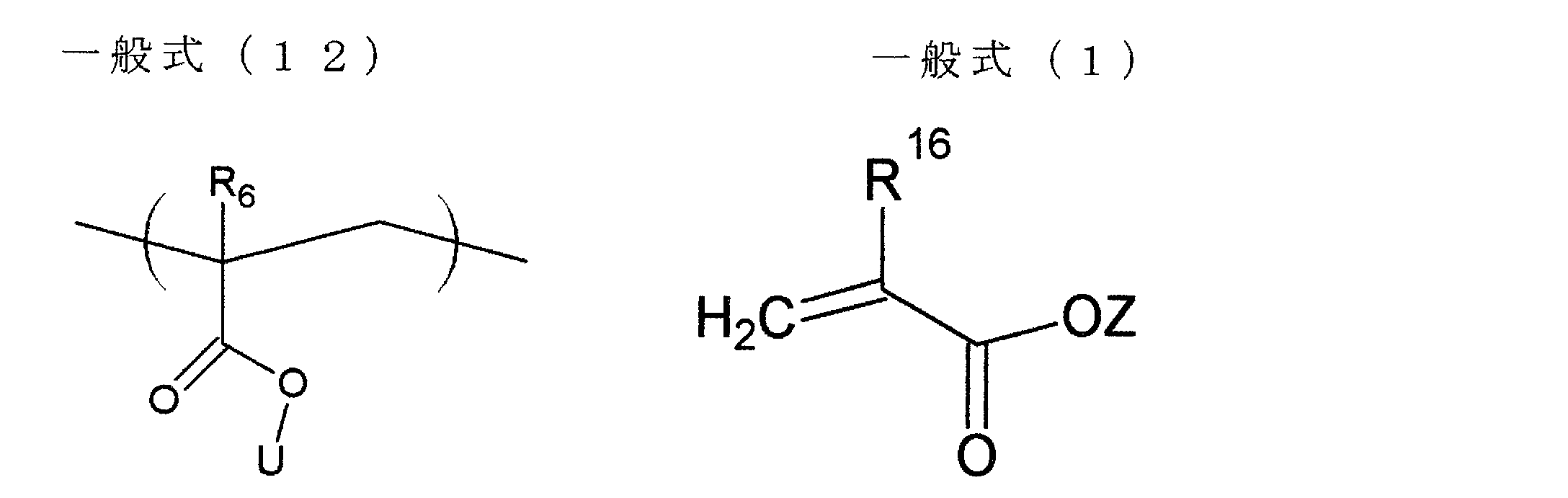
一般式(1)中、R16は、水素原子及びメチル基からなる群より選択されるいずれかを表し、Zは、炭素数10以上の、鎖状炭化水素基及び多環式炭化水素基からなる群より選択されるいずれかを表す。
Aブロック及びBブロックを含有し、
前記Aブロックは、下記一般式(12)で示す単量体単位を含有するポリマーブロックであり、
前記Bブロックは、下記一般式(1)で示す単量体単位を含有するポリマーブロック(ただし、一般式(12)で示す単量体単位を含有しない)である、紫外線吸収性ポリマーである。
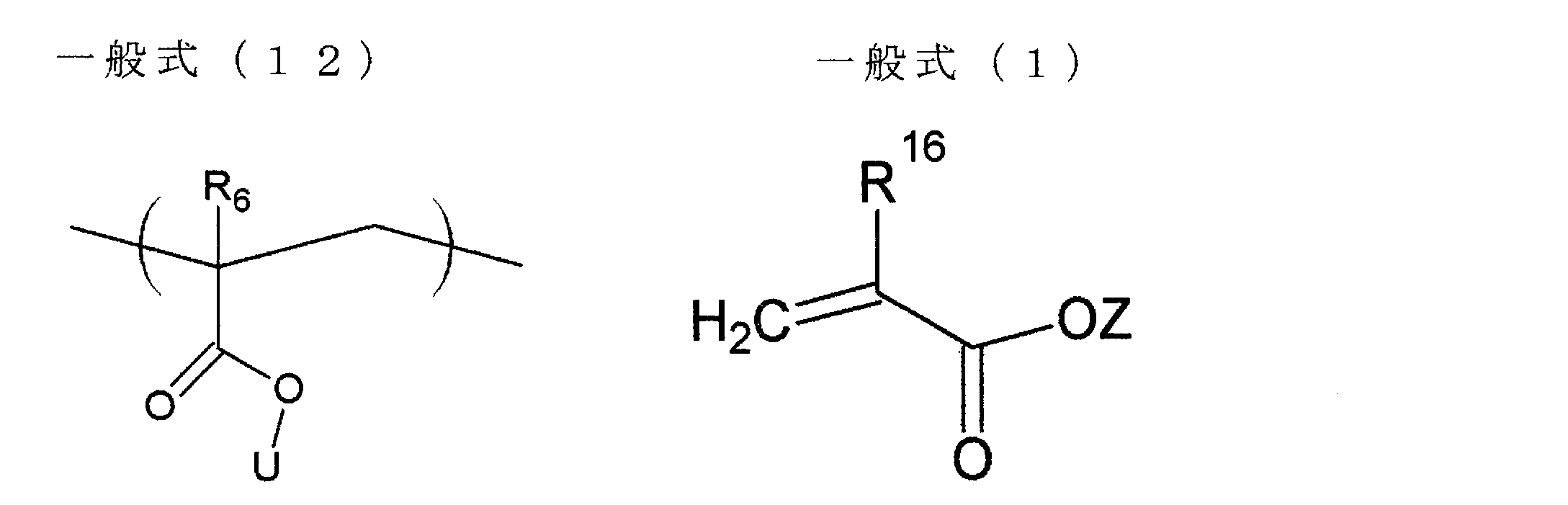
一般式(1)中、R16は、水素原子及びメチル基からなる群より選択されるいずれかを表し、Zは、炭素数10以上の、鎖状炭化水素基及び多環式炭化水素基からなる群より選択されるいずれかを表す。
熱可塑性樹脂、及び上述の紫外線吸収性ポリマーを含み、
前記紫外線吸収性ポリマーの重量平均分子量は、5,000~100,000である、成形用樹脂組成物である。

一般式(1)中、R16は、水素原子及びメチル基からなる群より選択されるいずれかを表し、Zは、炭素数10以上の、鎖状炭化水素基及び多環式炭化水素基からなる群より選択されるいずれかを表す。
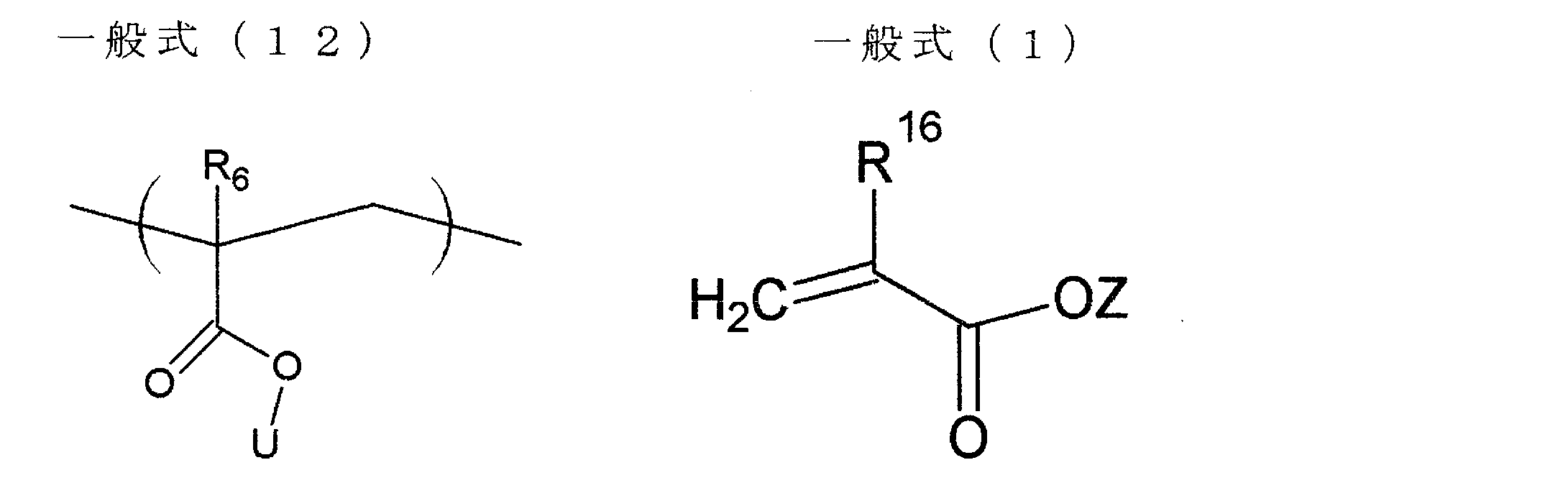
一般式(1)中、R16は、水素原子及びメチル基からなる群より選択されるいずれかを表し、Zは、炭素数10以上の、鎖状炭化水素基及び多環式炭化水素基からなる群より選択されるいずれかを表す。


Pは、-O-及び-O-R47-O-からなる群より選択されるいずれかを表し、R47は、炭素数1~20のアルキレン基を表し、前記アルキレン基は水酸基を有してもよく、Qは、水素原子及びメチル基からなる群より選択されるいずれかを表す。

本実施形態の紫外線吸収性ポリマーは、下記一般式(12)で示す単量体単位及び下記一般式(1)で示す単量体単位を有する。紫外線吸収性ポリマーは、ブロックポリマーであってもよい。
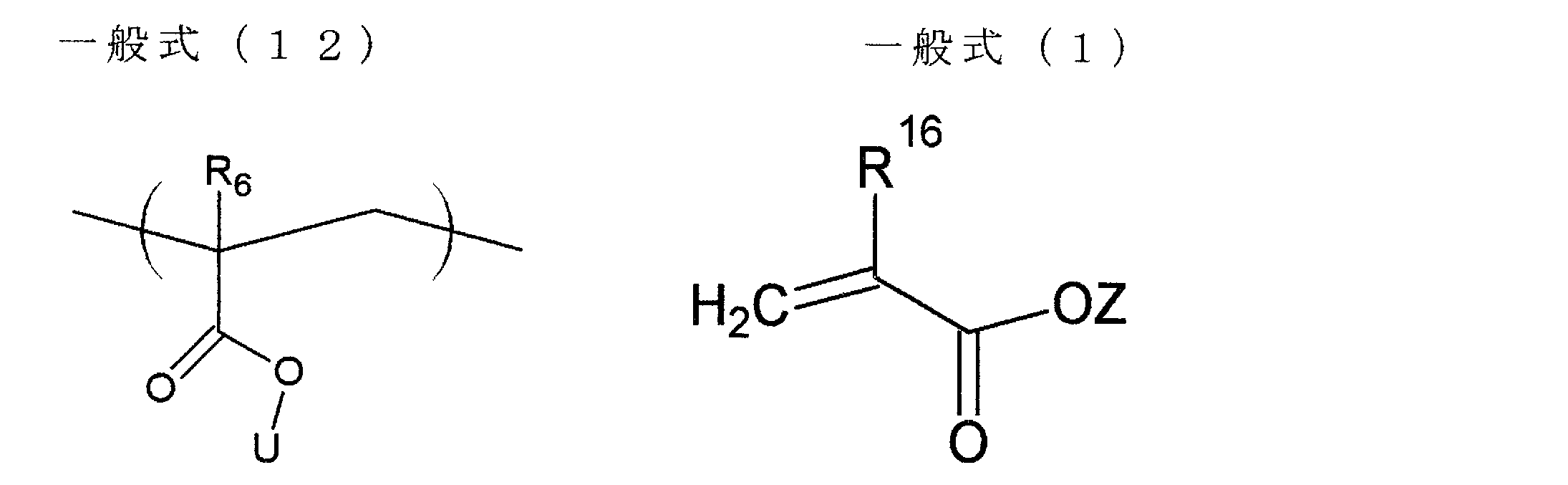
一般式(12)中、R6は、水素原子及びメチル基からなる群より選択されるいずれかを表し、Uは、炭化水素基を表し、当該炭化水素基は紫外線を吸収する骨格を含むヘテロ原子を含んでもよい。
一般式(12)で示す単量体単位は、下記一般式(16)で示す単量体を重合して生成する単位である。
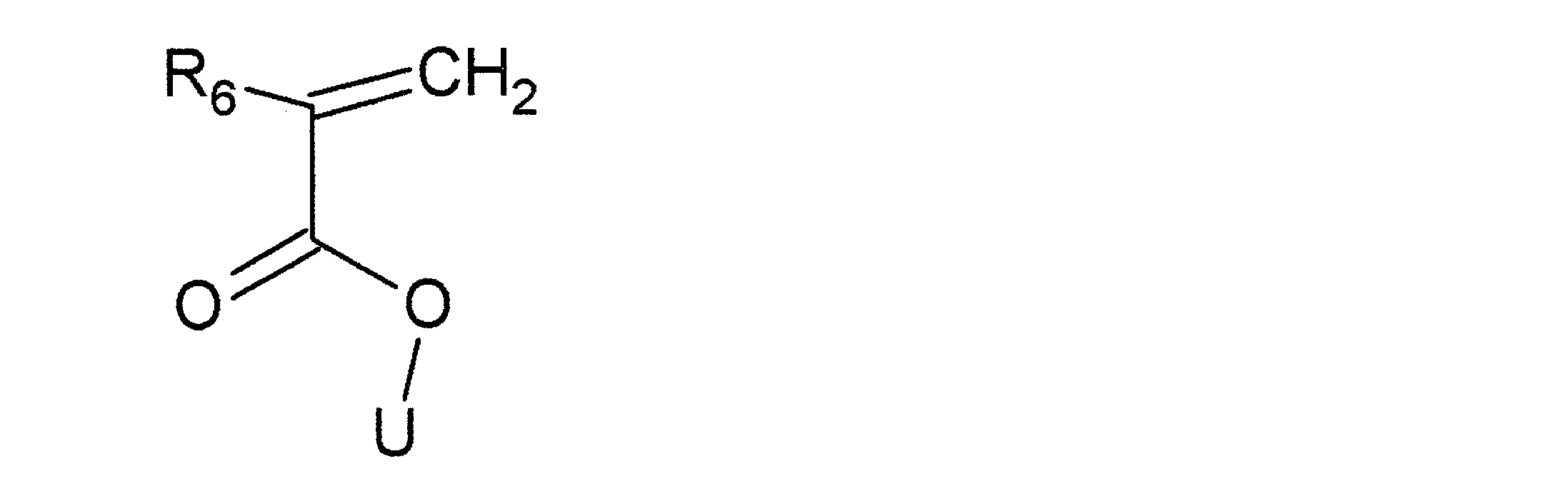
一般式(16)で示す単量体単位(a1)中、Uは、炭化水素基を表し、当該炭化水素基は紫外線を吸収する骨格を含むヘテロ原子を含んでもよい。紫外線を吸収する骨格は、例えば、ベンゾトリアゾール骨格、トリアジン骨格、及びベンゾフェノン骨格からなる群より選択される1種以上であることが好ましい。以下、紫外線を吸収する骨格ごとに単量体単位を説明する。
一般式(16)中、Uがベンゾトリアゾール骨格である場合、例えば、下記一般式(a1-1)~(a1-3)で示す単量体単位が挙げられる。
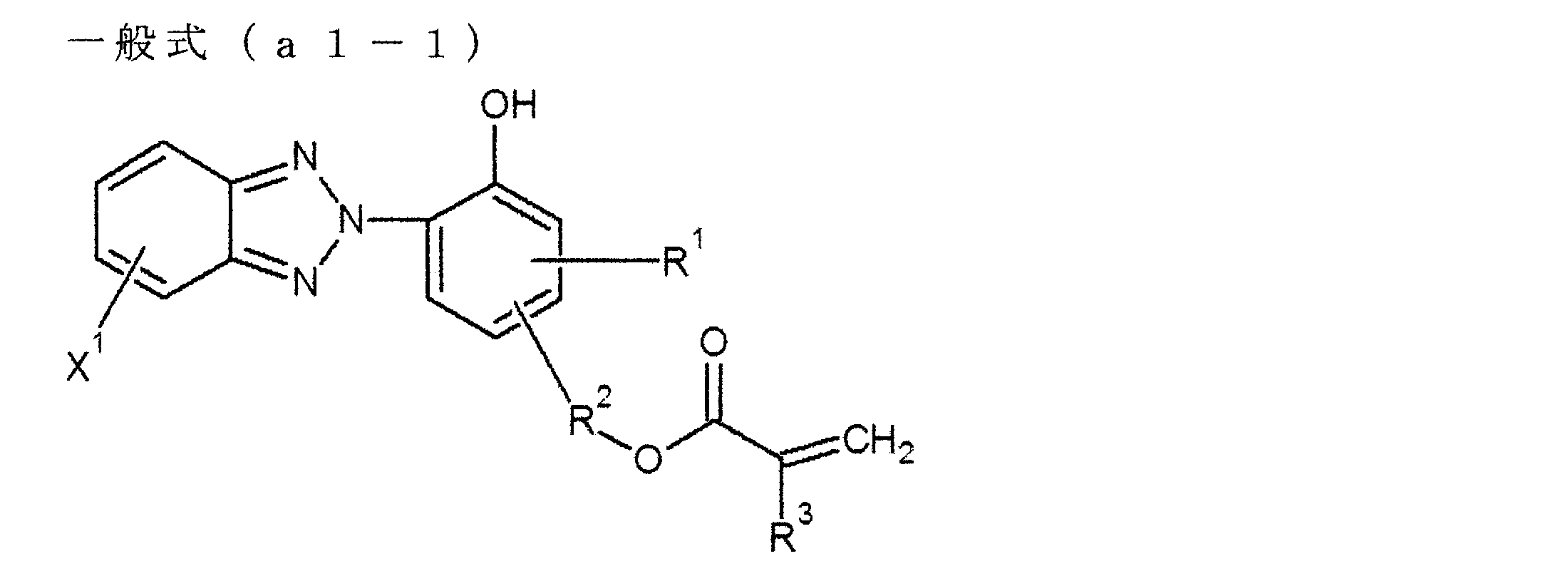
ハロゲン原子は、例えば、フッ素原子、塩素原子、臭素原子、ヨウ素原子等が挙げられる。
炭素数1~6のアルコキシ基は、例えば、メトキシ基、エトキシ基、プロポキシ基、ブトキシ基、ペントキシ基、ヘプトキシ基等が挙げられる。

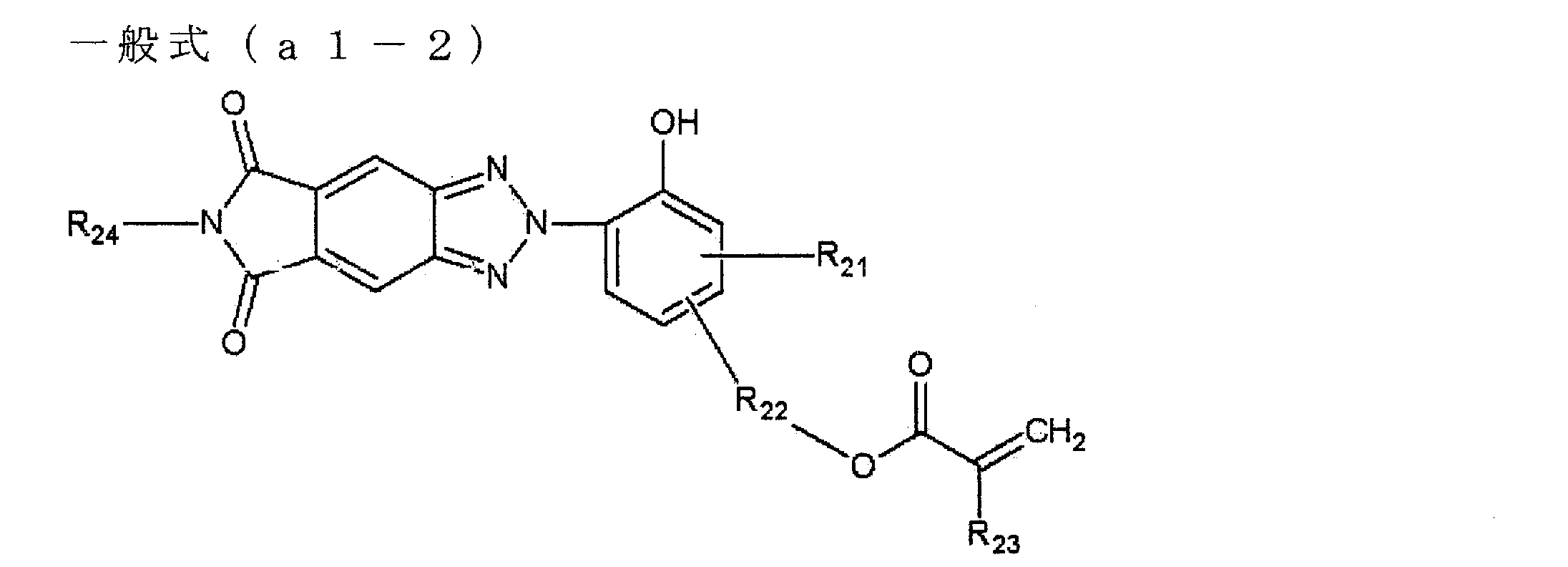


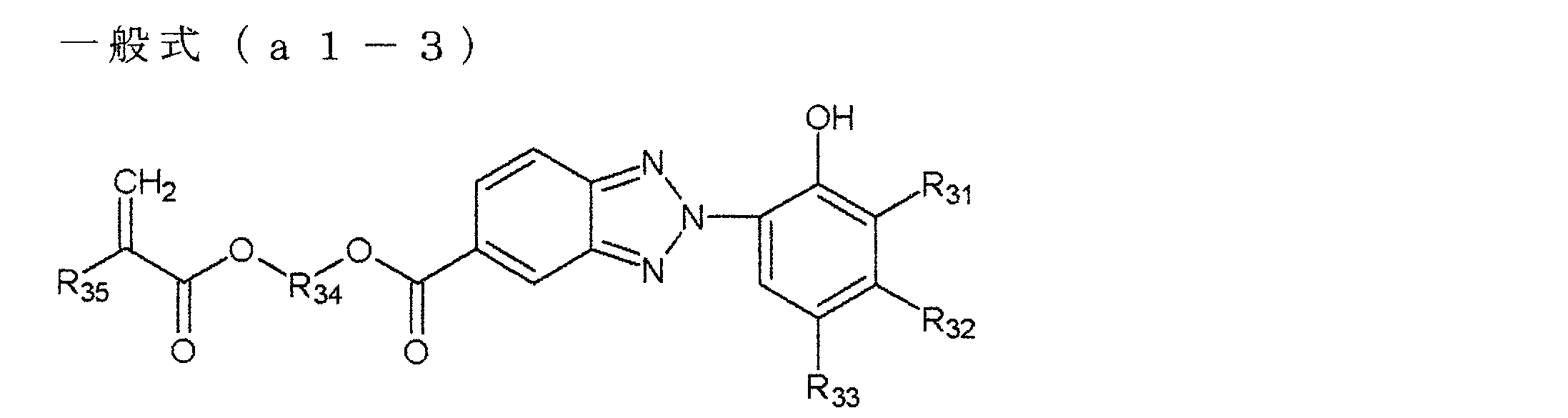
ハロゲン原子置換された炭素数1~20のアルキル基は、例えば、1-ブロモメチル基、2-ブロモエチル基、2-クロロエチル基、2-ヨードエチル基、3-ブロモプロピル基、4-ブロモブチル基、1-ブロモブチル基、5-ブロモペンチル基、6-ブロモヘキシル基、7-ブロモヘプチル基、8-ブロモオクチル基、9-ブロモノニル基、10-ブロモデシル基、11-ブロモウンデシル基、12-ブロモドデシル基、13-ブロモトリデシル基、14-ブロモテトラデシル基、15-ブロモペンタデシル基、16-ブロモヘキサデシル基、17-ブロモヘプタデシル基、18-ブロモオクタデシル基、19-ブロモノナデシル基、20-ブロモイコシル基等が挙げられる。
ハロゲン原子置換された炭素数3~20のシクロアルキル基は、例えば、2-ブロモシクロプロピル基、2-ブロモシクロペンチル基、4-ブロモシクロヘキシル基等が挙げられる。ハロゲン原子置換された炭素数1~20のアルコキシ基は、例えば、1-ブロモメトキシ基、2-ブロモエトキシ基、3-クロロプロポキシ基等が挙げられる。
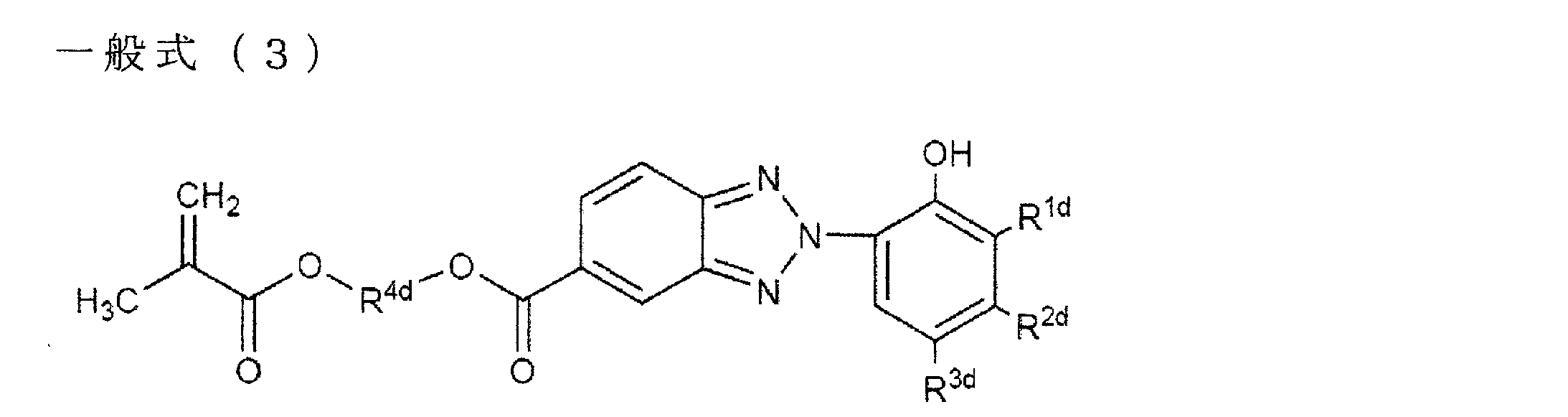


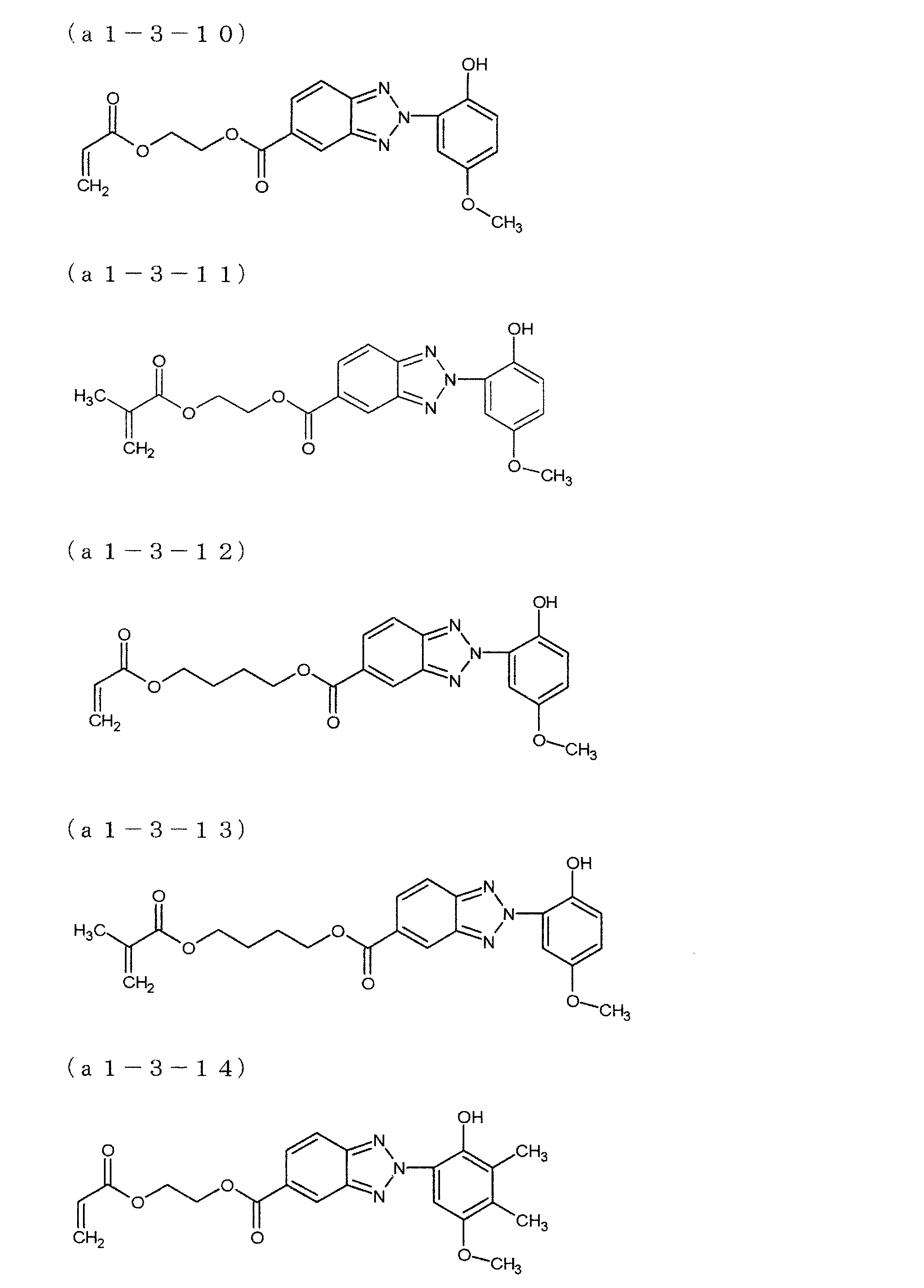


一般式(16)中、Uがトリアジン骨格である場合、例えば、下記一般式(a1-4)で示す単量体単位が挙げられる。
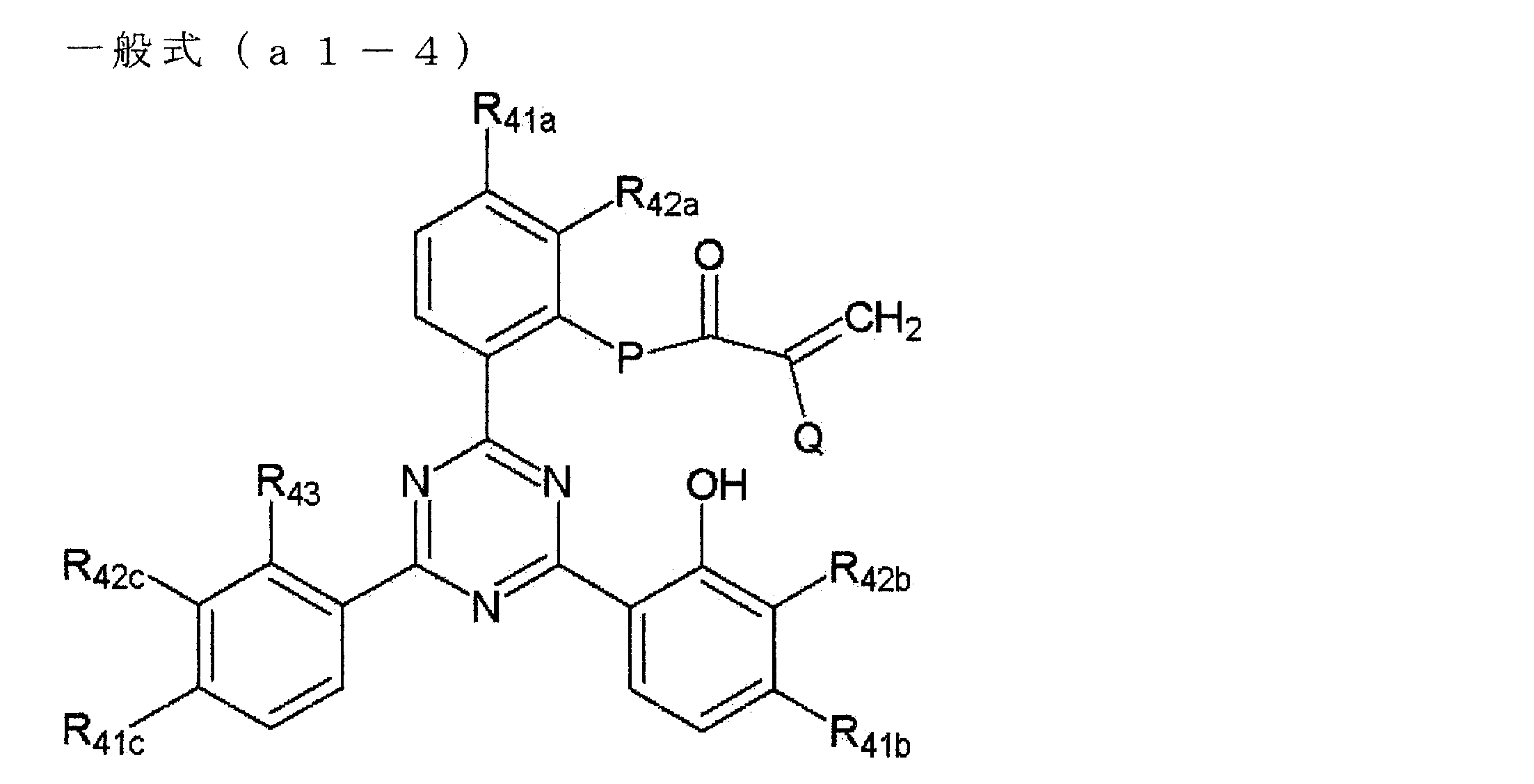
R42a、R42b、及びR42cは、それぞれ独立に、水素もしくは、炭素数1~10のアルキル基である。
R43は、水素、水酸基、炭素数1~20のアルキル基、炭素数6~20のアリール基、-O-R44、もしくは、-O-R45-CO-O-R46で表され、R44及びR46は、それぞれ独立に、炭素数1~20のアルキル基、もしくは炭素数6~20のアリール基で表され、上記アルキル基は環構造を形成していてもよく、R45aは、炭素数1~20のアルキレン基及び炭素数6~20のアリーレン基からなる群より選択されるいずれかを表し、上記アルキル基は環構造を形成していてもよい。
Pは、-O-及び-O-R47-O-からなる群より選択されるいずれかを表し、R47は、炭素数1~20のアルキレン基を表し、前記炭化水素基は水酸基を有してもよく、Qは、水素原子及びメチル基からなる群より選択されるいずれかを表す。
炭素数1~20のアルキル基は、その水素原子をハロゲン原子で置換できる。例えば、1-ブロモメチル基、2-ブロモエチル基、2-クロロエチル基、2-ヨードエチル基、3-ブロモプロピル基、4-ブロモブチル基、1-ブロモブチル基、5-ブロモペンチル基、6-ブロモヘキシル基、7-ブロモヘプチル基、8-ブロモオクチル基、9-ブロモノニル基、10-ブロモデシル基、11-ブロモウンデシル基、12-ブロモドデシル基、13-ブロモトリデシル基、14-ブロモテトラデシル基、15-ブロモペンタデシル基、16-ブロモヘキサデシル基、17-ブロモヘプタデシル基、18-ブロモオクタデシル基、19-ブロモノナデシル基、20-ブロモイコシル基等の鎖式炭化水素基;2-ブロモシクロプロピル基、2-ブロモシクロペンチル基、4-ブロモシクロヘキシル基等の脂環式炭化水素基等が挙げられる。

水酸基を有してもよい炭素数1~20のアルキレン基は、さらに、水素が置換されたものも含む。


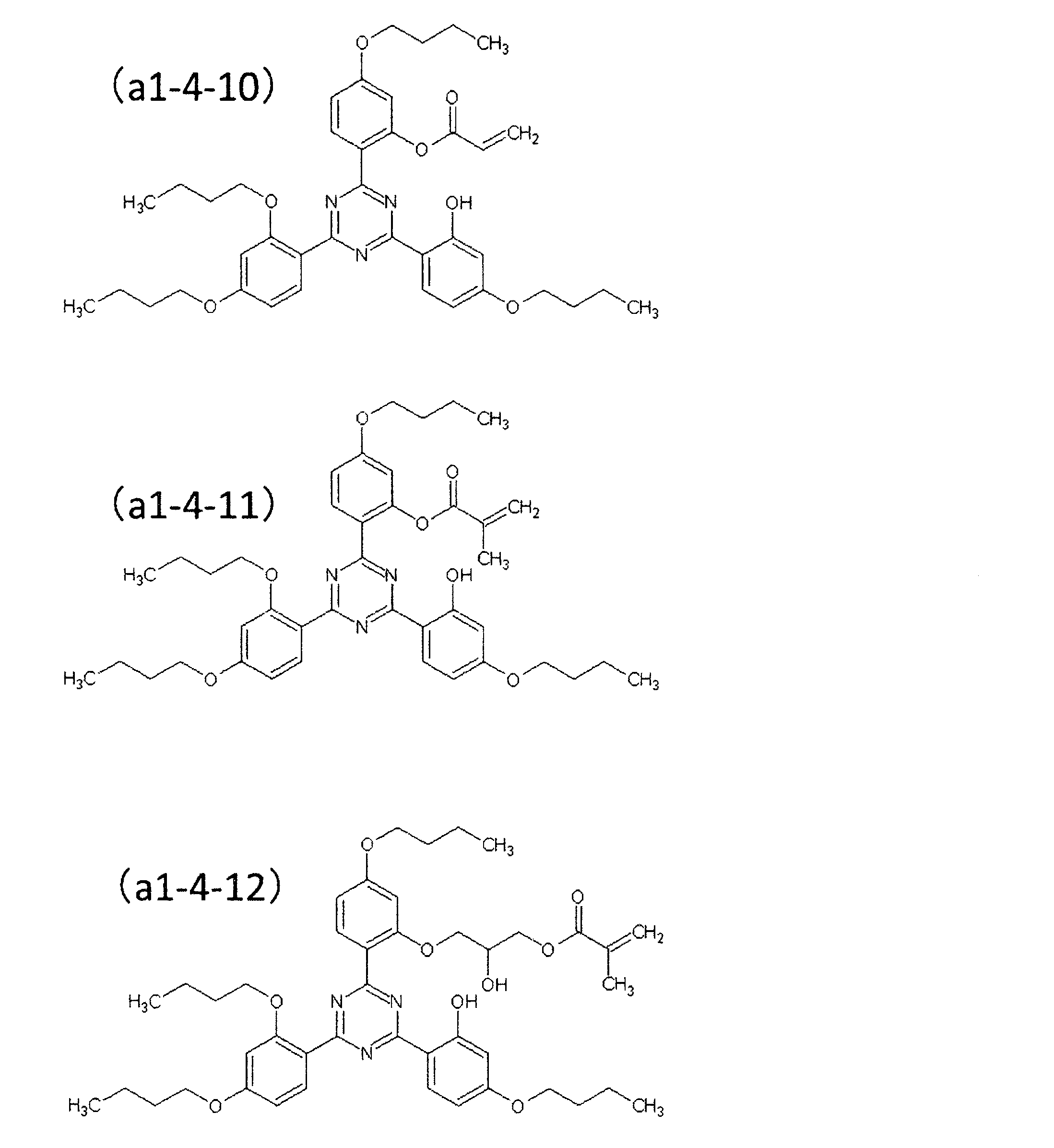


一般式(16)中、Uがベンゾフェノン骨格である場合、ベンゾフェノン骨格とエチレン性不飽和基を有する化合物が好ましい。
一般式(1)中、R16は、水素原子及びメチル基からなる群より選択されるいずれかを表し、Zは、炭素数10以上の、鎖状炭化水素基及び多環式炭化水素基からなる群より選択されるいずれかを表す。
多環式炭化水素基は、例えば、イソボルニル基、ジシクロペンタニル基、ジシクロペンテニル基、2-メチル-2-アダマンチル基、2-エチル-2-アダマンチル基等が挙げられる。これらの脂環式炭化水素基及び多環式炭化水素基は、多環式炭化水素基が好ましく、ジシクロペンタニル基がより好ましい。
芳香族ビニル単量体単位を形成する芳香族ビニル単量体は、例えば、スチレン、α-メチルスチレン、安息香酸ビニル、ビニル安息香酸メチル、ビニルトルエン、ジメチルスチレン、トリメチルスチレン、エチルスチレン、イソプロピルスチレン、ブチルスチレン、ヒドロキシスチレン、メトキシスチレン、ブトキシスチレン、アセトキシスチレン、クロロスチレン、ジクロロスチレン、ブロモスチレン、クロロメチルスチレン、酸性物質により脱保護可能な基(例えばtert-ブトキシカルボニル基(t-Boc)など)で保護されたヒドロキシスチレン等が挙げられる。
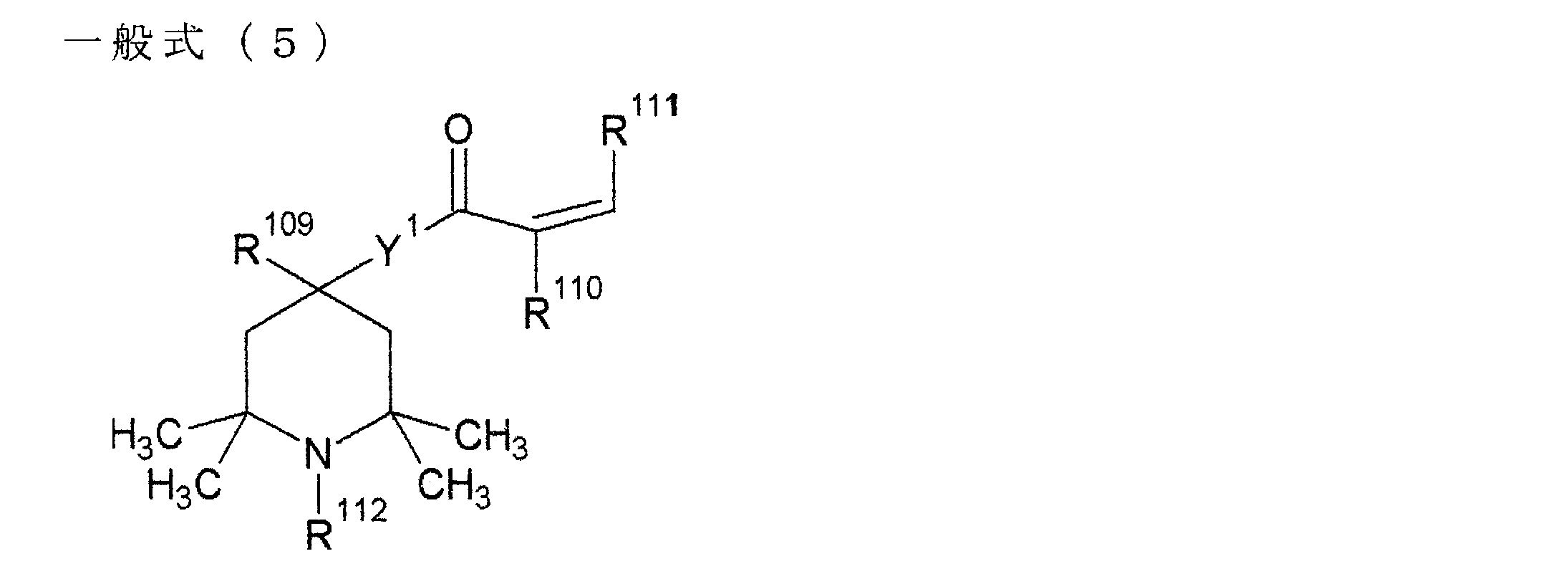

(参考文献1)Fukudaら、Prog.Polym.Sci.2004,29,329
(参考文献2)Matyjaszewskiら、Chem.Rev.2001,101,2921
(参考文献3)Matyjaszewskiら、J.Am.Chem.Soc.1995,117,5614
(参考文献4)Macromolecules 1995,28,7901,Science,1996,272,866
(参考文献5)国際公開第96/030421号
(参考文献6)国際公開第97/018247号
(参考文献7)特開平9-208616号公報
(参考文献8)特開平8-41117号公報
ジチオベンゾエート型は、例えば、ジチオ安息香酸2-シアノ-2-プロピル、4-シアノ-4-(チオベンゾイルチオ)ペンタン酸、ベンゾジチオ酸2-フェニル-2-プロピル等が挙げられる。
トリチオカーボネート型は、例えば、4-[(2-カルボキシエチルスルファニルチオカルボニル)スルファニル]-4-シアノペンタン酸、2-{[(2-カルボキシエチル)スルファニルチオカルボニル]スルファニル}プロパン酸、4-シアノ-4-[(ドデシルスルファニルチオカルボニル)スルファニル]ペンタン酸、2-シアノ-2-[(ドデシルスルファニルチオカルボニル)スルファニル]プロパン、2-[(ドデシルスルファニルチオカルボニル)スルファニル]プロパン酸、4-シアノ-4-[(ドデシルスルファニルチオカルボニル)スルファニル]ペンタン酸メチル、2-メチル-2-[(ドデシルスルファニルチオカルボニル)スルファニル]プロパン酸、S,S-ジベンジルトリチオ炭酸、トリチオ炭酸=ビス[4-(アリルオキシカルボニル)ベンジル]、トリチオ炭酸=ビス[4-(2,3-ジヒドロキシプロポキシカルボニル)ベンジル]、トリチオ炭酸=ビス{4-[エチル-(2-アセチルオキシエチル)カルバモイル]ベンジル}、トリチオ炭酸ビス{4-[エチル-(2-ヒドロキシエチル)カルバモイル]ベンジル}、トリチオ炭酸=ビス[4-(2-ヒドロキシエトキシカルボニル)ベンジル]等が挙げられる。
ジチオカルバメート型は、例えば、4-クロロ-3,5-ジメチルピラゾ-ル-1-カルボジチオ酸2'-シアノブタン-2'-イル、3,5-ジメチルピラゾ-ル-1-カルボジチオ酸2'-シアノブタン-2'-イル、3,5-ジメチルピラゾ-ル-1-カルボジチオ酸シアノメチル、N-メチル-N-フェニルジチオカルバミン酸シアノメチル等が挙げられる。
ジスルフィド型としては、ビス(ドデシルスルファニルチオカルボニル)ジスルフィド、ビス(チオベンゾイル)ジスルフィド等が挙げられる。これらはブロック共重合体の製造に好ましい。
分子量分布(Mw/Mn)は1.5以下が好ましい。分布が1.5以下になることでポリオレフィンとの相溶性より向上し透明性もより向上する。なお。Mnは数平均分子量である。
成形用樹脂組成物は、紫外線吸収性ポリマー、及び熱可塑性樹脂を含有する。必要に応じて、着色剤、そのほかの添加剤を含んでいてもよい。熱可塑性樹脂は、例えば、ポリエチレン、ポリプロピレンなどのポリオレフィン、ポリスチレン、ポリフェニレンエーテル、アクリロニトリル-ブタジエン-スチレン共重合体(ABS樹脂)、ポリカーボネート、ポリアミド、ポリアセタール、ポリエステル、ポリ塩化ビニル、ポリメチルメタアクリレート等のポリアクリル、及びポリエーテルイミドが挙げられる。これらの中でも透明性が良好な成形体を得ることが困難なポリオレフィンであっても、良好な成形性及び成形品の機械強度を得られる。以下、ポリオレフィンを重点的に説明する。
ポリオレフィンは、例えば、ポリエチレン、ポリプロピレンポリエチレン、ポリプロピレン、ポリブテン-1、及びポリ-4-メチルペンテン、並びにこれらの共重合体が挙げられる。
これらの共重合体は、例えば、エチレン-プロピレンのランダム、ブロックあるいはグラフト共重合体、α-オレフィンとエチレンあるいはプロピレンの共重合体、エチレン-酢酸ビニル共重合体、エチレン-アクリル酸メチル共重合体、エチレン-アクリル酸エチル共重合体、及びエチレン-アクリル酸共重合体等が挙げられる。
これらの中でも結晶性又は非晶性ポリプロピレン、エチレン-プロピレンのランダム、ブロックあるいはグラフト共重合体が好ましく、プロピレン-エチレンブロック共重合体がより好ましい。また安価で、比重が小さいために成形体を軽量化できる観点からはポリプロピレンが好ましい。
紫外線吸収性ポリマーは、成形体が含む相当量を成形時に配合するよりも、一旦、マスターバッチとして着色成形用樹脂組成物に予備分散した後に、希釈樹脂の熱可塑性樹脂と配合(溶融混錬)して所望の成形体を製造すると、紫外線吸収性ポリマーを成形体内に均一に分散しやすくなる。
ポリカーボネートは、2価のフェノールとカーボネート前駆体とを公知の方法で合成した化合物である。2価のフェノールは、例えば、ハイドロキノン、レゾルシノール、2,2-ビス(4-ヒドロキシフェニル)プロパン、ビス(4-ビドロキシフェニル)メタン、2,2-ビス(4-ヒドロキシ-3,5-ジメチルフェニル)プロパン、2,2-ビス(4-ヒドロキシ-3,5-ジブロモフェニル)プロパン、ビス(4-ビドロキシフェニル)サルファイド等が挙げられる。これらの中でビス(4-ビドロキシフェニル)アルカン系が好ましく、ビスフェノールAと称される2,2-ビス(4-ヒドロキシフェニル)プロパンがより好ましい。カーボネート前駆体は、例えば、ホスゲン、ジフェニルカーボネート、2価のフェノールのジハロホルメート等が挙げられる。この中でもジフェニルカーボネートが好ましい。
ポリアクリルは、メタクリル酸メチル及び/又はメタクリル酸エチル等のモノマーを公知の方法で重合した化合物である。例えば、エチレン-アクリル酸メチル共重合体、エチレン-アクリル酸エチル共重合体及びエチレン-アクリル酸共重合体等が挙げられる。前記モノマーの他に、例えば、ブタジエン、α-メチルスチレン、無水マレイン酸等のモノマーを加えて重合することもでき、モノマー量と分子量によって耐熱性、流動性、衝撃性を調整することができる。
ポリエステルは、分子の主鎖にエステル結合を有する樹脂であり、ジカルボン酸(その誘導体を含む)と、ジオール(2価アルコール又は2価フェノール)とから合成した重縮合物;、ジカルボン酸(その誘導体を含む)と、環状エーテル化合物とから合成した重縮合物;、環状エーテル化合物の開環重合物等が挙げられる。ポリエステルは、ジカルボン酸とジオールでの重合体によるホモポリマー、複数の原料を使用するコポリマー、これらを混合するポリマーブレンド体が挙げられる。なお、ジカルボン酸の誘導体とは、酸無水物、エステル化物である。ジカルボン酸は、脂肪族及び芳香族の2種類のジカルボン酸があるところ、耐熱性が向上する芳香族がより好ましい。
脂肪族ジカルボン酸は、例えば、シュウ酸、コハク酸、アジピン酸、コルク酸、マゼライン酸、セバシン酸、ドデカンジカルボン酸、ウンデカンジカルボン酸、マレイン酸、フマル酸等が挙げられる。
2価フェノールは、例えば、ヒドロキノン、レゾルシノール、ビスフェノールA等が挙げられる。
環状エーテル化合物は、例えばエチレンオキサイド、プロピレンオキサイド等が挙げられる。
シクロオレフィン樹脂は、エチレン又はα-オレフィンと環状オレフィンとの重合体である。α-オレフィンはC4~C12(炭素数4~12)のαオレフィンから誘導されるモノマーであり、例えば、1-ブテン、1-ペンテン、1-へキセン、3-メチル-1-ブテン、3-メチル-1-ペンテン、3-エチル-1-ペンテン、4-メチル-1-ペンテン、4-メチル-1-へキセン、4,4-ジメチル-1-ヘキセン、4,4-ジメチル-1-ペンテン、4-エチル-1-へキセン、3-エチル-1-ヘキセン、1-オクテン、1-デセン、1-ドデセン等が挙げられる。環状オレフィンはノルボルネンから誘導されるモノマーであり、水素基、ハロゲン原子、1価又は2価の炭化水素基の置換物が挙げられる。これらの中でも無置換のノルボルネンが好ましい。
成形用樹脂組成物は、例えば、食品包装材、医薬品包装材、ディスプレイ用途に使用することが好ましい。食品包装材や医薬品包装材は、熱可塑性樹脂に、例えば、ポリエステル等を使用することが好ましい。これら成形体は、柔軟性及び視認性が向上し、内容物の劣化を抑制できる。これにより、医薬品や化粧品等のセルフライフが延長できる。また、ディスプレイ用途(例えば、テレビ、パソコン、スマホ等)は、熱可塑性樹脂に、例えば、ポリアクリルやポリカーボネート等を使用することが好ましい。これら成形体は、バックライトに含まれる紫外線や可視光の短波長領域の光を吸収することで、目への悪影響を抑制することができ、また、太陽光に含まれる紫外線や可視光の短波長領域の光を吸収することで、ディスプレイの表示素子の劣化を抑制することができ、さらにマイグレーションによる透明性低下を抑制することができる。さらに、ディスプレイ用材料、センサー用材料、光学制御材料などの用途でも幅広く使用できる。
水酸基含有単量体は、例えば、2-ヒドロキシエチル(メタ)アクリレート、4-ヒドロキシブチル(メタ)アクリレート等が挙げられる。
で、ディスプレイに貼り合わせる使用することが好ましい。粘着シートは、上述の紫外線吸収材料を含むことで、バックライトに含まれる紫外線や可視光の短波長領域の光を吸収し、目への悪影響を抑制することができる。また、太陽光に含まれる紫外線や可視光の短波長領域の光を吸収することで、ディスプレイの表示素子の劣化を抑制することができ、さらにマイグレーションによる透明性低下を抑制することができる。
数平均分子量(Mn)、重量平均分子量(Mw)は、RI検出器を装備したゲルパーミエーションクロマトグラフィー(GPC)で測定した。装置としてHLC-8320GPC(東ソー社製)を用い、分離カラムを2本直列に繋ぎ、両方の充填剤には「TSK-GEL SUPER HZM-N」を2連でつなげて使用し、オーブン温度40℃、溶離液としてTHF溶液を用い、流速0.35ml/minで測定した。サンプルは1wt%の上記溶離液からなる溶剤に溶解し、20マイクロリットル注入した。分子量はいずれもポリスチレン換算値である。
本実験例で使用したポリオレフィンを以下に示す。なお、下記ポリオレフィンの数平均分子量は、全て3万~20万の範囲内である。
(A-1):ポリエチレン(サンテックLD M2270、MFR=7g/10min、旭化成ケミカルズ社製)
(A-2):ポリエチレン(ノバテックUJ790、MFR=50g/10min、日本ポリエチレン社製)
(A-3):ポリプロピレン(ノバテックPP FA3EB、MFR=10.5g/10min、日本ポリプロ社製)
(A-4):ポリプロピレン(プライムポリプロJ226T、MFR=20g/10min、プライムポリマー社製)
(A-5):ポリエチレン(エボリューHSP65051B MFR= 0.45g/10min、プライムポリマー社製)
(D-1):ポリエチレンワックス(サンワックス131-P 数平均分子量3500、融点105℃、三洋化成工業社製)
(D-2):ポリエチレンワックス(ハイワックス405MP 数平均分子量4500、融点120℃、三井化学社製)
(D-3):ポリプロピレンワックス(ハイワックスNP056 数平均分子量7200、融点130℃、三井化学社製)
(ポリマー(B-1))
温度計、撹拌機、滴下ロート、冷却器を具備した4つ口セパラブルフラスコに、メチルエチルケトン75.0部を仕込み、窒素気流下で75℃に昇温した。別途、一般式(a1-1)で示す単量体単位としてRUVA-93(大塚化学社製)を14部、一般式(1)で示す単量体単位としてイソステアリルアクリレートを43部、メチルメタクリレートを43部、2.2’-アゾビス(イソ酪酸メチル)を5.0部、及びメチルエチルケトン20.0部を均一に混合した後、滴下ロートに仕込んだ。次いで滴下ロートの内容物を2時間かけて滴下した。滴下終了後、2時間反応を継続した。その後、サンプリングを行い重合収率が98%以上であることを確認し、50℃へ冷却、テフロン(登録商標)バットに取り出した。さらに、真空乾燥機で50℃12時間乾燥し、ポリマー(B-1)を製造した。

ポリマー(B-1)で使用した単量体の種類及びその使用量を表1に記載した通りに変更した以外は、ポリマー(B-1)と同様に行い、ポリマー(B-2)~ポリマー(B-27)をそれぞれ製造した。

・紫外線吸収性モノマー1:2-[2’-ヒドロキシ-3’-tert-ブチル-5’-(メタクリロイルオキシエチル)フェニル]-2H-ベンゾトリアゾール
・紫外線吸収性モノマー2:2-〔2’-ヒドロキシ-5’-(β-メタクリロイルオキシエトキシ)-3’-tert-ブチルフェニル〕-4-tert-ブチル-2H-ベンゾトリアゾール
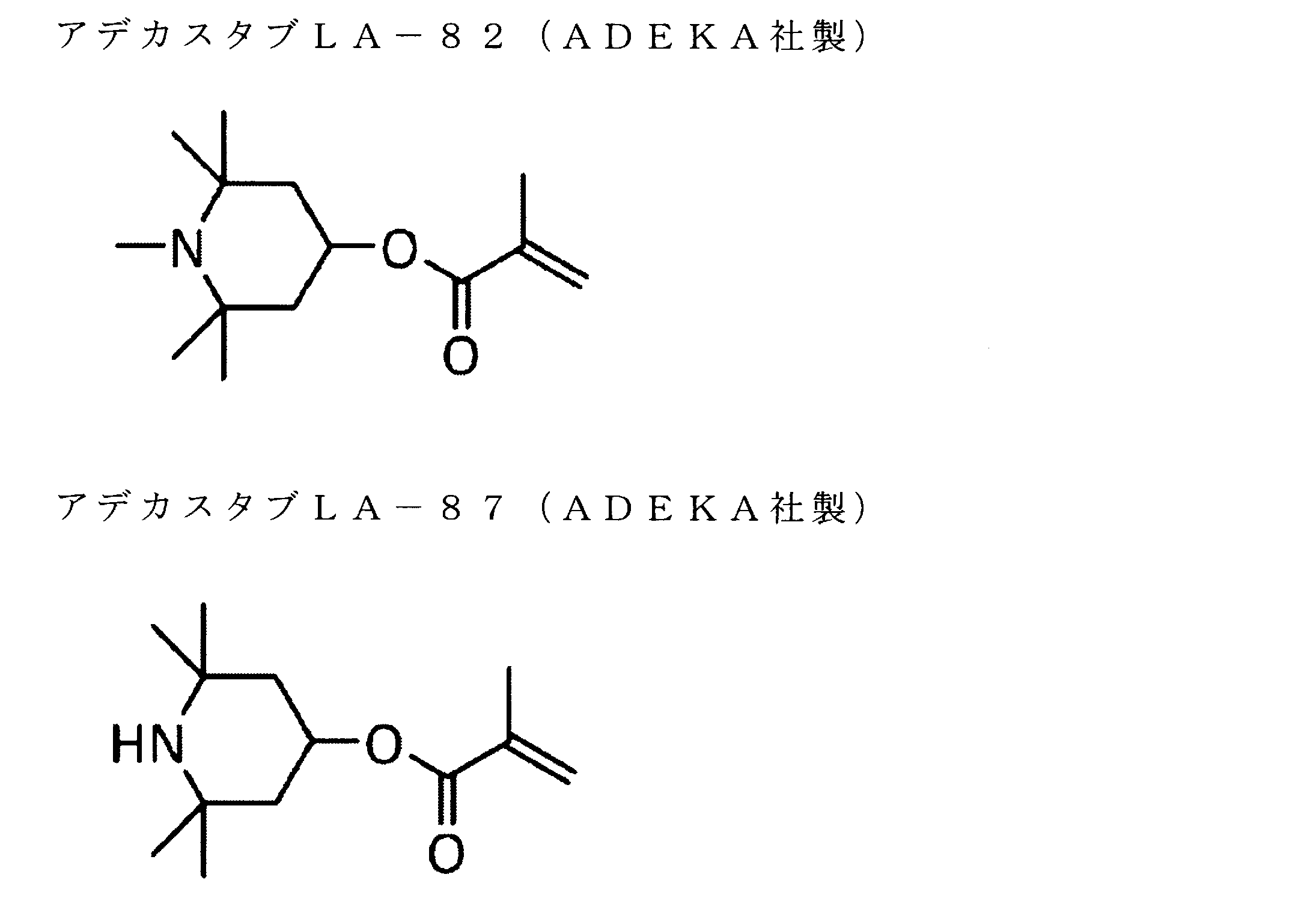
〔マスターバッチの製造〕
ワックス(D-1)100部、及びポリマー(B-1)100部を混合し、3本ロールミルを使用して160℃で混練を行い、ポリマー(B-1)の分散体を製造した。次いで、ポリオレフィン(A-1)100部と共に得られた上記分散体10部をヘンシェルミキサーで混合した。次いで、スクリュー径30mmの単軸押出機にて180℃で溶融混練した後、ペレタイザーを用いてペレット状にカッティングしてマスターバッチを製造した。
希釈樹脂としてポリオレフィン(A-1)100部に対して、製造したマスターバッチ10部を混合した。次いで、T-ダイ成形機(東洋精機社製)を用いて、温度180℃で溶融混合し、厚さ250μmのフィルムを成形した。
実施例1の材料を表2に示す材料及び配合量に変更した以外は、実施例1と同様にして、マスターバッチを製造し、次いで実施例2~53、比較例1~4のフィルムをそれぞれ成形した。
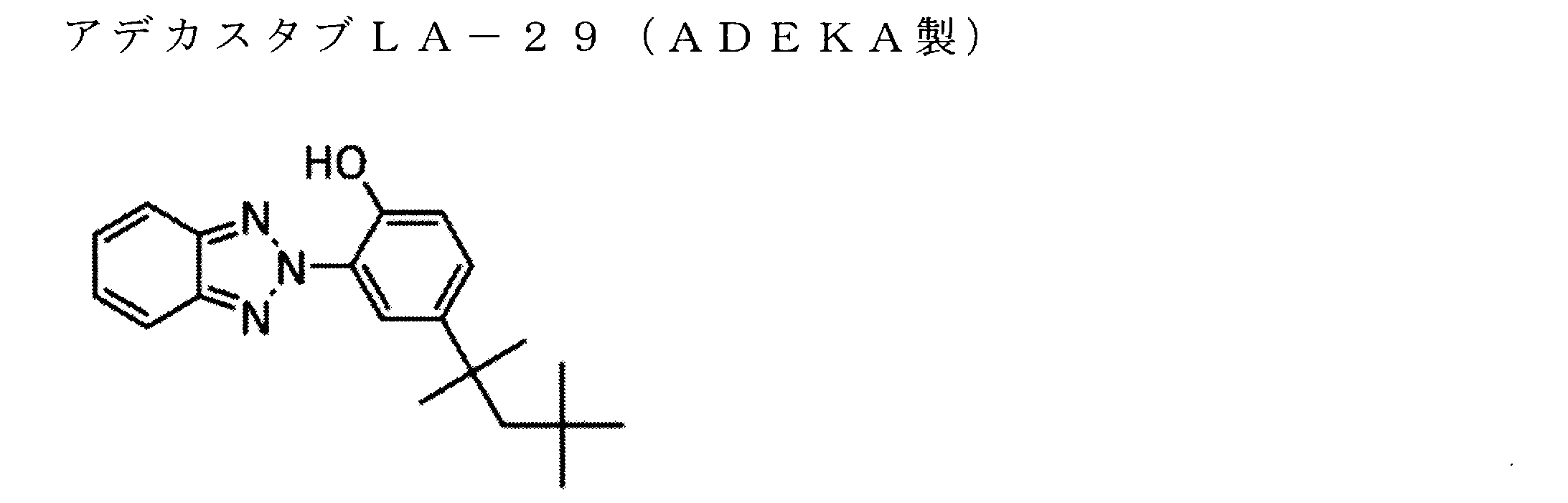
成形したフィルムの透過率を、紫外可視近赤外分光光度計(島津製作所社製)を用いて測定した。透過率は白色標準板に対する分光透過率を測定した。以下の条件を満たすか否かを評価した。なお、評価基準は以下の通りである。
A:波長290~360nmの光透過率が全領域にわたって2%未満。良好。
B:波長290~360nmの範囲で一部光透過率が2%以上の領域がある。実用域。
C:波長290~360nmの光透過率が全領域にわたって2%以上。実用不可。
成形したフィルムの透過性を目視評価した。なお、評価基準は以下の通りである。
AA:濁りが全く認められない。優れている。
A:濁りがほとんど認められない。良好。
B:濁りが若干認められる。実用域。
C:明らかに濁りが認められる。実用不可。
成形したフィルムをキセノンウェザーメーターで、300~400nmが60W/m2の照度で1500時間暴露した。なお、評価基準は以下の通りである。
A:黄変が全く認められない。良好。
B:黄変がわずかに認められる。実用域。
C:明らかに黄変が認められる。実用不可。
成形したフィルムを軟質塩化ビニルシートで挟み、熱プレス機を使用して圧力100g/cm2・温度170℃30秒間の条件で加熱圧着した。次いで、直ちにフィルムを外して軟質塩化ビニルシートへのマイグレーションを紫外可視近赤外分光光度計(島津製作所社製)を用いて評価した。評価は、上記の処理を行った軟質塩化ビニルシート上の任意の箇所5点を選び、紫外領域の吸光度を測定し、その平均を算出することで行った。
A:280~480nmにおける吸光度が検出されない(0.05未満)。良好。
B:280~480nmにおける吸光度が0.05以上0.2以下。実用域。
C:280~480nmにおける吸光度が0.2を超える。実用不可。
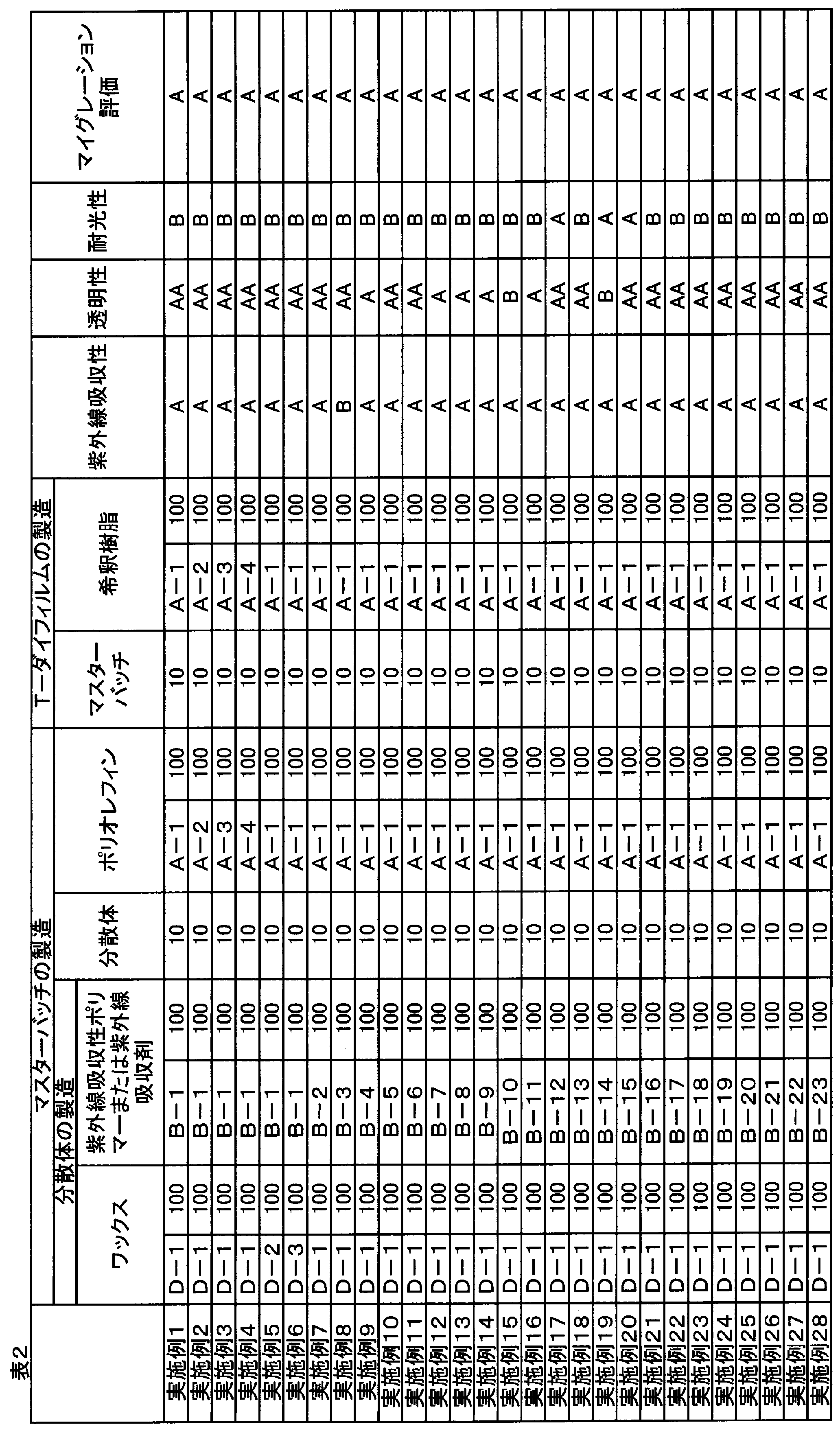

本実験例で使用したポリオレフィン(数平均分子量30,000以上)を以下に示す。
(C-1):ポリエチレン(サンテックLD M2270、MFR=7g/10min、旭化成ケミカルズ社製)
(C-2):ポリエチレン(ノバテックUJ790、MFR=50g/10min、日本ポリエチレン社製)
(C-3):ポリプロピレン(ノバテックPP FA3EB、MFR=10.5g/10min、日本ポリプロ社製)
(C-4):ポリプロピレン(プライムポリプロJ226T、MFR=20g/10min、プライムポリマー社製)
(E-1):ポリカーボネート(ユーピロンS3000、MFR=15g/10min、三菱エンジニアリングプラスチックス社製)
(E-2):ポリメタクリル樹脂(アクリペットMF、MFR=14g/10min、三菱レイヨン社製)
(E-3):ポリエステル(三井ペットSA135、三井化学社製)
(E-4):シクロオレフィン樹脂(TOPAS5013L-10、三井化学社製)
(紫外線吸収性不飽和単量体(A-1))

紫外線吸収性不飽和単量体(A-1)の製造において、アクリロイルクロリドの代わりにメタクリロイルクロリドを滴下した以外は同様な方法で製造し、紫外線吸収性不飽和単量体(A-2)を製造した。
紫外線吸収性不飽和単量体(A-1)の製造における中間体1を用いて、以下の反応を行った。温度計、撹拌機を具備した200mL4つ口フラスコに、N-メチルピロリドンを100g、中間体1を28.6mmol、メチルヒドロキノンを0.01mmol仕込み、エアーをバブリングしながら120℃で撹拌した。その後、グリシジルメタクリレートを62.9mmol、N,N-ジメチルベンジルアミンを0.6mmol添加し、120℃で8時間撹拌した。一方、500mLビーカーに水を300g仕込み、撹拌して得た先の反応液を少しずつ滴下し、紫外線吸収性不飽和単量体が析出させ、ろ過した。その後、水300gでふりかけ洗浄を行った。得られたウエットケーキを水300g中に戻して室温で30分間リスラリーを行い、ろ過した。その後、水300gでふりかけ洗浄を行った。40℃で減圧乾燥を行い、紫外線吸収性不飽和単量体(A-3)を製造した。
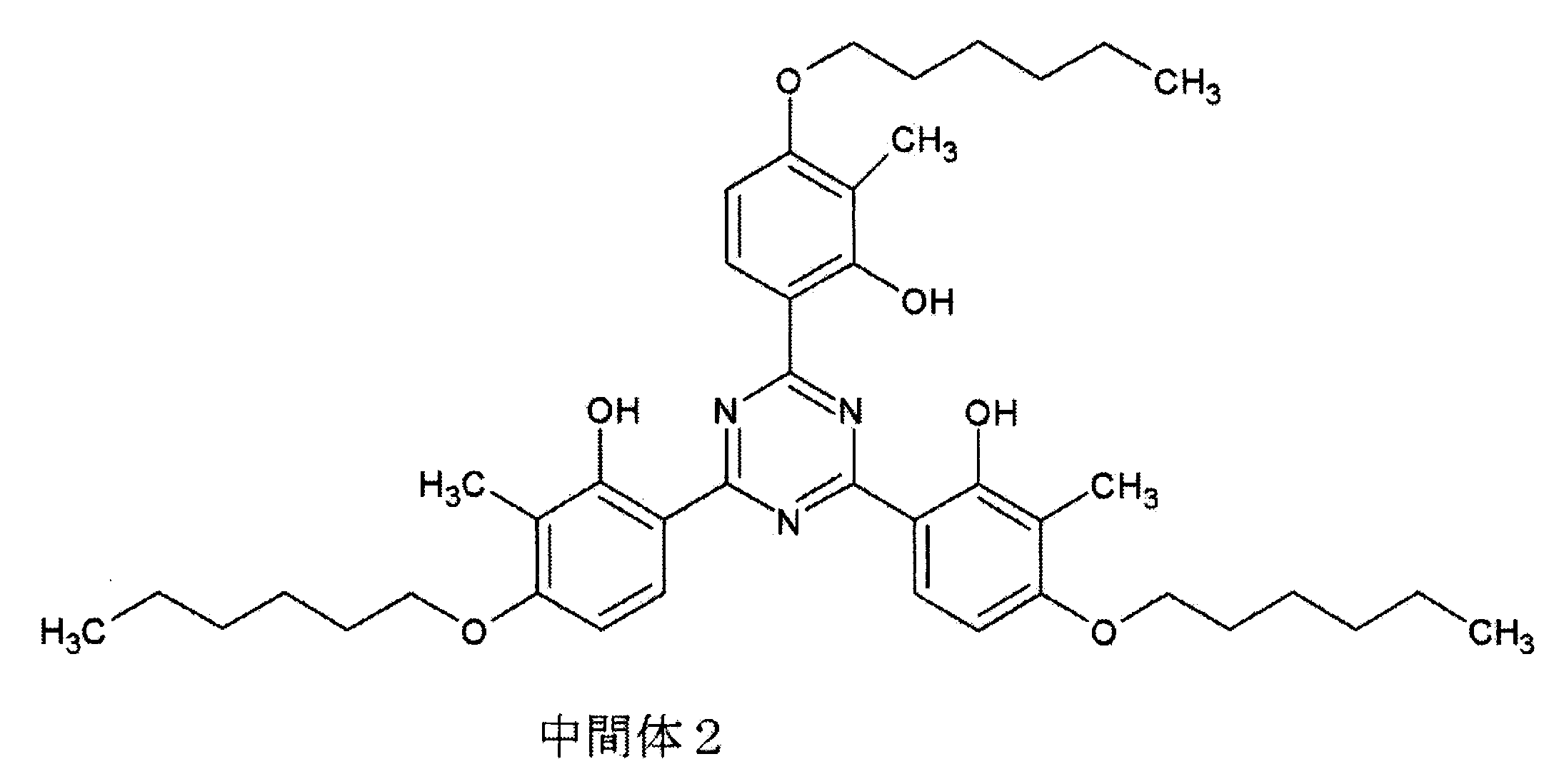
<測定条件>
装置:BRUKER AVANCE400
共振周波数:400MHz(1H-NMR)
溶媒:テトラヒドロフラン-d8
1H-NMRの内部標準物質として、テトラメチルシランを用い、ケミカルシフト値はδ値(ppm)、カップリング定数はHertzで示した。またsはsinglet、dはdoublet、ddはdoubledoublet、tはtriplet、mはmultipletの略とする。得られたNMRスペクトルの内容は以下のとおりである。
δ=13.39(s,2H,-OH),8.34(d,2H,J=9.0Hz,phenyl-H),8.11(d,1H,J=9.0Hz,phenyl-H),7.11(d,1H,J=9.0Hz,phenyl-H),6.67(d,2H,J=9.0Hz,phenyl-H),6.52(d,1H,J=3.2Hz,-CH=CHH),6.52(d,1H,J=8.8Hz,-CH=CHH),5.94(dd,1H,J=8.8Hz,J=3.2Hz,-CH=CHH),4.19(t,2H,J=6.4Hz,-O-CH2-CH2-),4.13(t,4H,J=6.4Hz,-O-CH2-CH2-),2.19(s,6H,phenyl-CH3),2.16(s,3H,phenyl-CH3),1.84-1.94(m,6H,-O-CH2-CH2-),1.54-1.62(m,6H,-O-CH2-CH2-CH2-),1.38-1.47(m,12H,-O-CH2-CH2-CH2-CH2-CH2-CH3),0.95-1.00(m,9H,-O-CH2-CH2-CH2-CH2-CH2-CH3)
紫外線吸収性不飽和単量体(A-4)の製造において、アクリロイルクロリドの代わりにメタクリロイルクロリドを滴下した以外は同様な方法で製造し、紫外線吸収性不飽和単量体(A-5)を製造した。
温度計、撹拌機を具備した200mL4つ口フラスコに、N-メチルピロリドンを100g、中間体2を28.6mmol、メチルヒドロキノンを0.01mmol仕込み、エアーをバブリングしながら120℃で撹拌した。その後、グリシジルメタクリレートを62.9mmol、N,N-ジメチルベンジルアミンを0.6mmol添加し、120℃で8時間撹拌した。一方、500mLビーカーに水を300g仕込み、撹拌して得た先の反応液を少しずつ滴下し、紫外線吸収性不飽和単量体が析出させ、ろ過した。その後、水300gでふりかけ洗浄を行った。得られたウエットケーキを水300g中に戻して室温で30分間リスラリーを行い、ろ過した。その後、水300gでふりかけ洗浄を行った。40℃で減圧乾燥を行い、紫外線吸収性不飽和単量体(A-6)を製造した。
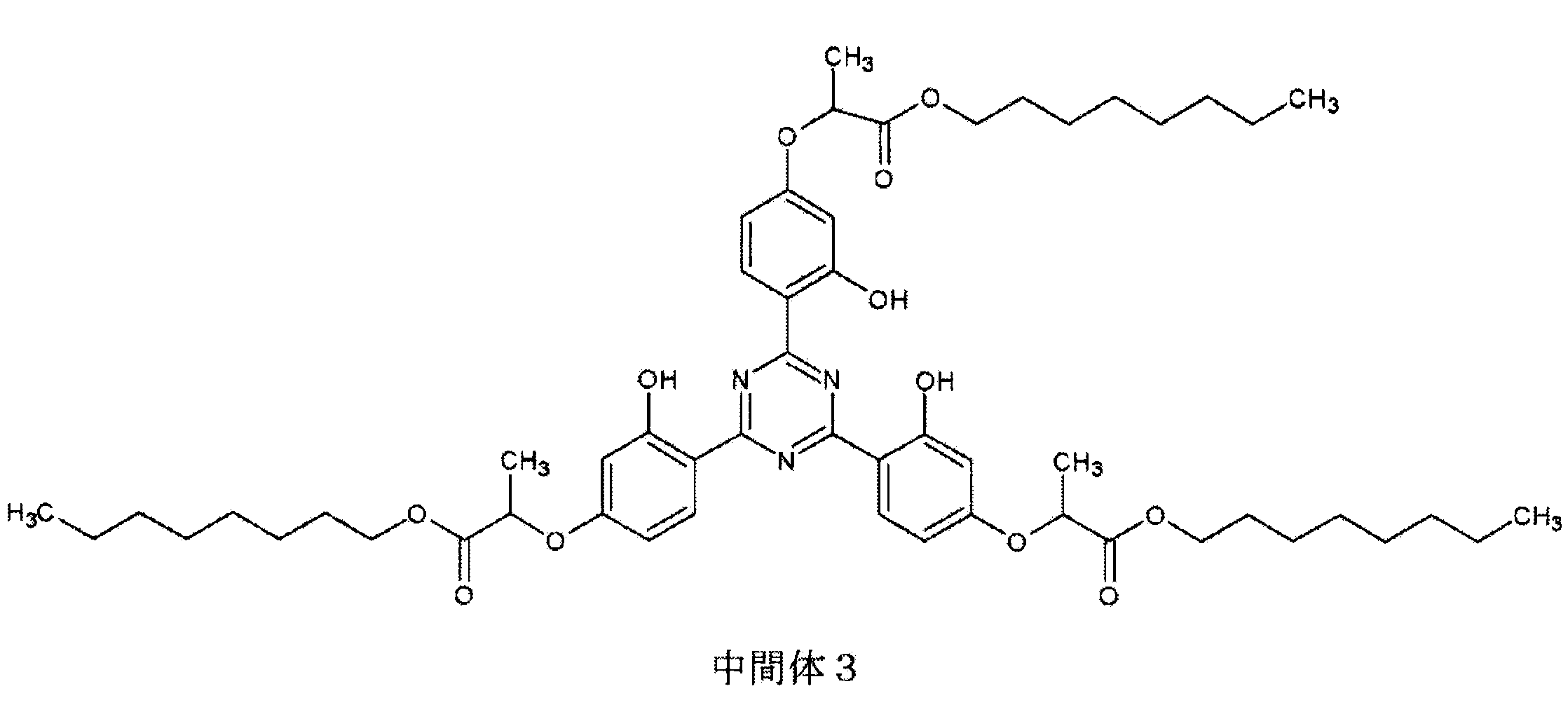
紫外線吸収性不飽和単量体(A-7)の製造において、アクリロイルクロリドの代わりにメタクリロイルクロリドを滴下した以外は同様な方法で製造し、紫外線吸収性不飽和単量体(A-8)を製造した。
温度計、撹拌機を具備した200mL4つ口フラスコに、N-メチルピロリドンを100g、中間体3を28.6mmol、メチルヒドロキノンを0.01mmol仕込み、エアーをバブリングしながら120℃で撹拌した。その後、グリシジルメタクリレートを62.9mmol、N,N-ジメチルベンジルアミンを0.6mmol添加し、120℃で8時間撹拌した。一方、500mLビーカーに水を300g仕込み、撹拌して得た先の反応液を少しずつ滴下し、紫外線吸収性不飽和単量体が析出させ、ろ過した。その後、水300gでふりかけ洗浄を行った。得られたウエットケーキを水300g中に戻して室温で30分間リスラリーを行い、ろ過した。その後、水300gでふりかけ洗浄を行った。40℃で減圧乾燥を行い、紫外線吸収性不飽和単量体(A-9)を製造した。

紫外線吸収性不飽和単量体(A-10)の製造において、アクリロイルクロリドの代わりにメタクリロイルクロリドを滴下した以外は同様な方法で製造し、紫外線吸収性不飽和単量体(A-11)を製造した。
温度計、撹拌機を具備した200mL4つ口フラスコに、N-メチルピロリドンを100g、中間体4を28.6mmol、メチルヒドロキノンを0.01mmol仕込み、エアーをバブリングしながら120℃で撹拌した。その後、グリシジルメタクリレートを62.9mmol、N,N-ジメチルベンジルアミンを0.6mmol添加し、120℃で8時間撹拌した。一方、500mLビーカーに水を300g仕込み、撹拌して得た先の反応液を少しずつ滴下し、紫外線吸収性不飽和単量体が析出させ、ろ過した。その後、水300gでふりかけ洗浄を行った。得られたウエットケーキを水300g中に戻して室温で30分間リスラリーを行い、ろ過した。その後、水300gでふりかけ洗浄を行った。40℃で減圧乾燥を行い、紫外線吸収性不飽和単量体(A-12)を製造した。

紫外線吸収性不飽和単量体(A-13)の製造において、アクリロイルクロリドの代わりにメタクリロイルクロリドを滴下した以外は同様な方法で製造し、紫外線吸収性不飽和単量体(A-14)を製造した。
紫外線吸収性不飽和単量体(A-13)の製造における中間体5を用いて、以下の反応を行った。温度計、撹拌機を具備した200mL4つ口フラスコに、N-メチルピロリドンを100g、中間体5を28.6mmol、メチルヒドロキノンを0.01mmol仕込み、エアーをバブリングしながら120℃で撹拌した。その後、グリシジルメタクリレートを62.9mmol、N,N-ジメチルベンジルアミンを0.6mmol添加し、120℃で8時間撹拌した。一方、500mLビーカーに水を300g仕込み、撹拌して得た先の反応液を少しずつ滴下し、紫外線吸収性不飽和単量体が析出させ、ろ過した。その後、水300gでふりかけ洗浄を行った。得られたウエットケーキを水300g中に戻して室温で30分間リスラリーを行い、ろ過した。その後、水300gでふりかけ洗浄を行った。40℃で減圧乾燥を行い、紫外線吸収性不飽和単量体(A-15)を製造した。
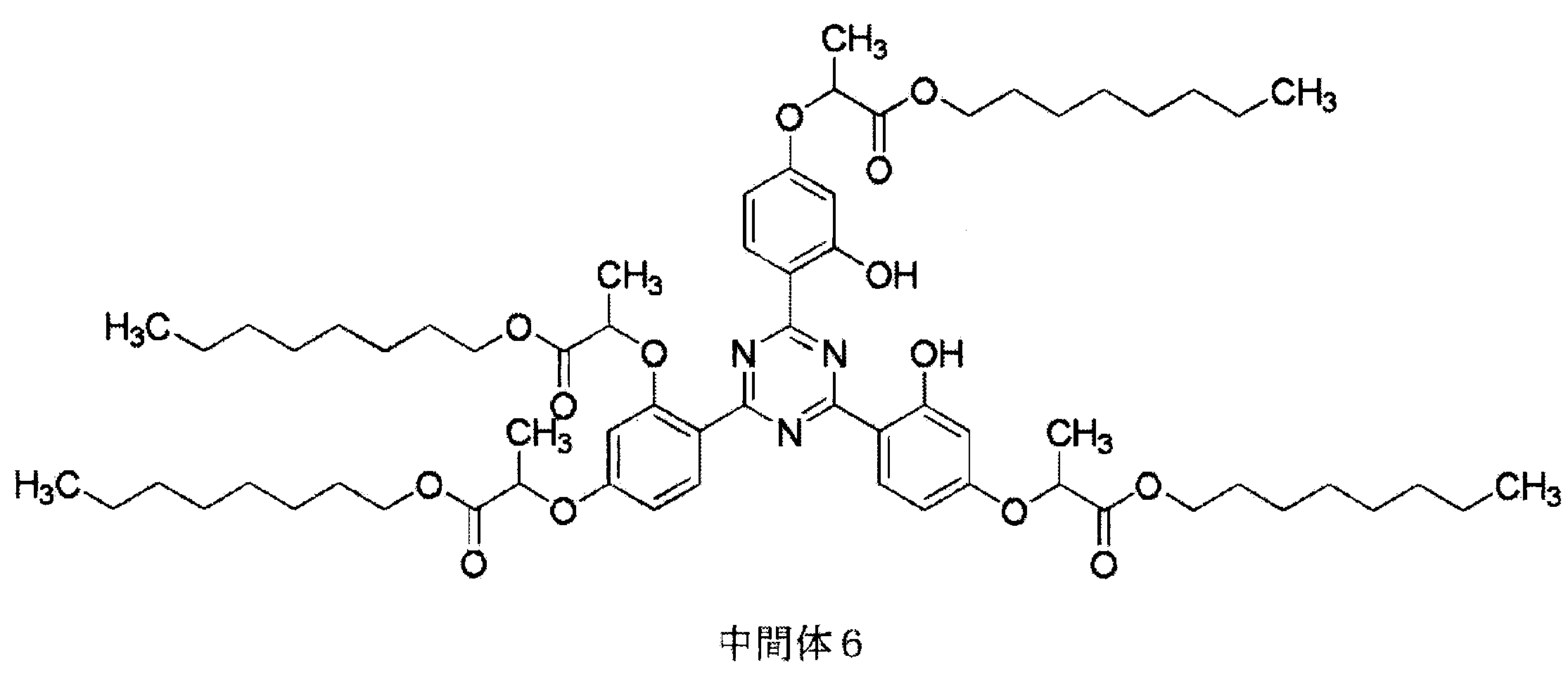
紫外線吸収性不飽和単量体(A-16)の製造において、アクリロイルクロリドの代わりにメタクリロイルクロリドを滴下した以外は同様な方法で製造し、紫外線吸収性不飽和単量体(A-17)を製造した。
紫外線吸収性不飽和単量体(A-16)の製造における中間体6を用いて、以下の反応を行った。温度計、撹拌機を具備した200mL4つ口フラスコに、N-メチルピロリドンを100g、中間体6を28.6mmol、メチルヒドロキノンを0.01mmol仕込み、エアーをバブリングしながら120℃で撹拌した。その後、グリシジルメタクリレートを62.9mmol、N,N-ジメチルベンジルアミンを0.6mmol添加し、120℃で8時間撹拌した。一方、500mLビーカーに水を300g仕込み、撹拌して得た先の反応液を少しずつ滴下し、紫外線吸収性不飽和単量体が析出させ、ろ過した。その後、水300gでふりかけ洗浄を行った。得られたウエットケーキを水300g中に戻して室温で30分間リスラリーを行い、ろ過した。その後、水300gでふりかけ洗浄を行った。40℃で減圧乾燥を行い、紫外線吸収性不飽和単量体(A-18)を製造した。

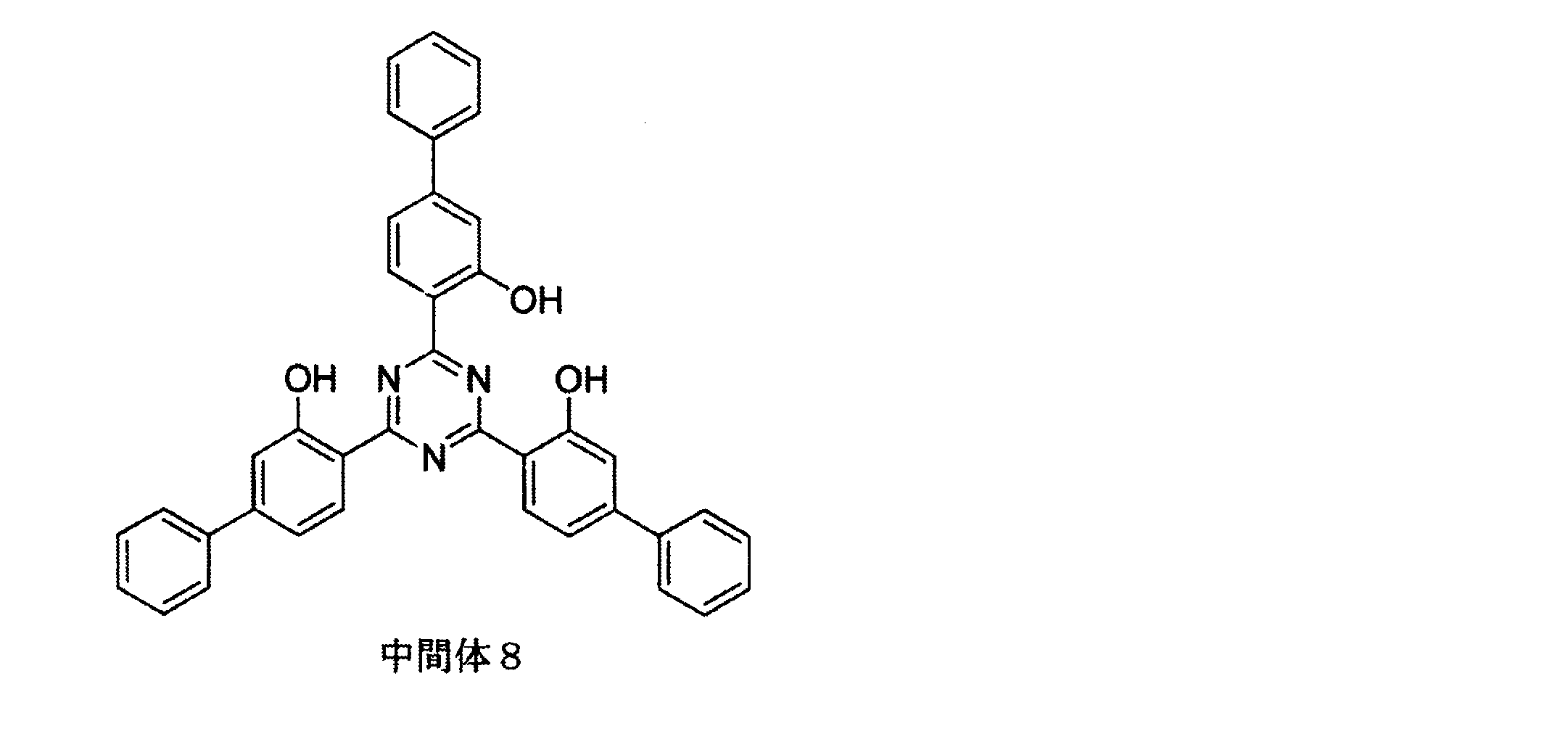

(紫外線吸収性ポリマー(B-1))
温度計、撹拌機、蒸留管、冷却器を具備した4つ口セパラブルフラスコに、メチルエチルケトン75.0部を仕込み、窒素気流下で75℃に昇温した。別途、紫外線吸収性不飽和単量体(A-1)を10部、ジシクロペンタニルメタクリレートを45部、スチレンを45部、2.2’-アゾビス(イソ酪酸メチル)を5.0部、及びメチルエチルケトン20.0部を均一にした後、滴下ロートに仕込み、4つ口セパラブルフラスコに取り付け、2時間かけて滴下した。滴下終了2時間後、固形分から重合収率が98%以上であることを確認し、50℃へ冷却した。このようにして不揮発分が50質量%の紫外線吸収性ポリマー(B-1)を製造した。
表4に示すように、紫外線吸収性ポリマー(B-1)と同様にして、(B-2)~(B-32)を製造した。
なお、実験例1で示した不飽和単量体であるアデカスタブLA-82(ADEKA製)も用いた。
温度計、撹拌機、滴下ロート、冷却器を具備した4つ口セパラブルフラスコに、メチルエチルケトン9.0部、を仕込み、窒素気流下で4-シアノ-4-[(ドデシルスルファニルチオカルボニル)スルファニル]ペンタン酸メチルを1.0部、紫外線吸収性不飽和単量体(A-1)を10.0部、を仕込み、窒素気流下で75℃に昇温した。そこに2,2’-アゾビス(2,4-ジメチルバレロニトリル)を0.12部及びメチルエチルケトン5.0部を8時間かけて滴下し、Aブロックを合成した。その後、ジシクロペンタニルメタクリレートを45.0部、スチレンを45.0部、メチルエチルケトン77.5部を仕込み、2,2’-アゾビス(2,4-ジメチルバレロニトリル)を0.12部及びメチルエチルケトン10.0部を8時間かけて滴下し、Bブロックを合成した。滴下終了後、24時間反応を継続した。その後、サンプリングを行い重合収率が99%以上であることを確認し、50℃へ冷却した。このようにして不揮発分が50質量%の紫外線吸収性ポリマー(B-33)を製造した。
温度計、撹拌機、滴下ロート、冷却器を具備した4つ口セパラブルフラスコに、メチルエチルケトン21.6部、ビス(ドデシルスルファニルチオカルボニル)ジスルフィドを3.5部、2,2’-アゾビス(2,4-ジメチルバレロニトリル)を1.9部仕込み、窒素気流下で70℃に昇温し、2時間反応させた。そこに紫外線吸収性不飽和単量体(A-1)を50.0部仕込み、窒素気流下で75℃に昇温した。そこに2,2’-アゾビス(2,4-ジメチルバレロニトリル)を0.31部及びメチルエチルケトン10.0部を8時間かけて滴下し、Aブロックを合成した。その後、ジシクロペンタニルメタクリレートを25.0部、スチレンを25.0部、メチルエチルケトン12.5部を仕込み、2,2’-アゾビス(2,4-ジメチルバレロニトリル)を0.31部及びメチルエチルケトン10.0部を8時間かけて滴下し、Bブロックを合成した。滴下終了後、24時間反応を継続した。その後、サンプリングを行い重合収率が99%以上であることを確認し、50℃へ冷却した。このようにして不揮発分が50質量%の紫外線吸収性ポリマー(B-34)を製造した。
表4に示すように、紫外線吸収性ポリマー(B-34)と同様にして、紫外線吸収性ポリマー(B-35)を作製した。なお、紫外線吸収性ポリマー(B-33)~(B-35)は、ブロックポリマーである。

〔マスターバッチの製造〕
ワックス(D‐1)100部、及び紫外線吸収性ポリマー(B-1)100部を混合し、3本ロールミルを使用して160℃で混練を行い紫外線吸収性ポリマー(B-1)の分散体を製造した。次いで、ポリオレフィン(C-1)100部と共に得られた上記分散体10部をヘンシェルミキサーで混合した。次いで、スクリュー径30mmの単軸押出機にて180℃で溶融混練した後、ペレタイザーを用いてペレット状にカッティングしてマスターバッチを製造した。
希釈樹脂としてポリオレフィン(C-1)100部に対して、製造したマスターバッチ10部を混合した。次いで、T-ダイ成形機(東洋精機製)を用いて、温度180℃で溶融混合し、厚さ250μmのフィルムを成形した。
実施例1Aの材料を表5に示す材料及び配合量に変更した以外は、実施例1Aと同様にして、マスターバッチを製造し、次いで実施例2A~40A、比較例1Aのフィルムをそれぞれ成形した。なお、比較例1Aでは、実施例1Aの紫外線吸収性ポリマー(B-1)の代わりに、紫外線吸収性不飽和単量体(A-1)を合成する際に用いた中間体1を用いた。
希釈樹脂としてポリオレフィン(C-1)100部に対して、製造したマスターバッチ10部を混合した。次いで、T-ダイ成形機(東洋精機製)を用いて、温度180℃で溶融混合し、厚さ250μmのフィルムを成形した。
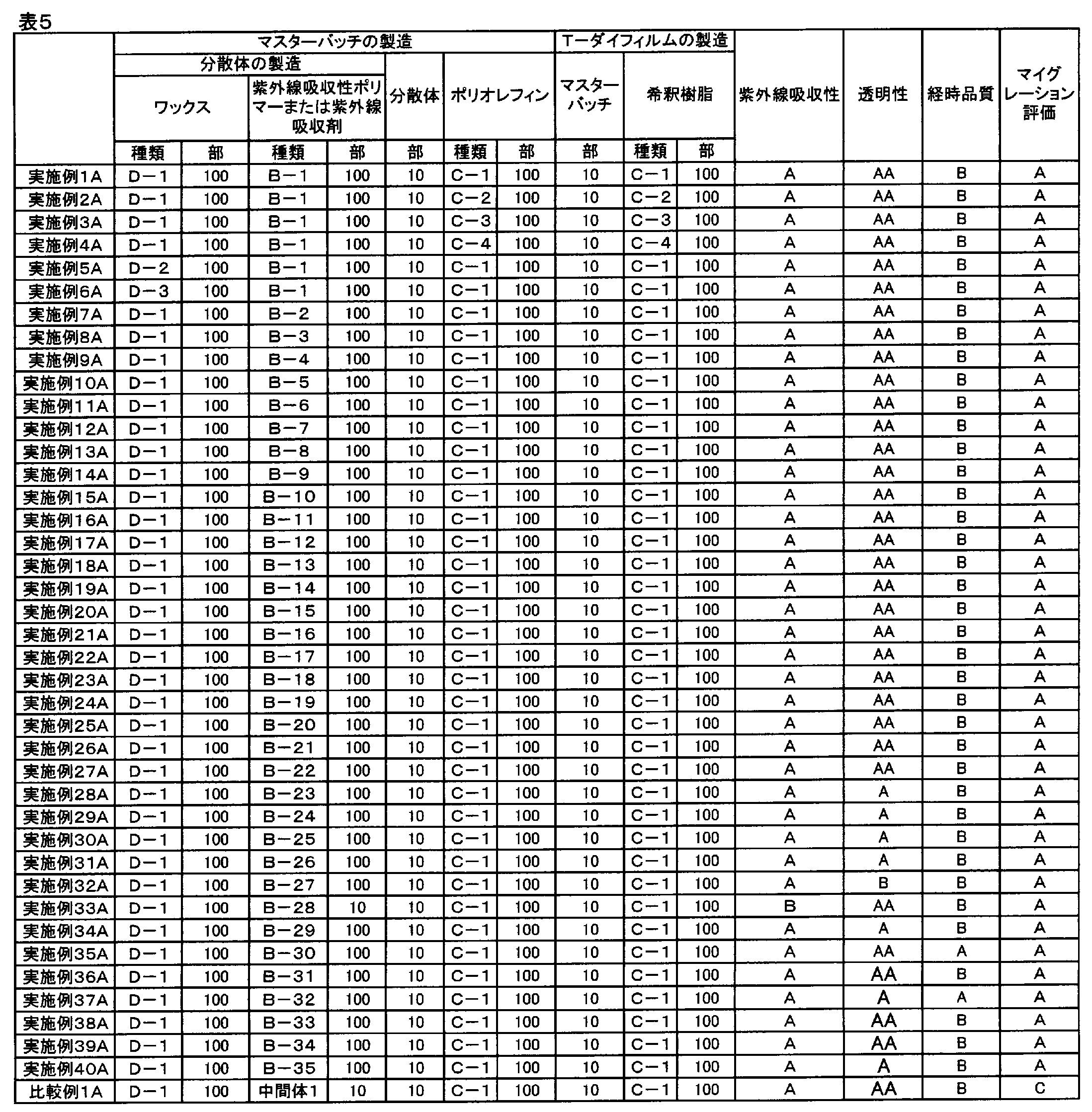
〔マスターバッチの製造〕
紫外線吸収性ポリマー(B-1)を真空乾燥機で50℃12時間乾燥し、紫外線吸収性ポリマー(B-1)乾燥品を製造した。ポリオレフィン(C-1)100部と紫外線吸収性ポリマー(B-1)乾燥品20部とを同じ供給口からスクリュー径30mmの二軸押出機(日本製鋼所社製)に投入し、280℃で溶融混錬した上で、ペレタイザーを用いてペレット状にカッティングして成形用樹脂組成物(マスターバッチ)を製造した。
希釈樹脂としてポリオレフィン(C-1)100部に対して、製造した成形用樹脂組成物10部を混合した。次いで、T-ダイ成形機(東洋精機製)を用いて、温度230℃で溶融混合し、厚さ250μmのフィルムを成形した。
〔マスターバッチの製造〕
ポリカーボネート(E-1)100部と紫外線吸収性ポリマー(B-1)乾燥品20部とを同じ供給口からスクリュー径30mmの二軸押出機(日本製鋼所社製)に投入し、280℃で溶融混錬した上で、ペレタイザーを用いてペレット状にカッティングして成形用樹脂組成物(マスターバッチ)を製造した。
希釈樹脂としてポリカーボネート(E-1)100部に対して、製造した成形用樹脂組成物10部を混合した。次いで、T-ダイ成形機(東洋精機製)を用いて、温度280℃で溶融混合し、厚さ250μmのフィルムを成形した。
実施例42Aの材料を表6に示す材料及び配合量に変更した以外は、実施例42Aと同様にして、マスターバッチを製造し、次いで実施例43A~47A、比較例2Aのフィルムをそれぞれ製造した。なお、表6に示す紫外線吸収性ポリマー(B-2)~(B-4)、(B-27)、(B-33)の乾燥品は、紫外線吸収性ポリマー(B-1)乾燥品と同様に、真空乾燥機で50℃12時間乾燥して製造した。
〔マスターバッチの製造〕
ポリメタクリル樹脂(E-2)100部と紫外線吸収性ポリマー(B-1)乾燥品20部とを同じ供給口からスクリュー径30mmの二軸押出機(日本製鋼所社製)に投入し、240℃で溶融混錬した上で、ペレタイザーを用いてペレット状にカッティングして成形用樹脂組成物(マスターバッチ)を製造した。
希釈樹脂としてメタクリル樹脂(E-2)100部に対して、製造した成形用樹脂組成物10部を混合し、T-ダイ成形機(東洋精機製)を用いて、温度280℃で溶融混合し、厚さ250μmのT-ダイフィルムを成形した。
実施例48Aの材料を表6に示す材料及び配合量に変更した以外は、実施例48Aと同様にして、マスターバッチを製造し、次いで実施例49A~53A、比較例3Aのフィルムをそれぞれ製造した。
〔マスターバッチの製造〕
ポリエステル(E-3)100部と紫外線吸収性ポリマー(B-1)乾燥品20部とを同じ供給口からスクリュー径30mmの二軸押出機(日本製鋼所社製)に投入し、280℃で溶融混錬した上で、ペレタイザーを用いてペレット状にカッティングして成形用樹脂組成物(マスターバッチ)を製造した。
希釈樹脂としてポリカーボネート(E-3)100部に対して、製造した成形用樹脂組成物10部を混合し、T-ダイ成形機(東洋精機製)を用いて、温度280℃で溶融混合し、厚さ250μmのフィルムを成形した。
実施例54Aの材料を表6に示す材料及び配合量に変更した以外は、実施例54Aと同様にして、マスターバッチを製造し、次いで実施例55A~59A、比較例4Aのフィルムをそれぞれ製造した。
〔マスターバッチの製造〕
シクロオレフィン樹脂(E-4)100部と紫外線吸収性ポリマー(B-1)乾燥品20部とを同じ供給口からスクリュー径30mmの二軸押出機(日本製鋼所社製)に投入し、240℃で溶融混錬した上で、ペレタイザーを用いてペレット状にカッティングして成形用樹脂組成物(マスターバッチ)を製造した。
希釈樹脂としてシクロオレフィン樹脂(E-4)100部に対して、製造した成形用樹脂組成物10部を混合し、T-ダイ成形機(東洋精機製)を用いて、温度280℃で溶融混合し、厚さ250μmのT-ダイフィルムを成形した。
実施例60Aの材料を表6に示す材料及び配合量に変更した以外は、実施例60Aと同様にして、マスターバッチを製造し、次いで実施例61A~65A、比較例5Aのフィルムをそれぞれ製造した。
実験例1と同様の評価方法にて評価した。
A:波長280~380nmの光透過率が全領域にわたって2%以下。良好。
B:波長280~380nmの光透過率が一部2%以上。実用域。
C:波長280~380nmの光透過率が全領域にわたって2%以上。実用不可。
実験例1と同様の評価方法及び評価基準にて評価した。
実験例1の[耐光性試験]と同様の評価方法及び評価基準にて評価した。
実験例1と同様の評価方法にて評価した。
A:280~380nmにおける吸光度が検出されない(0.05未満)。良好。
B:280~380nmにおける吸光度が0.05以上0.2未満。実用域。
C:280~380nmにおける吸光度が0.2以上。実用不可。
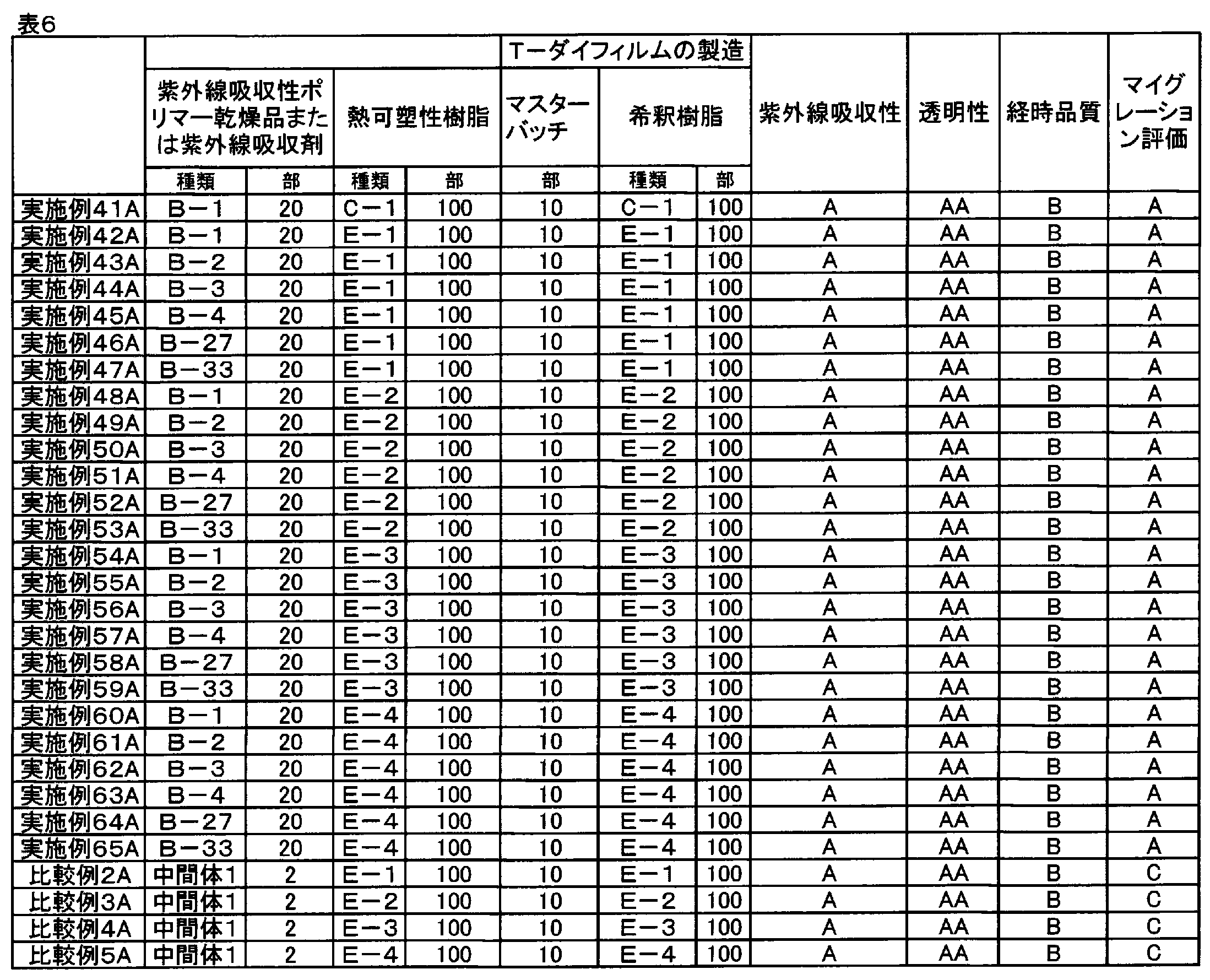
撹拌機、還流冷却機、窒素導入管、温度計、滴下管を備えた反応装置を使用して、窒素雰囲気下にてn-ブチルアクリレート96.0部と、2-ヒドロキシルエチルアクリレート4.0部の合計量のうちの50%、及び重合開始剤として2,2’-アゾビスイソブチルニトリルを0.2部、溶剤として酢酸エチルを150部反応槽に仕込み、前記合計量の残りの50%と適量の酢酸エチルを滴下槽に仕込んだ。次いで、加熱を開始して反応槽内での反応開始を確認してから、還流下、滴下管の内容物、及び0.01部の2,2’-アゾビスイソブチルニトリルの酢酸エチル希釈液を滴下した。滴下終了後、還流状態を維持したまま5時間反応を行った。反応終了後、冷却し、適量の酢酸エチルを添加することで、アクリル系樹脂である粘着性樹脂(F-1)を製造した。製造した粘着性樹脂(F-1)の重量平均分子量は50万、不揮発分は40%、粘度は3,200mPa・sであった。
撹拌機、還流冷却機、窒素導入管、温度計、滴下管を備えた反応装置を使用して、窒素雰囲気下にてn-ブチルアクリレート96.0部と、アクリル酸4.0部の合計量のうちの50%、及び重合開始剤として2,2’-アゾビスイソブチルニトリルを0.2部、溶剤として酢酸エチルを150部反応槽に仕込み、前記合計量の残りの50%と適量の酢酸エチルを滴下槽に仕込んだ。次いで、加熱を開始して反応槽内での反応開始を確認してから、還流下、滴下管の内容物、及び0.01部の2,2’-アゾビスイソブチルニトリルの酢酸エチル希釈液を滴下した。滴下終了後、還流状態を維持したまま5時間反応を行った。反応終了後、冷却し、適量の酢酸エチルを添加することで、アクリル系樹脂である粘着性樹脂(F-2)を製造した。製造した粘着性樹脂(F-2)の重量平均分子量は60万、不揮発分は40%、粘度は4,000mPa・sであった。
粘着性樹脂として、粘着性樹脂(F-1)の不揮発分100部に対して、紫外線吸収性ポリマー(B-27)2部を混合し、シランカップリング剤としてKBM-403(信越化学工業製)を0.1部、硬化剤としてトリレンジイソシアネートのトリメチロールプロパンアダクト体(略号:TDI-TMP、NCO価=13.2、不揮発分=75%)を0.4部加え、よく撹拌し粘着剤を製造した。その後、この粘着剤を厚さ38μmのポリエチレンテレフタレート基材の剥離フィルム上に、乾燥後の厚みが50μmになるように塗布し、100℃の熱風オーブンで2分間乾燥させた。そして、粘着剤層側に25μmのポリエチレンテレフタレートフィルムを貼り合せ、この状態で室温にて7日間エージングさせ、粘着シートを製造した。
表7に示すように、実施例66Aと同様に調整して、実施例67A~70A、比較例6Aの粘着シートをそれぞれ製造した。
(1)粘着力
製造した粘着シートを幅25mm・縦150mmの大きさに準備した。23℃、相対湿度50%雰囲気下、粘着シートから剥離性フィルムを剥がして露出した粘着剤層をガラス板に貼り付け、2kgロールで1往復圧着した。24時間放置した後に引張試験機を用いて180度方向に300mm/分の速度で引き剥がす180°ピール試験において粘着力を測定し、下記の評価基準に基づいて評価を行った。(JIS Z0237:2000に準拠)
AA:粘着力が15N以上。非常に良好。
A:粘着力が10N以上15N未満。良好。
C:粘着力が10N未満。実用不可。
製造した粘着シートを幅25mm・縦150mmの大きさに準備した。JIS Z0237:2000に準拠して粘着シートから剥離性シートを剥がして、研磨した幅30mm・縦150mmのステンレス板の下端部幅25mm・横25mmの部分に粘着剤層を貼着し、2kgロールで1往復圧着した後、40℃雰囲気で1kgの荷重をかけ、7万秒放置することで保持力を測定した。評価は、粘着シート貼付面上端部が下にずれた長さを測定した。
A:ずれた長さが0.5mm未満。良好。
C:ずれた長さが0.5mm以上。実用不可。
製造した粘着シートから剥離性シートを剥がして、粘着剤層の透明性を目視にて評価した。粘着剤層の外観に関しては、下記の3段階の評価基準に基づいて評価を行った。
A:粘着剤層は透明。良好。
B:粘着剤層はわずかに白化している。実用域。
C:粘着剤層が白化している。実用不可。
製造した粘着シートを幅100mm・縦100mmの大きさに準備した。23℃、相対湿度50%雰囲気下、粘着シートから剥離性フィルムを剥がして露出した粘着剤層をガラス板に貼り付け、2kgロールで1往復圧着した。ついで、同環境下で48時間放置し、ついで粘着シートを剥がして、ガラスへの紫外線吸収材料のマイグレーション性に関して、紫外可視近赤外分光光度計(島津製作所社製)を用いて評価した。評価は、上記の処理を行ったガラス上の箇所5点を選び、紫外領域の吸光度を測定し、その平均を算出することで行った。
A:280~380nmにおける吸光度が検出されない(0.05以下)。良好。
B:280~380nmにおける吸光度が0.05超0.2以下。実用域。
C:280~380nmにおける吸光度が0.2超。実用不可。
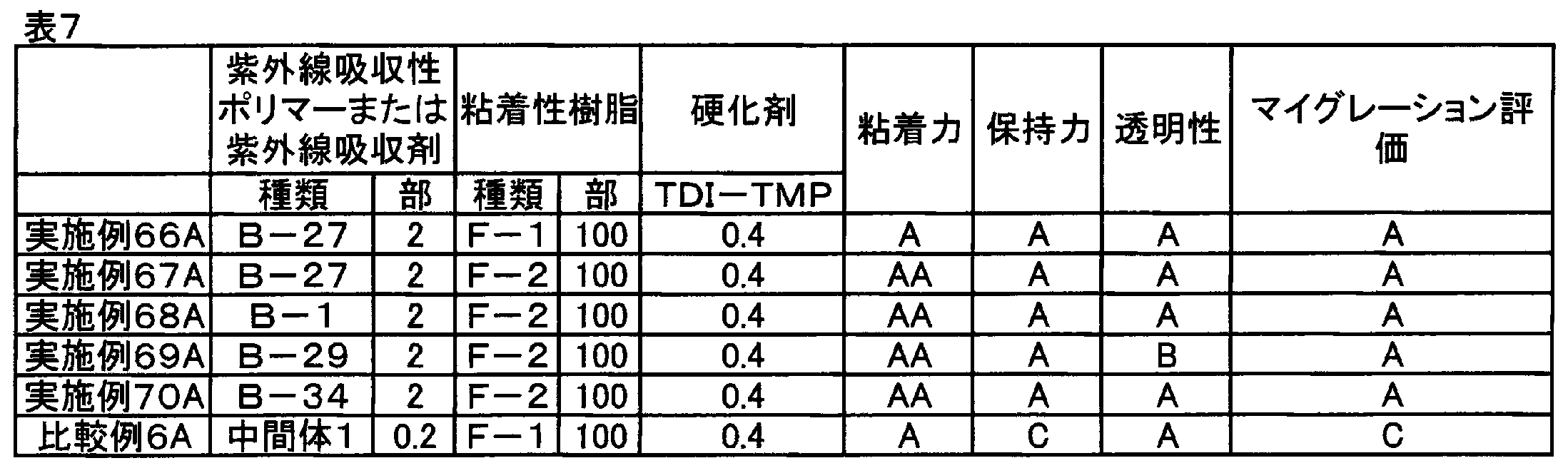
(実施例71A)
以下の組成で、撹拌混合を行い、塗料を調整した。
紫外線吸収性ポリマー(B-27) 1.0部
ポリエステル(バイロンGK250、東洋紡社製) 9.0部
メチルエチルケトン 90.0部
表8に示すように、実施例71Aと同様に調整し、実施例72A~75A、比較例7A~8Aの塗料をそれぞれ調整した。
調整した塗料を厚さ1000μmのガラス基板にバーコーターを用いて乾燥膜厚で6μmとなるよう塗布し、100℃2分で乾燥させて塗膜を作製した。
作製した塗工物を、以下の方法で評価した。
作製した塗工物の透過率を、紫外可視近赤外分光光度計(島津製作所社製)を用いて測定した。透過率は白色標準板に対しての分光透過率を測定した。
以下の条件を満たすか否かを評価した。
A:波長280~380nmの光透過率が全領域にわたって2%以下。良好。
B:波長280~380nmの光透過率が一部2%を超え10%以下。実用域。
C:波長280~380nmの光透過率が一部10%以上もしくは全領域にわたって2%超。実用不可。
作製した塗工物の透明性を目視評価した。
A:まったく濁りが認められない。良好。
C:濁りが認められる。実用不可。
作製した塗工物の塗膜面に軟質塩化ビニルシートを載せ、熱プレス機を使用して圧力100g/cm2・温度170℃30秒間の条件で加熱圧着した。次いで、直ちにフィルムを外して軟質塩化ビニルシートへのマイグレーションを紫外可視近赤外分光光度計(島津製作所社製)を用いて評価した。評価は、上記の処理を行った軟質塩化ビニルシート上の箇所5点を選び、紫外領域の吸光度を測定し、その平均を算出することで行った。
A:280~380nmにおける吸光度が検出されない(0.05以下)。良好。
B:280~380nmにおける吸光度が0.05超0.2以下。実用域。
C:280~380nmにおける吸光度が0.2を超える。実用不可。

(実施例76A)
以下の組成で、各原料を撹拌混合し、光硬化性組成物を調整した。
紫外線吸収性ポリマー(B-27) 10.0部
光重合性化合物(多官能アクリレート「KAYARAD DPHA」日本化薬社製) 9.0部
光重合開始剤(IGM ResinBV製「Omnirad184」) 1.0部
プロピレングリコールモノメチルエーテル 80.0部
表9に示すように、実施例76Aと同様に調整し、実施例77A~79A、比較例9Aの光硬化性組成物を調整した。
上記の光硬化性組成物をバーコーターを用いて厚さ1mmのガラス基板に乾燥膜厚で6μmとなるよう塗布した。得られた塗布層を、100℃1分で乾燥したのち、高圧水銀ランプで400mJ/cm2の紫外線を照射して硬化し塗工物を作製した。
作製した塗工物を、以下の方法で評価した。
本実験例における<塗料>と同様の評価方法及び評価基準にて評価した。
塗工物を学振試験機にセットし、スチールウールを用いて、荷重250gで10回学振させた。取り出した塗工物について、キズのつき具合を以下の5段階の目視評価に従って判断した。数値が大きいほど、硬化膜の耐擦傷性が良好であることを示す。
5:キズが全くない。
4:僅かにキズが付いている。
3:キズは付いているが、基材は見えていない。
2:キズが付き、一部硬化膜が剥がれている。
1:硬化膜が剥がれてしまい、基材が剥き出しの状態。
JIS-K5600に準拠し、鉛筆硬度試験機(HEIDON社製Scratching Tester HEIDON-14)を用い、鉛筆の芯の硬さを種々変えて、塗工物の硬化膜に対して荷重500gにて5回試験をした。5回中、1回も傷がつかない、もしくは1回のみ傷が付く時の芯の硬さを、その硬化膜の鉛筆硬度とした。評価基準は以下の通りである。
A:2H以上。
B:H。
C:Hより低い。
本実験例における<塗料>と同様の評価方法にて評価した。A:まったく濁りが認められない。良好。
B:わずかに濁りが認められる。実用域。
C:濁りが多く認められる。実用不可。
作製し塗工物を2枚の軟質塩化ビニルシートで挟み、熱プレス機を使用して圧力100g/cm2・温度170℃30秒間の条件で加熱圧着した。次いで、直ちにフィルムを外して軟質塩化ビニルシートへのマイグレーションを紫外可視近赤外分光光度計(島津製作所社製)を用いて評価した。評価は、上記の処理を行った軟質塩化ビニルシート上の場所5点を選び、紫外領域の吸光度を測定し、その平均を算出することで行った。なお、本実験例における<塗料>と同様の評価基準にて評価した。
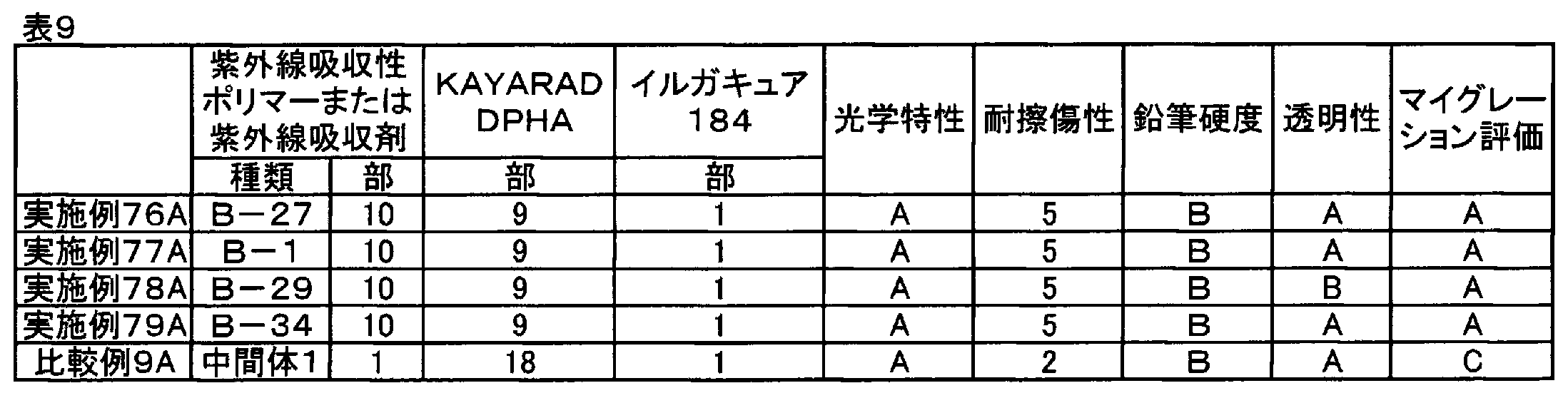
本実験例で使用したポリオレフィンを以下に示す。
(A-1):ポリエチレン(サンテックLD M2270、MFR=7g/10min、旭化成ケミカルズ社製)
(A-2):ポリエチレン(ノバテックUJ790、MFR=50g/10min、日本ポリエチレン社製)
(A-3):ポリプロピレン(ノバテックPP FA3EB、MFR=10.5g/10min、日本ポリプロ社製)
(A-4):ポリプロピレン(プライムポリプロJ226T、MFR=20g/10min、プライムポリマー社製)
(A-5):ポリエチレン(エボリューH SP65051B、MFR= 0.45g/10min、プライムポリマー社製)
<製造例1B(ポリマー(B-1))>
温度計、撹拌機、滴下ロート、冷却器を具備した4つ口セパラブルフラスコに、メチルエチルケトン61.4部を仕込み、窒素気流下で75℃に昇温した。別途、4-メタクリロイルオキシベンゾフェノン(MCCユニテック社製、MBP)を5.0部、一般式(1)で示す単量体単位としてジシクロペンタニルメタクリレート(日立化成社製、FA-513M)を47.5部、スチレンを47.5部、2,2’-アゾビス(イソ酪酸メチル)を10.0部、及びメチルエチルケトン75.0部を均一に混合した後、滴下ロートに仕込んだ。次いで滴下ロートの内容物を2時間かけて滴下した。滴下終了後、2時間反応を継続した。その後、サンプリングを行い重合収率が98%以上であることを確認し、メチルエチルケトンで不揮発分が35%になるように希釈し、室温に冷却し、樹脂溶液b-1を製造した。次に温度計、撹拌機、滴下ロート、冷却器を具備した4つ口セパラブルフラスコにメチルエチルケトン500部、メタノール500部を仕込んでおき、ディスパーで1,000回転させたところに上記樹脂溶液b-1、250部を1時間かけて滴下した。生成した白色沈殿物をろ過で取出し、真空乾燥機で50℃12時間乾燥し、ポリマー(B-1)を製造した。
単量体の種類と配合量を表10の通り変更した以外は、製造例1Bと同様に合成し、ポリマー(B-2)、(B-3)、(B-5)、(B-9)を製造した。
単量体の種類と配合量を表10の通り変更し、樹脂溶液b-4を製造した。不揮発分35%のb-4、250部にアセトン250部を添加し、ディスパーで1,000回転で30分間撹拌したあと、撹拌を止め、1時間放置すると2層に分かれた。下層の樹脂層を取出し、メチルエチルケトンで35%に希釈し、樹脂溶液b-4’を製造した。製造した樹脂溶液を真空乾燥機で50℃12時間乾燥し、ポリマー(B-4)を製造した。
温度計、撹拌機、滴下ロート、冷却器を具備した4つ口セパラブルフラスコにメチルエチルケトン250部、メタノール250部を仕込んでおき、ディスパーで1,000回転させたところに製造例4Bで製造した樹脂溶液b-4’、125部を1時間かけて滴下した。生成した白色沈殿物をろ過で取出し、真空乾燥機で50℃12時間乾燥し、ポリマー(B-6)を製造した。
単量体の種類と配合量を表10の通り変更し、製造例4B、6Bと同様の操作を行い、ポリマー(B-7)、(B-12)を製造した。
温度計、撹拌機、滴下ロート、冷却器を具備した4つ口セパラブルフラスコに、メチルエチルケトン38.0部、4-メタクリロイルオキシベンゾフェノンを3.0部、一般式(1)で示す単量体単位としてジシクロペンタニルメタクリレートを41.0部、スチレンを41.0部、一般式(a1-1)で示す単量体単位として2-[2-ヒドロキシ-5-[2-(メタクリロイルオキシ)エチル]フェニル]-2H-ベンゾトリアゾール(大塚化学社製、RUVA-93)を15.0部、チオグリコール酸オクチル(淀化学社製、OTG)を2.0g仕込み、窒素気流下で75℃に昇温した。そこに2,2’-アゾビス(イソ酪酸メチル)を1.0部、チオグリコール酸オクチル(淀化学社製、OTG)を2.0g及びメチルエチルケトン17.0部を8時間かけて滴下した。滴下終了後、2時間反応を継続した。その後、サンプリングを行い重合収率が98%以上であることを確認し、メチルエチルケトンで希釈し、不揮発分35%の樹脂溶液b-8を製造した。樹脂溶液b-8、250部にアセトン250部を添加し、ディスパーで1,000回転で30分間撹拌したあと、撹拌を止め、1時間放置すると2層に分かれた。下層の樹脂層を取出し、メチルエチルケトンで35%に希釈し、樹脂溶液b-8’を製造した。
次に、温度計、撹拌機、滴下ロート、冷却器を具備した4つ口セパラブルフラスコにメチルエチルケトン250部、メタノール250部を仕込んでおき、ディスパーで1,000回転させたところに樹脂溶液b-8’、125部を1時間かけて滴下した。生成した白色沈殿物をろ過で取出し、真空乾燥機で50℃12時間乾燥し、ポリマー(B-8)を製造した。
温度計、撹拌機、滴下ロート、冷却器を具備した4つ口セパラブルフラスコに、メチルエチルケトン38.0部、4-メタクリロイルオキシベンゾフェノン(MCCユニテック株式会社製、MBP)を3.0部、一般式(1)で示す単量体単位としてジシクロペンタニルメタクリレートを41.0部、スチレンを41.0部、一般式(a1-1)で示す単量体単位として2-[2-ヒドロキシ-5-[2-(メタクリロイルオキシ)エチル]フェニル]-2H-ベンゾトリアゾールを15.0部、4-シアノ-4-[(ドデシルスルファニルチオカルボニル)スルファニル]ペンタン酸メチルを4.4g仕込み、窒素気流下で75℃に昇温した。そこに2,2’-アゾビス(イソ酪酸メチル)を2.5部及びメチルエチルケトン17.0部を8時間かけて滴下した。滴下終了後、24時間反応を継続した。その後、サンプリングを行い重合収率が99%以上であることを確認し、50℃へ冷却、テフロン(登録商標)バットに取り出した。さらに、真空乾燥機で50℃12時間乾燥し、ポリマー(B-10)を製造した。
温度計、撹拌機、滴下ロート、冷却器を具備した4つ口セパラブルフラスコに、メチルエチルケトン43.0部、ビス(ドデシルスルファニルチオカルボニル)ジスルフィドを1.77部、ジメチル2,2’-アゾビス(2-メチルプロピオネート)を0.88部仕込み、窒素気流下で70℃に昇温し、2時間反応させた。そこに4-アクリロイルオキシベンゾフェノンを10.0部、一般式(a1-1)で示す単量体単位として2-[2-ヒドロキシ-5-[2-(メタクリロイルオキシ)エチル]フェニル]-2H-ベンゾトリアゾールを40.0部仕込み、窒素気流下で75℃に昇温した。そこにジメチル2,2’-アゾビス(2-メチルプロピオネート)を0.15部及びメチルエチルケトン10.0部を8時間かけて滴下し、Aブロックを合成した。その後、ジシクロペンタニルメタクリレートを45.0部、2-メトキシエチルアクリレートを5.0部、メチルエチルケトンを40.1部仕込み、ジメチル2,2’-アゾビス(2-メチルプロピオネート)を0.15部及びメチルエチルケトン10.0部を8時間かけて滴下し、Bブロックを合成した。滴下終了後、24時間反応を継続した。その後、サンプリングを行い重合収率が99%以上であることを確認し、樹脂溶液b-11を製造した。
次に温度計、撹拌機、滴下ロート、冷却器を具備した4つ口セパラブルフラスコにメタノール500部を仕込んでおき、ディスパーで1,000回転させたところに上記樹脂溶液b-11、100部を1時間かけて滴下した。生成した白色沈殿物をろ過で取出し、真空乾燥機で50℃12時間乾燥し、ABブロックポリマー(B-11)を製造した。製造したポリマーの重量平均分子量(Mw)は15,200、Mw/Mnは1.23であった。
温度計、撹拌機、滴下ロート、冷却器を具備した4つ口セパラブルフラスコに、酢酸エチル25.4部、ビス(ドデシルスルファニルチオカルボニル)ジスルフィドを1.77部、2,2’-アゾビス(2、4-ジメチルバレロニトリル)を0.95部仕込み、窒素気流下で70℃に昇温し、2時間反応させた。そこに4-メタクリロイルオキシベンゾフェノン(MCCユニテック株式会社製、MBP)を10.0部、一般式(a1-1)で示す単量体単位として2-[2-ヒドロキシ-5-[2-(メタクリロイルオキシ)エチル]フェニル]-2H-ベンゾトリアゾールを40.0部仕込み、窒素気流下で75℃に昇温した。そこに2,2’-アゾビス(2、4-ジメチルバレロニトリル)を0.16部及び酢酸エチル10.0部を8時間かけて滴下し、Aブロックを合成した。その後、ジシクロペンタニルメタクリレートを45.0部、2-メトキシエチルアクリレートを5.0部、酢酸エチルを23.4部仕込み、2,2’-アゾビス(2、4-ジメチルバレロニトリル)を0.16部及び酢酸エチル10.0部を8時間かけて滴下し、Bブロックを合成した。滴下終了後、24時間反応を継続した。その後、サンプリングを行い、重合収率が99%以上であることを確認し、樹脂溶液b-12を製造した。
次に温度計、撹拌機、滴下ロート、冷却器を具備した4つ口セパラブルフラスコにメタノール500部を仕込んでおき、ディスパーで1,000回転させたところに上記樹脂溶液b-12、100部を1時間かけて滴下した。生成した白色沈殿物をろ過で取出し、真空乾燥機で50℃12時間乾燥し、ABブロックポリマー(B-12)を製造した。製造したポリマーの重量平均分子量(Mw)は13,600、Mw/Mnは1.20であった。
温度計、撹拌機、滴下ロート、冷却器を具備した4つ口セパラブルフラスコに、メチルエチルケトン61.4部を仕込み、窒素気流下で75℃に昇温した。別途、4-メタクリロイルオキシベンゾフェノンを3.0部、一般式(1)で示す単量体単位としてジシクロペンタニルメタクリレートを41.0部、スチレンを41.0部、一般式(a1-1)で示す単量体単位として2-[2-ヒドロキシ-5-[2-(メタクリロイルオキシ)エチル]フェニル]-2H-ベンゾトリアゾールを15.0部、2,2’-アゾビス(イソ酪酸メチル)を10.0部、及びメチルエチルケトン75.0部、を均一に混合した後、滴下ロートに仕込んだ。次いで滴下ロートの内容物を2時間かけて滴下した。滴下終了後、2時間反応を継続した。その後、サンプリングを行い重合収率が98%以上であることを確認し、50℃へ冷却、テフロン(登録商標)バットに取り出した。さらに、真空乾燥機で50℃12時間乾燥し、ポリマー(B-13)を製造した。

・MBP:4-メタクリロイルオキシベンゾフェノン(MCCユニテック社製)
・4ABP:4-アクリロイルオキシベンゾフェノン
・RUVA-93:2-[2-ヒドロキシ-5-[2-(メタクリロイルオキシ)エチル]フェニル]-2H-ベンゾトリアゾール(大塚化学社製)
・FA-711MM:ペンタメチルピペリジニルメタクリレート(日立化成社製)
・2-MTA:2-メトキシエチルアクリレート
〔マスターバッチの製造〕
ワックス(D-1)100部、及びポリマー(B-1)100部を混合し、3本ロールミルを使用して160℃で混練を行いポリマー(B-1)の分散体を製造した。次いで、ポリオレフィン(A-3)100部と共に製造した上記分散体100部をヘンシェルミキサーで混合した。次いで、スクリュー径30mmの単軸押出機にて180℃で溶融混練した後、冷却し、ペレタイザーを用いてペレット状にカッティングしてマスターバッチを製造した。
希釈樹脂としてポリオレフィン(A-3)100部に対して、製造したマスターバッチ50部を混合し、T-ダイ成形機(東洋精機社製)を用いて、温度180℃で溶融混合し、厚さ250μmのフィルムを成形した。
実施例1Bの材料を表11に示す材料及び配合量に変更した以外は、実施例1Bと同様にして、マスターバッチを製造し、次いで実施例2B~19B、比較例1B~3Bのフィルムをそれぞれ成形した。なお、実験例1で示したアデカスタブLA-29(ADEKA製)も用いた。
実験例1と同様の評価方法にて評価した。A:波長290~360nmの光透過率が全領域にわたって0.3%未満。良好。
B:波長290~360nmの範囲で一部光透過率が0.3%%以上の領域がある。実用域。
C:波長290~360nmの光透過率が全領域にわたって0.3%%以上。実用不可。
実験例1の[透明性]と同様の評価方法及び評価基準にて評価した。
実験例1と同様の評価方法及び評価基準にて評価した。
成形したフィルムを、酸化チタンを配合した軟質塩化ビニルシートで挟み、熱プレス機を使用して圧力100g/cm2・温度170℃30秒間の条件で加熱圧着した。次いで、直ちにフィルムを外して酸化チタンを配合した軟質塩化ビニルシートへのマイグレーションを紫外可視近赤外分光光度計(島津製作所社製)を用いて評価した。評価は、上記の処理を行った軟質塩化ビニルシート上の箇所5点を選び、紫外領域の吸光度を測定し、その平均を算出することで行った。
A:380~480nmにおける吸光度が検出されない(0.05未満)。良好。
B:380~480nmにおける吸光度が0.05以上0.2以下。実用域。
C:380~480nmにおける吸光度が0.2を超える。実用不可。
成形したフィルムの臭気を官能試験で確認し、ポリオレフィンのみのフィルムとの違いの確認を5名で行った。
A:ポリオレフィンフィルムのみのフィルムと同等の臭気と5名が判定。良好。
B:ポリオレフィンフィルムのみのフィルムと同等の臭気と3名が判定。実用域。
C:ポリオレフィンフィルムのみのフィルムと同等の臭気と0名が判定。実用不可。
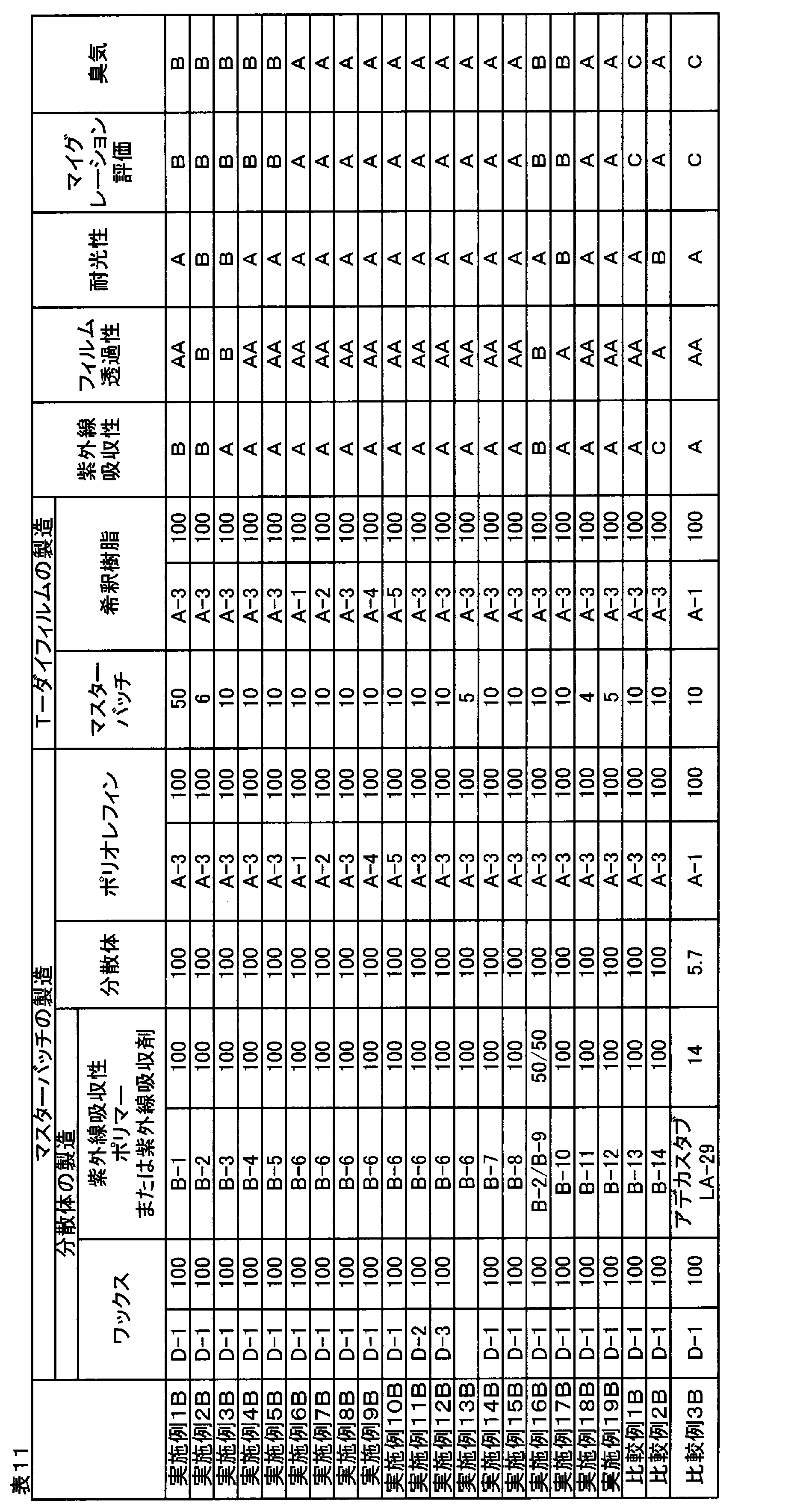
本実験例で使用した熱可塑性樹脂を以下に示す。
(A-1):ポリエチレン(サンテックLDM2270、MFR=7g/10min、旭化成ケミカルズ社製)
(A-2):ポリエチレン(ノバテックUJ790、MFR=50g/10min、日本ポリエチレン社製)
(A-3):ポリプロピレン(ノバテックPPFA3EB、MFR=10.5g/10min、日本ポリプロ社製)
(A-4):ポリプロピレン(プライムポリプロJ226T、MFR=20G/10MIN、プライムポリマー社製)
(A-5):ポリカーボネート(ユーピロンS3000、MFR=15g/10min、三菱エンジニアリングプラスチックス社製)
(A-6):ポリメタクリル樹脂(アクリペットMF、MFR=14g/10min、三菱レイヨン社製)
(単量体(a1-3-1)~(a1-3-4))
特開2018-168148号公報を参考にして、公知の方法で単量体(a1-3-1)~(a1-3-4)を製造した。
原料に以下の化合物を用いて、単量体(a1-3-1)~(a1-3-4)と同様にして単量体(a1-3-5)~(a1-3-8)を製造した。
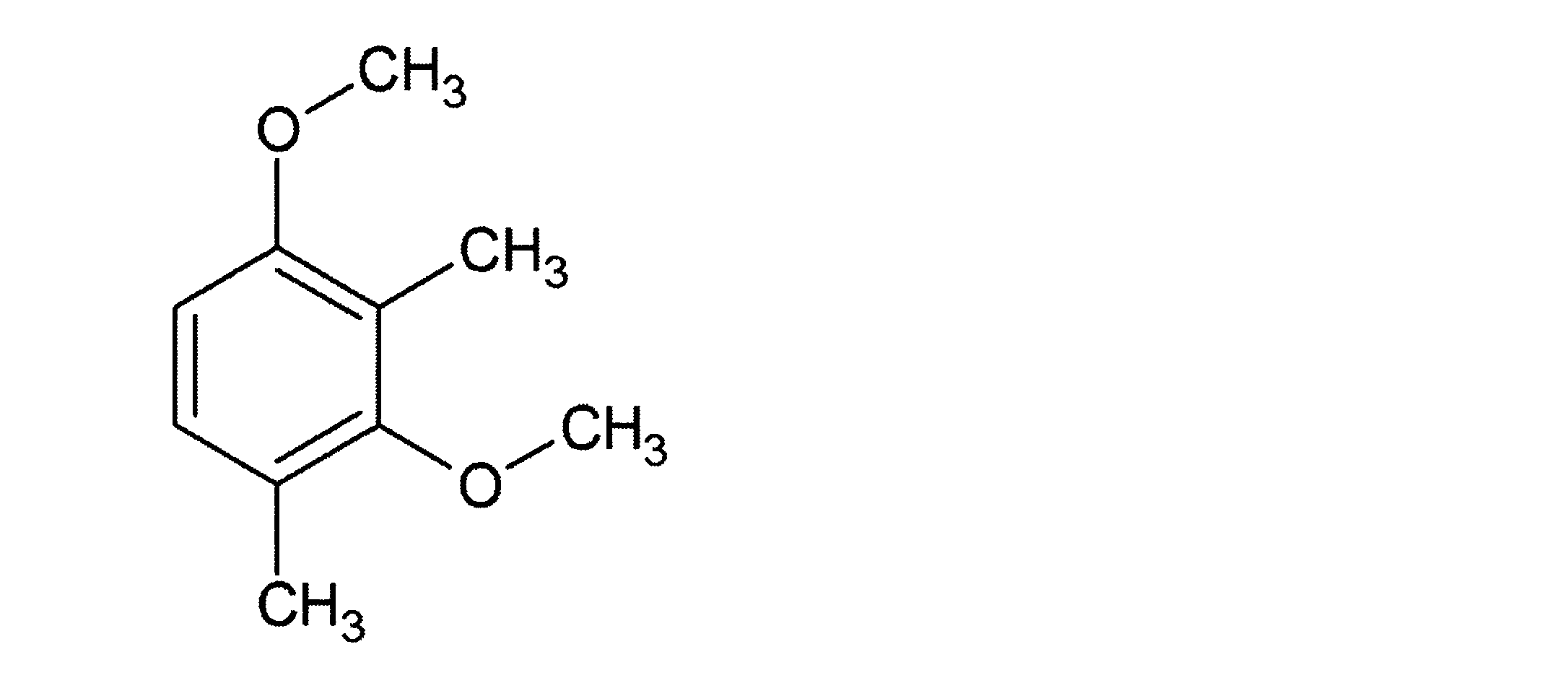
原料に以下の化合物を用いて、単量体(a1-3-1)~(a1-3-4)と同様にして単量体(a1-3-9)を製造した。
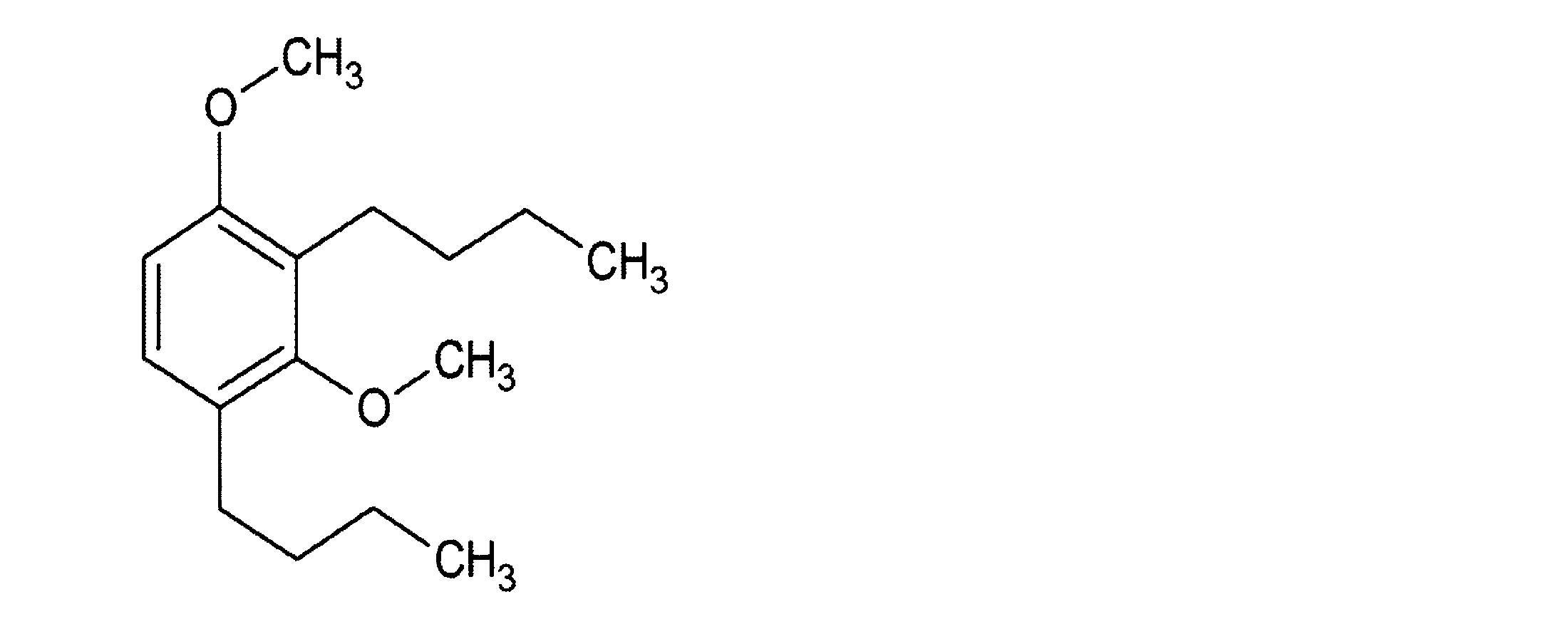
特開2018-177696号公報を参考にして、公知の方法で単量体(a1-3-10)~(a1-3-13)を製造した。
原料に以下の化合物を用いて、単量体(a1-3-10)~(a1-3-13)と同様にして単量体(a1-3-14)~(a1-3-17)を製造した。
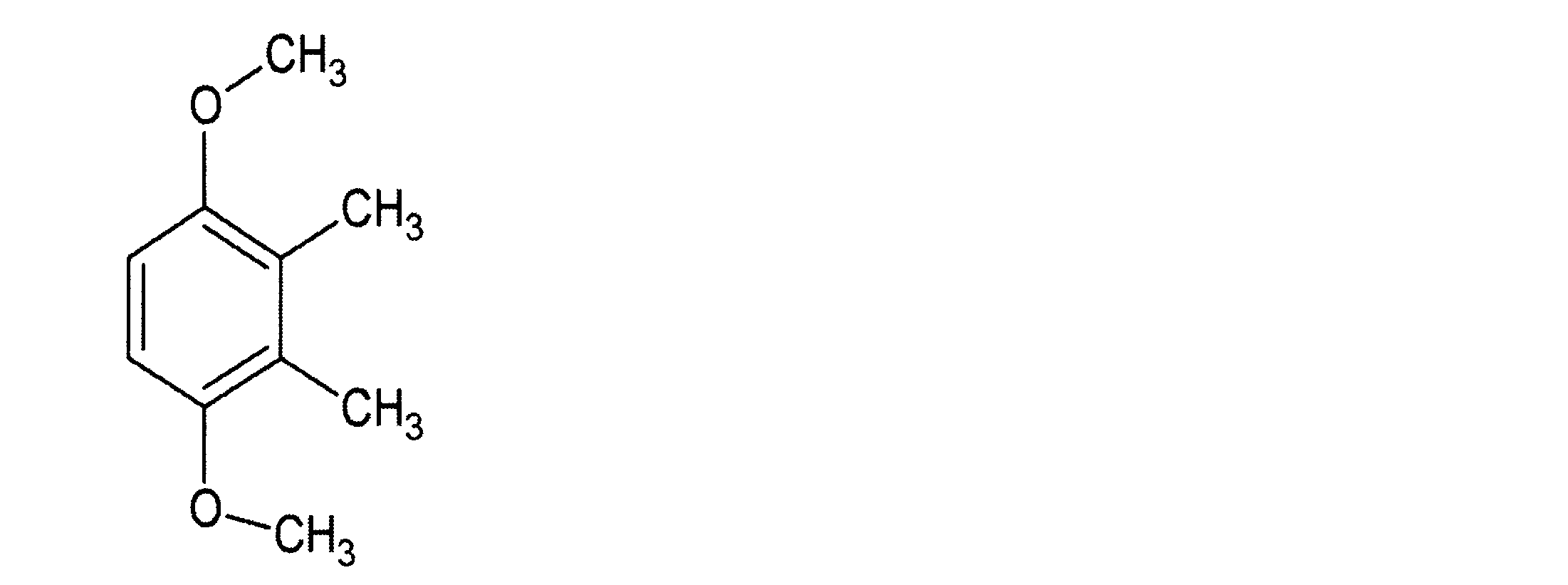
原料に以下の化合物を用いて、単量体(a1-3-14)~(a1-3-17)と同様にして単量体(a1-3-18)を製造した。

以下の中間体1Aを特開2018-168148号公報を参考にして、公知の方法で製造した。

以下の中間体2Aを特開2018-177696号公報を参考にして、公知の方法で製造した。
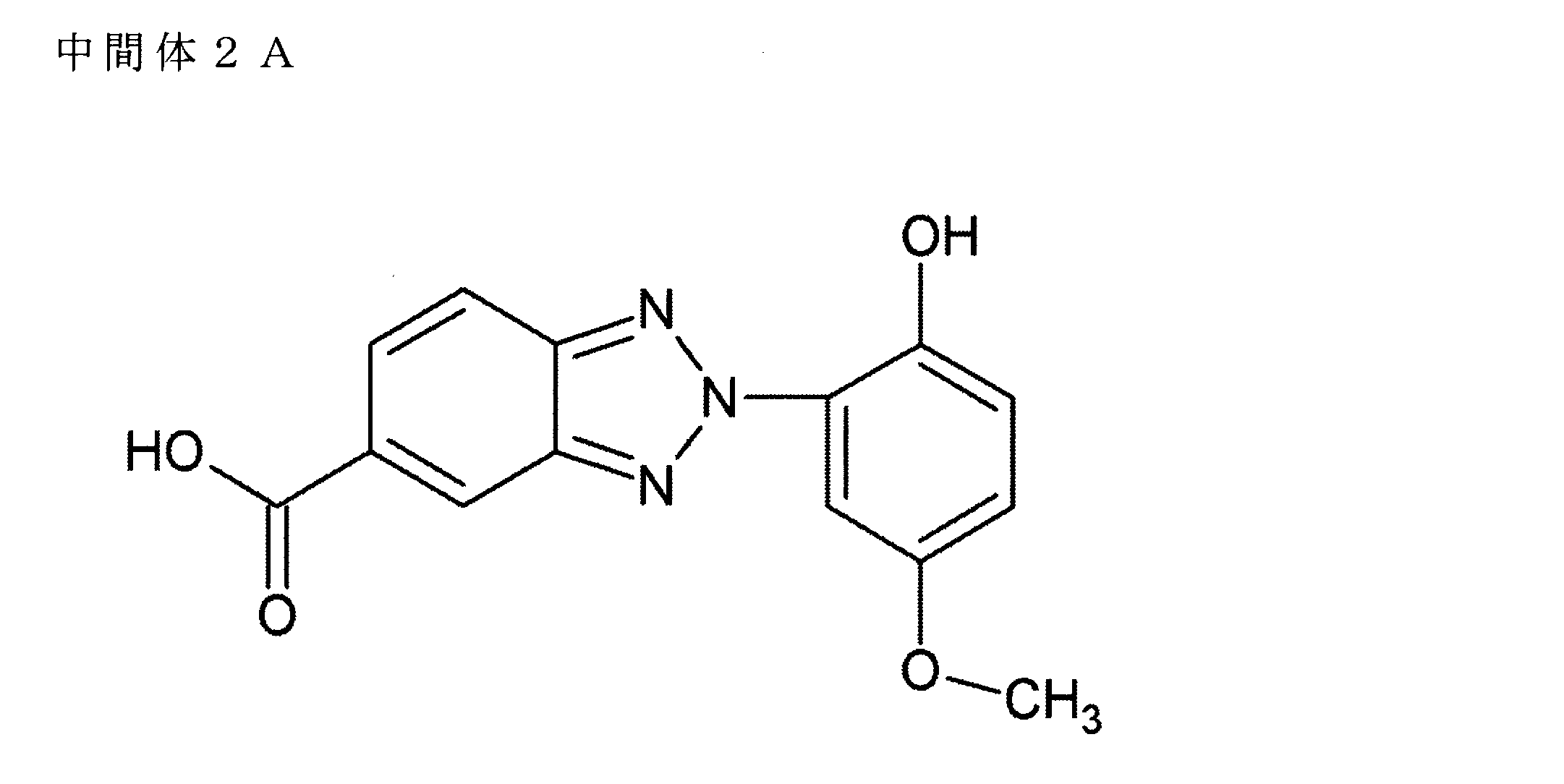
原料に以下の化合物を用いて、単量体(a1-3-1)~(a1-3-4)と同様にして単量体(a1-3-23)~(a1-3-26)を製造した。
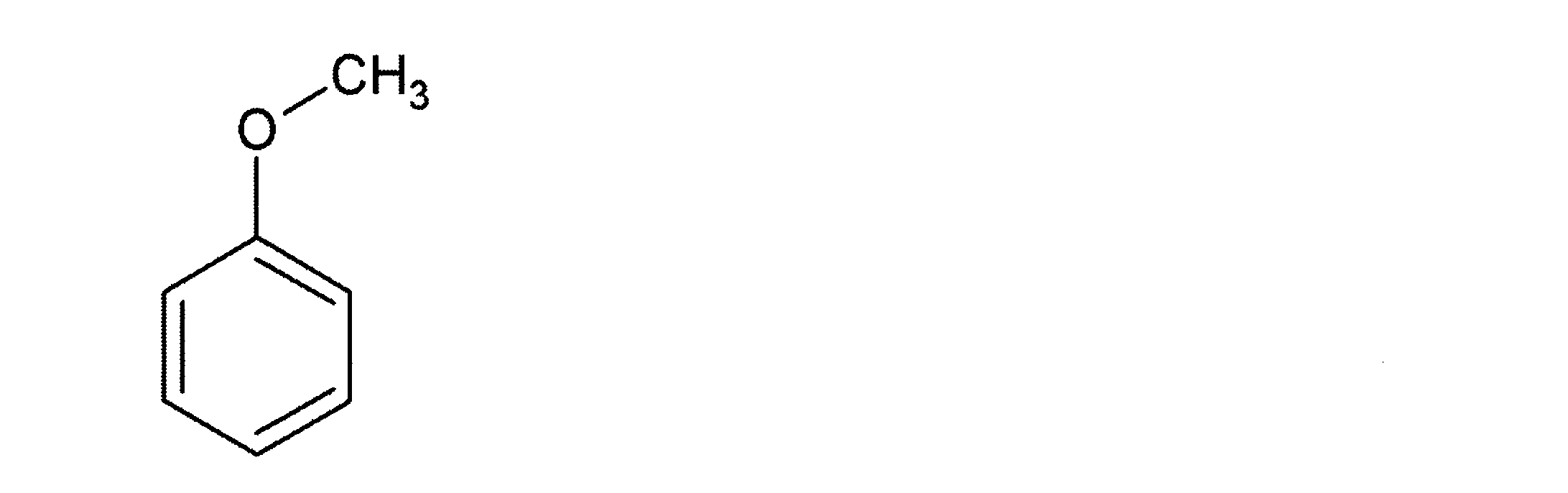
原料に以下の化合物を用いて、単量体(a1-3-1)~(a1-3-2)と同様にして単量体(a1-3-27)、(a1-3-28)を製造した。

原料に以下の化合物を用いて、単量体(a1-3-1)~(a1-3-2)と同様にして単量体(a1-3-29)、(a1-3-30)を製造した。

原料に以下の化合物を用いて、単量体(a1-3-19)、(a1-3-20)と同様にして単量体(a1-3-31)、(a1-3-32)の混合物を製造した。

<製造例1C(紫外線吸収性ポリマー(B-1))>
温度計、撹拌機、滴下ロート、冷却器を具備した4つ口セパラブルフラスコに、メチルエチルケトン75.0部を仕込み、窒素気流下で75℃に昇温した。別途、一般式(3)で示す単量体単位として単量体(a1-3-1)を14部、一般式(1)で示す単量体単位としてイソステアリルアクリレートを43部、メチルメタクリレートを43部、2.2’-アゾビス(イソ酪酸メチル)を5.0部、及びメチルエチルケトン20.0部を均一に混合した後、滴下ロートに仕込んだ。次いで滴下ロートの内容物を2時間かけて滴下した。滴下終了後、2時間反応を継続した。その後、サンプリングを行い重合収率が98%以上であることを確認し、50℃へ冷却、デュポン社製フッ素樹脂のバットに取り出した。さらに、真空乾燥機で50℃12時間乾燥し、ポリマー(B-1)を製造した。
製造例1Cで使用した単量体の種類及びその配合量を表12に記載した通りに変更した以外は、製造例1Cと同様に行いポリマー(B-2)~(B-32)、(B-35)~(B-45)をそれぞれ製造した。なお、実験例1で示したアデカスタブLA-82(ADEKA製)も用いた。

〔マスターバッチの製造〕
ワックス(D-1)100部に対し、紫外線性吸収ポリマー(B-1)100部を混合し、3本ロールミルにて160℃にて加熱混練し、紫外線吸収性ポリマー(B-1)の分散体を製造した。次いで、ポリオレフィン(A-1)100部に対し、製造した上記分散体10部をヘンシェルミキサーにて混合し、スクリュー径30mmの単軸押出機にて180℃で溶融混練し、ペレタイザーを用いてペレット状にカッティングして成形用樹脂組成物(マスターバッチ)を製造した。
希釈樹脂としてポリオレフィン(A-1)100部に対して、製造した成形用樹脂組成物10部を混合し、T-ダイ成形機(東洋精機製)を用いて、温度180℃で溶融混合し、厚さ250μmのフィルムを成形した。
実施例2C~37C、40C~50C、及び比較例1Cは、実施例1Cの材料を表13に記載された通りに変更した以外は、実施例1Cと同様に行い、マスターバッチを製造し、次いで、実施例2C~37C、40C~50C、比較例1Cのフィルムをそれぞれ成形した。
〔マスターバッチの製造〕
ポリカーボネート(A-5)100部と紫外線吸収性ポリマー(B-1)5部とを同じ供給口からスクリュー径30mmの二軸押出機(日本製鋼所社製)に投入し、280℃で溶融混錬した上で、ペレタイザーを用いてペレット状にカッティングして成形用樹脂組成物(マスターバッチ)を製造した。
希釈樹脂としてポリカーボネート(A-5)100部に対して、製造した成形用樹脂組成物10部を混合し、T-ダイ成形機(東洋精機製)を用いて、温度280℃で溶融混合し、厚さ250μmのフィルムを成形した。
実施例52C~82C、及び比較例2Cは、実施例51Cの材料を表14に記載された通りに変更した以外は、実施例51Cと同様に行い、それぞれマスターバッチを製造し、次いで、実施例52C~82C、比較例2Cのフィルムをそれぞれ成形した。
〔マスターバッチの製造〕
ポリメタクリル樹脂(A-6)100部と紫外線吸収性ポリマー(B-1)5部とを同じ供給口からスクリュー径30mmの二軸押出機(日本製鋼所社製)に投入し、240℃で溶融混錬した上で、ペレタイザーを用いてペレット状にカッティングして成形用樹脂組成物(マスターバッチ)を製造した。
希釈樹脂としてポリメタクリル樹脂(A-6)100部に対して、製造した成形用樹脂組成物10部を混合し、T-ダイ成形機(東洋精機製)を用いて、温度280℃で溶融混合し、厚さ250μmのフィルムを成形した。
実施例86C~116C、及び比較例3Cは、実施例85Cの材料を表15に記載された通りに変更した以外は、実施例85Cと同様に行い、それぞれマスターバッチを製造し、次いで、実施例86C~116C、比較例3Cのフィルムをそれぞれ成形した。
実験例1と同様の評価方法にて評価した。
A:波長280~420nmの光透過率が全領域にわたって2%以下。良好。
B:波長280~420mの光透過率が一部2%超。実用域。
C:波長280~420nmの光透過率が全領域にわたって2%超。実用不可。
実験例1と同様の評価方法及び評価基準にて評価した。
実験例1と同様の評価方法及び評価基準にて評価した。
実験例3と同様の評価方法にて評価した。
A:280~400nmにおける吸光度が検出されない(0.05以下)。
B:280~400nmにおける吸光度が0.05を超えて0.2以下。
C:280~400nmにおける吸光度が0.2を超える。
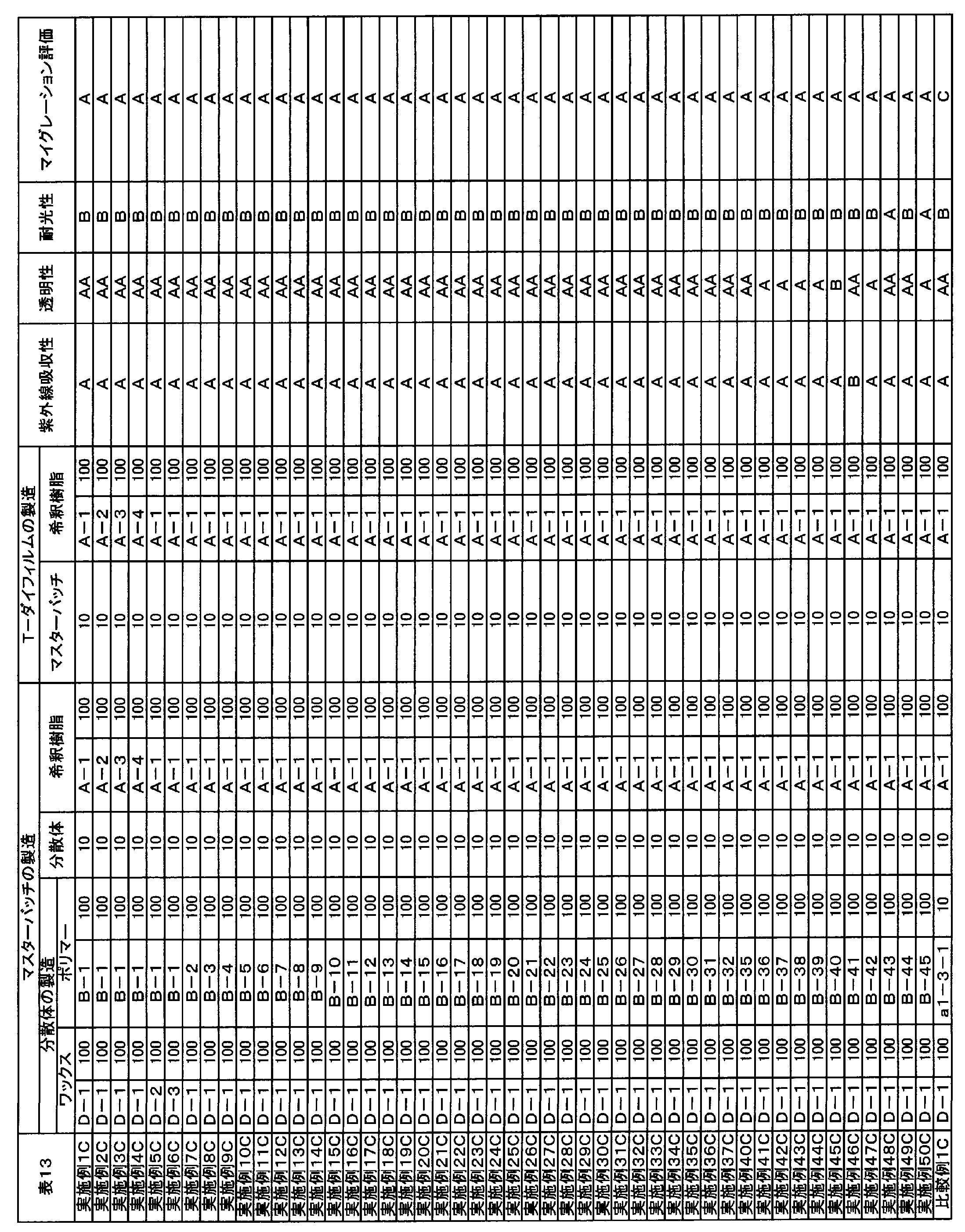
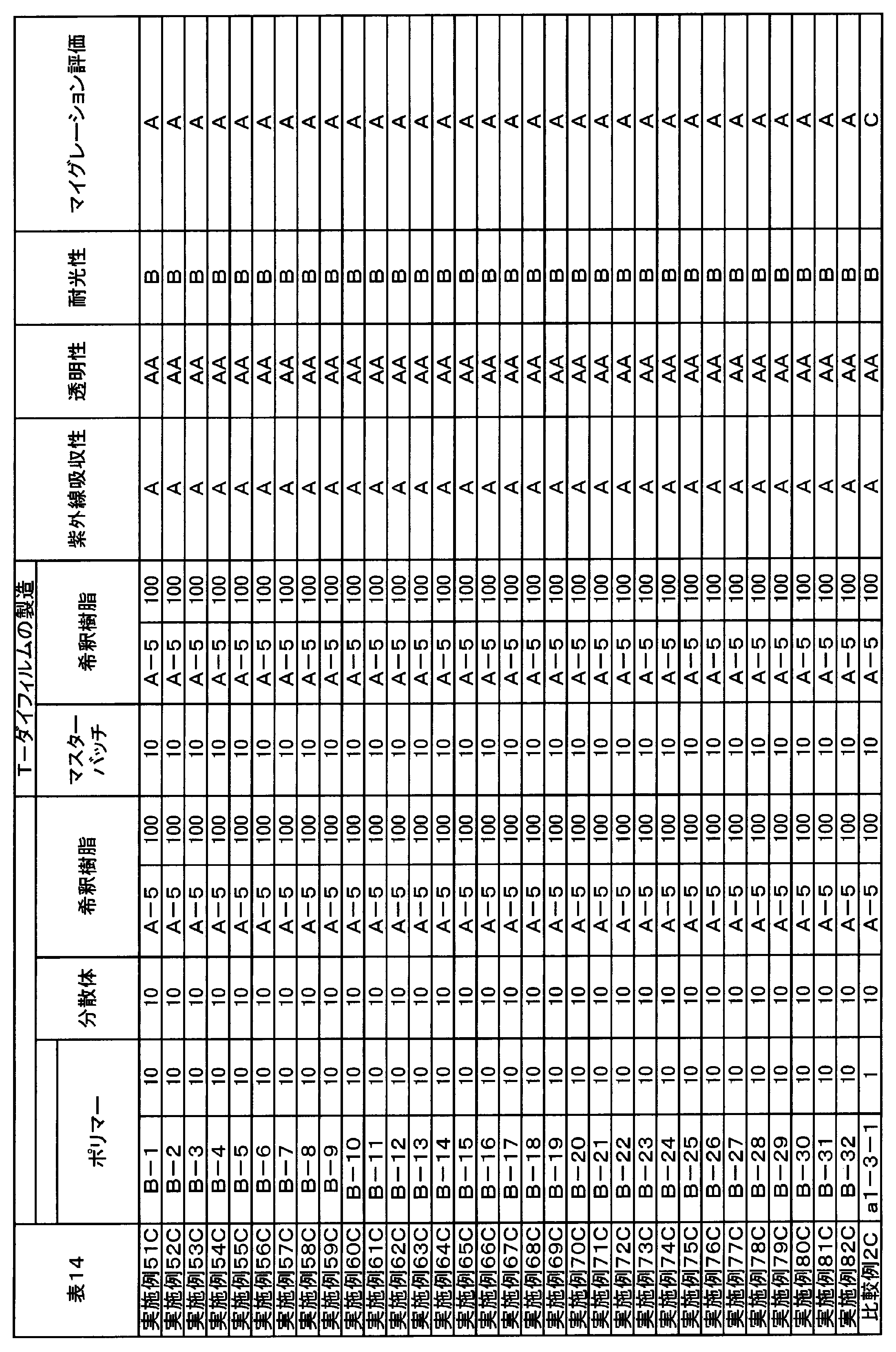
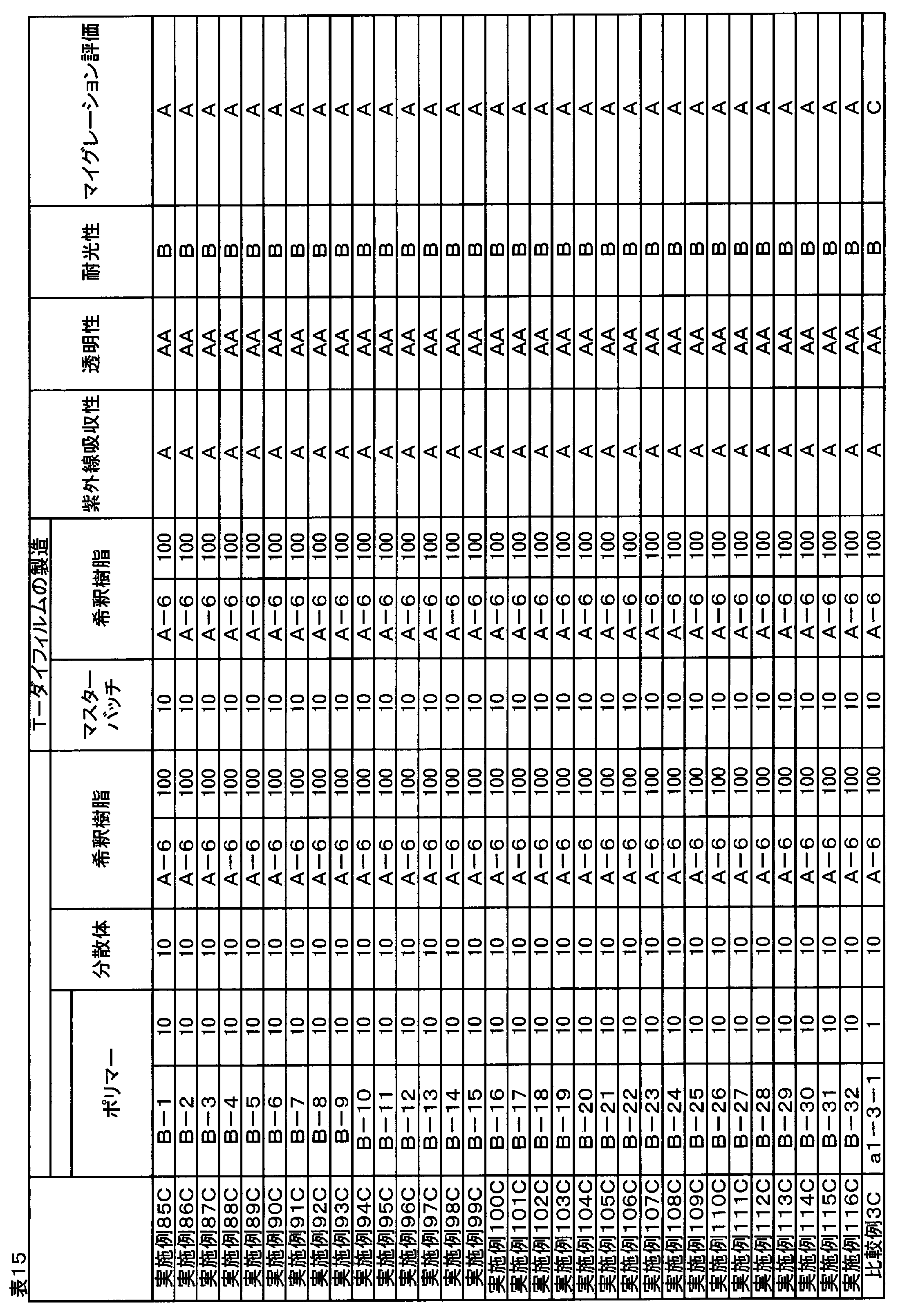
本実験例で使用したポリオレフィン(数平均分子量は、30,000以上)を示す。
(A-1):ポリエチレン(サンテックLD M2270、MFR=7g/10min、旭化成ケミカルズ社製)
(A-2):ポリエチレン(ノバテックUJ790、MFR=50g/10min、日本ポリエチレン社製)
(A-3):ポリプロピレン(ノバテックPP FA3EB、MFR=10.5g/10min、日本ポリプロ社製)
(A-4):ポリプロピレン(プライムポリプロJ226T、MFR=20g/10min、プライムポリマー社製)
(A-5):ポリエチレン(エボリューH SP65051B、MFR= 0.45g/10min、プライムポリマー社製)
<製造例1D(ポリマー(B-1))>
温度計、撹拌機、滴下ロート、冷却器を具備した4つ口セパラブルフラスコに、トルエン17.5部、を仕込み、窒素気流下で4-シアノ-4-[(ドデシルスルファニルチオカルボニル)スルファニル]ペンタン酸メチルを1.0部、構造式(a1-1-1)で示す単量体を40.0部、を仕込み、窒素気流下で75℃に昇温した。そこに2,2’-アゾビス(2,4-ジメチルバレロニトリル)を0.12部及びトルエン10.0部を8時間かけて滴下し、Aブロックを合成した。その後、ジシクロペンタニルメタクリレートを30.0部、スチレンを30.0部、トルエン30.0部を仕込み、2,2’-アゾビス(2,4-ジメチルバレロニトリル)を0.12部及びトルエン10.0部を8時間かけて滴下し、Bブロックを合成した。滴下終了後、24時間反応を継続した。その後、サンプリングを行い重合収率が99%以上であることを確認し、樹脂溶液b-1を製造した。
次に温度計、撹拌機、滴下ロート、冷却器を具備した4つ口セパラブルフラスコにメタノール500部を仕込んでおき、ディスパーで1,000回転させたところに上記樹脂溶液b-1、100部を1時間かけて滴下した。生成した白色沈殿物をろ過で取出し、真空乾燥機で50℃12時間乾燥し、ABブロックポリマー(B-1)を製造した。製造したポリマーの重量平均分子量(Mw)は22,000、Mw/Mnは1.22であった。
単量体の種類と配合量を表16の通り変更した以外は、製造例1Dと同様に合成し、ポリマー(B-3)、(B-4)、(B-6)~(B-9)を製造した。
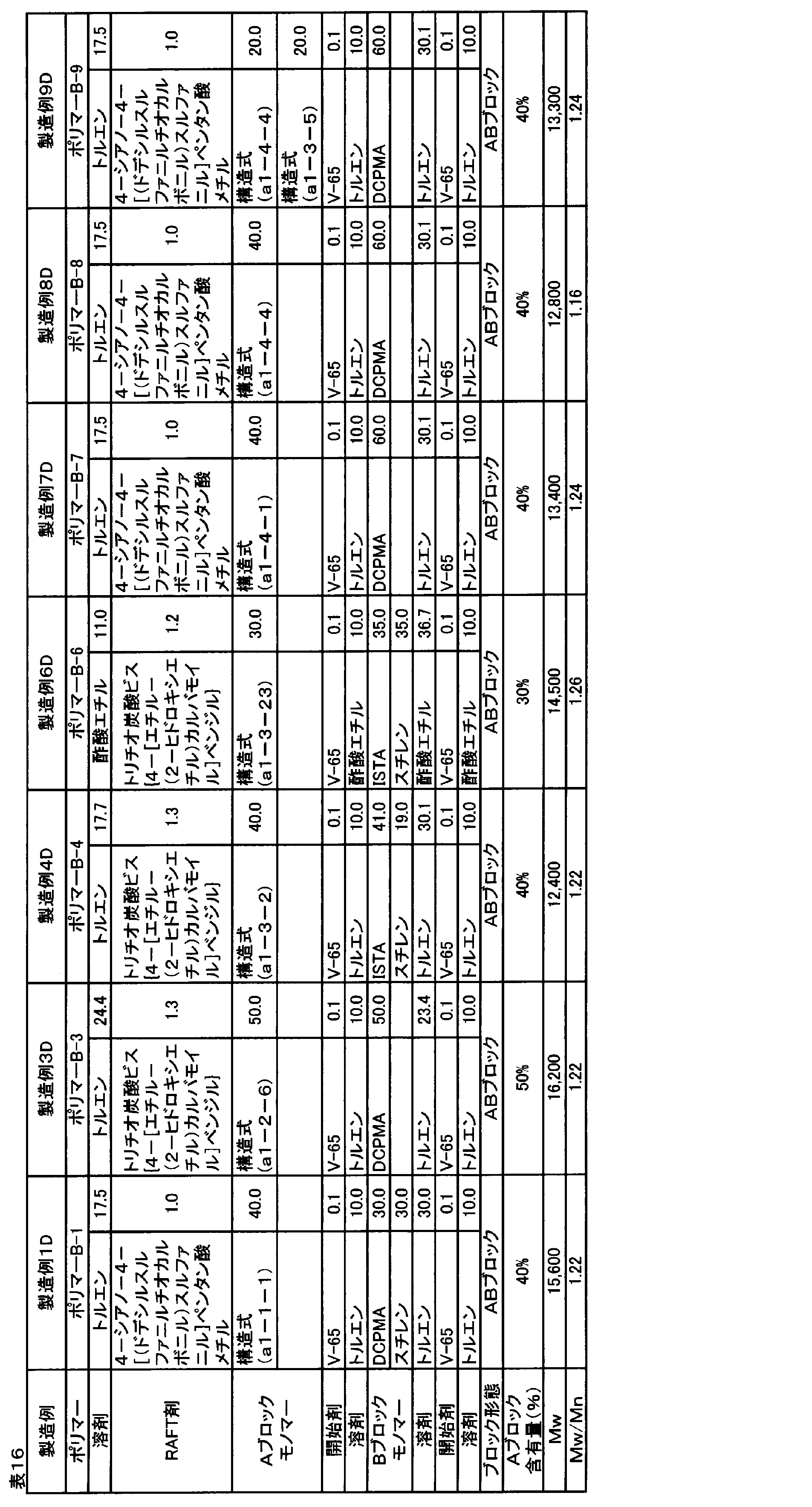
・V-65:2,2’-アゾビス(2,4-ジメチルバレロニトリル)
・DCPMA:ジシクロペンタニルメタクリレート
・ISTA:イソステアリルアクリレート
温度計、撹拌機、滴下ロート、冷却器を具備した4つ口セパラブルフラスコに、酢酸エチル36.0部、ビス(ドデシルスルファニルチオカルボニル)ジスルフィドを3.5部、2,2’-アゾビス(2,4-ジメチルバレロニトリル)を1.9部仕込み、窒素気流下で70℃に昇温し、2時間反応させた。そこに構造式(a1-1-1)で示す単量体を40.0部仕込み、窒素気流下で75℃に昇温した。そこに2,2’-アゾビス(2,4-ジメチルバレロニトリル)を0.31部及び酢酸エチル10.0部を8時間かけて滴下し、Aブロックを合成した。その後、ジシクロペンタニルメタクリレートを50.0部、2-メトキシエチルアクリレートを10.0部、酢酸エチル50.3部を仕込み、2,2’-アゾビス(2,4-ジメチルバレロニトリル)を0.31部及び酢酸エチル10.0部を8時間かけて滴下し、Bブロックを合成した。滴下終了後、24時間反応を継続した。その後、サンプリングを行い重合収率が99%以上であることを確認し、樹脂溶液b-2を製造した。
次に温度計、撹拌機、滴下ロート、冷却器を具備した4つ口セパラブルフラスコにメタノール500部を仕込んでおき、ディスパーで1,000回転させたところに上記樹脂溶液b-2、100部を1時間かけて滴下した。生成した白色沈殿物をろ過で取出し、真空乾燥機で50℃12時間乾燥し、ABブロックポリマー(B-2)を製造した。製造したポリマーの重量平均分子量(Mw)は13,600、Mw/Mnは1.20であった。
温度計、撹拌機、滴下ロート、冷却器を具備した4つ口セパラブルフラスコに、酢酸エチル36.0部、ビス(ドデシルスルファニルチオカルボニル)ジスルフィドを3.5部、2,2’-アゾビス(2,4-ジメチルバレロニトリル)を1.9部仕込み、窒素気流下で70℃に昇温し、2時間反応させた。そこに構造式(a1-3-5)で示す単量体を40.0部仕込み、窒素気流下で75℃に昇温した。そこに2,2’-アゾビス(2,4-ジメチルバレロニトリル)を0.31部及び酢酸エチル10.0部を8時間かけて滴下し、Aブロックを合成した。その後、ジシクロペンタニルメタクリレートを60.0部、酢酸エチル50.3部を仕込み、2,2’-アゾビス(2,4-ジメチルバレロニトリル)を0.31部及び酢酸エチル10.0部を8時間かけて滴下し、Bブロックを合成した。滴下終了後、24時間反応を継続した。その後、サンプリングを行い重合収率が99%以上であることを確認し、樹脂溶液b-5を製造した。
次に温度計、撹拌機、滴下ロート、冷却器を具備した4つ口セパラブルフラスコにメタノール500部を仕込んでおき、ディスパーで1,000回転させたところに上記樹脂溶液b-5、100部を1時間かけて滴下した。生成した白色沈殿物をろ過で取出し、真空乾燥機で50℃12時間乾燥し、ABブロックポリマー(B-5)を製造した。製造したポリマーの重量平均分子量(Mw)は14,600、Mw/Mnは1.20であった。
温度計、撹拌機、滴下ロート、冷却器を具備した4つ口セパラブルフラスコに、トルエン17.5部、4-シアノ-4-[(ドデシルスルファニルチオカルボニル)スルファニル]ペンタン酸メチルを1.0部、ジシクロペンタニルメタクリレートを30.0部、を仕込み、窒素気流化で75℃に昇温した。そこに2,2’-アゾビス(2,4-ジメチルバレロニトリル)を0.06部及びトルエン5.0部を8時間かけて滴下し、Bブロックを合成した。その後、構造式(a1-4-4)で示す単量体を20.0部、構造式(a1-1-1)で示す単量体を20.0部、を仕込み、窒素気流下で75℃に昇温した。そこに2,2’-アゾビス(2,4-ジメチルバレロニトリル)を0.12部及びトルエン10.0部を8時間かけて滴下し、Aブロックを合成した。その後、ジシクロペンタニルメタクリレートを30.0部、を仕込み、窒素気流化で75℃に昇温した。そこに2,2’-アゾビス(2,4-ジメチルバレロニトリル)を0.06部及びトルエン5.0部を8時間かけて滴下し、Bブロックを合成した。その後、サンプリングを行い重合収率が99%以上であることを確認し、樹脂溶液b-10を製造した。
次に温度計、撹拌機、滴下ロート、冷却器を具備した4つ口セパラブルフラスコにメタノール500部を仕込んでおき、ディスパーで1,000回転させたところに上記樹脂溶液b-10、100部を1時間かけて滴下した。生成した白色沈殿物をろ過で取出し、真空乾燥機で50℃12時間乾燥し、BABブロックポリマー(B-10)を製造した。製造したポリマーの重量平均分子量(Mw)は13,000、Mw/Mnは1.25であった。
温度計、撹拌機、滴下ロート、冷却器を具備した4つ口セパラブルフラスコに、メチルエチルケトン61.4部を仕込み、窒素気流下で75℃に昇温した。別途、構造式(a1-1-1)で示す単量体を40.0部、ジシクロペンタニルメタクリレートを30.0部、スチレンを30.0部、2,2’-アゾビス(イソ酪酸メチル)を10.0部、及びメチルエチルケトン75.0部、を均一に混合した後、滴下ロートに仕込んだ。次いで滴下ロートの内容物を2時間かけて滴下した。滴下終了後、2時間反応を継続した。その後、サンプリングを行い重合収率が98%以上であることを確認し、樹脂溶液b-11を製造した。
次に温度計、撹拌機、滴下ロート、冷却器を具備した4つ口セパラブルフラスコにメタノール500部を仕込んでおき、ディスパーで1,000回転させたところに上記樹脂溶液b-11、100部を1時間かけて滴下した。生成した白色沈殿物をろ過で取出し、真空乾燥機で50℃12時間乾燥し、ランダムポリマー(B-11)を製造した。
単量体の種類と配合量を表17の通り変更した以外は、製造例1Dと同様に合成し、ポリマー(B-12)、(B-13)を製造した。

〔マスターバッチの製造〕
ワックス(D-1)100部、及びポリマー(B-1)100部を混合し、3本ロールミルを使用して160℃で混練を行いポリマー(B-1)の分散体を製造した。次いで、ポリオレフィン(A-3)100部と共に製造した上記分散体30部をヘンシェルミキサーで混合した。次いで、スクリュー径30mmの単軸押出機にて180℃で溶融混練した後、冷却し、ペレタイザーを用いてペレット状にカッティングしてマスターバッチを製造した。
希釈樹脂としてポリオレフィン(A-3)100部に対して、得られたマスターバッチ10部を混合した。次いで、T-ダイ成形機(東洋精機社製)を用いて、温度180℃で溶融混合し、厚さ250μmのフィルムを成形した。
実施例1Dの材料を表18に示す材料及び配合量に変更した以外は、実施例1Dと同様にして、マスターバッチを製造し、次いで実施例2D~17D、比較例1D~3Dのフィルムをそれぞれ成形した。なお、実施例12Dは、フィルム成形の際、希釈樹脂としてポリエチレンテレフタレート(略称P-1、ミツイペットSA135、IV=0.83dl/g、三井化学社製)を使用した。なお、IVは固有粘度を示し、JIS K 7367に記載の方法で測定される。
実験例1と同様の評価方法にて評価した。
AA:波長290~360nmの光透過率が全領域にわたって0.3%未満。良好。
A:波長290~360nmの範囲で一部光透過率が0.3%%以上の領域がある。実用域。
C:波長290~360nmの光透過率が全領域にわたって0.3%%以上。実用不可。
実験例1の[透明性]と同様の評価方法及び評価基準にて評価した。

本実験例で使用したポリオレフィンを以下に示す。なお、ポリオレフィンの数平均分子量は、全て30,000以上である。
(C-1):ポリエチレン(サンテックLD M2270、MFR=7g/10min、旭化成ケミカルズ社製)
(C-2):ポリエチレン(ノバテックUJ790、MFR=50g/10min、日本ポリエチレン社製)
(C-3):ポリプロピレン(ノバテックPP FA3EB、MFR=10.5g/10min、日本ポリプロ社製)
(C-4):ポリプロピレン(プライムポリプロJ226T、MFR=20g/10min、プライムポリマー社製)
(紫外線吸収性単量体(A-1))
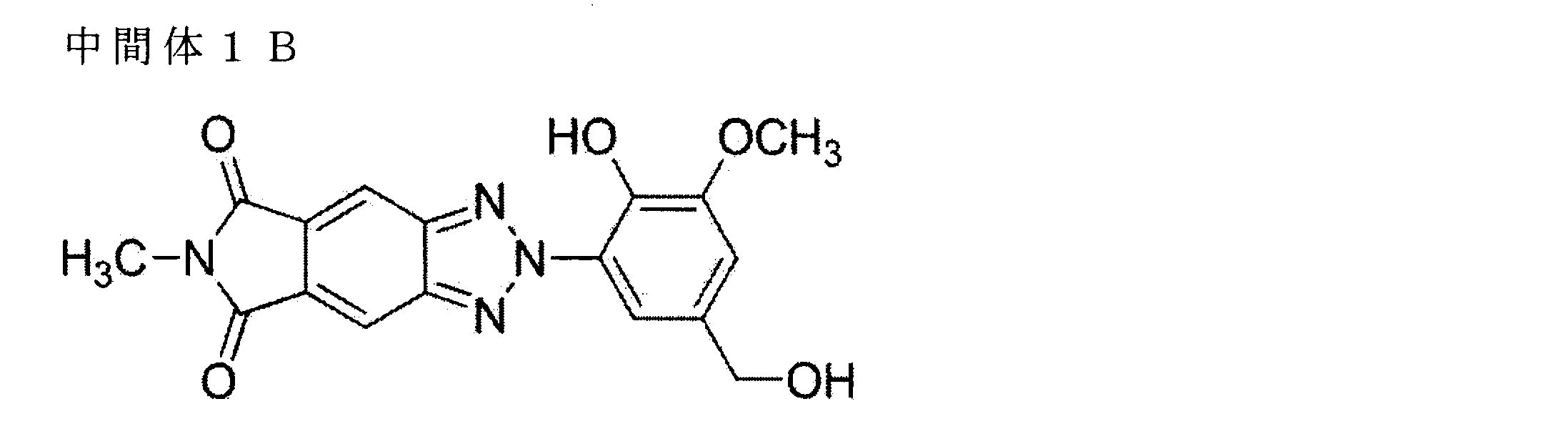
紫外線吸収性単量体(A-1)の製造で使用したアクリロイルクロリドの代わりにメタクリロイルクロリドを使用した以外は同様に行い、紫外線吸収性単量体(A-2)を製造した。
温度計、撹拌機を具備した200mL4つ口フラスコに、テトラヒドロフランを100g、先の中間体1Bを28.6mmol仕込み、室温で撹拌した。その後、2-アクリロイルオキシエチルイソシアナートを28.6mmol添加し、さらにネオスタンU-810(スズ系触媒 日東化成製)を0.02mmol添加し、60℃で5時間撹拌した。その後、加熱撹拌して紫外線吸収性単量体が析出するまでテトラヒドロフランを揮発させ、さらに40℃で減圧乾燥を行い、紫外線吸収性単量体(A-3)を製造した。
紫外線吸収性単量体(A-3)の製造で使用した2-アクリロイルオキシエチルイソシアナートの代わりに2-メタクリロイルオキシエチルイソシアナートを使用した以外は同様に行い、紫外線吸収性単量体(A-4)を製造した。
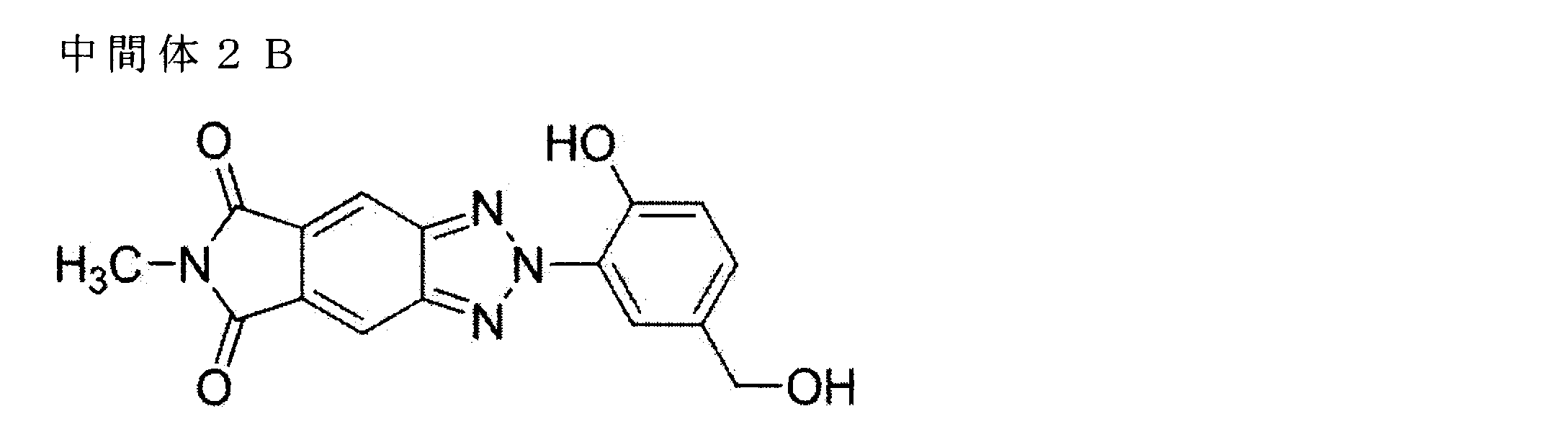
紫外線吸収性単量体(A-5)の製造で使用したアクリロイルクロリドの代わりにメタクリロイルクロリドを滴下した以外は同様に行い、紫外線吸収性単量体(A-6)を製造した。
温度計、撹拌機を具備した200mL4つ口フラスコに、テトラヒドロフランを100g、先の中間体2Bを28.6mmol仕込み、室温で撹拌した。その後、2-アクリロイルオキシエチルイソシアナートを28.6mmol添加し、さらに日東化成製ネオスタンU-810を0.02mmol添加し、60℃で5時間撹拌した。その後、加熱撹拌して紫外線吸収性単量体が析出するまでテトラヒドロフランを揮発させ、さらに40℃で減圧乾燥を行い、紫外線吸収性単量体(A-7)を製造した。
紫外線吸収性単量体(A-7)の製造で使用した2-アクリロイルオキシエチルイソシアナートの代わりに2-メタクリロイルオキシエチルイソシアナートを使用した以外は同様に行い、紫外線吸収性単量体(A-8)を製造した。
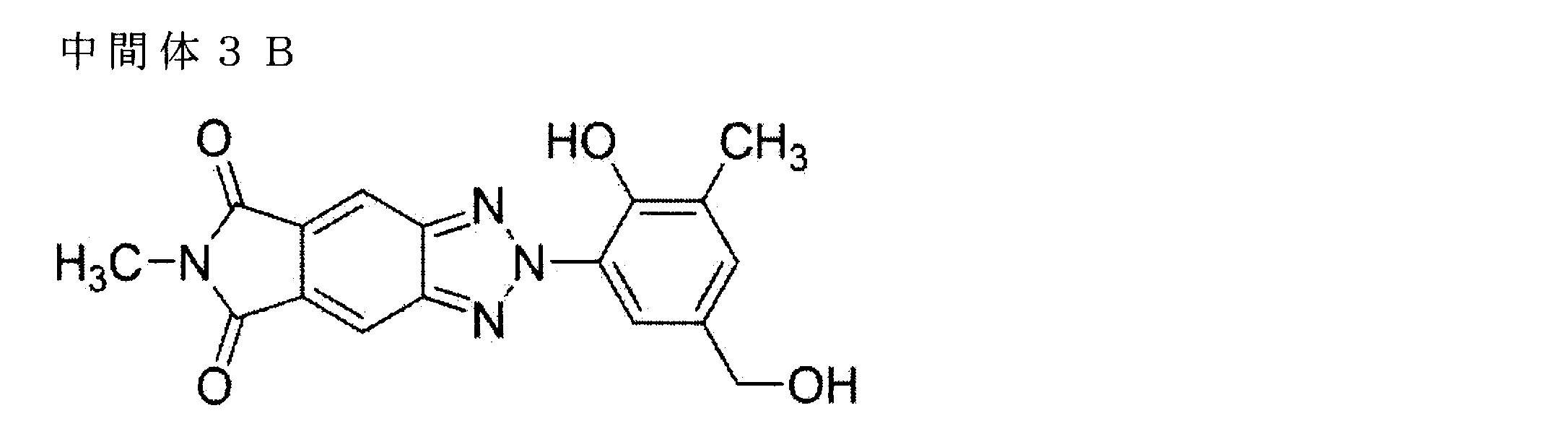
紫外線吸収性単量体(A-9)の製造で使用したアクリロイルクロリドの代わりにメタクリロイルクロリドを滴下した以外は同様に行い、紫外線吸収性単量体(A-10)を製造した。
上記中間体3Bの合成に続いて、温度計、撹拌機を具備した200mL4つ口フラスコに、テトラヒドロフランを100g、先の中間体3Bを28.6mmol仕込み、室温で撹拌した。その後、2-アクリロイルオキシエチルイソシアナートを28.6mmol添加し、さらに日東化成製ネオスタンU-810を0.02mmol添加し、60℃で5時間撹拌した。その後、加熱撹拌して紫外線吸収性単量体が析出するまでテトラヒドロフランを揮発させ、さらに40℃で減圧乾燥を行い、紫外線吸収性単量体(A-11)を製造した。
紫外線吸収性単量体(A-11)の製造で使用した2-アクリロイルオキシエチルイソシアナートの代わりに2-メタクリロイルオキシエチルイソシアナートを使用した以外は同様に行い、紫外線吸収性単量体(A-12)を製造した。
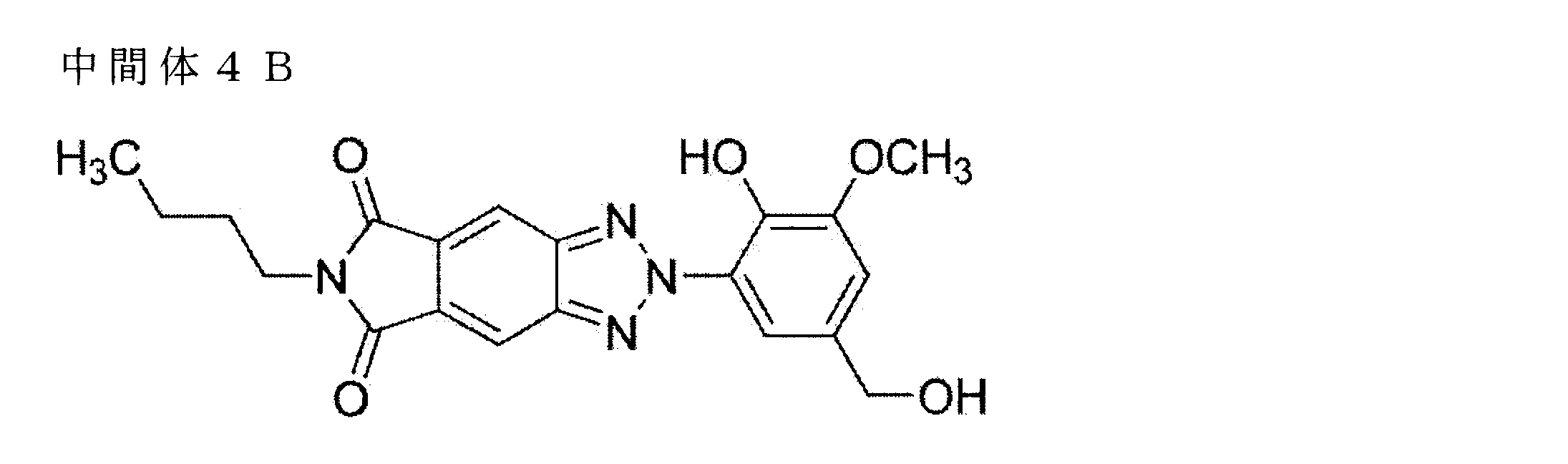
紫外線吸収性単量体(A-13)の製造で使用したアクリロイルクロリドの代わりにメタクリロイルクロリドを滴下した以外は同様に行い、紫外線吸収性単量体(A-14)を製造した。
上記中間体4の合成に続いて、温度計、撹拌機を具備した200mL4つ口フラスコに、テトラヒドロフランを100g、先の中間体4Bを28.6mmol仕込み、室温で撹拌した。その後、2-アクリロイルオキシエチルイソシアナートを28.6mmol添加し、さらに日東化成製ネオスタンU-810を0.02mmol添加し、60℃で5時間撹拌した。その後、加熱撹拌して紫外線吸収性単量体が析出するまでテトラヒドロフランを揮発させ、さらに40℃で減圧乾燥を行い、紫外線吸収性単量体(A-15)を製造した。
紫外線吸収性単量体(A-15)の製造で使用した2-アクリロイルオキシエチルイソシアナートの代わりに2-メタクリロイルオキシエチルイソシアナートを使用した以外は同様に行い、紫外線吸収性単量体(A-16)を製造した。

紫外線吸収性単量体(A-17)の製造で使用したアクリロイルクロリドの代わりにメタクリロイルクロリドを滴下した以外は同様に行い、紫外線吸収性単量体(A-18)を製造した。
上記中間体5Bの合成に続いて、温度計、撹拌機を具備した200mL4つ口フラスコに、テトラヒドロフランを100g、先の中間体5Bを28.6mmol仕込み、室温で撹拌した。その後、2-アクリロイルオキシエチルイソシアナートを28.6mmol添加し、さらに日東化成製ネオスタンU-810を0.02mmol添加し、60℃で5時間撹拌した。その後、加熱撹拌して紫外線吸収性単量体が析出するまでテトラヒドロフランを揮発させ、さらに40℃で減圧乾燥を行い、紫外線吸収性単量体(A-19)を製造した。
紫外線吸収性単量体(A-19)の製造で使用した2-アクリロイルオキシエチルイソシアナートの代わりに2-メタクリロイルオキシエチルイソシアナートを使用した以外は同様に行い、紫外線吸収性単量体(A-20)を製造した。
(アクリル重合体(B-1))
温度計、撹拌機、蒸留管、冷却器を具備した4つ口セパラブルフラスコに、メチルエチルケトン75.0部を仕込み、窒素気流下で75℃に昇温した。別途、紫外線吸収性単量体(A-1)を10部、ジシクロペンタニルメタクリレートを45部、スチレンを45部、2.2’-アゾビス(イソ酪酸メチル)を5.0部、及びメチルエチルケトン20.0部を均一にした後、滴下ロートに仕込み、4つ口セパラブルフラスコに取り付け、2時間かけて滴下した。滴下終了2時間後、サンプリングを行い重合転化率が98%以上であることを確認し、50℃へ冷却した。このようにして不揮発分が50質量%のアクリル重合体(B-1)溶液を製造した。
アクリル重合体(B-1)の合成で使用した紫外線吸収性単量体を表19に示すように変更した以外はアクリル重合体(B-1)と同様に行い、アクリル重合体(B-2)~(B-31)をそれぞれ製造した。なお、実験例1で示したアデカスタブLA-82(ADEKA製)も用いた。

〔マスターバッチの製造〕
ワックス(D‐1)100部、及びアクリル重合体(B-1)100部を混合し、3本ロールミルを使用して160℃で混練を行いアクリル重合体(B-1)の分散体を製造した。次いで、ポリオレフィン(C-1)100質量部と共に製造した上記分散体10部をヘンシェルミキサーで混合した。次いで、スクリュー径30mmの単軸押出機にて180℃で溶融混練した後、ペレタイザーを用いてペレット状にカッティングしてマスターバッチを製造した。
希釈樹脂としてポリオレフィン(C-1)100部に対して、製造したマスターバッチ10部を混合した。次いで、T-ダイ成形機(東洋精機製)を用いて、温度180℃で溶融混合し、厚さ250μmのフィルムを成形した。
実施例1Eの材料を表20に示す材料及び配合量に変更した以外は、実施例1Eと同様にして、マスターバッチを製造し、次いで実施例2E~36E、比較例1Eのフィルムをそれぞれ成形した。なお、比較例では、実施例1のアクリル重合体(B-1)の代わりに、中間体1Bを用いた。
希釈樹脂としてポリオレフィン(C-1)100部に対して、製造したマスターバッチ10部を混合した。次いで、T-ダイ成形機(東洋精機製)を用いて、温度180℃で溶融混合し、厚さ250μmのフィルムを成形した。
実験例1と同様の評価方法及び評価基準にて評価した。
実験例1と同様の評価方法及び評価基準にて評価した。
実験例1と同様の評価方法にて評価した。
AA:濁りが全く認められない。非常に良好。
A:濁りがほとんど認められない。良好。
B:濁りが若干認められる。実用域。
C:明らかに濁りが認められる。実用不可。
実験例4と同様の評価方法及び評価基準にて評価した。

Claims (9)
- 下記一般式(12)で示す単量体単位及び下記一般式(1)で示す単量体単位を有する紫外線吸収性ポリマー。

(一般式(12)中、R6は、水素原子及びメチル基からなる群より選択されるいずれかを表し、Uは、炭化水素基を表し、前記炭化水素基は紫外線を吸収する骨格を含むヘテロ原子を含んでもよく、
一般式(1)中、R16は、水素原子及びメチル基からなる群より選択されるいずれかを表し、Zは、炭素数10以上の、鎖状炭化水素基及び多環式炭化水素基からなる群より選択されるいずれかを表す。) - Aブロック及びBブロックを含有し、
前記Aブロックは、下記一般式(12)で示す単量体単位を含有するポリマーブロックであり、
前記Bブロックは、下記一般式(1)で示す単量体単位を含有するポリマーブロック(ただし、一般式(12)で示す単量体単位を含有しない)である、紫外線吸収性ポリマー。
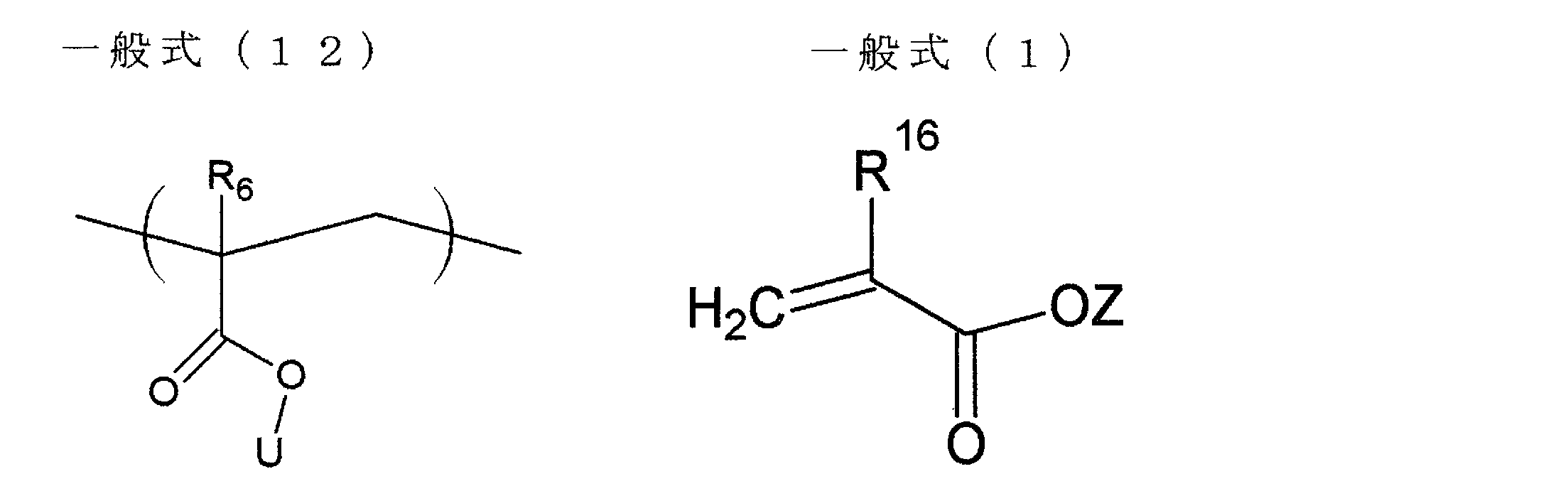
(一般式(12)中、R6は、水素原子及びメチル基からなる群より選択されるいずれかを表し、Uは、炭化水素基を表し、前記炭化水素基は紫外線を吸収する骨格を含むヘテロ原子を含んでもよく、
一般式(1)中、R16は、水素原子及びメチル基からなる群より選択されるいずれかを表し、Zは、炭素数10以上の、鎖状炭化水素基及び多環式炭化水素基からなる群より選択されるいずれかを表す。) - 前記一般式(12)で示す単位を、前記Aブロック中、30~100質量%含有する、請求項2に記載の紫外線吸収性ポリマー。
- 前記紫外線を吸収する骨格が、ベンゾトリアゾール骨格、トリアジン骨格、及びベンゾフェノン骨格からなる群より選択される1種以上である、請求項1~3のいずれか1項に記載の紫外線吸収性ポリマー。
- 前記紫外線を吸収する骨格が、前記ベンゾトリアゾール骨格及び前記トリアジン骨格からなる群より選択される1種以上であり、
前記ベンゾトリアゾール骨格を有する単量体単位が、下記一般式(a1-1)で示す単量体単位及び下記一般式(3)で示す単量体単位からなる群より選択される1種を含み、
前記トリアジンを有する単量体単位が、下記一般式(a1-4)で示す単量体単位を含む、請求項4に記載の紫外線吸収性ポリマー。
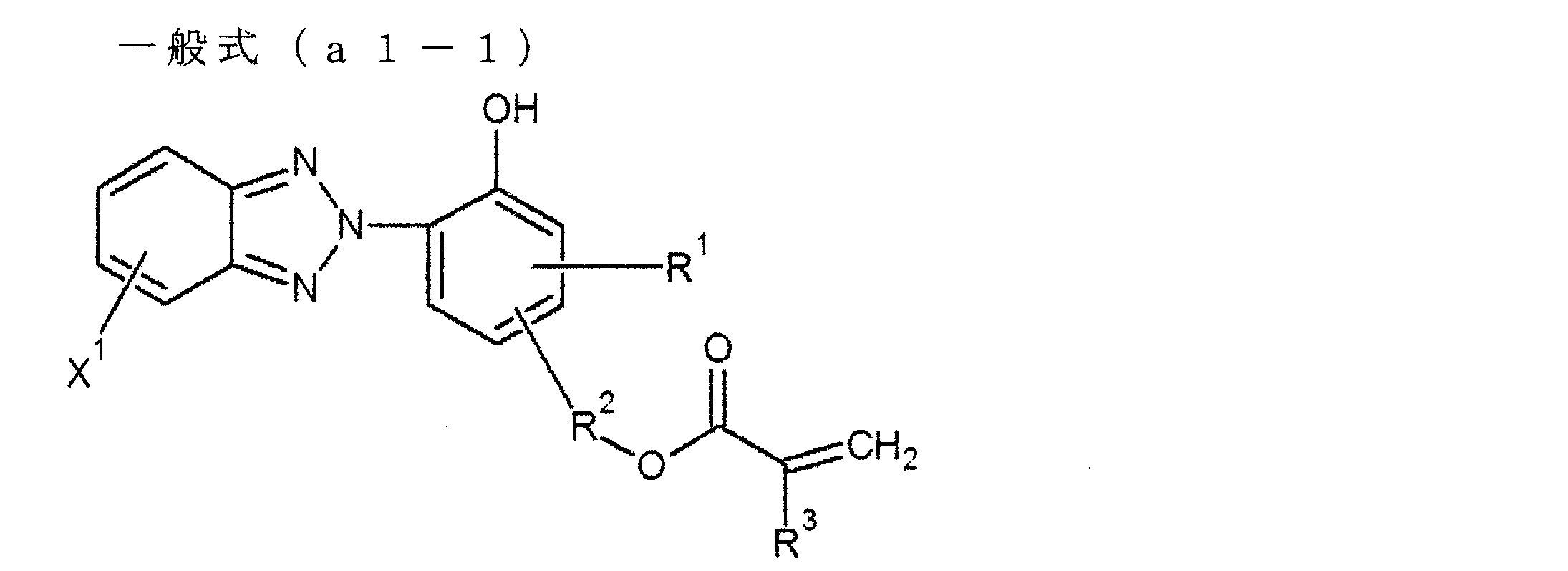
(一般式(a1-1)中、R1は、水素原子及び炭素数1~8の炭化水素基からなる群より選択されるいずれかを表し、R2は、炭素数1~6のアルキレン基及び-O-R5からなる群より選択されるいずれかを表し、R5は、炭素数1~6のアルキレン基を表し、R3は、水素原子及びメチル基からなる群より選択されるいずれかを表し、X1は、水素原子、ハロゲン原子、炭素数1~8の炭化水素基、炭素数1~6のアルコキシ基、シアノ基、及びニトロ基からなる群より選択されるいずれかを表す。)
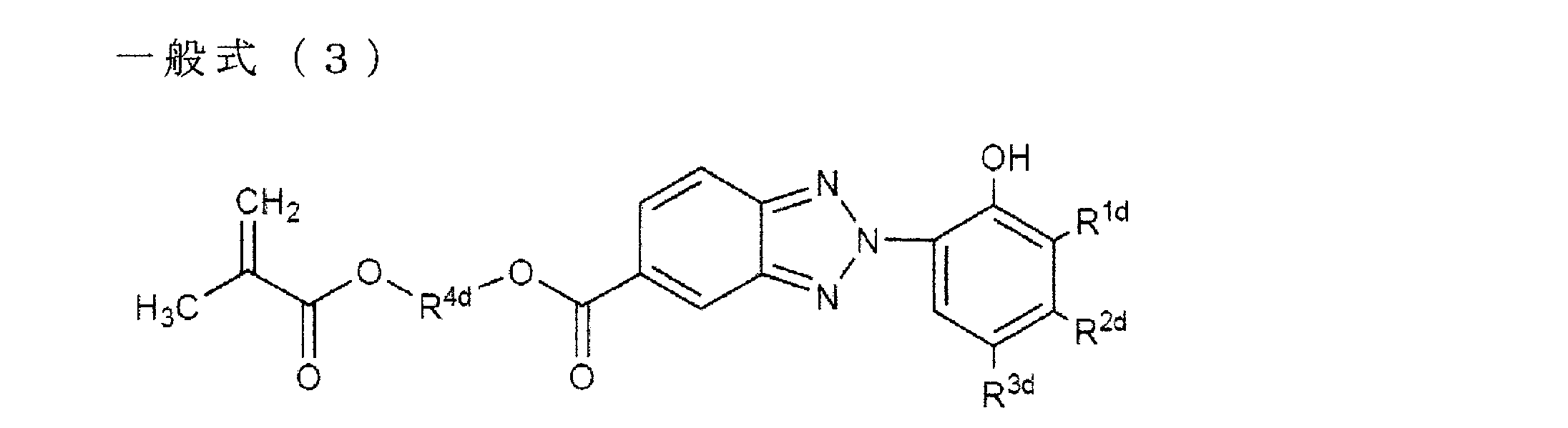
(一般式(3)中、R1dは、水素原子、炭素数1~20のアルキル基、及び炭素数3~20のシクロアルキル基からなる群より選択されるいずれかを表し、R2d及びR3dは、それぞれ独立に、水素原子、炭素数1~20のアルキル基、炭素数3~20のシクロアルキル、及び炭素数1~20のアルコキシ基からなる群より選択されるいずれかを表し、R4dは、炭素数1~20のアルキレン基及び炭素数3~5のヒドロキシアルキレン基からなる群より選択されるいずれかを表す。)

(一般式(a1-4)中、R41a、R41b、及びR41cは、それぞれ独立に、水素原子、炭素数1~20のアルキル基、炭素数6~20のアリール基、-O-R44a、及び-O-R45a-CO-O-R46aからなる群より選択されるいずれかを表し、R44a及びR46aは、それぞれ独立に、炭素数1~20のアルキル基及び炭素数6~20のアリール基からなる群より選択されるいずれかを表し、前記アルキル基は環構造を形成していてもよく、R45aは、炭素数1~20のアルキレン基及び炭素数6~20のアリーレン基からなる群より選択されるいずれかを表し、R42a、R42b、及びR42cは、それぞれ独立に、水素原子及び炭素数1~10のアルキル基からなる群より選択されるいずれかを表し、R43は、水素原子、水酸基、炭素数1~20のアルキル基、炭素数6~20のアリール基、-O-R44b、及び-O-R45b-CO-O-R46bからなる群より選択されるいずれかを表し、R44b及びR46bは、それぞれ独立に、炭素数1~20のアルキル基及び炭素数6~20のアリール基からなる群より選択されるいずれかを表し、前記アルキル基は環構造を形成していてもよく、R45bは、炭素数1~20のアルキレン基及び炭素数6~20のアリーレン基からなる群より選択されるいずれかを表し、前記アルキル基は環構造を形成していてもよい。
Pは、-O-及び-O-R47-O-からなる群より選択されるいずれかを表し、R47は、炭素数1~20のアルキレン基を表し、前記アルキレン基は水酸基を有してもよく、Qは、水素原子及びメチル基からなる群より選択されるいずれかを表す。) - 前記一般式(12)で示す単量体単位、前記一般式(1)で示す単量体単位、及び下記一般式(5)で示す単量体単位を共重合してなる、請求項1~5のいずれか1項に記載の紫外線吸収性ポリマー。

(一般式(5)中、R109は、水素原子及びシアノ基からなる群より選択されるいずれかを表し、R110及びR111は、それぞれ独立に、水素原子及びメチル基からなる群より選択されるいずれかを表し、R112は、水素原子及び炭化水素基からなる群より選択されるいずれかを表し、Y1は酸素原子及びイミノ基からなる群より選択されるいずれかを表す。) - 熱可塑性樹脂、及び請求項1~6のいずれか1項に記載の紫外線吸収性ポリマーを含み、
前記紫外線吸収性ポリマーの重量平均分子量は、5,000~100,000である、成形用樹脂組成物。 - 前記熱可塑性樹脂がポリオレフィンである、請求項7に記載の成形用樹脂組成物。
- 請求項7又は8に記載の成形用樹脂組成物を含む、成形体。
Priority Applications (3)
| Application Number | Priority Date | Filing Date | Title |
|---|---|---|---|
| KR1020217028962A KR20210132082A (ko) | 2019-02-20 | 2020-02-18 | 자외선 흡수성 폴리머, 성형용 수지 조성물, 및 성형체 |
| CN202080015324.6A CN113454132B (zh) | 2019-02-20 | 2020-02-18 | 紫外线吸收性聚合物、成形用树脂组合物及成形体 |
| US17/405,036 US20210380743A1 (en) | 2019-02-20 | 2021-08-18 | Ultraviolet-ray absorbing polymer, formation resin composition, and formed body |
Applications Claiming Priority (8)
| Application Number | Priority Date | Filing Date | Title |
|---|---|---|---|
| JP2019028618 | 2019-02-20 | ||
| JP2019-028618 | 2019-02-20 | ||
| JP2019048496A JP7293753B2 (ja) | 2019-03-15 | 2019-03-15 | 成型用樹脂組成物および成形体 |
| JP2019-048496 | 2019-03-15 | ||
| JP2019150889A JP6741132B1 (ja) | 2019-02-20 | 2019-08-21 | 成形用樹脂組成物および成形体 |
| JP2019-150889 | 2019-08-21 | ||
| JP2019-150888 | 2019-08-21 | ||
| JP2019150888A JP6725047B1 (ja) | 2019-08-21 | 2019-08-21 | 紫外線吸収性ポリマー、成形用組成物、および成形体 |
Related Child Applications (1)
| Application Number | Title | Priority Date | Filing Date |
|---|---|---|---|
| US17/405,036 Continuation US20210380743A1 (en) | 2019-02-20 | 2021-08-18 | Ultraviolet-ray absorbing polymer, formation resin composition, and formed body |
Publications (1)
| Publication Number | Publication Date |
|---|---|
| WO2020171071A1 true WO2020171071A1 (ja) | 2020-08-27 |
Family
ID=72144509
Family Applications (1)
| Application Number | Title | Priority Date | Filing Date |
|---|---|---|---|
| PCT/JP2020/006299 Ceased WO2020171071A1 (ja) | 2019-02-20 | 2020-02-18 | 紫外線吸収性ポリマー、成形用樹脂組成物、及び成形体 |
Country Status (4)
| Country | Link |
|---|---|
| US (1) | US20210380743A1 (ja) |
| KR (1) | KR20210132082A (ja) |
| CN (1) | CN113454132B (ja) |
| WO (1) | WO2020171071A1 (ja) |
Families Citing this family (2)
| Publication number | Priority date | Publication date | Assignee | Title |
|---|---|---|---|---|
| TW202323266A (zh) | 2021-11-29 | 2023-06-16 | 美商普羅梅勒斯有限公司 | 作為光學材料之包含保存期限長期穩定的光活性本體聚合型多環烯烴組成物之雙重uv阻斷劑 |
| CN114685710B (zh) * | 2022-04-27 | 2024-01-09 | 西尼尔(山东)新材料科技有限公司 | 一种pbs用呋喃基光稳定剂的制备方法 |
Citations (10)
| Publication number | Priority date | Publication date | Assignee | Title |
|---|---|---|---|---|
| JPH05204190A (ja) * | 1992-01-24 | 1993-08-13 | Tomoegawa Paper Co Ltd | 液体現像剤 |
| JPH05255447A (ja) * | 1983-07-11 | 1993-10-05 | Iolab Corp | 紫外線吸収性組成物 |
| JPH1046100A (ja) * | 1996-05-07 | 1998-02-17 | Kansai Paint Co Ltd | 塗料組成物及び塗膜形成方法 |
| JP2000273437A (ja) * | 1999-03-26 | 2000-10-03 | Fuji Photo Film Co Ltd | 高分子紫外線吸収剤ならびに該高分子紫外線吸収剤を含む有機材料、写真要素およびハロゲン化銀写真感光材料 |
| JP2003129033A (ja) * | 2001-10-23 | 2003-05-08 | Otsuka Chem Co Ltd | 紫外線吸収性重合体、ポリオレフィン系材料及び該材料からなるシート、フィルム |
| JP2003268048A (ja) * | 2002-03-15 | 2003-09-25 | Nippon Shokubai Co Ltd | 紫外線遮蔽層形成用樹脂組成物および紫外線遮蔽性積層体 |
| JP2008145739A (ja) * | 2006-12-11 | 2008-06-26 | Konica Minolta Opto Inc | 光学フィルム、その製造方法、偏光板及び液晶表示装置 |
| JP2012230194A (ja) * | 2011-04-25 | 2012-11-22 | Okamoto Kagaku Kogyo Kk | 感光性組成物およびそれを用いた平版印刷版用原版 |
| WO2012161100A1 (ja) * | 2011-05-23 | 2012-11-29 | パナソニック株式会社 | メタクリル系樹脂組成物及びその成形体 |
| JP2018030969A (ja) * | 2016-08-26 | 2018-03-01 | 大日精化工業株式会社 | アクリル系樹脂組成物及びそれを用いて作製された物品、並びにアクリル系樹脂組成物の製造方法 |
Family Cites Families (7)
| Publication number | Priority date | Publication date | Assignee | Title |
|---|---|---|---|---|
| JP3920460B2 (ja) * | 1998-06-10 | 2007-05-30 | 株式会社日本触媒 | 紫外線吸収性複合フィルム |
| JP3646581B2 (ja) | 1999-09-03 | 2005-05-11 | 三菱化学株式会社 | オレフィン系樹脂組成物及びこれを含有する熱可塑性樹脂組成物 |
| JP3941300B2 (ja) | 1999-10-21 | 2007-07-04 | 三菱化学株式会社 | オレフィン系樹脂組成物及びこれを含有する熱可塑性樹脂組成物 |
| JP4078256B2 (ja) | 2003-06-20 | 2008-04-23 | 一方社油脂工業株式会社 | アクリル系共重合体、及びそれを用いたコーティング剤、シュリンクフィルム |
| JP4627009B2 (ja) * | 2005-05-16 | 2011-02-09 | 株式会社日本触媒 | エマルションの製造方法 |
| WO2017033871A1 (ja) * | 2015-08-21 | 2017-03-02 | 株式会社日本触媒 | ブロック共重合体 |
| SG10201911771XA (en) * | 2015-09-25 | 2020-02-27 | Mitsubishi Chem Corp | (meth)acrylic copolymer, polymer solution, polymer-containing composition, anti-fouling coating composition, and method for producing (meth)acrylic copolymer |
-
2020
- 2020-02-18 KR KR1020217028962A patent/KR20210132082A/ko not_active Abandoned
- 2020-02-18 CN CN202080015324.6A patent/CN113454132B/zh active Active
- 2020-02-18 WO PCT/JP2020/006299 patent/WO2020171071A1/ja not_active Ceased
-
2021
- 2021-08-18 US US17/405,036 patent/US20210380743A1/en not_active Abandoned
Patent Citations (10)
| Publication number | Priority date | Publication date | Assignee | Title |
|---|---|---|---|---|
| JPH05255447A (ja) * | 1983-07-11 | 1993-10-05 | Iolab Corp | 紫外線吸収性組成物 |
| JPH05204190A (ja) * | 1992-01-24 | 1993-08-13 | Tomoegawa Paper Co Ltd | 液体現像剤 |
| JPH1046100A (ja) * | 1996-05-07 | 1998-02-17 | Kansai Paint Co Ltd | 塗料組成物及び塗膜形成方法 |
| JP2000273437A (ja) * | 1999-03-26 | 2000-10-03 | Fuji Photo Film Co Ltd | 高分子紫外線吸収剤ならびに該高分子紫外線吸収剤を含む有機材料、写真要素およびハロゲン化銀写真感光材料 |
| JP2003129033A (ja) * | 2001-10-23 | 2003-05-08 | Otsuka Chem Co Ltd | 紫外線吸収性重合体、ポリオレフィン系材料及び該材料からなるシート、フィルム |
| JP2003268048A (ja) * | 2002-03-15 | 2003-09-25 | Nippon Shokubai Co Ltd | 紫外線遮蔽層形成用樹脂組成物および紫外線遮蔽性積層体 |
| JP2008145739A (ja) * | 2006-12-11 | 2008-06-26 | Konica Minolta Opto Inc | 光学フィルム、その製造方法、偏光板及び液晶表示装置 |
| JP2012230194A (ja) * | 2011-04-25 | 2012-11-22 | Okamoto Kagaku Kogyo Kk | 感光性組成物およびそれを用いた平版印刷版用原版 |
| WO2012161100A1 (ja) * | 2011-05-23 | 2012-11-29 | パナソニック株式会社 | メタクリル系樹脂組成物及びその成形体 |
| JP2018030969A (ja) * | 2016-08-26 | 2018-03-01 | 大日精化工業株式会社 | アクリル系樹脂組成物及びそれを用いて作製された物品、並びにアクリル系樹脂組成物の製造方法 |
Also Published As
| Publication number | Publication date |
|---|---|
| US20210380743A1 (en) | 2021-12-09 |
| CN113454132A (zh) | 2021-09-28 |
| KR20210132082A (ko) | 2021-11-03 |
| CN113454132B (zh) | 2023-05-09 |
Similar Documents
| Publication | Publication Date | Title |
|---|---|---|
| JP6702493B1 (ja) | 紫外線吸収性不飽和単量体、紫外線吸収性紫外線吸収性ポリマー、成形用樹脂組成物および成形体 | |
| KR20130086148A (ko) | 중합성 이온 액체 조성물 | |
| JP7302685B2 (ja) | 共重合体、樹脂組成物、成形体、フィルム状成形体、及び共重合体の製造方法 | |
| CN113454132B (zh) | 紫外线吸收性聚合物、成形用树脂组合物及成形体 | |
| JP6575047B2 (ja) | ヨウ素末端ポリマー及びその製造方法、並びにブロックコポリマー及びその製造方法 | |
| JP7472470B2 (ja) | 紫外線吸収性単量体、紫外線吸収性ポリマー、成形用樹脂組成物、および成形体 | |
| JP7794055B2 (ja) | 紫外線吸収剤、およびその用途 | |
| CN107001548B (zh) | 固化性组合物及膜 | |
| JP6741132B1 (ja) | 成形用樹脂組成物および成形体 | |
| JP3556332B2 (ja) | プラスチックレンズ成形用組成物及びそれを用いたプラスチックレンズ | |
| JP7476520B2 (ja) | 紫外線吸収性単量体、アクリル重合体、樹脂組成物および成形体 | |
| JP6729776B1 (ja) | 紫外線吸収材料、およびその組成物 | |
| JP7293753B2 (ja) | 成型用樹脂組成物および成形体 | |
| JP7703924B2 (ja) | 成形用樹脂組成物、および成形体 | |
| JP6725047B1 (ja) | 紫外線吸収性ポリマー、成形用組成物、および成形体 | |
| JPWO2017135066A1 (ja) | 光拡散剤、光拡散性樹脂組成物および成形体 | |
| JP6928765B2 (ja) | 成形用樹脂組成物および成形体 | |
| WO2023157793A1 (ja) | 熱可塑性樹脂組成物、成形材料及び成形体 | |
| JP7005907B2 (ja) | 硬化性組成物及び膜 | |
| JP7192630B2 (ja) | 紫外線吸収材料および樹脂組成物 | |
| JP2023067721A (ja) | 高屈折率材料用樹脂および樹脂組成物 | |
| JP4802731B2 (ja) | マレイミド系共重合体、その製造方法、重合体組成物および成形体 | |
| JPH02206641A (ja) | 含フッ素重合体非水分散液およびその製造方法 | |
| JP2022091106A (ja) | 成形用樹脂組成物、および成形体 | |
| JP2024030298A (ja) | 成形用樹脂組成物、および成形体 |
Legal Events
| Date | Code | Title | Description |
|---|---|---|---|
| 121 | Ep: the epo has been informed by wipo that ep was designated in this application |
Ref document number: 20759912 Country of ref document: EP Kind code of ref document: A1 |
|
| NENP | Non-entry into the national phase |
Ref country code: DE |
|
| ENP | Entry into the national phase |
Ref document number: 20217028962 Country of ref document: KR Kind code of ref document: A |
|
| 122 | Ep: pct application non-entry in european phase |
Ref document number: 20759912 Country of ref document: EP Kind code of ref document: A1 |
|
| WWW | Wipo information: withdrawn in national office |
Ref document number: 1020217028962 Country of ref document: KR |