WO2020170778A1 - 液状エポキシ樹脂組成物及びそれを硬化させて得られる硬化物 - Google Patents
液状エポキシ樹脂組成物及びそれを硬化させて得られる硬化物 Download PDFInfo
- Publication number
- WO2020170778A1 WO2020170778A1 PCT/JP2020/003854 JP2020003854W WO2020170778A1 WO 2020170778 A1 WO2020170778 A1 WO 2020170778A1 JP 2020003854 W JP2020003854 W JP 2020003854W WO 2020170778 A1 WO2020170778 A1 WO 2020170778A1
- Authority
- WO
- WIPO (PCT)
- Prior art keywords
- epoxy resin
- resin composition
- component
- liquid epoxy
- present
- Prior art date
- Legal status (The legal status is an assumption and is not a legal conclusion. Google has not performed a legal analysis and makes no representation as to the accuracy of the status listed.)
- Ceased
Links
Images

Classifications
-
- C—CHEMISTRY; METALLURGY
- C08—ORGANIC MACROMOLECULAR COMPOUNDS; THEIR PREPARATION OR CHEMICAL WORKING-UP; COMPOSITIONS BASED THEREON
- C08G—MACROMOLECULAR COMPOUNDS OBTAINED OTHERWISE THAN BY REACTIONS ONLY INVOLVING UNSATURATED CARBON-TO-CARBON BONDS
- C08G59/00—Polycondensates containing more than one epoxy group per molecule; Macromolecules obtained by polymerising compounds containing more than one epoxy group per molecule using curing agents or catalysts which react with the epoxy groups
- C08G59/18—Macromolecules obtained by polymerising compounds containing more than one epoxy group per molecule using curing agents or catalysts which react with the epoxy groups ; e.g. general methods of curing
- C08G59/20—Macromolecules obtained by polymerising compounds containing more than one epoxy group per molecule using curing agents or catalysts which react with the epoxy groups ; e.g. general methods of curing characterised by the epoxy compounds used
- C08G59/22—Di-epoxy compounds
- C08G59/24—Di-epoxy compounds carbocyclic
- C08G59/245—Di-epoxy compounds carbocyclic aromatic
-
- C—CHEMISTRY; METALLURGY
- C08—ORGANIC MACROMOLECULAR COMPOUNDS; THEIR PREPARATION OR CHEMICAL WORKING-UP; COMPOSITIONS BASED THEREON
- C08G—MACROMOLECULAR COMPOUNDS OBTAINED OTHERWISE THAN BY REACTIONS ONLY INVOLVING UNSATURATED CARBON-TO-CARBON BONDS
- C08G59/00—Polycondensates containing more than one epoxy group per molecule; Macromolecules obtained by polymerising compounds containing more than one epoxy group per molecule using curing agents or catalysts which react with the epoxy groups
- C08G59/18—Macromolecules obtained by polymerising compounds containing more than one epoxy group per molecule using curing agents or catalysts which react with the epoxy groups ; e.g. general methods of curing
- C08G59/20—Macromolecules obtained by polymerising compounds containing more than one epoxy group per molecule using curing agents or catalysts which react with the epoxy groups ; e.g. general methods of curing characterised by the epoxy compounds used
-
- C—CHEMISTRY; METALLURGY
- C08—ORGANIC MACROMOLECULAR COMPOUNDS; THEIR PREPARATION OR CHEMICAL WORKING-UP; COMPOSITIONS BASED THEREON
- C08G—MACROMOLECULAR COMPOUNDS OBTAINED OTHERWISE THAN BY REACTIONS ONLY INVOLVING UNSATURATED CARBON-TO-CARBON BONDS
- C08G59/00—Polycondensates containing more than one epoxy group per molecule; Macromolecules obtained by polymerising compounds containing more than one epoxy group per molecule using curing agents or catalysts which react with the epoxy groups
- C08G59/18—Macromolecules obtained by polymerising compounds containing more than one epoxy group per molecule using curing agents or catalysts which react with the epoxy groups ; e.g. general methods of curing
- C08G59/40—Macromolecules obtained by polymerising compounds containing more than one epoxy group per molecule using curing agents or catalysts which react with the epoxy groups ; e.g. general methods of curing characterised by the curing agents used
- C08G59/42—Polycarboxylic acids; Anhydrides, halides or low molecular weight esters thereof
-
- C—CHEMISTRY; METALLURGY
- C08—ORGANIC MACROMOLECULAR COMPOUNDS; THEIR PREPARATION OR CHEMICAL WORKING-UP; COMPOSITIONS BASED THEREON
- C08G—MACROMOLECULAR COMPOUNDS OBTAINED OTHERWISE THAN BY REACTIONS ONLY INVOLVING UNSATURATED CARBON-TO-CARBON BONDS
- C08G59/00—Polycondensates containing more than one epoxy group per molecule; Macromolecules obtained by polymerising compounds containing more than one epoxy group per molecule using curing agents or catalysts which react with the epoxy groups
- C08G59/18—Macromolecules obtained by polymerising compounds containing more than one epoxy group per molecule using curing agents or catalysts which react with the epoxy groups ; e.g. general methods of curing
- C08G59/40—Macromolecules obtained by polymerising compounds containing more than one epoxy group per molecule using curing agents or catalysts which react with the epoxy groups ; e.g. general methods of curing characterised by the curing agents used
- C08G59/50—Amines
-
- C—CHEMISTRY; METALLURGY
- C08—ORGANIC MACROMOLECULAR COMPOUNDS; THEIR PREPARATION OR CHEMICAL WORKING-UP; COMPOSITIONS BASED THEREON
- C08G—MACROMOLECULAR COMPOUNDS OBTAINED OTHERWISE THAN BY REACTIONS ONLY INVOLVING UNSATURATED CARBON-TO-CARBON BONDS
- C08G59/00—Polycondensates containing more than one epoxy group per molecule; Macromolecules obtained by polymerising compounds containing more than one epoxy group per molecule using curing agents or catalysts which react with the epoxy groups
- C08G59/18—Macromolecules obtained by polymerising compounds containing more than one epoxy group per molecule using curing agents or catalysts which react with the epoxy groups ; e.g. general methods of curing
- C08G59/40—Macromolecules obtained by polymerising compounds containing more than one epoxy group per molecule using curing agents or catalysts which react with the epoxy groups ; e.g. general methods of curing characterised by the curing agents used
- C08G59/62—Alcohols or phenols
- C08G59/621—Phenols
-
- C—CHEMISTRY; METALLURGY
- C08—ORGANIC MACROMOLECULAR COMPOUNDS; THEIR PREPARATION OR CHEMICAL WORKING-UP; COMPOSITIONS BASED THEREON
- C08J—WORKING-UP; GENERAL PROCESSES OF COMPOUNDING; AFTER-TREATMENT NOT COVERED BY SUBCLASSES C08B, C08C, C08F, C08G or C08H
- C08J5/00—Manufacture of articles or shaped materials containing macromolecular substances
- C08J5/18—Manufacture of films or sheets
-
- C—CHEMISTRY; METALLURGY
- C08—ORGANIC MACROMOLECULAR COMPOUNDS; THEIR PREPARATION OR CHEMICAL WORKING-UP; COMPOSITIONS BASED THEREON
- C08K—Use of inorganic or non-macromolecular organic substances as compounding ingredients
- C08K3/00—Use of inorganic substances as compounding ingredients
- C08K3/18—Oxygen-containing compounds, e.g. metal carbonyls
- C08K3/20—Oxides; Hydroxides
- C08K3/22—Oxides; Hydroxides of metals
-
- C—CHEMISTRY; METALLURGY
- C08—ORGANIC MACROMOLECULAR COMPOUNDS; THEIR PREPARATION OR CHEMICAL WORKING-UP; COMPOSITIONS BASED THEREON
- C08K—Use of inorganic or non-macromolecular organic substances as compounding ingredients
- C08K3/00—Use of inorganic substances as compounding ingredients
- C08K3/34—Silicon-containing compounds
- C08K3/36—Silica
-
- C—CHEMISTRY; METALLURGY
- C08—ORGANIC MACROMOLECULAR COMPOUNDS; THEIR PREPARATION OR CHEMICAL WORKING-UP; COMPOSITIONS BASED THEREON
- C08L—COMPOSITIONS OF MACROMOLECULAR COMPOUNDS
- C08L63/00—Compositions of epoxy resins; Compositions of derivatives of epoxy resins
-
- C—CHEMISTRY; METALLURGY
- C09—DYES; PAINTS; POLISHES; NATURAL RESINS; ADHESIVES; COMPOSITIONS NOT OTHERWISE PROVIDED FOR; APPLICATIONS OF MATERIALS NOT OTHERWISE PROVIDED FOR
- C09J—ADHESIVES; NON-MECHANICAL ASPECTS OF ADHESIVE PROCESSES IN GENERAL; ADHESIVE PROCESSES NOT PROVIDED FOR ELSEWHERE; USE OF MATERIALS AS ADHESIVES
- C09J11/00—Features of adhesives not provided for in group C09J9/00, e.g. additives
- C09J11/02—Non-macromolecular additives
- C09J11/04—Non-macromolecular additives inorganic
-
- C—CHEMISTRY; METALLURGY
- C09—DYES; PAINTS; POLISHES; NATURAL RESINS; ADHESIVES; COMPOSITIONS NOT OTHERWISE PROVIDED FOR; APPLICATIONS OF MATERIALS NOT OTHERWISE PROVIDED FOR
- C09J—ADHESIVES; NON-MECHANICAL ASPECTS OF ADHESIVE PROCESSES IN GENERAL; ADHESIVE PROCESSES NOT PROVIDED FOR ELSEWHERE; USE OF MATERIALS AS ADHESIVES
- C09J11/00—Features of adhesives not provided for in group C09J9/00, e.g. additives
- C09J11/02—Non-macromolecular additives
- C09J11/06—Non-macromolecular additives organic
-
- C—CHEMISTRY; METALLURGY
- C09—DYES; PAINTS; POLISHES; NATURAL RESINS; ADHESIVES; COMPOSITIONS NOT OTHERWISE PROVIDED FOR; APPLICATIONS OF MATERIALS NOT OTHERWISE PROVIDED FOR
- C09J—ADHESIVES; NON-MECHANICAL ASPECTS OF ADHESIVE PROCESSES IN GENERAL; ADHESIVE PROCESSES NOT PROVIDED FOR ELSEWHERE; USE OF MATERIALS AS ADHESIVES
- C09J163/00—Adhesives based on epoxy resins; Adhesives based on derivatives of epoxy resins
-
- C—CHEMISTRY; METALLURGY
- C09—DYES; PAINTS; POLISHES; NATURAL RESINS; ADHESIVES; COMPOSITIONS NOT OTHERWISE PROVIDED FOR; APPLICATIONS OF MATERIALS NOT OTHERWISE PROVIDED FOR
- C09K—MATERIALS FOR MISCELLANEOUS APPLICATIONS, NOT PROVIDED FOR ELSEWHERE
- C09K3/00—Materials not provided for elsewhere
- C09K3/10—Materials in mouldable or extrudable form for sealing or packing joints or covers
-
- H—ELECTRICITY
- H10—SEMICONDUCTOR DEVICES; ELECTRIC SOLID-STATE DEVICES NOT OTHERWISE PROVIDED FOR
- H10W—GENERIC PACKAGES, INTERCONNECTIONS, CONNECTORS OR OTHER CONSTRUCTIONAL DETAILS OF DEVICES COVERED BY CLASS H10
- H10W74/00—Encapsulations, e.g. protective coatings
- H10W74/10—Encapsulations, e.g. protective coatings characterised by their shape or disposition
-
- H—ELECTRICITY
- H10—SEMICONDUCTOR DEVICES; ELECTRIC SOLID-STATE DEVICES NOT OTHERWISE PROVIDED FOR
- H10W—GENERIC PACKAGES, INTERCONNECTIONS, CONNECTORS OR OTHER CONSTRUCTIONAL DETAILS OF DEVICES COVERED BY CLASS H10
- H10W74/00—Encapsulations, e.g. protective coatings
- H10W74/40—Encapsulations, e.g. protective coatings characterised by their materials
-
- C—CHEMISTRY; METALLURGY
- C08—ORGANIC MACROMOLECULAR COMPOUNDS; THEIR PREPARATION OR CHEMICAL WORKING-UP; COMPOSITIONS BASED THEREON
- C08K—Use of inorganic or non-macromolecular organic substances as compounding ingredients
- C08K3/00—Use of inorganic substances as compounding ingredients
- C08K3/18—Oxygen-containing compounds, e.g. metal carbonyls
- C08K3/20—Oxides; Hydroxides
- C08K3/22—Oxides; Hydroxides of metals
- C08K2003/2227—Oxides; Hydroxides of metals of aluminium
-
- H—ELECTRICITY
- H10—SEMICONDUCTOR DEVICES; ELECTRIC SOLID-STATE DEVICES NOT OTHERWISE PROVIDED FOR
- H10W—GENERIC PACKAGES, INTERCONNECTIONS, CONNECTORS OR OTHER CONSTRUCTIONAL DETAILS OF DEVICES COVERED BY CLASS H10
- H10W74/00—Encapsulations, e.g. protective coatings
- H10W74/10—Encapsulations, e.g. protective coatings characterised by their shape or disposition
- H10W74/15—Encapsulations, e.g. protective coatings characterised by their shape or disposition on active surfaces of flip-chip devices, e.g. underfills
-
- H—ELECTRICITY
- H10—SEMICONDUCTOR DEVICES; ELECTRIC SOLID-STATE DEVICES NOT OTHERWISE PROVIDED FOR
- H10W—GENERIC PACKAGES, INTERCONNECTIONS, CONNECTORS OR OTHER CONSTRUCTIONAL DETAILS OF DEVICES COVERED BY CLASS H10
- H10W90/00—Package configurations
- H10W90/701—Package configurations characterised by the relative positions of pads or connectors relative to package parts
- H10W90/721—Package configurations characterised by the relative positions of pads or connectors relative to package parts of bump connectors
- H10W90/724—Package configurations characterised by the relative positions of pads or connectors relative to package parts of bump connectors between a chip and a stacked insulating package substrate, interposer or RDL
-
- H—ELECTRICITY
- H10—SEMICONDUCTOR DEVICES; ELECTRIC SOLID-STATE DEVICES NOT OTHERWISE PROVIDED FOR
- H10W—GENERIC PACKAGES, INTERCONNECTIONS, CONNECTORS OR OTHER CONSTRUCTIONAL DETAILS OF DEVICES COVERED BY CLASS H10
- H10W90/00—Package configurations
- H10W90/701—Package configurations characterised by the relative positions of pads or connectors relative to package parts
- H10W90/731—Package configurations characterised by the relative positions of pads or connectors relative to package parts of die-attach connectors
- H10W90/734—Package configurations characterised by the relative positions of pads or connectors relative to package parts of die-attach connectors between a chip and a stacked insulating package substrate, interposer or RDL
Definitions
- the present invention relates to a liquid epoxy resin composition which can be suitably used as an adhesive or a sealing material in the production of electronic parts, a cured product obtained by curing the same, and an electronic part containing the cured product.
- an adhesive or the like containing an epoxy resin composition is often used for the purpose of retaining reliability and the like for sealing electronic parts used in electronic devices, for example, semiconductor chip encapsulation and underfill applications. Therefore, there is a demand for the development of an epoxy resin composition that provides a cured product having a lower relative dielectric constant and dielectric loss tangent, which can respond to further miniaturization of wiring and further processing of high-frequency signals. There is. In particular, the development of encapsulating materials, underfills, etc. suitable for fifth-generation mobile communication systems and in-vehicle quasi-millimeter wave radars that handle ultra-high frequency signals has become an urgent issue.
- an adhesive or the like for electronic parts may need to be injected into a narrow portion using a capillary phenomenon. Therefore, the epoxy resin composition contained in the adhesive or the like for electronic parts is required to have sufficient adhesive strength and to be a liquid having a low viscosity at the manufacturing temperature.
- Patent Documents 1 and 2 disclose epoxy resin compositions that provide a cured product having a low dielectric loss tangent.
- these compositions are intended to be used in the form of an adhesive film for producing a printed circuit board or the like, their viscosity is not sufficiently low. Further, with respect to the cured products provided by these compositions, a decrease in dielectric loss tangent has been confirmed, but a decrease in relative dielectric constant has not been confirmed.
- the present invention is a curing liquid that is a low-viscosity liquid at room temperature, exhibits sufficient adhesive strength, and has a lower relative dielectric constant and dielectric loss tangent than conventional products.
- An object of the present invention is to provide a liquid epoxy resin composition that gives a product and a cured product obtained by curing the same.
- the present inventors have arrived at the present invention as a result of intensive research to solve the above problems.
- the present invention includes, but is not limited to, the following inventions.
- R 1 represents a monovalent hydrocarbon group containing 1 to 3 epoxy groups and optionally containing an ether bond, When R 1 contains 2 or 3 epoxy groups, R 1 has a branched structure, Each R 2 independently represents a hydrogen atom or a methyl group, n and m each independently represent an integer of 1 to 10.
- a liquid epoxy resin composition containing a filler The mass of the component (A) is 40% or more and 80% or less with respect to the total mass of the component (A) and the component (B), The liquid epoxy resin composition, wherein the mass of the component (D) is 40% or more and 65% or less with respect to the total mass of the liquid epoxy resin composition.
- liquid epoxy resin composition according to item 1 further comprising a curing accelerator.
- a film comprising the liquid epoxy resin composition according to any one of items 1 to 5 above.
- An electronic component comprising the cured product according to item 6, the adhesive or sealing material according to item 7, or the film cured product according to item 8.
- the liquid epoxy resin composition of the present invention is a low-viscosity liquid at room temperature and exhibits sufficient adhesive strength for fixing electronic components to a substrate. Further, the cured product obtained by curing the liquid epoxy resin composition of the present invention exhibits a lower relative dielectric constant and dielectric loss tangent than the cured product provided by the conventional product. Therefore, by using the liquid epoxy resin composition of the present invention, it is possible to easily prepare an electronic component including finer wiring and capable of processing a higher frequency signal. Can be mounted on a substrate with sufficient adhesive strength.
- FIG. 6 is a cross-sectional view of a portion where a chip is mounted on a substrate by flip-chip connection, which is sealed by an underfill material.
- the present invention includes the following components (A) to (D): (A) a first epoxy resin (B) a second epoxy resin (C) including a curing agent (D) filler capable of curing the epoxy resin,
- the mass of the component (A) is 40% or more and 80% or less with respect to the total mass of the component (A) and the component (B)
- the present invention relates to a liquid epoxy resin composition in which the mass of the component (D) is 40% or more and 80% or less with respect to the total mass of the components (A) to (D).
- the components (A) to (D) contained in the liquid epoxy resin composition of the present invention will be described below.
- the liquid epoxy resin composition of the present invention has the following formula (1): [In the formula, R 1 represents a monovalent hydrocarbon group containing 1 to 3 epoxy groups and optionally containing an ether bond, When R 1 contains 2 or 3 epoxy groups, R 1 has a branched structure, Each R 2 independently represents a hydrogen atom or a methyl group, n and m each independently represent an integer of 1 to 10. ] It contains a first epoxy resin having a structure represented by. Hereinafter, this first epoxy resin may be referred to as “component (A)”.
- the component (A) is an ester of a branched aliphatic carboxylic acid having a specific structure, which is represented by the above formula (1).
- the use of the component (A) is important in the present invention because the component (A) has a function of improving the dielectric properties of a cured product obtained by curing the liquid epoxy resin composition of the present invention.
- the component (A) may be used alone or in combination of two or more kinds.
- R 1 in the above formula (1) is a monovalent hydrocarbon group.
- the monovalent hydrocarbon group refers to a monovalent group produced by removing one hydrogen atom from a carbon atom of hydrocarbon.
- Examples of the monovalent hydrocarbon group include an alkyl group, an alkenyl group, an alkynyl group, a cycloalkyl group, an alkyl-substituted cycloalkyl group, an aryl group, an aralkyl group, and an alkaryl group.
- alkyl group etc. The number of carbon atoms of the above-mentioned alkyl group, alkenyl group, and alkynyl group (hereinafter collectively referred to as “alkyl group etc.”) is not particularly limited.
- the alkyl group has usually 1 to 20, preferably 2 to 18, more preferably 3 to 17, more preferably 4 to 16 and particularly preferably 5 to 15 carbon atoms.
- the carbon number of the alkenyl group and alkynyl group is usually 2 to 20, preferably 2 to 18, more preferably 3 to 17, more preferably 4 to 16, and particularly preferably 5 to 15.
- the carbon number of the alkyl group or the like is usually 4 to 20, preferably 4 to 18, more preferably 5 to 16 and more preferably 6 to 15.
- the carbon number of the alkyl group and the like can be specified by, for example, LC-TOF or nuclear magnetic resonance method (NMR method).
- the alkyl group and the like may be linear or may have a side chain.
- the alkyl group and the like may have a chain structure or a cyclic structure (cycloalkyl group, cycloalkenyl group, and cycloalkynyl group).
- the alkyl group and the like may have one or more other substituents.
- the alkyl group and the like may have a substituent containing an atom other than a carbon atom and a hydrogen atom as a substituent.
- the alkyl group and the like may include one or more atoms other than carbon atoms and hydrogen atoms in the chain structure or the ring structure. Examples of the atom other than the carbon atom and the hydrogen atom include one kind or two or more kinds of oxygen atom and nitrogen atom.
- R 1 in the above formula (1) contains 1 to 3 epoxy groups.
- R 1 contains one or two epoxy groups. More preferably, R 1 contains two epoxy groups.
- R 1 contains 2 or 3 epoxy groups, R 1 has a branched structure. That is, in this case, R 1 has a side chain.
- R 1 is alkyl, cycloalkyl, heterocyclyl, aryl, heteroaryl, allyl, alkoxy, alkylthio, aryloxy, hydroxyl, nitro, amide, azide, cyano, acyloxy, carboxy, sulfoxy, acryloxy, It may be substituted with siloxy or ester. That is, R 1 may contain an ether bond.
- R 1 comprises one or more glycidyloxy groups. In another aspect, R 1 contains one or two glycidyloxy groups. In another aspect, R 1 comprises two glycidyloxy groups.
- n and m are preferably 1 to 8, more preferably 1 to 6, and particularly preferably 2 to 4.
- the content of the component (A) in the liquid epoxy resin composition of the present invention is not particularly limited, but is preferably 20 to 40% by mass, more preferably 100% by mass of the liquid epoxy resin composition of the present invention. It is 30 to 40% by mass. If the content of the component (A) is too low, the dielectric properties of the cured product obtained by curing the liquid epoxy resin composition of the present invention will not be sufficiently improved. On the other hand, when the content of the component (A) is too large, the adhesive strength of the liquid epoxy resin composition of the present invention becomes insufficient.
- the state of component (A) is not particularly limited, and component (A) may be liquid or solid as long as the composition of the present invention is liquid.
- the state of the component (A) means the state of a mixture obtained by mixing all the components (A).
- the component (A) is preferably liquid.
- the viscosity (25° C.) of the component (A) is not particularly limited, but is preferably 0.01 to 5 Pa ⁇ s, more preferably 0.1 to 3 Pa ⁇ s, and particularly preferably 0.1. It is up to 1 Pa ⁇ s.
- ester compounds are sometimes used as a curing agent for epoxy resins.
- Such an ester compound is usually called an "active ester compound” and has a structure such as phenol ester or thiophenol ester which improves the reactivity with an epoxy group (for example, see JP-A-62-053327).
- the name implies, it is an ester compound having a relatively high reactivity with epoxy groups.
- the component (A) is an ester having a structure in which a branched aliphatic carboxylic acid having a specific structure is bonded to a hydrocarbon group R 1 via an ester bond. It is a compound.
- the component (A) does not have a structure that improves the reactivity with the epoxy group and is not a substance that can be expected to act as a curing agent.
- the component (A) can be obtained as a commercially available product (for example, FOLDI E101, FOLDI E201 (manufactured by Nissan Kagaku), etc.).
- the liquid epoxy resin composition of the present invention contains a second epoxy resin having a structure other than the structure represented by the above formula (1).
- this second epoxy resin may be referred to as “component (B)”.
- two kinds of epoxy resins that is, the components (A) and (B) are used in combination.
- the use of the component (A) is important in the present invention, but when only the component (A) is used as the epoxy resin, the adhesive strength becomes insufficient. Therefore, the component (B) is used in combination with the component (A) for the purpose of ensuring sufficient adhesive strength.
- the component (B) is not particularly limited as long as it is an epoxy resin having a structure other than the structure represented by the above formula (1), and a known such epoxy resin can be used.
- the component (B) may be used alone or in combination of two or more kinds.
- the state of component (B) is not particularly limited, and component (B) may be liquid or solid as long as the composition of the present invention is liquid.
- the state of the component (B) refers to the state of a mixture obtained by mixing all the components (B).
- the component (B) is preferably liquid.
- the component (B) is roughly classified into an aliphatic epoxy resin and an aromatic epoxy resin.
- aliphatic epoxy resins include: -(Poly)propylene glycol diglycidyl ether, butanediol diglycidyl ether, neopentyl glycol diglycidyl ether, 1,6-hexanediol diglycidyl ether, trimethylolpropane diglycidyl ether, polytetramethylene ether glycol diglycidyl ether, glycerin Diepoxy resins such as diglycidyl ether, neopentyl glycol diglycidyl ether; -Triepoxy resins such as trimethylolpropane triglycidyl ether, glycerin triglycidyl ether; Alicyclic epoxy resins such as vinyl(3,4-cyclohexene) dioxide, 2-(3,4-epoxycyclohexyl)-5,
- the aromatic epoxy resin is an epoxy resin having a structure containing an aromatic ring such as a benzene ring.
- Most of the conventionally used epoxy resins such as bisphenol A type epoxy resin are of this type.
- aromatic epoxy resins include: -Bisphenol A type epoxy resin; -Branched polyfunctional bisphenol A type epoxy resin such as p-glycidyloxyphenyl dimethyl tris bisphenol A diglycidyl ether; -Bisphenol F type epoxy resin; -Novolak type epoxy resin; -Fluorene type epoxy resin; -Biphenyl aralkyl epoxy resin; A diepoxy resin such as -p-tert-butylphenyl glycidyl ether, 1,4-phenyldimethanol diglycidyl ether; Biphenyl type epoxy resin such as -3,3',5,5'-tetramethyl-4,4'-diglycidyloxybiphenyl; -Aminophenol type epoxy
- the aromatic epoxy resin having a molecular weight of 200 to 400 is particularly preferable.
- the component (B) contains at least one selected from the group consisting of bisphenol F type epoxy resin, bisphenol A type epoxy resin, aminophenol type epoxy resin and naphthalene type epoxy resin.
- the component (B) preferably contains at least one epoxy resin having no hydroxyl group. This is because the higher the hydroxyl group content of the epoxy resin, the lower the dielectric constant and dielectric loss tangent of the cured product obtained by curing the epoxy resin. Further, even if an epoxy resin having no hydroxyl group is used, the above-mentioned cured product necessarily contains a hydroxyl group generated by cleavage of the epoxy group during curing. The higher the epoxy equivalent of an epoxy resin, the lower the content of such hydroxyl groups in the cured product obtained by curing a certain amount of the epoxy resin. However, if the epoxy equivalent of the epoxy resin is too large, a sufficient number of crosslinks are not formed and sufficient curing cannot be obtained.
- the component (B) contains at least one kind of epoxy resin having an epoxy equivalent of 110 to 200 g/eq.
- the epoxy equivalent of this epoxy resin is more preferably 120 to 180 g/eq, further preferably 130 to 150 g/eq.
- the component (B) contains substantially no nitrogen atom from the viewpoint of not impairing the dielectric properties of the cured product.
- the content of the component (B) in the liquid epoxy resin composition of the present invention is not particularly limited, but it is preferably 10 to 30 mass% with respect to 100 mass% of the liquid epoxy resin composition of the present invention.
- the mass of the component (B) is the mass containing the epoxy resin contained in the component (E).
- the mass of the component (A) is 40% or more and 80% or less with respect to the total mass of the component (A) and the component (B).
- the mass of the component (A) is preferably 40% or more and 80% or less, more preferably 60% or more and 80% or less with respect to the total mass of the component (A) and the component (B).
- the component (B) can be obtained as a commercially available product (for example, YDF8170 (manufactured by Nippon Steel), EXA850CRP (manufactured by DIC), etc.).
- the liquid epoxy resin composition of the present invention contains a curing agent capable of curing the epoxy resin.
- this curing agent may be referred to as “component (C)”.
- the component (C) is not particularly limited as long as it can cure the epoxy resin, and a known curing agent can be used.
- the component (C) may be used alone or in combination of two or more kinds.
- Examples of the component (C) include a phenol resin, an acid anhydride, an amine compound (such as an aromatic amine), and an imidazole derivative.
- Examples of the phenol resin include phenol novolac resin, cresol novolac resin, naphthol modified phenol resin, dicyclopentadiene modified phenol resin and p-xylene modified phenol resin.
- Examples of acid anhydrides include methyltetrahydrophthalic anhydride, methylhexahydrophthalic anhydride, alkylated tetrahydrophthalic anhydride, hexahydrophthalic anhydride, methylhymic anhydride, dodecenylsuccinic anhydride and methylnado.
- An acid anhydride can be mentioned.
- Examples of amine compounds include aromatic amines such as methylenedianiline, m-phenylenediamine, 4,4'-diaminodiphenyl sulfone and 3,3'-diaminodiphenyl sulfone.
- the component (C) preferably contains at least one selected from the group consisting of acid anhydrides, amine compounds and phenol resins. From the viewpoint of the dielectric properties of the cured product obtained by curing the liquid epoxy resin composition of the present invention, it is particularly preferred that component (C) is an acid anhydride.
- the content of the component (C) in the liquid epoxy resin composition of the present invention is not particularly limited, but the content of the epoxy group of the component (C) relative to the total amount of the epoxy groups of the components (A) and (B) is It is preferable that the total amount of the functional groups (an acid anhydride group, an amino group, a hydroxyl group, etc.) to react is approximately equivalent. That is, when the total amount of epoxy groups in the components (A) and (B) is 1 equivalent, the total amount of functional groups that react with the epoxy groups of the component (C) is preferably 0.3 to 1 0.5 equivalents, more preferably 0.6 to 1.2 equivalents. When the total amount of the functional groups is out of the above range, unreacted functional groups are increased, which has adverse effects such as increased hydrolyzability, and also increased water absorption, resulting in deterioration of dielectric properties. Invite.
- the component (C) can be obtained as a commercially available product (for example, YH306 (anhydride, manufactured by Mitsubishi Chemical), HDAA (amine compound, manufactured by Nippon Kayaku), MEH8005 (phenolic resin, manufactured by Meiwa Kasei) and the like). ..
- the liquid epoxy resin composition of the present invention contains a filler.
- this filler may be referred to as “component (D)”. Since the component (D) has an action of improving the adhesive strength to an adherend when the liquid epoxy resin composition of the present invention is used as an adhesive or a sealing material, the use of the component (D) in the present invention. It has important significance.
- the component (D) is not particularly limited, and a known filler can be used.
- the component (D) may be used alone or in combination of two or more kinds.
- Specific examples of the component (D) include silica filler, alumina filler, talc filler, calcium carbonate filler and the like.
- Preferably component (D) comprises at least one selected from the group consisting of silica fillers and alumina fillers.
- the average particle size of the component (D) is not particularly limited, but the average particle size as the median size (D50) measured by a laser diffraction/scattering particle size distribution meter is preferably 0.01 to 20 ⁇ m, and more preferably Is 0.1 to 10 ⁇ m, most preferably 0.3 to 7 ⁇ m.
- the mass of the component (D) is 40% or more and 65% or less with respect to the total mass of the liquid epoxy resin composition. If it is less than 40%, the adhesive strength of the liquid epoxy resin composition of the present invention will be insufficient. On the other hand, if it exceeds 65%, the viscosity of the liquid epoxy resin composition of the present invention becomes excessively high, and the injection property into the narrow gap becomes insufficient.
- the mass of the component (D) is preferably 50% or more and 60% or less with respect to the total mass of the liquid epoxy resin composition.
- the component (D) can be obtained as a commercial product (for example, SO-E5 (silica filler, manufactured by Admatex)).
- the liquid epoxy resin composition of the present invention may contain optional components in addition to the above-mentioned essential components (A) to (D), if necessary. Hereinafter, those optional components will be described.
- the liquid epoxy resin composition of the present invention may contain a curing accelerator, if desired.
- this curing accelerator may be referred to as “component (E)”.
- the liquid epoxy resin composition of the present invention further comprises a curing accelerator.
- the component (E) used in the present invention is not particularly limited as long as it is a compound that can accelerate the curing of the epoxy resin (the above components (A) and (B)) by the component (C), and a known such compound, For example, an imidazole compound can be used.
- the component (E) may be used alone or in combination of two or more kinds.
- imidazole compound examples include 1-methylimidazole, 2-heptadecylimidazole, 2-phenyl-4,5-dihydroxymethylimidazole, 2-undecylimidazole, 2-phenyl-4-methyl-5-hydroxymethylimidazole, 2-phenyl-4-benzyl-5-hydroxymethylimidazole, 2,4-diamino-6-(2-methylimidazolyl-(1))-ethyl-S-triazine, 2,4-diamino-6-(2' -Methylimidazolyl-(1)')-ethyl-S-triazine/isocyanuric acid adduct, 2-methylimidazole, 2-phenylimidazole, 2-phenyl-4-methylimidazole, 1-cyanoethyl-2-phenylimidazole, 1-Cyanoethyl-2-methylimidazole-trimellitate, 1-cyanoethyl-2-phenylim
- the component (E) may be a latent curing accelerator.
- the latent curing accelerator is a compound that is inactive at room temperature and is activated by heating or the like to function as a curing accelerator.
- an imidazole compound that is solid at room temperature a reaction between an amine compound and an epoxy compound
- Solid dispersion-type amine adduct-based latent curing accelerators such as products (amine-epoxy adduct-based); reaction products of amine compounds and isocyanate compounds or urea compounds (urea-based adduct-based) and the like.
- amine-epoxy adducts include "Amicure PN-23" (trade name of Ajinomoto Fine Techno Co., Ltd.) and “Amicure PN-”. 40” (trade name of Ajinomoto Fine Techno Co., Ltd.), “Amicure PN-50” (trade name of Ajinomoto Fine Techno Co., Ltd.), “Hardener X-3661S” (trade name of AC R Co., Ltd.), Hardener X-3670S” (AC R Co., Ltd. product name), “Novacure HX-3742” (Asahi Kasei Co., Ltd.
- urea type adduct system "Fujicure FXE-1000"(T&K TOKA( Trade name), “Fujicure FXR-1030” (T&K TOKA Co., Ltd. trade name) and the like, but are not limited thereto.
- component (E) a solid dispersion type amine adduct-based latent curing accelerator is preferable from the viewpoint of pot life and curability.
- the liquid epoxy resin composition of the present invention can be cured in a short time even under low temperature conditions.
- Some of the components (E) are provided in the form of a dispersion liquid dispersed in an epoxy resin (the above component (B)). It should be noted that when the component (E) in such a form is used, the amount of the epoxy resin in which it is dispersed is also included in the amount of the component (B) in the liquid epoxy resin composition of the present invention. is there.
- the liquid epoxy resin composition of the present invention may further contain an optional component other than the above-mentioned component (E), for example, a monofunctional epoxy resin, a stabilizer, a coupling agent and the like.
- the liquid epoxy resin composition of the present invention may further contain other additives such as carbon black, titanium black, an ion trap agent, a leveling agent, and an antioxidant within a range not impairing the gist of the present invention. Agents, defoamers, thixotropic agents, viscosity modifiers, flame retardants, colorants, solvents and the like can be added. The type and amount of each additive are in the usual manner.
- the liquid epoxy resin composition of the present invention can be produced by mixing the above components.
- the method for producing the liquid epoxy resin composition of the present invention is not particularly limited.
- the components (A) to (D) and, if desired, the component (E) and other optional components are introduced into a suitable mixer at the same time or separately, and the mixture is stirred while being melted by heating if necessary.
- the liquid epoxy resin composition of the present invention can be obtained by mixing and mixing to form a uniform composition.
- the mixer is not particularly limited, but a raikai machine equipped with a stirring device and a heating device, a Henschel mixer, a three-roll mill, a ball mill, a planetary mixer, a bead mill and the like can be used. Further, these devices may be appropriately combined and used.
- the liquid epoxy resin composition thus obtained is thermosetting, and it is preferable to cure in 0.5 to 6 hours under the condition of a temperature of 140 to 170° C., and to cure in 1 to 2 hours. Is more preferable.
- the liquid epoxy resin composition of the present invention is, for example, a semiconductor device including various electronic components, or an adhesive, a sealing material, or a raw material thereof for fixing, joining or protecting components constituting the electronic components. Can be used.
- the liquid epoxy resin composition of the present invention is particularly suitable as an underfill material for protecting electronic parts and the like or fixing it to a substrate. Adhesives and encapsulants for electronic parts may need to be injected into narrow areas, but the liquid epoxy resin composition of the present invention is a low-viscosity liquid at room temperature, so it is suitable for these applications. Are suitable.
- the liquid epoxy resin composition of the present invention is particularly useful as a capillary underfill material that is injected into a narrow gap between electronic components by using a capillary phenomenon when mounting the electronic components on a substrate.
- the viscosity of the liquid epoxy resin composition of the present invention measured at 25° C. using an E-type viscometer is preferably 0.1 to 100 Pa ⁇ s, more preferably 0.2. To 70 Pa ⁇ s, more preferably 0.3 to 60 Pa ⁇ s.
- a certain substance being “liquid” means that the substance is in a liquid state at 25°C.
- the “liquid” means a fluid having a viscosity of 0.001 to 1000 Pa ⁇ s at 25° C., which is preferably measured using an E-type viscometer.
- the substance may be a pure substance or a mixture. This mixture may be in the form of a homogeneous system (solution or the like) or may be in the form of a heterogeneous system (emulsion, suspension or the like). That is, unless otherwise specified, if the mixture as a whole satisfies the above requirements, the mixture is considered to be liquid even if the mixture contains a component that does not correspond to the liquid.
- the cured product provided by the liquid epoxy resin composition of the present invention is superior to the conventional cured product in dielectric properties such as relative permittivity and dielectric loss tangent. Therefore, when the liquid epoxy resin composition of the present invention is used for producing a substrate including a circuit for processing a high-frequency signal, transmission loss and propagation delay time are increased as compared with the case of using a conventional epoxy resin composition. Can be significantly suppressed.
- the terms "relative permittivity” and “dielectric loss tangent” mean the relative permittivity and dielectric loss tangent defined in JIS C2138 "electrical insulating material-method of measuring relative permittivity and dielectric loss tangent", respectively. These values can be measured by a known method suitable for the frequency band to be measured, for example, a method using a cavity resonator, a dielectric resonator, or the like. Unless otherwise specified in this specification, the relative permittivity and the dielectric loss tangent are values measured at 25° C. using a dielectric resonator.
- the dielectric constant of the cured product obtained by curing the liquid epoxy resin composition of the present invention is preferably 2.2 to 3.8, more preferably 2.2 to 3.5 at a measurement frequency of 10 GHz. , And more preferably 2.2 to 3.1. Further, the dielectric loss tangent of a cured product obtained by curing the liquid epoxy resin composition of the present invention is preferably 0.003 to 0.015, more preferably 0.003 to 0.01, and further at a measurement frequency of 10 GHz. It is preferably 0.003 to 0.007.
- the present invention also provides an adhesive or sealant containing the liquid epoxy resin composition of the present invention.
- the adhesive or sealing material of the present invention is suitable, for example, as an underfill material for protecting an electronic component or the like or fixing it to a substrate, particularly as a capillary underfill material.
- the adhesive or sealant containing the liquid epoxy resin composition of the present invention is a one-pack type.
- the present invention also provides a liquid epoxy resin composition of the present invention, or a cured product obtained by curing the adhesive or the sealing material. Furthermore, the present invention also provides an electronic component containing the cured product of the present invention.
- the liquid epoxy resin composition of the present invention can be used as a constituent material of a film.
- the liquid epoxy resin composition of the present invention is suitable for a coverlay film for protecting a wiring pattern and an interlayer adhesive film for a multilayer wiring board.
- the film containing the liquid epoxy resin composition of the present invention can be preferably used for electronic parts.
- the present invention also provides a film containing the liquid epoxy resin composition of the present invention.
- the film containing the liquid epoxy resin composition of the present invention can be obtained from the liquid epoxy resin composition of the present invention by a known method.
- the liquid epoxy resin composition of the present invention is diluted with a solvent to form a varnish, which is applied to at least one side of a support and dried, and then a film with a support or a film peeled from the support. Can be provided.
- the present invention also provides a cured product obtained by curing the liquid epoxy resin composition of the present invention. Further, in the present invention, it is obtained by curing a cured product obtained by curing an adhesive or a sealing material containing the liquid epoxy resin composition of the present invention, and a film containing the liquid epoxy resin composition of the present invention. Cured products are also provided. Furthermore, the present invention also provides an electronic component containing the cured product of the present invention, the cured product of the adhesive or sealing material of the present invention, or the cured product of the film of the present invention.
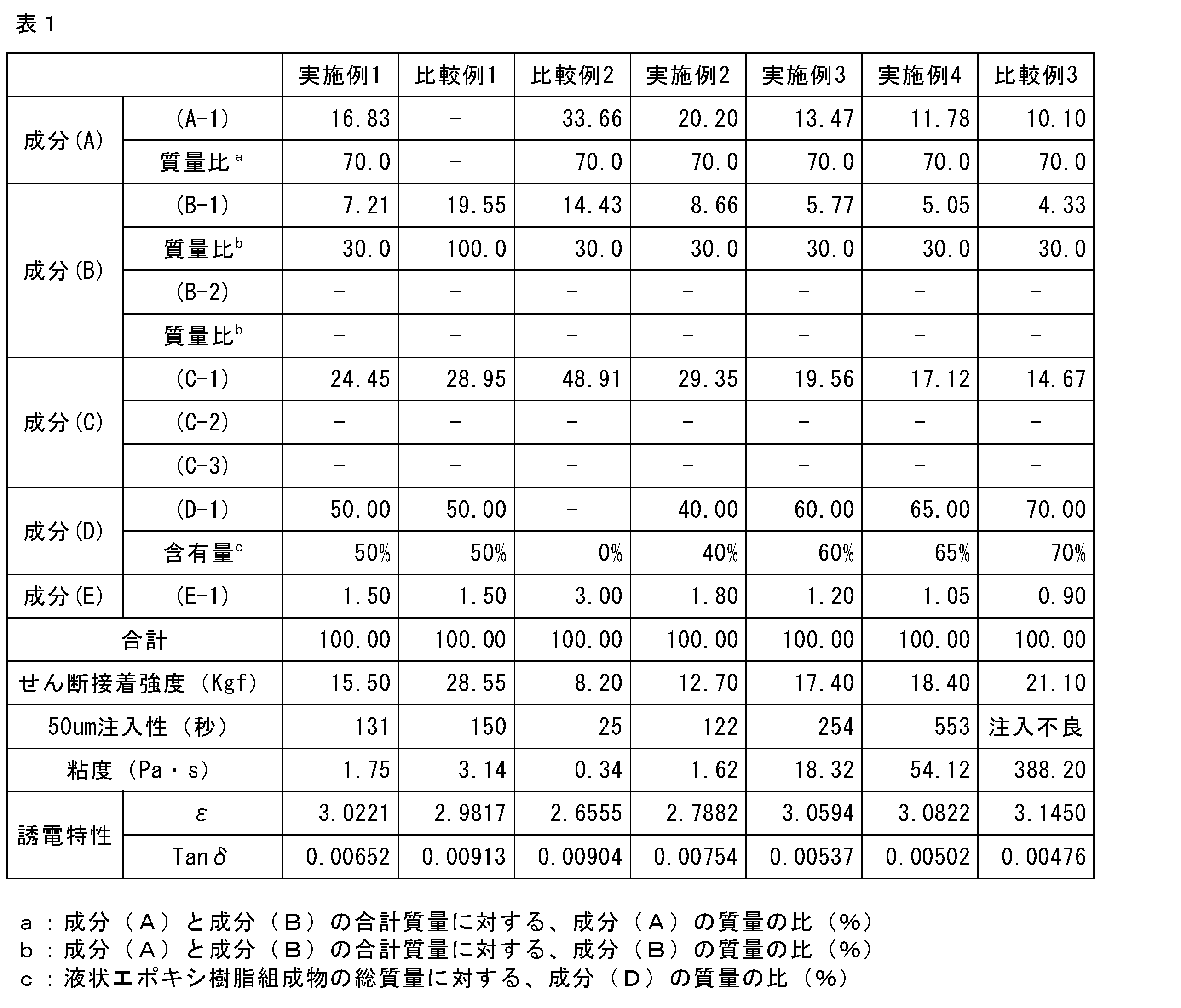
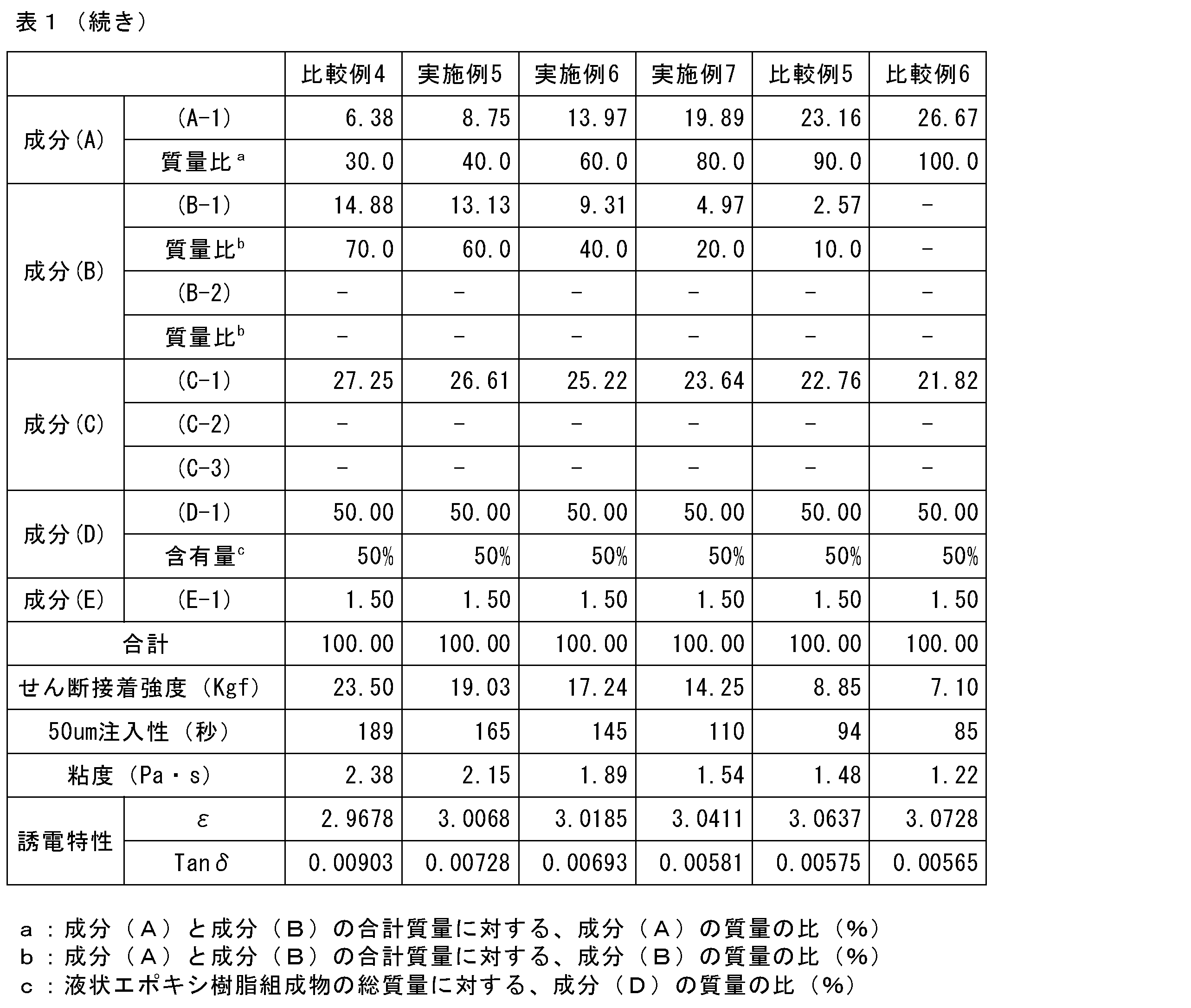
- Examples 1-10, Comparative Examples 1-6 A liquid epoxy resin composition was prepared by mixing predetermined amounts of the respective components according to the formulation shown in Table 1. In Table 1, the amount of each component is expressed in parts by mass.
- B-Second epoxy resin component (B)
- B-1 Bisphenol F type epoxy resin (Brand name: YDF-8170, Nippon Steel & Sumitomo Metal, epoxy equivalent: 159)
- B-2 Bisphenol A type epoxy resin (trade name: EXA-850CRP, manufactured by DIC, epoxy equivalent: 172)
- ⁇ Curing agent component (C)
- the compounds used as the component (C) in the examples and comparative examples are as follows.
- component (D) ⁇ Filler (component (D)
- the compounds used as the component (D) in the examples and comparative examples are as follows.
- the properties of the liquid epoxy resin composition and the cured product were measured as follows.
- Shear strength A FR-4 grade glass cloth-epoxy resin substrate is bonded with a 2 mm square silicon chip (the surface of which is stabilized by forming a SiN film) using 0.5 mg of a liquid epoxy resin composition, and the temperature is increased to 150° C. A sample was obtained after curing for 2 hours. The shear adhesion strength (unit: Kgf) was measured for each of the obtained samples using a Bond Tester Series 4000 (manufactured by ARCTEC) at a head speed of 200.0 ⁇ m/s. The results are shown in Table 1.
- the liquid epoxy resin composition was injected into the gap of 20 ⁇ m, and the time required for the injected liquid epoxy resin composition to reach the position of 20 mm from the injection position was measured. The shorter the time to reach this position, the better the injection property.
- the liquid epoxy resin composition of the present invention is excellent in dielectric properties (relative permittivity and dielectric loss tangent), injectability and adhesive strength (Examples 1 to 10).
- the mass of the component (A) is less than 40% with respect to the total mass of the component (A) and the component (B)
- the dielectric properties of the cured product obtained by curing the liquid epoxy resin composition are not sufficiently improved ( Comparative Examples 1 and 4).
- the mass of the component (A) is more than 80% with respect to the total mass of the component (A) and the component (B)
- the adhesive strength of the liquid epoxy resin composition becomes insufficient (Comparative Example 5 and 6).
- the sum of the components (A) and (B) is required. It is necessary that the ratio of the mass of the component (A) to the mass and the ratio of the mass of the component (D) to the total mass of the liquid epoxy resin composition are within the respective predetermined ranges.
- the liquid epoxy resin composition of the present invention is a low-viscosity liquid at room temperature and exhibits sufficient adhesive strength for fixing electronic components to a substrate. Further, the cured product obtained by curing the liquid epoxy resin composition of the present invention exhibits a lower relative dielectric constant and dielectric loss tangent than the cured product provided by the conventional product. Therefore, by using the liquid epoxy resin composition of the present invention, it is possible to easily prepare an electronic component including finer wiring and capable of processing a higher frequency signal. Can be mounted on a substrate with sufficient adhesive strength.
Landscapes
- Chemical & Material Sciences (AREA)
- Organic Chemistry (AREA)
- Health & Medical Sciences (AREA)
- Chemical Kinetics & Catalysis (AREA)
- Medicinal Chemistry (AREA)
- Polymers & Plastics (AREA)
- Engineering & Computer Science (AREA)
- Manufacturing & Machinery (AREA)
- Materials Engineering (AREA)
- Inorganic Chemistry (AREA)
- Epoxy Resins (AREA)
- Sealing Material Composition (AREA)
- Compositions Of Macromolecular Compounds (AREA)
- Adhesives Or Adhesive Processes (AREA)
- Structures Or Materials For Encapsulating Or Coating Semiconductor Devices Or Solid State Devices (AREA)
- Wire Bonding (AREA)
Abstract
本発明は、常温では低粘度の液体であり、かつ十分な接着強度を示すと共に、従来品に比して低い比誘電率及び誘電正接を示す硬化物を与える液状エポキシ樹脂組成物及びそれを硬化させて得られる硬化物等を提供することを目的とする。 本発明の液状エポキシ樹脂組成物は、(A)第1のエポキシ樹脂、(B)第2のエポキシ樹脂、(C)エポキシ樹脂を硬化させることができる硬化剤及び(D)充填剤を特定の組成で含む。本発明の液状エポキシ樹脂組成物は、常温では低粘度の液体であり、かつ電子部品を基板に固定するのに十分な接着強度を示す。また、本発明の液状エポキシ樹脂組成物を硬化させて得られる硬化物は、従来品が与える硬化物に比して低い比誘電率及び誘電正接を示す。したがって、本発明の液状エポキシ樹脂組成物を用いると、より微細化された配線を含み、より高周波の信号を処理することに対応し得る電子部品を容易に作成することができ、またこの電子部品を、十分な接着強度をもって基板に実装することができる。
Description
本発明は、電子部品の製作において接着剤又は封止材として好適に使用し得る液状エポキシ樹脂組成物、それを硬化させて得られる硬化物及びその硬化物を含む電子部品に関するものである。
近年、電子機器の高性能化に伴い、それらの電子機器に含まれる回路において、より高周波の信号を処理することが求められている。これに伴い、信号の伝送時に生じる信号の遅延や伝送損失が問題となる。
信号の遅延や伝送損失は、電子機器内の基板や電子部品に含まれる絶縁体の誘電特性を改善すること、特に、比誘電率及び誘電正接を低下させることによって抑制することができる。
信号の遅延や伝送損失は、電子機器内の基板や電子部品に含まれる絶縁体の誘電特性を改善すること、特に、比誘電率及び誘電正接を低下させることによって抑制することができる。
また、電子部品内の配線が近年著しく微細化され、配線間や端子間の間隔が極めて狭くなっており、優れた絶縁性の確保が重要な課題となっている。短絡を回避し得る十分な絶縁を確保するためには、より比誘電率の低い絶縁体を用いることが必要になる。
従来より、電子機器に用いられる電子部品、例えば半導体チップの封止やアンダーフィル用途には、信頼性の保持等を目的として、エポキシ樹脂組成物を含む接着剤等がしばしば用いられる。このため、今後の更なる配線の微細化や、更に高周波の信号を処理することに対応し得る、より低い比誘電率及び誘電正接を示す硬化物を与えるエポキシ樹脂組成物の開発が求められている。特に、超高周波の信号を扱う、第5世代移動通信システムや車載用の準ミリ波レーダーに適した封止材やアンダーフィル等の開発は、喫緊の課題となっている。
また、電子部品用の接着剤等は、毛細管現象を利用した狭小部への注入が必要になることがある。そのため、電子部品用の接着剤等に含まれるエポキシ樹脂組成物は、十分な接着強度を示すことはもちろん、製造される温度において低粘度の液体であることが必要である。
また、電子部品用の接着剤等は、毛細管現象を利用した狭小部への注入が必要になることがある。そのため、電子部品用の接着剤等に含まれるエポキシ樹脂組成物は、十分な接着強度を示すことはもちろん、製造される温度において低粘度の液体であることが必要である。
しかし、低い比誘電率及び誘電正接、十分な接着強度、常温における低い粘度という上記の要求全てを満足し得るエポキシ樹脂組成物は、従来知られていなかった。例えば特許文献1及び2は、誘電正接の低い硬化物をもたらすエポキシ樹脂組成物を開示している。しかし、これらの組成物は、プリント基板等を作成するための接着フィルムの形態で用いることが意図されているので、その粘度は十分に低いものではない。また、これらの組成物が与える硬化物については、誘電正接の低下は確認されているものの、比誘電率の低下は確認されていない。
本発明は、上記した従来技術の問題点を解決するため、常温では低粘度の液体であり、かつ十分な接着強度を示すと共に、従来品に比して低い比誘電率及び誘電正接を示す硬化物を与える液状エポキシ樹脂組成物及びそれを硬化させて得られる硬化物等を提供することを目的とする。
本発明者らは、上記問題点を解決するために鋭意研究を重ねた結果、本発明に到達した。
すなわち、本発明は、以下に限定されるものではないが、次の発明を包含する。
1.下記成分(A)~(D):
(A)下記式(1):
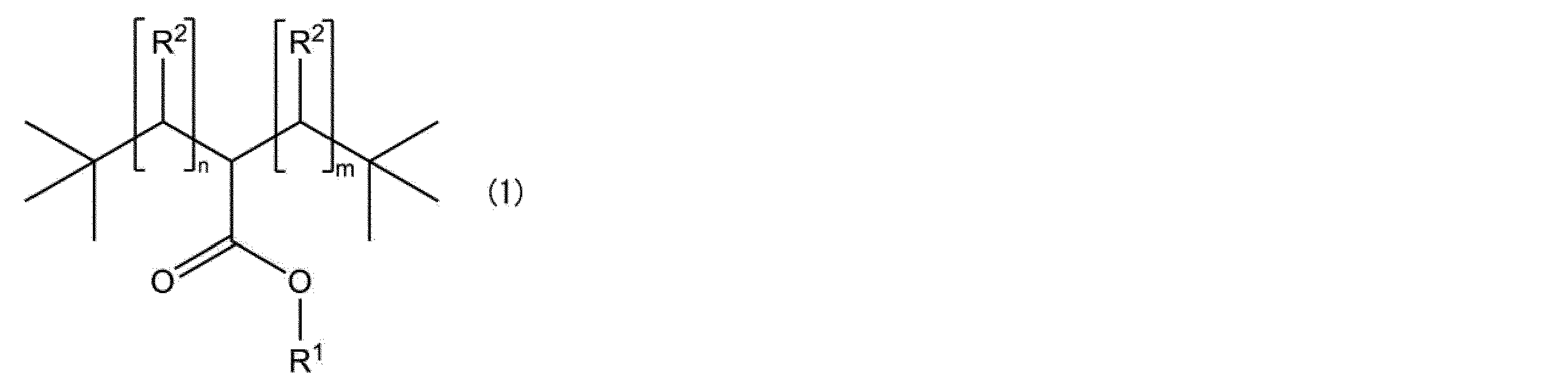
[式中、
R1は、1つ~3つのエポキシ基を含み、かつエーテル結合を含んでいてもよい1価の炭化水素基を表し、
R1が2つ又は3つのエポキシ基を含むとき、R1は分岐した構造を有し、
それぞれのR2は、独立に水素原子又はメチル基を表し、
n及びmは、各々独立に1~10の整数を表す。]
で表される構造を有する第1のエポキシ樹脂
(B)式(1)で表される構造以外の構造を有する第2のエポキシ樹脂
(C)エポキシ樹脂を硬化させることができる硬化剤
(D)充填剤
を含む液状エポキシ樹脂組成物であって、
該成分(A)の質量が、該成分(A)と該成分(B)の合計質量に対し、40%以上、80%以下であり、
該成分(D)の質量が、液状エポキシ樹脂組成物の総質量に対し、40%以上、65%以下である、液状エポキシ樹脂組成物。
(A)下記式(1):
[式中、
R1は、1つ~3つのエポキシ基を含み、かつエーテル結合を含んでいてもよい1価の炭化水素基を表し、
R1が2つ又は3つのエポキシ基を含むとき、R1は分岐した構造を有し、
それぞれのR2は、独立に水素原子又はメチル基を表し、
n及びmは、各々独立に1~10の整数を表す。]
で表される構造を有する第1のエポキシ樹脂
(B)式(1)で表される構造以外の構造を有する第2のエポキシ樹脂
(C)エポキシ樹脂を硬化させることができる硬化剤
(D)充填剤
を含む液状エポキシ樹脂組成物であって、
該成分(A)の質量が、該成分(A)と該成分(B)の合計質量に対し、40%以上、80%以下であり、
該成分(D)の質量が、液状エポキシ樹脂組成物の総質量に対し、40%以上、65%以下である、液状エポキシ樹脂組成物。
2.硬化促進剤を更に含む、前項1記載の液状エポキシ樹脂組成物。
3.前記成分(B)が、ビスフェノールF型エポキシ樹脂、ビスフェノールA型エポキシ樹脂、アミノフェノール型エポキシ樹脂及びナフタレン型エポキシ樹脂からなる群より選択される少なくとも1種を含む、前項1又は2記載の液状エポキシ樹脂組成物。
4.前記成分(C)が、酸無水物、アミン化合物及びフェノール樹脂からなる群より選択される少なくとも1種を含む、前項1~3のいずれか一項記載の液状エポキシ樹脂組成物。
5.前記成分(D)が、シリカ充填剤及びアルミナ充填剤からなる群より選択される少なくとも1種を含む、前項1~4のいずれか一項記載の液状エポキシ樹脂組成物。
6.前項1~5のいずれか一項記載の液状エポキシ樹脂組成物を硬化させて得られる、硬化物。
7.前項1~5のいずれか一項記載の液状エポキシ樹脂組成物を含む、接着剤又は封止材。
8.前項1~5のいずれか一項記載の液状エポキシ樹脂組成物を含む、フィルム。
9.前項6記載の硬化物、前項7記載の接着剤若しくは封止材の硬化物、又は前項8記載のフィルムの硬化物を含む、電子部品。
本発明の液状エポキシ樹脂組成物は、常温では低粘度の液体であり、かつ電子部品を基板に固定するのに十分な接着強度を示す。また、本発明の液状エポキシ樹脂組成物を硬化させて得られる硬化物は、従来品が与える硬化物に比して低い比誘電率及び誘電正接を示す。したがって、本発明の液状エポキシ樹脂組成物を用いると、より微細化された配線を含み、より高周波の信号を処理することに対応し得る電子部品を容易に作成することができ、またこの電子部品を、十分な接着強度をもって基板に実装することができる。
以下、本発明の実施形態について詳細に説明する。
本発明は、下記成分(A)~(D):
(A)第1のエポキシ樹脂
(B)第2のエポキシ樹脂
(C)エポキシ樹脂を硬化させることができる硬化剤
(D)充填剤
を含み、
上記成分(A)の質量が、上記成分(A)と上記成分(B)の合計質量に対し、40%以上、80%以下であり、
上記成分(D)の質量が、上記成分(A)~(D)の合計質量に対し、40%以上、80%以下である、液状エポキシ樹脂組成物に関する。本発明の液状エポキシ樹脂組成物に含まれる上記成分(A)~(D)に関し、以下に説明する。
本発明は、下記成分(A)~(D):
(A)第1のエポキシ樹脂
(B)第2のエポキシ樹脂
(C)エポキシ樹脂を硬化させることができる硬化剤
(D)充填剤
を含み、
上記成分(A)の質量が、上記成分(A)と上記成分(B)の合計質量に対し、40%以上、80%以下であり、
上記成分(D)の質量が、上記成分(A)~(D)の合計質量に対し、40%以上、80%以下である、液状エポキシ樹脂組成物に関する。本発明の液状エポキシ樹脂組成物に含まれる上記成分(A)~(D)に関し、以下に説明する。
[第1のエポキシ樹脂(成分(A))]
本発明の液状エポキシ樹脂組成物は、下記式(1):
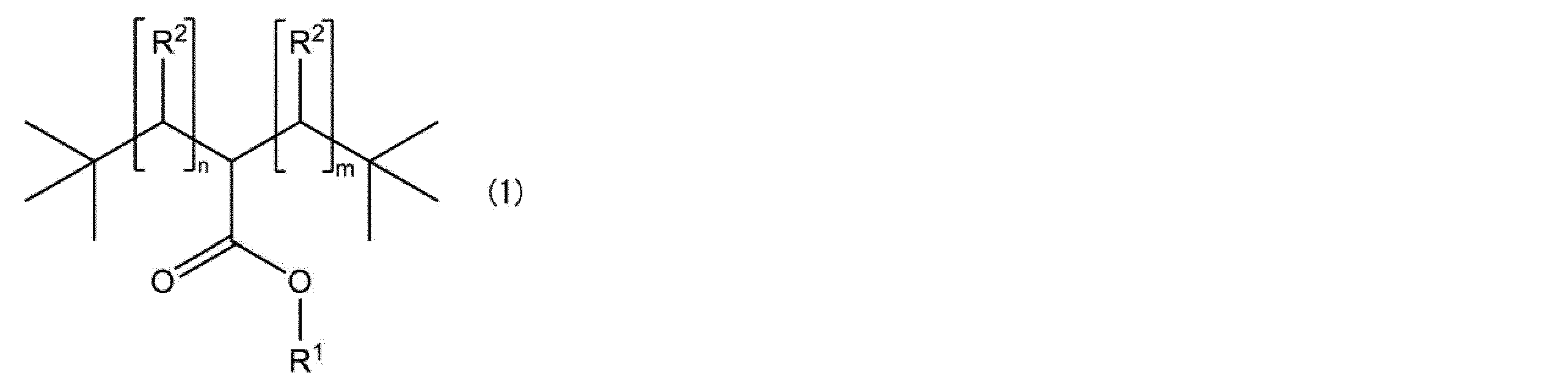
[式中、
R1は、1つ~3つのエポキシ基を含み、かつエーテル結合を含んでいてもよい1価の炭化水素基を表し、
R1が2つ又は3つのエポキシ基を含むとき、R1は分岐した構造を有し、
それぞれのR2は、独立に水素原子又はメチル基を表し、
n及びmは、各々独立に1~10の整数を表す。]
で表される構造を有する第1のエポキシ樹脂を含有する。以降、この第1のエポキシ樹脂を「成分(A)」と称する場合がある。成分(A)は、上記式(1)で表される、特定の構造を有する分岐状脂肪族カルボン酸のエステルである。成分(A)は、本発明の液状エポキシ樹脂組成物を硬化させて得られる硬化物の誘電特性を向上させる作用を示すので、成分(A)の使用は本発明において重要である。成分(A)は、単独で用いてもよく、2種以上を併用してもよい。
本発明の液状エポキシ樹脂組成物は、下記式(1):
[式中、
R1は、1つ~3つのエポキシ基を含み、かつエーテル結合を含んでいてもよい1価の炭化水素基を表し、
R1が2つ又は3つのエポキシ基を含むとき、R1は分岐した構造を有し、
それぞれのR2は、独立に水素原子又はメチル基を表し、
n及びmは、各々独立に1~10の整数を表す。]
で表される構造を有する第1のエポキシ樹脂を含有する。以降、この第1のエポキシ樹脂を「成分(A)」と称する場合がある。成分(A)は、上記式(1)で表される、特定の構造を有する分岐状脂肪族カルボン酸のエステルである。成分(A)は、本発明の液状エポキシ樹脂組成物を硬化させて得られる硬化物の誘電特性を向上させる作用を示すので、成分(A)の使用は本発明において重要である。成分(A)は、単独で用いてもよく、2種以上を併用してもよい。
上記式(1)におけるR1は、1価の炭化水素基である。1価の炭化水素基とは、炭化水素の炭素原子から1つの水素原子を除去することにより生じる1価の基を指す。1価の炭化水素基としては、例えば、アルキル基、アルケニル基、アルキニル基、シクロアルキル基、アルキル置換シクロアルキル基、アリール基、アラルキル基、アルカリル基が挙げられる。
上記アルキル基、アルケニル基、及びアルキニル基(以下、「アルキル基等」と総称する。)の炭素数には特に限定はない。上記アルキル基の炭素数は、通常1~20、好ましくは2~18、更に好ましくは3~17、より好ましくは4~16、特に好ましくは5~15である。また、上記アルケニル基及びアルキニル基の炭素数は、通常2~20、好ましくは2~18、更に好ましくは3~17、より好ましくは4~16、特に好ましくは5~15である。上記アルキル基等が環状構造を含む場合、上記アルキル基等の炭素数は、通常4~20、好ましくは4~18、更に好ましくは5~16、より好ましくは6~15である。上記アルキル基等の炭素数は、例えばLC-TOFや核磁気共鳴法(NMR法)によって特定できる。
上記アルキル基等の構造には特に限定はない。上記アルキル基等は、直鎖状でもよく、側鎖を有していてもよい。上記アルキル基等は、鎖状構造でもよく、環状構造(シクロアルキル基、シクロアルケニル基、及びシクロアルキニル基)でもよい。上記アルキル基等は、他の置換基を1種又は2種以上有していてもよい。例えば、上記アルキル基等は、置換基として、炭素原子及び水素原子以外の原子を含む置換基を有していてもよい。また、上記アルキル基等は、鎖状構造中又は環状構造中に炭素原子及び水素原子以外の原子を1つ又は2つ以上含んでいてもよい。上記炭素原子及び水素原子以外の原子としては、例えば、酸素原子及び窒素原子の1種又は2種以上が挙げられる。
上記式(1)におけるR1は、1つ~3つのエポキシ基を含む。好ましくは、R1は、1つ又は2つのエポキシ基を含む。より好ましくは、R1は、2つのエポキシ基を含む。
R1が2つ又は3つのエポキシ基を含むとき、R1は分岐した構造を有する。すなわちこの場合、R1は側鎖を有する。
このエポキシ基に加えて、R1は、アルキル、シクロアルキル、ヘテロシクリル、アリール、ヘテロアリール、アリル、アルコキシ、アルキルチオ、アリールオキシ、ヒドロキシル、ニトロ、アミド、アジド、シアノ、アシロキシ、カルボキシ、スルホキシ、アクリロキシ、シロキシ、またはエステルで置換されていてもよい。すなわちR1は、エーテル結合を含んでいてもよい。
R1が2つ又は3つのエポキシ基を含むとき、R1は分岐した構造を有する。すなわちこの場合、R1は側鎖を有する。
このエポキシ基に加えて、R1は、アルキル、シクロアルキル、ヘテロシクリル、アリール、ヘテロアリール、アリル、アルコキシ、アルキルチオ、アリールオキシ、ヒドロキシル、ニトロ、アミド、アジド、シアノ、アシロキシ、カルボキシ、スルホキシ、アクリロキシ、シロキシ、またはエステルで置換されていてもよい。すなわちR1は、エーテル結合を含んでいてもよい。
一態様において、R1は、グリシジルオキシ基を1つ以上含む。他の一態様において、R1は、グリシジルオキシ基を1つ又は2つ含む。他の一態様において、R1は、グリシジルオキシ基を2つ含む。
上記式(1)において、n及びmは、好ましくは1~8であり、より好ましくは1~6であり、特に好ましくは2~4である。一態様において、n=4、m=2であり、R2のうち2個がメチル基であり、他のR2が水素原子である。
本発明の液状エポキシ樹脂組成物における成分(A)の含有量は、特に限定されないが、本発明の液状エポキシ樹脂組成物100質量%に対し、好ましくは20~40質量%であり、更に好ましくは30~40質量%である。成分(A)の含有量が少なすぎると、本発明の液状エポキシ樹脂組成物を硬化させて得られる硬化物の誘電特性が十分向上されない。一方、成分(A)の含有量が多すぎると、本発明の液状エポキシ樹脂組成物の示す接着強度が不十分になる。
成分(A)の状態に特に制限はなく、本発明の組成物が液状である限り、成分(A)は液状であってもよく、固体であってもよい。2種以上の成分(A)を併用する場合、成分(A)の状態は、全ての成分(A)を混合して得られる混合物の状態をいう。本発明において、好ましくは、成分(A)は液状である。また、成分(A)の粘度(25℃)は、特に限定されないが、好ましくは0.01~5Pa・sであり、より好ましくは0.1~3Pa・sであり、特に好ましくは0.1~1Pa・sである。
なお近年、エポキシ樹脂用の硬化剤としてある種のエステル化合物が用いられる場合がある。このようなエステル化合物は通常「活性エステル化合物」と称され、フェノールエステル、チオフェノールエステル等の、エポキシ基との反応性を向上させる構造(例えば、特開昭62-053327号公報を参照)を有しているため、その名称が示す通り、エポキシ基との反応性が相対的に高いエステル化合物である。
一方、上記式(1)より明らかなように、上記成分(A)は、特定の構造を有する分岐状脂肪族カルボン酸が、エステル結合を介して炭化水素基R1と結合した構造を有するエステル化合物である。しかし成分(A)は、エポキシ基との反応性を向上させる構造を有しておらず、硬化剤としての作用を期待しうる物質ではない。
一方、上記式(1)より明らかなように、上記成分(A)は、特定の構造を有する分岐状脂肪族カルボン酸が、エステル結合を介して炭化水素基R1と結合した構造を有するエステル化合物である。しかし成分(A)は、エポキシ基との反応性を向上させる構造を有しておらず、硬化剤としての作用を期待しうる物質ではない。
成分(A)は、市販品(例えば、FOLDI E101、FOLDI E201(日産化学製)等)として入手することができる。
[第2のエポキシ樹脂(成分(B))]
本発明の液状エポキシ樹脂組成物は、上記式(1)で表される構造以外の構造を有する第2のエポキシ樹脂を含有する。以降、この第2のエポキシ樹脂を「成分(B)」と称する場合がある。
本発明においては、2種のエポキシ樹脂、即ち成分(A)及び(B)を組み合わせて用いる。上記したように、成分(A)の使用は本発明において重要であるが、エポキシ樹脂として成分(A)のみを用いると、接着強度が不十分になる。そのため、十分な接着強度を確保する目的で、成分(A)と組み合わせて成分(B)を用いる。
本発明の液状エポキシ樹脂組成物は、上記式(1)で表される構造以外の構造を有する第2のエポキシ樹脂を含有する。以降、この第2のエポキシ樹脂を「成分(B)」と称する場合がある。
本発明においては、2種のエポキシ樹脂、即ち成分(A)及び(B)を組み合わせて用いる。上記したように、成分(A)の使用は本発明において重要であるが、エポキシ樹脂として成分(A)のみを用いると、接着強度が不十分になる。そのため、十分な接着強度を確保する目的で、成分(A)と組み合わせて成分(B)を用いる。
成分(B)は、上記式(1)で表される構造以外の構造を有するエポキシ樹脂である限り特に限定されず、公知のそのようなエポキシ樹脂を用いることができる。成分(B)は、単独で用いてもよく、2種以上を併用してもよい。成分(B)の状態に特に制限はなく、本発明の組成物が液状である限り、成分(B)は液状であってもよく、固体であってもよい。2種以上の成分(B)を併用する場合、成分(B)の状態は、全ての成分(B)を混合して得られる混合物の状態をいう。本発明において、好ましくは、成分(B)は液状である。
成分(B)は、脂肪族エポキシ樹脂と芳香族エポキシ樹脂に大別される。
脂肪族エポキシ樹脂の例としては、
-(ポリ)プロピレングリコールジグリシジルエーテル、ブタンジオールジグリシジルエーテル、ネオペンチルグリコールジグリシジルエーテル、1,6-ヘキサンジオールジグリシジルエーテル、トリメチロールプロパンジグリシジルエーテル、ポリテトラメチレンエーテルグリコールジグリシジルエーテル、グリセリンジグリシジルエーテル、ネオペンチルグリコールジグリシジルエーテルのようなジエポキシ樹脂;
-トリメチロールプロパントリグリシジルエーテル、グリセリントリグリシジルエーテルのようなトリエポキシ樹脂;
-ビニル(3,4-シクロヘキセン)ジオキシド、2-(3,4-エポキシシクロヘキシル)-5,1-スピロ-(3,4-エポキシシクロヘキシル)-m-ジオキサンのような脂環式エポキシ樹脂;
-テトラグリシジルビス(アミノメチル)シクロヘキサンのようなグリシジルアミン型エポキシ樹脂;
-1,3-ジグリシジル-5-メチル-5-エチルヒダントインのようなヒダントイン型エポキシ樹脂;及び
-1,3-ビス(3-グリシドキシプロピル)-1,1,3,3-テトラメチルジシロキサンのようなシリコーン骨格を有するエポキシ樹脂
などが挙げられるが、これらに限定されるものではない。
脂肪族エポキシ樹脂は、分子量が150~800であるものが特に好ましい。
脂肪族エポキシ樹脂の例としては、
-(ポリ)プロピレングリコールジグリシジルエーテル、ブタンジオールジグリシジルエーテル、ネオペンチルグリコールジグリシジルエーテル、1,6-ヘキサンジオールジグリシジルエーテル、トリメチロールプロパンジグリシジルエーテル、ポリテトラメチレンエーテルグリコールジグリシジルエーテル、グリセリンジグリシジルエーテル、ネオペンチルグリコールジグリシジルエーテルのようなジエポキシ樹脂;
-トリメチロールプロパントリグリシジルエーテル、グリセリントリグリシジルエーテルのようなトリエポキシ樹脂;
-ビニル(3,4-シクロヘキセン)ジオキシド、2-(3,4-エポキシシクロヘキシル)-5,1-スピロ-(3,4-エポキシシクロヘキシル)-m-ジオキサンのような脂環式エポキシ樹脂;
-テトラグリシジルビス(アミノメチル)シクロヘキサンのようなグリシジルアミン型エポキシ樹脂;
-1,3-ジグリシジル-5-メチル-5-エチルヒダントインのようなヒダントイン型エポキシ樹脂;及び
-1,3-ビス(3-グリシドキシプロピル)-1,1,3,3-テトラメチルジシロキサンのようなシリコーン骨格を有するエポキシ樹脂
などが挙げられるが、これらに限定されるものではない。
脂肪族エポキシ樹脂は、分子量が150~800であるものが特に好ましい。
一方、芳香族エポキシ樹脂は、ベンゼン環等の芳香環を含む構造を有するエポキシ樹脂である。ビスフェノールA型エポキシ樹脂など、従来頻用されているエポキシ樹脂にはこの種のものが多い。
芳香族エポキシ樹脂の例としては、
-ビスフェノールA型エポキシ樹脂;
-p-グリシジルオキシフェニルジメチルトリスビスフェノールAジグリシジルエーテルのような分岐状多官能ビスフェノールA型エポキシ樹脂;
-ビスフェノールF型エポキシ樹脂;
-ノボラック型エポキシ樹脂;
-フルオレン型エポキシ樹脂;
-ビフェニルアラルキルエポキシ樹脂;
-p-tert-ブチルフェニルグリシジルエーテル、1,4-フェニルジメタノールジグリシジルエーテルのようなジエポキシ樹脂;
-3,3’,5,5’-テトラメチル-4,4’-ジグリシジルオキシビフェニルのようなビフェニル型エポキシ樹脂;
-ジグリシジルアニリン、ジグリシジルトルイジン、トリグリシジル-p-アミノフェノール、テトラグリシジル-m-キシリレンジアミンのようなアミノフェノール型エポキシ樹脂;及び
-ナフタレン型エポキシ樹脂
などが挙げられるが、これらに限定されるものではない。
芳香族エポキシ樹脂は、分子量が200~400であるものが特に好ましい。
一態様においては、成分(B)が、ビスフェノールF型エポキシ樹脂、ビスフェノールA型エポキシ樹脂、アミノフェノール型エポキシ樹脂及びナフタレン型エポキシ樹脂からなる群より選択される少なくとも1種を含む。
芳香族エポキシ樹脂の例としては、
-ビスフェノールA型エポキシ樹脂;
-p-グリシジルオキシフェニルジメチルトリスビスフェノールAジグリシジルエーテルのような分岐状多官能ビスフェノールA型エポキシ樹脂;
-ビスフェノールF型エポキシ樹脂;
-ノボラック型エポキシ樹脂;
-フルオレン型エポキシ樹脂;
-ビフェニルアラルキルエポキシ樹脂;
-p-tert-ブチルフェニルグリシジルエーテル、1,4-フェニルジメタノールジグリシジルエーテルのようなジエポキシ樹脂;
-3,3’,5,5’-テトラメチル-4,4’-ジグリシジルオキシビフェニルのようなビフェニル型エポキシ樹脂;
-ジグリシジルアニリン、ジグリシジルトルイジン、トリグリシジル-p-アミノフェノール、テトラグリシジル-m-キシリレンジアミンのようなアミノフェノール型エポキシ樹脂;及び
-ナフタレン型エポキシ樹脂
などが挙げられるが、これらに限定されるものではない。
芳香族エポキシ樹脂は、分子量が200~400であるものが特に好ましい。
一態様においては、成分(B)が、ビスフェノールF型エポキシ樹脂、ビスフェノールA型エポキシ樹脂、アミノフェノール型エポキシ樹脂及びナフタレン型エポキシ樹脂からなる群より選択される少なくとも1種を含む。
本発明においては、成分(B)が、少なくとも1種の、ヒドロキシル基を有していないエポキシ樹脂を含むことが好ましい。これは、エポキシ樹脂のヒドロキシル基の含有量が高くなると、そのエポキシ樹脂を硬化させて得られる硬化物の誘電率や誘電正接が低下する傾向にあるからである。
また、ヒドロキシル基を有していないエポキシ樹脂を用いても、上記硬化物は必然的に、硬化時のエポキシ基の開裂により生じるヒドロキシル基を含む。あるエポキシ樹脂のエポキシ当量が大きいほど、一定量のそのエポキシ樹脂を硬化させて得られる硬化物におけるそのようなヒドロキシル基の含有量は低くなる。ただし、エポキシ樹脂のエポキシ当量が大きすぎると、十分な数の架橋が形成されず、十分な硬化が得られない。そのため本発明においては、成分(B)が、少なくとも1種の、110~200g/eqのエポキシ当量を有するエポキシ樹脂を含むことが特に好ましい。このエポキシ樹脂のエポキシ当量は、120~180g/eqがより好ましく、130~150g/eqが更に好ましい。
他の一つの態様において、成分(B)は、硬化物の誘電特性を低下させない観点から、実質的に窒素原子を含まない。
また、ヒドロキシル基を有していないエポキシ樹脂を用いても、上記硬化物は必然的に、硬化時のエポキシ基の開裂により生じるヒドロキシル基を含む。あるエポキシ樹脂のエポキシ当量が大きいほど、一定量のそのエポキシ樹脂を硬化させて得られる硬化物におけるそのようなヒドロキシル基の含有量は低くなる。ただし、エポキシ樹脂のエポキシ当量が大きすぎると、十分な数の架橋が形成されず、十分な硬化が得られない。そのため本発明においては、成分(B)が、少なくとも1種の、110~200g/eqのエポキシ当量を有するエポキシ樹脂を含むことが特に好ましい。このエポキシ樹脂のエポキシ当量は、120~180g/eqがより好ましく、130~150g/eqが更に好ましい。
他の一つの態様において、成分(B)は、硬化物の誘電特性を低下させない観点から、実質的に窒素原子を含まない。
本発明の液状エポキシ樹脂組成物における成分(B)の含有量は、特に限定されないが、本発明の液状エポキシ樹脂組成物100質量%に対し、好ましくは10~30質量%である。
なお、後述する成分(E)(硬化促進剤)としてエポキシ樹脂を含む成分(E)を用いる場合、成分(B)の質量は、成分(E)に含まれるエポキシ樹脂を含む質量である。
なお、後述する成分(E)(硬化促進剤)としてエポキシ樹脂を含む成分(E)を用いる場合、成分(B)の質量は、成分(E)に含まれるエポキシ樹脂を含む質量である。
本発明において、成分(A)の質量は、成分(A)と上記成分(B)の合計質量に対し、40%以上、80%以下である。40%未満であると、本発明の液状エポキシ樹脂組成物を硬化させて得られる硬化物の誘電特性が十分向上されない。一方、80%超であると、本発明の液状エポキシ樹脂組成物の示す接着強度が不十分になる。成分(A)の質量は、成分(A)と成分(B)の合計質量に対し、好ましくは40%以上、80%以下であり、より好ましくは60%以上、80%以下である。
成分(B)は、市販品(例えば、YDF8170(新日鉄製)、EXA850CRP(DIC製)等)として入手することができる。
[硬化剤(成分(C))]
本発明の液状エポキシ樹脂組成物は、エポキシ樹脂を硬化させることができる硬化剤を含有する。以降、この硬化剤を「成分(C)」と称する場合がある。
本発明の液状エポキシ樹脂組成物は、エポキシ樹脂を硬化させることができる硬化剤を含有する。以降、この硬化剤を「成分(C)」と称する場合がある。
成分(C)は、エポキシ樹脂を硬化させることができる限り特に限定されず、公知の硬化剤を用いることができる。成分(C)は、単独で用いてもよく、2種以上を併用してもよい。
成分(C)の例としては、フェノール樹脂、酸無水物、アミン化合物(芳香族アミン等)及びイミダゾール誘導体等を挙げることができる。
フェノール樹脂の例としては、フェノールノボラック樹脂、クレゾールノボラック樹脂、ナフトール修飾フェノール樹脂、ジシクロペンタジエン修飾フェノール樹脂及びp-キシレン修飾フェノール樹脂を挙げることができる。
酸無水物の例としては、メチルテトラヒドロフタル酸無水物、メチルヘキサヒドロフタル酸無水物、アルキル化テトラヒドロフタル酸無水物、ヘキサヒドロフタル酸無水物、メチルハイミック無水物、ドデセニル無水コハク酸及びメチルナド酸無水物を挙げることができる。
アミン化合物の例としては、芳香族アミン、例えばメチレンジアニリン、m-フェニレンジアミン、4,4’-ジアミノジフェニルスルホン及び3,3’-ジアミノジフェニルスルホンを挙げることができる。
本発明においては、成分(C)が、酸無水物、アミン化合物及びフェノール樹脂からなる群より選択される少なくとも1種を含むことが好ましい。本発明の液状エポキシ樹脂組成物を硬化させて得られる硬化物の誘電特性の観点から、成分(C)が酸無水物であることが特に好ましい。
成分(C)の例としては、フェノール樹脂、酸無水物、アミン化合物(芳香族アミン等)及びイミダゾール誘導体等を挙げることができる。
フェノール樹脂の例としては、フェノールノボラック樹脂、クレゾールノボラック樹脂、ナフトール修飾フェノール樹脂、ジシクロペンタジエン修飾フェノール樹脂及びp-キシレン修飾フェノール樹脂を挙げることができる。
酸無水物の例としては、メチルテトラヒドロフタル酸無水物、メチルヘキサヒドロフタル酸無水物、アルキル化テトラヒドロフタル酸無水物、ヘキサヒドロフタル酸無水物、メチルハイミック無水物、ドデセニル無水コハク酸及びメチルナド酸無水物を挙げることができる。
アミン化合物の例としては、芳香族アミン、例えばメチレンジアニリン、m-フェニレンジアミン、4,4’-ジアミノジフェニルスルホン及び3,3’-ジアミノジフェニルスルホンを挙げることができる。
本発明においては、成分(C)が、酸無水物、アミン化合物及びフェノール樹脂からなる群より選択される少なくとも1種を含むことが好ましい。本発明の液状エポキシ樹脂組成物を硬化させて得られる硬化物の誘電特性の観点から、成分(C)が酸無水物であることが特に好ましい。
本発明の液状エポキシ樹脂組成物中の成分(C)の含有量は、特に限定されないが、上記成分(A)及び(B)のエポキシ基の合計量に対し、成分(C)のエポキシ基と反応する官能基(酸無水基、アミノ基、ヒドロキシル基等)の合計量がほぼ当量であることが好ましい。すなわち、上記成分(A)及び(B)中のエポキシ基の合計量を1当量とするとき、上記成分(C)のエポキシ基と反応する官能基の合計量が、好ましくは0.3~1.5当量、より好ましくは0.6~1.2当量である。官能基の合計量が上記の範囲外であると、未反応の官能基が多くなるため、加水分解性が高くなるなどの悪影響があり、また吸水性が高くなることから、誘電特性の悪化を招く。
成分(C)は、市販品(例えば、YH306(酸無水物、三菱化学製)、HDAA(アミン化合物、日本化薬製)、MEH8005(フェノール樹脂、明和化成製)等)として入手することができる。
[充填剤(成分(D))]
本発明の液状エポキシ樹脂組成物は、充填剤を含有する。以降、この充填剤を「成分(D)」と称する場合がある。
成分(D)は、本発明の液状エポキシ樹脂組成物を接着剤又は封止材として用いる際の、被着材に対する接着強度を向上する作用を有するので、成分(D)の使用は本発明において重要な意義を有する。
本発明の液状エポキシ樹脂組成物は、充填剤を含有する。以降、この充填剤を「成分(D)」と称する場合がある。
成分(D)は、本発明の液状エポキシ樹脂組成物を接着剤又は封止材として用いる際の、被着材に対する接着強度を向上する作用を有するので、成分(D)の使用は本発明において重要な意義を有する。
成分(D)は特に限定されず、公知の充填剤を使用することができる。成分(D)は、単独で使用しても、2種以上を併用してもよい。成分(D)の具体的な例としては、シリカ充填剤、アルミナ充填剤、タルク充填剤、炭酸カルシウム充填剤等が挙げられる。好ましくは、成分(D)が、シリカ充填剤及びアルミナ充填剤からなる群より選択される少なくとも1種を含む。
成分(D)の平均粒径は、特に限定されないが、レーザー回折散乱式粒度分布計によって測定されたメジアン径(D50)としての平均粒径で、好ましくは0.01~20μmであり、より好ましくは0.1~10μmであり、最も好ましくは0.3~7μmである。
本発明の液状エポキシ樹脂組成物において、成分(D)の質量は、液状エポキシ樹脂組成物の総質量に対し、40%以上、65%以下である。40%未満であると、本発明の液状エポキシ樹脂組成物の示す接着強度が不十分になる。一方、65%超であると、本発明の液状エポキシ樹脂組成物の粘度が過度に高くなり、狭ギャップへの注入性が不十分になる。成分(D)の質量は、液状エポキシ樹脂組成物の総質量に対し、好ましくは50%以上、60%以下である。
成分(D)は、市販品(例えば、SO-E5(シリカ充填剤、アドマテックス製)として入手することができる。
本発明の液状エポキシ樹脂組成物は、必要に応じて、必須成分である上記成分(A)~(D)に加え、任意成分を含有していてもよい。以降、それらの任意成分につき説明する。
[硬化促進剤(成分(E))]
本発明の液状エポキシ樹脂組成物は、所望であれば、硬化促進剤を含有してもよい。以降、この硬化促進剤を「成分(E)」と称する場合がある。一態様において、本発明の液状エポキシ樹脂組成物は、硬化促進剤を更に含む。
本発明の液状エポキシ樹脂組成物は、所望であれば、硬化促進剤を含有してもよい。以降、この硬化促進剤を「成分(E)」と称する場合がある。一態様において、本発明の液状エポキシ樹脂組成物は、硬化促進剤を更に含む。
本発明において用いる成分(E)は、成分(C)によるエポキシ樹脂(上記成分(A)及び(B))の硬化を促進しうる化合物であれば特に限定されず、公知のそのような化合物、例えばイミダゾール化合物を使用することができる。成分(E)は、単独で使用しても、2種以上を併用してもよい。
イミダゾール化合物の例としては、1-メチルイミダゾール、2-ヘプタデシルイミダゾール、2-フェニル-4,5-ジヒドロキシメチルイミダゾール、2-ウンデシルイミダゾール、2-フェニル-4-メチル-5-ヒドロキシメチルイミダゾール、2-フェニル-4-ベンジル-5-ヒドロキシメチルイミダゾール、2,4-ジアミノ-6-(2-メチルイミダゾリル-(1))-エチル-S-トリアジン、2,4-ジアミノ-6-(2’-メチルイミダゾリル-(1)’)-エチル-S-トリアジン・イソシアヌール酸付加物、2-メチルイミダゾール、2-フェニルイミダゾール、2-フェニル-4-メチルイミダゾール、1-シアノエチル-2-フェニルイミダゾール、1-シアノエチル-2-メチルイミダゾール-トリメリテイト、1-シアノエチル-2-フェニルイミダゾール-トリメリテイト、N-(2-メチルイミダゾリル-1-エチル)-尿素、N,N′-(2-メチルイミダゾリル-(1)-エチル)-アジボイルジアミド等が挙げられるが、これらに限定されない。これらのイミダゾール化合物は、市販品(例えば、2P4MZ(2-フェニル-4-メチルイミダゾール、四国化成製)等)として入手することができる。
また成分(E)は、潜在性硬化促進剤であってもよい。潜在性硬化促進剤とは、室温では不活性の状態で、加熱等により活性化されて、硬化促進剤として機能する化合物であり、例えば、常温で固体のイミダゾール化合物;アミン化合物とエポキシ化合物の反応生成物(アミン-エポキシアダクト系)等の固体分散型アミンアダクト系潜在性硬化促進剤;アミン化合物とイソシアネート化合物または尿素化合物の反応生成物(尿素型アダクト系)等が挙げられる。
潜在性硬化促進剤の市販品の代表的な例としては、アミン-エポキシアダクト系(アミンアダクト系)としては、「アミキュアPN-23」(味の素ファインテクノ(株)商品名)、「アミキュアPN-40」(味の素ファインテクノ(株)商品名)、「アミキュアPN-50」(味の素ファインテクノ(株)商品名)、「ハードナーX-3661S」(エー・シー・アール(株)商品名)、「ハードナーX-3670S」(エー・シー・アール(株)商品名)、「ノバキュアHX-3742」(旭化成(株)商品名)、「ノバキュアHX-3721」(旭化成(株)商品名)、「ノバキュアHXA9322HP」(旭化成(株)商品名)、「ノバキュアHXA3922HP」(旭化成(株)商品名)、「ノバキュアHXA3932HP」(旭化成(株)商品名)、「ノバキュアHXA5945HP」(旭化成(株)商品名)、「ノバキュアHXA9382HP」(旭化成(株)商品名)、「フジキュアーFXR1121」(T&K TOKA(株)商品名)などが挙げられ、また、尿素型アダクト系としては、「フジキュアーFXE-1000」(T&K TOKA(株)商品名)、「フジキュアーFXR-1030」(T&K TOKA(株)商品名)等が挙げられるが、これらに限定されない。
成分(E)としては、ポットライフ、硬化性の観点から、固体分散型アミンアダクト系の潜在性硬化促進剤が好ましい。
成分(E)としては、ポットライフ、硬化性の観点から、固体分散型アミンアダクト系の潜在性硬化促進剤が好ましい。
上記成分(E)を用いることにより、本発明の液状エポキシ樹脂組成物を低温条件下でも短時間で硬化させることができる。
なお成分(E)には、エポキシ樹脂(上記成分(B))に分散された分散液の形態で提供されるものがある。そのような形態の成分(E)を使用する場合、それが分散しているエポキシ樹脂の量も、本発明の液状エポキシ樹脂組成物における成分(B)の量に含まれることに注意すべきである。
なお成分(E)には、エポキシ樹脂(上記成分(B))に分散された分散液の形態で提供されるものがある。そのような形態の成分(E)を使用する場合、それが分散しているエポキシ樹脂の量も、本発明の液状エポキシ樹脂組成物における成分(B)の量に含まれることに注意すべきである。
本発明の液状エポキシ樹脂組成物は、所望であれば、上記成分(E)以外の任意成分、例えば単官能エポキシ樹脂、安定剤、カップリング剤等を更に含有していてもよい。
また、本発明の液状エポキシ樹脂組成物には、所望であれば、本発明の趣旨を損なわない範囲で、更に他の添加剤、例えばカーボンブラック、チタンブラック、イオントラップ剤、レベリング剤、酸化防止剤、消泡剤、揺変剤、粘度調整剤、難燃剤、着色剤、溶剤等を添加することができる。各添加剤の種類、添加量は常法通りである。
また、本発明の液状エポキシ樹脂組成物には、所望であれば、本発明の趣旨を損なわない範囲で、更に他の添加剤、例えばカーボンブラック、チタンブラック、イオントラップ剤、レベリング剤、酸化防止剤、消泡剤、揺変剤、粘度調整剤、難燃剤、着色剤、溶剤等を添加することができる。各添加剤の種類、添加量は常法通りである。
[液状エポキシ樹脂組成物]
本発明の液状エポキシ樹脂組成物は、上記各成分を混合することにより製造することができる。本発明の液状エポキシ樹脂組成物を製造する方法は、特に限定されない。例えば、成分(A)~(D)及び所望であれば成分(E)その他の任意成分を、適切な混合機に同時に、または別々に導入して、必要であれば加熱により溶融しながら撹拌して混合し、均一な組成物とすることにより、本発明の液状エポキシ樹脂組成物を得ることができる。この混合機は特に限定されないが、撹拌装置及び加熱装置を備えたライカイ機、ヘンシェルミキサー、3本ロールミル、ボールミル、プラネタリーミキサー、ビーズミル等を使用することができる。また、これら装置を適宜組み合わせて使用してもよい。
本発明の液状エポキシ樹脂組成物は、上記各成分を混合することにより製造することができる。本発明の液状エポキシ樹脂組成物を製造する方法は、特に限定されない。例えば、成分(A)~(D)及び所望であれば成分(E)その他の任意成分を、適切な混合機に同時に、または別々に導入して、必要であれば加熱により溶融しながら撹拌して混合し、均一な組成物とすることにより、本発明の液状エポキシ樹脂組成物を得ることができる。この混合機は特に限定されないが、撹拌装置及び加熱装置を備えたライカイ機、ヘンシェルミキサー、3本ロールミル、ボールミル、プラネタリーミキサー、ビーズミル等を使用することができる。また、これら装置を適宜組み合わせて使用してもよい。
このようにして得られた液状エポキシ樹脂組成物は熱硬化性であり、温度140~170℃の条件下では、0.5~6時間で硬化することが好ましく、1~2時間で硬化することがより好ましい。
本発明の液状エポキシ樹脂組成物は、例えば、種々の電子部品を含む半導体装置や、電子部品を構成する部品同士を固定、接合又は保護するための、接着剤、封止材、又はその原料として用いることができる。本発明の液状エポキシ樹脂組成物は、電子部品などを保護したり、基板に固定したりするためのアンダーフィル材として特に好適である。
電子部品用の接着剤や封止材は、狭小部への注入が必要になることがあるが、本発明の液状エポキシ樹脂組成物は、常温では低粘度の液体であるため、これらの用途に適している。本発明の液状エポキシ樹脂組成物は特に、電子部品を基板に実装する際、それらの間の狭い隙間に毛細管現象を利用して注入されるキャピラリーアンダーフィル材として有用である。
電子部品用の接着剤や封止材は、狭小部への注入が必要になることがあるが、本発明の液状エポキシ樹脂組成物は、常温では低粘度の液体であるため、これらの用途に適している。本発明の液状エポキシ樹脂組成物は特に、電子部品を基板に実装する際、それらの間の狭い隙間に毛細管現象を利用して注入されるキャピラリーアンダーフィル材として有用である。
狭ギャップへの注入性の観点から、E型粘度計を用いて測定した本発明の液状エポキシ樹脂組成物の25℃における粘度は、好ましくは0.1~100Pa・s、より好ましくは0.2~70Pa・s、更に好ましくは0.3~60Pa・sである。
なお本明細書において、ある物質が「液状」であるとは、その物質が25℃において液体の状態にあることを意味する。「液体」とは、好ましくはE型粘度計を用いて測定した、25℃における粘度0.001~1000Pa・sである流体を意味する。上記物質は純物質であってもよく、混合物であってもよい。この混合物は、均一系の形態にあるもの(溶液等)であってもよく、不均一系の形態にあるもの(乳液、懸濁液等)であってもよい。すなわち、特に断らない限り、この混合物が全体として上記要件を満足していれば、この混合物が上記液体に該当しない成分を含んでいても、その混合物は液状であると見なされる。
加えて、本発明の液状エポキシ樹脂組成物が与える硬化物は、従来の硬化物に比して、比誘電率、誘電正接等の誘電特性に優れている。そのため、本発明の液状エポキシ樹脂組成物を、特に高周波の信号を処理する回路を含む基板の作成に使用すると、従来のエポキシ樹脂組成物を使用する場合に比して、伝送損失及び伝播遅延時間を大幅に抑制することができる。
本発明において、用語「比誘電率」及び「誘電正接」は各々、JIS C2138「電気絶縁材料-比誘電率及び誘電正接の測定方法」で定義されている比誘電率及び誘電正接を意味する。
これらの値は、測定する周波数帯に適した公知の方法、例えば空洞共振器、誘電体共振器等を用いる方法により測定することができる。この明細書において特に断りがない場合は、比誘電率及び誘電正接は、25℃において誘電体共振器を用いて測定した値である。
これらの値は、測定する周波数帯に適した公知の方法、例えば空洞共振器、誘電体共振器等を用いる方法により測定することができる。この明細書において特に断りがない場合は、比誘電率及び誘電正接は、25℃において誘電体共振器を用いて測定した値である。
好ましくは、本発明の液状エポキシ樹脂組成物を硬化させて得られる硬化物の比誘電率は、測定周波数10GHzにおいて、好ましくは2.2~3.8、より好ましくは2.2~3.5、更に好ましくは2.2~3.1である。また、本発明の液状エポキシ樹脂組成物を硬化させて得られる硬化物の誘電正接は、測定周波数10GHzにおいて、好ましくは0.003~0.015、より好ましくは0.003~0.01、更に好ましくは0.003~0.007である。
本発明においては、本発明の液状エポキシ樹脂組成物を含む接着剤又は封止材も提供される。本発明の接着剤又は封止材は、例えば、電子部品などを保護したり、基板に固定したりするためのアンダーフィル材、特にキャピラリーアンダーフィル材として好適である。好ましくは、本発明の液状エポキシ樹脂組成物を含む接着剤又は封止材は、一液型である。
また、本発明においては、本発明の液状エポキシ樹脂組成物、或いは接着剤又は封止材を硬化させて得られる硬化物も提供される。
さらには、本発明においては、本発明の硬化物を含む電子部品も提供される。
また、本発明においては、本発明の液状エポキシ樹脂組成物、或いは接着剤又は封止材を硬化させて得られる硬化物も提供される。
さらには、本発明においては、本発明の硬化物を含む電子部品も提供される。
また、本発明の液状エポキシ樹脂組成物は、フィルムの構成材料として使用することもできる。特に、本発明の液状エポキシ樹脂組成物は、配線パターンを保護するカバーレイ用フィルムや、多層配線基板の層間接着フィルムに好適である。また、本発明の液状エポキシ樹脂組成物を含むフィルムは、好ましくは、電子部品用に使用することができる。本発明においては、本発明の液状エポキシ樹脂組成物を含むフィルムも提供される。
本発明の液状エポキシ樹脂組成物を含むフィルムは、本発明の液状エポキシ樹脂組成物から公知の方法により得ることができる。例えば、本発明の液状エポキシ樹脂組成物を溶剤で希釈してワニスとし、これを支持体の少なくとも片面に塗布し、乾燥させた後、支持体付のフィルム、または、支持体から剥離したフィルムとして提供することができる。
本発明においては、本発明の液状エポキシ樹脂組成物を硬化させて得られる硬化物も提供される。また、本発明においては、本発明の液状エポキシ樹脂組成物を含む接着剤又は封止材を硬化させて得られる硬化物、及び本発明の液状エポキシ樹脂組成物を含むフィルムを硬化させて得られる硬化物も提供される。
さらには、本発明においては、本発明の硬化物、本発明の接着剤若しくは封止材の硬化物、又は本発明のフィルムの硬化物を含む電子部品も提供される。
さらには、本発明においては、本発明の硬化物、本発明の接着剤若しくは封止材の硬化物、又は本発明のフィルムの硬化物を含む電子部品も提供される。
以下、本発明について、実施例により説明するが、本発明はこれらに限定されるものではない。
実施例1~10、比較例1~6
表1に示す配合に従って、所定の量の各成分を混合することにより、液状エポキシ樹脂組成物を調製した。表1において、各成分の量は質量部で表されている。
表1に示す配合に従って、所定の量の各成分を混合することにより、液状エポキシ樹脂組成物を調製した。表1において、各成分の量は質量部で表されている。
・第1のエポキシ樹脂(成分(A))
実施例及び比較例において、成分(A)として用いた化合物は、以下の通りである。
(A-1):イソステアリン酸エステル型エポキシ樹脂(商品名:FOLDI E201、日産化学製、エポキシ当量:285)
実施例及び比較例において、成分(A)として用いた化合物は、以下の通りである。
(A-1):イソステアリン酸エステル型エポキシ樹脂(商品名:FOLDI E201、日産化学製、エポキシ当量:285)
・第2のエポキシ樹脂(成分(B))
実施例及び比較例において、成分(B)として用いた化合物は、以下の通りである。
(B-1):ビスフェノールF型エポキシ樹脂(商品名:YDF-8170、新日鐵住金製、エポキシ当量:159)
(B-2):ビスフェノールA型エポキシ樹脂(商品名:EXA-850CRP、DIC製、エポキシ当量:172)
実施例及び比較例において、成分(B)として用いた化合物は、以下の通りである。
(B-1):ビスフェノールF型エポキシ樹脂(商品名:YDF-8170、新日鐵住金製、エポキシ当量:159)
(B-2):ビスフェノールA型エポキシ樹脂(商品名:EXA-850CRP、DIC製、エポキシ当量:172)
・硬化剤(成分(C))
実施例及び比較例において、成分(C)として用いた化合物は、以下の通りである。
(C-1):YH306(酸無水物、三菱化学製)
(C-2):HDAA(アミン化合物、日本化薬製)
(C-3):MEH8005(フェノールノボラック樹脂、明和化成製)
実施例及び比較例において、成分(C)として用いた化合物は、以下の通りである。
(C-1):YH306(酸無水物、三菱化学製)
(C-2):HDAA(アミン化合物、日本化薬製)
(C-3):MEH8005(フェノールノボラック樹脂、明和化成製)
・充填剤(成分(D))
実施例及び比較例において、成分(D)として用いた化合物は、以下の通りである。
(D-1):SO-E5(シリカ充填剤(粒径1.3~1.7μm)、アドマテックス製)
実施例及び比較例において、成分(D)として用いた化合物は、以下の通りである。
(D-1):SO-E5(シリカ充填剤(粒径1.3~1.7μm)、アドマテックス製)
・硬化促進剤(成分(E))
実施例及び比較例において、成分(E)として用いた化合物は、以下の通りである。
(E-1):2P4MZ(2-フェニル-4-メチルイミダゾール、四国化成製)
実施例及び比較例において、成分(E)として用いた化合物は、以下の通りである。
(E-1):2P4MZ(2-フェニル-4-メチルイミダゾール、四国化成製)
実施例及び比較例においては、液状エポキシ樹脂組成物及び硬化物の特性を、以下のようにして測定した。
[液状エポキシ樹脂組成物の粘度]
東機産業社製E型粘度計(型番:TVE-22H、ローター名:1°34’×R24)(適切な測定レンジ(H、RまたはU)に設定)を用い、液状エポキシ樹脂組成物の粘度(単位:Pa・s)を、25℃で、ローター回転数1rpmで測定した。結果を表1に示す。
東機産業社製E型粘度計(型番:TVE-22H、ローター名:1°34’×R24)(適切な測定レンジ(H、RまたはU)に設定)を用い、液状エポキシ樹脂組成物の粘度(単位:Pa・s)を、25℃で、ローター回転数1rpmで測定した。結果を表1に示す。
[せん断接着強度]
FR-4グレードのガラスクロス-エポキシ樹脂基板に、2mm角のシリコンチップ(SiN膜形成により表面を安定化したもの)を、0.5mgの液状エポキシ樹脂組成物を用いて接着し、150℃で2時間硬化させて、試料を得た。得られた各試料に関し、Bond Tester Series 4000(ARCTEC製)を用いて、ヘッドスピード200.0μm/sでせん断接着強度(単位:Kgf)を測定した。結果を表1に示す。
FR-4グレードのガラスクロス-エポキシ樹脂基板に、2mm角のシリコンチップ(SiN膜形成により表面を安定化したもの)を、0.5mgの液状エポキシ樹脂組成物を用いて接着し、150℃で2時間硬化させて、試料を得た。得られた各試料に関し、Bond Tester Series 4000(ARCTEC製)を用いて、ヘッドスピード200.0μm/sでせん断接着強度(単位:Kgf)を測定した。結果を表1に示す。
[注入性]
110℃において、20μmのギャップ(間隙)に液状エポキシ樹脂組成物を注入し、注入された液状エポキシ樹脂組成物が、注入位置から20mmの位置に到達するまでの時間を測定した。この位置に到達するまでの時間が短いほど、注入性が良いことを示している。
110℃において、20μmのギャップ(間隙)に液状エポキシ樹脂組成物を注入し、注入された液状エポキシ樹脂組成物が、注入位置から20mmの位置に到達するまでの時間を測定した。この位置に到達するまでの時間が短いほど、注入性が良いことを示している。
[比誘電率(ε)及び誘電正接(Tanδ)]
離型剤を施した50μm厚のポリエチレンテレフタレート(PET)フィルム上に、塗布機を用いて乾燥塗膜が25±5μmの膜厚になるように液状エポキシ樹脂組成物を塗布した後、150℃で120分間加熱することにより、液状エポキシ樹脂組成物を硬化させ、エポキシ樹脂フィルムを得た。得られたエポキシ樹脂フィルムを、PETフィルムごと130×40mmに裁断した後、PETフィルムを除去することにより、比誘電率及び誘電正接測定用試料を作製した。
スプリットポスト誘電体共振器(SPDR)により、温度25℃、周波数10GHzで、上記測定用試料の比誘電率(ε)、誘電正接(Tanδ)を測定した。結果を表1に示す。
離型剤を施した50μm厚のポリエチレンテレフタレート(PET)フィルム上に、塗布機を用いて乾燥塗膜が25±5μmの膜厚になるように液状エポキシ樹脂組成物を塗布した後、150℃で120分間加熱することにより、液状エポキシ樹脂組成物を硬化させ、エポキシ樹脂フィルムを得た。得られたエポキシ樹脂フィルムを、PETフィルムごと130×40mmに裁断した後、PETフィルムを除去することにより、比誘電率及び誘電正接測定用試料を作製した。
スプリットポスト誘電体共振器(SPDR)により、温度25℃、周波数10GHzで、上記測定用試料の比誘電率(ε)、誘電正接(Tanδ)を測定した。結果を表1に示す。

(結果の考察)
表1より明らかなように、本発明の液状エポキシ樹脂組成物は、誘電特性(比誘電率及び誘電正接)、注入性及び接着強度のいずれも優れている(実施例1~10)。
成分(A)の質量が、成分(A)と成分(B)の合計質量に対し40%未満であると、液状エポキシ樹脂組成物を硬化させて得られる硬化物の誘電特性が十分向上されない(比較例1及び4)。
一方、成分(A)の質量が、成分(A)と成分(B)の合計質量に対し80%超であると、液状エポキシ樹脂組成物の示す接着強度が不十分になる(比較例5及び6)。
表1より明らかなように、本発明の液状エポキシ樹脂組成物は、誘電特性(比誘電率及び誘電正接)、注入性及び接着強度のいずれも優れている(実施例1~10)。
成分(A)の質量が、成分(A)と成分(B)の合計質量に対し40%未満であると、液状エポキシ樹脂組成物を硬化させて得られる硬化物の誘電特性が十分向上されない(比較例1及び4)。
一方、成分(A)の質量が、成分(A)と成分(B)の合計質量に対し80%超であると、液状エポキシ樹脂組成物の示す接着強度が不十分になる(比較例5及び6)。
また、成分(D)の質量が、液状エポキシ樹脂組成物の総質量に対し40%未満であると、液状エポキシ樹脂組成物の示す接着強度が不十分になり、液状エポキシ樹脂組成物を硬化させて得られる硬化物の誘電正接も過度に高くなる(比較例2)。
一方、成分(D)の質量が、液状エポキシ樹脂組成物の総質量に対し65%超であると、液状エポキシ樹脂組成物の示す粘度が過度に高くなり、狭ギャップへの注入性が不十分になる(比較例3)。
一方、成分(D)の質量が、液状エポキシ樹脂組成物の総質量に対し65%超であると、液状エポキシ樹脂組成物の示す粘度が過度に高くなり、狭ギャップへの注入性が不十分になる(比較例3)。
以上から明らかなように、液状エポキシ樹脂組成物又はそれを硬化させて得られる硬化物が優れた誘電特性、注入性及び接着強度を示すためには、成分(A)と成分(B)の合計質量に対する成分(A)の質量の比及び液状エポキシ樹脂組成物の総質量に対する成分(D)の質量の比が、各々所定の範囲内にあることが必要である。
本発明の液状エポキシ樹脂組成物は、常温では低粘度の液体であり、かつ電子部品を基板に固定するのに十分な接着強度を示す。また、本発明の液状エポキシ樹脂組成物を硬化させて得られる硬化物は、従来品が与える硬化物に比して低い比誘電率及び誘電正接を示す。したがって、本発明の液状エポキシ樹脂組成物を用いると、より微細化された配線を含み、より高周波の信号を処理することに対応し得る電子部品を容易に作成することができ、またこの電子部品を、十分な接着強度をもって基板に実装することができる。
1 基板
2 バンプ
3 チップ
4 アンダーフィル材
2 バンプ
3 チップ
4 アンダーフィル材
Claims (9)
- 下記成分(A)~(D):
(A)下記式(1):

[式中、
R1は、1つ~3つのエポキシ基を含み、かつエーテル結合を含んでいてもよい1価の炭化水素基を表し、
R1が2つ又は3つのエポキシ基を含むとき、R1は分岐した構造を有し、
それぞれのR2は、独立に水素原子又はメチル基を表し、
n及びmは、各々独立に1~10の整数を表す。]
で表される構造を有する第1のエポキシ樹脂
(B)式(1)で表される構造以外の構造を有する第2のエポキシ樹脂
(C)エポキシ樹脂を硬化させることができる硬化剤
(D)充填剤
を含む液状エポキシ樹脂組成物であって、
該成分(A)の質量が、該成分(A)と該成分(B)の合計質量に対し、40%以上、80%以下であり、
該成分(D)の質量が、液状エポキシ樹脂組成物の総質量に対し、40%以上、65%以下である、液状エポキシ樹脂組成物。 - 硬化促進剤を更に含む、請求項1記載の液状エポキシ樹脂組成物。
- 前記成分(B)が、ビスフェノールF型エポキシ樹脂、ビスフェノールA型エポキシ樹脂、アミノフェノール型エポキシ樹脂及びナフタレン型エポキシ樹脂からなる群より選択される少なくとも1種を含む、請求項1又は2記載の液状エポキシ樹脂組成物。
- 前記成分(C)が、酸無水物、アミン化合物及びフェノール樹脂からなる群より選択される少なくとも1種を含む、請求項1~3のいずれか一項記載の液状エポキシ樹脂組成物。
- 前記成分(D)が、シリカ充填剤及びアルミナ充填剤からなる群より選択される少なくとも1種を含む、請求項1~4のいずれか一項記載の液状エポキシ樹脂組成物。
- 請求項1~5のいずれか一項記載の液状エポキシ樹脂組成物を硬化させて得られる、硬化物。
- 請求項1~5のいずれか一項記載の液状エポキシ樹脂組成物を含む、接着剤又は封止材。
- 請求項1~5のいずれか一項記載の液状エポキシ樹脂組成物を含む、フィルム。
- 請求項6記載の硬化物、請求項7記載の接着剤若しくは封止材の硬化物、又は請求項8記載のフィルムの硬化物を含む、電子部品。
Priority Applications (1)
| Application Number | Priority Date | Filing Date | Title |
|---|---|---|---|
| KR1020217029358A KR102816833B1 (ko) | 2019-02-21 | 2020-02-03 | 액상 에폭시 수지 조성물 및 그것을 경화시켜 얻어지는 경화물 |
Applications Claiming Priority (2)
| Application Number | Priority Date | Filing Date | Title |
|---|---|---|---|
| JP2019-029526 | 2019-02-21 | ||
| JP2019029526A JP7241389B2 (ja) | 2019-02-21 | 2019-02-21 | 液状エポキシ樹脂組成物及びそれを硬化させて得られる硬化物 |
Publications (1)
| Publication Number | Publication Date |
|---|---|
| WO2020170778A1 true WO2020170778A1 (ja) | 2020-08-27 |
Family
ID=72144642
Family Applications (1)
| Application Number | Title | Priority Date | Filing Date |
|---|---|---|---|
| PCT/JP2020/003854 Ceased WO2020170778A1 (ja) | 2019-02-21 | 2020-02-03 | 液状エポキシ樹脂組成物及びそれを硬化させて得られる硬化物 |
Country Status (4)
| Country | Link |
|---|---|
| JP (1) | JP7241389B2 (ja) |
| KR (1) | KR102816833B1 (ja) |
| TW (1) | TWI835988B (ja) |
| WO (1) | WO2020170778A1 (ja) |
Cited By (3)
| Publication number | Priority date | Publication date | Assignee | Title |
|---|---|---|---|---|
| CN112457808A (zh) * | 2020-11-20 | 2021-03-09 | 湖北三选科技有限公司 | 氮化镓功率器件用低翘曲高接着力液态模封胶及制备方法 |
| CN116323845A (zh) * | 2020-09-29 | 2023-06-23 | 日东电工株式会社 | 粘合剂组合物、粘合剂层及粘合片 |
| KR20250149972A (ko) | 2023-02-22 | 2025-10-17 | 에이지씨 가부시키가이샤 | 밀봉 수지 조성물 및 전자 부품 장치 |
Families Citing this family (3)
| Publication number | Priority date | Publication date | Assignee | Title |
|---|---|---|---|---|
| JP2021009936A (ja) * | 2019-07-01 | 2021-01-28 | 昭和電工マテリアルズ株式会社 | アンダーフィル用樹脂組成物並びに電子部品装置及びその製造方法 |
| JP7415536B2 (ja) * | 2019-12-18 | 2024-01-17 | 信越化学工業株式会社 | 樹脂組成物、樹脂フィルム、半導体積層体、半導体積層体の製造方法、半導体装置及び半導体装置の製造方法 |
| WO2025249327A1 (ja) * | 2024-05-27 | 2025-12-04 | 株式会社レゾナック | 液状硬化性組成物及び電子部品装置 |
Citations (6)
| Publication number | Priority date | Publication date | Assignee | Title |
|---|---|---|---|---|
| JP2007182561A (ja) * | 2005-12-08 | 2007-07-19 | Hitachi Chem Co Ltd | 電子部品用液状樹脂組成物、及びこれを用いた電子部品装置 |
| JP2009120815A (ja) * | 2007-09-14 | 2009-06-04 | Nippon Kayaku Co Ltd | エポキシ樹脂組成物および半導体装置 |
| WO2012046636A1 (ja) * | 2010-10-05 | 2012-04-12 | 住友ベークライト株式会社 | 液状封止樹脂組成物および半導体パッケージ |
| WO2017077846A1 (ja) * | 2015-11-05 | 2017-05-11 | 日産化学工業株式会社 | エポキシ系反応性希釈剤及びそれを含むエポキシ樹脂組成物 |
| WO2017077845A1 (ja) * | 2015-11-05 | 2017-05-11 | 日産化学工業株式会社 | 多官能エポキシ化合物及びそれを含む硬化性組成物 |
| WO2020017141A1 (ja) * | 2018-07-17 | 2020-01-23 | Jxtgエネルギー株式会社 | 反応性希釈剤、組成物、封止材、硬化物、基板、電子部品、エポキシ化合物、及び化合物の製造方法 |
Family Cites Families (5)
| Publication number | Priority date | Publication date | Assignee | Title |
|---|---|---|---|---|
| JP2012021086A (ja) * | 2010-07-15 | 2012-02-02 | Sumitomo Bakelite Co Ltd | 液状封止樹脂組成物および半導体装置 |
| JP2013163747A (ja) * | 2012-02-10 | 2013-08-22 | Sumitomo Bakelite Co Ltd | 半導体封止用液状樹脂組成物及び半導体装置 |
| JP6163803B2 (ja) | 2013-03-14 | 2017-07-19 | 味の素株式会社 | 樹脂組成物 |
| JP6415104B2 (ja) * | 2014-05-16 | 2018-10-31 | ナミックス株式会社 | 液状封止材、それを用いた電子部品 |
| JP7024174B2 (ja) | 2016-08-26 | 2022-02-24 | 味の素株式会社 | 樹脂組成物 |
-
2019
- 2019-02-21 JP JP2019029526A patent/JP7241389B2/ja active Active
-
2020
- 2020-02-03 WO PCT/JP2020/003854 patent/WO2020170778A1/ja not_active Ceased
- 2020-02-03 TW TW109103209A patent/TWI835988B/zh active
- 2020-02-03 KR KR1020217029358A patent/KR102816833B1/ko active Active
Patent Citations (6)
| Publication number | Priority date | Publication date | Assignee | Title |
|---|---|---|---|---|
| JP2007182561A (ja) * | 2005-12-08 | 2007-07-19 | Hitachi Chem Co Ltd | 電子部品用液状樹脂組成物、及びこれを用いた電子部品装置 |
| JP2009120815A (ja) * | 2007-09-14 | 2009-06-04 | Nippon Kayaku Co Ltd | エポキシ樹脂組成物および半導体装置 |
| WO2012046636A1 (ja) * | 2010-10-05 | 2012-04-12 | 住友ベークライト株式会社 | 液状封止樹脂組成物および半導体パッケージ |
| WO2017077846A1 (ja) * | 2015-11-05 | 2017-05-11 | 日産化学工業株式会社 | エポキシ系反応性希釈剤及びそれを含むエポキシ樹脂組成物 |
| WO2017077845A1 (ja) * | 2015-11-05 | 2017-05-11 | 日産化学工業株式会社 | 多官能エポキシ化合物及びそれを含む硬化性組成物 |
| WO2020017141A1 (ja) * | 2018-07-17 | 2020-01-23 | Jxtgエネルギー株式会社 | 反応性希釈剤、組成物、封止材、硬化物、基板、電子部品、エポキシ化合物、及び化合物の製造方法 |
Cited By (3)
| Publication number | Priority date | Publication date | Assignee | Title |
|---|---|---|---|---|
| CN116323845A (zh) * | 2020-09-29 | 2023-06-23 | 日东电工株式会社 | 粘合剂组合物、粘合剂层及粘合片 |
| CN112457808A (zh) * | 2020-11-20 | 2021-03-09 | 湖北三选科技有限公司 | 氮化镓功率器件用低翘曲高接着力液态模封胶及制备方法 |
| KR20250149972A (ko) | 2023-02-22 | 2025-10-17 | 에이지씨 가부시키가이샤 | 밀봉 수지 조성물 및 전자 부품 장치 |
Also Published As
| Publication number | Publication date |
|---|---|
| JP2020132779A (ja) | 2020-08-31 |
| TW202041593A (zh) | 2020-11-16 |
| TWI835988B (zh) | 2024-03-21 |
| KR20210132093A (ko) | 2021-11-03 |
| JP7241389B2 (ja) | 2023-03-17 |
| KR102816833B1 (ko) | 2025-06-09 |
Similar Documents
| Publication | Publication Date | Title |
|---|---|---|
| JP7241389B2 (ja) | 液状エポキシ樹脂組成物及びそれを硬化させて得られる硬化物 | |
| CN102906149B (zh) | 无溶剂一液型氰酸酯-环氧复合树脂组合物 | |
| AU728193B2 (en) | Thermosetting resin compositions useful as underfill sealants | |
| CN104629262B (zh) | 电子部件用液体状树脂组合物及电子部件装置 | |
| US20130313693A1 (en) | Epoxy-thiol compositions with improved stability | |
| KR102014573B1 (ko) | 액상 봉지재, 그것을 사용한 전자부품 | |
| JP6602865B2 (ja) | エポキシ樹脂組成物、その製造方法、及び該組成物の用途 | |
| CN101851388B (zh) | 电子部件用液体状树脂组合物及电子部件装置 | |
| US20020058778A1 (en) | Toughened thermosetting resin compositions useful as underfill sealants | |
| WO2010098431A9 (ja) | マイクロカプセル型エポキシ樹脂用硬化剤、マスターバッチ型エポキシ樹脂用硬化剤組成物、一液性エポキシ樹脂組成物、および加工品 | |
| EP3037492A1 (en) | Liquid underfill material composition for sealing semiconductor and flip-chip semiconductor device | |
| CN112823177B (zh) | 树脂组合物 | |
| WO2003044089A1 (en) | Thermosetting resin compositions useful as underfill sealants | |
| WO2012070387A1 (ja) | エポキシ樹脂および樹脂組成物 | |
| TWI820542B (zh) | 環氧樹脂組合物、接著膜、印刷電路板、半導體晶片封裝、半導體裝置、及接著膜之使用方法 | |
| JP7849687B2 (ja) | Tsv用モールドアンダーフィル組成物 | |
| JP2014196465A (ja) | エポキシ樹脂の硬化剤、製法、およびその用途 | |
| KR101079068B1 (ko) | 에폭시 수지 조성물 | |
| JP2024074518A (ja) | エポキシ樹脂組成物 | |
| JP2001098049A (ja) | 半導体封止用液状エポキシ樹脂組成物 | |
| TWI663220B (zh) | 樹脂改質塡料之製造方法 | |
| WO2024116693A1 (ja) | 樹脂組成物、接着剤、封止材、ダイアタッチ剤、硬化物及び電子デバイス | |
| CN103814056A (zh) | 树脂组合物 | |
| JP2026061821A (ja) | シート状硬化物、複合成形体及びパワー半導体装置 | |
| WO2026094435A1 (ja) | 樹脂組成物、接着剤、封止材、硬化物、電子部品及び半導体装置 |
Legal Events
| Date | Code | Title | Description |
|---|---|---|---|
| 121 | Ep: the epo has been informed by wipo that ep was designated in this application |
Ref document number: 20759596 Country of ref document: EP Kind code of ref document: A1 |
|
| NENP | Non-entry into the national phase |
Ref country code: DE |
|
| ENP | Entry into the national phase |
Ref document number: 20217029358 Country of ref document: KR Kind code of ref document: A |
|
| 122 | Ep: pct application non-entry in european phase |
Ref document number: 20759596 Country of ref document: EP Kind code of ref document: A1 |