WO2020162324A1 - 帯電防止ハードコート用硬化性組成物 - Google Patents
帯電防止ハードコート用硬化性組成物 Download PDFInfo
- Publication number
- WO2020162324A1 WO2020162324A1 PCT/JP2020/003477 JP2020003477W WO2020162324A1 WO 2020162324 A1 WO2020162324 A1 WO 2020162324A1 JP 2020003477 W JP2020003477 W JP 2020003477W WO 2020162324 A1 WO2020162324 A1 WO 2020162324A1
- Authority
- WO
- WIPO (PCT)
- Prior art keywords
- curable composition
- group
- hard coat
- mass
- film
- Prior art date
- Legal status (The legal status is an assumption and is not a legal conclusion. Google has not performed a legal analysis and makes no representation as to the accuracy of the status listed.)
- Ceased
Links
Classifications
-
- C—CHEMISTRY; METALLURGY
- C08—ORGANIC MACROMOLECULAR COMPOUNDS; THEIR PREPARATION OR CHEMICAL WORKING-UP; COMPOSITIONS BASED THEREON
- C08F—MACROMOLECULAR COMPOUNDS OBTAINED BY REACTIONS ONLY INVOLVING CARBON-TO-CARBON UNSATURATED BONDS
- C08F290/00—Macromolecular compounds obtained by polymerising monomers on to polymers modified by introduction of aliphatic unsaturated end or side groups
- C08F290/02—Macromolecular compounds obtained by polymerising monomers on to polymers modified by introduction of aliphatic unsaturated end or side groups on to polymers modified by introduction of unsaturated end groups
- C08F290/06—Polymers provided for in subclass C08G
- C08F290/062—Polyethers
-
- B—PERFORMING OPERATIONS; TRANSPORTING
- B32—LAYERED PRODUCTS
- B32B—LAYERED PRODUCTS, i.e. PRODUCTS BUILT-UP OF STRATA OF FLAT OR NON-FLAT, e.g. CELLULAR OR HONEYCOMB, FORM
- B32B27/00—Layered products comprising a layer of synthetic resin
- B32B27/30—Layered products comprising a layer of synthetic resin comprising vinyl (co)polymers; comprising acrylic (co)polymers
-
- C—CHEMISTRY; METALLURGY
- C08—ORGANIC MACROMOLECULAR COMPOUNDS; THEIR PREPARATION OR CHEMICAL WORKING-UP; COMPOSITIONS BASED THEREON
- C08F—MACROMOLECULAR COMPOUNDS OBTAINED BY REACTIONS ONLY INVOLVING CARBON-TO-CARBON UNSATURATED BONDS
- C08F2/00—Processes of polymerisation
- C08F2/44—Polymerisation in the presence of compounding ingredients, e.g. plasticisers, dyestuffs, fillers
-
- C—CHEMISTRY; METALLURGY
- C08—ORGANIC MACROMOLECULAR COMPOUNDS; THEIR PREPARATION OR CHEMICAL WORKING-UP; COMPOSITIONS BASED THEREON
- C08F—MACROMOLECULAR COMPOUNDS OBTAINED BY REACTIONS ONLY INVOLVING CARBON-TO-CARBON UNSATURATED BONDS
- C08F2/00—Processes of polymerisation
- C08F2/46—Polymerisation initiated by wave energy or particle radiation
- C08F2/48—Polymerisation initiated by wave energy or particle radiation by ultraviolet or visible light
- C08F2/50—Polymerisation initiated by wave energy or particle radiation by ultraviolet or visible light with sensitising agents
-
- C—CHEMISTRY; METALLURGY
- C08—ORGANIC MACROMOLECULAR COMPOUNDS; THEIR PREPARATION OR CHEMICAL WORKING-UP; COMPOSITIONS BASED THEREON
- C08F—MACROMOLECULAR COMPOUNDS OBTAINED BY REACTIONS ONLY INVOLVING CARBON-TO-CARBON UNSATURATED BONDS
- C08F290/00—Macromolecular compounds obtained by polymerising monomers on to polymers modified by introduction of aliphatic unsaturated end or side groups
- C08F290/02—Macromolecular compounds obtained by polymerising monomers on to polymers modified by introduction of aliphatic unsaturated end or side groups on to polymers modified by introduction of unsaturated end groups
- C08F290/06—Polymers provided for in subclass C08G
-
- C—CHEMISTRY; METALLURGY
- C08—ORGANIC MACROMOLECULAR COMPOUNDS; THEIR PREPARATION OR CHEMICAL WORKING-UP; COMPOSITIONS BASED THEREON
- C08J—WORKING-UP; GENERAL PROCESSES OF COMPOUNDING; AFTER-TREATMENT NOT COVERED BY SUBCLASSES C08B, C08C, C08F, C08G or C08H
- C08J7/00—Chemical treatment or coating of shaped articles made of macromolecular substances
- C08J7/04—Coating
-
- C—CHEMISTRY; METALLURGY
- C08—ORGANIC MACROMOLECULAR COMPOUNDS; THEIR PREPARATION OR CHEMICAL WORKING-UP; COMPOSITIONS BASED THEREON
- C08J—WORKING-UP; GENERAL PROCESSES OF COMPOUNDING; AFTER-TREATMENT NOT COVERED BY SUBCLASSES C08B, C08C, C08F, C08G or C08H
- C08J7/00—Chemical treatment or coating of shaped articles made of macromolecular substances
- C08J7/04—Coating
- C08J7/044—Forming conductive coatings; Forming coatings having anti-static properties
-
- C—CHEMISTRY; METALLURGY
- C08—ORGANIC MACROMOLECULAR COMPOUNDS; THEIR PREPARATION OR CHEMICAL WORKING-UP; COMPOSITIONS BASED THEREON
- C08J—WORKING-UP; GENERAL PROCESSES OF COMPOUNDING; AFTER-TREATMENT NOT COVERED BY SUBCLASSES C08B, C08C, C08F, C08G or C08H
- C08J7/00—Chemical treatment or coating of shaped articles made of macromolecular substances
- C08J7/04—Coating
- C08J7/046—Forming abrasion-resistant coatings; Forming surface-hardening coatings
-
- C—CHEMISTRY; METALLURGY
- C08—ORGANIC MACROMOLECULAR COMPOUNDS; THEIR PREPARATION OR CHEMICAL WORKING-UP; COMPOSITIONS BASED THEREON
- C08K—Use of inorganic or non-macromolecular organic substances as compounding ingredients
- C08K3/00—Use of inorganic substances as compounding ingredients
- C08K3/18—Oxygen-containing compounds, e.g. metal carbonyls
- C08K3/20—Oxides; Hydroxides
- C08K3/22—Oxides; Hydroxides of metals
-
- C—CHEMISTRY; METALLURGY
- C09—DYES; PAINTS; POLISHES; NATURAL RESINS; ADHESIVES; COMPOSITIONS NOT OTHERWISE PROVIDED FOR; APPLICATIONS OF MATERIALS NOT OTHERWISE PROVIDED FOR
- C09D—COATING COMPOSITIONS, e.g. PAINTS, VARNISHES OR LACQUERS; FILLING PASTES; CHEMICAL PAINT OR INK REMOVERS; INKS; CORRECTING FLUIDS; WOODSTAINS; PASTES OR SOLIDS FOR COLOURING OR PRINTING; USE OF MATERIALS THEREFOR
- C09D4/00—Coating compositions, e.g. paints, varnishes or lacquers, based on organic non-macromolecular compounds having at least one polymerisable carbon-to-carbon unsaturated bond ; Coating compositions, based on monomers of macromolecular compounds of groups C09D183/00 - C09D183/16
-
- C—CHEMISTRY; METALLURGY
- C09—DYES; PAINTS; POLISHES; NATURAL RESINS; ADHESIVES; COMPOSITIONS NOT OTHERWISE PROVIDED FOR; APPLICATIONS OF MATERIALS NOT OTHERWISE PROVIDED FOR
- C09D—COATING COMPOSITIONS, e.g. PAINTS, VARNISHES OR LACQUERS; FILLING PASTES; CHEMICAL PAINT OR INK REMOVERS; INKS; CORRECTING FLUIDS; WOODSTAINS; PASTES OR SOLIDS FOR COLOURING OR PRINTING; USE OF MATERIALS THEREFOR
- C09D4/00—Coating compositions, e.g. paints, varnishes or lacquers, based on organic non-macromolecular compounds having at least one polymerisable carbon-to-carbon unsaturated bond ; Coating compositions, based on monomers of macromolecular compounds of groups C09D183/00 - C09D183/16
- C09D4/06—Organic non-macromolecular compounds having at least one polymerisable carbon-to-carbon unsaturated bond in combination with a macromolecular compound other than an unsaturated polymer of groups C09D159/00 - C09D187/00
-
- C—CHEMISTRY; METALLURGY
- C09—DYES; PAINTS; POLISHES; NATURAL RESINS; ADHESIVES; COMPOSITIONS NOT OTHERWISE PROVIDED FOR; APPLICATIONS OF MATERIALS NOT OTHERWISE PROVIDED FOR
- C09D—COATING COMPOSITIONS, e.g. PAINTS, VARNISHES OR LACQUERS; FILLING PASTES; CHEMICAL PAINT OR INK REMOVERS; INKS; CORRECTING FLUIDS; WOODSTAINS; PASTES OR SOLIDS FOR COLOURING OR PRINTING; USE OF MATERIALS THEREFOR
- C09D7/00—Features of coating compositions, not provided for in group C09D5/00; Processes for incorporating ingredients in coating compositions
- C09D7/40—Additives
- C09D7/60—Additives non-macromolecular
- C09D7/61—Additives non-macromolecular inorganic
-
- G—PHYSICS
- G02—OPTICS
- G02B—OPTICAL ELEMENTS, SYSTEMS OR APPARATUS
- G02B1/00—Optical elements characterised by the material of which they are made; Optical coatings for optical elements
- G02B1/10—Optical coatings produced by application to, or surface treatment of, optical elements
- G02B1/14—Protective coatings, e.g. hard coatings
-
- C—CHEMISTRY; METALLURGY
- C08—ORGANIC MACROMOLECULAR COMPOUNDS; THEIR PREPARATION OR CHEMICAL WORKING-UP; COMPOSITIONS BASED THEREON
- C08K—Use of inorganic or non-macromolecular organic substances as compounding ingredients
- C08K2201/00—Specific properties of additives
- C08K2201/011—Nanostructured additives
Definitions
- the present invention relates to a curable composition useful as a material for forming a hard coat layer applied to the surface of a flexible display or the like. More specifically, the present invention relates to a curable composition that has both extremely high scratch resistance and stretchability and can form a hard coat layer having antistatic properties.
- Smartphones are widely used as products that are essential to our daily lives.
- a bendable display that is, a so-called flexible display
- the flexible display can be deformed such as bent and wound, and is expected to have a wide range of uses as a mobile display that can be carried.
- a cover glass is used on the surface of the smartphone to prevent scratches on the display.
- glass since glass is generally hard and cannot be bent back, it cannot be applied to a flexible display. Therefore, it has been attempted to apply a plastic film having a hard coat layer having scratch resistance.
- the plastic film provided with these hard coat layers is bent with the hard coat layer facing outward, stress in the tensile direction occurs in the hard coat layer. Therefore, the hard coat layer is required to have a certain stretchability.
- a highly crosslinked structure is formed, that is, a crosslinked structure having low molecular mobility is formed to increase the surface hardness and to impart resistance to external force.
- the method is adopted.
- these hard coat layer forming materials at present, polyfunctional acrylate materials which are three-dimensionally crosslinked by radicals are most used.
- polyfunctional acrylate-based materials are usually not stretchable due to their high crosslink density. As described above, the stretchability of the hard coat layer and the scratch resistance are in a trade-off relationship, and it has been a problem to make both properties compatible.
- the hard coat film applied to the display surface is desired to have antistatic properties. There is.
- a method of imparting antistatic properties to a polyfunctional acrylate-based material that is three-dimensionally crosslinked by radicals a method of adding metal oxide fine particles having electronic conductivity or ionic conductivity, an organic material having ionic conductivity, or the like can be used.
- a method of adding metal oxide fine particles having electronic conductivity or ionic conductivity, an organic material having ionic conductivity, or the like can be used.
- metal oxide fine particles exhibiting electron conductivity and ionic conductivity include antimony-doped tin oxide (ATO), tin-doped indium oxide (ITO), and phosphorus-doped tin oxide (PTO).
- ATO antimony-doped tin oxide
- ITO tin-doped indium oxide
- PTO phosphorus-doped tin oxide
- Patent Document 1 has a problem in its stretchability because it contains a polyfunctional urethane acrylate in order to impart scratch resistance.
- a plastic film provided with a hard coat layer having stretchability and scratch resistance has a problem that the contact surface is easily charged due to friction or the like.
- the surface modifier described in Patent Document 2 has a problem that its function (antifouling property) is deteriorated during use in the case where a person touches it with a hand every day like a touch panel. There was a problem with the durability of dirt.
- the hard coat layer containing the metal oxide fine particles for preventing electrification has a problem that irregularities due to the particles are formed on the surface and the scratch resistance is lowered.
- the hard coat layer containing an organic material exhibiting ion conductivity for antistatic property has a feature that it can be imparted with antistatic property without impairing the flatness, but since the organic material generally has a flexible structure.
- the scratch resistance of the hard coat layer is likely to decrease. That is, it is an object of the present invention to provide a curable composition capable of forming a hard coat layer having both extremely high scratch resistance and stretchability and further having antistatic property.
- the present inventors have conducted extensive studies in order to achieve the above-mentioned object, and as a result, a perfluoropolyether containing a poly(oxyperfluoroalkylene) group, wherein poly(oxyalkylene) is present at both ends of its molecular chain.
- a hard coat layer having both extremely high scratch resistance and stretchability and having antistatic property can be formed, and completed the present invention.
- the present invention as a first aspect, (A) 100 parts by mass of active energy ray-curable polyfunctional monomer, (B) A perfluoropolyether containing a poly(oxyperfluoroalkylene) group, which has an active energy ray-polymerizable group at both ends of its molecular chain via urethane bonds (however, 0.05 parts by mass to 10 parts by mass, excluding perfluoropolyether having a poly(oxyalkylene) group between the poly(oxyperfluoroalkylene) group and the urethane bond.
- a curable composition comprising: As a second aspect, the curable composition according to the first aspect, wherein the (b) perfluoropolyether has at least two active energy ray-polymerizable groups via urethane bonds at both ends of its molecular chain. Regarding As a third aspect, the curable composition according to the second aspect, wherein the (b) perfluoropolyether has at least three active energy ray-polymerizable groups via urethane bonds at both ends of its molecular chain.
- the poly(oxyperfluoroalkylene) group has both a repeating unit —[OCF 2 ]— and a repeating unit —[OCF 2 CF 2 ]—, and these repeating units are block-bonded or random-bonded.
- the curable composition according to any one of the first to third aspects which is a group formed by a block bond and a random bond.
- the curable composition according to the fourth aspect, wherein the (b) perfluoropolyether has a partial structure represented by the following formula [1].
- n is the total number of repeating units -[OCF 2 CF 2 ]- and repeating units -[OCF 2 ]-, and represents an integer of 5 to 30,
- the repeating unit —[OCF 2 CF 2 ]— and the repeating unit —[OCF 2 ]— are bonded by a block bond, a random bond, or a block bond and a random bond.
- a sixth aspect relates to the curable composition according to any one of the first to fifth aspects, wherein the (a) polyfunctional monomer is an oxyethylene-modified polyfunctional monomer.
- the curable composition according to any one of the sixth aspect wherein the average oxyethylene modification amount of the (a) polyfunctional monomer is less than 3 mol with respect to 1 mol of the polymerizable group of the polyfunctional monomer.
- the (a) polyfunctional monomer is selected from the group consisting of polyfunctional (meth)acrylate compounds (excluding the polyfunctional urethane (meth)acrylate compounds described below) and polyfunctional urethane (meth)acrylate compounds.
- the curable composition according to any one of the first to seventh aspects containing at least one selected.
- the (c) metal oxide particles are tin-doped indium oxide, fluorine-doped tin oxide, antimony-doped tin oxide, phosphorus-doped tin oxide, gallium-doped zinc oxide, aluminum-doped zinc oxide, antimony-doped zinc oxide, indium-doped oxidation.
- the curable composition according to any one of the first to eighth aspects containing at least one selected from the group consisting of zinc, zinc oxide-doped indium oxide, and indium gallium zinc oxide.
- a tenth aspect relates to the curable composition according to any one of the first to ninth aspects, in which the (c) metal oxide particles contain phosphorus-doped tin oxide.
- An eleventh aspect relates to the curable composition according to any one of the first to tenth aspects, wherein the (c) metal oxide particles have a primary particle diameter of 4 nm to 100 nm.
- a twelfth aspect relates to the curable composition according to any one of the first to eleventh aspects, further including (e) a solvent.
- a thirteenth aspect relates to a cured film obtained from the curable composition according to any one of the first to eleventh aspects.
- a fourteenth aspect relates to a hard coat film having a hard coat layer on at least one surface of a film substrate, wherein the hard coat layer is the cured film according to the thirteenth aspect.
- a fifteenth aspect relates to the hard coat film according to the fourteenth aspect, wherein the hard coat layer has a layer thickness of 1 ⁇ m to 15 ⁇ m.
- a sixteenth aspect is a method for producing a hard coat film having a hard coat layer on at least one surface of a film substrate, wherein the hard coat layer is described in any one of the first to twelfth aspects. It relates to a method for producing a hard coat film, which comprises the steps of forming a coating film by applying the curable composition of (1) on a film substrate and irradiating the coating film with an active energy ray to cure the coating film.
- a curable composition which has both extremely high scratch resistance and stretchability even in a thin film having a thickness of about 1 ⁇ m to 10 ⁇ m and which is useful for forming a hardened film and a hard coat layer having antistatic properties.
- a hard coat film having a cured film obtained from the curable composition or a hard coat layer formed thereof on the surface and having extremely high scratch resistance and stretching. It is possible to provide a hard coat film having both good properties and antistatic properties.
- the curable composition of the present invention specifically comprises (A) 100 parts by mass of active energy ray-curable polyfunctional monomer, (B) A perfluoropolyether containing a poly(oxyperfluoroalkylene) group, which has an active energy ray-polymerizable group at both ends of its molecular chain via urethane bonds (however, 0.05 parts by mass to 10 parts by mass, excluding perfluoropolyether having a poly(oxyalkylene) group between the poly(oxyperfluoroalkylene) group and the urethane bond.
- the (a) active energy ray-curable polyfunctional monomer (hereinafter, also simply referred to as “(a) polyfunctional monomer”) is a polyfunctional compound that undergoes a polymerization reaction by irradiation with an active energy ray such as ultraviolet rays and is cured. Refers to monomers.
- Preferred (a) polyfunctional monomers in the curable composition of the present invention include oxyethylene-modified polyfunctional monomers, for example, oxyethylene-modified polyfunctional monomers having at least three active energy ray-polymerizable groups. ..
- Examples of the oxyethylene-modified polyfunctional monomer having at least three active energy ray-polymerizable groups include oxyethylene-modified polyfunctional monomers having at least three active energy ray-polymerizable groups, and preferably the average oxyethylene
- An oxyethylene-modified polyfunctional monomer having an ethylene-modified amount of less than 3 mol with respect to 1 mol of the polymerizable group can be used.
- a more preferable oxyethylene-modified polyfunctional monomer in the curable composition of the present invention has at least three active energy ray-polymerizable groups, and the average oxyethylene-modified amount is less than 3 mol with respect to 1 mol of the polymerizable groups. It is a monomer selected from the group consisting of oxyethylene-modified polyfunctional (meth)acrylate compounds and oxyethylene-modified polyfunctional urethane (meth)acrylate compounds.
- a (meth)acrylate compound means both an acrylate compound and a methacrylate compound.
- (meth)acrylic acid refers to acrylic acid and methacrylic acid.
- the average amount of modified oxyethylene in the oxyethylene-modified polyfunctional monomer is less than 3 mol with respect to 1 mol of the active energy ray-polymerizable group contained in the monomer, and preferably less than 2 mol with respect to 1 mol of the active energy ray-polymerizable group contained in the monomer. Is.
- the average amount of modified oxyethylene in the oxyethylene-modified polyfunctional monomer is greater than 0 mol with respect to 1 mol of the active energy ray-polymerizable group contained in the monomer, preferably 1 mol of the active energy ray-polymerizable group contained in the monomer. 0.1 mol or more, more preferably 0.5 mol or more.
- Examples of the oxyethylene-modified polyfunctional (meth)acrylate compound include (oxy)ethylene-modified polyol (meth)acrylate compounds.
- Examples of the polyol include glycerin, diglycerin, triglycerin, tetraglycerin, pentaglycerin, hexaglycerin, decaglycerin, polyglycerin, trimethylolpropane, ditrimethylolpropane, pentaerythritol, dipentaerythritol and the like.
- the number of oxyethylene added to one molecule of the oxy-modified polyfunctional monomer is 1 to 30, preferably 1 to 12.
- the polyfunctional monomer (a) can be used alone or in combination of two or more kinds.
- the active energy ray-curable polyfunctional monomer may be a polyfunctional monomer which is not modified with oxyethylene.
- polyfunctional (meth)acrylate compound examples include trimethylolpropane tri(meth)acrylate, ditrimethylolpropane tetra(meth)acrylate, pentaerythritol di(meth)acrylate, pentaerythritol tri(meth)acrylate, pentaerythritol tetraacrylate.
- the polyfunctional urethane (meth)acrylate compound is a compound having a plurality of acryloyl groups or methacryloyl groups in one molecule and one or more urethane bond (—NHCOO—).
- the above-mentioned polyfunctional urethane (meth)acrylate is obtained by reacting a polyfunctional isocyanate with a (meth)acrylate having a hydroxy group, or a polyfunctional isocyanate is reacted with a (meth)acrylate having a hydroxy group and a polyol. Examples thereof include those obtained, but the polyfunctional urethane (meth)acrylate compound usable in the present invention is not limited to these examples.
- Examples of the polyfunctional isocyanate include tolylene diisocyanate, isophorone diisocyanate, xylylene diisocyanate, hexamethylene diisocyanate, and the like.
- Examples of the (meth)acrylate having a hydroxy group include 2-hydroxyethyl (meth)acrylate, 2-hydroxypropyl (meth)acrylate, pentaerythritol tri(meth)acrylate, dipentaerythritol penta(meth)acrylate. Examples thereof include acrylate and tripentaerythritol hepta(meth)acrylate.
- polystyrene resin examples include diols such as ethylene glycol, propylene glycol, neopentyl glycol, 1,4-butanediol, 1,6-hexanediol, diethylene glycol and dipropylene glycol; these diols and succinic acid, maleic acid.
- diols such as ethylene glycol, propylene glycol, neopentyl glycol, 1,4-butanediol, 1,6-hexanediol, diethylene glycol and dipropylene glycol; these diols and succinic acid, maleic acid.
- polyester polyols, polyether polyols, polycarbonate diols and the like which are reaction products of aliphatic dicarboxylic acids such as acids and adipic acid or dicarboxylic acid anhydrides.
- the polyfunctional (meth)acrylate compound (excluding the polyfunctional urethane (meth)acrylate compound) and the polyfunctional urethane (meth)acrylate compound are used as the (a) active energy ray-curable polyfunctional monomer.
- One kind selected from the group consisting of can be used alone, or two or more kinds can be used in combination.
- (B) A perfluoropolyether containing a poly(oxyperfluoroalkylene) group, which has active energy ray-polymerizable groups at both ends of its molecular chain via urethane bonds (provided that , Except for perfluoropolyether having a poly(oxyalkylene) group between the poly(oxyperfluoroalkylene) group and the urethane bond.)]
- the component (b) is a perfluoropolyether containing a poly(oxyperfluoroalkylene) group, and a urethane bond is introduced at both ends of the molecular chain thereof without interposing the poly(oxyalkylene) group.
- a perfluoropolyether having an active energy ray-polymerizable group (hereinafter, also simply referred to as “(b) perfluoropolyether having a polymerizable group at both ends of a molecular chain”) is used.
- the component (b) serves as a surface modifier in the hard coat layer to which the curable composition of the present invention is applied. Further, the component (b) has excellent compatibility with the component (a), thereby suppressing the clouding of the hard coat layer and enabling the formation of a hard coat layer having a transparent appearance.
- the above poly(oxyalkylene) group means a group in which the number of repeating units of the oxyalkylene group is 2 or more and the alkylene group in the oxyalkylene group is an unsubstituted alkylene group.
- the number of carbon atoms of the alkylene group in the above poly(oxyperfluoroalkylene) group is not particularly limited, but it is preferably 1 to 4 carbon atoms. That is, the poly(oxyperfluoroalkylene) group refers to a group having a structure in which a divalent fluorocarbon group having 1 to 4 carbon atoms and an oxygen atom are alternately linked, and the oxyperfluoroalkylene group is a carbon atom. It refers to a group having a structure in which a divalent fluorocarbon group of formulas 1 to 4 and an oxygen atom are linked.
- examples thereof include groups such as -1,3-diyl group) and -[OCF 2 C(CF 3 )F]-(oxyperfluoropropane-1,2-diyl group).
- the above oxyperfluoroalkylene groups may be used alone or in combination of two or more, and in that case, the bonds of plural kinds of oxyperfluoroalkylene groups are a block bond and a random bond. Either of them may be used.
- poly(oxyperfluoroalkylene) groups -[OCF 2 ]-(oxyperfluoromethylene group) and -[OCF 2 CF 2 ] are used. It is preferable to use a group having both —(oxyperfluoroethylene group) as a repeating unit.
- repeating units: -[OCF 2 ]- and -[OCF 2 CF 2 ]- are in a molar ratio of [repeating unit: -[OCF 2 ]-]:
- [repeat Unit: —[OCF 2 CF 2 ]—] is preferably a group containing at a ratio of 2:1 to 1:2, and more preferably a group containing at a ratio of about 1:1.
- the bond of these repeating units may be either a block bond or a random bond.
- the total number of repeating units of the oxyperfluoroalkylene group is preferably in the range of 5 to 30, and more preferably in the range of 7 to 21.
- the weight average molecular weight (Mw) of the poly(oxyperfluoroalkylene) group measured by gel permeation chromatography in terms of polystyrene is 1,000 to 5,000, preferably 1,500 to 3,000. ..
- the perfluoropolyether having a polymerizable group at both ends of the molecular chain (b) is not limited to one having one active energy ray-polymerizable group such as a (meth)acryloyl group at both ends of the molecular chain. It may have one or more active energy ray-polymerizable groups at both ends of the molecular chain.
- the terminal structure containing the active energy ray-polymerizable groups the following formulas [A1] to [A A5] and the structures in which the acryloyl group in these structures is substituted with a methacryloyl group.
- Examples of such a perfluoropolyether having a polymerizable group at both ends of the molecular chain (b) include compounds represented by the following formula [2].
- A represents one of the structures represented by the formulas [A1] to [A5] and a structure in which an acryloyl group in these structures is substituted with a methacryloyl group
- PFPE represents Represents a poly(oxyperfluoroalkylene) group (provided that the side directly bonded to L 1 is an oxy terminal and the side bonded to an oxygen atom is a perfluoroalkylene terminal), and L 1 is 1 to 3 fluorine atoms.
- alkylene group of the fluorine atom 1 to carbon atoms substituted with three 2 or 3, -CH 2 CHF -, - CH 2 CF 2 -, - CHFCF 2 -, - CH 2 CH 2 CHF-, Examples thereof include —CH 2 CH 2 CF 2 — and —CH 2 CHFCF 2 —, and —CH 2 CF 2 — is preferable.
- Examples of the partial structure (A-NHC( ⁇ O)O) m L 2 — in the compound represented by the above formula [2] include structures represented by the following formulas [B1] to [B12].
- A represents one of the structures represented by the above formulas [A1] to [A5] and the structure in which the acryloyl group in these structures is substituted with a methacryloyl group.
- the structure represented by the formula [B3] is preferable, and the combination of the formula [B3] and the formula [A3] is particularly preferable.
- n represents the total number of repeating units -[OCF 2 CF 2 ]- and the number of repeating units -[OCF 2 ]-, and preferably an integer in the range of 5 to 30, An integer in the range of to 21 is more preferable.
- the ratio of the number of repeating units —[OCF 2 CF 2 ]— to the number of repeating units —[OCF 2 ]— is preferably in the range of 2:1 to 1:2, and is approximately 1 It is more preferable that the ratio is in the range of 1:1.
- the bond of these repeating units may be either a block bond or a random bond.
- the perfluoropolyether having a polymerizable group at both ends of the molecular chain is 0.05 to 10 parts by mass with respect to 100 parts by mass of the above-mentioned (a) active energy ray-curable polyfunctional monomer. It is used in an amount of 0.1 part by mass, preferably 0.1 part by mass to 5 parts by mass. (B) By using the perfluoropolyether having a polymerizable group at both ends of the molecular chain in a proportion of 0.05 parts by mass or more, sufficient scratch resistance can be imparted to the hard coat layer.
- the perfluoropolyether having a polymerizable group at both ends of the molecular chain (b) is, for example, a compound represented by the following formula [3].
- PFPE, L 1 , L 2 and m have the same meanings as those in the formula [2].
- a polymerizable group for the hydroxy group present at both terminals of the compound represented by the formula [2].
- An isocyanate compound having, that is, a compound in which an isocyanato group is bonded to a bond in a structure represented by the above formulas [A1] to [A5] and a structure in which an acryloyl group in these structures is replaced with a methacryloyl group for example, It can be obtained by reacting 2-(meth)acryloyloxyethyl isocyanate, 1,1-bis((meth)acryloyloxymethyl)ethyl isocyanate, etc.) to form a urethane bond.
- the curable composition of the present invention comprises (b) a poly(oxyperfluoroalkylene) group-containing perfluoropolyether, which has active energy ray polymerization at both ends of its molecular chain via urethane bonds.
- a perfluoropolyether having a polymerizable group provided that the poly(oxyperfluoroalkylene) group and the urethane bond do not have a poly(oxyalkylene) group.
- a perfluoropolyether having a hydroxy group at the end thereof (provided that the poly(oxyperfluoroalkylene) group is between the urethane bond and the poly(oxyperfluoroalkylene) group is between the hydroxy group.
- Perfluoropolyether having a hydroxy group (provided that there is no poly(oxyalkylene) group between the poly(oxyperfluoroalkylene) group and the hydroxy group.) [Has an active energy ray-polymerizable group No compound] may be included.
- the perfluoropolyether compound of the curable composition of the present invention has excellent compatibility with the component (a) as described above, it has an excellent effect of enabling formation of a hard coat layer with less white turbidity. Play.
- the metal oxide particles refer to an antistatic agent that can impart antistatic performance to a cured film (hard coat layer) obtained from the curable composition of the present invention.
- the (c) metal oxide particles are not particularly limited, but examples thereof include tin oxide (SnO 2 ), tin-doped indium oxide (ITO), fluorine-doped tin oxide (FTO), antimony-doped tin oxide (ATO), and phosphorus-doped oxidation.
- Tin (PTO) gallium-doped zinc oxide (GZO), aluminum-doped zinc oxide (AlZO), antimony-doped zinc oxide (AZO), indium-doped zinc oxide or zinc oxide-doped indium oxide (IZO), indium gallium zinc oxide (IGZO).
- the curable composition of the present invention using phosphorus-doped tin oxide as an antistatic agent forms a transparent cured film (hard coat layer) without clouding or coloring. It is possible because it is possible.
- the above-mentioned metal oxide particles may also include surface-coated metal oxide particles having a metal oxide as a nucleus and the surface of which is coated with an acidic or basic oxide.
- the nucleus include titanium oxide, a titanium oxide-tin oxide composite, a zirconium oxide-tin oxide composite, a tungsten oxide-tin oxide composite, a titanium oxide-zirconium oxide-, in addition to the metal oxide particles such as tin oxide. Mention may be made of tin oxide composites.
- the acidic or basic oxides include antimony pentoxide, silicon oxide-antimony pentoxide composite, and silicon oxide-tin oxide composite. Of these, core-shell particles having tin oxide as the nucleus and the surface thereof coated with antimony pentoxide are preferable.
- the primary particle diameter of the (c) metal oxide particles may be within a range that can be uniformly dispersed in the curable composition and does not impair the scratch resistance of the hard coat layer, preferably 4 nm to 100 nm, and more preferably Is 4 nm to 50 nm.
- the primary particle diameter of the metal oxide particles refers to the particle diameter of each particle observed by using a transmission electron microscope (average value of 100 randomly selected particles). ..
- the amount of the (c) metal oxide particles is 5 parts by mass to 100 parts by mass with respect to 100 parts by mass of the above-mentioned (a) active energy ray-curable polyfunctional monomer.
- a polymerization initiator that generates a radical by a preferable active energy ray is, for example, an active energy such as an electron beam, an ultraviolet ray or an X-ray. It is a polymerization initiator that generates radicals by irradiation of rays, especially by irradiation of ultraviolet rays.
- Examples of the (d) polymerization initiator include benzoins, alkylphenones, thioxanthones, azos, azides, diazos, o-quinonediazides, acylphosphine oxides, oxime esters, organic peroxides, and benzophenone. And biscoumarins, bisimidazoles, titanocenes, thiols, halogenated hydrocarbons, trichloromethyltriazines, and onium salts such as iodonium salts and sulfonium salts. You may use these individually by 1 type or in mixture of 2 or more types.
- alkylphenones as the (d) polymerization initiator from the viewpoint of transparency, surface curability, and thin film curability.
- a cured film having further improved scratch resistance can be obtained.
- alkylphenones examples include 1-hydroxycyclohexyl phenyl ketone, 2-hydroxy-2-methyl-1-phenylpropan-1-one, 2-hydroxy-1-(4-(2-hydroxyethoxy)phenyl) ⁇ -hydroxy such as 2-methylpropan-1-one and 2-hydroxy-1-(4-(4-(2-hydroxy-2-methylpropionyl)benzyl)phenyl)-2-methylpropan-1-one
- Alkylphenones 2-methyl-1-(4-(methylthio)phenyl)-2-morpholinopropan-1-one, 2-benzyl-2-dimethylamino-1-(4-morpholinophenyl)butan-1-one And ⁇ -aminoalkylphenones; 2,2-dimethoxy-1,2-diphenylethan-1-one; methyl phenylglyoxylate and the like.
- the curable composition of the present invention may further contain (e) a solvent, that is, in the form of a varnish (film forming material).
- a solvent that is, in the form of a varnish (film forming material).
- the components (a) to (d) are dissolved or uniformly dispersed, and the workability at the time of coating for forming a cured film (hard coat layer) described later, the drying property before and after curing, etc. It may be selected as appropriate in consideration.
- aromatic hydrocarbons such as benzene, toluene, xylene, ethylbenzene and tetralin; aliphatic or alicyclic hydrocarbons such as n-hexane, n-heptane, mineral spirits and cyclohexane; methyl chloride, methyl bromide, Halides such as methyl iodide, dichloromethane, chloroform, carbon tetrachloride, trichloroethylene, perchloroethylene, o-dichlorobenzene; ethyl acetate, propyl acetate, butyl acetate, methoxybutyl acetate, methyl cellosolve acetate, ethyl cellosolve acetate, propylene Esters or ester ethers such as glycol monomethyl ether acetate (PGMEA); diethyl ether, tetrahydrofuran (THF), 1,4-dio
- the amount of the solvent (e) used is not particularly limited, but for example, it is used at a concentration such that the solid content concentration in the curable composition of the present invention is 1% by mass to 70% by mass, preferably 5% by mass to 50% by mass.
- the solid content concentration also referred to as the non-volatile content concentration
- the solid content concentration means the solid content relative to the total mass (total mass) of the components (a) to (d) (and optionally other additives) of the curable composition of the present invention. It represents the content of the components (all components excluding the solvent component).
- additives generally added as necessary, for example, a polymerization accelerator, a polymerization inhibitor, a photosensitizer, leveling Agents, surfactants, adhesion promoters, plasticizers, ultraviolet absorbers, light stabilizers, antioxidants, storage stabilizers, antistatic agents, inorganic fillers, pigments, dyes and the like may be appropriately mixed.
- Examples of the antistatic agent of the above-mentioned other additives include nanocarbons such as CNT (carbon nanotube), graphene and fullerene; ions of ammonium-based, imidazolium-based, phosphonium-based, pyridinium-based, pyrrolidinium-based, sulfonium-based, etc.
- Liquids poly(3,4-ethylenedioxythiophene ((PEDOT)), poly(3,4-ethylenedioxythiophene)-poly(styrenesulfonic acid) (PEDOT-PSS), and other polythiophenes, polyacetylenes, polyaniline
- Examples include conductive polymers such as those based on polypyrrole and the like.
- the curable composition of the present invention can form a cured film by applying (coating) on a substrate to form a coating film, and irradiating the coating film with an active energy ray to polymerize (curing).
- the cured film is also an object of the present invention.
- the hard coat layer in the hard coat film described later can be made of the cured film.
- the base material in this case examples include various resins (polycarbonate, polymethacrylate, polystyrene, polyester such as polyethylene terephthalate (PET) and polyethylene naphthalate (PEN), polyurethane, thermoplastic polyurethane (TPU), polyolefin, polyamide, Polyimide, epoxy resin, melamine resin, triacetyl cellulose, acrylonitrile-butadiene-styrene copolymer (ABS), acrylonitrile-styrene copolymer (AS), norbornene resin, etc.), metal, wood, paper, glass, slate, etc. Can be mentioned.
- the shape of these base materials may be a plate shape, a film shape, or a three-dimensional molded body.
- the coating method on the substrate is a cast coating method, a spin coating method, a blade coating method, a dip coating method, a roll coating method, a spray coating method, a bar coating method, a die coating method, an inkjet method, a printing method (a relief printing method).
- An intaglio printing method, a lithographic printing method, a screen printing method, etc. can be appropriately selected, and among them, it can be used for a roll-to-roll method, and from the viewpoint of thin film coating properties, a relief printing method can be used.
- the curable composition is filtered in advance using a filter having a pore size of about 0.2 ⁇ m and then applied to the coating.
- a solvent may be added to the curable composition, if necessary, to form a varnish.
- the various solvents mentioned in the above [(e) solvent] can be mentioned.
- the coating film is preliminarily dried by a heating means such as a hot plate or an oven to remove the solvent, if necessary (solvent removing step).
- the conditions for heat drying at this time are preferably, for example, 40° C. to 120° C. and about 30 seconds to 10 minutes.
- the coating film is cured by irradiating with active energy rays such as ultraviolet rays.
- active energy rays include ultraviolet rays, electron beams, and X-rays, and ultraviolet rays are particularly preferable.
- a light source used for ultraviolet ray irradiation sun rays, chemical lamps, low pressure mercury lamps, high pressure mercury lamps, metal halide lamps, xenon lamps, UV-LEDs and the like can be used.
- the polymerization may be completed by performing post-baking, specifically, heating with a heating means such as a hot plate or an oven.
- the thickness of the formed cured film is usually 0.01 ⁇ m to 50 ⁇ m, preferably 0.05 ⁇ m to 20 ⁇ m after drying and curing.
- a hard coat film having a hard coat layer on at least one surface (surface) of a film substrate can be produced.
- the hard coat film is also an object of the present invention, and the hard coat film is preferably used for protecting the surface of various display elements such as touch panels and liquid crystal displays.
- the hard coat layer in the hard coat film of the present invention comprises a step of applying the curable composition of the present invention onto a film substrate to form a coating film, and irradiating the coating film with active energy rays such as ultraviolet rays. It can be formed by a method including a step of curing the coating film.
- polyesters such as polyethylene terephthalate (PET), polybutylene terephthalate (PBT), and polyethylene naphthalate (PEN), polyurethane, thermoplastic polyurethane (TPU), polycarbonate, polymethacrylate, polystyrene, polyolefin, Examples thereof include films of polyamide, polyimide, triacetyl cellulose and the like.
- the method described in the above ⁇ cured film> should be used.
- the curable composition of the present invention contains a solvent (in the form of varnish)
- a step of drying the coating film and removing the solvent may be included after the coating film forming step, if necessary.
- the coating film drying method (solvent removing step) described in the above ⁇ cured film> can be used.
- the thickness of the hard coat layer thus obtained is preferably 1 ⁇ m to 20 ⁇ m, more preferably 1 ⁇ m to 10 ⁇ m.
- HLC-8220GPC Column: Shodex (registered trademark) GPC K-804L, GPC K-805L manufactured by Showa Denko KK Column temperature: 40°C Eluent: Tetrahydrofuran Detector: RI (5) Scratch resistance test device: Shinto Kagaku Co., Ltd.
- a-1 Oxyethylene-modified pentaerythritol tetraacrylate [KAYALAD RP-1040 manufactured by Nippon Kayaku Co., Ltd., oxyethylene group 4 mol]
- a-2 oxyethylene-modified trimethylolpropane triacrylate [Aronix (registered trademark) M-350 manufactured by Toagosei Co., Ltd., oxyethylene group 3 mol]
- a-3 oxyethylene-modified tetraglycerin polyacrylate [SA-TE6 manufactured by Sakamoto Yakuhin Kogyo Co., Ltd., 6 functional groups, oxyethylene group 6 mol]
- a-4 trimethylolpropane triacrylate [NK ester A-TMPT manufactured by Shin-Nakamura Chemical Co., Ltd.]
- CM-1 Phosphorus-doped tin oxide 20 mass% isopropyl alcohol dispersion sol [Cernax (registered trademark) C
- the particle size was measured by dripping a sol with a transmission electron microscope onto a copper mesh, drying it, and observing it with a transmission electron microscope (JEM-1020, manufactured by JEOL Ltd.) at an acceleration voltage of 100 kV. The measured and averaged value was determined as the average primary particle diameter.
- CM-3 Quaternary ammonium salt type antistatic polymer [Akrit standard type 1SX-1090 manufactured by Taisei Fine Chemicals Co., Ltd.]
- CM-4 Quaternary ammonium salt type antistatic polymer [Akrit reactive type 8SX-1071 manufactured by Taisei Fine Chemical Co., Ltd.]
- CM-5 Silicone oligomer containing ionic group [Shin-Etsu Silicone (registered trademark) X-40-2750 manufactured by Shin-Etsu Chemical Co., Ltd.]
- CM-6 Core-shell particles whose core is tin oxide and whose surface is coated with antimony pentoxide 30 mass% methanol-dispersed sol [manufactured by Nissan Kagaku KK, Cellunax (registered trademark) HX-307M1, primary particle diameter: 30 nm ⁇ 40nm]
- PFPE1 Perfluoropolyether having two hydroxy groups at both ends of the molecular chain without interposing a
- Examples 1 to 8 and Comparative Examples 1 to 4 The following components were mixed according to the description in Table 1 to prepare a curable composition having the solid content concentration shown in Table 1.
- the solid content refers to components other than the solvent.
- “parts” means “parts by mass”.
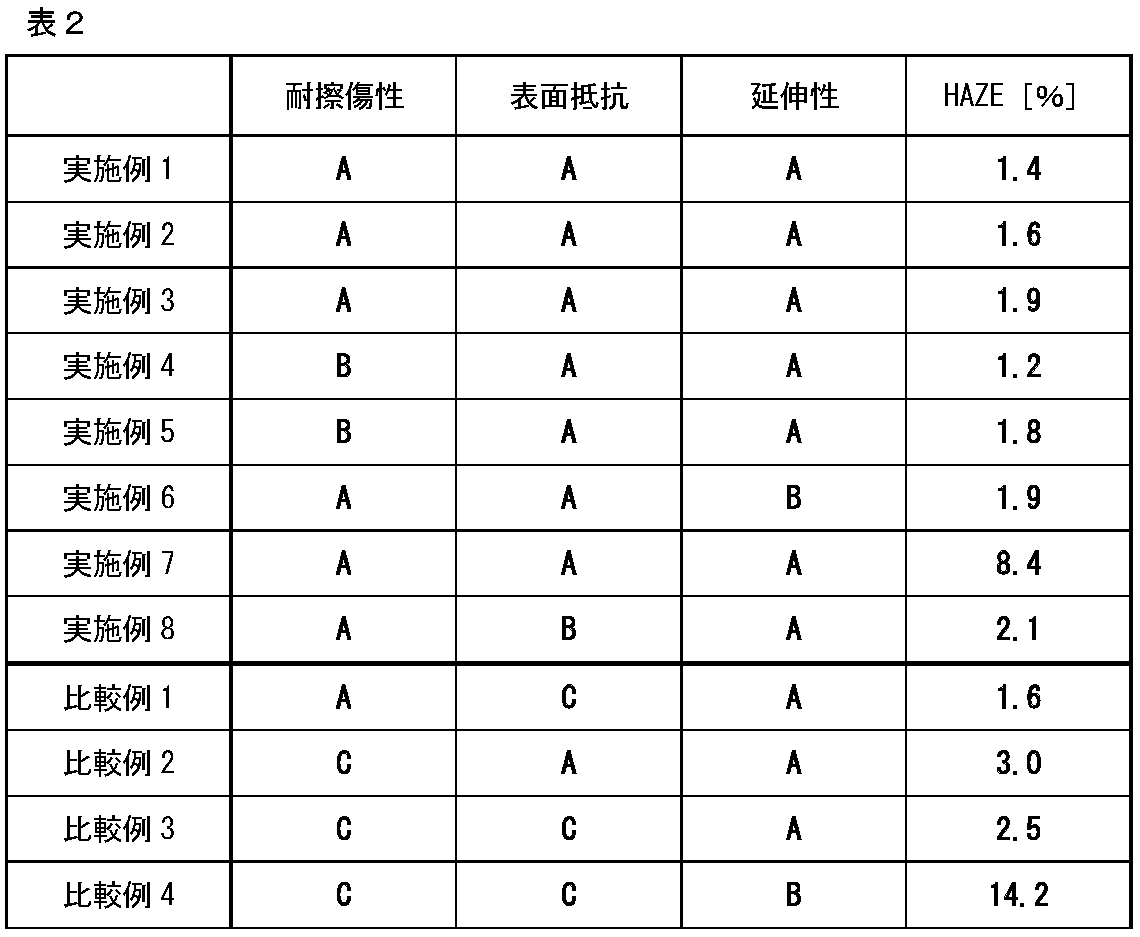
- the scratch resistance, surface resistance, stretchability and HAZE value of the obtained hard coat film were evaluated.
- the procedure of each evaluation is shown below.
- the results are also shown in Table 2.
- the hard coat film was cut into a rectangle having a length of 60 mm and a width of 10 mm to prepare a test piece.
- the hard coat layer of the test piece was visually observed, and the maximum stretch ratio at which cracks did not occur was evaluated as stretchability according to the following criteria A, B and C.
- C Less than 2.5%
- Hard coat films having a hard coat layer obtained from a curable composition containing polyether SM1 have scratch resistance and appropriate stretchability, and have antistatic properties. It became clear that it is excellent.
- the hard coat films having the hard coat layer obtained from the curable composition using the oxyethylene-modified acrylate as the polyfunctional monomer are more stretchable. It became clear that it is excellent.
- the hard coat film having a hard coat layer obtained from a curable composition containing no metal oxide particles as an antistatic agent resulted in no antistatic property being exhibited.
- the hard coat film (Comparative Example 2 and Comparative Example 3) having a hard coat layer obtained from a curable composition using a quaternary ammonium salt type polymer having ion conductivity as an antistatic agent has scratch resistance.
- the hard coat film (Comparative Example 4) having the hard coat layer obtained from the curable composition using the ionic group-containing silicone oligomer resulted in poor scratch resistance and antistatic property.
Landscapes
- Chemical & Material Sciences (AREA)
- Organic Chemistry (AREA)
- Health & Medical Sciences (AREA)
- Chemical Kinetics & Catalysis (AREA)
- Medicinal Chemistry (AREA)
- Polymers & Plastics (AREA)
- Materials Engineering (AREA)
- Engineering & Computer Science (AREA)
- Life Sciences & Earth Sciences (AREA)
- Wood Science & Technology (AREA)
- Physics & Mathematics (AREA)
- Inorganic Chemistry (AREA)
- General Physics & Mathematics (AREA)
- Optics & Photonics (AREA)
- Paints Or Removers (AREA)
- Macromonomer-Based Addition Polymer (AREA)
- Polymerisation Methods In General (AREA)
Abstract
Description
また、特許文献2に記載の表面改質剤では、タッチパネルのように人が毎日手で触れるものの場合、使用中にその機能(防汚性)が低下するという問題があり、使用過程での防汚性の耐久性に課題があった。
また、帯電防止のための金属酸化物微粒子を含むハードコート層は、表面に粒子による凹凸が形成され、耐擦傷性が低下するという問題がある。また、帯電防止のためのイオン伝導性を示す有機材料を含むハードコート層は、平坦性を損なわずに帯電防止性を付与できるという特徴を有するが、該有機材料は一般に柔軟な構造を有するため、ハードコート層の耐擦傷性が低下しやすいという問題があった。
すなわち、本発明は、極めて高い耐擦傷性と延伸性とを両立し、更に帯電防止性を有するハードコート層を形成できる、硬化性組成物を提供することを目的とする。
(a)活性エネルギー線硬化性多官能モノマー100質量部、
(b)ポリ(オキシパーフルオロアルキレン)基を含むパーフルオロポリエーテルであって、その分子鎖の両末端に、ウレタン結合を介して、活性エネルギー線重合性基を有するパーフルオロポリエーテル(但し、前記ポリ(オキシパーフルオロアルキレン)基と前記ウレタン結合との間にポリ(オキシアルキレン)基を有するパーフルオロポリエーテルを除く。)0.05質量部~10質量部、
(c)帯電防止剤として金属酸化物粒子5質量部~100質量部、及び
(d)活性エネルギー線によりラジカルを発生する重合開始剤1質量部~20質量部、
を含む、硬化性組成物に関する。
第2観点として、前記(b)パーフルオロポリエーテルは、その分子鎖の両末端それぞれにおいてウレタン結合を介して活性エネルギー線重合性基を少なくとも2つ有する、第1観点に記載の硬化性組成物に関する。
第3観点として、前記(b)パーフルオロポリエーテルは、その分子鎖の両末端それぞれにおいてウレタン結合を介して活性エネルギー線重合性基を少なくとも3つ有する、第2観点に記載の硬化性組成物に関する。
第4観点として、前記ポリ(オキシパーフルオロアルキレン)基が、繰り返し単位-[OCF2]-及び繰り返し単位-[OCF2CF2]-の双方を有し、これら繰り返し単位をブロック結合、ランダム結合、又は、ブロック結合及びランダム結合にて結合してなる基である、第1観点乃至第3観点のうち何れか一つに記載の硬化性組成物に関する。
第5観点として、前記(b)パーフルオロポリエーテルが下記式[1]で表される部分構造を有する、第4観点に記載の硬化性組成物に関する。

前記繰り返し単位-[OCF2CF2]-及び前記繰り返し単位-[OCF2]-は、ブロック結合、ランダム結合、又は、ブロック結合及びランダム結合の何れかにて結合してなる。
第6観点として、前記(a)多官能モノマーが、オキシエチレン変性多官能モノマーである、第1観点乃至第5観点のうち何れか一つに記載の硬化性組成物に関する。
第7観点として、前記(a)多官能モノマーの平均オキシエチレン変性量が、該多官能モノマーの重合性基1molに対し3mol未満である第6観点のうち何れか一つに記載の硬化性組成物に関する。
第8観点として、前記(a)多官能モノマーが、多官能(メタ)アクリレート化合物(但し、後述の多官能ウレタン(メタ)アクリレート化合物を除く)及び多官能ウレタン(メタ)アクリレート化合物からなる群から選ばれる少なくとも1つを含む、第1観点乃至第7観点のうち何れか一つに記載の硬化性組成物に関する。
第9観点として、前記(c)金属酸化物粒子がスズドープ酸化インジウム、フッ素ドープ酸化スズ、アンチモンドープ酸化スズ、リンドープ酸化スズ、ガリウムドープ酸化亜鉛、アルミニウムドープ酸化亜鉛、アンチモンドープ酸化亜鉛、インジウムドープ酸化亜鉛、酸化亜鉛ドープ酸化インジウム、及び酸化インジウムガリウム亜鉛からなる群から選ばれる少なくとも1つを含む、第1観点乃至第8観点のうち何れか一つに記載の硬化性組成物に関する。
第10観点として、前記(c)金属酸化物粒子がリンドープ酸化スズを含む、第1観点乃至第9観点のうち何れか一つに記載の硬化性組成物に関する。
第11観点として、前記(c)金属酸化物粒子の一次粒子径が4nm~100nmである、第1観点乃至第10観点のうち何れか一つに記載の硬化性組成物に関する。
第12観点として、さらに(e)溶媒を含む、第1観点乃至第11観点のうち何れか一つに記載の硬化性組成物に関する。
第13観点として、第1観点乃至第11観点のうち何れか一つに記載の硬化性組成物より得られる硬化膜に関する。
第14観点として、フィルム基材の少なくとも一方の面にハードコート層を備えるハードコートフィルムであって、該ハードコート層が第13観点に記載の硬化膜からなる、ハードコートフィルムに関する。
第15観点として、前記ハードコート層が1μm~15μmの層厚を有する、第14観点に記載のハードコートフィルムに関する。
第16観点として、フィルム基材の少なくとも一方の面にハードコート層を備えるハードコートフィルムの製造方法であって、該ハードコート層が、第1観点乃至第12観点のうち何れか一つに記載の硬化性組成物をフィルム基材上に塗布し塗膜を形成する工程と、該塗膜に活性エネルギー線を照射し硬化する工程とを含む、ハードコートフィルムの製造方法に関する。
また、本発明によれば、前記硬化性組成物より得られる硬化膜又はそれより形成されるハードコート層が表面に付与されたハードコートフィルムを提供することができ、極めて高い耐擦傷性と延伸性とを両立し、更に帯電防止性を有するハードコートフィルムを提供することができる。
本発明の硬化性組成物は、詳細には、
(a)活性エネルギー線硬化性多官能モノマー100質量部、
(b)ポリ(オキシパーフルオロアルキレン)基を含むパーフルオロポリエーテルであって、その分子鎖の両末端に、ウレタン結合を介して、活性エネルギー線重合性基を有するパーフルオロポリエーテル(但し、該ポリ(オキシパーフルオロアルキレン)基と該ウレタン結合との間にポリ(オキシアルキレン)基を有するパーフルオロポリエーテルを除く。)0.05質量部~10質量部、
(c)帯電防止剤として金属酸化物粒子5質量部~100質量部、及び
(d)活性エネルギー線によりラジカルを発生する重合開始剤1質量部~20質量部、
を含む、硬化性組成物に関する。
以下、まず上記(a)~(d)の各成分について説明する。
(a)活性エネルギー線硬化性多官能モノマー(以下、単に「(a)多官能モノマー」とも称する)とは、紫外線等の活性エネルギー線を照射することで重合反応が進行し、硬化する多官能モノマーを指す。
活性エネルギー線重合性基を少なくとも3つ有するオキシエチレン変性多官能モノマーとしては、活性エネルギー線重合性基を少なくとも3つ有する、オキシエチレンで変性された多官能モノマーが挙げられ、好ましくは、平均オキシエチレン変性量が該重合性基1molに対し3mol未満であるオキシエチレン変性多官能モノマーが挙げられる。
本発明の硬化性組成物においてより好ましいオキシエチレン変性多官能モノマーとしては、活性エネルギー線重合性基を少なくとも3つ有し、平均オキシエチレン変性量が該重合性基1molに対し3mol未満である、オキシエチレン変性多官能(メタ)アクリレート化合物及びオキシエチレン変性多官能ウレタン(メタ)アクリレート化合物からなる群から選択されるモノマーである。
なお、本発明において(メタ)アクリレート化合物とは、アクリレート化合物とメタクリレート化合物の両方をいう。例えば(メタ)アクリル酸は、アクリル酸とメタクリル酸をいう。
また、オキシエチレン変性多官能モノマーにおける平均オキシエチレン変性量は、該モノマーが有する活性エネルギー線重合性基1molに対して0molより大きく、好ましくは、該モノマーが有する活性エネルギー線重合性基1molに対して0.1mol以上、より好ましくは0.5mol以上である。
該ポリオールとしては、例えば、グリセリン、ジグリセリン、トリグリセリン、テトラグリセリン、ペンタグリセリン、ヘキサグリセリン、デカグリセリン、ポリグリセリン、トリメチロールプロパン、ジトリメチロールプロパン、ペンタエリスリトール、ジペンタエリスリトール等が挙げられる。
中でも好ましい多官能(メタ)アクリレート化合物として、トリメチロールプロパントリ(メタ)アクリレート等を挙げることができる。
例えば上記多官能ウレタン(メタ)アクリレートとしては、多官能イソシアネートとヒドロキシ基を有する(メタ)アクリレートとの反応により得られるもの、多官能イソシアネートとヒドロキシ基を有する(メタ)アクリレートとポリオールとの反応により得られるものなどが挙げられるが、本発明で使用可能な多官能ウレタン(メタ)アクリレート化合物はかかる例示のみに限定されるものではない。
また上記ヒドロキシ基を有する(メタ)アクリレートとしては、例えば、(メタ)アクリル酸2-ヒドロキシエチル、(メタ)アクリル酸2-ヒドロキシプロピル、ペンタエリスリトールトリ(メタ)アクリレート、ジペンタエリスリトールペンタ(メタ)アクリレート、トリペンタエリスリトールヘプタ(メタ)アクリレート等が挙げられる。
そして上記ポリオールとしては、例えば、エチレングリコール、プロピレングリコール、ネオペンチルグリコール、1,4-ブタンジオール、1,6-ヘキサンジオール、ジエチレングリコール、ジプロピレングリコール等のジオール類;これらジオール類とコハク酸、マレイン酸、アジピン酸等の脂肪族ジカルボン酸類又はジカルボン酸無水物類との反応生成物であるポリエステルポリオール;ポリエーテルポリオール;ポリカーボネートジオール等が挙げられる。
本発明では、(b)成分として、ポリ(オキシパーフルオロアルキレン)基を含むパーフルオロポリエーテルであって、その分子鎖の両末端に、ポリ(オキシアルキレン)基を介さずにウレタン結合を介して、活性エネルギー線重合性基を有するパーフルオロポリエーテル(以下、単に「(b)分子鎖の両末端に重合性基を有するパーフルオロポリエーテル」とも称する)を使用する。(b)成分は、本発明の硬化性組成物を適用するハードコート層における表面改質剤としての役割を果たす。
また、(b)成分は、(a)成分との相溶性に優れ、それにより、ハードコート層が白濁するのを抑制して、透明な外観を呈するハードコート層の形成を可能とする。
尚、上記のポリ(オキシアルキレン)基とは、オキシアルキレン基の繰り返し単位数が2以上であり且つオキシアルキレン基におけるアルキレン基は無置換のアルキレン基である基を意図する。
上記オキシパーフルオロアルキレン基は、一種を単独で使用してもよく、或いは二種以上を組み合わせて使用してもよく、その場合、複数種のオキシパーフルオロアルキレン基の結合はブロック結合及びランダム結合の何れであってもよい。
中でも上記ポリ(オキシパーフルオロアルキレン)基として、繰り返し単位:-[OCF2]-と-[OCF2CF2]-とが、モル比率で[繰り返し単位:-[OCF2]-]:[繰り返し単位:-[OCF2CF2]-]=2:1~1:2となる割合で含む基であることが好ましく、およそ1:1となる割合で含む基であることがより好ましい。これら繰り返し単位の結合は、ブロック結合及びランダム結合の何れであってもよい。
上記オキシパーフルオロアルキレン基の繰り返し単位数は、その繰り返し単位数の総計として5~30の範囲であることが好ましく、7~21の範囲であることがより好ましい。
また、上記ポリ(オキシパーフルオロアルキレン)基のゲル浸透クロマトグラフィーによるポリスチレン換算で測定される重量平均分子量(Mw)は、1,000~5,000、好ましくは1,500~3,000である。




上記式[B1]~式[B12]で表される構造の中で、式[B1]及び式[B2]がm=1の場合に相当し、式[B3]~式[B6]がm=2の場合に相当し、式[B7]~式[B9]がm=3の場合に相当し、式[B10]~式[B12]がm=5の場合に相当する。
これらの中でも、式[B3]で表される構造が好ましく、特に式[B3]と式[A3]の組合せが好ましい。

式[1]中のnは、繰り返し単位-[OCF2CF2]-の数と、繰り返し単位-[OCF2]-の数との総数を表し、5~30の範囲の整数が好ましく、7~21の範囲の整数がより好ましい。また、前記繰り返し単位-[OCF2CF2]-の数と、前記繰り返し単位-[OCF2]-の数との比率は、2:1~1:2の範囲であることが好ましく、およそ1:1の範囲とすることがより好ましい。これら繰り返し単位の結合は、ブロック結合及びランダム結合の何れであってもよい。
(b)分子鎖の両末端に重合性基を有するパーフルオロポリエーテルを0.05質量部以上の割合で使用することで、ハードコート層に十分な耐擦傷性を付与することができる。また、(b)分子鎖の両末端に重合性基を有するパーフルオロポリエーテルを10質量部以下の割合で使用することで、(a)活性エネルギー線硬化性多官能モノマーと十分に相溶し、より白濁の少ないハードコート層が得られる。

金属酸化物粒子とは、本発明の硬化性組成物から得られる硬化膜(ハードコート層)に帯電防止性能を付与できる帯電防止剤をいう。
なお、本発明において、金属酸化物粒子の一次粒子径とは、透過型電子顕微鏡を用いて観察される個々の粒子の粒子径(無作為に選ばれた100個の粒子の平均値)をいう。
本発明の硬化性組成物において好ましい活性エネルギー線によりラジカルを発生する重合開始剤(以下、単に「(d)重合開始剤」とも称する)は、例えば、電子線、紫外線、X線等の活性エネルギー線により、特に紫外線照射によりラジカルを発生する重合開始剤である。
上記(d)重合開始剤としては、例えばベンゾイン類、アルキルフェノン類、チオキサントン類、アゾ類、アジド類、ジアゾ類、o-キノンジアジド類、アシルホスフィンオキシド類、オキシムエステル類、有機過酸化物、ベンゾフェノン類、ビスクマリン類、ビスイミダゾール類、チタノセン類、チオール類、ハロゲン化炭化水素類、トリクロロメチルトリアジン類、及びヨードニウム塩、スルホニウム塩などのオニウム塩類等が挙げられる。これらは一種単独で或いは二種以上を混合して用いてもよい。
中でも本発明では、透明性、表面硬化性、薄膜硬化性の観点から(d)重合開始剤として、アルキルフェノン類を使用することが好ましい。アルキルフェノン類を使用することにより、耐擦傷性がより向上した硬化膜を得ることができる。
本発明の硬化性組成物は、さらに(e)溶媒を含んでいてもよく、すなわちワニス(膜形成材料)の形態としてもよい。
上記溶媒としては、前記(a)成分~(d)成分を溶解又は均一に分散し、また後述する硬化膜(ハードコート層)形成にかかる塗工時の作業性や硬化前後の乾燥性等を考慮して適宜選択すればよい。例えば、ベンゼン、トルエン、キシレン、エチルベンゼン、テトラリン等の芳香族炭化水素類;n-ヘキサン、n-ヘプタン、ミネラルスピリット、シクロヘキサン等の脂肪族又は脂環式炭化水素類;塩化メチル、臭化メチル、ヨウ化メチル、ジクロロメタン、クロロホルム、四塩化炭素、トリクロロエチレン、パークロロエチレン、o-ジクロロベンゼン等のハロゲン化物類;酢酸エチル、酢酸プロピル、酢酸ブチル、メトキシブチルアセテート、メチルセロソルブアセテート、エチルセロソルブアセテート、プロピレングリコールモノメチルエーテルアセテート(PGMEA)等のエステル類又はエステルエーテル類;ジエチルエーテル、テトラヒドロフラン(THF)、1,4-ジオキサン、メチルセロソルブ、エチルセロソルブ、ブチルセロソルブ、プロピレングリコールモノメチルエーテル(PGME)、プロピレングリコールモノエチルエーテル、プロピレングリコールモノ-n-プロピルエーテル、プロピレングリコールモノイソプロピルエーテル、プロピレングリコールモノ-n-ブチルエーテル等のエーテル類;アセトン、メチルエチルケトン(MEK)、メチルイソブチルケトン(MIBK)、ジ-n-ブチルケトン、シクロヘキサノン等のケトン類;メタノール、エタノール、n-プロパノール、イソプロピルアルコール、n-ブタノール、イソブチルアルコール、tert-ブチルアルコール、2-エチルヘキシルアルコール、ベンジルアルコール、エチレングリコール等のアルコール類;N,N-ジメチルホルムアミド(DMF)、N,N-ジメチルアセトアミド(DMAc)、N-メチル-2-ピロリドン(NMP)等のアミド類;ジメチルスルホキシド(DMSO)等のスルホキシド類、並びにこれらの溶媒のうち2種以上を混合した溶媒が挙げられる。
また、本発明の硬化性組成物には、本発明の効果を損なわない限り、必要に応じて一般的に添加される添加剤、例えば、重合促進剤、重合禁止剤、光増感剤、レベリング剤、界面活性剤、密着性付与剤、可塑剤、紫外線吸収剤、光安定剤、酸化防止剤、貯蔵安定剤、帯電防止剤、無機充填剤、顔料、染料等を適宜配合してよい。
本発明の硬化性組成物は、基材上に塗布(コーティング)して塗膜を形成し、該塗膜に活性エネルギー線を照射して重合(硬化)させることにより、硬化膜を形成できる。該硬化膜も本発明の対象である。また後述するハードコートフィルムにおけるハードコート層を該硬化膜からなるものとすることができる。
この場合の前記基材としては、例えば、各種樹脂(ポリカーボネート、ポリメタクリレート、ポリスチレン、ポリエチレンテレフタレート(PET)やポリエチレンナフタレート(PEN)等のポリエステル、ポリウレタン、熱可塑性ポリウレタン(TPU)、ポリオレフィン、ポリアミド、ポリイミド、エポキシ樹脂、メラミン樹脂、トリアセチルセルロース、アクリロニトリル-ブタジエン-スチレン共重合体(ABS)、アクリロニトリル-スチレン共重合体(AS)、ノルボルネン系樹脂等)、金属、木材、紙、ガラス、スレート等を挙げることができる。これら基材の形状は板状、フィルム状又は3次元成形体でもよい。
基材上に硬化性組成物を塗布し塗膜を形成した後、必要に応じてホットプレート、オーブン等の加熱手段で塗膜を予備乾燥して溶媒を除去する(溶媒除去工程)。この際の加熱乾燥の条件としては、例えば、40℃~120℃で、30秒~10分程度とすることが好ましい。
乾燥後、紫外線等の活性エネルギー線を照射して、塗膜を硬化させる。活性エネルギー線としては、紫外線、電子線、X線等が挙げられ、特に紫外線が好ましい。紫外線照射に用いる光源としては、太陽光線、ケミカルランプ、低圧水銀灯、高圧水銀灯、メタルハライドランプ、キセノンランプ、UV-LED等が使用できる。
さらにその後、ポストベークを行うことにより、具体的にはホットプレート、オーブン等の加熱手段を用いて加熱することにより重合を完結させてもよい。
なお、形成される硬化膜の厚さは、乾燥、硬化後において、通常0.01μm~50μm、好ましくは0.05μm~20μmである。
本発明の硬化性組成物を用いて、フィルム基材の少なくとも一方の面(表面)にハードコート層を備えるハードコートフィルムを製造することができる。該ハードコートフィルムも本発明の対象であり、該ハードコートフィルムは、例えばタッチパネルや液晶ディスプレイ等の各種表示素子等の表面を保護するために好適に用いられる。
また前記フィルム基材上への硬化性組成物の塗布方法(塗膜形成工程)及び塗膜への活性エネルギー線照射方法(硬化工程)は、前述の<硬化膜>に挙げた方法を用いることができる。また本発明の硬化性組成物に溶媒が含まれる(ワニス形態の)場合、塗膜形成工程の後、必要に応じて該塗膜を乾燥し溶媒除去する工程を含むことができる。その場合、前述の<硬化膜>に挙げた塗膜の乾燥方法(溶媒除去工程)を用いることができる。
こうして得られたハードコート層の層厚は、好ましくは1μm~20μm、より好ましくは1μm~10μmである。
なお、実施例において、試料の調製及び物性の分析に用いた装置及び条件は、以下の通りである。
装置:TQC Sheen社製 Automatic Filmapplicator AB3125
バー:オーエスジーシステムプロダクツ(株)製 A-Bar OSP-25、最大ウエット膜厚25μm(ワイヤーバー#10相当)
塗布速度:4m/分
(2)オーブン
装置:三基計装(株)製 2層式クリーンオーブン(上下式)PO-250-45-D
(3)UV硬化
装置:ヘレウス(株)製 CV-110QC-G
ランプ:ヘレウス(株)製 高圧水銀ランプH-bulb
(4)ゲル浸透クロマトグラフィー(GPC)
装置:東ソー(株)製 HLC-8220GPC
カラム:昭和電工(株)製 Shodex(登録商標)GPC K-804L、GPC K-805L
カラム温度:40℃
溶離液:テトラヒドロフラン
検出器:RI
(5)耐擦傷性試験
装置:新東科学(株)製 往復摩耗試験機 TRIBOGEAR TYPE:30H
走査速度:3,000mm/分
走査距離:50mm
(6)引張試験
装置:(株)島津製作所製 卓上形精密万能試験機オートグラフAGS-10kNX
つかみ具:1kN手動ねじ式平面形つかみ具
つかみ歯:高強度ラバーコートつかみ歯
引張速度:50mm/分
測定温度:23℃
(7)表面抵抗測定
装置:三菱化学(株)製 ハイレスタ-UP MCP-HT450
プローブ:URSプローブ
レジテーブル:UFL
印加電圧:10V
(8)HAZE測定
装置:日本電色工業(株)製 ヘーズメーター NDH 5000
a-1:オキシエチレン変性ペンタエリスリトールテトラアクリレート[日本化薬(株)製 KAYALAD RP-1040、オキシエチレン基4mol]
a-2:オキシエチレン変性トリメチロールプロパントリアクリレート[東亞合成(株)製 アロニックス(登録商標)M-350、オキシエチレン基3mol]
a-3:オキシエチレン変性テトラグリセリンポリアクリレート[阪本薬品工業(株)製 SA-TE6、官能基数6、オキシエチレン基6mol]
a-4:トリメチロールプロパントリアクリレート[新中村化学工業(株)製 NKエステルA-TMPT]
CM-1:リンドープ酸化スズ20質量%イソプロピルアルコール分散ゾル[日産化学(株)製 セルナックス(登録商標)CX-S204IP、一次粒子径:5nm~20nm、二次粒子径:10nm~20nm]
CM-2:アンチモンドープ酸化スズ40質量%メタノール分散ゾル[日産化学(株)製 セルナックス(登録商標)CX-Z410M、一次粒子径:20nm~30nm、二次粒子径:80nm~120nm]
ここで一次粒子径、及び二次粒子径とは、透過型電子顕微鏡観察によって測定される粒子径を指す。粒子径は透過型電子顕微鏡によるゾルを銅メッシュ上に滴下し乾燥させ、透過型電子顕微鏡(日本電子(株)製 JEM-1020)を用いて加速電圧100kVにて観察し、100個の粒子を測定し平均化した値を平均一次粒子径として求めた。
CM-3:4級アンモニウム塩タイプ帯電防止ポリマー[大成ファインケミカル(株)製 アクリット スタンダードタイプ 1SX-1090]
CM-4:4級アンモニウム塩タイプ帯電防止ポリマー[大成ファインケミカル(株)製 アクリット 反応性タイプ 8SX-1071]
CM-5:イオン性基含有シリコーンオリゴマー[信越化学工業(株)製 信越シリコーン(登録商標)X-40-2750]
CM-6:酸化スズを核としてその表面が五酸化アンチモンで被覆されたコアシェル粒子30質量%メタノール分散ゾル[日産化学(株)製、セルナックス(登録商標)HX-307M1、一次粒子径:30nm~40nm]
PFPE1:分子鎖の両末端それぞれにポリ(オキシアルキレン)基を介さずヒドロキシ基を2つ有するパーフルオロポリエーテル[ソルベイスペシャルティポリマーズ社製 Fomblin(登録商標)T4]
BEI:1,1-ビス(アクリロイルオキシメチル)エチルイソシアネート[昭和電工(株)製 カレンズ(登録商標)BEI]
DOTDD:ジネオデカン酸ジオクチル錫[日東化成(株)製 ネオスタン(登録商標)U-830]
O2959:2-ヒドロキシ-1-(4-(2-ヒドロキシエトキシ)フェニル)-2-メチルプロパン-1-オン[IGM Resins社製 OMNIRAD(登録商標)2959]
MEK:メチルエチルケトン
MeOH:メタノール
IPA:イソプロピルアルコール
スクリュー管に、PFPE1 1.19g(0.5mmol)、BEI0.52g(2.0mmol)、DOTDD0.017g(PFPE1及びBEIの合計質量の0.01倍量)、及びMEK1.67gを仕込んだ。この混合物を、スターラーチップを用いて室温(およそ23℃)で24時間撹拌して、目的化合物であるSM1の50質量%MEK溶液を得た。
得られたSM1のGPCによるポリスチレン換算で測定される重量平均分子量:Mwは3,000、分散度:Mw(重量平均分子量)/Mn(数平均分子量)は1.2であった。
表1の記載に従って以下の各成分を混合し、表1に記載の固形分濃度の硬化性組成物を調製した。なお、ここで固形分とは溶媒以外の成分を指す。また、表1中、[部]とは[質量部]を表す。
(1)多官能モノマー:表1に記載の多官能モノマー 100質量部
(2)表面改質剤:表1に記載の表面改質剤 0.2質量部(固形分換算)
(3)帯電防止剤:表1に記載の導電材料 表1に記載の量
(4)重合開始剤:O2959 3質量部
(5)溶媒:MeOH/IPA 表1に記載の量
この硬化性組成物を、A4サイズの両面易接着処理PETフィルム[東レ(株)製 ルミラー(商標登録)U403、厚み100μm]上にバーコーターにより塗布し、塗膜を得た。この塗膜を120℃のオーブンで3分間乾燥させ溶媒を除去した。得られた膜を、窒素雰囲気下、露光量300mJ/cm2のUV光を照射し露光することで、およそ5μmの層(膜)厚を有するハードコート層(硬化膜)を有するハードコートフィルムを作製した。
ハードコートフィルムのハードコート層表面を、往復摩耗試験機に取り付けたスチールウール[ボンスター販売(株)製 ボンスター(登録商標)#0000(超極細)]で500g/cm2の荷重を掛けて10往復擦り、傷の程度を目視で確認し以下の基準A、B及びCに従い評価した。なおハードコート層として実際の使用を想定した場合、少なくともBであることが求められ、Aであることが望ましい。
A:傷が無い
B:細かい傷が数本発生
C:全面に傷が発生
ハードコート層表面を上にしたハードコートフィルムをレジテーブル上に置き、プローブをハードコートフィルムに押し付け10秒後に測定した。同様の操作を3回行い、平均値を表面抵抗値として、以下の基準A、B及びCに従い評価した。
A:1×10¹¹Ω/□未満
B:1×10¹¹Ω/□以上1×1014Ω/□未満
C:1014Ω/□以上
ハードコートフィルムを長さ60mm、幅10mmの矩形に切り取り、試験片を作製した。試験片の長手方向の両端から20mmずつを掴むように万能試験機のつかみ具に取り付け、延伸率(=(つかみ具間距離の増加量)÷(つかみ具間距離)×100)が2.5%、7.5%、10%となるように引張試験を行った。試験片のハードコート層を目視で観察し、クラックが発生しなかった最大の延伸率を延伸性として、以下の基準A、B及びCに従い評価した。
A:10%以上
B:2.5%以上10%未満
C:2.5%未満

Claims (16)
- (a)活性エネルギー線硬化性多官能モノマー100質量部、
(b)ポリ(オキシパーフルオロアルキレン)基を含むパーフルオロポリエーテルであって、その分子鎖の両末端に、ウレタン結合を介して、活性エネルギー線重合性基を有するパーフルオロポリエーテル(但し、前記ポリ(オキシパーフルオロアルキレン)基と前記ウレタン結合との間にポリ(オキシアルキレン)基を有するパーフルオロポリエーテルを除く。)0.05質量部~10質量部、
(c)帯電防止剤として金属酸化物粒子5質量部~100質量部、及び
(d)活性エネルギー線によりラジカルを発生する重合開始剤1質量部~20質量部、
を含む、硬化性組成物。 - 前記(b)パーフルオロポリエーテルは、その分子鎖の両末端それぞれにおいてウレタン結合を介して活性エネルギー線重合性基を少なくとも2つ有する、請求項1に記載の硬化性組成物。
- 前記(b)パーフルオロポリエーテルは、その分子鎖の両末端それぞれにおいてウレタン結合を介して活性エネルギー線重合性基を少なくとも3つ有する、請求項2に記載の硬化性組成物。
- 前記ポリ(オキシパーフルオロアルキレン)基が、繰り返し単位-[OCF2]-及び繰り返し単位-[OCF2CF2]-の双方を有し、これら繰り返し単位をブロック結合、ランダム結合、又は、ブロック結合及びランダム結合にて結合してなる基である請求項1乃至請求項3のうち何れか一項に記載の硬化性組成物。
- 前記(b)パーフルオロポリエーテルが下記式[1]で表される部分構造を有する、請求項4に記載の硬化性組成物。

nは、繰り返し単位-[OCF2CF2]-の数と、繰り返し単位-[OCF2]-の数との総数であって、5~30の整数を表し、
前記繰り返し単位-[OCF2CF2]-及び前記繰り返し単位-[OCF2]-は、ブロック結合、ランダム結合、又は、ブロック結合及びランダム結合の何れかにて結合してなる。) - 前記(a)多官能モノマーがオキシエチレン変性多官能モノマーである、請求項1乃至請求項5のうち何れか一項に記載の硬化性組成物。
- 前記(a)多官能モノマーの平均オキシエチレン変性量が、該(a)多官能モノマーの重合性基1molに対し3mol未満である、請求項6に記載の硬化性組成物。
- 前記(a)多官能モノマーが、多官能(メタ)アクリレート化合物(但し、後述の多官能ウレタン(メタ)アクリレート化合物を除く)及び多官能ウレタン(メタ)アクリレート化合物からなる群から選ばれる少なくとも1つを含む、請求項1乃至請求項7のうち何れか一項に記載の硬化性組成物。
- 前記(c)金属酸化物粒子がスズドープ酸化インジウム、フッ素ドープ酸化スズ、アンチモンドープ酸化スズ、リンドープ酸化スズ、ガリウムドープ酸化亜鉛、アルミニウムドープ酸化亜鉛、アンチモンドープ酸化亜鉛、インジウムドープ酸化亜鉛、酸化亜鉛ドープ酸化インジウム、及び酸化インジウムガリウム亜鉛からなる群から選ばれる少なくとも1つを含む、請求項1乃至請求項8のうち何れか一項に記載の硬化性組成物。
- 前記(c)金属酸化物粒子がリンドープ酸化スズを含む、請求項1乃至請求項9のうち何れか一項に記載の硬化性組成物。
- 前記(c)金属酸化物粒子の一次粒子径が4nm~100nmである、請求項1乃至請求項10のうち何れか一項に記載の硬化性組成物。
- さらに(e)溶媒を含む、請求項1乃至請求項11のうち何れか一項に記載の硬化性組成物。
- 請求項1乃至請求項11のうち何れか一項に記載の硬化性組成物より得られる硬化膜。
- フィルム基材の少なくとも一方の面にハードコート層を備えるハードコートフィルムであって、該ハードコート層が請求項13に記載の硬化膜からなる、ハードコートフィルム。
- 前記ハードコート層が1μm~15μmの層厚を有する、請求項14に記載のハードコートフィルム。
- フィルム基材の少なくとも一方の面にハードコート層を備えるハードコートフィルムの製造方法であって、該ハードコート層が、請求項1乃至請求項12のうち何れか一項に記載の硬化性組成物をフィルム基材上に塗布し塗膜を形成する工程と、該塗膜に活性エネルギー線を照射し硬化する工程とを含む、ハードコートフィルムの製造方法。
Priority Applications (3)
| Application Number | Priority Date | Filing Date | Title |
|---|---|---|---|
| KR1020217026126A KR102868546B1 (ko) | 2019-02-06 | 2020-01-30 | 대전방지 하드코트용 경화성 조성물 |
| JP2020571142A JP7510117B2 (ja) | 2019-02-06 | 2020-01-30 | 帯電防止ハードコート用硬化性組成物 |
| CN202080013211.2A CN113412190B (zh) | 2019-02-06 | 2020-01-30 | 抗静电硬涂用固化性组合物 |
Applications Claiming Priority (2)
| Application Number | Priority Date | Filing Date | Title |
|---|---|---|---|
| JP2019-020177 | 2019-02-06 | ||
| JP2019020177 | 2019-02-06 |
Publications (1)
| Publication Number | Publication Date |
|---|---|
| WO2020162324A1 true WO2020162324A1 (ja) | 2020-08-13 |
Family
ID=71947053
Family Applications (1)
| Application Number | Title | Priority Date | Filing Date |
|---|---|---|---|
| PCT/JP2020/003477 Ceased WO2020162324A1 (ja) | 2019-02-06 | 2020-01-30 | 帯電防止ハードコート用硬化性組成物 |
Country Status (5)
| Country | Link |
|---|---|
| JP (1) | JP7510117B2 (ja) |
| KR (1) | KR102868546B1 (ja) |
| CN (1) | CN113412190B (ja) |
| TW (1) | TWI828851B (ja) |
| WO (1) | WO2020162324A1 (ja) |
Cited By (4)
| Publication number | Priority date | Publication date | Assignee | Title |
|---|---|---|---|---|
| JP2020158585A (ja) * | 2019-03-26 | 2020-10-01 | 三菱ケミカル株式会社 | 高滑水性活性エネルギー線硬化性組成物及び樹脂成形品 |
| WO2022209867A1 (ja) * | 2021-04-02 | 2022-10-06 | 日産化学株式会社 | 帯電防止ハードコート層および硬化性組成物 |
| JP2023086648A (ja) * | 2021-12-10 | 2023-06-22 | 東洋インキScホールディングス株式会社 | 積層体および透明電極フィルム |
| JP7861501B2 (ja) | 2022-05-18 | 2026-05-19 | artience株式会社 | 積層体 |
Citations (7)
| Publication number | Priority date | Publication date | Assignee | Title |
|---|---|---|---|---|
| JP2005126453A (ja) * | 2003-10-21 | 2005-05-19 | Tdk Corp | ハードコート剤組成物及びこれを用いた光情報媒体 |
| JP2009256597A (ja) * | 2008-03-26 | 2009-11-05 | Jsr Corp | パーフルオロポリエーテル基、ウレタン基及び(メタ)アクリロイル基を有する化合物 |
| JP2015054461A (ja) * | 2013-09-12 | 2015-03-23 | 富士フイルム株式会社 | ハードコートフィルム |
| JP2015160902A (ja) * | 2014-02-27 | 2015-09-07 | デクセリアルズ株式会社 | 表面調整剤及びそれを用いた物品 |
| JP2017008128A (ja) * | 2015-06-16 | 2017-01-12 | ユニマテック株式会社 | 活性エネルギー線硬化性樹脂組成物 |
| WO2019045096A1 (ja) * | 2017-09-01 | 2019-03-07 | 日産化学株式会社 | 延伸性耐擦傷性コーティング用硬化性組成物 |
| WO2020008937A1 (ja) * | 2018-07-05 | 2020-01-09 | 日産化学株式会社 | フレキシブルコーティング用硬化性組成物 |
Family Cites Families (4)
| Publication number | Priority date | Publication date | Assignee | Title |
|---|---|---|---|---|
| JP2013076029A (ja) * | 2011-09-30 | 2013-04-25 | Tdk Corp | ハードコート剤組成物及びこれを用いたハードコートフィルム |
| WO2013191254A1 (ja) | 2012-06-22 | 2013-12-27 | ソマール株式会社 | エネルギー線硬化型樹脂組成物、硬化物及び積層体 |
| JP5954505B2 (ja) * | 2013-11-11 | 2016-07-20 | Dic株式会社 | 活性エネルギー線硬化性組成物、その硬化物及びその硬化塗膜を有する物品 |
| CN107406564B (zh) * | 2015-04-07 | 2020-05-22 | 日产化学工业株式会社 | 耐擦伤性涂覆用固化性组合物 |
-
2020
- 2020-01-30 CN CN202080013211.2A patent/CN113412190B/zh active Active
- 2020-01-30 KR KR1020217026126A patent/KR102868546B1/ko active Active
- 2020-01-30 JP JP2020571142A patent/JP7510117B2/ja active Active
- 2020-01-30 WO PCT/JP2020/003477 patent/WO2020162324A1/ja not_active Ceased
- 2020-02-03 TW TW109103131A patent/TWI828851B/zh active
Patent Citations (7)
| Publication number | Priority date | Publication date | Assignee | Title |
|---|---|---|---|---|
| JP2005126453A (ja) * | 2003-10-21 | 2005-05-19 | Tdk Corp | ハードコート剤組成物及びこれを用いた光情報媒体 |
| JP2009256597A (ja) * | 2008-03-26 | 2009-11-05 | Jsr Corp | パーフルオロポリエーテル基、ウレタン基及び(メタ)アクリロイル基を有する化合物 |
| JP2015054461A (ja) * | 2013-09-12 | 2015-03-23 | 富士フイルム株式会社 | ハードコートフィルム |
| JP2015160902A (ja) * | 2014-02-27 | 2015-09-07 | デクセリアルズ株式会社 | 表面調整剤及びそれを用いた物品 |
| JP2017008128A (ja) * | 2015-06-16 | 2017-01-12 | ユニマテック株式会社 | 活性エネルギー線硬化性樹脂組成物 |
| WO2019045096A1 (ja) * | 2017-09-01 | 2019-03-07 | 日産化学株式会社 | 延伸性耐擦傷性コーティング用硬化性組成物 |
| WO2020008937A1 (ja) * | 2018-07-05 | 2020-01-09 | 日産化学株式会社 | フレキシブルコーティング用硬化性組成物 |
Cited By (7)
| Publication number | Priority date | Publication date | Assignee | Title |
|---|---|---|---|---|
| JP2020158585A (ja) * | 2019-03-26 | 2020-10-01 | 三菱ケミカル株式会社 | 高滑水性活性エネルギー線硬化性組成物及び樹脂成形品 |
| JP7367316B2 (ja) | 2019-03-26 | 2023-10-24 | 三菱ケミカル株式会社 | 高滑水性活性エネルギー線硬化性組成物及び樹脂成形品 |
| WO2022209867A1 (ja) * | 2021-04-02 | 2022-10-06 | 日産化学株式会社 | 帯電防止ハードコート層および硬化性組成物 |
| JPWO2022209867A1 (ja) * | 2021-04-02 | 2022-10-06 | ||
| KR20230162016A (ko) | 2021-04-02 | 2023-11-28 | 닛산 가가쿠 가부시키가이샤 | 대전방지 하드코트층 및 경화성 조성물 |
| JP2023086648A (ja) * | 2021-12-10 | 2023-06-22 | 東洋インキScホールディングス株式会社 | 積層体および透明電極フィルム |
| JP7861501B2 (ja) | 2022-05-18 | 2026-05-19 | artience株式会社 | 積層体 |
Also Published As
| Publication number | Publication date |
|---|---|
| TWI828851B (zh) | 2024-01-11 |
| CN113412190B (zh) | 2023-09-26 |
| KR20210124271A (ko) | 2021-10-14 |
| JPWO2020162324A1 (ja) | 2021-12-09 |
| JP7510117B2 (ja) | 2024-07-03 |
| CN113412190A (zh) | 2021-09-17 |
| KR102868546B1 (ko) | 2025-10-13 |
| TW202041609A (zh) | 2020-11-16 |
Similar Documents
| Publication | Publication Date | Title |
|---|---|---|
| JP7397412B2 (ja) | 硬化性組成物 | |
| KR102332177B1 (ko) | 내찰상성 코팅용 경화성 조성물 | |
| KR102902455B1 (ko) | 연신성 내찰상성 코팅용 경화성 조성물 | |
| TWI810431B (zh) | 可撓性硬塗覆用硬化性組成物 | |
| TW202302781A (zh) | 抗靜電硬塗層及硬化性組成物 | |
| KR102947982B1 (ko) | 플렉서블 하드코트용 경화성 조성물 | |
| JP7510117B2 (ja) | 帯電防止ハードコート用硬化性組成物 | |
| JP7587201B2 (ja) | 特定のウレタン(メタ)アクリレートを含むハードコート層形成用硬化性組成物 | |
| JPWO2018056370A1 (ja) | 耐擦傷性ハードコート材 | |
| JP7678408B2 (ja) | ウレタン(メタ)アクリレート及び表面修飾されたシリカ粒子を含むハードコート層形成用硬化性組成物 | |
| JP7832598B2 (ja) | ハードコート用硬化性組成物 | |
| WO2025253960A1 (ja) | ハードコート層形成用硬化性組成物 |
Legal Events
| Date | Code | Title | Description |
|---|---|---|---|
| 121 | Ep: the epo has been informed by wipo that ep was designated in this application |
Ref document number: 20753170 Country of ref document: EP Kind code of ref document: A1 |
|
| ENP | Entry into the national phase |
Ref document number: 2020571142 Country of ref document: JP Kind code of ref document: A |
|
| NENP | Non-entry into the national phase |
Ref country code: DE |
|
| ENP | Entry into the national phase |
Ref document number: 20217026126 Country of ref document: KR Kind code of ref document: A |
|
| 122 | Ep: pct application non-entry in european phase |
Ref document number: 20753170 Country of ref document: EP Kind code of ref document: A1 |