WO2020145342A1 - スピネル粒子及びその製造方法、樹脂組成物、成形物、組成物、グリーンシート、焼成物、並びに、ガラスセラミックス基板 - Google Patents
スピネル粒子及びその製造方法、樹脂組成物、成形物、組成物、グリーンシート、焼成物、並びに、ガラスセラミックス基板 Download PDFInfo
- Publication number
- WO2020145342A1 WO2020145342A1 PCT/JP2020/000438 JP2020000438W WO2020145342A1 WO 2020145342 A1 WO2020145342 A1 WO 2020145342A1 JP 2020000438 W JP2020000438 W JP 2020000438W WO 2020145342 A1 WO2020145342 A1 WO 2020145342A1
- Authority
- WO
- WIPO (PCT)
- Prior art keywords
- particles
- less
- mass
- spinel particles
- spinel
- Prior art date
- Legal status (The legal status is an assumption and is not a legal conclusion. Google has not performed a legal analysis and makes no representation as to the accuracy of the status listed.)
- Ceased
Links
Images

Classifications
-
- C—CHEMISTRY; METALLURGY
- C01—INORGANIC CHEMISTRY
- C01F—COMPOUNDS OF THE METALS BERYLLIUM, MAGNESIUM, ALUMINIUM, CALCIUM, STRONTIUM, BARIUM, RADIUM, THORIUM, OR OF THE RARE-EARTH METALS
- C01F7/00—Compounds of aluminium
- C01F7/02—Aluminium oxide; Aluminium hydroxide; Aluminates
- C01F7/16—Preparation of alkaline-earth metal aluminates or magnesium aluminates; Aluminium oxide or hydroxide therefrom
-
- C—CHEMISTRY; METALLURGY
- C01—INORGANIC CHEMISTRY
- C01G—COMPOUNDS CONTAINING METALS NOT COVERED BY SUBCLASSES C01D OR C01F
- C01G39/00—Compounds of molybdenum
-
- C—CHEMISTRY; METALLURGY
- C04—CEMENTS; CONCRETE; ARTIFICIAL STONE; CERAMICS; REFRACTORIES
- C04B—LIME, MAGNESIA; SLAG; CEMENTS; COMPOSITIONS THEREOF, e.g. MORTARS, CONCRETE OR LIKE BUILDING MATERIALS; ARTIFICIAL STONE; CERAMICS; REFRACTORIES; TREATMENT OF NATURAL STONE
- C04B35/00—Shaped ceramic products characterised by their composition; Ceramics compositions; Processing powders of inorganic compounds preparatory to the manufacturing of ceramic products
- C04B35/01—Shaped ceramic products characterised by their composition; Ceramics compositions; Processing powders of inorganic compounds preparatory to the manufacturing of ceramic products based on oxide ceramics
- C04B35/44—Shaped ceramic products characterised by their composition; Ceramics compositions; Processing powders of inorganic compounds preparatory to the manufacturing of ceramic products based on oxide ceramics based on aluminates
- C04B35/443—Magnesium aluminate spinel
-
- C—CHEMISTRY; METALLURGY
- C08—ORGANIC MACROMOLECULAR COMPOUNDS; THEIR PREPARATION OR CHEMICAL WORKING-UP; COMPOSITIONS BASED THEREON
- C08K—Use of inorganic or non-macromolecular organic substances as compounding ingredients
- C08K3/00—Use of inorganic substances as compounding ingredients
- C08K3/18—Oxygen-containing compounds, e.g. metal carbonyls
- C08K3/20—Oxides; Hydroxides
- C08K3/22—Oxides; Hydroxides of metals
-
- C—CHEMISTRY; METALLURGY
- C08—ORGANIC MACROMOLECULAR COMPOUNDS; THEIR PREPARATION OR CHEMICAL WORKING-UP; COMPOSITIONS BASED THEREON
- C08L—COMPOSITIONS OF MACROMOLECULAR COMPOUNDS
- C08L101/00—Compositions of unspecified macromolecular compounds
Definitions
- the present invention relates to spinel particles, a method for producing the same, a resin composition, a molded product, a composition, a green sheet, a fired product, and a glass ceramic substrate.
- Low temperature co-fired ceramics are generally glass powders (eg CaO-Al 2 O 3 -SiO 2 -B 2 O 3 ) with several 10% (30%) of Al 2 O 3 filler. It is a ceramic that is made of Ag or Cu having a low conductor resistance as the inner layer conductor, and can be fired at a temperature lower than the melting point of these conductor metals (1000°C or less).
- the permittivity relative permittivity
- Q value or dielectric loss tangent bending strength
- thermal conductivity thermal expansion coefficient of mobile phones and in-vehicle millimeter-wave radar, WiGig, VR/head mount displays, etc.
- LTCC substrates There is a demand for LTCC substrates with excellent physical properties.
- crushed alumina is mentioned as a filler mainly used for LTCC substrates.
- examples of the inorganic particles having a low dielectric loss tangent include a mixed oxide spinel of a metal element represented by MgAl 2 O 4 and having a general formula AB 2 X 4 .
- spinel particles have been applied to applications such as fluorescent luminescent materials, catalyst carriers, adsorbents, photocatalysts, and heat-resistant insulating materials in view of their porous structure and easiness of modification.
- Patent Document 1 discloses an insulating ceramic composition containing spinel particles.
- the dielectric loss tangent peculiar to alumina is as high as 10 -3, and since it is made by crushing the filler, it has a wide particle size distribution and is an amorphous particle, so that a green sheet is produced. It is difficult to obtain an LTCC substrate that has both high thermal conductivity and low dielectric loss tangent, as well as impairing processability at the time.
- spinel particles have a good dielectric loss tangent of 10 ⁇ 4 , and like alumina, those with a smaller particle size by pulverization are used, but there is a limit to the particle size adjustment, and since it is an irregular shape, Exist as agglomerated particles and may impair mechanical strength and thermal conductivity.
- the present invention has been made in view of the above circumstances, is excellent in filler filling property and appearance during sheet preparation, has both high thermal conductivity and low dielectric loss tangent, and has excellent mechanical strength.
- Resin composition and glass ceramic substrate And a method for producing the same.
- the present invention provides a resin composition which is excellent in the filling property of the filler and the appearance at the time of producing the sheet, has both high thermal conductivity and low dielectric loss tangent, and is also excellent in mechanical strength.
- the present invention also provides a molded product obtained by molding the resin composition.
- the present invention also provides a composition used for producing a glass-ceramic substrate, which is excellent in filler filling property and appearance when producing a green sheet, has both high thermal conductivity and low dielectric loss tangent, and is also excellent in mechanical strength.
- the present invention also provides a green sheet manufactured using the composition.
- the present invention also provides a fired product obtained by firing the composition.
- the present invention also provides a glass ceramic substrate including the fired product.
- the dielectric loss tangent is low, the particle size is smaller, and by using spinel particles having a narrow particle size distribution, the filler filling property and sheet preparation It was found that a resin composition and a glass-ceramic substrate having excellent appearance, high thermal conductivity and low dielectric loss tangent, and excellent mechanical strength can be obtained, and the present invention has been completed.
- the present invention includes the following aspects.
- (1) The volume-based average particle diameter d50 in laser diffraction particle size distribution measurement is 0.01 ⁇ m or more and 5 ⁇ m or less, d90/d10 is 5 or less, and the content of particles of 15 ⁇ m or more is the total of all particles.
- a composition containing the spinel particles according to any one of (1) to (4) and a glass component (15) The composition according to (14), wherein the content of the spinel particles is 10 vol% or more and 50 vol% or less with respect to a total volume of 100 vol% of the spinel particles and the glass component. (16) A green sheet formed by molding the composition according to (14) or (15). (17) A fired product obtained by firing the composition according to (14) or (15). (18) A glass ceramic substrate provided with the fired product according to (17).
- the spinel particles and the method for producing the same in the above aspect it is possible to obtain a resin composition and a glass ceramics substrate which are excellent in the filling property of the filler and the appearance at the time of sheet preparation, have both high thermal conductivity and low dielectric loss tangent, and are also excellent in mechanical strength.
- Spinel particles can be provided.
- the resin composition of the above aspect it is possible to provide a resin composition which is excellent in the filling property of the filler and the appearance at the time of producing the sheet, has both high thermal conductivity and low dielectric loss tangent, and is also excellent in mechanical strength.
- a molded product obtained by molding the resin composition can be provided.
- composition of the above aspect there is provided a composition which is excellent in the filling property of the filler and the appearance at the time of producing the green sheet, has a high thermal conductivity and a low dielectric loss tangent, and is used in the production of a glass ceramic substrate having excellent mechanical strength. be able to.
- the green sheet of the above aspect it is possible to provide a green sheet manufactured using the composition.
- a baked product obtained by baking the composition can be provided.
- glass ceramic substrate of the above aspect it is possible to provide a glass ceramic substrate including the fired product.
- the scale bar on the left side of (A) is 20.0 ⁇ m.
- the scale bar in the enlarged view on the upper right of (A) is 2.0 ⁇ m.
- the scale bar on the left side of (B) to (C) is 10.0 ⁇ m.
- the scale bar in the enlarged view on the upper right of (B) to (C) is 1.0 ⁇ m.
- the spinel particles according to the embodiment have a volume-based average particle diameter d50 in laser diffraction particle size distribution measurement of 0.01 ⁇ m or more and 5 ⁇ m or less, d90/d10 of 5 or less, and a content of particles of 15 ⁇ m or more. Is 0.1% by volume or less based on the total volume of all particles.
- the spinel particles according to the embodiment are excellent in the filling property of the filler and the appearance at the time of sheet production, have both high thermal conductivity and low dielectric loss tangent, and have excellent mechanical strength. can get.
- the conventional spinel particles do not satisfy at least one of the requirements for the average particle size d50, d90/d10, and the content of particles of 15 ⁇ m or more in the above particle size distribution measurement, as shown in Examples described later. there were.
- the conventional spinel particles because the particle size is non-uniform or indefinite, in the resulting resin composition or glass ceramics substrate, the dielectric loss tangent is low, the filling properties of the filler and the appearance during sheet preparation, It was poor in thermal conductivity and mechanical strength.
- the spinel particles according to the embodiment have a small particle size and a narrow particle size distribution, that is, since the particle size is uniform, the filling properties of the filler and the appearance at the time of sheet production are excellent, and it is possible to exhibit excellent mechanical strength. Conceivable.
- spinel particles contain a magnesium atom, an aluminum atom, and an oxygen atom, and thus are usually represented by a chemical composition of MgAl 2 O 4 .
- the spinel particles according to the embodiment preferably contain molybdenum in the particles.
- the contained form of molybdenum in the spinel particles is not particularly limited, but examples thereof include a form in which molybdenum is attached to the surface of the spinel particles, coated, bonded, or arranged in a similar form, a form in which molybdenum is incorporated into the spinel, or a combination thereof.
- the "form in which molybdenum is incorporated into the spinel" a form in which at least a part of atoms constituting the spinel particle is replaced with molybdenum, a space that may exist inside the crystal of the spinel particle (a space generated by a defect in the crystal structure And the like), and the like in which molybdenum is arranged.
- the atom constituting the spinel particle to be substituted is not particularly limited and may be a magnesium atom, an aluminum atom, an oxygen atom, or any other atom.
- molybdenum is preferably contained at least in a form incorporated in spinel. When molybdenum is incorporated in the spinel, it tends to be difficult to be removed by cleaning, for example.
- the spinel particles according to the embodiment have a volume-based average particle diameter d50 in laser diffraction type particle size distribution measurement of 0.01 ⁇ m or more and 5 ⁇ m or less, preferably 0.05 ⁇ m or more and 5 ⁇ m or less, and 0.1 ⁇ m or more and 4.8 ⁇ m or less. It is more preferably 0.5 ⁇ m or more and 4.5 ⁇ m or less, particularly preferably 1 ⁇ m or more and 4.3 ⁇ m or less, and most preferably 3.4 ⁇ m or more and 4.1 ⁇ m or less.
- the volume-based average particle diameter d50 in the laser diffraction particle size distribution measurement is within the above range, so that when the spinel particles according to the embodiment are used in the production of a resin composition or a glass ceramic substrate, the filling property of the filler and the sheet The appearance at the time of production can be made more excellent, and the thermal conductivity and mechanical strength can be made more excellent.
- a value measured by the method described in Examples described later can be used as the volume-based average particle diameter d50 in the laser diffraction particle size distribution measurement.
- the spinel particles according to the embodiment have a volume-based d90/d10 in the laser diffraction type particle size distribution measurement of 5 or less, preferably 4.9 or less, more preferably 4.8 or less, still more preferably 4.7 or less, A value of 4.6 or less is particularly preferable.
- the volume-based d90/d10 in the laser diffraction particle size distribution measurement is equal to or less than the above upper limit, the particle size distribution becomes narrower, that is, the particle size becomes more uniform, and the spinel particles according to the embodiment are used as resin compositions or When it is used for manufacturing a glass ceramic substrate, it can be made more excellent in the filling property of the filler and the appearance at the time of making the sheet, and can be made more excellent in thermal conductivity and mechanical strength.
- the lower limit of d90/d10 is not particularly limited, and can be, for example, 1 or more, 2 or more, 3 or more, and 3.5 or more. It can be 3.7 or more.
- the volume-based d90/d10 in the laser diffraction type particle size distribution measurement a value measured using the method described in Examples described later can be adopted.
- the content of particles of 15 ⁇ m or more is 0.1 vol% or less with respect to the total volume of all particles, 0.05 vol% or less is preferable, and 0.01 vol% or less is more preferable. Preferably, 0% by volume is more preferable.
- the spinel particles according to the embodiment do not substantially contain particles having a large particle size, and are used in the production of a resin composition or a glass ceramic substrate.
- the filling property of the filler and the appearance at the time of producing the sheet can be made excellent, and the thermal conductivity and the mechanical strength can be made excellent.
- the content of the particles having a particle size of 15 ⁇ m or more the value measured by the method described in Examples described later can be adopted.
- the conditions of the volume-based average particle diameter d50, d90/d10, and the content of particles of 15 ⁇ m or more in laser diffraction particle size distribution measurement can be combined in any way.
- the ratio L/S of the major axis L to the minor axis S of the spinel particles according to the embodiment is preferably 2 or less, more preferably 1.8 or less, and further preferably 1.5 or less. It is preferably 1.4 or less, and particularly preferably 1.4 or less.
- L/S is less than or equal to the above upper limit value, the shape of the spinel particles becomes closer to a regular polygon, and when the spinel particles according to the embodiment are used for manufacturing a resin composition or a glass ceramic substrate, the filling property of the filler In addition, the appearance of the sheet can be improved, and the thermal conductivity and mechanical strength can be improved.
- the lower limit of L/S is not particularly limited and can be, for example, 1 or more, 1.1 or more, 1.2 or more, and 1.3 or more. can do.
- major axis L is the maximum length of the distance between two points on the contour line of the spinel particle
- minor axis S is the distance between two points on the contour line of the spinel particle. The minimum length. L/S is an arithmetic mean value calculated using the major axis L and the minor axis S measured for at least 50 randomly selected spinel particles from an image obtained by a scanning electron microscope (SEM).
- SEM scanning electron microscope
- Examples of the shape of the spinel particles according to the embodiment include polyhedral shape, spherical shape, elliptical shape, columnar shape, polygonal columnar shape, needle shape, rod shape, plate shape, disk shape, flaky shape, and scale shape.
- polyhedral, spherical, elliptical or plate-like are preferable because they are easily dispersed in the resin, and polyhedral or spherical are more preferable.
- the term “polyhedron” generally means a hexahedron or more, preferably an octahedron or more, more preferably a 10-hedron or more and a 30-hedron or less.
- the crystallite diameter of the (311) plane of the spinel particles according to the embodiment is preferably 120 nm or more, more preferably 140 nm or more, still more preferably 144 nm, even more preferably 150 nm or more, and particularly preferably 160 nm or more.
- the upper limit of the crystallite diameter of the (311) plane is not particularly limited and can be, for example, 300 nm or less, 250 nm or less, 200 nm or less, and 190 nm or less. And can be 181 nm or less.
- the (311) plane is one of the main crystal domains of the spinel particle, and the size of the crystal domain of the (311) plane corresponds to the crystallite diameter of the (311) plane.
- the crystallite size of the (311) plane of the spinel particles can be controlled by appropriately setting the conditions of the manufacturing method described later.
- XRD X-ray diffraction
- the spinel particles contain magnesium atoms, aluminum atoms, and oxygen atoms, and are generally represented by the composition of MgAl 2 O 4 .
- the spinel particles according to the embodiment include molybdenum.
- the spinel particles according to the embodiment may contain unavoidable impurities, other atoms, etc., as long as the effects of the present invention are not impaired.
- the content of magnesium atoms in the spinel particles is not particularly limited, but for example, when the molar amount of aluminum atoms is 2 mol, it is preferably 0.8 mol or more and 1.2 mol or less, and 0.9 mol or less. More preferably, it is 1.1 mol or less.
- the content of aluminum atoms in the spinel particles is not particularly limited, but for example, when the molar amount of magnesium atoms is 1 mol, it is preferably 1.8 mol or more and 2.2 mol or less, and 1.9 mol. More preferably, it is 2.1 mol or less.
- the content of magnesium atoms and aluminum atoms in the spinel particles can be measured by inductively coupled plasma optical emission spectroscopy (ICP-AES).
- the content of oxygen atoms in the spinel particles is not particularly limited, but depends on the molar amount of magnesium atoms and aluminum atoms.
- the content of oxygen atoms in the spinel particles is preferably 3.8 mol or more and 4.2 mol or less, and preferably 3.9 mol or more. It is more preferably 4.1 mol or less.
- Molybdenum may be contained due to the manufacturing method described below.
- the molybdenum is not particularly limited, but includes molybdenum metal, molybdenum oxide, a partially reduced molybdenum compound, and the like. Molybdenum is considered to be included in the spinel grains as MoO 3, it may be included in the spinel particles as MoO 2 and MoO like in addition to MoO 3.
- the contained form of molybdenum is not particularly limited, and may be contained in the form of being adhered, coated, bonded, or the like on the surface of the spinel particles, or in a form in which molybdenum is incorporated into the spinel. Or a combination thereof.
- the content of molybdenum is not particularly limited, but from the viewpoint of high thermal conductivity of the spinel particles according to the embodiment, it is preferably 1% by mass or less in terms of molybdenum trioxide with respect to 100% by mass of the spinel particles, 0 It is more preferably 0.8% by mass or less, further preferably 0.5% by mass or less, particularly preferably 0.4% by mass or less, from the viewpoint that the spinel particles exhibit higher denseness. Most preferably, it is 0.35 mass% or less.
- the lower limit of the content of molybdenum is not particularly limited, but may be 0.01% by mass or more, may be 0.05% by mass or more, and may be 0.1% by mass or more. , 0.12 mass% or more.
- the content of molybdenum in the spinel particles can be determined by XRF analysis. The XRF analysis is performed under the same measurement conditions as those described in Examples described later or under compatible conditions that the same measurement results are obtained.
- the unavoidable impurities are those that are present in the raw materials or are inevitably mixed in the spinel particles in the manufacturing process, and are essentially unnecessary, but are trace amounts, and impurities that do not affect the properties of the spinel particles are included. means.
- the unavoidable impurities include, but are not limited to, silicon, iron, potassium, sodium, calcium and the like. These unavoidable impurities may be contained alone or in combination of two or more.
- the content of unavoidable impurities in the spinel particles is preferably 10000 ppm or less, more preferably 1000 ppm or less, and further preferably 10 ppm or more and 500 ppm or less, based on the mass of the spinel particles.
- the other atom means one that is intentionally added to the spinel particles for the purpose of coloring, emitting light, controlling the formation of spinel particles, etc. within a range that does not impair the effects of the present invention.
- atoms include, but are not limited to, zinc, cobalt, nickel, iron, manganese, titanium, zirconium, calcium, strontium, yttrium, and the like. These other atoms may be used alone or in combination of two or more.
- the content of other atoms in the spinel particles is preferably 10% by mass or less, more preferably 5% by mass or less, and more preferably 2% by mass or less, relative to 100% by mass of the spinel particles. More preferable.
- the method for producing the spinel particles according to the embodiment is not particularly limited, and known techniques may be appropriately applied. However, a production method including a step of firing a magnesium compound and an aluminum compound in the presence of molybdenum (firing step) is preferable.
- the firing step may be a step of firing the mixture obtained in the step of obtaining the mixture to be fired (mixing step).
- the mixing step is a step of mixing raw materials such as a magnesium compound, an aluminum compound and molybdenum to obtain a mixture.
- the mixed state of the magnesium compound and the aluminum compound is not particularly limited. When both are mixed, simple mixing for mixing powders, mechanical mixing using a crusher or mixer, mixing using a mortar or the like is performed. At this time, the obtained mixture may be in a dry state or a wet state, but is preferably in a dry state from the viewpoint of cost.
- the mixing ratio of the magnesium compound and the aluminum compound is not particularly limited, but the molar ratio of the aluminum element of the aluminum compound to the magnesium element of the magnesium compound (aluminum element/magnesium element) is 1.8 or more.2. It is preferable to mix so as to be 2 or less, and it is more preferable to mix so as to be 1.9 or more and 2.1 or less. The contents of the mixture will be described below.
- the magnesium compound is not particularly limited, but examples thereof include metallic magnesium, magnesium derivatives, magnesium oxo acid salts, magnesium organic salts, and hydrates thereof.
- the magnesium derivative include magnesium oxide, magnesium hydroxide, magnesium peroxide, magnesium fluoride, magnesium chloride, magnesium bromide, magnesium iodide, magnesium hydride, magnesium diboride, magnesium nitride and magnesium sulfide.
- the magnesium oxo acid salt include magnesium carbonate, calcium magnesium carbonate, magnesium nitrate, magnesium sulfate, magnesium sulfite, magnesium perchlorate, trimagnesium phosphate, magnesium permanganate, magnesium phosphate and the like.
- magnesium organic salt for example, magnesium acetate, magnesium citrate, magnesium malate, magnesium glutamate, magnesium benzoate, magnesium stearate, magnesium acrylate, magnesium methacrylate, magnesium gluconate, magnesium naphthenate, magnesium salicylate, lactic acid.
- magnesium and magnesium monoperoxyphthalate examples thereof include magnesium and magnesium monoperoxyphthalate.
- These magnesium compounds may be used alone or in combination of two or more. Among them, magnesium oxide, magnesium hydroxide, magnesium carbonate, magnesium acetate, magnesium nitrate or magnesium sulfate is preferable, and magnesium oxide, magnesium hydroxide, magnesium nitrate or magnesium acetate is more preferable.
- the volume-based average particle diameter d50 in the laser diffraction particle size distribution measurement of the magnesium compound is not particularly limited, but by using one having a smaller particle diameter within the range where aggregation does not occur, homogenization during firing can be achieved, More uniform spinel particles can be obtained. It is 0.01 ⁇ m or more and 5 ⁇ m or less, preferably 0.05 ⁇ m or more and 5 ⁇ m or less, more preferably 0.1 ⁇ m or more and 4.8 ⁇ m or less, still more preferably 0.5 ⁇ m or more and 4.5 ⁇ m or less, and 0.5 ⁇ m or more and 4.3 ⁇ m or less.
- the volume-based average particle diameter d50 in the laser diffraction particle size distribution measurement of the magnesium compound is not less than the above lower limit, particle aggregation can be more effectively prevented in spinel crystallization.
- the average particle diameter of the magnesium compound is not more than the above upper limit value, spinel crystallization can proceed to the central portion of the particles more efficiently.
- the magnesium compound may be a commercially available product or may be prepared by itself.
- the reactivity can be adjusted.
- magnesium hydroxide having a small particle size can be obtained by neutralizing an acidic aqueous solution of magnesium ions with a base. Since the obtained magnesium hydroxide having a small particle size has high reactivity, the crystallite size of the spinel obtained using this tends to be large.
- the aluminum compound is not particularly limited, but examples thereof include aluminum metal, aluminum chloride, aluminum sulfate, basic aluminum acetate, aluminum hydroxide, boehmite, pseudoboehmite, and aluminum oxide.
- aluminum oxide include hydrated aluminum oxide, ⁇ -aluminum oxide, ⁇ -aluminum oxide, ⁇ -aluminum oxide, ⁇ -aluminum oxide, ⁇ -aluminum oxide, and mixed aluminum oxide having two or more crystal phases. Are listed.
- the above-mentioned aluminum compound is preferably aluminum oxide, preferably aluminum oxide having at least one crystal form selected from the group consisting of ⁇ crystal, ⁇ crystal, ⁇ crystal, ⁇ crystal and ⁇ crystal, Aluminum oxide having ⁇ crystals is more preferable.
- the above-mentioned aluminum compound preferably contains molybdenum.
- the molybdenum-containing form of the aluminum compound containing molybdenum is not particularly limited, but like the spinel particles, molybdenum is attached to the surface of the aluminum compound, coated, bonded, or arranged in a form similar thereto, molybdenum. And a combination thereof.
- the “form in which molybdenum is incorporated into the aluminum compound” a form in which at least a part of atoms constituting the aluminum compound is substituted with molybdenum, a space that may exist inside the crystal of the aluminum compound (occurs due to a defect in the crystal structure)
- a form in which molybdenum is arranged in (including a space) is included.
- the atoms constituting the aluminum compound to be substituted are not particularly limited and may be any of aluminum atoms, oxygen atoms and other atoms.
- aluminum compounds it is preferable to use an aluminum compound containing molybdenum, and it is more preferable to use an aluminum compound containing molybdenum.
- an aluminum compound containing molybdenum is preferable because it is due to the following mechanism. That is, molybdenum contained in the aluminum compound plays a role of promoting nucleation at the solid phase interface, promoting solid phase diffusion of aluminum atoms and magnesium atoms, etc., so that the solid phase reaction between the aluminum compound and magnesium compound proceeds more favorably. It is supposed to do. That is, as described later, the aluminum compound containing molybdenum can have a function as an aluminum compound and molybdenum. In particular, in an aluminum compound incorporating molybdenum, molybdenum is arranged directly or in the vicinity of the reaction point, and the effect of molybdenum can be more effectively exhibited. It should be noted that the above mechanism is only an estimation, and even if a desired effect can be obtained by a mechanism different from the above mechanism, it is included in the technical scope.
- the shape of the aluminum compound is not particularly limited, and examples thereof include polyhedron, sphere, ellipse, column, polygonal column, needle, rod, plate, disc, flakes, and scales. Among them, as described below, in the manufacturing method according to the embodiment, there is a tendency to obtain spinel particles reflecting the shape of the aluminum compound, and the resulting spinel particles are easily dispersed in the resin, polyhedral, It is preferably spherical, elliptical or plate-shaped, and more preferably polyhedral or spherical. Further, when the aluminum compound is plate-shaped, spinel particles having a large crystallite size on the (311) plane are obtained, and the thermal conductivity and mechanical strength tend to be excellent.
- the average particle size of the aluminum compound is not particularly limited, but it is appropriately adjusted according to the particle size of the spinel particles to be obtained. Similar to the magnesium compound, by using a particle having a smaller particle size within the range where aggregation does not occur, homogenization during firing can be achieved and spinel particles having a more uniform particle size can be obtained.
- the volume-based average particle diameter d50 in the laser diffraction particle size distribution measurement of the aluminum compound is 0.01 ⁇ m or more and 5 ⁇ m or less, preferably 0.05 ⁇ m or more and 5 ⁇ m or less, more preferably 0.1 ⁇ m or more and 4.8 ⁇ m or less, and 0
- the thickness is more preferably 0.5 ⁇ m or more and 4.5 ⁇ m or less, still more preferably 1 ⁇ m or more and 4.3 ⁇ m or less, particularly preferably 3 ⁇ m or more and 4.3 ⁇ m or less, and most preferably 3.8 ⁇ m or more and 4.3 ⁇ m or less.
- volume-based average particle diameter in the laser diffraction particle size distribution measurement of the aluminum compound is not less than the above lower limit, particle aggregation can be more effectively prevented in spinel crystallization.
- the volume-based average particle diameter in the laser diffraction particle size distribution measurement of the aluminum compound is not more than the above upper limit, spinel crystallization can proceed more efficiently to the central portion of the particle.
- the volume-based d90/d10 of the aluminum compound in the laser diffraction particle size distribution measurement is 5 or less, preferably 4.9 or less, more preferably 4.8 or less, still more preferably 4.7 or less.
- the volume-based d90/d10 in the laser diffraction particle size distribution measurement is not more than the above upper limit, spinel particles having a narrower particle size distribution, that is, more uniform particle size can be obtained.
- the lower limit of d90/d10 is not particularly limited and can be set to 1 or more, for example.
- the volume-based d90/d10 in the laser diffraction type particle size distribution measurement can be measured by the method described in Examples below.
- the content of particles of the aluminum compound of 15 ⁇ m or more is 0.1% by volume or less, preferably 0.05% by volume or less, more preferably 0.01% by volume or less, and 0 volume% with respect to the total volume of all particles. % Is more preferable.
- the content of the particles having a particle size of 15 ⁇ m or more is not more than the above upper limit value, spinel particles that do not substantially contain particles having a large particle size can be obtained.
- the content of particles of 15 ⁇ m or more can be measured by the method described in Examples below.
- the aluminum compound a commercially available product may be used, or an aluminum compound prepared by itself may be used.
- the aluminum compound containing molybdenum can be prepared by the flux method described in detail below. That is, in a preferred embodiment, the method for producing spinel particles further includes the step of preparing an aluminum compound by the flux method.
- the flux method is classified into the liquid-phase method, especially the solution method. More specifically, the flux method is a crystal growth method that utilizes the fact that the crystal-flux binary system phase diagram shows a eutectic type.
- the mechanism of the flux method is presumed to be as follows. That is, as the mixture of solute and flux is heated, the solute and flux become a liquid phase. At this time, since the flux is a flux, in other words, since the solute-flux binary system phase diagram shows a eutectic type, the solute should be melted at a temperature lower than its melting point to form a liquid phase.
- the concentration of the flux is lowered, in other words, the melting point lowering effect of the solute by the flux is reduced, and the flux evaporation serves as a driving force to cause solute crystal growth (flux). Evaporation method).
- the solute and the flux can also cause solute crystal growth by cooling the liquid phase (slow cooling method).
- the flux method has the advantages that crystals can be grown at a temperature much lower than the melting point, the crystal structure can be precisely controlled, and polyhedral crystals having an automorphism can be formed.
- molybdenum contained in the aluminum compound may correspond to a flux impurity called a disadvantage of the flux method, but as described above, in one embodiment of the present invention, molybdenum contained in the aluminum compound is spinel particles. A suitable action and effect can be exhibited at the time of manufacturing.
- the flux method includes a flux evaporation step of firing a mixture containing an aluminum source and a molybdenum compound, and a cooling step of cooling the aluminum compound crystal-grown in the firing step.
- the aluminum source is not particularly limited, but aluminum chloride, aluminum sulfate, basic aluminum acetate, aluminum hydroxide, boehmite, pseudoboehmite, transition alumina, alumina hydrate, ⁇ -alumina, and two or more crystals. Examples include mixed alumina having a phase. Examples of the transition alumina include ⁇ -alumina, ⁇ -alumina, ⁇ -alumina and the like.
- the above aluminum sources may be used alone or in combination of two or more. Among them, aluminum hydroxide, transition alumina, boehmite, pseudo-boehmite or alumina hydrate is preferable, and aluminum hydroxide, transition alumina or boehmite is more preferable.
- the aluminum source may be a commercially available product or may be prepared by itself.
- alumina hydrate or transition alumina having high structural stability at high temperature can be prepared by neutralizing an aqueous solution of aluminum. More specifically, the alumina hydrate can be prepared by neutralizing an acidic aqueous solution of aluminum with a base, and the transition alumina is prepared by heat-treating the alumina hydrate obtained above. be able to.
- the alumina hydrate or transition alumina thus obtained has high structural stability at high temperatures, and therefore, when calcined in the presence of molybdenum, an aluminum compound containing molybdenum having a large average particle diameter tends to be obtained.
- the shape of the aluminum source is not particularly limited, and any shape such as spherical, amorphous, structural body with aspect, sheet, etc. can be preferably used.
- a structure having an aspect for example, a wire, a fiber, a ribbon, a tube, or the like can be preferably used.
- the particle size of the aluminum source is not particularly limited, and a solid aluminum compound of several nm to several hundreds of ⁇ m can be preferably used.
- the aluminum source may form a complex with an organic compound.
- the composite include an organic-inorganic composite obtained by modifying an aluminum compound with an organic silane, an aluminum compound composite adsorbing a polymer, a composite coated with an organic compound, and the like.
- the content of the organic compound is not particularly limited, but is preferably 60% by mass or less, and more preferably 30% by mass or less.
- the specific surface area of the aluminum source is also not particularly limited. Since the molybdenum compound acts effectively, it is preferable that the specific surface area is large, but by adjusting the firing conditions and the amount of the molybdenum compound used, any specific surface area can be used as a raw material.
- a shape control agent can be used to form an aluminum compound.
- the shape control agent plays an important role in the plate crystal growth of alumina by firing an aluminum source in the presence of a molybdenum compound.
- the state of existence of the shape control agent is not particularly limited, and for example, a shape control agent, an aluminum compound and a physical mixture, a complex in which the shape control agent is present uniformly or locally on the surface or inside of the aluminum source, and the like are preferable. Can be used.
- the shape control agent may be added to the aluminum compound, but may be included as an impurity in the aluminum compound.
- Shape control agent plays an important role in plate crystal growth.
- molybdenum oxide flux method that is generally performed, molybdenum oxide is selectively adsorbed on the (113) plane of ⁇ crystals of alumina, and the crystal component is difficult to be supplied to the (113) plane, and the (001) plane or ( Since the appearance of the (006) plane can be completely suppressed, polyhedral particles having a hexagonal bipyramidal base are formed.
- molybdenum oxide which is a flux agent, suppresses the selective adsorption of crystalline components on the (113) plane, so that the (001) plane is thermodynamically developed.
- silicon or a silicon compound containing a silicon element, germanium or a germanium compound containing a germanium element can be used. It is preferable to use silicon or a silicon compound containing a silicon element from the viewpoint that it is possible to produce plate-like alumina particles that are less expensive and have excellent productivity.
- An aluminum compound having a high aspect ratio can be easily produced by the flux method using silicon or a silicon compound as the shape control agent. A higher aspect ratio means a thinner plate when compared with the same particle size.
- the size of the spinel particles formed after firing varies depending on the thickness of the plate, and by using an aluminum compound having a smaller thickness, spinel particles having a smaller particle size can be obtained.
- the silicon compound containing silicon or silicon element is not particularly limited, and known compounds can be used.
- the silicon compound containing silicon or a silicon element may be an artificial synthetic silicon compound or a natural silicon compound.
- Examples of the artificially synthesized silicon compound include metal silicon, organic silane, silicon resin, silica fine particles, silica gel, mesoporous silica, SiC, and mullite.
- Examples of natural silicon compounds include biosilica and the like. Above all, it is preferable to use organic silane, silicon resin, or silica fine particles from the viewpoint that the compounding and mixing with the aluminum compound can be formed more uniformly.
- the silicon compounds containing silicon or silicon element may be used alone or in combination of two or more kinds.
- the shape of silicon or a silicon compound containing a silicon element is not particularly limited, and for example, a spherical shape, an amorphous shape, a structure having an aspect, a sheet, or the like can be preferably used.
- a structure having an aspect for example, a wire, a fiber, a ribbon, a tube, or the like can be preferably used.
- the content of silicon with respect to 100 mass% of the aluminum compound is preferably 10 mass% or less, more preferably 0.001 mass% or more and 5 mass% or less, further 0.01 mass% or more and 4 mass% or less in terms of silicon dioxide. It is preferably 0.6% by mass or more and 2.5% by mass or less.
- the silicon content can be determined by XRF analysis.
- the molybdenum compound molybdenum compound is not particularly limited, metallic molybdenum, molybdenum oxide, molybdenum sulfide, sodium molybdate, potassium molybdate, calcium molybdate, ammonium molybdate, H 3 PMo 12 O 40, H 3 SiMo 12 O 40 etc. are mentioned.
- the molybdenum compound includes isomers.
- molybdenum oxide may be molybdenum (IV) dioxide (MoO 2 ) or molybdenum trioxide (VI) (MoO 3 ).
- the above molybdenum compounds may be used alone or in combination of two or more. Of these, molybdenum trioxide, molybdenum dioxide or ammonium molybdate is preferable, and molybdenum trioxide is more preferable.
- the molar ratio of the molybdenum element of the molybdenum compound to the aluminum element of the aluminum compound is preferably 0.01 or more and 3.0 or less, and more preferably 0.03 or more and 1.0 or less. preferable.
- the molar ratio is at least the above lower limit, crystal growth of the aluminum compound containing molybdenum can proceed more favorably.
- the aluminum compound containing molybdenum can be prepared industrially more efficiently.
- the firing temperature is not particularly limited, but is preferably 700° C. or higher and 2000° C. or lower, more preferably 900° C. or higher and 1600° C. or lower, further preferably 950° C. or higher and 1500° C. or lower, and 1000° C. or higher 1400 or higher. It is particularly preferable that the temperature is not higher than °C. If the firing temperature is at least the above lower limit, the flux reaction will proceed more suitably. On the other hand, when the firing temperature is at most the above upper limit, the burden on the firing furnace and the fuel cost can be further reduced.
- the state of the aluminum source and the molybdenum compound during firing is not particularly limited as long as the molybdenum compound and the aluminum source exist in the same space.
- the flux reaction can proceed even when the two are not mixed.
- simple mixing of powders, mechanical mixing using a crusher, mixing using a mortar, etc. can be performed, and the resulting mixture is in a dry state. It may be in a wet state.
- the firing time is also not particularly limited, but is preferably 5 minutes or more and 30 hours or less, and more preferably 10 minutes or more and 15 hours or less from the viewpoint of efficiently forming an aluminum compound containing molybdenum.
- the firing atmosphere is also not particularly limited, but for example, an oxygen-containing atmosphere such as air or oxygen, or an inert atmosphere such as nitrogen or argon is preferable, and corrosion is performed from the viewpoint of the safety of the practitioner and the durability of the furnace. It is more preferable to use an oxygen-containing atmosphere having no property and a nitrogen atmosphere, and it is more preferable to use an air atmosphere from the viewpoint of cost.
- the firing device is not particularly limited, and a so-called firing furnace is usually used.
- the firing furnace is preferably made of a material that does not react with the sublimated molybdenum compound, and more preferably a highly tight firing furnace that can efficiently use the molybdenum compound.
- the cooling step is a step of cooling the aluminum compound crystal-grown in the firing step.
- the cooling rate is not particularly limited, but is preferably 1° C./hour or more and 1000° C./hour or less, more preferably 5° C./hour or more and 500° C./hour or less, and 50° C./hour or more 100° C./hour. More preferably, it is less than or equal to time. When the cooling rate is equal to or higher than the above lower limit value, the manufacturing time can be further shortened. On the other hand, when the cooling rate is less than or equal to the above upper limit, the firing container is less likely to be cracked by heat shock and can be used for a longer time, which is preferable.
- the cooling method is not particularly limited, and natural cooling or a cooling device may be used.
- the aluminum compound obtained by the flux method contains molybdenum, it is usually colored. Although the colored color varies depending on the amount of molybdenum contained, it is usually a light blue to a dark blue color close to black, and the color tends to become dark in proportion to the molybdenum content.
- the aluminum compound containing molybdenum may be colored in another color. For example, the compound containing molybdenum may be red when it contains chromium, and may be yellow when it contains nickel.
- the content of molybdenum in the aluminum compound containing molybdenum is not particularly limited, but is preferably 0.1% by mass or more and 1% by mass or less and 0.2% by mass or more and 0.9% by mass in terms of molybdenum trioxide. It is more preferably at most 0.3% by mass and at most 0.9% by mass, even more preferably at least 0.5% by mass and at most 0.88% by mass, and at least 0.7% by mass. 0.87 mass% or less is particularly preferable, and 0.83 mass% or more and 0.85 mass% or less is most preferable. When the content of molybdenum is not less than the above lower limit, spinel crystal growth can proceed more efficiently.
- the content of molybdenum is not more than the above upper limit value, the crystal quality of the aluminum compound can be improved, which is preferable.
- the content of molybdenum in the aluminum compound can be measured by the same method as the method described in the content of molybdenum in the spinel particles.
- the aluminum compound containing molybdenum preferably has a high ⁇ crystallization rate with molybdenum serving as a flux agent and having a crystal plane other than the (001) plane as a main crystal plane, and the ⁇ crystallization rate is 90% or more. Is more preferable.
- the flux method includes a step of firing a mixture containing an aluminum source and a molybdenum compound, and a slow cooling step of cooling the obtained fired material to grow crystals.
- Molybdenum has a function of promoting nucleation at the interface in the solid phase reaction, promoting solid phase diffusion of at least one atom of magnesium atom and aluminum atom, and the like.
- molybdenum in a compound containing molybdenum metal and molybdenum may be used.
- the compound containing molybdenum include the above-mentioned molybdenum compound and the aluminum compound containing molybdenum.
- the aluminum compound containing molybdenum can be used as a compound containing molybdenum and an aluminum compound.
- the above molybdenum may be used alone or in combination of two or more kinds.
- the molar ratio of molybdenum element to aluminum element of the aluminum compound is preferably 0.00001 or more and 0.05 or less, and 0.0001 or more and 0.03 or less. Is more preferable. When the molar ratio is within the above range, solid solution of the magnesium compound and the aluminum compound and spinel crystallization can proceed more favorably.
- a magnesium compound and an aluminum compound are added in the presence of molybdenum, This is a step of crystallizing the above spinel particles by solid solution and crystallization.
- the solid solution and crystallization are usually carried out by the so-called solid phase method.
- the mechanism of solid solution and crystallization in the solid phase method is presumed to be as follows. That is, when heating is performed in an environment in which the magnesium compound and the aluminum compound are in contact with each other, the magnesium compound and the aluminum compound form nuclei at the interface (solid phase interface), so that the bond between the solid phases is strengthened. Then, the solid phase reaction can proceed using the formed nucleus as a carrier. At this time, the solid phase reaction is that the binary phase diagram of the magnesium compound and the aluminum compound has a eutectic type, whereby the temperature at which the magnesium compound and the aluminum compound can react at the interface is the magnesium compound or the aluminum compound alone. Lower than melting temperature can be utilized.
- the magnesium compound and the aluminum compound react at the interface to form a nucleus, and at least one atom of the magnesium atom and the aluminum atom is solid-phase diffused through the nucleus, and the aluminum compound and the magnesium atom. Reacts with at least one of the atoms. Thereby, a dense crystal body, that is, spinel particles can be obtained.
- the diffusion rate of magnesium atoms into the aluminum compound is relatively higher than the diffusion rate of aluminum atoms into the magnesium compound, so that spinel particles in which the shape of the aluminum compound is reflected are obtained. Tend. Therefore, it may be possible to control the shape and the average particle diameter of the spinel particles by appropriately changing the shape and the average particle diameter of the aluminum compound.
- spinel particles can be manufactured more easily by using alumina particles having a desired shape containing molybdenum as the aluminum compound.
- the above solid-phase reaction is performed in the presence of molybdenum.
- molybdenum is not always clear, for example, solid-phase reaction proceeds more favorably by promoting nucleation at the interface, promoting solid-phase diffusion of at least one of magnesium and aluminum atoms, and the like. it is conceivable that.
- flux method as a process of the reaction, first, molybdenum and an aluminum compound are reacted to form an aluminum intermediate molybdate, and then the aluminum molybdate and the magnesium compound are reacted. It is presumed to include things that do.
- spinel particles having a plurality of metal components it is difficult to precisely control the crystal structure because a defect structure or the like is likely to occur during the firing process.
- molybdenum it is possible to control the crystal structure of the spinel crystal. You can Thereby, the crystallite diameter of the (311) plane becomes large, and spinel particles having excellent thermal conductivity can be obtained. Since the solid phase reaction is performed in the presence of molybdenum, the obtained spinel particles may contain molybdenum.
- Crystal control such as the crystallite size of the (311) plane of the spinel particles is controlled by the amount of molybdenum used, the type of magnesium compound, the firing temperature, the firing time, the mixed state of the magnesium compound and the aluminum compound, the presence or absence of a shape control agent.
- the amount of the shape control agent used, the amount of impurities, and the like can be changed. The reason is that the amount of molybdenum, the type of magnesium compound, the firing temperature, the firing time, and the mixed state of the magnesium compound and the aluminum compound depend on the rate of solid solution and crystallization in the magnesium compound and the aluminum compound in the solid phase reaction. It is considered to be related.
- the use of a highly reactive magnesium compound increases the rate of solid solution and crystallization of the magnesium compound, and the increase in the amount of molybdenum used, high temperature calcination, and long time calcination solidify at least one of magnesium and aluminum atoms. And the rate of crystallization can be respectively increased, and for example, the crystallite diameter of the (311) plane can be increased.
- the firing temperature is not particularly limited, but is preferably 800°C or higher and 2000°C or lower, more preferably 1000°C or higher and 1600°C or lower, and further preferably 1300°C or higher and 1500°C or lower.
- the firing temperature is not more than the above upper limit, spinel particles can be produced more efficiently in a shorter time.
- the shape and dispersibility of spinel particles can be controlled more easily.
- the firing time is not particularly limited, but is preferably 0.1 hour or more and 1000 hours or less, and more preferably 3 hours or more and 100 hours or less.
- the firing time is at least the above lower limit, spinel particles having a larger crystallite size on the (311) plane can be obtained.
- the manufacturing cost may be lower.
- a shape control agent in order to promote the solid solution and crystallization of the magnesium compound and the aluminum compound and to control the shape.
- the shape control agent include sodium compounds and potassium compounds.
- the sodium compound is not particularly limited and includes sodium, sodium chloride, sodium chlorite, sodium chlorate, sodium sulfate, sodium hydrogen sulfate, sodium sulfite, sodium hydrogen sulfite, sodium nitrate, sodium carbonate, sodium hydrogen carbonate, sodium acetate. , Sodium oxide, sodium bromide, sodium bromate, sodium hydroxide, sodium silicate, sodium phosphate, sodium hydrogen phosphate, sodium sulfide, sodium hydrogen sulfide, sodium molybdate, sodium tungstate and the like. At this time, the sodium compound includes isomers as in the case of the molybdenum compound.
- sodium carbonate, sodium hydrogen carbonate, sodium oxide, sodium hydroxide, sodium chloride, sodium sulfate or sodium molybdate is preferably used, and sodium carbonate, sodium hydrogen carbonate, sodium chloride, sodium sulfate or sodium molybdate is used. Is more preferable.
- the sodium compounds described above may be used alone or in combination of two or more. Further, since sodium molybdate contains molybdenum, it can also have a function as the above-mentioned molybdenum compound.
- the potassium compound is not particularly limited, potassium, potassium chloride, potassium chlorite, potassium chlorate, potassium sulfate, potassium hydrogen sulfate, potassium sulfite, potassium hydrogen sulfite, potassium nitrate, potassium carbonate, potassium hydrogen carbonate, potassium acetate, Examples thereof include potassium oxide, potassium bromide, potassium bromate, potassium hydroxide, potassium silicate, potassium phosphate, potassium hydrogen phosphate, potassium sulfide, potassium hydrogen sulfide, potassium molybdate, potassium tungstate, and the like.
- the potassium compound includes isomers, as in the case of the molybdenum compound.
- potassium carbonate, potassium hydrogen carbonate, potassium oxide, potassium hydroxide, potassium chloride, potassium sulfate or potassium molybdate is preferably used, and potassium carbonate, potassium hydrogen carbonate, potassium chloride, potassium sulfate or potassium molybdate is used. Is more preferable.
- the above potassium compounds may be used alone or in combination of two or more. Further, since potassium molybdate contains molybdenum, it can also have a function as the above-mentioned molybdenum compound.
- the amount of the shape control agent added is preferably 20% by mass or more and 90% by mass or less, more preferably 30% by mass or more and 80% by mass or less, in terms of oxide, based on 100% by mass of the raw material. , 40% by mass or more and 70% by mass or less, more preferably 50% by mass or more and 68% by mass or less, particularly preferably 55% by mass or more and 67% by mass or less, and 61% by mass or more and 66% by mass or less. Most preferred.
- the addition amount of the shape control agent is within the above range, it is possible to obtain spinel particles that are more excellent in surface smoothness and have a more uniform particle size, and are more dispersible when dispersed in a resin or a solvent. It is possible to produce a composition that is high and highly dense. These additives are preferably mixed in the above mixing step before firing.
- the firing atmosphere may be an air atmosphere, an inert gas atmosphere such as nitrogen gas or argon gas, an oxygen atmosphere, an ammonia gas atmosphere, or a carbon dioxide atmosphere. It may be. At this time, an air atmosphere is preferable from the viewpoint of manufacturing cost.
- the pressure during firing is also not particularly limited, and may be under normal pressure, may be under pressure, or may be under reduced pressure, but molybdenum oxide vapor generated during firing can be efficiently generated from the firing furnace. From the viewpoint of being able to discharge, it is preferable to carry out under reduced pressure.
- the heating means is preferably a firing furnace, which is not particularly limited.
- firing furnaces that can be used at this time include tunnel furnaces, roller hearth furnaces, rotary kilns, and muffle furnaces. It is preferable that the firing furnace is made of a material that does not react with molybdenum oxide vapor, and it is more preferable to use a firing furnace having high airtightness.
- the manufacturing method of the present invention may include a cooling step.
- the cooling step is a step of cooling the spinel particles having crystal grown in the firing step.
- the cooling rate is not particularly limited, but is preferably 1° C./hour or more and 1000° C./hour or less, more preferably 5° C./hour or more and 500° C./hour or less, and 50° C./hour or more 100° C./hour. More preferably, it is less than or equal to time. When the cooling rate is equal to or higher than the above lower limit value, the manufacturing time can be further shortened. On the other hand, when the cooling rate is less than or equal to the above upper limit, the firing container is less likely to be cracked by heat shock and can be used for a longer time.
- the cooling method is not particularly limited, and natural cooling may be used, or a cooling device may be used.
- the manufacturing method of the present invention may include a post-treatment step.
- the post-treatment step is a step of removing additives and the like.
- the post-treatment step may be performed after the above-mentioned firing step, may be performed after the above-mentioned cooling step, or may be performed after the firing step and the cooling step. Moreover, you may repeat twice or more as needed.
- Examples of the post-treatment method include washing and high temperature treatment. These can be performed in combination.
- the washing method is not particularly limited, but it can be removed by washing with water, an aqueous ammonia solution, an aqueous sodium hydroxide solution, an acidic aqueous solution, or the like.
- the molybdenum content can be controlled by appropriately changing the concentration, the amount of water used, the aqueous ammonia solution, the aqueous sodium hydroxide solution, the acidic aqueous solution, the washing site, the washing time, and the like.
- a method of high temperature treatment a method of raising the temperature above the sublimation point or boiling point of the additive can be mentioned.
- the spinel particles may be aggregated and may not satisfy the particle size range suitable for the present invention. Therefore, the spinel particles may be pulverized, if necessary, so as to satisfy the range of the particle diameter suitable for the present invention.
- the method for pulverizing the fired product is not particularly limited, and conventionally known pulverizing methods such as a ball mill, a jaw crusher, a jet mill, a disc mill, a spectro mill, a grinder, and a mixer mill can be applied.
- the spinel particles are preferably classified in order to adjust the average particle size and improve the fluidity of the powder, or to suppress the increase in viscosity when blended with the binder for forming the matrix.
- the "classifying treatment” refers to an operation of grouping particles according to the size of the particles.
- the classification may be either wet or dry, but from the viewpoint of productivity, dry classification is preferred.
- Dry classification in addition to classification by a sieve, there is a wind classification that classifies by the difference in centrifugal force and fluid drag force, but from the viewpoint of classification accuracy, wind classification is preferable, and an air classifier that utilizes the Coanda effect, It can be performed using a classifier such as a swirling air flow classifier, a forced vortex centrifugal classifier, a semi-free vortex centrifugal classifier, or the like.
- the crushing step and the classification step described above can be performed at necessary stages, including before and after the organic compound layer forming step described later.
- the average particle size of the obtained spinel particles can be adjusted, for example, by the presence or absence of the pulverization or classification and the selection of the conditions.
- the spinel particles according to the embodiment, or the spinel particles obtained by the manufacturing method according to the embodiment, those with less aggregation or those without aggregation are more likely to exhibit the original properties and are excellent in handleability thereof. Further, it is preferable from the viewpoint of more excellent dispersibility when used by being dispersed in a medium to be dispersed.
- the method for producing spinel particles if the above-mentioned pulverization step and classification step are not carried out, and if there is little aggregation or no aggregation, it is not necessary to carry out the step described on the left, and it has excellent properties of interest.
- Spinel particles are preferable because they can be produced with high productivity.
- the resin composition according to the embodiment contains spinel particles and a resin. Further, the resin composition according to the embodiment may further contain a curing agent, a curing catalyst, a viscosity modifier, a plasticizer, etc., if necessary.
- the resin is not particularly limited, and examples thereof include thermoplastic resins and thermosetting resins.
- thermoplastic resin is not particularly limited, and known and commonly used resins used for molding materials and the like can be used. Specifically, for example, polyethylene resin, polypropylene resin, polymethylmethacrylate resin, polyvinyl acetate resin, ethylene-propylene copolymer, ethylene-vinyl acetate copolymer, polyvinyl chloride resin, polystyrene resin, polyacrylonitrile resin , Polyamide resin, polycarbonate resin, polyacetal resin, polyethylene terephthalate resin, polyphenylene oxide resin, polyphenylene sulfide resin, polysulfone resin, polyethersulfone resin, polyetheretherketone resin, polyallylsulfone resin, thermoplastic polyimide resin, thermoplastic urethane resin , Polyamino bismaleimide resin, polyamide imide resin, polyether imide resin, bismaleimide triazine resin, polymethylpentene resin, fluororesin, liquid crystal polymer, olefin-vinyl
- the thermosetting resin is a resin having the property of being substantially insoluble and infusible when cured by means such as heating or radiation or a catalyst, and is generally a molding material or the like.
- Known and conventional resins used for can be used. Specifically, for example, phenol resin, epoxy resin, urea (urea) resin, resin having a triazine ring, (meth)acrylic resin, vinyl resin, unsaturated polyester resin, bismaleimide resin, polyurethane resin, diallyl phthalate resin, Examples thereof include silicone resins, resins having a benzoxazine ring, and cyanate ester resins.
- the phenol resin include novolac type phenol resin and resol type phenol resin.
- Examples of the novolac type phenolic resin include phenol novolac resin and cresol novolac resin.
- Examples of the resol type phenol resin include unmodified resol phenol resin and oil-modified resol phenol resin.
- Examples of the oil used for oil modification include tung oil, linseed oil, walnut oil, and the like.
- Examples of the epoxy resin include bisphenol type epoxy resin, fatty chain modified bisphenol type epoxy resin, novolac type epoxy resin, biphenyl type epoxy resin, polyalkylene glycol type epoxy resin, and the like.
- Examples of the bisphenol type epoxy resin include bisphenol A epoxy resin and bisphenol F epoxy resin.
- Examples of the novolac type epoxy resin include novolac epoxy resin and cresol novolac epoxy resin.
- Examples of the resin having a triazine ring include melamine resin and the like.
- Examples of vinyl resins include vinyl ester resins.
- thermoplastic resins may be used alone or in combination of two or more.
- thermosetting resins may be used, one or more thermoplastic resins and one or more thermosetting resins may be used. Good.
- the content of the resin is preferably 5% by mass or more and 90% by mass or less, more preferably 10% by mass or more and 70% by mass or less, and 12% by mass or more and 50% by mass with respect to the mass of the resin composition. % Or less is more preferable, 14% by mass or more and 30% by mass or less is still more preferable, and 15% by mass or more and 28% by mass or less is particularly preferable.
- the content of the resin is at least the above lower limit value, the resin composition can be provided with excellent moldability.
- the content of the resin is equal to or less than the above upper limit value, it is possible to mold and obtain higher thermal conductivity as a compound.
- the curing agent is not particularly limited, and known ones can be used. Specific examples of the curing agent include amine compounds, amide compounds, acid anhydride compounds, and phenol compounds.
- amine compound examples include diaminodiphenylmethane, diethylenetriamine, triethylenetetramine, diaminodiphenylsulfone, isophoronediamine, imidazole, BF3-amine complex, guanidine derivative and the like.
- amide compound examples include dicyandiamide, a polyamide resin synthesized from a dimer of linolenic acid and ethylenediamine, and the like.
- Examples of the acid anhydride-based compound include phthalic anhydride, trimellitic anhydride, pyromellitic anhydride, maleic anhydride, tetrahydrophthalic anhydride, methyltetrahydrophthalic anhydride, methylnadic acid anhydride, hexahydrophthalic anhydride, Methyl hexahydrophthalic anhydride and the like can be mentioned.
- phenolic compound examples include phenol novolac resin, cresol novolac resin, aromatic hydrocarbon formaldehyde resin-modified phenol resin, dicyclopentadiene phenol addition type resin, phenol aralkyl resin (Zyloc resin), and resorcin novolac resin.
- a polyvalent phenol compound in which a phenol nucleus is linked with a polyphenol compound an alkoxy group-containing aromatic ring-modified novolac resin (a polyvalent phenol compound in which a phenol nucleus and
- the above-mentioned curing agents may be used alone or in combination of two or more kinds.
- the curing accelerator has a function of promoting curing when curing the resin composition.
- the curing accelerator is not particularly limited, and examples thereof include phosphorus compounds, tertiary amines, imidazoles, organic acid metal salts, Lewis acids, amine complex salts and the like.
- the above curing accelerators may be used alone or in combination of two or more.
- the curing catalyst has a function of promoting a curing reaction of a compound having a polymerizable functional group, instead of the curing agent.
- the curing catalyst is not particularly limited, and a known and commonly used thermal polymerization initiator or active energy ray polymerization initiator can be used.
- the curing catalyst may be used alone or in combination of two or more kinds.
- the viscosity modifier has a function of adjusting the viscosity of the resin composition.
- the viscosity modifier is not particularly limited and, for example, organic polymers, polymer particles, inorganic particles and the like can be used.
- the above viscosity modifiers may be used alone or in combination of two or more.
- the plasticizer has a function of improving processability, flexibility and weather resistance of the thermoplastic synthetic resin.
- the plasticizer is not particularly limited, and for example, phthalic acid ester, adipic acid ester, phosphoric acid ester, trimellitic acid ester, polyester, polyolefin, polysiloxane and the like can be used.
- the above plasticizers may be used alone or in combination of two or more.
- the resin composition according to the embodiment is obtained by mixing the plate-like spinel particles and the resin, and if necessary, other compounds.
- the mixing method is not particularly limited, and the mixing is performed by a known and commonly used method.
- the resin is a thermosetting resin
- the thermosetting resin of a predetermined blending amount, the plate-like spinel particles examples include a method in which other components are sufficiently mixed with a mixer or the like and then kneaded with a triple roll or the like to obtain a fluid liquid composition.
- a predetermined amount of the thermosetting resin and the plate-like spinel particles, if necessary other components by a mixer or the like as a method of mixing the thermosetting resin and the plate-like spinel particles and the like in another embodiment, a predetermined amount of the thermosetting resin and the plate-like spinel particles, if necessary other components by a mixer or the like.
- Examples include a method in which a solid composition is obtained by sufficiently mixing, then melt-kneading with a mixing roll, an extruder, or the like, and then cooling.
- a method in which a solid composition is obtained by sufficiently mixing, then melt-kneading with a mixing roll, an extruder, or the like, and then cooling Regarding the mixed state, when a curing agent, a catalyst and the like are mixed, it is sufficient that the curable resin and the mixture thereof are sufficiently uniformly mixed, but it is more preferable that the plate-like spinel particles are also uniformly dispersed and mixed. preferable.
- the resin is a thermoplastic resin
- a thermoplastic resin as a mixing method of a general thermoplastic resin and plate-like spinel particles, a thermoplastic resin, plate-like spinel particles, and other components as necessary, for example, a tumbler or After premixing using various mixers such as a Henschel mixer, a method of melt-kneading with a mixer such as Banbury mixer, roll, Brabender, single-screw kneading extruder, twin-screw kneading extruder, kneader, and mixing roll can be mentioned. ..
- the temperature of melt-kneading is not particularly limited, but is usually in the range of 100°C or higher and 320°C or lower.
- a coupling agent may be externally added to the resin composition because the fluidity of the resin composition and the filling ability of fillers such as plate-like spinel particles can be further enhanced.
- the adhesion between the resin and the plate-like spinel particles is further enhanced, the interfacial thermal resistance between the resin and the plate-like spinel particles is reduced, and the thermal conductivity of the resin composition is reduced. Can be improved.
- organic silane compound examples include methyltrimethoxysilane, dimethyldimethoxysilane, ethyltrimethoxysilane, ethyltriethoxysilane, n-propyltrimethoxysilane, n-propyltriethoxysilane, iso-propyltrimethoxysilane, and iso.
- -Propyltriethoxysilane pentyltrimethoxysilane, hexyltrimethoxysilane, octenyltrimethoxysilane, etc.
- the above coupling agents may be used alone or in combination of two or more.
- the addition amount of the coupling agent is not particularly limited, but is preferably 0.01% by mass or more and 5% by mass or less, more preferably 0.1% by mass or more and 3% by mass or less, based on the mass of the resin. preferable.
- the resin composition according to the embodiment is used as a heat conductive material.
- alumina is often used from the viewpoint of cost, and in addition, boron nitride, aluminum nitride, magnesium oxide, magnesium carbonate, etc. have been used.
- spinel particles have been known to be inferior in thermal conductivity to alumina, so there was no idea to use spinel particles instead of alumina.
- the above spinel particles have a large crystallite size on the (311) plane, and therefore have excellent heat conduction performance.
- the thermal conductivity of the spinel particles is higher than that of alumina. Therefore, the resin composition according to the embodiment is preferably used as a heat conductive material.
- the spinel particles obtained by the above production method have a small average particle size d50 (0.01 ⁇ m or more and 5 ⁇ m or less), a narrow particle size distribution (d90/d10 is 5 or less), and a large crystallite size. Since it has excellent dispersibility in the resin composition, it can exhibit more excellent thermal conductivity as a resin composition.
- the spinel particles obtained by the above-mentioned manufacturing method are polyhedral particles having an automorphism synthesized by the solid phase method, and since they are not obtained by crushing amorphous particles, they are excellent in smoothness, Excellent dispersibility in resin. Therefore, the resin composition according to the embodiment can have very high thermal conductivity.
- the molded product according to the embodiment is formed by molding the above resin composition.
- the molded product is preferably used as an insulating/radiating member. As a result, the heat dissipation function of the device can be improved, and it is possible to contribute to reduction in size and weight of the device and higher performance.
- the molded product can be used as a low dielectric material or the like. Since the spinel particles have a low dielectric loss tangent and can impart excellent mechanical strength to the molded product, it is possible to contribute to the enhancement of the communication function in the high frequency circuit.
- composition contains spinel particles and a glass component.
- each component will be described.
- the content of the spinel particles is preferably 10 vol% or more and 50 vol% or less, more preferably 15 vol% or more and 45 vol% or less, and more preferably 20 vol% or more and 45 vol% with respect to the total volume of 100 vol% of the spinel particles and the glass component. % Or less is more preferable, 30 vol% or more and 45 vol% or less is still more preferable, 35 vol% or more and 45 vol% or less is particularly preferable, and 40 vol% is the most preferable.
- the content of the spinel particles is at least the above lower limit value, the high thermal conductivity of the spinel particles can be more efficiently exhibited.
- the content of the spinel particles is not more than the above upper limit value, a composition excellent in moldability can be obtained.
- the composition according to the embodiment can be easily prepared by mixing the spinel particles and the glass component.
- the glass component mixed with the particles is also particles from the viewpoint of easy mixing and handleability.
- Examples of the compound contained in the glass component include B 2 O 3 , SiO 2 , GeO 2 , Al 2 O 3 , P 2 O 5 , V 2 O 5 , As 2 O 5 and Sb 2 used as a network former component.
- the glass component is preferably an oxide glass containing an oxide such as the above compound as a main component.
- containing as a main component means containing 50% by mass or more of an oxide with respect to 100% by mass of the total amount of glass components converted into oxides.
- the glass component is preferably silicate glass containing SiO 2 as an essential component.
- SiO 2 has an excellent effect of suppressing crystallization of glass, improving stability, and further imparting chemical stability.
- B 2 O 3 has an excellent effect of improving the sinterability of glass and is preferably used.
- Al 2 O 3 contributes to the stabilization of the glass phase, has an excellent effect of improving chemical stability and durability, and is preferably used.
- ZnO and MgO are excellent in the effect of improving the water resistance of glass and are preferably used.
- ZrO 2 is excellent in the effect of improving chemical stability and is preferably used.
- oxides of alkaline earth metals such as BaO and CaO are excellent in the effect of improving the sinterability due to a decrease in viscosity when glass is melted, and are preferably used.
- Na 2 O and K 2 O are preferably used because they are excellent in the effect of lowering the glass melting temperature and the glass transition temperature (Tg) and improving the sinterability.
- the compounds listed above may be used in combination of two or more kinds, in any combination of two or more kinds, and may be contained in any proportion. More preferable compounds contained in the glass component include BaO, SiO 2 , B 2 O 3 , Al 2 O 3 , MgO, ZnO, ZrO 2 , alkaline earth metal oxides, Na 2 O, and K 2 O. Are listed. SiO 2 which is an essential component is 10% by mass or more and 60% by mass or less, B 2 O 3 is 0% by mass or more and 60% by mass or less, and Al 2 O 3 is 100% by mass based on the total amount of glass components converted into oxides.
- MgO is 0 mass% or more and 60 mass% or less
- ZnO is 0 mass% or more and 40 mass% or less
- ZrO 2 is 0 mass% or more and 40 mass% or less
- RO R is alkaline earth
- a metal is included in a proportion of 0 mass% or more and 30 mass% or less
- Na 2 O or K 2 O is contained in a proportion of 0 mass% or more and 30 mass% or less, which has good sinterability and excellent appearance. This is preferable because a glass ceramics substrate having excellent smoothness can be obtained, and a glass ceramics substrate having excellent chemical stability, water resistance, and strength can be obtained.
- the glass component is SiO 2 and the group consisting of B 2 O 3 , Al 2 O 3 , MgO, ZnO, ZrO 2 , RO (R represents an alkaline earth metal), Na 2 O, and K 2 O. It is preferable to contain at least one compound selected from the following as a main component.
- containing as a main component means that SiO 2 and the above B 2 O 3 , Al 2 O 3 , MgO, ZnO, ZrO 2 , and RO( based on 100% by mass of the total amount of glass components converted into oxides.
- R represents an alkaline earth metal), Na 2 O
- at least one compound selected from the group consisting of K 2 O have a total mass of 50% by mass or more.
- the glass component preferably contains SiO 2 and at least one compound selected from the group consisting of MgO and RO (R represents an alkaline earth metal) as main components.
- containing as a main component is selected from the group consisting of SiO 2 , MgO, and RO (R represents an alkaline earth metal) with respect to 100% by mass of the total glass components converted into oxides. It means that the sum of the mass with at least one compound is 50 mass% or more.
- SiO 2 is preferably contained in an amount of 40% by mass or more, more preferably 50% by mass or more, and 60% by mass or more based on 100% by mass of the total amount of glass components converted into oxides. It is more preferable that the content is included.
- Examples of preferable combinations of the compounds contained in the glass component include silicate glasses such as Li 2 O—SiO 2 , Na 2 O—MgO—SiO 2 —Na 2 O—BaO—SiO 2 , and LiO—Al 2.
- silicate glasses such as Li 2 O—SiO 2 , Na 2 O—MgO—SiO 2 —Na 2 O—BaO—SiO 2 , and LiO—Al 2.
- Aluminosilicate glass such as O 3 —SiO 2 , MgO—Al 2 O 3 —SiO 2 , BaO—Al 2 O 3 —CaO—MgO—Al 2 O 3 —SiO 2 , PbO—ZnO—ZnO—B 2 O 3 , borate glass such as CdO—In 2 O 3 —B 2 O 3 , borosilicate glass such as Al 2 O 3 —B 2 O 3 —SiO 2 , ZnO—B 2 O 3 —SiO 2 , MgO— Examples thereof include phosphosilicate glass such as P 2 O 5 —SiO 2 and CaO—Al 2 O 3 —P 2 O 5 —SiO 2 .
- the glass component may be in the form of glass powder.
- the type of glass powder is not particularly limited, and various types can be appropriately used depending on the intended use.
- the average particle diameter of the glass powder is not particularly limited, but as an example, 0.1 ⁇ m or more and 10 ⁇ m or less is preferable. When the average particle diameter of the glass powder is within the above range, the handling property is more excellent. Further, when mixed with spinel particles, the difference in average particle size between the glass powder and the spinel particles becomes smaller, and a composition in which the particles are uniformly mixed and a green sheet are obtained. Further, it is preferable that unevenness in firing is less likely to occur due to uniform heat conductivity during firing, and a more dense glass ceramic substrate can be obtained.
- the “average particle diameter of glass powder” is a value calculated as a volume-based median diameter d50 from the volume-based cumulative particle size distribution measured by a laser diffraction/scattering particle size distribution measuring device.
- the composition according to the embodiment may contain a binder component, a plasticizer, a solvent and the like in addition to the spinel particles and the glass component.
- the binder component is not particularly limited as long as it can be applied as a green sheet and does not impair the effects of the present invention, and various resins can be exemplified, for example, acrylic resin, epoxy resin, urethane resin, polyvinyl. Butyral, olefin resin, methyl cellulose, polyvinyl alcohol, polyethylene oxide and the like can be mentioned. Of these, acrylic resins or epoxy resins are preferable because they are excellent in the film thickness uniformity of the green sheet, ease of coating, and handling properties.
- acrylic resin examples include acrylic polymers, and specific examples thereof include (meth)acrylic acid polymers, (meth)acrylic acid copolymers, (meth)acrylic acid ester polymers, (meth)acrylics. Examples thereof include acid ester copolymers. Examples of the (meth)acrylic acid ester constituting the acrylic resin include methyl (meth)acrylate, ethyl (meth)acrylate, n-propyl (meth)acrylate, isopropyl (meth)acrylate, and (meth)acrylic acid. Hexyl, heptyl (meth)acrylate, 2-ethylhexyl (meth)acrylate and the like can be mentioned.
- plasticizer Any plasticizer can be used without particular limitation as long as it does not impair the effects of the present invention, and examples thereof include dibutyl phthalate, dioctyl phthalate, diisononyl phthalate, di-2-ethylhexyl phthalate, adipic acid diester, and adipine. Examples thereof include acid diisononyl ester, phosphoric acid ester, sebacic acid ester, low molecular weight polyester, glycerin, polyethylene glycol, polyether polyol, epoxidized soybean oil, and epoxidized linseed oil.
- the viscosity of the composition can be reduced, the film thickness of the coating can be made uniform, and the ease of coating can be improved.
- the solvent is not particularly limited, and any solvent can be used as long as it does not impair the effects of the present invention.
- examples thereof include a ketone solvent, an aromatic hydrocarbon solvent, an aliphatic hydrocarbon solvent, an ester solvent, an ether solvent, an alcohol solvent and the like.
- the ketone solvent include acetone, methyl ethyl ketone, methyl isobutyl ketone, and cyclohexanone.
- the aromatic hydrocarbon solvent include toluene and xylene.
- Examples of the aliphatic hydrocarbon solvent include hexane and cyclohexane.
- ester solvent examples include ethyl acetate, normal propyl acetate, isopropyl acetate, butyl acetate and the like.
- ether solvent examples include diisopropyl ether, methyl cellosolve, ethyl cellosolve, 1,4-dioxane and the like.
- alcohol solvent examples include methanol, ethanol, butanol, isopropanol and the like.
- the composition according to the embodiment if not impairing the effects of the present invention, further enhances various physical properties such as denseness, heat resistance, water resistance, and chemical resistance while maintaining high thermal conductivity.
- an inorganic filler such as alumina, magnesium oxide, aluminum nitride, silicon carbide, zinc oxide, boron nitride or graphite, which does not correspond to these components.
- the shape of these fillers is not particularly limited, and any shape such as spherical shape, plate shape, flake shape, fibrous shape, and amorphous shape may be used.
- the composition according to the embodiment can be produced, for example, by mixing the spinel particles with a glass component.
- the composition which concerns on embodiment can be manufactured, for example by mixing the said spinel particle, a glass component, a binder component, a plasticizer, and a solvent.
- Content of the said glass component with respect to 100 mass% of total mass of a composition is 30 mass% or more and 80 mass% or less, for example, 33 mass% or more and 70 mass% or less are more preferable, 35 mass% or more and 60 mass% or less Is more preferable, 35% by mass or more and 50% by mass or less is still more preferable, and 35% by mass or more and 40% by mass is particularly preferable.
- the content of the spinel particles with respect to the total mass of the spinel particles and the glass component of 100 mass% is, for example, preferably 5 mass% or more and 60 mass% or less, more preferably 10 mass% or more and 50 mass% or less, and 20 mass% or more. 45 mass% or less is more preferable, 30 mass% or more and 43 mass% or less is still more preferable, 35 mass% or more and 43 mass% or less is especially preferable, and 40 mass% or more and 41 mass% or less is most preferable.
- the composition according to the embodiment can more easily retain a desired shape after itself or after being formed into a sheet.
- the content of the binder component with respect to 100% by mass of the total composition is, in terms of solid content, preferably 0.5% by mass or more and 20% by mass or less, more preferably 1% by mass or more and 18% by mass or less, and 3
- the content is more preferably 15% by mass or more and 15% by mass or less, still more preferably 5% by mass or more and 10% by mass or less, particularly preferably 5.5% by mass or more and 8% by mass or less, and most preferably 6% by mass or more and 7% by mass or less.
- the content of the plasticizer with respect to 100% by mass of the total composition is, for example, preferably 0.5% by mass or more and 5% by mass or less, more preferably 1% by mass or more and 4% by mass or less, and 1.5% by mass or more.
- the content of the solvent with respect to 100% by mass of the total composition is, for example, preferably 10% by mass or more and 50% by mass or less, more preferably 15% by mass or more and 40% by mass or less, and 20% by mass or more and 35% by mass or less. More preferably, it is more preferably 21% by mass or more and 30% by mass or less, particularly preferably 22% by mass or more and 25% by mass or less, and most preferably 23% by mass or more and 24% by mass or less.
- the amount of the spinel particles, the glass component, the binder component, the plasticizer, the solvent contained in the composition according to the embodiment is within the above range, the moldability of the composition and the strength and thermal conductivity after firing. In terms of, it can be more excellent.
- the above composition is suitably used for producing a glass ceramic substrate, and a green sheet can be produced using the above composition. That is, the above composition can be used as a composition for producing a green sheet used for producing a green sheet.
- the green sheet according to the embodiment is formed by molding the above composition. That is, the green sheet according to the embodiment can be manufactured by forming the composition into a sheet (molding step).
- the method for forming the sheet is not particularly limited, and examples thereof include forming the slurry (composition for producing a green sheet) obtained by the above method into a sheet.
- the forming method is not particularly limited, and can be formed by a known method such as a doctor blade method, a press forming method, a rolling method, a calender roll method, etc., but the film thickness can be easily adjusted and the film thickness can be adjusted. It is preferable to form the sheet by the doctor blade method, which is excellent in uniformity.
- the composition according to the embodiment can be formed into a sheet on a release sheet. If necessary, a drying process may be performed during or after the sheet molding. Further, after forming the sheet, it may be processed into a desired shape by a cutter, a punching die or the like.
- the green sheet according to the embodiment may have a conductive pattern.
- the conductive pattern can be formed by filling a through hole such as a via hole with a conductive material containing a conductive metal, printing on a green sheet, or the like.
- the green sheet according to the embodiment can be provided as a laminated body in which a plurality of green sheets are laminated. The laminated body may be subjected to press working, if necessary.
- the green sheet according to the embodiment may have a release sheet on the outermost surface on one or both sides.
- the thickness of the green sheet according to the embodiment is appropriately adjusted according to the thickness of the glass ceramic substrate described later.
- the thickness is the total thickness of the green sheets having a plurality of layers.
- the fired product according to the embodiment is obtained by firing the above composition.
- the fired product the fired product of the green sheet can be exemplified.
- a glass ceramic substrate can be manufactured by firing the green sheet. That is, the glass ceramic substrate according to the embodiment includes the fired product.
- the above composition and the green sheet can be fired by firing.
- the binder component contained was burned off, the contained glass component was melted to form a continuous layer, and the spinel particles were dispersed in this continuous glass layer, and the spinel particle and the glass component were strongly A tightly fired product is obtained.
- the composition and the green sheet are not particularly limited in firing conditions, and can be fired under the same conditions. Since the plate surfaces of the spinel particles in the obtained fired product are arranged in the plane direction of the fired product, it becomes possible to remarkably increase the mechanical strength in the thickness direction.
- This fired product can be used, for example, as a glass ceramic substrate.
- the firing temperature and firing time for firing the above composition may be, for example, about 850° C. or more and 1000° C. or less, and about 0.5 hours or more and 3 hours or less.
- the density of the fired product according to the embodiment is different depending on the density of the glass component used, the density of the spinel particles, and the mixing ratio, and the density of the fired product (glass ceramic substrate) according to the embodiment is the density of the glass component, and
- the density of the spinel particles can be obtained and calculated from the blending ratio (the density of the glass ceramic substrate obtained from the blending ratio is called the theoretical density). If the glass component dispersed in the composition and in the green sheet, and the molten glass at the time of firing and the spinel particles are not well compatible with each other, voids will occur at the interface between the glass component in the fired product and the spinel particles. ..
- a layer of low-density air (0.001293 g/cm 3 ) is included in the glass ceramics, and when the density of the fired product (glass ceramics substrate) according to the embodiment is measured, the value calculated from the blending ratio Will be smaller than. Therefore, when the glass component and the spinel particles in the fired product (glass-ceramic substrate) according to the embodiment are well compatible with each other and more interfaces are adhered to each other to form a dense structure, the firing according to the embodiment is performed. The measured density of the product (glass-ceramic substrate) becomes closer to the theoretical density.
- the sintered product (glass-ceramic substrate) according to the embodiment will have more voids.
- the measured density is smaller than the theoretical density.
- the denseness (%) of the fired product (glass ceramic substrate) according to the embodiment can be obtained by the following formula. It is considered that the higher the denseness value, the better the compatibility between the glass component and the spinel particles, the higher the adhesiveness, and the higher thermal conductivity and mechanical strength.
- the density is a value obtained by the Archimedes method.
- Density (%) (measured density (g/cm 3 )/theoretical density (g/cm 3 )) ⁇ 100
- the thickness of the glass ceramic substrate can be, for example, 0.05 mm or more and 5 mm or less.
- the fired product according to the embodiment contains the spinel particles and a glass component.
- the content of the spinel particles with respect to the total mass of 100% by mass of the fired product is, for example, preferably 10% by mass or more and 60% by mass or less, more preferably 15% by mass or more and 40% by mass or less, and 20% by mass or more and 30% by mass or less. Is more preferable.
- the content of the glass component with respect to the total mass of 100% by mass of the fired product is, for example, preferably 50% by mass or more and 90% by mass or less, more preferably 60% by mass or more and 85% by mass or less, and 70% by mass or more and 80% by mass or less. Is more preferable.
- the amounts of the spinel particles and the glass component contained in the fired product according to the embodiment are within the above ranges, the strength and thermal conductivity after firing can be further improved.
- the thermal conductivity of the fired product (glass-ceramic substrate) according to the embodiment is preferably 1.6 W/mk or more, more preferably 1.8 W/mk or more, and 2.0 W/mk or more. Is more preferable.
- the upper limit of the thermal conductivity of the fired product (glass ceramic substrate) is not particularly limited, it can be 4.0 W/mk or less, 3.0 W/mk or less, and 2.5 W/mk. It can be set to mk or less.
- the thermal conductivity is assumed to be the same as the measurement conditions described in the examples described later, or under the compatible condition that the same measurement result is obtained.
- the bending strength of the fired product (glass ceramic substrate) is preferably 130 Mpa or more, more preferably 140 Mpa or more, further preferably 142 MPa or more, and more preferably 145 Mpa or more. More preferably, it is particularly preferably 148 MPa or more, and most preferably 150 Mpa or more.
- the bending strength of the fired product (glass-ceramic substrate) is not particularly limited, but can be 200 MPa or less, 180 MPa or less, 160 MPa or less, and 156 MPa or less. it can.
- the bending strength shall be performed under the same conditions as the measurement conditions described in the examples described later, or under compatible conditions with which the same measurement results are obtained.
- the above spinel particles have a more uniform particle size, and when mixed with a glass component or other inorganic particle material, the mixed state with a plurality of particles can be made uniform, and the composition can be homogenized. It is considered that this is because densification can be achieved and the adhesion with the glass component can be improved. Therefore, when it is made into a fired product with a glass component, the adhesion between the glass component and spinel particles is further enhanced, and as a result, the denseness (density) of the fired product is improved, and the thermal conductivity is high and the mechanical strength is high. It is considered to be excellent.
- the glass-ceramic substrate manufactured by using the above spinel particles as raw material has a low relative permittivity and dielectric loss tangent to the same extent as conventional spinel particles, and is expected to have a low dielectric constant and a low dielectric loss tangent.
- the evaluation of the interface between the glass component in the substrate and the spinel particles was performed by chemical mechanical polishing of the substrate cross section, then ion milling treatment, SEM observation of the polished surface, and contrast of backscattered electron images caused by element differences. There is a method for obtaining.
- the porosity% can be expressed by obtaining the area ratio of the glass component phase, the spinel component phase, and the void phase.
- the substrate has extremely few voids and excellent compactness as compared with the case of using conventional spinel particles.
- TEM or STEM observation of the cross section of the substrate makes it possible to understand the glass component near the interface and the crystal structure and composition of the spinel particles.
- the temperature was lowered to room temperature under the condition of 5° C./min, and the crucible was taken out to obtain 98 g of a light blue powder.
- the obtained powder was crushed in a mortar until it passed through a 106 ⁇ m sieve.
- 98 g of the obtained light blue powder was dispersed in 150 mL of 0.5% aqueous ammonia, the dispersion solution was stirred at room temperature (25 to 30° C.) for 0.5 hours, and the aqueous ammonia was removed by filtration. Molybdenum remaining on the surface of the particles was removed by washing with water and drying to obtain 97 g of white powder.
- the obtained powder had an average particle size of 4.3 ⁇ m as determined by a laser diffraction type particle size distribution analyzer, and had a polygonal plate shape by SEM observation, which had very few aggregates and had excellent handleability. It was confirmed that the particles were shaped like particles. Further, when XRD measurement was carried out, sharp peak scattering derived from ⁇ -alumina appeared, and no alumina crystal system peak other than ⁇ crystal structure was observed, which confirmed that the plate-like alumina had a dense crystal structure. .. Moreover, the alpha conversion rate was 90% or more. Furthermore, it was confirmed from the results of the quantitative X-ray fluorescence analysis that the obtained particles contained 0.83 mass% of molybdenum in terms of molybdenum trioxide. Furthermore, the result of measuring the density was 3.95 g/cm 3 .
- ⁇ Synthesis Example 2 Synthesis of ⁇ -alumina particles A-2 145.3 g of aluminum hydroxide (manufactured by Nippon Light Metal Co., Ltd., average particle diameter 2 ⁇ m), 2.85 g of silicon dioxide, and molybdenum trioxide (Taiyo Mining Co., Ltd.) The same operation as in Synthesis Example 1 was carried out except that 5 g of the product) was mixed in a mortar to obtain 98 g of a pale blue powder. The obtained powder had an average particle diameter of 3.8 ⁇ m as determined by a laser diffraction type particle size distribution analyzer, and had a polygonal plate shape by SEM observation, which had very few aggregates and had excellent handleability.
- the particles were shaped like particles. Further, when XRD measurement was carried out, sharp peak scattering derived from ⁇ -alumina appeared, and no alumina crystal system peak other than ⁇ crystal structure was observed, which confirmed that the plate-like alumina had a dense crystal structure. .. Moreover, the alpha conversion rate was 90% or more. Furthermore, it was confirmed from the result of the quantitative X-ray fluorescence analysis that the obtained particles contained molybdenum in an amount of 0.86% by mass in terms of molybdenum trioxide. Furthermore, the result of measuring the density was 3.94 g/cm 3 .
- the prepared sample is placed on a holder for a measurement sample having a depth of 0.5 mm and filled so as to be flat with a constant load, and the sample is set in a wide-angle X-ray diffractometer (Rint-Ultma manufactured by Rigaku Corporation), and Cu/ The measurement was performed under the conditions of K ⁇ ray, 40 kV/30 mA, scan speed 2°/min, and scanning range 10° or more and 70° or less. The ⁇ conversion rate was calculated from the ratio of the strongest peak heights of ⁇ -alumina and transition alumina.
- the prepared sample is pretreated under the condition of 300° C. for 3 hours, and then measured using a dry automatic densimeter Acupic II 1330 manufactured by Micromeritics under the conditions of measuring temperature of 25° C. and using helium as a carrier gas. did.
- the obtained powder was crushed in a mortar until it passed through a 150 ⁇ m sieve. Subsequently, 25 g of the obtained white powder and 100 mL of 2% by mass nitric acid were blended, alumina beads having a diameter of 5 mm were added, and 20 pieces were crushed and pulverized with a paint conditioner. Then, the dispersion solution was filtered to remove 2% by mass of nitric acid, washed with water and dried to remove molybdenum remaining on the surface of the particles, thereby obtaining 24.7 g of white powder.
- the obtained powder had an average particle diameter of 4.1 ⁇ m and a narrow particle size distribution of d90/d10 of 4.2.
- Example 2 Synthesis of spinel particles S-a2 20 g of ⁇ -alumina particles A-2 obtained in Synthesis Example 2 and 7.86 g of magnesium oxide (average particle size 0.6 ⁇ m manufactured by Kamijima Chemical Co., Ltd.) were mixed in a mortar. The same operation as in Example 1 was carried out except that a mixture was obtained to obtain 24.8 g of white powder. The average particle diameter of the obtained powder was 3.4 ⁇ m, and the d90/d10 was 4.1, and particles having an average particle diameter smaller than that of the spinel particles obtained in Example 1 were obtained. In addition, it was confirmed by SEM observation that the particles were polygonal and had very few aggregates, and had excellent handleability.
- the major axis L ( ⁇ m)/minor axis S ( ⁇ m) was 1.4. Further, when XRD measurement was performed, sharp peak scattering derived from spinel was observed. Moreover, when the crystallite diameter was determined from the peak of the (311) plane observed near 37 degrees using a CALSA detector, it was confirmed to be 165 nm. Furthermore, it was confirmed from the results of the fluorescent X-ray quantitative analysis that the obtained particles contained 0.20% by mass of molybdenum in terms of molybdenum trioxide.
- Example 3 Synthesis of spinel particles S-a3 20 g of ⁇ -alumina particles A-2 obtained in Synthesis Example 2, 7.86 g of magnesium oxide (manufactured by Kamijima Chemical Co., Ltd., average particle size 0.6 ⁇ m), and molybdenum trioxide 1 The same operation as in Example 1 was performed except that 0.67 g was mixed in a mortar to obtain a mixture, to obtain 24.7 g of a white powder. The obtained powder had an average particle diameter of 3.8 ⁇ m, and had a d90/d10 of 3.9, and particles having a narrower particle size distribution than the spinel particles obtained in Example 1 were obtained.
- Example 4 Synthesis of Spinel Particles S-a4 20 g of ⁇ -alumina particles A-2 obtained in Synthesis Example 2, 7.86 g of magnesium oxide (manufactured by Kamijima Chemical Co., Ltd., average particle size 0.6 ⁇ m), and sodium chloride 83. The same operation as in Example 1 was carried out except that 57 g was mixed in a mortar to obtain a mixture, and 24.7 g of white powder was obtained. The obtained powder had an average particle diameter of 3.6 ⁇ m and had a d90/d10 of 3.7, and particles having a narrower particle size distribution than the spinel particles obtained in Example 3 were obtained.
- Example 5 Synthesis of spinel particles S-a5 20 g of ⁇ -alumina particles A-2 obtained in Synthesis Example 2, 7.86 g of magnesium oxide (manufactured by Kamijima Chemical Co., Ltd., average particle size 0.6 ⁇ m), and potassium chloride 83. The same operation as in Example 1 was carried out except that 57 g was mixed in a mortar to obtain a mixture, and 24.7 g of white powder was obtained. The obtained powder had an average particle size of 3.6 ⁇ m and had a d90/d10 of 3.8, and thus the particle size distribution was narrower than that of the spinel particles obtained in Example 3, like the spinel particles obtained in Example 4. Particles were obtained.
- Example 6 Synthesis of spinel particles S-a6 20 g of commercially available ⁇ -alumina particles (particle diameter 3 ⁇ m), 7.86 g of magnesium oxide (Kamijima Chemical Co., Ltd. average particle diameter 3.5 ⁇ m), and 1.67 g of molybdenum trioxide.
- ⁇ -alumina particles particle diameter 3 ⁇ m
- magnesium oxide Kamijima Chemical Co., Ltd. average particle diameter 3.5 ⁇ m
- molybdenum trioxide was obtained in a mortar and the same operation as in Example 1 was carried out except that a mixture was obtained to obtain 24.8 g of white powder.
- the average particle diameter of the obtained powder was 3.8 ⁇ m, and d90/d10 was 4.6.
- the major axis L ( ⁇ m)/minor axis S ( ⁇ m) was 1.3. Further, when XRD measurement was performed, sharp peak scattering derived from spinel was observed. Further, the crystallite size was found to be 144 nm by using a CALSA detector and determining the crystallite size from the peak of the (311) plane observed near 37 degrees. Furthermore, it was confirmed from the result of the quantitative X-ray fluorescence analysis that the obtained particles contained 0.12 mass% of molybdenum in terms of molybdenum trioxide.
- the obtained powder was crushed in a mortar until it passed through a 150 ⁇ m sieve. Subsequently, 25 g of the obtained white powder and 100 mL of 2% by mass nitric acid were blended, alumina beads having a diameter of 5 mm were added, and 20 pieces were crushed and pulverized with a paint conditioner. Then, the dispersion solution was filtered to remove 2% by mass of nitric acid, washed with water and dried to obtain 24.7 g of white powder. Although the obtained powder had an average particle size of 3.9 ⁇ m, the value of d90/d10 was 8 and the particles had a wide particle size distribution. As a result of SEM observation (see FIG.
- the particles had polygonal shapes, but the particle shapes and particle sizes were not uniform.
- the major axis L ( ⁇ m)/minor axis S ( ⁇ m) was also 2.3, which was an extremely large value as compared with the spinel particles obtained in Examples 1 to 6.
- XRD measurement was performed, peak scattering derived from spinel was observed, but the peak was broader than the measurement results of the spinel particles obtained in Examples 1 to 6, and a CALSA detector was used.
- the crystallite size was determined from the peak of the (311) plane observed near 37 degrees, it was 113 nm, which was a smaller value than the measurement results of the spinel particles obtained in Examples 1 to 6.
- ⁇ Comparative Example 2 Synthesis of spinel particles S-b2 To 25 g of commercially available spinel particles (adjusted by sieving to an average particle diameter of 20 ⁇ m), 25 g of alumina beads having a diameter of 5 mm was added, and the mixture was pulverized using a paint conditioner. 24.7 g of spinel particle powder having a particle size adjusted to 5.0 ⁇ m was obtained. The obtained powder had an extremely wide particle size distribution with d90/d10 of 15.1. Moreover, when the obtained powder was observed by SEM (see FIG. 1(C)), it was found that the particles had irregular particle shapes and particle diameters.
- the major axis L ( ⁇ m)/minor axis S ( ⁇ m) was also 2.5, which was an extremely large value as compared with the spinel particles obtained in Examples 1 to 6. Further, when XRD measurement was performed, peak scattering derived from spinel was observed. The crystallite size was found to be 78 nm from the peak of the (311) plane observed at around 37 degrees using a CALSA detector, and it was 78 nm, which is extremely superior to the measurement results of the spinel particles obtained in Examples 1 to 6. It became a small value.
- the average particle diameter d50 ( ⁇ m) of the prepared sample was obtained using a laser diffraction particle size distribution analyzer HELOS (H3355) & RODOS (manufactured by Nippon Laser Co., Ltd.) under the conditions of a dispersion pressure of 3 bar and a pulling pressure of 90 mbar.
- volume% of particles of 15 ⁇ m or more The prepared sample was measured with a laser diffraction type particle size distribution analyzer HELOS (H3355) & RODOS (manufactured by Nippon Laser Co., Ltd.) under the conditions of a dispersion pressure of 3 bar and a pulling pressure of 90 mbar, and the cumulative distribution value to the total volume of all particles was measured.
- the volume ratio (volume%) of particles having a particle diameter of 15 ⁇ m or more (hereinafter, may be referred to as “volume% of particles having a particle diameter of 15 ⁇ m or more”) was determined.
- Alumina beads having a diameter of 5 mm were added to 25 g of the prepared sample and treated with a paint conditioner for 4 hours to pulverize the spinel particles.
- Pre-treatment was performed using pulverized spinel particles under the conditions of 300° C. for 3 hours, and then using a dry automatic densimeter Acupic II1330 manufactured by Micromeritics Co., Ltd., a measurement temperature of 25° C., and helium as a carrier gas. It was measured at.
- the prepared sample is placed on a holder for a measurement sample having a depth of 0.5 mm and filled so as to be flat with a constant load, and the sample is set in a wide-angle X-ray diffraction (XRD) device (Rint-Ultma manufactured by Rigaku Corporation). , Cu/K ⁇ ray, 40 kV/30 mA, scan speed of 2°/min, and scanning range of 10° to 70°.
- XRD wide-angle X-ray diffraction
- the crystallite diameter (nm) of the (311) plane was obtained from the peak observed at around 37 degrees under the following conditions using an X-ray diffractometer, SmartLab, manufactured by Rigaku Corporation, and a detector CALSA.
- the dielectric loss tangent of the produced sample was obtained by using a vector network analyzer E8361A under the conditions of perturbation type resonator method, frequency 1 GHz, temperature 25° C. and humidity 50%.
- the spinel particles S-a1 to S-a6 obtained in Examples 1 to 6 had d90/d10 of 5 or less, a narrow particle size distribution and uniform particle size. Further, the volume% of particles of 15 ⁇ m or more was 0% by volume, and particles having a large particle diameter of 15 ⁇ m or more were not contained. Furthermore, the major axis L/S was 2 or less, and the shape was close to a regular polygon. Further, the crystallite diameter of the (311) plane was as large as 120 nm or more, and it was presumed that the thermal conductivity was high.
- the spinel particles S-b1 and S-b2 obtained in Comparative Examples 1 and 2 were more than 5, the particle size distribution was wide, and the particle sizes were uneven. Further, the volume% of particles of 15 ⁇ m or more was 3.0% by volume and 24.6% by volume, respectively, and there were particles having a large particle diameter of 15 ⁇ m or more. Further, the major axis L/S was more than 2, which was extremely larger than the spinel particles S-a1 to S-a6 obtained in Examples 1 to 6. In addition, the crystallite diameter of the (311) plane was as small as less than 120 nm, and it was estimated that the thermal conductivity was lower than that of the spinel particles S-a1 to S-a6 obtained in Examples 1 to 6. ..
- the obtained kneaded product was taken out from the die in a strand form to obtain a PPS resin composition.
- This is pelletized, weighed 9 cc, injection-molded using a small injection molding machine at an injection temperature of 320° C. and a mold temperature of 140° C., and a dumbbell test piece (width 5 mm, total length 75 mm, thickness equivalent to JIS K7161-2 1BA). 2 mm) was obtained.
- the molded products of the PPS resin compositions (Examples 7 to 12) using the spinel particles S-a1 to S-a6 obtained in Examples 1 to 6 had a high density of 95% or more. Further, since these spinel particles have a large crystallite size, even when the spinel particles are highly filled so that the ratio of the volume of the spinel particles to the total volume of the PPS resin composition is 50 vol %, the dielectric constant and dielectric loss tangent, etc. A molded product of the PPS resin composition excellent in thermal conductivity and mechanical properties (bending strength, bending elastic modulus, tensile strength and tensile elastic modulus) was obtained without impairing the original performance of the spinel particles.
- the spinel particles S-b1 and S-b2 obtained in Comparative Examples 1 and 2 have d90/d10 higher than those of the spinel particles S-a1 and S-a6 obtained in Examples 1 to 6.
- a large volume of particles having a size of 15 ⁇ m or more is more than 0% by volume, a major axis L/a minor axis S is more than 2, and a molded product of a PPS resin composition using these spinel particles S-b1 to S-b2 ( In Comparative Examples 3 to 4), the compactness was low. It was speculated that this was due to the non-uniformity of the particles, which promoted the local agglomeration and the influence of the meshing of the coarse particles.
- the molded products of the PPS resin compositions obtained in Comparative Examples 3 to 4 also had thermal conductivity and mechanical properties (bending strength, bending elastic modulus, tensile strength and tensile elastic modulus) of Examples 7 to 12. It was inferior to the molded product of the PPS resin composition obtained in.
- the agent AH-154 (dicyandiamide, manufactured by Ajinomoto Fine-Techno Co., Inc.) is described in Table 3 such that the mass ratio of the total solid content to the solvent (cyclohexanone) is 20/10 with respect to the epoxy resin.
- the obtained molded product was cut out so as to have a size of 10 mm ⁇ 10 mm ⁇ 0.5 mm, and transferred in a direction perpendicular to a surface at 25° C. by using a thermal conductivity measuring device (LFA467 HyperFlash, manufactured by NETZSCH) by a xenon flash method.
- the thermal diffusivity of heating and the specific heat were measured. Five samples were measured and the average value was calculated. As the specific heat, the theoretical specific heat was used rather than the composition.
- the thermal conductivity of the epoxy resin composition was estimated from the product of the obtained thermal diffusivity, specific heat and density.
- the obtained molded product was cut out into a size of 80 mm ⁇ 10 mm ⁇ 0.5 mm, and a three-point bending strength test was performed.
- One side of the obtained dumbbell test piece was supported at two points so that the distance between fulcrums was 40 mm, and the crosshead was moved at a speed of 1 mm/min at an intermediate position between the two points on the side opposite to this.
- the maximum load when the test piece was broken was measured by applying a load, and the three-point bending strength (MPa) was calculated. Five samples of the bending strength were measured and an average value was obtained.
- the spinel particles S-b1 and S-b2 obtained in Comparative Examples 1 and 2 have d90/d10 higher than those of the spinel particles S-a1 and S-a6 obtained in Examples 1 to 6.
- Epoxy resin composition containing spinel particles S-b1 and S-b2, which are large and have a volume% of particles of 15 ⁇ m or more of more than 0 volume% and a major axis L/minor axis S of more than 2 (Comparative Example 5 In the cases of 6), due to the non-uniformity of the particles, local aggregation is promoted and the influence of the meshing of coarse particles causes the formation of agglomerates in the coated sheet, and the appearance of the sheet is significantly deteriorated, such as streaks and foaming.
- Binder Resin C for Glass Ceramics Composition 100 parts of xylene is kept at 80° C. in a nitrogen stream and stirred, 68 parts of ethyl methacrylate, 29 parts of 2-ethylhexyl methacrylate, 3 parts of thioglycolic acid. And 0.2 part of a polymerization initiator (“Perbutyl O” (active ingredient t-butyl peroxy-2-ethylhexanoate, manufactured by NOF CORPORATION)) were added dropwise over 4 hours.
- Perbutyl O active ingredient t-butyl peroxy-2-ethylhexanoate, manufactured by NOF CORPORATION
- the ratio of spinel particles to glass powder is 40/60 by volume ratio (the content of spinel particles in the glass-ceramic substrate after firing is 40 volume% with respect to the total amount of the glass component and spinel particles.
- the total amount (Nv) including the total solid content/solvent was 70% by mass, as described in Table 4.
- the formulation was mixed using an orbital mixer to obtain a paste.
- the prepared paste was formed into a film on a polyethylene terephthalate film by a doctor blade method and dried with a drier to form a plurality of green sheets for substrates.
- the glass ceramic substrates (Examples 19 to 24) using the spinel particles S-a1 to S-a6 obtained in Examples 1 to 6 have a high density. It was as high as 95% or more.
- the content of spinel particles in the glass ceramic substrate after firing is 40 vol% with respect to the total amount of the glass component and the spinel particles, so that the content of the spinel particles is high.
- the glass-ceramic substrate is excellent in thermal conductivity and mechanical properties (bending strength) while maintaining the good appearance of the green sheet without impairing the original performance of spinel particles such as dielectric constant and dielectric loss tangent. was gotten.
- the spinel particles S-b1 and S-b2 obtained in Comparative Examples 1 and 2 have d90/d10 higher than those of the spinel particles S-a1 and S-a6 obtained in Examples 1 to 6.
- the volume ratio of particles having a size of 15 ⁇ m or more is more than 0% by volume, the major axis L/the minor axis S is more than 2, and a glass ceramic substrate using these spinel particles S-b1 to Sb2 (Comparative Example 7 to In 8), streaks were observed on the green sheet due to the effect of local agglomeration due to the non-uniformity of the particles and the meshing of coarse particles, resulting in a marked deterioration of the sheet appearance.
- the glass ceramic substrates obtained in Comparative Examples 7 to 8 have low denseness and are inferior in thermal conductivity and mechanical characteristics (bending strength) to the glass ceramic substrates obtained in Examples 19 to 24. there were.
- the spinel particles and the method for producing the same according to the embodiment it is possible to obtain a resin composition and a glass ceramics substrate that are more excellent in the filling property of the filler and the appearance at the time of making a sheet, have both high thermal conductivity and low dielectric loss tangent, and have excellent mechanical strength.
- Spinel particles can be provided.
Landscapes
- Chemical & Material Sciences (AREA)
- Organic Chemistry (AREA)
- Engineering & Computer Science (AREA)
- Chemical Kinetics & Catalysis (AREA)
- Medicinal Chemistry (AREA)
- Polymers & Plastics (AREA)
- Inorganic Chemistry (AREA)
- Ceramic Engineering (AREA)
- Health & Medical Sciences (AREA)
- Geology (AREA)
- Manufacturing & Machinery (AREA)
- Life Sciences & Earth Sciences (AREA)
- Materials Engineering (AREA)
- Structural Engineering (AREA)
- Compositions Of Macromolecular Compounds (AREA)
- Compounds Of Alkaline-Earth Elements, Aluminum Or Rare-Earth Metals (AREA)
Abstract
スピネル粒子は、レーザー回折式粒度分布測定における体積基準の平均粒子径d50が0.01μm以上5μm以下であり、d90/d10が5以下であり、且つ、15μm以上の粒子の含有量が全粒子の総体積に対して0.1体積%以下である。前記スピネル粒子の製造方法は、マグネシウム化合物及びアルミニウム化合物を、モリブデン存在下で、焼成させる、製造方法である。
Description
本発明は、スピネル粒子及びその製造方法、樹脂組成物、成形物、組成物、グリーンシート、焼成物、並びに、ガラスセラミックス基板に関する。
低温焼成基板(Low Temperature Co-fired Ceramics:LTCC)は、一般的にガラス粉末(例えばCaO-Al2O3-SiO2-B2O3)にAl2O3フィラーを数10%(30%以上55%以下程度)添加した原料に、導体抵抗の小さいAgやCuを内層導体に用い、これらの導体金属の融点より低い(1000℃以下)温度で焼成できるようにしたセラミックスである。高周波モジュール用途に関しては、携帯電話及び車載用ミリ波レーダー、WiGig、VR/ヘッドマウントディスプレイ等において、誘電率(比誘電率)、Q値又は誘電正接、曲げ強さ、熱伝導率、熱膨張係数等の物性に優れたLTCC基板が求められている。特に、次世代通信システムに用いられる基板としては、大量のデータを速く、効率よく処理及び伝達するために、低誘電正接の材料が求められる。従来、LTCC基板用に主に用いられているフィラーとして、破砕アルミナが挙げられる。
一方、低誘電正接の無機粒子としては、MgAl2O4で表わされる、一般式AB2X4となる金属元素の複酸化物スピネルが挙げられる。スピネル粒子は、宝石類として使用される他、その多孔構造や修飾容易性の観点から、蛍光発光体、触媒担体、吸着剤、光触媒、耐熱絶縁材料等の用途に適用されている。また、特許文献1にはスピネル粒子を配合した絶縁体セラミック組成物が開示されている。
しかし、破砕アルミナでは、アルミナ固有の誘電正接は10-3と高いこと、さらに、フィラーを破砕することにより作製されているため、粒度分布が広く、不定形な粒子であることにより、グリーンシート作製時の加工性を損なうばかりでなく、高熱伝導率及び低誘電正接を併せ持つLTCC基板を得ることが難しい。
一方、スピネル粒子は誘電正接が10-4と良好であり、アルミナと同様に粉砕により粒度をより小さくしたものが用いられるが、粒度の調整に限界があり、不定形であるため、グリーンシート内に凝集粒子として存在し、機械強度や熱伝導率を損なう虞がある。
一方、スピネル粒子は誘電正接が10-4と良好であり、アルミナと同様に粉砕により粒度をより小さくしたものが用いられるが、粒度の調整に限界があり、不定形であるため、グリーンシート内に凝集粒子として存在し、機械強度や熱伝導率を損なう虞がある。
本発明は、上記事情に鑑みてなされたものであって、フィラーの充填性及びシート作製時の外観に優れ、高熱伝導率と低誘電正接を併せ持ち、機械強度も優れる樹脂組成物及びガラスセラミックス基板が得られるスピネル粒子及びその製造方法を提供する。
また、本発明は、フィラーの充填性及びシート作製時の外観に優れ、高熱伝導率と低誘電正接を併せ持ち、機械強度も優れる樹脂組成物を提供する。
また、本発明は、前記樹脂組成物を成形してなる成形物を提供する。
また、本発明は、フィラーの充填性及びグリーンシート作製時の外観に優れ、高熱伝導率と低誘電正接を併せ持ち、機械強度も優れるガラスセラミックス基板の製造に用いられる組成物を提供する。
また、本発明は、前記組成物を用いて製造されたグリーンシートを提供する。
また、本発明は、前記組成物を焼成してなる焼成物を提供する。
また、本発明は、前記焼成物を備えるガラスセラミックス基板を提供する。
また、本発明は、フィラーの充填性及びシート作製時の外観に優れ、高熱伝導率と低誘電正接を併せ持ち、機械強度も優れる樹脂組成物を提供する。
また、本発明は、前記樹脂組成物を成形してなる成形物を提供する。
また、本発明は、フィラーの充填性及びグリーンシート作製時の外観に優れ、高熱伝導率と低誘電正接を併せ持ち、機械強度も優れるガラスセラミックス基板の製造に用いられる組成物を提供する。
また、本発明は、前記組成物を用いて製造されたグリーンシートを提供する。
また、本発明は、前記組成物を焼成してなる焼成物を提供する。
また、本発明は、前記焼成物を備えるガラスセラミックス基板を提供する。
発明者らは、上記目的を達成すべく鋭意研究を重ねた結果、誘電正接が低く、粒子径がより小さく、且つ、粒度分布の狭いスピネル粒子を用いることで、フィラーの充填性及びシート作製時の外観に優れ、高熱伝導率と低誘電正接を併せ持ち、機械強度も優れる樹脂組成物及びガラスセラミックス基板が得られることを見出し、本発明を完成するに至った。
すなわち、本発明は、以下の態様を含む。
(1)レーザー回折式粒度分布測定における体積基準の平均粒子径d50が0.01μm以上5μm以下であり、d90/d10が5以下であり、且つ、15μm以上の粒子の含有量が全粒子の総体積に対して0.1体積%以下である、スピネル粒子。
(2)スピネル粒子の短径Sに対する長径Lの比L/Sが2以下である、(1)に記載のスピネル粒子。
(3)粒子内にモリブデンを含む、(1)又は(2)に記載のスピネル粒子。
(4)X線回折法により得られる回折ピークの、(311)面に相当するピークの半値幅から算出される結晶子径が120nm以上である、(1)~(3)のいずれか一つに記載のスピネル粒子。
(5)(1)~(4)のいずれか一つに記載のスピネル粒子の製造方法であって、マグネシウム化合物及びアルミニウム化合物を、モリブデン存在下で、焼成させる、製造方法。
(6)前記アルミニウム化合物が板状アルミナ粒子である、(5)に記載の製造方法。
(7)前記アルミニウム化合物及び前記マグネシウム化合物のレーザー回折式粒度分布測定における体積基準の平均粒子径d50が0.01μm以上5μm以下である、(5)又は(6)に記載の製造方法。
(8)前記アルミニウム化合物がモリブデンを三酸化モリブデン換算で0.1質量%以上1質量%以下含む、(5)~(7)のいずれか一つに記載の製造方法。
(9)焼成時に形状制御剤としてナトリウム化合物又はカリウム化合物を用いる、(5)~(8)のいずれか一つに記載の製造方法。
(10)(1)~(4)のいずれか一つに記載のスピネル粒子と、樹脂と、を含有する樹脂組成物。
(11)硬化剤を更に含有する、(10)に記載の樹脂組成物。
(12)熱伝導性材料である、(10)又は(11)に記載の樹脂組成物。
(13)(10)~(12)のいずれか一つに記載の樹脂組成物を成形してなる、成形物。
(14)(1)~(4)のいずれか一つに記載のスピネル粒子と、ガラス成分と、を含有する、組成物。
(15)前記スピネル粒子の含有量がスピネル粒子及びガラス成分の合計体積100vol%に対して、10vol%以上50vol%以下である、(14)に記載の組成物。
(16)(14)又は(15)に記載の組成物を成形してなる、グリーンシート。
(17)(14)又は(15)に記載の組成物を焼成してなる、焼成物。
(18)(17)に記載の焼成物を備える、ガラスセラミックス基板。
(1)レーザー回折式粒度分布測定における体積基準の平均粒子径d50が0.01μm以上5μm以下であり、d90/d10が5以下であり、且つ、15μm以上の粒子の含有量が全粒子の総体積に対して0.1体積%以下である、スピネル粒子。
(2)スピネル粒子の短径Sに対する長径Lの比L/Sが2以下である、(1)に記載のスピネル粒子。
(3)粒子内にモリブデンを含む、(1)又は(2)に記載のスピネル粒子。
(4)X線回折法により得られる回折ピークの、(311)面に相当するピークの半値幅から算出される結晶子径が120nm以上である、(1)~(3)のいずれか一つに記載のスピネル粒子。
(5)(1)~(4)のいずれか一つに記載のスピネル粒子の製造方法であって、マグネシウム化合物及びアルミニウム化合物を、モリブデン存在下で、焼成させる、製造方法。
(6)前記アルミニウム化合物が板状アルミナ粒子である、(5)に記載の製造方法。
(7)前記アルミニウム化合物及び前記マグネシウム化合物のレーザー回折式粒度分布測定における体積基準の平均粒子径d50が0.01μm以上5μm以下である、(5)又は(6)に記載の製造方法。
(8)前記アルミニウム化合物がモリブデンを三酸化モリブデン換算で0.1質量%以上1質量%以下含む、(5)~(7)のいずれか一つに記載の製造方法。
(9)焼成時に形状制御剤としてナトリウム化合物又はカリウム化合物を用いる、(5)~(8)のいずれか一つに記載の製造方法。
(10)(1)~(4)のいずれか一つに記載のスピネル粒子と、樹脂と、を含有する樹脂組成物。
(11)硬化剤を更に含有する、(10)に記載の樹脂組成物。
(12)熱伝導性材料である、(10)又は(11)に記載の樹脂組成物。
(13)(10)~(12)のいずれか一つに記載の樹脂組成物を成形してなる、成形物。
(14)(1)~(4)のいずれか一つに記載のスピネル粒子と、ガラス成分と、を含有する、組成物。
(15)前記スピネル粒子の含有量がスピネル粒子及びガラス成分の合計体積100vol%に対して、10vol%以上50vol%以下である、(14)に記載の組成物。
(16)(14)又は(15)に記載の組成物を成形してなる、グリーンシート。
(17)(14)又は(15)に記載の組成物を焼成してなる、焼成物。
(18)(17)に記載の焼成物を備える、ガラスセラミックス基板。
上記態様のスピネル粒子及びその製造方法によれば、フィラーの充填性及びシート作製時の外観に優れ、高熱伝導率と低誘電正接を併せ持ち、機械強度も優れる樹脂組成物及びガラスセラミックス基板が得られるスピネル粒子を提供することができる。
上記態様の樹脂組成物によれば、フィラーの充填性及びシート作製時の外観に優れ、高熱伝導率と低誘電正接を併せ持ち、機械強度も優れる樹脂組成物を提供することができる。
上記態様の成形物によれば、前記樹脂組成物を成形してなる成形物を提供することができる。
上記態様の組成物によれば、フィラーの充填性及びグリーンシート作製時の外観に優れ、高熱伝導率と低誘電正接を併せ持ち、機械強度も優れるガラスセラミックス基板の製造に用いられる組成物を提供することができる。
上記態様のグリーンシートによれば、前記組成物を用いて製造されたグリーンシートを提供することができる。
上記態様の焼成物によれば、前記組成物を焼成してなる焼成物を提供することができる。
上記態様のガラスセラミックス基板によれば、前記焼成物を備えるガラスセラミックス基板を提供することができる。
上記態様の樹脂組成物によれば、フィラーの充填性及びシート作製時の外観に優れ、高熱伝導率と低誘電正接を併せ持ち、機械強度も優れる樹脂組成物を提供することができる。
上記態様の成形物によれば、前記樹脂組成物を成形してなる成形物を提供することができる。
上記態様の組成物によれば、フィラーの充填性及びグリーンシート作製時の外観に優れ、高熱伝導率と低誘電正接を併せ持ち、機械強度も優れるガラスセラミックス基板の製造に用いられる組成物を提供することができる。
上記態様のグリーンシートによれば、前記組成物を用いて製造されたグリーンシートを提供することができる。
上記態様の焼成物によれば、前記組成物を焼成してなる焼成物を提供することができる。
上記態様のガラスセラミックス基板によれば、前記焼成物を備えるガラスセラミックス基板を提供することができる。
以下、本発明の一実施形態に係るスピネル粒子及びその製造方法、樹脂組成物、成形物、組成物、グリーンシート、焼成物、並びに、ガラスセラミックス基板について詳細に説明する。
≪スピネル粒子≫
実施形態に係るスピネル粒子は、レーザー回折式粒度分布測定における体積基準の平均粒子径d50が0.01μm以上5μm以下であり、d90/d10が5以下であり、且つ、15μm以上の粒子の含有量が全粒子の総体積に対して0.1体積%以下である。
実施形態に係るスピネル粒子は、レーザー回折式粒度分布測定における体積基準の平均粒子径d50が0.01μm以上5μm以下であり、d90/d10が5以下であり、且つ、15μm以上の粒子の含有量が全粒子の総体積に対して0.1体積%以下である。
実施形態に係るスピネル粒子は、上記形状であることにより、フィラーの充填性及びシート作製時の外観に優れ、高熱伝導率と低誘電正接を併せ持ち、機械強度も優れる樹脂組成物及びガラスセラミックス基板が得られる。従来のスピネル粒子は、後述する実施例にも示すように、上記粒度分布測定における平均粒子径d50、d90/d10及び15μm以上の粒子の含有量のうち少なくともいずれか1つの要件を満たさないものであった。そのため、従来のスピネル粒子は、粒度が不均一である又は不定形状であるために、得られる樹脂組成物やガラスセラミックス基板において、誘電正接は低いが、フィラーの充填性及びシート作製時の外観、熱伝導性や機械強度に乏しいものであった。
実施形態に係るスピネル粒子は、粒子径が小さく、粒度分布が狭い、すなわち粒度が均一であることから、フィラーの充填性及びシート作製時の外観に優れ、また優れた機械強度を発揮できるものと考えられる。
実施形態に係るスピネル粒子は、粒子径が小さく、粒度分布が狭い、すなわち粒度が均一であることから、フィラーの充填性及びシート作製時の外観に優れ、また優れた機械強度を発揮できるものと考えられる。
一般に、「スピネル粒子」は、マグネシウム原子、アルミニウム原子、及び酸素原子を含むことから、通常、MgAl2O4の化学組成で表される。実施形態に係るスピネル粒子は粒子内にモリブデンを含むことが好ましい。スピネル粒子中におけるモリブデンの含有形態は特に制限されないが、モリブデンがスピネル粒子表面に付着、被覆、結合、その他これに類する形態で配置される形態、モリブデンがスピネルに組み込まれる形態、これらの組み合わせが挙げられる。この際、「モリブデンがスピネルに組み込まれる形態」としては、スピネル粒子を構成する原子の少なくとも一部がモリブデンに置換する形態、スピネル粒子の結晶内部に存在しうる空間(結晶構造の欠陥により生じる空間等を含む)にモリブデンが配置される形態等が挙げられる。なお、前記置換する形態において、置換されるスピネル粒子を構成する原子としては、特に制限されず、マグネシウム原子、アルミニウム原子、酸素原子、他の原子のいずれであってもよい。
中でも、モリブデンは少なくともスピネルに組み込まれる形態で含有されることが好ましい。なお、モリブデンがスピネルに組み込まれている場合、例えば、洗浄による除去がされにくい傾向がある。
中でも、モリブデンは少なくともスピネルに組み込まれる形態で含有されることが好ましい。なお、モリブデンがスピネルに組み込まれている場合、例えば、洗浄による除去がされにくい傾向がある。
実施形態に係るスピネル粒子は、レーザー回折式粒度分布測定における体積基準の平均粒子径d50が0.01μm以上5μm以下であり、0.05μm以上5μm以下が好ましく、0.1μm以上4.8μm以下がより好ましく、0.5μm以上4.5μm以下がさらに好ましく、1μm以上4.3μm以下が特に好ましく、3.4μm以上4.1μm以下が最も好ましい。レーザー回折式粒度分布測定における体積基準の平均粒子径d50が上記範囲内であることで、実施形態に係るスピネル粒子を樹脂組成物やガラスセラミックス基板の製造に用いる場合に、フィラーの充填性及びシート作製時の外観により優れたものとすることができ、熱伝導性及び機械強度により優れたものとすることができる。
レーザー回折式粒度分布測定における体積基準の平均粒子径d50は、後述する実施例に記載の方法を用いて測定された値を採用することができる。
レーザー回折式粒度分布測定における体積基準の平均粒子径d50は、後述する実施例に記載の方法を用いて測定された値を採用することができる。
実施形態に係るスピネル粒子は、レーザー回折式粒度分布測定における体積基準のd90/d10が5以下であり、4.9以下が好ましく、4.8以下がより好ましく、4.7以下がさらに好ましく、4.6以下が特に好ましい。レーザー回折式粒度分布測定における体積基準のd90/d10が上記上限値以下であることで、粒度分布がより狭い、すなわち、粒度がより揃ったものとなり、実施形態に係るスピネル粒子を樹脂組成物やガラスセラミックス基板の製造に用いる場合に、フィラーの充填性及びシート作製時の外観により優れたものとすることができ、熱伝導性及び機械強度により優れたものとすることができる。一方で、d90/d10の下限は特別な限定はなく、例えば、1以上とすることができ、2以上とすることができ、3以上とすることができ、3.5以上とすることができ、3.7以上とすることができる。
レーザー回折式粒度分布測定における体積基準のd90/d10は、後述する実施例に記載の方法を用いて測定された値を採用することができる。
レーザー回折式粒度分布測定における体積基準のd90/d10は、後述する実施例に記載の方法を用いて測定された値を採用することができる。
実施形態に係るスピネル粒子は、15μm以上の粒子の含有量が全粒子の総体積に対して0.1体積%以下であり、0.05体積%以下が好ましく、0.01体積%以下がより好ましく、0体積%がさらに好ましい。15μm以上の粒子の含有量が上記上限値以下であることで、粒子径の大きい粒子を実質的に含有せず、実施形態に係るスピネル粒子を樹脂組成物やガラスセラミックス基板の製造に用いる場合に、フィラーの充填性及びシート作製時の外観により優れたものとすることができ、熱伝導性及び機械強度により優れたものとすることができる。
15μm以上の粒子の含有量は、後述する実施例に記載の方法を用いて測定された値を採用することができる。
15μm以上の粒子の含有量は、後述する実施例に記載の方法を用いて測定された値を採用することができる。
上記の好ましいスピネル粒子について、レーザー回折式粒度分布測定における体積基準の平均粒子径d50、d90/d10、及び15μm以上の粒子の含有量の条件は、どのように組み合わせることもできる。
実施形態に係るスピネル粒子は、粒子の短径Sに対する長径Lの比L/Sが2以下であることが好ましく、1.8以下であることがより好ましく、1.5以下であることがさらに好ましく、1.4以下が特に好ましい。L/Sが上記上限値以下であることで、スピネル粒子の形状が正多角形により近くなり、実施形態に係るスピネル粒子を樹脂組成物やガラスセラミックス基板の製造に用いる場合に、フィラーの充填性及びシート作製時の外観により優れたものとすることができ、熱伝導性及び機械強度により優れたものとすることができる。一方で、L/Sの下限は特別な限定はなく、例えば、1以上とすることができ、1.1以上とすることができ、1.2以上とすることができ、1.3以上とすることができる。
本明細書において、「長径L」は、スピネル粒子の輪郭線上の2点間の距離のうち、最大の長さとし、「短径S」はスピネル粒子の輪郭線上の2点間の距離のうち、最小の長さとする。L/Sは、走査型電子顕微鏡(SEM)により得られたイメージから、無作為に選出された少なくとも50個のスピネル粒子について測定された長径L及び短径Sを用いて算出された算術平均値とする。
実施形態に係るスピネル粒子の形状としては、多面体状、球状、楕円状、円柱状、多角柱状、針状、棒状、板状、円板状、薄片状、鱗片状等が挙げられる。これらのうち、樹脂に分散しやすいことから多面体状、球状、楕円状又は板状であることが好ましく、多面体状又は球状であることがより好ましい。なお、本明細書において、「多面体」とは、通常、6面体以上、好ましくは8面体以上、より好ましくは10面体以上30面体以下であることを意味する。
実施形態に係るスピネル粒子の(311)面の結晶子径は、120nm以上が好ましく、140nm以上がより好ましく、144nmがさらに好ましく、150nm以上がよりさらに好ましく、160nm以上が特に好ましい。一方で、(311)面の結晶子径の上限は特別な限定はなく、例えば、300nm以下とすることができ、250nm以下とすることができ、200nm以下とすることができ、190nm以下とすることができ、181nm以下とすることができる。
ここで、(311)面はスピネル粒子の主要な結晶ドメインの1つであり、当該(311)面の結晶ドメインの大きさが(311)面の結晶子径に相当する。当該結晶子径が大きいほど粒子の緻密性及び結晶性が高く、フォノンの散乱が起こる乱れ部分がないことを意味するため、熱伝導性が高いということができる。なお、スピネル粒子の(311)面の結晶子径は、後述する製造方法の条件を適宜設定することで制御することができる。また、本明細書において「(311)面の結晶子径」の値は、X線回折(XRD)を用いて測定された(311)面に帰属されるピーク(2θ=37度付近に出現するピーク)の半値幅からシェラー式を用いて算出された値を採用するものとする。なお、ここでいう「37度付近」とは、37度±0.5度の範囲を意味する。
ここで、(311)面はスピネル粒子の主要な結晶ドメインの1つであり、当該(311)面の結晶ドメインの大きさが(311)面の結晶子径に相当する。当該結晶子径が大きいほど粒子の緻密性及び結晶性が高く、フォノンの散乱が起こる乱れ部分がないことを意味するため、熱伝導性が高いということができる。なお、スピネル粒子の(311)面の結晶子径は、後述する製造方法の条件を適宜設定することで制御することができる。また、本明細書において「(311)面の結晶子径」の値は、X線回折(XRD)を用いて測定された(311)面に帰属されるピーク(2θ=37度付近に出現するピーク)の半値幅からシェラー式を用いて算出された値を採用するものとする。なお、ここでいう「37度付近」とは、37度±0.5度の範囲を意味する。
上述のとおりスピネル粒子は、マグネシウム原子、アルミニウム原子、及び、酸素原子を含み、一般的には、MgAl2O4の組成で表される。また、実施形態に係るスピネル粒子は、モリブデンを含む。また、実施形態に係るスピネル粒子は、本発明の効果を損なわない限り、その他、不可避不純物、他の原子等が含まれていてもよい。
<各原子の含有量>
スピネル粒子中のマグネシウム原子の含有量は、特に制限されないが、例えば、アルミニウム原子のモル量が2モルである場合、0.8モル以上1.2モル以下であることが好ましく、0.9モル以上1.1モル以下であることがより好ましい。
スピネル粒子中のアルミニウム原子の含有量は、特に制限されないが、例えば、マグネシウム原子のモル量を1モルとした場合、1.8モル以上2.2モル以下であることが好ましく、1.9モル以上2.1モル以下であることがより好ましい。
なお、スピネル粒子中のマグネシウム原子及びアルミニウム原子の含有量は誘導結合プラズマ発光分光分析法(ICP-AES)により測定することができる。
スピネル粒子中の酸素原子の含有量は、特に制限されないが、マグネシウム原子及びアルミニウム原子のモル量に応じて決まる。例えば、マグネシウム原子及びアルミニウム原子がそれぞれ1モルと2モルである場合、スピネル粒子中の酸素原子の含有量は、3.8モル以上4.2モル以下であることが好ましく、3.9モル以上4.1モル以下であることがより好ましい。
スピネル粒子中のマグネシウム原子の含有量は、特に制限されないが、例えば、アルミニウム原子のモル量が2モルである場合、0.8モル以上1.2モル以下であることが好ましく、0.9モル以上1.1モル以下であることがより好ましい。
スピネル粒子中のアルミニウム原子の含有量は、特に制限されないが、例えば、マグネシウム原子のモル量を1モルとした場合、1.8モル以上2.2モル以下であることが好ましく、1.9モル以上2.1モル以下であることがより好ましい。
なお、スピネル粒子中のマグネシウム原子及びアルミニウム原子の含有量は誘導結合プラズマ発光分光分析法(ICP-AES)により測定することができる。
スピネル粒子中の酸素原子の含有量は、特に制限されないが、マグネシウム原子及びアルミニウム原子のモル量に応じて決まる。例えば、マグネシウム原子及びアルミニウム原子がそれぞれ1モルと2モルである場合、スピネル粒子中の酸素原子の含有量は、3.8モル以上4.2モル以下であることが好ましく、3.9モル以上4.1モル以下であることがより好ましい。
<モリブデン>
モリブデンは、後述する製造方法に起因して含有されうる。
モリブデンは、後述する製造方法に起因して含有されうる。
当該モリブデンとしては、特に制限されないが、モリブデン金属の他、酸化モリブデンや一部が還元されたモリブデン化合物等が含まれる。モリブデンは、MoO3としてスピネル粒子に含まれると考えられるが、MoO3以外にもMoO2やMoO等としてスピネル粒子に含まれてもよい。
モリブデンの含有形態は、特に制限されず、スピネル粒子の表面に付着、被覆、結合、その他これに類する形態で配置される形態で含まれていてもよく、モリブデンがスピネルに組み込まれる形態で含まれていてもよく、これらの組み合わせであってもよい。
モリブデンの含有量は、特に制限されないが、実施形態に係るスピネル粒子の高熱伝導性の観点から、スピネル粒子100質量%に対して、三酸化モリブデン換算で1質量%以下であることが好ましく、0.8質量%以下であることがより好ましく、スピネル粒子がより高い緻密性を示す観点から、0.5質量%以下であることがさらに好ましく、0.4質量%以下であることが特に好ましく、0.35質量%以下であることが最も好ましい。一方で、モリブデンの含有量の下限は特に限定されないが、0.01質量%以上とすることができ、0.05質量%以上とすることができ、0.1質量%以上とすることができ、0.12質量%以上とすることができる。なお、本明細書において、スピネル粒子中のモリブデンの含有量は、XRF分析により求めることができる。XRF分析は、後述する実施例に記載の測定条件と同一の条件、又は同一の測定結果が得られる互換性のある条件のもと実施されるものとする。
<不可避不純物>
不可避不純物は、原料中に存在したり、製造工程において不可避的にスピネル粒子に混入するものであり、本来は不要なものであるが、微量であり、スピネル粒子の特性に影響を及ぼさない不純物を意味する。
不可避不純物は、原料中に存在したり、製造工程において不可避的にスピネル粒子に混入するものであり、本来は不要なものであるが、微量であり、スピネル粒子の特性に影響を及ぼさない不純物を意味する。
不可避不純物としては、特に制限されないが、ケイ素、鉄、カリウム、ナトリウム、カルシウム等が挙げられる。これらの不可避不純物は単独で含まれていても、2種以上が含まれていてもよい。
スピネル粒子中の不可避不純物の含有量は、スピネル粒子の質量に対して、10000ppm以下であることが好ましく、1000ppm以下であることがより好ましく、10ppm以上500ppm以下であることがさらに好ましい。
<他の原子>
他の原子は、本発明の効果を阻害しない範囲において、着色、発光、スピネル粒子の形成制御等を目的として意図的にスピネル粒子に添加されるものを意味する。
他の原子は、本発明の効果を阻害しない範囲において、着色、発光、スピネル粒子の形成制御等を目的として意図的にスピネル粒子に添加されるものを意味する。
他の原子としては、特に制限されないが、亜鉛、コバルト、ニッケル、鉄、マンガン、チタン、ジルコニウム、カルシウム、ストロンチウム、イットリウム等が挙げられる。これらの他の原子は単独で用いてもよく、2種以上を混合して用いてもよい。
スピネル粒子中の他の原子の含有量は、スピネル粒子100質量%に対して、10質量%以下であることが好ましく、5質量%以下であることがより好ましく、2質量%以下であることがさらに好ましい。
≪スピネル粒子の製造方法≫
実施形態に係るスピネル粒子の製造方法は、特に限定されず、公知の技術が適宜適用され得るが、マグネシウム化合物及びアルミニウム化合物を、モリブデン存在下で、焼成させる工程(焼成工程)を含む製造方法が好ましい。焼成工程は焼成対象の混合物を得る工程(混合工程)で得られた混合物を焼成する工程であってもよい。
実施形態に係るスピネル粒子の製造方法は、特に限定されず、公知の技術が適宜適用され得るが、マグネシウム化合物及びアルミニウム化合物を、モリブデン存在下で、焼成させる工程(焼成工程)を含む製造方法が好ましい。焼成工程は焼成対象の混合物を得る工程(混合工程)で得られた混合物を焼成する工程であってもよい。
<混合工程>
混合工程は、マグネシウム化合物、アルミニウム化合物、モリブデン等の原料を混合して混合物とする工程である。この際、マグネシウム化合物及びアルミニウム化合物の混合状態は、特に限定されない。両者を混合する場合には、粉体を混ぜ合わせる簡便な混合、粉砕機やミキサー等を用いた機械的な混合、乳鉢等を用いた混合等が行われる。この際、得られる混合物は、乾式状態、湿式状態のいずれであってもよいが、コストの観点から乾式状態であることが好ましい。
混合工程は、マグネシウム化合物、アルミニウム化合物、モリブデン等の原料を混合して混合物とする工程である。この際、マグネシウム化合物及びアルミニウム化合物の混合状態は、特に限定されない。両者を混合する場合には、粉体を混ぜ合わせる簡便な混合、粉砕機やミキサー等を用いた機械的な混合、乳鉢等を用いた混合等が行われる。この際、得られる混合物は、乾式状態、湿式状態のいずれであってもよいが、コストの観点から乾式状態であることが好ましい。
混合工程において、マグネシウム化合物とアルミニウム化合物との混合比は特別な限定はないが、マグネシウム化合物のマグネシウム元素に対するアルミニウム化合物のアルミニウム元素のモル比(アルミニウム元素/マグネシウム元素)が、1.8以上2.2以下となるように混合することが好ましく、1.9以上2.1以下となるように混合することがより好ましい。
以下、混合物の内容について説明する。
以下、混合物の内容について説明する。
[マグネシウム化合物]
マグネシウム化合物としては、特に制限されないが、金属マグネシウム、マグネシウム誘導体、マグネシウムオキソ酸塩、マグネシウム有機塩、及びこれらの水和物等が挙げられる。マグネシウム誘導体としては、例えば、酸化マグネシウム、水酸化マグネシウム、過酸化マグネシウム、フッ化マグネシウム、塩化マグネシウム、臭化マグネシウム、ヨウ化マグネシウム、水素化マグネシウム、二ホウ化マグネシウム、窒化マグネシウム、硫化マグネシウム等が挙げられる。マグネシウムオキソ酸塩としては、例えば、炭酸マグネシウム、炭酸カルシウムマグネシウム、硝酸マグネシウム、硫酸マグネシウム、亜硫酸マグネシウム、過塩素酸マグネシウム、リン酸三マグネシウム、過マンガン酸マグネシウム、リン酸マグネシウム等が挙げられる。マグネシウム有機塩としては、例えば、酢酸マグネシウム、クエン酸マグネシウム、リンゴ酸マグネシウム、グルタミン酸マグネシウム、安息香酸マグネシウム、ステアリン酸マグネシウム、アクリル酸マグネシウム、メタクリル酸マグネシウム、グルコン酸マグネシウム、ナフテン酸マグネシウム、サリチル酸マグネシウム、乳酸マグネシウム、モノペルオキシフタル酸マグネシウム等が挙げられる。なお、これらマグネシウム化合物は単独で用いてもよく、2種以上を組み合わせて用いてもよい。
中でも、酸化マグネシウム、水酸化マグネシウム、炭酸マグネシウム、酢酸マグネシウム、硝酸マグネシウム又は硫酸マグネシウムであることが好ましく、酸化マグネシウム、水酸化マグネシウム、硝酸マグネシウム又は酢酸マグネシウムであることがより好ましい。
マグネシウム化合物としては、特に制限されないが、金属マグネシウム、マグネシウム誘導体、マグネシウムオキソ酸塩、マグネシウム有機塩、及びこれらの水和物等が挙げられる。マグネシウム誘導体としては、例えば、酸化マグネシウム、水酸化マグネシウム、過酸化マグネシウム、フッ化マグネシウム、塩化マグネシウム、臭化マグネシウム、ヨウ化マグネシウム、水素化マグネシウム、二ホウ化マグネシウム、窒化マグネシウム、硫化マグネシウム等が挙げられる。マグネシウムオキソ酸塩としては、例えば、炭酸マグネシウム、炭酸カルシウムマグネシウム、硝酸マグネシウム、硫酸マグネシウム、亜硫酸マグネシウム、過塩素酸マグネシウム、リン酸三マグネシウム、過マンガン酸マグネシウム、リン酸マグネシウム等が挙げられる。マグネシウム有機塩としては、例えば、酢酸マグネシウム、クエン酸マグネシウム、リンゴ酸マグネシウム、グルタミン酸マグネシウム、安息香酸マグネシウム、ステアリン酸マグネシウム、アクリル酸マグネシウム、メタクリル酸マグネシウム、グルコン酸マグネシウム、ナフテン酸マグネシウム、サリチル酸マグネシウム、乳酸マグネシウム、モノペルオキシフタル酸マグネシウム等が挙げられる。なお、これらマグネシウム化合物は単独で用いてもよく、2種以上を組み合わせて用いてもよい。
中でも、酸化マグネシウム、水酸化マグネシウム、炭酸マグネシウム、酢酸マグネシウム、硝酸マグネシウム又は硫酸マグネシウムであることが好ましく、酸化マグネシウム、水酸化マグネシウム、硝酸マグネシウム又は酢酸マグネシウムであることがより好ましい。
マグネシウム化合物のレーザー回折式粒度分布測定における体積基準の平均粒子径d50は、特に限定されないが、凝集がない範囲でより小さい粒子径のものを用いることで、焼成時の均質化が図れ、粒度のより揃ったスピネル粒子を得ることができる。0.01μm以上5μm以下であり、0.05μm以上5μm以下が好ましく、0.1μm以上4.8μm以下がより好ましく、0.5μm以上4.5μm以下がさらに好ましく、0.5μm以上4.3μm以下がよりさらに好ましく、0.6μm以上4.0μm以下が特に好ましく、0.6μm以上3.5μm以下が最も好ましい。マグネシウム化合物のレーザー回折式粒度分布測定における体積基準の平均粒子径d50が上記下限値以上であると、スピネル結晶化において粒子凝集をより効果的に防止し得る。一方、マグネシウム化合物の平均粒子径が上記上限値以下であると、スピネル結晶化が粒子の中心部までより効率よく進行し得る。
マグネシウム化合物は市販品を使用してもよく、自ら調製してもよい。
マグネシウム化合物を自ら調製する場合、反応性を調整することができる。例えば、マグネシウムイオンの酸性水溶液を塩基で中和することで粒子径の小さい水酸化マグネシウムを得ることができる。得られる粒径の小さい水酸化マグネシウムは反応性が高いため、これを用いて得られるスピネルの結晶子径は大きくなる傾向がある。
マグネシウム化合物を自ら調製する場合、反応性を調整することができる。例えば、マグネシウムイオンの酸性水溶液を塩基で中和することで粒子径の小さい水酸化マグネシウムを得ることができる。得られる粒径の小さい水酸化マグネシウムは反応性が高いため、これを用いて得られるスピネルの結晶子径は大きくなる傾向がある。
[アルミニウム化合物]
アルミニウム化合物としては、特に限定されないが、アルミニウム金属、塩化アルミニウム、硫酸アルミニウム、塩基性酢酸アルミニウム、水酸化アルミニウム、ベーマイト、擬ベーマイト、酸化アルミニウム等が挙げられる。酸化アルミニウムとしては、例えば、酸化アルミニウム水和物、β-酸化アルミニウム、γ-酸化アルミニウム、δ-酸化アルミニウム、θ-酸化アルミニウム、α-酸化アルミニウム、2種以上の結晶相を有する混合酸化アルミニウム等が挙げられる。
アルミニウム化合物としては、特に限定されないが、アルミニウム金属、塩化アルミニウム、硫酸アルミニウム、塩基性酢酸アルミニウム、水酸化アルミニウム、ベーマイト、擬ベーマイト、酸化アルミニウム等が挙げられる。酸化アルミニウムとしては、例えば、酸化アルミニウム水和物、β-酸化アルミニウム、γ-酸化アルミニウム、δ-酸化アルミニウム、θ-酸化アルミニウム、α-酸化アルミニウム、2種以上の結晶相を有する混合酸化アルミニウム等が挙げられる。
上述のアルミニウム化合物は、酸化アルミニウムであることが好ましく、α結晶、β結晶、γ結晶、δ結晶及びθ結晶からなる群から選択される少なくとも1つの結晶形態を有する酸化アルミニウムであることが好ましく、α結晶を有する酸化アルミニウムであることがより好ましい。
また、上述のアルミニウム化合物はモリブデンを含むことが好ましい。この際、前記モリブデンを含むアルミニウム化合物のモリブデン含有形態は、特に制限されないが、スピネル粒子と同様に、モリブデンがアルミニウム化合物表面に付着、被覆、結合、その他これに類する形態で配置される形態、モリブデンがアルミニウム化合物に組み込まれる形態、これらの組み合わせが挙げられる。この際、「モリブデンがアルミニウム化合物に組み込まれる形態」としては、アルミニウム化合物を構成する原子の少なくとも一部がモリブデンに置換する形態、アルミニウム化合物の結晶内部に存在しうる空間(結晶構造の欠陥により生じる空間等を含む)にモリブデンが配置される形態等が挙げられる。なお、前記置換する形態において、置換されるアルミニウム化合物を構成する原子としては、特に制限されず、アルミニウム原子、酸素原子、他の原子のいずれであってもよい。
上述のアルミニウム化合物のうち、モリブデンを含むアルミニウム化合物を用いることが好ましく、モリブデンが組み込まれたアルミニウム化合物を用いることがより好ましい。
モリブデンを含むアルミニウム化合物が好ましい理由は必ずしも明らかではないが、以下のメカニズムによるものと推察される。すなわち、アルミニウム化合物に含まれるモリブデンが固相界面における核形成の促進、アルミニウム原子とマグネシウム原子の固相拡散の促進等の機能を果たし、アルミニウム化合物とマグネシウム化合物との固相反応がより好適に進行するものと考えられる。すなわち、後述するように、モリブデンを含むアルミニウム化合物は、アルミニウム化合物、かつ、モリブデンとしての機能を有しうるのである。特に、モリブデンが組み込まれたアルミニウム化合物は、反応点に直接又は近接した部分にモリブデンが配置されることとなり、モリブデンによる効果をより効果的に発揮しうる。なお、上記メカニズムはあくまで推測のものであり、上記メカニズムと異なるメカニズムで所望の効果が得られる場合であっても、技術的範囲に含まれる。
アルミニウム化合物の形状については特に限定されないが、多面体状、球状、楕円状、円柱状、多角柱状、針状、棒状、板状、円板状、薄片状、鱗片状等が挙げられる。中でも、後述において説明するとおり、実施形態に係る製造方法では、アルミニウム化合物の形状を反映したスピネル粒子が得られる傾向があり、且つ、得られるスピネル粒子が樹脂に分散しやすいことから、多面体状、球状、楕円状又は板状であることが好ましく、多面体状又は球状であることがより好ましい。また、アルミニウム化合物が板状であると、(311)面の結晶子径が大きなスピネル粒子が得られ、熱伝導性及び機械強度に優れたものとなる傾向がある。
アルミニウム化合物の平均粒子径は、特に限定されないが、得たいスピネル粒子の粒子径に応じ適宜調整する。マグネシウム化合物と同様に、凝集がない範囲でより小さい粒子径のものを用いることで、焼成時の均質化が図れ、粒度のより揃ったスピネル粒子を得ることができる。アルミニウム化合物のレーザー回折式粒度分布測定における体積基準の平均粒子径d50は、0.01μm以上5μm以下であり、0.05μm以上5μm以下が好ましく、0.1μm以上4.8μm以下がより好ましく、0.5μm以上4.5μm以下がさらに好ましく、1μm以上4.3μm以下がよりさらに好ましく、3μm以上4.3μm以下が特に好ましく、3.8μm以上4.3μm以下が最も好ましい。アルミニウム化合物のレーザー回折式粒度分布測定における体積基準の平均粒子径が上記下限値以上であると、スピネル結晶化において粒子凝集をより効果的に防止し得る。一方、アルミニウム化合物のレーザー回折式粒度分布測定における体積基準の平均粒子径が上記上限値以下であると、スピネル結晶化が粒子の中心部までより効率よく進行し得る。
また、アルミニウム化合物のレーザー回折式粒度分布測定における体積基準のd90/d10が5以下であり、4.9以下が好ましく、4.8以下がより好ましく、4.7以下がさらに好ましい。レーザー回折式粒度分布測定における体積基準のd90/d10が上記上限値以下であることで、粒度分布がより狭い、すなわち、粒度がより揃ったスピネル粒子を得ることができる。一方で、d90/d10の下限は特別な限定はなく、例えば、1以上とすることができる。
レーザー回折式粒度分布測定における体積基準のd90/d10は、後述する実施例に記載の方法を用いて測定することができる。
レーザー回折式粒度分布測定における体積基準のd90/d10は、後述する実施例に記載の方法を用いて測定することができる。
アルミニウム化合物の15μm以上の粒子の含有量は、全粒子の総体積に対して0.1体積%以下であり、0.05体積%以下が好ましく、0.01体積%以下がより好ましく、0体積%がさらに好ましい。
15μm以上の粒子の含有量が上記上限値以下であることで、粒子径の大きい粒子を実質的に含有しないスピネル粒子を得ることができる。
15μm以上の粒子の含有量は、後述する実施例に記載の方法を用いて測定することができる。
15μm以上の粒子の含有量が上記上限値以下であることで、粒子径の大きい粒子を実質的に含有しないスピネル粒子を得ることができる。
15μm以上の粒子の含有量は、後述する実施例に記載の方法を用いて測定することができる。
アルミニウム化合物は、市販品を使用してもよいし、自ら調製したものを使用してもよい。アルミニウム化合物を自ら調製する場合、例えば、モリブデンを含むアルミニウム化合物は、以下に詳述するフラックス法により調製することができる。すなわち、好ましい一実施形態において、スピネル粒子の製造方法は、フラックス法によりアルミニウム化合物を調製する工程をさらに含む。
フラックス法は、上述した固相法とは異なり、液相法、中でも溶液法に分類される。フラックス法とは、より詳細には、結晶-フラックス2成分系状態図が共晶型を示すことを利用した結晶成長の方法である。フラックス法のメカニズムとしては、以下のとおりであると推測される。すなわち、溶質及びフラックスの混合物を加熱していくと、溶質及びフラックスは液相となる。この際、フラックスは融剤であるため、換言すれば、溶質-フラックス2成分系状態図が共晶型を示すため、溶質は、その融点よりも低い温度で溶融し、液相を構成することとなる。この状態で、フラックスを蒸発させると、フラックスの濃度は低下し、換言すれば、フラックスによる前記溶質の融点低下効果が低減し、フラックスの蒸発が駆動力となって溶質の結晶成長が起こる(フラックス蒸発法)。なお、溶質及びフラックスは液相を冷却することによっても溶質の結晶成長を起こすことができる(徐冷法)。
フラックス法は、融点よりもはるかに低い温度で結晶成長をさせることができる、結晶構造を精密に制御できる、自形をもつ多面体結晶体を形成できる等のメリットを有する。
アルミニウム化合物をフラックス法で調製する場合において、フラックス剤としてモリブデン化合物を使用すると、中間化合物であるモリブデン酸アルミニウムを経由して、モリブデンを含むアルミニウム化合物が得られ得る。この際、アルミニウム化合物に含まれるモリブデンは、フラックス法のデメリットと言われるフラックス不純物に該当しうるが、上述のように、本発明の一実施形態においてはアルミニウム化合物に含有されるモリブデンは、スピネル粒子を製造する際に好適な作用効果を発揮しうる。
(フラックス蒸発法)
一実施形態において、フラックス法は、アルミニウム源及びモリブデン化合物を含む混合物を焼成するフラックス蒸発工程と、前記焼成工程で結晶成長したアルミニウム化合物を冷却する冷却工程と、を含む。
一実施形態において、フラックス法は、アルミニウム源及びモリブデン化合物を含む混合物を焼成するフラックス蒸発工程と、前記焼成工程で結晶成長したアルミニウム化合物を冷却する冷却工程と、を含む。
・アルミニウム源
アルミニウム源としては、特に限定されないが、塩化アルミニウム、硫酸アルミニウム、塩基性酢酸アルミニウム、水酸化アルミニウム、ベーマイト、擬ベーマイト、遷移アルミナ、アルミナ水和物、α-アルミナ、2種以上の結晶相を有する混合アルミナ等が挙げられる。遷移アルミナとしては、例えば、γ-アルミナ、δ-アルミナ、θ-アルミナ等が挙げられる。なお、上述のアルミニウム源は単独で用いても、2種以上を組み合わせて用いてもよい。中でも、水酸化アルミニウム、遷移アルミナ、ベーマイト、擬ベーマイト又はアルミナ水和物であることが好ましく、水酸化アルミニウム、遷移アルミナ又はベーマイトであることがより好ましい。
アルミニウム源としては、特に限定されないが、塩化アルミニウム、硫酸アルミニウム、塩基性酢酸アルミニウム、水酸化アルミニウム、ベーマイト、擬ベーマイト、遷移アルミナ、アルミナ水和物、α-アルミナ、2種以上の結晶相を有する混合アルミナ等が挙げられる。遷移アルミナとしては、例えば、γ-アルミナ、δ-アルミナ、θ-アルミナ等が挙げられる。なお、上述のアルミニウム源は単独で用いても、2種以上を組み合わせて用いてもよい。中でも、水酸化アルミニウム、遷移アルミナ、ベーマイト、擬ベーマイト又はアルミナ水和物であることが好ましく、水酸化アルミニウム、遷移アルミナ又はベーマイトであることがより好ましい。
アルミニウム源は市販品を使用しても、自ら調製してもよい。
アルミニウム源を自ら調製する場合、例えば、高温において構造安定性の高いアルミナ水和物又は遷移アルミナは、アルミニウムの水溶液の中和により調製することができる。より詳細には、前記アルミナ水和物は、アルミニウムの酸性水溶液を塩基で中和することで調製することができ、前記遷移アルミナは、上記で得られたアルミナ水和物を熱処理して調製することができる。なお、これによって得られるアルミナ水和物又は遷移アルミナは、高温において構造安定性が高いため、モリブデンの存在下で焼成すると、平均粒子径の大きいモリブデンを含むアルミニウム化合物が得られる傾向がある。
アルミニウム源を自ら調製する場合、例えば、高温において構造安定性の高いアルミナ水和物又は遷移アルミナは、アルミニウムの水溶液の中和により調製することができる。より詳細には、前記アルミナ水和物は、アルミニウムの酸性水溶液を塩基で中和することで調製することができ、前記遷移アルミナは、上記で得られたアルミナ水和物を熱処理して調製することができる。なお、これによって得られるアルミナ水和物又は遷移アルミナは、高温において構造安定性が高いため、モリブデンの存在下で焼成すると、平均粒子径の大きいモリブデンを含むアルミニウム化合物が得られる傾向がある。
上述したフラックス法において、アルミニウム源の形状は、特に制限されず、球状、無定形、アスペクトのある構造体、シート等のいずれであっても好適に用いることができる。アスペクトのある構造体としては、例えば、ワイヤ、ファイバー、リボン、チューブ等の形状のものであっても好適に用いることができる。
同様に、上述したフラックス法において、アルミニウム源の粒子径は特に制限されず、数nmから数百μmまでのアルミニウム化合物の固体を好適に用いることができる。
また、アルミニウム源は、有機化合物と複合体を形成していてもよい。当該複合体としては、例えば、有機シランを用いて、アルミニウム化合物を修飾して得られる有機無機複合体、ポリマーを吸着したアルミニウム化合物複合体、有機化合物で被覆した複合体等が挙げられる。これらの複合体を用いる場合、有機化合物の含有率としては、特に制限はないが、60質量%以下であることが好ましく、30質量%以下であることがより好ましい。
アルミニウム源の比表面積も特に限定されるものではない。モリブデン化合物が効果的に作用するため、比表面積が大きい方が好ましいが、焼成条件やモリブデン化合物の使用量を調整する事で、いずれの比表面積のものでも原料として使用することができる。
上述したフラックス法において、アルミニウム化合物を形成するために、形状制御剤を用いることができる。形状制御剤はモリブデン化合物の存在下で、アルミニウム源の焼成によるアルミナの板状結晶成長に重要な役割を果たす。
形状制御剤の存在状態は、特に制限されず、例えば、形状制御剤とアルミニウム化合物と物理混合物、形状制御剤がアルミニウム源の表面又は内部に、均一又は局在に存在した複合体等が好適に用いることができる。
また、形状制御剤をアルミニウム化合物に添加してもよいが、アルミニウム化合物中に不純物として含んでもよい。
形状制御剤は板状結晶成長に重要な役割を果たす。一般的に行なわれる酸化モリブデンフラックス法では酸化モリブデンがアルミナのα結晶の(113)面に選択的に吸着し、結晶成分は(113)面に供給されにくくなり、(001)面、又は、(006)面の出現を完全に抑制できるとするものであることから、六角両錘型をベースとした多面体状粒子を形成する。上述したフラックス法においては、形状制御剤を用いて、フラックス剤である酸化モリブデンが(113)面に選択的な結晶成分の吸着を抑制することで、(001)面の発達した熱力学的に最も安定的な稠密六方格子の結晶構造を有する板状形態を形成することができる。モリブデン化合物をフラックス剤として用いることで、α結晶化率が高い、モリブデンを含む板状アルミナ粒子をより容易に形成できる。
形状制御剤の種類については、シリコン又はケイ素元素を含むケイ素化合物、ゲルマニウム又はゲルマニウム元素を含むゲルマニウム化合物を用いることができる。より安価で生産性に優れる板状アルミナ粒子を製造可能な点からも、シリコン又はケイ素元素を含むケイ素化合物を用いることが好ましい。形状制御剤として、シリコン又はケイ素化合物を用いた上記フラックス法により、アスペクト比の高いアルミニウム化合物を容易に製造することができる。同一の粒子径で比較した場合、アスペクト比がより高いということは板の厚みが薄いことを意味する。板の厚みに応じ、焼成後形成されるスピネル粒子のサイズが変わり、厚みがより薄いアルミニウム化合物を用いることで、粒度のより小さいスピネル粒子を得る事ができる。
シリコン又はケイ素元素を含むケイ素化合物としては、特に制限されず、公知のものが使用されうる。シリコン又はケイ素元素を含むケイ素化合物としては、人工合成シリコン化合物であってもよく、天然シリコン化合物であってもよい。人工合成シリコン化合物としては、例えば、金属シリコン、有機シラン、シリコン樹脂、シリカ微粒子、シリカゲル、メソポーラスシリカ、SiC、ムライト等が挙げられる。天然シリコン化合物としては、例えば、バイオシリカ等が挙げられる。中でも、アルミニウム化合物との複合、混合がより均一的に形成できる観点から、有機シラン、シリコン樹脂又はシリカ微粒子を用いることが好ましい。なお、シリコン又はケイ素元素を含むケイ素化合物は、単独で用いてもよく、2種以上を組み合わせて用いてもよい。
シリコン又はケイ素元素を含むケイ素化合物の形状は、特に制限されず、例えば、球状、無定形、アスペクトのある構造体、シート等を好適に用いることができる。アスペクトのある構造体としては、例えば、ワイヤ、ファイバー、リボン、チューブ等の形状のものであっても好適に用いることができる。
アルミニウム化合物100質量%に対するケイ素の含有量は、二酸化ケイ素換算で、10質量%以下が好ましく、0.001質量%以上5質量%以下がより好ましく、0.01質量%以上4質量%以下がさらに好ましく、0.6質量%以上2.5質量%以下が特に好ましい。上記ケイ素の含有量はXRF分析により求めることができる。
・モリブデン化合物
モリブデン化合物としては、特に制限されないが、金属モリブデン、酸化モリブデン、硫化モリブデン、モリブデン酸ナトリウム、モリブデン酸カリウム、モリブデン酸カルシウム、モリブデン酸アンモニウム、H3PMo12O40、H3SiMo12O40等が挙げられる。この際、前記モリブデン化合物は、異性体を含む。例えば、酸化モリブデンは、二酸化モリブデン(IV)(MoO2)であってもよく、三酸化モリブデン(VI)(MoO3)であってもよい。なお、上述のモリブデン化合物は、単独で用いても、2種以上を組み合わせて用いてもよい。これらのうち、三酸化モリブデン、二酸化モリブデン又はモリブデン酸アンモニウムであることが好ましく、三酸化モリブデンであることがより好ましい。
モリブデン化合物としては、特に制限されないが、金属モリブデン、酸化モリブデン、硫化モリブデン、モリブデン酸ナトリウム、モリブデン酸カリウム、モリブデン酸カルシウム、モリブデン酸アンモニウム、H3PMo12O40、H3SiMo12O40等が挙げられる。この際、前記モリブデン化合物は、異性体を含む。例えば、酸化モリブデンは、二酸化モリブデン(IV)(MoO2)であってもよく、三酸化モリブデン(VI)(MoO3)であってもよい。なお、上述のモリブデン化合物は、単独で用いても、2種以上を組み合わせて用いてもよい。これらのうち、三酸化モリブデン、二酸化モリブデン又はモリブデン酸アンモニウムであることが好ましく、三酸化モリブデンであることがより好ましい。
アルミニウム化合物のアルミニウム元素に対するモリブデン化合物のモリブデン元素のモル比(モリブデン元素/アルミニウム元素)は、0.01以上3.0以下であることが好ましく、0.03以上1.0以下であることがより好ましい。前記モル比が上記下限値以上であると、モリブデンを含むアルミニウム化合物の結晶成長がより好適に進行し得る。一方、前記モル比が上記上限値以下であると、モリブデンを含むアルミニウム化合物の調製が工業的により効率よくできる。
-フラックス蒸発工程-
アルミニウム源及びモリブデン化合物を含む混合物を焼成することで、中間化合物であるモリブデン酸アルミニウムを経由し、前記モリブデン酸アルミニウムが分解し、モリブデン化合物が蒸発することで、モリブデンを含むアルミニウム化合物が生成する。この際、前記モリブデン化合物の蒸発がモリブデンを含むアルミニウム化合物の結晶成長の駆動力となる。
アルミニウム源及びモリブデン化合物を含む混合物を焼成することで、中間化合物であるモリブデン酸アルミニウムを経由し、前記モリブデン酸アルミニウムが分解し、モリブデン化合物が蒸発することで、モリブデンを含むアルミニウム化合物が生成する。この際、前記モリブデン化合物の蒸発がモリブデンを含むアルミニウム化合物の結晶成長の駆動力となる。
焼成温度は特に制限されないが、700℃以上2000℃以下であることが好ましく、900℃以上1600℃以下であることがより好ましく、950℃以上1500℃以下であることがさらに好ましく、1000℃以上1400℃以下であることが特に好ましい。焼成温度が上記下限値以上であると、より好適にフラックス反応が進行する。一方、焼成温度が上記上限値以下であると、焼成炉への負担や燃料コストがより低減され得る。
焼成時におけるアルミニウム源及びモリブデン化合物の状態は、特に限定されず、モリブデン化合物及びアルミニウム源が同一の空間に存在すればよい。例えば、両者が混合されていない状態であっても、フラックス反応は進行しうる。両者を混合する場合には、粉体を混ぜ合わせる簡便な混合、粉砕機等を用いた機械的な混合、乳鉢等を用いた混合等を行うことができ、この際、得られる混合物は乾式状態、湿式状態のいずれであってもよい。
焼成の時間についても特に制限されないが、5分以上30時間以下であることが好ましく、モリブデンを含むアルミニウム化合物の形成を効率的に行う観点から、10分以上15時間以下であることがより好ましい。
焼成の雰囲気についても特に限定されないが、例えば、空気や酸素のような含酸素雰囲気、窒素やアルゴンのような不活性雰囲気であることが好ましく、実施者の安全性や炉の耐久性観点から腐食性を有さない含酸素雰囲気、窒素雰囲気であることがより好ましく、コストの観点から、空気雰囲気であることがさらに好ましい。
焼成装置についても特に制限されず、通常、いわゆる焼成炉を用いる。当該焼成炉は、昇華したモリブデン化合物と反応しない材質で構成されていることが好ましく、モリブデン化合物を効率的に利用可能な密閉性の高い焼成炉であることがより好ましい。
-冷却工程-
冷却工程は、焼成工程において結晶成長したアルミニウム化合物を冷却する工程である。
冷却工程は、焼成工程において結晶成長したアルミニウム化合物を冷却する工程である。
冷却速度は、特に制限されないが、1℃/時間以上1000℃/時間以下であることが好ましく、5℃/時間以上500℃/時間以下であることがより好ましく、50℃/時間以上100℃/時間以下であることがさらに好ましい。冷却速度が上記下限値以上であると、製造時間がより短縮され得る。一方、冷却速度が上記上限値以下であると、焼成容器がヒートショックで割れることがより少なく、より長く使用できることから好ましい。
冷却方法は特に制限されず、自然放冷であっても、冷却装置を使用してもよい。
-モリブデンを含むアルミニウム化合物-
フラックス法により得られるアルミニウム化合物は、モリブデンを含むため、通常、着色されている。着色された色彩は、含有されるモリブデンの量によっても異なるが、通常、薄い青色から黒色に近い濃青色であり、モリブデン含有量に比例して色彩が濃色になる傾向がある。なお、モリブデンを含むアルミニウム化合物の構成によっては、他の色彩に着色されている場合もある。例えば、モリブデンを含む化合物がクロムを含む場合には赤色に、ニッケルを含む場合には黄色になりうる。
フラックス法により得られるアルミニウム化合物は、モリブデンを含むため、通常、着色されている。着色された色彩は、含有されるモリブデンの量によっても異なるが、通常、薄い青色から黒色に近い濃青色であり、モリブデン含有量に比例して色彩が濃色になる傾向がある。なお、モリブデンを含むアルミニウム化合物の構成によっては、他の色彩に着色されている場合もある。例えば、モリブデンを含む化合物がクロムを含む場合には赤色に、ニッケルを含む場合には黄色になりうる。
モリブデンを含むアルミニウム化合物のモリブデンの含有量は、特に制限されないが、三酸化モリブデン換算で、0.1質量%以上1質量%以下であることが好ましく、0.2質量%以上0.9質量%以下であることがより好ましく、0.3質量%以上0.9質量%以下であることがさらに好ましく、0.5質量%以上0.88質量%以下がよりさらに好ましく、0.7質量%以上0.87質量%以下が特に好ましく、0.83質量%以上0.85質量%以下が最も好ましい。モリブデンの含有量が上記下限値以上であると、スピネルの結晶成長がより効率よく進行できる。一方、モリブデンの含有量が上記上限値以下であると、アルミニウム化合物の結晶品質が向上しうることから好ましい。なお、本明細書において、アルミニウム化合物中のモリブデンの含有量は、上記スピネル粒子中のモリブデンの含有量に記載の方法と同様の方法を用いて測定することができる。
モリブデンを含むアルミニウム化合物は、モリブデンがフラックス剤として働き、(001)面以外の結晶面を主結晶面とした高α結晶化率であることが好ましく、α結晶化率が90%以上であることがより好ましい。
(徐冷法)
また、一実施形態において、フラックス法は、アルミニウム源及びモリブデン化合物を含む混合物を焼成する工程と、得られる焼成物を冷却して結晶成長させる徐冷工程と、を含む。
また、一実施形態において、フラックス法は、アルミニウム源及びモリブデン化合物を含む混合物を焼成する工程と、得られる焼成物を冷却して結晶成長させる徐冷工程と、を含む。
[モリブデン]
モリブデンは、固相反応において、界面における核形成の促進、マグネシウム原子及びアルミニウム原子のうち少なくともいずれかの原子の固相拡散の促進等の機能を有する。
モリブデンは、固相反応において、界面における核形成の促進、マグネシウム原子及びアルミニウム原子のうち少なくともいずれかの原子の固相拡散の促進等の機能を有する。
モリブデンは、モリブデン金属及びモリブデンを含む化合物中のモリブデンが用いられうる。モリブデンを含む化合物の具体例としては、上述したモリブデン化合物、モリブデンを含むアルミニウム化合物が挙げられる。なお、モリブデンを含むアルミニウム化合物は、モリブデンを含む化合物、かつ、アルミニウム化合物として使用されうる。上述のモリブデンは、単独で用いても、2種以上を組み合わせて用いてもよい。
モリブデンの使用量として、アルミニウム化合物のアルミニウム元素に対するモリブデン元素のモル比(モリブデン元素/アルミニウム元素)は、0.00001以上0.05以下であることが好ましく、0.0001以上0.03以下であることがより好ましい。前記モル比が上記範囲内であると、マグネシウム化合物とアルミニウム化合物との固溶化及びスピネル晶出がより好適に進行し得る。
<焼成工程>
焼成工程は、マグネシウム化合物及びアルミニウム化合物を、モリブデン存在下で、
固溶化及び晶出により、上記スピネル粒子に結晶成長させる工程である。
焼成工程は、マグネシウム化合物及びアルミニウム化合物を、モリブデン存在下で、
固溶化及び晶出により、上記スピネル粒子に結晶成長させる工程である。
前記固溶化及び晶出は、通常、いわゆる固相法により行われる。固相法における固溶化及び晶出のメカニズムとしては、以下のとおりであると推測される。すなわち、マグネシウム化合物及びアルミニウム化合物が接触する環境下において加熱を行うと、マグネシウム化合物及びアルミニウム化合物が界面(固相界面)において核を形成することで、固相間の結合が強化される。そして、前記形成された核を担体として、固相反応が進行しうる。この際、前記固相反応は、マグネシウム化合物及びアルミニウム化合物の二元系状態図が共晶型をとること、これによりマグネシウム化合物及びアルミニウム化合物が界面における反応できる温度はマグネシウム化合物又はアルミニウム化合物が単独で溶融する温度よりも低いことが利用されうる。具体的には、マグネシウム化合物及びアルミニウム化合物が界面において反応して核を形成し、マグネシウム原子及びアルミニウム原子のうち少なくともいずれかの原子が、前記核を介して固相拡散し、アルミニウム化合物及びマグネシウム原子のうち少なくともいずれかの原子と反応する。これにより、緻密な結晶体、すなわちスピネル粒子を得ることができる。この際、前記固相拡散において、マグネシウム原子のアルミニウム化合物への拡散速度は、アルミニウム原子のマグネシウム化合物への拡散速度よりも相対的に高いため、アルミニウム化合物の形状が反映されたスピネル粒子が得られる傾向がある。このため、アルミニウム化合物の形状や平均粒子径を適宜変更することで、スピネル粒子の形状及び平均粒子径を制御することが可能となり得る。実施形態に係る製造方法では、アルミニウム化合物としてモリブデンを含む所望の形状のアルミナ粒子を用いることで、スピネル粒子をより容易に製造することができる。
ここで、上述の固相反応は、モリブデン存在下で行われる。モリブデンの作用は必ずしも明らかではないが、例えば、界面における核形成の促進、マグネシウム原子及びアルミニウム原子のうち少なくともいずれかの原子の固相拡散の促進等により、固相反応がより好適に進行するものと考えられる。また、上述のフラックス法において説明したとおり、反応の過程として、まずモリブデンとアルミニウム化合物とが反応して、中間体であるモリブデン酸アルミニウムが形成された後、当該モリブデン酸アルミニウムとマグネシウム化合物とが反応するものを含むと推察される。金属成分を複数有するスピネル粒子では、焼成過程において、欠陥構造等が生じやすいため、結晶構造を精密に制御することが困難であるが、モリブデンを用いることにより、スピネル結晶の結晶構造を制御することができる。これにより、(311)面の結晶子径は大きくなり、熱伝導性に優れるスピネル粒子が得られうる。なお、固相反応は、モリブデン存在下で行われるため、得られるスピネル粒子には、モリブデンが含まれうる。
なお、スピネル粒子の(311)面の結晶子径等の結晶制御は、モリブデンの使用量、マグネシウム化合物の種類、焼成温度、焼成時間、マグネシウム化合物とアルミニウム化合物との混合状態、形状制御剤の有無、形状制御剤の使用量、不純物量等を変更することにより行うことができる。この理由は、モリブデンの量、マグネシウム化合物の種類、焼成温度、焼成時間、マグネシウム化合物とアルミニウム化合物との混合状態は、固相反応において、マグネシウム化合物及びアルミニウム化合物に固溶化及び晶出の速度等に関連するためであると考えられる。高反応性マグネシウム化合物の使用はマグネシウム化合物の固溶化及び晶出の速度を、モリブデンの使用量の増加、高温焼成、及び長時間焼成はマグネシウム原子及びアルミニウム原子のうち少なくともいずれかの原子の固溶化及び晶出の速度を、それぞれ早くすることができ、例えば、(311)面の結晶子径を大きくすることができる。
焼成温度は、特別な限定はないが、800℃以上2000℃以下が好ましく、1000℃以上1600℃以下がより好ましく、1300℃以上1500℃以下がさらに好ましい。焼成温度が上記上限値以下であることで、より短時間でより効率的にスピネル粒子を製造することができる。一方で、焼成温度が上記上限値以下であることで、スピネル粒子の形状及び分散性をより容易に制御することができる。
焼成時間は、特に制限されないが、0.1時間以上1000時間以下であることが好ましく、3時間以上100時間以下であることがより好ましい。焼成時間が上記下限値以上であると、(311)面の結晶子径のより大きなスピネル粒子を得ることができる。一方、焼成時間が上記上限値以内であると、製造コストがより低くなり得る。
なお、焼成においては、マグネシウム化合物とアルミニウム化合物との固溶化及び晶出を促進するため、及び、形状を制御するために、形状制御剤を使用することも可能である。当該形状制御剤としては、例えば、ナトリウム化合物、カリウム化合物等が挙げられる。形状制御剤を添加することで、モリブデンが効率よく拡散され結晶形成の均質化へ寄与し、形状や粒子表面がより均一で平滑性の高く、かつ粒度がより揃ったスピネル粒子を得る事ができる。
ナトリウム化合物としては、特に制限されないが、ナトリウム、塩化ナトリウム、亜塩素酸ナトリウム、塩素酸ナトリウム、硫酸ナトリウム、硫酸水素ナトリウム、亜硫酸ナトリウム、亜硫酸水素ナトリウム、硝酸ナトリウム、炭酸ナトリウム、炭酸水素ナトリウム、酢酸ナトリウム、酸化ナトリウム、臭化ナトリウム、臭素酸ナトリウム、水酸化ナトリウム、珪酸ナトリウム、燐酸ナトリウム、燐酸水素ナトリウム、硫化ナトリウム、硫化水素ナトリウム、モリブデン酸ナトリウム、タングステン酸ナトリウム等が挙げられる。この際、前記ナトリウム化合物は、モリブデン化合物の場合と同様に、異性体を含む。中でも、炭酸ナトリウム、炭酸水素ナトリウム、酸化ナトリウム、水酸化ナトリウム、塩化ナトリウム、硫酸ナトリウム又はモリブデン酸ナトリウムを用いることが好ましく、炭酸ナトリウム、炭酸水素ナトリウム、塩化ナトリウム、硫酸ナトリウム又はモリブデン酸ナトリウムを用いることがより好ましい。なお、上述のナトリウム化合物は、単独で用いてもよく、2種以上を組み合わせて用いてもよい。また、モリブデン酸ナトリウムは、モリブデンを含むため、上述のモリブデン化合物としての機能も有しうる。
カリウム化合物としては、特に制限されないが、カリウム、塩化カリウム、亜塩素酸カリウム、塩素酸カリウム、硫酸カリウム、硫酸水素カリウム、亜硫酸カリウム、亜硫酸水素カリウム、硝酸カリウム、炭酸カリウム、炭酸水素カリウム、酢酸カリウム、酸化カリウム、臭化カリウム、臭素酸カリウム、水酸化カリウム、珪酸カリウム、燐酸カリウム、燐酸水素カリウム、硫化カリウム、硫化水素カリウム、モリブデン酸カリウム、タングステン酸カリウム等が挙げられる。この際、前記カリウム化合物は、モリブデン化合物の場合と同様に、異性体を含む。中でも、炭酸カリウム、炭酸水素カリウム、酸化カリウム、水酸化カリウム、塩化カリウム、硫酸カリウム又はモリブデン酸カリウムを用いることが好ましく、炭酸カリウム、炭酸水素カリウム、塩化カリウム、硫酸カリウム又はモリブデン酸カリウムを用いることがより好ましい。なお、上述のカリウム化合物は、単独で用いてもよく、2種以上を組み合わせて用いてもよい。また、モリブデン酸カリウムは、モリブデンを含むため、上述のモリブデン化合物としての機能も有しうる。
形状制御剤の添加量としては、原料100質量%に対して、酸化物換算で、20質量%以上90質量%以下であることが好ましく、30質量%以上80質量%以下であることがより好ましく、40質量%以上70質量%以下であることがさらに好ましく、50質量%以上68質量%以下がよりさらに好ましく、55質量%以上67質量%以下が特に好ましく、61質量%以上66質量%以下が最も好ましい。形状制御剤の添加量が上記範囲内であることで、表面の平滑性により優れ、かつ粒度のより揃ったスピネル粒子を得ることができ、樹脂や溶剤等に分散した際に、より分散性が高く、緻密性の高い組成物を作製することが可能となる。
これら添加剤は、上記混合工程において焼成前に混合しておくことが好ましい。
これら添加剤は、上記混合工程において焼成前に混合しておくことが好ましい。
焼成雰囲気は、空気雰囲気であってもよく、窒素ガスやアルゴンガス等の不活性ガス雰囲気であってもよく、酸素雰囲気であってもよく、アンモニアガス雰囲気であってもよく、二酸化炭素雰囲気であってもよい。この際、製造コストの観点からは空気雰囲気であることが好ましい。
焼成時の圧力についても特に制限されず、常圧下であってもよく、加圧下であってもよく、減圧下であってもよいが、焼成時に生成する酸化モリブデン蒸気を効率的に焼成炉から排出できる観点から減圧下で行うことが好ましい。
加熱手段としては、特に制限されない、焼成炉を用いることが好ましい。この際使用されうる焼成炉としては、トンネル炉、ローラーハース炉、ロータリーキルン、マッフル炉等が挙げられる。
焼成炉は酸化モリブデン蒸気と反応しない材質で構成されていることが好ましく、密閉性の高い焼成炉を用いることがより好ましい。
焼成炉は酸化モリブデン蒸気と反応しない材質で構成されていることが好ましく、密閉性の高い焼成炉を用いることがより好ましい。
<冷却工程>
本発明の製造方法は、冷却工程を含んでいてもよい。当該冷却工程は、焼成工程において結晶成長したスピネル粒子を冷却する工程である。
本発明の製造方法は、冷却工程を含んでいてもよい。当該冷却工程は、焼成工程において結晶成長したスピネル粒子を冷却する工程である。
冷却速度は、特に制限されないが、1℃/時間以上1000℃/時間以下であることが好ましく、5℃/時間以上500℃/時間以下であることがより好ましく、50℃/時間以上100℃/時間以下であることがさらに好ましい。冷却速度が上記下限値以上であると、製造時間がより短縮され得る。一方、冷却速度が上記上限値以下であると、焼成容器がヒートショックで割れることがより少なく、より長く使用できる。
冷却方法は特に制限されず、自然放冷であってもよく、冷却装置を使用してもよい。
[後処理工程]
本発明の製造方法は、後処理工程を含んでいてもよい。当該後処理工程は、添加剤等を除去する工程である。後処理工程は、上述の焼成工程の後に行ってもよく、上述の冷却工程の後に行ってもよく、焼成工程及び冷却工程の後に行ってもよい。また、必要に応じて、2度以上繰り返し行ってもよい。
後処理の方法としては、洗浄及び高温処理が挙げられる。これらは組み合わせて行うことができる。
前記洗浄方法としては、特に制限されないが、例えば、水、アンモニア水溶液、水酸化ナトリウム水溶液、酸性水溶液等で洗浄することにより除去することができる。
この際、使用する水、アンモニア水溶液、水酸化ナトリウム水溶液、酸性水溶液の濃度、使用量、並びに洗浄部位及び洗浄時間等を適宜変更することで、モリブデン含有量を制御することができる。
また、高温処理の方法としては、添加剤の昇華点又は沸点以上に昇温する方法が挙げられる。
本発明の製造方法は、後処理工程を含んでいてもよい。当該後処理工程は、添加剤等を除去する工程である。後処理工程は、上述の焼成工程の後に行ってもよく、上述の冷却工程の後に行ってもよく、焼成工程及び冷却工程の後に行ってもよい。また、必要に応じて、2度以上繰り返し行ってもよい。
後処理の方法としては、洗浄及び高温処理が挙げられる。これらは組み合わせて行うことができる。
前記洗浄方法としては、特に制限されないが、例えば、水、アンモニア水溶液、水酸化ナトリウム水溶液、酸性水溶液等で洗浄することにより除去することができる。
この際、使用する水、アンモニア水溶液、水酸化ナトリウム水溶液、酸性水溶液の濃度、使用量、並びに洗浄部位及び洗浄時間等を適宜変更することで、モリブデン含有量を制御することができる。
また、高温処理の方法としては、添加剤の昇華点又は沸点以上に昇温する方法が挙げられる。
[粉砕工程]
焼成物はスピネル粒子が凝集して、本発明に好適な粒子径の範囲を満たさない場合がある。そのため、スピネル粒子は、必要に応じて、本発明に好適な粒子径の範囲を満たすように粉砕してもよい。
焼成物の粉砕の方法は特に限定されず、ボールミル、ジョークラッシャー、ジェットミル、ディスクミル、スペクトロミル、グラインダー、ミキサーミル等の従来公知の粉砕方法を適用できる。
焼成物はスピネル粒子が凝集して、本発明に好適な粒子径の範囲を満たさない場合がある。そのため、スピネル粒子は、必要に応じて、本発明に好適な粒子径の範囲を満たすように粉砕してもよい。
焼成物の粉砕の方法は特に限定されず、ボールミル、ジョークラッシャー、ジェットミル、ディスクミル、スペクトロミル、グラインダー、ミキサーミル等の従来公知の粉砕方法を適用できる。
[分級工程]
スピネル粒子は、平均粒子径を調整し、粉体の流動性を向上するため、又はマトリックスを形成するためのバインダーに配合したときの粘度上昇を抑制するために、好ましくは分級処理される。「分級処理」とは、粒子の大きさによって粒子をグループ分けする操作をいう。
分級は湿式、乾式のいずれでも良いが、生産性の観点からは、乾式の分級が好ましい。乾式の分級には、篩による分級のほか、遠心力と流体抗力の差によって分級する風力分級等があるが、分級精度の観点からは、風力分級が好ましく、コアンダ効果を利用した気流分級機、旋回気流式分級機、強制渦遠心式分級機、半自由渦遠心式分級機等の分級機を用いて行うことができる。
上記した粉砕工程や分級工程は、後述する有機化合物層形成工程の前後を含めて、必要な段階において行うことができる。これら粉砕や分級の有無やそれらの条件選定により、例えば、得られるスピネル粒子の平均粒子径を調整することができる。
スピネル粒子は、平均粒子径を調整し、粉体の流動性を向上するため、又はマトリックスを形成するためのバインダーに配合したときの粘度上昇を抑制するために、好ましくは分級処理される。「分級処理」とは、粒子の大きさによって粒子をグループ分けする操作をいう。
分級は湿式、乾式のいずれでも良いが、生産性の観点からは、乾式の分級が好ましい。乾式の分級には、篩による分級のほか、遠心力と流体抗力の差によって分級する風力分級等があるが、分級精度の観点からは、風力分級が好ましく、コアンダ効果を利用した気流分級機、旋回気流式分級機、強制渦遠心式分級機、半自由渦遠心式分級機等の分級機を用いて行うことができる。
上記した粉砕工程や分級工程は、後述する有機化合物層形成工程の前後を含めて、必要な段階において行うことができる。これら粉砕や分級の有無やそれらの条件選定により、例えば、得られるスピネル粒子の平均粒子径を調整することができる。
実施形態に係るスピネル粒子、或いは実施形態に係る製造方法で得るスピネル粒子は、凝集が少ないもの或いは凝集していないものが、本来の性質を発揮しやすく、それ自体の取扱性により優れており、また被分散媒体に分散させて用いる場合において、より分散性に優れる観点から、好ましい。スピネル粒子の製造方法においては、上記した粉砕工程や分級工程は行わずに、凝集が少ないもの或いは凝集していないものが得られれば、左記工程を行う必要もなく、目的の優れた性質を有するスピネル粒子を、生産性高く製造することができるので好ましい。
≪樹脂組成物≫
実施形態に係る樹脂組成物は、スピネル粒子と、樹脂と、を含有する。また、実施形態に係る樹脂組成物は、必要に応じて、硬化剤、硬化触媒、粘度調節剤、可塑剤等を更に含有してもよい。
実施形態に係る樹脂組成物は、スピネル粒子と、樹脂と、を含有する。また、実施形態に係る樹脂組成物は、必要に応じて、硬化剤、硬化触媒、粘度調節剤、可塑剤等を更に含有してもよい。
<スピネル粒子>
スピネル粒子としては、上記「スピネル粒子」において説明したものが用いられ得ることから、ここでは説明を省略する。
スピネル粒子としては、上記「スピネル粒子」において説明したものが用いられ得ることから、ここでは説明を省略する。
<樹脂>
樹脂としては、特に制限されず、例えば、熱可塑性樹脂、熱硬化性樹脂等が挙げられる。
樹脂としては、特に制限されず、例えば、熱可塑性樹脂、熱硬化性樹脂等が挙げられる。
前記熱可塑性樹脂としては、特に制限されず、成形材料等に使用される公知慣用の樹脂が用いられうる。具体的には、例えば、ポリエチレン樹脂、ポリプロピレン樹脂、ポリメタクリル酸メチル樹脂、ポリ酢酸ビニル樹脂、エチレン-プロピレン共重合体、エチレン-酢酸ビニル共重合体、ポリ塩化ビニル樹脂、ポリスチレン樹脂、ポリアクリロニトリル樹脂、ポリアミド樹脂、ポリカーボネート樹脂、ポリアセタール樹脂、ポリエチレンテレフタレート樹脂、ポリフェニレンオキシド樹脂、ポリフェニレンスルフィド樹脂、ポリスルホン樹脂、ポリエーテルスルホン樹脂、ポリエーテルエーテルケトン樹脂、ポリアリルスルホン樹脂、熱可塑性ポリイミド樹脂、熱可塑性ウレタン樹脂、ポリアミノビスマレイミド樹脂、ポリアミドイミド樹脂、ポリエーテルイミド樹脂、ビスマレイミドトリアジン樹脂、ポリメチルペンテン樹脂、フッ化樹脂、液晶ポリマー、オレフィン-ビニルアルコール共重合体、アイオノマー樹脂、ポリアリレート樹脂、アクリロニトリル-エチレン-スチレン共重合体、アクリロニトリル-ブタジエン-スチレン共重合体、アクリロニトリル-スチレン共重合体等が挙げられる。
前記熱硬化性樹脂としては、加熱又は放射線や触媒等の手段によって硬化される際に実質的に不溶かつ不融性に変化し得る特性を持った樹脂であり、一般的には、成形材料等に使用される公知慣用の樹脂が用いられうる。具体的には、例えば、フェノール樹脂、エポキシ樹脂、ユリア(尿素)樹脂、トリアジン環を有する樹脂、(メタ)アクリル樹脂、ビニル樹脂、不飽和ポリエステル樹脂、ビスマレイミド樹脂、ポリウレタン樹脂、ジアリルフタレート樹脂、シリコーン樹脂、ベンゾオキサジン環を有する樹脂、シアネートエステル樹脂等が挙げられる。フェノール樹脂としては、例えば、ノボラック型フェノール樹脂、レゾール型フェノール樹脂等が挙げられる。ノボラック型フェノール樹脂としては、例えば、フェノールノボラック樹脂、クレゾールノボラック樹脂等が挙げられる。レゾール型フェノール樹脂としては、例えば、未変性のレゾールフェノール樹脂、油変性レゾールフェノール樹脂等が挙げられる。油変性に用いられる油としては、例えば、桐油、アマニ油、クルミ油等が挙げられる。エポキシ樹脂としては、例えば、ビスフェノール型エポキシ樹脂、脂肪鎖変性ビスフェノール型エポキシ樹脂、ノボラック型エポキシ樹脂、ビフェニル型エポキシ樹脂、ポリアルキレングルコール型エポキシ樹脂等が挙げられる。ビスフェノール型エポキシ樹脂としては、例えば、ビスフェノールAエポキシ樹脂、ビスフェノールFエポキシ樹脂等が挙げられる。ノボラック型エポキシ樹脂としては、例えば、ノボラックエポキシ樹脂、クレゾールノボラックエポキシ樹脂等が挙げられる。トリアジン環を有する樹脂としては、例えば、メラミン樹脂等が挙げられる。ビニル樹脂としては、例えば、ビニルエステル樹脂等が挙げられる。
上述の樹脂は単独で用いてもよく、2種以上を組み合わせて用いてもよい。この際、熱可塑性樹脂を2種以上使用してもよく、熱硬化性樹脂を2種以上使用してもよく、熱可塑性樹脂を1種以上及び熱硬化性樹脂を1種以上使用してもよい。
樹脂の含有量は、樹脂組成物の質量に対して、5質量%以上90質量%以下であることが好ましく、10質量%以上70質量%以下であることがより好ましく、12質量%以上50質量%以下がさらに好ましく、14質量%以上30質量%以下がよりさらに好ましく、15質量%以上28質量%以下が特に好ましい。樹脂の含有量が上記下限値以上であると、樹脂組成物により優れた成形性を付与できる。一方、樹脂の含有量が上記上限値以下であると、成形してコンパウンドとしてより優れた高熱伝導性を得ることができる。
<硬化剤>
硬化剤としては、特に制限されず、公知のものが使用されうる。
硬化剤として具体的には、例えば、アミン系化合物、アミド系化合物、酸無水物系化合物、フェノール系化合物等が挙げられる
硬化剤としては、特に制限されず、公知のものが使用されうる。
硬化剤として具体的には、例えば、アミン系化合物、アミド系化合物、酸無水物系化合物、フェノール系化合物等が挙げられる
前記アミン系化合物としては、例えば、ジアミノジフェニルメタン、ジエチレントリアミン、トリエチレンテトラミン、ジアミノジフェニルスルホン、イソホロンジアミン、イミダゾ-ル、BF3-アミン錯体、グアニジン誘導体等が挙げられる。
前記アミド系化合物としては、例えば、ジシアンジアミド、リノレン酸の2量体とエチレンジアミンとより合成されるポリアミド樹脂等が挙げられる。
前記酸無水物系化合物としては、例えば、無水フタル酸、無水トリメリット酸、無水ピロメリット酸、無水マレイン酸、テトラヒドロ無水フタル酸、メチルテトラヒドロ無水フタル酸、無水メチルナジック酸、ヘキサヒドロ無水フタル酸、メチルヘキサヒドロ無水フタル酸等が挙げられる。
前記フェノール系化合物としては、例えば、フェノールノボラック樹脂、クレゾールノボラック樹脂、芳香族炭化水素ホルムアルデヒド樹脂変性フェノール樹脂、ジシクロペンタジエンフェノール付加型樹脂、フェノールアラルキル樹脂(ザイロック樹脂)、レゾルシンノボラック樹脂に代表される多価ヒドロキシ化合物とホルムアルデヒドから合成される多価フェノールノボラック樹脂、ナフトールアラルキル樹脂、トリメチロールメタン樹脂、テトラフェニロールエタン樹脂、ナフトールノボラック樹脂、ナフトール-フェノール共縮ノボラック樹脂、ナフトール-クレゾール共縮ノボラック樹脂、ビフェニル変性フェノール樹脂(ビスメチレン基でフェノール核が連結された多価フェノール化合物)、ビフェニル変性ナフトール樹脂(ビスメチレン基でフェノール核が連結された多価ナフトール化合物)、アミノトリアジン変性フェノール樹脂(メラミン、ベンゾグアナミン等でフェノール核が連結された多価フェノール化合物)、アルコキシ基含有芳香環変性ノボラック樹脂(ホルムアルデヒドでフェノール核及びアルコキシ基含有芳香環が連結された多価フェノール化合物)等の多価フェノール化合物等が挙げられる。
上述の硬化剤は、単独で用いてもよく、2種以上を組み合わせて用いてもよい。
<硬化促進剤>
硬化促進剤は、樹脂組成物を硬化する際に硬化を促進させる機能を有する。
前記硬化促進剤としては、特に制限されないが、例えば、リン系化合物、第3級アミン、イミダゾール、有機酸金属塩、ルイス酸、アミン錯塩等が挙げられる。
上述の硬化促進剤は単独で用いてもよく、2種以上を組み合わせて用いてもよい。
硬化促進剤は、樹脂組成物を硬化する際に硬化を促進させる機能を有する。
前記硬化促進剤としては、特に制限されないが、例えば、リン系化合物、第3級アミン、イミダゾール、有機酸金属塩、ルイス酸、アミン錯塩等が挙げられる。
上述の硬化促進剤は単独で用いてもよく、2種以上を組み合わせて用いてもよい。
<硬化触媒>
硬化触媒は、前記硬化剤の代わりに、重合性官能基を有する化合物の硬化反応を進行させる機能を有する。
硬化触媒としては、特に制限されず、公知慣用の熱重合開始剤や活性エネルギー線重合開始剤が用いられうる。
なお、硬化触媒は単独で用いてもよく、2種以上を組み合わせて用いてもよい。
硬化触媒は、前記硬化剤の代わりに、重合性官能基を有する化合物の硬化反応を進行させる機能を有する。
硬化触媒としては、特に制限されず、公知慣用の熱重合開始剤や活性エネルギー線重合開始剤が用いられうる。
なお、硬化触媒は単独で用いてもよく、2種以上を組み合わせて用いてもよい。
<粘度調節剤>
粘度調節剤は、樹脂組成物の粘度を調整する機能を有する。
粘度調節剤としては、特に制限されず、例えば、有機ポリマー、ポリマー粒子、無機粒子等が用いられうる。
上述の粘度調節剤は単独で用いてもよく、2種以上を組み合わせて用いてもよい。
粘度調節剤は、樹脂組成物の粘度を調整する機能を有する。
粘度調節剤としては、特に制限されず、例えば、有機ポリマー、ポリマー粒子、無機粒子等が用いられうる。
上述の粘度調節剤は単独で用いてもよく、2種以上を組み合わせて用いてもよい。
<可塑剤>
可塑剤は、熱可塑性合成樹脂の加工性、柔軟性、耐候性を向上させる機能を有する。
可塑剤としては、特に制限されず、例えば、フタル酸エステル、アジピン酸エステル、リン酸エステル、トリメリット酸エステル、ポリエステル、ポリオレフィン、ポリシロキサン等が用いられうる。
上述の可塑剤は単独で用いてもよく、2種以上を組み合わせて用いてもよい。
可塑剤は、熱可塑性合成樹脂の加工性、柔軟性、耐候性を向上させる機能を有する。
可塑剤としては、特に制限されず、例えば、フタル酸エステル、アジピン酸エステル、リン酸エステル、トリメリット酸エステル、ポリエステル、ポリオレフィン、ポリシロキサン等が用いられうる。
上述の可塑剤は単独で用いてもよく、2種以上を組み合わせて用いてもよい。
<混合>
実施形態に係る樹脂組成物は、板状スピネル粒子と樹脂、さらに必要に応じてその他の配合物を混合することにより得られる。その混合方法に特に限定はなく、公知慣用の方法により、混合される。
実施形態に係る樹脂組成物は、板状スピネル粒子と樹脂、さらに必要に応じてその他の配合物を混合することにより得られる。その混合方法に特に限定はなく、公知慣用の方法により、混合される。
樹脂が熱硬化性樹脂である場合、一般的な熱硬化性樹脂と板状スピネル粒子等との混合方法としては、所定の配合量の熱硬化性樹脂と、板状スピネル粒子、必要に応じてその他の成分をミキサー等によって充分に混合した後、三本ロール等で混練し、流動性ある液状の組成物を得る方法が挙げられる。また、別の実施形態における熱硬化性樹脂と板状スピネル粒子等との混合方法として、所定の配合量の熱硬化性樹脂と、板状スピネル粒子、必要に応じてその他の成分をミキサー等によって充分に混合した後、ミキシングロール、押出機等で溶融混練した後、冷却することで、固形の組成物として得る方法が挙げられる。混合状態に関して、硬化剤や触媒等を配合した場合は、硬化性樹脂とそれらの配合物が充分に均一に混合されていればよいが、板状スピネル粒子も均一に分散混合された方がより好ましい。
樹脂が熱可塑性樹脂である場合の一般的な熱可塑性樹脂と板状スピネル粒子等との混合方法としては、熱可塑性樹脂、板状スピネル粒子、及び必要に応じてその他の成分を、例えばタンブラーやヘンシェルミキサー等の各種混合機を用い予め混合した後、バンバリーミキサー、ロール、ブラベンダー、単軸混練押出機、二軸混練押出機、ニーダー、混合ロール等の混合機で溶融混練する方法が挙げられる。なお、溶融混練の温度は特に制限されないが、通常100℃以上320℃以下の範囲である。
樹脂組成物の流動性や板状スピネル粒子等のフィラー充填性をより高められることから、樹脂組成物にカップリング剤を外添してもよい。なお、カップリング剤を外添することで、樹脂と板状スピネル粒子の密着性が更に高められ、樹脂と板状スピネル粒子の間での界面熱抵抗が低下し、樹脂組成物の熱伝導性が向上しうる。
前記有機シラン化合物としては、例えば、メチルトリメトキシシラン、ジメチルジメトキシシラン、エチルトリメトキシシラン、エチルトリエトキシシラン、n-プロピルトリメトキシシラン、n-プロピルトリエトキシシラン、iso-プロピルトリメトキシシラン、iso-プロピルトリエトキシシラン、ペンチルトリメトキシシラン、ヘキシルトリメトキシシラン、オクテニルトリメトキシシラン等のアルキル基の炭素数が1以上22以下のアルキルトリメトキシシラン類;3,3,3-トリフルオロプロピルトリメトキシシラン;トリデカフルオロ-1,1,2,2-テトラヒドロオクチル)トリクロロシラン等のアルキル基の炭素数が1以上22以下のアルキルトリクロロシラン類;フェニルトリメトキシシラン、フェニルトリエトキシシラン、p-クロロメチルフェニルトリメトキシシラン、p-クロロメチルフェニルトリエトキシシラン;γ-グリシドキシプロピルトリメトキシシラン、γ-グリシドキシプロピルトリエトキシシラン、β-(3,4-エポキシシクロヘキシル)エチルトリメトキシシラン、グリシドキシオクチルトリメトキシシラン等のエポキシシラン類;γ-アミノプロピルトリエトキシシラン、N-β(アミノエチル)γ-アミノプロピルトリメトキシシラン、N-β(アミノエチル)γ-アミノプロピルメチルジメトキシシラン、γ-アミノプロピルトリメトキシシラン、γ-ウレイドプロピルトリエトキシシラン等のアミノシラン類;3-メルカプトプロピルトリメトキシシラン等のメルカプトシラン類;p-スチリルトリメトキシシラン、ビニルトリクロルシラン、ビニルトリス(β-メトキシエトキシ)シラン、ビニルトリメトキシシラン、ビニルトリエトキシシラン、γ-メタクリロキシプロピルトリメトキシシラン、メタクリロキシオクチルトリメトキシシラン等のビニルシラン類;さらに、エポキシ系、アミノ系、ビニル系の高分子タイプのシランが挙げられる。なお、上記有機シラン化合物は、単独で含まれていてもよく、2種以上を含んでいてもよい。
上述のカップリング剤は、単独で用いてもよく、2種以上を組み合わせて用いてもよい。
カップリング剤の添加量は特に制限されないが、樹脂の質量に対して、0.01質量%以上5質量%以下であることが好ましく、0.1質量%以上3質量%以下であることがより好ましい。
<用途>
実施形態に係る樹脂組成物は、熱伝導性材料に使用される。
上述の通り、熱伝導性材料としては、コストの観点からアルミナがよく使用されており、その他、窒化ホウ素、窒化アルミニウム、酸化マグネシウム、炭酸マグネシウム等が使用されていた。これに対し、スピネル粒子は、熱伝導性がアルミナよりも劣ることが知られていたため、あえてアルミナに代えてスピネル粒子を用いるという思想はなかった。
実施形態に係る樹脂組成物は、熱伝導性材料に使用される。
上述の通り、熱伝導性材料としては、コストの観点からアルミナがよく使用されており、その他、窒化ホウ素、窒化アルミニウム、酸化マグネシウム、炭酸マグネシウム等が使用されていた。これに対し、スピネル粒子は、熱伝導性がアルミナよりも劣ることが知られていたため、あえてアルミナに代えてスピネル粒子を用いるという思想はなかった。
これに対し、上記スピネル粒子は、(311)面の結晶子径が大きいため熱伝導性能に優れている。特に、上記スピネル粒子の熱伝導率は、アルミナの熱伝導率よりも高い。したがって、実施形態に係る樹脂組成物は熱伝導性材料に好適に使用される。
また、上記製造方法によって得られる上記スピネル粒子は平均粒子径d50が小さく(0.01μm以上5μm以下)、粒度分布が狭く(d90/d10が5以下)、かつ結晶子径が大きいことから、樹脂中への分散性に優れるため、樹脂組成物としていっそう優れた熱伝導性を発揮しうる。
さらに、上記製造方法によって得られる上記スピネル粒子は、固相法で合成した自形を持つ多面体状粒子であり、無定形の粒子を粉砕して得たものではないことから、平滑性に優れ、樹脂中への分散性に優れる。このため、実施形態に係る樹脂組成物として、非常に高い熱伝導性を有しうる。
≪成形物≫
実施形態に係る成形物は、上記樹脂組成物を成形してなるものである。
実施形態に係る成形物は、上記樹脂組成物を成形してなるものである。
成形物に含有される上記スピネル粒子は熱伝導性に優れることから、当該成形物は、好ましくは絶縁放熱部材として使用される。これにより、機器の放熱機能を向上させることができ、機器の小型軽量化、高性能化に寄与することができる。
また、前記成形物は、低誘電部材等にも使用することができる。上記スピネル粒子が低誘電正接であり、成形物に優れた機械強度を付与できることにより、高周波回路において通信機能の高機能化に寄与することができる。
≪組成物≫
実施形態に係る組成物は、スピネル粒子と、ガラス成分とを含有する。
以下、各成分について説明する。
実施形態に係る組成物は、スピネル粒子と、ガラス成分とを含有する。
以下、各成分について説明する。
<スピネル粒子>
スピネル粒子としては、上記「スピネル粒子」において説明したものが用いられ得ることから、ここでは説明を省略する。
スピネル粒子としては、上記「スピネル粒子」において説明したものが用いられ得ることから、ここでは説明を省略する。
スピネル粒子の含有量は、スピネル粒子及びガラス成分の合計体積100vol%に対して、10vol%以上50vol%以下であることが好ましく、15vol%以上45vol%以下であることがより好ましく、20vol%以上45vol%以下がさらに好ましく、30vol%以上45vol%以下がよりさらに好ましく、35vol%以上45vol%以下が特に好ましく、40vol%が最も好ましい。スピネル粒子の含有量が上記下限値以上であると、スピネル粒子の高熱伝導性をより効率的に発揮できる。一方、スピネル粒子の含有量が上記上限値以下であると、成形性により優れた組成物を得ることができる。
<ガラス成分>
実施形態に係る組成物は、スピネル粒子とガラス成分とを混合することで容易に調製することができる。実施形態に係る組成物の調製に当たっては、スピネルが粒子であることから、それと混合するガラス成分も粒子であることが、混合のし易さや取扱性の観点からは、好ましい。
実施形態に係る組成物は、スピネル粒子とガラス成分とを混合することで容易に調製することができる。実施形態に係る組成物の調製に当たっては、スピネルが粒子であることから、それと混合するガラス成分も粒子であることが、混合のし易さや取扱性の観点からは、好ましい。
ガラス成分としては、ボロンシリケート(SiO2・B2O3)等からなる非結晶質ガラス、及び、クリストバライト、アノーサイトやセルシアンと称するRO-Al2O3-2SiO2(Rはアルカリ土類金属Ca、Sr、Ba)、コージエライト(2MgO・2Al2O3・5SiO2)、ディオプサイト(CaO・MgO・2SiO2)、チタン酸ランタノイド〔(TiO2-Ln2O3(Lnはランタノイド系金属を表す。)〕等の結晶が析出する結晶質ガラスが挙げられ、いずれのものも好適に用いることができるが、耐水性、耐化学安定性、基板強度等の向上の観点から結晶質ガラスが好ましい。
ガラス成分に含まれる化合物としては、例えば、ネットワークフォーマ成分として用いられるB2O3、SiO2、GeO2、Al2O3、P2O5、V2O5、As2O5、Sb2O5、ZrO2等や、インターミディエート成分として用いられるTiO2、ZnO、PbO、Al2O3、ThO2、BeO、ZrO2、CdO等、ネットワークモディファイア(改質)成分として用いられるSc2O3、La2O3、Bi2O3、Y2O3、SnO2、Ga2O3、In2O3、ThO2、PbO2、PbO、MgO、Li2O、ZnO、FeO、CdO、Na2O、K2O、Rb2O、HgO、Cs2O等、アルカリ土類金属の酸化物(BaO、CaO、SrO、RaO等)が挙げられる。ガラス成分は、上記化合物等の酸化物を主成分として含有する酸化物ガラスであることが好ましい。ここで、主成分として含有するとは、酸化物換算されたガラス成分の総量100質量%に対して、酸化物を50質量%以上含有することをいう。これらのうち、ガラス成分は、SiO2を必須成分として含有するケイ酸塩ガラスであることが好ましい。SiO2はガラスの結晶化を抑制し安定性を向上させ、さらに化学安定性を付与する効果に優れる。また、B2O3はガラスの焼結性を向上させる効果に優れ、好適に用いられる。また、Al2O3はガラス相の安定化に寄与し、化学安定性・耐久性を向上させる効果に優れ、好適に用いられる。また、ZnOやMgOはガラスの耐水性を向上させる効果に優れ、好適に用いられる。また、ZrO2は化学安定性を向上させる効果に優れ、好適に用いられる。また、BaO、CaO等のアルカリ土類金属の酸化物は、ガラス溶融時の粘度低下による焼結性を向上する効果に優れ、好適に用いられる。また、Na2OやK2Oはガラス溶融温度やガラス転移温度(Tg)を低下させ、焼結性を向上させる効果に優れ、好適に用いられる。
上記に挙げた化合物は、複数種類を組み合わせてもよく、2種又は3種以上の如何なる組み合わせでもよく、如何なる割合で含まれていてもよい。ガラス成分に含まれる、より好ましい化合物としては、BaO、SiO2、B2O3、Al2O3、MgO、ZnO、ZrO2、アルカリ土類金属の酸化物、Na2O、及びK2Oが挙げられる。酸化物換算されたガラス成分の総量100質量%に対して、必須成分であるSiO2は10質量%以上60質量%以下、B2O3は0質量%以上60質量%以下、Al2O3は0質量%以上40質量%以下、MgOは0質量%以上60質量%以下、ZnOは0質量%以上40質量%以下、ZrO2は0質量%以上40質量%以下、RO(Rはアルカリ土類金属を表す。)は0質量%以上30質量%以下、Na2O又はK2Oは0質量%以上30質量%以下の割合で含有するものが、焼結性が良好で、外観に優れ平滑性に優れたガラスセラミックス基板が得られ、また化学安定性、耐水性、強度に優れたガラスセラミックス基板が得られるため好ましい。
ガラス成分は、SiO2と、上記B2O3、Al2O3、MgO、ZnO、ZrO2、RO(Rはアルカリ土類金属を表す。)、Na2O、及びK2Oからなる群から選ばれる少なくとも一種の化合物と、を主成分として含有することが好ましい。ここで、主成分として含有するとは、酸化物換算されたガラス成分の総量100質量%に対して、SiO2と、上記B2O3、Al2O3、MgO、ZnO、ZrO2、RO(Rはアルカリ土類金属を表す。)、Na2O、及びK2Oからなる群から選ばれる少なくとも一種の化合物との質量の和が50質量%以上であることをいう。ガラス成分は、SiO2と、MgO及びRO(Rはアルカリ土類金属を表す。)からなる群から選ばれる少なくとも一種の化合物と、を主成分として含有することが好ましい。ここで、主成分として含有するとは、酸化物換算されたガラス成分の総量100質量%に対して、SiO2と、MgO及びRO(Rはアルカリ土類金属を表す。)からなる群から選ばれる少なくとも一種の化合物との質量の和が50質量%以上であることをいう。そのうち、酸化物換算されたガラス成分の総量100質量%に対して、SiO2は40質量%以上含有されていることが好ましく、50質量%以上含有されていることがより好ましく、60質量%以上含有されていることがさらに好ましい。
ガラス成分は、SiO2と、上記B2O3、Al2O3、MgO、ZnO、ZrO2、RO(Rはアルカリ土類金属を表す。)、Na2O、及びK2Oからなる群から選ばれる少なくとも一種の化合物と、を主成分として含有することが好ましい。ここで、主成分として含有するとは、酸化物換算されたガラス成分の総量100質量%に対して、SiO2と、上記B2O3、Al2O3、MgO、ZnO、ZrO2、RO(Rはアルカリ土類金属を表す。)、Na2O、及びK2Oからなる群から選ばれる少なくとも一種の化合物との質量の和が50質量%以上であることをいう。ガラス成分は、SiO2と、MgO及びRO(Rはアルカリ土類金属を表す。)からなる群から選ばれる少なくとも一種の化合物と、を主成分として含有することが好ましい。ここで、主成分として含有するとは、酸化物換算されたガラス成分の総量100質量%に対して、SiO2と、MgO及びRO(Rはアルカリ土類金属を表す。)からなる群から選ばれる少なくとも一種の化合物との質量の和が50質量%以上であることをいう。そのうち、酸化物換算されたガラス成分の総量100質量%に対して、SiO2は40質量%以上含有されていることが好ましく、50質量%以上含有されていることがより好ましく、60質量%以上含有されていることがさらに好ましい。
ガラス成分に含まれる化合物の、好ましい組み合わせの一例としては、Li2O-SiO2、Na2O-MgO-SiO2-Na2O-BaO-SiO2等のケイ酸塩ガラス、LiO-Al2O3-SiO2、MgO-Al2O3-SiO2、BaO-Al2O3-CaO-MgO-Al2O3-SiO2等のアルミノケイ酸塩ガラス、PbO-ZnO-ZnO-B2O3、CdO-In2O3-B2O3等のホウ酸塩ガラス、Al2O3-B2O3-SiO2、ZnO-B2O3-SiO2等のホウケイ酸ガラス、MgO-P2O5-SiO2、CaO-Al2O3-P2O5-SiO2等のリンケイ酸塩ガラス等が挙げられる。
ガラス成分は、ガラス粉末の形態であるものを用いることができる。ガラス粉末の種類は特に限定されるものではなく、種々のものを使用用途に応じ適宜用いることができる。
ガラス粉末の平均粒子径は、特に制限はないが、一例として、0.1μm以上10μm以下が好ましい。ガラス粉末の平均粒子径が上記範囲内であると、取り扱い性により優れる。また、スピネル粒子と混合する際、ガラス粉末とスピネル粒子の平均粒子径の差がより小さくなり、粒子が均一混合された組成物、グリーンシートが得られる。さらには、焼成時、熱伝導性の均一化により焼成のむらが生じにくくなり、より緻密なガラスセラミックス基板を得られることが可能となり好ましい。「ガラス粉末の平均粒子径」は、レーザー回折・散乱式粒度分布測定装置により測定された体積基準の累積粒度分布から、体積基準メジアン径d50として算出された値とする。
ガラス粉末の平均粒子径は、特に制限はないが、一例として、0.1μm以上10μm以下が好ましい。ガラス粉末の平均粒子径が上記範囲内であると、取り扱い性により優れる。また、スピネル粒子と混合する際、ガラス粉末とスピネル粒子の平均粒子径の差がより小さくなり、粒子が均一混合された組成物、グリーンシートが得られる。さらには、焼成時、熱伝導性の均一化により焼成のむらが生じにくくなり、より緻密なガラスセラミックス基板を得られることが可能となり好ましい。「ガラス粉末の平均粒子径」は、レーザー回折・散乱式粒度分布測定装置により測定された体積基準の累積粒度分布から、体積基準メジアン径d50として算出された値とする。
<その他成分>
実施形態に係る組成物は、スピネル粒子及びガラス成分以外にも、バインダー成分、可塑剤、溶剤等を含有してもよい。
実施形態に係る組成物は、スピネル粒子及びガラス成分以外にも、バインダー成分、可塑剤、溶剤等を含有してもよい。
[バインダー成分]
バインダー成分としては、グリーンシートとして塗工が可能なものであり、本発明の効果を損なうものでなければ特に限定されず、各種樹脂を例示でき、例えば、アクリル樹脂、エポキシ樹脂、ウレタン樹脂、ポリビニルブチラール、オレフィン樹脂、メチルセルロース、ポリビニルアルコール、ポリエチレンオキシド等が挙げられる。中でも、グリーンシートの膜厚均一性、塗工のし易さ、取り扱い性等に優れることから、アクリル樹脂又はエポキシ樹脂が好ましい。アクリル樹脂としては、アクリル系重合体が挙げられ、具体的には、例えば、(メタ)アクリル酸重合体、(メタ)アクリル酸共重合体、(メタ)アクリル酸エステル重合体、(メタ)アクリル酸エステル共重合体等が挙げられる。アクリル樹脂を構成する前記(メタ)アクリル酸エステルとしては、(メタ)アクリル酸メチル、(メタ)アクリル酸エチル、(メタ)アクリル酸n-プロピル、(メタ)アクリル酸イソプロピル、(メタ)アクリル酸ヘキシル、(メタ)アクリル酸ヘプチル、(メタ)アクリル酸2-エチルヘキシル等が挙げられる。
バインダー成分としては、グリーンシートとして塗工が可能なものであり、本発明の効果を損なうものでなければ特に限定されず、各種樹脂を例示でき、例えば、アクリル樹脂、エポキシ樹脂、ウレタン樹脂、ポリビニルブチラール、オレフィン樹脂、メチルセルロース、ポリビニルアルコール、ポリエチレンオキシド等が挙げられる。中でも、グリーンシートの膜厚均一性、塗工のし易さ、取り扱い性等に優れることから、アクリル樹脂又はエポキシ樹脂が好ましい。アクリル樹脂としては、アクリル系重合体が挙げられ、具体的には、例えば、(メタ)アクリル酸重合体、(メタ)アクリル酸共重合体、(メタ)アクリル酸エステル重合体、(メタ)アクリル酸エステル共重合体等が挙げられる。アクリル樹脂を構成する前記(メタ)アクリル酸エステルとしては、(メタ)アクリル酸メチル、(メタ)アクリル酸エチル、(メタ)アクリル酸n-プロピル、(メタ)アクリル酸イソプロピル、(メタ)アクリル酸ヘキシル、(メタ)アクリル酸ヘプチル、(メタ)アクリル酸2-エチルヘキシル等が挙げられる。
[可塑剤]
可塑剤としては、本発明の効果を損なうものでなければ特に制限なく用いることができ、例えば、フタル酸ジブチル、フタル酸ジオクチル、フタル酸ジイソノニル、フタル酸ジ-2-エチルヘキシル、アジピン酸ジエステル、アジピン酸ジイソノニル、リン酸エステル、セバシン酸エステル、低分子量ポリエステル、グリセリン、ポリエチレングリコール、ポリエーテルポリオール、エポキシ化大豆油、エポキシ化亜麻仁油等が挙げられる。可塑剤を含有することで、組成物の粘度が低減し、塗工の膜厚を均一化でき、塗工のしやすさを向上させることができる。
可塑剤としては、本発明の効果を損なうものでなければ特に制限なく用いることができ、例えば、フタル酸ジブチル、フタル酸ジオクチル、フタル酸ジイソノニル、フタル酸ジ-2-エチルヘキシル、アジピン酸ジエステル、アジピン酸ジイソノニル、リン酸エステル、セバシン酸エステル、低分子量ポリエステル、グリセリン、ポリエチレングリコール、ポリエーテルポリオール、エポキシ化大豆油、エポキシ化亜麻仁油等が挙げられる。可塑剤を含有することで、組成物の粘度が低減し、塗工の膜厚を均一化でき、塗工のしやすさを向上させることができる。
[溶剤]
溶剤としては特に限定されず、本発明の効果を損なうものでなければ如何なるものでも使用できる。例えば、ケトン系溶剤、芳香族炭化水素系溶剤、脂肪族炭化水素系溶剤、エステル系溶剤、エーテル系溶剤、アルコール系溶剤等が挙げられる。ケトン系溶剤としては、例えば、アセトン、メチルエチルケトン、メチルイソブチルケトン、シクロヘキサノン等が挙げられる。芳香族炭化水素系溶剤としては、例えば、トルエン、キシレン等が挙げられる。脂肪族炭化水素系溶剤としては、例えば、ヘキサン、シクロヘキサン等が挙げられる。エステル系溶剤としては、例えば、酢酸エチル、酢酸ノルマルプロピル、酢酸イソプロピル、酢酸ブチル等が挙げられる。エーテル系溶剤としては、例えば、ジイソプロピルエーテル、メチルセロソルブ、エチルセロソルブ、1,4-ジオキサン等が挙げられる。アルコール系溶剤としては、例えば、メタノール、エタノール、ブタノール、イソプロパノール等が挙げられる。溶剤を含有することで、バインダー樹脂を溶解し、ガラス成分とスピネル粒子の分散性を向上させることができる。
溶剤としては特に限定されず、本発明の効果を損なうものでなければ如何なるものでも使用できる。例えば、ケトン系溶剤、芳香族炭化水素系溶剤、脂肪族炭化水素系溶剤、エステル系溶剤、エーテル系溶剤、アルコール系溶剤等が挙げられる。ケトン系溶剤としては、例えば、アセトン、メチルエチルケトン、メチルイソブチルケトン、シクロヘキサノン等が挙げられる。芳香族炭化水素系溶剤としては、例えば、トルエン、キシレン等が挙げられる。脂肪族炭化水素系溶剤としては、例えば、ヘキサン、シクロヘキサン等が挙げられる。エステル系溶剤としては、例えば、酢酸エチル、酢酸ノルマルプロピル、酢酸イソプロピル、酢酸ブチル等が挙げられる。エーテル系溶剤としては、例えば、ジイソプロピルエーテル、メチルセロソルブ、エチルセロソルブ、1,4-ジオキサン等が挙げられる。アルコール系溶剤としては、例えば、メタノール、エタノール、ブタノール、イソプロパノール等が挙げられる。溶剤を含有することで、バインダー樹脂を溶解し、ガラス成分とスピネル粒子の分散性を向上させることができる。
[その他無機フィラー]
また、実施形態に係る組成物は、本発明の効果を損なうものでなければ、高い熱伝導率を維持しつつ、緻密性、耐熱性、耐水性、耐薬品性等の種々の物性をより高めるという目的において、上記スピネル粒子及びガラス成分以外にも、これらに該当しない、アルミナ、酸化マグネシウム、窒化アルミ、炭化珪素、酸化亜鉛、窒化ホウ素、黒鉛等の無機フィラーを含有することができる。これらフィラーの形状に特に制限はなく、球状、板状、燐片状、繊維状、不定形等いかなるものを用いても構わない。
また、実施形態に係る組成物は、本発明の効果を損なうものでなければ、高い熱伝導率を維持しつつ、緻密性、耐熱性、耐水性、耐薬品性等の種々の物性をより高めるという目的において、上記スピネル粒子及びガラス成分以外にも、これらに該当しない、アルミナ、酸化マグネシウム、窒化アルミ、炭化珪素、酸化亜鉛、窒化ホウ素、黒鉛等の無機フィラーを含有することができる。これらフィラーの形状に特に制限はなく、球状、板状、燐片状、繊維状、不定形等いかなるものを用いても構わない。
<配合量>
実施形態に係る組成物は、例えば、上記スピネル粒子と、ガラス成分とを混合して製造することができる。また、実施形態に係る組成物は、例えば、上記スピネル粒子と、ガラス成分と、バインダー成分と、可塑剤と、溶剤とを混合して製造することができる。
組成物の総質量100質量%に対する上記ガラス成分の含有量は、例えば、30質量%以上80質量%以下が好ましく、33質量%以上70質量%以下がより好ましく、35質量%以上60質量%以下がさらに好ましく、35質量%以上50質量%以下がよりさらに好ましく、35質量%以上40質量%が特に好ましい。
上記スピネル粒子及びガラス成分の総質量100質量%に対する上記スピネル粒子の含有量は、例えば、5質量%以上60質量%以下が好ましく、10質量%以上50質量%以下がより好ましく、20質量%以上45質量%以下がさらに好ましく、30質量%以上43質量%以下がよりさらに好ましく、35質量%以上43質量%以下が特に好ましく、40質量%以上41質量%以下が最も好ましい。
実施形態に係る組成物は、バインダー成分を含有することで、それ自体又はシートとした後に、より容易に所望の形状を保持させることができる。
組成物の総質量100質量%に対する上記バインダー成分の含有量は、固形分換算で、例えば、0.5質量%以上20質量%以下が好ましく、1質量%以上18質量%以下がより好ましく、3質量%以上15質量%以下がさらに好ましく、5質量%以上10質量%以下がよりさらに好ましく、5.5質量%以上8質量%以下が特に好ましく、6質量%以上7質量%以下が最も好ましい。
組成物の総質量100質量%に対する上記可塑剤の含有量は、例えば、0.5質量%以上5質量%以下が好ましく、1質量%以上4質量%以下がより好ましく、1.5質量%以上3質量%以下がさらに好ましく、2質量%以上2.5質量%以下がよりさらに好ましく、2.2質量%以上2.4質量%以下が特に好ましく、2.2質量%以上2.3質量%以下が最も好ましい。
組成物の総質量100質量%に対する上記溶剤の含有量は、例えば、10質量%以上50質量%以下が好ましく、15質量%以上40質量%以下がより好ましく、20質量%以上35質量%以下がさらに好ましく、21質量%以上30質量%以下がよりさらに好ましく、22質量%以上25質量%以下が特に好ましく、23質量%以上24質量%以下が最も好ましい。
実施形態に係る組成物に含まれる上記スピネル粒子、ガラス成分、バインダー成分、可塑剤、溶剤の量が、上記範囲内にあることで、組成物の成形加工性並びに焼成後の強度及び熱伝導率の点で、より優れたものとすることができる。
実施形態に係る組成物は、例えば、上記スピネル粒子と、ガラス成分とを混合して製造することができる。また、実施形態に係る組成物は、例えば、上記スピネル粒子と、ガラス成分と、バインダー成分と、可塑剤と、溶剤とを混合して製造することができる。
組成物の総質量100質量%に対する上記ガラス成分の含有量は、例えば、30質量%以上80質量%以下が好ましく、33質量%以上70質量%以下がより好ましく、35質量%以上60質量%以下がさらに好ましく、35質量%以上50質量%以下がよりさらに好ましく、35質量%以上40質量%が特に好ましい。
上記スピネル粒子及びガラス成分の総質量100質量%に対する上記スピネル粒子の含有量は、例えば、5質量%以上60質量%以下が好ましく、10質量%以上50質量%以下がより好ましく、20質量%以上45質量%以下がさらに好ましく、30質量%以上43質量%以下がよりさらに好ましく、35質量%以上43質量%以下が特に好ましく、40質量%以上41質量%以下が最も好ましい。
実施形態に係る組成物は、バインダー成分を含有することで、それ自体又はシートとした後に、より容易に所望の形状を保持させることができる。
組成物の総質量100質量%に対する上記バインダー成分の含有量は、固形分換算で、例えば、0.5質量%以上20質量%以下が好ましく、1質量%以上18質量%以下がより好ましく、3質量%以上15質量%以下がさらに好ましく、5質量%以上10質量%以下がよりさらに好ましく、5.5質量%以上8質量%以下が特に好ましく、6質量%以上7質量%以下が最も好ましい。
組成物の総質量100質量%に対する上記可塑剤の含有量は、例えば、0.5質量%以上5質量%以下が好ましく、1質量%以上4質量%以下がより好ましく、1.5質量%以上3質量%以下がさらに好ましく、2質量%以上2.5質量%以下がよりさらに好ましく、2.2質量%以上2.4質量%以下が特に好ましく、2.2質量%以上2.3質量%以下が最も好ましい。
組成物の総質量100質量%に対する上記溶剤の含有量は、例えば、10質量%以上50質量%以下が好ましく、15質量%以上40質量%以下がより好ましく、20質量%以上35質量%以下がさらに好ましく、21質量%以上30質量%以下がよりさらに好ましく、22質量%以上25質量%以下が特に好ましく、23質量%以上24質量%以下が最も好ましい。
実施形態に係る組成物に含まれる上記スピネル粒子、ガラス成分、バインダー成分、可塑剤、溶剤の量が、上記範囲内にあることで、組成物の成形加工性並びに焼成後の強度及び熱伝導率の点で、より優れたものとすることができる。
≪グリーンシート≫
上記組成物は、ガラスセラミックス基板の製造に好適に用いられ、上記組成物を用いてグリーンシートを製造できる。すなわち、上記組成物は、グリーンシートの製造に使用されるグリーンシート製造用組成物として用いることができる。
実施形態に係るグリーンシートは、上記組成物を成形してなる。すなわち、実施形態に係るグリーンシートは、上記組成物をシート成形して製造することができる(成形加工工程)。シート成形の方法は特に制限されるものではないが、上記方法により得られたスラリー(グリーンシート製造用組成物)をシート状に成形加工することが挙げられる。成形加工方法は、特に限定されず、ドクターブレード法、プレス成形法、圧延法、カレンダーロール法等の公知の方法に基づき成形することができるが、膜厚調整が容易に可能で、かつ膜厚均一性に優れるドクターブレード法によりシート成形することが好ましい。実施形態に係る組成物は、離型シート上にシート成形することができる。シート成形時又はシート成形後には、必要に応じて乾燥処理を行ってもよい。また、シート成形後に、カッター又は打抜き型等により所望の形状に加工されてよい。
実施形態に係るグリーンシートは、導電パターンを有していてもよい。導電パターンは、導電性金属を含む導電材料を、ビアホール等の貫通孔内に充填すること、グリーンシート上に印刷すること等により形成できる。
実施形態に係るグリーンシートは、グリーンシートが複数枚積層された積層体として提供できる。積層体は、必要に応じてプレス加工を施されてもよい。実施形態に係るグリーンシートは、片方又は両方の側の最表面に離型シートを有していてもよい。
上記組成物は、ガラスセラミックス基板の製造に好適に用いられ、上記組成物を用いてグリーンシートを製造できる。すなわち、上記組成物は、グリーンシートの製造に使用されるグリーンシート製造用組成物として用いることができる。
実施形態に係るグリーンシートは、上記組成物を成形してなる。すなわち、実施形態に係るグリーンシートは、上記組成物をシート成形して製造することができる(成形加工工程)。シート成形の方法は特に制限されるものではないが、上記方法により得られたスラリー(グリーンシート製造用組成物)をシート状に成形加工することが挙げられる。成形加工方法は、特に限定されず、ドクターブレード法、プレス成形法、圧延法、カレンダーロール法等の公知の方法に基づき成形することができるが、膜厚調整が容易に可能で、かつ膜厚均一性に優れるドクターブレード法によりシート成形することが好ましい。実施形態に係る組成物は、離型シート上にシート成形することができる。シート成形時又はシート成形後には、必要に応じて乾燥処理を行ってもよい。また、シート成形後に、カッター又は打抜き型等により所望の形状に加工されてよい。
実施形態に係るグリーンシートは、導電パターンを有していてもよい。導電パターンは、導電性金属を含む導電材料を、ビアホール等の貫通孔内に充填すること、グリーンシート上に印刷すること等により形成できる。
実施形態に係るグリーンシートは、グリーンシートが複数枚積層された積層体として提供できる。積層体は、必要に応じてプレス加工を施されてもよい。実施形態に係るグリーンシートは、片方又は両方の側の最表面に離型シートを有していてもよい。
実施形態に係るグリーンシートの厚みは、後述のガラスセラミックス基板の厚みに応じて、適宜調整される。グリーンシートが積層体である場合には、上記厚みは、複数層あるグリーンシートの厚みの合計とする。
≪焼成物及びガラスセラミックス基板≫
実施形態に係る焼成物は、上記組成物を焼成してなる。当該焼成物としては、上記グリーンシートの焼成物を例示できる。上記グリーンシートを焼成することで、ガラスセラミックス基板を製造できる。すなわち、実施形態に係るガラスセラミックス基板は、上記焼成物を備える。
実施形態に係る焼成物は、上記組成物を焼成してなる。当該焼成物としては、上記グリーンシートの焼成物を例示できる。上記グリーンシートを焼成することで、ガラスセラミックス基板を製造できる。すなわち、実施形態に係るガラスセラミックス基板は、上記焼成物を備える。
上記組成物も、上記グリーンシートも、焼成することで焼成物とすることができる。この焼成により、含有していたバインダー成分は焼失し、含有していたガラス成分が溶融し連続層を形成すると共に、このガラス連続層中にスピネル粒子が分散し、スピネル粒子とガラス成分とが強く密着した焼成物が得られる。上記の組成物も、上記グリーンシートも、焼成条件に特に制限は無く、いずれも同様の条件で焼成することができる。得られた焼成物中のスピネル粒子は、その板面が焼成物の平面方向に並ぶため、厚み方向の機械強度を著しく高めることが可能となる。この焼成物は、例えば、ガラスセラミックス基板として用いることができる。
上記組成物を焼成する焼成温度及び焼成時間は、一例として、850℃以上1000℃以下程度で、0.5時間以上3時間以下程度とすることができる。
実施形態に係る焼成物の密度は、使用するガラス成分の密度、及びスピネル粒子の密度、配合割合により値が異なり、実施形態に係る焼成物(ガラスセラミックス基板)の密度はガラス成分の密度、及びスピネル粒子の密度を求め、配合割合より算出することができる(配合割合より求めたガラスセラミックス基板の密度を理論密度と呼ぶ。)。
組成物内及びグリーンシート内に分散されたガラス成分、並びに焼成時における溶融ガラスと、スピネル粒子とのなじみが悪いと、焼成物内のガラス成分とスピネル粒子との界面に空隙が生じることとなる。その結果、ガラスセラミックス内に密度の低い空気(0.001293g/cm3)の層が含まれることとなり、実施形態に係る焼成物(ガラスセラミックス基板)の密度を測定すると、配合割合より算出した値よりも小さくなる。
従って、実施形態に係る焼成物(ガラスセラミックス基板)の内のガラス成分とスピネル粒子のなじみが良く、より多くの界面が密着することで、緻密な構造となっている場合、実施形態に係る焼成物(ガラスセラミックス基板)の測定密度は理論密度により近くなり、一方、ガラス成分とスピネル粒子のなじみが悪いと、より多くの界面に空隙が生じ、実施形態に係る焼成物(ガラスセラミックス基板)の測定密度は理論密度と比較しより小さくなる。
実施形態に係る焼成物(ガラスセラミックス基板)の緻密性(%)は、以下の式にて求めることができる。緻密性の値がより高いほど、ガラス成分とスピネル粒子のなじみが良く、密着性が高く、より高い熱伝導率、機械強度を発現するもと考えられる。尚、密度は、アルキメデス法により求めた値である。
組成物内及びグリーンシート内に分散されたガラス成分、並びに焼成時における溶融ガラスと、スピネル粒子とのなじみが悪いと、焼成物内のガラス成分とスピネル粒子との界面に空隙が生じることとなる。その結果、ガラスセラミックス内に密度の低い空気(0.001293g/cm3)の層が含まれることとなり、実施形態に係る焼成物(ガラスセラミックス基板)の密度を測定すると、配合割合より算出した値よりも小さくなる。
従って、実施形態に係る焼成物(ガラスセラミックス基板)の内のガラス成分とスピネル粒子のなじみが良く、より多くの界面が密着することで、緻密な構造となっている場合、実施形態に係る焼成物(ガラスセラミックス基板)の測定密度は理論密度により近くなり、一方、ガラス成分とスピネル粒子のなじみが悪いと、より多くの界面に空隙が生じ、実施形態に係る焼成物(ガラスセラミックス基板)の測定密度は理論密度と比較しより小さくなる。
実施形態に係る焼成物(ガラスセラミックス基板)の緻密性(%)は、以下の式にて求めることができる。緻密性の値がより高いほど、ガラス成分とスピネル粒子のなじみが良く、密着性が高く、より高い熱伝導率、機械強度を発現するもと考えられる。尚、密度は、アルキメデス法により求めた値である。
緻密性(%)= (実測密度(g/cm3)/理論密度(g/cm3))×100
ガラスセラミックス基板の厚みは、例えば、0.05mm以上5mm以下とすることができる。
実施形態に係る組成物が焼成されると、組成物に含まれる上記バインダー成分、可塑剤、及び溶剤は、熱分解又は揮発する一方で、ガラス成分は溶融して焼成物を構成する分散媒の少なくとも一部となる。そして、溶融後に固まったガラス成分の中に、上記スピネル粒子が分散した状態となる。
なお、少なくとも上記焼成条件による焼成であれば、通常、スピネル粒子が完全に溶融することはない。したがって、実施形態に係る焼成物に含まれるスピネル粒子は、上記で説明した種々の特徴を有するものである。
実施形態に係る組成物が焼成されると、組成物に含まれる上記バインダー成分、可塑剤、及び溶剤は、熱分解又は揮発する一方で、ガラス成分は溶融して焼成物を構成する分散媒の少なくとも一部となる。そして、溶融後に固まったガラス成分の中に、上記スピネル粒子が分散した状態となる。
なお、少なくとも上記焼成条件による焼成であれば、通常、スピネル粒子が完全に溶融することはない。したがって、実施形態に係る焼成物に含まれるスピネル粒子は、上記で説明した種々の特徴を有するものである。
実施形態に係る焼成物は、上記スピネル粒子と、ガラス成分とを含有する。
焼成物の総質量100質量%に対する上記スピネル粒子の含有量は、例えば、10質量%以上60質量%以下が好ましく、15質量%以上40質量%以下がより好ましく、20質量%以上30質量%以下がさらに好ましい。
焼成物の総質量100質量%に対する上記ガラス成分の含有量は、例えば、50質量%以上90質量%以下が好ましく、60質量%以上85質量%以下がより好ましく、70質量%以上80質量%以下がさらに好ましい。
実施形態に係る焼成物に含まれる、上記スピネル粒子及びガラス成分の量が上記範囲内にあることで、焼成後の強度及び熱伝導率の点で、より優れたものとすることができる。
焼成物の総質量100質量%に対する上記スピネル粒子の含有量は、例えば、10質量%以上60質量%以下が好ましく、15質量%以上40質量%以下がより好ましく、20質量%以上30質量%以下がさらに好ましい。
焼成物の総質量100質量%に対する上記ガラス成分の含有量は、例えば、50質量%以上90質量%以下が好ましく、60質量%以上85質量%以下がより好ましく、70質量%以上80質量%以下がさらに好ましい。
実施形態に係る焼成物に含まれる、上記スピネル粒子及びガラス成分の量が上記範囲内にあることで、焼成後の強度及び熱伝導率の点で、より優れたものとすることができる。
実施形態に係る焼成物(ガラスセラミックス基板)の熱伝導率は、1.6W/mk以上であることが好ましく、1.8W/mk以上であることがより好ましく、2.0W/mk以上であることがさらに好ましい。一方で、焼成物(ガラスセラミックス基板)の熱伝導率の上限は特に限定されないが、4.0W/mk以下とすることができ、3.0W/mk以下とすることができ、2.5W/mk以下とすることができる。
熱伝導率は、後述する実施例に記載の測定条件と同一の条件、又は同一の測定結果が得られる互換性のある条件のもと実施されるものとする。
熱伝導率は、後述する実施例に記載の測定条件と同一の条件、又は同一の測定結果が得られる互換性のある条件のもと実施されるものとする。
実施形態に係る焼成物(ガラスセラミックス基板)の曲げ強さは、130Mpa以上であることが好ましく、140Mpa以上であることがより好ましく、142MPa以上であることがさらに好ましく、145Mpa以上であることがよりさらに好ましく、148MPa以上であることが特に好ましく、150Mpa以上であることが最も好ましい。一方で、焼成物(ガラスセラミックス基板)の曲げ強さは特に限定されないが、200MPa以下とすることができ、180MPa以下とすることができ、160MPa以下とすることができ、156Mpa以下とすることができる。
曲げ強さは、後述する実施例に記載の測定条件と同一の条件、又は同一の測定結果が得られる互換性のある条件のもと実施されるものとする。
曲げ強さは、後述する実施例に記載の測定条件と同一の条件、又は同一の測定結果が得られる互換性のある条件のもと実施されるものとする。
従来、無機粒子が含有されているガラスセラミックス基板はあったが、無機粒子を含有させる目的は、基板強度を高めることや、基板収縮を抑えることにあった。
一方、熱伝導率等の熱特性に着目すると、各種無機粒子の中でスピネル粒子は優れた特性を有している。スピネル粒子の中でも、上記スピネル粒子は熱伝導率が高く、特に優れている。
また、上記スピネル粒子を配合するガラスセラミックス基板は、従来のスピネル粒子を配合するガラスセラミックス基板と比較し、熱伝導率が高く、且つ曲げ強さも高い。このような効果が得られる理由を以下に考察する。上記スピネル粒子は、粒度がより揃った形状を有するものであり、ガラス成分や他の無機粒子材料等と混合した場合、複数の粒子との混合状態の均一化が図れ、組成物の均質化・緻密化が図れ、かつガラス成分との密着性も高められるためと考えられる。そのため、ガラス成分との焼成物としたときに、ガラス成分とスピネル粒子との密着性がより高められ、その結果、焼成物の緻密性(密度)が向上し、熱伝導率が高く機械強度に優れたものとなると考えられる。
また、上記スピネル粒子を原料として製造されたガラスセラミックス基板は、従来のスピネル粒子と同程度に比誘電率及び誘電正接の値が低く、低誘電率化及び低誘電正接化されているものと期待される。
尚、基板内のガラス成分とスピネル粒子の界面の評価としては、基板断面の化学機械研磨を行った後、イオンミリング処理を行い、研磨面のSEM観察し、元素差より生じる反射電子像のコントラストを求める手法が挙げられる。ガラス成分相とスピネル成分相、及び空隙相の面積比を求めることで空隙率%を表わすことが可能である。これより、ガラス成分と上記スピネル粒子の界面を観察したところ、従来のスピネル粒子を用いた場合と比較し、空隙が極端に少なく、緻密性に優れた基板であることが推測できる。
また、ガラス成分とスピネル粒子の界面の評価方法として、基板断面をTEMやSTEM観察を行うことで、界面及び界面近傍のガラス成分、並びにスピネル粒子の結晶構造及び組成を把握することができる。
一方、熱伝導率等の熱特性に着目すると、各種無機粒子の中でスピネル粒子は優れた特性を有している。スピネル粒子の中でも、上記スピネル粒子は熱伝導率が高く、特に優れている。
また、上記スピネル粒子を配合するガラスセラミックス基板は、従来のスピネル粒子を配合するガラスセラミックス基板と比較し、熱伝導率が高く、且つ曲げ強さも高い。このような効果が得られる理由を以下に考察する。上記スピネル粒子は、粒度がより揃った形状を有するものであり、ガラス成分や他の無機粒子材料等と混合した場合、複数の粒子との混合状態の均一化が図れ、組成物の均質化・緻密化が図れ、かつガラス成分との密着性も高められるためと考えられる。そのため、ガラス成分との焼成物としたときに、ガラス成分とスピネル粒子との密着性がより高められ、その結果、焼成物の緻密性(密度)が向上し、熱伝導率が高く機械強度に優れたものとなると考えられる。
また、上記スピネル粒子を原料として製造されたガラスセラミックス基板は、従来のスピネル粒子と同程度に比誘電率及び誘電正接の値が低く、低誘電率化及び低誘電正接化されているものと期待される。
尚、基板内のガラス成分とスピネル粒子の界面の評価としては、基板断面の化学機械研磨を行った後、イオンミリング処理を行い、研磨面のSEM観察し、元素差より生じる反射電子像のコントラストを求める手法が挙げられる。ガラス成分相とスピネル成分相、及び空隙相の面積比を求めることで空隙率%を表わすことが可能である。これより、ガラス成分と上記スピネル粒子の界面を観察したところ、従来のスピネル粒子を用いた場合と比較し、空隙が極端に少なく、緻密性に優れた基板であることが推測できる。
また、ガラス成分とスピネル粒子の界面の評価方法として、基板断面をTEMやSTEM観察を行うことで、界面及び界面近傍のガラス成分、並びにスピネル粒子の結晶構造及び組成を把握することができる。
以下、実施例により本発明を説明するが、本発明は以下の実施例に限定されるものではない。
≪原料α-アルミナ粒子の合成≫
<合成例1>α-アルミナ粒子A-1の合成
水酸化アルミニウム145.3g(日本軽金属株式会社製、平均粒子径3μm)と、二酸化珪素(関東化学株式会社製、特級)1.90gと、三酸化モリブデン(太陽鉱工株式会社製)5gとを乳鉢で混合し、混合物を得た。得られた混合物を坩堝に入れ、セラミック電気炉にて5℃/分の条件で1100℃まで昇温し、1100℃で10時間焼成を行った。その後5℃/分の条件で室温まで降温後、坩堝を取り出し、98gの薄青色の粉末を得た。得られた粉末を乳鉢で、106μm篩を通るまで解砕した。
続いて、得られた前記薄青色粉末の98gを0.5%アンモニア水の150mLに分散し、分散溶液を室温(25~30℃)で0.5時間攪拌後、ろ過によりアンモニア水を除き、水洗浄と乾燥を行う事で、粒子表面に残存するモリブデンを除去し、97gの白色の粉末を得た。得られた粉末はレーザー回折式粒度分布計により求めた平均粒子径が4.3μmであり、また、SEM観察により形状が多角板状であり、凝集体が極めて少なく、優れた取り扱い性を有する板状形状の粒子であることが確認された。さらに、XRD測定を行ったところ、α-アルミナに由来する鋭いピーク散乱が現れ、α結晶構造以外のアルミナ結晶系ピークは観察されなく、緻密な結晶構造を有する板状アルミナであることを確認した。また、α化率は90%以上であった。さらに、蛍光X線定量分析の結果から、得られた粒子は、モリブデンを三酸化モリブデン換算で0.83質量%含むものであることを確認した。さらに、密度を測定した結果3.95g/cm3であった。
<合成例1>α-アルミナ粒子A-1の合成
水酸化アルミニウム145.3g(日本軽金属株式会社製、平均粒子径3μm)と、二酸化珪素(関東化学株式会社製、特級)1.90gと、三酸化モリブデン(太陽鉱工株式会社製)5gとを乳鉢で混合し、混合物を得た。得られた混合物を坩堝に入れ、セラミック電気炉にて5℃/分の条件で1100℃まで昇温し、1100℃で10時間焼成を行った。その後5℃/分の条件で室温まで降温後、坩堝を取り出し、98gの薄青色の粉末を得た。得られた粉末を乳鉢で、106μm篩を通るまで解砕した。
続いて、得られた前記薄青色粉末の98gを0.5%アンモニア水の150mLに分散し、分散溶液を室温(25~30℃)で0.5時間攪拌後、ろ過によりアンモニア水を除き、水洗浄と乾燥を行う事で、粒子表面に残存するモリブデンを除去し、97gの白色の粉末を得た。得られた粉末はレーザー回折式粒度分布計により求めた平均粒子径が4.3μmであり、また、SEM観察により形状が多角板状であり、凝集体が極めて少なく、優れた取り扱い性を有する板状形状の粒子であることが確認された。さらに、XRD測定を行ったところ、α-アルミナに由来する鋭いピーク散乱が現れ、α結晶構造以外のアルミナ結晶系ピークは観察されなく、緻密な結晶構造を有する板状アルミナであることを確認した。また、α化率は90%以上であった。さらに、蛍光X線定量分析の結果から、得られた粒子は、モリブデンを三酸化モリブデン換算で0.83質量%含むものであることを確認した。さらに、密度を測定した結果3.95g/cm3であった。
<合成例2>α-アルミナ粒子A-2の合成
水酸化アルミニウム(日本軽金属株式会社製、平均粒子径2μm)145.3gと、二酸化珪素2.85gと、三酸化モリブデン(太陽鉱工株式会社製)5gとを乳鉢で混合した以外は合成例1と同様の操作を行い、98gの薄青色の粉末を得た。得られた粉末はレーザー回折式粒度分布計により求めた平均粒子径が3.8μmであり、また、SEM観察により形状が多角板状であり、凝集体が極めて少なく、優れた取り扱い性を有する板状形状の粒子であることが確認された。さらに、XRD測定を行ったところ、α-アルミナに由来する鋭いピーク散乱が現れ、α結晶構造以外のアルミナ結晶系ピークは観察されなく、緻密な結晶構造を有する板状アルミナであることを確認した。また、α化率は90%以上であった。さらに、蛍光X線定量分析の結果から、得られた粒子は、モリブデンを三酸化モリブデン換算で0.86質量%含むものであることを確認した。さらに、密度を測定した結果3.94g/cm3であった。
水酸化アルミニウム(日本軽金属株式会社製、平均粒子径2μm)145.3gと、二酸化珪素2.85gと、三酸化モリブデン(太陽鉱工株式会社製)5gとを乳鉢で混合した以外は合成例1と同様の操作を行い、98gの薄青色の粉末を得た。得られた粉末はレーザー回折式粒度分布計により求めた平均粒子径が3.8μmであり、また、SEM観察により形状が多角板状であり、凝集体が極めて少なく、優れた取り扱い性を有する板状形状の粒子であることが確認された。さらに、XRD測定を行ったところ、α-アルミナに由来する鋭いピーク散乱が現れ、α結晶構造以外のアルミナ結晶系ピークは観察されなく、緻密な結晶構造を有する板状アルミナであることを確認した。また、α化率は90%以上であった。さらに、蛍光X線定量分析の結果から、得られた粒子は、モリブデンを三酸化モリブデン換算で0.86質量%含むものであることを確認した。さらに、密度を測定した結果3.94g/cm3であった。
≪α-アルミナ粒子の評価方法≫
[α―アルミナ粒子の平均粒子径Laの計測]
作製した試料について、レーザー回折式粒度分布計HELOS(H3355)&RODOS(株式会社日本レーザー製)を用い、分散圧3bar、引圧90mbarの条件で平均粒子径d50(μm)を求め、平均粒子径Laとした。
[α―アルミナ粒子の平均粒子径Laの計測]
作製した試料について、レーザー回折式粒度分布計HELOS(H3355)&RODOS(株式会社日本レーザー製)を用い、分散圧3bar、引圧90mbarの条件で平均粒子径d50(μm)を求め、平均粒子径Laとした。
[α化率の分析]
作製した試料を0.5mm深さの測定試料用ホルダーにのせ、一定荷重で平らになるように充填し、それを広角X線回折装置(株式会社リガク製 Rint-Ultma)にセットし、Cu/Kα線、40kV/30mA、スキャンスピード2度/分、走査範囲10度以上70度以下の条件で測定を行った。α-アルミナと遷移アルミナの最強ピーク高さの比よりα化率を求めた。
作製した試料を0.5mm深さの測定試料用ホルダーにのせ、一定荷重で平らになるように充填し、それを広角X線回折装置(株式会社リガク製 Rint-Ultma)にセットし、Cu/Kα線、40kV/30mA、スキャンスピード2度/分、走査範囲10度以上70度以下の条件で測定を行った。α-アルミナと遷移アルミナの最強ピーク高さの比よりα化率を求めた。
[α-アルミナ粒子内に含まれるMo量の分析]
蛍光X線分析装置PrimusIV(株式会社リガク製) を用い、作製した試料約70mgをろ紙にとり、PPフィルムをかぶせて組成分析を行った。XRF分析結果により求められるモリブデン量を、板状アルミナ粒子100質量%に対する三酸化モリブデン換算(質量%)により求めた。
蛍光X線分析装置PrimusIV(株式会社リガク製) を用い、作製した試料約70mgをろ紙にとり、PPフィルムをかぶせて組成分析を行った。XRF分析結果により求められるモリブデン量を、板状アルミナ粒子100質量%に対する三酸化モリブデン換算(質量%)により求めた。
[密度の測定]
作製した試料を、300℃3時間の条件で前処理を行った後、マイクロメリティックス社製 乾式自動密度計アキュピックII1330を用いて、測定温度25℃、ヘリウムをキャリアガスとして使用した条件で測定した。
作製した試料を、300℃3時間の条件で前処理を行った後、マイクロメリティックス社製 乾式自動密度計アキュピックII1330を用いて、測定温度25℃、ヘリウムをキャリアガスとして使用した条件で測定した。
≪スピネル粒子の合成≫
<実施例1>スピネル粒子S-a1の合成
合成例1で得たα-アルミナ粒子A-1 20gと、酸化マグネシウム(神島化学製 平均粒子径0.6μm)7.86gとを乳鉢で混合し、混合物を得た。得られた混合物を坩堝に入れ、セラミック電気炉にて5℃/分の条件で1400℃まで昇温し、1400℃で10時間保持し焼成を行った。その後5℃/分の条件で室温まで降温後、坩堝を取り出し、27.3gの白色の粉末を得た。得られた粉末を乳鉢で、150μm篩を通るまで解砕した。
続いて、得られた前記白色粉末の25gと2質量%硝酸の100mLを配合し、直径5mmのアルミナビーズを加え、ペイントコンディショナーで20分解砕を行った。その後、分散溶液をろ過により2質量%硝酸を除き、水洗浄と乾燥を行うことで、粒子表面に残存するモリブデンを除去し、24.7gの白色の粉末を得た。得られた粉末は平均粒子径が4.1μmで、かつd90/d10の値が4.2と狭い粒度分布をもつ粒子が得られた。また、走査型電子顕微鏡(SEM)観察(図1(A)参照)により多角形を持った粒状であり、凝集体が極めて少なく、優れた取り扱い性を有する粒子であることが確認された。長径L(μm)/短径S(μm)は1.4であった。さらに、XRD測定を行ったところ、スピネルに由来する鋭いピーク散乱が観察された。また、CALSA検出器を用い、37度付近に認められる(311)面のピークより結晶子径を求めたところ、181nmであることを確認した。さらに、蛍光X線定量分析の結果から、得られた粒子は、モリブデンを三酸化モリブデン換算で0.20質量%含むものであることを確認した。
<実施例1>スピネル粒子S-a1の合成
合成例1で得たα-アルミナ粒子A-1 20gと、酸化マグネシウム(神島化学製 平均粒子径0.6μm)7.86gとを乳鉢で混合し、混合物を得た。得られた混合物を坩堝に入れ、セラミック電気炉にて5℃/分の条件で1400℃まで昇温し、1400℃で10時間保持し焼成を行った。その後5℃/分の条件で室温まで降温後、坩堝を取り出し、27.3gの白色の粉末を得た。得られた粉末を乳鉢で、150μm篩を通るまで解砕した。
続いて、得られた前記白色粉末の25gと2質量%硝酸の100mLを配合し、直径5mmのアルミナビーズを加え、ペイントコンディショナーで20分解砕を行った。その後、分散溶液をろ過により2質量%硝酸を除き、水洗浄と乾燥を行うことで、粒子表面に残存するモリブデンを除去し、24.7gの白色の粉末を得た。得られた粉末は平均粒子径が4.1μmで、かつd90/d10の値が4.2と狭い粒度分布をもつ粒子が得られた。また、走査型電子顕微鏡(SEM)観察(図1(A)参照)により多角形を持った粒状であり、凝集体が極めて少なく、優れた取り扱い性を有する粒子であることが確認された。長径L(μm)/短径S(μm)は1.4であった。さらに、XRD測定を行ったところ、スピネルに由来する鋭いピーク散乱が観察された。また、CALSA検出器を用い、37度付近に認められる(311)面のピークより結晶子径を求めたところ、181nmであることを確認した。さらに、蛍光X線定量分析の結果から、得られた粒子は、モリブデンを三酸化モリブデン換算で0.20質量%含むものであることを確認した。
<実施例2>スピネル粒子S-a2の合成
合成例2で得たα-アルミナ粒子A-2 20gと、酸化マグネシウム(神島化学製 平均粒子径0.6μm)7.86gとを乳鉢で混合し、混合物を得た以外は実施例1と同様の操作を行い、24.8gの白色の粉末を得た。得られた粉末の平均粒子径は3.4μmであり、d90/d10が4.1と実施例1で得たスピネル粒子よりも平均粒子径が小さい粒子が得られた。また、SEM観察により多角形を持った粒状であり、凝集体が極めて少なく、優れた取り扱い性を有する粒子であることが確認された。長径L(μm)/短径S(μm)は1.4であった。さらに、XRD測定を行ったところ、スピネルに由来する鋭いピーク散乱が観察された。また、CALSA検出器を用い、37度付近に認められる(311)面のピークより結晶子径を求めたところ、165nmであることを確認した。さらに、蛍光X線定量分析の結果から、得られた粒子は、モリブデンを三酸化モリブデン換算で0.20質量%含むものであることを確認した。
合成例2で得たα-アルミナ粒子A-2 20gと、酸化マグネシウム(神島化学製 平均粒子径0.6μm)7.86gとを乳鉢で混合し、混合物を得た以外は実施例1と同様の操作を行い、24.8gの白色の粉末を得た。得られた粉末の平均粒子径は3.4μmであり、d90/d10が4.1と実施例1で得たスピネル粒子よりも平均粒子径が小さい粒子が得られた。また、SEM観察により多角形を持った粒状であり、凝集体が極めて少なく、優れた取り扱い性を有する粒子であることが確認された。長径L(μm)/短径S(μm)は1.4であった。さらに、XRD測定を行ったところ、スピネルに由来する鋭いピーク散乱が観察された。また、CALSA検出器を用い、37度付近に認められる(311)面のピークより結晶子径を求めたところ、165nmであることを確認した。さらに、蛍光X線定量分析の結果から、得られた粒子は、モリブデンを三酸化モリブデン換算で0.20質量%含むものであることを確認した。
<実施例3>スピネル粒子S-a3の合成
合成例2で得たα-アルミナ粒子A-2 20gと、酸化マグネシウム(神島化学製 平均粒子径0.6μm)7.86gと、三酸化モリブデン1.67gを乳鉢で混合し、混合物を得た以外は実施例1と同様の操作を行い、24.7gの白色の粉末を得た。得られた粉末の平均粒子径は3.8μmであり、d90/d10が3.9と実施例1で得たスピネル粒子よりも粒度分布の狭い粒子が得られた。また、SEM観察により多角形を持った粒状であり、凝集体が極めて少なく、優れた取り扱い性を有する粒子であることが確認された。長径L(μm)/短径S(μm)は1.3であった。さらに、XRD測定を行ったところ、スピネルに由来する鋭いピーク散乱が観察された。また、CALSA検出器を用い、37度付近に認められる(311)面のピークより結晶子径を求めたところ、169nmであり、実施例1の三酸化モリブデンを含まない配合で焼成したものと比べ結晶子径が大きく、三酸化モリブデンが結晶成長に寄与していることを確認した。さらに、蛍光X線定量分析の結果から、得られた粒子は、モリブデンを三酸化モリブデン換算で0.35質量%含むものであることを確認した。
合成例2で得たα-アルミナ粒子A-2 20gと、酸化マグネシウム(神島化学製 平均粒子径0.6μm)7.86gと、三酸化モリブデン1.67gを乳鉢で混合し、混合物を得た以外は実施例1と同様の操作を行い、24.7gの白色の粉末を得た。得られた粉末の平均粒子径は3.8μmであり、d90/d10が3.9と実施例1で得たスピネル粒子よりも粒度分布の狭い粒子が得られた。また、SEM観察により多角形を持った粒状であり、凝集体が極めて少なく、優れた取り扱い性を有する粒子であることが確認された。長径L(μm)/短径S(μm)は1.3であった。さらに、XRD測定を行ったところ、スピネルに由来する鋭いピーク散乱が観察された。また、CALSA検出器を用い、37度付近に認められる(311)面のピークより結晶子径を求めたところ、169nmであり、実施例1の三酸化モリブデンを含まない配合で焼成したものと比べ結晶子径が大きく、三酸化モリブデンが結晶成長に寄与していることを確認した。さらに、蛍光X線定量分析の結果から、得られた粒子は、モリブデンを三酸化モリブデン換算で0.35質量%含むものであることを確認した。
<実施例4>スピネル粒子S-a4の合成
合成例2で得たα-アルミナ粒子A-2 20gと、酸化マグネシウム(神島化学製 平均粒子径0.6μm)7.86gと、塩化ナトリウム83.57gを乳鉢で混合し、混合物を得た以外は実施例1と同様の操作を行い、24.7gの白色の粉末を得た。得られた粉末の平均粒子径は3.6μmであり、d90/d10が3.7と実施例3で得たスピネル粒子よりも更に粒度分布の狭い粒子が得られた。また、SEM観察により多角形を持った粒状であり、凝集体が極めて少なく、優れた取り扱い性を有する粒子であることが確認された。長径L(μm)/短径S(μm)は1.3であった。さらに、XRD測定を行ったところ、スピネルに由来する鋭いピーク散乱が観察された。また、CALSA検出器を用い、37度付近に認められる(311)面のピークより結晶子径を求めたところ、155nmであった。さらに、蛍光X線定量分析の結果から、得られた粒子は、モリブデンを三酸化モリブデン換算で0.15質量%含むものであることを確認した。
合成例2で得たα-アルミナ粒子A-2 20gと、酸化マグネシウム(神島化学製 平均粒子径0.6μm)7.86gと、塩化ナトリウム83.57gを乳鉢で混合し、混合物を得た以外は実施例1と同様の操作を行い、24.7gの白色の粉末を得た。得られた粉末の平均粒子径は3.6μmであり、d90/d10が3.7と実施例3で得たスピネル粒子よりも更に粒度分布の狭い粒子が得られた。また、SEM観察により多角形を持った粒状であり、凝集体が極めて少なく、優れた取り扱い性を有する粒子であることが確認された。長径L(μm)/短径S(μm)は1.3であった。さらに、XRD測定を行ったところ、スピネルに由来する鋭いピーク散乱が観察された。また、CALSA検出器を用い、37度付近に認められる(311)面のピークより結晶子径を求めたところ、155nmであった。さらに、蛍光X線定量分析の結果から、得られた粒子は、モリブデンを三酸化モリブデン換算で0.15質量%含むものであることを確認した。
<実施例5>スピネル粒子S-a5の合成
合成例2で得たα-アルミナ粒子A-2 20gと、酸化マグネシウム(神島化学製 平均粒子径0.6μm)7.86gと、塩化カリウム83.57gを乳鉢で混合し、混合物を得た以外は実施例1と同様の操作を行い、24.7gの白色の粉末を得た。得られた粉末の平均粒子径は3.6μmであり、d90/d10が3.8と実施例4で得たスピネル粒子と同様に、実施例3で得たスピネル粒子よりも更に粒度分布の狭い粒子が得られた。また、SEM観察により多角形を持った粒状であり、凝集体が極めて少なく、優れた取り扱い性を有する粒子であることが確認された。長径L(μm)/短径S(μm)は1.3であった。さらに、XRD測定を行ったところ、スピネルに由来する鋭いピーク散乱が観察された。また、CALSA検出器を用い、37度付近に認められる(311)面のピークより結晶子径を求めたところ、157nmであった。さらに、蛍光X線定量分析の結果から、得られた粒子は、モリブデンを三酸化モリブデン換算で0.16質量%含むものであることを確認した。
合成例2で得たα-アルミナ粒子A-2 20gと、酸化マグネシウム(神島化学製 平均粒子径0.6μm)7.86gと、塩化カリウム83.57gを乳鉢で混合し、混合物を得た以外は実施例1と同様の操作を行い、24.7gの白色の粉末を得た。得られた粉末の平均粒子径は3.6μmであり、d90/d10が3.8と実施例4で得たスピネル粒子と同様に、実施例3で得たスピネル粒子よりも更に粒度分布の狭い粒子が得られた。また、SEM観察により多角形を持った粒状であり、凝集体が極めて少なく、優れた取り扱い性を有する粒子であることが確認された。長径L(μm)/短径S(μm)は1.3であった。さらに、XRD測定を行ったところ、スピネルに由来する鋭いピーク散乱が観察された。また、CALSA検出器を用い、37度付近に認められる(311)面のピークより結晶子径を求めたところ、157nmであった。さらに、蛍光X線定量分析の結果から、得られた粒子は、モリブデンを三酸化モリブデン換算で0.16質量%含むものであることを確認した。
<実施例6>スピネル粒子S-a6の合成
市販のα-アルミナ粒子(粒子径3μm)20gと、酸化マグネシウム(神島化学製 平均粒子径3.5μm)7.86gと、三酸化モリブデン1.67gを乳鉢で混合し、混合物を得た以外は実施例1と同様の操作を行い、24.8gの白色の粉末を得た。得られた粉末の平均粒子径は3.8μmであり、d90/d10は4.6となった。また、SEM観察により多角形を持った粒状であり、凝集体が極めて少なく、優れた取り扱い性を有する粒子であることが確認された。長径L(μm)/短径S(μm)は1.3であった。さらに、XRD測定を行ったところ、スピネルに由来する鋭いピーク散乱が観察された。また、CALSA検出器を用い、37度付近に認められる(311)面のピークより結晶子径を求めたところ、144nmであった。さらに、蛍光X線定量分析の結果から、得られた粒子は、モリブデンを三酸化モリブデン換算で0.12質量%含むものであることを確認した。
市販のα-アルミナ粒子(粒子径3μm)20gと、酸化マグネシウム(神島化学製 平均粒子径3.5μm)7.86gと、三酸化モリブデン1.67gを乳鉢で混合し、混合物を得た以外は実施例1と同様の操作を行い、24.8gの白色の粉末を得た。得られた粉末の平均粒子径は3.8μmであり、d90/d10は4.6となった。また、SEM観察により多角形を持った粒状であり、凝集体が極めて少なく、優れた取り扱い性を有する粒子であることが確認された。長径L(μm)/短径S(μm)は1.3であった。さらに、XRD測定を行ったところ、スピネルに由来する鋭いピーク散乱が観察された。また、CALSA検出器を用い、37度付近に認められる(311)面のピークより結晶子径を求めたところ、144nmであった。さらに、蛍光X線定量分析の結果から、得られた粒子は、モリブデンを三酸化モリブデン換算で0.12質量%含むものであることを確認した。
<比較例1>スピネル粒子S-b1の合成
市販のベーマイト(粒子径2μm)23.53gと、酸化マグネシウム(神島化学製 平均粒子径3.5μm)7.86gとを乳鉢で混合し、混合物を得た。得られた混合物を坩堝に入れ、セラミック電気炉にて5℃/分の条件で1400℃まで昇温し、1400℃で10時間保持し焼成を行なった。その後5℃/分の条件で室温まで降温後、坩堝を取り出し、27.7gの白色の粉末を得た。得られた粉末を乳鉢で、150μm篩を通るまで解砕した。続いて、得られた前記白色粉末の25gと2質量%硝酸の100mLを配合し、直径5mmのアルミナビーズを加え、ペイントコンディショナーで20分解砕を行った。その後、分散溶液をろ過により2質量%硝酸を除き、水洗浄と乾燥を行い24.7gの白色の粉末を得た。得られた粉末は平均粒子径が3.9μmだが、d90/d10の値が8と広い粒度分布をもつ粒子となった。SEMで観察したところ(図1(B)参照)、多角形を持った粒状であったが、粒子形状や粒子径が不揃いであった。長径L(μm)/短径S(μm)も2.3と、実施例1~6で得たスピネル粒子と比較して、極端に大きい値であった。さらに、XRD測定を行ったところ、スピネルに由来するピーク散乱が観察されたが、実施例1~6で得たスピネル粒子の測定結果と比べて、ピークがブロードであり、CALSA検出器を用い、37度付近に認められる(311)面のピークより結晶子径を求めたところ113nmであり、実施例1~6で得たスピネル粒子の測定結果と比較して小さい値となった。
市販のベーマイト(粒子径2μm)23.53gと、酸化マグネシウム(神島化学製 平均粒子径3.5μm)7.86gとを乳鉢で混合し、混合物を得た。得られた混合物を坩堝に入れ、セラミック電気炉にて5℃/分の条件で1400℃まで昇温し、1400℃で10時間保持し焼成を行なった。その後5℃/分の条件で室温まで降温後、坩堝を取り出し、27.7gの白色の粉末を得た。得られた粉末を乳鉢で、150μm篩を通るまで解砕した。続いて、得られた前記白色粉末の25gと2質量%硝酸の100mLを配合し、直径5mmのアルミナビーズを加え、ペイントコンディショナーで20分解砕を行った。その後、分散溶液をろ過により2質量%硝酸を除き、水洗浄と乾燥を行い24.7gの白色の粉末を得た。得られた粉末は平均粒子径が3.9μmだが、d90/d10の値が8と広い粒度分布をもつ粒子となった。SEMで観察したところ(図1(B)参照)、多角形を持った粒状であったが、粒子形状や粒子径が不揃いであった。長径L(μm)/短径S(μm)も2.3と、実施例1~6で得たスピネル粒子と比較して、極端に大きい値であった。さらに、XRD測定を行ったところ、スピネルに由来するピーク散乱が観察されたが、実施例1~6で得たスピネル粒子の測定結果と比べて、ピークがブロードであり、CALSA検出器を用い、37度付近に認められる(311)面のピークより結晶子径を求めたところ113nmであり、実施例1~6で得たスピネル粒子の測定結果と比較して小さい値となった。
<比較例2>スピネル粒子S-b2の合成
市販のスピネル粒子(平均粒子径20μmに篩分級で調整されたもの)25gに、径5mmのアルミナビーズ25gを加えペイントコンディショナーを用い粉砕を行い、平均粒子径を5.0μmに調整した24.7gのスピネル粒子粉末を得た。得られた粉末はd90/d10が15.1と極めて広い粒度分布を持つものであった。また、得られた粉末をSEMで観察したところ(図1(C)参照)、粒子形状や粒子径が不揃いな角状粒子であった。長径L(μm)/短径S(μm)も2.5と、実施例1~6で得たスピネル粒子と比較して、極端に大きい値であった。さらに、XRD測定を行ったところ、スピネルに由来するピーク散乱が観察された。CALSA検出器を用い、37度付近に認められる(311)面のピークより結晶子径を求めたところ78nmであり、実施例1~6で得たスピネル粒子の測定結果と比較して、極端に小さい値となった。
市販のスピネル粒子(平均粒子径20μmに篩分級で調整されたもの)25gに、径5mmのアルミナビーズ25gを加えペイントコンディショナーを用い粉砕を行い、平均粒子径を5.0μmに調整した24.7gのスピネル粒子粉末を得た。得られた粉末はd90/d10が15.1と極めて広い粒度分布を持つものであった。また、得られた粉末をSEMで観察したところ(図1(C)参照)、粒子形状や粒子径が不揃いな角状粒子であった。長径L(μm)/短径S(μm)も2.5と、実施例1~6で得たスピネル粒子と比較して、極端に大きい値であった。さらに、XRD測定を行ったところ、スピネルに由来するピーク散乱が観察された。CALSA検出器を用い、37度付近に認められる(311)面のピークより結晶子径を求めたところ78nmであり、実施例1~6で得たスピネル粒子の測定結果と比較して、極端に小さい値となった。
≪実施例及び比較例で得られたスピネル粒子の評価≫
上記の実施例1~6及び比較例1~2で得たスピネル粒子を試料とし、以下の評価を行った。測定方法を以下に示す。また、測定結果を表1に示す。
上記の実施例1~6及び比較例1~2で得たスピネル粒子を試料とし、以下の評価を行った。測定方法を以下に示す。また、測定結果を表1に示す。
[スピネル粒子の平均粒子径d50の計測]
作製した試料について、レーザー回折式粒度分布計HELOS(H3355)&RODOS(株式会社日本レーザー製)を用い、分散圧3bar、引圧90mbarの条件で平均粒子径d50(μm)を求めた。
作製した試料について、レーザー回折式粒度分布計HELOS(H3355)&RODOS(株式会社日本レーザー製)を用い、分散圧3bar、引圧90mbarの条件で平均粒子径d50(μm)を求めた。
[粒度分布d90/d10の評価]
作製した試料について、レーザー回折式粒度分布計HELOS(H3355)&RODOS(株式会社日本レーザー製)を用い、分散圧3bar、引圧90mbarの条件でd90(μm)とd10(μm)を求め、d90/d10の値を算出した。値が小さい程、粒度分布が狭い粒子となる。
作製した試料について、レーザー回折式粒度分布計HELOS(H3355)&RODOS(株式会社日本レーザー製)を用い、分散圧3bar、引圧90mbarの条件でd90(μm)とd10(μm)を求め、d90/d10の値を算出した。値が小さい程、粒度分布が狭い粒子となる。
[15μm以上の粒子の体積%]
作製した試料について、レーザー回折式粒度分布計HELOS(H3355)&RODOS(株式会社日本レーザー製)を用い、分散圧3bar、引圧90mbarの条件で測定し、累積分布の値より全粒子の総体積に対する粒子径が15μm以上の粒子の体積の割合(体積%)(以下、「15μm以上の粒子の体積%」と称する場合がある)を求めた。
作製した試料について、レーザー回折式粒度分布計HELOS(H3355)&RODOS(株式会社日本レーザー製)を用い、分散圧3bar、引圧90mbarの条件で測定し、累積分布の値より全粒子の総体積に対する粒子径が15μm以上の粒子の体積の割合(体積%)(以下、「15μm以上の粒子の体積%」と称する場合がある)を求めた。
[長径L(μm)/短径S(μm)]
作製した試料について、SEMを用いて、粒子1個の長径(μm)と短径(μm)を計測し、長径L/短径Sの値を求めた。粒子50個を計測し、平均値を求めた。
作製した試料について、SEMを用いて、粒子1個の長径(μm)と短径(μm)を計測し、長径L/短径Sの値を求めた。粒子50個を計測し、平均値を求めた。
[スピネル粒子内に含まれるMo量の分析]
蛍光X線分析装置PrimusIV(株式会社リガク製)を用い、作製した試料約70mgをろ紙にとり、PPフィルムをかぶせて組成分析を行った。
XRF分析結果により求められるモリブデン量を、スピネル粒子100質量%に対する三酸化モリブデン換算(質量%)により求めた。
蛍光X線分析装置PrimusIV(株式会社リガク製)を用い、作製した試料約70mgをろ紙にとり、PPフィルムをかぶせて組成分析を行った。
XRF分析結果により求められるモリブデン量を、スピネル粒子100質量%に対する三酸化モリブデン換算(質量%)により求めた。
[密度の測定]
作製した試料に25gに径5mmのアルミナビーズを加え、ペイントコンディショナーで4時間処理し、スピネル粒子を粉砕した。粉砕したスピネル粒子を用い、300℃3時間の条件で前処理を行った後、マイクロメリティックス社製 乾式自動密度計アキュピックII1330を用いて、測定温度25℃、ヘリウムをキャリアガスとして使用した条件で測定した。
作製した試料に25gに径5mmのアルミナビーズを加え、ペイントコンディショナーで4時間処理し、スピネル粒子を粉砕した。粉砕したスピネル粒子を用い、300℃3時間の条件で前処理を行った後、マイクロメリティックス社製 乾式自動密度計アキュピックII1330を用いて、測定温度25℃、ヘリウムをキャリアガスとして使用した条件で測定した。
[スピネル結晶の分析]
作製した試料を0.5mm深さの測定試料用ホルダーにのせ、一定荷重で平らになるように充填し、それを広角X線回折(XRD)装置(株式会社リガク製 Rint-Ultma)にセットし、Cu/Kα線、40kV/30mA、スキャンスピード2度/分、走査範囲10度以上70度以下の条件で測定を行った。
作製した試料を0.5mm深さの測定試料用ホルダーにのせ、一定荷重で平らになるように充填し、それを広角X線回折(XRD)装置(株式会社リガク製 Rint-Ultma)にセットし、Cu/Kα線、40kV/30mA、スキャンスピード2度/分、走査範囲10度以上70度以下の条件で測定を行った。
[結晶子径の測定]
作製した試料について、株式会社リガク製 X線回折装置SmartLab、検出器CALSAを用い、以下の条件で37度付近に認められるピークより、(311)面の結晶子径(nm)を求めた。
作製した試料について、株式会社リガク製 X線回折装置SmartLab、検出器CALSAを用い、以下の条件で37度付近に認められるピークより、(311)面の結晶子径(nm)を求めた。
(測定条件)
2θ/θ法 2θ=15deg以上80deg以下
step数 0.002deg
スキャンスピード0.05deg./min.
βs=20rpm
Soller/PSC=2.5deg.short
Soller=2.5deg.
2θ/θ法 2θ=15deg以上80deg以下
step数 0.002deg
スキャンスピード0.05deg./min.
βs=20rpm
Soller/PSC=2.5deg.short
Soller=2.5deg.
[誘電正接の測定]
作製した試料について、ベクトルネットワークアナライザE8361Aを用い、摂動方式共振器法、周波数1GHz、温度25℃、湿度50%の条件で誘電正接を求めた。
作製した試料について、ベクトルネットワークアナライザE8361Aを用い、摂動方式共振器法、周波数1GHz、温度25℃、湿度50%の条件で誘電正接を求めた。

表1から、実施例1~6で得たスピネル粒子S-a1~S-a6では、d90/d10が5以下と粒度分布が狭く、粒度が揃っていた。また、15μm以上の粒子の体積%が0体積%と、15μm以上の粒子径の大きな粒子を含有していなかった。さらに、長径L/Sが2以下であり、正多角形に近い形状であった。また、(311)面の結晶子径が120nm以上と大きく、熱伝導率が高いものであると推察された。
これに対して、比較例1~2で得たスピネル粒子S-b1~S-b2では、d90/d10が5超と粒度分布が広く、粒度が不揃いであった。また、15μm以上の粒子の体積%がそれぞれ3.0体積%及び24.6体積%であり、15μm以上の粒子径が大きな粒子が存在していた。さらに、長径L/Sが2超であり、実施例1~6で得たスピネル粒子S-a1~S-a6よりも極端に大きかった。また、(311)面の結晶子径が120nm未満と小さく、実施例1~6で得たスピネル粒子S-a1~S-a6と比較して、熱伝導率が低いものであると推察された。
これに対して、比較例1~2で得たスピネル粒子S-b1~S-b2では、d90/d10が5超と粒度分布が広く、粒度が不揃いであった。また、15μm以上の粒子の体積%がそれぞれ3.0体積%及び24.6体積%であり、15μm以上の粒子径が大きな粒子が存在していた。さらに、長径L/Sが2超であり、実施例1~6で得たスピネル粒子S-a1~S-a6よりも極端に大きかった。また、(311)面の結晶子径が120nm未満と小さく、実施例1~6で得たスピネル粒子S-a1~S-a6と比較して、熱伝導率が低いものであると推察された。
≪PPS樹脂組成物及びその成形物の作製≫
<実施例7~12及び比較例3~4>
実施例1~6及び比較例1~2で作製したスピネル粒子を用い、ポリフェニレンサルファイト樹脂(PPS樹脂 DIC製LR-100G)の比重を1.34とし、スピネル粒子の体積%が50vol%となるように、表2に記載のとおり配合し、混合した。混合物をフルフライトのスクリューを設置した二軸混練機を用いて、押出機温度300℃、スクリュー回転数100rpmの条件で2分間溶融混練を行った。得られた混練物をダイスからストランド状で取り出し、PPS樹脂組成物を得た。これをペレット化し9cc計り取り、小型射出成形機を用いて射出温度320℃、金型温度140℃にて射出成形し、JIS K7161-2 1BAに相当するダンベル試験片(幅5mm、全長75mm、厚み2mm)を得た。
<実施例7~12及び比較例3~4>
実施例1~6及び比較例1~2で作製したスピネル粒子を用い、ポリフェニレンサルファイト樹脂(PPS樹脂 DIC製LR-100G)の比重を1.34とし、スピネル粒子の体積%が50vol%となるように、表2に記載のとおり配合し、混合した。混合物をフルフライトのスクリューを設置した二軸混練機を用いて、押出機温度300℃、スクリュー回転数100rpmの条件で2分間溶融混練を行った。得られた混練物をダイスからストランド状で取り出し、PPS樹脂組成物を得た。これをペレット化し9cc計り取り、小型射出成形機を用いて射出温度320℃、金型温度140℃にて射出成形し、JIS K7161-2 1BAに相当するダンベル試験片(幅5mm、全長75mm、厚み2mm)を得た。
≪PPS樹脂組成物の成形物の評価≫
上記の実施例7~12及び比較例3~4で製造したPPS樹脂組成物の試験片を試料とし、以下の評価を行った。測定方法を以下に示す。また、PPS樹脂組成物の試験片の測定結果を表2に示す。
上記の実施例7~12及び比較例3~4で製造したPPS樹脂組成物の試験片を試料とし、以下の評価を行った。測定方法を以下に示す。また、PPS樹脂組成物の試験片の測定結果を表2に示す。
[PPS樹脂組成物の成形物の密度の測定]
得られたダンベル試験片の、大気中とエタノール成形体の質量を小数4位まで測定し、アルキメデス法により、密度を測定した。
得られたダンベル試験片の、大気中とエタノール成形体の質量を小数4位まで測定し、アルキメデス法により、密度を測定した。
[PPS樹脂組成物の成形物の緻密性の測定]
配合組成より得られる理論密度に対する、密度測定にて得られた値を%で求めた。値が100%に近いほど、理論密度に近く、緻密性が高いと言える。
配合組成より得られる理論密度に対する、密度測定にて得られた値を%で求めた。値が100%に近いほど、理論密度に近く、緻密性が高いと言える。
[PPS樹脂組成物の成形物の熱伝導率の測定]
得られたダンベル試験片の中心から10mm×10mm×2mmとなるように切り出し、キセノンフラッシュ法による熱伝導率測定装置(LFA467 HyperFlash、NETZSCH社製)を用いて、25℃における面に対し垂直方向に伝熱する熱拡散率及び比熱の測定を行った。5サンプル測定し平均値を求めた。比熱については、10mm×10mm×2mmのパイロセラム9606をレファレンスとして測定した。得られた熱拡散率、比熱、そして密度の積から、PPS樹脂組成物の成形物の熱伝導率を見積もった。
得られたダンベル試験片の中心から10mm×10mm×2mmとなるように切り出し、キセノンフラッシュ法による熱伝導率測定装置(LFA467 HyperFlash、NETZSCH社製)を用いて、25℃における面に対し垂直方向に伝熱する熱拡散率及び比熱の測定を行った。5サンプル測定し平均値を求めた。比熱については、10mm×10mm×2mmのパイロセラム9606をレファレンスとして測定した。得られた熱拡散率、比熱、そして密度の積から、PPS樹脂組成物の成形物の熱伝導率を見積もった。
[PPS樹脂組成物の成形物の誘電率及び誘電正接の測定]
株式会社エーイーティ製誘電率測定装置 ADMS01Oを用い、温度25℃、湿度50%の条件下、空洞共振法にて周波数1GHzの誘電率及び誘電正接を測定した。
株式会社エーイーティ製誘電率測定装置 ADMS01Oを用い、温度25℃、湿度50%の条件下、空洞共振法にて周波数1GHzの誘電率及び誘電正接を測定した。
[PPS樹脂組成物の成形物の曲げ強さ及び曲げ弾性率の測定]
3点曲げ強さ試験を行った。得られたダンベル試験片の一辺を、支点間距離が32mmとなるように、2点で支持し、これと対向する辺における上記2点の中間位置にクロスヘッドの移動速度1mm/分の速度で加重を加えて、試験片が破壊したときの最大荷重を測定し、3点曲げ強さ(MPa)を算出した。当該曲げ強さを5サンプル測定して平均値を求めた。
3点曲げ強さ試験を行った。得られたダンベル試験片の一辺を、支点間距離が32mmとなるように、2点で支持し、これと対向する辺における上記2点の中間位置にクロスヘッドの移動速度1mm/分の速度で加重を加えて、試験片が破壊したときの最大荷重を測定し、3点曲げ強さ(MPa)を算出した。当該曲げ強さを5サンプル測定して平均値を求めた。
[PPS樹脂組成物の引張強さ及び引張弾性率の測定]
得られたダンベル試験片を用い、JIS K7161-1に準拠し引張強さ、引張弾性率を測定した。引張速度は5mm/minで行い、5サンプル測定して平均値を求めた。
得られたダンベル試験片を用い、JIS K7161-1に準拠し引張強さ、引張弾性率を測定した。引張速度は5mm/minで行い、5サンプル測定して平均値を求めた。
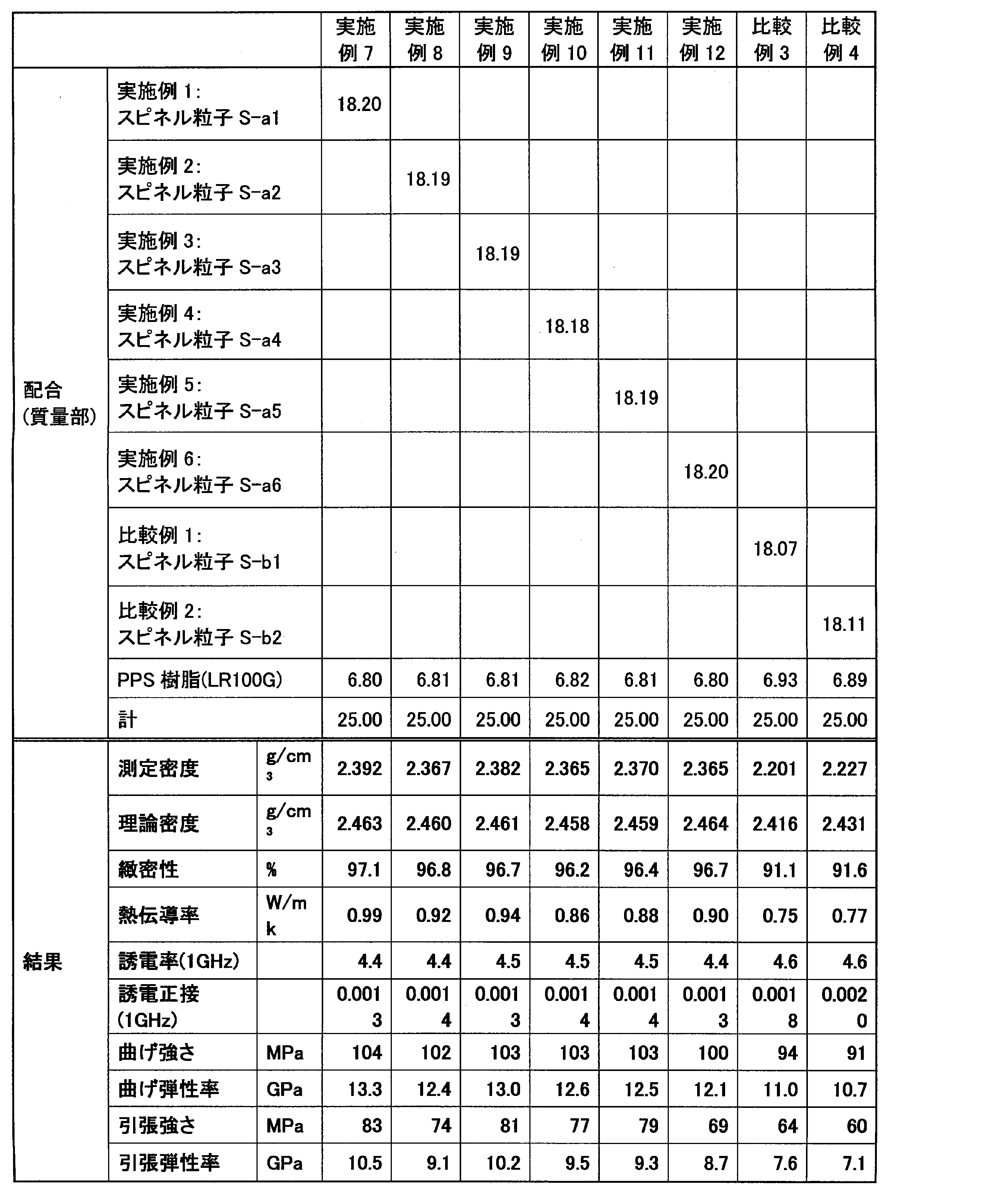
表2から、実施例1~6で得たスピネル粒子S-a1~S-a6を用いたPPS樹脂組成物の成形物(実施例7~12)では、緻密性が95%以上と高かった。また、これらのスピネル粒子は結晶子径が大きいことから、PPS樹脂組成物の総体積に対するスピネル粒子の体積の割合が50vol%となるように高充填した場合においても、誘電率及び誘電正接等のスピネル粒子本来の性能を損なわず、熱伝導率や力学特性(曲げ強さ、曲げ弾性率、引張強さ及び引張弾性率)に優れたPPS樹脂組成物の成形物が得られた。
これに対して、比較例1~2で得たスピネル粒子S-b1~S-b2は、実施例1~6で得たスピネル粒子S-a1~S-a6と比較して、d90/d10が大きく、15μm以上の粒子の体積%が0体積%超であり、長径L/短径Sが2超であり、これらスピネル粒子S-b1~S-b2を用いたPPS樹脂組成物の成形物(比較例3~4)では、緻密性が低かった。これは、粒子の不均一性により、局部の凝集の促進や粗大粒子のかみ合いの影響によるものであると推察された。また、比較例3~4で得たPPS樹脂組成物の成形物は、熱伝導率や力学特性(曲げ強さ、曲げ弾性率、引張強さ及び引張弾性率)についても、実施例7~12で得たPPS樹脂組成物の成形物よりも劣るものであった。
これに対して、比較例1~2で得たスピネル粒子S-b1~S-b2は、実施例1~6で得たスピネル粒子S-a1~S-a6と比較して、d90/d10が大きく、15μm以上の粒子の体積%が0体積%超であり、長径L/短径Sが2超であり、これらスピネル粒子S-b1~S-b2を用いたPPS樹脂組成物の成形物(比較例3~4)では、緻密性が低かった。これは、粒子の不均一性により、局部の凝集の促進や粗大粒子のかみ合いの影響によるものであると推察された。また、比較例3~4で得たPPS樹脂組成物の成形物は、熱伝導率や力学特性(曲げ強さ、曲げ弾性率、引張強さ及び引張弾性率)についても、実施例7~12で得たPPS樹脂組成物の成形物よりも劣るものであった。
≪エポキシ樹脂組成物及びその成形物の作製≫
<実施例13~18、比較例5~6>
実施例1~6及び比較例1~2で作製したスピネル粒子を用い、エポキシ樹脂(ビスフェノールA型エポキシ樹脂(DIC(株)製EPICLON-850S)(エポキシ当量:188)とEX-321L(トリメチロールプロパングリシジルエーテル、ナガセケムテックス(株)製、エポキシ当量130g/eq.)を85質量%/15質量%で混合したもの)の比重を1.18とし、スピネル粒子の体積%が40vol%、硬化剤AH-154(ジシアンジアミド、味の素ファインテクノ(株)製)がエポキシ樹脂に対し0.95質量%、全固形分と溶剤(シクロヘキサノン)の質量比が20/10となるように、表3に記載のとおり配合した。配合物を自転-公転型混練装置で混練し、エポキシ樹脂組成物を得た。得られたエポキシ樹脂組成物について、アプリケーターを用いて、50μmのシートを作製した。シートを乾燥し溶剤を除いた後、シート中に50μm以上の凝集物がシート表面に露出して存在するかを確認し、凝集物がないものを「〇」、凝集物が1個以上あるものを「×」と評価した。更に、シート外観に濃度ムラ、スジ、発泡等の不具合があるか確認し、不具合がないものを「〇」、あるものを「×」と評価した。その後、シートを10枚重ね加熱プレス成形により樹脂硬化物を作成した(硬化条件170℃×20分)。その樹脂硬化物を乾燥器内で170℃×2時間、200℃×2時間で更に硬化させて、成形物を得た。
<実施例13~18、比較例5~6>
実施例1~6及び比較例1~2で作製したスピネル粒子を用い、エポキシ樹脂(ビスフェノールA型エポキシ樹脂(DIC(株)製EPICLON-850S)(エポキシ当量:188)とEX-321L(トリメチロールプロパングリシジルエーテル、ナガセケムテックス(株)製、エポキシ当量130g/eq.)を85質量%/15質量%で混合したもの)の比重を1.18とし、スピネル粒子の体積%が40vol%、硬化剤AH-154(ジシアンジアミド、味の素ファインテクノ(株)製)がエポキシ樹脂に対し0.95質量%、全固形分と溶剤(シクロヘキサノン)の質量比が20/10となるように、表3に記載のとおり配合した。配合物を自転-公転型混練装置で混練し、エポキシ樹脂組成物を得た。得られたエポキシ樹脂組成物について、アプリケーターを用いて、50μmのシートを作製した。シートを乾燥し溶剤を除いた後、シート中に50μm以上の凝集物がシート表面に露出して存在するかを確認し、凝集物がないものを「〇」、凝集物が1個以上あるものを「×」と評価した。更に、シート外観に濃度ムラ、スジ、発泡等の不具合があるか確認し、不具合がないものを「〇」、あるものを「×」と評価した。その後、シートを10枚重ね加熱プレス成形により樹脂硬化物を作成した(硬化条件170℃×20分)。その樹脂硬化物を乾燥器内で170℃×2時間、200℃×2時間で更に硬化させて、成形物を得た。
≪エポキシ樹脂組成物の成形物の評価≫
上記の実施例13~18及び比較例5~6で製造したエポキシ樹脂組成物の成形物を試料とし、以下の評価を行った。測定方法を以下に示す。また、測定結果を表3に示す。
上記の実施例13~18及び比較例5~6で製造したエポキシ樹脂組成物の成形物を試料とし、以下の評価を行った。測定方法を以下に示す。また、測定結果を表3に示す。
[エポキシ樹脂組成物の成形物の密度の測定]
得られた成形物を30mm×30mm×0.5mmに切り出し、大気中とエタノール成形体の質量を小数4位まで測定し、アルキメデス法により、密度を測定した。
得られた成形物を30mm×30mm×0.5mmに切り出し、大気中とエタノール成形体の質量を小数4位まで測定し、アルキメデス法により、密度を測定した。
[エポキシ樹脂組成物の成形物の緻密性の測定]
配合組成より得られる理論密度に対する、密度測定にて得られた値を%で求めた。値が100%に近いほど、理論密度に近く、緻密性が高いと言える。
配合組成より得られる理論密度に対する、密度測定にて得られた値を%で求めた。値が100%に近いほど、理論密度に近く、緻密性が高いと言える。
[エポキシ樹脂組成物の成形物の熱伝導率の測定]
得られた成形物を10mm×10mm×0.5mmとなるように切り出し、キセノンフラッシュ法による熱伝導率測定装置(LFA467 HyperFlash、NETZSCH社製)を用いて、25℃における面に対し垂直方向に伝熱する熱拡散率及び比熱の測定を行った。5サンプル測定し平均値を求めた。比熱は配合より理論比熱を用いた。得られた熱拡散率、比熱、そして密度の積から、エポキシ樹脂組成物の熱伝導率を見積もった。
得られた成形物を10mm×10mm×0.5mmとなるように切り出し、キセノンフラッシュ法による熱伝導率測定装置(LFA467 HyperFlash、NETZSCH社製)を用いて、25℃における面に対し垂直方向に伝熱する熱拡散率及び比熱の測定を行った。5サンプル測定し平均値を求めた。比熱は配合より理論比熱を用いた。得られた熱拡散率、比熱、そして密度の積から、エポキシ樹脂組成物の熱伝導率を見積もった。
[エポキシ樹脂組成物の成形物の曲げ強さ及び弾性率の測定]
得られた成形物を80mm×10mm×0.5mmとなるように切り出し、3点曲げ強さ試験を行った。得られたダンベル試験片の一辺を、支点間距離が40mmとなるように、2点で支持し、これと対向する辺における上記2点の中間位置にクロスヘッドの移動速度1mm/分の速度で加重を加えて、試験片が破壊したときの最大荷重を測定し、3点曲げ強さ(MPa)を算出した。当該曲げ強さを5サンプル測定して平均値を求めた。
得られた成形物を80mm×10mm×0.5mmとなるように切り出し、3点曲げ強さ試験を行った。得られたダンベル試験片の一辺を、支点間距離が40mmとなるように、2点で支持し、これと対向する辺における上記2点の中間位置にクロスヘッドの移動速度1mm/分の速度で加重を加えて、試験片が破壊したときの最大荷重を測定し、3点曲げ強さ(MPa)を算出した。当該曲げ強さを5サンプル測定して平均値を求めた。
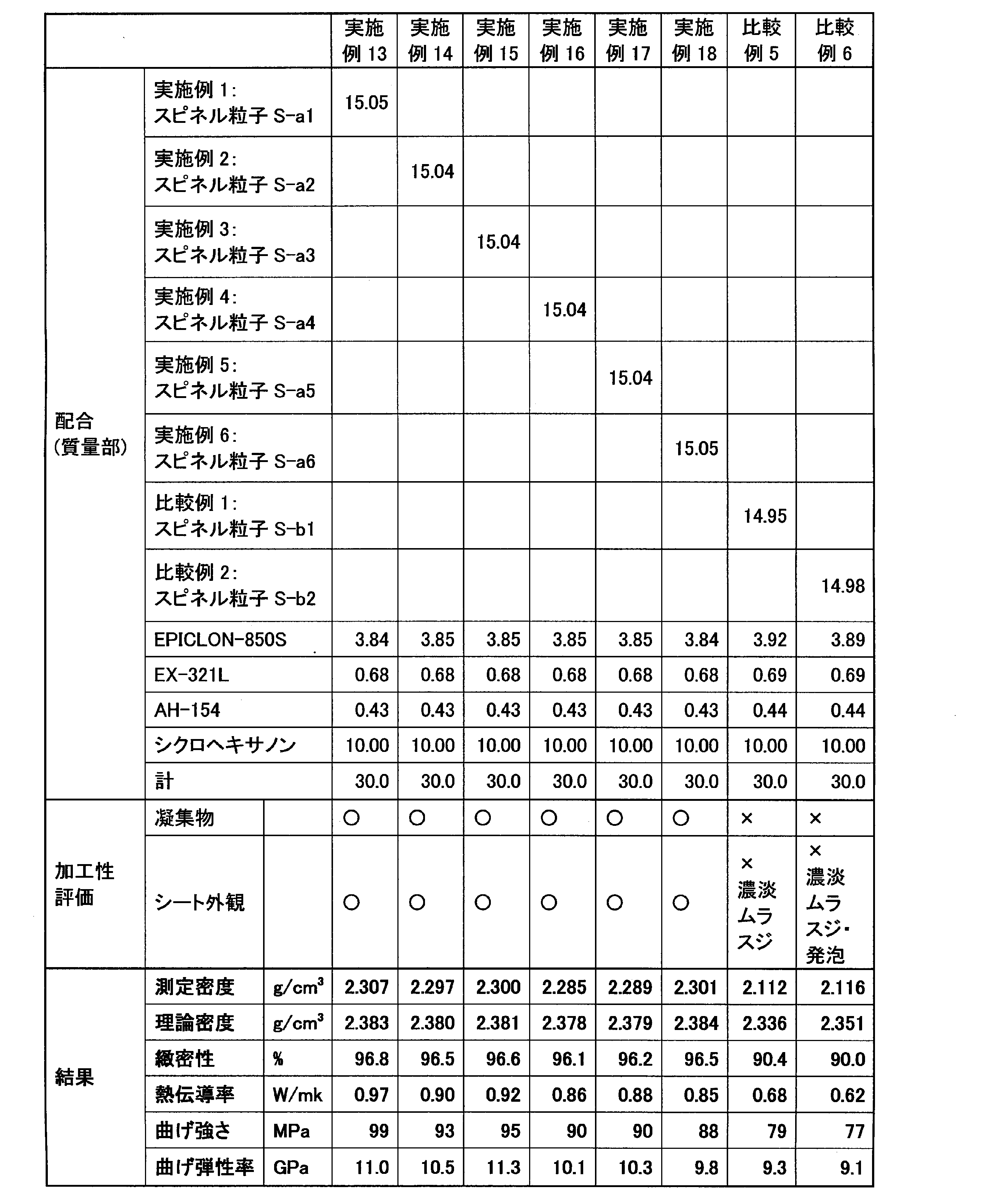
表3から、PPS樹脂組成物の成形物での結果と同様に、実施例1~6で得たスピネル粒子S-a1~S-a6を用いたエポキシ樹脂組成物の成形物(実施例13~18)では、緻密性が95%以上と高かった。また、これらのスピネル粒子は結晶子径が大きいことから、エポキシ樹脂組成物の総体積に対するスピネル粒子の体積の割合が40vol%となるように高充填した場合においても、スピネル粒子本来の性能を損なわず、熱伝導率や力学特性(曲げ強さ及び曲げ弾性率)に優れたエポキシ樹脂組成物の成形物が得られた。
これに対して、比較例1~2で得たスピネル粒子S-b1~S-b2は、実施例1~6で得たスピネル粒子S-a1~S-a6と比較して、d90/d10が大きく、15μm以上の粒子の体積%が0体積%超であり、長径L/短径Sが2超であり、これらスピネル粒子S-b1~S-b2を用いたエポキシ樹脂組成物(比較例5~6)では、粒子の不均一性によって局部の凝集の促進や粗大粒子のかみ合いの影響から、塗工したシート状に凝集物が認められ、スジや発泡の発生等、シート外観が著しく悪化する結果となった。また、比較例5~6で得たエポキシ樹脂組成物の成形物は、緻密性が低く、熱伝導率や力学特性(曲げ強さ及び曲げ弾性率)についても、実施例13~18で得たエポキシ樹脂組成物の成形物よりも劣るものであった。
これに対して、比較例1~2で得たスピネル粒子S-b1~S-b2は、実施例1~6で得たスピネル粒子S-a1~S-a6と比較して、d90/d10が大きく、15μm以上の粒子の体積%が0体積%超であり、長径L/短径Sが2超であり、これらスピネル粒子S-b1~S-b2を用いたエポキシ樹脂組成物(比較例5~6)では、粒子の不均一性によって局部の凝集の促進や粗大粒子のかみ合いの影響から、塗工したシート状に凝集物が認められ、スジや発泡の発生等、シート外観が著しく悪化する結果となった。また、比較例5~6で得たエポキシ樹脂組成物の成形物は、緻密性が低く、熱伝導率や力学特性(曲げ強さ及び曲げ弾性率)についても、実施例13~18で得たエポキシ樹脂組成物の成形物よりも劣るものであった。
≪ガラスセラミックス組成物用バインダー樹脂の合成≫
<合成例3>ガラスセラミックス組成物用バインダー樹脂Cの合成
キシレン100部を、窒素気流中80℃に保ち、攪拌しながらメタクリル酸エチル68部、メタクリル酸2-エチルヘキシル29部、チオグリコール酸3部、及び重合開始剤(「パーブチルO」〔有効成分ペルオキシ2-エチルヘキサン酸t-ブチル、日本油脂(株)製〕)0.2部からなる混合物を4時間かけて滴下した。滴下終了後、4時間ごとに「パーブチルO」0.5部を添加し、80℃で12時間攪拌した。反応終了後不揮発分調整のためキシレンを加え、不揮発分(固形分)50%の、片末端にカルボキシル基を有するビニル共重合体のキシレン溶液を得た。該樹脂の質量平均分子量は7000、酸価は18.0mgKOH/g、ガラス転移温度Tgは38℃であった。
<合成例3>ガラスセラミックス組成物用バインダー樹脂Cの合成
キシレン100部を、窒素気流中80℃に保ち、攪拌しながらメタクリル酸エチル68部、メタクリル酸2-エチルヘキシル29部、チオグリコール酸3部、及び重合開始剤(「パーブチルO」〔有効成分ペルオキシ2-エチルヘキサン酸t-ブチル、日本油脂(株)製〕)0.2部からなる混合物を4時間かけて滴下した。滴下終了後、4時間ごとに「パーブチルO」0.5部を添加し、80℃で12時間攪拌した。反応終了後不揮発分調整のためキシレンを加え、不揮発分(固形分)50%の、片末端にカルボキシル基を有するビニル共重合体のキシレン溶液を得た。該樹脂の質量平均分子量は7000、酸価は18.0mgKOH/g、ガラス転移温度Tgは38℃であった。
≪組成物、グリーンシート及びガラスセラミックス基板の製造≫
<実施例19~24、比較例7~8>
実施例1~6及び比較例1~2で得たスピネル粒子と、ガラス粉末(旭硝子株式会社製 平均粒子径d50=4.5μm、アルキメデス法による密度測定結果3.512、SiO2、MgO、アルカリ土類金属の酸化物を主成分とする)と、合成例3で得たバインダー樹脂Cと、可塑剤と、メチルエチルケトンとを用いて、全固形分中のスピネル粒子とガラス粉末が占める割合を80体積%、スピネル粒子とガラス粉末の割合が体積比で40/60(焼成後のガラスセラミックス基板中のスピネル粒子の含有量が、ガラス成分とスピネル粒子の合計量に対して、40体積%となる配合とした。)、全固形分/溶剤も含めた全量(Nv)が70質量%となるように、表4の記載のとおり配合した。配合物を、自公転ミキサーを用いて混合してペーストを得た。作製したペーストをポリエチレンテレフタレートフィルム上にドクターブレード法により成膜し、乾燥機で乾燥後、基板用グリーンシートを複数形成した。その際、シート中に50μm以上の凝集物がシート表面に露出して存在するかを確認し、凝集物がないものを「〇」、凝集物が1個以上あるものを「×」と評価した。更に、シート外観に濃度ムラ、スジ、発泡等の不具合があるか確認し、不具合がないものを「〇」、あるものを「×」と評価した。
次に、複数枚の基板用グリーンシートを、焼成後のガラスセラミックス基板の厚さが0.2mmとなるように、積層して、50MPaでプレスした後、大気中900℃1時間の条件で焼成し、ガラスセラミックス基板を得た。
<実施例19~24、比較例7~8>
実施例1~6及び比較例1~2で得たスピネル粒子と、ガラス粉末(旭硝子株式会社製 平均粒子径d50=4.5μm、アルキメデス法による密度測定結果3.512、SiO2、MgO、アルカリ土類金属の酸化物を主成分とする)と、合成例3で得たバインダー樹脂Cと、可塑剤と、メチルエチルケトンとを用いて、全固形分中のスピネル粒子とガラス粉末が占める割合を80体積%、スピネル粒子とガラス粉末の割合が体積比で40/60(焼成後のガラスセラミックス基板中のスピネル粒子の含有量が、ガラス成分とスピネル粒子の合計量に対して、40体積%となる配合とした。)、全固形分/溶剤も含めた全量(Nv)が70質量%となるように、表4の記載のとおり配合した。配合物を、自公転ミキサーを用いて混合してペーストを得た。作製したペーストをポリエチレンテレフタレートフィルム上にドクターブレード法により成膜し、乾燥機で乾燥後、基板用グリーンシートを複数形成した。その際、シート中に50μm以上の凝集物がシート表面に露出して存在するかを確認し、凝集物がないものを「〇」、凝集物が1個以上あるものを「×」と評価した。更に、シート外観に濃度ムラ、スジ、発泡等の不具合があるか確認し、不具合がないものを「〇」、あるものを「×」と評価した。
次に、複数枚の基板用グリーンシートを、焼成後のガラスセラミックス基板の厚さが0.2mmとなるように、積層して、50MPaでプレスした後、大気中900℃1時間の条件で焼成し、ガラスセラミックス基板を得た。
≪ガラスセラミックス基板の評価≫
上記の実施例19~24及び比較例7~8で製造したガラスセラミックス基板を試料とし、以下の評価を行った。測定方法を以下に示す。また、測定結果を表4に示す。
上記の実施例19~24及び比較例7~8で製造したガラスセラミックス基板を試料とし、以下の評価を行った。測定方法を以下に示す。また、測定結果を表4に示す。
[ガラスセラミックス基板の密度の測定]
ガラスセラミックス基板のサイズが30mm×30mm×0.2mmとなるよう調整し、大気中とエタノール成形体の質量を小数4位まで測定し、アルキメデス法により、密度を測定した。
ガラスセラミックス基板のサイズが30mm×30mm×0.2mmとなるよう調整し、大気中とエタノール成形体の質量を小数4位まで測定し、アルキメデス法により、密度を測定した。
[ガラスセラミックス基板の緻密性の測定]
配合組成より得られる理論密度に対する、密度測定にて得られた値を%で求めた。値が100%に近いほど、理論密度に近く、緻密性が高いと言える。
配合組成より得られる理論密度に対する、密度測定にて得られた値を%で求めた。値が100%に近いほど、理論密度に近く、緻密性が高いと言える。
[ガラスセラミックス基板の熱伝導率の測定]
実施例及び比較例で得た複数枚の基板用グリーンシートを、焼成後のガラスセラミックス基板の厚さが1.0mmとなるように、積層して、50MPaでプレスした後、大気中900℃1時間の条件で焼成し、ガラスセラミックス基板を得た。その後、ガラスセラミックス基板を10mm×10mm×1.0mmとなるよう調整し、キセノンフラッシュ法による熱伝導率測定装置(LFA467 HyperFlash、NETZSCH社製)を用いて、25℃における面に対し垂直方向に伝熱する熱拡散率及び比熱の測定を行った。比熱については、10mm×10mm×1mmのパイロセラム9606をレファレンスとして測定した。得られた熱拡散率、比熱、そして密度の積から、ガラスセラミックス基板の熱伝導率を見積もった。
実施例及び比較例で得た複数枚の基板用グリーンシートを、焼成後のガラスセラミックス基板の厚さが1.0mmとなるように、積層して、50MPaでプレスした後、大気中900℃1時間の条件で焼成し、ガラスセラミックス基板を得た。その後、ガラスセラミックス基板を10mm×10mm×1.0mmとなるよう調整し、キセノンフラッシュ法による熱伝導率測定装置(LFA467 HyperFlash、NETZSCH社製)を用いて、25℃における面に対し垂直方向に伝熱する熱拡散率及び比熱の測定を行った。比熱については、10mm×10mm×1mmのパイロセラム9606をレファレンスとして測定した。得られた熱拡散率、比熱、そして密度の積から、ガラスセラミックス基板の熱伝導率を見積もった。
[ガラスセラミックス基板の誘電率及び誘電正接の測定]
株式会社エーイーティ製誘電率測定装置 ADMS01Oを用い、温度25℃、湿度50%の条件下、空洞共振法にて周波数1GHzの誘電率及び誘電正接を測定した。
株式会社エーイーティ製誘電率測定装置 ADMS01Oを用い、温度25℃、湿度50%の条件下、空洞共振法にて周波数1GHzの誘電率及び誘電正接を測定した。
[ガラスセラミックス基板の曲げ強さの測定]
JIS C2141に準拠する3点曲げ強さ試験を行った。ガラスセラミックス基板の一辺を、支点間距離が40mmとなるように、2点で支持し、これと対向する辺における上記2点の中間位置にクロスヘッドの移動速度0.5mm/分の速度で加重を加えて、試験片が破壊したときの最大荷重を測定し、3点曲げ強さ(MPa)を算出した。当該曲げ強さを5サンプル測定して平均値を求めた。
JIS C2141に準拠する3点曲げ強さ試験を行った。ガラスセラミックス基板の一辺を、支点間距離が40mmとなるように、2点で支持し、これと対向する辺における上記2点の中間位置にクロスヘッドの移動速度0.5mm/分の速度で加重を加えて、試験片が破壊したときの最大荷重を測定し、3点曲げ強さ(MPa)を算出した。当該曲げ強さを5サンプル測定して平均値を求めた。
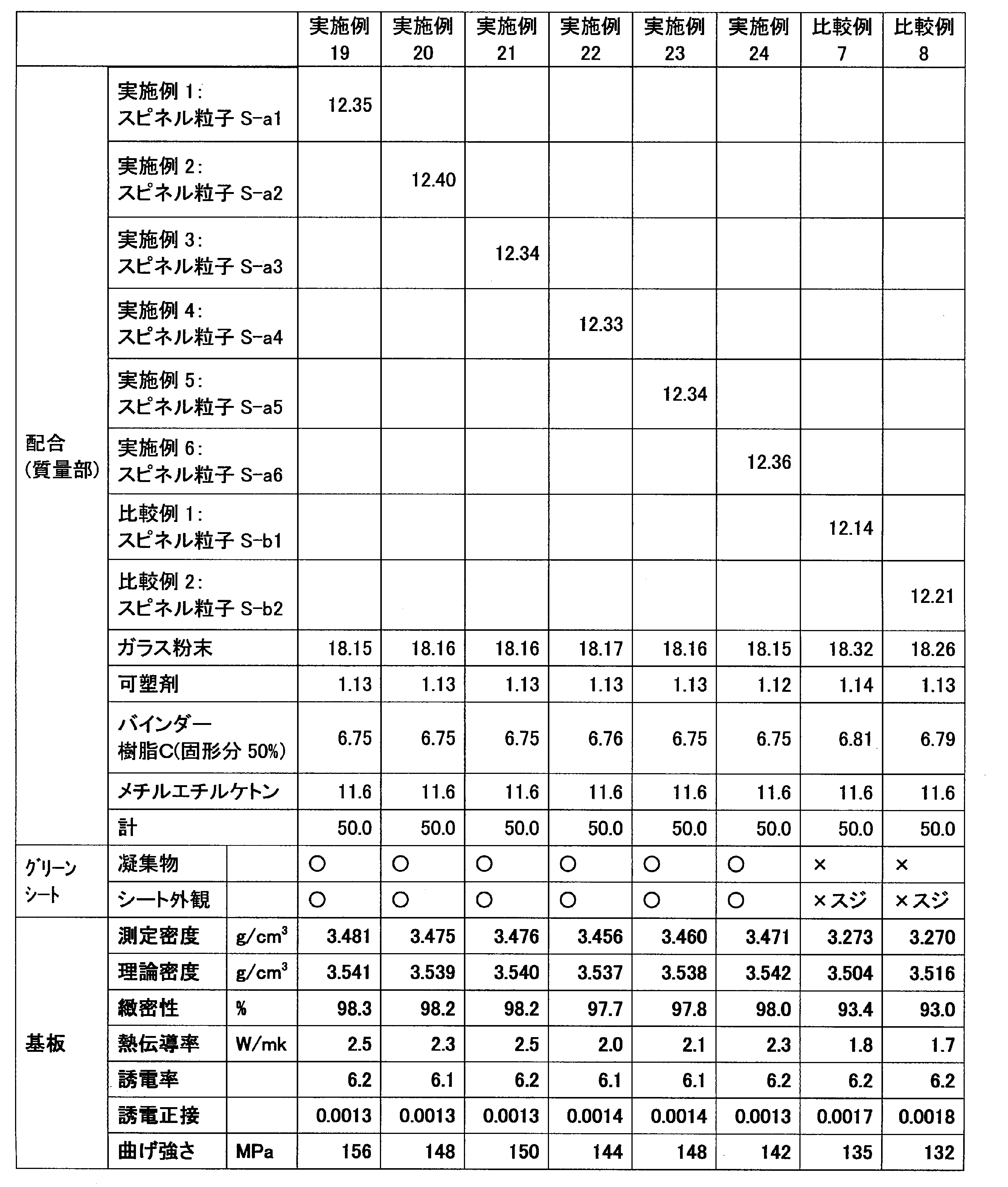
表4から、PPS樹脂組成物での結果と同様に、実施例1~6で得たスピネル粒子S-a1~S-a6を用いたガラスセラミックス基板(実施例19~24)では、緻密性が95%以上と高かった。また、これらのスピネル粒子は結晶子径が大きいことから、焼成後のガラスセラミックス基板中のスピネル粒子の含有量が、ガラス成分とスピネル粒子の合計量に対して、40vol%となるように高充填した場合においても、誘電率や誘電正接等のスピネル粒子本来の性能を損なわず、また、グリーンシートの外観を良好に保ちながら、熱伝導率や力学特性(曲げ強さ)に優れたガラスセラミックス基板が得られた。
これに対して、比較例1~2で得たスピネル粒子S-b1~S-b2は、実施例1~6で得たスピネル粒子S-a1~S-a6と比較して、d90/d10が大きく、15μm以上の粒子の体積%が0体積%超であり、長径L/短径Sが2超であり、これらスピネル粒子S-b1~S-b2を用いたガラスセラミックス基板(比較例7~8)では、粒子の不均一性によって局部の凝集の促進や粗大粒子のかみ合いの影響から、グリーンシートにスジの発生が認められ、シート外観が著しく悪化する結果となった。また、比較例7~8で得たガラスセラミックス基板は、緻密性が低く、熱伝導率や力学特性(曲げ強さ)についても、実施例19~24で得たガラスセラミックス基板よりも劣るものであった。
これに対して、比較例1~2で得たスピネル粒子S-b1~S-b2は、実施例1~6で得たスピネル粒子S-a1~S-a6と比較して、d90/d10が大きく、15μm以上の粒子の体積%が0体積%超であり、長径L/短径Sが2超であり、これらスピネル粒子S-b1~S-b2を用いたガラスセラミックス基板(比較例7~8)では、粒子の不均一性によって局部の凝集の促進や粗大粒子のかみ合いの影響から、グリーンシートにスジの発生が認められ、シート外観が著しく悪化する結果となった。また、比較例7~8で得たガラスセラミックス基板は、緻密性が低く、熱伝導率や力学特性(曲げ強さ)についても、実施例19~24で得たガラスセラミックス基板よりも劣るものであった。
実施形態に係るスピネル粒子及びその製造方法によれば、フィラーの充填性及びシート作製時の外観により優れ、高熱伝導率と低誘電正接を併せ持ち、機械強度も優れる樹脂組成物及びガラスセラミックス基板が得られるスピネル粒子を提供することができる。
Claims (18)
- レーザー回折式粒度分布測定における体積基準の平均粒子径d50が0.01μm以上5μm以下であり、d90/d10が5以下であり、且つ、15μm以上の粒子の含有量が全粒子の総体積に対して0.1体積%以下である、スピネル粒子。
- スピネル粒子の短径Sに対する長径Lの比L/Sが2以下である、請求項1に記載のスピネル粒子。
- 粒子内にモリブデンを含む、請求項1又は2に記載のスピネル粒子。
- X線回折法により得られる回折ピークの、(311)面に相当するピークの半値幅から算出される結晶子径が120nm以上である、請求項1~3のいずれか一項に記載のスピネル粒子。
- 請求項1~4のいずれか一項に記載のスピネル粒子の製造方法であって、
マグネシウム化合物及びアルミニウム化合物を、モリブデン存在下で、焼成させる、製造方法。 - 前記アルミニウム化合物が板状アルミナ粒子である、請求項5に記載の製造方法。
- 前記アルミニウム化合物及び前記マグネシウム化合物のレーザー回折式粒度分布測定における体積基準の平均粒子径d50が0.01μm以上5μm以下である、請求項5又は6に記載の製造方法。
- 前記アルミニウム化合物がモリブデンを三酸化モリブデン換算で0.1質量%以上1質量%以下含む、請求項5~7のいずれか一項に記載の製造方法。
- 焼成時に形状制御剤としてナトリウム化合物又はカリウム化合物を用いる、請求項5~8のいずれ一項に記載の製造方法。
- 請求項1~4のいずれか一項に記載のスピネル粒子と、樹脂と、を含有する樹脂組成物。
- 硬化剤を更に含有する、請求項10に記載の樹脂組成物。
- 熱伝導性材料である、請求項10又は11に記載の樹脂組成物。
- 請求項10~12のいずれか一項に記載の樹脂組成物を成形してなる、成形物。
- 請求項1~4のいずれか一項に記載のスピネル粒子と、ガラス成分と、を含有する、組成物。
- 前記スピネル粒子の含有量がスピネル粒子及びガラス成分の合計体積100vol%に対して、10vol%以上50vol%以下である、請求項14に記載の組成物。
- 請求項14又は15に記載の組成物を成形してなる、グリーンシート。
- 請求項14又は15に記載の組成物を焼成してなる、焼成物。
- 請求項17に記載の焼成物を備える、ガラスセラミックス基板。
Priority Applications (1)
| Application Number | Priority Date | Filing Date | Title |
|---|---|---|---|
| JP2020565199A JPWO2020145342A1 (ja) | 2019-01-11 | 2020-01-09 | スピネル粒子及びその製造方法、樹脂組成物、成形物、組成物、グリーンシート、焼成物、並びに、ガラスセラミックス基板 |
Applications Claiming Priority (2)
| Application Number | Priority Date | Filing Date | Title |
|---|---|---|---|
| JP2019003649 | 2019-01-11 | ||
| JP2019-003649 | 2019-01-11 |
Publications (1)
| Publication Number | Publication Date |
|---|---|
| WO2020145342A1 true WO2020145342A1 (ja) | 2020-07-16 |
Family
ID=71520530
Family Applications (1)
| Application Number | Title | Priority Date | Filing Date |
|---|---|---|---|
| PCT/JP2020/000438 Ceased WO2020145342A1 (ja) | 2019-01-11 | 2020-01-09 | スピネル粒子及びその製造方法、樹脂組成物、成形物、組成物、グリーンシート、焼成物、並びに、ガラスセラミックス基板 |
Country Status (2)
| Country | Link |
|---|---|
| JP (1) | JPWO2020145342A1 (ja) |
| WO (1) | WO2020145342A1 (ja) |
Cited By (3)
| Publication number | Priority date | Publication date | Assignee | Title |
|---|---|---|---|---|
| CN115637426A (zh) * | 2022-02-28 | 2023-01-24 | 青岛科技大学 | 一种化学浴沉积介孔二氧化锡薄膜的方法 |
| CN116409987A (zh) * | 2023-04-18 | 2023-07-11 | 郑州大学 | 一种含钼酸钙渣增值利用的方法 |
| JP7843569B1 (ja) * | 2025-10-22 | 2026-04-10 | 浅田化学工業株式会社 | スピネル型アルミニウム酸化物およびその製造方法 |
Citations (11)
| Publication number | Priority date | Publication date | Assignee | Title |
|---|---|---|---|---|
| JPS6360106A (ja) * | 1986-08-28 | 1988-03-16 | Asahi Chem Ind Co Ltd | スピネル粉体およびその製造方法 |
| JP2001002413A (ja) * | 1999-06-18 | 2001-01-09 | Sumitomo Chem Co Ltd | マグネシアスピネル粉末の製造方法 |
| CN1634802A (zh) * | 2003-12-30 | 2005-07-06 | 中国科学院福建物质结构研究所 | 用共沉淀法制备镁铝尖晶石纳米粉体 |
| JP2008529758A (ja) * | 2005-01-19 | 2008-08-07 | メルク パテント ゲゼルシャフト ミット ベシュレンクテル ハフトング | スプレー熱分解による混合酸化物の製造方法 |
| JP2008244136A (ja) * | 2007-03-27 | 2008-10-09 | Kyocera Corp | ガラスセラミック多層基板の製造方法 |
| JP2008273817A (ja) * | 2001-03-28 | 2008-11-13 | Murata Mfg Co Ltd | 絶縁体セラミック組成物およびそれを用いた絶縁体セラミック |
| CN103265278A (zh) * | 2013-06-20 | 2013-08-28 | 商丘师范学院 | 一种无团聚MgAl2O4纳米颗粒粉体的制备方法 |
| CN104710169A (zh) * | 2015-03-17 | 2015-06-17 | 武汉科技大学 | 一种镁铝尖晶石超细粉体及其制备方法 |
| JP2016222501A (ja) * | 2015-06-01 | 2016-12-28 | Dic株式会社 | 板状アルミナ粒子およびその製造方法 |
| WO2017221372A1 (ja) * | 2016-06-23 | 2017-12-28 | Dic株式会社 | スピネル粒子およびその製造方法、並びに前記スピネル粒子を含む組成物および成形物 |
| JP2018052747A (ja) * | 2016-09-26 | 2018-04-05 | タテホ化学工業株式会社 | 酸化マグネシウム含有スピネル粉末及びその製造方法 |
-
2020
- 2020-01-09 JP JP2020565199A patent/JPWO2020145342A1/ja active Pending
- 2020-01-09 WO PCT/JP2020/000438 patent/WO2020145342A1/ja not_active Ceased
Patent Citations (11)
| Publication number | Priority date | Publication date | Assignee | Title |
|---|---|---|---|---|
| JPS6360106A (ja) * | 1986-08-28 | 1988-03-16 | Asahi Chem Ind Co Ltd | スピネル粉体およびその製造方法 |
| JP2001002413A (ja) * | 1999-06-18 | 2001-01-09 | Sumitomo Chem Co Ltd | マグネシアスピネル粉末の製造方法 |
| JP2008273817A (ja) * | 2001-03-28 | 2008-11-13 | Murata Mfg Co Ltd | 絶縁体セラミック組成物およびそれを用いた絶縁体セラミック |
| CN1634802A (zh) * | 2003-12-30 | 2005-07-06 | 中国科学院福建物质结构研究所 | 用共沉淀法制备镁铝尖晶石纳米粉体 |
| JP2008529758A (ja) * | 2005-01-19 | 2008-08-07 | メルク パテント ゲゼルシャフト ミット ベシュレンクテル ハフトング | スプレー熱分解による混合酸化物の製造方法 |
| JP2008244136A (ja) * | 2007-03-27 | 2008-10-09 | Kyocera Corp | ガラスセラミック多層基板の製造方法 |
| CN103265278A (zh) * | 2013-06-20 | 2013-08-28 | 商丘师范学院 | 一种无团聚MgAl2O4纳米颗粒粉体的制备方法 |
| CN104710169A (zh) * | 2015-03-17 | 2015-06-17 | 武汉科技大学 | 一种镁铝尖晶石超细粉体及其制备方法 |
| JP2016222501A (ja) * | 2015-06-01 | 2016-12-28 | Dic株式会社 | 板状アルミナ粒子およびその製造方法 |
| WO2017221372A1 (ja) * | 2016-06-23 | 2017-12-28 | Dic株式会社 | スピネル粒子およびその製造方法、並びに前記スピネル粒子を含む組成物および成形物 |
| JP2018052747A (ja) * | 2016-09-26 | 2018-04-05 | タテホ化学工業株式会社 | 酸化マグネシウム含有スピネル粉末及びその製造方法 |
Cited By (3)
| Publication number | Priority date | Publication date | Assignee | Title |
|---|---|---|---|---|
| CN115637426A (zh) * | 2022-02-28 | 2023-01-24 | 青岛科技大学 | 一种化学浴沉积介孔二氧化锡薄膜的方法 |
| CN116409987A (zh) * | 2023-04-18 | 2023-07-11 | 郑州大学 | 一种含钼酸钙渣增值利用的方法 |
| JP7843569B1 (ja) * | 2025-10-22 | 2026-04-10 | 浅田化学工業株式会社 | スピネル型アルミニウム酸化物およびその製造方法 |
Also Published As
| Publication number | Publication date |
|---|---|
| JPWO2020145342A1 (ja) | 2021-11-25 |
Similar Documents
| Publication | Publication Date | Title |
|---|---|---|
| JP5975182B2 (ja) | 樹脂組成物、樹脂成形体、放熱材料及び放熱部材、並びにこれらの製造方法 | |
| JP6607325B2 (ja) | α−アルミナ粒子の製造方法および樹脂組成物の製造方法 | |
| TWI709531B (zh) | 尖晶石粒子及其製造方法、以及包含前述尖晶石粒子之組成物及成形物 | |
| JP7683773B2 (ja) | 複合粒子の製造方法 | |
| JP5995130B1 (ja) | スピネル粒子およびその製造方法、並びに前記スピネル粒子を含む組成物および成形物 | |
| JP7459801B2 (ja) | 板状アルミナ粒子、板状アルミナ粒子の製造方法、及び樹脂組成物 | |
| WO2020145342A1 (ja) | スピネル粒子及びその製造方法、樹脂組成物、成形物、組成物、グリーンシート、焼成物、並びに、ガラスセラミックス基板 | |
| WO2019194159A1 (ja) | アルミナを含有する樹脂組成物及び放熱部材 | |
| WO2020145343A1 (ja) | 板状スピネル粒子及びその製造方法 | |
| JP7435473B2 (ja) | 樹脂組成物、成形物、組成物、グリーンシート、焼成物及びガラスセラミックス基板 | |
| KR20220079556A (ko) | 판상 알루미나 입자 및 판상 알루미나 입자의 제조 방법 | |
| JP6892030B1 (ja) | アルミナ粒子の製造方法 | |
| JP7107075B2 (ja) | 組成物、グリーンシート、焼成物、及びガラスセラミックス基板 | |
| CN114555718A (zh) | 氧化铝颗粒和氧化铝颗粒的制造方法 | |
| JP7468808B1 (ja) | ガーナイト粒子およびその製造方法 | |
| WO2024024604A1 (ja) | 高純度スピネル粒子およびその製造方法 | |
| WO2023234161A1 (ja) | 酸化銅クロムスピネル、及びその樹脂組成物、樹脂成形品 | |
| TW202504850A (zh) | 鎂橄欖石粒子及鎂橄欖石粒子的製造方法 | |
| JP2024103577A (ja) | 酸化銅クロムスピネル、及びその樹脂組成物、樹脂成形品、酸化銅クロムスピネルの製造方法 | |
| WO2018194117A1 (ja) | スピネル粒子の製造方法、樹脂組成物の製造方法および成形物の製造方法 |
Legal Events
| Date | Code | Title | Description |
|---|---|---|---|
| 121 | Ep: the epo has been informed by wipo that ep was designated in this application |
Ref document number: 20738907 Country of ref document: EP Kind code of ref document: A1 |
|
| ENP | Entry into the national phase |
Ref document number: 2020565199 Country of ref document: JP Kind code of ref document: A |
|
| NENP | Non-entry into the national phase |
Ref country code: DE |
|
| 122 | Ep: pct application non-entry in european phase |
Ref document number: 20738907 Country of ref document: EP Kind code of ref document: A1 |