WO2020144004A1 - Herstellung von polyurethanhartschaum - Google Patents
Herstellung von polyurethanhartschaum Download PDFInfo
- Publication number
- WO2020144004A1 WO2020144004A1 PCT/EP2019/085264 EP2019085264W WO2020144004A1 WO 2020144004 A1 WO2020144004 A1 WO 2020144004A1 EP 2019085264 W EP2019085264 W EP 2019085264W WO 2020144004 A1 WO2020144004 A1 WO 2020144004A1
- Authority
- WO
- WIPO (PCT)
- Prior art keywords
- polyether
- siloxanes
- hydrocarbons
- foam
- kws
- Prior art date
- Legal status (The legal status is an assumption and is not a legal conclusion. Google has not performed a legal analysis and makes no representation as to the accuracy of the status listed.)
- Ceased
Links
Classifications
-
- C—CHEMISTRY; METALLURGY
- C08—ORGANIC MACROMOLECULAR COMPOUNDS; THEIR PREPARATION OR CHEMICAL WORKING-UP; COMPOSITIONS BASED THEREON
- C08G—MACROMOLECULAR COMPOUNDS OBTAINED OTHERWISE THAN BY REACTIONS ONLY INVOLVING UNSATURATED CARBON-TO-CARBON BONDS
- C08G18/00—Polymeric products of isocyanates or isothiocyanates
- C08G18/06—Polymeric products of isocyanates or isothiocyanates with compounds having active hydrogen
- C08G18/28—Polymeric products of isocyanates or isothiocyanates with compounds having active hydrogen characterised by the compounds used containing active hydrogen
- C08G18/40—High-molecular-weight compounds
- C08G18/61—Polysiloxanes
-
- C—CHEMISTRY; METALLURGY
- C08—ORGANIC MACROMOLECULAR COMPOUNDS; THEIR PREPARATION OR CHEMICAL WORKING-UP; COMPOSITIONS BASED THEREON
- C08J—WORKING-UP; GENERAL PROCESSES OF COMPOUNDING; AFTER-TREATMENT NOT COVERED BY SUBCLASSES C08B, C08C, C08F, C08G or C08H
- C08J9/00—Working-up of macromolecular substances to porous or cellular articles or materials; After-treatment thereof
- C08J9/0061—Working-up of macromolecular substances to porous or cellular articles or materials; After-treatment thereof characterized by the use of several polymeric components
-
- C—CHEMISTRY; METALLURGY
- C08—ORGANIC MACROMOLECULAR COMPOUNDS; THEIR PREPARATION OR CHEMICAL WORKING-UP; COMPOSITIONS BASED THEREON
- C08G—MACROMOLECULAR COMPOUNDS OBTAINED OTHERWISE THAN BY REACTIONS ONLY INVOLVING UNSATURATED CARBON-TO-CARBON BONDS
- C08G18/00—Polymeric products of isocyanates or isothiocyanates
- C08G18/06—Polymeric products of isocyanates or isothiocyanates with compounds having active hydrogen
- C08G18/70—Polymeric products of isocyanates or isothiocyanates with compounds having active hydrogen characterised by the isocyanates or isothiocyanates used
- C08G18/72—Polyisocyanates or polyisothiocyanates
- C08G18/74—Polyisocyanates or polyisothiocyanates cyclic
- C08G18/76—Polyisocyanates or polyisothiocyanates cyclic aromatic
- C08G18/7657—Polyisocyanates or polyisothiocyanates cyclic aromatic containing two or more aromatic rings
- C08G18/7664—Polyisocyanates or polyisothiocyanates cyclic aromatic containing two or more aromatic rings containing alkylene polyphenyl groups
-
- C—CHEMISTRY; METALLURGY
- C08—ORGANIC MACROMOLECULAR COMPOUNDS; THEIR PREPARATION OR CHEMICAL WORKING-UP; COMPOSITIONS BASED THEREON
- C08G—MACROMOLECULAR COMPOUNDS OBTAINED OTHERWISE THAN BY REACTIONS ONLY INVOLVING UNSATURATED CARBON-TO-CARBON BONDS
- C08G18/00—Polymeric products of isocyanates or isothiocyanates
- C08G18/06—Polymeric products of isocyanates or isothiocyanates with compounds having active hydrogen
- C08G18/08—Processes
- C08G18/16—Catalysts
- C08G18/161—Catalysts containing two or more components to be covered by at least two of the groups C08G18/166, C08G18/18 or C08G18/22
- C08G18/163—Catalysts containing two or more components to be covered by at least two of the groups C08G18/166, C08G18/18 or C08G18/22 covered by C08G18/18 and C08G18/22
-
- C—CHEMISTRY; METALLURGY
- C08—ORGANIC MACROMOLECULAR COMPOUNDS; THEIR PREPARATION OR CHEMICAL WORKING-UP; COMPOSITIONS BASED THEREON
- C08G—MACROMOLECULAR COMPOUNDS OBTAINED OTHERWISE THAN BY REACTIONS ONLY INVOLVING UNSATURATED CARBON-TO-CARBON BONDS
- C08G18/00—Polymeric products of isocyanates or isothiocyanates
- C08G18/06—Polymeric products of isocyanates or isothiocyanates with compounds having active hydrogen
- C08G18/08—Processes
- C08G18/16—Catalysts
- C08G18/18—Catalysts containing secondary or tertiary amines or salts thereof
- C08G18/1808—Catalysts containing secondary or tertiary amines or salts thereof having alkylene polyamine groups
-
- C—CHEMISTRY; METALLURGY
- C08—ORGANIC MACROMOLECULAR COMPOUNDS; THEIR PREPARATION OR CHEMICAL WORKING-UP; COMPOSITIONS BASED THEREON
- C08G—MACROMOLECULAR COMPOUNDS OBTAINED OTHERWISE THAN BY REACTIONS ONLY INVOLVING UNSATURATED CARBON-TO-CARBON BONDS
- C08G18/00—Polymeric products of isocyanates or isothiocyanates
- C08G18/06—Polymeric products of isocyanates or isothiocyanates with compounds having active hydrogen
- C08G18/08—Processes
- C08G18/16—Catalysts
- C08G18/22—Catalysts containing metal compounds
- C08G18/225—Catalysts containing metal compounds of alkali or alkaline earth metals
-
- C—CHEMISTRY; METALLURGY
- C08—ORGANIC MACROMOLECULAR COMPOUNDS; THEIR PREPARATION OR CHEMICAL WORKING-UP; COMPOSITIONS BASED THEREON
- C08G—MACROMOLECULAR COMPOUNDS OBTAINED OTHERWISE THAN BY REACTIONS ONLY INVOLVING UNSATURATED CARBON-TO-CARBON BONDS
- C08G18/00—Polymeric products of isocyanates or isothiocyanates
- C08G18/06—Polymeric products of isocyanates or isothiocyanates with compounds having active hydrogen
- C08G18/28—Polymeric products of isocyanates or isothiocyanates with compounds having active hydrogen characterised by the compounds used containing active hydrogen
- C08G18/40—High-molecular-weight compounds
- C08G18/42—Polycondensates having carboxylic or carbonic ester groups in the main chain
- C08G18/4205—Polycondensates having carboxylic or carbonic ester groups in the main chain containing cyclic groups
- C08G18/4208—Polycondensates having carboxylic or carbonic ester groups in the main chain containing cyclic groups containing aromatic groups
-
- C—CHEMISTRY; METALLURGY
- C08—ORGANIC MACROMOLECULAR COMPOUNDS; THEIR PREPARATION OR CHEMICAL WORKING-UP; COMPOSITIONS BASED THEREON
- C08J—WORKING-UP; GENERAL PROCESSES OF COMPOUNDING; AFTER-TREATMENT NOT COVERED BY SUBCLASSES C08B, C08C, C08F, C08G or C08H
- C08J9/00—Working-up of macromolecular substances to porous or cellular articles or materials; After-treatment thereof
- C08J9/04—Working-up of macromolecular substances to porous or cellular articles or materials; After-treatment thereof using blowing gases generated by a previously added blowing agent
- C08J9/12—Working-up of macromolecular substances to porous or cellular articles or materials; After-treatment thereof using blowing gases generated by a previously added blowing agent by a physical blowing agent
- C08J9/14—Working-up of macromolecular substances to porous or cellular articles or materials; After-treatment thereof using blowing gases generated by a previously added blowing agent by a physical blowing agent organic
- C08J9/141—Hydrocarbons
-
- C—CHEMISTRY; METALLURGY
- C08—ORGANIC MACROMOLECULAR COMPOUNDS; THEIR PREPARATION OR CHEMICAL WORKING-UP; COMPOSITIONS BASED THEREON
- C08L—COMPOSITIONS OF MACROMOLECULAR COMPOUNDS
- C08L75/00—Compositions of polyureas or polyurethanes; Compositions of derivatives of such polymers
- C08L75/04—Polyurethanes
-
- C—CHEMISTRY; METALLURGY
- C08—ORGANIC MACROMOLECULAR COMPOUNDS; THEIR PREPARATION OR CHEMICAL WORKING-UP; COMPOSITIONS BASED THEREON
- C08L—COMPOSITIONS OF MACROMOLECULAR COMPOUNDS
- C08L75/00—Compositions of polyureas or polyurethanes; Compositions of derivatives of such polymers
- C08L75/04—Polyurethanes
- C08L75/06—Polyurethanes from polyesters
-
- C—CHEMISTRY; METALLURGY
- C08—ORGANIC MACROMOLECULAR COMPOUNDS; THEIR PREPARATION OR CHEMICAL WORKING-UP; COMPOSITIONS BASED THEREON
- C08L—COMPOSITIONS OF MACROMOLECULAR COMPOUNDS
- C08L83/00—Compositions of macromolecular compounds obtained by reactions forming in the main chain of the macromolecule a linkage containing silicon with or without sulfur, nitrogen, oxygen or carbon only; Compositions of derivatives of such polymers
- C08L83/10—Block- or graft-copolymers containing polysiloxane sequences
- C08L83/12—Block- or graft-copolymers containing polysiloxane sequences containing polyether sequences
-
- C—CHEMISTRY; METALLURGY
- C08—ORGANIC MACROMOLECULAR COMPOUNDS; THEIR PREPARATION OR CHEMICAL WORKING-UP; COMPOSITIONS BASED THEREON
- C08G—MACROMOLECULAR COMPOUNDS OBTAINED OTHERWISE THAN BY REACTIONS ONLY INVOLVING UNSATURATED CARBON-TO-CARBON BONDS
- C08G2101/00—Manufacture of cellular products
-
- C—CHEMISTRY; METALLURGY
- C08—ORGANIC MACROMOLECULAR COMPOUNDS; THEIR PREPARATION OR CHEMICAL WORKING-UP; COMPOSITIONS BASED THEREON
- C08G—MACROMOLECULAR COMPOUNDS OBTAINED OTHERWISE THAN BY REACTIONS ONLY INVOLVING UNSATURATED CARBON-TO-CARBON BONDS
- C08G2110/00—Foam properties
- C08G2110/0025—Foam properties rigid
-
- C—CHEMISTRY; METALLURGY
- C08—ORGANIC MACROMOLECULAR COMPOUNDS; THEIR PREPARATION OR CHEMICAL WORKING-UP; COMPOSITIONS BASED THEREON
- C08J—WORKING-UP; GENERAL PROCESSES OF COMPOUNDING; AFTER-TREATMENT NOT COVERED BY SUBCLASSES C08B, C08C, C08F, C08G or C08H
- C08J2203/00—Foams characterized by the expanding agent
- C08J2203/14—Saturated hydrocarbons, e.g. butane; Unspecified hydrocarbons
-
- C—CHEMISTRY; METALLURGY
- C08—ORGANIC MACROMOLECULAR COMPOUNDS; THEIR PREPARATION OR CHEMICAL WORKING-UP; COMPOSITIONS BASED THEREON
- C08J—WORKING-UP; GENERAL PROCESSES OF COMPOUNDING; AFTER-TREATMENT NOT COVERED BY SUBCLASSES C08B, C08C, C08F, C08G or C08H
- C08J2203/00—Foams characterized by the expanding agent
- C08J2203/16—Unsaturated hydrocarbons
-
- C—CHEMISTRY; METALLURGY
- C08—ORGANIC MACROMOLECULAR COMPOUNDS; THEIR PREPARATION OR CHEMICAL WORKING-UP; COMPOSITIONS BASED THEREON
- C08J—WORKING-UP; GENERAL PROCESSES OF COMPOUNDING; AFTER-TREATMENT NOT COVERED BY SUBCLASSES C08B, C08C, C08F, C08G or C08H
- C08J2205/00—Foams characterised by their properties
- C08J2205/10—Rigid foams
-
- C—CHEMISTRY; METALLURGY
- C08—ORGANIC MACROMOLECULAR COMPOUNDS; THEIR PREPARATION OR CHEMICAL WORKING-UP; COMPOSITIONS BASED THEREON
- C08J—WORKING-UP; GENERAL PROCESSES OF COMPOUNDING; AFTER-TREATMENT NOT COVERED BY SUBCLASSES C08B, C08C, C08F, C08G or C08H
- C08J2375/00—Characterised by the use of polyureas or polyurethanes; Derivatives of such polymers
- C08J2375/04—Polyurethanes
-
- C—CHEMISTRY; METALLURGY
- C08—ORGANIC MACROMOLECULAR COMPOUNDS; THEIR PREPARATION OR CHEMICAL WORKING-UP; COMPOSITIONS BASED THEREON
- C08J—WORKING-UP; GENERAL PROCESSES OF COMPOUNDING; AFTER-TREATMENT NOT COVERED BY SUBCLASSES C08B, C08C, C08F, C08G or C08H
- C08J2375/00—Characterised by the use of polyureas or polyurethanes; Derivatives of such polymers
- C08J2375/04—Polyurethanes
- C08J2375/06—Polyurethanes from polyesters
-
- C—CHEMISTRY; METALLURGY
- C08—ORGANIC MACROMOLECULAR COMPOUNDS; THEIR PREPARATION OR CHEMICAL WORKING-UP; COMPOSITIONS BASED THEREON
- C08J—WORKING-UP; GENERAL PROCESSES OF COMPOUNDING; AFTER-TREATMENT NOT COVERED BY SUBCLASSES C08B, C08C, C08F, C08G or C08H
- C08J2483/00—Characterised by the use of macromolecular compounds obtained by reactions forming in the main chain of the macromolecule a linkage containing silicon with or without sulfur, nitrogen, oxygen, or carbon only; Derivatives of such polymers
- C08J2483/04—Polysiloxanes
- C08J2483/06—Polysiloxanes containing silicon bound to oxygen-containing groups
-
- C—CHEMISTRY; METALLURGY
- C08—ORGANIC MACROMOLECULAR COMPOUNDS; THEIR PREPARATION OR CHEMICAL WORKING-UP; COMPOSITIONS BASED THEREON
- C08J—WORKING-UP; GENERAL PROCESSES OF COMPOUNDING; AFTER-TREATMENT NOT COVERED BY SUBCLASSES C08B, C08C, C08F, C08G or C08H
- C08J2483/00—Characterised by the use of macromolecular compounds obtained by reactions forming in the main chain of the macromolecule a linkage containing silicon with or without sulfur, nitrogen, oxygen, or carbon only; Derivatives of such polymers
- C08J2483/10—Block- or graft-copolymers containing polysiloxane sequences
- C08J2483/12—Block- or graft-copolymers containing polysiloxane sequences containing polyether sequences
-
- C—CHEMISTRY; METALLURGY
- C08—ORGANIC MACROMOLECULAR COMPOUNDS; THEIR PREPARATION OR CHEMICAL WORKING-UP; COMPOSITIONS BASED THEREON
- C08L—COMPOSITIONS OF MACROMOLECULAR COMPOUNDS
- C08L2201/00—Properties
- C08L2201/08—Stabilised against heat, light or radiation or oxydation
-
- C—CHEMISTRY; METALLURGY
- C08—ORGANIC MACROMOLECULAR COMPOUNDS; THEIR PREPARATION OR CHEMICAL WORKING-UP; COMPOSITIONS BASED THEREON
- C08L—COMPOSITIONS OF MACROMOLECULAR COMPOUNDS
- C08L2203/00—Applications
- C08L2203/14—Applications used for foams
-
- C—CHEMISTRY; METALLURGY
- C08—ORGANIC MACROMOLECULAR COMPOUNDS; THEIR PREPARATION OR CHEMICAL WORKING-UP; COMPOSITIONS BASED THEREON
- C08L—COMPOSITIONS OF MACROMOLECULAR COMPOUNDS
- C08L2205/00—Polymer mixtures characterised by other features
- C08L2205/02—Polymer mixtures characterised by other features containing two or more polymers of the same C08L -group
- C08L2205/025—Polymer mixtures characterised by other features containing two or more polymers of the same C08L -group containing two or more polymers of the same hierarchy C08L, and differing only in parameters such as density, comonomer content, molecular weight, structure
-
- C—CHEMISTRY; METALLURGY
- C08—ORGANIC MACROMOLECULAR COMPOUNDS; THEIR PREPARATION OR CHEMICAL WORKING-UP; COMPOSITIONS BASED THEREON
- C08L—COMPOSITIONS OF MACROMOLECULAR COMPOUNDS
- C08L2205/00—Polymer mixtures characterised by other features
- C08L2205/03—Polymer mixtures characterised by other features containing three or more polymers in a blend
Definitions
- the present invention is in the field of rigid polyurethane foams.
- it relates to the production of rigid polyurethane foams using special siloxane compounds in combination with hydrocarbons, and also to the use of the foams produced therewith.
- polyurethane is understood in particular to mean a product obtainable by reaction of polyisocyanates and polyols or compounds with isocyanate-reactive groups.
- other functional groups can also be formed, such as Uretdiones, carbodiimides, isocyanurates, allophanates, biurets, ureas and / or uretimines.
- PU in the context of the present invention is therefore understood to mean both polyurethane and polyisocyanurate, polyureas and uretdione, carbodiimide, allophanate, biuret and uretimine groups containing polyisocyanate reaction products.
- polyurethane foam is understood to mean, in particular, foam which is obtained as a reaction product based on polyisocyanates and polyols or compounds having isocyanate-reactive groups.
- other functional groups can also be formed, such as Allophanates, biurets, ureas, carbodiimides, uretdiones, isocyanurates or uretimines.
- cell-stabilizing additives are usually used, which should ensure a fine-line, uniform and low-interference foam structure and thus have a substantially positive effect on the properties of use, in particular the thermal insulation capacity of the rigid foam.
- Hydrocarbons are often used as blowing agents.
- Compounds with 3 to 7 carbons are preferably used here, since these have their boiling points in the appropriate temperature range, so that they evaporate during the foaming process and thus contribute to the increase in volume, that is to say the formation of foam.
- these blowing agents are then still contained in the foam as cell gas.
- EP 0 570 174 B1 describes polyether siloxanes which are suitable for the production of rigid polyurethane foams using organic blowing agents, in particular chlorofluorocarbons such as CFC-11.
- EP 0 533 202 A1 describes polyether siloxanes which carry SiC-bonded polyalkylene oxide residues and which, when using hydrochlorofluorocarbons, such as. B. HCFC-123, are suitable as blowing agents.
- EP 0 877 045 B1 describes structures analogous to this production process which stand out from the first-mentioned foam stabilizers by virtue of a comparatively higher molecular weight and the combination of two polyether substituents on the siloxane chain.
- EP1544235 describes typical polyether-modified siloxanes for rigid PU foam applications.
- siloxanes with 60 to 130 Si atoms and different polyether substituents R whose mixture molecular weight is 450 to 1000 g / mol and whose ethylene oxide content is 70 to 100 mol%, are used.
- CN103055759 describes polyether-modified siloxanes that improve cell opening.
- the siloxane contains at least 18 Si units and various side chains are used for modification.
- EP 1873209 describes polyether-modified siloxanes for the production of rigid PU foams with improved fire properties.
- 10 to 45 Si atoms are contained in the siloxanes and the polyether side chains consist of at least 90% ethylene oxide units.
- EP 2465891 A1 describes polyether-modified siloxanes in which the polyether side chains partially carry OH groups.
- the siloxanes contain at least 10 Si atoms.
- EP 2465892 A1 describes polyether-modified siloxanes in which the polyether side chains mainly carry secondary OH end groups.
- the siloxanes contain at least 10 Si atoms.
- EP 421269 describes the use of cyclopentane and mixtures thereof with cyclohexane and various hydrocarbons with max. 4 carbons, as well as ethers and fluoroalkanes, which have a boiling point of less than 35 ° C. So hydrocarbons are used here, all of which evaporate during PU foaming and thus serve as blowing agents.
- CN 101880452 describes the use of alkanes with 14 to 21 carbons as phase transition material, which is used as a filler in amounts of 10 to 30 parts per 100 parts of polyol. No effects on the quality of a PU foam produced with it are described with regard to its thermal conductivity.
- JP 09165427 describes the use of alkanes with 9 to 12 carbons, which serve to improve the storage stability of the polyol mixture, especially when pentane is used as a blowing agent. 1 to 10 parts of the alkanes based on 100 parts of polyol are used. No effects on the quality of a PU foam produced with it are described with regard to its thermal conductivity.
- JP 04018431 describes the use of non-reactive components such as e.g. Paraffins or other hydrocarbons, which are added in amounts of 0.1 to 10 pphp, in rigid PU foam, which are intended to improve the aging of the foam with regard to the lambda value.
- non-reactive components such as e.g. Paraffins or other hydrocarbons, which are added in amounts of 0.1 to 10 pphp, in rigid PU foam, which are intended to improve the aging of the foam with regard to the lambda value.
- the examples show that the intial lambda values become worse when paraffin is added.
- Siloxanes that do not contain any polyether modification are mainly found in flexible polyurethane foam, especially molded foam, known as additives.
- DE 3215317 C1 describes the Production of cold foams with siloxanes, which are modified with allyl glycidyl ether and then reacted with amines. Here, too, a maximum of 10 Si atoms are contained in siloxanes.
- EP0258600A2 describes cold foams with chloropropyl-modified siloxanes with 3-20 Si units and 1-8 side chain modifications.
- EP2368927A1 describes the production of rigid PU foam using CO2 as blowing agent and two different types of polyol, one based on phenolic resins, made from novolaks and alkylene oxides, and one based on aromatic amine polyols, produced by alkoxylation of aromatic ones Amines.
- polydimethylsiloxanes such as in particular hexamethyldisiloxane, can also be used here.
- the object of the present invention was to provide rigid polyurethane or polyisocyanurate foams which have particularly advantageous performance properties, such as, in particular, low thermal conductivity and / or good surface quality.
- PU rigid foam-based products such as Insulation panels or refrigeration cabinets are manufactured with higher quality or the processes for manufacturing are designed more efficiently.
- polyalkyl siloxanes are additionally used, in which case mixtures or combinations of hydrocarbons (KWS), polyalkyl siloxanes (PAS) and polyether-modified siloxanes (PES) are used.
- the hydrocarbons KWS according to the invention have boiling points above 100 ° C., preferably above 150 ° C. Both saturated and unsaturated as well as aromatic hydrocarbons can be used.
- the hydrocarbons KWS can be branched or unbranched.
- Preferred hydrocarbons KWS are olefins, paraffins, isoparaffins or alkylbenzenes, according to a preferred embodiment of the invention. Such materials are available, for example, from Sasol under the trade names: HF-1000, LINPAR, SASOLAB, PARAFOL.
- hydrocarbons KWS according to the invention are preferably hydrocarbons (branched, unbranched, saturated, unsaturated or aromatic) with 10 to 24 carbon atoms.
- KWS are decene, dodecene, dodecane, tetradecane, tributes, tributane, tetrabutene, tetrabutane, alkylbenzenes with at least 10 carbon atoms and / or oxo oils.
- PES polyether-modified siloxanes
- PAS polyalkyl siloxanes
- the optionally usable polyalkyl siloxanes contain less than 20, preferably less than 15, particularly preferably less than 1 1 Si atoms.
- the optionally usable polyalkyl siloxanes are used in combination with polyether-modified siloxanes in a mass ratio of 1: 5 to 1: 200.
- the hydrocarbons KWS, polyether-modified siloxanes and optional polyalkyl siloxanes can be added separately or as a mixture of the mass to be foamed. If the optional polyalkyl siloxanes are added separately, the addition is preferably carried out in a carrier medium (solvent).
- Suitable carrier media are, for example, glycols, alkoxylates or oils of synthetic and / or natural origin.
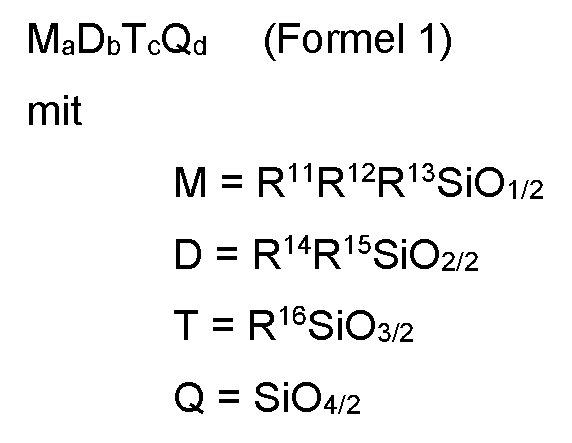
- the optional polyalkyl siloxanes of the formula (1) are subject to:
- R 11 , R 12 , R 13 , R 14 , R 15 , R 16 identical or different hydrocarbon radicals having 1 to 12 carbon atoms, the hydrocarbon radicals optionally being substituted by heteroatoms, or H,
- hydrocarbon radicals preferably identical or different hydrocarbon radicals with 1-8 carbon atoms, the hydrocarbon radicals optionally being substituted with heteroatoms, or H,
- d 0 - 2 with the proviso that a + b + c + d ⁇ 20, preferably ⁇ 15, particularly preferably ⁇ 1 1.
- R 16 is different from R 11 , R 12 , R 13 , R 14 and R 15 .
- R 11 , R 12 , R 13 are different, so that the M unit in the siloxane has two or three different radicals.
- Preferred polyalkyl siloxanes satisfy formula 2:
- Preferred polyalkyl siloxanes of the formula 2 satisfy the formulas 3 or 4:
- Preferred polyalkyl siloxanes are the following:
- polyether-modified siloxanes are described in more detail below.
- the use of polyether-modified siloxanes is mandatory in the context of the invention.
- Preferred polyether-modified siloxanes can be described using the following formula:
- n is independently 0 to 500, preferably 1 to 300 and in particular 2 to 150
- m is independently 0 to 60, preferably 1 to 50 and in particular 1 to 30
- p is independently 0 to 10, preferably 0 or> 0 to 5 is is
- k is independently 0 to 10, preferably 0 or> 0 to 5,
- the average number ⁇ k of T units and the average number ⁇ p of Q units per molecule are not greater than 50, and the average number ⁇ n of D units per molecule is not greater than 2000 and the average number ⁇ m of the R 1 -bearing siloxy units per molecule is not greater than 100,
- R independently of one another is at least one radical from the group consisting of linear, cyclic or branched, aliphatic or aromatic, saturated or unsaturated hydrocarbon radicals having 1 to 20 C atoms, but is preferably a methyl radical,
- R 2 is independently of one another R 1 or R,
- R 1 is not equal to R and is independently an organic radical and / or a polyether radical, R 1 is preferably selected from the group:
- x 0 to 100 preferably> 0, in particular 1 to 50
- y 0 to 100, preferably> 0, in particular 1 to 50,
- R 6 is, independently of one another, an optionally substituted alkyl or aryl group having 1 to 12 carbon atoms, for example substituted by alkyl radicals, aryl radicals or haloalkyl or haloaryl radicals, R 1 and / or a molecule of the formula (1) being within one radical different substituents R 1 may be present, and
- R 8 is a linear, cyclic or branched, optionally substituted, e.g. B. with halogens
- substituted hydrocarbon radical having 1 to 50, preferably 9 to 45, preferably 13 to 37 carbon atoms,
- D is a linear, cyclic or branched, optionally substituted, for. B. is substituted with heteroatoms such as O, N or halogens, saturated or unsaturated hydrocarbon radical having 2 to 50, preferably 3 to 45, preferably 4 to 37 carbon atoms,
- G corresponds to one of the following formulas z can be 0 or 1, where R 1 can also be bridging in the sense that two or three siloxane
- Structures of the formula (1) can be connected to one another via R 1 , in this case R 7 or R 8 corresponding to bifunctional groups are therefore R 5 , R 4 independently of one another R, R 1 and / or a hetero atom-substituted,
- R 3 represents the siloxane side chains that can arise from T and Q units. Since one can not control exactly where these branches sitting occurs in the formula (1) R 3 R 3 turn on. Hyperbranched structures can thus occur, as occurs, for example, with dendrimers.
- R 2 identical or different - CH3 or R 1 ,
- n + m + 2 10 to 150, preferably 25 to 120,
- m 0 to 25, preferably 0.5 to 15,
- w 2 to 10, preferably 3,
- x + y 1 to 30, preferably 5 to 25,
- R 6 identical or different -CH3, -CH2CH3 or phenyl radicals
- R 5 identical or different H, alkyl or acyl radicals, preferably -H, -CH3 or -COCH3. where at least one residue with x + y greater than 3 must be included.
- At least one radical R 2 is equal to R 1 .
- polyether-modified siloxanes of the formula 5 are used, the molar proportion of oxyethylene units making up at least 70% of the oxalkylene units, ie x / (x + y)> 0.7. It may also be advantageous if the polyoxyalkylene chain carries a hydrogen or a methyl group at the end and at the same time the molar proportion of oxyethylene units makes up a maximum of 70% of the oxalkylene units, ie x / (x + y) ⁇ 0.7 and R 5 is a hydrogen or methyl radical.
- polyether siloxanes of the formula (5) are used in which, inter alia, olefins are used in the hydrosilylation, as a result of which R 1 consists of at least 10 mol%, preferably at least 20 mol%, particularly preferably at least 40 mol% CH2-R 8 , where R 8 is a linear or branched hydrocarbon having 9 to 17 carbon atoms.
- polyether siloxanes of the formula (5) are used in which the terminal positions, or else alpha- and omega-mentioned positions on the siloxane are at least partially functionalized with radicals R 1 . At least 10 mol%, preferably at least 30 mol%, particularly preferably at least 50 mol% of the terminal positions are functionalized with radicals R 1 .
- polyether siloxanes of the formula (5) are used in which, on a statistical average, a maximum of 50%, preferably a maximum of 45%, particularly preferably a maximum of 40% of the total average molecular weight of the siloxane to the total molar mass of all, possibly different, residues R 1 in the siloxane is omitted.
- polyether siloxanes of the formula (5) are used, the number of structural elements with the index n being greater than the number of structural elements with the index m, in such a way that the quotient n / m is at least 4 is preferably greater than 6, particularly preferably greater than 7.
- the hydrocarbons KWS, polyether-modified siloxanes and optional polyalkyl siloxanes which can be used according to the invention can also be used as part of compositions with different carrier media.
- Suitable carrier media are, for example, glycols, alkoxylates or oils of synthetic and / or natural origin. It corresponds to a preferred embodiment of the invention if the total mass fraction of hydrocarbons KWS, polyether-modified siloxanes and optional polyalkyl siloxanes in the finished polyurethane foam is from 0.01 to 10% by weight, preferably from 0.1 to 3% by weight is.
- the use of PAS is mandatory; the following combinations of PAS and PES are preferably used:
- Siloxane is the total molar mass of all, possibly different, radicals R 1 in the siloxane, or f) PAS of formula 3 with c + d ⁇ 0.5, particularly preferably c + d ⁇ 0.1 in combination with PES of formula 5, in which the polyoxyalkylene chain carries a hydrogen or a methyl group at the end and at the same time the molar proportion of oxyethylene units makes up a maximum of 70% of the oxalkylene units, i.e. x / (x + y) ⁇ 0.7 and R 5 means a hydrogen or methyl radical.
- hydrocarbons KWS, polyether-modified siloxanes and optional polyalkyl siloxanes according to the invention are also referred to below as “mixtures”, regardless of whether the components are added separately or together to the reaction mixture for producing the rigid PU foam.
- Another object of the present invention is a composition suitable for the production of rigid polyurethane or polyisocyanurate foams containing at least one isocyanate component, at least one polyol component, at least one foam stabilizer, at least one urethane and / or isocyanurate catalyst, water and / or blowing agent , and optionally at least one flame retardant and / or further additives, which is characterized in that a mixture of hydrocarbons KWS, polyether-modified siloxanes and optional polyalkyl siloxanes is included as foam stabilizer, a process for the production of rigid polyurethane or polyisocyanurate foams , by implementing this composition and the rigid polyurethane or polyisocyanurate foams obtainable thereby.
- the present invention also relates to the use of rigid polyurethane or polyisocyanurate foams according to the invention as insulation boards and insulating means, and to a cooling apparatus which has a rigid polyurethane or polyisocyanurate foam according to the invention as the insulating material.
- the mixture of hydrocarbons KWS, polyether-modified siloxanes and optional polyalkyl siloxanes according to the invention has the advantage that polyurethane or polyisocyanurate foams, in particular rigid foams, can be produced with them, which are characterized by good fine cell structure and good insulating properties and at the same time have few foam defects.
- a preferred composition according to the invention contains the following components
- At least one isocyanate-reactive component especially polyols
- the mass fraction of mixture according to the invention i.e. hydrocarbons KWS, polyether-modified siloxanes and optional polyalkyl siloxanes) d) based on 100 parts by mass of polyol component a) is preferably from 0.1 to 10 pphp, preferably from 0.5 to 5 pphp and particularly preferably from 1 to 3 pphp.
- Polyols suitable as polyol component a) in the sense of the present invention are all organic substances with one or more groups reactive toward isocyanates, preferably OH groups, and also their preparations.
- Preferred polyols are all for the production of polyurethane systems, in particular polyurethane coatings, polyurethane elastomers or foams;
- polyether polyols and / or polyester polyols and / or aliphatic polycarbonates containing hydroxyl groups in particular polyether polycarbonate polyols and / or polyols of natural origin, so-called "natural oil based polyols" (NOPs).
- the polyols usually have a functionality of 1.8 to 8 and number-average molecular weights in the range from 500 to 15000.
- the polyols with OH numbers in the range from 10 to 1200 mg KOH / g are usually used.
- Polyether polyols can be prepared by known processes, for example by anionic polymerization of alkylene oxides in the presence of alkali hydroxides, alkali metal alcoholates or amines as catalysts and with the addition of at least one starter molecule which preferably contains 2 or 3 reactive hydrogen atoms, or by cationic polymerization of alkylene oxides in the presence of Lewis - Acids such as antimony pentachloride or boron trifluoride etherate or by doppehmetalhcyanide catalysis.
- Suitable alkylene oxides contain 2 to 4 carbon atoms in the alkylene radical.
- Examples are tetrahydrofuran, 1, 3-propylene oxide, 1, 2- or 2,3-butylene oxide; ethylene oxide and 1,2-propylene oxide are preferably used.
- the alkylene oxides can be used individually, cumulatively, in blocks, alternately in succession or as mixtures.
- compounds with at least 2, preferably 2 to 8 hydroxyl groups or with at least two primary amino groups in the molecule are used as starting molecules.
- starter molecules can be used.
- Water, 2-, 3- or 4-valent alcohols such as ethylene glycol, propanediol-1, 2 and -1, 3, diethylene glycol, dipropylene glycol, glycerin, trimethylolpropane, pentaerythritol, castor oil etc., higher polyfunctional polyols, especially sugar compounds such as glucose, Sorbitol, mannitol and sucrose, polyhydric phenols, resols, such as Oligomeric condensation products from phenol and formaldehyde and Mannich condensates from phenols, formaldehyde and dialkanolamines and melamine, or amines such as aniline, EDA, TDA, MDA and PMDA, particularly preferably TDA and PMDA.
- the choice of the suitable starter molecule depends on the particular field of application of the resulting polyether polyol in the production of polyurethane
- Polyester polyols are based on esters of polyhydric aliphatic or aromatic carboxylic acids, preferably with 2 to 12 carbon atoms.
- aliphatic carboxylic acids are Succinic acid, glutaric acid, adipic acid, suberic acid, azelaic acid, sebacic acid, decanedicarboxylic acid, maleic acid and fumaric acid.
- aromatic carboxylic acids are phthalic acid, isophthalic acid, terephthalic acid and the isomeric naphthalenedicarboxylic acids.
- polyester polyols are obtained by condensation of these polyvalent carboxylic acids with polyhydric alcohols, preferably diols or triols having 2 to 12, particularly preferably 2 to 6, carbon atoms, preferably trimethylolpropane and glycerol.
- polyester polyols based on aromatic carboxylic acids are used in more than 50 pphp, preferably more than 70 pphp, based on 100 parts by mass of the polyol component.
- no polyols based on phenol resins, produced from novolaks and alkylene oxides, and no polyols based on aromatic amine polyols, produced by alkoxylation of aromatic amines which means that in this preferred Embodiment less than 20 pphp, preferably less than 10 pphp, especially less than 2 pphp, and most advantageously no polyols based on phenolic resins made from novolaks and alkylene oxides, and no polyols based on aromatic amine polyols at all by alkoxylation of aromatic amines.
- Polyether polycarbonate polyols are polyols which contain carbon dioxide bound as carbonate. Since carbon dioxide is a by-product of many processes in the chemical industry, the use of carbon dioxide as a comonomer in alkylene oxide polymerizations is of particular commercial interest. A partial replacement of alkylene oxides in polyols with carbon dioxide has the potential to significantly reduce the costs for the production of polyols. In addition, the use of CO 2 as a comonomer is ecologically very advantageous since this reaction is the conversion of a greenhouse gas to a polymer. The production of polyethylene polycarbonate polyols by addition of alkylene oxides and carbon dioxide onto H-functional starting substances using catalysts has long been known.
- the first generation represented heterogeneous zinc or aluminum salts, as described for example in US-A 3900424 or US-A 3953383. Furthermore, mono- and binuclear metal complexes have been successfully used for the copolymerization of CO 2 and alkylene oxides (WO 2010/028362, WO 2009/130470, WO 2013/022932 or WO 201 1/163133).
- Carbon dioxide and alkylene oxides are the double metal cyanide catalysts, also known as DMC catalysts (US-A 4500704, WO 2008/058913).
- Suitable alkylene oxides and H-functional starter substances are those which are also used for the production of carbonate-free polyether polyols, as described above.
- NTPs Natural oil based polyols
- Polyurethane foams are of increasing interest in view of the long-term limited availability of fossil resources, namely oil, coal and gas, and against the background of rising crude oil prices, and are already in many of them Applications described (WO 2005/033167; US 2006/0293400, WO 2006/094227, WO 2004/096882, US 2002/0103091, WO
- two groups can be distinguished: a) polyols based on renewable raw materials, which are modified to such an extent that they can be used 100% for the production of polyurethanes (W02004 / 020497, US2006 / 0229375); b) Polyols based on renewable raw materials, which due to their processing and properties can only replace the petrochemically based polyol to a certain extent (W02009 / 058367).
- polystyrene polyols Another class of polyols that can be used are the so-called packed polyols (polymer polyols). These are distinguished by the fact that they contain solid organic fillers up to a solids content of 40% or more in disperse distribution.
- SAN, PHD and PIPA polyols can be used.
- SAN polyols are highly reactive polyols that contain a copolymer based on styrene / acrylonitrile (SAN) dispersed.
- PHD polyols are highly reactive polyols, which also contain polyurea in dispersed form.
- PIPA polyols are highly reactive polyols which contain a polyurethane in dispersed form, for example by the in situ reaction of an isocyanate with an alkanolamine in a conventional polyol.
- polyols which can be used are those which are obtained as prepolymers by reacting polyol with isocyanate in a molar ratio of preferably 100 to 1 to 5 to 1, preferably 50 to 1 to 10 to 1.
- prepolymers are preferably prepared in solution in polymer, the polyol preferably corresponding to the polyol used to prepare the prepolymers.
- a preferred ratio of isocyanate and polyol expressed as an index of the formulation i.e. the stoichiometric ratio of isocyanate groups to isocyanate-reactive groups (for example OH groups, NH groups) multiplied by 100 is in the range from 10 to 1000, preferably 40 to 600.
- An index of 100 stands for a molar ratio of the reactive Groups of 1 to 1.
- the index of the formulation is in the range from 150 to 550, particularly preferably from 200 to 500. That is to say, in a preferred embodiment, a clear excess of isocyanate groups to isocyanate-reactive groups is present. This leads to trimerization reactions of the isocyanates, which thus form isocyanurates.
- foam are also known as polyisocyanurate (PIR) foams and are characterized by improved fire behavior, i.e. poorer burning. These types of foam are a preferred subject of the invention.
- One or more organic polyisocyanates with two or more isocyanate functions are preferably used as isocyanate components b).
- One or more polyols having two or more isocyanate-reactive groups are preferably used as polyol components.
- Isocyanates suitable as isocyanate components for the purposes of this invention are all isocyanates which contain at least two isocyanate groups.
- all known aliphatic, cycloaliphatic, arylaliphatic and preferably aromatic polyfunctional isocyanates can be used.
- Isocyanates are particularly preferably used in a range from 60 to 200 mol% relative to the sum of the isocyanate-needing components.
- Alkylene diisocyanates with 4 to 12 carbon atoms in the alkylene radical such as 1, 12-dodecane diisocyanate, 2-ethyltetramethylene diisocyanate-1, 4, 2-
- the organic di- and polyisocyanates can be used individually or in the form of their mixtures.
- Corresponding “oligomers” of the diisocyanates can also be used (IPDI trimer based on isocyanurate, biurete urethdione.)
- prepolymers based on the above-mentioned isocyanates is possible.
- modified isocyanates which have been modified by the incorporation of urethane, uretdione, isocyanurate, allophanate and other groups.
- Particularly suitable organic polyisocyanates and therefore particularly preferably used are various isomers of toluenediisocyanate (2,4- and 2,6-toluenediisocyanate (TDI), in pure form or as isomer mixtures of different compositions), 4,4'- Diphenylmethane diisocyanate (MDI), the so-called “crude MDI” or “polymeric MDI” (contains not only the 4,4'- but also the 2,4'- and 2,2'-isomers of MDI and higher-core products) as well as the " pure MDI ”called binuclear product from predominantly 2,4'- and 4,4'-isomer mixtures or their prepolymers.
- examples of particularly suitable isocyanates are listed, for example, in EP 1712578, EP 1 161474, WO 00/58383, US 2007/0072951, EP 1678232 and WO 2005/085310, to which reference is made in full here.
- Suitable catalysts c) in the sense of the present invention are all compounds which are capable of accelerating the reaction of isocyanates with OH functions, NH functions or other isocyanate-reactive groups and with isocyanates themselves.
- the usual catalysts known from the prior art can be used, including e.g. Amines (cyclic, acyclic; monoamines, diamines, oligomers with one or more amino groups), ammonium compounds, organometallic compounds and metal salts, preferably those of tin, iron, bismuth and zinc.
- Amines cyclic, acyclic; monoamines, diamines, oligomers with one or more amino groups
- ammonium compounds e.g. Amines (cyclic, acyclic; monoamines, diamines, oligomers with one or more amino groups), ammonium compounds, organometallic compounds and metal salts, preferably those of tin, iron, bismuth and zinc.
- mixtures of several components can be used as catalysts
- the mixtures according to the invention ie hydrocarbons KWS, polyether-modified siloxanes and optional polyalkyl siloxanes are used as component d).
- PES polyether-modified siloxanes
- PAS polyalkylsiloxanes
- PES polyether-modified siloxanes
- the total amount of the mixture used ie the total of hydrocarbons KWS, polyether-modified siloxanes and optional polyalkyl siloxanes
- the mass fraction based on the finished polyurethane is 0.01 to 10% by weight, is preferably 0.1 to 3% by weight.
- blowing agents e is optional, depending on which foaming process is used. Chemical and physical blowing agents can be used. Depending on the amount of blowing agent used, a foam with high or low density is produced. Foams with densities of 5 kg / m 3 to 900 kg / m 3 can be produced. Preferred densities are 8 to 800, particularly preferably 10 to 600 kg / m 3 , in particular 30 to 150 kg / m 3 .
- blowing agents which react with NCO groups and release of gases, such as water or formic acid, can also be used.
- blowing agents are liquefied CO 2, nitrogen, air, volatile liquids, for example hydrocarbons with 3, 4 or 5 carbon atoms, preferably cyclo-, iso- and n-pentane, hydrofluorocarbons, preferably HFC 245fa, HFC 134a and HFC 365mfc, fluonchlon hydrocarbons, preferably HCFC 141 b, hydrofluoroolefins (HFO) or hydrohaloolefins such as 1234ze, 1234yf, 1233zd (E) or 1336mzz, oxygen-containing compounds such as methyl formate, acetone and dimethoxymethane, or chlorinated hydrocarbons, preferably dichloromethane and 1,2-dichloroethane.
- Suitable water contents in the sense of this invention depend on whether or not one or more blowing agents are used in addition to the water.
- preferred values are typically 1 to 20 pphp; if other blowing agents are used, the preferred amount is reduced to usually 0.1 to 5 pphp.
- additives f) All substances known in the prior art which are used in the production of polyurethanes, in particular polyurethane foams, such as, for example, crosslinkers and chain extenders, stabilizers against oxidative degradation (so-called antioxidants) can be used as additives f) ), Flame retardants, surfactants, biocides, cell-refining additives, cell openers, solid fillers, antistatic additives, nucleating agents, thickeners, dyes, pigments, color pastes, fragrances, emulsifiers, etc.
- additives f) flame retardants, surfactants, biocides, cell-refining additives, cell openers, solid fillers, antistatic additives, nucleating agents, thickeners, dyes, pigments, color pastes, fragrances, emulsifiers, etc.
- the process according to the invention for the production of PU foams can be carried out according to the known methods, for example using the manual mixing process or preferably using foaming machines. If the process is carried out using foaming machines, high-pressure or low-pressure machines can be used.
- the process according to the invention can be carried out batchwise or continuously.
- a preferred polyurethane or polyisocyanurate hard foam formulation in the sense of this invention gives a density of 5 to 900 kg / m3 and has the composition specified in Table 1.
- Table 1 Composition of a preferred polyurethane or polyisocyanurate rigid foam formulation
- Another object of the invention is a rigid PU foam, obtainable by the method mentioned.
- the polyurethane foam has a density of 5 to 900 kg / m 3 , preferably 8 to 800, particularly preferably 10 to 600 kg / m 3 , in particular 30 to 150 kg / m 3 .
- Rigid polyurethane foam or rigid PU foam is a fixed technical term.
- the known and principal difference between soft foam and hard foam is that a soft foam shows elastic behavior and the deformation is reversible.
- the rigid foam is permanently deformed.
- rigid polyurethane foam is understood in particular to be a foam in accordance with DIN 7726, which has a compressive strength in accordance with DIN 53 421 / DIN EN ISO 604 of advantageously 3 20 kPa, preferably 3 80 kPa, preferably 3 100 kPa, more preferably 3 150 kPa, particularly preferably 3 180 kPa.
- the rigid polyurethane foam according to DIN ISO 4590 advantageously has a closed cell of greater than 50%, preferably greater than 80% and particularly preferably greater than 90%.
- the rigid PU foams according to the invention can be used as or for the production of insulating materials, preferably insulating boards, refrigerators, insulating foams, headliners, packaging foams or spray foams.
- the PU foams of the invention can be used with advantage.
- vehicle construction in particular for the manufacture of vehicle headlining, body parts, interior linings, refrigerated vehicles, large containers, transport pallets, packaging laminates, in the furniture industry, e.g. for furniture parts, doors, cladding, in electronics applications.
- Cooling apparatuses according to the invention have a PU foam (polyurethane or polyisocyanurate foam) as the insulating material.
- Another object of the invention is the use of the rigid PU foam as insulation material in refrigeration technology, in refrigerated furniture, in construction, automotive, shipbuilding and / or electronics, as insulation panels, as spray foam, as one-component foam.
- the polyether-modified siloxanes with the various hydrocarbons and polyalkyl siloxanes were used in a mixture or combination.
- the mixtures according to the invention are compared with the corresponding non-inventive polyether siloxanes in the following foaming experiments.
- Stepanpol PS 2352 polyester polyol from Stepan
- Stepanpol PS 2412 polyester polyol from Stepan
- TCPP Tris (2-chloroisopropyl) phosphate from Fyrol
- MDI 44V20: Desmodur 44V20L from Covestro, diphenylmethane-4,4'-diisocyanate (MDI) with isomers and higher functional homologues Examples: Production of PU foams
- the foaming was carried out by hand mixing.
- the compounds according to the invention, polyols, flame retardants, catalysts, water, siloxane surfactants according to the invention or not according to the invention, hydrocarbons according to the invention and optionally polyalkyl siloxanes and blowing agents were weighed into a beaker and mixed with a plate stirrer (6 cm diameter) for 30 s at 1000 rpm . By weighing again, the amount of blowing agent evaporated during the mixing process was determined and supplemented again. The isocyanate (MDI) was then added and the reaction mixture was stirred for 5 s at 3000 rpm using the stirrer described.
- MDI isocyanate
- the mixture was immediately introduced into an aluminum mold thermostated to 65 ° C. with the dimensions 50 cm x 25 cm x 7 cm.
- the amount of foam formulation used was such that the amount was sufficient to fill the mold as a minimum. The foams would be removed from the mold after 10 minutes and then stored for 24 hours at room temperature.
- the thermal conductivity (l value in mW / m-K) was measured on 2.5 cm thick panes using a Hesto Lambda Control, model HLC X206, at an average temperature of 10 ° C in accordance with the requirements of the standard EN12667: 2001.
- PAS contain various foam formulations.
Landscapes
- Chemical & Material Sciences (AREA)
- Health & Medical Sciences (AREA)
- Chemical Kinetics & Catalysis (AREA)
- Medicinal Chemistry (AREA)
- Polymers & Plastics (AREA)
- Organic Chemistry (AREA)
- Engineering & Computer Science (AREA)
- Materials Engineering (AREA)
- Polyurethanes Or Polyureas (AREA)
- Silicon Polymers (AREA)
Abstract
Description


Claims
Priority Applications (7)
| Application Number | Priority Date | Filing Date | Title |
|---|---|---|---|
| US17/414,726 US20220041829A1 (en) | 2019-01-07 | 2019-12-16 | Production of rigid polyurethane foam |
| CA3125572A CA3125572A1 (en) | 2019-01-07 | 2019-12-16 | Production of rigid polyurethane foam |
| KR1020217024668A KR102861531B1 (ko) | 2019-01-07 | 2019-12-16 | 경질 폴리우레탄 발포체의 제조 |
| JP2021539556A JP7459113B2 (ja) | 2019-01-07 | 2019-12-16 | 硬質ポリウレタンフォームの製造 |
| BR112021013187-6A BR112021013187B1 (pt) | 2019-01-07 | 2019-12-16 | Composição para produção de espuma de poliuretano rígida, processo de produção, espuma de poliuretano rígida e usos |
| CN201980088185.7A CN113272353B (zh) | 2019-01-07 | 2019-12-16 | 硬质聚氨酯泡沫的制备 |
| MX2021008063A MX2021008063A (es) | 2019-01-07 | 2019-12-16 | Produccion de espuma rigida de poliuretano. |
Applications Claiming Priority (2)
| Application Number | Priority Date | Filing Date | Title |
|---|---|---|---|
| EP19150465.3 | 2019-01-07 | ||
| EP19150465.3A EP3677610B9 (de) | 2019-01-07 | 2019-01-07 | Herstellung von polyurethanhartschaum |
Publications (1)
| Publication Number | Publication Date |
|---|---|
| WO2020144004A1 true WO2020144004A1 (de) | 2020-07-16 |
Family
ID=65003288
Family Applications (1)
| Application Number | Title | Priority Date | Filing Date |
|---|---|---|---|
| PCT/EP2019/085264 Ceased WO2020144004A1 (de) | 2019-01-07 | 2019-12-16 | Herstellung von polyurethanhartschaum |
Country Status (10)
| Country | Link |
|---|---|
| US (1) | US20220041829A1 (de) |
| EP (1) | EP3677610B9 (de) |
| JP (1) | JP7459113B2 (de) |
| KR (1) | KR102861531B1 (de) |
| CN (1) | CN113272353B (de) |
| CA (1) | CA3125572A1 (de) |
| ES (1) | ES2898877T5 (de) |
| MX (1) | MX2021008063A (de) |
| PL (1) | PL3677610T5 (de) |
| WO (1) | WO2020144004A1 (de) |
Cited By (6)
| Publication number | Priority date | Publication date | Assignee | Title |
|---|---|---|---|---|
| JP2023049496A (ja) * | 2021-09-29 | 2023-04-10 | 株式会社イノアックコーポレーション | ポリウレタンフォーム |
| JP2023049486A (ja) * | 2021-09-29 | 2023-04-10 | 株式会社イノアックコーポレーション | ポリウレタンフォーム |
| JP2023529816A (ja) * | 2020-06-11 | 2023-07-12 | ダウ グローバル テクノロジーズ エルエルシー | 液体シロキサン核形成添加剤を用いたポリウレタン及びポリイソシアヌレートフォームの調製 |
| JP2024511331A (ja) * | 2021-03-17 | 2024-03-13 | ダウ シリコーンズ コーポレーション | 発泡体を調製するための組成物、それに関連する方法、及びそれから形成された発泡体 |
| US12053721B2 (en) | 2020-08-14 | 2024-08-06 | Evonik Operations Gmbh | Defoamer composition based on organofunctionally modified polysiloxanes |
| EP4549481A1 (de) * | 2023-11-01 | 2025-05-07 | Sika Technology AG | Polyurethanschaum mit flammhemmenden eigenschaften |
Families Citing this family (7)
| Publication number | Priority date | Publication date | Assignee | Title |
|---|---|---|---|---|
| PL3675994T3 (pl) | 2017-08-30 | 2025-03-24 | Evonik Operations Gmbh | Zastosowanie eterów poliolowych do wytwarzania porowatych powłok z tworzyw sztucznych |
| WO2020144003A1 (de) | 2019-01-07 | 2020-07-16 | Evonik Operations Gmbh | Herstellung von polyurethanhartschaum |
| US12122890B2 (en) | 2020-08-20 | 2024-10-22 | Evonik Operations Gmbh | Production of polyurethane foam |
| WO2022125642A1 (en) * | 2020-12-08 | 2022-06-16 | Dow Silicones Corporation | Isocyanate-reactive component, composition comprising same, and foam formed therewith |
| US12252588B2 (en) | 2020-12-10 | 2025-03-18 | Evonik Operations Gmbh | Polyether-siloxane block copolymers for the production of polyurethane foams |
| WO2023222400A1 (de) | 2022-05-17 | 2023-11-23 | Evonik Operations Gmbh | Herstellung von polyurethanschaum |
| CA3279246A1 (en) | 2024-07-12 | 2026-03-01 | Evonik Operations Gmbh | Production of polyurethane foam |
Citations (61)
| Publication number | Priority date | Publication date | Assignee | Title |
|---|---|---|---|---|
| US3900424A (en) | 1972-07-21 | 1975-08-19 | Nippon Oil Seal Ind Co Ltd | Catalyst for copolymerizing epoxy compounds with carbon dioxide |
| DE2533074A1 (de) | 1974-08-30 | 1976-03-11 | Goldschmidt Ag Th | Verfahren zur herstellung von hochelastischen polyurethanweichschaeumen |
| US3953383A (en) | 1972-07-21 | 1976-04-27 | Nippon Oil Seal Industry Co., Ltd. | Catalytic process for copolymerizing epoxy compounds with carbon dioxide |
| DE3215317C1 (de) | 1982-04-23 | 1983-06-09 | Th. Goldschmidt Ag, 4300 Essen | Verfahren zur Herstellung hochelastischer kalthaertender Polyurethanschaumstoffe |
| DE3234462C1 (de) | 1982-09-17 | 1984-01-05 | Th. Goldschmidt Ag, 4300 Essen | Verfahren zur Herstellung hochelastischer kalthaertender Polyurethanschaumstoffe |
| US4500704A (en) | 1983-08-15 | 1985-02-19 | The Dow Chemical Company | Carbon dioxide oxirane copolymers prepared using double metal cyanide complexes |
| EP0258600A2 (de) | 1986-08-02 | 1988-03-09 | Th. Goldschmidt AG | Verfahren zur Herstellung hochelastischer, kalthärtender Polyurethanschaumstoffe |
| US4751251A (en) * | 1987-05-19 | 1988-06-14 | Dow Corning Corporation | Surfactant composition for rigid urethane and isocyanurate foams |
| EP0275563A1 (de) | 1986-12-31 | 1988-07-27 | Union Carbide Corporation | Polysiloxan-polyoxyalkylen-Zusammensetzungen für die Herstellung von Polyurethanschaum |
| EP0421269A2 (de) | 1989-10-06 | 1991-04-10 | BASF Aktiengesellschaft | Verfahren zur Herstellung von Polyurethan-Hartschaumstoffen mit geringer Wärmeleitfähigkeit und ihre Verwendung |
| JPH0418431B2 (de) | 1987-07-27 | 1992-03-27 | Shin Kobe Electric Machinery | |
| EP0533202A1 (de) | 1991-09-20 | 1993-03-24 | Union Carbide Chemicals & Plastics Technology Corporation | Verwendung von blockierten oberflächenaktiven Mitteln zur Herstellung von Polyurethan-Hartschaumstoffen gebläht mittels Fluorchlorkohlenwasserstoffen |
| EP0570174B1 (de) | 1992-05-11 | 1996-02-07 | Dow Corning Corporation | Verfahren zur Herstellung starrer Polyurethan- und Polyisocyanuratschaumstoffe |
| DE4444898C1 (de) | 1994-12-16 | 1996-10-10 | Goldschmidt Ag Th | Verfahren zur Herstellung von Polyurethankaltschäumen |
| JPH09165427A (ja) | 1995-12-14 | 1997-06-24 | Mitsui Toatsu Chem Inc | 硬質ポリウレタンフォーム及びその製造方法 |
| EP0867464A1 (de) | 1997-03-26 | 1998-09-30 | Th. Goldschmidt AG | Verwendung von organofunktionell modifizierten Polysiloxanen bei der Herstellung von Polyurethanschaum |
| EP0867465A1 (de) | 1997-03-29 | 1998-09-30 | Th. Goldschmidt AG | Verwendung von Blockcopolymeren mit verknüpften Siloxanblöcken bei der Herstellung von Polyrethanschaumstoffen |
| US5852065A (en) * | 1998-01-15 | 1998-12-22 | Air Products And Chemicals, Inc. | Low emission, cell opening surfactants for polyurethane flexible and rigid foams |
| WO2000058383A1 (en) | 1999-03-31 | 2000-10-05 | Oxid L.P. | Aromatic polyester polyols made from a natural oil |
| EP1095968A1 (de) | 1999-10-28 | 2001-05-02 | Air Products And Chemicals, Inc. | Silikon-Schaumstabilisatoren zur Herstellung offenzelliger Polyurethanweichschaumstoffe |
| EP1161474A1 (de) | 1999-02-13 | 2001-12-12 | Bayer Ag | Feinzellige, wassergetriebene polyurethanhartschaumstoffe |
| EP0877045B1 (de) | 1997-05-08 | 2002-01-16 | Air Products And Chemicals, Inc. | Silikon Schaumstabilisatoren für Polyurethan Hartschäume hergestellt mit Treibmitteln der dritten Generation |
| EP1211279A1 (de) | 2000-11-28 | 2002-06-05 | Goldschmidt AG | Verwendung von Mischungen organofunktionell modifizierter Polysiloxane mit verzweigten Alkoholen bei der Herstellung von Polyurethanweichschäumen |
| US20020103091A1 (en) | 2001-01-29 | 2002-08-01 | Kodali Dharma R. | Reactive oil compositions and uses thereof |
| WO2004020497A1 (de) | 2002-08-28 | 2004-03-11 | Basf Aktiengesellschaft | Verfahren zur herstellung von emissionsarmen polyurethan-weichschaumstoffen |
| WO2004096882A1 (en) | 2003-04-25 | 2004-11-11 | Dow Global Technologies, Inc. | Vegetable oil based polyols and polyurethanes made therefrom |
| EP1520870A1 (de) | 2003-10-04 | 2005-04-06 | Goldschmidt GmbH | Verfahren zur Herstellung von organischen Siliciumverbindungen |
| WO2005033167A2 (en) | 2003-09-30 | 2005-04-14 | Cargill Incorporated | Flexible polyurethane foams prepared using modified vegetable oil-based polyols |
| EP1544235A1 (de) | 2003-12-15 | 2005-06-22 | Air Products And Chemicals, Inc. | Silikon-Schaumstabilisatoren für Polyurethan-Hartschäume hergestellt mit Kohlenwasserstoff-Treibmitteln |
| WO2005085310A2 (de) | 2004-03-08 | 2005-09-15 | Rathor Ag | Phasenstabile polyurethanprepolymere |
| WO2006094227A2 (en) | 2005-03-03 | 2006-09-08 | South Dakota Soybean Processors, Llc | Novel polyols derived from a vegetable oil using an oxidation process |
| US20060229375A1 (en) | 2005-04-06 | 2006-10-12 | Yu-Ling Hsiao | Polyurethane foams made with alkoxylated vegetable oil hydroxylate |
| EP1712578A1 (de) | 2005-04-13 | 2006-10-18 | Bayer MaterialScience LLC | Aus Pflanzenölhydroxylaten, Polymerpolyolen und aliphatischen Polyhydroxyalkoholen hergestellte Polyurethanschäume |
| WO2006116456A1 (en) | 2005-04-25 | 2006-11-02 | Cargill, Incorporated | Polyurethane foams comprising oligomeric polyols |
| US20060293400A1 (en) | 2003-04-25 | 2006-12-28 | Wiltz Jr Eugene P | Dow global technologies inc |
| US20070066697A1 (en) | 2005-08-31 | 2007-03-22 | Gilder Stephen D | Strut-reinforced polyurethane foam |
| US20070072951A1 (en) | 2005-09-27 | 2007-03-29 | Bender Jared D | Silanol-functionalized compounds for the preparation of polyurethane foams |
| EP1873209A2 (de) | 2006-07-01 | 2008-01-02 | Evonik Goldschmidt GmbH | Siliconstabilisatoren für flammgeschützte Polyurethan- bzw. Polyisocyanurat-Hartschaumstoffe |
| WO2008058913A1 (de) | 2006-11-15 | 2008-05-22 | Basf Se | Verfahren zur herstellung von polyurethan-weichschaumstoffen |
| EP1515934B1 (de) | 2002-05-10 | 2008-10-08 | Evonik Oxeno GmbH | Verfahren zur herstellung von c13-alkoholgemischen |
| WO2009058367A1 (en) | 2007-11-01 | 2009-05-07 | Cargill, Incorporated | Natural oil-derived polyester polyols and polyurethanes made therefrom |
| DE102008007081A1 (de) | 2008-01-31 | 2009-08-06 | Evonik Oxeno Gmbh | Verfahren zur Herstellung von n-Buten-Oligomeren und 1-Buten aus technischen Mischungen I von C4-Kohlenwasserstoffen |
| WO2009130470A1 (en) | 2008-04-25 | 2009-10-29 | Imperial Innovations Limited | Bimetallic catalytic complexes for the copolymerisation of carbon dioxide and an epoxide |
| WO2010028362A1 (en) | 2008-09-08 | 2010-03-11 | Novomer, Inc. | Polycarbonate polyol compositions and methods |
| CN101880452A (zh) | 2009-05-08 | 2010-11-10 | 深圳先进技术研究院 | 具有调温功能的高分子复合纳米材料及其制备方法 |
| WO2011012390A1 (de) | 2009-07-29 | 2011-02-03 | Evonik Goldschmidt Gmbh | Verfahren zur herstellung von polyurethanschaum |
| US20110218259A1 (en) | 2010-03-02 | 2011-09-08 | Basf Se | Preparing polyurethanes |
| EP2368927A1 (de) | 2008-12-24 | 2011-09-28 | Asahi Organic Chemicals Industry Co., Ltd. | Schäumbare zusammensetzung für einen polyurethanschaumstoff und polyurethanschaumstoff |
| WO2011163133A1 (en) | 2010-06-20 | 2011-12-29 | Novomer, Inc. | Aliphatic polycarbonates |
| EP2465891A1 (de) | 2010-12-16 | 2012-06-20 | Evonik Goldschmidt GmbH | Siliconstabilisatoren für Polyurethan- oder Polyisocyanurat-Hartschaumstoffe |
| EP2465892A1 (de) | 2010-12-16 | 2012-06-20 | Evonik Goldschmidt GmbH | Siliconstabilisatoren für Polyurethan- oder Polyisocyanurat-Hartschaumstoffe |
| WO2013022932A1 (en) | 2011-08-08 | 2013-02-14 | Novomer, Inc. | Catalysts and methods for polymer synthesis |
| CN103044687A (zh) | 2012-12-21 | 2013-04-17 | 江苏美思德化学股份有限公司 | 一种含氟有机硅聚醚共聚物及其制备方法 |
| CN103055759A (zh) | 2012-12-21 | 2013-04-24 | 南京美思德新材料有限公司 | 一种兼有稳泡和开孔性能的聚氨酯泡沫有机硅表面活性剂 |
| CN103657518A (zh) | 2013-12-16 | 2014-03-26 | 南京美思德新材料有限公司 | 一种非离子有机硅表面活性剂及其制备方法 |
| CN103665385A (zh) | 2013-12-16 | 2014-03-26 | 江苏美思德化学股份有限公司 | 一种含烯酸酯有机硅聚醚共聚物及其制备方法 |
| DE102013212481A1 (de) | 2013-06-27 | 2014-12-31 | Evonik Industries Ag | Oligomerisierung von C4-Strömen mit geringstem Gehalt an 1-Buten |
| WO2015101497A1 (de) * | 2013-12-30 | 2015-07-09 | Evonik Degussa Gmbh | Zusammensetzung geeignet zur herstellung von polyurethan- oder polyisocyanurat-hartschaumstoffen |
| EP2947064A1 (de) | 2014-05-20 | 2015-11-25 | Evonik Degussa GmbH | Herstellung qualitativ hochwertiger Oxo-Alkohole aus unsteten Rohstoffquellen |
| WO2016202912A1 (de) | 2015-06-18 | 2016-12-22 | Basf Se | Verfahren zur herstellung von polyurethan-hartschaumstoffen |
| WO2017220332A1 (de) * | 2016-06-23 | 2017-12-28 | Evonik Degussa Gmbh | Zusammensetzung geeignet zur herstellung von polyurethan- oder polyisocyanurat-hartschaumstoffen |
Family Cites Families (32)
| Publication number | Priority date | Publication date | Assignee | Title |
|---|---|---|---|---|
| GB1085037A (en) * | 1963-11-09 | 1967-09-27 | Mitsui Chemical Ind Co Ltd | Process for producing semi-rigid polyurethane foam |
| JPS57212219A (en) * | 1981-06-24 | 1982-12-27 | Mitui Toatsu Chem Inc | Preparation of rigid polyurethane foam having open-cell structure |
| JPS62167313A (ja) * | 1986-01-17 | 1987-07-23 | Human Ind Corp | ポリウレタンフオ−ムの製造方法 |
| JPS63227614A (ja) * | 1987-03-17 | 1988-09-21 | Human Ind Corp | ポリウレタンフオ−ムの製造方法 |
| US5143945A (en) * | 1989-07-19 | 1992-09-01 | The Dow Chemical Company | Carboxylic acid modified carbon dioxide co-blown polyurethane-polyisocyanurate foams |
| JPH0418431A (ja) * | 1990-03-30 | 1992-01-22 | Toshiba Corp | ポリウレタン樹脂発泡体およびその製造方法 |
| US5104904A (en) * | 1990-04-23 | 1992-04-14 | Crowley Chemical Co. | Use of aromatic petroleum oils as surfactant for polyurethane foams |
| JP3256262B2 (ja) * | 1992-03-16 | 2002-02-12 | 三井化学株式会社 | 硬質ポリウレタンフォームおよびその製造方法 |
| US5310766A (en) † | 1992-06-15 | 1994-05-10 | The Dow Chemical Company | Foam stabilizing additive and polyurethane foam prepared in the presence thereof |
| JPH06145280A (ja) * | 1992-10-23 | 1994-05-24 | Nisshinbo Ind Inc | 変性ポリイソシアヌレート発泡体の製造法 |
| ES2118987T3 (es) * | 1993-02-10 | 1998-10-01 | Bayer Ag | Procedimiento para la obtencion de plasticos celulares a base de isocianato. |
| JP3061717B2 (ja) * | 1993-12-03 | 2000-07-10 | 日清紡績株式会社 | 変性ポリイソシアヌレート発泡体の製造法 |
| DE4409043A1 (de) * | 1994-03-17 | 1995-09-21 | Bayer Ag | Verfahren zur Herstellung von gegebenenfalls zellförmigen Polyurethanen |
| DE4409042A1 (de) * | 1994-03-17 | 1995-09-21 | Bayer Ag | Verfahren zur Herstellung von gegebenenfalls zellförmigen Polyurethanen und/oder Polyurethanharnstoffen |
| JPH07304894A (ja) * | 1994-05-12 | 1995-11-21 | Nippon Unicar Co Ltd | 有機界面活性剤変性オルガノポリシロキサン化合物からなる硬質ポリウレタンフォーム用整泡剤 |
| JPH08156143A (ja) * | 1994-11-30 | 1996-06-18 | Rojiyaasu Inoatsuku:Kk | 電子写真装置用転写ローラ |
| TR200000192T2 (tr) * | 1997-07-25 | 2000-05-22 | Huntsman Ici Chemicals Llc | Hidrokarbon üfürmeli ateşe dayanıklı katı poliüretan köpükleri |
| JP2002003565A (ja) * | 2000-06-20 | 2002-01-09 | Lion Corp | 硬質ポリウレタンフォーム用ポリオール組成物 |
| US20040162359A1 (en) * | 2002-12-30 | 2004-08-19 | Barber Thomas Allan | Rigid foam from highly functionalized aromatic polyester polyols |
| JP4544853B2 (ja) | 2003-12-11 | 2010-09-15 | 株式会社イノアックコーポレーション | 難燃性シール材の製造方法 |
| US20070078193A1 (en) * | 2005-08-31 | 2007-04-05 | Gilder Stephen D | Strut-reinforced, reduced VOC polyurethane foam |
| JP2007186551A (ja) | 2006-01-11 | 2007-07-26 | Toyo Tire & Rubber Co Ltd | 硬質ポリウレタンフォーム用ポリオール組成物及び硬質ポリウレタンフォームの製造方法 |
| JP4953312B2 (ja) | 2006-09-07 | 2012-06-13 | ベック株式会社 | 硬質ポリウレタンフォームの形成方法 |
| JP4772028B2 (ja) | 2006-12-05 | 2011-09-14 | ベック株式会社 | ポリオール組成物 |
| JP5026896B2 (ja) | 2006-12-11 | 2012-09-19 | ベック株式会社 | ポリオール組成物及び硬質ポリウレタンフォームの製造方法 |
| DE102007055485A1 (de) * | 2007-11-21 | 2009-06-04 | Evonik Goldschmidt Gmbh | Verfahren zur Herstellung verzweigter SiH-funktioneller Polysiloxane und deren Verwendung zur Herstellung SiC- und SiOC-verknüpfter, verzweigter organomodifizierter Polysiloxane |
| JP2012001574A (ja) * | 2010-06-14 | 2012-01-05 | Bekku Kk | ポリオール組成物 |
| KR20130007896A (ko) † | 2011-07-11 | 2013-01-21 | 대주이엔티 주식회사 | 발열량 제어가능한 폴리우레탄 발포체 조성물 및 그 제조방법 및 그 발포체 |
| DE102014218635A1 (de) * | 2014-09-17 | 2016-03-17 | Evonik Degussa Gmbh | Herstellung von viskoelastischen Polyurethansystemen unter Einsatz von Blockpolymeren mit verknüpften Siloxanblöcken als Zellöffner |
| CN107312321B (zh) * | 2017-07-31 | 2019-01-25 | 陕西理工大学 | 一种发泡的tpu复合相变储能材料及其制备方法 |
| JP6984547B2 (ja) * | 2018-06-08 | 2021-12-22 | トヨタ自動車株式会社 | 車線変更支援システム、車線変更支援装置及び車線変更支援方法 |
| WO2020144003A1 (de) * | 2019-01-07 | 2020-07-16 | Evonik Operations Gmbh | Herstellung von polyurethanhartschaum |
-
2019
- 2019-01-07 ES ES19150465T patent/ES2898877T5/es active Active
- 2019-01-07 PL PL19150465.3T patent/PL3677610T5/pl unknown
- 2019-01-07 EP EP19150465.3A patent/EP3677610B9/de active Active
- 2019-12-16 CN CN201980088185.7A patent/CN113272353B/zh active Active
- 2019-12-16 JP JP2021539556A patent/JP7459113B2/ja active Active
- 2019-12-16 MX MX2021008063A patent/MX2021008063A/es unknown
- 2019-12-16 WO PCT/EP2019/085264 patent/WO2020144004A1/de not_active Ceased
- 2019-12-16 US US17/414,726 patent/US20220041829A1/en active Pending
- 2019-12-16 CA CA3125572A patent/CA3125572A1/en active Pending
- 2019-12-16 KR KR1020217024668A patent/KR102861531B1/ko active Active
Patent Citations (64)
| Publication number | Priority date | Publication date | Assignee | Title |
|---|---|---|---|---|
| US3900424A (en) | 1972-07-21 | 1975-08-19 | Nippon Oil Seal Ind Co Ltd | Catalyst for copolymerizing epoxy compounds with carbon dioxide |
| US3953383A (en) | 1972-07-21 | 1976-04-27 | Nippon Oil Seal Industry Co., Ltd. | Catalytic process for copolymerizing epoxy compounds with carbon dioxide |
| DE2533074A1 (de) | 1974-08-30 | 1976-03-11 | Goldschmidt Ag Th | Verfahren zur herstellung von hochelastischen polyurethanweichschaeumen |
| DE3215317C1 (de) | 1982-04-23 | 1983-06-09 | Th. Goldschmidt Ag, 4300 Essen | Verfahren zur Herstellung hochelastischer kalthaertender Polyurethanschaumstoffe |
| DE3234462C1 (de) | 1982-09-17 | 1984-01-05 | Th. Goldschmidt Ag, 4300 Essen | Verfahren zur Herstellung hochelastischer kalthaertender Polyurethanschaumstoffe |
| US4500704A (en) | 1983-08-15 | 1985-02-19 | The Dow Chemical Company | Carbon dioxide oxirane copolymers prepared using double metal cyanide complexes |
| EP0258600A2 (de) | 1986-08-02 | 1988-03-09 | Th. Goldschmidt AG | Verfahren zur Herstellung hochelastischer, kalthärtender Polyurethanschaumstoffe |
| EP0275563A1 (de) | 1986-12-31 | 1988-07-27 | Union Carbide Corporation | Polysiloxan-polyoxyalkylen-Zusammensetzungen für die Herstellung von Polyurethanschaum |
| US4751251A (en) * | 1987-05-19 | 1988-06-14 | Dow Corning Corporation | Surfactant composition for rigid urethane and isocyanurate foams |
| JPH0418431B2 (de) | 1987-07-27 | 1992-03-27 | Shin Kobe Electric Machinery | |
| EP0421269A2 (de) | 1989-10-06 | 1991-04-10 | BASF Aktiengesellschaft | Verfahren zur Herstellung von Polyurethan-Hartschaumstoffen mit geringer Wärmeleitfähigkeit und ihre Verwendung |
| EP0533202A1 (de) | 1991-09-20 | 1993-03-24 | Union Carbide Chemicals & Plastics Technology Corporation | Verwendung von blockierten oberflächenaktiven Mitteln zur Herstellung von Polyurethan-Hartschaumstoffen gebläht mittels Fluorchlorkohlenwasserstoffen |
| EP0570174B1 (de) | 1992-05-11 | 1996-02-07 | Dow Corning Corporation | Verfahren zur Herstellung starrer Polyurethan- und Polyisocyanuratschaumstoffe |
| DE4444898C1 (de) | 1994-12-16 | 1996-10-10 | Goldschmidt Ag Th | Verfahren zur Herstellung von Polyurethankaltschäumen |
| JPH09165427A (ja) | 1995-12-14 | 1997-06-24 | Mitsui Toatsu Chem Inc | 硬質ポリウレタンフォーム及びその製造方法 |
| EP0867464A1 (de) | 1997-03-26 | 1998-09-30 | Th. Goldschmidt AG | Verwendung von organofunktionell modifizierten Polysiloxanen bei der Herstellung von Polyurethanschaum |
| EP0867465A1 (de) | 1997-03-29 | 1998-09-30 | Th. Goldschmidt AG | Verwendung von Blockcopolymeren mit verknüpften Siloxanblöcken bei der Herstellung von Polyrethanschaumstoffen |
| EP0877045B1 (de) | 1997-05-08 | 2002-01-16 | Air Products And Chemicals, Inc. | Silikon Schaumstabilisatoren für Polyurethan Hartschäume hergestellt mit Treibmitteln der dritten Generation |
| US5852065A (en) * | 1998-01-15 | 1998-12-22 | Air Products And Chemicals, Inc. | Low emission, cell opening surfactants for polyurethane flexible and rigid foams |
| EP1161474A1 (de) | 1999-02-13 | 2001-12-12 | Bayer Ag | Feinzellige, wassergetriebene polyurethanhartschaumstoffe |
| WO2000058383A1 (en) | 1999-03-31 | 2000-10-05 | Oxid L.P. | Aromatic polyester polyols made from a natural oil |
| EP1095968A1 (de) | 1999-10-28 | 2001-05-02 | Air Products And Chemicals, Inc. | Silikon-Schaumstabilisatoren zur Herstellung offenzelliger Polyurethanweichschaumstoffe |
| EP1211279A1 (de) | 2000-11-28 | 2002-06-05 | Goldschmidt AG | Verwendung von Mischungen organofunktionell modifizierter Polysiloxane mit verzweigten Alkoholen bei der Herstellung von Polyurethanweichschäumen |
| US20020103091A1 (en) | 2001-01-29 | 2002-08-01 | Kodali Dharma R. | Reactive oil compositions and uses thereof |
| EP1515934B1 (de) | 2002-05-10 | 2008-10-08 | Evonik Oxeno GmbH | Verfahren zur herstellung von c13-alkoholgemischen |
| WO2004020497A1 (de) | 2002-08-28 | 2004-03-11 | Basf Aktiengesellschaft | Verfahren zur herstellung von emissionsarmen polyurethan-weichschaumstoffen |
| WO2004096882A1 (en) | 2003-04-25 | 2004-11-11 | Dow Global Technologies, Inc. | Vegetable oil based polyols and polyurethanes made therefrom |
| US20060293400A1 (en) | 2003-04-25 | 2006-12-28 | Wiltz Jr Eugene P | Dow global technologies inc |
| WO2005033167A2 (en) | 2003-09-30 | 2005-04-14 | Cargill Incorporated | Flexible polyurethane foams prepared using modified vegetable oil-based polyols |
| EP1678232A2 (de) | 2003-09-30 | 2006-07-12 | Cargill, Incorporated | Mit polyolen auf basis von modifiziertem pflanzenöl hergestellte polyurethan-weichschaumstoffe |
| EP1520870A1 (de) | 2003-10-04 | 2005-04-06 | Goldschmidt GmbH | Verfahren zur Herstellung von organischen Siliciumverbindungen |
| EP1544235A1 (de) | 2003-12-15 | 2005-06-22 | Air Products And Chemicals, Inc. | Silikon-Schaumstabilisatoren für Polyurethan-Hartschäume hergestellt mit Kohlenwasserstoff-Treibmitteln |
| WO2005085310A2 (de) | 2004-03-08 | 2005-09-15 | Rathor Ag | Phasenstabile polyurethanprepolymere |
| WO2006094227A2 (en) | 2005-03-03 | 2006-09-08 | South Dakota Soybean Processors, Llc | Novel polyols derived from a vegetable oil using an oxidation process |
| US20060229375A1 (en) | 2005-04-06 | 2006-10-12 | Yu-Ling Hsiao | Polyurethane foams made with alkoxylated vegetable oil hydroxylate |
| EP1712578A1 (de) | 2005-04-13 | 2006-10-18 | Bayer MaterialScience LLC | Aus Pflanzenölhydroxylaten, Polymerpolyolen und aliphatischen Polyhydroxyalkoholen hergestellte Polyurethanschäume |
| WO2006116456A1 (en) | 2005-04-25 | 2006-11-02 | Cargill, Incorporated | Polyurethane foams comprising oligomeric polyols |
| US20070066697A1 (en) | 2005-08-31 | 2007-03-22 | Gilder Stephen D | Strut-reinforced polyurethane foam |
| US20070072951A1 (en) | 2005-09-27 | 2007-03-29 | Bender Jared D | Silanol-functionalized compounds for the preparation of polyurethane foams |
| EP1873209A2 (de) | 2006-07-01 | 2008-01-02 | Evonik Goldschmidt GmbH | Siliconstabilisatoren für flammgeschützte Polyurethan- bzw. Polyisocyanurat-Hartschaumstoffe |
| US20080125503A1 (en) | 2006-07-01 | 2008-05-29 | Goldschmidt Gmbh | Silicone stabilizers for flame-retarded rigid polyurethane or polyisocyanurate foams |
| WO2008058913A1 (de) | 2006-11-15 | 2008-05-22 | Basf Se | Verfahren zur herstellung von polyurethan-weichschaumstoffen |
| WO2009058367A1 (en) | 2007-11-01 | 2009-05-07 | Cargill, Incorporated | Natural oil-derived polyester polyols and polyurethanes made therefrom |
| DE102008007081A1 (de) | 2008-01-31 | 2009-08-06 | Evonik Oxeno Gmbh | Verfahren zur Herstellung von n-Buten-Oligomeren und 1-Buten aus technischen Mischungen I von C4-Kohlenwasserstoffen |
| WO2009130470A1 (en) | 2008-04-25 | 2009-10-29 | Imperial Innovations Limited | Bimetallic catalytic complexes for the copolymerisation of carbon dioxide and an epoxide |
| WO2010028362A1 (en) | 2008-09-08 | 2010-03-11 | Novomer, Inc. | Polycarbonate polyol compositions and methods |
| EP2368927A1 (de) | 2008-12-24 | 2011-09-28 | Asahi Organic Chemicals Industry Co., Ltd. | Schäumbare zusammensetzung für einen polyurethanschaumstoff und polyurethanschaumstoff |
| CN101880452A (zh) | 2009-05-08 | 2010-11-10 | 深圳先进技术研究院 | 具有调温功能的高分子复合纳米材料及其制备方法 |
| US20150057384A1 (en) | 2009-07-29 | 2015-02-26 | Evonik Degussa Gmbh | Method for producing polyurethane foam |
| WO2011012390A1 (de) | 2009-07-29 | 2011-02-03 | Evonik Goldschmidt Gmbh | Verfahren zur herstellung von polyurethanschaum |
| US20110218259A1 (en) | 2010-03-02 | 2011-09-08 | Basf Se | Preparing polyurethanes |
| WO2011163133A1 (en) | 2010-06-20 | 2011-12-29 | Novomer, Inc. | Aliphatic polycarbonates |
| EP2465891A1 (de) | 2010-12-16 | 2012-06-20 | Evonik Goldschmidt GmbH | Siliconstabilisatoren für Polyurethan- oder Polyisocyanurat-Hartschaumstoffe |
| EP2465892A1 (de) | 2010-12-16 | 2012-06-20 | Evonik Goldschmidt GmbH | Siliconstabilisatoren für Polyurethan- oder Polyisocyanurat-Hartschaumstoffe |
| WO2013022932A1 (en) | 2011-08-08 | 2013-02-14 | Novomer, Inc. | Catalysts and methods for polymer synthesis |
| CN103044687A (zh) | 2012-12-21 | 2013-04-17 | 江苏美思德化学股份有限公司 | 一种含氟有机硅聚醚共聚物及其制备方法 |
| CN103055759A (zh) | 2012-12-21 | 2013-04-24 | 南京美思德新材料有限公司 | 一种兼有稳泡和开孔性能的聚氨酯泡沫有机硅表面活性剂 |
| DE102013212481A1 (de) | 2013-06-27 | 2014-12-31 | Evonik Industries Ag | Oligomerisierung von C4-Strömen mit geringstem Gehalt an 1-Buten |
| CN103657518A (zh) | 2013-12-16 | 2014-03-26 | 南京美思德新材料有限公司 | 一种非离子有机硅表面活性剂及其制备方法 |
| CN103665385A (zh) | 2013-12-16 | 2014-03-26 | 江苏美思德化学股份有限公司 | 一种含烯酸酯有机硅聚醚共聚物及其制备方法 |
| WO2015101497A1 (de) * | 2013-12-30 | 2015-07-09 | Evonik Degussa Gmbh | Zusammensetzung geeignet zur herstellung von polyurethan- oder polyisocyanurat-hartschaumstoffen |
| EP2947064A1 (de) | 2014-05-20 | 2015-11-25 | Evonik Degussa GmbH | Herstellung qualitativ hochwertiger Oxo-Alkohole aus unsteten Rohstoffquellen |
| WO2016202912A1 (de) | 2015-06-18 | 2016-12-22 | Basf Se | Verfahren zur herstellung von polyurethan-hartschaumstoffen |
| WO2017220332A1 (de) * | 2016-06-23 | 2017-12-28 | Evonik Degussa Gmbh | Zusammensetzung geeignet zur herstellung von polyurethan- oder polyisocyanurat-hartschaumstoffen |
Cited By (9)
| Publication number | Priority date | Publication date | Assignee | Title |
|---|---|---|---|---|
| JP2023529816A (ja) * | 2020-06-11 | 2023-07-12 | ダウ グローバル テクノロジーズ エルエルシー | 液体シロキサン核形成添加剤を用いたポリウレタン及びポリイソシアヌレートフォームの調製 |
| US12053721B2 (en) | 2020-08-14 | 2024-08-06 | Evonik Operations Gmbh | Defoamer composition based on organofunctionally modified polysiloxanes |
| JP2024511331A (ja) * | 2021-03-17 | 2024-03-13 | ダウ シリコーンズ コーポレーション | 発泡体を調製するための組成物、それに関連する方法、及びそれから形成された発泡体 |
| JP2023049496A (ja) * | 2021-09-29 | 2023-04-10 | 株式会社イノアックコーポレーション | ポリウレタンフォーム |
| JP2023049486A (ja) * | 2021-09-29 | 2023-04-10 | 株式会社イノアックコーポレーション | ポリウレタンフォーム |
| JP7755430B2 (ja) | 2021-09-29 | 2025-10-16 | 株式会社イノアックコーポレーション | ポリウレタンフォームの製造方法及びポリウレタンフォーム |
| JP7755431B2 (ja) | 2021-09-29 | 2025-10-16 | 株式会社イノアックコーポレーション | ポリウレタンフォームの製造方法及びポリウレタンフォーム |
| EP4549481A1 (de) * | 2023-11-01 | 2025-05-07 | Sika Technology AG | Polyurethanschaum mit flammhemmenden eigenschaften |
| WO2025093725A1 (de) | 2023-11-01 | 2025-05-08 | Sika Technology Ag | Polyurethanschaum mit flammhemmenden eigenschaften |
Also Published As
| Publication number | Publication date |
|---|---|
| KR20210112351A (ko) | 2021-09-14 |
| CN113272353B (zh) | 2023-05-02 |
| ES2898877T5 (en) | 2026-04-24 |
| CN113272353A (zh) | 2021-08-17 |
| EP3677610B1 (de) | 2021-09-22 |
| KR102861531B1 (ko) | 2025-09-18 |
| EP3677610B9 (de) | 2026-03-11 |
| MX2021008063A (es) | 2021-08-05 |
| EP3677610B2 (de) | 2025-12-24 |
| EP3677610A1 (de) | 2020-07-08 |
| BR112021013187A2 (pt) | 2021-09-28 |
| ES2898877T3 (es) | 2022-03-09 |
| JP7459113B2 (ja) | 2024-04-01 |
| PL3677610T5 (pl) | 2026-04-13 |
| PL3677610T3 (pl) | 2022-01-31 |
| CA3125572A1 (en) | 2020-07-16 |
| JP2022516371A (ja) | 2022-02-25 |
| US20220041829A1 (en) | 2022-02-10 |
Similar Documents
| Publication | Publication Date | Title |
|---|---|---|
| EP3677610B1 (de) | Herstellung von polyurethanhartschaum | |
| EP3908617B1 (de) | Herstellung von polyurethanhartschaum | |
| EP2295485B1 (de) | Lecithin enthaltende Zusammensetzung geeignet zur Herstellung von Polyurethanhartschäumen | |
| EP2465892B1 (de) | Siliconstabilisatoren für polyurethan- oder polyisocyanurat-hartschaumstoffe | |
| EP1873209B1 (de) | Siliconstabilisatoren für flammgeschützte Polyurethan- bzw. Polyisocyanurat-Hartschaumstoffe | |
| EP3320012B1 (de) | Herstellung von polyurethanschaum | |
| EP3957669A1 (de) | Herstellung von polyurethanschaum | |
| WO2013127647A1 (de) | Polyetheresterpolyole und ihre verwendung zur herstellung von polyurethan-hartschaumstoffen | |
| EP4107214A1 (de) | Polyurethan-isolierschaumstoffe und ihre herstellung | |
| WO2014170198A1 (de) | Pur-schaum mit vergröberter zellstruktur | |
| EP4259684A1 (de) | Herstellung von polyurethanschaum | |
| WO2019057453A1 (de) | Herstellung von polyurethanschaum | |
| EP3805285B1 (de) | Herstellung von polyurethanhartschaum | |
| EP3919539A1 (de) | Herstellung von polyurethanschaum | |
| EP4323420A1 (de) | Herstellung von polyurethan- oder polyisocyanurat-hartschaumstoff | |
| EP4665779A1 (de) | Stabilisatoren für polyurethanschaumstoffe enthaltend feststoff | |
| WO2023222400A1 (de) | Herstellung von polyurethanschaum | |
| WO2022184543A1 (de) | Herstellung von polyurethanschaum | |
| EP4596597A1 (de) | Herstellung von polyurethan- oder polyisocyanurat-schaumstoff | |
| EP4363480A1 (de) | Herstellung von polyurethan- oder polyisocyanurat-hartschaumstoff | |
| EP4596596A1 (de) | Herstellung von polyurethan- oder polyisocyanurat-schaumstoff | |
| EP4299656A1 (de) | Herstellung von propoxylierten benzoldicarbonsäureamiden und dem entsprechenden polyurethanschaum | |
| WO2024170429A1 (de) | Stabilisatoren für polyurethanschaumstoffe enthaltend recycling-polyol |
Legal Events
| Date | Code | Title | Description |
|---|---|---|---|
| 121 | Ep: the epo has been informed by wipo that ep was designated in this application |
Ref document number: 19818087 Country of ref document: EP Kind code of ref document: A1 |
|
| WWE | Wipo information: entry into national phase |
Ref document number: MX/A/2021/008063 Country of ref document: MX |
|
| ENP | Entry into the national phase |
Ref document number: 3125572 Country of ref document: CA |
|
| ENP | Entry into the national phase |
Ref document number: 2021539556 Country of ref document: JP Kind code of ref document: A |
|
| NENP | Non-entry into the national phase |
Ref country code: DE |
|
| REG | Reference to national code |
Ref country code: BR Ref legal event code: B01A Ref document number: 112021013187 Country of ref document: BR |
|
| ENP | Entry into the national phase |
Ref document number: 20217024668 Country of ref document: KR Kind code of ref document: A |
|
| WWP | Wipo information: published in national office |
Ref document number: MX/A/2021/008063 Country of ref document: MX |
|
| ENP | Entry into the national phase |
Ref document number: 112021013187 Country of ref document: BR Kind code of ref document: A2 Effective date: 20210702 |
|
| 122 | Ep: pct application non-entry in european phase |
Ref document number: 19818087 Country of ref document: EP Kind code of ref document: A1 |
|
| WWG | Wipo information: grant in national office |
Ref document number: MX/A/2021/008063 Country of ref document: MX |