EP0877045B1 - Silikon Schaumstabilisatoren für Polyurethan Hartschäume hergestellt mit Treibmitteln der dritten Generation - Google Patents
Silikon Schaumstabilisatoren für Polyurethan Hartschäume hergestellt mit Treibmitteln der dritten Generation Download PDFInfo
- Publication number
- EP0877045B1 EP0877045B1 EP98108268A EP98108268A EP0877045B1 EP 0877045 B1 EP0877045 B1 EP 0877045B1 EP 98108268 A EP98108268 A EP 98108268A EP 98108268 A EP98108268 A EP 98108268A EP 0877045 B1 EP0877045 B1 EP 0877045B1
- Authority
- EP
- European Patent Office
- Prior art keywords
- hfc
- blowing agent
- surfactant
- hcfc
- mole
- Prior art date
- Legal status (The legal status is an assumption and is not a legal conclusion. Google has not performed a legal analysis and makes no representation as to the accuracy of the status listed.)
- Expired - Lifetime
Links
- 239000004094 surface-active agent Substances 0.000 title claims description 71
- 229920001296 polysiloxane Polymers 0.000 title claims description 45
- 239000004604 Blowing Agent Substances 0.000 title claims description 41
- 229920005830 Polyurethane Foam Polymers 0.000 title claims description 21
- 239000011496 polyurethane foam Substances 0.000 title claims description 21
- 239000000203 mixture Substances 0.000 claims description 38
- 229920000570 polyether Polymers 0.000 claims description 29
- 239000004721 Polyphenylene oxide Substances 0.000 claims description 28
- 239000006260 foam Substances 0.000 claims description 26
- 238000000034 method Methods 0.000 claims description 23
- 229920005862 polyol Polymers 0.000 claims description 17
- 239000003054 catalyst Substances 0.000 claims description 16
- 150000003077 polyols Chemical class 0.000 claims description 16
- OFBQJSOFQDEBGM-UHFFFAOYSA-N Pentane Chemical compound CCCCC OFBQJSOFQDEBGM-UHFFFAOYSA-N 0.000 claims description 15
- MSSNHSVIGIHOJA-UHFFFAOYSA-N pentafluoropropane Chemical compound FC(F)CC(F)(F)F MSSNHSVIGIHOJA-UHFFFAOYSA-N 0.000 claims description 14
- IAYPIBMASNFSPL-UHFFFAOYSA-N Ethylene oxide Chemical compound C1CO1 IAYPIBMASNFSPL-UHFFFAOYSA-N 0.000 claims description 11
- 238000009472 formulation Methods 0.000 claims description 11
- 239000005056 polyisocyanate Substances 0.000 claims description 10
- 229920001228 polyisocyanate Polymers 0.000 claims description 10
- XLYOFNOQVPJJNP-UHFFFAOYSA-N water Substances O XLYOFNOQVPJJNP-UHFFFAOYSA-N 0.000 claims description 10
- VOPWNXZWBYDODV-UHFFFAOYSA-N Chlorodifluoromethane Chemical compound FC(F)Cl VOPWNXZWBYDODV-UHFFFAOYSA-N 0.000 claims description 9
- KPUWHANPEXNPJT-UHFFFAOYSA-N disiloxane Chemical class [SiH3]O[SiH3] KPUWHANPEXNPJT-UHFFFAOYSA-N 0.000 claims description 9
- 125000002777 acetyl group Chemical group [H]C([H])([H])C(*)=O 0.000 claims description 8
- FYIRUPZTYPILDH-UHFFFAOYSA-N 1,1,1,2,3,3-hexafluoropropane Chemical compound FC(F)C(F)C(F)(F)F FYIRUPZTYPILDH-UHFFFAOYSA-N 0.000 claims description 7
- LVGUZGTVOIAKKC-UHFFFAOYSA-N 1,1,1,2-tetrafluoroethane Chemical group FCC(F)(F)F LVGUZGTVOIAKKC-UHFFFAOYSA-N 0.000 claims description 7
- WZLFPVPRZGTCKP-UHFFFAOYSA-N 1,1,1,3,3-pentafluorobutane Chemical compound CC(F)(F)CC(F)(F)F WZLFPVPRZGTCKP-UHFFFAOYSA-N 0.000 claims description 7
- JOYRKODLDBILNP-UHFFFAOYSA-N Ethyl urethane Chemical compound CCOC(N)=O JOYRKODLDBILNP-UHFFFAOYSA-N 0.000 claims description 7
- 238000009835 boiling Methods 0.000 claims description 7
- CBENFWSGALASAD-UHFFFAOYSA-N Ozone Chemical compound [O-][O+]=O CBENFWSGALASAD-UHFFFAOYSA-N 0.000 claims description 5
- 239000012948 isocyanate Substances 0.000 claims description 5
- 150000002513 isocyanates Chemical class 0.000 claims description 5
- 230000000779 depleting effect Effects 0.000 claims description 4
- 229920002635 polyurethane Polymers 0.000 description 11
- 239000004814 polyurethane Substances 0.000 description 11
- LYCAIKOWRPUZTN-UHFFFAOYSA-N Ethylene glycol Chemical compound OCCO LYCAIKOWRPUZTN-UHFFFAOYSA-N 0.000 description 9
- DNIAPMSPPWPWGF-UHFFFAOYSA-N Propylene glycol Chemical compound CC(O)CO DNIAPMSPPWPWGF-UHFFFAOYSA-N 0.000 description 9
- -1 for example Substances 0.000 description 9
- OHMHBGPWCHTMQE-UHFFFAOYSA-N 2,2-dichloro-1,1,1-trifluoroethane Chemical compound FC(F)(F)C(Cl)Cl OHMHBGPWCHTMQE-UHFFFAOYSA-N 0.000 description 6
- 239000000463 material Substances 0.000 description 6
- UPMLOUAZCHDJJD-UHFFFAOYSA-N 4,4'-Diphenylmethane Diisocyanate Chemical compound C1=CC(N=C=O)=CC=C1CC1=CC=C(N=C=O)C=C1 UPMLOUAZCHDJJD-UHFFFAOYSA-N 0.000 description 5
- FRCHKSNAZZFGCA-UHFFFAOYSA-N 1,1-dichloro-1-fluoroethane Chemical compound CC(F)(Cl)Cl FRCHKSNAZZFGCA-UHFFFAOYSA-N 0.000 description 4
- XXROGKLTLUQVRX-UHFFFAOYSA-N allyl alcohol Chemical compound OCC=C XXROGKLTLUQVRX-UHFFFAOYSA-N 0.000 description 4
- 150000001412 amines Chemical class 0.000 description 4
- 150000001875 compounds Chemical class 0.000 description 4
- 229920000642 polymer Polymers 0.000 description 4
- 239000003381 stabilizer Substances 0.000 description 4
- RTZKZFJDLAIYFH-UHFFFAOYSA-N Diethyl ether Chemical compound CCOCC RTZKZFJDLAIYFH-UHFFFAOYSA-N 0.000 description 3
- PEDCQBHIVMGVHV-UHFFFAOYSA-N Glycerine Chemical compound OCC(O)CO PEDCQBHIVMGVHV-UHFFFAOYSA-N 0.000 description 3
- GOOHAUXETOMSMM-UHFFFAOYSA-N Propylene oxide Chemical compound CC1CO1 GOOHAUXETOMSMM-UHFFFAOYSA-N 0.000 description 3
- MTHSVFCYNBDYFN-UHFFFAOYSA-N diethylene glycol Chemical compound OCCOCCO MTHSVFCYNBDYFN-UHFFFAOYSA-N 0.000 description 3
- 150000002009 diols Chemical class 0.000 description 3
- 238000006459 hydrosilylation reaction Methods 0.000 description 3
- 238000004519 manufacturing process Methods 0.000 description 3
- 229920005906 polyester polyol Polymers 0.000 description 3
- 229920000582 polyisocyanurate Polymers 0.000 description 3
- 239000011495 polyisocyanurate Substances 0.000 description 3
- 238000002360 preparation method Methods 0.000 description 3
- PUPZLCDOIYMWBV-UHFFFAOYSA-N (+/-)-1,3-Butanediol Chemical compound CC(O)CCO PUPZLCDOIYMWBV-UHFFFAOYSA-N 0.000 description 2
- WNLRTRBMVRJNCN-UHFFFAOYSA-N adipic acid Chemical compound OC(=O)CCCCC(O)=O WNLRTRBMVRJNCN-UHFFFAOYSA-N 0.000 description 2
- 230000015572 biosynthetic process Effects 0.000 description 2
- CDQSJQSWAWPGKG-UHFFFAOYSA-N butane-1,1-diol Chemical compound CCCC(O)O CDQSJQSWAWPGKG-UHFFFAOYSA-N 0.000 description 2
- WERYXYBDKMZEQL-UHFFFAOYSA-N butane-1,4-diol Chemical compound OCCCCO WERYXYBDKMZEQL-UHFFFAOYSA-N 0.000 description 2
- 229920001577 copolymer Polymers 0.000 description 2
- XNGIFLGASWRNHJ-UHFFFAOYSA-N phthalic acid Chemical compound OC(=O)C1=CC=CC=C1C(O)=O XNGIFLGASWRNHJ-UHFFFAOYSA-N 0.000 description 2
- 229920001281 polyalkylene Polymers 0.000 description 2
- 239000011347 resin Substances 0.000 description 2
- 229920005989 resin Polymers 0.000 description 2
- 239000000126 substance Substances 0.000 description 2
- IMNIMPAHZVJRPE-UHFFFAOYSA-N triethylenediamine Chemical compound C1CN2CCN1CC2 IMNIMPAHZVJRPE-UHFFFAOYSA-N 0.000 description 2
- MTZUIIAIAKMWLI-UHFFFAOYSA-N 1,2-diisocyanatobenzene Chemical compound O=C=NC1=CC=CC=C1N=C=O MTZUIIAIAKMWLI-UHFFFAOYSA-N 0.000 description 1
- GIWQSPITLQVMSG-UHFFFAOYSA-N 1,2-dimethylimidazole Chemical compound CC1=NC=CN1C GIWQSPITLQVMSG-UHFFFAOYSA-N 0.000 description 1
- GTEXIOINCJRBIO-UHFFFAOYSA-N 2-[2-(dimethylamino)ethoxy]-n,n-dimethylethanamine Chemical compound CN(C)CCOCCN(C)C GTEXIOINCJRBIO-UHFFFAOYSA-N 0.000 description 1
- BFSVOASYOCHEOV-UHFFFAOYSA-N 2-diethylaminoethanol Chemical compound CCN(CC)CCO BFSVOASYOCHEOV-UHFFFAOYSA-N 0.000 description 1
- SVNWKKJQEFIURY-UHFFFAOYSA-N 2-methyl-1-(2-methylpropyl)imidazole Chemical compound CC(C)CN1C=CN=C1C SVNWKKJQEFIURY-UHFFFAOYSA-N 0.000 description 1
- WMNWJTDAUWBXFJ-UHFFFAOYSA-N 3,3,4-trimethylheptane-2,2-diamine Chemical compound CCCC(C)C(C)(C)C(C)(N)N WMNWJTDAUWBXFJ-UHFFFAOYSA-N 0.000 description 1
- HVCNXQOWACZAFN-UHFFFAOYSA-N 4-ethylmorpholine Chemical compound CCN1CCOCC1 HVCNXQOWACZAFN-UHFFFAOYSA-N 0.000 description 1
- 239000004970 Chain extender Substances 0.000 description 1
- RPNUMPOLZDHAAY-UHFFFAOYSA-N Diethylenetriamine Chemical compound NCCNCCN RPNUMPOLZDHAAY-UHFFFAOYSA-N 0.000 description 1
- PIICEJLVQHRZGT-UHFFFAOYSA-N Ethylenediamine Chemical compound NCCN PIICEJLVQHRZGT-UHFFFAOYSA-N 0.000 description 1
- 239000005057 Hexamethylene diisocyanate Substances 0.000 description 1
- 239000005058 Isophorone diisocyanate Substances 0.000 description 1
- OFOBLEOULBTSOW-UHFFFAOYSA-N Malonic acid Chemical compound OC(=O)CC(O)=O OFOBLEOULBTSOW-UHFFFAOYSA-N 0.000 description 1
- SVYKKECYCPFKGB-UHFFFAOYSA-N N,N-dimethylcyclohexylamine Chemical compound CN(C)C1CCCCC1 SVYKKECYCPFKGB-UHFFFAOYSA-N 0.000 description 1
- SJRJJKPEHAURKC-UHFFFAOYSA-N N-Methylmorpholine Chemical compound CN1CCOCC1 SJRJJKPEHAURKC-UHFFFAOYSA-N 0.000 description 1
- UEEJHVSXFDXPFK-UHFFFAOYSA-N N-dimethylaminoethanol Chemical compound CN(C)CCO UEEJHVSXFDXPFK-UHFFFAOYSA-N 0.000 description 1
- LGRFSURHDFAFJT-UHFFFAOYSA-N Phthalic anhydride Natural products C1=CC=C2C(=O)OC(=O)C2=C1 LGRFSURHDFAFJT-UHFFFAOYSA-N 0.000 description 1
- 229920003171 Poly (ethylene oxide) Polymers 0.000 description 1
- 229910018540 Si C Inorganic materials 0.000 description 1
- CZMRCDWAGMRECN-UGDNZRGBSA-N Sucrose Chemical compound O[C@H]1[C@H](O)[C@@H](CO)O[C@@]1(CO)O[C@@H]1[C@H](O)[C@@H](O)[C@H](O)[C@@H](CO)O1 CZMRCDWAGMRECN-UGDNZRGBSA-N 0.000 description 1
- 229930006000 Sucrose Natural products 0.000 description 1
- GSEJCLTVZPLZKY-UHFFFAOYSA-N Triethanolamine Chemical compound OCCN(CCO)CCO GSEJCLTVZPLZKY-UHFFFAOYSA-N 0.000 description 1
- ZJCCRDAZUWHFQH-UHFFFAOYSA-N Trimethylolpropane Chemical compound CCC(CO)(CO)CO ZJCCRDAZUWHFQH-UHFFFAOYSA-N 0.000 description 1
- UKLDJPRMSDWDSL-UHFFFAOYSA-L [dibutyl(dodecanoyloxy)stannyl] dodecanoate Chemical compound CCCCCCCCCCCC(=O)O[Sn](CCCC)(CCCC)OC(=O)CCCCCCCCCCC UKLDJPRMSDWDSL-UHFFFAOYSA-L 0.000 description 1
- 125000004423 acyloxy group Chemical group 0.000 description 1
- 235000011037 adipic acid Nutrition 0.000 description 1
- 239000001361 adipic acid Substances 0.000 description 1
- 125000005336 allyloxy group Chemical group 0.000 description 1
- 230000003466 anti-cipated effect Effects 0.000 description 1
- 238000007664 blowing Methods 0.000 description 1
- 125000001246 bromo group Chemical group Br* 0.000 description 1
- 235000019437 butane-1,3-diol Nutrition 0.000 description 1
- 125000004432 carbon atom Chemical group C* 0.000 description 1
- 150000007942 carboxylates Chemical class 0.000 description 1
- 238000006243 chemical reaction Methods 0.000 description 1
- 239000003795 chemical substances by application Substances 0.000 description 1
- 125000001309 chloro group Chemical group Cl* 0.000 description 1
- 239000002131 composite material Substances 0.000 description 1
- 229960002887 deanol Drugs 0.000 description 1
- 239000012975 dibutyltin dilaurate Substances 0.000 description 1
- GPLRAVKSCUXZTP-UHFFFAOYSA-N diglycerol Chemical compound OCC(O)COCC(O)CO GPLRAVKSCUXZTP-UHFFFAOYSA-N 0.000 description 1
- 125000005442 diisocyanate group Chemical group 0.000 description 1
- ZZTCPWRAHWXWCH-UHFFFAOYSA-N diphenylmethanediamine Chemical compound C=1C=CC=CC=1C(N)(N)C1=CC=CC=C1 ZZTCPWRAHWXWCH-UHFFFAOYSA-N 0.000 description 1
- SZXQTJUDPRGNJN-UHFFFAOYSA-N dipropylene glycol Chemical compound OCCCOCCCO SZXQTJUDPRGNJN-UHFFFAOYSA-N 0.000 description 1
- 238000005516 engineering process Methods 0.000 description 1
- 230000007613 environmental effect Effects 0.000 description 1
- 239000003063 flame retardant Substances 0.000 description 1
- 229910052731 fluorine Inorganic materials 0.000 description 1
- 125000001153 fluoro group Chemical group F* 0.000 description 1
- 238000005187 foaming Methods 0.000 description 1
- RRAMGCGOFNQTLD-UHFFFAOYSA-N hexamethylene diisocyanate Chemical compound O=C=NCCCCCCN=C=O RRAMGCGOFNQTLD-UHFFFAOYSA-N 0.000 description 1
- XXMIOPMDWAUFGU-UHFFFAOYSA-N hexane-1,6-diol Chemical compound OCCCCCCO XXMIOPMDWAUFGU-UHFFFAOYSA-N 0.000 description 1
- 125000004435 hydrogen atom Chemical group [H]* 0.000 description 1
- 125000002887 hydroxy group Chemical group [H]O* 0.000 description 1
- 239000011261 inert gas Substances 0.000 description 1
- 239000004615 ingredient Substances 0.000 description 1
- 238000009413 insulation Methods 0.000 description 1
- NIMLQBUJDJZYEJ-UHFFFAOYSA-N isophorone diisocyanate Chemical compound CC1(C)CC(N=C=O)CC(C)(CN=C=O)C1 NIMLQBUJDJZYEJ-UHFFFAOYSA-N 0.000 description 1
- 150000002596 lactones Chemical class 0.000 description 1
- 238000005259 measurement Methods 0.000 description 1
- 239000007777 multifunctional material Substances 0.000 description 1
- SLCVBVWXLSEKPL-UHFFFAOYSA-N neopentyl glycol Chemical compound OCC(C)(C)CO SLCVBVWXLSEKPL-UHFFFAOYSA-N 0.000 description 1
- 229910000510 noble metal Inorganic materials 0.000 description 1
- 150000007524 organic acids Chemical class 0.000 description 1
- WXZMFSXDPGVJKK-UHFFFAOYSA-N pentaerythritol Chemical compound OCC(CO)(CO)CO WXZMFSXDPGVJKK-UHFFFAOYSA-N 0.000 description 1
- UKODFQOELJFMII-UHFFFAOYSA-N pentamethyldiethylenetriamine Chemical compound CN(C)CCN(C)CCN(C)C UKODFQOELJFMII-UHFFFAOYSA-N 0.000 description 1
- 229920000233 poly(alkylene oxides) Polymers 0.000 description 1
- 229920001843 polymethylhydrosiloxane Polymers 0.000 description 1
- 229920001451 polypropylene glycol Polymers 0.000 description 1
- 238000001812 pycnometry Methods 0.000 description 1
- 150000003242 quaternary ammonium salts Chemical class 0.000 description 1
- 229920005604 random copolymer Polymers 0.000 description 1
- 150000003839 salts Chemical class 0.000 description 1
- 125000003198 secondary alcohol group Chemical group 0.000 description 1
- 229910010271 silicon carbide Inorganic materials 0.000 description 1
- 230000000087 stabilizing effect Effects 0.000 description 1
- 238000012916 structural analysis Methods 0.000 description 1
- 239000005720 sucrose Substances 0.000 description 1
- 235000000346 sugar Nutrition 0.000 description 1
- 150000008163 sugars Chemical class 0.000 description 1
- 238000003786 synthesis reaction Methods 0.000 description 1
- 230000002194 synthesizing effect Effects 0.000 description 1
- 150000003512 tertiary amines Chemical class 0.000 description 1
- 239000012974 tin catalyst Substances 0.000 description 1
- DVKJHBMWWAPEIU-UHFFFAOYSA-N toluene 2,4-diisocyanate Chemical compound CC1=CC=C(N=C=O)C=C1N=C=O DVKJHBMWWAPEIU-UHFFFAOYSA-N 0.000 description 1
- RUELTTOHQODFPA-UHFFFAOYSA-N toluene 2,6-diisocyanate Chemical compound CC1=C(N=C=O)C=CC=C1N=C=O RUELTTOHQODFPA-UHFFFAOYSA-N 0.000 description 1
- VOZKAJLKRJDJLL-UHFFFAOYSA-N tolylenediamine group Chemical group CC1=C(C=C(C=C1)N)N VOZKAJLKRJDJLL-UHFFFAOYSA-N 0.000 description 1
- CYRMSUTZVYGINF-UHFFFAOYSA-N trichlorofluoromethane Chemical compound FC(Cl)(Cl)Cl CYRMSUTZVYGINF-UHFFFAOYSA-N 0.000 description 1
- 150000004072 triols Chemical class 0.000 description 1
- PAPBSGBWRJIAAV-UHFFFAOYSA-N ε-Caprolactone Chemical compound O=C1CCCCCO1 PAPBSGBWRJIAAV-UHFFFAOYSA-N 0.000 description 1
Classifications
-
- C—CHEMISTRY; METALLURGY
- C08—ORGANIC MACROMOLECULAR COMPOUNDS; THEIR PREPARATION OR CHEMICAL WORKING-UP; COMPOSITIONS BASED THEREON
- C08J—WORKING-UP; GENERAL PROCESSES OF COMPOUNDING; AFTER-TREATMENT NOT COVERED BY SUBCLASSES C08B, C08C, C08F, C08G or C08H
- C08J9/00—Working-up of macromolecular substances to porous or cellular articles or materials; After-treatment thereof
- C08J9/04—Working-up of macromolecular substances to porous or cellular articles or materials; After-treatment thereof using blowing gases generated by a previously added blowing agent
-
- C—CHEMISTRY; METALLURGY
- C08—ORGANIC MACROMOLECULAR COMPOUNDS; THEIR PREPARATION OR CHEMICAL WORKING-UP; COMPOSITIONS BASED THEREON
- C08J—WORKING-UP; GENERAL PROCESSES OF COMPOUNDING; AFTER-TREATMENT NOT COVERED BY SUBCLASSES C08B, C08C, C08F, C08G or C08H
- C08J9/00—Working-up of macromolecular substances to porous or cellular articles or materials; After-treatment thereof
- C08J9/0061—Working-up of macromolecular substances to porous or cellular articles or materials; After-treatment thereof characterized by the use of several polymeric components
-
- C—CHEMISTRY; METALLURGY
- C08—ORGANIC MACROMOLECULAR COMPOUNDS; THEIR PREPARATION OR CHEMICAL WORKING-UP; COMPOSITIONS BASED THEREON
- C08G—MACROMOLECULAR COMPOUNDS OBTAINED OTHERWISE THAN BY REACTIONS ONLY INVOLVING UNSATURATED CARBON-TO-CARBON BONDS
- C08G77/00—Macromolecular compounds obtained by reactions forming a linkage containing silicon with or without sulfur, nitrogen, oxygen or carbon in the main chain of the macromolecule
- C08G77/42—Block-or graft-polymers containing polysiloxane sequences
- C08G77/46—Block-or graft-polymers containing polysiloxane sequences containing polyether sequences
-
- C—CHEMISTRY; METALLURGY
- C08—ORGANIC MACROMOLECULAR COMPOUNDS; THEIR PREPARATION OR CHEMICAL WORKING-UP; COMPOSITIONS BASED THEREON
- C08J—WORKING-UP; GENERAL PROCESSES OF COMPOUNDING; AFTER-TREATMENT NOT COVERED BY SUBCLASSES C08B, C08C, C08F, C08G or C08H
- C08J9/00—Working-up of macromolecular substances to porous or cellular articles or materials; After-treatment thereof
- C08J9/04—Working-up of macromolecular substances to porous or cellular articles or materials; After-treatment thereof using blowing gases generated by a previously added blowing agent
- C08J9/12—Working-up of macromolecular substances to porous or cellular articles or materials; After-treatment thereof using blowing gases generated by a previously added blowing agent by a physical blowing agent
- C08J9/14—Working-up of macromolecular substances to porous or cellular articles or materials; After-treatment thereof using blowing gases generated by a previously added blowing agent by a physical blowing agent organic
- C08J9/143—Halogen containing compounds
- C08J9/144—Halogen containing compounds containing carbon, halogen and hydrogen only
-
- C—CHEMISTRY; METALLURGY
- C08—ORGANIC MACROMOLECULAR COMPOUNDS; THEIR PREPARATION OR CHEMICAL WORKING-UP; COMPOSITIONS BASED THEREON
- C08J—WORKING-UP; GENERAL PROCESSES OF COMPOUNDING; AFTER-TREATMENT NOT COVERED BY SUBCLASSES C08B, C08C, C08F, C08G or C08H
- C08J2205/00—Foams characterised by their properties
- C08J2205/04—Foams characterised by their properties characterised by the foam pores
- C08J2205/052—Closed cells, i.e. more than 50% of the pores are closed
-
- C—CHEMISTRY; METALLURGY
- C08—ORGANIC MACROMOLECULAR COMPOUNDS; THEIR PREPARATION OR CHEMICAL WORKING-UP; COMPOSITIONS BASED THEREON
- C08J—WORKING-UP; GENERAL PROCESSES OF COMPOUNDING; AFTER-TREATMENT NOT COVERED BY SUBCLASSES C08B, C08C, C08F, C08G or C08H
- C08J2205/00—Foams characterised by their properties
- C08J2205/10—Rigid foams
-
- C—CHEMISTRY; METALLURGY
- C08—ORGANIC MACROMOLECULAR COMPOUNDS; THEIR PREPARATION OR CHEMICAL WORKING-UP; COMPOSITIONS BASED THEREON
- C08J—WORKING-UP; GENERAL PROCESSES OF COMPOUNDING; AFTER-TREATMENT NOT COVERED BY SUBCLASSES C08B, C08C, C08F, C08G or C08H
- C08J2375/00—Characterised by the use of polyureas or polyurethanes; Derivatives of such polymers
- C08J2375/04—Polyurethanes
-
- C—CHEMISTRY; METALLURGY
- C08—ORGANIC MACROMOLECULAR COMPOUNDS; THEIR PREPARATION OR CHEMICAL WORKING-UP; COMPOSITIONS BASED THEREON
- C08J—WORKING-UP; GENERAL PROCESSES OF COMPOUNDING; AFTER-TREATMENT NOT COVERED BY SUBCLASSES C08B, C08C, C08F, C08G or C08H
- C08J2483/00—Characterised by the use of macromolecular compounds obtained by reactions forming in the main chain of the macromolecule a linkage containing silicon with or without sulfur, nitrogen, oxygen, or carbon only; Derivatives of such polymers
Definitions
- the present invention relates to cell stabilizers for making polyurethane foams and, more particularly, relates to silicone surfactant cell stabilizers for making rigid polyurethane foams.
- the Montreal Protocol which regulate the use of ozone-depleting materials
- the primary blowing agent currently being used by the industry (in the United States) for applications where good insulating properties are needed is HCFC-141b.
- the Montreal Protocol dictates that this material may not be used in the United States after 1 January 2003.
- HFC-141b must be phased out of Japan by 2004; phase out dates for other countries vary from 2010 - 2040.
- Potential replacements, the 'third generation' blowing agents are partially hydrogenated fluorocarbons (HFCs) and some hydrochlorofluorocarbons (HCFCs) and include compounds such as HFC-134a, HFC-236ea, HFC-245fa, HFC-365mfc, and HCFC-22. However, these may not allow for optimal performance in current foam formulations.
- the blowing agent For foams used in various market segments, for example the appliance and water heater markets, the blowing agent must produce rigid foams with good insulating values, i.e., low thermal conductivities (low k-factors). Water heaters and refrigerators both must conform to energy requirements established by the U.S. Department of Energy. Additionally, it is anticipated that these requirements will become even more stringent in the future.
- third generation blowing agents yield rigid foam in which there is a small to moderate increase in k-factors.
- the choice of silicone surfactant in the formulation has a direct impact upon the magnitude of this increase in k-factor. That is, the proper choice of surfactant can minimize the potential loss in insulating capability of the foam when converting to a third generation blowing agent.
- Bodnar, T. W.; Koch, J. J.; Thomsberry, J. D., "New Surfactant Technology for HCFC-123 and HCFC-141b Blown Rigid Foam Systems", Polyurethane World Congress 1991, pp. 24-26 discusses surfactants to optimize rigid foam properties using traditional rigid foam surfactants.
- U.S. 5,461,084 and 5,426,127 teach the use of HFC blowing agents and B-8426 silicone surfactant in rigid polyurethane foam for low k-factor and good physical properties.
- U.S. 4,997,706 teaches the use of C2-C6 polyfluorocarbon compounds containing no Cl or Br atoms as physical blowing agents for rigid closed cell polymer foams. The benefit is that the loss in thermal insulation performance with time compared to foams made in absence of these compounds is reduced.
- U.S. 5,432,206 discloses silicone surfactants for making stable polyurethane foam.
- U.S. 5,525,640 teaches the use of certain surfactants for polyurethane foam made with an inert gas blowing agent.
- the present invention provides a silicone surfactant (polyether-polysiloxane copolymer) for stabilizing the cell formation in the preparation of a rigid polyurethane and/or polyisocyanurate foam by the reaction of a polyisocyanate and a polyol in the presence of a urethane catalyst and a blowing agent containing at least one hydrogen atom and at least one fluorine atom, namely a C1-C4 hydrofluorocarbon (HFC) or hydrochlorofluorocarbon (HCFC), having a molecular weight of 50 to 170 g/mole, and a boiling point of -60° to +50°C.
- a silicone surfactant polyether-polysiloxane copolymer
- the silicone surfactant comprises a polyether-polysiloxane copolymer represented by the following formula: where R" is H, CH3, or C(O)CH3; x is 50 - 200; y+z is 3 - 30; and x/(y+z) is 7 - 20; and the total surfactant molecular weight, based on the formula, is 12,000 - 100,000 g/mole, the wt% siloxane in the surfactant is 10 - 40 wt%, the blend average molecular weight (BAMW) of the polyether portion is 1200 - 6,000 g/mole, and the wt% of ethylene oxide in the polyether portion is 30 - 100 wt%.
- R" is H, CH3, or C(O)CH3
- x 50 - 200
- y+z is 3 - 30
- x/(y+z) is 7 - 20
- the total surfactant molecular weight, based on the formula, is 1
- the silicone surfactants provide for foams with higher closed cell content and lower k-factors than silicone surfactants traditionally used in the rigid polyurethane foam industry.
- polyurethane is intended to mean polyurethane and/or polyisocyanurate as is understood in the art.
- a rigid polyurethane foam can be a rigid polyurethane and/or polyisocyanurate foam.
- the process according to the invention can easily be carried out by conventional means for making rigid polyurethane foam, excepting that the general preparation of rigid polyurethane foam using a C1-C4 HFC or HCFC is carried out using the polyether-polysiloxane copolymer according to the invention as the cell stabilizer.
- the polyurethane rigid products are prepared using any suitable organic polyisocyanates well known in the art for making rigid polyurethane foam including, for example, hexamethylene diisocyanate, isophorone diisocyanate, phenylene diisocyanate, toluene diisocyanate (“TDI”) and 4,4'-diphenylmethane diisocyanate (“MDI”).
- suitable organic polyisocyanates well known in the art for making rigid polyurethane foam
- TDI phenylene diisocyanate
- MDI 4,4'-diphenylmethane diisocyanate
- mixtures of diisocyanates known commercially as "crude MDI", marketed as PAPI by Dow Chemical, which contain about 60% of 4,4'-diphenylmethane diisocyanate along with other isomeric and analogous higher polyisocyanates.
- isocyanates are the 2,4- and 2,6-TDI's individually or together as their commercially available mixtures. Also suitable are "prepolymers" of these polyisocyanates comprising a partially prereacted mixture of a polyisocyanate and a polyether or polyester polyol. Preferably the above polyisocyanates are used in an isocyanate index range of 80 to 400.
- Suitable polyols are those polyols typically used in the art for making rigid polyurethane foam including the polyalkylene ether and polyester polyols.
- the polyalkylene ether polyols include the poly(alkylene oxide) polymers such as poly(ethylene oxide) and poly(propylene oxide) polymers and copolymers with terminal hydroxyl groups derived from polyhydric compounds, including diols and triols; for example, among others, ethylene glycol, propylene glycol, 1,3-butane diol, 1,4-butane diol, 1,6-hexane diol, neopentyl glycol, diethylene glycol, dipropylene glycol, pentaerythritol, glycerol, diglycerol, trimethylol propane, sugars, such as sucrose, and like low molecular weight polyols.
- amine polyether polyols which can be prepared by reacting an amine, such as ethylenediamine, diethylenetriamine, tolylenediamine, diphenylmethanediamine, triethanolamine or the like, with ethylene oxide or propylene oxide.
- a single high molecular weight polyether polyol may be used.
- mixtures of high molecular weight polyether polyols such as mixtures of different multifunctional materials and/or different molecular weight or different chemical composition materials may be used.
- Useful polyester polyols include those produced by reacting a dicarboxylic acid with an excess of a diol, for example, adipic acid or phthalic acid/anhydride with ethylene glycol or butanediol, or reacting a lactone with an excess of a diol such as caprolactone with propylene glycol.
- the catalyst composition may be any catalyst well known in the urethane art such as tertiary amines, organotin and carboxylate urethane catalysts (gelling and/or blowing).
- Typical examples of useful catalysts are amine catalysts such as triethylenediamine, dimethylcyclohexylamine, tetramethylhexanediamine, bis(dimethylaminoethyl)ether, tri(dimethylaminopropyl)hexahydrotriamine, 1-isobutyl-2-methylimidazole, 1,2-dimethylimidazole, dimethylaminoethanol, diethylaminoethanol, pentamethyldiethylenetriamine, pentamethyldipropylenetriamine, methyl morpholine, ethyl morpholine, quaternary ammonium salts, salts of an organic acid and tin catalysts such as dibutyltin dilaurate and the like.
- a catalytically effective amount of the catalyst composition is used in the polyurethane formulation. More specifically, suitable amounts of the catalyst composition may range from about 0.01 to 10 parts by weight per 100 parts polyol (0.01 to 10 pphp) in the polyurethane formulation, preferably 0.5 to 4 pphp.
- the third generation blowing agents used in the present invention for making rigid foams comprise a C1-C4 HFC or HCFC with a molecular weight of 50 to 170 g/mole, a boiling point of -60° to +50°C, and preferably an Ozone Depleting Potential (ODP) of ⁇ 0.10, ODP as described by: Synthesis of the Reports of the Ozone Scientific Assessment Panel, Environmental Effects Assessment Panel Technology and Economic Assessment Panel, Prepared by the Assessment Chairs for the Parties to the Montreal Protocol, November 1991.
- HFCs and HCFCs meeting this criteria include HFC-134a, HFC-236ea, HFC-365mfc, HCFC-22 and preferably HFC-245fa.
- Water may be included in the formulation at 0 to 4 pphp.
- Other blowing agents which may optionally be used in combination with the defined C1-C4 HFC or HCFC include CFCs, other HCFCs, other HFCs, pentanes and the like.
- the silicone surfactant cell stabilizer in an amount of 0.5 to 3.5 pphp, preferably 1.5 to 2.5 pphp, may be any polyether-polysiloxane copolymer of the following structure where the calculated total surfactant molecular weight, based on the structure, is 12,000 to 100,000 g/mole, preferably 15,000 to 30,000 g/mole; the wt% siloxane in the surfactant is 10 to 40 wt%, preferably 25 to 35 wt%; the BAMW of the polyether portion is 1200 to 6000 g/mole, preferably 1200 to 3000 g/mole; and the wt% ethylene oxide in the polyether portion is 30 to 100 wt%; preferably 30 to 60 wt%.
- R" can be H, CH 3 , or C(O)CH 3 and x is 50 to 200, preferably 50 to 170, y+z is 3 to 30, preferably 5 to 25; and x/(y+z) is 7 to 20, preferably 7 to 15.
- These polyether-polysiloxane copolymers can be used as the sole surfactant or in combination with another silicone surfactant which falls outside of the range described here.
- polyether polyoxyalkylene
- an unsaturated group such as allyloxy
- the polysiloxanes have a certain number of methylhydrogensiloxane units in their molecules that react with the unsaturated groups of the polyethers to form Si-C bonds.
- the polyether copolymers can be capped before the hydrosilylation, or they can be capped after the hydrosilylation.
- the normal preparative method for the unsaturated polyether copolymers is to coreact, for example, allyl alcohol with ethylene oxide and then react this polymer with propylene oxide such that the polyether copolymer molecule ends up with primarily secondary alcohol groups at its non-unsaturated end.
- a random copolymer can be formed by reacting ethylene oxide, propylene oxide and allyl alcohol to provide a material having large numbers of carbinols on the secondary carbon atoms of the propylene glycol that is formed. So that the polyether materials could be reacted into polysiloxanes, and eventually participate in, for example polyurethane foam production as surfactants, the carbinols are quite often endblocked, a common endblocker being acyloxy.
- Typical agents which may be used in the polyurethane rigid foam formulations include flame retardants and chain extenders such as ethylene glycol and butanediol.
- a general polyurethane rigid foam formulation having a 1.5-2.5 lb/ft 3 (24-40 kg/m 3 ) density (e.g., appliance foam) containing a silicone surfactant such as the polyether-polysiloxane copolymer according to the invention and a third generation blowing agent, for example HFC-245fa, would comprise the following components in parts by weight (pbw): Rigid Foam Formulation pbw Polyol 100 Silicone Surfactant 1-3 Blowing Agent 20-40 Water 0-3 Catalyst 0.5-3 Isocyanate Index 80-400
- the ingredients in Table 1 were combined and incubated at 10°C until the mixture had equilibrated to temperature.
- the resin was weighed into a paper cup and Surfactant A was added in an amount equal to 3.0 parts by weight per 100 parts of polyol.
- Polymeric MDI at 23°C was added in an amount such that the isocyanate (NCO) index was 115.
- the mixture was stirred with a high speed mixer for 8 seconds and poured into a 12x12x2 inch (30.5x30.5x5.1 cm) mold which was heated to 49°C. Enough of the foaming mixture was added to the mold to yield a plaque which was 5% overpacked. The foam plaque was removed from the mold after 4 minutes and aged at 23°C for 18 to 24 hours.
- Example 1 The procedure of Example 1 was followed, except that Surfactant B was used in place of Surfactant A.
- Example 1 The procedure of Example 1 was followed, except that Surfactant C was used in place of Surfactant A.
- Example 1 The procedure of Example 1 was followed, except that Surfactant D was used in place of Surfactant A.
- Example 1 The procedure of Example 1 was followed except that 1.5 parts by weight of Surfactant B and 1.5 parts by weight of Surfactant C were added to the resin mixture in place of 3.0 parts by weight Surfactant A.
- Example 1 The procedure of Example 1 was followed except that Goldschmidt B8404 was used in place of Surfactant A.
- Example 1 The procedure of Example 1 was utilized except that OSi Specialty Niax L-6900 silicone surfactant was used in place of Surfactant A.
- Table 2 presents the results of Examples 1-7. It can be seen from the data that Surfactants A and B provided for notably lower k-factors and higher % closed cell contents than Surfactants C, D, B8404, and L-6900. Surfactants C and D as well as B8404 and L-6900 are all representative of what is used currently in the rigid foam industry. Furthermore, Surfactant B used in conjunction with Surfactant C also yielded foam with lower k-factor and higher % closed cell content than surfactant C alone or the other, typical rigid foam surfactants. This data clearly demonstrates that the silicone surfactants according to the invention yield foams with a higher % closed cell content and a lower k-factor than those typically used in the industry.
- the present invention provides polyether-polysiloxane copolymers for making rigid polyurethane foam.
Landscapes
- Chemical & Material Sciences (AREA)
- Health & Medical Sciences (AREA)
- Chemical Kinetics & Catalysis (AREA)
- Medicinal Chemistry (AREA)
- Polymers & Plastics (AREA)
- Organic Chemistry (AREA)
- Engineering & Computer Science (AREA)
- Materials Engineering (AREA)
- Polyurethanes Or Polyureas (AREA)
- Manufacture Of Porous Articles, And Recovery And Treatment Of Waste Products (AREA)
- Compositions Of Macromolecular Compounds (AREA)
Claims (20)
- Verfahren zur Herstellung eines Polyurethanhartschaums durch Reaktion eines Polyisocyanats und eines Polyols in Gegenwart eines Urethankatalysators, eines Treibmittels, gegebenenfalls Wasser und eines Silikonschaumstabilisators, wobei die Verbesserung den Einsatz als Treibmittel von C1-C4-HFC mit einem Molekulargewicht von 50 bis 170 g/mol und einem Siedepunkt von -60 bis +50 °C oder HCFC-22 und als Silikonschaumstabilisator ein Polyether-Polysiloxan-Copolymer umfaßt, das durch die folgende Formel dargestellt ist:

 wo R" H, CH3 oder C(O)CH3 ist; x 50 bis 200; y+z 3 bis 30 und x/(y+z) 7 bis 20 ist; das Gesamtschaumstabilisatormolekulargewicht 12.000 bis 100.000 g/mol ist, die Gewichtsprozente Siloxan in dem Schaumstabilisator 10 bis 40 Gewichtsprozent sind, das mittlere Mischmolekulargewicht des Polyetherteils 1.200 bis 6.000 g/mol ist und die Gewichtsprozente Ethylenoxid in dem Polyetherteil 30 bis 100 Gewichtsprozent sind.
- Verfahren nach Anspruch 1, wobei das Treibmittel HFC-134a, HFC-236ea, HFC-365mfc, HCFC-22 oder HFC-245fa ist.
- Verfahren nach Anspruch 1, wobei das Treibmittel HFC-245fa ist.
- Verfahren nach Anspruch 1, wobei das Treibmittel ebenso ein CFC, ein weiteres HCFC, ein weiteres HFC oder ein Pentan enthält.
- Verfahren zur Herstellung eines Polyurethanhartschaums durch Reaktion eines Polyisocyanats und eines Polyols in Gegenwart eines Urethankatalysators, eines Treibmittels, gegebenenfalls Wasser und eines Silikonschaumstabilisators, wobei die Verbesserung den Einsatz als Treibmittel von C1-C4-HFC oder HCFC mit einem Molekulargewicht von 50 bis 170 g/mol, einem Siedepunkt von -60 bis +50 °C und einem Ozonabreicherungspotential von <0,10 und als Silikonschaumstabilisator ein Polyether-Polysiloxan-Copolymer umfaßt, das durch die folgende Formel dargestellt ist:
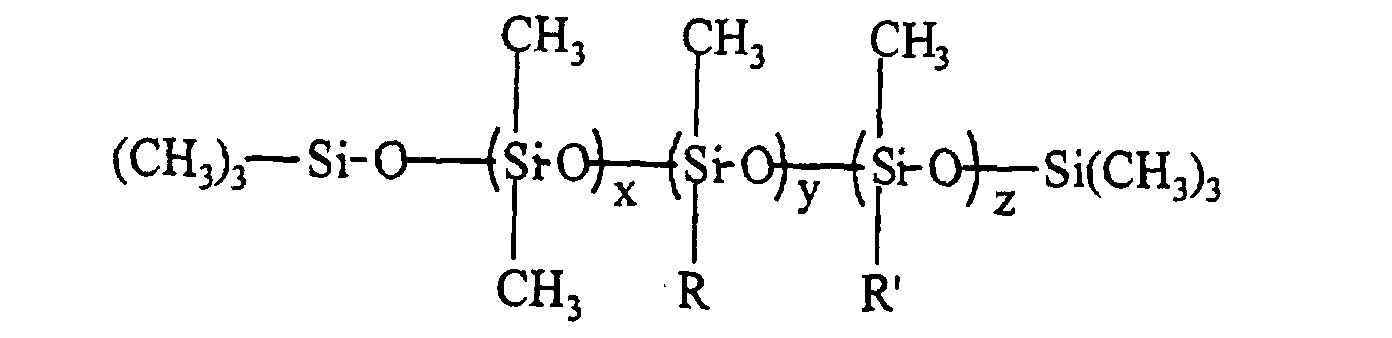
 wo R" H, CH3 oder C(O)CH3 ist; x 50 bis 200; y+z 3 bis 30 und x/(y+z) 7 bis 20 ist; das Gesamtschaumstabilisatormolekulargewicht 12.000 bis 100.000 g/mol ist, die Gewichtsprozente Siloxan in dem Schaumstabilisator 10 bis 40 Gewichtsprozent sind, das mittlere Mischmolekulargewicht des Polyetherteils 1.200 bis 6.000 g/mol ist und die Gewichtsprozente Ethylenoxid in dem Polyetherteil 30 bis 100 Gewichtsprozent sind.
- Verfahren zur Herstellung eines Polyurethanhartschaums durch Reaktion eines Polyisocyanats und eines Polyols in Gegenwart eines Urethankatalysators, eines Treibmittels, gegebenenfalls Wasser und eines Silikonschaumstabilisators, wobei die Verbesserung den Einsatz als Treibmittel von C1-C4-HFC mit einem Molekulargewicht von 50 bis 170 g/mol und einem Siedepunkt von -60 bis +50 °C oder HCFC-22 und als Silikonschaumstabilisator bei 0,5 bis 3,5 pphp ein Polyether-Polysiloxan-Copolymer umfaßt, das durch die folgende Formel dargestellt ist:

 wo R" H, CH3 oder C(O)CH3 ist; x 50 bis 200; y+z 3 bis 30 und x/(y+z) 7 bis 20 ist; das Gesamtschaumstabilisatormolekulargewicht 15.000 bis 30.000 g/mol ist, die Gewichtsprozente Siloxan in dem Schaumstabilisator 25 bis 35 Gewichtsprozent sind, das mittlere Mischmolekulargewicht des Polyetherteils 1.200 bis 3.000 g/mol ist und die Gewichtsprozente Ethylenoxid in dem Polyetherteil 30 bis 60 Gewichtsprozent sind.
- Verfahren nach Anspruch 6, wobei das Treibmittel HFC-134a, HFC-236ea, HFC-365mfc, HCFC-22 oder HFC-245fa ist.
- Verfahren nach Anspruch 6, wobei das Treibmittel HFC-245fa ist.
- Verfahren nach Anspruch 6, wobei das Treibmittel ebenso ein CFC, ein weiteres HCFC, ein weiteres HFC oder ein Pentan enthält.
- Verfahren nach Anspruch 8, wobei das Treibmittel ebenso ein CFC, ein weiteres HCFC, ein weiteres HFC oder ein Pentan enthält.
- Verfahren zur Herstellung eines Polyurethanhartschaums durch Reaktion eines Polyisocyanats und eines Polyols in Gegenwart eines Urethankatalysators, eines Treibmittels, gegebenenfalls Wasser und eines Silikonschaumstabilisators, wobei die Verbesserung den Einsatz als Treibmittel von C1-C4-HFC oder HCFC mit einem Molekulargewicht von 50 bis 170 g/mol, einem Siedepunkt von -60 bis +50 °C und einem Ozonabreicherungspotential von <0,10 und als Silikonschaumstabilisator bei 0,5 bis 3,5 pphp ein Polyether-Polysiloxan-Copolymer umfaßt, das durch die folgende Formel dargestellt ist:
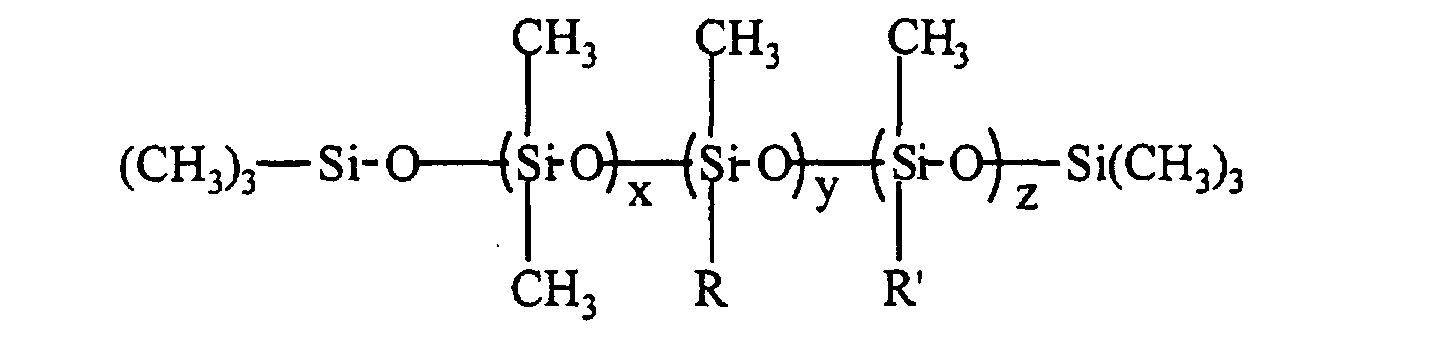
 wo R" H, CH3 oder C(O)CH3 ist; x 50 bis 200; y+z 3 bis 30 und x/(y+z) 7 bis 20 ist; das Gesamtschaumstabilisatormolekulargewicht 15.000 bis 30.000 g/mol ist, die Gewichtsprozente Siloxan in dem Schaumstabilisator 25 bis 35 Gewichtsprozent sind, das mittlere Mischmolekulargewicht des Polyetherteils 1.200 bis 3.000 g/mol ist und die Gewichtsprozente Ethylenoxid in dem Polyetherteil 30 bis 60 Gewichtsprozent sind.
- Verfahren nach Anspruch 11, wobei das Treibmittel HFC-134a, HFC-236ea, HFC-365mfc, HCFC-22 oder HFC-245fa ist und gegebenenfalls ein CFC, ein weiteres HCFC, ein weiteres HFC oder ein Pentan enthält.
- Polyurethanhartschaumzusammensetzung, umfassend die folgenden Komponenten in Gewichtsteilen (Gt):
Hartschaumformulierung Gt Polyol 100 Silikonschaumstabilisator 1 bis 3 Treibmittel 20 bis 40 Wasser 0 bis 3 Katalysator 0,5 bis 3 Isocyanatindex 80 bis 400 
 wo R" H, CH3 oder C(O)CH3 ist; x 50 bis 200; y+z 3 bis 30 und x/(y+z) 7 bis 20 ist; das Gesamtschaumstabilisatormolekulargewicht 12.000 bis 100.000 g/mol ist, die Gewichtsprozente Siloxan in dem Schaumstabilisator 10 bis 40 Gewichtsprozent sind, das mittlere Mischmolekulargewicht des Polyetherteils 1.200 bis 6.000 g/mol ist und die Gewichtsprozente Ethylenoxid in dem Polyetherteil 30 bis 100 Gewichtsprozent sind.
- Zusammensetzung nach Anspruch 13, wobei das Treibmittel HFC-134a, HFC-236ea, HFC-365mfc, HCFC-22 oder HFC-245fa ist.
- Zusammensetzung nach Anspruch 13, wobei das Treibmittel HFC-245fa ist.
- Zusammensetzung nach Anspruch 13, wobei das Treibmittel ebenso ein CFC, ein weiteres HCFC, ein weiteres HFC oder ein Pentan enthält.
- Zusammensetzung nach Anspruch 13, wobei das Treibmittel HFC-134a, HFC-236ea, HFC-365mfc, HCFC-22 oder HFC-245fa ist und der Silikonschaumstabilisator ein Polyether-Polysiloxan-Copolymer ist, das durch die folgende Formel dargestellt ist:
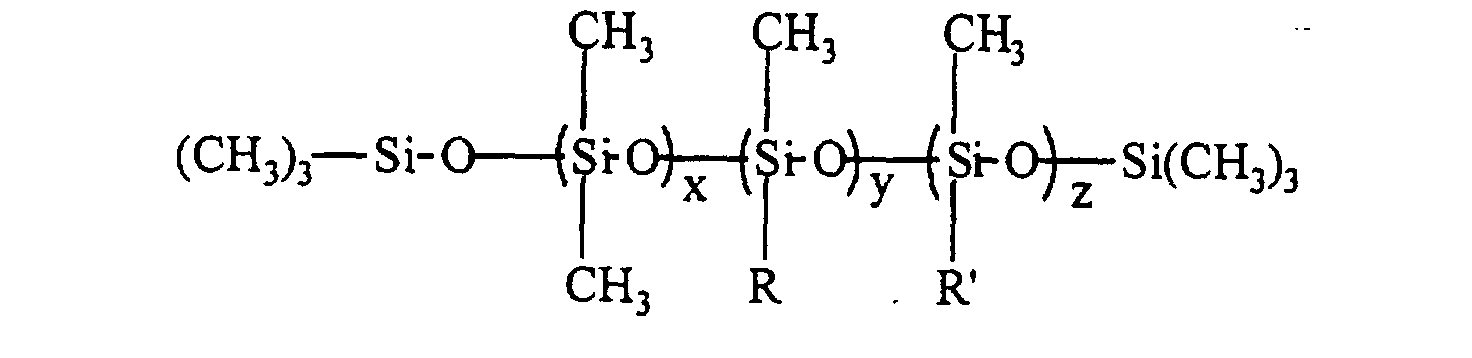
 wo R" H, CH3 oder C(O)CH3 ist; x 50 bis 200; y+z 3 bis 30 und x/(y+z) 7 bis 20 ist; das Gesamtschaumstabilisatormolekulargewicht 15.000 bis 30.000 g/mol ist, die Gewichtsprozente Siloxan in dem Schaumstabilisator 25 bis 35 Gewichtsprozent sind, das mittlere Mischmolekulargewicht des Polyetherteils 1.200 bis 3.000 g/mol ist und die Gewichtsprozente Ethylenoxid in dem Polyetherteil 30 bis 60 Gewichtsprozent sind.
- Zusammensetzung nach Anspruch 17, wobei das Treibmittel HFC-245fa ist.
- Zusammensetzung nach Anspruch 17, wobei das Treibmittel ebenso ein CFC, ein weiteres HCFC, ein weiteres HFC oder ein Pentan enthält.
- Zusammensetzung nach Anspruch 18, wobei das Treibmittel ebenso ein CFC, ein weiteres HCFC, ein weiteres HFC oder ein Pentan enthält.
Applications Claiming Priority (4)
| Application Number | Priority Date | Filing Date | Title |
|---|---|---|---|
| US85313697A | 1997-05-08 | 1997-05-08 | |
| US853136 | 1997-05-08 | ||
| US976979 | 1997-11-24 | ||
| US08/976,979 US5883142A (en) | 1997-05-08 | 1997-11-25 | Silicone surfactants for rigid polyurethane foam made with third generation blowing agents |
Publications (2)
| Publication Number | Publication Date |
|---|---|
| EP0877045A1 EP0877045A1 (de) | 1998-11-11 |
| EP0877045B1 true EP0877045B1 (de) | 2002-01-16 |
Family
ID=27127118
Family Applications (1)
| Application Number | Title | Priority Date | Filing Date |
|---|---|---|---|
| EP98108268A Expired - Lifetime EP0877045B1 (de) | 1997-05-08 | 1998-05-06 | Silikon Schaumstabilisatoren für Polyurethan Hartschäume hergestellt mit Treibmitteln der dritten Generation |
Country Status (7)
| Country | Link |
|---|---|
| US (1) | US5883142A (de) |
| EP (1) | EP0877045B1 (de) |
| JP (1) | JP3273133B2 (de) |
| KR (1) | KR100255720B1 (de) |
| CN (1) | CN1103789C (de) |
| BR (1) | BR9801575A (de) |
| DE (1) | DE69803140T2 (de) |
Cited By (7)
| Publication number | Priority date | Publication date | Assignee | Title |
|---|---|---|---|---|
| EP2465891A1 (de) | 2010-12-16 | 2012-06-20 | Evonik Goldschmidt GmbH | Siliconstabilisatoren für Polyurethan- oder Polyisocyanurat-Hartschaumstoffe |
| EP2465892A1 (de) | 2010-12-16 | 2012-06-20 | Evonik Goldschmidt GmbH | Siliconstabilisatoren für Polyurethan- oder Polyisocyanurat-Hartschaumstoffe |
| WO2015101497A1 (de) | 2013-12-30 | 2015-07-09 | Evonik Degussa Gmbh | Zusammensetzung geeignet zur herstellung von polyurethan- oder polyisocyanurat-hartschaumstoffen |
| EP3677610A1 (de) | 2019-01-07 | 2020-07-08 | Evonik Operations GmbH | Herstellung von polyurethanhartschaum |
| WO2020144003A1 (de) | 2019-01-07 | 2020-07-16 | Evonik Operations Gmbh | Herstellung von polyurethanhartschaum |
| EP3919539A1 (de) | 2020-06-04 | 2021-12-08 | Evonik Operations GmbH | Herstellung von polyurethanschaum |
| EP3957669A1 (de) | 2020-08-20 | 2022-02-23 | Evonik Operations GmbH | Herstellung von polyurethanschaum |
Families Citing this family (23)
| Publication number | Priority date | Publication date | Assignee | Title |
|---|---|---|---|---|
| US6514301B1 (en) | 1998-06-02 | 2003-02-04 | Peripheral Products Inc. | Foam semiconductor polishing belts and pads |
| US7718102B2 (en) * | 1998-06-02 | 2010-05-18 | Praxair S.T. Technology, Inc. | Froth and method of producing froth |
| US6514928B1 (en) * | 1999-03-15 | 2003-02-04 | Alliedsignal Inc. | Azeotrope-like compositions of pentafluoropropane and water |
| DE60220591T2 (de) | 2001-07-02 | 2008-02-14 | Tosoh Corp., Shinnanyo | Verfahren zur Herstellung eines Polyurethanhartschaumstoffes |
| US6784150B2 (en) * | 2002-04-16 | 2004-08-31 | Honeywell International Inc. | Composition of pentafluoropropane, pentafluoropropane and water |
| US20040097604A1 (en) * | 2002-11-15 | 2004-05-20 | Schilling Steven L. | Rigid foams with improved insulation properties and a process for the production of such foams |
| CN1308372C (zh) * | 2003-05-15 | 2007-04-04 | 广州市白云化工实业有限公司 | 一种非离子型活性硅表面活性剂及其制备方法 |
| US20050070619A1 (en) * | 2003-09-26 | 2005-03-31 | Miller John William | Blowing agent enhancers for polyurethane foam production |
| CN1301279C (zh) * | 2003-11-14 | 2007-02-21 | 广东科龙电器股份有限公司 | 一种聚氨酯硬质泡沫塑料及其制备方法 |
| US7183330B2 (en) * | 2003-12-15 | 2007-02-27 | Air Products And Chemicals, Inc. | Silicone surfactants for rigid polyurethane foam made with hydrocarbon blowing agents |
| US20060084708A1 (en) * | 2004-10-14 | 2006-04-20 | Bayer Materialscience Llc | Rigid foams with good insulation properties and a process for the production of such foams |
| DE102009028061A1 (de) * | 2009-07-29 | 2011-02-10 | Evonik Goldschmidt Gmbh | Verfahren zur Herstellung von Polyurethanschaum |
| CN101781396B (zh) * | 2010-03-30 | 2012-02-15 | 上海交通大学 | 壳聚糖复合聚氨酯的硬质闭孔泡沫材料及其制备方法 |
| DE102011003150A1 (de) * | 2011-01-26 | 2012-07-26 | Evonik Goldschmidt Gmbh | Silikonpolyetherblock-Copolymere mit hochmolekularen Polyetherresten und deren Verwendung als Stabilisatoren zur Herstellung von Polyurethanschäumen |
| DE102011003148A1 (de) * | 2011-01-26 | 2012-07-26 | Evonik Goldschmidt Gmbh | Verwendung von Silikonpolyetherblock-Copolymere mit hochmolekularen nicht endverkappten Polyetherresten als Stabilisatoren zur Herstellung von Polyuretherschäumen niedriger Dichte |
| US9758535B2 (en) | 2013-03-15 | 2017-09-12 | Bio-Rad Laboratories, Inc. | Silicone surfactants for emulsion assays |
| CN103638872B (zh) * | 2013-12-16 | 2015-07-29 | 南京美思德新材料有限公司 | 一种三硅氧烷聚醚酯表面活性剂及其制备方法 |
| JP6482208B2 (ja) * | 2014-08-25 | 2019-03-13 | 日本発條株式会社 | ポリウレタンフォーム |
| ES2939860T3 (es) | 2016-06-23 | 2023-04-27 | Evonik Operations Gmbh | Composición apropiada para la producción de materiales celulares duros de poliuretano o poliisocianurato |
| CN110072943B (zh) * | 2016-10-18 | 2022-04-12 | 陶氏东丽株式会社 | 聚醚改性的硅酮组合物,以及用于制造所述组合物的方法 |
| EP3684831A1 (de) * | 2017-09-18 | 2020-07-29 | Dow Global Technologies LLC | Verfahren zur verbesserten stabilität von polyurethanschaum, der mit einem hydrohaloolefintreibmittel hergestellt wird |
| WO2020028016A1 (en) * | 2018-07-31 | 2020-02-06 | Dow Global Technologies Llc | Composition with isocyanate compatible silicone stabilizer |
| US12617891B2 (en) * | 2021-07-28 | 2026-05-05 | Momentive Performance Materials Inc. | Flexible foams comprising additives for improving hardness |
Family Cites Families (12)
| Publication number | Priority date | Publication date | Assignee | Title |
|---|---|---|---|---|
| GR68082B (de) * | 1979-04-28 | 1981-10-30 | Polyol Int Bv | |
| DE3338106C1 (de) * | 1983-10-20 | 1985-02-14 | Th. Goldschmidt Ag, 4300 Essen | Verfahren zur Herstellung von Polyurethanhartschaeumen |
| US4751251A (en) * | 1987-05-19 | 1988-06-14 | Dow Corning Corporation | Surfactant composition for rigid urethane and isocyanurate foams |
| US4997706A (en) * | 1990-02-09 | 1991-03-05 | The Dow Chemical Company | Foaming system for closed-cell rigid polymer foam |
| BR9203663A (pt) * | 1991-09-20 | 1993-04-20 | Union Carbide Chem Plastic | Uso de tensoativos capeados para a producao de espumas de polioretano rigidas soprados com hidrocloro-fluorcarbonetos |
| US5169872A (en) * | 1992-05-11 | 1992-12-08 | Dow Corning Corporation | Process for preparing rigid polyurethane and polyisocyanurate foams having enhanced benefits |
| US5308881A (en) * | 1993-10-25 | 1994-05-03 | The Celotex Corporation | Surfactant for polyisocyanurate foams made with alternative blowing agents |
| US5432206A (en) * | 1994-07-29 | 1995-07-11 | Dow Corning Corporation | Polyether silicone surfactants for the manufacture of urethane foams |
| US5426127A (en) * | 1994-09-26 | 1995-06-20 | Miles Inc. | Rigid foams with improved insulation and physical properties |
| US5525640A (en) * | 1995-09-13 | 1996-06-11 | Osi Specialties, Inc. | Silicone surfactants for use in inert gas blown polyurethane foams |
| US5686499A (en) * | 1995-10-27 | 1997-11-11 | Basf Corporation | Polyurethane foams containing high levels of silicone-containing surfactant polymer to improve flame retardance and aged K-factors |
| MX9604872A (es) * | 1995-10-27 | 1997-04-30 | Basf Corp | Composiciones de poliol que proporcionan resistencia mejorada a las llamas y factores k curados a las espumas de poliuretano. |
-
1997
- 1997-11-25 US US08/976,979 patent/US5883142A/en not_active Expired - Fee Related
-
1998
- 1998-05-05 BR BR9801575A patent/BR9801575A/pt not_active IP Right Cessation
- 1998-05-06 KR KR1019980016086A patent/KR100255720B1/ko not_active Expired - Fee Related
- 1998-05-06 EP EP98108268A patent/EP0877045B1/de not_active Expired - Lifetime
- 1998-05-06 DE DE69803140T patent/DE69803140T2/de not_active Expired - Fee Related
- 1998-05-07 JP JP12438198A patent/JP3273133B2/ja not_active Expired - Fee Related
- 1998-05-08 CN CN98107963A patent/CN1103789C/zh not_active Expired - Fee Related
Cited By (13)
| Publication number | Priority date | Publication date | Assignee | Title |
|---|---|---|---|---|
| EP2465891A1 (de) | 2010-12-16 | 2012-06-20 | Evonik Goldschmidt GmbH | Siliconstabilisatoren für Polyurethan- oder Polyisocyanurat-Hartschaumstoffe |
| EP2465892A1 (de) | 2010-12-16 | 2012-06-20 | Evonik Goldschmidt GmbH | Siliconstabilisatoren für Polyurethan- oder Polyisocyanurat-Hartschaumstoffe |
| DE102010063241A1 (de) | 2010-12-16 | 2012-06-21 | Evonik Goldschmidt Gmbh | Siliconstabilisatoren für Polyurethan- oder Polyisocyanurat-Hartschaumstoffe |
| DE102010063237A1 (de) | 2010-12-16 | 2012-06-21 | Evonik Goldschmidt Gmbh | Siliconstabilisatoren für Polyurethan- oder Polyisocyanurat-Hartschaumstoffe |
| US8957121B2 (en) | 2010-12-16 | 2015-02-17 | Evonik Degussa Gmbh | Silicone stabilizers for rigid polyurethane or polyisocyanurate foams |
| WO2015101497A1 (de) | 2013-12-30 | 2015-07-09 | Evonik Degussa Gmbh | Zusammensetzung geeignet zur herstellung von polyurethan- oder polyisocyanurat-hartschaumstoffen |
| US10351687B2 (en) | 2013-12-30 | 2019-07-16 | Evonik Degussa Gmbh | Composition suitable for production of rigid polyurethane or polyisocyanurate foams |
| EP3677610A1 (de) | 2019-01-07 | 2020-07-08 | Evonik Operations GmbH | Herstellung von polyurethanhartschaum |
| WO2020144003A1 (de) | 2019-01-07 | 2020-07-16 | Evonik Operations Gmbh | Herstellung von polyurethanhartschaum |
| WO2020144004A1 (de) | 2019-01-07 | 2020-07-16 | Evonik Operations Gmbh | Herstellung von polyurethanhartschaum |
| EP3919539A1 (de) | 2020-06-04 | 2021-12-08 | Evonik Operations GmbH | Herstellung von polyurethanschaum |
| EP3957669A1 (de) | 2020-08-20 | 2022-02-23 | Evonik Operations GmbH | Herstellung von polyurethanschaum |
| US12122890B2 (en) | 2020-08-20 | 2024-10-22 | Evonik Operations Gmbh | Production of polyurethane foam |
Also Published As
| Publication number | Publication date |
|---|---|
| BR9801575A (pt) | 1999-06-15 |
| CN1199058A (zh) | 1998-11-18 |
| JPH10324760A (ja) | 1998-12-08 |
| DE69803140T2 (de) | 2002-06-20 |
| JP3273133B2 (ja) | 2002-04-08 |
| KR100255720B1 (ko) | 2000-05-01 |
| US5883142A (en) | 1999-03-16 |
| EP0877045A1 (de) | 1998-11-11 |
| DE69803140D1 (de) | 2002-02-21 |
| CN1103789C (zh) | 2003-03-26 |
| KR19980086778A (ko) | 1998-12-05 |
Similar Documents
| Publication | Publication Date | Title |
|---|---|---|
| US5883142A (en) | Silicone surfactants for rigid polyurethane foam made with third generation blowing agents | |
| US7183330B2 (en) | Silicone surfactants for rigid polyurethane foam made with hydrocarbon blowing agents | |
| JP6033273B2 (ja) | Z−1,1,1,4,4,4−ヘキサフルオロ−2−ブテンを含有する共沸もしくは共沸様混合物を含有する発泡体形成組成物およびポリイソシアネートベースの発泡体の製造におけるその使用 | |
| JP6255332B2 (ja) | 組成物、およびポリイソシアネートベースの発泡体の製造におけるシス−1,1,1,4,4,4−ヘキサフルオロ−2−ブテン発泡体形成組成物の使用 | |
| US9321892B2 (en) | Blowing agent enhancers for polyurethane foam production | |
| JP2018150554A (ja) | シス−1,1,1,4,4,4−ヘキサフルオロ−2−ブテン発泡成形用組成物、およびポリイソシアネートベースの発泡体の製造における組成物の使用 | |
| JP2011530646A (ja) | 2−クロロ−3,3,3−トリフルオロプロペンと炭化水素との混合物を含有する発泡体形成用組成物およびポリイソシアネートベースの発泡体の製造におけるその使用 | |
| US5530033A (en) | Process for preparing formed articles made of polyurethane foams and formed articles so obtained | |
| CN109689753B (zh) | 具有z-1,1,1,4,4,4-六氟丁烯的泡沫 | |
| WO2002053631A1 (en) | Process for making polyurethane integral skin foams | |
| AU2002234544A1 (en) | Process for making polyurethane integral skin foams | |
| JP6536144B2 (ja) | 硬質ポリウレタンフォーム及びその製造方法 | |
| WO1998003580A1 (en) | Blowing agent blends and use thereof in the preparation of polyisocyanate-based foams | |
| MXPA98003628A (en) | Silicone surfactants for rigid polyurethane foam, prepared with third generation blown agents | |
| MXPA04011205A (es) | Mejoradores de agentes de soplado para la produccion de espuma de poliuretano. | |
| JPH0680815A (ja) | 硬質ポリウレタンフォームの製造方法 |
Legal Events
| Date | Code | Title | Description |
|---|---|---|---|
| PUAI | Public reference made under article 153(3) epc to a published international application that has entered the european phase |
Free format text: ORIGINAL CODE: 0009012 |
|
| AK | Designated contracting states |
Kind code of ref document: A1 Designated state(s): DE FR GB IT |
|
| AX | Request for extension of the european patent |
Free format text: AL;LT;LV;MK;RO;SI |
|
| 17P | Request for examination filed |
Effective date: 19990511 |
|
| AKX | Designation fees paid |
Free format text: DE FR GB IT |
|
| 17Q | First examination report despatched |
Effective date: 20000316 |
|
| GRAG | Despatch of communication of intention to grant |
Free format text: ORIGINAL CODE: EPIDOS AGRA |
|
| GRAG | Despatch of communication of intention to grant |
Free format text: ORIGINAL CODE: EPIDOS AGRA |
|
| GRAH | Despatch of communication of intention to grant a patent |
Free format text: ORIGINAL CODE: EPIDOS IGRA |
|
| GRAH | Despatch of communication of intention to grant a patent |
Free format text: ORIGINAL CODE: EPIDOS IGRA |
|
| GRAA | (expected) grant |
Free format text: ORIGINAL CODE: 0009210 |
|
| REG | Reference to a national code |
Ref country code: GB Ref legal event code: IF02 |
|
| AK | Designated contracting states |
Kind code of ref document: B1 Designated state(s): DE FR GB IT |
|
| REF | Corresponds to: |
Ref document number: 69803140 Country of ref document: DE Date of ref document: 20020221 |
|
| ET | Fr: translation filed | ||
| PLBE | No opposition filed within time limit |
Free format text: ORIGINAL CODE: 0009261 |
|
| STAA | Information on the status of an ep patent application or granted ep patent |
Free format text: STATUS: NO OPPOSITION FILED WITHIN TIME LIMIT |
|
| 26N | No opposition filed | ||
| PGFP | Annual fee paid to national office [announced via postgrant information from national office to epo] |
Ref country code: FR Payment date: 20050517 Year of fee payment: 8 |
|
| PGFP | Annual fee paid to national office [announced via postgrant information from national office to epo] |
Ref country code: DE Payment date: 20070531 Year of fee payment: 10 |
|
| PGFP | Annual fee paid to national office [announced via postgrant information from national office to epo] |
Ref country code: GB Payment date: 20070410 Year of fee payment: 10 |
|
| PGFP | Annual fee paid to national office [announced via postgrant information from national office to epo] |
Ref country code: IT Payment date: 20070519 Year of fee payment: 10 |
|
| REG | Reference to a national code |
Ref country code: FR Ref legal event code: ST Effective date: 20080131 |
|
| PG25 | Lapsed in a contracting state [announced via postgrant information from national office to epo] |
Ref country code: FR Free format text: LAPSE BECAUSE OF NON-PAYMENT OF DUE FEES Effective date: 20070531 |
|
| PG25 | Lapsed in a contracting state [announced via postgrant information from national office to epo] |
Ref country code: FR Free format text: LAPSE BECAUSE OF NON-PAYMENT OF DUE FEES Effective date: 20060531 |
|
| GBPC | Gb: european patent ceased through non-payment of renewal fee |
Effective date: 20080506 |
|
| PG25 | Lapsed in a contracting state [announced via postgrant information from national office to epo] |
Ref country code: DE Free format text: LAPSE BECAUSE OF NON-PAYMENT OF DUE FEES Effective date: 20081202 |
|
| PG25 | Lapsed in a contracting state [announced via postgrant information from national office to epo] |
Ref country code: GB Free format text: LAPSE BECAUSE OF NON-PAYMENT OF DUE FEES Effective date: 20080506 |
|
| PG25 | Lapsed in a contracting state [announced via postgrant information from national office to epo] |
Ref country code: IT Free format text: LAPSE BECAUSE OF NON-PAYMENT OF DUE FEES Effective date: 20080506 |