WO2020143448A1 - 一种聚碳酸酯合金及其制备方法和一种应用 - Google Patents
一种聚碳酸酯合金及其制备方法和一种应用 Download PDFInfo
- Publication number
- WO2020143448A1 WO2020143448A1 PCT/CN2019/128148 CN2019128148W WO2020143448A1 WO 2020143448 A1 WO2020143448 A1 WO 2020143448A1 CN 2019128148 W CN2019128148 W CN 2019128148W WO 2020143448 A1 WO2020143448 A1 WO 2020143448A1
- Authority
- WO
- WIPO (PCT)
- Prior art keywords
- polycarbonate
- maleic anhydride
- phosphate
- polycarbonate alloy
- weight
- Prior art date
- Legal status (The legal status is an assumption and is not a legal conclusion. Google has not performed a legal analysis and makes no representation as to the accuracy of the status listed.)
- Ceased
Links
Classifications
-
- C—CHEMISTRY; METALLURGY
- C08—ORGANIC MACROMOLECULAR COMPOUNDS; THEIR PREPARATION OR CHEMICAL WORKING-UP; COMPOSITIONS BASED THEREON
- C08L—COMPOSITIONS OF MACROMOLECULAR COMPOUNDS
- C08L69/00—Compositions of polycarbonates; Compositions of derivatives of polycarbonates
-
- C—CHEMISTRY; METALLURGY
- C08—ORGANIC MACROMOLECULAR COMPOUNDS; THEIR PREPARATION OR CHEMICAL WORKING-UP; COMPOSITIONS BASED THEREON
- C08K—Use of inorganic or non-macromolecular organic substances as compounding ingredients
- C08K3/00—Use of inorganic substances as compounding ingredients
- C08K3/18—Oxygen-containing compounds, e.g. metal carbonyls
- C08K3/20—Oxides; Hydroxides
- C08K3/22—Oxides; Hydroxides of metals
-
- C—CHEMISTRY; METALLURGY
- C08—ORGANIC MACROMOLECULAR COMPOUNDS; THEIR PREPARATION OR CHEMICAL WORKING-UP; COMPOSITIONS BASED THEREON
- C08K—Use of inorganic or non-macromolecular organic substances as compounding ingredients
- C08K3/00—Use of inorganic substances as compounding ingredients
- C08K3/32—Phosphorus-containing compounds
-
- C—CHEMISTRY; METALLURGY
- C08—ORGANIC MACROMOLECULAR COMPOUNDS; THEIR PREPARATION OR CHEMICAL WORKING-UP; COMPOSITIONS BASED THEREON
- C08K—Use of inorganic or non-macromolecular organic substances as compounding ingredients
- C08K5/00—Use of organic ingredients
- C08K5/02—Halogenated hydrocarbons
- C08K5/03—Halogenated hydrocarbons aromatic, e.g. C6H5-CH2-Cl
-
- C—CHEMISTRY; METALLURGY
- C08—ORGANIC MACROMOLECULAR COMPOUNDS; THEIR PREPARATION OR CHEMICAL WORKING-UP; COMPOSITIONS BASED THEREON
- C08K—Use of inorganic or non-macromolecular organic substances as compounding ingredients
- C08K5/00—Use of organic ingredients
- C08K5/04—Oxygen-containing compounds
- C08K5/13—Phenols; Phenolates
- C08K5/136—Phenols containing halogens
-
- C—CHEMISTRY; METALLURGY
- C08—ORGANIC MACROMOLECULAR COMPOUNDS; THEIR PREPARATION OR CHEMICAL WORKING-UP; COMPOSITIONS BASED THEREON
- C08L—COMPOSITIONS OF MACROMOLECULAR COMPOUNDS
- C08L23/00—Compositions of homopolymers or copolymers of unsaturated aliphatic hydrocarbons having only one carbon-to-carbon double bond; Compositions of derivatives of such polymers
- C08L23/02—Compositions of homopolymers or copolymers of unsaturated aliphatic hydrocarbons having only one carbon-to-carbon double bond; Compositions of derivatives of such polymers not modified by chemical after-treatment
- C08L23/04—Homopolymers or copolymers of ethene
- C08L23/06—Polyethylene
-
- C—CHEMISTRY; METALLURGY
- C08—ORGANIC MACROMOLECULAR COMPOUNDS; THEIR PREPARATION OR CHEMICAL WORKING-UP; COMPOSITIONS BASED THEREON
- C08L—COMPOSITIONS OF MACROMOLECULAR COMPOUNDS
- C08L23/00—Compositions of homopolymers or copolymers of unsaturated aliphatic hydrocarbons having only one carbon-to-carbon double bond; Compositions of derivatives of such polymers
- C08L23/02—Compositions of homopolymers or copolymers of unsaturated aliphatic hydrocarbons having only one carbon-to-carbon double bond; Compositions of derivatives of such polymers not modified by chemical after-treatment
- C08L23/10—Homopolymers or copolymers of propene
- C08L23/12—Polypropene
-
- C—CHEMISTRY; METALLURGY
- C08—ORGANIC MACROMOLECULAR COMPOUNDS; THEIR PREPARATION OR CHEMICAL WORKING-UP; COMPOSITIONS BASED THEREON
- C08L—COMPOSITIONS OF MACROMOLECULAR COMPOUNDS
- C08L51/00—Compositions of graft polymers in which the grafted component is obtained by reactions only involving carbon-to-carbon unsaturated bonds; Compositions of derivatives of such polymers
- C08L51/06—Compositions of graft polymers in which the grafted component is obtained by reactions only involving carbon-to-carbon unsaturated bonds; Compositions of derivatives of such polymers grafted on to homopolymers or copolymers of aliphatic hydrocarbons containing only one carbon-to-carbon double bond
-
- C—CHEMISTRY; METALLURGY
- C08—ORGANIC MACROMOLECULAR COMPOUNDS; THEIR PREPARATION OR CHEMICAL WORKING-UP; COMPOSITIONS BASED THEREON
- C08L—COMPOSITIONS OF MACROMOLECULAR COMPOUNDS
- C08L67/00—Compositions of polyesters obtained by reactions forming a carboxylic ester link in the main chain; Compositions of derivatives of such polymers
- C08L67/02—Polyesters derived from dicarboxylic acids and dihydroxy compounds
-
- C—CHEMISTRY; METALLURGY
- C08—ORGANIC MACROMOLECULAR COMPOUNDS; THEIR PREPARATION OR CHEMICAL WORKING-UP; COMPOSITIONS BASED THEREON
- C08K—Use of inorganic or non-macromolecular organic substances as compounding ingredients
- C08K3/00—Use of inorganic substances as compounding ingredients
- C08K3/32—Phosphorus-containing compounds
- C08K2003/321—Phosphates
- C08K2003/324—Alkali metal phosphate
-
- C—CHEMISTRY; METALLURGY
- C08—ORGANIC MACROMOLECULAR COMPOUNDS; THEIR PREPARATION OR CHEMICAL WORKING-UP; COMPOSITIONS BASED THEREON
- C08L—COMPOSITIONS OF MACROMOLECULAR COMPOUNDS
- C08L2205/00—Polymer mixtures characterised by other features
- C08L2205/03—Polymer mixtures characterised by other features containing three or more polymers in a blend
Definitions
- the invention relates to the technical field of polymer composite materials, in particular to a polycarbonate alloy, its preparation method and an application.
- PC polycarbonate
- industrial and civil parts such as various transparent parts, lampshades, instrument panels, etc.
- Polycarbonate also has the disadvantage of poor chemical resistance, and it is difficult to apply to kitchen appliances, vehicles and other equipment that are easily exposed to oil fumes.
- people's demand for chemical resistant and flame retardant polycarbonate materials is becoming more and more demanding.
- the method of solving the chemical resistance of polycarbonate is generally prepared by adding other crystalline polyester into an alloy. After polycarbonate and crystalline polyester are prepared into an alloy, the crystalline polyester as an uncontinuous phase will form an island-like distribution in the poly In carbonates, fillers and additives can be selectively dissolved in polycarbonate or liquid crystal polyester due to different solubility, resulting in insufficient performance.
- bromine-based flame retardants In many application scenarios, flame retardants need to be added, but brominated flame retardants are easily degraded in the high-temperature preparation process, free bromine, reduce the stability of polycarbonate and darken the surface of the material.
- bromine-based flame retardants often require the addition of alkaline metal oxides to be flame retardant, but alkaline metal salts can destroy the stability of polycarbonate.
- bromine-based flame retardants are difficult to apply to light-colored polycarbonate products, so bromine-antimony flame retardants are generally not added to polycarbonate.
- the object of the present invention is to provide a polycarbonate alloy, which has the advantages of good alloy stability, continuous and uniform distribution of polyester in the alloy.
- Another object of the present invention is to provide a method for preparing the above polycarbonate alloy; and the application of the maleic anhydride polymer and the phosphate metal salt to promote the continuous and uniform distribution of the crystalline polyester in the polycarbonate alloy.
- a polycarbonate alloy based on parts by weight, including the following components:
- the polycarbonate resin of the present invention may be a branched thermoplastic polymer or copolymer obtained by the reaction of a dihydroxy compound or a small amount thereof with phosgene or a carbonic acid diester.
- the production method of the polycarbonate resin is not particularly limited, and a polycarbonate resin produced by the phosgene method (interfacial polymerization method) or melting method (ester exchange method) known hitherto can be used.
- the polycarbonate resin is preferably derived from an aromatic polycarbonate resin derived from 2,2-bis(4-hydroxyphenyl)propane, or derived from 2,2-bis(4-hydroxyphenyl)propane and other aromatic Aromatic polycarbonate copolymer of dihydroxy compounds.
- the polycarbonate resin may also be a copolymer in which the main composition is an aromatic polycarbonate resin, for example, a copolymer with a polymer or oligomer containing a siloxane structure.
- a mixture of two or more of the above polycarbonate resins may be used.
- Monovalent aromatic hydroxy compounds can be used to adjust the molecular weight of polycarbonate resins, for example, m-methylphenol, p-methylphenol, m-propylphenol, p-propylphenol, p-tert-butylphenol and p-(long-chain alkyl )-Substituted phenol.
- the present invention has no particular limitation on the production method of polycarbonate resin, and polycarbonate resin produced by phosgene method (interfacial polymerization method) or melting method (transesterification method) can be used.
- the polycarbonate resin is also provided by the polycarbonate resin produced by the melting method undergoing post-treatment for adjusting the amount of terminal hydroxyl groups.
- the crystalline polyester is selected from polyethylene terephthalate (PET), polyethylene terephthalate-co-adipate (PETA), poly Butylene terephthalate (PBT), Polytrimethylene terephthalate (PPT), Polycyclohexylene dimethylene terephthalate (PCT), Polytrimethylene terephthalate (PTT) , Poly 1,4-cyclohexylene dimethylene terephthalate-co-isophthalate (PCTA), diol modified poly cyclohexylene dimethyl terephthalate (PCTG) At least one of glycol modified polyethylene terephthalate (PETG).
- PET polyethylene terephthalate
- PETA polyethylene terephthalate-co-adipate
- PBT poly Butylene terephthalate
- PPT Polytrimethylene terephthalate
- PCT Polycyclohexylene dimethylene terephthalate
- PCT Polytrimethylene terephthalate
- PCTA Poly 1,4
- PET Polyethylene terephthalate
- PET is a polyester of terephthalic acid and ethylene glycol, and can be polycondensed by dimethyl terephthalate and ethylene glycol, and terephthalic acid and ethylene glycol Obtained by polycondensation of alcohol.
- PET can be an amorphous (transparent) and semi-crystalline (opaque, white) thermoplastic.
- Ethylene glycol can be of biological origin, and the biological sources are mainly corn, sugar cane, wheat and other crop straws.
- the polyethylene terephthalate of the present invention can also be modified and synthesized, and the diacid unit can also contain dimethyl isophthalate, dimethyl isophthalate-5-sulfonate, o-benzene Aromatic carboxylic acid derivatives such as dimethyl diformate, dimethyl methyl terephthalate, dimethyl naphthalate, dimethyl diphthalate, and dimethyl adipate, pimelic acid Aliphatic polyesters such as dimethyl, dimethyl suberate, dimethyl azelate, dimethyl dodecane dicarboxylate, dimethyl cyclohexane dicarboxylate, hexahydroisophthalic acid Alicyclic dicarboxylic acid esters such as dimethyl ester and hexahydrophthalic acid dimethyl ester.
- the content of the terminal carbonyl group of PET can also be controlled, and the content of the terminal carbonyl group can be controlled at a level of 8-30 eq/ton.
- Polybutylene terephthalate-based resin which is the main component constituting the polybutylene terephthalate-based resin composition of the present invention, is represented by having a terephthalic acid unit and 1,4 -A polymer having a structure in which butylene glycol units are bonded by ester bonds. Therefore, in addition to polybutylene terephthalate resin (homopolymer), this includes polyterephthalic acid containing copolymer components other than terephthalic acid units and 1,4-butanediol units Butadiene copolymers, and also includes mixtures of such copolymers with homopolymers.
- the PBT resin may contain dicarboxylic acid units other than terephthalic acid, and the additional dicarboxylic acid unit may be specifically exemplified by aromatic dicarboxylic acids such as isophthalic acid, phthalic acid, and 1,5-naphthalene Dicarboxylic acid, 2,5-naphthylenedicarboxylic acid, 2,6-naphthylenedicarboxylic acid, biphenyl-2,2′-dicarboxylic acid, biphenyl-3,3′-di Carboxylic acid, biphenyl-4,4′-dicarboxylic acid, bis(4,4′-carboxyphenyl)methane, anthracenedicarboxylic acid and 4,4′-diphenyl ether dicarboxylic acid Alicyclic dicarboxylic acids such as 1,4-cyclohexane dicarboxylic acid and 4,4′-dicyclohexyl dicarboxylic acid; and aliphatic di
- the diol unit may include a diol unit other than 1,4-butanediol, and the additional diol unit may be specifically exemplified by C 2-20 aliphatic and cycloaliphatic diols and bisphenol derivatives. Specific examples are ethylene glycol, propylene glycol, 1,5-pentanediol, 1,6-hexanediol, neopentyl glycol, decanediol, cyclohexanedimethanol, 4,4′-dicyclohexylhydroxymethane , 4,4′-dicyclohexylhydroxypropane and bisphenol A/ethylene oxide addition diols. In addition, triols such as glycerin, trimethylolpropane, etc. can also be considered.
- the maleic anhydride polymer is a maleic anhydride grafted polymer with a grafting rate of 3%-25%;
- the graft ratio is 5-13%.
- the maleic anhydride grafted polymer for achieving the object of the present invention preferably has a relatively high grafting rate.
- the graft ratio of maleic anhydride grafted polypropylene used as a compatibilizer in thermoplastic resin is about 0.5-2%, and the effect is general.
- test method for the grafting rate of the maleic anhydride polymer is: using a titration method, the specific method may be the test method disclosed in Chinese Patent 2016109445762.
- the main chain of the maleic anhydride graft polymer may be polyethylene, polypropylene, or the like.
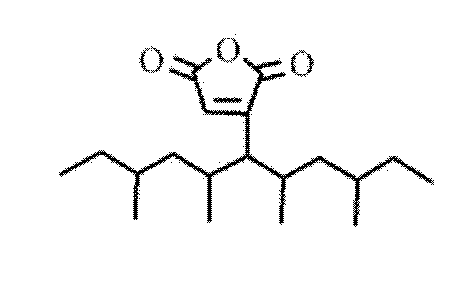
- the molecular formula of maleic anhydride grafted polypropylene is as follows:
- the metal phosphate is selected from at least one of sodium phosphate, sodium monohydrogen phosphate, sodium dihydrogen phosphate, disodium pyrophosphate, zinc phosphate, calcium phosphate, zinc monohydrogen phosphate, and zinc dihydrogen phosphate.
- Phosphoric acid metal salt plays a role in synergizing the maleic anhydride polymer to promote the continuous and uniform dispersion of the crystalline polyester in the polycarbonate alloy, which cannot be replaced by other metal salts. Experiments have shown that such as metal oxides or other mineral fillers Can not achieve a similar effect.
- the weight ratio of the maleic anhydride polymer to the metal phosphate is 3:1 to 1:2.
- the flame retardant is selected from bromine flame retardant and flame retardant synergist compound;
- the bromine flame retardant is selected from octabromide At least one of ether, decabromodiphenylethane, brominated epoxy, brominated polystyrene, brominated triazine, brominated polycarbon, and tetrabromobisphenol A;
- the flame retardant synergist is selected Self-contained antimony compound flame retardant synergist, at least one of boric acid metal salt; by weight, it also includes 0-10 parts of anti-dripping agent.
- additives are selected from at least one of antioxidants, lubricants, and weathering agents.
- the application of maleic anhydride polymer and phosphoric acid metal salt to promote the continuous and uniform distribution of crystalline polyester in polycarbonate alloy, based on parts by weight, includes the following components:
- maleic anhydride polymer and metal phosphate are added to polycarbonate/crystalline polyester alloy to promote good dispersion of crystalline polyester in polycarbonate, and promote the formation of uniformly dispersed and continuously distributed microstructure (Evaluation using dyeing uniformity, the more uniformly dispersed the crystalline polyester as the dispersed phase in the alloy and the better the continuity, the more uniform the dyeing).
- maleic anhydride polymer and phosphate metal salt have a good dispersion and stabilizing effect on flame retardants, especially bromine flame retardant systems, to ensure long-term flame retardant stability, alloy stability (embodied as thermal retention Good liquidity).
- the source of raw materials used in the present invention is as follows, but is not limited by the following raw materials.
- PBT Polybutylene terephthalate, crystalline polyester
- PET polyethylene terephthalate, crystalline polyester
- Maleic anhydride polymer A grafting rate 5-6%, main chain polyethylene
- Maleic anhydride polymer B grafting rate 5-6%, main chain polypropylene
- Maleic anhydride polymer C Grafting rate 11-13%, main chain polyethylene
- Maleic anhydride polymer D grafting rate 3-4%, main chain polyethylene
- Maleic anhydride polymer E grafting rate 15-17%, main chain polyethylene
- Maleic anhydride polymer F grafting ratio 0.8-1%, main chain polyethylene
- Preparation method of polycarbonate alloy polycarbonate, crystalline polyester, maleic anhydride polymer, and metal phosphate are added to the high-speed mixer according to the mixing ratio, mixed uniformly, and extruded and granulated in the twin screw extruder , Screw temperature is 220-250 °C, to obtain polycarbonate alloy.
- Dyeing performance test color quality evaluation: comparing the color uniformity of the injection molding sample (2.0mm) under the same colorant system, visually comparing, if the color becomes uniform on the sample plate, it is judged as excellent If there are irregular spots on the four corners of the injection model, it means that it is general. If there are continuous continuous irregular spots on the four corners and the middle of the injection model, it means that the standard is not met.
- Table 1 Example 1-10 distribution ratio (parts by weight) and performance test results
- Table 3 Distribution ratio (parts by weight) of each group of Example 17 and performance test results
- Table 4 Distribution ratio (parts by weight) and performance test results of each group in the comparative example
- the alloy has better thermal retention kinetics at the preferred amount (the amount of maleic anhydride polymer is 0.1-2 parts and the amount of metal phosphate salt is 0.1-2 parts), and the dyeing uniformity it is good.
- the ratio of maleic anhydride polymer and metal phosphate also has a great influence on alloy stability and dyeing stability.
- the weight ratio of maleic anhydride polymer and metal phosphate is 3 :1-1:2, the alloy has better stability and better dyeing uniformity.
- the graft ratio is in the range of 5-13%, the alloy has the best comprehensive stability, and the dyeing uniformity is also the best; generally, it is used as a compatibilizer in thermoplastic resins
- the grafting rate of the maleic anhydride grafted polypropylene is only 0.8-1%, and the performance of the product is relatively poor, especially the dyeing uniformity; from Example 14 it can be seen that the higher the grafting rate, the higher the heat The better the retention kinetics, but more than 13% will cause the dyeing uniformity to decline instead.
- Example 3/17 and Comparative Example 4/5/6 that the bromine-antimony flame retardant system will seriously reduce the alloy stability and combustion uniformity of the alloy, which can be effectively reduced by adding maleic anhydride polymer and phosphate metal salt
- the influence of the bromine-antimony flame retardant system on the properties of the alloy also guarantees the stability of the flame retardant.
- the invention relates to the technical field of polymer composite materials, in particular to a polycarbonate alloy, its preparation method and an application.
- PC polycarbonate
- industrial and civil parts such as various transparent parts, lampshades, instrument panels, etc.
- Polycarbonate also has the disadvantage of poor chemical resistance, and it is difficult to apply to kitchen appliances, vehicles and other equipment that are easily exposed to oil fumes.
- people's demand for chemical resistant and flame retardant polycarbonate materials is becoming more and more demanding.
- the method of solving the chemical resistance of polycarbonate is generally prepared by adding other crystalline polyester into an alloy. After polycarbonate and crystalline polyester are prepared into an alloy, the crystalline polyester as an uncontinuous phase will form an island-like distribution in the poly In carbonates, fillers and additives can be selectively dissolved in polycarbonate or liquid crystal polyester due to different solubility, resulting in insufficient performance.
- bromine-based flame retardants In many application scenarios, flame retardants need to be added, but brominated flame retardants are easily degraded in the high-temperature preparation process, free bromine, reduce the stability of polycarbonate and darken the surface of the material.
- bromine-based flame retardants often require the addition of alkaline metal oxides to be flame retardant, but alkaline metal salts can destroy the stability of polycarbonate.
- bromine-based flame retardants are difficult to apply to light-colored polycarbonate products, so bromine-antimony flame retardants are generally not added to polycarbonate.
- the object of the present invention is to provide a polycarbonate alloy, which has the advantages of good alloy stability, continuous and uniform distribution of polyester in the alloy.
- Another object of the present invention is to provide a method for preparing the above polycarbonate alloy; and the application of the maleic anhydride polymer and the phosphate metal salt to promote the continuous and uniform distribution of the crystalline polyester in the polycarbonate alloy.
- a polycarbonate alloy based on parts by weight, including the following components:
- the polycarbonate resin of the present invention may be a branched thermoplastic polymer or copolymer obtained by the reaction of a dihydroxy compound or a small amount thereof with phosgene or a carbonic acid diester.
- the production method of the polycarbonate resin is not particularly limited, and a polycarbonate resin produced by the phosgene method (interfacial polymerization method) or melting method (ester exchange method) known hitherto can be used.
- the polycarbonate resin is preferably derived from an aromatic polycarbonate resin derived from 2,2-bis(4-hydroxyphenyl)propane, or derived from 2,2-bis(4-hydroxyphenyl)propane and other aromatic Aromatic polycarbonate copolymer of dihydroxy compounds.
- the polycarbonate resin may also be a copolymer in which the main composition is an aromatic polycarbonate resin, for example, a copolymer with a polymer or oligomer containing a siloxane structure.
- a mixture of two or more of the above polycarbonate resins may be used.
- Monovalent aromatic hydroxy compounds can be used to adjust the molecular weight of polycarbonate resins, for example, m-methylphenol, p-methylphenol, m-propylphenol, p-propylphenol, p-tert-butylphenol and p-(long-chain alkyl )-Substituted phenol.
- the present invention has no particular limitation on the production method of polycarbonate resin, and polycarbonate resin produced by phosgene method (interfacial polymerization method) or melting method (transesterification method) can be used.
- the polycarbonate resin is also provided by the polycarbonate resin produced by the melting method undergoing post-treatment for adjusting the amount of terminal hydroxyl groups.
- the crystalline polyester is selected from polyethylene terephthalate (PET), polyethylene terephthalate-co-adipate (PETA), poly Butylene terephthalate (PBT), Polytrimethylene terephthalate (PPT), Polycyclohexylene dimethylene terephthalate (PCT), Polytrimethylene terephthalate (PTT) , Poly 1,4-cyclohexylene dimethylene terephthalate-co-isophthalate (PCTA), diol modified poly cyclohexylene dimethyl terephthalate (PCTG) At least one of glycol modified polyethylene terephthalate (PETG).
- PET polyethylene terephthalate
- PETA polyethylene terephthalate-co-adipate
- PBT poly Butylene terephthalate
- PPT Polytrimethylene terephthalate
- PCT Polycyclohexylene dimethylene terephthalate
- PCT Polytrimethylene terephthalate
- PCTA Poly 1,4
- PET Polyethylene terephthalate
- PET is a polyester of terephthalic acid and ethylene glycol, and can be polycondensed by dimethyl terephthalate and ethylene glycol, and terephthalic acid and ethylene glycol Obtained by polycondensation of alcohol.
- PET can be an amorphous (transparent) and semi-crystalline (opaque, white) thermoplastic.
- Ethylene glycol can be of biological origin, and the biological sources are mainly corn, sugar cane, wheat and other crop straws.
- the polyethylene terephthalate of the present invention can also be modified and synthesized, and the diacid unit can also contain dimethyl isophthalate, dimethyl isophthalate-5-sulfonate, o-benzene Aromatic carboxylic acid derivatives such as dimethyl diformate, dimethyl methyl terephthalate, dimethyl naphthalate, dimethyl diphthalate, and dimethyl adipate, pimelic acid Aliphatic polyesters such as dimethyl, dimethyl suberate, dimethyl azelate, dimethyl dodecane dicarboxylate, dimethyl cyclohexane dicarboxylate, hexahydroisophthalic acid Alicyclic dicarboxylic acid esters such as dimethyl ester and hexahydrophthalic acid dimethyl ester.
- the content of the terminal carbonyl group of PET can also be controlled, and the content of the terminal carbonyl group can be controlled at a level of 8-30 eq/ton.
- Polybutylene terephthalate-based resin which is the main component constituting the polybutylene terephthalate-based resin composition of the present invention, is represented by having a terephthalic acid unit and 1,4 -A polymer having a structure in which butylene glycol units are bonded by ester bonds. Therefore, in addition to polybutylene terephthalate resin (homopolymer), this includes polyterephthalic acid containing copolymer components other than terephthalic acid units and 1,4-butanediol units Butadiene copolymers, and also includes mixtures of such copolymers with homopolymers.
- the PBT resin may contain dicarboxylic acid units other than terephthalic acid, and the additional dicarboxylic acid unit may be specifically exemplified by aromatic dicarboxylic acids such as isophthalic acid, phthalic acid, and 1,5-naphthalene Dicarboxylic acid, 2,5-naphthylenedicarboxylic acid, 2,6-naphthylenedicarboxylic acid, biphenyl-2,2′-dicarboxylic acid, biphenyl-3,3′-di Carboxylic acid, biphenyl-4,4′-dicarboxylic acid, bis(4,4′-carboxyphenyl)methane, anthracenedicarboxylic acid and 4,4′-diphenyl ether dicarboxylic acid Alicyclic dicarboxylic acids such as 1,4-cyclohexane dicarboxylic acid and 4,4′-dicyclohexyl dicarboxylic acid; and aliphatic di
- the diol unit may include a diol unit other than 1,4-butanediol, and the additional diol unit may be specifically exemplified by C 2-20 aliphatic and cycloaliphatic diols and bisphenol derivatives. Specific examples are ethylene glycol, propylene glycol, 1,5-pentanediol, 1,6-hexanediol, neopentyl glycol, decanediol, cyclohexanedimethanol, 4,4′-dicyclohexylhydroxymethane , 4,4′-dicyclohexylhydroxypropane and bisphenol A/ethylene oxide addition diols. In addition, triols such as glycerin, trimethylolpropane, etc. can also be considered.
- the maleic anhydride polymer is a maleic anhydride grafted polymer with a grafting rate of 3%-25%;
- the graft ratio is 5-13%.
- the maleic anhydride grafted polymer for achieving the object of the present invention preferably has a relatively high grafting rate.
- the graft ratio of maleic anhydride grafted polypropylene used as a compatibilizer in thermoplastic resin is about 0.5-2%, and the effect is general.
- test method for the grafting rate of the maleic anhydride polymer is: using a titration method, the specific method may be the test method disclosed in Chinese Patent 2016109445762.
- the main chain of the maleic anhydride graft polymer may be polyethylene, polypropylene, or the like.
- the molecular formula of maleic anhydride grafted polypropylene is as follows:
- the metal phosphate is selected from at least one of sodium phosphate, sodium monohydrogen phosphate, sodium dihydrogen phosphate, disodium pyrophosphate, zinc phosphate, calcium phosphate, zinc monohydrogen phosphate, and zinc dihydrogen phosphate.
- Phosphoric acid metal salt plays a role in synergizing the maleic anhydride polymer to promote the continuous and uniform dispersion of the crystalline polyester in the polycarbonate alloy, which cannot be replaced by other metal salts. Experiments have shown that such as metal oxides or other mineral fillers Can not achieve a similar effect.
- the weight ratio of the maleic anhydride polymer to the metal phosphate is 3:1 to 1:2.
- the flame retardant is selected from bromine flame retardant and flame retardant synergist compound;
- the bromine flame retardant is selected from octabromide At least one of ether, decabromodiphenylethane, brominated epoxy, brominated polystyrene, brominated triazine, brominated polycarbon, and tetrabromobisphenol A;
- the flame retardant synergist is selected Self-contained antimony compound flame retardant synergist, at least one of boric acid metal salt; by weight, it also includes 0-10 parts of anti-dripping agent.
- additives are selected from at least one of antioxidants, lubricants, and weathering agents.
- the application of maleic anhydride polymer and phosphoric acid metal salt to promote the continuous and uniform distribution of crystalline polyester in polycarbonate alloy, based on parts by weight, includes the following components:
- maleic anhydride polymer and metal phosphate are added to polycarbonate/crystalline polyester alloy to promote good dispersion of crystalline polyester in polycarbonate, and promote the formation of uniformly dispersed and continuously distributed microstructure (Evaluation using dyeing uniformity, the more uniformly dispersed the crystalline polyester as the dispersed phase in the alloy and the better the continuity, the more uniform the dyeing).
- maleic anhydride polymer and phosphate metal salt have a good dispersion and stabilizing effect on flame retardants, especially bromine flame retardant systems, to ensure long-term flame retardant stability, alloy stability (embodied as thermal retention Good liquidity).
- the source of raw materials used in the present invention is as follows, but is not limited by the following raw materials.
- PBT Polybutylene terephthalate, crystalline polyester
- PET polyethylene terephthalate, crystalline polyester
- Maleic anhydride polymer A grafting rate 5-6%, main chain polyethylene
- Maleic anhydride polymer B grafting rate 5-6%, main chain polypropylene
- Maleic anhydride polymer C Grafting rate 11-13%, main chain polyethylene
- Maleic anhydride polymer D grafting rate 3-4%, main chain polyethylene
- Maleic anhydride polymer E grafting rate 15-17%, main chain polyethylene
- Maleic anhydride polymer F grafting ratio 0.8-1%, main chain polyethylene
- Preparation method of polycarbonate alloy polycarbonate, crystalline polyester, maleic anhydride polymer, and metal phosphate are added to the high-speed mixer according to the mixing ratio, mixed uniformly, and extruded and granulated in the twin screw extruder , Screw temperature is 220-250 °C, to obtain polycarbonate alloy.
- Dyeing performance test color quality evaluation: comparing the color uniformity of the injection molding sample (2.0mm) under the same colorant system, visually comparing, if the color becomes uniform on the sample plate, it is judged as excellent If there are irregular spots on the four corners of the injection model, it means that it is general. If there are continuous continuous irregular spots on the four corners and the middle of the injection model, it means that the standard is not met.
- Table 1 Example 1-10 distribution ratio (parts by weight) and performance test results
- Table 3 Distribution ratio (parts by weight) of each group of Example 17 and performance test results
- Table 4 Distribution ratio (parts by weight) and performance test results of each group in the comparative example
- the alloy has better thermal retention kinetics at the preferred amount (the amount of maleic anhydride polymer is 0.1-2 parts and the amount of metal phosphate salt is 0.1-2 parts), and the dyeing uniformity it is good.
- the ratio of maleic anhydride polymer and metal phosphate also has a great influence on alloy stability and dyeing stability.
- the weight ratio of maleic anhydride polymer and metal phosphate is 3 :1-1:2, the alloy has better stability and better dyeing uniformity.
- the graft ratio is in the range of 5-13%, the alloy has the best comprehensive stability, and the dyeing uniformity is also the best; generally, it is used as a compatibilizer in thermoplastic resins
- the grafting rate of the maleic anhydride grafted polypropylene is only 0.8-1%, and the performance of the product is relatively poor, especially the dyeing uniformity; from Example 14 it can be seen that the higher the grafting rate, the higher the heat The better the retention kinetics, but more than 13% will cause the dyeing uniformity to decline instead.
- Example 3/17 and Comparative Example 4/5/6 that the bromine-antimony flame retardant system will seriously reduce the alloy stability and combustion uniformity of the alloy, which can be effectively reduced by adding maleic anhydride polymer and phosphate metal salt
- the influence of the bromine-antimony flame retardant system on the properties of the alloy also guarantees the stability of the flame retardant.
Landscapes
- Chemical & Material Sciences (AREA)
- Health & Medical Sciences (AREA)
- Chemical Kinetics & Catalysis (AREA)
- Medicinal Chemistry (AREA)
- Polymers & Plastics (AREA)
- Organic Chemistry (AREA)
- Compositions Of Macromolecular Compounds (AREA)
Abstract
本发明提供了一种聚碳酸酯合金,按重量份计,包括以下组分:聚碳酸酯50-80份;结晶性聚酯1-50份;马来酸酐聚合物0.01-4份;磷酸金属盐0.01-4份。本发明的聚碳酸酯合金,具有合金稳定性好、结晶性聚酯在合金中连续、分布均匀的优点。
Description
本发明涉及高分子复合材料技术领域,特别是涉及一种聚碳酸酯合金及其制备方法和一种应用。
目前,聚碳酸酯(PC)被广泛用于生产各种工业、民用制件(如各种透明制件、灯罩、仪表盘等)。聚碳酸酯也具有耐化学品性能差的缺点,很难应用在厨房电器、交通工具等容易接触到油烟的设备中。随着,生活水平的提高,人们对材料的耐化学品、阻燃性能聚碳酸酯材料的需求越来越苛刻。
解决聚碳酸酯耐化学品性能的方法一般为加入其他结晶性聚酯制备成合金,聚碳酸酯和结晶性聚酯制备成合金后,结晶性聚酯作为非连续相会形成岛状分布在聚碳酸酯中,会导致填料、助剂因为溶解度的不同会选择性的溶解在聚碳酸酯或者液晶聚酯中,导致性能不足。
很多的应用场景中需要添加阻燃剂,但是溴系阻燃剂在高温制备工艺中容易降解,游离出溴素,降低聚碳酸酯的稳定性以及使材料表面颜色变深。并且,溴系阻燃剂往往需要添加碱性金属氧化物才具有阻燃性,但是碱性金属盐会破坏聚碳酸酯的稳定性。综上,溴系阻燃剂很难应用在浅色的聚碳酸酯产品中,因此聚碳酸酯中一般不加入溴锑阻燃剂。
发明内容
本发明的目的在于,提供一种聚碳酸酯合金,具有合金稳定性好、聚酯在合金中连续、分布均匀的等优点。
本发明的另一目的在于,提供上述聚碳酸酯合金的制备方法;以及马来酸酐聚合物和磷酸金属盐在促进结晶性聚酯在聚碳酸酯合金中连续均匀分布的应用。
本发明是通过以下技术方案实现的:
一种聚碳酸酯合金,按重量份计,包括以下组分:

优选的,按重量份计,包括以下组分:


聚碳酸酯树脂:本发明的聚碳酸酯树脂可为由二羟基化合物或其和少量的多羟基化合物与光气(phosgene)或碳酸二酯的反应获得的支化热塑性聚合物或共聚物。不特别限制聚碳酸酯树脂的生产方法,并且可使用由迄今为止已知的光气法(界面聚合法)或熔融法(酯交换法)生产的聚碳酸酯树脂。优选芳族二羟基化合物为原料二羟基化合物,且可示例为2,2-双(4-羟苯基)丙烷(=双酚A)、四甲基双酚A、双(4-羟苯基)-对-二异丙基苯、对苯二酚、间苯二酚、4,4-二羟基二苯等,其中优选双酚A。还可使用其中至少一个四烷基磺酸膦(tetraalkylphosphonium sulfonate)结合至前述芳族二羟基化合物的化合物。
前述中,聚碳酸酯树脂优选源于2,2-双(4-羟苯基)丙烷的芳族聚碳酸酯树脂,或源于2,2-双(4-羟苯基)丙烷和其它芳族二羟基化合物的芳族聚碳酸酯共聚物。聚碳酸酯树脂还可为其中主要组成为芳族聚碳酸酯树脂的共聚物,例如,与含硅氧烷结构的聚合物或低聚物的共聚物。此外,可使用两种或更多种的上述聚碳酸酯树脂的混合物。一元芳族羟基化合物可用于调整聚碳酸酯树脂的分子量,例如,间甲基苯酚、对甲基苯酚、间丙基苯酚、对丙基苯酚、对叔丁基苯酚和对-(长链烷基)-取代酚。
本发明对聚碳酸酯树脂的生产方法没有特别限制,且可使用由光气法(界面聚合法)或熔融法(酯交换法)生产的聚碳酸酯树脂。聚碳酸酯树脂还通过由熔融法生产的聚碳酸酯树脂进行调节末端羟基的量的后处理来提供。
可以实施的,所述的结晶性聚酯选自聚对苯二甲酸乙二醇酯(PET)、聚对苯二甲酸乙二醇酯-共-己二酸乙二醇酯(PETA)、聚对苯二甲酸丁二醇酯(PBT)、聚对苯二甲酸丙二醇酯(PPT)、聚对苯二甲酸亚环己基二亚甲酯(PCT)、聚对苯二甲酸三亚甲酯(PTT)、聚对苯二甲酸1,4-亚环己基二亚甲酯-共-间苯二甲酸酯(PCTA)、二醇改性的聚对苯二甲酸亚环己基二亚甲酯(PCTG)、二醇改性的聚对苯二甲酸乙二醇酯(PETG)中的至少一种。
聚对苯二甲酸乙二醇酯(PET)是对苯二甲酸和乙二醇的聚酯,且可通过对苯二甲酸二甲酯与乙二醇的缩聚,以及对苯二甲酸与乙二醇的缩聚获得。PET可以是无定型(透明)和半结晶(不透明的、白色的)热塑性塑料。乙二醇可以是生物来源的,生物来源主要为玉米、甘蔗、小麦等农作物秸秆。本发明的聚对苯二甲酸乙二醇酯也可以是改性合成的,二酸单元还可以含有间苯二甲酸二甲酯、间苯二甲酸二甲酯-5-磺酸盐、邻苯二甲酸二甲酯、甲基对苯二甲酸二甲酯、萘二酸二甲酯、联苯二甲酸二甲酯等芳香族羧酸酯类衍生物及己二酸二甲酯、庚二酸二甲酯、辛二酸二甲酯、壬二酸二甲酯、十二烷二羧酸二甲酯等脂肪族聚酯 类以及环己烷二羧酸二甲酯、六氢化间苯二甲酸二甲酯、六氢化邻苯二甲酸二甲酯等脂环族二羧酸酯类。还可以对PET的末端羰基的含量进行控制,可以将末端羰基含量控制在8-30eq/ton的水平。
聚对苯二甲酸丁二酯类树脂(PBT树脂),其为构成本发明的聚对苯二甲酸丁二酯类树脂组合物的主组分,表示具有其中对苯二甲酸单元和1,4-丁二醇单元以酯键结合的结构的聚合物。因此,除了聚对苯二甲酸丁二酯类树脂(均聚物)以外,这包括含有除对苯二甲酸单元和1,4-丁二醇单元以外的共聚物组分的聚对苯二甲酸丁二酯共聚物,并且还包括这种共聚物与均聚物的混合物。PBT树脂可包含除对苯二甲酸以外的二羧酸单元,且该额外的二羧酸单元可具体示例为芳族二羧酸如间苯二甲酸、邻苯二甲酸、1,5-亚萘基二羧酸、2,5-亚萘基二羧酸、2,6-亚萘基二羧酸、联苯基-2,2′-二羧酸、联苯基-3,3′-二羧酸、联苯基-4,4′-二羧酸、双(4,4′-羧苯基)甲烷、蒽二羧酸(anthracenedicarboxylic acid)和4,4′-二苯基醚二羧酸;脂环族二羧酸如1,4-环己烷二羧酸和4,4′-二环己基二羧酸;和脂族二羧酸如己二酸、癸二酸、壬二酸和二聚酸。二醇单元可包括除1,4-丁二醇以外的二醇单元,且该额外的二醇单元可具体示例为C
2-20脂族和脂环族二醇类及双酚衍生物类。具体实例为乙二醇、丙二醇、1,5-戊二醇、1,6-己二醇、新戊二醇、癸二醇、环己烷二甲醇、4,4′-二环己基羟基甲烷、4,4′-二环己基羟基丙烷和双酚A/环氧乙烷加成二醇类。另外,还可考虑三醇类,例如丙三醇、三羟甲基丙烷等。
所述的马来酸酐聚合物为马来酸酐接枝聚合物,接枝率3%-25%;
优选的,接枝率为5-13%。
实现本发明发明目的的马来酸酐接枝聚合物优选具有较高的的接枝率。一般在热塑性树脂中作为相容剂使用的马来酸酐接枝聚丙烯接枝率在0.5-2%左右,效果一般。
当接枝率高于13%后,虽然合金稳定性会继续提升,但是染色均一性反而会下降。
马来酸酐聚合物的接枝率测试方法为:使用滴定法测试,具体方法可以是中国专利2016109445762公开的测试方法。
马来酸酐接枝聚合物的主链可以是聚乙烯、聚丙烯等。马来酸酐接枝聚丙烯的分子式如下:
所述的磷酸金属盐选自磷酸钠、磷酸一氢钠、磷酸二氢钠、焦磷酸二氢二钠、磷酸锌、磷酸钙、磷酸一氢锌、磷酸二氢锌中的至少一种。
磷酸金属盐起到协同马来酸酐聚合物促进结晶性聚酯在聚碳酸酯合金中连续、均匀的分散的作用,是其他金属盐所不能代替的,实验表明,如金属氧化物或者其他矿物填料无法起到类似的效果。
所述的马来酸酐聚合物和磷酸金属盐的重量比为3:1-1:2。
按重量份计,还包括0-20份阻燃剂;所述的阻燃剂选自溴系阻燃剂和阻燃协效剂复配物;所述的溴系阻燃剂选自八溴醚、十溴二苯乙烷、溴化环氧、溴化聚苯乙烯、溴代三嗪、溴化聚碳、四溴双酚A中的至少一种;所述的阻燃协效剂选自含锑化合物阻燃协效剂、硼酸金属盐中的至少一种;按重量份计,还包括0-10份的抗滴落剂。
按重量份计,还包括0-10份的助剂;所述的助剂选自抗氧剂、润滑剂、耐候剂中的至少一种。
上述聚碳酸酯合金的制备方法,其特征在于,包括以下步骤:
按配比将聚碳酸酯、结晶性聚酯、马来酸酐聚合物、磷酸金属盐加入高速混料机中混合均匀,在加入双螺杆挤出机中挤出造粒,螺杆温度为220-250℃,得到聚碳酸酯合金。
马来酸酐聚合物和磷酸金属盐在促进结晶性聚酯在聚碳酸酯合金中连续均匀分布的应用,按重量份计,包括以下组分:

本发明具有如下有益效果:
本发明通过在聚碳酸酯/结晶性聚酯合金中加入马来酸酐聚合物以及磷酸金属盐,促进结晶性聚酯在聚碳酸酯中很好的分散,促进形成分散均一且分布连续的微观结构(使用染色均匀性进行评价,结晶性聚酯作为分散相在合金中分散越均匀、连续性越好,则染色越均一)。
本发明还发现,马来酸酐聚合物和磷酸金属盐对阻燃剂特别是溴系阻燃体系具有很好的分散和稳定作用,保证长期阻燃稳定性、合金的稳定性(体现为热滞留流动性好)。
本发明通过以下实施例来进一步说明本发明,但是本发明不受以下实施例限制。
本发明所用原料来源如下,但是不受以下原料限制。
PBT:聚对苯二甲酸丁二醇酯,结晶性聚酯;
PET:聚对苯二甲酸乙二醇酯,结晶性聚酯;
马来酸酐聚合物A:接枝率5-6%,主链聚乙烯;
马来酸酐聚合物B:接枝率5-6%,主链聚丙烯;
马来酸酐聚合物C:接枝率11-13%,主链聚乙烯;
马来酸酐聚合物D:接枝率3-4%,主链聚乙烯;
马来酸酐聚合物E:接枝率15-17%,主链聚乙烯;
马来酸酐聚合物F:接枝率0.8-1%,主链聚乙烯;
颜料:红色R206;
聚碳酸酯合金的制备方法:按配比将聚碳酸酯、结晶性聚酯、马来酸酐聚合物、磷酸金属盐加入高速混料机中混合均匀,在加入双螺杆挤出机中挤出造粒,螺杆温度为220-250℃,得到聚碳酸酯合金。
各性能测试方法:
(1)染色性能测试(染色均匀性):颜色质量评价:在相同着色剂体系下对比注塑样板(2.0mm)的颜色均一性,目测进行对比,如果颜色在样板上变现均一,则判定为优异,如果在注塑样板四角出现异色斑点,则说明一般,如果在注塑样板四角以及中间出现长条状连续异色斑,则说明不达标。
(2)热滞留流动性:在预设注塑温度为250℃的螺筒中停留时间为20min后,通过背压将熔体挤出20g后,按照ISO1133标准在250℃温度负荷为5kg进行熔融指数的测试,通过与ISO1133正常测试流程的计算结果进行对比,熔融指数增加越大,热滞留流动性越大,熔体稳定性越差。
(3)阻燃等级:UL94标准。
表1:实施例1-10各组分配比(重量份)及各性能测试结果


表2:实施例11-16各组分配比(重量份)及各性能测试结果

表3:实施例17各组分配比(重量份)及各性能测试结果
| 实施例17 | |
| PC | 70 |
| PBT | 30 |
| 马来酸酐聚合物A | 0.15 |
| 磷酸钠 | 0.15 |
| 四溴双酚A | 10 |
| 三氧化二锑 | 2 |
| 润滑剂 | 0.3 |
| 抗氧剂 | 0.1 |
| 色粉 | 0.4 |
| 染色均匀性 | 少量异色斑 |
| 热滞留流动性,% | 10.1 |
| 阻燃等级 | V-0 |
表4:对比例各组分配比(重量份)及各性能测试结果

从实施例1-5可以看出,在优选的用量(马来酸酐聚合物用量为0.1-2份、磷酸金属盐用量为0.1-2份)合金的热滞留动性较好,同时染色均匀性好。
从实施例6-9可以看出,马来酸酐聚合物和磷酸金属盐的配比也对合金稳定性、染色稳定性的影响较大,马来酸酐聚合物和磷酸金属盐的重量比为3:1-1:2时,合金的稳定性较好、染色均一性也较好。
从实施例3和实施例12-15可以看出,接枝率在5-13%的范围内,合金的稳定性综合最好,而且染色均一性也最好;一般热塑性树脂中作为相容剂的马来酸酐接枝聚丙烯的接枝率只有0.8-1%,产品的各项性能都相对较差,特别是染色均一性一般;从实施例14可以看出,接枝率越高,热滞留动性越好,但是大于13%后会导致染色均一性反而下降。
从实施例3/17和对比例4/5/6可以看出,溴锑阻燃体系会严重降低合金的合金稳定性以及燃烧均一性,加入马来酸酐聚合物和磷酸金属盐后可以有效减少溴锑阻燃体系对合金性能的影响,也保证了阻燃的稳定性。
从对比例可以看出,只有马来酸酐聚合物和磷酸金属盐复配使用才能具有良好的提升合金稳定性、染色均一性的优点,单独添加马来酸酐聚合物或磷酸金属盐综合性能差,很难满足使用。
本发明涉及高分子复合材料技术领域,特别是涉及一种聚碳酸酯合金及其制备方法和一种应用。
目前,聚碳酸酯(PC)被广泛用于生产各种工业、民用制件(如各种透明制件、灯罩、仪表盘等)。聚碳酸酯也具有耐化学品性能差的缺点,很难应用在厨房电器、交通工具等容易接触到油烟的设备中。随着,生活水平的提高,人们对材料的耐化学品、阻燃性能聚碳酸酯材料的需求越来越苛刻。
解决聚碳酸酯耐化学品性能的方法一般为加入其他结晶性聚酯制备成合金,聚碳酸酯和结晶性聚酯制备成合金后,结晶性聚酯作为非连续相会形成岛状分布在聚碳酸酯中,会导致填料、助剂因为溶解度的不同会选择性的溶解在聚碳酸酯或者液晶聚酯中,导致性能不足。
很多的应用场景中需要添加阻燃剂,但是溴系阻燃剂在高温制备工艺中容易降解,游离出溴素,降低聚碳酸酯的稳定性以及使材料表面颜色变深。并且,溴系阻燃剂往往需要添加碱性金属氧化物才具有阻燃性,但是碱性金属盐会破坏聚碳酸酯的稳定性。综上,溴系阻燃剂很难应用在浅色的聚碳酸酯产品中,因此聚碳酸酯中一般不加入溴锑阻燃剂。
发明内容
本发明的目的在于,提供一种聚碳酸酯合金,具有合金稳定性好、聚酯在合金中连续、分布均匀的等优点。
本发明的另一目的在于,提供上述聚碳酸酯合金的制备方法;以及马来酸酐聚合物和磷酸金属盐在促进结晶性聚酯在聚碳酸酯合金中连续均匀分布的应用。
本发明是通过以下技术方案实现的:
一种聚碳酸酯合金,按重量份计,包括以下组分:
优选的,按重量份计,包括以下组分:
聚碳酸酯树脂:本发明的聚碳酸酯树脂可为由二羟基化合物或其和少量的多羟基化合物与光气(phosgene)或碳酸二酯的反应获得的支化热塑性聚合物或共聚物。不特别限制聚碳酸酯树脂的生产方法,并且可使用由迄今为止已知的光气法(界面聚合法)或熔融法(酯交换法)生产的聚碳酸酯树脂。优选芳族二羟基化合物为原料二羟基化合物,且可示例为2,2-双(4-羟苯基)丙烷(=双酚A)、四甲基双酚A、双(4-羟苯基)-对-二异丙基苯、对苯二酚、间苯二酚、4,4-二羟基二苯等,其中优选双酚A。还可使用其中至少一个四烷基磺酸膦(tetraalkylphosphonium sulfonate)结合至前述芳族二羟基化合物的化合物。
前述中,聚碳酸酯树脂优选源于2,2-双(4-羟苯基)丙烷的芳族聚碳酸酯树脂,或源于2,2-双(4-羟苯基)丙烷和其它芳族二羟基化合物的芳族聚碳酸酯共聚物。聚碳酸酯树脂还可为其中主要组成为芳族聚碳酸酯树脂的共聚物,例如,与含硅氧烷结构的聚合物或低聚物的共聚物。此外,可使用两种或更多种的上述聚碳酸酯树脂的混合物。一元芳族羟基化合物可用于调整聚碳酸酯树脂的分子量,例如,间甲基苯酚、对甲基苯酚、间丙基苯酚、对丙基苯酚、对叔丁基苯酚和对-(长链烷基)-取代酚。
本发明对聚碳酸酯树脂的生产方法没有特别限制,且可使用由光气法(界面聚合法)或熔融法(酯交换法)生产的聚碳酸酯树脂。聚碳酸酯树脂还通过由熔融法生产的聚碳酸酯树脂进行调节末端羟基的量的后处理来提供。
可以实施的,所述的结晶性聚酯选自聚对苯二甲酸乙二醇酯(PET)、聚对苯二甲酸乙二醇酯-共-己二酸乙二醇酯(PETA)、聚对苯二甲酸丁二醇酯(PBT)、聚对苯二甲酸丙二醇酯(PPT)、聚对苯二甲酸亚环己基二亚甲酯(PCT)、聚对苯二甲酸三亚甲酯(PTT)、聚对苯二甲酸1,4-亚环己基二亚甲酯-共-间苯二甲酸酯(PCTA)、二醇改性的聚对苯二甲酸亚环己基二亚甲酯(PCTG)、二醇改性的聚对苯二甲酸乙二醇酯(PETG)中的至少一种。
聚对苯二甲酸乙二醇酯(PET)是对苯二甲酸和乙二醇的聚酯,且可通过对苯二甲酸二甲酯与乙二醇的缩聚,以及对苯二甲酸与乙二醇的缩聚获得。PET可以是无定型(透明)和半结晶(不透明的、白色的)热塑性塑料。乙二醇可以是生物来源的,生物来源主要为玉米、甘蔗、小麦等农作物秸秆。本发明的聚对苯二甲酸乙二醇酯也可以是改性合成的,二酸单元还可以含有间苯二甲酸二甲酯、间苯二甲酸二甲酯-5-磺酸盐、邻苯二甲酸二甲酯、甲基对苯二甲酸二甲酯、萘二酸二甲酯、联苯二甲酸二甲酯等芳香族羧酸酯类衍生物及己二酸二甲酯、庚二酸二甲酯、辛二酸二甲酯、壬二酸二甲酯、十二烷二羧酸二甲酯等脂肪族聚酯 类以及环己烷二羧酸二甲酯、六氢化间苯二甲酸二甲酯、六氢化邻苯二甲酸二甲酯等脂环族二羧酸酯类。还可以对PET的末端羰基的含量进行控制,可以将末端羰基含量控制在8-30eq/ton的水平。
聚对苯二甲酸丁二酯类树脂(PBT树脂),其为构成本发明的聚对苯二甲酸丁二酯类树脂组合物的主组分,表示具有其中对苯二甲酸单元和1,4-丁二醇单元以酯键结合的结构的聚合物。因此,除了聚对苯二甲酸丁二酯类树脂(均聚物)以外,这包括含有除对苯二甲酸单元和1,4-丁二醇单元以外的共聚物组分的聚对苯二甲酸丁二酯共聚物,并且还包括这种共聚物与均聚物的混合物。PBT树脂可包含除对苯二甲酸以外的二羧酸单元,且该额外的二羧酸单元可具体示例为芳族二羧酸如间苯二甲酸、邻苯二甲酸、1,5-亚萘基二羧酸、2,5-亚萘基二羧酸、2,6-亚萘基二羧酸、联苯基-2,2′-二羧酸、联苯基-3,3′-二羧酸、联苯基-4,4′-二羧酸、双(4,4′-羧苯基)甲烷、蒽二羧酸(anthracenedicarboxylic acid)和4,4′-二苯基醚二羧酸;脂环族二羧酸如1,4-环己烷二羧酸和4,4′-二环己基二羧酸;和脂族二羧酸如己二酸、癸二酸、壬二酸和二聚酸。二醇单元可包括除1,4-丁二醇以外的二醇单元,且该额外的二醇单元可具体示例为C
2-20脂族和脂环族二醇类及双酚衍生物类。具体实例为乙二醇、丙二醇、1,5-戊二醇、1,6-己二醇、新戊二醇、癸二醇、环己烷二甲醇、4,4′-二环己基羟基甲烷、4,4′-二环己基羟基丙烷和双酚A/环氧乙烷加成二醇类。另外,还可考虑三醇类,例如丙三醇、三羟甲基丙烷等。
所述的马来酸酐聚合物为马来酸酐接枝聚合物,接枝率3%-25%;
优选的,接枝率为5-13%。
实现本发明发明目的的马来酸酐接枝聚合物优选具有较高的的接枝率。一般在热塑性树脂中作为相容剂使用的马来酸酐接枝聚丙烯接枝率在0.5-2%左右,效果一般。
当接枝率高于13%后,虽然合金稳定性会继续提升,但是染色均一性反而会下降。
马来酸酐聚合物的接枝率测试方法为:使用滴定法测试,具体方法可以是中国专利2016109445762公开的测试方法。
马来酸酐接枝聚合物的主链可以是聚乙烯、聚丙烯等。马来酸酐接枝聚丙烯的分子式如下:

所述的磷酸金属盐选自磷酸钠、磷酸一氢钠、磷酸二氢钠、焦磷酸二氢二钠、磷酸锌、磷酸钙、磷酸一氢锌、磷酸二氢锌中的至少一种。
磷酸金属盐起到协同马来酸酐聚合物促进结晶性聚酯在聚碳酸酯合金中连续、均匀的分散的作用,是其他金属盐所不能代替的,实验表明,如金属氧化物或者其他矿物填料无法起到类似的效果。
所述的马来酸酐聚合物和磷酸金属盐的重量比为3:1-1:2。
按重量份计,还包括0-20份阻燃剂;所述的阻燃剂选自溴系阻燃剂和阻燃协效剂复配物;所述的溴系阻燃剂选自八溴醚、十溴二苯乙烷、溴化环氧、溴化聚苯乙烯、溴代三嗪、溴化聚碳、四溴双酚A中的至少一种;所述的阻燃协效剂选自含锑化合物阻燃协效剂、硼酸金属盐中的至少一种;按重量份计,还包括0-10份的抗滴落剂。
按重量份计,还包括0-10份的助剂;所述的助剂选自抗氧剂、润滑剂、耐候剂中的至少一种。
上述聚碳酸酯合金的制备方法,其特征在于,包括以下步骤:
按配比将聚碳酸酯、结晶性聚酯、马来酸酐聚合物、磷酸金属盐加入高速混料机中混合均匀,在加入双螺杆挤出机中挤出造粒,螺杆温度为220-250℃,得到聚碳酸酯合金。
马来酸酐聚合物和磷酸金属盐在促进结晶性聚酯在聚碳酸酯合金中连续均匀分布的应用,按重量份计,包括以下组分:
本发明具有如下有益效果:
本发明通过在聚碳酸酯/结晶性聚酯合金中加入马来酸酐聚合物以及磷酸金属盐,促进结晶性聚酯在聚碳酸酯中很好的分散,促进形成分散均一且分布连续的微观结构(使用染色均匀性进行评价,结晶性聚酯作为分散相在合金中分散越均匀、连续性越好,则染色越均一)。
本发明还发现,马来酸酐聚合物和磷酸金属盐对阻燃剂特别是溴系阻燃体系具有很好的分散和稳定作用,保证长期阻燃稳定性、合金的稳定性(体现为热滞留流动性好)。
本发明通过以下实施例来进一步说明本发明,但是本发明不受以下实施例限制。
本发明所用原料来源如下,但是不受以下原料限制。
PBT:聚对苯二甲酸丁二醇酯,结晶性聚酯;
PET:聚对苯二甲酸乙二醇酯,结晶性聚酯;
马来酸酐聚合物A:接枝率5-6%,主链聚乙烯;
马来酸酐聚合物B:接枝率5-6%,主链聚丙烯;
马来酸酐聚合物C:接枝率11-13%,主链聚乙烯;
马来酸酐聚合物D:接枝率3-4%,主链聚乙烯;
马来酸酐聚合物E:接枝率15-17%,主链聚乙烯;
马来酸酐聚合物F:接枝率0.8-1%,主链聚乙烯;
颜料:红色R206;
聚碳酸酯合金的制备方法:按配比将聚碳酸酯、结晶性聚酯、马来酸酐聚合物、磷酸金属盐加入高速混料机中混合均匀,在加入双螺杆挤出机中挤出造粒,螺杆温度为220-250℃,得到聚碳酸酯合金。
各性能测试方法:
(1)染色性能测试(染色均匀性):颜色质量评价:在相同着色剂体系下对比注塑样板(2.0mm)的颜色均一性,目测进行对比,如果颜色在样板上变现均一,则判定为优异,如果在注塑样板四角出现异色斑点,则说明一般,如果在注塑样板四角以及中间出现长条状连续异色斑,则说明不达标。
(2)热滞留流动性:在预设注塑温度为250℃的螺筒中停留时间为20min后,通过背压将熔体挤出20g后,按照ISO1133标准在250℃温度负荷为5kg进行熔融指数的测试,通过与ISO1133正常测试流程的计算结果进行对比,熔融指数增加越大,热滞留流动性越大,熔体稳定性越差。
(3)阻燃等级:UL94标准。
表1:实施例1-10各组分配比(重量份)及各性能测试结果
表2:实施例11-16各组分配比(重量份)及各性能测试结果
表3:实施例17各组分配比(重量份)及各性能测试结果
| 实施例17 | |
| PC | 70 |
| PBT | 30 |
| 马来酸酐聚合物A | 0.15 |
| 磷酸钠 | 0.15 |
| 四溴双酚A | 10 |
| 三氧化二锑 | 2 |
| 润滑剂 | 0.3 |
| 抗氧剂 | 0.1 |
| 色粉 | 0.4 |
| 染色均匀性 | 少量异色斑 |
| 热滞留流动性,% | 10.1 |
| 阻燃等级 | V-0 |
表4:对比例各组分配比(重量份)及各性能测试结果
从实施例1-5可以看出,在优选的用量(马来酸酐聚合物用量为0.1-2份、磷酸金属盐用量为0.1-2份)合金的热滞留动性较好,同时染色均匀性好。
从实施例6-9可以看出,马来酸酐聚合物和磷酸金属盐的配比也对合金稳定性、染色稳定性的影响较大,马来酸酐聚合物和磷酸金属盐的重量比为3:1-1:2时,合金的稳定性较好、染色均一性也较好。
从实施例3和实施例12-15可以看出,接枝率在5-13%的范围内,合金的稳定性综合最好,而且染色均一性也最好;一般热塑性树脂中作为相容剂的马来酸酐接枝聚丙烯的接枝率只有0.8-1%,产品的各项性能都相对较差,特别是染色均一性一般;从实施例14可以看出,接枝率越高,热滞留动性越好,但是大于13%后会导致染色均一性反而下降。
从实施例3/17和对比例4/5/6可以看出,溴锑阻燃体系会严重降低合金的合金稳定性以及燃烧均一性,加入马来酸酐聚合物和磷酸金属盐后可以有效减少溴锑阻燃体系对合金性能的影响,也保证了阻燃的稳定性。
从对比例可以看出,只有马来酸酐聚合物和磷酸金属盐复配使用才能具有良好的提升合金稳定性、染色均一性的优点,单独添加马来酸酐聚合物或磷酸金属盐综合性能差,很难满足使用。
Claims (10)
- 一种聚碳酸酯合金,其特征在于,按重量份计,包括以下组分:

- 根据权利要求1所述的聚碳酸酯合金,其特征在于,按重量份计,包括以下组分:

- 根据权利要求1或2所述的聚碳酸酯合金,其特征在于,所述的结晶性聚酯选自聚对苯二甲酸乙二醇酯、聚对苯二甲酸乙二醇酯-共-己二酸乙二醇酯、聚对苯二甲酸丁二醇酯、聚对苯二甲酸丙二醇酯、聚对苯二甲酸亚环己基二亚甲酯、聚对苯二甲酸三亚甲酯、聚对苯二甲酸1,4-亚环己基二亚甲酯-共-间苯二甲酸酯、二醇改性的聚对苯二甲酸亚环己基二亚甲酯、二醇改性的聚对苯二甲酸乙二醇酯中的至少一种。
- 根据权利要求1或2所述的聚碳酸酯合金,其特征在于,所述的马来酸酐聚合物为马来酸酐接枝聚合物,接枝率3%-25%;优选的,接枝率为5-13%。
- 根据权利要求1或2所述的聚碳酸酯合金,其特征在于,所述的磷酸金属盐选自磷酸钠、磷酸一氢钠、磷酸二氢钠、焦磷酸二氢二钠、磷酸锌、磷酸钙、磷酸一氢锌、磷酸二氢锌中的至少一种。
- 根据权利要求1或2所述的聚碳酸酯合金,其特征在于,所述的马来酸酐聚合物和磷酸金属盐的重量比为3:1-1:2。
- 根据权利要求1或2所述的聚碳酸酯合金,其特征在于,按重量份计,还包括0-20份阻燃剂;所述的阻燃剂选自溴系阻燃剂和阻燃协效剂复配物;所述的溴系阻燃剂选自八溴醚、十溴二苯乙烷、溴化环氧、溴化聚苯乙烯、溴代三嗪、溴化聚碳、四溴双酚A中的至少一种;所述的阻燃协效剂选自含锑化合物阻燃协效剂、硼酸金属盐中的至少一种;按重量份计,还包括0-10份的抗滴落剂。
- 根据权利要求1或2所述的聚碳酸酯合金,其特征在于,按重量份计,还包括0-10份的助剂;所述的助剂选自抗氧剂、润滑剂、耐候剂中的至少一种。
- 权利要求1或2所述的聚碳酸酯合金的制备方法,其特征在于,包括以下步骤:按配比将聚碳酸酯、结晶性聚酯、马来酸酐聚合物、磷酸金属盐加入高速混料机中混合均匀, 在加入双螺杆挤出机中挤出造粒,螺杆温度为220-250℃,得到聚碳酸酯合金。
- 马来酸酐聚合物和磷酸金属盐在促进结晶性聚酯在聚碳酸酯合金中连续均匀分布的应用,其特征在于,按重量份计,包括以下组分:

Priority Applications (1)
| Application Number | Priority Date | Filing Date | Title |
|---|---|---|---|
| US17/278,659 US11767427B2 (en) | 2019-01-10 | 2019-01-10 | Polycarbonate alloy and preparation method thereof and application |
Applications Claiming Priority (2)
| Application Number | Priority Date | Filing Date | Title |
|---|---|---|---|
| CN201910023700.5 | 2019-01-10 | ||
| CN201910023700.5A CN109880336B (zh) | 2019-01-10 | 2019-01-10 | 一种聚碳酸酯合金及其制备方法和一种应用 |
Publications (1)
| Publication Number | Publication Date |
|---|---|
| WO2020143448A1 true WO2020143448A1 (zh) | 2020-07-16 |
Family
ID=66925831
Family Applications (1)
| Application Number | Title | Priority Date | Filing Date |
|---|---|---|---|
| PCT/CN2019/128148 Ceased WO2020143448A1 (zh) | 2019-01-10 | 2020-03-02 | 一种聚碳酸酯合金及其制备方法和一种应用 |
Country Status (3)
| Country | Link |
|---|---|
| US (1) | US11767427B2 (zh) |
| CN (1) | CN109880336B (zh) |
| WO (1) | WO2020143448A1 (zh) |
Cited By (1)
| Publication number | Priority date | Publication date | Assignee | Title |
|---|---|---|---|---|
| CN113637310A (zh) * | 2021-08-17 | 2021-11-12 | 金发科技股份有限公司 | 一种具有长期热氧稳定性的聚碳酸酯/聚酯合金组合物及其制备方法和应用 |
Families Citing this family (3)
| Publication number | Priority date | Publication date | Assignee | Title |
|---|---|---|---|---|
| CN109880336B (zh) * | 2019-01-10 | 2021-06-01 | 金发科技股份有限公司 | 一种聚碳酸酯合金及其制备方法和一种应用 |
| WO2022225164A1 (ko) * | 2021-04-23 | 2022-10-27 | (주) 엘지화학 | 자동차 내장재용 복합수지 조성물 및 이를 이용한 자동차 내장재 |
| CN115521601B (zh) * | 2022-09-29 | 2023-11-21 | 上海中镭新材料科技有限公司 | 一种聚合物合金材料及其制备方法和用途 |
Citations (5)
| Publication number | Priority date | Publication date | Assignee | Title |
|---|---|---|---|---|
| CN104693759A (zh) * | 2013-12-10 | 2015-06-10 | 青岛同创节能环保工程有限公司 | 一种增韧改性的pc/pbt阻燃合金 |
| CN104693745A (zh) * | 2013-12-10 | 2015-06-10 | 青岛同创节能环保工程有限公司 | 阻燃抗静电改性pc/pbt合金及其制备方法 |
| CN105860474A (zh) * | 2016-04-12 | 2016-08-17 | 东莞市奥能工程塑料有限公司 | 一种耐热耐溶剂的轻质合金及其制备方法 |
| CN107746555A (zh) * | 2017-12-01 | 2018-03-02 | 上海金发科技发展有限公司 | 一种仿陶瓷pet/pc树脂组合物及其制备方法 |
| CN109880336A (zh) * | 2019-01-10 | 2019-06-14 | 金发科技股份有限公司 | 一种聚碳酸酯合金及其制备方法和一种应用 |
Family Cites Families (8)
| Publication number | Priority date | Publication date | Assignee | Title |
|---|---|---|---|---|
| US6455664B1 (en) * | 2000-11-20 | 2002-09-24 | General Electric Company | Crystalline polyester resins and process for their preparation |
| US6448334B1 (en) * | 2000-12-19 | 2002-09-10 | General Electric Company | Translucent polycarbonate composition, method for preparation thereof, and articles derived therefrom |
| CN101875769B (zh) * | 2010-03-31 | 2012-11-14 | 深圳市科聚新材料有限公司 | 一种无卤阻燃玻纤增强pc/pbt合金材料及其制备方法 |
| CN101914275A (zh) * | 2010-08-12 | 2010-12-15 | 东莞市信诺橡塑工业有限公司 | 聚碳酸酯组合物及其制备方法 |
| CN104270135A (zh) * | 2014-09-19 | 2015-01-07 | 宁波恒越电器有限公司 | 触摸开关 |
| CN104693768B (zh) * | 2014-12-23 | 2018-01-26 | 深圳市科罗威材料科技有限公司 | Pc/pbt合金材料及其制备方法和应用 |
| CN106324186A (zh) | 2016-11-02 | 2017-01-11 | 泸州北方化学工业有限公司 | 一种测定马来酸酐接枝氯化聚丙烯接枝率的方法 |
| CN107141752A (zh) * | 2017-05-06 | 2017-09-08 | 广东威林工程塑料股份有限公司 | 一种可通过有机溶液应力开裂测试的合金材料及其制备方法 |
-
2019
- 2019-01-10 CN CN201910023700.5A patent/CN109880336B/zh active Active
- 2019-01-10 US US17/278,659 patent/US11767427B2/en active Active
-
2020
- 2020-03-02 WO PCT/CN2019/128148 patent/WO2020143448A1/zh not_active Ceased
Patent Citations (5)
| Publication number | Priority date | Publication date | Assignee | Title |
|---|---|---|---|---|
| CN104693759A (zh) * | 2013-12-10 | 2015-06-10 | 青岛同创节能环保工程有限公司 | 一种增韧改性的pc/pbt阻燃合金 |
| CN104693745A (zh) * | 2013-12-10 | 2015-06-10 | 青岛同创节能环保工程有限公司 | 阻燃抗静电改性pc/pbt合金及其制备方法 |
| CN105860474A (zh) * | 2016-04-12 | 2016-08-17 | 东莞市奥能工程塑料有限公司 | 一种耐热耐溶剂的轻质合金及其制备方法 |
| CN107746555A (zh) * | 2017-12-01 | 2018-03-02 | 上海金发科技发展有限公司 | 一种仿陶瓷pet/pc树脂组合物及其制备方法 |
| CN109880336A (zh) * | 2019-01-10 | 2019-06-14 | 金发科技股份有限公司 | 一种聚碳酸酯合金及其制备方法和一种应用 |
Cited By (1)
| Publication number | Priority date | Publication date | Assignee | Title |
|---|---|---|---|---|
| CN113637310A (zh) * | 2021-08-17 | 2021-11-12 | 金发科技股份有限公司 | 一种具有长期热氧稳定性的聚碳酸酯/聚酯合金组合物及其制备方法和应用 |
Also Published As
| Publication number | Publication date |
|---|---|
| CN109880336B (zh) | 2021-06-01 |
| CN109880336A (zh) | 2019-06-14 |
| US20220041860A1 (en) | 2022-02-10 |
| US11767427B2 (en) | 2023-09-26 |
Similar Documents
| Publication | Publication Date | Title |
|---|---|---|
| WO2020143448A1 (zh) | 一种聚碳酸酯合金及其制备方法和一种应用 | |
| DE60301398T2 (de) | Polyester/polycarbonat blends mit verminderter gelbheit | |
| CN103254576B (zh) | 一种适用于纤维增强pet工程塑料的改性母粒及其制备方法 | |
| JP2004521167A (ja) | 半透明ポリカーボネート組成物、その製造方法及びその加工品 | |
| JP2002302596A (ja) | ポリアリレート樹脂組成物およびそれからなる成形品 | |
| US20190194448A1 (en) | Flame retardant copolyester compositions | |
| WO2023020398A1 (zh) | 一种具有长期热氧稳定性的聚碳酸酯/聚酯合金组合物及其制备方法和应用 | |
| EP1927629A1 (en) | Polyethylene terephthalate compositions | |
| EP0388518A2 (en) | Improved polyethylene terephthalate molding resin blends | |
| WO2021052088A1 (zh) | 一种薄壁阻燃聚碳酸酯/聚对苯二甲酸乙二醇酯合金及其制备方法 | |
| KR20210104804A (ko) | 폴리카보네이트 조성물 및 그 제조 방법과 응용 | |
| JP6159137B2 (ja) | 帯電防止性ポリカーボネート樹脂組成物および成形品 | |
| CN1269902C (zh) | 稳定的树脂组合物 | |
| US20230063699A1 (en) | Non-halogenated flame retardant copolyester compositions | |
| US5068274A (en) | Secondary amides in polyethylene terephthalate molding compositions | |
| US20230098457A1 (en) | Flame retardant copolyester compositions | |
| JP5103720B2 (ja) | 樹脂組成物 | |
| JP2001040196A (ja) | 導電性樹脂組成物 | |
| JPH10152606A (ja) | ポリエステル樹脂組成物及びその成形品 | |
| JP2002309072A (ja) | 難燃性樹脂組成物 | |
| JPS6140354A (ja) | 樹脂組成物 | |
| KR102311477B1 (ko) | 열가소성 수지 조성물 및 이를 이용한 성형품 | |
| TWI884735B (zh) | 經改質的聚酯材料、聚酯組成物及其製品 | |
| JPS60173042A (ja) | 樹脂組成物及びそれを用いてなる成形体の製造法 | |
| JPS5996159A (ja) | 樹脂組成物 |
Legal Events
| Date | Code | Title | Description |
|---|---|---|---|
| 121 | Ep: the epo has been informed by wipo that ep was designated in this application |
Ref document number: 19908302 Country of ref document: EP Kind code of ref document: A1 |
|
| NENP | Non-entry into the national phase |
Ref country code: DE |
|
| 122 | Ep: pct application non-entry in european phase |
Ref document number: 19908302 Country of ref document: EP Kind code of ref document: A1 |