WO2020138111A1 - 硬化性組成物及びその製造方法 - Google Patents
硬化性組成物及びその製造方法 Download PDFInfo
- Publication number
- WO2020138111A1 WO2020138111A1 PCT/JP2019/050689 JP2019050689W WO2020138111A1 WO 2020138111 A1 WO2020138111 A1 WO 2020138111A1 JP 2019050689 W JP2019050689 W JP 2019050689W WO 2020138111 A1 WO2020138111 A1 WO 2020138111A1
- Authority
- WO
- WIPO (PCT)
- Prior art keywords
- polymer
- group
- mass
- curable composition
- parts
- Prior art date
- Legal status (The legal status is an assumption and is not a legal conclusion. Google has not performed a legal analysis and makes no representation as to the accuracy of the status listed.)
- Ceased
Links
Classifications
-
- C—CHEMISTRY; METALLURGY
- C08—ORGANIC MACROMOLECULAR COMPOUNDS; THEIR PREPARATION OR CHEMICAL WORKING-UP; COMPOSITIONS BASED THEREON
- C08F—MACROMOLECULAR COMPOUNDS OBTAINED BY REACTIONS ONLY INVOLVING CARBON-TO-CARBON UNSATURATED BONDS
- C08F290/00—Macromolecular compounds obtained by polymerising monomers on to polymers modified by introduction of aliphatic unsaturated end or side groups
- C08F290/02—Macromolecular compounds obtained by polymerising monomers on to polymers modified by introduction of aliphatic unsaturated end or side groups on to polymers modified by introduction of unsaturated end groups
- C08F290/06—Polymers provided for in subclass C08G
-
- C—CHEMISTRY; METALLURGY
- C08—ORGANIC MACROMOLECULAR COMPOUNDS; THEIR PREPARATION OR CHEMICAL WORKING-UP; COMPOSITIONS BASED THEREON
- C08L—COMPOSITIONS OF MACROMOLECULAR COMPOUNDS
- C08L101/00—Compositions of unspecified macromolecular compounds
- C08L101/02—Compositions of unspecified macromolecular compounds characterised by the presence of specified groups, e.g. terminal or pendant functional groups
-
- C—CHEMISTRY; METALLURGY
- C08—ORGANIC MACROMOLECULAR COMPOUNDS; THEIR PREPARATION OR CHEMICAL WORKING-UP; COMPOSITIONS BASED THEREON
- C08L—COMPOSITIONS OF MACROMOLECULAR COMPOUNDS
- C08L71/00—Compositions of polyethers obtained by reactions forming an ether link in the main chain; Compositions of derivatives of such polymers
- C08L71/08—Polyethers derived from hydroxy compounds or from their metallic derivatives
Definitions
- the present invention relates to a curable composition and a method for producing the same.
- Patent Document 1 describes a curable composition containing an oxyalkylene polymer having a specific reactive silicon group and a polymer obtained by polymerizing a polymerizable unsaturated group-containing monomer. Examples are examples of producing a curable composition in which acrylonitrile and styrene are copolymerized in an oxyalkylene polymer having a reactive silicon group, and particles of the copolymer are dispersed in the oxyalkylene polymer. Is listed.
- An object of the present invention is to provide a curable composition excellent in strength and elongation of a cured product and a method for producing the same.
- An oxyalkylene polymer A having a reactive silicon group represented by the following formula 1 an oxyalkylene polymer B having no reactive silicon group represented by the following formula 1, and polymer particles
- a curable composition comprising, wherein the polymer particles include a polymer C having no reactive silicon group represented by the following formula 1 and having a unit based on a polymerizable unsaturated group-containing monomer.
- -SiX a R 3-a Formula 1 [In the formula 1, R is a monovalent organic group having 1 to 20 carbon atoms and represents an organic group other than a hydrolyzable group, and X represents a hydroxyl group or a hydrolyzable group. a represents an integer of 1 to 3.
- R When a is 1, R may be the same or different. When a is 2 or more, X may be the same or different from each other.
- the polymer C has units based on acrylonitrile, optionally further units based on styrene, and units based on acrylonitrile and styrene based on the total amount of units based on the polymerizable unsaturated group-containing monomer.
- the ratio of the polymer particles to the total amount of the curable composition is 0.01 to 30% by mass, and the ratio of the polymer particles to the polymer A is 1 to 70% by mass.
- the polymer B has a polyoxyalkylene chain containing an oxyethylene group and an oxypropylene group, and the ratio of the oxyethylene group to the total amount of the oxyethylene group and the oxypropylene group is 1 to 20% by mass.
- R is a monovalent organic group having 1 to 20 carbon atoms and represents an organic group other than a hydrolyzable group, and X represents a hydroxyl group or a hydrolyzable group.
- a represents an integer of 1 to 3.
- R may be the same or different.
- X may be the same or different from each other.
- the polymerizable unsaturated group-containing monomer contains acrylonitrile, optionally further contains styrene, and the total amount of acrylonitrile and styrene with respect to the total amount of the polymerizable unsaturated group-containing monomer is 60% by mass or more.
- the curable composition of the present invention is excellent in strength and elongation of the cured product. According to the production method of the present invention, a curable composition having excellent strength and elongation of a cured product can be obtained.
- the definition of the term in this specification is as follows.
- the "unit” that constitutes the polymer means an atomic group formed directly by polymerization of a monomer.
- the “oxyalkylene polymer” means a compound having a polyoxyalkylene chain formed by ring-opening addition polymerization of a cyclic ether such as alkylene oxide.
- the “precursor polymer” is an oxyalkylene polymer before the introduction of a reactive silicon group, which is obtained by ring-opening addition polymerization of a cyclic ether such as alkylene oxide with an initiator having an active hydrogen-containing group.
- a compound having an alkylene chain is atomic group formed directly by polymerization of a monomer.
- the “oxyalkylene polymer” means a compound having a polyoxyalkylene chain formed by ring-opening addition polymerization of a cyclic ether such as alkylene oxide.
- the “precursor polymer” is an oxyalkylene polymer
- the precursor polymer Since the precursor polymer has active hydrogen bonded to the terminal oxygen atom of the polyoxyalkylene chain, it is regarded as a polymer whose terminal group is a hydroxyl group. Similarly, the terminal group of the oxyalkylene polymer is also a group containing a terminal oxygen atom of the polyoxyalkylene chain.
- the number of terminal groups in the oxyalkylene polymer and the precursor polymer is equal to the number of active hydrogens in the initiator. However, when the initiator has one active hydrogen, the initiator residue (group bonded to the terminal carbon atom of the polyoxyalkylene chain) is regarded as an end group, and the end of such an oxyalkylene polymer or its precursor polymer is regarded as The number of groups is 2.
- the “reactive end group” refers to an end group that reacts with a silylating agent when a reactive silicon group is introduced into the precursor polymer or its derivative.
- the reactive terminal group include an alkenyloxy group such as an allyloxy group and a hydroxyl group.
- the number of alkenyloxy groups can be calculated by a method of measuring the concentration of unsaturated groups by titration analysis based on the principle of iodine value measurement method defined in JIS K 0070 (1992).
- “Non-reactive end group” refers to an end group that does not react with a silylating agent.
- silylating agent is meant a compound capable of reacting with a reactive end group to form an end group having a reactive silicon group.
- the “silylation ratio” is the number of the reactive silicon groups with respect to the total number of the reactive silicon groups, the active hydrogen-containing groups or the unsaturated group introduced into the polymer main chain terminals. Is the ratio of. The value of the silylation rate can be measured by 1 H-NMR analysis. Further, when the reactive silicon group is introduced into the end of the main chain of the polymer by the silylating agent described below, the ratio of the number of silyl groups of the added silylating agent to the number of end groups at the main chain end ( Mol%).
- (Meth)acrylic acid is a general term for acrylic acid and methacrylic acid.
- Macromonomer means a polymer or oligomer having one polymerizable unsaturated group and a number average molecular weight of 1,000 or more.
- the number average molecular weight (hereinafter referred to as “Mn”) and the mass average molecular weight (hereinafter referred to as “Mw”) are polystyrene-equivalent molecular weights obtained by gel permeation chromatography (GPC) measurement.
- the molecular weight distribution is a value calculated from Mw and Mn, and is the ratio of Mw to Mn (Mw/Mn).
- the hydroxyl value of the polyol is obtained by measurement according to JIS K1557 (2007 edition).
- the average particle diameter of the polymer particles is the median diameter (volume basis) measured by a wet method using a laser diffraction/scattering particle size distribution analyzer.
- the curable composition of the present invention comprises an oxyalkylene polymer A having a reactive silicon group (hereinafter also referred to as a polymer A) and an oxyalkylene polymer B having no reactive silicon group (hereinafter a polymer B). Also referred to as), and polymer particles.
- the reactive silicon group is represented by the following formula 1.
- the reactive silicon group has a hydroxyl group or a hydrolyzable group bonded to a silicon atom, and can form a siloxane bond and crosslink.
- the reaction to form the siloxane bond is promoted by the cure catalyst.
- R represents a monovalent organic group having 1 to 20 carbon atoms.
- R is not the hydrolyzable group described below.
- examples of R include a hydrocarbon group having 1 to 20 carbon atoms, a halogenated hydrocarbon group, and a triorganosiloxy group.
- R is preferably at least one selected from the group consisting of an alkyl group, a cycloalkyl group, an aryl group, a 1-chloroalkyl group, and a triorganosiloxy group.
- An alkyl group having 1 to 4 carbon atoms, a cyclohexyl group, a phenyl group, a benzyl group, a chloromethyl group, a trimethylsiloxy group, a triethylsiloxy group and a triphenylsiloxy group are more preferable.
- a methyl group or an ethyl group is preferable from the viewpoint that the curability and stability of the polymer having a reactive silicon group are well balanced.
- a chloromethyl group is preferred from the viewpoint that the curing rate of the cured product is high.
- a methyl group is particularly preferable because it is easily available.
- X represents a hydroxyl group, a halogen atom or a hydrolyzable group.
- the hydrolyzable group include an alkoxy group, an acyloxy group, a ketoximate group, an amino group, an amide group, an acid amide group, an aminooxy group, a sulfanyl group, and an alkenyloxy group.
- Alkoxy groups are preferred because of their mild hydrolyzability and easy handling.
- the alkoxy group is preferably a methoxy group, an ethoxy group or an isopropoxy group, more preferably a methoxy group or an ethoxy group.
- a represents an integer of 1 to 3.
- R may be the same or different.
- X may be the same or different from each other.
- a is preferably 1 or 2, and a is more preferably 2.
- Examples of the reactive silicon group represented by Formula 1 include trimethoxysilyl group, triethoxysilyl group, triisopropoxysilyl group, tris(2-propenyloxy)silyl group, triacetoxysilyl group, methyldimethoxysilyl group, methyl Examples thereof include a diethoxysilyl group, an ethyldimethoxysilyl group, a methyldiisopropoxysilyl group, a chloromethyldimethoxysilyl group, and a chloromethyldiethoxysilyl group.
- trimethoxysilyl group a triethoxysilyl group, a methyldimethoxysilyl group, and a methyldiethoxysilyl group are preferable, and a methyldimethoxysilyl group and a trimethoxysilyl group are more preferable.
- the polymer A has a divalent or higher valent initiator residue, a polyoxyalkylene chain formed by ring-opening addition polymerization of a cyclic ether, and an end group containing a terminal oxygen atom of the polyoxyalkylene chain.
- cyclic ether examples include alkylene oxides such as ethylene oxide, propylene oxide, 1,2-butylene oxide and 2,3-butylene oxide, and cyclic ethers other than alkylene oxides such as tetrahydrofuran. Particularly, propylene oxide is preferable.
- the polyoxyalkylene chain may be a copolymer chain having two or more oxyalkylene groups, in which case the copolymer chain may be a block copolymer chain or a random copolymer chain.
- the polyoxyalkylene chain contained in the polymer A includes a polyoxypropylene chain, a polyoxyethylene chain, a poly(oxy-2-ethylethylene) chain, a poly(oxy-1,2-dimethylethylene) chain, a poly(oxytetra chain). Examples thereof include a methylene) chain, a poly(oxyethylene/oxypropylene) chain, and a poly(oxypropylene/oxy-2-ethylethylene) chain.
- a polyoxypropylene chain and a poly(oxyethylene/oxypropylene) chain are preferable, and a polyoxypropylene chain is particularly preferable.
- the terminal group contained in the polymer A is a group having a reactive silicon group represented by Formula 1, a hydroxyl group, an alkenyloxy group, an alkoxy group, or the like, and at least a part of the reactive silicon group represented by Formula 1 It is a group having.
- the precursor polymer of the polymer A is a polymer having a hydroxyl group as a terminal group, and the hydroxyl group of the precursor polymer is converted into a group having a reactive silicon group represented by the formula 1 to produce the polymer A.
- the polymer A has a hydroxyl group as a terminal group.
- the hydroxyl group of the precursor polymer is converted into an alkenyloxy group and then the alkenyloxy group is converted into a group having a reactive silicon group represented by the formula 1, when an unreacted alkenyloxy group remains, In the case where an inactive alkenyloxy group is generated due to the transfer of the unsaturated group of the alkenyloxy group, etc., the polymer A has an alkenyloxy group as a terminal group. Further, when a part of the hydroxyl groups of the precursor polymer is inactivated for the purpose of adjusting the number of reactive silicon groups of the polymer A, the polymer A has a non-reactive group such as an alkoxy group as an end group. Have.
- the polymer A preferably has 2 to 8 terminal groups in one molecule, more preferably 2 to 6 terminal groups, and further preferably 2 or 3 terminal groups.
- Polymer A is preferably an oxyalkylene polymer having an average of more than 0.5 reactive silicon groups per terminal group. It is more preferable that the polymer A has more than 0.5 and not more than 2.0 reactive silicon groups per terminal group on the average, from the viewpoint of easily increasing the strength of the cured product.
- the polymer A preferably has an average of 1.0 to 6.0 reactive silicon groups per molecule, and more preferably 1.2 to 4.2, from the viewpoint of excellent elongation properties. ..
- the Mn of the polymer A is preferably 2,000 to 100,000, more preferably 3,000 to 50,000, and even more preferably 4,000 to 30,000. When it is at least the lower limit of the above range, the elongation property of the cured product will be excellent, and when it is at most the upper limit, the viscosity of the polymer A will tend to be low and workability will be excellent.
- the molecular weight distribution of the polymer A is preferably 1.80 or less. From the viewpoint that the viscosity of the polymer A is likely to be low, the molecular weight distribution is preferably small, more preferably 1.50 or less, further preferably 1.40 or less, and particularly preferably 1.20 or less.
- the polymer A is obtained by converting the hydroxyl group of the precursor polymer described later into a group having a reactive silicon group. Specifically, the hydroxyl group of the precursor polymer is converted into an alkenyloxy group, and then the unsaturated group of the alkenyloxy group is reacted with a silylating agent capable of introducing -SiX a R 3-a to obtain -SiX a R 3 Examples thereof include a method of using an alkoxy group having -a .
- the alkenyloxy group include an alkenyloxy group having a double bond at the terminal such as an allyloxy group, a 3-butenyloxy group and a vinyloxy group, and an allyloxy group is particularly preferable.
- the silylating agent capable of introducing -SiX a R 3-a into an unsaturated group has a group capable of reacting with an unsaturated group to form a bond (for example, a sulfanyl group) and -SiX a R 3-a.
- Examples thereof include compounds and hydrosilane compounds (HSiX a R 3-a , where X, R and a are the same as those in formula 1).
- a hydrosilane compound is preferable.
- a polymer A obtained by converting the hydroxyl group of the precursor polymer into an allyloxy group and then reacting the allyloxy group with a hydrosilane compound is particularly preferable.
- the group having a reactive silicon group formed by reacting an allyloxy group with a hydrosilane compound is a group represented by —OCH 2 CH 2 CH 2 —SiX a R 3-a .
- the precursor polymer for obtaining the polymer A is an oxyalkylene obtained by ring-opening addition polymerization of a cyclic ether with an initiator having two or more active hydrogens in one molecule in the presence of a ring-opening polymerization catalyst. It is a polymer.
- the active hydrogen-containing group of the initiator is preferably a hydroxyl group.
- the cyclic ether include the same compounds as described above, alkylene oxide is preferable, and propylene oxide is particularly preferable. Therefore, the precursor polymer for obtaining the polymer A is preferably a precursor polymer obtained by ring-opening addition polymerization of propylene oxide with an initiator having two or more hydroxyl groups.
- the initiator a compound known as an initiator of an oxyalkylene polymer can be used.
- the initiator may be used alone or in combination of two or more.
- As the initiator having two hydroxyl groups ethylene glycol, diethylene glycol, propylene glycol, dipropylene glycol, triethylene glycol, tripropylene glycol, neopentyl glycol, 1,4-butanediol, 1,6-hexanediol, low molecular weight
- the polyoxypropylene glycol can be exemplified.
- Examples of the initiator having three or more hydroxyl groups include glycerin, trimethylolpropane, trimethylolethane, low molecular weight polyoxypropylenetriol, sorbitol, pentaerythritol and sucrose.
- a conventionally known catalyst can be used, for example, an alkali catalyst (KOH or the like), a transition metal compound-porphyrin complex catalyst (organoaluminum).
- the catalyst include a complex obtained by reacting a compound with porphyrin), a complex metal cyanide complex catalyst, and a phosphazene compound.
- a double metal cyanide complex catalyst is preferable because it can narrow the molecular weight distribution of the precursor polymer, that is, the polymer A, and can easily obtain a curable composition having low viscosity.
- the complex metal cyanide complex catalyst As the complex metal cyanide complex catalyst, a conventionally known compound can be used, and as the method for producing a polymer using the complex metal cyanide complex, a known method can be adopted.
- a known method For example, International Publication No. 2003/062301, International Publication No. 2004/067633, Japanese Patent Laid-Open No. 2004-297776, Japanese Patent Publication No. 2005-15786, International Publication No. 2013/065802, Japanese Patent Laid-Open No. 2015-010162.
- the compounds and production methods disclosed in the publication can be used.
- hydrosilane compound that is a silylating agent examples include trimethoxysilane, triethoxysilane, triisopropoxysilane, tris(2-propenyloxy)silane, triacetoxysilane, methyldimethoxysilane, and methyldiethoxy.
- examples thereof include silane, ethyldimethoxysilane, methyldiisopropoxysilane, chloromethyldimethoxysilane, and chloromethyldiethoxysilane.
- trimethoxysilane, triethoxysilane, methyldimethoxysilane, and methyldiethoxysilane are preferable, and methyldimethoxysilane or trimethoxysilane is more preferable.
- a method for producing the polymer A a conventionally known method can be used. For example, JP-B-45-36319, JP-A-50-156599, JP-A-61-197631, JP-A-3-72527, The methods proposed in JP-A-8-231707, US Pat. No. 3,632,557, US Pat.
- a known method can be used without particular limitation.
- epoxy compound having an unsaturated group examples include allyl glycidyl ether, methallyl glycidyl ether, glycidyl acrylate, glycidyl methacrylate, butadiene monooxide, and 1,4-cyclopentadiene monoepoxide. Allyl glycidyl ether is preferred.
- the silylation ratio of the polymer A is preferably more than 50 mol% and 100 mol% or less, more preferably 55 to 97 mol%, further preferably 60 to 95 mol%.
- the average silylation rate in the whole polymer A may be within the above range.
- the ratio of the polymer A to the total amount of the curable composition is preferably 8 to 50% by mass, more preferably 10 to 45% by mass, and further preferably 12 to 40% by mass.
- the cured product will have excellent elongation properties, and when it is at most the upper limit, the viscosity of the curable composition will tend to be low, and workability will be more excellent.
- Polymer B is an oxyalkylene polymer having no reactive silicon group.
- the polymer B contained in the curable composition of the present invention may be one type or two or more types.
- Polymer B is a polymer having a monovalent or higher valent initiator residue and a polyoxyalkylene chain formed by ring-opening addition polymerization of a cyclic ether.
- the cyclic ether those similar to the polymer A can be used, and ethylene oxide and propylene oxide are particularly preferable.
- the polyoxyalkylene chain may be a copolymer chain using two or more kinds of cyclic ethers, in which case the copolymer chain may be a block copolymer chain or a random copolymer chain. ..
- the polyoxyalkylene chain may be a polyoxyalkylene chain in which an oxyethylene group and an oxypropylene group are randomly bonded, or an oxyethylene group and an oxypropylene group are Each may be a block-bonded polyoxyalkylene chain, or may be a block-bonded polyoxyalkylene chain having an oxypropylene group and then a block-bonding oxyethylene group.
- the polymer B preferably has a polyoxyalkylene chain containing an oxyethylene group from the viewpoint of improving the dispersibility of the polymer particles, and the oxypropylene group from the viewpoint of improving the water resistance. It is preferred to have a polyoxyalkylene chain containing. Therefore, the polymer B more preferably has a polyoxyalkylene chain containing an oxyethylene group and an oxypropylene group. Examples of the polyoxyalkylene chain in the polymer B include polyoxyethylene chain, polyoxypropylene chain, poly(oxy-2-ethylethylene) chain, poly(oxy-1,2-dimethylethylene) chain, poly(oxytetramethylene).
- Chain poly(oxyethylene/oxypropylene) chain, and poly(oxypropylene/oxy-2-ethylethylene) chain.
- a poly(oxyethylene/oxypropylene) chain in which ethylene oxide and propylene oxide are arranged in a block form a poly(oxyethylene/oxypropylene) chain in which one or more oxyethylene groups are bonded to the end of the polyoxypropylene chain is used. preferable.
- the ratio of oxyethylene groups to the total amount of oxyalkylene groups forming the polyoxyalkylene chain is preferably 1 to 30% by mass, more preferably 2 to 25% by mass, and 5 to 22%. Mass% is more preferable.
- the proportion of the oxyethylene group relative to the total amount of the oxyethylene group and the oxypropylene group is preferably 1 to 20% by mass. 18% by mass is more preferable, and 3 to 16% by mass is further preferable.
- the polymer particles are likely to be stably dispersed, and when it is at most the upper limit, the water resistance of the cured product is easily maintained.
- the polymer B having a polyoxyalkylene chain in which the ratio of oxyethylene groups to the total amount of oxyethylene groups and oxypropylene groups is 1 to 20% by mass is 1 to 20% by mass based on the total amount of propylene oxide and ethylene oxide. % Ethylene oxide.
- the terminal group contained in the polymer B is an alkoxy group, a hydroxyl group, an alkenyloxy group or the like, which is a residue of the initiator.
- an oxyalkylene polymer in which the terminal group is a hydroxyl group, an oxyalkylene polymer in which at least a part of the terminal group is an alkoxy group which is a residue of the initiator, and the remaining terminal groups are hydroxyl groups
- An oxyalkylene polymer in which at least a part of the terminal groups is an alkoxy group which is a residue of the initiator, and a part of the remaining terminal groups is a hydroxyl group converted into an alkenyloxy group can be mentioned.
- An oxyalkylene polymer having a hydroxyl group as a terminal group is preferable because it improves the dispersibility of the polymer particles.
- a cyclic ether is subjected to ring opening in the same manner as described in the section of (Polymer A) except that an initiator having one or more active hydrogens in one molecule is used. It is manufactured by addition polymerization.
- the polymer thus obtained having a hydroxyl group as a terminal group at least a part of the hydroxyl group may be converted into an alkenyloxy group.
- the hydroxyl group can be converted to an alkenyloxy group by a known method similar to the method of converting the hydroxyl group in the precursor polymer of the polymer A into an alkenyloxy group.
- Examples of the alkenyloxy group include the same groups as those exemplified in the section of (Polymer A), and the preferred embodiments are also the same.
- the number of terminal groups in one molecule of the polymer B is preferably 2 to 8, more preferably 2 to 6, and even more preferably 2 or 3.
- the polymer B preferably has an active hydrogen-containing group in at least a part of the terminal groups. It is more preferable that the polymer B has more than 0.5 and not more than 1.0 active hydrogen-containing groups on average per one terminal group. In particular, it is preferable to have one active hydrogen-containing group in each of all the terminal groups.
- the active hydrogen-containing group in the polymer B is preferably a hydroxyl group, an alkenyloxy group, an amino group or a secondary amino group, more preferably a hydroxyl group or an alkenyloxy group, and is represented by a hydroxyl group or —OCH 2 CH ⁇ CH 2. More preferred are groups.
- a compound known as an initiator of an oxyalkylene polymer can be used.
- the initiator may be used alone or in combination of two or more.
- a monohydric alcohol having a linear or branched hydrocarbon group is preferable. Specifically, methanol, ethanol, 2-propanol, n-butanol, isobutanol, 2-butanol, t-butanol, 2-ethylhexanol, decyl alcohol, lauryl alcohol, tridecanol, cetyl alcohol, stearyl alcohol, oleyl alcohol, A low molecular weight polyoxyalkylene monool can be illustrated.
- Examples of the initiator having two hydroxyl groups and examples of the initiator having three or more hydroxyl groups include the same compounds as the polymer A.
- Butanol, propylene glycol, and glycerin are particularly preferable because they are highly versatile, liquid, and easy to handle.
- As the ring-opening polymerization catalyst a conventionally known catalyst similar to the polymer A can be used.
- a double metal cyanide complex catalyst is preferable in that the viscosity of the polymer B tends to be low, and an alkali catalyst (KOH or the like) is preferable in terms of high versatility.
- KOH or the like alkali catalyst
- the Mn of the polymer B is preferably 200 to 40,000, more preferably 200 to 15,000, and even more preferably 1,000 to 10,000.
- the Mw/Mn of the polymer B is preferably 1.0 to 3.0, more preferably 1.01 to 2.5, and further preferably 1.02 to 2.0. Within the above range, the viscosity of the polymer B tends to be low.
- the hydroxyl value of the polymer B is preferably 5 to 1,000 mgKOH/g, more preferably 5 to 200 mgKOH/g, even more preferably 10 to 200 mgKOH/g, and 10 to 100 mgKOH. /G is particularly preferred.
- the viscosity of the polymer B tends to be low, and when it is at most the upper limit, the polymer particles are easily dispersed stably.
- the polymer particles include polymer C.
- Polymer C is a polymer having a unit based on a polymerizable unsaturated group-containing monomer (hereinafter referred to as “monomer X”), and has a reactive silicon group represented by Formula 1. Absent.
- the monomer X is preferably a compound having one carbon-carbon unsaturated bond, more preferably a compound having one carbon-carbon double bond.
- Examples of the monomer X include a monomer X having no reactive silicon group represented by Formula 1, and specific examples thereof include a cyano group-containing monomer such as acrylonitrile and methacrylonitrile; styrene, ⁇ - Styrene-based monomers having substituents such as methylstyrene, phenylstyrene, halogenated styrene; (meth)acrylic acid; (meth)acrylic acid alkyl esters such as methyl (meth)acrylate; phenyl (meth)acrylate and the like ( Examples thereof include (meth)acrylic acid aryl ester acrylamide, butadiene, 1,4-pentadiene, and vinyl acetate.
- a cyano group-containing monomer such as acrylonitrile and methacrylonitrile
- styrene ⁇ - Styrene-based monomers having substituents such as methylstyrene, phenyls
- the polymer C preferably has at least a unit based on acrylonitrile, and more preferably has a unit based on acrylonitrile and a unit based on styrene.
- the total ratio of the units based on acrylonitrile and the units based on styrene with respect to the total amount of the units based on the monomer X is preferably 60% by mass or more, more preferably 70% by mass or more, and further preferably 80% by mass or more. It may be 100% by mass. When it is at least the above lower limit, the polymer particles are likely to be stably dispersed.
- the ratio of the acrylonitrile-based unit to the total of the acrylonitrile-based unit and the styrene-based unit is preferably 10% by mass or more, and more preferably 20% by mass or more. It may be 100% by mass.
- the proportion of the polymer C in the polymer particles is preferably 80% by mass or more, more preferably 90% by mass or more, and may be 100% by mass.
- the monomer X may be a macromonomer.
- the macromonomer is a monomer having a polyoxyalkylene chain, a group having a urethane bond derived from an isocyanate group-containing compound, and a polymerizable unsaturated group.
- the Mw of the macromonomer is preferably 400,000 or less, more preferably 100,000 or less, further preferably 85,000 or less, more preferably 1,000 or more, more preferably 2,000 or more, and further 3,000 or more. preferable. These lower limit values and upper limit values can be arbitrarily combined.
- the average number of hydroxyl groups per molecule of macromonomer is preferably 0.5 to 5, and more preferably 1.0 to 3. Within the above range, the polymer particles are likely to be stably dispersed, particularly when the polymer B has a hydroxyl group.
- the polyoxyalkylene chain in the macromonomer is preferably a polyoxyalkylene chain derived from a compound having a polyoxyalkylene chain such as polyoxyalkylene polyol and a hydroxyl group.
- the urethane bond is preferably a urethane bond formed by a reaction between an isocyanate group of an isocyanate group-containing compound such as polyisocyanate and an isocyanate group-containing (meth)acrylate and a hydroxyl group of a hydroxyl group-containing compound.
- the hydroxyl group-containing compound include compounds having a polyoxyalkylene chain and a hydroxyl group, and hydroxyl group-containing compounds such as hydroxyl group-containing (meth)acrylate.
- reaction product (1) a reactive product obtained by reacting a polyoxyalkylene polyol, a polyisocyanate compound, and a compound having a group capable of reacting with an isocyanate group and a polymerizable unsaturated group at an index of less than 100.
- reaction product (2) A reaction product obtained by reacting a polyoxyalkylene polyol with a compound having an isocyanate group and a polymerizable unsaturated group at an index of less than 100.
- the mixing ratio of each component in the method for producing the reaction product (1) and the reaction product (2) is adjusted so that the average number of hydroxyl groups per molecule of the obtained macromonomer becomes a desired value.
- the reaction temperature for producing the macromonomer is preferably 50 to 120°C, more preferably 70 to 90°C. After completion of the reaction, it is preferable to remove unreacted substances, decomposition products and the like by subjecting to reduced pressure treatment.
- polyoxyalkylene polyol examples include a polyoxyalkylene polyol obtained by adding an alkylene oxide to a bifunctional to hexafunctional initiator. Polyoxyalkylene diols or polyoxyalkylene triols are preferred.
- a polyoxyalkylene polyol having an average number of hydroxyl groups in one molecule of 1.2 to 6.0 is preferable because it is excellent in the effect of improving the dispersion stability of polymer particles.
- a polyoxyalkylene polyol having a number of 0.4 to 3.4 is more preferable, and a polyoxyalkylene polyol having a number of 1.5 to 3.0 is more preferable.
- the hydroxyl value of the polyoxyalkylene polyol is preferably 10 to 190 mgKOH/g, more preferably 12 to 100 mgKOH/g, and even more preferably 14 to 56 mgKOH/g from the viewpoint that the dispersibility of the polymer particles tends to be good.
- the polyoxyalkylene chain in the polyoxyalkylene polyol is preferably a polyoxyalkylene chain in which at least one oxyethylene group is bonded to the end of the polyoxyalkylene chain composed of an oxypropylene group.
- the ratio of oxyethylene groups to the total amount of oxypropylene groups and oxyethylene groups is preferably 1 to 15% by mass, more preferably 5 to 10% by mass.
- the polyisocyanate compound is preferably diisocyanate.
- Diisocyanates include 2,4-tolylene diisocyanate (2,4-TDI), 2,6-tolylene diisocyanate (2,6-TDI), crude tolylene diisocyanate (crude TDI), and 4,4'-diphenylmethane diisocyanate.
- MDI diphenylmethane diisocyanate
- Polymethylene polyphenyl isocyanate polymeric MDI or crude MDI
- toluidine diisocyanate xylylene diisocyanate
- hexamethylene diisocyanate isophorone diisocyanate
- dicyclohexylmethane diisocyanate etc.
- carbodiimide modified products of these diisocyanates burette modified products, dimers, Examples thereof include trimers and their prepolymers.
- the isocyanate compounds may be used alone or in combination of two or more. Of these, 2,4-TDI, 2,6-TDI, crude TDI, or a mixture thereof is preferable because the obtained macromonomer has a low viscosity. A mixture of 2,4-TDI/2,6-TDI in an 80/20 weight ratio (80/20-TDI) or a 65/35 weight ratio (65/35-TDI) is particularly preferred.
- the compound having a group reactive with an isocyanate group and a polymerizable unsaturated group is preferably a compound having a hydroxyl group or an amino group and a polymerizable unsaturated group, and more preferably a compound having a hydroxyl group and a polymerizable unsaturated group.
- Examples of the compound having a hydroxyl group and a polymerizable unsaturated group include unsaturated alcohols such as allyl alcohol, 2-buten-1-ol and 3-buten-2-ol; unsaturated compounds such as acrylic acid, methacrylic acid and itaconic acid.
- Saturated carboxylic acids esters of unsaturated carboxylic acids such as 2-hydroxyethyl acrylate and 2-hydroxyethyl methacrylate with polyhydric alcohols can be exemplified.
- a hydroxyl group-containing (meth)acrylate is preferable, and a hydroxyalkyl (meth)acrylate is preferable, because of its good reactivity with an isocyanate group.
- As the hydroxyalkyl (meth)acrylate 2-hydroxyethyl acrylate and 2-hydroxyethyl methacrylate are more preferable.
- As the compound having an isocyanate group and a polymerizable unsaturated group (meth)acrylate having one isocyanate group is preferable, and isocyanate alkyl (meth)acrylate is more preferable.
- a reaction product of polyoxyalkylene diol or polyoxyalkylene triol, diisocyanate and hydroxyalkyl (meth)acrylate, or polyoxyalkylene diol or polyoxyalkylene triol, and isocyanate alkyl (meth) It is preferably a reaction product with an acrylate.
- a reaction product of a polyoxyalkylene diol or polyoxyalkylene triol, a diisocyanate, and a hydroxyalkyl (meth)acrylate is more preferable because it is excellent in the effect of improving the dispersion stability of the polymer particles.
- the ratio of the macromonomer to the total amount of the monomer X is preferably more than 0 to 20% by mass, more preferably 1 to 15% by mass, and further preferably 2 to 10% by mass. .. Within the above range, the effect of improving the dispersion stability of the polymer particles is excellent.
- the polymer particles are preferably particles obtained by polymerizing the monomer X in the presence of the polymer B and the polymerization initiator, because the polymer particles are easily dispersed stably.
- the polymer C produced by the polymerization of the monomer X forms particles in the polymer B.
- the polymer C and a part of the polymer B may be bonded.
- the average particle size of the polymer particles is preferably 0.01 to 5.0 ⁇ m, more preferably 0.1 to 3.0 ⁇ m, and even more preferably 0.2 to 1.5 ⁇ m. Within the above range, the polymer particles are likely to be stably dispersed.
- the ratio of the polymer particles to the total amount of the curable composition is preferably 0.01 to 30% by mass, more preferably 0.1 to 25% by mass, and further preferably 1 to 15% by mass.
- the ratio of the polymer particles to 100 parts by mass of the polymer A is preferably 1 to 70 parts by mass, more preferably 2 to 65 parts by mass, further preferably 5 to 60 parts by mass.
- the total ratio of the polymer B and the polymer C to 100 parts by mass of the polymer A is preferably 10 to 200 parts by mass, more preferably 20 to 180 parts by mass, further preferably 20 to 150 parts by mass, and 30 to 140 parts by mass. Part by weight is especially preferred.
- the elongation of the cured product will be improved, and when it is at most the upper limit, the strength of the cured product will be easily maintained.
- the ratio of the polymer particles to 100 parts by mass of the total of the polymer B and the polymer C is preferably 5 to 65 parts by mass, more preferably 5 to 55 parts by mass, and further preferably 10 to 50 parts by mass.
- the elongation of the cured product will be improved, and when it is at most the upper limit value, the viscosity of the curable composition will be lowered.
- 30 mass% or more is preferable, as for the ratio of the sum total of the polymer A, the polymer B, and the polymer C with respect to the total amount of curable composition, 35 mass% or more is more preferable, and 40 mass% or more is further more preferable.
- the upper limit is preferably 70% by mass or less, more preferably 60% by mass or less, and further preferably 50% by mass or less.
- the curable composition of the present invention may further contain a polymer D, a polymer E and an additive in addition to the polymer A, the polymer B and the polymer particles.
- Polymer D is a vinyl polymer having one or more reactive silicon groups represented by the above formula 1 in one molecule.
- the curable composition of the present invention may contain one or more polymers D.
- the reactive silicon group in the polymer D may be introduced at the main chain terminal, may be introduced at the side chain, or may be introduced at both the main chain terminal and the side chain.
- the average number of reactive silicon groups per molecule of polymer D is preferably 1.0 or more. From the viewpoint of strength after curing, 1.2 or more are preferable, and 1.6 or more are more preferable. From the viewpoint of good elongation of the cured product, 4.0 or less is preferable, and 3.0 or less is more preferable. These lower limit values and upper limit values can be arbitrarily combined.
- the average number of reactive silicon groups per molecule of the polymer D is calculated by "concentration of reactive silicon group in the polymer D [mol/g] x Mn of the polymer D".
- concentration [mol/g] of the reactive silicon group in the polymer D can be measured by NMR.
- the monomer constituting the main chain of the polymer D for example, conventionally known monomers described in JP-B-3-14068, JP-A-6-211922 and JP-A-11-130931 are known.
- the body can be used.
- the monomer containing a reactive silicon group and an unsaturated group to be copolymerized with the monomer constituting the main chain of the polymer D include vinylmethyldimethoxysilane, vinylmethyldiethoxysilane, vinylmethyldichlorosilane, vinyltrivinylsilane.
- Vinylsilane such as methoxysilane, vinyltriethoxysilane, vinyltrichlorosilane, tris(2-methoxyethoxy)vinylsilane; (meth)acrylic acid-3-(methyldimethoxylyl)propyl, (meth)acrylic acid-3-(trimethoxy) Examples thereof include (meth)acrylic acid esters such as (silyl)propyl and (meth)acrylic acid-3-(triethoxysilyl)propyl. One or more of these monomers can be used.
- the proportion of the (meth)acrylic acid ester with respect to all the monomers constituting the polymer D is preferably 50% by mass or more, more preferably 70% by mass or more, and may be 100% by mass.
- the polymer D can be polymerized by a conventionally known polymerization method described in JP 2006-257405 A, JP 2006-37076 A, JP 2008-45059 A, or the like.
- auxiliary materials such as an initiator necessary for the polymerization
- conventionally known materials can be used, and reaction conditions such as reaction temperature and reaction pressure can be appropriately selected.
- the polymerization method include a solution polymerization method, an emulsion polymerization method, a suspension polymerization method, a polymerization method using a radical polymerization initiator by bulk polymerization, and a living radical polymerization method.
- a living radical polymerization method a method using a cobalt porphyrin complex as shown in Journal of American Chemical Society (J. Am.
- polymer D can also be used.
- Commercially available products include, for example, XMAP series (Kaneka product name), ARUFON US-6000 series (eg, US-6110, US-6120, etc., Toa Gosei product name), Actflow NE series (eg NE- 1000 and NE-3000 can be used as the product name of Soken Chemical Industry Co., Ltd.).
- the Mn of the polymer D is preferably 1,000 to 100,000, more preferably 2,000 to 80,000, and even more preferably 4,000 to 60,000.
- the molecular weight distribution of the polymer D is preferably 4.0 or less, more preferably 3.0 or less.
- the proportion of the polymer D is preferably 1 to 600 parts by mass, more preferably 5 to 500 parts by mass, and more preferably 10 to 300 parts by mass with respect to 100 parts by mass of the polymer A.
- Part by mass is more preferable, and 15 to 200 is particularly preferable.
- the surface stainability tends to decrease, and when it is at most the upper limit value, the viscosity tends to be low, and workability is more excellent.
- the curable composition of the present invention further comprises at least one polymer having no reactive silicon group and not corresponding to either the polymer B or the polymer C (hereinafter referred to as “polymer E”). May be included.
- Polymer C forms particles, but polymer E is liquid and does not form particles.
- the polymer E contributes to the reduction of stains on the surface of the cured product, the improvement of the drying property of the coating on the surface of the cured product, and the reduction of the stain on the surface of the coating.
- the polymer E is preferably one or more selected from the group consisting of saturated hydrocarbon polymers and (meth)acrylic acid ester polymers.
- the saturated hydrocarbon polymer is a polymer whose main chain contains units derived from a saturated hydrocarbon monomer, and examples thereof include polyethylene and polypropylene.
- the (meth)acrylate polymer includes methyl (meth)acrylate, butyl (meth)acrylate, 2-ethylhexyl (meth)acrylate, lauryl (meth)acrylate, and stearyl (meth)acrylate. Examples thereof include polymers or copolymers of monomers.
- Examples of commercially available (meth)acrylic acid ester polymers include ARUFON UP-1000, ARUFON UP-1110, and ARUFON UP-1171 (all are product names of Toagosei Co., Ltd.).
- the Mn of the polymer E is preferably 1,000 to 40,000, more preferably 1,500 to 35,000, and further preferably 2,000 to 30,000.
- the molecular weight distribution of the polymer E is preferably less than 6.0, more preferably 5.5 or less, and further preferably 5.0 or less.
- the proportion of the polymer E is preferably 1 to 600 parts by mass, more preferably 5 to 500 parts by mass, and more preferably 10 to 300 parts by mass with respect to 100 parts by mass of the polymer A. Part by mass is more preferred.
- the surface stainability is likely to decrease, and when it is at most the upper limit value, the curable composition tends to have a low viscosity, which is more excellent in workability.
- the curable composition of the present invention may further contain an additive.
- an additive a curing catalyst, a filler, a thixotropic agent, an antioxidant, an ultraviolet absorber, an adhesiveness imparting agent, a dehydrating agent, a plasticizer, a surface modifier (surfactant), a flame retardant, a foaming agent, A solvent and a silicate can be illustrated.
- Additives include WO 2013/180203, WO 2014/192842, WO 2016/002907, JP-A-2014-88481, JP-A-2015-10162, and JP-A-2015-105293. Conventionally known ones described in JP-A-2017-039728, JP-A-2017-214541 and the like can be used in combination without limitation.
- the proportion of the filler is preferably 10 to 400 parts by mass, more preferably 30 to 350 parts by mass, and further preferably 50 to 300 parts by mass, relative to 100 parts by mass of the polymer A. ..
- the total content of the components (additives) other than the polymers A, B, C, D, E, the polymer particles, and the filler is preferably 150 to 1200 parts by mass with respect to 100 parts by mass of the polymer A. More preferably, 200 to 1000 parts by mass.
- the polymer A is 10 to 50 mass% and the polymer particles are 0.1 to 25.0 mass% with respect to the total amount of the curable composition
- the total amount of the polymer A, the polymer B, and the polymer C is 30% by mass or more; the polymer particles are 5 to 65% by mass with respect to the total amount of the polymer B and the polymer C;
- the total amount of the polymer B and the polymer C is 10 to 200 parts by weight, the polymer particles are 1 to 70 parts by weight, the polymer D is 0 to 600 parts by weight, and the polymer is E is 0 to 600 parts by mass, the filler is 0 to 400 parts by mass, and the total content of the polymers A, B, C, D, E, the polymer particles, and the components other than the filler is 150.
- a curable composition of about 1000 parts by mass is preferred because it is more excellent in strength and elongation of the cured product.
- the method for producing the curable composition of the present invention is to polymerize a monomer X in the presence of the polymer B and a polymerization initiator so that polymer particles having units based on the monomer X are present in the polymer B.
- a method of obtaining a dispersion liquid in which the polymer A is dispersed and mixing the obtained dispersion liquid with the polymer A is preferable.
- the monomer X is polymerized in the presence of the polymer B and the polymerization initiator.
- the monomer X has the same content as described in the section of ⁇ Curable composition>, and the preferred embodiments are also the same.
- the ratio of the monomer X to the total of the polymer B and the monomer X is set so that the ratio of the monomer X to the total amount of the dispersion liquid, which will be described later, falls within a desired range.
- peroxides such as hydrogen peroxide, benzoyl peroxide, acetyl peroxide, t-butyl peroxide, di-t-butyl peroxide; azobis(isobutyronitrile), azobis(2-methyl)
- examples thereof include azo compounds such as butyronitrile); persulfates, persuccinic acid, and peroxides such as di-isopropyl peroxy dicarbonate.
- Particularly preferred are azo compounds.
- the amount of the polymerization initiator used is preferably 0.01 to 5 parts by mass, and more preferably 0.1 to 2 parts by mass, based on 100 parts by mass of the total of the polymer B and the monomer X.
- the monomer X may be polymerized in the presence of a solvent.
- a solvent examples include aliphatic ethers such as diisopropyl ether, methyl-t-butyl ether and ethyl-t-butyl ether; alcohols such as methanol, ethanol and isopropyl alcohol; and hydrocarbons such as hexane, toluene and xylene.
- the amount of the solvent used is preferably 1 to 50 parts by mass and more preferably 5 to 45 parts by mass with respect to 100 parts by mass as the total of the polymer B and the monomer X.
- the monomer X may be polymerized in the presence of a chain transfer agent.
- a chain transfer agent an alkyl mercaptan is preferable because the reaction can be easily controlled.
- examples of the alkyl mercaptan include dodecyl mercaptan and mercaptoethanol.
- the amount of the chain transfer agent used is preferably 0.01 to 1 part by mass, and 0.1 to 0.5 part by mass based on 100 parts by mass of the total of the polymer B and the monomer X. More preferably, it is 0.2 to 0.8 parts by mass.
- the monomer X may be polymerized in the presence of an antioxidant.
- the antioxidant include hindered phenol-based antioxidants, hindered amine-based antioxidants, phosphorus-based antioxidants, and sulfur-based antioxidants.
- a combination of a hindered phenol antioxidant and a hindered amine antioxidant is preferred.
- the amount of the antioxidant used is preferably 0.01 to 5 parts by mass, and 0.1 to 0.5 parts by mass based on 100 parts by mass of the total amount of the polymer B and the monomer X. The mass part is more preferable.
- the polymerization reaction of the monomer X may be a batch system or a continuous system.
- the polymerization reaction may be performed in a pressurized system or an atmospheric pressure system.
- the polymerization temperature is preferably equal to or higher than the decomposition temperature of the polymerization initiator. For example, 60 to 200° C. is preferable, and 90 to 160° C. is more preferable.
- After the completion of the polymerization reaction it is preferable to remove unreacted monomers, decomposition products of the polymerization initiator, chain transfer agents and the like by subjecting to reduced pressure treatment.
- the polymer particles include a polymer C having a unit based on the monomer X.
- the average particle size of the polymer particles is preferably 0.01 to 5.0 ⁇ m, more preferably 0.1 to 3.0 ⁇ m, still more preferably 0.2 to 1.5 ⁇ m. Within the above range, the polymer particles are likely to be stably dispersed.
- the proportion of the monomer X with respect to the total amount of the dispersion liquid is preferably 5 to 65% by mass, more preferably 5 to 60% by mass, further preferably 5 to 55% by mass, and particularly preferably 10 to 50% by mass. ..
- the ratio or the total amount of the monomer X is a value calculated from the charged amount of the monomer X polymerized in the polymer B, and the same applies hereinafter.
- the viscosity of the dispersion liquid at 25° C. is preferably 500 to 1,000,000 Pa ⁇ s, more preferably 500 to 250,000 Pa ⁇ s, further preferably 500 to 30,000 Pa ⁇ s, and 1,000 to 25,000 Pa. .S is particularly preferable, and 1200 to 20,000 Pa.s is most preferable. Within the above range, workability and mixability with other components are good, and the physical properties of the cured product are likely to be stable.
- the curable composition is obtained by mixing the obtained dispersion liquid, the polymer A, and additives as necessary. Further, the polymer B may be mixed. When the polymer B is mixed, the total amount of all the polymers B present in the curable composition is preferably within the range described in the section ⁇ Curable composition>. ..
- the ratio of the total amount of the monomer X to the total amount of the curable composition is preferably 0.01 to 30% by mass, more preferably 0.1 to 25% by mass, and further preferably 1 to 15% by mass.
- the ratio of the total amount of the monomer X to the total amount of the curable composition is preferably 0.01 to 30% by mass, more preferably 0.1 to 25% by mass, and further preferably 1 to 15% by mass.
- the ratio of the total amount of the monomer X to 100 parts by mass of the polymer A is preferably 1 to 70 parts by mass, more preferably 2 to 65 parts by mass, further preferably 5 to 60 parts by mass.
- the ratio of the total amount of the monomer X to 100 parts by mass of the polymer A is preferably 1 to 70 parts by mass, more preferably 2 to 65 parts by mass, further preferably 5 to 60 parts by mass.
- the total amount of the polymer A and the dispersion liquid is preferably 30% by mass or more, more preferably 35% by mass or more, and further preferably 40% by mass or more based on the total amount of the curable composition.
- the upper limit is preferably 70% by mass or less, more preferably 60% by mass or less, and further preferably 50% by mass or less from the viewpoint that it is easy to balance with other components added to improve the strength and elongation of the cured product.
- the ratio of the dispersion liquid to 100 parts by mass of the polymer A is preferably 10 to 200 parts by mass, more preferably 20 to 150 parts by mass, further preferably 30 to 130 parts by mass.
- the ratio of the dispersion liquid to 100 parts by mass of the polymer A is preferably 10 to 200 parts by mass, more preferably 20 to 150 parts by mass, further preferably 30 to 130 parts by mass.
- Examples of the use of the curable composition of the present invention include an adhesive, a sealing material, a waterproof material, a coating material, a sealing material, a putty, and a primer.
- elastic adhesives for buildings adhesives for buildings, adhesives for vehicles, adhesives for concrete blocks, elastic sealing materials for buildings, sealing materials for double glazing, for rust prevention and waterproofing of glass edges.
- examples thereof include a sealing material, a solar cell back surface sealing material, a building sealing material, a ship sealing material, an automobile sealing material, and a road sealing material.
- the curable composition of the present invention is excellent in strength and elongation of a cured product, and thus is particularly suitable for use as an adhesive.
- the cured product of the curable composition of the present invention can simultaneously achieve that M50 is 0.4 N/mm 2 or more and maximum point elongation is 250% or more, for example, in a tensile test described later. Further, it is possible to simultaneously achieve a tear strength of 5.0 N/mm or more in a tear test described later.
- Particles P Polymer particles AN: Acrylonitrile STY: Styrene VAC: Vinyl acetate MMA: Methyl methacrylate MM1: Macromonomer 1 of Synthesis Example 12
- ABMN Azobis(2-methylbutyronitrile) MBE: Methyl-t-butyl ether IPA: Isopropyl alcohol
- Mw and Mn were measured using HLC-8220GPC (product name) manufactured by Tosoh, using tetrahydrofuran as an eluent. The value of Mw/Mn was calculated using these.
- 10 g of methanol and 1 g of the dispersion liquid to be measured were placed and mixed. After mixing, put the mixed solution into the measuring cell within 5 minutes, and use a laser diffraction/scattering type particle size distribution measuring device (Nikkiso Co., Ltd. product name: Microtrac FRA-9220) to average the cumulative 50% particle size on a volume basis. It was calculated as the particle size (median size).
- Tear test A cured product obtained in the same manner as the tensile test was punched out with an angle mold to obtain a test piece. This test piece was subjected to a tear test at a tear speed of 500 mm/min to measure the tear strength (N/mm). The tear strength is preferably 5.0 N/mm or more.
- Synthesis Example 1 Polymer A1 Using polyoxypropylene triol having Mn of about 1,000 as an initiator and a zinc hexacyanocobaltate complex (hereinafter referred to as “TBA-DMC catalyst”) having a ligand of t-butyl alcohol as a catalyst. Then, propylene oxide was polymerized to obtain an oxypropylene polymer (precursor polymer a1).
- the precursor polymer a1 had three hydroxyl groups per molecule, Mn was 15,000, and Mw/Mn was 1.10.
- a methanol solution of sodium methoxide (concentration: 28% by mass, the same applies hereinafter) was added in an amount of 1.15 molar equivalents relative to the hydroxyl groups of the precursor polymer a1.
- an excess amount of allyl chloride was added to the amount of the hydroxyl group of the precursor polymer a1 and reacted at 130° C. for 2 hours to convert the hydroxyl group into an allyl group.
- 0.64 molar equivalent of dimethoxymethylsilane with respect to the allyl group was added as a silylating agent. After reacting at 70° C.
- An oxypropylene polymer (precursor polymer a2) was obtained by polymerizing propylene oxide using polyoxypropylene glycol having Mn of about 2,000 as an initiator and using a TBA-DMC catalyst.
- the precursor polymer a2 had two hydroxyl groups per molecule, Mn was 23,500, and Mw/Mn was 1.10. 1.05 molar equivalent of a methanol solution of sodium methoxide was added to the hydroxyl group of the precursor polymer a2 to convert the hydroxyl group into an alcoholate group.
- oxypropylene polymer (precursor polymer a3) was obtained by polymerizing propylene oxide using a TBA-DMC catalyst using polyoxypropylene triol having Mn of about 1,000 as an initiator.
- the precursor polymer a3 had three hydroxyl groups per molecule, Mn was 28,000, and Mw/Mn was 1.10.
- the hydroxyl group of the precursor polymer a3 was converted into an allyl group, and 0.7 mol equivalent of dimethoxymethylsilane with respect to the allyl group was added as a silylating agent.
- the reaction was carried out at 70° C. for 5 hours to obtain an oxypropylene polymer (polymer A3) having a dimethoxymethylsilyl group introduced as a reactive silicon group.
- Synthesis Example 5 Polymer A5
- An oxypropylene polymer (precursor polymer a5) was obtained by polymerizing propylene oxide using a Glyme-DMC catalyst using polyoxypropylene triol having Mn of about 1,000 as an initiator.
- the precursor polymer a5 had three hydroxyl groups per molecule, Mn was 18,000, and Mw/Mn was 1.40.
- the hydroxyl group of the precursor polymer a5 was converted into an allyl group.
- ⁇ -mercaptopropyltrimethoxysilane 0.85 molar equivalent of ⁇ -mercaptopropyltrimethoxysilane was added to an allyl group, and a 25% methanol solution of ABMN was added as a polymerization initiator. The reaction was carried out at 70° C. for 10 hours to obtain an oxypropylene polymer (polymer A5) having a ⁇ -mercaptopropyltrimethoxy group introduced as a reactive silicon group.
- Oxypropylene polymer (precursor polymer a6) was obtained by polymerizing propylene oxide using TBA-DMC catalyst using polyoxypropylene glycol having Mn of about 2,000 as an initiator.
- the precursor polymer a6 had two hydroxyl groups per molecule, Mn was 23,500, and Mw/Mn was 1.10.
- a methanol solution of sodium methoxide was added so as to be 1.15 molar equivalents relative to the hydroxyl group of the precursor polymer a6.
- Polymer B2 After propylene oxide was subjected to ring-opening addition polymerization using glycerol as an initiator and potassium hydroxide catalyst, polyoxypropyleneoxyethylenetriol (polymer B2) was obtained by carrying out ring-opening addition polymerization of ethylene oxide at the terminal. ..
- the hydroxyl value of the polymer B2 was 34 mgKOH/g, and the ratio of EO units to the total amount of EO units and PO units was 14.5% by mass.
- Polymer B2 had three hydroxyl groups per molecule, Mn was 6,800, and Mw/Mn was 1.05.
- Polymer B5 Polyoxypropylenetriol having Mn of about 3,000 was used as an initiator, and propylene oxide was polymerized using a TBA-DMC catalyst to obtain polyoxypropylenetriol (polymer B5).
- the polymer B5 had three hydroxyl groups per molecule, the hydroxyl value was 7 mgKOH/g, Mn was 36,000, and Mw/Mn was 1.14.
- the monomer mixture was added to the reactor from the feed tank at a rate of 19.71 parts by mass/hour and polymerized while stirring to obtain a reaction product. Unreacted matter and solvent were removed from the obtained reaction product at 115° C. under reduced pressure to obtain a dispersion P1 in which particles P are dispersed.
- Table 3 shows the average particle diameters of the particles P. Table 3 also shows the silylation ratios of the dispersions P2 to P10 and the dispersions Pc obtained in the following Production Examples 2 to 11, the average number of reactive silicon groups per molecule, Mn, and Mw/Mn.
- Examples 1, 5, 6, 8, 10, 12, 14 and 18 to 30 are examples, and Examples 2 to 4, 7, 9, 11, 13 and 15 to 17 are comparative examples.
- Curable compositions were prepared by mixing in the formulations shown in Table 4 and Tables 5 to 7.
- the additives listed in Table 4 are as follows.
- a tensile physical property test and a tear physical property test were performed on the obtained curable composition. The results are shown in Tables 5-7.
- Example 28 In the formulation shown in Example 1 of Table 5, the curable composition was adjusted by changing the formulation 1 to the formulations 3 to 5 shown in Table 4 without using the curing catalyst DBTDL. A cured product was obtained in the same manner as in.
- Example 28 is an example in which the formulation 1 of the example 1 is the formulation 3
- example 29 is an example in which the formulation 1 of the example 1 is the formulation 4
- example 30 is a formulation 5 of the formulation 1 in the example 1.
- the curable compositions of Examples 28-30 cured well.
- Whiten SB Heavy calcium carbonate, product name of Shiraishi Calcium Co.
- White gloss CCR Colloidal calcium carbonate, product name of Shiraishi Calcium Co.
- Viscolite EL20 Colloidal calcium carbonate, product name of Shiraishi Calcium Industry Co., Ltd.
- FS150 fly ash balloon, product name of Tomoe Kogyo Co., Ltd.
- WB9011 Shirasu Balloon, product name of Axis Chemicals Co., Ltd.
- DINP diisononyl phthalate, manufactured by Shin Nippon Rika Co., Ltd.
- Disparlon #6500 hydrogenated castor oil-based thixotropic agent, Kusumoto Kasei Co. product name.
- IRGANOX 1010 hindered phenolic antioxidant, BASF product name.
- IRGANOX 1135 hindered phenolic antioxidant, product name of BASF Corporation.
- TINUVIN 326 Benzotriazole-based light stabilizer, product name of BASF Corporation.
- TINUVIN 765 A hindered amine light stabilizer containing a tertiary amine, a product name of BASF.
- LA-63P ADEKA STAB LA-63P, product name of ADEKA company.
- KBM-403 3-glycidyloxypropyltrimethoxysilane, a product name of Shin-Etsu Chemical Co., Ltd.
- KBM-603 3-(2-aminoethylamino)propyltrimethoxysilane, a product name of Shin-Etsu Chemical Co., Ltd.
- KBM-1003 vinyltrimethoxysilane, product name of Shin-Etsu Chemical Co., Ltd. Farmin CS: Coconut amine, product name of Kao Company.
- TMP-3TMS Tristrimethylsilyl derivative of trimethylolpropane.
- Tung oil air oxidation curable compound, manufactured by Kimura company.
- M-309 Aronix M-309, product name of Toagosei Co., Ltd.
- DBTDL dibutyltin dilaurate.
- SCAT-32A tin catalyst, product name of Nitto Kasei Co., Ltd.
- Catalyst composition 4 parts by mass of a mixture of stannocto (stannous octylate, product name of Yoshitomi Pharmaceutical Co., Ltd.) and laurylamine (reagent, manufactured by Junsei Kagaku Co., Ltd.) in a mass ratio of 6:1, Sanso 6 parts by weight of Sizer DINP (diisononyl phthalate, product name of Shin Nippon Rika Co., Ltd.), 15 parts by weight of Whiten SB (product name of heavy calcium carbonate, Shiraishi Calcium Industry Co., Ltd.) and Glomax LL (calcined kaolin, Takehara Chemical Industry Co., Ltd.) A mixture of 5 parts by mass of the product name).
- Example 1 As shown in Tables 5 to 7, the curable compositions of Examples 1, 5, 6, 8, 10, 12, 14, and 18 to 27 containing the polymer A, the polymer B, and the particles P were cured products.
- the values of M50, tear strength and maximum elongation were high, and both strength and elongation were excellent.
- Examples 2, 9, 11, 13, and 15 are comparative examples in which the plasticizer was added without adding the dispersion liquid.
- Examples 3, 7, and 16 are comparative examples in which the polymer B was added without adding the dispersion liquid.
- Example 4 is a comparative example in which the dispersion was not added, but the plasticizer was added and the amount of the filler was increased.
- Example 17 is a comparative example using the dispersion liquid in which the particles P are dispersed in the polymer A, without using the polymer B. These comparative examples were inferior in strength and/or elongation.
- the curable composition of the present invention is excellent in strength and elongation of the cured product. According to the production method of the present invention, a curable composition having excellent strength and elongation of a cured product can be obtained.
Landscapes
- Chemical & Material Sciences (AREA)
- Health & Medical Sciences (AREA)
- Chemical Kinetics & Catalysis (AREA)
- Medicinal Chemistry (AREA)
- Polymers & Plastics (AREA)
- Organic Chemistry (AREA)
- Compositions Of Macromolecular Compounds (AREA)
Abstract
硬化物の強度と伸びに優れる硬化性組成物の提供。 反応性ケイ素基を有するオキシアルキレン重合体Aと、反応性ケイ素基を有さないオキシアルキレン重合体Bと、重合体粒子とを含み、前記重合体粒子が、反応性ケイ素基を有さず、重合性不飽和基含有単量体に基づく単位を有する重合体Cを含む、硬化性組成物。
Description
本発明は、硬化性組成物及びその製造方法に関する。
反応性ケイ素基を有するオキシアルキレン重合体は、加水分解反応により硬化して、柔軟性を有するゴム状硬化物を形成し、シーリング材、接着剤等の用途に用いられる。
特許文献1には、特定の反応性ケイ素基を有するオキシアルキレン重合体と、重合性不飽和基含有単量体を重合して得られる重合体とを含む硬化性組成物が記載されている。実施例には、反応性ケイ素基を有するオキシアルキレン重合体中でアクリロニトリルとスチレンを共重合させて、共重合体の粒子がオキシアルキレン重合体中に分散している硬化性組成物を製造した例が記載されている。
特許文献1には、特定の反応性ケイ素基を有するオキシアルキレン重合体と、重合性不飽和基含有単量体を重合して得られる重合体とを含む硬化性組成物が記載されている。実施例には、反応性ケイ素基を有するオキシアルキレン重合体中でアクリロニトリルとスチレンを共重合させて、共重合体の粒子がオキシアルキレン重合体中に分散している硬化性組成物を製造した例が記載されている。
例えば接着剤用途においては、硬化物の強度が高いだけでなく、伸びが良いことが求められる。しかし、硬化物の強度と伸びを両立させることは容易ではない。
本発明者等の知見によれば、前記特許文献1の実施例に記載されている硬化性組成物は、強度が良好であっても伸びが充分でない。
本発明は、硬化物の強度と伸びに優れる硬化性組成物及びその製造方法の提供を目的とする。
本発明者等の知見によれば、前記特許文献1の実施例に記載されている硬化性組成物は、強度が良好であっても伸びが充分でない。
本発明は、硬化物の強度と伸びに優れる硬化性組成物及びその製造方法の提供を目的とする。
本発明は、下記の態様を有する。
[1] 下式1で表される反応性ケイ素基を有するオキシアルキレン重合体Aと、下式1で表される反応性ケイ素基を有さないオキシアルキレン重合体Bと、重合体粒子とを含み、前記重合体粒子が、下式1で表される反応性ケイ素基を有さず、重合性不飽和基含有単量体に基づく単位を有する重合体Cを含む、硬化性組成物。
-SiXaR3-a 式1
[式1中、Rは炭素数1~20の1価の有機基であって、加水分解性基以外の有機基を示し、Xは水酸基又は加水分解性基を示す。aは1~3の整数を示す。aが1の場合、Rは互いに同一でも異なってもよい。aが2以上の場合、Xは互いに同一でも異なってもよい。]
[2] 前記重合体Cがアクリロニトリルに基づく単位を有し、スチレンに基づく単位を任意でさらに有し、前記重合性不飽和基含有単量体に基づく単位の総量に対するアクリロニトリルに基づく単位とスチレンに基づく単位の合計が、60質量%以上である、[1]の硬化性組成物。
[3] 前記重合体粒子の平均粒子径が、0.01~5.0μmである、[1]又は[2]の硬化性組成物。
[4] 前記硬化性組成物の総量に対する前記重合体粒子の割合が、0.01~30質量%であり、前記重合体Aに対する前記重合体粒子の割合が、1~70質量%である、[1]~[3]のいずれかの硬化性組成物。
[5] 前記重合体Bが、オキシプロピレン基を含むポリオキシアルキレン鎖を有する、[1]~[4]のいずれかの硬化性組成物。
[6] 前記重合体Bが、オキシエチレン基とオキシプロピレン基とを含むポリオキシアルキレン鎖を有し、オキシエチレン基とオキシプロピレン基の総量に対するオキシエチレン基の割合が1~20質量%である、[1]~[5]のいずれかの硬化性組成物。
[7] 下式1で表される反応性ケイ素基を有さないオキシアルキレン重合体Bと重合開始剤の存在下で、下式1で表される反応性ケイ素基を有さない重合性不飽和基含有単量体を重合して、前記重合性不飽和基含有単量体に基づく単位を有する重合体粒子が前記オキシアルキレン重合体B中に分散している分散液を得、前記分散液と下式1で表される反応性ケイ素基を有するオキシアルキレン重合体Aとを混合する、硬化性組成物の製造方法。
-SiXaR3-a 式1
[式1中、Rは炭素数1~20の1価の有機基であって、加水分解性基以外の有機基を示し、Xは水酸基又は加水分解性基を示す。aは1~3の整数を示す。aが1の場合、Rは互いに同一でも異なってもよい。aが2以上の場合、Xは互いに同一でも異なってもよい。]
[8] 前記重合性不飽和基含有単量体がアクリロニトリルを含み、スチレンを任意でさらに含み、前記重合性不飽和基含有単量体の総量に対するアクリロニトリルとスチレンの合計が、60質量%以上である、[7]の製造方法。
[9] 前記重合体粒子の平均粒子径が、0.01~5.0μmである、[7]又は[8]の製造方法。
[10] 前記重合体Bが、オキシプロピレン基を含むポリオキシアルキレン鎖を有する、[7]~[9]のいずれかの製造方法。
[11] 前記ポリオキシアルキレン鎖が、オキシエチレン基をさらに含む、[10]の製造方法。
[12] 前記重合体Bが、プロピレンオキシドとエチレンオキシドとの総量に対して1~20質量%のエチレンオキシドを重合して得られるポリオキシアルキレン鎖を有する、[7]~[11]のいずれかの製造方法。
[13] 前記分散液の総量に対する前記重合性不飽和基含有単量体の割合が、5~65質量%である、[7]~[12]のいずれかの製造方法。
[14] 前記硬化性組成物の総量に対する前記重合体Aと前記分散液の合計の割合が、30質量%以上であり、前記重合体Aの100質量部に対する前記分散液の割合が、10~200質量部である、[7]~[13]のいずれかの製造方法。
[15] 前記硬化性組成物の総量に対する前記重合性不飽和基含有単量体の割合が、0.01~30質量%であり、前記重合体Aの100質量部に対する前記重合性不飽和基含有単量体の割合が、1~70質量部である、[7]~[14]のいずれかの製造方法。
[1] 下式1で表される反応性ケイ素基を有するオキシアルキレン重合体Aと、下式1で表される反応性ケイ素基を有さないオキシアルキレン重合体Bと、重合体粒子とを含み、前記重合体粒子が、下式1で表される反応性ケイ素基を有さず、重合性不飽和基含有単量体に基づく単位を有する重合体Cを含む、硬化性組成物。
-SiXaR3-a 式1
[式1中、Rは炭素数1~20の1価の有機基であって、加水分解性基以外の有機基を示し、Xは水酸基又は加水分解性基を示す。aは1~3の整数を示す。aが1の場合、Rは互いに同一でも異なってもよい。aが2以上の場合、Xは互いに同一でも異なってもよい。]
[2] 前記重合体Cがアクリロニトリルに基づく単位を有し、スチレンに基づく単位を任意でさらに有し、前記重合性不飽和基含有単量体に基づく単位の総量に対するアクリロニトリルに基づく単位とスチレンに基づく単位の合計が、60質量%以上である、[1]の硬化性組成物。
[3] 前記重合体粒子の平均粒子径が、0.01~5.0μmである、[1]又は[2]の硬化性組成物。
[4] 前記硬化性組成物の総量に対する前記重合体粒子の割合が、0.01~30質量%であり、前記重合体Aに対する前記重合体粒子の割合が、1~70質量%である、[1]~[3]のいずれかの硬化性組成物。
[5] 前記重合体Bが、オキシプロピレン基を含むポリオキシアルキレン鎖を有する、[1]~[4]のいずれかの硬化性組成物。
[6] 前記重合体Bが、オキシエチレン基とオキシプロピレン基とを含むポリオキシアルキレン鎖を有し、オキシエチレン基とオキシプロピレン基の総量に対するオキシエチレン基の割合が1~20質量%である、[1]~[5]のいずれかの硬化性組成物。
[7] 下式1で表される反応性ケイ素基を有さないオキシアルキレン重合体Bと重合開始剤の存在下で、下式1で表される反応性ケイ素基を有さない重合性不飽和基含有単量体を重合して、前記重合性不飽和基含有単量体に基づく単位を有する重合体粒子が前記オキシアルキレン重合体B中に分散している分散液を得、前記分散液と下式1で表される反応性ケイ素基を有するオキシアルキレン重合体Aとを混合する、硬化性組成物の製造方法。
-SiXaR3-a 式1
[式1中、Rは炭素数1~20の1価の有機基であって、加水分解性基以外の有機基を示し、Xは水酸基又は加水分解性基を示す。aは1~3の整数を示す。aが1の場合、Rは互いに同一でも異なってもよい。aが2以上の場合、Xは互いに同一でも異なってもよい。]
[8] 前記重合性不飽和基含有単量体がアクリロニトリルを含み、スチレンを任意でさらに含み、前記重合性不飽和基含有単量体の総量に対するアクリロニトリルとスチレンの合計が、60質量%以上である、[7]の製造方法。
[9] 前記重合体粒子の平均粒子径が、0.01~5.0μmである、[7]又は[8]の製造方法。
[10] 前記重合体Bが、オキシプロピレン基を含むポリオキシアルキレン鎖を有する、[7]~[9]のいずれかの製造方法。
[11] 前記ポリオキシアルキレン鎖が、オキシエチレン基をさらに含む、[10]の製造方法。
[12] 前記重合体Bが、プロピレンオキシドとエチレンオキシドとの総量に対して1~20質量%のエチレンオキシドを重合して得られるポリオキシアルキレン鎖を有する、[7]~[11]のいずれかの製造方法。
[13] 前記分散液の総量に対する前記重合性不飽和基含有単量体の割合が、5~65質量%である、[7]~[12]のいずれかの製造方法。
[14] 前記硬化性組成物の総量に対する前記重合体Aと前記分散液の合計の割合が、30質量%以上であり、前記重合体Aの100質量部に対する前記分散液の割合が、10~200質量部である、[7]~[13]のいずれかの製造方法。
[15] 前記硬化性組成物の総量に対する前記重合性不飽和基含有単量体の割合が、0.01~30質量%であり、前記重合体Aの100質量部に対する前記重合性不飽和基含有単量体の割合が、1~70質量部である、[7]~[14]のいずれかの製造方法。
本発明の硬化性組成物は、硬化物の強度と伸びに優れる。
本発明の製造方法によれば、硬化物の強度と伸びに優れる硬化性組成物が得られる。
本発明の製造方法によれば、硬化物の強度と伸びに優れる硬化性組成物が得られる。
本明細書における用語の定義は以下である。
重合体を構成する「単位」とは、単量体の重合により直接形成された原子団を意味する。
「オキシアルキレン重合体」とは、アルキレンオキシド等の環状エーテルの開環付加重合によって形成されたポリオキシアルキレン鎖を有する化合物を意味する。
「前駆重合体」とは、反応性ケイ素基導入前のオキシアルキレン重合体であって、活性水素含有基を有する開始剤にアルキレンオキシド等の環状エーテルを開環付加重合させて得られる、ポリオキシアルキレン鎖を有する化合物をいう。前駆重合体はポリオキシアルキレン鎖の末端酸素原子に活性水素が結合していることにより、末端基が水酸基である重合体とみなす。同様に、オキシアルキレン重合体の末端基もまたポリオキシアルキレン鎖の末端酸素原子を含む基であるものとする。
なお、オキシアルキレン重合体及び前駆重合体の末端基の数は、前記開始剤の活性水素の数に等しい。ただし、開始剤が1個の活性水素を有する場合、開始剤残基(ポリオキシアルキレン鎖の末端炭素原子に結合する基)を末端基とみなし、かかるオキシアルキレン重合体及びその前駆重合体の末端基の数は2とする。
重合体を構成する「単位」とは、単量体の重合により直接形成された原子団を意味する。
「オキシアルキレン重合体」とは、アルキレンオキシド等の環状エーテルの開環付加重合によって形成されたポリオキシアルキレン鎖を有する化合物を意味する。
「前駆重合体」とは、反応性ケイ素基導入前のオキシアルキレン重合体であって、活性水素含有基を有する開始剤にアルキレンオキシド等の環状エーテルを開環付加重合させて得られる、ポリオキシアルキレン鎖を有する化合物をいう。前駆重合体はポリオキシアルキレン鎖の末端酸素原子に活性水素が結合していることにより、末端基が水酸基である重合体とみなす。同様に、オキシアルキレン重合体の末端基もまたポリオキシアルキレン鎖の末端酸素原子を含む基であるものとする。
なお、オキシアルキレン重合体及び前駆重合体の末端基の数は、前記開始剤の活性水素の数に等しい。ただし、開始剤が1個の活性水素を有する場合、開始剤残基(ポリオキシアルキレン鎖の末端炭素原子に結合する基)を末端基とみなし、かかるオキシアルキレン重合体及びその前駆重合体の末端基の数は2とする。
「反応性末端基」とは、前駆重合体又はその誘導体に反応性ケイ素基を導入する際に、シリル化剤と反応する末端基をいう。反応性末端基としては、アリルオキシ基等のアルケニルオキシ基、水酸基等が挙げられる。なお、アルケニルオキシ基の数は、JIS K 0070(1992)に規定されたよう素価の測定方法の原理に基づいた滴定分析により、不飽和基濃度を測定する方法で算出できる。
「非反応性末端基」とは、シリル化剤と反応しない末端基をいう。
「シリル化剤」とは、反応性末端基と反応して反応性ケイ素基を有する末端基を形成しうる化合物を意味する。
「シリル化率」は、重合体の主鎖末端に導入された、反応性ケイ素基、活性水素含有基又は不飽和基のいずれかである末端基の数の合計に対する前記反応性ケイ素基の数の割合である。シリル化率の値は1H-NMR分析によって測定できる。また、後述のシリル化剤により、重合体の主鎖末端に前記反応性ケイ素基を導入する際の、主鎖末端における末端基の数に対する添加した前記シリル化剤のシリル基の数の割合(モル%)としてもよい。
「非反応性末端基」とは、シリル化剤と反応しない末端基をいう。
「シリル化剤」とは、反応性末端基と反応して反応性ケイ素基を有する末端基を形成しうる化合物を意味する。
「シリル化率」は、重合体の主鎖末端に導入された、反応性ケイ素基、活性水素含有基又は不飽和基のいずれかである末端基の数の合計に対する前記反応性ケイ素基の数の割合である。シリル化率の値は1H-NMR分析によって測定できる。また、後述のシリル化剤により、重合体の主鎖末端に前記反応性ケイ素基を導入する際の、主鎖末端における末端基の数に対する添加した前記シリル化剤のシリル基の数の割合(モル%)としてもよい。
「(メタ)アクリル酸」とは、アクリル酸とメタクリル酸の総称である。
「マクロモノマー」とは、重合性不飽和基を1個有する数平均分子量1,000以上のポリマー又はオリゴマーを意味する。
数平均分子量(以下、「Mn」と記す)及び質量平均分子量(以下、「Mw」と記す)は、ゲル浸透クロマトグラフィー(GPC)測定によって得られるポリスチレン換算分子量である。分子量分布は、MwとMnより算出した値であり、Mnに対するMwの比率(Mw/Mn)である。
ポリオールの水酸基価は、JIS K1557(2007年版)に準拠した測定により得られる。
重合体粒子の平均粒子径は、レーザー回折散乱式粒度分布測定装置により湿式で測定したメジアン径(体積基準)である。
「マクロモノマー」とは、重合性不飽和基を1個有する数平均分子量1,000以上のポリマー又はオリゴマーを意味する。
数平均分子量(以下、「Mn」と記す)及び質量平均分子量(以下、「Mw」と記す)は、ゲル浸透クロマトグラフィー(GPC)測定によって得られるポリスチレン換算分子量である。分子量分布は、MwとMnより算出した値であり、Mnに対するMwの比率(Mw/Mn)である。
ポリオールの水酸基価は、JIS K1557(2007年版)に準拠した測定により得られる。
重合体粒子の平均粒子径は、レーザー回折散乱式粒度分布測定装置により湿式で測定したメジアン径(体積基準)である。
<硬化性組成物>
本発明の硬化性組成物は、反応性ケイ素基を有するオキシアルキレン重合体A(以下、重合体Aとも記す)と、反応性ケイ素基を有さないオキシアルキレン重合体B(以下、重合体Bとも記す)と、重合体粒子を含む。
本発明の硬化性組成物は、反応性ケイ素基を有するオキシアルキレン重合体A(以下、重合体Aとも記す)と、反応性ケイ素基を有さないオキシアルキレン重合体B(以下、重合体Bとも記す)と、重合体粒子を含む。
(反応性ケイ素基)
反応性ケイ素基は、下式1で表わされる。反応性ケイ素基は、ケイ素原子に結合した水酸基又は加水分解性基を有し、シロキサン結合を形成して架橋し得る。シロキサン結合を形成する反応は硬化触媒によって促進される。
-SiXaR3-a 式1
反応性ケイ素基は、下式1で表わされる。反応性ケイ素基は、ケイ素原子に結合した水酸基又は加水分解性基を有し、シロキサン結合を形成して架橋し得る。シロキサン結合を形成する反応は硬化触媒によって促進される。
-SiXaR3-a 式1
式1において、Rは炭素数1~20の1価の有機基を示す。Rは、後述の加水分解性基ではない。
Rとしては、炭素数1~20の炭化水素基、ハロゲン化炭化水素基、トリオルガノシロキシ基が挙げられる。
Rとしては、炭素数1~20の炭化水素基、ハロゲン化炭化水素基、トリオルガノシロキシ基が挙げられる。
Rとしては、アルキル基、シクロアルキル基、アリール基、1-クロロアルキル基、トリオルガノシロキシ基からなる群から選ばれる少なくとも1種が好ましい。炭素数1~4のアルキル基、シクロヘキシル基、フェニル基、ベンジル基、クロロメチル基、トリメチルシロキシ基、トリエチルシロキシ基、トリフェニルシロキシ基がより好ましい。反応性ケイ素基を有する重合体の硬化性と安定性のバランスが良い点からメチル基又はエチル基が好ましい。硬化物の硬化速度が速い点からクロロメチル基が好ましい。容易に入手できる点からメチル基が特に好ましい。
式1において、Xは水酸基、ハロゲン原子又は加水分解性基を示す。
加水分解性基としては、アルコキシ基、アシルオキシ基、ケトキシメート基、アミノ基、アミド基、酸アミド基、アミノオキシ基、スルファニル基、アルケニルオキシ基が例示できる。
加水分解性が穏やかで取扱いやすい点からアルコキシ基が好ましい。アルコキシ基は、メトキシ基、エトキシ基、イソプロポキシ基が好ましく、メトキシ基又はエトキシ基がより好ましい。アルコキシ基がメトキシ基又はエトキシ基であると、シロキサン結合を速やかに形成し硬化物中に架橋構造を形成しやすく、硬化物の物性値が良好となりやすい。
加水分解性基としては、アルコキシ基、アシルオキシ基、ケトキシメート基、アミノ基、アミド基、酸アミド基、アミノオキシ基、スルファニル基、アルケニルオキシ基が例示できる。
加水分解性が穏やかで取扱いやすい点からアルコキシ基が好ましい。アルコキシ基は、メトキシ基、エトキシ基、イソプロポキシ基が好ましく、メトキシ基又はエトキシ基がより好ましい。アルコキシ基がメトキシ基又はエトキシ基であると、シロキサン結合を速やかに形成し硬化物中に架橋構造を形成しやすく、硬化物の物性値が良好となりやすい。
式1において、aは1~3の整数を示す。aが1の場合、Rは互いに同一でも異なってもよい。aが2以上の場合、Xは互いに同一でも異なってもよい。
aは1又は2が好ましく、aは2がより好ましい。
aは1又は2が好ましく、aは2がより好ましい。
式1で表される反応性ケイ素基としては、トリメトキシシリル基、トリエトキシシリル基、トリイソプロポキシシリル基、トリス(2-プロペニルオキシ)シリル基、トリアセトキシシリル基、メチルジメトキシシリル基、メチルジエトキシシリル基、エチルジメトキシシリル基、メチルジイソプロポキシシリル基、クロロメチルジメトキシシリル基、クロロメチルジエトキシシリル基が例示できる。活性が高く良好な硬化性が得られる点から、トリメトキシシリル基、トリエトキシシリル基、メチルジメトキシシリル基、メチルジエトキシシリル基が好ましく、メチルジメトキシシリル基、トリメトキシシリル基がより好ましい。
(重合体A)
重合体Aは、2価以上の開始剤残基と、環状エーテルの開環付加重合により形成されたポリオキシアルキレン鎖と、該ポリオキシアルキレン鎖の末端酸素原子を含む末端基と、を有する。
重合体Aは、2価以上の開始剤残基と、環状エーテルの開環付加重合により形成されたポリオキシアルキレン鎖と、該ポリオキシアルキレン鎖の末端酸素原子を含む末端基と、を有する。
環状エーテルとしては、エチレンオキシド、プロピレンオキシド、1,2-ブチレンオキシド、2,3-ブチレンオキシド等のアルキレンオキシド、テトラヒドロフラン等のアルキレンオキシド以外の環状エーテルが挙げられる。特に、プロピレンオキシドが好ましい。
ポリオキシアルキレン鎖は2種以上のオキシアルキレン基を有する共重合鎖であってもよく、その場合、共重合鎖はブロック共重合鎖であってもよく、ランダム共重合鎖であってもよい。
重合体Aが有するポリオキシアルキレン鎖としては、ポリオキシプロピレン鎖、ポリオキシエチレン鎖、ポリ(オキシ-2-エチルエチレン)鎖、ポリ(オキシ-1,2-ジメチルエチレン)鎖、ポリ(オキシテトラメチレン)鎖、ポリ(オキシエチレン・オキシプロピレン)鎖、ポリ(オキシプロピレン・オキシ-2-エチルエチレン)鎖が挙げられる。ポリオキシアルキレン鎖としては、ポリオキシプロピレン鎖、ポリ(オキシエチレン・オキシプロピレン)鎖が好ましく、ポリオキシプロピレン鎖が特に好ましい。
重合体Aが有する末端基は、式1で表される反応性ケイ素基を有する基、水酸基、アルケニルオキシ基、アルコキシ基等であり、少なくとも一部は式1で表される反応性ケイ素基を有する基である。重合体Aの前駆重合体は末端基として水酸基を有する重合体であり、前駆重合体の水酸基を式1で表される反応性ケイ素基を有する基に変換して重合体Aが製造される。この重合体Aを製造する過程において未反応の水酸基が残存した場合、重合体Aは末端基として水酸基を有する。また、前駆重合体の水酸基をアルケニルオキシ基に変換し、次いでアルケニルオキシ基を式1で表される反応性ケイ素基を有する基に変換する場合において、未反応のアルケニルオキシ基が残存した場合、アルケニルオキシ基の不飽和基転移等により不活性なアルケニルオキシ基が生じた場合、等においては、重合体Aは末端基としてアルケニルオキシ基を有する。さらに、重合体Aの反応性ケイ素基の数を調整する等の目的で前駆重合体の水酸基の一部を不活性化した場合は、重合体Aは末端基としてアルコキシ基等の非反応性基を有する。
重合体Aは、1分子中に末端基を2~8個有することが好ましく、2~6個有することがより好ましく、2個又は3個有することがさらに好ましい。
重合体Aは、前記反応性ケイ素基を1つの末端基あたりに平均して0.5個より多くの反応性ケイ素基を有するオキシアルキレン重合体が好ましい。
重合体Aは、硬化物を高強度にしやすい点で、末端基1個あたりに平均して反応性ケイ素基を0.5個超2.0個以下有するものがより好ましい。
重合体Aは、伸び物性に優れる点から、1分子あたりに平均して反応性ケイ素基を1.0~6.0個有するものが好ましく、1.2~4.2個有するものがより好ましい。
重合体Aは、前記反応性ケイ素基を1つの末端基あたりに平均して0.5個より多くの反応性ケイ素基を有するオキシアルキレン重合体が好ましい。
重合体Aは、硬化物を高強度にしやすい点で、末端基1個あたりに平均して反応性ケイ素基を0.5個超2.0個以下有するものがより好ましい。
重合体Aは、伸び物性に優れる点から、1分子あたりに平均して反応性ケイ素基を1.0~6.0個有するものが好ましく、1.2~4.2個有するものがより好ましい。
重合体AのMnは、2,000~100,000が好ましく、3,000~50,000がより好ましく、4,000~30,000がさらに好ましい。前記範囲の下限値以上であると、硬化物の伸び物性に優れ、上限値以下であると、重合体Aの粘度が低くなりやすく作業性に優れる。
重合体Aの分子量分布は1.80以下が好ましい。重合体Aの粘度が低くなりやすい点から、分子量分布は小さいほうが好ましく、1.50以下がより好ましく、1.40以下がさらに好ましく、1.20以下が特に好ましい。
重合体Aの分子量分布は1.80以下が好ましい。重合体Aの粘度が低くなりやすい点から、分子量分布は小さいほうが好ましく、1.50以下がより好ましく、1.40以下がさらに好ましく、1.20以下が特に好ましい。
重合体Aは、後述の前駆重合体の水酸基を、反応性ケイ素基を有する基に変換して得られる。具体的には、前駆重合体の水酸基をアルケニルオキシ基に変換し、次いでアルケニルオキシ基の不飽和基に-SiXaR3-aを導入しうるシリル化剤を反応させて-SiXaR3-aを有するアルコキシ基とする方法が挙げられる。
アルケニルオキシ基としては、アリルオキシ基、3-ブテニルオキシ基、ビニルオキシ基等の末端に二重結合を有するアルケニルオキシ基が挙げられ、アリルオキシ基が特に好ましい。不飽和基に-SiXaR3-aを導入しうるシリル化剤としては、不飽和基と反応して結合を形成し得る基(例えばスルファニル基)と-SiXaR3-aとを有する化合物、ヒドロシラン化合物(HSiXaR3-a、ただし、X、R及びaは前記式1と同様である。)が挙げられる。特に、ヒドロシラン化合物が好ましい。
アルケニルオキシ基としては、アリルオキシ基、3-ブテニルオキシ基、ビニルオキシ基等の末端に二重結合を有するアルケニルオキシ基が挙げられ、アリルオキシ基が特に好ましい。不飽和基に-SiXaR3-aを導入しうるシリル化剤としては、不飽和基と反応して結合を形成し得る基(例えばスルファニル基)と-SiXaR3-aとを有する化合物、ヒドロシラン化合物(HSiXaR3-a、ただし、X、R及びaは前記式1と同様である。)が挙げられる。特に、ヒドロシラン化合物が好ましい。
重合体Aとしては、特に、前駆重合体の水酸基をアリルオキシ基に変換し、次いでアリルオキシ基にヒドロシラン化合物を反応させることにより得られる重合体Aが好ましい。アリルオキシ基にヒドロシラン化合物を反応させることにより生成する反応性ケイ素基を有する基は、-OCH2CH2CH2-SiXaR3-aで表される基である。
重合体Aを得るための前駆重合体は、1分子中に活性水素を2個以上有する開始剤に、開環重合触媒の存在下で、環状エーテルを開環付加重合させて得られる、オキシアルキレン重合体である。開始剤の活性水素含有基としては水酸基が好ましい。環状エーテルとしては前記と同様の化合物が挙げられ、アルキレンオキシドが好ましく、プロピレンオキシドが特に好ましい。したがって、重合体Aを得るための前駆重合体としては、水酸基を2個以上有する開始剤にプロピレンオキシドを開環付加重合させて得られる前駆重合体が好ましい。
重合体Aを得るための前駆重合体は、1分子中に活性水素を2個以上有する開始剤に、開環重合触媒の存在下で、環状エーテルを開環付加重合させて得られる、オキシアルキレン重合体である。開始剤の活性水素含有基としては水酸基が好ましい。環状エーテルとしては前記と同様の化合物が挙げられ、アルキレンオキシドが好ましく、プロピレンオキシドが特に好ましい。したがって、重合体Aを得るための前駆重合体としては、水酸基を2個以上有する開始剤にプロピレンオキシドを開環付加重合させて得られる前駆重合体が好ましい。
開始剤は、オキシアルキレン重合体の開始剤として公知の化合物を使用できる。開始剤は1種類を単独で使用してもよく2種類以上を併用してもよい。
水酸基を2個有する開始剤としては、エチレングリコール、ジエチレングリコール、プロピレングリコール、ジプロピレングリコール、トリエチレングリコール、トリプロピレングリコール、ネオペンチルグリコール、1,4-ブタンジオール、1,6-ヘキサンジオール、低分子量のポリオキシプロピレングリコールが例示できる。
水酸基を3個以上有する開始剤としては、グリセリン、トリメチロールプロパン、トリメチロールエタン、低分子量のポリオキシプロピレントリオール、ソルビトール、ペンタエリスリトール、スクロースが例示できる。
水酸基を2個有する開始剤としては、エチレングリコール、ジエチレングリコール、プロピレングリコール、ジプロピレングリコール、トリエチレングリコール、トリプロピレングリコール、ネオペンチルグリコール、1,4-ブタンジオール、1,6-ヘキサンジオール、低分子量のポリオキシプロピレングリコールが例示できる。
水酸基を3個以上有する開始剤としては、グリセリン、トリメチロールプロパン、トリメチロールエタン、低分子量のポリオキシプロピレントリオール、ソルビトール、ペンタエリスリトール、スクロースが例示できる。
開始剤に環状エーテルを開環付加重合させる際の、開環重合触媒としては、従来公知の触媒を用いることができ、例えば、アルカリ触媒(KOH等)、遷移金属化合物-ポルフィリン錯体触媒(有機アルミニウム化合物とポルフィリンとを反応させて得られる錯体等)、複合金属シアン化物錯体触媒、ホスファゼン化合物からなる触媒が例示できる。
開環付加重合触媒としては、前駆重合体、ひいては重合体Aの分子量分布を狭くすることができ、粘度の低い硬化性組成物が得られやすい点から、複合金属シアン化物錯体触媒が好ましい。複合金属シアン化物錯体触媒は、従来公知の化合物を用いることができ、複合金属シアン化物錯体を用いた重合体の製造方法も公知の方法を採用することができる。例えば、国際公開公報第2003/062301号、国際公開公報第2004/067633号、特開2004-269776号公報、特開2005-15786号公報、国際公開公報第2013/065802号、特開2015-010162号公報に開示される化合物及び製造方法を用いることができる。
開環付加重合触媒としては、前駆重合体、ひいては重合体Aの分子量分布を狭くすることができ、粘度の低い硬化性組成物が得られやすい点から、複合金属シアン化物錯体触媒が好ましい。複合金属シアン化物錯体触媒は、従来公知の化合物を用いることができ、複合金属シアン化物錯体を用いた重合体の製造方法も公知の方法を採用することができる。例えば、国際公開公報第2003/062301号、国際公開公報第2004/067633号、特開2004-269776号公報、特開2005-15786号公報、国際公開公報第2013/065802号、特開2015-010162号公報に開示される化合物及び製造方法を用いることができる。
シリル化剤であるヒドロシラン化合物としては、具体的には、例えば、トリメトキシシラン、トリエトキシシラン、トリイソプロポキシシラン、トリス(2-プロペニルオキシ)シラン、トリアセトキシシラン、メチルジメトキシシラン、メチルジエトキシシラン、エチルジメトキシシラン、メチルジイソプロポキシシラン、クロロメチルジメトキシシラン、クロロメチルジエトキシシランが例示できる。活性が高く良好な硬化性が得られる点から、トリメトキシシラン、トリエトキシシラン、メチルジメトキシシラン、メチルジエトキシシランが好ましく、メチルジメトキシシラン又はトリメトキシシランがより好ましい。
重合体Aの製造方法は、従来公知の方法を用いることができ、例えば、特公昭45-36319号、特開昭50-156599号、特開昭61-197631号、特開平3-72527号、特開平8-231707号、米国特許3632557、米国特許4960844等の各公報に提案されている方法が例示できる。
前駆重合体の1つの主鎖末端に不飽和基を1個よりも多く導入する方法としては、公知の方法を特に制限なく用いることができ、例えば、国際公開第2013/180203号公報、国際公開第2014/192842号公報、特開2015-105293号、特開2015-105322号、特開2015-105323号、特開2015-105324号、国際公開第2015/080067号公報、国際公開第2015/105122号公報、国際公開第2015/111577号公報、国際公開第2016/002907号公報、特開2016-216633号、特開2017-39782号に記載される方法を用いることができる。
前駆重合体の1つの主鎖末端に平均して不飽和基を1.0個よりも多く導入する方法としては、前駆重合体に、アルカリ金属塩を作用させた後、不飽和基を有するエポキシ化合物を反応させ、次いで不飽和基を有するハロゲン化炭化水素化合物を反応させる方法が好ましい。不飽和基を有するエポキシ化合物としては、アリルグリシジルエーテル、メタリルグリシジルエーテル、グリシジルアクリレート、グリシジルメタクリレート、ブタジエンモノオキシド、1,4-シクロペンタジエンモノエポキシドが例示できる。アリルグリシジルエーテルが好ましい。
前駆重合体の1つの主鎖末端に不飽和基を1個よりも多く導入する方法としては、公知の方法を特に制限なく用いることができ、例えば、国際公開第2013/180203号公報、国際公開第2014/192842号公報、特開2015-105293号、特開2015-105322号、特開2015-105323号、特開2015-105324号、国際公開第2015/080067号公報、国際公開第2015/105122号公報、国際公開第2015/111577号公報、国際公開第2016/002907号公報、特開2016-216633号、特開2017-39782号に記載される方法を用いることができる。
前駆重合体の1つの主鎖末端に平均して不飽和基を1.0個よりも多く導入する方法としては、前駆重合体に、アルカリ金属塩を作用させた後、不飽和基を有するエポキシ化合物を反応させ、次いで不飽和基を有するハロゲン化炭化水素化合物を反応させる方法が好ましい。不飽和基を有するエポキシ化合物としては、アリルグリシジルエーテル、メタリルグリシジルエーテル、グリシジルアクリレート、グリシジルメタクリレート、ブタジエンモノオキシド、1,4-シクロペンタジエンモノエポキシドが例示できる。アリルグリシジルエーテルが好ましい。
重合体Aのシリル化率は、50モル%超100モル%以下が好ましく、55~97モル%がより好ましく、60~95モル%がさらに好ましい。
硬化性組成物が、2種以上の重合体Aを含む場合、重合体A全体における平均のシリル化率が前記の範囲内であればよい。
硬化性組成物が、2種以上の重合体Aを含む場合、重合体A全体における平均のシリル化率が前記の範囲内であればよい。
硬化性組成物の総量に対する重合体Aの割合は、8~50質量%が好ましく、10~45質量%がより好ましく、12~40質量%がさらに好ましい。前記範囲の下限値以上であると硬化物の伸び物性に優れやすく、上限値以下であると硬化性組成物の粘度が低くなりやすく、より作業性に優れる。
(重合体B)
重合体Bは、前記反応性ケイ素基を有さないオキシアルキレン重合体である。
本発明の硬化性組成物に含まれる重合体Bは1種でもよく、2種類以上でもよい。
重合体Bは、前記反応性ケイ素基を有さないオキシアルキレン重合体である。
本発明の硬化性組成物に含まれる重合体Bは1種でもよく、2種類以上でもよい。
重合体Bは、1価以上の開始剤残基と、環状エーテルの開環付加重合により形成されたポリオキシアルキレン鎖とを有する重合体である。
環状エーテルとしては、重合体Aと同様のものを用いることができ、特にエチレンオキシド、プロピレンオキシドが好ましい。
ポリオキシアルキレン鎖は、2種以上の環状エーテルを用いた共重合鎖であってもよく、その場合、共重合鎖は、ブロック共重合鎖であっても、ランダム共重合鎖であってもよい。例えば、エチレンオキシドとプロピレンオキシドを両方用いる場合には、ポリオキシアルキレン鎖は、オキシエチレン基とオキシプロピレン基がランダムに結合したポリオキシアルキレン鎖であってもよいし、オキシエチレン基とオキシプロピレン基がそれぞれブロック状に結合したポリオキシアルキレン鎖であってもよいし、オキシプロピレン基がブロック状に結合し、次いでオキシエチレン基がブロック状に結合したポリオキシアルキレン鎖であってもよい。
環状エーテルとしては、重合体Aと同様のものを用いることができ、特にエチレンオキシド、プロピレンオキシドが好ましい。
ポリオキシアルキレン鎖は、2種以上の環状エーテルを用いた共重合鎖であってもよく、その場合、共重合鎖は、ブロック共重合鎖であっても、ランダム共重合鎖であってもよい。例えば、エチレンオキシドとプロピレンオキシドを両方用いる場合には、ポリオキシアルキレン鎖は、オキシエチレン基とオキシプロピレン基がランダムに結合したポリオキシアルキレン鎖であってもよいし、オキシエチレン基とオキシプロピレン基がそれぞれブロック状に結合したポリオキシアルキレン鎖であってもよいし、オキシプロピレン基がブロック状に結合し、次いでオキシエチレン基がブロック状に結合したポリオキシアルキレン鎖であってもよい。
重合体Bは、重合体粒子の分散性をより良くするという点からは、オキシエチレン基を含むポリオキシアルキレン鎖を有することが好ましく、耐水性をより良くするという点からは、オキシプロピレン基を含むポリオキシアルキレン鎖を有することが好ましい。そのため、重合体Bは、オキシエチレン基とオキシプロピレン基とを含むポリオキシアルキレン鎖を有することがより好ましい。
重合体Bにおけるポリオキシアルキレン鎖としては、ポリオキシエチレン鎖、ポリオキシプロピレン鎖、ポリ(オキシ-2-エチルエチレン)鎖、ポリ(オキシ-1,2-ジメチルエチレン)鎖、ポリ(オキシテトラメチレン)鎖、ポリ(オキシエチレン・オキシプロピレン)鎖、ポリ(オキシプロピレン・オキシ-2-エチルエチレン)鎖が挙げられる。ポリオキシエチレン鎖、ポリオキシプロピレン鎖、エチレンオキシドとプロピレンオキシドがランダム状に配列したポリ(オキシエチレン・オキシプロピレン)鎖、エチレンオキシドとプロピレンオキシドがブロック状に配列したポリ(オキシエチレン・オキシプロピレン)鎖が好ましい。エチレンオキシドとプロピレンオキシドがブロック状に配列したポリ(オキシエチレン・オキシプロピレン)鎖としては、ポリオキシプロピレン鎖の末端にオキシエチレン基が1個以上結合しているポリ(オキシエチレン・オキシプロピレン)鎖が好ましい。
重合体Bにおけるポリオキシアルキレン鎖としては、ポリオキシエチレン鎖、ポリオキシプロピレン鎖、ポリ(オキシ-2-エチルエチレン)鎖、ポリ(オキシ-1,2-ジメチルエチレン)鎖、ポリ(オキシテトラメチレン)鎖、ポリ(オキシエチレン・オキシプロピレン)鎖、ポリ(オキシプロピレン・オキシ-2-エチルエチレン)鎖が挙げられる。ポリオキシエチレン鎖、ポリオキシプロピレン鎖、エチレンオキシドとプロピレンオキシドがランダム状に配列したポリ(オキシエチレン・オキシプロピレン)鎖、エチレンオキシドとプロピレンオキシドがブロック状に配列したポリ(オキシエチレン・オキシプロピレン)鎖が好ましい。エチレンオキシドとプロピレンオキシドがブロック状に配列したポリ(オキシエチレン・オキシプロピレン)鎖としては、ポリオキシプロピレン鎖の末端にオキシエチレン基が1個以上結合しているポリ(オキシエチレン・オキシプロピレン)鎖が好ましい。
重合体Bにおけるポリオキシアルキレン鎖において、ポリオキシアルキレン鎖を構成するオキシアルキレン基の全量に対するオキシエチレン基の割合は、1~30質量%が好ましく、2~25質量%がより好ましく、5~22質量%がさらに好ましい。重合体Bが、オキシエチレン基とオキシプロピレン基とを含むポリオキシアルキレン鎖を有する場合、オキシエチレン基とオキシプロピレン基の総量に対するオキシエチレン基の割合は、1~20質量%が好ましく、2~18質量%がより好ましく、3~16質量%がさらに好ましい。前記範囲の下限値以上であると重合体粒子が安定的に分散しやすく、上限値以下であると硬化物の耐水性を維持しやすい。
例えば、オキシエチレン基とオキシプロピレン基の総量に対するオキシエチレン基の割合が1~20質量%であるポリオキシアルキレン鎖を有する重合体Bは、プロピレンオキシドとエチレンオキシドとの総量に対して1~20質量%のエチレンオキシドを重合して得られる。
例えば、オキシエチレン基とオキシプロピレン基の総量に対するオキシエチレン基の割合が1~20質量%であるポリオキシアルキレン鎖を有する重合体Bは、プロピレンオキシドとエチレンオキシドとの総量に対して1~20質量%のエチレンオキシドを重合して得られる。
重合体Bが有する末端基は、開始剤の残基であるアルコキシ基、水酸基、アルケニルオキシ基等である。
重合体Bとしては、末端基が水酸基であるオキシアルキレン重合体、末端基の少なくとも一部が開始剤の残基であるアルコキシ基であり、かつ残りの末端基が水酸基であるオキシアルキレン重合体、末端基の少なくとも一部が開始剤の残基であるアルコキシ基であり、かつ残りの末端基の一部が水酸基をアルケニルオキシ基に変換したオキシアルキレン重合体が挙げられる。重合体粒子の分散性を良くするという理由から、末端基が水酸基であるオキシアルキレン重合体が好ましい。
重合体Bとしては、末端基が水酸基であるオキシアルキレン重合体、末端基の少なくとも一部が開始剤の残基であるアルコキシ基であり、かつ残りの末端基が水酸基であるオキシアルキレン重合体、末端基の少なくとも一部が開始剤の残基であるアルコキシ基であり、かつ残りの末端基の一部が水酸基をアルケニルオキシ基に変換したオキシアルキレン重合体が挙げられる。重合体粒子の分散性を良くするという理由から、末端基が水酸基であるオキシアルキレン重合体が好ましい。
末端基が水酸基である重合体Bは、1分子中に活性水素を1個以上有する開始剤を用いるほかは、(重合体A)の項で説明した内容と同様にして、環状エーテルを開環付加重合させて製造される。このようにして得られた末端基が水酸基である重合体における、該水酸基の少なくとも一部をアルケニルオキシ基に変換してもよい。水酸基は、前記重合体Aにおいて前駆重合体における水酸基をアルケニルオキシ基に変換する方法と同様の公知の方法で、アルケニルオキシ基に変換できる。アルケニルオキシ基としては、(重合体A)の項で例示した基と同様の基が挙げられ、好ましい態様も同様である。
重合体Bの1分子中の末端基の数は2~8個が好ましく、2~6個がより好ましく、2個又は3個がさらに好ましい。
重合体Bは、少なくとも一部の末端基に活性水素含有基を有することが好ましい。重合体Bは、1つの末端基あたりに平均して活性水素含有基を0.5個超1.0個以下有することがより好ましい。特に、全末端基に活性水素含有基をそれぞれ1個有することが好ましい。
重合体B中の活性水素含有基は、水酸基、アルケニルオキシ基、アミノ基、第二級アミノ基が好ましく、水酸基、アルケニルオキシ基がより好ましく、水酸基又は-OCH2CH=CH2で表される基がさらに好ましい。
重合体Bは、少なくとも一部の末端基に活性水素含有基を有することが好ましい。重合体Bは、1つの末端基あたりに平均して活性水素含有基を0.5個超1.0個以下有することがより好ましい。特に、全末端基に活性水素含有基をそれぞれ1個有することが好ましい。
重合体B中の活性水素含有基は、水酸基、アルケニルオキシ基、アミノ基、第二級アミノ基が好ましく、水酸基、アルケニルオキシ基がより好ましく、水酸基又は-OCH2CH=CH2で表される基がさらに好ましい。
開始剤はオキシアルキレン重合体の開始剤として公知の化合物を使用できる。開始剤は1種類を単独で使用してもよく、2種類以上を併用してもよい。
水酸基を1個有する開始剤としては、直鎖状又は分岐状の炭化水素基を有する1価のアルコールが好ましい。具体的には、メタノール、エタノール、2-プロパノール、n-ブタノール、イソブタノール、2-ブタノール、t-ブタノール、2-エチルヘキサノール、デシルアルコール、ラウリルアルコール、トリデカノール、セチルアルコール、ステアリルアルコール、オレイルアルコール、低分子量のポリオキシアルキレンモノオールが例示できる。
水酸基を2個有する開始剤の例、水酸基を3個以上有する開始剤の例としては、前記重合体Aと同様の化合物が挙げられる。特に汎用性が高く、液状であり、取り扱い易い点で、ブタノール、プロプレングリコール、グリセリンが好ましい。
開環重合触媒としては、前記重合体Aと同様の従来公知の触媒を用いることができる。重合体Bの粘度が低くなりやすい点で複合金属シアン化物錯体触媒が好ましく、汎用性が高い点でアルカリ触媒(KOH等)が好ましい。特に、開始剤や開始剤にプロピレンオキシドが付加した重合体に、エチレンオキシドを付加させる工程においてはアルカリ触媒を用いることが好ましい。
水酸基を1個有する開始剤としては、直鎖状又は分岐状の炭化水素基を有する1価のアルコールが好ましい。具体的には、メタノール、エタノール、2-プロパノール、n-ブタノール、イソブタノール、2-ブタノール、t-ブタノール、2-エチルヘキサノール、デシルアルコール、ラウリルアルコール、トリデカノール、セチルアルコール、ステアリルアルコール、オレイルアルコール、低分子量のポリオキシアルキレンモノオールが例示できる。
水酸基を2個有する開始剤の例、水酸基を3個以上有する開始剤の例としては、前記重合体Aと同様の化合物が挙げられる。特に汎用性が高く、液状であり、取り扱い易い点で、ブタノール、プロプレングリコール、グリセリンが好ましい。
開環重合触媒としては、前記重合体Aと同様の従来公知の触媒を用いることができる。重合体Bの粘度が低くなりやすい点で複合金属シアン化物錯体触媒が好ましく、汎用性が高い点でアルカリ触媒(KOH等)が好ましい。特に、開始剤や開始剤にプロピレンオキシドが付加した重合体に、エチレンオキシドを付加させる工程においてはアルカリ触媒を用いることが好ましい。
重合体BのMnは、200~40,000が好ましく、200~15,000がより好ましく、1,000~10,000がさらに好ましい。
重合体BのMw/Mnは、1.0~3.0が好ましく、1.01~2.5がより好ましく、1.02~2.0がさらに好ましい。前記範囲内であれば、重合体Bの粘度が低くなりやすい。
重合体Bがポリエーテルポリオールである場合、重合体Bの水酸基価は、5~1,000mgKOH/gが好ましく、5~200mgKOH/gがより好ましく、10~200mgKOH/gがさらに好ましく、10~100mgKOH/gが特に好ましい。
前記範囲の下限値以上であると重合体Bの粘度が低くなりやすく、上限値以下であると重合体粒子が安定に分散しやすい。
重合体BのMw/Mnは、1.0~3.0が好ましく、1.01~2.5がより好ましく、1.02~2.0がさらに好ましい。前記範囲内であれば、重合体Bの粘度が低くなりやすい。
重合体Bがポリエーテルポリオールである場合、重合体Bの水酸基価は、5~1,000mgKOH/gが好ましく、5~200mgKOH/gがより好ましく、10~200mgKOH/gがさらに好ましく、10~100mgKOH/gが特に好ましい。
前記範囲の下限値以上であると重合体Bの粘度が低くなりやすく、上限値以下であると重合体粒子が安定に分散しやすい。
(重合体粒子)
重合体粒子は重合体Cを含む。重合体Cは重合性不飽和基含有単量体(以下、「単量体X」と記載する。)に基づく単位を有する重合体であり、式1で表される反応性ケイ素基を有さない。
単量体Xは、炭素-炭素不飽和結合を1個有する化合物が好ましく、炭素-炭素二重結合を1個有する化合物がより好ましい。
単量体Xとしては、式1で表される反応性ケイ素基を有さない単量体Xが例示でき、具体的には、アクリロニトリル、メタクリロニトリル等のシアノ基含有モノマー;スチレン、α-メチルスチレン、フェニルスチレン、ハロゲン化スチレン等の置換基を有するスチレン系モノマー;(メタ)アクリル酸;(メタ)アクリル酸メチル等の(メタ)アクリル酸アルキルエステル;(メタ)アクリル酸フェニル等の(メタ)アクリル酸アリールエステルアクリルアミド、ブタジエン、1,4-ペンタジエン、酢酸ビニル等が例示できる。
重合体粒子は重合体Cを含む。重合体Cは重合性不飽和基含有単量体(以下、「単量体X」と記載する。)に基づく単位を有する重合体であり、式1で表される反応性ケイ素基を有さない。
単量体Xは、炭素-炭素不飽和結合を1個有する化合物が好ましく、炭素-炭素二重結合を1個有する化合物がより好ましい。
単量体Xとしては、式1で表される反応性ケイ素基を有さない単量体Xが例示でき、具体的には、アクリロニトリル、メタクリロニトリル等のシアノ基含有モノマー;スチレン、α-メチルスチレン、フェニルスチレン、ハロゲン化スチレン等の置換基を有するスチレン系モノマー;(メタ)アクリル酸;(メタ)アクリル酸メチル等の(メタ)アクリル酸アルキルエステル;(メタ)アクリル酸フェニル等の(メタ)アクリル酸アリールエステルアクリルアミド、ブタジエン、1,4-ペンタジエン、酢酸ビニル等が例示できる。
重合体Cは、少なくともアクリロニトリルに基づく単位を有することが好ましく、アクリロニトリルに基づく単位とスチレンに基づく単位とを有することがより好ましい。
単量体Xに基づく単位の総量に対するアクリロニトリルに基づく単位とスチレンに基づく単位の合計の割合は、60質量%以上が好ましく、70質量%以上がより好ましく、80質量%以上がさらに好ましい。100質量%でもよい。前記下限値以上であると重合体粒子が安定的に分散しやすい。
また、アクリロニトリルに基づく単位とスチレンに基づく単位の合計に対するアクリロニトリルに基づく単位の割合は、10質量%以上が好ましく、20質量%以上がより好ましい。100質量%でもよい。前記下限値以上であると重合体粒子が安定に分散しやすく、硬化物の伸びと強度が良好となりやすい。
重合体粒子における重合体Cの割合は、80質量%以上が好ましく、90質量%以上がより好ましく、100質量%であってもよい。
単量体Xに基づく単位の総量に対するアクリロニトリルに基づく単位とスチレンに基づく単位の合計の割合は、60質量%以上が好ましく、70質量%以上がより好ましく、80質量%以上がさらに好ましい。100質量%でもよい。前記下限値以上であると重合体粒子が安定的に分散しやすい。
また、アクリロニトリルに基づく単位とスチレンに基づく単位の合計に対するアクリロニトリルに基づく単位の割合は、10質量%以上が好ましく、20質量%以上がより好ましい。100質量%でもよい。前記下限値以上であると重合体粒子が安定に分散しやすく、硬化物の伸びと強度が良好となりやすい。
重合体粒子における重合体Cの割合は、80質量%以上が好ましく、90質量%以上がより好ましく、100質量%であってもよい。
単量体Xとしては、マクロモノマーであってもよい。該マクロモノマーは、ポリオキシアルキレン鎖と、イソシアネート基含有化合物に由来するウレタン結合を有する基と、重合性不飽和基を有する単量体である。
マクロモノマーのMwは、400,000以下が好ましく、100,000以下がより好ましく、85,000以下がさらに好ましく、1,000以上が好ましく、2,000以上がより好ましく、3,000以上がさらに好ましい。これらの下限値及び上限値は任意に組み合わせることができる。
マクロモノマーの1分子あたりの平均水酸基数は、0.5~5が好ましく、1.0~3がより好ましい。前記範囲内であると、特に重合体Bが水酸基を有する場合に、重合体粒子が安定に分散しやすい。
マクロモノマーのMwは、400,000以下が好ましく、100,000以下がより好ましく、85,000以下がさらに好ましく、1,000以上が好ましく、2,000以上がより好ましく、3,000以上がさらに好ましい。これらの下限値及び上限値は任意に組み合わせることができる。
マクロモノマーの1分子あたりの平均水酸基数は、0.5~5が好ましく、1.0~3がより好ましい。前記範囲内であると、特に重合体Bが水酸基を有する場合に、重合体粒子が安定に分散しやすい。
マクロモノマーにおけるポリオキシアルキレン鎖は、ポリオキシアルキレンポリオール等のポリオキシアルキレン鎖と水酸基を有する化合物に由来するポリオキシアルキレン鎖であることが好ましい。ウレタン結合は、ポリイソシアネート、イソシアネート基含有(メタ)アクリレート等のイソシアネート基含有化合物のイソシアネート基と水酸基含有化合物の水酸基との反応により生成するウレタン結合が好ましい。水酸基含有化合物としては、前記ポリオキシアルキレン鎖と水酸基を有する化合物や水酸基含有(メタ)アクリレート等の水酸基含有化合物が挙げられる。
マクロモノマーとしては、下記製造方法で得られる反応生成物(1)又は下記製造方法で得られる反応生成物(2)が好ましい。
反応生成物(1):ポリオキシアルキレンポリオールと、ポリイソシアネート化合物と、イソシアネート基と反応しうる基と重合性不飽和基を有する化合物とを、インデックス100未満で反応させて得られる反応性生成物。
反応生成物(2):ポリオキシアルキレンポリオールと、イソシアネート基及び重合性不飽和基を有する化合物とを、インデックス100未満で反応させて得られる反応生成物。
反応生成物(1)、反応生成物(2)の製造方法における各成分の混合比率は、得られるマクロモノマーの1分子あたりの平均水酸基数が所望の値となるように調製する。
マクロモノマーを製造する際の反応温度は、50~120℃が好ましく、70~90℃がより好ましい。反応終了後、減圧処理して未反応物、分解生成物等を除去することが好ましい。
反応生成物(1):ポリオキシアルキレンポリオールと、ポリイソシアネート化合物と、イソシアネート基と反応しうる基と重合性不飽和基を有する化合物とを、インデックス100未満で反応させて得られる反応性生成物。
反応生成物(2):ポリオキシアルキレンポリオールと、イソシアネート基及び重合性不飽和基を有する化合物とを、インデックス100未満で反応させて得られる反応生成物。
反応生成物(1)、反応生成物(2)の製造方法における各成分の混合比率は、得られるマクロモノマーの1分子あたりの平均水酸基数が所望の値となるように調製する。
マクロモノマーを製造する際の反応温度は、50~120℃が好ましく、70~90℃がより好ましい。反応終了後、減圧処理して未反応物、分解生成物等を除去することが好ましい。
ポリオキシアルキレンポリオールとしては、2~6官能の開始剤にアルキレンオキシドを付加して得られるポリオキシアルキレンポリオールが挙げられる。ポリオキシアルキレンジオール又はポリオキシアルキレントリオールが好ましい。
ポリオキシアルキレンポリオールとしては、重合体粒子の分散安定性を向上させる効果に優れる点で、1分子中の平均の水酸基数が1.2~6.0個であるポリオキシアルキレンポリオールが好ましく、1.4~3.4個であるポリオキシアルキレンポリオールがより好ましく、1.5~3.0個であるポリオキシアルキレンポリオールがさらに好ましい。
ポリオキシアルキレンポリオールにおける水酸基価は、重合体粒子の分散性が良好となりやすい点で、10~190mgKOH/gが好ましく、12~100mgKOH/gがより好ましく、14~56mgKOH/gがさらに好ましい。
前記ポリオキシアルキレンポリオールにおけるポリオキシアルキレン鎖は、オキシプロピレン基からなるポリオキシアルキレン鎖の末端にオキシエチレン基が1個以上結合したポリオキシアルキレン鎖であることが好ましい。オキシプロピレン基及びオキシエチレン基の総量に対するオキシエチレン基の割合は、1~15質量%が好ましく、5~10質量%がより好ましい。
ポリオキシアルキレンポリオールとしては、重合体粒子の分散安定性を向上させる効果に優れる点で、1分子中の平均の水酸基数が1.2~6.0個であるポリオキシアルキレンポリオールが好ましく、1.4~3.4個であるポリオキシアルキレンポリオールがより好ましく、1.5~3.0個であるポリオキシアルキレンポリオールがさらに好ましい。
ポリオキシアルキレンポリオールにおける水酸基価は、重合体粒子の分散性が良好となりやすい点で、10~190mgKOH/gが好ましく、12~100mgKOH/gがより好ましく、14~56mgKOH/gがさらに好ましい。
前記ポリオキシアルキレンポリオールにおけるポリオキシアルキレン鎖は、オキシプロピレン基からなるポリオキシアルキレン鎖の末端にオキシエチレン基が1個以上結合したポリオキシアルキレン鎖であることが好ましい。オキシプロピレン基及びオキシエチレン基の総量に対するオキシエチレン基の割合は、1~15質量%が好ましく、5~10質量%がより好ましい。
ポリイソシアネート化合物は、ジイソシアネートであることが好ましい。ジイソシアネートとしては、2,4-トリレンジイソシアネート(2,4-TDI)、2,6-トリレンジイソシアネート(2,6-TDI)、粗トリレンジイソシアネート(粗TDI)、4,4’-ジフェニルメタンジイソシアネート(4,4’-MDI)、2,4’-ジフェニルメタンジイソシアネート(2,4’-MDI)、2,2’-ジフェニルメタンジイソシアネート(2,2’-MDI)、ジフェニルメタンジイソシアネートの異性体混合物(MDI)、ポリメチレンポリフェニルイソシアネート(ポリメリックMDIまたは粗製MDI)、トルイジンジイソシアネート、キシリレンジイソシアネート、ヘキサメチレンジイソシアネート、イソホロンジイソシアネート、ジシクロヘキシルメタンジイソシアネート等のジイソシアネート、これらジイソシアネートのカルボジイミド変性体、ビュレット変性体、二量体、三量体、またはこれらのプレポリマー等が挙げられる。イソシアネート化合物は、1種を単独で用いてもよく、2種以上を混合して用いてもよい。
これらのうち、得られるマクロモノマーの粘度が低くなることから、2,4-TDI、2,6-TDI、粗TDI、またはこれらの混合物が好ましい。2,4-TDI/2,6-TDIの80/20質量比の混合物(80/20-TDI)または65/35質量比の混合物(65/35-TDI)が特に好ましい。
これらのうち、得られるマクロモノマーの粘度が低くなることから、2,4-TDI、2,6-TDI、粗TDI、またはこれらの混合物が好ましい。2,4-TDI/2,6-TDIの80/20質量比の混合物(80/20-TDI)または65/35質量比の混合物(65/35-TDI)が特に好ましい。
イソシアネート基と反応する基及び重合性不飽和基を有する化合物としては、水酸基又はアミノ基と重合性不飽和基を有する化合物が好ましく、水酸基及び重合性不飽和基を有する化合物がより好ましい。水酸基及び重合性不飽和基を有する化合物としては、例えば、アリルアルコール、2-ブテン-1-オール、3-ブテン-2-オール等の不飽和アルコール;アクリル酸、メタクリル酸、イタコン酸等の不飽和カルボン酸;2-ヒドロキシエチルアクリレート、2-ヒドロキシエチルメタクリレート等の不飽和カルボン酸と多価アルコールとのエステルが例示できる。イソシアネート基との反応性が良好である点から、水酸基を有する(メタ)アクリレートが好ましく、ヒドロキシアルキル(メタ)アクリレートが好ましい。ヒドロキシアルキル(メタ)アクリレートとしては、2-ヒドロキシエチルアクリレート、2-ヒドロキシエチルメタクリレートがより好ましい。
イソシアネート基及び重合性不飽和基を有する化合物としてはイソシアネート基を1個有する(メタ)アクリレートが好ましく、イソシアネートアルキル(メタ)アクリレートがより好ましい。
イソシアネート基及び重合性不飽和基を有する化合物としてはイソシアネート基を1個有する(メタ)アクリレートが好ましく、イソシアネートアルキル(メタ)アクリレートがより好ましい。
以上より、マクロモノマーとしては、ポリオキシアルキレンジオール又はポリオキシアルキレントリオールと、ジイソシアネートと、ヒドロキシアルキル(メタ)アクリレートとの反応生成物又はポリオキシアルキレンジオール又はポリオキシアルキレントリオールと、イソシアネートアルキル(メタ)アクリレートとの反応生成物であることが好ましい。重合体粒子の分散安定性を向上させる効果に優れる点で、ポリオキシアルキレンジオール又はポリオキシアルキレントリオールと、ジイソシアネートと、ヒドロキシアルキル(メタ)アクリレートとの反応生成物がより好ましい。
単量体Xとしてマクロモノマーを用いる場合、単量体Xの総量に対するマクロモノマーの割合は、0超~20質量%が好ましく、1~15質量%がより好ましく、2~10質量%がさらに好ましい。前記範囲内であると重合体粒子の分散安定性を向上させる効果に優れる。
重合体粒子が安定に分散しやすい点で、重合体粒子は、重合体Bと重合開始剤の存在下で、単量体Xを重合して得られる粒子が好ましい。単量体Xの重合により生成する重合体Cは、重合体B中で粒子を形成する。重合体Cと、重合体Bの一部が結合していてもよい。
重合体粒子の平均粒子径は、0.01~5.0μmが好ましく、0.1~3.0μmがより好ましく、0.2~1.5μmがさらに好ましい。前記範囲内であると、重合体粒子が安定に分散しやすい。
硬化性組成物の総量に対する重合体粒子の割合は、0.01~30質量%が好ましく、0.1~25質量%がより好ましく、1~15質量%がさらに好ましい。前記範囲の下限値以上であると引張試験における硬化物の伸びが向上しやすく、上限値以下であると硬化性組成物の粘度が低くなりやすい。
重合体Aの100質量部に対する重合体粒子の割合は、1~70質量部が好ましく、2~65質量部がより好ましく、5~60質量部がさらに好ましい。前記範囲の下限値以上であると伸びが向上しやすく、上限値以下であると強度を維持しやすい。
重合体Aの100質量部に対する重合体Bと重合体Cの合計の割合は、10~200質量部が好ましく、20~180質量部がより好ましく、20~150質量部がさらに好ましく、30~140質量部が特に好ましい。前記範囲の下限値以上であると硬化物の伸びが向上しやすく、上限値以下であると硬化物の強度を維持しやすい。
重合体Bと重合体Cの合計の100質量部に対する重合体粒子の割合は、5~65質量部が好ましく、5~55質量部がより好ましく、10~50質量部がさらに好ましい。前記範囲の下限値以上であると硬化物の伸びが向上しやすく、上限値以下であると硬化性組成物の粘度が低くなりやすい。
硬化性組成物の総量に対する重合体Aと重合体Bと重合体Cの合計の割合は、30質量%以上が好ましく、35質量%以上がより好ましく、40質量%以上がさらに好ましい。前記範囲の下限値以上であると強度及び伸びが満足される。上限は他の成分とのバランスの点で70質量%以下が好ましく、60質量%以下がより好ましく、50質量%以下がさらに好ましい。
重合体Aの100質量部に対する重合体粒子の割合は、1~70質量部が好ましく、2~65質量部がより好ましく、5~60質量部がさらに好ましい。前記範囲の下限値以上であると伸びが向上しやすく、上限値以下であると強度を維持しやすい。
重合体Aの100質量部に対する重合体Bと重合体Cの合計の割合は、10~200質量部が好ましく、20~180質量部がより好ましく、20~150質量部がさらに好ましく、30~140質量部が特に好ましい。前記範囲の下限値以上であると硬化物の伸びが向上しやすく、上限値以下であると硬化物の強度を維持しやすい。
重合体Bと重合体Cの合計の100質量部に対する重合体粒子の割合は、5~65質量部が好ましく、5~55質量部がより好ましく、10~50質量部がさらに好ましい。前記範囲の下限値以上であると硬化物の伸びが向上しやすく、上限値以下であると硬化性組成物の粘度が低くなりやすい。
硬化性組成物の総量に対する重合体Aと重合体Bと重合体Cの合計の割合は、30質量%以上が好ましく、35質量%以上がより好ましく、40質量%以上がさらに好ましい。前記範囲の下限値以上であると強度及び伸びが満足される。上限は他の成分とのバランスの点で70質量%以下が好ましく、60質量%以下がより好ましく、50質量%以下がさらに好ましい。
本発明の硬化性組成物は、前記重合体A、前記重合体B及び前記重合体粒子の他に、重合体D、重合体E及び添加剤をさらに含んでもよい。
(重合体D)
重合体Dは、1分子中に1個以上の前記式1で表される反応性ケイ素基を有するビニル重合体である。本発明の硬化性組成物は重合体Dの1種以上を含んでもよい。
重合体Dにおける反応性ケイ素基は、主鎖末端に導入されていてもよく、側鎖に導入されていてもよく、主鎖末端と側鎖の両方に導入されていてもよい。
重合体Dの1分子あたりの反応性ケイ素基の数の平均は、1.0個以上が好ましい。硬化後の強度の点から1.2個以上が好ましく、1.6個以上がより好ましい。硬化物の伸びが良好となる点から4.0個以下が好ましく、3.0個以下がより好ましい。これらの下限値及び上限値は任意に組み合わせることができる。
重合体Dの1分子あたりの反応性ケイ素基の数の平均は、「重合体D中の反応性ケイ素基の濃度[モル/g]×重合体DのMn」で算出される。重合体D中の反応性ケイ素基の濃度[モル/g]は、NMRにより測定できる。
重合体Dは、1分子中に1個以上の前記式1で表される反応性ケイ素基を有するビニル重合体である。本発明の硬化性組成物は重合体Dの1種以上を含んでもよい。
重合体Dにおける反応性ケイ素基は、主鎖末端に導入されていてもよく、側鎖に導入されていてもよく、主鎖末端と側鎖の両方に導入されていてもよい。
重合体Dの1分子あたりの反応性ケイ素基の数の平均は、1.0個以上が好ましい。硬化後の強度の点から1.2個以上が好ましく、1.6個以上がより好ましい。硬化物の伸びが良好となる点から4.0個以下が好ましく、3.0個以下がより好ましい。これらの下限値及び上限値は任意に組み合わせることができる。
重合体Dの1分子あたりの反応性ケイ素基の数の平均は、「重合体D中の反応性ケイ素基の濃度[モル/g]×重合体DのMn」で算出される。重合体D中の反応性ケイ素基の濃度[モル/g]は、NMRにより測定できる。
重合体Dの主鎖を構成する単量体としては、例えば、特公平3-14068号公報、特開平6-211922号公報、特開平11-130931号公報に記載される、従来公知の単量体を用いることができる。
重合体Dの主鎖を構成する単量体と共重合させる反応性ケイ素基及び不飽和基を含む単量体としては、ビニルメチルジメトキシシラン、ビニルメチルジエトキシシラン、ビニルメチルジクロロシラン、ビニルトリメトキシシラン、ビニルトリエトキシシラン、ビニルトリクロロシラン、トリス(2-メトキシエトキシ)ビニルシラン等のビニルシラン;(メタ)アクリル酸-3-(メチルジメトキシリル)プロピル、(メタ)アクリル酸-3-(トリメトキシシリル)プロピル、(メタ)アクリル酸-3-(トリエトキシシリル)プロピル等の(メタ)アクリル酸エステルが例示できる。これらの単量体は、1種以上を用いることができる。
重合体Dを構成する全単量体に対して、(メタ)アクリル酸エステルの割合は、50質量%以上が好ましく、70質量%以上がより好ましく、100質量%でもよい。
重合体Dの主鎖を構成する単量体と共重合させる反応性ケイ素基及び不飽和基を含む単量体としては、ビニルメチルジメトキシシラン、ビニルメチルジエトキシシラン、ビニルメチルジクロロシラン、ビニルトリメトキシシラン、ビニルトリエトキシシラン、ビニルトリクロロシラン、トリス(2-メトキシエトキシ)ビニルシラン等のビニルシラン;(メタ)アクリル酸-3-(メチルジメトキシリル)プロピル、(メタ)アクリル酸-3-(トリメトキシシリル)プロピル、(メタ)アクリル酸-3-(トリエトキシシリル)プロピル等の(メタ)アクリル酸エステルが例示できる。これらの単量体は、1種以上を用いることができる。
重合体Dを構成する全単量体に対して、(メタ)アクリル酸エステルの割合は、50質量%以上が好ましく、70質量%以上がより好ましく、100質量%でもよい。
重合体Dは、特開2006-257405号公報、特開2006-37076号公報、特開2008-45059号公報等に記載の従来公知の重合方法で重合できる。重合に必要な開始剤等の副資材についても従来公知のものを用いることができ、反応温度や反応圧力等の反応条件も適宜選択できる。
重合方法としては、溶液重合、乳化重合、懸濁重合又はバルク重合によるラジカル重合開始剤を用いた重合方法やリビングラジカル重合が例示できる。リビングラジカル重合法としては、ジャーナル・オブ・アメリカン・ケミカル・ソサエティー(J.Am.Chem.Soc.)、1994年、116巻、7943頁に示されているようなコバルトポルフィリン錯体を用いる方法;特表2003-500378号公報に示されているようなニトロオキサイドラジカルを用いる方法;特開平11-130931号公報に示されているような有機ハロゲン化物、ハロゲン化スルホニル化合物等を開始剤とし、遷移金属錯体を触媒とする原子移動ラジカル重合(Atom Transfer Radical Polymerization:ATRP法)が例示できる。リビングラジカル重合で得られる重合体は、分子量分布が狭く、低粘度である傾向がある。
重合方法としては、溶液重合、乳化重合、懸濁重合又はバルク重合によるラジカル重合開始剤を用いた重合方法やリビングラジカル重合が例示できる。リビングラジカル重合法としては、ジャーナル・オブ・アメリカン・ケミカル・ソサエティー(J.Am.Chem.Soc.)、1994年、116巻、7943頁に示されているようなコバルトポルフィリン錯体を用いる方法;特表2003-500378号公報に示されているようなニトロオキサイドラジカルを用いる方法;特開平11-130931号公報に示されているような有機ハロゲン化物、ハロゲン化スルホニル化合物等を開始剤とし、遷移金属錯体を触媒とする原子移動ラジカル重合(Atom Transfer Radical Polymerization:ATRP法)が例示できる。リビングラジカル重合で得られる重合体は、分子量分布が狭く、低粘度である傾向がある。
市販の重合体Dを用いることもできる。市販品としては、例えばXMAPシリーズ(カネカ社製品名)、ARUFON US-6000シリーズ(例えば、US-6110、US-6120等、いずれも東亜合成社製品名)、アクトフロー NEシリーズ(例えば、NE-1000、NE-3000、いずれも綜研化学社製品名)等を用いることができる。
重合体DのMnは、1,000~100,000が好ましく、2,000~80,000がより好ましく、4,000~60,000がさらに好ましい。前記範囲の下限値以上であると、硬化物の伸び物性や耐候性に優れやすく、上限値以下であると、より作業性に優れる。
重合体Dの分子量分布は、4.0以下が好ましく、3.0以下がより好ましい。前記範囲の上限値以下であると、作業性により優れる。
硬化性組成物が重合体Dを含む場合の重合体Dの割合は、重合体Aの100質量部に対して、1~600質量部が好ましく、5~500質量部がより好ましく、10~300質量部がさらに好ましく、15~200が特に好ましい。前記範囲の下限値以上であると、表面の汚染性が低下しやすく、上限値以下であると低粘度となりやすく、作業性により優れる。
重合体Dの分子量分布は、4.0以下が好ましく、3.0以下がより好ましい。前記範囲の上限値以下であると、作業性により優れる。
硬化性組成物が重合体Dを含む場合の重合体Dの割合は、重合体Aの100質量部に対して、1~600質量部が好ましく、5~500質量部がより好ましく、10~300質量部がさらに好ましく、15~200が特に好ましい。前記範囲の下限値以上であると、表面の汚染性が低下しやすく、上限値以下であると低粘度となりやすく、作業性により優れる。
(重合体E)
本発明の硬化性組成物は、反応性ケイ素基を有さず、かつ重合体B及び重合体Cのいずれにも該当しない重合体(以下、「重合体E」という。)を1種以上さらに含んでもよい。重合体Cは粒子を形成しているが、重合体Eは液状であり、粒子を形成していない。
重合体Eは、硬化物の表面の汚染低減、硬化物の表面上の塗料の乾燥性向上、塗料表面の汚染低減に寄与する。
重合体Eとしては、飽和炭化水素重合体及び(メタ)アクリル酸エステル重合体からなる群から選ばれる1種以上が好ましい。
本発明の硬化性組成物は、反応性ケイ素基を有さず、かつ重合体B及び重合体Cのいずれにも該当しない重合体(以下、「重合体E」という。)を1種以上さらに含んでもよい。重合体Cは粒子を形成しているが、重合体Eは液状であり、粒子を形成していない。
重合体Eは、硬化物の表面の汚染低減、硬化物の表面上の塗料の乾燥性向上、塗料表面の汚染低減に寄与する。
重合体Eとしては、飽和炭化水素重合体及び(メタ)アクリル酸エステル重合体からなる群から選ばれる1種以上が好ましい。
飽和炭化水素重合体は、主鎖が飽和炭化水素の単量体に基づく単位を含む重合体であり、ポリエチレン、ポリプロピレンが例示できる。
(メタ)アクリル酸エステル重合体としては、(メタ)アクリル酸メチル、(メタ)アクリル酸ブチル、(メタ)アクリル酸-2-エチルヘキシル、(メタ)アクリル酸ラウリル、(メタ)アクリル酸ステアリルを含む単量体の重合体又は共重合体が例示できる。市販の(メタ)アクリル酸エステル重合体としては、ARUFON UP-1000、ARUFON UP-1110、ARUFON UP-1171(いずれも東亜合成社製品名)が例示できる。
(メタ)アクリル酸エステル重合体としては、(メタ)アクリル酸メチル、(メタ)アクリル酸ブチル、(メタ)アクリル酸-2-エチルヘキシル、(メタ)アクリル酸ラウリル、(メタ)アクリル酸ステアリルを含む単量体の重合体又は共重合体が例示できる。市販の(メタ)アクリル酸エステル重合体としては、ARUFON UP-1000、ARUFON UP-1110、ARUFON UP-1171(いずれも東亜合成社製品名)が例示できる。
重合体EのMnは、1,000~40,000が好ましく、1,500~35,000がより好ましく、2,000~30,000がさらに好ましい。前記範囲の下限値以上であると熱や降雨による流出防止に優れやすく、上限値以下であると重合体Eの粘度が低くなりやすく、作業性により優れる。
重合体Eの分子量分布は、(メタ)アクリル酸エステル重合体の場合、6.0未満が好ましく、5.5以下がより好ましく、5.0以下がさらに好ましい。
硬化性組成物が重合体Eを含む場合の重合体Eの割合は、重合体Aの100質量部に対して、1~600質量部が好ましく、5~500質量部がより好ましく、10~300質量部がさらに好ましい。前記範囲の下限値以上であると、表面の汚染性が低下しやすく、上限値以下であると硬化性組成物が低粘度となりやすく、作業性により優れる。
重合体Eの分子量分布は、(メタ)アクリル酸エステル重合体の場合、6.0未満が好ましく、5.5以下がより好ましく、5.0以下がさらに好ましい。
硬化性組成物が重合体Eを含む場合の重合体Eの割合は、重合体Aの100質量部に対して、1~600質量部が好ましく、5~500質量部がより好ましく、10~300質量部がさらに好ましい。前記範囲の下限値以上であると、表面の汚染性が低下しやすく、上限値以下であると硬化性組成物が低粘度となりやすく、作業性により優れる。
(添加剤)
本発明の硬化性組成物は、添加剤をさらに含んでもよい。
添加剤としては硬化触媒、充填剤、チクソ性付与剤、酸化防止剤、紫外線吸収剤、接着性付与剤、脱水剤、可塑剤、表面改質剤(界面活性剤)、難燃剤、発泡剤、溶媒、シリケートが例示できる。
添加剤は、国際公開第2013/180203号、国際公開第2014/192842号、国際公開第2016/002907号、特開2014-88481号公報、特開2015-10162号公報、特開2015-105293号公報、特開2017-039728号公報、特開2017-214541号公報等に記載される従来公知のものを、制限なく組み合わせて用いることができる。
本発明の硬化性組成物は、添加剤をさらに含んでもよい。
添加剤としては硬化触媒、充填剤、チクソ性付与剤、酸化防止剤、紫外線吸収剤、接着性付与剤、脱水剤、可塑剤、表面改質剤(界面活性剤)、難燃剤、発泡剤、溶媒、シリケートが例示できる。
添加剤は、国際公開第2013/180203号、国際公開第2014/192842号、国際公開第2016/002907号、特開2014-88481号公報、特開2015-10162号公報、特開2015-105293号公報、特開2017-039728号公報、特開2017-214541号公報等に記載される従来公知のものを、制限なく組み合わせて用いることができる。
添加剤として充填剤を用いる場合、充填剤の割合は、重合体Aの100質量部に対して10~400質量部が好ましく、30~350質量部がより好ましく、50~300質量部がさらに好ましい。
重合体A、B、C、D、E、重合体粒子、及び充填剤以外の成分(添加剤)の合計の含有量は、重合体Aの100質量部に対して150~1200質量部が好ましく、200~1000質量部がより好ましい。
重合体A、B、C、D、E、重合体粒子、及び充填剤以外の成分(添加剤)の合計の含有量は、重合体Aの100質量部に対して150~1200質量部が好ましく、200~1000質量部がより好ましい。
本発明の硬化性組成物の組成としては、硬化性組成物の総量に対して、重合体Aが10~50質量%であり、重合体粒子が0.1~25.0質量%であり、重合体Aと重合体Bと重合体Cの合計が30質量%以上であり;重合体Bと重合体Cの合計に対して重合体粒子が5~65質量%であり;重合体Aの100質量部に対して、重合体Bと重合体Cの合計が10~200質量部であり、重合体粒子が1~70質量部であり、重合体Dが0~600質量部であり、重合体Eが0~600質量部であり、充填剤が0~400質量部であり、重合体A、B、C、D、E、重合体粒子、及び充填剤以外の成分の合計の含有量が150~1000質量部である硬化性組成物が、硬化物の強度及び伸びにより優れるため好ましい。
<硬化性組成物の製造方法>
本発明の硬化性組成物を製造する方法は、重合体Bと重合開始剤の存在下、単量体Xを重合して、単量体Xに基づく単位を有する重合体粒子が重合体B中に分散している分散液を得て、得られた分散液と重合体Aとを混合する方法が好ましい。
本発明の硬化性組成物を製造する方法は、重合体Bと重合開始剤の存在下、単量体Xを重合して、単量体Xに基づく単位を有する重合体粒子が重合体B中に分散している分散液を得て、得られた分散液と重合体Aとを混合する方法が好ましい。
まず、重合体Bと重合開始剤の存在下で、単量体Xを重合する。単量体Xは、<硬化性組成物>の項で説明した内容と同様であり、好ましい態様も同様である。
重合体Bと単量体Xの合計に対する、単量体Xの割合は、後述の、分散液の総量に対する単量体Xの割合が、所望の範囲となるように設定する。
重合体Bと単量体Xの合計に対する、単量体Xの割合は、後述の、分散液の総量に対する単量体Xの割合が、所望の範囲となるように設定する。
重合開始剤としては、過酸化水素、ベンゾイルパーオキシド、アセチルパーオキシド、t-ブチルパーオキシド、ジ-t-ブチルパーオキシド等の過酸化物;アゾビス(イソブチロニトリル)、アゾビス(2-メチルブチロニトリル)等のアゾ化合物;過硫酸塩、過コハク酸、ジ-イソプロピルパーオキシ・ジカーボネート等の過酸化物が例示できる。特にアゾ化合物が好ましい。
重合開始剤の使用量は、重合体Bと単量体Xの合計100質量部に対して、0.01~5質量部が好ましく、0.1~2質量部がより好ましい。
重合開始剤の使用量は、重合体Bと単量体Xの合計100質量部に対して、0.01~5質量部が好ましく、0.1~2質量部がより好ましい。
溶媒の存在下で単量体Xを重合してもよい。溶媒としては、ジイソプロピルエーテル、メチル-t-ブチルエーテル、エチル-t-ブチルエーテル等の脂肪族エーテル類;メタノール、エタノール、イソプロピルアルコール等のアルコール類;ヘキサン、トルエン、キシレン等の炭化水素類が例示できる。
溶媒を使用する場合の溶媒の使用量は、重合体Bと単量体Xの合計100質量部に対して、1~50質量部が好ましく、5~45質量部がより好ましい。
溶媒を使用する場合の溶媒の使用量は、重合体Bと単量体Xの合計100質量部に対して、1~50質量部が好ましく、5~45質量部がより好ましい。
連鎖移動剤の存在下で単量体Xを重合してもよい。連鎖移動剤としては、反応を制御しやすいことから、アルキルメルカプタンが好ましい。アルキルメルカプタンとしては、ドデシルメルカプタン、メルカプトエタノール等が挙げられる。
連鎖移動剤を使用する場合の連鎖移動剤の使用量は、重合体Bと単量体Xの合計100質量部に対して、0.01~1質量部が好ましく、0.1~0.5質量部がより好ましく、0.2~0.8質量部がさらに好ましい。
連鎖移動剤を使用する場合の連鎖移動剤の使用量は、重合体Bと単量体Xの合計100質量部に対して、0.01~1質量部が好ましく、0.1~0.5質量部がより好ましく、0.2~0.8質量部がさらに好ましい。
酸化防止剤の存在下で、単量体Xを重合してもよい。酸化防止剤としては、ヒンダードフェノール系酸化防止剤、ヒンダードアミン系酸化防止剤、リン系酸化防止剤、イオウ系酸化防止剤が例示できる。ヒンダードフェノール系酸化防止剤とヒンダードアミン系酸化防止剤との併用が好ましい。
酸化防止剤を使用する場合の酸化防止剤の使用量は、重合体Bと単量体Xの合計100質量部に対して、0.01~5質量部が好ましく、0.1~0.5質量部がより好ましい。
酸化防止剤を使用する場合の酸化防止剤の使用量は、重合体Bと単量体Xの合計100質量部に対して、0.01~5質量部が好ましく、0.1~0.5質量部がより好ましい。
単量体Xの重合反応は、バッチ式でもよく、連続式でもよい。重合反応は、加圧系で行ってもよく、常圧系で行ってもよい。重合温度は、重合開始剤の分解温度以上が好ましい。例えば60~200℃が好ましく、90~160℃がより好ましい。
重合反応終了後、減圧処理して未反応モノマー、重合開始剤の分解生成物、連鎖移動剤等を除去することが好ましい。
重合反応終了後、減圧処理して未反応モノマー、重合開始剤の分解生成物、連鎖移動剤等を除去することが好ましい。
前記重合反応により、重合体B中に前記重合体粒子が分散している分散液を得る。該重合体粒子は、単量体Xに基づく単位を有する重合体Cを含む。
重合体粒子の平均粒子径は0.01~5.0μmが好ましく、0.1~3.0μmがより好ましく、0.2~1.5μmがさらに好ましい。前記範囲内であると、重合体粒子が安定に分散しやすい。
重合体粒子の平均粒子径は0.01~5.0μmが好ましく、0.1~3.0μmがより好ましく、0.2~1.5μmがさらに好ましい。前記範囲内であると、重合体粒子が安定に分散しやすい。
分散液の総量に対して、単量体Xの割合は、5~65質量%が好ましく、5~60質量%がより好ましく、5~55質量%がさらに好ましく、10~50質量%が特に好ましい。前記範囲の下限値以上であると硬化物の伸びが向上しやすく、上限値以下であると硬化性組成物の粘度が低くなりやすい。ここで、単量体Xの割合又は総量は、重合体B中で重合させた単量体Xの仕込み量から算出した値であり、以下同様である。
分散液の25℃における粘度は、500~1,000,000Pa・sが好ましく、500~250,000Pa・sがより好ましく、500~30,000Pa・sがさらに好ましく、1,000~25,000Pa・sが特に好ましく、1,200~20,000Pa・sが最も好ましい。前記範囲内であれば、作業性及び他の成分との混合性が良好であり、硬化物の物性が安定しやすい。
得られた分散液と、重合体Aと、必要に応じた添加剤等を混合して硬化性組成物を得る。さらに重合体Bを混合してもよい。重合体Bを混合する場合の添加量は、硬化性組成物中に存在するすべての重合体Bの含有量の合計が、<硬化性組成物>の項で説明した範囲内となることが好ましい。
硬化性組成物の総量に対する単量体Xの総量の割合は、0.01~30質量%が好ましく、0.1~25質量%がより好ましく、1~15質量%がさらに好ましい。前記範囲の下限値以上であると引張試験における硬化物の伸びが向上しやすく、上限値以下であると硬化性組成物の粘度が低くなりやすい。
重合体Aの100質量部に対する単量体Xの総量の割合は、1~70質量部が好ましく、2~65質量部がより好ましく、5~60質量部がさらに好ましい。前記範囲の下限値以上であると伸びが向上しやすく、上限値以下であると強度を維持しやすい。
硬化性組成物の総量に対して、重合体Aと分散液の合計は30質量%以上が好ましく、35質量%以上がより好ましく、40質量%以上がさらに好ましい。前記範囲の下限値以上であると硬化物の強度及び伸びが良好となりやすい。上限は硬化物の強度及び伸びを良好とするために添加する他の成分とのバランスをとりやすい点で70質量%以下が好ましく、60質量%以下がより好ましく、50質量%以下がさらに好ましい。
前記重合体Aの100質量部に対する分散液の割合は、10~200質量部が好ましく、20~150質量部がより好ましく、30~130質量部がさらに好ましい。前記範囲の下限値以上であると硬化物の伸びが向上しやすく、上限値以下であると硬化物の強度を維持しやすい。
<用途>
本発明の硬化性組成物の用途としては、接着剤、シーリング材、防水材、コーティング材、封止材、パテ、プライマーが例示できる。具体的には、建築用弾性接着剤、建造物用接着剤、車輛用接着剤、コンクリートブロック用接着剤、建築用弾性シーリング材、複層ガラス用シーリング材、ガラス端部の防錆・防水用封止材、太陽電池裏面封止材、建造物用密封材、船舶用密封材、自動車用密封材、道路用密封材が例示できる。
本発明の硬化性組成物は硬化物の強度と伸びに優れるため、特に接着剤の用途に好適である。
本発明の硬化性組成物の硬化物は、例えば後述の引張試験において、M50が0.4N/mm2以上であることと、最大点伸びが250%以上であることを同時に達成できる。さらに、後述の引裂試験において引裂強度が5.0N/mm以上であることも同時に達成できる。
本発明の硬化性組成物の用途としては、接着剤、シーリング材、防水材、コーティング材、封止材、パテ、プライマーが例示できる。具体的には、建築用弾性接着剤、建造物用接着剤、車輛用接着剤、コンクリートブロック用接着剤、建築用弾性シーリング材、複層ガラス用シーリング材、ガラス端部の防錆・防水用封止材、太陽電池裏面封止材、建造物用密封材、船舶用密封材、自動車用密封材、道路用密封材が例示できる。
本発明の硬化性組成物は硬化物の強度と伸びに優れるため、特に接着剤の用途に好適である。
本発明の硬化性組成物の硬化物は、例えば後述の引張試験において、M50が0.4N/mm2以上であることと、最大点伸びが250%以上であることを同時に達成できる。さらに、後述の引裂試験において引裂強度が5.0N/mm以上であることも同時に達成できる。
以下に実施例を用いて本発明をさらに詳しく説明するが、本発明はこれら実施例に限定されるものではない。
[略号]
実施例の記載における略号を以下に示す。
粒子P:重合体粒子
AN:アクリロニトリル
STY:スチレン
VAC:酢酸ビニル
MMA:メチルメタクリレート
MM1:合成例12のマクロモノマー1
ABMN:アゾビス(2-メチルブチロニトリル)
MBE:メチル-t-ブチルエーテル
IPA:イソプロピルアルコール
実施例の記載における略号を以下に示す。
粒子P:重合体粒子
AN:アクリロニトリル
STY:スチレン
VAC:酢酸ビニル
MMA:メチルメタクリレート
MM1:合成例12のマクロモノマー1
ABMN:アゾビス(2-メチルブチロニトリル)
MBE:メチル-t-ブチルエーテル
IPA:イソプロピルアルコール
以下の測定方法を用いた。
[Mn及びMw/Mn]
東ソー製、HLC-8220GPC(製品名)を用い、テトラヒドロフランを溶離液として、Mw及びMnを測定した。これらを用いてMw/Mnの値を算出した。
[Mn及びMw/Mn]
東ソー製、HLC-8220GPC(製品名)を用い、テトラヒドロフランを溶離液として、Mw及びMnを測定した。これらを用いてMw/Mnの値を算出した。
[シリル化率]
主鎖末端に塩化アリルを用いて不飽和基を導入し、シリル化剤を前記不飽和基と反応させて反応性ケイ素基を導入する方法において、主鎖末端に導入された不飽和基の数に対する、添加したシリル化剤の反応性ケイ素基の数の割合をシリル化率(モル%)とした。
塩化アリルを用いて導入された不飽和基とシリル化剤の反応において、副反応によりシリル化剤と反応しない不飽和基はおよそ10モル%である。したがって不飽和基の90モル%未満をシリル化剤と反応させる場合には、シリル化率は、塩化アリルの仕込み当量に対するシリル化剤の仕込み当量として算出できる。
主鎖末端に塩化アリルを用いて不飽和基を導入し、シリル化剤を前記不飽和基と反応させて反応性ケイ素基を導入する方法において、主鎖末端に導入された不飽和基の数に対する、添加したシリル化剤の反応性ケイ素基の数の割合をシリル化率(モル%)とした。
塩化アリルを用いて導入された不飽和基とシリル化剤の反応において、副反応によりシリル化剤と反応しない不飽和基はおよそ10モル%である。したがって不飽和基の90モル%未満をシリル化剤と反応させる場合には、シリル化率は、塩化アリルの仕込み当量に対するシリル化剤の仕込み当量として算出できる。
[粘度]
粘度は、JIS K 1557-5(2007年)に従って測定した。
粘度は、JIS K 1557-5(2007年)に従って測定した。
[分散液中の粒子Pの割合]
50ミリリットル遠沈管に、測定対象の分散液の約5gを計りとり、質量(W1)を正確に測定した。分散液にメタノール25gを加え、冷却遠心分離機(型番:H-251、コクサン社製)を用いて、12,000rpm、30分間、15℃にて遠心分離した。上澄み液をデカントし、沈降物を0.10MPa(G)で40℃×60分間減圧乾燥した。得られた固形物を粉砕し、再度40℃×120分間減圧乾燥した。乾燥した固形物の質量(W2)を測定した。前記W1と前記W2を用い下記式により分散液中の粒子Pの割合(単位:質量%)を算出した。
粒子Pの割合=(W2)×100/(W1)
50ミリリットル遠沈管に、測定対象の分散液の約5gを計りとり、質量(W1)を正確に測定した。分散液にメタノール25gを加え、冷却遠心分離機(型番:H-251、コクサン社製)を用いて、12,000rpm、30分間、15℃にて遠心分離した。上澄み液をデカントし、沈降物を0.10MPa(G)で40℃×60分間減圧乾燥した。得られた固形物を粉砕し、再度40℃×120分間減圧乾燥した。乾燥した固形物の質量(W2)を測定した。前記W1と前記W2を用い下記式により分散液中の粒子Pの割合(単位:質量%)を算出した。
粒子Pの割合=(W2)×100/(W1)
[粒子Pの平均粒子径]
25mlのガラス瓶に、メタノールの10gと、測定対象の分散液の1gを入れ、混合した。混合後、5分間以内に混合液を測定セルに投入し、レーザー回折散乱式粒度分布測定装置(日機装社製品名:マイクロトラックFRA-9220)を用い、体積基準による累積の50%粒子径を平均粒子径(メジアン径)として算出した。
25mlのガラス瓶に、メタノールの10gと、測定対象の分散液の1gを入れ、混合した。混合後、5分間以内に混合液を測定セルに投入し、レーザー回折散乱式粒度分布測定装置(日機装社製品名:マイクロトラックFRA-9220)を用い、体積基準による累積の50%粒子径を平均粒子径(メジアン径)として算出した。
[引張試験]
測定対象の硬化性組成物を厚さ2mmの型枠に充填し、温度23℃、湿度50%で3日間養生し、更に温度50℃、湿度65%で4日間養生した。得られた硬化物をダンベル型枠で打ち抜いて、試験片を得た。この試験片を引張速度500mm/分で引張試験を行い、50%伸張した時の応力(M50、単位:N/mm2)、最大点凝集力(単位:N/mm2)、最大点伸び(単位:%)を測定した。
M50は0.4N/mm2以上が好ましい。最大点伸びは250%以上が好ましい。
測定対象の硬化性組成物を厚さ2mmの型枠に充填し、温度23℃、湿度50%で3日間養生し、更に温度50℃、湿度65%で4日間養生した。得られた硬化物をダンベル型枠で打ち抜いて、試験片を得た。この試験片を引張速度500mm/分で引張試験を行い、50%伸張した時の応力(M50、単位:N/mm2)、最大点凝集力(単位:N/mm2)、最大点伸び(単位:%)を測定した。
M50は0.4N/mm2以上が好ましい。最大点伸びは250%以上が好ましい。
[引裂試験]
前記引張試験と同様にして得られた硬化物をアングル型枠で打ち抜いて、試験片を得た。この試験片を引裂速度500mm/分で引裂試験を行い、引裂強度(N/mm)を測定した。引裂強度は5.0N/mm以上が好ましい。
前記引張試験と同様にして得られた硬化物をアングル型枠で打ち抜いて、試験片を得た。この試験片を引裂速度500mm/分で引裂試験を行い、引裂強度(N/mm)を測定した。引裂強度は5.0N/mm以上が好ましい。
(合成例1:重合体A1)
Mnが約1,000のポリオキシプロピレントリオールを開始剤として使用し、配位子がt-ブチルアルコールの亜鉛ヘキサシアノコバルテート錯体(以下、「TBA-DMC触媒」と記す)を触媒として使用して、プロピレンオキサイドを重合し、オキシプロピレン重合体(前駆重合体a1)を得た。前駆重合体a1は1分子あたり水酸基を3個有し、Mnは15,000、Mw/Mnは1.10であった。
前駆重合体a1の水酸基に対して1.15モル当量のナトリウムメトキシドのメタノール溶液(濃度28質量%、以下同様)を添加した。真空脱揮によりメタノールを留去した後、前駆重合体a1の水酸基量に対して過剰量の塩化アリルを添加し、130℃で2時間反応させて、水酸基をアリル基に変換した。次いで、白金ジビニルジシロキサン錯体の存在下、アリル基に対して0.64モル当量のジメトキシメチルシランをシリル化剤として添加した。70℃で5時間反応させた後、未反応のシリル化剤を減圧下で除去し、反応性ケイ素基としてジメトキシメチルシリル基が主鎖末端に導入されたオキシプロピレン重合体(重合体A1)を得た。重合体A1の主鎖末端の数、シリル化率、1分子当たりの反応性ケイ素基の平均数、Mn、Mw/Mnを表1に示す。以下の合成例2~6において得られた重合体A2~A6のシリル化率、1分子当たりの反応性ケイ素基の平均数、Mn、Mw/Mnについても表1に示す。
Mnが約1,000のポリオキシプロピレントリオールを開始剤として使用し、配位子がt-ブチルアルコールの亜鉛ヘキサシアノコバルテート錯体(以下、「TBA-DMC触媒」と記す)を触媒として使用して、プロピレンオキサイドを重合し、オキシプロピレン重合体(前駆重合体a1)を得た。前駆重合体a1は1分子あたり水酸基を3個有し、Mnは15,000、Mw/Mnは1.10であった。
前駆重合体a1の水酸基に対して1.15モル当量のナトリウムメトキシドのメタノール溶液(濃度28質量%、以下同様)を添加した。真空脱揮によりメタノールを留去した後、前駆重合体a1の水酸基量に対して過剰量の塩化アリルを添加し、130℃で2時間反応させて、水酸基をアリル基に変換した。次いで、白金ジビニルジシロキサン錯体の存在下、アリル基に対して0.64モル当量のジメトキシメチルシランをシリル化剤として添加した。70℃で5時間反応させた後、未反応のシリル化剤を減圧下で除去し、反応性ケイ素基としてジメトキシメチルシリル基が主鎖末端に導入されたオキシプロピレン重合体(重合体A1)を得た。重合体A1の主鎖末端の数、シリル化率、1分子当たりの反応性ケイ素基の平均数、Mn、Mw/Mnを表1に示す。以下の合成例2~6において得られた重合体A2~A6のシリル化率、1分子当たりの反応性ケイ素基の平均数、Mn、Mw/Mnについても表1に示す。
(合成例2:重合体A2)
Mnが約2,000のポリオキシプロピレングリコールを開始剤として使用し、TBA-DMC触媒を使用して、プロピレンオキサイドを重合し、オキシプロピレン重合体(前駆重合体a2)を得た。前駆重合体a2は1分子あたり水酸基を2個有し、Mnは23,500、Mw/Mnは1.10であった。
前駆重合体a2の水酸基に対して1.05モル当量のナトリウムメトキシドのメタノール溶液を添加して、水酸基をアルコラート基に変換した。次に、加熱減圧によりメタノールを留去し、さらに前駆重合体a2の水酸基量に対して過剰量の塩化アリルを添加し、アルコラート基をアリル基に変換した。次に、塩化白金酸六水和物の存在下、アリル基に対して0.69モル当量のトリメトキシシランをシリル化剤として添加した。70℃で5時間反応させ、反応性ケイ素基としてトリメトキシシリシリル基が導入されたオキシプロピレン重合体(重合体A2)を得た。
Mnが約2,000のポリオキシプロピレングリコールを開始剤として使用し、TBA-DMC触媒を使用して、プロピレンオキサイドを重合し、オキシプロピレン重合体(前駆重合体a2)を得た。前駆重合体a2は1分子あたり水酸基を2個有し、Mnは23,500、Mw/Mnは1.10であった。
前駆重合体a2の水酸基に対して1.05モル当量のナトリウムメトキシドのメタノール溶液を添加して、水酸基をアルコラート基に変換した。次に、加熱減圧によりメタノールを留去し、さらに前駆重合体a2の水酸基量に対して過剰量の塩化アリルを添加し、アルコラート基をアリル基に変換した。次に、塩化白金酸六水和物の存在下、アリル基に対して0.69モル当量のトリメトキシシランをシリル化剤として添加した。70℃で5時間反応させ、反応性ケイ素基としてトリメトキシシリシリル基が導入されたオキシプロピレン重合体(重合体A2)を得た。
(合成例3:重合体A3)
Mnが約1,000のポリオキシプロピレントリオールを開始剤として使用し、TBA-DMC触媒を使用してプロピレンオキサイドを重合し、オキシプロピレン重合体(前駆重合体a3)を得た。前駆重合体a3は1分子あたり水酸基を3個有し、Mnは28,000、Mw/Mnは1.10であった。
合成例2と同様にして、前駆重合体a3の水酸基をアリル基に変換し、アリル基に対して0.7モル当量のジメトキシメチルシランをシリル化剤として添加した。70℃で5時間反応させ、反応性ケイ素基としてジメトキシメチルシリル基が導入されたオキシプロピレン重合体(重合体A3)を得た。
Mnが約1,000のポリオキシプロピレントリオールを開始剤として使用し、TBA-DMC触媒を使用してプロピレンオキサイドを重合し、オキシプロピレン重合体(前駆重合体a3)を得た。前駆重合体a3は1分子あたり水酸基を3個有し、Mnは28,000、Mw/Mnは1.10であった。
合成例2と同様にして、前駆重合体a3の水酸基をアリル基に変換し、アリル基に対して0.7モル当量のジメトキシメチルシランをシリル化剤として添加した。70℃で5時間反応させ、反応性ケイ素基としてジメトキシメチルシリル基が導入されたオキシプロピレン重合体(重合体A3)を得た。
(合成例4:重合体A4)
Mnが約1,000のポリオキシプロピレントリオールを開始剤として使用し、配位子がグライムの亜鉛ヘキサシアノコバルテート錯体(以下、「Glyme-DMC触媒」と記す)を触媒として使用して、プロピレンオキサイドを重合し、オキシプロピレン重合体(前駆重合体a4)を得た。前駆重合体a4は1分子あたり水酸基を3個有し、Mnは21,000、Mw/Mnは1.40であった。
合成例3と同様にして、前駆重合体a4の水酸基をアリル基に変換し、アリル基にジメトキシメチルシリル基を導入してオキシプロピレン重合体(重合体A4)を得た。
Mnが約1,000のポリオキシプロピレントリオールを開始剤として使用し、配位子がグライムの亜鉛ヘキサシアノコバルテート錯体(以下、「Glyme-DMC触媒」と記す)を触媒として使用して、プロピレンオキサイドを重合し、オキシプロピレン重合体(前駆重合体a4)を得た。前駆重合体a4は1分子あたり水酸基を3個有し、Mnは21,000、Mw/Mnは1.40であった。
合成例3と同様にして、前駆重合体a4の水酸基をアリル基に変換し、アリル基にジメトキシメチルシリル基を導入してオキシプロピレン重合体(重合体A4)を得た。
(合成例5:重合体A5)
Mnが約1,000のポリオキシプロピレントリオールを開始剤として使用し、Glyme-DMC触媒を使用してプロピレンオキサイドを重合し、オキシプロピレン重合体(前駆重合体a5)を得た。前駆重合体a5は1分子あたり水酸基を3個有し、Mnは18,000、Mw/Mnは1.40であった。
合成例2と同様にして、前駆重合体a5の水酸基をアリル基に変換した。シリル化剤として、アリル基に対して0.85モル当量のγ-メルカプトプロピルトリメトキシシランを添加し、重合開始剤としてABMNの25%メタノール溶液を添加した。70℃で10時間反応させ、反応性ケイ素基としてγ-メルカプトプロピルトリメトキシ基が導入されたオキシプロピレン重合体(重合体A5)を得た。
Mnが約1,000のポリオキシプロピレントリオールを開始剤として使用し、Glyme-DMC触媒を使用してプロピレンオキサイドを重合し、オキシプロピレン重合体(前駆重合体a5)を得た。前駆重合体a5は1分子あたり水酸基を3個有し、Mnは18,000、Mw/Mnは1.40であった。
合成例2と同様にして、前駆重合体a5の水酸基をアリル基に変換した。シリル化剤として、アリル基に対して0.85モル当量のγ-メルカプトプロピルトリメトキシシランを添加し、重合開始剤としてABMNの25%メタノール溶液を添加した。70℃で10時間反応させ、反応性ケイ素基としてγ-メルカプトプロピルトリメトキシ基が導入されたオキシプロピレン重合体(重合体A5)を得た。
(合成例6:重合体A6)
Mnが約2,000のポリオキシプロピレングリコールを開始剤として使用し、TBA-DMC触媒を使用してプロピレンオキシドを重合し、オキシプロピレン重合体(前駆重合体a6)を得た。前駆重合体a6は1分子あたり水酸基を2個有し、Mnは23,500、Mw/Mnは1.10であった。
前駆重合体a6の水酸基に対して1.15モル当量となるようにナトリウムメトキシドのメタノール溶液を添加した。真空脱揮によりメタノールを留去した後、前駆重合体a6の水酸基のモル数に対して1.05モル当量のアリルグリシジルエーテルを添加し、130℃で2時間反応させた。その後、追加で0.28モル当量のナトリウムメトキシドのメタノール溶液を添加して、次いでメタノールを除去し、さらに前駆重合体a6の水酸基量に対して過剰量の塩化アリルを添加して130℃で2時間反応し、末端基をアリル基に変換した。次いで、白金ジビニルジシロキサン錯体の存在下、アリル基に対して0.6モル当量のジメトキシメチルシランをシリル化剤として添加した。70℃で5時間反応させた後、未反応のシリル化剤を減圧下で除去し、反応性ケイ素基としてジメトキシメチルシリル基が主鎖末端に導入されたオキシプロピレン重合体(重合体A6)を得た。
Mnが約2,000のポリオキシプロピレングリコールを開始剤として使用し、TBA-DMC触媒を使用してプロピレンオキシドを重合し、オキシプロピレン重合体(前駆重合体a6)を得た。前駆重合体a6は1分子あたり水酸基を2個有し、Mnは23,500、Mw/Mnは1.10であった。
前駆重合体a6の水酸基に対して1.15モル当量となるようにナトリウムメトキシドのメタノール溶液を添加した。真空脱揮によりメタノールを留去した後、前駆重合体a6の水酸基のモル数に対して1.05モル当量のアリルグリシジルエーテルを添加し、130℃で2時間反応させた。その後、追加で0.28モル当量のナトリウムメトキシドのメタノール溶液を添加して、次いでメタノールを除去し、さらに前駆重合体a6の水酸基量に対して過剰量の塩化アリルを添加して130℃で2時間反応し、末端基をアリル基に変換した。次いで、白金ジビニルジシロキサン錯体の存在下、アリル基に対して0.6モル当量のジメトキシメチルシランをシリル化剤として添加した。70℃で5時間反応させた後、未反応のシリル化剤を減圧下で除去し、反応性ケイ素基としてジメトキシメチルシリル基が主鎖末端に導入されたオキシプロピレン重合体(重合体A6)を得た。

(合成例7:重合体B1)
グリセリンを開始剤とし、水酸化カリウム触媒を用いてプロピレンオキサイド及びエチレンオキサイドをランダムに開環付加重合させて、ポリオキシプロピレンオキシエチレントリオール(重合体B1)を得た。
重合体B1の水酸基価は56mgKOH/g、EO単位とPO単位の総量に対するEO単位の割合は7質量%であった。重合体B1は1分子あたり水酸基を3個有し、Mnは4,300、Mw/Mnは1.06であった。
グリセリンを開始剤とし、水酸化カリウム触媒を用いてプロピレンオキサイド及びエチレンオキサイドをランダムに開環付加重合させて、ポリオキシプロピレンオキシエチレントリオール(重合体B1)を得た。
重合体B1の水酸基価は56mgKOH/g、EO単位とPO単位の総量に対するEO単位の割合は7質量%であった。重合体B1は1分子あたり水酸基を3個有し、Mnは4,300、Mw/Mnは1.06であった。
(合成例8:重合体B2)
グリセリンを開始剤とし、水酸化カリウム触媒を用いてプロピレンオキサイドを開環付加重合させた後、末端にエチレンオキサイドを開環付加重合させて、ポリオキシプロピレンオキシエチレントリオール(重合体B2)を得た。
重合体B2の水酸基価は34mgKOH/g、EO単位とPO単位の総量に対するEO単位の割合は14.5質量%であった。重合体B2は1分子あたり水酸基を3個有し、Mnは6,800、Mw/Mnは1.05であった。
グリセリンを開始剤とし、水酸化カリウム触媒を用いてプロピレンオキサイドを開環付加重合させた後、末端にエチレンオキサイドを開環付加重合させて、ポリオキシプロピレンオキシエチレントリオール(重合体B2)を得た。
重合体B2の水酸基価は34mgKOH/g、EO単位とPO単位の総量に対するEO単位の割合は14.5質量%であった。重合体B2は1分子あたり水酸基を3個有し、Mnは6,800、Mw/Mnは1.05であった。
(合成例9:重合体B3)
ブタノールを開始剤としてプロピレンオキサイドを付加重合させたMnが約400のポリオキシプロピレンモノオールを開始剤として使用し、TBA-DMC触媒を使用して、プロピレンオキサイドを重合して、ポリオキシプロピレンモノオール(重合体B3)を得た。重合体B3は1分子あたり水酸基を1個有し、水酸基価は11mgKOH/gであり、Mnは7,500、Mw/Mnは1.10であった。
ブタノールを開始剤としてプロピレンオキサイドを付加重合させたMnが約400のポリオキシプロピレンモノオールを開始剤として使用し、TBA-DMC触媒を使用して、プロピレンオキサイドを重合して、ポリオキシプロピレンモノオール(重合体B3)を得た。重合体B3は1分子あたり水酸基を1個有し、水酸基価は11mgKOH/gであり、Mnは7,500、Mw/Mnは1.10であった。
(合成例10:重合体B4)
合成例9で得られた重合体B3の水酸基に対して、1.15モル当量のナトリウムメトキシドのメタノール溶液(濃度28質量%)を添加した。真空脱揮によりメタノールを留去した後、重合体B3の水酸基量に対して過剰量の塩化アリルを添加し、130℃で2時間反応させて、水酸基をアリル基に変換して重合体B4を得た。
重合体B4は1分子あたり水酸基を1個未満で有し、Mnは7,500、Mw/Mnは1.10であった。
合成例9で得られた重合体B3の水酸基に対して、1.15モル当量のナトリウムメトキシドのメタノール溶液(濃度28質量%)を添加した。真空脱揮によりメタノールを留去した後、重合体B3の水酸基量に対して過剰量の塩化アリルを添加し、130℃で2時間反応させて、水酸基をアリル基に変換して重合体B4を得た。
重合体B4は1分子あたり水酸基を1個未満で有し、Mnは7,500、Mw/Mnは1.10であった。
(合成例11:重合体B5)
Mnが約3,000のポリオキシプロピレントリオールを開始剤として使用し、TBA-DMC触媒を使用して、プロピレンオキサイドを重合し、ポリオキシプロピレントリオール(重合体B5)を得た。重合体B5は1分子あたり水酸基を3個有し、水酸基価は7mgKOH/gであり、Mnは36,000、Mw/Mnは1.14であった。
Mnが約3,000のポリオキシプロピレントリオールを開始剤として使用し、TBA-DMC触媒を使用して、プロピレンオキサイドを重合し、ポリオキシプロピレントリオール(重合体B5)を得た。重合体B5は1分子あたり水酸基を3個有し、水酸基価は7mgKOH/gであり、Mnは36,000、Mw/Mnは1.14であった。
(合成例12:マクロモノマー1)
グリセリンを開始剤とし、水酸化カリウム触媒を用いてプロピレンオキサイドを開環付加重合させた後、末端にエチレンオキサイドを開環付加重合させて、ポリオキシプロピレンオキシエチレントリオール(中間ポリオール1)を得た。
中間ポリオール1の水酸基価は26mgKOH/g、EO単位とPO単位の総量に対するEO単位の割合は8.7質量%であった。
中間ポリオール1の1モル、2-ヒドロキシエチルメタクリレートの1モルを反応器に仕込み、さらにトルエンジイソシアネート(80/20-TDI)の1モル、及び触媒としてトリエチルアミンを加えた。トリエチルアミンの添加量は、中間ポリオール1の100質量部に対して0.153質量部とした。
80℃で攪拌して反応させた後、80℃、減圧条件下で、未反応物を除去してマクロモノマー1(MM1)を得た。MM1の1分子あたりの平均水酸基数は2.0であり、Mwは31,000であった。
グリセリンを開始剤とし、水酸化カリウム触媒を用いてプロピレンオキサイドを開環付加重合させた後、末端にエチレンオキサイドを開環付加重合させて、ポリオキシプロピレンオキシエチレントリオール(中間ポリオール1)を得た。
中間ポリオール1の水酸基価は26mgKOH/g、EO単位とPO単位の総量に対するEO単位の割合は8.7質量%であった。
中間ポリオール1の1モル、2-ヒドロキシエチルメタクリレートの1モルを反応器に仕込み、さらにトルエンジイソシアネート(80/20-TDI)の1モル、及び触媒としてトリエチルアミンを加えた。トリエチルアミンの添加量は、中間ポリオール1の100質量部に対して0.153質量部とした。
80℃で攪拌して反応させた後、80℃、減圧条件下で、未反応物を除去してマクロモノマー1(MM1)を得た。MM1の1分子あたりの平均水酸基数は2.0であり、Mwは31,000であった。
表2にMn、PO単位及びEO単位の割合を示す重合体A5、重合体B1~B5、前駆重合体a1を使用して、表3に示す配合で以下の分散液を製造した。
(製造例1:分散液P1)
フィード槽に重合体B1の14.87質量部、ANの12.15質量部、STYの28.35質量部、MM1の2.98質量部、溶媒としてMBEの20質量部、重合開始剤としてABMNの0.5質量部を仕込み、混合してモノマー混合液を得た。反応器に重合体B1の41.65質量部、IRGANOX1010(ヒンダードフェノール系酸化防止剤、BASF社製品名)の0.4質量部、ノンフレックスDCD(アミン系酸化防止剤、精工化学社製品名)の0.1質量部を仕込んだ。反応器内の温度を105℃として、撹拌しながら、フィード槽から、モノマー混合液を19.71質量部/時間の速度で反応器に添加して重合し、反応物を得た。得られた反応物を115℃、減圧条件下で、未反応物及び溶媒を除去して、粒子Pが分散している分散液P1を得た。
重合体Cにおける、ANに基づく単位とSTYに基づく単位の合計に対するANに基づく単位の質量%(ANの割合)、分散液P1の25℃における粘度、単量体Xの割合、粒子Pの割合、粒子Pの平均粒子径を表3に示す。以下の製造例2~11において得られた分散液P2~P10、分散液Pcのシリル化率、1分子当たりの反応性ケイ素基の平均数、Mn、Mw/Mnについても表3に示す。
フィード槽に重合体B1の14.87質量部、ANの12.15質量部、STYの28.35質量部、MM1の2.98質量部、溶媒としてMBEの20質量部、重合開始剤としてABMNの0.5質量部を仕込み、混合してモノマー混合液を得た。反応器に重合体B1の41.65質量部、IRGANOX1010(ヒンダードフェノール系酸化防止剤、BASF社製品名)の0.4質量部、ノンフレックスDCD(アミン系酸化防止剤、精工化学社製品名)の0.1質量部を仕込んだ。反応器内の温度を105℃として、撹拌しながら、フィード槽から、モノマー混合液を19.71質量部/時間の速度で反応器に添加して重合し、反応物を得た。得られた反応物を115℃、減圧条件下で、未反応物及び溶媒を除去して、粒子Pが分散している分散液P1を得た。
重合体Cにおける、ANに基づく単位とSTYに基づく単位の合計に対するANに基づく単位の質量%(ANの割合)、分散液P1の25℃における粘度、単量体Xの割合、粒子Pの割合、粒子Pの平均粒子径を表3に示す。以下の製造例2~11において得られた分散液P2~P10、分散液Pcのシリル化率、1分子当たりの反応性ケイ素基の平均数、Mn、Mw/Mnについても表3に示す。
(製造例2:分散液P2 )
フィード槽に重合体B2の79.0質量部、ANの21.0質量部、ABMNの0.6質量部を仕込み、混合してモノマー混合液を得た。モノマー混合液を導入する導入口と反応混合液を導出する導出口を備えた反応器に重合体B2の5.3質量部を仕込んだ。反応器内の温度を120℃として、撹拌しながら、フィード槽のから、モノマー混合液を、導入口から反応槽滞留時間が1時間となるように、6.7質量部/時間の速度で連続的にフィードしながら、同時に得られた反応混合物を導出口から回収した。得られた回収された反応混合物がモノマー混合液の全量のうち4割となる量までは未反応のモノマーの量が多いため重合体Bの割合が多く、粒子Pが少ないため廃棄した。次いで、回収したモノマー混合液の全量に対して6割に相当する量の反応混合物を80℃、減圧条件下で、未反応物及び溶媒を除去して、2,6-ジ-tt-ブチル-4-メチルフェノール(BHT)を0.05質量部添加して、粒子Pが分散している分散液P2を得た。
フィード槽に重合体B2の79.0質量部、ANの21.0質量部、ABMNの0.6質量部を仕込み、混合してモノマー混合液を得た。モノマー混合液を導入する導入口と反応混合液を導出する導出口を備えた反応器に重合体B2の5.3質量部を仕込んだ。反応器内の温度を120℃として、撹拌しながら、フィード槽のから、モノマー混合液を、導入口から反応槽滞留時間が1時間となるように、6.7質量部/時間の速度で連続的にフィードしながら、同時に得られた反応混合物を導出口から回収した。得られた回収された反応混合物がモノマー混合液の全量のうち4割となる量までは未反応のモノマーの量が多いため重合体Bの割合が多く、粒子Pが少ないため廃棄した。次いで、回収したモノマー混合液の全量に対して6割に相当する量の反応混合物を80℃、減圧条件下で、未反応物及び溶媒を除去して、2,6-ジ-tt-ブチル-4-メチルフェノール(BHT)を0.05質量部添加して、粒子Pが分散している分散液P2を得た。
(製造例3:分散液P3)
フィード槽に重合体B2の78.9質量部、ANの11.0質量部、STYの10.1質量部、ABMNの0.6質量部を仕込み、混合してモノマー混合液を得た。製造例2と同様の反応器に重合体B2の7.2質量部を仕込んだ。反応器内の温度を115℃として、撹拌しながら、フィード槽から、モノマー混合液を、反応槽滞留時間が1時間となるように、6.5質量部/時間の速度で連続的にフィードしながら、製造例2と同様にして反応混合物を回収した。得られた反応混合物のうち、後半に回収した6割分を105℃、減圧条件下で、未反応物及び溶媒を除去したのち、BHTを0.05質量部添加して、粒子Pが分散している分散液P3を得た。
フィード槽に重合体B2の78.9質量部、ANの11.0質量部、STYの10.1質量部、ABMNの0.6質量部を仕込み、混合してモノマー混合液を得た。製造例2と同様の反応器に重合体B2の7.2質量部を仕込んだ。反応器内の温度を115℃として、撹拌しながら、フィード槽から、モノマー混合液を、反応槽滞留時間が1時間となるように、6.5質量部/時間の速度で連続的にフィードしながら、製造例2と同様にして反応混合物を回収した。得られた反応混合物のうち、後半に回収した6割分を105℃、減圧条件下で、未反応物及び溶媒を除去したのち、BHTを0.05質量部添加して、粒子Pが分散している分散液P3を得た。
(製造例4:分散液P4)
フィード槽にANの20.5質量部、STYの20.5質量部、溶媒としてIPAの12.3部、重合開始剤としてABMNの1.0質量部を仕込み、混合してモノマー混合液を得た。反応器に前駆重合体a1の50質量部、溶媒としてIPAの100質量部を仕込んだ。反応器内の温度を95℃として、撹拌しながら、フィード槽から、モノマー混合液を18.1質量部/時間の速度で反応器に添加して重合し、反応物を得た。得られた反応物を90℃、減圧条件下で、未反応物及び溶媒を除去して、粒子Pが分散している分散液P4を得た。
フィード槽にANの20.5質量部、STYの20.5質量部、溶媒としてIPAの12.3部、重合開始剤としてABMNの1.0質量部を仕込み、混合してモノマー混合液を得た。反応器に前駆重合体a1の50質量部、溶媒としてIPAの100質量部を仕込んだ。反応器内の温度を95℃として、撹拌しながら、フィード槽から、モノマー混合液を18.1質量部/時間の速度で反応器に添加して重合し、反応物を得た。得られた反応物を90℃、減圧条件下で、未反応物及び溶媒を除去して、粒子Pが分散している分散液P4を得た。
(製造例5:分散液P5)
フィード槽にANの30.8質量部、VACの10.3質量部、溶媒としてIPAの12.3部、重合開始剤としてABMNの1.0質量部を仕込み、混合してモノマー混合液を得た。反応器に前駆重合体a1の50質量部、溶媒としてIPAの100質量部を仕込んだ。反応器内の温度を80℃として、撹拌しながら、フィード槽から、モノマー混合液を19.4質量部/時間の速度で反応器に添加して重合し、反応物を得た。得られた反応物を90℃、減圧条件下で、未反応物及び溶媒を除去して、粒子Pが分散している分散液P5を得た。
フィード槽にANの30.8質量部、VACの10.3質量部、溶媒としてIPAの12.3部、重合開始剤としてABMNの1.0質量部を仕込み、混合してモノマー混合液を得た。反応器に前駆重合体a1の50質量部、溶媒としてIPAの100質量部を仕込んだ。反応器内の温度を80℃として、撹拌しながら、フィード槽から、モノマー混合液を19.4質量部/時間の速度で反応器に添加して重合し、反応物を得た。得られた反応物を90℃、減圧条件下で、未反応物及び溶媒を除去して、粒子Pが分散している分散液P5を得た。
(製造例6:分散液P6)
フィード槽にANの20.1質量部、STYの10.5質量部、VACの10.0質量部、溶媒としてIPAの12.3部、重合開始剤としてABMNの1.0質量部を仕込み、混合してモノマー混合液を得た。反応器に前駆重合体a1の50質量部、溶媒としてIPAの100質量部を仕込んだ。製造例5と同様にして反応物を得、未反応物及び溶媒を除去して、反応器内の温度を80℃として、撹拌しながら、フィード槽から、モノマー混合液を19.1質量部/時間の速度で反応器に添加して重合し、反応物を得た。得られた反応物を90℃、減圧条件下で、未反応物及び溶媒を除去して、粒子Pが分散している分散液P6を得た。
フィード槽にANの20.1質量部、STYの10.5質量部、VACの10.0質量部、溶媒としてIPAの12.3部、重合開始剤としてABMNの1.0質量部を仕込み、混合してモノマー混合液を得た。反応器に前駆重合体a1の50質量部、溶媒としてIPAの100質量部を仕込んだ。製造例5と同様にして反応物を得、未反応物及び溶媒を除去して、反応器内の温度を80℃として、撹拌しながら、フィード槽から、モノマー混合液を19.1質量部/時間の速度で反応器に添加して重合し、反応物を得た。得られた反応物を90℃、減圧条件下で、未反応物及び溶媒を除去して、粒子Pが分散している分散液P6を得た。
(製造例7:分散液P7)
フィード槽にANの30.8質量部、MMAの10.3質量部、溶媒としてIPAの12.3部、重合開始剤としてABMNの1.0質量部を仕込み、混合してモノマー混合液を得た。反応器に前駆重合体a1の50質量部、溶媒としてIPAの100質量部を仕込んだ。反応器内の温度を80℃として、撹拌しながら、フィード槽から、モノマー混合液を18.1質量部/時間の速度で反応器に添加して重合し、反応物を得た。得られた反応物を90℃、減圧条件下で、未反応物及び溶媒を除去して、粒子Pが分散している分散液P7を得た。
フィード槽にANの30.8質量部、MMAの10.3質量部、溶媒としてIPAの12.3部、重合開始剤としてABMNの1.0質量部を仕込み、混合してモノマー混合液を得た。反応器に前駆重合体a1の50質量部、溶媒としてIPAの100質量部を仕込んだ。反応器内の温度を80℃として、撹拌しながら、フィード槽から、モノマー混合液を18.1質量部/時間の速度で反応器に添加して重合し、反応物を得た。得られた反応物を90℃、減圧条件下で、未反応物及び溶媒を除去して、粒子Pが分散している分散液P7を得た。
(製造例8:分散液P8)
フィード槽にANの20.5質量部、STYの20.5質量部、溶媒としてIPAの12.3部、重合開始剤としてABMNの1.0質量部を仕込み、混合してモノマー混合液を得た。反応器に重合体B3 の50質量部、溶媒としてIPAの100質量部を仕込んだ。製造例7と同様にして、重合し反応物を得、未反応物及び溶媒を除去して、粒子Pが分散している分散液P8を得た。
フィード槽にANの20.5質量部、STYの20.5質量部、溶媒としてIPAの12.3部、重合開始剤としてABMNの1.0質量部を仕込み、混合してモノマー混合液を得た。反応器に重合体B3 の50質量部、溶媒としてIPAの100質量部を仕込んだ。製造例7と同様にして、重合し反応物を得、未反応物及び溶媒を除去して、粒子Pが分散している分散液P8を得た。
(製造例9:分散液P9)
フィード槽にANの20.5質量部、STYの20.5質量部、溶媒としてIPAの12.3部、重合開始剤としてABMNの1.0質量部を仕込み、混合してモノマー混合液を得た。反応器に重合体B4 の50質量部、溶媒としてIPAの100質量部を仕込んだ。製造例7と同様にして、重合し反応物を得、未反応物及び溶媒を除去して、粒子Pが分散している分散液P9を得た。
フィード槽にANの20.5質量部、STYの20.5質量部、溶媒としてIPAの12.3部、重合開始剤としてABMNの1.0質量部を仕込み、混合してモノマー混合液を得た。反応器に重合体B4 の50質量部、溶媒としてIPAの100質量部を仕込んだ。製造例7と同様にして、重合し反応物を得、未反応物及び溶媒を除去して、粒子Pが分散している分散液P9を得た。
(製造例10:分散液P10)
フィード槽にANの20.5質量部、STYの20.5質量部、溶媒としてIPAの12.3部、重合開始剤としてABMNの1.0質量部を仕込み、混合してモノマー混合液を得た。反応器に重合体B5 の50質量部、溶媒としてIPAの100質量部を仕込んだ。製造例7と同様にして、重合し反応物を得、未反応物及び溶媒を除去して、粒子Pが分散している分散液P10を得た。
フィード槽にANの20.5質量部、STYの20.5質量部、溶媒としてIPAの12.3部、重合開始剤としてABMNの1.0質量部を仕込み、混合してモノマー混合液を得た。反応器に重合体B5 の50質量部、溶媒としてIPAの100質量部を仕込んだ。製造例7と同様にして、重合し反応物を得、未反応物及び溶媒を除去して、粒子Pが分散している分散液P10を得た。
(製造例11:比較の分散液Pc)
フィード槽にANの50質量部、STYの50質量部、ABMNの1質量部、及び溶媒としてMBEの30質量部を仕込み、混合してモノマー混合液を得た。反応器に重合体A5の50質量部及びMBEの100質量部を仕込んだ。反応器内の温度を95℃として撹拌しながら、フィード槽から、モノマー混合液を、43.7質量部/時間の速度で反応器に添加して、重合し反応物を得た。得られた反応物に、さらに重合体A5の318.5質量部、TINUVIN B75(光安定剤、BASF社製品名)とイルガノックス245(ヒンダードフェノール系酸化防止剤、BASF社製品名)を各1.2質量部、を追加投入し、90℃、減圧条件下で、未反応モノマー及び溶媒を除去して、粒子Pが分散している比較の分散液Pcを得た。
フィード槽にANの50質量部、STYの50質量部、ABMNの1質量部、及び溶媒としてMBEの30質量部を仕込み、混合してモノマー混合液を得た。反応器に重合体A5の50質量部及びMBEの100質量部を仕込んだ。反応器内の温度を95℃として撹拌しながら、フィード槽から、モノマー混合液を、43.7質量部/時間の速度で反応器に添加して、重合し反応物を得た。得られた反応物に、さらに重合体A5の318.5質量部、TINUVIN B75(光安定剤、BASF社製品名)とイルガノックス245(ヒンダードフェノール系酸化防止剤、BASF社製品名)を各1.2質量部、を追加投入し、90℃、減圧条件下で、未反応モノマー及び溶媒を除去して、粒子Pが分散している比較の分散液Pcを得た。
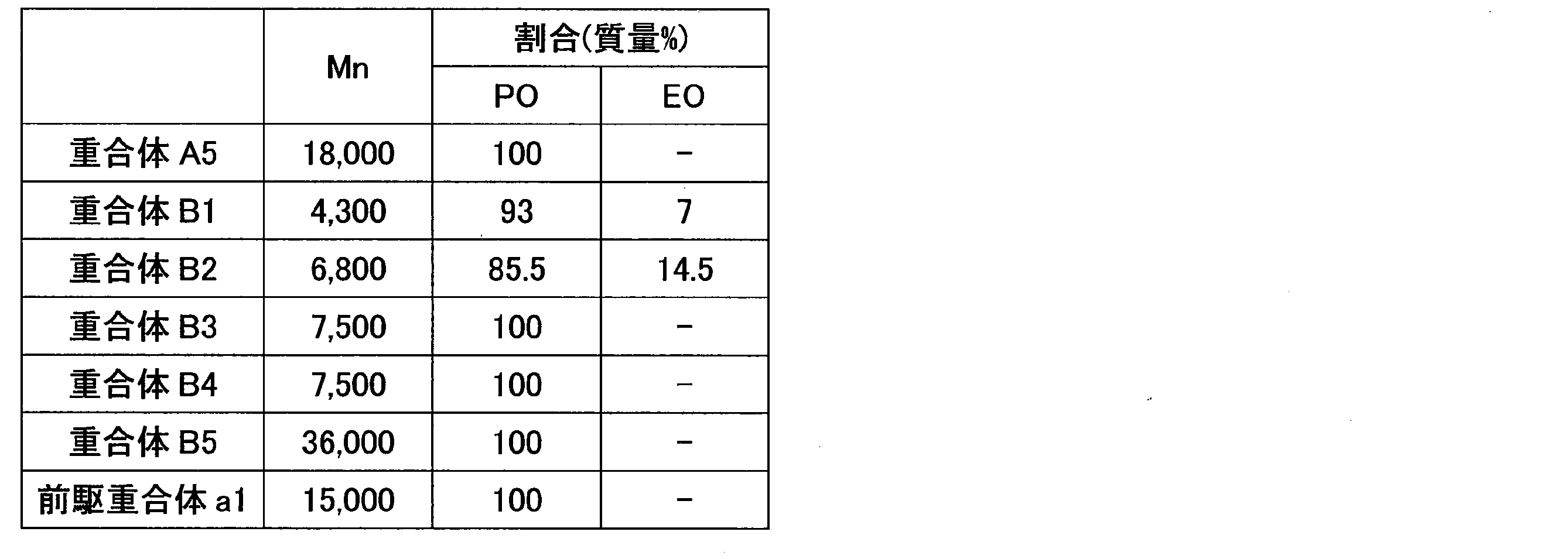
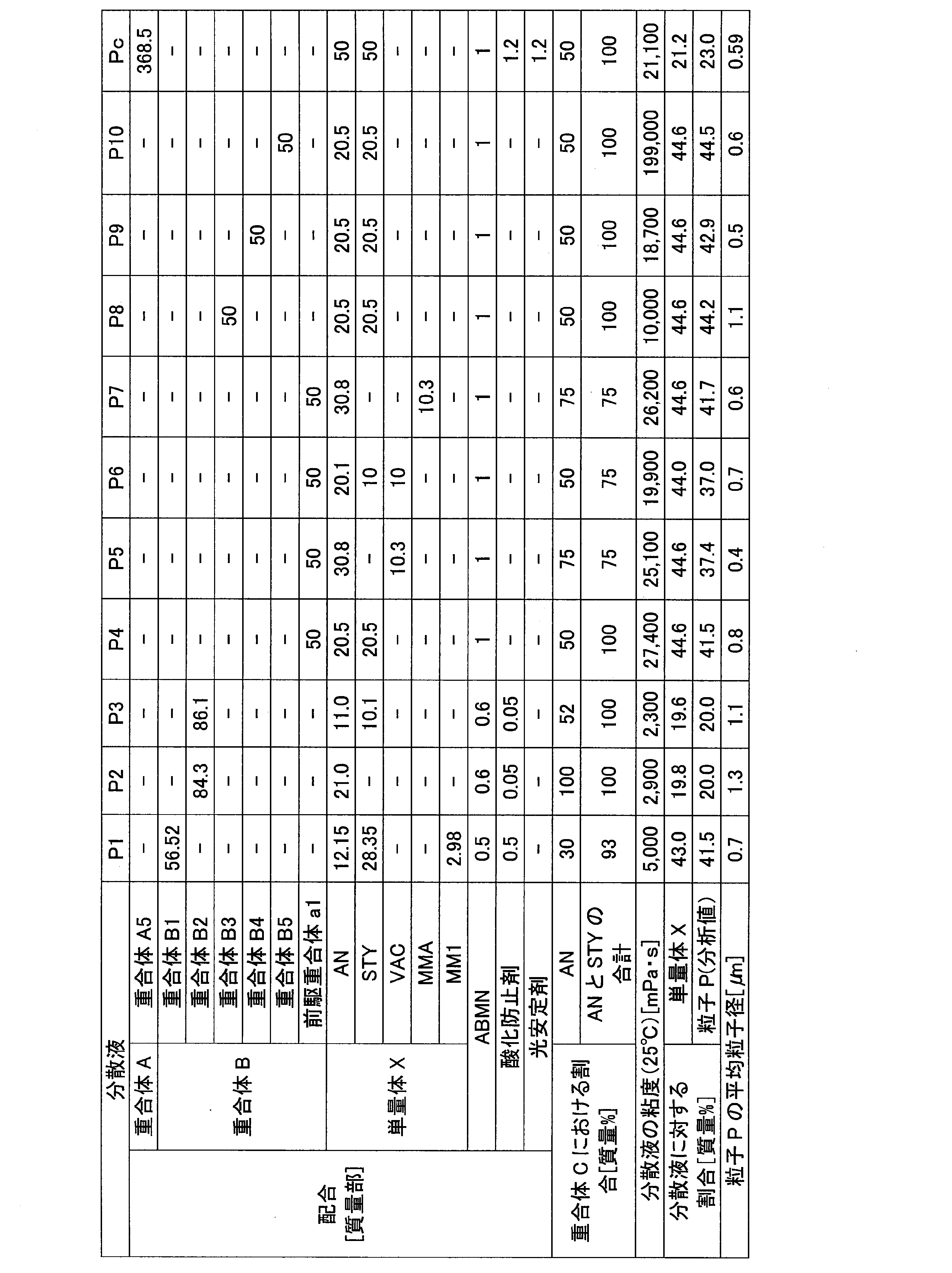
(合成例13:重合体D1)
攪拌機付きの耐圧反応器に酢酸エチルの257.1gを添加し、約70℃に昇温した。反応容器内温を約70℃に保ち、窒素雰囲気下、攪拌しながら、MMAの57.4g、アクリル酸-n-ブチルの430.6g、メタクリル酸ステアリルの86.1g、3-メタクリロキシプロピルメチルジメトキシシラン(KBM-502、信越シリコーン社製品名)の15.8g及び2,2’-アゾビス-2,4-ジメチルバレロニトリル(V-65、和光純薬工業社製品名)の5.7g、ドデシルメルカプタンの0.8gの混合溶液を、酢酸エチル中に2時間かけて滴下して重合し、側鎖にジメトキシメチルシリル基を有する(メタ)アクリル酸エステル重合体(重合体D1)を得た。
攪拌機付きの耐圧反応器に酢酸エチルの257.1gを添加し、約70℃に昇温した。反応容器内温を約70℃に保ち、窒素雰囲気下、攪拌しながら、MMAの57.4g、アクリル酸-n-ブチルの430.6g、メタクリル酸ステアリルの86.1g、3-メタクリロキシプロピルメチルジメトキシシラン(KBM-502、信越シリコーン社製品名)の15.8g及び2,2’-アゾビス-2,4-ジメチルバレロニトリル(V-65、和光純薬工業社製品名)の5.7g、ドデシルメルカプタンの0.8gの混合溶液を、酢酸エチル中に2時間かけて滴下して重合し、側鎖にジメトキシメチルシリル基を有する(メタ)アクリル酸エステル重合体(重合体D1)を得た。
(合成例14:重合体D2)
本例では、リビングラジカル重合法を用い、重合反応の終期にアルケニル基を2個有する化合物を反応させる方法で下記重合体D2を合成した。
2Lフラスコに臭化第一銅の8.39g、アセトニトリルの112mLを添加し、窒素気流下70℃で20分間加熱撹拌した。これに2,5-ジブロモアジピン酸ジエチルの17.6g、アクリル酸エチルの130mL、アクリル酸-n-ブチルの720mL、アクリル酸ステアリルの251gを添加し、さらに70℃で40分間加熱撹拌した。これにペンタメチルジエチレントリアミン(以下、「トリアミン」という。)0.41mLを添加して反応を開始した。引き続き70℃で加熱撹拌を続け、さらにトリアミンの2.05mLを添加した。反応開始から330分後に1,7-オクタジエンの244mL及びトリアミンの4.1mLを添加し、引き続き70℃で加熱撹拌を続け、反応開始から570分後に加熱を停止した。
得られた反応溶液をトルエンで希釈してろ過し、ろ液を減圧加熱処理して、末端にアルケニル基を有するアクリル酸エステル重合体(重合体d1)を得た。
重合体d1のMnは22,800、分子量分布は1.40、1H-NMR分析より求めた重合体d1の1分子あたりのアルケニル基の平均数は2.8個であった。
本例では、リビングラジカル重合法を用い、重合反応の終期にアルケニル基を2個有する化合物を反応させる方法で下記重合体D2を合成した。
2Lフラスコに臭化第一銅の8.39g、アセトニトリルの112mLを添加し、窒素気流下70℃で20分間加熱撹拌した。これに2,5-ジブロモアジピン酸ジエチルの17.6g、アクリル酸エチルの130mL、アクリル酸-n-ブチルの720mL、アクリル酸ステアリルの251gを添加し、さらに70℃で40分間加熱撹拌した。これにペンタメチルジエチレントリアミン(以下、「トリアミン」という。)0.41mLを添加して反応を開始した。引き続き70℃で加熱撹拌を続け、さらにトリアミンの2.05mLを添加した。反応開始から330分後に1,7-オクタジエンの244mL及びトリアミンの4.1mLを添加し、引き続き70℃で加熱撹拌を続け、反応開始から570分後に加熱を停止した。
得られた反応溶液をトルエンで希釈してろ過し、ろ液を減圧加熱処理して、末端にアルケニル基を有するアクリル酸エステル重合体(重合体d1)を得た。
重合体d1のMnは22,800、分子量分布は1.40、1H-NMR分析より求めた重合体d1の1分子あたりのアルケニル基の平均数は2.8個であった。
窒素雰囲気下、2Lフラスコに、得られた前記重合体d1の全量、酢酸カリウムの17.2g、N,N-ジメチルアセトアミドメチル(以下、DMAcという。)の700mLを添加し、100℃で10時間加熱撹拌した。反応溶液を減圧加熱してDMAcを除去し、トルエンを添加してろ過した。ろ液を減圧加熱して揮発分を除去した残りを2Lフラスコに添加し、吸着剤(キョーワード500SNとキョーワード700SN(いずれも協和化学製品名)の質量比で1対1の混合物)の100gを添加し、窒素気流下130℃で9時間加熱撹拌した。トルエンで希釈し、ろ過して吸着剤を除去し、ろ液中のトルエンを減圧留去して重合体(重合体d2)を得た。
1L耐圧反応容器に、重合体d2の700g、ジメトキシメチルヒドロシランの22.2mL、オルトぎ酸メチルの7.71mL及び白金触媒(0価白金の1,1,3,3-テトラメチル-1,3-ジビニルジシロキサン錯体)を添加した。ただし、白金触媒の使用量は、重合体d1のアルケニル基に対して9×10⁻³モル当量とした。反応容器内の混合物を100℃で195分加熱撹拌した。混合物の揮発分を減圧留去して、主鎖末端にジメトキシメチルシリル基を有する重合体(重合体D2)を得た。
1分子あたりの反応性ケイ素基の平均数を、1H-NMR分析により求めたところ2.0個であった。
1分子あたりの反応性ケイ素基の平均数を、1H-NMR分析により求めたところ2.0個であった。
例1、5、6、8、10、12、14及び18~30は実施例であり、例2~4、7、9、11、13及び15~17は比較例である。
(例1~例27)
表4及び表5~7に示す配合で混合して硬化性組成物を調製した。表4に記載の添加剤は下記の通りである。
得られた硬化性組成物について、引張物性試験及び引裂物性試験を実施した。その結果を表5~7に示す。
表4及び表5~7に示す配合で混合して硬化性組成物を調製した。表4に記載の添加剤は下記の通りである。
得られた硬化性組成物について、引張物性試験及び引裂物性試験を実施した。その結果を表5~7に示す。
(例28~30)
表5の例1に示す配合において、硬化触媒であるDBTDLを使用せずに、配合1を表4に示す配合3~5にそれぞれ変更して硬化性組成物を調整し、例1~例27と同様にして硬化物を得た。例28は、例1の配合1を配合3とした例であり、例29は、例1の配合1を配合4とした例であり、例30は、例1の配合1を配合5とした例である。例28~30の硬化性組成物は良好に硬化した。
表5の例1に示す配合において、硬化触媒であるDBTDLを使用せずに、配合1を表4に示す配合3~5にそれぞれ変更して硬化性組成物を調整し、例1~例27と同様にして硬化物を得た。例28は、例1の配合1を配合3とした例であり、例29は、例1の配合1を配合4とした例であり、例30は、例1の配合1を配合5とした例である。例28~30の硬化性組成物は良好に硬化した。
(添加剤)
ホワイトンSB:重質炭酸カルシウム、白石カルシウム社製品名。
白艶化CCR:膠質炭酸カルシウム、白石カルシウム社製品名。
Viscolite EL20:膠質炭酸カルシウム、白石カルシウム工業社製品名。
FS150:フライアッシュバルーン、巴工業株式会社製品名。
WB9011:シラスバルーン、株式会社アクシーズケミカル社製品名。
DINP:ジイソノニルフタレート、新日本理化社製。
ディスパロン#6500:水添ひまし油系チクソ性付与剤、楠本化成社製品名。
IRGANOX 1010:ヒンダードフェノール系酸化防止剤、BASF社製品名。
IRGANOX 1135:ヒンダードフェノール系酸化防止剤、BASF社製品名。
TINUVIN 326:ベンゾトリアゾール系光安定剤、BASF社製品名。
TINUVIN 765:3級アミン含有ヒンダードアミン系光安定剤、BASF社製品名。
LA-63P:アデカスタブLA-63P、ADEKA社製品名。
KBM-403:3-グリシジルオキシプロピルトリメトキシシラン、信越化学社製品名。
KBM-603:3-(2-アミノエチルアミノ)プロピルトリメトキシシラン、信越化学社製品名。
KBM-1003:ビニルトリメトキシシラン、信越化学社製品名。
ファーミンCS:ココナットアミン、花王社製品名。
TMP-3TMS:トリメチロールプロパンのトリストリメチルシリル体。
桐油:空気酸化硬化性化合物、木村社製。
M-309:アロニックスM-309、東亜合成社製品名。
DBTDL:ジラウリン酸ジブチル錫。
SCAT-32A:錫触媒、日東化成社製品名。
触媒組成物:スタノクト(オクチル酸第一錫、吉富製薬社品名)とラウリルアミン(試薬、純正化学社製、)とを質量比が6対1となるように混合した混合物の4質量部、サンソサイザーDINP(ジイソノニルフタレート、新日本理化社製品名)の6質量部、ホワイトンSB(重質炭酸カルシウム、白石カルシウム工業社製品名)の15質量部及びグロマックスLL(焼成カオリン、竹原化学工業社製品名)の5質量部を混合した混合物。
ホワイトンSB:重質炭酸カルシウム、白石カルシウム社製品名。
白艶化CCR:膠質炭酸カルシウム、白石カルシウム社製品名。
Viscolite EL20:膠質炭酸カルシウム、白石カルシウム工業社製品名。
FS150:フライアッシュバルーン、巴工業株式会社製品名。
WB9011:シラスバルーン、株式会社アクシーズケミカル社製品名。
DINP:ジイソノニルフタレート、新日本理化社製。
ディスパロン#6500:水添ひまし油系チクソ性付与剤、楠本化成社製品名。
IRGANOX 1010:ヒンダードフェノール系酸化防止剤、BASF社製品名。
IRGANOX 1135:ヒンダードフェノール系酸化防止剤、BASF社製品名。
TINUVIN 326:ベンゾトリアゾール系光安定剤、BASF社製品名。
TINUVIN 765:3級アミン含有ヒンダードアミン系光安定剤、BASF社製品名。
LA-63P:アデカスタブLA-63P、ADEKA社製品名。
KBM-403:3-グリシジルオキシプロピルトリメトキシシラン、信越化学社製品名。
KBM-603:3-(2-アミノエチルアミノ)プロピルトリメトキシシラン、信越化学社製品名。
KBM-1003:ビニルトリメトキシシラン、信越化学社製品名。
ファーミンCS:ココナットアミン、花王社製品名。
TMP-3TMS:トリメチロールプロパンのトリストリメチルシリル体。
桐油:空気酸化硬化性化合物、木村社製。
M-309:アロニックスM-309、東亜合成社製品名。
DBTDL:ジラウリン酸ジブチル錫。
SCAT-32A:錫触媒、日東化成社製品名。
触媒組成物:スタノクト(オクチル酸第一錫、吉富製薬社品名)とラウリルアミン(試薬、純正化学社製、)とを質量比が6対1となるように混合した混合物の4質量部、サンソサイザーDINP(ジイソノニルフタレート、新日本理化社製品名)の6質量部、ホワイトンSB(重質炭酸カルシウム、白石カルシウム工業社製品名)の15質量部及びグロマックスLL(焼成カオリン、竹原化学工業社製品名)の5質量部を混合した混合物。

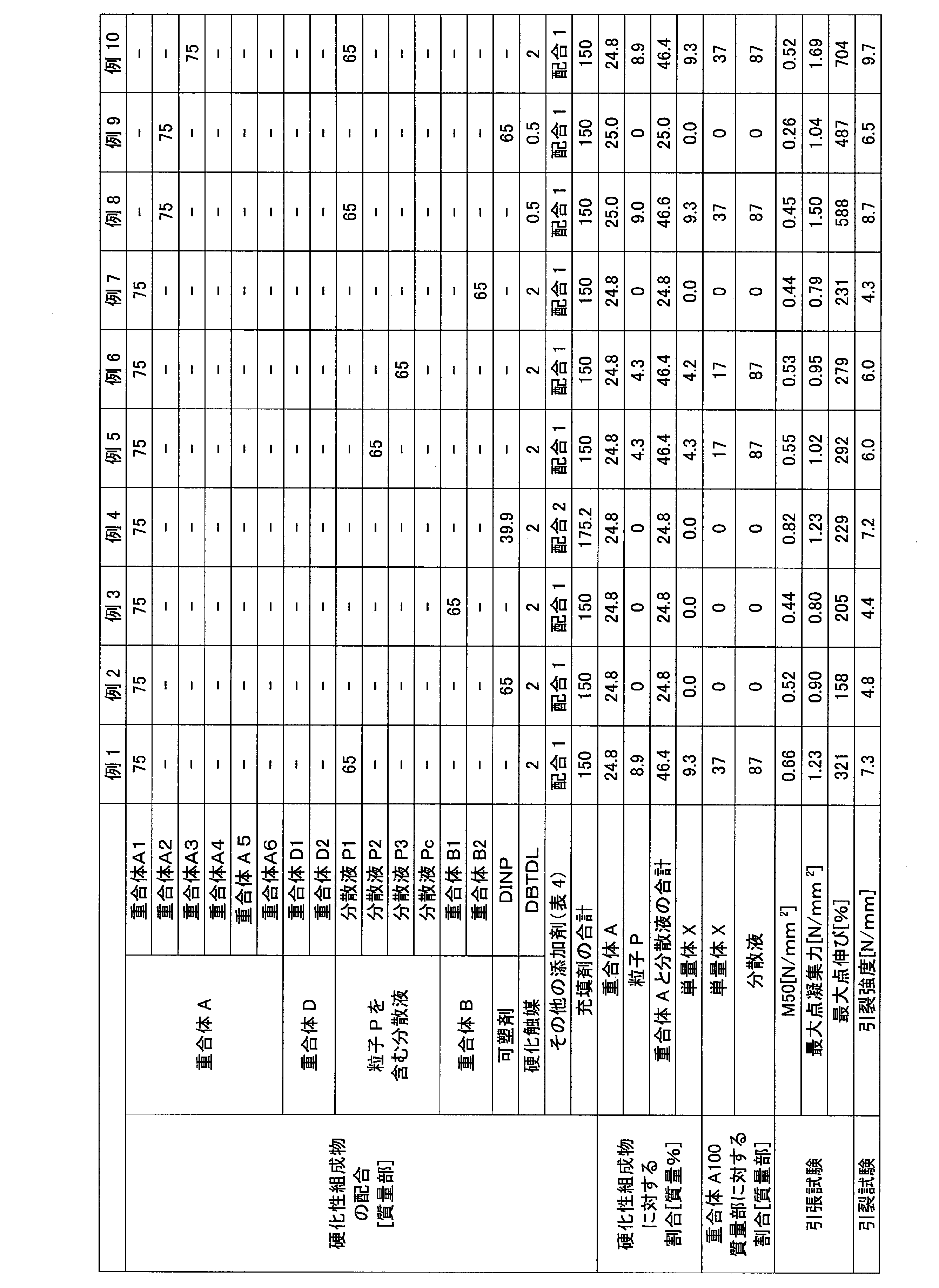
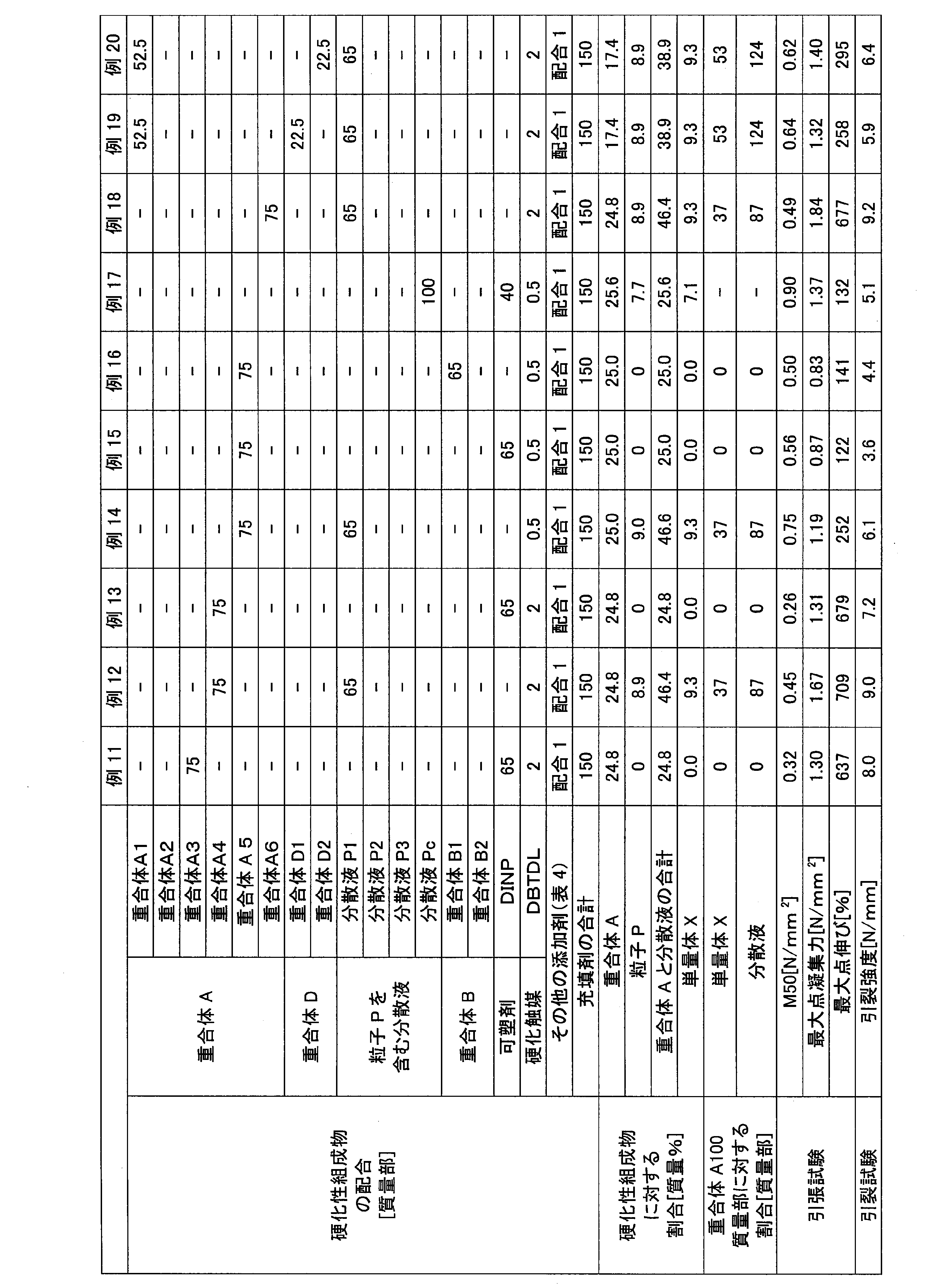

表5~7に示されるように、重合体Aと重合体Bと粒子Pを含む例1、5、6、8、10、12、14及び18~27の硬化性組成物は、硬化物のM50、引裂強度及び最大点伸びの値が高く、強度と伸びの両方が優れていた。
例2、9、11、13、15は、分散液を添加せず可塑剤を添加した比較例である。例3、7、16は分散液を添加せず重合体Bを添加した比較例である。例4は分散液を添加せず、可塑剤を添加するとともに充填剤を増量した比較例である。例17は重合体Bを用いず、重合体A中に粒子Pが分散している分散液を用いた比較例である。これらの比較例は強度と伸びの一方又は両方が劣った。
例2、9、11、13、15は、分散液を添加せず可塑剤を添加した比較例である。例3、7、16は分散液を添加せず重合体Bを添加した比較例である。例4は分散液を添加せず、可塑剤を添加するとともに充填剤を増量した比較例である。例17は重合体Bを用いず、重合体A中に粒子Pが分散している分散液を用いた比較例である。これらの比較例は強度と伸びの一方又は両方が劣った。
本発明の硬化性組成物は、硬化物の強度と伸びに優れる。
本発明の製造方法によれば、硬化物の強度と伸びに優れる硬化性組成物が得られる。
本発明の製造方法によれば、硬化物の強度と伸びに優れる硬化性組成物が得られる。
また、本願は2018年12月28日に出願した日本国特許出願2018-247205号に基づく優先権を主張するものであり、同日本国出願の全内容を本願に参照により援用する。
Claims (15)
- 下式1で表される反応性ケイ素基を有するオキシアルキレン重合体Aと、下式1で表される反応性ケイ素基を有さないオキシアルキレン重合体Bと、重合体粒子とを含み、前記重合体粒子が、下式1で表される反応性ケイ素基を有さず、重合性不飽和基含有単量体に基づく単位を有する重合体Cを含む、硬化性組成物。
-SiXaR3-a 式1
[式1中、Rは炭素数1~20の1価の有機基であって、加水分解性基以外の有機基を示し、Xは水酸基又は加水分解性基を示す。aは1~3の整数を示す。aが1の場合、Rは互いに同一でも異なってもよい。aが2以上の場合、Xは互いに同一でも異なってもよい。] - 前記重合体Cがアクリロニトリルに基づく単位を有し、スチレンに基づく単位を任意でさらに有し、前記重合性不飽和基含有単量体に基づく単位の総量に対するアクリロニトリルに基づく単位とスチレンに基づく単位の合計が、60質量%以上である、請求項1に記載の硬化性組成物。
- 前記重合体粒子の平均粒子径が、0.01~5.0μmである、請求項1又は2に記載の硬化性組成物。
- 前記硬化性組成物の総量に対する前記重合体粒子の割合が、0.01~30質量%であり、前記重合体Aに対する前記重合体粒子の割合が、1~70質量%である、請求項1~3のいずれか一項に記載の硬化性組成物。
- 前記重合体Bが、オキシプロピレン基を含むポリオキシアルキレン鎖を有する、請求項1~4のいずれか一項に記載の硬化性組成物。
- 前記重合体Bが、オキシエチレン基とオキシプロピレン基とを含むポリオキシアルキレン鎖を有し、オキシエチレン基とオキシプロピレン基の総量に対するオキシエチレン基の割合が1~20質量%である、請求項1~5のいずれか一項に記載の硬化性組成物。
- 下式1で表される反応性ケイ素基を有さないオキシアルキレン重合体Bと重合開始剤の存在下で、下式1で表される反応性ケイ素基を有さない重合性不飽和基含有単量体を重合して、前記重合性不飽和基含有単量体に基づく単位を有する重合体粒子が前記オキシアルキレン重合体B中に分散している分散液を得、前記分散液と下式1で表される反応性ケイ素基を有するオキシアルキレン重合体Aとを混合する、硬化性組成物の製造方法。
-SiXaR3-a 式1
[式1中、Rは炭素数1~20の1価の有機基であって、加水分解性基以外の有機基を示し、Xは水酸基又は加水分解性基を示す。aは1~3の整数を示す。aが1の場合、Rは互いに同一でも異なってもよい。aが2以上の場合、Xは互いに同一でも異なってもよい。] - 前記重合性不飽和基含有単量体がアクリロニトリルを含み、スチレンを任意でさらに含み、前記重合性不飽和基含有単量体の総量に対するアクリロニトリルとスチレンの合計が、60質量%以上である、請求項7に記載の製造方法。
- 前記重合体粒子の平均粒子径が、0.01~5.0μmである、請求項7又は8に記載の製造方法。
- 前記重合体Bが、オキシプロピレン基を含むポリオキシアルキレン鎖を有する、請求項7~9のいずれか一項に記載の製造方法。
- 前記ポリオキシアルキレン鎖が、オキシエチレン基をさらに含む、請求項10に記載の製造方法。
- 前記重合体Bが、プロピレンオキシドとエチレンオキシドとの総量に対して1~20質量%のエチレンオキシドを重合して得られるポリオキシアルキレン鎖を有する、請求項7~11のいずれか一項に記載の製造方法。
- 前記分散液の総量に対する前記重合性不飽和基含有単量体の割合が、5~65質量%である、請求項7~12のいずれか一項に記載の製造方法。
- 前記硬化性組成物の総量に対する前記重合体Aと前記分散液の合計の割合が、30質量%以上であり、
前記重合体Aの100質量部に対する前記分散液の割合が、10~200質量部である、請求項7~13のいずれか一項に記載の製造方法。 - 前記硬化性組成物の総量に対する前記重合性不飽和基含有単量体の割合が、0.01~30質量%であり、
前記重合体Aの100質量部に対する前記重合性不飽和基含有単量体の割合が、1~70質量部である、請求項7~14のいずれか一項に記載の製造方法。
Priority Applications (1)
| Application Number | Priority Date | Filing Date | Title |
|---|---|---|---|
| JP2020563323A JP7435472B2 (ja) | 2018-12-28 | 2019-12-24 | 硬化性組成物の製造方法 |
Applications Claiming Priority (2)
| Application Number | Priority Date | Filing Date | Title |
|---|---|---|---|
| JP2018247205 | 2018-12-28 | ||
| JP2018-247205 | 2018-12-28 |
Publications (1)
| Publication Number | Publication Date |
|---|---|
| WO2020138111A1 true WO2020138111A1 (ja) | 2020-07-02 |
Family
ID=71129436
Family Applications (1)
| Application Number | Title | Priority Date | Filing Date |
|---|---|---|---|
| PCT/JP2019/050689 Ceased WO2020138111A1 (ja) | 2018-12-28 | 2019-12-24 | 硬化性組成物及びその製造方法 |
Country Status (2)
| Country | Link |
|---|---|
| JP (1) | JP7435472B2 (ja) |
| WO (1) | WO2020138111A1 (ja) |
Cited By (1)
| Publication number | Priority date | Publication date | Assignee | Title |
|---|---|---|---|---|
| EP4306570A4 (en) * | 2021-03-12 | 2025-03-05 | Agc Inc. | HARDENABLE COMPOSITION AND HARDENED PRODUCT |
Citations (6)
| Publication number | Priority date | Publication date | Assignee | Title |
|---|---|---|---|---|
| JP2000313800A (ja) * | 1999-04-28 | 2000-11-14 | Mitsubishi Chemicals Corp | ポリアルキレンオキシド組成物 |
| JP2004115679A (ja) * | 2002-09-26 | 2004-04-15 | Kanegafuchi Chem Ind Co Ltd | 硬化性組成物 |
| JP2008291159A (ja) * | 2007-05-28 | 2008-12-04 | Sunstar Engineering Inc | 硬化性組成物 |
| JP2011219608A (ja) * | 2010-04-08 | 2011-11-04 | Kaneka Corp | 硬化性組成物およびその硬化物 |
| JP2013107941A (ja) * | 2011-11-17 | 2013-06-06 | Yokohama Rubber Co Ltd:The | 二液常温硬化型ウレタン塗膜防水材組成物 |
| JP2017214541A (ja) * | 2015-12-21 | 2017-12-07 | 旭硝子株式会社 | 硬化性組成物およびその製造方法、ならびに硬化物およびシーリング材 |
-
2019
- 2019-12-24 JP JP2020563323A patent/JP7435472B2/ja active Active
- 2019-12-24 WO PCT/JP2019/050689 patent/WO2020138111A1/ja not_active Ceased
Patent Citations (6)
| Publication number | Priority date | Publication date | Assignee | Title |
|---|---|---|---|---|
| JP2000313800A (ja) * | 1999-04-28 | 2000-11-14 | Mitsubishi Chemicals Corp | ポリアルキレンオキシド組成物 |
| JP2004115679A (ja) * | 2002-09-26 | 2004-04-15 | Kanegafuchi Chem Ind Co Ltd | 硬化性組成物 |
| JP2008291159A (ja) * | 2007-05-28 | 2008-12-04 | Sunstar Engineering Inc | 硬化性組成物 |
| JP2011219608A (ja) * | 2010-04-08 | 2011-11-04 | Kaneka Corp | 硬化性組成物およびその硬化物 |
| JP2013107941A (ja) * | 2011-11-17 | 2013-06-06 | Yokohama Rubber Co Ltd:The | 二液常温硬化型ウレタン塗膜防水材組成物 |
| JP2017214541A (ja) * | 2015-12-21 | 2017-12-07 | 旭硝子株式会社 | 硬化性組成物およびその製造方法、ならびに硬化物およびシーリング材 |
Cited By (1)
| Publication number | Priority date | Publication date | Assignee | Title |
|---|---|---|---|---|
| EP4306570A4 (en) * | 2021-03-12 | 2025-03-05 | Agc Inc. | HARDENABLE COMPOSITION AND HARDENED PRODUCT |
Also Published As
| Publication number | Publication date |
|---|---|
| JPWO2020138111A1 (ja) | 2021-11-25 |
| JP7435472B2 (ja) | 2024-02-21 |
Similar Documents
| Publication | Publication Date | Title |
|---|---|---|
| US8211992B2 (en) | Curable composition | |
| JP5251493B2 (ja) | 硬化性組成物 | |
| WO2008018389A1 (en) | Curable resin and curable composition | |
| JP2013076094A (ja) | 硬化性組成物 | |
| US20220002541A1 (en) | Curable composition and cured product | |
| JP7127302B2 (ja) | オキシアルキレン重合体を含む硬化性組成物、シーリング材用のオキシアルキレン重合体を含む硬化性組成物、及び硬化物 | |
| JPWO2020066551A1 (ja) | 硬化性組成物並びに硬化物及びシーリング材 | |
| JP5109146B2 (ja) | 硬化性組成物及びコンタクト型接着剤 | |
| JP7435472B2 (ja) | 硬化性組成物の製造方法 | |
| JP2021014491A (ja) | 硬化性組成物、及び硬化物 | |
| JP5158554B2 (ja) | 硬化性組成物 | |
| JP7852638B2 (ja) | 硬化性組成物、硬化物、接着剤、及びシーリング材 | |
| JP6953910B2 (ja) | 硬化性組成物およびその製造方法、硬化物、ならびにシーリング材 | |
| EP1619212B1 (en) | Reactive modifier | |
| JP2020152894A (ja) | 硬化性組成物及び硬化物 | |
| WO2023074462A1 (ja) | エマルション組成物およびその製造方法 | |
| JP5584979B2 (ja) | 硬化性組成物 | |
| JP7722390B2 (ja) | オキシアルキレン重合体、その製造方法、硬化性組成物、硬化物 | |
| JP2021055013A (ja) | 反応性ケイ素基含有重合体及び硬化性組成物 | |
| JP7380041B2 (ja) | 硬化性組成物の製造方法 | |
| JP2022064564A (ja) | オキシアルキレン重合体、オキシアルキレン重合体を含む硬化性組成物及びオキシアルキレン重合体の製造方法 | |
| WO2025182821A1 (ja) | 硬化性組成物、硬化物、接着剤、及びシーリング材 | |
| CN117597395A (zh) | 固化性组合物、固化物、粘接剂以及密封材料 | |
| JP2022064565A (ja) | オキシアルキレン重合体、オキシアルキレン重合体を含む硬化性組成物及びオキシアルキレン重合体の製造方法 | |
| WO2023204067A1 (ja) | 硬化性組成物及びその硬化物 |
Legal Events
| Date | Code | Title | Description |
|---|---|---|---|
| 121 | Ep: the epo has been informed by wipo that ep was designated in this application |
Ref document number: 19905973 Country of ref document: EP Kind code of ref document: A1 |
|
| ENP | Entry into the national phase |
Ref document number: 2020563323 Country of ref document: JP Kind code of ref document: A |
|
| NENP | Non-entry into the national phase |
Ref country code: DE |
|
| 122 | Ep: pct application non-entry in european phase |
Ref document number: 19905973 Country of ref document: EP Kind code of ref document: A1 |