WO2020116605A1 - プレス成形品用粉状液晶性樹脂、プレス成形品及びその製造方法 - Google Patents
プレス成形品用粉状液晶性樹脂、プレス成形品及びその製造方法 Download PDFInfo
- Publication number
- WO2020116605A1 WO2020116605A1 PCT/JP2019/047786 JP2019047786W WO2020116605A1 WO 2020116605 A1 WO2020116605 A1 WO 2020116605A1 JP 2019047786 W JP2019047786 W JP 2019047786W WO 2020116605 A1 WO2020116605 A1 WO 2020116605A1
- Authority
- WO
- WIPO (PCT)
- Prior art keywords
- press
- liquid crystalline
- crystalline resin
- powdery liquid
- particle size
- Prior art date
- Legal status (The legal status is an assumption and is not a legal conclusion. Google has not performed a legal analysis and makes no representation as to the accuracy of the status listed.)
- Ceased
Links
Classifications
-
- B—PERFORMING OPERATIONS; TRANSPORTING
- B29—WORKING OF PLASTICS; WORKING OF SUBSTANCES IN A PLASTIC STATE IN GENERAL
- B29C—SHAPING OR JOINING OF PLASTICS; SHAPING OF MATERIAL IN A PLASTIC STATE, NOT OTHERWISE PROVIDED FOR; AFTER-TREATMENT OF THE SHAPED PRODUCTS, e.g. REPAIRING
- B29C43/00—Compression moulding, i.e. applying external pressure to flow the moulding material; Apparatus therefor
- B29C43/006—Pressing and sintering powders, granules or fibres
-
- B—PERFORMING OPERATIONS; TRANSPORTING
- B29—WORKING OF PLASTICS; WORKING OF SUBSTANCES IN A PLASTIC STATE IN GENERAL
- B29C—SHAPING OR JOINING OF PLASTICS; SHAPING OF MATERIAL IN A PLASTIC STATE, NOT OTHERWISE PROVIDED FOR; AFTER-TREATMENT OF THE SHAPED PRODUCTS, e.g. REPAIRING
- B29C43/00—Compression moulding, i.e. applying external pressure to flow the moulding material; Apparatus therefor
- B29C43/003—Compression moulding, i.e. applying external pressure to flow the moulding material; Apparatus therefor characterised by the choice of material
-
- B—PERFORMING OPERATIONS; TRANSPORTING
- B29—WORKING OF PLASTICS; WORKING OF SUBSTANCES IN A PLASTIC STATE IN GENERAL
- B29C—SHAPING OR JOINING OF PLASTICS; SHAPING OF MATERIAL IN A PLASTIC STATE, NOT OTHERWISE PROVIDED FOR; AFTER-TREATMENT OF THE SHAPED PRODUCTS, e.g. REPAIRING
- B29C43/00—Compression moulding, i.e. applying external pressure to flow the moulding material; Apparatus therefor
- B29C43/32—Component parts, details or accessories; Auxiliary operations
- B29C43/52—Heating or cooling
-
- C—CHEMISTRY; METALLURGY
- C08—ORGANIC MACROMOLECULAR COMPOUNDS; THEIR PREPARATION OR CHEMICAL WORKING-UP; COMPOSITIONS BASED THEREON
- C08J—WORKING-UP; GENERAL PROCESSES OF COMPOUNDING; AFTER-TREATMENT NOT COVERED BY SUBCLASSES C08B, C08C, C08F, C08G or C08H
- C08J3/00—Processes of treating or compounding macromolecular substances
- C08J3/12—Powdering or granulating
-
- B—PERFORMING OPERATIONS; TRANSPORTING
- B29—WORKING OF PLASTICS; WORKING OF SUBSTANCES IN A PLASTIC STATE IN GENERAL
- B29K—INDEXING SCHEME ASSOCIATED WITH SUBCLASSES B29B, B29C OR B29D, RELATING TO MOULDING MATERIALS OR TO MATERIALS FOR MOULDS, REINFORCEMENTS, FILLERS OR PREFORMED PARTS, e.g. INSERTS
- B29K2067/00—Use of polyesters or derivatives thereof, as moulding material
- B29K2067/003—PET, i.e. poylethylene terephthalate
-
- B—PERFORMING OPERATIONS; TRANSPORTING
- B29—WORKING OF PLASTICS; WORKING OF SUBSTANCES IN A PLASTIC STATE IN GENERAL
- B29K—INDEXING SCHEME ASSOCIATED WITH SUBCLASSES B29B, B29C OR B29D, RELATING TO MOULDING MATERIALS OR TO MATERIALS FOR MOULDS, REINFORCEMENTS, FILLERS OR PREFORMED PARTS, e.g. INSERTS
- B29K2105/00—Condition, form or state of moulded material or of the material to be shaped
- B29K2105/0079—Liquid crystals
-
- B—PERFORMING OPERATIONS; TRANSPORTING
- B29—WORKING OF PLASTICS; WORKING OF SUBSTANCES IN A PLASTIC STATE IN GENERAL
- B29K—INDEXING SCHEME ASSOCIATED WITH SUBCLASSES B29B, B29C OR B29D, RELATING TO MOULDING MATERIALS OR TO MATERIALS FOR MOULDS, REINFORCEMENTS, FILLERS OR PREFORMED PARTS, e.g. INSERTS
- B29K2105/00—Condition, form or state of moulded material or of the material to be shaped
- B29K2105/25—Solid
- B29K2105/251—Particles, powder or granules
-
- B—PERFORMING OPERATIONS; TRANSPORTING
- B29—WORKING OF PLASTICS; WORKING OF SUBSTANCES IN A PLASTIC STATE IN GENERAL
- B29K—INDEXING SCHEME ASSOCIATED WITH SUBCLASSES B29B, B29C OR B29D, RELATING TO MOULDING MATERIALS OR TO MATERIALS FOR MOULDS, REINFORCEMENTS, FILLERS OR PREFORMED PARTS, e.g. INSERTS
- B29K2995/00—Properties of moulding materials, reinforcements, fillers, preformed parts or moulds
- B29K2995/0037—Other properties
- B29K2995/0063—Density
Definitions
- the present invention relates to a powdery liquid crystalline resin for press-molded products, a press-molded product and a method for producing the same.
- Liquid crystal resins typified by liquid crystal polyester resins, are widely used in various fields because of their high fluidity, low burr resistance, and reflow resistance.
- the liquid crystalline resin has a property (orientation) of being oriented in the flow direction of the resin during molding and cooling, the obtained molded product has anisotropy in which the physical properties differ depending on the flow direction of the resin and the direction perpendicular thereto. May have. Therefore, conventionally, much research on a molded product of a liquid crystalline resin is related to a technique for canceling anisotropy such as improvement of dimensional accuracy.
- Patent Document 1 describes a method for producing a liquid crystal resin sheet in which two types of liquid crystal resins are pulverized to have a predetermined average particle size range, mixed, and then hot-press molded at a predetermined temperature. According to this method, the thickness of the sheet can be easily adjusted.
- Patent Document 2 describes a method for producing modified liquid crystal polyester particles in which amorphous particles made of liquid crystal polyester are made spherical by an impact method in a high-speed air stream. According to this method, when a large molded plate is obtained by hot press molding, it is possible to obtain a molded plate with extremely good thickness accuracy.
- the hot press molding is a molding method in which the resin powder is heated and pressed at a temperature at which the resin melts, and the orientation of the liquid crystalline resin can be suppressed smaller than that of injection molding at which the resin powder is melted at a high temperature at which the resin flows.
- press molding is performed under high pressure, not only burrs are generated, but also orientation may be caused by the flow of resin accompanying the generation of burrs. In that case, the anisotropy of the molded product may not be sufficiently canceled and the strength may decrease.
- An object of the present invention is to provide a powdery liquid crystalline resin capable of producing a press-formed product having high mechanical strength, a press-formed product using the same, and a method for producing the same.
- the present invention relates to the following.
- bulk density is less than 0.5 g / cm 3 greater than the 0.05 g / cm 3, the press-molded product for powdery liquid resin.
- the powdery liquid crystalline resin according to [1] which has a particle size distribution width defined by JIS Z8825:2013 of 3.0 or more and 12 or less.
- the powdery liquid crystalline resin according to [1] or [2] which has an average particle size of 10 ⁇ m or more and 300 ⁇ m or less.
- the difference ⁇ Tm (Tm2-Tm1 onset temperature) between the melting point Tm2 and the melting point Tm1 onset temperature measured by a differential scanning calorimeter is 30° C. or more and 90° C. or less, from [1] to [4] The powdery liquid crystalline resin according to any one of the above.
- the melt viscosity measured at a cylinder temperature 10 to 30° C. higher than the melting point Tm2 measured by a differential scanning calorimeter and a shear rate of 100 sec ⁇ 1 is 10 Pa ⁇ s or more and 1000 Pa ⁇ s or less, from [1] The powdery liquid crystalline resin according to any one of [6]. [8] The powdery liquid crystalline resin according to any one of [1] to [7], wherein the ratio of the maximum particle diameter to the average particle diameter (maximum particle diameter/average particle diameter) is 5 or less. [9] A press-molded product of the powdery liquid crystalline resin according to any one of [1] to [8].
- a method of producing a press-formed product which comprises a hot-pressing step of press-forming the powdery liquid crystalline resin at a temperature of (melting point Tm2-60 measured by a differential scanning calorimeter) or higher.
- the present invention it is possible to provide a powdery liquid crystalline resin capable of producing a press-formed product with high mechanical strength, a press-formed product using the same, and a method for producing the same.
- the term “powdered liquid crystalline resin” means that it is composed of fine particles having an average particle size of about 0.1 ⁇ m to 1000 ⁇ m, and the “average particle size” is a laser diffraction/scattering particle size. It means a volume-based arithmetic mean particle diameter measured by a distribution measurement method. The average particle size can be measured, for example, using a laser diffraction/scattering particle size distribution measuring device LA-960 manufactured by Horiba Ltd. "Liquid crystallinity" means having a property capable of forming an optically anisotropic molten phase.
- the properties of the anisotropic molten phase can be confirmed by a conventional polarization inspection method using a crossed polarizer. More specifically, the confirmation of the anisotropic molten phase can be performed by using a Leitz polarization microscope and observing the molten sample placed on the Leitz hot stage under a nitrogen atmosphere at a magnification of 40 times. When a resin having liquid crystallinity is inspected between orthogonal polarizers, it normally transmits polarized light even if it is in a molten stationary state, and exhibits optical anisotropy.
- the liquid crystalline resin preferably contains at least one selected from liquid crystalline polyester and liquid crystalline polyesteramide.
- the liquid crystalline polyester and the liquid crystalline polyesteramide are not particularly limited, but are preferably aromatic polyester or aromatic polyesteramide, and include at least one resin selected from wholly aromatic polyester and wholly aromatic polyesteramide. Is more preferable. Further, it is also possible to use a polyester partially containing an aromatic polyester or an aromatic polyesteramide in the same molecular chain.
- the aromatic polyester or the aromatic polyester amide is particularly preferably an aromatic polyester or an aromatic polyester amide having an aromatic hydroxycarboxylic acid as a constituent component.
- aromatic polyester or aromatic polyester amide more specifically, (1) A polyester mainly composed of one or more aromatic hydroxycarboxylic acids and their derivatives; (2) Mainly (a) one or more aromatic hydroxycarboxylic acids and their derivatives, and (b) one or more aromatic dicarboxylic acids, alicyclic dicarboxylic acids, and their derivatives. Made of polyester; (3) Mainly (a) one or more aromatic hydroxycarboxylic acids and their derivatives, and (b) one or more aromatic dicarboxylic acids, alicyclic dicarboxylic acids, and their derivatives.
- specific compounds (monomers) constituting the liquid crystalline polyester and the liquid crystalline polyesteramide include aromatic hydroxycarboxylic acids such as p-hydroxybenzoic acid and 6-hydroxy-2-naphthoic acid, 2,6- Aromatic aromatic compounds such as dihydroxynaphthalene, 1,4-dihydroxynaphthalene, 4,4′-dihydroxybiphenyl, hydroquinone, resorcin, compounds represented by the following general formula (I), and compounds represented by the following general formula (II) Diol; terephthalic acid, isophthalic acid, 4,4'-diphenyldicarboxylic acid, 2,6-naphthalenedicarboxylic acid, and aromatic dicarboxylic acids such as compounds represented by the following general formula (III); p-aminophenol, p -Aromatic amines such as phenylenediamine.
- aromatic hydroxycarboxylic acids such as p-hydroxybenzoic acid and 6-hydroxy-2-naphth
- X a group selected from alkylene (C 1 to C 4 ), alkylidene, —O—, —SO—, —SO 2 —, —S—, and —CO—.
- the method for producing the liquid crystalline polyester and the liquid crystalline polyesteramide is not particularly limited, and may be produced by a known method using the above-mentioned monomer compound (or a mixture of monomers), a direct polymerization method or a transesterification method.
- a melt polymerization method, a solution polymerization method, a slurry polymerization method, a solid phase polymerization method, or the like, or a combination of two or more thereof is used, and the melt polymerization method or the melt polymerization method and the solid phase polymerization method is used.
- the combination with is preferably used.
- a compound having an ester-forming ability it may be used as it is for the polymerization, or it may be modified from the precursor to a derivative having the ester-forming ability by using an acylating agent or the like before the polymerization. You may use the thing.
- the acylating agent include carboxylic acid anhydride such as acetic anhydride.
- Typical catalysts can be used for polymerization.
- Typical catalysts that can be used include potassium acetate, magnesium acetate, stannous acetate, tetrabutyl titanate, lead acetate, sodium acetate, antimony trioxide, tris(2,4-pentanedionato)cobalt(III ) And other metal salt catalysts, and N-methylimidazole, 4-dimethylaminopyridine, and other organic compound catalysts.
- the amount of the catalyst used is generally about 0.001 to 1% by weight, and preferably about 0.01 to 0.2% by weight, based on the total weight of the monomers.
- the liquid crystalline resin may be blended with various fibrous, powdery or plate-like inorganic and organic fillers at each production stage.
- fibrous filler glass fiber, milled glass fiber, carbon fiber, asbestos fiber, silica fiber, silica-alumina fiber, alumina fiber, zirconia fiber, boron nitride fiber, silicon nitride fiber, boron fiber, potassium titanate fiber
- examples thereof include silicate fibers such as wollastonite, magnesium sulfate fibers, aluminum borate fibers, and inorganic fibrous substances such as metal fibrous substances such as stainless steel, aluminum, titanium, copper, and brass.
- a particularly representative fibrous filler is glass fiber.
- high-melting-point organic fibrous substances such as polyamide, fluororesin, polyester resin, and acrylic resin can also be used.
- powdery and granular filler carbon black, graphite, silica, quartz powder, glass beads, glass balloons, glass powder, calcium silicate, aluminum silicate, kaolin, clay, silicate such as diatomaceous earth, wollastonite, etc.
- metals such as iron oxide, titanium oxide, zinc oxide, antimony trioxide, alumina
- carbonates of metals such as calcium carbonate and magnesium carbonate
- sulfates of metals such as calcium sulfate and barium sulfate
- other ferrites carbonization
- Examples thereof include silicon, silicon nitride, boron nitride, various metal powders and the like.
- the plate-like filler include mica, glass flakes, talc, various metal foils and the like. These inorganic and organic fillers can be used alone or in combination of two or more.
- the content of the filler can be 0 to 100 parts by mass with respect to 100 parts by mass of the liquid crystalline resin.
- Powdered liquid-crystalline resin has a bulk density of at beyond 0.5 g / cm 3 or less 0.05 g / cm 3, preferably not more than 0.06 g / cm 3 or more 0.4g / cm 3, 0. It is more preferable that it is not less than 07 g/cm 3 and not more than 0.3 g/cm 3 .
- a powdery liquid crystalline resin having a bulk density of more than 0.05 g/cm 3 and not more than 0.5 g/cm 3 can produce a molded product having high mechanical strength by hot press molding.
- the bulk density can be measured using a powder fluidity analyzer. In this specification, the bulk density is a value measured by a method of compaction using a powder rheometer FT4 manufactured by Freeman Technology. The method for adjusting the bulk density will be described later.
- the powdery liquid crystalline resin preferably has a particle size distribution width defined by JIS Z8825:2013 of 3.0 or more and 12 or less, more preferably 3.5 or more and 11 or less, and 4.0 or more. It is more preferably 10 or less.
- width of the particle size distribution means the ratio of D90 (90% cumulative particle size) and D10 (10% cumulative particle size).
- the width of the particle size distribution can be measured, for example, using a laser diffraction/scattering type particle size distribution measuring device LA-960 manufactured by Horiba Ltd. A method for adjusting the width of the particle size distribution will be described later.
- the average particle size of the powdery liquid crystalline resin is preferably 10 ⁇ m or more and 300 ⁇ m or less, more preferably 10 ⁇ m or more and 100 ⁇ m or less, and further preferably 50 ⁇ m or more and 80 ⁇ m or less. It can also be 10 ⁇ m or more and 50 ⁇ m or less.
- the method for measuring the average particle size is as described above. The method of adjusting the average particle size will be described later.
- the ratio of the maximum particle size to the average particle size (maximum particle size/average particle size) of the powdery liquid crystalline resin is preferably 5 or less, more preferably 2.5 or less.
- the lower limit value is not particularly limited and can be 1 or more.
- the “maximum particle size” means the maximum value among the values measured by the laser diffraction/scattering type particle size distribution measuring method.
- the crystallinity of the powdery liquid crystalline resin is preferably 20% or more and 70% or less, more preferably 22% or more and 68% or less, further preferably 25% or more and 65% or less, and particularly preferably It is 30% or more and 65% or less.
- the crystallinity When the crystallinity is less than the above range, it can be adjusted to the above range by heat treating the liquid crystalline resin.
- the crystallinity can be adjusted within the above range by heat-treating the liquid crystalline resin in a temperature range from the glass transition point Tg to the melting point Tm2 inclusive.
- the glass transition point Tg can be measured by dynamic viscoelasticity measurement.
- the degree of crystallinity is not particularly limited and can be adjusted, for example, by performing heat treatment at a temperature equal to or higher than the glass transition point.
- the melting point Tm2 of the powdery liquid crystalline resin measured by a differential scanning calorimeter is preferably 250° C. or higher and 400° C. or lower, more preferably 260° C. or higher and 380° C. or lower, and further preferably 280° C. or higher and 350° C. It is below.
- the melting point Tm2 is preferably 250° C. or higher and 400° C. or lower, more preferably 260° C. or higher and 380° C. or lower, and further preferably 280° C. or higher and 350° C. It is below.
- the melting point Tm2 is the temperature at the peak top of the endothermic peak observed when heating (1st RUN) from room temperature at a heating rate of 20° C./min (melting point Tm1 by the method based on JIS K-7121 (1999)). After the measurement of (), the temperature was kept at (melting point Tm1+40)° C. for 2 minutes, then cooled to room temperature at a temperature decreasing rate of 20° C./minute, and observed again when heated from room temperature at a temperature increasing rate of 20° C./minute (2nd RUN). The peak top temperature in the endothermic peak of 2ndRUN.
- the onset temperature (peak rising start temperature) of the melting point Tm1 described below is the onset temperature at the endothermic peak of the 1st RUN.
- the difference ⁇ Tm (Tm2-Tm1 onset temperature) between the melting point Tm2 and the melting point Tm1 measured by a differential scanning calorimeter is preferably 30° C. or more and 90° C. or less, 30 It is more preferable that the temperature is not lower than 50°C and not higher than 50°C.
- the liquid crystalline resin powder has a melt viscosity of 10 Pa ⁇ s or more and 1000 Pa ⁇ s or less measured at a cylinder temperature 10 to 30° C. higher than the melting point Tm2 measured by a differential scanning calorimeter and a shear rate of 100 sec ⁇ 1. Is preferable, and more preferably 50 Pa ⁇ s or more and 800 Pa ⁇ s or less.
- the melt viscosity measured at “cylinder temperature 10 to 30° C. higher than the melting point Tm2” means any one selected from the temperatures at which the cylinder temperature is 10 to 30° C. higher than the melting point Tm2, depending on the type of liquid crystalline resin. It means the melt viscosity measured at the temperature of, and the melt viscosity measured in the whole temperature range of 10 to 30° C.
- the hot press molded article can have a good appearance.
- the melt viscosity can be adjusted by adjusting the final polymerization temperature during the melt polymerization of the liquid crystalline resin. For example, when the final polymerization temperature at the time of melt polymerization of the liquid crystalline resin is higher than 300° C., the melt viscosity can be made 10 Pa ⁇ s to 200 Pa ⁇ s.
- the shape of the powdery liquid crystalline resin is preferably a fibril shape or the like in that the bulk density can be easily adjusted within the above range.
- the method for adjusting the bulk density, the particle size distribution and/or the average particle size of the powdery liquid crystalline resin is not particularly limited, and the bulk density, the particle size distribution and the bulk density of the liquid crystalline resin obtained by the method for producing the liquid crystalline resin are If the average particle size is within the desired range, the powdery liquid crystalline resin can be used as it is. If the average particle size is outside the above range, the liquid crystalline resin obtained by the above method for producing a liquid crystalline resin can be used. Pellet, fiber, film, etc. are crushed by dry crushing, wet crushing, and freeze crushing using a jet mill, bead mill, hammer mill, ball mill, cutter mill, stone mill type grinder, etc. to obtain bulk density. The adjusted one can also be used.
- a method of dissolving the liquid crystalline resin in a solvent and then spray drying, a poor solvent precipitation method of forming an emulsion in the solvent and then contacting with a poor solvent, and a method of drying the organic solvent after forming the emulsion in the solvent It is also possible to adjust the bulk density by using an in-liquid drying method for removal.
- a method of mixing the liquid crystalline resin and the non-liquid crystalline resin and then dissolving and removing the non-liquid crystalline resin with a solvent to obtain a powdery liquid crystalline resin having a desired average particle diameter can be used.
- an oligomer of a liquid crystalline resin is pulverized and then solid phase polymerized to obtain a powdery liquid crystalline resin having the above average particle diameter.
- the wet pulverization is preferable from the viewpoint of preventing the bulk density from becoming too low and making cold press molding difficult.
- the press-formed product according to the present embodiment is formed using the powdery liquid crystalline resin described above. That is, the press molded article, a bulk density of the press molded product of powdery liquid resin is beyond 0.5 g / cm 3 or less 0.05 g / cm 3. Since this press-formed product is formed using the powdery liquid crystalline resin having the above-mentioned predetermined bulk density, it has excellent mechanical strength.
- the other features of the powdery liquid crystalline resin are as described above, and thus the description thereof is omitted here.
- the press-formed product according to the present embodiment has high mechanical strength, it can be preferably used for various applications such as filter media and mechanical parts with low anisotropy and high heat resistance.
- the shape and dimensions of the press-formed product are not particularly limited, and for example, a sheet-shaped press-formed product can be used.
- This press-molded product is obtained by hot-press molding a powdery liquid crystalline resin.
- the method for producing a press-formed product according to the first embodiment has a hot-pressing step of press-forming a powdery liquid crystalline resin at a mold temperature of (melting point ⁇ 60)° C. or higher.
- the powdery liquid crystalline resin is press molded at a mold temperature of (melting point Tm2-60 measured by a differential scanning calorimeter) or higher.
- the mold temperature By setting the mold temperature to (melting point Tm2-60)° C. or higher, the orientation of the resin at the time of hot press molding can be reduced, and a hot press molded article having small anisotropy can be manufactured.
- press molding with a mold temperature of a press molding machine in which powdery liquid crystalline resin is charged is (Tm2-30)°C or higher and (Tm2+30)°C or lower, preferably (Tm2-10)°C or higher and (Tm2+15)°C or lower.
- the pressure in this case is not particularly limited, and may be a pressure capable of molding to a desired thickness.
- the pressure can be 0.5 MPa or more and 10 MPa or less, preferably 1 MPa or more and 5 MPa or less.
- the method for manufacturing a press-formed product according to the first embodiment may include a cold pressing step before the hot pressing step. That is, the method for producing a press-formed product according to the second embodiment comprises: a cold-pressing step of press-molding a powdery liquid crystalline resin at a temperature not higher than the glass transition point; and a molded article obtained by the cold-pressing step, A hot-pressing step of press-molding the powdery liquid crystalline resin at a mold temperature of (melting point Tm2-60 measured by a differential scanning calorimeter) or more.
- the powdery liquid crystalline resin having the above-mentioned predetermined average aspect ratio is press-molded (cold press molding) at a mold temperature not higher than the glass transition point (Tg) of the powdery liquid crystalline resin.
- Tg glass transition point
- the powdery liquid crystalline resin is put in a mold of a press molding machine and pressure-molded at a mold temperature of 0° C. or higher and 100° C. or lower, preferably 10° C. or higher and 40° C. or lower.
- the pressure in this case is not particularly limited, and may be a pressure capable of molding to a desired thickness.
- the pressure can be 1 MPa or more and 30 MPa or less, preferably 5 MPa or more and 20 MPa or less.
- a molded product obtained by press-molding the powdery liquid crystalline resin having the above-mentioned predetermined bulk density at a mold temperature below the glass transition point (Tg) of the powdery liquid crystalline resin has a gas such as air residing therein. Low density and high density. As a result, it is possible to further increase the mechanical strength of the press-molded product obtained in the hot pressing step described later.
- the molded product obtained in the cold press step is press molded at a mold temperature of (melting point Tm2-60 measured by a differential scanning calorimeter) of the powdery liquid crystalline resin or higher.
- a mold temperature of (melting point Tm2-60 measured by a differential scanning calorimeter) of the powdery liquid crystalline resin or higher By setting the mold temperature to (melting point Tm2-60)° C. or higher, the powdery liquid crystalline resin flows and a molded product can be obtained with good mold reproducibility.
- pressure molding is performed with the mold temperature of the press molding machine set to (Tm2-30)° C. or higher and (Tm2+30)° C. or lower, preferably (Tm2-10)° C. or higher and (Tm2+15)° C. or lower.
- the pressure in this case is not particularly limited, and may be a pressure capable of molding to a desired thickness.
- the pressure may be 0.5 MPa or more and 10 MPa or less, preferably 1 MPa or more and 8.5 MPa or less, and more preferably 1 MPa or more and 5 MPa or less.
- the method for manufacturing a press-formed product according to the first embodiment and the second embodiment described above includes other steps such as a step of preparing a powder material for a press-formed article (powder material preparation step). Is also good.
- the powder material preparing step involves, for example, a method of mixing one or more liquid crystalline resins having the above-mentioned bulk density and, if necessary, an additive such as an inorganic filler by shaking, and a pulverization by a ball mill or the like. It is possible to obtain a mixed material by mixing using a conventional method such as a mixing method or a mixing method using a stirring blade such as a Henschel mixer.
- the total content of the powdery liquid crystalline resin in the case of a mixed material is preferably 50% by mass or more, and more preferably 70% by mass or more in the powder material for press molding.
- the upper limit is not particularly limited, and may be 95% by mass or less, for example.
- Examples of the inorganic additive to be mixed with the powdery liquid crystalline resin include inorganic fine particles having an average particle diameter of 500 nm or less or 400 nm or less, and an inorganic reinforcing material having an average particle diameter of 1 ⁇ m or more and 100 ⁇ m or less.
- the material of the inorganic additive is not particularly limited, and for example, the same inorganic filler as that which can be blended with the above-mentioned liquid crystalline resin can be used.
- the inorganic fine particles having the above average particle diameter it is possible to enhance the powder fluidity and dispersibility of the liquid crystalline resin fine particles.
- the inorganic reinforcing material having the above average particle diameter the strength of the obtained press-formed product can be further increased.
- the average particle size can be measured by the same method as above.
- the content of the inorganic additive in the powder material is preferably 50% by mass or less, and more preferably 30% by mass or less.
- Liquid crystal resins LCP1 to 4 used in Examples and Comparative Examples were manufactured as follows.
- HBA 4-Hydroxybenzoic acid
- HNA 2-Hydroxy-6-naphthoic acid
- TA Terephthalic acid
- BP 4,4'-dihydroxybiphenyl
- APAP 4-acetoxyaminophenol
- Metal catalyst potassium acetate catalyst
- 110 mg Acylating agent acetic anhydride
- Example 1 LCP1 was wet-milled using a mass colloider (MKZA10-15JP, manufactured by Masuyuki Sangyo Co., Ltd.) under a water temperature of 35° C., and then spray-dried to obtain a powdery liquid crystalline resin.
- MKZA10-15JP mass colloider
- the bulk density, width of particle size distribution, average particle size and maximum particle size, crystallinity, melting point (Tm2, Tm1 onset temperature), and melt viscosity of this powdery liquid crystalline resin were measured by the following methods. ..
- a tablet molding compressor (“TYPE.M.No.
- Example 2 A press-formed product was obtained in the same manner as in Example 1 except that LCP2 was used instead of LCP1 and the temperature of the hot pressing step was changed as shown in Table 1. Various physical properties of the obtained powdery liquid crystalline resin and molded products were measured in the same manner as in Example 1.
- Example 3 A press-formed product was obtained in the same manner as in Example 2 except that the cold press step was not performed. Various physical properties of the obtained powdery liquid crystalline resin and molded products were measured in the same manner as in Example 1.
- the composition was extruded from a circular nozzle at a resin extrusion rate of 10 kg/hr to obtain extruded strands, which were cut and pelletized.
- the ratio (nS/Q) between the product nS (mm 2 ) of the number n of nozzle openings and the area S of each opening and the resin extrusion rate Q (kg/hr) per hour is 30. there were.
- 100 g of the obtained composition pellet was put into 900 g of toluene heated to 40° C. in a 2 L flask, and stirred for 30 minutes to dissolve polystyrene in toluene.
- the insoluble component was recovered by suction filtration, and well washed with 90 g of toluene at 40°C. Additional washing was performed 3 times. The insoluble component after the additional washing was filtered with a 1 ⁇ m filter, collected, and dried to obtain a powdery liquid crystalline resin.
- a press molded product was obtained in the same manner as in Example 1 except that the powdery liquid crystalline resin obtained was used and the temperature in the hot pressing step was changed.
- Various physical properties of the obtained powdery liquid crystalline resin and molded products were measured in the same manner as in Example 1.
- melt viscosity An apparent melt viscosity was measured using a capillary rheometer (Capillograph 1D manufactured by Toyo Seiki Seisakusho Co., Ltd.: piston diameter 10 mm) under the following conditions according to ISO 11443. An orifice having an inner diameter of 1 mm and a length of 20 mm was used for the measurement. Cylinder temperature: 370°C (LCP1) 350°C (LCP2) 340°C (LCP3) Shear rate: 100 sec -1
- the width of the particle size distribution, the average particle size and the maximum particle size were measured using a laser diffraction/scattering particle size distribution analyzer (LA-960, manufactured by Horiba, Ltd.) using methanol as a dispersion solvent.
- the average particle diameter is a volume-based arithmetic average particle diameter.
- melting point Tm2 and melting point Tm1 onset temperature Using a differential scanning calorimeter (manufactured by Hitachi High-Tech Science Co., Ltd., DSC7000X), a peak top temperature (melting point Tm1) in an endothermic peak observed when heated (1st RUN) from room temperature at a temperature rising rate of 20°C/min. After the measurement, the temperature is maintained at (melting point Tm1+40)° C. for 2 minutes, then cooled to room temperature at a temperature decrease rate of 20° C./minute, and again observed at a temperature increase rate of 20° C./minute from room temperature. The peak top temperature in the endothermic peak of 2ndRUN was measured as the melting point Tm2. The onset temperature at the endothermic peak of 1stRUN (temperature at which the peak starts rising) was measured as the melting point Tm1 onset temperature.
- Glass transition point The glass transition point was measured using a dynamic viscoelasticity measuring device (RSA-III, manufactured by TA Instruments).
Landscapes
- Engineering & Computer Science (AREA)
- Mechanical Engineering (AREA)
- Chemical & Material Sciences (AREA)
- Health & Medical Sciences (AREA)
- Chemical Kinetics & Catalysis (AREA)
- Medicinal Chemistry (AREA)
- Polymers & Plastics (AREA)
- Organic Chemistry (AREA)
- Casting Or Compression Moulding Of Plastics Or The Like (AREA)
Abstract
【課題】高機械強度のプレス成形品を製造可能な粉状液晶性樹脂、並びにそれを用いたプレス成形品及びその製造方法を提供する。 【解決手段】嵩密度が0.05g/cm3を超え0.5g/cm3以下である、プレス成形品用粉状液晶性樹脂とする。粉状液晶性樹脂はJIS Z8825:2013に定義される粒子径分布の幅が3.0以上12以下であることが好ましい。粉状液晶性樹脂は平均粒径が10μm以上300μm以下であることが好ましい。粉状液晶性樹脂は結晶化度が20%以上70%以下であることが好ましい。
Description
本発明は、プレス成形品用粉状液晶性樹脂、プレス成形品及びその製造方法に関する。
液晶性ポリエステル樹脂に代表される液晶性樹脂は、高流動性、低バリ性、耐リフロー性等に優れるため、種々の分野で広く用いられている。一方、液晶性樹脂は、成形冷却時に樹脂の流動方向に配向する性質(配向性)を有しているため、得られる成形品は樹脂の流動方向とその直角方向とで物性が異なる異方性を有している場合がある。そのため、従来、液晶性樹脂の成形品についての研究は、寸法精度の向上等、異方性を打ち消すための技術に関するものが多い。特許文献1には、二種類の液晶樹脂をそれぞれ粉砕して所定の平均粒径の範囲とした後混合し、その後所定の温度で熱プレス成形する液晶樹脂シートの製造方法が記載されている。この方法によれば、シートの厚みを容易に調整することができるとされている。特許文献2には、液晶ポリエステルからなる不定形粒子を高速気流中衝撃法で球形化する改質液晶ポリエステル粒子の製造方法が記載されている。この方法によれば、熱プレス成形によって大型の成形板を得た場合、厚み精度が極めて良好な成形板を得ることができるとされている。熱プレス成形は、樹脂粉体を樹脂が溶融する温度で加熱プレス成形する成形方法であり、樹脂が流動する高温で溶融させる射出成形と比べると液晶性樹脂の配向性を小さく抑えることができる。しかし、得られる成形品の機械強度を向上させるために高圧でプレス成形する必要がある。高圧でプレス成形すると、バリが発生するだけでなく、バリの発生に伴う樹脂の流動によって配向が生じてしまう場合がある。その場合は成形品の異方性が十分に打ち消されずに強度が低下してしまうことがある。
本発明は、高機械強度のプレス成形品を製造可能な粉状液晶性樹脂、並びにそれを用いたプレス成形品及びその製造方法を提供することを課題とする。
従来、粉状樹脂を用いてなる成形品の機械強度を高めるためには、球状の微粒子のように嵩密度が高い粒子を用いることが好ましいとされていた。しかしながら、本発明者は、粉状液晶性樹脂を用いたプレス成形品の機械強度を向上させるための研究の過程で、驚くべきことに、球状の微粒子のように嵩密度が高い粒子ではなく、フィブリル状の微粒子のように嵩密度が低い微粒子からなる粉状液晶性樹脂を用いてなるプレス成形品の方が、高い機械強度を実現できることを見出した。さらに研究を進め、所定の嵩密度を有する粉状液晶性樹脂を用いることで、より高い機械強度を有する成形品を得ることができるとの知見を得て、本発明を完成させるに至った。すなわち、本発明は、以下に関するものである。
[1]嵩密度が0.05g/cm3を超え0.5g/cm3以下である、プレス成形品用粉状液晶性樹脂。
[2]JIS Z8825:2013に定義される粒子径分布の幅が3.0以上12以下である、[1]に記載の粉状液晶性樹脂。
[3]平均粒径が10μm以上300μm以下である、[1]又は[2]に記載の粉状液晶性樹脂。
[4]結晶化度が20%以上70%以下である、[1]から[3]のいずれかに記載の粉状液晶性樹脂。
[5]示差走査熱量計で測定される融点Tm2と融点Tm1のオンセット温度との差ΔTm(Tm2-Tm1オンセット温度)が30℃以上90℃以下である、[1]から[4]のいずれかに記載の粉状液晶性樹脂。
[6]示差走査熱量計で測定される融点Tm2が250℃以上400℃以下である、[1]から[5]のいずれかに記載の粉状液晶性樹脂。
[7]示差走査熱量計で測定される融点Tm2よりも10~30℃高いシリンダー温度及びせん断速度100sec-1で測定した溶融粘度が、10Pa・s以上1000Pa・s以下である、[1]から[6]のいずれかに記載の粉状液晶性樹脂。
[8]最大粒径と平均粒径との比(最大粒径/平均粒径)が5以下である、[1]から[7]のいずれかに記載の粉状液晶性樹脂。
[9][1]から[8]のいずれかに記載の粉状液晶性樹脂のプレス成形品。
[10][1]から[8]のいずれかに記載の粉状液晶性樹脂を、(示差走査熱量計で測定される融点Tm2-60)℃以上の温度でプレス成形する熱プレス工程を有する、プレス成形品の製造方法。
[11][1]から[8]のいずれかに記載の粉状液晶性樹脂をガラス転移点以下の温度でプレス成形する冷プレス工程と、前記冷プレス工程で得られた成形品を、前記粉状液晶性樹脂の(示差走査熱量計で測定される融点Tm2-60)℃以上の温度でプレス成形する熱プレス工程と、を備える、プレス成形品の製造方法。
[1]嵩密度が0.05g/cm3を超え0.5g/cm3以下である、プレス成形品用粉状液晶性樹脂。
[2]JIS Z8825:2013に定義される粒子径分布の幅が3.0以上12以下である、[1]に記載の粉状液晶性樹脂。
[3]平均粒径が10μm以上300μm以下である、[1]又は[2]に記載の粉状液晶性樹脂。
[4]結晶化度が20%以上70%以下である、[1]から[3]のいずれかに記載の粉状液晶性樹脂。
[5]示差走査熱量計で測定される融点Tm2と融点Tm1のオンセット温度との差ΔTm(Tm2-Tm1オンセット温度)が30℃以上90℃以下である、[1]から[4]のいずれかに記載の粉状液晶性樹脂。
[6]示差走査熱量計で測定される融点Tm2が250℃以上400℃以下である、[1]から[5]のいずれかに記載の粉状液晶性樹脂。
[7]示差走査熱量計で測定される融点Tm2よりも10~30℃高いシリンダー温度及びせん断速度100sec-1で測定した溶融粘度が、10Pa・s以上1000Pa・s以下である、[1]から[6]のいずれかに記載の粉状液晶性樹脂。
[8]最大粒径と平均粒径との比(最大粒径/平均粒径)が5以下である、[1]から[7]のいずれかに記載の粉状液晶性樹脂。
[9][1]から[8]のいずれかに記載の粉状液晶性樹脂のプレス成形品。
[10][1]から[8]のいずれかに記載の粉状液晶性樹脂を、(示差走査熱量計で測定される融点Tm2-60)℃以上の温度でプレス成形する熱プレス工程を有する、プレス成形品の製造方法。
[11][1]から[8]のいずれかに記載の粉状液晶性樹脂をガラス転移点以下の温度でプレス成形する冷プレス工程と、前記冷プレス工程で得られた成形品を、前記粉状液晶性樹脂の(示差走査熱量計で測定される融点Tm2-60)℃以上の温度でプレス成形する熱プレス工程と、を備える、プレス成形品の製造方法。
本発明によれば、高機械強度のプレス成形品を製造可能な粉状液晶性樹脂、並びにそれを用いたプレス成形品及びその製造方法を提供することができる。
以下、本発明の一実施形態について詳細に説明する。本発明は、以下の実施形態に限定されるものではなく、本発明の効果を阻害しない範囲で適宜変更を加えて実施することができる。
[粉状液晶性樹脂]
本明細書において、「粉状」との用語は、0.1μm~1000μm程度の平均粒径を有する微粒子で構成されていることをいい、「平均粒径」とは、レーザー回折/散乱式粒度分布測定法による体積基準の算術平均粒子径を意味する。平均粒径は、例えば、株式会社堀場製作所製レーザー回折/散乱式粒度分布測定装置LA-960を用いて測定することができる。「液晶性」とは、光学異方性溶融相を形成し得る性質を有することをいう。異方性溶融相の性質は、直交偏光子を利用した慣用の偏光検査法により確認することができる。より具体的には、異方性溶融相の確認は、Leitz偏光顕微鏡を使用し、Leitzホットステージに載せた溶融試料を窒素雰囲気下で40倍の倍率で観察することにより実施できる。液晶性を有する樹脂は、直交偏光子の間で検査したときに、たとえ溶融静止状態であっても偏光は通常透過し、光学的に異方性を示す。
本明細書において、「粉状」との用語は、0.1μm~1000μm程度の平均粒径を有する微粒子で構成されていることをいい、「平均粒径」とは、レーザー回折/散乱式粒度分布測定法による体積基準の算術平均粒子径を意味する。平均粒径は、例えば、株式会社堀場製作所製レーザー回折/散乱式粒度分布測定装置LA-960を用いて測定することができる。「液晶性」とは、光学異方性溶融相を形成し得る性質を有することをいう。異方性溶融相の性質は、直交偏光子を利用した慣用の偏光検査法により確認することができる。より具体的には、異方性溶融相の確認は、Leitz偏光顕微鏡を使用し、Leitzホットステージに載せた溶融試料を窒素雰囲気下で40倍の倍率で観察することにより実施できる。液晶性を有する樹脂は、直交偏光子の間で検査したときに、たとえ溶融静止状態であっても偏光は通常透過し、光学的に異方性を示す。
液晶性樹脂としては、液晶性ポリエステル及び液晶性ポリエステルアミドから選択される少なくとも1種を含むことが好ましい。液晶性ポリエステル及び液晶性ポリエステルアミドとしては、特に限定されないが、芳香族ポリエステル又は芳香族ポリエステルアミドであることが好ましく、全芳香族ポリエステル及び全芳香族ポリエステルアミドから選択される少なくとも一種の樹脂を含むことがより好ましい。また、芳香族ポリエステル又は芳香族ポリエステルアミドを同一分子鎖中に部分的に含むポリエステルを用いることもできる。
芳香族ポリエステル又は芳香族ポリエステルアミドとしては、特に好ましくは、芳香族ヒドロキシカルボン酸を構成成分として有する芳香族ポリエステル又は芳香族ポリエステルアミドである。
芳香族ポリエステル又は芳香族ポリエステルアミドとしては、より具体的には、
(1)主として芳香族ヒドロキシカルボン酸及びその誘導体の1種又は2種以上からなるポリエステル;
(2)主として
(a)芳香族ヒドロキシカルボン酸及びその誘導体の1種又は2種以上と、(b)芳香族ジカルボン酸、脂環族ジカルボン酸、及びそれらの誘導体の1種又は2種以上とからなるポリエステル;
(3)主として(a)芳香族ヒドロキシカルボン酸及びその誘導体の1種又は2種以上と、(b)芳香族ジカルボン酸、脂環族ジカルボン酸、及びそれらの誘導体の1種又は2種以上と、(c)芳香族ジオール、脂環族ジオール、脂肪族ジオール、及びそれらの誘導体の1種又は2種以上、とからなるポリエステル;
(4)主として(a)芳香族ヒドロキシカルボン酸及びその誘導体の1種又は2種以上と、(b)芳香族ヒドロキシアミン、芳香族ジアミン、及びそれらの誘導体の1種又は2種以上と、(c)芳香族ジカルボン酸、脂環族ジカルボン酸、及びそれらの誘導体の1種又は2種以上、とからなるポリエステルアミド;
(5)主として(a)芳香族ヒドロキシカルボン酸及びその誘導体の1種又は2種以上と、(b)芳香族ヒドロキシアミン、芳香族ジアミン、及びそれらの誘導体の1種又は2種以上と、(c)芳香族ジカルボン酸、脂環族ジカルボン酸、及びそれらの誘導体の1種又は2種以上と、(d)芳香族ジオール、脂環族ジオール、脂肪族ジオール、及びそれらの誘導体の1種又は2種以上、とからなるポリエステルアミド等、を挙げることができる。さらに上記の構成成分に必要に応じ分子量調整剤を併用してもよい。
(1)主として芳香族ヒドロキシカルボン酸及びその誘導体の1種又は2種以上からなるポリエステル;
(2)主として
(a)芳香族ヒドロキシカルボン酸及びその誘導体の1種又は2種以上と、(b)芳香族ジカルボン酸、脂環族ジカルボン酸、及びそれらの誘導体の1種又は2種以上とからなるポリエステル;
(3)主として(a)芳香族ヒドロキシカルボン酸及びその誘導体の1種又は2種以上と、(b)芳香族ジカルボン酸、脂環族ジカルボン酸、及びそれらの誘導体の1種又は2種以上と、(c)芳香族ジオール、脂環族ジオール、脂肪族ジオール、及びそれらの誘導体の1種又は2種以上、とからなるポリエステル;
(4)主として(a)芳香族ヒドロキシカルボン酸及びその誘導体の1種又は2種以上と、(b)芳香族ヒドロキシアミン、芳香族ジアミン、及びそれらの誘導体の1種又は2種以上と、(c)芳香族ジカルボン酸、脂環族ジカルボン酸、及びそれらの誘導体の1種又は2種以上、とからなるポリエステルアミド;
(5)主として(a)芳香族ヒドロキシカルボン酸及びその誘導体の1種又は2種以上と、(b)芳香族ヒドロキシアミン、芳香族ジアミン、及びそれらの誘導体の1種又は2種以上と、(c)芳香族ジカルボン酸、脂環族ジカルボン酸、及びそれらの誘導体の1種又は2種以上と、(d)芳香族ジオール、脂環族ジオール、脂肪族ジオール、及びそれらの誘導体の1種又は2種以上、とからなるポリエステルアミド等、を挙げることができる。さらに上記の構成成分に必要に応じ分子量調整剤を併用してもよい。
液晶性ポリエステル及び液晶性ポリエステルアミドを構成する具体的化合物(モノマー)の好ましい具体例としては、p-ヒドロキシ安息香酸、6-ヒドロキシ-2-ナフトエ酸等の芳香族ヒドロキシカルボン酸、2,6-ジヒドロキシナフタレン、1,4-ジヒドロキシナフタレン、4,4’-ジヒドロキシビフェニル、ハイドロキノン、レゾルシン、下記一般式(I)で表される化合物、及び下記一般式(II)で表される化合物等の芳香族ジオール;テレフタル酸、イソフタル酸、4,4’-ジフェニルジカルボン酸、2,6-ナフタレンジカルボン酸、及び下記一般式(III)で表される化合物等の芳香族ジカルボン酸;p-アミノフェノール、p-フェニレンジアミン等の芳香族アミン類が挙げられる。

(X:アルキレン(C1~C4)、アルキリデン、-O-、-SO-、-SO2-、-S-、及び-CO-より選ばれる基である。)


(Y:-(CH2)n-(n=1~4)及び-O(CH2)nO-(n=1~4)より選ばれる基である。)
液晶性ポリエステル及び液晶性ポリエステルアミドの製造方法は、特に限定されず、上述したモノマー化合物(又はモノマーの混合物)を用いて、直接重合法やエステル交換法を用いて、公知の方法で製造することができるが、通常は、溶融重合法、溶液重合法、スラリー重合法、固相重合法等、又はこれらの2種以上の組み合わせが用いられ、溶融重合法、又は溶融重合法と固相重合法との組み合わせが好ましく用いられる。エステル形成能を有する化合物である場合は、そのままの形で重合に用いてもよく、また、重合の前段階でアシル化剤等を用いて前駆体から該エステル形成能を有する誘導体に変性されたものを用いてもよい。アシル化剤としては、無水酢酸等の無水カルボン酸等を挙げることができる。
重合に際しては、種々の触媒の使用が可能である。使用可能な触媒の代表的なものとしては、酢酸カリウム、酢酸マグネシウム、酢酸第一錫、テトラブチルチタネート、酢酸鉛、酢酸ナトリウム、三酸化アンチモン、トリス(2,4-ペンタンジオナト)コバルト(III)等の金属塩系触媒、N-メチルイミダゾール、4-ジメチルアミノピリジン等の有機化合物系触媒を挙げることができる。触媒の使用量は、一般にはモノマーの全重量に対して、約0.001~1質量%であり、特に、約0.01~0.2質量%が好ましい。
液晶性樹脂には、各製造段階で、種の繊維状、粉粒状、板状の無機及び有機の充填剤を配合することができる。繊維状充填剤としては、ガラス繊維、ミルドガラスファイバー、カーボン繊維、アスベスト繊維、シリカ繊維、シリカ・アルミナ繊維、アルミナ繊維、ジルコニア繊維、窒化硼素繊維、窒化珪素繊維、硼素繊維、チタン酸カリ繊維、ウォラストナイト等の珪酸塩の繊維、硫酸マグネシウム繊維、ホウ酸アルミニウム繊維、更にステンレス、アルミニウム、チタン、銅、真鍮等の金属の繊維状物等の無機質繊維状物質が挙げられる。特に代表的な繊維状充填剤はガラス繊維である。なお、ポリアミド、フッ素樹脂、ポリエステル樹脂、アクリル樹脂などの高融点有機質繊維状物質も使用することができる。
粉粒状充填剤としては、カーボンブラック、黒鉛、シリカ、石英粉末、ガラスビーズ、ガラスバルーン、ガラス粉、硅酸カルシウム、ケイ酸アルミニウム、カオリン、クレー、硅藻土、ウォラストナイト等の硅酸塩、酸化鉄、酸化チタン、酸化亜鉛、三酸化アンチモン、アルミナ等の金属の酸化物、炭酸カルシウム、炭酸マグネシウム等の金属の炭酸塩、硫酸カルシウム、硫酸バリウム等の金属の硫酸塩、その他フェライト、炭化ケイ素、窒化ケイ素、窒化硼素、各種金属粉末等が挙げられる。
板状充填剤としては、マイカ、ガラスフレーク、タルク、各種の金属箔等が挙げられる。
これらの無機及び有機充填剤は一種又は二種以上併用することができる。
充填剤の含有量は、液晶性樹脂100質量部に対して、0~100質量部とすることができる。
また、液晶性樹脂には、その他の成分として、酸化防止剤、熱安定剤、紫外線吸収剤、滑剤、顔料、結晶核剤等の添加剤が配合されていてもよい。
粉粒状充填剤としては、カーボンブラック、黒鉛、シリカ、石英粉末、ガラスビーズ、ガラスバルーン、ガラス粉、硅酸カルシウム、ケイ酸アルミニウム、カオリン、クレー、硅藻土、ウォラストナイト等の硅酸塩、酸化鉄、酸化チタン、酸化亜鉛、三酸化アンチモン、アルミナ等の金属の酸化物、炭酸カルシウム、炭酸マグネシウム等の金属の炭酸塩、硫酸カルシウム、硫酸バリウム等の金属の硫酸塩、その他フェライト、炭化ケイ素、窒化ケイ素、窒化硼素、各種金属粉末等が挙げられる。
板状充填剤としては、マイカ、ガラスフレーク、タルク、各種の金属箔等が挙げられる。
これらの無機及び有機充填剤は一種又は二種以上併用することができる。
充填剤の含有量は、液晶性樹脂100質量部に対して、0~100質量部とすることができる。
また、液晶性樹脂には、その他の成分として、酸化防止剤、熱安定剤、紫外線吸収剤、滑剤、顔料、結晶核剤等の添加剤が配合されていてもよい。
粉状液晶性樹脂は、嵩密度が0.05g/cm3を超え0.5g/cm3以下であり、0.06g/cm3以上0.4g/cm3以下であることが好ましく、0.07g/cm3以上0.3g/cm3以下であることがより好ましい。嵩密度が0.05g/cm3を超え0.5g/cm3以下である粉状液晶性樹脂は、熱プレス成形により高機械強度を有する成形品を製造することができる。嵩密度は、粉体流動性分析装置を用いて測定することができる。本明細書において、嵩密度は、フリーマンテクノロジー社製パウダーレオメータFT4を用いて圧密させる方法で測定した値とする。嵩密度の調整方法は後述する。
粉状液晶性樹脂は、JIS Z8825:2013に定義される粒子径分布の幅が3.0以上12以下であることが好ましく、3.5以上11以下であることがより好ましく、4.0以上10以下であることがさらに好ましい。粒子径分布の幅を3.0以上12以下にすることにより、熱プレス成形で得られる成形品の機械強度をより高めることができる。「粒子径分布の幅」とは、D90(90%積算粒子径)とD10(10%積算粒子径)の比を意味する。粒子径分布の幅は、例えば、株式会社堀場製作所製レーザー回折/散乱式粒度分布測定装置LA-960を用いて測定することができる。粒子径分布の幅の調整方法は後述する。
粉状液晶性樹脂の平均粒径は、10μm以上300μm以下であることが好ましく、より好ましくは10μm以上100μm以下であり、さらに好ましくは50μm以上80μm以下である。10μm以上50μm以下にすることもできる。平均粒径を10m以上300μm以下にすることにより、熱プレス成形で得られる成形品の機械強度をより高めることができる。平均粒径の測定方法は上記のとおりである。平均粒径の調整方法は後述する。
粉状液晶性樹脂は、最大粒径と平均粒径との比(最大粒径/平均粒径)が、5以下であることが好ましく、2.5以下であることがより好ましい。下限値は特に限定されず、1以上とすることができる。なお、「最大粒径」とは、レーザー回折/散乱式粒度分布測定法により測定した値のうち、最大値のことをいう。最大粒径と平均粒径との比(最大粒径/平均粒径)を5以下にすることにより、熱プレス成形時の粉体流動性を向上させることができる。
粉状液晶性樹脂の結晶化度は、20%以上70%以下であることが好ましく、より好ましくは22%以上68%以下であり、さらに好ましくは25%以上65%以下であり、特に好ましくは30%以上65%以下である。粉状液晶性樹脂の結晶化度を20%以上70%以下にすることにより、熱プレス成形時の樹脂の配向性を小さくすることができ、異方性が小さい熱プレス成形品を製造することができる。また、熱プレス成形品の強度をより高めるとともに耐熱性をより高めることができる。結晶化度の測定は、X線回折装置により行うことができる。結晶化度が上記範囲に満たない場合、液晶性樹脂を熱処理することで上記範囲に調整することができる。例えば、液晶性樹脂をガラス転移点Tg以上融点Tm2以下の温度の範囲で熱処理することにより結晶化度を上記範囲に調整することができる。なお、ガラス転移点Tgの測定は、動的粘弾性測定により行うことができる。
結晶化度の調整は、特に限定されず、例えば、ガラス転移点以上の温度で熱処理することにより調整することができる。
結晶化度の調整は、特に限定されず、例えば、ガラス転移点以上の温度で熱処理することにより調整することができる。
粉状液晶性樹脂の示差走査熱量計で測定される融点Tm2は、250℃以上400℃以下であることが好ましく、より好ましくは260℃以上380℃以下であり、さらに好ましくは280℃以上350℃以下である。融点Tm2を250℃以上400℃以下にすることにより、熱プレス成形時の樹脂の配向性を小さくすることができ、異方性が小さい熱プレス成形品を製造することができる。また、熱プレス成形品の強度をより高めることができるとともに耐熱性をより高めることができる。
なお、融点Tm2は、JIS K-7121(1999)に基づいた方法により、室温から20℃/分の昇温速度で加熱(1stRUN)した際に観測される吸熱ピークにおけるピークトップの温度(融点Tm1)の測定後、(融点Tm1+40)℃で2分間保持し、次いで20℃/分の降温速度で室温まで冷却し、再度室温から20℃/分の昇温速度で加熱(2ndRUN)した際に観測される2ndRUNの吸熱ピークにおけるピークトップの温度とする。後述する融点Tm1のオンセット温度(ピークの立ち上がり開始温度)は、上記1stRUNの吸熱ピークにおけるオンセットの温度とする。
なお、融点Tm2は、JIS K-7121(1999)に基づいた方法により、室温から20℃/分の昇温速度で加熱(1stRUN)した際に観測される吸熱ピークにおけるピークトップの温度(融点Tm1)の測定後、(融点Tm1+40)℃で2分間保持し、次いで20℃/分の降温速度で室温まで冷却し、再度室温から20℃/分の昇温速度で加熱(2ndRUN)した際に観測される2ndRUNの吸熱ピークにおけるピークトップの温度とする。後述する融点Tm1のオンセット温度(ピークの立ち上がり開始温度)は、上記1stRUNの吸熱ピークにおけるオンセットの温度とする。
粉状液晶性樹脂は、示差走査熱量計で測定される融点Tm2と融点Tm1のオンセット温度との差ΔTm(Tm2-Tm1オンセット温度)が30℃以上90℃以下であることが好ましく、30℃以上50℃以下であることがより好ましい。融点Tm2と融点Tm1のオンセット温度との差ΔTmをこの範囲にすることにより、熱プレス成形時の加工性を向上させるとともに、熱プレス成形品の耐熱性をより良好にすることができる。
粉状液晶性樹脂は、示差走査熱量計で測定される融点Tm2よりも10~30℃高いシリンダー温度及びせん断速度100sec-1で測定した溶融粘度が、10Pa・s以上1000Pa・s以下であることが好ましく、50Pa・s以上800Pa・s以下であることがより好ましい。なお、「融点Tm2よりも10~30℃高いシリンダー温度」で測定した溶融粘度とは、シリンダー温度が融点Tm2よりも10~30℃高い温度のうち液晶性樹脂の種類によって適宜選択したいずれか一の温度で測定した溶融粘度を意味しており、融点Tm2よりも10~30℃高い温度範囲の全てにおいて測定した溶融粘度が上記範囲内でなくともよい。粉状液晶性樹脂の溶融粘度を上記範囲にすることにより、熱プレス成形品の外観を良好にすることができる。溶融粘度の調整は、液晶性樹脂の溶融重合時の最終重合温度を調整することで行うことができる。例えば、液晶性樹脂の溶融重合時の最終重合温度を300℃超で行うことにより溶融粘度を10Pa・s~200Pa・sにすることができる。
粉状液晶性樹脂の形状は、嵩密度を上記範囲に容易に調整可能な点で、フィブリル形状等であることが好ましい。
粉状液晶性樹脂の嵩密度、粒子径分布及び/又は平均粒径の調整方法は、特に限定されず、上記液晶性樹脂の製造方法によって得られた液晶性樹脂の嵩密度、粒子径分布及び/又は平均粒径が所望の範囲内である場合はそのまま粉状液晶性樹脂として用いることもできるし、上記した範囲外である場合は上記液晶性樹脂の製造方法によって得られた液晶性樹脂をペレット、繊維、フィルム等に成形したものを、ジェットミル、ビーズミル、ハンマーミル、ボールミル、カッターミル、石臼型摩砕機等を用いた、乾式粉砕、湿式粉砕、冷凍粉砕により粉砕処理して嵩密度を調整したものを用いることもできる。また、溶媒中に液晶性樹脂を溶解させた後にスプレードライする方法、溶媒中でエマルションを形成した後で貧溶媒に接触させる貧溶媒析出法、溶媒中でエマルションを形成した後で有機溶媒を乾燥除去する液中乾燥法等を用いて嵩密度を調整することもできる。液晶性樹脂と非液晶性樹脂とを混ぜ合わせた後、非液晶性樹脂を溶媒で溶解除去して所望の平均粒径を有する粉状液晶性樹脂を得る方法を用いることもできる。また、液晶性樹脂のオリゴマーを粉砕処理した後、固相重合して上記平均粒径を有する粉状液晶性樹脂を得る方法を用いることもできる。嵩密度が低くなりすぎてコールドプレス成形が困難になることを防ぐ点で、湿式粉砕であることが好ましい。
[プレス成形品]
本実施形態に係るプレス成形品は、上記した粉状液晶性樹脂を用いて形成される。すなわち、プレス成形品は、嵩密度が0.05g/cm3を超え0.5g/cm3以下である粉状液晶性樹脂のプレス成形品である。このプレス成形品は、上記のような所定の嵩密度を有する粉状液晶性樹脂を用いて形成されるので、機械強度が優れている。粉状液晶性樹脂のその他の特徴については上記の通りであるのでここでは記載を省略する。
本実施形態に係るプレス成形品は、上記した粉状液晶性樹脂を用いて形成される。すなわち、プレス成形品は、嵩密度が0.05g/cm3を超え0.5g/cm3以下である粉状液晶性樹脂のプレス成形品である。このプレス成形品は、上記のような所定の嵩密度を有する粉状液晶性樹脂を用いて形成されるので、機械強度が優れている。粉状液晶性樹脂のその他の特徴については上記の通りであるのでここでは記載を省略する。
本実施形態に係るプレス成形品は、高機械強度を有しているので、濾材、低異方性で高耐熱な機構部品等の各種用途に好ましく用いることができる。プレス成形品の形状及び寸法は特に限定されず、例えば、シート状のプレス成形品にすることができる。このプレス成形品は、粉状液晶性樹脂を熱プレス成形して得られる。
[プレス成形品の製造方法]
<第1実施形態>
第1実施形態に係るプレス成形品の製造方法は、粉状液晶性樹脂を(融点-60)℃以上の金型温度でプレス成形する熱プレス工程を有する。
<第1実施形態>
第1実施形態に係るプレス成形品の製造方法は、粉状液晶性樹脂を(融点-60)℃以上の金型温度でプレス成形する熱プレス工程を有する。
(熱プレス工程)
熱プレス工程では、粉状液晶性樹脂を、(示差走査熱量計で測定される融点Tm2-60)℃以上の金型温度でプレス成形する。(融点Tm2-60)℃以上の金型温度にすることで、熱プレス成形時の樹脂の配向性を小さくすることができ、異方性が小さい熱プレス成形品を製造することができる。例えば、粉状液晶性樹脂を投入したプレス成形機の金型温度を(Tm2-30)℃以上(Tm2+30)℃以下、好ましくは(Tm2-10)℃以上(Tm2+15)℃以下として、加圧成形する。この場合の圧力は特に限定されず、所望の厚みに成形できる圧力とすることができる。例えば、0.5MPa以上10MPa以下、好ましくは1MPa以上5MPa以下の圧力とすることができる。
熱プレス工程では、粉状液晶性樹脂を、(示差走査熱量計で測定される融点Tm2-60)℃以上の金型温度でプレス成形する。(融点Tm2-60)℃以上の金型温度にすることで、熱プレス成形時の樹脂の配向性を小さくすることができ、異方性が小さい熱プレス成形品を製造することができる。例えば、粉状液晶性樹脂を投入したプレス成形機の金型温度を(Tm2-30)℃以上(Tm2+30)℃以下、好ましくは(Tm2-10)℃以上(Tm2+15)℃以下として、加圧成形する。この場合の圧力は特に限定されず、所望の厚みに成形できる圧力とすることができる。例えば、0.5MPa以上10MPa以下、好ましくは1MPa以上5MPa以下の圧力とすることができる。
<第2実施形態>
第1実施形態におけるプレス成形品の製造方法において、熱プレス工程の前に、冷プレス工程を有していてもよい。すなわち、第2実施形態に係るプレス成形品の製造方法は、粉状液晶性樹脂をガラス転移点以下の温度でプレス成形する冷プレス工程と、前記冷プレス工程で得られた成形品を、前記粉状液晶性樹脂の(示差走査熱量計で測定される融点Tm2-60)℃以上の金型温度でプレス成形する熱プレス工程と、を有する。
第1実施形態におけるプレス成形品の製造方法において、熱プレス工程の前に、冷プレス工程を有していてもよい。すなわち、第2実施形態に係るプレス成形品の製造方法は、粉状液晶性樹脂をガラス転移点以下の温度でプレス成形する冷プレス工程と、前記冷プレス工程で得られた成形品を、前記粉状液晶性樹脂の(示差走査熱量計で測定される融点Tm2-60)℃以上の金型温度でプレス成形する熱プレス工程と、を有する。
(冷プレス工程)
冷プレス工程では、上記所定の平均アスペクト比を有する粉状液晶性樹脂を、粉状液晶性樹脂のガラス転移点(Tg)以下の金型温度でプレス成形(コールドプレス成形)する。冷プレス工程を経て熱プレス成形することでより高機械強度のプレス成形品にすることができる。例えば、粉状液晶性樹脂をプレス成形機の金型内に入れ、0℃以上100℃以下、好ましくは10℃以上40℃以下の金型温度で加圧成形する。この場合の圧力は特に限定されず、所望の厚みに成形できる圧力とすることができる。例えば、1MPa以上30MPa以下、好ましくは5MPa以上20MPa以下の圧力とすることができる。
上記所定の嵩密度を有する粉状液晶性樹脂を粉状液晶性樹脂のガラス転移点(Tg)以下の金型温度でプレス成形して得られる成形品は、内部に在留する空気等のガスが少なく高密度となる。その結果、後述する熱プレス工程で得られるプレス成形品の機械強度をより高めることができる。
冷プレス工程では、上記所定の平均アスペクト比を有する粉状液晶性樹脂を、粉状液晶性樹脂のガラス転移点(Tg)以下の金型温度でプレス成形(コールドプレス成形)する。冷プレス工程を経て熱プレス成形することでより高機械強度のプレス成形品にすることができる。例えば、粉状液晶性樹脂をプレス成形機の金型内に入れ、0℃以上100℃以下、好ましくは10℃以上40℃以下の金型温度で加圧成形する。この場合の圧力は特に限定されず、所望の厚みに成形できる圧力とすることができる。例えば、1MPa以上30MPa以下、好ましくは5MPa以上20MPa以下の圧力とすることができる。
上記所定の嵩密度を有する粉状液晶性樹脂を粉状液晶性樹脂のガラス転移点(Tg)以下の金型温度でプレス成形して得られる成形品は、内部に在留する空気等のガスが少なく高密度となる。その結果、後述する熱プレス工程で得られるプレス成形品の機械強度をより高めることができる。
(熱プレス工程)
熱プレス工程では、冷プレス工程で得られた成形品を、粉状液晶性樹脂の(示差走査熱量計で測定される融点Tm2-60)℃以上の金型温度でプレス成形する。(融点Tm2-60)℃以上の金型温度にすることで、粉状液晶性樹脂が流動して金型の再現性よく成形品を得ることができる。例えば、冷プレス工程に引き続き、プレス成形機の金型温度を(Tm2-30)℃以上(Tm2+30)℃以下、好ましくは(Tm2-10)℃以上(Tm2+15)℃以下として、加圧成形する。この場合の圧力は特に限定されず、所望の厚みに成形できる圧力とすることができる。例えば、0.5MPa以上10MPa以下、好ましくは1MPa以上8.5MPa以下、より好ましくは1MPa以上5MPa以下の圧力とすることができる。
<その他の工程>
上記した第1実施形態及び第2実施形態に係るプレス成形品の製造方法は、プレス成形品用の粉体材料を準備する工程(粉体材料準備工程)等のその他の工程を有していても良い。粉体材料準備工程は、例えば、上記した嵩密度を有する1種以上の液晶性樹脂と、必要に応じて無機充填剤等の添加剤とを、振とうによる混合方法、ボールミル等の粉砕を伴う混合方法、ヘンシェルミキサー等の攪拌翼による混合方法等の従来の方法を用いて混合して混合材料を得る工程とすることができる。
混合材料にする場合の粉状液晶性樹脂の総含有量は、プレス成形用粉体材料中50質量%以上であることが好ましく、70質量%以上であることがより好ましい。上限値は、特に限定されず、例えば、95質量%以下とすることができる。
粉状液晶性樹脂と混合する無機添加剤としては、平均粒径が500nm以下、又は400nm以下の無機微粒子や、平均粒径が1μm以上100μm以下の無機強化材等を挙げることができる。無機添加剤の材質は、特に限定されず、例えば、上記した液晶性樹脂に配合することができる無機充填剤と同様のものを用いることができる。上記平均粒径を有する無機微粒子を用いることで、上記液晶性樹脂微粒子の粉体流動性や分散性を高めることができる。上記平均粒径を有する無機強化材を用いることで、得られるプレス成形品の強度をより高めることができる。なお、平均粒径は、上記と同じ方法で測定することができる。無機添加剤の含有量は、粉体材料中50質量%以下であることが好ましく、30質量%以下であることがより好ましい。
熱プレス工程では、冷プレス工程で得られた成形品を、粉状液晶性樹脂の(示差走査熱量計で測定される融点Tm2-60)℃以上の金型温度でプレス成形する。(融点Tm2-60)℃以上の金型温度にすることで、粉状液晶性樹脂が流動して金型の再現性よく成形品を得ることができる。例えば、冷プレス工程に引き続き、プレス成形機の金型温度を(Tm2-30)℃以上(Tm2+30)℃以下、好ましくは(Tm2-10)℃以上(Tm2+15)℃以下として、加圧成形する。この場合の圧力は特に限定されず、所望の厚みに成形できる圧力とすることができる。例えば、0.5MPa以上10MPa以下、好ましくは1MPa以上8.5MPa以下、より好ましくは1MPa以上5MPa以下の圧力とすることができる。
<その他の工程>
上記した第1実施形態及び第2実施形態に係るプレス成形品の製造方法は、プレス成形品用の粉体材料を準備する工程(粉体材料準備工程)等のその他の工程を有していても良い。粉体材料準備工程は、例えば、上記した嵩密度を有する1種以上の液晶性樹脂と、必要に応じて無機充填剤等の添加剤とを、振とうによる混合方法、ボールミル等の粉砕を伴う混合方法、ヘンシェルミキサー等の攪拌翼による混合方法等の従来の方法を用いて混合して混合材料を得る工程とすることができる。
混合材料にする場合の粉状液晶性樹脂の総含有量は、プレス成形用粉体材料中50質量%以上であることが好ましく、70質量%以上であることがより好ましい。上限値は、特に限定されず、例えば、95質量%以下とすることができる。
粉状液晶性樹脂と混合する無機添加剤としては、平均粒径が500nm以下、又は400nm以下の無機微粒子や、平均粒径が1μm以上100μm以下の無機強化材等を挙げることができる。無機添加剤の材質は、特に限定されず、例えば、上記した液晶性樹脂に配合することができる無機充填剤と同様のものを用いることができる。上記平均粒径を有する無機微粒子を用いることで、上記液晶性樹脂微粒子の粉体流動性や分散性を高めることができる。上記平均粒径を有する無機強化材を用いることで、得られるプレス成形品の強度をより高めることができる。なお、平均粒径は、上記と同じ方法で測定することができる。無機添加剤の含有量は、粉体材料中50質量%以下であることが好ましく、30質量%以下であることがより好ましい。
以下に実施例を示して本発明を更に具体的に説明するが、これらの実施例により本発明の解釈が限定されるものではない。
実施例及び比較例で用いた液晶性樹脂LCP1~4を以下のようにして製造した。
実施例及び比較例で用いた液晶性樹脂LCP1~4を以下のようにして製造した。
[製造例1]LCP1:全芳香族ポリエステル
重合容器に下記の原料を仕込んだ後、反応系の温度を140℃に上げ、140℃で1時間反応させた。その後、更に360℃まで5.5時間かけて昇温し、そこから30分かけて5Torr(即ち667Pa)まで減圧して、酢酸、過剰の無水酢酸、及びその他の低沸分を留出させながら溶融重合を行った。撹拌トルクが所定の値に達した後、窒素を導入して減圧状態から常圧を経て加圧状態にして、重合容器の下部からポリマーを排出し、ストランドをペレタイズしてペレットを得た。得られたペレットを、窒素雰囲気下で室温から290℃まで20分かけて昇温し、3時間保持した後、放冷し、LCP1ペレットを得た。
(原料)
4-ヒドロキシ安息香酸(HBA);37g(2モル%)
2-ヒドロキシ-6-ナフトエ酸(HNA);1218g(48モル%)
テレフタル酸(TA);560g(25モル%)
4,4’-ジヒドロキシビフェニル(BP);628g(25モル%)
金属触媒(酢酸カリウム触媒);165mg
アシル化剤(無水酢酸);1432g
重合容器に下記の原料を仕込んだ後、反応系の温度を140℃に上げ、140℃で1時間反応させた。その後、更に360℃まで5.5時間かけて昇温し、そこから30分かけて5Torr(即ち667Pa)まで減圧して、酢酸、過剰の無水酢酸、及びその他の低沸分を留出させながら溶融重合を行った。撹拌トルクが所定の値に達した後、窒素を導入して減圧状態から常圧を経て加圧状態にして、重合容器の下部からポリマーを排出し、ストランドをペレタイズしてペレットを得た。得られたペレットを、窒素雰囲気下で室温から290℃まで20分かけて昇温し、3時間保持した後、放冷し、LCP1ペレットを得た。
(原料)
4-ヒドロキシ安息香酸(HBA);37g(2モル%)
2-ヒドロキシ-6-ナフトエ酸(HNA);1218g(48モル%)
テレフタル酸(TA);560g(25モル%)
4,4’-ジヒドロキシビフェニル(BP);628g(25モル%)
金属触媒(酢酸カリウム触媒);165mg
アシル化剤(無水酢酸);1432g
[製造例2]LCP2:全芳香族ポリエステルアミド
重合容器に下記の原料を仕込んだ後、反応系の温度を140℃に上げ、140℃で1時間反応させた。その後、更に340℃まで4.5時間かけて昇温し、そこから15分かけて10Torr(即ち1330Pa)まで減圧して、酢酸、過剰の無水酢酸、及びその他の低沸分を留出させながら重縮合を行った。撹拌トルクが所定の値に達した後、窒素を導入して減圧状態から常圧を経て加圧状態にして、重合容器の下部からポリマーを排出し、ストランドをペレタイズしてLCP2ペレットを得た。
(原料)
4-ヒドロキシ安息香酸(HBA);1380g(60モル%)
2-ヒドロキシ-6-ナフトエ酸(HNA);157g(5モル%)
テレフタル酸(TA);484g(17.5モル%)
4,4’-ジヒドロキシビフェニル(BP);388g(12.5モル%)
4-アセトキシアミノフェノール(APAP);160g(5モル%)
金属触媒(酢酸カリウム触媒);110mg
アシル化剤(無水酢酸);1659g
重合容器に下記の原料を仕込んだ後、反応系の温度を140℃に上げ、140℃で1時間反応させた。その後、更に340℃まで4.5時間かけて昇温し、そこから15分かけて10Torr(即ち1330Pa)まで減圧して、酢酸、過剰の無水酢酸、及びその他の低沸分を留出させながら重縮合を行った。撹拌トルクが所定の値に達した後、窒素を導入して減圧状態から常圧を経て加圧状態にして、重合容器の下部からポリマーを排出し、ストランドをペレタイズしてLCP2ペレットを得た。
(原料)
4-ヒドロキシ安息香酸(HBA);1380g(60モル%)
2-ヒドロキシ-6-ナフトエ酸(HNA);157g(5モル%)
テレフタル酸(TA);484g(17.5モル%)
4,4’-ジヒドロキシビフェニル(BP);388g(12.5モル%)
4-アセトキシアミノフェノール(APAP);160g(5モル%)
金属触媒(酢酸カリウム触媒);110mg
アシル化剤(無水酢酸);1659g
[製造例3]LCP3:全芳香族ポリエステル
重合容器に下記の原料を仕込んだ後、反応系の温度を140℃に上げ、140℃で1時間反応させた。その後、更に330℃まで3.5時間かけて昇温し、そこから15分かけて10Torr(即ち1330Pa)まで減圧して、酢酸、過剰の無水酢酸、及びその他の低沸分を留出させながら重縮合を行った。撹拌トルクが所定の値に達した後、窒素を導入して減圧状態から常圧を経て加圧状態にして、重合容器の下部からポリマーを排出し、ストランドをペレタイズしてLCP3ペレットを得た。
(原料)
4-ヒドロキシ安息香酸(HBA);2524g(79.3モル%)
2-ヒドロキシ-6-ナフトエ酸(HNA);867g(20モル%)
テレフタル酸(TA);27g(0.3モル%)
金属触媒(酢酸カリウム触媒);150mg
アシル化剤(無水酢酸);2336g
重合容器に下記の原料を仕込んだ後、反応系の温度を140℃に上げ、140℃で1時間反応させた。その後、更に330℃まで3.5時間かけて昇温し、そこから15分かけて10Torr(即ち1330Pa)まで減圧して、酢酸、過剰の無水酢酸、及びその他の低沸分を留出させながら重縮合を行った。撹拌トルクが所定の値に達した後、窒素を導入して減圧状態から常圧を経て加圧状態にして、重合容器の下部からポリマーを排出し、ストランドをペレタイズしてLCP3ペレットを得た。
(原料)
4-ヒドロキシ安息香酸(HBA);2524g(79.3モル%)
2-ヒドロキシ-6-ナフトエ酸(HNA);867g(20モル%)
テレフタル酸(TA);27g(0.3モル%)
金属触媒(酢酸カリウム触媒);150mg
アシル化剤(無水酢酸);2336g
[実施例1]
LCP1をマスコロイダー(増幸産業株式会社製、MKZA10-15JP)を用いて、水温35℃の環境下で湿式粉砕処理した後、スプレードライして粉状液晶性樹脂を得た。この粉状液晶性樹脂の嵩密度、粒子径分布の幅、平均粒径及び最大粒径、結晶化度、融点(Tm2,Tm1オンセット温度)、並びに溶融粘度について、以下に示す方法で測定した。
得られた粉状液晶性樹脂2.8gを使用して、錠剤成形圧縮機(株式会社前川試験機製作所製「TYPE.M.No.30」)を用いて、金型温度23℃、圧力8.5MPaの条件で、半径40mm×厚さ1mmである成形品を作製した(冷プレス工程)。引き続き、熱プレス成形機の金型温度を上昇させ、金型温度355℃、圧力2MPaの条件で、半径40mm×厚さ1mmである成形品を作製した(熱プレス工程)。得られた成形品について、以下に示す方法で落下試験を行った。
LCP1をマスコロイダー(増幸産業株式会社製、MKZA10-15JP)を用いて、水温35℃の環境下で湿式粉砕処理した後、スプレードライして粉状液晶性樹脂を得た。この粉状液晶性樹脂の嵩密度、粒子径分布の幅、平均粒径及び最大粒径、結晶化度、融点(Tm2,Tm1オンセット温度)、並びに溶融粘度について、以下に示す方法で測定した。
得られた粉状液晶性樹脂2.8gを使用して、錠剤成形圧縮機(株式会社前川試験機製作所製「TYPE.M.No.30」)を用いて、金型温度23℃、圧力8.5MPaの条件で、半径40mm×厚さ1mmである成形品を作製した(冷プレス工程)。引き続き、熱プレス成形機の金型温度を上昇させ、金型温度355℃、圧力2MPaの条件で、半径40mm×厚さ1mmである成形品を作製した(熱プレス工程)。得られた成形品について、以下に示す方法で落下試験を行った。
[実施例2]
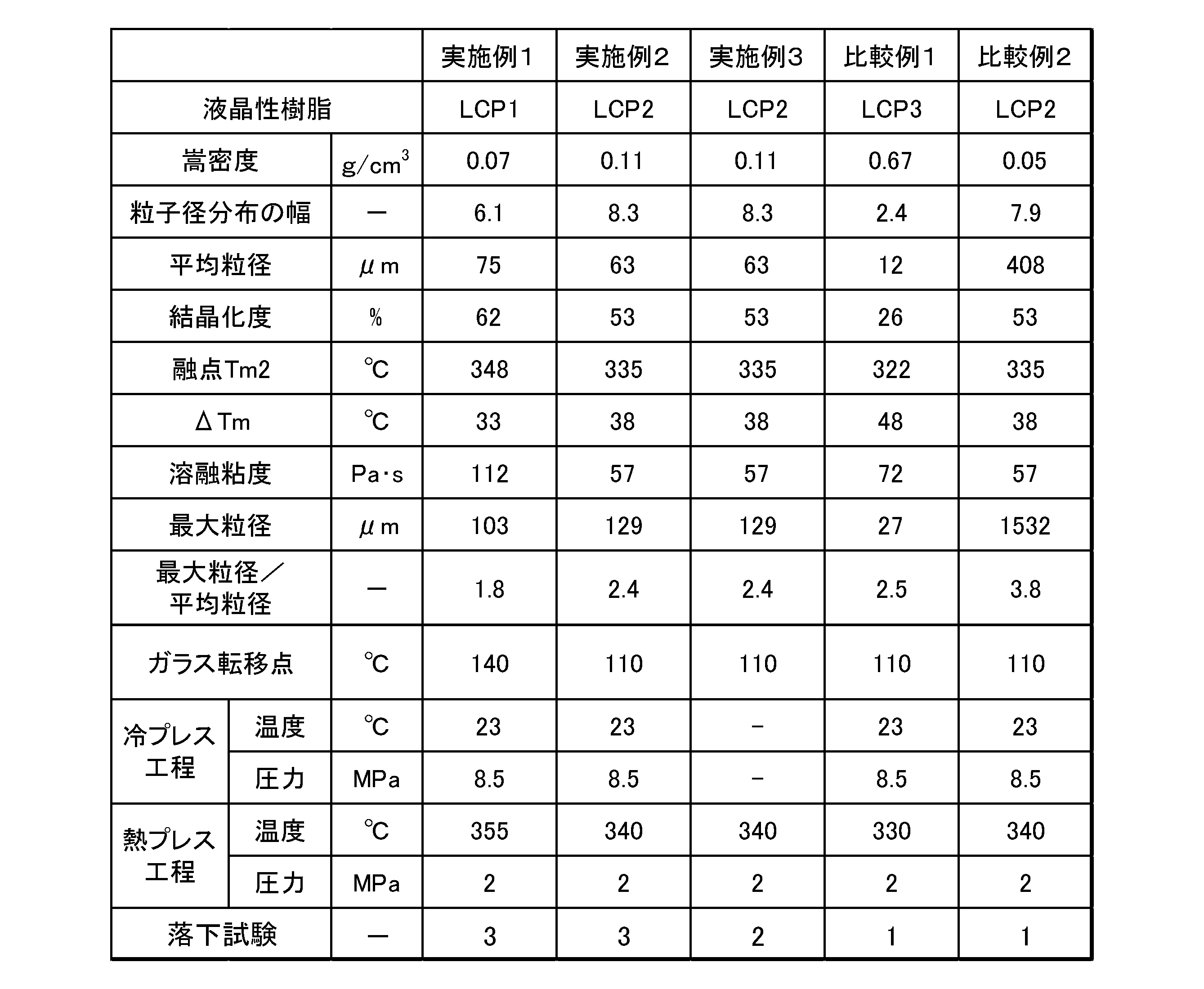
LCP1に替えてLCP2を用い、熱プレス工程の温度を表1に記載のように変更した以外は、実施例1と同様にしてプレス成形品を得た。得られた粉状液晶性樹脂及び成形品について、実施例1と同様にして、各種物性を測定した。
LCP1に替えてLCP2を用い、熱プレス工程の温度を表1に記載のように変更した以外は、実施例1と同様にしてプレス成形品を得た。得られた粉状液晶性樹脂及び成形品について、実施例1と同様にして、各種物性を測定した。
[実施例3]
冷プレス工程を行わなかった以外は、実施例2と同様にしてプレス成形品を得た。得られた粉状液晶性樹脂及び成形品について、実施例1と同様にして、各種物性を測定した。
冷プレス工程を行わなかった以外は、実施例2と同様にしてプレス成形品を得た。得られた粉状液晶性樹脂及び成形品について、実施例1と同様にして、各種物性を測定した。
[比較例1]
LCP3を100質量部に対して、ポリスチレン(PSジャパン株式会社製、「SGP10」、ガラス転移点Tg100℃、溶融粘度27Pa・s(シリンダー温度340℃、せん断速度1000sec-1))を900質量部となるように、株式会社日本製鋼所製二軸押出機「TEX-α」(ノズル開口部の数と各開口部の面積との積300mm2)を用い、シリンダー温度340℃、スクリュー回転数125rpmで溶融混練して組成物を得た。組成物を円形ノズルから、樹脂押出速度10kg/hrで押出ストランドを得て、カットしてペレット化した。この際、ノズル開口部の数nと各開口部の面積Sとの積nS(mm2)と1時間あたりの樹脂押出量Q(kg/hr)との比(nS/Q)は、30であった。
得られた組成物ペレット100gを、2Lフラスコ中で40℃に加熱したトルエン900g中に投入し、30分間攪拌し、ポリスチレンをトルエン中に溶解させた。吸引ろ過により不溶成分を回収し、40℃のトルエン90gでよく追加洗浄した。追加洗浄は3度行った。追加洗浄後の不溶成分を1μmのフィルターでろ過して回収し乾燥して粉状液晶性樹脂を得た。
得られた粉状液晶性樹脂を用い、熱プレス工程の温度を変更した以外は、実施例1と同様にしてプレス成形品を得た。得られた粉状液晶性樹脂及び成形品について、実施例1と同様にして、各種物性を測定した。
LCP3を100質量部に対して、ポリスチレン(PSジャパン株式会社製、「SGP10」、ガラス転移点Tg100℃、溶融粘度27Pa・s(シリンダー温度340℃、せん断速度1000sec-1))を900質量部となるように、株式会社日本製鋼所製二軸押出機「TEX-α」(ノズル開口部の数と各開口部の面積との積300mm2)を用い、シリンダー温度340℃、スクリュー回転数125rpmで溶融混練して組成物を得た。組成物を円形ノズルから、樹脂押出速度10kg/hrで押出ストランドを得て、カットしてペレット化した。この際、ノズル開口部の数nと各開口部の面積Sとの積nS(mm2)と1時間あたりの樹脂押出量Q(kg/hr)との比(nS/Q)は、30であった。
得られた組成物ペレット100gを、2Lフラスコ中で40℃に加熱したトルエン900g中に投入し、30分間攪拌し、ポリスチレンをトルエン中に溶解させた。吸引ろ過により不溶成分を回収し、40℃のトルエン90gでよく追加洗浄した。追加洗浄は3度行った。追加洗浄後の不溶成分を1μmのフィルターでろ過して回収し乾燥して粉状液晶性樹脂を得た。
得られた粉状液晶性樹脂を用い、熱プレス工程の温度を変更した以外は、実施例1と同様にしてプレス成形品を得た。得られた粉状液晶性樹脂及び成形品について、実施例1と同様にして、各種物性を測定した。
[比較例2]
LCP2をメッシュミル型粉砕機(株式会社ホーライ製、HA-2542)を用いて凍結粉砕処理して粉状液晶性樹脂を得た。
得られた粉状液晶性樹脂を用い、実施例2と同様にしてプレス成形品を得た。得られた粉状液晶性樹脂及び成形品について、実施例1と同様にして、各種物性を測定した。
LCP2をメッシュミル型粉砕機(株式会社ホーライ製、HA-2542)を用いて凍結粉砕処理して粉状液晶性樹脂を得た。
得られた粉状液晶性樹脂を用い、実施例2と同様にしてプレス成形品を得た。得られた粉状液晶性樹脂及び成形品について、実施例1と同様にして、各種物性を測定した。
[測定]
粉状液晶性樹脂の嵩密度、粒子径分布の幅、平均粒径及び最大粒径、結晶化度、融点(Tm2,Tm1オンセット温度)、溶融粘度の測定方法、並びにプレス成形品の落下試験の方法は、以下のとおりである。結果を表1に示した。
粉状液晶性樹脂の嵩密度、粒子径分布の幅、平均粒径及び最大粒径、結晶化度、融点(Tm2,Tm1オンセット温度)、溶融粘度の測定方法、並びにプレス成形品の落下試験の方法は、以下のとおりである。結果を表1に示した。
(嵩密度)
粉体流動性分析装置(フリーマンテクノロジー社製、「パウダーレオメータFT4」)を用いて、直径50mmの筒状容器に容積85mLの粉状液晶性樹脂を充填し、重量を測定した。その後、直径48mmのVented Pistonを用いて15KPaの圧力で圧縮し、圧縮後の容積で重量を除した値を嵩密度として算出した。
粉体流動性分析装置(フリーマンテクノロジー社製、「パウダーレオメータFT4」)を用いて、直径50mmの筒状容器に容積85mLの粉状液晶性樹脂を充填し、重量を測定した。その後、直径48mmのVented Pistonを用いて15KPaの圧力で圧縮し、圧縮後の容積で重量を除した値を嵩密度として算出した。
(溶融粘度)
キャピラリー式レオメーター(株式会社東洋精機製作所製キャピログラフ1D:ピストン径10mm)を用いて、以下の条件で、ISO 11443に準拠し、見かけの溶融粘度を測定した。測定には、内径1mm、長さ20mmのオリフィスを用いた。
シリンダー温度:
370℃(LCP1)
350℃(LCP2)
340℃(LCP3)
せん断速度:100sec-1
キャピラリー式レオメーター(株式会社東洋精機製作所製キャピログラフ1D:ピストン径10mm)を用いて、以下の条件で、ISO 11443に準拠し、見かけの溶融粘度を測定した。測定には、内径1mm、長さ20mmのオリフィスを用いた。
シリンダー温度:
370℃(LCP1)
350℃(LCP2)
340℃(LCP3)
せん断速度:100sec-1
(粒子径分布の幅、平均粒径及び最大粒径)
レーザー回折/散乱式粒度分布測定装置(株式会社堀場製作所製、LA-960)を用い、分散溶媒としてメタノールを用いて、粒子径分布の幅、平均粒径及び最大粒径を測定した。なお、平均粒径は、体積基準の算術平均粒子径である。
レーザー回折/散乱式粒度分布測定装置(株式会社堀場製作所製、LA-960)を用い、分散溶媒としてメタノールを用いて、粒子径分布の幅、平均粒径及び最大粒径を測定した。なお、平均粒径は、体積基準の算術平均粒子径である。
(結晶化度)
X線回折装置(ブルカー社製、D2 PHASER)を用いて、得られる回折情報(広角X線回折図形または広角X線回折プロファイル)から、非晶に由来する散乱領域と結晶に由来する散乱領域とを分け、W.Ruland,Acta Cryst.,14,1180(1961)に記載の方法に準拠し、以下の式(I)により、結晶化度を測定した。
結晶化度(%)=[結晶由来散乱強度/(結晶由来散乱強度+非結晶由来散乱強度)]×100・・・(I)
X線回折装置(ブルカー社製、D2 PHASER)を用いて、得られる回折情報(広角X線回折図形または広角X線回折プロファイル)から、非晶に由来する散乱領域と結晶に由来する散乱領域とを分け、W.Ruland,Acta Cryst.,14,1180(1961)に記載の方法に準拠し、以下の式(I)により、結晶化度を測定した。
結晶化度(%)=[結晶由来散乱強度/(結晶由来散乱強度+非結晶由来散乱強度)]×100・・・(I)
(融点Tm2及び融点Tm1オンセット温度)
示差走査熱量計(株式会社日立ハイテクサイエンス製、DSC7000X)を用いて、室温から20℃/分の昇温速度で加熱(1stRUN)した際に観測される吸熱ピークにおけるピークトップの温度(融点Tm1)の測定後、(融点Tm1+40)℃の温度で2分間保持し、次いで20℃/分の降温速度で室温まで冷却し、再度室温から20℃/分の昇温速度で加熱した際に観測される2ndRUNの吸熱ピークにおけるピークトップの温度を融点Tm2として測定した。また、1stRUNの吸熱ピークにおけるオンセットの温度(ピークが立ち上がり始める温度)を融点Tm1オンセット温度として測定した。
示差走査熱量計(株式会社日立ハイテクサイエンス製、DSC7000X)を用いて、室温から20℃/分の昇温速度で加熱(1stRUN)した際に観測される吸熱ピークにおけるピークトップの温度(融点Tm1)の測定後、(融点Tm1+40)℃の温度で2分間保持し、次いで20℃/分の降温速度で室温まで冷却し、再度室温から20℃/分の昇温速度で加熱した際に観測される2ndRUNの吸熱ピークにおけるピークトップの温度を融点Tm2として測定した。また、1stRUNの吸熱ピークにおけるオンセットの温度(ピークが立ち上がり始める温度)を融点Tm1オンセット温度として測定した。
(ガラス転移点)
動的粘弾性測定装置(ティー・エイ・インスツルメント社製、RSA-III)を用いて、ガラス転移点を測定した。
動的粘弾性測定装置(ティー・エイ・インスツルメント社製、RSA-III)を用いて、ガラス転移点を測定した。
(落下試験)
成形品を50cmの高さから落下させ、以下の基準に従って評価した。
3:成形品が割れなかった。
2:成形品が割れなかったが、ひびがあった。
1:成形品が割れた。
成形品を50cmの高さから落下させ、以下の基準に従って評価した。
3:成形品が割れなかった。
2:成形品が割れなかったが、ひびがあった。
1:成形品が割れた。
Claims (11)
- 嵩密度が0.05g/cm3を超え0.5g/cm3以下である、プレス成形品用粉状液晶性樹脂。
- JIS Z8825:2013に定義される粒子径分布の幅が3.0以上12以下である、請求項1に記載の粉状液晶性樹脂。
- 平均粒径が10μm以上300μm以下である、請求項1又は2に記載の粉状液晶性樹脂。
- 結晶化度が20%以上70%以下である、請求項1から3のいずれか一項に記載の粉状液晶性樹脂。
- 示差走査熱量計で測定される融点Tm2と融点Tm1のオンセット温度との差ΔTm(Tm2-Tm1オンセット温度)が30℃以上90℃以下である、請求項1から4のいずれか一項に記載の粉状液晶性樹脂。
- 示差走査熱量計で測定される融点Tm2が250℃以上400℃以下である、請求項1から5のいずれか一項に記載の粉状液晶性樹脂。
- 示差走査熱量計で測定される融点Tm2よりも10~30℃高いシリンダー温度及びせん断速度100sec-1で測定した溶融粘度が、10Pa・s以上1000Pa・s以下である、請求項1から6のいずれか一項に記載の粉状液晶性樹脂。
- 最大粒径と平均粒径との比(最大粒径/平均粒径)が5以下である、請求項1から7のいずれか一項に記載の粉状液晶性樹脂。
- 請求項1から8のいずれか一項に記載の粉状液晶性樹脂のプレス成形品。
- 請求項1から8のいずれか一項に記載の粉状液晶性樹脂を、(示差走査熱量計で測定される融点Tm2-60)℃以上の金型温度でプレス成形する熱プレス工程を有する、プレス成形品の製造方法。
- 請求項1から8のいずれか一項に記載の粉状液晶性樹脂をガラス転移点以下の温度でプレス成形する冷プレス工程と、前記冷プレス工程で得られた成形品を、前記粉状液晶性樹脂の(示差走査熱量計で測定される融点Tm2-60)℃以上の金型温度でプレス成形する熱プレス工程と、を有する、プレス成形品の製造方法。
Priority Applications (3)
| Application Number | Priority Date | Filing Date | Title |
|---|---|---|---|
| US17/311,032 US11426903B2 (en) | 2018-12-06 | 2019-12-06 | Powdery liquid-crystal resin for press-molded article, press-molded article, and production method therefor |
| CN201980080557.1A CN113166433B (zh) | 2018-12-06 | 2019-12-06 | 压制成形品用粉状液晶性树脂、压制成形品及其制造方法 |
| JP2020524653A JP6788150B2 (ja) | 2018-12-06 | 2019-12-06 | プレス成形品用粉状液晶性樹脂、プレス成形品及びその製造方法 |
Applications Claiming Priority (2)
| Application Number | Priority Date | Filing Date | Title |
|---|---|---|---|
| JP2018-228723 | 2018-12-06 | ||
| JP2018228723 | 2018-12-06 |
Publications (1)
| Publication Number | Publication Date |
|---|---|
| WO2020116605A1 true WO2020116605A1 (ja) | 2020-06-11 |
Family
ID=70973957
Family Applications (1)
| Application Number | Title | Priority Date | Filing Date |
|---|---|---|---|
| PCT/JP2019/047786 Ceased WO2020116605A1 (ja) | 2018-12-06 | 2019-12-06 | プレス成形品用粉状液晶性樹脂、プレス成形品及びその製造方法 |
Country Status (4)
| Country | Link |
|---|---|
| US (1) | US11426903B2 (ja) |
| JP (1) | JP6788150B2 (ja) |
| CN (1) | CN113166433B (ja) |
| WO (1) | WO2020116605A1 (ja) |
Cited By (2)
| Publication number | Priority date | Publication date | Assignee | Title |
|---|---|---|---|---|
| JP2022190608A (ja) * | 2021-06-14 | 2022-12-26 | Eneos株式会社 | フィブリル状液晶ポリマー粒子の製造方法 |
| JP2024032255A (ja) * | 2022-08-29 | 2024-03-12 | 上野製薬株式会社 | 液晶ポリマー微粒子の製造方法 |
Families Citing this family (2)
| Publication number | Priority date | Publication date | Assignee | Title |
|---|---|---|---|---|
| US12104010B2 (en) | 2021-02-04 | 2024-10-01 | Ticona Llc | Polymer composition for an electric circuit protection device |
| CN113897053B (zh) * | 2021-10-19 | 2023-12-12 | 重庆沃特智成新材料科技有限公司 | 改性聚酰胺薄膜材料及其制备方法、包装袋 |
Citations (5)
| Publication number | Priority date | Publication date | Assignee | Title |
|---|---|---|---|---|
| JP2004068004A (ja) * | 2002-06-14 | 2004-03-04 | Toray Ind Inc | 液晶性ポリマー粉末、その製造方法およびフィラー高充填樹脂材料 |
| JP2013208791A (ja) * | 2012-03-30 | 2013-10-10 | Toray Ind Inc | 複合成形品の製造方法 |
| WO2014188830A1 (ja) * | 2013-05-22 | 2014-11-27 | 株式会社村田製作所 | フィブリル化液晶ポリマーパウダー、フィブリル化液晶ポリマーパウダーの製造方法、ペースト、樹脂多層基板、および、樹脂多層基板の製造方法 |
| JP2017155085A (ja) * | 2016-02-29 | 2017-09-07 | ポリプラスチックス株式会社 | 液晶ポリマー粒子の製造方法 |
| WO2017150336A1 (ja) * | 2016-02-29 | 2017-09-08 | ポリプラスチックス株式会社 | 液晶ポリマー粒子を含有する樹脂組成物、それを用いた成形体、及びそれらの製造方法 |
Family Cites Families (3)
| Publication number | Priority date | Publication date | Assignee | Title |
|---|---|---|---|---|
| JP2008030397A (ja) | 2006-07-31 | 2008-02-14 | Shin Etsu Polymer Co Ltd | 液晶樹脂シートの製造方法及び液晶樹脂シート |
| JP2008075063A (ja) * | 2006-08-22 | 2008-04-03 | Sumitomo Chemical Co Ltd | 液晶性ポリマー成形体 |
| JP5396764B2 (ja) | 2008-07-28 | 2014-01-22 | 住友化学株式会社 | 液晶ポリエステル粒子及びその成形体 |
-
2019
- 2019-12-06 WO PCT/JP2019/047786 patent/WO2020116605A1/ja not_active Ceased
- 2019-12-06 CN CN201980080557.1A patent/CN113166433B/zh active Active
- 2019-12-06 JP JP2020524653A patent/JP6788150B2/ja active Active
- 2019-12-06 US US17/311,032 patent/US11426903B2/en active Active
Patent Citations (5)
| Publication number | Priority date | Publication date | Assignee | Title |
|---|---|---|---|---|
| JP2004068004A (ja) * | 2002-06-14 | 2004-03-04 | Toray Ind Inc | 液晶性ポリマー粉末、その製造方法およびフィラー高充填樹脂材料 |
| JP2013208791A (ja) * | 2012-03-30 | 2013-10-10 | Toray Ind Inc | 複合成形品の製造方法 |
| WO2014188830A1 (ja) * | 2013-05-22 | 2014-11-27 | 株式会社村田製作所 | フィブリル化液晶ポリマーパウダー、フィブリル化液晶ポリマーパウダーの製造方法、ペースト、樹脂多層基板、および、樹脂多層基板の製造方法 |
| JP2017155085A (ja) * | 2016-02-29 | 2017-09-07 | ポリプラスチックス株式会社 | 液晶ポリマー粒子の製造方法 |
| WO2017150336A1 (ja) * | 2016-02-29 | 2017-09-08 | ポリプラスチックス株式会社 | 液晶ポリマー粒子を含有する樹脂組成物、それを用いた成形体、及びそれらの製造方法 |
Cited By (3)
| Publication number | Priority date | Publication date | Assignee | Title |
|---|---|---|---|---|
| JP2022190608A (ja) * | 2021-06-14 | 2022-12-26 | Eneos株式会社 | フィブリル状液晶ポリマー粒子の製造方法 |
| JP7749349B2 (ja) | 2021-06-14 | 2025-10-06 | 株式会社Eneosマテリアル | フィブリル状液晶ポリマー粒子の製造方法 |
| JP2024032255A (ja) * | 2022-08-29 | 2024-03-12 | 上野製薬株式会社 | 液晶ポリマー微粒子の製造方法 |
Also Published As
| Publication number | Publication date |
|---|---|
| JP6788150B2 (ja) | 2020-11-18 |
| US11426903B2 (en) | 2022-08-30 |
| CN113166433A (zh) | 2021-07-23 |
| CN113166433B (zh) | 2023-04-04 |
| JPWO2020116605A1 (ja) | 2021-02-15 |
| US20210354342A1 (en) | 2021-11-18 |
Similar Documents
| Publication | Publication Date | Title |
|---|---|---|
| JP6788150B2 (ja) | プレス成形品用粉状液晶性樹脂、プレス成形品及びその製造方法 | |
| JP6643516B1 (ja) | ペレット混合物および射出成形体 | |
| TWI785251B (zh) | 液晶性樹脂微粒子的製造方法 | |
| JP2017095600A (ja) | 液晶ポリマー | |
| JP7325972B2 (ja) | 3dプリンター用粉体材料、三次元造形物及びその製造方法 | |
| JP6837580B2 (ja) | 熱プレス成形品用粉状液晶性樹脂及び熱プレス成形品 | |
| JP2010077397A (ja) | 液晶ポリエステル粒子及びそれを用いる改質液晶ポリエステル粒子の製造方法 | |
| JP6688105B2 (ja) | 液晶ポリマー粒子の製造方法 | |
| JPS63139921A (ja) | 粉体の製造方法 | |
| JP7084133B2 (ja) | 液晶性樹脂の製造方法 | |
| JP3709969B2 (ja) | 液晶性ポリマーの製造方法 | |
| CN116134553B (zh) | 树脂组合物和其成型品 | |
| JP7722821B2 (ja) | 液晶ポリエステル組成物、液晶ポリエステル組成物の製造方法及び射出成形体の製造方法 | |
| JP7611693B2 (ja) | 液晶性樹脂フィルムの製造方法 | |
| CN113874432A (zh) | 液晶性树脂组合物及使用其的成型体 | |
| TW201333066A (zh) | 全芳香族聚酯、聚酯樹脂組合物以及聚酯成形品 |
Legal Events
| Date | Code | Title | Description |
|---|---|---|---|
| ENP | Entry into the national phase |
Ref document number: 2020524653 Country of ref document: JP Kind code of ref document: A |
|
| 121 | Ep: the epo has been informed by wipo that ep was designated in this application |
Ref document number: 19891838 Country of ref document: EP Kind code of ref document: A1 |
|
| NENP | Non-entry into the national phase |
Ref country code: DE |
|
| 122 | Ep: pct application non-entry in european phase |
Ref document number: 19891838 Country of ref document: EP Kind code of ref document: A1 |