WO2020111217A1 - 液状経口用組成物及び液状経口用組成物の苦味低減方法 - Google Patents
液状経口用組成物及び液状経口用組成物の苦味低減方法 Download PDFInfo
- Publication number
- WO2020111217A1 WO2020111217A1 PCT/JP2019/046713 JP2019046713W WO2020111217A1 WO 2020111217 A1 WO2020111217 A1 WO 2020111217A1 JP 2019046713 W JP2019046713 W JP 2019046713W WO 2020111217 A1 WO2020111217 A1 WO 2020111217A1
- Authority
- WO
- WIPO (PCT)
- Prior art keywords
- hyp
- liquid oral
- oral composition
- gly
- content
- Prior art date
- Legal status (The legal status is an assumption and is not a legal conclusion. Google has not performed a legal analysis and makes no representation as to the accuracy of the status listed.)
- Ceased
Links
Classifications
-
- A—HUMAN NECESSITIES
- A23—FOODS OR FOODSTUFFS; TREATMENT THEREOF, NOT COVERED BY OTHER CLASSES
- A23L—FOODS, FOODSTUFFS OR NON-ALCOHOLIC BEVERAGES, NOT OTHERWISE PROVIDED FOR; PREPARATION OR TREATMENT THEREOF
- A23L2/00—Non-alcoholic beverages; Dry compositions or concentrates therefor; Preparation or treatment thereof
-
- A—HUMAN NECESSITIES
- A61—MEDICAL OR VETERINARY SCIENCE; HYGIENE
- A61K—PREPARATIONS FOR MEDICAL, DENTAL OR TOILETRY PURPOSES
- A61K38/00—Medicinal preparations containing peptides
- A61K38/04—Peptides having up to 20 amino acids in a fully defined sequence; Derivatives thereof
- A61K38/05—Dipeptides
-
- A—HUMAN NECESSITIES
- A23—FOODS OR FOODSTUFFS; TREATMENT THEREOF, NOT COVERED BY OTHER CLASSES
- A23L—FOODS, FOODSTUFFS OR NON-ALCOHOLIC BEVERAGES, NOT OTHERWISE PROVIDED FOR; PREPARATION OR TREATMENT THEREOF
- A23L2/00—Non-alcoholic beverages; Dry compositions or concentrates therefor; Preparation or treatment thereof
- A23L2/52—Adding ingredients
-
- A—HUMAN NECESSITIES
- A23—FOODS OR FOODSTUFFS; TREATMENT THEREOF, NOT COVERED BY OTHER CLASSES
- A23L—FOODS, FOODSTUFFS OR NON-ALCOHOLIC BEVERAGES, NOT OTHERWISE PROVIDED FOR; PREPARATION OR TREATMENT THEREOF
- A23L2/00—Non-alcoholic beverages; Dry compositions or concentrates therefor; Preparation or treatment thereof
- A23L2/70—Clarifying or fining of non-alcoholic beverages; Removing unwanted matter
-
- A—HUMAN NECESSITIES
- A23—FOODS OR FOODSTUFFS; TREATMENT THEREOF, NOT COVERED BY OTHER CLASSES
- A23L—FOODS, FOODSTUFFS OR NON-ALCOHOLIC BEVERAGES, NOT OTHERWISE PROVIDED FOR; PREPARATION OR TREATMENT THEREOF
- A23L27/00—Spices; Flavouring agents or condiments; Artificial sweetening agents; Table salts; Dietetic salt substitutes; Preparation or treatment thereof
- A23L27/86—Addition of bitterness inhibitors
-
- A—HUMAN NECESSITIES
- A23—FOODS OR FOODSTUFFS; TREATMENT THEREOF, NOT COVERED BY OTHER CLASSES
- A23L—FOODS, FOODSTUFFS OR NON-ALCOHOLIC BEVERAGES, NOT OTHERWISE PROVIDED FOR; PREPARATION OR TREATMENT THEREOF
- A23L33/00—Modifying nutritive qualities of foods; Dietetic products; Preparation or treatment thereof
- A23L33/10—Modifying nutritive qualities of foods; Dietetic products; Preparation or treatment thereof using additives
- A23L33/17—Amino acids, peptides or proteins
- A23L33/18—Peptides; Protein hydrolysates
-
- A—HUMAN NECESSITIES
- A61—MEDICAL OR VETERINARY SCIENCE; HYGIENE
- A61K—PREPARATIONS FOR MEDICAL, DENTAL OR TOILETRY PURPOSES
- A61K47/00—Medicinal preparations characterised by the non-active ingredients used, e.g. carriers or inert additives; Targeting or modifying agents chemically bound to the active ingredient
- A61K47/06—Organic compounds, e.g. natural or synthetic hydrocarbons, polyolefins, mineral oil, petrolatum or ozokerite
- A61K47/08—Organic compounds, e.g. natural or synthetic hydrocarbons, polyolefins, mineral oil, petrolatum or ozokerite containing oxygen, e.g. ethers, acetals, ketones, quinones, aldehydes, peroxides
- A61K47/10—Alcohols; Phenols; Salts thereof, e.g. glycerol; Polyethylene glycols [PEG]; Poloxamers; PEG/POE alkyl ethers
-
- C—CHEMISTRY; METALLURGY
- C01—INORGANIC CHEMISTRY
- C01G—COMPOUNDS CONTAINING METALS NOT COVERED BY SUBCLASSES C01D OR C01F
- C01G3/00—Compounds of copper
- C01G3/04—Halides
-
- C—CHEMISTRY; METALLURGY
- C12—BIOCHEMISTRY; BEER; SPIRITS; WINE; VINEGAR; MICROBIOLOGY; ENZYMOLOGY; MUTATION OR GENETIC ENGINEERING
- C12G—WINE; PREPARATION THEREOF; ALCOHOLIC BEVERAGES; PREPARATION OF ALCOHOLIC BEVERAGES NOT PROVIDED FOR IN SUBCLASSES C12C OR C12H
- C12G3/00—Preparation of other alcoholic beverages
- C12G3/04—Preparation of other alcoholic beverages by mixing, e.g. for preparation of liqueurs
-
- A—HUMAN NECESSITIES
- A23—FOODS OR FOODSTUFFS; TREATMENT THEREOF, NOT COVERED BY OTHER CLASSES
- A23V—INDEXING SCHEME RELATING TO FOODS, FOODSTUFFS OR NON-ALCOHOLIC BEVERAGES AND LACTIC OR PROPIONIC ACID BACTERIA USED IN FOODSTUFFS OR FOOD PREPARATION
- A23V2002/00—Food compositions, function of food ingredients or processes for food or foodstuffs
Definitions
- the present invention relates to liquid oral compositions.
- the present invention also relates to methods and the like for reducing the bitterness of liquid oral compositions.
- Collagen is a protein that has been widely used in the food field as gelatin. Generally, it is said that even if a high-molecular weight collagen is orally taken, it is difficult to efficiently use the ingested collagen in the body. Peptides are being developed.
- Hyp-Gly which is a dipeptide containing hydroxyproline (Hyp) derived from collagen, has actions such as skin beautifying effect.
- Patent Document 1 describes a method for masking an unpleasant odor and/or bitterness derived from collagen peptide using a milk solids component containing a masking effective amount of a non-fat milk solids component for a soft drink containing collagen peptide. There is.
- Hyp-Gly hydroxyprolylglycine, hereinafter also referred to as OG.
- OG hydroxyprolylglycine
- a beverage having a Hyp-Gly content of 1.0 mg/100 mL or more has a bitter taste of Hyp-Gly, which is a factor that makes continuous oral intake difficult. Therefore, in a liquid oral composition such as a beverage containing Hyp-Gly in a specific amount, a technique capable of reducing the bitterness of Hyp-Gly is useful.
- Patent Document 1 describes a method for masking bitterness and the like derived from collagen peptide, but a method for reducing the bitterness of a liquid oral composition containing a specific amount of Hyp-Gly has not been studied.
- An object of the present invention is to provide a technique for reducing the bitterness of Hyp-Gly in a liquid oral composition containing a specific amount of Hyp-Gly.
- the inventors of the present invention have conducted extensive studies to solve the above-mentioned problems and found that a liquid oral composition containing 1.0 mg/100 mL or more of Hyp-Gly contains a monohydric alcohol having 2 to 4 carbon atoms. , It was found that the bitterness of Hyp-Gly can be reduced (suppressed).
- the present invention relates to the following liquid oral composition, a method for reducing bitterness of a liquid oral composition, and the like.
- the alcohol is one or more selected from the group consisting of ethanol, butylene glycol, propylene glycol and glycerin.
- the bitter taste of Hyp-Gly can be reduced in a liquid oral composition such as a beverage containing a specific amount of Hyp-Gly.
- the liquid oral composition of the present invention contains Hyp-Gly in an amount of 1.0 mg/100 mL or more, and contains a monohydric or trihydric alcohol having 2 to 4 carbon atoms.
- Hyp-Gly(OG) refers to a peptide (dipeptide) consisting of an amino acid sequence represented by hydroxyproline-glycine.
- Hyp-Gly is preferably a linear dipeptide.
- a monovalent to trivalent alcohol having 2 to 4 carbon atoms may be simply referred to as an alcohol hereinafter.
- the left end is the N-terminal (amino terminal) and the right end is the C-terminal (carboxyl terminal) according to the convention of peptide notation.
- the liquid oral composition contains Hyp-Gly in an amount of 1.0 mg/100 mL or more, it is derived from Hyp-Gly.
- the content of Hyp-Gly in the liquid oral composition may exceed 1.4 mg/100 mL, preferably 1.5 mg/100 mL or more, more preferably 25 mg/100 mL or more, and 28 mg/100 mL or more. More preferably, it is preferably 100 mg/100 mL or less, more preferably 35 mg/100 mL or less.
- the upper and lower limits may be in any combination.
- the content of Hyp-Gly in the liquid oral composition is preferably 1.0 to 100 mg/100 mL, and 1.0 to 35 mg/100 mL. More preferably, more than 1.4 mg/100 mL, more preferably 35 mg/100 mL or less, still more preferably 1.5 to 35 mg/100 mL, even more preferably 25 to 35 mg/100 mL, 28 Particularly preferably, it is ⁇ 35 mg/100 mL.
- Hyp-Gly The origin and production method of Hyp-Gly are not particularly limited.
- Hyp-Gly one prepared by a method known in the art can be used.
- a collagen peptide containing Hyp-Gly can be obtained by hydrolyzing collagen or denatured collagen such as gelatin.
- a liquid oral composition may be prepared using the collagen peptide containing Hyp-Gly thus obtained.
- Hyp-Gly can be prepared by appropriately purifying a collagen peptide containing Hyp-Gly obtained by hydrolyzing collagen or denatured collagen.
- Hyp-Gly can also be produced by a chemical synthesis method.
- the liquid oral composition contains a collagen peptide containing Hyp-Gly so that the liquid oral composition has a Hyp-Gly content of 1.0 mg/100 mL or more. You may let me.
- the collagen peptide containing Hyp-Gly may be composed of only Hyp-Gly, or may contain a peptide other than Hyp-Gly.
- the collagen peptide containing Hyp-Gly can be obtained by hydrolyzing collagen or modified collagen such as gelatin with an enzyme, an acid, an alkali or the like.
- the origin and production method of the collagen peptide are not particularly limited.
- An artificially synthesized collagen peptide can also be used.
- As the collagen peptide one kind of collagen peptide may be used alone, or two or more kinds of collagen peptide may be used in combination.
- Collagen or gelatin which is a raw material of the collagen peptide, may be derived from bovine, porcine, chicken, fish, etc., and one or more of these may be used as a raw material.
- collagen from fish is preferred.
- the fish may be saltwater fish or freshwater fish, and examples thereof include tuna (yellowfin), shark, cod, flounder, flatfish, Thailand, tilapia, salmon, catfish and the like.
- the enzyme used for the preparation of the collagen peptide may be one capable of cleaving the peptide bond of collagen or gelatin, and examples thereof include collagenase, papain, bromelain, actinidine, ficin, cathepsin, pepsin, chymosin, trypsin, and these.
- An enzyme preparation containing a mixture of the above enzymes can be used.
- the acid for example, hydrochloric acid, sulfuric acid, nitric acid or the like can be used.
- alkali for example, sodium hydroxide, calcium hydroxide or the like can be used.
- the aqueous solution of the hydrolyzed collagen peptide may be used as it is, or may be powdered by drying or the like.
- the aqueous solution that has been subjected to a purification treatment usually used may be used in the form of an aqueous solution or powder.
- a commercially available product may be used as the collagen peptide.
- Hyp-Gly content in the collagen peptide is less than a specific amount, Hyp-Gly may be appropriately added and used.
- the average molecular weight of the collagen peptide is not particularly limited and is, for example, preferably 300 to 5,000, more preferably 300 to 4,000.
- the average molecular weight of collagen peptide is the weight average molecular weight.
- the average molecular weight of collagen peptide means the value measured by the relative molecular mass measurement method for the Chinese national standard (GB standard) GB/T 22729-2008 fish oligopeptide powder.
- substitute reagents are used for the reagents M, 451 and M, 189.
- the average molecular weight in this method is the cell pigment C (cytochrome, M, 6500), the molecular weight of which is known in advance, trasylol (aprotinin, M, 12500), bacillus (bacitracin, M, 1450), glycine-glycine-tyrosine.
- the average molecular weight in the present invention refers to the weight average molecular weight calculated in terms of each standard product according to this method.
- the content of Hyp-Gly in the liquid oral composition or collagen peptide can be measured by LC/MS/MS, and can be measured by, for example, the following method.
- LC/MS/MS device for example, LCMS-8050 manufactured by Shimadzu Corporation can be used.
- LC-30AD manufactured by Shimadzu Corporation can be used as the pump, and CTO-20AC manufactured by Shimadzu Corporation can be used as the column oven.
- CTO-20AC manufactured by Shimadzu Corporation
- a 1% formic acid aqueous solution can be used.
- alcohols usable in foods and drinks are preferable, and examples thereof include ethanol, propanol, isopropanol, butylene glycol, propylene glycol and glycerin.
- the alcohol may be used alone or in combination of two or more.
- one or more selected from the group consisting of ethanol, butylene glycol, propylene glycol and glycerin is preferable from the viewpoint of bitterness reduction, more preferably ethanol and/or propylene glycol, and further preferably ethanol.
- the liquid oral composition of the present invention preferably has a content of a monohydric alcohol having 2 to 4 carbon atoms of 0.001 vol% (v/v%) or more, It is more preferably 0.005 vol% or more, still more preferably 0.01 vol% or more.
- the liquid oral composition preferably has an alcohol content of 1.0 vol% or less. Even if the alcohol content is more than 1.0 vol%, the bitterness-reducing effect may not be obtained. From the viewpoint of more sufficiently obtaining the bitterness-reducing effect, the alcohol content of the liquid oral composition is more preferably less than 1.0 vol%, further preferably 0.5 vol% or less, and 0.3 vol% or less.
- the liquid oral composition of the present invention preferably has an alcohol content of 0.001 to 1.0 vol %, and more than 0.001 vol% and less than 1.0 vol %. More preferably, it is more preferably 0.005 to 0.5 vol%, even more preferably 0.005 to 0.3 vol%, particularly preferably 0.01 to 0.3 vol%, and Most preferably, it is 0.01 vol% to 0.1 vol %.
- the content of the monohydric alcohol having 2 to 4 carbon atoms is the total amount of two or more alcohols when they are contained.
- the alcohol content can be measured by a known method.
- the content of ethanol can be measured, for example, by gas chromatography.
- the content of propylene glycol can be measured, for example, by gas chromatography mass spectrometry.
- the ratio of the content of the monohydric alcohol having 2 to 4 carbon atoms (vol%) to the Hyp-Gly content (mg/100 mL) in the liquid oral composition (alcohol content (vol%) /Hyp-Gly content (mg/100 mL) is, for example, preferably 0.00003 or more, more preferably 0.00025 or more, still more preferably 0.0007 or more, and further preferably 0.7 or less, 0. It is more preferably 5 or less, still more preferably 0.07 or less, even more preferably 0.05 or less, particularly preferably 0.04 or less, most preferably less than 0.04.
- the ratio of the content of the monohydric alcohol having 2 to 4 carbon atoms (vol%) to the Hyp-Gly content (mg/100 mL) in the liquid oral composition is preferably 0.00003 to 0.7, more preferably 0.00025 to 0.5, still more preferably 0.00025 to 0.07, and 0.00025 to 0.05 is even more preferable, and 0.0007 to 0.05 is particularly preferable.
- the ratio of the content of the monohydric alcohol having 2 to 4 carbon atoms (vol%) to the above Hyp-Gly content (mg/100 mL) is 0.00025 to 0.04. It is more preferably 0.00025 or more and less than 0.04.
- the liquid oral composition of the present invention may contain one or more components other than the above components within a range that does not impair the effects of the present invention.
- the liquid oral composition of the present invention includes, for example, sweeteners (erythritol, acesulfame K, sucralose, etc.), acidulants (citric acid, etc.), antioxidants, stabilizers, preservatives, perfumes, emulsifiers, pigments, seasonings.
- sweeteners erythritol, acesulfame K, sucralose, etc.
- acidulants citric acid, etc.
- antioxidants stabilizers
- preservatives perfumes
- perfumes emulsifiers
- pigments pigments
- seasonings seasonings.
- additives such as additives, pH adjusters, nutrient enhancers, thickeners (welan gum, xanthan gum, etc.) may be included.
- the liquid oral composition of the present invention may contain, in addition to Hyp-Gly, one or more materials having other in-vivo functionalities, for example, materials known to have a skin improving effect.
- materials known to have a skin improving effect include proteoglycans, elastin peptides, ceramides, plant extracts, chondroitin sulfates, glucosamines, minerals (calcium etc.), vitamins (vitamin C etc.) and the like.
- the liquid oral composition of the present invention preferably contains a sweetener and an acidulant from the viewpoint of further reducing bitterness.
- the liquid oral composition of the present invention contains an aqueous medium, usually water.
- the liquid oral composition of the present invention is preferably a liquid oral composition containing water as a medium (aqueous liquid oral composition).
- the liquid oral composition of the present invention preferably has a pH of 6 or less, more preferably 2 to 6, and further preferably 3 to 4.5.
- the pH is the pH at 25°C.
- an acid or salt that can be used in foods and drinks can be used.
- the acid or its salt may be used alone or in combination of two or more.
- the liquid oral composition of the present invention is preferably used as a beverage (beverage composition). Of these, soft drinks are preferable.
- the liquid oral composition of the present invention can be packaged in a container.
- the form of the container is not particularly limited, and the container can be filled in a sealed container such as a bottle, a can, a PET bottle, a paper pack, an aluminum pouch, and a vinyl pouch to prepare a packaged beverage (container-containing beverage).
- the method for producing the liquid oral composition of the present invention is not particularly limited, and preferably includes, for example, a mixing step of mixing the respective components.
- the liquid oral composition of the present invention is mixed with each component such as Hyp-Gly and a monohydric or trihydric alcohol having 2 to 4 carbon atoms so that the Hyp-Gly content is 1.0 mg/100 mL. It can be manufactured.
- the mixing step it is preferable to add an aqueous medium to the components and mix them. Water is usually used as the aqueous medium.
- the order of mixing the components is not particularly limited as long as the components are uniformly mixed.
- a pH adjusting step of adjusting the pH of the liquid oral composition may be performed.
- the pH adjusting step may be performed at the same time as the mixing step or after the mixing step. In the production of the liquid oral composition, steps such as filtration, dilution and sterilization may be appropriately carried out if necessary. When the liquid oral composition is used as a packaged beverage, the step of filling the liquid oral composition into a container may be performed.
- the present invention relates to a method for reducing bitterness of a liquid oral composition, which comprises adding a monohydric alcohol having 2 to 4 carbon atoms to a liquid oral composition having a Hyp-Gly content of 1.0 mg/100 mL or more. Also includes. Addition of a monohydric or trihydric alcohol having 2 to 4 carbon atoms can reduce the bitterness of Hyp-Gly in a liquid oral composition having a Hyp-Gly content of 1.0 mg/100 mL or more. it can. The method and timing of blending the alcohol are not particularly limited. It is sufficient that the liquid oral composition containing Hyp-Gly finally contains a monohydric alcohol having 2 to 4 carbon atoms.
- the preferred range of the content of Hyp-Gly in the liquid oral composition is the same as in the case of the liquid oral composition of the present invention described above.
- the above-mentioned alcohol, its preferable mode, the amount to be mixed and the like are the same as those in the above-mentioned liquid oral composition of the present invention.
- the liquid oral composition may contain a collagen peptide containing Hyp-Gly. You may mix
- Example 1 A liquid oral composition (beverage) was prepared by mixing OG and ethanol with water so that the contents of Hyp-Gly(OG) (manufactured by BACHEM) and ethanol were as shown in Table 1.
- the OG used is a linear OG.
- Examples 2, 3, 4 and 5 A liquid oral composition was prepared in the same manner as in Example 1 except that OG and ethanol were blended so that the contents of OG and ethanol were as shown in Table 1.
- Example 1 A liquid oral composition was prepared in the same manner as in Example 1 except that ethanol was not added. Specifically, OG was mixed with water so that the content of OG was the amount shown in Table 1, to prepare a liquid oral composition.
- Example 2 In the liquid oral composition of Example, the ratio of the ethanol content to the Hyp-Gly(OG) content (ethanol content (vol%)/Hyp-Gly content (mg/100 mL)) was the same as in Example 1. 0.0007, Example 2 was 0.003, Example 3 was 0.03, Example 4 was 0.01, and Example 5 was 0.015.
- the liquid oral compositions obtained in the examples and comparative examples were organoleptically evaluated at room temperature by the following method. The evaluation results are shown in Table 1.
- Example 1 From Example 1 and Comparative Example 1, by adding ethanol, the bitterness of OG (Hyp-Gly) could be reduced (suppressed). In each of Examples 1 to 4, the bitterness of OG was reduced. Further, in Examples 1 to 4, no alcohol odor was felt. In Example 5, the bitterness of OG was reduced, but the smell of alcohol was felt.
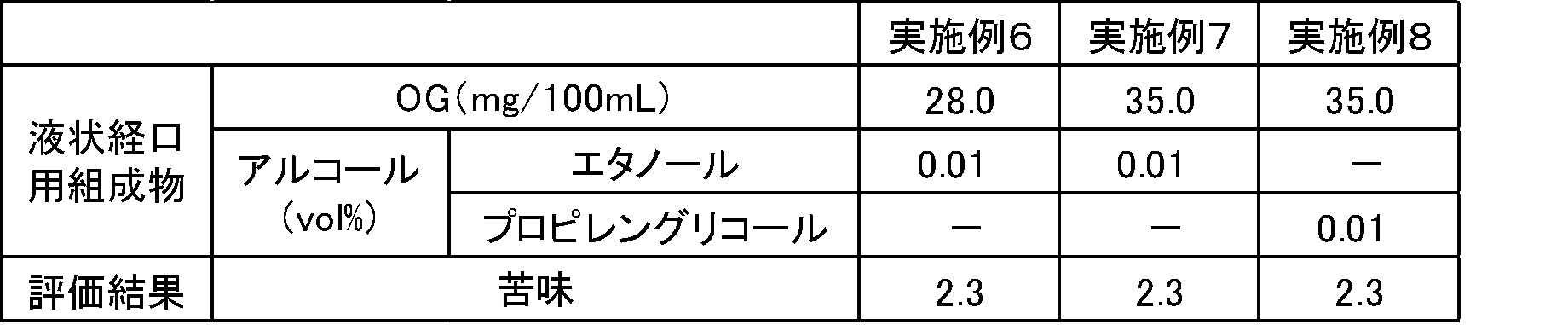
- Example 6 and Example 7 A liquid oral composition was prepared in the same manner as in Example 1 except that OG and ethanol were blended so that the contents of OG (manufactured by BACHEM) and ethanol were as shown in Table 2.
- the ratio of the ethanol content to the Hyp-Gly content (ethanol content (vol%)/Hyp-Gly content (mg/100 mL)) was 0.0004 in Example 6 and 7 was 0.0003.
- Example 8 Propylene glycol was used instead of ethanol. OG and propylene glycol were mixed with water so that the contents of OG (manufactured by BACHEM) and propylene glycol were the amounts shown in Table 2, to prepare a liquid oral composition.
- the liquid oral composition of Example 8 had a ratio of propylene glycol content to Hyp-Gly content (propylene glycol content (vol %)/Hyp-Gly content (mg/100 mL)) of 0.0003. It was
- the present invention is useful in the field of food and drink and the like.
Landscapes
- Health & Medical Sciences (AREA)
- Life Sciences & Earth Sciences (AREA)
- Chemical & Material Sciences (AREA)
- Engineering & Computer Science (AREA)
- Polymers & Plastics (AREA)
- Food Science & Technology (AREA)
- Nutrition Science (AREA)
- Organic Chemistry (AREA)
- Proteomics, Peptides & Aminoacids (AREA)
- General Health & Medical Sciences (AREA)
- Medicinal Chemistry (AREA)
- Animal Behavior & Ethology (AREA)
- Public Health (AREA)
- Veterinary Medicine (AREA)
- Pharmacology & Pharmacy (AREA)
- Epidemiology (AREA)
- Bioinformatics & Cheminformatics (AREA)
- Immunology (AREA)
- Molecular Biology (AREA)
- Gastroenterology & Hepatology (AREA)
- Mycology (AREA)
- Inorganic Chemistry (AREA)
- Chemical Kinetics & Catalysis (AREA)
- General Chemical & Material Sciences (AREA)
- Oil, Petroleum & Natural Gas (AREA)
- Wood Science & Technology (AREA)
- Biochemistry (AREA)
- Zoology (AREA)
- Genetics & Genomics (AREA)
- General Engineering & Computer Science (AREA)
- Medicinal Preparation (AREA)
- Non-Alcoholic Beverages (AREA)
- Medicines That Contain Protein Lipid Enzymes And Other Medicines (AREA)
- Seasonings (AREA)
- Alcoholic Beverages (AREA)
- Peptides Or Proteins (AREA)
Abstract
Description
〔1〕Hyp-Glyの含有量が1.0mg/100mL以上であり、かつ、炭素数2~4の1~3価のアルコールを含有する液状経口用組成物。
〔2〕上記アルコールの含有量が、0.001~1.0vol%である上記〔1〕に記載の液状経口用組成物。
〔3〕上記アルコールが、エタノール、ブチレングリコール、プロピレングリコール及びグリセリンからなる群より選択される1以上である上記〔1〕又は〔2〕に記載の液状経口用組成物。
〔4〕上記Hyp-Glyの含有量が1.0~100mg/100mLである上記〔1〕~〔3〕のいずれかに記載の液状経口用組成物。
〔5〕飲料である上記〔1〕~〔4〕のいずれかに記載の液状経口用組成物。
〔6〕Hyp-Glyの含有量が1.0mg/100mL以上である液状経口用組成物に炭素数2~4の1~3価のアルコールを配合する、液状経口用組成物の苦味低減方法。
本発明の液状経口用組成物は、Hyp-Glyの含有量が1.0mg/100mL以上であり、かつ、炭素数2~4の1~3価のアルコールを含有する。本発明において、Hyp-Gly(OG)は、ヒドロキシプロリン-グリシンで表されるアミノ酸配列からなるペプチド(ジペプチド)を指す。本発明において、Hyp-Glyは、好ましくは直鎖状ジペプチドである。本明細書中、炭素数2~4の1~3価のアルコールを、以下では単にアルコールと記載することもある。
本明細書におけるペプチドの表記は、ペプチド表記の慣例に従って、左端がN末端(アミノ末端)、右端がC末端(カルボキシル末端)である。
液状経口用組成物は本発明においては、液状経口用組成物のHyp-Glyの含有量が1.0mg/100mL以上となるように、液状経口用組成物にHyp-Glyを含むコラーゲンペプチドを含有させてもよい。Hyp-Glyを含むコラーゲンペプチドは、Hyp-Glyのみからなるものであってもよく、Hyp-Gly以外のペプチドを含んでいてよい。
コラーゲンペプチドは市販品を用いてもよい。コラーゲンペプチド中のHyp-Gly含有量が特定の量に満たない場合等には、Hyp-Glyを適宜追加して用いることもできる。
本法での平均分子量は、あらかじめ分子量が既知である細胞色素C(cytochrome,M,6500)、トラジロール(aprotinin, M,12500)、バシラス菌(bacitracin, M,1450)、グリシン-グリシン-チロシン-アルギニン(M,451)、グリシン-グリシン-グリシン(M,189)を同条件で測定して得られたリテンションタイムと相対分子量の対数の関係の相対分子質量較正曲線を元に算出する。本発明における平均分子量とは、この手法に従って各標準品換算で算出した重量平均分子量を言う。
(LC分析条件)
カラム:Intrada Amino Acid(インタクト社製、Prod No.WAA34, Ser No.PE09HQF)3μm,3.0mmI.D.×100mm
カラム温度:35℃
流速:0.6mL/min
溶離液A:0.1%ギ酸アセトニトリル溶液
溶離液B:100mMギ酸アンモニウム水溶液
グラジェント:B液(体積%) 14%(0分)-14%(6分)-100%(20分)-14%(20.1分)-14%(24分)
LC終了時間:24分
注入量:1μL
平衡化後初期圧力:Pump A:6.3MPa、Pump B:6.4MPa
(MS分析条件)
イオン化モード:ESI Positive
ネブライザーガス流量:3L/min
ドライングガス流量:10L/min
DL温度:250℃
ブロックヒーター温度:400℃
インターフェイス温度:300℃
ヒーティングガス流量:10L/min
分析モード:
MRM (+) 189.05>86.10
Q1 Pre Bias (V):-22.0, CE:-16.0,
Q3 Pre Bias (V):-13.0
アルコール含有量は、公知の方法で測定することができる。エタノールの含有量は、例えば、ガスクロマトグラフィーで測定することができる。プロピレングリコールの含有量は、例えば、ガスクロマトグラフィー質量分析法で測定することができる。
一態様において、液状経口用組成物中のHyp-Gly含有量(mg/100mL)に対する炭素数2~4の1~3価のアルコール含有量(vol%)の比率(アルコール含有量(vol%)/Hyp-Gly含有量(mg/100mL))は、0.00003~0.7が好ましく、0.00025~0.5がより好ましく、0.00025~0.07がさらに好ましく、0.00025~0.05がさらにより好ましく、0.0007~0.05が特に好ましい。一態様において、上記のHyp-Gly含有量(mg/100mL)に対する炭素数2~4の1~3価のアルコール含有量(vol%)の比率は、0.00025~0.04であることが好ましく、0.00025以上0.04未満であることがより好ましい。
本発明の液状経口用組成物は、例えば、甘味料(エリスリトール、アセスルファムK、スクラロース等)、酸味料(クエン酸等)、酸化防止剤、安定剤、保存料、香料、乳化剤、色素類、調味料、pH調整剤、栄養強化剤、増粘剤(ウェランガム、キサンタンガム等)等の添加剤を1又は2以上含んでいてもよい。また、本発明の液状経口用組成物は、Hyp-Glyに加えて、その他の生体内機能性を有する素材、例えば、皮膚改善効果が知られている素材を1又は2以上含んでもよい。皮膚改善効果が知られている素材として、例えば、プロテオグリカン、エラスチンペプチド、セラミド、植物エキス、コンドロイチン硫酸、グルコサミン類、ミネラル類(カルシウム等)、ビタミン類(ビタミンC等)等が挙げられる。一態様において、苦味がより低減される観点から、本発明の液状経口用組成物は、甘味料及び酸味料を含むことが好ましい。
本発明の液状経口用組成物は水性媒体、通常水を含む。本発明の液状経口用組成物は、好ましくは水を媒体とする液状経口用組成物(水性液状経口用組成物)である。
pHの調整には、飲食品に使用可能な酸又は塩を使用することができる。酸又はその塩は1種用いてもよく、2種以上を組み合わせて使用してもよい。
本発明の液状経口用組成物は、容器詰めとすることができる。容器の形態は特に限定されず、ビン、缶、ペットボトル、紙パック、アルミパウチ、ビニールパウチ等の密封容器に充填して、容器詰め飲料(容器入り飲料)等とすることができる。
混合工程では、成分に、水性媒体を加えて混合することが好ましい。水性媒体としては、通常水が用いられる。各成分を混合する順番は特に限定されず、各成分が均一に混合されればよい。液状経口用組成物の製造においては、液状経口用組成物のpHを調整するpH調整工程を行ってもよい。pH調整工程は、混合工程と同時に行ってもよく、混合工程の後で行ってもよい。液状経口用組成物の製造においては、必要に応じて適宜ろ過、希釈、殺菌等の工程を行ってもよい。液状経口用組成物を容器詰め飲料とする場合は、液状経口用組成物を容器に充填する工程を行ってよい。
本発明は、Hyp-Glyの含有量が1.0mg/100mL以上である液状経口用組成物に炭素数2~4の1~3価のアルコールを配合する、液状経口用組成物の苦味低減方法も包含する。
炭素数2~4の1~3価のアルコールを配合することにより、Hyp-Glyの含有量が1.0mg/100mL以上である液状経口用組成物において、Hyp-Glyの苦味を低減することができる。
上記アルコールを配合する方法及びタイミングは特に限定されない。上記Hyp-Glyを含有する液状経口用組成物が、最終的に炭素数2~4の1~3価のアルコールを含有するものとなればよい。液状経口用組成物中のHyp-Glyの含有量の好ましい範囲は、上述した本発明の液状経口用組成物の場合と同じである。上記アルコール及びその好ましい態様、配合量等は、上述した本発明の液状経口用組成物におけるものと同じである。液状経口用組成物は、Hyp-Glyを含有するコラーゲンペプチドを含有していてもよい。液状経口用組成物には、上述した甘味料等の他の成分を配合してもよい。
Hyp-Gly(OG)(BACHEM社製)及びエタノールの含有量が表1に示す量となるように、OG及びエタノールを水に混合して、液状経口用組成物(飲料)を調製した。使用したOGは、直鎖状のOGである。
OG及びエタノールの含有量が表1に示す量となるようにOG及びエタノールを配合した以外は、実施例1と同じ方法で液状経口用組成物を調製した。
エタノールを配合しなかった以外は、実施例1と同じ方法で液状経口用組成物を調製した。具体的には、OGの含有量が表1に示す量となるように、OGを水に混合して、液状経口用組成物を調製した。
専門のパネラー3名が、液状経口用組成物(常温)の風味を、苦味の観点で、下記の基準で官能評価した。苦味の程度については、パネラー全員が下記基準(3点満点)にて官能評価を実施し、3人の平均点を求めた。結果は平均点で示した。
風味の評価基準
3点:苦味を感じない
2点:苦味をやや感じるが、問題ない
1点:苦味を感じる

OG(BACHEM社製)及びエタノールの含有量が表2に示す量となるように、OG及びエタノールを配合した以外は、実施例1と同じ方法で液状経口用組成物を調製した。液状経口用組成物において、Hyp-Gly含有量に対するエタノール含有量の比率(エタノール含有量(vol%)/Hyp-Gly含有量(mg/100mL))は、実施例6が0.0004、実施例7が0.0003であった。
エタノールに代えてプロピレングリコールを使用した。OG(BACHEM社製)及びプロピレングリコールの含有量が表2に示す量となるように、OG及びプロピレングリコールを水に混合して、液状経口用組成物を調製した。実施例8の液状経口用組成物は、Hyp-Gly含有量に対するプロピレングリコール含有量の比率(プロピレングリコール含有量(vol%)/Hyp-Gly含有量(mg/100mL))が0.0003であった。
Claims (6)
- Hyp-Glyの含有量が1.0mg/100mL以上であり、かつ、炭素数2~4の1~3価のアルコールを含有する液状経口用組成物。
- 前記アルコールの含有量が、0.001~1.0vol%である請求項1に記載の液状経口用組成物。
- 前記アルコールが、エタノール、ブチレングリコール、プロピレングリコール及びグリセリンからなる群より選択される1以上である請求項1又は2に記載の液状経口用組成物。
- 前記Hyp-Glyの含有量が1.0~100mg/100mLである請求項1~3のいずれか一項に記載の液状経口用組成物。
- 飲料である請求項1~4のいずれか一項に記載の液状経口用組成物。
- Hyp-Glyの含有量が1.0mg/100mL以上である液状経口用組成物に炭素数2~4の1~3価のアルコールを配合する、液状経口用組成物の苦味低減方法。
Priority Applications (9)
| Application Number | Priority Date | Filing Date | Title |
|---|---|---|---|
| US17/297,759 US20220031796A1 (en) | 2018-11-30 | 2019-11-29 | Liquid composition for oral use and method for reducing bitterness of liquid composition for oral use |
| CN201980077464.3A CN113302273B (zh) | 2018-11-30 | 2019-11-29 | 液状口服用组合物及降低液状口服用组合物的苦味的方法 |
| MYPI2021002936A MY209435A (en) | 2018-11-30 | 2019-11-29 | Liquid composition for oral use and method for reducing bitterness of liquid composition for oral use |
| JP2020557848A JP7197605B2 (ja) | 2018-11-30 | 2019-11-29 | 液状経口用組成物及び液状経口用組成物の苦味低減方法 |
| CA3121438A CA3121438A1 (en) | 2018-11-30 | 2019-11-29 | Liquid composition for oral use and method for reducing bitterness of liquid composition for oral use |
| AU2019388008A AU2019388008B2 (en) | 2018-11-30 | 2019-11-29 | Liquid composition for oral use and method for reducing bitterness of liquid composition for oral use |
| SG11202104399YA SG11202104399YA (en) | 2018-11-30 | 2019-11-29 | Liquid composition for oral use and method for reducing bitterness of liquid composition for oral use |
| KR1020217017658A KR102906349B1 (ko) | 2018-11-30 | 2019-11-29 | 액상 경구용 조성물 및 액상 경구용 조성물의 쓴맛 저감 방법 |
| PH12021551060A PH12021551060A1 (en) | 2018-11-30 | 2021-05-07 | Liquid composition for oral use and method for reducing bitterness of liquid composition for oral use |
Applications Claiming Priority (2)
| Application Number | Priority Date | Filing Date | Title |
|---|---|---|---|
| JP2018-226088 | 2018-11-30 | ||
| JP2018226088 | 2018-11-30 |
Publications (1)
| Publication Number | Publication Date |
|---|---|
| WO2020111217A1 true WO2020111217A1 (ja) | 2020-06-04 |
Family
ID=70853499
Family Applications (1)
| Application Number | Title | Priority Date | Filing Date |
|---|---|---|---|
| PCT/JP2019/046713 Ceased WO2020111217A1 (ja) | 2018-11-30 | 2019-11-29 | 液状経口用組成物及び液状経口用組成物の苦味低減方法 |
Country Status (11)
| Country | Link |
|---|---|
| US (1) | US20220031796A1 (ja) |
| JP (1) | JP7197605B2 (ja) |
| KR (1) | KR102906349B1 (ja) |
| CN (1) | CN113302273B (ja) |
| AU (1) | AU2019388008B2 (ja) |
| CA (1) | CA3121438A1 (ja) |
| MY (1) | MY209435A (ja) |
| PH (1) | PH12021551060A1 (ja) |
| SG (1) | SG11202104399YA (ja) |
| TW (1) | TWI857993B (ja) |
| WO (1) | WO2020111217A1 (ja) |
Citations (5)
| Publication number | Priority date | Publication date | Assignee | Title |
|---|---|---|---|---|
| JP2010106003A (ja) * | 2008-09-30 | 2010-05-13 | Nitta Gelatin Inc | 疾病抑制剤 |
| JP2011211962A (ja) * | 2010-03-31 | 2011-10-27 | Nippon Menaade Keshohin Kk | 飲料用組成物 |
| WO2015029605A1 (ja) * | 2013-08-30 | 2015-03-05 | サントリーホールディングス株式会社 | コラーゲンペプチド含有飲料の臭気抑制技術 |
| JP2018039751A (ja) * | 2016-09-07 | 2018-03-15 | 新田ゼラチン株式会社 | 表皮細胞間機能強化剤 |
| JP2020000187A (ja) * | 2018-06-29 | 2020-01-09 | アサヒビール株式会社 | アルコール飲料 |
Family Cites Families (3)
| Publication number | Priority date | Publication date | Assignee | Title |
|---|---|---|---|---|
| FR2611916B1 (fr) * | 1987-03-06 | 1989-05-26 | Thomson Csf | Systeme de recueil, par une station fixe, de donnees transmises par voie optique par n stations mobiles |
| JP2014117254A (ja) | 2012-12-19 | 2014-06-30 | Asahi Soft Drinks Co Ltd | 清涼飲料、ならびに、コラーゲンペプチド含有清涼飲料の不快臭及び/又は苦味のマスキング方法 |
| WO2015156246A1 (ja) * | 2014-04-10 | 2015-10-15 | サントリーホールディングス株式会社 | コラーゲンペプチド含有組成物の苦味マスキング方法 |
-
2019
- 2019-11-29 WO PCT/JP2019/046713 patent/WO2020111217A1/ja not_active Ceased
- 2019-11-29 MY MYPI2021002936A patent/MY209435A/en unknown
- 2019-11-29 KR KR1020217017658A patent/KR102906349B1/ko active Active
- 2019-11-29 JP JP2020557848A patent/JP7197605B2/ja active Active
- 2019-11-29 SG SG11202104399YA patent/SG11202104399YA/en unknown
- 2019-11-29 US US17/297,759 patent/US20220031796A1/en not_active Abandoned
- 2019-11-29 AU AU2019388008A patent/AU2019388008B2/en active Active
- 2019-11-29 CN CN201980077464.3A patent/CN113302273B/zh active Active
- 2019-11-29 TW TW108143692A patent/TWI857993B/zh active
- 2019-11-29 CA CA3121438A patent/CA3121438A1/en active Pending
-
2021
- 2021-05-07 PH PH12021551060A patent/PH12021551060A1/en unknown
Patent Citations (5)
| Publication number | Priority date | Publication date | Assignee | Title |
|---|---|---|---|---|
| JP2010106003A (ja) * | 2008-09-30 | 2010-05-13 | Nitta Gelatin Inc | 疾病抑制剤 |
| JP2011211962A (ja) * | 2010-03-31 | 2011-10-27 | Nippon Menaade Keshohin Kk | 飲料用組成物 |
| WO2015029605A1 (ja) * | 2013-08-30 | 2015-03-05 | サントリーホールディングス株式会社 | コラーゲンペプチド含有飲料の臭気抑制技術 |
| JP2018039751A (ja) * | 2016-09-07 | 2018-03-15 | 新田ゼラチン株式会社 | 表皮細胞間機能強化剤 |
| JP2020000187A (ja) * | 2018-06-29 | 2020-01-09 | アサヒビール株式会社 | アルコール飲料 |
Also Published As
| Publication number | Publication date |
|---|---|
| CN113302273B (zh) | 2023-12-12 |
| JP7197605B2 (ja) | 2022-12-27 |
| TWI857993B (zh) | 2024-10-11 |
| AU2019388008B2 (en) | 2025-02-06 |
| US20220031796A1 (en) | 2022-02-03 |
| KR102906349B1 (ko) | 2025-12-30 |
| CN113302273A (zh) | 2021-08-24 |
| PH12021551060A1 (en) | 2021-12-06 |
| SG11202104399YA (en) | 2021-06-29 |
| AU2019388008A1 (en) | 2021-05-27 |
| JPWO2020111217A1 (ja) | 2021-09-30 |
| TW202038740A (zh) | 2020-11-01 |
| KR20210096129A (ko) | 2021-08-04 |
| CA3121438A1 (en) | 2020-06-04 |
| MY209435A (en) | 2025-07-09 |
Similar Documents
| Publication | Publication Date | Title |
|---|---|---|
| JP7367747B2 (ja) | コク味付与機能を有する組成物 | |
| JP7210935B2 (ja) | マスキング剤 | |
| JP5303438B2 (ja) | コラーゲンペプチド含有飲料 | |
| JP5628499B2 (ja) | 塩味増強剤を含有する低食塩醤油又は低食塩醤油調味料 | |
| JP7197519B2 (ja) | コラーゲンペプチドを含む液状経口用組成物及びコラーゲンペプチドを含む液状経口用組成物の風味改善方法 | |
| TW202002810A (zh) | 包含膠原蛋白胜肽之經口用組成物以及液狀經口用組成物之緩和酸味之方法 | |
| JP7197605B2 (ja) | 液状経口用組成物及び液状経口用組成物の苦味低減方法 | |
| JP2008148568A (ja) | 蛋白質補給食品 | |
| HK40058319B (en) | Liquid composition for oral use and method for reducing bitterness of liquid composition for oral use | |
| JP7179085B2 (ja) | コラーゲンペプチドを含有する液状経口用組成物及び液状経口用組成物の泡立ちを抑制する方法 | |
| HK40058319A (en) | Liquid composition for oral use and method for reducing bitterness of liquid composition for oral use | |
| JP2011062170A (ja) | 塩味増強剤を含有する低食塩味噌又は低食塩味噌調味料 | |
| JP6803796B2 (ja) | タンパクまたはペプチドに由来する異味改善剤及び異臭改善剤 | |
| JP7022439B2 (ja) | アミノ酸由来の異味改善剤 | |
| JP2019115297A (ja) | 経口摂取用酸性組成物、容器詰め飲料、経口摂取用酸性組成物の製造方法、および異味抑制方法 | |
| HK40036994A (en) | Liquid composition for oral use containing collagen peptide, and method for improving flavor of liquid composition for oral use including collagen peptide | |
| JP2018014962A (ja) | 飲料 | |
| CN104363772A (zh) | 风味改良剂 |
Legal Events
| Date | Code | Title | Description |
|---|---|---|---|
| 121 | Ep: the epo has been informed by wipo that ep was designated in this application |
Ref document number: 19889288 Country of ref document: EP Kind code of ref document: A1 |
|
| ENP | Entry into the national phase |
Ref document number: 2020557848 Country of ref document: JP Kind code of ref document: A |
|
| ENP | Entry into the national phase |
Ref document number: 2019388008 Country of ref document: AU Date of ref document: 20191129 Kind code of ref document: A |
|
| WWE | Wipo information: entry into national phase |
Ref document number: 2101003020 Country of ref document: TH |
|
| ENP | Entry into the national phase |
Ref document number: 3121438 Country of ref document: CA |
|
| NENP | Non-entry into the national phase |
Ref country code: DE |
|
| ENP | Entry into the national phase |
Ref document number: 20217017658 Country of ref document: KR Kind code of ref document: A |
|
| 122 | Ep: pct application non-entry in european phase |
Ref document number: 19889288 Country of ref document: EP Kind code of ref document: A1 |