WO2020105256A1 - 粘着剤組成物、粘着剤および粘着シート - Google Patents
粘着剤組成物、粘着剤および粘着シートInfo
- Publication number
- WO2020105256A1 WO2020105256A1 PCT/JP2019/036182 JP2019036182W WO2020105256A1 WO 2020105256 A1 WO2020105256 A1 WO 2020105256A1 JP 2019036182 W JP2019036182 W JP 2019036182W WO 2020105256 A1 WO2020105256 A1 WO 2020105256A1
- Authority
- WO
- WIPO (PCT)
- Prior art keywords
- pressure
- sensitive adhesive
- meth
- group
- ethylenically unsaturated
- Prior art date
- Legal status (The legal status is an assumption and is not a legal conclusion. Google has not performed a legal analysis and makes no representation as to the accuracy of the status listed.)
- Ceased
Links
Classifications
-
- C—CHEMISTRY; METALLURGY
- C09—DYES; PAINTS; POLISHES; NATURAL RESINS; ADHESIVES; COMPOSITIONS NOT OTHERWISE PROVIDED FOR; APPLICATIONS OF MATERIALS NOT OTHERWISE PROVIDED FOR
- C09J—ADHESIVES; NON-MECHANICAL ASPECTS OF ADHESIVE PROCESSES IN GENERAL; ADHESIVE PROCESSES NOT PROVIDED FOR ELSEWHERE; USE OF MATERIALS AS ADHESIVES
- C09J11/00—Features of adhesives not provided for in group C09J9/00, e.g. additives
- C09J11/02—Non-macromolecular additives
- C09J11/06—Non-macromolecular additives organic
-
- C—CHEMISTRY; METALLURGY
- C09—DYES; PAINTS; POLISHES; NATURAL RESINS; ADHESIVES; COMPOSITIONS NOT OTHERWISE PROVIDED FOR; APPLICATIONS OF MATERIALS NOT OTHERWISE PROVIDED FOR
- C09J—ADHESIVES; NON-MECHANICAL ASPECTS OF ADHESIVE PROCESSES IN GENERAL; ADHESIVE PROCESSES NOT PROVIDED FOR ELSEWHERE; USE OF MATERIALS AS ADHESIVES
- C09J133/00—Adhesives based on homopolymers or copolymers of compounds having one or more unsaturated aliphatic radicals, each having only one carbon-to-carbon double bond, and at least one being terminated by only one carboxyl radical, or of salts, anhydrides, esters, amides, imides, or nitriles thereof; Adhesives based on derivatives of such polymers
-
- C—CHEMISTRY; METALLURGY
- C09—DYES; PAINTS; POLISHES; NATURAL RESINS; ADHESIVES; COMPOSITIONS NOT OTHERWISE PROVIDED FOR; APPLICATIONS OF MATERIALS NOT OTHERWISE PROVIDED FOR
- C09J—ADHESIVES; NON-MECHANICAL ASPECTS OF ADHESIVE PROCESSES IN GENERAL; ADHESIVE PROCESSES NOT PROVIDED FOR ELSEWHERE; USE OF MATERIALS AS ADHESIVES
- C09J7/00—Adhesives in the form of films or foils
- C09J7/10—Adhesives in the form of films or foils without carriers
-
- C—CHEMISTRY; METALLURGY
- C09—DYES; PAINTS; POLISHES; NATURAL RESINS; ADHESIVES; COMPOSITIONS NOT OTHERWISE PROVIDED FOR; APPLICATIONS OF MATERIALS NOT OTHERWISE PROVIDED FOR
- C09J—ADHESIVES; NON-MECHANICAL ASPECTS OF ADHESIVE PROCESSES IN GENERAL; ADHESIVE PROCESSES NOT PROVIDED FOR ELSEWHERE; USE OF MATERIALS AS ADHESIVES
- C09J7/00—Adhesives in the form of films or foils
- C09J7/30—Adhesives in the form of films or foils characterised by the adhesive composition
- C09J7/38—Pressure-sensitive adhesives [PSA]
Definitions
- the present invention relates to an adhesive composition, an adhesive and an adhesive sheet.
- the pressure-sensitive adhesive for example, a strong pressure-sensitive adhesive for the purpose of firmly sticking the pressure-sensitive adhesive sheet to an adherend for a long period of time, or peeling from the adherend after sticking the pressure-sensitive adhesive sheet.
- a strong pressure-sensitive adhesive for the purpose of firmly sticking the pressure-sensitive adhesive sheet to an adherend for a long period of time, or peeling from the adherend after sticking the pressure-sensitive adhesive sheet.
- target release type adhesives There are various types such as target release type adhesives, and the optimum adhesive is designed and used in each field.
- the strong adhesive type adhesive is useful not only for attaching an adhesive sheet to an adherend but also for attaching members to each other, for example, attaching optical members to each other or building members to each other.
- the step followability and the impact resistance are required in the bonding of such members, it is necessary to make the pressure-sensitive adhesive layer in the pressure-sensitive adhesive sheet a thick film.
- Patent Document 1 As a method of increasing the cohesive force of the pressure-sensitive adhesive, for example, a method of blending a polyfunctional monomer with the pressure-sensitive adhesive is known (for example, Patent Document 1).
- An object is to provide a pressure-sensitive adhesive composition that can be used. Another object of the present invention is to provide a pressure-sensitive adhesive obtained by curing the pressure-sensitive adhesive composition, and a pressure-sensitive adhesive sheet having a pressure-sensitive adhesive layer made of the pressure-sensitive adhesive.
- the ethylenically unsaturated compound (B) contains an ethylenically unsaturated compound (B1) having one ethylenically unsaturated group and an ethylenically unsaturated compound (B2) having two or more ethylenically unsaturated groups.
- the ethylenically unsaturated compound (B1) is an ethylenically unsaturated compound (B1-1) having a polar group and one ethylenically unsaturated group, an alkyl group having 1 to 20 carbon atoms and one ethylenically unsaturated Containing an ethylenically unsaturated compound (B1-2) having a group,
- R is an atom or a group selected from the group consisting of a halogen atom, a hydroxyl group, an alkoxy group, an alkyl group and a phenyl group, and n is an integer of 0 to 5. However, when n is 2 or more, all 2 or more R may be the same or at least 1 may differ.
- ⁇ 2> The pressure-sensitive adhesive composition according to ⁇ 1>, wherein the ethylenically unsaturated compound (B1-1) is a carboxy group-containing monomer or an amide group-containing monomer.
- ⁇ 3> The adhesive as described in ⁇ 1> or ⁇ 2>, wherein the content ratio of the ethylenically unsaturated compound (B1-1) in the ethylenically unsaturated compound (B1) is 0.1 to 50% by weight.
- Agent composition ⁇ 4> The pressure-sensitive adhesive composition according to any one of ⁇ 1> to ⁇ 3>, wherein the acrylic resin (A) is a functional group-containing acrylic resin.
- ⁇ 5> Any one of ⁇ 1> to ⁇ 4>, wherein the content of the ethylenically unsaturated compound (B1) is 1 to 1000 parts by weight with respect to 100 parts by weight of the acrylic resin (A).
- ⁇ 6> Any of ⁇ 1> to ⁇ 5>, wherein the content of the ethylenically unsaturated compound (B2) is 0.01 to 5 parts by weight with respect to 100 parts by weight of the acrylic resin (A).
- the polymerization initiator (C) is further at least one of a radical cleavage type polymerization initiator (C2) and a hydrogen abstraction type polymerization initiator (C3) (however, the polymerization initiator (C1) is excluded).
- ⁇ 8> The pressure-sensitive adhesive composition according to any one of ⁇ 1> to ⁇ 7>, in which the content of the polymerization initiator (C1) in the polymerization initiator (C) is 10% by weight or more.
- ⁇ 10> A pressure-sensitive adhesive obtained by curing the pressure-sensitive adhesive composition according to any one of ⁇ 1> to ⁇ 9> by irradiation with active energy rays.
- ⁇ 11> A pressure-sensitive adhesive sheet having a pressure-sensitive adhesive layer made of the pressure-sensitive adhesive according to ⁇ 10>.
- ⁇ 12> The pressure-sensitive adhesive sheet according to ⁇ 11>, which is a double-sided pressure-sensitive adhesive sheet in which a release sheet is laminated on both surfaces of the pressure-sensitive adhesive layer.
- the "adhesive sheet" in the present invention conceptually includes a long adhesive tape. Further, the “adhesive” in the present invention is not only those whose adhesive force when applied to an adherend hardly changes, but also those which have a function as an adhesive whose adhesive force increases after being applied to an adherend. Include.
- the pressure-sensitive adhesive composition of the present invention has a high curing rate and good curability, and the pressure-sensitive adhesive layer made of the pressure-sensitive adhesive obtained by curing the pressure-sensitive adhesive composition has an adherend (metal , Polyolefin, etc.), and also has excellent tensile strength and toughness.
- (meth) acryl means acryl or methacryl
- (meth) acryloyl means acryloyl or methacryloyl
- (meth) acrylate means acrylate or methacrylate.
- the pressure-sensitive adhesive composition of the present invention contains an acrylic resin (A), an ethylenically unsaturated compound (B) and a polymerization initiator (C).
- A acrylic resin
- B ethylenically unsaturated compound
- C polymerization initiator
- the acrylic resin (A) used in the present invention is a polymer obtained by polymerizing a polymerizable monomer containing the (meth) acrylic acid alkyl ester (a1) as an essential monomer.
- the acrylic resin (A) is a functional group-containing acrylic resin obtained by polymerizing a polymerizable monomer further containing a functional group-containing monomer (a2) in addition to the (meth) acrylic acid alkyl ester (a1).
- the above-mentioned polymerizable monomer may contain other copolymerizable monomer (a3), if necessary.
- the (meth) acrylic acid alkyl ester (a1), the functional group-containing monomer (a2) and the other copolymerizable monomer (a3) one type or two or more types can be used.
- the (meth) acrylic acid alkyl ester (a1) is preferably a (meth) acrylic acid alkyl ester having an alkyl group having 1 to 20 carbon atoms, and the carbon number is particularly preferably 1 to 10, further preferably 1 to 8. ..
- the (meth) acrylic acid alkyl ester (a1) include, for example, nonyl (meth) acrylate, n-octyl (meth) acrylate, iso-octyl (meth) acrylate, 2-ethylhexyl (meth) acrylate, n- Examples thereof include butyl (meth) acrylate, iso-butyl (meth) acrylate, tert-butyl (meth) acrylate, n-propyl (meth) acrylate, methyl (meth) acrylate, ethyl (meth) acrylate, and particularly 2- Ethylhexyl (meth) acrylate, methyl (meth) acrylate, ethyl (meth) acrylate, n-butyl (meth) acrylate are preferable.
- Examples of the functional group-containing monomer (a2) include a carboxy group-containing monomer, a hydroxyl group-containing monomer, an amino group-containing monomer, an amide group-containing monomer, an oxyalkylene group-containing monomer, an acetoacetyl group-containing monomer, an isocyanate group-containing monomer, and a glycidyl group. Examples thereof include a contained monomer, a phosphoric acid group-containing monomer, and a sulfonic acid group-containing monomer.
- the carboxy group also includes an acid anhydride group that is a derivative of the carboxy group.
- carboxy group-containing monomer examples include (meth) acrylic acid, crotonic acid, maleic acid, maleic anhydride, fumaric acid, citraconic acid, glutaconic acid, itaconic acid, acrylamido-N-glycolic acid, cinnamic acid, ( Michael adduct of (meth) acrylic acid (for example, acrylic acid dimer, methacrylic acid dimer, acrylic acid trimer, methacrylic acid trimer, acrylic acid tetramer, methacrylic acid tetramer, etc.), 2- (meth) acryloyloxyethyl dicarboxylic acid monoester ( For example, 2-acryloyloxyethyl succinic acid monoester, 2-methacryloyloxyethyl succinic acid monoester, 2-acryloyloxyethyl phthalic acid monoester, 2-methacryloyloxyethyl phthalic acid monoester, 2-acryloyloxyethy
- hydroxyl group-containing monomer examples include 2-hydroxyethyl (meth) acrylate, 4-hydroxybutyl (meth) acrylate, 5-hydroxypentyl (meth) acrylate, 6-hydroxyhexyl (meth) acrylate, 8-hydroxyoctyl ( Hydroxyalkyl (meth) acrylate monomers such as (meth) acrylate; Caprolactone-modified monomers such as caprolactone-modified 2-hydroxyethyl (meth) acrylate; Diethylene glycol mono (meth) acrylate, polyethylene glycol mono (meth) acrylate, octoxy polyethylene glycol-polypropylene Oxyalkylene-modified mono (meth) acrylate monomers such as glycol-mono (meth) acrylate, lauroxy polyethylene glycol-mono (meth) acrylate, stearoxy polyethylene glycol mono (meth) acrylate; 2-acryloyloxyethyl-2-hydroxy Primary
- amino group-containing monomer examples include primary amino group-containing monomers such as aminoalkyl (meth) acrylates such as aminomethyl (meth) acrylate and aminoethyl (meth) acrylate; tert-butylaminoethyl (meth) acrylate and the like. Secondary amino group-containing monomers; tertiary amino group-containing monomers such as dialkylaminoethyl (meth) acrylates such as dimethylaminoethyl (meth) acrylate and diethylaminoethyl (meth) acrylate; heterocyclic groups such as (meth) acryloylmorpholine Examples include amine structure-containing monomers, and quaternized products thereof.
- amide group-containing monomer examples include (meth) acrylamide; N-methoxymethyl (meth) acrylamide, N-ethoxymethyl (meth) acrylamide, N-propoxymethyl (meth) acrylamide, N-isopropoxymethyl (meth).
- N-alkoxyalkyl (meth) acrylamides such as acrylamide, N- (n-butoxymethyl) (meth) acrylamide, N-isobutoxymethyl (meth) acrylamide; N, N-dimethyl (meth) acrylamide, N, N-diethyl N, N-dialkyl (meth) acrylamide such as (meth) acrylamide; N, N-dialkylaminoalkyl (meth) acrylamide such as N, N-dimethylaminopropyl (meth) acrylamide; cyclic structure containing N-acryloylmorpholine Examples thereof include amide.
- Examples of the oxyalkylene group-containing monomer include 2-methoxyethyl (meth) acrylate, 3-methoxyethyl (meth) acrylate, 2-ethoxyethyl (meth) acrylate, 3-methoxybutyl (meth) acrylate and 2-butoxy.
- Alkoxyalkyl mono (meth) acrylates such as ethyl (meth) acrylate, 2-butoxydiethylene glycol (meth) acrylate, methoxydiethylene glycol (meth) acrylate, methoxytriethylene glycol (meth) acrylate, ethoxydiethylene glycol (meth) acrylate, methoxydi Alkoxy such as propylene glycol (meth) acrylate, methoxy polyethylene glycol (meth) acrylate, octoxy polyethylene glycol-polypropylene glycol mono (meth) acrylate, lauroxy polyethylene glycol mono (meth) acrylate, stearoxy polyethylene glycol mono (meth) acrylate Aliphatic (meth) acrylic acid ester such as (poly) alkylene glycol mono (meth) acrylate; 2-phenoxyethyl (meth) acrylate, phenoxy polyethylene glycol (meth) acrylate, phenoxy poly
- acetoacetyl group-containing monomer examples include 2- (acetoacetoxy) ethyl (meth) acrylate and allyl acetoacetate.
- isocyanate group-containing monomer examples include 2- (meth) acryloyloxyethyl isocyanate and its alkylene oxide adduct.
- Examples of the glycidyl group-containing monomer include glycidyl (meth) acrylate and allylglycidyl (meth) acrylate.
- Examples of the phosphoric acid group-containing monomer include 2- (meth) acryloyloxyethyl acid phosphate, bis (2- (meth) acryloyloxyethyl) acid phosphate, phosphoric acid ester of polyethylene glycol monomethacrylate, and polyethylene glycol monoacrylate.
- Phosphoric acid ester Phosphoric acid ester, phosphoric acid ester of polypropylene glycol monomethacrylate, phosphoric acid ester of polyalkylene glycol mono (meth) acrylate such as phosphoric acid ester of polypropylene glycol monoacrylate, methylene (meth) acrylate phosphate, trimethylene (meth) phosphate
- Examples thereof include acrylates, propylene (meth) acrylate phosphates, and alkylene (meth) acrylate phosphates such as tetramethylene (meth) acrylate phosphates.
- sulfonic acid group-containing monomer examples include olefin sulfonic acids such as ethylene sulfonic acid, allyl sulfonic acid and methallyl sulfonic acid, 2-acrylamido-2-methylpropane sulfonic acid, styrene sulfonic acid and salts thereof. ..
- Examples of the other copolymerizable monomer (a3) include allyl compounds such as N-acrylamidomethyltrimethylammonium chloride, allyltrimethylammonium chloride and dimethylallylvinylketone; N-vinylpyrrolidone, vinyl propionate, vinyl stearate, and the like.
- Vinyl-based monomers such as vinyl chloride, vinylidene chloride, vinyl acetate, and styrene; and (meth) acrylic acid alkyl esters other than the (meth) acrylic acid alkyl ester (a1).
- the (meth) acrylic acid alkyl ester (a1), the functional group-containing monomer (a2), and optionally a polymerizable monomer further containing another copolymerizable monomer (a3) are (co) polymerized to obtain an acrylic resin.
- a system resin (A) is obtained.
- the acrylic resin (A) For the polymerization of the acrylic resin (A), conventionally known methods such as solution radical polymerization, suspension polymerization, bulk polymerization, emulsion polymerization and the like can be adopted.
- the acrylic resin (A) is preferably a solvent-based acrylic resin obtained by solution radical polymerization, from the viewpoint that an acrylic resin can be safely and stably produced with an arbitrary monomer composition.
- a (meth) acrylic acid alkyl ester (a1) and a functional group-containing monomer (a2), a polymerizable monomer further containing another copolymerizable monomer (a3) as necessary, and a polymerization initiator are added.
- the solvent-based acrylic resin (A) is obtained by mixing or dropping, and polymerizing at reflux or at 50 to 99 ° C. for 2 to 20 hours.
- the weight average molecular weight (Mw) of the acrylic resin (A) in the present invention is usually 100,000 to 2,500,000, preferably 200,000 to 2,200,000, and particularly preferably 400,000 to 2,000,000. If the weight average molecular weight is too small, the cohesive force of the pressure-sensitive adhesive obtained by irradiation with active energy rays tends to decrease, and if the weight-average molecular weight is too large, a uniformly compatible pressure-sensitive adhesive composition tends to be difficult to obtain. is there.
- the dispersity (weight average molecular weight / number average molecular weight) of the acrylic resin (A) is usually 20 or less, preferably 15 or less, particularly preferably 10 or less, and the lower limit of the dispersity is usually 1.1. Is. If the dispersity is too high, the cohesive force and the sticking property tend to increase due to the active energy ray irradiation conditions.
- the above-mentioned weight average molecular weight is a weight average molecular weight in terms of standard polystyrene molecular weight, and is 3 in the high performance liquid chromatography (manufactured by Japan Waters, "Waters 2695 (main body)” and “Waters 2414 (detector)”).
- Main column in series Shodex GPC KF-806L (Exclusion limit molecular weight: 2 ⁇ 10 7 , separation range: 100 to 2 ⁇ 10 7 , theoretical plate number: 10,000 plates / line, packing material: styrene-divinylbenzene co-weight It is measured by using coalescence and filler particle size: 10 ⁇ m).
- the number average molecular weight can be measured by the same method.
- the polymer may be derivatized at the time of measurement, and the type of eluent may be appropriately changed.
- the glass transition temperature (Tg) of the acrylic resin (A) is preferably ⁇ 70 to 20 ° C., particularly preferably ⁇ 60 to 0 ° C., further preferably ⁇ 55 to ⁇ 10 ° C. If the glass transition temperature (Tg) of the acrylic resin (A) is too low, the cohesive force tends to decrease, and if the glass transition temperature (Tg) of the acrylic resin (A) is too high, the pressure-sensitive adhesive becomes brittle. Tend to be induced.
- the glass transition temperature (Tg) of the acrylic resin (A) is calculated by applying the glass transition temperature and the weight fraction when the monomers constituting the acrylic resin (A) are homopolymers to the Fox equation. It is the calculated value.
- the glass transition temperature when the monomer that constitutes the acrylic resin (A) is a homopolymer is usually measured by a differential scanning calorimeter (DSC), and may be measured according to JIS K7121-1987 or JIS K6240. It can be measured by a method in conformity with.
- DSC differential scanning calorimeter
- the content of the acrylic resin (A) in the pressure-sensitive adhesive composition of the present invention is preferably 1 to 99% by weight, particularly preferably 5 to 80% by weight, based on the total amount of the pressure-sensitive adhesive composition. It is preferably 7 to 70% by weight.
- the content ratio of the acrylic resin (A) is too high, the processability (handling property) is lowered, and the dispersibility of the filler (D) at the time of blending the below-mentioned filler (D) is lowered and the mixture is mixed. Tend to be difficult or less reactive.
- the content of the acrylic resin (A) is too low, the workability is lowered and it becomes difficult to form the pressure-sensitive adhesive layer into a thick film, or the dispersibility of the filler (D) is lowered.
- the filler (D) tends to precipitate or float.
- the ethylenically unsaturated compound (B) used in the present invention is an ethylenically unsaturated compound (B1) having one ethylenically unsaturated group and an ethylenically unsaturated compound having two or more ethylenically unsaturated groups. (B2) is contained.
- ethylenically unsaturated compound (B1) having one ethylenically unsaturated group will be described.
- an ethylenically unsaturated compound (B1) having one ethylenically unsaturated group is referred to as a “monofunctional monomer (B1)”, and an ethylenically unsaturated compound having two or more ethylenically unsaturated groups is used.
- (B2) may be referred to as a "polyfunctional monomer (B2)".
- the monofunctional monomer (B1) is an ethylenically unsaturated compound (B1-1) having a polar group and one ethylenically unsaturated group (hereinafter, may be referred to as “monofunctional monomer (B1-1)”). And an ethylenically unsaturated compound (B1-2) having an alkyl group having 1 to 20 carbon atoms and one ethylenically unsaturated group (hereinafter may be referred to as “monofunctional monomer (B1-2)”). Contains.
- the monofunctional monomers (B1-1) and (B1-2) one type or two or more types can be used.
- Examples of the polar group in the monofunctional monomer (B1-1) include a carboxy group, a hydroxyl group, an amino group, an amide group, an oxyalkylene group, an acetoacetyl group, an isocyanate group, a glycidyl group, a phosphoric acid group and a sulfonic acid group. Can be mentioned.
- the carboxy group also includes an acid anhydride group that is a derivative of the carboxy group.
- a (meth) acryloyl group is preferable from the viewpoint of reactivity.
- Examples of the monofunctional monomer (B1-1) include a carboxy group-containing monomer, a hydroxyl group-containing monomer, an amino group-containing monomer, an amide group-containing monomer, an oxyalkylene group-containing monomer, an acetoacetyl group-containing monomer, an isocyanate group-containing monomer, and glycidyl.
- Examples thereof include a group-containing monomer, a phosphoric acid group-containing monomer, and a sulfonic acid group-containing monomer. Specific examples thereof include the same as the above-mentioned functional group-containing monomer (a2).
- the monofunctional monomer (B1-1) a carboxy group-containing monomer and an amide group-containing monomer are preferable in terms of reactivity, and (meth) acrylic acid is particularly preferable in terms of adhesive strength, and acrylic acid is more preferable.
- the content ratio of the monofunctional monomer (B1-1) in the monofunctional monomer (B1) is preferably 0.1 to 50% by weight, particularly preferably 1 to 40% by weight, and further preferably 5 to 20% by weight. Is. If the content of the monofunctional monomer (B1-1) is too high, the contamination of the member and the deterioration of weather resistance and adhesiveness tend to be caused. If the content of the monofunctional monomer (B1-1) is too low, curing will occur. Property tends to decrease and strength tends to decrease.
- the alkyl group having 1 to 20 carbon atoms in the monofunctional monomer (B1-2) may be linear, branched or alicyclic.
- a (meth) acryloyl group is preferable from the viewpoint of reactivity.
- the alkyl group when the alkyl group is linear or branched, the alkyl group preferably has 2 to 20 carbon atoms, particularly preferably 4 to 18 carbon atoms, and further preferably 4 to 10 carbon atoms.
- Examples of the monofunctional monomer (B1-2) having a linear or branched alkyl group include, for example, methyl (meth) acrylate, ethyl (meth) acrylate, n-propyl (meth) acrylate, n-butyl (meth).
- the carbon number of the alkyl group is preferably 4-20, particularly preferably 6-10.
- Examples of the monofunctional monomer (B1-2) having an alicyclic alkyl group include cyclopentyl (meth) acrylate, cyclohexyl (meth) acrylate, tricyclodecanyl (meth) acrylate, and 2-methylcyclohexyl (meth) acrylate.
- cyclohexyl (meth) acrylate, dicyclopentanyl (meth) acrylate, and dicyclopentenyl (meth) acrylate are preferable, and cyclohexyl acrylate is particularly preferable, in terms of excellent compatibility with the acrylic resin (A). Is.
- the ethylenically unsaturated compound having an alkyl group having 1 to 20 carbon atoms and one ethylenically unsaturated group, and further having a polar group is a monofunctional monomer (B1- It is classified into 1).
- the content ratio of the monofunctional monomer (B1-2) in the monofunctional monomer (B1) is preferably 50 to 99% by weight, particularly preferably 70 to 98% by weight, and further preferably 80 to 95% by weight. .. If the content ratio of the monofunctional monomer (B1-2) is too high, the polarity tends to decrease, and thus the adhesion or reactivity with the member tends to decrease, and the content ratio of the monofunctional monomer (B1-2) tends to be low. If it is too much, the weather resistance tends to decrease and the member tends to be contaminated.
- the monofunctional monomer (B1) may contain, in addition to the monofunctional monomers (B1-1) and (B1-2), another ethylenically unsaturated compound having one ethylenically unsaturated group.
- the content of the monofunctional monomer (B1) in the pressure-sensitive adhesive composition of the present invention is preferably 1 to 1000 parts by weight, more preferably 50 to 800 parts by weight, based on 100 parts by weight of the acrylic resin (A). Parts, particularly preferably 150 to 500 parts by weight, more preferably 200 to 300 parts by weight.
- the content of the monofunctional monomer (B1) is too large, the processability is lowered and it becomes difficult to form the pressure-sensitive adhesive layer into a thick film, or the dispersibility of the filler (D) described later is lowered.
- the filler (D) tends to precipitate or float.
- the content of the monofunctional monomer (B1) is too small, the processability (handling property) is reduced, the dispersibility of the filler (D) is reduced, and mixing is difficult, or the reactivity is reduced. Tend to do.
- the content ratio of the monofunctional monomer (B1) in the ethylenically unsaturated compound (B) is preferably 20 to 99% by weight, particularly preferably 50 to 98% by weight, further preferably 60 to 97% by weight. Is. If the content ratio of the monofunctional monomer (B1) is too large, the curability tends to be deteriorated and the strength tends to be lowered. If the content ratio of the monofunctional monomer (B1) is too small, the adhesive force tends to be decreased. ..
- the polyfunctional monomer (B2) contains two or more ethylenically unsaturated groups in one molecule.
- Examples of the polyfunctional monomer (B2) include a bifunctional (meth) acrylate-based monomer, a trifunctional or higher-functional (meth) acrylate-based monomer, a urethane (meth) acrylate-based compound, an epoxy (meth) acrylate-based compound, and a polyester ( A (meth) acrylate compound can be used.
- 1 type (s) or 2 or more types can be used.
- the bifunctional (meth) acrylate-based monomer may be a monomer containing two (meth) acryloyl groups, and examples thereof include ethylene glycol di (meth) acrylate, diethylene glycol di (meth) acrylate, and tetraethylene glycol di ( (Meth) acrylate, polyethylene glycol di (meth) acrylate, propylene glycol di (meth) acrylate, dipropylene glycol di (meth) acrylate, polypropylene glycol di (meth) acrylate, butylene glycol di (meth) acrylate, neopentyl glycol di ( (Meth) acrylate, ethylene oxide modified bisphenol A type di (meth) acrylate, propylene oxide modified bisphenol A type di (meth) acrylate, 1,6-hexanediol di (meth) acrylate, 1,6-hexanediol ethylene oxide modified di (Meth) acrylate, gly
- the trifunctional or higher functional (meth) acrylate-based monomer may be a monomer containing three or more (meth) acryloyl groups, and examples thereof include trimethylolpropane tri (meth) acrylate, pentaerythritol tri (meth) acrylate, and penta.
- the urethane (meth) acrylate-based compound is a (meth) acrylate-based compound having a urethane bond in the molecule, and contains a hydroxyl group-containing (meth) acrylic-based compound and a polyvalent isocyanate-based compound (if necessary, a polyol-based compound).
- a compound obtained by reacting a compound) by a known general method is used.
- the weight average molecular weight is usually 300 to 4000.
- the content of the polyfunctional monomer (B2) in the pressure-sensitive adhesive composition of the present invention is preferably 0.01 to 5 parts by weight, particularly preferably 0.1 parts by weight, based on 100 parts by weight of the acrylic resin (A).
- the amount is 05 to 1 part by weight, more preferably 0.1 to 0.5 part by weight. If the content of the polyfunctional monomer (B2) is too large, the adhesive force tends to decrease, and if the content of the polyfunctional monomer (B2) is too small, the cohesive force tends to decrease.
- the content ratio of the polyfunctional monomer (B2) in the ethylenically unsaturated compound (B) is preferably 0.01 to 30% by weight, particularly preferably 0.05 to 10% by weight, and further preferably 0. 0.08 to 5% by weight. If the content ratio of the polyfunctional monomer (B2) is too large, it tends to be too hard and the adhesive strength tends to be lowered, and if the content ratio of the monofunctional monomer (B2) is too small, the strength tends to be lowered.
- the polymerization initiator (C) used in the present invention contains a polymerization initiator (C1) having at least one structural site represented by the following formula (1) in the molecule.
- R is a substituent on the benzene ring and is an atom or group selected from the group consisting of a halogen atom, a hydroxyl group, an alkoxy group, an alkyl group and a phenyl group.
- the alkyl group is, for example, a straight chain or branched chain having 1 to 12 carbon atoms such as methyl group, ethyl group, n- or iso-propyl group, n- or tert-butyl group, n-hexyl group and cyclohexyl group.
- a cyclic alkyl group and the like can be mentioned.
- the alkoxy group includes, for example, a straight chain having 1 to 12 carbon atoms such as methoxy group, ethoxy group, n- or iso-propoxy group, n- or tert-butoxy group, n-hexyloxy group and cyclohexyloxy group, Examples thereof include branched or cyclic alkoxy groups.
- n is an integer of 0 to 5, and any of the five hydrogen atoms of the benzene ring may be substituted.
- n is 2 or more, all 2 or more R may be the same or at least 1 may differ.
- a structure in which n in the above formula (1) is 0, that is, a structure in which any hydrogen atom of the benzene ring is not substituted is preferable.
- the polymerization initiator (C1) is a hydrogen abstraction type polymerization initiator and can abstract hydrogen in the molecule and generate radicals. Therefore, when the polymerization initiator (C) used in the present invention contains the polymerization initiator (C1), the polymerization initiator (C1) reacts with the unsaturated group of the monomer, and hydrogen in the polymer after the polymerization is added. Is extracted and reacted to form a crosslinked structure, so that the strength of the pressure-sensitive adhesive after polymerization can be increased.
- Examples of the polymerization initiator (C1) include oxyphenylacetic acid 2- (2-oxo-2-phenylacetoxyethoxy) ethyl ester (for example, “Omnirad754” manufactured by IGM Resins BV) and oxyphenylacetic acid 2- (2). -Hydroxyethoxy) ethyl ester and the like, and oxyphenylacetic acid 2- (2-oxo-2-phenylacetoxyethoxy) ethyl ester (for example, "Omnirad754" manufactured by IGM Resins BV) is particularly preferable.
- the polymerization initiator (C) is at least one polymerization initiator of a radical cleavage type polymerization initiator (C2) and a hydrogen abstraction type polymerization initiator (C3) (however, excluding the polymerization initiator (C1)). It is preferable to contain
- radical cleavage type polymerization initiator (C2) examples include 4-phenoxydichloroacetophenone, 4-tert-butyl-dichloroacetophenone, diethoxyacetophenone, 2-hydroxy-2-methyl-1-phenylpropan-1-one, 1- (4-isopropylenephenyl) -2-hydroxy-2-methylpropan-1-one, 1- (4-dodecylphenyl) -2-hydroxy-2-methylpropan-1-one, 4- (2- Hydroxyethoxy) -phenyl (2-hydroxy-2-propyl) ketone, 1-hydroxycyclohexyl phenyl ketone (for example, "Omnirad184" manufactured by IGM Resins BV), 2-methyl-1- [4- (methylthio) phenyl] -2-morpholinopropan-1-one, benzoin, benzoin methyl ether, benzoin ethyl ether, benzoin isopropyl ether, benzoin isobuty
- 1-hydroxycyclohexyl phenyl ketone eg, “Omnirad 184” manufactured by IGM Resins B.V.
- 2-hydroxy-2-methyl-1-phenylpropan-1-one are preferable.
- 1 type (s) or 2 or more types can be used.
- Examples of the hydrogen abstraction type polymerization initiator (C3) include 2,2-diethoxyacetophenone, 2-hydroxy-2-methyl-1-phenylpropan-1-one, and 2,2-dimethoxy-1,2-diphenyl.
- Acylphosphon oxides; camphorquinone, di Examples thereof include benzosuberone, 2-ethylanthraquinone, methyl 2- (phenyl) -2-oxoethanoate, and 9,10-phenanthrenequinone.
- benzophenone, 4-methylbenzophenone and 2,4,6-trimethylbenzophenone are preferable.
- 1 type (s) or 2 or more types can be used.
- auxiliary agent of the polymerization initiator (C) for example, triethanolamine, triisopropanolamine, 4,4′-dimethylaminobenzophenone (Michler's ketone), 4,4′-diethylaminobenzophenone, 2-dimethylaminoethylbenzoic acid , Ethyl 4-dimethylaminobenzoate, (n-butoxy) ethyl 4-dimethylaminobenzoate, isoamyl 4-dimethylaminobenzoate, 2-ethylhexyl 4-dimethylaminobenzoate, 2,4-diethylthioxanthone, 2 It is also possible to use 4,4-diisopropylthioxanthone and the like together.
- the content ratio of the polymerization initiator (C1) in the polymerization initiator (C) is preferably 10% by weight or more, particularly preferably 20 to 80% by weight, further preferably 30 to 70% by weight.
- the content of the radical cleavage type polymerization initiator (C2) in the polymerization initiator (C) is preferably 0.001 to 50% by weight, particularly preferably 10 to 40% by weight, further preferably 15 to 30% by weight. Is.
- the content ratio of the hydrogen abstraction type polymerization initiator (C3) in the polymerization initiator (C) is preferably 0.001 to 50% by weight, particularly preferably 10 to 45% by weight, further preferably 15 to 40% by weight. Is.
- the radical cleavage type polymerization initiator (C2) and the hydrogen abstraction type polymerization initiator (C3) contains at least one of the radical cleavage type polymerization initiator (C2) and the hydrogen abstraction type polymerization initiator (C3)
- the content ratio of the agent (C3) [weight of radical cleavage type polymerization initiator (C2): weight of hydrogen abstraction type polymerization initiator (C3)] is preferably 0: 100 to 100: 0, and more preferably 20. : 80 to 80:20, more preferably 30:70 to 70:30.
- the content of the polymerization initiator (C) in the pressure-sensitive adhesive composition of the present invention is preferably 0.01 to 10 parts by weight, particularly preferably 0. 0, based on 100 parts by weight of the acrylic resin (A).
- the amount is 04 to 5 parts by weight, more preferably 0.1 to 2 parts by weight. If the content of the polymerization initiator (C) is too large, it tends to be colored or the weather resistance is deteriorated, and if the content of the polymerization initiator (C) is too small, the reactivity is decreased and the strength is decreased. Tend to invite.
- the above-mentioned polymerization initiators (C1) to (C3) are all photopolymerization initiators for initiating polymerization by irradiation with active energy rays, but if necessary, in addition to curing by irradiation with active energy rays, Curing by heating can also be performed. At that time, the polymerization initiators (C1) to (C3) and the thermal polymerization initiator may be used in combination.
- thermal polymerization initiator for example, known general thermal radical polymerization initiators such as organic peroxide type initiators and azo type initiators can be used. Among these, 1 type (s) or 2 or more types can be used.
- the pressure-sensitive adhesive composition of the present invention preferably further contains a filler (D).
- a filler D
- the apparent viscosity of the solution of the pressure-sensitive adhesive composition is lowered, and moldability (productivity of pressure-sensitive adhesive sheet: coatability) can be improved.
- the strength of the pressure-sensitive adhesive layer after curing can be improved.
- Examples of the filler (D) include hollow particles, inorganic particles such as silica and alumina, glass particles, metal particles, polymer particles, and rubber particles.
- the filler (D) can be used alone or in combination of two or more kinds.
- silicic acid-based hollow particles such as shirasu, barlite, glass, silica, and flasheye; non-silicic acid-based hollow particles such as alumina, zirconia, and carbon; thermosetting of phenol resin, epoxy resin, urea resin, etc. Resin-based hollow particles; thermoplastic resin-based hollow particles such as polyvinylidene chloride, polystyrene, polymethyl methacrylate, polyacrylonitrile, and copolymers thereof.
- the average particle diameter (D50) of the hollow particles is preferably 1 to 500 ⁇ m, particularly preferably 5 to 200 ⁇ m, and further preferably 20 to 80 ⁇ m.
- the average particle diameter (D50) of the hollow particles is measured using a laser scattering type particle size distribution measuring device.
- the specific gravity of the hollow particles is preferably 0.1 to 0.8 g / cm 3 , and particularly preferably 0.15 to 0.5 g / cm 3 .
- the content of the filler (D) in the pressure-sensitive adhesive composition of the present invention is preferably 0.5 to 30 parts by weight, particularly preferably 1 to 28, relative to 100 parts by weight of the acrylic resin (A). Parts by weight, more preferably 5 to 25 parts by weight.
- the content of the filler (D) is too large, the pressure-sensitive adhesive tends to become brittle, and the reactivity and the tackiness are deteriorated due to inhibition of curing, and the content of the filler (D) is too small. If so, the shear adhesive strength tends to decrease due to the decrease in the adhesive strength.
- the pressure-sensitive adhesive composition of the present invention may contain a crosslinking agent, if necessary, within a range that does not impair the effects of the present invention.
- cross-linking agent isocyanate-based, epoxy-based, metal salt, metal alcoside, aldehyde-based compound, non-amino resin-based amino compound, urea-based, metal chelate-based, melamine-based, aziridine-based, etc. Can be mentioned.
- the pressure-sensitive adhesive composition of the present invention within the range that does not impair the effects of the present invention, other acrylic pressure-sensitive adhesive, other pressure-sensitive adhesive, urethane resin, rosin, rosin ester, hydrogenated rosin ester, phenol resin, aroma Group-modified terpene resin, aliphatic petroleum resin, alicyclic petroleum resin, styrene resin, xylene resin, etc. tackifier, antistatic agent, colorant, antiaging agent, ultraviolet absorber, functional dye, etc.
- the above-mentioned known additives and compounds that cause coloration or discoloration upon irradiation with ultraviolet rays or radiation may be contained.
- the pressure-sensitive adhesive composition of the present invention may contain, in addition to the above-mentioned additives, a small amount of impurities and the like contained in the raw materials for producing the constituent components of the pressure-sensitive adhesive composition.
- the content of the above-mentioned additive is usually preferably 50% by weight or less, particularly preferably 30% by weight or less, further preferably 20% by weight or less, based on the entire pressure-sensitive adhesive composition. If the content is too large, the pressure-sensitive adhesive is likely to be colored, and adhesive sagging tends to occur due to the plasticizing effect of the additive.
- the pressure-sensitive adhesive composition of the present invention does not substantially contain water, an aqueous solvent or an organic solvent, and the acrylic resin (A) and the polymerization initiator (C), and other components added as necessary. Is in a state of being dissolved or uniformly dispersed in the ethylenically unsaturated compound (B).
- the acrylic resin (A), the ethylenically unsaturated compound (B), the polymerization initiator (C), and other components optionally added are added at room temperature or in some cases 60 It can be prepared by heating to about 0 ° C. and mixing.
- the active energy rays for example, light rays such as far-ultraviolet rays, ultraviolet rays, near-ultraviolet rays, infrared rays, electromagnetic waves such as X-rays and ⁇ -rays, electron rays, proton rays, neutron rays, etc. can be used, but curing speed Curing by ultraviolet irradiation is advantageous because of the availability of the equipment and the price.
- a high pressure mercury lamp that emits light in the wavelength range of 150 to 450 nm
- an ultrahigh pressure mercury lamp a carbon arc lamp, a metal halide lamp, a xenon lamp, a chemical lamp, an electrodeless discharge lamp, an LED lamp, etc.
- a high pressure mercury lamp that emits light in the wavelength range of 150 to 450 nm
- an ultrahigh pressure mercury lamp a carbon arc lamp, a metal halide lamp, a xenon lamp, a chemical lamp, an electrodeless discharge lamp, an LED lamp, etc.
- the exposure dose of the actinic energy ray is preferably at 500 mJ / cm 2 or more, further 1000 mJ / cm 2 or more, and particularly preferably at 1500 mJ / cm 2 or more. If the irradiation amount is too small, the polymerization due to irradiation with active energy rays tends to be uneven. The upper limit of the dose is usually 10,000 mJ / cm 2 . If the irradiation amount is too large, it is not practical due to the device and cost.
- the pressure-sensitive adhesive sheet of the present invention has a pressure-sensitive adhesive layer made of the pressure-sensitive adhesive of the present invention.
- the pressure-sensitive adhesive layer is preferably on the base sheet.
- the pressure-sensitive adhesive sheet of the present invention is preferably a double-sided pressure-sensitive adhesive sheet in which a release sheet is laminated on both sides of the pressure-sensitive adhesive layer.
- the pressure-sensitive adhesive sheet of the present invention is obtained by, for example, applying the pressure-sensitive adhesive composition of the present invention onto a substrate sheet, irradiating with active energy rays to form a pressure-sensitive adhesive layer, and then sticking a release sheet to the pressure-sensitive adhesive layer.
- a pressure-sensitive adhesive layer by bonding the release sheet to the pressure-sensitive adhesive composition-side surface of the base material sheet coated with the pressure-sensitive adhesive composition, and then irradiating with active energy rays. , Can be manufactured.
- the pressure-sensitive adhesive sheet of the present invention is obtained by applying the pressure-sensitive adhesive composition of the present invention onto a release sheet, irradiating an active energy ray to form a pressure-sensitive adhesive layer, and then sticking a base sheet or a release sheet. It can also be manufactured by a method of forming a pressure-sensitive adhesive layer by irradiating active energy rays after bonding the base material sheet or the release sheet.
- the pressure-sensitive adhesive sheet of the present invention can also be used for a double-sided tape or the like by using a non-woven fabric, a foam base material or the like as a base material sheet.
- polyester resins such as polyethylene naphthalate, polyethylene terephthalate (PET), polybutylene terephthalate and polyethylene terephthalate / isophthalate copolymers
- polyolefin resins such as polyethylene, polypropylene and polymethylpentene
- Cyclic olefin resins such as trade name "Arton (cyclic olefin polymer; manufactured by JSR)" and trade name “Zeonoa (cyclic olefin polymer; manufactured by Nippon Zeon Co.)”
- Polyfluorinated ethylene resins such as; polyamides such as nylon 6, nylon 6,6; polyvinyl chloride, polyvinyl chloride / vinyl acetate copolymers, ethylene-vinyl acetate copolymers, ethylene-vinyl alcohol copolymers, polyvinyl alcohol , Vinyl polymers such as
- an ITO (acid-valued indium tin) electrode film a transparent electrode film such as Cu mesh, Ag mesh, Ag nanofiber, or an organic conductive film such as polythiophene, and the above various types with the transparent electrode film are used.
- Optical members such as a base sheet, a polarizing plate, a retardation plate, an elliptically polarizing plate, an optical compensation film, a brightness enhancement film, an electromagnetic wave shielding film, a near infrared ray absorbing film, and an AR (antireflection) film may be used.
- release sheet those obtained by performing release treatment on various base material sheets exemplified as the base material sheet can be used.
- a silicone-based release sheet an olefin-based release sheet, and a fluorine-based release sheet.
- examples thereof include a release sheet, a long-chain alkyl release sheet, and an alkyd release sheet.
- a gravure roll coater for the application of the pressure-sensitive adhesive composition, for example, a gravure roll coater, reverse roll coater, kiss roll coater, dip roll coater, bar coater, knife coater, spray coater or the like can be used.
- the pressure-sensitive adhesive composition When applying the pressure-sensitive adhesive composition, the pressure-sensitive adhesive composition may be diluted with a solvent and then applied.
- the dilution concentration of the pressure-sensitive adhesive composition at that time is preferably 5 to 60% by weight, particularly preferably 10 to 30% by weight, as the concentration of the heating residue.
- the solvent is not particularly limited as long as it can dissolve the pressure-sensitive adhesive composition, for example, methyl acetate, ethyl acetate, methyl acetoacetate, ester solvents such as ethyl acetoacetate, acetone, methyl ethyl ketone, A ketone solvent such as methyl isobutyl ketone, an aromatic solvent such as toluene or xylene, or an alcohol solvent such as methanol, ethanol or propyl alcohol can be used.
- ethyl acetate and methyl ethyl ketone are preferably used in terms of solubility, drying property, price, and the like.
- the drying temperature at that time is usually 50 ° C. to 250 ° C., preferably 60 ° C. to 120 ° C., and more preferably 65 ° C. to 95.
- the drying time is usually 10 seconds to 10 minutes.
- the thickness of the pressure-sensitive adhesive layer of the pressure-sensitive adhesive sheet of the present invention is preferably 20 to 2000 ⁇ m, particularly preferably 50 to 1500 ⁇ m, further preferably 100 to 1200 ⁇ m, and particularly preferably 200 to 1000 ⁇ m. If the thickness is too thin, the step followability tends to decrease, and if the thickness is too thick, the thickness of the entire adaptive member tends to increase too much.
- the film thickness of the pressure-sensitive adhesive composition when applied is preferably 50 ⁇ m or more, particularly preferably 100 ⁇ m or more, further preferably 200 ⁇ m or more.
- the upper limit of the thickness is usually 1000 ⁇ m.
- the film thickness is a value obtained by subtracting the measured value of the thickness of the constituent members other than the adhesive layer from the measured value of the thickness of the entire adhesive sheet using "ID-C112B" manufactured by Mitutoyo. ..
- the gel fraction of the pressure-sensitive adhesive layer of the pressure-sensitive adhesive sheet of the present invention is preferably 30 to 95%, particularly preferably 50 to 93%, and further preferably 60 to 90%, from the viewpoint of durability performance and adhesive strength. .. If the gel fraction is too low, the cohesive force will decrease and the durability will tend to decrease.
- the above gel fraction is a measure of the degree of cross-linking, and is calculated by the following method, for example. That is, an adhesive sheet (without a separator) formed by forming an adhesive layer on a polymer sheet (for example, PET film) as a base material is wrapped with a 200-mesh SUS (Steel Special Use Stainless) wire mesh. It is immersed in ethyl acetate adjusted to 23 ° C. for 24 hours, and the weight percentage of the insoluble pressure-sensitive adhesive component remaining in the wire netting is taken as the gel fraction. However, the weight of the base material is subtracted.
- SUS Steel Special Use Stainless
- Examples of the method for sticking the pressure-sensitive adhesive sheet of the present invention to the adherend include, for example, bonding the pressure-sensitive adhesive layer surface of the pressure-sensitive adhesive sheet of the present invention to the adherend, and then applying heat and pressure in an autoclave or the like (for example, 50 ° C.). , 0.5 MPa ⁇ 30 minutes).
- the pressure-sensitive adhesive layer is cured by irradiation with active energy rays
- a laminate with a pressure-sensitive adhesive layer obtained by laminating the pressure-sensitive adhesive sheet of the present invention on an adherend, and laminating the pressure-sensitive adhesive layer on the adherend [adherent / adhesive layer / base material sheet], or base material).
- adherend / adhesive layer / base material sheet or base material.
- the acrylic resin solution obtained above was allowed to stand for 1 hour at a jacket temperature of 80 ° C. in a flask in which the solvent could be distilled out of the system by using a V-shaped connecting tube, and then to 10 kPa.
- the solvent was distilled off by reducing the pressure and leaving it at a jacket temperature of 90 ° C. for 2 hours to obtain an acrylic resin (A-1) (weight average molecular weight: 500,000).
- the premixed solution was added dropwise over 3 hours. After 30 minutes from the end of the dropping, 0.30 part of ADVN was added dropwise over 1 hour to react, and then 1.3 parts of "Irganox 1010" (manufactured by BASF) as an antioxidant was added to obtain an acrylic resin solution. It was
- the acrylic resin solution obtained above was allowed to stand for 1 hour at a jacket temperature of 80 ° C. in a flask in which the solvent could be distilled out of the system by using a V-shaped connecting tube, and then to 10 kPa.
- the solvent was distilled off by reducing the pressure and leaving it at a jacket temperature of 90 ° C. for 2 hours to obtain an acrylic resin (A-2) (weight average molecular weight: 510,000).
- Examples 1 to 7, Comparative Examples 1 to 4 The components were mixed in the blending amounts shown in Table 1 below to prepare a pressure-sensitive adhesive composition.
- the numbers of the components (A) to (D) in Table 1 represent parts by weight, and "-" indicates that they are not contained.
- AAc acrylic acid DMAA: N, N-dimethylacrylamide
- ACMO acryloylmorpholine
- EHA 2-ethylhexyl acrylate
- HDDA 1,6-hexanediol diacrylate
- 754 oxyphenylacetic acid 2- (2-oxo-2-phenylacetoxyethoxy)
- Ethyl ester (“Omnirad 754” manufactured by IGM Resins BV)
- 184 1-hydroxycyclohexyl phenyl ketone (IGM Resins BV “Omnirad 184”)
- MBP 4-methylbenzophenone (MBP)
- VS5500 Glass Bubbles (3M, average particle size (D50) 40 ⁇ m, specific gravity 0.38 g / cm 3 ).
- a pressure-sensitive adhesive sheet having a pressure-sensitive adhesive was produced by the following method using the pressure-sensitive adhesive compositions of the above Examples and Comparative Examples.
- the physical properties of the obtained pressure sensitive adhesive were measured by the following methods, and the results are summarized in Table 2. In addition, "-" in Table 2 indicates not measured.
- the obtained pressure-sensitive adhesive composition was sandwiched between two PET films (SP-PET-01BU, 38 ⁇ m; manufactured by Mitsui Chemicals Tohcello) which had been subjected to a mold release treatment, and a spacer (a glass plate having a thickness of 1 mm) was placed between the two PET films. ) was put.
- the pressure-sensitive adhesive composition was molded to a thickness of 1 mm by pressing the PET film with another glass plate.
- the pressure-sensitive adhesive sheet produced under the above condition (2) was cut into 10 cm ⁇ 1 cm, and the release PET on one side was peeled off.
- the cut adhesive sheet was attached to an untreated PET (Lumirror T60, manufactured by Toray Industries, Inc.) having a thickness of 38 ⁇ m by using a 2 kg hand roller and reciprocating twice at a speed of 1 cm / sec. After that, the release PET on the other side was peeled off, and a hand roller of 2 kg was used to reciprocate twice at a speed of 1 cm / sec to bond the adherend to the adherend (SUS304).
- the pressure-sensitive adhesive sheet produced under the above condition (2) was cut into 2.5 cm ⁇ 1.25 cm, and the release PET on one side was peeled off.
- the pressure-sensitive adhesive sheet after cutting was attached to an adherend (SUS304) by using a 2 kg hand roller and reciprocating twice at a speed of 1 cm / sec. After that, the release PET on the other side was peeled off, and a hand roller of 2 kg was used to reciprocate twice at a speed of 1 cm / sec to bond the adherend to the adherend (SUS304).
- the adhesive compositions are excellent in curability because the gel fractions in Examples 1 to 7 are high. Further, even if the pressure-sensitive adhesive layer is a thick film having a thickness of 1 mm, since the peel strength, the shear adhesive strength and the tensile strength are high, the pressure-sensitive adhesive layer has an excellent balance between the adhesiveness to the adherend and the strength. I understand.
- the monofunctional monomer (B1-2) when the monofunctional monomer (B1-2) is not contained, for example, when only acrylic acid is used as the monofunctional monomer (B1), the pressure-sensitive adhesive becomes too hard and adhesive properties cannot be obtained. ..
- the pressure-sensitive adhesive composition of the present invention has a high curing rate and good curability, and the pressure-sensitive adhesive layer made of the pressure-sensitive adhesive obtained by curing the pressure-sensitive adhesive composition has an adherend (metal , Polyolefin, etc.), and has excellent tensile strength and toughness. Therefore, the pressure-sensitive adhesive composition of the present invention is, for example, an ITO film, a Cu mesh, a transparent electrode film such as an organic conductive film such as Ag nanofiber or polythiophene, a polarizing plate, a retardation plate, an elliptically polarizing plate, an optical compensation film.
- Optical materials such as brightness enhancement film, electromagnetic wave shielding film, near infrared ray absorbing film, AR (anti-reflection) film; mortar, concrete, calcium silicate, marble, wood, melamine decorative board, glass, metal, vinyl chloride material, plastic, It can be used for building materials such as rubber; and for vehicle members such as moldings, emblems, side mirrors, room mirrors, back cameras, frames, door panels, front panels, bumpers, and interior materials.
Landscapes
- Chemical & Material Sciences (AREA)
- Organic Chemistry (AREA)
- Adhesive Tapes (AREA)
- Adhesives Or Adhesive Processes (AREA)
Abstract
本発明は、アクリル系樹脂(A)、1つのエチレン性不飽和基を有する化合物(B1)および2つ以上のエチレン性不飽和基を有する化合物(B2)を含有する化合物(B)、並びに式(1)の構造部位を有する重合開始剤(C)を含有し、化合物(B1)が、極性基を有する化合物(B1-1)と、炭素数1~20のアルキル基を有する化合物(B1-2)を含有する、粘着剤組成物に関する。 〔式(1)中、R及びnはそれぞれ、明細書に記載された定義と同様である。〕
Description
本発明は、粘着剤組成物、粘着剤および粘着シートに関する。
従来、粘着剤としては、例えば、粘着シートを被着体に強固に長期間貼り合わせることを目的とする強粘着タイプの粘着剤や、粘着シートを貼り付けた後に被着体から剥離することを目的とする剥離タイプの粘着剤等様々なタイプが存在しており、各種分野ごとに最適の粘着剤が設計され使用されている。
これら粘着剤のうち強粘着タイプの粘着剤は、粘着シートを被着体に貼り合わせる用途だけでなく、部材同士の貼り合わせ、例えば光学部材同士や建築部材同士の貼り合わせ等に有用である。しかし、このような部材同士の貼り合わせにおいては、段差追従性や耐衝撃性が求められるので、粘着シートにおける粘着剤層を厚膜にする必要がある。
しかしながら、厚膜の粘着剤層を有する粘着シートでは、粘着剤自体がより高い凝集力を有していない場合、粘着剤層内での破壊(凝集破壊)が生じてしまうおそれがあるため、凝集力を高めて粘着剤の強度を高める必要がある。
粘着剤の凝集力を高める方法としては、例えば、多官能モノマーを粘着剤に配合する方法が知られている(例えば、特許文献1)。
しかしながら、特許文献1に開示の方法では、粘着剤層を厚膜(例えば、100μm以上、特には200μm以上)にすると粘着剤層の強度が向上する傾向ではあるものの、粘着性が低下するおそれがあった。
そこで、本発明ではこのような背景下において、硬化速度が速く硬化性に優れるうえに、粘着剤層を厚膜にした場合でも、粘着性と強度とのバランスにも優れた粘着剤層を得ることができる粘着剤組成物の提供を目的とする。
また本発明は、当該粘着剤組成物を硬化して得られた粘着剤、当該粘着剤からなる粘着剤層を有する粘着シートの提供をも目的とする。
また本発明は、当該粘着剤組成物を硬化して得られた粘着剤、当該粘着剤からなる粘着剤層を有する粘着シートの提供をも目的とする。
しかるに本発明者は、かかる事情に鑑み鋭意研究を重ねた結果、粘着性向上を図ることにより粘着剤が柔らかくなって強度が低下してしまうところ、アクリル系樹脂、エチレン性不飽和化合物および重合開始剤を含有する粘着剤組成物において、エチレン性不飽和化合物として特定のモノマーの組み合わせを選択し、重合開始剤として特定化学構造を有するものを用いることによって、上記課題を解決できることを見出し、本発明を完成させるに至った。
すなわち、本発明は下記<1>~<12>に関するものである。
<1>アクリル系樹脂(A)、エチレン性不飽和化合物(B)および重合開始剤(C)を含有する粘着剤組成物であって、
前記エチレン性不飽和化合物(B)が、1つのエチレン性不飽和基を有するエチレン性不飽和化合物(B1)および2つ以上のエチレン性不飽和基を有するエチレン性不飽和化合物(B2)を含有し、
前記エチレン性不飽和化合物(B1)が、極性基および1つのエチレン性不飽和基を有するエチレン性不飽和化合物(B1-1)と、炭素数1~20のアルキル基および1つのエチレン性不飽和基を有するエチレン性不飽和化合物(B1-2)を含有し、
前記重合開始剤(C)が、分子内に下記式(1)で示される構造部位を有する重合開始剤(C1)を含有する、粘着剤組成物。
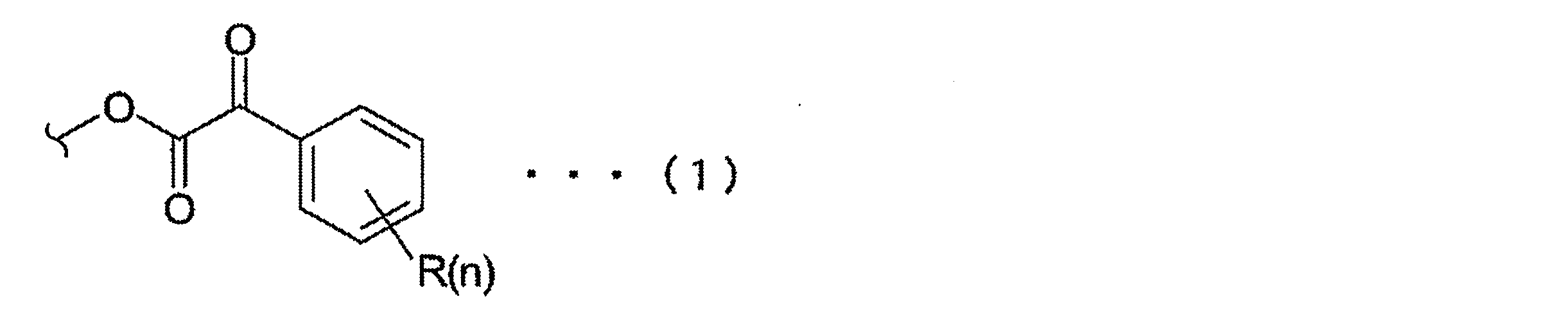
〔式(1)中、Rは、ハロゲン原子、水酸基、アルコキシ基、アルキル基およびフェニル基からなる群から選択される原子または基であり、nは0~5の整数である。ただし、nが2以上である場合、2以上のRの全てが同一であっても、少なくとも1つが異なっていてもよい。〕
<2>前記エチレン性不飽和化合物(B1-1)がカルボキシ基含有モノマーまたはアミド基含有モノマーである、<1>に記載の粘着剤組成物。
<3>前記エチレン性不飽和化合物(B1)における、前記エチレン性不飽和化合物(B1-1)の含有割合が0.1~50重量%である、<1>または<2>に記載の粘着剤組成物。
<4>前記アクリル系樹脂(A)が官能基含有アクリル系樹脂である、<1>~<3>のいずれか一つに記載の粘着剤組成物。
<5>前記エチレン性不飽和化合物(B1)の含有量が、前記アクリル系樹脂(A)100重量部に対して、1~1000重量部である、<1>~<4>のいずれか一つに記載の粘着剤組成物。
<6>前記エチレン性不飽和化合物(B2)の含有量が、前記アクリル系樹脂(A)100重量部に対して、0.01~5重量部である、<1>~<5>のいずれか一つに記載の粘着剤組成物。
<7>前記重合開始剤(C)が、更に、ラジカル開裂型重合開始剤(C2)および水素引き抜き型重合開始剤(C3)(但し、前記重合開始剤(C1)を除く。)の少なくとも1種の重合開始剤を含有する、<1>~<6>のいずれか一つに記載の粘着剤組成物。
<8>前記重合開始剤(C)における、前記重合開始剤(C1)の含有割合が10重量%以上である、<1>~<7>のいずれか一つに記載の粘着剤組成物。
<9>更に、充填剤(D)を含有する、<1>~<8>のいずれか一つに記載の粘着剤組成物。
<10><1>~<9>のいずれか一つに記載の粘着剤組成物が活性エネルギー線照射により硬化された、粘着剤。
<11><10>に記載の粘着剤からなる粘着剤層を有する、粘着シート。
<12>前記粘着剤層の両面に離型シートが積層された両面粘着シートである、<11>に記載の粘着シート。
なお、本発明における「粘着シート」は長尺の粘着テープを概念的に包括する。
また本発明における「粘着剤」は、被着体に適用した際の粘着力がほとんど変わらないものだけでなく、被着体に適用した後に粘着力が増大する接着剤としての機能を有するものも包含する。
また本発明における「粘着剤」は、被着体に適用した際の粘着力がほとんど変わらないものだけでなく、被着体に適用した後に粘着力が増大する接着剤としての機能を有するものも包含する。
本発明の粘着剤組成物は、硬化速度が速く硬化性が良好であり、かかる粘着剤組成物が硬化された粘着剤からなる粘着剤層は、厚膜にした場合でも、被着体(金属、ポリオレフィン等)に対して優れた粘着性を有し、かつ引張強度に優れ、強靭性に優れる。
したがって、当該粘着剤層を有する粘着シートを被着体に貼り付けた後、当該粘着シートを被着体から剥離する際に、当該粘着剤層が厚膜であったとしても、凝集破壊が生じ難く、当該粘着剤層は耐衝撃性に優れる。
以下に記載する構成要件の説明は本発明の実施態様の一例(代表例)であり、本発明はこれらの内容に限定されるものではない。
なお、本発明において、(メタ)アクリルとはアクリルまたはメタクリルを、(メタ)アクリロイルとはアクリロイルまたはメタクリロイルを、(メタ)アクリレートとはアクリレートまたはメタクリレートをそれぞれ意味する。
[粘着剤組成物]
本発明の粘着剤組成物は、アクリル系樹脂(A)、エチレン性不飽和化合物(B)および重合開始剤(C)を含有する。以下、各成分について説明する。
本発明の粘着剤組成物は、アクリル系樹脂(A)、エチレン性不飽和化合物(B)および重合開始剤(C)を含有する。以下、各成分について説明する。
〔アクリル系樹脂(A)〕
本発明で使用されるアクリル系樹脂(A)は、(メタ)アクリル酸アルキルエステル(a1)を必須モノマーとして含有する重合性モノマーを重合して得られる重合体である。アクリル系樹脂(A)は、(メタ)アクリル酸アルキルエステル(a1)の他に官能基含有モノマー(a2)を更に含有する重合性モノマーを重合して得られる官能基含有アクリル系樹脂であることが、部材との密着性、極性基による反応性、および凝集力の上昇による粘着強度をいずれも向上させる点で好ましい。
本発明で使用されるアクリル系樹脂(A)は、(メタ)アクリル酸アルキルエステル(a1)を必須モノマーとして含有する重合性モノマーを重合して得られる重合体である。アクリル系樹脂(A)は、(メタ)アクリル酸アルキルエステル(a1)の他に官能基含有モノマー(a2)を更に含有する重合性モノマーを重合して得られる官能基含有アクリル系樹脂であることが、部材との密着性、極性基による反応性、および凝集力の上昇による粘着強度をいずれも向上させる点で好ましい。
また、上記重合性モノマーは、必要に応じて、他の共重合性モノマー(a3)を含有していてもよい。(メタ)アクリル酸アルキルエステル(a1)、官能基含有モノマー(a2)及び他の共重合性モノマー(a3)は、それぞれ1種または2種以上を用いることができる。
(メタ)アクリル酸アルキルエステル(a1)としては、アルキル基の炭素数が1~20の(メタ)アクリル酸アルキルエステルが好ましく、当該炭素数は特には1~10、更には1~8が好ましい。
(メタ)アクリル酸アルキルエステル(a1)の具体例としては、例えば、ノニル(メタ)アクリレート、n-オクチル(メタ)アクリレート、iso-オクチル(メタ)アクリレート、2-エチルヘキシル(メタ)アクリレート、n-ブチル(メタ)アクリレート、iso-ブチル(メタ)アクリレート、tert-ブチル(メタ)アクリレート、n-プロピル(メタ)アクリレート、メチル(メタ)アクリレート、エチル(メタ)アクリレート等が挙げられ、特には2-エチルヘキシル(メタ)アクリレート、メチル(メタ)アクリレート、エチル(メタ)アクリレート、n-ブチル(メタ)アクリレートが好ましい。
官能基含有モノマー(a2)としては、例えば、カルボキシ基含有モノマー、水酸基含有モノマー、アミノ基含有モノマー、アミド基含有モノマー、オキシアルキレン基含有モノマー、アセトアセチル基含有モノマー、イソシアネート基含有モノマー、グリシジル基含有モノマー、リン酸基含有モノマー、スルホン酸基含有モノマー等が挙げられる。なお、上記カルボキシ基には、カルボキシ基の誘導体である酸無水物基も含まれる。
上記カルボキシ基含有モノマーとしては、例えば、(メタ)アクリル酸、クロトン酸、マレイン酸、無水マレイン酸、フマル酸、シトラコン酸、グルタコン酸、イタコン酸、アクリルアミド-N-グリコール酸、ケイ皮酸、(メタ)アクリル酸のミカエル付加物(例えば、アクリル酸ダイマー、メタクリル酸ダイマー、アクリル酸トリマー、メタクリル酸トリマー、アクリル酸テトラマー、メタクリル酸テトラマー等)、2-(メタ)アクリロイルオキシエチルジカルボン酸モノエステル(例えば、2-アクリロイルオキシエチルコハク酸モノエステル、2-メタクリロイルオキシエチルコハク酸モノエステル、2-アクリロイルオキシエチルフタル酸モノエステル、2-メタクリロイルオキシエチルフタル酸モノエステル、2-アクリロイルオキシエチルヘキサヒドロフタル酸モノエステル、2-メタクリロイルオキシエチルヘキサヒドロフタル酸モノエステル等)等が挙げられ、中でも重合時の安定性の点で(メタ)アクリル酸が好ましく用いられる。
上記水酸基含有モノマーとしては、例えば、2-ヒドロキシエチル(メタ)アクリレート、4-ヒドロキシブチル(メタ)アクリレート、5-ヒドロキシペンチル(メタ)アクリレート、6-ヒドロキシヘキシル(メタ)アクリレート、8-ヒドロキシオクチル(メタ)アクリレート等のヒドロキシアルキル(メタ)アクリレートモノマー;カプロラクトン変性2-ヒドロキシエチル(メタ)アクリレート等のカプロラクトン変性モノマー;ジエチレングリコールモノ(メタ)アクリレート、ポリエチレングリコールモノ(メタ)アクリレート、オクトキシポリエチレングリコール-ポリプロピレングリコール-モノ(メタ)アクリレート、ラウロキシポリエチレングリコール-モノ(メタ)アクリレート、ステアロキシポリエチレングリコールモノ(メタ)アクリレート等のオキシアルキレン変性モノ(メタ)アクリレート系モノマー;2-アクリロイルオキシエチル-2-ヒドロキシエチルフタル酸、N-メチロール(メタ)アクリルアミド、ヒドロキシエチルアクリルアミド等の1級水酸基含有(メタ)アクリレートモノマー;2-ヒドロキシプロピル(メタ)アクリレート、2-ヒドロキシブチル(メタ)アクリレート、3-クロロ-2-ヒドロキシプロピル(メタ)アクリレート等の2級水酸基含有(メタ)アクリレートモノマー;2,2-ジメチル2-ヒドロキシエチル(メタ)アクリレート等の3級水酸基含有(メタ)アクリレートモノマー、テトラヒドロフルフリルアクリレート、2-ヒドロキシ3-フェノキシプロピル(メタ)アクリレート等が挙げられる。
上記アミノ基含有モノマーとしては、例えば、アミノメチル(メタ)アクリレート、アミノエチル(メタ)アクリレート等のアミノアルキル(メタ)アクリレート等の1級アミノ基含有モノマー;tert-ブチルアミノエチル(メタ)アクリレート等の2級アミノ基含有モノマー;ジメチルアミノエチル(メタ)アクリレート、ジエチルアミノエチル(メタ)アクリレート等のジアルキルアミノエチル(メタ)アクリレート等の3級アミノ基含有モノマー;(メタ)アクリロイルモルホリン等の複素環式アミン構造含有モノマー、更にこれらの4級化物等が挙げられる。
上記アミド基含有モノマーとしては、例えば、(メタ)アクリルアミド;N-メトキシメチル(メタ)アクリルアミド、N-エトキシメチル(メタ)アクリルアミド、N-プロポキシメチル(メタ)アクリルアミド、N-イソプロポキシメチル(メタ)アクリルアミド、N-(n-ブトキシメチル)(メタ)アクリルアミド、N-イソブトキシメチル(メタ)アクリルアミド等のN-アルコキシアルキル(メタ)アクリルアミド;N,N-ジメチル(メタ)アクリルアミド、N,N-ジエチル(メタ)アクリルアミド等のN,N-ジアルキル(メタ)アクリルアミド;N,N-ジメチルアミノプロピル(メタ)アクリルアミド等のN,N-ジアルキルアミノアルキル(メタ)アクリルアミド;N-アクリロイルモルホリン等の環状構造含有アミド等が挙げられる。
上記オキシアルキレン基含有モノマーとしては、例えば、2-メトキシエチル(メタ)アクリレート、3-メトキシエチル(メタ)アクリレート、2-エトキシエチル(メタ)アクリレート、3-メトキシブチル(メタ)アクリレート、2-ブトキシエチル(メタ)アクリレート等のアルコキシアルキルモノ(メタ)アクリレート類、2-ブトキシジエチレングリコール(メタ)アクリレート、メトキシジエチレングリコール(メタ)アクリレート、メトキシトリエチレングリコール(メタ)アクリレート、エトキシジエチレングリコール(メタ)アクリレート、メトキシジプロピレングリコール(メタ)アクリレート、メトキシポリエチレングリコール(メタ)アクリレート、オクトキシポリエチレングリコール-ポリプロピレングリコールモノ(メタ)アクリレート、ラウロキシポリエチレングリコールモノ(メタ)アクリレート、ステアロキシポリエチレングリコールモノ(メタ)アクリレート等のアルコキシ(ポリ)アルキレングリコールモノ(メタ)アクリレート類等の脂肪族系の(メタ)アクリル酸エステル;2-フェノキシエチル(メタ)アクリレート、フェノキシポリエチレングリコール(メタ)アクリレート、フェノキシポリエチレングリコール-ポリプロピレングリコール(メタ)アクリレート、ノニルフェノールエチレンオキサイド付加物(メタ)アクリレート等の芳香族系の(メタ)アクリル酸エステル等が挙げられる。
上記アセトアセチル基含有モノマーとしては、例えば、2-(アセトアセトキシ)エチル(メタ)アクリレート、アリルアセトアセテート等が挙げられる。
上記イソシアネート基含有モノマーとしては、例えば、2-(メタ)アクリロイルオキシエチルイソシアネートやそのアルキレンオキサイド付加物等が挙げられる。
上記グリシジル基含有モノマーとしては、例えば、(メタ)アクリル酸グリシジル、(メタ)アクリル酸アリルグリシジル等が挙げられる。
上記リン酸基含有モノマーとしては、例えば、2-(メタ)アクリロイルオキシエチルアシッドホスフェート、ビス(2-(メタ)アクリロイルオキシエチル)アシッドホスフェート、ポリエチレングリコールモノメタクリレートのリン酸エステル、ポリエチレングリコールモノアクリレートのリン酸エステル、ポリプロピレングリコールモノメタクリレートのリン酸エステル、ポリプロピレングリコールモノアクリレートのリン酸エステル等のポリアルキレングリコールモノ(メタ)アクリレートのリン酸エステル、リン酸メチレン(メタ)アクリレート、リン酸トリメチレン(メタ)アクリレート、リン酸プロピレン(メタ)アクリレート、リン酸テトラメチレン(メタ)アクリレート等のリン酸アルキレン(メタ)アクリレート等が挙げられる。
上記スルホン酸基含有モノマーとしては、例えば、エチレンスルホン酸、アリルスルホン酸、メタアリルスルホン酸等のオレフィンスルホン酸、2-アクリルアミド-2-メチルプロパンスルホン酸、スチレンスルホン酸またはその塩等が挙げられる。
他の共重合性モノマー(a3)としては、例えば、N-アクリルアミドメチルトリメチルアンモニウムクロライド、アリルトリメチルアンモニウムクロライド、ジメチルアリルビニルケトン等のアリル化合物類;N-ビニルピロリドン、プロピオン酸ビニル、ステアリン酸ビニル、塩化ビニル、塩化ビニリデン、酢酸ビニル、スチレン等のビニル系モノマー;上記(メタ)アクリル酸アルキルエステル(a1)以外の(メタ)アクリル酸アルキルエステル等が挙げられる。
上記の(メタ)アクリル酸アルキルエステル(a1)、官能基含有モノマー(a2)、必要に応じて他の共重合性モノマー(a3)を更に含有する重合性モノマーを(共)重合して、アクリル系樹脂(A)が得られる。
アクリル系樹脂(A)の重合に際しては、例えば、溶液ラジカル重合、懸濁重合、塊状重合、乳化重合等の従来公知の方法を採用することができる。中でも、安全に、安定的に、また任意のモノマー組成でアクリル系樹脂を製造できる点で、アクリル系樹脂(A)は、溶液ラジカル重合により得られる溶剤系のアクリル系樹脂であることが好ましい。
例えば、有機溶剤中に、(メタ)アクリル酸アルキルエステル(a1)および官能基含有モノマー(a2)、必要に応じて他の共重合性モノマー(a3)を更に含む重合性モノマー、重合開始剤を混合あるいは滴下し、還流状態あるいは50~99℃で2~20時間重合を行なうことにより溶剤系のアクリル系樹脂(A)が得られる。
本発明におけるアクリル系樹脂(A)の重量平均分子量(Mw)は、通常10万~250万であり、好ましくは20万~220万、特に好ましくは40万~200万である。重量平均分子量が小さすぎると、活性エネルギー線照射によって得られる粘着剤の凝集力が低下する傾向があり、重量平均分子量が大きすぎると、均一に相溶した粘着剤組成物が得難くなる傾向がある。
また、アクリル系樹脂(A)の分散度(重量平均分子量/数平均分子量)は、通常20以下であり、好ましくは15以下、特に好ましくは10以下であり、分散度の下限は通常1.1である。分散度が高すぎると、凝集力や粘着物性の活性エネルギー線照射条件による振れが大きくなる傾向がある。
なお、上記の重量平均分子量は、標準ポリスチレン分子量換算による重量平均分子量であり、高速液体クロマトグラフィー(日本Waters社製、「Waters 2695(本体)」と「Waters 2414(検出器)」)に、3本直列のカラム:Shodex GPC KF-806L(排除限界分子量:2×10⁷、分離範囲:100~2×10⁷、理論段数:10,000段/本、充填剤材質:スチレン-ジビニルベンゼン共重合体、充填剤粒径:10μm)を用いることにより測定されるものである。数平均分子量も同様の方法で測定することができる。
また、測定に際してポリマーを誘導体化してもよいし、溶離液の種類を適宜変更してもよい。
また、測定に際してポリマーを誘導体化してもよいし、溶離液の種類を適宜変更してもよい。
アクリル系樹脂(A)のガラス転移温度(Tg)は、-70~20℃であることが好ましく、特に好ましくは-60~0℃、更に好ましくは-55~-10℃である。アクリル系樹脂(A)のガラス転移温度(Tg)が低すぎると、凝集力が低下する傾向があり、アクリル系樹脂(A)のガラス転移温度(Tg)が高すぎると、粘着剤の脆質化を招く傾向がある。
なお、ガラス転移温度は下記のFoxの式より算出されるものである。

Tg:アクリル系樹脂(A)のガラス転移温度(K)
Tga:モノマーAのホモポリマーのガラス転移温度(K)
Wa:モノマーAの重量分率
Tgb:モノマーBのホモポリマーのガラス転移温度(K)
Wb:モノマーBの重量分率
Tgn:モノマーNのホモポリマーのガラス転移温度(K)
Wn:モノマーNの重量分率(Wa+Wb+・・・+Wn=1)
Tga:モノマーAのホモポリマーのガラス転移温度(K)
Wa:モノマーAの重量分率
Tgb:モノマーBのホモポリマーのガラス転移温度(K)
Wb:モノマーBの重量分率
Tgn:モノマーNのホモポリマーのガラス転移温度(K)
Wn:モノマーNの重量分率(Wa+Wb+・・・+Wn=1)
即ち、アクリル系樹脂(A)のガラス転移温度(Tg)は、アクリル系樹脂(A)を構成するそれぞれのモノマーをホモポリマーとした際のガラス転移温度および重量分率をFoxの式に当てはめて算出した値である。
なお、アクリル系樹脂(A)を構成するモノマーをホモポリマーとした際のガラス転移温度は、通常、示差走査熱量計(DSC)により測定されるものであり、JIS K7121-1987や、JIS K 6240に準拠した方法で測定することができる。
本発明の粘着剤組成物中のアクリル系樹脂(A)の含有量は、粘着剤組成物全量に対して、1~99重量%であることが好ましく、特に好ましくは5~80重量%、更に好ましくは7~70重量%である。アクリル系樹脂(A)の含有割合が高すぎると、加工性(ハンドリング性)が低下したり、後述の充填剤(D)を配合する際の充填剤(D)の分散性が低下して混合が困難になったり、反応性が低下したりする傾向がある。また、アクリル系樹脂(A)の含有割合が低すぎると、加工性が低下して粘着剤層を厚膜に作製するのが困難となったり、充填剤(D)の分散性が低下して充填剤(D)が沈殿または浮遊したりする傾向がある。
〔エチレン性不飽和化合物(B)〕
本発明で使用されるエチレン性不飽和化合物(B)は、1つのエチレン性不飽和基を有するエチレン性不飽和化合物(B1)および2つ以上のエチレン性不飽和基を有するエチレン性不飽和化合物(B2)を含有する。
本発明で使用されるエチレン性不飽和化合物(B)は、1つのエチレン性不飽和基を有するエチレン性不飽和化合物(B1)および2つ以上のエチレン性不飽和基を有するエチレン性不飽和化合物(B2)を含有する。
まず、1つのエチレン性不飽和基を有するエチレン性不飽和化合物(B1)について説明する。なお、本明細書では、1つのエチレン性不飽和基を有するエチレン性不飽和化合物(B1)を「単官能モノマー(B1)」、2つ以上のエチレン性不飽和基を有するエチレン性不飽和化合物(B2)を「多官能モノマー(B2)」と表記することもある。
<単官能モノマー(B1)>
単官能モノマー(B1)は、極性基および1つのエチレン性不飽和基を有するエチレン性不飽和化合物(B1-1)(以下、「単官能モノマー(B1-1)」と称することがある。)と、炭素数1~20のアルキル基および1つのエチレン性不飽和基を有するエチレン性不飽和化合物(B1-2)(以下、「単官能モノマー(B1-2)」と称することがある。)を含有する。単官能モノマー(B1-1)および(B1-2)は、いずれも1種または2種以上を用いることができる。
単官能モノマー(B1)は、極性基および1つのエチレン性不飽和基を有するエチレン性不飽和化合物(B1-1)(以下、「単官能モノマー(B1-1)」と称することがある。)と、炭素数1~20のアルキル基および1つのエチレン性不飽和基を有するエチレン性不飽和化合物(B1-2)(以下、「単官能モノマー(B1-2)」と称することがある。)を含有する。単官能モノマー(B1-1)および(B1-2)は、いずれも1種または2種以上を用いることができる。
[単官能モノマー(B1-1)]
単官能モノマー(B1-1)における極性基としては、例えば、カルボキシ基、水酸基、アミノ基、アミド基、オキシアルキレン基、アセトアセチル基、イソシアネート基、グリシジル基、リン酸基、スルホン酸基等が挙げられる。前記カルボキシ基には、カルボキシ基の誘導体である酸無水物基も含まれる。エチレン性不飽和基としては、反応性の点で(メタ)アクリロイル基が好ましい。
単官能モノマー(B1-1)における極性基としては、例えば、カルボキシ基、水酸基、アミノ基、アミド基、オキシアルキレン基、アセトアセチル基、イソシアネート基、グリシジル基、リン酸基、スルホン酸基等が挙げられる。前記カルボキシ基には、カルボキシ基の誘導体である酸無水物基も含まれる。エチレン性不飽和基としては、反応性の点で(メタ)アクリロイル基が好ましい。
単官能モノマー(B1-1)としては、例えば、カルボキシ基含有モノマー、水酸基含有モノマー、アミノ基含有モノマー、アミド基含有モノマー、オキシアルキレン基含有モノマー、アセトアセチル基含有モノマー、イソシアネート基含有モノマー、グリシジル基含有モノマー、リン酸基含有モノマー、スルホン酸基含有モノマー等が挙げられ、具体例としては、上述した官能基含有モノマー(a2)と同様のものが例示できる。
単官能モノマー(B1-1)としては、反応性の点でカルボキシ基含有モノマー、アミド基含有モノマーが好ましく、特には粘着力の点で(メタ)アクリル酸が好ましく、アクリル酸がより好ましい。
単官能モノマー(B1)における、単官能モノマー(B1-1)の含有割合は、好ましくは0.1~50重量%であり、特に好ましくは1~40重量%、更に好ましくは5~20重量%である。単官能モノマー(B1-1)の含有割合が多すぎると、部材の汚染、耐候性や粘着性の低下を招く傾向があり、単官能モノマー(B1-1)の含有割合が少なすぎると、硬化性が低下し強度低下を招く傾向がある。
[単官能モノマー(B1-2)]
単官能モノマー(B1-2)における炭素数1~20のアルキル基は直鎖状、分枝状または脂環式のいずれでもよい。また、エチレン性不飽和基としては、反応性の点で(メタ)アクリロイル基が好ましい。
単官能モノマー(B1-2)における炭素数1~20のアルキル基は直鎖状、分枝状または脂環式のいずれでもよい。また、エチレン性不飽和基としては、反応性の点で(メタ)アクリロイル基が好ましい。
アルキル基が直鎖状または分枝状である場合、アルキル基の炭素数は、好ましくは2~20、特に好ましくは4~18、更に好ましくは4~10である。
直鎖状または分枝状のアルキル基を有する単官能モノマー(B1-2)としては、例えば、メチル(メタ)アクリレート、エチル(メタ)アクリレート、n-プロピル(メタ)アクリレート、n-ブチル(メタ)アクリレート、iso-ブチル(メタ)アクリレート、tert-ブチル(メタ)アクリレート、n-ヘキシル(メタ)アクリレート、n-オクチル(メタ)アクリレート、iso-オクチル(メタ)アクリレート、2-エチルヘキシル(メタ)アクリレート、ノニル(メタ)アクリレート、n-デシル(メタ)アクリレート、iso-デシル(メタ)アクリレート、ラウリル(メタ)アクリレート、セチル(メタ)アクリレート、n-ステアリル(メタ)アクリレート、iso-ステアリル(メタ)アクリレート等が挙げられる。これらの中でも、n-オクチル(メタ)アクリレート、2-エチルヘキシル(メタ)アクリレート、n-ブチル(メタ)アクリレートが好ましく用いられる。
アルキル基が脂環式である場合、アルキル基の炭素数は、好ましくは4~20、特に好ましくは6~10である。
脂環式のアルキル基を有する単官能モノマー(B1-2)としては、例えば、シクロペンチル(メタ)アクリレート、シクロヘキシル(メタ)アクリレート、トリシクロデカニル(メタ)アクリレート、2-メチルシクロヘキシル(メタ)アクリレート、トリシクロ[5.2.1.02,6]デカン-8-イル(メタ)アクリレート、ジシクロペンタニル(メタ)アクリレート、ジシクロペンテニル(メタ)アクリレート、2-ジシクロペンタニルオキシエチル(メタ)アクリレート、イソボロニル(メタ)アクリレート、4-tert-ブチルシクロヘキシル(メタ)アクリレート、1,4-シクロヘキサンジメタノールモノ(メタ)アクリレート等が挙げられる。これらの中でも、アクリル系樹脂(A)との相溶性が優れる点で、シクロヘキシル(メタ)アクリレート、ジシクロペンタニル(メタ)アクリレート、ジシクロペンテニル(メタ)アクリレートが好ましく、特に好ましくは、シクロヘキシルアクリレートである。
なお、炭素数1~20のアルキル基および1つのエチレン性不飽和基を有するエチレン性不飽和化合物であって、更に極性基を有するエチレン性不飽和化合物は、本発明では単官能モノマー(B1-1)に分類される。
単官能モノマー(B1)における、単官能モノマー(B1-2)の含有割合は、好ましくは50~99重量%であり、特に好ましくは70~98重量%、更に好ましくは80~95重量%である。単官能モノマー(B1-2)の含有割合が多すぎると、極性の低下によって、部材との密着性や反応性の低下を招く傾向があり、単官能モノマー(B1-2)の含有割合が少なすぎると、耐候性の低下、部材の汚染を招く傾向がある。
単官能モノマー(B1)は、単官能モノマー(B1-1)および(B1-2)以外に、1つのエチレン性不飽和基を有する他のエチレン性不飽和化合物を含有していてもよい。
本発明の粘着剤組成物中の単官能モノマー(B1)の含有量は、アクリル系樹脂(A)100重量部に対して、好ましくは1~1000重量部であり、より好ましくは50~800重量部、特に好ましくは150~500重量部、更に好ましくは200~300重量部である。単官能モノマー(B1)の含有量が多すぎると、加工性が低下して粘着剤層を厚膜に作製するのが困難となったり、後述の充填剤(D)の分散性が低下して充填剤(D)が沈殿または浮遊したりする傾向がある。単官能モノマー(B1)の含有量が少なすぎると、加工性(ハンドリング性)が低下したり、充填剤(D)の分散性が低下して混合が困難になったり、反応性が低下したりする傾向がある。
また、エチレン性不飽和化合物(B)における、単官能モノマー(B1)の含有割合は、好ましくは20~99重量%であり、特に好ましくは50~98重量%、更に好ましくは60~97重量%である。単官能モノマー(B1)の含有割合が多すぎると、硬化性が低下し、強度低下を招く傾向があり、単官能モノマー(B1)の含有割合が少なすぎると、粘着力が低下する傾向がある。
<多官能モノマー(B2)>
多官能モノマー(B2)は、1分子内にエチレン性不飽和基を2個以上含有する。多官能モノマー(B2)としては、例えば、2官能の(メタ)アクリレート系モノマー、3官能以上の(メタ)アクリレート系モノマー、ウレタン(メタ)アクリレート系化合物、エポキシ(メタ)アクリレート系化合物、ポリエステル(メタ)アクリレート系化合物を用いることができる。これらのうち1種または2種以上を用いることができる。
多官能モノマー(B2)は、1分子内にエチレン性不飽和基を2個以上含有する。多官能モノマー(B2)としては、例えば、2官能の(メタ)アクリレート系モノマー、3官能以上の(メタ)アクリレート系モノマー、ウレタン(メタ)アクリレート系化合物、エポキシ(メタ)アクリレート系化合物、ポリエステル(メタ)アクリレート系化合物を用いることができる。これらのうち1種または2種以上を用いることができる。
2官能の(メタ)アクリレート系モノマーとしては、(メタ)アクリロイル基を2つ含有するモノマーであればよく、例えば、エチレングリコールジ(メタ)アクリレート、ジエチレングリコールジ(メタ)アクリレート、テトラエチレングリコールジ(メタ)アクリレート、ポリエチレングリコールジ(メタ)アクリレート、プロピレングリコールジ(メタ)アクリレート、ジプロピレングリコールジ(メタ)アクリレート、ポリプロピレングリコールジ(メタ)アクリレート、ブチレングリコールジ(メタ)アクリレート、ネオペンチルグリコールジ(メタ)アクリレート、エチレンオキサイド変性ビスフェノールA型ジ(メタ)アクリレート、プロピレンオキサイド変性ビスフェノールA型ジ(メタ)アクリレート、1,6-ヘキサンジオールジ(メタ)アクリレート、1,6-ヘキサンジオールエチレンオキサイド変性ジ(メタ)アクリレート、グリセリンジ(メタ)アクリレート、ペンタエリスリトールジ(メタ)アクリレート、エチレングリコールジグリシジルエーテルジ(メタ)アクリレート、ジエチレングリコールジグリシジルエーテルジ(メタ)アクリレート、フタル酸ジグリシジルエステルジ(メタ)アクリレート、ヒドロキシピバリン酸変性ネオペンチルグリコールジ(メタ)アクリレート、イソシアヌル酸エチレンオキサイド変性ジアクリレート、2-(メタ)アクリロイルオキシエチルアシッドホスフェートジエステル等が挙げられる。
3官能以上の(メタ)アクリレート系モノマーとしては、(メタ)アクリロイル基を3つ以上含有するモノマーであればよく、例えば、トリメチロールプロパントリ(メタ)アクリレート、ペンタエリスリトールトリ(メタ)アクリレート、ペンタエリスリトールテトラ(メタ)アクリレート、ジペンタエリスリトールトリ(メタ)アクリレート、ジペンタエリスリトールテトラ(メタ)アクリレート、ジペンタエリスリトールペンタ(メタ)アクリレート、ジペンタエリスリトールヘキサ(メタ)アクリレート、トリ(メタ)アクリロイルオキシエトキシトリメチロールプロパン、グリセリンポリグリシジルエーテルポリ(メタ)アクリレート、イソシアヌル酸エチレンオキサイド変性トリ(メタ)アクリレート、エチレンオキサイド変性ジペンタエリスリトールペンタ(メタ)アクリレート、エチレンオキサイド変性ジペンタエリスリトールヘキサ(メタ)アクリレート、エチレンオキサイド変性ペンタエリスリトールトリ(メタ)アクリレート、エチレンオキサイド変性ペンタエリスリトールテトラ(メタ)アクリレート、コハク酸変性ペンタエリスリトールトリ(メタ)アクリレート等が挙げられる。
ウレタン(メタ)アクリレート系化合物としては、分子内にウレタン結合を有する(メタ)アクリレート系化合物であり、水酸基を含有する(メタ)アクリル系化合物と多価イソシアネート系化合物(必要に応じて、ポリオール系化合物)を公知一般の方法により反応させて得られるものが用いられる。その重量平均分子量は、通常300~4000である。
本発明の粘着剤組成物中の多官能モノマー(B2)の含有量は、アクリル系樹脂(A)100重量部に対して、好ましくは0.01~5重量部であり、特に好ましくは0.05~1重量部、更に好ましくは0.1~0.5重量部である。多官能モノマー(B2)の含有量が多すぎると粘着力が低下する傾向があり、多官能モノマー(B2)の含有量が少なすぎると凝集力が低下する傾向がある。
また、エチレン性不飽和化合物(B)における、多官能モノマー(B2)の含有割合は、好ましくは0.01~30重量%であり、特に好ましくは0.05~10重量%、更に好ましくは0.08~5重量%である。多官能モノマー(B2)の含有割合が多すぎると、硬くなりすぎて粘着力が低下する傾向があり、単官能モノマー(B2)の含有割合が少なすぎると、強度低下を招く傾向がある。
〔重合開始剤(C)〕
本発明で使用される重合開始剤(C)は、分子内に下記式(1)で示される構造部位を1つ以上有する重合開始剤(C1)を含有する。
本発明で使用される重合開始剤(C)は、分子内に下記式(1)で示される構造部位を1つ以上有する重合開始剤(C1)を含有する。
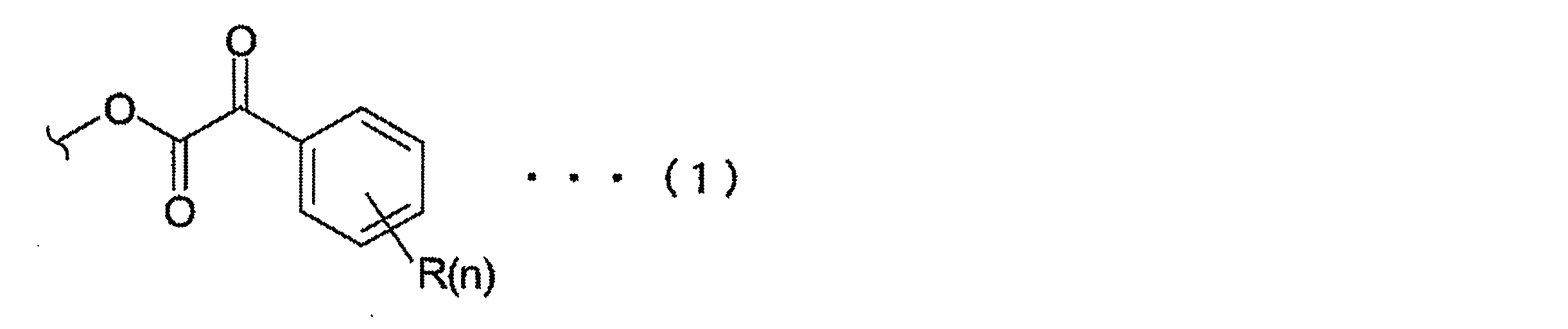
上記式(1)中、Rはベンゼン環の置換基であり、ハロゲン原子、水酸基、アルコキシ基、アルキル基およびフェニル基からなる群から選択される原子または基である。
アルキル基としては、例えば、メチル基、エチル基、n-またはiso-プロピル基、n-またはtert-ブチル基、n-ヘキシル基、シクロヘキシル基等の炭素数1~12の直鎖状、分岐状または環状のアルキル基等が挙げられる。アルコキシ基としては、例えば、メトキシ基、エトキシ基、n-またはiso-プロポキシ基、n-またはtert-ブトキシ基、n-ヘキシルオキシ基、シクロヘキシルオキシ基等の炭素数1~12の直鎖状、分岐状または環状のアルコキシ基等が挙げられる。
また、nは0~5の整数であり、ベンゼン環の5つの水素原子のうちいずれが置換されていてもよい。ただし、nが2以上である場合、2以上のRの全てが同一であっても、少なくとも1つが異なっていてもよい。
本発明においては、上記式(1)中のnが0である構造、即ちベンゼン環のいずれの水素原子も置換されていない構造が好ましい。
本発明においては、上記式(1)中のnが0である構造、即ちベンゼン環のいずれの水素原子も置換されていない構造が好ましい。
重合開始剤(C1)は、水素引き抜き型重合開始剤であり、分子中の水素を引抜き、ラジカルを発生させることができる。そのため、本発明で使用される重合開始剤(C)が重合開始剤(C1)を含有すると、重合開始剤(C1)がモノマーの不飽和基と反応する他に、重合後のポリマー中の水素を引抜き反応し、架橋構造を形成するため、重合後の粘着剤の強度を高くすることができる。
重合開始剤(C1)としては、例えば、オキシフェニル酢酸2-(2-オキソ-2-フェニルアセトキシエトキシ)エチルエステル(例えば、IGM Resins B.V.社製「Omnirad 754」)、オキシフェニル酢酸2-(2-ヒドロキシエトキシ)エチルエステル等が挙げられ、特にオキシフェニル酢酸2-(2-オキソ-2-フェニルアセトキシエトキシ)エチルエステル(例えば、IGM Resins B.V.社製「Omnirad 754」)が好ましい。
重合開始剤(C)は、更に、ラジカル開裂型重合開始剤(C2)および水素引き抜き型重合開始剤(C3)(但し、重合開始剤(C1)を除く。)の少なくとも1種の重合開始剤を含有することが好ましい。
ラジカル開裂型重合開始剤(C2)としては、例えば、4-フェノキシジクロロアセトフェノン、4-tert-ブチル-ジクロロアセトフェノン、ジエトキシアセトフェノン、2-ヒドロキシ-2-メチル-1-フェニルプロパン-1-オン、1-(4-イソプロピレンフェニル)-2-ヒドロキシ-2-メチルプロパン-1-オン、1-(4-ドデシルフェニル)-2-ヒドロキシ-2-メチルプロパン-1-オン、4-(2-ヒドロキシエトキシ)-フェニル(2-ヒドロキシ-2-プロピル)ケトン、1-ヒドロキシシクロヘキシルフェニルケトン(例えば、IGM Resins B.V.社製「Omnirad 184」)、2-メチル-1-〔4-(メチルチオ)フェニル〕-2-モルホリノプロパン-1-オン、ベンゾイン、ベンゾインメチルエーテル、ベンゾインエチルエーテル、ベンゾインイソプロピルエーテル、ベンゾインイソブチルエーテル、ベンジルジメチルケタール、α-アシロキシムエステル、アシルホスフィンオキサイド、メチルフェニルグリオキシレート、4-(2-ヒドロキシエトキシ)フェニル-(2-ヒドロキシ-2-プロピル)ケトン、4-ベンゾイル-4′-メチルジフェニルサルファイド等が挙げられる。これらの中でも1-ヒドロキシシクロヘキシルフェニルケトン(例えば、IGM Resins B.V.社製「Omnirad 184」)、2-ヒドロキシ-2-メチル-1-フェニルプロパン-1-オンが好適である。これらのうち1種または2種以上を用いることができる。
水素引き抜き型重合開始剤(C3)としては、例えば、2,2-ジエトキシアセトフェノン、2-ヒドロキシ-2-メチル-1-フェニルプロパン-1-オン、2,2-ジメトキシ-1,2-ジフェニルエタン-1-オン、4-(2-ヒドロキシエトキシ)フェニル-(2-ヒドロキシ-2-プロピル)ケトン、2-メチル-2-モルホリノ(4-チオメチルフェニル)プロパン-1-オン、2-ベンジル-2-ジメチルアミノ-1-(4-モルホリノフェニル)ブタノン、2-ヒドロキシ-2-メチル-1-[4-(1-メチルビニル)フェニル]プロパノンオリゴマー等のアセトフェノン類;ベンゾイン、ベンゾインメチルエーテル、ベンゾインエチルエーテル、ベンゾインイソプロピルエーテル、ベンゾインイソブチルエーテル等のベンゾイン類;ベンゾフェノン、ベンゾイル安息香酸、ヒドロキシベンゾフェノン、3,3′-ジメチル-4-メトキシベンゾフェノン、4-メチルベンゾフェノン、o-ベンゾイル安息香酸メチル、4-フェニルベンゾフェノン、4-ベンゾイル-4′-メチル-ジフェニルサルファイド、3,3′,4,4′-テトラ(tert-ブチルパーオキシカルボニル)ベンゾフェノン、2,4,6-トリメチルベンゾフェノン、4-ベンゾイル-N,N-ジメチル-N-[2-(1-オキソ-2-プロペニルオキシ)エチル]ベンゼンメタナミニウムブロミド、(4-ベンゾイルベンジル)トリメチルアンモニウムクロリド、4-メタクリロイルオキシベンゾフェノン等のベンゾフェノン類;チオキサンソン、2-クロルチオキサンソン、2-メチルチオキサンソン、2,4-ジメチルチオキサンソン、イソプロピルチオキサンソン、2-イソプロピルチオキサントン、4-イソプロピルチオキサントン、2,4-ジエチルチオキサントン、2,4-ジクロロチオキサントン、1-クロロ-4-プロポキシチオキサントン、2-(3-ジメチルアミノ-2-ヒドロキシ)-3,4-ジメチル-9H-チオキサントン-9-オンメソクロリド等のチオキサントン類;2,4,6-トリメチルベンゾイル-ジフェニルフォスフィンオキサイド、ビス(2,6-ジメトキシベンゾイル)-2,4,4-トリメチル-ペンチルフォスフィンオキサイド、ビス(2,4,6-トリメチルベンゾイル)-フェニルフォスフィンオキサイド等のアシルフォスフォンオキサイド類;カンファーキノン、ジベンゾスベロン、2-エチルアンスラキノン、2-(フェニル)-2-オキソエタン酸メチル、9,10-フェナンスレンキノン等が挙げられる。これらの中でもベンゾフェノン、4-メチルベンゾフェノン、2,4,6-トリメチルベンゾフェノンが好ましい。これらのうち1種または2種以上を用いることができる。
また、重合開始剤(C)の助剤として、例えば、トリエタノールアミン、トリイソプロパノールアミン、4,4′-ジメチルアミノベンゾフェノン(ミヒラーケトン)、4,4′-ジエチルアミノベンゾフェノン、2-ジメチルアミノエチル安息香酸、4-ジメチルアミノ安息香酸エチル、4-ジメチルアミノ安息香酸(n-ブトキシ)エチル、4-ジメチルアミノ安息香酸イソアミル、4-ジメチルアミノ安息香酸2-エチルヘキシル、2,4-ジエチルチオキサンソン、2,4-ジイソプロピルチオキサンソン等を併用することも可能である。
重合開始剤(C)における重合開始剤(C1)の含有割合は、好ましくは10重量%以上であり、特に好ましくは20~80重量%、更に好ましくは30~70重量%である。
重合開始剤(C)におけるラジカル開裂型重合開始剤(C2)の含有割合は、好ましくは0.001~50重量%であり、特に好ましくは10~40重量%、更に好ましくは15~30重量%である。
重合開始剤(C)における水素引き抜き型重合開始剤(C3)の含有割合は、好ましくは0.001~50重量%であり、特に好ましくは10~45重量%、更に好ましくは15~40重量%である。
重合開始剤(C)がラジカル開裂型重合開始剤(C2)および水素引き抜き型重合開始剤(C3)のうち少なくとも一方を含有する場合、ラジカル開裂型重合開始剤(C2)と水素引き抜き型重合開始剤(C3)の含有割合〔ラジカル開裂型重合開始剤(C2)の重量:水素引き抜き型重合開始剤(C3)の重量〕は、好ましくは0:100~100:0であり、より好ましくは20:80~80:20、更に好ましくは30:70~70:30である。
本発明の粘着剤組成物中の重合開始剤(C)の含有量は、アクリル系樹脂(A)100重量部に対して、好ましくは0.01~10重量部であり、特に好ましくは0.04~5重量部、更に好ましくは0.1~2重量部である。重合開始剤(C)の含有量が多すぎると、着色したり、耐候性が低下したりする傾向があり、重合開始剤(C)の含有量が少なすぎると、反応性の低下による強度低下を招く傾向がある。
なお、上記重合開始剤(C1)~(C3)は、いずれも活性エネルギー線照射により重合を開始するための光重合開始剤であるが、必要に応じて、活性エネルギー線照射による硬化に加えて加熱による硬化を行うこともできる。その際には、重合開始剤(C1)~(C3)と熱重合開始剤を併用してもよい。
熱重合開始剤としては、例えば、有機過酸化物系開始剤やアゾ系開始剤等の公知一般の熱ラジカル重合開始剤を用いることができる。これらのうち1種または2種以上を用いることができる。
〔充填剤(D)〕
本発明の粘着剤組成物は、更に、充填剤(D)を含有することが好ましい。粘着剤組成物が充填剤(D)を含有することにより、粘着剤組成物の溶液の見かけ粘度が低下し、成型性(粘着シートの生産性:塗工性)を向上させることができる。また、硬化後の粘着剤層の強度も向上させることができる。
本発明の粘着剤組成物は、更に、充填剤(D)を含有することが好ましい。粘着剤組成物が充填剤(D)を含有することにより、粘着剤組成物の溶液の見かけ粘度が低下し、成型性(粘着シートの生産性:塗工性)を向上させることができる。また、硬化後の粘着剤層の強度も向上させることができる。
充填剤(D)としては、例えば、中空粒子、シリカやアルミナ等の無機微粒子、ガラス粒子、金属微粒子、ポリマー粒子、ゴム粒子等が挙げられる。充填剤(D)は単独でまたは2種以上を組み合わせて用いることができる。
中空粒子としては、シラス、バーライト、ガラス、シリカ、フラッシュアイ等のケイ酸系中空粒子;アルミナ、ジルコニア、カーボン等の非ケイ酸系中空粒子;フェノール樹脂、エポキシ樹脂、尿素樹脂等の熱硬化性樹脂系中空粒子;ポリ塩化ビニリデン、ポリスチレン、ポリメチルメタクリレート、ポリアクリロニトリル、これらの共重合体等の熱可塑性樹脂系中空粒子等が挙げられる。
中空粒子の平均粒径(D50)は、好ましくは1~500μmであり、特に好ましくは5~200μmであり、更に好ましくは20~80μmである。中空粒子の平均粒径(D50)は、レーザー散乱型粒度分布測定装置を用いて測定される。
中空粒子の比重は、好ましくは0.1~0.8g/cm3であり、特に好ましくは0.15~0.5g/cm3である。
本発明の粘着剤組成物中の充填剤(D)の含有量は、アクリル系樹脂(A)100重量部に対して、好ましくは0.5~30重量部であり、特に好ましくは1~28重量部、更に好ましくは5~25重量部である。充填剤(D)の含有量が多すぎると、粘着剤が脆弱になったり、硬化の阻害により反応性や粘着性が低下したりする傾向があり、充填剤(D)の含有量が少なすぎると、粘着剤強度の低下によりせん断接着強度が低下する傾向がある。
〔架橋剤〕
本発明の粘着剤組成物は、必要に応じて、本発明の効果を損なわない範囲内で架橋剤を含有していてもよい。
本発明の粘着剤組成物は、必要に応じて、本発明の効果を損なわない範囲内で架橋剤を含有していてもよい。
架橋剤としては、イソシアネート系、エポキシ系、金属塩、金属アルコシド、アルデヒド系化合物、非アミノ樹脂系アミノ化合物、尿素系、金属キレート系、メラミン系、アジリジン系等、一般的に使用される架橋剤を挙げることができる。
〔その他の添加剤〕
また、本発明の粘着剤組成物は、本発明の効果を損なわない範囲において、その他のアクリル系粘着剤、その他の粘着剤、ウレタン樹脂、ロジン、ロジンエステル、水添ロジンエステル、フェノール樹脂、芳香族変性テルペン樹脂、脂肪族系石油樹脂、脂環族系石油樹脂、スチレン系樹脂、キシレン系樹脂等の粘着付与剤、帯電防止剤、着色剤、老化防止剤、紫外線吸収剤、機能性色素等の従来公知の添加剤や、紫外線または放射線照射により呈色あるいは変色を起こすような化合物を含有していてもよい。
また、本発明の粘着剤組成物は、本発明の効果を損なわない範囲において、その他のアクリル系粘着剤、その他の粘着剤、ウレタン樹脂、ロジン、ロジンエステル、水添ロジンエステル、フェノール樹脂、芳香族変性テルペン樹脂、脂肪族系石油樹脂、脂環族系石油樹脂、スチレン系樹脂、キシレン系樹脂等の粘着付与剤、帯電防止剤、着色剤、老化防止剤、紫外線吸収剤、機能性色素等の従来公知の添加剤や、紫外線または放射線照射により呈色あるいは変色を起こすような化合物を含有していてもよい。
また、本発明の粘着剤組成物は、上記添加剤の他にも、粘着剤組成物の構成成分の製造原料等に含まれる不純物等が少量含有されたものであってもよい。
上記添加剤の含有量としては、通常、粘着剤組成物全体に対して50重量%以下であることが好ましく、特に好ましくは30重量%以下、更に好ましくは20重量%以下である。かかる含有量が多すぎると、粘着剤が着色しやすくなり、また添加剤の可塑効果で糊ダレが発生する傾向がある。
上記添加剤の含有量としては、通常、粘着剤組成物全体に対して50重量%以下であることが好ましく、特に好ましくは30重量%以下、更に好ましくは20重量%以下である。かかる含有量が多すぎると、粘着剤が着色しやすくなり、また添加剤の可塑効果で糊ダレが発生する傾向がある。
〔調製方法〕
本発明の粘着剤組成物は、水、水性溶媒あるいは有機溶媒を実質的に含有しておらず、アクリル系樹脂(A)および重合開始剤(C)、更に必要に応じ添加される他の成分は、エチレン性不飽和化合物(B)中に溶解または均一に分散した状態となる。本発明の粘着剤組成物は、アクリル系樹脂(A)、エチレン性不飽和化合物(B)、重合開始剤(C)、さらに必要に応じ添加される他の成分を、常温または場合によっては60℃程度まで加温して混合することにより調製することができる。
本発明の粘着剤組成物は、水、水性溶媒あるいは有機溶媒を実質的に含有しておらず、アクリル系樹脂(A)および重合開始剤(C)、更に必要に応じ添加される他の成分は、エチレン性不飽和化合物(B)中に溶解または均一に分散した状態となる。本発明の粘着剤組成物は、アクリル系樹脂(A)、エチレン性不飽和化合物(B)、重合開始剤(C)、さらに必要に応じ添加される他の成分を、常温または場合によっては60℃程度まで加温して混合することにより調製することができる。
[粘着剤]
本発明の粘着剤組成物に活性エネルギー線を照射することにより硬化が進行して粘着剤が得られる。
本発明の粘着剤組成物に活性エネルギー線を照射することにより硬化が進行して粘着剤が得られる。
活性エネルギー線としては、例えば、遠紫外線、紫外線、近紫外線、赤外線等の光線、X線、γ線等の電磁波の他、電子線、プロトン線、中性子線等が利用できるが、硬化速度、照射装置の入手のし易さ、価格等から紫外線照射による硬化が有利である。
紫外線照射には、150~450nm波長域の光を発する高圧水銀ランプ、超高圧水銀灯、カーボンアーク灯、メタルハライドランプ、キセノンランプ、ケミカルランプ、無電極放電ランプ、LEDランプ等を用いることができる。
本発明において、活性エネルギー線の照射量としては、500mJ/cm2以上であることが好ましく、更には1000mJ/cm2以上、特には1500mJ/cm2以上であることが好ましい。照射量が少なすぎると活性エネルギー線照射による重合にばらつきができやすくなる傾向がある。なお、照射量の上限は通常10000mJ/cm2である。照射量が多すぎると装置およびコストの関係で実用的ではない。
[粘着シート]
本発明の粘着シートは、本発明の粘着剤からなる粘着剤層を有する。上記粘着剤層は、好ましくは基材シート上にある。また、本発明の粘着シートは、好ましくは、粘着剤層の両面に離型シートが積層された両面粘着シートである。
本発明の粘着シートは、本発明の粘着剤からなる粘着剤層を有する。上記粘着剤層は、好ましくは基材シート上にある。また、本発明の粘着シートは、好ましくは、粘着剤層の両面に離型シートが積層された両面粘着シートである。
本発明の粘着シートは、例えば、本発明の粘着剤組成物を基材シート上に塗布した後、活性エネルギー線を照射して粘着剤層を形成し、その粘着剤層に離型シートを貼合する方法、逆に粘着剤組成物が塗布された基材シートの粘着剤組成物側の面に離型シートを貼合した後、活性エネルギー線照射を行い、粘着剤層を形成する方法により、製造することができる。
また、本発明の粘着シートは、離型シート上に本発明の粘着剤組成物を塗布した後、活性エネルギー線を照射して粘着剤層を形成した後、基材シートまたは離型シートを貼合する方法、逆に基材シートまたは離型シート貼合後に、活性エネルギー線照射を行い、粘着剤層を形成する方法により、製造することもできる。
また、本発明の粘着シートは、基材シートとして、不織布やフォーム基材等を用いて、両面テープ等の用途に使用することも可能である。
活性エネルギー線照射後に貼合する場合は、活性エネルギー線照射時の酸素による重合阻害要因を排除するため、不活性ガス雰囲気下において活性エネルギー線を照射することがより好ましいが、酸素による重合阻害要因を考慮して照射条件を調整し物性のバランスをとることも可能である。
上記基材シートとしては、例えば、ポリエチレンナフタート、ポリエチレンテレフタレート(PET)、ボリブチレンテレフタレート、ポリエチレンテレフタレート/イソフタレート共重合体等のポリエステル系樹脂;ポリエチレン、ポリプロピレン、ポリメチルペンテン等のポリオレフィン系樹脂;商品名「アートン(環状オレフィン系ポリマー;JSR社製)」、商品名「ゼオノア(環状オレフィン系ポリマー;日本ゼオン社製)」等の環状オレフィン系樹脂;ポリフッ化ビニル、ポリフッ化ビニリデン、ポリフッ化エチレン等のポリフッ化エチレン樹脂;ナイロン6、ナイロン6,6等のポリアミド;ポリ塩化ビニル、ポリ塩化ビニル/酢酸ビニル共重合体、エチレン-酢酸ビニル共重合体、エチレン-ビニルアルコール共重合体、ポリビニルアルコール、ビニロン等のビニル重合体;三酢酸セルロース、セロファン等のセルロース系樹脂;ポリメタクリル酸メチル、ポリメタクリル酸エチル、ポリアクリル酸エチル、ポリアクリル酸ブチル等のアクリル系樹脂;ポリスチレン;ポリカーボネート(PC);ポリアリレート;ポリイミド;等の合成樹脂からなる合成樹脂シート、アルミニウム、銅、鉄等の金属箔;上質紙、グラシン紙等の紙;硝子繊維、天然繊維、合成繊維等からなる織物や不織布;等が挙げられる。これらの基材シートは、単層体としてまたは2種以上が積層された複層体として用いることができる。
また、基材シートとしては、ITO(酸価インジウムスズ)電極膜やCuメッシュ、Agメッシュ、Agナノファイバー、またはポリチオフェン等の有機系導電膜等の透明電極膜、前記透明電極膜付きの上記各種基材シート、偏光板、位相差板、楕円偏光板、光学補償フィルム、輝度向上フィルム、電磁波シールドフィルム、近赤外線吸収フィルム、AR(アンチリフレクション)フィルム等の光学部材を用いてもよい。
上記離型シートとしては、上記基材シートで例示した各種基材シートに離型処理したものを使用することができ、例えば、シリコン系の離型シート、オレフィン系の離型シート、フッ素系の離型シート、長鎖アルキル系の離型シート、アルキッド系の離型シートが挙げられる。
上記粘着剤組成物の塗布には、例えば、グラビヤロールコーター、リバースロールコーター、キスロールコーター、ディップロールコーター、バーコーター、ナイフコーター、スプレーコーター等を用いることができる。
上記粘着剤組成物の塗布に際しては、この粘着剤組成物を溶剤で希釈して塗布してもよい。その際の粘着剤組成物の希釈濃度としては、加熱残分濃度として、好ましくは5~60重量%、特に好ましくは10~30重量%である。
また、上記溶剤としては、粘着剤組成物を溶解させるものであれば特に限定されることなく、例えば、酢酸メチル、酢酸エチル、アセト酢酸メチル、アセト酢酸エチル等のエステル系溶剤、アセトン、メチルエチルケトン、メチルイソブチルケトン等のケトン系溶剤、トルエン、キシレン等の芳香族系溶剤、メタノール、エタノール、プロピルアルコール等のアルコール系溶剤を用いることができる。これらの中でも、溶解性、乾燥性、価格等の点から酢酸エチル、メチルエチルケトンが好適に用いられる。
なお、粘着剤組成物を溶剤で希釈して塗布した場合は、塗布後に溶剤を乾燥させることが好ましい。その際の乾燥温度は、通常50℃~250℃、好ましくは60℃~120℃、更に好ましくは65℃~95である。乾燥時間は、通常10秒~10分である。
本発明の粘着シートの粘着剤層の厚みは、好ましくは20~2000μmであり、特に好ましくは50~1500μm、更に好ましくは100~1200μm、殊に好ましくは200~1000μmである。かかる厚みが薄すぎると段差追従性が低下する傾向があり、かかる厚みが厚すぎると適応部材全体の厚みが増しすぎてしまう傾向がある。
また、特に厚膜の粘着剤層を得る場合には、粘着剤組成物の塗布時の膜厚を50μm以上にすることが好ましく、特に好ましくは100μm以上、更に好ましくは200μm以上であり、かかる膜厚の上限としては、通常1000μmである。
なお、上記膜厚は、ミツトヨ社製「ID-C112B」を用いて、粘着シート全体の厚みの測定値から、粘着剤層以外の構成部材の厚みの測定値を差し引くことにより求めた値である。
本発明の粘着シートの粘着剤層のゲル分率は、耐久性能と粘着力の点から30~95%であることが好ましく、特に好ましくは50~93%、更に好ましくは60~90%である。ゲル分率が低すぎると凝集力の低下により耐久性が低下する傾向がある。
上記ゲル分率は、架橋度の目安となるもので、例えば、以下の方法にて算出される。すなわち、基材となる高分子シート(例えば、PETフィルム等)に粘着剤層が形成されてなる粘着シート(セパレーターを設けていないもの)を200メッシュのSUS(Steel Special Use Stainless)製金網で包み、23℃に調整した酢酸エチル中に24時間浸漬し、金網中に残存した不溶解の粘着剤成分の重量百分率をゲル分率とする。ただし、基材の重量は差し引いておく。
本発明の粘着シートと被着体との貼合方法としては、例えば、本発明の粘着シートの粘着剤層面を被着体に貼合した後、オートクレーブ等で加熱加圧処理(例えば、50℃、0.5MPa×30分)を行う方法が挙げられる。
また、粘着剤層を活性エネルギー線照射により硬化する際には、基材シートおよび被着体のうち少なくとも一方に透明なものを用い、かかる透明な面から活性エネルギー線照射を行なうのが好ましい。
本発明の粘着シートを被着体に貼合し、粘着剤層が被着体に積層してなる粘着剤層付き積層体([被着体/粘着剤層/基材シート]、または基材レス両面粘着シートとした際には[被着体/粘着剤層/被着体])を得ることができる。
以下、実施例を挙げて本発明をさらに具体的に説明するが、本発明はその要旨を超えない限り以下の実施例に限定されるものではない。なお、以下では重量部を単に「部」と表記する。
[アクリル系樹脂(A-1)の調製]
冷却器付きの2Lフラスコに、重合溶剤として酢酸エチル100部(沸点77℃)、重合開始剤として2,2’-アゾビス(2,4-ジメチルバレロニトリル)(ADVN、半減温度52℃)0.01部を入れ、フラスコ内で加熱還流し、2-エチルヘキシルアクリレート(2EHA)190部、酢酸ビニル(VAc)48部、アクリル酸(AAc)13部、アセトン25部、ADVN0.38部を予め混合した溶液を3時間かけて滴下した。滴下終了の30分後にADVN0.33部を1時間かけて滴下して反応した後、酸化防止剤として「イルガノックス1010」(BASF社製)を1.3部添加し、アクリル系樹脂溶液を得た。
冷却器付きの2Lフラスコに、重合溶剤として酢酸エチル100部(沸点77℃)、重合開始剤として2,2’-アゾビス(2,4-ジメチルバレロニトリル)(ADVN、半減温度52℃)0.01部を入れ、フラスコ内で加熱還流し、2-エチルヘキシルアクリレート(2EHA)190部、酢酸ビニル(VAc)48部、アクリル酸(AAc)13部、アセトン25部、ADVN0.38部を予め混合した溶液を3時間かけて滴下した。滴下終了の30分後にADVN0.33部を1時間かけて滴下して反応した後、酸化防止剤として「イルガノックス1010」(BASF社製)を1.3部添加し、アクリル系樹脂溶液を得た。
上記で得られたアクリル系樹脂溶液を、トの字連結管を使用することで溶媒を系外に留去できる形にしたフラスコにて、ジャケット温度80℃にて1時間放置し、さらに10kPaに減圧しジャケット温度90℃にて2時間放置して溶媒の留去を行い、アクリル系樹脂(A-1)(重量平均分子量;50万)を得た。アクリル系樹脂(A-1)の組成比は、2EHA/VAc/AAc=86.6/8.4/5であった。
[アクリル系樹脂(A-2)の調製]
冷却器付きの2Lフラスコに、重合溶剤として酢酸エチル100部(沸点77℃)、重合開始剤として2,2’-アゾビス(2,4-ジメチルバレロニトリル)(ADVN、半減温度52℃)0.02部を入れ、フラスコ内で加熱還流し、2-エチルヘキシルアクリレート(2EHA)163部、メチルアクリレート(MA)50部、2-ヒドロキシエチルアクリレート(2HEA)38部、アセトン25部、ADVN0.44部を予め混合した溶液を3時間かけて滴下した。滴下終了の30分後にADVN0.30部を1時間かけて滴下して反応した後、酸化防止剤として「イルガノックス1010」(BASF社製)を1.3部添加し、アクリル系樹脂溶液を得た。
冷却器付きの2Lフラスコに、重合溶剤として酢酸エチル100部(沸点77℃)、重合開始剤として2,2’-アゾビス(2,4-ジメチルバレロニトリル)(ADVN、半減温度52℃)0.02部を入れ、フラスコ内で加熱還流し、2-エチルヘキシルアクリレート(2EHA)163部、メチルアクリレート(MA)50部、2-ヒドロキシエチルアクリレート(2HEA)38部、アセトン25部、ADVN0.44部を予め混合した溶液を3時間かけて滴下した。滴下終了の30分後にADVN0.30部を1時間かけて滴下して反応した後、酸化防止剤として「イルガノックス1010」(BASF社製)を1.3部添加し、アクリル系樹脂溶液を得た。
上記で得られたアクリル系樹脂溶液を、トの字連結管を使用することで溶媒を系外に留去できる形にしたフラスコにて、ジャケット温度80℃にて1時間放置し、さらに10kPaに減圧しジャケット温度90℃にて2時間放置して溶媒の留去を行い、アクリル系樹脂(A-2)(重量平均分子量;51万)を得た。アクリル系樹脂(A-2)の組成比は、2EHA/MA/2HEA=65/20/15であった。
〔実施例1~7、比較例1~4〕
下記表1に記載の配合量にて各成分を混合し、粘着剤組成物を調製した。なお、表1中の成分(A)~(D)の数字は重量部を表し、「-」は含有しないことを示す。
下記表1に記載の配合量にて各成分を混合し、粘着剤組成物を調製した。なお、表1中の成分(A)~(D)の数字は重量部を表し、「-」は含有しないことを示す。
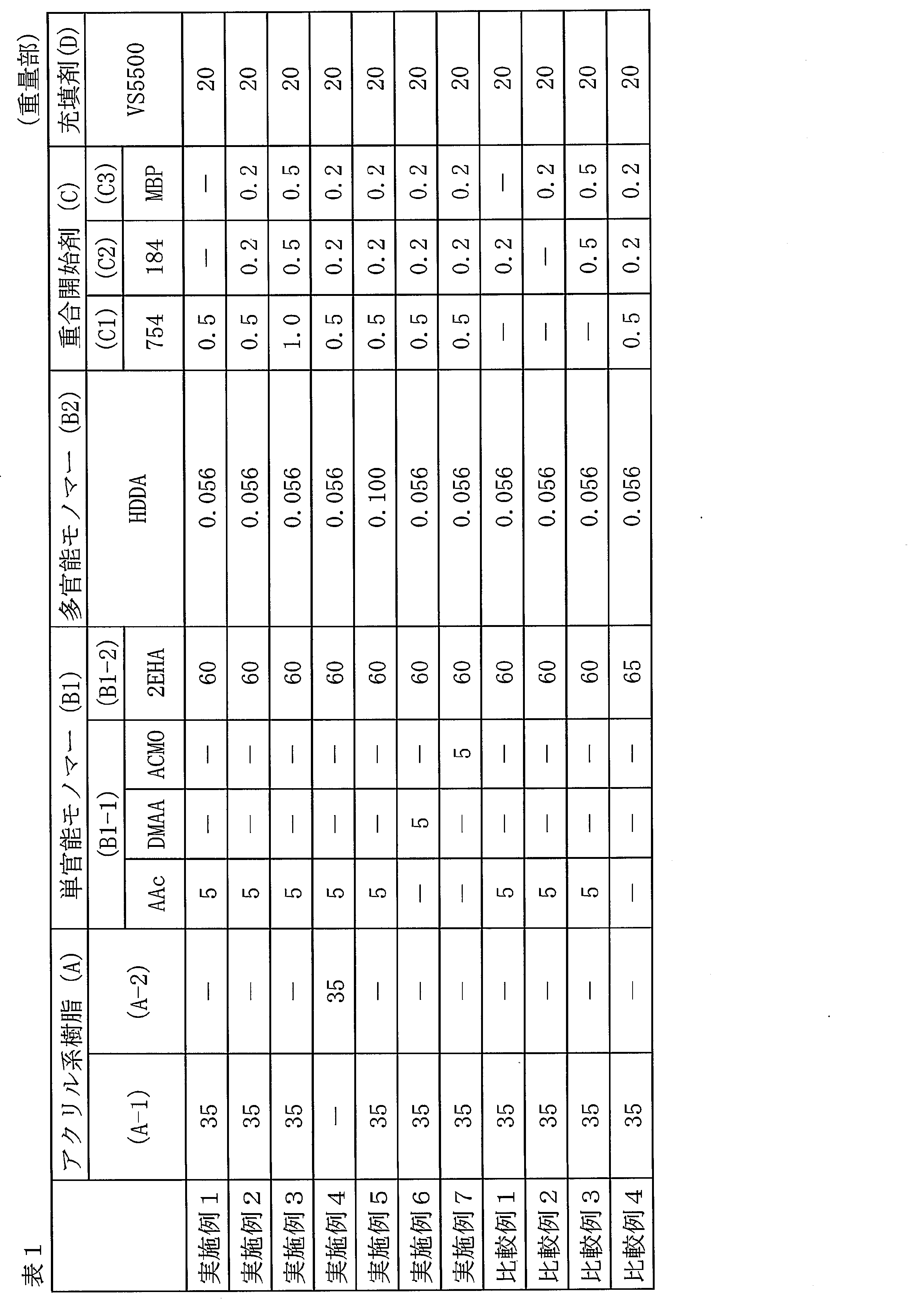
なお、表1の略号の意味は以下のとおりである。
AAc:アクリル酸
DMAA:N,N-ジメチルアクリルアミド
ACMO:アクリロイルモルホリン
2EHA:2-エチルヘキシルアクリレート
HDDA:1,6-ヘキサンジオールジアクリレート
754:オキシフェニル酢酸2-(2-オキソ-2-フェニルアセトキシエトキシ)エチルエステル(IGM Resins B.V.社製「Omnirad 754」)
184:1-ヒドロキシシクロヘキシルフェニルケトン(IGM Resins B.V.社製「Omnirad 184」)
MBP:4-メチルベンゾフェノン(MBP)
VS5500:グラスバブルズ(3M社製、平均粒径(D50)40μm、比重0.38g/cm3)
AAc:アクリル酸
DMAA:N,N-ジメチルアクリルアミド
ACMO:アクリロイルモルホリン
2EHA:2-エチルヘキシルアクリレート
HDDA:1,6-ヘキサンジオールジアクリレート
754:オキシフェニル酢酸2-(2-オキソ-2-フェニルアセトキシエトキシ)エチルエステル(IGM Resins B.V.社製「Omnirad 754」)
184:1-ヒドロキシシクロヘキシルフェニルケトン(IGM Resins B.V.社製「Omnirad 184」)
MBP:4-メチルベンゾフェノン(MBP)
VS5500:グラスバブルズ(3M社製、平均粒径(D50)40μm、比重0.38g/cm3)
上記実施例及び比較例の粘着剤組成物を用いて下記の方法により粘着剤を有する粘着シートを作製した。また、得られた粘着剤について下記方法により物性を測定し、その結果を表2にまとめた。なお、表2中の「-」は未測定を示す。
〔粘着シートの作製〕
得られた粘着剤組成物を離型処理されたPETフィルム(SP-PET-01BU、38μm;三井化学東セロ社製)2枚で挟み、2枚のPETフィルムの間にスペーサー(1mm厚のガラス板)を入れた。他のガラス板で当該PETフィルムを押し付けることで粘着剤組成物を1mm厚に成型した。
得られた粘着剤組成物を離型処理されたPETフィルム(SP-PET-01BU、38μm;三井化学東セロ社製)2枚で挟み、2枚のPETフィルムの間にスペーサー(1mm厚のガラス板)を入れた。他のガラス板で当該PETフィルムを押し付けることで粘着剤組成物を1mm厚に成型した。
コンベア式紫外線照射装置[装置高圧水銀ランプ(80W、1灯)、ランプ高さ18cm、コンベア速度0.4m/min]を用いて、得られた成型物に対して下記(1)又は(2)の条件で紫外線照射を行い、粘着シートを作製した。なお、比較例4においては、紫外線照射を行っても粘着剤組成物の硬化があまり進まず液体状態であったため、粘着シートを作製することができなかった。
(1)成型物の一方の面を1パスした後、他方の面を1パスする操作を3回行なった(合計光量:4500mJ/cm2)
(2)成型物の一方の面を1パスした後、他方の面を1パスする操作を5回行なった(合計光量:7500mJ/cm2)
なお、上記「1パス」とは、成型物が高圧水銀ランプの下を1回通過することを意味し、1パスあたり積算光量は750mJ/cm2である。
(2)成型物の一方の面を1パスした後、他方の面を1パスする操作を5回行なった(合計光量:7500mJ/cm2)
なお、上記「1パス」とは、成型物が高圧水銀ランプの下を1回通過することを意味し、1パスあたり積算光量は750mJ/cm2である。
〔硬化性:ゲル分率〕
上記(1)及び(2)の条件で作製した粘着シートをそれぞれ25mm×25mmになるように裁断し、片側の離型PETフィルムを剥がし、200メッシュのSUS製金網で包んだ後、23℃に調整した酢酸エチルに24時間浸漬した。酢酸エチル浸漬前の粘着剤層の重量に対する、金網中に残存した不溶解の粘着剤成分の重量百分率をゲル分率(%)とした。ただし、基材の重量は差し引いておいた。なお、比較例4においては、液体状態のままの粘着剤組成物を200メッシュのSUS製金網で包み、その後は上記と同様の方法によりゲル分率を測定した。
上記(1)及び(2)の条件で作製した粘着シートをそれぞれ25mm×25mmになるように裁断し、片側の離型PETフィルムを剥がし、200メッシュのSUS製金網で包んだ後、23℃に調整した酢酸エチルに24時間浸漬した。酢酸エチル浸漬前の粘着剤層の重量に対する、金網中に残存した不溶解の粘着剤成分の重量百分率をゲル分率(%)とした。ただし、基材の重量は差し引いておいた。なお、比較例4においては、液体状態のままの粘着剤組成物を200メッシュのSUS製金網で包み、その後は上記と同様の方法によりゲル分率を測定した。
〔被着体への粘着性:90°ピール強度〕
上記(2)の条件で作製した粘着シートを10cm×1cmに裁断し、片側の離型PETを剥がした。裁断後の粘着シートを38μm厚の未処理PET(東レ社製、ルミラーT60)に、2kgのハンドローラーを用い、1cm/秒の速度で2往復し貼り合せた。その後、もう片側の離型PETを剥がし、2kgのハンドローラーを用い、1cm/秒の速度で2往復し被着体(SUS304)と貼り合せた。
上記(2)の条件で作製した粘着シートを10cm×1cmに裁断し、片側の離型PETを剥がした。裁断後の粘着シートを38μm厚の未処理PET(東レ社製、ルミラーT60)に、2kgのハンドローラーを用い、1cm/秒の速度で2往復し貼り合せた。その後、もう片側の離型PETを剥がし、2kgのハンドローラーを用い、1cm/秒の速度で2往復し被着体(SUS304)と貼り合せた。
これを23℃、50%RHの雰囲気下で2時間放置し、AUTO Graph AG-X Plus(島津製作所社製)を用い、300mm/minの速度で90°ピール強度(N/10mm)を測定した。なお、比較例2の粘着シートは、柔らかすぎたため測定値を出すことができなかった。
〔被着体への粘着性:せん断接着強度〕
上記(2)の条件で作製した粘着シートを2.5cm×1.25cmに裁断し、片側の離型PETを剥がした。裁断後の粘着シートを被着体(SUS304)に、2kgのハンドローラーを用い、1cm/秒の速度で2往復し貼り合せた。その後、もう片側の離型PETを剥がし、2kgのハンドローラーを用い、1cm/秒の速度で2往復し被着体(SUS304)と貼り合せた。
上記(2)の条件で作製した粘着シートを2.5cm×1.25cmに裁断し、片側の離型PETを剥がした。裁断後の粘着シートを被着体(SUS304)に、2kgのハンドローラーを用い、1cm/秒の速度で2往復し貼り合せた。その後、もう片側の離型PETを剥がし、2kgのハンドローラーを用い、1cm/秒の速度で2往復し被着体(SUS304)と貼り合せた。
これを23℃、50%RHの雰囲気下で6時間放置し、AUTO Graph AG-X Plus(島津製作所社製)を用い、100mm/minの速度でせん断接着強度(MPa)を測定した。なお、比較例2の粘着シートは、柔らかすぎたため測定値を出すことができなかった。
〔粘着剤の強度:引張強度〕
上記(2)の条件で作製した粘着シートを5cm×1cmに裁断し、両側の離型PETを剥がしチャック間距離を4cmとし、AUTO Graph AG-X Plus(島津製作所社製)にセットした。
上記(2)の条件で作製した粘着シートを5cm×1cmに裁断し、両側の離型PETを剥がしチャック間距離を4cmとし、AUTO Graph AG-X Plus(島津製作所社製)にセットした。
これを23℃、50%RHの雰囲気下で50mm/minの速度で引張り、引張強度(N/mm2)を測定した。なお、比較例1及び2の粘着シートは、柔らかすぎたため測定値を出すことができなかった。
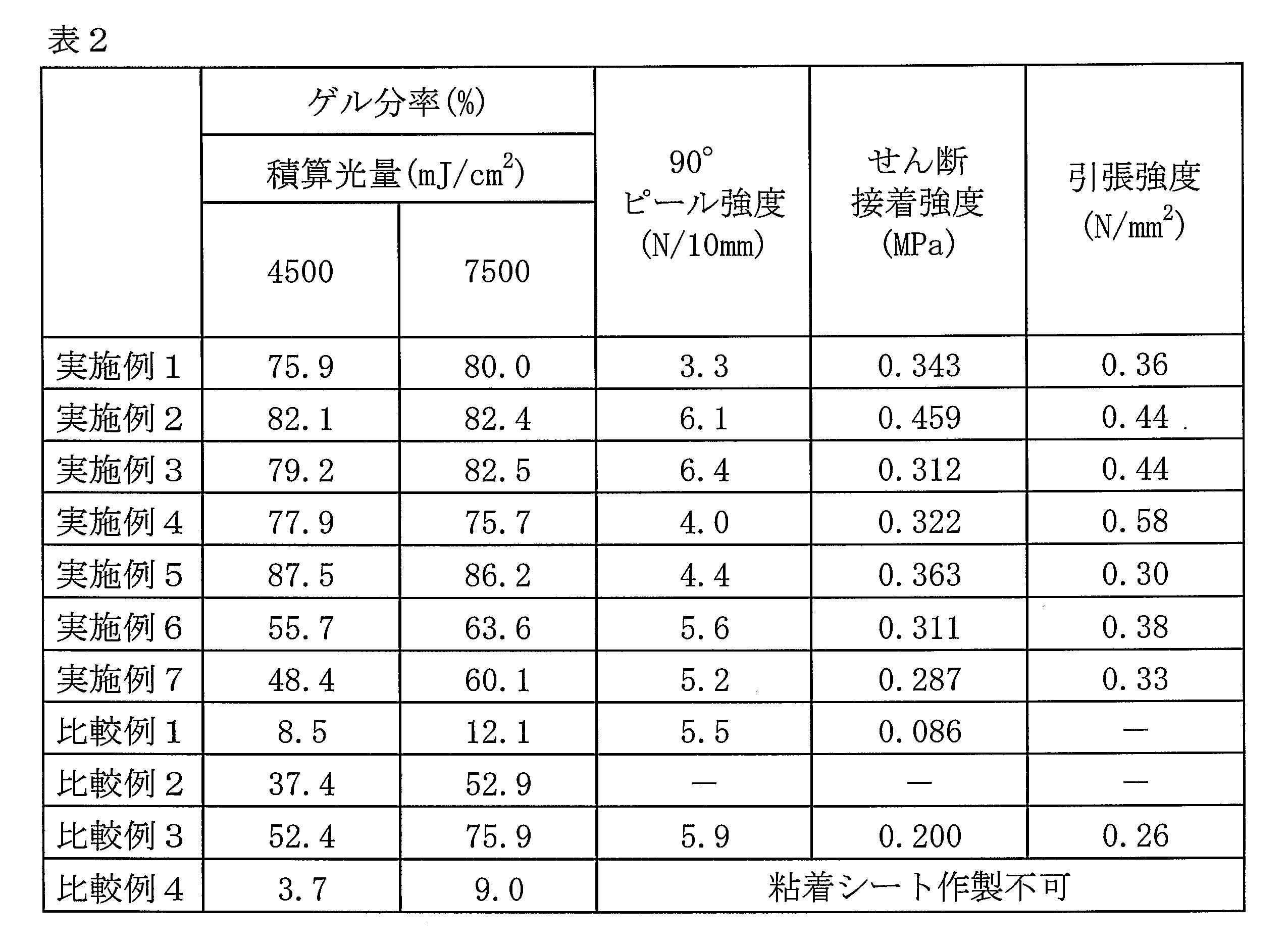
表2に示す結果から、実施例1~7ではゲル分率が高いことから、粘着剤組成物が硬化性に優れることが分かる。また、粘着剤層が1mm厚という厚膜であってもピール強度、せん断接着強度および引張強度が高いことから、粘着剤層の被着体への粘着性と強度とのバランスにも優れていることが分かる。
一方、重合開始剤(C1)を含有しない比較例1~3、エチレン性不飽和化合物(B1-1)を含有しない比較例4では、本発明の効果が得られなかった。
なお、単官能モノマー(B1-2)を含有しない場合、例えば、単官能モノマー(B1)としてアクリル酸のみを用いる場合では、粘着剤が硬くなりすぎて粘着物性が得られないことが推察される。
本発明を詳細にまた特定の実施態様を参照して説明したが、本発明の精神と範囲を逸脱することなく様々な変更や修正を加えることができることは当業者にとって明らかである。本出願は2018年11月22日出願の日本特許出願(特願2018-219702)に基づくものであり、その内容はここに参照として取り込まれる。
本発明の粘着剤組成物は、硬化速度が速く硬化性が良好であり、かかる粘着剤組成物が硬化された粘着剤からなる粘着剤層は、厚膜にした場合でも、被着体(金属、ポリオレフィン等)に対して優れた粘着性を有し、かつ引張強度に優れ、強靭性に優れるものである。そのため、本発明の粘着剤組成物は、例えば、ITOフィルム、Cuメッシュ、Agナノファイバーやポリチオフェン等の有機系導電膜等の透明電極膜、偏光板、位相差板、楕円偏光板、光学補償フィルム、輝度向上フィルム、電磁波シールドフィルム、近赤外線吸収フィルム、AR(アンチリフレクション)フィルム等の光学部材;モルタル、コンクリート、ケイ酸カルシウム、大理石、木材、メラミン化粧板、ガラス、金属、塩ビ材、プラスチック、ゴム等の建材;さらに、モール、エンブレム、サイドミラー、ルームミラー、バックカメラ、フレーム、ドアパネル、フロントパネル、バンパー、内装材等の車両部材に利用することができる。
Claims (12)
- アクリル系樹脂(A)、エチレン性不飽和化合物(B)および重合開始剤(C)を含有する粘着剤組成物であって、
前記エチレン性不飽和化合物(B)が、1つのエチレン性不飽和基を有するエチレン性不飽和化合物(B1)および2つ以上のエチレン性不飽和基を有するエチレン性不飽和化合物(B2)を含有し、
前記エチレン性不飽和化合物(B1)が、極性基および1つのエチレン性不飽和基を有するエチレン性不飽和化合物(B1-1)と、炭素数1~20のアルキル基および1つのエチレン性不飽和基を有するエチレン性不飽和化合物(B1-2)を含有し、
前記重合開始剤(C)が、分子内に下記式(1)で示される構造部位を有する重合開始剤(C1)を含有する、粘着剤組成物。

- 前記エチレン性不飽和化合物(B1-1)がカルボキシ基含有モノマーまたはアミド基含有モノマーである、請求項1に記載の粘着剤組成物。
- 前記エチレン性不飽和化合物(B1)における、前記エチレン性不飽和化合物(B1-1)の含有割合が0.1~50重量%である、請求項1または2に記載の粘着剤組成物。
- 前記アクリル系樹脂(A)が官能基含有アクリル系樹脂である、請求項1~3のいずれか一項に記載の粘着剤組成物。
- 前記エチレン性不飽和化合物(B1)の含有量が、前記アクリル系樹脂(A)100重量部に対して、1~1000重量部である、請求項1~4のいずれか一項に記載の粘着剤組成物。
- 前記エチレン性不飽和化合物(B2)の含有量が、前記アクリル系樹脂(A)100重量部に対して、0.01~5重量部である、請求項1~5のいずれか一項に記載の粘着剤組成物。
- 前記重合開始剤(C)が、更に、ラジカル開裂型重合開始剤(C2)および水素引き抜き型重合開始剤(C3)(但し、前記重合開始剤(C1)を除く。)の少なくとも1種の重合開始剤を含有する、請求項1~6のいずれか一項に記載の粘着剤組成物。
- 前記重合開始剤(C)における、前記重合開始剤(C1)の含有割合が10重量%以上である、請求項1~7のいずれか一項に記載の粘着剤組成物。
- 更に、充填剤(D)を含有する、請求項1~8のいずれか一項に記載の粘着剤組成物。
- 請求項1~9のいずれか一項に記載の粘着剤組成物が活性エネルギー線照射により硬化された、粘着剤。
- 請求項10に記載の粘着剤からなる粘着剤層を有する、粘着シート。
- 前記粘着剤層の両面に離型シートが積層された両面粘着シートである、請求項11に記載の粘着シート。
Priority Applications (1)
| Application Number | Priority Date | Filing Date | Title |
|---|---|---|---|
| JP2019551484A JPWO2020105256A1 (ja) | 2018-11-22 | 2019-09-13 | 粘着剤組成物、粘着剤および粘着シート |
Applications Claiming Priority (2)
| Application Number | Priority Date | Filing Date | Title |
|---|---|---|---|
| JP2018219702 | 2018-11-22 | ||
| JP2018-219702 | 2018-11-22 |
Publications (1)
| Publication Number | Publication Date |
|---|---|
| WO2020105256A1 true WO2020105256A1 (ja) | 2020-05-28 |
Family
ID=70774230
Family Applications (1)
| Application Number | Title | Priority Date | Filing Date |
|---|---|---|---|
| PCT/JP2019/036182 Ceased WO2020105256A1 (ja) | 2018-11-22 | 2019-09-13 | 粘着剤組成物、粘着剤および粘着シート |
Country Status (2)
| Country | Link |
|---|---|
| JP (1) | JPWO2020105256A1 (ja) |
| WO (1) | WO2020105256A1 (ja) |
Citations (4)
| Publication number | Priority date | Publication date | Assignee | Title |
|---|---|---|---|---|
| JP2007217674A (ja) * | 2006-01-18 | 2007-08-30 | Nippon Synthetic Chem Ind Co Ltd:The | 活性エネルギー線重合性組成物、粘着剤、および粘着テープ |
| JP2012012506A (ja) * | 2010-06-30 | 2012-01-19 | Dainippon Printing Co Ltd | エネルギー線易剥離型粘着剤組成物 |
| JP2013036024A (ja) * | 2011-07-11 | 2013-02-21 | Sanyo Chem Ind Ltd | 感光性樹脂組成物 |
| CN107099256A (zh) * | 2017-03-20 | 2017-08-29 | 苏州凡赛特材料科技有限公司 | 一种uv阻隔光学胶粘剂以及光学胶膜、触摸屏和显示器 |
-
2019
- 2019-09-13 JP JP2019551484A patent/JPWO2020105256A1/ja active Pending
- 2019-09-13 WO PCT/JP2019/036182 patent/WO2020105256A1/ja not_active Ceased
Patent Citations (4)
| Publication number | Priority date | Publication date | Assignee | Title |
|---|---|---|---|---|
| JP2007217674A (ja) * | 2006-01-18 | 2007-08-30 | Nippon Synthetic Chem Ind Co Ltd:The | 活性エネルギー線重合性組成物、粘着剤、および粘着テープ |
| JP2012012506A (ja) * | 2010-06-30 | 2012-01-19 | Dainippon Printing Co Ltd | エネルギー線易剥離型粘着剤組成物 |
| JP2013036024A (ja) * | 2011-07-11 | 2013-02-21 | Sanyo Chem Ind Ltd | 感光性樹脂組成物 |
| CN107099256A (zh) * | 2017-03-20 | 2017-08-29 | 苏州凡赛特材料科技有限公司 | 一种uv阻隔光学胶粘剂以及光学胶膜、触摸屏和显示器 |
Also Published As
| Publication number | Publication date |
|---|---|
| JPWO2020105256A1 (ja) | 2021-10-14 |
Similar Documents
| Publication | Publication Date | Title |
|---|---|---|
| JP6729380B2 (ja) | 粘着シート、粘着剤層付き積層体の製造方法、粘着剤層付き積層体、画像表示装置およびタッチパネル | |
| JP6699544B2 (ja) | 粘着剤組成物、粘着剤、粘着シート、粘着剤層付き積層体の製造方法、画像表示装置、およびタッチパネル | |
| KR101928727B1 (ko) | 점착 시트 및 그 사용 방법 그리고 적층체 | |
| KR101806813B1 (ko) | 점착 시트 및 적층체와 그 제조 방법 | |
| JP5954972B2 (ja) | 粘着剤組成物、粘着剤、およびそれを用いてなる粘着シート | |
| JP6319039B2 (ja) | 粘着シート、積層体及び積層体の製造方法 | |
| JP5415115B2 (ja) | 一時表面保護用粘着剤組成物、それにより得られる粘着剤、粘着シート、およびその粘着シートの使用方法 | |
| CN107001888B (zh) | 粘合剂组合物、粘合剂、粘合片材、两面粘合片材、透明电极用粘合剂、触摸面板及图像显示装置 | |
| JP2012153788A (ja) | 光学用粘着シート | |
| JP2012140497A (ja) | 活性エネルギー線硬化型組成物及び粘着剤 | |
| JP7251073B2 (ja) | 粘着シート、剥離シート付き粘着シート、積層体及び積層体の製造方法 | |
| KR20170062390A (ko) | 점착 시트 및 박리 필름 구비 점착 시트 | |
| WO2017010501A1 (ja) | 粘着シート及び積層体とその製造方法 | |
| JP5483565B2 (ja) | 活性エネルギー線硬化型粘着剤用樹脂組成物、それにより得られる粘着剤、および粘着シート | |
| WO2023074558A1 (ja) | 光学粘着シート | |
| JP6132463B2 (ja) | 粘着剤組成物、粘着剤、およびそれを用いてなる粘着シート | |
| JP7567645B2 (ja) | 活性エネルギー線硬化型粘着シート及び表示装置 | |
| JP7172058B2 (ja) | 積層粘着シート及び積層粘着シートの製造方法 | |
| JP7207379B2 (ja) | 粘着シート、剥離シート付き粘着シート、積層体及び積層体の製造方法 | |
| JP6958180B2 (ja) | 無溶剤型粘着剤組成物、それを用いて得られる粘着剤、光学部材用粘着シート、光学部材用基材レス両面粘着シート、粘着剤層付き光学部材、画像表示装置 | |
| WO2023074554A1 (ja) | 光硬化性粘着シート | |
| JPWO2020105256A1 (ja) | 粘着剤組成物、粘着剤および粘着シート | |
| JP2013253129A (ja) | 粘着剤組成物、粘着剤、およびそれを用いてなる粘着シート | |
| WO2017204247A1 (ja) | 粘着シート | |
| JP6747475B2 (ja) | 粘着シート、剥離シート付き粘着シート、積層体及び積層体の製造方法 |
Legal Events
| Date | Code | Title | Description |
|---|---|---|---|
| ENP | Entry into the national phase |
Ref document number: 2019551484 Country of ref document: JP Kind code of ref document: A |
|
| 121 | Ep: the epo has been informed by wipo that ep was designated in this application |
Ref document number: 19887408 Country of ref document: EP Kind code of ref document: A1 |
|
| NENP | Non-entry into the national phase |
Ref country code: DE |
|
| 122 | Ep: pct application non-entry in european phase |
Ref document number: 19887408 Country of ref document: EP Kind code of ref document: A1 |