WO2020071382A1 - 分散液及び樹脂付金属箔の製造方法 - Google Patents
分散液及び樹脂付金属箔の製造方法Info
- Publication number
- WO2020071382A1 WO2020071382A1 PCT/JP2019/038793 JP2019038793W WO2020071382A1 WO 2020071382 A1 WO2020071382 A1 WO 2020071382A1 JP 2019038793 W JP2019038793 W JP 2019038793W WO 2020071382 A1 WO2020071382 A1 WO 2020071382A1
- Authority
- WO
- WIPO (PCT)
- Prior art keywords
- polymer
- meth
- dispersion
- group
- acrylate
- Prior art date
- Legal status (The legal status is an assumption and is not a legal conclusion. Google has not performed a legal analysis and makes no representation as to the accuracy of the status listed.)
- Ceased
Links
Classifications
-
- B—PERFORMING OPERATIONS; TRANSPORTING
- B05—SPRAYING OR ATOMISING IN GENERAL; APPLYING FLUENT MATERIALS TO SURFACES, IN GENERAL
- B05D—PROCESSES FOR APPLYING FLUENT MATERIALS TO SURFACES, IN GENERAL
- B05D7/00—Processes, other than flocking, specially adapted for applying liquids or other fluent materials to particular surfaces or for applying particular liquids or other fluent materials
- B05D7/14—Processes, other than flocking, specially adapted for applying liquids or other fluent materials to particular surfaces or for applying particular liquids or other fluent materials to metal, e.g. car bodies
-
- B—PERFORMING OPERATIONS; TRANSPORTING
- B05—SPRAYING OR ATOMISING IN GENERAL; APPLYING FLUENT MATERIALS TO SURFACES, IN GENERAL
- B05D—PROCESSES FOR APPLYING FLUENT MATERIALS TO SURFACES, IN GENERAL
- B05D7/00—Processes, other than flocking, specially adapted for applying liquids or other fluent materials to particular surfaces or for applying particular liquids or other fluent materials
- B05D7/24—Processes, other than flocking, specially adapted for applying liquids or other fluent materials to particular surfaces or for applying particular liquids or other fluent materials for applying particular liquids or other fluent materials
-
- B—PERFORMING OPERATIONS; TRANSPORTING
- B32—LAYERED PRODUCTS
- B32B—LAYERED PRODUCTS, i.e. PRODUCTS BUILT-UP OF STRATA OF FLAT OR NON-FLAT, e.g. CELLULAR OR HONEYCOMB, FORM
- B32B15/00—Layered products comprising a layer of metal
- B32B15/04—Layered products comprising a layer of metal comprising metal as the main or only constituent of a layer, which is next to another layer of the same or of a different material
- B32B15/08—Layered products comprising a layer of metal comprising metal as the main or only constituent of a layer, which is next to another layer of the same or of a different material of synthetic resin
- B32B15/082—Layered products comprising a layer of metal comprising metal as the main or only constituent of a layer, which is next to another layer of the same or of a different material of synthetic resin comprising vinyl resins; comprising acrylic resins
-
- C—CHEMISTRY; METALLURGY
- C08—ORGANIC MACROMOLECULAR COMPOUNDS; THEIR PREPARATION OR CHEMICAL WORKING-UP; COMPOSITIONS BASED THEREON
- C08L—COMPOSITIONS OF MACROMOLECULAR COMPOUNDS
- C08L27/00—Compositions of homopolymers or copolymers of compounds having one or more unsaturated aliphatic radicals, each having only one carbon-to-carbon double bond, and at least one being terminated by a halogen; Compositions of derivatives of such polymers
- C08L27/02—Compositions of homopolymers or copolymers of compounds having one or more unsaturated aliphatic radicals, each having only one carbon-to-carbon double bond, and at least one being terminated by a halogen; Compositions of derivatives of such polymers not modified by chemical after-treatment
- C08L27/12—Compositions of homopolymers or copolymers of compounds having one or more unsaturated aliphatic radicals, each having only one carbon-to-carbon double bond, and at least one being terminated by a halogen; Compositions of derivatives of such polymers not modified by chemical after-treatment containing fluorine atoms
- C08L27/18—Homopolymers or copolymers or tetrafluoroethene
-
- C—CHEMISTRY; METALLURGY
- C08—ORGANIC MACROMOLECULAR COMPOUNDS; THEIR PREPARATION OR CHEMICAL WORKING-UP; COMPOSITIONS BASED THEREON
- C08L—COMPOSITIONS OF MACROMOLECULAR COMPOUNDS
- C08L29/00—Compositions of homopolymers or copolymers of compounds having one or more unsaturated aliphatic radicals, each having only one carbon-to-carbon double bond, and at least one being terminated by an alcohol, ether, aldehydo, ketonic, acetal or ketal radical; Compositions of hydrolysed polymers of esters of unsaturated alcohols with saturated carboxylic acids; Compositions of derivatives of such polymers
-
- C—CHEMISTRY; METALLURGY
- C08—ORGANIC MACROMOLECULAR COMPOUNDS; THEIR PREPARATION OR CHEMICAL WORKING-UP; COMPOSITIONS BASED THEREON
- C08L—COMPOSITIONS OF MACROMOLECULAR COMPOUNDS
- C08L33/00—Compositions of homopolymers or copolymers of compounds having one or more unsaturated aliphatic radicals, each having only one carbon-to-carbon double bond, and only one being terminated by only one carboxyl radical, or of salts, anhydrides, esters, amides, imides or nitriles thereof; Compositions of derivatives of such polymers
- C08L33/04—Homopolymers or copolymers of esters
- C08L33/06—Homopolymers or copolymers of esters of esters containing only carbon, hydrogen and oxygen, which oxygen atoms are present only as part of the carboxyl radical
Definitions
- the present invention relates to a dispersion liquid capable of forming layers (resin layers) having excellent physical properties of various layers (resin layers) in which powder falling during formation of layers (resin layers) is suppressed, and a method for producing a resin-attached metal foil.
- Patent Document 1 describes an aqueous dispersion containing a powder of a tetrafluoroethylene-based polymer, a powder of a depolymerizable acrylic polymer, and an aqueous medium.
- Patent Document 2 describes a resin-coated metal foil having a PTFE layer formed from a dispersion of PTFE powder dispersed in a non-aqueous medium, and a method of forming a transmission line on the metal foil to form a printed circuit board.
- Patent Document 3 describes a non-aqueous dispersion containing PTFE powder as such a dispersion.
- Formation of a layer (resin layer) of a tetrafluoroethylene-based polymer from such a dispersion is performed by applying the dispersion to the surface of a substrate, volatilizing a liquid dispersion medium to form a powder-filled layer on the surface of the substrate, Further, the powder is melted or fired.
- tetrafluoroethylene-based polymers are essentially non-tacky and their powders have poor interaction between particles. Therefore, when forming the filling layer, the powder is likely to be missing (powdering). The powder falling off not only impairs the physical properties of the layer (resin layer), but also contaminates the article itself or the manufacturing apparatus, and lowers the productivity.
- a layer (resin layer) having excellent electrical physical properties (electrical properties such as dielectric constant and electrostatic tangent) and surface physical properties (heat resistance, chemical resistance, smoothness, glossiness, etc.) while suppressing powder dropping. ) are required.
- a dispersion containing a predetermined (meth) acrylic polymer and a powder of a tetrafluoroethylene polymer in a predetermined ratio has a reduced electrical and surface physical properties while suppressing powder dropping. It was found that an excellent layer (resin layer) could be formed.
- a dispersion comprising a powder of a tetrafluoroethylene polymer, a (meth) acrylic polymer having a glass transition point of 0 to 120 ° C., and a liquid dispersion medium, wherein the tetrafluoroethylene polymer is dispersed in the liquid dispersion medium.
- a dispersion comprising 0.1 to 10 parts by mass of the (meth) acrylate-based polymer with respect to 100 parts by mass of the tetrafluoroethylene-based polymer.
- the tetrafluoroethylene-based polymer has at least one functional group selected from the group consisting of a carbonyl group-containing group, a hydroxy group, an epoxy group, an oxetanyl group, an amino group, a nitrile group, and an isocyanate group.
- the (meth) acrylic polymer is methyl (meth) acrylate, ethyl (meth) acrylate, butyl (meth) acrylate, isobornyl (meth) acrylate, cyclopentyl (meth) acrylate, cyclohexyl (meth) acrylate and benzyl (The dispersion according to any one of [1] to [6], comprising at least one unit based on (meth) acrylate selected from the group consisting of (meth) acrylates. [8] The dispersion according to any one of [1] to [7], wherein the (meth) acrylic polymer is a methacrylate polymer.
- a method for producing a metal foil with resin having a metal foil and a resin layer provided in contact with the surface of the metal foil and containing a tetrafluoroethylene-based polymer The dispersion according to any one of [1] to [11] is applied to the surface to form a coating layer from the dispersion, and the liquid dispersion medium is removed by heating.
- ADVANTAGE OF THE INVENTION According to this invention, it is excellent in electrical characteristics (dielectric constant, electrostatic tangent, etc.) and surface physical properties (heat resistance, chemical resistance, smoothness, glossiness, etc.), suppressing powder falling of powder particles.
- a dispersion containing a tetrafluoroethylene-based polymer that can form a layer (resin layer) is provided.
- D50 of powder is a point where the particle size distribution of a powder is measured by a laser diffraction / scattering method, a cumulative curve is obtained with the total volume of a group of powder particles being 100%, and the cumulative volume is 50% on the cumulative curve. (A cumulative 50% diameter based on volume).
- D90 of powder is a point where the particle size distribution of a powder is measured by a laser diffraction / scattering method, a cumulative curve is determined with the total volume of a group of powder particles being 100%, and the cumulative volume on the cumulative curve is 90%. (90% diameter based on volume).
- Polymer melt viscosity is based on ASTM D 1238, using a flow tester and a 2 ⁇ -8L die, applying a 0.7 MPa load to a polymer sample (2 g) previously heated at a measurement temperature for 5 minutes. Is a value measured at a measurement temperature.
- Melting point of polymer is the temperature corresponding to the maximum value of the melting peak measured by differential scanning calorimetry (DSC).
- Viscosity is a value measured using a B-type viscometer at room temperature (25 ° C.) and at a rotation speed of 30 rpm. The measurement is repeated three times, and the average value of the three measured values is used.
- (Meth) acrylate is a general term for acrylate and methacrylate.
- (Meth) acrylic acid is a general term for acrylic acid and methacrylic acid.
- the “glass transition point (Tg)” of the polymer is a value obtained by differential scanning calorimetry, and when it cannot be measured, it is a value obtained from the Fox equation.
- the “weight average molecular weight (Mw)” of a polymer is a value determined by gel permeation chromatography using polystyrene as a standard sample and tetrahydrofuran as a developing solvent.
- thermogravimetric analyzer TG
- TG-DTA thermogravimetric differential thermal analyzer
- the unit may be a unit directly formed by a polymerization reaction, or a unit in which a part of the unit is converted to another structure by treating a polymer.
- the unit based on the monomer a is also simply referred to as “monomer a unit”.
- a unit based on tetrafluoroethylene (TFE) is also referred to as a TFE unit.
- the dispersion of the present invention comprises a powder of a tetrafluoroethylene-based polymer (hereinafter, also referred to as “TFE-based polymer”) and a (meth) acryl-based polymer having a glass transition point of 0 to 120 ° C. (hereinafter, “predetermined polymer”). And a liquid dispersion medium.
- TFE-based polymer tetrafluoroethylene-based polymer
- predetermined polymer a tetrafluoroethylene-based polymer having a glass transition point of 0 to 120 ° C.
- the predetermined polymer In forming a coating layer (a layer formed at the stage where the liquid dispersion medium of the dispersion of the present invention is removed), the predetermined polymer has a reduced rigidity and viscosity, and is uniformly and thinly formed in the gap between the powder particles. It is thought to penetrate. In addition, it is considered that the predetermined polymer having a (meth) acryloyloxy group forms a thin and dense matrix in the coating layer due to the intermolecular force, and suppresses powder falling off. On the other hand, the predetermined polymer has low heat resistance as compared with the TFE-based polymer and is easily lost by thermal decomposition. Therefore, the physical properties of a layer (resin layer) formed by melting or firing the powder by heating are not easily damaged. .
- the gas and polymer residue generated by the thermal decomposition hardly inhibit the physical properties of the layer (resin layer).
- a layer (resin layer) having excellent surface properties (heat resistance, chemical resistance, smoothness, glossiness, etc.) and electrical properties (dielectric constant, electrostatic tangent, etc.) was obtained from the dispersion of the present invention. It is considered formed. Such a tendency tends to be remarkable when the thickness of the layer (resin layer) is small. Therefore, the use of the dispersion of the present invention makes it easy to obtain a printed circuit board material (such as a resin-coated copper foil) having a thin-film electric insulating layer having surface physical properties and electric characteristics.
- the D50 of the powder in the present invention is preferably from 0.05 to 6 ⁇ m, particularly preferably from 0.1 to 3.0 ⁇ m.
- the D50 of the powder is in the above range, not only the fluidity and the dispersibility of the powder are excellent, but also the layer or the resin layer containing a TFE-based polymer melt or calcined product formed from the dispersion of the present invention ( Hereinafter, also referred to as “F layer”).
- D90 of the powder is preferably 8.0 ⁇ m or less, particularly preferably 1.5 to 5.0 ⁇ m. When D90 of the powder is in the above range, the dispersibility of the powder and the uniformity of the F layer are excellent.
- the loosely packed bulk density and the densely packed bulk density of the powder are preferably from 0.08 to 0.5 g / mL and from 0.1 to 0.8 g / mL in this order.
- the powder in the present invention is a powder containing a TFE-based polymer as a main component.
- the content of the TFE-based polymer in the powder is preferably 80% by mass or more, and particularly preferably 100% by mass.
- Other resins that can be included in the powder include aromatic polyesters, polyamide imides, thermoplastic polyimides, polyphenylene ether, polyphenylene oxide, and the like.
- the TFE-based polymer in the present invention is a polymer containing a unit (TFE unit) based on tetrafluoroethylene (TFE).
- TFE-based polymer includes a homopolymer substantially consisting of TFE units (hereinafter, also referred to as “PTFE”), a copolymer containing TFE units and a unit (PAVE unit) based on perfluoro (alkyl vinyl ether) (PAVE), and a TFE unit.
- PTFE a homopolymer substantially consisting of TFE units
- PAVE unit copolymer containing TFE units and a unit (PAVE unit) based on perfluoro (alkyl vinyl ether) (PAVE)
- PAVE perfluoro (alkyl vinyl ether)
- FEE fluoroalkylethylene
- PTFE also includes polymers containing a trace amount of units other than TFE units and low molecular weight PTFE.
- the polymer preferably contains more than 99.5 mol%, more preferably more than 99.9 mol%, of TFE units based on all units contained in the polymer.
- the melt viscosity of the polymer at 380 ° C. is preferably 1 ⁇ 10 2 to 1 ⁇ 10 8 Pa ⁇ s, and particularly preferably 1 ⁇ 10 3 to 1 ⁇ 10 6 Pa ⁇ s.
- the low-molecular-weight PTFE may be PTFE obtained by irradiating high-molecular-weight PTFE with radiation (polymers described in WO2018 / 02602, WO2018 / 026017, etc.), and TFE may be used.
- PTFE obtained by using a chain transfer agent when polymerizing to produce PTFE polymers described in JP-A-2009-1745, WO 2010/114033, JP-A-2013-2322082, etc.
- a polymer having a core-shell structure consisting of a core portion and a shell portion, wherein only the shell portion has a low molecular weight PTFE Japanese Patent Application Laid-Open No. 2005-527652, International Publication No.
- the standard specific gravity of the low molecular weight PTFE (specific gravity measured in accordance with ASTM D4895-04) is preferably from 2.14 to 2.22, more preferably from 2.16 to 2.20.
- the polymer containing TFE units includes polymers containing units other than TFE units.
- the polymer preferably contains more than 0.5 mol% of units based on monomers other than TFE units, based on all units contained in the polymer.
- the unit other than TFE is preferably a PAVE unit, an HFP unit, a FAE unit or a unit having a functional group described later.
- the polymer containing the TFE unit preferably has at least one functional group selected from the group consisting of a carbonyl group-containing group, a hydroxy group, an epoxy group, an oxetanyl group, an amino group, a nitrile group, and an isocyanate group.
- a functional group selected from the group consisting of a carbonyl group-containing group, a hydroxy group, an epoxy group, an oxetanyl group, an amino group, a nitrile group, and an isocyanate group.
- the TFE-based polymer has the above-mentioned functional group, the interaction between the predetermined polymer and the TFE-based polymer is strengthened, and the dispersion properties (viscosity, color tone, etc.) of the dispersion and the F-layer forming properties (adhesion, transparency, etc.) are obtained. Also easier to improve.
- the carbonyl group-containing group includes an amide group.
- the functional group may be contained in a unit constituting the TFE polymer, may be contained in a terminal group of the polymer main chain, or may be introduced into the TFE polymer by plasma treatment or the like.
- the TFE-based polymer having the above functional group in the terminal group of the polymer main chain include a TFE-based polymer having a functional group as a terminal group derived from a polymerization initiator, a chain transfer agent and the like.
- the functional group is preferably a hydroxy group or a carbonyl group-containing group, more preferably a carbonyl-containing group, particularly preferably a carbonate group, a carboxy group, a haloformyl group, an alkoxycarbonyl group, an acid anhydride residue or a fatty acid residue, and a carboxy group. Or an acid anhydride residue is most preferred.
- the TFE-based polymer in the present invention is preferably a polymer containing a TFE unit, a PAVE unit, an HFP unit or an FAE unit, and a unit having a functional group.
- the unit having a functional group is preferably a unit based on a monomer having a functional group.
- a monomer having a carbonyl group-containing group is preferable, and a cyclic monomer having an acid anhydride residue is particularly preferable.
- the cyclic monomer include itaconic anhydride, citraconic anhydride, 5-norbornene-2,3-dicarboxylic anhydride (also called hymic anhydride; hereinafter also referred to as “NAH”) or maleic anhydride. Is preferred.
- PPVE CFOCF 2 CF 2 CF 3
- CF 2 CFOCF 2 CF 2 CF 3
- CF 2 CFO (CF 2 ) 8 F, with PPVE being preferred.
- PPVE CFO (CF 2 ) 8 F
- the TFE unit, the PAVE unit, the HFP unit or the FAE unit and the unit having a functional group are 90 to 99 mol% and 0.5 to 9.97 mol% in this order with respect to all units contained in the polymer. , 0.01 to 3 mol%.
- the melting point of the TFE-based polymer is preferably from 250 to 380 ° C, particularly preferably from 280 to 350 ° C.
- a polymer described in WO2018 / 16644 can be mentioned.
- the predetermined polymer in the present invention is a (meth) acrylic polymer having a glass transition point of 0 to 120 ° C.
- (Meth) acrylic polymer is a generic term for polymers containing units based on (meth) acrylate.
- the predetermined polymer may be dispersed in the form of particles in the dispersion, or may be dissolved in the dispersion.
- the glass transition point of the predetermined polymer is preferably from 30 to 120 ° C, more preferably from 40 to 110 ° C, and particularly preferably from 60 to 100 ° C. In this case, the fluidity of the predetermined polymer in the formation of the coating layer is increased, powder powder is more suppressed, and the physical properties of the F layer are more easily improved.
- the thermal decomposition onset temperature of a given polymer is preferably 200 ° C. or higher, and particularly preferably 250 to 300 ° C.
- the predetermined polymer has a thermal decomposition rate at 350 ° C. of preferably 1% by mass / min or more, particularly preferably 2% by mass / min or more.
- the predetermined polymer forms a dense matrix in the coating layer formed from the dispersion, and the predetermined polymer is easily decomposed in the formation of the F layer, and the F layer excellent in electric characteristics is easily formed. .
- Certain polymers preferably have hydroxy groups.
- the interaction between the predetermined polymers is further improved, but also the interaction between the liquid dispersion medium and the TFE-based polymer is easily improved.
- the hydroxy group may be contained in a predetermined polymer unit, or may be contained at a terminal of a polymer chain (terminal of a polymer main chain).
- the predetermined polymer is a (meth) acrylate-based polymer containing a unit based on (meth) acrylate having a hydroxy group, or a polymer chain terminal obtained by polymerizing (meth) acrylate in the presence of a chain transfer agent and an alcohol.
- (Meth) acrylate polymers having a hydroxy group are preferred.
- Examples of the (meth) acrylate having a hydroxy group include hydroxyethyl (meth) acrylate, 2-hydroxypropyl (meth) acrylate, 3-hydroxypropyl (meth) acrylate, 2-hydroxybutyl (meth) acrylate, and 4-hydroxybutyl ( (Meth) acrylate, monoglycidyl ether or (meth) acrylate obtained by adding glycidol and (meth) acrylic acid are exemplified.
- chain transfer agent examples include 1-butanethiol, 1-octanethiol, 1-decanethiol, 1-dodecanethiol, 1-hexadecanethiol, cyclohexanethiol, 2-mercaptoethanol, mercaptoacetic acid, methyl mercaptoacetate, 3-mercaptopropion Acid and 2,4-diphenyl-4-methyl-1-pentene.
- the alcohol include methanol, ethanol, and propanol.
- Certain polymers preferably include units based on hydrocarbon (meth) acrylates, such as methyl (meth) acrylate, ethyl (meth) acrylate, butyl (meth) acrylate, cyclohexyl (meth) acrylate, and benzyl (meth) acrylate. More preferably, it contains at least one unit based on (meth) acrylate selected from the group consisting of: In this case, the glass transition point of the predetermined polymer and the thermal decomposability of the predetermined polymer can be easily adjusted, the powder falling off when forming the F layer can be further suppressed, and the physical properties thereof can be further improved.
- the butyl (meth) acrylate may be any of n-butyl (meth) acrylate, iso-butyl (meth) acrylate, and tert-butyl (meth) acrylate.
- the weight average molecular weight of the predetermined polymer is preferably 10,000 to 150,000. In this case, not only the fluidity of the predetermined polymer in the formation of the coating layer is increased, but also the decomposability of the predetermined polymer is improved, so that powder dispersion of the dispersion of the present invention is more suppressed, and the F layer Properties are more easily improved.
- the predetermined polymer examples include a polymer containing a unit based on the monomer having a hydroxy group and a unit based on the hydrocarbon (meth) acrylate and having a weight average molecular weight of 50,000 to 150,000, and a hydrocarbon (meth)
- a polymer composed of acrylate-based units and having a weight average molecular weight of 10,000 to 50,000 is exemplified.
- the latter polymer preferably has a hydroxy group at the terminal of the polymer chain.
- a unit based on a monomer having a hydroxy group and a unit based on the hydrocarbon-based (meth) acrylate are present in an order of 1 to 20 mol% and 80 to 99 mol with respect to all units contained in the polymer. %.
- the predetermined polymer is preferably a methacrylate polymer.
- the methacrylate-based polymer is a general term for polymers containing units based on methacrylate.
- the predetermined polymer is a methacrylate-based polymer, it is considered that a denser matrix is formed due to the intermolecular force based on the steric configuration of the polymer main chain, and powder falling off the edge of the F layer is more easily suppressed.
- the methacrylate-based polymer include a polymer having a weight-average molecular weight of 50,000 to 150,000 containing a unit based on a methacrylate having a hydroxy group and a unit based on a hydrocarbon-based methacrylate, and a unit based on a hydrocarbon-based methacrylate. Of 10,000 to 50,000.
- the former polymer preferably contains 1 to 20 mol% and 80 to 99 mol% of a unit based on a methacrylate having a hydroxy group and a unit based on a hydrocarbon methacrylate in this order, based on all units contained in the polymer. preferable.
- the glass transition point of the former polymer is preferably from 60 to 100 ° C.
- the latter polymer preferably has a hydroxy group at the end of the polymer chain.
- the glass transition point of the latter polymer is preferably from 0 to 40 ° C.
- the hydrocarbon methacrylate is preferably at least one methacrylate selected from the group consisting of methyl methacrylate, ethyl methacrylate, butyl methacrylate, cyclohexyl methacrylate and benzyl methacrylate, and is preferably methyl methacrylate (MMA), ethyl methacrylate (EMA). ) Or butyl methacrylate (BMA) is more preferred.
- the BMA may be any of n-butyl methacrylate, iso-butyl methacrylate, and tert-butyl methacrylate.
- the methacrylate having a hydroxy group is preferably hydroxyethyl methacrylate (HEMA), 2-hydroxybutyl methacrylate or 4-hydroxybutyl methacrylate.
- HEMA hydroxyethyl methacrylate
- 2-hydroxybutyl methacrylate 2-hydroxybutyl methacrylate
- 4-hydroxybutyl methacrylate Such a predetermined polymer can be obtained as a commercial product (such as “Oricox KC-1700P” manufactured by Kyoeisha Chemical Co., Ltd.).
- the liquid dispersion medium in the present invention is a compound that is liquid at 25 ° C. and has a function of dispersing the powder of the present invention, and may be an aqueous medium or a non-aqueous medium, and is preferably a non-aqueous medium.
- the water content of the non-aqueous medium is preferably 20,000 ppm or less.
- the lower limit of the water content of the non-aqueous medium is usually 0 ppm.
- the formation of a dense matrix, etc.) can be further improved, and powder drips when forming a thin F layer can be particularly easily suppressed.
- the compound of the liquid dispersion medium is preferably an organic medium such as a nitrogen-containing compound, a sulfur-containing compound, an ester, a ketone, and a glycol ether.
- the boiling point of the compound of the liquid dispersion medium is preferably from 60 to 240 ° C, particularly preferably from 80 to 210 ° C.
- the boiling point of the compound of the liquid dispersion medium is preferably equal to or higher than the glass transition point of a predetermined polymer.
- the boiling point of the compound of the liquid dispersion medium is preferably equal to or lower than the glass transition point + 150 ° C.
- the fluidity of the predetermined polymer is increased, powder powder is more suppressed, and the physical properties of the formed layer (F layer) are more easily improved.
- the compound of the liquid dispersion medium include water, methanol, ethanol, isopropanol, N, N-dimethylformamide, N, N-dimethylacetamide, N-methyl-2-pyrrolidone, dimethyl sulfoxide, diethyl ether, dioxane, and lactic acid.
- Examples include ethyl, ethyl acetate, butyl acetate, methyl ethyl ketone, methyl isopropyl ketone, ⁇ -butyrolactone, cyclopentanone, cyclohexanone, ethylene glycol monoisopropyl ether, and cellosolve (eg, methyl cellosolve, ethyl cellosolve).
- the compound of the liquid dispersion medium is preferably N, N-dimethylacetamide, N-methyl-2-pyrrolidone or ⁇ -butyrolactone.
- the dispersion of the present invention is a dispersant, an antifoaming agent, an inorganic filler, a dehydrating agent, a plasticizer, a weathering agent, an antioxidant, a binder, a heat stabilizer, a lubricant, an antistatic agent, a brightener, and a colorant.
- a conductive agent, a release agent, a surface treatment agent, a viscosity modifier, and a flame retardant from the viewpoint of improving the dispersibility of the TFE polymer powder in the dispersion and improving the physical properties of the F layer, the dispersion of the present invention preferably contains a dispersant.
- the dispersant is a compound having a function of chemically and / or physically adsorbing to the surface of the powder of the TFE-based polymer to stably disperse the powder in a liquid dispersion medium.
- a fluorine-based dispersant having a hydrophilic site fluorine-based surfactant
- at least one compound selected from the group consisting of fluoroalcohol, fluorosilicone, and fluoropolyether is particularly preferable. Note that these compounds are compounds other than the TFE-based polymer and the predetermined polymer.
- fluoroalcohol examples include a non-polymeric fluoromonol and a polymeric fluoropolyol. In addition, some of the hydroxyl groups of the polymeric fluoropolyol may be chemically modified.
- fluorosilicone a polyorganosiloxane containing a CF bond in a part of a side chain can be used.
- fluoropolyether examples include compounds in which a hydrogen atom of a polyoxyalkylene alkyl ether is partially substituted with a fluorine atom.
- the fluorine-based dispersant is preferably a polymeric fluoropolyol, and more preferably a polymer containing fluoroalkyl (meth) acrylate or fluoroalkenyl (meth) acrylate and a unit based on oxyalkylene glycol mono (meth) acrylate.
- CH 2 C (CH 3 ) C (O) OCH 2 CH 2 (CF 2) 6 F
- CH 2 CHC (O) OCH 2 CH 2 (CF 2) 6 F
- CH 2 C ( CH 3) C (O) OCH 2 CH 2 (CF 2) 4 F
- CH 2 CClC (O) OCH 2 CH 2 (CF 2) 4 F
- the amount of the former unit with respect to all units contained in the polymer is preferably from 60 to 90 mol%, particularly preferably from 70 to 90 mol%.
- the polymer may further include other additional units.
- the polymer is preferably nonionic.
- the mass average molecular weight of the polymer is preferably from 2,000 to 80,000, particularly preferably from 6,000 to 20,000.
- the polymer may have a hydroxyl group or a carboxyl group at the terminal of the main chain. In this case, the leveling property of the dispersion of the present invention is easily improved.
- Such a polymer can be obtained by adjusting the type of polymerization initiator or chain transfer agent used in the production thereof.
- the proportion of the powder in the dispersion is preferably from 5 to 60% by mass, particularly preferably from 30 to 50% by mass. In this case, the dispersibility of the dispersion and the physical properties of the F layer are easily improved.
- the proportion of the liquid dispersion medium in the dispersion is preferably from 15 to 65% by mass, particularly preferably from 25 to 50% by mass. In this case, the formation of the coating layer from the dispersion and the physical properties of the F layer are easily improved.
- the proportion of the predetermined polymer in the dispersion is preferably 0.05 to 6% by mass, particularly preferably 0.1 to 5% by mass. In this case, the dispersibility of the dispersion and the physical properties of the F layer are easily improved.
- the dispersion of the present invention contains 0.1 to 10 parts by mass of a predetermined polymer based on 100 parts by mass of the TFE-based polymer.
- the content of the predetermined polymer with respect to 100 parts by mass of the TFE-based polymer is preferably at least 0.5 part by mass, particularly preferably at least 1 part by mass.
- the content is preferably 5 parts by mass or less, particularly preferably less than 5% by mass.
- powder falling of the powder of the coating layer formed from the dispersion of the present invention is further suppressed, and the physical properties of the F layer are more easily improved. Further, it is easier to form a thin-film electric insulating layer having surface physical properties and electric characteristics.
- the proportion of the other material in the dispersion is preferably from 1 to 50% by mass, particularly preferably from 5 to 30% by mass.
- the ratio of the dispersant in the dispersion is preferably 1 to 10 parts by mass.
- the dispersion of the present invention can be produced by mixing a liquid dispersion medium, a powder of a TFE-based polymer and a predetermined polymer, and is preferably produced by mixing a liquid dispersion medium and a predetermined polymer with a powder of a TFE-based polymer. preferable. At the time of mixing, it is preferable to perform a dispersion treatment using a homodisper or a homogenizer to improve the dispersion state. When using the dispersion of the present invention stored at 0 to 40 ° C., it is preferable to use the dispersion after these dispersion treatments.
- the present invention provides a resin layer (F layer) containing a TFE-based polymer by applying the dispersion of the present invention to the surface of a metal foil to form a coating layer, and then melting or firing the TFE-based polymer by heating.
- a resin-attached metal foil having a metal foil and a resin layer provided in contact with the surface of the metal foil and containing a TFE-based polymer can be provided.
- the ranges of the TFE-based polymer, the powder thereof, the predetermined polymer, and the liquid dispersion medium are the same as the range of the polymer dispersion of the present invention, including preferred embodiments thereof.
- the resin layer may be formed on at least one surface of the metal foil, the resin layer may be formed on only one surface of the metal foil, and the resin layers may be formed on both surfaces of the metal foil. It may be formed.
- the material of the metal foil examples include copper, copper alloy, stainless steel, nickel, nickel alloy (including 42 alloy), aluminum, aluminum alloy, titanium, and titanium alloy.
- a copper foil such as a rolled copper foil and an electrolytic copper foil is preferable.
- a rustproofing layer or a heat-resistant layer may be arranged on the surface of the metal foil.
- the surface of the metal foil may be surface-treated with a silane coupling agent.
- the thickness of the metal foil may be any thickness as long as a sufficient function can be exhibited in the use of the laminate.
- the thickness of the metal foil is not less than the ten-point average roughness of the surface, and is preferably 2 to 40 ⁇ m.
- the metal foil As the metal foil, a metal foil with a carrier composed of a carrier copper foil (thickness 10 to 35 ⁇ m) and an ultrathin copper foil (thickness 2 to 5 ⁇ m) laminated on the carrier copper foil via a release layer is used. You may. Also, the thickness of the metal foil is preferably larger than the thickness of the F resin layer.
- Examples of the method of applying the dispersion include a spray method, a roll coating method, a spin coating method, a gravure coating method, a microgravure coating method, a gravure offset method, a knife coating method, a kiss coating method, a bar coating method, a die coating method, and a fountain Meyer bar method And a slot die coating method.
- the coating layer it is preferable to remove the liquid dispersion medium by heating the metal foil at a temperature equal to or higher than the glass transition point of a predetermined polymer. At this time, it is not necessary to completely volatilize the liquid dispersion medium, and the liquid dispersion medium may be volatilized to such an extent that a stable self-supporting film is formed from the coating layer formed by applying the dispersion liquid. Specifically, it is preferable to volatilize 50% by mass or more of the liquid dispersion medium contained in the dispersion. The liquid dispersion medium not volatilized can be completely removed in the next melting or firing step.
- the temperature at this time is preferably 50 to 150 ° C, more preferably 80 to 120 ° C.
- the time at this time is preferably from 0.1 to 30 minutes, more preferably from 0.5 to 20 minutes.
- the temperature at which the coating layer is heated to melt or bake the TFE-based polymer to form a resin layer containing the TFE-based polymer is preferably from 250 ° C to 400 ° C, particularly preferably from 300 ° C to 400 ° C.
- the heating method include a method using an oven, a method using a ventilation drying oven, and a method of irradiating heat rays such as infrared rays.
- pressure may be applied with a heating plate, a heating roll, or the like. Note that the temperature in heating usually indicates the temperature of the atmosphere.
- the effective wavelength band of infrared rays is particularly preferably 3 to 7 ⁇ m from the viewpoint of homogeneously melting or firing the TFE-based polymer.
- the atmosphere in the heating preferably has an oxygen gas concentration of 100 to 500 ppm from the viewpoint of suppressing oxidation of the metal foil and the F layer.
- the atmosphere is preferably an inert gas (such as nitrogen gas) atmosphere or a reducing gas atmosphere (such as hydrogen gas).
- the thickness of the formed resin layer is preferably less than 20 ⁇ m, more preferably less than 10 ⁇ m.
- the thickness of the resin layer is preferably 1 ⁇ m or more.
- the content of the predetermined polymer with respect to the content of the TFE polymer is within a predetermined range, and even when such a thin resin layer is formed, a dense layer of the TFE polymer is formed by the action of the predetermined polymer.
- the predetermined polymer hardly remains in the resin layer. As a result, a thin resin layer having excellent surface physical properties and electrical characteristics can be easily formed, and a resin-coated copper foil that is less likely to warp can be easily obtained.
- the surface of the resin layer may be surface-treated in order to control the linear expansion coefficient of the resin layer or to further improve the adhesiveness of the resin layer.
- the surface treatment include annealing treatment, corona discharge treatment, atmospheric pressure plasma treatment, vacuum plasma treatment, UV ozone treatment, excimer treatment, chemical etching, silane coupling treatment, and fine surface roughening treatment.
- the temperature in the annealing treatment is preferably from 80 to 190 ° C.
- the pressure in the annealing treatment is preferably 0.001 to 0.030 MPa.
- the annealing time is preferably 10 to 300 minutes.
- Examples of the plasma irradiation apparatus in the plasma processing include a high-frequency induction method, a capacitive coupling electrode method, a corona discharge electrode-plasma jet method, a parallel plate type, a remote plasma type, an atmospheric pressure plasma type, an ICP type high density plasma type, and the like.
- Examples of a gas used for the plasma treatment include an oxygen gas, a nitrogen gas, a rare gas (eg, argon), a hydrogen gas, and an ammonia gas, and a rare gas or a nitrogen gas is preferable.
- Specific examples of the gas used for the plasma treatment include an argon gas, a mixed gas of hydrogen gas and nitrogen gas, and a mixed gas of hydrogen gas, nitrogen gas, and argon gas.
- the atmosphere in the plasma treatment is preferably an atmosphere having a volume fraction of a rare gas or a nitrogen gas of 70% by volume or more, and particularly preferably an atmosphere of 100% by volume.
- Ra on the surface of the F resin layer is adjusted to 2.5 ⁇ m or less, so that fine irregularities are easily formed on the surface of the F layer of the metal foil with resin.
- Ra of the surface of the F layer in the resin-attached metal foil is preferably from 2 nm to 2.5 ⁇ m, particularly preferably from 5 nm to 1 ⁇ m.
- Rz on the surface of the F layer is preferably from 15 nm to 2.5 ⁇ m, particularly preferably from 50 nm to 2 ⁇ m. Within this range, it is easy to balance the adhesion between the resin-attached metal foil and the prepreg and the surface workability of the F layer.
- As a method of laminating the prepreg on the surface of the F layer of the metal foil with resin there is a method of hot pressing the metal foil with resin and the prepreg.
- the pressing temperature is preferably equal to or lower than the melting point of the TFE polymer, and particularly preferably 160 to 220 ° C. Within this range, the F layer and the prepreg can be firmly bonded while suppressing thermal deterioration of the prepreg. It is particularly preferable to perform the hot pressing at a degree of vacuum of 20 kPa or less. Within this range, it is possible to suppress the incorporation of bubbles into the respective interfaces of the metal foil, the F layer, and the cured product layer in the laminate and the deterioration due to oxidation. In the case of hot pressing, it is preferable to raise the temperature after reaching the degree of vacuum.
- the pressure in the hot press is preferably 0.2 to 10 MPa. Within this range, the F layer and the prepreg can be firmly bonded while suppressing damage to the prepreg.
- the metal foil with resin of the present invention is made of a TFE-based polymer having excellent physical properties such as electrical properties and chemical resistance (etching resistance) as a resin layer
- the metal foil with resin of the present invention may be a flexible metal-clad laminate or As a rigid metal-clad laminate, it can be used for manufacturing printed circuit boards.
- a printed circuit board can be manufactured from the resin-attached metal foil of the present invention by a method of processing a transmission circuit by a method (SAP method, modified semi-additive method (MSAP method), or the like).
- the printed circuit board manufactured from the metal foil with resin of the present invention preferably has a transmission circuit, an F layer, and a cured layer in this order.
- Examples of the layer structure of the printed circuit board of the present invention include a transmission circuit / F layer / cured material layer and a transmission circuit / F layer / cured material layer / F layer / transmission circuit.
- an interlayer insulating film may be formed over the transmission circuit, and the transmission circuit may be further formed over the interlayer insulating film.
- the interlayer insulating film can also be formed by, for example, the dispersion of the present invention.
- a solder resist may be laminated on a transmission circuit.
- the solder resist can be formed by the dispersion of the present invention.
- a coverlay film may be laminated on a transmission circuit. Coverlay films can also be formed with the dispersions of the present invention.
- ⁇ Powder from coating layer (Part 1)> The metal foil in a state where the dispersion liquid is applied and dried to form an application layer is wound into a roll and stored for 10 days. Thereafter, a 10-m-long metal foil is fed out from the roll, and the number of powders (release powders) adhering to the back surface (the surface on which the coating layer is not formed) of the metal foil is visually checked and evaluated according to the following criteria. did.
- ⁇ The number of detached powders is less than 5.
- X The number of detached powders is 5 or more.
- ⁇ Powder drop of coating layer (Part 2)> The edge of the metal foil in a state where the dispersion was coated and dried to form a coating layer was visually observed and evaluated according to the following criteria. ⁇ : No missing is confirmed. ⁇ : Missing is partially observed. X: The defect is also expanding in the peripheral part.
- ⁇ Smoothness of copper foil with resin The surface of the F layer of the resin-coated copper foil was irradiated with light, visually observed from obliquely above, and evaluated according to the following criteria. :: No citron skin pattern was observed. ⁇ : A yuzu skin pattern is observed. The details and abbreviations of the materials used are as follows.
- Polymer F1 a copolymer containing 97.9 mol%, 0.1 mol%, and 2.0 mol% of TFE units, NAH units, and PPVE units in this order, and having a melting point of 300 ° C.
- Polymer A1 a polymer having Tg of 75 ° C. and Mw of 120,000 containing EMA unit, MMA unit and HEMA unit in this order of 60 mol%, 20 mol% and 10 mol%.
- Polymer A2 a polymer composed of BMA units and having a Tg of 25 ° C. and a Mw of 25,000.
- Polymer A3 a polymer containing 60 mol%, 20 mol%, and 10 mol% of EMA units, MMA units, and HEMA units in this order, having a Tg of 65 ° C. and a Mw of 100,000.
- NMP N-methylpyrrolidone (boiling point: 202 ° C)
- Example 1 Production Example of Dispersion
- Powder F1 of polymer F1 (D50: 2.6 ⁇ m) was prepared by the method described in paragraph [0123] of WO 2016/017801. , D90: 7.1 ⁇ m).
- 3209 g of powder F1, 320.9 g of a fluorine-based dispersant (manufactured by Neos Co., Ltd., Phantagent 710FL), 2888 g of NMP, and 97.7 g of polymer A1 were charged into a horizontal ball mill pot, and dispersed in a zirconia ball having a diameter of 15 mm.
- a dispersion 1 in which the powder of the polymer A1 was dispersed was obtained.
- the viscosity of Dispersion 1 was 180 mPa ⁇ s at 60 rpm.
- Example 1-2 Production Example of Dispersion 2 As a fluorine-based dispersant, a unit based on CH 2 CC (CH 3 ) C (O) OCH 2 CH 2 (CF 2 ) 6 F and CH 2 CC (CH 3 ) Example 1 except that a polymer containing 81 mol% and 19 mol% of a unit based on C (O) (OCH 2 CH 2 ) 23 OH was used in this order, and polymer A2 was used instead of polymer A1. In the same manner as -1, dispersion 2 was obtained. The viscosity of Dispersion 2 was 160 mPa ⁇ s at 60 rpm.
- Example 1-3 Production Example of Dispersion 3 Dispersion 3 was obtained in the same manner as in Example 1-1, except that polymer A3 was used instead of polymer A1. The viscosity of the dispersion 3 was 150 mPa ⁇ s at 60 rpm.
- Example 1-4 Production example of dispersion liquid 4 Same as Example 1-1 except that polymer A2 was used instead of polymer A1 and 15 parts by mass of polymer A2 was used with respect to 100 parts by mass of polymer F1. Thus, a dispersion liquid 4 was obtained.
- the dispersions 1 to 3 were applied to the surface of the copper foil immediately after the preparation and heated to produce a resin-coated copper foil having an F layer (5 ⁇ m in thickness) containing the polymer F1. Resin-coated copper foils having an F layer having a thickness of 7 ⁇ m and a thickness of 10 ⁇ m could be produced without any problems.
- Example 2 Production example of metal foil with resin (1)
- Example 2-1 Dispersion liquid 1 was stirred for 1 hour with a paint shaker, stirred for 30 minutes with a homomixer at 3000 rpm, filtered through a mesh (pore diameter 100 ⁇ m), and then placed in a tank connected to a gravure coater via a liquid feed line. The tank was operated by installing a stirring device with stirring blades, and a filtration filter was installed in the liquid sending line.
- a gravure coater thicken the dispersion liquid 1 on the roughened surface of a long copper foil (Fukuda Metal Foil & Powder Industry Co., Ltd., CF-T4X-SV, width 640 mm, thickness 18 ⁇ m) moving at a transport speed of 10 m / min. It was applied to a thickness of 5 ⁇ m to form a wet film on the roughened surface. Subsequently, the long copper foil with a wet film was passed through a ventilation drying oven to volatilize the liquid dispersion medium to form a coating layer. The conditions in the ventilation drying oven were 100 ° C. for 1.5 minutes.
- the copper foil is passed through a far-infrared ray furnace (Noritake Co., Ltd., roll-to-roll type NORITAKE far-infrared ray. N2 atmosphere furnace, length 4.7 m) while moving the copper foil at a conveying speed of 5 m / min, and the polymer F1 is melted and fired.
- a long resin-coated copper foil having an F layer containing the polymer F1 was obtained.
- the heating conditions in the far-infrared furnace were 370 ° C. for 1 minute in a nitrogen gas atmosphere having an oxygen gas concentration of 200 ppm.
- the surface of the F layer of the obtained copper foil with resin was subjected to plasma treatment.
- a roll-to-roll type vacuum plasma apparatus of NVC-R series / Roll VIA system manufactured by Nisshinko Corporation was used as a plasma processing apparatus.
- the plasma processing conditions were as follows: output: 4.5 kW, introduced gas: argon gas, introduced gas flow rate: 50 cm3 / min, pressure: 50 mTorr (6.7 Pa), and processing time: 2 minutes.
- FR-4 (GEA-67N 0.2t (HAN), manufactured by Hitachi Chemical Co., Ltd.), reinforced fiber: glass fiber, matrix resin: epoxy resin, on the surface of the F layer of the resin-coated copper foil within 72 hours after the plasma treatment , Thickness: 0.2 mm), and subjected to vacuum hot pressing under the conditions of a press temperature: 185 ° C., a press pressure: 3.0 MPa, and a press time: 60 minutes to obtain a laminate.
- the evaluation results of the powder drop of the coating layer (No. 1), the powder drop of the coating layer (No. 2), and the smoothness of the resin-coated copper foil were “ ⁇ ”.
- Example 2-2 to [Example 2-4] A resin-coated copper foil was prepared in the same manner as in Example 2-1 except that instead of Dispersion 1, Dispersions 2, 3 or Dispersion 1 (Dispersion C) containing no (meth) acrylate-based polymer were used. Manufactured. Table 1 shows the results of evaluation of the coating layer in each of the resin-coated copper foils.
- Example 3 Production example of metal foil with resin (part 2) [Example 3-1]
- the dispersion 2 was applied to the same copper foil as in Example 2 by a gravure reverse method by roll-to-roll to form a wet film. Subsequently, it passed through a drying furnace at 120 ° C. for 5 minutes, and was heated and dried to form a coating layer. Thereafter, the dried coating was heated at 380 ° C. for 3 minutes in a nitrogen oven.
- a resin-coated copper foil having an F layer (4 ⁇ m thick) formed by melting and firing the polymer F1 on the surface of the copper foil was obtained.
- This resin-coated copper foil was subjected to plasma treatment in the same manner as in Example 2, and prepregs were laminated in the same manner as in Example 2, to obtain a laminate having a copper foil, an F layer, and a cured product layer of the prepreg in this order.
- the laminate swells at the interface between the F layer and the cured product layer (swelling phenomenon) even if it floats five times for 5 seconds in a 288 ° C. solder bath. The phenomenon that the copper foil floats (floating phenomenon) did not occur.
- Example 3-2 A laminate having a copper foil, an F layer, and a cured prepreg layer in this order was obtained in the same manner as in Example 3-1 except that Dispersion Liquid 4 was used instead of Dispersion Liquid 2.
- Table 2 summarizes the results of the solder heat resistance test for each laminate. The value of “Polymer A2 / Polymer F1” in the table is the content (parts by mass) of polymer A2 with respect to 100 parts by mass of polymer F1 contained in the used dispersion liquid.
- the dispersion of the present invention is capable of forming an article having a layer (F layer) of a TFE-based polymer excellent in electrical properties and surface properties by suppressing powder falling during formation of the layer (F layer). It can be used for fiber reinforced film, prepreg, resin-attached metal foil, metal-clad laminate, printed circuit board and the like.
- the dispersion of the present invention is useful as a material for antenna parts, printed circuit boards, aircraft parts, automobile parts, sports equipment, food industry supplies, saws, slide bearings, and the like.
Landscapes
- Chemical & Material Sciences (AREA)
- Health & Medical Sciences (AREA)
- Chemical Kinetics & Catalysis (AREA)
- Medicinal Chemistry (AREA)
- Polymers & Plastics (AREA)
- Organic Chemistry (AREA)
- Life Sciences & Earth Sciences (AREA)
- Engineering & Computer Science (AREA)
- Wood Science & Technology (AREA)
- Laminated Bodies (AREA)
- Application Of Or Painting With Fluid Materials (AREA)
- Compositions Of Macromolecular Compounds (AREA)
Abstract
層(樹脂層)形成時の粉落ちが抑制され、電気特性等の層(樹脂層)物性に優れた層(樹脂層)を形成できる分散液、及び樹脂付金属箔の製造方法の提供。 本発明の分散液は、テトラフルオロエチレン系ポリマーのパウダーとガラス転移点が0~120℃の(メタ)アクリル系ポリマーと液状分散媒とを含み、前記テトラフルオロエチレン系ポリマーが前記液状分散媒に分散している。この分散液は、前記テトラフルオロエチレン系ポリマー100質量部に対して、前記(メタ)アクリレート系ポリマーを0.1~10質量部含む。
Description
本発明は、層(樹脂層)形成時の粉落ちが抑制され、種々の層(樹脂層)物性に優れた層(樹脂層)を形成できる分散液、及び樹脂付金属箔の製造方法に関する。
ポリテトラフルオロエチレン(PTFE)等のテトラフルオロエチレン系ポリマーは、耐薬品性、撥水撥油性、耐熱性、電気特性等の物性に優れており、種々の用途と、パウダー,フィルム等の種々の使用形態とが知られている。特許文献1には、テトラフルオロエチレン系ポリマーのパウダー、解重合性アクリルポリマーのパウダー及び水性媒体を含む水性分散液が記載されている。
近年では、高周帯域の周波数に対応するプリント基板材料として、低誘電率、低誘電正接等の電気特性や半田リフロー耐性等の耐熱性に優れたテトラフルオロエチレン系ポリマーが注目されている。
近年では、高周帯域の周波数に対応するプリント基板材料として、低誘電率、低誘電正接等の電気特性や半田リフロー耐性等の耐熱性に優れたテトラフルオロエチレン系ポリマーが注目されている。
特許文献2には、PTFEのパウダーが非水媒体に分散した分散液から形成されたPTFE層を有する樹脂付金属箔、その金属箔に伝送回線を形成してプリント基板とする方法が記載されている。特許文献3には、かかる分散液として、PTFEのパウダーを含む非水系分散液が記載されている。
かかる分散液からテトラフルオロエチレン系ポリマーの層(樹脂層)の形成は、分散液を基材の表面に塗布し、液状分散媒を揮発させて基材の表面にパウダーの充填層を形成し、さらにパウダーを溶融又は焼成させて行う。しかし、テトラフルオロエチレン系ポリマーは本質的に非粘着性であり、そのパウダーは粒子間の相互作用に乏しい。そのため、充填層の形成に際してはパウダーが欠落(粉落ち)しやすい。
パウダーの粉落ちは、層(樹脂層)の物性を損なうばかりか、物品自体又は製造装置を汚染し、その生産性を低下させてしまう。そのため、粉落ちを抑制しつつ、電気物性(誘電率、静電正接等の電気物性。)と表面物性(耐熱性、耐薬品性、平滑性、光沢性等。)に優れた層(樹脂層)を形成できる分散液が求められている。
パウダーの粉落ちは、層(樹脂層)の物性を損なうばかりか、物品自体又は製造装置を汚染し、その生産性を低下させてしまう。そのため、粉落ちを抑制しつつ、電気物性(誘電率、静電正接等の電気物性。)と表面物性(耐熱性、耐薬品性、平滑性、光沢性等。)に優れた層(樹脂層)を形成できる分散液が求められている。
本発明者らは、鋭意検討の結果、所定の(メタ)アクリル系ポリマーとテトラフルオロエチレン系ポリマーのパウダーとを所定の比率で含む分散液は、粉落ちを抑制しつつ、電気物性と表面物性に優れた層(樹脂層)を形成できることを知見した。
本発明は、下記の態様を有する。
[1] テトラフルオロエチレン系ポリマーのパウダーとガラス転移点が0~120℃の(メタ)アクリル系ポリマーと液状分散媒とを含み、前記テトラフルオロエチレン系ポリマーが前記液状分散媒に分散した分散液であって、前記テトラフルオロエチレン系ポリマー100質量部に対して、前記(メタ)アクリレート系ポリマーを0.1~10質量部含む、分散液。
[2] 前記テトラフルオロエチレン系ポリマー100質量部に対して、前記(メタ)アクリレート系ポリマーを0.1以上5質量部未満含む、[1]に記載の分散液。
[3] 前記液状分散媒が、非水媒体である、[1]又は[2]に記載の分散液。
[4] 前記液状分散媒が、エステル又はアミドである、[1]~[3]のいずれか1項に記載の分散液。
[5] 前記テトラフルオロエチレン系ポリマーが、カルボニル基含有基、ヒドロキシ基、エポキシ基、オキセタニル基、アミノ基、ニトリル基及びイソシアネート基からなる群から選ばれる少なくとも1種の官能基を有する、[1]~[4]のいずれか1項に記載の分散液。
[6] 前記(メタ)アクリル系ポリマーが、ヒドロキシ基を有する、[1]~[5]のいずれか1項に記載の分散液。
[7] 前記(メタ)アクリル系ポリマーが、メチル(メタ)アクリレート、エチル(メタ)アクリレート、ブチル(メタ)アクリレート、イソボルニル(メタ)アクリレート、シクロペンチル(メタ)アクリレート、シクロヘキシル(メタ)アクリレート及びベンジル(メタ)アクリレートからなる群から選ばれる少なくとも1種の(メタ)アクリレートに基づく単位を含む、[1]~[6]のいずれか1項に記載の分散液。
[8] 前記(メタ)アクリル系ポリマーが、メタクリレート系ポリマーである、[1]~[7]のいずれか1項に記載の分散液。
[9] 前記(メタ)アクリル系ポリマーの重量平均分子量が、10000~150000である、[1]~[8]のいずれか1項に記載の分散液。
[10] フッ素系分散剤をさらに含む、[1]~[9]のいずれか1項に記載の分散液。
[11] フルオロアルコール、フルオロシリコーン及びフルオロポリエーテルからなる群から選ばれる少なくとも1種のフッ素系分散剤をさらに含む、[1]~[10]のいずれか1項に記載の分散液。
[12] 金属箔と、該金属箔の表面に接して設けられ、テトラフルオロエチレン系ポリマーを含む樹脂層とを有する樹脂付金属箔を製造する方法であって、
[1]~[11]のいずれか1項に記載の分散液を、前記表面に塗布して分散液から塗工層を形成し、さらに加熱により液状分散媒を除去し、前記テトラフルオロエチレン系ポリマーを溶融又は焼成させて前記樹脂層を形成する、樹脂付金属箔の製造方法。
[13] 前記塗工層の形成を、前記(メタ)アクリル系ポリマーのガラス転移点以上の温度にて行う、[12]に記載の製造方法。
[14] 前記樹脂層の形成を、250℃~400℃にて行う、[12]又は[13]に記載の製造方法。
[15] 前記樹脂層の厚さが、20μm未満である、[12]~[14]のいずれか1項に記載の製造方法。
[1] テトラフルオロエチレン系ポリマーのパウダーとガラス転移点が0~120℃の(メタ)アクリル系ポリマーと液状分散媒とを含み、前記テトラフルオロエチレン系ポリマーが前記液状分散媒に分散した分散液であって、前記テトラフルオロエチレン系ポリマー100質量部に対して、前記(メタ)アクリレート系ポリマーを0.1~10質量部含む、分散液。
[2] 前記テトラフルオロエチレン系ポリマー100質量部に対して、前記(メタ)アクリレート系ポリマーを0.1以上5質量部未満含む、[1]に記載の分散液。
[3] 前記液状分散媒が、非水媒体である、[1]又は[2]に記載の分散液。
[4] 前記液状分散媒が、エステル又はアミドである、[1]~[3]のいずれか1項に記載の分散液。
[5] 前記テトラフルオロエチレン系ポリマーが、カルボニル基含有基、ヒドロキシ基、エポキシ基、オキセタニル基、アミノ基、ニトリル基及びイソシアネート基からなる群から選ばれる少なくとも1種の官能基を有する、[1]~[4]のいずれか1項に記載の分散液。
[6] 前記(メタ)アクリル系ポリマーが、ヒドロキシ基を有する、[1]~[5]のいずれか1項に記載の分散液。
[7] 前記(メタ)アクリル系ポリマーが、メチル(メタ)アクリレート、エチル(メタ)アクリレート、ブチル(メタ)アクリレート、イソボルニル(メタ)アクリレート、シクロペンチル(メタ)アクリレート、シクロヘキシル(メタ)アクリレート及びベンジル(メタ)アクリレートからなる群から選ばれる少なくとも1種の(メタ)アクリレートに基づく単位を含む、[1]~[6]のいずれか1項に記載の分散液。
[8] 前記(メタ)アクリル系ポリマーが、メタクリレート系ポリマーである、[1]~[7]のいずれか1項に記載の分散液。
[9] 前記(メタ)アクリル系ポリマーの重量平均分子量が、10000~150000である、[1]~[8]のいずれか1項に記載の分散液。
[10] フッ素系分散剤をさらに含む、[1]~[9]のいずれか1項に記載の分散液。
[11] フルオロアルコール、フルオロシリコーン及びフルオロポリエーテルからなる群から選ばれる少なくとも1種のフッ素系分散剤をさらに含む、[1]~[10]のいずれか1項に記載の分散液。
[12] 金属箔と、該金属箔の表面に接して設けられ、テトラフルオロエチレン系ポリマーを含む樹脂層とを有する樹脂付金属箔を製造する方法であって、
[1]~[11]のいずれか1項に記載の分散液を、前記表面に塗布して分散液から塗工層を形成し、さらに加熱により液状分散媒を除去し、前記テトラフルオロエチレン系ポリマーを溶融又は焼成させて前記樹脂層を形成する、樹脂付金属箔の製造方法。
[13] 前記塗工層の形成を、前記(メタ)アクリル系ポリマーのガラス転移点以上の温度にて行う、[12]に記載の製造方法。
[14] 前記樹脂層の形成を、250℃~400℃にて行う、[12]又は[13]に記載の製造方法。
[15] 前記樹脂層の厚さが、20μm未満である、[12]~[14]のいずれか1項に記載の製造方法。
本発明によれば、パウダー粒子の粉落ちを抑制しつつ、電気特性(誘電率、静電正接等。)と表面物性(耐熱性、耐薬品性、平滑性、光沢性等。)に優れた層(樹脂層)を形成できる、テトラフルオロエチレン系ポリマーを含む分散液が提供される。
以下の用語は、以下の意味を有する。
「パウダーのD50」は、レーザー回折・散乱法によってパウダーの粒度分布を測定し、パウダー粒子の集団の全体積を100%として累積カーブを求め、その累積カーブ上で累積体積が50%となる点の粒子径(体積基準累積50%径)である。
「パウダーのD90」は、レーザー回折・散乱法によってパウダーの粒度分布を測定し、パウダー粒子の集団の全体積を100%として累積カーブを求め、その累積カーブ上で累積体積が90%となる点の粒子径(体積基準累積90%径)である。
「ポリマーの溶融粘度」は、ASTM D 1238に準拠し、フローテスター及び2Φ-8Lのダイを用い、予め測定温度にて5分間加熱しておいたポリマーの試料(2g)を0.7MPaの荷重にて測定温度に保持して測定した値である。
「ポリマーの融点」は、示差走査熱量測定(DSC)法で測定した融解ピークの最大値に対応する温度である。
「粘度」は、B型粘度計を用いて、室温下(25℃)で回転数が30rpmの条件下で測定される値である。測定を3回繰り返し、3回分の測定値の平均値とする。
「(メタ)アクリレート」とは、アクリレートとメタクリレートの総称である。
「(メタ)アクリル酸」とは、アクリル酸とメタクリル酸の総称である。
ポリマーの「ガラス転移点(Tg)」は、示差走査熱量測定によって求められる値であり、測定できない場合には、フォックスの式から求められる値である。
ポリマーの「重量平均分子量(Mw)」は、ポリスチレンを標準試料とし、テトラヒドロフランを展開溶媒とする、ゲルパーミネーションクロマトグラフィー法によって求められる値である。
ポリマーの「熱分解開始温度」は、熱重量測定装置(TG)、熱重量示差熱分析装置(TG-DTA)を使用し、ポリマー(10mg)を、混合ガス(ヘリウム90体積%と酸素10体積%)雰囲気下、10℃/分のペースにて昇温させた際に、その質量減少率が1質量%/分以上となる温度である。
ポリマーにおける「単位」とは、モノマーの重合により形成された前記モノマー1分子に由来する原子団と、該原子団の一部を化学変換することで得られる原子団との総称である。単位は、重合反応によって直接形成された単位であってもよく、ポリマーを処理することによって前記単位の一部が別の構造に変換された単位であってもよい。以下、モノマーaに基づく単位を、単に「モノマーa単位」とも記す。例えば、テトラフルオロエチレン(TFE)に基づく単位をTFE単位とも記す。
「パウダーのD50」は、レーザー回折・散乱法によってパウダーの粒度分布を測定し、パウダー粒子の集団の全体積を100%として累積カーブを求め、その累積カーブ上で累積体積が50%となる点の粒子径(体積基準累積50%径)である。
「パウダーのD90」は、レーザー回折・散乱法によってパウダーの粒度分布を測定し、パウダー粒子の集団の全体積を100%として累積カーブを求め、その累積カーブ上で累積体積が90%となる点の粒子径(体積基準累積90%径)である。
「ポリマーの溶融粘度」は、ASTM D 1238に準拠し、フローテスター及び2Φ-8Lのダイを用い、予め測定温度にて5分間加熱しておいたポリマーの試料(2g)を0.7MPaの荷重にて測定温度に保持して測定した値である。
「ポリマーの融点」は、示差走査熱量測定(DSC)法で測定した融解ピークの最大値に対応する温度である。
「粘度」は、B型粘度計を用いて、室温下(25℃)で回転数が30rpmの条件下で測定される値である。測定を3回繰り返し、3回分の測定値の平均値とする。
「(メタ)アクリレート」とは、アクリレートとメタクリレートの総称である。
「(メタ)アクリル酸」とは、アクリル酸とメタクリル酸の総称である。
ポリマーの「ガラス転移点(Tg)」は、示差走査熱量測定によって求められる値であり、測定できない場合には、フォックスの式から求められる値である。
ポリマーの「重量平均分子量(Mw)」は、ポリスチレンを標準試料とし、テトラヒドロフランを展開溶媒とする、ゲルパーミネーションクロマトグラフィー法によって求められる値である。
ポリマーの「熱分解開始温度」は、熱重量測定装置(TG)、熱重量示差熱分析装置(TG-DTA)を使用し、ポリマー(10mg)を、混合ガス(ヘリウム90体積%と酸素10体積%)雰囲気下、10℃/分のペースにて昇温させた際に、その質量減少率が1質量%/分以上となる温度である。
ポリマーにおける「単位」とは、モノマーの重合により形成された前記モノマー1分子に由来する原子団と、該原子団の一部を化学変換することで得られる原子団との総称である。単位は、重合反応によって直接形成された単位であってもよく、ポリマーを処理することによって前記単位の一部が別の構造に変換された単位であってもよい。以下、モノマーaに基づく単位を、単に「モノマーa単位」とも記す。例えば、テトラフルオロエチレン(TFE)に基づく単位をTFE単位とも記す。
本発明の分散液は、テトラフルオロエチレン系ポリマー(以下、「TFE系ポリマー」とも記す。)のパウダーとガラス転移点が0~120℃の(メタ)アクリル系ポリマー(以下、「所定のポリマー」とも記す。)と液状分散媒とを含む。
分散液中において、TFE系ポリマーは液状分散媒に分散しており、分散液は、TFE系ポリマー100質量部に対して、所定のポリマーを0.1~10質量部含んでいる。
本発明の分散液から層(樹脂層)を形成する際、パウダーの粉落ちが抑制され、形成される層(樹脂層)が電気特性と表面物性が優れている理由は、以下の様に考えられる。
分散液中において、TFE系ポリマーは液状分散媒に分散しており、分散液は、TFE系ポリマー100質量部に対して、所定のポリマーを0.1~10質量部含んでいる。
本発明の分散液から層(樹脂層)を形成する際、パウダーの粉落ちが抑制され、形成される層(樹脂層)が電気特性と表面物性が優れている理由は、以下の様に考えられる。
所定のポリマーは、塗工層(本発明の分散液の液状分散媒が除去された段階で形成される層)の形成に際して、剛性と粘性が低下して、パウダー粒子同士の間隙に薄く均一に浸透すると考えられる。また、(メタ)アクリロイルオキシ基を有する所定のポリマーは、その分子間力により、塗工層中における薄く緻密なマトリックスを形成して、パウダーの粉落ちが抑制されると考えられる。
一方で、所定のポリマーは、TFE系ポリマーに比較して耐熱性が低く、熱分解により消失しやすいため、加熱によりパウダーを溶融又は焼成させて形成される層(樹脂層)の物性を損ないにくい。また、所定のポリマーは、パウダー粒子同士の間隙に薄く存在するため、熱分解に伴って発生するガスやポリマー残渣が、層(樹脂層)の物性を阻害しにくい。その結果、本発明の分散液から、表面物性(耐熱性、耐薬品性、平滑性、光沢性等。)と電気特性(誘電率、静電正接等。)に優れた層(樹脂層)が形成されたと考えられる。かかる傾向は、層(樹脂層)の厚さが薄い場合に顕著になり易い。そのため、本発明の分散液を用いれば、表面物性と電気特性を具備した薄膜状の電気絶縁層を有するプリント基板材料(樹脂付銅箔等。)が容易に得られる。
一方で、所定のポリマーは、TFE系ポリマーに比較して耐熱性が低く、熱分解により消失しやすいため、加熱によりパウダーを溶融又は焼成させて形成される層(樹脂層)の物性を損ないにくい。また、所定のポリマーは、パウダー粒子同士の間隙に薄く存在するため、熱分解に伴って発生するガスやポリマー残渣が、層(樹脂層)の物性を阻害しにくい。その結果、本発明の分散液から、表面物性(耐熱性、耐薬品性、平滑性、光沢性等。)と電気特性(誘電率、静電正接等。)に優れた層(樹脂層)が形成されたと考えられる。かかる傾向は、層(樹脂層)の厚さが薄い場合に顕著になり易い。そのため、本発明の分散液を用いれば、表面物性と電気特性を具備した薄膜状の電気絶縁層を有するプリント基板材料(樹脂付銅箔等。)が容易に得られる。
本発明におけるパウダーのD50は、0.05~6μmが好ましく、0.1~3.0μmが特に好ましい。パウダーのD50が前記範囲にある場合、パウダーの流動性と分散性が優れるだけでなく、本発明の分散液から形成される、TFE系ポリマーの溶融物又は焼成物を含む、層又は樹脂層(以下、「F層」とも言う。)の平滑性が優れる。パウダーのD90は、8.0μm以下が好ましく、1.5~5.0μmが特に好ましい。パウダーのD90が前記範囲にある場合、パウダーの分散性とF層の均質性が優れる。
パウダーの疎充填嵩密度と密充填嵩密度は、この順に、0.08~0.5g/mL、0.1~0.8g/mLであるのが好ましい。
本発明におけるパウダーは、TFE系ポリマーを主成分とするパウダーである。パウダーにおけるTFE系ポリマーの含有量は、80質量%以上が好ましく、100質量%が特に好ましい。パウダーに含まれ得る他の樹脂としては、芳香族ポリエステル、ポリアミドイミド、熱可塑性ポリイミド、ポリフェニレンエーテル、ポリフェニレンオキシド等が挙げられる。
パウダーの疎充填嵩密度と密充填嵩密度は、この順に、0.08~0.5g/mL、0.1~0.8g/mLであるのが好ましい。
本発明におけるパウダーは、TFE系ポリマーを主成分とするパウダーである。パウダーにおけるTFE系ポリマーの含有量は、80質量%以上が好ましく、100質量%が特に好ましい。パウダーに含まれ得る他の樹脂としては、芳香族ポリエステル、ポリアミドイミド、熱可塑性ポリイミド、ポリフェニレンエーテル、ポリフェニレンオキシド等が挙げられる。
本発明におけるTFE系ポリマーは、テトラフルオロエチレン(TFE)に基づく単位(TFE単位)を含むポリマーである。
TFE系ポリマーは、TFE単位から実質的になるホモポリマー(以下、「PTFE」とも記す。)、TFE単位とペルフルオロ(アルキルビニルエーテル)(PAVE)に基づく単位(PAVE単位)を含むコポリマー、TFE単位とヘキサフルオロプロピレン(HFP)に基づく単位(HFP単位)を含むコポリマー又はTFE単位とフルオロアルキルエチレン(FAE)に基づく単位(FAE単位)を含むコポリマーが好ましい。
TFE系ポリマーは、TFE単位から実質的になるホモポリマー(以下、「PTFE」とも記す。)、TFE単位とペルフルオロ(アルキルビニルエーテル)(PAVE)に基づく単位(PAVE単位)を含むコポリマー、TFE単位とヘキサフルオロプロピレン(HFP)に基づく単位(HFP単位)を含むコポリマー又はTFE単位とフルオロアルキルエチレン(FAE)に基づく単位(FAE単位)を含むコポリマーが好ましい。
PTFEは、TFE単位以外の単位を極微量含むポリマーや低分子量のPTFEも包含される。前記ポリマーは、ポリマーに含まれる全単位に対して、TFE単位を、99.5モル%超含むのが好ましく、99.9モル%以上含むのが特に好ましい。前記ポリマーの380℃における溶融粘度は、1×10²~1×10⁸Pa・sが好ましく、1×10³~1×10⁶Pa・sが特に好ましい。
低分子量のPTFEは、高分子量のPTFEに放射線を照射して得られるPTFE(国際公開第2018/026012号、国際公開第2018/026017号等に記載のポリマー。)であってもよく、TFEを重合してPTFEを製造する際に連鎖移動剤を用いて得られるPTFE(特開2009-1745号公報、国際公開第2010/114033号、特開2015-232082号公報等に記載のポリマー。)であってもよく、コア部分とシェル部分からなるコア-シェル構造を有するポリマーであって、シェル部分のみ低分子量のPTFE(特表2005-527652号公報、国際公開第2016/170918号、特開平09-087334号公報等に記載のポリマー。)であってもよい。
低分子量のPTFEの標準比重(ASTM D4895-04に準拠して測定される比重である。)は、2.14~2.22が好ましく、2.16~2.20がより好ましい。
低分子量のPTFEの標準比重(ASTM D4895-04に準拠して測定される比重である。)は、2.14~2.22が好ましく、2.16~2.20がより好ましい。
TFE単位を含むポリマーは、TFE単位以外の単位を含むポリマーも包含される。前記ポリマーは、ポリマーに含まれる全単位に対して、TFE単位以外のモノマーに基づく単位を0.5モル%超含むのが好ましい。TFE以外の単位は、PAVE単位、HFP単位、FAE単位又は後述する官能基を有する単位が好ましい。
TFE単位を含むポリマーは、カルボニル基含有基、ヒドロキシ基、エポキシ基、オキセタニル基、アミノ基、ニトリル基及びイソシアネート基からなる群から選択される少なくとも1種の官能基を有するのが好ましい。TFE系ポリマーが前記官能基を有する場合、所定のポリマーとTFE系ポリマーとの相互作用が強まり、分散液の分散物性(粘度、色調等)とF層形成物性(接着性、透明性等。)もより向上しやすい。なお、カルボニル基含有基には、アミド基が含まれる。
上記官能基は、TFE系ポリマーを構成する単位に含まれてもよく、ポリマー主鎖の末端基に含まれてもよく、プラズマ処理等によりTFE系ポリマーに導入してもよい。ポリマー主鎖の末端基に上記官能基が含まれるTFE系ポリマーとしては、重合開始剤、連鎖移動剤等に由来する末端基として官能基を有するTFE系ポリマーが挙げられる。
上記官能基は、ヒドロキシ基又はカルボニル基含有基が好ましく、カルボニル含有基がより好ましく、カーボネート基、カルボキシ基、ハロホルミル基、アルコキシカルボニル基、酸無水物残基又は脂肪酸残基が特に好ましく、カルボキシ基又は酸無水物残基が最も好ましい。
本発明におけるTFE系ポリマーは、TFE単位と、PAVE単位、HFP単位又はFAE単位と、官能基を有する単位とを含むポリマーが好ましい。
官能基を有する単位は、官能基を有するモノマーに基づく単位が好ましい。
官能基を有するモノマーとしては、カルボニル基含有基を有するモノマーが好ましく、酸無水物残基を有する環状モノマーが特に好ましい。
環状モノマーとしては、無水イタコン酸、無水シトラコン酸、5-ノルボルネン-2,3-ジカルボン酸無水物(別称:無水ハイミック酸;以下、「NAH」とも記す。)又は無水マレイン酸が挙げられ、NAHが好ましい。
本発明におけるTFE系ポリマーは、TFE単位と、PAVE単位、HFP単位又はFAE単位と、官能基を有する単位とを含むポリマーが好ましい。
官能基を有する単位は、官能基を有するモノマーに基づく単位が好ましい。
官能基を有するモノマーとしては、カルボニル基含有基を有するモノマーが好ましく、酸無水物残基を有する環状モノマーが特に好ましい。
環状モノマーとしては、無水イタコン酸、無水シトラコン酸、5-ノルボルネン-2,3-ジカルボン酸無水物(別称:無水ハイミック酸;以下、「NAH」とも記す。)又は無水マレイン酸が挙げられ、NAHが好ましい。
PAVEとしては、CF2=CFOCF3、CF2=CFOCF2CF3、CF2=CFOCF2CF2CF3(PPVE)、CF2=CFOCF2CF2CF2CF3、CF2=CFO(CF2)8Fが挙げられ、PPVEが好ましい。
FAEとしては、CH2=CH(CF2)2F、CH2=CH(CF2)3F、CH2=CH(CF2)4F、CH2=CF(CF2)3H、CH2=CF(CF2)4Hが挙げられる。
この場合、ポリマーに含まれる全単位に対して、TFE単位、PAVE単位、HFP単位又はFAE単位及び官能基を有する単位は、この順に、90~99モル%、0.5~9.97モル%、0.01~3モル%含まれるのが好ましい。この場合、TFE系ポリマーの融点は、250~380℃が好ましく、280~350℃が特に好ましい。かかるTFE系ポリマーの具体例としては、国際公開第2018/16644号に記載のポリマーが挙げられる。
FAEとしては、CH2=CH(CF2)2F、CH2=CH(CF2)3F、CH2=CH(CF2)4F、CH2=CF(CF2)3H、CH2=CF(CF2)4Hが挙げられる。
この場合、ポリマーに含まれる全単位に対して、TFE単位、PAVE単位、HFP単位又はFAE単位及び官能基を有する単位は、この順に、90~99モル%、0.5~9.97モル%、0.01~3モル%含まれるのが好ましい。この場合、TFE系ポリマーの融点は、250~380℃が好ましく、280~350℃が特に好ましい。かかるTFE系ポリマーの具体例としては、国際公開第2018/16644号に記載のポリマーが挙げられる。
本発明における所定のポリマーは、ガラス転移点が0~120℃の(メタ)アクリル系ポリマーである。(メタ)アクリル系ポリマーとは、(メタ)アクリレートに基づく単位を含むポリマーの総称である。
所定のポリマーは、分散液中に粒子状に分散していてもよく、分散液中に溶解していてもよい。
所定のポリマーのガラス転移点は、30~120℃が好ましく、40~110℃が好ましく、60~100℃が特に好ましい。この場合、塗工層の形成における所定のポリマーの流動性が高まり、パウダーの粉落ちがより抑制され、F層の物性がより向上しやすい。
所定のポリマーの熱分解開始温度は、200℃以上が好ましく、250~300℃が特に好ましい。また、所定のポリマーは、350℃における熱分解速度は、1質量%/分以上が好ましく、2質量%/分以上が特に好ましい。この場合、分散液から形成される塗工層中で所定のポリマーが緻密なマトリックスを形成し、かつF層の形成において所定のポリマーが分解しやすく、電気特性に優れたF層を形成しやすい。
所定のポリマーは、分散液中に粒子状に分散していてもよく、分散液中に溶解していてもよい。
所定のポリマーのガラス転移点は、30~120℃が好ましく、40~110℃が好ましく、60~100℃が特に好ましい。この場合、塗工層の形成における所定のポリマーの流動性が高まり、パウダーの粉落ちがより抑制され、F層の物性がより向上しやすい。
所定のポリマーの熱分解開始温度は、200℃以上が好ましく、250~300℃が特に好ましい。また、所定のポリマーは、350℃における熱分解速度は、1質量%/分以上が好ましく、2質量%/分以上が特に好ましい。この場合、分散液から形成される塗工層中で所定のポリマーが緻密なマトリックスを形成し、かつF層の形成において所定のポリマーが分解しやすく、電気特性に優れたF層を形成しやすい。
所定のポリマーは、ヒドロキシ基を有するのが好ましい。この場合、所定のポリマー間の相互作用がより向上するだけでなく、液状分散媒とTFE系ポリマーとの相互作用も向上しやすい。その結果、パウダーの粉落ちがより抑制され、F層の物性がより向上しやすい。
ヒドロキシ基は、所定のポリマーの単位中に含まれていてもよく、ポリマー鎖の末端(ポリマー主鎖の末端)に含まれていてもよい。
所定のポリマーは、ヒドロキシ基を有する(メタ)アクリレートに基づく単位を含む(メタ)アクリレート系ポリマー、又は、連鎖移動剤とアルコールの存在下に(メタ)アクリレートを重合させて得られるポリマー鎖の末端にヒドロキシ基を有する(メタ)アクリレート系ポリマーが好ましい。
ヒドロキシ基は、所定のポリマーの単位中に含まれていてもよく、ポリマー鎖の末端(ポリマー主鎖の末端)に含まれていてもよい。
所定のポリマーは、ヒドロキシ基を有する(メタ)アクリレートに基づく単位を含む(メタ)アクリレート系ポリマー、又は、連鎖移動剤とアルコールの存在下に(メタ)アクリレートを重合させて得られるポリマー鎖の末端にヒドロキシ基を有する(メタ)アクリレート系ポリマーが好ましい。
ヒドロキシ基を有する(メタ)アクリレートとしては、ヒドロキシエチル(メタ)アクリレート、2-ヒドロキシプロピル(メタ)アクリレート、3-ヒドロキシプロピル(メタ)アクリレート、2-ヒドロキシブチル(メタ)アクリレート、4-ヒドロキシブチル(メタ)アクリレート、モノグリシジルエーテル又はグリシドールと(メタ)アクリル酸とを付加させて得られる(メタ)アクリレートが挙げられる。
連鎖移動剤としては、1-ブタンチオール、1-オクタンチオール、1-デカンチオール、1-ドデカンチオール、1-ヘキサデカンチオール、シクロヘキサンチオール、2-メルカプトエタノール、メルカプト酢酸、メチルメルカプトアセテート、3-メルカプトプロピオン酸、2,4-ジフェニル-4-メチル-1-ペンテンが挙げられる。
アルコールとしては、メタノール、エタノール、プロパノールが挙げられる。
連鎖移動剤としては、1-ブタンチオール、1-オクタンチオール、1-デカンチオール、1-ドデカンチオール、1-ヘキサデカンチオール、シクロヘキサンチオール、2-メルカプトエタノール、メルカプト酢酸、メチルメルカプトアセテート、3-メルカプトプロピオン酸、2,4-ジフェニル-4-メチル-1-ペンテンが挙げられる。
アルコールとしては、メタノール、エタノール、プロパノールが挙げられる。
所定のポリマーは、炭化水素系(メタ)アクリレートに基づく単位を含むのが好ましく、メチル(メタ)アクリレート、エチル(メタ)アクリレート、ブチル(メタ)アクリレート、シクロヘキシル(メタ)アクリレート及びベンジル(メタ)アクリレートからなる群から選ばれる少なくとも1種の(メタ)アクリレートに基づく単位を含むのがより好ましい。この場合、所定のポリマーのガラス転移点と、所定のポリマーの熱分解性とを調整しやすく、F層を形成する際のパウダーの粉落ちがより抑制され、その物性がより向上させやすい。なお、ブチル(メタ)アクリレートは、n-ブチル(メタ)アクリレート、iso-ブチル(メタ)アクリレート、tert-ブチル(メタ)アクリレートのいずれであってもよい。
所定のポリマーの重量平均分子量は、10000~150000が好ましい。この場合、塗工層の形成における所定のポリマーの流動性が高まるだけでなく、所定のポリマーの分解性も向上するため、本発明の分散液の、パウダーの粉落ちがより抑制され、F層の物性がより向上しやすい。
所定のポリマーの具体例としては、上記ヒドロキシ基を有するモノマーに基づく単位と上記炭化水素系(メタ)アクリレートに基づく単位とを含み重量平均分子量が50000~150000のポリマー、上記炭化水素系(メタ)アクリレートに基づく単位からなり重量平均分子量が10000~50000のポリマーが挙げられる。なお、後者のポリマーは、ポリマー鎖の末端にヒドロキシ基を有するのが好ましい。
前者のポリマーは、ポリマーに含まれる全単位に対して、ヒドロキシ基を有するモノマーに基づく単位、上記炭化水素系(メタ)アクリレートに基づく単位を、この順に、1~20モル%、80~99モル%含むのが好ましい。
前者のポリマーは、ポリマーに含まれる全単位に対して、ヒドロキシ基を有するモノマーに基づく単位、上記炭化水素系(メタ)アクリレートに基づく単位を、この順に、1~20モル%、80~99モル%含むのが好ましい。
所定のポリマーは、メタクリレート系ポリマーが好ましい。なお、メタクリレート系ポリマーとは、メタクリレートに基づく単位を含むポリマーの総称である。所定のポリマーがメタクリレート系ポリマーである場合、ポリマー主鎖の立体配置に基づく分子間力により、より緻密なマトリックスが形成されると考えられ、F層縁部の粉落ちがより抑制されやすい。
メタクリレート系ポリマーの具体例としては、ヒドロキシ基を有するメタクリレートに基づく単位と炭化水素系メタクリレートに基づく単位とを含み重量平均分子量が50000~150000のポリマー、炭化水素系メタクリレートに基づく単位からなり重量平均分子量が10000~50000のポリマーが挙げられる。
前者のポリマーは、ポリマーに含まれる全単位に対して、ヒドロキシ基を有するメタクリレートに基づく単位、炭化水素系メタクリレートに基づく単位を、この順に、1~20モル%、80~99モル%含むのが好ましい。また、前者のポリマーのガラス転移点は、60~100℃が好ましい。
後者のポリマーは、ポリマー鎖の末端にヒドロキシ基を有するのが好ましい。また、後者のポリマーのガラス転移点は、0~40℃が好ましい。
メタクリレート系ポリマーの具体例としては、ヒドロキシ基を有するメタクリレートに基づく単位と炭化水素系メタクリレートに基づく単位とを含み重量平均分子量が50000~150000のポリマー、炭化水素系メタクリレートに基づく単位からなり重量平均分子量が10000~50000のポリマーが挙げられる。
前者のポリマーは、ポリマーに含まれる全単位に対して、ヒドロキシ基を有するメタクリレートに基づく単位、炭化水素系メタクリレートに基づく単位を、この順に、1~20モル%、80~99モル%含むのが好ましい。また、前者のポリマーのガラス転移点は、60~100℃が好ましい。
後者のポリマーは、ポリマー鎖の末端にヒドロキシ基を有するのが好ましい。また、後者のポリマーのガラス転移点は、0~40℃が好ましい。
炭化水素系メタクリレートは、メチルメタアクリレート、エチルメタアクリレート、ブチルメタアクリレート、シクロヘキシルメタアクリレート及びベンジルメタアクリレートからなる群から選ばれる少なくとも1種のメタアクリレートが好ましく、メチルメタクリレート(MMA)、エチルメタクリレート(EMA)又はブチルメタクリレート(BMA)がより好ましい。なお、BMAは、n-ブチルメタクリレート、iso-ブチルメタクリレート、tert-ブチルメタクリレートの何れであってもよい。
ヒドロキシ基を有するメタクリレートは、ヒドロキシエチルメタクリレート(HEMA)、2-ヒドロキシブチルメタクリレート又は4-ヒドロキシブチルメタクリレートが好ましい。
かかる所定のポリマーは、市販品(共栄社化学社製「オリコックス KC-1700P」等。)として入手できる。
ヒドロキシ基を有するメタクリレートは、ヒドロキシエチルメタクリレート(HEMA)、2-ヒドロキシブチルメタクリレート又は4-ヒドロキシブチルメタクリレートが好ましい。
かかる所定のポリマーは、市販品(共栄社化学社製「オリコックス KC-1700P」等。)として入手できる。
本発明における液状分散媒は、本発明のパウダーを分散させる機能を有する25℃で液体の化合物であり、水性媒体であってもよく、非水媒体であってもよく、非水媒体が好ましい。非水媒体の含水量は、20000ppm以下であるのが好ましい。非水媒体の含水量の下限は、通常、0ppmである。
液状分散媒が非水媒体(特に、エステル又はケトン。)であれば、分散液中で所定のポリマーが、より分散又は溶解しやすくなり、塗工層を形成する際の作用(所定のポリマーによる緻密なマトリックスの形成等。)が一層向上しやすくなり、薄いF層を形成する際のパウダーの粉落ちが特に抑制されやすくなる。
液状分散媒の化合物は、含窒素化合物、含硫黄化合物、エステル、ケトン、グリコールエーテル等の有機媒体が好ましい。
液状分散媒の化合物の沸点は、60~240℃が好ましく、80~210℃が特に好ましい。
液状分散媒の化合物の沸点は、所定のポリマーのガラス転移点以上が好ましい。液状分散媒の化合物の沸点は、前記ガラス転移点+150℃以下が好ましい。この場合、液状分散媒の揮発に伴う塗工層の形成において、所定のポリマーの流動性が高まり、パウダーの粉落ちがより抑制され、形成される層(F層)の物性がより向上しやすい。
液状分散媒が非水媒体(特に、エステル又はケトン。)であれば、分散液中で所定のポリマーが、より分散又は溶解しやすくなり、塗工層を形成する際の作用(所定のポリマーによる緻密なマトリックスの形成等。)が一層向上しやすくなり、薄いF層を形成する際のパウダーの粉落ちが特に抑制されやすくなる。
液状分散媒の化合物は、含窒素化合物、含硫黄化合物、エステル、ケトン、グリコールエーテル等の有機媒体が好ましい。
液状分散媒の化合物の沸点は、60~240℃が好ましく、80~210℃が特に好ましい。
液状分散媒の化合物の沸点は、所定のポリマーのガラス転移点以上が好ましい。液状分散媒の化合物の沸点は、前記ガラス転移点+150℃以下が好ましい。この場合、液状分散媒の揮発に伴う塗工層の形成において、所定のポリマーの流動性が高まり、パウダーの粉落ちがより抑制され、形成される層(F層)の物性がより向上しやすい。
液状分散媒の化合物の具体例としては、水、メタノール、エタノール、イソプロパノール、N,N-ジメチルホルムアミド、N,N-ジメチルアセトアミド、N-メチル-2-ピロリドン、ジメチルスルホキシド、ジエチルエーテル、ジオキサン、乳酸エチル、酢酸エチル、酢酸ブチル、メチルエチルケトン、メチルイソプロピルケトン、γ-ブチロラクトン、シクロペンタノン、シクロヘキサノン、エチレングリコールモノイソプロピルエーテル、セロソルブ(メチルセロソルブ、エチルセロソルブ等。)が挙げられる。
液状分散媒の化合物は、N,N-ジメチルアセトアミド、N-メチル-2-ピロリドン又はγ-ブチロラクトンが好ましい。
液状分散媒の化合物は、N,N-ジメチルアセトアミド、N-メチル-2-ピロリドン又はγ-ブチロラクトンが好ましい。
本発明の分散液は、分散剤、消泡剤、無機フィラー、脱水剤、可塑剤、耐候剤、酸化防止剤、結着剤、熱安定剤、滑剤、帯電防止剤、増白剤、着色剤、導電剤、離型剤、表面処理剤、粘度調節剤、難燃剤を含んでいてもよい。
分散液におけるTFE系ポリマーのパウダーの分散性が向上し、F層の物性が向上する観点から、本発明の分散液は、分散剤を含むのが好ましい。
分散液におけるTFE系ポリマーのパウダーの分散性が向上し、F層の物性が向上する観点から、本発明の分散液は、分散剤を含むのが好ましい。
分散剤は、TFE系ポリマーのパウダーの表面に化学的及び/又は物理的に吸着して、パウダーを液状分散媒に安定的に分散させる機能を有する化合物であり、フッ素原子を含有する疎水部位と親水部位とを有するフッ素系分散剤(フッ素系界面活性剤)が好ましく、フルオロアルコール、フルオロシリコーン及びフルオロポリエーテルからなる群から選ばれる少なくとも1種の化合物が特に好ましい。なお、これらの化合物は、TFE系ポリマー及び所定のポリマー以外の化合物である。
フルオロアルコールとしては、非ポリマー状フルオロモノオール、ポリマー状フルオロポリオールが挙げられる。また、ポリマー状フルオロポリオールの水酸基の一部は、化学修飾されていてもよい。
フルオロシリコーンとしては、側鎖の一部にC-F結合を含むポリオルガノシロキサンが挙げられる。
フルオロポリエーテルとしては、ポリオキシアルキレンアルキルエーテルの水素原子の一部がフッ素原子に置換された化合物が挙げられる。
フルオロシリコーンとしては、側鎖の一部にC-F結合を含むポリオルガノシロキサンが挙げられる。
フルオロポリエーテルとしては、ポリオキシアルキレンアルキルエーテルの水素原子の一部がフッ素原子に置換された化合物が挙げられる。
フッ素系分散剤は、ポリマー状フルオロポリオールが好ましく、フルオロアルキル(メタ)アクリレート又はフルオロアルケニル(メタ)アクリレートとオキシアルキレングリコールモノ(メタ)アクリレートに基づく単位とを含むポリマーがより好ましい。
前者の(メタ)アクリレートの具体例としては、CH2=C(CH3)C(O)OCH2CH2(CF2)6F、CH2=CHC(O)OCH2CH2(CF2)6F、CH2=C(CH3)C(O)OCH2CH2(CF2)4F、CH2=CClC(O)OCH2CH2(CF2)4F、CH2=CHC(O)OCH2CH2CH2CH2OCF(CF3)C(=C(CF3)2)(CF(CF3)2)、CH2=CHC(O)OCH2CH2CH2CH2OC(CF3)C(=C(CF(CF3)2)2)が挙げられる。
前記ポリマーに含まれる全単位に対する前者の単位の量は、60~90モル%が好ましく、70~90モル%が特に好ましい。
前者の(メタ)アクリレートの具体例としては、CH2=C(CH3)C(O)OCH2CH2(CF2)6F、CH2=CHC(O)OCH2CH2(CF2)6F、CH2=C(CH3)C(O)OCH2CH2(CF2)4F、CH2=CClC(O)OCH2CH2(CF2)4F、CH2=CHC(O)OCH2CH2CH2CH2OCF(CF3)C(=C(CF3)2)(CF(CF3)2)、CH2=CHC(O)OCH2CH2CH2CH2OC(CF3)C(=C(CF(CF3)2)2)が挙げられる。
前記ポリマーに含まれる全単位に対する前者の単位の量は、60~90モル%が好ましく、70~90モル%が特に好ましい。
後者の(メタ)アクリレートの具体例としては、CH2=C(CH3)C(O)(OCH2CH2)2OH、CH2=C(CH3)C(O)(OCH2CH2)9OH、CH2=C(CH3)C(O)(OCH2CH2)23OH、CH2=C(CH3)C(O)(OCH2CH2)66OH、CH2=CHC(O)(OCH2CH2)4OH、CH2=CHC(O)(OCH2CH2)9OH、CH2=CHC(O)(OCH2CH2)23OH、CH2=CHC(O)(OCH2CH2)66OH、CH2=C(CH3)C(O)(OCH2CH(CH3))4OH、CH2=C(CH3)C(O)(OCH2CH2)4・(OCH2CH(CH3))3OH、CH2=C(CH3)C(O)(OCH2CH2)10・(OCH2CH2CH2CH2)5OHが挙げられる。
前記ポリマーに含まれる全単位に対する後者の単位の量は、10~40モル%が好ましく、10~30モル%が特に好ましい。
前記ポリマーに含まれる全単位に対する後者の単位の量は、10~40モル%が好ましく、10~30モル%が特に好ましい。
前記ポリマーは、さらに他の追加の単位をさらに含んでいてもよい。
前記ポリマーは、ノニオン性であるのが好ましい。
前記ポリマーの質量平均分子量は、2000~80000が好ましく、6000~20000が特に好ましい。
前記ポリマーは、主鎖末端に水酸基またはカルボキシル基を有していてもよい。この場合、本発明の分散液のレベリング性が向上しやすい。かかるポリマーは、その製造に際して使用する重合開始剤や連鎖移動剤の種類を調製して得られる。
前記ポリマーは、ノニオン性であるのが好ましい。
前記ポリマーの質量平均分子量は、2000~80000が好ましく、6000~20000が特に好ましい。
前記ポリマーは、主鎖末端に水酸基またはカルボキシル基を有していてもよい。この場合、本発明の分散液のレベリング性が向上しやすい。かかるポリマーは、その製造に際して使用する重合開始剤や連鎖移動剤の種類を調製して得られる。
分散液におけるパウダーの割合は、5~60質量%が好ましく、30~50質量%が特に好ましい。この場合、分散液の分散性とF層の物性とが向上しやすい。
分散液における液状分散媒の割合は、15~65質量%が好ましく、25~50質量%が特に好ましい。この場合、分散液からの塗工層の形成とF層の物性とが向上しやすい。
分散液における所定のポリマーの割合は、0.05~6質量%が好ましく、0.1~5質量%が特に好ましい。この場合、分散液の分散性とF層の物性とが向上しやすい。
分散液における液状分散媒の割合は、15~65質量%が好ましく、25~50質量%が特に好ましい。この場合、分散液からの塗工層の形成とF層の物性とが向上しやすい。
分散液における所定のポリマーの割合は、0.05~6質量%が好ましく、0.1~5質量%が特に好ましい。この場合、分散液の分散性とF層の物性とが向上しやすい。
本発明の分散液は、TFE系ポリマー100質量部に対して、所定のポリマーを0.1~10質量部含む。TFE系ポリマー100質量部に対する所定のポリマーの含有量は、0.5質量部以上が好ましく、1質量部以上が特に好ましい。前記含有量は、5質量部以下が好ましく、5質量%未満が特に好ましい。この場合、本発明の分散液から形成される塗工層のパウダーの粉落ちがより抑制され、F層の物性がより向上しやすい。また、表面物性と電気特性を具備した薄膜状の電気絶縁層をより形成しやすい。
本発明の分散液が他の材料を含む場合、分散液における他の材料の割合は、1~50質量%が好ましく、5~30質量部が特に好ましい。なお、他の材料が分散剤を含む場合、分散液における分散剤の割合は、1~10質量部が好ましい。
本発明の分散液が他の材料を含む場合、分散液における他の材料の割合は、1~50質量%が好ましく、5~30質量部が特に好ましい。なお、他の材料が分散剤を含む場合、分散液における分散剤の割合は、1~10質量部が好ましい。
本発明の分散液は、液状分散媒とTFE系ポリマーのパウダーと所定のポリマーを混合して製造でき、液状分散媒及び所定のポリマーと、TFE系ポリマーのパウダーとを混合して製造するのが好ましい。
混合に際しては、ホモディスパーやホモジナイザーを用いて分散処理して、分散状態を向上させるのが好ましい。また、0~40℃で貯蔵した本発明の分散液を使用する際は、これらの分散処理をしてから使用するのが好ましい。
混合に際しては、ホモディスパーやホモジナイザーを用いて分散処理して、分散状態を向上させるのが好ましい。また、0~40℃で貯蔵した本発明の分散液を使用する際は、これらの分散処理をしてから使用するのが好ましい。
本発明は、本発明の分散液を、金属箔の表面に塗布して塗工層を形成し、さらに加熱によりTFE系ポリマーを溶融又は焼成させてTFE系ポリマーを含む樹脂層(F層)を形成する。これにより、金属箔と、この金属箔の表面に接して設けられ、TFE系ポリマーを含む樹脂層とを有する樹脂付金属箔を提供できる。
本発明の製造方法における、TFE系ポリマー、そのパウダー、所定のポリマー及び液状分散媒の範囲は、その好適な態様も含めて、本発明のポリマー分散液における範囲と同様である。また、本発明の製造方法においては、金属箔の表面の少なくとも片面に樹脂層が形成されればよく、金属箔の片面のみに樹脂層が形成されてもよく、金属箔の両面に樹脂層が形成されてもよい。
本発明の製造方法における、TFE系ポリマー、そのパウダー、所定のポリマー及び液状分散媒の範囲は、その好適な態様も含めて、本発明のポリマー分散液における範囲と同様である。また、本発明の製造方法においては、金属箔の表面の少なくとも片面に樹脂層が形成されればよく、金属箔の片面のみに樹脂層が形成されてもよく、金属箔の両面に樹脂層が形成されてもよい。
金属箔の材質としては、銅、銅合金、ステンレス鋼、ニッケル、ニッケル合金(42合金も含む)、アルミニウム、アルミニウム合金、チタン、チタン合金等が挙げられる。
金属箔としては、圧延銅箔、電解銅箔等の銅箔が好ましい。
金属箔の表面には、防錆処理層や耐熱層が配置されていてもよい。また、金属箔の表面は、シランカップリング剤で表面処理されていてもよい。
金属箔の厚さは、積層体の用途において充分な機能が発揮できる厚さであればよい。金属箔の厚さは、その表面の十点平均粗さ以上の厚さであり、2~40μmが好ましい。金属箔として、キャリア銅箔(厚さ10~35μm)と、剥離層を介してキャリア銅箔上に積層された極薄銅箔(厚さ2~5μm)とからなるキャリア付金属箔を使用してもよい。また、金属箔の厚さは、F樹脂層の厚さより大きいのが好ましい。
金属箔としては、圧延銅箔、電解銅箔等の銅箔が好ましい。
金属箔の表面には、防錆処理層や耐熱層が配置されていてもよい。また、金属箔の表面は、シランカップリング剤で表面処理されていてもよい。
金属箔の厚さは、積層体の用途において充分な機能が発揮できる厚さであればよい。金属箔の厚さは、その表面の十点平均粗さ以上の厚さであり、2~40μmが好ましい。金属箔として、キャリア銅箔(厚さ10~35μm)と、剥離層を介してキャリア銅箔上に積層された極薄銅箔(厚さ2~5μm)とからなるキャリア付金属箔を使用してもよい。また、金属箔の厚さは、F樹脂層の厚さより大きいのが好ましい。
分散液の塗布方法としては、スプレー法、ロールコート法、スピンコート法、グラビアコート法、マイクログラビアコート法、グラビアオフセット法、ナイフコート法、キスコート法、バーコート法、ダイコート法、ファウンテンメイヤーバー法、スロットダイコート法が挙げられる。
塗工層の形成は、所定のポリマーのガラス転移点以上の温度にて金属箔を加熱して、液状分散媒を除去するのが好ましい。この際、液状分散媒を完全に揮発させる必要はなく、分散液の塗布により形成される塗工層から安定した自立膜が形成される程度まで液状分散媒を揮発させればよい。具体的には、分散液に含まれる液状分散媒のうち、50質量%以上を揮発させることが好ましい。なお、揮発させなかった液状分散媒は、次の溶融又は焼成段階において、完全に除くことができる。
この際の温度は、50~150℃が好ましく、80~120℃がより好ましい。
この際の時間は、0.1~30分間が好ましく、0.5~20分間がより好ましい。
この際の温度は、50~150℃が好ましく、80~120℃がより好ましい。
この際の時間は、0.1~30分間が好ましく、0.5~20分間がより好ましい。
塗工層を加熱して、TFE系ポリマーを溶融又は焼成させてTFE系ポリマーを含む樹脂層を形成する際の温度は、250℃~400℃が好ましく、300~400℃が特に好ましい。
加熱方法としては、オーブンを用いる方法、通風乾燥炉を用いる方法、赤外線等の熱線を照射する方法等が挙げられる。F層の表面平滑性を高めるために、加熱板、加熱ロール等で加圧してもよい。なお、加熱における温度は、通常、雰囲気の温度を示す。赤外線の有効波長帯は、TFE系ポリマーの均質に溶融又は焼成させる観点から、3~7μmが特に好ましい。
加熱における雰囲気は、金属箔やF層の酸化を抑制する点から、酸素ガス濃度が、100~500ppmであるのが好ましい。また、雰囲気は、不活性ガス(窒素ガス等。)雰囲気又は還元性ガス雰囲気(水素ガス等。)が好ましい。
加熱方法としては、オーブンを用いる方法、通風乾燥炉を用いる方法、赤外線等の熱線を照射する方法等が挙げられる。F層の表面平滑性を高めるために、加熱板、加熱ロール等で加圧してもよい。なお、加熱における温度は、通常、雰囲気の温度を示す。赤外線の有効波長帯は、TFE系ポリマーの均質に溶融又は焼成させる観点から、3~7μmが特に好ましい。
加熱における雰囲気は、金属箔やF層の酸化を抑制する点から、酸素ガス濃度が、100~500ppmであるのが好ましい。また、雰囲気は、不活性ガス(窒素ガス等。)雰囲気又は還元性ガス雰囲気(水素ガス等。)が好ましい。
形成される樹脂層の厚さは、20μm未満が好ましく、10μm未満がより好ましい。前記樹脂層の厚さは、1μm以上が好ましい。本発明の分散液は、TFE系ポリマーの含有量に対する所定のポリマーの含有量が所定の範囲にあり、かかる薄い樹脂層の形成においても、所定のポリマーの作用によりTFE系ポリマーの緻密層が形成できるだけでなく、所定のポリマーが樹脂層に残存し難い。その結果、表面物性と電気特性に優れた薄膜状の樹脂層を容易に形成でき、反りにくい樹脂付銅箔が容易に得られる。
本発明における樹脂付金属箔においては、樹脂層の線膨張係数を制御したり、樹脂層の接着性をさらに改善したりするために、樹脂層の表面を表面処理してもよい。
表面処理としては、アニール処理、コロナ放電処理、大気圧プラズマ処理、真空プラズマ処理、UVオゾン処理、エキシマ処理、ケミカルエッチング、シランカップリング処理、微粗面化処理等が挙げられる。
アニール処理における温度は、80~190℃が好ましい。アニール処理における圧力は、0.001~0.030MPaが好ましい。アニール処理の時間は、10~300分間が好ましい。
表面処理としては、アニール処理、コロナ放電処理、大気圧プラズマ処理、真空プラズマ処理、UVオゾン処理、エキシマ処理、ケミカルエッチング、シランカップリング処理、微粗面化処理等が挙げられる。
アニール処理における温度は、80~190℃が好ましい。アニール処理における圧力は、0.001~0.030MPaが好ましい。アニール処理の時間は、10~300分間が好ましい。
プラズマ処理におけるプラズマ照射装置としては、高周波誘導方式、容量結合型電極方式、コロナ放電電極-プラズマジェット方式、平行平板型、リモートプラズマ型、大気圧プラズマ型、ICP型高密度プラズマ型等が挙げられる。
プラズマ処理に用いるガスとしては、酸素ガス、窒素ガス、希ガス(アルゴン等)、水素ガス、アンモニアガス等が挙げられ、希ガス又は窒素ガスが好ましい。プラズマ処理に用いるガスの具体例としては、アルゴンガス、水素ガスと窒素ガスの混合ガス、水素ガスと窒素ガスとアルゴンガスの混合ガスが挙げられる。
プラズマ処理における雰囲気は、希ガス又は窒素ガスの体積分率が70体積%以上の雰囲気が好ましく、100体積%の雰囲気が特に好ましい。この範囲において、F樹脂層の表面のRaを2.5μm以下に調整して、樹脂付金属箔のF層の表面に微細凹凸を形成しやすい。
プラズマ処理に用いるガスとしては、酸素ガス、窒素ガス、希ガス(アルゴン等)、水素ガス、アンモニアガス等が挙げられ、希ガス又は窒素ガスが好ましい。プラズマ処理に用いるガスの具体例としては、アルゴンガス、水素ガスと窒素ガスの混合ガス、水素ガスと窒素ガスとアルゴンガスの混合ガスが挙げられる。
プラズマ処理における雰囲気は、希ガス又は窒素ガスの体積分率が70体積%以上の雰囲気が好ましく、100体積%の雰囲気が特に好ましい。この範囲において、F樹脂層の表面のRaを2.5μm以下に調整して、樹脂付金属箔のF層の表面に微細凹凸を形成しやすい。
樹脂付金属箔におけるF層の表面のRaは、2nm~2.5μmが好ましく、5nm~1μmが特に好ましい。F層の表面のRzは、15nm~2.5μmが好ましく、50nm~2μmが特に好ましい。この範囲において、樹脂付金属箔とプリプレグとの接着性と、F層の表面加工性とをバランスさせやすい。
樹脂付金属箔のF層の表面にプリプレグを積層する方法としては、樹脂付金属箔とプリプレグとを熱プレスする方法が挙げられる。
樹脂付金属箔のF層の表面にプリプレグを積層する方法としては、樹脂付金属箔とプリプレグとを熱プレスする方法が挙げられる。
プレス温度は、TFE系ポリマーの融点以下が好ましく、160~220℃が特に好ましい。この範囲において、プリプレグの熱劣化を抑えつつ、F層とプリプレグとを強固に接着できる。
熱プレスは、20kPa以下の真空度で行うのが特に好ましい。この範囲において、積層体における金属箔、F層、硬化物層のそれぞれの界面への気泡混入と酸化による劣化とを抑制できる。また、熱プレス時は前記真空度に到達した後に昇温することが好ましい。
熱プレスにおける圧力は、0.2~10MPaが好ましい。この範囲において、プリプレグの破損を抑えつつ、F層とプリプレグとを強固に接着できる。
熱プレスは、20kPa以下の真空度で行うのが特に好ましい。この範囲において、積層体における金属箔、F層、硬化物層のそれぞれの界面への気泡混入と酸化による劣化とを抑制できる。また、熱プレス時は前記真空度に到達した後に昇温することが好ましい。
熱プレスにおける圧力は、0.2~10MPaが好ましい。この範囲において、プリプレグの破損を抑えつつ、F層とプリプレグとを強固に接着できる。
本発明の樹脂付金属箔は、電気特性、耐薬品性(エッチング耐性)等の物性に優れたTFE系ポリマーを樹脂層とするため、本発明の樹脂付金属箔は、フレキシブル金属張積層板やリジッド金属張積層板として、プリント基板の製造に使用できる。
例えば、本発明の樹脂付金属箔の金属箔をエッチング処理して所定のパターンの導体回路(伝送回路)に加工する方法や、本発明の樹脂付金属箔の金属箔を電解めっき法(セミアディティブ法(SAP法)、モディファイドセミアディティブ法(MSAP法)等)によって伝送回路に加工する方法によって、本発明の樹脂付金属箔からプリント基板を製造できる。
例えば、本発明の樹脂付金属箔の金属箔をエッチング処理して所定のパターンの導体回路(伝送回路)に加工する方法や、本発明の樹脂付金属箔の金属箔を電解めっき法(セミアディティブ法(SAP法)、モディファイドセミアディティブ法(MSAP法)等)によって伝送回路に加工する方法によって、本発明の樹脂付金属箔からプリント基板を製造できる。
本発明の樹脂付金属箔から製造されたプリント基板は、伝送回路、F層、硬化物層をこの順に有するのが好ましい。本発明のプリント基板の層構成としては、例えば、伝送回路/F層/硬化物層、伝送回路/F層/硬化物層/F層/伝送回路が挙げられる。
プリント基板の製造においては、伝送回路を形成した後に、伝送回路上に層間絶縁膜を形成し、層間絶縁膜上にさらに伝送回路を形成してもよい。層間絶縁膜は、例えば、本発明の分散液によっても形成できる。
プリント基板の製造においては、伝送回路上にソルダーレジストを積層してもよい。ソルダーレジストは、本発明の分散液によって形成できる。
プリント基板の製造においては、伝送回路上にカバーレイフィルムを積層してもよい。カバーレイフィルムは、本発明の分散液によっても形成できる。
プリント基板の製造においては、伝送回路を形成した後に、伝送回路上に層間絶縁膜を形成し、層間絶縁膜上にさらに伝送回路を形成してもよい。層間絶縁膜は、例えば、本発明の分散液によっても形成できる。
プリント基板の製造においては、伝送回路上にソルダーレジストを積層してもよい。ソルダーレジストは、本発明の分散液によって形成できる。
プリント基板の製造においては、伝送回路上にカバーレイフィルムを積層してもよい。カバーレイフィルムは、本発明の分散液によっても形成できる。
以下、実施例によって本発明を詳細に説明するが、本発明はこれらに限定されない。
以下の方法よって、各種評価を行った。
<塗工層の粉落ち(その1)>
分散液が塗工乾燥され塗工層が形成された状態の金属箔を、ロール状に巻き取り、10日間保管する。その後、ロールから10m長の金属箔を繰り出し、金属箔の裏面(塗工層が形成されていない面)側に付着しているパウダー(脱離パウダー)の数を目視確認し、下記基準で評価した。
〇:脱離パウダーの数が5個未満である。
×:脱離パウダーの数が5個以上である。
<塗工層の粉落ち(その2)>
分散液が塗工乾燥され塗工層が形成された状態の金属箔の縁部を目視確認し、下記基準で評価した。
〇:欠落が確認されない。
△:一部に欠落が確認される。
×:周辺部にも欠落が拡大している。
<樹脂付銅箔の平滑性>
樹脂付銅箔のF層表面に光照射し、斜め上方から目視確認し、下記基準で評価した。
○:ゆず肌模様が確認されない。
×:ゆず肌模様が確認される。
使用した材料の、詳細と略号は以下の通りである。
以下の方法よって、各種評価を行った。
<塗工層の粉落ち(その1)>
分散液が塗工乾燥され塗工層が形成された状態の金属箔を、ロール状に巻き取り、10日間保管する。その後、ロールから10m長の金属箔を繰り出し、金属箔の裏面(塗工層が形成されていない面)側に付着しているパウダー(脱離パウダー)の数を目視確認し、下記基準で評価した。
〇:脱離パウダーの数が5個未満である。
×:脱離パウダーの数が5個以上である。
<塗工層の粉落ち(その2)>
分散液が塗工乾燥され塗工層が形成された状態の金属箔の縁部を目視確認し、下記基準で評価した。
〇:欠落が確認されない。
△:一部に欠落が確認される。
×:周辺部にも欠落が拡大している。
<樹脂付銅箔の平滑性>
樹脂付銅箔のF層表面に光照射し、斜め上方から目視確認し、下記基準で評価した。
○:ゆず肌模様が確認されない。
×:ゆず肌模様が確認される。
使用した材料の、詳細と略号は以下の通りである。
<TFE系ポリマー>
ポリマーF1:TFE単位、NAH単位及びPPVE単位を、この順に97.9モル%、0.1モル%、2.0モル%含むコポリマーであり、融点300℃のポリマー。
<(メタ)アクリレート系ポリマー>
ポリマーA1:EMA単位、MMA単位及びHEMA単位を、この順に60モル%、20モル%、10モル%含む、Tgが75℃、Mwが120000のポリマー。
ポリマーA2:BMA単位からなる、Tgが25℃、Mwが25000のポリマー。
ポリマーA3:EMA単位、MMA単位及びHEMA単位を、この順に60モル%、20モル%、10モル%含む、Tgが65℃、Mwが100000のポリマー。
<液状分散媒>
NMP:N-メチルピロリドン(沸点:202℃)
ポリマーF1:TFE単位、NAH単位及びPPVE単位を、この順に97.9モル%、0.1モル%、2.0モル%含むコポリマーであり、融点300℃のポリマー。
<(メタ)アクリレート系ポリマー>
ポリマーA1:EMA単位、MMA単位及びHEMA単位を、この順に60モル%、20モル%、10モル%含む、Tgが75℃、Mwが120000のポリマー。
ポリマーA2:BMA単位からなる、Tgが25℃、Mwが25000のポリマー。
ポリマーA3:EMA単位、MMA単位及びHEMA単位を、この順に60モル%、20モル%、10モル%含む、Tgが65℃、Mwが100000のポリマー。
<液状分散媒>
NMP:N-メチルピロリドン(沸点:202℃)
[例1]分散液の製造例
[例1-1]分散液1の製造例
国際公開第2016/017801号の段落[0123]に記載の方法で、ポリマーF1のパウダーF1(D50:2.6μm、D90:7.1μm)を得た。
パウダーF1の3209g、フッ素系分散剤(ネオス社製、フタージェント710FL)の320.9g、NMPの2888g、ポリマーA1の97.7gを横型ボールミルポットに投入し、15mm径のジルコニアボールにて分散させ、ポリマーA1のパウダーが分散した分散液1を得た。分散液1の粘度は、60rpmのときに180mPa・sであった。
[例1-1]分散液1の製造例
国際公開第2016/017801号の段落[0123]に記載の方法で、ポリマーF1のパウダーF1(D50:2.6μm、D90:7.1μm)を得た。
パウダーF1の3209g、フッ素系分散剤(ネオス社製、フタージェント710FL)の320.9g、NMPの2888g、ポリマーA1の97.7gを横型ボールミルポットに投入し、15mm径のジルコニアボールにて分散させ、ポリマーA1のパウダーが分散した分散液1を得た。分散液1の粘度は、60rpmのときに180mPa・sであった。
[例1-2]分散液2の製造例
フッ素系分散剤として、CH2=C(CH3)C(O)OCH2CH2(CF2)6Fに基づく単位とCH2=C(CH3)C(O)(OCH2CH2)23OHに基づく単位とを、この順に81モル%、19モル%含むポリマーを使用し、ポリマーA1にかえてポリマーA2を使用する以外は、例1-1と同様にして、分散液2を得た。分散液2の粘度は、60rpmのときに160mPa・sであった。
[例1-3]分散液3の製造例
ポリマーA1にかえてポリマーA3を使用する以外は、例1-1と同様にして、分散液3を得た。分散液3の粘度は、60rpmのときに150mPa・sであった。
[例1-4]分散液4の製造例
ポリマーA1にかえてポリマーA2を使用し、ポリマーF1の100質量部に対してポリマーA2の15質量部を使用する以外は、例1-1と同様にして、分散液4を得た。
なお、分散液1~3は、調製直後に銅箔の表面に塗布して、加熱すると、ポリマーF1を含むF層(厚さ5μm)を有する樹脂付銅箔を製造できた。厚さ7μm及び厚さ10μmのF層を有する樹脂付銅箔も、それぞれ問題なく製造できた。
フッ素系分散剤として、CH2=C(CH3)C(O)OCH2CH2(CF2)6Fに基づく単位とCH2=C(CH3)C(O)(OCH2CH2)23OHに基づく単位とを、この順に81モル%、19モル%含むポリマーを使用し、ポリマーA1にかえてポリマーA2を使用する以外は、例1-1と同様にして、分散液2を得た。分散液2の粘度は、60rpmのときに160mPa・sであった。
[例1-3]分散液3の製造例
ポリマーA1にかえてポリマーA3を使用する以外は、例1-1と同様にして、分散液3を得た。分散液3の粘度は、60rpmのときに150mPa・sであった。
[例1-4]分散液4の製造例
ポリマーA1にかえてポリマーA2を使用し、ポリマーF1の100質量部に対してポリマーA2の15質量部を使用する以外は、例1-1と同様にして、分散液4を得た。
なお、分散液1~3は、調製直後に銅箔の表面に塗布して、加熱すると、ポリマーF1を含むF層(厚さ5μm)を有する樹脂付銅箔を製造できた。厚さ7μm及び厚さ10μmのF層を有する樹脂付銅箔も、それぞれ問題なく製造できた。
[例2]樹脂付金属箔の製造例(その1)
[例2-1]
分散液1を、ペイントシェイカーで1時間撹拌し、ホモミキサーで30分間、3000rpmで撹拌し、メッシュ濾過(孔径100μm)した後に、グラビアコーターに送液ラインを介して接続したタンクに入れた。タンクには撹拌翼付き撹拌装置を設置して作動させ、送液ライン中にはろ過フィルターを設置した。
搬送速度10m/分間で移動する長尺の銅箔(福田金属箔粉工業社、CF-T4X-SV、幅640mm、厚さ18μm)の粗化表面に、グラビアコーターを用いて分散液1を厚さ5μmとなるように塗布して、粗化表面にウェット膜を形成した。引き続き、長尺のウェット膜付銅箔を、通風乾燥炉に通過させて液状分散媒を揮発させて塗工層を形成させた。通風乾燥炉における条件は、100℃で1.5分間とした。
[例2-1]
分散液1を、ペイントシェイカーで1時間撹拌し、ホモミキサーで30分間、3000rpmで撹拌し、メッシュ濾過(孔径100μm)した後に、グラビアコーターに送液ラインを介して接続したタンクに入れた。タンクには撹拌翼付き撹拌装置を設置して作動させ、送液ライン中にはろ過フィルターを設置した。
搬送速度10m/分間で移動する長尺の銅箔(福田金属箔粉工業社、CF-T4X-SV、幅640mm、厚さ18μm)の粗化表面に、グラビアコーターを用いて分散液1を厚さ5μmとなるように塗布して、粗化表面にウェット膜を形成した。引き続き、長尺のウェット膜付銅箔を、通風乾燥炉に通過させて液状分散媒を揮発させて塗工層を形成させた。通風乾燥炉における条件は、100℃で1.5分間とした。
さらに、銅箔を搬送速度5m/分間で移動させながら遠赤外線炉(ノリタケカンパニーリミテド社、ロールツーロール式NORITAKE遠赤外線。N2雰囲気炉、長さ4.7m)に通過させ、ポリマーF1を溶融焼成して、ポリマーF1を含むF層を有する長尺の樹脂付銅箔を得た。遠赤外線炉における加熱条件は、酸素ガス濃度200ppmの窒素ガス雰囲気下、370℃で1分間とした。
得られた樹脂付銅箔のF層の表面をプラズマ処理した。プラズマ処理装置としては、日放電子社製のNVC-Rシリーズ/RollVIAシステムのロールtoロール方式真空プラズマ装置を用いた。プラズマ処理条件は、出力:4.5kW、導入ガス:アルゴンガス、導入ガス流量:50cm3/分間、圧力:50mTorr(6.7Pa)、処理時間:2分間とした。
得られた樹脂付銅箔のF層の表面をプラズマ処理した。プラズマ処理装置としては、日放電子社製のNVC-Rシリーズ/RollVIAシステムのロールtoロール方式真空プラズマ装置を用いた。プラズマ処理条件は、出力:4.5kW、導入ガス:アルゴンガス、導入ガス流量:50cm3/分間、圧力:50mTorr(6.7Pa)、処理時間:2分間とした。
プラズマ処理後72時間以内の樹脂付銅箔のF層の表面に、プリプレグとしてFR-4(日立化成社製、GEA-67N 0.2t(HAN)、強化繊維:ガラス繊維、マトリックス樹脂:エポキシ樹脂、厚さ:0.2mm)を積層し、プレス温度:185℃、プレス圧力:3.0MPa、プレス時間:60分間の条件にて真空熱プレスをして、積層体を得た。塗工層の粉落ち(その1)、塗工層の粉落ち(その2)及び樹脂付銅箔の平滑性の評価結果は、それぞれ「〇」であった。
[例2-2]~[例2-4]
分散液1のかわりに、分散液2、3又は(メタ)アクリレート系ポリマーが配合されていない分散液1(分散液C)を用いる以外は、例2-1と同様にして樹脂付銅箔を製造した。それぞれの樹脂付銅箔における塗工層の評価結果を、表1にまとめて示す。
分散液1のかわりに、分散液2、3又は(メタ)アクリレート系ポリマーが配合されていない分散液1(分散液C)を用いる以外は、例2-1と同様にして樹脂付銅箔を製造した。それぞれの樹脂付銅箔における塗工層の評価結果を、表1にまとめて示す。

[例3]樹脂付金属箔の製造例(その2)
[例3-1]
例2と同じ銅箔に、分散液2をグラビアリバース法によりロールツーロールで塗工してウェット膜を形成した。次いで、120℃にて5分間乾燥炉に通し、加熱し乾燥して、塗工層を形成した。その後、乾燥被膜を窒素オーブン下で380℃にて3分間加熱した。これにより、銅箔の表面に、ポリマーF1が溶融焼成して形成されたF層(厚さ4μm)を有する樹脂付銅箔を得た。
この樹脂付銅箔を、例2と同様にプラズマ処理し、例2と同様にプリプレグを重ね、銅箔、F層、プリプレグの硬化物層をこの順に有する、積層体を得た。この積層体は、はんだ浴に浮かべるはんだ耐熱性試験において、288℃のはんだ浴に5秒間、5回浮かべても、F層と硬化物層の界面に膨れる現象(膨れ現象)と、F層から銅箔が浮く現象(浮き現象)とが発生しなかった。
[例3-1]
例2と同じ銅箔に、分散液2をグラビアリバース法によりロールツーロールで塗工してウェット膜を形成した。次いで、120℃にて5分間乾燥炉に通し、加熱し乾燥して、塗工層を形成した。その後、乾燥被膜を窒素オーブン下で380℃にて3分間加熱した。これにより、銅箔の表面に、ポリマーF1が溶融焼成して形成されたF層(厚さ4μm)を有する樹脂付銅箔を得た。
この樹脂付銅箔を、例2と同様にプラズマ処理し、例2と同様にプリプレグを重ね、銅箔、F層、プリプレグの硬化物層をこの順に有する、積層体を得た。この積層体は、はんだ浴に浮かべるはんだ耐熱性試験において、288℃のはんだ浴に5秒間、5回浮かべても、F層と硬化物層の界面に膨れる現象(膨れ現象)と、F層から銅箔が浮く現象(浮き現象)とが発生しなかった。
[例3-2]
分散液2のかわりに分散液4を用いる以外は例3-1と同様にして、銅箔、F層、プリプレグの硬化物層をこの順に有する積層体を得た。
それぞれの積層体のはんだ耐熱性試験の結果を、表2にまとめて示す。なお、表中の「ポリマーA2/ポリマーF1」の値は、使用した分散液に含まれる、ポリマーF1の100質量部に対するポリマーA2の含有量(質量部)である。
分散液2のかわりに分散液4を用いる以外は例3-1と同様にして、銅箔、F層、プリプレグの硬化物層をこの順に有する積層体を得た。
それぞれの積層体のはんだ耐熱性試験の結果を、表2にまとめて示す。なお、表中の「ポリマーA2/ポリマーF1」の値は、使用した分散液に含まれる、ポリマーF1の100質量部に対するポリマーA2の含有量(質量部)である。
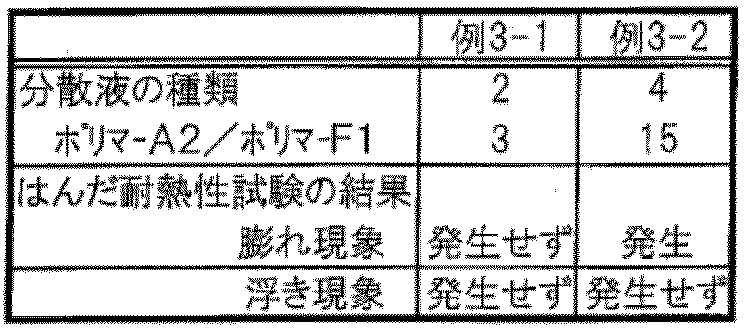
本発明の分散液は、層(F層)形成時の粉落ちが抑制され、電気特性と表面性状に優れたTFE系ポリマーの層(F層)を有する物品を形成でき、該物品はフィルム、繊維強化フィルム、プリプレグ、樹脂付金属箔、金属張積層板、プリント基板等に使用できる。また、本発明の分散液は、アンテナ部品、プリント基板、航空機用部品、自動車用部品、スポーツ用具、食品工業用品、のこぎり、すべり軸受け等の材料として有用である。
なお、2018年10月3日に出願された日本特許出願2018-188254号、2018年11月21日に出願された日本特許出願2018-218320号、及び2019年4月4日に出願された日本特許出願2019-071907号の明細書、特許請求の範囲及び要約書の全内容をここに引用し、本発明の明細書の開示として、取り入れるものである。
Claims (15)
- テトラフルオロエチレン系ポリマーのパウダーとガラス転移点が0~120℃の(メタ)アクリル系ポリマーと液状分散媒とを含み、前記テトラフルオロエチレン系ポリマーが前記液状分散媒に分散した分散液であって、前記テトラフルオロエチレン系ポリマー100質量部に対して、前記(メタ)アクリレート系ポリマーを0.1~10質量部含む、分散液。
- 前記テトラフルオロエチレン系ポリマー100質量部に対して、前記(メタ)アクリレート系ポリマーを0.1以上5質量部未満含む、請求項1に記載の分散液。
- 前記液状分散媒が、非水媒体である、請求項1又は2に記載の分散液。
- 前記液状分散媒が、エステル又はアミドである、請求項1~3のいずれか1項に記載の分散液。
- 前記テトラフルオロエチレン系ポリマーが、カルボニル基含有基、ヒドロキシ基、エポキシ基、オキセタニル基、アミノ基、ニトリル基及びイソシアネート基からなる群から選ばれる少なくとも1種の官能基を有する、請求項1~4のいずれか1項に記載の分散液。
- 前記(メタ)アクリル系ポリマーが、ヒドロキシ基を有する、請求項1~5のいずれか1項に記載の分散液。
- 前記(メタ)アクリル系ポリマーが、メチル(メタ)アクリレート、エチル(メタ)アクリレート、ブチル(メタ)アクリレート、イソボルニル(メタ)アクリレート、シクロペンチル(メタ)アクリレート、シクロヘキシル(メタ)アクリレート及びベンジル(メタ)アクリレートからなる群から選ばれる少なくとも1種の(メタ)アクリレートに基づく単位を含む、請求項1~6のいずれか1項に記載の分散液。
- 前記(メタ)アクリル系ポリマーが、メタクリレート系ポリマーである、請求項1~7のいずれか1項に記載の分散液。
- 前記(メタ)アクリル系ポリマーの重量平均分子量が、10000~150000である、請求項1~8のいずれか1項に記載の分散液。
- フッ素系分散剤をさらに含む、請求項1~9のいずれか1項に記載の分散液。
- フルオロアルコール、フルオロシリコーン及びフルオロポリエーテルからなる群から選ばれる少なくとも1種のフッ素系分散剤をさらに含む、請求項1~10のいずれか1項に記載の分散液。
- 金属箔と、該金属箔の表面に接して設けられ、テトラフルオロエチレン系ポリマーを含む樹脂層とを有する樹脂付金属箔を製造する方法であって、
請求項1~11のいずれか1項に記載の分散液を、前記表面に塗布して分散液から塗工層を形成し、さらに加熱により液状分散媒を除去し、前記テトラフルオロエチレン系ポリマーを溶融又は焼成させて前記樹脂層を形成する、樹脂付金属箔の製造方法。 - 前記塗工層の形成を、前記(メタ)アクリル系ポリマーのガラス転移点以上の温度にて行う、請求項12に記載の製造方法。
- 前記樹脂層の形成を、250℃~400℃にて行う、請求項12又は13に記載の製造方法。
- 前記樹脂層の厚さが、20μm未満である、請求項12~14のいずれか1項に記載の製造方法。
Priority Applications (2)
| Application Number | Priority Date | Filing Date | Title |
|---|---|---|---|
| CN201980065447.8A CN112789320A (zh) | 2018-10-03 | 2019-10-01 | 分散液和带树脂金属箔的制造方法 |
| JP2020550465A JP7363797B2 (ja) | 2018-10-03 | 2019-10-01 | 分散液及び樹脂付金属箔の製造方法 |
Applications Claiming Priority (6)
| Application Number | Priority Date | Filing Date | Title |
|---|---|---|---|
| JP2018188254 | 2018-10-03 | ||
| JP2018-188254 | 2018-10-03 | ||
| JP2018218320 | 2018-11-21 | ||
| JP2018-218320 | 2018-11-21 | ||
| JP2019-071907 | 2019-04-04 | ||
| JP2019071907 | 2019-04-04 |
Publications (1)
| Publication Number | Publication Date |
|---|---|
| WO2020071382A1 true WO2020071382A1 (ja) | 2020-04-09 |
Family
ID=70055594
Family Applications (1)
| Application Number | Title | Priority Date | Filing Date |
|---|---|---|---|
| PCT/JP2019/038793 Ceased WO2020071382A1 (ja) | 2018-10-03 | 2019-10-01 | 分散液及び樹脂付金属箔の製造方法 |
Country Status (4)
| Country | Link |
|---|---|
| JP (1) | JP7363797B2 (ja) |
| CN (1) | CN112789320A (ja) |
| TW (1) | TWI813783B (ja) |
| WO (1) | WO2020071382A1 (ja) |
Cited By (6)
| Publication number | Priority date | Publication date | Assignee | Title |
|---|---|---|---|---|
| JP2021004322A (ja) * | 2019-06-27 | 2021-01-14 | 三菱鉛筆株式会社 | ポリテトラフルオロエチレンの非水系分散体 |
| WO2022097679A1 (ja) | 2020-11-06 | 2022-05-12 | ダイキン工業株式会社 | 水性塗料組成物及び塗装物品 |
| WO2022097678A1 (ja) | 2020-11-06 | 2022-05-12 | ダイキン工業株式会社 | 水性塗料組成物及び塗装物品 |
| WO2022249923A1 (ja) | 2021-05-25 | 2022-12-01 | ダイキン工業株式会社 | 塗料組成物及び積層体 |
| WO2022270460A1 (ja) * | 2021-06-21 | 2022-12-29 | 積水化学工業株式会社 | (メタ)アクリル樹脂組成物、無機微粒子分散スラリー組成物及び無機微粒子分散成形物 |
| CN116021189A (zh) * | 2022-12-14 | 2023-04-28 | 云南锡业锡材有限公司 | 一种添加剂在提高锡膏耐高温储存性能中的应用 |
Citations (12)
| Publication number | Priority date | Publication date | Assignee | Title |
|---|---|---|---|---|
| JPS6465161A (en) * | 1987-06-08 | 1989-03-10 | Ici Plc | Fluorine copolymer composition |
| JPH0859748A (ja) * | 1994-06-01 | 1996-03-05 | Elf Atochem Sa | ヒドロキシル化されたフッ素化共重合体とアクリル共重合体とからなる安定な水性懸濁液と、その製造方法と、その水性塗料としての利用 |
| WO2003011991A1 (en) * | 2001-07-30 | 2003-02-13 | Daikin Industries, Ltd. | Aqueous dispersion type fluororesin coating composition |
| JP2013173837A (ja) * | 2012-02-24 | 2013-09-05 | Dic Corp | フッ素樹脂粒子の水分散体及びフッ素樹脂塗料 |
| WO2014200020A1 (ja) * | 2013-06-13 | 2014-12-18 | ダイキン工業株式会社 | フッ素樹脂組成物、塗膜、及び、物品 |
| JP2015509113A (ja) * | 2011-12-12 | 2015-03-26 | エルジー・ケム・リミテッド | 回路基板製造用シアネートエステル系樹脂組成物およびこれを含む軟性金属箔積層板 |
| JP2015110697A (ja) * | 2013-12-06 | 2015-06-18 | 共栄社化学株式会社 | フッ素ポリマー用分散剤 |
| WO2016017801A1 (ja) * | 2014-08-01 | 2016-02-04 | 旭硝子株式会社 | 樹脂パウダー、その製造方法、複合体、成形体、セラミックス成形体の製造方法、金属積層板、プリント基板及びプリプレグ |
| WO2016159102A1 (ja) * | 2015-04-01 | 2016-10-06 | 三菱鉛筆株式会社 | フッ素系樹脂含有非水系分散体、フッ素系樹脂含有ポリイミド前駆体溶液組成物、それを用いたポリイミド、ポリイミドフィルム、回路基板用接着剤組成物、およびそれらの製造方法 |
| JP6274339B1 (ja) * | 2017-03-29 | 2018-02-07 | 旭硝子株式会社 | 水性分散液 |
| JP2018111778A (ja) * | 2017-01-12 | 2018-07-19 | キヤノン株式会社 | フッ素原子含有樹脂粒子の分散液、および電子写真感光体の製造方法 |
| WO2018190371A1 (ja) * | 2017-04-14 | 2018-10-18 | ダイキン工業株式会社 | 樹脂組成物及び成形体 |
Family Cites Families (5)
| Publication number | Priority date | Publication date | Assignee | Title |
|---|---|---|---|---|
| JP5103702B2 (ja) * | 2001-07-30 | 2012-12-19 | ダイキン工業株式会社 | 樹脂水性分散組成物 |
| JP2007191709A (ja) * | 2005-12-21 | 2007-08-02 | Ist Corp | フッ素樹脂コーティング用水性分散組成物及び積層体 |
| WO2014104222A1 (ja) * | 2012-12-27 | 2014-07-03 | 旭硝子株式会社 | エチレン/テトラフルオロエチレン共重合体を含むブレンドポリマー、該ブレンドポリマーの成形体、太陽電池用バックシートおよび該成形体の製造方法 |
| JP6904347B2 (ja) * | 2016-06-23 | 2021-07-14 | Agc株式会社 | フッ素樹脂パウダーを含む液状組成物の製造方法 |
| KR102353961B1 (ko) * | 2016-07-22 | 2022-01-21 | 에이지씨 가부시키가이샤 | 액상 조성물, 그리고 그 액상 조성물을 사용한, 필름 및 적층체의 제조 방법 |
-
2019
- 2019-10-01 CN CN201980065447.8A patent/CN112789320A/zh active Pending
- 2019-10-01 JP JP2020550465A patent/JP7363797B2/ja active Active
- 2019-10-01 WO PCT/JP2019/038793 patent/WO2020071382A1/ja not_active Ceased
- 2019-10-03 TW TW108135832A patent/TWI813783B/zh active
Patent Citations (12)
| Publication number | Priority date | Publication date | Assignee | Title |
|---|---|---|---|---|
| JPS6465161A (en) * | 1987-06-08 | 1989-03-10 | Ici Plc | Fluorine copolymer composition |
| JPH0859748A (ja) * | 1994-06-01 | 1996-03-05 | Elf Atochem Sa | ヒドロキシル化されたフッ素化共重合体とアクリル共重合体とからなる安定な水性懸濁液と、その製造方法と、その水性塗料としての利用 |
| WO2003011991A1 (en) * | 2001-07-30 | 2003-02-13 | Daikin Industries, Ltd. | Aqueous dispersion type fluororesin coating composition |
| JP2015509113A (ja) * | 2011-12-12 | 2015-03-26 | エルジー・ケム・リミテッド | 回路基板製造用シアネートエステル系樹脂組成物およびこれを含む軟性金属箔積層板 |
| JP2013173837A (ja) * | 2012-02-24 | 2013-09-05 | Dic Corp | フッ素樹脂粒子の水分散体及びフッ素樹脂塗料 |
| WO2014200020A1 (ja) * | 2013-06-13 | 2014-12-18 | ダイキン工業株式会社 | フッ素樹脂組成物、塗膜、及び、物品 |
| JP2015110697A (ja) * | 2013-12-06 | 2015-06-18 | 共栄社化学株式会社 | フッ素ポリマー用分散剤 |
| WO2016017801A1 (ja) * | 2014-08-01 | 2016-02-04 | 旭硝子株式会社 | 樹脂パウダー、その製造方法、複合体、成形体、セラミックス成形体の製造方法、金属積層板、プリント基板及びプリプレグ |
| WO2016159102A1 (ja) * | 2015-04-01 | 2016-10-06 | 三菱鉛筆株式会社 | フッ素系樹脂含有非水系分散体、フッ素系樹脂含有ポリイミド前駆体溶液組成物、それを用いたポリイミド、ポリイミドフィルム、回路基板用接着剤組成物、およびそれらの製造方法 |
| JP2018111778A (ja) * | 2017-01-12 | 2018-07-19 | キヤノン株式会社 | フッ素原子含有樹脂粒子の分散液、および電子写真感光体の製造方法 |
| JP6274339B1 (ja) * | 2017-03-29 | 2018-02-07 | 旭硝子株式会社 | 水性分散液 |
| WO2018190371A1 (ja) * | 2017-04-14 | 2018-10-18 | ダイキン工業株式会社 | 樹脂組成物及び成形体 |
Cited By (8)
| Publication number | Priority date | Publication date | Assignee | Title |
|---|---|---|---|---|
| JP2021004322A (ja) * | 2019-06-27 | 2021-01-14 | 三菱鉛筆株式会社 | ポリテトラフルオロエチレンの非水系分散体 |
| WO2022097679A1 (ja) | 2020-11-06 | 2022-05-12 | ダイキン工業株式会社 | 水性塗料組成物及び塗装物品 |
| WO2022097678A1 (ja) | 2020-11-06 | 2022-05-12 | ダイキン工業株式会社 | 水性塗料組成物及び塗装物品 |
| WO2022249923A1 (ja) | 2021-05-25 | 2022-12-01 | ダイキン工業株式会社 | 塗料組成物及び積層体 |
| KR20240001705A (ko) | 2021-05-25 | 2024-01-03 | 다이킨 고교 가부시키가이샤 | 도료 조성물 및 적층체 |
| US12552955B2 (en) | 2021-05-25 | 2026-02-17 | Daikin Industries, Ltd. | Coating composition and laminate |
| WO2022270460A1 (ja) * | 2021-06-21 | 2022-12-29 | 積水化学工業株式会社 | (メタ)アクリル樹脂組成物、無機微粒子分散スラリー組成物及び無機微粒子分散成形物 |
| CN116021189A (zh) * | 2022-12-14 | 2023-04-28 | 云南锡业锡材有限公司 | 一种添加剂在提高锡膏耐高温储存性能中的应用 |
Also Published As
| Publication number | Publication date |
|---|---|
| JPWO2020071382A1 (ja) | 2021-09-16 |
| TWI813783B (zh) | 2023-09-01 |
| JP7363797B2 (ja) | 2023-10-18 |
| CN112789320A (zh) | 2021-05-11 |
| TW202033652A (zh) | 2020-09-16 |
Similar Documents
| Publication | Publication Date | Title |
|---|---|---|
| JP7363797B2 (ja) | 分散液及び樹脂付金属箔の製造方法 | |
| JP7115589B2 (ja) | 液状組成物、並びに該液状組成物を使用した、フィルムおよび積層体の製造方法 | |
| JP7363818B2 (ja) | パウダー分散液、積層体及びプリント基板 | |
| TWI824049B (zh) | 分散液 | |
| JP7230932B2 (ja) | 積層体及びその製造方法、複合積層体の製造方法、並びにポリマーフィルムの製造方法 | |
| JP7283208B2 (ja) | パウダー分散液、積層体の製造方法、積層体及びプリント基板の製造方法 | |
| TWI826452B (zh) | 附樹脂之金屬箔之製造方法、附樹脂之金屬箔、積層體及印刷基板 | |
| CN112236473B (zh) | 分散液、带树脂的金属箔的制造方法、及印刷基板的制造方法 | |
| KR102667496B1 (ko) | 수지 부착 금속박의 제조 방법 | |
| JP2020037662A (ja) | フッ素樹脂膜、分散液の製造方法およびフッ素樹脂膜付基材の製造方法 | |
| CN115666942A (zh) | 具有包含热熔融性四氟乙烯类聚合物的层的层叠体的制造方法 | |
| JP2020158720A (ja) | 複合粒子、分散液、積層体の製造方法、膜の製造方法及び被覆織布の製造方法 | |
| WO2021075504A1 (ja) | 非水系分散液及び積層体の製造方法 | |
| WO2020071381A1 (ja) | 分散液 | |
| JP2020070401A (ja) | 分散液 | |
| JP7247536B2 (ja) | 複合体の製造方法及び複合体 | |
| JP7452534B2 (ja) | パウダー分散液、パウダー分散液の製造方法及び樹脂付基板の製造方法 | |
| WO2020250919A1 (ja) | 収容体の製造方法及び液状組成物 | |
| JP2020093196A (ja) | 処理金属基板の製造方法 |
Legal Events
| Date | Code | Title | Description |
|---|---|---|---|
| 121 | Ep: the epo has been informed by wipo that ep was designated in this application |
Ref document number: 19869897 Country of ref document: EP Kind code of ref document: A1 |
|
| ENP | Entry into the national phase |
Ref document number: 2020550465 Country of ref document: JP Kind code of ref document: A |
|
| NENP | Non-entry into the national phase |
Ref country code: DE |
|
| 122 | Ep: pct application non-entry in european phase |
Ref document number: 19869897 Country of ref document: EP Kind code of ref document: A1 |