WO2020071335A1 - 金属粒子組成物の製造方法および金属粒子組成物 - Google Patents
金属粒子組成物の製造方法および金属粒子組成物Info
- Publication number
- WO2020071335A1 WO2020071335A1 PCT/JP2019/038616 JP2019038616W WO2020071335A1 WO 2020071335 A1 WO2020071335 A1 WO 2020071335A1 JP 2019038616 W JP2019038616 W JP 2019038616W WO 2020071335 A1 WO2020071335 A1 WO 2020071335A1
- Authority
- WO
- WIPO (PCT)
- Prior art keywords
- metal
- particle composition
- beads
- metal material
- particle size
- Prior art date
- Legal status (The legal status is an assumption and is not a legal conclusion. Google has not performed a legal analysis and makes no representation as to the accuracy of the status listed.)
- Ceased
Links
Images




Classifications
-
- B—PERFORMING OPERATIONS; TRANSPORTING
- B22—CASTING; POWDER METALLURGY
- B22F—WORKING METALLIC POWDER; MANUFACTURE OF ARTICLES FROM METALLIC POWDER; MAKING METALLIC POWDER; APPARATUS OR DEVICES SPECIALLY ADAPTED FOR METALLIC POWDER
- B22F9/00—Making metallic powder or suspensions thereof
- B22F9/02—Making metallic powder or suspensions thereof using physical processes
- B22F9/04—Making metallic powder or suspensions thereof using physical processes starting from solid material, e.g. by crushing, grinding or milling
-
- B—PERFORMING OPERATIONS; TRANSPORTING
- B02—CRUSHING, PULVERISING, OR DISINTEGRATING; PREPARATORY TREATMENT OF GRAIN FOR MILLING
- B02C—CRUSHING, PULVERISING, OR DISINTEGRATING IN GENERAL; MILLING GRAIN
- B02C17/00—Disintegrating by tumbling mills, i.e. mills having a container charged with the material to be disintegrated with or without special disintegrating members such as pebbles or balls
- B02C17/16—Mills in which a fixed container houses stirring means tumbling the charge
-
- B—PERFORMING OPERATIONS; TRANSPORTING
- B02—CRUSHING, PULVERISING, OR DISINTEGRATING; PREPARATORY TREATMENT OF GRAIN FOR MILLING
- B02C—CRUSHING, PULVERISING, OR DISINTEGRATING IN GENERAL; MILLING GRAIN
- B02C17/00—Disintegrating by tumbling mills, i.e. mills having a container charged with the material to be disintegrated with or without special disintegrating members such as pebbles or balls
- B02C17/18—Details
- B02C17/20—Disintegrating members
-
- B—PERFORMING OPERATIONS; TRANSPORTING
- B22—CASTING; POWDER METALLURGY
- B22F—WORKING METALLIC POWDER; MANUFACTURE OF ARTICLES FROM METALLIC POWDER; MAKING METALLIC POWDER; APPARATUS OR DEVICES SPECIALLY ADAPTED FOR METALLIC POWDER
- B22F1/00—Metallic powder; Treatment of metallic powder, e.g. to facilitate working or to improve properties
- B22F1/05—Metallic powder characterised by the size or surface area of the particles
-
- C—CHEMISTRY; METALLURGY
- C22—METALLURGY; FERROUS OR NON-FERROUS ALLOYS; TREATMENT OF ALLOYS OR NON-FERROUS METALS
- C22C—ALLOYS
- C22C16/00—Alloys based on zirconium
-
- H—ELECTRICITY
- H01—ELECTRIC ELEMENTS
- H01M—PROCESSES OR MEANS, e.g. BATTERIES, FOR THE DIRECT CONVERSION OF CHEMICAL ENERGY INTO ELECTRICAL ENERGY
- H01M4/00—Electrodes
- H01M4/02—Electrodes composed of, or comprising, active material
- H01M4/36—Selection of substances as active materials, active masses, active liquids
- H01M4/38—Selection of substances as active materials, active masses, active liquids of elements or alloys
-
- B—PERFORMING OPERATIONS; TRANSPORTING
- B22—CASTING; POWDER METALLURGY
- B22F—WORKING METALLIC POWDER; MANUFACTURE OF ARTICLES FROM METALLIC POWDER; MAKING METALLIC POWDER; APPARATUS OR DEVICES SPECIALLY ADAPTED FOR METALLIC POWDER
- B22F9/00—Making metallic powder or suspensions thereof
- B22F9/02—Making metallic powder or suspensions thereof using physical processes
- B22F9/04—Making metallic powder or suspensions thereof using physical processes starting from solid material, e.g. by crushing, grinding or milling
- B22F2009/041—Making metallic powder or suspensions thereof using physical processes starting from solid material, e.g. by crushing, grinding or milling by mechanical alloying, e.g. blending, milling
-
- B—PERFORMING OPERATIONS; TRANSPORTING
- B22—CASTING; POWDER METALLURGY
- B22F—WORKING METALLIC POWDER; MANUFACTURE OF ARTICLES FROM METALLIC POWDER; MAKING METALLIC POWDER; APPARATUS OR DEVICES SPECIALLY ADAPTED FOR METALLIC POWDER
- B22F9/00—Making metallic powder or suspensions thereof
- B22F9/02—Making metallic powder or suspensions thereof using physical processes
- B22F9/04—Making metallic powder or suspensions thereof using physical processes starting from solid material, e.g. by crushing, grinding or milling
- B22F2009/043—Making metallic powder or suspensions thereof using physical processes starting from solid material, e.g. by crushing, grinding or milling by ball milling
-
- B—PERFORMING OPERATIONS; TRANSPORTING
- B22—CASTING; POWDER METALLURGY
- B22F—WORKING METALLIC POWDER; MANUFACTURE OF ARTICLES FROM METALLIC POWDER; MAKING METALLIC POWDER; APPARATUS OR DEVICES SPECIALLY ADAPTED FOR METALLIC POWDER
- B22F9/00—Making metallic powder or suspensions thereof
- B22F9/02—Making metallic powder or suspensions thereof using physical processes
- B22F9/04—Making metallic powder or suspensions thereof using physical processes starting from solid material, e.g. by crushing, grinding or milling
- B22F2009/045—Making metallic powder or suspensions thereof using physical processes starting from solid material, e.g. by crushing, grinding or milling by other means than ball or jet milling
- B22F2009/046—Making metallic powder or suspensions thereof using physical processes starting from solid material, e.g. by crushing, grinding or milling by other means than ball or jet milling by cutting
-
- B—PERFORMING OPERATIONS; TRANSPORTING
- B22—CASTING; POWDER METALLURGY
- B22F—WORKING METALLIC POWDER; MANUFACTURE OF ARTICLES FROM METALLIC POWDER; MAKING METALLIC POWDER; APPARATUS OR DEVICES SPECIALLY ADAPTED FOR METALLIC POWDER
- B22F2304/00—Physical aspects of the powder
- B22F2304/10—Micron size particles, i.e. above 1 micrometer up to 500 micrometer
-
- Y—GENERAL TAGGING OF NEW TECHNOLOGICAL DEVELOPMENTS; GENERAL TAGGING OF CROSS-SECTIONAL TECHNOLOGIES SPANNING OVER SEVERAL SECTIONS OF THE IPC; TECHNICAL SUBJECTS COVERED BY FORMER USPC CROSS-REFERENCE ART COLLECTIONS [XRACs] AND DIGESTS
- Y02—TECHNOLOGIES OR APPLICATIONS FOR MITIGATION OR ADAPTATION AGAINST CLIMATE CHANGE
- Y02E—REDUCTION OF GREENHOUSE GAS [GHG] EMISSIONS, RELATED TO ENERGY GENERATION, TRANSMISSION OR DISTRIBUTION
- Y02E60/00—Enabling technologies; Technologies with a potential or indirect contribution to GHG emissions mitigation
- Y02E60/10—Energy storage using batteries
Definitions
- the present invention relates to a method for producing a metal particle composition useful as a negative electrode material for a lithium ion secondary battery, and a metal particle composition.
- Group 14 elements silicon, germanium and tin have a higher lithium ion storage capacity than carbon-based materials, and thus are useful as negative electrode materials for lithium ion secondary batteries.
- germanium when germanium is used as a negative electrode active material of a lithium ion secondary battery, a discharge capacity four times or more that of a carbon-based negative electrode active material is provided (Patent Document 1).
- metal materials such as silicon and germanium expand significantly in volume due to occlusion of lithium ions. For this reason, a large stress is generated in the negative electrode active material layer at the time of charging, and the negative electrode active material layer is cracked and peeled to increase the resistance, thereby deteriorating the charge / discharge characteristics.
- Patent Document 2 When metal particles of a silicon-based metal material are used for a negative electrode material of a lithium-ion secondary battery, the insertion of lithium by reducing the crystallites of silicon by atomizing or pulverizing and / or amorphizing the silicon alloy. It is known that the desorption reaction can be made uniform, the volume expansion and contraction due to the repeated insertion and desorption occur uniformly, and as a result, the repetition life becomes longer (Patent Document 2).
- Patent Document 3 a method of obtaining nanometer-sized metal particles by a pulverization method including a dry pulverization step and a wet pulverization step using a silicon oxide as a metal particle of a silicon-based metal material is known (Patent Document 3).
- An object of the present invention is to solve the above-mentioned problem, and an object of the present invention is to provide a pulverization method capable of obtaining metal material particles having a narrow particle size distribution in a metal material having a lower hardness than silicon. .
- Another object of the present invention is to provide a metal particle composition which, when used as a negative electrode material of a lithium ion secondary battery or the like, has a large discharge capacity, excellent coating properties, and excellent capacity retention performance before and after high-speed discharge.
- a metal material including a simple metal having a Mohs hardness of 2.5 to 6.3 is pulverized in the presence of beads as a pulverization medium using a medium stirring type pulverizer equipped with a rotating body.
- a method for producing a metal particle composition comprising a metal material particle, a grinding container-derived component, and a bead-derived component, comprising a step of stirring and grinding in a container, A mass ratio of the metal material to the beads is 0.02 to 0.10.
- the peripheral speed of the rotating body is 2.5 to 8.5 m / s, Provided is a method for producing a metal particle composition.
- the medium stirring type pulverizer is a medium stirring type mill provided with a pulverizing vessel and stirring blades.
- the metal material is at least one germanium material selected from the group consisting of germanium and a germanium alloy.
- a dispersion medium is used in the step of pulverizing the metal material.
- the mass ratio between the metal material and the dispersion medium is 0.07 to 0.5.
- the beads have a diameter of 0.03 mm to 2 mm.
- the material of the crushing container includes alumina, and the material of the beads includes zirconia.
- the metal particle composition has a maximum particle size (D 100 ) in a volume-based particle size distribution of 0.2 to 5.2 ⁇ m.
- the metal particle composition contains at least one of zirconium and aluminum, and the total amount of zirconium and aluminum is 0.028 to 1.0 part by weight based on 100 parts by weight of the metal particles.
- the present invention also provides a metal particle composition
- a metal particle composition comprising a metal material containing a simple metal having a Mohs hardness of 2.5 to 6.3, and a metal particle composition containing at least one of zirconium and aluminum,
- the metal particles have a maximum particle size (D 100 ) in a volume-based particle size distribution of 0.2 to 5.2 ⁇ m,
- a metal particle composition is provided, wherein the total amount of the zirconium and aluminum is 0.028 to 1.0 parts by weight based on 100 parts by weight of the metal particles.
- the total amount of zirconium and aluminum is 0.028 to 0.146 parts by weight based on 100 parts by weight of the metal particles.
- the metal material is at least one germanium material selected from the group consisting of germanium and a germanium alloy.
- the present invention provides a method for grinding a metal material containing a simple metal having a Mohs hardness of 2.5 to 6.3 by using a medium stirring type pulverizer equipped with a rotating body.
- a method for producing a metal particle composition comprising particles of a metal material, a component derived from a grinding container, and a component derived from beads, comprising:
- the beads (1) have an average particle size of 0.2 to 2 mm
- the beads (2) have an average particle size of 0.03 to 0.2 mm
- the beads (1) are beads. It has a larger average particle diameter than (2).
- the present invention also provides a metal particle composition obtained by any one of the above methods.
- a pulverization method capable of obtaining metal material particles having a narrow particle size distribution in a metal material having a lower hardness than silicon. Further, according to the present invention, when used as a negative electrode material of a lithium ion secondary battery or the like, a metal particle composition having a large discharge capacity, excellent coating properties, and excellent capacity retention performance before and after high-speed discharge is provided. .
- FIG. 2 is a schematic sectional view of a bead mill device.
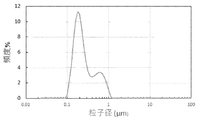
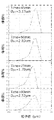
- FIG. 3 is a particle size distribution diagram of metal particles of Example 1.
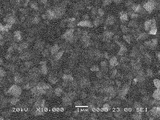
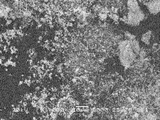
- 3 is a scanning electron microscope image of the metal particles of Example 1.
- 3 is a particle size distribution diagram of metal particles of Comparative Example 1.
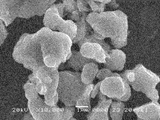
- FIG. 5 is a scanning electron microscope image of the metal particles of Comparative Example 1.
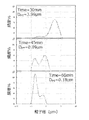
- FIG. 3 is a particle size distribution diagram showing a change over time of the metal particles of Example 1.
- FIG. 3 is a particle size distribution diagram showing a change over time of metal particles of Comparative Example 1.
- 5 is a scanning electron microscope image of the metal particles of Comparative Example 1 when the pulverization time is 60 minutes.
- 7 is a scanning electron microscope image of the metal particles of Comparative Example 1 when the pulverization time is 75 minutes.
- 9 is a scanning electron microscope image of the metal particles of Comparative Example 1 when the grinding time is 90 minutes.
- Mohs' hardness is an empirical measure for determining the hardness of a mineral by comparing it with ten kinds of reference minerals.
- the reference minerals are talc, gypsum, calcite, fluorite, apatite, feldspar, quartz, jade, and steel ball in order from soft (Mohs hardness 1) to hard (Mohs hardness 10). Scrub the material-based mineral and measure the hardness with or without scratches. For example, when fluorite is not damaged and apatite is damaged, the Mohs hardness is 4.5 (meaning between 4 and 5).
- the “average particle diameter” is a value of a volume average particle diameter measured using a laser analysis method.
- the present invention relates to a method for producing metal particles.
- the method of the present invention comprises a step of crushing a metal material containing a simple metal having a Mohs hardness of 2.5 to 6.3 with beads using a medium stirring type crusher provided with a crushing vessel and a rotating body.
- a method for producing particles wherein the ratio of the mass of the metal material to the mass of the beads is 0.02 to 0.10, and the peripheral speed of the rotating body is 2.5 to 8.5 m / s. It is.
- the metal material is stirred in a pulverization container in the presence of beads as a pulverization medium, and the beads and the pulverization container collide with each other and rub. At that time, depending on the type of material used for the beads and the milling vessel, both materials may wear. As a result, the materials constituting the beads and the crushing container are mixed with the metal particles to be crushed.
- the pulverized metal particles When the material mixed during the pulverization is considered as a component of the pulverized material, the pulverized metal particles have the same meaning as the metal particle composition including the metal material particles, the component derived from the pulverizing container, and the component derived from the beads.
- the present invention which is a method for producing metal particles, is equivalent to a method for producing a metal particle composition.
- a metal material containing at least one simple metal having a Mohs' hardness of 2.5 to 6.3 is used as a pulverization target.
- Mohs'hardness As a simple metal having a Mohs 'hardness of 2.5 to 6.3, Ti (Mohs's hardness: 6, similarly, the values in parentheses indicate Mohs' hardness), Mn (6), Ge (6), Nb (6) ), Rh (6), U (6), Be (5.5), Mo (5.5), Hf (5.5), Co (5), Zr (5), Pd (4.75), Fe (4), Ni (4), As (3.5), Pt (3.5), Cu (3), Sb (3), Th (3), Al (2.75), Mg (2. 5), Zn (2.5), Ag (2.5), La (2.5), Ce (2.5), Au (2.5) and the like.
- G.S. V. Samsonov As a source of the Mohs hardness of a single metal, G.S. V. Samsonov, @ed. , “Mechanical Properties of the Element”. Handbook ⁇ of ⁇ the ⁇ physicochemical ⁇ properties ⁇ of ⁇ the ⁇ elements. New York
- the Mohs hardness of the metal alone contained in the metal material is too high, the pulverization time required for miniaturization may be long. On the other hand, if the Mohs hardness is too low, the metal particles are likely to be stretched or re-agglomerated with the pulverization, and it may be difficult to make the particles fine by pulverization.
- the Mohs' hardness of a single metal contained in the metal material is preferably from 3 to 6.3, more preferably from 4 to 6.3, and still more preferably from 5 to 6.3.
- metal material Ti, Mn, Ge, Nb, Rh, U, Be, Mo, Hf, Co, Zr, Pd, Fe, Ni, As, Pt, Cu, Sb, Th, Al, Mg, Zn, Ag , La, a metal material containing at least one metal selected from Ce and Au, preferably a metal material containing at least one metal selected from Ge, Ti, Mn, Nb, Mo, Co and Zr, A metal material containing Ge is more preferable, and at least one germanium material selected from the group consisting of germanium and a germanium alloy is preferable.
- the metal material may be a simple metal having a Mohs 'hardness of 2.5 to 6.3, or an alloy containing at least one simple metal having a Mohs' hardness of 2.5 to 6.3.
- the metal material is an alloy, including a simple metal having a Mohs' hardness of 2.5 to 6.3 means that the metal element constituting the simple metal is included in the alloy.
- the ratio of the metal element is preferably 10% by mass or more, more preferably 50% by mass or more, further preferably 75% by mass or more, and particularly preferably 90% by mass or more.
- the metal material may be a mixture of two or more simple metals having a Mohs hardness of 2.5 to 6.3, and an alloy containing at least one metal having a Mohs hardness of 2.5 to 6.3. May be mixed, or a material obtained by mixing at least one elemental metal and at least one alloy.
- Metal materials include metals whose metal Mohs hardness is 2.5 to 6.3.
- the Mohs hardness of the metal alone is preferably from 3 to 6.3, more preferably from 4 to 6.3, even more preferably from 5 to 6.3. If the Mohs hardness of the metal alone contained in the metal material is less than 2.5, the metal particles are likely to be stretched or re-agglomerated with the pulverization, and it may be difficult to make the metal particles fine by pulverization. If it exceeds 3, the pulverization time required for micronization may be long.
- the material to be charged into the crushing container may include other materials other than the above-mentioned metal material.
- Other materials include boron, boride, graphite, glassy carbon, carbon nanotubes, graphene, fullerene, amorphous carbon, carbon fiber, carbon black, diamond, carbide, nitride, nitrite, nitrate, phosphorus, phosphide , Phosphate, oxide, sulfur, sulfide, sulfite, sulfate, selenium, selenide, tellurium, telluride, tellurate, fluoride, chloride, bromide, iodide.
- the ratio of the other material to the total of the metal material and the other material is preferably 0 to 50% by mass, more preferably 0 to 25% by mass, further preferably 0 to 10% by mass, It is particularly preferably 0 to 5% by mass.
- Metal materials are crushed using beads.
- the metal material and the beads are charged in a crushing container, and the metal material and the beads in the crushing container flow by the rotational motion of the rotating body, and the beads and the metal material collide with each other.
- the material can be crushed.
- the pulverizing step is a step of pulverizing the metal material with beads using a medium stirring type pulverizer provided with a pulverizing container and a rotating body in the presence of the metal material.
- the metal material is preferably pulverized in the presence of a dispersion medium.
- the use of the dispersion medium causes the surface of the metal material to be wet to reduce the interaction between the particles, thereby suppressing aggregation of the metal material. Further, it is possible to suppress the metal material from adhering to the crushing container, the beads or the rotating body.
- a medium stirring type pulverizer there are a dry pulverizer that pulverizes a metal material using only beads without using a dispersion medium, and a wet pulverizer that pulverizes a metal material using a dispersion medium and beads.
- dry pulverizer examples include a rotary cylindrical ball mill that rotates the pulverization container itself and / or revolves to flow the metal material and beads in the contents.
- a rotating cylindrical ball mill that rotates the grinding container itself and / or revolves to flow the metal material of the contents, the dispersion medium, and the beads, and a stirring blade including a shaft and an arm inside the grinding container.
- a medium stirring type mill for rotating a shaft to flow a metal material, a dispersion medium, and beads of contents by an arm. From the viewpoint of efficiently transmitting mechanical energy by rotation to the contents to complete pulverization in a short time, a medium stirring type mill is preferable. Examples of the medium stirring mill include a bead mill and an attritor.
- the medium stirring mill has a batch type in which a fixed amount of contents are stored in a grinding container, and a circulation type in which a metal material dispersed in a dispersion medium is circulated inside and outside the grinding container.
- a circulation-type medium stirring mill is industrially advantageous because a large amount of metal material can be uniformly processed in a short time.
- the rotator is a portion that directly transmits kinetic energy to beads by rotational motion.
- the rotating body in a medium stirring mill such as a bead mill or an attritor is a stirring blade including a shaft and an arm.
- the rotating body in the rotary cylindrical ball mill that rotates the pulverizing container itself such as a ball mill and / or revolves to flow the metal material and beads of the contents is a pulverizing container.
- the rotating body is a stirring blade.
- the surface of the pulverizing container in contact with the metal material may be formed of a material having strength not to be damaged during the pulverizing step.
- the material of the pulverizing container include alumina or zirconia, and the other element oxide-reinforced alumina obtained by mixing the alumina or the zirconia with another element or the other element oxide stabilized zirconia.
- zirconium is used as another element.
- other element oxide stabilized zirconia aluminum, yttrium, calcium, magnesium, hafnium and the like are used as other elements.
- an alumina pulverizing container means that when used as a negative electrode material of a lithium ion secondary battery or the like, a metal particle composition having a large discharge capacity, excellent coating properties, and excellent capacity retention performance before and after high-speed discharge. This is preferable because it makes it easier to obtain
- the alumina-made pulverizing container include an alumina-made pulverizing container.
- Beads are a grinding medium for grinding metal materials.
- the diameter of a bead is the average particle diameter of the bead.
- the grinding medium may be referred to as a ball, but in the present specification, the solid grinding medium is referred to as a bead regardless of the average particle diameter of the beads.
- the beads flow at high speed in the pulverizing container by the rotation of the pulverizing container itself of the pulverizer or the rotation of the shaft with the arm, and collide with the metal material to form a metal material having a smaller average particle diameter. And crushed.
- the shape of the beads is preferably spherical or elliptical.
- the diameter of the beads is preferably larger than the average particle diameter of the metal particles after pulverization.
- a large crushing energy can be given to the metal material, so that metal particles can be efficiently obtained in a short time.
- the diameter of the beads is too large, reaggregation of the metal particles is promoted, and metal particles having a wide particle size distribution are generated.
- the diameter of the beads is preferably 0.03 mm to 2 mm, more preferably 0.05 mm to 1 mm, and still more preferably 0.1 mm to 0.8 mm.
- the diameter of the beads is in this range, reaggregation of the metal particles can be suppressed, and metal particles having a narrow particle size distribution can be efficiently obtained in a short time.
- the diameter of the beads to be put in the crushing container may be uniform or different.
- the material of the beads examples include glass, meno, alumina, zirconia, stainless steel, chrome steel, tungsten carbide, silicon carbide, and silicon nitride.
- zirconia is preferably used because it has a relatively high hardness so that it is hard to be worn, and because it has a relatively large specific gravity, it is possible to obtain a large grinding energy.
- the metal material can be efficiently pulverized.
- a zirconia-made pulverizing medium means that when used as a negative electrode material of a lithium ion secondary battery, a metal particle composition having a large discharge capacity, excellent coating properties, and excellent capacity retention performance before and after high-speed discharge. It is preferable because it can be easily obtained.
- a crushing medium made of zirconia and using a crushing container made of alumina when used as a negative electrode material of a lithium ion secondary battery, has a large discharge capacity, excellent coating characteristics, and before and after high-speed discharge. It is more preferable because it becomes easier to obtain a metal particle composition having excellent capacity retention performance.
- the pulverizing step is performed, for example, at a ratio of the mass of the metal material to the mass of the beads of 0.02 to 0.10.
- the ratio between the mass of the metal material and the mass of the beads is preferably 0.02 to 0.09, and more preferably 0.02 to 0.06.
- the ratio of the mass of the metal material to the mass of the beads is in this range, reaggregation of the metal particles is promoted, and metal particles having a narrow particle size distribution can be obtained.
- the ratio of the mass of the metal material to the mass of the beads in the grinding container is calculated by using the mass of the metal material in the grinding container in a steady state in the operation of the apparatus.
- the mass of the metal material in the grinding container can be calculated using the following equation.
- each symbol is W M, V : mass of the metal material in the grinding vessel, V C : effective volume of the grinding vessel, V M, T : volume of the circulating metal material, W M, T : circulation.
- Mass of metallic material, ⁇ M, T density of metallic material, V B : volume of bead, W B : mass of bead, ⁇ B : true density of bead, V DM, T : circulating dispersion Volume of medium, W DM, T : mass of circulating dispersion medium, ⁇ DM, T : density of dispersion medium, V NM, T : volume of circulating material other than metal, W NM, T : circulation
- the mass of the material other than the metal, ⁇ NM, T is the density of the material other than the metal.
- the pulverizing step is preferably performed at a peripheral speed of the rotating body of 2.5 to 8.5 m / s.
- the peripheral speed of the rotating body is the maximum rotational movement of the rotating body.
- the peripheral speed in a medium stirring type mill such as a bead mill or an attritor is the maximum speed during steady operation of the stirring blade which is a rotating body, and more specifically, the peripheral speed of the outermost periphery of the stirring blade having the longest diameter. Show.
- the peripheral speed in the rotating cylindrical ball mill is the maximum rotational speed of the grinding container itself, which is a rotating body, during steady operation, and more specifically, the peripheral speed of the inner wall of the grinding container given by rotation and / or revolution.
- the peripheral speed of the rotating body is preferably 3 to 8 m / s. When the peripheral speed of the rotating body is in this range, reagglomeration of metal particles is promoted, and metal particles having a narrow particle size distribution can be obtained.
- the filling rate of the beads is preferably 10% by volume or more and 74% by volume or less of the volume of the crushing container provided in the medium stirring type crusher.
- Water or an organic solvent can be used as the dispersion medium.
- the organic solvent may optionally include water.
- examples of the organic solvent include alcohol solvents, ether solvents, ketone solvents, glycol solvents, hydrocarbon solvents, and aprotic polar solvents. Among them, alcohol solvents are preferable from the viewpoint that the metal material is hardly oxidized and metal particles having a narrow particle size distribution can be obtained.
- alcohol solvents examples include methanol (MeOH), ethanol (EtOH), n-propyl alcohol, isopropyl alcohol (IPA), n-butyl alcohol, isobutyl alcohol, sec-butyl alcohol, t-butyl alcohol, heptanol, n-amyl Alcohol, sec-amyl alcohol, n-hexyl alcohol, tetrahydrofurfuryl alcohol, furfuryl alcohol, allyl alcohol, ethylene chlorohydrin, octyldodecanol, 1-ethyl-1-propanol, 2-methyl-1-butanol, isoamyl Alcohol, t-amyl alcohol, sec-isoamyl alcohol, neoamyl alcohol, hexyl alcohol, 2-methyl-1-pentanol, 4-methyl-2-pentanol, Butyl alcohol, n-octyl alcohol, 2-ethylhexyl alcohol, nonyl alcohol, de
- glycol solvents include ethylene glycol, diethylene glycol, triethylene glycol, propylene glycol, dipropylene glycol, 1,3-butylene glycol, hexylene glycol, polyethylene glycol, and polypropylene glycol.
- ether solvents include ethyl ether, isopropyl ether, dioxane, tetrahydrofuran, dibutyl ether, butyl ethyl ether, methyl-t-butyl ether, terpinyl methyl ether, dihydroterpinyl methyl ether, diglyme, and 1,3-dioxolane.
- ethers and dialkyl ethers such as diethylene glycol dimethyl ether, diethylene glycol diethyl ether, diethylene glycol methyl isobutyl ether, dipropylene glycol dimethyl ether, and dipropylene glycol diethyl ether.
- ketone solvent examples include acetone, methyl ethyl ketone (MEK), diethyl ketone, methyl propyl ketone, methyl isobutyl ketone, methyl amyl ketone, cyclohexanone, cyclopentanone and the like.
- hydrocarbon solvents examples include aromatic hydrocarbons such as toluene and xylene, hydrocarbons such as n-hexane, cyclohexane and n-heptane, and halogenated hydrocarbons such as methylene chloride, chloroform and dichloroethane.
- aprotic polar solvent examples include dimethylformamide, dimethylacetamide, dimethylsulfoxide, acetonitrile ⁇ , and N-methyl-2-pyrrolidone (NMP).
- isopropyl alcohol, ethanol, and water are preferable, and isopropyl alcohol is more preferable, from the viewpoint of obtaining metal particles having a narrow particle size distribution.
- the organic solvent may be arbitrarily mixed and used as a dispersion medium.
- the dispersion medium may include a surfactant.
- the surfactant includes an organic compound having a carboxyl group, an organic compound having a thiol group, an organic compound having a phenol ring, an anionic surfactant, a cationic surfactant, an amphoteric surfactant, and a nonionic surfactant. No.
- organic compounds having a carboxyl group examples include formic acid, acetic acid, propionic acid, butanoic acid, hexanoic acid, heptanoic acid, octanoic acid, nonanoic acid, decanoic acid, undecanoic acid, lauric acid, myristic acid, palmitic acid, stearic acid, and oleic acid.
- saturated and unsaturated carboxylic acids having 1 to 20 carbon atoms such as acids, linoleic acid and linolenic acid, hydroxycarboxylic acids, alicyclic and aromatic carboxylic acids having 6 to 34 carbon atoms, and the like can be mentioned.
- Examples of the organic compound having a thiol group include mercaptoethanol, mercapto-2-propanol, 1-mercapto-2, 3-propanediol, 3-mercaptopropyltrimethoxysilane, mercaptosuccinic acid, hexanethiol, pentanedithiol, dodecanethiol, Alkanethiols such as undecanethiol and decanthiol are exemplified.
- Examples of the organic compound having a phenol ring include triphenylphosphine, tributylphosphine, trioctylphosphine, tributylphosphine, and the like.
- Examples of anionic surfactants include higher fatty acid salts, alkyl sulfonates, alpha olefin sulfonates, alkane sulfonates, alkylbenzene sulfonates, sulfosuccinates, alkyl sulfates, alkyl ether sulfates, and alkyl sulfates.
- Phosphate ester salts alkyl ether phosphate ester salts, alkyl ether carboxylate salts, alpha sulfo fatty acid methyl ester salts, methyl taurate salts and the like can be mentioned.
- Examples of the cationic surfactant include an alkyltrimethylammonium salt, a dialkyldimethylammonium salt, an alkyldimethylbenzylammonium salt, an alkylpyridinium salt and the like.
- amphoteric surfactant examples include alkyl betaine, fatty acid amidopropyl betaine, and alkylamine oxide.
- Nonionic surfactants include glycerin fatty acid ester, polyglycerin fatty acid ester, sucrose fatty acid ester, sorbitan fatty acid ester, polyoxyethylene sorbitan fatty acid ester, polyoxyethylene alkyl ether, polyoxyethylene alkylphenyl ether, polyoxyethylene fatty acid Esters, fatty acid alkanolamides, alkyl glucosides, and the like.
- fluorosurfactants polymer derivatives such as cellulose derivatives, polycarboxylates and polystyrene sulfonates.
- the ratio of the mass of the metal material to the mass of the dispersion medium is preferably 0.07 to 0.5, since metal particles having a narrow particle size distribution can be efficiently obtained in a short time. , And more preferably 0.1 to 0.35.
- the ratio between the mass of the metal material and the mass of the dispersion medium is within this range, it is possible to suppress the coarse metal material remaining due to an increase in the viscosity of the mixture of the metal material and the dispersion medium, and In addition, a reduction in grinding efficiency can be suppressed.
- Pulverization time is the sum of the time during which a rotary cylinder ball mill and a batch-type medium agitation mill perform a rotary motion.
- the average residence time of the metal material in the grinding container is defined as the grinding time.
- the pulverization time in the circulation type media stirring type mill can be calculated by the following equation (2).
- each symbol is t mill : pulverization time, t circ : time during which the dispersion is circulating through the rotating pulverizer, V M, T : volume of the circulating metal material, W M, T : mass of circulating metal material, ⁇ M, T : density of metal material, V B : volume of bead, W B : mass of bead, ⁇ B : true density of bead, V DM, T : circulating Volume of the dispersing medium, W DM, T : mass of the circulating dispersion medium, ⁇ DM, T : density of the dispersing medium, V NM, T : volume of the circulating material other than metal, W NM, T : mass of circulating material other than metal, ⁇ NM, T : density of material other than metal.
- the grinding time is preferably from 0.01 hour to 10 hours. More preferably, 0.05 hours to 5 hours. 0.05 hours to 2 hours are particularly preferred.
- the pulverization temperature is too high or too low, the mechanical properties of the metal material change, and it becomes difficult to obtain particles having a uniform particle size distribution. It is preferable to adjust the temperature to be within the temperature range. Since heat is generated during the pulverization, it is preferable to cool the pulverization container so that the inside of the pulverization container is maintained in a constant temperature range during operation of the pulverization device.
- the temperature of the grinding container is sufficiently higher than the melting point of the liquid dispersion medium and sufficiently lower than the boiling point of the liquid dispersion medium.
- the temperature for the pulverization is preferably from 0 ° C to 100 ° C, more preferably from 5 ° C to 50 ° C.
- a plurality of pulverizing steps may be performed.
- the type of the stirrer, the ratio of the beads, the ratio of the mass of the metal material to the mass of the beads, the peripheral speed of the rotating body, the dispersion medium, the mass of the metal material and the dispersion medium Grinding conditions such as the ratio to the mass may be different.
- a method for producing metal particles including a “first pulverizing step” and a “second pulverizing step”
- a metal material containing a metal simple substance having a Mohs hardness of 2.5 to 6.3 is pulverized with beads (1) to form metal particles (1).
- the ratio of the mass of the metal material having the Mohs hardness of 2.5 to 6.3 to the mass of the beads (1) is 0.02 to 0.10.
- the peripheral speed is 2.5 to 8.5 m / s
- the ratio of the mass of the metal particles (1) to the mass of the beads (2) is 0.02 to 0.10
- the peripheral speed of the rotating body is 2.5 to 8 0.5 m / s.
- the average particle diameter of the beads (1) used in the first grinding step is larger than the average particle diameter of the beads (2) used in the second grinding step.
- the beads (1) and the beads (2) when the average particle diameter of each bead is in the above relationship, it is possible to suppress the re-aggregation of the metal particles.
- the average particle diameter of the beads (1) is preferably 0.2 to 2 mm, more preferably 0.2 to 1 mm, and even more preferably 0.2 to 0.6 mm.
- the average particle diameter of the beads (2) is preferably 0.03 to 0.2 mm, more preferably 0.05 to 0.2 mm.
- the average particle diameter of each bead is within the above range, and the average particle diameter of the beads (1) is larger than the particle diameter of the beads (2). In this case, metal particles having a narrow particle size distribution can be efficiently obtained in a short time.
- the method for producing metal particles including a plurality of the pulverizing steps, when the raw metal material has a large average particle diameter, when the raw metal material has a wide particle size distribution, or when the raw material is from a plurality of metal materials Even when it is configured, metal particles having a narrow particle size distribution can be obtained.
- the ratio of the mass of the metal material having a Mohs hardness of 2.5 to 6.3 to the mass of the beads (1) is preferably 0.02 to 0.09, and more preferably. Is 0.02 to 0.06.
- the ratio of the mass of the metal particles (1) to the mass of the beads (2) is preferably 0.02 to 0.09, more preferably 0.02 to 0.09. 06.
- the metal particles obtained by the method of the present invention are metal particles having a particle size distribution of a peak top DPT of 0.1 to 1 ⁇ m and a particle size width D 90 -D 10 of 1.7 ⁇ m or less. According to the method of the present invention, metal particles having a narrow particle size distribution can be efficiently obtained in a short time.
- the peak top DPT is 0.1 to 1 ⁇ m, more preferably 0.1 to 0.9 ⁇ m, further preferably 0.1 to 0.3 ⁇ m, and
- the particle size width D 90 -D 10 is 1.7 ⁇ m or less, preferably 5 ⁇ m or less, more preferably 1.0 ⁇ m or less, and even more preferably 0.5 ⁇ m or less.
- the metal particles falling within this range can repeatedly store and release a large amount of lithium ions with high efficiency as a negative electrode material of a lithium ion secondary battery or the like.
- the metal particles may have a value of D 90 -D 10 of 0.1 to 1 ⁇ m, 0.1 to 0.9 ⁇ m, 0.1 to 0.3 ⁇ m,
- the value of PT may be 1.7 or less, 1.5 or less, 1.0 or less, or 0.5 or less.
- the metal particle composition obtained by the method comprises metal particles of a metal material containing a simple metal having a Mohs hardness of 2.5 to 6.3. It contains a component derived from a grinding container and a component derived from beads.
- the components derived from the pulverizing container include zirconium, aluminum, yttrium, calcium, magnesium, hafnium and the like.
- Components derived from beads include zirconium, aluminum, yttrium, calcium, magnesium, hafnium, silicon, iron, chromium, nickel, carbon, tungsten, and nitrogen.
- the metal particle composition has a maximum particle size (D 100 ) in a volume-based particle size distribution of 0.2 to 5.2 ⁇ m, contains at least one of zirconium and aluminum, and is contained in 100 parts by weight of the metal particles.
- the total amount of zirconium and aluminum is 0.028 to 1.0 parts by weight.
- the metal particle composition When used as a negative electrode material of a lithium ion secondary battery or the like, the metal particle composition has a large discharge capacity, excellent coating characteristics, and excellent capacity retention performance before and after high-speed discharge.
- Metal simple substance is Ti, Mn, Ge, Nb, Rh, U, Be, Mo, Hf, Co, Zr, Pd, Fe, Ni, As, Pt, Cu, Sb, Th, Al, Mg, Zn, Ag, At least one selected from the group consisting of La, Ce and Au, and from the group consisting of Ti, Mn, Ge, Be, Mo, Co, Fe, Ni, Cu, Mg, Zn, Ag, La and Ce Preferably, at least one selected from them is used.
- These simple metals have the ability to occlude lithium ions.
- the metal material may be an alloy containing the above-mentioned metal element having the ability to occlude lithium ions.
- the metal material is at least one germanium material selected from the group consisting of germanium and a germanium alloy because the charge capacity and the discharge capacity per unit weight are large when used as a negative electrode material of a lithium ion secondary battery or the like. Is preferred.
- the metal particles of the metal material may include two or more metal materials.
- the metal particle composition When using the metal particle composition as a negative electrode material of a lithium ion secondary battery, a slurry in which the metal particle composition is dispersed in a solvent, and apply the slurry on a current collector such as a metal foil, The negative electrode layer is formed by drying the solvent. By keeping the thickness of the negative electrode layer constant, the repetitive life of the lithium ion secondary battery is prolonged. Therefore, the metal particle composition, in the state of a slurry dispersed in a solvent, on the current collector, characteristics that can be uniformly applied without streaking and uneven thickness, that is, excellent coating characteristics are required. .
- the metal particle composition has the maximum particle diameter (D 100 ) of preferably 0.2 ⁇ m to 4.4 ⁇ m, more preferably 0.2 to 3.5 ⁇ m, from the viewpoint of improving coating characteristics. If the maximum particle diameter (D 100 ) of the metal particle composition is too large, it will cause streaking and uneven thickness when applied, causing electrode failure. If D 100 is too small, fine metal particles will aggregate in the slurry and become coarse, which will also cause streaking and uneven thickness when applied, causing electrode failure.
- the coating properties of the metal particle composition can be evaluated, for example, by measuring the size of the metal particles dispersed in the slurry using a “grain gauge” (trade name) manufactured by All Good Company. it can.
- the grain gauge is formed with a slope-shaped groove which gradually deepens starting from a flat reference plane. When the groove of the grain gauge is filled with the slurry and scraped off with a scraper, grains of the metal particles appear somewhere in the stage where the groove gradually becomes shallower. The depth at which the grain appears is used as the evaluation value. The smaller the value measured by the grain gauge, the better the coatability of the metal particle composition.
- zirconium and aluminum may be contained in the form of a simple metal or in the form of an oxide. Usually, these are contained in an oxide state.
- the total amount of zirconium and aluminum is more preferably 0.028 to 0.146 parts by weight, and still more preferably 100 parts by weight of the metal particles, from the viewpoint of improving the capacity maintenance performance before and after high-speed discharge. Is from 0.050 to 0.146 part by weight, particularly preferably from 0.050 to 0.10 part by weight.
- zirconium is preferably 0.014 to 0.124 parts by weight, more preferably 0.039 to 0.124 parts by weight, and still more preferably 0.039 to 0 parts by weight, based on 100 parts by weight of the metal particles. 0.071 parts by weight.
- aluminum may be contained in an amount of 0.014 to 0.035 parts by weight, more preferably 0.014 to 0.022 parts by weight, based on 100 parts by weight of the metal particles.
- Capacity maintenance performance before and after high-speed discharge can be evaluated, for example, by measuring a capacity maintenance ratio before and after 10C rate discharge.
- the C (Capacity) rate is the ratio of the discharge current value to the battery capacity (discharge current (A) / point (Ah)).
- the capacity retention ratio before and after the 10C rate discharge was obtained by performing a 10C rate discharge test with respect to a 0.5C discharge capacity before the 10C rate discharge test when the metal particles were used as a negative electrode material of a lithium ion secondary battery.
- the ratio of the subsequent 0.5 C discharge capacity is shown.
- the C rate is an index of the discharge rate of the battery, and is a discharge current for discharging the designed discharge capacity of the battery in 1 / (C rate) time.
- 0.5 C rate discharge it means a discharge test in which a discharge current for discharging the design capacity of the battery in 120 minutes is passed through the battery.
- 10C rate discharge it means a discharge test in which a discharge current for discharging the design capacity of the battery in 6 minutes is passed through the battery.
- the design discharge capacity of a battery in a lithium ion secondary battery using metal particles as a negative electrode material uses the theoretical discharge capacity of the negative electrode material. For example, when germanium is used as the metal particles, the charge state of germanium is set to Li 22 Ge 5 , and the theoretical discharge capacity of the germanium negative electrode material calculated therefrom is set to 1624 mAh / g.
- the metal particle composition is selected from the group consisting of B, C, Na, P, S, K, Ca, Si, Y, Sc, Cr, Ce, and W, in addition to the metal particles, the zirconium, and the aluminum. It may contain at least one kind of substance or an oxide or other substance thereof. These substances can be included in the metal particle composition by performing the method for producing the metal particle composition.
- the content of the metal particles in the metal particle composition is preferably 99 parts by weight to 99.972 parts by weight, and more preferably 99.854 parts by weight to 99.972 parts by weight based on 100 parts by weight of the solid content of the metal particle composition. More preferably, it is part by weight.
- the metal particles satisfy the above range, when the composition is used as a negative electrode material of a lithium ion secondary battery, the capacity retention ratio before and after 10C rate discharge is excellent.
- the method for producing the metal particle composition is not limited to the method of the present invention.
- a generation method by thermal plasma an addition method of adding at least one of zirconium and aluminum alone or a compound at the time of preparing metal particles, and the like may be used.
- At least one of zirconium and aluminum alone or a compound is used as a raw material.
- At least one of zirconium and aluminum alone or a compound may be used as a raw material.
- the particle size distributions of the dispersions obtained in the examples and comparative examples were measured using a laser diffraction type particle size distribution analyzer (Mastersizer 2000 (HydroS) manufactured by Malvern).
- the dispersions obtained in Examples and Comparative Examples were dispersed in water by ultrasonic waves and stirring, and the dispersions were obtained using 3.07-i (real part 3.07, imaginary part 1) as the refractive index of the germanium material.
- the particle size distribution of the metal particles therein was measured.
- the particle size showing 10% in cumulative value was D 90 particle size showing a D 10, 90%.
- the particle size corresponding to the vertex of the hill-shaped distribution shape (peak top) was D PT at D 10 and D 90 volume-based particle size distribution obtained by calculating the particle size width D 90 -D 10 from.
- D PT a particle size corresponding to the vertex detection frequency is greater.
- volume-based particle size distribution when integrated from fine side a particle size distribution by volume, the particle size corresponding to show a 100% cumulative value was D 100.
- composition analysis of composition> It was measured by an inductively coupled plasma emission spectrometry (hereinafter sometimes referred to as ICP-AES) using a composition analyzer (SPS3000 manufactured by SII Nanotechnology Inc.). 0.2 g of tartaric acid was added to 10 mg of a composition obtained by drying the dispersions obtained in Examples and Comparative Examples, and 10 mL of nitric acid was added to dissolve the composition. Further, 10 mL of sulfuric acid was added and heated at 200 ° C. to completely dissolve the composition. After confirming that the composition and tartaric acid were completely dissolved, heating was stopped and the mixture was allowed to cool.
- ICP-AES inductively coupled plasma emission spectrometry
- a 100 ppm Sc standard solution (manufactured by Wako Pure Chemical Industries, Ltd.) was added as an internal standard substance. 1000 ppm of Sc as an internal standard was added to a solution prepared by the same operation except that the composition was not used, and then a Zr 1000 ppm standard solution (manufactured by Fujifilm Wako Pure Chemical Industries, Ltd.) and an Al 1000 ppm standard solution (Wako Pure Chemical Industries, Ltd.) (Manufactured by Co., Ltd.) to prepare a standard sample. The composition analysis and measurement were performed using the composition solution and the standard sample, and the contents of Zr and Al of the composition were obtained by a calibration curve method.
- a signal intensity corresponding to Zr, Al, and Sc was obtained by spraying a composition solution or a standard sample onto the plasma.
- the wavelengths at which the signal intensity was obtained were 339 nm for Zr, 396 nm for Al, and 363 nm for Sc.
- a negative electrode slurry composed of a negative electrode material of the following composition containing metal particles, a conductive material, a binder, and a solvent was prepared.
- A negative electrode material: composition containing metal particles
- conductive material acetylene black (manufactured by Denki Kagaku Kogyo Co., Ltd., product number: Denka Black HS100)
- Binder PVdF (manufactured by Kureha Corporation)
- Solvent N-methyl-2-pyrrolidone (hereinafter sometimes referred to as “NMP”)
- the negative electrode material, the conductive material, the binder, and the solvent were adjusted so that the weight ratio of the negative electrode material: conductive material: binder was 80:10:10, respectively, and these were kneaded using a meno-mortar to prepare a negative electrode slurry. did.
- NMP was added and adjusted so that the solid concentration was 45 to 50% by weight, and the solid concentration was kept constant.
- a negative electrode slurry was dropped at a position where the depth of the groove of the grain gauge was 100 ⁇ m. Using a scraper attached to the grain gauge, the negative electrode slurry on the grain gauge was pulled from the position where the depth of the groove was 100 ⁇ m toward the position where the depth of the groove was 0 ⁇ m. No grain or streak was found at a position where the depth of the groove was 100 ⁇ m to 0 ⁇ m, and between a position where the depth of the groove was less than 50 ⁇ m and 0 ⁇ m. The case was regarded as good as a film. A film was determined to be defective when grains or streaks were observed between a position where the depth of the groove was 100 ⁇ m and a position where the depth was 50 ⁇ m or more.
- a negative electrode slurry composed of a negative electrode material of the following composition containing metal particles, a conductive material, a binder, and a solvent was prepared.
- A negative electrode material: composition containing metal particles
- conductive material acetylene black (manufactured by Denki Kagaku Kogyo Co., Ltd., product number: Denka Black HS100)
- Binder PVdF (manufactured by Kureha Corporation)
- Solvent N-methyl-2-pyrrolidone (hereinafter sometimes referred to as “NMP”)
- the negative electrode material, the conductive material, the binder, and the solvent were adjusted so that the weight ratio of the negative electrode material: conductive material: binder was 80:10:10, respectively, and these were kneaded using a meno-mortar to prepare a negative electrode slurry. did. NMP was added so that the total weight of the negative electrode material, the conductive material, and the binder in the negative electrode slurry was 30 to 60% by weight.
- the negative electrode slurry was applied to the copper foil current collector using a doctor blade, and then blow-dried at 60 ° C. for 1.5 hours to dry the solvent, pressed with a roll press, and then vacuumed at 150 ° C. for 8 hours. After drying, an electrode was obtained.
- a lithium ion secondary battery (coin-type battery R2032) was fabricated by combining an electrode using a composition containing metal particles as a negative electrode material, a counter electrode, an electrolytic solution, and a separator. The battery was assembled in a glove box in an argon atmosphere.
- an electrode using the composition containing the metal particles as a negative electrode material was used.
- an electrolytic solution a solution obtained by dissolving LiPF - 6 as an electrolyte at a concentration of 1 mol / liter in a mixed solvent of ethylene carbonate and diethyl carbonate in a volume ratio of 30:70 was used.
- a polypropylene porous separator was used as the separator.
- Metal lithium was used as a counter electrode.
- ⁇ Charging / discharging test> A method of a charge / discharge test when a composition containing germanium as metal particles is used as a negative electrode material will be described. A charge / discharge test was carried out under the conditions described below, while maintaining the temperature at 25 ° C., using an electrode using the composition as a negative electrode material and the produced coin-type battery. In the charge / discharge test, the discharge capacity was measured while changing the discharge current during discharge. The charging current in each cycle was constant at a rate of 0.2C.
- ⁇ Discharge was performed by changing the discharge current in each cycle as follows.
- the discharge current was calculated using a current value per weight of germanium contained in the electrode according to the C rate of each cycle.
- First cycle discharge (0.2 C): discharge current 325 mA / g-Ge Second cycle discharge (0.2 C): discharge current 325 mA / g-Ge
- Third cycle discharge (0.5 C): discharge current 812 mA / g-Ge Discharge in fourth cycle (1C): discharge current 1624 mA / g-Ge Discharge at the fifth cycle (2C): discharge current 3248 mA / g-Ge Discharge at 6th cycle (4C): discharge current 6496 mA / g-Ge 7th cycle discharge (6C): discharge current 9744 mA / g-Ge
- Eighth cycle discharge (8C): discharge current 12992 mA / g-Ge 9th cycle discharge (10C): discharge current 16240 mA / g-Ge Discharge at the 10th cycle (0.5 C): discharge current 812 mA / g-Ge
- the capacity retention ratio before and after the # 10C rate discharge was defined as the ratio of the discharge capacity obtained at the 10th cycle 0.5C rate discharge to the discharge capacity obtained at the third cycle 0.5C rate discharge. As the capacity retention after the rate is larger, the deterioration of the negative electrode material after a large discharge current is passed is small, and the negative electrode material is excellent.
- water is flowed between the outer cylinder and the inner cylinder of the grinding container using a chiller set at 10 ° C., and the temperature of the grinding container is sufficiently higher than the melting point of the dispersion medium, and the boiling point of the dispersion medium 10 ° C. to 50 ° C., which is sufficiently lower than that.
- the wet pulverization was performed with the ratio of the mass of the metal material 1 to the mass of the beads being 0.056, the sum of the mass of the metal material and the mass of the dispersion medium being 30.0 g, and the peripheral speed being 3 m / s.
- the apparatus was stopped, and the dispersion A1 was collected.
- Measurement of the particle size distribution of the dispersion A1 grain size width D 90 -D 10 is 0.46 .mu.m, peak top D PT was 0.18 .mu.m.
- Example 2 Wet pulverization was performed under the same conditions as in Example 1 except that the ratio of the mass of the metal material 1 to the mass of the beads was 0.083, and the dispersion A2 was recovered. Measurement of the particle size distribution of the dispersion A2, the particle size width D 90 -D 10 is 1.10 .mu.m, peak top D PT was 0.89Myuemu.
- Example 3 The dispersion A3 was recovered by wet grinding under the same conditions as in Example 1 except that the peripheral speed was changed to 5 m / s. Measurement of the particle size distribution of the dispersions A3, particle size width D 90 -D 10 is 1.50 .mu.m, peak top D PT was 0.89Myuemu.
- Example 4 Using a bead mill (a batch type ready mill RMB-08 manufactured by IMEX Co., Ltd.) as a batch-type medium stirring type mill, metal is placed in this pulverizing container (outer cylinder material: SUS304, inner cylinder material: zirconia, etc., effective volume: 820 mL).
- a bead mill a batch type ready mill RMB-08 manufactured by IMEX Co., Ltd.
- metal is placed in this pulverizing container (outer cylinder material: SUS304, inner cylinder material: zirconia, etc., effective volume: 820 mL).
- Example 1 Wet pulverization was performed under the same conditions as in Example 1 except that the ratio of the mass of the metal material 1 to the mass of the beads was 0.014, and the dispersion B1 was recovered. Measurement of the particle size distribution of the dispersion B1, particle size width D 90 -D 10 is 5.16Myuemu, peak top D PT was 2.83Myuemu.
- Example 2 Wet pulverization was performed under the same conditions as in Example 1 except that the ratio of the mass of the metal material 1 to the mass of the beads was 0.111, and the dispersion B2 was recovered. Measurement of the particle size distribution of the dispersion B2, particle size width D 90 -D 10 is 3.71Myuemu, peak top D PT was 2.52Myuemu.
- Example 3 The dispersion B3 was recovered by wet grinding under the same conditions as in Example 1 except that the peripheral speed was changed to 2 m / s. Measurement of the particle size distribution of the dispersion B3, particle size width D 90 -D 10 is 21.78Myuemu, peak top D PT was 15.89Myuemu.
- Example 4 The dispersion B4 was recovered by wet grinding under the same conditions as in Example 4 except that the peripheral speed was 9 m / s. Measurement of the particle size distribution of the dispersion B4, particle size width D 90 -D 10 is 1.84Myuemu, peak top D PT was 1.13.
- Example 5 As a circulation type medium stirring type mill, a bead mill for circulation operation provided with a zirconia shaft (manufactured by Ashizawa Finetech Co., Ltd., continuous star mill LMZ015, inner cylinder material: zirconia reinforced alumina, effective volume of grinding container: 170 mL) The crushed container was charged with 585 g zirconia beads (0.8 mm ⁇ , true density 5.7 g / mL) as beads.
- a zirconia shaft manufactured by Ashizawa Finetech Co., Ltd., continuous star mill LMZ015, inner cylinder material: zirconia reinforced alumina, effective volume of grinding container: 170 mL
- the crushed container was charged with 585 g zirconia beads (0.8 mm ⁇ , true density 5.7 g / mL) as beads.
- Example 5 the ratio between the mass of the metal material 2 and the mass of the zirconia beads was 0.022.
- a dispersion A5 in which germanium particles were dispersed was recovered.
- Measurement of the particle size distribution of the dispersions A5 particle size width D 90 -D 10 is 1.07 .mu.m, peak top D PT was 0.75 .mu.m.
- Example 6 The same bead mill for circulation operation as in Example 5 was charged with 601 g of zirconia beads (0.1 mm ⁇ ) as beads. The shaft was operated at a peripheral speed of 8 m / s. 400 g of the dispersion A5 was flowed so that the ratio of the mass of the metal material 2 (metal material 2-A5) contained in the dispersion A5 obtained in Example 5 to the mass of the zirconia beads was 0.020. Circulation was performed at 150 mL / min, water was circulated using a chiller set at 5 ° C., and wet pulverization was performed (second pulverization step).
- the particles obtained in the second pulverization step of Example 6 were compared with the particles obtained in the first pulverization step of Example 5 in terms of the value of the particle size width D 90 -D 10 and the peak top DPT . Both values were small, and more uniform metal particles could be obtained without leaving coarse particles of the metal material.
- wet grinding was performed under the same conditions as in Example 1 except that 108 g of zirconia beads (0.5 mm ⁇ , true density 5.7 g / mL) were used as beads, and a dispersion A7 was recovered (first grinding). Process).
- Example 8> Except that 108 g of zirconia beads (0.1 mm ⁇ , true density of 5.7 g / mL) were used as beads, and the dispersion A7 obtained in Example 7 was used instead of the metal material 1 and isopropyl alcohol as the dispersion medium. Then, wet pulverization was performed under the same conditions as in Example 1 to obtain a dispersion A8 (second pulverization step). When the particle size distribution of the metal material 1 (metal material 1-A8) in the dispersion A8 was measured, the particle size width D 90 -D 10 was 0.12 ⁇ m, and the peak top DPT was 0.18 ⁇ m.
- the particles obtained in the second grinding step of Example 8 were compared with the particles obtained in the first grinding step of Example 7 in terms of the value of the particle size width D 90 -D 10 and the peak top DPT . Both values were small.
- Example 9 Except that 108 g of zirconia beads (0.8 mm ⁇ , true density 5.7 g / mL) were used as the beads, wet grinding was performed under the same conditions as in Example 7 to recover a dispersion A9 (first grinding step). . Measurement of the particle size distribution of the dispersions metallic material in A9 2 (metal material 2-A9), a particle size width D 90 -D 10 is 1.57 .mu.m, peak top D PT was 1.12 .mu.m.
- Example 10 Except that the dispersion A9 obtained in Example 9 was used instead of the dispersion A7, wet pulverization was performed under the same conditions as in Example 8, and a dispersion A10 was recovered (second pulverization step). Measurement of the particle size distribution of the dispersions metallic material in A10 2 (metal material 2-A10), a particle size width D 90 -D 10 is 0.36 .mu.m, peak top D PT was 0.18 .mu.m.
- Example 11 Except that a mass of 24 g of ethanol (manufactured by FUJIFILM Wako Pure Chemical Industries, Ltd., true density 0.79 g / mL) was used as the dispersion medium, the dispersion A11 was recovered by wet grinding under the same conditions as in Example 9 (No. One crushing step). Measurement of the particle size distribution of the dispersions metallic material in A11 2 (metal material 2-A11), a particle size width D 90 -D 10 is 1.64, peak top D PT was 1.00 .mu.m.
- Example 12 The wet grinding was performed under the same conditions as in Example 10 except that the dispersion A11 obtained in Example 11 was used instead of the dispersion 9, and the dispersion A12 was recovered (second grinding step).
- the particle size distribution of the metal material 2 (metal material 2-A12) in the dispersion A12 was measured, the particle size width D 90 -D 10 was 0.39 ⁇ m, and the peak top DPT was 0.20 ⁇ m.
- Example 1 when the pulverization time was 30 minutes, 45 minutes, and 60 minutes, dispersions A1 to 30 minutes, dispersions A1 to 45 minutes, and dispersions A1 to 60 minutes were collected.
- Table 6 shows the particle size width D 90 -D 10 and the peak top D PT calculated from the particle size distribution of these dispersions. As the milling time increased, the value of the particle size width D 90 -D 10 and the value of the peak top DPT decreased.
- Comparative Example 1 when the pulverization time was 45 minutes, 60 minutes, 75 minutes, and 90 minutes, the respective dispersions B1 to 45, dispersion B1 to 60 minutes, dispersion B1 to 75 minutes, and dispersion B1 90 minutes were collected.
- Table 7 shows the particle size width D 90 -D 10 and the peak top D PT calculated from the particle size distribution of these dispersions.
- the particle size width D 90 -D 10 and the peak top D PT decreased with the increase in the pulverization time.
- the pulverization time was compared with 75 minutes and 90 minutes when the pulverization time was 90 minutes, the value of the particle size width D 90 -D 10 and the value of the peak top D PT were large.
- Example 13 As a circulation type medium stirring type mill, a bead mill for circulation operation having a zirconia shaft (manufactured by Ashizawa Finetech Co., Ltd., continuous star mill LMZ2, inner cylinder material: zirconia reinforced alumina, effective volume of grinding container: 1400 mL) A zirconia bead (0.8 mm ⁇ , true density: 5.7 g / mL) having a mass of 4900 g was charged as a bead into the grinding container.
- a zirconia shaft manufactured by Ashizawa Finetech Co., Ltd., continuous star mill LMZ2
- inner cylinder material zirconia reinforced alumina, effective volume of grinding container: 1400 mL
- first pulverization step first pulverization step.
- water is flowed between the outer and inner cylinders of the grinding container using a chiller set at 5 ° C., and the temperature of the grinding container is sufficiently higher than the melting point of the dispersion medium, and the boiling point of the dispersion medium 5 ° C. to 50 ° C., which is much lower than that.
- D 100 of the resulting composition in Comparative Example 1 and Comparative Example 3 was greater than 5.2 .mu.m.
- the coating properties were poor due to the occurrence of streaking and uneven thickness, and an electrode for evaluating charge / discharge characteristics could not be obtained.
- the total amount of zirconium and aluminum in the compositions obtained in Comparative Examples 2 and 4 was less than 0.028 parts by weight.
- the capacity retention rates before and after the 10 C rate discharge were 61.8% and 57.1%, respectively, which were smaller than the values obtained in Examples described later.
- the total amount of zirconium and aluminum in the compositions obtained in Examples 1 to 4, Example 6, Example 8, Example 12, and Example 13 was in the range of 0.028 to 0.146 parts by weight. And D 100 ranged from 0.2 to 5.2 ⁇ m.
- the coating properties of the compositions obtained in Examples 1 to 4, Example 6, Example 8, Example 12, and Example 13 were good.
- the capacity retention ratio before and after the 10 C rate discharge was determined as a comparative example. It was larger than 1-5.
- the 0.5 C discharge capacity was high, and the capacity retention ratio before and after the 10 C rate discharge was high.
- the metal particles obtained by the method of the present invention can be suitably used, for example, as a negative electrode material of a lithium ion secondary battery or the like.
- Dispersion liquid inlet 2 Beads 3: Dispersion liquid outlet 4: Shaft 5: Arm 6: Crushing vessel
Landscapes
- Engineering & Computer Science (AREA)
- Food Science & Technology (AREA)
- Chemical & Material Sciences (AREA)
- Materials Engineering (AREA)
- Mechanical Engineering (AREA)
- Metallurgy (AREA)
- Organic Chemistry (AREA)
- Chemical Kinetics & Catalysis (AREA)
- Electrochemistry (AREA)
- General Chemical & Material Sciences (AREA)
- Battery Electrode And Active Subsutance (AREA)
- Manufacture Of Metal Powder And Suspensions Thereof (AREA)
Abstract
発明の課題は、ケイ素よりも低い硬度を有する金属材料において、粒度分布の狭い金属材料粒子を得ることができる、金属粒子組成物の製造方法を提供することである。課題の解決手段は、回転体を備えた媒体撹拌型粉砕機を使用して、2.5~6.3のモース硬度を有する金属単体を含む金属材料を粉砕媒体であるビーズの存在下に粉砕容器内で撹拌して粉砕する工程を包含する、金属材料の粒子と粉砕容器由来成分とビーズ由来成分とを含む金属粒子組成物の製造方法であって、前記金属材料と前記ビーズとの質量比が0.02~0.10であり、前記回転体の周速が2.5~8.5m/sである、金属粒子組成物の製造方法である。
Description
本発明は、リチウムイオン二次電池の負極材料として有用な金属粒子組成物の製造方法および金属粒子組成物に関する。
14族元素のケイ素、ゲルマニウムおよびスズは炭素系材料よりも高いリチウムイオン吸蔵能力を持つので、リチウムイオン二次電池の負極材料として有用である。例えば、ゲルマニウムをリチウムイオン二次電池の負極活物質に用いた場合、炭素系負極活物質の4倍以上の放電容量が提供される(特許文献1)。
しかしながら、ケイ素及びゲルマニウム等の金属材料はリチウムイオンの吸蔵に伴い、体積が大きく膨張する。そのため、充電時に負極活物質層内において大きな応力が発生し、負極活物質層に割れ及び剥がれが生じて高抵抗化し、充放電特性が劣化する。
ケイ素系金属材料の金属粒子をリチウムイオン二次電池の負極材料に用いる場合、ケイ素合金の微粒子化もしくは微粉末化及びまたは非晶質化によって、ケイ素の結晶子を小さくすることで、リチウムの挿入脱離反応を均一にでき、挿入脱離の繰り返しによる体積の膨張収縮も均一に起こり、結果として繰り返し寿命も長くなることが知られている(特許文献2)。
また、ケイ素系金属材料の金属粒子について、ケイ素酸化物を材料として乾式粉砕工程と湿式粉砕工程とを含む粉砕方法によりナノメートルサイズの金属粒子を得る方法が知られている(特許文献3)。
しかしながら、ケイ素よりも低い硬度を有する金属材料では、ケイ素系金属材料と同様の粉砕方法によって微粒子化を試みても、却って金属粒子の粒度分布が広がってしまい、微粒子化もしくは微粉末化することが困難という問題がある。
本発明は前記課題を解決するものであり、その目的とするところは、ケイ素よりも低い硬度を有する金属材料において、粒度分布の狭い金属材料粒子を得ることができる粉砕方法を提供することにある。また、本発明は、リチウムイオン二次電池等の負極材料として用いた場合、放電容量が大きく、塗工特性に優れ、高速放電前後の容量維持性能に優れる金属粒子組成物を提供することも目的とする。
すなわち、本発明は、回転体を備えた媒体撹拌型粉砕機を使用して、2.5~6.3のモース硬度を有する金属単体を含む金属材料を粉砕媒体であるビーズの存在下に粉砕容器内で撹拌して粉砕する工程を包含する、金属材料の粒子と粉砕容器由来成分とビーズ由来成分とを含む金属粒子組成物の製造方法であって、
前記金属材料と前記ビーズとの質量比が0.02~0.10であり、
前記回転体の周速が2.5~8.5m/sである、
金属粒子組成物の製造方法を提供する。
前記金属材料と前記ビーズとの質量比が0.02~0.10であり、
前記回転体の周速が2.5~8.5m/sである、
金属粒子組成物の製造方法を提供する。
ある一形態においては、前記媒体撹拌型粉砕機が、粉砕容器と撹拌翼とを備えた媒体撹拌式ミルである。
ある一形態においては、前記金属材料が、ゲルマニウムおよびゲルマニウム合金からなる群より選ばれる少なくとも1つのゲルマニウム材料である。
ある一形態においては、前記金属材料を粉砕する工程において、分散媒が使用される。
ある一形態においては、前記金属材料と前記分散媒との質量比が0.07~0.5である。
ある一形態においては、前記ビーズが、0.03mm~2mmの直径を有する。
ある一形態においては、前記粉砕容器の材質にアルミナが含まれ、前記ビーズの材質にジルコニアが含まれる。
ある一形態においては、前記金属粒子組成物が0.2~5.2μmの体積基準粒度分布における最大粒子径(D100)を有する。
ある一形態においては、前記金属粒子組成物が、ジルコニウムおよびアルミニウムの少なくとも一方を含み、金属粒子100重量部に対してジルコニウムおよびアルミニウムの合計量が0.028~1.0重量部である。
また、本発明は、2.5~6.3のモース硬度を有する金属単体を含む金属材料の金属粒子、ジルコニウムおよびアルミニウムの少なくとも一方を含む金属粒子組成物であって、
該金属粒子が0.2~5.2μmの体積基準粒度分布における最大粒子径(D100)を有し、
該ジルコニウムおよびアルミニウムの合計量が該金属粒子100重量部に対して0.028~1.0重量部である、金属粒子組成物を提供する。
該金属粒子が0.2~5.2μmの体積基準粒度分布における最大粒子径(D100)を有し、
該ジルコニウムおよびアルミニウムの合計量が該金属粒子100重量部に対して0.028~1.0重量部である、金属粒子組成物を提供する。
ある一形態においては、前記ジルコニウムおよびアルミニウムの合計量が前記金属粒子100重量部に対して0.028~0.146重量部である。
ある一形態においては、前記金属材料が、ゲルマニウムおよびゲルマニウム合金からなる群より選ばれる少なくとも1つのゲルマニウム材料である。
また、本発明は、回転体を備えた媒体撹拌型粉砕機を使用して、2.5~6.3のモース硬度を有する金属単体を含む金属材料を粉砕媒体であるビーズ(1)の存在下に粉砕容器内で撹拌して粉砕する工程であって、
前記金属材料とビーズ(1)との質量比が0.02~0.10であり、
前記回転体の周速が2.5~8.5m/sである第一の粉砕工程と、
得られる金属粒子組成物(1)をビーズ(1)から分離する工程と、
回転体を備えた媒体撹拌型粉砕機を使用して、金属粒子組成物(1)を粉砕媒体であるビーズ(2)の存在下に粉砕容器内で撹拌して粉砕する工程であって、
前記金属材料(1)と前記ビーズ(2)との質量比が0.02~0.10であり、
前記回転体の周速が2.5~8.5m/sである第二の粉砕工程と、
を包含する、金属材料の粒子と粉砕容器由来成分とビーズ由来成分とを含む金属粒子組成物の製造方法を提供する。
前記金属材料とビーズ(1)との質量比が0.02~0.10であり、
前記回転体の周速が2.5~8.5m/sである第一の粉砕工程と、
得られる金属粒子組成物(1)をビーズ(1)から分離する工程と、
回転体を備えた媒体撹拌型粉砕機を使用して、金属粒子組成物(1)を粉砕媒体であるビーズ(2)の存在下に粉砕容器内で撹拌して粉砕する工程であって、
前記金属材料(1)と前記ビーズ(2)との質量比が0.02~0.10であり、
前記回転体の周速が2.5~8.5m/sである第二の粉砕工程と、
を包含する、金属材料の粒子と粉砕容器由来成分とビーズ由来成分とを含む金属粒子組成物の製造方法を提供する。
ある一形態においては、ビーズ(1)は0.2~2mmの平均粒子径を有し、ビーズ(2)は0.03~0.2mmの平均粒子径を有し、ビーズ(1)はビーズ(2)よりも大きい平均粒子径を有する。
また、本発明は、上記いずれかの方法により得られる金属粒子組成物を提供する。
本発明によれば、ケイ素よりも低い硬度を有する金属材料において、粒度分布の狭い金属材料粒子を得ることができる粉砕方法が提供される。また、本発明によれば、リチウムイオン二次電池等の負極材料として用いた場合、放電容量が大きく、塗工特性に優れ、高速放電前後の容量維持性能に優れる金属粒子組成物が提供される。
本明細書において、「モース硬度」とは、10種の基準となる鉱物と比較することによって鉱物の硬度を求める経験的な尺度である。基準となる鉱物はやわらかいもの(モース硬度1)から硬いもの(モース硬度10)の順に、タルク、石膏、方解石、ホタル石、燐灰石、正長石、石英、黄玉、鋼玉ダイヤモンドで、硬度を測りたい試料物質基準の鉱物をこすり、ひっかき傷の有無で硬度を測定する。例えば、ホタル石では傷が付かず、燐灰石で傷が付く場合、モース硬度は4.5(4と5の間の意)となる。
本明細書において、「平均粒子径」は、レーザー解析法を用いて測定した体積平均粒子径の値とする。
<金属粒子の製造方法>
本発明は、金属粒子の製造方法に関する。
本発明は、金属粒子の製造方法に関する。
本発明の方法は、粉砕容器と回転体とを備えた媒体撹拌型粉砕機を用いて、モース硬度が2.5~6.3の金属単体を含む金属材料をビーズにより粉砕する工程を含む金属粒子の製造方法であって、前記金属材料の質量と前記ビーズの質量との比を0.02~0.10とし、前記回転体の周速を2.5~8.5m/sとするものである。
金属材料を粉砕する工程(以下「粉砕工程」という。)において、金属材料は粉砕媒体であるビーズの存在下に粉砕容器内で撹拌され、ビーズと粉砕容器は相互に衝突し、摩擦する。その際に、ビーズ及び粉砕容器に使用する材料の種類に依存して、両方の材料が摩耗することがある。その結果、粉砕対象である金属粒子には、ビーズ及び粉砕容器を構成する材料が混入する。粉砕中に混入する前記材料を粉砕物の成分として考慮する場合、粉砕された金属粒子は、金属材料の粒子と粉砕容器由来成分とビーズ由来成分とを含む金属粒子組成物と同意義である。かかる場合、金属粒子の製造方法である本発明は、金属粒子組成物の製造方法と同意義である。
<金属材料>
本発明の方法においては、粉砕対象として、モース硬度が2.5~6.3の金属単体を少なくとも1つ含む金属材料を使用する。
本発明の方法においては、粉砕対象として、モース硬度が2.5~6.3の金属単体を少なくとも1つ含む金属材料を使用する。
モース硬度が2.5~6.3の金属単体として、Ti(モース硬度:6。以下同様に括弧内の数値はモース硬度を示す。)、Mn(6)、Ge(6)、Nb(6)、Rh(6)、U(6)、Be(5.5)、Mo(5.5)、Hf(5.5)、Co(5)、Zr(5)、Pd(4.75)、Fe(4)、Ni(4)、As(3.5)、Pt(3.5)、Cu(3)、Sb(3)、Th(3)、Al(2.75)、Mg(2.5)、Zn(2.5)、Ag(2.5)、La(2.5)、Ce(2.5)、Au(2.5)等が挙げられる。ここで、金属単体のモース硬度の出典としてG.V.Samsonov, ed.,“Mecanical Properties of the Element”.Handbook of the physicochemical properties of the elements.New York,USA:IFI-Plenum.(1968)を用いた。
金属材料に含まれる金属単体のモース硬度が高すぎると、微細化に必要な粉砕時間が長時間となる場合がある。一方、モース硬度が低すぎると、粉砕に伴って金属粒子の延伸や再凝集が生じ易くなり、粉砕による微細化が困難な場合がある。
金属材料に含まれる金属単体のモース硬度として、好ましくは3~6.3であり、より好ましくは4~6.3であり、更に好ましくは5~6.3である。
金属材料としては、Ti、Mn、Ge、Nb、Rh、U、Be、Mo、Hf、Co、Zr、Pd、Fe、Ni、As、Pt、Cu、Sb、Th、Al、Mg、Zn、Ag、La、Ce及びAuから選ばれる少なくとも1つの金属単体を含む金属材料であって、Ge、Ti、Mn、Nb、Mo、Co及びZrから選ばれる少なくとも1つの金属単体を含む金属材料が好ましく、Geを含む金属材料がより好ましく、ゲルマニウムおよびゲルマニウム合金からなる群から選ばれる少なくとも1つのゲルマニウム材料が好ましい。
金属材料としては、モース硬度が2.5~6.3の金属単体でもよいし、モース硬度が2.5~6.3の金属単体を少なくとも1つ含む合金であってもよい。
金属材料が合金である場合、モース硬度が2.5~6.3の金属単体を含むとは、当該金属単体を構成する金属元素が当該合金中に含まれることを意味する。当該金属元素の割合は、好ましくは10質量%以上であり、より好ましくは50質量%以上であり、さらに好ましくは75質量%以上であり、特に好ましくは90質量%以上である。
金属材料は2種類以上を用いてもよい。金属材料としては、モース硬度が2.5~6.3の金属単体を2種類以上混合した材料でもよく、金属単体のモース硬度が2.5~6.3である金属を少なくとも1つ含む合金を2種類以上混合した材料でもよく、少なくとも1つの前記金属単体と少なくとも1つの前記合金とを混合した材料でもよい。
金属材料は、金属単体のモース硬度が2.5~6.3である金属を含む。前記金属単体のモース硬度は、好ましくは3~6.3、より好ましくは4~6.3、更に好ましくは5~6.3である。金属材料に含まれる金属の金属単体のモース硬度が2.5未満であると、粉砕に伴って金属粒子の延伸や再凝集が生じ易くなり、粉砕による微細化が困難な場合があり、6.3を超えると微細化に必要な粉砕時間が長時間となる場合がある。
本発明の方法において、粉砕容器内に投入する材料としては、前記金属材料以外のその他の材料を含んでいてもよい。その他の材料としては、ホウ素、ホウ素化物、黒鉛、ガラス状炭素、カーボンナノチューブ、グラフェン、フラーレン、無定形炭素、炭素繊維、カーボンブラック、ダイヤモンド、炭化物、窒化物、亜硝酸塩、硝酸塩、リン、リン化物、リン酸塩、酸化物、硫黄、硫化物、亜硫酸塩、硫酸塩、セレン、セレン化物、テルル、テルル化物、テルル酸塩、フッ化物、塩化物、臭化物、ヨウ化物が挙げられる。金属材料とその他の材料との合計に対するその他の材料の割合は、好ましくは0~50質量%であり、よりに好ましくは0~25質量%であり、さらに好ましくは0~10質量%であり、特に好ましくは0~5質量%である。
金属材料は、ビーズを用いて粉砕される。例えば、粉砕容器中に前記金属材料とビーズとを仕込み、回転体による回転運動により、粉砕容器中の前記金属材料とビーズとが流動し、ビーズと前記金属材料とが衝突し合うことで、金属材料を粉砕することができる。
<粉砕工程>
粉砕工程は、前記金属材料の存在下で、粉砕容器と回転体とを備えた媒体撹拌型粉砕機を用いて、前記金属材料をビーズにより粉砕する工程である。粉砕工程において、前記金属材料が分散媒の存在下で粉砕されることが好ましい。金属材料の粒度が1μm以下の領域では、分散媒を用いることで、金属材料表面を濡らして粒子同士の相互作用を弱めた状態にすることにより、金属材料の凝集が抑制される。また、金属材料が粉砕容器、ビーズまたは回転体へ付着することを抑制することができる。
粉砕工程は、前記金属材料の存在下で、粉砕容器と回転体とを備えた媒体撹拌型粉砕機を用いて、前記金属材料をビーズにより粉砕する工程である。粉砕工程において、前記金属材料が分散媒の存在下で粉砕されることが好ましい。金属材料の粒度が1μm以下の領域では、分散媒を用いることで、金属材料表面を濡らして粒子同士の相互作用を弱めた状態にすることにより、金属材料の凝集が抑制される。また、金属材料が粉砕容器、ビーズまたは回転体へ付着することを抑制することができる。
媒体撹拌型粉砕機としては、分散媒を用いずに、ビーズのみで金属材料を粉砕する乾式粉砕装置と、分散媒とビーズとを用いて金属材料を粉砕する湿式粉砕装置とがある。
乾式粉砕装置としては、粉砕容器自体を自転および/または公転させて内容物の金属材料とビーズとを流動させる回転円筒式ボールミル等が挙げられる。
湿式粉砕装置としては、粉砕容器自体を自転および/または公転させて内容物の金属材料と分散媒とビーズとを流動させる回転円筒式ボールミル、粉砕容器の内部にシャフトとアームとからなる攪拌翼を備え、シャフトを回転させてアームで内容物の金属材料と分散媒とビーズとを流動させる媒体攪拌式ミル等が挙げられる。回転による機械エネルギーを効率的に内容物に伝えることで短時間に粉砕が完了する観点で、好ましくは媒体攪拌式ミルである。媒体撹拌式ミルとして、例えばビーズミルやアトライタ等が挙げられる。
媒体攪拌式ミルには、一定量の内容物が粉砕容器内に格納された状態で粉砕するバッチ式と、分散媒に分散させた金属材料を粉砕容器の内部と外部とを循環流動させる循環式と、がある。特に循環式の媒体攪拌式ミルは、短時間で大量の金属材料を、均質に処理できることから工業的に有利である。
本明細書において、回転体とは回転運動によりビーズに運動エネルギーを直接伝達する部分である。ビーズミルやアトライタなどの媒体攪拌式ミルにおける回転体とはシャフトとアームとからなる攪拌翼である。ボールミルなどの粉砕容器自体を自転および/または公転させて内容物の金属材料とビーズとを流動させる回転円筒式ボールミルにおける回転体とは粉砕容器である。本発明の一実施形態において、回転体は、攪拌翼である。
金属材料と接する粉砕容器表面は、粉砕工程中に破損しない強度を有する材料で形成されたものであればよい。粉砕容器の材質としては、アルミナ又はジルコニアが挙げられ、また、前記アルミナ又は前記ジルコニアと他元素とを混合した他元素酸化物強化型アルミナ又は他元素酸化物安定化ジルコニアが挙げられる。他元素酸化物強化型アルミナの場合、ジルコニウムが他元素として用いられる。他元素酸化物安定化ジルコニアの場合、アルミニウム、イットリウム、カルシウム、マグネシウム、ハフニウム等が他元素として用いられる。
アルミナ製の粉砕容器体を使用することは、リチウムイオン二次電池等の負極材料として使用する場合、放電容量が大きく、塗工特性に優れ、高速放電前後の容量維持性能に優れる金属粒子組成物を得やすくなるため、好ましい。アルミナ製の粉砕容器体としては、アルミナ製の粉砕容器体が挙げられる。
ビーズは金属材料を粉砕するための粉砕媒体である。ビーズの直径とは、ビーズの平均粒子径である。ビーズの平均粒子径が大きいときに、粉砕媒体をボールと呼称することがあるが、本明細書ではビーズの平均粒子径によらず固体の粉砕媒体をビーズと呼称する。ビーズは、粉砕機の粉砕容器自体の回転や、アームのついたシャフトの回転などによって、粉砕容器内を高速で流動して、金属材料に衝突することで、より平均粒子径の小さな金属材料へと破砕される。粉砕工程において、粉砕容器及びビーズは、過剰に摩耗しないことが好ましい。そのため、ビーズの形状は、球状または楕円体状であることが好ましい。
ビーズの直径は、粉砕後の金属粒子の平均粒子径よりも大きいものが好ましい。このようなビーズを用いることで、大きな粉砕エネルギーを金属材料に与えることがでるため、短時間で効率的に金属粒子を得ることができる。一方で、ビーズの直径が大きすぎると、金属粒子の再凝集を促進し、粒度分布の広い金属粒子が生成する。
ビーズの直径は好ましくは0.03mm~2mmであり、より好ましくは0.05mm~1mm、さらに好ましくは0.1mm~0.8mmである。ビーズの直径がこの範囲である場合、金属粒子の再凝集を抑制し、短時間で効率的に粒度分布が狭い金属粒子を得ることができる。
粉砕容器に入れるビーズの直径は均一でもよく、異なっていてもよい。
ビーズの材質としては、ガラス、メノー、アルミナ、ジルコニア、ステンレス、クローム鋼、タングステンカーバイド、炭化ケイ素、窒化ケイ素が挙げられる。中でも、比較的高い硬度を有しているため摩耗しにくく、また、比重が比較的大きいため大きな粉砕エネルギーを得ることが可能であるため、ジルコニアが用いられることが好ましい。これらのビーズを用いることにより、効率的に金属材料の粉砕を行うことができる。
ジルコニア製の粉砕媒体を使用することは、リチウムイオン二次電池等の負極材料として使用する場合、放電容量が大きく、塗工特性に優れ、高速放電前後の容量維持性能に優れる金属粒子組成物を得やすくなるため、好ましい。
また、ジルコニア製の粉砕媒体を使用し、アルミナ製の粉砕容器を使用することは、リチウムイオン二次電池等の負極材料として使用する場合、放電容量が大きく、塗工特性に優れ、高速放電前後の容量維持性能に優れる金属粒子組成物を、更に得やすくなるため、更に好ましい。
粉砕工程は、例えば、前記金属材料の質量と前記ビーズの質量との比を0.02~0.10として行う。前記金属材料の質量と前記ビーズの質量との比は、好ましくは0.02~0.09であり、より好ましくは0.02~0.06である。前記金属材料の質量と前記ビーズの質量との比がこの範囲である場合、金属粒子の再凝集を促進し、粒度分布が狭い金属粒子が得られる。
循環式の媒体攪拌式ミルでは、装置の運転における定常状態で粉砕容器中の金属材料の質量を用いて、粉砕容器中のビーズの質量に対する金属材料の質量の比を算出する。粉砕容器中の金属材料の質量は、下記式を用いて算出できる。

ここで、各記号は、WM,V:粉砕容器中の金属材料の質量、VC:粉砕容器の実効容積、VM,T:循環している金属材料の体積、WM,T:循環している金属材料の質量、ρM,T:金属材料の密度、VB:ビーズの体積、WB:ビーズの質量、ρB:ビーズの真密度、VDM,T:循環している分散媒の体積、WDM,T:循環している分散媒の質量、ρDM,T:分散媒の密度、VNM,T:循環している金属以外の材料の体積、WNM,T:循環している金属以外の材料の質量、ρNM,T:金属以外の材料の密度、である。
粉砕工程は、好ましくは、回転体の周速を2.5~8.5m/sとして行う。回転体の周速は、回転体の最大回転運動である。ビーズミルやアトライタなどの媒体攪拌式ミルにおける周速とは、回転体である攪拌翼の定常運転時の最大速度であり、より具体的には最も長い直径を有する攪拌翼の最外周の周速を示す。
回転円筒式ボールミルにおける周速とは、回転体である粉砕容器自体の定常運転時の最大回転速度であり、より具体的には自転および/または公転で与えられる粉砕容器内壁の周速である。
回転体の周速としては、3~8m/sであることが好ましい。回転体の周速がこの範囲である場合、金属粒子の再凝集を促進し、粒度分布が狭い金属粒子が得られる。
ビーズの充填率は、媒体撹拌型粉砕機の備える粉砕容器の容積の10体積%以上74体積%以下であることが好ましい。
また、粉砕工程が終了した後、ビーズは金属粒子や溶媒とから、フィルターなどを用いて分離する。
また、粉砕工程が終了した後、ビーズは金属粒子や溶媒とから、フィルターなどを用いて分離する。
分散媒としては、水または有機溶媒を用いることができる。有機溶媒は、任意に水を含んでいてもよい。有機溶媒としては、アルコール系溶媒、エーテル系溶媒、ケトン系溶媒、グリコール系溶媒、炭化水素系溶媒、非プロトン性極性溶媒が挙げられる。中でも、金属材料を酸化し難いこと及び粒度分布が狭い金属粒子を得ることができる観点から、アルコール系溶媒が好ましい。
アルコール系溶媒としては、メタノール(MeOH)、エタノール(EtOH)、n-プロピルアルコール、イソプロピルアルコール(IPA)、n-ブチルアルコール、イソブチルアルコール、sec-ブチルアルコール、t-ブチルアルコール、ヘプタノール、n-アミルアルコール、sec-アミルアルコール、n-ヘキシルアルコール、テトラヒドロフルフリルアルコール、フルフリルアルコール、アリルアルコール、エチレンクロロヒドリン、オクチルドデカノール、1-エチル-1-プロパノール、2-メチル-1-ブタノール、イソアミルアルコール、t-アミルアルコール、sec-イソアミルアルコール、ネオアミルアルコール、ヘキシルアルコール、2-メチル-1-ペンタノール、4-メチル-2-ペンタノール、ヘプチルアルコール、n-オクチルアルコール、2-エチルヘキシルアルコール、ノニルアルコール、デシルアルコール、ウンデシルアルコール、ラウリルアルコール、シクロペンタノール、シクロヘキサノール、ベンジルアルコール、α-テルピネオール、ターピネオールC、L-α-ターピネオール、ジヒドロターピネオール、ターピニルオキシエタノール、ジヒドロターピニルオキシエタノールなどが挙げられる。
グリコール系溶剤としては、エチレングリコール、ジエチレングリコール、トリエチレングリコール、プロピレングリコール、ジプロピレングリコール、1,3-ブチレングリコール、へキシレングリコール、ポリエチレングリコール、ポリプロピレングリコールなどが挙げられる。
エーテル系溶媒としてはエチルエーテル、イソプロピルエーテル、ジオキサン、テトラヒドロフラン、ジブチルエーテル、ブチルエチルエーテル、メチル-t-ブチルエーテル、ターピニルメチルエーテル、ジヒドロターピニルメチルエーテル、ジグライム、1,3-ジオキソランなどのエーテル系や、ジエチレングリコールジメチルエーテル、ジエチレングリコールジエチルエーテル、ジエチレングリコールメチルイソブチルエーテル、ジプロピレングリコールジメチルエーテル、ジプロピレングリコールジエチルエーテルなどのジアルキルエーテル系が挙げられる。
ケトン系溶媒としては、アセトン、メチルエチルケトン(MEK)、ジエチルケトン、メチルプロピルケトン、メチルイソブチルケトン、メチルアミルケトン、シクロヘキサノン、シクロペンタノン等が挙げられる。
炭化水素系溶媒としては、トルエン、キシレンなどの芳香族炭化水素系、n-ヘキサン、シクロヘキサン、n-ヘプタンなどの炭化水素系、塩化メチレン、クロロホルム、ジクロロエタンなどのハロゲン化炭化水素系が挙げられる。
非プロトン性極性溶媒としては、ジメチルホルムアミド、ジメチルアセトアミド、ジメチルスルホキシド、アセトニトリル 、N-メチル―2―ピロリドン(NMP)が挙げられる。
中でも、粒度分布が狭い金属粒子を得ることができる観点からイソプロピルアルコール、エタノール、水が好ましく、イソプロピルアルコールがより好ましい。
前記有機溶媒を任意に混合して、分散媒として利用してもよい。さらに、分散媒は、界面活性剤を含んでいてもよい。界面活性剤にはカルボキシル基を有する有機化合物、チオール基を有する有機化合物、フェノール環を有する有機化合物、陰イオン界面活性剤、陽イオン界面活性剤、両性界面活性剤、非イオン界面活性剤、が挙げられる。
カルボキシル基を有する有機化合物としては、ギ酸、酢酸、プロピオン酸、ブタン酸、ヘキサン酸、ヘプタン酸、オクタン酸、ノナン酸、デカン酸、ウンデカン酸、ラウリン酸、ミリスチン酸、パルミチン酸、ステアリン酸、オレイン酸、リノール酸、リノレン酸などの炭素数1~20の飽和、不飽和のカルボン酸類の他、ヒドロキシカルボン酸類、炭素数6~34の脂環族、芳香族カルボン酸類などが挙げられる。
チオール基を有する有機化合物としては、メルカプトエタノール、メルカプト-2-プロパノール、1-メルカプト-2、3-プロパンジオール、3-メルカプトプロピルトリメトキシシラン、メルカプトコハク酸、ヘキサンチオール、ペンタンジチオール、ドデカンチオール、ウンデカンチオール、デカンチオールなどのアルカンチオールなどが挙げられる。
フェノール環を有する有機化合物としては、トリフェニルホスフィン、トリブチルホスフィン、トリオクチルホスフィン、トリブチルホスフィンなどが挙げられる。
陰イオン界面活性剤としては、高級脂肪酸塩、アルキルスルホン酸塩、アルファオレフィンスルホン酸塩、アルカンスルホン酸塩、アルキルベンゼンスルホン酸塩、スルホコハク酸エステル塩、アルキル硫酸エステル塩、アルキルエーテル硫酸エステル塩、アルキルリン酸エステル塩、アルキルエーテルリン酸エステル塩、アルキルエーテルカルボン酸塩、アルファスルホ脂肪酸メチルエステル塩、メチルタウリン酸塩などが挙げられる。
陰イオン界面活性剤としては、高級脂肪酸塩、アルキルスルホン酸塩、アルファオレフィンスルホン酸塩、アルカンスルホン酸塩、アルキルベンゼンスルホン酸塩、スルホコハク酸エステル塩、アルキル硫酸エステル塩、アルキルエーテル硫酸エステル塩、アルキルリン酸エステル塩、アルキルエーテルリン酸エステル塩、アルキルエーテルカルボン酸塩、アルファスルホ脂肪酸メチルエステル塩、メチルタウリン酸塩などが挙げられる。
陽イオン界面活性剤としては、アルキルトリメチルアンモニウム塩、ジアルキルジメチルアンモニウム塩、アルキルジメチルベンジルアンモニウム塩、アルキルピリジニウム塩などが挙げられる。
両性界面活性剤としては、アルキルベタイン、脂肪酸アミドプロピルベタイン、アルキルアミンオキシドなどが挙げられる。
非イオン界面活性剤としては、グリセリン脂肪酸エステル、ポリグリセリン脂肪酸エステル、ショ糖脂肪酸エステル、ソルビタン脂肪酸エステル、ポリオキシエチレンソルビタン脂肪酸エステル、ポリオキシエチレンアルキルエーテル、ポリオキシエチレンアルキルフェニルエーテル、ポリオキシエチレン脂肪酸エステル、脂肪酸アルカノールアミド、アルキルグルコシドなどが挙げられる。
その他、フッ素系界面活性剤やセルロース誘導体、ポリカルボン酸塩、ポリスチレンスルホン酸塩などの高分子界面活性剤がある。
粉砕工程において、粒度分布が狭い金属粒子を短時間で効率的に得ることができるため、前記金属材料の質量と前記分散媒の質量との比が0.07~0.5であることが好ましく、0.1~0.35であることがより好ましい。前記金属材料の質量と前記分散媒の質量との比がこの範囲である場合、金属材料と分散媒との混合物の粘度の増大による粗大な金属材料が残留することを抑制することができ、また、粉砕効率の低下を抑制できる。
粉砕時間は、回転円筒式ボールミルとバッチ式の媒体攪拌式ミルでは、回転運動をしている時間の積算を示す。循環式の媒体攪拌式ミルでは、金属材料の粉砕容器内の平均滞留時間を粉砕時間とする。循環式の媒体攪拌式ミルにおける粉砕時間は、下記式2で算出できる。

ここで、各記号は、tmill:粉砕時間、tcirc:回転運動している粉砕装置を分散液が循環している時間、VM,T:循環している金属材料の体積、WM,T:循環している金属材料の質量、ρM,T:金属材料の密度、VB:ビーズの体積、WB:ビーズの質量、ρB:ビーズの真密度、VDM,T:循環している分散媒の体積、WDM,T:循環している分散媒の質量、ρDM,T:分散媒の密度、VNM,T:循環している金属以外の材料の体積、WNM,T:循環している金属以外の材料の質量、ρNM,T:金属以外の材料の密度、である。
粉砕時間としては、0.01時間~10時間が好ましい。0.05時間~5時間がより好ましい。0.05時間~2時間が特に好ましい。この範囲で粉砕工程を行うことにより、金属粒子の再凝集を抑制できるため、粒度分布が狭い金属粒子を得ることができる。
粉砕工程において、粉砕温度が高すぎたり、低すぎたりすると、金属材料の機械物性が変化して、均質な粒度分布を有する粒子を得ることが困難となることから、粉砕容器の温度を一定の温度範囲内となるよう調整することが好ましい。粉砕に伴って発熱することから、粉砕装置の運転中は、粉砕容器の内部を一定の温度範囲に維持するように粉砕容器を冷却することが好ましい。
分散媒を用いた湿式粉砕では、粉砕容器の温度は液体の分散媒の融点よりも十分に高く、液体の分散媒の沸点よりも十分に低いことが好ましい。粉砕における温度としては、好ましくは0℃~100℃であり、より好ましくは5℃~50℃である。
粉砕工程は複数行われてもよい。複数の粉砕工程が行われる場合、それぞれの粉砕工程で、攪拌機の種類、ビーズ、金属材料の質量とビーズの質量との比、回転体の周速、分散媒、金属材料の質量と分散媒の質量との比等の粉砕条件が異なってもよい。
例えば、「第一の粉砕工程」と「第二の粉砕工程」を含む金属粒子の製造方法は、
粉砕容器と回転体とを備えた媒体撹拌型粉砕機を用いて、モース硬度が2.5~6.3の金属単体を含む金属材料をビーズ(1)により粉砕して金属粒子(1)を得る第一の粉砕工程と、
前記金属粒子(1)とビーズ(1)を分離し、前記金属粒子(1)を取り出す工程と、
粉砕容器と回転体とを備えた媒体撹拌型粉砕機を用いて、前記取り出し工程で得られた前記金属材料(1)をビーズ(2)により粉砕して前記金属粒子を得る第二の粉砕工程と、
を有する前記金属粒子の製造方法であって、
前記第一の粉砕工程において、前記モース硬度が2.5~6.3の金属材料の質量と前記ビーズ(1)の質量との比が0.02~0.10であり、前記回転体の周速が2.5~8.5m/sであり、
前記第二の粉砕工程において、前記金属粒子(1)の質量と前記ビーズ(2)の質量との比が0.02~0.10であり、前記回転体の周速が2.5~8.5m/sである前記金属粒子の製造方法である。
粉砕容器と回転体とを備えた媒体撹拌型粉砕機を用いて、モース硬度が2.5~6.3の金属単体を含む金属材料をビーズ(1)により粉砕して金属粒子(1)を得る第一の粉砕工程と、
前記金属粒子(1)とビーズ(1)を分離し、前記金属粒子(1)を取り出す工程と、
粉砕容器と回転体とを備えた媒体撹拌型粉砕機を用いて、前記取り出し工程で得られた前記金属材料(1)をビーズ(2)により粉砕して前記金属粒子を得る第二の粉砕工程と、
を有する前記金属粒子の製造方法であって、
前記第一の粉砕工程において、前記モース硬度が2.5~6.3の金属材料の質量と前記ビーズ(1)の質量との比が0.02~0.10であり、前記回転体の周速が2.5~8.5m/sであり、
前記第二の粉砕工程において、前記金属粒子(1)の質量と前記ビーズ(2)の質量との比が0.02~0.10であり、前記回転体の周速が2.5~8.5m/sである前記金属粒子の製造方法である。
ビーズとしては、前記第一の粉砕工程で用いるビーズ(1)の平均粒子径が前記第二の粉砕工程で用いるビーズ(2)の平均粒子径よりも大きいことが好ましい。前記ビーズ(1)と前記ビーズ(2)において、それぞれのビーズの平均粒子径が前記の関係にある場合、金属粒子の再凝集を抑制することができる。
前記ビーズ(1)の平均粒子径は、0.2~2mmが好ましく、0.2~1mmがより好ましく、0.2~0.6mmがさらに好ましい。前記ビーズ(2)の平均粒子径は、0.03~0.2mmが好ましく、0.05~0.2mmがより好ましい。
前記ビーズ(1)と前記ビーズ(2)において、それぞれのビーズの平均粒子径が前記範囲であって、かつ、前記ビーズ(1)の平均粒子径が前記ビーズ(2)の粒径よりも大きい場合、短時間で効率的に粒度分布が狭い金属粒子を得ることができる。
複数の前記粉砕工程を含む金属粒子の製造方法は、原料の金属材料が大きな平均粒子径を有する場合、原料の金属材料が広い粒度分布を有している場合、または原料が複数の金属材料から構成される場合であっても、粒度分布が狭い金属粒子を得ることができる。
前記第一の粉砕工程において、モース硬度が2.5~6.3の金属材料の質量と前記ビーズ(1)の質量との比は、好ましくは0.02~0.09であり、より好ましくは0.02~0.06である。前記第二の粉砕工程において、前記金属粒子(1)の質量と前記ビーズ(2)の質量との比は、好ましくは0.02~0.09であり、より好ましくは0.02~0.06である。前記金属材料の質量と前記ビーズ(1)の質量との比および前記金属粒子(1)の質量と前記ビーズ(2)の質量との比が、それぞれこの範囲である場合、金属粒子の再凝集を促進し、粒度分布が狭い金属粒子が得られる。
本発明の方法により得られる金属粒子は、金属粒子の粒度分布として、ピークトップDPTが0.1~1μmかつ、粒度幅D90-D10が1.7μm以下である金属粒子である。本発明の方法によれば、粒度分布の狭い金属粒子を短時間で効率的に得ることができる。
金属粒子の粒度分布としては、ピークトップDPTが0.1~1μmであり、0.1~0.9μmであることがより好ましく、0.1~0.3μmであることがさらに好ましく、また、粒度幅D90-D10が1.7μm以下であり、5μm以下であることが好ましく、1.0μm以下であることがより好ましく、0.5μm以下であることがさらに好ましい。この範囲である金属粒子は、リチウムイオン二次電池等の負極材料として、高効率で多量のリチウムイオンを繰り返し蓄え放出できる。
金属粒子は、D90-D10の値が0.1~1μmであってもよく、0.1~0.9μmであってもよく、0.1~0.3μmであってもよく、DPTの値が1.7以下であってもよく、1.5以下であってもよく、1.0以下であってもよく、0.5以下であってもよい。
<金属粒子組成物>
本発明の方法が、金属粒子組成物の製造方法である場合、当該方法で得られる金属粒子組成物は、2.5~6.3のモース硬度を有する金属単体を含む金属材料の金属粒子と粉砕容器由来成分とビーズ由来成分とを含む。粉砕容器由来成分としては、ジルコニウム、アルミニウム、イットリウム、カルシウム、マグネシウム、ハフニウム等が挙げられる。ビーズ由来成分としては、ジルコニウム、アルミニウム、イットリウム、カルシウム、マグネシウム、ハフニウム、ケイ素、鉄、クロム、ニッケル、炭素、タングステン、窒素が挙げられる。
本発明の方法が、金属粒子組成物の製造方法である場合、当該方法で得られる金属粒子組成物は、2.5~6.3のモース硬度を有する金属単体を含む金属材料の金属粒子と粉砕容器由来成分とビーズ由来成分とを含む。粉砕容器由来成分としては、ジルコニウム、アルミニウム、イットリウム、カルシウム、マグネシウム、ハフニウム等が挙げられる。ビーズ由来成分としては、ジルコニウム、アルミニウム、イットリウム、カルシウム、マグネシウム、ハフニウム、ケイ素、鉄、クロム、ニッケル、炭素、タングステン、窒素が挙げられる。
好ましくは、前記金属粒子組成物は、0.2~5.2μmの体積基準粒度分布における最大粒子径(D100)を有し、ジルコニウムおよびアルミニウムの少なくとも一方を含み、該金属粒子100重量部に対してジルコニウムおよびアルミニウムの合計量が0.028~1.0重量部である。
金属粒子組成物は、リチウムイオン二次電池等の負極材料として用いた場合、放電容量が大きく、塗工特性に優れ、高速放電前後の容量維持性能に優れるものである。
金属単体は、Ti、Mn、Ge、Nb、Rh、U、Be、Mo、Hf、Co、Zr、Pd、Fe、Ni、As、Pt、Cu、Sb、Th、Al、Mg、Zn、Ag、La、Ce及びAuからなる群から選択される少なくとも1種であって、Ti、Mn、Ge、Be、Mo、Co、Fe、Ni、Cu、Mg、Zn、Ag、La及びCeからなる群から選択される少なくとも1種であることが好ましい。これらの金属単体はリチウムイオンを吸蔵する能力を有する。金属材料は、リチウムイオンを吸蔵する能力を有する前記金属単体を含む合金であってもよい。
金属材料は、リチウムイオン二次電池等の負極材料として使用したときに単位重量当たりの充電容量や放電容量が大きいことから、ゲルマニウムおよびゲルマニウム合金からなる群より選ばれる少なくとも1つのゲルマニウム材料であることが好ましい。金属材料の金属粒子は、2種類以上の金属材料を含むものであってよい。
金属粒子組成物をリチウムイオン二次電池の負極材料として使用する際には、金属粒子組成物を溶媒中に分散したスラリーとし、該スラリーを金属箔などの集電体上に塗布し、その後、溶媒を乾燥させることで負極層を形成する。負極層の厚みを一定にすることで、リチウムイオン二次電池の繰り返し寿命が長くなる。そのため、金属粒子組成物には、溶媒中に分散したスラリーの状態で、集電体上に、筋引きや厚みムラのなく均質に塗布される特性、即ち、優れた塗工特性が要求される。
金属粒子組成物は、塗工特性を向上させる観点から、より好ましくは0.2μm~4.4μm、更に好ましくは0.2~3.5μmの前記最大粒子径(D100)を有する。金属粒子組成物の最大粒子径(D100)が大きすぎると、塗布した際に筋引きや厚みムラを発生させ、電極不良生じる原因となる。D100が小さすぎると、細かい金属粒子がスラリー中で凝集して粗大化し、やはり塗布した際に筋引きや厚みムラを発生させ、電極不良を生じる原因となる。
金属粒子組成物の塗工特性は、例えば、オールグッド社製「粒ゲージ」(商品名)を使用して、スラリーに分散した金属粒子の「つぶ」の大きさを測ることで評価することができる。粒ゲージには、平坦な基準面から出発して徐々に深くなるスロープ状の溝が形成されている。粒ゲージの溝にスラリーを満たし、スクレーパーで掻きとると、溝の徐々に浅くなっていく段階のどこかで金属粒子の粒が現れる。粒が現れる深さを評価値とする。粒ゲージによる測定値が小さいほど、金属粒子組成物の塗工性が良好であることを意味する。
金属粒子組成物において、ジルコニウム及びアルミニウムは、金属単体の状態で含有されてよく、酸化物の状態で含有されてもよい。通常、これらは酸化物の状態で含有される。
金属粒子組成物において、高速放電前後の容量維持性能を向上させる観点から、ジルコニウムおよびアルミニウムの合計量は金属粒子100重量部に対して、より好ましくは0.028~0.146重量部、更に好ましくは0.050~0.146重量部、特に好ましくは0.050~0.10重量部である。
金属粒子組成物において、ジルコニウムは金属粒子100重量部に対して、好ましくは0.014~0.124重量部、より好ましくは0.039~0.124重量部、更に好ましくは0.039~0.071重量部の量で含有されてよい。また、前記金属粒子組成物において、アルミニウムは金属粒子100重量部に対して、0.014~0.035重量部、より好ましくは0.014~0.022重量部の量で含有されてよい。
上記の上限値および下限値は任意に組み合わせることができる。
高速放電前後の容量維持性能は、例えば、10Cレート放電前後の容量維持率を測定することで評価することができる。C(Capacity)レートとは、バッテリ容量に対する放電電流値の比(放電電流(A)/要領(Ah))である。10Cレート放電前後の容量維持率とは、金属粒子をリチウムイオン二次電池の負極材料として用いた場合に、10Cレート放電試験を行う前の0.5C放電容量に対する、10Cレート放電試験を行った後の0.5C放電容量の比率を示す。ここでCレートとは、電池の放電速度の指標であり、電池の設計放電容量を1/(Cレート)時間で放電しきるための放電電流である。
0.5Cレート放電の場合、電池の設計容量を120分で放電するための放電電流を電池に流す放電試験を意味する。10Cレート放電の場合、電池の設計容量を6分で放電するための放電電流を電池に流す放電試験を意味する。金属粒子を負極材料として用いたリチウムイオン二次電池における電池の設計放電容量は、負極材料の理論放電容量を用いる。例えば、金属粒子としてゲルマニウムを用いた場合には、ゲルマニウムの充電状態をLi22Ge5として、ここから計算されるゲルマニウム負極材料の理論放電容量を1624mAh/gとする。
金属粒子組成物は、前記金属粒子、前記ジルコニウムおよび前記アルミニウム以外に、B、C、Na、P、S、K、Ca、Si、Y、Sc、Cr、Ce、Wからなる群から選択される少なくとも一種の物質又はこれらの酸化物その他の物質を含んでいてもよい。これらの物質は、金属粒子組成物を製造する方法を行うことで金属粒子組成物に含まれうる。
金属粒子組成物における金属粒子の含有量は、金属粒子組成物の固形分100重量部に対して、99重量部~99.972重量部であることが好ましく、99.854重量部~99.972重量部であることがより好ましい。金属粒子が前記範囲を満たすことによって、該組成物をリチウムイオン二次電池の負極材料として用いた場合、10Cレート放電前後の容量維持率に優れる。
前記金属粒子組成物の製造方法は、本発明の方法に限定されない。例えば、熱プラズマによる生成法、金属粒子作製時にジルコニウムやアルミニウムの単体もしくは化合物の少なくとも一つを添加する添加法等を使用してもよい。
熱プラズマ法の場合、ジルコニウムやアルミニウムの単体もしくは化合物の少なくとも一つを原料に用いる。
添加法の場合、ジルコニウムやアルミニウムの単体もしくは化合物の少なくとも一つを原料に用いてもよい。
以下の実施例により、本発明を更に具体的に説明する。
<粒度分布の測定>
実施例および比較例で得られた分散液の粒度分布は、レーザー回折式粒度分布測定装置(マルバーン社製マスターサイザー2000(HydroS))を用いて測定した。実施例および比較例で得られた分散液を水中で超音波および攪拌により分散させ、ゲルマニウム材料の屈折率として3.07-i(実数部3.07、虚数部1)を用いて、分散液中の金属粒子の粒度分布を測定した。
実施例および比較例で得られた分散液の粒度分布は、レーザー回折式粒度分布測定装置(マルバーン社製マスターサイザー2000(HydroS))を用いて測定した。実施例および比較例で得られた分散液を水中で超音波および攪拌により分散させ、ゲルマニウム材料の屈折率として3.07-i(実数部3.07、虚数部1)を用いて、分散液中の金属粒子の粒度分布を測定した。
粒度分布を体積基準で微粒側から積算した際、積算値で10%を示す粒子径をD10、90%を示す粒子径をD90とした。D10とD90から粒度幅D90-D10を計算した体積基準粒度分布で山型の分布形状の頂点(ピークトップ)に相当する粒子径をDPTとした。ただし、山型の分布形状の頂点が2つ以上ある場合、検出頻度が大きい頂点に相当する粒子径をDPTとした。
体積基準粒度分布において、粒度分布を体積基準で微粒側から積算した際、積算値で100%を示すに相当する粒子径をD100とした。
<組成物の成分分析>
誘導結合プラズマ発光分析法(以下ICP-AESということがある。)で組成分析装置(エスアイアイ・ナノテクノロジー株式会社製SPS3000)を用いて測定した。実施例および比較例で得られた分散液を乾燥させて得た組成物10mgに酒石酸0.2gを添加し、硝酸10mLを加えて、組成物を溶解させた。さらに硫酸10mLを加えて200℃で加熱することで組成物を完全に溶解させた。組成物と酒石酸が完全に溶解したことを確認した後に、加熱を止め、放冷した。内標準物質としてSc100ppm標準溶液(和光純薬工業株式会社製)を添加した。組成物を用いないこと以外は同様の操作で調製した溶液に、内標準物質としてSc1000ppmを添加し、その後、Zr1000ppm標準溶液(富士フイルム和光純薬株式会社製)とAl1000ppm標準溶液(和光純薬工業株式会社製)とを添加し、標準試料を調整した。組成物溶液と標準試料を用いて、組成分析測定を行い、検量線法で組成物のZrとAlの含有量を得た。組成分析測定では、プラズマに組成物溶液や標準試料を噴霧してZrとAlとScに対応する信号強度を得た。このときに信号強度を得た波長は、それぞれZrは339nm、Alは396nm、Scは363nmとした。
誘導結合プラズマ発光分析法(以下ICP-AESということがある。)で組成分析装置(エスアイアイ・ナノテクノロジー株式会社製SPS3000)を用いて測定した。実施例および比較例で得られた分散液を乾燥させて得た組成物10mgに酒石酸0.2gを添加し、硝酸10mLを加えて、組成物を溶解させた。さらに硫酸10mLを加えて200℃で加熱することで組成物を完全に溶解させた。組成物と酒石酸が完全に溶解したことを確認した後に、加熱を止め、放冷した。内標準物質としてSc100ppm標準溶液(和光純薬工業株式会社製)を添加した。組成物を用いないこと以外は同様の操作で調製した溶液に、内標準物質としてSc1000ppmを添加し、その後、Zr1000ppm標準溶液(富士フイルム和光純薬株式会社製)とAl1000ppm標準溶液(和光純薬工業株式会社製)とを添加し、標準試料を調整した。組成物溶液と標準試料を用いて、組成分析測定を行い、検量線法で組成物のZrとAlの含有量を得た。組成分析測定では、プラズマに組成物溶液や標準試料を噴霧してZrとAlとScに対応する信号強度を得た。このときに信号強度を得た波長は、それぞれZrは339nm、Alは396nm、Scは363nmとした。
<塗工性の評価>
粒ゲージ(日本シーダースサービス社製、つぶゲージ100ミクロン)を用いて評価した。以下の金属粒子を含む組成物の負極材料、導電材、バインダー、溶媒にて構成される負極スラリーを作製した。
粒ゲージ(日本シーダースサービス社製、つぶゲージ100ミクロン)を用いて評価した。以下の金属粒子を含む組成物の負極材料、導電材、バインダー、溶媒にて構成される負極スラリーを作製した。
(a)負極材料:金属粒子を含む組成物
(b)導電材:アセチレンブラック(電気化学工業株式会社製、品番:デンカブラック HS100)
(c)バインダー:PVdF(株式会社クレハ社製)
(d)溶媒:N-メチル-2-ピロリドン(以下、「NMP」ということがある。)
(b)導電材:アセチレンブラック(電気化学工業株式会社製、品番:デンカブラック HS100)
(c)バインダー:PVdF(株式会社クレハ社製)
(d)溶媒:N-メチル-2-ピロリドン(以下、「NMP」ということがある。)
前記負極材料、導電材、バインダー、溶媒を調整して、負極材料:導電材:バインダーの重量比がそれぞれ80:10:10として、これらをメノ―乳鉢を用いて混練して、負極スラリーを作製した。負極スラリー中の負極材料と導電材とバインダーの重量の合計(固形分濃度)が低いほど粘度が下がり塗工しやすく、高いほど粘度が上がり塗工しにくくなる。固形分濃度が45~50重量%となるようにNMPを添加して調整し、固形分濃度を一定にした。
粒ゲージの溝の深さが100μmである位置に負極スラリーを滴下した。粒ゲージに付属のスクレーパーを用いて、粒ゲージ上の負極スラリーを溝の深さが100μmである位置から溝の深さが0μmである位置の方向に向かって引いた。溝の深さが100μmである位置から0μmである位置において粒や筋が見られなかった場合および溝の深さが50μm未満である位置から0μmである位置の間に粒や筋が見られた場合を膜として良好であるとした。溝の深さが100μmである位置から50μm以上である位置の間で粒や筋が見られた場合を膜として不良であるとした。
負極材料を含む粒や筋が膜に生じた場合、該膜を形成材料とする負極層の厚みが不均一になり、リチウムイオン二次電池の繰り返し寿命が短くなる。
<電極の作製>
以下の金属粒子を含む組成物の負極材料、導電材、バインダー、溶媒にて構成される負極スラリーを作製した。
以下の金属粒子を含む組成物の負極材料、導電材、バインダー、溶媒にて構成される負極スラリーを作製した。
(a)負極材料:金属粒子を含む組成物
(b)導電材:アセチレンブラック(電気化学工業株式会社製、品番:デンカブラック HS100)
(c)バインダー:PVdF(株式会社クレハ社製)
(d)溶媒:N-メチル-2-ピロリドン(以下、「NMP」ということがある。)
(b)導電材:アセチレンブラック(電気化学工業株式会社製、品番:デンカブラック HS100)
(c)バインダー:PVdF(株式会社クレハ社製)
(d)溶媒:N-メチル-2-ピロリドン(以下、「NMP」ということがある。)
前記負極材料、導電材、バインダー、溶媒を調整して、負極材料:導電材:バインダーの重量比がそれぞれ80:10:10として、これらをメノ―乳鉢を用いて混練して、負極スラリーを作製した。また、負極スラリー中の負極材料と導電材とバインダーの重量の合計が30~60重量%となるようにNMPを添加して調整した。
ドクターブレードを用いて負極スラリーを銅箔集電体に塗布し、その後、60℃で1.5時間送風乾燥して溶媒を乾燥させ、ロールプレス機でプレスした後に、さらに150℃で8時間真空乾燥して、電極を得た。
<リチウムイオン二次電池の作製>
金属粒子を含む組成物を負極材料とした電極、対極、電解液、セパレータを組み合わせてリチウムイオン二次電池(コイン型電池R2032)を作製した。電池の組み立てはアルゴン雰囲気のグローブボックス内で行った。
金属粒子を含む組成物を負極材料とした電極、対極、電解液、セパレータを組み合わせてリチウムイオン二次電池(コイン型電池R2032)を作製した。電池の組み立てはアルゴン雰囲気のグローブボックス内で行った。
電極として、前記の金属粒子を含む組成物を負極材料とした電極を用いた。
電解液として、エチレンカーボネートとジエチルカーボネートとをそれぞれ体積比で30:70とした混合溶媒に、電解質としてLiPF-
6を1モル/リットルとなるように溶解したものを使用した。
セパレータとしてポリプロピレン製多孔質セパレータを使用した。対極として金属リチウムを使用した。
<充放電試験>
金属粒子としてゲルマニウムを含む組成物を負極材料として用いた場合の充放電試験の方法を示す。組成物を負極材料とした電極を用いて、作製したコイン型電池を用いて、25℃保持下、以下に示す条件で充放電試験を実施した。充放電試験は、放電時の放電電流を変えて放電容量を測定した。各サイクルでの充電電流は0.2Cレートで一定とした。
金属粒子としてゲルマニウムを含む組成物を負極材料として用いた場合の充放電試験の方法を示す。組成物を負極材料とした電極を用いて、作製したコイン型電池を用いて、25℃保持下、以下に示す条件で充放電試験を実施した。充放電試験は、放電時の放電電流を変えて放電容量を測定した。各サイクルでの充電電流は0.2Cレートで一定とした。
充電最小電圧:0.01V
充電電流:0.2C (325mA/g-Ge)
放電最大電圧:1.0V
放電電流:所定のCレート
充電電流:0.2C (325mA/g-Ge)
放電最大電圧:1.0V
放電電流:所定のCレート
各サイクルにおける放電電流を下記のように変えて放電を行った。放電電流は、各サイクルのCレートに応じて、電極に含まれるゲルマニウム重量当たりの電流値を用いて計算した。
1サイクル目の放電(0.2C):放電電流 325mA/g-Ge
2サイクル目の放電(0.2C):放電電流 325mA/g-Ge
3サイクル目の放電(0.5C):放電電流 812mA/g-Ge
4サイクル目の放電(1C) :放電電流 1624mA/g-Ge
5サイクル目の放電(2C) :放電電流 3248mA/g-Ge
6サイクル目の放電(4C) :放電電流 6496mA/g-Ge
7サイクル目の放電(6C) :放電電流 9744mA/g-Ge
8サイクル目の放電(8C) :放電電流12992mA/g-Ge
9サイクル目の放電(10C) :放電電流16240mA/g-Ge
10サイクル目の放電(0.5C):放電電流 812mA/g-Ge
2サイクル目の放電(0.2C):放電電流 325mA/g-Ge
3サイクル目の放電(0.5C):放電電流 812mA/g-Ge
4サイクル目の放電(1C) :放電電流 1624mA/g-Ge
5サイクル目の放電(2C) :放電電流 3248mA/g-Ge
6サイクル目の放電(4C) :放電電流 6496mA/g-Ge
7サイクル目の放電(6C) :放電電流 9744mA/g-Ge
8サイクル目の放電(8C) :放電電流12992mA/g-Ge
9サイクル目の放電(10C) :放電電流16240mA/g-Ge
10サイクル目の放電(0.5C):放電電流 812mA/g-Ge
10Cレート放電前後の容量維持率は、3サイクル目の0.5Cレート放電で得らえた放電容量に対する10サイクル目の0.5Cレート放電で得られた放電容量の比率とした。レート後容量維持率が大きいほど、大きな放電電流を流した後の負極材料の劣化が小さく、負極材料として優れる。
<実施例1>
バッチ式の媒体攪拌式ミルとしてビーズミル(アイメックス社製、バッチ式レディーミルRMB-08)を用い、この粉砕容器(外筒材質:SUS304、内筒材質:ジルコニア等、実効容積:125mL)に、金属材料1として質量6.0gのゲルマニウム金属(高純度化学株式社製、45μm pass、真密度5.3g/mL、モース硬度6.0、D90-D10=21.52、DPT=15.89)と、ビーズとして108gのジルコニアビーズ(0.1mmφ、真密度5.7g/mL)と、分散媒として質量24.0gのイソプロピルアルコール(富士フイルム和光純薬株式会社製、真密度0.79g/mL)を入れて、ジルコニア製シャフトを設置して、シャフトの回転によりビーズを攪拌して、金属材料1を湿式粉砕した。湿式粉砕を行うときに、10℃に設定したチラーを用いて水を粉砕容器の外筒と内筒の間に流し、粉砕容器の温度が分散媒の融点よりも十分に高く、分散媒の沸点よりも十分に低い10℃~50℃になるようにした。
バッチ式の媒体攪拌式ミルとしてビーズミル(アイメックス社製、バッチ式レディーミルRMB-08)を用い、この粉砕容器(外筒材質:SUS304、内筒材質:ジルコニア等、実効容積:125mL)に、金属材料1として質量6.0gのゲルマニウム金属(高純度化学株式社製、45μm pass、真密度5.3g/mL、モース硬度6.0、D90-D10=21.52、DPT=15.89)と、ビーズとして108gのジルコニアビーズ(0.1mmφ、真密度5.7g/mL)と、分散媒として質量24.0gのイソプロピルアルコール(富士フイルム和光純薬株式会社製、真密度0.79g/mL)を入れて、ジルコニア製シャフトを設置して、シャフトの回転によりビーズを攪拌して、金属材料1を湿式粉砕した。湿式粉砕を行うときに、10℃に設定したチラーを用いて水を粉砕容器の外筒と内筒の間に流し、粉砕容器の温度が分散媒の融点よりも十分に高く、分散媒の沸点よりも十分に低い10℃~50℃になるようにした。
金属材料1の質量とビーズの質量との比を0.056とし、金属材料の質量と分散媒の質量の和を30.0gとし、周速を3m/sとして湿式粉砕をした。粉砕時間が60分間に達した後に装置を止めて、分散液A1を回収した。分散液A1の粒度分布を測定したところ、粒度幅D90-D10は0.46μmであり、ピークトップDPTは0.18μmであった。
実施例1で得られた分散液A1の粒度分布図で、分布の山は0.1~1.0μmにあった。1.0μmよりも大きな粗粒や、0.1μmよりも小さな微粒はほとんどなかった。(図2)
実施例1で得られた分散液A1の分散媒を乾燥して得られたゲルマニウム粒子の走査型電子顕微鏡による観察写真では、1.0μm未満の粒子が観察された。(図3)
<実施例2>
金属材料1の質量とビーズの質量との比を0.083とした以外は、実施例1と同じ条件で湿式粉砕をし、分散液A2を回収した。分散液A2の粒度分布を測定したところ、粒度幅D90-D10は1.10μmであり、ピークトップDPTは0.89μmであった。
金属材料1の質量とビーズの質量との比を0.083とした以外は、実施例1と同じ条件で湿式粉砕をし、分散液A2を回収した。分散液A2の粒度分布を測定したところ、粒度幅D90-D10は1.10μmであり、ピークトップDPTは0.89μmであった。
<実施例3>
周速を5m/sにした以外は、実施例1と同じ条件で湿式粉砕し、分散液A3を回収した。分散液A3の粒度分布を測定したところ、粒度幅D90-D10は1.50μmであり、ピークトップDPTは0.89μmであった。
周速を5m/sにした以外は、実施例1と同じ条件で湿式粉砕し、分散液A3を回収した。分散液A3の粒度分布を測定したところ、粒度幅D90-D10は1.50μmであり、ピークトップDPTは0.89μmであった。
<実施例4>
バッチ式の媒体攪拌式ミルとしてビーズミル(アイメックス社製、バッチ式レディーミルRMB-08)を用い、この粉砕容器(外筒材質:SUS304、内筒材質:ジルコニア等、実効容積:820mL)に、金属材料1として質量39gのゲルマニウム金属(高純度化学株式社製、45μm pass、真密度5.3g/mL、モース硬度6.0、D90-D10=21.52、DPT=15.89)と、ビーズとして108gのジルコニアビーズ(0.1mmφ、真密度5.7g/mL)と、分散媒として質量157gのイソプロピルアルコール(富士フイルム和光純薬株式会社製、真密度0.79g/mL)を入れて、ジルコニア製シャフトを設置して、シャフトを回転により、ビーズを攪拌して、金属材料1を湿式粉砕した。湿式粉砕を行うときに、10℃に設定したチラーを用いてエチレングリコール水溶液を循環させ、粉砕容器の温度が分散媒の融点よりも十分に高く、分散媒の沸点よりも十分に低い10℃~50℃になるようにした。金属材料1の質量とビーズの質量との比を0.056とし、周速を8m/sとした。粉砕時間が60分間に達した後に装置を止めて、分散液A4を回収した。分散液A4の粒度分布を測定したところ、粒度幅D90-D10は1.48μmであり、ピークトップDPTは1.00μmであった。
バッチ式の媒体攪拌式ミルとしてビーズミル(アイメックス社製、バッチ式レディーミルRMB-08)を用い、この粉砕容器(外筒材質:SUS304、内筒材質:ジルコニア等、実効容積:820mL)に、金属材料1として質量39gのゲルマニウム金属(高純度化学株式社製、45μm pass、真密度5.3g/mL、モース硬度6.0、D90-D10=21.52、DPT=15.89)と、ビーズとして108gのジルコニアビーズ(0.1mmφ、真密度5.7g/mL)と、分散媒として質量157gのイソプロピルアルコール(富士フイルム和光純薬株式会社製、真密度0.79g/mL)を入れて、ジルコニア製シャフトを設置して、シャフトを回転により、ビーズを攪拌して、金属材料1を湿式粉砕した。湿式粉砕を行うときに、10℃に設定したチラーを用いてエチレングリコール水溶液を循環させ、粉砕容器の温度が分散媒の融点よりも十分に高く、分散媒の沸点よりも十分に低い10℃~50℃になるようにした。金属材料1の質量とビーズの質量との比を0.056とし、周速を8m/sとした。粉砕時間が60分間に達した後に装置を止めて、分散液A4を回収した。分散液A4の粒度分布を測定したところ、粒度幅D90-D10は1.48μmであり、ピークトップDPTは1.00μmであった。
<比較例1>
金属材料1の質量とビーズの質量との比を0.014とした以外は、実施例1と同じ条件で湿式粉砕をし、分散液B1を回収した。分散液B1の粒度分布を測定したところ、粒度幅D90-D10は5.16μmであり、ピークトップDPTは2.83μmであった。
金属材料1の質量とビーズの質量との比を0.014とした以外は、実施例1と同じ条件で湿式粉砕をし、分散液B1を回収した。分散液B1の粒度分布を測定したところ、粒度幅D90-D10は5.16μmであり、ピークトップDPTは2.83μmであった。
比較例1で得られた分散液B1の粒度分布図で、粒度分布は0.1μmよりも小さな微粒から10μmを超える粗粒まで広範囲にわたっていた。(図4)
比較例1で得られた分散液B1の分散媒を乾燥して得られたゲルマニウム粒子を、走査型電子顕微鏡を用いた観察写真では、粒径が2.0μmを超える粗粒が多く見られた。(図5)
<比較例2>
金属材料1の質量とビーズの質量との比を0.111とした以外は、実施例1と同じ条件で湿式粉砕をし、分散液B2を回収した。分散液B2の粒度分布を測定したところ、粒度幅D90-D10は3.71μmであり、ピークトップDPTは2.52μmであった。
金属材料1の質量とビーズの質量との比を0.111とした以外は、実施例1と同じ条件で湿式粉砕をし、分散液B2を回収した。分散液B2の粒度分布を測定したところ、粒度幅D90-D10は3.71μmであり、ピークトップDPTは2.52μmであった。
<比較例3>
周速を2m/sにした以外は、実施例1と同じ条件で湿式粉砕し、分散液B3を回収した。分散液B3の粒度分布を測定したところ、粒度幅D90-D10は21.78μmであり、ピークトップDPTは15.89μmであった。
周速を2m/sにした以外は、実施例1と同じ条件で湿式粉砕し、分散液B3を回収した。分散液B3の粒度分布を測定したところ、粒度幅D90-D10は21.78μmであり、ピークトップDPTは15.89μmであった。
<比較例4>
周速を9m/sにした以外は、実施例4と同じ条件で湿式粉砕し、分散液B4を回収した。分散液B4の粒度分布を測定したところ、粒度幅D90-D10は1.84μmであり、ピークトップDPTは1.13μmであった。
周速を9m/sにした以外は、実施例4と同じ条件で湿式粉砕し、分散液B4を回収した。分散液B4の粒度分布を測定したところ、粒度幅D90-D10は1.84μmであり、ピークトップDPTは1.13μmであった。

<実施例5>
循環式の媒体攪拌式ミルとして、ジルコニア製シャフトを備えた循環運転用ビーズミル(アシザワ・ファインテック社製、連続式スターミルLMZ015、内筒材質:ジルコニア強化型アルミナ、粉砕容器の実効容積:170mL)を用い、粉砕容器内にビーズとして質量585gのジルコニアビーズ(0.8mmφ、真密度5.7g/mL)を仕込んだ。循環運転用ビーズミルに質量560gのイソプロピルアルコール(富士フイルム和光純薬株式会社製、真密度0.79g/mL)を流量350mL/minで循環した。周速を8m/sとして運転した。イソプロピルアルコールに金属材料2として質量140gのゲルマニウム金属(高純度化学株式社製、300μm pass、真密度5.3g/mL、モース硬度6.0、D90-D10=240.19、DPT=39.91)を分散させて、循環運転用ビーズミルに送り込み、湿式粉砕した(第一の粉砕工程)。湿式粉砕を行うときに、5℃に設定したチラーを用いて水を粉砕容器の外筒と内筒の間に流し、粉砕容器の温度が分散媒の融点よりも十分に高く、分散媒の沸点よりも十分に低い5℃~50℃になるようにした。実施例5では、金属材料2の質量とジルコニアビーズの質量との比を0.022とした。粉砕時間が8分間に達したところで、ゲルマニウム粒子が分散した分散液A5を回収した。分散液A5の粒度分布を測定したところ、粒度幅D90-D10は1.07μmであり、ピークトップDPTは0.75μmであった。
循環式の媒体攪拌式ミルとして、ジルコニア製シャフトを備えた循環運転用ビーズミル(アシザワ・ファインテック社製、連続式スターミルLMZ015、内筒材質:ジルコニア強化型アルミナ、粉砕容器の実効容積:170mL)を用い、粉砕容器内にビーズとして質量585gのジルコニアビーズ(0.8mmφ、真密度5.7g/mL)を仕込んだ。循環運転用ビーズミルに質量560gのイソプロピルアルコール(富士フイルム和光純薬株式会社製、真密度0.79g/mL)を流量350mL/minで循環した。周速を8m/sとして運転した。イソプロピルアルコールに金属材料2として質量140gのゲルマニウム金属(高純度化学株式社製、300μm pass、真密度5.3g/mL、モース硬度6.0、D90-D10=240.19、DPT=39.91)を分散させて、循環運転用ビーズミルに送り込み、湿式粉砕した(第一の粉砕工程)。湿式粉砕を行うときに、5℃に設定したチラーを用いて水を粉砕容器の外筒と内筒の間に流し、粉砕容器の温度が分散媒の融点よりも十分に高く、分散媒の沸点よりも十分に低い5℃~50℃になるようにした。実施例5では、金属材料2の質量とジルコニアビーズの質量との比を0.022とした。粉砕時間が8分間に達したところで、ゲルマニウム粒子が分散した分散液A5を回収した。分散液A5の粒度分布を測定したところ、粒度幅D90-D10は1.07μmであり、ピークトップDPTは0.75μmであった。
<実施例6>
実施例5と同じ循環運転用ビーズミルに、ビーズとして601gのジルコニアビーズ(0.1mmφ)を仕込んだ。シャフトの周速を8m/sとして運転した。実施例5で得られた分散液A5に含まれる金属材料2(金属材料2-A5)の質量とジルコニアビーズの質量との比が0.020となるように、分散液A5のうち400gを流量150mL/minで循環し、5℃に設定したチラーを用いて水を循環させ、湿式粉砕した(第二の粉砕工程)。粉砕時間が6分間に達したところで、ゲルマニウム粒子が分散した分散液A6を回収した。分散液A6の粒度分布を測定したところ、粒度幅D90-D10は0.39μmであり、ピークトップDPTは0.22μmであった。
実施例5と同じ循環運転用ビーズミルに、ビーズとして601gのジルコニアビーズ(0.1mmφ)を仕込んだ。シャフトの周速を8m/sとして運転した。実施例5で得られた分散液A5に含まれる金属材料2(金属材料2-A5)の質量とジルコニアビーズの質量との比が0.020となるように、分散液A5のうち400gを流量150mL/minで循環し、5℃に設定したチラーを用いて水を循環させ、湿式粉砕した(第二の粉砕工程)。粉砕時間が6分間に達したところで、ゲルマニウム粒子が分散した分散液A6を回収した。分散液A6の粒度分布を測定したところ、粒度幅D90-D10は0.39μmであり、ピークトップDPTは0.22μmであった。
循環式の媒体攪拌式ミルとして、循環運転用ビーズミルを用いることで、粉砕容器の容積より大きな容量の分散液を粉砕処理することで、より短い粉砕時間で粒度分布が狭い金属粒子を得ることができた。
実施例6の第二の粉砕工程で得られた粒子は、実施例5の第一の粉砕工程で得られた粒子と比較して、粒度幅D90-D10の値とピークトップDPTの値が共に小さくなっており、金属材料の粗粒を残すことなくより均質な金属粒子を得ることができた。

<実施例7>
金属材料2として6gのゲルマニウム金属(高純度化学株式社製、300μm pass、真密度5.3g/mL、モース硬度6.0、D90-D10=240.19、DPT=39.91)と、ビーズとして108gのジルコニアビーズ(0.5mmφ、真密度5.7g/mL)を用いた以外は、実施例1と同じ条件で湿式粉砕をおこない、分散液A7を回収した(第一の粉砕工程)。分散液A7中の金属材料2(金属材料2-A7)の粒度分布を測定したところ、粒度幅D90-D10は1.20μmであり、ピークトップDPTは0.71μmであった。
金属材料2として6gのゲルマニウム金属(高純度化学株式社製、300μm pass、真密度5.3g/mL、モース硬度6.0、D90-D10=240.19、DPT=39.91)と、ビーズとして108gのジルコニアビーズ(0.5mmφ、真密度5.7g/mL)を用いた以外は、実施例1と同じ条件で湿式粉砕をおこない、分散液A7を回収した(第一の粉砕工程)。分散液A7中の金属材料2(金属材料2-A7)の粒度分布を測定したところ、粒度幅D90-D10は1.20μmであり、ピークトップDPTは0.71μmであった。
<実施例8>
ビーズとして質量108gのジルコニアビーズ(0.1mmφ、真密度5.7g/mL)と、金属材料1および分散媒としてのイソプロピルアルコールの代わりに実施例7で得られた分散液A7を用いた以外は、実施例1と同じ条件で湿式粉砕をおこない、分散液A8を得た(第二の粉砕工程)。分散液A8中の金属材料1(金属材料1-A8)の粒度分布を測定したところ、粒度幅D90-D10は0.12μmであり、ピークトップDPTは0.18μmであった。
ビーズとして質量108gのジルコニアビーズ(0.1mmφ、真密度5.7g/mL)と、金属材料1および分散媒としてのイソプロピルアルコールの代わりに実施例7で得られた分散液A7を用いた以外は、実施例1と同じ条件で湿式粉砕をおこない、分散液A8を得た(第二の粉砕工程)。分散液A8中の金属材料1(金属材料1-A8)の粒度分布を測定したところ、粒度幅D90-D10は0.12μmであり、ピークトップDPTは0.18μmであった。
実施例8の第二の粉砕工程で得られた粒子は、実施例7の第一の粉砕工程で得られた粒子と比較して、粒度幅D90-D10の値とピークトップDPTの値がともに小さくなっていた。

<実施例9>
ビーズとして質量108gのジルコニアビーズ(0.8mmφ、真密度5.7g/mL)を用いた以外は、実施例7と同じ条件で湿式粉砕し、分散液A9を回収した(第一の粉砕工程)。分散液A9中の金属材料2(金属材料2-A9)の粒度分布を測定したところ、粒度幅D90-D10は1.57μmであり、ピークトップDPTは1.12μmであった。
ビーズとして質量108gのジルコニアビーズ(0.8mmφ、真密度5.7g/mL)を用いた以外は、実施例7と同じ条件で湿式粉砕し、分散液A9を回収した(第一の粉砕工程)。分散液A9中の金属材料2(金属材料2-A9)の粒度分布を測定したところ、粒度幅D90-D10は1.57μmであり、ピークトップDPTは1.12μmであった。
<実施例10>
分散液A7の代わりに実施例9で得られた分散液A9を用いた以外は、実施例8と同じ条件で湿式粉砕し、分散液A10を回収した(第二の粉砕工程)。分散液A10中の金属材料2(金属材料2-A10)の粒度分布を測定したところ、粒度幅D90-D10は0.36μmであり、ピークトップDPTは0.18μmであった。
分散液A7の代わりに実施例9で得られた分散液A9を用いた以外は、実施例8と同じ条件で湿式粉砕し、分散液A10を回収した(第二の粉砕工程)。分散液A10中の金属材料2(金属材料2-A10)の粒度分布を測定したところ、粒度幅D90-D10は0.36μmであり、ピークトップDPTは0.18μmであった。

<実施例11>
分散媒として質量24gのエタノール(富士フイルム和光純薬株式会社製、真密度0.79g/mL)を用いた以外は、実施例9と同じ条件で湿式粉砕し、分散液A11を回収した(第一の粉砕工程)。分散液A11中の金属材料2(金属材料2-A11)の粒度分布を測定したところ、粒度幅D90-D10は1.64μmであり、ピークトップDPTは1.00μmであった。
分散媒として質量24gのエタノール(富士フイルム和光純薬株式会社製、真密度0.79g/mL)を用いた以外は、実施例9と同じ条件で湿式粉砕し、分散液A11を回収した(第一の粉砕工程)。分散液A11中の金属材料2(金属材料2-A11)の粒度分布を測定したところ、粒度幅D90-D10は1.64μmであり、ピークトップDPTは1.00μmであった。
<実施例12>
分散液9の代わりに実施例11で得られた分散液A11を用いた以外は、実施例10と同じ条件で湿式粉砕をし、分散液A12を回収した(第二の粉砕工程)。分散液A12中の金属材料2(金属材料2-A12)の粒度分布を測定したところ、粒度幅D90-D10は0.39μmであり、ピークトップDPTは0.20μmであった。
分散液9の代わりに実施例11で得られた分散液A11を用いた以外は、実施例10と同じ条件で湿式粉砕をし、分散液A12を回収した(第二の粉砕工程)。分散液A12中の金属材料2(金属材料2-A12)の粒度分布を測定したところ、粒度幅D90-D10は0.39μmであり、ピークトップDPTは0.20μmであった。

<実施例1の金属粒子の粒度分布の経時変化>

実施例1において、粉砕時間が30分、45分、60分であるときのそれぞれの分散液A1-30分、分散液A1-45分、分散液A1-60分を回収した。これらの分散液の粒度分布から算出される粒度幅D90-D10およびピークトップDPTを表6に示した。
粉砕時間が長くなるにつれて、粒度幅D90-D10の値およびピークトップDPTの値は小さくなった。
粉砕時間が長くなるにつれて、粒度幅D90-D10の値およびピークトップDPTの値は小さくなった。
<比較例1の金属粒子の粒度分布の経時変化>

比較例1において、粉砕時間が45分、60分、75分、90分であるときのそれぞれの分散液B1-45分、分散液B1-60分、分散液B1-75分、分散液B1-90分を回収した。これらの分散液の粒度分布から算出される粒度幅D90-D10およびピークトップDPTを表7に示した。粉砕時間45分、60分、75分では、粉砕時間が長くなるとともに、粒度幅D90-D10およびピークトップDPTは減少した。一方、粉砕時間75分と90分とを比較すると、粉砕時間が90分では、粒度幅D90-D10の値およびピークトップDPTの値は大きくなった。
比較例1の粉砕時間75分で得られた金属粒子の粒度分布と粉砕時間90分で得られた金属粒子の粒度分布を比較すると、粉砕時間75分では0.1μm未満の分布が粉砕時間90分よりも大きいのに対して、粉砕時間90分では3μmよりも大きな粒子の分布が大きくなっていた。
比較例1の金属粒子の製造方法では、0.1μmよりも小さな微粒の発生に伴って、再凝集が起こりやすくなり、粉砕時間が長くなるとともに1μmよりも大きな粗粒が増大した。
<実施例13>
循環式の媒体攪拌式ミルとして、ジルコニア製シャフトを備えた循環運転用ビーズミル(アシザワ・ファインテック社製、連続式スターミルLMZ2、内筒材質:ジルコニア強化型アルミナ、粉砕容器の実効容積:1400mL)を用い、粉砕容器内にビーズとして質量4900gのジルコニアビーズ(0.8mmφ、真密度5.7g/mL)を仕込んだ。循環運転用ビーズミルに質量5600gのイソプロピルアルコール(富士フイルム和光純薬株式会社製、真密度0.79g/mL)を流量4000mL/minで循環した。周速を8m/sとして運転した。イソプロピルアルコールに金属材料2として質量1400gのゲルマニウム金属(高純度化学株式社製、300μm pass、真密度5.3g/mL、モース硬度6.0、D90-D10=240.19、DPT=39.91)を分散させて、循環運転用ビーズミルに送り込み、湿式粉砕した(第一の粉砕工程)。湿式粉砕を行うときに、5℃に設定したチラーを用いて水を粉砕容器の外筒と内筒の間に流し、粉砕容器の温度が分散媒の融点よりも十分に高く、分散媒の沸点よりも十分に低い5℃~50℃になるようにした。粉砕時間が7分間に達したところで、ゲルマニウム粒子が分散した分散液を回収し、1280gイソプロピルアルコールを加えて粉砕容器内のゲルマニウム粒子が分散した分散液をさらに回収した。前記2つの分散液を合わせて分散液A13‘とした。
循環式の媒体攪拌式ミルとして、ジルコニア製シャフトを備えた循環運転用ビーズミル(アシザワ・ファインテック社製、連続式スターミルLMZ2、内筒材質:ジルコニア強化型アルミナ、粉砕容器の実効容積:1400mL)を用い、粉砕容器内にビーズとして質量4900gのジルコニアビーズ(0.8mmφ、真密度5.7g/mL)を仕込んだ。循環運転用ビーズミルに質量5600gのイソプロピルアルコール(富士フイルム和光純薬株式会社製、真密度0.79g/mL)を流量4000mL/minで循環した。周速を8m/sとして運転した。イソプロピルアルコールに金属材料2として質量1400gのゲルマニウム金属(高純度化学株式社製、300μm pass、真密度5.3g/mL、モース硬度6.0、D90-D10=240.19、DPT=39.91)を分散させて、循環運転用ビーズミルに送り込み、湿式粉砕した(第一の粉砕工程)。湿式粉砕を行うときに、5℃に設定したチラーを用いて水を粉砕容器の外筒と内筒の間に流し、粉砕容器の温度が分散媒の融点よりも十分に高く、分散媒の沸点よりも十分に低い5℃~50℃になるようにした。粉砕時間が7分間に達したところで、ゲルマニウム粒子が分散した分散液を回収し、1280gイソプロピルアルコールを加えて粉砕容器内のゲルマニウム粒子が分散した分散液をさらに回収した。前記2つの分散液を合わせて分散液A13‘とした。
同じ循環運転用ビーズミルに、分散液A13‘に含まれる金属材料2(金属材料2-A13‘)の質量とジルコニアビーズの質量との比が0.020となるように、ビーズとして4600gのジルコニアビーズ(0.1mmφ)を仕込んだ。シャフトの周速を8m/sとして運転した。7240gの分散液A13と760gのイソプロピルアルコールとを流量2000mL/minで循環し、5℃に設定したチラーを用いて水を循環させ、湿式粉砕した(第二の粉砕工程)。粉砕時間が13分間に達したところで、ゲルマニウム粒子が分散した分散液A13を回収した。分散液A13の粒度分布を測定したところ、粒度幅D90-D10は0.63μmであり、ピークトップDPTは0.22μmであった。

<塗工性および10Cレート放電前後の容量維持率>
比較例1~5および、実施例1~4、実施例6、実施例8、実施例12、実施例13で得られた組成物のジルコニウムおよびアルミニウムの含有量、D100、10Cレート放電前後の容量維持率を表9に示す。
比較例1~5および、実施例1~4、実施例6、実施例8、実施例12、実施例13で得られた組成物のジルコニウムおよびアルミニウムの含有量、D100、10Cレート放電前後の容量維持率を表9に示す。
比較例1および比較例3で得られた組成物のD100は5.2μmを超えていた。比較例1および比較例3で得られた組成物を用いて電極を作製する際に筋引きや厚みムラが生じたことから塗工性が悪く、充放電特性評価用の電極が得られなかった。
比較例2および比較例4で得られた組成物のジルコニウムおよびアルミニウムの含有量の合計量は0.028重量部未満であった。10Cレート放電前後の容量維持率はそれぞれ61.8%と57.1%であり、後述する実施例で得られた値よりも小さかった。
比較例2および比較例4で得られた組成物のジルコニウムおよびアルミニウムの含有量の合計量は0.028重量部未満であった。10Cレート放電前後の容量維持率はそれぞれ61.8%と57.1%であり、後述する実施例で得られた値よりも小さかった。
実施例1~4、実施例6、実施例8、実施例12、実施例13で得られた組成物のジルコニウムおよびアルミニウムの含有量の合計量は、0.028~0.146重量部の範囲であり、D100は0.2~5.2μmの範囲であった。実施例1~4、実施例6、実施例8、実施例12、実施例13で得られた組成物の塗工性は良好であった。実施例1~4、実施例6、実施例8、実施例12、実施例13で得られた組成物を負極材料として電池性能を評価したところ、10Cレート放電前後の容量維持率は、比較例1~5に比較して大きかった。特に実施例6、実施例8、実施例12、実施例13の第二の粉砕工程を経て得られた組成物では、0.5C放電容量が高く、さらに10Cレート放電前後の容量維持率が高かった。
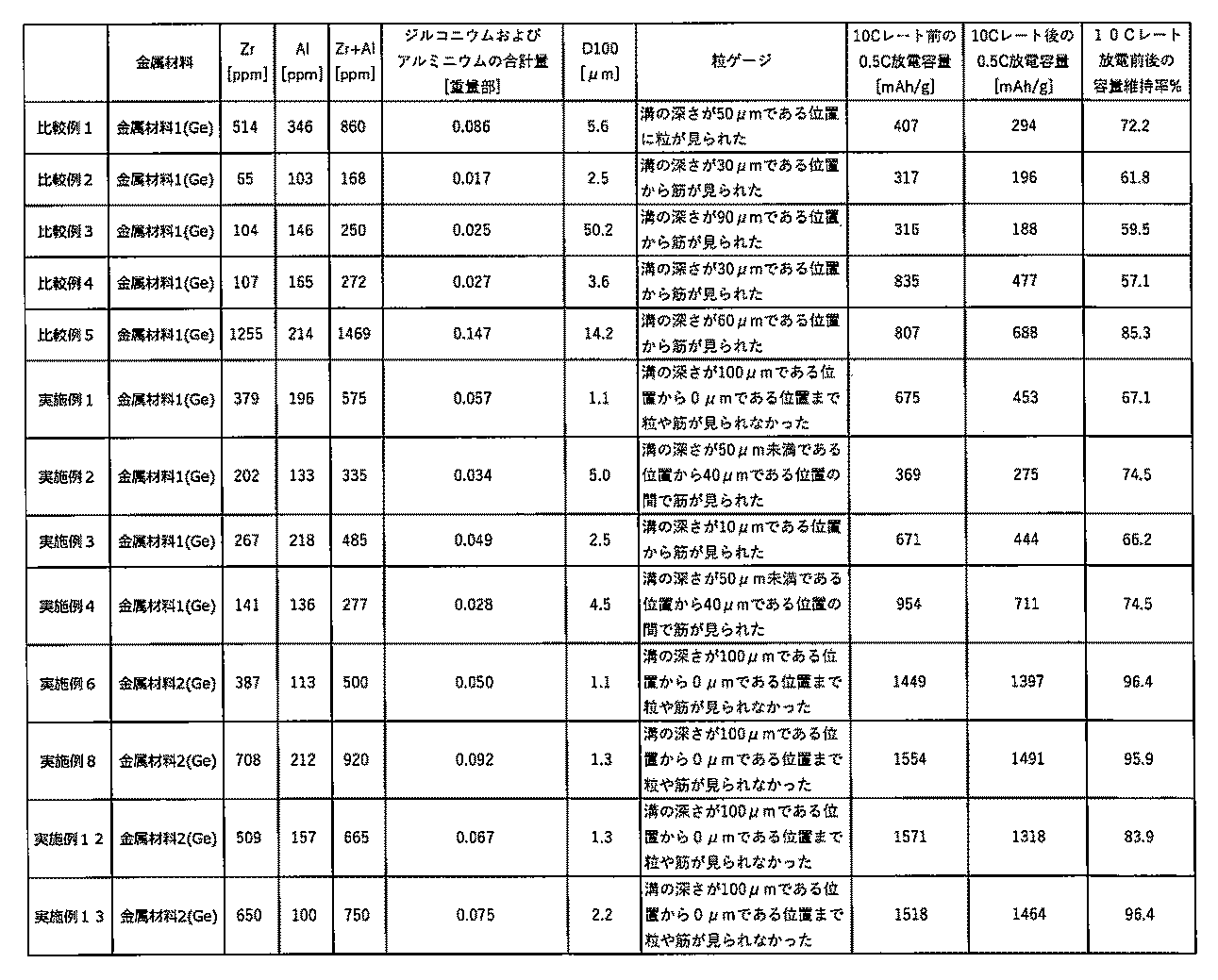
本発明の方法により得られる金属粒子は、例えば、リチウムイオン二次電池等の負極材料として好適に用いることができる。
1:分散液流入口
2:ビーズ
3:分散液流出口
4:シャフト
5:アーム
6:粉砕容器
2:ビーズ
3:分散液流出口
4:シャフト
5:アーム
6:粉砕容器
Claims (13)
- 回転体を備えた媒体撹拌型粉砕機を使用して、2.5~6.3のモース硬度を有する金属単体を含む金属材料を粉砕媒体であるビーズの存在下に粉砕容器内で撹拌して粉砕する工程を包含する、金属材料の粒子と粉砕容器由来成分とビーズ由来成分とを含む金属粒子組成物の製造方法であって、
前記金属材料と前記ビーズとの質量比が0.02~0.10であり、
前記回転体の周速が2.5~8.5m/sである、
金属粒子組成物の製造方法。 - 前記媒体撹拌型粉砕機が、粉砕容器と撹拌翼とを備えた媒体撹拌式ミルである請求項1に記載の金属粒子組成物の製造方法。
- 前記金属材料が、ゲルマニウムおよびゲルマニウム合金からなる群より選ばれる少なくとも1つのゲルマニウム材料である請求項1又は2に記載の金属粒子組成物の製造方法。
- 前記金属材料を粉砕する工程において、分散媒が使用される請求項1~3のいずれか一項に記載の金属粒子組成物の製造方法。
- 前記金属材料と前記分散媒との質量比が0.07~0.5である請求項4に記載の金属粒子組成物の製造方法。
- 前記ビーズが、0.03mm~2mmの直径を有する請求項1~5のいずれか一項に記載の金属粒子組成物の製造方法。
- 前記粉砕容器の材質にアルミナが含まれ、前記ビーズの材質にジルコニアが含まれる請求項1~6のいずれか一項に記載の金属粒子組成物の製造方法。
- 前記金属粒子組成物が0.2~5.2μmの体積基準粒度分布における最大粒子径(D100)を有する請求項1~7のいずれか一項に記載に記載の金属粒子組成物の製造方法。
- 前記金属粒子組成物がジルコニウムおよびアルミニウムの少なくとも一方を含み、金属粒子100重量部に対してジルコニウムおよびアルミニウムの合計量が0.028~1.0重量部である請求項1~8のいずれか一項に記載の金属粒子組成物の製造方法。
- 2.5~6.3のモース硬度を有する金属単体を含む金属材料の金属粒子、ジルコニウムおよびアルミニウムの少なくとも一方を含む金属粒子組成物であって、
該金属粒子が0.2~5.2μmの体積基準粒度分布における最大粒子径(D100)を有し、
該ジルコニウムおよびアルミニウムの合計量が該金属粒子100重量部に対して0.028~1.0重量部である、金属粒子組成物。 - 前記ジルコニウムおよびアルミニウムの合計量が前記金属粒子100重量部に対して0.028~0.146重量部である、請求項10に記載の金属粒子組成物。
- 前記金属材料が、ゲルマニウムおよびゲルマニウム合金からなる群より選ばれる少なくとも1つのゲルマニウム材料である請求項10又は11に記載の金属粒子組成物。
- 請求項1~9のいずれか一項に記載の方法により得られる金属粒子組成物。
Priority Applications (4)
| Application Number | Priority Date | Filing Date | Title |
|---|---|---|---|
| JP2020550434A JPWO2020071335A1 (ja) | 2018-10-05 | 2019-09-30 | 金属粒子組成物の製造方法および金属粒子組成物 |
| KR1020217009492A KR20210069049A (ko) | 2018-10-05 | 2019-09-30 | 금속 입자 조성물의 제조 방법 및 금속 입자 조성물 |
| US17/282,194 US20210339315A1 (en) | 2018-10-05 | 2019-09-30 | Method for Producing Metal Particle Composition, and Metal Particle Composition |
| CN201980065681.0A CN112823069A (zh) | 2018-10-05 | 2019-09-30 | 金属粒子组合物的制造方法及金属粒子组合物 |
Applications Claiming Priority (2)
| Application Number | Priority Date | Filing Date | Title |
|---|---|---|---|
| JP2018-189769 | 2018-10-05 | ||
| JP2018189769 | 2018-10-05 |
Publications (1)
| Publication Number | Publication Date |
|---|---|
| WO2020071335A1 true WO2020071335A1 (ja) | 2020-04-09 |
Family
ID=70055600
Family Applications (1)
| Application Number | Title | Priority Date | Filing Date |
|---|---|---|---|
| PCT/JP2019/038616 Ceased WO2020071335A1 (ja) | 2018-10-05 | 2019-09-30 | 金属粒子組成物の製造方法および金属粒子組成物 |
Country Status (5)
| Country | Link |
|---|---|
| US (1) | US20210339315A1 (ja) |
| JP (1) | JPWO2020071335A1 (ja) |
| KR (1) | KR20210069049A (ja) |
| CN (1) | CN112823069A (ja) |
| WO (1) | WO2020071335A1 (ja) |
Cited By (3)
| Publication number | Priority date | Publication date | Assignee | Title |
|---|---|---|---|---|
| US20220238877A1 (en) * | 2021-01-26 | 2022-07-28 | Honda Motor Co., Ltd. | Negative electrode for use in fluoride ion secondary battery and fluoride ion secondary battery including same |
| JP2024149515A (ja) * | 2020-10-15 | 2024-10-18 | 古河機械金属株式会社 | 粉砕ボールからの無機材料の分離方法 |
| CN120133529A (zh) * | 2025-05-16 | 2025-06-13 | 山西富亨迪新材料股份有限公司 | 一种窄粒径镁粉末制备方法 |
Families Citing this family (3)
| Publication number | Priority date | Publication date | Assignee | Title |
|---|---|---|---|---|
| CN111420780B (zh) * | 2020-01-15 | 2022-03-01 | 厦门艾思欧标准砂有限公司 | 一种立式研磨机研磨与整形的方法 |
| KR102857651B1 (ko) * | 2020-09-09 | 2025-09-08 | 삼성에스디아이 주식회사 | 전고체 전지 |
| KR102734079B1 (ko) * | 2023-10-04 | 2024-11-25 | 주식회사 비츠로셀 | 출력 특성 및 내구성을 향상시킨 리튬이온 커패시터 및 그 제조 방법 |
Citations (2)
| Publication number | Priority date | Publication date | Assignee | Title |
|---|---|---|---|---|
| JP2012033371A (ja) * | 2010-07-30 | 2012-02-16 | Panasonic Corp | リチウムイオン二次電池負極およびその製造方法、ならびにそれを用いたリチウムイオン二次電池 |
| JP2017168463A (ja) * | 2017-06-28 | 2017-09-21 | 昭和電工株式会社 | リチウムイオン電池の負極材料、電極、及び電池 |
Family Cites Families (10)
| Publication number | Priority date | Publication date | Assignee | Title |
|---|---|---|---|---|
| US20060040182A1 (en) | 2003-03-26 | 2006-02-23 | Canon Kabushiki Kaisha | Electrode material for lithium secondary battery and electrode structure having the electrode material |
| AU2008319749B2 (en) * | 2007-11-01 | 2012-10-18 | Agc Seimi Chemical Co., Ltd. | Granulated powder of transition metal compound for raw material for positive electrode active material of lithium secondary battery, and method for producing the same |
| JP2012023015A (ja) * | 2010-01-08 | 2012-02-02 | Mitsubishi Chemicals Corp | リチウム二次電池用正極材料用粉体及びその製造方法、並びにそれを用いたリチウム二次電池用正極及びリチウム二次電池 |
| CA2752844A1 (en) | 2011-09-19 | 2013-03-19 | Hydro-Quebec | Method for preparing a particulate of si or siox-based anode material, and material thus obtained |
| JP5621753B2 (ja) * | 2011-11-15 | 2014-11-12 | 信越化学工業株式会社 | リチウムイオン電池用負極材 |
| CN103733393B (zh) * | 2012-03-26 | 2016-03-02 | 古河电气工业株式会社 | 锂离子二次电池用负极材料及其制造方法、以及使用该负极材料的锂离子二次电池用负极及锂离子二次电池 |
| EP3032616B1 (en) * | 2013-08-05 | 2020-02-26 | Showa Denko K.K. | Method for producing composite |
| JP6572551B2 (ja) * | 2014-02-19 | 2019-09-11 | 東ソー株式会社 | リチウムイオン2次電池用負極活物質およびその製造方法 |
| JP6211961B2 (ja) * | 2014-03-13 | 2017-10-11 | 山陽特殊製鋼株式会社 | 蓄電デバイスの負極材料 |
| GB2529410A (en) * | 2014-08-18 | 2016-02-24 | Nexeon Ltd | Electroactive materials for metal-ion batteries |
-
2019
- 2019-09-30 CN CN201980065681.0A patent/CN112823069A/zh active Pending
- 2019-09-30 JP JP2020550434A patent/JPWO2020071335A1/ja not_active Ceased
- 2019-09-30 US US17/282,194 patent/US20210339315A1/en not_active Abandoned
- 2019-09-30 KR KR1020217009492A patent/KR20210069049A/ko not_active Withdrawn
- 2019-09-30 WO PCT/JP2019/038616 patent/WO2020071335A1/ja not_active Ceased
Patent Citations (2)
| Publication number | Priority date | Publication date | Assignee | Title |
|---|---|---|---|---|
| JP2012033371A (ja) * | 2010-07-30 | 2012-02-16 | Panasonic Corp | リチウムイオン二次電池負極およびその製造方法、ならびにそれを用いたリチウムイオン二次電池 |
| JP2017168463A (ja) * | 2017-06-28 | 2017-09-21 | 昭和電工株式会社 | リチウムイオン電池の負極材料、電極、及び電池 |
Cited By (5)
| Publication number | Priority date | Publication date | Assignee | Title |
|---|---|---|---|---|
| JP2024149515A (ja) * | 2020-10-15 | 2024-10-18 | 古河機械金属株式会社 | 粉砕ボールからの無機材料の分離方法 |
| JP7834140B2 (ja) | 2020-10-15 | 2026-03-23 | 古河機械金属株式会社 | 粉砕ボールからの無機材料の分離方法 |
| US20220238877A1 (en) * | 2021-01-26 | 2022-07-28 | Honda Motor Co., Ltd. | Negative electrode for use in fluoride ion secondary battery and fluoride ion secondary battery including same |
| US12469848B2 (en) * | 2021-01-26 | 2025-11-11 | Honda Motor Co., Ltd. | Negative electrode for use in fluoride ion secondary battery and fluoride ion secondary battery including same |
| CN120133529A (zh) * | 2025-05-16 | 2025-06-13 | 山西富亨迪新材料股份有限公司 | 一种窄粒径镁粉末制备方法 |
Also Published As
| Publication number | Publication date |
|---|---|
| JPWO2020071335A1 (ja) | 2021-09-30 |
| US20210339315A1 (en) | 2021-11-04 |
| CN112823069A (zh) | 2021-05-18 |
| KR20210069049A (ko) | 2021-06-10 |
Similar Documents
| Publication | Publication Date | Title |
|---|---|---|
| WO2020071335A1 (ja) | 金属粒子組成物の製造方法および金属粒子組成物 | |
| EP4021855B1 (en) | Improved microgranulation methods and product particles therefrom | |
| JP6720864B2 (ja) | 非水系二次電池負極用複合黒鉛粒子、非水系二次電池負極用活物質及び非水系二次電池 | |
| JP6096101B2 (ja) | リチウム二次電池用正極の製造方法 | |
| JP6696632B1 (ja) | グラフェン分散液およびその製造方法ならびに二次電池用電極 | |
| JP5877025B2 (ja) | 多孔質シリコン複合体粒子及びその製造方法 | |
| JPWO2009057777A1 (ja) | リチウム二次電池正極活物質の原料用遷移金属化合物の造粒体粉末及びその製造方法 | |
| WO2018168059A1 (ja) | 二次電池用電極 | |
| JP2011132095A (ja) | オリビン型化合物粒子粉末の製造方法、並びに非水電解質二次電池 | |
| WO2015012086A1 (ja) | 複合粒子及びその製造方法並びに電極及び非水電解質二次電池 | |
| TW202009216A (zh) | SiO粉末的製造方法及球形顆粒狀SiO粉末 | |
| WO2021095652A1 (ja) | グラフェン分散液および正極ペースト | |
| WO2014034494A1 (ja) | 合金粒子、電極、非水電解質二次電池および合金粒子製造方法 | |
| WO2012133581A1 (ja) | 二次電池用正極活物質、二次電池用正極、および二次電池の製造方法 | |
| JP6447013B2 (ja) | リチウムイオン二次電池用負極材、リチウムイオン二次電池用負極及びリチウムイオン二次電池 | |
| CN106165157A (zh) | 用于锂二次电池的负极活性材料的制造方法、和锂二次电池 | |
| JP2014101268A (ja) | シリコン材料の製造方法、アノード材料及びリチウムイオン電池のアノード電極の製造方法 | |
| JP2017073363A (ja) | 電極合剤スラリーの製造方法 | |
| WO2021200318A1 (ja) | 金属粒子及びリチウムイオン二次電池用負極活物質 | |
| CN111615768A (zh) | 用于蓄电池负电极中的复合粉末以及包括此类复合粉末的蓄电池 | |
| JP2013507316A (ja) | 微細分散したチタン酸リチウムスピネルの生成方法及びその使用方法 | |
| JP2018098018A (ja) | リチウムイオン二次電池用負極活物質およびその製造方法並びに負極および電池 | |
| KR20130012027A (ko) | 비수 전해질 2차 전지의 음극 재료 및 그 제조 방법 | |
| WO2024166792A1 (ja) | 負極合剤、スラリー、負極及び電池 | |
| WO2024166778A1 (ja) | 負極及びこれを用いた電池 |
Legal Events
| Date | Code | Title | Description |
|---|---|---|---|
| 121 | Ep: the epo has been informed by wipo that ep was designated in this application |
Ref document number: 19868681 Country of ref document: EP Kind code of ref document: A1 |
|
| ENP | Entry into the national phase |
Ref document number: 2020550434 Country of ref document: JP Kind code of ref document: A |
|
| NENP | Non-entry into the national phase |
Ref country code: DE |
|
| 122 | Ep: pct application non-entry in european phase |
Ref document number: 19868681 Country of ref document: EP Kind code of ref document: A1 |