WO2020054847A1 - アルミニウム合金の押出材、建具及びアルミニウム合金の押出材の製造方法 - Google Patents
アルミニウム合金の押出材、建具及びアルミニウム合金の押出材の製造方法 Download PDFInfo
- Publication number
- WO2020054847A1 WO2020054847A1 PCT/JP2019/036102 JP2019036102W WO2020054847A1 WO 2020054847 A1 WO2020054847 A1 WO 2020054847A1 JP 2019036102 W JP2019036102 W JP 2019036102W WO 2020054847 A1 WO2020054847 A1 WO 2020054847A1
- Authority
- WO
- WIPO (PCT)
- Prior art keywords
- aluminum alloy
- less
- extruded material
- aluminum
- weight
- Prior art date
- Legal status (The legal status is an assumption and is not a legal conclusion. Google has not performed a legal analysis and makes no representation as to the accuracy of the status listed.)
- Ceased
Links
Images
Classifications
-
- C—CHEMISTRY; METALLURGY
- C22—METALLURGY; FERROUS OR NON-FERROUS ALLOYS; TREATMENT OF ALLOYS OR NON-FERROUS METALS
- C22C—ALLOYS
- C22C21/00—Alloys based on aluminium
-
- C—CHEMISTRY; METALLURGY
- C22—METALLURGY; FERROUS OR NON-FERROUS ALLOYS; TREATMENT OF ALLOYS OR NON-FERROUS METALS
- C22F—CHANGING THE PHYSICAL STRUCTURE OF NON-FERROUS METALS AND NON-FERROUS ALLOYS
- C22F1/00—Changing the physical structure of non-ferrous metals or alloys by heat treatment or by hot or cold working
- C22F1/04—Changing the physical structure of non-ferrous metals or alloys by heat treatment or by hot or cold working of aluminium or alloys based thereon
-
- C—CHEMISTRY; METALLURGY
- C25—ELECTROLYTIC OR ELECTROPHORETIC PROCESSES; APPARATUS THEREFOR
- C25D—PROCESSES FOR THE ELECTROLYTIC OR ELECTROPHORETIC PRODUCTION OF COATINGS; ELECTROFORMING; APPARATUS THEREFOR
- C25D11/00—Electrolytic coating by surface reaction, i.e. forming conversion layers
-
- C—CHEMISTRY; METALLURGY
- C25—ELECTROLYTIC OR ELECTROPHORETIC PROCESSES; APPARATUS THEREFOR
- C25D—PROCESSES FOR THE ELECTROLYTIC OR ELECTROPHORETIC PRODUCTION OF COATINGS; ELECTROFORMING; APPARATUS THEREFOR
- C25D11/00—Electrolytic coating by surface reaction, i.e. forming conversion layers
- C25D11/02—Anodisation
- C25D11/04—Anodisation of aluminium or alloys based thereon
-
- C—CHEMISTRY; METALLURGY
- C25—ELECTROLYTIC OR ELECTROPHORETIC PROCESSES; APPARATUS THEREFOR
- C25D—PROCESSES FOR THE ELECTROLYTIC OR ELECTROPHORETIC PRODUCTION OF COATINGS; ELECTROFORMING; APPARATUS THEREFOR
- C25D11/00—Electrolytic coating by surface reaction, i.e. forming conversion layers
- C25D11/02—Anodisation
- C25D11/04—Anodisation of aluminium or alloys based thereon
- C25D11/16—Pretreatment, e.g. desmutting
Definitions
- the present invention relates to an aluminum alloy extruded material, a fitting, and a method for producing an aluminum alloy extruded material.
- Priority is claimed on Japanese Patent Application No. 2018-172385 filed on Sep. 14, 2018, the content of which is incorporated herein by reference.
- Metal profiles are widely used as building materials such as sashes.
- sashes and the like have been required to have a high-class appearance, and for example, stainless steel members have been used as building materials.
- Stainless steel is excellent in glitter, but the cost of stainless steel, which is the material of the stainless steel, is high. For this reason, there has been a demand for a low-cost shape that can be produced instead of a stainless steel shape.
- a low-cost producible profile is an extruded aluminum alloy made of an aluminum alloy.
- an extruded material of an aluminum alloy is manufactured by extruding a billet of an aluminum alloy and subjecting the aluminum raw material obtained after the extrusion to anodization.
- the anodic oxidation treatment is a treatment for improving the corrosion resistance and wear resistance of the extruded material of the aluminum alloy.
- an oxide film is formed on the surface of the aluminum raw material.
- the oxide film is called an alumite film.
- the impurities contained in the aluminum alloy are precipitated in the alumite film.
- Typical impurities are iron (Fe) and silicon (Si).
- Precipitation of impurities in the alumite film causes the aluminum alloy extruded material to look cloudy, and reduces the glitter of the aluminum alloy extruded material.
- Patent Literature 1 discloses an aluminum alloy manufactured to improve glitter.
- the aluminum alloy of Patent Document 1 includes 0.35 to 0.45% by mass of magnesium (Mg), 0.35 to 0.45% by mass of Si, and 0.16 to 0.25% by mass of copper (Cu). ).
- the ratio between the Mg content and the Si content is 0.80 to 1.20.
- the aluminum alloy of Patent Document 1 contains 0.10% by mass or less of Fe as impurities and inevitable impurities of 0.05% by mass or less in total.
- a magnesium silicide (Mg 2 Si) compound having a particle size of 0.5 to 3 ⁇ m and 300 to 1500 particles / mm 2 exists in the aluminum alloy of Patent Document 1.
- Patent Literature 2 discloses a component including a metal substrate having a surface having a point and a sharp dent and an oxide layer (alumite film) disposed on the surface of the metal substrate.
- the thickness of the alumite film of Patent Document 2 is 10 ⁇ m to 20 ⁇ m.
- A6063 aluminum alloy (hereinafter referred to as A6063 alloy).
- the Cu content of the aluminum alloy described in Patent Document 1 is larger than that of the A6063 alloy.
- a high-purity aluminum raw material is used. Therefore, when an extruded material is manufactured using the aluminum alloy described in Patent Literature 1, the manufacturing cost increases.
- the thickness of the alumite film is limited to the range of 10 ⁇ m to 20 ⁇ m, but the component amount of the aluminum alloy is not controlled. Therefore, in the component described in Patent Document 2, sufficient glitter cannot be obtained.
- the present invention provides an aluminum alloy extruded material, a fitting, and a method for manufacturing an aluminum alloy extruded material which is made of the A6063 alloy and has high glitter.
- the extruded material of the aluminum alloy according to the present invention includes an aluminum base, and an alumite film formed on the surface of the base of the aluminum base.
- the extruded material of the aluminum alloy according to the present invention comprises 0.20 wt% to 0.53 wt% of Si, 0.18 wt% or less of Fe, 0.10 wt% or less of Cu, and 0.10 wt% or less of Cu. Wt% or less of Mn, 0.45 wt% or more and 0.9 wt% or less of Mg, 0.10 wt% or less of Cr, 0.10 wt% or less of Zn, and 0.04 wt% or less of And Ti, and further contains Al and inevitable impurities.
- a plurality of hairlines are formed on the surface of the substrate along the longitudinal direction of the aluminum substrate.
- the thickness of the alumite film is 4 ⁇ m or more and 10 ⁇ m or less.
- the fitting according to the present invention is configured to include the extruded material of the above-described aluminum alloy.
- the method for producing an aluminum alloy extruded material according to the present invention comprises the following steps: 0.20 wt% to 0.53 wt% of Si, 0.18 wt% or less of Fe, and 0.10 wt% or less of Cu; 0.10 wt% or less of Mn, 0.45 wt% or more and 0.9 wt% or less of Mg, 0.10 wt% or less of Cu, 0.10 wt% or less of Zn, and 0.04 wt% % Or less, and an aluminum alloy billet containing Al and unavoidable impurities is cast, the aluminum alloy billet is extruded to form an aluminum raw material, and the aluminum raw material surface is polished.
- Forming a plurality of hair lines on the polished surface of the raw material along the longitudinal direction of the aluminum raw material, anodizing the aluminum raw material on which the hair lines are formed, and forming a substrate surface of an aluminum base material Thickness includes forming a 10 ⁇ m following alumite film than 4 [mu] m.
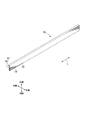
- FIG. 1 is a perspective view of an aluminum alloy extruded material of one embodiment of the present invention.
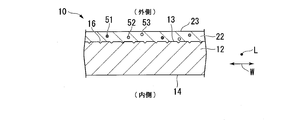
- FIG. 2 is a sectional view of a part of the extruded material of the aluminum alloy shown in FIG.
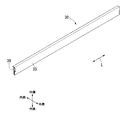
- FIG. 3 is a perspective view showing an example of a method for manufacturing an extruded aluminum alloy according to one embodiment of the present invention.
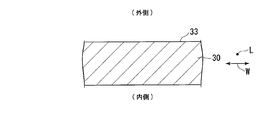
- FIG. 4 is a sectional view of a part of the aluminum raw material shown in FIG.
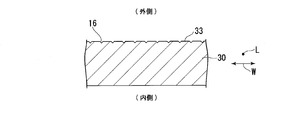
- FIG. 5 is a cross-sectional view illustrating an example of a method for manufacturing an extruded aluminum alloy according to one embodiment of the present invention.
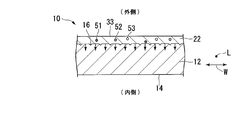
- FIG. 6 is a cross-sectional view showing an example of a method for manufacturing an extruded aluminum alloy according to one embodiment of the present invention. It is a perspective view of the extruded material of the aluminum alloy experimentally manufactured in each example from Example 1 to Example 9.
- the extruded material 10 of an aluminum alloy extends along a predetermined direction (hereinafter, a longitudinal direction L) and has a predetermined cross-sectional shape.
- the use of the aluminum alloy extruded material 10 is, for example, a frame of a sash (fitting), a sash (fitting) for a store, a front sash (fitting) used for a facade, a door (fitting), an automatic door (fitting), and various other types. It is a building material and includes a wide range of applications to which A6063 alloy can be applied.
- the predetermined cross-sectional shape of the aluminum alloy extruded material 10 is appropriately designed according to the application, and is not particularly limited.
- FIG. 2 is a cross-sectional view of a portion 19 of the extruded material 10 of the aluminum alloy cut along a plane (not shown) orthogonal to the longitudinal direction L and viewed along the longitudinal direction L.
- the extruded material 10 of an aluminum alloy has an aluminum base 12 and an alumite coating 22 formed on a surface (base surface) 13 of the aluminum base 12.
- the extruded material 10 of an aluminum alloy satisfies at least the standard of A6063 of JIS.
- the extruded aluminum alloy material meeting the JIS A6063 standard (hereinafter, extruded A6063) has a Si content of 0.20% by weight or more and 0.6% by weight or less.
- the A6063 extruded material has a Fe content of 0.35% by weight or less.
- the A6063 extruded material has a Cu content of 0.10% by weight or less.
- the content of manganese (Mn) in the A6063 extruded material is 0.10% by weight or less.
- the content of Mg in the extruded A6063 is 0.45% by weight or more and 0.9% by weight or less.
- the content of chromium (Cr) in the extruded A6063 material is 0.10% by weight or less.
- the content of zinc (Zn) in the extruded material of A6063 is 0.10% by weight or less.
- the content of titanium (Ti) in the extruded material of A6063 is 0.10% by weight or less.
- the A6063 extruded material contains aluminum (Al) and unavoidable impurities, in addition to the plurality of metals described above.
- the lower limit of the content of each of Fe, Cu, Mn, Cr, Zn, and Ti for which the lower limit is not specified in the aforementioned A6063 extruded material is 0.00% by weight.
- the content of Fe in the extruded material 10 of the aluminum alloy according to the present embodiment is smaller than that of the extruded material of the aluminum alloy A6063, and is not less than 0.00% by weight and not more than 0.18% by weight.
- the glitter of the aluminum alloy extruded material 10 is enhanced. If the Fe content of the aluminum alloy extruded material 10 exceeds 0.18% by weight, the alumite film 22 becomes cloudy and the glitter of the aluminum alloy extruded material 10 is reduced.
- the L * a * b * color system is a standard of the color system by the International Commission on Illumination (hereinafter CIE).
- CIE International Commission on Illumination
- a color difference close to the color difference visually recognized by a user or an observer of the extruded material 10 of the aluminum alloy can be represented.
- the L * value is a value on the brightness axis in the L * a * b * color system.
- the L * value of the extruded aluminum alloy is such that the glitter of the extruded aluminum alloy is equivalent to the glitter of the stainless steel profile when viewed from an observer. Means that it is set in a range that can be determined.
- the L * value of the extruded material 10 of the aluminum alloy is 20.7 or less, the glittering property is enhanced, and an appearance excellent in aesthetics and design can be obtained.
- the L * value of the aluminum alloy extruded material 10 is measured using, for example, a spectrophotometer CM-M6 (manufactured by Konica Minolta Japan).
- CM-M6 spectrophotometer
- the light is applied to the extruded material 10 of the aluminum alloy at an incident angle of 45 ° with respect to an orthogonal plane (not shown) orthogonal to a reference plane (not shown) parallel to the surface 13.
- the predetermined light receiving angles include six types of light receiving angles of -15 °, + 15 °, + 25 °, + 45 °, + 75 °, and + 110 °.
- the six types of light receiving angles represent angles when an angle of 45 ° with respect to the orthogonal plane on the side opposite to the light incident side with respect to the orthogonal plane is 0 °.
- the signs of the six types of light receiving angles are positive (+) if the angle of the surface on the orthogonal surface side with respect to the surface with the light receiving angle of 0 ° is opposite to the surface opposite to the orthogonal surface with the light receiving angle of 0 °. Is negative (-) if the angle of the surface is.
- the L * value of the extruded material 10 of the aluminum alloy represents a value measured at a light receiving angle of + 110 °.
- the a * value and the b * value of the L * a * b * color system do not affect the glitter and appearance of the extruded material 10 of an aluminum alloy and the stainless steel material, and are not considered in this specification.
- the extruded material 10 of the aluminum alloy has a Si content of 0.20 to 0.53% by weight, and the extruded material 10 of an aluminum alloy has a Ti content of 0.004 to 0.04% by weight. It is.
- the cloudiness of the alumite coating 22 is suppressed, and the glitter of the aluminum alloy extruded material 10 is enhanced.
- the content of Cu in the aluminum alloy extruded material 10 is 0.00% by weight or more and 0.10% by weight or less.
- the content of Mn in the extruded material 10 of the aluminum alloy is 0.00% by weight or more and 0.10% by weight or less.
- the content of Mg in the extruded material 10 of the aluminum alloy is 0.45% by weight or more and 0.9% by weight or less.
- the content of Cr in the extruded material 10 of the aluminum alloy is 0.00% by weight or more and 0.10% by weight or less.
- the content of Zn in the aluminum alloy extruded material 10 is not less than 0.00% by weight and not more than 0.10% by weight.
- the Cu content of the extruded material 10 of the aluminum alloy is 0.03% by weight or less. Also, the glitter of the aluminum alloy extruded material 10 is enhanced, and the production cost of the aluminum alloy extruded material 10 can be suppressed by suppressing the amount of expensive Cu used.
- the aluminum base 12 extends along the longitudinal direction L and has the same cross-sectional shape as the aluminum alloy extruded material 10.
- the thickness of the aluminum base 12 is adjusted, for example, within a range of 1 mm or more and 3 mm or less.
- the thickness of the aluminum base 12 is appropriately set according to the use of the extruded material 10 of the aluminum alloy.
- the aluminum base 12 is configured based on an A6063 alloy.
- a plurality of hairlines 16 are formed on the surface 13 along the longitudinal direction L.
- the arithmetic average roughness Ra of the plurality of hairlines 16 is evaluated using, for example, an index defined in JIS B0601 (2013).
- the arithmetic average roughness Ra of the plurality of hairlines 16 is preferably 0.06 ⁇ m or more. It is preferable that the maximum height roughness Rz of the plurality of hairlines 16 is 0.63 ⁇ m or more.
- the average length RSm of the cross-sectional curve elements of the plurality of hairlines 16 is preferably 0.3 ⁇ m or less. In other words, the arithmetic average roughness Ra of the surface 13 on which the plurality of hairlines 16 are formed is preferably 0.06 ⁇ m or more. It is preferable that the maximum height roughness Rz of the surface 13 be 0.63 ⁇ m or more.
- the surface 13 means a surface of the aluminum substrate 12 facing at least outward.
- the outer side means a side of the extruded material 10 of the aluminum alloy in the use form, which is in the field of view of the user or the observer.
- the inner side means the side of the extruded material 10 of the aluminum alloy used in the use form, which is hidden from the view of the user or the observer.
- the alumite film 22 is formed on the surface 13 and the inner surface 14 of the aluminum base 12.
- a plurality of hairlines 16 and one alumite film 22 are formed on at least the surface 13. It is preferable that at least the alumite film 22 is formed on the surface 14 and a plurality of hairlines 16 are formed as necessary.
- the alumite film 22 is a film for improving the corrosion resistance and wear resistance of the extruded material 10 of the aluminum alloy.
- the alumite film 22 is formed by performing anodizing treatment on the surface of the aluminum base material 12 including at least the surface 13. As shown in FIG. 2, a part of a plurality of impurities contained in the extruded material 10 of the aluminum alloy is precipitated on the alumite film 22.
- FIG. 2 shows only Fe51, Si52 and Ti53, and omits impurities other than Fe51, Si52 and Ti53. Fe51, Si52 and Ti53 precipitate on the alumite film 22, and have a great effect on the cloudiness of the alumite film 22 and the glitter of the extruded material 10 of the aluminum alloy.
- the alumite film 22 is a porous film.
- the alumite film 22 has a plurality of micropores that are opened on the outer surface 23 of the alumite film 22. In FIG. 2, a plurality of micro holes are omitted. Coloring metals, metal compounds, and the like are present in the plurality of micropores.
- the metal or metal compound for coloring is not limited to a specific substance.
- the thickness of the alumite film 22 is 4 ⁇ m or more and 10 ⁇ m or less. Thereby, the glitter of the extruded material 10 of the aluminum alloy having the Fe content of 0.18% by weight or less is enhanced.
- the thickness of the alumite film 22 is less than 4 ⁇ m, the corrosion resistance and wear resistance of the aluminum alloy extruded material 10 are insufficient, and the aluminum alloy extruded material 10 is not suitable for a desired use. If the thickness of the alumite film 22 is less than 4 ⁇ m, the corrosion resistance required for an extruded aluminum alloy based on the A6063 alloy may not be obtained.
- the thickness of the alumite film 22 is more than 10 ⁇ m, the cloudiness of the alumite film 22 due to Fe51 becomes remarkable, and the glitter of the extruded material 10 of the aluminum alloy may be reduced.
- a coating film (not shown) may be provided on the surface 23 in order to enhance the weather resistance and the design of the aluminum alloy extruded material 10.
- the method for manufacturing an extruded aluminum alloy material according to the present embodiment includes a casting step, an extrusion step, a polishing step, a hairline forming step, and a surface treatment step.
- an aluminum alloy billet (not shown) is cast.
- the content of Si in the aluminum alloy billet is from 0.20% by weight to 0.53% by weight.
- the Fe content of the aluminum alloy billet is 0.18% by weight or less.
- the Cu content of the aluminum alloy billet is 0.10% by weight or less.
- the Mn content of the aluminum alloy billet is 0.10% by weight or less.
- the Mg content of the aluminum alloy billet is 0.45% by weight or more and 0.9% by weight or less.
- the Cr content of the aluminum alloy billet is 0.10% by weight or less.
- the content of Zn in the aluminum alloy billet is 0.10% by weight or less.
- the Ti content of the aluminum alloy billet is 0.04% by weight or less.
- the remainder of the aluminum alloy billet other than the plurality of metals described above consists of Al and unavoidable impurities.
- the casting method of the aluminum alloy billet is the same as the conventional casting method of the A6063 alloy. However, when dissolving aluminum ingot, which is a raw material of the aluminum alloy billet, and blending and adjusting the additive metal (that is, the impurity metal added to the A6063 alloy), the amount of Fe added, the amount of Si added and The added amount of Ti is set within a predetermined range described below. The amount of Fe to be added to the entire aluminum alloy in the melting furnace is set to 0.00% by weight or more and 0.18% by weight or less.
- the amount of Si added to the entire aluminum alloy in the melting furnace is set to 0.20% by weight or more and 0.53% by weight or less.
- the amount of Ti added to the entire aluminum alloy in the melting furnace is set to 0.00% by weight or more and 0.04% by weight or less.
- the standard of A6063 of JIS is satisfied, and the content of Fe is 0.00% by weight to 0.18%.
- An aluminum alloy billet having a Si content of 0.20% to 0.53% by weight and a Ti content of 0.00% to 0.04% by weight is cast.
- the shape of the aluminum alloy billet is, for example, a columnar shape or a cylindrical shape having an annular cross section, and is appropriately adjusted according to the length and thickness required for extrusion in the subsequent extrusion step.
- FIG. 4 is a cross-sectional view of a part 39 of the aluminum raw material 30 taken along a plane (not shown) orthogonal to the longitudinal direction L and viewed along the longitudinal direction L.
- the aluminum raw material 30 is a precursor of the extruded material 10 of the aluminum alloy before the alumite film 22 is formed.
- the aluminum raw material 30 extends in the longitudinal direction L similarly to the aluminum alloy extruded material 10 and has the same cross-sectional shape as the aluminum alloy extruded material 10.
- the aluminum alloy billet is heated to a predetermined temperature, and is extruded at a high pressure into a mold formed in the same shape as the cross-sectional shape of the aluminum alloy extruded material 10.
- the predetermined temperature is, for example, 400 ° C. or more and 500 ° C. or less, but is appropriately adjusted.
- the aluminum raw material 30 extruded from the mold is cooled to room temperature. Thereafter, the aluminum raw material 30 may be subjected to aging at a temperature of, for example, 150 ° C. or more and 250 ° C. or less for 1 hour or more and 10 hours or less.
- the surface (raw material surface) 33 of the aluminum raw material 30 is polished.
- the method of polishing the surface 33 is not limited to a specific method as long as it can enhance the glitter of the extruded material 10 of the aluminum alloy.
- the glossiness of the surface 33 after polishing is 660 (%) or more and 900 (%) or less.
- the glossiness described above refers to a specular glossiness measured in accordance with the JIS standard with the incident angle to the surface 33 set at + 60 °.
- the glossiness of the surface 33 after polishing is lower than 660 (%), the design of the appearance of the extruded material 10 of the aluminum alloy is reduced. If the gloss of the surface 33 after polishing becomes higher than 900 (%), the gloss of the aluminum alloy extruded material 10 becomes excessively high as compared with the same gloss as the stainless steel material, and waste occurs in the polishing work, and the aluminum alloy is wasted.
- the production efficiency of the extruded material 10 decreases.
- the glossiness of the surface 33 after polishing is 660 (%) or more and 900 (%) or less, even if the glossiness of the surface 33 decreases when the operation of forming the next hairline is performed, the aluminum alloy is extruded. The reduction in the glitter of the material 10 is suppressed.
- the glossiness of the polished surface 33 is measured using, for example, a high gloss gloss checker IG-410 (manufactured by Horiba, Ltd.).
- a plurality of hairlines 16 are formed on the polished surface 33 along the longitudinal direction L, as shown in FIG.
- FIG. 5 is a cross-sectional view when a part of the aluminum raw material 30 after the plurality of hairlines 16 are formed is cut along a plane perpendicular to the longitudinal direction L and viewed along the longitudinal direction L.
- the distance between the centers of the hairlines 16 adjacent to each other in the width direction W is a predetermined distance, and the average value of the depths of the plurality of hairlines 16 is set to an appropriately designed depth. Any method may be used, and the method is not limited to a specific method.
- the aluminum raw material 30 on which the plurality of hairlines 16 are formed is subjected to anodizing treatment to form an alumite film 22 having a thickness of 4 ⁇ m or more and 10 ⁇ m or less on the surface 13 as shown in FIG.
- anodic oxidation treatment of the aluminum raw material 30 for example, electrolysis is performed in a sulfuric acid bath using the aluminum raw material 30 as an anode. Conditions for the electrolysis may be set as appropriate.
- oxygen is generated from the surface 33.
- the generated oxygen and Al contained in the aluminum raw material 30 are combined, and the alumite film 22 mainly composed of aluminum oxide is formed inside the surface 33 as shown in FIG. FIG.
- FIG. 6 is a cross-sectional view of a state in which the alumite film 22 is formed on a part of the aluminum raw material 30 after the hairline is formed, cut along a plane perpendicular to the longitudinal direction L and viewed along the longitudinal direction. .
- impurities such as Fe 51, Si 52, and Ti 53 precipitate from the aluminum raw material 30 on the alumite film 22 and are scattered in the alumite film 22.
- the electrolytic coloring and the electrodeposition coating may be performed after the alumite film 22 is formed by the surface treatment.
- electrolytic coloring and electrodeposition coating By electrolytic coloring and electrodeposition coating, the appearance of the aluminum alloy extruded material 10 is made closer to the appearance of a stainless steel profile, the weather resistance of the aluminum alloy extruded material 10 is enhanced, and the aluminum alloy extruded material is exposed to ultraviolet light when used outdoors. 10 discoloration can be prevented.
- Conditions for electrolytic coloring are appropriately set so that the L * value of at least the outside of the extruded material 10 of the aluminum alloy is 20.7 or less.
- an extruded material 10 of an aluminum alloy can be manufactured.
- the aluminum alloy extruded material 10 according to the present embodiment described above is made of an A6063 alloy that satisfies JIS A6063.
- the extruded material of aluminum alloy has a Fe content of 0.35% by weight or less. If the thickness of the alumite film exceeds 10 ⁇ m and the content of Fe exceeds 0.18% by weight, the alumite film may become cloudy and the glitter of the extruded aluminum alloy may be reduced.
- the content of Fe in the extruded material 10 of the aluminum alloy of the present embodiment is 0.18% by weight or less, the content of Si is 0.20% by weight or more and 0.53% by weight or less, and the content of Ti is 0.04% by weight or less.
- the thickness of the alumite film 22 is 4 ⁇ m or more and 10 ⁇ m or less. Under these conditions, the amounts of Fe51, Si52, and Ti53 in the alumite film 22 can be suppressed, and the cloudiness of the alumite film 22 can be suppressed. Therefore, the L * value of the extruded material 10 of the aluminum alloy is 20.7 or less, and the glitter of the extruded material 10 of the aluminum alloy can be enhanced, and a high glitter that is equal to or more than that of the conventional stainless steel material can be obtained. Can be.
- the L * value of the extruded material 10 of the aluminum alloy according to the present embodiment is 20.7 or less, it is possible to obtain at least one of high brilliancy and aesthetics equivalent to or higher than the conventional stainless steel material.
- the arithmetic average roughness Ra of the plurality of hairlines 16 is 0.06 ⁇ m or more, and the maximum height roughness Rz of the plurality of hairlines 16 is 0.63 ⁇ m or more.
- the average length RSm of the cross-sectional curve elements of the plurality of hairlines 16 is 0.3 ⁇ m or less.
- the content of Fe in the A6063 alloy is set to 0.18% by weight or less, and the content of Si is set to 0.20% to 0.53% by weight,
- An aluminum alloy billet in which the content of Ti is regulated to 0.04% by weight or less is cast.
- the aluminum raw material 30 is extruded using the aluminum alloy billet.
- the alumite film 22 is grown on the surface 33 and the alumite film 22 having a thickness of 4 ⁇ m or more and 10 ⁇ m or less is formed on the surface 13.
- the cloudiness of the alumite film 22 caused by Fe51, Si52, and Ti53 is suppressed.
- the glitter of the aluminum alloy extruded material 10 can be enhanced.
- a plurality of hairlines 16 and an alumite film 22 may be formed not only on the surface 13 but also on the surface 14 shown in FIGS. 2 and 6.
- the cross-sectional shape of the extruded material of the aluminum alloy according to the present invention is not limited to the cross-sectional shape illustrated in FIG.
- the extruded material of the aluminum alloy according to the present invention may be formed in a plate shape, or may be formed in a rod shape without forming a hollow portion.
- the shape of the extruded material of the aluminum alloy according to the present invention includes all shapes that can be realized by changing the shape of the mold and that can be extruded.
- electrolytic coloring and electrodeposition coating may be omitted. May be added.
- Example 1 to Example 6 According to the method for manufacturing an extruded aluminum alloy material of the above-described embodiment, the content of Fe is 0.18% by weight or less, and the content of Si is 0.20% by weight or more and 0.53% by weight or less, An aluminum raw material having a Ti content of 0.04% by weight or less was obtained. After forming a plurality of hair lines 16 on the aluminum raw material, the thickness of the alumite film 22 was changed to produce an aluminum alloy extruded material 50 shown in FIG.
- the aluminum alloy extruded material 50 has the same configuration as the aluminum alloy extruded material 10 of the above-described embodiment, except that it has a rectangular cross-sectional shape and is a hollow body. The thickness d of the aluminum alloy extruded material 50 was 1.7 mm.
- Table 1 shows the specifications of the extruded materials of the aluminum alloys of Examples 1 to 6 and Comparative Examples 1 to 4 and the L * values relating to the evaluation results of the glitter.
- L * values described in Table 1 were measured using a spectrophotometer CM-M6. In measuring these L * values, the light emitted from the spectrophotometer CM-M6 was applied to the alumite film of the extruded aluminum alloy in each example. “OK” of pass / fail described in Table 1 indicates that the L * value is 20.7 or less, and “NG” of pass / fail described in Table 1 indicates that the L * value is larger than 20.7. Represents
- the L * value of the extruded material 50 of the aluminum alloy of each of Examples 1 to 6 was 20.7 or less, and high glitter was obtained.
- the content of Fe in the extruded material 50 of the aluminum alloy is 0.00% by weight or more and 0.18% by weight or less, and the content of Si is 0.20% by weight. It is considered that the content of Ti was not less than 0.003 wt% and not more than 0.04 wt%.
- the thickness of the alumite film 22 was 4 ⁇ m or more and 10 ⁇ m or less.
- the content of Fe in the A6063 alloy is set to 0.000 to 0.18% by weight, and the content of Si is set to 0.20 to 0.53% by weight. Wt% or less, the content of Ti is set to 0.004 wt% or less and 0.04 wt% or less, and the thickness of the alumite film is set to 4 ⁇ m or more and 10 ⁇ m or less, thereby enhancing the glitter of the extruded aluminum alloy. did it.
- Example 7 to 9 The aluminum raw materials of the respective examples from Example 7 to Example 9 were obtained by the same method as the method for manufacturing the extruded material of the aluminum alloy of each of the examples 1 to 6. After forming a plurality of hairlines on the aluminum raw material, the thickness of the alumite film 22 was changed to produce an aluminum alloy extruded material 50 shown in FIG.
- the content of Si and the content of Mg of the extruded material 50 of the aluminum alloy were appropriately changed as shown in Table 2, The contents of Fe, Cu, Mn, Cr, and Ti were made constant as shown in Table 2.
- Table 2 shows the specification of the extruded material of the aluminum alloy of each of Examples 7 to 9 and Comparative Example 8, and the measurement results of the rating numbers with respect to the evaluation results of the corrosion resistance.
- the rating number described in Table 2 means the rating number specified in the JIS-H-8602-A2 CASS test. “OK” of pass / fail described in Table 2 indicates that the rating number of the extruded material of the aluminum alloy of each example is 9.5 or more, and “NG” of pass / fail is that of the extruded material of the aluminum alloy of each example. The rating number is smaller than 9.5.
- the extruded material 50 of the aluminum alloy of each of Examples 7 to 9 has a rating number of 9.5 or more, and the extruded material 50 of the aluminum alloy passes the CASS test. The required corrosion resistance was obtained. In each of Examples 7 to 9, it is considered that the thickness of the alumite film 22 was 4 ⁇ m or more and 10 ⁇ m or less.
- the extruded aluminum alloy of Comparative Example 8 did not have the corrosion resistance required to pass the CASS test. It is considered that in Comparative Example 8, the thickness of the alumite film was less than 4 ⁇ m.
- Corrosion resistance is an evaluation content from a different viewpoint from glitter, but as can be seen from the evaluation results of the above Examples and Comparative Examples, by setting the thickness of the alumite film to 4 ⁇ m or more and 10 ⁇ m or less, it is based on the A6063 alloy. The corrosion resistance required for extruded aluminum alloy was obtained.
- Aluminum alloy extruded material 12 Aluminum substrate 13 Surface (substrate surface) 16 Hairline 22 Alumite film 30 Aluminum raw material 33 Surface (raw material surface) 51 Iron (Fe) 52 Silicon (Si) 53 Titanium (Ti) L longitudinal direction
Landscapes
- Chemical & Material Sciences (AREA)
- Metallurgy (AREA)
- Engineering & Computer Science (AREA)
- Materials Engineering (AREA)
- Organic Chemistry (AREA)
- Electrochemistry (AREA)
- Chemical Kinetics & Catalysis (AREA)
- Mechanical Engineering (AREA)
- Physics & Mathematics (AREA)
- Crystallography & Structural Chemistry (AREA)
- Thermal Sciences (AREA)
- Extrusion Of Metal (AREA)
- Laminated Bodies (AREA)
Abstract
本発明に係るアルミニウム合金の押出材は、アルミニウム基材と、前記アルミニウム基材の基材表面に形成されたアルマイト皮膜と、を備える。本発明に係るアルミニウム合金の押出材は、0.20重量%以上0.53質量%以下のSiと、0.18重量%以下のFeと、0.10重量%以下のCuと、0.10重量%以下のMnと、0.45重量%以上0.9重量%以下のMgと、0.10重量%以下のCrと、0.10重量%以下のZnと、0.04重量%以下のTiと、を含み、Al及び不可避的不純物をさらに含む。前記基材表面には、前記アルミニウム基材の長手方向に沿って複数のヘアラインが形成されている。前記アルマイト皮膜の厚みは4μm以上10μm以下である。
Description
本発明は、アルミニウム合金の押出材、建具及びアルミニウム合金の押出材の製造方法に関する。本願は、2018年9月14日に、日本に出願された特願2018-172385号に基づき優先権を主張し、その内容をここに援用する。
サッシ等の建築材料として、金属製の形材が広く用いられている。近年では、サッシ等に高級感が求められ、建築材料として例えばステンレス形材が用いられている。
ステンレス形材は光輝性に優れているが、ステンレス形材の材料であるステンレス鋼のコストは高い。そのため、ステンレス形材に代わる低コストで製造可能な形材が求められていた。低コストで製造可能な形材の1例が、アルミニウム合金製のアルミニウム合金の押出材である。
一般に、アルミニウム合金の押出材は、アルミニウム合金のビレットを押出成形し、押出成形後に得られるアルミニウム原材を陽極酸化処理することによって、製造される。陽極酸化処理は、アルミニウム合金の押出材の耐食性や耐摩耗性を高めるための処理である。アルミニウム原材が陽極酸化処理されると、アルミニウム原材の表層に酸化皮膜が形成される。酸化皮膜は、アルマイト皮膜と呼ばれている。
アルマイト皮膜には、アルミニウム合金に含まれる不純物が析出している。典型的な不純物は、鉄(Fe)、ケイ素(Si)である。アルマイト皮膜中に不純物が析出することによって、アルミニウム合金の押出材の見た目にくもりが生じ、アルミニウム合金の押出材の光輝性が低下する。
アルミニウム合金の押出材の光輝性を高めるために、アルミニウム合金のFe含有量を低くする対応策が提案されている。特許文献1には、光輝性を向上させるために製造されたアルミニウム合金が開示されている。特許文献1のアルミニウム合金は、0.35~0.45質量%のマグネシウム(Mg)と、0.35~0.45質量%のSiと、0.16~0.25質量%の銅(Cu)とを含んでいる。特許文献1のアルミニウム合金では、Mgの含有量とSiの含有量との比率(Mg含有量%/Si含有量%)は、0.80~1.20である。特許文献1のアルミニウム合金は、不純物として0.10質量%以下のFeと、0.05質量%以下の総量の不可避的不純物を含んでいる。特許文献1のアルミニウム合金には、粒径0.5~3μm且つ300~1500個/mm2のケイ化マグネシウム(Mg2Si)化合物が存在する。
アルマイト皮膜の厚みが増加する程、アルマイト皮膜の透明性が低下し、アルミニウム合金の押出材の光輝性が低下する。特許文献2には、尖端及びシャープなくぼみを有する表面を備える金属基質と金属基質の表面に配置された酸化物層(アルマイト皮膜)とを備える部品が開示されている。特許文献2のアルマイト皮膜の厚みは、10μm~20μmである。
日本工業規格(以下、JISと記載する)で規格化されて広く使われているアルミニウム合金の1例が、A6063のアルミニウム合金(以下、A6063合金と記載する)である。特許文献1に記載されているアルミニウム合金のCuの含有量は、A6063合金に比べて多い。特許文献1に記載されているようにアルミニウム合金のFe含有量を0.10質量%以下に抑えるためには、高純度のアルミニウム原料が用いられる。そのため、特許文献1に記載されているアルミニウム合金を用いて押出材を製造すると、製造コストが高くなる。
特許文献2に記載されている部品では、アルマイト皮膜の厚みが10μm~20μmの範囲に制限されているが、アルミニウム合金の成分量が制御されていない。そのため、特許文献2に記載されている部品では、十分な光輝性が得られない。
本発明は、A6063合金で構成され、且つ高い光輝性を有するアルミニウム合金の押出材、建具及びアルミニウム合金の押出材の製造方法を提供する。
本発明に係るアルミニウム合金の押出材は、アルミニウム基材と、前記アルミニウム基材の基材表面に形成されたアルマイト皮膜と、を備える。本発明に係るアルミニウム合金の押出材は、0.20重量%以上0.53質量%以下のSiと、0.18重量%以下のFeと、0.10重量%以下のCuと、0.10重量%以下のMnと、0.45重量%以上0.9重量%以下のMgと、0.10重量%以下のCrと、0.10重量%以下のZnと、0.04重量%以下のTiと、を含み、Al及び不可避的不純物をさらに含む。前記基材表面には、前記アルミニウム基材の長手方向に沿って複数のヘアラインが形成されている。前記アルマイト皮膜の厚みは、4μm以上10μm以下である。
本発明に係る建具は、上述のアルミニウム合金の押出材を含んで構成されている。
本発明に係るアルミニウム合金の押出材の製造方法は、0.20重量%以上0.53重量%以下のSiと、0.18重量%以下のFeと、0.10重量%以下のCuと、0.10重量%以下のMnと、0.45重量%以上0.9重量%以下のMgと、0.10重量%以下のCuと、0.10重量%以下のZnと、0.04重量%以下のTiとを含み、且つAl及び不可避的不純物を含むアルミニウム合金ビレットを鋳造し、前記アルミニウム合金ビレットを押出成形してアルミニウム原材を形成し、前記アルミニウム原材の原材表面を研磨し、研磨された前記原材表面に前記アルミニウム原材の長手方向に沿ってヘアラインを複数形成し、前記ヘアラインが形成された前記アルミニウム原材を陽極酸化処理し、アルミニウム基材の基材表面に厚みが4μm以上10μm以下のアルマイト皮膜を形成することを含む。
以下、本発明に係るアルミニウム合金の押出材及びアルミニウム合金の押出材の製造方法の実施形態について、図面を参照して説明する。
[アルミニウム合金の押出材の構成]
始めに、本発明の一実施形態(以下、本実施形態)のアルミニウム合金の押出材の構成を説明する。
始めに、本発明の一実施形態(以下、本実施形態)のアルミニウム合金の押出材の構成を説明する。
図1に示すように、アルミニウム合金の押出材10は、所定の方向(以下、長手方向L)に沿って延び、所定の断面形状を有する。アルミニウム合金の押出材10の用途は、例えばサッシ(建具)の枠、店舗用のサッシ(建具)、ファサードに使用されるフロントサッシ(建具)、扉(建具)、自動ドア(建具)や種々の建築材料であり、A6063合金を適用可能な用途を広く含む。アルミニウム合金の押出材10の所定の断面形状は、用途に応じて適切に設計され、特に限定されない。
図2は、アルミニウム合金の押出材10の一部分19を長手方向Lに直交する不図示の面で切断して長手方向Lに沿って見た断面図である。図2に示すように、アルミニウム合金の押出材10は、アルミニウム基材12と、アルミニウム基材12の表面(基材表面)13に形成されたアルマイト皮膜22と、を有する。
アルミニウム合金の押出材10は、少なくともJISのA6063の規格を満たす。JISのA6063の規格を満たすアルミニウム合金の押出材(以下、A6063押出材)のSiの含有量は0.20重量%以上0.6重量%以下である。A6063押出材のFeの含有量は、0.35重量%以下である。A6063押出材のCuの含有量は、0.10重量%以下である。A6063押出材のマンガン(Mn)の含有量は、0.10重量%以下である。A6063押出材のMgの含有量は、0.45重量%以上0.9重量%以下である。A6063押出材のクロム(Cr)の含有量は、0.10重量%以下である。A6063押出材の亜鉛(Zn)の含有量は、0.10重量%以下である。A6063押出材のチタン(Ti)の含有量は、0.10重量%以下である。A6063押出材は、前述の複数の金属以外に、アルミニウム(Al)及び不可避的不純物を含む。前述のA6063押出材において下限値が規定されていないFe,Cu,Mn,Cr,Zn,Tiのそれぞれの含有量の下限値は、0.00重量%である。
本実施形態に係るアルミニウム合金の押出材10のFeの含有量は、A6063のアルミニウム合金の押出材に比べて少なく、0.00重量%以上0.18重量%以下である。アルミニウム合金の押出材10のFeの含有量が前述の範囲内であることによって、アルミニウム合金の押出材10の光輝性が高まる。アルミニウム合金の押出材10のFe含有量が0.18重量%を超えると、アルマイト皮膜22が白濁し、アルミニウム合金の押出材10の光輝性が低下する。
アルミニウム合金の押出材10の光輝性の指標として、L*a*b*表色系におけるL*値を用いる。L*a*b*表色系は、国際照明委員会(以下、CIE)による表色系の基準である。光輝性の評価基準として、L*a*b*表色系を採用することによって、アルミニウム合金の押出材10の使用者や観察者が視認する色差に近い色差を表すことができる。L*値は、L*a*b*表色系における明るさの軸上の値である。L*値が相対的に小さいと、光輝性が高いといえる。L*値が相対的に大きいと、光輝性は低いといえる。単に「光輝性が高い」という場合は、アルミニウム合金の押出材のL*値が、観察者から見てアルミニウム合金の押出材の外観の光輝性がステンレス形材の外観の光輝性と同等であると判断し得る範囲に設定されていることを意味する。アルミニウム合金の押出材10のL*値が20.7以下であると、光輝性が高まり、美観性及び意匠性に優れた外観が得られる。
アルミニウム合金の押出材10のL*値は、例えば分光測色計CM-M6(コニカミノルタジャパン株式会社製)を用いて測定される。分光側色計CM-M6を用いる場合、アルミニウム合金の押出材10によって反射した光を所定の受光角で受光する。光は、表面13と平行な基準面(図示略)に直交する直交面(図示略)に対して45°の入射角でアルミニウム合金の押出材10に照射される。所定の受光角には、-15°、+15°、+25°、+45°、+75°、+110°の6種類の受光角が含まれる。6種類の受光角は、直交面に対して光の入射側とは反対側において直交面に対して45°をなす角度を0°としたときの角度を表す。6種類の受光角の符号は、受光角0°の面に対して直交面側の面の角度であれば正(+)であり、受光角0°の面に対して直交面とは反対側の面の角度であれば負(-)である。アルミニウム合金の押出材10で反射された光を6種類の受光角で受光することによって、6種類の受光角の各々におけるL*値が測定される。以下では、特筆しない限り、アルミニウム合金の押出材10のL*値は、+110°の受光角で測定した値を表す。L*a*b*表色系のa*値及びb*値は、アルミニウム合金の押出材10やステンレス形材の光輝性、外観に影響しないので、本明細書では考慮されていない。
Si及びTiは、Feとともに、アルマイト皮膜22の白濁の原因と考えられる。アルミニウム合金の押出材10のSi含有量は、0.20重量%以上0.53重量%以下であり、アルミニウム合金の押出材10のTi含有量は0.00重量%以上0.04重量%以下である。アルミニウム合金の押出材10のSiの含有量及びTiの含有量の各々が前述の範囲内であることによって、アルマイト皮膜22の白濁が抑えられ、アルミニウム合金の押出材10の光輝性が高まる。アルミニウム合金の押出材10のFeの含有量、Siの含有量及びTiの含有量の各々が全て上述の所定の範囲内であることによって、アルミニウム合金の押出材10の優れた光輝性が発揮される。
アルミニウム合金の押出材10のCuの含有量は、0.00重量%以上0.10重量%以下である。アルミニウム合金の押出材10のMnの含有量は、0.00重量%以上0.10重量%以下である。アルミニウム合金の押出材10のMgの含有量は、0.45重量%以上0.9重量%以下である。アルミニウム合金の押出材10のCrの含有量は、0.00重量%以上0.10重量%以下である。アルミニウム合金の押出材10のZnの含有量は、0.00重量%以上0.10重量%以下である。アルミニウム合金の押出材10のFeをはじめとする各金属の含有量が全て上述の所定の範囲内であることによって、アルミニウム合金の押出材10のCu含有量が0.03重量%以下であっても、アルミニウム合金の押出材10の光輝性が高まり、且つ高価なCuの使用量を抑えてアルミニウム合金の押出材10の製造コストを抑えることができる。
アルミニウム基材12は、長手方向Lに沿って延び、アルミニウム合金の押出材10と同様の断面形状を有する。アルミニウム基材12の厚みは、例えば1mm以上3mm以下の範囲内で調整される。アルミニウム基材12の厚みは、アルミニウム合金の押出材10の用途に合わせて適切に設定されている。アルミニウム基材12は、A6063合金に基づいて構成されている。
表面13には、長手方向Lに沿って複数のヘアライン16が形成されている。複数のヘアライン16の算術平均粗さRaは、例えばJIS B 0601(2013)で規定されている指標を用いて評価される。複数のヘアライン16の算術平均粗さRaは、0.06μm以上であることが好ましい。複数のヘアライン16の最大高さ粗さRzは、0.63μm以上であることが好ましい。複数のヘアライン16の断面曲線要素の平均長さRSmは、0.3μm以下であることが好ましい。言い換えると、複数のヘアライン16が形成された表面13の算術平均粗さRaは、0.06μm以上であることが好ましい。表面13の最大高さ粗さRzは、0.63μm以上であることが好ましい。
表面13は、アルミニウム基材12の表面のうち、少なくとも外側に向いている表面を意味する。外側は、図1を参照するとわかるように、使用形態のアルミニウム合金の押出材10において使用者や観察者の視界に入る側を意味する。内側は、使用形態のアルミニウム合金の押出材10において、使用者や観察者の視界から隠れる側を意味する。アルミニウム合金の押出材10の耐食性や耐摩耗性を高めるためには、表面13及びアルミニウム基材12の内側の表面14に、アルマイト皮膜22が形成されていることが好ましい。言い換えれば、少なくとも表面13には、複数のヘアライン16と1つのアルマイト皮膜22が形成されていることが好ましい。表面14には、少なくともアルマイト皮膜22が形成され、必要に応じて複数のヘアライン16が形成されていることが好ましい。
アルマイト皮膜22は、アルミニウム合金の押出材10の耐食性や耐摩耗性を高めるための膜である。アルマイト皮膜22は、少なくとも表面13を含むアルミニウム基材12の表面に陽極酸化処理を施すことによって形成される。図2に示すように、アルマイト皮膜22には、アルミニウム合金の押出材10に含まれる複数の不純物の一部が析出している。図2では、Fe51、Si52、Ti53のみが示され、Fe51、Si52及びTi53以外の不純物は省略されている。Fe51、Si52及びTi53は、アルマイト皮膜22に析出し、且つアルマイト皮膜22の白濁及びアルミニウム合金の押出材10の光輝性に大きな影響を与える。
アルマイト皮膜22は、多孔質皮膜である。アルマイト皮膜22には、アルマイト皮膜22の外側の表面23に開口する複数の微細孔が形成されている。図2では、複数の微細孔は省略されている。複数の微細孔には、着色用の金属や金属化合物等が存在する。着色用の金属や金属化合物は、特定の物質に限定されない。
アルマイト皮膜22の厚みは、4μm以上10μm以下である。このことによって、Feの含有量が0.18重量%以下であるアルミニウム合金の押出材10の光輝性が高まる。アルマイト皮膜22の厚みが4μmより薄くなると、アルミニウム合金の押出材10の耐食性や耐摩耗性が不足し、アルミニウム合金の押出材10を所望の用途に適さない。アルマイト皮膜22の厚みが4μmより薄くなると、A6063合金に基づくアルミニウム合金の押出材に求められる耐食性が得られない場合がある。アルマイト皮膜22の厚みが10μmより増すと、Fe51に起因するアルマイト皮膜22の白濁が顕著になり、アルミニウム合金の押出材10の光輝性が低下する虞がある。
アルミニウム合金の押出材10の耐候性及び意匠性を高めるために、表面23に、不図示の塗膜が設けられてもよい。
[アルミニウム合金の押出材の製造方法]
次いで、本実施形態に係るアルミニウム合金の押出材の製造方法を説明する。本実施形態に係るアルミニウム合金の押出材の製造方法は、鋳造工程と、押出工程と、研磨工程と、ヘアライン形成工程と、表面処理工程と、を備える。
次いで、本実施形態に係るアルミニウム合金の押出材の製造方法を説明する。本実施形態に係るアルミニウム合金の押出材の製造方法は、鋳造工程と、押出工程と、研磨工程と、ヘアライン形成工程と、表面処理工程と、を備える。
鋳造工程では、アルミニウム合金ビレット(図示略)を鋳造する。アルミニウム合金ビレットのSiの含有量は、0.20重量%以上0.53重量%以下である。アルミニウム合金ビレットのFeの含有量は、0.18重量%以下である。アルミニウム合金ビレットのCuの含有量は、0.10重量%以下である。アルミニウム合金ビレットのMnの含有量は、0.10重量%以下である。アルミニウム合金ビレットのMgの含有量は、0.45重量%以上0.9重量%以下である。アルミニウム合金ビレットのCrの含有量は、0.10重量%以下である。アルミニウム合金ビレットのZnの含有量は、0.10重量%以下である。アルミニウム合金ビレットのTiの含有量は、0.04重量%以下である。アルミニウム合金ビレットの前述の複数の金属以外の残部は、Al及び不可避的不純物からなる。アルミニウム合金ビレットの鋳造方法は、従来のA6063合金の鋳造方法と同様である。しかしながら、アルミニウム合金ビレットの原料であるアルミニウム地金を溶解させて添加金属(即ち、A6063合金に添加される不純物の金属)を配合して調整する際に、Feの添加量、Siの添加量及びTiの添加量をそれぞれ、次に述べる所定の範囲内にする。溶解炉内のアルムニウム合金全体に対するFeの添加量を0.00重量%以上0.18重量%以下にする。溶解炉内のアルムニウム合金全体に対するSiの添加量を0.20重量%以上0.53重量%以下にする。溶解炉内のアルムニウム合金全体に対するTiの添加量を0.00重量%以上0.04重量%以下にする。Feの添加量、Siの添加量及びTiの添加量の各々が前述の範囲内にされることによって、JISのA6063の規格を満たし、且つFeの含有量が0.00重量%以上0.18重量%以下、Siの含有量が0.20重量%以上0.53重量%以下、Tiの含有量が0.00重量%以上0.04重量%以下のアルミニウム合金ビレットを鋳造する。アルミニウム合金ビレットの形状は、例えば円柱状や、環状の断面を有する筒状であり、次に行う押出工程において押出成形するために必要な長さや厚みに合わせて適切に調整される。
次に、鋳造工程で得られたアルミニウム合金ビレットを押出成形し、図3及び図4に示すようなアルミニウム原材30を形成する。図4は、アルミニウム原材30の一部分39を長手方向Lに直交する不図示の面で切断して長手方向Lに沿って見た断面図である。アルミニウム原材30は、アルマイト皮膜22が形成される前のアルミニウム合金の押出材10の前駆体である。アルミニウム原材30は、アルミニウム合金の押出材10と同様に長手方向Lに沿って延び、アルミニウム合金の押出材10と同じ断面形状を有する。
押出工程では、アルミニウム合金ビレットを所定の温度に加熱し、アルミニウム合金の押出材10の断面形状と同一の形状で形成された金型に高い圧力で押し出す。所定の温度は、例えば400℃以上500℃以下であるが、適切に調整される。金型から押出成形されたアルミニウム原材30を室温まで冷却する。この後、アルミニウム原材30を例えば150℃以上250℃以下の温度で1時間以上10時間以下、時効処理してもよい。
研磨工程では、アルミニウム原材30の表面(原材表面)33を研磨する。表面33の研磨方法は、アルミニウム合金の押出材10の光輝性を高めることが可能な方法であればよく、特定の方法に限定されない。
アルミニウム合金の押出材10の光輝性を高めるためには、研磨後の表面33の光沢度が660(%)以上900(%)以下であることが好ましい。前述の光沢度は、JISの規格に準拠し、表面33に対する入射角を+60°に設定して測定される鏡面光沢度を意味する。研磨後の表面33の光沢度が660(%)より低くなると、アルミニウム合金の押出材10の外観の意匠性が低下する。研磨後の表面33の光沢度が900(%)より高くなると、アルミニウム合金の押出材10の光沢がステンレス形材と同程度の光沢に比べて過剰に高まり、研磨作業に無駄が生じ、アルミニウム合金の押出材10の製造効率が低下する。研磨後の表面33の光沢度が660(%)以上900(%)以下であることによって、次のヘアラインを形成する作業を進める際に表面33の光沢度が低下しても、アルミニウム合金の押出材10の光輝性の低下が抑えられる。研磨後の表面33の光沢度は、例えば、高光沢グロスチェッカーIG-410(株式会社堀場製作所製)を用いて測定される。
ヘアライン形成工程では、図5に示すように、研磨された表面33に、長手方向Lに沿って複数のヘアライン16を形成する。図5は、複数のヘアライン16が形成された後のアルミニウム原材30の一部分を長手方向Lに直交する面で切断して長手方向Lに沿って見たときの断面図である。複数のヘアライン16の形成方法は、幅方向Wにおいて互いに隣り合うヘアライン16の中心同士の間隔が所定の間隔になり、且つ複数のヘアライン16の深さの平均値が適切に設計された深さになる方法であればよく、特定の方法に限定されない。
表面処理工程では、複数のヘアライン16が形成されたアルミニウム原材30を陽極酸化処理し、図1に示すように表面13に厚みが4μm以上10μm以下であるアルマイト皮膜22を形成する。アルミニウム原材30の陽極酸化処理では、例えばアルミニウム原材30を陽極として硫酸浴中で電気分解する。電気分解時の条件は、適宜設定すればよい。アルミニウム原材30を電気分解すると、表面33から酸素が発生する。発生した酸素とアルミニウム原材30に含まれるAlとが結合し、図6に示すように主体が酸化アルミニウムであるアルマイト皮膜22が表面33よりも内側に形成される。図6は、ヘアラインを形成した後のアルミニウム原材30の一部分にアルマイト皮膜22が形成される様子を長手方向Lに直交する面で切断して長手方向に沿って見たときの断面図である。アルマイト皮膜22の形成に伴い、アルミニウム原材30からFe51、Si52、Ti53等の不純物がアルマイト皮膜22に析出し、アルマイト皮膜22内で散在する。
本実施形態に係るアルミニウム合金の押出材の製造方法では、表面処理によってアルマイト皮膜22を形成した後に、電解着色及び電着塗装を行ってもよい。電解着色及び電着塗装することによって、アルミニウム合金の押出材10の外観をステンレス形材の外観に近づけると共に、アルミニウム合金の押出材10の耐候性を高め、屋外使用時に紫外線によるアルミニウム合金の押出材10の変退色を防ぐことができる。電解着色する際の条件は、アルミニウム合金の押出材10の少なくとも外側のL*値が20.7以下になるように適切に設定される。
上述の作業を進めることによって、アルミニウム合金の押出材10を製造できる。
以上説明した本実施形態に係るアルミニウム合金の押出材10は、JISのA6063の規定を満たすA6063合金で構成されている。A6063の規格では、アルミニウム合金の押出材のFe含有量は0.35重量%以下とされている。アルマイト皮膜の厚みが10μmを超え、Feの含有量が0.18重量%を超えると、アルマイト皮膜が白濁し、アルミニウム合金の押出材の光輝性が低下する虞がある。本実施形態のアルミニウム合金の押出材10のFeの含有量は0.18重量%以下であり、Siの含有量は0.20重量%以上0.53重量%以下であり、Tiの含有量は0.04重量%以下である。アルマイト皮膜22の厚みは、4μm以上10μm以下である。これらの条件によって、アルマイト皮膜22内のFe51,Si52,Ti53の量を抑え、アルマイト皮膜22の白濁を抑制できる。そのため、アルミニウム合金の押出材10のL*値が20.7以下になり、アルミニウム合金の押出材10の光輝性を高めることができ、従来のステンレス形材と同等以上の高い光輝性を得ることができる。
本実施形態に係るアルミニウム合金の押出材10のL*値は20.7以下であるので、従来のステンレス形材と同等以上の高い光輝性及び美観性の少なくとも一方を得ることができる。
本実施形態に係るアルミニウム合金の押出材10では、複数のヘアライン16の算術平均粗さRaは、0.06μm以上であり、複数のヘアライン16の最大高さ粗さRzは、0.63μm以上であり、複数のヘアライン16の断面曲線要素の平均長さRSmは、0.3μm以下である。これらの条件を満たすことによって、複数のヘアライン16の表面粗さが適切に調節され、高い光輝性及び従来のステンレス形材と同等の外観を有するアルミニウム合金の押出材10を得ることができる。
本実施形態に係るアルミニウム合金の押出材の製造方法では、A6063合金のFeの含有量を0.18重量%以下とし、Siの含有量を0.20重量%以上0.53重量%以下とし、Tiの含有量を0.04重量%以下に規制したアルミニウム合金ビレットを鋳造する。このアルミニウム合金ビレットを用いて、アルミニウム原材30を押出成形する。表面33にアルマイト皮膜22を成長させ、表面13に厚みが4μm以上10μm以下のアルマイト皮膜22を形成する。前述のFeの含有量、Siの含有量及びTiの含有量の各々の低減化とアルマイト皮膜22の厚みとのバランスをとることによって、Fe51、Si52、Ti53に起因するアルマイト皮膜22の白濁を抑え、アルミニウム合金の押出材10の光輝性を高めることができる。
以上、本発明の好ましい実施形態について詳述したが、本発明は上述した実施形態に限定されない。本発明は、特許請求の範囲内に記載された本発明の要旨の範囲内において、変更可能である。
例えば、アルミニウム合金の押出材10において、表面13だけではなく、図2及び図6に示す表面14に複数のヘアライン16及びアルマイト皮膜22が形成されていてもよい。本発明に係るアルミニウム合金の押出材の断面形状は、図1に例示した断面形状に限定されない。例えば、本発明に係るアルミニウム合金の押出材は、板状に形成されてもよく、中空部が形成されずに棒状に形成されてもよい。本発明に係るアルミニウム合金の押出材の形状は、金型の形状を変更することで実現可能、且つ押出成形可能な形状を全て含む。
本発明に係るアルミニウム合金の押出材の製造方法では、製造後のアルミニウム合金の押出材において20.7以下のL*値が得られれば、電解着色及び電着塗装を省略してもよく、任意の工程を追加してもよい。
始めに、上述の一実施形態に係るアルミニウム合金の押出材の光輝性に関する実施例及び比較例について説明する。本発明は、以下の実施例に関する記載のみによって限定されない。
(実施例1-実施例6)
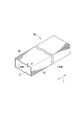
上述の一実施形態のアルミニウム合金の押出材の製造方法によって、Feの含有量が0.18重量%以下であり、Siの含有量が0.20重量%以上0.53重量%以下であり、Tiの含有量が0.04重量%以下のアルミニウム原材を得た。アルミニウム原材に複数のヘアライン16を形成した後、アルマイト皮膜22の厚みを変化させ、図7に示すアルミニウム合金の押出材50を製造した。アルミニウム合金の押出材50は、矩形の断面形状を有し、且つ中空体であること以外は、上述の一実施形態のアルミニウム合金の押出材10と同様の構成を備える。アルミニウム合金の押出材50の厚みdを1.7mmとした。
上述の一実施形態のアルミニウム合金の押出材の製造方法によって、Feの含有量が0.18重量%以下であり、Siの含有量が0.20重量%以上0.53重量%以下であり、Tiの含有量が0.04重量%以下のアルミニウム原材を得た。アルミニウム原材に複数のヘアライン16を形成した後、アルマイト皮膜22の厚みを変化させ、図7に示すアルミニウム合金の押出材50を製造した。アルミニウム合金の押出材50は、矩形の断面形状を有し、且つ中空体であること以外は、上述の一実施形態のアルミニウム合金の押出材10と同様の構成を備える。アルミニウム合金の押出材50の厚みdを1.7mmとした。
(比較例1-比較例7)
上述の実施例1から実施例6までの各例のアルミニウム合金の押出材50の製造方法と同様の製造方法で条件を変更し、図7に示すアルミニウム合金の押出材50と同様の形状を備えるアルミニウム合金の押出材を製造した。比較例1から比較例7までの各例のアルミニウム合金の押出材のFe,Si,Tiの各含有量及びアルマイト皮膜の厚みの何れかを実施例1から実施例6までの各例のアルミニウム合金の押出材50のFe,Si,Tiの各含有量及びアルマイト皮膜の厚みの範囲外にした。
上述の実施例1から実施例6までの各例のアルミニウム合金の押出材50の製造方法と同様の製造方法で条件を変更し、図7に示すアルミニウム合金の押出材50と同様の形状を備えるアルミニウム合金の押出材を製造した。比較例1から比較例7までの各例のアルミニウム合金の押出材のFe,Si,Tiの各含有量及びアルマイト皮膜の厚みの何れかを実施例1から実施例6までの各例のアルミニウム合金の押出材50のFe,Si,Tiの各含有量及びアルマイト皮膜の厚みの範囲外にした。
表1は、実施例1から実施例6まで及び比較例1から比較例4までの各例のアルミニウム合金の押出材の仕様と光輝性の評価結果に関するL*値を示す。

分光測色計CM-M6を用いて表1に記載されているL*値を測定した。これらのL*値の測定の際には、各例のアルミニウム合金の押出材のアルマイト皮膜に分光測色計CM-M6から出射された光を当てた。表1に記載されている合否の「OK」はL*値が20.7以下であることを表し、表1に記載されている合否の「NG」はL*値が20.7より大きいことを表す。
表1に示すように、実施例1から実施例6までの各例のアルミニウム合金の押出材50のL*値は20.7以下になり、高い光輝性が得られた。実施例1から実施例6までの各例では、アルミニウム合金の押出材50のFeの含有量は0.00重量%以上0.18重量%以下であり、Siの含有量は0.20重量%以上0.53重量%以下であり、Tiの含有量は0.00重量%以上0.04重量%以下であったためと考えられる。加えて、実施例1から実施例6までの各例では、アルマイト皮膜22の厚みは4μm以上10μm以下であったためと考えられる。
比較例1から比較例5の各々のアルミニウム合金の押出材では、アルマイト皮膜が白濁し、L*値が20.7に比べて大きくなり、光輝性が低下した。比較例1,2では、Siの含有量が0.53重量%を超えたためと考えられる。比較例3のアルミニウム合金の押出材では、Tiの含有量が0.04重量%を超えたためと考えられる。比較例4のアルミニウム合金の押出材では、Feの含有量が0.18重量%を超え、Tiの含有量が0.04重量%を超えたためと考えられる。比較例5のアルミニウム合金の押出材では、Feの含有量が0.18重量%を超えたためと考えられる。比較例6,7の各々のアルミニウム合金の押出材では、L*値が20.7に比べて大きくなり、光輝性が低下した。比較例6,7の各例では、アルマイト皮膜の厚みが10μmを超えたためと考えられる。
上述の実施例及び比較例の結果からわかるように、A6063合金のFeの含有量を0.00重量%以上0.18重量%以下とし、Siの含有量を0.20重量%以上0.53重量%以下とし、Tiの含有量を0.00重量%以上0.04重量%以下とし、アルマイト皮膜の厚みを4μm以上10μm以下としたことによって、アルミニウム合金の押出材の光輝性を高めることができた。
次に、上述の一実施形態のアルミニウム合金の押出材の耐食性に関する実施例及び比較例について説明する。
(実施例7-実施例9)
実施例1から実施例6までの各例のアルミニウム合金の押出材の製造方法と同様の方法によって、実施例7から実施例9までの各例のアルミニウム原材を得た。アルミニウム原材に複数のヘアラインを形成した後、アルマイト皮膜22の厚みを変化させ、図7に示すアルミニウム合金の押出材50を製造した。実施例7から実施例9までの各例では、アルマイト皮膜22の厚みを変えるために、アルミニウム合金の押出材50のSiの含有量及びMgの含有量を表2に示すように適宜変更し、Fe,Cu,Mn,Cr,Tiの各含有量を表2に示すように一定にした。
実施例1から実施例6までの各例のアルミニウム合金の押出材の製造方法と同様の方法によって、実施例7から実施例9までの各例のアルミニウム原材を得た。アルミニウム原材に複数のヘアラインを形成した後、アルマイト皮膜22の厚みを変化させ、図7に示すアルミニウム合金の押出材50を製造した。実施例7から実施例9までの各例では、アルマイト皮膜22の厚みを変えるために、アルミニウム合金の押出材50のSiの含有量及びMgの含有量を表2に示すように適宜変更し、Fe,Cu,Mn,Cr,Tiの各含有量を表2に示すように一定にした。
(比較例8)
実施例1から実施例6までの各例のアルミニウム合金の押出材50の製造方法と同様の方法において、各不純物の含有量を表2に示すように規制し、アルミニウム原材を得た。アルミニウム原材に複数のヘアラインを形成した後、アルマイト皮膜22の厚みを3μmとして、アルミニウム合金の押出材を製造した。
実施例1から実施例6までの各例のアルミニウム合金の押出材50の製造方法と同様の方法において、各不純物の含有量を表2に示すように規制し、アルミニウム原材を得た。アルミニウム原材に複数のヘアラインを形成した後、アルマイト皮膜22の厚みを3μmとして、アルミニウム合金の押出材を製造した。
表2は、実施例7から実施例9まで及び比較例8の各例のアルミニウム合金の押出材の仕様と耐食性の評価結果に関するレイティングナンバの測定結果を示す。表2に記載されているレイティングナンバは、JIS-H-8602-A2種のCASS試験で規定されているレイティングナンバを意味する。表2に記載されている合否の「OK」は各例のアルミニウム合金の押出材のレイティングナンバが9.5以上であることを表し、合否の「NG」は各例のアルミニウム合金の押出材のレイティングナンバが9.5に比べて小さいことを表す。
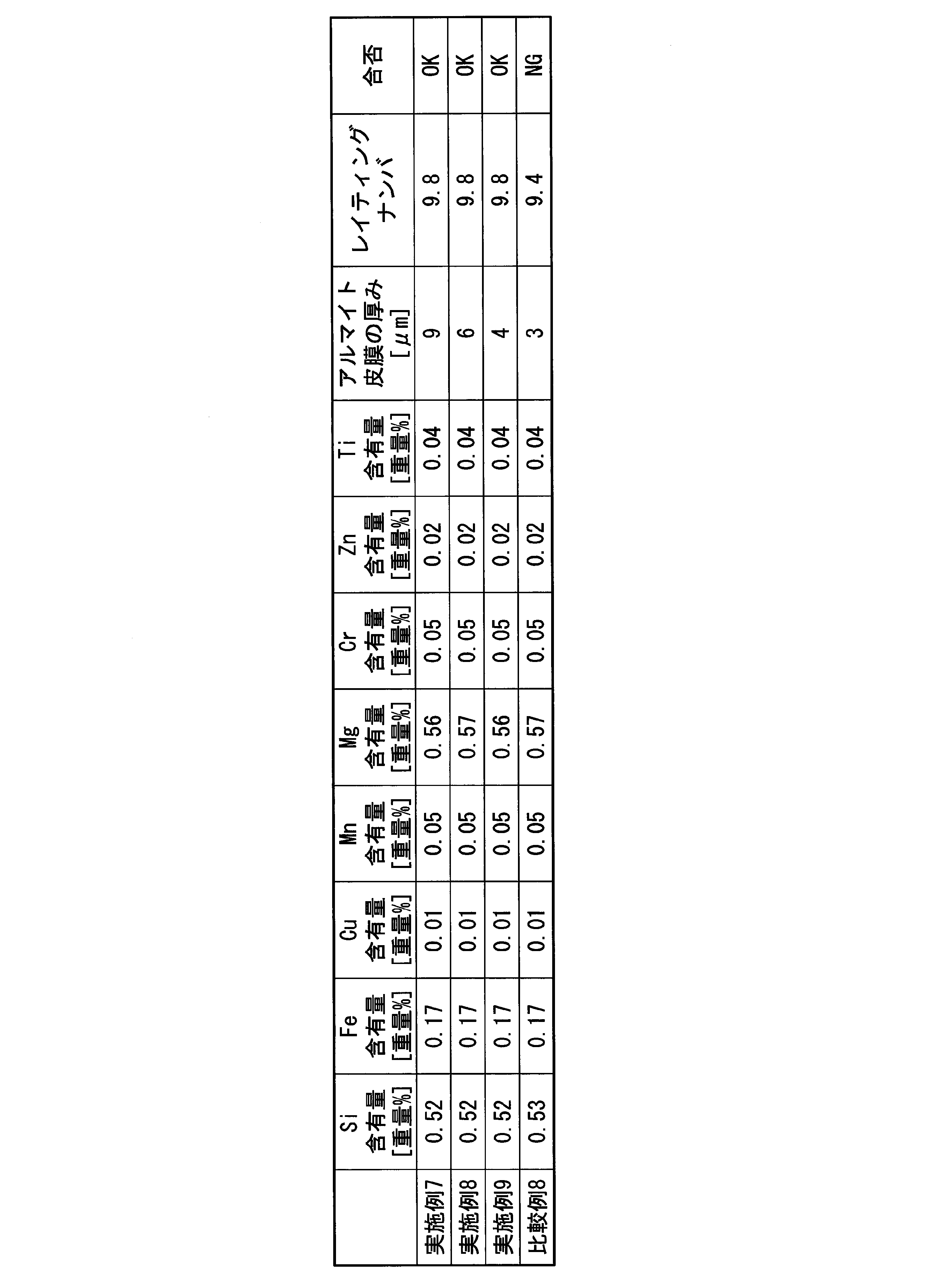
表2に示すように、実施例7から実施例9までの各例のアルミニウム合金の押出材50では、レイティングナンバが9.5以上になり、アルミニウム合金の押出材50がCASS試験に合格するために求められる耐食性を得られた。実施例7から実施例9までの各例では、アルマイト皮膜22の厚みは4μm以上10μm以下であったためと考えられる。
比較例8のアルミニウム合金の押出材では、CASS試験に合格するために求められる耐食性が得られなかった。比較例8では、アルマイト皮膜の厚みは4μm未満であったためと考えられる。
耐食性は光輝性とは互いに別の観点の評価内容であるが、上述の実施例及び比較例の評価結果からわかるように、アルマイト皮膜の厚みを4μm以上10μm以下にしたことによって、A6063合金に基づくアルミニウム合金の押出材に求められる耐食性を得ることができた。
10 アルミニウム合金の押出材
12 アルミニウム基材
13 表面(基材表面)
16 ヘアライン
22 アルマイト皮膜
30 アルミニウム原材
33 表面(原材表面)
51 鉄(Fe)
52 ケイ素(Si)
53 チタン(Ti)
L 長手方向
12 アルミニウム基材
13 表面(基材表面)
16 ヘアライン
22 アルマイト皮膜
30 アルミニウム原材
33 表面(原材表面)
51 鉄(Fe)
52 ケイ素(Si)
53 チタン(Ti)
L 長手方向
Claims (6)
- アルミニウム基材と、
前記アルミニウム基材の基材表面に形成されたアルマイト皮膜と、
を備え、
0.20重量%以上0.53質量%以下のSiと、0.18重量%以下のFeと、0.10重量%以下のCuと、0.10重量%以下のMnと、0.45重量%以上0.9重量%以下のMgと、0.10重量%以下のCrと、0.10重量%以下のZnと、0.04重量%以下のTiと、を含み、
アルミニウム及び不可避的不純物をさらに含み、
前記基材表面に前記アルミニウム基材の長手方向に沿って複数のヘアラインが形成され、
前記アルマイト皮膜の厚みは4μm以上10μm以下である、
アルミニウム合金の押出材。 - L*a*b表色系の明るさの軸上の値を表すL*値が20.7以下である、
請求項1に記載のアルミニウム合金の押出材。 - 前記ヘアラインの算術平均粗さは0.06μm以上であり、
前記ヘアラインの最大高さ粗さは0.63μm以上であり、
前記ヘアラインの断面曲線要素の平均長さは0.3μm以下である、
請求項1又は2に記載のアルミニウム合金の押出材。 - レイティングナンバが9.5以上である、
請求項1から3の何れか一項に記載のアルミニウム合金の押出材。 - 請求項1から4の何れか一項に記載のアルミニウム合金の押出材を含んで構成された、
建具。 - 0.20重量%以上0.53重量%以下のSiと、0.18重量%以下のFeと、0.10重量%以下のCuと、0.10重量%以下のMnと、0.45重量%以上0.9重量%以下のMgと、0.10重量%以下のCrと、0.10重量%以下のZnと、0.04重量%以下のTiとを含み、且つAl及び不可避的不純物を含むアルミニウム合金ビレットを鋳造し、
前記アルミニウム合金ビレットを押出成形してアルミニウム原材を形成し、
前記アルミニウム原材の原材表面を研磨し、
研磨された前記原材表面に前記アルミニウム原材の長手方向に沿ってヘアラインを複数形成し、
前記ヘアラインが形成された前記アルミニウム原材を陽極酸化処理し、アルミニウム基材の基材表面に厚みが4μm以上10μm以下のアルマイト皮膜を形成することを含むアルミニウム合金の押出材の製造方法。
Applications Claiming Priority (2)
| Application Number | Priority Date | Filing Date | Title |
|---|---|---|---|
| JP2018172385A JP7248399B2 (ja) | 2018-09-14 | 2018-09-14 | アルミニウム形材、建具及びアルミニウム形材の製造方法 |
| JP2018-172385 | 2018-09-14 |
Publications (1)
| Publication Number | Publication Date |
|---|---|
| WO2020054847A1 true WO2020054847A1 (ja) | 2020-03-19 |
Family
ID=69777121
Family Applications (1)
| Application Number | Title | Priority Date | Filing Date |
|---|---|---|---|
| PCT/JP2019/036102 Ceased WO2020054847A1 (ja) | 2018-09-14 | 2019-09-13 | アルミニウム合金の押出材、建具及びアルミニウム合金の押出材の製造方法 |
Country Status (2)
| Country | Link |
|---|---|
| JP (2) | JP7248399B2 (ja) |
| WO (1) | WO2020054847A1 (ja) |
Cited By (1)
| Publication number | Priority date | Publication date | Assignee | Title |
|---|---|---|---|---|
| US20210285120A1 (en) * | 2018-11-30 | 2021-09-16 | Uacj Corporation | Aluminum member and method of manufacturing aluminum member |
Families Citing this family (1)
| Publication number | Priority date | Publication date | Assignee | Title |
|---|---|---|---|---|
| CN112981194A (zh) * | 2021-02-09 | 2021-06-18 | 东莞市东联铝业有限公司 | 一种防起皱铝型材及制备方法 |
Citations (5)
| Publication number | Priority date | Publication date | Assignee | Title |
|---|---|---|---|---|
| JPS5366811A (en) * | 1976-11-27 | 1978-06-14 | Toyama Keikinzoku Kogyo Kk | Black spot preventive allmggsi based alloy and preventive treatment method of black spots |
| JPH09227978A (ja) * | 1996-02-16 | 1997-09-02 | Tateyama Alum Ind Co Ltd | アルミニウム合金 |
| JPH10306336A (ja) * | 1997-05-01 | 1998-11-17 | Sumitomo Light Metal Ind Ltd | 陽極酸化処理後の表面光沢性に優れたアルミニウム合金押出材およびその製造方法 |
| JP2012149335A (ja) * | 2010-12-27 | 2012-08-09 | Sankyo Tateyama Inc | アルミニウム合金 |
| JP2012255191A (ja) * | 2011-06-08 | 2012-12-27 | Sankyo Tateyama Inc | アルミニウム合金 |
Family Cites Families (11)
| Publication number | Priority date | Publication date | Assignee | Title |
|---|---|---|---|---|
| JPS56161796A (en) * | 1980-05-19 | 1981-12-12 | Pioneer Electronic Corp | Speaker system of passive radiator system |
| JPS5915000A (ja) * | 1982-07-15 | 1984-01-25 | 株式会社勝光社 | アルミニウム基材の装飾法 |
| JP3609348B2 (ja) * | 2001-03-30 | 2005-01-12 | アイシン軽金属株式会社 | アルミニウム合金の電解着色方法 |
| JP4790564B2 (ja) * | 2006-10-16 | 2011-10-12 | Ykk Ap株式会社 | 表面処理アルミニウム材または表面処理アルミニウム合金材、及びそれを使用した建材製品 |
| JP5561181B2 (ja) * | 2011-01-18 | 2014-07-30 | トヨタ自動車株式会社 | 燃料残量測定装置 |
| JP5642597B2 (ja) | 2011-03-22 | 2014-12-17 | 株式会社Lixil | アルミニウム押出材の陽極酸化塗装複合皮膜形成方法及びその陽極酸化塗装複合皮膜 |
| JP5522318B2 (ja) | 2012-05-23 | 2014-06-18 | 新日鐵住金株式会社 | ヘアライン外観を有するAl系合金めっき鋼材 |
| FR2996857B1 (fr) * | 2012-10-17 | 2015-02-27 | Constellium France | Elements de chambres a vide en alliage d'aluminium |
| JP6381435B2 (ja) * | 2014-12-17 | 2018-08-29 | 昭和電工株式会社 | ルーフレール材およびその製造方法 |
| JP2017029469A (ja) * | 2015-08-03 | 2017-02-09 | 株式会社オリンピア | 遊技機 |
| JP6705292B2 (ja) | 2015-11-27 | 2020-06-03 | 日本軽金属株式会社 | 低反射アルミニウム材及びその製造方法 |
-
2018
- 2018-09-14 JP JP2018172385A patent/JP7248399B2/ja active Active
-
2019
- 2019-09-13 WO PCT/JP2019/036102 patent/WO2020054847A1/ja not_active Ceased
-
2023
- 2023-03-16 JP JP2023042348A patent/JP2023072081A/ja active Pending
Patent Citations (5)
| Publication number | Priority date | Publication date | Assignee | Title |
|---|---|---|---|---|
| JPS5366811A (en) * | 1976-11-27 | 1978-06-14 | Toyama Keikinzoku Kogyo Kk | Black spot preventive allmggsi based alloy and preventive treatment method of black spots |
| JPH09227978A (ja) * | 1996-02-16 | 1997-09-02 | Tateyama Alum Ind Co Ltd | アルミニウム合金 |
| JPH10306336A (ja) * | 1997-05-01 | 1998-11-17 | Sumitomo Light Metal Ind Ltd | 陽極酸化処理後の表面光沢性に優れたアルミニウム合金押出材およびその製造方法 |
| JP2012149335A (ja) * | 2010-12-27 | 2012-08-09 | Sankyo Tateyama Inc | アルミニウム合金 |
| JP2012255191A (ja) * | 2011-06-08 | 2012-12-27 | Sankyo Tateyama Inc | アルミニウム合金 |
Cited By (2)
| Publication number | Priority date | Publication date | Assignee | Title |
|---|---|---|---|---|
| US20210285120A1 (en) * | 2018-11-30 | 2021-09-16 | Uacj Corporation | Aluminum member and method of manufacturing aluminum member |
| US12168835B2 (en) * | 2018-11-30 | 2024-12-17 | Uacj Corporation | Aluminum member and method of manufacturing aluminum member |
Also Published As
| Publication number | Publication date |
|---|---|
| JP2020045506A (ja) | 2020-03-26 |
| JP7248399B2 (ja) | 2023-03-29 |
| JP2023072081A (ja) | 2023-05-23 |
Similar Documents
| Publication | Publication Date | Title |
|---|---|---|
| US9970080B2 (en) | Micro-alloying to mitigate the slight discoloration resulting from entrained metal in anodized aluminum surface finishes | |
| KR102213570B1 (ko) | 양극산화된-품질 알루미늄 합금 및 관련된 제품 및 방법 | |
| JP2023072081A (ja) | アルミニウム形材、建具及びアルミニウム形材の製造方法 | |
| NO161517B (no) | Anordning for aa gi oppdrift til i det minste ett element av et undervannsproduksjonsstigeroer. | |
| CN105063442A (zh) | 一种铝合金 | |
| JPH0347937A (ja) | 陽極酸化処理後の色調が白色のアルミニウム合金材料 | |
| AU2014307526A1 (en) | Al-coated steel sheet having excellent total reflection properties and corrosion resistance, and method for manufacturing same | |
| JP3314312B2 (ja) | アルミニウム合金材の結晶模様製造方法 | |
| JP2012149335A (ja) | アルミニウム合金 | |
| JP5629099B2 (ja) | 耐食性及び光輝性に優れた押出し用アルミニウム合金 | |
| JP3200523B2 (ja) | グレー発色用時効硬化型アルミニウム合金押出形材及びその製造方法 | |
| EP3500689B1 (en) | Anodized aluminum with dark gray color | |
| TWI565809B (zh) | 鋁合金之製造方法 | |
| US20170137956A1 (en) | Surface-treated aluminum material and zinc-supplemented aluminum alloy | |
| US3098724A (en) | Aluminous metal article | |
| JP4942524B2 (ja) | 曲げ加工性及び陽極酸化処理後の光輝性に優れたアルミニウム合金ならびにその押出形材 | |
| WO2018221435A1 (ja) | アルミニウム積層体およびその製造方法 | |
| JP2005248213A (ja) | グレー発色アルミニウム合金 | |
| TWI758563B (zh) | 鋁積層體及其製造方法 | |
| JP2013173992A (ja) | 押出用高強度グレー発色合金 | |
| JP2021085039A (ja) | アルミニウム部材及びその製造方法 | |
| JPH06200398A (ja) | 遠赤外線放射体およびその製造方法 | |
| JPH0689430B2 (ja) | 押出用グレー発色アルミニウム合金 | |
| JPH116023A (ja) | アルミ合金材およびアルミ合金材の製造方法 |
Legal Events
| Date | Code | Title | Description |
|---|---|---|---|
| 121 | Ep: the epo has been informed by wipo that ep was designated in this application |
Ref document number: 19858942 Country of ref document: EP Kind code of ref document: A1 |
|
| NENP | Non-entry into the national phase |
Ref country code: DE |
|
| 122 | Ep: pct application non-entry in european phase |
Ref document number: 19858942 Country of ref document: EP Kind code of ref document: A1 |