WO2020054680A1 - ファインバブル発生装置及びファインバブル発生方法 - Google Patents
ファインバブル発生装置及びファインバブル発生方法 Download PDFInfo
- Publication number
- WO2020054680A1 WO2020054680A1 PCT/JP2019/035418 JP2019035418W WO2020054680A1 WO 2020054680 A1 WO2020054680 A1 WO 2020054680A1 JP 2019035418 W JP2019035418 W JP 2019035418W WO 2020054680 A1 WO2020054680 A1 WO 2020054680A1
- Authority
- WO
- WIPO (PCT)
- Prior art keywords
- liquid
- porous body
- fine bubble
- fine
- less
- Prior art date
- Legal status (The legal status is an assumption and is not a legal conclusion. Google has not performed a legal analysis and makes no representation as to the accuracy of the status listed.)
- Ceased
Links
Images


Classifications
-
- B—PERFORMING OPERATIONS; TRANSPORTING
- B01—PHYSICAL OR CHEMICAL PROCESSES OR APPARATUS IN GENERAL
- B01F—MIXING, e.g. DISSOLVING, EMULSIFYING OR DISPERSING
- B01F23/00—Mixing according to the phases to be mixed, e.g. dispersing or emulsifying
- B01F23/20—Mixing gases with liquids
- B01F23/23—Mixing gases with liquids by introducing gases into liquid media, e.g. for producing aerated liquids
- B01F23/232—Mixing gases with liquids by introducing gases into liquid media, e.g. for producing aerated liquids using flow-mixing means for introducing the gases, e.g. baffles
- B01F23/2323—Mixing gases with liquids by introducing gases into liquid media, e.g. for producing aerated liquids using flow-mixing means for introducing the gases, e.g. baffles by circulating the flow in guiding constructions or conduits
-
- B—PERFORMING OPERATIONS; TRANSPORTING
- B01—PHYSICAL OR CHEMICAL PROCESSES OR APPARATUS IN GENERAL
- B01F—MIXING, e.g. DISSOLVING, EMULSIFYING OR DISPERSING
- B01F23/00—Mixing according to the phases to be mixed, e.g. dispersing or emulsifying
- B01F23/20—Mixing gases with liquids
- B01F23/23—Mixing gases with liquids by introducing gases into liquid media, e.g. for producing aerated liquids
- B01F23/232—Mixing gases with liquids by introducing gases into liquid media, e.g. for producing aerated liquids using flow-mixing means for introducing the gases, e.g. baffles
-
- B—PERFORMING OPERATIONS; TRANSPORTING
- B01—PHYSICAL OR CHEMICAL PROCESSES OR APPARATUS IN GENERAL
- B01F—MIXING, e.g. DISSOLVING, EMULSIFYING OR DISPERSING
- B01F23/00—Mixing according to the phases to be mixed, e.g. dispersing or emulsifying
- B01F23/20—Mixing gases with liquids
- B01F23/23—Mixing gases with liquids by introducing gases into liquid media, e.g. for producing aerated liquids
- B01F23/237—Mixing gases with liquids by introducing gases into liquid media, e.g. for producing aerated liquids characterised by the physical or chemical properties of gases or vapours introduced in the liquid media
- B01F23/2373—Mixing gases with liquids by introducing gases into liquid media, e.g. for producing aerated liquids characterised by the physical or chemical properties of gases or vapours introduced in the liquid media for obtaining fine bubbles, i.e. bubbles with a size below 100 µm
-
- B—PERFORMING OPERATIONS; TRANSPORTING
- B01—PHYSICAL OR CHEMICAL PROCESSES OR APPARATUS IN GENERAL
- B01F—MIXING, e.g. DISSOLVING, EMULSIFYING OR DISPERSING
- B01F25/00—Flow mixers; Mixers for falling materials, e.g. solid particles
- B01F25/40—Static mixers
- B01F25/45—Mixers in which the materials to be mixed are pressed together through orifices or interstitial spaces, e.g. between beads
- B01F25/452—Mixers in which the materials to be mixed are pressed together through orifices or interstitial spaces, e.g. between beads characterised by elements provided with orifices or interstitial spaces
- B01F25/4522—Mixers in which the materials to be mixed are pressed together through orifices or interstitial spaces, e.g. between beads characterised by elements provided with orifices or interstitial spaces the components being pressed through porous bodies, e.g. flat plates, blocks or cylinders, which obstruct the whole diameter of the tube
- B01F25/45221—Mixers in which the materials to be mixed are pressed together through orifices or interstitial spaces, e.g. between beads characterised by elements provided with orifices or interstitial spaces the components being pressed through porous bodies, e.g. flat plates, blocks or cylinders, which obstruct the whole diameter of the tube the porous bodies being cylinders or cones which obstruct the whole diameter of the tube, the flow changing from axial in radial and again in axial
-
- B—PERFORMING OPERATIONS; TRANSPORTING
- B01—PHYSICAL OR CHEMICAL PROCESSES OR APPARATUS IN GENERAL
- B01F—MIXING, e.g. DISSOLVING, EMULSIFYING OR DISPERSING
- B01F2215/00—Auxiliary or complementary information in relation with mixing
- B01F2215/04—Technical information in relation with mixing
- B01F2215/0413—Numerical information
- B01F2215/0418—Geometrical information
- B01F2215/0431—Numerical size values, e.g. diameter of a hole or conduit, area, volume, length, width, or ratios thereof
-
- Y—GENERAL TAGGING OF NEW TECHNOLOGICAL DEVELOPMENTS; GENERAL TAGGING OF CROSS-SECTIONAL TECHNOLOGIES SPANNING OVER SEVERAL SECTIONS OF THE IPC; TECHNICAL SUBJECTS COVERED BY FORMER USPC CROSS-REFERENCE ART COLLECTIONS [XRACs] AND DIGESTS
- Y02—TECHNOLOGIES OR APPLICATIONS FOR MITIGATION OR ADAPTATION AGAINST CLIMATE CHANGE
- Y02W—CLIMATE CHANGE MITIGATION TECHNOLOGIES RELATED TO WASTEWATER TREATMENT OR WASTE MANAGEMENT
- Y02W10/00—Technologies for wastewater treatment
- Y02W10/10—Biological treatment of water, waste water, or sewage
Definitions
- the present invention relates to a fine bubble generation device and a fine bubble generation method.
- Fine bubbles refer to bubbles having a diameter of 100 ⁇ m or less
- ultra fine bubbles refer to bubbles having a diameter of 1 ⁇ m or less among fine bubbles. Since these have different properties from ordinary bubbles, their application in various fields has been studied in recent years.
- a swirling liquid flow method As a method for producing fine bubbles or ultra fine bubbles, a swirling liquid flow method, a pressure dissolution / decompression method, and a microporous method can be mainly mentioned.
- the gas is pressurized and dissolved in the liquid. Then, by rapidly discharging the liquid into a liquid under reduced pressure or normal pressure, the dissolved gas can be deposited as fine bubbles.
- a gas is ejected from the nanopore into the liquid.
- Patent Document 1 a gas is pressurized by a pump to be dissolved in a liquid, and the gas-liquid mixture is passed through a metal filter having a fine pore path, whereby fine particles are formed. It is said that oxidized bubbles are obtained.
- the microporous path has a length of 30 mm to 60 mm and a pore diameter of 300 ⁇ m or less, and is a regular linear flow path.
- the gas-liquid mixture flows through the fine pores, so that the bubbles are broken by shearing, and fine bubbles with a fine texture can be obtained.
- An object of the present invention is to provide a fine bubble generating device and a fine bubble generating method capable of generating fine bubbles with a simple configuration.
- a fine bubble generator comprising: a porous body having continuous pores; a liquid supply unit that supplies a liquid to the porous body to flow through the continuous pores; and a liquid discharge unit that discharges the liquid that has flowed through the continuous pores.
- ⁇ Aspect 2 The fine bubble generator according to aspect 1, wherein the porous body is made of ceramic.
- ⁇ Aspect 3 The fine bubble generator according to aspect 1 or 2, wherein an average flow rate diameter of the porous body measured by a palm porometer is 5 ⁇ m or more and 100 ⁇ m or less.
- ⁇ Aspect 4 The fine bubble generator according to any one of aspects 1 to 3, wherein a porosity of the porous body is 40% or more and 80% or less.
- ⁇ Aspect 5 Aspect 1, wherein the porous body has a plurality of inlet channels and a plurality of outlet channels, and is a porous filter substrate in which the inlet channel and the outlet channel are separated by a porous wall. 5.
- ⁇ Aspect 6 >> The fine bubble generator according to aspect 5, wherein the plurality of inlet channels and the plurality of outlet channels of the porous filter substrate extend substantially in parallel and are adjacent to each other.
- ⁇ Aspect 7 The fine bubble generator according to aspect 5 or 6, wherein the thickness of the porous wall is 1.0 mm or less.
- Fine bubble generation methods including: 8. Supplying a liquid to the porous body from the liquid supply unit of the fine bubble manufacturing apparatus according to any one of aspects 1 to 7, and circulating the supplied liquid to continuous pores of the porous body. And obtaining a liquid containing fine bubbles from the liquid discharge section.
- the present invention it is possible to provide a fine bubble generating device and a fine bubble generating method capable of generating fine bubbles with a simple configuration.
- fine bubbles can be generated without pressurizing with a pump. Therefore, the fine bubble generation device of the present invention can be downsized and can be used at home. Further, the fine bubble generating device of the present invention can greatly reduce the operating energy and can be used without generating noise or the like.
- the method for generating fine bubbles of the present invention can be implemented at home and has advantages such as being able to be implemented with low driving energy.
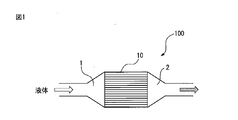
- FIG. 1 is a schematic diagram of one embodiment of the device of the present invention.
- FIG. 2 is a schematic view of one embodiment of the porous body of the device of the present invention.
- FIG. 3 is a diagram showing the relationship between the average flow diameter of the base material used in the example and the number of fine bubbles generated.
- the fine bubble generation device of the present invention includes a porous body having continuous pores, a liquid supply unit that supplies a liquid to the porous body and causes the liquid to flow through the continuous pores, and a liquid discharge unit that discharges the liquid that has flowed through the continuous pores. .
- a liquid is supplied from a liquid supply unit (1) to a porous body (10), and the liquid is supplied to the porous body (10).
- the liquid containing fine bubbles obtained through the continuous pores and obtained from the porous body (10) is discharged from the liquid discharge part (2).
- the present inventors have discovered that when a liquid is passed through a porous body such as a diesel particulate filter (DPF), fine bubbles are generated in the liquid.
- a porous body such as a diesel particulate filter (DPF)
- DPF diesel particulate filter
- the pressure is reduced by the Venturi effect, and a gas dissolved in the liquid is generated as fine bubbles. That is, when the liquid enters the pores of the porous body from the normal flow path, the total of the dynamic pressure and the static pressure is kept constant by Bernoulli's theorem, so that the dynamic pressure becomes extremely high, Is very low.
- the static pressure decreases, gas dissolved in the liquid is generated as fine bubbles. Since the fine bubbles are hard to disappear once formed, the fine bubbles are considered to remain even if the liquid containing the fine bubbles returns to the normal flow path.
- the pore size of the porous body is small to some extent, it is sufficient to generate fine bubbles. Even if the pore size is very small, it is not clear whether many fine bubbles are generated in response to the fine pores. It is conceivable that when the pore diameter has a certain size, the space region in which fine bubbles are generated is widened and the total number of fine bubbles generated is increased.
- fine bubbles can be generated without pressurizing with a pump. Therefore, the fine bubble generation device of the present invention can be downsized and can be used at home. Further, the fine bubble generating device of the present invention can greatly reduce the operating energy and can be used without generating noise or the like.
- the liquid used in the fine bubble generator of the present invention is not particularly limited as long as it is a liquid in which gas is dissolved.
- the liquid to be used may be a liquid in which gas is dissolved by means such as pressurizing in advance.
- Specific examples of the liquid used in the fine bubble generator of the present invention include aqueous liquids (that is, water such as tap water, pure water, and deionized water); aqueous solutions containing a surfactant and the like; Examples include hydrophilic liquids such as methanol and ethanol, and organic solvents may be used.
- the type of gas is not particularly limited as long as it can be dissolved in the liquid used, and examples thereof include oxygen and hydrogen.
- the average particle diameter of the fine bubbles may be, for example, 100 ⁇ m or less, 50 ⁇ m or less, 30 ⁇ m or less, 10 ⁇ m or less, 5 ⁇ m or less, 3 ⁇ m or less, 1 ⁇ m or less, 500 nm or less, 300 nm or less, or 100 nm or less, and 10 nm or more, 50 nm or more , 100 nm or more, 300 nm or more, or 500 nm or more. Therefore, the fine bubbles obtained by the fine bubble generator of the present invention may be ultrafine bubbles having an average particle diameter of 1 ⁇ m or less.
- the average particle size of the ultrafine bubbles can be measured using a nanoparticle analysis system NanoSight (Malvern), and the average particle size of the fine bubbles can be measured using Microtrac @ PartAn @ SI (Microtrac Bell Inc.). Can be measured.
- the fine bubbles obtained by the fine bubble generator of the present invention can be used for various purposes, for example, for cleaning, chemical synthesis, sterilization and disinfection, deodorization, fine particle adsorption, and the like.
- the porous body used in the present invention is not particularly limited as long as it has continuous pores and a liquid can flow through the continuous pores.
- the flow velocity of the liquid locally increases. That is, in the liquid in this case, it is considered that the dynamic pressure locally increases and the static pressure decreases, thereby causing fine bubbles.
- the continuous pores may be irregularly shaped.
- the material of the porous body is not particularly limited, examples thereof include a porous metal, a porous ceramic, and a porous resin.
- a ceramic porous body can be preferably used from the viewpoint of easily obtaining a porous body having preferred continuous pores, particularly a porous body having irregularly shaped continuous pores.
- a ceramic material in particular cordierite (2MgO ⁇ 2Al 2 O 3 ⁇ 5SiO 2), mention may be made of alumina, silica, zirconia, silicon carbide or the like.
- the pore diameter of the porous body is not particularly limited as long as fine bubbles can be generated.
- the average pore diameter measured by a mercury porosimeter may be 5 ⁇ m or more, 8 ⁇ m or more, 10 ⁇ m or more, or 15 ⁇ m or more. , 500 ⁇ m or less, 300 ⁇ m or less, 100 ⁇ m or less, 50 ⁇ m or less, 30 ⁇ m or less, 20 ⁇ m or less, or 15 ⁇ m or less.
- the present inventors have also found that the average flow diameter measured by a palm porometer has a high correlation with the number of fine bubbles generated.
- This average flow diameter corresponds to the average of the pore diameter of the narrowest portion of the continuous pores present in the porous body, and it is considered that the pore diameter of the narrowest portion has a great influence on the generation of fine bubbles.
- the average flow diameter measured by a palm porometer may be 3 ⁇ m or more, 5 ⁇ m or more, 8 ⁇ m or more, 10 ⁇ m or more, or 15 ⁇ m or more, 500 ⁇ m or less, 300 ⁇ m or less, 200 ⁇ m or less, 100 ⁇ m or less, 50 ⁇ m or less, 30 ⁇ m or less. Or 20 ⁇ m or less.
- the porosity of the porous body is not particularly limited as long as fine bubbles can be effectively generated.
- the porosity may be 30% or more, 40% or more, 50% or more, or 60% or more, and 90% or less. , 80% or less, 70% or less, or 60% or less.
- the porosity can be determined from the ratio of the weight of the porous body to the theoretical weight of the solid body based on the material of the porous body.
- the thickness of the porous body through which the liquid is circulated is not particularly limited as long as fine bubbles can be generated effectively.
- the thickness is 10 mm or less, 5.0 mm or less, 1.0 mm or less, and 500 ⁇ m.
- it may be 300 ⁇ m or less, or 200 ⁇ m or less, and may be 100 ⁇ m or more, 200 ⁇ m or more, or 300 ⁇ m or more.
- the porous body is a porous substrate having a plurality of flow paths, and the flow paths are separated by porous walls.
- a porous base material may be a so-called straight flow type honeycomb base material in which the flow paths extend substantially in parallel and are adjacent to each other.
- honeycomb substrate of a straight flow type a honeycomb substrate which is used for manufacturing an exhaust gas purifying catalyst for an automobile and is well known in the field can be used as it is.
- the plurality of flow paths are constituted by a plurality of inlet flow paths and a plurality of outlet flow paths, and substantially all of the liquid flows into the inlet flow path.
- the porous filter base material which flows through the continuous pores of the porous wall and flows out from the outlet channel can be exemplified.
- the solution can be effectively circulated through the porous wall with a low pressure loss.
- the porous filter substrate may be a so-called wall flow type honeycomb substrate in which the plurality of inlet channels and the plurality of outlet channels extend substantially in parallel and are adjacent to each other. .
- a honeycomb substrate well-known in the field which is used for manufacturing a diesel particulate filter (DPF), a gasoline particulate filter (GPF), or the like, can be used as it is. Can be.
- DPF diesel particulate filter
- GPF gasoline particulate filter
- the number of cells is, for example, 300 cells / inch 2 or more and 500 cells / inch. It may be in 2 or more, 800 cells / inch 2 or more, 1000 cells / inch 2 or more, or 1200 cells / inch 2 or more, 2000 cells / inch 2 or less, 1500 cells / inch 2 or less, 1200 cells / inch 2 Hereinafter, it may be 1000 cells / inch 2 or less, or 800 cells / inch 2 or less.
- the thickness of the porous wall of the honeycomb substrate may be 1.0 mm or less, 500 ⁇ m or less, 300 ⁇ m or less, or 200 ⁇ m or less, and may be 100 ⁇ m or more, 200 ⁇ m or more, or 300 ⁇ m or more.
- FIG. 2 is a schematic diagram of one embodiment of a porous body (10) used in the apparatus of the present invention, which comprises a plurality of inlet channels (11) and a plurality of outlet channels. (12), an inlet channel (11) and an outlet channel (12) are separated by a porous wall (13), and a plurality of inlet channels (11) and a plurality of outlet channels ( 12) extend substantially parallel to each other and are adjacent to each other.
- this porous body (10) porous filter substrate
- fine bubbles are generated when liquid flows in from the inlet channel (11) and flows through the continuous pores of the porous wall (13). I do. Then, the liquid containing fine bubbles flows out of the outlet channel (12).
- FIG. 2 is a schematic diagram, and the porous body (10) is displayed with a very small number of cells due to the drawing.
- the liquid supply unit used in the apparatus of the present invention is not particularly limited as long as the liquid can be supplied to the continuous pores of the porous body.
- the liquid discharging section is not particularly limited as long as the liquid flowing through the continuous pores of the porous body can be discharged.
- a flow path for flowing the liquid In the liquid supply unit and the liquid discharge unit, a flow path for flowing the liquid, a container for storing the liquid, a pump for pumping the liquid, a valve for controlling the flow rate of the liquid, a pump, A controller or the like for automatically controlling the valve may be present.
- a controller or the like for automatically controlling the valve may be present.
- Those skilled in the art can design a configuration suitable for the use, the place of use, and the like of the fine bubble generator.
- the fine bubble generation method of the present invention is to supply the liquid to the porous body from the liquid supply unit of the fine bubble generation device as described above, and to circulate the supplied liquid through the continuous pores of the porous body. Obtaining a liquid containing fine bubbles from a liquid outlet.
- each configuration described for the fine bubble generating device of the present invention can be referred to.
- the number of generated fine bubbles was measured in the same manner as described above, using a commercially available straight flow type metal substrate used for an exhaust gas purifying catalyst for motorcycles.
- the average flow diameter of each substrate was measured by a palm porometer. Specifically, Porous Materials Inc. Using a palm porometer manufactured by the company, the measurement was performed by the bubble point method under the condition of WetUP / DryUP (Galwick / air) with Tortuosity factor set to 0.715. As the average pore diameter and the porosity, numerical values indicated by the vendor of the porous filter substrate were used, and these are the values measured by the above method.
- the fine bubbles obtained in Examples 1 to 4 had a particle size of about 100 to 400 nm, and were ultra fine bubbles.
Landscapes
- Chemical & Material Sciences (AREA)
- Chemical Kinetics & Catalysis (AREA)
- Dispersion Chemistry (AREA)
- Engineering & Computer Science (AREA)
- Nanotechnology (AREA)
- Porous Artificial Stone Or Porous Ceramic Products (AREA)
Priority Applications (3)
| Application Number | Priority Date | Filing Date | Title |
|---|---|---|---|
| US17/272,549 US11890586B2 (en) | 2018-09-11 | 2019-09-09 | Fine bubble generation device and method for generating fine bubbles |
| EP19858767.7A EP3851185B1 (en) | 2018-09-11 | 2019-09-09 | Method for generating fine bubbles |
| CN201980058495.4A CN112689533B (zh) | 2018-09-11 | 2019-09-09 | 微泡产生装置和微泡产生方法 |
Applications Claiming Priority (2)
| Application Number | Priority Date | Filing Date | Title |
|---|---|---|---|
| JP2018169968A JP7243972B2 (ja) | 2018-09-11 | 2018-09-11 | ファインバブルの製造装置及びファインバブルの製造方法 |
| JP2018-169968 | 2018-09-11 |
Publications (1)
| Publication Number | Publication Date |
|---|---|
| WO2020054680A1 true WO2020054680A1 (ja) | 2020-03-19 |
Family
ID=69778100
Family Applications (1)
| Application Number | Title | Priority Date | Filing Date |
|---|---|---|---|
| PCT/JP2019/035418 Ceased WO2020054680A1 (ja) | 2018-09-11 | 2019-09-09 | ファインバブル発生装置及びファインバブル発生方法 |
Country Status (5)
| Country | Link |
|---|---|
| US (1) | US11890586B2 (https=) |
| EP (1) | EP3851185B1 (https=) |
| JP (1) | JP7243972B2 (https=) |
| CN (1) | CN112689533B (https=) |
| WO (1) | WO2020054680A1 (https=) |
Cited By (1)
| Publication number | Priority date | Publication date | Assignee | Title |
|---|---|---|---|---|
| WO2023105915A1 (ja) * | 2021-12-08 | 2023-06-15 | パナソニックIpマネジメント株式会社 | 気泡含有液体生成装置及びノズル |
Families Citing this family (1)
| Publication number | Priority date | Publication date | Assignee | Title |
|---|---|---|---|---|
| JP7572930B2 (ja) * | 2021-10-04 | 2024-10-24 | 日立グローバルライフソリューションズ株式会社 | 給湯システム及び給湯方法 |
Citations (6)
| Publication number | Priority date | Publication date | Assignee | Title |
|---|---|---|---|---|
| JP2002018467A (ja) * | 2000-07-06 | 2002-01-22 | Ebara Corp | 有機性汚水の生物処理方法及び装置 |
| JP2002301345A (ja) * | 2001-02-05 | 2002-10-15 | Teruji Sasaki | 気泡水製造装置 |
| JP2007237161A (ja) * | 2006-02-09 | 2007-09-20 | Hiroshima Kasei Ltd | 加水素水の製造方法及び製造装置 |
| JP2010269200A (ja) * | 2007-08-09 | 2010-12-02 | Sumitomo Electric Ind Ltd | 水処理装置および水処理方法 |
| US20170259218A1 (en) * | 2015-06-30 | 2017-09-14 | Kechuang Lin | Bubble-generation apparatus and system |
| JP2017217585A (ja) | 2016-06-03 | 2017-12-14 | 株式会社テクノアート | ファインバブル液製造装置 |
Family Cites Families (16)
| Publication number | Priority date | Publication date | Assignee | Title |
|---|---|---|---|---|
| US6290847B1 (en) * | 1998-12-17 | 2001-09-18 | Corning Incorporated | Gravity-flow water filtration device |
| JP2004261664A (ja) * | 2003-02-28 | 2004-09-24 | Ngk Insulators Ltd | ハニカム構造体及びハニカム構造体押出し成形用口金 |
| US7255332B2 (en) * | 2004-05-25 | 2007-08-14 | The Board Of Trustees Of The University Of Arkansas | System and method for dissolving gases in liquids |
| JP2006289183A (ja) * | 2005-04-06 | 2006-10-26 | Nano Bubble Kk | ナノバブル生成方法とその装置 |
| JP2006314972A (ja) * | 2005-05-16 | 2006-11-24 | Matsushita Electric Ind Co Ltd | 気泡発生装置 |
| US20090038701A1 (en) | 2006-01-17 | 2009-02-12 | Baxter International Inc. | Device, system and method for mixing |
| DE102006048456B4 (de) | 2006-10-11 | 2009-12-10 | Carbotek Holding Gmbh | Imprägnierer-Einlass |
| US20120186206A1 (en) | 2009-09-30 | 2012-07-26 | Honda Motor Co., Ltd. | Exhaust gas purifying filter |
| EP2368625A1 (de) | 2010-03-22 | 2011-09-28 | Sulzer Chemtech AG | Verfahren und Vorrichtung zur Dispergierung |
| CN102834158B (zh) * | 2010-04-01 | 2015-07-15 | 日立金属株式会社 | 陶瓷蜂窝过滤器及其制造方法 |
| US20110165040A1 (en) | 2010-11-03 | 2011-07-07 | Ford Global Technologies, Llc | Device for remediating emissions and method of manufacture |
| EP2832962B1 (en) | 2012-03-30 | 2016-08-17 | Toyota Jidosha Kabushiki Kaisha | Particulate filter |
| KR20150107752A (ko) * | 2013-01-17 | 2015-09-23 | 아이뎃쿠 가부시키가이샤 | 고밀도 미세기포액 생성방법 및 고밀도 미세기포액 생성장치 |
| EP3298087A4 (en) * | 2015-05-18 | 2019-01-23 | President and Fellows of Harvard College | FOAM INK COMPOSITION AND 3D PRINTED HIERARCHICAL POROUS STRUCTURE |
| JP2017019743A (ja) * | 2015-07-09 | 2017-01-26 | 国立大学法人静岡大学 | 気相−液相−液相化学反応を用いた有機合成法 |
| JP7464390B2 (ja) * | 2018-06-28 | 2024-04-09 | 日本特殊陶業株式会社 | ファインバブル発生装置及びファインバブル発生方法 |
-
2018
- 2018-09-11 JP JP2018169968A patent/JP7243972B2/ja active Active
-
2019
- 2019-09-09 WO PCT/JP2019/035418 patent/WO2020054680A1/ja not_active Ceased
- 2019-09-09 EP EP19858767.7A patent/EP3851185B1/en active Active
- 2019-09-09 US US17/272,549 patent/US11890586B2/en active Active
- 2019-09-09 CN CN201980058495.4A patent/CN112689533B/zh active Active
Patent Citations (6)
| Publication number | Priority date | Publication date | Assignee | Title |
|---|---|---|---|---|
| JP2002018467A (ja) * | 2000-07-06 | 2002-01-22 | Ebara Corp | 有機性汚水の生物処理方法及び装置 |
| JP2002301345A (ja) * | 2001-02-05 | 2002-10-15 | Teruji Sasaki | 気泡水製造装置 |
| JP2007237161A (ja) * | 2006-02-09 | 2007-09-20 | Hiroshima Kasei Ltd | 加水素水の製造方法及び製造装置 |
| JP2010269200A (ja) * | 2007-08-09 | 2010-12-02 | Sumitomo Electric Ind Ltd | 水処理装置および水処理方法 |
| US20170259218A1 (en) * | 2015-06-30 | 2017-09-14 | Kechuang Lin | Bubble-generation apparatus and system |
| JP2017217585A (ja) | 2016-06-03 | 2017-12-14 | 株式会社テクノアート | ファインバブル液製造装置 |
Non-Patent Citations (1)
| Title |
|---|
| See also references of EP3851185A4 |
Cited By (1)
| Publication number | Priority date | Publication date | Assignee | Title |
|---|---|---|---|---|
| WO2023105915A1 (ja) * | 2021-12-08 | 2023-06-15 | パナソニックIpマネジメント株式会社 | 気泡含有液体生成装置及びノズル |
Also Published As
| Publication number | Publication date |
|---|---|
| CN112689533B (zh) | 2023-04-18 |
| EP3851185B1 (en) | 2026-02-11 |
| CN112689533A (zh) | 2021-04-20 |
| EP3851185A4 (en) | 2022-06-22 |
| US11890586B2 (en) | 2024-02-06 |
| EP3851185A1 (en) | 2021-07-21 |
| JP7243972B2 (ja) | 2023-03-22 |
| EP3851185C0 (en) | 2026-02-11 |
| JP2020040021A (ja) | 2020-03-19 |
| US20210322937A1 (en) | 2021-10-21 |
Similar Documents
| Publication | Publication Date | Title |
|---|---|---|
| WO2020054679A1 (ja) | ファインバブルを用いた反応装置及び反応方法 | |
| JP6334434B2 (ja) | 微細気泡生成装置及び微細気泡生成方法 | |
| JP2013521112A (ja) | 泡を発生させる装置および方法 | |
| JP5440151B2 (ja) | マイクロバブル濃縮装置及び生成装置並びにそれらの方法 | |
| WO2020054680A1 (ja) | ファインバブル発生装置及びファインバブル発生方法 | |
| CA2534704C (en) | Apparatus and method of dissolving a gas into a liquid | |
| JP4994279B2 (ja) | 微小気泡生成装置 | |
| KR20130082266A (ko) | 미세기포 발생장치 | |
| JP2016112477A (ja) | マイクロバブル発生装置 | |
| JP2005218955A (ja) | 気液接触装置 | |
| JP2023058216A (ja) | オゾン含有ウルトラファインバブル液の生成装置およびオゾン含有ウルトラファインバブル液の生成方法 | |
| JP2015013267A (ja) | 混合撹拌滞留装置 | |
| JP7207910B2 (ja) | 微粒子抽出装置、微粒子抽出方法 | |
| JP2013123701A (ja) | 気体溶解液の生成システム及び生成方法 | |
| JP7219048B2 (ja) | 微細気泡の有無判定装置、微細気泡の有無判定方法 | |
| CN115818826A (zh) | 磁-微纳米气泡耦合提升mbr运行效能的方法和装置 | |
| JP2018069220A (ja) | 気相と液相の混合方法とその装置 | |
| JP7729556B2 (ja) | 微細気泡発生装置および微細気泡の発生方法 | |
| JP5424225B2 (ja) | オゾン水生成装置 | |
| GB2484070A (en) | Fine bubble generation device | |
| JP2015089901A (ja) | 有機無機複合体及び構造体 | |
| Janknecht et al. | Membrane ozonation in wastewater treatment | |
| JP2022144980A (ja) | ウルトラファインバブル液の製造方法 | |
| JP2021154262A (ja) | ファインバブル液生成装置 | |
| JP2018086632A (ja) | 気泡発生部材及び気泡発生装置並びに気泡発生方法 |
Legal Events
| Date | Code | Title | Description |
|---|---|---|---|
| 121 | Ep: the epo has been informed by wipo that ep was designated in this application |
Ref document number: 19858767 Country of ref document: EP Kind code of ref document: A1 |
|
| NENP | Non-entry into the national phase |
Ref country code: DE |
|
| ENP | Entry into the national phase |
Ref document number: 2019858767 Country of ref document: EP Effective date: 20210412 |
|
| WWG | Wipo information: grant in national office |
Ref document number: 2019858767 Country of ref document: EP |