WO2020031481A1 - 石英ガラスるつぼ - Google Patents
石英ガラスるつぼ Download PDFInfo
- Publication number
- WO2020031481A1 WO2020031481A1 PCT/JP2019/022168 JP2019022168W WO2020031481A1 WO 2020031481 A1 WO2020031481 A1 WO 2020031481A1 JP 2019022168 W JP2019022168 W JP 2019022168W WO 2020031481 A1 WO2020031481 A1 WO 2020031481A1
- Authority
- WO
- WIPO (PCT)
- Prior art keywords
- layer
- devitrification
- quartz glass
- glass crucible
- crucible
- Prior art date
- Legal status (The legal status is an assumption and is not a legal conclusion. Google has not performed a legal analysis and makes no representation as to the accuracy of the status listed.)
- Ceased
Links
Images




Classifications
-
- C—CHEMISTRY; METALLURGY
- C03—GLASS; MINERAL OR SLAG WOOL
- C03B—MANUFACTURE, SHAPING, OR SUPPLEMENTARY PROCESSES
- C03B19/00—Other methods of shaping glass
- C03B19/09—Other methods of shaping glass by fusing powdered glass in a shaping mould
- C03B19/095—Other methods of shaping glass by fusing powdered glass in a shaping mould by centrifuging, e.g. arc discharge in rotating mould
-
- C—CHEMISTRY; METALLURGY
- C30—CRYSTAL GROWTH
- C30B—SINGLE-CRYSTAL GROWTH; UNIDIRECTIONAL SOLIDIFICATION OF EUTECTIC MATERIAL OR UNIDIRECTIONAL DEMIXING OF EUTECTOID MATERIAL; REFINING BY ZONE-MELTING OF MATERIAL; PRODUCTION OF A HOMOGENEOUS POLYCRYSTALLINE MATERIAL WITH DEFINED STRUCTURE; SINGLE CRYSTALS OR HOMOGENEOUS POLYCRYSTALLINE MATERIAL WITH DEFINED STRUCTURE; AFTER-TREATMENT OF SINGLE CRYSTALS OR A HOMOGENEOUS POLYCRYSTALLINE MATERIAL WITH DEFINED STRUCTURE; APPARATUS THEREFOR
- C30B15/00—Single-crystal growth by pulling from a melt, e.g. Czochralski method
- C30B15/10—Crucibles or containers for supporting the melt
-
- C—CHEMISTRY; METALLURGY
- C03—GLASS; MINERAL OR SLAG WOOL
- C03B—MANUFACTURE, SHAPING, OR SUPPLEMENTARY PROCESSES
- C03B20/00—Processes specially adapted for the production of quartz or fused silica articles, not otherwise provided for
-
- C—CHEMISTRY; METALLURGY
- C30—CRYSTAL GROWTH
- C30B—SINGLE-CRYSTAL GROWTH; UNIDIRECTIONAL SOLIDIFICATION OF EUTECTIC MATERIAL OR UNIDIRECTIONAL DEMIXING OF EUTECTOID MATERIAL; REFINING BY ZONE-MELTING OF MATERIAL; PRODUCTION OF A HOMOGENEOUS POLYCRYSTALLINE MATERIAL WITH DEFINED STRUCTURE; SINGLE CRYSTALS OR HOMOGENEOUS POLYCRYSTALLINE MATERIAL WITH DEFINED STRUCTURE; AFTER-TREATMENT OF SINGLE CRYSTALS OR A HOMOGENEOUS POLYCRYSTALLINE MATERIAL WITH DEFINED STRUCTURE; APPARATUS THEREFOR
- C30B29/00—Single crystals or homogeneous polycrystalline material with defined structure characterised by the material or by their shape
- C30B29/02—Elements
- C30B29/06—Silicon
-
- C—CHEMISTRY; METALLURGY
- C30—CRYSTAL GROWTH
- C30B—SINGLE-CRYSTAL GROWTH; UNIDIRECTIONAL SOLIDIFICATION OF EUTECTIC MATERIAL OR UNIDIRECTIONAL DEMIXING OF EUTECTOID MATERIAL; REFINING BY ZONE-MELTING OF MATERIAL; PRODUCTION OF A HOMOGENEOUS POLYCRYSTALLINE MATERIAL WITH DEFINED STRUCTURE; SINGLE CRYSTALS OR HOMOGENEOUS POLYCRYSTALLINE MATERIAL WITH DEFINED STRUCTURE; AFTER-TREATMENT OF SINGLE CRYSTALS OR A HOMOGENEOUS POLYCRYSTALLINE MATERIAL WITH DEFINED STRUCTURE; APPARATUS THEREFOR
- C30B35/00—Apparatus not otherwise provided for, specially adapted for the growth, production or after-treatment of single crystals or of a homogeneous polycrystalline material with defined structure
- C30B35/002—Crucibles or containers
Definitions
- the present invention relates to a quartz glass crucible.
- a so-called Czochralski method has been widely adopted for the production of a single crystal substance such as a single crystal semiconductor material.
- polycrystalline silicon is melted in a container, and the end of the seed crystal is immersed in the molten bath (melt) and pulled up while rotating.
- a single crystal having the same crystal orientation grows below the seed crystal.
- a quartz glass crucible is generally used for the single crystal pulling container. This quartz glass crucible has an outer layer made of opaque quartz glass containing bubbles and an inner layer made of transparent quartz glass containing substantially no bubbles.
- Patent Literature 1 describes that a layer made of a silica glass containing a crystallization accelerator is provided on an outer layer of a quartz glass crucible.
- Patent Document 2 describes a quartz glass crucible having a three-layer structure in which the outer layer of the crucible is an Al-added quartz layer, the intermediate layer is a natural quartz layer or a high-purity synthetic quartz layer, and the inner layer is a transparent high-purity synthetic quartz layer.
- Patent Document 3 describes that a raw material used for a crucible is heated and devitrification is evaluated.
- the problem of deformation of the quartz glass crucible due to prolonged heating can be solved by providing a crystallization promoting layer on the outer layer of the crucible.
- the devitrification phenomenon proceeds too much, or the devitrification problem that the devitrification phenomenon progresses in the thickness direction of the crucible is derived, so it is necessary to take measures to suppress crystallization. .
- problems such as breakage such as generation of cracks in the crucible occur.
- it is necessary to take countermeasures in one quartz glass crucible to promote crystallization for the deformation problem and to suppress crystallization for the devitrification problem.
- Patent Literature 1 describes that a crystallization accelerator is added to the outer layer of a quartz glass crucible as described above, but the crystallization accelerator (Al, Ba, Ca , K).
- Patent Document 2 also describes that the degree of crystallization of each layer of the crucible is controlled by the Al concentration in each layer of the crucible.
- a high correlation is not necessarily obtained between these impurity concentrations and the degree of devitrification.
- the present invention has been made in view of the above circumstances, and has as its object to provide a quartz glass crucible capable of suppressing deformation due to heating and suppressing excessive progress of devitrification.
- the present invention has been made in order to solve the above problems, and is a quartz glass crucible including a bottom portion, a curved portion, and a straight body portion, and includes an outer layer made of opaque quartz glass containing bubbles, and transparent quartz glass.
- An inner layer wherein the outer layer is composed of a plurality of layers at least in a part of the straight body portion, and at least one of the plurality of layers heats the quartz glass crucible at 1600 ° C. for 24 hours.
- a devitrification easy layer having a number of devitrification spots of not less than 50 / cm 3 and not more than 70 / cm 3 , wherein the devitrification easy layer of the plurality of layers is provided in a thickness direction of the quartz glass crucible.
- a quartz glass crucible characterized in that the layer located inside the quartz glass crucible is a low devitrification layer in which the number of devitrification spots when the quartz glass crucible is heated at 1600 ° C. for 24 hours is 2 / cm 3 or less. provide.
- Such a quartz glass crucible can be a layer that is easily devitrified when heated by having an easily devitrified layer in a plurality of layers constituting the outer layer. Thereby, the strength of the crucible at the time of heating can be secured.
- the low devitrification layer is provided inside the devitrification easy layer, so that excessive devitrification due to the presence of the devitrification easy layer can be prevented.
- the presence of these layers makes it possible to achieve both suppression of crucible deformation and suppression of excessive progress of devitrification. Further, by defining each of these layers by the number of devitrification spots, the state of devitrification can be reliably controlled.
- the outer layer composed of the plurality of layers is a layer other than the devitrification easy layer and the low devitrification layer, and the number of devitrification spots when the quartz glass crucible is heated at 1600 ° C. for 24 hours is 2 / cm. It is preferable to have a medium devitrification layer of more than 3 and not more than 10 / cm 3 .
- the strength of the crucible can be easily increased by moderate devitrification by the middle devitrification layer.
- the outermost layer of the plurality of outer layers is the devitrification-easy layer.
- the outermost layer of the plurality of layers constituting the outer layer is easily devitrified layer, and the crucible strength is easily maintained at a high level, and devitrification in the inner layer direction is prevented. Propagation can be easily suppressed.
- the outer layer is made of natural quartz glass
- the inner layer is made of synthetic quartz glass.
- the inner layer of the crucible from synthetic quartz glass, it is possible to reduce impurity contamination of the contents held in the crucible.
- the outer layer of the crucible made of natural quartz glass the devitrification density in the outer layer can be appropriately adjusted to maintain the strength, and the cost can be reduced.
- the thickness of the devitrification easy layer is 5% or more of the thickness of the quartz glass crucible, and the thickness of the low devitrification layer is 20% or more and 70% or less of the thickness of the quartz glass crucible.
- the thickness of the inner layer is 5% or more of the thickness of the quartz glass crucible.
- the thickness of the devitrification easy layer is set to 5% or more of the thickness of the quartz glass crucible, a portion to be devitrified can be more sufficiently secured. Further, by setting the thickness of the low devitrification layer to 20% or more of the thickness of the quartz glass crucible, propagation of devitrification caused by the easily devitrified layer can be more effectively suppressed. Further, by setting the thickness of the low devitrification layer to 70% or less of the thickness of the quartz glass crucible, the crucible strength can be more reliably ensured. Further, by setting the thickness of the inner layer to 5% or more of the thickness of the quartz glass crucible, the contents of the crucible can be appropriately held, and impurity contamination of the contents can be more effectively suppressed.
- the quartz glass crucible of the present invention has, in a plurality of layers constituting an outer layer, a devitrification easy layer defined by the number of devitrification spots and a low devitrification layer inside thereof, thereby suppressing deformation of the crucible and devitrification. Can be suppressed at the same time.
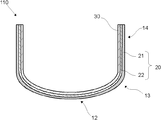
- FIG. 1 is a schematic sectional view of a first embodiment of a quartz glass crucible according to the present invention.
- FIG. 4 is a schematic enlarged sectional view of a second embodiment of the quartz glass crucible according to the present invention.
- FIG. 7 is a schematic enlarged sectional view of a third embodiment of the quartz glass crucible according to the present invention.
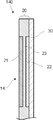
- FIG. 8 is a schematic enlarged sectional view of a fourth embodiment of the quartz glass crucible according to the present invention. It is a schematic expanded sectional view of the conventional quartz glass crucible. It is a schematic expanded sectional view of another conventional quartz glass crucible. It is a photograph of the devitrification spot which arises in quartz glass.
- a metal impurity such as Al or Ba has generally been added to a crystallization promoting layer for promoting devitrification. Further, as described in Patent Documents 1 and 2, it is general that the crystallization promoting layer defines the impurity concentration.
- the quartz raw material powder to which impurities are added is vitrified and the quartz glass is heated, a phenomenon called "devitrification" occurs in a spot-like manner.
- FIG. 7 shows a photograph of the devitrification spot.
- the reason why the number of devitrification spots differs depending on the base material powder even when the crystallization promoting impurity concentration is the same is considered to be due to other factors other than the crystallization promoting impurity elements such as Al and Ba.
- the detailed reason is unknown.
- the number of devitrification spots at the time of heating after being made into quartz glass a structure necessary to obtain the effect of securing strength and suppressing excessive progress of devitrification in the quartz glass crucible is adopted. It can be specified directly.
- the number of devitrification spots can be easily confirmed experimentally by performing a heat treatment on the sample at 1600 ° C. for 24 hours.
- the present inventor has found that, in the outer layer of the quartz glass crucible, a devitrification easy layer for preventing deformation and buckling of the crucible (a crystallization promoting layer) and a devitrification easy layer (a crystallization promoting layer) are provided.
- a devitrification easy layer for preventing deformation and buckling of the crucible a crystallization promoting layer
- a devitrification easy layer a crystallization promoting layer
- FIG. 1 shows a schematic sectional view of an example (first embodiment) of the quartz glass crucible according to the present invention.
- the quartz glass crucible 110 of the present invention includes a bottom portion 12, a curved portion 13, and a straight body portion.
- the straight body portion 14 refers to a substantially cylindrical portion of the crucible shape.
- the area between the straight body part 14 and the bottom part 12 is called a curved part 13.
- Crucible bottom 12 can be defined, for example, as a portion having a diameter of about two-thirds or less of the outer diameter of the crucible.
- the height of the straight body portion 14 can be defined, for example, as the upper third of the crucible height, but varies depending on the shape of the crucible.
- the quartz glass crucible 110 has an outer layer 20 made of opaque quartz glass containing bubbles and an inner layer 30 made of transparent quartz glass.
- the inner layer 30 is a portion that looks transparent because it does not substantially contain air bubbles.
- the outer layer 20 is composed of a plurality of layers at least in a part of the straight body portion 14.
- FIG. 1 shows an example in which the entire outer layer 20 (all of the bottom portion 12, the curved portion 13, and the straight body portion 14) is composed of two layers, and the outer layer 20 has a devitrification easy layer 21 and a low devitrification layer 22, which will be described later. ing.
- Quartz glass crucible 110 of the present invention further, among the plurality of layers constituting the outer layer 20, at least one layer, the quartz glass crucible 110 devitrification number spots when heated for 24 hours at 1600 ° C. is 50 / cm 3
- the devitrification easy layer 21 having a number of 70 or more / cm 3 or less, of the plurality of layers, a layer located inside the devitrification easy layer 21 in the thickness direction of the quartz glass crucible 110 is the quartz glass crucible 110.
- a low devitrification layer 22 having a number of devitrification spots of 2 / cm 3 or less when heated at 1600 ° C. for 24 hours.
- the number of devitrification spots can be measured by preparing a sample from a quartz glass crucible after the heat treatment and observing the sample under an optical microscope.
- the devitrification easy layer 21 has at least a part of the straight body portion 14 of the quartz glass crucible 110, preferably the height of the straight body portion. When it is set to 100%, it is preferable that at least 50% or more thereof be present. However, the devitrification easy layer 21 may be present at the entire height of the straight body portion 14, and as shown in FIG. 1, is present at all of the straight body portion 14, the curved portion 13, and the bottom portion 12. You may. It is preferable that the devitrification easy layer 21 has its upper end located at a position higher than the melt surface of the straight body portion 14 when the silicon melt is held in the quartz glass crucible 110. Further, it is preferable that the lower end of the devitrification easy layer 21 is set to the curved portion 13 beyond the straight body portion 14. By setting such a position, the strength of the quartz glass crucible 110 during heating can be more effectively maintained.
- the low devitrification layer 22 is a layer located inside the devitrification easy layer 21 in the thickness direction of the quartz glass crucible 110 as described above.
- the low devitrification layer 22 is a layer having a devitrification spot number of 2 / cm 3 or less when the quartz glass crucible 110 is heated at 1600 ° C. for 24 hours.
- the low devitrification layer 22 is preferably located adjacent to the inside of the devitrification easy layer 21 in the thickness direction of the quartz glass crucible 110 as shown in FIG.
- Other layers for example, a medium-devitrification layer described later, may exist between the permeable layer 22 and the devitrification easy layer 21. In either case, the effect of suppressing the progress of devitrification inward can be obtained.
- the outer layer 20 of the quartz glass crucible of the present invention may have a layer other than the devitrification easy layer 21 and the low devitrification layer 22.
- the outer layer composed of a plurality of layers preferably has a middle devitrification layer as a layer other than the easily devitrified layer and the low devitrification layer.
- the medium devitrification layer is a layer in which the number of devitrification spots when the quartz glass crucible is heated at 1600 ° C. for 24 hours is more than 2 / cm 3 and not more than 10 / cm 3 .
- the quartz glass crucible 120 has a devitrification easy layer 21 and a low devitrification layer 22 in a part of the straight body portion 14 of the outer layer 20.
- the low devitrification layer 22 is adjacent to the easily devitrified layer 21 and exists at a position from the easily devitrified layer 21 to the inner layer 30. Further, in the portion of the outer layer 20 in which the devitrification easy layer 21 and the low devitrification layer 22 do not exist, the middle devitrification layer 23 exists.
- the quartz glass crucible 120 having such a configuration, when the quartz glass crucible 120 is heated, for example, when pulling a silicon single crystal, the devitrification easy layer 21 is devitrified, and the crucible strength can be increased. At the same time, the presence of the low devitrification layer 22 can suppress the propagation of devitrification generated in the devitrification easy layer 21 and prevent the quartz glass crucible 120 from being cracked or damaged. Can be.
- the quartz glass crucible 130 has an easily devitrified layer 21 and a low-devitrification layer 22 in a part of the straight body portion 14 of the outer layer 20. Further, a middle devitrification layer 23 is present adjacent to the low devitrification layer 22 also in a portion of the straight body portion 14 where the devitrification easy layer 21 and the low devitrification layer 22 are present. In the quartz glass crucible 130, the middle devitrification layer 23 also exists in a portion where the devitrification easy layer 21 and the low devitrification layer 22 do not exist.
- the quartz glass crucible 130 having such a configuration increases the crucible strength by promoting the devitrification of the crucible wall by the devitrification easy layer 21, while suppressing the progress and propagation of devitrification by the low devitrification layer 22. .
- the low devitrification layer 22 itself does not easily cause devitrification, the low devitrification layer 22 itself has low strength at the time of heating. Therefore, the presence of the middle devitrification layer 23 makes it possible to supplement the strength of the crucible and enhance the deformation resistance of the entire quartz glass crucible.
- the outer layer 20 of the quartz glass crucible of the present invention may have another layer in addition to the devitrification easy layer 21, the low devitrification layer 22, and the middle devitrification layer 23.
- the devitrification easy layer 21 and the low devitrification layer 22 may be each one layer in the thickness direction of the quartz glass crucible, but may be a plurality of layers.
- the middle devitrification layer 23 or another layer is present in the outer layer 20, only one layer may be provided or a plurality of layers may be provided.
- the quartz glass crucible 140 includes the devitrification easy layer 21 and the low devitrification layer in a part of the straight body portion 14 of the outer layer 20. It has a layer 22. However, in the fourth embodiment, a middle devitrification layer 23 is provided between the easily devitrified layer 21 and the low devitrification layer 22. Also in this case, the strength of the quartz glass crucible 140 can be increased by causing devitrification in the devitrification easy layer 21 by heating.
- the outermost layer of the plurality of outer layers 20 may be the devitrification easy layer 21.
- the outermost layer of the plurality of layers constituting the outer layer 20 the devitrification easy layer 21.
- the outermost layer is easily devitrified, the crucible strength is easily maintained, and the propagation of devitrification in the direction of the inner layer 30. Can be easily suppressed.
- the outer layer 20 is preferably made of natural quartz glass
- the inner layer 30 is preferably made of synthetic quartz glass.
- the inner layer 30 By forming the inner layer 30 of synthetic quartz glass, it is possible to reduce impurity contamination of contents (silicon melt) held in the quartz glass crucibles 110, 120, 130, and 140.
- the outer layer 20 is made of natural quartz glass, the devitrification density of the outer layer 20 can be easily adjusted appropriately, the strength can be maintained, and the cost can be reduced.
- the thickness of the devitrification easy layer 21 is preferably 5% or more of the thickness of the quartz glass crucibles 110, 120, 130, and 140.
- the thickness of the devitrification easy layer 21 is more preferably 30% or less of the thickness of the quartz glass crucibles 110, 120, 130, 140. If the devitrification easy layer has a thickness of 30% or less of the thickness of the quartz glass crucible, it is possible to suppress excessive devitrification.
- the thickness of the low devitrification layer 22 is preferably 20% or more and 70% or less of the thickness of the quartz glass crucibles 110, 120, 130, and 140. Thereby, propagation of the devitrification caused by the devitrification easy layer 21 can be more effectively suppressed, and the strength of the crucible can be sufficiently secured.
- the thickness of the low-devitrification layer 22 is more preferably 20% to 60% of the thickness of the quartz glass crucibles 110, 120, 130, 140.
- the thickness of the inner layer 30 is preferably 5% or more of the thickness of the quartz glass crucibles 110, 120, 130, 140.
- the thickness of the inner layer 30 is more preferably 10% or more of the thickness of the quartz glass crucibles 110, 120, 130, 140.
- the thickness of the medium devitrification layer 23 is preferably 10% or more of the thickness of the quartz glass crucible 130. Thereby, the strength of the quartz glass crucible 130 can be more effectively secured.
- each layer constituting the quartz glass crucible can be measured by, for example, cross-sectional observation. That is, the thickness of each layer may be measured from the cross-sectional direction by breaking the quartz glass crucible. In that case, the boundary of each layer can also be confirmed using a polarizing plate. In addition, if a bubble density distribution is given to each layer according to a difference in rotational speed of the mold when the quartz glass crucible is manufactured, the thickness of each layer can be easily measured. In addition, the thickness of each layer can be confirmed by performing profile analysis for each impurity layer by ICP measurement.
- the quartz glass crucibles 110 and 130 of the present invention shown in FIGS. 1 and 3 can be manufactured using the raw material powder for the plurality of layers constituting the outer layer 20 and the raw material powder for the inner layer 30.
- a raw material powder molded body is formed in a rotary mold so as to correspond to each layer of the quartz glass crucibles 110 and 130 to be manufactured, and this is heated from the inside by arc discharge or the like.
- the quartz glass crucibles 110 and 130 can be manufactured.
- a portion corresponding to the outer layer 20 is molded in a rotary mold as a raw material powder molded body, and the inner layer 30 is heated and melted from the inside of the outer layer raw material powder molded body by arc discharge, and simultaneously in the high-temperature atmosphere.
- the inner layer 30 may be formed on the inner surface of the outer layer 20 by supplying a raw material powder such as a synthetic quartz glass powder.
- the raw material powder of the devitrification easy layer 21 is prepared by preparing a raw material powder (raw material powder before performing a doping process) and doping a crystallization accelerator (Al, Ba, or the like) into the raw material powder. can do.
- a crystallization accelerator Al, Ba, or the like
- the devitrification easy layer 21 is defined by the number of devitrification spots under predetermined conditions (heating at 1600 ° C. for 24 hours). This is different from the case where the degree of devitrification is conventionally defined by the impurity concentration of an impurity element such as Al or Ba.
- the concentration of the crystallization accelerator in the raw material powder of the easily devitrified layer 21 is preferably set according to the number of devitrified spots when the easily devitrified layer 21 is formed. That is, after forming the devitrification easy layer 21 of the quartz glass crucibles 110 and 130 from the raw material powder, the number of devitrification spots when heated at 1600 ° C. for 24 hours becomes 50 / cm 3 or more and 70 / cm 3 or less.
- the impurity concentration is adjusted by, for example, doping the raw material powder of the devitrification easy layer 21 with a crystallization accelerator, and the sample prepared using this raw material is subjected to the above-described heat treatment to obtain the desired devitrification. It is sufficient to investigate whether or not the number of spots will be obtained, and to select raw material powder to be used based on the result. A raw material powder capable of obtaining the above devitrification spot number without adjusting the impurity concentration can also be used.
- the raw material powder of the low-devitrification layer 22 has a devitrification spot number of 2 / cm 3 or less when heated at 1600 ° C. for 24 hours after forming the low-devitrification layer 22 of the quartz glass crucibles 110 and 130 from the raw material powder.
- the raw material powder is selected and used.
- the raw material powder of the middle devitrification layer 23 is formed at 1600 ° C. after forming the middle devitrification layer 23 of the quartz glass crucible 130 from the raw material powder.
- the raw material powder is selected and used so that the number of devitrification spots when heated for 24 hours is more than 2 / cm 3 and 10 / cm 3 or less.
- the inner layer 30 of the quartz glass crucibles 110 and 130 it is preferable to use synthetic quartz powder.
- the inner layer 30 can be a synthetic quartz glass layer.
- Each of the above-mentioned raw material powders is placed in a rotary mold so as to correspond to each layer constituting the outer layer 20 of the quartz glass crucibles 110 and 130 to be manufactured, and is heated.
- a quartz glass piece to be a sample is prepared from each raw material powder and a heating experiment (1600) C. for 24 hours), but it is preferable to actually prepare a quartz glass crucible, heat it at 1600 ° C. for 24 hours, take out samples from each layer, and measure. This is because the number of devitrified spots can be defined according to the conditions when the quartz glass crucible was actually manufactured.
- the number of devitrification spots of each layer measured by producing a quartz glass crucible can be considered to be the same for each layer formed from the raw material powder of the same lot.
- a quartz glass crucible 130 as shown in FIG. 3 was produced as follows.
- a raw material powder (raw material powder A) for forming the easily devitrified layer 21 a raw material powder made of Al-doped natural quartz powder having a particle size of 50 to 500 ⁇ m was prepared.
- the raw material powder (base raw material powder) before doping with Al was a raw material powder having 13 devitrification spots / cm 3 when heated at 1600 ° C. for 24 hours after being made of quartz glass.
- By doping Al into the base material powder so that devitrification number spots when the Al-doped raw material powder was heated for 24 hours at 1600 ° C.
- the quartz glass is 50 / cm 3 or more 70 / cm 3
- the dope amount was adjusted.
- a raw material powder (raw material powder B) made of natural quartz powder having a particle diameter of 50 to 500 ⁇ m and having a devitrification spot number of 1 / cm 3 was prepared.
- a raw material powder (raw material powder C) made of natural quartz powder and having a particle diameter of 50 to 500 ⁇ m with a devitrification spot number of 8 / cm 3 was prepared.
- the raw material powder A was supplied to the rotating inner cylindrical body having an inner diameter of 830 mm to form a powder layer A having a thickness of 10 mm (powder layer serving as the easily devitrified layer 21).
- the powder layer A was molded such that the devitrification-easy layer 21 of the quartz glass crucible 130 to be manufactured was located at a part of the straight body portion 14 as shown in FIG.
- the raw material powder B was supplied to the straight body in the mold, and a powder layer B (powder layer serving as the low devitrification layer 22) having a thickness of 10 mm was formed inside the powder layer A.
- the raw material powder C was supplied to the straight body portion, the curved portion, and the bottom portion in the mold, and the remaining powder layer C (the powder layer serving as the middle devitrification layer 23) required for molding was formed.
- the middle devitrification layer 23 of the quartz glass crucible 130 to be manufactured is located inside the low devitrification layer 22 and above and below the devitrification easy layer 21 and the low devitrification layer 22 as shown in FIG. Powder layer C was formed as described above.
- the molded body is heated and melted from the inside of the molded body by arc discharge, and at the same time, synthetic quartz glass powder is supplied into the high-temperature atmosphere at a rate of 100 to 200 g / min. Over a thickness of 1-3 mm. After the melting was completed, the upper end of the cooled quartz glass crucible having a diameter of 805 to 815 mm was cut so as to have a height of 500 mm, thereby producing a quartz glass crucible 130.
- the straight body of the quartz glass crucible 130 having the thickness of the devitrification easy layer 21 was measured.
- the ratio of 14 to the wall thickness was about 15%.
- the ratio of the thickness of the low-devitrification layer 22 to the thickness of the straight body portion 14 of the quartz glass crucible 130 was about 40%.
- the number of devitrification spots of the easily devitrified layer 21, the low-devitrification layer 22 and the middle devitrification layer 23 was measured.
- the number of devitrification spots, devitrification easily layer 21 is 60 / cm 3
- low devitrified layer 22 is one / cm 3
- Chushitsu Toruso 23 was 8 / cm 3.
- a silicon single crystal was pulled up using the quartz glass crucible 130 manufactured in the same manner as above, and the operation result was evaluated.
- the deformation resistance and the devitrification state were evaluated.
- the evaluation criteria are as follows: Regarding the deformation resistance, if the deformation that affects the operation occurs, it is “poor”; if there is a slight deformation that does not affect the operation, it is “good”. The case where it was not possible was regarded as “particularly good”.
- the thickness of the devitrification layer after operation was 60% or more of the thickness of the quartz glass crucible 130, it was determined to be “defective”. . When this thickness was less than 60% of the thickness of the quartz glass crucible 130, it was determined to be “good”. When this thickness was less than 50% of the thickness of the quartz glass crucible 130, it was determined to be "particularly good.”
- Example 1 no problem was found in the operation result, and the result was good.
- Table 2 shows the number of layers (sub-layers) constituting the outer layer, the type of layer defined based on the number of devitrified spots of the plurality of layers constituting the outer layer, the number of devitrified spots, and the type of the inner layer in Example 1. Indicated. Table 2 also shows the ratio of the thickness of the easily devitrified layer 21 and the low devitrification layer 22 to the thickness of the crucible in the quartz glass crucible before operation (hereinafter, also simply referred to as “layer thickness ratio”). Indicated. Table 2 shows the evaluation of the deformation resistance and the devitrification state as the evaluation of the operation results.
- Example 2 A quartz glass crucible was manufactured in the same manner as in Example 1, except that, in the outer layer, the middle devitrification layer was disposed on the outermost layer, and the easily devitrified layer and the low devitrification layer were disposed on the inner side.
- Table 2 shows the number of devitrification spots and the layer thickness ratio of the easily devitrified layer and the low devitrification layer in each layer. The operation results were evaluated in the same manner as in Example 1, and the results were as shown in Table 2.
- Example 3 A quartz glass crucible was manufactured in the same manner as in Example 1, but the layer thickness ratio of the low-devitrification layer 22 in the outer layer was set to 22%. Table 2 shows the number of devitrification spots in each layer and the layer thickness ratio of the devitrification easy layer. The operation results were evaluated in the same manner as in Example 1, and the results were as shown in Table 2.
- Example 4 A quartz glass crucible was manufactured in the same manner as in Example 1, except that the thickness ratio of the low-devitrification layer 22 in the outer layer was set to 18%. Table 2 shows the number of devitrification spots in each layer and the layer thickness ratio of the devitrification easy layer. The operation results were evaluated in the same manner as in Example 1, and the results were as shown in Table 2. The devitrification state was "good", and although the devitrification progressed from Example 1, no problem occurred in the operation.
- Example 5 A quartz glass crucible was manufactured in the same manner as in Example 1, but the thickness ratio of the devitrification easy layer 21 in the outer layer was set to 5%. Table 2 shows the number of devitrification spots and the ratio of the thickness of the low devitrification layer in each layer. The operation results were evaluated in the same manner as in Example 1, and the results were as shown in Table 2. Devitrification progressed less than in Example 1, but no problematic deformation occurred in the operation.
- Example 6 A quartz glass crucible was manufactured in the same manner as in Example 1, but the layer thickness ratio of the easily devitrified layer 21 in the outer layer was 35%. Table 2 shows the number of devitrification spots and the ratio of the thickness of the low devitrification layer in each layer. The operation results were evaluated in the same manner as in Example 1, and the results were as shown in Table 2. Although devitrification progressed from Example 1, there was no problem in operation.
- Example 7 A quartz glass crucible was manufactured in the same manner as in Example 1. However, as a raw material powder for forming a layer corresponding to the middle devitrification layer 23 in Example 1, a raw material in which devitrification is more likely to progress by heating after being made of quartz glass Powder was used. The number of devitrification spots in each layer and the layer thickness ratio of the easily devitrified layer / low devitrification layer are as shown in Table 2. In the layer corresponding to the middle devitrification layer 23 in Example 1, the number of devitrification spots was There were twelve. This is higher than the range of the “medium devitrification layer” in the present invention, and the devitrification proceeds more easily than in Example 1 due to heating in pulling a silicon single crystal. The operation results of the manufactured quartz glass crucible were evaluated in the same manner as in Example 1, and the results are as shown in Table 2. The devitrification state was “good”, and devitrification proceeded more than in Example 1. However, there was no problem in the operation.
- Example 8 A quartz glass crucible was manufactured in the same manner as in Example 1, except that the thickness ratio of the low-devitrification layer 22 in the outer layer was 10%. Table 2 shows the number of devitrification spots in each layer and the layer thickness ratio of the devitrification easy layer. The operation results were evaluated in the same manner as in Example 1, and the results were as shown in Table 2. The devitrification state was “good”, and devitrification proceeded more than in Example 1. It is considered that the low devitrification layer 22 is thin. However, there was no problem in the operation.
- Example 9 A quartz glass crucible was manufactured in the same manner as in Example 1. However, as a raw material powder for forming a layer corresponding to the middle devitrification layer 23 in Example 1, a raw material in which devitrification is more likely to progress by heating after being made of quartz glass Powder was used. The number of devitrification spots in each layer and the layer thickness ratio of the easily devitrified layer / low devitrification layer are as shown in Table 2. In the layer corresponding to the middle devitrification layer 23 in Example 1, the number of devitrification spots was There were fifteen. This is higher than the range of the “medium devitrification layer” in the present invention, and the devitrification proceeds more easily than in Example 1 due to heating in pulling a silicon single crystal. The operation results of the manufactured quartz glass crucible were evaluated in the same manner as in Example 1, and the results are as shown in Table 2. The devitrification state was "good", and although the devitrification progressed from Example 1, no problem occurred in the operation.
- Example 10 The quartz glass crucible 120 shown in FIG. 2 was produced.
- the raw material powder (raw material powder A) for forming the easily devitrified layer 21 used in Example 1
- the method of producing the raw material powder molded body is as follows. First, the raw material powder A was supplied to a rotating inner cylindrical body having an inner diameter of 830 mm, and a powder layer A having a thickness of 10 mm (a powder layer to be the devitrification easy layer 21) was formed. At this time, the powder layer A was molded such that the devitrification-easy layer 21 of the quartz glass crucible 120 to be manufactured was located at a part of the straight body portion 14 as shown in FIG. Next, the raw material powder B was supplied to the straight body in the mold, and a powder layer B having a thickness of 18 mm (a powder layer serving as the low devitrification layer 22) was formed inside the powder layer A.
- the raw material powder C is supplied to a region in which the powder layers A and B have not been formed among the straight body portion, the curved portion, and the bottom portion in the mold, and the remaining powder layer C required for molding (medium devitrification) (A powder layer to be the layer 23) was molded.
- the powder layer C was molded such that the middle devitrification layer 23 of the quartz glass crucible 120 to be manufactured was located above and below the devitrification easy layer 21 and the low devitrification layer 22, as shown in FIG. .
- the molded body is heated and melted from the inside of the molded body by arc discharge, and at the same time, synthetic quartz glass powder is supplied into the high-temperature atmosphere at a rate of 100 to 200 g / min. Over a thickness of 1-3 mm. After the melting was completed, the upper end of the cooled quartz glass crucible having a diameter of 805 to 815 mm was cut so as to have a height of 500 mm, thereby producing a quartz glass crucible 120.
- the quartz glass crucible 120 When the quartz glass crucible 120 was broken and the thicknesses of the devitrification easy layer 21 and the low devitrification layer 22 were measured from the cross-sectional direction, the ratio of the quartz glass crucible 120 to the thickness of the straight body portion 14 was devitrified.
- the easy layer was about 15%, and the low devitrification layer was about 70%.
- the number of devitrification spots of the easily devitrified layer 21, the low-devitrification layer 22, and the middle devitrification layer 23 was measured.
- the number of devitrification spots, devitrification easily layer 21 is 60 / cm 3
- low devitrified layer 22 was 1 / cm 3.
- the number of devitrification spots was 7 / cm 3 in the middle devitrification layer 23 located above and below the devitrification easy layer 21 and the low devitrification layer 22.
- Example 11 In the outer layer, a quartz glass crucible having a structure in which a devitrification easy layer was sandwiched by a low devitrification layer was produced.
- the raw material powder (raw material powder A) for forming the easily devitrified layer 21 used in Example 1, the raw material powder (raw material powder B) for forming the low devitrified layer 22, and the formation of the inner layer 30 are used.
- Raw material powder was used.
- the method of producing the raw material powder molded body is as follows. First, the raw material powder B was supplied to the straight body in the mold, and the powder layer B (the powder layer to be a low devitrification layer) was formed. Next, the raw material powder A was formed into a powder layer A (powder layer serving as an easily devitrified layer) on a straight body in the mold. Further, the raw material powder B was supplied to a straight body in the mold, and a second powder layer B (a powder layer to be a low devitrification layer) was formed.
- the raw material powder C is supplied to a region in which the powder layers A and B have not been formed among the straight body portion, the curved portion, and the bottom portion in the mold, and the remaining powder layer C (middle devitrification) required for molding is supplied. (A powder layer to be a layer) was molded.
- the molded body is heated and melted from the inside of the molded body by arc discharge, and at the same time, synthetic quartz glass powder is supplied into the high-temperature atmosphere at a rate of 100 to 200 g / min. Over a thickness of 1-3 mm. After the melting was completed, the upper end of the cooled quartz glass crucible having a diameter of 805 to 815 mm was cut so as to have a height of 500 mm, thereby producing a quartz glass crucible.
- the quartz glass crucible was manufactured by changing the order of each layer in the outer layer 20 from the quartz glass crucible 130 of Example 1. That is, a quartz glass crucible was manufactured as a configuration of a middle devitrification layer, a low devitrification layer, and a devitrification easy layer from the outer layer. In this case, since the devitrification easy layer was in contact with the inner layer, devitrification also progressed too much in the inner layer, and all the evaluations of the operation results were “poor”.
- Example 2 A quartz glass crucible was manufactured basically in the same manner as in Example 1. However, in the outer layer, the Al doping concentration was reduced in the raw material powder of the layer corresponding to the devitrification easy layer 21 in FIG. / Cm 3 . Table 2 shows the number of devitrification spots and the layer thickness ratio of the easily devitrified layer and the low devitrification layer in each layer. The operation results were evaluated in the same manner as in Example 1, and the results were as shown in Table 2. Deformation resistance was "poor", which affected the operation results. It is considered that the devitrification in the outer layer was insufficient.
- Example 3 A quartz glass crucible was manufactured basically in the same manner as in Example 1. However, in the outer layer, the Al powder concentration was increased in the raw material powder of the layer corresponding to the devitrification easy layer 21 in FIG. / Cm 3 .
- Table 2 shows the number of devitrification spots and the layer thickness ratio of the easily devitrified layer and the low devitrification layer in each layer. The operation results were evaluated in the same manner as in Example 1, and the results were as shown in Table 2. The devitrification state was "poor" because the layer corresponding to the devitrification easy layer caused excessive devitrification.
- Comparative Example 4 A quartz glass crucible was manufactured in the same manner as in Comparative Example 2; however, in the outer layer, a middle devitrification layer was used as a raw material powder for a layer (the second layer from the outermost layer) corresponding to the low devitrification layer 22 in FIG. Such raw material powder (provided that the number of devitrification spots is smaller than that of the third layer from the outermost layer) was used. Table 2 shows the number of devitrification spots and the layer thickness ratio of the easily devitrified layer and the low devitrification layer in each layer. The operation results were evaluated in the same manner as in Example 1, and the results were as shown in Table 2. Deformation resistance was "poor", which affected the operation results. It is considered that the devitrification in the outer layer was insufficient. The devitrification state was “good”, and devitrification proceeded more than in Example 1.
- Comparative Example 5 A quartz glass crucible was manufactured in the same manner as in Comparative Example 3, but in the outer layer, a middle devitrification layer was used as a raw material powder of a layer (the second layer from the outermost layer) corresponding to the low devitrification layer 22 in FIG. Such raw material powder (provided that the number of devitrification spots is smaller than that of the third layer from the outermost layer) was used. Table 2 shows the number of devitrification spots in each layer and the layer thickness ratio of the devitrification easy layer. The operation results were evaluated in the same manner as in Example 1, and the results were as shown in Table 2. The devitrification state was "poor" because the layer corresponding to the devitrification easy layer caused excessive devitrification.
- FIG. 5 A quartz glass crucible 200 having a configuration as shown in FIG. 5 was manufactured.
- the outer layer 220 is entirely composed of a middle devitrification layer 223, and an inner layer 230 is formed on the outer layer 220.
- the raw material powder the raw material powder for forming the middle devitrification layer 23 and the raw material powder for forming the inner layer 30 used in the quartz glass crucible 130 of Example 1 were used.
- the number of devitrification spots in the outer layer 220 was as shown in Table 2.
- the operation results were evaluated in the same manner as in Example 1, and the results were as shown in Table 2.
- Deformation resistance was "poor", which affected the operation results. It is considered that the devitrification in the outer layer was insufficient.
- FIG. 6 A quartz glass crucible 300 having a configuration as shown in FIG. 6 was manufactured.
- an outer layer 220 is composed of an easily devitrified layer 221 and a middle devitrified layer 223, and an inner layer 230 is formed on the outer layer 220. It does not have a low devitrification layer.
- the raw material powder the raw material powder for forming the devitrification easy layer 21 and the raw material powder for forming the middle devitrification layer 23 and the raw material powder for forming the inner layer 30 used in the quartz glass crucible 130 of Example 1 are used. Using.
- the number of devitrification spots in each layer constituting the outer layer was as shown in Table 2.
- the operation results were evaluated in the same manner as in Example 1, and the results were as shown in Table 2.
- the devitrification state was "poor", which affected the operation results. This is because devitrification has progressed too much in the outer layer.
- the present invention is not limited to the above embodiment.
- the above embodiment is merely an example, and any embodiment having substantially the same configuration as the technical idea described in the claims of the present invention and exerting the same function and effect will be described. It is included in the technical scope of the invention.
Landscapes
- Chemical & Material Sciences (AREA)
- Engineering & Computer Science (AREA)
- Materials Engineering (AREA)
- Organic Chemistry (AREA)
- Crystallography & Structural Chemistry (AREA)
- Metallurgy (AREA)
- Manufacturing & Machinery (AREA)
- Crystals, And After-Treatments Of Crystals (AREA)
- Glass Melting And Manufacturing (AREA)
- Glass Compositions (AREA)
Priority Applications (5)
| Application Number | Priority Date | Filing Date | Title |
|---|---|---|---|
| CN201980050978.XA CN112533878A (zh) | 2018-08-09 | 2019-06-04 | 石英玻璃坩埚 |
| KR1020217003924A KR102788131B1 (ko) | 2018-08-09 | 2019-06-04 | 석영유리 도가니 |
| SG11202101068VA SG11202101068VA (en) | 2018-08-09 | 2019-06-04 | Quartz glass crucible |
| EP19847282.1A EP3835270B1 (en) | 2018-08-09 | 2019-06-04 | Quartz glass crucible |
| US17/267,283 US11821103B2 (en) | 2018-08-09 | 2019-06-04 | Quartz glass crucible |
Applications Claiming Priority (2)
| Application Number | Priority Date | Filing Date | Title |
|---|---|---|---|
| JP2018-150790 | 2018-08-09 | ||
| JP2018150790A JP7349779B2 (ja) | 2018-08-09 | 2018-08-09 | 石英ガラスるつぼ |
Publications (1)
| Publication Number | Publication Date |
|---|---|
| WO2020031481A1 true WO2020031481A1 (ja) | 2020-02-13 |
Family
ID=69415494
Family Applications (1)
| Application Number | Title | Priority Date | Filing Date |
|---|---|---|---|
| PCT/JP2019/022168 Ceased WO2020031481A1 (ja) | 2018-08-09 | 2019-06-04 | 石英ガラスるつぼ |
Country Status (8)
| Country | Link |
|---|---|
| US (1) | US11821103B2 (https=) |
| EP (1) | EP3835270B1 (https=) |
| JP (1) | JP7349779B2 (https=) |
| KR (1) | KR102788131B1 (https=) |
| CN (1) | CN112533878A (https=) |
| SG (1) | SG11202101068VA (https=) |
| TW (1) | TWI795571B (https=) |
| WO (1) | WO2020031481A1 (https=) |
Citations (8)
| Publication number | Priority date | Publication date | Assignee | Title |
|---|---|---|---|---|
| JPH10203893A (ja) * | 1997-01-20 | 1998-08-04 | Mitsubishi Materials Shilicon Corp | 高強度石英ガラスルツボ及びその製造方法 |
| JP2000247778A (ja) | 1999-02-25 | 2000-09-12 | Toshiba Ceramics Co Ltd | 石英ガラスルツボおよびその製造方法ならびにこれを用いたシリコン単結晶の引上げ方法 |
| JP2005523229A (ja) * | 2002-04-22 | 2005-08-04 | ヘラオイス.クヴァールツグラース.ゲゼルシャフト.ミット.ベシュレンクテル.ハフツング.ウント.コンパニー.コマンディットゲゼルシャフト | 石英ガラスるつぼおよび該るつぼを製造する方法 |
| JP2008081374A (ja) | 2006-09-28 | 2008-04-10 | Covalent Materials Corp | シリカガラスルツボ |
| JP2009084085A (ja) * | 2007-09-28 | 2009-04-23 | Covalent Materials Corp | シリカガラスルツボ |
| JP2015155375A (ja) | 2010-08-12 | 2015-08-27 | 株式会社Sumco | シリカ粉の評価方法、シリカガラスルツボ、シリカガラスルツボの製造方法 |
| JP2018104248A (ja) * | 2016-12-28 | 2018-07-05 | クアーズテック株式会社 | シリコン単結晶引上げ用石英ガラスルツボ |
| JP2019059652A (ja) * | 2017-09-27 | 2019-04-18 | クアーズテック株式会社 | シリコン単結晶引上げ用石英ガラスルツボ |
Family Cites Families (6)
| Publication number | Priority date | Publication date | Assignee | Title |
|---|---|---|---|---|
| JPH10182139A (ja) * | 1996-12-18 | 1998-07-07 | Mitsubishi Chem Corp | 合成石英ガラス粉末の品質評価方法 |
| JP4140868B2 (ja) * | 1998-08-31 | 2008-08-27 | 信越石英株式会社 | シリコン単結晶引き上げ用石英ガラスるつぼ及び その製造方法 |
| JP5069663B2 (ja) * | 2008-10-31 | 2012-11-07 | ジャパンスーパークォーツ株式会社 | 多層構造を有する石英ガラスルツボ |
| JP5774400B2 (ja) | 2010-08-12 | 2015-09-09 | 株式会社Sumco | シリカ粉の評価方法、シリカガラスルツボ、シリカガラスルツボの製造方法 |
| JP2017186135A (ja) * | 2016-04-07 | 2017-10-12 | 理想科学工業株式会社 | 印刷システム |
| JP2018104247A (ja) | 2016-12-28 | 2018-07-05 | クアーズテック株式会社 | シリカ焼結体とその製造方法 |
-
2018
- 2018-08-09 JP JP2018150790A patent/JP7349779B2/ja active Active
-
2019
- 2019-06-04 SG SG11202101068VA patent/SG11202101068VA/en unknown
- 2019-06-04 KR KR1020217003924A patent/KR102788131B1/ko active Active
- 2019-06-04 CN CN201980050978.XA patent/CN112533878A/zh active Pending
- 2019-06-04 US US17/267,283 patent/US11821103B2/en active Active
- 2019-06-04 WO PCT/JP2019/022168 patent/WO2020031481A1/ja not_active Ceased
- 2019-06-04 EP EP19847282.1A patent/EP3835270B1/en active Active
- 2019-06-11 TW TW108120019A patent/TWI795571B/zh active
Patent Citations (8)
| Publication number | Priority date | Publication date | Assignee | Title |
|---|---|---|---|---|
| JPH10203893A (ja) * | 1997-01-20 | 1998-08-04 | Mitsubishi Materials Shilicon Corp | 高強度石英ガラスルツボ及びその製造方法 |
| JP2000247778A (ja) | 1999-02-25 | 2000-09-12 | Toshiba Ceramics Co Ltd | 石英ガラスルツボおよびその製造方法ならびにこれを用いたシリコン単結晶の引上げ方法 |
| JP2005523229A (ja) * | 2002-04-22 | 2005-08-04 | ヘラオイス.クヴァールツグラース.ゲゼルシャフト.ミット.ベシュレンクテル.ハフツング.ウント.コンパニー.コマンディットゲゼルシャフト | 石英ガラスるつぼおよび該るつぼを製造する方法 |
| JP2008081374A (ja) | 2006-09-28 | 2008-04-10 | Covalent Materials Corp | シリカガラスルツボ |
| JP2009084085A (ja) * | 2007-09-28 | 2009-04-23 | Covalent Materials Corp | シリカガラスルツボ |
| JP2015155375A (ja) | 2010-08-12 | 2015-08-27 | 株式会社Sumco | シリカ粉の評価方法、シリカガラスルツボ、シリカガラスルツボの製造方法 |
| JP2018104248A (ja) * | 2016-12-28 | 2018-07-05 | クアーズテック株式会社 | シリコン単結晶引上げ用石英ガラスルツボ |
| JP2019059652A (ja) * | 2017-09-27 | 2019-04-18 | クアーズテック株式会社 | シリコン単結晶引上げ用石英ガラスルツボ |
Also Published As
| Publication number | Publication date |
|---|---|
| KR20210040976A (ko) | 2021-04-14 |
| KR102788131B1 (ko) | 2025-03-31 |
| JP7349779B2 (ja) | 2023-09-25 |
| EP3835270B1 (en) | 2025-11-26 |
| SG11202101068VA (en) | 2021-03-30 |
| US11821103B2 (en) | 2023-11-21 |
| EP3835270A1 (en) | 2021-06-16 |
| TWI795571B (zh) | 2023-03-11 |
| EP3835270A4 (en) | 2022-05-04 |
| JP2020026362A (ja) | 2020-02-20 |
| US20210310151A1 (en) | 2021-10-07 |
| TW202018134A (zh) | 2020-05-16 |
| CN112533878A (zh) | 2021-03-19 |
Similar Documents
| Publication | Publication Date | Title |
|---|---|---|
| JP5072933B2 (ja) | シリコン単結晶引き上げ用石英ガラスルツボ及びその製造方法並びにシリコン単結晶の製造方法 | |
| KR101165703B1 (ko) | 실리콘 단결정 인상용 석영 유리 도가니 및 그 제조 방법 | |
| CN101965418B (zh) | 单晶硅拉晶用石英坩埚及其制造方法 | |
| KR101081994B1 (ko) | 다층 구조를 갖는 석영 유리 도가니 | |
| US8951346B2 (en) | Silica glass crucible for pulling up silicon single crystal and method for manufacturing thereof | |
| KR101234109B1 (ko) | 실리콘 단결정 인상용 석영 유리 도가니 및 그의 제조 방법 | |
| JP5036735B2 (ja) | シリコン単結晶引き上げ用石英ガラスルツボ及びその製造方法 | |
| JP7349779B2 (ja) | 石英ガラスるつぼ | |
| CN111936678B (zh) | 石英玻璃坩埚及其制造方法 | |
| KR20250006036A (ko) | 단결정 실리콘 잉곳 인상용 석영 유리 도가니 | |
| KR20250065647A (ko) | 실리콘 단결정 인상용 석영 유리 도가니 및 이를 이용한 실리콘 단결정의 제조 방법 |
Legal Events
| Date | Code | Title | Description |
|---|---|---|---|
| 121 | Ep: the epo has been informed by wipo that ep was designated in this application |
Ref document number: 19847282 Country of ref document: EP Kind code of ref document: A1 |
|
| ENP | Entry into the national phase |
Ref document number: 20217003924 Country of ref document: KR Kind code of ref document: A |
|
| NENP | Non-entry into the national phase |
Ref country code: DE |
|
| ENP | Entry into the national phase |
Ref document number: 2019847282 Country of ref document: EP Effective date: 20210309 |
|
| WWG | Wipo information: grant in national office |
Ref document number: 2019847282 Country of ref document: EP |