WO2020004630A1 - 難溶性の塩基性薬剤を含有する医薬組成物 - Google Patents
難溶性の塩基性薬剤を含有する医薬組成物 Download PDFInfo
- Publication number
- WO2020004630A1 WO2020004630A1 PCT/JP2019/025856 JP2019025856W WO2020004630A1 WO 2020004630 A1 WO2020004630 A1 WO 2020004630A1 JP 2019025856 W JP2019025856 W JP 2019025856W WO 2020004630 A1 WO2020004630 A1 WO 2020004630A1
- Authority
- WO
- WIPO (PCT)
- Prior art keywords
- sodium
- magnesium
- dissolution
- basic substance
- hydrochloride
- Prior art date
- Legal status (The legal status is an assumption and is not a legal conclusion. Google has not performed a legal analysis and makes no representation as to the accuracy of the status listed.)
- Ceased
Links
Images


Classifications
-
- A—HUMAN NECESSITIES
- A61—MEDICAL OR VETERINARY SCIENCE; HYGIENE
- A61K—PREPARATIONS FOR MEDICAL, DENTAL OR TOILETRY PURPOSES
- A61K31/00—Medicinal preparations containing organic active ingredients
- A61K31/33—Heterocyclic compounds
- A61K31/395—Heterocyclic compounds having nitrogen as a ring hetero atom, e.g. guanethidine or rifamycins
- A61K31/535—Heterocyclic compounds having nitrogen as a ring hetero atom, e.g. guanethidine or rifamycins having six-membered rings with at least one nitrogen and one oxygen as the ring hetero atoms, e.g. 1,2-oxazines
- A61K31/5375—1,4-Oxazines, e.g. morpholine
- A61K31/5377—1,4-Oxazines, e.g. morpholine not condensed and containing further heterocyclic rings, e.g. timolol
-
- A—HUMAN NECESSITIES
- A61—MEDICAL OR VETERINARY SCIENCE; HYGIENE
- A61K—PREPARATIONS FOR MEDICAL, DENTAL OR TOILETRY PURPOSES
- A61K47/00—Medicinal preparations characterised by the non-active ingredients used, e.g. carriers or inert additives; Targeting or modifying agents chemically bound to the active ingredient
- A61K47/02—Inorganic compounds
-
- A—HUMAN NECESSITIES
- A61—MEDICAL OR VETERINARY SCIENCE; HYGIENE
- A61K—PREPARATIONS FOR MEDICAL, DENTAL OR TOILETRY PURPOSES
- A61K47/00—Medicinal preparations characterised by the non-active ingredients used, e.g. carriers or inert additives; Targeting or modifying agents chemically bound to the active ingredient
- A61K47/06—Organic compounds, e.g. natural or synthetic hydrocarbons, polyolefins, mineral oil, petrolatum or ozokerite
- A61K47/16—Organic compounds, e.g. natural or synthetic hydrocarbons, polyolefins, mineral oil, petrolatum or ozokerite containing nitrogen, e.g. nitro-, nitroso-, azo-compounds, nitriles, cyanates
- A61K47/18—Amines; Amides; Ureas; Quaternary ammonium compounds; Amino acids; Oligopeptides having up to five amino acids
-
- A—HUMAN NECESSITIES
- A61—MEDICAL OR VETERINARY SCIENCE; HYGIENE
- A61K—PREPARATIONS FOR MEDICAL, DENTAL OR TOILETRY PURPOSES
- A61K47/00—Medicinal preparations characterised by the non-active ingredients used, e.g. carriers or inert additives; Targeting or modifying agents chemically bound to the active ingredient
- A61K47/06—Organic compounds, e.g. natural or synthetic hydrocarbons, polyolefins, mineral oil, petrolatum or ozokerite
- A61K47/20—Organic compounds, e.g. natural or synthetic hydrocarbons, polyolefins, mineral oil, petrolatum or ozokerite containing sulfur, e.g. dimethyl sulfoxide [DMSO], docusate, sodium lauryl sulfate or aminosulfonic acids
-
- A—HUMAN NECESSITIES
- A61—MEDICAL OR VETERINARY SCIENCE; HYGIENE
- A61K—PREPARATIONS FOR MEDICAL, DENTAL OR TOILETRY PURPOSES
- A61K47/00—Medicinal preparations characterised by the non-active ingredients used, e.g. carriers or inert additives; Targeting or modifying agents chemically bound to the active ingredient
- A61K47/30—Macromolecular organic or inorganic compounds, e.g. inorganic polyphosphates
- A61K47/32—Macromolecular compounds obtained by reactions only involving carbon-to-carbon unsaturated bonds, e.g. carbomers, poly(meth)acrylates, or polyvinyl pyrrolidone
-
- A—HUMAN NECESSITIES
- A61—MEDICAL OR VETERINARY SCIENCE; HYGIENE
- A61K—PREPARATIONS FOR MEDICAL, DENTAL OR TOILETRY PURPOSES
- A61K47/00—Medicinal preparations characterised by the non-active ingredients used, e.g. carriers or inert additives; Targeting or modifying agents chemically bound to the active ingredient
- A61K47/30—Macromolecular organic or inorganic compounds, e.g. inorganic polyphosphates
- A61K47/36—Polysaccharides; Derivatives thereof, e.g. gums, starch, alginate, dextrin, hyaluronic acid, chitosan, inulin, agar or pectin
- A61K47/38—Cellulose; Derivatives thereof
-
- A—HUMAN NECESSITIES
- A61—MEDICAL OR VETERINARY SCIENCE; HYGIENE
- A61K—PREPARATIONS FOR MEDICAL, DENTAL OR TOILETRY PURPOSES
- A61K9/00—Medicinal preparations characterised by special physical form
- A61K9/20—Pills, tablets, discs, rods
-
- A—HUMAN NECESSITIES
- A61—MEDICAL OR VETERINARY SCIENCE; HYGIENE
- A61K—PREPARATIONS FOR MEDICAL, DENTAL OR TOILETRY PURPOSES
- A61K9/00—Medicinal preparations characterised by special physical form
- A61K9/20—Pills, tablets, discs, rods
- A61K9/2004—Excipients; Inactive ingredients
- A61K9/2009—Inorganic compounds
-
- A—HUMAN NECESSITIES
- A61—MEDICAL OR VETERINARY SCIENCE; HYGIENE
- A61K—PREPARATIONS FOR MEDICAL, DENTAL OR TOILETRY PURPOSES
- A61K9/00—Medicinal preparations characterised by special physical form
- A61K9/20—Pills, tablets, discs, rods
- A61K9/2004—Excipients; Inactive ingredients
- A61K9/2013—Organic compounds, e.g. phospholipids, fats
- A61K9/2018—Sugars, or sugar alcohols, e.g. lactose, mannitol; Derivatives thereof, e.g. polysorbates
-
- A—HUMAN NECESSITIES
- A61—MEDICAL OR VETERINARY SCIENCE; HYGIENE
- A61K—PREPARATIONS FOR MEDICAL, DENTAL OR TOILETRY PURPOSES
- A61K9/00—Medicinal preparations characterised by special physical form
- A61K9/20—Pills, tablets, discs, rods
- A61K9/2004—Excipients; Inactive ingredients
- A61K9/2022—Organic macromolecular compounds
- A61K9/2027—Organic macromolecular compounds obtained by reactions only involving carbon-to-carbon unsaturated bonds, e.g. polyvinyl pyrrolidone, poly(meth)acrylates
-
- A—HUMAN NECESSITIES
- A61—MEDICAL OR VETERINARY SCIENCE; HYGIENE
- A61K—PREPARATIONS FOR MEDICAL, DENTAL OR TOILETRY PURPOSES
- A61K9/00—Medicinal preparations characterised by special physical form
- A61K9/20—Pills, tablets, discs, rods
- A61K9/2004—Excipients; Inactive ingredients
- A61K9/2022—Organic macromolecular compounds
- A61K9/205—Polysaccharides, e.g. alginate, gums; Cyclodextrin
- A61K9/2054—Cellulose; Cellulose derivatives, e.g. hydroxypropyl methylcellulose
-
- A—HUMAN NECESSITIES
- A61—MEDICAL OR VETERINARY SCIENCE; HYGIENE
- A61K—PREPARATIONS FOR MEDICAL, DENTAL OR TOILETRY PURPOSES
- A61K9/00—Medicinal preparations characterised by special physical form
- A61K9/20—Pills, tablets, discs, rods
- A61K9/2004—Excipients; Inactive ingredients
- A61K9/2022—Organic macromolecular compounds
- A61K9/205—Polysaccharides, e.g. alginate, gums; Cyclodextrin
- A61K9/2059—Starch, including chemically or physically modified derivatives; Amylose; Amylopectin; Dextrin
-
- A—HUMAN NECESSITIES
- A61—MEDICAL OR VETERINARY SCIENCE; HYGIENE
- A61P—SPECIFIC THERAPEUTIC ACTIVITY OF CHEMICAL COMPOUNDS OR MEDICINAL PREPARATIONS
- A61P25/00—Drugs for disorders of the nervous system
- A61P25/24—Antidepressants
-
- A—HUMAN NECESSITIES
- A61—MEDICAL OR VETERINARY SCIENCE; HYGIENE
- A61P—SPECIFIC THERAPEUTIC ACTIVITY OF CHEMICAL COMPOUNDS OR MEDICINAL PREPARATIONS
- A61P25/00—Drugs for disorders of the nervous system
- A61P25/28—Drugs for disorders of the nervous system for treating neurodegenerative disorders of the central nervous system, e.g. nootropic agents, cognition enhancers, drugs for treating Alzheimer's disease or other forms of dementia
-
- A—HUMAN NECESSITIES
- A61—MEDICAL OR VETERINARY SCIENCE; HYGIENE
- A61P—SPECIFIC THERAPEUTIC ACTIVITY OF CHEMICAL COMPOUNDS OR MEDICINAL PREPARATIONS
- A61P35/00—Antineoplastic agents
-
- A—HUMAN NECESSITIES
- A61—MEDICAL OR VETERINARY SCIENCE; HYGIENE
- A61P—SPECIFIC THERAPEUTIC ACTIVITY OF CHEMICAL COMPOUNDS OR MEDICINAL PREPARATIONS
- A61P35/00—Antineoplastic agents
- A61P35/04—Antineoplastic agents specific for metastasis
-
- A—HUMAN NECESSITIES
- A61—MEDICAL OR VETERINARY SCIENCE; HYGIENE
- A61P—SPECIFIC THERAPEUTIC ACTIVITY OF CHEMICAL COMPOUNDS OR MEDICINAL PREPARATIONS
- A61P43/00—Drugs for specific purposes, not provided for in groups A61P1/00-A61P41/00
Definitions
- the present invention relates to a pharmaceutical composition suitable for a high-dose preparation of a poorly soluble basic drug, particularly a compound represented by the formula (I), a high-dose tablet thereof and the like.
- Anaplastic Lymphoma Kinase is one of the receptor tyrosine kinases belonging to the insulin receptor family (Non-Patent Documents 1 and 2), and ALK gene abnormalities produce abnormal kinases fused with other genes. It has been reported to cause Known diseases associated with ALK abnormality include, for example, cancer and cancer metastasis (Non-patent Document 1, Patent Document 1), depression, cognitive dysfunction (Non-patent Document 2), and the like. An effective therapeutic and prophylactic agent for those diseases is provided.
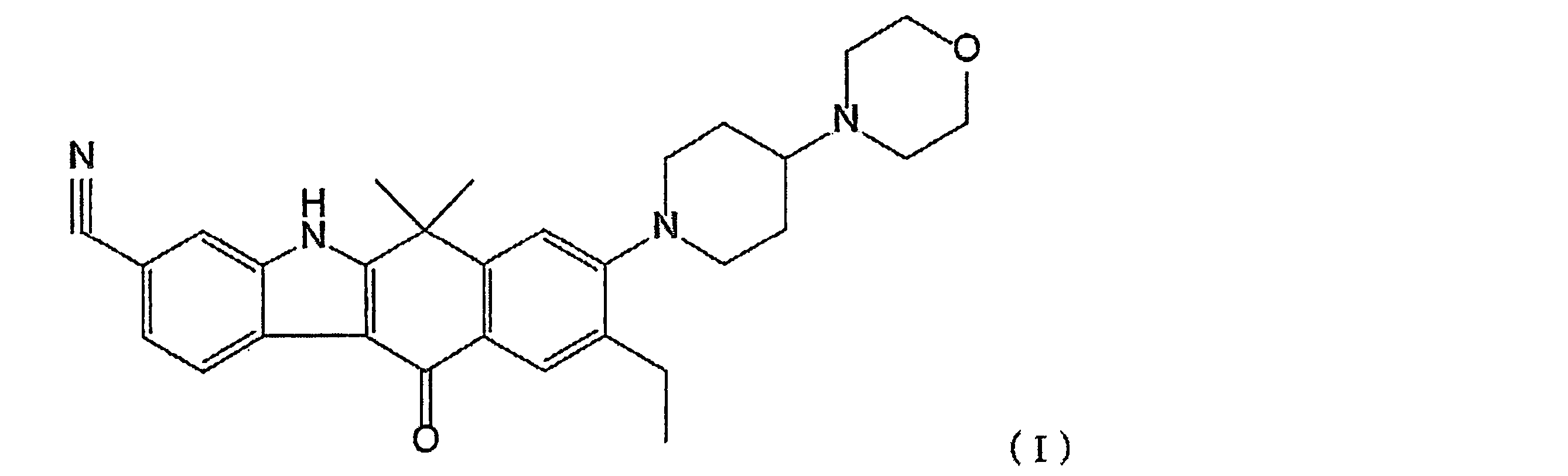
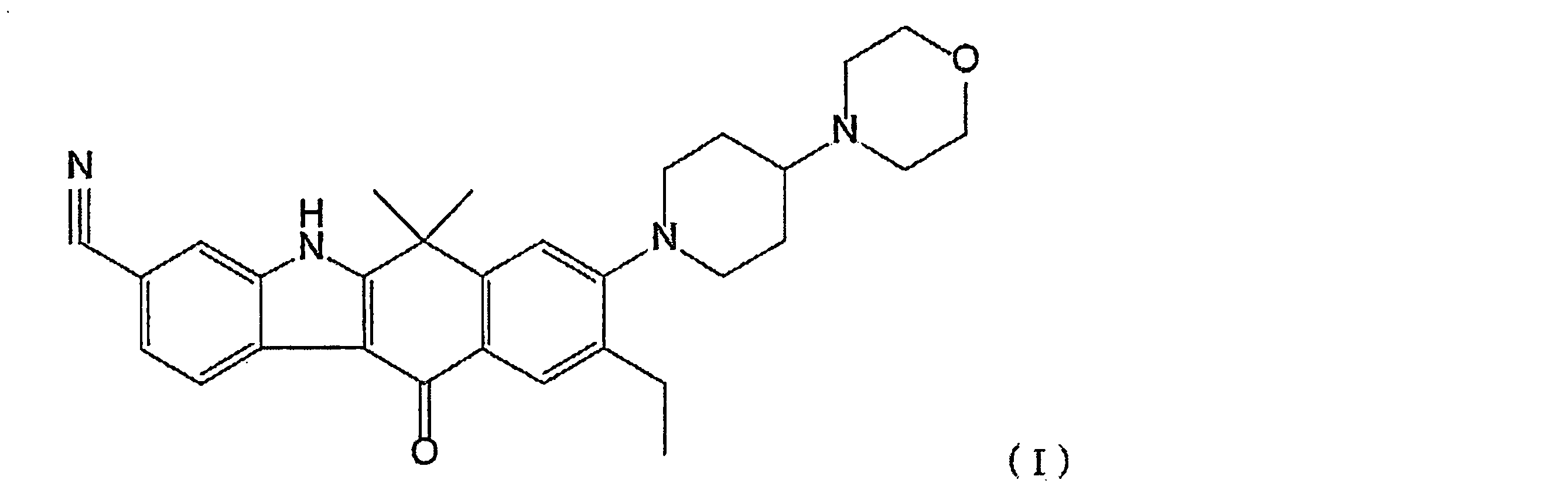
- Patent Literature 2 a compound represented by the formula (I) (compound name: 9-ethyl-6,6-dimethyl-8- (4-morpholin-4-yl-piperidin-1-yl) -11- Oxo-6,11-dihydro-5H-benzo [b] carbazole-3-carbonitrile) And the like (Patent Literature 2, Patent Literature 3, Patent Literature 4, Patent Literature 5).
- the compound represented by the formula (I) is a poorly soluble basic drug, and may be formulated into a composition coexisting with a solubilizing agent in its formulation (Patent Document 3), or a compound represented by the formula (I) Alternatively, it has been reported that a granule containing a salt thereof is formed, and the granule is made to coexist with a disintegrant to form a capsule having good dissolution properties (Patent Document 5).
- Pharmaceutical preparations containing a poorly soluble basic drug such as the compound represented by the formula (I) as an active ingredient generally have low bioavailability when administered orally. Therefore, the bioavailability of the active ingredient is improved and the oral absorption is improved.
- High dose formulations are usually used to improve
- compression molding (tableting) at a high dose tends to have poor water-solubility or insolubility as a characteristic, and thus has a problem in dissolution or oral absorption.
- the present inventors have conducted intensive studies in order to solve the above problems, and as a result, added a basic substance to a poorly soluble basic drug, particularly a compound represented by the formula (I) or a salt thereof. It has been found that by forming a pharmaceutical composition, formation of an impermeable coating upon disintegration when the composition is made into a tablet is prevented, and a high-dose tablet with good dissolution can be obtained. That is, the present invention is as follows. (1) A pharmaceutical composition comprising a compound represented by the formula (I) or a salt thereof, a surfactant, and a basic substance. (2) The composition according to (1), wherein the surfactant is an anionic surfactant.
- composition according to (2) wherein the anionic surfactant is sodium lauryl sulfate.
- 5-1 The composition according to any one of (1) to (4), wherein the weight ratio of the compound represented by the formula (I) or a salt thereof to the surfactant is from 100: 3 to 100: 50. .
- (5-2) The compound according to any one of (1) to (4), wherein the weight ratio of the compound represented by the formula (I) or a salt thereof to the surfactant is from 100: 12.5 to 100: 25.
- Composition wherein the weight ratio of the compound represented by the formula (I) or a salt thereof to the surfactant is from 100: 12.5 to 100: 25.
- (6-1) The composition according to (4) or (5), containing the disintegrant in an amount of 5% by weight or more.
- (6-2) The composition according to (4) or (5), containing 7.5% by weight or more of the disintegrant.
- (6-3) The composition according to (4) or (5), containing 8.5% by weight or more of the disintegrant.
- 6-4 The composition according to (4) or (5), containing the disintegrant in an amount of 10% by weight or more.
- the disintegrant comprises sodium starch glycolate, low-substituted hydroxypropylcellulose, carmellose calcium, pregelatinized starch, sodium chloride, corn starch, croscarmellose sodium, crystalline cellulose, silicic anhydride and carmellose
- the disintegrant is one or more substances selected from the group consisting of carmellose calcium, crospovidone, sodium starch glycolate, and croscarmellose sodium;
- (7-3) The composition according to any one of (4) to (6), wherein the disintegrant is carmellose calcium.
- the basic substance is L-tryptophan, L-lysine, magnesium hydroxide, magnesium silicate, calcium hydrogen carbonate, sodium hydrogen carbonate, magnesium aluminate metasilicate, L-arginine, meglumine, magnesium oxide and carbonate
- the basic substance is one or more substances selected from the group consisting of magnesium aluminate metasilicate, L-arginine, meglumine, magnesium oxide, magnesium hydroxide, and magnesium carbonate.
- composition according to any one of (8) to (8) The composition according to any one of (8) to (8). (9-3) The composition according to any one of (1) to (8), wherein the basic substance is at least one substance selected from the group consisting of magnesium aluminate metasilicate, magnesium oxide and magnesium carbonate. object. (9-4) The composition according to any one of (1) to (8), wherein the basic substance is magnesium aluminate metasilicate. (9-5) The magnesium aluminate metasilicate is selected from the group consisting of Neusilin® US2, S2, UFL2, FH2, NS2N (Fuji Chemical Industry Co., Ltd.) and PTU-F (Tomita Pharmaceutical Co., Ltd.) The composition according to any one of (1) to (8), which is one or more substances.
- composition. (10-8) The compound according to any one of (1) to (9), wherein the compound represented by the formula (I) or a salt thereof is contained in an amount of from 20 to 70% by weight, calculated as a free form, based on the whole composition.
- Composition. (10-9) The compound according to any one of (1) to (9), wherein the compound represented by the formula (I) or a salt thereof is contained in an amount of 35 to 60% by weight in terms of a free form with respect to the whole composition.
- Composition. (10-10) The compound according to any one of (1) to (9), wherein the compound represented by the formula (I) or a salt thereof is contained in an amount of 45 to 50% by weight in terms of a free form with respect to the whole composition. Composition.
- (12-1) The tablet according to any one of (1) to (11), which contains the compound represented by the formula (I) or a salt thereof in a unit amount of 150 mg to 800 mg per unit preparation.
- (12-2) The tablet according to any one of (1) to (11), which contains the compound of the formula (I) or a salt thereof in a unit amount of 150 mg to 400 mg per unit preparation.
- (14-4) The compound represented by the formula (I) or a salt thereof, L-tryptophan, L-lysine, magnesium hydroxide, magnesium silicate, calcium bicarbonate, magnesium metasilicate aluminate, L-arginine, meglumine, magnesium oxide And a pharmaceutical composition comprising one or more basic substances selected from the group consisting of and magnesium carbonate, crospovidone, lactose hydrate, sodium lauryl sulfate, hydroxypropylcellulose and magnesium stearate.
- (16-1) The tablet according to (15), which contains the compound of the formula (I) or a salt thereof in an amount of 150 mg to 800 mg as a free form per unit preparation.
- (16-2) The tablet according to (15), which contains the compound represented by the formula (I) or a salt thereof in a unit amount of 150 mg to 600 mg per free unit.
- (16-3) The tablet according to (15), which contains the compound represented by the formula (I) or a salt thereof in a unit amount of 200 mg to 300 mg per unit preparation.
- (17-1) The dissolution property in the Japanese Pharmacopoeia dissolution test paddle method using the Japanese Pharmacopoeia dissolution test solution 1 containing 4% of polyoxyethylene (10) octylphenyl ether is 45% or more in 30 minutes. , (15) or (16).
- a test solution containing 4% of polyoxyethylene (10) octyl phenyl ether prepared by dissolving 2.0 g of sodium chloride in 7.0 ml of hydrochloric acid and 1000 ml of water and preparing a solution having a pH of about 1.2 was used.
- the composition of the present invention prevents the formation of an impermeable membrane at the time of disintegration by tableting, and contains a poorly soluble basic drug, particularly the compound represented by the formula (I) or a salt thereof as an active ingredient.
- a high-dose preparation having good disintegration properties can be provided.
- the tableting of the pharmaceutical composition of the present invention can provide a high-dose tablet with good dissolution regardless of whether or not granules are formed.
- FIG. 3 is a view showing the dissolution profile of the tablet of Reference Example 1. Photographs of a) the appearance of the tablet of Reference Example 1 before the test, b) the appearance after the test, and c) the center cut surface after the test are shown.
- FIG. 9 is a view showing an elution profile of Examples 8 to 10.
- FIG. 9 is a view showing an elution profile of Examples 11 to 14.
- FIG. 9 is a view showing an elution profile of Examples 15 to 18.
- the “pharmaceutical composition” means a mixture of two or more substances used for treating or preventing a disease.
- the pharmaceutical composition is used for producing a pharmaceutical preparation.
- the “pharmaceutical preparation” refers to a preparation for treating or preventing a disease, and in the present invention, an oral administration preparation is preferable.
- An “orally administered formulation” is a formulation that can be administered orally, wherein the active ingredient is absorbed primarily from the intestinal tract.
- Oral administration preparations include solid preparations and liquid preparations. In the present invention, solid preparations are preferable, and specific examples include tablets, capsules, liquids, powders, troches, chewables, granules, and gels.
- Preparations solid preparations such as film preparations, etc., among which tablets are preferred.
- granules may or may not be used.
- the average particle size of the granules may be any average particle size used for ordinary formulation.
- the “compound of the formula (I)” is a compound of the formula (I) In the compound name, 9-ethyl-6,6-dimethyl-8- (4-morpholin-4-yl-piperidin-1-yl) -11-oxo-6,11-dihydro-5H-benzo [ b] carbazole-3-carbonitrile.
- the “salt” of the compound represented by the formula (I) is preferably a pharmaceutically acceptable salt, and examples of the “pharmaceutically acceptable salt” include hydrochloride, hydrobromide, and hydrogen iodide.
- Acid salts such as salt, or alkali metal salt such as sodium salt and potassium salt; alkaline earth metal salt such as magnesium salt and calcium salt; ammonium salt, alkyl ammonium salt, dialkyl ammonium salt, trialkyl ammonium salt, tetraalkyl And ammonium salts such as alkyl ammonium salts.
- Carboxylate such as salt, or alkali metal salt such as sodium salt and potassium salt; alkaline earth metal salt such as magnesium salt and calcium salt; ammonium salt, alkyl ammonium salt, dialkyl ammonium salt, trialkyl ammonium salt, tetraalkyl And ammonium salts such as alkyl ammonium salts.
- it is the hydrochloride, most preferably the monohydrochloride.
- the compound represented by the formula (I) or a salt thereof can be produced by a known method (for example, a method described in Patent Document 2).
- the monohydrochloride of the compound represented by the formula (I) may be amorphous or crystalline. In the case of crystalline, the monohydrochloride is 8.4 °, 14.0 °, 16 ° C in the powder X-ray diffraction pattern. Crystals having peaks at diffraction angles (2 ⁇ ) of around 0.7 °, 18.8 °, and 23.3 ° are preferred.
- the amorphous form of the monohydrochloride of the compound represented by the formula (I) can be produced by the method described in WO2016 / 021707, and the crystal having the peak can be produced by the method described in WO2015 / 163447.
- the compound represented by the formula (I) or a salt thereof accounts for 20 to 70% by weight, preferably 35 to 60% by weight, more preferably 45 to 50% by weight in terms of a free form, based on the whole composition.
- the preparation obtained from the composition of the present invention is obtained by converting the compound represented by the formula (I) or a salt thereof into 150 mg to 800 mg, preferably 150 mg to 400 mg, particularly preferably 200 mg to 200 mg in free form per unit preparation. Contains 300 mg.
- “Surfactant” means a substance having both a hydrophilic group and a hydrophobic group in the molecule, and the surfactant includes an ionic surfactant and a nonionic surfactant.
- the ionic surfactant refers to an ionic surfactant that is ionized to become an ion (charged atom or atomic group) when dissolved in water. Ionic surfactants are further classified into anionic surfactants, cationic surfactants, and amphoteric surfactants, depending on the charge of the generated ions.
- nonionic surfactant examples include sugar ester type surfactants such as sorbitan fatty acid ester (C12-18), POE sorbitan fatty acid ester (C12-18), sucrose fatty acid ester; POE fatty acid ester (C12-18); Fatty acid ester type such as POE resin acid ester and POE fatty acid diester (C12-18); alcohol type such as POE alkyl ether (C12-18); POE alkyl (C8-12) phenyl ether, POE dialkyl (C8-12) phenyl Alkyl phenol type surfactants such as ether and POE alkyl (C8-12) phenyl ether formalin condensate; polyoxyethylene / polyoxypropylene block polymer, alkyl (C12-18) polyoxyethylene / polyoxypropylene Polyoxyethylene / polyoxypropylene block polymer type surfactants such as lock polymer ethers; alkylamine types such as POE alkylamines (C12-
- polyoxyl stearate 40 sorbitan trioleate, polyoxyethylene ⁇ (105) ⁇ polyoxypropylene ⁇ (5) ⁇ glycol, polyoxyethylene hydrogenated castor oil 60, polyoxyl 35 castor oil, lauromacrogol and the like are exemplified.
- anionic surfactant examples include alkyl sulfate (C12-18, Na, NH4, alkanolamine), POE alkyl ether sulfate (C12-18, Na, NH4, alkanolamine), and POE alkylphenyl ether sulfate (C12-18).
- two or more surfactants may be used in combination at an appropriate ratio.
- the surfactant is preferably an anionic surfactant.
- Preferred surfactants are monoalkyl sulfates, polyoxyl stearate 40, sorbitan trioleate, polyoxyethylene (105) polyoxypropylene (5) glycol, polyoxyethylene hydrogenated castor oil 60, polyoxyl 35 castor oil, lauromacro Selected from the group consisting of gall, dioctyl sodium sulfosuccinate, sodium lauroyl sarcosine, sodium dodecyl benzene sulfonate and mixtures thereof.
- More preferred surfactants are monoalkyl sulfates, sorbitan trioleate, polyoxyethylene (105) polyoxypropylene (5) glycol, polyoxyethylene hydrogenated castor oil 60, polyoxyl 35 castor oil, dioctyl sodium sulfosuccinate. , Sodium lauroyl sarcosine, sodium dodecylbenzenesulfonate, and mixtures thereof. More preferred surfactants are selected from the group consisting of sodium lauryl sulfate, sodium tetradecyl sulfate, sodium hexadecyl sulfate, sodium octadecyl sulfate, and mixtures thereof.
- a particularly preferred surfactant is a mixture of sodium lauryl sulfate and polyoxyethylene (105) polyoxypropylene (5) glycol.
- the most preferred surfactant is sodium lauryl sulfate.
- the ionic surfactant is more preferably sodium lauryl sulfate.
- crystals obtained by spray drying or those obtained by crystallization can be used.
- monohydrate, hemihydrate, 1/8 hydrate, and non-solvate are known as crystalline polymorphs of sodium lauryl sulfate (literature: Journal of Crystal Growth 263 ( 2004) 480-490), but any crystals can be used in the compositions or formulations of the present invention.
- the surfactant accounts for 5% by weight or more, preferably 5% by weight or more and 30% by weight or less, more preferably 7.5% by weight or more, and most preferably 7.5% by weight or more and 30% by weight or less based on the whole composition. contains.
- the surfactant contained in the composition or preparation of the present invention preferably has a weight ratio of the compound represented by the formula (I) or a salt thereof to the surfactant of from 100: 3 to 100: 50, more preferably 100: 12.5 to 100: 25, most preferably 100: 25.
- the "basic substance” is preferably a substance defined as a base according to the definition of Lewis, more preferably a substance defined as a base according to the definition of Bronsted Lowry, and may be a pharmacologically acceptable component.
- the basic substance may be an inorganic basic substance or an organic basic substance.
- As the basic substance one type may be used alone, or two or more types may be used in combination.
- inorganic basic substances include metal oxides such as magnesium oxide, calcium oxide, and aluminum oxide; metal hydroxides such as sodium hydroxide, potassium hydroxide, magnesium hydroxide, calcium hydroxide, and aluminum hydroxide; and sodium carbonate.
- Metal carbonates such as potassium carbonate, magnesium carbonate, calcium carbonate, etc.
- metal hydrogen carbonates such as sodium hydrogen carbonate, potassium hydrogen carbonate, etc., trisodium phosphate, tripotassium phosphate, tricalcium phosphate, trimagnesium phosphate, pyrroline Metal phosphates such as sodium silicate, potassium pyrophosphate, sodium polyphosphate, and potassium polyphosphate; metal hydrogen phosphates such as sodium monohydrogen phosphate and potassium monohydrogen phosphate; sodium silicate, magnesium silicate, and silicic acid Calcium, synthetic aluminum silicate, synthetic Metal silicates such as sodium magnesium silicate and talc; composite silicate-aluminum compounds such as magnesium aluminate silicate, magnesium aluminum silicate and magnesium metasi
- Examples of the organic basic substance include metal salts of organic acids, organic amines, basic amino acids and the like.
- the metal salts of organic acids include sodium, potassium, magnesium, and calcium salts of organic acids such as citric acid, succinic acid, tartaric acid, fumaric acid, maleic acid, malonic acid, and malic acid.
- Examples of the organic amine include meglumine, monoethanolamine, diisopropanolamine, triethanolamine, monoisopropanolamine, diisopropanolamine, triisopropanolamine, 2-amino-2-methyl-1-propanol, 2-amino-2-methyl 1,3-propanediol, polyoxyethylene alkylamine and the like.
- Examples of the basic amino acid include lysine, arginine, phenylalanine, tyrosine, histidine, proline, oxyproline, ornithine, hydroxylysine, and derivatives thereof.
- metal oxides such as magnesium oxide, calcium oxide and aluminum oxide
- metal hydroxides such as sodium hydroxide, potassium hydroxide, magnesium hydroxide, calcium hydroxide and aluminum hydroxide, sodium carbonate, potassium carbonate, and carbonate
- Metal carbonates such as magnesium and calcium carbonate
- metal bicarbonates such as sodium hydrogen carbonate and potassium hydrogen carbonate, trisodium phosphate, tripotassium phosphate, tricalcium phosphate, trimagnesium phosphate, sodium pyrophosphate, pyrophosphate
- Metal phosphates such as potassium, sodium polyphosphate and potassium polyphosphate
- metal hydrogen phosphates such as sodium monohydrogen phosphate and potassium monohydrogen phosphate
- magnesium silicate Metal silicates such as sodium and talc
- composite silicate-aluminum compounds such as magnesium aluminate silicate, magnesium aluminum silicate and magnesium aluminate metasilicate
- the magnesium aluminate metasilicate examples include Neusilin (registered trademark) US2, S2, UFL2, FH2, NS2N (Fuji Chemical Industry Co., Ltd.) and PTU-F (Tomita Pharmaceutical Co., Ltd.). More preferably, the magnesium metasilicate aluminate is Neusilin (registered trademark) US2, S2 (Fuji Chemical Industry Co., Ltd.).
- the basic substance is preferably selected from L-tryptophan, L-lysine, magnesium hydroxide, magnesium silicate, calcium hydrogen carbonate, sodium hydrogen carbonate, magnesium aluminate metasilicate, L-arginine, meglumine, magnesium oxide and magnesium carbonate.
- the basic substance is contained in the composition in an amount of 5% by weight or more, 5% by weight or more and 30% by weight or less, 7.5% by weight or more, 7.5% by weight or more and 30% by weight or less.
- the weight ratio of the compound represented by the formula (I) or a salt thereof to the basic substance is preferably from 100: 5 to 100: 60, more preferably from 100: 10 to 100: 50, in free form. Most preferably, it is 100: 20 to 100: 40.
- the preparation of the present invention is produced by a known method using additives such as excipients, lubricants, coating agents, binders, disintegrants, stabilizers, flavoring agents, and diluents.
- additives such as excipients, lubricants, coating agents, binders, disintegrants, stabilizers, flavoring agents, and diluents.
- excipient include starches such as corn starch, potato starch, wheat starch, rice starch, partially pregelatinized starch, pregelatinized starch, and perforated starch; lactose hydrate, fructose, glucose, mannitol, Sugars or sugar alcohols such as sorbitol: anhydrous calcium hydrogen phosphate, crystalline cellulose, precipitated calcium carbonate, calcium silicate and the like.
- Preferred excipients include starch such as starch, potato starch, and corn starch, lactose hydrate, crystalline cellulose, anhydrous calcium hydrogen phosphate, and the like.
- the “disintegrant” in the present invention is a component for promoting rapid disintegration of a solid preparation after internal administration of the solid preparation.
- examples of disintegrants include sodium starch glycolate, low-substituted hydroxypropylcellulose, carmellose calcium, pregelatinized starch, sodium chloride, corn starch, croscarmellose sodium, crystalline cellulose, silicic anhydride, carmellose and the like.
- the disintegrant is used in an amount of, for example, 5% by weight or more, preferably 7.5% by weight or more, more preferably 8.5% by weight or more, and particularly preferably 10% by weight, based on the whole composition or the whole preparation of the present invention. % Or more.
- the upper limit of the amount used is not particularly limited, but is, for example, 30% by weight.
- the preparation of the present invention is a preparation having a film such as a coated tablet or the like
- the amount to be used is based on the whole components covered by the film (the whole components filled in the capsule and the whole components coated on the coating). Quantity.
- Binders include, for example, polyvinylpyrrolidone, macrogol and the same compounds as the above-mentioned excipients.
- Specific examples of the binder include hydroxypropylcellulose, hydroxypropylmethylcellulose, methylcellulose, povidone (polyvinylpyrrolidone), gum arabic powder and the like.
- the amount of the binder to be used is preferably 0.1 to 50 parts by weight, more preferably 0.5 to 40 parts by weight, based on 100 parts by weight of the preparation.
- lubricant examples include, for example, magnesium stearate, calcium stearate, talc, sucrose fatty acid ester, sodium stearyl fumarate and the like.
- surfactant or emulsifier examples include polysorbate 80, polyoxyl stearate 40, lauromacrogol, and the like. Any coloring agent may be used as long as it is permitted to be added to pharmaceuticals, for example, Food Yellow No. 5 (Sunset Yellow, US Food Yellow No. 6), Food Red No. 2, Food Blue No. 2 Food dyes such as No. 1, food lake dyes, iron sesquioxide and the like.
- the stabilizer examples include paraoxybenzoic acid esters such as methylparaben and propylparaben; alcohols such as chlorobutanol, benzyl alcohol and phenylethyl alcohol; benzalkonium chloride; phenols such as phenol and cresol; thimerosal; Dehydroacetic acid; and sorbic acid.
- paraoxybenzoic acid esters such as methylparaben and propylparaben
- alcohols such as chlorobutanol, benzyl alcohol and phenylethyl alcohol
- benzalkonium chloride phenols such as phenol and cresol
- thimerosal Dehydroacetic acid
- sorbic acid sorbic acid.
- the "flavoring agent” for example, commonly used sweeteners, sour agents, flavors and the like can be mentioned.
- plasticizer a plasticizer is used for the purpose of improving the fluidity of the powder mixture or granules, and typical examples thereof include light an
- the light anhydrous silicic acid may be any one containing water-containing silicon dioxide (SiO 2 .nH 2 O) (n is an integer) as a main component.
- n is an integer
- the “preservative” include, for example, paraoxybenzoic acid esters, chlorobutanol, benzyl alcohol, phenethyl alcohol, dehydroacetic acid, sorbic acid and the like.
- Suitable examples of the antioxidant include, for example, sulfite, ascorbic acid and the like.
- the above additives may be used as a mixture of two or more kinds at an appropriate ratio. Ethanol, phenol, chlorocresol, purified water, distilled water and the like can be used as a solvent for producing the liquid preparation.
- the solid preparation of the present invention can be produced by a general production method. Preferably, it is produced according to the following production method. 1) The solid preparation of the present invention is produced by mixing the compound represented by the formula (I) with additives such as a basic substance, an excipient, a disintegrant, and a lubricant, followed by compression molding. 2) After mixing the compound represented by the formula (I) with additives such as a basic substance, an excipient and a binder, a solvent (for example, purified water, ethanol, or a mixture thereof) is added or sprayed. While granulating.
- additives such as a basic substance, an excipient, a disintegrant, and a lubricant
- the solid preparation of the present invention is produced by adding an appropriate amount of a lubricant and, if necessary, a disintegrant and the like to the obtained granules, mixing and compression-molding. 3) After mixing the compound represented by the formula (I) with additives such as a basic substance and an excipient, a binder and other additives as necessary may be mixed with a solvent (for example, purified water, ethanol, or the like). The mixture is granulated while adding or spraying a liquid obtained by dispersing or dissolving the mixture in a mixed liquid.
- the solid preparation of the present invention is produced by adding an appropriate amount of a lubricant and, if necessary, a disintegrant and the like to the obtained granules, mixing and compression-molding.
- the pharmaceutical composition of the present invention also relates to a pharmaceutical composition containing (i) the compound represented by the formula (I) or a salt thereof, and (ii) a basic substance.
- a pharmaceutical composition of the present invention also relates to a non-granular pharmaceutical composition containing (i) the compound represented by the formula (I) or a salt thereof, and (ii) a basic substance.
- a pharmaceutical composition comprising (i) a granule containing the compound represented by the formula (I) or a salt thereof, and (ii) a powder containing a basic substance
- a pharmaceutical composition comprising (i) a granule containing the compound represented by the formula (I) or a salt thereof, and (ii) a powder containing a basic substance
- composition of the present invention (i) a granule containing the compound represented by the formula (I) or a salt thereof and a surfactant, and (ii) a powder containing a basic compound and a disintegrant
- a pharmaceutical composition comprising: As a further embodiment of the pharmaceutical composition of the present invention, (i) granules containing the compound represented by the formula (I) or a salt thereof, a surfactant and a disintegrant, and (ii) a basic compound and a disintegrant It is a pharmaceutical composition containing a latex.
- granules means particles having a substantially uniform shape and size, and raw materials such as powder, lump, solution or molten liquid are prepared by wet granulation, dry granulation or heat granulation. It is obtained by granulating by a granulation method or the like. “Non-granular” means a state in which granules are not formed.
- the granules may contain various additives in addition to the above-mentioned surfactants and disintegrants.
- the granules may contain a compound of formula (I) or a salt thereof, a disintegrant, a surfactant, an excipient and a binder.
- the granules may further contain one or more additives selected from lubricants, coating agents, stabilizers, flavoring agents and diluents, and the compound represented by the formula (I) or a compound thereof.
- a composition comprising salts and optionally additives such as disintegrants, surfactants, excipients, lubricants, coatings, binders, stabilizers, flavors, diluents, etc., is subjected to normal granulation. It can be manufactured by granulating using a process.
- the average particle size of the granules may be an average particle size used in general formulation.
- the average particle size was determined by adding 6 g of sampled granules from a stack of a plurality of sieves having different pore sizes (for example, pore sizes: 850, 500, 355, 250, 180, 106, 75, 53, and 0 ⁇ m). After shaking for 3 minutes, the weight of the granules remaining on each sieve was measured, and from the pore size of each sieve and the cumulative rate under the sieve, a particle diameter corresponding to a cumulative rate of 50% was determined using lognormal distribution approximation. This is a value obtained by calculation.
- “late powder” and “late powder component” mean components added to the outside of the granulated granules.
- additives such as a lubricant and a fluidizing agent can be further added as the late powder component.
- the disintegrant may be contained in the granule or in the late powder component, and preferably, sodium starch glycolate, low-substituted hydroxypropylcellulose, carmellose calcium, pregelatinized starch, sodium chloride, corn starch, croscarmellose It is selected from sodium, microcrystalline cellulose, silicic anhydride and carmellose, more preferably from carmellose calcium, crospovidone, sodium starch glycolate and croscarmellose sodium, most preferably carmellose calcium and crospovidone.
- the granule of (i) may contain a basic substance in the granule, in which case (i) a granule containing the compound represented by the formula (I) or a salt thereof, and a basic substance, It may be a pharmaceutical composition containing (ii) a surfactant.
- the basic substance is more preferably added as a late component.
- the basic substance contained in the granules of (i) is a substance exemplified as the basic substance described above, and is preferably an inorganic basic substance, a metal salt of an organic acid, an organic amine, or a basic amino acid (group). Selected, more preferably inorganic basic substance (s), most preferably magnesium metasilicate aluminate.
- the basic substance contained in the latter component is the substance exemplified as the aforementioned basic substance, and is preferably the aforementioned inorganic basic substance or organic substance. It is selected from metal salts of acids, organic amines, basic amino acids (group), more preferably the above-mentioned inorganic basic substances (group), most preferably magnesium metasilicate aluminate.
- the basic substance contained in the granules of (i) and in the terminal component of (ii) is contained in an amount of 5% by weight or more, 5% by weight or more and 30% by weight or less, and 7.5% by weight or more based on the whole preparation. , 7.5% by weight or more and 30% by weight or less.
- the pharmaceutical composition of the present invention may contain a solubilizing agent such as an organic polymer described below in addition to the surfactant.
- a solubilizing agent such as an organic polymer described below in addition to the surfactant.
- the “solubilizing agent” includes an organic polymer and the like, and specifically, the “organic polymer” used in the present invention includes hydroxypropylcellulose (hereinafter, also referred to as HPC), hydroxypropylmethylcellulose, Polysaccharides such as methylcellulose, propylene glycol alginate, agar powder, guar gum, zein, hydroxyethyl methylcellulose, carboxyvinyl polymer, polyvinyl alcohol, or vinyl acetate resin, synthetic resins such as sodium polystyrenesulfonate, phosphorus such as casein, sodium caseinate And the like.
- HPC hydroxypropylcellulose
- Polysaccharides such as methylcellulose, propylene glycol alginate, agar powder,
- a polymer having a solubility in water of 1 g / 100 g or more is called a water-soluble polymer.
- Specific examples include hydroxypropylcellulose, hydroxypropylmethylcellulose, methylcellulose, propylene glycol alginate, sodium caseinate, carboxyvinyl polymer, agar powder, guar gum, copolyvidone, hydroxyethylmethylcellulose, polyvinyl alcohol and the like.
- organic macromolecules those that dissolve under acidic conditions of 1.2 to 3.5, which is the pH of gastric juice, are called gastrosoluble polymers, and those that rapidly dissolve at pH 6 to 8 in the intestine are called enteric polymers. .
- Gastric-soluble polymers include aminoalkyl methacrylate copolymer E or polyvinyl acetal diethylaminoacetate
- enteric polymers include methacrylic acid copolymer LD (emulsion), methacrylic acid copolymer S, purified shellac, carboxymethyl ethyl cellulose, and acetic acid.
- examples include cellulose phthalate (cerafate), hydroxypropyl methylcellulose acetate succinate, casein, zein and the like.
- Preferred solubilizers include, for example, casein, sodium caseinate, skim milk powder, dioctyl sodium sulfosuccinate, polyoxyl stearate 40, sorbitan trioleate, polyoxyethylene (105) polyoxypropylene (5) glycol, polyoxyethylene curing Castor oil 60, polyoxyl 35 castor oil, lauromacrogol, sodium lauroyl sarcosine, sodium tetradecyl sulfate, sodium hexadecyl sulfate, sodium octadecyl sulfate, sodium methyl sulfate, sodium ethyl sulfate, sodium butyl sulfate, sodium octyl sulfate, sodium decyl sulfate, dodecyl And sodium benzenesulfonate.
- the solubilizer may be in the form of granules or obtained by spray drying.
- excipients that can be contained in the granules of (i) include, for example, starches such as corn starch, potato starch, wheat starch, rice starch, partially pregelatinized starch, pregelatinized starch, and perforated starch; lactose Sugars or sugar alcohols such as hydrates, fructose, glucose, mannitol, sorbitol and the like: anhydrous calcium hydrogen phosphate, crystalline cellulose, precipitated calcium carbonate, calcium silicate and the like.
- Preferred excipients include starch such as starch, potato starch, and corn starch, lactose hydrate, crystalline cellulose, anhydrous calcium hydrogen phosphate, and the like, and mannitol and lactose hydrate are more preferable.
- the amount of the excipient to be used is preferably 5 to 60 parts by weight, more preferably 10 to 30 parts by weight, based on 100 parts by weight of the composition or the preparation.
- the used amount means the used amount based on the whole components covered by the film (the whole components covered by the coating).
- examples of the binder that can be contained in the granules (i) include hydroxypropylcellulose, polyvinylpyrrolidone, macrogol, and compounds similar to the above-mentioned excipients.
- Specific examples of the binder include, for example, hydroxypropylcellulose, hydroxypropylmethylcellulose, methylcellulose, povidone (polyvinylpyrrolidone), gum arabic powder and the like, and preferably hydroxypropylcellulose.
- the amount of the binder used is preferably 0.1 to 50 parts by weight, more preferably 0.5 to 40 parts by weight, and still more preferably 0.5 to 10 parts by weight, per 100 parts by weight of the composition or preparation. Department.
- the used amount means the used amount based on the whole components covered by the film (the whole components covered by the coating).
- a binder may be contained in the inside of the granules and in the late powder component, and as such a binder, hydroxypropyl cellulose is preferable.
- lubricant which can be contained in the granules (i) in the present invention include, for example, magnesium stearate, calcium stearate, talc, sucrose fatty acid ester, sodium stearyl fumarate and the like.
- the stabilizer which can be contained in the granules of (i) includes, for example, paraoxybenzoic acid esters such as methylparaben and propylparaben; alcohols such as chlorobutanol, benzyl alcohol and phenylethyl alcohol; benzalkonium chloride Phenols such as phenol and cresol; thimerosal; dehydroacetic acid; and sorbic acid.
- the flavoring agent that can be contained in the granules of the present invention include, for example, commonly used sweeteners, acidulants, flavors and the like.
- a pharmaceutical composition containing a poorly soluble basic drug, an anionic surfactant and a basic substance may be mentioned, and the poorly soluble basic drug may be added by adding a basic substance.
- the term “poorly soluble” means that the solubility in a solvent, particularly water, a buffer, or a solution in the digestive tract is 1 mg / ml or less, more preferably 100 ⁇ g / ml or less, still more preferably 10 ⁇ g / ml or less, and particularly preferably 1 ⁇ g / ml or less. , Most preferably 0.1 g / ml or less.
- any solvent having a pH of 7 or less it is preferably hardly soluble in any solvent having a pH of 4 to 7, and further preferably hardly soluble in the solvent having a pH of 4 and / or pH 7. .
- it is preferably hardly soluble in any solvent having a pH of 7 or more, more preferably in any solvent having a pH of 7 to 9; More preferably, it is hardly soluble in a solvent having a pH of 9.
- the solvent for measuring the solubility is not particularly limited, but examples of the pH 4 solvent include an acetate buffer and a citrate buffer.
- Examples of the pH 5 solvent include an acetate buffer, a citrate buffer, and a phosphate buffer.
- Examples of the solvent having a pH of 7 include water and a phosphate buffer.
- Examples of the pH 9 solvent include a carbonate buffer.
- the temperature at which the solubility is measured is preferably 20 to 40 ° C., and more preferably 37 ° C. in each case.
- Base agents include at least one basic group such as a primary amino group (-NH2), a secondary amino group (imino group -NH-), a tertiary amino group (> N-), Having an amide group, a basic nitrogen-containing heterocyclic group (pyrrolyl group, imidazolyl group, pyrazolyl group, pyrazinyl group, purinyl group, quinolyl group, pyridyl group, piperidino group, piperidyl group, piperazinyl group, triazolo group, etc.) I have.
- the amino group also includes a hydrazino group (-NH-NH2), a hydrazo group (-NH-NH-), and the like.
- the basic drug only needs to have at least one basic group, and may have a plurality of the same or different types of basic groups.
- the drug may be a salt (for example, a salt with an inorganic acid such as hydrochloric acid, sulfuric acid or phosphoric acid, an organic carboxylic acid such as acetic acid, tartaric acid, citric acid, fumaric acid, or maleic acid, or an organic sulfonic acid such as mesylic acid). It may be formed.
- the cationic or basic drug includes a metabolite or a drug whose prodrug that exhibits activity in a living body is cationic or basic.
- the type of the basic drug is not particularly limited, and may be, for example, a drug that acts on the central nervous system, autonomic nervous system, respiratory system, circulatory system, digestive system, metabolic system, etc. It may be a drug, a drug in the ophthalmic or otolaryngological region, an in-vivo active substance (autacoid), or the like.
- Specific types include antipyretics, analgesics, anti-inflammatory drugs, hypnotics and sedatives, rheumatic drugs, antidepressants, antiepileptic drugs, anti-vertigo drugs, antiallergic drugs, inotropic drugs, beta-blockers, calcium antagonists Drugs, antiarrhythmic drugs, diuretics, angina drugs, heart failure drugs, myocardial infarction drugs, antihypertensive drugs (hypertensive drugs), peripheral circulatory disorders, vasopressors (hypotension drugs), bronchodilators , Asthma, antituberculosis, diabetes, diabetic complications, hyperlipidemia, hyperuricemia, antitussive expectorant, peptic ulcer, thyroid disease, prostate It may be an agent for treating hypertrophy, an agent for treating cancer, an agent for treating osteoporosis, an agent for treating Alzheimer's disease, an antibiotic, a vitamin, an antiplasmin agent, or the like.
- antipyretic / analgesic / anti-inflammatory drugs include antipyretic analgesics such as dimethothiazine mesylate, headaches such as dihydroergotamine mesylate, lomerizine hydrochloride, sumatributane succinate, fenamic acid, mefenamic acid, flotafenin, maleic acid
- Anti-inflammatory drugs such as progouratasin acid, epirilazole, tiaramid hydrochloride, etc., anti-rheumatic drugs (penicillamine, methotrexate, etc.), drugs for hyperuricemia (such as allopurinol), hypnotics and sedatives (such as rilmazaphone hydrochloride, zolpidem tartrate)
- Antidepressants nonortriptyline hydrochloride, imipramine hydrochloride, amitriptyline hydrochloride, clomipramine hydrochloride
- the present invention provides a composition comprising a poorly soluble basic drug, an anionic surfactant and a basic substance, wherein the composition has a good drug dissolution property;
- a composition comprising a poorly soluble basic drug, an anionic surfactant and a basic substance, wherein the composition has good drug disintegration properties;
- the above composition, wherein the composition is a formulation for oral administration; and the above composition, wherein the composition is a tablet; Is also included.
- the present invention provides a method for improving the dissolution property of a drug by adding a basic substance to a preparation containing a basic drug and an anionic surfactant; A method for improving the disintegration of a drug product by adding a basic substance to a drug product containing a basic drug and an anionic surfactant; and adding a base to a drug product containing a basic drug and an anionic surfactant.
- a method for producing a preparation having a good drug dissolution property which comprises a step of adding an active substance.
- an impervious film is formed by ionic interaction between the basic substance and the anionic surfactant, thereby causing poor disintegration. And found that a basic substance can suppress the formation of an impermeable coating.
- good dissolution means that the dissolution rate of the preparation is usually measured using 33 mL of formic acid as a test solution and 900 mL of purified water containing 2% of polyoxyethylene (10) octyl phenyl ether in the Japanese Pharmacopoeia.
- a dissolution test (dissolution test 1) is performed at 100 revolutions per minute by the dissolution test paddle method, a dissolution property of 45% or more, preferably 60% or more, more preferably 75% or more is obtained after 30 minutes.
- 900 mL of the Japanese Pharmacopoeia Dissolution Test Solution 1 containing 4% of polyoxyethylene (10) octyl phenyl ether as a test solution, and preferably 75 mL of the Dissolution Test Solution 1, contain polyoxyethylene (10) octyl phenyl ether.
- a dissolution test (dissolution test 2) is performed by a paddle method at 100 rpm per minute using a test solution mixed with 3 g, dissolution of 45% or more, preferably 60% or more, more preferably 75% or more after 30 minutes. It means that sex is obtained.
- the dissolution test 2 when the dissolution test 2 is performed, 45% or more, preferably 60% after 30 minutes. As described above, more preferably, a dissolution property of 75% or more is obtained. Particularly preferably, when the dissolution test 2 is performed, it means that 70% or more is dissolved in 75 minutes.
- the first solution of the Japanese Pharmacopoeia dissolution test solution was prepared by dissolving 2.0 g of sodium chloride in 7.0 ml of hydrochloric acid and water to make 1000 mL, and was a clear and colorless solution having a pH of about 1.2. "Improvement of dissolution" means that the dissolution of a drug below the dissolution range is set to the dissolution range, and the improvement of dissolution allows the active pharmaceutical ingredient to be efficiently absorbed.
- dissolution test 2 is set as a dissolution standard test method for an approved capsule preparation of the active pharmaceutical ingredient.
- the dissolution by dissolution test 2 may be 45% or more after 30 minutes in the United States and Israel, 75% or more after 70 minutes, 45% or more to 75% or less after 30 minutes in the EU zone, and 75% or more after 70 minutes. desirable.
- good disintegration can be obtained by adding a basic substance to a preparation containing a poorly soluble basic drug such as the compound represented by the formula (I) and a surfactant.
- “good disintegration” means that the disintegration time of the preparation is usually determined by the disintegration test in the Japanese Pharmacopoeia using the dissolution test liquid No. 1 of the Japanese Pharmacopoeia as the test solution (disintegration test 1). Means that it disintegrates within 30 minutes, and preferably disintegrates within 15 minutes.
- disintegration test 2 when a disintegration test (disintegration test 2) is performed in the Japanese Pharmacopoeia disintegration test using water as a test solution, it means disintegration after 10 minutes, preferably disintegration within 5 minutes.
- the disintegration test 1 and the disintegration test 2 mean that the disintegration property can be obtained. More preferably, when the disintegration test 2 is performed, it means disintegration within 3 minutes.
- “Improvement in disintegration” means that the disintegration of a preparation that falls below the above-mentioned disintegration range is set in the above-mentioned disintegration range.
- disintegrate refers to a state where "a sample residue is observed at 30 minutes but soft substances or substances on mud are slight" or "a sample residue is not observed at 30 minutes”. This means that no residue of the sample is observed after 30 minutes.
- Example 1-20 as the sodium lauryl sulfate, NIKKOL @ SLS (Nikko Chemicals) was used.
- Reference Example 1 Formation of Impermeable Coating (Production of Formulation) Tablets were prepared according to the amounts of the components described in Table 1.
- the hydrochloride of the compound of formula (I) (hereinafter, compound A), sodium lauryl sulfate and magnesium stearate were manually mixed using a polyethylene container.
- the dissolution profile of the tablet prepared by wet granulation containing the compound A and sodium lauryl sulfate was linear, and the maximum dissolution rate was 40% or less.
- the test liquid permeated only to the surface of the tablet, and the inside was dry. This is considered to be because an impervious film is formed on the tablet surface, and because the penetration of the test solution into the tablet is inhibited, the disintegration does not proceed and a good dissolution profile cannot be obtained.
- the impermeable coating refers to a coating formed on the tablet surface by a basic drug and an anionic surfactant in a test solution.
- Example 1-7 Study on disintegration of basic substance (production of preparation) Tablets were prepared according to the amounts of each component of the tablet formulation shown in Table 2. The substances shown in Table 3 were used as X contained in the latter components in the formulation. The granulated ingredients are mixed, the premixed powder is put into a stainless beaker, purified water is added while stirring with a metal spatula, wet granulation is performed, and then a vacuum dryer (VOS-301SD, Tokyo Rika Kikai) Co., Ltd.) at room temperature. Subsequently, the mixture was sized with a sieve having a size diameter of 850 ⁇ m to obtain granules, and further mixed with the late powder component to obtain a blended powder.
- VOS-301SD Tokyo Rika Kikai
- Comparative Example 1 is a tablet manufactured using the capsule formulation of Patent Document 5. By comparing Comparative Example 1 with Example 1-7, the relationship between the type of X and the disintegration time of the tablet was examined.
- Example 1-7 For Comparative Example 1 and Example 1-7, a disintegration test was performed three times for each comparative example / example in the Japanese Pharmacopoeia disintegration test using water and the first solution of the Japanese Pharmacopoeia dissolution test liquid as the test solution. .
- Table 4 shows the disintegration behavior of Example 1-7. Note that this test is a disintegration test under water (disintegration test 2) and under acidic conditions (disintegration test 1) in which disintegration is more difficult than in water.
- the following symbols used in the tables have the following meanings. -: Sample residue is observed at 30 minutes. +: The sample residue is observed at 30 minutes, but the soft substance or the substance on the mud is slight. ++: No residue of the sample was observed at 30 minutes.
- Example 8-10 Examination of production method for dissolution (production of preparation) According to the amounts of each component of the tablet formulation described in Table 5, the tablets were prepared by changing the production method. In Example 8, the ingredients were mixed to give a blended powder. In Example 9, the granule components were mixed, and the mixture was compressed using a static pressure tableting machine (P-16, Riken Seiki Co., Ltd.) using a ⁇ 16 mm punch with a pressing force (400 kgf) to obtain a molded product. The product was sized with a sieve having a size diameter of 850 ⁇ m to obtain granules, and further mixed with the late powder component to obtain a blended powder.
- a static pressure tableting machine P-16, Riken Seiki Co., Ltd.
- Example 10 the ingredients listed in Table 5 were mixed, the premixed powder was put into a stainless beaker, purified water was added thereto while stirring with a metal spatula, and wet granulation was performed. VOS-301SD, Tokyo Rikakikai Co., Ltd.) at room temperature. Subsequently, the mixture was sized with a sieve having a size diameter of 850 ⁇ m to obtain granules, and further mixed with the late powder component to obtain a blended powder. Each of the blended powders of Examples 8 to 10 was tableted with a compression tableting machine (P-16, Riken Seiki Co., Ltd.) at a compression pressure (500 kgf), and tablets containing 150 mg of Compound A in terms of a free form were obtained.
- a compression tableting machine P-16, Riken Seiki Co., Ltd.
- Example 11-14 Examination of ratio of excipient or basic substance to dissolution (manufacture of preparation) According to the amount of each component shown in Table 6, the granulated components were mixed, purified water was added to this premix, and wet granulation was carried out in the same manner as in Example 1-7. The granulated powder obtained by the wet granulation was dried, sized with a sieve having a size diameter of 850 ⁇ m to obtain granules, and further mixed with a late powder component to obtain a compounded powder.
- Each of the compounded powders is compressed with a compression tableting machine (P-16, Riken Seiki Co., Ltd.) at a compression force (1000 kgf), and tablets (15.9 ⁇ 8.3) containing 300 mg of Compound A in free form are converted. mm).
- the dissolution properties of the tablets were examined according to the ratio of the excipient to the granule formulation component and the ratio of the disintegrant to the basic substance in the late powder component.
- Example 15-18 Examination of combination of excipient and late component for dissolution (production of preparation) According to the amounts of each component described in Table 7, the granule prescription components are weighed, mixed using a granulator (VG-05, Powrex Co., Ltd.), and purified water is added to granulate to reduce the loss on drying to 2% or less. It was dried in a fluidized bed drier (FL-LABO, supply air temperature 60 ° C) until it became. The obtained dried powder was granulated by a granulator using a screen having a size diameter of 1.4 mm, and further mixed with a late powder component to obtain a blended powder.
- VG-05 granulator
- purified water is added to granulate to reduce the loss on drying to 2% or less. It was dried in a fluidized bed drier (FL-LABO, supply air temperature 60 ° C) until it became.
- FL-LABO supply air temperature 60 ° C
- Each compounded powder was converted into a free form using a hydrostatic tableting machine under the same conditions as in Examples 8-10 to produce tablets containing 150 mg of compound A, and the dissolution properties were examined.
- a disintegration test (disintegration test 1) was performed in the disintegration test of the Japanese Pharmacopoeia using the dissolution test liquid 1 of the Japanese Pharmacopoeia as the test solution. Examples 15-18 showed no sample residue at 30 minutes for all tablets.
- This test is a disintegration test (disintegration test 1) under acidic conditions in which disintegration is less likely to proceed than in water.
- Examples 15-18 900 rpm of the Japanese Pharmacopoeia dissolution test paddle method was used, using 900 mL of the Japanese Pharmacopoeia dissolution test solution 1 containing 4% polyoxyethylene (10) octylphenyl ether as the test solution, at 100 rpm.
- a dissolution test (dissolution test 2) was performed.
- FIG. 5 shows the elution profiles of Examples 15-18. As shown in FIG. 5, the dissolution profile of Compound A from the tablet showed good dissolution regardless of the combination of the excipient and the disintegrant due to the addition of magnesium aluminate metasilicate. This result is in compliance with the dissolution test standards of each country for approved capsule formulations.
- Examples 19 and 20 Examination of tablet weight (production of preparation) According to the amounts of each component described in Table 8, the granulated components were weighed, mixed using a fluidized bed granulating dryer (FG-602, Freund Corporation), and purified water was added by spraying and granulated. Using the same machine, drying was performed at an air supply temperature of 60 ° C. until the loss on drying was 2% or less. The obtained dried powder was sized by a sizing machine using a screen having a size diameter of 1.4 mm, and the obtained granules were further mixed with a late powder component to obtain a blended powder.
- FG-602 fluidized bed granulating dryer
- the compounded powder was tableted with a rotary tableting machine (AQUARIUS-C, Kikusui Seisakusho) at a compression pressure (10 kN) to produce a tablet (17.3 ⁇ 8.0 mm) containing 300 mg of compound A in free form. .
- the relationship between tablet weight and disintegration was examined by comparing with Examples 15-18.
- a disintegration test was performed in the disintegration test of the Japanese Pharmacopoeia using the dissolution test liquid 1 of the Japanese Pharmacopoeia as the test solution.
- the tablets of Examples 19 and 20 showed no sample residue at 30 minutes.
- This test is a disintegration test (disintegration test 1) under acidic conditions in which disintegration is less likely to proceed than in water. (Formulation evaluation and results) Even when the tablet weight was increased by adding magnesium aluminate metasilicate, which is a basic substance, good disintegration was exhibited as in Examples 15-18.
Landscapes
- Health & Medical Sciences (AREA)
- Chemical & Material Sciences (AREA)
- Life Sciences & Earth Sciences (AREA)
- Medicinal Chemistry (AREA)
- Pharmacology & Pharmacy (AREA)
- Animal Behavior & Ethology (AREA)
- General Health & Medical Sciences (AREA)
- Public Health (AREA)
- Veterinary Medicine (AREA)
- Epidemiology (AREA)
- Chemical Kinetics & Catalysis (AREA)
- General Chemical & Material Sciences (AREA)
- Nuclear Medicine, Radiotherapy & Molecular Imaging (AREA)
- Engineering & Computer Science (AREA)
- Organic Chemistry (AREA)
- Bioinformatics & Cheminformatics (AREA)
- Neurosurgery (AREA)
- Biomedical Technology (AREA)
- Neurology (AREA)
- Inorganic Chemistry (AREA)
- Psychiatry (AREA)
- Biophysics (AREA)
- Molecular Biology (AREA)
- Pain & Pain Management (AREA)
- Hospice & Palliative Care (AREA)
- Oncology (AREA)
- Oil, Petroleum & Natural Gas (AREA)
- Proteomics, Peptides & Aminoacids (AREA)
- Medicinal Preparation (AREA)
- Pharmaceuticals Containing Other Organic And Inorganic Compounds (AREA)
Abstract
Description
ALKの異常を伴う疾患として、例えばがん及びがん転移(非特許文献1、特許文献1)、うつ、認知機能障害(非特許文献2)等が知られており、ALK阻害剤の提供はそれらの疾患の有効な治療及び予防薬を提供する。
ALK阻害作用を有する化合物として、式(I)で示される化合物(化合物名:9-エチル-6,6-ジメチル-8-(4-モルホリン-4-イル-ピペリジン-1-イル)-11-オキソ-6,11-ジヒドロ-5H-ベンゾ[b]カルバゾール-3-カルボニトリル)
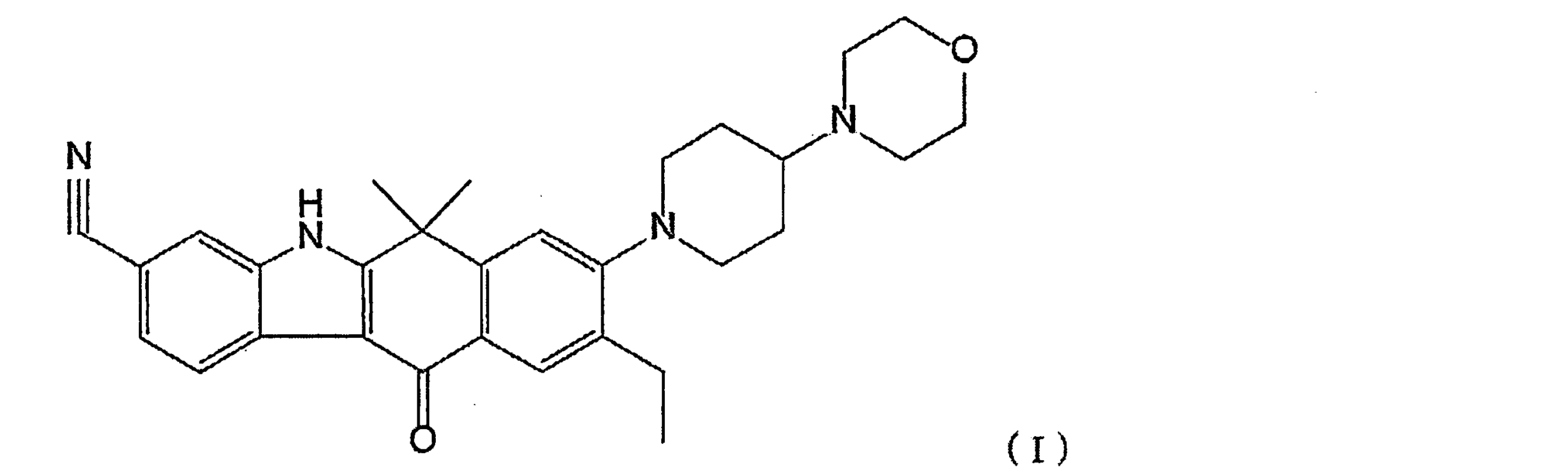
式(I)で示される化合物は難溶性の塩基性薬剤であり、その製剤化において、溶解補助剤を共存させた組成物とすること(特許文献3)や、式(I)で示される化合物又はその塩を含む顆粒を形成し、該顆粒を崩壊剤と共存させることにより、溶出性の良好なカプセル剤とすること(特許文献5)が報告されている。
式(I)で示される化合物のような難溶性の塩基性薬剤を有効成分とする医薬製剤は、経口投与した場合、一般にバイオアベイラビリティが低いため、有効成分のバイオアベイラビリティを向上させ、経口吸収性を改善するために、通常、高用量製剤が用いられる。一方、水難溶性又は不溶性の薬物の場合、高用量で圧縮成形(錠剤化)するとその特性として水難溶性又は不溶性がより強くなる傾向があるため、溶出性や経口吸収性に問題があった。
すなわち、本発明は以下のとおりである。
(1)式(I)で示される化合物又はその塩、界面活性剤及び塩基性物質を含有する医薬組成物。
(3)前記陰イオン界面活性剤がラウリル硫酸ナトリウムである、(2)に記載の組成物。
(4)更に崩壊剤を含む(1)~(3)のいずれかに記載の組成物。
(5-1)式(I)で示される化合物又はその塩と界面活性剤との重量比が100:3~100:50である、(1)~(4)のいずれかに記載の組成物。
(5-2)式(I)で示される化合物又はその塩と界面活性剤との重量比が100:12.5~100:25である、(1)~(4)のいずれかに記載の組成物。
(5-3)式(I)で示される化合物又はその塩と界面活性剤との重量比が100:25である、(1)~(4)のいずれかに記載の組成物。
(6-1)前記崩壊剤を5重量%以上含有する(4)又は(5)に記載の組成物。
(6-2)前記崩壊剤を7.5重量%以上含有する(4)又は(5)に記載の組成物。
(6-3)前記崩壊剤を8.5重量%以上含有する(4)又は(5)に記載の組成物。
(6-4)前記崩壊剤を10重量%以上含有する(4)又は(5)に記載の組成物。(7-1)前記崩壊剤が、デンプングリコール酸ナトリウム、低置換ヒドロキシプロピルセルロース、カルメロースカルシウム、アルファー化デンプン、塩化ナトリウム、トウモロコシデンプン、クロスカルメロースナトリウム、結晶セルロース、無水ケイ酸及びカルメロースからなる群から選択される1以上の物質である、(4)~(6)のいずれかに記載の組成物。
(7-2)前記崩壊剤が、カルメロースカルシウム、クロスポビドン、デンプングリコール酸ナトリウム及びクロスカルメロースナトリウムからなる群から選択される1以上の物質である、(4)~(6)のいずれかに記載の組成物。
(7-3)前記崩壊剤が、カルメロースカルシウムである、(4)~(6)のいずれかに記載の組成物。
(8)前記塩基性物質が、無機の塩基性物質及び有機の塩基性物質からなる群から選択される1以上の物質である、(1)~(7)のいずれかに記載の組成物。
(9-1)前記塩基性物質が、L-トリプトファン、L-リシン、水酸化マグネシウム、珪酸マグネシウム、炭酸水素カルシウム、炭酸水素ナトリウム、メタケイ酸アルミン酸マグネシウム、L-アルギニン、メグルミン、酸化マグネシウム及び炭酸マグネシウムからなる群から選択される1以上の物質である、(1)~(8)のいずれかに記載の組成物。
(9-2)前記塩基性物質が、メタケイ酸アルミン酸マグネシウム、L-アルギニン、メグルミン、酸化マグネシウム、水酸化マグネシウム、及び炭酸マグネシウムからなる群から選択される1以上の物質である、(1)~(8)のいずれかに記載の組成物。
(9-3)前記塩基性物質が、メタケイ酸アルミン酸マグネシウム、酸化マグネシウム及び炭酸マグネシウムからなる群から選択される1以上の物質である、(1)~(8)のいずれかに記載の組成物。
(9-4)前記塩基性物質が、メタケイ酸アルミン酸マグネシウムである、(1)~(8)のいずれかに記載の組成物。
(9-5)前記メタケイ酸アルミン酸マグネシウムが、Neusilin(登録商標)US2、S2、UFL2、FH2、NS2N(富士化学工業株式会社)及びPTU-F(富田製薬株式会社)からなる群から選択される1以上の物質である、(1)~(8)のいずれかに記載の組成物。
(9-6)前記メタケイ酸アルミン酸マグネシウムが、Neusilin(登録商標)US2又はS2(富士化学工業株式会社)である、(1)~(8)のいずれかに記載の組成物。
(10-1)前記塩基性物質を5重量%以上含有する(1)~(9)のいずれかに記載の組成物。
(10-2)前記塩基性物質を5重量%以上30重量%以下含有する(1)~(9)のいずれかに記載の組成物。
(10-3)前記塩基性物質を7.5重量%以上含有する(1)~(9)のいずれかに記載の組成物。
(10-4)前記塩基性物質を7.5重量%以上30重量%以下含有する(1)~(9)のいずれかに記載の組成物。
(10-5)式(I)で示される化合物又はその塩と前記塩基性物質との重量比が、フリー体換算で、100:5~100:60である(1)~(9)のいずれかに記載の組成物。
(10-6)式(I)で示される化合物又はその塩と前記塩基性物質との重量比が、フリー体換算で、100:10~100:50である(1)~(9)のいずれかに記載の組成物。
(10-7)式(I)で示される化合物又はその塩と前記塩基性物質との重量比が、フリー体換算で、100:20~100:40である(1)~(9)のいずれかに記載の組成物。
(10-8)式(I)で示される化合物又はその塩が、組成物全体に対し、フリー体に換算して20~70重量%含有する、(1)~(9)のいずれかに記載の組成物。
(10-9)式(I)で示される化合物又はその塩が、組成物全体に対し、フリー体に換算して35~60重量%含有する、(1)~(9)のいずれかに記載の組成物。
(10-10)式(I)で示される化合物又はその塩が、組成物全体に対し、フリー体に換算して45~50重量%含有する、(1)~(9)のいずれかに記載の組成物。
(12-1)単位製剤あたり、式(I)で示される化合物又はその塩を、フリー体換算量で150mg~800mg含有する(1)~(11)のいずれかに記載の錠剤。
(12-2)単位製剤あたり、式(I)で示される化合物又はその塩を、フリー体換算量で150mg~400mg含有する(1)~(11)のいずれかに記載の錠剤。
(12-3)単位製剤あたり、式(I)で示される化合物又はその塩を、フリー体換算量で200mg~300mg含有する(1)~(11)のいずれかに記載の錠剤。
(13-1)ポリオキシエチレン(10)オクチルフェニルエーテル4%を含む日本薬局方溶出試験液第1液を用いた日本薬局方溶出試験パドル法における溶出性が、30分間で45%以上である、(11)又は(12)に記載の錠剤。
(13-2)ポリオキシエチレン(10)オクチルフェニルエーテル4%を含む日本薬局方溶出試験液第1液を用いた日本薬局方溶出試験パドル法における溶出性が、30分間で60%以上である、(11)又は(12)に記載の錠剤。
(13-3)ポリオキシエチレン(10)オクチルフェニルエーテル4%を含む日本薬局方溶出試験液第1液を用いた日本薬局方溶出試験パドル法における溶出性が、30分間で75%以上である、(11)又は(12)に記載の錠剤。
(13-4)ポリオキシエチレン(10)オクチルフェニルエーテル4%を含む日本薬局方溶出試験液第1液を用いた日本薬局方溶出試験パドル法における溶出性が、75分間で70%以上である、(11)又は(12)に記載の錠剤。
(13-5)ギ酸を33mL及びポリオキシエチレン(10)オクチルフェニルエーテル2%を含む精製水900mLを用いて、日本薬局方溶出試験パドル法における溶出性が、30分間で45%以上である、(11)又は(12)に記載の錠剤。
(13-6)ギ酸を33mL及びポリオキシエチレン(10)オクチルフェニルエーテル2%を含む精製水900mLを用いて、日本薬局方溶出試験パドル法における溶出性が、30分間で60%以上である、(11)又は(12)に記載の錠剤。
(13-7)ギ酸を33mL及びポリオキシエチレン(10)オクチルフェニルエーテル2%を含む精製水900mLを用いて、日本薬局方溶出試験パドル法における溶出性が、30分間で75%以上である、(11)又は(12)に記載の錠剤。
(13-8)ギ酸を33mL及びポリオキシエチレン(10)オクチルフェニルエーテル2%を含む精製水900mLを用いて、日本薬局方溶出試験パドル法における溶出性が、75分間で70%以上である、(11)又は(12)に記載の錠剤。
(13-9)試験液として水を用いた日本薬局方崩壊試験において、30分時点で試料の残留物を認めるが軟質の物質若しくは泥上の物質がわずかである、(11)又は(12)に記載の錠剤。
(13-10)試験液として水を用いた日本薬局方崩壊試験において、30分時点で試料の残留物を認めない、(11)又は(12)に記載の錠剤。
(13-11)試験液として日本薬局方溶出試験液第1液を用いた日本薬局方崩壊試験において、30分時点で試料の残留物を認めるが軟質の物質若しくは泥上の物質がわずかである、(11)又は(12)に記載の錠剤。
(13-12)試験液として日本薬局方溶出試験液第1液を用いた日本薬局方崩壊試験において、30分時点で試料の残留物を認めない、(11)又は(12)に記載の錠剤。
(14)式(I)で示される化合物又はその塩、L-トリプトファン、L-リシン、水酸化マグネシウム、珪酸マグネシウム、炭酸水素カルシウム、メタケイ酸アルミン酸マグネシウム、L-アルギニン、メグルミン、酸化マグネシウム及び炭酸マグネシウムからなる群から選択される1以上の塩基性物質、カルメロースカルシウム、ヒドロキシプロピルセルロース、ラウリル硫酸ナトリウム、及びステアリン酸マグネシウムを含有する医薬組成物。
(14-1)式(I)で示される化合物又はその塩、L-トリプトファン、L-リシン、水酸化マグネシウム、珪酸マグネシウム、炭酸水素カルシウム、メタケイ酸アルミン酸マグネシウム、L-アルギニン、メグルミン、酸化マグネシウム及び炭酸マグネシウムからなる群から選択される1以上の塩基性物質、カルメロースカルシウム、D―マンニトール、及びラウリル硫酸ナトリウムを含有する医薬組成物。
(14-2)式(I)で示される化合物又はその塩、L-トリプトファン、L-リシン、水酸化マグネシウム、珪酸マグネシウム、炭酸水素カルシウム、メタケイ酸アルミン酸マグネシウム、L-アルギニン、メグルミン、酸化マグネシウム及び炭酸マグネシウムからなる群から選択される1以上の塩基性物質、クロスポピドン、乳糖水和物、及びラウリル硫酸ナトリウムを含有する医薬組成物。
(14-3)式(I)で示される化合物又はその塩、L-トリプトファン、L-リシン、水酸化マグネシウム、珪酸マグネシウム、炭酸水素カルシウム、メタケイ酸アルミン酸マグネシウム、L-アルギニン、メグルミン、酸化マグネシウム及び炭酸マグネシウムからなる群から選択される1以上の塩基性物質、カルメロースカルシウム、D―マンニトール、ラウリル硫酸ナトリウム、ヒドロキシプロピルセルロース及びステアリン酸マグネシウムを含有する医薬組成物。
(14-4)式(I)で示される化合物又はその塩、L-トリプトファン、L-リシン、水酸化マグネシウム、珪酸マグネシウム、炭酸水素カルシウム、メタケイ酸アルミン酸マグネシウム、L-アルギニン、メグルミン、酸化マグネシウム及び炭酸マグネシウムからなる群から選択される1以上の塩基性物質、クロスポピドン、乳糖水和物、ラウリル硫酸ナトリウム、ヒドロキシプロピルセルロース及びステアリン酸マグネシウムを含有する医薬組成物。
(15)(14)に記載の組成物を含有する錠剤。
(16-1)単位製剤あたり、式(I)で示される化合物又はその塩を、フリー体換算量で150mg~800mg含有する(15)に記載の錠剤。
(16-2)単位製剤あたり、式(I)で示される化合物又はその塩を、フリー体換算量で150mg~600mg含有する(15)に記載の錠剤。
(16-3)単位製剤あたり、式(I)で示される化合物又はその塩を、フリー体換算量で200mg~300mg含有する(15)に記載の錠剤。
(17-1)ポリオキシエチレン(10)オクチルフェニルエーテル4%を含む日本薬局方溶出試験液第1液を用いた日本薬局方溶出試験パドル法における溶出性が、30分間で45%以上である、(15)又は(16)に記載の錠剤。
(17-2)ポリオキシエチレン(10)オクチルフェニルエーテル4%を含む日本薬局方溶出試験液第1液を用いた日本薬局方溶出試験パドル法における溶出性が、30分間で60%以上である、(15)又は(16)に記載の錠剤。
(17-3)ポリオキシエチレン(10)オクチルフェニルエーテル4%を含む日本薬局方溶出試験液第1液を用いた日本薬局方溶出試験パドル法における溶出性が、30分間で75%以上である、(15)又は(16)に記載の錠剤。
(17-4)ポリオキシエチレン(10)オクチルフェニルエーテル4%を含む日本薬局方溶出試験液第1液を用いた日本薬局方溶出試験パドル法における溶出性が、75分間で70%以上である、(15)又は(16)に記載の錠剤。
(17-5)ギ酸を33mL及びポリオキシエチレン(10)オクチルフェニルエーテル2%を含む精製水900mLを用いた日本薬局方溶出試験パドル法における溶出性が、30分間で45%以上である、(15)又は(16)に記載の錠剤。
(17-6)ギ酸を33mL及びポリオキシエチレン(10)オクチルフェニルエーテル2%を含む精製水900mLを用いた日本薬局方溶出試験パドル法における溶出性が、30分間で60%以上である、(15)又は(16)に記載の錠剤。
(17-7)ギ酸を33mL及びポリオキシエチレン(10)オクチルフェニルエーテル2%を含む精製水900mLを用いた日本薬局方溶出試験パドル法における溶出性が、30分間で75%以上である、(15)又は(16)に記載の錠剤。
(17-8)ギ酸を33mL及びポリオキシエチレン(10)オクチルフェニルエーテル2%を含む精製水900mLを用いた日本薬局方溶出試験パドル法における溶出性が、75分間で70%以上である、(15)又は(16)に記載の錠剤。
(17-9)試験液として水を用いた日本薬局方崩壊試験において、30分時点で試料の残留物を認めるが軟質の物質若しくは泥上の物質がわずかである、(15)又は(16)に記載の錠剤。
(17-10)試験液として水を用いた日本薬局方崩壊試験において、30分時点で試料の残留物を認めない、(15)又は(16)に記載の錠剤。
(17-11)試験液として日本薬局方溶出試験液第1液を用いた日本薬局方崩壊試験において、30分時点で試料の残留物を認めるが軟質の物質若しくは泥上の物質がわずかである、(15)又は(16)に記載の錠剤。
(17-12)試験液として日本薬局方溶出試験液第1液を用いた日本薬局方崩壊試験において、30分時点で試料の残留物を認めない、(15)又は(16)に記載の錠剤。
(18)塩化ナトリウム2.0gを塩酸7.0ml及び水に溶かして1000mLとしたpH約1.2の溶液で調製したポリオキシエチレン(10)オクチルフェニルエーテル4%を含む試験液を用いた、毎分100rpm回転のパドル法による溶出試験において、30分後に45%以上、及び/又は70分後に75%以上の溶出性を示す、(15)又は(16)に記載の錠剤。
また、本発明の医薬組成物は、錠剤化の際に、顆粒の形成の有無に関わらず、溶出性の良好な高用量錠剤が得られる。
本発明において「医薬組成物」とは、疾患の治療・予防などに用いられる、2以上の物質の混合物を意味する。本発明の一つの態様として、当該医薬組成物は、医薬製剤の製造に用いられる。「医薬製剤」とは、疾患の治療・予防などのための製剤を意味し、本発明においては経口投与製剤が好ましい。「経口投与製剤」とは、経口的に投与することができる製剤であり、活性成分は主に腸管から吸収される。
経口投与製剤としては、固形製剤ならびに液状製剤が含まれるが、本発明においては、固形製剤が好ましく、具体的には、錠剤、カプセル剤、液剤、散剤、トローチ剤、咀嚼剤、顆粒剤、ゲル剤、フィルム剤などの固形製剤が挙げられるが、なかでも錠剤が好ましい。
本発明において錠剤を製する際は顆粒を用いても良いし、用いなくともよい。顆粒を用いて錠剤を製造する場合は、顆粒の平均粒子径は、通常の製剤化に用いられる平均粒子径であればよい。
式(I)で示される化合物の「塩」は、薬学的に許容される塩が好ましく、「薬学的に許容される塩」としては、例えば、塩酸塩、臭化水素酸塩、ヨウ化水素酸塩、リン酸塩、ホスホン酸塩、硫酸塩、メタンスルホン酸塩、p-トルエンスルホン酸塩などのスルホン酸塩、酢酸塩、クエン酸塩、リンゴ酸塩、酒石酸塩、コハク酸塩、サリチル酸塩などのカルボン酸塩、又は、ナトリウム塩、カリウム塩などのアルカリ金属塩;マグネシウム塩、カルシウム塩などのアルカリ土類金属塩;アンモニウム塩、アルキルアンモニウム塩、ジアルキルアンモニウム塩、トリアルキルアンモニウム塩、テトラアルキルアンモニウム塩などのアンモニウム塩などが含まれる。
好ましくは塩酸塩であり、最も好ましくは一塩酸塩である。
式(I)で示される化合物又はその塩は、公知の方法(例えば、特許文献2に記載の方法)により製造することができる。
式(I)で示される化合物の一塩酸塩は、非晶質であっても結晶であってもよく、結晶の場合は、粉末X線回折パターンにおいて8.4°、14.0°、16.7°、18.8°、23.3°付近の回折角(2θ)にピークを有する結晶が好ましい。式(I)で示される化合物の一塩酸塩の非晶質体は、WO2016/021707に記載の方法により、当該ピークを有する結晶は、WO2015/163447に記載の方法により製造することができる。
式(I)で示される化合物又はその塩は、組成物全体に対し、フリー体に換算して20~70重量%、好ましくは35~60重量%、さらに好ましくは45~50重量%含有する。
本発明の組成物により得られる製剤は、式(I)で示される化合物又はその塩を、単位製剤あたり、フリー体に換算して150mg~800mg、好ましくは150mg~400mg、特に好ましくは、200mg~300mg含有する。
イオン性界面活性剤とは、水に溶解したとき、電離してイオン(電荷をもつ原子又は原子団)となるイオン性界面活性剤を意味する。イオン性界面活性剤は、生成するイオンの電荷により、更に陰イオン性界面活性剤、陽イオン性界面活性剤及び両性界面活性剤に分類される。
本発明において、界面活性剤は、2種以上を適宜の割合で組み合わせて用いてもよい。
本発明において、界面活性剤は、好ましくは陰イオン性界面活性剤である。
より好ましい界面活性剤は、モノアルキル硫酸塩、トリオレイン酸ソルビタン、ポリオキシエチレン(105)ポリオキシプロピレン(5)グリコール、ポリオキシエチレン硬化ヒマシ油60、ポリオキシル35ヒマシ油、ジオクチルソジウムスルホサクシネート、ラウロイルサルコシンナトリウム、ドデシルベンゼンスルホン酸ナトリウム及びそれらの混合物からなる群から選択される。
さらに好ましい界面活性剤は、ラウリル硫酸ナトリウム、テトラデシル硫酸ナトリウム、ヘキサデシル硫酸ナトリウム、オクタデシル硫酸ナトリウム及びそれらの混合物からなる群から選択される。
特に好ましい界面活性剤は、ラウリル硫酸ナトリウム及びポリオキシエチレン(105)ポリオキシプロピレン(5)グリコールの混合物である。
最も好ましい界面活性剤は、ラウリル硫酸ナトリウムである。
本発明において、イオン性界面活性剤は、より好ましくはラウリル硫酸ナトリウムである。
本発明においてラウリル硫酸ナトリウムを使用する場合、その結晶はスプレードライにより得られたもの、又は晶析により得られたものを用いることができる。なお、ラウリル硫酸ナトリウムの結晶多形として、1水和物、1/2水和物、1/8水和物、及び非溶媒和物が知られている(文献名:Journal of Crystal Growth 263 (2004) 480-490)が、いずれの結晶も本発明の組成物又は製剤に使用され得る。
界面活性剤は、組成物全体に対し、5重量%以上、好ましくは5重量%以上30重量%以下、より好ましくは7.5重量%以上、最も好ましくは7.5重量%以上30重量%以下含有する。
本発明の組成物又は製剤に含まれる界面活性剤は、式(I)示される化合物又はその塩と界面活性剤との重量比が100:3~100:50であることが好ましく、より好ましくは100:12.5~100:25、最も好ましくは100:25である。
有機酸の金属塩としては、クエン酸、コハク酸、酒石酸、フマル酸、マレイン酸、マロン酸、リンゴ酸等の有機酸のナトリウム塩、カリウム塩、マグネシウム塩、カルシウム塩等が挙げられる。
有機アミンとしては、メグルミン、モノエタノールアミン、ジイソプロパノールアミン、トリエタノールアミン、モノイソプロパノールアミン、ジイソプロパノールアミン、トリイソプロパノールアミン、2-アミノ-2-メチル-1-プロパノール、2-アミノ-2-メチル-1,3-プロパンジオール、ポリオキシエチレンアルキルアミン等が挙げられる。
塩基性アミノ酸としては、リジン、アルギニン、フェニルアラニン、チロシン、ヒスチジン、プロリン、オキシプロリン、オルニチン、ヒドロキシリジン、これらの誘導体等が挙げられる。
又は、グリシン、L-セリン、L-シスチン、L-トリプトファン、L-プロリン、L-アスパラギン酸、L-リシン、L-ヒスチジン、L-アルギニン、L-リシン塩酸塩、メグルミン、メタケイ酸アルミン酸マグネシウム、メタケイ酸アルミン酸マグネシウム、酸化マグネシウム、水酸化マグネシウム、炭酸マグネシウム、珪酸マグネシウム、炭酸水素カルシウムなどが挙げられ、好ましくは、L-トリプトファン、L-リシン、水酸化マグネシウム、珪酸マグネシウム、炭酸水素カルシウム、炭酸水素ナトリウム、メタケイ酸アルミン酸マグネシウム、L-アルギニン、メグルミン、酸化マグネシウム、炭酸マグネシウムであり、より好ましくは、メタケイ酸アルミン酸マグネシウム、L-アルギニン、メグルミン、酸化マグネシウム、水酸化マグネシウム、炭酸マグネシウム、炭酸水素ナトリウムであり、更に好ましくは、メタケイ酸アルミン酸マグネシウム、酸化マグネシウム、炭酸マグネシウムであり、最も好ましくは、メタケイ酸アルミン酸マグネシウムである。
メタケイ酸アルミン酸マグネシウムとしては、好ましくは、Neusilin(登録商標)US2、S2、UFL2、FH2、NS2N(富士化学工業株式会社)、PTU-F(富田製薬株式会社)である。より好ましくは、メタケイ酸アルミン酸マグネシウムがNeusilin(登録商標)US2、S2(富士化学工業株式会社)である。
前記塩基性物質は、好ましくは、L-トリプトファン、L-リシン、水酸化マグネシウム、珪酸マグネシウム、炭酸水素カルシウム、炭酸水素ナトリウム、メタケイ酸アルミン酸マグネシウム、L-アルギニン、メグルミン、酸化マグネシウム及び炭酸マグネシウムからなる群から選択され、最も好ましくは、、L-トリプトファン、L-リシン、水酸化マグネシウム、珪酸マグネシウム、炭酸水素カルシウム、炭酸水素ナトリウム、メタケイ酸アルミン酸マグネシウム、L-アルギニン、メグルミン、及び酸化マグネシウムからなる群から選択される。
塩基性物質は、組成物全体に対し、5重量%以上、5重量%以上30重量%以下、7.5重量%以上、7.5重量%以上30重量%以下含有する。
式(I)で示される化合物又はその塩と塩基性物質との重量比が、フリー体換算で、100:5~100:60であることが好ましく、より好ましくは100:10~100:50、最も好ましくは100:20~100:40である。
「賦形剤」としては、例えばトウモロコシデンプン、馬鈴薯デンプン、コムギコデンプン、コメデンプン、部分アルファー化デンプン、アルファ-化デンプン、有孔デンプン等のデンプン類;乳糖水和物、果糖、ブドウ糖、マンニトール、ソルビトール等の糖又は糖アルコール類:無水リン酸水素カルシウム、結晶セルロース、沈降炭酸カルシウム、ケイ酸カルシウムなどが挙げられる。好ましい賦形剤としては、デンプン、バレイショデンプン、トウモロコシデンプン等のデンプン、乳糖水和物、結晶セルロース、無水リン酸水素カルシウム等を挙げることができる。
本発明における「崩壊剤」とは、固形製剤を内服後、固体の製剤の速やかな崩壊を促すための成分である。
崩壊剤の例としては、デンプングリコール酸ナトリウム、低置換ヒドロキシプロピルセルロース、カルメロースカルシウム、アルファー化デンプン、塩化ナトリウム、トウモロコシデンプン、クロスカルメロースナトリウム、結晶セルロース、無水ケイ酸、カルメロースなどが挙げられる。
崩壊剤の使用量は、本発明の組成物全体又は製剤全体に対し、例えば、5重量%以上、好ましくは7.5重量%以上、さらに好ましくは8.5重量%以上、特に好ましくは10重量%以上である。使用量の上限は、特に限定されないが、例えば30重量%である。なお、本発明の製剤がコーティング錠等といった皮膜を有する製剤である場合、前記使用量は、該皮膜により被覆される成分全体(カプセルに充てんされる成分全体、コーティングに被覆される成分全体)に対する量である。
界面活性剤又は乳化剤としては、例えば、ポリソルベート80、ステアリン酸ポリオキシル40、ラウロマクロゴール等を挙げることができる。
着色剤としては医薬品に添加することが許可されているものであれば、いかなるものでもよく、例えば食用黄色5号(サンセットイエロー、米国の食用黄色6号)、食用赤色2号、食用青色2号などの食用色素、食用レーキ色素、三二酸化鉄などが挙げられる。
「矯味矯臭剤」としては、例えば通常使用される、甘味料、酸味料、香料等を挙げることができる。
「流動化剤」としては、流動化剤は混合末や顆粒の流動性を改善する目的で使用され,代表例としてタルクや二酸化ケイ素である軽質無水ケイ酸や含水二酸化ケイ素があげられる。ここで、軽質無水ケイ酸は、含水二酸化ケイ素(SiO2・nH2O)(nは整数を示す)を主成分とするものであればよく、その具体例として、例えばサイリシア320(商品名、富士シリシア化学(株))、アエロジル200(商品名、日本アエロジル(株))等が挙げられる。
「防腐剤」の好適な例としては、例えば、パラオキシ安息香酸エステル類、クロロブタノール、ベンジルアルコール、フェネチルアルコール、デヒドロ酢酸、ソルビン酸などが用いられる。
抗酸化剤の好適な例としては、例えば、亜硫酸塩、アスコルビン酸などが用いられる。
上記した添加剤は、2種以上を適宜の割合で混合して用いてもよい。
液剤を製造するための溶媒としては、エタノール、フェノール、クロロクレゾール、精製水、蒸留水等を使用することができる。
1)式(I)で示される化合物を、塩基性物質、賦形剤、崩壊剤,滑沢剤などの添加剤と共に混合後、圧縮成形することによって、本発明の固形製剤を製造する。
2)式(I)で示される化合物を、塩基性物質、賦形剤、結合剤などの添加剤と共に混合した後、溶媒(例えば精製水やエタノール、又はその混合液など)を添加あるいは噴霧しながら造粒する。得られる造粒物に、適量の滑沢剤、必要に応じて崩壊剤などを加えて混合後、圧縮成形することによって、本発明の固形製剤を製造する。
3)式(I)で示される化合物を、塩基性物質,賦形剤などの添加剤と共に混合した後、結合剤と必要に応じて他の添加剤を溶媒(例えば精製水やエタノール、又はその混合液など)に分散又は溶解して得られる液を添加あるいは噴霧しながら造粒する。得られる造粒物に、適量の滑沢剤,必要に応じて崩壊剤など加えて混合後、圧縮成形することによって、本発明の固形製剤を製造する。
本発明の医薬組成物の一態様としては、(i)式(I)で示される化合物又はその塩と、(ii)塩基性物質とを含有する非顆粒状の医薬組成物にも関する。
また、本発明の医薬組成物の一態様としては、(i)式(I)で示される化合物又はその塩を含有する顆粒と、(ii)塩基性物質とを含有する後末を含む医薬組成物にも関する。
本発明の医薬組成物のさらなる態様として、(i)式(I)で示される化合物又はその塩及び界面活性剤を含有する顆粒と、(ii)塩基性化合物と崩壊剤とを含有する後末を含む医薬組成物である。
本発明の医薬組成物のさらなる態様として、(i)式(I)で示される化合物又はその塩、界面活性剤、及び崩壊剤を含有する顆粒と、(ii)塩基性化合物と崩壊剤とを含有する後末を含む医薬組成物である。
本発明において、顆粒は、上記の界面活性剤や崩壊剤の他に、種々の添加剤を含んでいてもよい。
例えば、顆粒は、式(I)で示される化合物又はその塩、崩壊剤、界面活性剤、賦形剤及び結合剤を含有してもよい。当該顆粒は、さらに、滑沢剤、コーティング剤、安定化剤、矯味矯臭剤及び希釈剤から選択される1以上の添加剤を含んでいてもよく、式(I)で表される化合物又はその塩、及び、任意に崩壊剤、界面活性剤、賦形剤、滑沢剤、コーティング剤、結合剤、安定剤、矯味矯臭剤、希釈剤などの添加剤を含む組成物を、通常の造粒工程を用いて造粒することにより製造できる。
顆粒の平均粒子径は、通常の製剤化で用いられる平均粒子径であればよい。
なお、平均粒子径は、孔径の異なる複数の篩(例えば、孔径:850,500,355,250,180,106,75,53,0μm)を重ねた上から、サンプリングした造粒物6gを加え、3分間振盪後、各篩の上に残った造粒物の重量を測定し、各篩の孔径と篩下累積率から、対数正規分布近似を用いて累積率50%に相当する粒子径を算出することにより、得られる値である。
本発明において「後末」及び「後末成分」とは、造粒された顆粒の外側に加える成分を意味する。該後末成分としては、崩壊剤のほか、さらに滑沢剤、流動化剤等の添加剤を加えることもできる。
(i)の顆粒内に含まれる塩基性物質は、前述の塩基性物質として例示した物質であり、好ましくは無機の塩基性物質、有機酸の金属塩、有機アミン、塩基性アミノ酸(群)から選択され、より好ましくは無機の塩基性物質(群)、最も好ましくはメタケイ酸アルミン酸マグネシウムである。
(i)の顆粒内、及び(ii)の後末成分に含まれる塩基性物質は、製剤全体に対し、5重量%以上、5重量%以上30重量%以下、7.5重量%以上含有する、7.5重量%以上30重量%以下で含有するのが好ましい。
「溶解補助剤」としては、有機高分子などが含まれ、本発明において用いられる「有機高分子」としては、具体的には、ヒドロキシプロピルセルロース(以下、HPCとも称する。)、ヒドロキシプロピルメチルセルロース、メチルセルロース、アルギン酸プロピレングリコールエステル、カンテン末、グァーガム、ゼイン、ヒドロキシエチルメチルセルロースなどの多糖類、カルボキシビニルポリマー、ポリビニルアルコール、又は酢酸ビニル樹脂、ポリスチレンスルホン酸ナトリウムなどの合成樹脂、カゼイン、カゼインナトリウムなどのリンタンパク質などが挙げられる。
有機高分子のうち水に対する溶解度が1g/100g以上の高分子を水溶性高分子と言う。具体的には、ヒドロキシプロピルセルロース、ヒドロキシプロピルメチルセルロース、メチルセルロース、アルギン酸プロピレングリコールエステル、カゼインナトリウム、カルボキシビニルポリマー、カンテン末、グァーガム、コポリビドン、ヒドロキシエチルメチルセルロース、ポリビニルアルコールなどが挙げられる。
有機高分子のうち胃液のpHである1.2~3.5の酸性条件下で溶けるものを胃溶性高分子、腸内のpH6~8で速やかに溶解するものは、腸溶性高分子と称する。胃溶性高分子としては、アミノアルキルメタクリレートコポリマーE、又はポリビニルアセタールジエチルアミノアセテートなど、腸溶性高分子としては、メタクリル酸コポリマーLD(乳濁液)、メタクリル酸コポリマーS、精製セラック、カルボキシメチルエチルセルロース、酢酸フタル酸セルロース(セラフェート)、ヒドロキシプロピルメチルセルロースアセテートサクシネート、カゼイン、ゼインなどが挙げられる。
好ましい溶解補助剤は、例えばカゼイン、カゼインナトリウム、脱脂粉乳、ジオクチルソジウムスルホサクシネート、ステアリン酸ポリオキシル40、トリオレイン酸ソルビタン、ポリオキシエチレン(105)ポリオキシプロピレン(5)グリコール、ポリオキシエチレン硬化ヒマシ油60、ポリオキシル35ヒマシ油、ラウロマクロゴール、ラウロイルサルコシンナトリウム、テトラデシル硫酸ナトリウム、ヘキサデシル硫酸ナトリウム、オクタデシル硫酸ナトリウム、メチル硫酸ナトリウム、エチル硫酸ナトリウム、ブチル硫酸ナトリウム、オクチル硫酸ナトリウム、デシル硫酸ナトリウム、ドデシルベンゼンスルホン酸ナトリウムなどが挙げられる。
前記溶解補助剤は顆粒状のものでも、スプレードライにより得られたものでもよい。
なお、本発明の製剤がコーティング錠等といった皮膜を有する製剤である場合、前記使用量は、該皮膜により被覆される成分全体(コーティングで被覆される成分全体)に対する使用量を意味する。
なお、本発明の製剤がコーティング錠等といった皮膜を有する製剤である場合、前記使用量は、該皮膜により被覆される成分全体(コーティングで被覆される成分全体)に対する使用量を意味する。
また、顆粒内と後末成分に結合剤を含有してもよく、そのような結合剤としては、ヒドロキシプロピルセルロースが好ましい。
本発明の顆粒に含まれ得る矯味矯臭剤としては、例えば通常使用される、甘味料、酸味料、香料等を挙げることができる。
「難溶性」とは、溶媒、特に水、緩衝液、又は消化管内液に対する溶解度が1mg/ml以下、より好ましくは100μg/ml以下、さらに好ましくは10μg/ml以下、特に好ましくは1μg/ml以下、最も好ましくは0.1μg/ml以下の状態を意味する。pH7以下のいずれかの溶媒に難溶性であるのが好ましく、pH4~7のいずれかの溶媒に難溶性であるのがより好ましく、pH4及び/又はpH7の溶媒に難溶性であるのがさらに好ましい。但し、分子内に塩基性基を有する化合物の場合は、pH7以上のいずれかの溶媒に難溶性であるのが好ましく、pH7~9のいずれかの溶媒に難溶性であるのがより好ましく、pH7及び/又はpH9の溶媒に難溶性であるのがさらに好ましい。溶解度を測定するための溶媒は特に限定されないが、pH4の溶媒としては、例えば、酢酸緩衝液、クエン酸緩衝液などである。pH5の溶媒としては、例えば、酢酸緩衝液、クエン酸緩衝液、リン酸緩衝液などである。pH7の溶媒としては、例えば、水、リン酸緩衝液などである。pH9の溶媒としては、例えば、炭酸緩衝液などである。溶解度の測定温度は、いずれの場合も、好ましくは20~40℃であり、より好ましくは37℃である。
塩基性薬剤の種類は特に制限されず、例えば、中枢神経系、自律神経性、呼吸器系、循環器系、消化器系、代謝系などに作用する薬物であってもよく、血液及び造血作用薬、眼科領域や耳鼻科領域の薬物、生体内活性物質(オータコイド)などであってもよい。具体的な種類としては、解熱剤、鎮痛剤、抗炎症薬、催眠・鎮静薬、リウマチ治療薬、抗うつ剤、抗てんかん剤、抗めまい剤、抗アレルギー剤、強心薬、β遮断剤、カルシウム拮抗剤、抗不整脈剤、利尿薬、狭心症治療薬、心不全治療薬、心筋梗塞治療薬、降圧剤(高血圧治療薬)、末梢循環障害治療薬、昇圧剤(低血圧治療薬)、気管支拡張薬、喘息治療薬、抗結核薬、糖尿病治療薬、糖尿病性合併症治療薬、高脂血症治療薬、高尿酸血症治療薬、鎮咳去痰薬、消化性潰瘍治療剤、甲状腺疾患治療薬、前立腺肥大症治療薬、抗癌剤、骨粗鬆症治療薬、アルツハイマー病治療薬、抗生物質、ビタミン類、抗プラスミン剤などであってもよい。
これらの塩基性薬剤は、予防又は治療目的などに応じて、単独で又は二種以上組み合わせて使用できる。
難溶性の塩基性薬剤、陰イオン界面活性剤及び塩基性物質からなる組成物であって、良好な薬剤の崩壊性を有する組成物;
前記組成物が経口投与製剤である上記組成物;及び
前記組成物が錠剤である上記組成物;
も含まれる。
さらに、本発明には、塩基性薬剤と陰イオン界面活性剤を含有する製剤に、塩基性物質を添加することで、薬剤の溶出性を改善する方法;
塩基性薬剤と陰イオン界面活性剤を含有する製剤に、塩基性物質を添加することで、製剤の崩壊性を改善する方法;及び
塩基性薬剤と陰イオン界面活性剤を含有する製剤に、塩基性物質を添加する工程を含む、良好な薬剤の溶出性を有する製剤を製造する方法;も含まれる。
なお、日本薬局方溶出試験液第1液は、塩化ナトリウム2.0gを塩酸7.0ml及び水に溶かして1000mLとしたものであり、無色澄明で、pHは約1.2の溶液である。
「溶出性の改善」とは、上記溶出性の範囲を下回る薬剤の溶出性を、上記溶出性の範囲にすることを意味し、溶出性の改善により、該医薬有効成分が効率的に吸収され、薬効を速やかに発揮することができる。なお、米国、欧州、イスラエル等日本以外の諸外国においては、溶出試験2が、該医薬有効成分の既承認カプセル製剤の溶出規格試験法として設定されている。溶出試験2による溶出性が、米国およびイスラエルでは30分後に45%以上、70分後に75%以上、EU圏では30分後に45%以上から75%以内、70分後に75%以上であることが望ましい。
(製剤の製造)
表1に記載の各成分量に従い、錠剤を調製した。それぞれ式(I)の化合物の塩酸塩(以下、化合物A)とラウリル硫酸ナトリウムとステアリン酸マグネシウムをポリエチレン容器を用いて手混合した。配合末を静圧打錠機(P-16、理研精機株式会社)にて打圧(500 kgf)で打錠し、フリー体に換算して化合物Aを150mg含有する錠剤(φ=9.0 mm)を製造した。
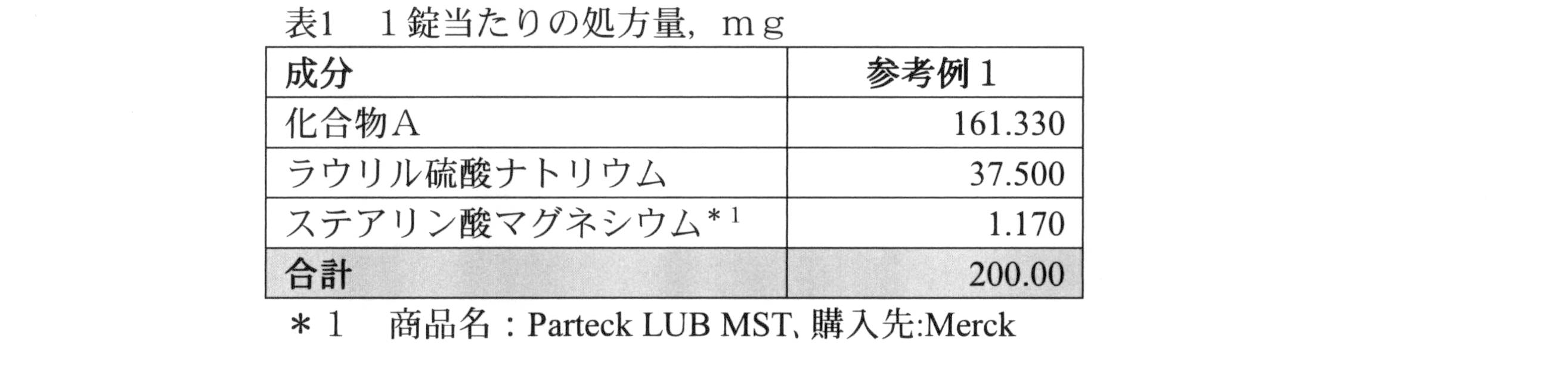
参考例1について、試験液にポリオオキシエチレン(10)オクチルフェニルエーテル4%を含む日本薬局方溶出試験液第1液900mLを用いて、日本薬局方溶出試験パドル法にて毎分100回転で溶出試験(溶出試験2)を行った。参考例1の溶出プロファイルを図1に示す。また、製剤の試験前、試験後の外観、及び試験後の中央切断面の写真を図2に示す。
図1に示す通り、湿式造粒により製した化合物A及びラウリル硫酸ナトリウムを含む処方による錠剤の溶出プロファイルは直線的であり、また最大溶出率は40%以下であった。また、図2に示す通り、試験後の製剤を錠剤中央にて切断した観察結果から試験液は錠剤表面のみにしか浸透しておらず、内部は乾燥していた。これは不浸透性被膜が錠剤表面に生じるためと考えられ、試験液の錠剤内部への浸透が阻害されるために崩壊が進行せず良好な溶出プロファイルが得られない理由であると考えられる。なお、不浸透性被膜とは試験液中での塩基性薬剤と陰イオン界面活性剤による錠剤表面に生じる被膜のことをいう。
(製剤の製造)
表2に記載の錠剤処方の各成分量に従い、錠剤を調製した。処方中の後末成分に含まれるXは、表3に示す各物質を用いた。顆粒処方成分を混合し、この予混合末をステンレスビーカー内に投入し、金属製のスパーテルで撹拌しながら精製水を添加して湿式造粒した後、真空乾燥機(VOS-301SD、東京理化器械株式会社)で常温にて乾燥した。続いてサイズ径850μmの篩により整粒して顆粒とし、後末成分とさらに混合することで配合末を得た。各配合末を静圧打錠機(P-16、理研精機株式会社)にて打圧(1000kgf)で打錠し、フリー体に換算して化合物Aを300mg含有する錠剤(15.9×8.4 mm)を製造した。なお、比較例1は特許文献5のカプセル剤処方を用いて製した錠剤であり、比較例1と実施例1-7との比較により、Xの種類と錠剤の崩壊時間の関係を検討した。
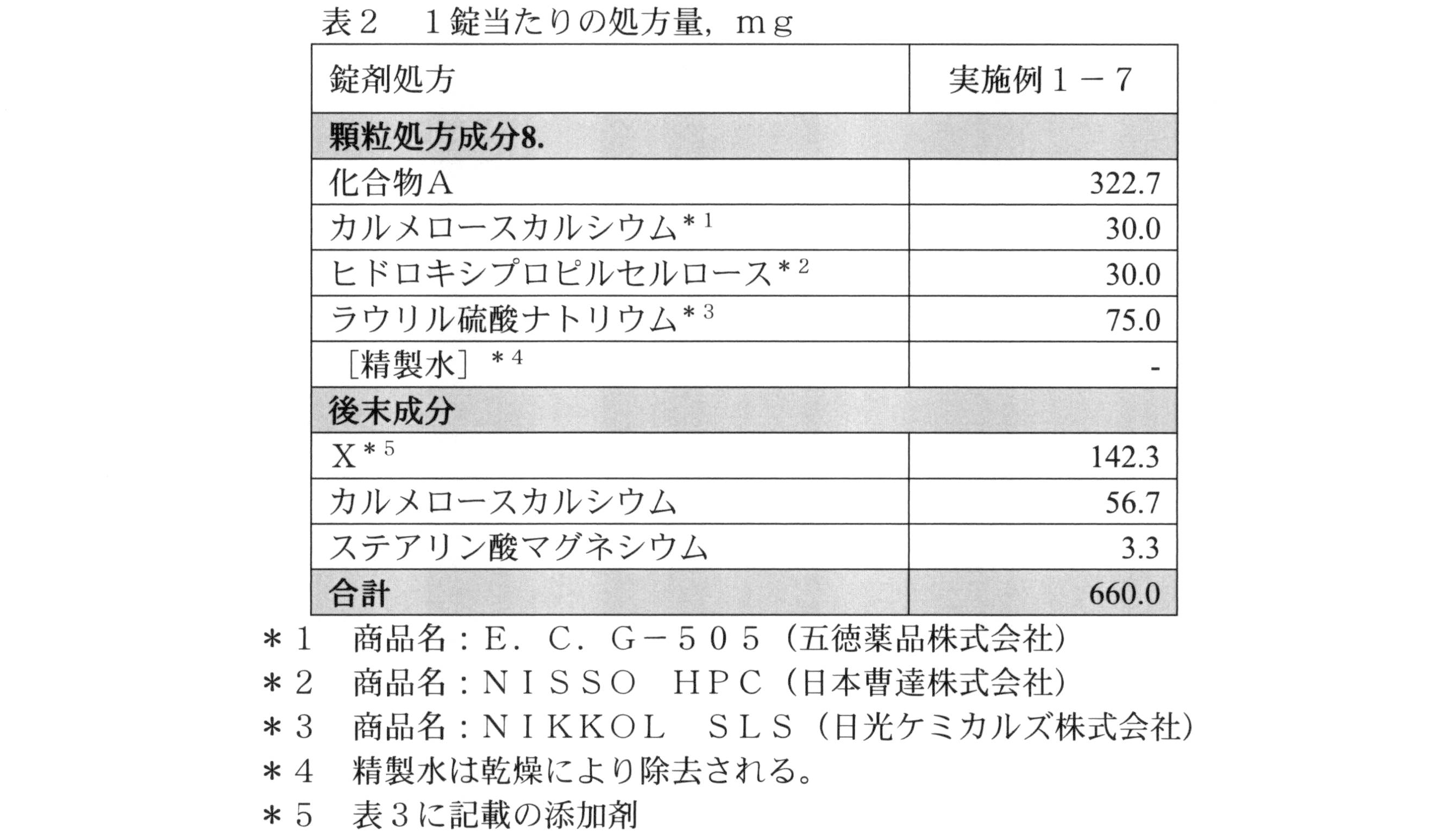
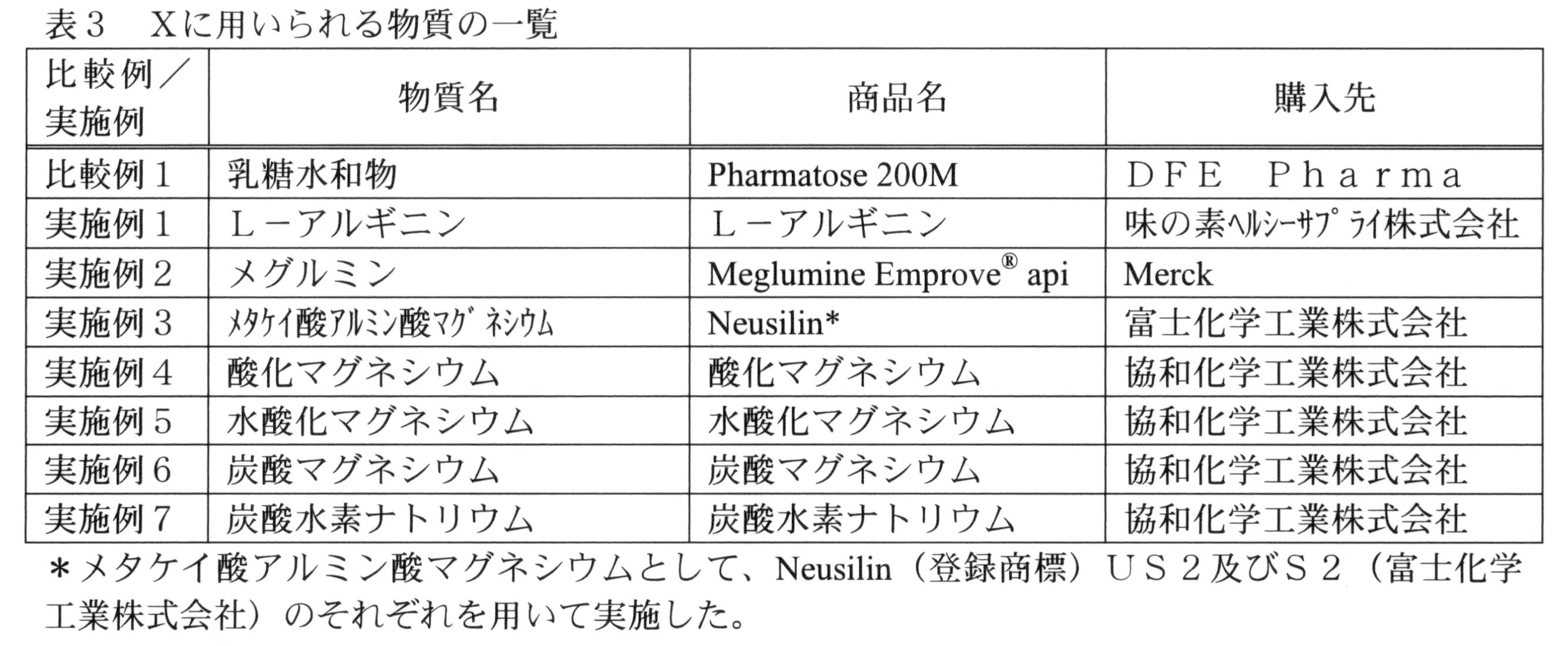
-:30分時点で試料の残留物を認める。
+ :30分時点で試料の残留物を認めるが軟質の物質若しくは泥上の物質がわずかである。
++:30分時点で試料の残留物を認めない。
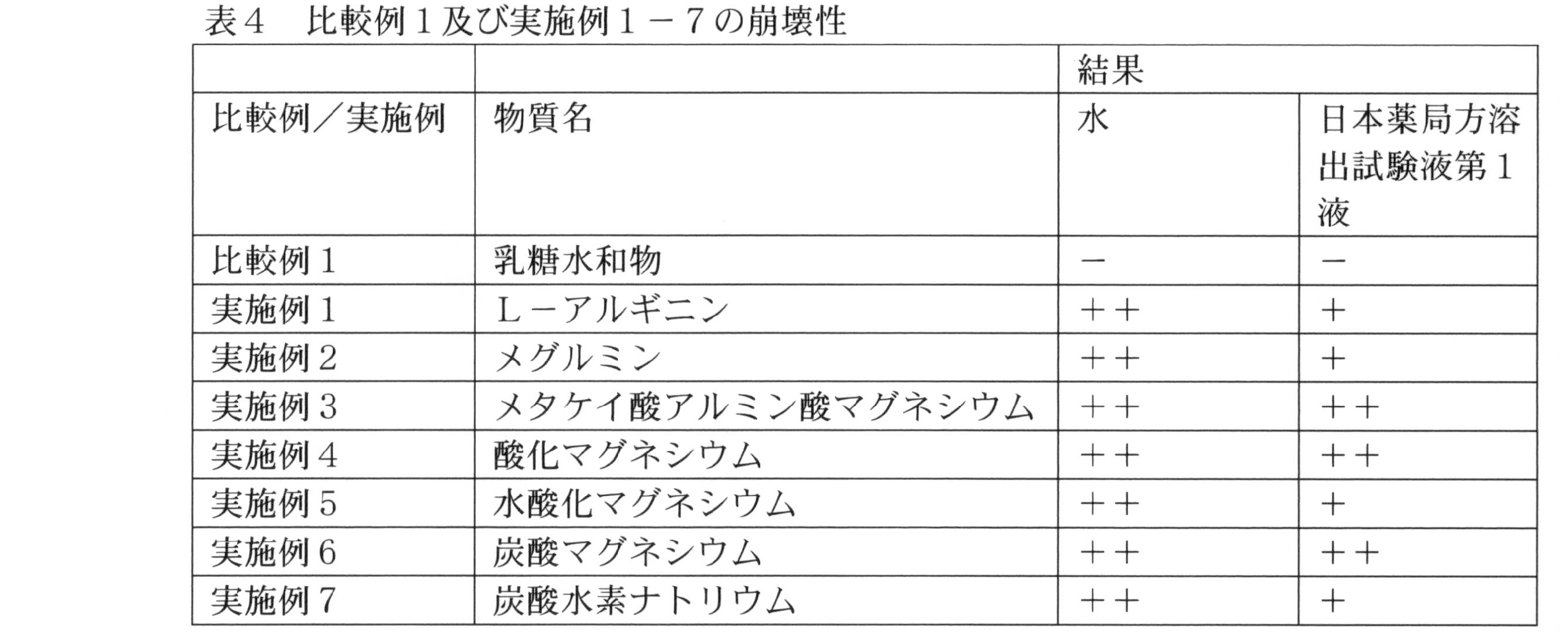
表4に示す通り、実施例1-7において、Xとして塩基性物質を用いて製した錠剤は、比較例1よりも優れた崩壊性を示した。
(製剤の製造)
表5に記載の錠剤処方の各成分量に従い、製法を変えて錠剤を調製した。実施例8は処方成分を混合、配合末とした。実施例9は顆粒処方成分を混合し、静圧打錠機(P-16、理研精機株式会社)にてΦ16mmの杵を用いて打圧(400 kgf)にて打錠し、得られた成形物をサイズ径850μmの篩により整粒して顆粒とし、後末成分とさらに混合することで配合末を得た。実施例10は表5に記載の処方成分を混合、この予混合末をステンレスビーカー内に投入し、金属製のスパーテルで撹拌しながら精製水を添加して湿式造粒した後、真空乾燥機(VOS-301SD、東京理化器械株式会社)で常温にて乾燥した。続いてサイズ径850μmの篩により整粒して顆粒とし、後末成分とさらに混合することで配合末を得た。実施例8-10の各配合末を静圧打錠機(P-16、理研精機株式会社)にて打圧(500kgf)で打錠し、フリー体に換算して化合物Aを150mg含有する錠剤を製造した。塩基性物質を処方成分に加えた場合の製法による錠剤の溶出性を検討した。
(製剤評価及び結果)
図3に示す通り、実施例8-10において、製法によらず、すなわち顆粒形成の有無に関わらず、処方成分中に塩基性物質を用いて製した錠剤は、比較例1よりも優れた溶出性を示した。本結果は既承認カプセル製剤の各国溶出試験規格に適合するものである。
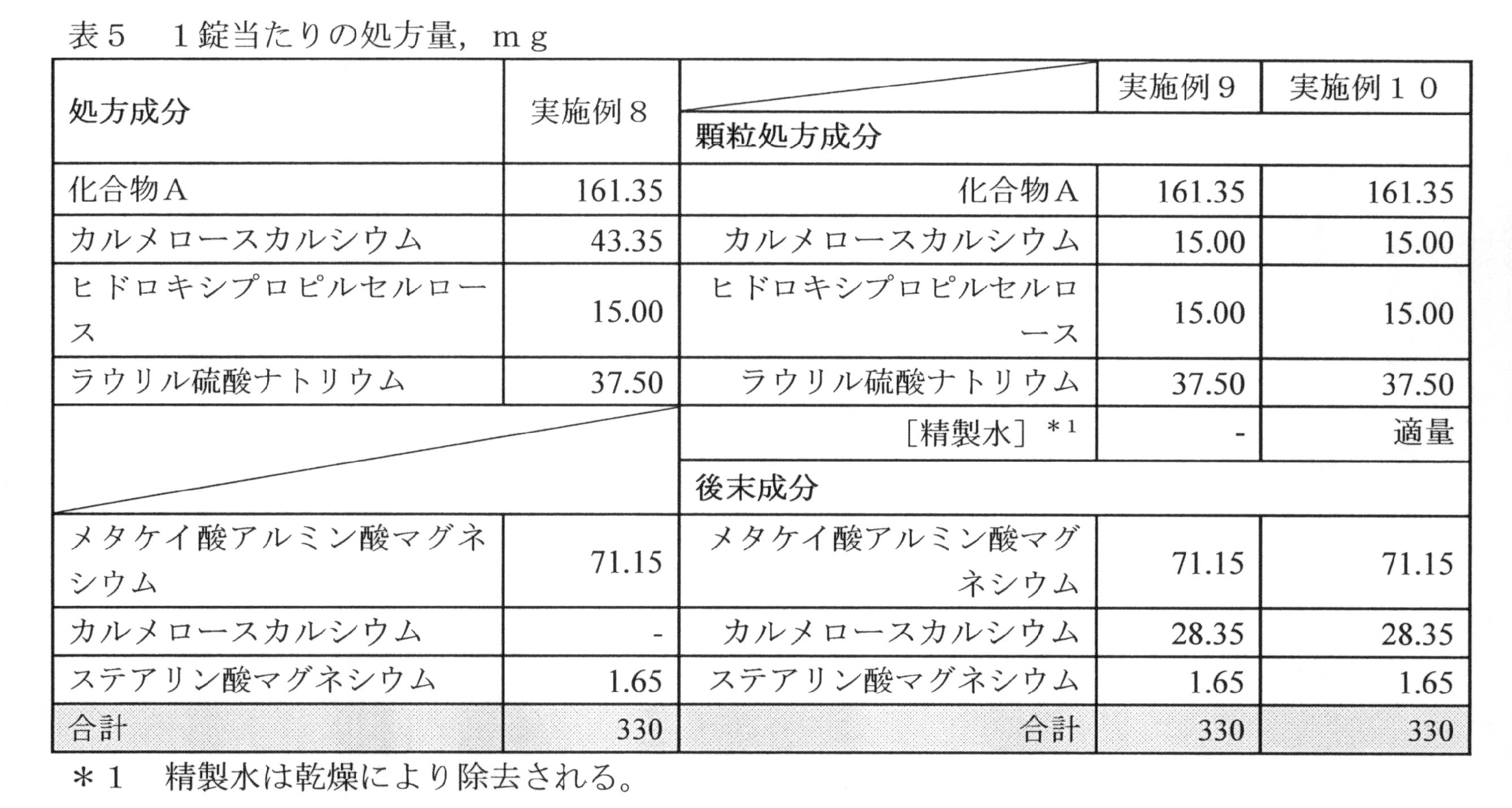
(製剤の製造)
表6に記載の各成分量に従い、顆粒処方成分を混合し、この予混合へ精製水を添加し実施例1-7と同様に湿式造粒した。湿式造粒で得られた造粒末を乾燥し、サイズ径850μmの篩により整粒して顆粒とし、後末成分とさらに混合することで配合末を得た。それぞれの配合末を静圧打錠機(P-16、理研精機株式会社)にて打圧(1000 kgf)で打錠し、フリー体に換算して化合物Aを300mg含有する錠剤(15.9×8.3 mm)を製造した。顆粒処方成分に対する賦形剤の比率や、後末成分における崩壊剤と塩基性物質の比率による錠剤の溶出性を検討した。
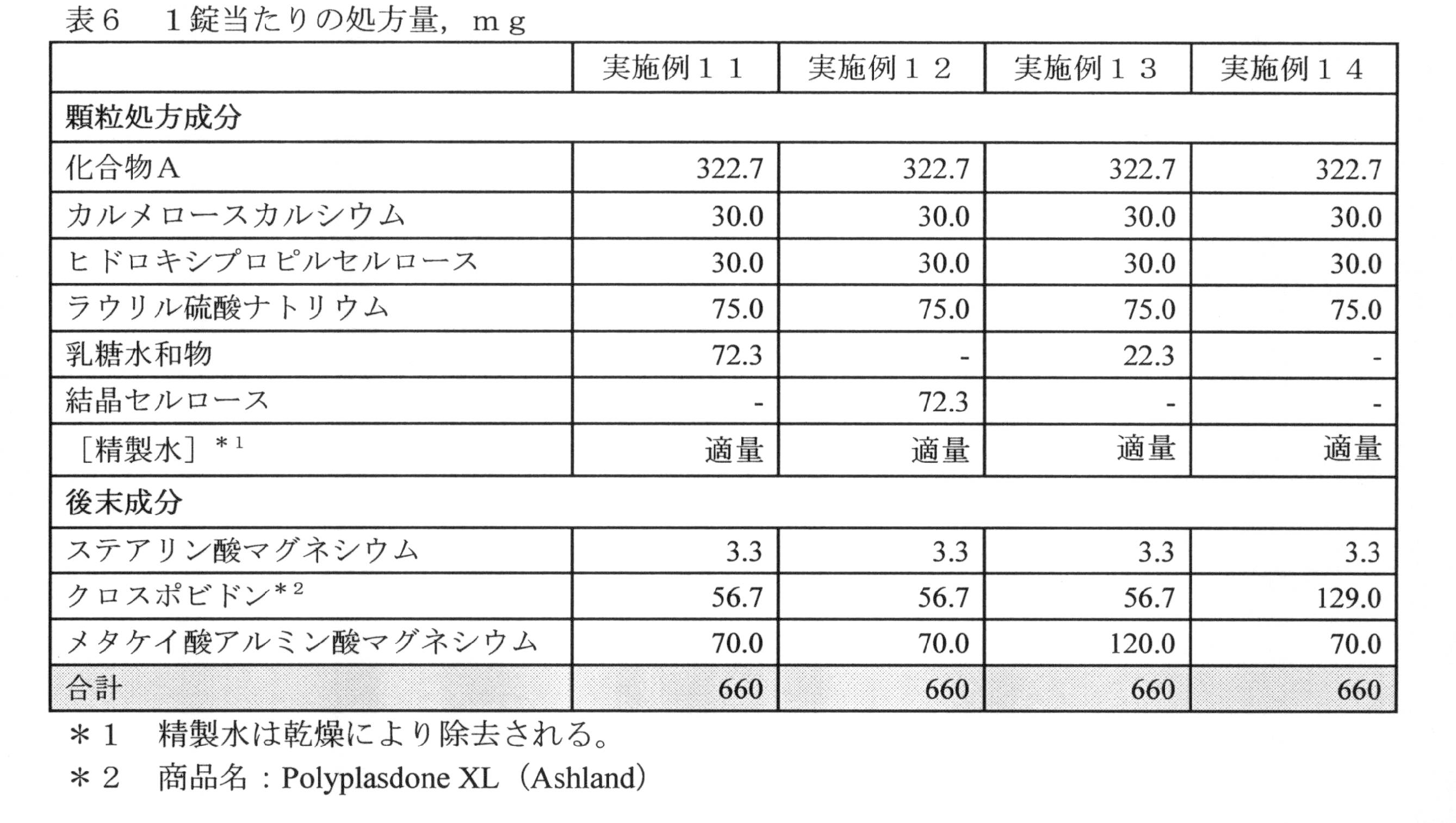
実施例11-14について、試験液にギ酸33mL及びポリオキシエチレン(10)オクチルフェニルエーテル2%を含む精製水900mLを用いて、日本薬局方溶出試験パドル法にて毎分100回転で溶出試験(溶出試験1)を行った。実施例11-14の溶出プロファイルを図4に示す。
図4に示す通り、塩基性物質(メタケイ酸アルミン酸マグネシウム)を加えることで、顆粒処方成分の賦形剤の種類・崩壊剤の比率によらず、良好な溶出プロファイルが得られた。
(製剤の製造)
表7に記載の各成分量に従い、顆粒処方成分を秤量し、造粒機(VG-05、株式会社パウレック)を用いて混合、精製水を添加し造粒し、乾燥減量が2%以下になるまで流動層乾燥機(FL-LABO、給気温度60℃)で乾燥した。得られた乾燥末をサイズ径1.4 mmのスクリーンを用いた整粒機により顆粒とし、後末成分とさらに混合することで配合末を得た。それぞれの配合末を実施例8-10と同様の条件により静圧打錠機にてフリー体に換算して化合物Aを150mg含有する錠剤を製造し溶出性を検討した。
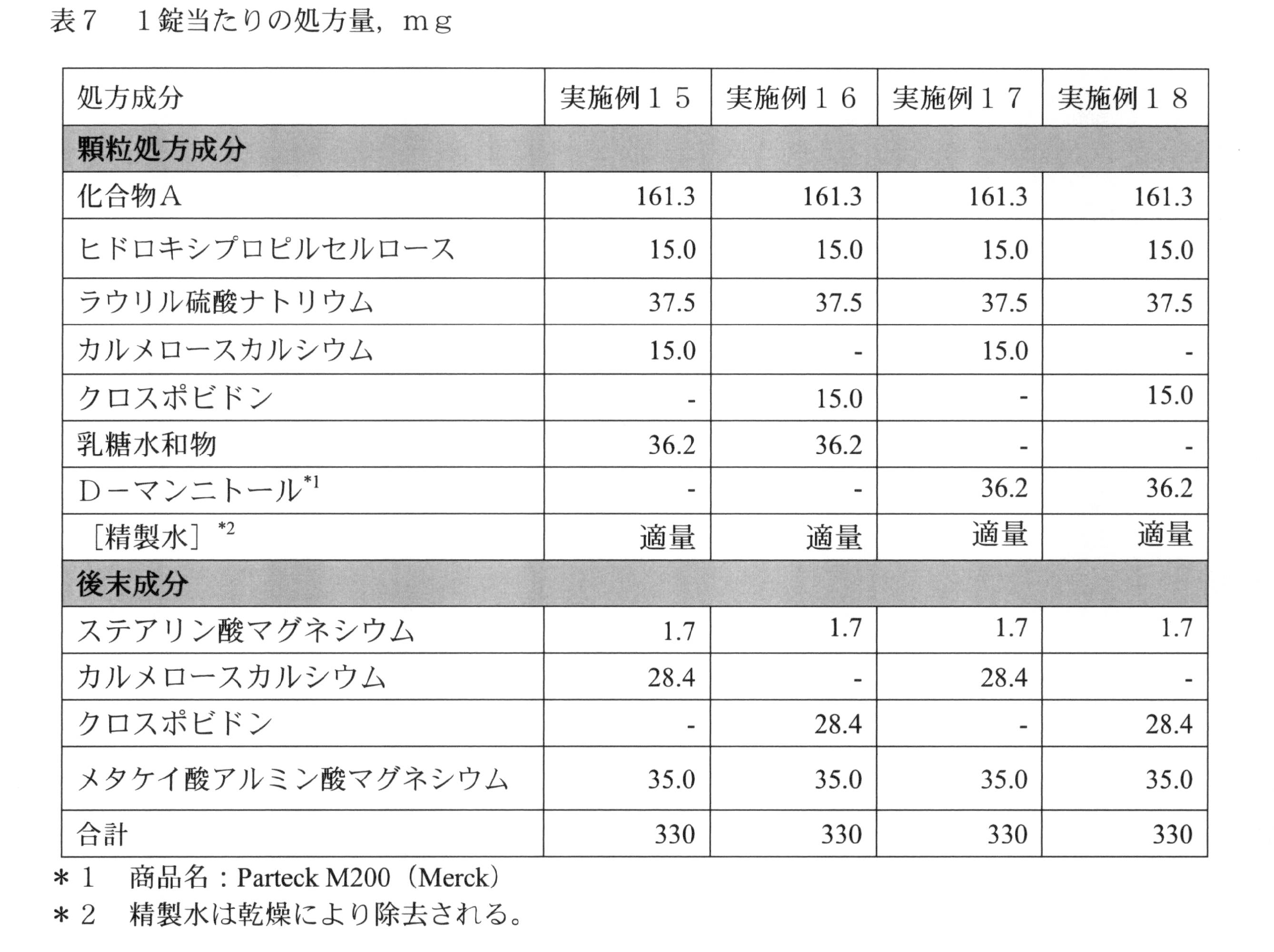
実施例15-18について、試験液に日本薬局方溶出試験液第1液を用いて、日本薬局方崩壊試験にて崩壊試験(崩壊試験1)を行った。実施例15-18は、全ての錠剤について、30分時点で試料の残留物を認めなかった。なお、本試験は、水に比べてより崩壊が進みにくい酸性条件下での崩壊試験(崩壊試験1)である。
実施例15-18について、試験液としてポリオキシエチレン(10)オクチルフェニルエーテル4%を含む日本薬局方溶出試験液第1液900mLを用いて、日本薬局方溶出試験パドル法にて毎分100回転で溶出試験(溶出試験2)を行った。実施例15-18の溶出プロファイルを図5に示す。
図5に示す通り、メタケイ酸アルミン酸マグネシウムの添加により、錠剤からの化合物Aの溶出プロファイルは、賦形剤及び崩壊剤の組み合わせによらず良好な溶出性を示した。本結果は既承認カプセル製剤の各国溶出試験規格に適合するものである。
(製剤の製造)
表8に記載の各成分量に従い、それぞれ顆粒処方成分を秤量し、流動層造粒乾燥機(FG-602、フロイント産業株式会社)を用いて混合し、精製水をスプレーにより添加、造粒し、乾燥減量が2%以下になるまで同機を用いて給気温度60℃で乾燥した。得られた乾燥末をサイズ径1.4 mmのスクリーンを用いた整粒機により整粒し、得られた顆粒と後末成分をさらに混合することで配合末を得た。配合末をロータリー打錠機(AQUARIUS-C、菊水製作所)にて打圧(10 kN)で打錠し、フリー体に換算して化合物Aを300mg含有する錠剤(17.3×8.0 mm)を製造した。実施例15-18と比較することで錠剤重量と崩壊性の関係を検討した。
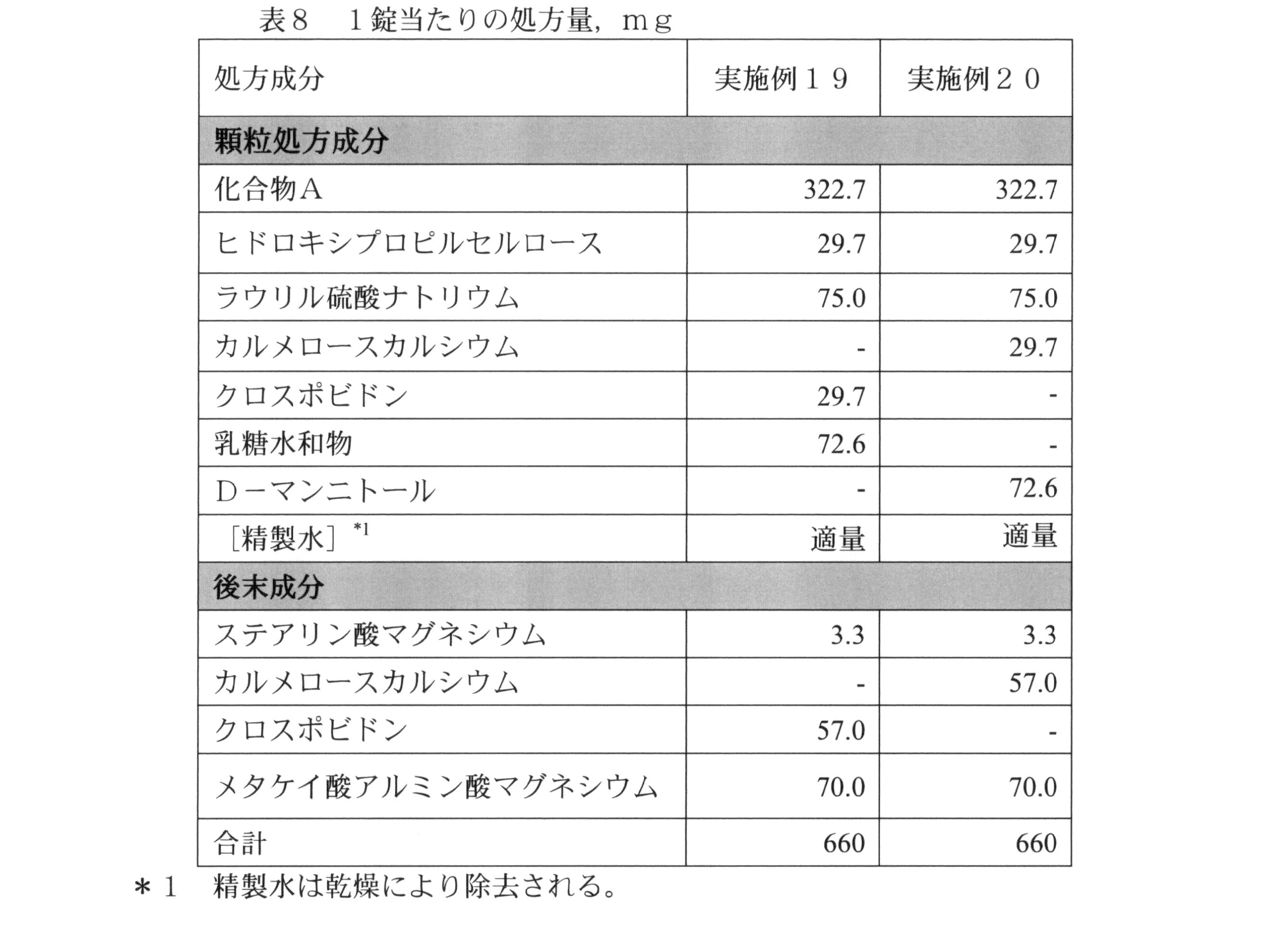
(製剤評価及び結果)
塩基性物質であるメタケイ酸アルミン酸マグネシウムを加えることで錠剤重量が増加しても実施例15-18と同様に良好な崩壊性を示した。
Claims (11)
- 式(I)で示される化合物又はその塩、界面活性剤及び塩基性物質を含有する医薬組成物。
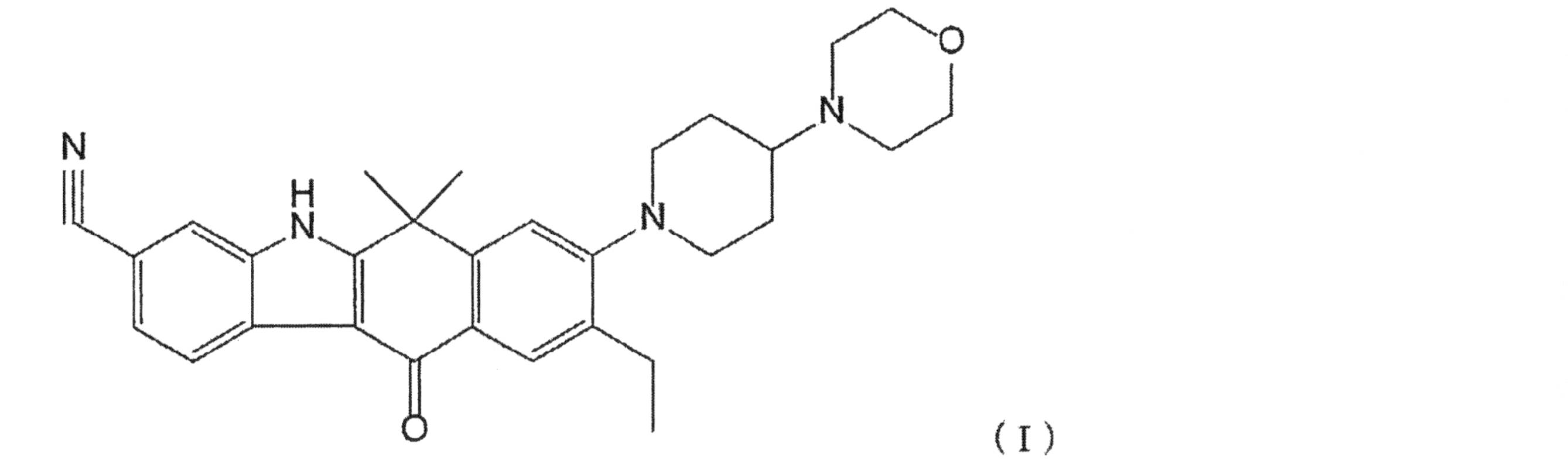
- 前記界面活性剤が陰イオン界面活性剤である、請求項1に記載の組成物。
- 前記陰イオン界面活性剤がラウリル硫酸ナトリウムである、請求項2に記載の組成物。
- 更に崩壊剤を含む請求項1乃至3のいずれか一項に記載の組成物。
- 式(I)で示される化合物又はその塩と界面活性剤との重量比が100:3~100:50である、請求項1乃至4のいずれか一項に記載の組成物。
- 前記崩壊剤を5重量%以上含有する請求項4又は5に記載の組成物。
- 前記崩壊剤が、カルメロースカルシウム、クロスポビドン、デンプングリコール酸ナトリウム及びクロスカルメロースナトリウムからなる群から選択される1以上の物質である、請求項4乃至6のいずれか一項に記載の組成物。
- 前記塩基性物質が、無機の塩基性物質及び有機の塩基性物質からなる群から選択される1以上の物質である、請求項1乃至7のいずれか一項に記載の組成物。
- 前記塩基性物質が、メタケイ酸アルミン酸マグネシウム、L-アルギニン、メグルミン、酸化マグネシウム、水酸化マグネシウム、炭酸マグネシウム及び炭酸水素ナトリウムからなる群から選択される1以上の物質である、請求項1乃至8のいずれか一項に記載の組成物。
- 前記塩基性物質を5重量%以上含有する請求項1乃至9のいずれか一項に記載の組成物。
- 請求項1乃至10のいずれか一項に記載の組成物を含有する錠剤。
Priority Applications (14)
| Application Number | Priority Date | Filing Date | Title |
|---|---|---|---|
| EP25182781.2A EP4606435A3 (en) | 2018-06-29 | 2019-06-28 | Pharmaceutical composition comprising poorly soluble basic agent |
| KR1020217001170A KR20210024541A (ko) | 2018-06-29 | 2019-06-28 | 난용성의 염기성 약제를 함유하는 의약 조성물 |
| CN201980042661.1A CN112384223B (zh) | 2018-06-29 | 2019-06-28 | 含有难溶性碱性药剂的药物组合物 |
| JP2020527688A JP7346403B2 (ja) | 2018-06-29 | 2019-06-28 | 難溶性の塩基性薬剤を含有する医薬組成物 |
| BR112020025499-1A BR112020025499A2 (pt) | 2018-06-29 | 2019-06-28 | Composição farmacêutica que compreende agente básico pouco solúvel |
| EP23212247.3A EP4316598B1 (en) | 2018-06-29 | 2019-06-28 | Pharmaceutical composition comprising a poorly soluble basic agent |
| EP19826841.9A EP3815688B1 (en) | 2018-06-29 | 2019-06-28 | Pharmaceutical composition containing poorly-soluble basic medicine |
| US17/255,707 US12564594B2 (en) | 2018-06-29 | 2019-06-28 | Pharmaceutical composition containing 9-ethyl-6, 6-dimethyl-8-(4-morpholin-4-yl-piperidin-1-yl)-11-oxo-6, 11-dihydro-5H-benzo[b]carbazole-3-carbonitrile |
| AU2019293777A AU2019293777A1 (en) | 2018-06-29 | 2019-06-28 | Pharmaceutical composition containing poorly-soluble basic medicine |
| CA3104995A CA3104995A1 (en) | 2018-06-29 | 2019-06-28 | Pharmaceutical composition comprising poorly soluble basic agent |
| MX2020014262A MX2020014262A (es) | 2018-06-29 | 2019-06-28 | Composicion farmaceutica que comprende un agente basico poco soluble. |
| IL279594A IL279594A (en) | 2018-06-29 | 2020-12-20 | Pharmaceutical preparations containing low-solubility basic drugs |
| JP2023144737A JP7648698B2 (ja) | 2018-06-29 | 2023-09-06 | 難溶性の塩基性薬剤を含有する医薬組成物 |
| JP2025035425A JP2025081776A (ja) | 2018-06-29 | 2025-03-06 | 難溶性の塩基性薬剤を含有する医薬組成物 |
Applications Claiming Priority (2)
| Application Number | Priority Date | Filing Date | Title |
|---|---|---|---|
| JP2018124830 | 2018-06-29 | ||
| JP2018-124830 | 2018-06-29 |
Publications (1)
| Publication Number | Publication Date |
|---|---|
| WO2020004630A1 true WO2020004630A1 (ja) | 2020-01-02 |
Family
ID=68985006
Family Applications (1)
| Application Number | Title | Priority Date | Filing Date |
|---|---|---|---|
| PCT/JP2019/025856 Ceased WO2020004630A1 (ja) | 2018-06-29 | 2019-06-28 | 難溶性の塩基性薬剤を含有する医薬組成物 |
Country Status (12)
| Country | Link |
|---|---|
| US (1) | US12564594B2 (ja) |
| EP (3) | EP4316598B1 (ja) |
| JP (3) | JP7346403B2 (ja) |
| KR (1) | KR20210024541A (ja) |
| CN (1) | CN112384223B (ja) |
| AU (1) | AU2019293777A1 (ja) |
| BR (1) | BR112020025499A2 (ja) |
| CA (1) | CA3104995A1 (ja) |
| IL (1) | IL279594A (ja) |
| MX (1) | MX2020014262A (ja) |
| TW (1) | TW202019430A (ja) |
| WO (1) | WO2020004630A1 (ja) |
Cited By (3)
| Publication number | Priority date | Publication date | Assignee | Title |
|---|---|---|---|---|
| WO2022163794A1 (ja) | 2021-01-29 | 2022-08-04 | 中外製薬株式会社 | 小児がん治療用医薬組成物 |
| WO2022210829A1 (ja) * | 2021-04-01 | 2022-10-06 | ニプロ株式会社 | アビラテロン酢酸エステル含有錠剤 |
| WO2023074785A1 (ja) | 2021-10-28 | 2023-05-04 | 中外製薬株式会社 | シロップ剤 |
Families Citing this family (2)
| Publication number | Priority date | Publication date | Assignee | Title |
|---|---|---|---|---|
| BR112020025499A2 (pt) | 2018-06-29 | 2021-03-09 | Chugai Seiyaku Kabushiki Kaisha | Composição farmacêutica que compreende agente básico pouco solúvel |
| CN122272553B (zh) * | 2026-05-18 | 2026-07-24 | 江苏润恒制药有限公司 | 一种高稳定性布美他尼片及其制备方法 |
Citations (8)
| Publication number | Priority date | Publication date | Assignee | Title |
|---|---|---|---|---|
| JPS4918630B1 (ja) | 1970-07-29 | 1974-05-11 | ||
| JPS506987B1 (ja) | 1970-02-17 | 1975-03-19 | ||
| JP2009100783A (ja) | 2006-10-11 | 2009-05-14 | Astellas Pharma Inc | Eml4−alk融合遺伝子 |
| JP4588121B1 (ja) | 2009-06-10 | 2010-11-24 | 中外製薬株式会社 | 4環性化合物 |
| WO2012023597A1 (ja) * | 2010-08-20 | 2012-02-23 | 中外製薬株式会社 | 4環性化合物を含む組成物 |
| WO2015163448A1 (ja) * | 2014-04-25 | 2015-10-29 | 中外製薬株式会社 | 4環性化合物を高用量含有する製剤 |
| WO2015163447A1 (ja) | 2014-04-25 | 2015-10-29 | 中外製薬株式会社 | 4環性化合物の新規結晶 |
| WO2016021707A1 (ja) | 2014-08-08 | 2016-02-11 | 中外製薬株式会社 | 4環性化合物の非晶質体 |
Family Cites Families (40)
| Publication number | Priority date | Publication date | Assignee | Title |
|---|---|---|---|---|
| US5182289A (en) | 1988-06-14 | 1993-01-26 | Schering Corporation | Heterobicyclic compounds having antiinflammatory activity |
| JPH0565258A (ja) | 1991-07-03 | 1993-03-19 | Nippon Bayeragrochem Kk | 酢酸アニリド誘導体および除草剤 |
| JPH0892090A (ja) | 1994-07-26 | 1996-04-09 | Tanabe Seiyaku Co Ltd | 医薬組成物 |
| EP0695755B1 (en) | 1994-08-04 | 1998-10-21 | F. Hoffmann-La Roche AG | Pyrrolocarbazole |
| BR9709301A (pt) | 1996-05-01 | 1999-08-10 | Univ Mississipi | Inibidores da proteína quinase c halo-substituídos |
| US6632822B1 (en) | 1999-05-14 | 2003-10-14 | The Australian National University | Compounds and therapeutic methods |
| GB0030417D0 (en) | 2000-12-13 | 2001-01-24 | Pharma Mar Sa | An anticancer lead compound isolated from a New Zealand ascidian |
| FR2841138B1 (fr) | 2002-06-25 | 2005-02-25 | Cll Pharma | Composition pharmaceutique solide contenant un principe actif lipophile, son procede de preparation |
| CN100398519C (zh) | 2003-02-28 | 2008-07-02 | 伊诺泰克制药公司 | 四环苯甲酰胺衍生物及其用法 |
| EP1454992B1 (en) | 2003-03-07 | 2006-05-31 | Istituto Nazionale Per Lo Studio E La Cura Dei Tumori | Anaplastic lymphoma kinase assay, reagents and compositions thereof |
| GB0305929D0 (en) | 2003-03-14 | 2003-04-23 | Novartis Ag | Organic compounds |
| US7872014B2 (en) | 2003-07-23 | 2011-01-18 | Exelixis, Inc. | Anaplastic lymphoma kinase modulators and methods of use |
| US7378414B2 (en) | 2003-08-25 | 2008-05-27 | Abbott Laboratories | Anti-infective agents |
| US7611728B2 (en) | 2003-09-05 | 2009-11-03 | Supernus Pharmaceuticals, Inc. | Osmotic delivery of therapeutic compounds by solubility enhancement |
| RU2006121646A (ru) | 2003-11-21 | 2008-01-10 | Новартис АГ (CH) | Производные 1h-имидазохинолина в качестве ингибиторов протеинкиназы |
| CA2548600A1 (en) | 2003-12-12 | 2005-06-23 | Merck Frosst Canada & Co. | Cathepsin cysteine protease inhibitors |
| WO2005090304A1 (en) | 2004-03-19 | 2005-09-29 | Speedel Experimenta Ag | Organic compounds |
| CA2559866A1 (en) | 2004-03-31 | 2005-10-20 | Exelixis, Inc. | Anaplastic lymphoma kinase modulators and methods of use |
| EP3216445A1 (en) | 2004-05-28 | 2017-09-13 | Imaginot Pty Ltd. | Oral therapeutic compound delivery system |
| JP4242911B2 (ja) | 2004-08-26 | 2009-03-25 | ファイザー・インク | プロテインキナーゼ阻害薬としてのエナンチオピュアなアミノヘテロアリール化合物 |
| US7091202B2 (en) | 2004-09-15 | 2006-08-15 | Bristol-Myers Squibb Company | 4-arylspirocycloalkyl-2-aminopyrimidine carboxamide KCNQ potassium channel modulators |
| GB0517329D0 (en) | 2005-08-25 | 2005-10-05 | Merck Sharp & Dohme | Stimulation of neurogenesis |
| RU2008122547A (ru) | 2005-11-07 | 2009-12-20 | Айрм Ллк (Bm) | Соединения и композиции как модуляторы арпп (активированных рецепторов пролифератора пероксисом) |
| US7601716B2 (en) | 2006-05-01 | 2009-10-13 | Cephalon, Inc. | Pyridopyrazines and derivatives thereof as ALK and c-Met inhibitors |
| US8063225B2 (en) | 2006-08-14 | 2011-11-22 | Chembridge Corporation | Tricyclic compound derivatives useful in the treatment of neoplastic diseases, inflammatory disorders and immunomodulatory disorders |
| MX2009004426A (es) | 2006-10-23 | 2009-08-12 | Cephalon Inc | Derivados biciclicos fusionados de 2,4-diaminopirimidina como inhibidores alk y c-met. |
| US8546394B2 (en) | 2007-04-17 | 2013-10-01 | Bristol-Myers Squibb Company | Substituted [1,2,4]triazolo[4,3-A]pyrazine 11-beta-hydroxysteroid dehydrogenase inhibitors |
| TWI389893B (zh) | 2007-07-06 | 2013-03-21 | Astellas Pharma Inc | 二(芳胺基)芳基化合物 |
| EA018503B1 (ru) | 2007-07-20 | 2013-08-30 | НЕРВИАНО МЕДИКАЛ САЙЕНСИЗ С.р.л. | Замещенные производные индазола, активные как ингибиторы киназы |
| WO2009073620A2 (en) | 2007-11-30 | 2009-06-11 | Newlink Genetics | Ido inhibitors |
| ES2510866T3 (es) | 2008-03-13 | 2014-10-21 | Daiichi Sankyo Company, Limited | Mejora de la solubilidad de una preparación que contiene olmesartán medoxomilo |
| EA201190235A1 (ru) | 2009-05-07 | 2012-05-30 | Астразенека Аб | Замещенные 1-цианоэтилгетероциклилкарбоксамидные соединения 750 |
| US8609097B2 (en) | 2009-06-10 | 2013-12-17 | Hoffmann-La Roche Inc. | Use of an anti-Tau pS422 antibody for the treatment of brain diseases |
| GB0910046D0 (en) | 2009-06-10 | 2009-07-22 | Glaxosmithkline Biolog Sa | Novel compositions |
| WO2012042421A1 (en) | 2010-09-29 | 2012-04-05 | Pfizer Inc. | Method of treating abnormal cell growth |
| JP5006987B2 (ja) | 2010-11-22 | 2012-08-22 | 中外製薬株式会社 | 4環性化合物を含む医薬 |
| PL2902029T3 (pl) | 2012-09-25 | 2019-01-31 | Chugai Seiyaku Kabushiki Kaisha | Inhibitor RET |
| KR101890649B1 (ko) | 2013-07-30 | 2018-09-28 | 라이온 가부시키가이샤 | 정제 |
| MX2017015936A (es) | 2014-06-18 | 2018-04-18 | Chugai Pharmaceutical Co Ltd | Nueva composicion farmaceutica que comprende agentes tensioactivos no ionicos. |
| BR112020025499A2 (pt) | 2018-06-29 | 2021-03-09 | Chugai Seiyaku Kabushiki Kaisha | Composição farmacêutica que compreende agente básico pouco solúvel |
-
2019
- 2019-06-28 BR BR112020025499-1A patent/BR112020025499A2/pt unknown
- 2019-06-28 KR KR1020217001170A patent/KR20210024541A/ko not_active Withdrawn
- 2019-06-28 EP EP23212247.3A patent/EP4316598B1/en active Active
- 2019-06-28 MX MX2020014262A patent/MX2020014262A/es unknown
- 2019-06-28 CN CN201980042661.1A patent/CN112384223B/zh active Active
- 2019-06-28 JP JP2020527688A patent/JP7346403B2/ja active Active
- 2019-06-28 US US17/255,707 patent/US12564594B2/en active Active
- 2019-06-28 EP EP25182781.2A patent/EP4606435A3/en active Pending
- 2019-06-28 AU AU2019293777A patent/AU2019293777A1/en not_active Abandoned
- 2019-06-28 CA CA3104995A patent/CA3104995A1/en active Pending
- 2019-06-28 EP EP19826841.9A patent/EP3815688B1/en active Active
- 2019-06-28 WO PCT/JP2019/025856 patent/WO2020004630A1/ja not_active Ceased
- 2019-06-28 TW TW108122884A patent/TW202019430A/zh unknown
-
2020
- 2020-12-20 IL IL279594A patent/IL279594A/en unknown
-
2023
- 2023-09-06 JP JP2023144737A patent/JP7648698B2/ja active Active
-
2025
- 2025-03-06 JP JP2025035425A patent/JP2025081776A/ja active Pending
Patent Citations (9)
| Publication number | Priority date | Publication date | Assignee | Title |
|---|---|---|---|---|
| JPS506987B1 (ja) | 1970-02-17 | 1975-03-19 | ||
| JPS4918630B1 (ja) | 1970-07-29 | 1974-05-11 | ||
| JP2009100783A (ja) | 2006-10-11 | 2009-05-14 | Astellas Pharma Inc | Eml4−alk融合遺伝子 |
| JP4588121B1 (ja) | 2009-06-10 | 2010-11-24 | 中外製薬株式会社 | 4環性化合物 |
| WO2012023597A1 (ja) * | 2010-08-20 | 2012-02-23 | 中外製薬株式会社 | 4環性化合物を含む組成物 |
| WO2015163448A1 (ja) * | 2014-04-25 | 2015-10-29 | 中外製薬株式会社 | 4環性化合物を高用量含有する製剤 |
| WO2015163447A1 (ja) | 2014-04-25 | 2015-10-29 | 中外製薬株式会社 | 4環性化合物の新規結晶 |
| JP5859712B1 (ja) | 2014-04-25 | 2016-02-10 | 中外製薬株式会社 | 4環性化合物を高用量含有する製剤 |
| WO2016021707A1 (ja) | 2014-08-08 | 2016-02-11 | 中外製薬株式会社 | 4環性化合物の非晶質体 |
Non-Patent Citations (4)
| Title |
|---|
| JOURNAL OF CRYSTAL GROWTH, vol. 263, 2004, pages 480 - 490 |
| NATURE, vol. 448, 2007, pages 561 - 566 |
| NEUROPSYCHOPHARMACOLOGY, vol. 33, 2008, pages 685 - 700 |
| YAMAMURA, TAKAHIRO: "Effects of automated external lubrication on tablet properties and the stability of eprazinone hydrochloride", THESIS, vol. 370, no. 1-2, 31 March 2009 (2009-03-31), pages 1 - 7, XP026001800 * |
Cited By (4)
| Publication number | Priority date | Publication date | Assignee | Title |
|---|---|---|---|---|
| WO2022163794A1 (ja) | 2021-01-29 | 2022-08-04 | 中外製薬株式会社 | 小児がん治療用医薬組成物 |
| WO2022210829A1 (ja) * | 2021-04-01 | 2022-10-06 | ニプロ株式会社 | アビラテロン酢酸エステル含有錠剤 |
| JPWO2022210829A1 (ja) * | 2021-04-01 | 2022-10-06 | ||
| WO2023074785A1 (ja) | 2021-10-28 | 2023-05-04 | 中外製薬株式会社 | シロップ剤 |
Also Published As
| Publication number | Publication date |
|---|---|
| US20210290630A1 (en) | 2021-09-23 |
| JP7648698B2 (ja) | 2025-03-18 |
| IL279594A (en) | 2021-03-01 |
| AU2019293777A1 (en) | 2021-02-18 |
| CN112384223A (zh) | 2021-02-19 |
| EP4316598B1 (en) | 2025-06-18 |
| JP2023175743A (ja) | 2023-12-12 |
| EP4316598A3 (en) | 2024-04-17 |
| JP7346403B2 (ja) | 2023-09-19 |
| JP2025081776A (ja) | 2025-05-27 |
| EP4606435A3 (en) | 2025-11-19 |
| JPWO2020004630A1 (ja) | 2021-07-08 |
| KR20210024541A (ko) | 2021-03-05 |
| CN112384223B (zh) | 2024-08-27 |
| US12564594B2 (en) | 2026-03-03 |
| EP3815688C0 (en) | 2023-12-06 |
| EP4316598A2 (en) | 2024-02-07 |
| TW202019430A (zh) | 2020-06-01 |
| EP3815688A1 (en) | 2021-05-05 |
| BR112020025499A2 (pt) | 2021-03-09 |
| EP3815688B1 (en) | 2023-12-06 |
| EP4606435A2 (en) | 2025-08-27 |
| EP3815688A4 (en) | 2022-03-16 |
| MX2020014262A (es) | 2021-03-25 |
| CA3104995A1 (en) | 2020-01-02 |
Similar Documents
| Publication | Publication Date | Title |
|---|---|---|
| JP7648698B2 (ja) | 難溶性の塩基性薬剤を含有する医薬組成物 | |
| US11911509B2 (en) | Pharmaceutical composition comprising Lenvatinib mesylate | |
| KR20160101720A (ko) | Azd9291을 포함하는 제약 조성물 | |
| US12036315B2 (en) | Pharmaceutical composition for oral administration comprising enzalutamide | |
| CN101951889A (zh) | 伊马替尼组合物 | |
| EP3860606B1 (en) | Pharmaceutical composition comprising lenvatinib esylate or tosylate | |
| CN105407925A (zh) | 用于泡腾剂型的制造工艺 | |
| WO2022095913A1 (en) | Solid formulation | |
| KR102206104B1 (ko) | 실로도신을 포함하는 과립물, 및 이를 포함하는 약학적 조성물 및 제형 | |
| WO2014115082A1 (en) | Pharmaceutical formulations of imatinib | |
| TW202434225A (zh) | 恩雜魯胺的固體調配物 | |
| TWI651085B (zh) | N-[5-[2-(3,5-二甲氧基苯基)乙基]-2h-吡唑-3-基]-4-[(3r,5s)-3,5-二甲基哌-1-基]苯甲醯胺之醫藥調配物 | |
| HK40047994A (en) | Pharmaceutical composition containing poorly soluble basic medicine | |
| HK40047994B (en) | Pharmaceutical composition containing poorly soluble basic medicine | |
| KR101809886B1 (ko) | 소형화된 클래리트로마이신 경구투여 제제 | |
| JP2020090484A (ja) | エルロチニブを有効成分とする医薬錠剤 | |
| WO2017078647A1 (en) | Pharmaceutical compositions of imatinib | |
| WO2023074785A1 (ja) | シロップ剤 | |
| JP6945377B2 (ja) | エルロチニブを有効成分とする医薬錠剤及びその製造方法 | |
| WO2024115680A1 (en) | Ribociclib salts and formulations thereof | |
| IL325099A (en) | Oral solid estrogen receptor antagonist dosage forms |
Legal Events
| Date | Code | Title | Description |
|---|---|---|---|
| 121 | Ep: the epo has been informed by wipo that ep was designated in this application |
Ref document number: 19826841 Country of ref document: EP Kind code of ref document: A1 |
|
| ENP | Entry into the national phase |
Ref document number: 2020527688 Country of ref document: JP Kind code of ref document: A |
|
| REG | Reference to national code |
Ref country code: BR Ref legal event code: B01A Ref document number: 112020025499 Country of ref document: BR |
|
| ENP | Entry into the national phase |
Ref document number: 3104995 Country of ref document: CA |
|
| NENP | Non-entry into the national phase |
Ref country code: DE |
|
| ENP | Entry into the national phase |
Ref document number: 20217001170 Country of ref document: KR Kind code of ref document: A |
|
| WWE | Wipo information: entry into national phase |
Ref document number: 2019826841 Country of ref document: EP |
|
| ENP | Entry into the national phase |
Ref document number: 2019293777 Country of ref document: AU Date of ref document: 20190628 Kind code of ref document: A |
|
| ENP | Entry into the national phase |
Ref document number: 112020025499 Country of ref document: BR Kind code of ref document: A2 Effective date: 20201214 |
|
| WWG | Wipo information: grant in national office |
Ref document number: 17255707 Country of ref document: US |