WO2020004046A1 - 熱可塑性ポリエステル樹脂組成物および成形品 - Google Patents
熱可塑性ポリエステル樹脂組成物および成形品 Download PDFInfo
- Publication number
- WO2020004046A1 WO2020004046A1 PCT/JP2019/023370 JP2019023370W WO2020004046A1 WO 2020004046 A1 WO2020004046 A1 WO 2020004046A1 JP 2019023370 W JP2019023370 W JP 2019023370W WO 2020004046 A1 WO2020004046 A1 WO 2020004046A1
- Authority
- WO
- WIPO (PCT)
- Prior art keywords
- thermoplastic polyester
- resin composition
- parts
- polyester resin
- mass
- Prior art date
- Legal status (The legal status is an assumption and is not a legal conclusion. Google has not performed a legal analysis and makes no representation as to the accuracy of the status listed.)
- Ceased
Links
Classifications
-
- A—HUMAN NECESSITIES
- A47—FURNITURE; DOMESTIC ARTICLES OR APPLIANCES; COFFEE MILLS; SPICE MILLS; SUCTION CLEANERS IN GENERAL
- A47K—SANITARY EQUIPMENT; ACCESSORIES THEREFOR, e.g. TOILET ACCESSORIES
- A47K13/00—Seats or covers for all kinds of closets
-
- C—CHEMISTRY; METALLURGY
- C08—ORGANIC MACROMOLECULAR COMPOUNDS; THEIR PREPARATION OR CHEMICAL WORKING-UP; COMPOSITIONS BASED THEREON
- C08K—Use of inorganic or non-macromolecular organic substances as compounding ingredients
- C08K3/00—Use of inorganic substances as compounding ingredients
- C08K3/01—Use of inorganic substances as compounding ingredients characterized by their specific function
- C08K3/014—Stabilisers against oxidation, heat, light or ozone
-
- C—CHEMISTRY; METALLURGY
- C08—ORGANIC MACROMOLECULAR COMPOUNDS; THEIR PREPARATION OR CHEMICAL WORKING-UP; COMPOSITIONS BASED THEREON
- C08K—Use of inorganic or non-macromolecular organic substances as compounding ingredients
- C08K3/00—Use of inorganic substances as compounding ingredients
- C08K3/01—Use of inorganic substances as compounding ingredients characterized by their specific function
- C08K3/016—Flame-proofing or flame-retarding additives
-
- C—CHEMISTRY; METALLURGY
- C08—ORGANIC MACROMOLECULAR COMPOUNDS; THEIR PREPARATION OR CHEMICAL WORKING-UP; COMPOSITIONS BASED THEREON
- C08K—Use of inorganic or non-macromolecular organic substances as compounding ingredients
- C08K3/00—Use of inorganic substances as compounding ingredients
- C08K3/18—Oxygen-containing compounds, e.g. metal carbonyls
- C08K3/20—Oxides; Hydroxides
- C08K3/22—Oxides; Hydroxides of metals
-
- C—CHEMISTRY; METALLURGY
- C08—ORGANIC MACROMOLECULAR COMPOUNDS; THEIR PREPARATION OR CHEMICAL WORKING-UP; COMPOSITIONS BASED THEREON
- C08K—Use of inorganic or non-macromolecular organic substances as compounding ingredients
- C08K3/00—Use of inorganic substances as compounding ingredients
- C08K3/34—Silicon-containing compounds
-
- C—CHEMISTRY; METALLURGY
- C08—ORGANIC MACROMOLECULAR COMPOUNDS; THEIR PREPARATION OR CHEMICAL WORKING-UP; COMPOSITIONS BASED THEREON
- C08L—COMPOSITIONS OF MACROMOLECULAR COMPOUNDS
- C08L23/00—Compositions of homopolymers or copolymers of unsaturated aliphatic hydrocarbons having only one carbon-to-carbon double bond; Compositions of derivatives of such polymers
-
- C—CHEMISTRY; METALLURGY
- C08—ORGANIC MACROMOLECULAR COMPOUNDS; THEIR PREPARATION OR CHEMICAL WORKING-UP; COMPOSITIONS BASED THEREON
- C08L—COMPOSITIONS OF MACROMOLECULAR COMPOUNDS
- C08L67/00—Compositions of polyesters obtained by reactions forming a carboxylic ester link in the main chain; Compositions of derivatives of such polymers
- C08L67/02—Polyesters derived from dicarboxylic acids and dihydroxy compounds
Definitions
- the present invention relates to a thermoplastic polyester resin composition and a molded product obtained by molding the same.
- PBT resin which is a thermoplastic polyester, is excellent in electrical properties, chemical resistance, heat resistance, dimensional stability, etc., and is therefore used in various automobile parts and electric / electronic parts. Widely used for applications such as machine parts, daily necessities, plumbing parts and construction parts.
- the water supply parts referred to herein include bathroom control panels, hand dryers, refrigerator parts, kitchen parts, toilet seats, toilet lids, hot water flush toilet seat parts (wash nozzles, body cases, toilet seats, toilet lids, etc.) and the like.
- a plumbing component is an electric / electronic component and therefore needs to be flame-retardant, and since it is used on a daily basis, it needs to have a good appearance and weather resistance.
- Patent Document 1 As a resin composition having excellent pottery appearance and scratch resistance, there has been proposed a resin composition obtained by blending polybutylene terephthalate, polyethylene terephthalate, wollastonite, and acrylonitrile / styrene copolymer (for example, Patent Document 1). . Further, as a resin composition having excellent surface hardness, appearance and durability, there has been proposed a resin composition obtained by blending polybutylene terephthalate, an acrylic resin, a compatibilizer, and an inorganic filler (for example, Patent Document 1). 2).
- a resin composition having excellent mechanical strength, rigidity, surface hardness, dimensional stability, etc. a resin composition comprising polytrimethylene terephthalate, a thermoplastic resin, an epoxy resin, wollastonite, and a flame retardant is proposed.
- a resin composition having excellent surface appearance, abrasion resistance, and impact resistance a resin composition comprising a mixture of polybutylene terephthalate, polyethylene terephthalate, wollastonite, and a thermoplastic elastomer has been proposed (for example, Patent Document 4).
- Patent Document 5 a resin composition having excellent appearance and mechanical properties
- Patent Document 6 a resin composition comprising a mixture of polybutylene terephthalate, polyethylene terephthalate, a polyfunctional compound, and an inorganic reinforcing material has been proposed (for example, Patent Reference 6).
- Patent Document 7 As a resin composition having excellent surface hardness, appearance, and heat resistance, a resin composition comprising polybutylene terephthalate, polyethylene terephthalate, an acrylic resin, wollastonite, a compatibilizer, and an epoxy compound has been proposed. (For example, Patent Document 7).
- a resin composition having excellent rigidity, impact resistance, thermal stability, hue, and flame retardancy a resin composition comprising a thermoplastic polyester resin, a granular inorganic filler, a rubbery polymer, and a phosphorus-based compound.
- An object has been proposed (for example, Patent Document 8).
- a resin composition having excellent flame retardancy a resin composition comprising a flame retardant such as a polyester resin, polytetrafluoroethylene, and an antimony compound has been proposed (for example, Patent Document 9).
- JP 2010-150484 A JP 2008-150598 A JP 2007-260927 A JP-A-2000-86873 JP 2007-254611 A JP 2009-173900A JP 2010-24337 A JP 2007-284502 A JP 2015-110716 A
- urea resin which is a thermosetting resin
- urea resin has poor heat aging resistance, and is used in products that incorporate heat sources such as heaters. There is a problem that it cannot be applied. From such a background, a material having a high-grade appearance, such as a urea resin, and having heat aging resistance (flame retardancy), strength and weather discoloration resistance is required.
- molded articles made of the resin compositions described in Patent Documents 1 to 5 and 7 did not contain a flame retardant and had insufficient flame retardancy. Moreover, since the molded article made of the resin composition described in Patent Document 1 contains an acrylonitrile-styrene copolymer, it did not satisfy the high-grade appearance of a urea resin. Furthermore, the molded articles made of the resin compositions described in Patent Documents 2, 3, and 9 did not contain an impact modifier such as an elastomer, and thus had insufficient impact strength.
- the molded articles composed of the resin compositions described in Patent Documents 1, 2, 4, and 7 did not satisfy the high-grade appearance of urea resin because of a large amount of walsteinite. Furthermore, molded articles made of the resin compositions described in Patent Documents 6 and 8 do not satisfy the high-grade appearance of urea resins because glass fibers and talc are used as reinforcing materials. Was. Furthermore, molded articles made of the resin compositions described in Patent Documents 1 to 9 did not contain a stabilizer (weathering agent) and thus had insufficient heat discoloration resistance.
- the present invention has been made in view of the above problems, and has excellent moldability, a high-grade appearance like a urea resin, and a thermoplastic resin capable of obtaining a molded article having excellent flame retardancy, impact strength, and weather discoloration resistance.
- An object of the present invention is to provide a polyester resin composition.
- thermoplastic polyester resin composition comprising: (2) The thermoplastic polyester resin according to (1), wherein (A) the thermoplastic polyester comprises (A-1) 80 to 96 parts by mass of polybutylene terephthalate and (A-2) 4 to 20 parts by mass of polyethylene terephthalate. Composition.
- thermoplastic polyester resin composition according to (1) or (2), wherein the average fiber length of (B) wollastenite is 50 ⁇ m or more.
- thermoplastic polyester resin according to any one of (1) to (3) further comprising (E) 1 to 7 parts by mass of an olefin-based elastomer with respect to 100 parts by mass of the thermoplastic polyester (A). Composition.
- a plastic polyester resin composition is described in this specification.
- thermoplastic polyester resin composition according to any one of (1) to (5).
- thermoplastic polyester resin composition of the present invention has excellent moldability, and a molded product obtained by molding the thermoplastic polyester resin composition of the present invention has a high-grade appearance like a urea resin, and further has flame retardancy. It is useful as a bathroom control panel, hand dryer, refrigerator parts, kitchen parts, toilet seat, toilet lid, hot water flush toilet seat parts (wash nozzle, body case, toilet seat, toilet lid, etc.) because of its excellent properties, impact strength, and weather discoloration resistance. is there.
- thermoplastic polyester resin (A) used in the present invention a polymer obtained by a polycondensation reaction containing a dicarboxylic acid (or an ester-forming derivative thereof) and a diol (or an ester-forming derivative thereof) as main components is used. Or a copolymer.
- dicarboxylic acid examples include terephthalic acid, isophthalic acid, orthophthalic acid, 1,5-naphthalenedicarboxylic acid, 2,5-naphthalenedicarboxylic acid, 2,6-naphthalenedicarboxylic acid, 2,2′-biphenyldicarboxylic acid, 3,3 '-Biphenyldicarboxylic acid, 4,4'-biphenyldicarboxylic acid, 4,4'-diphenyletherdicarboxylic acid, 4,4'-diphenylmethanedicarboxylic acid, 4,4'-diphenylsulfonedicarboxylic acid, 4,4'-diphenylisopropylate Redidenedicarboxylic acid, 1,2-bis (phenoxy) ethane-4,4′-dicarboxylic acid, 2,5-anthracenedicarboxylic acid, 2,6-anthracenedicarboxylic acid, 4,4′-p-terphenylene
- dicarboxylic acids may be used as a mixture of two or more.
- adipic acid, azelaic acid, dodecanedioic acid, aliphatic dicarboxylic acids such as sebacic acid, and at least one alicyclic dicarboxylic acid such as cyclohexanedicarboxylic acid may be used together with these dicarboxylic acids. it can.
- diol component examples include aliphatic diols such as ethylene glycol, propylene glycol, butylene glycol, hexylene glycol, neopentyl glycol, 2-methyl-1,3-propanediol, diethylene glycol, and triethylene glycol; Alicyclic diols such as cyclohexanedimethanol, and mixtures thereof; If the amount is small, one or more long-chain diols having a molecular weight of 400 to 6,000, that is, polyethylene glycol, poly-1,3-propylene glycol, polytetramethylene glycol or the like may be copolymerized.
- aliphatic diols such as ethylene glycol, propylene glycol, butylene glycol, hexylene glycol, neopentyl glycol, 2-methyl-1,3-propanediol, diethylene glycol, and triethylene glycol
- Alicyclic diols such as cyclohe
- Two or more long-chain diols having a molecular weight of 400 to 6,000 may be used.
- the long-chain diol having a molecular weight of 400 to 6,000 is preferably 20% by mass or less of the raw material forming the thermoplastic polyester resin (A).
- thermoplastic polyester resin examples include polybutylene terephthalate (PBT), polyethylene terephthalate (PET), polypropylene terephthalate (PPT), polyethylene naphthalate, polybutylene naphthalate (PBN), and polyhexylene terephthalate (PHT).
- PBT polybutylene terephthalate
- PET polyethylene terephthalate
- PPT polypropylene terephthalate
- PBN polybutylene naphthalate
- PHT polyhexylene terephthalate
- “/” means a copolymer.
- the carboxyl group content of the thermoplastic polyester resin (A) used in the present invention is not particularly limited, but is preferably 50 eq / t or less, more preferably 30 eq / t or less, from the viewpoint of hydrolysis resistance. , 20 eq / t or less.
- the lower limit of the amount of the carboxyl group may be 0 eq / t.
- the carboxyl group content of the thermoplastic polyester resin is a value obtained by dissolving the thermoplastic polyester resin in an o-cresol / chloroform solvent and titrating with ethanolic potassium hydroxide.
- the viscosity of the thermoplastic polyester resin (A) used in the present invention is not particularly limited as long as melt kneading is possible.
- the intrinsic viscosity of the o-chlorophenol solution measured at 25 ° C. is 0. It is preferably in the range of .36 to 1.60. If the intrinsic viscosity is 0.36 or more, it is possible to obtain a molded article having excellent mechanical properties. 0.70 or more is more preferable. On the other hand, when the intrinsic viscosity is 1.60 or less, the fluidity can be further improved.
- the method for producing the thermoplastic polyester resin (A) used in the present invention is not particularly limited, and examples thereof include a known polycondensation method and a ring-opening polymerization method. Either a batch polymerization method or a continuous polymerization method may be used, and a method involving a transesterification reaction and a polycondensation reaction, and a method using a polycondensation reaction by direct polymerization (direct polymerization method) can be applied.
- the continuous polymerization method is preferred from the viewpoint that the amount of terminal groups can be reduced and the effect of improving the fluidity is increased, and the direct polymerization method is preferred from the viewpoint of cost.
- a polymerization reaction catalyst In order to effectively promote the esterification reaction or transesterification reaction and polycondensation reaction, it is preferable to add a polymerization reaction catalyst during these reactions, and specific examples of the polymerization reaction catalyst include methyl ester of titanic acid, Organic titanium such as tetra-n-propyl ester, tetra-n-butyl ester, tetraisopropyl ester, tetraisobutyl ester, tetra-tert-butyl ester, cyclohexyl ester, phenyl ester, benzyl ester, tolyl ester, or a mixed ester thereof Compound, dibutyltin oxide, methylphenyltin oxide, tetraethyltin, hexaethylditin oxide, cyclohexahexylditin oxide, didodecyltin oxide, triethyltin hydroxide, trip
- zirconia compounds such as zirconium tetra-n-butoxide, antimony trioxide, and antimony compounds such as antimony acetate.
- organic titanium compounds and tin compounds are preferable.
- tetra-n-propyl ester, tetra-n-butyl ester and tetraisopropyl ester of titanic acid are preferable. Tetra -n- butyl ester is particularly preferred.
- One of these polymerization reaction catalysts may be used alone, or two or more thereof may be used in combination.
- the amount of the polymerization reaction catalyst is preferably in the range of 0.005 to 0.5 part by mass, based on 100 parts by mass of the thermoplastic polyester resin (A), from the viewpoint of mechanical properties, moldability and color tone.
- the range is more preferably 0.2 to 0.2 parts by mass.
- thermoplastic polyester resin (A) used in the present invention can be used as a mixture of two or more kinds.
- the total amount of (A-1) 80 to 96 parts by mass of polybutylene terephthalate and (A-2) 4 to 20 parts by mass of polyethylene terephthalate is 100 parts by mass from the viewpoint of moldability and appearance of a molded product. Is preferred.
- the (A-1) polybutylene terephthalate resin used in the present invention is excellent in crystallization characteristics, heat resistance, moldability, chemical resistance and electrical insulation.
- the (A-2) polyethylene terephthalate resin used in the present invention has excellent chemical resistance and electrical properties. In addition, since the crystallization rate is appropriately low, a molded article having excellent mold transferability and good appearance can be obtained.
- the (A-2) polyethylene terephthalate used in the present invention preferably contains a polyethylene terephthalate resin that has been subjected to one type of process selected from the group consisting of a film forming process, a melt spinning process, and an injection molding process (hereinafter referred to as “recycled”). Abbreviated as material).
- Polyethylene terephthalate that has undergone these steps has more heat history than virgin polyethylene terephthalate that has not undergone these steps, and thus the fluidity of the resulting thermoplastic polyester resin composition is improved.
- Polyethylene terephthalate may be subjected to the above-mentioned steps a plurality of times or may be subjected to two or more kinds of steps. The more the number of steps and the kind of steps, the more the flowability of the obtained thermoplastic polyester resin composition is improved. I do. Specifically, there are recycled materials from so-called factories and the like, and recycled materials that are consumed after being consumed by ordinary consumers.
- the former is a production waste during polycondensation or processing of PET, for example, during injection molding.
- Sprue starting material during injection molding or extrusion, or edge pieces from an extruded plate or film.
- the latter are plastic articles and the like collected and processed after use by end users.
- a popular product in quantity is blow molded PET bottles for mineral water, soft drinks and juices.
- the regenerated material may be in the form of a pulverized material or a granule, but the regenerated material that comes out after being consumed by the consumer is separated and purified, and then melted and granulated in an extruder. This often leads to better operability, flowability and meterability for further processing steps.
- the (B) wollastenite used in the present invention is a natural white mineral having needle-like crystals: wollastonite (calcium metasilicate), represented by the chemical formula CaSiO 3 , which usually contains at least 50% by mass of SiO 2 and CaO It contains 45% by mass to 47% by mass, and additionally contains Fe 2 O 3 , Al 2 O 3 , MgO and the like.
- wollastonite calcium metasilicate
- the average fiber diameter of (B) wollastenite is 4.0 to 40 ⁇ m, preferably 5.0 to 20 ⁇ m, and the aspect ratio L / D is 8 to 30, preferably 15 to 25.
- the average fiber diameter refers to a numerical value obtained by measuring the particle size distribution by a microtrack laser analysis method and performing number average.
- the aspect ratio L / D is represented by a ratio between the average fiber length (L) and the average fiber diameter (D) of the wollastenite fibers measured by the same method.
- the average fiber diameter of wollastenite is 4.0 ⁇ m or more, a sufficient reinforcing effect is obtained and the rigidity is excellent, and when it is 40 ⁇ m or less, a decrease in toughness can be suppressed, which is preferable.
- the aspect ratio of (B) walastenite is 8 or more, a sufficient reinforcing effect is obtained and the rigidity of the molded article is excellent, and when the aspect ratio is 30 or less, the surface appearance of the obtained molded article is good. preferable.
- the average fiber length of (B) wollastenite in the present invention is preferably 50 ⁇ m or more.
- the weathering discoloration resistance of the obtained molded article and the strength of the molded article are improved. More preferably, it is in the range of 80 to 200 ⁇ m, and still more preferably, it is in the range of 110 to 170 ⁇ m.
- (B) wollastenite is a vinylsilane compound such as vinyltriethoxysilane and vinyltrichlorosilane, ⁇ -glycidoxypropyltrimethoxysilane, ⁇ -glycidoxypropyltriethoxysilane, ⁇ - (3,4-epoxy Epoxysilane compounds such as cyclohexyl) ethyltrimethoxysilane, aminosilanes such as ⁇ - (2-aminoethyl) aminopropylmethyldimethoxysilane, ⁇ - (2-aminoethyl) aminopropyltrimethoxysilane, ⁇ -aminopropyltrimethoxysilane Those surface-treated with a compound, a long-chain fatty acid such as stearic acid, oleic acid, montanic acid, stearyl alcohol or a long-chain aliphatic alcohol are preferably used.
- a long-chain fatty acid such as
- the halogen-based flame retardant (C) used in the present invention is not particularly limited as long as it is a substance containing a halogen added for the purpose of imparting flame retardancy to a resin, and specifically, decabromodiphenyl.
- tetrabromobisphenol-A-epoxy oligomer tetrabromobisphenol-A-carbonate oligomer and polypentabromobenzyl acrylate are preferable from the viewpoint of availability, and tetrabromobisphenol-A- is preferable from the viewpoint of hydrolysis resistance.
- Epoxy oligomers are more preferred.
- Preferred tetrabromobisphenol-A-epoxy oligomers include, for example, F-2100L (trade name) manufactured by ICL.
- Preferred examples of the tetrabromobisphenol-A-carbonate oligomer include "Fireguard” (registered trademark) FG-8500 (trade name) manufactured by Teijin Chemicals Limited.
- Preferred examples of polypentabromobenzyl acrylate include FR1025 (trade name) manufactured by ICL.
- the antimony compound (D) used in the present invention can improve flame retardancy when used in combination with the halogen-based flame retardant (C).
- the antimony compound (D) include antimony trioxide, antimony tetroxide, antimony pentoxide, antimony halide, and sodium antimonate. Of these, antimony trioxide is preferable in terms of availability.
- Preferred examples of antimony trioxide include "Fire Cut” (registered trademark) AT-3 (trade name) manufactured by Suzuhiro Chemical Co., Ltd.
- the average particle size of the antimony compound (D) used in the present invention is not particularly limited, but is preferably 1.0 to 2.0 ⁇ m, and more preferably 1.0 to 1.5 ⁇ m. (D) When the particle size of the antimony compound is within the above range, high flame retardancy can be obtained with a relatively small amount of addition.
- the (E) olefin-based elastomer used in the present invention comprises a glycidyl group-containing copolymer having an ⁇ -olefin and a glycidyl ester of an ⁇ , ⁇ -unsaturated acid as a copolymerization component.
- Glycidyl group-containing copolymers comprising a glycidyl ester of an ⁇ -olefin and an ⁇ , ⁇ -unsaturated acid as a copolymerization component include ⁇ -olefins, glycidyl esters of ⁇ , ⁇ -unsaturated acids, and A copolymer obtained by copolymerizing a copolymerizable unsaturated monomer. It is preferable to use a glycidyl ester of an ⁇ -olefin and an ⁇ , ⁇ -unsaturated acid in an amount of 60% by mass or more in all the copolymer components.
- Examples of the ⁇ -olefin include ethylene, propylene, 1-butene, 1-pentene, 1-octene and the like. Two or more of these may be used.
- Examples of glycidyl esters of ⁇ , ⁇ -unsaturated acids include glycidyl acrylate, glycidyl methacrylate, glycidyl ethacrylate, and glycidyl itaconate. Two or more of these may be used. Glycidyl methacrylate is preferably used.
- Examples of the unsaturated monomer copolymerizable with the above components include vinyl ethers, vinyl acetate, vinyl esters such as vinyl propionate, acrylic acid and methacrylic esters such as methyl, ethyl, propyl, and butyl, and acrylonitrile. And styrene. Two or more of these may be used.
- the (E) olefin-based elastomer used in the present invention may have a melt flow rate (hereinafter abbreviated as MFR) of 1 g / 10 min to 15 g / 10 min measured at 190 ° C. and 2160 g load according to ISO 1133: 1997. preferable.
- MFR melt flow rate
- Preferred examples of the (E) olefin elastomer used in the present invention include ethylene / glycidyl methacrylate copolymer, ethylene / methyl acrylate / glycidyl methacrylate copolymer, ethylene / glycidyl methacrylate / vinyl acetate copolymer And ethylene / glycidyl methacrylate / acrylate copolymer, ethylene / glycidyl acrylate / vinyl acetate copolymer, and the like. Two or more of these may be used.
- the glycidyl group-containing copolymer is composed of an ⁇ -olefin, a glycidyl ester of an ⁇ , ⁇ -unsaturated acid, and an unsaturated monomer.
- a particularly preferred ethylene / methyl acrylate / glycidyl methacrylate copolymer is available, for example, from ARKEMA under the trade name Rotader® AX8900.
- the stabilizer (F) used in the present invention is a weathering agent such as an ultraviolet absorber, a light stabilizer, and the like, and can be used to suppress light discoloration resistance.
- the ultraviolet absorber include 2-hydroxy-4-n-dodecyloxybenzophenone, 2,2′-dihydroxy-4,4′-dimethoxybenzophenone, and bis (5-benzoyl-4-hydroxy-2-methoxyphenyl) methane
- Benzophenone-based ultraviolet absorbers such as 4,6-bis (1-methyl-1-phenylethyl) -2- (2H-benzotriazol-2-yl) phenol, 2- (2'-hydroxy-) 5'-methylphenyl) benzotriazole, 2- (2'-hydroxy-3 ', 5'-di-tert-amylphenyl) benzotriazole, 2- [2'-hydroxy-3', 5'-bis ( ⁇ , ⁇ '-dimethylbenzyl) phenyl] benzotriazo
- Examples of the light stabilizer include bis (2,2,6,6-tetramethyl-4-piperidyl) sebacate, bis (1,2,2,6,6-pentamethyl-4-piperidyl) sebacate, tetrakis (2, 2,6,6-tetramethyl-4-piperidyl) -1,2,3,4-butanetetracarboxylate, tetrakis (1,2,2,6,6-pentamethyl-4-piperidyl) -1,2,2 3,4-butanetetracarboxylate, poly ⁇ [6- (1,1,3,3-tetramethylbutyl) amino-1,3,5-triazine-2,4-diyl] [(2,2,6 , 6-Tetramethylpiperidyl) imino] hexamethylene [(2,2,6,6-tetramethylpiperidyl) imino] ⁇ , polymethylpropyl 3-oxy- [4- (2,2,6,6-tetramethyl) ) Pipette Jiniru]
- the above stabilizer is preferably a benzotriazole-based ultraviolet absorber, and more specifically, 4,6-bis (1-methyl-1-phenylethyl) -2- (2H) is effective in suppressing light discoloration.
- 4,6-Bis (1-methyl-1-phenylethyl) -2- (2H-benzotriazol-2-yl) phenol is available, for example, from BASF under the trade name Tinuvin® 234.
- 2,2'-Methylenebis [4- (1,1,3,3-tetramethylbutyl) -6- (2H-benzotriazol-2-yl) phenol] can be obtained, for example, from ADEKA CORPORATION using ADK STAB (registered trademark). It is available under the trade name LA-31.
- the blending amount of (B) wollastenite in the thermoplastic polyester resin composition of the present invention is in the range of 5 to 35 parts by mass based on 100 parts by mass of the thermoplastic polyester (A). If the blending amount of (B) wolasternite is less than 5 parts by mass, the appearance of the obtained molded article becomes poor, and a molded article having a high-grade appearance similar to a urea resin cannot be obtained. (B) When the compounding amount of walastenite exceeds 35 parts by mass, the impact strength of the obtained molded article is reduced.
- the blending amount of the halogen-based flame retardant (C) in the thermoplastic polyester resin composition of the present invention is in the range of 5 to 35 parts by mass based on 100 parts by mass of the thermoplastic polyester (A).
- the amount of the antimony compound (D) in the thermoplastic polyester resin composition of the present invention is in the range of 1 to 15 parts by mass based on 100 parts by mass of the thermoplastic polyester (A).
- the amount of the (D) antimony compound is less than 1 part by mass, the flame retardancy is insufficient.
- the compounding amount of the antimony compound exceeds 15 parts by mass, the impact strength of the obtained molded article is reduced.
- an antimony compound may be added as a catalyst at the time of polymerizing PBT which can be used as (A) thermoplastic polyester. In this case, the amount of the catalyst added during the polymerization is also included in the amount of the antimony compound (D) of the present invention.
- the amount of the olefin-based elastomer (E) in the thermoplastic polyester resin composition of the present invention is preferably in the range of 1 to 7 parts by mass based on 100 parts by mass of the thermoplastic polyester (A).
- the compounding amount of the olefin-based elastomer is 1 part by mass or more, the impact strength of the obtained molded article can be maintained.
- the compounding amount of the olefin-based elastomer is 7 parts by mass or less, flame retardancy is good, and a molded article having a high-grade appearance similar to a urea resin can be obtained.
- the amount of the stabilizer (F) in the thermoplastic polyester resin composition of the present invention is preferably in the range of 0.3 to 1.0 part by mass based on 100 parts by mass of the thermoplastic polyester (A).
- (F) When the compounding amount of the stabilizer is 0.3 parts by mass or more, discoloration due to long-term light irradiation is small, and the weather discoloration resistance is excellent.
- the compounding amount of the (F) stabilizer is 1.0 part by mass or less, it is possible to prevent the (F) stabilizer from bleeding out to the surface of the molded article when the molded article is formed.
- thermoplastic polyester resin composition of the present invention contains a reactant obtained by reacting each component constituting the thermoplastic polyester resin composition, but there are circumstances in which it is not practical to specify the structure of the reactant. Therefore, the present invention specifies the invention by the amount of each component.
- thermoplastic polyester resin composition of the present invention is blended with various additives such as a plasticizer, an antibacterial agent, a release agent, a lubricant, an antistatic agent, and a good fluidizing agent, as long as the effects of the present invention are not impaired. be able to.
- thermoplastic polyester resin composition of the present invention it is preferable that the components (A) to (D) and, if necessary, the components (E), (F) and other components are uniformly dispersed.
- a method for producing the thermoplastic polyester resin composition of the present invention for example, using a known melt-kneading machine such as a single-screw or twin-screw extruder, Banbury mixer, kneader or mixing roll, each component is melt-kneaded. Methods can be mentioned.
- the components may be mixed together beforehand and then melt-kneaded. It is preferable that the water content of each component is small, and it is desirable that the components be dried in advance if necessary.
- each component to the melt kneader for example, using a single-screw or twin-screw extruder, (A) thermoplastic polyester, (C) halogen-based A flame retardant, (D) an antimony compound, (E) an olefin-based elastomer, (F) a stabilizer, and other components as necessary are supplied, and (B) wollastenite is supplied from a sub-injection port installed in front of the screw discharge port.
- a method of supplying and melt-kneading is used.
- the melting and kneading temperature is preferably 200 ° C. or higher, more preferably 240 ° C. or higher, from the viewpoint of better fluidity and mechanical properties. Further, the temperature is preferably 320 ° C. or lower, more preferably 300 ° C. or lower, and further preferably 280 ° C. or lower.
- the melt-kneading temperature refers to a set temperature of the melt-kneader, for example, a cylinder temperature in the case of a twin-screw extruder.
- thermoplastic polyester resin composition of the present invention can be processed into various molded articles by molding by any known method such as injection molding, extrusion molding, blow molding, press molding, and spinning.
- the temperature at the time of injection molding is preferably 230 ° C. or higher from the viewpoint of further improving fluidity.
- the molded product include an injection molded product, an extrusion molded product, a blow molded product, a film, a sheet, and a fiber.
- a molded article made of the thermoplastic polyester resin composition of the present invention is characterized by having a high-grade appearance similar to a urea resin.
- the appearance similar to the urea resin can be evaluated by the glossiness and image clarity of the molded article.
- the glossiness of the molded article made of the thermoplastic polyester resin composition of the present invention is preferably in the range of 58 to 82. It is preferably in the range of 65 to 79, and more preferably in the range of 67 to 79.
- the glossiness is a value measured using a glossmeter (for example, a digital variable glossmeter UGV-5D manufactured by Suga Test Instruments Co., Ltd.) under the conditions of an incident angle of 20 ° and a light receiving angle of 20 °. .
- the molded article made of the thermoplastic polyester resin composition of the present invention has the above-mentioned glossiness and the image clarity is in the range of 13 to 33. Preferably it is in the range of 15 to 30.
- the image clarity is a value measured using an image clarity measuring device (for example, image clarity measuring device ICM-1DP manufactured by Suga Test Instruments Co., Ltd.) under the conditions of a reflection of 60 ° and a comb width of 0.5 mm. .
- the above various molded articles can be used for various uses such as automobile members, electric / electronic members, building members, various containers, daily necessities, household goods and sanitary goods.
- the thermoplastic polyester resin composition of the present invention is excellent in moldability, excellent in flame retardancy, impact strength, weather discoloration resistance, and can obtain a molded article having a high-grade appearance like a urea resin. Therefore, it is suitably used as a bathroom control panel, a hand dryer, a refrigerator component, a kitchen component, a toilet seat, a toilet lid, and a hot water toilet seat component (a cleaning nozzle, a main body case, a toilet seat, a toilet lid, etc.).
- C Halogen-based flame retardant
- C-1 Tetrabromobisphenol-A-epoxy oligomer: F-2100L (trade name) manufactured by ICL
- C-2 Tribromophenol / tetrabromobisphenol-A-tetrabromobisphenol-A-glycidyl ether polycondensate: SR-T3040 (trade name) manufactured by Sakamoto Pharmaceutical Co., Ltd.
- Moldability A small box molded product having an opening using an injection molding machine “PS40” manufactured by Nissei Plastic Industry Co., Ltd. under molding conditions of a cylinder temperature of 260 ° C., a mold temperature of 80 ° C., and a cooling time of 15 seconds ( (Width 30 mm x depth 30 mm x height 30 mm, thickness 1.5 mm) was molded from the pin gate on the side.
- Examples 1 to 28 According to the composition shown in Tables 1 and 2, the components (A), (C), (D), (E) (or (E ')) and (F) are set at a cylinder temperature of 260 ° C.
- the component (B) was supplied from the side from the main part of a twin-screw extruder (TEM37, manufactured by Toshiba Machine Co., Ltd.) having a screw diameter of 37 mm ⁇ and melt-kneaded. After the strand discharged from the die was cooled in a cooling bath, it was pelletized by a strand cutter to obtain a thermoplastic polyester resin composition. Tables 1 and 2 show the results of the evaluation of the obtained thermoplastic polyester resin composition by the above method.
- TEM37 twin-screw extruder
- thermoplastic polyester resin compositions were excellent in moldability, excellent in impact strength and weathering discoloration resistance, and a molded article having a high-grade appearance like a urea resin could be obtained.
- the blending amount of (A-1) polybutylene terephthalate increases, the moldability improves, and as the blending amount of (A-2) polyethylene terephthalate increases, the glossiness and image clarity increase. Tend to be higher.
- a molded article having a high-grade appearance more similar to a urea resin can be obtained.
- thermoplastic polyester resin composition Pellets of a thermoplastic polyester resin composition were obtained in the same manner as in Examples 1 to 28, except that the composition was changed to the composition shown in Table 3.
- Comparative Example 1 when the blending amount of (B) wolasternite exceeds 35 parts by mass, moldability and impact strength are reduced. On the other hand, as shown in Comparative Example 2, when the blending amount of (B) wollastenite was less than 5 parts by mass, the glossiness was increased, and a high-grade appearance like a urea resin was not obtained. Further, as shown in Comparative Example 3, when the compounding amount of the halogen-based flame retardant (C) exceeded 35 parts by mass, the impact strength and the weather discoloration resistance were reduced. On the other hand, as shown in Comparative Example 4, when the blending amount of the halogen-based flame retardant (C) was less than 5 parts by mass, the flame retardancy was reduced.
Landscapes
- Chemical & Material Sciences (AREA)
- Health & Medical Sciences (AREA)
- Chemical Kinetics & Catalysis (AREA)
- Medicinal Chemistry (AREA)
- Polymers & Plastics (AREA)
- Organic Chemistry (AREA)
- Public Health (AREA)
- Compositions Of Macromolecular Compounds (AREA)
Abstract
(A)熱可塑性ポリエステル100質量部に対し、(B)ワラステナイト5~35質量部、(C)ハロゲン系難燃剤5~35質量部、および(D)アンチモン化合物1~15質量部を配合してなる熱可塑性ポリエステル樹脂組成物。成形性、難燃性、衝撃強度、および耐候変色性に優れ、ユリア樹脂のような高級感のある外観を有する成形品を得ることができる熱可塑性ポリエステル樹脂組成物を提供する。
Description
本発明は、熱可塑性ポリエステル樹脂組成物と、それを成形してなる成形品に関するものである。
熱可塑性ポリエステルであるポリブチレンテレフタレート(以下、PBTと略記することがある。)樹脂は、電気特性、耐薬品性、耐熱性、寸法安定性などに優れているため、各種自動車部品、電気電子部品、機械部品、日用品、水回り部品および建設部品などの用途に広く使用されている。
ここでいう水回り部品とは、浴室コントロールパネル、ハンドドライヤー、冷蔵庫部品、キッチン部品、便座、便蓋、温水洗浄便座部品(洗浄ノズル、本体ケース、便座、便蓋等)等をいう。このような水回り部品は、電気電子部品であるため難燃性が必要であり、また日常的に使用されるものであるため良外観、耐候変色性が要求される。
陶器調外観、耐傷性に優れる樹脂組成物として、ポリブチレンテレフタレート、ポリエチレンテレフタレート、ウォラストナイト、アクリロニトリル・スチレン共重合体を配合してなる樹脂組成物が提案されている(例えば、特許文献1)。また、表面硬度、外観性および耐久性に優れる樹脂組成物として、ポリブチレンテレフタレート、アクリル系樹脂、相溶化剤、無機充填剤を配合してなる樹脂組成物が提案されている(例えば、特許文献2)。
さらに、機械的強度、剛性、表面硬度、寸法安定性等に優れる樹脂組成物として、ポリトリメチレンテレフタレート、熱可塑性樹脂、エポキシ樹脂、ウォラストナイト、難燃剤を配合してなる樹脂組成物が提案されている(例えば、特許文献3)。さらにまた、表面外観、耐摩耗性、耐衝撃性に優れる樹脂組成物として、ポリブチレンテレフタレート、ポリエチレンテレフタレート、ワラストナイト、熱可塑性エラストマを配合してなる樹脂組成物が提案されている(例えば、特許文献4)。
さらにまた、外観性、機械特性に優れる樹脂組成物として、ポリブチレンテレフタレート、ポリカーボネート、ワラステナイト、ゴム質重合体を配合してなる樹脂組成物が提案されている(例えば、特許文献5)。また、機械特性、外観性、寸法安定性に優れる樹脂組成物として、ポリブチレンテレフタレート、ポリエチレンテレフタレート、多官能性化合物、無機強化材を配合してなる樹脂組成物が提案されている(例えば、特許文献6)。
さらに、表面硬度、外観性、耐熱性に優れる樹脂組成物として、ポリブチレンテレフタレート、ポリエチレンテレフタレート、アクリル系樹脂、ウォラストナイト、相溶化剤、エポキシ化合物を配合してなる樹脂組成物が提案されている(例えば、特許文献7)。
さらにまた、剛性、耐衝撃性、熱安定性、色相、難燃性に優れる樹脂組成物として、熱可塑性ポリエステル樹脂、顆粒状無機フィラー、ゴム性重合体、リン系化合物を配合してなる樹脂組成物が提案されている(例えば、特許文献8)。また、難燃性に優れる樹脂組成物として、ポリエステル系樹脂、ポリテトラフルオロエチレン、アンチモン化合物等の難燃剤を配合してなる樹脂組成物が提案されている(例えば、特許文献9)。
一方で海外では、高級感のある外観から、水回り部品に熱硬化性樹脂のユリア樹脂が好んで使用されているが、ユリア樹脂は耐熱老化性に乏しく、ヒーター等の熱源を組み込む製品への適用ができないという課題がある。
このような背景から、ユリア樹脂のような高級感のある外観であり、かつ耐熱老化性(難燃性)、強度および耐候変色性を有する材料が求められる。
このような背景から、ユリア樹脂のような高級感のある外観であり、かつ耐熱老化性(難燃性)、強度および耐候変色性を有する材料が求められる。
しかしながら、特許文献1~5および7に記載の樹脂組成物からなる成形品は、難燃剤を含まず難燃性が不十分であった。また、特許文献1に記載の樹脂組成物からなる成形品は、アクリロニトリル・スチレン共重合体を含むため、ユリア樹脂のような高級感のある外観を満足するものではなかった。さらに、特許文献2、3および9に記載の樹脂組成物からなる成形品は、エラストマのような衝撃改質材を含まないため衝撃強度が不十分であった。
また、特許文献1、2、4および7に記載の樹脂組成物からなる成形品は、ワラステナイトの配合量が多く、ユリア樹脂のような高級感のある外観を満足するものではなかった。さらに、特許文献6、8に記載の樹脂組成物からなる成形品は、強化材として、ガラス繊維やタルクを使用しているため、ユリア樹脂のような高級感のある外観を満足するものではなかった。さらにまた、特許文献1~9に記載の樹脂組成物からなる成形品は、安定剤(耐候剤)を含まないため耐熱変色性が不十分であった。
このように従来の熱可塑性ポリエステル樹脂からなる樹脂組成物では、ユリア樹脂のような高級感のある外観、難燃性、衝撃強度、耐候変色性を両立する材料の開発は難しかった。
本発明は、上記の課題に鑑み、成形性に優れ、ユリア樹脂のような高級感のある外観であり、難燃性、衝撃強度および耐候変色性に優れた成形品を得ることのできる熱可塑性ポリエステル樹脂組成物を提供することを課題とするものである。
上記課題を解決するため、本発明は次の構成を有する。
(1)(A)熱可塑性ポリエステル100質量部に対し、(B)ワラステナイト5~35質量部、(C)ハロゲン系難燃剤5~35質量部、および(D)アンチモン化合物1~15質量部を配合してなる熱可塑性ポリエステル樹脂組成物。
(2)前記(A)熱可塑性ポリエステルが、(A-1)ポリブチレンテレフタレート80~96質量部および(A-2)ポリエチレンテレフタレート4~20質量部からなる(1)に記載の熱可塑性ポリエステル樹脂組成物。
(1)(A)熱可塑性ポリエステル100質量部に対し、(B)ワラステナイト5~35質量部、(C)ハロゲン系難燃剤5~35質量部、および(D)アンチモン化合物1~15質量部を配合してなる熱可塑性ポリエステル樹脂組成物。
(2)前記(A)熱可塑性ポリエステルが、(A-1)ポリブチレンテレフタレート80~96質量部および(A-2)ポリエチレンテレフタレート4~20質量部からなる(1)に記載の熱可塑性ポリエステル樹脂組成物。
(3)前記(B)ワラステナイトの平均繊維長が50μm以上である(1)または(2)に記載の熱可塑性ポリエステル樹脂組成物。
(4)さらに前記(A)熱可塑性ポリエステル100質量部に対し、(E)オレフィン系エラストマを1~7質量部配合してなる(1)から(3)のいずれかに記載の熱可塑性ポリエステル樹脂組成物。
(5)さらに前記(A)熱可塑性ポリエステル100質量部に対し、(F)安定剤を0.3~1.0質量部配合してなる(1)から(4)のいずれかに記載の熱可塑性ポリエステル樹脂組成物。
(4)さらに前記(A)熱可塑性ポリエステル100質量部に対し、(E)オレフィン系エラストマを1~7質量部配合してなる(1)から(3)のいずれかに記載の熱可塑性ポリエステル樹脂組成物。
(5)さらに前記(A)熱可塑性ポリエステル100質量部に対し、(F)安定剤を0.3~1.0質量部配合してなる(1)から(4)のいずれかに記載の熱可塑性ポリエステル樹脂組成物。
(6)(1)から(5)のいずれかに記載の熱可塑性ポリエステル樹脂組成物からなる成形品。
(7)(1)から(5)のいずれかに記載の熱可塑性ポリエステル樹脂組成物を成形してなるトイレ回り部材として使用される成形品。
(8)(1)から(5)のいずれかに記載の熱可塑性ポリエステル樹脂組成物を成形してなる便座として使用される成形品。
(7)(1)から(5)のいずれかに記載の熱可塑性ポリエステル樹脂組成物を成形してなるトイレ回り部材として使用される成形品。
(8)(1)から(5)のいずれかに記載の熱可塑性ポリエステル樹脂組成物を成形してなる便座として使用される成形品。
本発明の熱可塑性ポリエステル樹脂組成物は成形性に優れ、本発明の熱可塑性ポリエステル樹脂組成物を成形して得られる成形品はユリア樹脂のような高級感のある外観を有し、さらに難燃性、衝撃強度、耐候変色性に優れるため、浴室コントロールパネル、ハンドドライヤー、冷蔵庫部品、キッチン部品、便座、便蓋、温水洗浄便座部品(洗浄ノズル、本体ケース、便座、便蓋等)として有用である。
以下、本発明について詳細に説明する。本発明に用いられる(A)熱可塑性ポリエステル樹脂としては、ジカルボン酸(あるいは、そのエステル形成誘導体)と、ジオール(あるいは、そのエステル形成誘導体)とを主成分とする重縮合反応によって得られる重合体ないしは共重合体などが挙げられる。
上記ジカルボン酸として、テレフタル酸、イソフタル酸、オルトフタル酸、1,5-ナフタレンジカルボン酸、2,5-ナフタレンジカルボン酸、2,6-ナフタレンジカルボン酸、2,2’-ビフェニルジカルボン酸、3,3’-ビフェニルジカルボン酸、4,4’-ビフェニルジカルボン酸、4,4’-ジフェニルエーテルジカルボン酸、4,4’-ジフェニルメタンジカルボン酸、4,4’-ジフェニルスルフォンジカルボン酸、4,4’-ジフェニルイソプロピリデンジカルボン酸、1,2-ビス(フェノキシ)エタン-4,4’-ジカルボン酸、2,5-アントラセンジカルボン酸、2,6-アントラセンジカルボン酸、4,4’-p-ターフェニレンジカルボン酸、2,5-ピリジンジカルボン酸などが挙げられ、テレフタル酸が好ましく使用できる。
これらのジカルボン酸は2種以上を混合して使用してもよい。なお、少量であればこれらのジカルボン酸とともにアジピン酸、アゼライン酸、ドデカンジオン酸、セバシン酸などの脂肪族ジカルボン酸、シクロヘキサンジカルボン酸などの脂環族ジカルボン酸を一種以上混合して使用することができる。
また、ジオール成分としては、エチレングリコール、プロピレングリコール、ブチレングリコール、ヘキシレングリコール、ネオペンチルグリコール、2-メチル-1,3-プロパンジオール、ジエチレングリコール、トリエチレングリコールなどの脂肪族ジオール、1,4-シクロヘキサンジメタノールなどの脂環族ジオール、およびそれらの混合物などが挙げられる。なお少量であれば、分子量400~6,000の長鎖ジオール、すなわち、ポリエチレングリコール、ポリ-1,3-プロピレングリコール、ポリテトラメチレングリコールなどを1種以上共重合せしめてもよい。分子量400~6,000の長鎖ジオールを2種以上用いてもよい。分子量400~6,000の長鎖ジオールは、(A)熱可塑性ポリエステル樹脂を形成する原料の20質量%以下が好ましい。
(A)熱可塑性ポリエステル樹脂の好ましい例としては、ポリブチレンテレフタレート(PBT)、ポリエチレンテレフタレート(PET)、ポリプロピレンテレフタレート(PPT)、ポリエチレンナフタレート、ポリブチレンナフタレート(PBN)、ポリヘキシレンテレフタレート(PHT)、ポリエチレン-1,2-ビス(フェノキシ)エタン-4,4’-ジカルボキシレート、ポリシクロヘキサン-1,4-ジメチロールテレフタレートなどのほか、ポリエチレンイソフタレート/テレフタレート、ポリブチレンテレフタレート/イソフタレート、ポリブチレンテレフタレート/デカンジカルボキシレートなどの共重合ポリエステルが挙げられる。これらのうち、ポリブチレンテレフタレート、ポリエチレンテレフタレートが好ましく使用できる。なお、ここで「/」は共重合体を意味する。
本発明で用いる(A)熱可塑性ポリエステル樹脂のカルボキシル基量は、特に限定されないが、耐加水分解性の点で、50eq/t以下であることが好ましく、30eq/t以下であることがより好ましく、20eq/t以下であることがさらに好ましい。カルボキシル基量の下限値は0eq/tであってもよい。なお、本発明において、(A)熱可塑性ポリエステル樹脂のカルボキシル基量は、熱可塑性ポリエステル樹脂をo-クレゾール/クロロホルム溶媒に溶解させた後、エタノール性水酸化カリウムで滴定し測定した値である。
本発明で用いる(A)熱可塑性ポリエステル樹脂の粘度は、溶融混練が可能であれば特に限定されないが、成形性の点で、o-クロロフェノール溶液を25℃で測定したときの固有粘度が0.36~1.60の範囲にあることが好ましい。固有粘度が0.36以上であれば、機械特性に優れる成形品を得ることができる。0.70以上がより好ましい。一方、固有粘度が1.60以下であれば、流動性をより向上させることができる。
本発明で用いる(A)熱可塑性ポリエステル樹脂の製造方法は、特に限定されるものではなく、公知の重縮合法や開環重合法などを挙げることができる。バッチ重合法および連続重合法のいずれでもよく、また、エステル交換反応および重縮合反応を経る方法、ならびに直接重合による重縮合反応による方法(直接重合法)のいずれも適用することができるが、カルボキシル末端基量を少なくすることができ、かつ、流動性向上効果が大きくなるという点で、連続重合法が好ましく、コストの点で、直接重合法が好ましい。
なお、エステル化反応またはエステル交換反応および重縮合反応を効果的に進めるために、これらの反応時に重合反応触媒を添加することが好ましく、重合反応触媒の具体例としては、チタン酸のメチルエステル、テトラ-n-プロピルエステル、テトラ-n-ブチルエステル、テトライソプロピルエステル、テトライソブチルエステル、テトラ-tert-ブチルエステル、シクロヘキシルエステル、フェニルエステル、ベンジルエステル、トリルエステル、あるいはこれらの混合エステルなどの有機チタン化合物、ジブチルスズオキシド、メチルフェニルスズオキシド、テトラエチルスズ、ヘキサエチルジスズオキシド、シクロヘキサヘキシルジスズオキシド、ジドデシルスズオキシド、トリエチルスズハイドロオキシド、トリフェニルスズハイドロオキシド、トリイソブチルスズアセテート、ジブチルスズジアセテート、ジフェニルスズジラウレート、モノブチルスズトリクロライド、ジブチルスズジクロライド、トリブチルスズクロライド、ジブチルスズサルファイドおよびブチルヒドロキシスズオキシド、メチルスタンノン酸、エチルスタンノン酸、ブチルスタンノン酸などのアルキルスタンノン酸などのスズ化合物、ジルコニウムテトラ-n-ブトキシドなどのジルコニア化合物、三酸化アンチモン、酢酸アンチモンなどのアンチモン化合物などが挙げられるが、これらの内でも有機チタン化合物およびスズ化合物が好ましく、さらに、チタン酸のテトラ-n-プロピルエステル、テトラ-n-ブチルエステルおよびテトライソプロピルエステルが好ましく、チタン酸のテトラ-n-ブチルエステルが特に好ましい。これらの重合反応触媒は、1種のみを用いてもよく、2種以上を併用することもできる。重合反応触媒の添加量は、機械特性、成形性および色調の点で、(A)熱可塑性ポリエステル樹脂100質量部に対して、0.005~0.5質量部の範囲が好ましく、0.01~0.2質量部の範囲がより好ましい。
また、本発明で用いる(A)熱可塑性ポリエステル樹脂は2種類以上を混ぜて使用することができる。混ぜて使用する場合は、成形性と成形品外観の観点から、(A-1)ポリブチレンテレフタレート80~96質量部および(A-2)ポリエチレンテレフタレート4~20質量部の合計100質量部とすることが好ましい。
本発明に用いられる(A-1)ポリブチレンテレフタレート樹脂は、結晶化特性、耐熱性、成形性、耐薬品性および電気絶縁性に優れている。
本発明に用いられる(A-2)ポリエチレンテレフタレート樹脂は、耐薬品性、電気特性に優れている。また、結晶化速度が適度に低いため、金型転写性に優れ、外観の良好な成形品を得ることができる。本発明に用いられる(A-2)ポリエチレンテレフタレートとしては、フィルム成形工程、溶融紡糸工程および射出成形工程からなる群から選ばれる1種の工程を経たポリエチレンテレフタレート樹脂を含むことが好ましい(以下、再生材と略記することもある)。これらの工程を経たポリエチレンテレフタレートは、これらの工程を経ていないバージンのポリエチレンテレフタレートと比較して、熱履歴を多く受けているため、得られる熱可塑性ポリエステル樹脂組成物の流動性が向上する。ポリエチレンテレフタレートは、前記工程を複数回経てもよいし、2種以上の工程を経てもよいが、工程回数および工程種類が多ければ多いほど、得られる熱可塑性ポリエステル樹脂組成物の流動性がより向上する。具体的には、いわゆる工場等から出る再生材と、一般の消費者によって消費された後に出る再生材があり、前者はPETの重縮合または加工の際の生産廃棄物、例えば射出成形加工の際のスプルー、射出成形加工または押し出しの際の出発品、あるいは押し出された板またはフィルムからの縁部の断片が挙げられる。後者は、エンドユーザーによる利用の後に収集され、且つ処理されたプラスチック物品等である。量的に広く普及している物品は、ミネラルウォーター、ソフトドリンクおよびジュース用のブロー成形PETボトルである。
再生材は、粉砕材でも顆粒の形態でもよいが、消費者によって消費された後に出る再生材は、分離されて精製された後、押出機内で溶融されて造粒される。これにより、多くの場合、さらなる加工段階のための操作性、流動性、および計量性が良くなる。
本発明に用いられる(B)ワラステナイトとは、針状結晶をもつ天然白色鉱物:珪灰石(メタケイ酸カルシウム)であり、化学式CaSiO3で表され、通常SiO2を50質量%以上、CaOを45質量%~47質量%、その他にFe2O3、Al2O3、MgO等を含有している。(B)ワラステナイトを配合することで、成形品の強度(剛性)が向上し、ユリア樹脂のような高級感のある外観を発現する。本発明においては、(B)ワラステナイトの平均繊維径が4.0~40μm、好ましくは5.0~20μmであり、且つアスペクト比L/Dが8~30、好ましくは15~25である。本発明で平均繊維径とは、マイクロトラックレーザー解析法で粒度分布を測定し、数平均した数値を指す。また、アスペクト比L/Dとは、同様の方法で測定したワラステナイト繊維の平均繊維長(L)と平均繊維径(D)との比で表されるものである。ワラステナイトの平均繊維径が4.0μm以上であると十分な補強効果が得られ剛性に優れ、40μm以下であると靱性の低下を抑制することができ、好ましい。また(B)ワラステナイトのアスペクト比が8以上では、十分な補強効果が得られるため成形品の剛性に優れ、アスペクト比が30以下であると、得られる成形品の表面外観が良好であり、好ましい。
本発明における(B)ワラステナイトの平均繊維長は、50μm以上であることが好ましい。(B)ワラステナイトの平均繊維長が50μm以上であると、得られる成形品の耐候変色性、および成形品の強度が向上する。より好ましくは80~200μmの範囲であり、さらに好ましくは、110~170μmの範囲である。また、(B)ワラステナイトは、ビニルトリエトキシシラン、ビニルトリクロロシランなどのビニルシラン化合物、γ-グリシドキシプロピルトリメトキシシラン、γ-グリシドキシプロピルトリエトキシシラン、β-(3,4-エポキシシクロヘキシル)エチルトリメトキシシランなどのエポキシシラン化合物、γ-(2-アミノエチル)アミノプロピルメチルジメトキシシラン、γ-(2-アミノエチル)アミノプロピルトリメトキシシラン、γ-アミノプロピルトリメトキシシランなどのアミノシラン化合物、ステアリン酸、オレイン酸、モンタン酸、ステアリルアルコールなどの長鎖脂肪酸または長鎖脂肪族アルコールなどで表面処理されたものが好ましく用いられる。
本発明に用いられる(C)ハロゲン系難燃剤は、樹脂に難燃性を付与する目的で添加されるハロゲンを含む物質であれば特に限定されるものではなく、具体的には、デカブロモジフェニルオキサイド、オクタブロモジフェニルオキサイド、テトラブロモジフェニルオキサイド、テトラブロモ無水フタル酸、ヘキサブロモシクロドデカン、ビス(2,4,6-トリブロモフェノキシ)エタン、エチレンビステトラブロモフタルイミド、ヘキサブロモベンゼン、1,1’-スルホニルビス[3,5-ジブロモ-4-(2,3-ジブロモプロポキシ)]ベンゼン、ポリジブロモフェニレンオキサイド、テトラブロモビスフェノール-S、トリス(2,3-ジブロモプロピル-1)イソシアヌレート、トリブロモフェノール、トリブロモフェニルアリルエーテル、トリブロモネオペンチルアルコール、ブロム化ポリスチレン、ブロム化ポリエチレン、テトラブロモビスフェノール-A、テトラブロモビスフェノール-A誘導体、テトラブロモビスフェノール-A-エポキシオリゴマーまたはポリマー、テトラブロモビスフェノール-A-カーボネートオリゴマーまたはポリマー、ブロム化フェノールノボラックエポキシなどのブロム化エポキシ樹脂、テトラブロモビスフェノール-A-ビス(2-ヒドロキシジエチルエーテル)、テトラブロモビスフェノール-A-ビス(2,3-ジブロモプロピルエーテル)、テトラブロモビスフェノール-A-ビス(アリルエーテル)、テトラブロモシクロオクタン、エチレンビス(ペンタブロモフェニル)、トリス(トリブロモネオペンチル)ホスフェート、ポリペンタブロモベンジルアクリレート、オクタブロモトリメチルフェニルインダン、ジブロモネオペンチルグリコール、ペンタブロモベンジルポリアクリレート、ジブロモクレジルグリシジルエーテル、N,N’-エチレン-ビス-テトラブロモフタルイミドなどが挙げられる。なかでも、入手容易性の点から、テトラブロモビスフェノール-A-エポキシオリゴマー、テトラブロモビスフェノール-A-カーボネートオリゴマー、ポリペンタブロモベンジルアクリレートが好ましく、耐加水分解性の点から、テトラブロモビスフェノール-A-エポキシオリゴマーがさらに好ましい。
好ましいテトラブロモビスフェノール-A-エポキシオリゴマーとしては、例えば、ICL社製のF-2100L(商品名)などを挙げることができる。好ましいテトラブロモビスフェノール-A-カーボネートオリゴマーとしては、帝人化成(株)製“ファイヤガード”(登録商標)FG-8500(商品名)などを挙げることができる。好ましいポリペンタブロモベンジルアクリレートとしては、例えば、ICL社製のFR1025(商品名)などを挙げることができる。
本発明に用いられる(D)アンチモン化合物は、(C)ハロゲン系難燃剤と併用することで、難燃性を向上することができる。(D)アンチモン化合物としては、例えば三酸化アンチモン、四酸化アンチモン、五酸化アンチモン、ハロゲン化アンチモン、アンチモン酸ソーダ、などが挙げられるが、入手容易性の点から、三酸化アンチモンが好ましい。好ましい三酸化アンチモンとしては、例えば、鈴裕化学(株)製“ファイアカット”(登録商標)AT-3(商品名)などが挙げられる。
本発明に用いる(D)アンチモン化合物の平均粒径としては特に限定はされないが、好ましくは1.0~2.0μmで、さらに好ましくは1.0~1.5μmである。(D)アンチモン化合物の粒径が上記範囲内であると、比較的少ない添加量で高度な難燃性が得られる。
本発明に用いられる(E)オレフィン系エラストマは、α-オレフィンと、α,β-不飽和酸のグリシジルエステルと、を共重合成分とするグリシジル基含有共重合体からなる。(E)オレフィン系エラストマを配合することで、得られる成形品の衝撃強度が向上する。
α-オレフィンとα,β-不飽和酸のグリシジルエステルを共重合成分とするグリシジル基含有共重合体は、α-オレフィン、α,β-不飽和酸のグリシジルエステル、および必要に応じてこれらと共重合可能な不飽和モノマーを共重合することにより得られる共重合体である。全共重合成分中、α-オレフィン、α,β-不飽和酸のグリシジルエステルを60質量%以上用いることが好ましい。
α-オレフィンとα,β-不飽和酸のグリシジルエステルを共重合成分とするグリシジル基含有共重合体は、α-オレフィン、α,β-不飽和酸のグリシジルエステル、および必要に応じてこれらと共重合可能な不飽和モノマーを共重合することにより得られる共重合体である。全共重合成分中、α-オレフィン、α,β-不飽和酸のグリシジルエステルを60質量%以上用いることが好ましい。
α-オレフィンとしては、例えば、エチレン、プロピレン、1-ブテン、1-ペンテン、1-オクテン等を挙げることができる。これらを二種以上用いてもよい。
α,β-不飽和酸のグリシジルエステルとしては、例えば、アクリル酸グリシジル、メタクリル酸グリシジル、エタクリル酸グリシジル、イタコン酸グリシジルなどを挙げることができる。これらを二種以上用いてもよい。メタクリル酸グリシジルが好ましく使用される。
α,β-不飽和酸のグリシジルエステルとしては、例えば、アクリル酸グリシジル、メタクリル酸グリシジル、エタクリル酸グリシジル、イタコン酸グリシジルなどを挙げることができる。これらを二種以上用いてもよい。メタクリル酸グリシジルが好ましく使用される。
また、上記成分と共重合可能な不飽和モノマーとしては、例えば、ビニルエーテル類、酢酸ビニル、プロピオン酸ビニルなどのビニルエステル類、メチル、エチル、プロピル、ブチルなどのアクリル酸およびメタクリル酸エステル類、アクリロニトリル、スチレンなどを挙げることができる。これらを二種以上用いてもよい。
本発明に用いられる(E)オレフィン系エラストマは、ISO1133:1997に従った190℃、2160g荷重で測定したメルトフローレート(以下MFRと略す)が1g/10分~15g/10分であることが好ましい。MFRを1g/10分以上とすることで、熱可塑性ポリエステル樹脂組成物の流動性がより向上し、15g/10分以下とすることで、インサート成形品とした際の耐冷熱衝撃性がより向上する。
本発明に用いられる(E)オレフィン系エラストマの好ましい例としては、エチレン/メタクリル酸グリシジル共重合体、エチレン/アクリル酸メチル/メタクリル酸グリシジル共重合体、エチレン/メタクリル酸グリシジル/酢酸ビニル共重合体、エチレン/メタクリル酸グリシジル/アクリル酸エステル共重合体、エチレン/アクリル酸グリシジル/酢酸ビニル共重合体などが挙げられる。これらを二種以上用いてもよい。熱可塑性ポリエステル樹脂組成物から得られる成形品の衝撃強度がより向上する点から、上記グリシジル基含有共重合体は、α-オレフィンと、α,β-不飽和酸のグリシジルエステルと、不飽和モノマーとを共重合成分とするグリシジル基含有三元共重合体であることが好ましく、具体的には、エチレン/アクリル酸メチル/メタクリル酸グリシジル共重合体がより好ましい。特に好ましいエチレン/アクリル酸メチル/メタクリル酸グリシジル共重合体は、例えば、ARKEMAからロタダー(登録商標)AX8900という商品名で入手できる。
本発明に用いられる(F)安定剤とは、紫外線吸収剤、光安定剤等の耐候剤であり、これを配合することで耐光変色を抑制することができるものである。紫外線吸収剤としては、例えば2-ヒドロキシ-4-n-ドデシルオキシベンゾフェノン、2,2’-ジヒドロキシ-4,4’-ジメトキシベンゾフェノン、ビス(5-ベンゾイル-4-ヒドロキシ-2-メトキシフェニル)メタンなどに代表されるベンゾフェノン系紫外線吸収剤、また4,6-ビス(1-メチル-1-フェニルエチル)-2-(2H-ベンゾトリアゾール-2-イル)フェノール、2-(2’-ヒドロキシ-5’-メチルフェニル)ベンゾトリアゾール、2-(2’-ヒドロキシ-3’,5’-ジ-tert-アミルフェニル)ベンゾトリアゾール、2-[2’-ヒドロキシ-3’,5’-ビス(α,α’-ジメチルベンジル)フェニル]ベンゾトリアゾール、2,2’メチレンビス[4-(1,1,3,3-テトラメチルブチル)-6-(2H-ベンゾトリアゾール-2-イル)フェノール]、メチル-3-[3-tert-ブチル-5-(2H-ベンゾトリアゾール-2-イル)-4-ヒドロキシフェニル]プロピオネート-ポリエチレングリコールとの縮合物に代表されるベンゾトリアゾール系紫外線吸収剤を挙げることができる。
光安定剤としては、例えばビス(2,2,6,6-テトラメチル-4-ピペリジル)セバケート、ビス(1,2,2,6,6-ペンタメチル-4-ピペリジル)セバケート、テトラキス(2,2,6,6-テトラメチル-4-ピペリジル)-1,2,3,4-ブタンテトラカルボキシレート、テトラキス(1,2,2,6,6-ペンタメチル-4-ピペリジル)-1,2,3,4-ブタンテトラカルボキシレート、ポリ{[6-(1,1,3,3-テトラメチルブチル)アミノ-1,3,5-トリアジン-2,4-ジイル][(2,2,6,6-テトラメチルピペリジル)イミノ]ヘキサメチレン[(2,2,6,6-テトラメチルピペリジル)イミノ]}、ポリメチルプロピル3-オキシ-[4-(2,2,6,6-テトラメチル)ピペリジニル]シロキサンなどに代表されるヒンダードアミン系の光安定剤を挙げることができる。これらの安定剤は、2種以上を組み合わせることによって相乗的な効果が得られることがあるので、併用して使用してもよい。耐光変色の抑制により効果的である点から、上記安定剤は、ベンゾトリアゾール系紫外線吸収剤が好ましく、具体的には4,6-ビス(1-メチル-1-フェニルエチル)-2-(2H-ベンゾトリアゾール-2-イル)フェノール、および2,2’メチレンビス[4-(1,1,3,3-テトラメチルブチル)-6-(2H-ベンゾトリアゾール-2-イル)フェノール]の併用が最も好ましい。4,6-ビス(1-メチル-1-フェニルエチル)-2-(2H-ベンゾトリアゾール-2-イル)フェノールは、例えば、BASF社からTinuvin(登録商標)234という商品名で入手できる。2,2’メチレンビス[4-(1,1,3,3-テトラメチルブチル)-6-(2H-ベンゾトリアゾール-2-イル)フェノール]は、例えば、(株)ADEKAからアデカスタブ(登録商標)LA-31という商品名で入手できる。
本発明の熱可塑性ポリエステル樹脂組成物における(B)ワラステナイトの配合量は、前記(A)熱可塑性ポリエステル100質量部に対し、5~35質量部の範囲である。(B)ワラステナイトの配合量が5質量部未満であると、得られる成形品の外観が不良となり、ユリア樹脂に似た高級感のある外観の成形品を得ることができない。(B)ワラステナイトの配合量が35質量部を超えると、得られる成形品の衝撃強度が低下する。
本発明の熱可塑性ポリエステル樹脂組成物における(C)ハロゲン系難燃剤の配合量は、前記(A)熱可塑性ポリエステル100質量部に対し、5~35質量部の範囲である。(C)ハロゲン系難燃剤の配合量が5質量部未満であると、難燃性が不足する。(C)ハロゲン系難燃剤の配合量が35質量部を超えると、得られる成形品の衝撃強度が低下し、得られる成形品の外観が不良となる。
本発明の熱可塑性ポリエステル樹脂組成物における(D)アンチモン化合物の配合量は、前記(A)熱可塑性ポリエステル100質量部に対し、1~15質量部の範囲である。(D)アンチモン化合物の配合量が1質量部未満であると、難燃性が不足する。(D)アンチモン化合物の配合量が15質量部を超えると、得られる成形品の衝撃強度が低下する。なお、(D)アンチモン化合物は、(A)熱可塑性ポリエステルとして使用しうるPBTを重合する際の触媒として添加する場合もある。この場合は、重合時に添加した触媒量も、本発明の(D)アンチモン化合物の配合量に含める。
本発明の熱可塑性ポリエステル樹脂組成物における(E)オレフィン系エラストマの配合量は、前記(A)熱可塑性ポリエステル100質量部に対し、1~7質量部の範囲であることが好ましい。(E)オレフィン系エラストマの配合量が1質量部以上であると、得られる成形品の衝撃強度を維持することができる。(E)オレフィン系エラストマの配合量が7質量部以下であると難燃性が良好であり、ユリア樹脂に似た高級感のある外観の成形品を得ることができる。
本発明の熱可塑性ポリエステル樹脂組成物における(F)安定剤の配合量は、前記(A)熱可塑性ポリエステル100質量部に対し、0.3~1.0質量部の範囲であることが好ましい。(F)安定剤の配合量が、0.3質量部以上であると、長期間の光照射による変色が小さく、耐候変色性に優れる。(F)安定剤の配合量を、1.0質量部以下とすることで、成形品としたときに(F)安定剤が成形品表面にブリードアウトすることを抑制できる。
また、本発明の熱可塑性ポリエステル樹脂組成物は、それを構成する各成分同士が反応した反応物を含むが、当該反応物はその構造を特定することが実際的でない事情が存在する。そのため、本発明は、各成分の配合量で発明を特定するものである。
本発明の熱可塑性ポリエステル樹脂組成物には、本発明の効果を損なわない範囲で、可塑剤、抗菌剤、離型剤、滑剤、帯電防止剤、良流動化剤などの各種添加剤を配合することができる。
本発明の熱可塑性ポリエステル樹脂組成物は、前記(A)~(D)成分ならびに必要により(E)成分、(F)成分およびその他成分が均一に分散されていることが好ましい。本発明の熱可塑性ポリエステル樹脂組成物の製造方法としては、例えば、単軸あるいは二軸の押出機、バンバリーミキサー、ニーダーあるいはミキシングロールなどの公知の溶融混練機を用いて、各成分を溶融混練する方法を挙げることができる。各成分は、予め一括して混合しておき、それから溶融混練してもよい。なお、各成分に含まれる水分は少ない方がよく、必要により予め乾燥しておくことが望ましい。
また、溶融混練機に各成分を投入する方法としては、例えば、単軸あるいは二軸の押出機を用い、スクリュー根元側に設置した主投入口から(A)熱可塑性ポリエステル、(C)ハロゲン系難燃剤、(D)アンチモン化合物、(E)オレフィン系エラストマ、(F)安定剤および必要に応じてその他成分を供給し、スクリュー吐出口手前側に設置した副投入口から(B)ワラステナイトを供給し溶融混練する方法が挙げられる。
溶融混練温度は、流動性および機械特性により優れるという点で、200℃以上が好ましく、240℃以上がより好ましい。また、320℃以下が好ましく、300℃以下がより好ましく、280℃以下がさらに好ましい。ここで溶融混練温度とは、溶融混練機の設定温度を指し、例えば二軸押出機の場合、シリンダ温度を指す。
本発明の熱可塑性ポリエステル樹脂組成物は、公知の射出成形、押出成形、ブロー成形、プレス成形、紡糸などの任意の方法で成形することにより、各種成形品に加工し利用することができる。射出成形時の温度は、流動性をより向上させる観点から230℃以上が好ましい。成形品としては例えば、射出成形品、押出成形品、ブロー成形品、フィルム、シート、繊維などが挙げられる。
本発明の熱可塑性ポリエステル樹脂組成物からなる成形品は、ユリア樹脂に似た高級感ある外観を有する点が特徴である。ユリア樹脂に似た外観とは、成形品の光沢度および写像性により評価することができる。本発明の熱可塑性ポリエステル樹脂組成物からなる成形品は、その光沢度が58~82の範囲であることが好ましい。好ましくは65~79の範囲であり、さらに好ましくは67~79の範囲である。なお、光沢度は、光沢計(たとえば、スガ試験機(株)製、デジタル変角光沢計UGV-5Dなど)を用いて入射角20°、受光角20°の条件にて測定した値である。
また、本発明の熱可塑性ポリエステル樹脂組成物からなる成形品は、前述の光沢度を有し、かつ写像性が13~33の範囲であることが好ましい。好ましくは15~30の範囲である。なお、写像性は、写像性測定器(例えば、スガ試験機(株)製、写像性測定器ICM-1DP)を用いて反射60°、櫛幅0.5mmの条件にて測定した値である。
本発明において、上記各種成形品は、自動車部材、電気・電子部材、建築部材、各種容器、日用品、生活雑貨および衛生用品など各種用途に利用することができる。特に、本発明の熱可塑性ポリエステル樹脂組成物は、成形性に優れ、難燃性、衝撃強度、耐候変色性に優れ、ユリア樹脂のような高級感のある外観を有する成形品を得ることができるため、浴室コントロールパネル、ハンドドライヤー、冷蔵庫部品、キッチン部品、便座、便蓋、温水洗浄便座部品(洗浄ノズル、本体ケース、便座、便蓋等)として好適に用いられる。
以下に、実施例を挙げて本発明をさらに詳細に説明する。実施例、比較例で使用する原料の略号および内容を以下に示す。
(A)熱可塑性ポリエステル
(A-1)ポリブチレンテレフタレート樹脂:東レ(株)製“トレコン”(登録商標)1200M(商品名)
(A-2)ポリエチレンテレフタレート樹脂:東レ(株)製“ルミラー”(登録商標)T900F(商品名)
(B)ワラステナイト
(B-1)NYCO社製“NYGLOS8”(商品名)、平均粒子径=8μm、繊維長136μm、表面処理無し
(B-2)NYCO社製“NYGLOS12”(商品名)、平均粒子径=12μm、繊維長156μm、表面処理無し
(B-3)NYCO社製“NYGLOS5”(商品名)、平均粒子径=5μm、繊維長65μm、表面処理無し
(B-4)NYCO社製“NYAD1250”(商品名)、平均粒子径=3μm、繊維長9μm
(A)熱可塑性ポリエステル
(A-1)ポリブチレンテレフタレート樹脂:東レ(株)製“トレコン”(登録商標)1200M(商品名)
(A-2)ポリエチレンテレフタレート樹脂:東レ(株)製“ルミラー”(登録商標)T900F(商品名)
(B)ワラステナイト
(B-1)NYCO社製“NYGLOS8”(商品名)、平均粒子径=8μm、繊維長136μm、表面処理無し
(B-2)NYCO社製“NYGLOS12”(商品名)、平均粒子径=12μm、繊維長156μm、表面処理無し
(B-3)NYCO社製“NYGLOS5”(商品名)、平均粒子径=5μm、繊維長65μm、表面処理無し
(B-4)NYCO社製“NYAD1250”(商品名)、平均粒子径=3μm、繊維長9μm
(C)ハロゲン系難燃剤
(C-1)テトラブロモビスフェノール-A-エポキシオリゴマー:ICL製 F-2100L(商品名)
(C-2)トリブロモフェノール・テトラブロモビスフェノール-A-テトラブロモビスフェノール-A-グリシジルエーテル重縮合物:坂本薬品工業(株)製 SR-T3040(商品名)
(C-3)テトラブロモビスフェノールAポリカーボネートオリゴマー:帝人化成(株)製“ファイヤガード”(登録商標)FG-8500(商品名)
(C-4)ポリペンタブロモベンジルアクリレート:ICL製 FR-1025(商品名)
(C-5)臭素化変性エポキシ樹脂:DIC(株)製“プラサーム”(登録商標)ECX-30(商品名)
(D)アンチモン化合物:三酸化アンチモン:鈴裕化学(株)製“ファイアカット”(登録商標)AT-3(商品名)
(C-1)テトラブロモビスフェノール-A-エポキシオリゴマー:ICL製 F-2100L(商品名)
(C-2)トリブロモフェノール・テトラブロモビスフェノール-A-テトラブロモビスフェノール-A-グリシジルエーテル重縮合物:坂本薬品工業(株)製 SR-T3040(商品名)
(C-3)テトラブロモビスフェノールAポリカーボネートオリゴマー:帝人化成(株)製“ファイヤガード”(登録商標)FG-8500(商品名)
(C-4)ポリペンタブロモベンジルアクリレート:ICL製 FR-1025(商品名)
(C-5)臭素化変性エポキシ樹脂:DIC(株)製“プラサーム”(登録商標)ECX-30(商品名)
(D)アンチモン化合物:三酸化アンチモン:鈴裕化学(株)製“ファイアカット”(登録商標)AT-3(商品名)
(E)オレフィン系エラストマ:エチレン/メチルアクリレート/グリシジルメタクリレート共重合体:ARKEMA製“ロタダー”(登録商標)AX8900(商品名)、MFR:6g/10分(190℃、2.16kgf)
(E’)その他のエラストマ
(E’-1)オレフィン系エラストマ:エチレン/1-ブテン共重合体:三井化学(株)製“タフマー”(登録商標)A0550S(商品名)、MFR:0.5g/10分(190℃、2.16kgf))
(E’-2)ポリエステル系エラストマ:ポリブチレンテレフタレート/ポリテトラメチレングリコール 東レデュポン製“ハイトレル” (登録商標)4047N(商品名)
(F)安定剤
(F-1)4,6-ビス(1-メチル-1-フェニルエチル)-2-(2H-ベンゾトリアゾール-2-イル)フェノール:BASF社製 “Tinuvin”(登録商標)234(商品名)
(F-2)2,2’メチレンビス[4-(1,1,3,3-テトラメチルブチル)-6-(2H-ベンゾトリアゾール-2-イル)フェノール]:(株)ADEKA製“アデカスタブ”(登録商標)LA-31(商品名)
(E’)その他のエラストマ
(E’-1)オレフィン系エラストマ:エチレン/1-ブテン共重合体:三井化学(株)製“タフマー”(登録商標)A0550S(商品名)、MFR:0.5g/10分(190℃、2.16kgf))
(E’-2)ポリエステル系エラストマ:ポリブチレンテレフタレート/ポリテトラメチレングリコール 東レデュポン製“ハイトレル” (登録商標)4047N(商品名)
(F)安定剤
(F-1)4,6-ビス(1-メチル-1-フェニルエチル)-2-(2H-ベンゾトリアゾール-2-イル)フェノール:BASF社製 “Tinuvin”(登録商標)234(商品名)
(F-2)2,2’メチレンビス[4-(1,1,3,3-テトラメチルブチル)-6-(2H-ベンゾトリアゾール-2-イル)フェノール]:(株)ADEKA製“アデカスタブ”(登録商標)LA-31(商品名)
実施例および比較例においては、次に記載する測定方法によってその特性を評価した。
(1)成形性
日精樹脂工業(株)製、射出成形機“PS40”を用い、シリンダ温度260℃、金型温度80℃、冷却時間15秒の成形条件で開口部を有する小箱成形品(幅30mm×奥行き30mm×高さ30mm、厚み1.5mm)を側面のピンゲートから成形した。成形時において、流動性が悪く充填不可能なものや、あるいは充填した後の成形品突き出し時に試験片が変形したものや、突き出し箇所が大きく挫屈するようなものを成形性不良として表中「C」で示した。充填後、成形品突出し時に変形が起こらないものは「B」で示した。さらに冷却時間を8秒に短縮した場合に、成形品突出し時に変形が起こらないものは「A」で示した。
(1)成形性
日精樹脂工業(株)製、射出成形機“PS40”を用い、シリンダ温度260℃、金型温度80℃、冷却時間15秒の成形条件で開口部を有する小箱成形品(幅30mm×奥行き30mm×高さ30mm、厚み1.5mm)を側面のピンゲートから成形した。成形時において、流動性が悪く充填不可能なものや、あるいは充填した後の成形品突き出し時に試験片が変形したものや、突き出し箇所が大きく挫屈するようなものを成形性不良として表中「C」で示した。充填後、成形品突出し時に変形が起こらないものは「B」で示した。さらに冷却時間を8秒に短縮した場合に、成形品突出し時に変形が起こらないものは「A」で示した。
(2)外観
(2-1)光沢度
日精樹脂工業(株)製、射出成形機“PS40”を用いて、フィルムゲートにて80mm×80mm×厚み3mmの角板を作製した。射出条件は、シリンダ温度260℃、金型温度80℃、射出時間10秒、冷却時間10秒、射出圧力は各樹脂組成物の充填下限圧力+10MPaで実施した。得られた試験片の光沢度をスガ試験機(株)製、デジタル変角光沢計UGV-5Dを用いて、入射角20°、受光角20°の条件にて測定した。
(2-2)写像性
(2-1)と同様にして得られた試験片の写像性をスガ試験機(株)製、写像性測定器ICM-1DPを用いて反射60°のモードで測定し、櫛幅0.5mmの測定値を写像性とした。
試験片の光沢度58~82の範囲、かつ写像性が13~33の範囲であれば、ユリア樹脂のような高級感のある外観と判断した。
(2-1)光沢度
日精樹脂工業(株)製、射出成形機“PS40”を用いて、フィルムゲートにて80mm×80mm×厚み3mmの角板を作製した。射出条件は、シリンダ温度260℃、金型温度80℃、射出時間10秒、冷却時間10秒、射出圧力は各樹脂組成物の充填下限圧力+10MPaで実施した。得られた試験片の光沢度をスガ試験機(株)製、デジタル変角光沢計UGV-5Dを用いて、入射角20°、受光角20°の条件にて測定した。
(2-2)写像性
(2-1)と同様にして得られた試験片の写像性をスガ試験機(株)製、写像性測定器ICM-1DPを用いて反射60°のモードで測定し、櫛幅0.5mmの測定値を写像性とした。
試験片の光沢度58~82の範囲、かつ写像性が13~33の範囲であれば、ユリア樹脂のような高級感のある外観と判断した。
(3)衝撃強度
(2-1)と同様にして得られた試験片を、デュポン衝撃試験器にセットし、1kg荷重を落下させた時に割れが発生しない高さ(cm)を計測した。測定は5cm刻みで行った。割れが発生しない高さが高いほど、衝撃強度に優れる。40cm以上であれば、衝撃強度は良好と判断した。
(2-1)と同様にして得られた試験片を、デュポン衝撃試験器にセットし、1kg荷重を落下させた時に割れが発生しない高さ(cm)を計測した。測定は5cm刻みで行った。割れが発生しない高さが高いほど、衝撃強度に優れる。40cm以上であれば、衝撃強度は良好と判断した。
(4)難燃性
(株)日本製鋼所製、射出成形機“J55AD”を用いて、一点ゲートにて棒状の試験片(125.0×13.0×3mm厚)を作製した。射出条件は、シリンダ温度260℃、金型温度80℃で実施した。得られた試験片を23℃、50%RH環境下で24h放置後、UL94に準拠して測定した。試験は試験片10本を行い、UL94に従って判定を行った。
(株)日本製鋼所製、射出成形機“J55AD”を用いて、一点ゲートにて棒状の試験片(125.0×13.0×3mm厚)を作製した。射出条件は、シリンダ温度260℃、金型温度80℃で実施した。得られた試験片を23℃、50%RH環境下で24h放置後、UL94に準拠して測定した。試験は試験片10本を行い、UL94に従って判定を行った。
(5)耐候変色性
(2-1)と同様にして得られた試験片を、スガ試験機(株)製、サンシャインウェザーメータS80HBにて、63℃、60分サイクル(降雨12分)の条件で200時間処理した。処理前後試験片の色調をスガ試験機(株)製、カラーコンピュータSM-5-IS-2Bにて、D65-10度視野、φ12mmの集光レンズ、反射モードの条件で測定し、得られたL、a、bの値からΔEを算出した。ΔEが小さいほど、耐候変色性に優れる。ΔEが7.0以下であれば、耐候変色性は良好であると判断した。
(2-1)と同様にして得られた試験片を、スガ試験機(株)製、サンシャインウェザーメータS80HBにて、63℃、60分サイクル(降雨12分)の条件で200時間処理した。処理前後試験片の色調をスガ試験機(株)製、カラーコンピュータSM-5-IS-2Bにて、D65-10度視野、φ12mmの集光レンズ、反射モードの条件で測定し、得られたL、a、bの値からΔEを算出した。ΔEが小さいほど、耐候変色性に優れる。ΔEが7.0以下であれば、耐候変色性は良好であると判断した。
[実施例1~28]
表1および表2に示す配合組成に従い、(A)成分、(C)成分、(D)成分、(E)成分(または(E’)成分)および(F)成分をシリンダ温度260℃に設定したスクリュー径37mmφの二軸押出機(東芝機械(株)製、TEM37)の元込め部から、(B)成分についてはサイドから供給し、溶融混練を行った。ダイスから吐出されたストランドを冷却バス内で冷却した後、ストランドカッターにてペレット化し、熱可塑性ポリエステル樹脂組成物を得た。得られた熱可塑性ポリエステル樹脂組成物について、上記方法で評価した結果を表1および表2に記した。
表1および表2に示す配合組成に従い、(A)成分、(C)成分、(D)成分、(E)成分(または(E’)成分)および(F)成分をシリンダ温度260℃に設定したスクリュー径37mmφの二軸押出機(東芝機械(株)製、TEM37)の元込め部から、(B)成分についてはサイドから供給し、溶融混練を行った。ダイスから吐出されたストランドを冷却バス内で冷却した後、ストランドカッターにてペレット化し、熱可塑性ポリエステル樹脂組成物を得た。得られた熱可塑性ポリエステル樹脂組成物について、上記方法で評価した結果を表1および表2に記した。


得られた熱可塑性ポリエステル樹脂組成物は、いずれも成形性に優れ、衝撃強度、耐候変色性に優れ、ユリア樹脂のような高級感のある外観を有する成形品を得ることができた。実施例1~6に示すように、(A-1)ポリブチレンテレフタレートの配合量が多いほど、成形性が向上し、(A-2)ポリエチレンテレフタレートの配合量が多いほど、光沢度、写像性が高くなる傾向にある。特に(A-2)ポリエチレンテレフタレートを4~20質量部配合した場合には、よりユリア樹脂に似た高級感のある外観の成形品を得ることができる。
実施例4、7、8に示すように、(B)ワラステナイトの配合量が多いほど、光沢度、写像性が低くなる傾向にあり、よりユリア樹脂に似た高級感のある外観の成形品を得ることができる。耐候変色性も向上する傾向にある。また、(B)ワラステナイトの配合量が少ないほど、衝撃強度は高くなる傾向にある。
実施例9、10に示すように(C)ハロゲン系難燃剤の配合量が多いほど、難燃性は良好となり、(C)ハロゲン系難燃剤の配合量が少ないほど、衝撃強度は高くなる傾向にある。実施例4および11~14に示すように、(C)ハロゲン系難燃剤として(C-1)テトラブロモビスフェノール-A-エポキシオリゴマーを使用した場合に、耐候変色性が良好である。
実施例15、16に示すように(D)アンチモン化合物の配合量が多いほど、難燃性は良好となり、(D)アンチモン化合物の配合量が少ないほど、衝撃強度は高くなる傾向にある。
実施例17~19に示すように(E)オレフィン系エラストマの配合量が多いほど、衝撃強度は高くなる傾向にあり、(E)オレフィン系エラストマの配合量が少ないほど、難燃性は良好である。
実施例4、20、21に示すように、(E)オレフィン系エラストマは、他のエラストマ(E’)を使用した場合より、耐候変色性や衝撃強度が良好である。
実施例4、20、21に示すように、(E)オレフィン系エラストマは、他のエラストマ(E’)を使用した場合より、耐候変色性や衝撃強度が良好である。
実施例22~25に示すように(F)安定剤の配合量が多いほど、耐候変色性は良好となる傾向にある。また、実施例4および26~28に示すように、(B)ワラステナイトの平均繊維長が長いほど、衝撃強度、耐候変色性は良好となる傾向にある。実施例1または3の組成となるように配合した場合は、成形性、外観、衝撃強度、耐候変色性のバランスが最も優れたものであった。
[比較例1~6]
表3に示す配合組成に変更した以外は実施例1~28と同様にして、熱可塑性ポリエステル樹脂組成物のペレットを得た。
表3に示す配合組成に変更した以外は実施例1~28と同様にして、熱可塑性ポリエステル樹脂組成物のペレットを得た。
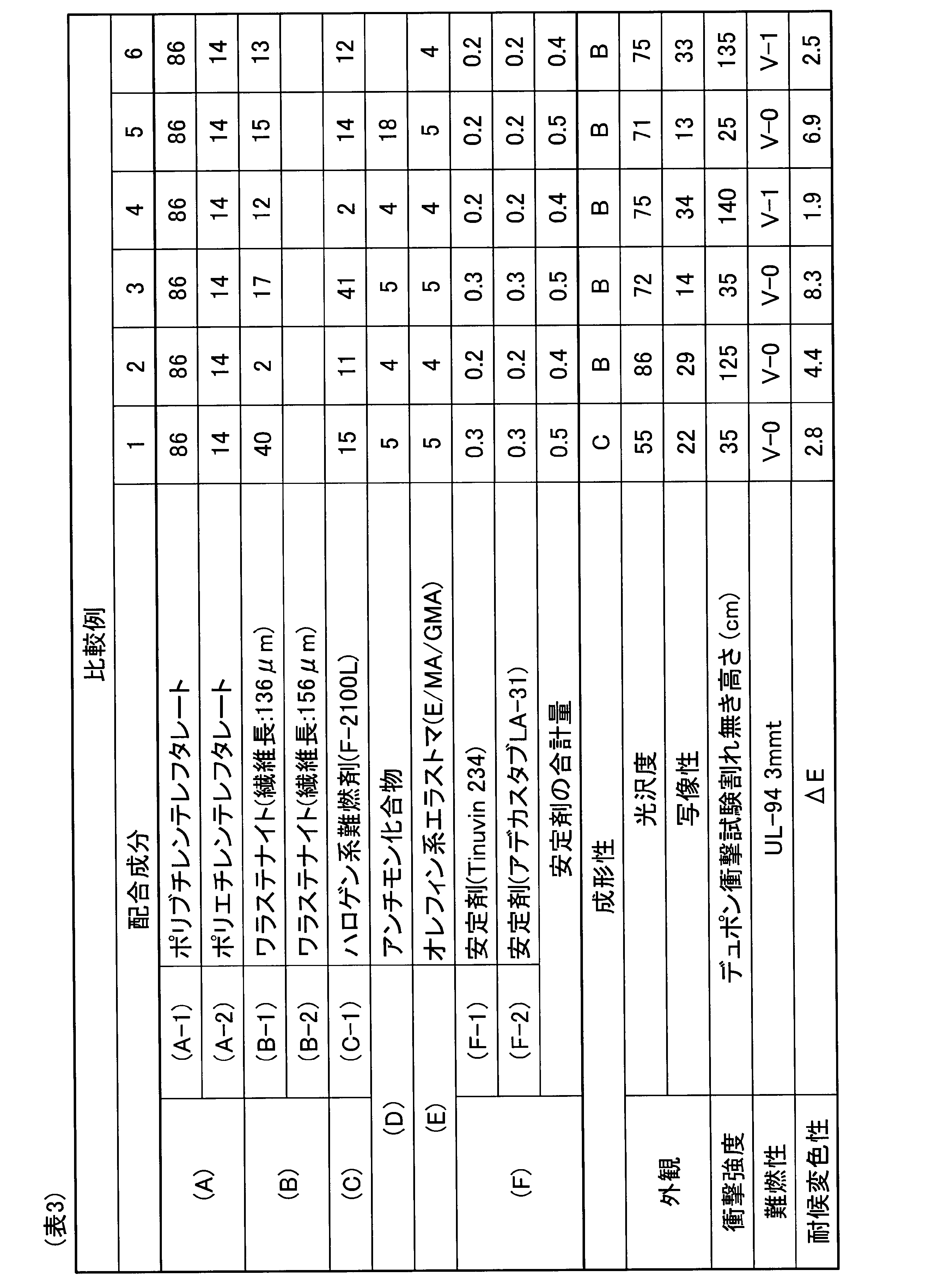
比較例1に示すように(B)ワラステナイトの配合量が、35質量部を超えると、成形性と衝撃強度が低下した。一方、比較例2に示すように(B)ワラステナイトの配合量が、5質量部未満であると、光沢度が高くなり、ユリア樹脂のような高級感のある外観とはならなかった。また、比較例3に示すように、(C)ハロゲン系難燃剤の配合量が35質量部を超えると、衝撃強度、耐候変色性が低下した。一方、比較例4に示すように(C)ハロゲン系難燃剤の配合量が5質量部未満であると、難燃性が低下した。
比較例5に示すように、(D)アンチモン化合物の配合量が15質量部を超えると、衝撃強度が低下した。一方、比較例6に示すように(D)アンチモン化合物の配合量が1質量部未満であると、難燃性が低下した。
Claims (8)
- (A)熱可塑性ポリエステル100質量部に対し、(B)ワラステナイト5~35質量部、(C)ハロゲン系難燃剤5~35質量部、および(D)アンチモン化合物1~15質量部を配合してなる熱可塑性ポリエステル樹脂組成物。
- 前記(A)熱可塑性ポリエステルが、(A-1)ポリブチレンテレフタレート80~96質量部および(A-2)ポリエチレンテレフタレート4~20質量部からなる請求項1に記載の熱可塑性ポリエステル樹脂組成物。
- 前記(B)ワラステナイトの平均繊維長が50μm以上である請求項1または2に記載の熱可塑性ポリエステル樹脂組成物。
- さらに前記(A)熱可塑性ポリエステル100質量部に対し、(E)オレフィン系エラストマを1~7質量部配合してなる請求項1~3のいずれかに記載の熱可塑性ポリエステル樹脂組成物。
- さらに前記(A)熱可塑性ポリエステル100質量部に対し、(F)安定剤を0.3~1.0質量部配合してなる請求項1~4のいずれかに記載の熱可塑性ポリエステル樹脂組成物。
- 請求項1~5のいずれかに記載の熱可塑性ポリエステル樹脂組成物からなる成形品。
- 請求項1~5のいずれかに記載の熱可塑性ポリエステル樹脂組成物を成形してなるトイレ回り部材として使用される成形品。
- 請求項1~5のいずれかに記載の熱可塑性ポリエステル樹脂組成物を成形してなる便座として使用される成形品。
Priority Applications (2)
| Application Number | Priority Date | Filing Date | Title |
|---|---|---|---|
| JP2019540019A JP7316215B2 (ja) | 2018-06-29 | 2019-06-12 | 熱可塑性ポリエステル樹脂組成物および成形品 |
| CN201980027563.0A CN112020539B (zh) | 2018-06-29 | 2019-06-12 | 热塑性聚酯树脂组合物及成型品 |
Applications Claiming Priority (4)
| Application Number | Priority Date | Filing Date | Title |
|---|---|---|---|
| JP2018-124142 | 2018-06-29 | ||
| JP2018124142 | 2018-06-29 | ||
| JP2018150082 | 2018-08-09 | ||
| JP2018-150082 | 2018-08-09 |
Publications (1)
| Publication Number | Publication Date |
|---|---|
| WO2020004046A1 true WO2020004046A1 (ja) | 2020-01-02 |
Family
ID=68986435
Family Applications (1)
| Application Number | Title | Priority Date | Filing Date |
|---|---|---|---|
| PCT/JP2019/023370 Ceased WO2020004046A1 (ja) | 2018-06-29 | 2019-06-12 | 熱可塑性ポリエステル樹脂組成物および成形品 |
Country Status (3)
| Country | Link |
|---|---|
| JP (1) | JP7316215B2 (ja) |
| CN (1) | CN112020539B (ja) |
| WO (1) | WO2020004046A1 (ja) |
Families Citing this family (1)
| Publication number | Priority date | Publication date | Assignee | Title |
|---|---|---|---|---|
| EP4442764A4 (en) * | 2021-11-30 | 2025-03-26 | Mitsubishi Chemical Corporation | RESIN COMPOSITION, MOLDED BODY, COMPOSITE AND METAL/RESIN COMPOSITE |
Citations (5)
| Publication number | Priority date | Publication date | Assignee | Title |
|---|---|---|---|---|
| JPH05179112A (ja) * | 1991-12-26 | 1993-07-20 | Nippon G Ii Plast Kk | 強化難燃ポリエステル系樹脂組成物 |
| JPH08225730A (ja) * | 1995-02-20 | 1996-09-03 | Kanegafuchi Chem Ind Co Ltd | 難燃性ポリエチレンテレフタレート系樹脂組成物 |
| JP2000063531A (ja) * | 1998-06-11 | 2000-02-29 | Toto Ltd | 熱可塑性樹脂成形体 |
| JP2016017104A (ja) * | 2014-07-07 | 2016-02-01 | 東レ株式会社 | ポリブチレンテレフタレート樹脂組成物 |
| JP2016088986A (ja) * | 2014-10-31 | 2016-05-23 | 住友ベークライト株式会社 | フェノール樹脂組成物および成形体 |
Family Cites Families (3)
| Publication number | Priority date | Publication date | Assignee | Title |
|---|---|---|---|---|
| JPH0623298B2 (ja) * | 1986-03-20 | 1994-03-30 | 東レ株式会社 | 熱可塑性ポリエステル樹脂組成物 |
| JPH0696665B2 (ja) * | 1986-08-22 | 1994-11-30 | 東レ株式会社 | 難燃性ポリエステル樹脂組成物 |
| JP3009407B2 (ja) * | 1989-08-10 | 2000-02-14 | 東レ株式会社 | 難燃性ポリエステル組成物 |
-
2019
- 2019-06-12 WO PCT/JP2019/023370 patent/WO2020004046A1/ja not_active Ceased
- 2019-06-12 CN CN201980027563.0A patent/CN112020539B/zh active Active
- 2019-06-12 JP JP2019540019A patent/JP7316215B2/ja active Active
Patent Citations (5)
| Publication number | Priority date | Publication date | Assignee | Title |
|---|---|---|---|---|
| JPH05179112A (ja) * | 1991-12-26 | 1993-07-20 | Nippon G Ii Plast Kk | 強化難燃ポリエステル系樹脂組成物 |
| JPH08225730A (ja) * | 1995-02-20 | 1996-09-03 | Kanegafuchi Chem Ind Co Ltd | 難燃性ポリエチレンテレフタレート系樹脂組成物 |
| JP2000063531A (ja) * | 1998-06-11 | 2000-02-29 | Toto Ltd | 熱可塑性樹脂成形体 |
| JP2016017104A (ja) * | 2014-07-07 | 2016-02-01 | 東レ株式会社 | ポリブチレンテレフタレート樹脂組成物 |
| JP2016088986A (ja) * | 2014-10-31 | 2016-05-23 | 住友ベークライト株式会社 | フェノール樹脂組成物および成形体 |
Also Published As
| Publication number | Publication date |
|---|---|
| CN112020539B (zh) | 2022-11-25 |
| CN112020539A (zh) | 2020-12-01 |
| JPWO2020004046A1 (ja) | 2021-05-13 |
| JP7316215B2 (ja) | 2023-07-27 |
Similar Documents
| Publication | Publication Date | Title |
|---|---|---|
| EP2738204B1 (en) | Polyester compositions with improved crystallization rate | |
| JP6668768B2 (ja) | ポリブチレンテレフタレート樹脂組成物およびそれからなる成形品 | |
| NL8103798A (nl) | Thermoplastische vormmaterialen met verbeterde bestandheid tegen kromtrekken en werkwijze voor het bereiden van deze materialen. | |
| EP3015508B1 (en) | Chemical resistant polymer resin composition for vehicle overhead console | |
| JP2014001374A (ja) | ポリブチレンテレフタレート樹脂組成物 | |
| JP6179161B2 (ja) | 熱可塑性樹脂組成物 | |
| US9944790B2 (en) | Polycarbonate resin composition with superior fluidity and molding thereof | |
| KR101367461B1 (ko) | 소광특성 및 내열성이 향상된 열가소성 폴리에스테르 수지 조성물 | |
| JP6217641B2 (ja) | 特定断面構造を有する成形体 | |
| JP2018123215A (ja) | ポリブチレンテレフタレート樹脂組成物および成形品 | |
| JP7316215B2 (ja) | 熱可塑性ポリエステル樹脂組成物および成形品 | |
| WO2001025332A1 (en) | Flame-retardant polyester resin composition, molded article thereof, and method of molding the same | |
| JP2000256545A (ja) | 難燃性ポリエステル樹脂組成物、その成形品およびその製造方法 | |
| JP2002128998A (ja) | 難燃性ポリエステル樹脂組成物 | |
| CN108395681B (zh) | 热塑性聚酯树脂组合物及其成型品 | |
| JP6097071B2 (ja) | 金型温度の決定方法 | |
| JP7174602B2 (ja) | ポリエステル樹脂組成物 | |
| JP2006219626A (ja) | ポリブチレンテレフタレート樹脂組成物、およびこれを成形してなる成形品 | |
| JP2021178921A (ja) | ポリブチレンテレフタレート樹脂組成物およびそれからなる成形品 | |
| JPH0627246B2 (ja) | 難燃性芳香族ポリエステル樹脂組成物 | |
| JP3631640B2 (ja) | 難燃性ポリエステル樹脂組成物およびそれからなる成形品 | |
| JP2025155919A (ja) | 車両用衝撃吸収部材 | |
| JP7112913B2 (ja) | ポリエステル系樹脂組成物及び成形品 | |
| US20150353724A1 (en) | Polyester compositions with improved crystallization rate | |
| JP2025081802A (ja) | ポリブチレンテレフタレート樹脂組成物、およびそれからなる成形品 |
Legal Events
| Date | Code | Title | Description |
|---|---|---|---|
| ENP | Entry into the national phase |
Ref document number: 2019540019 Country of ref document: JP Kind code of ref document: A |
|
| 121 | Ep: the epo has been informed by wipo that ep was designated in this application |
Ref document number: 19827265 Country of ref document: EP Kind code of ref document: A1 |
|
| NENP | Non-entry into the national phase |
Ref country code: DE |
|
| 122 | Ep: pct application non-entry in european phase |
Ref document number: 19827265 Country of ref document: EP Kind code of ref document: A1 |