WO2019216235A1 - 角度検出器 - Google Patents
角度検出器 Download PDFInfo
- Publication number
- WO2019216235A1 WO2019216235A1 PCT/JP2019/017642 JP2019017642W WO2019216235A1 WO 2019216235 A1 WO2019216235 A1 WO 2019216235A1 JP 2019017642 W JP2019017642 W JP 2019017642W WO 2019216235 A1 WO2019216235 A1 WO 2019216235A1
- Authority
- WO
- WIPO (PCT)
- Prior art keywords
- scale
- sensors
- angle
- component
- order
- Prior art date
- Legal status (The legal status is an assumption and is not a legal conclusion. Google has not performed a legal analysis and makes no representation as to the accuracy of the status listed.)
- Ceased
Links
Images





Classifications
-
- G—PHYSICS
- G01—MEASURING; TESTING
- G01D—MEASURING NOT SPECIALLY ADAPTED FOR A SPECIFIC VARIABLE; ARRANGEMENTS FOR MEASURING TWO OR MORE VARIABLES NOT COVERED IN A SINGLE OTHER SUBCLASS; TARIFF METERING APPARATUS; MEASURING OR TESTING NOT OTHERWISE PROVIDED FOR
- G01D5/00—Mechanical means for transferring the output of a sensing member; Means for converting the output of a sensing member to another variable where the form or nature of the sensing member does not constrain the means for converting; Transducers not specially adapted for a specific variable
- G01D5/12—Mechanical means for transferring the output of a sensing member; Means for converting the output of a sensing member to another variable where the form or nature of the sensing member does not constrain the means for converting; Transducers not specially adapted for a specific variable using electric or magnetic means
- G01D5/244—Mechanical means for transferring the output of a sensing member; Means for converting the output of a sensing member to another variable where the form or nature of the sensing member does not constrain the means for converting; Transducers not specially adapted for a specific variable using electric or magnetic means influencing characteristics of pulses or pulse trains; generating pulses or pulse trains
- G01D5/24471—Error correction
- G01D5/24485—Error correction using other sensors
-
- G—PHYSICS
- G01—MEASURING; TESTING
- G01D—MEASURING NOT SPECIALLY ADAPTED FOR A SPECIFIC VARIABLE; ARRANGEMENTS FOR MEASURING TWO OR MORE VARIABLES NOT COVERED IN A SINGLE OTHER SUBCLASS; TARIFF METERING APPARATUS; MEASURING OR TESTING NOT OTHERWISE PROVIDED FOR
- G01D5/00—Mechanical means for transferring the output of a sensing member; Means for converting the output of a sensing member to another variable where the form or nature of the sensing member does not constrain the means for converting; Transducers not specially adapted for a specific variable
- G01D5/12—Mechanical means for transferring the output of a sensing member; Means for converting the output of a sensing member to another variable where the form or nature of the sensing member does not constrain the means for converting; Transducers not specially adapted for a specific variable using electric or magnetic means
- G01D5/244—Mechanical means for transferring the output of a sensing member; Means for converting the output of a sensing member to another variable where the form or nature of the sensing member does not constrain the means for converting; Transducers not specially adapted for a specific variable using electric or magnetic means influencing characteristics of pulses or pulse trains; generating pulses or pulse trains
- G01D5/245—Mechanical means for transferring the output of a sensing member; Means for converting the output of a sensing member to another variable where the form or nature of the sensing member does not constrain the means for converting; Transducers not specially adapted for a specific variable using electric or magnetic means influencing characteristics of pulses or pulse trains; generating pulses or pulse trains using a variable number of pulses in a train
-
- G—PHYSICS
- G01—MEASURING; TESTING
- G01D—MEASURING NOT SPECIALLY ADAPTED FOR A SPECIFIC VARIABLE; ARRANGEMENTS FOR MEASURING TWO OR MORE VARIABLES NOT COVERED IN A SINGLE OTHER SUBCLASS; TARIFF METERING APPARATUS; MEASURING OR TESTING NOT OTHERWISE PROVIDED FOR
- G01D5/00—Mechanical means for transferring the output of a sensing member; Means for converting the output of a sensing member to another variable where the form or nature of the sensing member does not constrain the means for converting; Transducers not specially adapted for a specific variable
- G01D5/12—Mechanical means for transferring the output of a sensing member; Means for converting the output of a sensing member to another variable where the form or nature of the sensing member does not constrain the means for converting; Transducers not specially adapted for a specific variable using electric or magnetic means
- G01D5/244—Mechanical means for transferring the output of a sensing member; Means for converting the output of a sensing member to another variable where the form or nature of the sensing member does not constrain the means for converting; Transducers not specially adapted for a specific variable using electric or magnetic means influencing characteristics of pulses or pulse trains; generating pulses or pulse trains
-
- G—PHYSICS
- G01—MEASURING; TESTING
- G01D—MEASURING NOT SPECIALLY ADAPTED FOR A SPECIFIC VARIABLE; ARRANGEMENTS FOR MEASURING TWO OR MORE VARIABLES NOT COVERED IN A SINGLE OTHER SUBCLASS; TARIFF METERING APPARATUS; MEASURING OR TESTING NOT OTHERWISE PROVIDED FOR
- G01D5/00—Mechanical means for transferring the output of a sensing member; Means for converting the output of a sensing member to another variable where the form or nature of the sensing member does not constrain the means for converting; Transducers not specially adapted for a specific variable
- G01D5/12—Mechanical means for transferring the output of a sensing member; Means for converting the output of a sensing member to another variable where the form or nature of the sensing member does not constrain the means for converting; Transducers not specially adapted for a specific variable using electric or magnetic means
- G01D5/244—Mechanical means for transferring the output of a sensing member; Means for converting the output of a sensing member to another variable where the form or nature of the sensing member does not constrain the means for converting; Transducers not specially adapted for a specific variable using electric or magnetic means influencing characteristics of pulses or pulse trains; generating pulses or pulse trains
- G01D5/24471—Error correction
Definitions
- the present invention relates to an angle detector for detecting an angle change amount due to a rotational motion of a rotating body.
- An angle detector such as an encoder, a resolver, or an inductor is used to detect the amount of change in angle due to the rotational motion of the rotating body.
- the angle detector includes a scale scale on which a plurality of scales are arranged, a sensor that reads the plurality of scales, and a control unit that converts read information from the sensors into an angle change amount of the rotating body. Either the scale or the sensor is attached to the rotating body. In order to read the amount of change in the angle of the rotating body with higher resolution, the angle interval of one scale of the scale scale may be narrowed. However, the scale cannot be made infinitely fine because it is engraved by processing, for example.
- an output signal based on reading information from a sensor is numerically calculated by a control unit and one scale is divided finely.
- the output signal from the sensor used in the angle detector is usually a rectangular wave or a sine wave, and is often a two-phase signal with one graduation of 360 ° and a phase difference of 90 °. .
- the output signal from the sensor is a sine wave signal
- the two-phase signal has a shape of cos ⁇ and sin ⁇ with one scale as one cycle.
- the angular resolution can be improved in accordance with the detection resolution of the amplitude of the output signal from the sensor.
- the output signal from the sensor includes distortion of harmonic components separately from the ideal one-scale one-cycle sine wave signal, not only the true angle change amount of the rotating body, Depending on the distortion of the harmonic component, an amount that is unrelated to the true angle change amount is included and measured.
- An error (angle error) unrelated to the angle change amount occurs.
- the rotation axis of the rotating body and the center axis of the scale scale are arranged on a coaxial line.
- these axes do not coincide completely, and the true angle change due to the rotation of the rotating body based on the command and the output from the sensor due to the offset (axis eccentricity) between these axes.
- An angle error occurs between the angle change amount by the measurement obtained by converting the signal by the control unit.
- the scale of the scale scale is engraved by machining, for example, the scale pattern center and the scale scale rotation center itself are offset. There are quality issues such as equality.
- Patent Document 1 discloses a method for detecting and removing distortion of the third-order harmonic component included in a two-phase sinusoidal signal having a phase difference of 90 °.
- a method for detecting and removing distortion of the third and fifth harmonic components contained in a two-phase sinusoidal signal having a phase difference of 90 ° is disclosed.
- a plurality of first scale reading heads and one second scale reading head are provided around the scale plate fixed to the rotation axis.
- angle signals a i, 1 and the angle signal a i of the first graduation readhead scale read head, the difference between the j SA i, the angle detector for performing self-calibration by obtaining an average value SAV i seeking j is It is disclosed.
- i is a scale number (an integer from 1 to NG , NG is the total number of scales)
- j is a scale reading head number (an integer from 1 to NH
- NH is the total number of scale reading heads).
- an electrical angle error due to distortion of a specific harmonic component caused by the sensor can be detected and removed.
- the output signal from the sensor includes distortions of various harmonic components depending on the accuracy of the scale, sensor characteristics and method, etc. Harmonic component distortion cannot be removed uniformly for the sensor.
- the strain characteristics are completely different between the optical and magnetic sensor reading methods, and the strain characteristics are completely different between the magnetized ring and the gear on the magnetic scale.
- a device such as an amplifier that amplifies the output signal from the sensor is used, distortion of harmonic components due to these characteristics also occurs. Therefore, even if the harmonic component distortion can be removed in some cases, the harmonic component distortion may not be removed in other cases.
- the angle detector detects a mechanical angle error caused by the axis eccentricity between the rotation axis of the rotating body and the center axis of the scale scale, the quality of the scale scale, the aging of the angle detector, etc. And can be removed.
- a mechanical angle error caused by the axis eccentricity between the rotation axis of the rotating body and the center axis of the scale scale, the quality of the scale scale, the aging of the angle detector, etc. And can be removed.
- it is effective to narrow the angle interval of one scale or use a high-precision scale reading head. It is easy to lead to high cost of the detector.
- the amount of harmonic components contained in the signal output by the scale reading head will affect the electrical angle error. Since it appears as a dominant error rather than a mechanical angle error, the angle change amount of the rotating body cannot be obtained with high accuracy.
- the object of the present invention is to simultaneously remove not only the electrical angle error caused by the sensor, but also the mechanical angle error caused by the mounting accuracy of the rotating body, the quality of the scale, the change in the angle detector over time, etc.
- the angle detector includes a rotating body that rotates about the rotation axis, a scale scale that has a plurality of scales along one rotation with respect to the rotating direction of the rotating body, and a rotating direction of the rotating body. And at least two sensors arranged along one circumference with respect to the sensor, and detecting an amount of change in angle due to rotation of the rotating body. Each of the at least two sensors is a signal corresponding to the amount of change in angle based on a plurality of scales.
- the output signal includes a fundamental wave component whose primary part is one period of a plurality of scales and a harmonic component whose order is an integer multiple of 2 or more of the fundamental wave component.
- the amount of angular displacement calculated from the signal includes at least one angular error component having an order component that is an integral multiple of one graduation for one period as a first order due to harmonic components.
- the number of scales Of which is determined based on the order of the scale number and at least one angular error component.
- the at least one angle error component is a plurality of angle error components
- the number of at least two sensors is the number of scale scales and the plurality of angle errors. It is determined based on the order of each component.
- the number of at least two sensors may be a product of the number of scales on the scale scale and an integer of 1 or more that is the order of at least one angle error component. It is determined based on an integer that cannot.
- the number of at least two sensors is more than the division of an integer that cannot divide the product of the scale number of the scale scale and the degree of the angle error component. Has been determined based on.
- the number of at least two sensors is the remainder when dividing the product of the scale number of the scale scale and the degree of the angle error component by an integer that cannot be divided. It is determined on the basis of weighting according to the size of.
- the number of planned sensor placement locations corresponding to an integer that cannot be divided is set at substantially equal intervals around the rotation direction of the rotating body.
- at least two sensors are arranged one by one.
- At least two sensors are arranged one by one in two adjacent sensor arrangement locations.
- At least two sensors are arranged one by one at each of the planned sensor arrangement locations.
- At least one angle error component differs depending on at least two types of sensors.
- the angle detector is self-assembling by determining an output signal difference between an output signal from one of the at least two sensors and an output signal from the other sensor. It has been calibrated.
- the angle detector is caused by an electrical angle error caused by distortion included in the output signal from the sensor, the mounting accuracy of the rotating body, the quality of the scale, the change over time of the angle detector, and the like.
- the angle change amount of the rotating body can be obtained with high accuracy by removing the mechanical angle error at the same time, and the angle detector can be used to accurately and accurately change the angle of the rotating body without causing the sensor. An amount can be obtained.
- the accuracy of the angle change amount of the rotating body can be greatly improved by using an inexpensive and low accuracy sensor, and there is no need to use a conventional expensive and high accuracy sensor. The cost can be reduced.
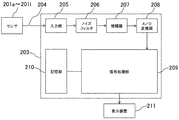
- FIG. 3 is a schematic diagram of a control unit of the angle detector of FIGS. 1A to 2B.
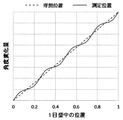
- FIG. 4B shows a measurement angle and an ideal angle with respect to a position on one scale calculated by the pseudo sine wave signal of FIG. 4A.
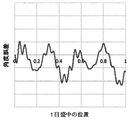
- FIG. 4B shows an angle error between a measurement angle and an ideal angle with respect to a position in one scale calculated by the pseudo sine wave signal of FIG. 4A.
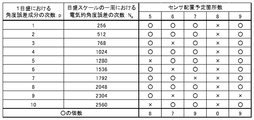
- surface which shows the result of having determined based on whether the number of scales is fixed and being divided / not divisible by dividing the angular error order of one round of the scale scale by the number of planned sensor placements.
- FIG. 6B is an enlarged view of a part of FIG.
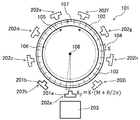
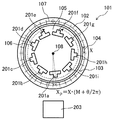
- the angle detector 101 including at least two sensors 201a to 201i arranged at the sensor arrangement planned locations 202a to 202i is shown.
- the scale 103 of the scale scale 102 is not only a visually recognizable one that is actually engraved on the scale scale 102 by, for example, processing, but also a predetermined position interval on the scale scale 102 for one scale.
- any scale can be used as long as it can be read by the sensors 201a to 201i, and the scale 102 is a member in which a plurality of such scales 103 are arranged.
- Typical examples of the angle detector 101 include an encoder, a resolver, an inductive, and the like, but the principle is not particularly limited as long as the present invention can be applied.
- the principle of the sensors 201a to 201i is not particularly limited as long as it can read the scale 103 of the scale 102.
- Examples of the sensors 201a to 201i include an optical sensor, a magnetic sensor, and a coil.
- the scale scale 102 is not limited as long as the sensors 201a to 201i can read the scale 103, and the material, the arrangement method of the scale 103, and the like are not limited.
- the sensors 201a to 201i are arranged at the sensor arrangement planned places 202a to 202i along one circumference 107 with respect to the rotation direction 106 of the rotating body 105, that is, along the entire circumference.
- Angle detector 101, the angle variation X p by the rotation of the rotating body 105, the detection is based on the output signals from the sensors 201a ⁇ 201i by using a plurality of graduations 103 which are arranged along the rotational direction 106 .
- Each of the sensors 201 a to 201 i outputs a signal 204 corresponding to the amount of change in angle due to the rotation of the rotating body 105 based on the plurality of scales 103.
- the width between two adjacent graduations 103, that is, the angular interval 104 of one graduation is indicated by X.
- FIG 1A 2 two sensors 201a along the circumference 107 of the rotary member 105, 201b is arranged, detects an angle change amount X p of the rotating body 105 to rotate in the rotational direction 106 of graduated scale 102 is attached
- An angle detector 101 is shown.
- FIG. 1B nine sensors 201a to 201i are arranged along one circumference 107 of the rotating body 105, and the rotation rotates along the rotation direction 106 to which the scale scale 102 is attached. indicated angle detector 101 for detecting an angle change amount X p body 105, FIG.
- FIG. 2A along the circumference 107 of the rotary member 105, three sensors 201a, 201b, 201d are arranged, three sensors 201a , the angle detector 1 for detecting 201b, the angle variation X p of the rotating body 105 to rotate in the rotational direction 106 201d is attached
- FIG. 2B nine sensors 201a to 201i are arranged along one circumference 107 of the rotator 105, and the rotator rotates along the rotation direction 106 to which the nine sensors 201a to 201i are attached.
- angle detector 101 for detecting an angle change amount X p of 105 is shown.
- the angle detector 101 further connected to the sensor 201a ⁇ 201i, a control unit 203 for converting the read information of the sensor 201a ⁇ 201i to angle variation X p of the rotary body 105.
- the converted angle change amount Xp may be output to the display device 211 or the like, or may be fed back to a motor that drives the rotating body 105, a control device for the rotating body 105, or the like.
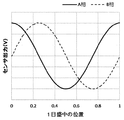
- the sensors 201a to 201i perform one cycle of a plurality of scales 103 in one cycle based on the read scale 103 and the angular interval 104 of one scale. It is possible to output an output signal 204 that is primary and whose amplitude changes according to the amount of change in angle.
- the control unit 203 includes an output signal 204 from the sensor 201a ⁇ 201i, and a scale detection number M counted until a certain time, can be converted into angle variation X p of the rotary body 105. As shown in FIGS. 1A to 2B, two pseudo sine waves whose phases are different from each other by 90 ° as shown in FIG.
- the control unit 203 outputs the pseudo sine wave output by each of the sensors 201a to 201i.
- the signal is acquired, and one of the two pseudo sine wave signals from each of the sensors 201a to 201i has a phase delayed by 90 °, and the one pseudo sine wave signal (B phase signal (B (0) )) is converted into the other pseudo sine wave signal.
- the calculated angle change amount Xp includes the rotation axis 108 of the rotating body 105 and the central axis of the scale scale 102 in the process of detecting a plurality of scales 103 as the rotating body 105 rotates.
- an extra quantity (referred to as a mechanical angle error) caused by the eccentricity of the axis, the quality of the scale scale 102, the aging of the angle detector 101, etc., and the output signal 204 includes the sensors 201a to 201i.
- the cause of the electrical angle error by the sensors 201a to 201i is that the output signal from the sensors 201a to 201i is a fundamental wave component in which one graduation of the graduations 103 is primary for one period.
- a harmonic component whose order is an integer multiple of 2 or more of the fundamental wave component.
- the two pseudo sine wave signals output from the sensors 201a to 201i are fundamental wave components cos ( ⁇ ) that are ideal waves in which one graduation of the plural graduations 103 has a primary period.
- harmonic components of the sensor 201a ⁇ 201i are affects angle variation X p when arctangent calculation as described above [Equation 2], as shown in FIG. 4C, the electrical angle error has occurred .
- a k and b k is a gain of the harmonic component of order k in the case where the amplitude of the first-order fundamental wave component of the one graduation as one cycle and the 1, .phi.a k and .phi.b k is This is the phase difference of the harmonic component of order k with respect to the fundamental component.
- a k , b k , ⁇ a k , and ⁇ b k generally do not change even if the scales 103 are different, or are small differences even if they change.
- a k , b k , ⁇ a k , and ⁇ b k are determined by the characteristics and detection principles of the sensors 201a to 201i and the scale scale 102. For example, if the sensors 201a to 201i are light detection sensors, the scale scale 102 If the sensors 201a to 201i are semiconductor magnetoresistive sensors, they are determined by the magnetoresistive characteristics of the semiconductor, and the semiconductor magnetoresistive sensor In use, the use of spur gears for magnetic detection is determined by the shape characteristics of the teeth.
- the harmonic component included in the output signal 204 differs depending on the types of the sensors 201a to 201i.
- the sensors 201a to 201i are preferably sensors that output the output signal 204 including substantially the same fundamental wave component and harmonic component.
- the sensors 201a to 201i may be the same type.
- the angle error includes not only the electrical angle error caused by the characteristics of the sensors 201a to 201i, but also the mounting accuracy of the rotating body 105, the quality of the scale scale 102, the change over time of the angle detector 101, Mechanical angle errors due to the above are also included.
- the angle detector 101 includes a scale scale 102 having a plurality of scales 103 along one rotation with respect to the rotation direction 106 of the rotating body 105, and a sensor along one rotation with respect to the rotation direction 106 of the rotating body 105. And at least two sensors 201a to 201i arranged at the planned arrangement locations 202a to 202i. Further, as shown in FIG. 3, the control unit 203 performs an arithmetic processing on the output signals 204 from these sensors 201a to 201i.
- a signal processing unit 209 is provided.
- the control unit 203 Prior to the arithmetic processing of the output signal 204 by the signal processing unit 209, the control unit 203 includes an input unit 205 for acquiring the output signal 204, a noise filter 206 for removing noise from the output signal 204, and an output signal 204.
- An amplifier 207 for amplification and an A / D converter 208 for converting the output signal 204 from an analog value to a digital value may be provided.
- the output signal 204 converted into a digital value is output to the signal processing unit 209.
- the control unit 203 may include a storage unit 210 that performs writing / reading of data by the signal processing unit 209.
- the signal processing unit 209 may be able to adjust the amplitude, offset, and phase difference between the two phases. Even if no adjustment is made, if the signal characteristics of each sensor are at the same level, these values are considered to be substantially the same, and the electrical angle error can be eliminated by the present invention.
- One of the output signals 204 from the sensors 201a to 201i is used as a reference sensor (for example, the sensor 201a), the output signal 204 from the reference sensor and the output signals of the other sensors (for example, the sensors 201b to 201i).
- a calibration value for removing the mechanical angle error can be obtained by obtaining an output signal difference with respect to 204 and obtaining an average value of the obtained output signal differences with other sensors. By adding this calibration value to the calculated temporary angle change amount X p (0) of the rotating body 105, the true angle change amount X p can be detected. Self-calibrated for mechanical angle error. However, the electrical angle error cannot be removed simply by arranging the sensors 201a to 201i along the rotation direction 106 of the rotating body 105.
- each of the output signals 204 of the sensors 201a to 201i is composed of a fundamental wave component in which one graduation of the graduations 103 is primary in one period and an integer multiple of 2 or more of the fundamental wave component.
- the temporary angular displacement amount X p (0) calculated from the output signal 204 is 1 of the scale 103 due to one or more harmonic components of the output signal 204. This is because the graduation includes at least one angular error component having an order component that is an integral multiple of one cycle as the primary.
- the order of the angle error component is the order of the angle error component, and the order of the angle error component is an integral multiple of one scale of the scale 103 as one cycle primary. For example, as shown in FIGS.
- the scale number of the scale scale 102 is 32 and the order of the angle error component in one scale caused by the harmonic component included in the output signal 204 is p.
- the number of sensors 201a to 201i arranged along the circumference 107 is selected.
- the degree p of the angle error component may be estimated by estimation, or may be determined from the result of calculating the angle error component in one round of the scale scale 102.
- the order p of the angle error component in which the electrical angle error appears significantly is often 5 or less.
- the harmonic component may be extracted from the output signals 204 from the sensors 201a to 201i in advance, and the degree p of the angular error component that needs to be removed may be determined.
- the output signals 204 from the sensors 201a to 201i are input to the signal processing unit 209 via the input unit 205, the noise filter 206, the amplifier 207, the A / D converter 208, etc. as shown in FIG.
- the harmonic components included in the signal input to the signal processing unit 209 may be extracted, and the number of sensors 201a to 201i may be appropriately selected based on the order p of the angle error component that needs to be removed. .
- each of the angle error components may include a plurality of angle error components each having an order component that is an integer multiple of the angle error components.
- the number of sensors 201a to 201i is based on the scale number N of the scale scale 102 and the order of each of the plurality of angular error components, and the sensors 201a to 201i are arranged along one circumference 107 with respect to the rotation direction 106 of the rotating body 105. It is necessary to select the number of 201i appropriately.
- the number of sensors 201a to 201i arranged along one circumference 107 with respect to 106 is selected.
- the number of sensors 201a-201i may be determined based on an integer that cannot divide p .
- the sensors 201a to 201i can output the output signals 204 having different phases. That is, the phases of the fundamental wave component and the harmonic component included in the output signal 204 output by each of the sensors 201a to 201i are different between the sensors 201a to 201i.
- the temporary angle change amount X p (0) is assumed to be one scale due to the harmonic component of the output signal 204. Is multiplied by the order p on the assumption that an angle error component having a component of order p (1 to 10) is included, and the order N p of the electrical angle error in one turn of the scale scale 102 is obtained.
- FIG. 5A shows the result of determining p when x is divisible by an integer (5 to 9) as the number of planned sensor locations, and by ⁇ when not divisible. An electrical angle error due to a component of a larger order p can be removed with the number of sensor placement planned places having a larger number of circles.
- FIG. 5A when the integer is 7 or 9, that is, when the number of sensor placement locations is 7 or 9, the number of circles is 9, and the electrical angle error due to many order p components is removed.
- the sensors 201a to 201i are arranged at any of the seven or nine planned sensor arrangement locations 202a to 202i.
- the integer when the integer is 8, that is, when the number of planned sensor locations is 8, the number of circles is 0, and the electrical angle error cannot be removed at all.
- FIG. 5A is an example, and there is no particular upper and lower limit on the number of scales 103 and the number of planned sensor locations in the scale 103 of the scale scale 102.
- the sensor arrangement planned locations 202a to 202i are arranged at substantially equal intervals along one circumference 107 with respect to the rotation direction 106 of the rotating body 105, and the order N p of the electrical angle error in one circumference of the scale scale 102. Is set by a number that matches an integer that cannot be divided. As shown in FIG. 5A, when the scale number N of the scale scale 102 is 256, the number of sensor placement planned places 202a to 202i is set to 7 or 9, and 7 or 9 sensor placement planned places 202a to 202i are rotated. It can be set at substantially equal intervals along one circumference 107 with respect to the rotation direction 106 of the body 105. In FIG. 1A and FIG.
- nine sensor arrangement planned locations 202a to 202i are set along one circumference 107 with respect to the rotation direction 106 of the rotating body 105.
- the sensors 201a to 201i are arranged at any of the planned sensor arrangement locations 202a to 202i.
- the sensors 201a and 201b are arranged at two (202a and 202b) of the nine planned sensor placement locations 202a to 202i.
- three of the nine planned sensor placement locations 202a to 202i are arranged.
- the sensors 201a, 201b, and 201d are arranged at (202a, 202b, and 202d), but it does not matter which of the sensor arrangement planned places 202a to 202i the sensors 202a to 202i are arranged.
- one sensor 201a, 201b may be arranged in each of two adjacent sensor placement locations 202a, 202b among the sensor placement locations 202a-202i
- one sensor 201a to 201i may be arranged in each of the planned sensor arrangement locations 202a to 202i.
- the electrical angle error when dividing the order N p of the electrical angle error in the circumference of the graduated scale 102 in integer as a sensor arrangement planned portion number, the electrical angle error can be removed larger the number of remainder (fraction) in case for the number of order N p increases, based on the remainder, the number of sensors 201a ⁇ 201i may be determined.
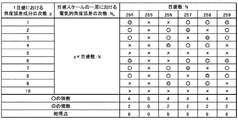
- a temporary angle change amount X p ( temporarily resulting from the harmonic component of the output signal 204 with respect to 256, which is the scale number N of the scale 103 included in the scale scale 102. 0) is assumed to include an angle error component having a component of order p (1 to 10) in one scale, and by multiplying the order p, the order N p of the electrical angle error in one turn of the scale scale 102 And the order N p is divided by an integer (5 to 9) as the number of sensor placement planned locations, for example, when the remainder is less than 0.3, the remainder is 0.3 or more and 0.7 If less than ⁇ , ⁇ if the remainder is 0.7 or more, ⁇ , weight according to the size of the remainder (for example, ⁇ is 0 points, ⁇ is 1 point, ⁇ is 2 points), the total score FIG.
- FIG. 5B shows the result of determining the number of sensor placement planned locations.
- the higher the total score the more the electrical angle error due to the higher order p components can be removed.
- the total score is 9 points, and the electrical angle error due to many order p components is removed.
- the sensors 201a to 201i are arranged at any one of the nine planned sensor arrangement locations 202a to 202i.
- the number of sensors 201a-201i may be determined.
- the number of sensors 201a ⁇ 201i May be determined.
- the number N of scales which the scale scale 102 has may be selected by first determining the number of planned sensor placement locations. Specifically, assuming that the number of sensor placement planned positions is 5, and the number N of the scale 103 of the scale scale 102 is 254 to 259, the temporary angle temporarily caused by the harmonic component of the output signal 204 By assuming that the change amount X p (0) includes an angle error component having a component of order p (1 to 10) in one scale, the electrical angle in one turn of the scale scale 102 is multiplied by the order p.
- FIG. 5 shows the result of determining the number of scales N in one round. To show. The higher the total score, the more electrical angle errors of order p can be removed. In the case of FIG.
- the electrical angle error of the substantially same number of orders p can be removed, and the five sensor placement planned locations 202a.
- Sensors 201a to 201e are arranged at any one of .about.202e.
- the determination result about the number of scales N in one turn of the scale scale 102 has repeatability depending on the number of sensor placement scheduled locations. For example, the determination result when the planned number of sensor placement locations is 5 is the same when the number of scales N in one turn of the scale scale 102 is 254 ⁇ (5 ⁇ integer multiple) (in FIG. 5C 254 In the case of 259, the same determination result is obtained). In this way, a determination result having repeatability according to the number of sensor placement planned positions can be obtained without depending on the size of the scale number N in one turn of the scale scale 102.
- the scale number N of the scale 103 included in the scale scale 102, the order p of the angle error component estimated from the harmonic components included in the output signal 204 or confirmed in advance, and the number of planned sensor locations are obtained.
- the sensors 201a to 201i are arranged at the sensor arrangement planned locations 202a to 202i, and one of the output signals 204 from the sensors 201a to 201i is used as a reference sensor (for example, the sensor 201a).
- the output signal difference between the output signal 204 from the reference sensor and the output signal 204 of each of the other sensors (for example, the sensors 201b to 201i) is obtained, and the obtained output signal difference with the other sensors is obtained.
- Angle variation X p after calibration may be as a detection value of the angle detector 101, the motor driving the rotating body 105, the control unit of the rotating body 105, is fed back to an equal, or may be used as a reference angle .
- This calibration value may be calculated each time the rotating body 105 rotates and the output signal 204 from the sensors 201a to 201i is input to the signal processing unit 209.
- this calibration value may be calculated for one rotation of the rotating body 105 in advance.
- the calibration value may be calculated by the signal processing unit 209 and stored in the storage unit 210 as a correction table, and the calibration value may be read from the storage unit 210 when the rotating body 105 rotates.
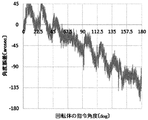
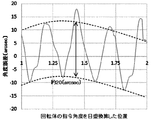
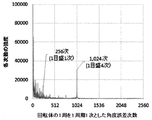
- the angle error including the mechanical angle error and the electrical angle error calculated by the signal processing unit 209 based on the output signal 204 only from the sensor 201a of the angle detector 101 in FIG.
- the angle error with respect to the command angle of the rotator 105, the angle error with respect to the command angle in one scale of the rotator 105 with a part thereof enlarged, and the angle error with one rotation of the rotator 105 as the primary cycle Shows the spectral intensity obtained by performing a Fourier transform on.
- An angle error due to a component having a long cycle (small order) with respect to the command angle is due to a mechanical angle error. According to FIG.
- the mechanical angle error is The width is about 180 arcsec with an angle error that makes one rotation of the rotating body 105 one cycle primary.
- FIG. 6A shows a measurement result obtained by extracting only the range of 0 to 180 deg from the measured range of 0 to 360 deg.
- the angle error due to the component having a short period (large order) with respect to the command angle is due to the electrical angle error.
- An angular error of about 20 arcsec corresponds to about 0.4%.
- the order component of the angular error is 256th order (1st scale 1st order), 768th order (1st scale 3rd order), 1024th order (1st scale 4th order), and the order component of angular error is larger. It can be seen that the spectrum intensity of the 1024th order (1 scale 4th order) is particularly remarkable.
- the angle error with respect to the command angle of the rotator 105 the angle error with respect to the command angle in one scale of the rotator 105 in which a part of the rotator 105 is enlarged.
- the spectral intensity obtained by performing Fourier transform on the angular error is shown. Since the sensor arrangement planned portion number (sensor arrangement number) is 9, it is possible to eliminate the angle error, including mechanical angle error and electrical angular error of order N p can not be divisible by 9, according to FIG.
- FIG. 7A For example, the mechanical angle error whose primary component is not divisible by 9 can be reduced to a width of about 45 arcsec.
- FIG. 7A shows a measurement result obtained by extracting only the range of 0 to 180 deg from the measured range of 0 to 360 deg.
- the electrical angle error whose main component is the 1024th order that cannot be divided by 9 is about 5 arcsec (about 0.1% with respect to 1.406 deg which is the angular interval 104 of one scale). Can be reduced to. In this way, angular errors including mechanical and electrical angular errors can be reduced to about 1 ⁇ 4.
- FIG. 7A shows a measurement result obtained by extracting only the range of 0 to 180 deg from the measured range of 0 to 360 deg.
- the electrical angle error whose main component is the 1024th order that cannot be divided by 9 is about 5 arcsec (about 0.1% with respect to 1.406 deg which is the angular interval 104 of one scale).
- the 10 mountain components (20th-order component with one round of the rotating body 105 as the primary cycle) generated during the command angle 180 deg of the rotating body 105 are caused by the mechanical characteristics of the used rotating body 105. It is known that this is an angle error, and by using the present invention, the mechanical angle error and the electrical angle error are removed from the temporary angle change amount X p (0) calculated from the output signal 204, and the rotation is performed.
- 7A to 7C show that the true rotation angle amount Xp and the angle error of the body 105 can be detected with higher accuracy.
Landscapes
- Physics & Mathematics (AREA)
- General Physics & Mathematics (AREA)
- Transmission And Conversion Of Sensor Element Output (AREA)
- Measurement Of Length, Angles, Or The Like Using Electric Or Magnetic Means (AREA)
Priority Applications (5)
| Application Number | Priority Date | Filing Date | Title |
|---|---|---|---|
| JP2020518258A JP7240387B2 (ja) | 2018-05-11 | 2019-04-25 | 角度検出器 |
| KR1020207002943A KR102888348B1 (ko) | 2018-05-11 | 2019-04-25 | 각도 검출기 |
| US16/760,835 US11573103B2 (en) | 2018-05-11 | 2019-04-25 | Angle detector |
| EP19800161.2A EP3792601B1 (en) | 2018-05-11 | 2019-04-25 | Angle detector |
| CN201980003659.3A CN110998244B (zh) | 2018-05-11 | 2019-04-25 | 角度检测器 |
Applications Claiming Priority (2)
| Application Number | Priority Date | Filing Date | Title |
|---|---|---|---|
| JP2018-092021 | 2018-05-11 | ||
| JP2018092021 | 2018-05-11 |
Publications (1)
| Publication Number | Publication Date |
|---|---|
| WO2019216235A1 true WO2019216235A1 (ja) | 2019-11-14 |
Family
ID=68468315
Family Applications (1)
| Application Number | Title | Priority Date | Filing Date |
|---|---|---|---|
| PCT/JP2019/017642 Ceased WO2019216235A1 (ja) | 2018-05-11 | 2019-04-25 | 角度検出器 |
Country Status (7)
| Country | Link |
|---|---|
| US (1) | US11573103B2 (https=) |
| EP (1) | EP3792601B1 (https=) |
| JP (1) | JP7240387B2 (https=) |
| KR (1) | KR102888348B1 (https=) |
| CN (1) | CN110998244B (https=) |
| TW (1) | TWI714072B (https=) |
| WO (1) | WO2019216235A1 (https=) |
Families Citing this family (3)
| Publication number | Priority date | Publication date | Assignee | Title |
|---|---|---|---|---|
| US12304020B2 (en) * | 2019-11-08 | 2025-05-20 | Sankyo Seisakusho Co. | Rotational positioning device |
| CN115213923B (zh) * | 2022-09-20 | 2023-01-06 | 深圳市欢创科技有限公司 | 旋转座、测距装置及移动机器人 |
| CN117288140B (zh) * | 2023-11-21 | 2024-02-20 | 西安交通大学 | 回转轴圆度误差测量方法、系统及径向回转误差测量方法 |
Citations (11)
| Publication number | Priority date | Publication date | Assignee | Title |
|---|---|---|---|---|
| JPS60170710A (ja) * | 1984-02-15 | 1985-09-04 | Asahi Optical Co Ltd | 測角誤差の補正装置 |
| US6433536B1 (en) * | 1998-12-31 | 2002-08-13 | Pacsci Motion Control, Inc. | Apparatus for measuring the position of a movable member |
| JP2005214920A (ja) * | 2004-02-02 | 2005-08-11 | Sankyo Seiki Mfg Co Ltd | 磁気センサ |
| JP2006098392A (ja) | 2004-08-31 | 2006-04-13 | National Institute Of Advanced Industrial & Technology | 自己校正機能付き角度検出器 |
| JP2006112862A (ja) | 2004-10-13 | 2006-04-27 | Mitsutoyo Corp | エンコーダ出力信号補正装置及び方法 |
| JP2008304249A (ja) | 2007-06-06 | 2008-12-18 | Yaskawa Electric Corp | エンコーダ信号処理装置およびその信号処理方法 |
| JP2011099802A (ja) | 2009-11-09 | 2011-05-19 | National Institute Of Advanced Industrial Science & Technology | 軸ぶれ計測方法及び軸ぶれ計測機能を具備した自己校正機能付き角度検出器 |
| JP2011099804A (ja) | 2009-11-09 | 2011-05-19 | National Institute Of Advanced Industrial Science & Technology | 複合自己校正機能付き角度検出器 |
| JP2012132714A (ja) * | 2010-12-20 | 2012-07-12 | Mitsutoyo Corp | 角度検出装置およびその偏心量推定方法 |
| JP2012519296A (ja) * | 2009-03-02 | 2012-08-23 | アールエルエス メリルナ テニカ ディー.オー.オー. | ポジションエンコーダ装置 |
| JP2016118491A (ja) * | 2014-12-22 | 2016-06-30 | Dmg森精機株式会社 | ロータリーエンコーダ、ロータリーエンコーダの制御方法および制御プログラム |
Family Cites Families (23)
| Publication number | Priority date | Publication date | Assignee | Title |
|---|---|---|---|---|
| JP2680435B2 (ja) * | 1989-07-26 | 1997-11-19 | シーケーディ株式会社 | 回転角度検出装置 |
| JPH11122120A (ja) * | 1997-10-17 | 1999-04-30 | Sony Corp | 符号化方法及び装置、並びに復号化方法及び装置 |
| JP3629242B2 (ja) * | 2001-02-05 | 2005-03-16 | ペンタックス株式会社 | 磁気式エンコーダおよびその高調波誤差削減方法 |
| FR2896036B1 (fr) * | 2006-01-06 | 2008-11-07 | Skf Ab | Systeme de detection de position angulaire absolue par comparaison differentielle, roulement et machine tournante |
| GB0601174D0 (en) * | 2006-01-20 | 2006-03-01 | Renishaw Plc | Multiple readhead apparatus |
| CN101443632B (zh) * | 2006-05-12 | 2010-10-13 | 株式会社安川电机 | 磁性编码装置 |
| DE102007036984A1 (de) * | 2007-07-06 | 2009-01-08 | Austriamicrosystems Ag | Messverfahren, Sensoranordnung und Messsystem |
| FR2920224B1 (fr) * | 2007-08-23 | 2009-10-02 | Sagem Defense Securite | Procede de determination d'une vitesse de rotation d'un capteur vibrant axisymetrique, et dispositif inertiel mettant en oeuvre le procede |
| JP4900837B2 (ja) * | 2008-05-16 | 2012-03-21 | 日立金属株式会社 | 回転角度検出装置および回転機 |
| TWI591625B (zh) * | 2009-05-27 | 2017-07-11 | 杜比國際公司 | 從訊號的低頻成份產生該訊號之高頻成份的系統與方法,及其機上盒、電腦程式產品、軟體程式及儲存媒體 |
| JP4916556B2 (ja) * | 2010-01-19 | 2012-04-11 | 三菱電機株式会社 | 回転角度検出装置、回転電機装置および電動パワーステアリング装置 |
| JP5706440B2 (ja) * | 2010-11-18 | 2015-04-22 | 三菱電機株式会社 | 回転角検出装置 |
| JP5660381B2 (ja) | 2011-03-09 | 2015-01-28 | 株式会社ジェイテクト | 回転角検出装置 |
| JP2013228312A (ja) * | 2012-04-26 | 2013-11-07 | Nikon Corp | エンコーダ、及び駆動装置 |
| KR101428971B1 (ko) * | 2013-03-21 | 2014-08-13 | 숭실대학교산학협력단 | 변위 측정 장치 |
| CN103704264B (zh) * | 2014-01-09 | 2016-04-20 | 南通思锐生物科技有限公司 | 一种消毒清洁剂 |
| JP2015192538A (ja) * | 2014-03-28 | 2015-11-02 | キヤノン株式会社 | ステッピングモータ駆動装置、像担持体回転駆動装置及び画像形成装置 |
| JP2017011880A (ja) * | 2015-06-22 | 2017-01-12 | 株式会社リコー | 高調波成分抽出装置、モータ駆動制御装置、搬送装置及び高調波成分抽出方法 |
| WO2017068684A1 (ja) | 2015-10-22 | 2017-04-27 | 三菱電機株式会社 | 角度検出装置 |
| JP6288481B2 (ja) * | 2016-06-24 | 2018-03-07 | Tdk株式会社 | 角度センサおよび角度センサシステム |
| EP3396327B1 (en) * | 2016-07-20 | 2020-02-19 | NSK Ltd. | Rotation angle detector and torque sensor |
| JP6350834B2 (ja) * | 2016-09-30 | 2018-07-04 | Tdk株式会社 | 角度センサおよび角度センサシステム |
| JP2021170710A (ja) * | 2020-04-15 | 2021-10-28 | 株式会社フィリット | プログラム |
-
2019
- 2019-04-25 WO PCT/JP2019/017642 patent/WO2019216235A1/ja not_active Ceased
- 2019-04-25 EP EP19800161.2A patent/EP3792601B1/en active Active
- 2019-04-25 CN CN201980003659.3A patent/CN110998244B/zh active Active
- 2019-04-25 US US16/760,835 patent/US11573103B2/en active Active
- 2019-04-25 JP JP2020518258A patent/JP7240387B2/ja active Active
- 2019-04-25 KR KR1020207002943A patent/KR102888348B1/ko active Active
- 2019-05-02 TW TW108115245A patent/TWI714072B/zh active
Patent Citations (11)
| Publication number | Priority date | Publication date | Assignee | Title |
|---|---|---|---|---|
| JPS60170710A (ja) * | 1984-02-15 | 1985-09-04 | Asahi Optical Co Ltd | 測角誤差の補正装置 |
| US6433536B1 (en) * | 1998-12-31 | 2002-08-13 | Pacsci Motion Control, Inc. | Apparatus for measuring the position of a movable member |
| JP2005214920A (ja) * | 2004-02-02 | 2005-08-11 | Sankyo Seiki Mfg Co Ltd | 磁気センサ |
| JP2006098392A (ja) | 2004-08-31 | 2006-04-13 | National Institute Of Advanced Industrial & Technology | 自己校正機能付き角度検出器 |
| JP2006112862A (ja) | 2004-10-13 | 2006-04-27 | Mitsutoyo Corp | エンコーダ出力信号補正装置及び方法 |
| JP2008304249A (ja) | 2007-06-06 | 2008-12-18 | Yaskawa Electric Corp | エンコーダ信号処理装置およびその信号処理方法 |
| JP2012519296A (ja) * | 2009-03-02 | 2012-08-23 | アールエルエス メリルナ テニカ ディー.オー.オー. | ポジションエンコーダ装置 |
| JP2011099802A (ja) | 2009-11-09 | 2011-05-19 | National Institute Of Advanced Industrial Science & Technology | 軸ぶれ計測方法及び軸ぶれ計測機能を具備した自己校正機能付き角度検出器 |
| JP2011099804A (ja) | 2009-11-09 | 2011-05-19 | National Institute Of Advanced Industrial Science & Technology | 複合自己校正機能付き角度検出器 |
| JP2012132714A (ja) * | 2010-12-20 | 2012-07-12 | Mitsutoyo Corp | 角度検出装置およびその偏心量推定方法 |
| JP2016118491A (ja) * | 2014-12-22 | 2016-06-30 | Dmg森精機株式会社 | ロータリーエンコーダ、ロータリーエンコーダの制御方法および制御プログラム |
Non-Patent Citations (1)
| Title |
|---|
| See also references of EP3792601A4 |
Also Published As
| Publication number | Publication date |
|---|---|
| CN110998244A (zh) | 2020-04-10 |
| CN110998244B (zh) | 2022-06-17 |
| KR102888348B1 (ko) | 2025-11-20 |
| EP3792601A4 (en) | 2022-02-16 |
| JPWO2019216235A1 (ja) | 2021-05-13 |
| KR20210007939A (ko) | 2021-01-20 |
| JP7240387B2 (ja) | 2023-03-15 |
| US11573103B2 (en) | 2023-02-07 |
| EP3792601B1 (en) | 2024-03-20 |
| EP3792601A1 (en) | 2021-03-17 |
| TW202006323A (zh) | 2020-02-01 |
| US20210215512A1 (en) | 2021-07-15 |
| TWI714072B (zh) | 2020-12-21 |
Similar Documents
| Publication | Publication Date | Title |
|---|---|---|
| TWI468649B (zh) | 位置檢測器 | |
| JP4689435B2 (ja) | 角度検出センサ | |
| JP4984269B2 (ja) | 複合自己校正機能付き角度検出器 | |
| Just et al. | Comparison of angle standards with the aid of a high-resolution angle encoder | |
| WO2019216235A1 (ja) | 角度検出器 | |
| JP2014025871A (ja) | エンコーダ出力信号補正装置 | |
| JP4429888B2 (ja) | 補償機能を備えた角度検出センサ | |
| JP4224154B2 (ja) | 自己校正型角度検出装置及び検出精度校正方法 | |
| JP2012073238A (ja) | 定量移動装置及びx線測定装置 | |
| EP3588014B1 (en) | Transport system and method for detecting a position of a carrier in a transport system | |
| EP3748306B1 (en) | Method and device for detecting positional change amount due to movement of moving body | |
| JP2024158481A (ja) | 磁気センサ |
Legal Events
| Date | Code | Title | Description |
|---|---|---|---|
| 121 | Ep: the epo has been informed by wipo that ep was designated in this application |
Ref document number: 19800161 Country of ref document: EP Kind code of ref document: A1 |
|
| ENP | Entry into the national phase |
Ref document number: 2020518258 Country of ref document: JP Kind code of ref document: A |
|
| ENP | Entry into the national phase |
Ref document number: 20207002943 Country of ref document: KR Kind code of ref document: A |
|
| NENP | Non-entry into the national phase |
Ref country code: DE |
|
| WWE | Wipo information: entry into national phase |
Ref document number: 2019800161 Country of ref document: EP |