WO2019198633A1 - 鉄道車両の現在位置情報補正方法 - Google Patents
鉄道車両の現在位置情報補正方法 Download PDFInfo
- Publication number
- WO2019198633A1 WO2019198633A1 PCT/JP2019/015103 JP2019015103W WO2019198633A1 WO 2019198633 A1 WO2019198633 A1 WO 2019198633A1 JP 2019015103 W JP2019015103 W JP 2019015103W WO 2019198633 A1 WO2019198633 A1 WO 2019198633A1
- Authority
- WO
- WIPO (PCT)
- Prior art keywords
- current position
- ground
- distance
- railway vehicle
- position information
- Prior art date
- Legal status (The legal status is an assumption and is not a legal conclusion. Google has not performed a legal analysis and makes no representation as to the accuracy of the status listed.)
- Ceased
Links
Images
Classifications
-
- B—PERFORMING OPERATIONS; TRANSPORTING
- B60—VEHICLES IN GENERAL
- B60L—PROPULSION OF ELECTRICALLY-PROPELLED VEHICLES; SUPPLYING ELECTRIC POWER FOR AUXILIARY EQUIPMENT OF ELECTRICALLY-PROPELLED VEHICLES; ELECTRODYNAMIC BRAKE SYSTEMS FOR VEHICLES IN GENERAL; MAGNETIC SUSPENSION OR LEVITATION FOR VEHICLES; MONITORING OPERATING VARIABLES OF ELECTRICALLY-PROPELLED VEHICLES; ELECTRIC SAFETY DEVICES FOR ELECTRICALLY-PROPELLED VEHICLES
- B60L3/00—Electric devices on electrically-propelled vehicles for safety purposes; Monitoring operating variables, e.g. speed, deceleration or energy consumption
-
- B—PERFORMING OPERATIONS; TRANSPORTING
- B61—RAILWAYS
- B61L—GUIDING RAILWAY TRAFFIC; ENSURING THE SAFETY OF RAILWAY TRAFFIC
- B61L25/00—Recording or indicating positions or identities of vehicles or trains or setting of track apparatus
- B61L25/02—Indicating or recording positions or identities of vehicles or trains
Definitions
- the present invention relates to a method for correcting the current position information of a railway vehicle when the traveling railway vehicle fails to receive the distance information transmitted from the ground element and cannot correct the current position information. is there.
- a case where the current position information cannot be corrected due to failure to receive the distance information transmitted from the ground unit is referred to as a case where the current position is lost.
- the current railroad vehicle knows the current position from the number of wheel rotations acquired by the speed generator from each stop station. In this method of grasping the current position, an error occurs in the grasped position when the wheel is idling or the wheel is sliding. Therefore, when a railcar passes through a ground element installed between a pair of rails, the railway vehicle receives distance information transmitted from the ground element and corrects the current position information (for example, Patent Document 1).
- the railway vehicle cannot receive the distance information from the ground element for some reason, or when the state where the distance cannot be received continues, the distance information received next is transmitted from which position of the ground element. It becomes impossible to specify whether it is a thing. In this case, the railway vehicle loses its current position.
- the reason why the distance information transmitted from the ground unit cannot be received is, for example, a system bug, the period until the change is reflected in the database when the position of the ground unit is changed due to the addition of the vehicle, etc. Can be considered.
- the current position information is corrected by receiving information about the distance sent from the ground unit, and the current position of the railway vehicle is not corrected until the next stop station.
- the recognition relied on grasping by the rotational speed of the wheel acquired by the speed generator.
- a railway vehicle that performs vehicle body tilt control based on curve information is a curve section that exists while traveling to the next stop station in a state where correction of current position information is not controlled. This means that proper vehicle body tilt control cannot be performed.
- An object of the present invention is to enable the current position information to be corrected as soon as possible by grasping the current position even when the current position of the traveling railway vehicle is lost for some reason. .
- the distance between ground elements installed on the rail is not constant, and differs depending on the length of the straight section, the radius of the curved section, the slope of the rail, the distance between adjacent stations, and the like.
- the inventors of the present invention have realized the following present invention, paying attention to the fact that the distance between the ground elements installed between the pair of rails is not constant.
- the present invention is a method for correcting the current position information of a railway vehicle when it is losing sight of the current position, and has the following main features.
- the traveling railway vehicle After the traveling railway vehicle loses sight of its current position, it stores the distance information received from the first recognized ground element and the appropriate number of ground elements continuously recognized from the ground element, and these stored distance distance information Based on the above, the interval between the ground elements recognized continuously is calculated.
- the calculated interval between the ground elements is compared with the distance between the ground elements on the traveling route database.
- the current position information is corrected with the identified position as the current position of the railway vehicle.
- the updated interval between the ground elements is calculated by updating each of the ground elements to be compared with the database.
- the ground element to be updated may be either the case where the ground element at the time when the location where both the intervals coincide with each other cannot be specified or the case where the ground element is partially included.
- the calculated interval between the above-mentioned ground children is compared with the interval between each above-ground child on the database.
- the update of the ground element and the comparison between the calculated calculation interval between the ground elements and the interval between the ground elements in the database are repeated until the location where both the distances match can be specified.
- the current position information is corrected with the identified position as the current position of the railway vehicle.
- the search range of the distance between the ground elements on the database to be compared with the calculation interval between the appropriate number of ground elements is determined, and the appropriate number of the search distances within the determined distance range It is desirable to compare with the calculated interval between each ground element.
- the search range of the distance is the search range of the distance starting from the ground element that is first recognized after losing sight of the current position of the railway vehicle. According to the inventors' investigation, it has been confirmed that when the search range is ⁇ 500 or less, it is possible to identify a place where the both intervals coincide with each other without any problem.
- the number of ground units to be compared with the database is not particularly limited. However, if the number between the ground elements is two, it is difficult to specify a place where the calculation interval between the ground elements coincides with the distance between the ground elements on the database.
- the number of ground units to be compared with the database is determined to be as small as possible. According to the investigation by the inventors, when the number of the above-mentioned ground elements is four, there is no overlapping section by defining the search range of the distance. If the number of ground units is three, there may be overlapping sections even if the search range of the distance is determined, but the current position information is corrected quickly by updating the ground unit to be compared. There is no change in what you can do.
- the distance between adjacent ground elements installed between the pair of rails is shorter than the distance between adjacent stations. Therefore, according to the present invention, the current position information of the railway vehicle can be corrected as soon as possible even when the traveling railway vehicle loses sight of the current position.
- the current position information during traveling can be corrected as quickly as possible. Therefore, appropriate vehicle body tilt control can be performed based on the curve information even if a curve section exists.
- An object of the present invention is to correct the current position information by grasping the current position as soon as possible even when the traveling railway vehicle loses sight of the current position. And the objective was implement
- a traveling railway vehicle cannot receive distance information from the ground element due to a bug in the system, it is determined from which ground element the distance information received from the subsequent ground element is transmitted. Can not. In this case, the traveling railway vehicle cannot correct the current position information and loses sight of the current position.
- the current position information of the railway vehicle is corrected as described below.
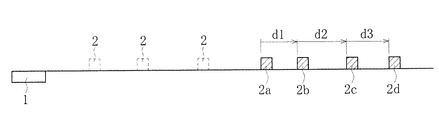
- the distance information transmitted from the ground element 2a recognized first and the appropriate number of ground elements 2b continuously recognized from the ground element 2a is mounted on the railway vehicle.
- the first recognized ground child is called the first ground child.
- the distance information received from the ground unit is cleared after confirming the current position during traveling.
- calculated intervals d1 to d3 are compared with the intervals between the ground elements in the database of the traveling route being traveled.
- the information processing apparatus determines the identified location as the current location of the railway vehicle and corrects the current location information. Then, the correction performed by receiving the distance information from the ground unit 2 is resumed.
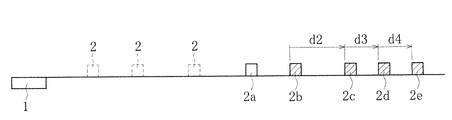
- FIG. 2 shows that the first ground element 2a among the first to fourth ground elements 2a to 2d compared previously is the fifth ground element following the fourth ground element 2d compared first.
- This is an example of changing to 2e. That is, in this example, the second ground element 2b next to the first ground element 2a and the third to fifth ground elements 2c to 2e continuous with the second ground element 2b are updated.
- the updated calculated intervals d2 to d4 are compared with the intervals between the ground elements on the database.
- the information processing apparatus can identify the specified location as a railroad.
- the current position information is corrected based on the current position of the vehicle. And with this correction
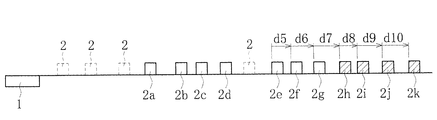
- Fig. 3 shows an example in which the current position is lost again after the first comparison.
- d5 to d7 are calculated, and the calculated intervals d5 to d7 are compared with the intervals between the ground elements in the travel route database.
- the first comparison after losing sight of the current position again could not identify the location where both intervals coincided.
- the first ground element 2e is changed to the sixth ground element 2j following the compared fifth ground element 2i.
- the updated calculated intervals d6 to d8 are compared with the intervals between the ground elements on the database.
- FIG. 3 shows the location where both intervals coincide with each other by comparing the calculated intervals d8 to d10 of the fourth to seventh ground elements 2h to 2k updated with the fifth time and the distance between the ground elements on the database. It is an example.
- the information processing apparatus determines that the identified place is the current position of the railway vehicle, corrects the current position information, and receives the distance information from the ground unit to perform correction. To resume.
- the ground element to be updated may be different from the ground element compared first and a plurality of ground elements, unlike the examples shown in FIGS. Moreover, all the ground children may be made different.
Landscapes
- Engineering & Computer Science (AREA)
- Mechanical Engineering (AREA)
- Life Sciences & Earth Sciences (AREA)
- Sustainable Development (AREA)
- Sustainable Energy (AREA)
- Power Engineering (AREA)
- Transportation (AREA)
- Electric Propulsion And Braking For Vehicles (AREA)
- Train Traffic Observation, Control, And Security (AREA)
Abstract
何らかの原因で走行中の鉄道車両が現在位置を見失ったときにも、可及的速やかに現在位置を把握して現在位置情報を補正する。 走行中の鉄道車両が地上子からの距離程情報の受信に失敗して現在位置情報を補正できないときに、当該鉄道車両の現在位置情報を補正する方法である。前記距離程情報の受信に失敗した後、最初に認識した地上子2aと当該地上子2aから連続して認識した適数の地上子2b…が発信する距離程情報を基に前記各地上子間の間隔を算出する。当該算出した各地上子間の間隔と、前記走行中の走行経路のデータベース上の各地上子間の間隔を比較する。前記比較した両間隔が一致する場所を特定できた場合、当該特定した位置を鉄道車両の現在位置として現在位置情報を補正する。
Description
本発明は、走行中の鉄道車両が地上子から発信される距離程情報の受信に失敗して現在位置情報を補正できなかったときに、当該鉄道車両の現在位置情報を補正する方法に関するものである。以下、地上子から発信される距離程情報の受信に失敗して現在位置情報を補正できなかった場合を、現在位置を見失った場合という。
走行中の鉄道車両は、各停車駅を起点として速度発電機により取得した車輪の回転数によって現在位置を把握している。この現在位置の把握方法では、車輪の空転時、或いは、車輪の滑走時には、前記把握した位置に誤差が生じる。従って、鉄道車両は、対を成すレール間に設置した地上子を通過するとき、当該地上子から発信される距離程情報を受信して現在位置情報を補正している(例えば特許文献1)。
しかしながら、鉄道車両が何らかの原因で地上子からの距離程情報を受信できなかったとき、或いは、前記受信できない状態が連続したとき、次に受信した距離程情報がどの位置の地上子から発信されたものであるのかを特定できなくなる。この場合、当該鉄道車両は現在位置を見失うことになる。
なお、地上子から発信された距離程情報を受信できない原因としては、例えばシステムのバグ、車両の増結に伴って地上子の位置を変更した場合に当該変更がデータベースに反映されるまでの期間などが考えられる。
走行中の鉄道車両が現在位置を見失ったとき、従来は、地上子から発信された距離程情報を受信して行う現在位置情報の補正を次の停車駅まで行わず、鉄道車両の現在位置の認識は速度発電機により取得した車輪の回転数による把握に頼っていた。
しかしながら、曲線区間が保有する曲線情報を基に車体傾斜制御を行う鉄道車両では、前記現在位置情報の補正を非制御とした状態で次の停車駅まで走行する間に曲線区間が存在する場合、適切な車体傾斜制御を行うことができない。
本発明が解決しようとする課題は、曲線情報を基に車体傾斜制御を行う鉄道車両では、現在位置情報の補正を非制御とした状態で次の停車駅まで走行する間に存在する曲線区間で適切な車体傾斜制御を行えないという点である。
本発明は、走行中の鉄道車両が何らかの原因で現在位置を見失ったときにも、可及的速やかに現在位置を把握して現在位置情報を補正できるようにすることを目的とするものである。
レール上に設置される地上子の間隔は一定ではなく、直線区間の長さ、曲線区間の曲線半径、レールの勾配、隣接する駅の間隔等によって相違する。発明者らは、対を成すレール間に設置される地上子の間隔が一定でないことに着目し、以下の本発明を成立させた。
本発明は、走行中の鉄道車両が現在位置を見失ったときに、当該鉄道車両の現在位置情報を補正する方法であって、以下の構成を最も主要な特徴としている。
走行中の鉄道車両が現在位置を見失った後、最初に認識した地上子と当該地上子から連続して認識した適数の地上子から受信した距離程情報を記憶し、これら記憶した距離程情報を基に前記連続して認識した各地上子間の間隔を算出する。
その後、前記算出した各地上子間の間隔と、前記走行中の走行経路のデータベース上の各地上子間の間隔を比較する。
そして、前記比較した両間隔が一致する場所を特定できた場合、当該特定した位置を鉄道車両の現在位置として現在位置情報を補正する。
一方、前記比較した両間隔が一致する場所を特定できない場合は、前記データベースと比較する各地上子を更新して更新した地上子間の間隔を算出する。なお、更新する地上子には、前記両間隔が一致する場所を特定できなかったときの地上子を全く含まない場合、前記地上子を一部含む場合の何れの場合でも良い。
その後、前記更新した地上子間の算出間隔と前記データベース上の各地上子間の間隔を比較する。
そして、前記地上子の更新と、更新した地上子間の算出間隔と前記データベース上の各地上子間の間隔との比較を、両間隔が一致する場所を特定できるまで繰り返し行い、両間隔が一致する場所を特定できた場合、当該特定した位置を鉄道車両の現在位置として現在位置情報を補正する。
上記本発明の場合、前記適数の各地上子間の算出間隔と比較する前記データベース上の地上子間の距離程の検索範囲を定め、当該定めた距離程の検索範囲内で前記適数の各地上子間の算出間隔と比較することが望ましい。
その理由は、比較する前記データベース上の地上子間の距離程の検索範囲を定めない場合は、比較するデータ数が膨大となって前記両間隔が一致する区間が重複する可能性が高くなり、前記両間隔が一致する場所を特定し難くなるからである。
前記距離程の検索範囲とは、鉄道車両が現在位置を見失ったとき、見失った後の最初に認識する地上子を起点とする距離程の検索範囲を意味する。発明者らの調査によれば、前記検索範囲は±500以下の場合は、問題なく前記両間隔が一致する場所を特定できることを確認している。
また、上記本発明において、前記データベースと比較する地上子間の数は特に限定されない。しかしながら、前記地上子間の数が2つでは各地上子間の算出間隔と前記データベース上の各地上子間の間隔が一致する場所を特定することが難しくなる。
一方、前記データベースと比較する地上子間の数が多くなりすぎる場合は、前記両間隔が一致する場所を特定できる可能性が高くなるが、特定に要する時間が長くなる。
従って、両者を勘案して、前記データベースと比較する地上子間の数は、できるだけ少なくなるように決定することになる。発明者らの調査によれば、前記地上子間の数を4つとした場合は、前記距離程の検索範囲を定めることによって重複する区間が存在しなかった。前記地上子間の数を3つとした場合は、前記距離程の検索範囲を定めても重複する区間が存在するときもあるが、比較する地上子を更新することによって速やかに現在位置情報を補正できることに変わりはない。
対を成すレール間に設置される隣接する地上子の間隔は、隣接する駅の間隔に比べて短い。したがって、上記本発明によれば、走行中の鉄道車両が現在位置を見失ったときにも、可及的速やかに鉄道車両の現在位置情報を補正することができる。
本発明では、走行中の鉄道車両が現在位置を見失ったときにも、可及的速やかに走行中の現在位置情報を補正することができる。したがって、曲線区間が存在しても曲線情報を基に適切な車体傾斜制御を行うことができる。
本発明の目的は、走行中の鉄道車両が現在位置を見失ったときにも、可及的速やかに現在位置を把握して現在位置情報を補正することである。そして、その目的を、連続する地上子から受信する距離程情報を基に算出した各地上子間の間隔をデータベース上の各地上子間の間隔と比較することで実現した。
以下、本発明の鉄道車両における現在位置情報の補正方法を、添付図面を用いて説明する。
例えばシステムのバグによって、走行中の鉄道車両が地上子からの距離程情報を受信できなかったとき、その後の地上子から受信する距離程情報がどの地上子から発信されたものであるのかを判断できない。この場合、走行中の鉄道車両は現在位置情報を補正できなくなって、現在位置を見失うことになる。
例えば、図1~図3に示すように、駅1を通過した後に地上子2を3つ読み飛ばし、3つ目の地上子を読み飛ばした後に当該読み飛ばしを検知した場合、地上子からの距離程情報を受信して行う現在位置情報の補正を次の停車駅まで非制御とする。
その後、本発明では、鉄道車両の現在位置情報を、以下に説明するように補正する。
現在位置情報の前記補正を非制御とした後、最初に認識した地上子2aと、当該地上子2aから連続して認識した適数の地上子2b…が発信する距離程情報を鉄道車両に搭載した情報処理装置に記憶する。以後、最初に認識した地上子を、最初の地上子という。なお、正常時は、地上子から受信する距離程情報は、走行中の現在位置を確認した後にクリアされる。
現在位置情報の前記補正を非制御とした後、最初に認識した地上子2aと、当該地上子2aから連続して認識した適数の地上子2b…が発信する距離程情報を鉄道車両に搭載した情報処理装置に記憶する。以後、最初に認識した地上子を、最初の地上子という。なお、正常時は、地上子から受信する距離程情報は、走行中の現在位置を確認した後にクリアされる。
(連続して認識した4つの地上子が発信する距離程情報を使用して最初の比較で現在位置を補正できた場合:図1)
前記記憶した、最初の地上子2aと、当該地上子2aから連続して認識した2番目~4番目の地上子2b~2dが発信した距離程情報を基に、前記情報処理装置は各地上子間の間隔d1~d3を算出する。
前記記憶した、最初の地上子2aと、当該地上子2aから連続して認識した2番目~4番目の地上子2b~2dが発信した距離程情報を基に、前記情報処理装置は各地上子間の間隔d1~d3を算出する。
そして、当該算出した間隔(以下、算出間隔という)d1~d3と、当該走行中の走行経路のデータベースにおける各地上子間の間隔を比較する。
図1に示した例のように、最初の比較により両間隔が一致する場所を特定できた場合、前記情報処理装置は当該特定した場所を鉄道車両の現在位置と判断して現在位置情報を補正し、地上子2からの距離程情報を受信して行う補正を再開する。
(連続して認識した4つの地上子が発信する距離程情報を使用して最初の比較で両間隔が一致する場所を特定できない場合:図2、図3)
一方、前記最初の比較により両間隔が一致する場所を特定できない場合は、比較する最初~4番目の地上子2a~2dを更新し、更新した地上子間の間隔を算出する。その後、更新した算出間隔を前記データベース上の各地上子間の間隔と比較する作業を、両間隔が一致する場所を特定できるまで行う。
一方、前記最初の比較により両間隔が一致する場所を特定できない場合は、比較する最初~4番目の地上子2a~2dを更新し、更新した地上子間の間隔を算出する。その後、更新した算出間隔を前記データベース上の各地上子間の間隔と比較する作業を、両間隔が一致する場所を特定できるまで行う。
(2回目の比較で現在位置を補正できた場合:図2)
図2で示した例の場合、最初の比較により、両間隔が一致する場所を特定できなかったので、比較する地上子2a~2dを更新する。
図2で示した例の場合、最初の比較により、両間隔が一致する場所を特定できなかったので、比較する地上子2a~2dを更新する。
更新する地上子として、図2は、先に比較した最初~4番目の地上子2a~2dのうち最初の地上子2aを、最初に比較した4番目の地上子2dに続く5番目の地上子2eに変更した例である。つまり、最初の地上子2aの次の2番目の地上子2bと、当該2番目の地上子2bと連続する3~5番目の地上子2c~2eに更新した例である。この場合、更新した算出間隔d2~d4を前記データベース上の各地上子間の間隔と比較する。
図2に示した例は、2回目の比較で前記算出間隔d2~d4と前記データベース上の各地上子間の間隔が一致する場所を特定できたので、情報処理装置は当該特定した場所を鉄道車両の現在位置と判断して現在位置情報を補正する。そして、この補正と共に、地上子からの距離程情報を受信して行う補正を再開する。
(5回目の比較で現在位置を補正できた場合:図3)
図3で示した例の場合も図2の例と同様、最初の比較により、両間隔が一致する場所を特定できなかったので、比較する地上子2a~2dを更新する。
図3で示した例の場合も図2の例と同様、最初の比較により、両間隔が一致する場所を特定できなかったので、比較する地上子2a~2dを更新する。
図3は、最初の比較後に再度現在位置を見失った例である。この場合、その後最初に認識した地上子2eと、当該最初の地上子2eから連続して認識した2~5番目の地上子2f~2hが発信する距離程情報を基に各地上子間の間隔d5~d7を算出し、当該算出間隔d5~d7と当該走行経路のデータベースにおける各地上子間の間隔を比較する。
図3の例では、再度現在位置を見失った後の最初の比較(2回目の比較)により、両間隔が一致する場所を特定できなかったので、図2の例と同様、比較した地上子のうち最初の地上子2eを、前記比較した5番目の地上子2iに続く6番目の地上子2jに変更する。そして、当該更新した算出間隔d6~d8と前記データベース上の各地上子間の間隔を比較する。
以上の作業を算出間隔と前記データベース上の各地上子間の間隔が一致する場所を特定できるまで行う。図3は5回目に更新した、4番目~7番目の地上子2h~2kの算出間隔d8~d10と前記データベース上の各地上子間の間隔の比較により両間隔が一致する場所を特定できた例である。両間隔が一致する場所を特定できた場合、情報処理装置は当該特定した場所を鉄道車両の現在位置と判断して現在位置情報を補正し、地上子からの距離程情報を受信して行う補正を再開する。
ちなみに、発明者らは、5つの走行区間で、データベース上の地上子間の距離程の検索範囲を±500mとした場合に、データベース上の隣接する3つの地上子間の間隔が重複する区間があるか否かを調査した。
その結果、2区間重複する走行区間が2つ、3区間重複する走行区間と1区間重複する走行区間が各1つあった。また、重複する区間がない走行区間も1つあった。
一方、前記と同じ5つの走行区間で、データベース上の地上子間の距離程の検索範囲を±500mとした場合に、データベース上の隣接する4つの地上子間の間隔が重複する区間があるか否かを発明者らが調査した結果、全ての走行区間で重複する区間がなかった。
本発明は上記した例に限らないことは勿論であり、各請求項に記載の技術的思想の範疇であれば、適宜実施の形態を変更しても良いことは言うまでもない。
更新する地上子は、図2、図3に示した例と異なり、最初に比較した地上子と複数個の地上子を異ならせてもよい。また、全ての地上子を異ならせてもよい。
1 駅
2,2a,2b… 地上子
2,2a,2b… 地上子
Claims (5)
- 走行中の鉄道車両が地上子からの距離程情報の受信に失敗して現在位置情報を補正できないときに、当該鉄道車両の現在位置情報を補正する方法であって、
前記距離程情報の受信に失敗した後、最初に認識した地上子と当該地上子から連続して認識した適数の地上子が発信する距離程情報を基に前記各地上子間の間隔を算出して、当該算出した各地上子間の間隔と、前記走行中の走行経路のデータベース上の各地上子間の間隔を比較し、
前記比較した両間隔が一致する場所を特定できた場合、当該特定した位置を鉄道車両の現在位置として現在位置情報を補正することを特徴とする鉄道車両の現在位置情報補正方法。 - 前記比較した両間隔が一致する場所を特定できない場合は、前記データベースと比較する各地上子を更新して更新した地上子間の間隔を算出し、当該算出した各地上子間の間隔と、前記データベース上の各地上子間の間隔との比較を両間隔が一致する場所を特定できるまで繰り返し行い、両間隔が一致する場所を特定できた場合、
当該特定した位置を鉄道車両の現在位置として現在位置情報を補正することを特徴とする請求の範囲第1項に記載の鉄道車両の現在位置情報補正方法。 - 前記適数の各地上子間の算出間隔と比較する前記データベース上の地上子間の距離程の検索範囲を定め、当該定めた距離程の検索範囲内で前記適数の各地上子間の算出間隔と比較することを特徴とする請求の範囲第1項又は第2項に記載の鉄道車両の現在位置情報補正方法。
- 前記検索範囲は±500m以下であることを特徴とする請求の範囲第3項に記載の鉄道車両の現在位置情報補正方法。
- 前記データベースと比較する地上子間の数は3つ又は4つであることを特徴とする請求の範囲第3項又は第4項に記載の鉄道車両の現在位置情報補正方法。
Priority Applications (1)
| Application Number | Priority Date | Filing Date | Title |
|---|---|---|---|
| JP2020513239A JP6981544B2 (ja) | 2018-04-09 | 2019-04-05 | 鉄道車両の現在位置情報補正方法 |
Applications Claiming Priority (2)
| Application Number | Priority Date | Filing Date | Title |
|---|---|---|---|
| JP2018074498 | 2018-04-09 | ||
| JP2018-074498 | 2018-04-09 |
Publications (1)
| Publication Number | Publication Date |
|---|---|
| WO2019198633A1 true WO2019198633A1 (ja) | 2019-10-17 |
Family
ID=68164074
Family Applications (1)
| Application Number | Title | Priority Date | Filing Date |
|---|---|---|---|
| PCT/JP2019/015103 Ceased WO2019198633A1 (ja) | 2018-04-09 | 2019-04-05 | 鉄道車両の現在位置情報補正方法 |
Country Status (2)
| Country | Link |
|---|---|
| JP (1) | JP6981544B2 (ja) |
| WO (1) | WO2019198633A1 (ja) |
Citations (6)
| Publication number | Priority date | Publication date | Assignee | Title |
|---|---|---|---|---|
| JPH06144227A (ja) * | 1992-10-30 | 1994-05-24 | East Japan Railway Co | 車両在線位置検知装置 |
| JPH11171017A (ja) * | 1997-12-15 | 1999-06-29 | Hitachi Ltd | 車両制御装置 |
| JP2008056179A (ja) * | 2006-09-01 | 2008-03-13 | Toshiba Corp | 列車位置検出装置 |
| JP2009023423A (ja) * | 2007-07-18 | 2009-02-05 | Nippon Signal Co Ltd:The | 車両制御装置 |
| WO2011135626A1 (ja) * | 2010-04-28 | 2011-11-03 | 三菱電機株式会社 | 列車速度制御装置および列車速度制御方法 |
| JP2016141300A (ja) * | 2015-02-03 | 2016-08-08 | 日本車輌製造株式会社 | 鉄道車両の走行位置検出システム |
-
2019
- 2019-04-05 JP JP2020513239A patent/JP6981544B2/ja active Active
- 2019-04-05 WO PCT/JP2019/015103 patent/WO2019198633A1/ja not_active Ceased
Patent Citations (6)
| Publication number | Priority date | Publication date | Assignee | Title |
|---|---|---|---|---|
| JPH06144227A (ja) * | 1992-10-30 | 1994-05-24 | East Japan Railway Co | 車両在線位置検知装置 |
| JPH11171017A (ja) * | 1997-12-15 | 1999-06-29 | Hitachi Ltd | 車両制御装置 |
| JP2008056179A (ja) * | 2006-09-01 | 2008-03-13 | Toshiba Corp | 列車位置検出装置 |
| JP2009023423A (ja) * | 2007-07-18 | 2009-02-05 | Nippon Signal Co Ltd:The | 車両制御装置 |
| WO2011135626A1 (ja) * | 2010-04-28 | 2011-11-03 | 三菱電機株式会社 | 列車速度制御装置および列車速度制御方法 |
| JP2016141300A (ja) * | 2015-02-03 | 2016-08-08 | 日本車輌製造株式会社 | 鉄道車両の走行位置検出システム |
Also Published As
| Publication number | Publication date |
|---|---|
| JPWO2019198633A1 (ja) | 2021-02-12 |
| JP6981544B2 (ja) | 2021-12-15 |
Similar Documents
| Publication | Publication Date | Title |
|---|---|---|
| CN111016891B (zh) | 一种车辆行驶的路线跟踪控制方法及装置 | |
| WO2014099660A4 (en) | Method of material handling with automatic guided vehicles | |
| ITBO20090514A1 (it) | Metodo di analisi del comportamento del conducente di un veicolo stradale | |
| JP5506762B2 (ja) | 車上装置および列車位置計算方法 | |
| JP2019216512A (ja) | 鉄道車両の定位置停止制御システムおよび車上装置 | |
| JP2018019470A (ja) | 列車定位置停止制御装置 | |
| CN114509087B (zh) | 定位方法、电子设备及计算机存储介质 | |
| WO2019198633A1 (ja) | 鉄道車両の現在位置情報補正方法 | |
| JP5109915B2 (ja) | 走行支援装置 | |
| JP2017055518A (ja) | 列車制御システム | |
| WO2023112578A1 (ja) | 列車制御システムおよび列車制御方法 | |
| FR2982963B1 (fr) | Procede de guidage pour correction de trajectoire d'un aeronef | |
| CN113895487B (zh) | 一种等间隔行车调整方法 | |
| KR102467014B1 (ko) | 돌발상황 발생 시 자율주행 자동차의 운행경로를 생성하는 방법 및 이를 이용한 장치 | |
| JP2013005588A (ja) | 自動列車停止装置および自動列車停止方法 | |
| KR20160010175A (ko) | 방향각 오차를 이용한 차량형 이동 로봇의 오도메트리 오차 보정 방법 | |
| JP2019050691A (ja) | 列車位置検出システム、自動列車制御システム、列車運転支援システム及び列車障害物検知システム | |
| JP6284723B2 (ja) | 列車位置の補正方法 | |
| JP4599835B2 (ja) | 車両用自動操舵制御装置 | |
| JP2016068640A (ja) | 列車制御システム、車上装置及び列車制御方法 | |
| US20230118458A1 (en) | Method and control unit for the satellite-based localization of a vehicle in a map-based reference system | |
| JP3552869B2 (ja) | 走行距離補正装置 | |
| US20150197351A1 (en) | Trajectory generation device, trajectory generation method, and storage medium having trajectory generation program stored therein | |
| JP6324001B2 (ja) | 車上装置 | |
| JP2010018090A (ja) | 列車制御システム |
Legal Events
| Date | Code | Title | Description |
|---|---|---|---|
| 121 | Ep: the epo has been informed by wipo that ep was designated in this application |
Ref document number: 19785251 Country of ref document: EP Kind code of ref document: A1 |
|
| ENP | Entry into the national phase |
Ref document number: 2020513239 Country of ref document: JP Kind code of ref document: A |
|
| NENP | Non-entry into the national phase |
Ref country code: DE |
|
| 122 | Ep: pct application non-entry in european phase |
Ref document number: 19785251 Country of ref document: EP Kind code of ref document: A1 |