WO2019130722A1 - 平版印刷インキ組成物及び印刷物 - Google Patents
平版印刷インキ組成物及び印刷物 Download PDFInfo
- Publication number
- WO2019130722A1 WO2019130722A1 PCT/JP2018/037999 JP2018037999W WO2019130722A1 WO 2019130722 A1 WO2019130722 A1 WO 2019130722A1 JP 2018037999 W JP2018037999 W JP 2018037999W WO 2019130722 A1 WO2019130722 A1 WO 2019130722A1
- Authority
- WO
- WIPO (PCT)
- Prior art keywords
- vegetable oil
- ink composition
- lithographic printing
- printing ink
- alkyd resin
- Prior art date
- Legal status (The legal status is an assumption and is not a legal conclusion. Google has not performed a legal analysis and makes no representation as to the accuracy of the status listed.)
- Ceased
Links
Classifications
-
- C—CHEMISTRY; METALLURGY
- C09—DYES; PAINTS; POLISHES; NATURAL RESINS; ADHESIVES; COMPOSITIONS NOT OTHERWISE PROVIDED FOR; APPLICATIONS OF MATERIALS NOT OTHERWISE PROVIDED FOR
- C09D—COATING COMPOSITIONS, e.g. PAINTS, VARNISHES OR LACQUERS; FILLING PASTES; CHEMICAL PAINT OR INK REMOVERS; INKS; CORRECTING FLUIDS; WOODSTAINS; PASTES OR SOLIDS FOR COLOURING OR PRINTING; USE OF MATERIALS THEREFOR
- C09D11/00—Inks
- C09D11/02—Printing inks
- C09D11/06—Printing inks based on fatty oils
-
- C—CHEMISTRY; METALLURGY
- C09—DYES; PAINTS; POLISHES; NATURAL RESINS; ADHESIVES; COMPOSITIONS NOT OTHERWISE PROVIDED FOR; APPLICATIONS OF MATERIALS NOT OTHERWISE PROVIDED FOR
- C09D—COATING COMPOSITIONS, e.g. PAINTS, VARNISHES OR LACQUERS; FILLING PASTES; CHEMICAL PAINT OR INK REMOVERS; INKS; CORRECTING FLUIDS; WOODSTAINS; PASTES OR SOLIDS FOR COLOURING OR PRINTING; USE OF MATERIALS THEREFOR
- C09D11/00—Inks
- C09D11/02—Printing inks
- C09D11/10—Printing inks based on artificial resins
- C09D11/102—Printing inks based on artificial resins containing macromolecular compounds obtained by reactions other than those only involving unsaturated carbon-to-carbon bonds
- C09D11/103—Printing inks based on artificial resins containing macromolecular compounds obtained by reactions other than those only involving unsaturated carbon-to-carbon bonds of aldehydes, e.g. phenol-formaldehyde resins
-
- C—CHEMISTRY; METALLURGY
- C09—DYES; PAINTS; POLISHES; NATURAL RESINS; ADHESIVES; COMPOSITIONS NOT OTHERWISE PROVIDED FOR; APPLICATIONS OF MATERIALS NOT OTHERWISE PROVIDED FOR
- C09D—COATING COMPOSITIONS, e.g. PAINTS, VARNISHES OR LACQUERS; FILLING PASTES; CHEMICAL PAINT OR INK REMOVERS; INKS; CORRECTING FLUIDS; WOODSTAINS; PASTES OR SOLIDS FOR COLOURING OR PRINTING; USE OF MATERIALS THEREFOR
- C09D11/00—Inks
- C09D11/02—Printing inks
- C09D11/10—Printing inks based on artificial resins
- C09D11/102—Printing inks based on artificial resins containing macromolecular compounds obtained by reactions other than those only involving unsaturated carbon-to-carbon bonds
- C09D11/104—Polyesters
- C09D11/105—Alkyd resins
Definitions
- the present disclosure relates to a lithographic printing ink composition (hereinafter, also referred to as “lithographic ink” or “ink”) used in offset printing, and a printed material thereof.
- lithographic ink also referred to as “lithographic ink” or “ink”
- the "oxidation polymerization type" drying method generally used in offset printing means that after printing on a printing substrate such as paper, the oxygen in the air causes oxidation polymerization of the components in the ink to solidify and dry It is.
- the non-VOC ink containing the above-mentioned vegetable oil component the vegetable oil which is the main component participates in the oxidative polymerization reaction, and the resulting printed matter becomes excellent in rigidity.
- the printing layer can not follow the deformation of the printing substrate, and problems such as generation of cracks during post-processing occur.
- Patent Document 3 discloses a method of using an ethylene / unsaturated carboxylic acid copolymer as a resin, but the ink becomes over-emulsified and the printability (especially, the density fluctuation) is significantly deteriorated. Again, it was not a preferred method.
- JP 2004-204203 A Japanese Patent Application Laid-Open No. 2005-060963 Japanese Patent Application Publication No. 2003-183564
- the present disclosure solves the above-mentioned problems, and an object of the present disclosure is to obtain a printed material having high flexibility without causing blocking and deterioration of scratch resistance without excessively reducing the content of vegetable oil. It is an object of the present invention to provide a lithographic printing ink composition that can be used.
- a lithographic printing ink composition capable of solving the above-mentioned problems can be obtained by using a rosin-modified phenolic resin, an alkyd resin and a vegetable oil in combination as defined below.
- the lithographic printing ink composition of the present disclosure is a lithographic printing ink composition
- a lithographic printing ink composition comprising a rosin modified phenolic resin (A), an alkyd resin (B), a vegetable oil (C), and a pigment
- the weight average molecular weight of the rosin modified phenolic resin (A) is 50,000 to 130,000
- the phenolic structural unit constituting the rosin modified phenolic resin (A) is an alkyl group having 4 to 18 carbon atoms
- the iodine value of the vegetable oil (C) is 50 to 140 mg / 100 mg
- the content of the vegetable oil (C) is 35 to 60% by mass in the lithographic printing ink composition.
- the content of the vegetable oil-modified alkyd resin (b) is 2 to 20% by mass based on the total amount of the lithographic printing ink composition.
- the content of the rosin modified phenolic resin (A) is 15 to 25% by mass in the lithographic printing ink composition.
- the ratio (Cc / Bc) of the content (Bc) of the alkyd resin (B) to the content (Cc) of the vegetable oil (C) is 1. 8 to 10.5.
- the printed matter of the present disclosure has a colored layer formed by printing the above-mentioned lithographic printing ink composition on a substrate.
- One embodiment of the above-mentioned printed matter further comprises a covering layer on the colored layer.
- a lithographic printing ink composition capable of obtaining a print having high flexibility without causing blocking and deterioration of abrasion resistance without excessively reducing the content of a vegetable oil component. It becomes possible.
- lithographic printing ink composition of the present disclosure will be described in detail.
- the lithographic printing ink composition of this indication is not limited to the following embodiment, The modification implemented in the range which does not change a summary is also included.
- part “%” represents “mass part” “mass%” unless there is particular notice.
- the lithographic printing ink composition of the present disclosure has a specific structure and a rosin-modified phenolic resin having a defined weight average molecular weight, an alkyd resin modified with a vegetable oil, and a specific iodine value.
- a vegetable oil By using a vegetable oil in combination, it is possible to obtain a print having high flexibility without causing blocking and deterioration of scratch resistance.
- the principle by which the above-mentioned problems can be solved by the lithographic printing ink composition having the above-mentioned constitution will be described below. The following is an inference, and does not limit the lithographic printing ink composition of the present disclosure.
- the vegetable oil contained in the ink participates in the oxidative polymerization reaction.
- the reaction site of the oxidative polymerization reaction is the unsaturated bond present in vegetable oil, and the amount is represented by the iodine value.
- the iodine value of the vegetable oil (C) used in the lithographic printing ink composition of the present disclosure is 50 to 140 mg / 100 mg.
- a vegetable oil component having an iodine value of 140 mg / 100 mg or less the distance between reaction points can be appropriately broadened, and the crosslink density can be suitably reduced.
- the flexibility of the printed matter can be improved without using an additive such as a plasticizer.
- the iodine value of the vegetable oil (C) is 50 mg / 100 mg or more, the blocking and the deterioration of the abrasion resistance are suppressed while maintaining the above-mentioned flexibility.
- the vegetable oil (C) is used in the range of 35 to 60% by mass based on the total amount of the lithographic printing ink composition.
- the content of the vegetable oil (C) is 35% by mass or more, the flexibility of the printed matter is excellent.
- the content of the vegetable oil (C) is set to 60% by mass or less, the content of each component to be described later is relatively increased, and flexibility, low blocking, and excellent scratch resistance are both achieved at a high level. can do.
- a rosin modified phenolic resin (A) having a weight average molecular weight of 50,000 to 130,000 and containing a phenol structural unit containing an alkyl group having 4 to 18 carbon atoms is used . While a large rosin modified phenolic resin having a weight average molecular weight of 50,000 or more is incorporated into the crosslinked structure formed by the vegetable oil (C), the crosslink density is further reduced by the steric hindrance due to the C 4-18 alkyl group. Film flexibility is further improved.
- the weight average molecular weight of the rosin modified phenolic resin is 130,000 or less, the blocking and the deterioration of the abrasion resistance are suppressed while maintaining the above-mentioned flexibility.
- the alkyl group has 4 or more carbon atoms, the flexibility is improved by the steric hindrance.
- the carbon number is 18 or less, the blocking and the deterioration of the abrasion resistance are suppressed.
- the lithographic printing ink composition of the present disclosure is characterized by further using a vegetable oil-modified alkyd resin (b) in combination in order to suppress blocking and improve abrasion resistance.
- the vegetable oil portion of the vegetable oil-modified alkyd resin (b) causes oxidative polymerization with the vegetable oil (C), whereby the vegetable oil-modified alkyd resin (b) is incorporated into the cross-linked structure to make the coating film fast, and the above blocking property and resistance It is believed that the abradability improves.
- the lithographic ink composition of the present disclosure it is possible to obtain a print having low blocking property and excellent scratch resistance while having high flexibility.
- the rosin modified phenolic resin (A) used in the present embodiment has a weight average molecular weight of 50,000 to 130,000 and includes a phenol structural unit having an alkyl group having 4 to 18 carbon atoms.
- the weight average molecular weight of the rosin modified phenolic resin (A) is 50,000 to 130,000, more preferably 80,000 to 100,000.
- the crosslink density when incorporated into the crosslink structure becomes suitable, and the improvement of the coating film flexibility and the suppression of the tackiness, the blocking and the deterioration of the abrasion resistance are obtained. It is compatible.
- the viscosity to 50,000 or more, the viscosity of the ink can also be made suitable, generation of misting and the like can be suppressed, and the stability and printability of the ink on the printing press can be improved.
- the solubility of the resin is improved, and the fluidity of the ink and the gloss of the printed matter are improved.
- the said weight average molecular weight is the polystyrene conversion amount measured by gel permeation chromatography (GPC).
- the carbon number of the alkyl group contained in the phenol structural unit is 4 to 18 as described above, but is preferably 8 to 16, and particularly preferably 9 to 12.
- the carbon number of the alkyl group is 4 to 18 as described above, but is preferably 8 to 16, and particularly preferably 9 to 12.
- alkyl group n-butyl group, sec-butyl group, isobutyl group, tert-butyl group, n-pentyl group, isopentyl group, neopentyl group, n-hexyl group, isohexyl group, tert-hexyl group, n-heptyl Group, isoheptyl group, tert-heptyl group, n-octyl group, isooctyl group, tert-octyl group, n-nonyl group, isononyl group, tert-nonyl group, n-decyl group, isodecyl group, tert-decyl group, n -Dodecyl group, isododecyl group, tert-dodecyl group, n-tridecyl group, isotridecyl group, n-
- n-nonyl group, isononyl group, n-decyl group, isodecyl group, n-dodecyl group and isododecyl group are preferably selected from the viewpoint of coating film flexibility. Moreover, it is also preferable to select a linear alkyl group from the viewpoint of coating film flexibility.
- the content of the rosin-modified phenolic resin (A) is preferably 15 to 30% by mass, more preferably 20 to 25% by mass, based on the total amount of the lithographic ink.
- the alkyd resin (B) comprises vegetable oil modified alkyd resin (b).
- the vegetable oil modified alkyd resin (b) is incorporated into the cross-linked structure by causing oxidative polymerization of the vegetable oil portion of the vegetable oil modified alkyd resin (b) with the vegetable oil (C) which is another vegetable oil component.
- the printed matter can be made to be fast without excessively increasing the crosslinking density, and a printed matter excellent in blocking property and abrasion resistance can be obtained while maintaining the flexibility of the coating film.
- denatured alkyd resin (b) uses the same thing as the vegetable oil (C) mentioned later.
- the amount of the vegetable oil structural unit of the vegetable oil modified alkyd resin (b) is preferably 5 to 60% by mass, and preferably 10 to 55% by mass, relative to the amount of all structural units. Is more preferable, and 15 to 50% by mass is particularly preferable.
- the content of the vegetable oil-modified alkyd resin (b) is preferably 2 to 20% by mass, more preferably 5 to 20% by mass, still more preferably 5 to 18% by mass, based on the total amount of the lithographic ink. And particularly preferably 10 to 15% by mass.
- the content of the vegetable oil modified alkyd resin (b) within the above range, the crosslink density when incorporated in the crosslink structure and the coating film fastness of the printed matter are made suitable, and the film flexibility and blocking property ⁇ The balance with the abrasion resistance is improved. Further, by setting the content to 2% by mass or more, the coating film flexibility becomes suitable, and the fluidity of the ink can be secured. Further, by setting the content to 20% by mass or less, over-emulsification of the ink is suppressed, and printability is improved.
- an alkyd resin other than the vegetable oil-modified alkyd resin (b) may be added as the alkyd resin (B) for blocking property and abrasion resistance.
- the blending amount of the vegetable oil modified alkyd resin (b) is 8% by mass or more with respect to the total amount of alkyd resin (B), from the viewpoint of maintaining and improving the blocking property and scratch resistance of printed matter. It is more preferable to set it as mass% or more.
- resin other than the said rosin modified phenolic resin (A) and alkyd resin (B) can also be used together as a binder resin for the lithographic ink of this embodiment.
- resins selected from the group consisting of styrene maleic resin and maleic resin can be used.
- the total amount of the binder resin relative to the total amount of the lithographic ink is from the viewpoint of improving the printability and the adhesion to the substrate while maintaining the coating film flexibility, blocking property and scratch resistance.
- the content is preferably 25 to 60% by mass, and more preferably 30 to 50% by mass.
- the above blending amounts also include the blending amounts of the rosin modified phenolic resin (A) and the alkyd resin (B).
- the lithographic ink composition of the present embodiment contains a vegetable oil (C).
- vegetable oil refers to triglyceride which is an esterification reaction product of glycerin and a fatty acid, and monoglyceride and diglyceride obtained by the partial transesterification reaction thereof.
- the said fatty acid may contain the saturated fatty acid in the range with which the iodine value of the triglyceride obtained by said esterification reaction or partial transesterification, monoglyceride, and diglyceride falls in the range demonstrated below.
- the iodine value of the vegetable oil (C) used in the present embodiment is 50 to 140 mg / 100 mg, more preferably 70 to 120 mg / 100 mg.
- the crosslink density of the crosslink structure formed by the vegetable oil (C) becomes suitable, and the coating film flexibility is improved.
- the amount to 50 mg / 100 mg or more the gloss of the printed matter can be improved, and the stability of the ink on the printing press can be secured.
- the amount to 140 mg / 100 mg or less the coating film flexibility becomes preferable.
- the iodine value is a value measured by 2.3.4.1-1996 (Wies-cyclohexane method) of the standard oil and fat analysis test method (Japan Oil Chemistry Association). Specifically, after 0.15 g of the target vegetable oil is dissolved in 10 ml of cyclohexane, 25 ml of Wiss solution is added, and the flask is allowed to stand at room temperature in the dark for about 1 hour. After that, titration is performed with a 0.1 mol / l sodium thiosulfate standard solution, and the iodine value is calculated from the amount of the sodium thiosulfate standard solution added dropwise until the end point is reached.
- a vegetable oil (C) used in the present embodiment palm oil, neem oil, sunflower oil, soy sauce, castor oil, rice oil, rice bran oil, soybean oil, kapok oil, poppy seed oil, sesame oil, large flea oil, corn oil, Examples thereof include niger oil, an oil of manto oil, cottonseed oil, an oil of peanut oil, an oil of coconut oil and the like, but not limited thereto.
- rice oil, rice bran oil, soybean oil, neem oil and sesame oil is preferably selected from the viewpoint of coating film flexibility, and rice bran oil is particularly preferably selected.
- the vegetable oil (C) contains a regenerated vegetable oil.
- the reason is that by adjusting the conditions of the regeneration treatment, the iodine value can be artificially and easily contained within the above-mentioned preferable range, and the moisture content of the regenerated vegetable oil can be reduced to be contained together with the moisture. And removing impurities that adversely affect the stability and printability of the ink on the printing press.
- the water content of the regenerated vegetable oil is preferably 0.3% by mass or less.
- monoglyceride or diglyceride obtained by partial transesterification of one or more types of vegetable oils listed above can also be used as the vegetable oil (C).
- saturated fatty acids such as lauric acid, myristic acid, palmitic acid and stearic acid, monovalent saturated fatty acids such as palmitooleic acid, oleic acid and elaidic acid, linoleic acid and ⁇ -linoleic acid
- saturated fatty acids such as lauric acid, myristic acid, palmitic acid and stearic acid
- monovalent saturated fatty acids such as palmitooleic acid, oleic acid and elaidic acid
- linoleic acid and ⁇ -linoleic acid examples thereof include polyunsaturated fatty acids such as ⁇ -linolenic acid and the like, but not limited thereto.
- oleic acid and linoleic acid are preferably selected from the viewpoint of improving the balance between the coating film flexibility and the blocking
- the compounding amount of the vegetable oil (C) contained in the lithographic ink of the present embodiment is 35 to 60% by mass, particularly preferably 35 to 50% by mass, with respect to the total amount of the lithographic ink.
- the flexibility of the resulting printed matter and the drying property and on-machine stability of the ink can be suitably achieved.
- vegetable oil other than the said vegetable oil (C) may be used for the lithographic ink of this embodiment.
- vegetable oils other than the vegetable oil (C) include palm kernel oil, linseed oil, soy sauce, rapeseed oil and the like.
- the ratio (Cc / Bc) of the content (Bc) of the alkyd resin (B) to the content (Cc) of the vegetable oil (C) is 1.8 to 10 in mass ratio. It is preferably 5 and particularly preferably 2.1 to 10.5.
- the ratio of the alkyd resin (B) to the vegetable oil (C) in the above-mentioned range, a printed matter having high flexibility, low blocking property and excellent scratch resistance can be obtained. Further, by setting the ratio of the alkyd resin (B) to the vegetable oil (C) in the above range, the printability is excellent and the solid filling property at the time of printing is improved.
- the lithographic ink of the present embodiment contains a pigment.
- the pigment conventionally known organic pigments and / or inorganic pigments can be optionally used.
- an extender pigment may be included as the pigment.
- the compounding amount of the pigment in the present embodiment is an amount capable of securing the color developability and sharpness of the printed matter without inhibiting the effects of the present disclosure. It is preferable to do. Specifically, the amount is preferably 10 to 40% by mass, particularly preferably 15 to 35% by mass, based on the total amount of the lithographic ink.
- the lithographic ink of the present embodiment may also contain a gelling agent.
- the gelling agent include aluminum chelate compounds, metal soaps, and alkanolamines. The amount thereof is preferably 1% by mass or less based on the total amount of the lithographic ink.
- the lithographic ink of the present embodiment may appropriately contain various additives such as existing emulsifiers, emulsification inhibitors, abrasion resistance agents, anti-slip agents, drying accelerators, antioxidants, etc. It can be used.
- the total amount of the compounding amount is preferably 10% by mass or less based on the total amount of the lithographic ink.
- a rosin modified phenolic resin (A), an alkyd resin (B), a vegetable oil (C), a pigment and other components used as needed are uniformly mixed. It may be suitably selected from among known known dispersion methods.
- the above components are homogeneously mixed and dispersed by a kneader such as a kneader, three-roll mill, ball mill, planetary ball mill, beads mill, roll mill, attritor, sand mill, gate mixer, paint shaker, homogenizer, self-revolving stirrer, etc. It can be obtained by doing.
- the printed matter according to the present embodiment is characterized in that it has a colored layer formed by printing the lithographic printing ink composition on a substrate. Since the printed matter of the present embodiment has a colored layer formed by printing the above-mentioned lithographic printing ink composition, it is possible to obtain a printed matter provided with a colored layer having flexibility, low blocking, and excellent scratch resistance.
- the base material used in the present embodiment is not particularly limited, and can be appropriately selected according to the application.
- plastic substrates such as polycarbonate, hard vinyl chloride, soft vinyl chloride, polystyrene, foam polystyrene, PMMA, polypropylene, polyethylene, PET, etc. or combinations or modifications thereof; high quality paper, art paper, coated paper, cast coated paper etc.
- Paper substrates of The thickness of the substrate is not particularly limited, but can be, for example, 1 to 500 ⁇ m.
- the lithographic printing ink composition of the present embodiment can be printed on the substrate to form a colored layer by a known lithographic printing method.
- the thickness of the colored layer is not particularly limited, but can be, for example, 1 to 50 ⁇ m.
- the printed material of the present embodiment may further include a covering layer on the colored layer.
- the covering layer may be a layer which protects the colored layer and, if necessary, has an optical function such as low reflectivity and various functions such as adhesiveness.
- the covering layer may be a single layer or a laminate of two or more layers.
- the covering layer is preferably a transparent resin layer from the viewpoint of the visibility of the colored layer.
- the thickness of the covering layer is not particularly limited, but can be, for example, 1 to 500 ⁇ m.
- the lithographic printing ink composition of the present disclosure will be more specifically described by way of examples, but the lithographic printing ink composition of the present disclosure is not limited to these examples.
- a xylene solution (60% non-volatile content) of the resol-type phenolic resin.
- the compounds shown in Table 1 below were used as the above-mentioned para-alkylphenol.
- the obtained resol-type phenolic resins were designated as phenolic resins a1 to a6, respectively.
- Table 2 also shows the weight average molecular weights of the rosin modified phenolic resins 1 to 11.
- a gel chemical is prepared by charging Fine Chemical Co., Ltd. ALCH) according to the composition described in Table 3 below, heating to 190 ° C. while introducing nitrogen gas, and heating and stirring for 1 hour while maintaining the temperature. 1 to 22 were manufactured.
- the lithographic printing ink composition of the present disclosure which is a combination of a specific rosin modified phenolic resin (A), a specific alkyd resin (B) and a specific vegetable oil (C) It was possible to obtain a print having high flexibility without causing blocking and deterioration of scratch resistance.
Landscapes
- Chemical & Material Sciences (AREA)
- Life Sciences & Earth Sciences (AREA)
- Engineering & Computer Science (AREA)
- Materials Engineering (AREA)
- Wood Science & Technology (AREA)
- Organic Chemistry (AREA)
- Chemical Kinetics & Catalysis (AREA)
- Oil, Petroleum & Natural Gas (AREA)
- Inks, Pencil-Leads, Or Crayons (AREA)
Abstract
植物油の含有量を過度に減らすことなく、ブロッキングや耐擦過性の悪化を起こすことがなく、高い柔軟性を有する印刷物を得ることができる平版印刷インキ組成物を提供する。 ロジン変性フェノール樹脂(A)と、アルキド樹脂(B)と、植物油(C)と、顔料とを含有する平版印刷インキ組成物であって、前記ロジン変性フェノール樹脂(A)の重量平均分子量が、50,000~130,000であり、かつ、前記ロジン変性フェノール樹脂(A)を構成するフェノール構造単位が、炭素数4~18のアルキル基を含み、前記アルキド樹脂(B)が、植物油変性アルキド樹脂(b)を含み、前記植物油(C)のヨウ素価が、50~140mg/100mgであり、前記植物油(C)の含有量が、平版印刷インキ組成物中35~60質量%である、平版印刷インキ組成物。
Description
本開示は、オフセット印刷で用いられる平版印刷インキ組成物(以下、「平版インキ」「インキ」ともいう)、及びその印刷物に関する。
近年印刷業界では、印刷物や印刷作業現場に対する環境配慮の意識が高まっており、インキについても高い環境対応性能が求められている。オフセット印刷で用いられる平版印刷インキに関しては、従来使用されてきた揮発性の高い石油系溶剤をアロマフリー溶剤(芳香族成分の含有率が1質量%未満である溶剤)へと置き換えたインキや、揮発性有機化合物を実質的に含まないインキ(Non-VOCインキ)の検討・開発が進められている(特許文献1、2参照)。
中でも、生物由来資源を用いた環境配慮型製品に対して認定されるバイオマスマーク(一般社団法人日本有機資源協会)の普及・拡大に伴い、石油系溶剤の代わりに、バイオマス材料である植物油を含有するNon-VOCインキを要望する声が高まっている。
一方、オフセット印刷で一般に用いられる「酸化重合型」の乾燥方式とは、紙などの印刷基材に印刷した後、空気中の酸素によってインキ中の成分が酸化重合を起こし、固化・乾燥するものである。上記の植物油成分を含有するNon-VOCインキの場合は、主たる成分である植物油が酸化重合反応に関与し、得られる印刷物は剛直性に優れたものとなる。しかしながら、柔軟性のある印刷基材に対して印刷する場合、前記印刷基材の変形に印刷層が追従できず、後加工時にクラック等が発生する等の問題が発生する。
上記問題を解決する方法として、例えば、添加剤として可塑剤を用いる方法が考えられるが、可塑剤が、ブリード現象を引き起こしたり、ブロッキング性や耐擦過性を悪化させる恐れがあるため、好ましい方法とはいえなかった。また特許文献3には、樹脂としてエチレン・不飽和カルボン酸共重合体を使用する方法が開示されているが、インキが過乳化となってしまい著しく印刷適性(特に濃度変動)が悪化してしまうため、やはり好ましい方法ではなかった。
以上のように、植物油の含有量を過度に減らすことなく、ブロッキング性や耐擦過性の悪化を起こすことがなく、高い柔軟性を有する印刷物を得ることができる平版印刷インキ組成物は、これまでに存在しない状況であった。
本開示は、上記課題を解決するものであって、その目的は、植物油の含有量を過度に減らすことなく、ブロッキングや耐擦過性の悪化を起こすことがなく、高い柔軟性を有する印刷物を得ることができる平版印刷インキ組成物を提供することにある。
本発明者らが鋭意研究した結果、以下に規定するロジン変性フェノール樹脂、アルキド樹脂及び植物油を組み合わせて用いることにより、上記課題が解決可能な平版印刷インキ組成物が得られることを見出した。
すなわち本開示の平版印刷インキ組成物は、ロジン変性フェノール樹脂(A)と、アルキド樹脂(B)と、植物油(C)と、顔料とを含有する平版印刷インキ組成物であって、
前記ロジン変性フェノール樹脂(A)の重量平均分子量が、50,000~130,000であり、かつ、前記ロジン変性フェノール樹脂(A)を構成するフェノール構造単位が、炭素数4~18のアルキル基を含み、
前記植物油(C)のヨウ素価が、50~140mg/100mgであり、
前記植物油(C)の含有量が、平版印刷インキ組成物中35~60質量%である。
前記ロジン変性フェノール樹脂(A)の重量平均分子量が、50,000~130,000であり、かつ、前記ロジン変性フェノール樹脂(A)を構成するフェノール構造単位が、炭素数4~18のアルキル基を含み、
前記植物油(C)のヨウ素価が、50~140mg/100mgであり、
前記植物油(C)の含有量が、平版印刷インキ組成物中35~60質量%である。
上記平版印刷インキ組成物の一実施形態は、前記植物油変性アルキド樹脂(b)の含有量が、平版印刷インキ組成物全量中2~20質量%である。
上記平版印刷インキ組成物の一実施形態は、前記ロジン変性フェノール樹脂(A)の含有量が、平版印刷インキ組成物中15~25質量%である。
上記平版印刷インキ組成物の一実施形態は、前記アルキド樹脂(B)の含有量(Bc)と前記植物油(C)の含有量(Cc)の比(Cc/Bc)が、質量比で1.8~10.5である。
また本開示の印刷物は、基材上に、前記平版印刷インキ組成物が印刷されてなる着色層を有する。
上記印刷物の一実施形態は、前記着色層上に、更に被覆層を備えるものである。
本開示によれば、植物油成分の含有量を過度に減らすことなく、ブロッキングや耐擦過性の悪化を起こすことがなく、高い柔軟性を有する印刷物を得ることができる平版印刷インキ組成物を提供することが可能となる。
以下に、本開示の平版印刷インキ組成物の実施形態について詳細に説明する。なお、本開示の平版印刷インキ組成物は以下の実施形態に限定されるものではなく、要旨を変更しない範囲において実施される変形例も含まれる。また、特に断りのない限り、「部」「%」は、「質量部」「質量%」を表す。
上記の通り、本開示の平版印刷インキ組成物は、特定の構造を有し、かつ、重量平均分子量を規定したロジン変性フェノール樹脂、植物油で変性されたアルキド樹脂、及び、特定のヨウ素価を有する植物油を併用することで、ブロッキングや耐擦過性の悪化を起こすことがなく、高い柔軟性を有する印刷物を得ることができる。以下に、上記構成の平版印刷インキ組成物によって、上記の課題が解決できる原理について説明する。なお以下は推論であり、本開示の平版印刷インキ組成物を限定するものではない。
上記の通り、植物油を含有するNon-VOCインキの場合は、インキに含まれる植物油が酸化重合反応に関与する。その際、酸化重合反応の反応点は、植物油中に存在する不飽和結合であり、その量はヨウ素価によって表される。
本開示の平版印刷インキ組成物に用いる植物油(C)のヨウ素価は50~140mg/100mgである。ヨウ素価が140mg/100mg以下の植物油成分を用いることで、反応点間の間隔を適度に広げ、架橋密度を好適に低下させることができる。その結果、可塑剤等の添加剤を使用せずとも、印刷物の柔軟性が向上できる。一方、植物油(C)のヨウ素価が50mg/100mg以上であることにより、上記の柔軟性を保ちながら、ブロッキングや耐擦過性の悪化が抑制される。
本開示の平版印刷インキ組成物においては、当該植物油(C)を平版印刷インキ組成物全量中35~60質量%の範囲で用いる。植物油(C)の含有割合を35質量%以上とすることにより、上記印刷物の柔軟性に優れている。一方、植物油(C)の含有割合を60質量%以下とすることにより、後述する各成分の含有割合が相対的に上昇し、柔軟性、低ブロッキング、及び優れた耐擦過性を高い水準で両立することができる。
本開示の平版印刷インキ組成物においては、当該植物油(C)を平版印刷インキ組成物全量中35~60質量%の範囲で用いる。植物油(C)の含有割合を35質量%以上とすることにより、上記印刷物の柔軟性に優れている。一方、植物油(C)の含有割合を60質量%以下とすることにより、後述する各成分の含有割合が相対的に上昇し、柔軟性、低ブロッキング、及び優れた耐擦過性を高い水準で両立することができる。
また本開示の平版印刷インキ組成物では、重量平均分子量が50,000~130,000であり、炭素数4~18のアルキル基を含むフェノール構造単位を含むロジン変性フェノール樹脂(A)を使用する。重量平均分子量が50,000以上の大きいロジン変性フェノール樹脂が、植物油(C)が構成する架橋構造の中に取り込まれるとともに、炭素数4~18のアルキル基による立体障害によって、架橋密度が一層低下し、塗膜柔軟性が更に向上する。また、ロジン変性フェノール樹脂の重量平均分子量を130,000以下とすることにより、上記の柔軟性を保ちながら、ブロッキングや耐擦過性の悪化が抑制される。前記アルキル基は炭素数が4以上であることにより、上記立体障害によって柔軟性が向上する。一方、炭素数が18以下であることによりブロッキングや耐擦過性の悪化が抑制される。
上記のように印刷物の架橋密度をただ小さくしたのみでは、印刷物にタック感が生じ、ブロッキング性や耐擦過性が悪化する傾向がある。そこで本開示の平版印刷インキ組成物では、ブロッキングを抑制し、耐擦過性を向上するために、更に植物油変性アルキド樹脂(b)を併用することを特徴としている。植物油変性アルキド樹脂(b)が有する植物油部位が、植物油(C)と酸化重合を起こすことで、前記植物油変性アルキド樹脂(b)が架橋構造に組み込まれ塗膜が堅牢化し、上記ブロッキング性や耐擦過性が向上すると考えられる。
以上のように、本開示の平版インキ組成物によれば、高い柔軟性を有しながら、低ブロッキング性で、耐擦過性に優れた、印刷物を得ることができる。
続いて以下に、本開示の平版インキ組成物を構成する主要な材料について詳細に説明する。
本実施形態で用いるロジン変性フェノール樹脂(A)は、重量平均分子量が50,000~130,000であり、炭素数4~18のアルキル基を有するフェノール構造単位を含む。
ロジン変性フェノール樹脂(A)の重量平均分子量は、50,000~130,000であり、より好ましくは80,000~100,000である。重量平均分子量を上記範囲に収めることで、架橋構造の中に取り込まれた際の架橋密度が好適なものとなり、塗膜柔軟性の向上と、タック感、ブロッキング、耐擦過性悪化の抑制とが両立できる。また、50,000以上とすることで、インキの粘度も好適なものにでき、ミスチング等の発生を抑制し、印刷機上でのインキの安定性や印刷適性が向上する。更に、130,000以下とすることで、樹脂の溶解性が向上し、インキの流動性や印刷物の光沢性が向上する。
なお、上記重量平均分子量は、ゲルパーミエーションクロマトグラフィー(GPC)により測定したポリスチレン換算量である。
また、フェノール構造単位に含まれるアルキル基の炭素数は、上記の通り4~18であるが、8~16であることが好ましく、9~12であることが特に好ましい。アルキル基の炭素数を上記範囲内とすることで、前記アルキル基による立体障害の効果が向上し、塗膜柔軟性が好適なものとなる。加えて、ロジン変性フェノール樹脂(A)自身の軟化点や粘弾性を好適なものにできるとともに、インキへの溶解性も向上できる。
前記アルキル基として、n-ブチル基、sec-ブチル基、イソブチル基、tert-ブチル基、n-ペンチル基、イソペンチル基、ネオペンチル基、n-ヘキシル基、イソヘキシル基、tert-ヘキシル基、n-ヘプチル基、イソヘプチル基、tert-ヘプチル基、n-オクチル基、イソオクチル基、tert-オクチル基、n-ノニル基、イソノニル基、tert-ノニル基、n-デシル基、イソデシル基、tert-デシル基、n-ドデシル基、イソドデシル基、tert-ドデシル基、n-トリデシル基、イソトリデシル基、n-テトラデシル基、イソテトラデシル基、n-ヘキサデシル基、イソヘキサデシル基、n-オクタデシル基、イソオクタデシル基、等が例示できるが、上記に限定されるものではない。
上記の中でも、塗膜柔軟性の観点から、n-ノニル基、イソノニル基、n-デシル基、イソデシル基、n-ドデシル基、イソドデシル基、が好ましく選択される。
また塗膜柔軟性の観点から、直鎖アルキル基を選択することも好ましい。
上記の中でも、塗膜柔軟性の観点から、n-ノニル基、イソノニル基、n-デシル基、イソデシル基、n-ドデシル基、イソドデシル基、が好ましく選択される。
また塗膜柔軟性の観点から、直鎖アルキル基を選択することも好ましい。
ロジン変性フェノール樹脂(A)の含有量は、平版インキ全量に対して15~30質量%であることが好ましく、より好ましくは20~25質量%である。ロジン変性フェノール樹脂(A)の含有量を上記範囲に収めることで、架橋構造の中に組み込まれた際の架橋密度や印刷物の塗膜堅牢性を好適なものとし、塗膜柔軟性とブロッキング性・耐擦過性とのバランスが向上する。また、15質量%以上とすることで、顔料分散性が向上し、インキの流動性も確保できるため印刷適性が好適なものとなる。
アルキド樹脂(B)は、植物油変性アルキド樹脂(b)を含む。植物油変性アルキド樹脂(b)が有する植物油部位が、他の植物油成分である植物油(C)と酸化重合を起こすことで、前記植物油変性アルキド樹脂(b)が架橋構造に組み込まれる。その結果、架橋密度を過剰に高めることなく印刷物を堅牢化でき、塗膜柔軟性を維持しつつブロッキング性や耐擦過性にも優れる印刷物が得られる。
植物油変性アルキド樹脂(b)を構成する植物油構造単位は、後述する植物油(C)と同じものを用いることが好ましい。また顔料分散性の点から、前記植物油変性アルキド樹脂(b)の植物油構造単位の量は、全構造単位の量に対して5~60質量%であることが好ましく、10~55質量%であることがより好ましく、15~50質量%であることが特に好ましい。
植物油変性アルキド樹脂(b)の含有量は、平版インキ全量に対して、好ましくは2~20質量%であり、より好ましくは5~20質量%であり、更に好ましくは5~18質量%であり、特に好ましくは10~15質量%である。植物油変性アルキド樹脂(b)の含有量を上記範囲に収めることで、架橋構造の中に組み込まれた際の架橋密度や印刷物の塗膜堅牢性を好適なものとし、塗膜柔軟性とブロッキング性・耐擦過性とのバランスが向上する。また、2質量%以上とすることで、塗膜柔軟性が好適なものとなり、インキの流動性も確保できる。更に20質量%以下とすることで、インキの過乳化を抑制し、印刷適性が向上する。
なお本実施形態では、ブロッキング性や耐擦過性のため、アルキド樹脂(B)として、植物油変性アルキド樹脂(b)以外のアルキド樹脂を添加してもよい。その場合、印刷物のブロッキング性や耐擦過性を保持・向上させる観点から、アルキド樹脂(B)全量に対する、植物油変性アルキド樹脂(b)の配合量を、8質量%以上とすることが好ましく、10質量%以上とすることがより好ましい。
なお本実施形態の平版インキには、バインダー樹脂として、上記ロジン変性フェノール樹脂(A)、アルキド樹脂(B)以外の樹脂を併用することもできる。例えば、スチレンマレイン酸樹脂、およびマレイン酸樹脂からなる群から選択される1種以上の樹脂を用いることができる。
本実施形態の場合、塗膜柔軟性、ブロッキング性や耐擦過性を維持しながら、印刷適性や基材に対する密着性を向上させる観点から、平版インキ全量に対する、バインダー樹脂の配合量の総量は、25~60質量%であることが好ましく、30~50質量%であることがより好ましい。なお上記の配合量には、ロジン変性フェノール樹脂(A)、及びアルキド樹脂(B)の配合量も含まれる。
上記の通り、本実施形態の平版インキ組成物には植物油(C)が含まれる。本開示において「植物油」とは、グリセリンと脂肪酸とのエステル化反応物であるトリグリセライド、及び、その部分エステル交換反応により得られるモノグリセライドやジグリセライドを表す。
なお、上記のエステル化反応や部分エステル交換反応によって得られるトリグリセライド、モノグリセライドやジグリセライドのヨウ素価が、下記で説明する範囲に収まる範囲で、前記脂肪酸が飽和脂肪酸を含んでいてもよい。
なお、上記のエステル化反応や部分エステル交換反応によって得られるトリグリセライド、モノグリセライドやジグリセライドのヨウ素価が、下記で説明する範囲に収まる範囲で、前記脂肪酸が飽和脂肪酸を含んでいてもよい。
本実施形態で用いられる植物油(C)のヨウ素価は、50~140mg/100mgであり、より好ましくは70~120mg/100mgである。ヨウ素価を上記範囲に収めることで、前記植物油(C)が構成する架橋構造の架橋密度が好適なものとなり、塗膜柔軟性が向上する。また、50mg/100mg以上とすることで、印刷物の光沢も良化するとともに、印刷機上でのインキの安定性も確保できる。更に、140mg/100mg以下とすることで、塗膜柔軟性が好適なものとなる。
ヨウ素価は、基準油脂分析試験法(社団法人日本油化学会)の2.3.4.1-1996(ウィイス-シクロヘキサン法)により測定される値である。具体的には、対象となる植物油0.15gをシクロヘキサン10mlに溶解させたのち、ウィイス液25mlを加え、フラスコを常温、暗所にて約1時間放置する。その後、0.1mol/lのチオ硫酸ナトリウム標準液で滴定し、終点に到達するまでに滴下した前記チオ硫酸ナトリウム標準液の量から、ヨウ素価を算出する。
本実施形態で用いられる植物油(C)として、パーム油、ニーム油、サンフラワー油、椿油、ひまし油、米油、米ぬか油、大豆油、カポック油、ケシ油、ゴマ油、大風子油、トウモロコシ油、ニガー油、ヘントウ油、綿実油、落花生油、柚子油、等が例示されるが、上記に限定されるものではない。上記の中でも、塗膜柔軟性の観点から、米油、米ぬか油、大豆油、ニーム油、ゴマ油、から選択される1種以上が好ましく選定され、米ぬか油が特に好ましく選定される。
なお、前記植物油(C)として、飲食物の製造などに使用された後の植物油に再生処理を施したもの(以下、「再生植物油」ともいう)を用いることもできる。本実施形態では、前記植物油(C)が再生植物油を含むことが好ましい。その理由として、前記再生処理の条件を調整することにより、人為的かつ容易に、ヨウ素価を上記の好適な範囲に収められることや、再生植物油の含水率を低減させることで、水分とともに含まれ、印刷機上でのインキの安定性や印刷適性に悪影響を与える不純物を除去できることが挙げられる。なお、再生植物油の含水率は0.3質量%以下とすることが好ましい。
また本実施形態では、植物油(C)として、上記に列挙した1種類以上の植物油の部分エステル交換反応により得られる、モノグリセライドやジグリセライドを用いることもできる。具体的にはグリセリンと結合する脂肪酸としてはラウリン酸、ミリスチン酸、パルミチン酸、ステアリン酸等の飽和脂肪酸、パルミトオレイン酸、オレイン酸、エライジン酸等の一価飽和脂肪酸、リノール酸、γリノール酸、αリノレン酸等の多価不飽和脂肪酸等が例示されるが、上記に限定されるものではない。上記の中でも架橋構造に組み込まれることで塗膜柔軟性とブロッキング性や耐擦過性とのバランスが向上するという観点からオレイン酸、リノール酸が好ましく選定される。
本実施形態の平版インキに含まれる植物油(C)の配合量は、平版インキ全量に対し、35~60質量%であり、35~50質量%であることが特に好ましい。前記範囲内に収めることで、得られる印刷物の柔軟性と、インキの乾燥性・機上安定性とが好適に両立できる。
なお、本実施形態の平版インキには、上記植物油(C)以外の植物油を使用してもよい。前記植物油(C)以外の植物油として、例えば、パーム核油、亜麻仁油、桐油、菜種油等が挙げられる。
また、本実施形態においては、前記アルキド樹脂(B)の含有量(Bc)と前記植物油(C)の含有量(Cc)の比(Cc/Bc)が、質量比で1.8~10.5であることが好ましく、2.1~10.5であることが特に好ましい。アルキド樹脂(B)と植物油(C)との比率を上記範囲とすることにより、高い柔軟性を有しながら、低ブロッキング性で、耐擦過性に優れた印刷物が得られる。また、アルキド樹脂(B)と植物油(C)との比率を上記範囲とすることにより、印刷適性に優れ印刷時のべた埋まり性が向上する。
本実施形態の平版インキは顔料を含む。顔料としては、従来公知の有機顔料、及び/または無機顔料を任意に使用することができる。また前記顔料として、体質顔料を含んでもよい。本実施形態における顔料の配合量(ただし前記顔料の配合量に、体質顔料の配合量は含まない)は、本開示の効果を阻害することなく、印刷物の発色性や鮮明性を確保できる量とすることが好ましい。具体的には、平版インキ全量に対し、10~40質量%とすることが好ましく、15~35質量%とすることが特に好ましい。
また、本実施形態の平版インキはゲル化剤を含んでもよい。前記ゲル化剤の具体例として、アルミニウムキレート化合物、金属石鹸、アルカノールアミン等が挙げられ、その配合量は、平版インキ全量に対して1質量%以下とすることが好ましい。
更に、本実施形態の平版インキには、上記の成分以外にも、既存の乳化剤、乳化抑制剤、耐擦過剤、裏移り防止剤、乾燥促進剤、酸化防止剤などの各種添加剤を、適宜用いることができる。その配合量の総量は、平版インキ全量に対して10質量%以下とすることが好ましい。
本実施形態の平版インキの製造方法は、ロジン変性フェノール樹脂(A)と、アルキド樹脂(B)と、植物油(C)と、顔料と、必要に応じて用いられる他の成分とを均一に混合可能な、公知の分散法の中から適宜選択すればよい。例えば、上記各成分をニーダー、三本ロールミル、ボールミル、遊星式ボールミル、ビーズミル、ロールミル、アトライター、サンドミル、ゲートミキサー、ペイントシェーカー、ホモジナイザー、自公転型攪拌機等の撹拌・混練機で均質に混合分散することで得ることができる。
(印刷物)
本実施形態に係る印刷物は、基材上に、前記平版印刷インキ組成物が印刷されてなる着色層を有することを特徴とする。
本実施形態の印刷物は、前記平版印刷インキ組成物が印刷されてなる着色層を有するため、柔軟性、低ブロッキング、及び優れた耐擦過性を有する着色層を備えた印刷物を得ることができる。
本実施形態に係る印刷物は、基材上に、前記平版印刷インキ組成物が印刷されてなる着色層を有することを特徴とする。
本実施形態の印刷物は、前記平版印刷インキ組成物が印刷されてなる着色層を有するため、柔軟性、低ブロッキング、及び優れた耐擦過性を有する着色層を備えた印刷物を得ることができる。
本実施形態で用いられる基材は、特に限定されるものではなく、用途に応じて適宜選択することができる。例えば、ポリカーボネート、硬質塩化ビニル、軟質塩化ビニル、ポリスチレン、発砲スチロール、PMMA、ポリプロピレン、ポリエチレン、PETなどのプラスチック基材やこれらの組合せまたは変性品;上質紙、アート紙、コート紙、キャストコート紙などの紙基材が挙げられる。基材の厚みは特に限定されないが、例えば1~500μmなどとすることができる。
本実施形態の平版印刷インキ組成物は、公知の平版印刷方法により、前記基材上に印刷して着色層とすることができる。着色層の厚みは特に限定されないが、例えば、1~50μmとすることができる。
本実施形態の印刷物は、前記着色層上に更に被覆層を備えていてもよい。被覆層は、着色層を保護し、必要に応じて、低反射性などの光学機能や、粘着性などの各種機能を有する層であってもよい。また、被覆層は1層のみであってもよく2層以上の積層体であってもよい。被覆層は着色層の視認性の点から、透明樹脂層であることが好ましい。被覆層の厚みは特に限定されないが、例えば1~500μmなどとすることができる。
以下、本開示の平版印刷インキ組成物について実施例によってより具体的に説明するが、本開示の平版印刷インキ組成物はこれらの例に限定されるものではない。
(フェノール樹脂a1~a6の合成例)
撹拌機、冷却器、温度計を備えた4つ口フラスコに、フェノールまたはパラアルキルフェノール1000部、92%パラホルムアルデヒド480部、98%水酸化カルシウム10部、キシレン530部を加えたのち、フラスコ内を90℃まで昇温し5時間反応させた。その後、キシレン430部と、水道水250部とを加え、更に98%硫酸を10部滴下した。撹拌・静置後、上層(キシレン溶液層)を取り出し、不揮発分を調整することにより、レゾール型フェノール樹脂のキシレン溶液(不揮発分60%)を得た。なお、上記パラアルキルフェノールとして、下表1に示した化合物を使用した。得られたレゾール型フェノール樹脂を、それぞれフェノール樹脂a1~a6とした。
撹拌機、冷却器、温度計を備えた4つ口フラスコに、フェノールまたはパラアルキルフェノール1000部、92%パラホルムアルデヒド480部、98%水酸化カルシウム10部、キシレン530部を加えたのち、フラスコ内を90℃まで昇温し5時間反応させた。その後、キシレン430部と、水道水250部とを加え、更に98%硫酸を10部滴下した。撹拌・静置後、上層(キシレン溶液層)を取り出し、不揮発分を調整することにより、レゾール型フェノール樹脂のキシレン溶液(不揮発分60%)を得た。なお、上記パラアルキルフェノールとして、下表1に示した化合物を使用した。得られたレゾール型フェノール樹脂を、それぞれフェノール樹脂a1~a6とした。


(ロジン変性フェノール樹脂1~11の合成例)
撹拌機、水分分離器付き冷却器、ガス導入管、温度計を備えた4つ口フラスコに、ガムロジン450部を添加したのち、窒素ガスを導入しながら200℃まで加温し、前記ガムロジンを溶解させた。次いで、上記温度を維持したまま、上記で合成したフェノール樹脂a4のキシレン溶液(不揮発分60%)を830部、2時間かけてフラスコ内に滴下した。滴下後、キシレンを除去しながら、フラスコ内の温度を250℃まで昇温させ、更にグリセリン50部を加えたのち、250℃下で17時間重合反応を行った。そして反応終了後、フラスコ内の混合物を取り出すことで、重量平均分子量(Mw)が90,000であるロジン変性フェノール樹脂1を得た。
撹拌機、水分分離器付き冷却器、ガス導入管、温度計を備えた4つ口フラスコに、ガムロジン450部を添加したのち、窒素ガスを導入しながら200℃まで加温し、前記ガムロジンを溶解させた。次いで、上記温度を維持したまま、上記で合成したフェノール樹脂a4のキシレン溶液(不揮発分60%)を830部、2時間かけてフラスコ内に滴下した。滴下後、キシレンを除去しながら、フラスコ内の温度を250℃まで昇温させ、更にグリセリン50部を加えたのち、250℃下で17時間重合反応を行った。そして反応終了後、フラスコ内の混合物を取り出すことで、重量平均分子量(Mw)が90,000であるロジン変性フェノール樹脂1を得た。
また、フェノール樹脂の種類と、ガムロジンの量と、グリセリンを添加した後の重合反応時間とを、下表2に示したように変更した以外は、上記ロジン変性フェノール樹脂1の場合と同様にして、ロジン変性フェノール樹脂2~11を得た。
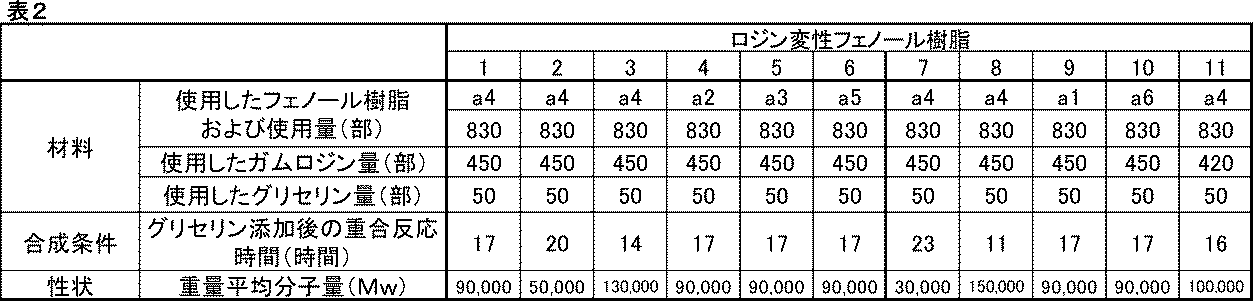
なお表2には、ロジン変性フェノール樹脂1~11の重量平均分子量も記載した。
(ゲルワニス1~22の製造例)
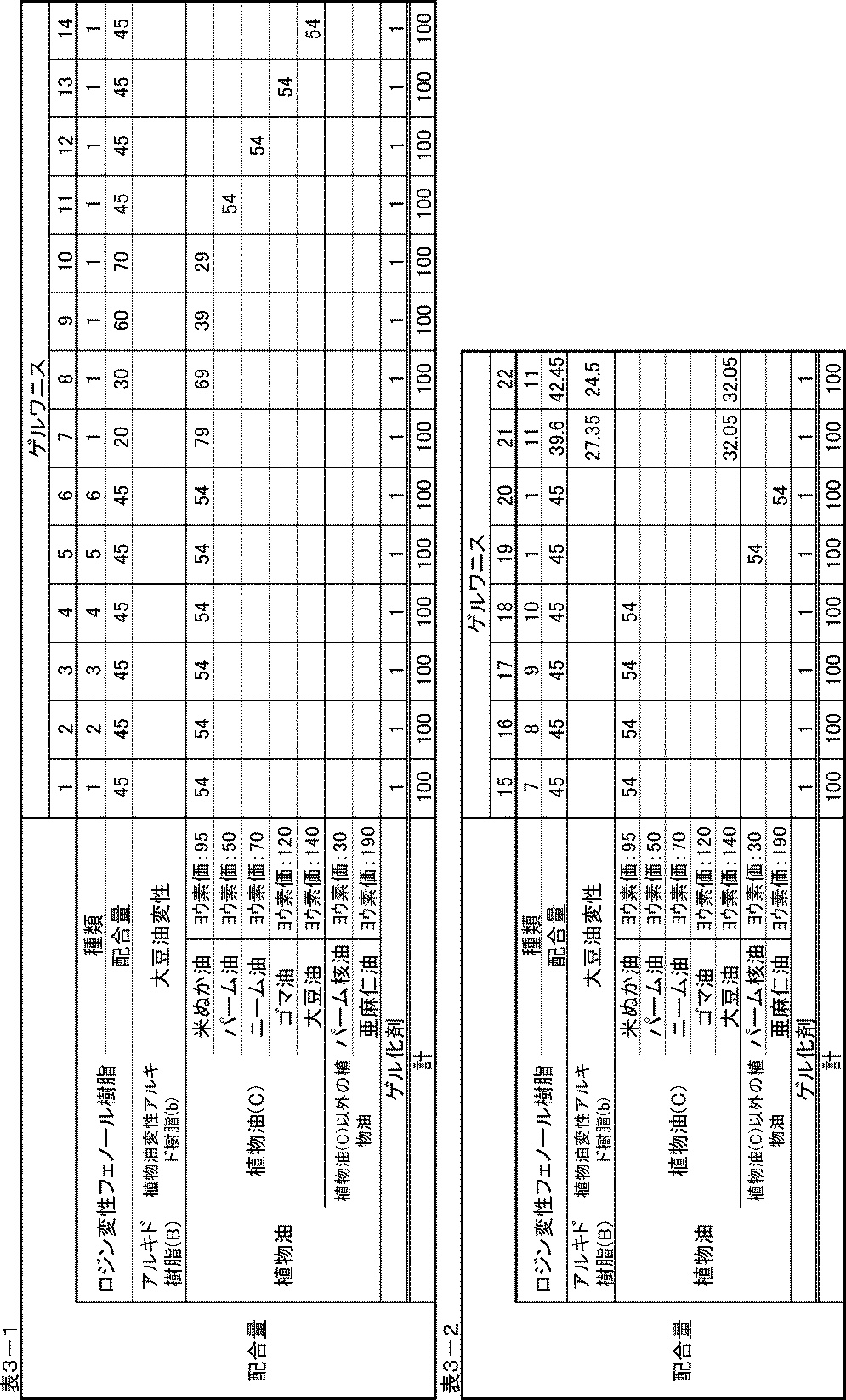
撹拌機、水分離器付還流冷却器、ガス導入管、温度計を備えた4つ口フラスコに、ロジン変性フェノール樹脂と、植物油変性アルキド樹脂(b)と、植物油と、ゲル化剤(川研ファインケミカル(株)製ALCH)とを、それぞれ下表3に記載した組成で仕込んだのち、窒素ガスを導入しながら190℃まで加温し、温度を維持したまま1時間加熱撹拌することで、ゲルワニス1~22を製造した。
撹拌機、水分離器付還流冷却器、ガス導入管、温度計を備えた4つ口フラスコに、ロジン変性フェノール樹脂と、植物油変性アルキド樹脂(b)と、植物油と、ゲル化剤(川研ファインケミカル(株)製ALCH)とを、それぞれ下表3に記載した組成で仕込んだのち、窒素ガスを導入しながら190℃まで加温し、温度を維持したまま1時間加熱撹拌することで、ゲルワニス1~22を製造した。
(平版インキ1~32の製造)
ゲルワニスと、カーボン顔料(三菱化学社製ミツビシカーボンMA7)と、アルキド樹脂(B)と、植物油とを、それぞれ下表4に記載した組成で混合したのち、常法に従い三本ロールを用いて練肉分散することで、平版インキ1~32を得た。
ゲルワニスと、カーボン顔料(三菱化学社製ミツビシカーボンMA7)と、アルキド樹脂(B)と、植物油とを、それぞれ下表4に記載した組成で混合したのち、常法に従い三本ロールを用いて練肉分散することで、平版インキ1~32を得た。
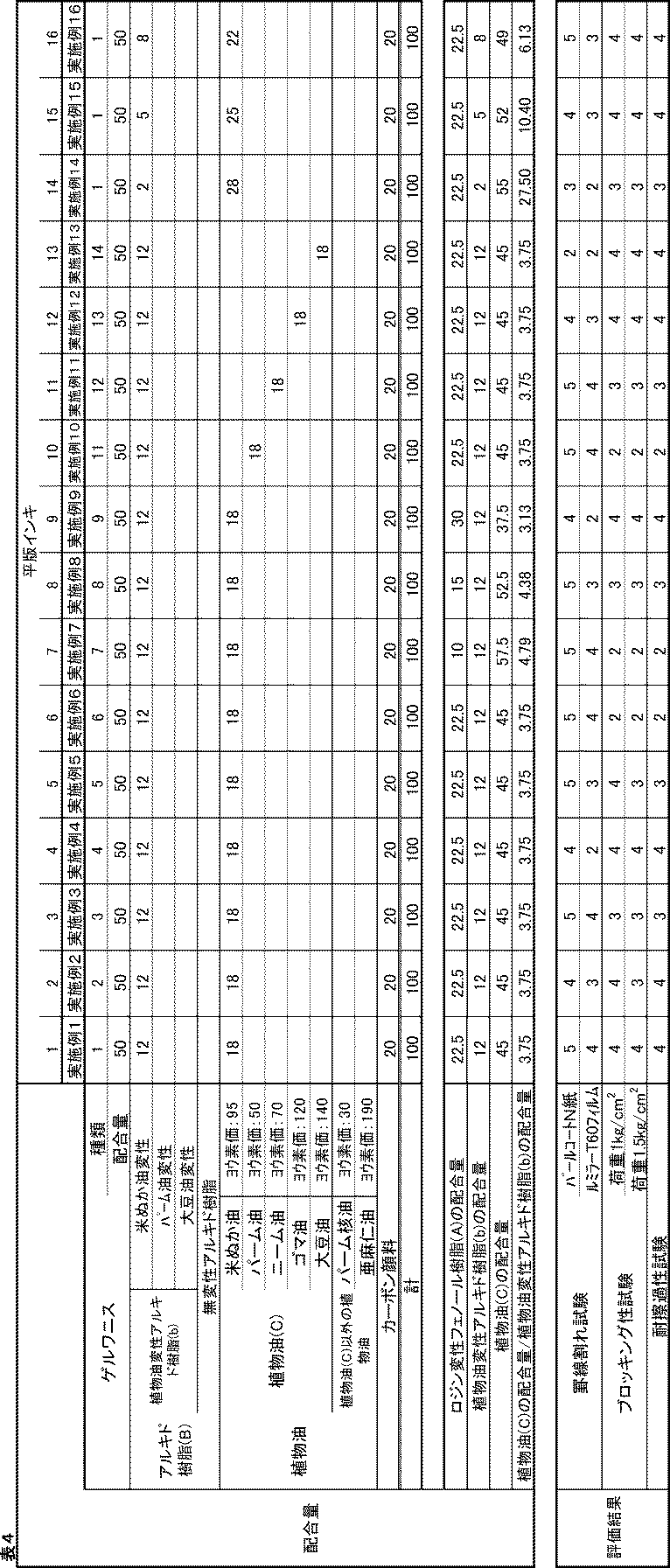

上記で製造した平版インキ1~32について、以下に示す評価を実施した。また評価結果は、表4に示した通りであった。
(罫線割れ試験)
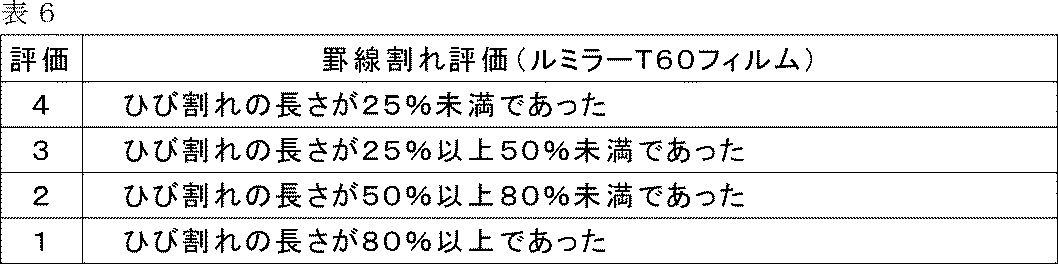
RIテスター展色機(明製作所社製)を使用して、パールコートN紙(三菱製紙社製コート紙)、及び、ルミラーT60フィルム(東レ社製PETフィルム、厚さ75μm)に対して、紙面濃度が1.8になるように展色した。なお前記紙面濃度は、X-Rite eXact(エックスライト社製)を使用して、CIEStatusE、視野角2°の条件で測定した値である。印刷から24時間後、紙面を折り曲げ、元に戻してから折り目部分を目視で観察した。そして、ひび割れの長さを、折り目全体の長さに対する百分率で算出することで、罫線割れの評価を行った。前記算出値について、パールコートN紙に展色したものについては、下表5に示した評価基準に基いて5段階で、また、ルミラーT60フィルムに展色したものについては、下表6に示した評価基準に基いて4段階で、それぞれ評価し、どちらも2以上を実用上好ましいとした。
RIテスター展色機(明製作所社製)を使用して、パールコートN紙(三菱製紙社製コート紙)、及び、ルミラーT60フィルム(東レ社製PETフィルム、厚さ75μm)に対して、紙面濃度が1.8になるように展色した。なお前記紙面濃度は、X-Rite eXact(エックスライト社製)を使用して、CIEStatusE、視野角2°の条件で測定した値である。印刷から24時間後、紙面を折り曲げ、元に戻してから折り目部分を目視で観察した。そして、ひび割れの長さを、折り目全体の長さに対する百分率で算出することで、罫線割れの評価を行った。前記算出値について、パールコートN紙に展色したものについては、下表5に示した評価基準に基いて5段階で、また、ルミラーT60フィルムに展色したものについては、下表6に示した評価基準に基いて4段階で、それぞれ評価し、どちらも2以上を実用上好ましいとした。

(ブロッキング性試験)
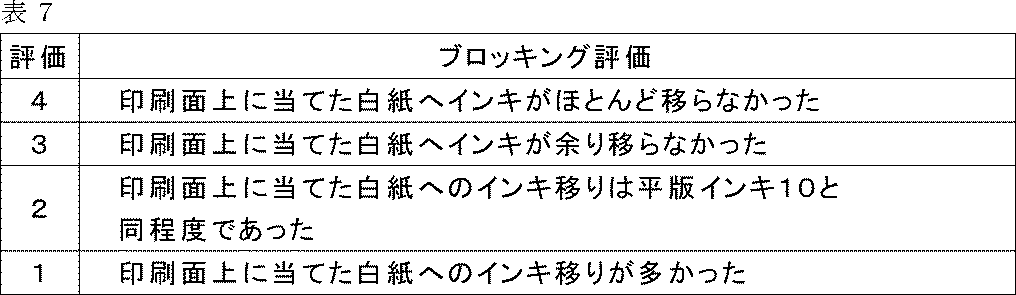
上記RIテスター展色機を使用して、パールコートN紙(三菱製紙社製コート紙)に対して、紙面濃度が1.8になるように展色した。なお前記紙面濃度は、上記罫線割れ試験と同様の条件で測定した。展色後、白紙(三菱製紙社製パールコートN紙)を印刷面に当て、1kg/cm2、または、1.5kg/cm2の荷重をかけた状態で、50℃・80%RH環境下に24時間静置した。そして静置後、前記白紙に対するインキの付着状態を目視で確認することで、ブロッキング性の評価を行った。評価結果は、下表7に示した評価基準に基づき、評価を行った平版インキ1~32の4段階相対評価とし、2以上を実用上好ましいとした。
上記RIテスター展色機を使用して、パールコートN紙(三菱製紙社製コート紙)に対して、紙面濃度が1.8になるように展色した。なお前記紙面濃度は、上記罫線割れ試験と同様の条件で測定した。展色後、白紙(三菱製紙社製パールコートN紙)を印刷面に当て、1kg/cm2、または、1.5kg/cm2の荷重をかけた状態で、50℃・80%RH環境下に24時間静置した。そして静置後、前記白紙に対するインキの付着状態を目視で確認することで、ブロッキング性の評価を行った。評価結果は、下表7に示した評価基準に基づき、評価を行った平版インキ1~32の4段階相対評価とし、2以上を実用上好ましいとした。
(耐擦過性試験)
上記RIテスター展色機を使用して、パールコートN紙(三菱製紙社製コート紙)に対して、紙面濃度が1.8になるように展色した。なお前記紙面濃度は、上記罫線割れ試験と同様の条件で測定した。展色後、学振型耐擦過試験機を使用して、白紙(三菱製紙社製パールコートN紙)を印刷面に当て、1kgの荷重をかけて20往復摩擦した。そして試験後、印刷面に当てた白紙に対するインキの付着度合いを目視で観察することで、耐擦過性の評価を行った。評価結果は、下表8に示した評価基準に基づき、評価を行った平版インキ1~32の4段階相対評価とし、2以上を実用上好ましいとした。
上記RIテスター展色機を使用して、パールコートN紙(三菱製紙社製コート紙)に対して、紙面濃度が1.8になるように展色した。なお前記紙面濃度は、上記罫線割れ試験と同様の条件で測定した。展色後、学振型耐擦過試験機を使用して、白紙(三菱製紙社製パールコートN紙)を印刷面に当て、1kgの荷重をかけて20往復摩擦した。そして試験後、印刷面に当てた白紙に対するインキの付着度合いを目視で観察することで、耐擦過性の評価を行った。評価結果は、下表8に示した評価基準に基づき、評価を行った平版インキ1~32の4段階相対評価とし、2以上を実用上好ましいとした。

表4から明らかなように、特定のロジン変性フェノール樹脂(A)と、特定のアルキド樹脂(B)と、特定の植物油(C)とを組み合わせた本開示の平版印刷インキ組成物を使用した場合、ブロッキングや耐擦過性の悪化を起こすことがなく、高い柔軟性を有する印刷物を得ることができた。
この出願は、2017年12月27日に出願された特願2017-251976を基礎とする優先権を主張し、その開示の全てをここに取り込む。
Claims (6)
- ロジン変性フェノール樹脂(A)と、アルキド樹脂(B)と、植物油(C)と、顔料とを含有する平版印刷インキ組成物であって、
前記ロジン変性フェノール樹脂(A)の重量平均分子量が、50,000~130,000であり、かつ、前記ロジン変性フェノール樹脂(A)を構成するフェノール構造単位が、炭素数4~18のアルキル基を含み、
前記アルキド樹脂(B)が、植物油変性アルキド樹脂(b)を含み、
前記植物油(C)のヨウ素価が、50~140mg/100mgであり、
前記植物油(C)の含有量が、平版印刷インキ組成物中35~60質量%である、平版印刷インキ組成物。 - 前記植物油変性アルキド樹脂(b)の含有量が、平版印刷インキ組成物全量中2~20質量%である、請求項1に記載の平版印刷インキ組成物。
- 前記ロジン変性フェノール樹脂(A)の含有量が、平版印刷インキ組成物中15~25質量%である、請求項1又は2に記載の平版印刷インキ組成物。
- 前記アルキド樹脂(B)の含有量(Bc)と前記植物油(C)の含有量(Cc)の比(Cc/Bc)が、質量比で1.8~10.5である、請求項1乃至3のいずれか一項に記載の平版印刷インキ組成物。
- 基材上に、請求項1乃至4のいずれか一項に記載の平版印刷インキ組成物が印刷されてなる着色層を有する印刷物。
- 前記着色層上に、更に被覆層を備える、請求項5に記載の印刷物。
Applications Claiming Priority (2)
| Application Number | Priority Date | Filing Date | Title |
|---|---|---|---|
| JP2017-251976 | 2017-12-27 | ||
| JP2017251976A JP6425055B1 (ja) | 2017-12-27 | 2017-12-27 | 平版印刷インキ組成物及び印刷物 |
Publications (1)
| Publication Number | Publication Date |
|---|---|
| WO2019130722A1 true WO2019130722A1 (ja) | 2019-07-04 |
Family
ID=64379155
Family Applications (1)
| Application Number | Title | Priority Date | Filing Date |
|---|---|---|---|
| PCT/JP2018/037999 Ceased WO2019130722A1 (ja) | 2017-12-27 | 2018-10-11 | 平版印刷インキ組成物及び印刷物 |
Country Status (2)
| Country | Link |
|---|---|
| JP (1) | JP6425055B1 (ja) |
| WO (1) | WO2019130722A1 (ja) |
Citations (9)
| Publication number | Priority date | Publication date | Assignee | Title |
|---|---|---|---|---|
| JPS5655469A (en) * | 1979-10-09 | 1981-05-16 | Toray Ind Inc | Ink composition for dry lithography |
| JPH01306482A (ja) * | 1988-06-03 | 1989-12-11 | Dainippon Ink & Chem Inc | 水なし平版印刷インキ用樹脂組成物およびインキ組成物 |
| JPH07179546A (ja) * | 1993-12-24 | 1995-07-18 | Seiko Kagaku Kogyo Co Ltd | ロジン変性フェノール樹脂及び該樹脂を使用した印刷インキ |
| JP2002322411A (ja) * | 2001-04-26 | 2002-11-08 | The Inctec Inc | ワニスおよび印刷インキ |
| JP2003119230A (ja) * | 2001-10-09 | 2003-04-23 | Toyo Ink Mfg Co Ltd | 硬化性組成物、硬化性インキ、その印刷方法およびその印刷物 |
| JP2003313482A (ja) * | 2002-04-22 | 2003-11-06 | Sakata Corp | オフセット印刷インキ組成物 |
| JP2015227432A (ja) * | 2014-06-03 | 2015-12-17 | 東京インキ株式会社 | オフセット印刷インキおよび印刷物 |
| JP2016204557A (ja) * | 2015-04-24 | 2016-12-08 | 東洋インキScホールディングス株式会社 | 平版印刷インキ組成物および印刷物 |
| JP2017110141A (ja) * | 2015-12-18 | 2017-06-22 | Dicグラフィックス株式会社 | 平版印刷インキ、印刷物 |
Family Cites Families (11)
| Publication number | Priority date | Publication date | Assignee | Title |
|---|---|---|---|---|
| JP3298268B2 (ja) * | 1993-11-05 | 2002-07-02 | 東洋インキ製造株式会社 | ロジンフェノール樹脂の製造方法 |
| JPH10292145A (ja) * | 1997-04-18 | 1998-11-04 | Toyo Ink Mfg Co Ltd | 水なし平版印刷用インキ |
| JP2007063497A (ja) * | 2005-09-02 | 2007-03-15 | Toyo Ink Mfg Co Ltd | 印刷インキ組成物 |
| JP2009057461A (ja) * | 2007-08-31 | 2009-03-19 | Dic Corp | 印刷インキ組成物 |
| JP5714238B2 (ja) * | 2010-04-01 | 2015-05-07 | Dicグラフィックス株式会社 | 平版印刷インキ組成物 |
| JP5745888B2 (ja) * | 2011-02-18 | 2015-07-08 | サカタインクス株式会社 | 油性印刷用カオリン顔料分散物の製造方法、該製造方法で得られる油性印刷用カオリン顔料分散物、及びその用途 |
| JP5943511B2 (ja) * | 2012-07-14 | 2016-07-05 | サカタインクス株式会社 | 印刷インキ組成物 |
| JP2015110750A (ja) * | 2013-11-01 | 2015-06-18 | 荒川化学工業株式会社 | ロジン変性フェノール樹脂、オフセット印刷インキ用バインダー、オフセット印刷インキ用ワニス及びオフセット印刷インキ |
| JP5689548B1 (ja) * | 2013-11-20 | 2015-03-25 | Dicグラフィックス株式会社 | 印刷インキ組成物 |
| JP2016166299A (ja) * | 2015-03-10 | 2016-09-15 | 東洋インキScホールディングス株式会社 | 平版印刷インキおよびその印刷物 |
| JP2017149877A (ja) * | 2016-02-25 | 2017-08-31 | 東洋インキScホールディングス株式会社 | 平版印刷インキ |
-
2017
- 2017-12-27 JP JP2017251976A patent/JP6425055B1/ja not_active Expired - Fee Related
-
2018
- 2018-10-11 WO PCT/JP2018/037999 patent/WO2019130722A1/ja not_active Ceased
Patent Citations (9)
| Publication number | Priority date | Publication date | Assignee | Title |
|---|---|---|---|---|
| JPS5655469A (en) * | 1979-10-09 | 1981-05-16 | Toray Ind Inc | Ink composition for dry lithography |
| JPH01306482A (ja) * | 1988-06-03 | 1989-12-11 | Dainippon Ink & Chem Inc | 水なし平版印刷インキ用樹脂組成物およびインキ組成物 |
| JPH07179546A (ja) * | 1993-12-24 | 1995-07-18 | Seiko Kagaku Kogyo Co Ltd | ロジン変性フェノール樹脂及び該樹脂を使用した印刷インキ |
| JP2002322411A (ja) * | 2001-04-26 | 2002-11-08 | The Inctec Inc | ワニスおよび印刷インキ |
| JP2003119230A (ja) * | 2001-10-09 | 2003-04-23 | Toyo Ink Mfg Co Ltd | 硬化性組成物、硬化性インキ、その印刷方法およびその印刷物 |
| JP2003313482A (ja) * | 2002-04-22 | 2003-11-06 | Sakata Corp | オフセット印刷インキ組成物 |
| JP2015227432A (ja) * | 2014-06-03 | 2015-12-17 | 東京インキ株式会社 | オフセット印刷インキおよび印刷物 |
| JP2016204557A (ja) * | 2015-04-24 | 2016-12-08 | 東洋インキScホールディングス株式会社 | 平版印刷インキ組成物および印刷物 |
| JP2017110141A (ja) * | 2015-12-18 | 2017-06-22 | Dicグラフィックス株式会社 | 平版印刷インキ、印刷物 |
Also Published As
| Publication number | Publication date |
|---|---|
| JP2019116579A (ja) | 2019-07-18 |
| JP6425055B1 (ja) | 2018-11-21 |
Similar Documents
| Publication | Publication Date | Title |
|---|---|---|
| JP6243248B2 (ja) | 印刷インキ組成物 | |
| JP6282837B2 (ja) | 印刷インキ用ワニス、印刷インキ、及び印刷物 | |
| WO2016013162A1 (ja) | 積層体およびその製造方法 | |
| CN1271153C (zh) | 印刷油墨组合物 | |
| JP6392317B2 (ja) | インキ組成物、印刷物および印刷方法 | |
| JP6368548B2 (ja) | オフセット印刷インキおよび印刷物 | |
| JP6232973B2 (ja) | 紙用グラビア墨インキ組成物およびこれを用いてなる印刷物 | |
| CN101641417B (zh) | 用于食品包装或用于能够与食品接触的接触装置的印刷油墨或印刷调墨油 | |
| WO2019130722A1 (ja) | 平版印刷インキ組成物及び印刷物 | |
| JP6439807B2 (ja) | 平版印刷用光輝性インキ組成物 | |
| WO2011037037A1 (ja) | オフセット印刷インキ用ワニス及び該ワニスを含有する印刷インキ | |
| TWI825283B (zh) | 活性能量線硬化型墨組成物及其製造方法、以及使用該組成物之印刷物的製造方法 | |
| JP6214495B2 (ja) | オフセット印刷インキおよび印刷物 | |
| JP6468103B2 (ja) | 積層体 | |
| WO2023157799A1 (ja) | ワニス、オフセット印刷インキ組成物およびオフセット印刷物の製造方法 | |
| CA2857192C (en) | Overprint varnishes with non-aqueous dispersions | |
| JP4466163B2 (ja) | 水性印刷ワニス組成物およびその印刷物 | |
| JP6226502B2 (ja) | オフセット印刷インキ用ゲルワニス、オフセット印刷インキおよび印刷物 | |
| WO2022196064A1 (ja) | 活性エネルギー線硬化型インキ組成物及びその製造方法 | |
| JP2010168477A (ja) | ヒートセットオフ輪インキ組成物 | |
| JP7275794B2 (ja) | 平版印刷インキ組成物および印刷物 | |
| JP7133495B2 (ja) | オフセット印刷用インキ組成物、及び枚葉オフセット印刷物の製造方法 | |
| JP2007169574A (ja) | 印刷インキ | |
| JP6530655B2 (ja) | オフセット印刷インキ組成物および印刷物 | |
| JP2014055260A (ja) | オフセット印刷インキおよびオフセット印刷インキ用ワニス |
Legal Events
| Date | Code | Title | Description |
|---|---|---|---|
| 121 | Ep: the epo has been informed by wipo that ep was designated in this application |
Ref document number: 18893493 Country of ref document: EP Kind code of ref document: A1 |
|
| NENP | Non-entry into the national phase |
Ref country code: DE |
|
| 122 | Ep: pct application non-entry in european phase |
Ref document number: 18893493 Country of ref document: EP Kind code of ref document: A1 |