WO2019130620A1 - 現金自動機およびその制御方法 - Google Patents
現金自動機およびその制御方法 Download PDFInfo
- Publication number
- WO2019130620A1 WO2019130620A1 PCT/JP2018/019090 JP2018019090W WO2019130620A1 WO 2019130620 A1 WO2019130620 A1 WO 2019130620A1 JP 2018019090 W JP2018019090 W JP 2018019090W WO 2019130620 A1 WO2019130620 A1 WO 2019130620A1
- Authority
- WO
- WIPO (PCT)
- Prior art keywords
- cash
- input
- total amount
- denomination
- user
- Prior art date
- Legal status (The legal status is an assumption and is not a legal conclusion. Google has not performed a legal analysis and makes no representation as to the accuracy of the status listed.)
- Ceased
Links
Images






Classifications
-
- G—PHYSICS
- G07—CHECKING-DEVICES
- G07D—HANDLING OF COINS OR VALUABLE PAPERS, e.g. TESTING, SORTING BY DENOMINATIONS, COUNTING, DISPENSING, CHANGING OR DEPOSITING
- G07D1/00—Coin dispensers
-
- G—PHYSICS
- G07—CHECKING-DEVICES
- G07D—HANDLING OF COINS OR VALUABLE PAPERS, e.g. TESTING, SORTING BY DENOMINATIONS, COUNTING, DISPENSING, CHANGING OR DEPOSITING
- G07D9/00—Counting coins; Handling of coins not provided for in the other groups of this subclass
Definitions
- the present invention relates to a cash automatic machine and its control method.
- Patent Document 1 a technique for enabling a user to withdraw desired amount of money with a denomination and number of money desired by the user.
- the user's desired amount of money is first obtained, and then the breakdown of the denomination is specified so as to match the user's desired amount of money.
- the minimum amount of banknotes may not be handled by a cash machine. Since the minimum amount of bills is frequently used, the condition is likely to be deteriorated, which may cause a bill jam. Thus, only relatively large denominations may be handled by an automated cash machine, and the smallest denominations may not.
- the cash machine may not be able to withdraw the banknotes as the input amount. If cash can not be dispensed that matches the user's desired amount, the dispensing operation fails, and another dispensing operation is required. As a result, the usability of the user is lowered, and the transaction time per user for the operator of the automatic cash machine becomes long, so the operating efficiency of the automatic cash machine is lowered.
- the present invention has been made in view of the above problems, and an object thereof is to provide a cash automatic machine capable of improving transaction efficiency and usability, and a control method thereof.
- a cash automatic machine is a cash automatic machine which dispenses cash in response to a user operation, and is controlled by a control unit and a control unit, and is an information input / output device operable by the user And the control unit is configured to input the number of banknotes into a predetermined number of denominations other than the minimum denomination of money, and the predetermined number input from the number of banknotes input unit.
- a bill number specification screen including a total amount display section displaying a total amount based on the number of bills of the denomination of money is displayed on the information input / output device, and cash of a predetermined denomination is input to the number of bills input portion Withdraw from the street.
- the automatic cash machine when the user inputs the number of bills in a predetermined denomination, the total amount of money is displayed and the cash of the predetermined denomination is dispensed according to the number of the input bills. be able to.
- the automatic cash machine dispenses cash according to the input number when the user inputs the number in a predetermined denomination. That is, in the present embodiment, the amount of money is input first, and then the denomination is not adjusted, but the number of sheets is input first for the denomination and the money is dispensed according to the number of the denomination.
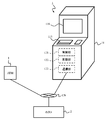
- FIG. 1 is an explanatory view showing an outline of the automatic cash machine 1 according to the present embodiment.
- the automated teller machine 1 configured as an ATM includes, for example, a main body 11, a cash deposit and withdrawal unit 113, an information input / output device 116, and a control unit 121.
- a main body 11 The outline of the internal configuration of the main body 11 will be described later with reference to FIG.
- the functional configuration of the cash automatic machine 1 will be described later with reference to FIG.
- the information input / output device 116 is a device that exchanges information with the user, and includes an information input unit and an information output unit.
- the information input / output device 116 is configured as a device in which an information input unit and an information output unit are integrated, such as a display capable of touch operation.
- the information input unit and the information output unit may be separated, such as a display and a button switch, and a display and an audio input device.
- the information input / output device 116 displays a screen G generated by the control unit 121.
- the screen G corresponds to the “number of sheets designation screen” or the “first number of sheets designation screen”.
- the screen G includes, for example, a total amount display portion GP1, a number-of-kinds input button B1 (1), B1 (2), B1 (3), and a confirmation button B2.
- the number-of-money-type number input buttons B1 (1) to B1 (3) correspond to the "bill number input unit".
- the buttons B1 (1) to B1 (3) are not particularly distinguished from one another, they are abbreviated as number-of-golds input button B1.
- a more detailed screen configuration example will be described later with reference to FIG.
- the control unit 121 causes the cash deposit / withdrawal unit 113 to appear the number of bills designated as the denomination.
- FIG. 2 is an explanatory view showing an outline of a bill management mechanism of the automatic cash machine 1.
- a collection unit 111 for storing the collection target banknotes and banknote storage units 112 (1) to 112 (3) of denominations are provided.
- three types of “100 k”, “50 k” and “20 k” are exemplified as predetermined denominations which are selected in advance from among denominations other than the minimum denomination, but the invention is not limited thereto. And two or more types are sufficient.
- a cash deposit / withdrawal unit 113 On the upper side of the bill management mechanism in the main body 11, a cash deposit / withdrawal unit 113, a temporary storage unit 114, a discrimination device 115, and a transport unit 117 are provided.
- the cash inserted into the cash deposit / withdrawal unit 113 is once transported by the transport unit 117 to the temporary storage unit 114 and stored. Thereafter, the cash in the temporary storage unit 114 is transported by the transport unit 117 to the discrimination device 115, and it is discriminated whether it should be collected. It is determined that the counterfeit bills and the highly damaged banknotes should be collected by the discrimination device 115.
- the banknote determined to be collected by the discrimination device 115 is conveyed by the conveyance unit 117 to the collection unit 111 and stored.
- the banknotes which are normal banknotes and have a low degree of damage are transported by the transport unit 117 to the banknote storage unit 112 and stored according to the denomination.
- the bills which are not to be collected are sent to and stored in the bill storage unit 112 according to the denomination.
- FIG. 3 is an explanatory view showing an overall outline of a cash transaction system including the cash automatic machine 1.
- a plurality of cash automatic machines 1 are connected to a host computer (hereinafter, host) 2 via a communication network CN so as to enable two-way communication.
- the host 2 determines the allowance or withdrawal of the deposit or withdrawal based on the deposit / withdrawal information transmitted from each cash machine 1 via the communication network CN, and sends the result of the determination back to the cash automatic machine 1.
- the functional configuration of the cash automatic machine 1 will be described.
- the cash dispenser 1 is configured as, for example, a computer system including a control unit 121, a storage unit 122, and a communication unit 123.
- the control unit 121 controls the overall operation of the automated teller machine 1.
- the storage unit 122 is configured of, for example, a non-volatile storage device such as a hard disk drive, and stores a computer program executed by the control unit 121, deposit and withdrawal data, and the like.
- the communication unit 123 communicates with the host 2 by connecting to the communication network CN.
- FIG. 4 is an explanatory view showing an example of a method of using the automated teller machine 1.
- the deposit operation will be mainly described, but the dispense operation is almost the same.
- the cash automatic machine 1 executes an authentication process by communicating with a user's portable information terminal (including a terminal such as a mobile phone, a so-called smart phone, a mobile phone attached with a non-contact IC tag) 3.
- the automated teller machine 1 receives a user operation on the information input / output device 116 (S2), acquires cash input by the user from the cash deposit / withdrawal unit 113 (S3), and performs a deposit process.
- the automated teller machine 1 inquires of the host 2 about the deposit process and receives an approval from the host 2. Then, the automatic cash machine 1 displays the result of the deposit process on the information input / output device 116, and the result of the deposit process is also notified from the host 2 to the portable information terminal 3 of the user (S4).
- the automatic cash machine 1 notifies the host 2 of information such as the amount of money, receives the approval from the host 2, and receives the user's desired cash the number of banknotes of the denomination desired by the user. Withdraw
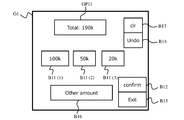
- FIG. 5 shows an example of the dispensing operation screen G1.
- the dispensing operation screen G1 corresponds to the "bill number specification screen".
- the dispensing operation screen G1 is presented to the information input / output device 116 when the cash machine 1 performs dispensing processing.
- the payment operation screen G1 includes, for example, a total amount display portion GP11, denomination number input buttons B11 (1), B11 (2), B11 (3), a confirmation button B12, a clear button B13, and an Undo button B14. , An Exit button B15, and a total amount specification button B16.
- the number-of-money-type number input buttons B11 (1) to B11 (3) correspond to the "bill number input unit".
- the buttons B11 (1) to B11 (3) are not particularly distinguished from one another, they are abbreviated as number-of-golds input button B11.
- the total amount specification button B16 for example, the screen changes to a screen G2 described later with reference to FIG.
- a user who desires to dispense money can designate a desired number of banknotes of a desired denomination by operating the denomination number input button B11.
- the denomination number input button B11 has three types of “100 k”, “50 k”, and “20 k” will be described.
- the cash machine 1 causes the total amount display portion GP11 to display “Total: 20k”.
- the total amount display part GP11 displays “Total: 40 k”.
- the total amount display portion GP11 is operated as “Total: 140 k”.
- the total amount display portion GP11 displays "Total: 190k”.
- the automated teller machine 1 multiplies the denomination by the number of times the number input button B11 is operated and the amount of money of the denomination, and causes the total amount display portion GP11 to display the total value of the denominations and subtotals.
- the user may operate the clear button B13. If it is desired to return to the previous operation, the user may operate the Undo button B14. By returning the operation to the previous position, the displayed amount of money of the total amount display portion GP11 also changes.
- the confirmation button B12 the automatic teller machine 1 communicates with the host 2 and obtains approval from the host 2. Then, the automatic cash machine 1 outputs cash from the cash deposit / withdrawal unit 113 according to the number of bills specified by the user for the denomination.
- the cash automatic machine 1 can not select any more banknotes.
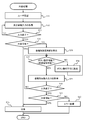
- FIG. 6 is a flowchart of the dispensing process according to the present embodiment. This flowchart shows the outline of the dispensing process, and the order of the steps is not limited to that shown.
- the cash automatic machine 1 executes user authentication, for example, by input of a personal identification number or the like to the information input / output device 116 or communication for authentication with the portable information terminal 3 (S11).
- user authentication for example, by input of a personal identification number or the like to the information input / output device 116 or communication for authentication with the portable information terminal 3 (S11).
- the description will be continued assuming that the user authentication is successful.
- the automatic cash machine 1 displays the dispensing operation screen G1 shown in FIG. 6 on the information input / output device 116, and determines whether an operation to increase the number of banknotes is possible (S12). In the example of FIG. 5, it is determined whether it is possible to increase the number of bills by operating the denomination number input button B11.
- the number of banknotes is increased for the denomination for which the remaining number is less than the predetermined number of possible withdrawals (S12: NO)
- the operation is prohibited (S13).
- the cash machine 1 acquires a user input (user operation) to the number of money type input button B11 (S14), and the acquired value Are stored (S15).
- the automated teller machine 1 determines whether the user operation for withdrawal has ended (S16). For example, when the confirmation button B12 is operated, it can be determined that the user operation relating to the withdrawal has ended (S16: YES), and the process proceeds to step S17 described later. On the other hand, if it is determined that the user operation has not ended (S16: NO), the process returns to step S12.
- the cash automatic machine 1 determines whether dispensing is possible (S17). For example, the automated teller machine 1 inquires whether the host 2 may withdraw money. When approval for withdrawal is obtained from the host 2 (S17: YES), the automatic cash machine 1 dispenses banknotes of each denomination from the cash deposit / withdrawal unit 113 as the number input by the user in step S14. (S18).
- an error process is executed (S19).
- an error message such as “insufficient balance” is displayed on the information input / output device 116.
- FIG. 7 is an example of the screen G1 including the button B11 in a state where the user operation is prohibited.
- the cash automatic machine 1 has, for example, a denomination number input button in order to prevent withdrawal of a denomination whose remaining number has become less than a predetermined number of possible withdrawals. Disable the operation of B11. Even if the user operates the button B11 (3) set to the operation prohibition, the cash automatic machine 1 does not acquire the input and does not reflect it on the total amount display part GP11.
- the button B 11 (3) of “20 k” is set to the operation prohibition by the automatic cash machine 1. For example, if the user wants a total of "190 k” cash, but can not take out only one sheet because the cash machine 1 is short of "20 k” bills, the button 20 for "20 k” The operation of (3) is prohibited. Therefore, the user can endure with a total of "170 k” of cash or operate the "50 k" button B11 (2) again to make the total amount "220 k”. The user can also display a screen G2 shown in FIG. 9 on the information input / output device 116 by operating the total amount specification button B16.
- the denomination is more than the total amount. Cash can be dispensed with priority given to the number of banknotes.
- the user's desired amount of money is realized as the number of banknotes closest to the amount of money, it is possible to reduce the possibility that the dispensing operation will fail, and improve the user's usability and operation efficiency. It can be done.
- the user can specify the number of money that can not be dispensed by the user in order to prohibit the operation of increasing the number of bills on the dispensing operation screen G1. Can be prevented.
- a second embodiment will be described with reference to FIGS. 8 to 10.
- the following embodiments, including the present embodiment, correspond to modifications of the first embodiment, and therefore, differences from the first embodiment will be mainly described.
- the present embodiment when it is not possible to dispense with the amount of money desired by the user, it is possible to designate the number of banknotes of the denomination which can be dispensed.
- FIG. 8 is a flowchart of the dispensing process according to the present embodiment.
- the automatic cash machine 1 After performing the user authentication (S31), the automatic cash machine 1 displays the payment operation screen G2 shown in FIG. 9 on the information input / output device 116, and acquires the total amount input by the user (S32).
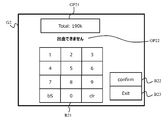
- the dispensing operation screen G2 which is an example of the “total amount specification screen” is a screen on which the user specifies the total amount.
- the dispensing operation screen G2 includes, for example, a total amount display portion GP21, an error message display portion GP22, a ten key switch B21, a confirmation button B22, and an Exit button B23.
- the automatic teller machine 1 acquires the input amount of money (S32), and causes the total amount display unit GP21 to display the input amount of money.
- the cash machine 1 determines whether the user has finished entering the amount (S33). When the user operates the confirmation button B22, the cash automatic machine 1 can determine that the amount input has ended (S33: YES).
- the cash automatic machine 1 determines whether it is possible to withdraw money from the amount input by the user (S34).
- the cash automatic machine 1 holds a bill corresponding to the input amount, and determines that dispensing is possible when the host 2's approval is obtained (S34: YES). Then, the automatic cash machine 1 causes the cash deposit / withdrawal unit 113 to withdraw cash of the amount desired by the user (S35).
- the automated teller machine 1 causes the error message display unit GP22 to display an error message such as "Cannot withdraw”. After that, the dispensing operation screen G3 shown in FIG. 10 is displayed on the information input / output device 116 (S36).
- the dispensing operation screen G3 will be described with reference to FIG.
- the dispensing operation screen G3 is an example of the “second bill number specification screen”.
- the dispensing operation screen G3 includes, for example, a total amount display portion GP31, denomination number input buttons B31 (1) to (3), a confirmation button B32, and an Exit button B33.
- the money type number input buttons B31 (1) to (3) are referred to as the money type number input button B31 unless otherwise specified.
- the number-of-moneys type input button B31 is provided with a number increase button Bu and a number decrease button Bd above and below the display indicating each denomination.
- the number increase button Bu the banknote of the denomination is increased by one.
- the number decrease button Bd the denomination of banknotes is decreased by one.
- the total amount display portion GP31 displays an amount based on the sum of the number of bills input by each number-of-kinds input button B31.
- the increase button Bu and the decrease button Bd are shown as white triangles when operable, and as black triangles when inoperable. It may be distinguished whether it can be operated by methods other than triangular black and white.
- the cash automatic machine 1 determines whether the denomination number input button B31 can be operated (can be increased the number of bills) (S37).
- the button B31 corresponding to that denomination is not operated (S37: NO).
- the cash automatic machine 1 prohibits the operation of the button B31 so that the number of bills included in the withdrawal can not be increased (S38).
- the cash automatic machine 1 is set so as not to operate the increase button Bu of the button B31 (3), and notifies the user with a black triangle.
- the user can operate the button B31 corresponding to the denomination (S37: YES).
- the cash automatic machine 1 acquires and stores the number of banknotes of the denomination input from the user (S39).
- the automated teller machine 1 determines whether or not the user has finished the input operation of the number of banknotes of denomination (S40). For example, when the confirmation button B32 is operated, the cash automatic machine 1 can determine that the input operation has ended.
- step S40 determines whether or not the payment can be made according to the number of bills of the denomination input by the user (S41).
- step S35 If the automatic teller machine 1 determines that payment can be made by obtaining the approval of the host 2 or the like (S41: YES), the process proceeds to step S35 to execute payment processing. On the other hand, when the automatic teller machine 1 can not obtain the approval of the host 2, it is determined that the withdrawal is impossible (S41: NO), and the error process is executed (S42). In error processing, an error message is displayed on the information input / output device 116.
- the present embodiment configured in this way also achieves the same effects as the first embodiment.
- the increase button Bu and the number decrease button Bd are prepared, the user can increase or decrease the number of bills according to the denomination. Therefore, the usability of the user is further improved.
- a desired amount of money can be input, and thereafter, on the screen G3 which can specify the number of bills as the denomination. Make a transition. Therefore, the user can input the number of bills of the desired denomination, for example, using the total amount displayed on the total amount display portion GP21 as a guide.
- this embodiment can also be carried out continuously from the first embodiment. That is, when the user operates total amount specification button B16, transition is made to total amount specification screen G2 of FIG. 9, and when the user operates confirmation button B22 on screen G2, transition is made to withdrawal operation screen G3 shown in FIG. It can also be configured. Furthermore, the dispensing operation screen G3 shown in FIG. 10 may be configured alone. The flow at that time is the flow excluding S32 to S34 in FIG.
- a third embodiment will be described with reference to FIG. In the present embodiment, a detailed example of a method of calculating the possible number of dispensed money and the like will be described.
- the automatic cash machine 1 authenticates the user from the credit card number inserted into the main body 11 by the user, the password input by the user, etc. (S101).
- the automatic cash machine 1 confirms the remaining number by type of money a (S102), and confirms the number of margins b as the "predetermined number of required sheets" (S103). It confirms (S104).
- the money type maximum withdrawal number m is the maximum number of banknotes that can be paid out for the money type. For example, the upper limit (upper limit amount) of the amount of money that can be paid out in one withdrawal process is determined, and the value obtained by dividing the upper limit amount by the par value of each denomination is the maximum number of withdrawals m for that denomination. Become.
- the upper limit of the amount of money that can be dispensed in one dispensing process is "500 k”
- the cash automatic machine 1 sets all of the number-of-money type input buttons to be operable (S106).
- the cash machine 1 can not operate the number of bills of that denomination. (In detail, the number of bills can not be increased) is set (S108).
- the cash automatic machine 1 proceeds to step S109 without restricting the button operation.
- the automatic cash machine 1 sets “0” to the number of money to be dispensed d by type (S109), calculates the total amount (S110), and displays the calculated total amount on the screen (S111). Here, since the process has just started, the total amount is displayed as "0".
- the cash machine 1 determines whether the clear button has been operated (S112). If the cash automatic machine 1 determines that the clear button has been operated (S112: YES), the total amount of money is erased and the process returns to step S106.
- the automatic cash machine 1 determines whether the Exit button has been operated (S113). If the cash automatic unit 1 determines that the Exit button has been operated (S113: YES), it proceeds to step S120 and executes post-processing.
- a shutter (not shown) of the cash depositing / dispensing unit 113 is closed, it is confirmed whether a bill remains on the transport unit 117, or damage among the bills stored in the temporary storage unit 114 is severe.
- a predetermined process such as transferring a bill to the collection unit 111 or leaving a record indicating that the dispensing process has been completed is performed.
- the cash automatic machine 1 determines whether the denomination number input button has been operated (S114), and when operated (S114: YES), the number of dispensed coins d of the operated denomination is incremented by one (S115).
- the cash automatic machine 1 determines that the stop condition of step S116 is met (S116: YES)
- the number of banknotes of the denomination corresponding to the stop condition can not be operated (cannot be increased).
- Restrict the operation of the number input button of the denomination S117. After restricting (prohibiting) the button operation for inputting the number of banknotes of the denomination corresponding to the stop condition, the automatic cash machine 1 returns to step S110.
- the automatic cash machine 1 determines whether there is a denomination exceeding the difference between the upper limit amount and the total amount (S110a), and if there is a corresponding denomination, the denomination The operation of the number input button of the denomination is restricted (S 110 b) so that the number of banknotes of can not be operated (cannot be increased).
- step S118 determines whether the denomination number input button is not operated (S118: NO). If the confirmation button is not operated (S119: NO), the process returns to step S111.
- the cash automatic machine 1 determines that the confirmation button has been operated (S118: YES)
- the approval of the host 2 is accepted in the same manner as in the first embodiment, etc., according to the number of withdrawals d of the denomination counted in step S115. After confirming that the money can be paid out by earning etc, cash is paid out from the cash deposit / withdrawal unit 113 (S119).
- the cash machine 1 performs the post-processing (S120), and ends the present process.
- the present embodiment configured in this way also achieves the same effects as the first embodiment.
- the sheet number counter GP12 (1) to (3) is associated with the number-of-kinds input button B11 (1) to (3).
- the dispensing operation screen G1a shown in FIG. 12 is the same as the dispensing operation screen G1 described in FIG. 5 except for the number counters GP12 (1) to (3), and thus further description will be omitted.
- the present embodiment configured in this way also achieves the same effects as the first embodiment. Furthermore, since the dispensing operation screen G1a of the present embodiment has the sheet number counter GP12 (1) to (3), the user can easily confirm which denomination of banknotes have been requested and how easy it is. Improve more and more.
Landscapes
- Physics & Mathematics (AREA)
- General Physics & Mathematics (AREA)
- Financial Or Insurance-Related Operations Such As Payment And Settlement (AREA)
Abstract
取引効率と使い勝手を向上できるようにした現金自動機およびその制御方法を提供すること。 現金自動機1は、ユーザ操作に応じて現金を出金する。現金自動機1は、制御部121と、制御部により制御され、ユーザ操作可能な情報入出力装置116とを備える。制御部121は、最少額の金種以外の金種の中から予め複数選択される所定の金種別に紙幣枚数を入力する紙幣枚数入力部B1(1)~(3)と、紙幣枚数入力部から入力される所定の金種別の紙幣枚数に基づく合計金額を表示する合計金額表示部GP1とを含む紙幣枚数指定画面Gを情報入出力装置に表示させ、所定の金種別の現金を紙幣枚数入力部に入力された紙幣枚数通りに出金させる。
Description
本発明は、現金自動機およびその制御方法に関する。
例えばATM(Automated Teller Machine)等の現金自動機において、ユーザの希望する金額をユーザの希望する金種および枚数で出金できるようにした技術は知られている(特許文献1)。
従来技術では、最初にユーザの所望金額を取得し、その次にユーザの所望金額に合致するように金種別の内訳を指定させる。しかし、場合によっては、最少額の紙幣を現金自動機で取り扱わないことがある。最少額の紙幣は使用回数が多いため、状態が悪化しやすく、紙幣詰まりの原因になるためである。したがって、比較的高額の金種のみが現金自動機で取り扱われ、最少額の金種は取り扱われない場合がある。
この結果、ユーザが所望金額を入力したとしても、その金額によっては、現金自動機は入力された金額通りに紙幣を出金できない場合がある。ユーザの所望金額に合致する現金を出金できない場合、その出金操作は失敗となり、再度の出金操作が必要となる。これにより、ユーザの使い勝手が低下する上に、現金自動機の運用者にとっては1ユーザ当たりの取引時間が長くなるため、現金自動機の運用効率が低下する。
本発明は上述の課題に鑑みてなされたもので、その目的は、取引効率と使い勝手を向上できるようにした現金自動機およびその制御方法を提供することにある。
上記課題を解決すべく、本発明に従う現金自動機は、ユーザ操作に応じて現金を出金する現金自動機であって、制御部と、制御部により制御され、ユーザ操作可能な情報入出力装置とを備え、制御部は、最少額の金種以外の金種の中から予め複数選択される所定の金種別に紙幣枚数を入力する紙幣枚数入力部と、紙幣枚数入力部から入力される所定の金種別の紙幣枚数に基づく合計金額を表示する合計金額表示部とを含む紙幣枚数指定画面を情報入出力装置に表示させ、所定の金種別の現金を紙幣枚数入力部に入力された紙幣枚数通りに出金させる。
本発明に係る現金自動機によれば、ユーザが所定の金種別に紙幣枚数を入力すると、その合計金額が表示されるとともに、所定の金種別の現金を入力された紙幣枚数通りに出金させることができる。
以下、図面に基づいて、本発明の実施の形態を説明する。本実施形態に係る現金自動機は、ユーザが所定の金種別に枚数を入力すると、その入力された枚数通りに現金を出金させる。すなわち、本実施形態では、先に金額を入力し、その次に金種の内訳を調整するのではなく、先に金種別に枚数を入力し、その金種別の枚数通りに出金させる。
図1~図7を用いて第1実施例を説明する。図1は、本実施例に係る現金自動機1の全体概要を示す説明図である。
例えばATMのように構成される現金自動機1は、例えば、本体11と、現金入出金部113と、情報入出力装置116と、制御部121とを備える。本体11の内部構成の概略は図2で後述する。現金自動機1の機能構成は図3で後述する。
情報入出力装置116は、ユーザとの間で情報を交換する装置であり、情報入力部と情報出力部とを備える。ここでは、情報入出力装置116は、タッチ操作可能なディスプレイ等のように、情報入力部と情報出力部とが一体化された装置として構成される。これに限らず、例えば、ディスプレイとボタンスイッチ、ディスプレイと音声入力装置などのように情報入力部と情報出力部とを分けてもよい。
情報入出力装置116には、制御部121で生成される画面Gが表示される。画面Gは、「枚数指定画面」または「第1の枚数指定画面」に該当する。画面Gは、例えば、合計金額表示部GP1と、金種別枚数入力ボタンB1(1),B1(2),B1(3)と、確認ボタンB2を備える。金種別枚数入力ボタンB1(1)~B1(3)は、「紙幣枚数入力部」に該当する。なお、ボタンB1(1)~B1(3)を特に区別しない場合、金種別枚数入力ボタンB1と略記する。より詳しい画面構成例は、図5で後述する。
後述のように、出金を希望するユーザは、金種別枚数入力ボタンB1を操作することにより、金種別に所望枚数を入力し、確認ボタンB2を操作する。これにより、制御部121は、金種別に指定された枚数の紙幣を現金入出金部113に出現させる。
図2は、現金自動機1の紙幣管理機構の概略を示す説明図である。本体11の下側には、回収対象紙幣を収容する回収部111と、金種別の紙幣収容部112(1)~112(3)が設けられている。
本実施例では、最少額の金種以外の金種の中から予め複数選択される所定の金種として、例えば「100k」「50k」「20k」の3種類を例示するが、これに限らず、2種類以上であればよい。
本体11内の紙幣管理機構の上側には、現金入出金部113と、一時収容部114と、鑑別装置115と、搬送部117とが設けられている。
現金入出金部113に投入された現金は、搬送部117によりいったん一時収容部114へ搬送されて格納される。その後、一時収容部114内の現金は、搬送部117により鑑別装置115へ搬送されて、回収すべきか否か鑑別される。偽札や損傷の度合いの大きい紙幣は、鑑別装置115により回収すべきと判断される。
鑑別装置115により回収すべきと判定された紙幣は、搬送部117により回収部111へ搬送されて格納される。正規の紙幣であって、損傷の度合いの低い紙幣は、金種別に、搬送部117により紙幣収容部112へ搬送されて収容される。回収対象とならない紙幣は、金種別に紙幣収容部112に送られて収容される。
図3は、現金自動機1を含む現金取引システムの全体概要を示す説明図である。ホストコンピュータ(以下、ホスト)2には、通信ネットワークCNを介して複数の現金自動機1が双方向通信可能に接続されている。ホスト2は、各現金自動機1から通信ネットワークCNを介して送信される入出金情報に基づいて、入出金の許否を判断し、その判断結果を現金自動機1へ返信する。
現金自動機1の機能構成を説明する。現金自動機1は、例えば、制御部121と、記憶部122と、通信部123とを備えるコンピュータシステムとして構成される。制御部121は、現金自動機1の全体動作を制御するものである。記憶部122は、例えば、ハードディスクドライブ等の不揮発性記憶装置から構成されており、制御部121で実行されるコンピュータプログラムや入出金データ等を格納する。通信部123は、通信ネットワークCNに接続して、ホスト2と通信するものである。
図4は、現金自動機1の利用方法の一例を示す説明図である。ここでは入金操作を主に説明するが、出金操作もほぼ同様である。
現金自動機1は、ユーザの携帯情報端末(携帯電話、いわゆるスマートフォンや、非接触ICタグを取り付けた携帯電話等の端末を含む)3と通信することにより、認証処理を実行する。現金自動機1は、情報入出力装置116に対するユーザ操作を受け付け(S2)、ユーザの投入する現金を現金入出金部113から取得し(S3)、入金処理を行う。現金自動機1は、入金処理についてホスト2に問合せ、ホスト2からの承認を受領する。そして、現金自動機1は情報入出力装置116へ入金処理の結果表示を行い、ホスト2からも入金処理の結果がユーザの携帯情報端末3へ通知される(S4)。出金操作の場合も同様に、現金自動機1は、金額等の情報をホスト2へ通知し、ホスト2からの承認を受領し、ユーザの希望する現金をユーザの希望する金種別の紙幣枚数で出金する。
図5は、出金操作画面G1の一例を示す。出金操作画面G1は、「紙幣枚数指定画面」に該当する。出金操作画面G1は、現金自動機1が出金処理を行う際に情報入出力装置116に提示される。
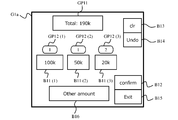
出金操作画面G1は、例えば、合計金額表示部GP11と、金種別枚数入力ボタンB11(1),B11(2),B11(3)と、確認ボタンB12と、クリアボタンB13と、UndoボタンB14と、ExitボタンB15と、合計金額指定ボタンB16とを備える。金種別枚数入力ボタンB11(1)~B11(3)は、「紙幣枚数入力部」に該当する。なお、ボタンB11(1)~B11(3)を特に区別しない場合、金種別枚数入力ボタンB11と略記する。合計金額指定ボタンB16をユーザが操作すると、例えば、図9で後述する画面G2へ遷移する。
出金を希望するユーザは、金種別枚数入力ボタンB11を操作することにより、所望の金種の紙幣を所望枚数だけ指定することができる。例えば、金種別枚数入力ボタンB11が「100k」「50k」「20k」の3種類である場合を説明する。
ユーザが「20k」のボタンB11(3)を1回操作すると、現金自動機1は合計金額表示部GP11に「Total:20k」と表示させる。ユーザが「20k」のボタンB11(3)をもう一度操作すると、合計金額表示部GP11には「Total:40k」と表示される。さらにユーザが「100k」ボタンB11(1)を一回操作すると、合計金額表示部GP11には「Total:140k」と操作される。さらにユーザが「50k」ボタンB11(2)を一回操作すると、合計金額表示部GP11には「Total:190k」と表示される。
このように現金自動機1は、金種別に枚数入力ボタンB11の操作回数と金種の金額とを乗じ、それら金種別小計の合計値を合計金額表示部GP11に表示させる。入力した操作を全てリセットしたい場合、ユーザはクリアボタンB13を操作すればよい。一回前の操作に戻したい場合、ユーザはUndoボタンB14を操作すればよい。操作を一回前に戻すことにより、合計金額表示部GP11の表示金額も変化する。ユーザが確認ボタンB12を操作すると、現金自動機1はホスト2と通信し、ホスト2からの承認を得る。そして、現金自動機1は、ユーザが金種別に指定した紙幣枚数通りに、現金入出金部113から現金を出力する。
図6,図7で後述するように、現金自動機1は、ユーザから要求された金種の紙幣が所定の出金可能枚数未満になると、その紙幣をそれ以上選択できないようにする。
図6は、本実施例に係る出金処理のフローチャートである。このフローチャートは出金処理の概要を示すものであり、ステップの順番は図示のものに限られない。
現金自動機1は、例えば、情報入出力装置116への暗証番号等の入力または携帯情報端末3との認証用通信により、ユーザ認証を実行する(S11)。ここでは、ユーザ認証に成功したものとして説明を続ける。
現金自動機1は、図6に示す出金操作画面G1を情報入出力装置116に表示させ、紙幣枚数を増加させる操作が可能か判定する(S12)。図5の例では、金種別枚数入力ボタンB11を操作して紙幣枚数の増加が可能か判定する。
例えば、現金自動機1の金種別紙幣収容部112に収容されている紙幣のうち、残枚数が所定の出金可能枚数未満になった金種については(S12:NO)、紙幣枚数を増加する操作が禁止される(S13)。ここで、出金可能枚数は、例えば、残枚数から所定の必要枚数を差し引いた値として算出することができる(出金可能枚数=残枚数-所定の必要枚数)。
金種別枚数入力ボタンB11を枚数増加方向へ操作可能な場合(S12:YES)、現金自動機1は、金種別枚数入力ボタンB11に対するユーザ入力(ユーザ操作)を取得し(S14)、取得した値を記憶する(S15)。
現金自動機1は、出金についてのユーザ操作が終了したか判断する(S16)。例えば、確認ボタンB12が操作された場合、出金に関するユーザ操作が終了したと判断することができ(S16:YES)、後述のステップS17へ移る。これに対し、ユーザ操作が終了していないと判断された場合(S16:NO)、ステップS12へ戻る。
現金自動機1は、ユーザによる出金操作が終了したと判定すると(S16:YES)、出金可能か判断する(S17)。例えば、現金自動機1は、ホスト2に対して出金してもよいか照会する。ホスト2から出金についての承認が得られると(S17:YES)、現金自動機1は、ステップS14でユーザから入力された枚数通りに、各金種の紙幣を現金入出金部113から出金させる(S18)。
これに対し、ホスト2がユーザの出金操作を承認しない場合(S17:NO)、エラー処理を実行する(S19)。エラー処理では、例えば「残高不足です」等のエラーメッセージが情報入出力装置116に表示される。
図7は、ユーザ操作が禁止された状態のボタンB11を含む画面G1の例である。図6のステップS12,S13で述べたように、現金自動機1は、例えば、残枚数が所定の出金可能枚数未満になった金種の出金を防止するために、金種別枚数入力ボタンB11を操作できないようにする。操作禁止に設定されたボタンB11(3)をユーザが操作しても、現金自動機1はその入力を取得せず、合計金額表示部GP11に反映させない。
図7の例では、「20k」のボタンB11(3)が現金自動機1により操作禁止に設定されている。例えば、ユーザは合計で「190k」の現金を希望しているが、現金自動機1では「20k」の紙幣が不足しているために1枚しか出すことができない場合、「20k」のボタンB11(3)の操作は禁止される。したがって、ユーザは、合計で「170k」の現金で我慢するか、あるいは「50k」のボタンB11(2)をもう一度操作して合計金額を「220k」にする。ユーザは、合計金額指定ボタンB16を操作することにより、図9に示す画面G2を情報入出力装置116に表示させることもできる。
このように構成される本実施例によれば、最少額の金種以外の金種の中から予め複数選択される所定の金種のみを取り扱う現金自動機1において、合計金額よりも金種別の紙幣枚数を優先させて現金を出金させることができる。
したがって、本実施例によれば、ユーザの所望金額はその金額に最も近い紙幣枚数として実現されるため、出金操作が失敗する可能性を低減することができ、ユーザの使い勝手および運用効率を向上させることができる。
本実施例によれば、残枚数が不足している金種については、出金操作画面G1において紙幣枚数を増加させる操作を禁止するため、出金不能な枚数がユーザにより指定されるのを未然に防止することができる。
図8~図10を用いて第2実施例を説明する。本実施例を含む以下の各実施例は、第1実施例の変形例に該当するため、第1実施例との相違を中心に説明する。本実施例では、ユーザの希望する金額で出金できない場合に、出金可能な金種別の紙幣枚数を指定できるようにしている。
図8は、本実施例による出金処理のフローチャートである。現金自動機1は、ユーザ認証を行った後(S31)、図9に示す出金操作画面G2を情報入出力装置116に表示させ、ユーザの入力する合計金額を取得する(S32)。
図9を参照する。「合計金額指定画面」の例である出金操作画面G2は、ユーザが合計金額を指定する画面である。出金操作画面G2は、例えば、合計金額表示部GP21と、エラーメッセージ表示部GP22と、テンキースイッチB21と、確認ボタンB22と、ExitボタンB23とを含む。
図8に戻る。ユーザが所望の金額をテンキースイッチB21から入力すると、現金自動機1は、その入力された金額を取得し(S32)、入力された金額を合計金額表示部GP21に表示させる。
現金自動機1は、ユーザによる金額入力が終了したか判定する(S33)。現金自動機1は、ユーザが確認ボタンB22を操作すると、金額入力が終了したものと判断することができる(S33:YES)。
現金自動機1は、ユーザの入力した金額で出金可能か判定する(S34)。現金自動機1は、入力された金額に一致する紙幣を保有しており、かつ、ホスト2の承認を得られた場合に出金可能であると判定する(S34:YES)。そして、現金自動機1は、ユーザの所望する金額の現金を現金入出金部113から出金させる(S35)。
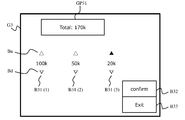
これに対し、ユーザの希望する金額通りに出金できないと判定された場合(S34:NO)、現金自動機1は、エラーメッセージ表示部GP22に例えば「出金できません」等のエラーメッセージを表示させた後、図10に示す出金操作画面G3を情報入出力装置116に表示させる(S36)。
図10を参照して出金操作画面G3を説明する。出金操作画面G3は、「第2の紙幣枚数指定画面」の例である。出金操作画面G3は、例えば、合計金額表示部GP31と、金種別枚数入力ボタンB31(1)~(3)と、確認ボタンB32と、ExitボタンB33とを備える。金種別枚数入力ボタンB31(1)~(3)は、特に区別しない場合、金種別枚数入力ボタンB31と呼ぶ。
金種別枚数入力ボタンB31は、それぞれの金種を示す表示の上下に、枚数増加ボタンBuと枚数減少ボタンBdとを備えている。ユーザが枚数増加ボタンBuを操作すると、その金種の紙幣が1枚増加する。ユーザが枚数減少ボタンBdを操作すると、その金種の紙幣が1枚減少する。合計金額表示部GP31には、各金種別枚数入力ボタンB31で入力された紙幣枚数の合計に基づく金額が表示される。
図10において、増加ボタンBuおよび減少ボタンBdは、操作可能である場合は白い三角形で示されており、操作不能である場合は黒い三角形で示されている。三角形の白黒以外の方法で操作可能か否かを区別してもよい。
図8に戻る。現金自動機1は、図10で述べた画面G3をユーザに提示した後(S36)、金種別枚数入力ボタンB31を操作可能か(紙幣枚数の増加が可能か)を判定する(S37)。
例えば、残枚数が所定の出金可能枚数未満である金種については、その金種に対応するボタンB31を操作させない(S37:NO)。現金自動機1は、出金に含める紙幣枚数を増加できないように、ボタンB31の操作を禁止する(S38)。図10の例では、現金自動機1は、ボタンB31(3)の増加ボタンBuを操作できないように設定し、黒い三角形でユーザに通知する。
これに対し、例えば、残枚数が所定の出金可能枚数以上である金種については、その金種に対応するボタンB31をユーザに操作させることができる(S37:YES)。現金自動機1は、ユーザから入力される金種別の紙幣枚数を取得し記憶する(S39)。
現金自動機1は、ユーザによる金種別の紙幣枚数の入力操作が終了したか判定する(S40)。現金自動機1は、例えば、確認ボタンB32が操作されると入力操作が終了したと判定することができる。
現金自動機1は、入力操作が終了していないと判定すると(S40:NO)、ステップS37へ戻る。現金自動機1は、入力操作が終了したと判定すると(S40:YES)、ユーザの入力した金種別の紙幣枚数通りに出金可能か判定する(S41)。
現金自動機1は、ホスト2の承認を得る等して出金可能であると判定すると(S41:YES)、ステップS35へ移行して出金処理を実行する。これに対し、現金自動機1は、ホスト2の承認を得られない場合には、出金不能であると判定し(S41:NO)、エラー処理を実行する(S42)。エラー処理ではエラーメッセージを情報入出力装置116に表示させる。
このように構成される本実施例も第1実施例と同様の作用効果を奏する。本実施例によれば、増加ボタンBuと枚数減少ボタンBdとを用意しているため、ユーザは金種別に紙幣枚数を増加または減少させることができる。したがって、ユーザの使い勝手がさらに向上する。
さらに本実施例によれば、図9に示す出金操作画面G2をユーザに提供することにより、所望の金額を入力させることができ、その後に、金種別に紙幣枚数を指定可能な画面G3に遷移させる。したがって、ユーザは、例えば、合計金額表示部GP21に表示された合計金額を目安として、所望の金種別の紙幣枚数を入力することができる。
さらに本実施例は、第1実施例から連続させて実行することもできる。すなわち、ユーザが合計金額指定ボタンB16を操作すると、図9の合計金額指定画面G2へ遷移し、ユーザが画面G2において確認ボタンB22を操作すると、図10に示す出金操作画面G3へ遷移するように構成することもできる。さらに、図10に示す出金操作画面G3単独で構成してもよい。その際のフローは図8のS32~S34を除いたフローとなる。
図11を用いて第3実施例を説明する。本実施例では、出金可能枚数の算出方法等の詳細な例を説明する。
まず最初に現金自動機1は、ユーザが本体11へ挿入するクレジットカードの番号やユーザが入力するパスワード等からユーザを認証する(S101)。
ユーザ認証後、現金自動機1は、金種別残枚数aを確認し(S102)、「所定の必要枚数」としてのマージン枚数bを確認し(S103)、さらに金種別の最大出金枚数mを確認する(S104)。金種別最大出金枚数mとは、金種別に出金可能な紙幣の最大枚数である。例えば、一回の出金処理で払出可能な金額の上限(上限金額)が決められており、その上限金額を各金種の額面で除算した値が、その金種の最大出金枚数mとなる。例えば、一回の出金処理で払出可能な金額の上限を「500k」とすると、「100k」の紙幣は5枚まで(=500k/100k)、「50k」の紙幣は10枚まで(=500k/50k)、「20k」の紙幣は25枚まで(=500k/25k)、出金可能である。
現金自動機1は、金種別残枚数aからマージン枚数bを差し引くことにより、金種別に出金可能枚数c(=a-b)をそれぞれ算出する(S105)。
現金自動機1は、金種別枚数入力ボタンを全て操作可能に設定する(S106)。現金自動機1は、ステップS105で算出した金種別出金可能枚数cのうち、c=0である金種が存在するか判定する(S107)。
c≦0の金種が存在する場合(S107:YES)、すなわち、出金可能な紙幣が一枚もない金種がある場合、現金自動機1は、その金種の紙幣枚数を操作できないように(詳しくは紙幣枚数を増加させることができないように)、設定する(S108)。
紙幣を一枚以上出金できる金種については(S107:NO)、現金自動機1は、ボタン操作を制限せずにステップS109へ進む。
現金自動機1は、金種別出金枚数dに「0」を設定し(S109)、合計金額を計算し(S110)、算出した合計金額を画面に表示させる(S111)。ここでは処理が開始されたばかりなので、合計金額は「0」と表示される。
現金自動機1は、クリアボタンが操作されたか判定する(S112)。現金自動機1は、クリアボタンが操作されたと判定すると(S112:YES)、合計金額を消去してステップS106へ戻る。
続いて現金自動機1は、Exitボタンが操作されたか判定する(S113)。現金自動機1は、Exitボタンが操作されたと判定すると(S113:YES)、ステップS120へ進み、後処理を実行する。
後処理では、例えば、現金入出金部113の図示せぬシャッタを閉じたり、搬送部117上に紙幣が残留していないか確認したり、一時収容部114に収容された紙幣のうち損傷の激しい紙幣を回収部111へ移したり、出金処理が終了された旨の記録を残したりといった所定の処理を実施する。
現金自動機1は、金種別枚数入力ボタンが操作されたか判定し(S114)、操作された場合(S114:YES)、操作された金種の出金枚数dを1つインクリメントする(S115)。
現金自動機1は、操作された金種について、出金枚数dが出金可能枚数cに一致したか(d=c)、あるいは、出金枚数dが最大出金枚数mに一致したか(d=m)の少なくともいずれかに該当したか判定する(S116)。
現金自動機1は、ステップS116で検査する停止条件(d=c or d=m)に該当しないと判定すると(S116:NO)、ステップS110へ戻る。これに対し、現金自動機1は、ステップS116の停止条件に該当すると判定すると(S116:YES)、停止条件に該当する金種の紙幣枚数を操作できないように(増加させることができないように)、その金種の枚数入力ボタンの操作を制限する(S117)。現金自動機1は、停止条件に該当する金種の紙幣枚数を入力するボタン操作を制限(禁止)させた後で、ステップS110へ戻る。現金自動機1は、ステップS110で合計金額を計算した後、前記上限金額と合計金額との差分を超える金種があるかを判定し(S110a)、該当する金種がある場合、その金種の紙幣枚数を操作できないように(増加させることができないように)、その金種の枚数入力ボタンの操作を制限する(S110b)。
現金自動機1は、ステップS118において、金種別枚数入力ボタンが操作されないと判定すると(S118:NO)、確認ボタンが操作されたか判定する(S119)。確認ボタンが操作されていない場合(S119:NO)、ステップS111へ戻る。
現金自動機1は、確認ボタンが操作されたと判定すると(S118:YES)、ステップS115でカウントした金種別の出金枚数dに応じて、第1実施例等と同様に、ホスト2の承認を得る等して出金可能であることを確認した上で、現金入出金部113から現金を出金させる(S119)。
そして、現金自動機1は、後処理を実施した後(S120)、本処理を終了する。このように構成される本実施例も第1実施例と同様の作用効果を奏する。
図12を用いて第4実施例を説明する。本実施例では、出金操作画面G1aにおいて、金種別枚数入力ボタンB11(1)~(3)に枚数カウンタGP12(1)~(3)を対応づけている。
図12に示す出金操作画面G1aは、枚数カウンタGP12(1)~(3)を除いて、図5で述べた出金操作画面G1と同様であるため、これ以上の説明を割愛する。
このように構成される本実施例も第1実施例と同様の作用効果を奏する。さらに、本実施例の出金操作画面G1aは、枚数カウンタGP12(1)~(3)を有するため、ユーザはどの金種の紙幣を何枚要求したか容易に確認することができ、使い勝手がますます向上する。
なお、本発明は、上述した実施形態に限定されない。当業者であれば、本発明の範囲内で、種々の追加や変更等を行うことができる。実施形態に述べた特徴は適宜組み合わせることもできる。
1:現金自動機、2:ホストコンピュータ、3:携帯情報端末、11:本体、111:回収部、112:紙幣収容部、113:現金入出金部、114:一時収容部、115:鑑別装置、116:情報入出力装置、121:制御部、122:記憶部、123:通信部、G,G1,G2,G3,G1a:画面、CN:通信ネットワーク
Claims (6)
- ユーザ操作に応じて現金を出金する現金自動機であって、
制御部と、
前記制御部により制御され、ユーザ操作可能な情報入出力装置とを備え、
前記制御部は、
最少額の金種以外の金種の中から予め複数選択される所定の金種別に紙幣枚数を入力する紙幣枚数入力部と、前記紙幣枚数入力部から入力される前記所定の金種別の紙幣枚数に基づく合計金額を表示する合計金額表示部とを含む紙幣枚数指定画面を前記情報入出力装置に表示させ、
前記所定の金種別の現金を前記紙幣枚数入力部に入力された紙幣枚数通りに出金させる、
現金自動機。 - 前記制御部は、前記所定の金種のうち残紙幣枚数が所定の出金可能紙幣枚数未満の金種については、前記紙幣枚数入力部において紙幣枚数の増加を禁止させる、
請求項1に記載の現金自動機。 - 前記所定の出金可能紙幣枚数は、残紙幣枚数から所定の必要紙幣枚数を差し引いた値である、
請求項2に記載の現金自動機。 - 前記制御部は、前記所定の金種のうち出金上限金額と合計金額との差分より大きな金種については、前記紙幣枚数入力部において紙幣枚数の増加を禁止させる、
請求項1に記載の現金自動機。 - 前記制御部は、
前記紙幣枚数入力部と前記合計金額表示部を含む第1の紙幣枚数指定画面または、
合計金額指定画面であって、合計金額を入力する合計金額指定画面と、
前記合計金額指定画面で指定された合計金額に一致する現金を出金できない場合に遷移する第2の紙幣枚数指定画面と、
第1または第2の紙幣枚数指定画面の少なくともいずれか1つの画面を前記情報入出力装置に表示させる、
請求項1~4のいずれか一項に記載の現金自動機。 - 現金自動機を制御する方法であって、
ユーザにより入力される所定の金種別の紙幣枚数を紙幣枚数入力部から取得し、
前記紙幣枚数入力部へ入力される前記所定の金種別の紙幣枚数に基づく合計金額を計算して合計金額表示部へ表示し、
所定の条件を満たす場合に、前記所定の金種別の現金を前記紙幣枚数入力部に入力された紙幣枚数通りに出金する、
現金自動機の制御方法。
Applications Claiming Priority (2)
| Application Number | Priority Date | Filing Date | Title |
|---|---|---|---|
| JP2017-253289 | 2017-12-28 | ||
| JP2017253289A JP2019120996A (ja) | 2017-12-28 | 2017-12-28 | 現金自動機およびその制御方法 |
Publications (1)
| Publication Number | Publication Date |
|---|---|
| WO2019130620A1 true WO2019130620A1 (ja) | 2019-07-04 |
Family
ID=67066900
Family Applications (1)
| Application Number | Title | Priority Date | Filing Date |
|---|---|---|---|
| PCT/JP2018/019090 Ceased WO2019130620A1 (ja) | 2017-12-28 | 2018-05-17 | 現金自動機およびその制御方法 |
Country Status (2)
| Country | Link |
|---|---|
| JP (1) | JP2019120996A (ja) |
| WO (1) | WO2019130620A1 (ja) |
Cited By (1)
| Publication number | Priority date | Publication date | Assignee | Title |
|---|---|---|---|---|
| US20210081917A1 (en) * | 2018-05-11 | 2021-03-18 | Diebold Nixdorf, Incorporated | Method of operating an automated transaction machine for enhanced security |
Families Citing this family (1)
| Publication number | Priority date | Publication date | Assignee | Title |
|---|---|---|---|---|
| JP7716606B1 (ja) * | 2025-03-12 | 2025-07-31 | PayPay株式会社 | 情報処理装置、情報処理方法、およびプログラム |
Citations (5)
| Publication number | Priority date | Publication date | Assignee | Title |
|---|---|---|---|---|
| JPS62204395A (ja) * | 1986-03-04 | 1987-09-09 | 日本電気株式会社 | 自動取引機 |
| JP2001175907A (ja) * | 1999-12-15 | 2001-06-29 | Glory Ltd | 両替装置 |
| JP2013012135A (ja) * | 2011-06-30 | 2013-01-17 | Glory Ltd | 紙幣処理装置 |
| JP2014157479A (ja) * | 2013-02-15 | 2014-08-28 | Oki Electric Ind Co Ltd | 現金処理装置及びプログラム |
| JP2016122232A (ja) * | 2014-12-24 | 2016-07-07 | 沖電気工業株式会社 | 現金処理装置および現金処理方法 |
-
2017
- 2017-12-28 JP JP2017253289A patent/JP2019120996A/ja active Pending
-
2018
- 2018-05-17 WO PCT/JP2018/019090 patent/WO2019130620A1/ja not_active Ceased
Patent Citations (5)
| Publication number | Priority date | Publication date | Assignee | Title |
|---|---|---|---|---|
| JPS62204395A (ja) * | 1986-03-04 | 1987-09-09 | 日本電気株式会社 | 自動取引機 |
| JP2001175907A (ja) * | 1999-12-15 | 2001-06-29 | Glory Ltd | 両替装置 |
| JP2013012135A (ja) * | 2011-06-30 | 2013-01-17 | Glory Ltd | 紙幣処理装置 |
| JP2014157479A (ja) * | 2013-02-15 | 2014-08-28 | Oki Electric Ind Co Ltd | 現金処理装置及びプログラム |
| JP2016122232A (ja) * | 2014-12-24 | 2016-07-07 | 沖電気工業株式会社 | 現金処理装置および現金処理方法 |
Cited By (2)
| Publication number | Priority date | Publication date | Assignee | Title |
|---|---|---|---|---|
| US20210081917A1 (en) * | 2018-05-11 | 2021-03-18 | Diebold Nixdorf, Incorporated | Method of operating an automated transaction machine for enhanced security |
| US12314921B2 (en) * | 2018-05-11 | 2025-05-27 | Diebold Nixdorf, Incorporated | Method of operating an automated transaction machine for enhanced security |
Also Published As
| Publication number | Publication date |
|---|---|
| JP2019120996A (ja) | 2019-07-22 |
Similar Documents
| Publication | Publication Date | Title |
|---|---|---|
| US8024272B2 (en) | Methods and systems for exchanging/transferring gift cards | |
| US20140201012A1 (en) | Methods and systems for exchanging and/or transferring various forms of value | |
| US20060037835A1 (en) | Methods and systems for exchanging and or transferring various forms of value | |
| JP2001256534A (ja) | 店舗用売上金入金装置 | |
| JP5251108B2 (ja) | 自動取引装置 | |
| WO2020095954A1 (ja) | 仮想通貨取引装置、仮想通貨取引システム及び仮想通貨取引方法 | |
| US8360309B2 (en) | Reducing transaction time in a self-service terminal | |
| JP6645757B2 (ja) | 貨幣管理装置及び貨幣管理システム | |
| WO2020026783A1 (ja) | 仮想通貨取引装置、仮想通貨取引システム及び仮想通貨取引方法 | |
| JP6036631B2 (ja) | 自動取引装置 | |
| WO2019130620A1 (ja) | 現金自動機およびその制御方法 | |
| JP7419808B2 (ja) | 取引装置 | |
| JP6117545B2 (ja) | 現金処理システム及び現金処理方法 | |
| JP2008046950A (ja) | 自動取引装置及び自動取引装置による振替予約方法 | |
| KR102250014B1 (ko) | 카드결제 기능이 구비된 무인 화폐교환장치 | |
| JP2019207598A (ja) | 自動取引装置、取引処理システムおよび取引処理プログラム | |
| JP7007835B2 (ja) | 電子マネー端末装置、電子マネー管理システム及び電子マネーチャージ方法 | |
| JP6867961B2 (ja) | プログラム、決済処理システム、方法 | |
| JP2002342589A (ja) | 自動取引装置の取引方法およびそのプログラム並びにその装置 | |
| JPH11213211A (ja) | 金額・金種入力方法および自動取引装置 | |
| JP2015108945A (ja) | 取引装置、取引システム及び取引プログラム | |
| JP2017041055A (ja) | 自動取引装置 | |
| JP6649078B2 (ja) | 自動取引装置 | |
| JP6690303B2 (ja) | 自動取引装置 | |
| JP7537114B2 (ja) | 自動取引装置 |
Legal Events
| Date | Code | Title | Description |
|---|---|---|---|
| 121 | Ep: the epo has been informed by wipo that ep was designated in this application |
Ref document number: 18897397 Country of ref document: EP Kind code of ref document: A1 |
|
| NENP | Non-entry into the national phase |
Ref country code: DE |
|
| 122 | Ep: pct application non-entry in european phase |
Ref document number: 18897397 Country of ref document: EP Kind code of ref document: A1 |
|
| WWG | Wipo information: grant in national office |
Ref document number: 202047014502 Country of ref document: IN |