WO2019064962A1 - 集電体用アルミニウム合金箔及びその製造方法 - Google Patents
集電体用アルミニウム合金箔及びその製造方法 Download PDFInfo
- Publication number
- WO2019064962A1 WO2019064962A1 PCT/JP2018/030071 JP2018030071W WO2019064962A1 WO 2019064962 A1 WO2019064962 A1 WO 2019064962A1 JP 2018030071 W JP2018030071 W JP 2018030071W WO 2019064962 A1 WO2019064962 A1 WO 2019064962A1
- Authority
- WO
- WIPO (PCT)
- Prior art keywords
- aluminum alloy
- alloy foil
- mass
- less
- temperature
- Prior art date
- Legal status (The legal status is an assumption and is not a legal conclusion. Google has not performed a legal analysis and makes no representation as to the accuracy of the status listed.)
- Ceased
Links
Images

Classifications
-
- H—ELECTRICITY
- H01—ELECTRIC ELEMENTS
- H01M—PROCESSES OR MEANS, e.g. BATTERIES, FOR THE DIRECT CONVERSION OF CHEMICAL ENERGY INTO ELECTRICAL ENERGY
- H01M4/00—Electrodes
- H01M4/02—Electrodes composed of, or comprising, active material
- H01M4/64—Carriers or collectors
- H01M4/66—Selection of materials
- H01M4/661—Metal or alloys, e.g. alloy coatings
- H01M4/662—Alloys
-
- H—ELECTRICITY
- H01—ELECTRIC ELEMENTS
- H01M—PROCESSES OR MEANS, e.g. BATTERIES, FOR THE DIRECT CONVERSION OF CHEMICAL ENERGY INTO ELECTRICAL ENERGY
- H01M4/00—Electrodes
- H01M4/02—Electrodes composed of, or comprising, active material
- H01M4/64—Carriers or collectors
- H01M4/66—Selection of materials
- H01M4/661—Metal or alloys, e.g. alloy coatings
-
- C—CHEMISTRY; METALLURGY
- C22—METALLURGY; FERROUS OR NON-FERROUS ALLOYS; TREATMENT OF ALLOYS OR NON-FERROUS METALS
- C22C—ALLOYS
- C22C21/00—Alloys based on aluminium
-
- C—CHEMISTRY; METALLURGY
- C22—METALLURGY; FERROUS OR NON-FERROUS ALLOYS; TREATMENT OF ALLOYS OR NON-FERROUS METALS
- C22F—CHANGING THE PHYSICAL STRUCTURE OF NON-FERROUS METALS AND NON-FERROUS ALLOYS
- C22F1/00—Changing the physical structure of non-ferrous metals or alloys by heat treatment or by hot or cold working
- C22F1/04—Changing the physical structure of non-ferrous metals or alloys by heat treatment or by hot or cold working of aluminium or alloys based thereon
-
- H—ELECTRICITY
- H01—ELECTRIC ELEMENTS
- H01M—PROCESSES OR MEANS, e.g. BATTERIES, FOR THE DIRECT CONVERSION OF CHEMICAL ENERGY INTO ELECTRICAL ENERGY
- H01M4/00—Electrodes
- H01M4/02—Electrodes composed of, or comprising, active material
- H01M4/04—Processes of manufacture in general
- H01M4/043—Processes of manufacture in general involving compressing or compaction
- H01M4/0435—Rolling or calendering
-
- C—CHEMISTRY; METALLURGY
- C22—METALLURGY; FERROUS OR NON-FERROUS ALLOYS; TREATMENT OF ALLOYS OR NON-FERROUS METALS
- C22F—CHANGING THE PHYSICAL STRUCTURE OF NON-FERROUS METALS AND NON-FERROUS ALLOYS
- C22F1/00—Changing the physical structure of non-ferrous metals or alloys by heat treatment or by hot or cold working
-
- H—ELECTRICITY
- H01—ELECTRIC ELEMENTS
- H01M—PROCESSES OR MEANS, e.g. BATTERIES, FOR THE DIRECT CONVERSION OF CHEMICAL ENERGY INTO ELECTRICAL ENERGY
- H01M10/00—Secondary cells; Manufacture thereof
- H01M10/05—Accumulators with non-aqueous electrolyte
- H01M10/052—Li-accumulators
- H01M10/0525—Rocking-chair batteries, i.e. batteries with lithium insertion or intercalation in both electrodes; Lithium-ion batteries
-
- H—ELECTRICITY
- H01—ELECTRIC ELEMENTS
- H01M—PROCESSES OR MEANS, e.g. BATTERIES, FOR THE DIRECT CONVERSION OF CHEMICAL ENERGY INTO ELECTRICAL ENERGY
- H01M2220/00—Batteries for particular applications
- H01M2220/20—Batteries in motive systems, e.g. vehicle, ship, plane
-
- Y—GENERAL TAGGING OF NEW TECHNOLOGICAL DEVELOPMENTS; GENERAL TAGGING OF CROSS-SECTIONAL TECHNOLOGIES SPANNING OVER SEVERAL SECTIONS OF THE IPC; TECHNICAL SUBJECTS COVERED BY FORMER USPC CROSS-REFERENCE ART COLLECTIONS [XRACs] AND DIGESTS
- Y02—TECHNOLOGIES OR APPLICATIONS FOR MITIGATION OR ADAPTATION AGAINST CLIMATE CHANGE
- Y02E—REDUCTION OF GREENHOUSE GAS [GHG] EMISSIONS, RELATED TO ENERGY GENERATION, TRANSMISSION OR DISTRIBUTION
- Y02E60/00—Enabling technologies; Technologies with a potential or indirect contribution to GHG emissions mitigation
- Y02E60/10—Energy storage using batteries
Definitions
- the present invention relates to an aluminum alloy foil for a current collector and a method for producing the same.
- Lithium ion secondary batteries are widely used as batteries mounted in various devices such as automobiles and laptop personal computers.
- the positive electrode of the lithium ion secondary battery has a current collector made of an aluminum alloy foil, and a positive electrode active material layer including a positive electrode active material and disposed on the surface of the current collector.
- the positive electrode for a lithium ion secondary battery is usually produced by the following method. That is, after a paste containing a positive electrode active material and a binder is applied to the surface of an aluminum alloy foil as a current collector, the paste is dried to form a positive electrode active material layer on the surface of the current collector. Then, after rolling the current collector provided with the positive electrode active material layer, the positive electrode can be obtained by cutting into a desired size (for example, Patent Document 1).
- the aluminum alloy foil In order to suppress breakage or the like of the aluminum alloy foil in the production process of the positive electrode described above, it is preferable to use an aluminum alloy foil having relatively high strength. However, the aluminum alloy foil tends to have a smaller elongation as the strength is higher. The positive electrode of the lithium ion secondary battery repeats expansion and contraction during charge and discharge. Therefore, when an aluminum alloy foil with a small elongation is used as a current collector, the aluminum alloy foil becomes early due to the repetition of expansion and contraction. May deteriorate. Also, in some cases, the aluminum alloy foil may break early.
- an aluminum alloy foil having sufficient strength at the time of coating, drying, and rolling at the time of electrode production, and thereafter softening starts at a low temperature of about 120 ° C.
- Patent Document 2 This aluminum alloy foil can suppress the fall of intensity
- the positive electrode before being incorporated into a lithium ion secondary battery is subjected to heat treatment at a temperature as low as possible at 200 ° C. or less, whereby the elongation of the aluminum alloy foil is improved and thus the durability of the aluminum alloy foil for charge and discharge cycles is improved. be able to.
- a positive electrode provided with a conventional aluminum alloy foil for example, when intense vibration is applied from the outside in an application such as a car battery, the positive electrode active material layer peels off from the aluminum alloy foil as a current collector and battery capacity May cause a decrease in In order to avoid such a problem, an aluminum alloy foil capable of suppressing peeling of the positive electrode active material layer when vibration is applied from the outside is required.
- the present invention has been made in view of the above background, and provides an aluminum alloy foil for a current collector having excellent durability against thermal cycles and capable of effectively damping external vibration, and a method of manufacturing the same. It is said that.
- One aspect of the present invention is Fe (iron): 1.1 to 1.8% by mass, Si (silicon): 0.30% by mass or less, Cu (copper): 0.030% by mass or less, Mg (magnesium) Chemical component comprising 0.030 mass% or less, Mn (manganese): 0.040 mass% or less, Ti (titanium): 0.050 mass% or less, and the balance being Al (aluminum) and unavoidable impurities , Have a cold worked structure and Recrystallize at temperatures above 150 ° C, In the case of complete recrystallization, it has a characteristic that the elongation is not less than 5.6% and the logarithmic damping factor of the free vibration is not less than 1.0 ⁇ 10 ⁇ 3 . It is in the aluminum alloy foil for current collectors.
- the other aspect of this invention is a manufacturing method of the aluminum alloy foil for collectors of said aspect, Comprising: Prepare an ingot with the above chemical composition, The ingot is kept at a temperature of 400 to 580 ° C. to perform homogenization treatment, A hot-rolled sheet is produced by hot rolling the ingot under the condition that the coiling temperature is equal to or less than the recrystallization temperature, A cold rolled sheet is produced by cold rolling the hot rolled sheet, The cold rolled sheet is held at a temperature of 300 to 340 ° C. for intermediate annealing. The cold rolled sheet is subjected to foil rolling under the condition that the rolling ratio is 85% or more and the winding temperature is less than 90 ° C. It is in the manufacturing method of aluminum alloy foil for current collectors.
- the aluminum alloy foil for the current collector (hereinafter, appropriately referred to as “aluminum alloy foil”) has the specific chemical component and a cold worked structure. Thereby, the characteristic of recrystallization at a temperature of 150 ° C. or more can be realized. And aluminum alloy foil provided with such a characteristic can maintain high intensity in a preparation process of a positive electrode, and can control a fracture of the aluminum alloy foil.
- the said aluminum alloy foil enlarges the elongation at the time of complete recrystallization compared with the aluminum alloy foil provided with the conventional component range by making content of Mg into 0.030 mass% or less. Can. Therefore, compared with the conventional aluminum alloy foil, the said aluminum alloy foil can suppress deterioration in the case of repeating expansion
- the logarithmic damping factor of the damping free vibration is 1.0 ⁇ 10 ⁇ 3 or more.
- the aluminum alloy foil can effectively damp the vibration applied from the outside by setting the logarithmic attenuation factor to the specific range. Therefore, by using the aluminum alloy foil as the current collector of the positive electrode, the vibration of the current collector when vibration is applied from the outside is suppressed, and the peeling of the positive electrode active material layer from the current collector is suppressed. can do.
- the said aluminum alloy foil is excellent in the durability with respect to a charging / discharging cycle, the vibration from the outside can be attenuated effectively.
- -Fe (iron) 1.1 to 1.8 mass% Fe is dissolved in the aluminum alloy foil in a supersaturated state.
- a part of Fe in solid solution in the Al matrix precipitates out as a fine Al—Fe-based compound having a particle diameter of less than 5 nm.
- the recovery rate of the cold worked structure is faster than the precipitation of the Al—Fe based compound. Therefore, when the aluminum alloy foil is subjected to heat treatment, recovery of the cold worked structure starts at a temperature of about 120 ° C., and the tensile strength is lowered. Then, the heat treatment of the aluminum alloy foil is further continued to raise the temperature to 150 ° C. or more, whereby the aluminum alloy foil can be recrystallized. As a result, the elongation of the aluminum alloy foil can be made larger than that before the heat treatment.
- Fe maintains its strength in the heat treatment at a temperature of about 100 ° C. in the aluminum alloy foil, and is softened and stretched more than in the heat treatment by heat treatment at a temperature of 150 ° C. or more. It is an important element to realize the characteristics of By setting the content of Fe in the specific range, such characteristics can be realized, and the elongation and the logarithmic attenuation factor of the completely recrystallized aluminum alloy foil can be in the specific range.
- the content of Fe is less than 1.1% by mass, the amount of Fe in solid solution in the Al matrix phase is insufficient, so that the logarithmic attenuation factor of the completely recrystallized aluminum alloy foil is in the specific range. It becomes smaller than. As a result, it is difficult to damp the vibration applied from the outside. From the viewpoint of increasing the logarithmic damping factor of the completely recrystallized aluminum alloy foil and more effectively damping the externally applied vibration, it is preferable to set the Fe content to 1.2% by mass or more. .
- part of Fe in the aluminum alloy foil is in solid solution in the Al matrix phase, and the rest is dispersed in the Al matrix phase as an Al—Fe-based compound. It is preferable that 800 pieces / ⁇ m 3 or more of Al—Fe based compounds having equivalent circle diameters of 10 to 50 nm be dispersed in the Al matrix.
- the Al—Fe-based compound having the circle equivalent diameter in the specific range has low consistency with the Al matrix phase. Therefore, when heat treatment is performed at a temperature of 150 ° C. or more, recovery of cold worked structure and recrystallization are promoted by dispersing Al—Fe based compound in Al matrix phase at 800 pieces / ⁇ m 3 or more. Can. As a result, the aluminum alloy foil can be recrystallized at a lower temperature, and the elongation of the completely recrystallized aluminum alloy foil can be further increased.
- the amount of Fe in solid solution in the Al matrix is preferably 0.015 to 0.035% by mass.
- the amount of Fe in solid solution in the Al matrix is preferably 0.015 to 0.035% by mass.
- the aluminum alloy foil has a characteristic that the amount of Fe dissolved in an Al matrix is 0.010 to 0.030 mass% when completely recrystallized. .
- Fe in solid solution in the Al matrix can effectively damp the vibration applied from the outside. Therefore, in this case, it is possible to make the logarithmic damping factor of the completely recrystallized aluminum alloy foil larger and to damp external applied vibrations more effectively.
- Si (silicon): 0.30 mass% or less Si is not an essential component, but may be mixed in the aluminum alloy foil.
- the content of Si increases, it is easy to precipitate Si single particles and second phase particles such as an Al-Fe-Si compound in the Al matrix phase, which may cause a decrease in the ductility of the aluminum alloy foil.
- the content of Si is set to 0.30 mass% or less. From the same viewpoint, the content of Si is preferably 0.10% by mass or less.
- the above-mentioned concept "Si: 0.30 mass% or less" is a concept including the case where content of Si is 0 mass%.
- Ti titanium: 0.050 mass% or less
- the aluminum alloy foil may contain Ti as an optional component. Ti has the effect of refining the ingot structure. However, when the content of Ti is excessively large, pinholes are easily formed in the aluminum alloy foil at the time of foil rolling. By making content of Ti into the said specific range, the dispersion of the mechanical property of the said aluminum alloy foil can be reduced more, avoiding formation of the pinhole at the time of foil rolling.
- Ti 0.050 mass% or less
- Ti is a concept including the case where content of Ti is 0 mass%.
- B (boron): 0.010 mass% or less
- the aluminum alloy foil may contain B as an optional component. B coexists with Ti, so that the ingot structure can be refined like Ti.
- B when the content of B is excessively large, pinholes are easily formed in the aluminum alloy foil at the time of foil rolling. By making content of B into the said specific range, the dispersion of the mechanical property of the said aluminum alloy foil can be reduced more, avoiding formation of the pinhole at the time of foil rolling.
- the above-mentioned concept "B: 0.010 mass% or less" is a concept including the case where the content of B is 0 mass%.
- Mn manganese
- the aluminum alloy foil may contain Mn as an optional component.
- Mn has the effect of improving the strength of the aluminum alloy foil.
- the content of Mn is excessively large, the elongation of the completely recrystallized aluminum alloy foil may be reduced.
- strength of the said aluminum alloy foil can be improved more, avoiding the fall of elongation.
- Mn: 0.040 mass% or less is a concept including the case where content of Mn is 0 mass%.
- the aluminum alloy foil may contain Cu as an optional component.
- Cu forms a solid solution in the Al matrix phase and has the function of improving the strength of the aluminum alloy foil.
- the content of Cu is excessively large, the amount of solid solution of Cu is increased, and therefore, the elongation of the completely recrystallized aluminum alloy foil may be reduced.
- strength of the said aluminum alloy foil can be improved more, avoiding the fall of elongation.
- the above-mentioned concept "Cu: 0.030 mass% or less" is a concept covering the case where content of Cu is 0 mass%.
- Mg (magnesium): 0.030 mass% or less
- the aluminum alloy foil may contain Mg as an optional component.
- Mg forms a solid solution in the Al matrix phase and has the effect of improving the strength of the aluminum alloy foil.
- the content of Mg is excessively large, the solid solution amount of Mg is increased, and therefore, the elongation of the completely recrystallized aluminum alloy foil may be reduced.
- strength of the said aluminum alloy foil can be improved more, avoiding the fall of elongation.
- the above-mentioned concept "Mg: 0.030 mass% or less" is a concept covering the case where content of Mg is 0 mass%.
- Zn (zinc), Ga (gallium), Ni (nickel), Cr (chromium), Sn (tin), Pb (lead), V (vanadium), etc. May be contained. If the content of these elements is excessively high, the temperature at which recrystallization starts may be increased. By setting the content of these elements to 0.020 mass% or less, an increase in the temperature at which recrystallization starts can be avoided. In addition, 0 mass% may be sufficient as content of these elements.
- the aluminum alloy foil has a cold worked structure.
- high strength can be maintained in the process of producing the positive electrode, and breakage of the aluminum alloy foil can be suppressed.
- the aluminum alloy foil preferably has a tensile strength of 160 MPa or more. In this case, breakage of the aluminum alloy foil in the process of producing the positive electrode can be more effectively suppressed.
- the tensile strength of the aluminum alloy foil after immersion in an oil bath at 100 ° C. for 1 minute is more preferably 150 MPa or more.
- Recrystallization temperature 150 ° C. or more
- the aluminum alloy foil has a property of recrystallization at a temperature of 150 ° C. or more.
- the aluminum alloy foil as a current collector may be heated to about 100 ° C. Since the aluminum alloy foil has a recrystallization start temperature of 150 ° C. or higher, it is possible to easily avoid the increase in the softening and ductility of the aluminum alloy foil in the process of producing the positive electrode. Thereby, high strength can be maintained in the production process of the positive electrode, and breakage of the aluminum alloy foil can be suppressed.
- the start temperature of the recrystallization in the said aluminum alloy foil is 200 degrees C or less.
- a positive electrode active material of a lithium ion secondary battery lithium cobaltate, a lithium nickel composite compound, etc. are used. These positive electrode active materials may be degraded when heated to a temperature exceeding 200 ° C., and in some cases, the electrical characteristics may be impaired. Therefore, by setting the start temperature of recrystallization in the aluminum alloy foil to 200 ° C. or less, elongation of the completely recrystallized aluminum alloy foil can be increased while avoiding deterioration of the positive electrode active material by heating. .
- the aluminum alloy foil completely recrystallized has an elongation of 5.6% or more. Further, in the aluminum alloy foil completely recrystallized, the logarithmic damping factor of the damping free vibration is 1.0 ⁇ 10 ⁇ 3 or more. These properties after recrystallization can be realized by at least having the specific chemical component.
- the tensile strength of the said aluminum alloy foil after 1 minute immersion in a 120 degreeC oil bath is less than 150 Mpa.
- the said aluminum alloy foil can be produced by the following method, for example. First, an ingot provided with the specific chemical component is prepared. The ingot can be produced, for example, by a method such as continuous casting or DC casting.
- the ingot is maintained at a temperature of 400 to 580 ° C. to carry out a homogenization treatment.
- the holding temperature in the homogenization treatment is less than 400 ° C., homogenization of the ingot structure is insufficient, and the variation in mechanical properties of the finally obtained aluminum alloy foil may be increased.
- the holding temperature exceeds 580 ° C., so-called Ostwald growth causes the size of the Al—Fe-based compound present in the ingot to increase and the number to decrease.
- the start temperature of recrystallization of the aluminum alloy foil is increased, which may make it difficult to increase the elongation of the aluminum alloy foil by heat treatment at a temperature of 150 ° C. or more.
- the retention time in the homogenization treatment is not particularly limited, but an excessively long retention time leads to an increase in production cost. From the viewpoint of avoiding an increase in manufacturing cost, it is preferable to set the holding time to 24 hours or less.
- the ingot is hot-rolled under the condition that the coiling temperature is equal to or lower than the recrystallization temperature, to prepare a hot-rolled sheet.
- the winding temperature of the hot-rolled sheet By setting the winding temperature of the hot-rolled sheet to the recrystallization temperature or less, it is possible to suppress the precipitation of Fe in the hot-rolled sheet. As a result, the solid solution amount of Fe in the aluminum alloy foil can be sufficiently increased.
- dislocation can be introduced into the hot-rolled sheet. Dislocations introduced into the hot-rolled sheet become precipitation sites of the Al—Fe-based compound in the subsequent intermediate annealing. Therefore, the introduction of dislocations into the hot-rolled sheet can promote the precipitation of the Al—Fe-based compound during intermediate annealing.
- the "recrystallization temperature” mentioned above means the temperature which a hot-rolled sheet completely recrystallizes, when it hold
- the recrystallization temperature of the hot-rolled sheet is higher than the temperature at which the recrystallization of the aluminum alloy foil starts.
- the coiling temperature of the hot-rolled sheet is 260 ° C. or less from the viewpoint of enhancing the effects of the above-described suppression of precipitation of Fe and introduction of transition.
- intermediate annealing may be performed on the obtained hot-rolled sheet if necessary.
- the intermediate annealing after the hot rolling can be performed, for example, under the conditions of holding at a temperature of 320 to 400 ° C. for 1 to 10 hours.
- the hot-rolled sheet is cold-rolled to produce a cold-rolled sheet.
- the conditions for cold rolling are not particularly limited. Further, the thickness of the cold rolled sheet can be appropriately set, for example, in the range of 0.2 to 1.5 mm.
- the resulting cold-rolled sheet is held at a temperature of 300 to 340 ° C. to perform intermediate annealing.
- variation in mechanical properties of the finally obtained aluminum alloy foil can be reduced.
- the holding temperature in the intermediate annealing is less than 300 ° C., the effect of reducing the variation in mechanical properties may be reduced.
- the holding temperature exceeds 340 ° C., coarse recrystallized grains are likely to be formed after the intermediate annealing. As a result, there is a possibility that a pinhole may be easily formed during foil rolling.
- the holding time in the intermediate annealing after cold rolling is preferably 2 hours or more from the viewpoint of further reducing variations in mechanical properties.
- the holding time is preferably 12 hours or less, and more preferably 8 hours or less.
- the cold rolled sheet is subjected to foil rolling, whereby the aluminum alloy foil can be obtained.
- the number of passes in foil rolling may be one pass or two or more passes.
- the reduction rate in foil rolling that is, the reduction ratio of the thickness when the thickness of a cold rolled sheet is 100%, is 85% or more.
- the rolling reduction in foil rolling is preferably 95% or more.
- larger strain energy can be accumulated in the cold worked structure of the aluminum alloy foil.
- this distortion energy becomes a driving force of recrystallization, it is possible to recrystallize the aluminum alloy foil at a lower temperature.
- the rolling ratio in foil rolling is less than 85%, the strain energy accumulated in the cold worked structure after foil rolling is insufficient. Therefore, when the heat treatment is performed at a temperature of 150 ° C. or more, the recrystallization of the aluminum alloy foil is not completed, and the ductility may be reduced.
- the winding temperature of the aluminum alloy foil in each pass of foil rolling shall be less than 90 degreeC.
- a sufficiently large strain energy can be accumulated in the cold-worked structure after foil rolling.
- the heat treatment is performed on the aluminum alloy foil at a temperature of 150 ° C. or more, it is possible to impart the characteristic that the elongation is increased.
- the coiling temperature of the aluminum alloy foil exceeds 90 ° C. in any pass in foil rolling, the cold worked structure is recovered in the wound aluminum alloy foil and accumulated in the cold worked structure after foil rolling Strain energy may be insufficient. Therefore, when the heat treatment is performed at a temperature of 150 ° C. or more, the recrystallization of the aluminum alloy foil is not completed, and the ductility may be reduced.
- an aluminum alloy foil having a thickness of 15 ⁇ m is produced by the following method, and the number, resistivity, and mechanical characteristics of Al-Fe based compounds dispersed in an Al matrix phase using the obtained aluminum alloy foil. And the presence or absence of the pinhole was evaluated. Moreover, separately from these, the strip test piece of 0.6 mm of board thickness was produced, and the logarithmic decrement in damping free vibration was measured using the obtained strip test piece. The details will be described below.
- an ingot of an aluminum alloy (alloy symbols A to L) having the chemical components shown in Table 1 was produced by DC casting.
- the obtained ingot was kept at a temperature of 520 ° C. for 10 hours to carry out a homogenization treatment.
- the ingot was hot-rolled under the condition that the coiling temperature was 230 ° C. to obtain a hot-rolled sheet having a thickness of 3 mm.
- the hot-rolled sheet was cold-rolled to obtain a cold-rolled sheet having a thickness of 0.5 mm.
- the cold rolled sheet was held at a temperature of 310 ° C. for 6 hours and subjected to intermediate annealing, and then the cold rolled sheet was subjected to foil rolling to produce an aluminum alloy foil having a thickness of 15 ⁇ m.
- the number of foil rolling passes was a plurality of passes, and the winding temperature of the aluminum alloy foil after each pass was 60 to 80 ° C. Moreover, the rolling reduction in foil rolling was 97%.
- a tensile test was performed using the above-described aluminum alloy foil to measure the initial tensile strength. Further, in order to simulate a current collector in the process of manufacturing the positive electrode, the aluminum alloy foil was subjected to heat treatment by being immersed in an oil bath at 100 ° C. for 1 minute. A tensile test was performed on the heat-treated aluminum alloy foil to measure the tensile strength in the process of producing the positive electrode.
- the aluminum alloy foil was subjected to heat treatment by being immersed in an oil bath at 120 ° C. for 1 minute. A tensile test was performed on the heat-treated aluminum alloy foil, and the tensile strength after heat treatment at a temperature of 120 ° C. was measured.
- the heat treatment was performed by immersing in an oil bath of aluminum alloy foil 170 ° C. for 1 minute.
- a tensile test was performed on the heat-treated aluminum alloy foil, and the tensile strength and elongation after heat treatment at a temperature of 170 ° C. were measured.
- Resistivity After immersing the aluminum alloy foil described above in liquid nitrogen, the resistivity was measured by the four-terminal method. The specific resistances of the respective test materials were as shown in Table 2.
- the measuring device 1 used in the present example has a drive electrode 2 and an amplitude sensor 3 facing the drive electrode 2.
- a strip test piece S is horizontally disposed between the drive electrode 2 and the amplitude sensor 3, and the strip test piece S is fixed by the thin wire 4 at a position to be a node of vibration.
- the strip test piece S can be vibrated by supplying an alternating current to the drive electrode 2 in this state and applying a coulomb force to the strip test piece S. Then, by measuring the amplitude of the strip test strip S using the amplitude sensor 3, a waveform of vibration can be obtained.
- an alternating current is supplied to the drive electrode 2 to forcibly vibrate the strip test piece S, and then the alternating current is stopped, and the strip test piece S is freely vibrated by the restoring force.
- the vibration of the strip test piece S became a so-called damped free vibration in which the amplitude is exponentially damped while being periodically vibrated with a period T as shown in the waveform shown in FIG.
- the damping free vibration it is considered that the amplitude decreases exponentially because the loss of vibrational energy occurs due to the resistance by the atmosphere, the internal friction derived from the dislocation inside the strip specimen, etc. .
- the value of the logarithmic attenuation factor ⁇ was calculated by the following method based on the waveform of the free oscillation of damping. First, from the waveform of the attenuation free vibration, n-th cycle (wherein, n is a positive integer) and n + m-th cycle (wherein, m is an integer of 2 or more) optionally select, the n-th cycle of the amplitude a n value If, to obtain the value of the amplitude a n + m of n + m-th cycle.
- the value of the logarithmic decrement ⁇ can be expressed by the following equation using the value of the amplitude a n of n-th cycle, the n + m th cycle a value of the amplitude a n + m.
- ⁇ (1 / m) ⁇ ln (a n / a n + m )
- alloys A to E have the chemical components in the specific range. Therefore, as shown in Table 2, the initial tensile strength of the aluminum alloy foil made of these alloys is 160 MPa or more, and the tensile strength after immersion in an oil bath at 100 ° C. for 1 minute is 150 MPa or more . In addition, the tensile strength after immersion in an oil bath at 170 ° C. for 1 minute was significantly lower than the initial tensile strength and the tensile strength after immersion in an oil bath at 100 ° C. for 1 minute. From these results, the aluminum alloy foil composed of the alloys A to E has the characteristic that it is not softened by the heat treatment at about 100 ° C. but is softened and the elongation is increased by the heat treatment at the temperature of 150 to 200 ° C. Understand that
- the aluminum alloy foil made of the alloys A to E has an elongation of 5.6% or more after being immersed in an oil bath at 170 ° C. for 1 minute.
- the aluminum alloy foil made of the alloys A to E can increase the elongation when completely recrystallized, as compared with the aluminum alloy foil having the conventional component range. Therefore, these aluminum alloy foils can suppress deterioration in the case of repeated expansion and contraction as compared with conventional aluminum alloy foils, and can improve durability against charge and discharge cycles.
- the logarithmic damping factor of the free vibration of damping in the completely recrystallized strip specimens made of alloys AE was 1.0 ⁇ 10 ⁇ 3 or more. Therefore, by using an aluminum alloy foil composed of these alloys as the current collector of the positive electrode, the vibration of the current collector when vibration is applied from the outside is suppressed, and thus the positive electrode active material layer from the current collector Peeling can be suppressed.
- alloy F contained less Fe than the above-mentioned specific range. Therefore, the logarithmic damping factor of the damping free vibration in the completely recrystallized strip specimen became less than 1.0 ⁇ 10 ⁇ 3 .
- the alloy G contained more Mg than the above-mentioned specific range. Therefore, the elongation of the aluminum alloy foil after immersion in an oil bath at 170 ° C. for 1 minute was smaller than that of the alloys A to E.
- alloy H the content of Fe was higher than the above specific range. Therefore, pinholes occurred during foil rolling.
- Alloy I had a higher content of Mn and Mg than the above specified range. Therefore, the elongation of the aluminum alloy foil after immersion in an oil bath at 170 ° C. for 1 minute was smaller than that of the alloys A to E.
- the alloy J had a Si content higher than the above-mentioned specific range. Therefore, the elongation of the aluminum alloy foil after immersion in an oil bath at 170 ° C. for 1 minute was smaller than that of the alloys A to E.
- the alloy K had a high content of Ti. Therefore, pinholes occurred during foil rolling.
- the alloy K had a content of Cu and a content of Mg more than the said specific range. Therefore, the elongation of the aluminum alloy foil after immersion in an oil bath at 170 ° C. for 1 minute was smaller than that of the alloys A to E.
- the alloy L is a JIS A1050 alloy conventionally used as an aluminum alloy foil for a current collector. Since the alloy L has a lower content of Fe than the above-mentioned specific range, the logarithmic damping factor of the free vibration in the completely recrystallized strip test piece is less than 1.0 ⁇ 10 ⁇ 3 . In addition, alloy L is difficult to recrystallize when heat treated at a temperature of 150 to 200 ° C., and the elongation of the aluminum alloy foil after immersion for 1 minute in an oil bath at 170 ° C. It was small.
Landscapes
- Chemical & Material Sciences (AREA)
- Engineering & Computer Science (AREA)
- Materials Engineering (AREA)
- Chemical Kinetics & Catalysis (AREA)
- General Chemical & Material Sciences (AREA)
- Electrochemistry (AREA)
- Mechanical Engineering (AREA)
- Organic Chemistry (AREA)
- Metallurgy (AREA)
- Manufacturing & Machinery (AREA)
- Thermal Sciences (AREA)
- Crystallography & Structural Chemistry (AREA)
- Physics & Mathematics (AREA)
- Cell Electrode Carriers And Collectors (AREA)
Abstract
熱サイクルに対する耐久性に優れ、外部からの振動を効果的に減衰させることができる集電体用アルミニウム合金箔及びその製造方法を提供する。集電体用アルミニウム合金箔は、Fe:1.1~1.8質量%、Si:0.30質量%以下、Cu:0.030質量%以下、Mg:0.030質量%以下、Mn:0.040質量%以下、Ti:0.050質量%以下を含有し、残部がAl及び不可避的不純物からなる化学成分と、冷間加工組織とを有しており、150℃以上の温度で再結晶する特性を有している。また、集電体用アルミニウム合金箔は、完全に再結晶した場合に、伸びが5.6%以上であり、かつ、減衰自由振動の対数減衰率が1.0×10⁻³以上となる特性を有している。
Description
本発明は、集電体用アルミニウム合金箔及びその製造方法に関する。
リチウムイオン二次電池は、自動車やノート型パーソナルコンピュータ等の、種々の機器に搭載されるバッテリーとして多用されている。リチウムイオン二次電池の正極は、アルミニウム合金箔からなる集電体と、正極活物質を含み、集電体の表面上に配置された正極活物質層とを有している。
リチウムイオン二次電池用の正極は、通常、以下の方法により作製されている。即ち、集電体としてのアルミニウム合金箔の表面に正極活物質とバインダとを含むペーストを塗布した後、ペーストを乾燥させて集電体の表面上に正極活物質層を形成する。そして、正極活物質層を設けた集電体を圧延した後、所望の寸法に裁断することにより、正極を得ることができる(例えば、特許文献1)。
前述した正極の作製過程におけるアルミニウム合金箔の破断等を抑制するためには、比較的強度の高いアルミニウム合金箔を使用することが好ましい。しかし、アルミニウム合金箔は、強度が高くなるほど伸びが小さくなる傾向を有している。リチウムイオン二次電池の正極は充放電の際に膨張と収縮とを繰り返すため、伸びの小さいアルミニウム合金箔を集電体として使用した場合には、膨張と収縮との繰り返しによりアルミニウム合金箔が早期に劣化するおそれがある。また、場合によってはアルミニウム合金箔が早期に破断するおそれもある。
そこで、本発明者らは、鋭意検討の結果、電極製造時の塗布、乾燥、圧延時には十分な強度を有し、その後120℃程度の低温から軟化が始まる特性を備えたアルミニウム合金箔を見出した(特許文献2)。このアルミニウム合金箔は、正極の作製過程においてアルミニウム合金箔の温度が120℃を超えないようにすることにより、強度の低下を抑制することができる。その結果、正極の作製過程におけるアルミニウム合金箔の破断を抑制することができる。また、リチウムイオン二次電池に組み込む前の正極に200℃以下の極力低い温度で熱処理を施すことにより、アルミニウム合金箔の伸びを向上させ、ひいては充放電サイクルに対するアルミニウム合金箔の耐久性を向上させることができる。
近年では、充放電サイクルに対するアルミニウム合金箔の耐久性をより向上させることが強く望まれている。それ故、特許文献2のアルミニウム合金箔よりも更に、熱処理を施した後のアルミニウム合金箔の伸びを大きくすることが求められている。
また、従来のアルミニウム合金箔を備えた正極は、例えば自動車用バッテリー等の用途において外部から激しい振動が加わった場合に、集電体としてのアルミニウム合金箔から正極活物質層が剥離し、電池容量の低下を招くおそれがある。かかる問題を回避するため、外部から振動が加わった場合に正極活物質層の剥離を抑制することができるアルミニウム合金箔が求められている。
本発明は、かかる背景に鑑みてなされたものであり、熱サイクルに対する耐久性に優れ、外部からの振動を効果的に減衰させることができる集電体用アルミニウム合金箔及びその製造方法を提供しようとするものである。
本発明の一態様は、Fe(鉄):1.1~1.8質量%、Si(ケイ素):0.30質量%以下、Cu(銅):0.030質量%以下、Mg(マグネシウム):0.030質量%以下、Mn(マンガン):0.040質量%以下、Ti(チタン):0.050質量%以下を含有し、残部がAl(アルミニウム)及び不可避的不純物からなる化学成分と、
冷間加工組織とを有し、
150℃以上の温度で再結晶し、
完全に再結晶した場合に、伸びが5.6%以上となり、かつ、減衰自由振動の対数減衰率が1.0×10⁻³以上となる特性を有している、
集電体用アルミニウム合金箔にある。
冷間加工組織とを有し、
150℃以上の温度で再結晶し、
完全に再結晶した場合に、伸びが5.6%以上となり、かつ、減衰自由振動の対数減衰率が1.0×10⁻³以上となる特性を有している、
集電体用アルミニウム合金箔にある。
また、本発明の他の態様は、前記の態様の集電体用アルミニウム合金箔の製造方法であって、
前記化学成分を備えた鋳塊を準備し、
前記鋳塊を400~580℃の温度に保持して均質化処理を行い、
巻き取り温度が前記再結晶温度以下となる条件で前記鋳塊に熱間圧延を行うことにより熱延板を作製し、
前記熱延板に冷間圧延を行うことにより冷延板を作製し、
前記冷延板を300~340℃の温度に保持して中間焼鈍を行い、
圧延率を85%以上とし、巻き取り温度が90℃未満となる条件で前記冷延板に箔圧延を行う、
集電体用アルミニウム合金箔の製造方法にある。
前記化学成分を備えた鋳塊を準備し、
前記鋳塊を400~580℃の温度に保持して均質化処理を行い、
巻き取り温度が前記再結晶温度以下となる条件で前記鋳塊に熱間圧延を行うことにより熱延板を作製し、
前記熱延板に冷間圧延を行うことにより冷延板を作製し、
前記冷延板を300~340℃の温度に保持して中間焼鈍を行い、
圧延率を85%以上とし、巻き取り温度が90℃未満となる条件で前記冷延板に箔圧延を行う、
集電体用アルミニウム合金箔の製造方法にある。
前記集電体用アルミニウム合金箔(以下、適宜「アルミニウム合金箔」という。)は、前記特定の化学成分と、冷間加工組織をと有している。これにより、150℃以上の温度で再結晶するという特性を実現することができる。そして、かかる特性を備えたアルミニウム合金箔は、正極の作製過程において高い強度を維持し、前記アルミニウム合金箔の破断を抑制することができる。
また、前記アルミニウム合金箔は、Mgの含有量を0.030質量%以下とすることにより、従来の成分範囲を備えたアルミニウム合金箔に比べて、完全に再結晶した場合の伸びを大きくすることができる。それ故、前記アルミニウム合金箔は、従来のアルミニウム合金箔に比べて膨張と収縮とを繰り返した場合の劣化を抑制し、充放電サイクルに対する耐久性を向上させることができる。
更に、完全に再結晶した前記アルミニウム合金箔における、減衰自由振動の対数減衰率は1.0×10⁻³以上である。前記アルミニウム合金箔は、対数減衰率を前記特定の範囲とすることにより、外部から加わった振動を効果的に減衰させることができる。それ故、前記アルミニウム合金箔を正極の集電体として使用することにより、外部から振動が加わった場合の集電体の振動を抑制し、ひいては集電体からの正極活物質層の剥離を抑制することができる。
以上のように、前記アルミニウム合金箔は、充放電サイクルに対する耐久性に優れているとともに、外部からの振動を効果的に減衰させることができる。
前記アルミニウム合金箔における化学成分等の限定理由を以下に説明する。
・Fe(鉄):1.1~1.8質量%
Feは、前記アルミニウム合金箔中に過飽和の状態で固溶している。Al母相中に固溶したFeの一部は、アルミニウム合金箔が100℃程度の温度まで加熱された場合に、5nm未満の粒径を有する微細なAl-Fe系化合物として析出する。この微細なAl-Fe系化合物が転位の移動を妨げることにより、120℃以下の温度範囲において前記アルミニウム合金箔の軟化を抑制し、高い強度を維持することができる。
Feは、前記アルミニウム合金箔中に過飽和の状態で固溶している。Al母相中に固溶したFeの一部は、アルミニウム合金箔が100℃程度の温度まで加熱された場合に、5nm未満の粒径を有する微細なAl-Fe系化合物として析出する。この微細なAl-Fe系化合物が転位の移動を妨げることにより、120℃以下の温度範囲において前記アルミニウム合金箔の軟化を抑制し、高い強度を維持することができる。
一方、120~200℃の温度範囲では、固溶しているFeの拡散速度が比較的遅いため、Al-Fe系化合物の析出に比べて冷間加工組織の回復速度が速くなる。それ故、前記アルミニウム合金箔は、熱処理を施した場合に120℃程度の温度で冷間加工組織の回復が始まり、引張強さが低下する特性を有している。そして、前記アルミニウム合金箔の熱処理をさらに継続して温度を150℃以上にすることにより、前記アルミニウム合金箔を再結晶させることができる。その結果、前記アルミニウム合金箔の伸びを熱処理前に比べて大きくすることができる。
また、Feの一部は、前記アルミニウム合金箔を120℃以上の温度に加熱した場合にAl-Fe系化合物として析出せず、Al母相中に固溶している。この固溶Feにより、外部から加わった振動を効果的に減衰させることができる。
このように、Feは、前記アルミニウム合金箔における、100℃程度の温度での熱処理では強度を維持し、150℃以上の温度で熱処理を施すことにより熱処理前に比べて軟化するとともに伸びが大きくなるという特性を実現するために重要な元素である。Feの含有量を前記特定の範囲とすることにより、かかる特性を実現するとともに、完全に再結晶した前記アルミニウム合金箔の伸び及び対数減衰率を前記特定の範囲にすることができる。
Feの含有量が1.1質量%未満の場合には、Al母相中に固溶したFeの量が不足するため、完全に再結晶した前記アルミニウム合金箔の対数減衰率が前記特定の範囲よりも小さくなる。その結果、外部から加わった振動を減衰させることが難しくなる。完全に再結晶した前記アルミニウム合金箔の対数減衰率をより大きくし、外部から加わった振動をより効果的に減衰させる観点からは、Feの含有量を1.2質量%以上とすることが好ましい。
Feの含有量が1.8質量%を超える場合には、前記アルミニウム合金箔の製造過程において鋳塊を作製した際に、粒径数百μmを超える粗大なAl-Fe系化合物が析出する。このような粗大なAl-Fe系化合物を内包した状態でアルミニウム合金箔を作製した場合、箔圧延時にアルミニウム合金箔にピンホールが形成されやすくなる。それ故、Feの含有量が1.8質量%を超える場合には、健全なアルミニウム合金箔を作製することが難しい。粗大なAl-Fe系化合物の析出を抑制し、ピンホールの形成をより確実に回避する観点からは、Feの含有量を1.6質量%以下とすることが好ましい。
前述したように、前記アルミニウム合金箔中のFeの一部はAl母相中に固溶しており、残部はAl-Fe系化合物としてAl母相中に分散している。Al母相中には、10~50nmの円相当直径を有するAl-Fe系化合物が800個/μm3以上分散していることが好ましい。前記特定の範囲の円相当直径を有するAl-Fe系化合物は、Al母相との整合性が低い。そのため、Al-Fe系化合物をAl母相中に800個/μm3以上分散させることにより、150℃以上の温度で熱処理を施した場合に、冷間加工組織の回復及び再結晶を促進させることができる。その結果、前記アルミニウム合金箔をより低い温度で再結晶させることができるとともに、完全に再結晶した前記アルミニウム合金箔の伸びをより大きくすることができる。
Al母相中に固溶しているFeの量は、0.015~0.035質量%であることが好ましい。この場合には、前記アルミニウム合金箔に100℃程度の温度で熱処理を施した場合に、Al母相中に微細なAl-Fe系化合物を多数析出させることができる。その結果、100℃程度の温度で熱処理を施した場合の強度の低下をより効果的に抑制することができる。
また、前記アルミニウム合金箔は、完全に再結晶した場合に、Al母相中に固溶しているFeの量が0.010~0.030質量%となる特性を有していることが好ましい。前述したように、Al母相中に固溶したFeは、外部から加わった振動を効果的に減衰させることができる。それ故、この場合には、完全に再結晶した前記アルミニウム合金箔の対数減衰率をより大きくし、外部から加わった振動をより効果的に減衰させることができる。
・Si(ケイ素):0.30質量%以下
Siは、必須成分ではないが、前記アルミニウム合金箔中に混入することがある。Siの含有量が多くなると、Al母相中にSi単体及びAl-Fe-Si系化合物等の第二相粒子が析出しやすくなり、前記アルミニウム合金箔の延性の低下を招くおそれがある。このようなアルミニウム合金箔の延性の低下を回避するため、Siの含有量は0.30質量%以下とする。同様の観点からは、Siの含有量を0.10質量%以下とすることが好ましい。なお、前述の「Si:0.30質量%以下」という概念は、Siの含有量が0質量%である場合を包含する概念である。
Siは、必須成分ではないが、前記アルミニウム合金箔中に混入することがある。Siの含有量が多くなると、Al母相中にSi単体及びAl-Fe-Si系化合物等の第二相粒子が析出しやすくなり、前記アルミニウム合金箔の延性の低下を招くおそれがある。このようなアルミニウム合金箔の延性の低下を回避するため、Siの含有量は0.30質量%以下とする。同様の観点からは、Siの含有量を0.10質量%以下とすることが好ましい。なお、前述の「Si:0.30質量%以下」という概念は、Siの含有量が0質量%である場合を包含する概念である。
Ti(チタン):0.050質量%以下
前記アルミニウム合金箔は、任意成分としてTiを含んでいてもよい。Tiは、鋳塊組織を微細化する作用を有している。しかし、Tiの含有量が過度に多い場合には、箔圧延時にアルミニウム合金箔にピンホールが形成されやすくなる。Tiの含有量を前記特定の範囲とすることにより、箔圧延時のピンホールの形成を回避しつつ、前記アルミニウム合金箔の機械的特性のバラつきをより低減することができる。なお、前述の「Ti:0.050質量%以下」という概念は、Tiの含有量が0質量%である場合を包含する概念である。
前記アルミニウム合金箔は、任意成分としてTiを含んでいてもよい。Tiは、鋳塊組織を微細化する作用を有している。しかし、Tiの含有量が過度に多い場合には、箔圧延時にアルミニウム合金箔にピンホールが形成されやすくなる。Tiの含有量を前記特定の範囲とすることにより、箔圧延時のピンホールの形成を回避しつつ、前記アルミニウム合金箔の機械的特性のバラつきをより低減することができる。なお、前述の「Ti:0.050質量%以下」という概念は、Tiの含有量が0質量%である場合を包含する概念である。
B(ホウ素):0.010質量%以下
前記アルミニウム合金箔は、任意成分としてBを含んでいてもよい。Bは、Tiと共存することにより、Tiと同様に鋳塊組織を微細化することができる。しかし、Bの含有量が過度に多い場合には、箔圧延時にアルミニウム合金箔にピンホールが形成されやすくなる。Bの含有量を前記特定の範囲とすることにより、箔圧延時のピンホールの形成を回避しつつ、前記アルミニウム合金箔の機械的特性のバラつきをより低減することができる。なお、前述の「B:0.010質量%以下」という概念は、Bの含有量が0質量%である場合を包含する概念である。
前記アルミニウム合金箔は、任意成分としてBを含んでいてもよい。Bは、Tiと共存することにより、Tiと同様に鋳塊組織を微細化することができる。しかし、Bの含有量が過度に多い場合には、箔圧延時にアルミニウム合金箔にピンホールが形成されやすくなる。Bの含有量を前記特定の範囲とすることにより、箔圧延時のピンホールの形成を回避しつつ、前記アルミニウム合金箔の機械的特性のバラつきをより低減することができる。なお、前述の「B:0.010質量%以下」という概念は、Bの含有量が0質量%である場合を包含する概念である。
Mn(マンガン):0.040質量%以下
前記アルミニウム合金箔は、任意成分としてMnを含んでいてもよい。Mnは前記アルミニウム合金箔の強度を向上させる作用を有している。しかし、Mnの含有量が過度に多い場合には、完全に再結晶した前記アルミニウム合金箔の伸びが低下するおそれがある。Mnの含有量を前記特定の範囲とすることにより、伸びの低下を回避しつつ前記アルミニウム合金箔の強度をより向上させることができる。なお、前述の「Mn:0.040質量%以下」という概念は、Mnの含有量が0質量%である場合を包含する概念である。
前記アルミニウム合金箔は、任意成分としてMnを含んでいてもよい。Mnは前記アルミニウム合金箔の強度を向上させる作用を有している。しかし、Mnの含有量が過度に多い場合には、完全に再結晶した前記アルミニウム合金箔の伸びが低下するおそれがある。Mnの含有量を前記特定の範囲とすることにより、伸びの低下を回避しつつ前記アルミニウム合金箔の強度をより向上させることができる。なお、前述の「Mn:0.040質量%以下」という概念は、Mnの含有量が0質量%である場合を包含する概念である。
Cu(銅):0.030質量%以下
前記アルミニウム合金箔は、任意成分としてCuを含んでいてもよい。CuはAl母相中に固溶し、前記アルミニウム合金箔の強度を向上させる作用を有している。しかし、Cuの含有量が過度に多い場合には、Cuの固溶量が大きくなるため、完全に再結晶した前記アルミニウム合金箔の伸びが低下するおそれがある。Cuの含有量を前記特定の範囲とすることにより、伸びの低下を回避しつつ前記アルミニウム合金箔の強度をより向上させることができる。なお、前述の「Cu:0.030質量%以下」という概念は、Cuの含有量が0質量%である場合を包含する概念である。
前記アルミニウム合金箔は、任意成分としてCuを含んでいてもよい。CuはAl母相中に固溶し、前記アルミニウム合金箔の強度を向上させる作用を有している。しかし、Cuの含有量が過度に多い場合には、Cuの固溶量が大きくなるため、完全に再結晶した前記アルミニウム合金箔の伸びが低下するおそれがある。Cuの含有量を前記特定の範囲とすることにより、伸びの低下を回避しつつ前記アルミニウム合金箔の強度をより向上させることができる。なお、前述の「Cu:0.030質量%以下」という概念は、Cuの含有量が0質量%である場合を包含する概念である。
Mg(マグネシウム):0.030質量%以下
前記アルミニウム合金箔は、任意成分としてMgを含んでいてもよい。MgはAl母相中に固溶し、前記アルミニウム合金箔の強度を向上させる作用を有している。しかし、Mgの含有量が過度に多い場合には、Mgの固溶量が大きくなるため、完全に再結晶した前記アルミニウム合金箔の伸びが低下するおそれがある。Mgの含有量を前記特定の範囲とすることにより、伸びの低下を回避しつつ前記アルミニウム合金箔の強度をより向上させることができる。なお、前述の「Mg:0.030質量%以下」という概念は、Mgの含有量が0質量%である場合を包含する概念である。
前記アルミニウム合金箔は、任意成分としてMgを含んでいてもよい。MgはAl母相中に固溶し、前記アルミニウム合金箔の強度を向上させる作用を有している。しかし、Mgの含有量が過度に多い場合には、Mgの固溶量が大きくなるため、完全に再結晶した前記アルミニウム合金箔の伸びが低下するおそれがある。Mgの含有量を前記特定の範囲とすることにより、伸びの低下を回避しつつ前記アルミニウム合金箔の強度をより向上させることができる。なお、前述の「Mg:0.030質量%以下」という概念は、Mgの含有量が0質量%である場合を包含する概念である。
・その他の元素
前記アルミニウム合金箔中には、不純物として、Zn(亜鉛)、Ga(ガリウム)、Ni(ニッケル)、Cr(クロム)、Sn(錫)、Pb(鉛)、V(バナジウム)等の元素が含まれていることがある。これらの元素の含有量が過度に多い場合には、再結晶し始める温度の上昇を招くおそれがある。これらの元素の含有量を0.020質量%以下とすることにより、再結晶し始める温度の上昇を回避することができる。なお、これらの元素の含有量は0質量%であってもよい。
前記アルミニウム合金箔中には、不純物として、Zn(亜鉛)、Ga(ガリウム)、Ni(ニッケル)、Cr(クロム)、Sn(錫)、Pb(鉛)、V(バナジウム)等の元素が含まれていることがある。これらの元素の含有量が過度に多い場合には、再結晶し始める温度の上昇を招くおそれがある。これらの元素の含有量を0.020質量%以下とすることにより、再結晶し始める温度の上昇を回避することができる。なお、これらの元素の含有量は0質量%であってもよい。
・再結晶前の金属組織及び機械的特性
前記アルミニウム合金箔は、冷間加工組織を有している。これにより、前述したように、正極の作製過程において高い強度を維持し、前記アルミニウム合金箔の破断を抑制することができる。
前記アルミニウム合金箔は、冷間加工組織を有している。これにより、前述したように、正極の作製過程において高い強度を維持し、前記アルミニウム合金箔の破断を抑制することができる。
また、前記アルミニウム合金箔は、160MPa以上の引張強さを有していることが好ましい。この場合には、正極の作製過程における前記アルミニウム合金箔の破断をより効果的に抑制することができる。
また、正極の作製過程における前記アルミニウム合金箔の破断をより効果的に抑制する観点からは、120℃未満の温度に加熱した後の前記アルミニウム合金箔の軟化を抑制することが好ましい。かかる観点からは、100℃のオイルバスに1分間浸漬した後の前記アルミニウム合金箔の引張強さが150MPa以上であることがより好ましい。
・再結晶する温度:150℃以上
前記アルミニウム合金箔は、150℃以上の温度で再結晶する特性を有している。一般的な正極の作製過程においては、例えば正極活物質層を乾燥させる際等に、集電体としてのアルミニウム合金箔が100℃程度まで加熱されることがある。前記アルミニウム合金箔は、再結晶の開始温度が150℃以上であるため、正極の作製過程における前記アルミニウム合金箔の軟化や延性の増大を容易に回避することができる。これにより、正極の作製過程において高い強度を維持し、前記アルミニウム合金箔の破断を抑制することができる。
前記アルミニウム合金箔は、150℃以上の温度で再結晶する特性を有している。一般的な正極の作製過程においては、例えば正極活物質層を乾燥させる際等に、集電体としてのアルミニウム合金箔が100℃程度まで加熱されることがある。前記アルミニウム合金箔は、再結晶の開始温度が150℃以上であるため、正極の作製過程における前記アルミニウム合金箔の軟化や延性の増大を容易に回避することができる。これにより、正極の作製過程において高い強度を維持し、前記アルミニウム合金箔の破断を抑制することができる。
また、前記アルミニウム合金箔における再結晶の開始温度は200℃以下であることが好ましい。リチウムイオン二次電池の正極活物質としては、コバルト酸リチウムやリチウムニッケル複合化合物等が使用されている。これらの正極活物質は、200℃を超える温度に加熱した場合に変質するおそれがあり、場合によっては電気的特性が損なわれるおそれもある。それ故、前記アルミニウム合金箔における再結晶の開始温度を200℃以下とすることにより、加熱による正極活物質の変質を回避しつつ完全に再結晶した前記アルミニウム合金箔の伸びを大きくすることができる。
・再結晶後の機械的特性
完全に再結晶した前記アルミニウム合金箔は、5.6%以上の伸びを有している。また、完全に再結晶した前記アルミニウム合金箔における、減衰自由振動の対数減衰率は1.0×10⁻³以上である。これらの再結晶後の特性は、少なくとも、前記特定の化学成分を有することにより実現することができる。
完全に再結晶した前記アルミニウム合金箔は、5.6%以上の伸びを有している。また、完全に再結晶した前記アルミニウム合金箔における、減衰自由振動の対数減衰率は1.0×10⁻³以上である。これらの再結晶後の特性は、少なくとも、前記特定の化学成分を有することにより実現することができる。
また、120℃のオイルバスに1分間浸漬した後の前記アルミニウム合金箔の引張強さは、150MPa未満であることが好ましい。120℃における前記アルミニウム合金箔の軟化特性を前記のごとく規定することにより、150℃以上の温度で熱処理を施した後の前記アルミニウム合金箔の延性をより向上させることができる。その結果、充放電サイクルに対するアルミニウム合金箔の耐久性をより向上させることができる。
・製造方法
前記アルミニウム合金箔は、例えば、以下の方法により作製することができる。まず、前記特定の化学成分を備えた鋳塊を準備する。鋳塊は、例えば、連続鋳造やDC鋳造等の方法により作製することができる。
前記アルミニウム合金箔は、例えば、以下の方法により作製することができる。まず、前記特定の化学成分を備えた鋳塊を準備する。鋳塊は、例えば、連続鋳造やDC鋳造等の方法により作製することができる。
次に、前記鋳塊を400~580℃の温度に保持して均質化処理を行う。均質化処理における保持温度が400℃未満の場合には、鋳塊組織の均質化が不十分となり、最終的に得られるアルミニウム合金箔の機械的特性のバラつきが増大するおそれがある。また、保持温度が580℃を超える場合には、いわゆるオストワルド成長により、鋳塊内に存在するAl-Fe系化合物の大きさが増大するとともに数が減少する。その結果、前記アルミニウム合金箔の再結晶の開始温度の上昇を招き、ひいては、150℃以上の温度での熱処理により前記アルミニウム合金箔の伸びを大きくすることが難しくなるおそれがある。
均質化処理における保持時間は特に限定されないが、保持時間が過度に長くなると製造コストの増大を招く。製造コストの増大を回避する観点からは、保持時間を24時間以下とすることが好ましい。
均質化処理を行った後、巻き取り温度が再結晶温度以下となる条件で鋳塊に熱間圧延を行い、熱延板を作製する。熱延板の巻き取り温度を再結晶温度以下とすることにより、熱延板中のFeの析出を抑制することができる。その結果、前記アルミニウム合金箔におけるFeの固溶量を十分に多くすることができる。また、この場合には、熱延板に転位を導入することができる。熱延板に導入された転位は、後に行う中間焼鈍の際にAl-Fe系化合物の析出サイトとなる。それ故、熱延板に転位を導入することにより、中間焼鈍時のAl-Fe系化合物の析出を促進することができる。
なお、前述した「再結晶温度」とは、当該温度に1時間保持した場合に、熱延板が完全に再結晶する温度をいう。熱延板の再結晶温度は、前記アルミニウム合金箔の再結晶が開始する温度よりも高い。
前述したFeの析出の抑制及び転移の導入の効果をより高める観点からは、熱延板の巻き取り温度が260℃以下となる条件で熱間圧延を行うことがより好ましい。
熱間圧延を行った後、得られた熱延板に必要に応じて中間焼鈍を施してもよい。熱間圧延後の中間焼鈍は、例えば、320~400℃の温度で1~10時間保持する条件で行うことができる。中間焼鈍を行うことにより、機械的特性のばらつきを低減し、かつ、冷間圧延中における冷延板の板幅方向端部の割れの発生をより効果的に抑制することができる。
次に、熱延板に冷間圧延を施して冷延板を作製する。冷間圧延の条件は特に限定されることはない。また、冷延板の板厚は、例えば0.2~1.5mmの範囲から適宜設定することができる。
冷間圧延を行った後、得られた冷延板を300~340℃の温度に保持して中間焼鈍を行う。これにより、最終的に得られるアルミニウム合金箔の機械的特性のバラつきを低減することができる。この中間焼鈍における保持温度が300℃未満の場合には、機械的特性のバラつきを低減する効果が低下するおそれがある。また、保持温度が340℃を超える場合には、中間焼鈍後に粗大な再結晶粒が形成されやすくなる。その結果、箔圧延時にピンホールが形成されやすくなるおそれがある。
冷間圧延後の中間焼鈍における保持時間は、機械的特性のバラつきをより低減する観点から、2時間以上とすることが好ましい。また、製造コストの増大を回避する観点からは、保持時間を12時間以下とすることが好ましく、8時間以下とすることがより好ましい。
中間焼鈍を行った後、冷延板に箔圧延を施すことにより、前記アルミニウム合金箔を得ることができる。箔圧延におけるパス数は1パスであってもよいし、2パス以上であってもよい。箔圧延における圧延率、即ち、冷延板の板厚を100%とした場合の板厚の減少率は85%以上とする。これにより、前記アルミニウム合金箔の金属組織を所望の冷間加工組織とし、100℃程度の熱処理を施した場合には強度が維持され、150℃以上の温度で熱処理を施した場合には伸びが増大するという特性を付与することができる。
箔圧延における圧延率は、95%以上とすることが好ましい。この場合には、前記アルミニウム合金箔の冷間加工組織に、より大きな歪みエネルギーを蓄積することができる。そして、この歪みエネルギーが再結晶の駆動力となることにより、より低い温度で前記アルミニウム合金箔を再結晶させることができる。
箔圧延における圧延率が85%未満の場合には、箔圧延後の冷間加工組織に蓄積された歪みエネルギーが不足する。そのため、150℃以上の温度で熱処理を施した場合に前記アルミニウム合金箔の再結晶が完了せず、延性の低下を招くおそれがある。
また、箔圧延の各パスにおけるアルミニウム合金箔の巻き取り温度は、90℃未満とする。これにより、箔圧延後の冷間加工組織に十分に大きな歪みエネルギーを蓄積することができる。その結果、前記アルミニウム合金箔に、150℃以上の温度で熱処理を施した場合には伸びが増大するという特性を付与することができる。
箔圧延におけるいずれかのパスでアルミニウム合金箔の巻き取り温度が90℃を超える場合には、巻き取られたアルミニウム合金箔において冷間加工組織が回復し、箔圧延後の冷間加工組織に蓄積された歪みエネルギーが不足するおそれがある。そのため、150℃以上の温度で熱処理を施した場合に前記アルミニウム合金箔の再結晶が完了せず、延性の低下を招くおそれがある。
前記アルミニウム合金箔及びその製造方法の実施例を以下に説明する。なお、本発明に係るアルミニウム合金箔及びその製造方法の態様は、実施例の態様に限定されるものではなく、本発明の趣旨を損なわない範囲で適宜構成を変更することができる。
本例では、まず、以下の方法により厚み15μmのアルミニウム合金箔を作製し、得られたアルミニウム合金箔を用いてAl母相中に分散したAl-Fe系化合物の数、比抵抗、機械的特性及びピンホールの有無を評価した。また、これらとは別に、板厚0.6mmの短冊試験片を作製し、得られた短冊試験片を用いて減衰自由振動における対数減衰率を測定した。以下、詳説する。
・Al-Fe系化合物の数
まず、DC鋳造により、表1に示す化学成分を備えたアルミニウム合金(合金記号A~L)の鋳塊を作製した。得られた鋳塊を520℃の温度に10時間保持して均質化処理を行った。均質化処理の後、巻き取り温度が230℃となる条件で鋳塊に熱間圧延を行い、板厚3mmの熱延板を得た。なお、表1における記号「Bal.」は残部(Balance)であることを示す記号である。
まず、DC鋳造により、表1に示す化学成分を備えたアルミニウム合金(合金記号A~L)の鋳塊を作製した。得られた鋳塊を520℃の温度に10時間保持して均質化処理を行った。均質化処理の後、巻き取り温度が230℃となる条件で鋳塊に熱間圧延を行い、板厚3mmの熱延板を得た。なお、表1における記号「Bal.」は残部(Balance)であることを示す記号である。
この熱延板に冷間圧延を行い、板厚0.5mmの冷延板を得た。冷延板を310℃の温度に6時間保持して中間焼鈍を行った後、冷延板に箔圧延を行い、厚み15μmのアルミニウム合金箔を作製した。箔圧延のパス数は複数パスとし、各パスが終了した後のアルミニウム合金箔の巻き取り温度は60~80℃とした。また、箔圧延における圧下率は97%であった。
・機械的特性
前述したアルミニウム合金箔を用いて引張試験を行い、初期の引張強さを測定した。また、正極の作製過程における集電体を模擬するため、アルミニウム合金箔を100℃のオイルバスに1分間浸漬して熱処理を施した。熱処理後のアルミニウム合金箔について引張試験を行い、正極の作製過程における引張強さを測定した。
前述したアルミニウム合金箔を用いて引張試験を行い、初期の引張強さを測定した。また、正極の作製過程における集電体を模擬するため、アルミニウム合金箔を100℃のオイルバスに1分間浸漬して熱処理を施した。熱処理後のアルミニウム合金箔について引張試験を行い、正極の作製過程における引張強さを測定した。
また、正極を作製した後、120℃の温度で熱処理を施した後の集電体を模擬するため、アルミニウム合金箔を120℃のオイルバスに1分間浸漬して熱処理を施した。熱処理後のアルミニウム合金箔について引張試験を行い、120℃の温度で熱処理を施した後の引張強さを測定した。
更に、正極を作製した後、170℃の温度で熱処理を施した後の集電体を模擬するため、アルミニウム合金箔170℃のオイルバスに1分間浸漬して熱処理を施した。熱処理後のアルミニウム合金箔について引張試験を行い、170℃の温度で熱処理を施した後の引張強さ及び伸びを測定した。これらの結果は、表2に示した通りであった。
・比抵抗
前述のアルミニウム合金箔を液体窒素に浸漬した後、4端子法により比抵抗を測定した。各試験材の比抵抗は、表2に示した通りであった。
前述のアルミニウム合金箔を液体窒素に浸漬した後、4端子法により比抵抗を測定した。各試験材の比抵抗は、表2に示した通りであった。
・ピンホール
前述のアルミニウム合金箔の外観を観察し、ピンホールの有無を評価した。その結果は、表2に示した通りであった。
前述のアルミニウム合金箔の外観を観察し、ピンホールの有無を評価した。その結果は、表2に示した通りであった。
・減衰自由振動の対数減衰率
最終的に得られる短冊試験片の板厚が0.6mmとなるように熱延板及び冷延板における板厚を調整した以外は、前述のアルミニウム合金箔の製造方法と同様の方法により板材を作製した。形削り盤を用いてこの板材から幅10mm、長さ60mmの短冊試験片を採取した。そして、得られた短冊試験片に熱処理を施し、完全に再結晶させた。なお、この短冊試験片は、電極の積層数が40層である角型のリチウムイオン二次電池を模擬したものである。
最終的に得られる短冊試験片の板厚が0.6mmとなるように熱延板及び冷延板における板厚を調整した以外は、前述のアルミニウム合金箔の製造方法と同様の方法により板材を作製した。形削り盤を用いてこの板材から幅10mm、長さ60mmの短冊試験片を採取した。そして、得られた短冊試験片に熱処理を施し、完全に再結晶させた。なお、この短冊試験片は、電極の積層数が40層である角型のリチウムイオン二次電池を模擬したものである。
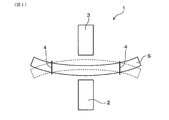
前述のように準備した短冊試験片について、自由共振式内部摩擦測定装置(日本テクノプラス株式会社製「JE-RT」)を用いて減衰自由振動における対数減衰率の測定を行った。本例において使用した測定装置1は、図1に示すように、駆動電極2と、駆動電極2に対面した振幅センサ3とを有している。駆動電極2と振幅センサ3との間に短冊試験片Sを水平に配置し、振動の節となる位置において細線4により短冊試験片Sを固定する。この状態で駆動電極2に交流電流を流して短冊試験片Sにクーロン力を作用させることにより、短冊試験片Sを振動させることができる。そして、振幅センサ3を用いて短冊試験片Sの振幅を測定することにより、振動の波形を得ることができる。
本例では、駆動電極2に交流電流を流して短冊試験片Sを強制的に振動させた後、交流電流を止め、短冊試験片Sを復元力により自由に振動させた。短冊試験片Sの振動は、図2に示す波形のように、周期Tで周期的に振動しながら振幅が指数関数的に減衰する、いわゆる減衰自由振動となった。なお、減衰自由振動においては、大気による抵抗や、短冊試験片内部の転位や粒界等に由来する内部摩擦等によって振動エネルギーの損失が生じるために振幅が指数関数的に減少すると考えられている。
対数減衰率δの値は、減衰自由振動の波形に基づいて、以下の方法により算出した。まず、減衰自由振動の波形から、n周期目(但し、nは正の整数)及びn+m周期目(但し、mは2以上の整数)を任意に選択し、n周期目の振幅anの値と、n+m周期目の振幅an+mの値を取得する。対数減衰率δは、k周期目の振幅akと、その次の周期の振幅ak+1との比の値の自然対数ln(ak/ak+1)であるから、振幅anと、振幅an+mとの比の自然対数ln(an/an+m)は、下式のように展開することができる。
ln(an/an+m)=ln{(an/an+1)×(an+1/an+2)×・・・×(an+m-1/an+m)}=mδ
ln(an/an+m)=ln{(an/an+1)×(an+1/an+2)×・・・×(an+m-1/an+m)}=mδ
従って、対数減衰率δの値は、n周期目の振幅anの値と、n+m周期目の振幅an+mの値を用いて下式のように表すことができる。
δ=(1/m)・ln(an/an+m)
δ=(1/m)・ln(an/an+m)
各短冊試験片の対数減衰率は、表2に示した通りであった。

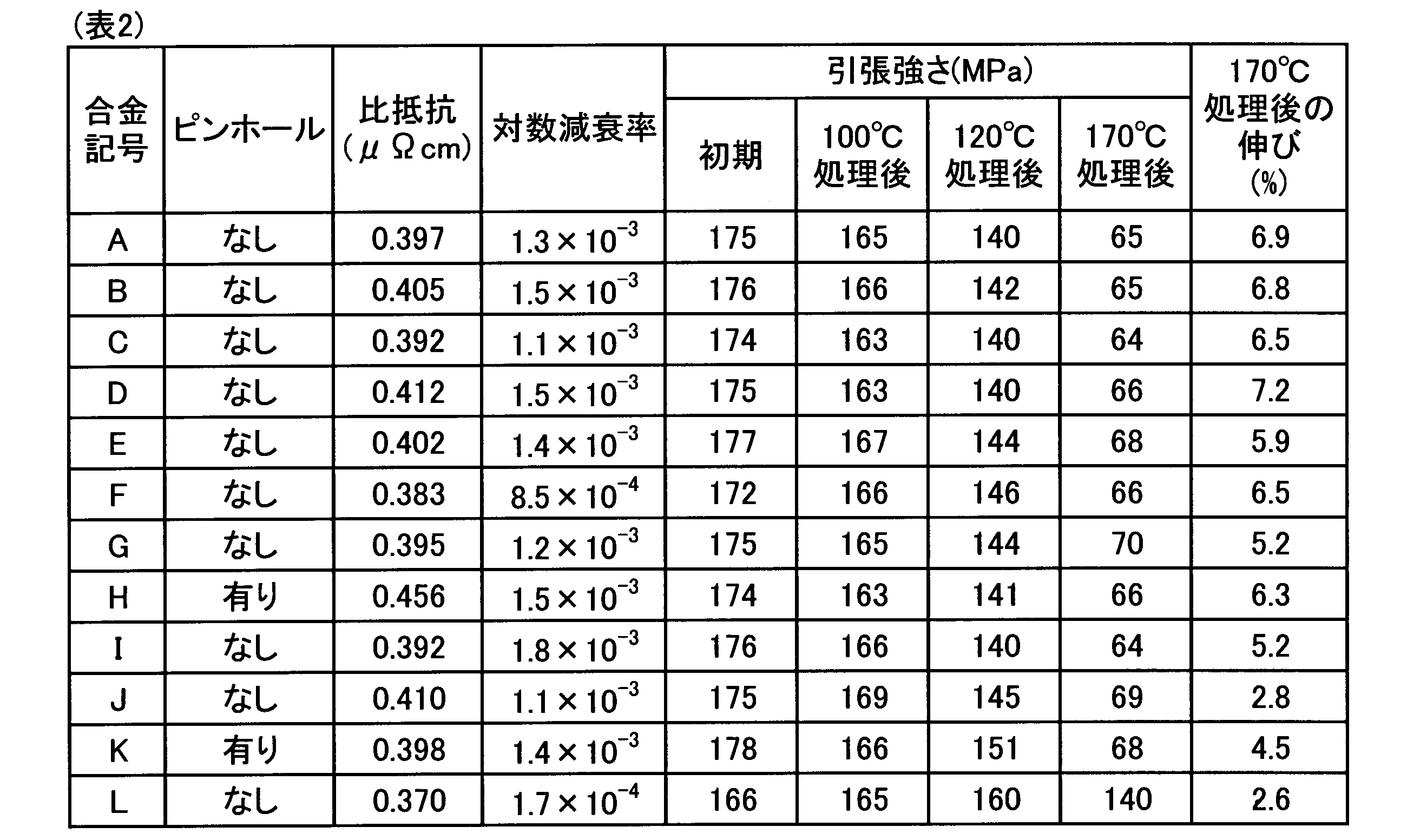
表1に示したように、合金A~Eは、前記特定の範囲の化学成分を有している。そのため、表2に示したように、これらの合金からなるアルミニウム合金箔の初期の引張強さは160MPa以上となり、100℃のオイルバスに1分間浸漬した後の引張強さは150MPa以上となった。また、170℃のオイルバスに1分間浸漬した後の引張強さが初期の引張強さ及び100℃のオイルバスに1分間浸漬した後の引張強さに比べて格段に低下した。これらの結果から、合金A~Eからなるアルミニウム合金箔は、100℃程度の熱処理では軟化せず、150~200℃の温度で熱処理を施すことによって軟化するとともに伸びが増大するという特性を有していることが理解できる。
また、合金A~Eからなるアルミニウム合金箔は、170℃のオイルバスに1分間浸漬した後に5.6%以上の伸びを有している。このように、合金A~Eからなるアルミニウム合金箔は、従来の成分範囲を備えたアルミニウム合金箔に比べて、完全に再結晶した場合の伸びを大きくすることができる。それ故、これらのアルミニウム合金箔は、従来のアルミニウム合金箔に比べて膨張と収縮とを繰り返した場合の劣化を抑制し、充放電サイクルに対する耐久性を向上させることができる。
更に、合金A~Eからなり、完全に再結晶した短冊試験片における減衰自由振動の対数減衰率は1.0×10⁻³以上となった。それ故、これらの合金からなるアルミニウム合金箔を正極の集電体として使用することにより、外部から振動が加わった場合の集電体の振動を抑制し、ひいては集電体からの正極活物質層の剥離を抑制することができる。
一方、合金Fは、Feの含有量が前記特定の範囲よりも少なかった。そのため、完全に再結晶した短冊試験片における減衰自由振動の対数減衰率が1.0×10⁻³未満となった。
合金Gは、Mgの含有量が前記特定の範囲よりも多かった。そのため、合金A~Eに比べて、170℃のオイルバスに1分間浸漬した後のアルミニウム合金箔の伸びが小さかった。
合金Gは、Mgの含有量が前記特定の範囲よりも多かった。そのため、合金A~Eに比べて、170℃のオイルバスに1分間浸漬した後のアルミニウム合金箔の伸びが小さかった。
合金Hは、Feの含有量が前記特定の範囲よりも多かった。そのため、箔圧延時にピンホールが発生した。
合金Iは、Mn及びMgの含有量が前記特定の範囲よりも多かった。そのため、合金A~Eに比べて、170℃のオイルバスに1分間浸漬した後のアルミニウム合金箔の伸びが小さかった。
合金Iは、Mn及びMgの含有量が前記特定の範囲よりも多かった。そのため、合金A~Eに比べて、170℃のオイルバスに1分間浸漬した後のアルミニウム合金箔の伸びが小さかった。
合金Jは、Siの含有量が前記特定の範囲よりも多かった。そのため、合金A~Eに比べて、170℃のオイルバスに1分間浸漬した後のアルミニウム合金箔の伸びが小さかった。
合金Kは、Tiの含有量が多かった。そのため、箔圧延時にピンホールが発生した。また、合金Kは、Cuの含有量及びMgの含有量が前記特定の範囲よりも多かった。そのため、合金A~Eに比べて、170℃のオイルバスに1分間浸漬した後のアルミニウム合金箔の伸びが小さかった。
合金Kは、Tiの含有量が多かった。そのため、箔圧延時にピンホールが発生した。また、合金Kは、Cuの含有量及びMgの含有量が前記特定の範囲よりも多かった。そのため、合金A~Eに比べて、170℃のオイルバスに1分間浸漬した後のアルミニウム合金箔の伸びが小さかった。
合金Lは、集電体用アルミニウム合金箔として従来使用されているJIS A1050合金である。合金Lは、Feの含有量が前記特定の範囲よりも少ないため、完全に再結晶した短冊試験片における減衰自由振動の対数減衰率が1.0×10⁻³未満となった。また、合金Lは、150~200℃の温度で熱処理を施した場合に再結晶しにくく、合金A~Eに比べて、170℃のオイルバスに1分間浸漬した後のアルミニウム合金箔の伸びが小さかった。
Claims (7)
- Fe:1.1~1.8質量%、Si:0.30質量%以下、Cu:0.030質量%以下、Mg:0.030質量%以下、Mn:0.040質量%以下、Ti:0.050質量%以下を含有し、残部がAl及び不可避的不純物からなる化学成分と、
冷間加工組織とを有し、
150℃以上の温度で再結晶し、
完全に再結晶した場合に、伸びが5.6%以上となり、かつ、減衰自由振動の対数減衰率が1.0×10⁻³以上となる特性を有している、
集電体用アルミニウム合金箔。 - 引張強さが160MPa以上である、請求項1に記載の集電体用アルミニウム合金箔。
- 100℃のオイルバスに1分間浸漬した後の引張強さが150MPa以上である、請求項1または2に記載の集電体用アルミニウム合金箔。
- 10~50nmの円相当直径を有するAl-Fe系化合物がAl母相中に800個/μm3以上分散している、請求項1~3のいずれか1項に記載の集電体用アルミニウム合金箔。
- Al母相中に固溶しているFeの量が0.015~0.035質量%である、請求項1~4のいずれか1項に記載の集電体用アルミニウム合金箔。
- 前記集電体用アルミニウム合金箔は、完全に再結晶した場合に、Al母相中に固溶しているFeの量が0.010~0.030質量%となる特性を有している、請求項1~5のいずれか1項に記載の集電体用アルミニウム合金箔。
- 請求項1~6のいずれか1項に記載の集電体用アルミニウム合金箔の製造方法であって、
前記化学成分を備えた鋳塊を準備し、
前記鋳塊を400~580℃の温度に保持して均質化処理を行い、
巻き取り温度が再結晶温度以下となる条件で前記鋳塊に熱間圧延を行うことにより熱延板を作製し、
前記熱延板に冷間圧延を行うことにより冷延板を作製し、
前記冷延板を300~340℃の温度に保持して中間焼鈍を行い、
圧延率を85%以上とし、巻き取り温度が90℃未満となる条件で前記冷延板に箔圧延を行う、
集電体用アルミニウム合金箔の製造方法。
Priority Applications (2)
| Application Number | Priority Date | Filing Date | Title |
|---|---|---|---|
| US16/638,920 US20200365906A1 (en) | 2017-09-28 | 2018-08-10 | Aluminum-alloy foil for current collector and method for manufacturing thereof |
| CN201880034476.3A CN110678565A (zh) | 2017-09-28 | 2018-08-10 | 集电体用铝合金箔及其制造方法 |
Applications Claiming Priority (2)
| Application Number | Priority Date | Filing Date | Title |
|---|---|---|---|
| JP2017-188307 | 2017-09-28 | ||
| JP2017188307A JP2019065312A (ja) | 2017-09-28 | 2017-09-28 | 集電体用アルミニウム合金箔及びその製造方法 |
Publications (1)
| Publication Number | Publication Date |
|---|---|
| WO2019064962A1 true WO2019064962A1 (ja) | 2019-04-04 |
Family
ID=65901156
Family Applications (1)
| Application Number | Title | Priority Date | Filing Date |
|---|---|---|---|
| PCT/JP2018/030071 Ceased WO2019064962A1 (ja) | 2017-09-28 | 2018-08-10 | 集電体用アルミニウム合金箔及びその製造方法 |
Country Status (4)
| Country | Link |
|---|---|
| US (1) | US20200365906A1 (ja) |
| JP (1) | JP2019065312A (ja) |
| CN (1) | CN110678565A (ja) |
| WO (1) | WO2019064962A1 (ja) |
Families Citing this family (8)
| Publication number | Priority date | Publication date | Assignee | Title |
|---|---|---|---|---|
| JP7329966B2 (ja) * | 2019-05-23 | 2023-08-21 | 株式会社Uacj | アルミニウム合金材 |
| EP4015658A1 (de) * | 2020-12-18 | 2022-06-22 | Speira GmbH | Aluminiumfolie mit verbesserter barriereeigenschaft |
| CN113634598B (zh) * | 2021-06-29 | 2023-09-22 | 乳源东阳光优艾希杰精箔有限公司 | 提高铝箔表面自由能的铝加工用油及铝制品的制备方法 |
| CN113634607B (zh) * | 2021-07-01 | 2023-09-22 | 乳源东阳光优艾希杰精箔有限公司 | 一种铝箔轧机轧制油及其在铝箔制备中的应用 |
| CN114517266B (zh) * | 2022-01-27 | 2023-05-16 | 晟通科技集团有限公司 | 铝钛箔 |
| JP2025533658A (ja) * | 2022-10-24 | 2025-10-07 | 揚州納力新材料科技有限公司 | 異方性正極アルミニウム集電体およびその製造方法、電気化学装置 |
| CN115663199A (zh) * | 2022-10-26 | 2023-01-31 | 龙口南山铝压延新材料有限公司 | 一种高延伸比正极集流体铝箔 |
| KR102915929B1 (ko) | 2023-10-12 | 2026-01-21 | 동원시스템즈 주식회사 | 알루미늄박 제조용 조성물, 이로부터 제조된 파우치형 이차전지용 알루미늄박 및 이의 제조방법 |
Citations (5)
| Publication number | Priority date | Publication date | Assignee | Title |
|---|---|---|---|---|
| JP2011241410A (ja) * | 2010-05-14 | 2011-12-01 | Sumitomo Light Metal Ind Ltd | リチウムイオン電池電極集電体用アルミニウム合金箔 |
| JP2013256700A (ja) * | 2012-06-13 | 2013-12-26 | Uacj Corp | アルミニウム合金箔 |
| WO2015060300A1 (ja) * | 2013-10-25 | 2015-04-30 | 株式会社Uacj | 電極集電体用アルミニウム合金箔及びその製造方法 |
| JP2015113515A (ja) * | 2013-12-13 | 2015-06-22 | 三菱アルミニウム株式会社 | リチウムイオン電池正極集電体用アルミニウム合金箔およびその製造方法 |
| JP2017186630A (ja) * | 2016-04-07 | 2017-10-12 | 三菱アルミニウム株式会社 | 電池集電体用アルミニウム合金箔およびその製造方法 |
-
2017
- 2017-09-28 JP JP2017188307A patent/JP2019065312A/ja active Pending
-
2018
- 2018-08-10 WO PCT/JP2018/030071 patent/WO2019064962A1/ja not_active Ceased
- 2018-08-10 US US16/638,920 patent/US20200365906A1/en not_active Abandoned
- 2018-08-10 CN CN201880034476.3A patent/CN110678565A/zh active Pending
Patent Citations (5)
| Publication number | Priority date | Publication date | Assignee | Title |
|---|---|---|---|---|
| JP2011241410A (ja) * | 2010-05-14 | 2011-12-01 | Sumitomo Light Metal Ind Ltd | リチウムイオン電池電極集電体用アルミニウム合金箔 |
| JP2013256700A (ja) * | 2012-06-13 | 2013-12-26 | Uacj Corp | アルミニウム合金箔 |
| WO2015060300A1 (ja) * | 2013-10-25 | 2015-04-30 | 株式会社Uacj | 電極集電体用アルミニウム合金箔及びその製造方法 |
| JP2015113515A (ja) * | 2013-12-13 | 2015-06-22 | 三菱アルミニウム株式会社 | リチウムイオン電池正極集電体用アルミニウム合金箔およびその製造方法 |
| JP2017186630A (ja) * | 2016-04-07 | 2017-10-12 | 三菱アルミニウム株式会社 | 電池集電体用アルミニウム合金箔およびその製造方法 |
Also Published As
| Publication number | Publication date |
|---|---|
| JP2019065312A (ja) | 2019-04-25 |
| US20200365906A1 (en) | 2020-11-19 |
| CN110678565A (zh) | 2020-01-10 |
Similar Documents
| Publication | Publication Date | Title |
|---|---|---|
| WO2019064962A1 (ja) | 集電体用アルミニウム合金箔及びその製造方法 | |
| CN103003457B (zh) | 电池集电体用铝硬质箔 | |
| JP5856076B2 (ja) | 電極集電体用アルミニウム合金箔及びその製造方法 | |
| JP5591583B2 (ja) | リチウムイオン電池電極集電体用アルミニウム合金箔 | |
| JP5189715B1 (ja) | 優れた耐疲労特性を有するCu−Mg−P系銅合金板及びその製造方法 | |
| JP5575632B2 (ja) | リチウムイオン二次電池用銅箔の製造方法 | |
| CN105658826B (zh) | 电极集电体用铝合金箔及其制造方法 | |
| JP5567719B2 (ja) | リチウムイオン二次電池正極集電体用アルミニウム合金箔の製造方法およびリチウムイオン二次電池正極集電体用アルミニウム合金箔とリチウムイオン二次電池 | |
| JP5816285B2 (ja) | 電極集電体用アルミニウム合金箔及びその製造方法 | |
| JP5490594B2 (ja) | 電池接続タブ材料用Cu−Zn系合金条 | |
| JP2021504584A (ja) | リチウムイオン蓄電池の製造のための電池電極箔 | |
| JP2012224927A (ja) | リチウムイオン電池正極集電体用アルミニウム合金箔及びその製造方法 | |
| JP7815105B2 (ja) | 無方向性電磁鋼板およびその製造方法 | |
| JP5685049B2 (ja) | 析出硬化型銅合金箔、及びそれを用いたリチウムイオン2次電池用負極、並びに析出硬化型銅合金箔の製造方法 | |
| JP2011179062A (ja) | 耐折り曲げ性に優れたアルミニウム合金硬質箔およびその製造方法 | |
| JP2017186630A (ja) | 電池集電体用アルミニウム合金箔およびその製造方法 | |
| JP2021139051A (ja) | アルミニウム合金箔 | |
| JP2010236055A (ja) | リチウムイオン二次電池用アルミニウム合金箔及びその製造方法 | |
| JP6580332B2 (ja) | アルミニウム合金箔、電池電極用集電体およびアルミニウム合金箔の製造方法 | |
| JP2013213236A (ja) | Cu−Zn−Sn−Ni−P系合金 | |
| JPWO2017135108A1 (ja) | アルミニウム合金箔およびその製造方法 | |
| JP2012241232A (ja) | 圧延銅合金箔及びそれを用いた二次電池用集電体 | |
| WO2015156319A1 (ja) | バスバー用アルミニウム合金板及びその製造方法 | |
| JPWO2018043117A1 (ja) | 二次電池正極集電体用アルミニウム合金硬質薄箔、二次電池正極集電体およびアルミニウム合金硬質薄箔の製造方法 | |
| JP6513896B2 (ja) | リチウムイオン電池正極集電体用アルミニウム合金箔およびその製造方法 |
Legal Events
| Date | Code | Title | Description |
|---|---|---|---|
| 121 | Ep: the epo has been informed by wipo that ep was designated in this application |
Ref document number: 18860200 Country of ref document: EP Kind code of ref document: A1 |
|
| NENP | Non-entry into the national phase |
Ref country code: DE |
|
| 122 | Ep: pct application non-entry in european phase |
Ref document number: 18860200 Country of ref document: EP Kind code of ref document: A1 |