WO2019012918A1 - 光学活性な2,3-ビスホスフィノピラジン誘導体の製造方法及び光学活性なホスフィン遷移金属錯体の製造方法 - Google Patents
光学活性な2,3-ビスホスフィノピラジン誘導体の製造方法及び光学活性なホスフィン遷移金属錯体の製造方法 Download PDFInfo
- Publication number
- WO2019012918A1 WO2019012918A1 PCT/JP2018/023019 JP2018023019W WO2019012918A1 WO 2019012918 A1 WO2019012918 A1 WO 2019012918A1 JP 2018023019 W JP2018023019 W JP 2018023019W WO 2019012918 A1 WO2019012918 A1 WO 2019012918A1
- Authority
- WO
- WIPO (PCT)
- Prior art keywords
- solution
- optically active
- general formula
- reaction
- represented
- Prior art date
- Legal status (The legal status is an assumption and is not a legal conclusion. Google has not performed a legal analysis and makes no representation as to the accuracy of the status listed.)
- Ceased
Links
Classifications
-
- C—CHEMISTRY; METALLURGY
- C07—ORGANIC CHEMISTRY
- C07F—ACYCLIC, CARBOCYCLIC OR HETEROCYCLIC COMPOUNDS CONTAINING ELEMENTS OTHER THAN CARBON, HYDROGEN, HALOGEN, OXYGEN, NITROGEN, SULFUR, SELENIUM OR TELLURIUM
- C07F9/00—Compounds containing elements of Groups 5 or 15 of the Periodic Table
- C07F9/02—Phosphorus compounds
- C07F9/547—Heterocyclic compounds, e.g. containing phosphorus as a ring hetero atom
- C07F9/645—Heterocyclic compounds, e.g. containing phosphorus as a ring hetero atom having two nitrogen atoms as the only ring hetero atoms
- C07F9/6509—Six-membered rings
- C07F9/650952—Six-membered rings having the nitrogen atoms in the positions 1 and 4
- C07F9/650994—Six-membered rings having the nitrogen atoms in the positions 1 and 4 condensed with carbocyclic rings or carbocyclic ring systems
Definitions
- the present invention relates to a process for the preparation of 2,3-bisphosphinopyrazine derivatives. More specifically, the present invention is useful as a ligand of a metal complex used as an asymmetric catalyst in an asymmetric synthesis reaction, a ligand source of a transition metal complex used as an anticancer agent, etc. 2,3- The present invention relates to a method for producing a bisphosphinopyrazine derivative, and further to a method for producing a phosphine transition metal complex useful as an anticancer agent.
- Patent Document 1 and Patent Document 2 describe optically active 2,3-bis (dialkylphosphino) pyrazine derivatives capable of providing a metal complex exhibiting excellent catalytic performance and a method for producing the same. .
- Patent Document 1 and Patent Document 2 include, for example, 2,3-dichloroquinoxaline in a solution containing tert-butyl methyl phosphine obtained by deprotonating an optically active isomer of tert-butyl methyl phosphine-borane.
- the solution is added dropwise, and cooled to -70 ° C. or lower to carry out an aromatic nucleophilic substitution reaction to obtain an intermediate diphosphine-borane, which is then deboranized to obtain the desired 2,3-bis (tert An optically active form of -butylmethylphosphino) quinoxaline is produced.
- the target 2,3-bis (tert-butylmethylphosphino) quinoxaline can be obtained with high yield and high purity.
- a special cooling device is required, and the time to cool to -70 ° C or less and the temperature to perform the next deboration reaction are also considerable. It is not necessary industrially.
- Patent Document 4 a solution containing racemic tert-butylmethylphosphine borane is added to a solution containing potassium tert-butoxide to carry out a deprotonation reaction of the racemic tert-butyl methyl phosphine borane. Then, the deprotonated solution is added at -10 ° C.
- the desired 2,3-bisphosphinopyrazine derivative is produced through the step of deboraneation reaction by adding tetramethylethylenediamine to the solution subjected to the group nucleophilic substitution reaction.
- Patent Document 4 In the production method described in Patent Document 4 below, it is possible to obtain a target (R, R) or (S, S) form 2,3-bisphosphinopyrazine derivative with high yield and high optical purity. There was a problem that I could not do it. Further, the use of a coordinating solvent in Patent Document 4 is a use for actively forming meso and racemic isomers of isomers from racemic phosphine borane and controlling the formation ratio of meso and racemic isomers. As in the present invention, 2,3-bisphosphinopyrazine derivatives in (R, R) form or (S, S) form are not obtained with high yield and high optical purity.
- Patent Documents 3 to 6 phosphine transition metal complexes obtained by reacting a 2,3-bisphosphinopyrazine derivative with a transition metal salt of gold, copper or silver have excellent anticancer activity. It is stated that it has.
- an object of the present invention is to provide a method for producing an industrially advantageous 2,3-bisphosphinopyrazine derivative.
- the object of the present invention is to provide an optical active (S, S) or (R, R) form of an optically active 2,3-bis (dialkylphosphino) pyrazine derivative having high optical purity in high yield. It is an object of the present invention to provide a process for producing an active 2,3-bisphosphinopyrazine derivative.
- Another object of the present invention is to provide a method for producing an optically active phosphine transition metal complex useful as an anticancer agent by an industrially advantageous method.
- the present inventors have found that, in general, the liquid A containing a 2,3-dihalogenopyrazine represented by a specific general formula and a carboxylic acid amide coordinating solvent
- a solution B containing a phosphine borane compound in which an optically active form of an S form or an R form of a hydrogen-phosphine borane compound represented by the formula is lithiated is added, compared to the conventional method of adding the A solution to the B solution (S, S) form or (R, R) form of 2,3-bisphosphinopyrazine derivative having high optical purity which can carry out aromatic nucleophilic substitution reaction at industrially advantageous temperature and in a short time It has been found that the present invention can be obtained in high yield.
- the first invention provided by the present invention is represented by the following general formula (1): (Wherein, X represents a halogen atom, R 1 represents a monovalent substituent, n represents an integer of 0 to 4.) 2,3-dihalogenopyrazine represented by the formula: While obtaining a solution A containing a coordinating solvent, the following general formula (2) (Wherein, R 2 and R 3 each represent a linear or branched alkyl group having 1 to 10 carbon atoms which may be substituted, a cycloalkyl group which may be substituted, or a phenyl which may be substituted.
- R 2 and R 3 are different groups, and * represents an asymmetric center on the phosphorus atom.
- the optically active form of R form or S form of hydrogen-phosphine borane compound is represented by
- the following general formula (3) includes the step of adding the solution B containing the lithiated phosphine borane compound to the solution A, performing an aromatic nucleophilic substitution reaction, and then performing a deboration reaction: (Wherein R 1 , R 2 , R 3 , * and n are as defined above).
- a second invention to be provided by the present invention is a compound represented by the following general formula (1) (Wherein, X represents a halogen atom, R 1 represents a monovalent substituent, n represents an integer of 0 to 4.) 2,3-dihalogenopyrazine represented by the formula: While obtaining solution A containing a coordinating solvent, the following general formula (2) (Wherein, R 2 and R 3 each represent a linear or branched alkyl group having 1 to 10 carbon atoms which may be substituted, a cycloalkyl group which may be substituted, or a phenyl which may be substituted.
- R 2 and R 3 are different groups, and * represents an asymmetric center on the phosphorus atom.
- the optically active form of R form or S form of hydrogen-phosphine borane compound is represented by To obtain a lithiated phosphine borane compound, The solution A containing the lithiated phosphine borane compound is added to the solution A to carry out an aromatic nucleophilic substitution reaction, and then a deboraneation reaction is carried out to obtain the following general formula (3) (Wherein R 1 , R 2 , R 3 , * and n are as defined above), a first step of obtaining an optically active 2,3-bisphosphinopyrazine derivative, and then 2, 2, 3-bisphosphinopyrazine derivative, And a second step of reacting a transition metal salt of gold, copper or silver with the following general formula (4) (Wherein, R 1 , R 2 , R 3 , * and n are as defined above. M is a transition metal atom selected from the
- the process for producing the optically active 2,3-bisphosphinopyrazine derivative represented by the above general formula (3) of the present invention comprises the 2,3-dihalogenopyrazine represented by the above general formula (1), and a carboxylic acid A liquid containing an acid amide coordinating solvent, a liquid containing a phosphine borane compound which is lithiated by lithiation of an optically active form of an R form or an S form of a hydrogen-phosphine borane compound represented by the above general formula (2)
- the solution is added to carry out an aromatic nucleophilic substitution reaction followed by a deboration reaction. This step corresponds to the first step of the process for producing the optically active phosphine transition metal complex of the present invention described later. Either of the preparation of the solution A and the preparation of the solution B may be performed first or simultaneously.
- X in the formula of 2,3-dihalogenopyrazine represented by the above general formula (1) is a halogen atom, and examples thereof include a chlorine atom, a bromine atom, an iodine atom and the like, and among these, a chlorine atom Is preferred.
- R 1 in the formula represents a monovalent substituent, and the monovalent substituent is not particularly limited, and is, for example, a linear or branched alkyl group having 1 to 5 carbon atoms And nitro, amino, hydroxyl, fluoro, chloro, bromo and iodo.
- n represents an integer of 0 to 4.
- 2,3-dihalogenopyrazines represented by the above general formula (1) can be used.
- 2,3-dichloroquinoxaline and the like can be obtained from Tokyo Chemical Industry Co., Ltd.
- R 2 and R 3 in the formula of the above general formula (2) are an optionally substituted linear or branched alkyl group having 1 to 10 carbon atoms, an optionally substituted cycloalkyl group or a substituted group is shown a phenyl group optionally, R 2 and R 3 are different groups.
- alkyl group represented by R 2 and R 3 for example, methyl group, ethyl group, isopropyl group, n-propyl group, isobutyl group, n-butyl group, sec-butyl group, tert-butyl group, isoheptyl group , N-heptyl group, isohexyl group, n-hexyl group and the like.
- cycloalkyl group represented by R 2 and R 3 a cyclopentyl group, a cyclohexyl group.
- R 2 and / or R 3 is a cycloalkyl group having a substituent or a phenyl group having a substituent
- substituents include an alkyl group, an alkoxy group, a nitro group, an amino group, a hydroxyl group and a fluoro group. , Chloro group, bromo group, iodo group and the like.
- R 2 and / or R 3 is an alkyl group having a substituent
- examples of the substituent include a phenyl group, an alkoxy group, a nitro group, an amino group, a hydroxyl group, a fluoro group, a chloro group, a bromo group and an iodo group Etc.
- the carbon number of the alkyl group as a substituent is preferably 1 to 5, and the carbon number of the alkoxy group as a substituent is preferably 1 to 5.
- a body is an optically active substance having an asymmetric center on a phosphorus atom. Since an optically active substance exhibits optical rotatory power, a racemate is not included in the optically active substance.
- R 2 in the formula of General Formula (2) is a t-butyl group or an adamantyl group, and R 3 is a methyl group.
- the optically active substance of the R form or S form of the hydrogen-phosphine borane compound represented by the general formula (2) preferably has high optical purity, for example, 2,3- with high optical purity of 95% ee or higher. It is preferable from the viewpoint of efficiently producing the bisphosphinopyrazine derivative.
- the optically active substance of the R form or S form of the hydrogen-phosphine borane compound represented by the general formula (2) can be prepared by a known method.
- a known method for example, JP-A-2001-253889, JP-A-2003-300988, JP-A-2007-70310, JP-A-2010-138136, and J.-A. Org. Chem, 2000, vol. 65, P 4185-4188 and the like.
- the solution A is a solution containing the 2,3-dihalogenopyrazine represented by the general formula (1) and a carboxylic acid amide coordinating solvent, and the solution A may be a solution or a slurry.
- the solution A may be a solution or a slurry.
- it is a carboxylic acid amide coordination to a lithium salt of a chiral phosphine borane compound from which a proton to be added is extracted by containing a carboxylic acid amide coordinating solvent in the solution A of the aromatic nucleophilic reaction. Solvents coordinate.
- the carboxylic acid amide coordinating solvent is a solvent having a stronger coordinating ability to lithium than, for example, an ether solvent such as tetrahydrofuran, and thus the anion moiety of a chiral phosphine borane compound as shown in the following chemical formula (5) Further, the distance between the lithium cation site and the lithium cation site is further extended, and the anion site of the chiral phosphine borane compound is likely to attack the halogen atom of 2,3-dihalogenopyrazine of the general formula (1), whereby the reaction is facilitated. Furthermore, the reactivity is enhanced in combination with the improvement of the solubility of the lithium salt.
- a coordinating solvent refers to a solvent capable of coordinating to lithium. The fact that the effect of the present invention is not exhibited when the carboxylic acid amide coordinating solvent is not used is shown from the description of Comparative Example 2 described later.
- Examples of the carboxylic acid amide coordinating solvent in the solution A include N, N-dimethylformamide (DMF), N, N-dimethylacetamide (DMA), 1,3-dimethyl-2-imidazolidinone (DMI), N N-methyl-2-pyrrolidone (NMP), N-methylformamide, N-methylacetamide, N, N-dibutylformamide, N, N-dibutylacetamide and the like, and among them, N, N-dimethylformamide (DMF Is preferred from the viewpoint of reactivity and industrial availability.
- the proportion of the carboxylic acid amide coordinating solvent in all the solvents constituting the solution A is 15% by volume to 100% by volume, particularly preferably 20% by volume to 100% by volume, particularly preferably 30% by volume. It is preferable from the viewpoints of reactivity and economy to set the volume to 70% by volume or less.
- the reaction rate can be increased to improve the productivity.
- the ratio of the carboxylic acid amide coordinating solvent in all the solvents constituting the solution A to 70% by volume or less removal of the carboxylic acid amide coordinating solvent can be facilitated, and the cost can be reduced. Productivity can be improved.
- the volume ratio refers to the ratio at room temperature.
- an ether solvent from the viewpoint of enhancing the solubility of the lithiated phosphine borane compound in the reaction solution in which the solution A and the solution B are mixed.
- the ether solvent include diethyl ether, diisopropyl ether, dibutyl ether, dioxane, cyclopentyl methyl ether, tetrahydrofuran and the like.
- tetrahydrofuran is preferable from the viewpoint of polarity and solubility of the raw material.
- the ratio of the ether solvent to the carboxylic acid amide coordinating solvent is 1.0: 0.2 or more and 1.0: 100 or less, particularly preferably, in volume ratio (the former: the latter). It is preferable from the viewpoint of reactivity and economy that the ratio of 1.0 to 0.3 and 1.0 to 100, and particularly preferably 1.0 to 0.5 and 1.0 to 3.0.
- the reaction rate is increased to improve productivity. Can be improved. Removal of the carboxylic acid amide coordinating solvent can be facilitated by setting the volume ratio of the ether solvent to the carboxylic acid amide coordinating solvent (the former: the latter) to be 1.0: 100 or less, and the yield and productivity Can be improved.
- the volume ratio (the former: the latter) is 1.0: 0.05 or more and 1.0: 100 or less, in particular, 1.0: 0.15 or more and 1.0: 100 or less, in particular 1.0: 0.25 or more It is more preferable from the viewpoint of reactivity and economy that the ratio is 1.0: 3.0 or less.
- the volume ratio of the ether solvent to the carboxylic acid amide coordinating solvent (the former: the latter) to be 1.0: 0.05 or more, particularly 1.0: 0.15 or more, the reaction rate is increased to improve productivity. Can be improved.
- Removal of the carboxylic acid amide coordinating solvent can be facilitated by setting the volume ratio of the ether solvent to the carboxylic acid amide coordinating solvent (the former: the latter) to be 1.0: 3.0 or less, and the yield and Productivity can be improved.
- the 2,3-dihalogenopyrazine represented by the general formula (1) does not necessarily have to be completely dissolved, and the reaction can be initiated even from the slurry state.
- the concentration of the 2,3-dihalogenopyrazine represented by the general formula (1) in the solution A is preferably 0.01 to 30% by mass from the viewpoint of reactivity and productivity, and is preferably 0.03 to 30% by mass. It is more preferable from the same viewpoint to make it 20 mass%.
- the preferable temperature of the solution A at the time of starting addition of the solution B described later is the same as the preferable addition temperature of the solution B to the solution A described later because a sufficiently reactive and high optical purity product can be obtained. Temperature is mentioned.
- the solution B is a solution containing a phosphine borane compound in which the hydrogen-phosphine borane compound represented by the general formula (2) is lithiated.
- the hydrogen represented by the general formula (2) is obtained by mixing a solution in which the hydrogen-phosphine borane compound represented by the general formula (2) is dissolved in a solvent, and a lithiolating agent.
- the lithiation of phosphine borane compounds can be carried out.
- the concentration of the hydrogen-phosphine borane compound represented by the above general formula (2) in the solution before the addition of n-butyllithium is 1 to 30% by mass so that reactivity and productivity From the viewpoint, it is preferable, and from 5 to 20% by mass, it is more preferable from the same viewpoint.
- an organic lithium compound is used as the rethiolation agent used in solution B.
- the organic lithium compound include methyllithium, ethyllithium, n-propyllithium, sec-propyllithium, n-butyllithium, sec-butyllithium, tert-butyllithium and the like.
- n-butyllithium is preferred from the viewpoint of adequate basicity and sufficient reactivity.
- the addition amount of the lithiation agent is 1.0 to 1.5 in molar ratio of the lithiation agent to the hydrogen-phosphine borane compound represented by the general formula (2) from the viewpoint of economy and reactivity
- it is more preferably 1.0 to 1.2 from the same viewpoint.
- the solvent used for the solution before addition of n-butyllithium can dissolve the hydrogen-phosphine borane compound represented by the above general formula (2) and the phosphine borane compound to be formed, and an inert solvent If it is, it can be used.
- the solvent include N, N-dimethylformamide, hexane, toluene and the like in addition to the above-mentioned ether solvents. These solvents can be used alone or as a mixed solvent.
- an ether solvent is preferable from the viewpoint of the solubility of the lithiated compound, and tetrahydrofuran is most preferable.
- the addition temperature of the lithiation agent is preferably ⁇ 20 to 20 ° C. from the viewpoint that it can be lithiated while maintaining the optical purity of the hydrogen-phosphine borane compound represented by the general formula (2). It is more preferable to set the temperature to -20 to 0 ° C.
- This production method is characterized in that the solution B is added to the solution A prepared above to carry out the aromatic nucleophilic substitution reaction, and this method is compared to the conventional method of adding the solution A to the solution B. It is possible to increase the temperature at which the aromatic nucleophilic substitution reaction is performed to a temperature advantageous for industrialization, and add an ether solvent as a solvent for solution A and add a carboxylic acid amide coordinating solvent to By performing the nuclear substitution reaction, a product having high optical purity can be obtained in a relatively high yield in a relatively short time as compared with the production of the optically active 2,3-bisphosphinopyrazine derivative. This is also shown from the description of each example and comparative example 1 described later.
- the optical purity of the obtained optically active 2,3-bisphosphinopyrazine derivative is preferably 95% ee or more, and more preferably 98% ee or more.
- Electrons of carbon atoms to which halogens are bonded in the 2,3-dihalogenopyrazine represented by the general formula (1) are attracted by adjacent nitrogen atoms. Therefore, the lithiated phosphine borane compound in the deprotonated state from the hydrogen-phosphine borane compound, ie, the nucleophile, attacks the carbon atom to cause an aromatic nucleophile substitution reaction, which is an intermediate in the reaction system.
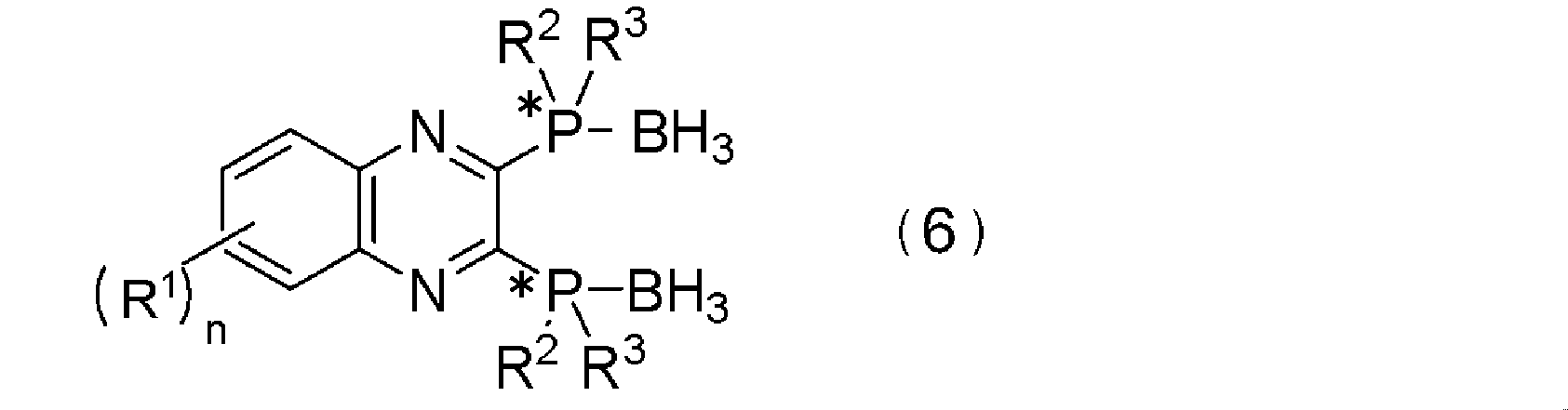
- a borane form of an optically active 2,3-bisphosphinopyrazine derivative represented by the following general formula (6) which is a form is formed.
- the addition of the solution B is carried out by adding phosphine which is lithiated from the hydrogen-phosphine borane compound represented by the general formula (2) to the 2,3-dihalogenopyrazine represented by the general formula (1) in the solution A. It is preferable from the viewpoint of reactivity and economics to add the borane compound in a molar ratio of 2.0 to 4.0, preferably 2.0 to 3.0.
- the addition rate of the solution B is not particularly limited, but it is preferable to add at a constant rate from the viewpoint of obtaining stable quality.
- a constant rate for example, in the case of 500 L scale, for example, in the case of 500 L scale, it is preferable to carry out addition of B liquid to A liquid over 30 minutes from the viewpoint of control of reaction heat, and it is more preferable to carry out addition over 60 minutes from this viewpoint.
- the addition of solution B to solution A may be continuous or intermittent. Whether continuous or intermittent, addition of solution B to solution A is preferably performed over 480 minutes or less in the case of, for example, a 500 L scale from the viewpoint of production time. It is preferable to maintain the internal temperature of the liquid mixture in the range of the preferable addition temperature of B liquid mentioned later.
- the addition temperature of solution B is preferably ⁇ 20 to 50 ° C., more preferably ⁇ 20 to 20 ° C., and ⁇ 20 to 0 ° C., from the viewpoint of obtaining a high optical purity in high yield. Is most preferred.
- the temperature of the mixture at the time of addition of liquid B to liquid A is also referred to as the reaction temperature of aromatic nucleophilic substitution reaction. .
- the temperature of the aging reaction is particularly preferably ⁇ 20 to 50 ° C., particularly preferably ⁇ 20 to 30 ° C., from the viewpoint of obtaining a product with high optical purity in high yield.
- the aging time may be, for example, 10 minutes or more, by analyzing the residual ratio of the 2,3-bisphosphinopyrazine derivative from solution A and the lithiated phosphine borane compound from solution B by analysis of the reaction solution by HPLC etc. Five hours or less is preferable from the viewpoint of preventing the decomposition of the product.
- the borane body of the 2,3-bisphosphinopyrazine derivative represented by the above general formula (6), which is the above intermediate is subjected to a deboration reaction.
- the deboration reaction of the borane form of the 2,3-bisphosphinopyrazine derivative represented by the general formula (6) is achieved by the borane of the 2,3-bisphosphinopyrazine derivative represented by the general formula (6). It can be carried out by adding a deboration agent to a reaction system containing a body.
- deboration agent examples include N, N, N ', N',-tetramethylethylenediamine (TMEDA), triethylenediamine (DABCO), triethylamine, HBF 4 , trifluoromethanesulfonic acid and the like, with preference given to It is TMEDA.
- TMEDA trimethylethylenediamine
- DABCO triethylenediamine
- HBF 4 trifluoromethanesulfonic acid and the like
- TMEDA trifluoromethanesulfonic acid and the like
- the amount of addition of the deboration agent is usually 2 to 20 equivalents, preferably 3 to 10 equivalents, relative to the 2,3-dihalogenopyrazine represented by the general formula (1).
- the reaction temperature of the deboration reaction is preferably ⁇ 20 to 80 ° C., more preferably ⁇ 20 to 50 ° C., and particularly preferably 10 to 30 ° C. From the viewpoint of obtaining the 2,3-bisphosphinopyrazine derivative.
- the reaction time of the deboration reaction is 10 minutes or more, preferably 1 to 10 hours, more preferably 1 to 5 hours.
- the 2,3-bisphosphinopyrazine derivative represented by the above general formula (3) generated by the deboration reaction is purified as necessary, such as separation washing, extraction, crystallization, distillation, sublimation, column chromatography It may be assigned to work.
- the optically active 2,3-bisphosphinopyrazine derivative represented by the above general formula (3) obtained by the production method of the present invention can form a complex with a transition metal as a ligand.
- This complex is useful as an asymmetric synthesis catalyst.
- Examples of the asymmetric synthesis include asymmetric hydrogenation reaction, asymmetric 1,4-addition reaction to an electron-deficient olefin using an organoboronic acid, asymmetric hydrosilyl reaction, asymmetric cyclization and the like.
- transition metal which can form a complex rhodium, ruthenium, iridium, palladium, platinum, nickel, iron etc. are mentioned, for example. Preferred metals are palladium and rhodium.
- a method of forming a complex with rhodium using a 2,3-bis (dialkylphosphino) pyrazine derivative represented by the general formula (1) as a ligand for example, the 4th edition of the Experimental Chemistry Lecture (edited by The Chemical Society of Japan) Maruzen Co., Ltd., 18th volume, pp. 327-353).
- an optically active compound having a group in which R 2 and R 3 are different is It is also useful as a ligand source of an optically active phosphine transition metal complex used as an agent.
- the phosphine transition metal complex is obtained by reacting the optically active 2,3-bisphosphinopyrazine derivative represented by the general formula (3) obtained in the first step described above with a salt of gold, copper or silver. It is obtained by performing the second step.
- R 1 , R 2 , R 3 , * and n are as defined above.
- M represents a transition metal atom selected from the group of gold, copper and silver.
- Z ⁇ represents an anion.
- R 1 , R 2 , R 3 and n in the formula of the optically active phosphine transition metal complex represented by the general formula (4) are 2,3-dihalogenopyrazines represented by the general formula (1)
- M in the formula of the optically active phosphine transition metal complex represented by the general formula (4) represents a transition metal atom selected from the group of gold, copper and silver.
- Z - represents an anion, preferably a monovalent anion.
- Z - as the anion represented by the chlorine ion, bromine ion, iodine ion, tetrafluoroborate ion, hexafluorophosphate ion, and a perchlorate ion.
- the salts of gold, copper or silver which react with the optically active 2,3-bisphosphinopyrazine derivative represented by the general formula (3) are, for example, halides, nitrates, perchlorates and tetrachlorides of these metals. And fluoroboronate, hexafluorophosphate and the like. Moreover, the valence of these metals is monovalent. In addition, salts of these metals may be two or more salts in which either one or both of the metal and the anion are different.
- Preferred gold salts include, for example, gold (I) chloride acid, gold (I) chloride, or tetrabutylammonium chloride / gold (I) chloride etc.
- Preferred transition metal salts of copper include, for example, copper (I) chloride, copper (I) bromide, copper (I) iodide etc.
- transition metal salts of silver for example, silver chloride (I), silver bromide (I), silver iodide (I) and the like ("Fifth Edition Experimental Chemistry Lecture 21", Editors of the Japan Chemical Society , Issuer Maruzen, Date of issue March 30, 2004, pp. 361-366).
- the transition metal salt according to the method for producing a phosphine transition metal complex of the present invention may be an anhydride or a hydrate.
- the molar ratio of the 2,3-bisphosphinopyrazine derivative represented by the general formula (3) to the salt of gold, copper or silver is preferably 1 to 5 moles, more preferably 1 to 1 mole with respect to 1 mole of metal. .8 to 2.2 times the molar amount.
- the reaction can be carried out in a solvent such as acetone, acetonitrile, methanol, ethanol, tetrahydrofuran, dichloromethane, chloroform and the like.
- the reaction temperature is preferably ⁇ 20 to 60 ° C., more preferably 0 to 25 ° C., and the reaction time is preferably 0.5 to 48 hours, more preferably 1 to 3 hours.
- the phosphine transition metal complex represented by the general formula (4) is obtained by this reaction. After completion of the reaction, conventional purification can be carried out as required.
- the optically active phosphine transition metal complex represented by the general formula (4) has four asymmetric phosphorus atoms when R 2 and R 3 in the formula each have different groups. There are many isomers, but in this production method, the phosphine transition metal complex to be obtained has steric features on the phosphorus atom, (R, R) (R, R), and (S, S) (S, S) And so forth, which are composed of a single enantiomer.
- optically active 2,3-bisphosphinopyrazine derivative represented by the general formula (3) which is the starting material for the second step
- two phosphorus atoms are different because R 2 and R 3 are different groups. It becomes a chiral center.
- the anion in the optically active phosphine transition metal complex represented by the general formula (4) thus obtained may be converted to another desired anion.
- Z in the formula of the general formula (3) - is, to synthesize a phosphine transition metal complex is a halide ion, then the phosphine transition metal complexes, the desired anion inorganic acids having organic acids or their alkali metal salts, by reacting in a suitable solvent, Z - is can be obtained phosphine transition metal complex is a desired anion.
- the details of such a method are described, for example, in Japanese Patent Application Laid-Open Nos. 10-147590, 10-1014782, and 61-10594.
- optically active phosphine transition metal complex represented by the general formula (4) thus obtained is useful as an anticancer agent.
- the volume of the solvent described in each Example and comparative example is a value in room temperature (25 degreeC).
- a solution was obtained by dissolving 6.05 g (24.0 mmol) of benzoyloxymethyl (tert-butyl) methyl phosphine-borane (99% ee) in 25 mL of ethanol. Separately, 4.0 g (72 mmol) of potassium hydroxide was dissolved in 15 mL of water to prepare an aqueous potassium hydroxide solution. The aqueous potassium hydroxide solution was added dropwise to the above solution. The hydrolysis was completed in about 1 hour. The reaction mixture was diluted with water and extracted three times with ether. The extract was washed with brine and dried over sodium sulfate.
- a well-dried 2000 mL four-necked flask is prepared separately, and after replacing with nitrogen, 8.97 g (45.0 mmol) of 2,3-dichloroquinoxaline (a1), tetrahydrofuran (81 ml), and 90 ml of N, N-dimethylformamide The mixture was charged, cooled to -10 ° C., and used as solution A.
- Solution B was added to solution A at a constant rate so that the internal temperature maintained around -10 ° C. over 40 minutes.
- the white slurry temporarily turned to green and finally became a reddish brown slurry.
- the temperature was gradually raised to room temperature (25 ° C.), and then aging was performed for 3 hours.
- the process for producing an optically active 2,3-bisphosphinopyrazine derivative of the present invention can carry out an aromatic nucleophilic substitution reaction at an industrially advantageous temperature in a short time, and has high optical purity. Can be obtained in high yield. Further, by performing the series of steps of the present invention, an optically active phosphine transition metal complex useful as an anticancer agent can be obtained in an industrially advantageous manner.
Landscapes
- Chemical & Material Sciences (AREA)
- Organic Chemistry (AREA)
- Health & Medical Sciences (AREA)
- Life Sciences & Earth Sciences (AREA)
- Biochemistry (AREA)
- General Health & Medical Sciences (AREA)
- Molecular Biology (AREA)
Abstract
本発明の光学活性な2,3-ビスホスフィノピラジン誘導体の製造方法は、下記一般式(1) で表される2,3-ジハロゲノピラジン、及びカルボン酸アミド配位性溶媒を含むA液を得るとともに、下記一般式(2) で表される水素-ホスフィンボラン化合物のR体又はS体の光学活性体をリチオ化して、リチオ化したホスフィンボラン化合物を得、 前記A液に、前記リチオ化したホスフィンボラン化合物を含むB液を添加し芳香族求核置換反応を行い、次いで脱ボラン化反応を行う工程により、下記一般式(3) で表される光学活性な2,3-ビスホスフィノピラジン誘導体を製造する。 (式の注釈は明細書を参照)
Description
本発明は、2,3-ビスホスフィノピラジン誘導体の製造方法に関する。更に詳細には、本発明は、不斉合成反応において不斉触媒として用いられる金属錯体の配位子、抗がん剤として用いられる遷移金属錯体の配位子源等として有用な2,3-ビスホスフィノピラジン誘導体の製造方法、更には抗がん剤として有用なホスフィン遷移金属錯体の製造方法に関するものである。
光学活性なホスフィン配位子を有する金属錯体を触媒とする有機合成反応は古くから知られており、極めて有用であることから、多くの研究成果が報告されている。近年では、リン原子そのものが不斉である配位子が開発されている。例えば特許文献1及び特許文献2には、優れた触媒性能を発揮する金属錯体を提供することができる光学活性な2,3-ビス(ジアルキルホスフィノ)ピラジン誘導体及びその製造方法が記載されている。
特許文献1及び特許文献2に記載の製造方法は、例えば、tert-ブチルメチルホスフィン-ボランの光学活性体を脱プロトン化したtert-ブチルメチルホスフィンを含む溶液に、2,3-ジクロロキノキサリンを含む溶液を滴下して、-70℃以下に冷却して芳香族求核置換反応を行って中間体であるジホスフィン-ボラン体を得た後、脱ボラン化して目的とする2,3-ビス(tert-ブチルメチルホスフィノ)キノキサリンの光学活性体を製造している。
特許文献1及び特許文献2に記載の製造方法では、収率よく高純度で目的とする2,3-ビス(tert-ブチルメチルホスフィノ)キノキサリンが得られるが、芳香族求核置換反応を-70℃以下の超低温で行うため、特別な冷却装置を必要とし、また、-70℃以下に冷却するまでの時間や次に行う脱ボラン化反応を行う温度まで昇温するにもかなりの時間を要し、工業的に有利でない。
また、下記特許文献4には、カリウム-tert-ブトキシドを含む溶液に、ラセミ-tert-ブチルメチルホスフィンボランを含む溶液を加えて、該ラセミ-tert-ブチルメチルホスフィンボランの脱プロトン化反応を行い、次いで、脱プロトン化反応を行った溶液を-10℃で、2,3-ジクロロキノキサリン、テトラヒドロフラン及びジメチルホルムアミドを含む溶液に添加し、芳香族求核置換反応を行った後、次いで、該芳香族求核置換反応を行った溶液に、テトラメチルエチレンジアミンを添加して脱ボラン化反応する工程を経て目的とする2,3-ビスホスフィノピラジン誘導体を製造することが開示されている。
しかしながら、下記特許文献4に記載の製造方法では、収率よく、光学純度の高い目的とする(R,R)又は(S,S)体の2,3-ビスホスフィノピラジン誘導体を得ることができないと言う問題があった。また、特許文献4での配位性溶媒の使用はホスフィンボランのラセミ体から異性体のメソ体とラセミ体を積極的に生成させメソ体とラセミ体の生成比率をコントロールするための使用であり、本発明のように、(R,R)体又は(S,S)体の2,3-ビスホスフィノピラジン誘導体を収率よく、高い光学純度で得るものではない。
また、下記特許文献3~6には、2,3-ビスホスフィノピラジン誘導体と、金、銅又は銀の遷移金属塩とを反応させて得られるホスフィン遷移金属錯体は、優れた抗がん作用を有することが記載されている。
従って、本発明の目的は、工業的に有利な2,3-ビスホスフィノピラジン誘導体の製造方法を提供することにある。特に本発明の目的は、光学純度が高い光学活性な2,3-ビス(ジアルキルホスフィノ)ピラジン誘導体の(S,S)体又は(R,R)体を高い収率で得ることが出来る光学活性な2,3-ビスホスフィノピラジン誘導体の製造方法を提供することにある。更に抗がん剤として有用な光学活性なホスフィン遷移金属錯体を工業的に有利な方法で製造する方法を提供することにある。
本発明者らは、上記実情に鑑み鋭意研究を重ねた結果、特定の一般式で表される2,3-ジハロゲノピラジン、及びカルボン酸アミド配位性溶媒を含むA液に、特定の一般式で表される水素-ホスフィンボラン化合物のS体又はR体の光学活性体をリチオ化したホスフィンボラン化合物を含むB液を添加すると、従来のB液にA液を添加する方法に比べて、工業的に有利な温度で、且つ短時間で芳香族求核置換反応を行うことができ光学純度が高い2,3-ビスホスフィノピラジン誘導体の(S,S)体又は(R,R)体を高い収率で得ることができること、を見出し本発明を完成するに到った。
即ち、本発明が提供する第1の発明は、下記一般式(1)

(式中、Xはハロゲン原子を示す。R1は一価の置換基を示す。nは、0~4の整数を示す。)で表される2,3-ジハロゲノピラジン、及びカルボン酸アミド配位性溶媒とを含むA液を得るとともに、下記一般式(2)

(式中、R2及びR3は、置換されていてもよい直鎖状又は分岐状の炭素数1~10のアルキル基、置換されていてもよいシクロアルキル基又は置換されていてもよいフェニル基を示し、R2及びR3は異なる基である。*はリン原子上の不斉中心を示す。)で表される水素-ホスフィンボラン化合物のR体又はS体の光学活性体をリチオ化して、リチオ化したホスフィンボラン化合物を得、
前記A液に、前記リチオ化したホスフィンボラン化合物を含むB液を添加し芳香族求核置換反応を行い、次いで脱ボラン化反応を行う工程を含む、下記一般式(3)

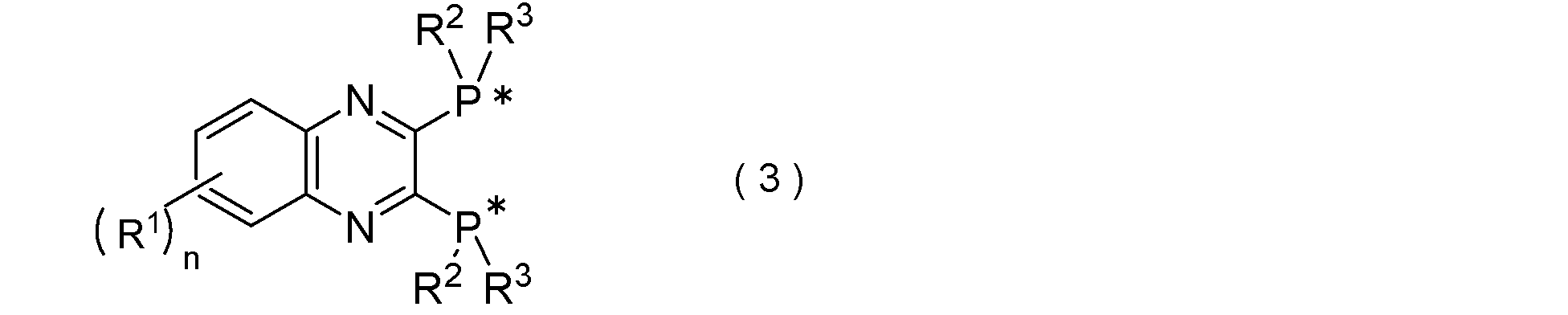
(式中、R1、R2、R3、*及びnは前記と同義。)で表される光学活性な2,3-ビスホスフィノピラジン誘導体の製造方法である。
前記A液に、前記リチオ化したホスフィンボラン化合物を含むB液を添加し芳香族求核置換反応を行い、次いで脱ボラン化反応を行う工程を含む、下記一般式(3)
また、本発明が提供しようとする第2の発明は、下記一般式(1)

(式中、Xはハロゲン原子を示す。R1は一価の置換基を示す。nは、0~4の整数を示す。)で表される2,3-ジハロゲノピラジン、及びカルボン酸アミド配位性溶媒を含むA液を得るとともに、下記一般式(2)

(式中、R2及びR3は、置換されていてもよい直鎖状又は分岐状の炭素数1~10のアルキル基、置換されていてもよいシクロアルキル基又は置換されていてもよいフェニル基を示し、R2及びR3は異なる基である。*はリン原子上の不斉中心を示す。)で表される水素-ホスフィンボラン化合物のR体又はS体の光学活性体をリチオ化して、リチオ化したホスフィンボラン化合物を得、
前記A液に、前記リチオ化したホスフィンボラン化合物を含むB液を添加し芳香族求核置換反応を行い、次いで脱ボラン化反応を行って下記一般式(3)
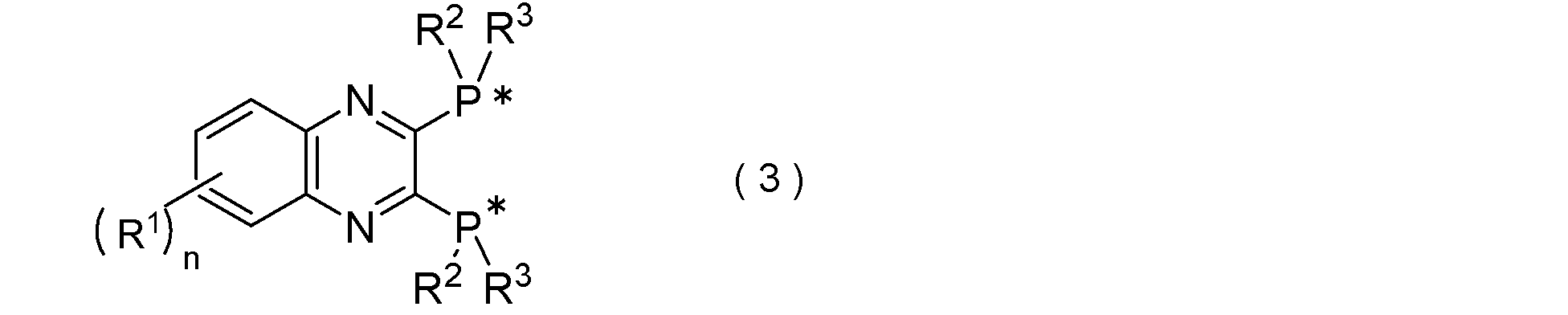
(式中、R1、R2、R3、*及びnは前記と同義。)で表される光学活性な2,3-ビスホスフィノピラジン誘導体を得る第一工程と、次いで、該2,3-ビスホスフィノピラジン誘導体と、
金、銅又は銀の遷移金属塩と、を反応させる第二工程と、を有する、下記一般式(4)
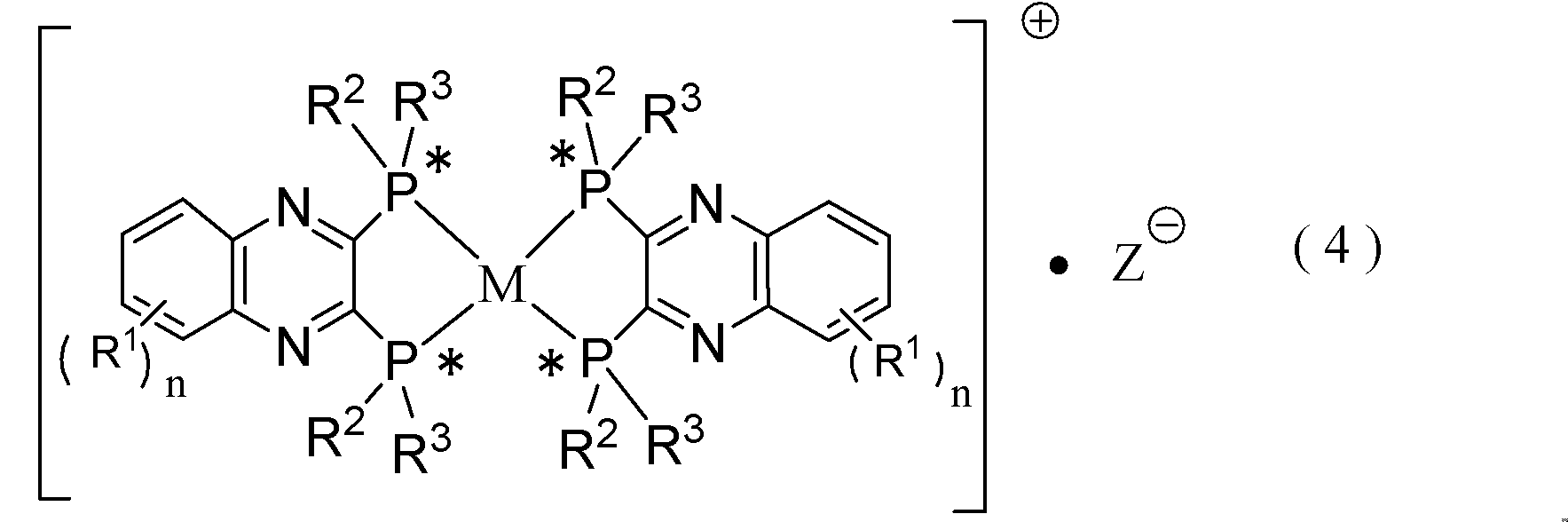
(式中、R1、R2、R3、*及びnは前記と同義。Mは、金、銅及び銀の群から選ばれる遷移金属原子を示す。Z-はアニオンを示す。)で表される光学活性なホスフィン遷移金属錯体の製造方法である。
前記A液に、前記リチオ化したホスフィンボラン化合物を含むB液を添加し芳香族求核置換反応を行い、次いで脱ボラン化反応を行って下記一般式(3)
金、銅又は銀の遷移金属塩と、を反応させる第二工程と、を有する、下記一般式(4)
以下、本発明を好ましい実施形態に基づき説明する。
本発明の前記一般式(3)で表される光学活性な2,3-ビスホスフィノピラジン誘導体の製造方法は、前記一般式(1)で表される2,3-ジハロゲノピラジン、及びカルボン酸アミド配位性溶媒を含むA液に、前記一般式(2)で表される水素-ホスフィンボラン化合物のR体又はS体の光学活性体をリチオ化してリチオ化したホスフィンボラン化合物を含むB液を添加し芳香族求核置換反応を行い、次いで脱ボラン化反応を行う。この工程は、後述する本発明の光学活性なホスフィン遷移金属錯体の製造方法の第一工程に該当する。A液の調製と、B液の調製は、どちらを先に行ってもよく、同時に行ってもよい。
本発明の前記一般式(3)で表される光学活性な2,3-ビスホスフィノピラジン誘導体の製造方法は、前記一般式(1)で表される2,3-ジハロゲノピラジン、及びカルボン酸アミド配位性溶媒を含むA液に、前記一般式(2)で表される水素-ホスフィンボラン化合物のR体又はS体の光学活性体をリチオ化してリチオ化したホスフィンボラン化合物を含むB液を添加し芳香族求核置換反応を行い、次いで脱ボラン化反応を行う。この工程は、後述する本発明の光学活性なホスフィン遷移金属錯体の製造方法の第一工程に該当する。A液の調製と、B液の調製は、どちらを先に行ってもよく、同時に行ってもよい。
前記一般式(1)で表される2,3-ジハロゲノピラジンの式中のXは、ハロゲン原子であり、例えば、塩素原子、臭素原子、ヨウ素原子等が挙げられ、これらの中、塩素原子が好ましい。
また、式中のR1は、一価の置換基を示し、該一価の置換基に特に制限はないが、例えば、直鎖状又は分岐状であり且つ炭素数が1~5のアルキル基、ニトロ基、アミノ基、ヒドロキシル基、フルオロ基、クロロ基、ブロモ基、ヨード基等が挙げられる。また、nは、0~4の整数を示す。
また、式中のR1は、一価の置換基を示し、該一価の置換基に特に制限はないが、例えば、直鎖状又は分岐状であり且つ炭素数が1~5のアルキル基、ニトロ基、アミノ基、ヒドロキシル基、フルオロ基、クロロ基、ブロモ基、ヨード基等が挙げられる。また、nは、0~4の整数を示す。
前記一般式(1)で表される2,3-ジハロゲノピラジンは、市販品を使用することができ、例えば、2,3-ジクロロキノキサリン等は、東京化成工業株式会社から入手可能である。
前記一般式(2)の式中のR2及びR3は、置換されていてもよい直鎖状又は分岐状の炭素数1~10のアルキル基、置換されていてもよいシクロアルキル基又は置換されていてもよいフェニル基を示し、R2及びR3は異なる基である。
R2及びR3で表されるアルキル基としては、例えば、メチル基、エチル基、イソプロピル基、n-プロピル基、イソブチル基、n-ブチル基、sec-ブチル基、tert-ブチル基、イソヘプチル基、n-ヘプチル基、イソヘキシル基、n-ヘキシル基等が挙げられる。また、R2及びR3で表されるシクロアルキル基としては、シクロペンチル基、シクロヘキシル基等が挙げられる。また、R2及び/又はR3が置換基を有するシクロアルキル基又は置換基を有するフェニル基の場合、該置換基としては、アルキル基、アルコキシ基、ニトロ基、アミノ基、ヒドロキシル基、フルオロ基、クロロ基、ブロモ基、ヨード基等が挙げられる。R2及び/又はR3が置換基を有するアルキル基である場合、該置換基としては、フェニル基、アルコキシ基、ニトロ基、アミノ基、ヒドロキシル基、フルオロ基、クロロ基、ブロモ基、ヨード基等が挙げられる。置換基としてのアルキル基の炭素数は1~5であることが好ましく、置換基としてのアルコキシ基の炭素数は1~5であることが好ましい。
本発明において、目的とする2,3-ビスホスフィノピラジン誘導体を不斉触媒の用途として用いる観点から前記一般式(2)で表される水素-ホスフィンボラン化合物のR体又はS体の光学活性体は、リン原子上に不斉中心を有する光学活性体である。光学活性体は旋光性を示すから、ラセミ体は光学活性体には含まれない。また、一般式(2)の式中のR2がt-ブチル基又はアダマンチル基で、R3がメチル基であることが特に好ましい。一般式(2)で表される水素-ホスフィンボラン化合物のR体又はS体の光学活性体は光学純度が高いことが好ましく、例えば95%ee以上であることが高い光学純度の2,3-ビスホスフィノピラジン誘導体を効率良く生産できる観点から好ましい。
前記一般式(2)で表される水素-ホスフィンボラン化合物のR体又はS体の光学活性体は、公知の方法によって調製することができる。そのような方法としては、例えば特開2001-253889号公報、特開2003-300988号公報、特開2007-70310号公報、特開2010-138136号公報及びJ.Org.Chem,2000,vol.65,P4185-4188等に記載の方法が挙げられる。
前記A液は、前記一般式(1)で表される2,3-ジハロゲノピラジン、及びカルボン酸アミド配位性溶媒を含む液であり、該A液は溶液であってもよくスラリーであってもよい。
本発明者は、本発明において、比較的短時間で高い光学純度の目的物が高収率で得られる理由の一つとして次の理由が挙げられると考えている。それは、本発明では、芳香族求核反応のA液にカルボン酸アミド配位性溶媒を含有させることにより、添加されるプロトンが引き抜かれたキラルなホスフィンボラン化合物のリチウム塩にカルボン酸アミド配位性溶媒が配位する。該カルボン酸アミド配位性溶媒は、例えばテトラヒドロフラン等のエーテル溶媒に比べてリチウムに対して配位性が強い溶媒であるため、下記化学式(5)に示すようにキラルなホスフィンボラン化合物のアニオン部位と、リチウムカチオン部位との距離がより広がり、キラルなホスフィンボラン化合物のアニオン部位が一般式(1)の2,3-ジハロゲノピラジンのハロゲン原子にアタックしやすくなり、反応が進行しやすくなる。更に、前記のリチウム塩の溶解性が向上することと相まって反応性が高まる。なお、本発明において配位性溶媒とは、リチウムに配位することのできる溶媒を言う。カルボン酸アミド配位性溶媒を使用しない場合、本発明の効果が奏されないことは、後述する比較例2の記載から示される。
本発明者は、本発明において、比較的短時間で高い光学純度の目的物が高収率で得られる理由の一つとして次の理由が挙げられると考えている。それは、本発明では、芳香族求核反応のA液にカルボン酸アミド配位性溶媒を含有させることにより、添加されるプロトンが引き抜かれたキラルなホスフィンボラン化合物のリチウム塩にカルボン酸アミド配位性溶媒が配位する。該カルボン酸アミド配位性溶媒は、例えばテトラヒドロフラン等のエーテル溶媒に比べてリチウムに対して配位性が強い溶媒であるため、下記化学式(5)に示すようにキラルなホスフィンボラン化合物のアニオン部位と、リチウムカチオン部位との距離がより広がり、キラルなホスフィンボラン化合物のアニオン部位が一般式(1)の2,3-ジハロゲノピラジンのハロゲン原子にアタックしやすくなり、反応が進行しやすくなる。更に、前記のリチウム塩の溶解性が向上することと相まって反応性が高まる。なお、本発明において配位性溶媒とは、リチウムに配位することのできる溶媒を言う。カルボン酸アミド配位性溶媒を使用しない場合、本発明の効果が奏されないことは、後述する比較例2の記載から示される。

A液におけるカルボン酸アミド配位性溶媒としては、例えばN,N-ジメチルホルムアミド(DMF)、N,N-ジメチルアセトアミド(DMA)、1,3-ジメチル-2-イミダゾリジノン(DMI)、N-メチル-2-ピロリドン(NMP)、N-メチルホルムアミド、N-メチルアセトアミド、N,N-ジブチルホルムアミド、N,N-ジブチルアセトアミド等が挙げられ、これらのうち、N,N-ジメチルホルムアミド(DMF)が反応性と工業的に入手が容易である観点から好ましい。
A液を構成する全溶媒におけるカルボン酸アミド配位性溶媒の割合は、体積割合で、15体積%以上100体積%以下、特に好ましくは20体積%以上100体積%以下、とりわけ好ましくは30体積%以上70体積%以下とすることが反応性と経済性の観点から好ましい。A液を構成する全溶媒におけるカルボン酸アミド配位性溶媒の割合を15体積%以上、特に20体積%以上とすることで、反応速度を高めて生産性を向上させることができる。A液を構成する全溶媒におけるカルボン酸アミド配位性溶媒の割合を70体積%以下とすることで、カルボン酸アミド配位性溶媒の除去を容易化できるほか、コストを低減でき、収率と生産性を向上させることができる。なお、本明細書中、体積比率は室温での比率をいう。
A液における他の溶媒としては、エーテル溶媒を用いることが、A液とB液とを混合した反応液においてリチオ化したホスフィンボラン化合物の溶解性を高める点で好ましい。エーテル溶媒としては、例えばジエチルエーテル、ジイソプロピルエーテル、ジブチルエーテル、ジオキサン、シクロペンチルメチルエーテル、テトラヒドロフラン等が挙げられ、これらのうち、テトラヒドロフランが極性と原料の溶解性の観点から好ましい。
A液においてエーテル溶媒を用いる場合、エーテル溶媒とカルボン酸アミド配位性溶媒との割合は、体積比(前者:後者)で、1.0:0.2以上1.0:100以下、特に好ましくは1.0:0.3以上1.0:100以下、とりわけ好ましくは1.0:0.5以上1.0:3.0以下とすることが反応性と経済性の観点から好ましい。エーテル溶媒とカルボン酸アミド配位性溶媒との体積比(前者:後者)を1.0:0.2以上、特に1.0:0.3以上とすることで、反応速度を高めて生産性を向上させることができる。エーテル溶媒とカルボン酸アミド配位性溶媒との体積比(前者:後者)を1.0:100以下とすることで、カルボン酸アミド配位性溶媒の除去を容易化でき、収率と生産性を向上させることができる。
またA液又はB液においてエーテル溶媒を用いる場合、A液にB液を添加した後の反応液(A液とB液との混合液)中のエーテル溶媒とカルボン酸アミド配位性溶媒との体積比(前者:後者)は、1.0:0.05以上1.0:100以下、特に、1.0:0.15以上1.0:100以下、とりわけ1.0:0.25以上1.0:3.0以下であることが、反応性と経済性の観点からより一層好ましい。エーテル溶媒とカルボン酸アミド配位性溶媒との体積比(前者:後者)を1.0:0.05以上、特に1.0:0.15以上とすることで、反応速度を高めて生産性を向上させることができる。エーテル溶媒とカルボン酸アミド配位性溶媒との体積比(前者:後者)を1.0:3.0以下とすることで、カルボン酸アミド配位性溶媒の除去を容易化でき、収率と生産性を向上させることができる。
またA液においては、必ずしも完全に一般式(1)で表される2,3-ジハロゲノピラジンを溶解する必要はなく、スラリー状態からでも反応を開始することができる。
A液中の前記一般式(1)で表される2,3-ジハロゲノピラジンの濃度は、0.01~30質量%とすることが反応性及び生産性の観点から好ましく、0.03~20質量%とすることが同様の観点からより好ましい。
後述するB液を添加開始する時点におけるA液の好ましい温度としては、十分な反応性で高い光学純度の生成物が得られる理由から、後述するB液のA液への好ましい添加温度と同様の温度が挙げられる。
B液は、前記一般式(2)で表される水素-ホスフィンボラン化合物をリチオ化したホスフィンボラン化合物を含む溶液である。
B液の調製は、前記一般式(2)で表される水素-ホスフィンボラン化合物を溶媒に溶解した溶液と、リチオ化剤とを混合することで、前記一般式(2)で表される水素-ホスフィンボラン化合物のリチオ化を行うことができる。この際、前記一般式(2)で表される水素-ホスフィンボラン化合物を溶媒に溶解した溶液に対してリチオ化剤を添加することが好ましい。この方法は、リチオ化剤溶液に対して、前記一般式(2)で表される水素-ホスフィンボラン化合物を溶媒に溶解した溶液を添加した場合に比べて、リチオ化物が過剰なリチオ化剤に曝され続ける事がないため、副生物を減少させるという利点がある。
B液の調製において、n-ブチルリチウム添加前の溶液中の前記一般式(2)で表される水素-ホスフィンボラン化合物の濃度は、1~30質量%であることが反応性及び生産性の観点から好ましく、5~20質量%とすることが同様の観点からより好ましい。
B液で用いるリチオ化剤としては、例えば、有機リチウム化合物が用いられる。有機リチウム化合物の例としては、メチルリチウム、エチルリチウム、n-プロピルリチウム、sec-プロピルリチウム、n-ブチルリチウム、sec-ブチルリチウム、tert-ブチルリチウム等が挙げられる。これらのうち、n-ブチルリチウムが適度な塩基性と十分な反応性の観点から好ましい。
リチオ化剤の添加量は、前記一般式(2)で表される水素-ホスフィンボラン化合物に対するリチオ化剤のモル比で1.0~1.5とすることが経済性と反応性の観点から好ましく、1.0~1.2とすることが同様の観点からより好ましい。
リチオ化剤の添加量は、前記一般式(2)で表される水素-ホスフィンボラン化合物に対するリチオ化剤のモル比で1.0~1.5とすることが経済性と反応性の観点から好ましく、1.0~1.2とすることが同様の観点からより好ましい。
B液の調製において、n-ブチルリチウム添加前の溶液に用いる溶媒は、前記一般式(2)で表される水素-ホスフィンボラン化合物及び生成するホスフィンボラン化合物を溶解することができ不活性な溶媒であれば用いることができる。該溶媒としては、上記エーテル溶媒のほか、N,N-ジメチルホルムアミド、ヘキサン、トルエン等が挙げられる。これらの溶媒は単独又は混合溶媒として用いることができる。これらのうち、特にエーテル溶媒がリチオ化物の溶解性の観点から好ましく、テトラヒドロフランが最も好ましい。
前記リチオ化剤の添加温度は、前記一般式(2)で表される水素-ホスフィンボラン化合物の光学純度を保ったままリチオ化することができる観点から、-20~20℃とすることが好ましく、-20~0℃とすることがより好ましい。前記一般式(2)で表される水素-ホスフィンボラン化合物を含む液に、リチオ化剤を添加することにより、前記一般式(2)で表される水素-ホスフィンボラン化合物のリチオ化が速やかに行われるが、必要に応じてリチオ化の反応を完結させるためリチオ化剤の添加終了後に引続き熟成反応を行ってもよい。
本製造方法は、前記で調製したA液に、前記B液を添加して芳香族求核置換反応を行うことに一つの特徴があり、従来のB液に、A液を添加する方法に比べて、芳香族求核置換反応を行う温度を工業化に有利な温度まで高くすることができ、また、A液の溶媒としてエーテル溶媒に加えてカルボン酸アミド配位性溶媒を添加して芳香族求核置換反応を行うことにより、光学活性な2,3-ビスホスフィノピラジン誘導体を製造することに対しても、比較的短時間で光学純度が高いものを高い収率で得ることが出来る。このことは後述する各実施例及び比較例1の記載からも示される。本発明の製造方法は、得られる光学活性な2,3-ビスホスフィノピラジン誘導体の光学純度が95%ee以上であるものであることが好ましく、98%ee以上であることがより好ましい。
前記一般式(1)で表される2,3-ジハロゲノピラジンにおけるハロゲンが結合している炭素原子の電子は、隣接する窒素原子により吸引されている。従って、水素-ホスフィンボラン化合物から脱プロトン化された状態のリチオ化したホスフィンボラン化合物、即ち求核試薬は、当該炭素原子を攻撃して芳香族求核置換反応が起こり、反応系内には中間体である下記一般式(6)で表される光学活性な2,3-ビスホスフィノピラジン誘導体のボラン体が生成する。
B液の添加は、A液中の前記一般式(1)で表される2,3-ジハロゲノピラジンに対する、前記一般式(2)で表される水素-ホスフィンボラン化合物からリチオ化されたホスフィンボラン化合物のモル比で2.0~4.0、好ましくは2.0~3.0となるように添加することが反応性と経済性の観点から好ましい。
また、B液の添加速度は、特に制限されるものではないが安定した品質のものを得る観点から一定速度で添加することが好ましい。例えば反応熱の制御の理由から、A液に対するB液の添加は、例えば500Lスケールの場合、30分以上かけて行うことが好ましく、この観点から60分以上かけて行うことがより好ましい。A液に対するB液の添加は、連続的であっても断続的であってもよい。
連続的であっても断続的であっても、製造時間の観点からA液に対するB液の添加は、例えば500Lスケールの場合、480分以下かけて行うことが好ましい。その間の混合液の内温は、後述するB液の好ましい添加温度の範囲内に維持することが好ましい。
連続的であっても断続的であっても、製造時間の観点からA液に対するB液の添加は、例えば500Lスケールの場合、480分以下かけて行うことが好ましい。その間の混合液の内温は、後述するB液の好ましい添加温度の範囲内に維持することが好ましい。
B液の添加温度は、光学純度が高いものを高収率で得る観点から-20~50℃とすることが好ましく、-20~20℃とすることがより好ましく、-20~0℃とすることが最も好ましい。なお、B液をA液に添加する時点で、芳香族求核置換反応が起きるため、A液へのB液の添加時における混合液の温度を、芳香族求核置換反応の反応温度ともいう。
B液の添加後、必要により引続き芳香族求核置換反応を完結させるため熟成反応を行うことができる。熟成反応の温度は、光学純度が高いものを高収率で得る観点から-20~50℃、特に-20~30℃とすることが特に好ましい。熟成時間は、HPLC等による反応液分析でA液からの2,3-ビスホスフィノピラジン誘導体とB液からのリチオ化されたホスフィンボラン化合物の残存率を分析すれば良いが、例えば10分以上5時間以下が生成物の分解を防ぐ等の点から好ましい。
次いで、本製造方法では、前記の中間体である前記一般式(6)で表される2,3-ビスホスフィノピラジン誘導体のボラン体の脱ボラン化反応を行う。
前記一般式(6)で表される2,3-ビスホスフィノピラジン誘導体のボラン体の脱ボラン化反応は、前記一般式(6)で表される2,3-ビスホスフィノピラジン誘導体のボラン体を含む反応系に、脱ボラン化剤を添加することにより行うことができる。
前記脱ボラン化剤としては、例えばN,N,N’,N’,-テトラメチルエチレンジアミン(TMEDA)、トリエチレンジアミン(DABCO)、トリエチルアミン、HBF4、トリフルオロメタンスルホン酸等が挙げられるが、好ましくはTMEDAである。前記脱ボラン化剤の添加量としては、前記一般式(1)で表される2,3-ジハロゲノピラジンに対し、通常2~20当量であり、好ましくは3~10当量である。
前記脱ボラン化反応の反応温度は、好ましくは-20~80℃、より好ましくは-20~50℃、特に好ましくは10~30℃とすることが光学純度の高い前記一般式(3)で表される2,3-ビスホスフィノピラジン誘導体を得る観点から好ましい。また、脱ボラン化反応の反応時間は、10分以上、好ましくは1~10時間、より好ましくは1~5時間である。
脱ボラン化反応により生成した前記一般式(3)で表される2,3-ビスホスフィノピラジン誘導体は、必要に応じて分液洗浄、抽出、晶析、蒸留、昇華、カラムクロマトグラフィーといった精製作業に付してもよい。
本発明の製造方法により得られる前記一般式(3)で表される光学活性な2,3-ビスホスフィノピラジン誘導体は、配位子として、遷移金属と共に錯体を形成することができる。この錯体は不斉合成触媒として有用なものである。不斉合成としては、例えば不斉水素化反応、有機ボロン酸を用いた電子不足オレフィンへの不斉1,4-付加反応、不斉ヒドロシリル反応、不斉環化などが挙げられる。
錯体を形成することができる遷移金属としては、例えば、ロジウム、ルテニウム、イリジウム、パラジウム、白金、ニッケル、鉄等が挙げられる。好ましい金属はパラジウムとロジウムである。一般式(1)で表される2,3-ビス(ジアルキルホスフィノ)ピラジン誘導体を配位子として用い、ロジウムと共に錯体を形成させる方法としては、例えば実験化学講座第4版(日本化学会編、丸善株式会社発行 第18巻327~353頁)に記載されている方法に従えばよい。
また、本発明の製造方法により得られる前記一般式(3)で表される2,3-ビスホスフィノピラジン誘導体のうち、R2及びR3が異なる基を有する光学活性な化合物は、抗がん剤として用いられる光学活性なホスフィン遷移金属錯体の配位子源としても有用である。
次に、下記一般式(4)で表される光学活性なホスフィン遷移金属錯体の好適な製造方法について説明する。このホスフィン遷移金属錯体は、前述した第一工程で得られた前記一般式(3)で表される光学活性な2,3-ビスホスフィノピラジン誘導体と、金、銅又は銀の塩とを反応させる第二工程を行うことで得られる。
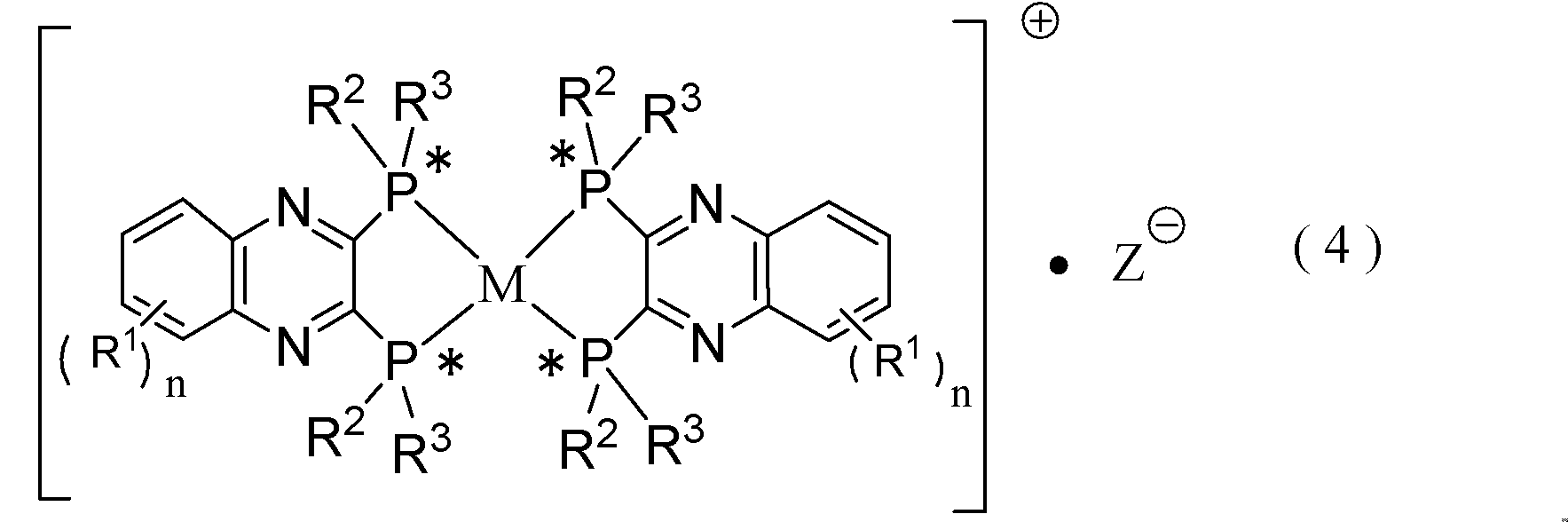
前記一般式(4)で表される光学活性なホスフィン遷移金属錯体の式中のR1、R2、R3及びnは、前記一般式(1)で表される2,3-ジハロゲノピラジンの式中のR1、n及び前記一般式(2)で表される水素-ホスフィンボラン化合物の式中のR2、R3に相当する。また、前記一般式(4)で表される光学活性なホスフィン遷移金属錯体の式中のMは金、銅及び銀の群から選ばれる遷移金属原子を示す。また、Z-はアニオンを示し、一価のアニオンであることが好ましい。Z-で表されるアニオンとしては、塩素イオン、臭素イオン、ヨウ素イオン、四フッ化ホウ素イオン、六フッ化リン酸イオン、過塩素酸イオン等が挙げられる。
一般式(3)で表される光学活性な2,3-ビスホスフィノピラジン誘導体と反応する金、銅又は銀の塩は、例えば、これらの金属のハロゲン化物、硝酸塩、過塩素酸塩、四フッ化ホウ素酸塩、六フッ化リン酸塩等である。また、これらの金属の価数は、一価である。また、これらの金属の塩は、金属又はアニオンのいずれか一方又は両方が異なる2種以上の塩であってもよい。
好ましい金の塩としては、例えば、塩化金(I)酸、塩化金(I)、あるいはテトラブチルアンモニウムクロリド・塩化金(I)等(「第5版 実験化学講座21」、編者 社団法人日本化学会、発行所 丸善、発行日 平成16年3月30日、p366~380、Aust.J.Chemm.,1997,50,775-778頁参照)が挙げられる。好ましい銅の遷移金属塩としては、例えば、塩化銅(I)、臭化銅(I)、ヨウ化銅(I)等(「第5版 実験化学講座21」、編者 社団法人日本化学会、発行所 丸善、発行日 平成16年3月30日、p349~361)が挙げられる。また、好ましい銀の遷移金属塩としては、例えば、塩化銀(I)、臭化銀(I)、ヨウ化銀(I)等(「第5版 実験化学講座21」、編者 社団法人日本化学会、発行所 丸善、発行日 平成16年3月30日、p361~366)が挙げられる。なお、本発明のホスフィン遷移金属錯体の製造方法に係る遷移金属塩は、無水物であっても含水物であってもよい。
金、銅又は銀の塩に対する、一般式(3)で表される2,3-ビスホスフィノピラジン誘導体のモル比は、金属1モルに対して好ましくは1~5倍モル、更に好ましくは1.8~2.2倍モルとする。反応は、アセトン、アセトニトリル、メタノール、エタノール、テトラヒドロフラン、ジクロロメタン、クロロホルム等の溶媒中で行うことができる。反応温度は好ましくは-20~60℃、更に好ましくは0~25℃であり、反応時間は好ましくは0.5~48時間、更に好ましくは1~3時間である。この反応によって、前記一般式(4)で表されるホスフィン遷移金属錯体が得られる。反応終了後は、必要に応じて常法の精製を行うことができる。
前記一般式(4)で表される光学活性なホスフィン遷移金属錯体は、式中のR2及びR3がそれぞれ異なる基を有している場合には、不斉なリン原子を4個有するため、数多くの異性体が存在するが、本製造方法では、得られるホスフィン遷移金属錯体はリン原子上の立体が、(R,R)(R,R)や、(S,S)(S,S)のように、単一のエナンチオマーから構成されているものである。
第二工程の出発原料となる一般式(3)で表される光学活性な2,3-ビスホスフィノピラジン誘導体においては、R2とR3が異なる基であることによって、2つのリン原子がキラル中心となる。第一工程において、所望の光学活性体を得た後、第二工程において、これらの光学活性体を用いることで、目的とする立体構造を有するホスフィン遷移金属錯体として得ることができる(例えば、特開2007-320909号公報、国際公開WO2011/078121号パンフレット、国際公開WO2011/072902号パンフレット、国際公開WO2011/129365号パンフレット等参照)。
このようにして得られた一般式(4)で表される光学活性なホスフィン遷移金属錯体におけるアニオンを、他の所望のアニオンに変換してもよい。例えば、先ず、上述の製造方法に従い、前記一般式(3)の式中のZ-が、ハロゲン化物イオンであるホスフィン遷移金属錯体を合成し、次いで、このホスフィン遷移金属錯体と、所望のアニオンを有する無機酸、有機酸又はそれらのアルカリ金属塩とを、適切な溶媒中で反応させることにより、Z-が、所望のアニオンであるホスフィン遷移金属錯体を得ることができる。このような方法の詳細は、例えば特開平10-147590号公報、特開平10-114782号公報及び特開昭61-10594号公報等に記載されている。
このようにして得られた前記一般式(4)で表される光学活性なホスフィン遷移金属錯体は、抗がん剤として有用である。
以下、本発明を実施例により詳細に説明するが、本発明はこれらの実施例に限定されるものではない。なお各実施例・比較例に記載した溶媒の体積は室温(25℃)における値である。
<(S)-tert-ブチルメチルホスフィン-ボランの合成>
(S)-tert-ブチル(ヒドロキシメチル)メチルホスフィン-ボラン(92%ee)2.22g(15.0mmol)を10mlのピリジンに溶解した溶液に、0℃、撹拌下に、塩化ベンゾイル 2.1mL(18mmol)を滴下した。次いで反応混合液を室温(25℃)まで加熱した。1時間経過後、反応混合液を水で希釈し、エーテルで3回抽出した。得られた有機層を1Mの塩酸、2.5wt%の炭酸水素ナトリウム水溶液及び飽和食塩水で順次洗浄し、硫酸ナトリウムで脱水した。溶媒を除去した後、シリカゲルのカラムクロマトグラフィー(移動相:ヘキサン/酢酸エチル=体積比3/1)で残渣を精製した。無色の固体が得られ、この固体を、ヘキサン/酢酸エチル混合溶媒で2回再結晶した。このようにして光学的に純粋なベンゾイルオキシメチル(tert-ブチル)メチルホスフィン-ボランを得た。収量は2.34g、収率は62%であった。
<(S)-tert-ブチルメチルホスフィン-ボランの合成>
(S)-tert-ブチル(ヒドロキシメチル)メチルホスフィン-ボラン(92%ee)2.22g(15.0mmol)を10mlのピリジンに溶解した溶液に、0℃、撹拌下に、塩化ベンゾイル 2.1mL(18mmol)を滴下した。次いで反応混合液を室温(25℃)まで加熱した。1時間経過後、反応混合液を水で希釈し、エーテルで3回抽出した。得られた有機層を1Mの塩酸、2.5wt%の炭酸水素ナトリウム水溶液及び飽和食塩水で順次洗浄し、硫酸ナトリウムで脱水した。溶媒を除去した後、シリカゲルのカラムクロマトグラフィー(移動相:ヘキサン/酢酸エチル=体積比3/1)で残渣を精製した。無色の固体が得られ、この固体を、ヘキサン/酢酸エチル混合溶媒で2回再結晶した。このようにして光学的に純粋なベンゾイルオキシメチル(tert-ブチル)メチルホスフィン-ボランを得た。収量は2.34g、収率は62%であった。
ベンゾイルオキシメチル(tert-ブチル)メチルホスフィン-ボラン(99%ee)6.05g(24.0mmol)を25mLのエタノールに溶解して溶液を得た。これとは別に15mLの水に水酸化カリウム4.0g(72mmol)を溶解して水酸化カリウム水溶液を調製した。この水酸化カリウム水溶液を前記の溶液に滴下した。約1時間で加水分解が完了した。反応混合液を水で希釈し、エーテルで3回抽出した。抽出液を飽和食塩水で洗浄し、硫酸ナトリウムで脱水した。ロータリーエバポレータで溶媒を除去し、シリカゲルのカラムクロマトグラフィー(移動相:ヘキサン/酢酸エチル=体積比3/1)で残渣を精製し、(S)-tert-ブチル(ヒドロキシメチル)メチルホスフィン-ボランを得た。この化合物を72mLのアセトンに溶解した。水酸化カリウム13.5g(240mmol)、過硫酸カリウム19.4g(72.0mmol)及び三塩化ルテニウム三水和物624mg(2.4mmol)を150mLの水に溶解した水溶液(0℃)に、該水溶液を激しく撹拌した状態で、前記アセトン溶液を徐々に添加した。2時間経過後、反応混合液を3Mの塩酸で中和し、エーテルで3回抽出した。抽出液を飽和食塩水で洗浄し、硫酸ナトリウムで脱水した。ロータリーエバポレータで溶媒を室温(25℃)下に除去し、シリカゲルのカラムクロマトグラフィー(移動相:ペンタン/エーテル=体積比8/1)で残渣を精製した。このようにして光学純度が99%ee以上である(S)-tert-ブチルメチルホスフィン-ボランを得た。収量は2.27g、収率は80%、純度は92.5%であった。
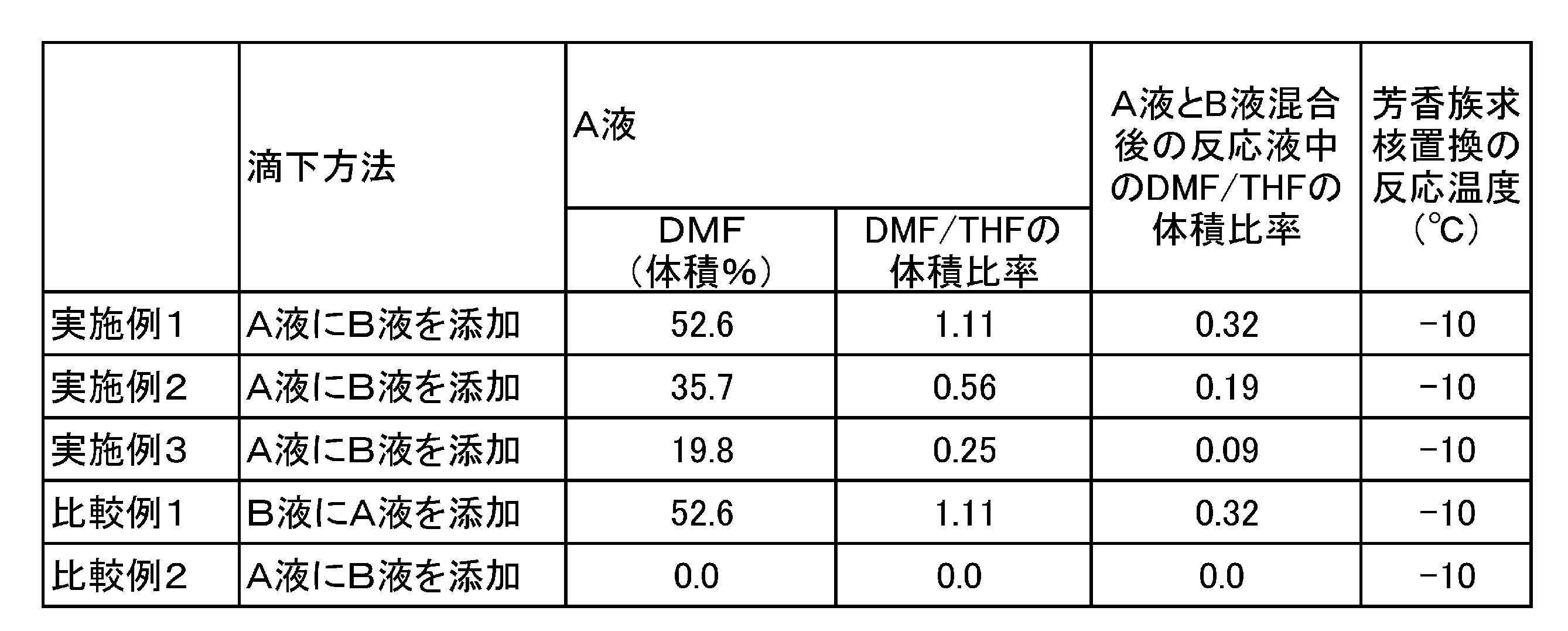
{実施例1}
<(R,R)-2,3-ビス(tert-ブチルメチルホスフィノ)キノキサリン(a3)の合成>
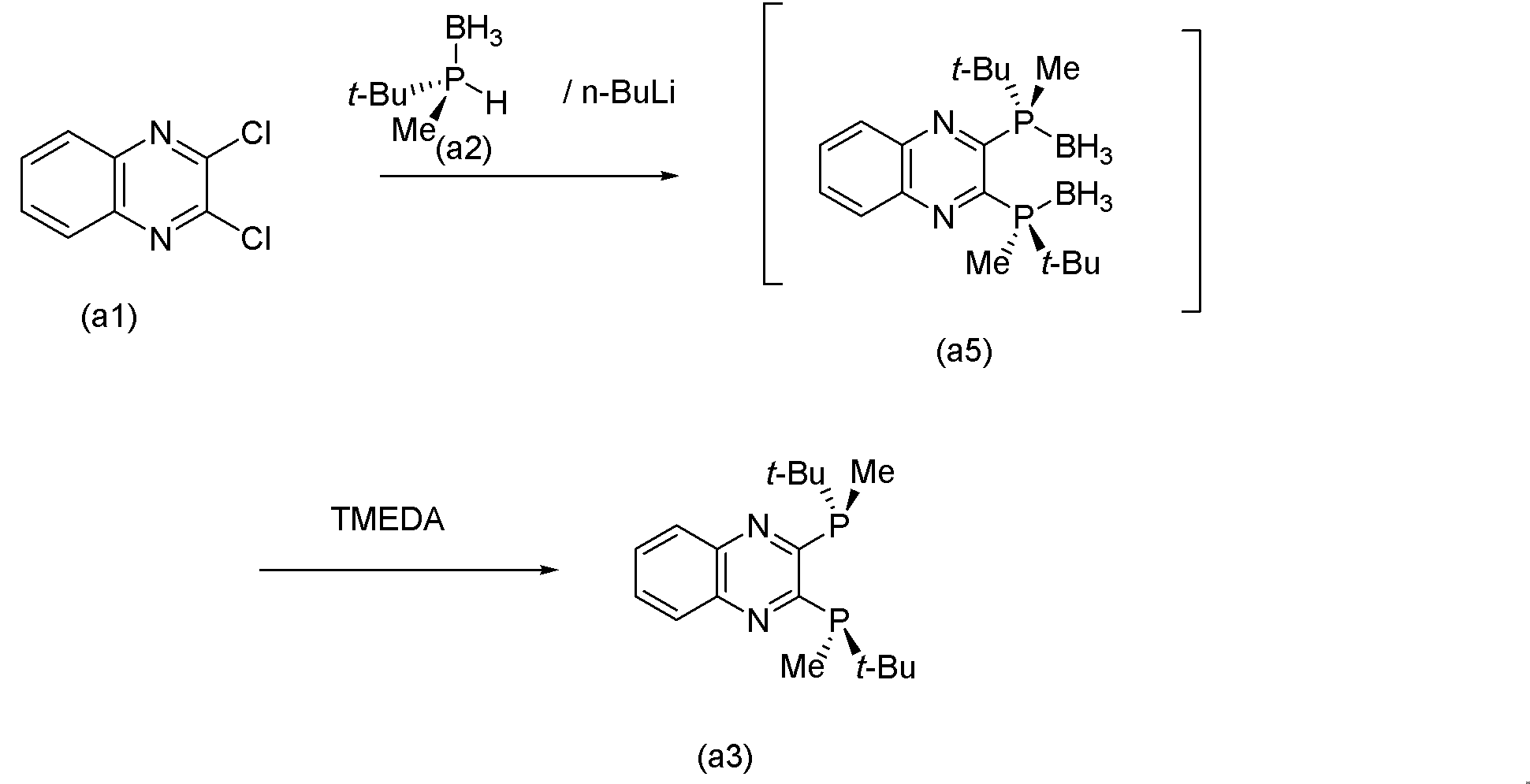
<(R,R)-2,3-ビス(tert-ブチルメチルホスフィノ)キノキサリン(a3)の合成>
十分に乾燥した300mL四つ口フラスコを窒素置換した後、上記で調製した14.2質量%(S)-tert-ブチルメチルホスフィン-ボラン(a2)のテトラヒドロフラン溶液111.46g(135.0mmol)を仕込み、窒素雰囲気下で-10℃へ冷却した後、15質量%のn-ブチルリチウムのヘキサン溶液59.3gを1時間かけて滴下した。次いで-10℃で1時間熟成し、これをB液とした。
十分に乾燥した2000mL四つ口フラスコを別に用意し、窒素置換した後に、2,3-ジクロロキノキサリン(a1)8.97g(45.0mmol)とテトラヒドロフラン(81ml)、N,N-ジメチルホルムアミド90mlを仕込み、-10℃へ冷却し、これをA液とした。
B液を、40分かけて内温が-10℃付近を維持するようにA液へ一定速度で添加した。白色スラリーから、一時緑色へ変色して、最終的には赤茶色スラリーとなった。
滴下終了後、徐々に室温(25℃)へ昇温した後、3時間熟成した。次いでテトラメチレンジアミン52.6g(450.0mmol)を加え、一晩熟成を続けると脱ボラン化反応は十分に進行しており、オレンジ色スラリーとなっていた。
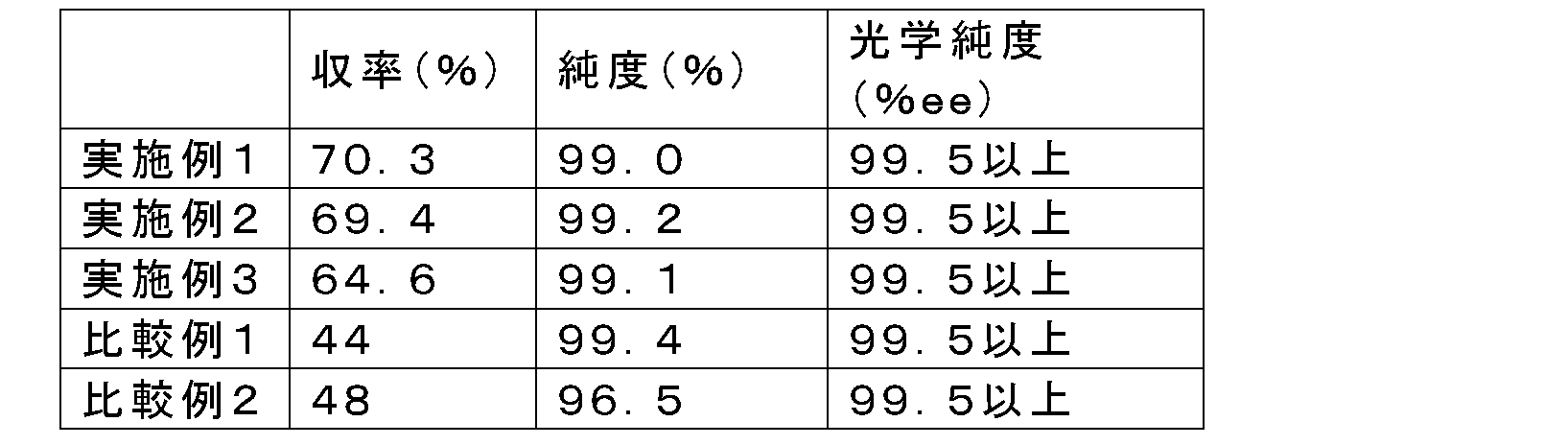
次いで10質量%塩酸180mLを加えて反応を停止させ、水層を廃棄した。更に水45mL、5質量%塩酸17mLを加えて反応液を洗浄し、水層を廃棄した。次いで、2.5質量%重曹水溶液45mLと水45mLを順次加えて反応液を洗浄して水層を廃棄し、真空ポンプを用いて溶媒を留去すると全体が固化した。メタノール90mLを加えて昇温して完全に溶解させた後、徐々に冷却するとオレンジ色の結晶が析出した。冷メタノールでリンスした後、減圧乾燥して(R,R)-2,3-ビス(tert-ブチルメチルホスフィノ)キノキサリン(a3)(10.58g、収率70.3%)を得た。この結晶は31P NMRで99.0%の純度であり、光学純度は99.5%ee以上であった。
(化合物(a3)の同定データ)
融点:102~103℃、
比旋光度[α]D 26 -54.5 (c 1.00, CHCl3)、
1H NMR(500.15MHz, CDCl3):δ 1.00-1.03(m, 18H), 1.42-1.44(m, 6H), 7.70-7.74(m, 2H), 8.08-8.12(m, 2H)、13C NMR(125.76MHz, CDCl3):δ4.77(t, J=4.1 Hz), 27.59(t, J=7.4 Hz), 31.90(t, J=7.4 Hz), 129.50, 129.60,
141.63, 165.12(dd, J=5.7, 2.4Hz)、
31P NMR(202.46MHz, CDCl3):δ-16.7(s)
十分に乾燥した2000mL四つ口フラスコを別に用意し、窒素置換した後に、2,3-ジクロロキノキサリン(a1)8.97g(45.0mmol)とテトラヒドロフラン(81ml)、N,N-ジメチルホルムアミド90mlを仕込み、-10℃へ冷却し、これをA液とした。
B液を、40分かけて内温が-10℃付近を維持するようにA液へ一定速度で添加した。白色スラリーから、一時緑色へ変色して、最終的には赤茶色スラリーとなった。
滴下終了後、徐々に室温(25℃)へ昇温した後、3時間熟成した。次いでテトラメチレンジアミン52.6g(450.0mmol)を加え、一晩熟成を続けると脱ボラン化反応は十分に進行しており、オレンジ色スラリーとなっていた。
次いで10質量%塩酸180mLを加えて反応を停止させ、水層を廃棄した。更に水45mL、5質量%塩酸17mLを加えて反応液を洗浄し、水層を廃棄した。次いで、2.5質量%重曹水溶液45mLと水45mLを順次加えて反応液を洗浄して水層を廃棄し、真空ポンプを用いて溶媒を留去すると全体が固化した。メタノール90mLを加えて昇温して完全に溶解させた後、徐々に冷却するとオレンジ色の結晶が析出した。冷メタノールでリンスした後、減圧乾燥して(R,R)-2,3-ビス(tert-ブチルメチルホスフィノ)キノキサリン(a3)(10.58g、収率70.3%)を得た。この結晶は31P NMRで99.0%の純度であり、光学純度は99.5%ee以上であった。
(化合物(a3)の同定データ)
融点:102~103℃、
比旋光度[α]D 26 -54.5 (c 1.00, CHCl3)、
1H NMR(500.15MHz, CDCl3):δ 1.00-1.03(m, 18H), 1.42-1.44(m, 6H), 7.70-7.74(m, 2H), 8.08-8.12(m, 2H)、13C NMR(125.76MHz, CDCl3):δ4.77(t, J=4.1 Hz), 27.59(t, J=7.4 Hz), 31.90(t, J=7.4 Hz), 129.50, 129.60,
141.63, 165.12(dd, J=5.7, 2.4Hz)、
31P NMR(202.46MHz, CDCl3):δ-16.7(s)
{実施例2}
<(R,R)-2,3-ビス(tert-ブチルメチルホスフィノ)キノキサリン(a3)の合成>
A液において、テトラヒドロフランの量を81mlとし、N,N-ジメチルホルムアミドの量を45mlとした以外は実施例1と同様にして反応を行って、(R,R)-2,3-ビス(tert-ブチルメチルホスフィノ)キノキサリン(a3)(収率69.4%)を得た。この結晶は31P NMRで99.2%の純度であり、光学純度は99.5%ee以上であった。
<(R,R)-2,3-ビス(tert-ブチルメチルホスフィノ)キノキサリン(a3)の合成>
A液において、テトラヒドロフランの量を81mlとし、N,N-ジメチルホルムアミドの量を45mlとした以外は実施例1と同様にして反応を行って、(R,R)-2,3-ビス(tert-ブチルメチルホスフィノ)キノキサリン(a3)(収率69.4%)を得た。この結晶は31P NMRで99.2%の純度であり、光学純度は99.5%ee以上であった。
{実施例3}
<(R,R)-2,3-ビス(tert-ブチルメチルホスフィノ)キノキサリン(a3)の合成>
A液において、テトラヒドロフランの量を81ml、N,N-ジメチルホルムアミドの量を20mlとした以外は実施例1と同様にして反応を行って、(R,R)-2,3-ビス(tert-ブチルメチルホスフィノ)キノキサリン(a3)(収率64.6%)を得た。この結晶は31P NMRで99.1%の純度であり、光学純度は99.5%ee以上であった。
<(R,R)-2,3-ビス(tert-ブチルメチルホスフィノ)キノキサリン(a3)の合成>
A液において、テトラヒドロフランの量を81ml、N,N-ジメチルホルムアミドの量を20mlとした以外は実施例1と同様にして反応を行って、(R,R)-2,3-ビス(tert-ブチルメチルホスフィノ)キノキサリン(a3)(収率64.6%)を得た。この結晶は31P NMRで99.1%の純度であり、光学純度は99.5%ee以上であった。
{比較例1}
<(R,R)-2,3-ビス(tert-ブチルメチルホスフィノ)キノキサリン(a3)の合成>
A液を、20分かけて内温が-10℃付近を維持するようにB液へ添加した以外は、実施例1と同様に反応を行って、(R,R)-2,3-ビス(tert-ブチルメチルホスフィノ)キノキサリン(a3)(収率44%)を得た。この結晶は31P NMRで99.4%の純度であり、光学純度は99.5%ee以上であった。
<(R,R)-2,3-ビス(tert-ブチルメチルホスフィノ)キノキサリン(a3)の合成>
A液を、20分かけて内温が-10℃付近を維持するようにB液へ添加した以外は、実施例1と同様に反応を行って、(R,R)-2,3-ビス(tert-ブチルメチルホスフィノ)キノキサリン(a3)(収率44%)を得た。この結晶は31P NMRで99.4%の純度であり、光学純度は99.5%ee以上であった。
{比較例2}
A液において、テトラヒドロフランの量を200mlとした以外は実施例1と同様にして反応を行って、(R,R)-2,3-ビス(tert-ブチルメチルホスフィノ)キノキサリン(a3)(収率48%)を得た。この結晶は31P NMRで96.5%の純度であり、光学純度は99.5%ee以上であった。
A液において、テトラヒドロフランの量を200mlとした以外は実施例1と同様にして反応を行って、(R,R)-2,3-ビス(tert-ブチルメチルホスフィノ)キノキサリン(a3)(収率48%)を得た。この結晶は31P NMRで96.5%の純度であり、光学純度は99.5%ee以上であった。
{実施例4}
<ビス(2,3-ビス(tert-ブチルメチルホスフィノ)キノキサリン)金(I)クロリド(4a)の合成>
窒素ガスで置換した500ml二口フラスコに、前記実施例1で調製した(R,R)-2,3-ビス(tert-ブチルメチルホスフィノ)キノキサリン(a3)5.50g(16.4mmol)と脱気したTHF220mlを加えた。ここにテトラブチルアンモニウム金(I)ジクロリド4.19g(8.2mmol)を加え、室温(25℃)で20時間撹拌した。沈殿をろ別し、ろ液を乾固した。得られた褐色固体を減圧下で乾燥し、7.26gの下記式(4a)で表されるビス(2,3-ビス(tert-ブチルメチルホスフィノ)キノキサリン)金(I)クロリド(4a)を得た。この時の収率は98%であった。
(化合物(4a)の同定データ)
・31P-NMR(CDCl3);13.6
・[α]D=+195.3(c=0.5、メタノール、25℃)

<ビス(2,3-ビス(tert-ブチルメチルホスフィノ)キノキサリン)金(I)クロリド(4a)の合成>
窒素ガスで置換した500ml二口フラスコに、前記実施例1で調製した(R,R)-2,3-ビス(tert-ブチルメチルホスフィノ)キノキサリン(a3)5.50g(16.4mmol)と脱気したTHF220mlを加えた。ここにテトラブチルアンモニウム金(I)ジクロリド4.19g(8.2mmol)を加え、室温(25℃)で20時間撹拌した。沈殿をろ別し、ろ液を乾固した。得られた褐色固体を減圧下で乾燥し、7.26gの下記式(4a)で表されるビス(2,3-ビス(tert-ブチルメチルホスフィノ)キノキサリン)金(I)クロリド(4a)を得た。この時の収率は98%であった。
(化合物(4a)の同定データ)
・31P-NMR(CDCl3);13.6
・[α]D=+195.3(c=0.5、メタノール、25℃)
本発明の光学活性な2,3-ビスホスフィノピラジン誘導体の製造方法は、芳香族求核置換反応を工業的に有利な温度にて短時間で行うことができ、また、光学純度が高いものを高い収率で得ることができる。また、本発明の一連の工程を行うことにより、抗がん剤として有用な光学活性なホスフィン遷移金属錯体を工業的に有利な方法で得ることができる。
Claims (10)
- 下記一般式(1)


前記A液に、前記リチオ化したホスフィンボラン化合物を含むB液を添加し芳香族求核置換反応を行い、次いで脱ボラン化反応を行う工程を含む、下記一般式(3)
- A液を構成する全溶媒中、カルボン酸アミド配位性溶媒の割合が、15体積%以上100体積%以下である、請求項1記載の光学活性な2,3-ビスホスフィノピラジン誘導体の製造方法。
- A液を構成する全溶媒中、カルボン酸アミド配位性溶媒の割合が、30体積%以上70体積%以下である、請求項2記載の光学活性な2,3-ビスホスフィノピラジン誘導体の製造方法。
- カルボン酸アミド配位性溶媒がN,N-ジメチルホルムアミドである、請求項1乃至3の何れか1項に記載の光学活性な2,3-ビスホスフィノピラジン誘導体の製造方法。
- R2がt-ブチル基又はアダマンチル基で、R3がメチル基である、請求項1乃至4の何れか1項に記載の光学活性な2,3-ビスホスフィノピラジン誘導体の製造方法。
- 芳香族求核置換反応の反応温度が、-20~20℃である、請求項1乃至5の何れか1項に記載の光学活性な2,3-ビスホスフィノピラジン誘導体の製造方法。
- 脱ボラン化反応の反応温度が、-20~80℃である、請求項1乃至6の何れか1項に記載の光学活性な2,3-ビスホスフィノピラジン誘導体の製造方法。
- B液は、前記一般式(2)で表される水素-ホスフィンボラン化合物のR体又はS体の光学活性体及びエーテル溶媒を含む溶液に、リチオ化剤を添加して得られる、請求項1乃至7の何れか1項に記載の光学活性な2,3-ビスホスフィノピラジン誘導体の製造方法。
- A液又はB液がエーテル溶媒を含有し、B液添加後の反応液中のエーテル溶媒とカルボン酸アミド配位性溶媒との体積比(前者:後者)が1.0:0.25~1.0:100.0である、請求項1乃至8の何れか1項記載の光学活性な2,3-ビスホスフィノピラジン誘導体の製造方法。
- 下記一般式(1)


前記A液に、前記リチオ化したホスフィンボラン化合物を含むB液を添加し芳香族求核置換反応を行い、次いで脱ボラン化反応を行って下記一般式(3)

金、銅又は銀の遷移金属塩と、を反応させる第二工程と、を有する、下記一般式(4)

Priority Applications (3)
| Application Number | Priority Date | Filing Date | Title |
|---|---|---|---|
| JP2019529009A JP6682703B2 (ja) | 2017-07-11 | 2018-06-15 | 光学活性な2,3−ビスホスフィノピラジン誘導体の製造方法及び光学活性なホスフィン遷移金属錯体の製造方法 |
| CN201880036780.1A CN110709407B (zh) | 2017-07-11 | 2018-06-15 | 具有光学活性的2,3-双膦基吡嗪衍生物的制造方法、以及具有光学活性的膦过渡金属配位化合物的制造方法 |
| US16/617,827 US11773120B2 (en) | 2017-07-11 | 2018-06-15 | Method for producing optically active 2, 3-bisphosphinopyrazine derivative and method for producing optically active phosphine transition metal complex |
Applications Claiming Priority (2)
| Application Number | Priority Date | Filing Date | Title |
|---|---|---|---|
| JP2017135729 | 2017-07-11 | ||
| JP2017-135729 | 2017-07-11 |
Publications (1)
| Publication Number | Publication Date |
|---|---|
| WO2019012918A1 true WO2019012918A1 (ja) | 2019-01-17 |
Family
ID=65002578
Family Applications (1)
| Application Number | Title | Priority Date | Filing Date |
|---|---|---|---|
| PCT/JP2018/023019 Ceased WO2019012918A1 (ja) | 2017-07-11 | 2018-06-15 | 光学活性な2,3-ビスホスフィノピラジン誘導体の製造方法及び光学活性なホスフィン遷移金属錯体の製造方法 |
Country Status (4)
| Country | Link |
|---|---|
| US (1) | US11773120B2 (ja) |
| JP (1) | JP6682703B2 (ja) |
| CN (1) | CN110709407B (ja) |
| WO (1) | WO2019012918A1 (ja) |
Families Citing this family (1)
| Publication number | Priority date | Publication date | Assignee | Title |
|---|---|---|---|---|
| CN116120366A (zh) * | 2021-11-12 | 2023-05-16 | 福建图尔分子科技有限公司 | 一种双磷配体化合物的制备方法 |
Citations (2)
| Publication number | Priority date | Publication date | Assignee | Title |
|---|---|---|---|---|
| WO2011078122A1 (ja) * | 2009-12-21 | 2011-06-30 | 日本化学工業株式会社 | 抗がん剤 |
| WO2011126045A1 (ja) * | 2010-04-09 | 2011-10-13 | 日本化学工業株式会社 | ピラジン誘導体の製造方法 |
Family Cites Families (4)
| Publication number | Priority date | Publication date | Assignee | Title |
|---|---|---|---|---|
| US7608709B2 (en) * | 2005-07-25 | 2009-10-27 | National University Corporation Chiba University | 2, 3-bis(dialkylphosphino)pyrazine derivative, process of producing the same, and metal complex having the same as ligand |
| JP4476244B2 (ja) | 2006-06-01 | 2010-06-09 | 日本化学工業株式会社 | ホスフィン遷移金属錯体、その製造方法及び抗癌剤 |
| WO2011078121A1 (ja) | 2009-12-21 | 2011-06-30 | 日本化学工業株式会社 | 抗がん剤 |
| WO2011129365A1 (ja) | 2010-04-14 | 2011-10-20 | 日本化学工業株式会社 | 抗がん剤 |
-
2018
- 2018-06-15 WO PCT/JP2018/023019 patent/WO2019012918A1/ja not_active Ceased
- 2018-06-15 CN CN201880036780.1A patent/CN110709407B/zh active Active
- 2018-06-15 JP JP2019529009A patent/JP6682703B2/ja active Active
- 2018-06-15 US US16/617,827 patent/US11773120B2/en active Active
Patent Citations (2)
| Publication number | Priority date | Publication date | Assignee | Title |
|---|---|---|---|---|
| WO2011078122A1 (ja) * | 2009-12-21 | 2011-06-30 | 日本化学工業株式会社 | 抗がん剤 |
| WO2011126045A1 (ja) * | 2010-04-09 | 2011-10-13 | 日本化学工業株式会社 | ピラジン誘導体の製造方法 |
Also Published As
| Publication number | Publication date |
|---|---|
| US20200087330A1 (en) | 2020-03-19 |
| CN110709407A (zh) | 2020-01-17 |
| CN110709407B (zh) | 2022-04-15 |
| US11773120B2 (en) | 2023-10-03 |
| JPWO2019012918A1 (ja) | 2020-01-23 |
| JP6682703B2 (ja) | 2020-04-15 |
Similar Documents
| Publication | Publication Date | Title |
|---|---|---|
| KR100341258B1 (ko) | 비대칭수소화촉매를위한신규비스포스핀 | |
| JP4500289B2 (ja) | 2,3−ビス(ジアルキルホスフィノ)ピラジン誘導体及びその製造方法、並びに該誘導体を配位子とする金属錯体 | |
| JP5968439B2 (ja) | スピロベンジルアミン−ホスフィン及びその製造方法並びにその使用 | |
| JP6682703B2 (ja) | 光学活性な2,3−ビスホスフィノピラジン誘導体の製造方法及び光学活性なホスフィン遷移金属錯体の製造方法 | |
| JP6641328B2 (ja) | 2,3−ビスホスフィノピラジン誘導体の製造方法及びホスフィン遷移金属錯体の製造方法 | |
| CN115108937B (zh) | 含三级立体中心的α-叠氮酮的合成方法 | |
| WO2019069828A1 (ja) | 光学活性な2,3-ビスホスフィノピラジン誘導体、その製造方法、遷移金属錯体及び有機ホウ素化合物の製造方法 | |
| JP2005041847A (ja) | フェロセンを置換基に有する光学活性リンキラルジホスフィン化合物、該化合物の中間体、該化合物の製造方法及び該化合物を用いる不斉合成反応、並びに該化合物を配位子として有する金属錯体触媒及び該金属錯体触媒を用いる不斉合成反応をする方法 | |
| WO2019230479A1 (ja) | ホスフィノベンゼンボラン誘導体の製造方法、1,2-ビス(ジアルキルホスフィノ)ベンゼン誘導体の製造方法及び遷移金属錯体 | |
| CN113710637B (zh) | 联芳膦的制备方法 | |
| JP7411650B2 (ja) | 金属錯体、中間体、その製造方法および使用 | |
| CN117820139B (zh) | 一种2-叔丁基胺基苯甲醛类衍生物的制备方法 | |
| JP7014882B2 (ja) | ホスフィノベンゼンボラン誘導体の製造方法、1,2-ビス(ジアルキルホスフィノ)ベンゼン誘導体の製造方法及び遷移金属錯体 | |
| CN114716473B (zh) | 一种氟烷基取代三价有机膦化合物的制备方法 | |
| US20060189818A1 (en) | Novel optically active phosphorus-chiral diphosphetanes, intermediates of the same, and transition metal complexes containing the diphosphetanes as the ligand | |
| JP5507499B2 (ja) | 1,2−ビス(ジアルキルホスフィノ)−4,5−(メチレンジオキシ)ベンゼン誘導体、その製造方法及び該1,2−ビス(ジアルキルホスフィノ)−4,5−(メチレンジオキシ)ベンゼン誘導体を配位子とする金属錯体並びに不斉水素化方法 | |
| US11084835B2 (en) | 2,3-bisphosphinopyrazine derivative, method for producing same, transition metal complex, asymmetric catalyst, and method for producing organic boron compound | |
| JP3146186B2 (ja) | 新規なジホスホナート化合物、その製造中間体およびその製造方法 | |
| Al Bayer | Innovative Techniques in Accessing High Valent Late Transition Metal Complexes | |
| Yuan et al. | Palladacycle mediated synthesis of cyano-functionalized chiral 1, 2-diphosphine and subsequent functional group transformations | |
| JP2020105127A (ja) | ビスホスフィノヘキサフルオロシクロペンテン誘導体、その製造方法、遷移金属錯体及びそれを用いた有機化合物の製造方法 | |
| JP2004067514A (ja) | 2−アミノ−1−シクロペンタノールホスフィン配位遷移金属錯体およびその製造法 |
Legal Events
| Date | Code | Title | Description |
|---|---|---|---|
| 121 | Ep: the epo has been informed by wipo that ep was designated in this application |
Ref document number: 18832598 Country of ref document: EP Kind code of ref document: A1 |
|
| ENP | Entry into the national phase |
Ref document number: 2019529009 Country of ref document: JP Kind code of ref document: A |
|
| NENP | Non-entry into the national phase |
Ref country code: DE |
|
| 122 | Ep: pct application non-entry in european phase |
Ref document number: 18832598 Country of ref document: EP Kind code of ref document: A1 |