WO2018207513A1 - ハードコート積層フィルム - Google Patents
ハードコート積層フィルム Download PDFInfo
- Publication number
- WO2018207513A1 WO2018207513A1 PCT/JP2018/014594 JP2018014594W WO2018207513A1 WO 2018207513 A1 WO2018207513 A1 WO 2018207513A1 JP 2018014594 W JP2018014594 W JP 2018014594W WO 2018207513 A1 WO2018207513 A1 WO 2018207513A1
- Authority
- WO
- WIPO (PCT)
- Prior art keywords
- hard coat
- mass
- parts
- laminated film
- meth
- Prior art date
- Legal status (The legal status is an assumption and is not a legal conclusion. Google has not performed a legal analysis and makes no representation as to the accuracy of the status listed.)
- Ceased
Links
Images


Classifications
-
- C—CHEMISTRY; METALLURGY
- C08—ORGANIC MACROMOLECULAR COMPOUNDS; THEIR PREPARATION OR CHEMICAL WORKING-UP; COMPOSITIONS BASED THEREON
- C08J—WORKING-UP; GENERAL PROCESSES OF COMPOUNDING; AFTER-TREATMENT NOT COVERED BY SUBCLASSES C08B, C08C, C08F, C08G or C08H
- C08J7/00—Chemical treatment or coating of shaped articles made of macromolecular substances
- C08J7/04—Coating
- C08J7/042—Coating with two or more layers, where at least one layer of a composition contains a polymer binder
-
- B—PERFORMING OPERATIONS; TRANSPORTING
- B32—LAYERED PRODUCTS
- B32B—LAYERED PRODUCTS, i.e. PRODUCTS BUILT-UP OF STRATA OF FLAT OR NON-FLAT, e.g. CELLULAR OR HONEYCOMB, FORM
- B32B27/00—Layered products comprising a layer of synthetic resin
- B32B27/30—Layered products comprising a layer of synthetic resin comprising vinyl (co)polymers; comprising acrylic (co)polymers
- B32B27/308—Layered products comprising a layer of synthetic resin comprising vinyl (co)polymers; comprising acrylic (co)polymers comprising acrylic (co)polymers
-
- B—PERFORMING OPERATIONS; TRANSPORTING
- B32—LAYERED PRODUCTS
- B32B—LAYERED PRODUCTS, i.e. PRODUCTS BUILT-UP OF STRATA OF FLAT OR NON-FLAT, e.g. CELLULAR OR HONEYCOMB, FORM
- B32B27/00—Layered products comprising a layer of synthetic resin
- B32B27/18—Layered products comprising a layer of synthetic resin characterised by the use of special additives
-
- B—PERFORMING OPERATIONS; TRANSPORTING
- B32—LAYERED PRODUCTS
- B32B—LAYERED PRODUCTS, i.e. PRODUCTS BUILT-UP OF STRATA OF FLAT OR NON-FLAT, e.g. CELLULAR OR HONEYCOMB, FORM
- B32B27/00—Layered products comprising a layer of synthetic resin
- B32B27/30—Layered products comprising a layer of synthetic resin comprising vinyl (co)polymers; comprising acrylic (co)polymers
-
- B—PERFORMING OPERATIONS; TRANSPORTING
- B32—LAYERED PRODUCTS
- B32B—LAYERED PRODUCTS, i.e. PRODUCTS BUILT-UP OF STRATA OF FLAT OR NON-FLAT, e.g. CELLULAR OR HONEYCOMB, FORM
- B32B27/00—Layered products comprising a layer of synthetic resin
- B32B27/34—Layered products comprising a layer of synthetic resin comprising polyamides
-
- B—PERFORMING OPERATIONS; TRANSPORTING
- B32—LAYERED PRODUCTS
- B32B—LAYERED PRODUCTS, i.e. PRODUCTS BUILT-UP OF STRATA OF FLAT OR NON-FLAT, e.g. CELLULAR OR HONEYCOMB, FORM
- B32B27/00—Layered products comprising a layer of synthetic resin
- B32B27/36—Layered products comprising a layer of synthetic resin comprising polyesters
- B32B27/365—Layered products comprising a layer of synthetic resin comprising polyesters comprising polycarbonates
-
- C—CHEMISTRY; METALLURGY
- C08—ORGANIC MACROMOLECULAR COMPOUNDS; THEIR PREPARATION OR CHEMICAL WORKING-UP; COMPOSITIONS BASED THEREON
- C08J—WORKING-UP; GENERAL PROCESSES OF COMPOUNDING; AFTER-TREATMENT NOT COVERED BY SUBCLASSES C08B, C08C, C08F, C08G or C08H
- C08J7/00—Chemical treatment or coating of shaped articles made of macromolecular substances
- C08J7/04—Coating
- C08J7/0427—Coating with only one layer of a composition containing a polymer binder
-
- C—CHEMISTRY; METALLURGY
- C08—ORGANIC MACROMOLECULAR COMPOUNDS; THEIR PREPARATION OR CHEMICAL WORKING-UP; COMPOSITIONS BASED THEREON
- C08J—WORKING-UP; GENERAL PROCESSES OF COMPOUNDING; AFTER-TREATMENT NOT COVERED BY SUBCLASSES C08B, C08C, C08F, C08G or C08H
- C08J7/00—Chemical treatment or coating of shaped articles made of macromolecular substances
- C08J7/04—Coating
- C08J7/043—Improving the adhesiveness of the coatings per se, e.g. forming primers
-
- C—CHEMISTRY; METALLURGY
- C08—ORGANIC MACROMOLECULAR COMPOUNDS; THEIR PREPARATION OR CHEMICAL WORKING-UP; COMPOSITIONS BASED THEREON
- C08J—WORKING-UP; GENERAL PROCESSES OF COMPOUNDING; AFTER-TREATMENT NOT COVERED BY SUBCLASSES C08B, C08C, C08F, C08G or C08H
- C08J7/00—Chemical treatment or coating of shaped articles made of macromolecular substances
- C08J7/04—Coating
- C08J7/046—Forming abrasion-resistant coatings; Forming surface-hardening coatings
-
- C—CHEMISTRY; METALLURGY
- C08—ORGANIC MACROMOLECULAR COMPOUNDS; THEIR PREPARATION OR CHEMICAL WORKING-UP; COMPOSITIONS BASED THEREON
- C08K—Use of inorganic or non-macromolecular organic substances as compounding ingredients
- C08K5/00—Use of organic ingredients
- C08K5/04—Oxygen-containing compounds
- C08K5/09—Carboxylic acids; Metal salts thereof; Anhydrides thereof
- C08K5/095—Carboxylic acids containing halogens
-
- C—CHEMISTRY; METALLURGY
- C09—DYES; PAINTS; POLISHES; NATURAL RESINS; ADHESIVES; COMPOSITIONS NOT OTHERWISE PROVIDED FOR; APPLICATIONS OF MATERIALS NOT OTHERWISE PROVIDED FOR
- C09K—MATERIALS FOR MISCELLANEOUS APPLICATIONS, NOT PROVIDED FOR ELSEWHERE
- C09K3/00—Materials not provided for elsewhere
- C09K3/18—Materials not provided for elsewhere for application to surfaces to minimize adherence of ice, mist or water thereto; Thawing or antifreeze materials for application to surfaces
-
- G—PHYSICS
- G02—OPTICS
- G02B—OPTICAL ELEMENTS, SYSTEMS OR APPARATUS
- G02B1/00—Optical elements characterised by the material of which they are made; Optical coatings for optical elements
- G02B1/10—Optical coatings produced by application to, or surface treatment of, optical elements
- G02B1/14—Protective coatings, e.g. hard coatings
-
- B—PERFORMING OPERATIONS; TRANSPORTING
- B32—LAYERED PRODUCTS
- B32B—LAYERED PRODUCTS, i.e. PRODUCTS BUILT-UP OF STRATA OF FLAT OR NON-FLAT, e.g. CELLULAR OR HONEYCOMB, FORM
- B32B2250/00—Layers arrangement
- B32B2250/05—5 or more layers
-
- B—PERFORMING OPERATIONS; TRANSPORTING
- B32—LAYERED PRODUCTS
- B32B—LAYERED PRODUCTS, i.e. PRODUCTS BUILT-UP OF STRATA OF FLAT OR NON-FLAT, e.g. CELLULAR OR HONEYCOMB, FORM
- B32B2250/00—Layers arrangement
- B32B2250/24—All layers being polymeric
-
- B—PERFORMING OPERATIONS; TRANSPORTING
- B32—LAYERED PRODUCTS
- B32B—LAYERED PRODUCTS, i.e. PRODUCTS BUILT-UP OF STRATA OF FLAT OR NON-FLAT, e.g. CELLULAR OR HONEYCOMB, FORM
- B32B2250/00—Layers arrangement
- B32B2250/40—Symmetrical or sandwich layers, e.g. ABA, ABCBA, ABCCBA
-
- B—PERFORMING OPERATIONS; TRANSPORTING
- B32—LAYERED PRODUCTS
- B32B—LAYERED PRODUCTS, i.e. PRODUCTS BUILT-UP OF STRATA OF FLAT OR NON-FLAT, e.g. CELLULAR OR HONEYCOMB, FORM
- B32B2307/00—Properties of the layers or laminate
- B32B2307/40—Properties of the layers or laminate having particular optical properties
- B32B2307/412—Transparent
-
- B—PERFORMING OPERATIONS; TRANSPORTING
- B32—LAYERED PRODUCTS
- B32B—LAYERED PRODUCTS, i.e. PRODUCTS BUILT-UP OF STRATA OF FLAT OR NON-FLAT, e.g. CELLULAR OR HONEYCOMB, FORM
- B32B2307/00—Properties of the layers or laminate
- B32B2307/50—Properties of the layers or laminate having particular mechanical properties
- B32B2307/536—Hardness
-
- B—PERFORMING OPERATIONS; TRANSPORTING
- B32—LAYERED PRODUCTS
- B32B—LAYERED PRODUCTS, i.e. PRODUCTS BUILT-UP OF STRATA OF FLAT OR NON-FLAT, e.g. CELLULAR OR HONEYCOMB, FORM
- B32B2307/00—Properties of the layers or laminate
- B32B2307/70—Other properties
- B32B2307/73—Hydrophobic
-
- C—CHEMISTRY; METALLURGY
- C08—ORGANIC MACROMOLECULAR COMPOUNDS; THEIR PREPARATION OR CHEMICAL WORKING-UP; COMPOSITIONS BASED THEREON
- C08J—WORKING-UP; GENERAL PROCESSES OF COMPOUNDING; AFTER-TREATMENT NOT COVERED BY SUBCLASSES C08B, C08C, C08F, C08G or C08H
- C08J2400/00—Characterised by the use of unspecified polymers
- C08J2400/20—Polymers characterized by their physical structure
- C08J2400/202—Dendritic macromolecules, e.g. dendrimers or hyperbranched polymers
-
- C—CHEMISTRY; METALLURGY
- C08—ORGANIC MACROMOLECULAR COMPOUNDS; THEIR PREPARATION OR CHEMICAL WORKING-UP; COMPOSITIONS BASED THEREON
- C08J—WORKING-UP; GENERAL PROCESSES OF COMPOUNDING; AFTER-TREATMENT NOT COVERED BY SUBCLASSES C08B, C08C, C08F, C08G or C08H
- C08J2433/00—Characterised by the use of homopolymers or copolymers of compounds having one or more unsaturated aliphatic radicals, each having only one carbon-to-carbon double bond, and only one being terminated by only one carboxyl radical, or of salts, anhydrides, esters, amides, imides, or nitriles thereof; Derivatives of such polymers
- C08J2433/04—Characterised by the use of homopolymers or copolymers of compounds having one or more unsaturated aliphatic radicals, each having only one carbon-to-carbon double bond, and only one being terminated by only one carboxyl radical, or of salts, anhydrides, esters, amides, imides, or nitriles thereof; Derivatives of such polymers esters
- C08J2433/14—Characterised by the use of homopolymers or copolymers of compounds having one or more unsaturated aliphatic radicals, each having only one carbon-to-carbon double bond, and only one being terminated by only one carboxyl radical, or of salts, anhydrides, esters, amides, imides, or nitriles thereof; Derivatives of such polymers esters of esters containing halogen, nitrogen, sulfur, or oxygen atoms in addition to the carboxy oxygen
Definitions
- the present invention relates to a hard coat laminated film. More specifically, the present invention relates to a hard coat laminated film having excellent scratch resistance (at least steel wool resistance).
- touch panels that are installed on image display devices such as a liquid crystal display, a plasma display, and an electroluminescence display and can be input by touching with a finger or a pen while watching the display have become widespread.
- glass-based articles have been used for display faceplates of touch panels because they meet required characteristics such as heat resistance, dimensional stability, high transparency, high surface hardness, and high rigidity.
- glass has disadvantages such as low impact resistance and easy cracking; low workability; difficult to handle; high specific gravity and heavy; difficult to meet demands for curved display and flexibility. Therefore, materials that replace glass have been actively studied, and a hard coat with excellent scratch resistance is provided on the surface of a transparent resin film substrate such as triacetyl cellulose, polyethylene terephthalate, polycarbonate, polymethyl methacrylate, and norbornene polymer.
- Many formed hard coat laminated films are proposed (for example, refer patent document 1). However, its scratch resistance is still insufficient, and there is a need for a hard coat laminated film that does not get scratched even when repeatedly rubbed with steel wool or the like.
- An object of the present invention is to provide a hard coat laminated film excellent in scratch resistance (at least steel wool resistance).
- a further object of the present invention is to provide a hardware excellent in at least one of crack resistance, surface appearance, transparency, color tone, surface hardness, and bending resistance in addition to scratch resistance, and preferably substantially all of these. It is to provide a coated laminated film.
- the first hard coat is (A) (a1) 100 parts by mass of a copolymer of polyfunctional (meth) acrylate and (a2) polyfunctional thiol; and (B) 0.01 to 7 parts by mass of a water repellent and inorganic particles There is no paint formed from hard coat laminated film. [2].
- the first hard coat is (A) (a1) a copolymer of a polyfunctional (meth) acrylate and (a2) a polyfunctional thiol; and (B) formed of a paint containing a water repellent and no inorganic particles; Hard coat laminated film satisfying the following characteristic (i): (I) Place the hard coat laminated film on the Gakushin type testing machine of JIS L0849: 2013 with the first hard coat on the surface, and attach # 0000 steel wool to the friction terminal of the Gakushoku type testing machine Then, after applying a load of 500 g, rubbing the surface of the first hard coat 9000 times in a reciprocating manner under the conditions of a moving speed of the friction terminal of 300 mm / min and a moving distance of 30 mm, unacceptable.
- the third hard coat is formed from a paint containing inorganic particles.
- the hard coat laminated film as described in the above item [1] or [2]. [4].
- the hard coat laminated film of the present invention is excellent in scratch resistance (at least steel wool resistance, preferably both steel wool resistance and water contact angle after cotton wiping).
- the preferred hard coat laminated film of the present invention is excellent in at least one of crack resistance, surface appearance, transparency, color tone, surface hardness, and bending resistance in addition to scratch resistance, preferably substantially all of these. . Therefore, the hard coat laminated film of the present invention is an article or a member of the article, for example, an image display device such as a liquid crystal display, a plasma display, and an electroluminescence display (an image display device having a touch panel function and an image having no touch panel function). Including display devices); members such as these display face plates, transparent conductive substrates, and housings; and particularly suitable as display face plates for image display devices having a touch panel function.
- FIG. 1 is a GPC curve of component (A-1) used in the examples.
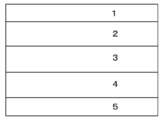
- FIG. 2 is a cross-sectional view showing an example of the hard coat laminated film of the present invention.
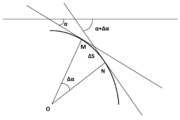
- FIG. 3 is a diagram illustrating the radius of curvature.
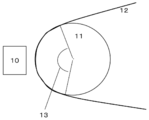
- FIG. 4 is a conceptual diagram of the film forming apparatus used in the examples.
- FIG. 5 is a conceptual diagram of the ultraviolet irradiation device used in the examples.
- film is used interchangeably or interchangeably with “sheet”.
- sheet is used for what can be rolled up in a roll form industrially.
- plate is used for those that cannot be rolled up industrially in roll form.
- resin is used as a term including a resin mixture containing two or more kinds of resins and a resin composition containing components other than resins.
- laminating a certain layer and another layer in order means directly laminating those layers and interposing one or more other layers such as an anchor coat between these layers. And laminating both.
- the term “above” relating to a numerical range is used in the meaning of a certain numerical value or a certain numerical value. For example, 20% or more means 20% or more than 20%.
- the term “below” relating to a numerical range is used to mean a certain numerical value or less than a certain numerical value. For example, 20% or less means 20% or less than 20%.
- the symbol “ ⁇ ” in a numerical range is used to mean a certain numerical value, a certain numerical value and less than a certain other numerical value, or another certain numerical value.
- 10-90% means 10%, more than 10% and less than 90%, or 90%.
- the hard coat laminated film of this invention has a 1st hard coat and the layer of a transparent resin film in order from the surface layer side.
- the “surface layer side” refers to the outer surface (display surface when used in an image display device) when an article formed from a hard coat laminated film having a multilayer structure is used in the field. It means close.
- the first hard coat usually forms the surface of the hard coat laminated film of the present invention.
- the first hard coat forms a touch surface when the hard coat laminated film of the present invention is used as a display face plate of an image display device having a touch panel function.
- the first hard coat exhibits good scratch resistance and functions to prevent scratches even when repeatedly rubbed with steel wool or the like.
- the first hard coat comprises (A) a copolymer of (a1) a polyfunctional (meth) acrylate and (a2) a compound having two or more thiol groups in one molecule (polyfunctional thiol), and (B ) It is formed from a paint containing a water repellent and no inorganic particles.
- the first hard coat is preferably (A) (a1) 100 parts by mass of a copolymer of a polyfunctional (meth) acrylate and (a2) a compound having two or more thiol groups in one molecule, and (B ) It is formed of a paint containing 0.01 to 7 parts by mass of a water repellent and not containing inorganic particles.
- Inorganic particles for example, silica (silicon dioxide); metal oxide particles such as aluminum oxide, zirconia, titania, zinc oxide, germanium oxide, indium oxide, tin oxide, indium tin oxide, antimony oxide, and cerium oxide; fluorination Metal fluoride particles such as magnesium and sodium fluoride; metal sulfide particles; metal nitride particles; and metal particles
- silica silicon dioxide
- metal oxide particles such as aluminum oxide, zirconia, titania, zinc oxide, germanium oxide, indium oxide, tin oxide, indium tin oxide, antimony oxide, and cerium oxide
- fluorination Metal fluoride particles such as magnesium and sodium fluoride
- metal sulfide particles metal nitride particles
- metal particles are highly effective in increasing the hardness of the hard coat.
- the interaction with the resin component such as the above component (A) is weak, which causes the scratch resistance of the hard coat laminated film to be insufficient. Therefore, in the present invention, the
- does not contain inorganic particles means that it does not contain a significant amount of inorganic particles.
- the significant amount of inorganic particles is usually about 1 part by mass or more with respect to 100 parts by mass of the copolymer of component (A). Therefore, “does not contain” inorganic particles means that the amount of inorganic particles is usually 0 parts by mass or more and less than 1 part by mass, preferably 0.5 parts by mass with respect to 100 parts by mass of the copolymer of component (A).
- it can be paraphrased more preferably as 0.1 parts by mass or less, and still more preferably as 0.01 parts by mass or less.
- (A) (a1) Copolymer of polyfunctional (meth) acrylate and (a2) polyfunctional thiol
- the copolymer of component (A) is composed of (a1) polyfunctional (meth) acrylate and (a2) polyfunctional. It is formed from thiol. Since both the component (a1) and the component (a2) are polyfunctional monomers, the component (A) is usually a copolymer having a highly branched structure, a so-called dendrimer structure.
- (meth) acrylate means acrylate or methacrylate.
- the copolymer of the component (A) functions to form a hard coat by being polymerized and cured by an active energy ray such as an ultraviolet ray or an electron beam.
- the component (a1) polyfunctional (meth) acrylate is a (meth) acrylate having two or more (meth) acryloyl groups in one molecule.
- the number of (meth) acryloyl groups in one molecule of the component (a1) is preferably 3 or more, more preferably from the viewpoint of making the copolymer of the component (A) have a so-called dendrimer structure. May be 4 or more, more preferably 5 or more.
- the number of (meth) acryloyl groups in one molecule is usually 20 or less, preferably 12 or less, from the viewpoint of crack resistance.
- polyfunctional (meth) acrylate for example, diethylene glycol di (meth) acrylate, neopentyl glycol di (meth) acrylate, 1,6-hexanediol di (meth) acrylate, polyethylene Glycol di (meth) acrylate, 2,2′-bis (4- (meth) acryloyloxypolyethyleneoxyphenyl) propane, 2,2′-bis (4- (meth) acryloyloxypolypropyleneoxyphenyl) propane, etc.
- diethylene glycol di (meth) acrylate for example, diethylene glycol di (meth) acrylate, neopentyl glycol di (meth) acrylate, 1,6-hexanediol di (meth) acrylate, polyethylene Glycol di (meth) acrylate, 2,2′-bis (4- (meth) acryloyloxypolyethyleneoxyphenyl) propane, 2,2′-bis (4- (meth
- (Meth) acryloyl group-containing bifunctional reactive monomers (meth) acryloyl such as trimethylolpropane tri (meth) acrylate, trimethylolethane tri (meth) acrylate, and ethoxylated trimethylolpropane tri (meth) acrylate -Containing trifunctional reactive monomer; (meth) acryloyl group-containing tetrafunctional reactive monomer such as ditrimethylolpropane tetra (meth) acrylate and pentaerythritol tetramethacrylate; (meth) acryloyl group-containing hexafunctional such as dipentaerythritol hexaacrylate Examples include reactive monomers; (meth) acryloyl group-containing octafunctional reactive monomers such as tripentaerythritol octaacrylate; and polymers (oligomers and prepolymers) containing one or more of these
- the component (a1) polyfunctional (meth) acrylate for example, polyurethane (meth) acrylate, polyester (meth) acrylate, polyacryl (meth) acrylate, polyepoxy (meth) acrylate, polyalkylene glycol Examples thereof include prepolymers or oligomers such as poly (meth) acrylate and polyether (meth) acrylate, which have two or more (meth) acryloyl groups in one molecule.
- these 1 type, or 2 or more types of mixtures can be used.
- the component (a2) polyfunctional thiol is a compound having two or more thiol groups in one molecule.
- the number of thiol groups in one molecule of the component (a2) is preferably 3 or more, more preferably 4 from the viewpoint of making the copolymer of the component (A) have a so-called dendrimer structure. It may be above.
- the number of thiol groups in one molecule may be usually 20 or less, preferably 12 or less, from the viewpoint of crack resistance of the hard coat laminated film.
- the thiol group of the component (a2) polyfunctional thiol is preferably a secondary thiol group from the viewpoint of the balance between reactivity and handleability.
- the component (a2) polyfunctional thiol has one or more polymerizable functional groups other than thiol groups such as (meth) acryloyl group, vinyl group, epoxy group, and isocyanate group in one molecule. There may be.
- a compound having two or more thiol groups in one molecule and having two or more (meth) acryloyl groups is the component (a2) and not the component (a1).
- Examples of the component (a2) polyfunctional thiol include 1,2-ethanedithiol, ethylene glycol bis (3-mercaptopropionate), diethylene glycol bis (3-mercaptopropionate), 1,4-bis (3 -Compounds having two thiol groups in one molecule such as mercaptobutyryloxy) butane and tetraethylene glycol bis (3-mercaptopropionate); 1,3,5-tris (3-mercaptobutyryloxy) Ethyl) -1,3,5-triazine-2,4,6 (1H, 3H, 5H) -trione, trimethylolpropane tris (3-mercaptobutyrate), trimethylolethane tris (3-mercaptobutyrate), And tris [(3-mercaptopropionyloxy) ethyl] isocyanurate Compounds having three thiol groups in the molecule; compounds having four thiol groups in one molecule such as pentaerythritol
- the copolymer of the component (A) contains a constituent unit derived from a monomer copolymerizable with the component (a1) and the component (a2) in addition to the component (a1) and the component (a2) as long as the object of the present invention is not adversely affected. It may be.
- the copolymerizable monomer is usually a compound having a carbon / carbon double bond, and typically a compound having an ethylenic double bond.
- the content of the structural unit derived from the component (a1) polyfunctional (meth) acrylate in the copolymer of the component (A) (hereinafter sometimes abbreviated as (a1) content) is the polymerizable monomer.
- (a1) content is the polymerizable monomer.
- it may be 50 mol% or more, preferably 60 mol% or more, more preferably 70 mol% or more, still more preferably 80 mol% or more.
- the content of (a1) is from the viewpoint of making the copolymer structure of the component (A) have a so-called dendrimer structure, and from the viewpoint of crack resistance and handling properties of the hard coat laminated film to be formed.
- it may be 99 mol% or less, preferably 97 mol% or less, more preferably 95 mol% or less, and still more preferably 93 mol% or less.
- the content of (a1) is usually 50 mol% or more and 99 mol% or less, preferably 50 mol% or more and 97 mol% or less, with the total of structural units derived from the polymerizable monomer being 100 mol%, 50 mol% to 95 mol%, 50 mol% to 93 mol%, 60 mol% to 99 mol%, 60 mol% to 97 mol%, 60 mol% to 95 mol%, 60 mol% to 93 mol Mol% or less, 70 mol% or more and 99 mol% or less, 70 mol% or more and 97 mol% or less, 70 mol% or more and 95 mol% or less, 70 mol% or more and 93 mol% or less, 80 mol% or more and 99 mol% or less, 80 It may be from mol% to 97 mol%, from 80 mol% to 95 mol%, or from 80 mol% to 93 mol%.
- the content of the structural unit derived from the component (a2) polyfunctional thiol in the copolymer of the component (A) (hereinafter sometimes abbreviated as (a2) content) is derived from the polymerizable monomer. From the viewpoint of making the structure of the component (A) have a so-called dendrimer structure, with the total unit being 100 mol%, and from the viewpoint of crack resistance and handling properties of the hard coat laminated film to be formed, it is usually 1 mol%.
- the content may be 3 mol% or more, more preferably 5 mol% or more, and even more preferably 7 mol% or more.
- the content of (a2) is usually 50 mol from the viewpoint of making the copolymer of the component (A) have a so-called dendrimer structure and from the viewpoint of scratch resistance of the hard coat laminated film to be formed. % Or less, preferably 40 mol% or less, more preferably 30 mol% or less, still more preferably 20 mol% or less.
- the content of (a2) is usually 1 mol% or more and 50 mol% or less, preferably 1 mol% or more and 40 mol% or less, with the total of structural units derived from the polymerizable monomer being 100 mol%, 1 mol% to 30 mol%, 1 mol% to 20 mol%, 3 mol% to 50 mol%, 3 mol% to 40 mol%, 3 mol% to 30 mol%, 3 mol% to 20 Mol% or less, 5 mol% or more and 50 mol% or less, 5 mol% or more and 40 mol% or less, 5 mol% or more and 30 mol% or less, 5 mol% or more and 20 mol% or less, 7 mol% or more and 50 mol% or less, 7 It may be from mol% to 40 mol%, from 7 mol% to 30 mol%, or from 7 mol% to 20 mol%.
- the sum of the content (a1) and the content (a2) is usually 80 mol% or more, preferably 90 mol% or more, with the total of structural units derived from the polymerizable monomer being 100 mol%. Preferably it is 95 mol% or more, More preferably, it may be 99 mol% or more and 100 mol% or less.
- the “polymerizable monomer” means the component (a1), the component (a2), and a monomer copolymerizable therewith.
- the copolymerizable monomer is usually a compound having a carbon / carbon double bond, and typically a compound having an ethylenic double bond.
- the sulfur content in the copolymer of the component (A) is usually 0.1 to 12% by mass, preferably 0.5 to 10% by mass, from the viewpoint of setting the content (a2) to the above-mentioned preferable range. More preferably, it may be 1 to 7% by mass, and still more preferably 1.5 to 5% by mass. In one embodiment, the sulfur content is 0.1-10 wt%, 0.1-7 wt%, 0.1-5 wt%, 0.5-12 wt%, 0.5-7 wt%, 0.5-5% by mass, 1-12% by mass, 1-10% by mass, 1-5% by mass, 1.5-12% by mass, 1.5-10% by mass, or 1.5-7% by mass It may be.
- the sulfur content was filtered using a microwave device after ashing (wet decomposition) of the sample using a mixed acid of nitric acid and hydrochloric acid (volume ratio 8: 2), and then adding an aqueous hydrochloric acid solution.
- the measurement sample obtained by measuring the volume of the filtrate with purified water is a value measured by atomic absorption spectrometry.
- yttrium was used as an internal standard.
- sulfur should be prevented because it binds to iron and the like and precipitates easily.
- the measurement of the sulfur content by atomic absorption spectrometry was specifically performed according to the following procedure.
- the polytetrafluoroethylene ashing container was allowed to stand until the temperature inside the ashing container reached room temperature, and then degassed for the second time.
- the pressure was increased to 400 PSI at a power of 40 PSI and a temperature of 130 ° C. over 10 minutes, held for 3 minutes, and then increased to a pressure of 60 PSI at a power of 400 P and a temperature of 150 ° C. over 10 minutes.
- the temperature is raised and held for 5 minutes, then the pressure is raised to 400 PSI at a pressure of 100 PSI and a temperature of 160 ° C. over 10 minutes.
- the pressure is raised to a pressure of 250 PSI and a temperature of 180 ° C. over 10 minutes.
- the temperature was raised and held for 3 minutes, and then the temperature was raised to a pressure of 550 PSI at a power of 400 W and a temperature of 200 ° C. over 10 minutes, and maintained for 7 minutes.
- the second heat treatment was performed under the condition that the pressure was raised to a pressure of 600 PSI at a power of 400 W and a temperature of 230 ° C. over 20 minutes and held for 10 minutes.
- 10 mL of a 1: 1 hydrochloric acid aqueous solution of hydrochloric acid for atomic absorption analysis and purified water from Kanto Chemical Co., Inc. was added, mixed, and allowed to stand at room temperature for 6 hours. Filtration was performed using “filter paper No.
- GPC curve Differential molecular weight distribution curve measured by gel permeation chromatography (hereinafter abbreviated as GPC) of the copolymer of component (A) using tetrahydrofuran as the mobile phase.
- Mw weight average molecular weight calculated in terms of polystyrene is preferably 5,000 or more, more preferably 8,000 or more, and still more preferably. May be 10,000 or more.
- the mass average molecular weight (Mw) is preferably 200,000 or less, more preferably 100,000 or less, and further preferably 50,000 or less. It may be.
- the mass average molecular weight (Mw) of the copolymer of the component (A) is preferably 5,000 to 200,000, more preferably 5,000 to 100,000, 5,000 to 50,000, It may be 8,000 to 200,000, 8,000 to 100,000, 8,000 to 50,000, 10,000 to 200,000, 10,000 to 100,000, or 10,000 to 50,000.
- the polystyrene-equivalent Z-average molecular weight (Mz) determined from the GPC curve of the copolymer of component (A) is the scratch resistance and crack resistance of the hard coat laminated film to be formed. From the viewpoint of balance, it may be preferably 5,000 or more, more preferably 10,000 or more, and still more preferably 30,000 or more. On the other hand, from the viewpoint of the coating property of the paint containing the copolymer of the component (A), the Z average molecular weight (Mz) is preferably 200,000 or less, more preferably 150,000 or less, and further preferably 120,000 or less. It may be.
- the Z average molecular weight (Mz) of the copolymer of the component (A) is preferably 5,000 to 200,000, more preferably 5,000 to 150,000, 5,000 to 120,000, It may be 10,000 or more and 200,000 or less, 10,000 or more and 150,000 or less, 10,000 or more and 120,000 or less, 30,000 or more and 200,000 or less, 30,000 or more and 150,000 or less, or 30,000 or more and 120,000 or less.
- GPC measurement uses Tosoh Corporation's high-performance liquid chromatography system “HLC-8320” (trade name) (a system that includes a degasser, liquid feed pump, autosampler, column oven, and RI (differential refractive index) detector).
- HLC-8320 high-performance liquid chromatography system
- GPC column Shodex's GPC columns “KF-806L” (trade name), 2 pieces, “KF-802” (trade name) and “KF-801” (trade name), one each Four tubes are connected in the order of KF-806L, KF-806L, KF-802, and KF-801 from the upstream side; tetrahydrofuran for high-performance liquid chromatograph manufactured by Wako Pure Chemical Industries, Ltd.
- flow rate 1.0 ml / min, column temperature 40 ° C., sample concentration 1 mg / ml, and sample injection volume 00 can be carried out under the conditions of a micro liter.
- the elution amount in each holding volume can be determined from the detection amount of the RI detector, assuming that the refractive index of the measurement sample does not depend on the molecular weight.
- the calibration curve from the retention capacity to the polystyrene-converted molecular weight is the standard polystyrene “EasiCal PS-1” (trade name) (Plain A molecular weight 6335000, 573000, 117000, 31500, 3480; Agilent Technology, Inc .; The molecular weight of Plain B 2517000, 270600, 71800, 10750, 705) can be used.
- the analysis program can use “TOSOH HLC-8320GPC EcoSEC” (trade name) manufactured by Tosoh Corporation.
- FIG. 1 shows a differential molecular weight distribution curve of a copolymer of the following component (A-1) used in the examples.
- A-1 the following component used in the examples.
- Three distinct peaks are observed in a relatively low molecular weight region, and the polystyrene equivalent molecular weights at the peak top positions are 340, 570, and 970 in order from the low molecular weight side.
- a plurality of overlapping and broad peaks are observed on the high molecular weight side from these three peaks, and the polystyrene equivalent molecular weight of the highest molecular weight component is recognized to be about 200,000.
- the overall mass average molecular weight is 12,000, the number average molecular weight is 940, and the Z average molecular weight is 73,000.
- the component (B) water-repellent agent functions to improve the scratch resistance, slipping property, dirt adhesion prevention property, and dirt wiping property of the hard coat laminated film to be formed.
- water repellent examples include wax-based water repellents such as paraffin wax, polyethylene wax, and acrylic / ethylene copolymer wax; silicon-based water repellents such as silicon oil, silicon resin, polydimethylsiloxane, and alkylalkoxysilane. Agents; fluorine-containing water repellents such as fluoropolyether water repellents and fluoropolyalkyl water repellents.
- the component (B) water repellent is preferably a fluorine-containing water repellent from the viewpoint of the scratch resistance and water repellent performance of the hard coat laminated film to be formed.
- the component (B) water-repellent agent the hard coat laminated film formed has scratch resistance, water-repellent performance, and the above-mentioned component (B) is chemically bonded to or strongly interacted with the copolymer of component (A).
- the water-repellent agent containing a (meth) acryloyl group and containing a (meth) acryloyl group (hereinafter referred to as “(meth) acryloyl group-containing)” It may be abbreviated as “fluorinated water repellent”).
- the (meth) acryloyl group-containing fluorine-based water repellent has one or more (meth) acryloyl groups in the molecule and one or more, preferably three or more, more preferably five in the molecule.
- a compound having the above fluorine-carbon bond (typically, a structure in which one or two or more hydrogen atoms of an organic functional group such as a hydrocarbon group are substituted with fluorine atoms).
- Examples of the (meth) acryloyl group-containing fluorine-based water repellent include (meth) acryloyl group-containing fluoroether-based water repellent, (meth) acryloyl group-containing fluoroalkyl-based water repellent, and (meth) acryloyl group-containing fluorophore.
- the component (B) water repellent includes a water repellent (hereinafter referred to as a (meth) acryloyl group-containing fluoropolyether water repellent) containing a compound containing a (meth) acryloyl group and a fluoropolyether group in the molecule. Is abbreviated).
- the chemical bond or interaction of the said component (B) and the copolymer of the said component (A) is adjusted suitably, and transparency of the hard coat laminated
- the most suitable mixture is an acryloyl group-containing fluoropolyether water repellent and a methacryloyl group-containing fluoropolyether water repellent. preferable.
- component (B) water repellent one or a mixture of two or more thereof can be used.
- the (meth) acryloyl group-containing fluorine-based water repellent is clearly distinguished from the component (a1) in that it has one or more fluorine / carbon bonds in the molecule.
- a compound containing two or more (meth) acryloyl groups in one molecule and having one or more fluorine / carbon bonds in the molecule is the component (B).
- the (meth) acryloyl group-containing fluoropolyether water repellent is clearly distinguished from the component (a1) in that it contains a fluoropolyether group in the molecule.
- the compound containing two or more (meth) acryloyl groups in one molecule and containing a fluoropolyether group is the component (B).
- the blending amount of the component (B) water repellent in the first hard coat forming coating is appropriately determined from the viewpoint of improving the scratch resistance of the hard coat laminated film to be formed, in particular, the property (i). Can be determined.
- the amount of the component (B) water repellent is usually 7 parts by mass or less, preferably 100 parts by mass of the component (A) from the viewpoint of preventing troubles such as bleeding out of the component (B). May be 4 parts by mass or less, more preferably 2 parts by mass or less.
- the amount of the component (B) water repellent is usually 0.01 parts by mass or more, preferably 0.05 parts by mass or more, more preferably 0, from the viewpoint of obtaining the use effect of the component (B).
- the amount of the component (B) water repellent is usually 0.01 to 7 parts by mass, preferably 0.01 to 4 parts by mass, 0.01 to 2 parts by mass. 0.05 parts by mass or more and 7 parts by mass or less, 0.05 parts by mass or more and 4 parts by mass or less, 0.05 parts by mass or more and 2 parts by mass or less, 0.1 parts by mass or more and 7 parts by mass or less, 0.1 parts by mass To 4 parts by mass, 0.1 to 2 parts by mass, 0.2 to 7 parts by mass, 0.2 to 4 parts by mass, or 2 to 2 parts by mass It may be the following.
- the first hard coat forming coating composition includes a compound having two or more isocyanate groups (—N ⁇ C ⁇ O) in one molecule and / or photopolymerization from the viewpoint of improving curability by active energy rays. It is preferable to further include an initiator.
- Examples of the compound having two or more isocyanate groups in one molecule include methylene bis-4-cyclohexyl isocyanate; a trimethylolpropane adduct of tolylene diisocyanate, a trimethylolpropane adduct of hexamethylene diisocyanate, and a trimethylolpropane adduct of isophorone diisocyanate.
- Polyisocyanates such as methylolpropane adduct, isocyanurate of tolylene diisocyanate, isocyanurate of hexamethylene diisocyanate, isocyanurate of isophorone diisocyanate, biuret of hexamethylene diisocyanate; and block isocyanates of the above polyisocyanates, etc.
- examples thereof include a urethane cross-linking agent.
- the compound having two or more isocyanate groups in one molecule one or a mixture of two or more thereof can be used.
- a catalyst such as dibutyltin dilaurate or dibutyltin diethylhexoate may be added as necessary.
- photopolymerization initiator examples include benzophenone, methyl-o-benzoylbenzoate, 4-methylbenzophenone, 4,4′-bis (diethylamino) benzophenone, methyl o-benzoylbenzoate, 4-phenylbenzophenone, 4-benzoyl.
- Benzophenone compounds such as -4'-methyldiphenyl sulfide, 3,3 ', 4,4'-tetra (tert-butylperoxycarbonyl) benzophenone, 2,4,6-trimethylbenzophenone; benzoin, benzoin methyl ether, benzoin Benzoin compounds such as ethyl ether, benzoin isopropyl ether, benzyl methyl ketal; acetophenone, 2,2-dimethoxy-2-phenylacetophenone, 1-hydroxycyclohexyl phenyl ketone Acetophenone compounds; methylanthraquinone, 2-ethylanthraquinone, 2-amylanthraquinone and other anthraquinone compounds; thioxanthone, 2,4-diethylthioxanthone, thioxanthone compounds such as 2,4-diisopropylthioxanthone; alkyl such as
- acetophenone photopolymerization initiators such as 1-hydroxy-cyclohexyl-phenylketone and 2-hydroxy-1- ⁇ 4- [4- (2-hydroxy-2-methyl-) are used. It is preferred to use in combination with propionyl) -benzyl] phenyl ⁇ -2-methyl-propan-1-one. Thereby, it can fully harden, suppressing coloring of a hard coat.
- the first hard coat-forming coating material includes, as desired, an antistatic agent, a surfactant, a leveling agent, a thixotropic agent, a stain-preventing agent, a printability improving agent, an antioxidant, a weathering stabilizer, One or more additives such as a light resistance stabilizer, an ultraviolet absorber, a heat stabilizer, organic particles, and an organic colorant may be included.
- the first hard coat-forming coating material may contain a solvent as desired in order to dilute to a concentration that facilitates coating. If the said solvent does not react with the said component (A), the said component (B), and other arbitrary components, or does not catalyze (promote) the self-reaction (including deterioration reaction) of these components, There is no particular limitation.
- the solvent include 1-methoxy-2-propanol, ethyl acetate, n-butyl acetate, toluene, methyl ethyl ketone, methyl isobutyl ketone, diacetone alcohol, and acetone. As said solvent, these 1 type, or 2 or more types of mixtures can be used.
- the first hard coat forming paint can be obtained by mixing and stirring these components.
- the method for forming the first hard coat using the first hard coat forming paint is not particularly limited, and a known web coating method can be used. Examples of the method include methods such as roll coating, gravure coating, reverse coating, roll brushing, dip coating, spray coating, spin coating, air knife coating, and die coating.
- the thickness of the first hard coat is usually 5 ⁇ m or more, preferably 8 ⁇ m or more, more preferably from the viewpoint of the scratch resistance of the hard coat laminated film to be formed, particularly the viewpoint of satisfying the above characteristic (i) and the surface hardness. It may be 10 ⁇ m or more, more preferably 12 ⁇ m or more. On the other hand, the thickness of the first hard coat is usually 60 ⁇ m or less, preferably 30 ⁇ m or less, more preferably from the viewpoint of maintaining good bending resistance of the hard coat laminated film of the present invention and allowing easy handling as a film roll. May be 25 ⁇ m or less, more preferably 20 ⁇ m or less.
- the thickness of the first hard coat is usually 5 ⁇ m to 60 ⁇ m, preferably 5 ⁇ m to 30 ⁇ m, 5 ⁇ m to 25 ⁇ m, 5 ⁇ m to 20 ⁇ m, 8 ⁇ m to 60 ⁇ m, 8 ⁇ m to 30 ⁇ m, 8 ⁇ m or more. 25 ⁇ m or less, 8 ⁇ m to 20 ⁇ m, 10 ⁇ m to 60 ⁇ m, 10 ⁇ m to 30 ⁇ m, 10 ⁇ m to 25 ⁇ m, 10 ⁇ m to 20 ⁇ m, 12 ⁇ m to 60 ⁇ m, 12 ⁇ m to 30 ⁇ m, 12 ⁇ m to 25 ⁇ m, or 12 ⁇ m to 20 ⁇ m It's okay.
- the hard coat laminated film of the present invention preferably has a first hard coat, a transparent resin film layer, and a second hard coat in order from the surface layer side.
- a first hard coat a transparent resin film layer
- a second hard coat in order from the surface layer side.
- the second hard coat is not particularly limited, and can be formed by any method using any paint.
- the second hard coat is preferably a co-polymer of (A) (a1) polyfunctional (meth) acrylate and (a2) a compound having two or more thiol groups in one molecule. Formed from paint containing coalescence.
- the second hard coat is more preferably (A) a copolymer of (a1) polyfunctional (meth) acrylate and (a2) a compound having two or more thiol groups in one molecule, and (C) leveling. It is formed from a paint containing an agent.
- the second hard coat is more preferably 100 parts by mass of a copolymer of (A) (a1) polyfunctional (meth) acrylate and (a2) a compound having two or more thiol groups in one molecule, and ( C) It is formed from a paint containing 0.01 to 10 parts by weight of a leveling agent.
- copolymer of the above component (A) those described above in the description of the first hard coat forming paint can be used.
- these 1 type, or 2 or more types of mixtures can be used.
- the copolymer of component (A) is more preferably the same as that used for the first hard coat forming coating material from the viewpoint of curling resistance.
- (C) Leveling agent It is preferable that a leveling agent is included in the coating material for forming the second hard coat from the viewpoint of making the surface of the second hard coat smooth.
- the leveling agent examples include acrylic leveling agents, silicon leveling agents, fluorine leveling agents, silicon / acrylic copolymer leveling agents, fluorine-modified acrylic leveling agents, fluorine-modified silicon leveling agents, and functionalities thereof.
- a leveling agent having a group introduced therein for example, alkoxy group such as methoxy group, ethoxy group, acyloxy group, halogen group, amino group, vinyl group, epoxy group, methacryloxy group, acryloxy group, and isocyanate group.
- the component (C) leveling agent an acrylic leveling agent and a silicon / acrylic copolymer leveling agent are preferable from the viewpoint of printability.
- these 1 type, or 2 or more types of mixtures can be used.
- the amount of the component (C) leveling agent is usually 0.01 parts by mass with respect to 100 parts by mass of the copolymer of the component (A) from the viewpoint of smoothening the surface of the second hard coat. As mentioned above, Preferably it may be 0.1 mass part or more, More preferably, it may be 0.2 mass part or more. On the other hand, from the viewpoint of preventing troubles such as bleeding out of the component (C) leveling agent, the blending amount is usually 10 parts by mass or less, preferably 7 parts by mass or less, more preferably 4 parts by mass or less, and still more preferably. It may be 2 parts by mass or less.
- the compounding quantity of the said component (C) leveling agent is 0.01 mass part or more and 10 mass parts or less normally, Preferably, 0.01 mass part or more and 7 mass parts or less, 0.01 mass part or more 4 Part by mass, 0.01 part by mass or more and 2 parts by mass or less, 0.1 part by mass or more and 10 parts by mass or less, 0.1 part by mass or more and 7 parts by mass or less, 0.1 part by mass or more and 4 parts by mass or less, 1 to 2 parts by mass, 0.2 to 10 parts by mass, 0.2 to 7 parts by mass, 0.2 to 4 parts by mass, or 0.2 to 2 parts by mass It may be below mass parts.
- the second hard coat-forming coating material has a compound having two or more isocyanate groups (—N ⁇ C ⁇ O) in one molecule and / or photopolymerization. It is preferable to further include an initiator.
- the compound having two or more isocyanate groups in one molecule those described above in the description of the first hard coat forming paint can be used.
- the compound having two or more isocyanate groups in one molecule one or a mixture of two or more thereof can be used.
- photopolymerization initiator those described above in the description of the first hard coat forming paint can be used.
- photopolymerization initiator one or a mixture of two or more of these can be used.
- an antistatic agent for the second hard coat forming coating, an antistatic agent, a surfactant, a thixotropic agent, a stain inhibitor, a printability improver, an antioxidant, a weather resistance stabilizer, and a light resistance stability are optionally added.
- One or more additives such as an agent, an ultraviolet absorber, a heat stabilizer, a colorant, inorganic particles, and organic particles can be included.
- the second hard coat-forming coating material may contain a solvent as desired in order to dilute to a concentration that is easy to apply. If the said solvent does not react with the said component (A), the said component (C), and other arbitrary components, or does not catalyze (promote) the self-reaction (including deterioration reaction) of these components, There is no particular limitation.
- the solvent include 1-methoxy-2-propanol, ethyl acetate, n-butyl acetate, toluene, methyl ethyl ketone, methyl isobutyl ketone, diacetone alcohol, and acetone. As said solvent, these 1 type, or 2 or more types of mixtures can be used.
- the second hard coat forming paint can be obtained by mixing and stirring these components.
- the method for forming the second hard coat using the second hard coat forming paint is not particularly limited, and a known web coating method can be used. Examples of the method include methods such as roll coating, gravure coating, reverse coating, roll brushing, dip coating, spray coating, spin coating, air knife coating, and die coating.
- the thickness of the second hard coat is not particularly limited, but may be usually 60 ⁇ m or less, preferably 30 ⁇ m or less, more preferably 25 ⁇ m or less, and even more preferably 20 ⁇ m or less from the viewpoint of bending resistance.
- the thickness of the second hard coat is usually 5 ⁇ m or more, preferably 8 ⁇ m or more, more preferably 10 ⁇ m or more, and further preferably 12 ⁇ m or more, from the viewpoint of suppressing the curling force.
- the thickness of the second hard coat is usually 5 ⁇ m to 60 ⁇ m, preferably 5 ⁇ m to 30 ⁇ m, 5 ⁇ m to 25 ⁇ m, 5 ⁇ m to 20 ⁇ m, 8 ⁇ m to 60 ⁇ m, 8 ⁇ m to 30 ⁇ m, 8 ⁇ m or more. 25 ⁇ m or less, 8 ⁇ m to 20 ⁇ m, 10 ⁇ m to 60 ⁇ m, 10 ⁇ m to 30 ⁇ m, 10 ⁇ m to 25 ⁇ m, 10 ⁇ m to 20 ⁇ m, 12 ⁇ m to 60 ⁇ m, 12 ⁇ m to 30 ⁇ m, 12 ⁇ m to 25 ⁇ m, or 12 ⁇ m to 20 ⁇ m It's okay.
- the thickness of the second hard coat may be the same as that of the first hard coat from the viewpoint of curl resistance of the hard coat laminated film.
- the“ same thickness ” should not be interpreted as completely the same thickness in a physicochemically strict sense.
- the thickness should be construed as the same thickness within the range of process / quality control that is usually performed in industry. This is because the curl resistance of the hard coat laminated film can be kept good if the thickness is the same within the range of the amplitude of the process and quality control that are usually performed industrially.
- the thickness of the hard coat (after curing) is usually controlled in the process and quality with a width of about ⁇ 0.5 to +0.5 ⁇ m. For example, when the set thickness is 10.5 ⁇ m, the thickness is 10 ⁇ m and the thickness is 11 ⁇ m. Should be interpreted identically.
- the “same thickness” here is also referred to as “substantially the same thickness”.
- the hard coat laminated film of the present invention may preferably have a first hard coat, a third hard coat, and a transparent resin film layer in order from the surface layer side.
- the hard coat laminated film of the present invention may more preferably have a first hard coat, a third hard coat, a transparent resin film layer, and a second hard coat in order from the surface layer side.
- the third hard coat By forming the third hard coat, the surface hardness of the first hard coat can be increased.
- the third hard coat is not particularly limited, and can be formed by any method using any paint.
- (D) a coating material containing inorganic particles is preferable from the viewpoint of increasing the surface hardness of the first hard coat.
- the paint for forming the third hard coat is more preferably a paint containing (F) an active energy ray-curable resin and (D) inorganic particles.
- containing inorganic particles means that the particles contain a significant amount of inorganic particles to increase the hardness of the hard coat.
- a significant amount of inorganic particles for increasing the hardness of the hard coat is usually about 5 parts by mass or more with respect to 100 parts by mass of the resin component of the paint. Therefore, “containing” the component (D) inorganic particles means that the amount of the inorganic particles is usually 5 parts by mass or more, preferably 30 parts by mass or more, more preferably 50 parts by mass with respect to 100 parts by mass of the resin component of the paint. In other words, more preferably 80 parts by mass or more, still more preferably 100 parts by mass or more, and most preferably 120 parts by mass or more.
- the upper limit of the amount of the component (D) inorganic particles is not particularly limited.
- the amount is usually 1000 parts by mass or less, preferably 500 parts by mass or less, and more preferably 300 parts by mass with respect to 100 parts by mass of the resin component of the paint. Part or less.
- the amount of the component (D) inorganic particles is usually 5 parts by mass or more and 1000 parts by mass or less, preferably 5 parts by mass or more and 500 parts by mass or less, 5 parts by mass with respect to 100 parts by mass of the resin component of the paint.
- Part by mass to 300 parts by mass, 30 parts by mass to 1000 parts by mass, 30 parts by mass to 500 parts by mass, 30 parts by mass to 300 parts by mass, 50 parts by mass to 1000 parts by mass, 50 parts by mass to 500 parts by mass. 50 to 300 parts by mass, 80 to 1000 parts by mass, 80 to 500 parts by mass, 80 to 300 parts by mass, 100 to 1000 parts by mass, 100 parts by mass 500 parts by weight or less, 100 parts by weight or more and 300 parts by weight or less, 120 parts by weight or more and 1000 parts by weight or less, 120 parts by weight or more and 500 parts by weight or less, or 1 0 may be at mass parts to 300 parts by weight.
- the component (F) active energy ray-curable resin functions to form a hard coat by being polymerized and cured by active energy rays such as ultraviolet rays and electron beams.
- component (F) active energy ray-curable resin examples include polyfunctional (meth) acrylates, polyfunctional thiols, monomers copolymerizable therewith, and polymers containing one or more of these as constituent monomers (pre-polymers). Polymer or oligomer). Examples of the polymer include a copolymer of a polyfunctional (meth) acrylate and a polyfunctional thiol.
- polyfunctional (meth) acrylate those described above as the component (a1) in the description of the first hard coat-forming coating material can be used.
- polyfunctional thiol what was mentioned above as a component (a2) in description of the coating material for 1st hard-coat formation can be used.
- Examples of the monomer copolymerizable with these include, for example, methyl (meth) acrylate, ethyl (meth) acrylate, n-butyl (meth) acrylate, hexyl (meth) acrylate, 2-ethylhexyl (meth) acrylate, lauryl (meth) ) Acrylate, isobornyl (meth) acrylate, dicyclopentenyl (meth) acrylate, dicyclopentenyloxyethyl (meth) acrylate, phenyl (meth) acrylate, phenyl cellosolve (meth) acrylate, 2-methoxyethyl (meth) acrylate, Hydroxyethyl (meth) acrylate, hydroxypropyl (meth) acrylate, 2-acryloyloxyethyl hydrogen phthalate, dimethylaminoethyl (meth) acrylate, trifluoroethy
- component (F) one or a mixture of two or more of these can be used.
- (meth) acrylate means acrylate or methacrylate.
- the component (D) inorganic particles serve to dramatically increase the hardness of the hard coat laminated film of the present invention.
- the inorganic particles include silica (silicon dioxide); metal oxide particles such as aluminum oxide, zirconia, titania, zinc oxide, germanium oxide, indium oxide, tin oxide, indium tin oxide, antimony oxide, and cerium oxide.
- Metal fluoride particles such as magnesium fluoride and sodium fluoride; metal sulfide particles; metal nitride particles; and metal particles.
- silica or aluminum oxide are preferable, and particles of silica are more preferable.
- examples of commercially available silica particles include Snowtex (trade name) manufactured by Nissan Chemical Industries, Ltd., Quartron (trade name) manufactured by Fuso Chemical Industries, Ltd., and the like.
- the surface of the inorganic particles is treated with a silane coupling agent such as vinylsilane or aminosilane; a titanate coupling agent.
- a silane coupling agent such as vinylsilane or aminosilane
- a titanate coupling agent such as aluminum oxide, aluminum oxide, magnesium oxide, magnesium oxide, magnesium oxide, magnesium oxide, magnesium oxide, magnesium oxide, magnesium oxide, magnesium oxide, etc.
- component (D) inorganic particles one kind or a mixture of two or more kinds thereof can be used.
- the average particle size of the component (D) inorganic particles is usually 300 nm or less, preferably 200 nm or less, and more preferably 120 nm or less, from the viewpoint of maintaining the transparency of the hard coat and ensuring the effect of improving the hardness. It's okay. On the other hand, there is no particular lower limit on the average particle diameter, but usually available inorganic particles are at most about 1 nm even if they are fine.
- the average particle diameter of the inorganic particles is a particle diameter in which the accumulation from the smaller particles becomes 50 mass% in the particle diameter distribution curve measured by the laser diffraction / scattering method.
- the average particle size of the inorganic particles is 50% by mass from the smaller particle size in a particle size distribution curve measured using a laser diffraction / scattering particle size analyzer “MT3200II” (trade name) manufactured by Nikkiso Co., Ltd.
- the particle diameter can be calculated as follows.
- the amount of the component (D) inorganic particles is based on 100 parts by mass of the component (F). From the viewpoint of the surface hardness of the hard coat, it may be usually 30 parts by mass or more, preferably 50 parts by mass or more, more preferably 80 parts by mass or more, still more preferably 100 parts by mass or more, and most preferably 120 parts by mass or more.
- the compounding amount of the component (D) inorganic particles is usually 300 parts by mass or less, preferably 250 parts by mass or less, more preferably 200 parts by mass or less, from the viewpoint of transparency of the hard coat.
- the compounding amount of the component (D) inorganic particles is usually 30 parts by mass or more and 300 parts by mass with respect to 100 parts by mass of the component (F) active energy ray-curable resin (when the resin is used). Parts by mass or less, preferably 30 parts by mass to 250 parts by mass, 30 parts by mass to 200 parts by mass, 50 parts by mass to 300 parts by mass, 50 parts by mass to 250 parts by mass, 50 parts by mass to 200 parts by mass 80 to 300 parts by mass, 80 to 250 parts by mass, 80 to 200 parts by mass, 100 to 300 parts by mass, 100 to 250 parts by mass, 100 parts by mass It may be 200 parts by mass or less, 120 parts by mass or more and 300 parts by mass or less, 120 parts by mass or more and 250 parts by mass or less, and 120 parts by mass or more and 200 parts by mass or less.
- the third hard coat-forming coating material further comprises (C) a leveling agent from the viewpoint of making the surface of the third hard coat smooth and facilitating the formation of the first hard coat.
- a leveling agent from the viewpoint of making the surface of the third hard coat smooth and facilitating the formation of the first hard coat.
- the component (C) leveling agent used in the third hard coat forming coating material, an acrylic leveling agent and a silicon / acrylic copolymer leveling agent are preferable.
- the component (C) these 1 type, or 2 or more types of mixtures can be used.
- the amount of the component (C) leveling agent is based on 100 parts by mass of the component (F). From the viewpoint of making the surface of the third hard coat smooth and facilitating the formation of the first hard coat, it is usually 0.01 parts by mass or more, preferably 0.1 parts by mass or more, more preferably 0.2 parts by mass. Or more. On the other hand, the blending amount of the component (C) leveling agent is usually 1 part by mass from the viewpoint of allowing the first hard coat forming coating material to be satisfactorily applied without being repelled on the third hard coat.
- the amount of the component (C) leveling agent is usually 0.01 parts by mass with respect to 100 parts by mass of the component (F) active energy ray-curable resin (when the resin is used).
- 1 part by mass or less preferably 0.01 part by mass or more and 0.6 part by mass or less, 0.01 part by mass or more and 0.4 part by mass or less, 0.1 part by mass or more and 1 part by mass or less, 0.1 part by mass Part by mass to 0.6 part by mass, 0.1 part by mass to 0.4 part by mass, 0.2 part by mass to 1 part by mass, 0.2 part by mass to 0.6 part by mass, or 0.2 part by mass It may be not less than 0.4 parts by mass.
- the third hard coat-forming coating material includes a compound having two or more isocyanate groups (—N ⁇ C ⁇ O) in one molecule and / or photopolymerization. It is preferable to further include an initiator.
- the compound having two or more isocyanate groups in one molecule those described above in the description of the first hard coat forming paint can be used.
- the compound having two or more isocyanate groups in one molecule one or a mixture of two or more thereof can be used.
- photopolymerization initiator those described above in the description of the first hard coat forming paint can be used.
- photopolymerization initiator one or a mixture of two or more of these can be used.
- an antistatic agent for the third hard coat forming coating, an antistatic agent, a surfactant, a thixotropic agent, a stain inhibitor, a printability improver, an antioxidant, a weather resistance stabilizer, and a light resistance stability are optionally added.
- One or more additives such as an agent, an ultraviolet absorber, a heat stabilizer, a colorant, and organic particles can be included.
- the third hard coat-forming coating material may contain a solvent as desired in order to dilute to a concentration that is easy to apply. If the said solvent does not react with the said component (F), the said component (D), and other arbitrary components, or does not catalyze (promote) the self-reaction (including deterioration reaction) of these components, There is no particular limitation.
- the solvent include 1-methoxy-2-propanol, ethyl acetate, n-butyl acetate, toluene, methyl ethyl ketone, methyl isobutyl ketone, diacetone alcohol, and acetone. Of these, 1-methoxy-2-propanol is preferred. As said solvent, these 1 type, or 2 or more types of mixtures can be used.
- the third hard coat forming paint can be obtained by mixing and stirring these components.
- the method for forming the third hard coat using the third hard coat forming paint is not particularly limited, and a known web coating method can be used. Examples of the method include methods such as roll coating, gravure coating, reverse coating, roll brushing, dip coating, spray coating, spin coating, air knife coating, and die coating.
- the thickness of the third hard coat is preferably 10 ⁇ m or more, more preferably 15 ⁇ m or more, from the viewpoint of the surface hardness of the hard coat laminated film.
- the thickness of the third hard coat is preferably 30 ⁇ m or less, more preferably 27 ⁇ m or less, and even more preferably 25 ⁇ m or less, from the viewpoint of curl resistance and bending resistance of the hard coat laminated film.
- the thickness of the third hard coat is preferably 10 ⁇ m to 30 ⁇ m, 10 ⁇ m to 27 ⁇ m, 10 ⁇ m to 25 ⁇ m, 15 ⁇ m to 30 ⁇ m, 15 ⁇ m to 27 ⁇ m, or 15 ⁇ m to 25 ⁇ m. Good.
- the aspect which uses the same coating material as the said 3rd hard coat formation coating material as said 2nd hard coat formation coating material is also preferable.
- the paint for forming the second hard coat in consideration of the sum of the curling force by the first hard coat and the curling force by the third hard coat, and Needless to say, the thickness should be set.
- the transparent resin film includes the first hard coat; the first hard coat and the third hard coat; the first hard coat and the second hard coat; or the first hard coat and the second hard coat. It is a layer used as a transparent film base material for forming a coat and the said 3rd hard coat on it.
- the transparent resin film is not limited except that it has high transparency, and preferably is not limited except that it has high transparency and is not colored. Any transparent resin film Can be used.
- the transparent resin film examples include cellulose ester resins such as triacetyl cellulose; polyester resins such as polyethylene terephthalate; cyclic hydrocarbon resins such as ethylene norbornene copolymers; polymethyl methacrylate, polyethyl methacrylate, And acrylic resins such as vinylcyclohexane- (meth) acrylate methyl copolymer; aromatic polycarbonate resins; polyolefin resins such as polypropylene and 4-methyl-pentene-1; polyamide resins; polyarylate resins; Examples thereof include polymer type urethane acrylate resins; and films such as polyimide resins. These films include unstretched films, uniaxially stretched films, and biaxially stretched films. Moreover, these films include the laminated film which laminated
- the thickness of the transparent resin film is not particularly limited, and can be any thickness as desired. From the viewpoint of handleability of the hard coat laminated film of the present invention, the thickness of the transparent resin film is usually 20 ⁇ m or more, preferably 50 ⁇ m or more. When the hard coat laminated film of the present invention is used as a display face plate of a touch panel, the thickness of the transparent resin film is usually 100 ⁇ m or more, preferably 200 ⁇ m or more, more preferably 300 ⁇ m or more from the viewpoint of maintaining rigidity. Good. Further, from the viewpoint of meeting the demand for thinning the apparatus, the thickness of the transparent resin film is usually 1500 ⁇ m or less, preferably 1200 ⁇ m or less, more preferably 1000 ⁇ m or less.
- the thickness of the transparent resin film is usually 250 ⁇ m or less, preferably 150 ⁇ m or less from the viewpoint of economy. It may be.
- the transparent resin film is preferably an acrylic resin transparent resin film.
- the acrylic resin include structural units derived from (meth) acrylic acid ester (co) polymers and (meth) acrylic acid esters (usually usually 50 mol% or more, preferably 65 mol% or more, more preferably Are 70 mol% or more) and copolymers thereof, and modified products thereof.
- (meth) acryl means acryl or methacryl.
- the (co) polymer means a polymer or a copolymer.
- Examples of the (meth) acrylate ester (co) polymer include poly (meth) acrylate methyl, poly (meth) acrylate ethyl, poly (meth) acrylate propyl, poly (meth) acrylate butyl, ( And (meth) methyl acrylate / (meth) butyl acrylate copolymer and (meth) ethyl acrylate / (meth) butyl acrylate copolymer.
- Examples of the copolymer mainly containing a structural unit derived from the (meth) acrylic acid ester include, for example, ethylene / methyl (meth) acrylate copolymer, styrene / methyl (meth) acrylate copolymer, vinylcyclohexane / Examples thereof include (meth) methyl acrylate copolymer, maleic anhydride / (meth) methyl acrylate copolymer, and N-substituted maleimide / (meth) methyl acrylate copolymer.
- modified substance examples include a polymer in which a lactone ring structure is introduced by an intramolecular cyclization reaction; a polymer in which glutaric anhydride is introduced by an intramolecular cyclization reaction; and an imidizing agent (for example, methyl
- an imidizing agent for example, methyl
- examples thereof include a polymer in which an imide structure is introduced by a reaction with amine, cyclohexylamine, ammonia, and the like (hereinafter referred to as poly (meth) acrylimide resin).
- acrylic resin transparent resin film examples include films of one kind or two or more kinds of resin mixtures. Moreover, these films include the laminated
- the transparent resin film is more preferably a vinyl cyclohexane / (meth) methyl acrylate copolymer film.
- this transparent resin film becomes a hard coat laminated film excellent in surface hardness, scratch resistance, transparency, surface smoothness, appearance, rigidity, and moisture resistance, and can be suitably used as a display face plate of a touch panel.
- the content of structural units derived from methyl (meth) acrylate in the vinylcyclohexane- (meth) acrylate methyl copolymer is usually 50%, with the total of structural units derived from all polymerizable monomers being 100 mol%. It may be -95 mol%, preferably 65-90 mol%, more preferably 70-85 mol%.
- polymerizable monomer means methyl (meth) acrylate, vinylcyclohexane, and a monomer copolymerizable therewith.
- the copolymerizable monomer is usually a compound having a carbon / carbon double bond, and typically a compound having an ethylenic double bond.
- the transparent resin film is more preferably a poly (meth) acrylimide resin film.
- this transparent resin film it becomes a hard coat laminated film excellent in surface hardness, scratch resistance, transparency, surface smoothness, appearance, rigidity, heat resistance, and heat-resistant dimensional stability. It can be suitably used as a conductive substrate.
- the yellowness index of the acrylic resin constituting the transparent resin film is preferably 3 or less. More preferably, it is 2 or less, More preferably, it is 1 or less.
- a hard coat laminated film suitably used as a member of an image display device can be obtained. The lower the yellowness index, the better.
- the melt mass flow rate of the acrylic resin constituting the transparent resin film is preferably 0.1 to 20 g from the viewpoint of extrusion load and melt film stability. / 10 minutes, more preferably 0.5 to 10 g / 10 minutes.
- the acrylic resin may include a thermoplastic resin other than the acrylic resin; a pigment, an inorganic filler, an organic filler, a resin filler; a lubricant, an antioxidant, and weather resistance, as long as it does not contradict the purpose of the present invention.
- An additive such as a stabilizer, a heat stabilizer, a release agent, an antistatic agent, and a surfactant can be further included.
- the amount of these optional components is usually about 0.01 to 10 parts by mass with 100 parts by mass of the acrylic resin.
- the transparent resin film is preferably a transparent multilayer film in which a first acrylic resin layer ( ⁇ 1); an aromatic polycarbonate resin layer ( ⁇ ); and a second acrylic resin layer ( ⁇ 2) are directly laminated in this order. is there.
- a first acrylic resin layer ( ⁇ 1); an aromatic polycarbonate resin layer ( ⁇ ); and a second acrylic resin layer ( ⁇ 2) are directly laminated in this order. is there.
- the present invention will be described on the assumption that the touch surface is formed on the ⁇ 1 layer side.
- Acrylic resins are excellent in surface hardness, but cutting processability tends to be insufficient, whereas aromatic polycarbonate resins are excellent in cutting processability, but surface hardness tends to be insufficient. . Therefore, by using the transparent multilayer film having the above-mentioned layer structure, it is possible to easily obtain a hard coat laminated film that compensates for both weak points and is excellent in both surface hardness and cutting workability.
- the layer thickness of the ⁇ 1 layer is not particularly limited. From the viewpoint of the surface hardness of the hard coat laminated film of the present invention, it may be usually 20 ⁇ m or more, preferably 40 ⁇ m or more, more preferably 60 ⁇ m or more, and further preferably 80 ⁇ m or more.
- the layer thickness of the ⁇ 2 layer is not particularly limited. From the viewpoint of curl resistance of the hard coat laminated film of the present invention, the layer thickness is preferably the same as the ⁇ 1 layer.
- the “same layer thickness” should not be interpreted as the same layer thickness in a physicochemically strict sense. It should be construed that the layer thickness is the same within the range of process and quality control that is usually performed industrially. This is because the curl resistance of the multilayer film can be kept good if the layer thickness is the same within the range of the amplitude of process and quality control that is usually performed industrially.
- the layer thicknesses of 65 ⁇ m and 75 ⁇ m should be interpreted as the same. is there.
- “the same layer thickness” is also referred to as “substantially the same layer thickness”.
- the layer thickness of the ⁇ layer is not particularly limited. From the viewpoint of cutting resistance of the hard coat laminated film of the present invention, it may be usually 20 ⁇ m or more, preferably 80 ⁇ m or more.
- acrylic resin used for the ⁇ 1 layer and the ⁇ 2 layer those described above can be used.
- the acrylic resin used for the ⁇ 1 layer and the acrylic resin used for the ⁇ 2 layer may have different resin characteristics, for example, different acrylic resins such as types, melt mass flow rates, and glass transition temperatures. Good. From the viewpoint of curling resistance of the hard coat laminated film of the present invention, those having the same resin characteristics are preferably used. For example, using the same lot of the same grade is one preferred embodiment.
- aromatic polycarbonate resin used for the ⁇ layer examples include aromatic dihydroxy compounds such as bisphenol A, dimethylbisphenol A, 1,1-bis (4-hydroxyphenyl) -3,3,5-trimethylcyclohexane, and phosgene.
- One or a mixture of two or more aromatic polycarbonate resins such as a polymer obtained by a transesterification reaction with a diester can be used.
- the aromatic polycarbonate resin include core-shell rubber.
- the core-shell rubber is 0-30 parts by mass (aromatic polycarbonate-based resin 100-70 parts by mass), preferably 0-10 parts by mass (aromatic When used in an amount of 100 to 90 parts by mass of a polycarbonate-based resin, it is possible to further improve the cutting resistance and impact resistance of the hard coat laminated film.
- core shell rubber examples include methacrylic ester / styrene / butadiene rubber graft copolymer, acrylonitrile / styrene / butadiene rubber graft copolymer, acrylonitrile / styrene / ethylene / propylene rubber graft copolymer, and acrylonitrile / styrene / acrylic.
- Acid ester graft copolymer methacrylate ester / acrylate rubber graft copolymer, methacrylate ester / styrene / acrylate rubber graft copolymer, and methacrylate ester / acrylonitrile / acrylate rubber graft copolymer And core-shell rubber.
- core shell rubber these 1 type, or 2 or more types of mixtures can be used.
- the aromatic polycarbonate-based resin may be a thermoplastic resin other than the aromatic polycarbonate-based resin or the core-shell rubber; a pigment, an inorganic filler, an organic filler, a resin filler; Further, additives such as an antioxidant, a weather resistance stabilizer, a heat stabilizer, a release agent, an antistatic agent, and a surfactant can be further included.
- the amount of these optional components is usually about 0.01 to 10 parts by mass, where the total of the aromatic polycarbonate resin and the core-shell rubber is 100 parts by mass.
- the method for producing the transparent resin film is not particularly limited.
- the transparent resin film is directly laminated in this order: a first poly (meth) acrylimide resin layer ( ⁇ 1); an aromatic polycarbonate resin layer ( ⁇ ); a second poly (meth) acrylimide resin layer ( ⁇ 2).
- a method described in JP-A-2015-083370 can be exemplified.
- a corona discharge treatment or anchor coat is formed in advance in order to increase the adhesive strength with the hard coat on the hard coat forming surface or both surfaces of the transparent resin film.
- An easy adhesion treatment such as
- FIG. 2 is a conceptual diagram of a cross section showing an example of the hard coat laminated film of the present invention.
- first hard coat 1 first poly (meth) acrylimide resin layer ( ⁇ 1) 2, aromatic polycarbonate resin layer ( ⁇ ) 3, second poly (meth) acrylimide resin layer ( ⁇ 2) 4 and the second hard coat 5 are provided.
- the hard coat laminated film of this invention may have arbitrary layers other than the layer of the said 1st hard coat, the said 2nd hard coat, the said 3rd hard coat, and the transparent resin film depending on necessity.
- the optional layer include a fourth hard coat, an anchor coat layer, an adhesive layer, a transparent conductive layer, a high refractive index layer, a low refractive index layer, and an antireflection functional layer.
- the component and thickness of the fourth hard coat are not particularly limited, but may be those described above for the second hard coat or the third hard coat, for example.
- the hard coat laminated film of the present invention comprises (first hard coat / transparent resin film layer, first hard coat / transparent resin film layer / second hard coat, first hard coat / third hard coat / transparent resin film layer, 1 hard coat / third hard coat / transparent resin film layer / second hard coat)) is placed on a JIS L0849: 2013 Gakushin type tester so that the first hard coat becomes the surface. After attaching # 0000 steel wool to the friction terminal of the above-mentioned Gakushin type testing machine, 500 g load is applied, and the surface of the first hard coat is reciprocated under the conditions of a friction terminal moving speed of 300 mm / min and a moving distance of 30 mm.
- the hard coat laminated film is more preferably one in which no scratches are observed after rubbing the surface of the first hard coat in a reciprocating manner 10,000 times.
- the hard coat laminated film is more preferably one in which no scratches are observed after the surface of the first hard coat is rubbed back and forth 11,000 times. More preferably, the hard coat laminated film is one in which no scratches are observed after the surface of the first hard coat is rubbed back and forth 12,000 times.
- the hard coat laminated film is most preferably one in which no scratches are observed after the surface of the first hard coat is rubbed back and forth 13,000 times.
- the hard coat laminated film is preferably such that no scratches are observed after the surface of the first hard coat is rubbed more times.
- scratch resistance steel wool resistance
- the hard coat laminated film of the present invention can be suitably used as an image display device member.
- the hard coat laminated film of the present invention comprises (first hard coat / transparent resin film layer, first hard coat / transparent resin film layer / second hard coat, first hard coat / third hard coat / transparent resin film layer, 1 hard coat / third hard coat / transparent resin film layer / second hard coat), total light transmittance (according to JIS K 7361-1: 1997) NDH2000 "(trade name) is preferably 85% or more, more preferably 88% or more, and still more preferably 90% or more. When the total light transmittance is 85% or more, the hard coat laminated film of the present invention can be suitably used as an image display device member. A higher total light transmittance is preferable.
- the hard coat laminated film of the present invention comprises (first hard coat / transparent resin film layer, first hard coat / transparent resin film layer / second hard coat, first hard coat / third hard coat / transparent resin film layer, 1 hard coat / third hard coat / transparent resin film layer / second hard coat)), the minimum bending radius is preferably 70 mm or less, more preferably 60 mm or less, still more preferably 50 mm or less, and still more preferably Is 40 mm or less, most preferably 30 mm or less.
- the minimum bending radius is preferably 70 mm or less, the hard coat laminated film of the present invention can be easily handled as a film roll, which is advantageous in terms of production efficiency. The smaller the minimum bending radius, the better.
- the minimum bending radius is a value measured according to the test (v) of the following example.
- the minimum bending radius is a bending radius immediately before a crack is generated on the surface of the bent portion when the hard coat laminated film is bent, and is an index indicating a bending limit.
- the bending radius is defined in the same way as the curvature radius.
- the curvature radius is defined as follows.
- the length from the M point to the N point of the curve is ⁇ S; the difference between the slope of the tangent at the M point and the slope of the tangent at the N point is ⁇ ; a straight line perpendicular to the tangent at the M point and intersecting at the M point When the intersection point with a straight line that is perpendicular to the tangent line at the N point and intersects at the N point is O; and when ⁇ S is sufficiently small, the curve from the M point to the N point can be approximated to an arc. (See FIG. 3).
- the hard coat laminated film of the present invention comprises (first hard coat / transparent resin film layer, first hard coat / transparent resin film layer / second hard coat, first hard coat / third hard coat / transparent resin film layer, 1 hard coat / third hard coat / transparent resin film layer / second hard coat), the water contact angle of the first hard coat surface is preferably 95 degrees or more, more preferably 100 degrees or more, More preferably, it is 105 degrees or more.
- the first hard coat forms a touch surface.
- the touch panel can be operated by sliding a finger or a pen as desired on the touch surface.
- the water contact angle is a value measured according to the test (vi) of the following Examples.
- the hard coat laminated film of the present invention comprises (first hard coat / transparent resin film layer, first hard coat / transparent resin film layer / second hard coat, first hard coat / third hard coat / transparent resin film layer, 1 hard coat / third hard coat / transparent resin film layer / second hard coat), the water contact angle after wiping the surface of the first hard coat (after being wiped with gauze), Preferably after reciprocating 15,000 times, more preferably after reciprocating 20,000 times, and even more preferably after reciprocating 25,000 times, preferably 95 degrees or more, more preferably 100 degrees or more More preferably, it is 105 degrees or more.
- the water contact angle after reciprocating 15,000 cotton swabs on the surface of the first hard coat is 95 degrees or more, surface characteristics such as slipperiness can be maintained even when repeatedly wiped with a handkerchief or the like. it can.
- the water contact angle after cotton wiping is a value measured according to the test (vii) of the following Examples.
- the yellowness index of the hard coat laminated film of the present invention is (first hard coat / transparent resin) Film layer, first hard coat / transparent resin film layer / second hard coat, first hard coat / third hard coat / transparent resin film layer, first hard coat / third hard coat / transparent resin film layer / second
- it is preferably 3 or less, more preferably 2 or less, and even more preferably 1 or less.
- the hard coat laminated film can be suitably used as an image display device member by having a yellowness index of 3 or less.
- the hard coat laminated film of the present invention has preferable characteristics as described above, it can be suitably used as an article or a member of an article.
- the article or article member include image display devices such as a liquid crystal display, a plasma display, and an electroluminescence display, and members such as a display face plate, a transparent conductive substrate, and a casing; a television, a personal computer, Tablet-type information devices, smartphones, and members such as housings and display faceplates; furthermore refrigerators, washing machines, cupboards, clothes racks, and panels constituting them; windows and doors of buildings; vehicles, vehicles Windows, windshields, roof windows, instrument panels and the like; electronic signboards and protective plates thereof; show windows; solar cells and members such as a casing and a front plate thereof.
- (Vii) Scratch resistance 2 (water contact angle after cotton wiping) JIS L0849 has a size of 150 mm in length and 50 mm in width, and a test piece taken so that the machine direction of the hard coat laminated film is the vertical direction of the test piece so that the first hard coat of the hard coat laminated film is on the surface.
- the operation of measuring the water contact angle of the cotton wiping location was repeated and evaluated according to the following criteria. .
- E The water contact angle was less than 95 degrees after 10,000 round trips.
- Classification 2 The coating film was peeled along the edge of the cut and / or at the intersection. The area affected by the crosscut portion clearly exceeded 5% but never exceeded 15%.
- Classification 3 The coating film was partially or completely peeled along the edge of the cut, and / or various parts of the eyes were partially or completely peeled off. The area affected by the crosscut portion clearly exceeded 15% but never exceeded 35%.
- Classification 4 The coating film was partially or completely peeled along the edge of the cut, and / or several eyes were partially or completely peeled off. The area affected by the crosscut portion clearly exceeded 35% but never exceeded 65%.
- Category 5 The case where the degree of peeling exceeded Category 4 was determined as the main category.
- Raw material used (A) (a1) Copolymer of polyfunctional (meth) acrylate and (a2) polyfunctional thiol (A-1) “STAR-501” (trade name) of Osaka Organic Chemical Industry Co., Ltd.
- Sulfur content 2.2 mass%.
- a ′ Reference (A′-1) Dipentaerythritol hexaacrylate (hexafunctional). (A′-2) “Karenz MT PE-1” (trade name) having four secondary thiol groups in one molecule of Showa Denko KK Pentaerythritol tetrakis (3-mercaptobutyrate).
- B Water repellent
- B-1 An acryloyl group-containing fluoropolyether water repellent “KY-1203” (trade name) manufactured by Shin-Etsu Chemical Co., Ltd. Solid content 20% by weight.
- B-2) A methacryloyl group-containing fluoropolyether water repellent “FOMBLIN MT70” (trade name) manufactured by Solvay. Solid content 70% by weight.
- B-3) Fluoropolyether water repellent (does not have a (meth) acryloyl group).
- B-4) Acrylic / ethylene copolymer wax-based water repellent.
- C Leveling agent
- C-1 An acrylic polymer leveling agent “BYK-399” (trade name) manufactured by Big Chemie Japan, Inc. Solid content 100 mass%.
- C-2) Silicone / acrylic copolymer leveling agent “Disparon NSH-8430HF” (trade name) from Enomoto Kasei Co., Ltd. Solid content 10% by weight.
- D Inorganic particles
- D-1 Silica particles having an average particle diameter of 20 nm and surface-treated with a silane coupling agent having a vinyl group.
- E Optional component
- E-1 An acetophenone photopolymerization initiator (1-hydroxy-cyclohexyl-phenyl ketone) “IRGACURE184” (trade name) manufactured by BASF.
- E-2) An acetophenone photopolymerization initiator (2-hydroxy-1- ⁇ 4- [4- (2-hydroxy-2-methyl-propionyl) -benzyl] phenyl ⁇ -2-methyl-propane- from BASF 1-on) “IRGACURE127” (trade name).
- H1-1) First hard coat forming paint (H1-1) (A-1) 100 parts by mass, (B-1) 1.25 parts by mass (solid content conversion 0.25 parts by mass), (B -2) 0.06 parts by mass (0.042 parts by mass in terms of solid content), 2 parts by mass of (E-1), 1 part by mass of (E-2), 40 parts by mass of (E-3), and 100 parts by mass of the above (E-4) were mixed and stirred to obtain a paint.
- Table 1 shows the composition of this paint. The values listed in the table are all values in terms of solid content except for the solvents (above (E-3) and (E-4)).
- the “first HC paint” in the table means the first hard coat forming paint. The same applies hereinafter.
- (H2) Second hard coat forming paint 100 parts by mass of (A-1), 0.5 parts by mass of (C-1), 2 parts by mass of (E-1), (E -2) 1 part by mass, 40 parts by mass of (E-3) and 100 parts by mass of (E-4) were mixed and stirred to obtain a paint.
- Each table shows the formulation of this paint.
- the values listed in the table are all values in terms of solid content except for the solvents (above (E-3) and (E-4)).
- the “second HC paint” in the table means the second hard coat forming paint. The same applies hereinafter.
- (H3) Third hard coat forming paint (H3-1) 100 parts by mass of (A-1), 140 parts by mass of (D-1), 2 parts by mass of (C-2) 2 parts by mass), 2 parts by mass of (E-1), 1 part by mass of (E-2), 80 parts by mass of (E-3), and 200 parts by mass of (E-4) were mixed and stirred. A paint was obtained.
- P Transparent resin film
- P-1 Two-type, three-layer multi-manifold co-extrusion T-die 6 and first mirror surface roll 8 (roll on the side of holding the molten film and feeding it to the next transfer roll) and the first As an outer layer ( ⁇ 1 layer and ⁇ 2 layer) of a two-kind three-layer multilayer resin film using an apparatus (see FIG.
- the setting conditions were a T die setting temperature of 300 ° C., a first mirror surface roll setting temperature of 130 ° C .; a second mirror surface roll setting temperature of 120 ° C., and a take-up speed of 6.5 m / min.
- P-3 A biaxially stretched polyethylene terephthalate film “Diafoil” (trade name) manufactured by Mitsubishi Plastics, Inc., having a thickness of 250 ⁇ m.
- a single layer T die, a first mirror surface roll (a roll on the side of holding the molten film and feeding it to the next transfer roll) and a second mirror surface roll, and a mechanism for pressing the molten film A first mirror roll and a second mirror roll rotating by continuously extruding an aromatic polycarbonate “Caliver 301-4” (trade name) from Sumika Stylon Polycarbonate Co., Ltd. was supplied and pressed to obtain a transparent resin film having a total thickness of 250 ⁇ m.
- the setting conditions were a T-die setting temperature of 320 ° C., a first mirror surface roll setting temperature of 140 ° C .; a second mirror surface roll setting temperature of 120 ° C., and a take-up speed of 5.6 m / min.
- Example 1 Corona discharge treatment was performed on both sides of the above (P-1). The wetness index on both sides was 64 mN / m.
- the above (H2-1) was applied to a wet thickness of 42.4 ⁇ m (post-cured thickness: 18 ⁇ m) using a die type coating apparatus.
- the high-pressure mercury lamp type ultraviolet irradiation device 10 and the diameter of 25.4 cm are passed.
- the second hard coat was formed by processing the mirror metal roll 11 at a temperature of 60 ° C.
- the first hard coat is formed by processing the mirror surface metal roll 11 at a temperature of 60 ° C. and an integrated light amount of 500 mJ / cm 2 .
- a hard coat laminated film was obtained.
- the above tests (i) to (xii) were conducted. The results are shown in Table 1.
- the “first HC thickness” in the table means the thickness after curing of the first hard coat.
- “Second HC thickness” means the thickness of the second hard coat after curing. The same applies to Tables 2-4.
- Example 2 Except having changed the thickness of the 1st hard coat and the 2nd hard coat into the thickness shown in Table 1, formation of the hard coat lamination film and measurement and evaluation of each physical property were performed like Example 1. The results are shown in Table 1.
- Examples 4, 6-14, 13-2, 13-3 Formation of hard coat laminated film and measurement of physical properties in the same manner as in Example 1 except that the first hard coat forming paint and the second hard coat forming paint were changed to those shown in any one of Tables 1 to 3. ⁇ Evaluated. The results are shown in any one of Tables 1 to 3. Since Example 8 had a water contact angle of less than 95 degrees from the beginning, the scratch resistance 2 test was omitted.
- Example 5 Example except that the first hard coat forming paint and the second hard coat forming paint are changed to those shown in Table 1, and the thicknesses of the first hard coat and the second hard coat are changed to the thicknesses shown in Table 1. In the same manner as in No. 1, formation of a hard coat laminated film and measurement / evaluation of each physical property were performed. The results are shown in Table 1.
- Examples 15-17 Except that the transparent resin film used was changed to that shown in Table 3 or Table 4, the formation of the hard coat laminated film and the measurement / evaluation of each physical property were performed in the same manner as in Example 1. The results are shown in Table 3 or Table 4.
- Example 17-2 Formation of hard coat laminated film and measurement of physical properties in the same manner as in Example 1, except that the first hard coat forming paint, the second hard coat forming paint, and the transparent resin film were changed to those shown in Table 4. Evaluation was performed. The results are shown in Table 4.
- Example 18 Corona discharge treatment was performed on both sides of the above (P-1).
- the wetness index on both sides was 64 mN / m.
- the above (H2-6) was applied on the surface of the ⁇ 2 layer side so as to have a wet thickness of 53.8 ⁇ m (thickness after curing: 25 ⁇ m) using a die type coating apparatus.
- the high-pressure mercury lamp type ultraviolet irradiation device 10 and the diameter of 25.4 cm are passed.
- the second hard coat was formed by processing the mirror metal roll 11 at a temperature of 60 ° C.
- the wet coating film (H3-1) was a dry-to-touch coating film (without tackiness).
- a die-type coating apparatus is used on the (H3-1) touch-dried coating film so that the (H1-1) has a wet thickness of 23.6 ⁇ m (the thickness after curing is 10 ⁇ m). It was applied as follows. Subsequently, after passing the drying furnace set at an in-furnace temperature of 80 ° C.
- the high-pressure mercury lamp type ultraviolet irradiation device 10 and the diameter of 25.4 cm are passed.
- the first hard coat is formed by processing the mirror surface metal roll 11 at a temperature of 60 ° C. and an integrated light amount of 500 mJ / cm 2 .
- a hard coat laminated film was obtained.
- the above tests (i) to (xii) were conducted. The results are shown in Table 4.
- surface means the thickness after hardening of a 3rd hard coat.
- Example 19 The surface on the ⁇ 1 layer side of (P-1) was subjected to corona discharge treatment.
- the wetting index after the corona discharge treatment was 64 mN / m.
- the above (H1-1) was applied to a wet thickness of 42.5 ⁇ m (thickness after curing: 18 ⁇ m) using a die-type coating apparatus.
- the high-pressure mercury lamp type ultraviolet irradiation device 10 and the diameter of 25.4 cm are passed.
- a curing device see FIG.
- the first hard coat is formed by processing the mirror surface metal roll 11 at a temperature of 60 ° C. and an integrated light amount of 500 mJ / cm 2 .
- a hard coat laminated film was obtained (reference numeral 12 in the figure represents a web, and reference numeral 13 represents a holding angle). The above tests (i) to (xii) were conducted. The results are shown in Table 4.
- the coating film is in a dry-to-touch state (without tackiness)” means that there is no handling problem even if the coating film directly touches the web device. .
- the hard coat laminated film of the present invention was excellent in scratch resistance (at least steel wool resistance).
- the preferred hard coat laminated film of the present invention has scratch resistance (at least steel wool resistance, preferably both steel wool resistance and water contact angle after cotton wiping), crack resistance, surface appearance, transparency, color tone, It was found that substantially all of the surface hardness and bending resistance were excellent, and physical properties suitable as a display face plate of an image display device having a touch panel function were expressed.
- scratch resistance 1 steel wool resistance
- First hard coat 2 First poly (meth) acrylimide resin layer ( ⁇ 1) 3: Aromatic polycarbonate resin layer ( ⁇ ) 4: Second poly (meth) acrylimide resin layer ( ⁇ 2) 5: 2nd hard coat 6: Co-extrusion T die 7: Molten film 8: 1st mirror surface roll 9: 2nd mirror surface roll 10: Ultraviolet irradiation apparatus 11: Mirror surface metal roll 12: Web 13: Holding angle
Landscapes
- Chemical & Material Sciences (AREA)
- Organic Chemistry (AREA)
- Health & Medical Sciences (AREA)
- Chemical Kinetics & Catalysis (AREA)
- Medicinal Chemistry (AREA)
- Polymers & Plastics (AREA)
- Physics & Mathematics (AREA)
- Engineering & Computer Science (AREA)
- General Physics & Mathematics (AREA)
- Optics & Photonics (AREA)
- Combustion & Propulsion (AREA)
- Materials Engineering (AREA)
- Laminated Bodies (AREA)
- Paints Or Removers (AREA)
- Coating Of Shaped Articles Made Of Macromolecular Substances (AREA)
Priority Applications (4)
| Application Number | Priority Date | Filing Date | Title |
|---|---|---|---|
| US16/612,646 US11773229B2 (en) | 2017-05-10 | 2018-04-05 | Hard coat laminated film |
| KR1020197035493A KR102560202B1 (ko) | 2017-05-10 | 2018-04-05 | 하드 코트 적층 필름 |
| CN201880025497.9A CN110770025B (zh) | 2017-05-10 | 2018-04-05 | 硬质涂层层压膜 |
| EP18799110.4A EP3623153B1 (en) | 2017-05-10 | 2018-04-05 | Hard coat laminated film |
Applications Claiming Priority (2)
| Application Number | Priority Date | Filing Date | Title |
|---|---|---|---|
| JP2017-093521 | 2017-05-10 | ||
| JP2017093521 | 2017-05-10 |
Publications (1)
| Publication Number | Publication Date |
|---|---|
| WO2018207513A1 true WO2018207513A1 (ja) | 2018-11-15 |
Family
ID=64104509
Family Applications (1)
| Application Number | Title | Priority Date | Filing Date |
|---|---|---|---|
| PCT/JP2018/014594 Ceased WO2018207513A1 (ja) | 2017-05-10 | 2018-04-05 | ハードコート積層フィルム |
Country Status (7)
| Country | Link |
|---|---|
| US (1) | US11773229B2 (enExample) |
| EP (1) | EP3623153B1 (enExample) |
| JP (1) | JP7074541B2 (enExample) |
| KR (1) | KR102560202B1 (enExample) |
| CN (1) | CN110770025B (enExample) |
| TW (1) | TWI761497B (enExample) |
| WO (1) | WO2018207513A1 (enExample) |
Families Citing this family (4)
| Publication number | Priority date | Publication date | Assignee | Title |
|---|---|---|---|---|
| KR102846866B1 (ko) * | 2018-02-22 | 2025-08-14 | 리껭테크노스 가부시키가이샤 | 눈부심 방지 하드 코트 다층 필름 |
| KR102233236B1 (ko) * | 2020-03-09 | 2021-03-29 | 에스케이씨하이테크앤마케팅(주) | 플라스틱 적층체, 이의 제조방법 및 플라스틱 성형체 |
| KR102233234B1 (ko) * | 2020-03-09 | 2021-03-30 | 에스케이씨하이테크앤마케팅(주) | 플라스틱 적층체, 이의 제조방법 및 플라스틱 성형체 |
| KR102496974B1 (ko) * | 2022-07-06 | 2023-02-07 | 주식회사 케이디텍스 | 온도조절기능을 갖는 삼중조직의 합포형 흡습 속건 원단 |
Citations (9)
| Publication number | Priority date | Publication date | Assignee | Title |
|---|---|---|---|---|
| WO2008047620A1 (en) * | 2006-10-10 | 2008-04-24 | Osaka Organic Chemical Industry Co., Ltd. | Hyperbranched polymer, process for production thereof, and resin composition |
| JP2011213989A (ja) * | 2010-03-15 | 2011-10-27 | Nidek Co Ltd | ハードコート用樹脂組成物の製造方法、及びハードコート用樹脂組成物 |
| WO2013146778A1 (ja) * | 2012-03-27 | 2013-10-03 | 三菱化学株式会社 | コーティング塗料用樹脂組成物 |
| JP2013204011A (ja) * | 2012-03-29 | 2013-10-07 | Osaka Gas Chem Kk | ハードコート性樹脂組成物及びその硬化物並びに硬化物の製造方法 |
| JP2013208896A (ja) | 2012-02-28 | 2013-10-10 | Mitsubishi Plastics Inc | 耐擦傷性樹脂積層体、ディスプレイのフロントカバー材及び画像表示装置 |
| JP2015083370A (ja) | 2013-09-20 | 2015-04-30 | リケンテクノス株式会社 | ポリ(メタ)アクリルイミド系樹脂透明多層フィルム、及びその製造方法 |
| JP2015113414A (ja) * | 2013-12-12 | 2015-06-22 | 日油株式会社 | 硬化性樹脂組成物、及び該組成物の硬化物が積層された積層体 |
| WO2016147424A1 (ja) * | 2015-03-18 | 2016-09-22 | リケンテクノス株式会社 | ハードコート積層フィルム及びその製造方法 |
| JP2018047686A (ja) * | 2016-09-14 | 2018-03-29 | リケンテクノス株式会社 | ハードコート積層フィルム |
Family Cites Families (23)
| Publication number | Priority date | Publication date | Assignee | Title |
|---|---|---|---|---|
| JP4075147B2 (ja) * | 1998-08-04 | 2008-04-16 | 凸版印刷株式会社 | ハードコートフィルムもしくはシート、及び機能性無機薄膜付きハードコートフィルムもしくはシート |
| KR100665105B1 (ko) * | 2003-05-02 | 2007-01-04 | 주식회사 트로넬 | 자외선 경화수지 조성물로 이루어진 저반사 고경도성의 필름 제조방법 |
| US7169825B2 (en) * | 2003-07-29 | 2007-01-30 | Ashland Licensing And Intellectual Property Llc | Dual cure reaction products of self-photoinitiating multifunctional acrylates with thiols and synthetic methods |
| JP2007254650A (ja) | 2006-03-24 | 2007-10-04 | Fujifilm Corp | 硬化膜、反射防止フィルム、それらを用いた偏光板及び画像表示装置 |
| US7824755B2 (en) * | 2006-06-29 | 2010-11-02 | 3M Innovative Properties Company | Fluorinated leveling agents |
| JP5313728B2 (ja) | 2009-03-12 | 2013-10-09 | リンテック株式会社 | 光学フィルム |
| JP5594037B2 (ja) | 2009-10-23 | 2014-09-24 | Jnc株式会社 | 硬化性樹脂組成物及び光学フィルム |
| KR101552739B1 (ko) * | 2010-02-10 | 2015-09-14 | (주)엘지하우시스 | 하드코팅 형성용 시트 |
| JP2011201087A (ja) | 2010-03-24 | 2011-10-13 | Toppan Printing Co Ltd | タッチパネル用ハードコートフィルム及びタッチパネル |
| TWI572624B (zh) * | 2012-03-06 | 2017-03-01 | Arakawa Chemical Industries Ltd | A polyfunctional sulfur (meth) acrylate resin, an active energy ray-hardening hard coat resin composition containing the same, a hardened film obtained by hardening the plastic film, a plastic film having a hardened film, a plastic film And processed products |
| TWI582117B (zh) | 2012-04-03 | 2017-05-11 | Arakawa Chemical Industries Ltd | A polyfunctional thio (meth) acrylate resin, an active energy ray-hardening hard coat resin composition having a hardened film obtained by hardening it, a plastic film having a hardened film laminated thereon, and a plastic film Molding and processing products |
| KR102097310B1 (ko) * | 2012-06-22 | 2020-04-06 | 소마아루 가부시끼가이샤 | 에너지선 경화형 수지 조성물, 경화물 및 적층체 |
| JP2014152281A (ja) | 2013-02-12 | 2014-08-25 | Riken Technos Corp | 透明樹脂積層フィルムの製造方法 |
| JP2016011365A (ja) * | 2014-06-30 | 2016-01-21 | アイカ工業株式会社 | 紫外線硬化型ハードコート剤 |
| JP6303948B2 (ja) | 2014-09-18 | 2018-04-04 | 三菱ケミカル株式会社 | 硬化性組成物、硬化物及び積層体 |
| JP5870223B1 (ja) * | 2015-03-18 | 2016-02-24 | リケンテクノス株式会社 | ハードコート積層フィルム |
| KR102551428B1 (ko) * | 2015-03-18 | 2023-07-04 | 리껭테크노스 가부시키가이샤 | 다층 하드 코팅 필름 |
| JP5870222B1 (ja) | 2015-03-18 | 2016-02-24 | リケンテクノス株式会社 | ハードコート積層フィルム |
| KR101970093B1 (ko) | 2015-03-18 | 2019-04-17 | 리껭테크노스 가부시키가이샤 | 방현성 하드 코트 적층 필름 |
| CN107960080B (zh) | 2015-04-07 | 2020-11-24 | 日产化学工业株式会社 | 防眩性涂层用固化性组合物 |
| TW201710089A (zh) | 2015-06-28 | 2017-03-16 | Nippon Paper Industries Co Ltd | 硬塗薄膜 |
| KR102031049B1 (ko) * | 2015-07-21 | 2019-10-15 | 동우 화인켐 주식회사 | 하드코팅 조성물 및 이를 이용한 하드코팅 필름 |
| JP7064313B2 (ja) | 2016-11-25 | 2022-05-10 | リケンテクノス株式会社 | ハードコート積層フィルム |
-
2018
- 2018-04-05 US US16/612,646 patent/US11773229B2/en active Active
- 2018-04-05 CN CN201880025497.9A patent/CN110770025B/zh active Active
- 2018-04-05 JP JP2018072808A patent/JP7074541B2/ja active Active
- 2018-04-05 WO PCT/JP2018/014594 patent/WO2018207513A1/ja not_active Ceased
- 2018-04-05 EP EP18799110.4A patent/EP3623153B1/en active Active
- 2018-04-05 KR KR1020197035493A patent/KR102560202B1/ko active Active
- 2018-04-23 TW TW107113647A patent/TWI761497B/zh active
Patent Citations (9)
| Publication number | Priority date | Publication date | Assignee | Title |
|---|---|---|---|---|
| WO2008047620A1 (en) * | 2006-10-10 | 2008-04-24 | Osaka Organic Chemical Industry Co., Ltd. | Hyperbranched polymer, process for production thereof, and resin composition |
| JP2011213989A (ja) * | 2010-03-15 | 2011-10-27 | Nidek Co Ltd | ハードコート用樹脂組成物の製造方法、及びハードコート用樹脂組成物 |
| JP2013208896A (ja) | 2012-02-28 | 2013-10-10 | Mitsubishi Plastics Inc | 耐擦傷性樹脂積層体、ディスプレイのフロントカバー材及び画像表示装置 |
| WO2013146778A1 (ja) * | 2012-03-27 | 2013-10-03 | 三菱化学株式会社 | コーティング塗料用樹脂組成物 |
| JP2013204011A (ja) * | 2012-03-29 | 2013-10-07 | Osaka Gas Chem Kk | ハードコート性樹脂組成物及びその硬化物並びに硬化物の製造方法 |
| JP2015083370A (ja) | 2013-09-20 | 2015-04-30 | リケンテクノス株式会社 | ポリ(メタ)アクリルイミド系樹脂透明多層フィルム、及びその製造方法 |
| JP2015113414A (ja) * | 2013-12-12 | 2015-06-22 | 日油株式会社 | 硬化性樹脂組成物、及び該組成物の硬化物が積層された積層体 |
| WO2016147424A1 (ja) * | 2015-03-18 | 2016-09-22 | リケンテクノス株式会社 | ハードコート積層フィルム及びその製造方法 |
| JP2018047686A (ja) * | 2016-09-14 | 2018-03-29 | リケンテクノス株式会社 | ハードコート積層フィルム |
Non-Patent Citations (1)
| Title |
|---|
| "Size Exclusion Chromatography, high performance Liquid Chromatography of Polymers", 10 December 1991, KYORITSU SHUPPAN CO., LTD. |
Also Published As
| Publication number | Publication date |
|---|---|
| CN110770025B (zh) | 2022-05-31 |
| EP3623153B1 (en) | 2024-08-07 |
| TW201902993A (zh) | 2019-01-16 |
| EP3623153A1 (en) | 2020-03-18 |
| EP3623153A4 (en) | 2021-01-13 |
| CN110770025A (zh) | 2020-02-07 |
| US11773229B2 (en) | 2023-10-03 |
| TWI761497B (zh) | 2022-04-21 |
| US20200061983A1 (en) | 2020-02-27 |
| KR102560202B1 (ko) | 2023-07-26 |
| JP2018187924A (ja) | 2018-11-29 |
| JP7074541B2 (ja) | 2022-05-24 |
| KR20200006552A (ko) | 2020-01-20 |
Similar Documents
| Publication | Publication Date | Title |
|---|---|---|
| JP5870222B1 (ja) | ハードコート積層フィルム | |
| WO2016147424A1 (ja) | ハードコート積層フィルム及びその製造方法 | |
| WO2016147733A1 (ja) | 防眩性ハードコート積層フィルム | |
| JP7333174B2 (ja) | 防眩性ハードコート積層フィルム | |
| JP5878255B1 (ja) | ハードコート積層フィルムの製造方法 | |
| JP6644534B2 (ja) | ハードコート積層フィルム | |
| WO2018096921A1 (ja) | ハードコート積層フィルム | |
| JP2016172424A (ja) | ハードコート積層フィルム | |
| JP6133966B2 (ja) | ハードコート積層フィルム | |
| JP7074541B2 (ja) | ハードコート積層フィルム | |
| KR102355571B1 (ko) | 하드 코트 적층 필름 | |
| KR102651209B1 (ko) | 하드 코트 적층 필름 | |
| JP2017128136A (ja) | ハードコート積層フィルム | |
| JP6153996B2 (ja) | ハードコート積層フィルムの製造方法 | |
| JP6144330B2 (ja) | ハードコート積層フィルム | |
| KR20170129140A (ko) | 점착 필름 |
Legal Events
| Date | Code | Title | Description |
|---|---|---|---|
| 121 | Ep: the epo has been informed by wipo that ep was designated in this application |
Ref document number: 18799110 Country of ref document: EP Kind code of ref document: A1 |
|
| NENP | Non-entry into the national phase |
Ref country code: DE |
|
| ENP | Entry into the national phase |
Ref document number: 20197035493 Country of ref document: KR Kind code of ref document: A |
|
| ENP | Entry into the national phase |
Ref document number: 2018799110 Country of ref document: EP Effective date: 20191210 |