WO2018173500A1 - 活性エステル組成物 - Google Patents
活性エステル組成物 Download PDFInfo
- Publication number
- WO2018173500A1 WO2018173500A1 PCT/JP2018/003362 JP2018003362W WO2018173500A1 WO 2018173500 A1 WO2018173500 A1 WO 2018173500A1 JP 2018003362 W JP2018003362 W JP 2018003362W WO 2018173500 A1 WO2018173500 A1 WO 2018173500A1
- Authority
- WO
- WIPO (PCT)
- Prior art keywords
- active ester
- compound
- group
- acid
- acid anhydride
- Prior art date
- Legal status (The legal status is an assumption and is not a legal conclusion. Google has not performed a legal analysis and makes no representation as to the accuracy of the status listed.)
- Ceased
Links
- 0 *C(C(C(C(*C[Cn])C1*(O2)=O)C(O3)=O)C3=O)C1C2=O Chemical compound *C(C(C(C(*C[Cn])C1*(O2)=O)C(O3)=O)C3=O)C1C2=O 0.000 description 6
Classifications
-
- C—CHEMISTRY; METALLURGY
- C08—ORGANIC MACROMOLECULAR COMPOUNDS; THEIR PREPARATION OR CHEMICAL WORKING-UP; COMPOSITIONS BASED THEREON
- C08G—MACROMOLECULAR COMPOUNDS OBTAINED OTHERWISE THAN BY REACTIONS ONLY INVOLVING UNSATURATED CARBON-TO-CARBON BONDS
- C08G59/00—Polycondensates containing more than one epoxy group per molecule; Macromolecules obtained by polymerising compounds containing more than one epoxy group per molecule using curing agents or catalysts which react with the epoxy groups
- C08G59/18—Macromolecules obtained by polymerising compounds containing more than one epoxy group per molecule using curing agents or catalysts which react with the epoxy groups ; e.g. general methods of curing
- C08G59/40—Macromolecules obtained by polymerising compounds containing more than one epoxy group per molecule using curing agents or catalysts which react with the epoxy groups ; e.g. general methods of curing characterised by the curing agents used
- C08G59/42—Polycarboxylic acids; Anhydrides, halides or low molecular weight esters thereof
-
- H—ELECTRICITY
- H05—ELECTRIC TECHNIQUES NOT OTHERWISE PROVIDED FOR
- H05K—PRINTED CIRCUITS; CASINGS OR CONSTRUCTIONAL DETAILS OF ELECTRIC APPARATUS; MANUFACTURE OF ASSEMBLAGES OF ELECTRICAL COMPONENTS
- H05K1/00—Printed circuits
- H05K1/02—Details
- H05K1/03—Use of materials for the substrate
- H05K1/0313—Organic insulating material
- H05K1/032—Organic insulating material consisting of one material
- H05K1/0326—Organic insulating material consisting of one material containing O
-
- H—ELECTRICITY
- H10—SEMICONDUCTOR DEVICES; ELECTRIC SOLID-STATE DEVICES NOT OTHERWISE PROVIDED FOR
- H10W—GENERIC PACKAGES, INTERCONNECTIONS, CONNECTORS OR OTHER CONSTRUCTIONAL DETAILS OF DEVICES COVERED BY CLASS H10
- H10W74/00—Encapsulations, e.g. protective coatings
- H10W74/40—Encapsulations, e.g. protective coatings characterised by their materials
- H10W74/47—Encapsulations, e.g. protective coatings characterised by their materials comprising organic materials, e.g. plastics or resins
Definitions
- the present invention relates to an active ester composition having high curability and excellent properties such as dielectric properties, heat resistance and moisture absorption resistance in a cured product, the cured product, a semiconductor sealing material using the composition, and
- the present invention relates to a printed wiring board.
- a technique using di ( ⁇ -naphthyl) isophthalate as a curing agent for an epoxy resin is known as a resin material excellent in heat resistance, dielectric properties, copper foil adhesion, and the like in a cured product (see Patent Document 1 below).
- the epoxy resin composition described in Patent Document 1 uses di ( ⁇ -naphthyl) isophthalate as an epoxy resin curing agent, thereby comparing with a case where a conventional epoxy resin curing agent such as a phenol novolac resin is used.
- the values of dielectric constant and dielectric loss tangent of cured products are certainly low, but they are low in curability and need to be cured at high temperature for a long time. Had a problem.
- the problem to be solved by the present invention is an active ester composition having high curability and excellent performance such as dielectric properties, heat resistance and moisture absorption resistance in the cured product, the cured product, and the composition.
- the object is to provide a semiconductor sealing material and a printed wiring board to be used.
- the present inventors have used a polyfunctional acid anhydride containing an active esterified product and an acid anhydride and having two or more acid anhydride groups as the acid anhydride.
- the product was found to have high curability and excellent properties such as dielectric properties, heat resistance and moisture absorption resistance in the cured product, and the present invention was completed.
- the present invention contains an active ester compound (A) and an acid anhydride (B) as essential components, and the acid anhydride (B) has two or more acid anhydride groups.
- the present invention relates to an active ester composition containing (B1) as an essential component.
- the present invention further relates to a curable composition containing the active ester composition and a curing agent.
- the present invention further relates to a cured product of the curable composition.
- the present invention further relates to a semiconductor sealing material using the curable composition.
- the present invention further relates to a printed wiring board using the curable composition.
- an active ester composition having high curability and excellent properties such as dielectric properties, heat resistance, and moisture absorption resistance in a cured product, the cured product, and semiconductor encapsulation using the composition Materials and printed wiring boards can be provided.
- the active ester composition of the present invention contains an active ester compound (A) and an acid anhydride (B) as essential components, and the acid anhydride (B) has two or more acid anhydride groups.
- An acid anhydride (B1) is an essential component.
- the active ester compound (A) is not particularly limited as long as it is a compound having an aromatic polyester structure in the molecular structure.
- the molecular weight is not particularly limited, and may be a single molecular weight compound or an oligomer or polymer having a molecular weight distribution.
- Specific examples of the active ester compound (A) include the following (A1) to (A4). These are merely examples of the active ester compound (A), and the active ester compound (A) of the present invention is not limited thereto.
- an active ester compound (A) may be used individually by 1 type, and may use 2 or more types together.
- Monocarboxylic acids or esters of the acid halide (a4) Mono
- the compound (a1) having one phenolic hydroxyl group in the molecular structure include phenol or a phenol compound having one or more substituents on the aromatic nucleus of phenol, naphthol or naphthol on the aromatic nucleus.
- examples thereof include naphthol compounds having one or more substituents, anthracenol or anthracenol compounds having one or more substituents on the aromatic nucleus of anthracenol.
- the substituent on the aromatic nucleus include an aliphatic hydrocarbon group, an alkoxy group, a halogen atom, an aryl group, an aryloxy group, and an aralkyl group.
- the aliphatic hydrocarbon group may be either linear or branched, and may have an unsaturated bond in the structure. Specific examples include a methyl group, an ethyl group, a propyl group, a butyl group, a pentyl group, a hexyl group, a cyclohexyl group, a heptyl group, an octyl group, and a nonyl group.
- Examples of the alkoxy group include a methoxy group, an ethoxy group, a propyloxy group, and a butoxy group.
- the halogen atom include a fluorine atom, a chlorine atom, and a bromine atom.
- aryl group examples include a phenyl group, a naphthyl group, an anthryl group, and a structural site in which the aromatic hydrocarbon group, the alkoxy group, the halogen atom, or the like is substituted on the aromatic nucleus.
- aryloxy group examples include a phenyloxy group, a naphthyloxy group, an anthryloxy group, and a structural site in which the alkyl group, alkoxy group, halogen atom, or the like is substituted on the aromatic nucleus.
- Examples of the aralkyl group include a benzyl group, a phenylethyl group, a naphthylmethyl group, a naphthylethyl group, and a structural site in which the alkyl group, alkoxy group, halogen atom, or the like is substituted on the aromatic nucleus.
- the compound (a1) having one phenolic hydroxyl group in the molecular structure one type may be used alone, or two or more types may be used in combination.
- a phenolic compound or a naphthol compound is preferable because a cured product excellent in various properties such as dielectric properties and heat resistance can be obtained.
- One or two of the above-described substituents on phenol, naphthol, or an aromatic nucleus thereof. are more preferred.
- the substituent on the aromatic nucleus is preferably an aliphatic hydrocarbon group having 1 to 6 carbon atoms or an aralkyl group.
- aromatic polycarboxylic acid or its acid halide (a2) examples include benzenedicarboxylic acids such as isophthalic acid and terephthalic acid; benzenetricarboxylic acids such as trimellitic acid; naphthalene-1,4-dicarboxylic acid and naphthalene-2 , 3-dicarboxylic acid, naphthalene-2,6-dicarboxylic acid, naphthalene dicarboxylic acid such as naphthalene-2,7-dicarboxylic acid; acid halides thereof; having one or more substituents on the aromatic nucleus Compounds and the like.
- benzenedicarboxylic acids such as isophthalic acid and terephthalic acid
- benzenetricarboxylic acids such as trimellitic acid
- naphthalene-1,4-dicarboxylic acid and naphthalene-2 3-dicarboxylic acid
- Examples of the acid halide include acid chlorides, acid bromides, acid fluorides, and acid iodides.
- Examples of the substituent on the aromatic nucleus include an aliphatic hydrocarbon group, an alkoxy group, a halogen atom, an aryl group, an aryloxy group, and an aralkyl group, and specific examples thereof are as described above.
- the aromatic polycarboxylic acid or its acid halide (a2) may be used alone or in combination of two or more. Among these, benzenedicarboxylic acids such as isophthalic acid and terephthalic acid or acid halides thereof are preferable because a cured product excellent in various properties such as dielectric properties and heat resistance can be obtained.
- the compound (a3) having two or more phenolic hydroxyl groups in the molecular structure is, for example, various aromatic polyhydroxy compounds or one or more compounds (a1) having one phenolic hydroxyl group in the molecular structure.
- R 1 is each independently an aliphatic hydrocarbon group, an alkoxy group, a halogen atom, an aryl group, an aryloxy group, or an aralkyl group, and i is an integer of 0 or 1 to 4.
- Z is any one of a vinyl group, a halomethyl group, a hydroxymethyl group, and an alkyloxymethyl group.
- Y is any one of an alkylene group having 1 to 4 carbon atoms, an oxygen atom, a sulfur atom, and a carbonyl group.
- j is an integer of 1 to 4.
- Examples of the various aromatic polyhydroxy compounds include dihydroxybenzene, trihydroxybenzene, tetrahydroxybenzene, dihydroxynaphthalene, trihydroxynaphthalene, tetrahydroxynaphthalene, dihydroxyanthracene, trihydroxyanthracene, tetrahydroxyanthracene, biphenol, tetrahydroxybiphenyl.
- compounds having one or more substituents on these aromatic nuclei can be mentioned.
- Examples of the substituent on the aromatic nucleus include an aliphatic hydrocarbon group, an alkoxy group, a halogen atom, an aryl group, an aryloxy group, and an aralkyl group, and specific examples thereof are as described above.
- the compound (a3) having two or more phenolic hydroxyl groups in the molecular structure may be used alone or in combination of two or more.
- the aromatic dihydroxy compound is preferably dihydroxynaphthalene or a compound having a substituent on the aromatic nucleus, and more preferably dihydroxynaphthalene having an aralkyl group because of excellent balance between curability and various performances in the cured product.
- the novolak type resin using one or more kinds of the compound (a1) as a reaction raw material include phenol, naphthol or an aliphatic hydrocarbon group having 1 to 6 carbon atoms or aralkyl on the aromatic nucleus as the compound (a1).
- a novolak resin using a compound having 1 to 2 groups is preferred.
- reaction product comprising the compound (a1) and the compound (x) as essential reaction raw materials
- examples of the reaction product include phenol, naphthol or aliphatic groups having 1 to 6 carbon atoms on the aromatic nucleus as the compound (a1).
- a compound having one or two hydrocarbon groups or aralkyl groups and a compound represented by any of (x-1) to (x-4) as the compound (x) is preferable. .
- the aromatic monocarboxylic acid or its acid halide (a4) is, for example, benzoic acid or benzoyl halide, the alkyl group, alkoxy group, halogen atom, aryl group, aryloxy group, aralkyl group on the aromatic nucleus. And the like are substituted. These may be used alone or in combination of two or more.
- the active ester compound (A) can be produced, for example, by a method in which each reaction raw material is mixed and stirred under a temperature condition of about 40 to 65 ° C. in the presence of an alkali catalyst. You may perform reaction in an organic solvent as needed. Further, after completion of the reaction, the reaction product may be purified by washing with water or reprecipitation.
- alkali catalyst examples include sodium hydroxide, potassium hydroxide, triethylamine, pyridine and the like. These may be used alone or in combination of two or more. Further, it may be used as an aqueous solution of about 3.0 to 30%. Among these, sodium hydroxide or potassium hydroxide having high catalytic ability is preferable.
- organic solvent examples include ketone solvents such as acetone, methyl ethyl ketone, and cyclohexanone; acetate solvents such as ethyl acetate, butyl acetate, cellosolve acetate, propylene glycol monomethyl ether acetate, and carbitol acetate; and carbitols such as cellosolve and butyl carbitol.
- ketone solvents such as acetone, methyl ethyl ketone, and cyclohexanone
- acetate solvents such as ethyl acetate, butyl acetate, cellosolve acetate, propylene glycol monomethyl ether acetate, and carbitol acetate
- carbitols such as cellosolve and butyl carbitol.
- solvents aromatic hydrocarbon solvents such as toluene and xylene, dimethylformamide, dimethylacetamide, and N-methyl
- reaction ratio of each reaction raw material is appropriately adjusted according to the desired physical properties of the obtained active ester compound (A), and is particularly preferably as follows.
- the reaction ratio between the compound (a1) having one phenolic hydroxyl group in the molecular structure and the aromatic polycarboxylic acid or its acid halide (a2) is as follows. Since the active ester compound (A1) can be obtained in a high yield, the total amount of carboxyl groups or acid halide groups of the aromatic polycarboxylic acid or acid halide (a2) is 1 mol in the molecular structure. The proportion of the compound (a1) having one phenolic hydroxyl group is preferably 0.95 to 1.05 mol.
- the aromatic monocarboxylic acid or its acid halide (a4) is preferably in a proportion of 0.95 to 1.05 mol.
- the compound (a1) having one phenolic hydroxyl group in the molecular structure, the aromatic polycarboxylic acid or its acid halide (a2), and phenolic in the molecular structure The reaction ratio of the compound (a3) having two or more hydroxyl groups is such that the number of moles of the hydroxyl group of the compound (a1) having one phenolic hydroxyl group in the molecular structure and two or more phenolic hydroxyl groups in the molecular structure.
- the ratio of the compound (a3) to the number of moles of the hydroxyl group possessed is preferably 10/90 to 75/25, more preferably 20/80 to 60/40.
- the compound (a1) having one phenolic hydroxyl group in the molecular structure and the molecule with respect to 1 mol in total of the carboxyl group or acid halide group of the aromatic polycarboxylic acid or acid halide (a2) thereof The total number of hydroxyl groups possessed by the compound (a3) having two or more phenolic hydroxyl groups in the structure is preferably in the range of 0.9 to 1.1 mol.
- the compound (a1) having one phenolic hydroxyl group in the molecular structure and the aromatic polycarboxylic acid or its acid halide (a2) A part of the active ester compound (A1) which is an esterified product may be formed.
- the content is preferably less than 40% in the ester compound (A3), more preferably in the range of 0.5 to 30%.
- the content of the active ester compound (A1) in the active ester compound (A3) is a value calculated from the area ratio of the GPC chart measured under the following conditions.
- Measuring device “HLC-8220 GPC” manufactured by Tosoh Corporation Column: Guard column “HXL-L” manufactured by Tosoh Corporation + “TSK-GEL G2000HXL” manufactured by Tosoh Corporation + “TSK-GEL G2000HXL” manufactured by Tosoh Corporation + Tosoh Corporation “TSK-GEL G3000HXL” + “TSK-GEL G4000HXL” manufactured by Tosoh Corporation Detector: RI (differential refractometer) Data processing: “GPC-8020 Model II version 4.10” manufactured by Tosoh Corporation Measurement conditions: Column temperature 40 ° C Developing solvent Tetrahydrofuran Flow rate 1.0 ml / min Standard: The following monodisperse polystyrene having a known molecular weight was used according to the measurement manual of “GPC-8020 model II version 4.10”.
- the reaction ratio of the acid halide (a4) may be the aromatic polycarboxylic acid or the acid polycarboxylic acid or the acid halide (a4) with respect to 1 mol in total of the carboxyl group or acid halide group of the aromatic monocarboxylic acid or the acid halide (a4)
- the ratio of the acid halide (a2) to the total of carboxyl groups or acid halide groups is preferably in the range of 0.5 to 5 mol, more preferably in the range of 0.8 to 3 mol.
- the total of carboxyl groups or acid halide groups possessed by the acid halide (a4) is preferably in the range of 0.9 to 1.1.
- the active ester compounds (A1) and (A2) preferably have a melt viscosity at 150 ° C. in the range of 0.01 to 5 dPa ⁇ s.
- the melt viscosity at 150 ° C. is a value measured with an ICI viscometer in accordance with ASTM D4287.
- the active ester resins (A3) and (A4) preferably have a softening point measured in accordance with JIS K7234 in the range of 80 to 200 ° C, more preferably in the range of 85 to 180 ° C.
- the functional group equivalent is preferably in the range of 150 to 350 g / equivalent because of excellent balance between curability and various performances in the cured product.
- the functional group in the active ester resin means an ester bond site and a phenolic hydroxyl group in the active ester resin.
- the functional group equivalent of the active ester resin is a value calculated from the charged amount of the reaction raw material.
- the acid anhydride (B) is not particularly limited as long as the acid anhydride (B) is a compound having one or more acid anhydride groups in the molecular structure, and a wide variety of compounds can be used.
- the acid anhydride group means a structural moiety represented by the following structural formula (3).
- the acid anhydride (B) may be a monomolecular compound or an oligomer or polymer having a molecular weight distribution.
- any of monomolecular compounds, oligomers, and polymers may be used.
- oligomers or polymers are preferred.
- a polyfunctional acid anhydride (B1) having two or more acid anhydride groups is used as the acid anhydride (B).
- the polyfunctional acid anhydride (B1) may be a monomolecular compound or an oligomer or polymer having a molecular weight distribution.
- a monomolecular compound as said polyfunctional acid anhydride (B1).
- the proportion of the monomolecular compound in the polyfunctional acid anhydride (B1) is preferably 50% by mass or more, and more preferably 80% by mass or more.
- examples of monomolecular compounds include those represented by the following structural formula (4) in addition to benzenetetracarboxylic dianhydride, cyclohexanetetracarboxylic dianhydride, and the like. And the like.
- examples of the oligomer or polymer in the polyfunctional acid anhydride (B1) include a copolymer of styrene and maleic anhydride.
- V is a structural moiety represented by any of the following structural formulas (V-1) to (V-7), and W is a direct bond or a divalent linking group.
- Vs may be the same or different.
- R 2 is a bonding point with W or each independently a hydrogen atom, an alkyl group, an alkyloxy group, an aryl group, an aryloxy group, an aralkyl group, or a halogen atom.
- the position of the acid anhydride group in Structural Formula (V-2) and Structural Formula (V-5) is not fixed and may be an isomer.
- R 2 include those exemplified as R 1 in the structural formulas (x-1) to (x-5).
- W in the structural formula (4) is a direct bond or a divalent linking group, and its specific structure is not particularly limited and can be appropriately selected according to the desired cured product performance and the like.
- the divalent linking group include, for example, a linear or branched alkylene group, a carbonyl group, a sulfonyl group, an oxygen atom, a sulfur atom, an ester bond, and a structural site formed by a combination thereof.
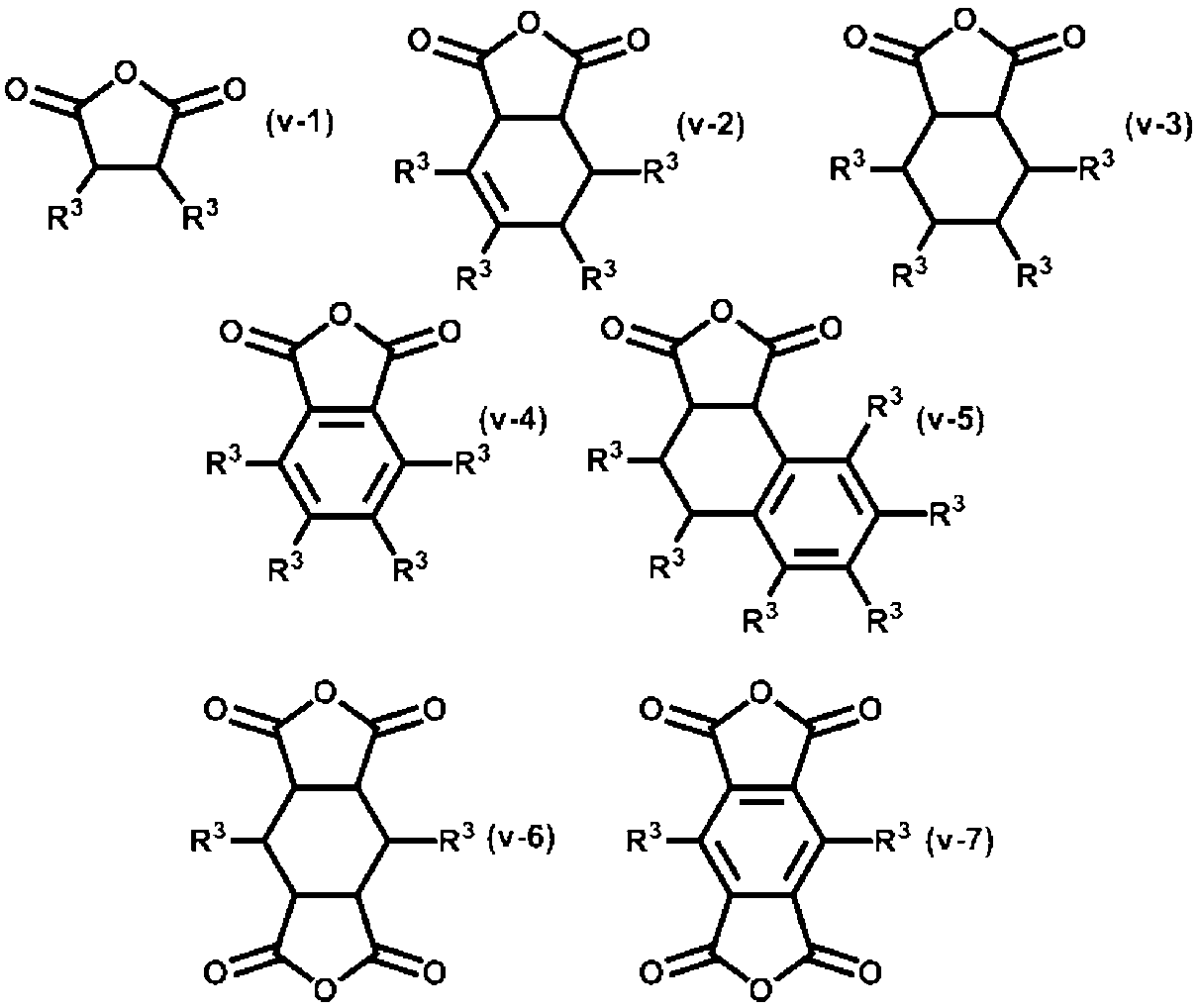
- Examples of compounds in which W is a structural moiety containing an ester bond include, for example, one or more of R 3 in the compounds represented by the following structural formulas (v-1) to (v-7) being a carboxy group
- Examples thereof include those obtained by reacting a certain compound with various polyol compounds or alkyl esterified products thereof in an arbitrary ratio.
- the polyol compound include aliphatic polyol compounds such as ethylene glycol, propylene glycol, butanediol, hexanediol, glycerin, trimethylolpropane, ditrimethylolpropane, pentaerythritol, and dipentaerythritol; aromatic polyols such as biphenol and bisphenol.
- Compound (Poly) oxyalkylene modified by introducing a (poly) oxyalkylene chain such as a (poly) oxyethylene chain, (poly) oxypropylene chain, (poly) oxytetramethylene chain) into the molecular structure of the various polyol compounds.
- a (poly) oxyalkylene chain such as a (poly) oxyethylene chain, (poly) oxypropylene chain, (poly) oxytetramethylene chain) into the molecular structure of the various polyol compounds. Examples include the body.
- each R 3 is independently a hydrogen atom, an alkyl group, an alkyloxy group, an aryl group, an aryloxy group, an aralkyl group, a halogen atom, or a carboxy group.
- the position of the acid anhydride group in the structural formulas (v-2) and (v-5) is not fixed and may be an isomer.
- V is an active ester composition having excellent physical properties such as dielectric properties, heat resistance, and moisture absorption resistance in a cured product. Therefore, V represents the structural formula (V-1). To (V-4) are preferred, and those represented by any of the following structural formulas (4-1) to (4-6) are particularly preferred.
- each R 2 is independently a hydrogen atom, an alkyl group, an alkyloxy group, an aryl group, an aryloxy group, an aralkyl group, or a halogen atom.
- R 4 is an aliphatic group having 1 to 6 carbon atoms. A hydrocarbon group, m is 0, 1 or 2, n is an integer of 2 to 4, and m + n is an integer of 2 to 4.
- a monofunctional acid anhydride (B2) having one acid anhydride may be used in combination with the polyfunctional acid anhydride (B1).
- R 3 is a hydrogen atom, an alkyl group, an alkyloxy group, an aryl group, an aryloxy group, an aralkyl group, Examples thereof include compounds that are any of halogen atoms.
- the ratio of the polyfunctional acid anhydride (B1) in the acid anhydride (B) is It is preferably 50% by mass or more, more preferably 80% by mass or more, and particularly preferably 90% by mass or more.
- the acid anhydride (B) preferably has a melting point of 250 ° C. or lower, more preferably in the range of 130 to 240 ° C.
- These acid anhydrides (B) can also be obtained as commercial products.
- Examples of commercially available products include the Rikacid series from Shin Nippon Rika Co., Ltd. and the EPICLON series from DIC Corporation.
- the blending ratio of the active ester compound (A) and the acid anhydride (B) is appropriately adjusted according to the desired curability and physical properties of the cured product. It is preferable that the acid anhydride (B) is contained in the range of 0.1 to 500 parts by mass with respect to 100 parts by mass of the active ester compound (A) because of excellent balance between curability and physical properties of the cured product. More preferably, it is contained in the range of 10 to 400 parts by mass.
- the curable composition of the present invention contains the active ester composition and a curing agent.
- the curing agent may be any compound that can react with the active ester composition of the present invention, and various compounds can be used without any particular limitation.
- An example of the curing agent is an epoxy resin.
- the epoxy resin include polyglycidyl ether of a compound (a3) having two or more phenolic hydroxyl groups in the molecular structure.
- the blending ratio of the active ester composition and the curing agent is not particularly limited and can be appropriately adjusted according to the desired cured product performance and the like.
- the total of functional groups in the active ester composition is 0.7 to 1.5 mol with respect to the total of 1 mol of epoxy groups in the epoxy resin.
- the ratio is preferably
- the functional group in the active ester composition means an ester bond site and an acid anhydride group in the active ester composition.
- the functional group equivalent of the active ester composition is a value calculated from the charged amount of reaction raw materials. Moreover, 1 mol of acid anhydride groups is calculated as one functional group.
- the curable composition of the present invention may further contain a curing accelerator.
- the curing accelerator include phosphorus compounds, tertiary amines, imidazole compounds, pyridine compounds, organic acid metal salts, Lewis acids, amine complex salts, and the like. Of these, triphenylphosphine for phosphorus compounds and 1,8-diazabicyclo- [5.4.0] -undecene (DBU) for tertiary amines are preferred because of their excellent curability, heat resistance, dielectric properties, and moisture absorption resistance. ), 2-ethyl-4-methylimidazole is preferred for imidazole compounds, and 4-dimethylaminopyridine and 2-phenylimidazole are preferred for pyridine compounds.
- the addition amount of these curing accelerators is preferably in the range of 0.01 to 15% by mass in 100 parts by mass of the curable composition.
- the curable composition of the present invention may further contain other resin components.
- Other resin components include, for example, a phenolic hydroxyl group-containing compound such as a compound (a3) having two or more phenolic hydroxyl groups in the molecular structure; diaminodiphenylmethane, diethylenetriamine, triethylenetetramine, diaminodiphenylsulfone, isophoronediamine, Amine compounds such as imidazole, BF 3 -amine complexes, guanidine derivatives; amide compounds such as polyamide resins synthesized from dimers of dicyandiamide and linolenic acid and ethylenediamine; benzoxazine compounds; cyanate ester resins; bismaleimides Resin; Styrene-maleic anhydride resin; Allyl group-containing resin represented by diallyl bisphenol and triallyl isocyanurate; Polyphosphate ester and phosphate ester-carbonate copolymer . These may be used
- the mixing ratio of these other resin components is not particularly limited and can be appropriately adjusted according to the desired performance of the cured product.
- the blending ratio it is preferably used in the range of 1 to 50% by mass in the curable composition of the present invention.
- the curable composition of the present invention may contain various additives such as a flame retardant, an inorganic filler, a silane coupling agent, a release agent, a pigment, and an emulsifier, if necessary.
- the flame retardant is, for example, red phosphorus, monoammonium phosphate, diammonium phosphate, triammonium phosphate, ammonium phosphate such as ammonium polyphosphate, inorganic phosphorus compounds such as phosphate amide; phosphate ester compound, phosphonic acid Compound, phosphinic acid compound, phosphine oxide compound, phosphorane compound, organic nitrogen-containing phosphorus compound, 9,10-dihydro-9-oxa-10-phosphaphenanthrene-10-oxide, 10- (2,5-dihydrooxyphenyl) ) Cyclic organic phosphorus such as -10H-9-oxa-10-phosphaphenanthrene-10-oxide, 10- (2,7-dihydrooxynaphthyl) -10H-9-oxa-10-phosphaphenanthrene-10-oxide Compound and its compound such as epoxy resin and phenol resin Organophosphorus compounds such as derivatives reacted with nitrogen; nitrogen
- the inorganic filler is blended, for example, when the curable composition of the present invention is used for a semiconductor sealing material.
- the inorganic filler include fused silica, crystalline silica, alumina, silicon nitride, and aluminum hydroxide.
- the said fused silica is preferable.
- the fused silica can be used in either crushed or spherical shape, but in order to increase the blending amount of the fused silica and to suppress an increase in the melt viscosity of the curable composition, a spherical one is mainly used. It is preferable.
- the filling rate is preferably in the range of 0.5 to 95 parts by mass in 100 parts by mass of the curable composition.
- a conductive filler such as silver powder or copper powder can be used.
- the active ester composition of the present invention and a curable composition using the active ester composition are highly curable and have excellent characteristics such as dielectric properties, heat resistance and moisture absorption resistance.
- the general required performance required for resin materials such as solubility in general-purpose organic solvents and storage stability, is sufficiently high. Accordingly, it can be widely used for applications such as paints, adhesives, and molded products in addition to electronic materials such as semiconductor sealing materials, printed wiring boards, and resist materials.
- the curable composition of the present invention when used for a semiconductor sealing material, it is preferable to blend an inorganic filler.
- the semiconductor sealing material can be prepared by mixing the compound using, for example, an extruder, a kneader, a roll, or the like.
- a method for molding a semiconductor package using the obtained semiconductor sealing material includes, for example, molding the semiconductor sealing material using a casting or transfer molding machine, injection molding machine, etc., and further a temperature of 50 to 200 ° C. Examples of the method include heating for 2 to 10 hours under conditions, and by such a method, a semiconductor device which is a molded product can be obtained.
- the curable composition of the present invention When the curable composition of the present invention is used for a printed wiring board or a build-up adhesive film, it is generally preferable to mix and dilute an organic solvent.
- the organic solvent include methyl ethyl ketone, acetone, dimethylformamide, methyl isobutyl ketone, methoxypropanol, cyclohexanone, methyl cellosolve, ethyl diglycol acetate, propylene glycol monomethyl ether acetate and the like.
- the type and blending amount of the organic solvent can be adjusted as appropriate according to the environment in which the curable composition is used. For example, for printed wiring board applications, the solvent must be a polar solvent having a boiling point of 160 ° C.
- ketone solvents such as acetone, methyl ethyl ketone, cyclohexanone, etc.
- acetate solvents such as ethyl acetate, butyl acetate, cellosolve acetate, propylene glycol monomethyl ether acetate, carbitol acetate, carbitols such as cellosolve, butyl carbitol, etc.
- a solvent an aromatic hydrocarbon solvent such as toluene and xylene, dimethylformamide, dimethylacetamide, N-methylpyrrolidone, and the like, and it is preferable to use them in a proportion that the nonvolatile content is 30 to 60% by mass.
- the method of manufacturing a printed wiring board using the curable composition of the present invention includes, for example, impregnating a curable composition into a reinforcing base material and curing it to obtain a prepreg, and heating this with a copper foil.
- the method of making it crimp is mentioned.
- the reinforcing substrate include paper, glass cloth, glass nonwoven fabric, aramid paper, aramid cloth, glass mat, and glass roving cloth.
- the impregnation amount of the curable composition is not particularly limited, but it is usually preferable to prepare so that the resin content in the prepreg is 20 to 60% by mass.
- the GPC measurement conditions in this example are as follows. Measuring device: “HLC-8220 GPC” manufactured by Tosoh Corporation Column: Guard column “HXL-L” manufactured by Tosoh Corporation + “TSK-GEL G2000HXL” manufactured by Tosoh Corporation + “TSK-GEL G2000HXL” manufactured by Tosoh Corporation + Tosoh Corporation “TSK-GEL G3000HXL” + “TSK-GEL G4000HXL” manufactured by Tosoh Corporation Detector: RI (differential refractometer) Data processing: “GPC-8020 Model II version 4.10” manufactured by Tosoh Corporation Measurement conditions: Column temperature 40 ° C Developing solvent Tetrahydrofuran Flow rate 1.0 ml / min Standard: The following monodisperse polystyrene having a known molecular weight was used according to the measurement manual of “GPC-8020 model II version 4.10”.
- Production Example 1 Production of Active Ester Resin (A3-1) An addition reaction product of dicyclopentadiene and phenol (hydroxyl equivalent 165 g / equivalent) to a flask equipped with a thermometer, dropping funnel, condenser, fractionator, and stirrer , 165 g of softening point 85 ° C.), 144 g of 1-naphthol, and 1315 g of toluene were dissolved in the system while substituting with nitrogen under reduced pressure. Next, 200 g of isophthalic acid chloride was charged, and the system was dissolved while substituting with nitrogen under reduced pressure. While performing nitrogen gas purge, the inside of the system was controlled to 60 ° C.
- a flask equipped with a thermometer, a dropping funnel, a condenser tube, a fractionating tube, and a stirrer was charged with 141.4 g of isophthalic acid chloride and 1000 g of toluene, and dissolved in the system while substituting with nitrogen under reduced pressure.
- 217 g of the intermediate (1) obtained above was charged, and the system was dissolved while substituting with nitrogen under reduced pressure.
- Tetrabutylammonium bromide (0.4 g) was dissolved, the inside of the system was controlled to 60 ° C. or lower while performing nitrogen gas purge, and 280 g of a 20% aqueous sodium hydroxide solution was added dropwise over 3 hours. After completion of dropping, the reaction was continued for 1 hour with stirring.
- an active ester resin (A3-2) was 220 g / equivalent, and the softening point measured according to JIS K7234 was 132 ° C. Further, the content of bis (paratertiary butylphenyl) isophthalate in the active ester resin (A3-2) calculated from the GPC chart was 10.1%.
- a flask equipped with a thermometer, dropping funnel, condenser, fractionator, and stirrer was charged with 225 g of the intermediate (2), 102 g of isophthalic acid chloride, 70 g of benzoyl chloride, and 1000 g of toluene, and the inside of the flask was purged with nitrogen under reduced pressure. The solution was dissolved while stirring. While adding 0.5 g of tetrabutylammonium bromide and performing a nitrogen gas purge, the inside of the system was controlled to 60 ° C. or lower, and 327 g of a 20% aqueous sodium hydroxide solution was added dropwise over 3 hours. After completion of the dropwise addition, stirring was continued for another hour.
- Production Example 5 Production of Active Ester Compound (A1-2) A flask equipped with a thermometer, dropping funnel, condenser, fractionator, and stirrer was charged with 202.0 g of isophthalic acid chloride and 1400 g of toluene, and the system was under reduced pressure nitrogen Dissolved with replacement. Next, 340.0 g of orthophenylphenol was charged, and the system was dissolved while substituting with nitrogen under reduced pressure. While adding 0.70 g of tetrabutylammonium bromide and performing nitrogen gas purge, the inside of the system was controlled to 60 ° C. or lower, and 400 g of 20% aqueous sodium hydroxide solution was added dropwise over 3 hours.
- the melt viscosity of the active ester compound (A1-2) is 0.2 dP. s.
- Curable Composition (1) An active ester resin and an acid anhydride were charged into the flask in the proportions shown in Table 1 below, and heated to 170 ° C. and stirred while blowing nitrogen. After cooling to 150 ° C., an epoxy resin and dimethylaminopyridine were further blended and mixed to obtain a curable composition (1). The addition amount of dimethylaminopyridine was 0.5% by mass relative to the total mass of the active ester compound, acid anhydride, and epoxy resin.
- the curable composition (1) was put into a mold and molded at 150 ° C. for 10 minutes using a press. The molded product was taken out from the mold and further cured at 175 ° C. for 5 hours. The molded product after curing was cut into a size of 5 mm ⁇ 54 mm ⁇ 2.4 mm and used as a test piece. Using a viscoelasticity measuring device (“solid viscoelasticity measuring device RSAII” manufactured by Rheometric Co., Ltd.), heating was performed from room temperature to 280 ° C. under the conditions of a rectangular tension method, a frequency of 1 Hz, and a temperature rising temperature of 3 ° C./min. The temperature at which the change in elastic modulus was maximum (tan ⁇ was the largest) was evaluated as the glass transition temperature.
- RSAII viscoelasticity measuring device
- test piece was prepared using the same apparatus and conditions as those for the previous glass transition temperature (Tg) measurement. Test specimens stored for 24 hours in a room at 23 ° C and 50% humidity after heating and vacuum drying are compliant with JIS-C-6481, using an impedance material analyzer “HP4291B” manufactured by Agilent Technologies, at 1 GHz. The dielectric constant and dielectric loss tangent of were measured.
- Curable Composition (2) An active ester resin, an acid anhydride, and an epoxy resin were charged into a flask in the proportions shown in Table 1 below. Methyl ethyl ketone was added to 40% by weight of the total, and the mixture was stirred while blowing nitrogen. An appropriate amount of dimethylaminopyridine was added so that the gel time was 5 to 7 minutes to obtain a curable composition (2).
- a prepreg was prepared using the curable composition (2) under the following conditions. The touch of the obtained prepreg was evaluated. If the prepreg is sticky or tacky, the workability during processing and the storage stability of the prepreg will decrease.
- a laminate was prepared using the curable composition (2) under the following conditions. The laminate was left in an atmosphere of 85 ° C. and 85% RH for 168 hours to perform a moisture absorption test. The laminate after the moisture absorption test was soaked in a molten solder bath for 10 seconds, A having no change in appearance, and B in which the formation of voids was observed was evaluated as B. (Lamination board creation conditions) Base material: Nitto Boseki Co., Ltd.
- Curable Composition (3) The active ester compound and the acid anhydride were charged into the flask in the proportions shown in Table 2 below, and the mixture was heated to 170 ° C. and stirred while blowing nitrogen. After cooling to 150 ° C., other components were blended and mixed to obtain a curable composition (3).
- the curable composition (3) was put into a mold and molded at 150 ° C. for 10 minutes using a press. The molded product was taken out from the mold and further cured at 175 ° C. for 5 hours. The molded product after curing was cut into a size of 5 mm ⁇ 54 mm ⁇ 2.4 mm and used as a test piece. Using a viscoelasticity measuring device (“solid viscoelasticity measuring device RSAII” manufactured by Rheometric Co., Ltd.), heating was performed from room temperature to 280 ° C. under the conditions of a rectangular tension method, a frequency of 1 Hz, and a temperature rising temperature of 3 ° C./min. The temperature at which the change in elastic modulus was maximum (tan ⁇ was the largest) was evaluated as the glass transition temperature.
- RSAII viscoelasticity measuring device
- Curable Composition (4) The active ester compound and the acid anhydride were charged into the flask in the proportions shown in Table 2 below, and the mixture was heated to 170 ° C. and stirred while blowing nitrogen. After cooling to 150 ° C., an epoxy resin and dimethylaminopyridine were blended and mixed to obtain a curable composition (4).
Landscapes
- Chemical & Material Sciences (AREA)
- Engineering & Computer Science (AREA)
- Microelectronics & Electronic Packaging (AREA)
- Health & Medical Sciences (AREA)
- Chemical Kinetics & Catalysis (AREA)
- Medicinal Chemistry (AREA)
- Polymers & Plastics (AREA)
- Organic Chemistry (AREA)
- Epoxy Resins (AREA)
- Structures Or Materials For Encapsulating Or Coating Semiconductor Devices Or Solid State Devices (AREA)
- Compositions Of Macromolecular Compounds (AREA)
- Phenolic Resins Or Amino Resins (AREA)
Abstract
Description
本発明の活性エステル組成物は、活性エステル化合物(A)と酸無水物(B)とを必須の成分として含有し、前記酸無水物(B)が酸無水物基を2つ以上有する多官能酸無水物(B1)を必須成分とすることを特徴とする。
活性エステル化合物(A1):分子構造中にフェノール性水酸基を一つ有する化合物(a1)と芳香族ポリカルボン酸又はその酸ハロゲン化物(a2)とのエステル化物
活性エステル化合物(A2):分子構造中にフェノール性水酸基を2つ以上有する化合物(a3)と芳香族モノカルボン酸又はその酸ハロゲン化物(a4)とのエステル化物
活性エステル樹脂(A3):分子構造中にフェノール性水酸基を一つ有する化合物(a1)、芳香族ポリカルボン酸又はその酸ハロゲン化物(a2)及び分子構造中にフェノール性水酸基を2つ以上有する化合物(a3)のエステル化物
活性エステル樹脂(A4):芳香族ポリカルボン酸又はその酸ハロゲン化物(a2)、分子構造中にフェノール性水酸基を2つ以上有する化合物(a3)及び芳香族モノカルボン酸又はその酸ハロゲン化物(a4)のエステル化物

の何れかで表される化合物(x)とを必須の反応原料とする反応生成物等が挙げられる。
カラム:東ソー株式会社製ガードカラム「HXL-L」
+東ソー株式会社製「TSK-GEL G2000HXL」
+東ソー株式会社製「TSK-GEL G2000HXL」
+東ソー株式会社製「TSK-GEL G3000HXL」
+東ソー株式会社製「TSK-GEL G4000HXL」
検出器: RI(示差屈折計)
データ処理:東ソー株式会社製「GPC-8020モデルIIバージョン4.10」
測定条件: カラム温度 40℃
展開溶媒 テトラヒドロフラン
流速 1.0ml/分
標準 : 前記「GPC-8020モデルIIバージョン4.10」の測定マニュアルに準拠して、分子量が既知の下記の単分散ポリスチレンを用いた。
(使用ポリスチレン)
東ソー株式会社製「A-500」
東ソー株式会社製「A-1000」
東ソー株式会社製「A-2500」
東ソー株式会社製「A-5000」
東ソー株式会社製「F-1」
東ソー株式会社製「F-2」
東ソー株式会社製「F-4」
東ソー株式会社製「F-10」
東ソー株式会社製「F-20」
東ソー株式会社製「F-40」
東ソー株式会社製「F-80」
東ソー株式会社製「F-128」
試料 : 樹脂固形分換算で1.0質量%のテトラヒドロフラン溶液をマイクロフィルターでろ過したもの(50μl)




測定装置 :東ソー株式会社製「HLC-8220 GPC」、
カラム:東ソー株式会社製ガードカラム「HXL-L」
+東ソー株式会社製「TSK-GEL G2000HXL」
+東ソー株式会社製「TSK-GEL G2000HXL」
+東ソー株式会社製「TSK-GEL G3000HXL」
+東ソー株式会社製「TSK-GEL G4000HXL」
検出器: RI(示差屈折計)
データ処理:東ソー株式会社製「GPC-8020モデルIIバージョン4.10」
測定条件: カラム温度 40℃
展開溶媒 テトラヒドロフラン
流速 1.0ml/分
標準 : 前記「GPC-8020モデルIIバージョン4.10」の測定マニュアルに準拠して、分子量が既知の下記の単分散ポリスチレンを用いた。
(使用ポリスチレン)
東ソー株式会社製「A-500」
東ソー株式会社製「A-1000」
東ソー株式会社製「A-2500」
東ソー株式会社製「A-5000」
東ソー株式会社製「F-1」
東ソー株式会社製「F-2」
東ソー株式会社製「F-4」
東ソー株式会社製「F-10」
東ソー株式会社製「F-20」
東ソー株式会社製「F-40」
東ソー株式会社製「F-80」
東ソー株式会社製「F-128」
試料 : 樹脂固形分換算で1.0質量%のテトラヒドロフラン溶液をマイクロフィルターでろ過したもの(50μl)
温度計、滴下ロート、冷却管、分留管、撹拌器を取り付けたフラスコに、ジシクロペンタジエンとフェノールとの付加反応物(水酸基当量165g/当量、軟化点85℃)165g、1-ナフトール144g、及びトルエン1315gを仕込み、系内を減圧窒素置換しながら溶解させた。次いで、イソフタル酸クロライド200gを仕込み、系内を減圧窒素置換しながら溶解させた。窒素ガスパージを施しながら、系内を60℃以下に制御して、20%水酸化ナトリウム水溶液434gを3時間かけて滴下した。滴下終了後、そのまま1時間撹拌を続けて反応させた。反応終了後、反応混合物を静置して分液し、水層を取り除いた。残った有機層に水を加えて約15分間撹拌混合した後、混合物を静置して分液し、水層を取り除いた。水層のpHが7になるまでこの操作を繰り返した後、加熱減圧条件下でトルエン等を留去し、活性エステル化合物(A3-1)を得た。活性エステル化合物(A1-1)の官能基当量は219g/当量、JIS K7234に基づいて測定した軟化点は130℃であった。
温度計、滴下ロート、冷却管、分留管、撹拌器を取り付けたフラスコに、パラターシャリブチルフェノール234.3g、トルエン52.8g、37質量%ホルマリン水溶液52.8g、49%水酸化ナトリウム4.8gを仕込んだ。攪拌しながら75℃まで加熱し、同温度で1時間撹拌して反応させた。反応終了後、第1リン酸ソーダ7.1gを添加して中和し、トルエン363.2gを加え、水121.1gで3回洗浄した。加熱減圧条件下で乾燥させ、未反応のパラターシャリブチルフェノールとフェノール樹脂とを含む中間体(1)234.8質量部を得た。中間体(1)の水酸基当量は155g/当量であった。
温度計、冷却管、分留管、攪拌器を取り付けたフラスコにフェノール565gとベンズアルデヒド106gを仕込み、系内を減圧窒素置換しながら撹拌して溶解させた。次いで、パラトルエンスルホン酸5.7gを仕込み、135℃で3時間反応させた。反応終了後、100℃まで冷却し、水酸化ナトリウム水溶液で中和した後、170℃で残留フェノールを除去して中間体(2)を得た。中間体(2)の水酸基当量は150g/当量であった。
温度計、滴下ロート、冷却管、分留管、攪拌器を取り付けたフラスコにイソフタル酸クロリド202.0g、トルエン1250gを仕込み、系内を減圧窒素置換しながら溶解させた。次いで、1-ナフトール288.0gを仕込み、系内を減圧窒素置換しながら溶解させた。テトラブチルアンモニウムブロマイド0.63gを加え、窒素ガスパージを施しながら、系内を60℃以下に制御して、20%水酸化ナトリウム水溶液400gを3時間かけて滴下した。滴下終了後、そのまま1時間撹拌を続けて反応させた。反応終了後、反応混合物を静置して分液し、水層を取り除いた。残った有機層に水を加えて約15分間攪拌混合した後、混合物を静置して分液し、水層を取り除いた。水層のpHが7になるまでこの操作を繰り返した後、加熱減圧条件下で乾燥させて、活性エステル化合物(A1-1)を得た。活活性エステル化合物(A1-1)の溶融粘度は0.6dPa・sであった。
温度計、滴下ロート、冷却管、分留管、攪拌器を取り付けたフラスコにイソフタル酸クロリド202.0g、トルエン1400gを仕込み、系内を減圧窒素置換しながら溶解させた。次いで、オルトフェニルフェノール340.0gを仕込み、系内を減圧窒素置換しながら溶解させた。テトラブチルアンモニウムブロマイド0.70gを加え、窒素ガスパージを施しながら、系内を60℃以下に制御して、20%水酸化ナトリウム水溶液400gを3時間かけて滴下した。滴下終了後、そのまま1時間撹拌を続けて反応させた。反応終了後、反応混合物を静置して分液し、水層を取り除いた。残った有機層に水を加えて約15分間攪拌混合した後、混合物を静置して分液し、水層を取り除いた。水層のpHが7になるまでこの操作を繰り返した後、加熱減圧条件下で乾燥させて、活性エステル化合物(A1-2)を得た。活性エステル化合物(A1-2)の溶融粘度は0.2dP.sであった。
冷却管、分留管、撹拌器を取り付けたフラスコに、3-メチル-4-シクロヘキセン-1・2-ジカルボン酸無水物(以下PMMAと略する)458g、無水マレイン酸542gを仕込んだ。200℃まで加熱して4時間撹拌した。温度を200℃に保ったまま、系内を10mmHgまで減圧し、未反応原料を回収した。反応容器に残った粗生成物215gにメチルイソブチルケトン600gを加え、110℃まで加熱して溶解させた後、室温まで冷却して晶析させた。得られた結晶を常温で風乾し、目的の多官能酸無水物(B1-1)を123g得た。多官能酸無水物(B1-1)の融点は168℃であった。
・多官能酸無水物(B1-2):株式会社ダイセル製「ベンゾフェノンテトラカルボン酸二無水物[BTDA]」、3,3’,4,4’-ベンゾフェノンテトラカルボン酸二無水物
・単官能酸無水物(B2-1):新日本理化株式会社製「リカシッド MH-700」、4-メチルヘキサヒドロ無水フタル酸とヘキサヒドロ無水フタル酸の7/3(質量比)混合物
・エポキシ樹脂(1):DIC株式会社製「HP-7200H」、ジシクロペンタジエン型エポキシ樹脂、エポキシ基当量は275g/当量
・エポキシ樹脂(2):DIC株式会社製「N-655-EXP-S」、クレゾールノボラック型エポキシ樹脂、エポキシ基当量は202g/当量
下記要領で硬化性組成物を調整し、各種評価試験を行った。結果を表1に示す。
下記表1に示す割合で活性エステル樹脂と酸無水物とをフラスコ内に仕込み、窒素を吹き込みながら170℃まで加熱し撹拌した。150℃まで冷却した後、更にエポキシ樹脂とジメチルアミノピリジンとを配合して混合し、硬化性組成物(1)を得た。ジメチルアミノピリジンの添加量は、活性エステル化合物、酸無水物、エポキシ樹脂の合計質量に対し0.5質量%とした。
硬化性組成物(1)を型枠へ入れ、プレス機を用いて150℃で10分間成型した。型枠から成型物を取り出し、175℃で更に5時間硬化させた。硬化後の成形物を5mm×54mm×2.4mmのサイズに切り出し、これを試験片とした。
粘弾性測定装置(レオメトリック社製「固体粘弾性測定装置RSAII」)を用い、レクタンギュラーテンション法、周波数1Hz、昇温温度3℃/分の条件で、室温から280℃まで加熱した。弾性率変化が最大となる(tanδが最も大きい)温度をガラス転移温度として評価した。
先のガラス転移温度(Tg)測定後の試験片を室温まで冷却した後、再度ガラス転移温度(Tg)測定を行った。一回目のガラス転移温度(Tg)測定値と2回目のガラス転移温度(Tg)測定値との差(ΔTg)を算出し、以下の基準で評価した。ΔTg値が大きいほど硬化性が低く、成形時に反応しきらなかった官能基が多く残存していたと考えられる。
A:ΔTgが5℃以下である。
B:ΔTgが5℃を超える
先のガラス転移温度(Tg)測定と同様の装置及び条件で試験片を作成した。加熱真空乾燥後、23℃、湿度50%の室内に24時間保管した試験片について、JIS-C-6481に準拠し、アジレント・テクノロジー株式会社製インピーダンス・マテリアル・アナライザ「HP4291B」を用い、1GHzでの誘電率および誘電正接を測定した。
下記表1に示す割合で活性エステル樹脂、酸無水物、エポキシ樹脂をフラスコに仕込んだ。メチルエチルケトンを全体の40重量%になるように加え、窒素を吹き込みながら撹拌した。ゲルタイムが5~7分となるようにジメチルアミノピリジンを適量加え、硬化性組成物(2)を得た。
硬化性組成物(2)を用いて下記条件でプリプレグを作成した。得られたプリプレグの指触評価を行った。プリプレグにべたつきやタック感があると、加工時の作業性や、プリプレグの保存安定性が低下する。
A:べたつき或いはタック感がない
B:べたつき或いはタック感がある
(プリプレグ作成条件)
基材:日東紡績株式会社製ガラスクロス「#2116」(210×280mm)
乾燥条件:160℃で3分乾燥
硬化性組成物(2)を用いて下記条件で積層板を作成した。積層板を85℃、85%RHの雰囲気下に168時間放置し、吸湿試験を行った。吸湿試験後の積層板を溶融させた半田浴に10秒浸し、外観に変化がないものをA、ボイドの生成等が観測されたものはBとして評価した。
(積層板作成条件)
基材:日東紡績株式会社製ガラスクロス「#2116」(210×280mm)
銅箔:JX日鉱日石金属株式会社製「JTC箔」(18μm)
プライ数:6
プリプレグ化条件:160℃
硬化条件:200℃、40kg/cm2で1.5時間
成型後板厚:0.8mm

下記要領で硬化性組成物を調整し、各種評価試験を行った。結果を表2に示す。
下記表2に示す割合で活性エステル化合物と酸無水物とをフラスコ内に仕込み、窒素を吹き込みながら170℃まで加熱し撹拌した。150℃まで冷却した後、その他の成分を配合して混合し、硬化性組成物(3)を得た。
常温条件下で硬化性組成物(3)の指触評価を行った。
A:べたつき或いはタック感がない
B:べたつき或いはタック感がある
硬化性組成物(3)を型枠へ入れ、プレス機を用いて150℃で10分間成型した。型枠から成型物を取り出し、175℃で更に5時間硬化させた。硬化後の成形物を5mm×54mm×2.4mmのサイズに切り出し、これを試験片とした。
粘弾性測定装置(レオメトリック社製「固体粘弾性測定装置RSAII」)を用い、レクタンギュラーテンション法、周波数1Hz、昇温温度3℃/分の条件で、室温から280℃まで加熱した。弾性率変化が最大となる(tanδが最も大きい)温度をガラス転移温度として評価した。
先のガラス転移温度(Tg)測定後の試験片を室温まで冷却した後、再度ガラス転移温度(Tg)測定を行った。一回目のガラス転移温度(Tg)測定値と2回目のガラス転移温度(Tg)測定値との差(ΔTg)を算出し、以下の基準で評価した。ΔTg値が大きいほど硬化性が低く、成形時に反応しきらなかった官能基が多く残存していたと考えられる。
A:ΔTgが5℃以下である。
B:ΔTgが5℃を超える
下記表2に示す割合で活性エステル化合物と酸無水物とをフラスコ内に仕込み、窒素を吹き込みながら170℃まで加熱し撹拌した。150℃まで冷却した後、エポキシ樹脂とジメチルアミノピリジンとを配合して混合し、硬化性組成物(4)を得た。
硬化性組成物(4)を用い、硬化性の評価と同様の方法で試験片を作成した。加熱真空乾燥後、23℃、湿度50%の室内に24時間保管した試験片について、JIS-C-6481に準拠し、アジレント・テクノロジー株式会社製インピーダンス・マテリアル・アナライザ「HP4291B」を用い、1GHzでの誘電率および誘電正接を測定した。

Claims (9)
- 活性エステル化合物(A)と酸無水物(B)とを必須の成分として含有し、前記酸無水物(B)が酸無水物基を2つ以上有する多官能酸無水物(B1)を必須成分とする活性エステル組成物。
- 前記活性エステル化合物(A)が、下記(A1)~(A4)の何れか一種類以上を必須とする請求項1記載の活性エステル組成物。
活性エステル化合物(A1):分子構造中にフェノール性水酸基を一つ有する化合物(a1)と芳香族ポリカルボン酸又はその酸ハロゲン化物(a2)とのエステル化物
活性エステル化合物(A2):分子構造中にフェノール性水酸基を2つ以上有する化合物(a3)と芳香族モノカルボン酸又はその酸ハロゲン化物(a4)とのエステル化物
活性エステル樹脂(A3):分子構造中にフェノール性水酸基を一つ有する化合物(a1)、芳香族ポリカルボン酸又はその酸ハロゲン化物(a2)及び分子構造中にフェノール性水酸基を2つ以上有する化合物(a3)のエステル化物
活性エステル樹脂(A4):芳香族ポリカルボン酸又はその酸ハロゲン化物(a2)、分子構造中にフェノール性水酸基を2つ以上有する化合物(a3)及び芳香族モノカルボン酸又はその酸ハロゲン化物(a4)のエステル化物 - 前記酸無水物(B)の50質量%以上が前記多官能酸無水物(B1)である請求項1記載の活性エステル組成物。
- 前記多官能酸無水物(B1)が、下記構造式(4-1)~(4-6)

の何れかで表される化合物である請求項1記載の活性エステル組成物。 - 前記活性エステル化合物(A)100質量部に対し、前記酸無水物(B)を0.1~500質量部の範囲で含有する請求項1記載の活性エステル組成物。
- 請求項1~5のいずれかに記載の活性エステル組成物と硬化剤とを含有する硬化性組成物。
- 請求項6記載の硬化性組成物の硬化物。
- 請求項6記載の硬化性組成物を用いてなる半導体封止材料。
- 請求項6記載の硬化性組成物を用いてなるプリント配線基板。
Priority Applications (3)
| Application Number | Priority Date | Filing Date | Title |
|---|---|---|---|
| JP2019507409A JP7137152B2 (ja) | 2017-03-24 | 2018-02-01 | 活性エステル組成物 |
| KR1020197025413A KR102404489B1 (ko) | 2017-03-24 | 2018-02-01 | 활성 에스테르 조성물 |
| CN201880020688.6A CN110475798B (zh) | 2017-03-24 | 2018-02-01 | 活性酯组合物 |
Applications Claiming Priority (2)
| Application Number | Priority Date | Filing Date | Title |
|---|---|---|---|
| JP2017059123 | 2017-03-24 | ||
| JP2017-059123 | 2017-03-24 |
Publications (1)
| Publication Number | Publication Date |
|---|---|
| WO2018173500A1 true WO2018173500A1 (ja) | 2018-09-27 |
Family
ID=63585329
Family Applications (1)
| Application Number | Title | Priority Date | Filing Date |
|---|---|---|---|
| PCT/JP2018/003362 Ceased WO2018173500A1 (ja) | 2017-03-24 | 2018-02-01 | 活性エステル組成物 |
Country Status (5)
| Country | Link |
|---|---|
| JP (1) | JP7137152B2 (ja) |
| KR (1) | KR102404489B1 (ja) |
| CN (1) | CN110475798B (ja) |
| TW (1) | TWI751266B (ja) |
| WO (1) | WO2018173500A1 (ja) |
Cited By (9)
| Publication number | Priority date | Publication date | Assignee | Title |
|---|---|---|---|---|
| CN109438465A (zh) * | 2018-12-27 | 2019-03-08 | 浙江阿尔法化工科技有限公司 | 一种制备甲基环己烯四酸二酐的方法 |
| CN109439257A (zh) * | 2018-11-23 | 2019-03-08 | 南亚新材料科技股份有限公司 | 一种无卤高Tg低介电型覆铜箔板的制备方法 |
| CN109536107A (zh) * | 2018-11-23 | 2019-03-29 | 南亚新材料科技股份有限公司 | 一种无卤高Tg低介电型覆铜箔板的粘合剂及其制备方法 |
| JP2020050793A (ja) * | 2018-09-27 | 2020-04-02 | 日立化成株式会社 | 封止用樹脂組成物、電子部品装置及び電子部品装置の製造方法 |
| CN111349314A (zh) * | 2018-12-20 | 2020-06-30 | 味之素株式会社 | 树脂组合物 |
| JPWO2020262654A1 (ja) * | 2019-06-26 | 2020-12-30 | ||
| WO2023027154A1 (ja) * | 2021-08-26 | 2023-03-02 | 味の素株式会社 | 樹脂組成物 |
| CN118772097A (zh) * | 2024-06-28 | 2024-10-15 | 天津众泰材料科技有限公司 | 一种高品质5-(2,5二氧四氢呋喃)-3-甲基-3-环己烯-1,2-二碳酸酐的制备方法 |
| WO2024229469A1 (en) * | 2023-05-04 | 2024-11-07 | Henkel Ag & Co. Kgaa | Conductive die attach compositions |
Families Citing this family (1)
| Publication number | Priority date | Publication date | Assignee | Title |
|---|---|---|---|---|
| CN118084838A (zh) * | 2024-03-29 | 2024-05-28 | 天津众泰材料科技有限公司 | 一种5-(2,5-二氧代四氢呋喃基)-3-甲基-3-环己烯-1,2-二羧酸酐的制备方法 |
Citations (4)
| Publication number | Priority date | Publication date | Assignee | Title |
|---|---|---|---|---|
| JPS5536406A (en) * | 1978-09-07 | 1980-03-14 | Dainippon Ink & Chem Inc | 3-methyl-5-succinic anhydrous-3-cyclohexene-1,2-dicarboxylic anhydride |
| JP2003261650A (ja) * | 2002-03-07 | 2003-09-19 | Dainippon Ink & Chem Inc | エポキシ樹脂組成物、その予備硬化物及び硬化物 |
| JP2011074120A (ja) * | 2009-09-29 | 2011-04-14 | Dic Corp | 硬化性樹脂組成物、その硬化物、及び回路基板 |
| JP2016098321A (ja) * | 2014-11-21 | 2016-05-30 | Dic株式会社 | エポキシ樹脂組成物、硬化性樹脂組成物、活性エステル、硬化物、半導体封止材料、半導体装置、プレプリグ、フレキシルブル配線基板、回路基板、ビルドアップフィルム、ビルドアップ基板、繊維強化複合材料、成形品 |
Family Cites Families (14)
| Publication number | Priority date | Publication date | Assignee | Title |
|---|---|---|---|---|
| JP3052617B2 (ja) * | 1992-11-06 | 2000-06-19 | 日立化成工業株式会社 | 含フッ素ポリイミド、含フッ素ポリアミド酸及びポリイミド系樹脂、並びにそれらの製造法 |
| JPH11349666A (ja) * | 1998-06-05 | 1999-12-21 | Kanagawa University | エポキシ樹脂組成物 |
| JP4815725B2 (ja) | 2001-09-12 | 2011-11-16 | Dic株式会社 | 電子材料用エポキシ樹脂組成物および低誘電性電子材料 |
| WO2004109403A1 (ja) | 2003-06-02 | 2004-12-16 | Toray Industries, Inc. | 感光性樹脂組成物およびそれを用いた電子部品ならびに表示装置 |
| JP4834949B2 (ja) * | 2003-07-24 | 2011-12-14 | 東レ株式会社 | 熱硬化性樹脂組成物およびそれを用いた電子部品 |
| JP2005075915A (ja) * | 2003-08-29 | 2005-03-24 | New Japan Chem Co Ltd | エポキシ樹脂用硬化剤組成物及びそれを含有するエポキシ樹脂組成物 |
| WO2012165317A1 (ja) * | 2011-05-27 | 2012-12-06 | Dic株式会社 | 活性エステル樹脂、その製造方法、熱硬化性樹脂組成物、その硬化物、半導体封止材料、プリプレグ、回路基板、及びビルドアップフィルム |
| JP5910866B2 (ja) * | 2012-03-06 | 2016-04-27 | Dic株式会社 | 活性エステル樹脂、熱硬化性樹脂組成物、その硬化物、半導体封止材料、プリプレグ、回路基板、及びビルドアップフィルム |
| DE102012211323A1 (de) * | 2012-06-29 | 2014-01-02 | Evonik Industries Ag | Härter für Epoxidharzsysteme und deren Verwendung |
| JP6083169B2 (ja) * | 2012-09-19 | 2017-02-22 | Dic株式会社 | エポキシ樹脂、硬化性樹脂組成物、その硬化物、及びプリント配線基板 |
| TWI572665B (zh) * | 2012-10-17 | 2017-03-01 | Dainippon Ink & Chemicals | 活性酯樹脂、環氧樹脂組成物、其硬化物、預浸體、 電路基板以及積層膜 |
| CN103980708B (zh) * | 2014-05-28 | 2017-01-11 | 苏州生益科技有限公司 | 用于集成电路的无卤阻燃热固性树脂组合物、半固化片及层压板 |
| TWI668269B (zh) * | 2014-06-30 | 2019-08-11 | 日商味之素股份有限公司 | Resin composition |
| KR102498471B1 (ko) * | 2014-12-26 | 2023-02-10 | 닛테츠 케미컬 앤드 머티리얼 가부시키가이샤 | 말단 변성 가용성 다관능 비닐 방향족 공중합체, 경화성 수지 조성물 및 이것을 사용한 광도파로 |
-
2018
- 2018-01-18 TW TW107101859A patent/TWI751266B/zh active
- 2018-02-01 KR KR1020197025413A patent/KR102404489B1/ko active Active
- 2018-02-01 WO PCT/JP2018/003362 patent/WO2018173500A1/ja not_active Ceased
- 2018-02-01 JP JP2019507409A patent/JP7137152B2/ja active Active
- 2018-02-01 CN CN201880020688.6A patent/CN110475798B/zh active Active
Patent Citations (4)
| Publication number | Priority date | Publication date | Assignee | Title |
|---|---|---|---|---|
| JPS5536406A (en) * | 1978-09-07 | 1980-03-14 | Dainippon Ink & Chem Inc | 3-methyl-5-succinic anhydrous-3-cyclohexene-1,2-dicarboxylic anhydride |
| JP2003261650A (ja) * | 2002-03-07 | 2003-09-19 | Dainippon Ink & Chem Inc | エポキシ樹脂組成物、その予備硬化物及び硬化物 |
| JP2011074120A (ja) * | 2009-09-29 | 2011-04-14 | Dic Corp | 硬化性樹脂組成物、その硬化物、及び回路基板 |
| JP2016098321A (ja) * | 2014-11-21 | 2016-05-30 | Dic株式会社 | エポキシ樹脂組成物、硬化性樹脂組成物、活性エステル、硬化物、半導体封止材料、半導体装置、プレプリグ、フレキシルブル配線基板、回路基板、ビルドアップフィルム、ビルドアップ基板、繊維強化複合材料、成形品 |
Non-Patent Citations (6)
| Title |
|---|
| "EPOXY RESIN SOCIETY 30 TH ANNIVERSARY PUBLISHING AND EDITORIAL COMMITTEE ed. Review of Epoxy Resins, Fundamentals 1", JAPAN SOCIETY OF EPOXY RESIN TECHNOLOGY, 19 November 2003 (2003-11-19), pages 156 - 174,235-236 * |
| FUJIMOTO, KOICHI ET AL.: "Development of new epoxy resin hardeners for low water absorption and low dissipation factor", PROCEEDINGS OF THE 19TH MEETING OF THE JAPAN INSTITUTE OF ELECTRONICS PACKAGING, pages 203 - 204 * |
| NAKAMURA, SHIGEO: "Curing of Epoxy Resins with Active Esters and Properties of Cured Resins", JOURNAL OF THE ADHESION SOCIETY OF JAPAN, vol. 33, no. 9, 1 September 1997 (1997-09-01), pages 358 - 365 * |
| SHIMAZAKI, AKIO: "Chemical Changes of Practical Epoxy Resin during Cure with Organic Acid Anhydride Hardener", THE JOURNAL OF THE CHEMICAL SOCIETY OF JAPAN , INDUSTRIAL CHEMISTRY SECTION, vol. 67, no. 8, 1964, pages 1304 - 1309 * |
| TAMASO, KENICHI ET AL.: "Reaction of Phosphate Esters and Epoxy Resins and Its Application to Crosslinking Reaction", JOURNAL OF NETWORK POLYMER, vol. 37, no. 3, 10 May 2016 (2016-05-10), Japan, pages 108 - 115 * |
| TANIGUCHI, RIKUO: "Epoxy Resin Curing Agents", POLYMERS, vol. 8, no. 11, 1959, pages 615 - 619 * |
Cited By (16)
| Publication number | Priority date | Publication date | Assignee | Title |
|---|---|---|---|---|
| JP2020050793A (ja) * | 2018-09-27 | 2020-04-02 | 日立化成株式会社 | 封止用樹脂組成物、電子部品装置及び電子部品装置の製造方法 |
| CN109439257A (zh) * | 2018-11-23 | 2019-03-08 | 南亚新材料科技股份有限公司 | 一种无卤高Tg低介电型覆铜箔板的制备方法 |
| CN109536107A (zh) * | 2018-11-23 | 2019-03-29 | 南亚新材料科技股份有限公司 | 一种无卤高Tg低介电型覆铜箔板的粘合剂及其制备方法 |
| JP7595402B2 (ja) | 2018-12-20 | 2024-12-06 | 味の素株式会社 | 樹脂組成物 |
| CN111349314A (zh) * | 2018-12-20 | 2020-06-30 | 味之素株式会社 | 树脂组合物 |
| JP2022189845A (ja) * | 2018-12-20 | 2022-12-22 | 味の素株式会社 | 樹脂組成物 |
| JP7472948B2 (ja) | 2018-12-20 | 2024-04-23 | 味の素株式会社 | 樹脂組成物 |
| TWI868091B (zh) * | 2018-12-20 | 2025-01-01 | 日商味之素股份有限公司 | 樹脂組成物 |
| CN111349314B (zh) * | 2018-12-20 | 2025-09-23 | 味之素株式会社 | 树脂组合物 |
| CN114085232A (zh) * | 2018-12-27 | 2022-02-25 | 浙江阿尔法化工科技有限公司 | 一种制备甲基环己烯四酸二酐的方法 |
| CN109438465A (zh) * | 2018-12-27 | 2019-03-08 | 浙江阿尔法化工科技有限公司 | 一种制备甲基环己烯四酸二酐的方法 |
| JPWO2020262654A1 (ja) * | 2019-06-26 | 2020-12-30 | ||
| JP7635709B2 (ja) | 2019-06-26 | 2025-02-26 | 株式会社レゾナック | 封止用樹脂組成物、電子部品装置及び電子部品装置の製造方法 |
| WO2023027154A1 (ja) * | 2021-08-26 | 2023-03-02 | 味の素株式会社 | 樹脂組成物 |
| WO2024229469A1 (en) * | 2023-05-04 | 2024-11-07 | Henkel Ag & Co. Kgaa | Conductive die attach compositions |
| CN118772097A (zh) * | 2024-06-28 | 2024-10-15 | 天津众泰材料科技有限公司 | 一种高品质5-(2,5二氧四氢呋喃)-3-甲基-3-环己烯-1,2-二碳酸酐的制备方法 |
Also Published As
| Publication number | Publication date |
|---|---|
| TW201902884A (zh) | 2019-01-16 |
| JP7137152B2 (ja) | 2022-09-14 |
| TWI751266B (zh) | 2022-01-01 |
| CN110475798B (zh) | 2024-08-23 |
| CN110475798A (zh) | 2019-11-19 |
| JPWO2018173500A1 (ja) | 2020-01-23 |
| KR102404489B1 (ko) | 2022-06-07 |
| KR20190128156A (ko) | 2019-11-15 |
Similar Documents
| Publication | Publication Date | Title |
|---|---|---|
| JP7137152B2 (ja) | 活性エステル組成物 | |
| JP6304465B1 (ja) | 活性エステル組成物及びその硬化物 | |
| JP6332720B1 (ja) | 活性エステル樹脂とその硬化物 | |
| JP7068669B2 (ja) | 活性エステル化合物 | |
| JP6270092B1 (ja) | 活性エステル樹脂組成物とその硬化物 | |
| EP2617747A1 (en) | Active ester resin, method for producing same, thermosetting resin composition, cured product thereof, semiconductor sealing material, prepreg, circuit board, and build-up film | |
| TWI776008B (zh) | 聚酯樹脂與其硬化物 | |
| JP7228085B2 (ja) | 活性エステル化合物及び硬化性組成物 | |
| JP6332721B1 (ja) | 活性エステル樹脂とその硬化物 | |
| JP7276665B2 (ja) | 活性エステル組成物及び半導体封止材料 | |
| WO2018173499A1 (ja) | ポリエステル樹脂とその硬化物 |
Legal Events
| Date | Code | Title | Description |
|---|---|---|---|
| 121 | Ep: the epo has been informed by wipo that ep was designated in this application |
Ref document number: 18772309 Country of ref document: EP Kind code of ref document: A1 |
|
| ENP | Entry into the national phase |
Ref document number: 2019507409 Country of ref document: JP Kind code of ref document: A |
|
| ENP | Entry into the national phase |
Ref document number: 20197025413 Country of ref document: KR Kind code of ref document: A |
|
| NENP | Non-entry into the national phase |
Ref country code: DE |
|
| 122 | Ep: pct application non-entry in european phase |
Ref document number: 18772309 Country of ref document: EP Kind code of ref document: A1 |