WO2018168522A1 - 膜用水処理薬品及び膜処理方法 - Google Patents
膜用水処理薬品及び膜処理方法 Download PDFInfo
- Publication number
- WO2018168522A1 WO2018168522A1 PCT/JP2018/007995 JP2018007995W WO2018168522A1 WO 2018168522 A1 WO2018168522 A1 WO 2018168522A1 JP 2018007995 W JP2018007995 W JP 2018007995W WO 2018168522 A1 WO2018168522 A1 WO 2018168522A1
- Authority
- WO
- WIPO (PCT)
- Prior art keywords
- membrane
- water
- water treatment
- treatment chemical
- hydroxy group
- Prior art date
- Legal status (The legal status is an assumption and is not a legal conclusion. Google has not performed a legal analysis and makes no representation as to the accuracy of the status listed.)
- Ceased
Links
Images
Classifications
-
- C—CHEMISTRY; METALLURGY
- C07—ORGANIC CHEMISTRY
- C07F—ACYCLIC, CARBOCYCLIC OR HETEROCYCLIC COMPOUNDS CONTAINING ELEMENTS OTHER THAN CARBON, HYDROGEN, HALOGEN, OXYGEN, NITROGEN, SULFUR, SELENIUM OR TELLURIUM
- C07F9/00—Compounds containing elements of Groups 5 or 15 of the Periodic Table
- C07F9/02—Phosphorus compounds
- C07F9/28—Phosphorus compounds with one or more P—C bonds
- C07F9/38—Phosphonic acids [RP(=O)(OH)2]; Thiophosphonic acids ; [RP(=X1)(X2H)2(X1, X2 are each independently O, S or Se)]
- C07F9/3804—Phosphonic acids [RP(=O)(OH)2]; Thiophosphonic acids ; [RP(=X1)(X2H)2(X1, X2 are each independently O, S or Se)] not used, see subgroups
- C07F9/3808—Acyclic saturated acids which can have further substituents on alkyl
- C07F9/3817—Acids containing the structure (RX)2P(=X)-alk-N...P (X = O, S, Se)
-
- B—PERFORMING OPERATIONS; TRANSPORTING
- B01—PHYSICAL OR CHEMICAL PROCESSES OR APPARATUS IN GENERAL
- B01D—SEPARATION
- B01D65/00—Accessories or auxiliary operations, in general, for separation processes or apparatus using semi-permeable membranes
- B01D65/08—Prevention of membrane fouling or of concentration polarisation
-
- B—PERFORMING OPERATIONS; TRANSPORTING
- B01—PHYSICAL OR CHEMICAL PROCESSES OR APPARATUS IN GENERAL
- B01D—SEPARATION
- B01D61/00—Processes of separation using semi-permeable membranes, e.g. dialysis, osmosis or ultrafiltration; Apparatus, accessories or auxiliary operations specially adapted therefor
- B01D61/02—Reverse osmosis; Hyperfiltration ; Nanofiltration
-
- B—PERFORMING OPERATIONS; TRANSPORTING
- B01—PHYSICAL OR CHEMICAL PROCESSES OR APPARATUS IN GENERAL
- B01D—SEPARATION
- B01D61/00—Processes of separation using semi-permeable membranes, e.g. dialysis, osmosis or ultrafiltration; Apparatus, accessories or auxiliary operations specially adapted therefor
- B01D61/02—Reverse osmosis; Hyperfiltration ; Nanofiltration
- B01D61/025—Reverse osmosis; Hyperfiltration
-
- B—PERFORMING OPERATIONS; TRANSPORTING
- B01—PHYSICAL OR CHEMICAL PROCESSES OR APPARATUS IN GENERAL
- B01D—SEPARATION
- B01D61/00—Processes of separation using semi-permeable membranes, e.g. dialysis, osmosis or ultrafiltration; Apparatus, accessories or auxiliary operations specially adapted therefor
- B01D61/02—Reverse osmosis; Hyperfiltration ; Nanofiltration
- B01D61/10—Accessories; Auxiliary operations
-
- B—PERFORMING OPERATIONS; TRANSPORTING
- B01—PHYSICAL OR CHEMICAL PROCESSES OR APPARATUS IN GENERAL
- B01D—SEPARATION
- B01D65/00—Accessories or auxiliary operations, in general, for separation processes or apparatus using semi-permeable membranes
- B01D65/02—Membrane cleaning or sterilisation ; Membrane regeneration
-
- C—CHEMISTRY; METALLURGY
- C07—ORGANIC CHEMISTRY
- C07C—ACYCLIC OR CARBOCYCLIC COMPOUNDS
- C07C229/00—Compounds containing amino and carboxyl groups bound to the same carbon skeleton
- C07C229/02—Compounds containing amino and carboxyl groups bound to the same carbon skeleton having amino and carboxyl groups bound to acyclic carbon atoms of the same carbon skeleton
- C07C229/04—Compounds containing amino and carboxyl groups bound to the same carbon skeleton having amino and carboxyl groups bound to acyclic carbon atoms of the same carbon skeleton the carbon skeleton being acyclic and saturated
- C07C229/06—Compounds containing amino and carboxyl groups bound to the same carbon skeleton having amino and carboxyl groups bound to acyclic carbon atoms of the same carbon skeleton the carbon skeleton being acyclic and saturated having only one amino and one carboxyl group bound to the carbon skeleton
- C07C229/10—Compounds containing amino and carboxyl groups bound to the same carbon skeleton having amino and carboxyl groups bound to acyclic carbon atoms of the same carbon skeleton the carbon skeleton being acyclic and saturated having only one amino and one carboxyl group bound to the carbon skeleton the nitrogen atom of the amino group being further bound to acyclic carbon atoms or to carbon atoms of rings other than six-membered aromatic rings
- C07C229/16—Compounds containing amino and carboxyl groups bound to the same carbon skeleton having amino and carboxyl groups bound to acyclic carbon atoms of the same carbon skeleton the carbon skeleton being acyclic and saturated having only one amino and one carboxyl group bound to the carbon skeleton the nitrogen atom of the amino group being further bound to acyclic carbon atoms or to carbon atoms of rings other than six-membered aromatic rings to carbon atoms of hydrocarbon radicals substituted by amino or carboxyl groups, e.g. ethylenediamine-tetra-acetic acid, iminodiacetic acids
-
- C—CHEMISTRY; METALLURGY
- C07—ORGANIC CHEMISTRY
- C07F—ACYCLIC, CARBOCYCLIC OR HETEROCYCLIC COMPOUNDS CONTAINING ELEMENTS OTHER THAN CARBON, HYDROGEN, HALOGEN, OXYGEN, NITROGEN, SULFUR, SELENIUM OR TELLURIUM
- C07F9/00—Compounds containing elements of Groups 5 or 15 of the Periodic Table
- C07F9/02—Phosphorus compounds
- C07F9/28—Phosphorus compounds with one or more P—C bonds
- C07F9/38—Phosphonic acids [RP(=O)(OH)2]; Thiophosphonic acids ; [RP(=X1)(X2H)2(X1, X2 are each independently O, S or Se)]
- C07F9/3804—Phosphonic acids [RP(=O)(OH)2]; Thiophosphonic acids ; [RP(=X1)(X2H)2(X1, X2 are each independently O, S or Se)] not used, see subgroups
- C07F9/3808—Acyclic saturated acids which can have further substituents on alkyl
-
- C—CHEMISTRY; METALLURGY
- C09—DYES; PAINTS; POLISHES; NATURAL RESINS; ADHESIVES; COMPOSITIONS NOT OTHERWISE PROVIDED FOR; APPLICATIONS OF MATERIALS NOT OTHERWISE PROVIDED FOR
- C09K—MATERIALS FOR MISCELLANEOUS APPLICATIONS, NOT PROVIDED FOR ELSEWHERE
- C09K3/00—Materials not provided for elsewhere
-
- B—PERFORMING OPERATIONS; TRANSPORTING
- B01—PHYSICAL OR CHEMICAL PROCESSES OR APPARATUS IN GENERAL
- B01D—SEPARATION
- B01D2311/00—Details relating to membrane separation process operations and control
- B01D2311/04—Specific process operations in the feed stream; Feed pretreatment
-
- B—PERFORMING OPERATIONS; TRANSPORTING
- B01—PHYSICAL OR CHEMICAL PROCESSES OR APPARATUS IN GENERAL
- B01D—SEPARATION
- B01D2311/00—Details relating to membrane separation process operations and control
- B01D2311/12—Addition of chemical agents
-
- B—PERFORMING OPERATIONS; TRANSPORTING
- B01—PHYSICAL OR CHEMICAL PROCESSES OR APPARATUS IN GENERAL
- B01D—SEPARATION
- B01D2321/00—Details relating to membrane cleaning, regeneration, sterilization or to the prevention of fouling
- B01D2321/16—Use of chemical agents
- B01D2321/168—Use of other chemical agents
-
- C—CHEMISTRY; METALLURGY
- C02—TREATMENT OF WATER, WASTE WATER, SEWAGE, OR SLUDGE
- C02F—TREATMENT OF WATER, WASTE WATER, SEWAGE, OR SLUDGE
- C02F1/00—Treatment of water, waste water, or sewage
- C02F1/44—Treatment of water, waste water, or sewage by dialysis, osmosis or reverse osmosis
- C02F1/441—Treatment of water, waste water, or sewage by dialysis, osmosis or reverse osmosis by reverse osmosis
-
- C—CHEMISTRY; METALLURGY
- C02—TREATMENT OF WATER, WASTE WATER, SEWAGE, OR SLUDGE
- C02F—TREATMENT OF WATER, WASTE WATER, SEWAGE, OR SLUDGE
- C02F2303/00—Specific treatment goals
- C02F2303/22—Eliminating or preventing deposits, scale removal, scale prevention
Definitions
- the present invention when water to be treated containing an organic compound having a phenolic hydroxy group is subjected to membrane separation treatment with a reverse osmosis membrane (RO membrane) or the like, membrane contamination by the organic compound having a phenolic hydroxy group in the water to be treated is prevented.
- the present invention relates to a membrane water treatment chemical to be prevented and a membrane treatment method using the membrane water treatment chemical.
- Water saving measures are being actively implemented by improving the water recovery rate by using RO membrane system in seawater and brine desalination and wastewater recovery systems.
- RO membrane system When the RO membrane system is operated at a high recovery rate, components in the RO membrane water supply are highly concentrated on the RO membrane surface, which causes problems such as scale obstacles and blockage of the RO membrane due to organic compounds.
- Polyphenol which is an organic compound having a phenolic hydroxy group, exists as a humic substance contained in soil, and is also used as a raw material for food and beverages in food and beverage manufacturing factories.
- Organic compounds having phenolic hydroxy groups such as humic substances contained in soil or polyphenols used as raw materials for foods and beverages are microfiltration membranes (MF membranes), ultrafiltration membranes (UF membranes), nanofiltration membranes (NF Membrane) and separation membranes such as reverse osmosis membranes (RO membranes) cause membrane contamination (fouling).
- Fouling is a phenomenon in which substances to be separated existing in the membrane water supply adhere to and deposit on the membrane surface and pores. Fouling is due to the accumulation of suspended particles on the membrane surface, formation of a layer by adsorption to the membrane, gelation of the soluble polymer substance on the membrane surface, adsorption inside the membrane pores, precipitation, clogging and bubbles. These include blocking of pores (clogging), channel blockage in the module, and the like.
- the organic compound having a phenolic hydroxy group can be removed by performing the aggregation / adsorption treatment in the previous stage of the membrane separation treatment, the aggregation treatment has an effect of removing relatively low molecular weight organic compounds such as fulvic acid.
- the adsorption process requires periodic replacement of the adsorbent.
- Patent Document 1 proposes a water treatment method in which an agglomeration treatment step is performed in which a flocculant made of an alkaline solution of a phenol resin having a melting point of 130 to 220 ° C. is added to the water to be treated before the membrane separation treatment step. .
- phenol resin which is an organic compound having a phenolic hydroxy group
- phenol resin remains in the agglomerated water obtained by aggregating with the aggregating agent described in Patent Document 1. Therefore, when this agglomerated water is subjected to membrane separation treatment, membrane contamination by an organic compound having a phenolic hydroxy group may occur.
- Patent Document 2 discloses a dispersion for an organic compound having a phenolic hydroxy group, such as polyvinyl pyrrolidone or polyacrylamide, having a carbonyl group and a polymer compound having a structure in which a carbonyl carbon and a nitrogen atom are bonded. Agents have been proposed. In order to increase the degree of freedom in drug selection and diversity for practical application, further development of new drugs is desired.
- JP 2011-56496 A Japanese Patent No. 5867532
- the present invention effectively prevents membrane contamination by an organic compound having a phenolic hydroxy group in the water to be treated when the water to be treated containing an organic compound having a phenolic hydroxy group is subjected to membrane separation treatment with an RO membrane or the like. It is an object to provide a membrane water treatment chemical that can be used and a membrane treatment method using the membrane water treatment chemical.
- the present inventor effectively uses an organic amine having 2 or more nitrogen atoms and 5 or more carboxyl groups or 4 or more phosphate groups and having a phenolic hydroxy group in the water to be treated. It has been found that it is possible to effectively prevent film contamination by an organic compound having a phenolic hydroxy group by dispersing.
- the gist of the present invention is as follows.
- Water treatment chemical for preventing membrane contamination by an organic compound having a phenolic hydroxy group, having 2 or more nitrogen atoms and 5 or more carboxyl groups or 4 or more phosphate groups A membrane water treatment chemical comprising an organic amine.
- R 1 , R 2 , R 3 and R 4 represent a phosphate group.
- N is an integer of 1 or more.
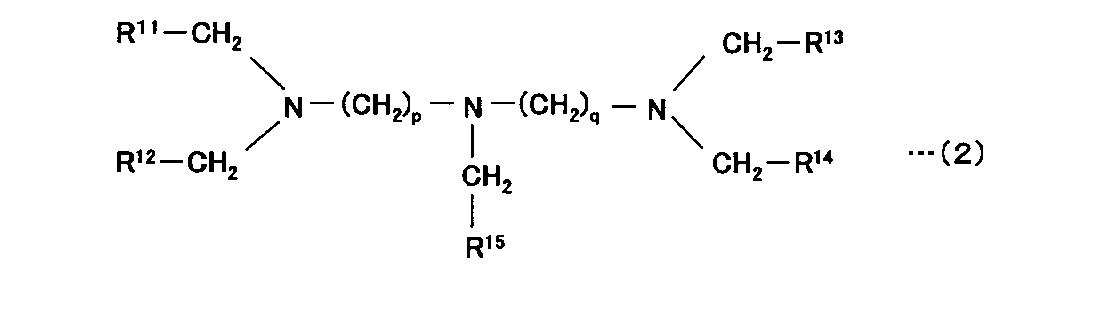
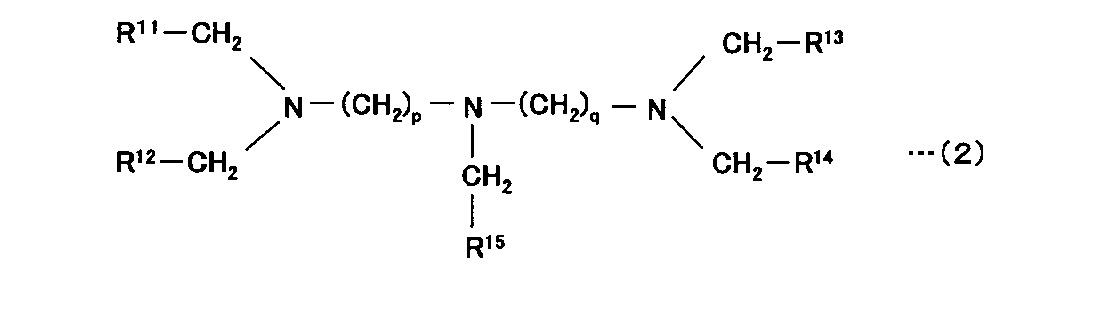
- R 11 , R 12 , R 13 , R 14 and R 15 represent a carboxyl group or a phosphate group.
- P and q are each independently an integer of 1 or more.
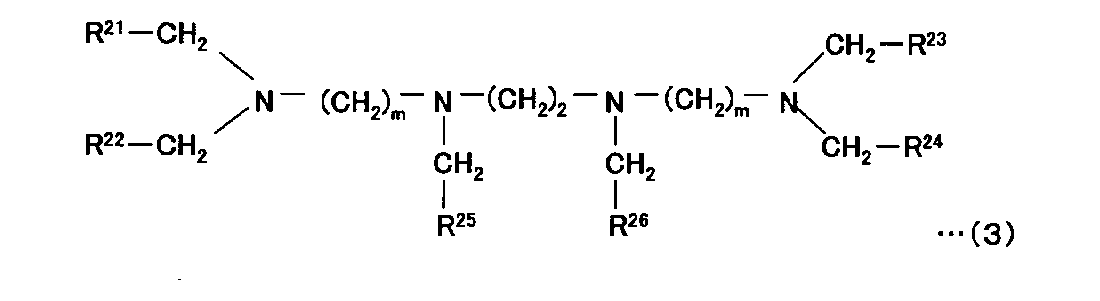
- R 21 , R 22 , R 23 , R 24 , R 25 and R 26 represent a carboxyl group.
- M is an integer of 1 or more.
- the organic compound having a phenolic hydroxy group in the water to be treated is effectively dispersed. Further, membrane contamination by an organic compound having a phenolic hydroxy group and further membrane clogging can be prevented, and a decrease in the amount of permeated water of the membrane can be suppressed, so that stable and efficient membrane separation treatment can be performed for a long time.
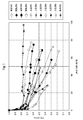
- FIG. 1 is a graph showing the results of Examples 1 to 4, Comparative Examples 1 to 6 and Reference Example 1.
- the present invention will be described by exemplifying a case where the membrane water treatment chemical of the present invention is applied mainly to a membrane separation treatment using an RO membrane, but the membrane water treatment chemical of the present invention is not limited to the RO membrane.
- the present invention is also effectively applied to water to be treated (water supply) for separation membranes such as MF membranes, UF membranes, and NF membranes.
- the membrane water treatment chemical of the present invention is a water treatment chemical for preventing membrane contamination by an organic compound having a phenolic hydroxy group, having two or more nitrogen atoms and 5 (carboxyl) groups (—COOH).
- the organic amine having 2 or more nitrogen atoms and 5 or more carboxyl groups or 4 or more phosphate groups used in the present invention can prevent membrane contamination by an organic compound having a phenolic hydroxy group.
- the details of the mechanism are not clear, but are considered as follows.
- the organic amine carboxyl group or phosphate group interacts with the phenolic hydroxy group of the organic compound having a phenolic hydroxy group in the water to be treated through hydrogen bonds, and the organic compound having the phenolic hydroxy group is dispersed to form a film. Prevent sticking to the surface.
- the organic amine has 5 or more carboxyl groups or 4 or more phosphate groups, the interaction with the organic compound having a phenolic hydroxy group is large, and a good dispersion effect can be obtained.
- a carboxyl group is 15 or less and a phosphoric acid group is 10 or less.
- R 1 , R 2 , R 3 and R 4 represent a phosphate group.
- N is an integer of 1 or more.
- R 11 , R 12 , R 13 , R 14 and R 15 represent a carboxyl group or a phosphate group.
- P and q are each independently an integer of 1 or more.
- R 21 , R 22 , R 23 , R 24 , R 25 and R 26 represent a carboxyl group.
- M is an integer of 1 or more.
- N in the general formula (1), p and q in the general formula (2), and m in the general formula (3) are each preferably an integer of 1 to 5, and more preferably 1 to 3.
- the molecular weight of the organic amine used in the present invention is preferably 100 to 1000, particularly 100 to 800.
- the molecular weight of the organic amine is the sum of the atomic weights in the molecular formula.
- organic amine used in the present invention include the organic amines used in Examples described later, but are not limited to the organic amines described below. Only one organic amine may be used, or two or more organic amines may be used in combination. Furthermore, you may use as salt forms, such as sodium.
- the membrane water treatment chemical of the present invention may contain any of the above-mentioned organic amines, and may contain other scale inhibitors and slime control agents other than organic amines.
- Examples of organic compounds having a phenolic hydroxy group contained in membrane water supply to which the water treatment chemical of the present invention is applied include the following.
- Phenolic hydroxy group means a hydroxy group bonded to an aromatic ring, and examples of organic compounds having it include humic acid, fulvic acid, ellagic acid, phenolic acid, tannin, catechin, rutin, anthocyanin , And synthesized phenol resins.
- the molecular weight (in the case of a low molecule) or the weight average molecular weight (in the case of a polymer) of the organic compound having a phenolic hydroxy group is usually 500 to 1,000,000, preferably 1,000 to 500,000, and preferably 1,000 to 100,000. Is more preferable. If the molecular weight or weight average molecular weight of the organic compound having a phenolic hydroxy group is about 500 to 1,000,000 (preferably 1000 to 100,000), it can be efficiently dispersed by the film water treatment chemical of the present invention.
- the weight average molecular weight is a pullulan-converted value measured by a GPC method and calculated using a standard pullulan calibration curve.
- Examples of water to be treated containing an organic compound having a phenolic hydroxy group include surface water and groundwater containing humic substances containing polyphenols, and wastewater from food and beverage manufacturing plants containing polyphenols derived from raw materials. .
- the agglomerated water in which the phenol resin remains which is obtained by agglomeration treatment using an alkaline solution of a phenol resin as a flocculant described in Patent Document 1 described above, can also be cited as a suitable treated water.
- the concentration of the organic compound having a phenolic hydroxy group contained in the water to be treated varies depending on the type of the water to be treated, but is usually about 0.01 to 10 mg / L.
- the pH of the water to be treated for membrane treatment is not particularly limited, but is preferably 3.5 to 8.5, more preferably 4.0 to 7.5, and still more preferably 5.0. Is 7.0. Therefore, it is desirable that the water to be treated is adjusted to be in this pH range by adding an acid agent and / or an alkali agent as necessary.
- the membrane water treatment chemical of the present invention can be suitably used, for example, as a RO membrane water treatment chemical.
- concentration of nonvolatile organic carbon (NPOC) in the concentrated water obtained is 0.01 to 100 mg / L, particularly 0.
- Addition to RO membrane water containing organic compounds with phenolic hydroxy groups in RO membrane separation treatment of 1 to 50 mg / L or RO membrane separation treatment with concentration factor of 3 times or more, for example 3 to 5 times By doing so, a good effect can be obtained.
- the amount added is two nitrogen atoms as described above.
- the concentration of the organic amine having 5 or more carboxyl groups or 4 or more phosphate groups is 0.01 to 20 mg / L, particularly 0.01 to 10 mg / L. Is preferred. If the addition amount of the organic amine is too small, it is not possible to obtain a sufficient dispersion effect of the organic compound having a phenolic hydroxy group by the organic amine, and if it is too large, the organic amine itself may cause film contamination.
- ⁇ Preparation of test solution> Prepare an aqueous solution containing a Canadian fulvo solution (adjusted so that the UV 260 value is 0.5), calcium chloride (100 mg / L), Ca 30 mg / L, and an evaluation drug 2 mg / L as an organic compound having a phenolic hydroxy group, Further, the pH was adjusted to 6.5 to 7.0 with a small amount of aqueous sodium hydroxide or sulfuric acid solution to obtain Test Solution I.
- Canadian fulvo is an organic compound having a phenolic hydroxy group having a molecular weight of 10,000, and the concentration of the organic compound having a phenolic hydroxy group in the test solution I is 7.4 to 7.6 mg / L.
- test solution II was prepared in the same manner as test solution I except that Canadian fulvo and the evaluation drug were not added (Reference Example 1).
- test solution III was prepared in the same manner as test solution I except that the evaluation drug was not added (Comparative Example 1).
- RO membrane Polyamide RO membrane (“ES20” manufactured by Nitto Denko Corporation) Temperature: 24-25 ° C RO membrane recovery rate: 75% (4-fold concentration) Concentrated water NPOC concentration in test solutions I and III: 29.6 to 30.4 mg / L The NPOC concentration is a concentration when no evaluation drug is added.
- FIG. From 1 it is clear that: In Comparative Example 1 in which no drug was added, the flux ratio significantly decreased with time. Even in Comparative Examples 2 to 6, this decrease cannot be sufficiently prevented. In Examples 1 to 4, 50% or more of the initial flux can be maintained even with continuous water flow for 50 hours or more.
- the agents used in Examples 1 to 4 usually include known scale dispersants, but conventionally, the dispersing effect on organic compounds having a phenolic hydroxy group is not known.
- the effect according to the present invention (the effect of improving the flux with respect to Comparative Example 1 with no drug added) is It can be seen that this is a dispersion effect on an organic compound having a phenolic hydroxy group and is an effect different from that of a Ca scale inhibitor.
Landscapes
- Chemical & Material Sciences (AREA)
- Organic Chemistry (AREA)
- Engineering & Computer Science (AREA)
- Water Supply & Treatment (AREA)
- Chemical Kinetics & Catalysis (AREA)
- Life Sciences & Earth Sciences (AREA)
- Nanotechnology (AREA)
- Environmental & Geological Engineering (AREA)
- Hydrology & Water Resources (AREA)
- Materials Engineering (AREA)
- Health & Medical Sciences (AREA)
- Biochemistry (AREA)
- General Health & Medical Sciences (AREA)
- Molecular Biology (AREA)
- Crystallography & Structural Chemistry (AREA)
- Separation Using Semi-Permeable Membranes (AREA)
Abstract
Description
薬品選択の自由度や、実用化に向けた多様性の拡大のために、更なる新規薬品の開発が望まれている。
本発明は以下を要旨とする。


有機アミンのカルボキシル基やリン酸基が被処理水中のフェノール性ヒドロキシ基を有する有機化合物のフェノール性ヒドロキシ基と水素結合を介して相互作用し、フェノール性ヒドロキシ基を有する有機化合物を分散させて膜面に付着するのを防止する。その際、カルボキシル基が5個以上又はリン酸基が4個以上の有機アミンであれば、フェノール性ヒドロキシ基を有する有機化合物との相互作用が大きく、良好な分散効果を得ることができる。有機アミンが有するカルボキシル基、リン酸基の数の上限については特に制限はないが、通常、カルボキシル基は15個以下、リン酸基は10個以下である。


フェノール性ヒドロキシ基を有する有機化合物としてカナディアンフルボ溶液(UV260値が0.5になるよう調整)、塩化カルシウム(100mg/L)、Ca30mg/L、評価薬剤2mg/Lを含有する水溶液を調製し、更に、少量の水酸化ナトリウム水溶液又は硫酸水溶液でpHを6.5~7.0に調整して試験溶液Iとした。
上記の試験溶液I~IIIを用い、以下の条件でRO膜通水試験を行った。
温度:24~25℃
RO膜回収率:75%(4倍濃縮)
試験溶液I,IIIにおける濃縮水のNPOC濃度:29.6~30.4mg/L
上記NPOC濃度は評価薬剤が添加されていないときの濃度である。
薬剤無添加の比較例1では、経時によりフラックス比が大きく低下した。
比較例2~6でも、この低下を十分に防止し得ない。
実施例1~4では、50時間以上の連続通水でも、初期フラックスの50%以上を維持することができる。
これに対して、Caを含んでいても、カナディアンフルボを含まない試験溶液IIではフラックスの低下は見られないことから、本発明による効果(薬剤無添加の比較例1に対するフラックスの向上効果)は、フェノール性ヒドロキシ基を有する有機化合物に対する分散効果であり、Caスケール防止剤とは異質の効果であることが分かる。
本出願は、2017年3月15日付で出願された日本特許出願2017-050167に基づいており、その全体が引用により援用される。
Claims (8)
- フェノール性ヒドロキシ基を有する有機化合物による膜汚染を防止するための水処理薬品であって、窒素原子を2個以上有し、かつカルボキシル基を5個以上又はリン酸基を4個以上有する有機アミンを含むことを特徴とする膜用水処理薬品。
- 前記有機アミンが、下記(1)~(3)のいずれかで表される有機アミンである請求項1に記載の膜用水処理薬品。

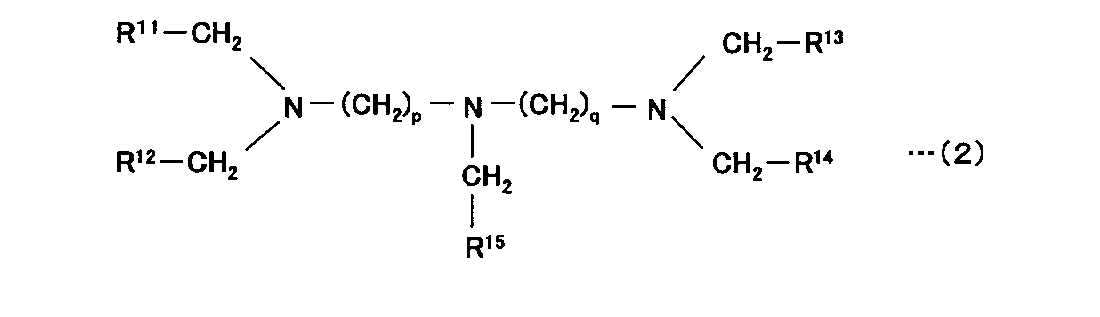

- 前記一般式(1)におけるn、前記一般式(2)におけるp,q、および前記一般式(3)におけるmが1~5の整数である請求項2に記載の膜用水処理薬品。
- 前記有機アミンの分子量が100~1000である請求項1ないし3のいずれか1項に記載の膜用水処理薬品。
- フェノール性ヒドロキシ基を有する有機化合物を含む被処理水を逆浸透膜処理する逆浸透膜用水処理薬品であって、該逆浸透膜処理で得られる濃縮水の不揮発性有機炭酸濃度が0.01~100mg/Lである請求項1ないし4のいずれか1項に記載の膜用水処理薬品。
- 前記逆浸透膜の濃縮倍率が3倍以上である請求項5に記載の膜用水処理薬品。
- フェノール性ヒドロキシ基を有する有機化合物を含む被処理水に請求項1ないし6のいずれか1項に記載の膜用水処理薬品を添加した後、膜分離処理する膜処理方法。
- 前記膜用水処理薬品を、前記被処理水に、前記有機アミンの濃度が0.01~20mg/Lとなるように添加する請求項7に記載の膜処理方法。
Priority Applications (4)
| Application Number | Priority Date | Filing Date | Title |
|---|---|---|---|
| KR1020197027714A KR102278438B1 (ko) | 2017-03-15 | 2018-03-02 | 막용 수 처리 약품 및 막 처리 방법 |
| US16/493,588 US20200129928A1 (en) | 2017-03-15 | 2018-03-02 | Water treatment chemical for membrane, and membrane treatment method |
| JP2018512231A JP6673470B2 (ja) | 2017-03-15 | 2018-03-02 | 膜用水処理薬品及び膜処理方法 |
| CN201880011362.7A CN110290859B (zh) | 2017-03-15 | 2018-03-02 | 膜用水处理药品以及膜处理方法 |
Applications Claiming Priority (2)
| Application Number | Priority Date | Filing Date | Title |
|---|---|---|---|
| JP2017-050167 | 2017-03-15 | ||
| JP2017050167 | 2017-03-15 |
Publications (1)
| Publication Number | Publication Date |
|---|---|
| WO2018168522A1 true WO2018168522A1 (ja) | 2018-09-20 |
Family
ID=63523472
Family Applications (1)
| Application Number | Title | Priority Date | Filing Date |
|---|---|---|---|
| PCT/JP2018/007995 Ceased WO2018168522A1 (ja) | 2017-03-15 | 2018-03-02 | 膜用水処理薬品及び膜処理方法 |
Country Status (6)
| Country | Link |
|---|---|
| US (1) | US20200129928A1 (ja) |
| JP (1) | JP6673470B2 (ja) |
| KR (1) | KR102278438B1 (ja) |
| CN (1) | CN110290859B (ja) |
| TW (1) | TWI721256B (ja) |
| WO (1) | WO2018168522A1 (ja) |
Cited By (2)
| Publication number | Priority date | Publication date | Assignee | Title |
|---|---|---|---|---|
| WO2020071309A1 (ja) * | 2018-10-05 | 2020-04-09 | 栗田工業株式会社 | 膜用水処理薬品及び膜処理方法 |
| WO2021235079A1 (ja) * | 2020-05-19 | 2021-11-25 | 栗田工業株式会社 | 分離膜のファウリング防止剤及びファウリング防止方法 |
Citations (3)
| Publication number | Priority date | Publication date | Assignee | Title |
|---|---|---|---|---|
| JP2001224933A (ja) * | 2000-02-18 | 2001-08-21 | Hakuto Co Ltd | 逆浸透膜表面のスケール抑制方法 |
| JP2008062223A (ja) * | 2006-08-08 | 2008-03-21 | Toray Ind Inc | 膜ろ過方法及び膜ろ過処理システム |
| JP2015142903A (ja) * | 2013-12-26 | 2015-08-06 | 栗田工業株式会社 | 逆浸透膜装置の運転方法、及び逆浸透膜装置 |
Family Cites Families (7)
| Publication number | Priority date | Publication date | Assignee | Title |
|---|---|---|---|---|
| JP5223219B2 (ja) * | 2007-03-30 | 2013-06-26 | 栗田工業株式会社 | 有機性排水の処理装置 |
| JP5194771B2 (ja) * | 2007-12-21 | 2013-05-08 | 栗田工業株式会社 | 有機物含有水の生物処理方法および装置 |
| JP5407994B2 (ja) | 2009-08-11 | 2014-02-05 | 栗田工業株式会社 | 水処理方法及び水処理凝集剤 |
| CN103480278B (zh) * | 2013-09-06 | 2015-02-25 | 烟台绿水赋膜材料有限公司 | 一种抗污染亲水性分离膜的制备方法及应用 |
| JP5867532B2 (ja) | 2014-03-18 | 2016-02-24 | 栗田工業株式会社 | 水処理用分散剤及び水処理方法 |
| ES2734098T3 (es) * | 2014-11-27 | 2019-12-04 | Toray Industries | Método de producción de agua |
| CN105688680B (zh) * | 2016-04-08 | 2018-08-14 | 北京今大禹环境技术股份有限公司 | 一种反渗透膜元件的清洗方法 |
-
2018
- 2018-03-02 WO PCT/JP2018/007995 patent/WO2018168522A1/ja not_active Ceased
- 2018-03-02 KR KR1020197027714A patent/KR102278438B1/ko active Active
- 2018-03-02 US US16/493,588 patent/US20200129928A1/en not_active Abandoned
- 2018-03-02 CN CN201880011362.7A patent/CN110290859B/zh active Active
- 2018-03-02 JP JP2018512231A patent/JP6673470B2/ja active Active
- 2018-03-08 TW TW107107815A patent/TWI721256B/zh active
Patent Citations (3)
| Publication number | Priority date | Publication date | Assignee | Title |
|---|---|---|---|---|
| JP2001224933A (ja) * | 2000-02-18 | 2001-08-21 | Hakuto Co Ltd | 逆浸透膜表面のスケール抑制方法 |
| JP2008062223A (ja) * | 2006-08-08 | 2008-03-21 | Toray Ind Inc | 膜ろ過方法及び膜ろ過処理システム |
| JP2015142903A (ja) * | 2013-12-26 | 2015-08-06 | 栗田工業株式会社 | 逆浸透膜装置の運転方法、及び逆浸透膜装置 |
Cited By (6)
| Publication number | Priority date | Publication date | Assignee | Title |
|---|---|---|---|---|
| WO2020071309A1 (ja) * | 2018-10-05 | 2020-04-09 | 栗田工業株式会社 | 膜用水処理薬品及び膜処理方法 |
| JP2020058964A (ja) * | 2018-10-05 | 2020-04-16 | 栗田工業株式会社 | 膜用水処理薬品及び膜処理方法 |
| CN112739448A (zh) * | 2018-10-05 | 2021-04-30 | 栗田工业株式会社 | 膜用水处理药品及膜处理方法 |
| CN112739448B (zh) * | 2018-10-05 | 2022-10-25 | 栗田工业株式会社 | 膜用水处理药品及膜处理方法 |
| US11958019B2 (en) | 2018-10-05 | 2024-04-16 | Kurita Water Industries Ltd. | Water treatment chemical for membranes and membrane treatment method |
| WO2021235079A1 (ja) * | 2020-05-19 | 2021-11-25 | 栗田工業株式会社 | 分離膜のファウリング防止剤及びファウリング防止方法 |
Also Published As
| Publication number | Publication date |
|---|---|
| JP6673470B2 (ja) | 2020-03-25 |
| KR20190123297A (ko) | 2019-10-31 |
| US20200129928A1 (en) | 2020-04-30 |
| CN110290859A (zh) | 2019-09-27 |
| TWI721256B (zh) | 2021-03-11 |
| CN110290859B (zh) | 2022-01-28 |
| JPWO2018168522A1 (ja) | 2019-03-28 |
| KR102278438B1 (ko) | 2021-07-15 |
| TW201841677A (zh) | 2018-12-01 |
Similar Documents
| Publication | Publication Date | Title |
|---|---|---|
| TW201043579A (en) | Slime control agent for activated carbon, method of passing water through activated-carbon device, and method and apparatus for treating organic-containing water | |
| US12528050B2 (en) | Biocide composition and method | |
| CN108585262A (zh) | 净化水的方法以及适用于所述方法的设备 | |
| Shon et al. | Comparison of physico-chemical pretreatment methods to seawater reverse osmosis: detailed analyses of molecular weight distribution of organic matter in initial stage | |
| JP5867532B2 (ja) | 水処理用分散剤及び水処理方法 | |
| JP6673470B2 (ja) | 膜用水処理薬品及び膜処理方法 | |
| Oh et al. | Effect of ozone on microfiltration as a pretreatment of seawater reverse osmosis | |
| JP2005224761A (ja) | 純水又は超純水の製造方法 | |
| CN112739448B (zh) | 膜用水处理药品及膜处理方法 | |
| US11077403B2 (en) | Water treatment method | |
| JP7200552B2 (ja) | 分離膜のファウリング防止剤及びファウリング防止方法 | |
| JP2004244346A (ja) | 水処理用殺菌剤、水処理方法および水処理装置 | |
| Palmowski et al. | Removal of salts from dairy processors effluent via reverse osmosis-results from lab and pilot-scale trials | |
| TW202144298A (zh) | 分離膜的積垢防止劑及積垢防止方法 | |
| JP2007000790A (ja) | 分離膜の処理・保存方法および装置 | |
| Vera Peña et al. | Nanofiltration/Reverse Osmosis as Pretreatment Technique for Water Reuse: Ultrafiltration Versus Tertiary Membrane Reactor | |
| JP2019171333A (ja) | 逆浸透膜分離方法及び逆浸透膜のファウリング防止剤 | |
| Shrestha | Seawater pre-treatment for reverse osmosis system | |
| JP2017131824A (ja) | 水処理方法および生物代謝物用吸着剤 |
Legal Events
| Date | Code | Title | Description |
|---|---|---|---|
| ENP | Entry into the national phase |
Ref document number: 2018512231 Country of ref document: JP Kind code of ref document: A |
|
| 121 | Ep: the epo has been informed by wipo that ep was designated in this application |
Ref document number: 18768270 Country of ref document: EP Kind code of ref document: A1 |
|
| NENP | Non-entry into the national phase |
Ref country code: DE |
|
| ENP | Entry into the national phase |
Ref document number: 20197027714 Country of ref document: KR Kind code of ref document: A |
|
| 122 | Ep: pct application non-entry in european phase |
Ref document number: 18768270 Country of ref document: EP Kind code of ref document: A1 |