WO2018168249A1 - 傾斜車両用ヘッドライト装置及び傾斜車両 - Google Patents
傾斜車両用ヘッドライト装置及び傾斜車両 Download PDFInfo
- Publication number
- WO2018168249A1 WO2018168249A1 PCT/JP2018/003716 JP2018003716W WO2018168249A1 WO 2018168249 A1 WO2018168249 A1 WO 2018168249A1 JP 2018003716 W JP2018003716 W JP 2018003716W WO 2018168249 A1 WO2018168249 A1 WO 2018168249A1
- Authority
- WO
- WIPO (PCT)
- Prior art keywords
- vehicle
- irradiation
- small irradiation
- light
- vehicle body
- Prior art date
- Legal status (The legal status is an assumption and is not a legal conclusion. Google has not performed a legal analysis and makes no representation as to the accuracy of the status listed.)
- Ceased
Links
Images







Classifications
-
- B—PERFORMING OPERATIONS; TRANSPORTING
- B62—LAND VEHICLES FOR TRAVELLING OTHERWISE THAN ON RAILS
- B62J—CYCLE SADDLES OR SEATS; AUXILIARY DEVICES OR ACCESSORIES SPECIALLY ADAPTED TO CYCLES AND NOT OTHERWISE PROVIDED FOR, e.g. ARTICLE CARRIERS OR CYCLE PROTECTORS
- B62J6/00—Arrangement of optical signalling or lighting devices on cycles; Mounting or supporting thereof; Circuits therefor
- B62J6/02—Headlights
- B62J6/022—Headlights specially adapted for motorcycles or the like
- B62J6/023—Headlights specially adapted for motorcycles or the like responsive to the lean angle of the cycle, e.g. changing intensity or switching sub-lights when cornering
-
- B—PERFORMING OPERATIONS; TRANSPORTING
- B60—VEHICLES IN GENERAL
- B60Q—ARRANGEMENT OF SIGNALLING OR LIGHTING DEVICES, THE MOUNTING OR SUPPORTING THEREOF OR CIRCUITS THEREFOR, FOR VEHICLES IN GENERAL
- B60Q1/00—Arrangement of optical signalling or lighting devices, the mounting or supporting thereof or circuits therefor
- B60Q1/02—Arrangement of optical signalling or lighting devices, the mounting or supporting thereof or circuits therefor the devices being primarily intended to illuminate the way ahead or to illuminate other areas of way or environments
- B60Q1/04—Arrangement of optical signalling or lighting devices, the mounting or supporting thereof or circuits therefor the devices being primarily intended to illuminate the way ahead or to illuminate other areas of way or environments the devices being headlights
- B60Q1/06—Arrangement of optical signalling or lighting devices, the mounting or supporting thereof or circuits therefor the devices being primarily intended to illuminate the way ahead or to illuminate other areas of way or environments the devices being headlights adjustable, e.g. remotely-controlled from inside vehicle
- B60Q1/08—Arrangement of optical signalling or lighting devices, the mounting or supporting thereof or circuits therefor the devices being primarily intended to illuminate the way ahead or to illuminate other areas of way or environments the devices being headlights adjustable, e.g. remotely-controlled from inside vehicle automatically
- B60Q1/12—Arrangement of optical signalling or lighting devices, the mounting or supporting thereof or circuits therefor the devices being primarily intended to illuminate the way ahead or to illuminate other areas of way or environments the devices being headlights adjustable, e.g. remotely-controlled from inside vehicle automatically due to steering position
-
- B—PERFORMING OPERATIONS; TRANSPORTING
- B60—VEHICLES IN GENERAL
- B60Q—ARRANGEMENT OF SIGNALLING OR LIGHTING DEVICES, THE MOUNTING OR SUPPORTING THEREOF OR CIRCUITS THEREFOR, FOR VEHICLES IN GENERAL
- B60Q1/00—Arrangement of optical signalling or lighting devices, the mounting or supporting thereof or circuits therefor
- B60Q1/02—Arrangement of optical signalling or lighting devices, the mounting or supporting thereof or circuits therefor the devices being primarily intended to illuminate the way ahead or to illuminate other areas of way or environments
- B60Q1/04—Arrangement of optical signalling or lighting devices, the mounting or supporting thereof or circuits therefor the devices being primarily intended to illuminate the way ahead or to illuminate other areas of way or environments the devices being headlights
- B60Q1/14—Arrangement of optical signalling or lighting devices, the mounting or supporting thereof or circuits therefor the devices being primarily intended to illuminate the way ahead or to illuminate other areas of way or environments the devices being headlights having dimming means
- B60Q1/1415—Dimming circuits
- B60Q1/1423—Automatic dimming circuits, i.e. switching between high beam and low beam due to change of ambient light or light level in road traffic
- B60Q1/143—Automatic dimming circuits, i.e. switching between high beam and low beam due to change of ambient light or light level in road traffic combined with another condition, e.g. using vehicle recognition from camera images or activation of wipers
-
- B—PERFORMING OPERATIONS; TRANSPORTING
- B60—VEHICLES IN GENERAL
- B60Q—ARRANGEMENT OF SIGNALLING OR LIGHTING DEVICES, THE MOUNTING OR SUPPORTING THEREOF OR CIRCUITS THEREFOR, FOR VEHICLES IN GENERAL
- B60Q2300/00—Indexing codes for automatically adjustable headlamps or automatically dimmable headlamps
- B60Q2300/10—Indexing codes relating to particular vehicle conditions
- B60Q2300/13—Attitude of the vehicle body
- B60Q2300/136—Roll
-
- B—PERFORMING OPERATIONS; TRANSPORTING
- B60—VEHICLES IN GENERAL
- B60Q—ARRANGEMENT OF SIGNALLING OR LIGHTING DEVICES, THE MOUNTING OR SUPPORTING THEREOF OR CIRCUITS THEREFOR, FOR VEHICLES IN GENERAL
- B60Q2300/00—Indexing codes for automatically adjustable headlamps or automatically dimmable headlamps
- B60Q2300/40—Indexing codes relating to other road users or special conditions
- B60Q2300/41—Indexing codes relating to other road users or special conditions preceding vehicle
-
- B—PERFORMING OPERATIONS; TRANSPORTING
- B60—VEHICLES IN GENERAL
- B60Q—ARRANGEMENT OF SIGNALLING OR LIGHTING DEVICES, THE MOUNTING OR SUPPORTING THEREOF OR CIRCUITS THEREFOR, FOR VEHICLES IN GENERAL
- B60Q2300/00—Indexing codes for automatically adjustable headlamps or automatically dimmable headlamps
- B60Q2300/40—Indexing codes relating to other road users or special conditions
- B60Q2300/42—Indexing codes relating to other road users or special conditions oncoming vehicle
Definitions
- the present invention relates to a headlight device for an inclined vehicle and an inclined vehicle including the same.
- motorcycles are known as inclined vehicles.
- a lean vehicle the vehicle body tilts to the left of the lean vehicle when turning left, and the vehicle body leans to the right of the lean vehicle when turning right.
- Such an inclined vehicle includes a headlight unit that can operate in a low beam mode and a high beam mode.
- Patent Document 1 An inclined vehicle including a headlight unit is disclosed in, for example, Japanese Patent Laid-Open No. 2016-64723 (Patent Document 1).
- the inclined vehicle of Patent Document 1 includes a headlight unit and an irradiation area additional sublight unit.
- the headlight unit can operate in a low beam mode and a high beam mode.
- the irradiation area additional sub-light unit forms an irradiation area that supplements the low beam and high beam irradiation areas of the headlight unit.
- Patent Document 1 describes that various irradiation regions can be formed in a state where the vehicle body of the inclined vehicle is inclined leftward or rightward in the inclined vehicle.
- the headlight unit irradiates various irradiation areas when the vehicle body is inclined leftward or rightward. Therefore, it is desired for the inclined vehicle to increase the degree of freedom in designing the irradiation area of the headlight unit in a state where the vehicle body is inclined leftward or rightward in the inclined vehicle.
- An object of the present invention is to provide a headlight device for a tilted vehicle and a tilted vehicle that can increase the degree of freedom in designing the irradiation area of the headlight unit when the vehicle body is tilted.
- the present inventors have examined the driving environment in a state where the body of the inclined vehicle is inclined again in detail. As a result, it has been found that there is a case where it is desired to design an irradiation area that cannot be formed by an irradiation area addition type sub-light unit depending on the traveling environment.
- the irradiation area is designed as described above, for example, when the vehicle body of the inclined vehicle is tilted to the left in the inclined vehicle, it is desired to reduce the amount of light in the irradiation area that illuminates the road surface on the lower left side when viewed from the rider.
- the headlight unit and the irradiation area addition type sublight unit approach the road surface on the lower left side as the vehicle body leans to the left in the inclined vehicle.
- the headlight unit and the sub-light unit of the irradiation area addition type approach the road surface, the road surface on the lower left side of the inclined vehicle is illuminated relatively brightly with respect to the surroundings. For this reason, the rider may want to reduce the amount of light in the irradiation area that illuminates the road surface on the lower left side of the inclined vehicle as viewed from the rider.
- the irradiation area when it is desired to design the irradiation area as described above, for example, when the vehicle body of the inclined vehicle is inclined to the left in the inclined vehicle, the irradiation area that illuminates the road surface on the lower right side of the inclined vehicle as viewed from the rider.
- the rider's line of sight faces the left front of the leaning vehicle. That is, when the inclined vehicle is turning left, it is less necessary for the rider to illuminate the road surface on the lower right side of the inclined vehicle. Therefore, there are cases where it is desired to reduce the amount of light in the irradiation area that illuminates the road surface on the lower right side of the inclined vehicle as seen from the rider.
- the present inventors are not the conventional technical idea of adding a necessary irradiation area when the vehicle body of the inclined vehicle is inclined leftward or rightward in the inclined vehicle.
- the present inventors have found a technical idea opposite to the conventional one in which a light source that forms an irradiation region that is less necessary when tilted to the right or to the right is dimmed or turned off.
- the inventors of the present invention have created a combination pattern of irradiation areas different from the conventional pattern when the vehicle body of an inclined vehicle is tilted leftward or rightward in an inclined vehicle. And the present inventors created the control apparatus required in order to form the irradiation area
- the inclined vehicle according to the present invention has been completed based on the above-described knowledge.
- Inclined vehicle A tilting vehicle headlight device for a tilting vehicle comprising a vehicle body that tilts to the left in a leaning vehicle when turning left and leans to the right in the leaning vehicle when turning right, A lower central light source that irradiates light that forms a lower central irradiation region forward in the vehicle body, and irradiates light that forms an upper central irradiation region disposed above the lower central irradiation region in the vehicle body forward in the vehicle body
- a lower right light source that irradiates light in front of the vehicle body with light that forms a lower right small irradiation region disposed on the vehicle body, and is disposed on the left side of the
- the lower right light source reduces the amount of light emitted from the lower right light source to a lower right small irradiation region, or the lower right light source emits light to the lower right small irradiation region.
- Lower right small irradiation area dimming / non-irradiation control for controlling the lower right small irradiation area in a non-irradiated state, the amount of light irradiated to the upper left small irradiation area by the upper left light source is irradiated to the entire small irradiation area
- the upper left small is set to a dimming state in which the upper left small light source is less than the amount of light irradiated to the upper left small irradiation region, or the upper left small irradiation region is not irradiated with light by the upper left light source.
- Small irradiation area dimming / non-irradiation control or the upper right small illumination area is irradiated with the upper right light source in the entire small irradiation area irradiation state by the upper right light source.
- the upper right small irradiation area is controlled to be in a dimmed state that is less than the amount of light that is emitted, or in a non-irradiated state in which the upper right small light source is not irradiated with light by the upper right light source.
- the headlight device for an inclined vehicle a wide area in front of the inclined vehicle can be illuminated. More specifically, the headlight device for an inclined vehicle includes a lower left small irradiation area, an upper left small irradiation area, a lower right small irradiation area, and an upper right small irradiation area in addition to the lower central irradiation area and the upper central irradiation area. Can illuminate. Therefore, the headlight unit can illuminate a wide area in front of the inclined vehicle.
- the degree of freedom in designing the irradiation region of the headlight unit when the vehicle body is inclined can be increased.
- the control device controls the lower left small irradiation region dimming / non-irradiation when the vehicle body is tilted to either the left or the right in the inclined vehicle in the irradiation state of the entire small irradiation region.
- the lower left small irradiation region is controlled in a dimming state that is less than the amount of light emitted, or in a non-irradiation state where the lower left small irradiation region is not irradiated with light by the lower left light source.
- the control device irradiates the lower right small irradiation area with the lower right light source in the irradiation state of the lower right small irradiation area with the lower right light source.
- the lower right small irradiation region is controlled in a dimming state that is less than the amount of light emitted, or in a non-irradiation state in which no light is irradiated to the lower right small irradiation region by the lower right light source.
- the control device irradiates the upper left small irradiation area with the upper left light source in the entire small irradiation area irradiation state with the upper left light source.
- the upper left small irradiation region is controlled in a dimming state that is less than the amount of light emitted or in a non-irradiation state in which no light is irradiated to the upper left small irradiation region by the upper left light source.
- the control device irradiates the upper right small irradiation area with the upper right light source in the entire small irradiation area irradiation state with the upper right light source.
- the upper right small irradiation region is controlled in a dimming state that is less than the amount of light emitted or in a non-irradiation state in which no light is irradiated to the upper right small irradiation region by the upper right light source. Therefore, the control device sets at least one of the lower left small irradiation region, the lower right small irradiation region, the upper left small irradiation region, or the upper right small irradiation region to a dimming state or a non-irradiation state according to various driving environments. Can be controlled without rider operation. As a result, the control device can form an irradiation area of the headlight unit corresponding to various traveling environments. Thus, according to the headlight device for an inclined vehicle, the degree of freedom in designing the irradiation area of the headlight unit when the vehicle body is inclined can be increased.
- the headlight device for an inclined vehicle according to (2) is the headlight device for an inclined vehicle according to (1)
- the control device includes: When the vehicle body is tilted to the left in the inclined vehicle in the all-small irradiation area irradiation state, the lower left small irradiation area dimming / non-irradiation control is executed, When the vehicle body is tilted to the right in the inclined vehicle in the all small irradiation region irradiation state, the lower right small irradiation region dimming / non-irradiation control is executed.
- the lower left small irradiation region and the lower right small irradiation region which are less necessary, can be in a dimmed state or a non-irradiated state. More specifically, when the vehicle body is tilted to the left in an inclined vehicle, the lower left light source approaches the road surface. Therefore, the lower left small irradiation region formed by the light irradiated by the lower left light source is illuminated relatively brightly with respect to the surroundings. Therefore, when the vehicle body is inclined to the left in the inclined vehicle, the necessity for the lower left small irradiation region is low.
- the control device controls the lower left small irradiation region and the lower right small irradiation region, which are less necessary, to the dimming state or the non-irradiation state.
- the headlight device for an inclined vehicle is the headlight device for an inclined vehicle
- the control device includes: When the vehicle body inclines to the left in the inclined vehicle in the all-small irradiation region irradiation state, the upper left small irradiation region dimming / non-irradiation control is not executed, When the vehicle body is tilted to the right in the inclined vehicle in the all small irradiation region irradiation state, the upper right small irradiation region dimming / non-irradiation control is not executed.
- the field of view of the rider can be further widened. More specifically, when the vehicle body is tilted to the left in the leaning vehicle, the rider's line of sight faces the left front in the leaning vehicle. Therefore, the upper left small irradiation region illuminates the same direction as the rider's line of sight. Thereby, according to the headlight device for an inclined vehicle, when the vehicle body is inclined leftward in the inclined vehicle, the field of view of the rider can be further widened. For the same reason, according to the headlight device for an inclined vehicle, when the vehicle body is inclined rightward in the inclined vehicle, the field of view of the rider can be further widened.
- the tilted vehicle headlight device is the tilted vehicle headlight device according to any one of (1) to (3),
- the tilted vehicle headlight device comprises: A detection device that detects the preceding vehicle or oncoming vehicle,
- the control device includes: When the detection device detects the preceding vehicle or the oncoming vehicle when the vehicle body is tilted to the left in the inclined vehicle in the all small irradiation region irradiation state, the upper left small irradiation region dimming / non-irradiation control is performed.
- the upper left small irradiation region dimming / non-irradiation control is performed when the detection device does not detect the preceding vehicle or the oncoming vehicle.
- the upper right small irradiation region dimming / non-irradiation control is performed when the detection device detects the preceding vehicle or the oncoming vehicle.
- the detection device does not detect the preceding vehicle or the oncoming vehicle when the vehicle body is tilted to the right in the lean vehicle in the all small irradiation region irradiation state, the upper right small irradiation region dimming / non-irradiation control is performed. Do not execute.
- the rider's field of view can be made wider for the same reason as the headlight device for an inclined vehicle of (3).
- the headlight device for an inclined vehicle of (4) when there is a preceding vehicle or an oncoming vehicle, it is possible to suppress discomfort due to glare to the preceding vehicle or the oncoming vehicle. More specifically, when the vehicle body is tilted to the left in an inclined vehicle, the upper left small irradiation region may give a discomfort due to glare to the preceding vehicle or the oncoming vehicle.
- the headlight device for an inclined vehicle of (4) when the vehicle body is inclined leftward in the inclined vehicle, the upper left small irradiation region is dimmed / not irradiated when the detection device detects a preceding vehicle or an oncoming vehicle. Execute control. For the same reason, in the headlight device for an inclined vehicle of (4), when the vehicle body is inclined to the right in the inclined vehicle, the upper right small irradiation area dimming / Non-irradiation control is executed. Thereby, according to the headlight device for an inclined vehicle, when there is a preceding vehicle or an oncoming vehicle, it is possible to suppress discomfort due to glare to the preceding vehicle or the oncoming vehicle.
- Inclined vehicle headlight device in (4) Inclined vehicle headlight device,
- the detection device is a light detection camera that detects light emitted from the preceding vehicle or the oncoming vehicle.
- Inclined vehicle headlight device in (5) Inclined vehicle headlight device, The light detection camera is tilted to the left or right in the inclined vehicle together with the vehicle body, The control device calculates an inclination angle of the vehicle body based on a video signal output from the light detection camera.
- the control device can calculate the inclination angle of the vehicle body using the light detection camera that detects the preceding vehicle or the oncoming vehicle.
- the tilted vehicle headlight device is an inclined vehicle headlight device, A plurality of the lower left light sources are arranged in the vertical direction of the vehicle body, A plurality of the lower right light sources are arranged in the vertical direction of the vehicle body; A plurality of the upper left light sources are arranged in the vertical direction of the vehicle body; A plurality of the upper right light sources are arranged in the vertical direction of the vehicle body; The plurality of lower left small irradiation areas are formed by the light irradiation of the plurality of lower left light sources, and are arranged in the vertical direction of the vehicle body, The plurality of lower right small irradiation areas are formed by the light irradiation of the plurality of lower right light sources, and are arranged in the vertical direction of the vehicle body, The plurality of upper left small irradiation areas are formed by the plurality of upper left light sources irradiating light, and are arranged in the vertical direction of the vehicle body, The plurality of upper right small irradi
- the degree of freedom in designing the irradiation area of the headlight unit when the vehicle body is inclined can be further increased. More specifically, a plurality of lower left small irradiation areas are formed. A plurality of upper left small irradiation areas are formed. A plurality of lower right small irradiation areas are formed. A plurality of upper right small irradiation areas are formed.
- the degree of freedom in designing the irradiation area of the headlight unit when the vehicle body is inclined can be further increased.
- Inclined vehicle headlight device In the inclined vehicle headlight device, The sum of the number of the plurality of lower left small irradiation areas and the number of the plurality of upper left small irradiation areas is larger than the total of the number of the lower central irradiation areas and the number of the upper central irradiation areas, The sum of the number of the plurality of lower right small irradiation areas and the number of the plurality of upper right small irradiation areas is larger than the total of the number of the lower central irradiation areas and the number of the upper central irradiation areas.
- the headlight device for an inclined vehicle of (8) According to the headlight device for an inclined vehicle of (8), the sum of the number of the plurality of lower left small irradiation areas and the number of the plurality of upper left small irradiation areas, and the number and the plurality of the lower right small irradiation areas. Therefore, the degree of freedom in designing the irradiation area of the headlight unit when the vehicle body is tilted can be further increased.
- the headlight device for an inclined vehicle according to (9) is the headlight device for an inclined vehicle according to either (1) or (8),
- the lower left small irradiation area extends to the lower left of the vehicle body
- the lower right small irradiation region extends to the lower right in the vehicle body
- the upper left small irradiation region extends to the upper left of the vehicle body
- the upper right small irradiation region extends to the upper right of the vehicle body.
- the lower left small irradiation region extends to the lower left in the vehicle body, and the lower right small irradiation region extends to the lower right in the vehicle body. Therefore, even if the vehicle body tilts to the left or right in an inclined vehicle, the lower left small irradiation region and the lower right small irradiation region are less likely to be positioned above the inclined vehicle than the lower central irradiation region. Therefore, it is difficult to give discomfort due to glare to the preceding vehicle or the oncoming vehicle.
- the upper left small irradiation region extends to the upper left in the vehicle body, and the upper right small irradiation region extends to the upper right in the vehicle body. Therefore, even if the vehicle body tilts to the left or right in an inclined vehicle, the upper left small irradiation region and the upper right small irradiation region are less likely to be positioned below the inclined vehicle than the upper central irradiation region. Therefore, even when the leaning vehicle is turning left or turning right, the upper left small irradiation region and the upper right small irradiation region can illuminate the far side of the leaning vehicle.
- the irradiation area includes light in at least one of the lower center irradiation area, the upper center irradiation area, the lower left small irradiation area, the upper left small irradiation area, the lower right small irradiation area, and the upper right small irradiation area.
- the lower right small irradiation area is the lower left small irradiation area with respect to a straight line that intersects the central axis of the irradiation area in the irradiation state of the all small irradiation area extending in the front-rear direction in the vehicle body and extends in the vertical direction in the inclined vehicle.
- the upper right small irradiation area is arranged in line symmetry with the upper left small irradiation area.
- the headlight device for an inclined vehicle when the vehicle body is in an upright state, the irradiation area has a symmetrical shape. Therefore, the headlight device for an inclined vehicle (10) is suitable for the headlight device for an inclined vehicle.
- Inclined vehicle A vehicle body that leans left in the leaning vehicle when turning left, and leans right in the leaning vehicle when turning right; (1) to the headlight device for an inclined vehicle according to any one of (10), Is provided.
- the degree of freedom in designing the irradiation area of the headlight unit when the vehicle body is inclined can be increased.
- the tilted vehicle according to the present invention can increase the degree of freedom in designing the irradiation area of the headlight unit when the vehicle body is tilted.
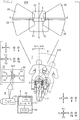
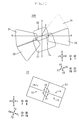
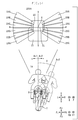
- FIG. 1 is a diagram showing an inclined vehicle 1, an inclined vehicle headlight device 8, a headlight unit 10, and an irradiation area 200 of the headlight unit 10.
- FIG. 2 is a view of the inclined vehicle 1 as viewed from the front of the inclined vehicle 1.
- FIG. 3 is a longitudinal sectional view of the vicinity of the headlight unit 10.
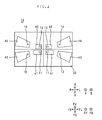
- 4 is a front view of the lower center inner lens 41, the upper center inner lens 42, the lower left inner lens 43, the upper left inner lens 44, the lower right inner lens 45, and the upper right inner lens 46.
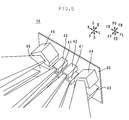
- FIG. FIG. 5 is a perspective view of the headlight unit 10.
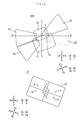
- FIG. 6 is a view showing an irradiation region 200 when the vehicle body 6 is tilted to the left L.
- FIG. 7 is a view showing an irradiation region 200 when the vehicle body 6 is tilted to the left L.
- FIG. FIG. 8 is a view showing an irradiation region 200 when the vehicle body 6 is tilted to the left L.
- FIG. 9 is a diagram showing an irradiation region 200 when the vehicle body 6 is tilted to the left L.
- FIG. 10 is a view showing an irradiation region 200 when the vehicle body 6 is tilted to the left L.
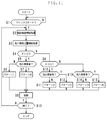
- FIG. FIG. 11 is a flowchart showing the irradiation area determination table of Table 1.
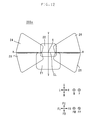
- FIG. 12 is a diagram showing an irradiation region 200a according to the first modification.
- FIG. 12 is a diagram showing an irradiation region 200a according to the first modification.
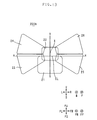
- FIG. 13 is a diagram showing an irradiation region 200b according to the second modification.
- FIG. 14 is a diagram showing an irradiation area 200A of the inclined vehicle 1A and the headlight unit 10A.
- FIG. 15 is a block diagram of the headlight device 8A for an inclined vehicle.
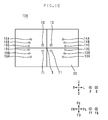
- FIG. 16 is a front view of the light source of the headlight unit 10A.
- FIG. 17 is a front view of the lower center inner lens 41, the upper center inner lens 42, the lower left inner lenses 43A to 43C, the upper left inner lenses 44A to 44C, the lower right inner lenses 45A to 45C, and the upper right inner lenses 46A to 46C.
- FIG. 18 is a perspective view of the headlight unit 10A.
- FIG. 19 is a diagram showing an irradiation area 200A when the vehicle body 6 is tilted to the left L.
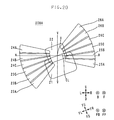
- FIG. FIG. 20 is a diagram showing an irradiation area 200A of the inclined vehicle 1A.
- FIG. 1 is a diagram showing an inclined vehicle 1, an inclined vehicle headlight device 8, a headlight unit 10, and an irradiation area 200 of the headlight unit 10.
- FIG. 2 is a view of the inclined vehicle 1 as viewed from the front of the inclined vehicle 1.
- the front of the inclined vehicle 1 is referred to as a front F.
- the rear in the inclined vehicle 1 is referred to as rear B.
- the left side in the inclined vehicle 1 is referred to as a left side L.
- the right side in the inclined vehicle 1 is called right side R.
- the upper side of the inclined vehicle 1 is referred to as an upper U.
- the lower part of the inclined vehicle 1 is referred to as a lower part D.
- the front-rear direction in the inclined vehicle 1 is referred to as the front-rear direction FB.
- the left-right direction in the inclined vehicle 1 is called the left-right direction LR.
- the vertical direction in the inclined vehicle 1 is referred to as the vertical direction UD.
- the front in the inclined vehicle 1 is the traveling direction of the inclined vehicle 1.
- the rear in the inclined vehicle 1 is the direction opposite to the traveling direction of the inclined vehicle 1.
- the left in the inclined vehicle 1 is the left with reference to the rider straddling the inclined vehicle 1.
- the right side in the inclined vehicle 1 is the right side based on the rider straddling the inclined vehicle 1.
- the upper direction in the inclined vehicle 1 is an upper direction based on the rider straddling the inclined vehicle 1.
- the downward direction in the inclined vehicle 1 is a downward direction based on the rider straddling the inclined vehicle 1.
- the vehicle body 6 can be inclined leftward L or rightward R.
- the vertical direction and the horizontal direction in the vehicle body 6 do not coincide with the vertical direction UD and the horizontal direction LR in the tilted vehicle 1, respectively.
- the up-down direction and the left-right direction in the upright vehicle body 6 coincide with the up-down direction UD and the left-right direction LR in the inclined vehicle 1, respectively.
- the front in the vehicle body 6 is called front FF.
- the rear side of the vehicle body 6 is referred to as a rear FB.
- the left side of the vehicle body 6 is called a left side FL.
- the right side of the vehicle body 6 is called a right side FR.
- the upper part in the vehicle body 6 is referred to as an upper FU.
- the lower part of the vehicle body 6 is referred to as a lower FD.
- the front-rear direction in the vehicle body 6 is referred to as a front-rear direction FFB.
- the left-right direction in the vehicle body 6 is referred to as the left-right direction FLR.
- the vertical direction in the vehicle body 6 is referred to as the vertical direction FUD.
- a shaft or member extending in the front-rear direction does not necessarily indicate only a shaft or member that is parallel to the front-rear direction.
- a shaft or member extending in the front-rear direction is a shaft or member that is inclined within a range of ⁇ 45 ° with respect to the front-rear direction.
- the shaft or member extending in the vertical direction is a shaft or member that is inclined within a range of ⁇ 45 ° with respect to the vertical direction.
- a shaft or member extending in the left-right direction is a shaft or member that is inclined within a range of ⁇ 45 ° with respect to the left-right direction.
- the state in which the vehicle body 6 is upright means a state in which the front wheels are neither steered nor tilted in a state where the rider is not in the vehicle and fuel is not mounted on the tilted vehicle 1.
- the fact that the first member is supported by the second member means that the first member is attached to the second member so that it cannot move relative to the second member (that is, fixed). And the case where the first member is attached to the second member so as to be movable with respect to the second member.
- the first member is supported by the second member when the first member is directly attached to the second member and when the first member is attached to the second member via the third member. Including both.
- the first member and the second member arranged in the front-rear direction indicate the following states.
- both the first member and the second member are arranged on an arbitrary straight line indicating the front-rear direction.
- the first member and the second member arranged in the front-rear direction as viewed from the up-down direction indicate the following states.
- both the first member and the second member are arranged on an arbitrary straight line indicating the front-rear direction.
- first member and the second member when the first member and the second member are viewed from the left-right direction different from the up-down direction, one of the first member and the second member may not be arranged on any straight line indicating the front-rear direction. .
- the first member and the second member may be in contact with each other.
- the first member and the second member may be separated.
- a third member may exist between the first member and the second member. This definition also applies to directions other than the front-rear direction.
- the first member being arranged in front of the second member indicates the following state.
- the first member is disposed in front of a plane that passes through the front end of the second member and is orthogonal to the front-rear direction.
- the first member and the second member may be aligned in the front-rear direction or may not be aligned. This definition also applies to directions other than the front-rear direction.
- the first member being arranged in front of the second member indicates the following state. At least a portion of the first member is disposed in a region through which the second member passes when moving forward. Therefore, the 1st member may be settled in the field which passes when the 2nd member translates ahead, and may protrude from the field which passes when the 2nd member translates ahead. .
- the first member and the second member are arranged in the front-rear direction. When two small irradiation areas (details will be described later) are arranged in the front-rear direction, a part of the two small irradiation areas may overlap each other. This definition also applies to directions other than the front-rear direction.
- the first member and the second member are arranged in the front-rear direction when viewed from the left-right direction, and the portion of the first member that faces the second member when viewed from the left-right direction is disposed in front of the second member.
- the first member and the second member do not have to be arranged in the front-rear direction in three dimensions. This definition also applies to directions other than the front-rear direction.
- each part of the first member is defined as follows.
- the front part of the first member means the front half of the first member.
- the rear part of the first member means the rear half of the first member.
- the left part of the first member means the left half of the first member.
- the right part of the first member means the right half of the first member.
- the upper part of the first member means the upper half of the first member.
- the lower part of the first member means the lower half of the first member.
- the upper end of the first member means the upper end of the first member.
- the lower end of the first member means the lower end of the first member.
- the front end of the first member means the front end of the first member.
- the rear end of the first member means the rear end of the first member.
- the right end of the first member means the right end of the first member.
- the left end of the first member means the left end of the first member.
- the upper end portion of the first member means the upper end of the first member and its vicinity.
- the lower end portion of the first member means the lower end of the first member and its vicinity.
- the front end portion of the first member means the front end of the first member and the vicinity thereof.
- the rear end portion of the first member means the rear end of the first member and the vicinity thereof.
- the right end portion of the first member means the right end of the first member and the vicinity thereof.
- the left end portion of the first member means the left end of the first member and its vicinity.
- the first member means a member constituting the inclined vehicle 1.
- inclination angle means an angle formed by an upper U in a vehicle body and a vertical direction.
- the inclination angle is 0 ° or more and less than 90 °.
- vehicle body means a vehicle body having a frame structure, a vehicle body having a monocoque structure, and a vehicle body having a semi-monocoque structure.
- irradiation area means an irradiation area projected by the headlight unit on a screen by a method defined in JIS D1619 (1977).
- the “center axis of the headlight unit” means a vertical line passing through the optical center of the irradiation area of the headlight unit and a vehicle body intersecting a horizontal line passing through the optical center of the irradiation area of the headlight unit. Means an axis extending in the front-rear direction.
- the inclined vehicle 1 includes a front wheel 2 (see FIG. 2), a vehicle body 6, a rear wheel 7, and a headlight device 8 for an inclined vehicle.
- the vehicle body 6 tilts to the left L when turning left, and leans to the right R when turning right.
- an angle formed by the center line Ax2 of the vehicle body 6 with respect to the vertical axis Ax1 extending in the vertical direction UD is defined as an inclination angle ⁇ .
- the center line Ax2 is a straight line that is located at the center of the left-right direction FLR of the vehicle body 6 and extends in the up-down direction FUD when viewed from the front FF.
- the center line Ax2 is inclined leftward L or rightward R when the vehicle body 6 is inclined leftward L or rightward R.
- the inclination angle ⁇ takes a positive value when the vehicle body 6 tilts to the left L, and takes a negative value when the vehicle body 6 tilts to the right R.
- the vehicle body 6 includes a vehicle body frame (not shown), a front fork 3, a front fender 4, and a front cowl 5, as shown in FIG.
- the vehicle body 6 also includes main components such as a handle, a seat, and an engine (not shown).
- the body frame supports main components such as a handle, a seat, and an engine.
- the front fork 3 is arranged at the front part of the vehicle body 6.
- the front fork 3 is supported by a head pipe (not shown) of the vehicle body frame.
- the front wheel 2 is supported by the front fork 3.
- the front wheel 2 can rotate around a front axle provided at the lower end of the front fork 3.
- the front fender 4 is disposed in the upper FU of the front wheel 2.
- the front cowl 5 is disposed above the front fender 4.
- the front cowl 5 is disposed on the front FF of the head pipe that is a part of the vehicle body frame.
- the headlight device 8 for an inclined vehicle includes a control device 9, a headlight unit 10, and a light detection camera 54 (see FIG. 2).
- the headlight unit 10 will be described with reference to the drawings.
- FIG. 3 is a longitudinal sectional view of the vicinity of the headlight unit 10.
- the headlight unit 10 is attached to the front cowl 5 as shown in FIG.
- the member to which the headlight unit 10 is attached is not limited to the front cowl 5.
- the headlight unit 10 may be attached to a bracket supported by a vehicle body frame of the vehicle body 6.
- the vehicle body 6 includes a housing 61 and an outer cover 62 as shown in FIG.
- the housing 61 is a box-shaped member having an opening on the front FF surface.
- the outer cover 62 closes the opening of the housing 61 by being disposed at the front FF of the opening of the housing 61.
- the outer cover 62 is a transparent member made of resin or the like. Accordingly, the headlight chamber 63 is formed by combining the housing 61 and the outer cover 62.
- the headlight unit 10 is accommodated in the headlight chamber 63.
- the headlight unit 10 is supported by the housing 61. However, the headlight unit 10 may be directly supported by the housing 61 or may be indirectly supported by the housing 61 via another member.
- the light irradiated by the headlight unit 10 passes through the outer cover 62 and is irradiated to the front F of the inclined vehicle 1.
- the headlight unit 10 irradiates light toward the front F of the inclined vehicle 1.
- the headlight unit 10 includes two lower central light emitting diodes 11, two upper central light emitting diodes 12, a lower left light emitting diode 13, an upper left light emitting diode 14, a lower right light emitting diode 15, and an upper right light emitting element.
- a diode 16 is included.
- the two lower central light emitting diodes 11 (an example of the lower central light source) irradiate the front FF with light forming a lower central irradiation region 21 (details will be described later), as shown in FIG.
- the lower center irradiation region 21 includes an upper end passing straight line CL extending in the left-right direction FLR at the upper end. That is, the two lower center light emitting diodes 11 emit a low beam.
- the two upper central light emitting diodes 12 (an example of the upper central light source) are arranged above the two lower central light emitting diodes 11 as shown in FIG.
- the two upper central light emitting diodes 12 irradiate the front FF with light forming an upper central irradiation region 22 (details will be described later). That is, the two upper center light emitting diodes 12 emit a high beam.
- the lower left light emitting diode 13 (an example of the lower left light source) is disposed in the lower left FLD of the two lower central light emitting diodes 11.
- the lower left light emitting diode 13 irradiates the front FF with light forming a lower left small irradiation region 23 (details will be described later).
- the upper left light emitting diode 14 (an example of the upper left light source) is disposed in the upper left FLU of the two upper central light emitting diodes 12.
- the upper left light emitting diode 14 irradiates the front FF with light forming an upper left small irradiation region 24 (details will be described later).
- the lower right light emitting diode 15 (an example of the lower right light source) is disposed in the lower right FRD of the two lower central light emitting diodes 11.
- the lower right light emitting diode 15 irradiates the front FF with light forming a lower right small irradiation region 25 (details will be described later).
- the lower right light emitting diode 15 is arranged in line symmetry with the lower left light emitting diode 13 with respect to the center line Ax2.
- the upper right light emitting diode 16 (an example of the upper right light source) is disposed on the upper right FRU of the two upper central light emitting diodes 12.
- the upper right light emitting diode 16 irradiates the front FF with light that forms an upper right small irradiation region 26 (details will be described later).
- the upper right light emitting diode 16 is arranged symmetrically with the upper left light emitting diode 14 with respect to the center line Ax2.
- FIG. 4 is a front view of the lower center inner lens 41, the upper center inner lens 42, the lower left inner lens 43, the upper left inner lens 44, the lower right inner lens 45, and the upper right inner lens 46.
- FIG. FIG. 5 is a perspective view of the headlight unit 10. In FIG. 5, the lower center light emitting diode 11, the upper center light emitting diode 12, the lower left light emitting diode 13, the upper left light emitting diode 14, the lower right light emitting diode 15 and the upper right light emitting diode 16 are all irradiating light. Shown schematically.
- the headlight unit 10 further includes a lower center inner lens 41, an upper center inner lens 42, a lower left inner lens 43, an upper left inner lens 44, a lower right inner lens 45, and an upper right inner lens 46.
- the lower center inner lens 41 is disposed in front FF of the lower center light emitting diode 11.
- the upper center inner lens 42 is disposed in front FF of the upper center light emitting diode 12.
- the lower left inner lens 43 is disposed in front FF of the lower left light emitting diode 13.
- the upper left inner lens 44 is disposed in front FF of the upper left light emitting diode 14.
- the lower right inner lens 45 is disposed in front FF of the lower right light emitting diode 15.
- the upper right inner lens 46 is disposed in front FF of the upper right light emitting diode 16.
- the lower center inner lens 41, the upper center inner lens 42, the lower left inner lens 43, the upper left inner lens 44, the lower right inner lens 45, and the upper right inner lens 46 are respectively shown in FIG.
- the divergent light emitted from the upper center light emitting diode 12, the lower left light emitting diode 13, the upper left light emitting diode 14, the lower right light emitting diode 15 and the upper right light emitting diode 16 is collected and emitted to the front FF.
- the shapes of the lower center inner lens 41, the upper center inner lens 42, the lower left inner lens 43, the upper left inner lens 44, the lower right inner lens 45, and the upper right inner lens 46 are the lower center irradiation region 21 and the upper center irradiation region, respectively. 22 corresponds to the shapes of the lower left small irradiation region 23, the upper left small irradiation region 24, the lower right small irradiation region 25, and the upper right small irradiation region 26.
- the outer lens 47 includes a lower center inner lens 41, an upper center inner lens 42, a lower left inner lens 43, an upper left inner lens 44, a lower right inner lens 45, and a front FF of the upper right inner lens 46. Is arranged. Light from the lower center inner lens 41, the upper center inner lens 42, the lower left inner lens 43, the upper left inner lens 44, the lower right inner lens 45 and the upper right inner lens 46 enters the outer lens 47. The outer lens 47 emits the incident light to the front FF.
- the lower center irradiation area 21, the upper center irradiation area 22, the lower left small irradiation area 23, the upper left small irradiation area 24, the lower right small irradiation area 25, and the upper right small irradiation area 26 are located on the front F of the inclined vehicle 1. It is formed.
- the irradiation area 200 is a light beam to at least one of the lower center irradiation area 21, the upper center irradiation area 22, the lower left small irradiation area 23, the upper left small irradiation area 24, the lower right small irradiation area 25, and the upper right small irradiation area 26. Is formed by irradiation.
- the state in which light is irradiated on is defined as the all-small irradiation region irradiation state.
- the lower center irradiation area 21, the upper center irradiation area 22, the lower left small irradiation area 23, the upper left small irradiation area 24, the lower right small irradiation area 25, and the upper right small irradiation area 26 are collectively referred to as a small irradiation area. Call it.
- the lower center irradiation region 21 has a rectangular shape having a long side extending in the left-right direction FLR and a short side extending in the up-down direction FUD.
- the lower center irradiation region 21 has an upper end passage straight line CL extending in the left-right direction FLR at the upper end (long side of the upper FU).
- the upper end passage straight line CL when the vehicle body 6 is in the upright state is defined as a reference upper end passage straight line HH.
- a straight line extending in the front-rear direction FFB at the center of the long side of the upper FU of the lower central irradiation region 21 is defined as the central axis X of the irradiation region 200 in the all-small irradiation region irradiation state.
- a straight line that intersects the central axis X of the headlight unit 10 and extends in the vertical direction UD is defined as a virtual vertical line VV.
- the upper center irradiation region 22 has a rectangular shape having a long side extending in the left-right direction FLR and a short side extending in the up-down direction FUD.
- the length of the lower center irradiation region 21 in the left-right direction FLR is longer than the length of the upper center irradiation region 22 in the left-right direction FLR.
- the length of the lower center irradiation region 21 in the vertical direction FUD is longer than the length of the upper center irradiation region 22 in the vertical direction FUD. This is because the lower central irradiation region 21 required for the low beam is wider than the upper central irradiation region 22 required for the high beam.
- the upper center irradiation area 22 is arranged in the upper FU of the lower center irradiation area 21. That is, the upper center irradiation region 22 corresponds to a high beam irradiation region. However, the upper center irradiation area 22 protrudes below the reference upper end passing straight line HH when the vehicle body 6 is in an upright state. Accordingly, the lower end portion of the upper central irradiation region 22 overlaps with the upper end portion of the lower central irradiation region 21.
- the lower left small irradiation region 23 has a strip shape extending linearly from the central axis X to the lower left FLD. However, the upper right end portion of the lower left small irradiation region 23 is disposed in the lower left FLD of the central axis X and does not overlap with the central axis X when viewed from the front FF. In addition, the width of the lower left small irradiation region 23 increases as the distance from the central axis X increases.
- the widths of the lower left small irradiation area 23, the upper left small irradiation area 24, the lower right small irradiation area 25, and the upper right small irradiation area 26 are the lower left small irradiation area 23 and the upper left small irradiation area 24.
- the lower left small irradiation region 23, the upper left small irradiation region 24, the lower right small irradiation region 25, and the upper right small irradiation region 26 in the direction orthogonal to the direction in which the lower right small irradiation region 25 and the upper right small irradiation region 26 extend. Dimensions.
- the extending direction of the lower left small irradiation area 23, the upper left small irradiation area 24, the lower right small irradiation area 25, and the upper right small irradiation area 26 includes the lower left small irradiation area 23, the upper left small irradiation area 24, the lower This is the direction in which the center lines in the width direction of the right small irradiation region 25 and the upper right small irradiation region 26 extend.
- the lower left small irradiation region 23 is disposed on the left FL of the lower central irradiation region 21. However, the upper right end of the lower left small irradiation area 23 overlaps the lower center irradiation area 21. Further, the lower left small irradiation region 23 is disposed on the lower FD of the reference upper end passing straight line HH. The lower left small irradiation region 23 is not in contact with the reference upper end passing straight line HH.
- the upper left small irradiation region 24 has a strip shape extending linearly from the central axis X to the upper left FLU. However, the lower right end of the upper left small irradiation region 24 is disposed in the upper left FLU of the central axis X and does not overlap with the central axis X when viewed from the front FF. In addition, the width of the upper left small irradiation region 24 increases as the distance from the central axis X increases.
- the upper left small irradiation area 24 is arranged on the left FL of the upper center irradiation area 22. However, the lower right end portion of the upper left small irradiation region 24 overlaps the upper center irradiation region 22. Further, the upper left small irradiation region 24 is disposed above the reference upper end passing straight line HH above the FU. However, the upper left small irradiation area 24 protrudes from the reference upper end passing straight line HH to the lower FD. Thereby, the lower end part of the upper left small irradiation area
- the lower right small irradiation region 25 has a strip shape extending linearly from the central axis X to the lower right FRD. However, the upper left end portion of the lower right small irradiation region 25 is disposed at the lower right FRD of the central axis X and does not overlap with the central axis X when viewed from the front FF. In addition, the width of the lower right small irradiation region 25 increases as the distance from the central axis X increases.
- the lower right small irradiation region 25 is disposed on the right side FR of the lower central irradiation region 21. However, the upper left end portion of the lower right small irradiation region 25 overlaps the lower center irradiation region 21. Further, the lower right small irradiation region 25 is disposed on the lower FD of the reference upper end passing straight line HH. The lower right small irradiation region 25 is not in contact with the reference upper end passing straight line HH. The lower right small irradiation area 25 is arranged symmetrically with the lower left small irradiation area 23 with respect to the virtual vertical line VV.
- the upper right small irradiation region 26 has a strip shape extending linearly from the central axis X to the upper right FRU. However, the lower left end of the upper right small irradiation region 26 is disposed at the upper right FRU of the central axis X and does not overlap with the central axis X when viewed from the front FF. In addition, the width of the upper right small irradiation region 26 increases as the distance from the central axis X increases.
- the upper right small irradiation area 26 is arranged on the right FR of the lower center irradiation area 21. However, the lower left end of the upper right small irradiation region 26 overlaps with the upper center irradiation region 22. Further, the upper right small irradiation region 26 is disposed above the reference upper end passing straight line HH above the FU. However, the upper right small irradiation region 26 protrudes from the reference upper end passing straight line HH to the lower FD. Thereby, the lower end part of the upper right small irradiation area
- the upper right small irradiation area 26 is arranged symmetrically with the upper left small irradiation area 24 with respect to the virtual vertical line VV.
- the control device 9 When the vehicle body 6 is tilted to either the left L or the right R in the entire small irradiation region irradiation state, the control device 9 has a lower left small irradiation region 23, an upper left small irradiation region 24, a lower At least one of the right small irradiation region 25 and the upper right small irradiation region 26 is controlled to be dimmed or non-irradiated without any rider operation.
- working environments can be formed, and the design freedom of the irradiation area
- the inclined vehicle 1 includes a control device 9 described below.
- the control device 9 includes a control board 30 as shown in FIG.
- the lower central light emitting diode 11, the upper central light emitting diode 12, the lower left light emitting diode 13, the upper left light emitting diode 14, the lower right light emitting diode 15, and the upper right light emitting diode 16 are mounted on the control board 30.
- the control board 30 is connected to a power source (not shown).
- a power source not shown.
- power is supplied from the power source to the lower central light emitting diode 11, the upper central light emitting diode 12, the lower left light emitting diode 13, the upper left light emitting diode 14, the lower right light emitting diode 15, and the upper right light emitting diode 16.
- control device 9 includes an ECU (Electronic Control Unit) 50 and a controller 51 as shown in FIG.
- the ECU 50 includes a microcomputer.
- the ECU 50 may be configured by a control board 30 and an IC (Integrated Circuit) mounted on the control board 30, or may be configured by a control board and IC different from the control board 30.
- the ECU 50 is connected to the light detection camera 54 (see FIG. 2).
- the light detection camera 54 will be described.
- the light detection camera 54 is attached to the vehicle body 6 as shown in FIG. Therefore, the light detection camera 54 is tilted to the left L or right R together with the vehicle body 6. Further, the light detection camera 54 detects light emitted from the preceding vehicle or the oncoming vehicle by photographing the front F of the inclined vehicle 1. Therefore, the light detection camera 54 includes a light receiving element.
- the light receiving element is, for example, a CCD (Charge Coupled Device) or a CMOS (Complementary Metal Oxide Semiconductor).
- the light emitted by the preceding vehicle is, for example, the taillight of the preceding vehicle.
- the light emitted by the oncoming vehicle is, for example, a headlight of the oncoming vehicle.
- the light detection camera 54 outputs a video signal to the ECU 50.
- the ECU 50 calculates the inclination angle ⁇ of the vehicle body 6 based on the video signal output from the light detection camera 54. For example, the ECU 50 calculates the inclination angle ⁇ of the vehicle body 6 based on the inclination of the white line on the road surface. Further, the ECU 50 calculates the position of the preceding vehicle or the oncoming vehicle based on the calculated inclination angle ⁇ of the vehicle body 6 and the video signal output from the light detection camera 54. The ECU 50 outputs information on the inclination angle ⁇ (hereinafter referred to as inclination angle information) and information on the position of the preceding vehicle or the oncoming vehicle (position information such as the preceding vehicle) to the controller 51.
- the preceding vehicle position information is information indicating the presence or absence of a preceding vehicle or an oncoming vehicle.
- the controller 51 includes a control IC for the headlight unit 10.
- the controller 51 may be configured by the control board 30 and a control IC mounted on the control board 30, or may be configured by a control board and control IC different from the control board 30.
- the controller 51 controls the irradiation area 200 of the headlight unit 10 based on the tilt angle information and the position information such as the preceding vehicle.
- the controller 51 includes a memory 55.
- the memory 55 stores an irradiation area determination table (details will be described later) indicating the relationship between the inclination angle information and the position information such as the preceding vehicle and the irradiation area 200.
- the controller 51 is connected to the headlight unit 10.
- the controller 51 outputs a control signal to the headlight unit 10 in order to form the irradiation region 200 determined using the irradiation region determination table.
- the control board 30 includes a power supply circuit (not shown). Based on the control signal from the controller 51, the power supply circuit flows to the lower central light emitting diode 11, the upper central light emitting diode 12, the lower left light emitting diode 13, the upper left light emitting diode 14, the lower right light emitting diode 15, and the upper right light emitting diode 16. Control the current. Thereby, the headlight unit 10 can form the irradiation area 200 corresponding to various traveling environments.
- FIG. 6 is a view showing an irradiation region 200 when the vehicle body 6 is tilted to the left L.
- the irradiation area 200 is in the entire small irradiation area irradiation state.
- the controller 51 performs dimming / non-irradiation control described below based on the tilt angle information and the preceding vehicle position information.
- FIG. 7 is a view showing an irradiation region 200 when the vehicle body 6 is tilted to the left L.
- the lower left small irradiation region 23 is in a non-irradiation state by indicating the lower left small irradiation region 23 with a dotted line.
- the tilt angle ⁇ takes a positive value.
- the lower left light emitting diode 13 approaches the road surface. Therefore, the lower left small irradiation region 23 formed by the light irradiated by the lower left light emitting diode 13 is illuminated relatively brightly with respect to the surroundings. Therefore, it is desirable that the amount of light irradiated to the lower left small irradiation region 23 by the lower left light emitting diode 13 is reduced when the inclined vehicle 1 is turning left.
- the controller 51 causes the lower left light emitting diode 13 to change the amount of light irradiated to the lower left small irradiation region 23 by the lower left light emitting diode 13 in the entire small irradiation region irradiation state.
- the lower left small irradiation area 23 is controlled to be in a dimming state that is less than the amount of light irradiated to the lower left small irradiation area 23 or in a non-irradiation state in which the lower left small irradiation area 23 is not irradiated with light by the lower left light emitting diode 13.
- Left small irradiation area dimming / non-irradiation control is executed.
- the controller 51 controls the lower left light emitting diode 13 from the lighting state to the dimming state or the extinguishing state. Specifically, when the controller 51 controls the lower left light emitting diode 13 from the lighting state to the dimming state, the current flowing through the lower left light emitting diode 13 is supplied to the lower left light emitting diode 13 in the all-small irradiation region irradiation state. Use less current.
- the memory 55 stores the value of the current passed through the lower left light emitting diode 13. Further, the controller 51 does not pass a current through the lower left light emitting diode 13 when controlling the lower left light emitting diode 13 from the lighting state to the extinguishing state.
- FIG. 8 is a view showing an irradiation region 200 when the vehicle body 6 is tilted to the left L.
- FIG. 8 the upper left small irradiation region 24 is shown in a non-irradiation state by describing the upper left small irradiation region 24 with a dotted line.
- a part of the upper left small irradiation region 24 is located below the reference upper end passing straight line HH below D.
- the remaining part of the upper left small irradiation region 24 is located above the reference upper end passing straight line HH above the U.
- the rider's line of sight faces the left front LF.
- the portion located above the reference upper end passing straight line HH illuminates the same direction as the rider's line of sight. Accordingly, when the inclined vehicle 1 is turning left, the portion located above the reference upper end passing straight line HH in the upper left small irradiation region 24 further widens the rider's field of view.
- the portion located above the reference upper end passing straight line HH in the upper left small irradiation region 24 may give a discomfort due to glare to the preceding vehicle or the oncoming vehicle. . Therefore, when the vehicle 1 is turning to the left, and there is a preceding vehicle or an oncoming vehicle, it is desirable that the amount of light in the upper left small irradiation region 24 be reduced by the upper left light emitting diode 14.
- the controller 51 determines the amount of light irradiated to the upper left small irradiation region 24 by the upper left light emitting diode 14 when the light detection camera 54 does not detect the preceding vehicle or the oncoming vehicle. In the all small irradiation region irradiation state, the light intensity is reduced below the amount of light irradiated to the upper left small irradiation region 24 by the upper left light emitting diode 14, or the upper left small irradiation region 24 is not irradiated with light by the upper left light emitting diode 14.
- the upper left small irradiation region dimming / non-irradiation control for controlling the upper left small irradiation region 24 in the irradiation state is not executed.
- the controller 51 when the light detection camera 54 detects a preceding vehicle or an oncoming vehicle, reduces the upper left small irradiation area as shown in FIG. Execute control.
- the controller 51 controls the upper left light emitting diode 14 from the lighting state to the dimming state or the extinguishing state.
- the controller 51 when the upper left light-emitting diode 14 is controlled from the lighting state to the dimming state, the controller 51 causes the current to flow through the upper left light-emitting diode 14 to the upper left light-emitting diode 14 in the irradiation state of the entire small irradiation region. Use less current.
- the memory 55 stores the value of the current passed through the upper left light emitting diode 14. Further, when the upper left light emitting diode 14 is controlled from the lighting state to the extinguished state, the controller 51 does not pass a current through the upper left light emitting diode 14.
- FIG. 9 is a diagram showing an irradiation region 200 when the vehicle body 6 is tilted to the left L.
- the lower right small irradiation region 25 is in a non-irradiation state by indicating the lower right small irradiation region 25 with a dotted line.
- a part of the lower right small irradiation region 25 is located below D from the reference upper end passing straight line HH.
- the remaining portion of the lower right small irradiation region 25 is located above the reference upper end passing straight line HH above the U.
- a portion located above the reference upper end passing straight line HH in the lower right small irradiation region 25 may give a discomfort due to glare to the preceding vehicle or the oncoming vehicle.
- the inclined vehicle 1 is turning left, the rider's line of sight faces the left front LF. Therefore, the lower right small irradiation region 25 is away from the rider's line of sight. Therefore, when the inclined vehicle 1 is making a left turn, it is desirable that the amount of light in the lower right small irradiation region 25 is reduced by the lower right light emitting diode 15 regardless of the presence of a preceding vehicle or an oncoming vehicle.
- the controller 51 uses the lower right light emitting diode 15 as shown in FIG. 9 regardless of whether the light detection camera 54 detects the preceding vehicle or the oncoming vehicle.
- Lower right small irradiation region dimming / non-irradiation control for controlling the lower right small irradiation region 25 in a non-irradiation state where the lower right small irradiation region 25 is not irradiated with light is executed.
- the controller 51 controls the lower right light emitting diode 15 from the lighting state to the dimming state or the extinguishing state. Specifically, when the controller 51 controls the lower right light emitting diode 15 from the lighting state to the dimming state, the current flowing through the lower right light emitting diode 15 is applied to the lower right light emitting diode 15 in the entire small irradiation region irradiation state. Use less current.
- the memory 55 stores the value of the current passed through the lower right light emitting diode 15. The controller 51 does not pass a current through the lower right light emitting diode 15 when controlling the lower right light emitting diode 15 from the on state to the off state.
- FIG. 10 is a view showing an irradiation region 200 when the vehicle body 6 is tilted to the left L.
- the upper right small irradiation region 26 is in a non-irradiation state by indicating the upper right small irradiation region 26 with a dotted line.
- the upper right small irradiation region 26 is located above the reference upper end passing straight line HH above the U.
- a portion located above the reference upper end passing straight line HH in the upper right small irradiation region 26 may give a discomfort due to glare to the preceding vehicle or the oncoming vehicle.
- the inclined vehicle 1 is turning left, the rider's line of sight faces the left front LF.
- the upper right small irradiation region 26 is away from the rider's line of sight. Therefore, when the inclined vehicle 1 is making a left turn, it is desirable that the amount of light in the upper right small irradiation region 26 is reduced by the upper right light emitting diode 16 regardless of the presence of a preceding vehicle or an oncoming vehicle.
- the controller 51 uses the upper right light emitting diode 16 as shown in FIG. 10 regardless of whether the light detection camera 54 detects the preceding vehicle or the oncoming vehicle.
- Lower right small irradiation region dimming / non-irradiation control for controlling the upper right small irradiation region 26 in a non-irradiation state where the upper right small irradiation region 26 is not irradiated with light is executed.
- the controller 51 controls the upper right light emitting diode 16 from the lighting state to the dimming state or the extinguishing state. Specifically, when the upper right light-emitting diode 16 is controlled from the lighting state to the dimming state, the controller 51 causes the current to flow through the upper right light-emitting diode 16 to the upper right light-emitting diode 16 in the irradiation state of the entire small irradiation region. Use less current.
- the memory 55 stores the value of the current passed through the upper right light emitting diode 16. The controller 51 does not flow current to the upper right light emitting diode 16 when controlling the upper right light emitting diode 16 from the on state to the off state.
- the controller 51 controls the lower left small irradiation area dimming / non-irradiation control, the upper left small irradiation area dimming / non-irradiation control, and the lower right small irradiation area dimming / non-irradiation control, and the upper right small irradiation area.
- the irradiation area determination table shown in Table 1 is stored so that dimming / non-irradiation control can be executed.
- the irradiation area determination table of Table 1 shows the relationship between the inclination angle information and the position information such as the preceding vehicle and the irradiation area 200.
- FIG. 11 is a flowchart showing the irradiation area determination table of Table 1.
- the controller 51 executes the operation of FIG. 11 according to a program stored in the memory 55.
- the normal mode and the matrix mode are control modes of the headlight unit 10.
- the normal mode includes a low beam mode and a high beam mode.
- the controller 51 controls the headlight unit 10 so that only the lower center irradiation region 21 is irradiated with light.
- the controller 51 controls the headlight unit 10 so that only the lower central irradiation region 21 and the upper central irradiation region 22 are irradiated with light.
- the controller 51 irradiates light only to the lower center irradiation region 21, or the lower center irradiation region 21 and the upper center irradiation region 22.
- the headlight unit 10 is controlled so that only light is irradiated.
- the controller 51 controls the headlight unit 10 so that the irradiation area 200 is in the entire irradiation area state when the vehicle body 6 is in an upright state.
- the controller 51 executes at least one of the following (a) to (d) according to the irradiation area determination table of Table 1.
- the headlight unit 10 is controlled.
- the lower left light emitting diode 13 does not irradiate the lower left small irradiation region 23 with light.
- the upper left light emitting diode 14 does not irradiate the upper left small irradiation region 24 with light.
- the lower right light emitting diode 15 does not irradiate the lower right small irradiation region 25 with light.
- the upper right light emitting diode 16 does not irradiate the upper right small irradiation region 26 with light.
- the controller 51 executes the control, the lower left light emitting diode 13, the upper left light emitting diode 14, the lower right light emitting diode 15 and the upper right light emitting diode 16 are respectively set to the lower left small irradiation region 23, the upper left small irradiation region 24, and the lower right small irradiation region. You may reduce the light irradiated to the irradiation area
- region 26 may reduce the light irradiated to the irradiation area
- step S1 This process is started when the headlight unit 10 of the inclined vehicle 1 is turned on.
- the controller 51 determines whether or not the control mode of the headlight unit 10 is a matrix mode (step S1). In the matrix mode, the process proceeds to step S2. When the mode is not the matrix mode (when the mode is the normal mode), the process returns to step S1. In this case, this process repeats step S1 until the control mode of the headlight unit 10 becomes the matrix mode.
- the controller 51 acquires the tilt angle information from the ECU 50 (step S2). Further, the controller 51 acquires position information such as a preceding vehicle from the ECU 50 (step S3).
- step S4 determines whether or not the tilt angle ⁇ is a positive value based on the tilt angle information (step S4).
- the process proceeds to step S5.
- the process proceeds to step S9.
- the controller 51 determines whether there is a preceding vehicle or an oncoming vehicle based on the preceding vehicle position information (step S5). If there is no preceding vehicle or oncoming vehicle, the process proceeds to step S6. If there is a preceding vehicle or an oncoming vehicle, the process proceeds to step S7.
- step S6 determines the irradiation area 200 as the pattern 1 in Table 1 (step S6). Thereafter, the process proceeds to step S8.
- step S7 determines the irradiation area 200 as the irradiation area 200 of the pattern 4 in Table 1 (step S7). Thereafter, the process proceeds to step S8.
- step S4 when the inclination angle ⁇ is not a positive value, the controller 51 determines whether or not the inclination angle ⁇ is 0 (step S9). When the inclination angle ⁇ is 0, the process proceeds to step S10. When the inclination angle ⁇ is not 0 (that is, when the inclination angle ⁇ is a negative value), the process proceeds to step S13.
- the controller 51 determines whether there is a preceding vehicle or an oncoming vehicle based on the preceding vehicle position information (step S10). When there is no preceding vehicle or oncoming vehicle, the process proceeds to step S11. If there is a preceding vehicle or an oncoming vehicle, the process proceeds to step S12.
- step S11 determines the irradiation area 200 as the pattern 2 in Table 1 (step S11). Thereafter, the process proceeds to step S8.
- step S12 determines the irradiation area 200 as the irradiation area 200 of the pattern 5 in Table 1 (step S12). Thereafter, the process proceeds to step S8.
- step S9 when the inclination angle ⁇ is not 0, the controller 51 determines whether there is a preceding vehicle or an oncoming vehicle based on the preceding vehicle position information (step S13). If there is no preceding vehicle or oncoming vehicle, the process proceeds to step S14. If there is a preceding vehicle or an oncoming vehicle, the process proceeds to step S15.
- step S14 the controller 51 determines the irradiation area 200 as the pattern 3 in Table 1 (step S14). Thereafter, the process proceeds to step S8.
- the controller 51 determines the irradiation area 200 as the irradiation area 200 of the pattern 6 in Table 1 (step S15). Thereafter, the process proceeds to step S8.
- step S8 the controller 51 causes the headlight unit 10 to emit light based on the irradiation region 200 determined in steps S6, S7, S11, S12, S14, and S15 (step S8).
- step S8 the controller 51 causes the headlight unit 10 to emit light based on the irradiation region 200 determined in steps S6, S7, S11, S12, S14, and S15 (step S8).
- the vehicle body 6 is tilted to the left L or right R (in the case of the patterns 1, 3, 4, 6)
- at least one of the above (a) to (d) is executed.
- the headlight unit 10 is controlled as described above.
- step S16 the controller 51 determines whether or not to end the present process by determining whether or not the matrix mode has ended. When the matrix mode ends, this process ends. If the matrix mode does not end, the process returns to step S2. Above, description of operation
- controller 51 may determine the irradiation area 200 based on the inclination information and the position information of the preceding vehicle, etc., using the irradiation area determination table of Table 1 without using the flowchart of FIG.
- the headlight device 8 for an inclined vehicle, a wide area in front F of the inclined vehicle 1 can be illuminated.
- the inclined vehicle headlight device 8 includes a lower left small irradiation area 23, an upper left small irradiation area 24, a lower right small irradiation area 25, and an upper right small irradiation area. 26 can be formed. Therefore, the headlight unit 10 can illuminate a wide area in front F of the inclined vehicle 1.
- the degree of freedom in designing the irradiation region 200 of the headlight unit 10 when the vehicle body 6 is inclined can be increased. More specifically, in the tilted vehicle headlight device 8, when the controller 51 is tilted to the left L or the right R in the vehicle body 6 in the all-small irradiation region irradiation state, the lower left small irradiation region At least one of dimming / non-irradiation control, lower right small irradiation area dimming / non-irradiation control, upper left small irradiation area dimming / non-irradiation control, or upper right small irradiation area dimming / non-irradiation control Run without rider operation.
- the controller 51 reduces the amount of light irradiated to the lower left small irradiation area 23 by the lower left light emitting diode 13 by the lower left light emitting diode 13 in the all small irradiation area irradiation state.
- the lower left small irradiation area 23 is controlled to be in a dimming state in which the amount of light irradiated to the small irradiation area 23 is reduced or in a non-irradiation state in which no light is irradiated to the lower left small irradiation area 23 by the lower left light emitting diode 13.
- the controller 51 reduces the amount of light irradiated to the lower right small irradiation area 25 by the lower right light emitting diode 15 by the lower right light emitting diode 15 in the all small irradiation area irradiation state.
- the lower right small irradiation region 25 is controlled in a dimming state where the amount of light irradiated to the small irradiation region 25 is reduced or in a non-irradiation state where the lower right light emitting diode 15 is not irradiated with light.
- the controller 51 increases the amount of light irradiated to the upper left small irradiation area 24 by the upper left light emitting diode 14 by the upper left light emitting diode 14 in the all small irradiation area irradiation state.
- the upper left small irradiation region 24 is controlled in a dimming state in which the amount of light irradiated to the small irradiation region 24 is reduced, or in a non-irradiation state in which the upper left light emitting diode 14 is not irradiated with light.
- the controller 51 determines the amount of light irradiated to the upper right small irradiation area 26 by the upper right light emitting diode 16 by the upper right light emitting diode 16 in the all small irradiation area irradiation state.
- the upper right small irradiation region 26 is controlled in a dimming state in which the amount of light irradiated to the small irradiation region 26 is reduced or in a non-irradiation state in which the upper right light emitting diode 16 is not irradiated with light.
- the controller 51 reduces at least one of the lower left small irradiation area 23, the lower right small irradiation area 25, the upper left small irradiation area 24, or the upper right small irradiation area 26 in a dimming state or according to various traveling environments. It can be controlled in the non-irradiated state without any rider operation As a result, the controller 51 can form the irradiation region 200 of the headlight unit 10 corresponding to various traveling environments. Thereby, according to the headlight device 8 for an inclined vehicle, the degree of freedom in designing the irradiation region 200 of the headlight unit 10 when the vehicle body 6 is inclined can be increased.
- the headlight device 8 for an inclined vehicle when the vehicle body 6 is inclined leftward L or rightward R, the lower left small irradiation region 23 and the lower right small irradiation region 25 that are less necessary are dimmed. Or it can be in a non-irradiation state. More specifically, when the vehicle body 6 tilts to the left L, the lower left light emitting diode 13 approaches the road surface. Therefore, the lower left small irradiation region 23 formed by the light irradiated by the lower left light emitting diode 13 is illuminated relatively brightly with respect to the surroundings. Therefore, when the vehicle body 6 is inclined to the left L, the necessity for the lower left small irradiation region 23 is low.
- the controller 51 controls the lower left small irradiation region 23 and the lower right small irradiation region 25, which are less necessary, to the dimming state or the non-irradiation state. .
- the field of view of the rider can be broadened. More specifically, when the vehicle body 6 is tilted to the left L, the rider's line of sight faces the left front LF. Therefore, the upper left small irradiation region 24 illuminates the same direction as the rider's line of sight. Thereby, according to the headlight device 8 for an inclined vehicle, when the vehicle body 6 is inclined to the left L, the field of view of the rider can be further widened. For the same reason, according to the tilted vehicle headlight device 8, when the vehicle body 6 tilts to the right R, the field of view of the rider can be further widened.
- the headlight device 8 for an inclined vehicle when there is a preceding vehicle or an oncoming vehicle, it is possible to suppress discomfort due to glare to the preceding vehicle or the oncoming vehicle. More specifically, a part of the upper left small irradiation region 24 when the vehicle body 6 is tilted to the left L is located above the reference upper end passing straight line HH. Such a part of the upper left small irradiation region 24 may give a discomfort due to glare to the preceding vehicle or the oncoming vehicle.
- the upper left small irradiation area dimming / non-irradiation control is executed when the detection device detects a preceding vehicle or an oncoming vehicle.
- the upper right small irradiation area dimming / non-irradiation control is performed when the detection device detects a preceding vehicle or an oncoming vehicle. Execute.
- the controller 51 can calculate the inclination angle ⁇ of the vehicle body 6 using the light detection camera 54 that detects the preceding vehicle or the oncoming vehicle.
- the lower left small irradiation area 23 extends to the lower left FLD
- the lower right small irradiation area 25 extends to the lower right FRD. Therefore, even if the vehicle body 6 is inclined to the left L or the right R, the lower left small irradiation region 23 and the lower right small irradiation region 25 are unlikely to be positioned above the reference upper end passing straight line HH. Therefore, it is difficult to give discomfort due to glare to the preceding vehicle or the oncoming vehicle.
- the upper left small irradiation region 24 extends to the upper left FLU
- the upper right small irradiation region 26 extends to the upper right FRU. Therefore, even if the vehicle body 6 is tilted to the left L or right R, the upper left small irradiation region 24 and the upper right small irradiation region 26 are unlikely to be positioned below the reference upper end passing straight line HH. Therefore, even when the inclined vehicle 1 is turning left or right, the upper left small irradiation region 24 and the upper right small irradiation region 26 can illuminate the far side of the inclined vehicle 1.
- the headlight device 8 for an inclined vehicle it is easy to give a rider a good field of view and hardly give the rider a sense of incongruity.
- the upper center irradiation region 22 is arranged over the upper U and lower D of the reference upper end passing straight line HH when the vehicle body 6 is in an upright state. Accordingly, the lower end portion of the upper central irradiation region 22 overlaps with the upper end portion of the lower central irradiation region 21.
- the headlight unit 10 irradiates both the lower central irradiation region 21 and the upper central irradiation region 22, no dark part is formed between the upper central irradiation region 22 and the lower central irradiation region 21. Since the dark part is not formed, it is easy for the rider to have a good field of view, and it is difficult for the rider to feel uncomfortable.
- the irradiation area 200 is not limited to the shape shown in FIG.
- the irradiation region 200a according to the first modification and the irradiation region 200b according to the second modification will be described with reference to the drawings.
- FIG. 12 is a diagram showing an irradiation region 200a according to the first modification.
- FIG. 13 is a diagram showing an irradiation region 200b according to the second modification.
- the irradiation area 200a is different from the irradiation area 200 in that the lower left small irradiation area 23 and the lower right small irradiation area 25 are in contact with the reference upper end passing straight line HH.
- the lower left small irradiation area 23 and the lower right small irradiation area 25 do not protrude beyond the reference upper end passing straight line HH.
- the irradiation area 200a is the same as the irradiation area 200 except for the above differences. Therefore, further explanation of the irradiation region 200a is omitted.
- the irradiation area 200b is different from the irradiation area 200 in that the lower left small irradiation area 23 and the lower right small irradiation area 25 protrude from the reference upper end passing straight line HH to the upper FU.
- the irradiation area 200b is the same as the irradiation area 200 except for the above differences. Therefore, further description of the irradiation region 200b is omitted.
- FIG. 14 is a diagram showing an irradiation area 200A of the inclined vehicle 1A and the headlight unit 10A.
- FIG. 2 is used for a view of the inclined vehicle 1A as viewed from the front F.
- the inclined vehicle 1A includes a front wheel 2 (see FIG. 2), a vehicle body 6, a rear wheel 7, and a headlight device 8A for an inclined vehicle (not shown in FIG. 14). Since the vehicle body 6 of the inclined vehicle 1A is the same as the vehicle body 6 of the inclined vehicle 1, description thereof is omitted.
- FIG. 15 is a block diagram of the headlight device 8A for an inclined vehicle.
- the headlight device 8A for an inclined vehicle includes a control device 9A, a headlight unit 10A, an inclination angle sensor 52, a speed sensor 53, and a light detection camera 54.
- FIG. 3 is used for a longitudinal sectional view in the vicinity of the headlight unit 10A.
- the headlight unit 10A is attached to the front cowl 5 as shown in FIG.
- the member to which the headlight unit 10A is attached is not limited to the front cowl 5.
- the headlight unit 10A may be attached to, for example, a bracket supported by the vehicle body frame of the vehicle body 6.
- the vehicle body 6 includes a housing 61 and an outer cover 62 as shown in FIG.
- the housing 61 is a box-shaped member having an opening on the front FF surface.
- the outer cover 62 closes the opening of the housing 61 by being disposed at the front FF of the opening of the housing 61.
- the outer cover 62 is a transparent member made of resin or the like. Accordingly, the headlight chamber 63 is formed by combining the housing 61 and the outer cover 62.
- the headlight unit 10 ⁇ / b> A is accommodated in the headlight chamber 63.
- the headlight unit 10 ⁇ / b> A is supported by the housing 61. However, the headlight unit 10A may be directly supported by the housing 61, or may be indirectly supported by the housing 61 via another member.
- the light irradiated by the headlight unit 10A passes through the outer cover 62 and is irradiated to the front F of the inclined vehicle 1A.
- the headlight unit 10A irradiates light toward the front F of the inclined vehicle 1A.
- FIG. 16 is a front view of the light source of the headlight unit 10A.
- FIG. 16 shows the headlight unit 10A in a state where the inclined vehicle 1A is upright.
- the headlight unit 10A includes two lower central light emitting diodes 11, two upper central light emitting diodes 12, lower left light emitting diodes 13A to 13C, upper left light emitting diodes 14A to 14C, and lower right light emitting diode 15A. To 15C and upper right light emitting diodes 16A to 16C.
- the two lower central light emitting diodes 11 irradiate light forming a lower central irradiation region 21 having an upper end passing straight line at the upper end, as will be described later. That is, the two lower center light emitting diodes 11 emit a low beam.
- the two upper central light emitting diodes 12 are disposed above the two lower central light emitting diodes 11. As will be described later, the plurality of upper center light emitting diodes 12 irradiate light forming the upper center irradiation region 22. That is, the two upper center light emitting diodes 12 emit a high beam.
- the lower left light emitting diodes 13A to 13C are arranged on the left FL side from the two lower central light emitting diodes 11. As will be described later, the lower left light emitting diodes 13A to 13C irradiate light forming the lower left small irradiation regions 23A to 23C, respectively.
- the lower left light emitting diodes 13A to 13C are arranged so as to be aligned in the vertical direction FUD.
- the lower left light emitting diodes 13A to 13C are arranged on the same circumference around the central axis X of the headlight unit 10.
- the lower left light emitting diodes 13A to 13C are chip parts.
- the upper left light emitting diodes 14A to 14C are arranged on the left FL and upper FU from the two upper central light emitting diodes 12. As will be described later, the upper left light emitting diodes 14A to 14C irradiate light forming the upper left small irradiation regions 24A to 24C, respectively.
- the upper left light emitting diodes 14A to 14C are arranged so as to be aligned in the vertical direction FUD.
- the upper left light emitting diodes 14A to 14C are arranged on the same circumference with the central axis X of the headlight unit 10 as the center.
- the upper left light emitting diodes 14A to 14C are chip parts.
- the lower right light emitting diodes 15A to 15C are arranged on the right side FR from the two lower central light emitting diodes 11. As will be described later, the lower right light emitting diodes 15A to 15C irradiate light forming the lower right small irradiation regions 25A to 25C, respectively.
- the lower right light emitting diodes 15A to 15C are arranged so as to be aligned in the vertical direction FUD.
- the lower right light emitting diodes 15A to 15C are arranged on the same circumference with the central axis X of the headlight unit 10 as the center.
- the lower right light emitting diodes 15A to 15C are chip parts.
- the upper right light emitting diodes 16A to 16C are arranged on the right FR and the upper FU from the two upper central light emitting diodes 12. As will be described later, the upper right light emitting diodes 16A to 16C irradiate light forming the upper right small irradiation regions 26A to 26C, respectively.
- the upper right light emitting diodes 16A to 16C are arranged so as to be aligned in the vertical direction FUD.
- the upper right light emitting diodes 16A to 16C are arranged on the same circumference with the central axis X of the headlight unit 10 as the center.
- the upper right light emitting diodes 16A to 16C are chip parts.
- FIG. 17 is a front view of the lower center inner lens 41, the upper center inner lens 42, the lower left inner lenses 43A to 43C, the upper left inner lenses 44A to 44C, the lower right inner lenses 45A to 45C, and the upper right inner lenses 46A to 46C.
- FIG. 18 is a perspective view of the headlight unit. In FIG. 18, all of the lower central light emitting diode 11, the upper central light emitting diode 12, the lower left light emitting diodes 13A to 13C, the upper left light emitting diodes 14A to 14C, the lower right light emitting diodes 15A to 15C, and the upper right light emitting diodes 16A to 16C. The state which is irradiating light is shown typically.
- the headlight unit 10A includes a lower center inner lens 41, an upper center inner lens 42, lower left inner lenses 43A to 43C, upper left inner lenses 44A to 44C, and lower right inner lenses 45A to 45A. 45C and upper right inner lenses 46A to 46C.
- the lower center inner lens 41 is disposed in front FF of the lower center light emitting diode 11.
- the upper center inner lens 42 is disposed in front FF of the upper center light emitting diode 12.
- the lower left inner lenses 43A to 43C are disposed in front FF of the lower left light emitting diodes 13A to 13C, respectively.
- the upper left inner lenses 44A to 44C are disposed in front FF of the upper left light emitting diodes 14A to 14C, respectively.
- the lower right inner lenses 45A to 45C are disposed in front FF of the lower right light emitting diodes 15A to 15C, respectively.
- the upper right inner lenses 46A to 46C are disposed in front FF of the upper right light emitting diodes 16A to 16C, respectively.
- the lower center inner lens 41, the upper center inner lens 42, the lower left inner lenses 43A to 43C, the upper left inner lenses 44A to 44C, the lower right inner lenses 45A to 45C, and the upper right inner lenses 46A to 46C are respectively a lower center light emitting diode.
- the shapes of the lower center inner lens 41, the upper center inner lens 42, the lower left inner lenses 43A to 43C, the upper left inner lenses 44A to 44C, the lower right inner lenses 45A to 45C, and the upper right inner lenses 46A to 46C will be described later. Corresponds to the shape of the small irradiation area.
- the outer lens 47 includes a lower center inner lens 41, an upper center inner lens 42, lower left inner lenses 43A to 43C, upper left inner lenses 44A to 44C, lower right inner lenses 45A to 45C, and upper right inner lenses. It is arranged in front FF of the lenses 46A to 46C.
- the outer lens 47 includes a lower center inner lens 41, an upper center inner lens 42, lower left inner lenses 43A to 43C, upper left inner lenses 44A to 44C, lower right inner lenses 45A to 45C, and upper right inner lenses 46A to 46C. Light enters.
- the outer lens 47 emits the incident light to the front FF.
- the inclined vehicle 1A includes lower left light emitting diodes 13A to 13C, upper left light emitting diodes 14A to 14C, and lower right light emitting diodes that form a small irradiation area that is less necessary when the vehicle body 6 is tilted to the left L or right R. It is desirable to be able to execute control to turn 15A to 15C and the upper right light emitting diodes 16A to 16C into a dimming state or a light-off state. Thereby, the irradiation area 200A corresponding to various traveling environments can be formed, and the degree of freedom in designing the irradiation area 200A of the headlight unit 10A is increased.
- the inclined vehicle 1A includes a control device 9A. .
- the control device 9A includes the control board 30 shown in FIGS.
- the lower central light emitting diode 11, the upper central light emitting diode 12, the lower left light emitting diodes 13A to 13C, the upper left light emitting diodes 14A to 14C, the lower right light emitting diodes 15A to 15C, and the upper right light emitting diodes 16A to 16C are mounted on the control board 30.
- the control board 30 is connected to a power source (not shown).
- the control device 9 ⁇ / b> A includes an ECU 50 and a controller 51.
- the ECU 50 includes a microcomputer.
- the ECU 50 is connected to the tilt angle sensor 52 and the speed sensor 53.
- the inclination angle sensor 52 is, for example, a gyro sensor.
- the tilt angle sensor 52 detects the angular velocity of the vehicle body 6 toward the left L or right R. Information on the angular velocity of the vehicle body 6 detected by the tilt angle sensor 52 is output to the ECU 50.
- the speed sensor 53 detects the speed of the inclined vehicle 1. Information on the speed of the inclined vehicle 1 detected by the speed sensor 53 is output to the ECU 50.
- the ECU 50 calculates the tilt angle ⁇ based on information output from the tilt angle sensor 52 and the speed sensor 53.
- the ECU 50 is connected to the controller 51.
- Information (inclination angle information) on the inclination angle ⁇ calculated by the ECU 50 is output to the controller 51.
- the controller 51 includes a memory 55.
- the memory 55 stores the relationship between the inclination angle ⁇ of the vehicle body 6 and the irradiation area 200A of the headlight unit 10A.
- the controller 51 determines the irradiation area 200A of the headlight unit 10A based on the inclination angle information from the ECU 50.
- the controller 51 is connected to the headlight unit 10A. In order to form the determined irradiation region 200A, the controller 51 outputs a control signal to the headlight unit 10A.
- the lower central light emitting diode 11, the upper central light emitting diode 12, the lower left light emitting diodes 13A to 13C, the upper left light emitting diodes 14A to 14C, the lower right light emitting diodes 15A to 15C, and the upper right light emitting diode 16A Based on the control signal from the controller 51, the lower central light emitting diode 11, the upper central light emitting diode 12, the lower left light emitting diodes 13A to 13C, the upper left light emitting diodes 14A to 14C, the lower right light emitting diodes 15A to 15C, and the upper right light emitting diode 16A.
- the current flowing through ⁇ 16C is controlled.
- the headlight unit 10A can form the irradiation area 200A corresponding to various traveling environments.
- the light detection camera 54 is attached to the vehicle body 6. Therefore, the light detection camera 54 is tilted to the left L or right R together with the vehicle body 6. Further, the light detection camera 54 detects the light of the preceding vehicle or the oncoming vehicle by photographing the front F of the inclined vehicle 1.
- the light detection camera includes a light receiving element.
- the light receiving element is, for example, a CCD or a CMOS.
- the light emitted by the preceding vehicle is, for example, the taillight of the preceding vehicle.
- the light emitted by the oncoming vehicle is, for example, a headlight of the oncoming vehicle.
- the light detection camera 54 is connected to the ECU 50.
- the light detection camera 54 When the light detection camera 54 detects the light of the preceding vehicle or the oncoming vehicle, the light detection camera 54 outputs a video signal to the ECU 50.
- the ECU 50 calculates the position of the preceding vehicle or the oncoming vehicle based on the video signal output from the light detection camera 54 and the calculated inclination angle ⁇ .
- Information on the position of the preceding vehicle or the oncoming vehicle (position information such as the preceding vehicle) is output to the controller 51.
- the controller 51 controls the irradiation area 200 ⁇ / b> A of the headlight unit 10 ⁇ / b> A based on the inclination angle information and the preceding vehicle position information output from the ECU 50.
- the headlight unit 10A includes a lower center irradiation area 21, an upper center irradiation area 22, lower left small irradiation areas 23A to 23C, upper left small irradiation areas 24A to 24C, and lower right small irradiation areas 25A to 25A. 25C and upper right small irradiation areas 26A to 26C can be formed.
- the lower center irradiation region 21 is formed by light irradiated by the lower center light emitting diode 11.
- the upper center irradiation region 22 is formed by light irradiated by the upper center light emitting diode 12.
- the lower left small irradiation region 23A is formed by light irradiated by the lower left light emitting diode 13A.
- the lower left small irradiation region 23B is formed by light irradiated by the lower left light emitting diode 13B.
- the lower left small irradiation region 23C is formed by light emitted from the lower left light emitting diode 13C.
- the upper left small irradiation region 24A is formed by light irradiated by the upper left light emitting diode 14A.
- the upper left small irradiation region 24B is formed by light irradiated by the upper left light emitting diode 14B.
- the upper left small irradiation region 24C is formed by light irradiated by the upper left light emitting diode 14C.
- the lower right small irradiation region 25A is formed by light irradiated by the lower right light emitting diode 15A.
- the lower right small irradiation region 25B is formed by light irradiated by the lower right light emitting diode 15B.
- the lower right small irradiation region 25C is formed by light irradiated by the lower right light emitting diode 15C.
- the upper right small irradiation region 26A is formed by light irradiated by the upper right light emitting diode 16A.
- the upper right small irradiation region 26B is formed by light irradiated by the upper right light emitting diode 16B.
- the upper right small irradiation region 26C is formed by light irradiated by the upper right light emitting diode 16C.
- the lower center irradiation region 21 has a rectangular shape having a long side extending in the left-right direction FLR and a short side extending in the up-down direction FUD.
- the lower center irradiation region 21 has an upper end passage straight line CL extending in the left-right direction FLR at the upper end (long side of the upper FU).
- the upper end passing straight line CL, the reference upper end passing straight line HH and the virtual vertical line VV in the inclined vehicle 1A are the same as the upper end passing straight line CL, the reference upper end passing straight line HH and the virtual vertical line VV in the inclined vehicle 1 Therefore, explanation is omitted.
- the lower center irradiation region 21 is arranged below the reference upper end passing straight line HH when the vehicle body 6 is in an upright state.
- the lower center irradiation region 21 corresponds to the low beam irradiation region 200A.
- the upper center irradiation region 22 has a rectangular shape having a long side extending in the left-right direction FLR and a short side extending in the up-down direction FUD.
- the length of the lower center irradiation region 21 in the left-right direction FLR is longer than the length of the upper center irradiation region 22 in the left-right direction FLR.
- the length of the lower center irradiation region 21 in the vertical direction FUD is longer than the length of the upper center irradiation region 22 in the vertical direction FUD. This is because the irradiation area required for the low beam is wider than the irradiation area required for the high beam.
- the upper center irradiation region 22 is arranged over the upper U and lower D of the reference upper end passing straight line HH. Accordingly, the lower end portion of the upper central irradiation region 22 overlaps with the upper end portion of the lower central irradiation region 21. Thereby, when the headlight unit 10A operates in the high beam mode, no dark part is formed between the high beam (upper central irradiation region 22) and the low beam (lower central irradiation region 21). The fact that no dark part is formed makes it easy to give the rider a good field of view and makes it difficult for the rider to feel uncomfortable.
- the lower left small irradiation areas 23A to 23C are arranged on the left side FL of the lower central irradiation area 21.
- the lower left small irradiation areas 23A to 23C are arranged below the reference upper end passing straight line HH when the vehicle body 6 is in an upright state. Therefore, the headlight unit 10 ⁇ / b> A can illuminate a wider range than the headlight unit that emits light that forms only the lower center irradiation region 21.
- the lower left small irradiation areas 23A to 23C are arranged so as to be aligned in the vertical direction FUD. Further, it is preferable that the adjacent lower left small irradiation areas 23A to 23C overlap each other. This is because when the adjacent lower left small irradiation areas 23A to 23C are arranged with a gap therebetween, the gap may become a dark part.
- the lower left small irradiation areas 23A to 23C extend to the lower left FLD.
- the lower left small irradiation areas 23A to 23C are unlikely to be positioned above the reference upper end passing straight line HH. For this reason, the headlight unit 10A hardly gives discomfort due to glare to the preceding vehicle or the oncoming vehicle even if the vehicle body 6 is tilted to the right R.
- the lower left small irradiation areas 23A to 23C extend radially around the central axis X.
- the angle between the extending direction of the lower left small irradiation area 23A arranged in the lower FD and the reference upper end passing straight line HH is the direction in which the lower left small irradiation areas 23B and 23C arranged in the upper FU extend. It is larger than the angle formed with the reference top passing straight line HH.
- the lower left small irradiation areas 23A to 23C, the upper left small irradiation areas 24A to 24C, the lower right small irradiation areas 25A to 25C, and the upper right small irradiation areas 26A to 26C are extended in the lower left small irradiation areas 23A to 23C. This is the direction in which the center lines in the width direction of the upper left small irradiation areas 24A to 24C, the lower right small irradiation areas 25A to 25C, and the upper right small irradiation areas 26A to 26C extend.
- the reason why such a configuration is preferable is as follows.
- the angle formed by the extending direction of the lower left small irradiation areas 23A to 23C and the reference upper end passing straight line HH is larger. This is because even if the vehicle body 6 is tilted to the right R, the lower left small irradiation areas 23A to 23C are unlikely to be positioned above the reference upper end passing straight line HH. However, if the angle formed between the extending direction of the lower left small irradiation area 23C near the reference upper end passing straight line HH and the reference upper end passing straight line HH is excessively large, the left end of the lower left small irradiation area 23C passes the reference upper end passing line. A large distance from the straight line HH to the lower part D.
- the length in the left-right direction LR of the irradiation region 200A in the vicinity of the reference top passing straight line HH is shortened.
- the lower left small irradiation region 23C in the vicinity of the reference upper end passing straight line HH illuminates a region farther from the rider than the lower left small irradiation regions 23A and 23B. Therefore, from the viewpoint of widening the far field of view, it is preferable that the angle formed between the extending direction of the lower left small irradiation region 23C near the reference upper end passing straight line HH and the reference upper end passing straight line HH is smaller.
- the angle formed between the extending direction of the lower left small irradiation area 23C of the upper FU and the reference upper end passing straight line HH is small. Therefore, the far field of view can be made wider.
- the lower left small irradiation areas 23A to 23C extend radially from the central axis X, the lower left small irradiation area arranged in the lower FD further extends the lower left small irradiation area and the reference upper end passing straight line HH. The angle between and increases.
- the headlight unit 10A is less likely to give glare to the preceding vehicle or the oncoming vehicle due to glare.
- the lower left small irradiation regions 23A to 23C extend radially from the central axis X, it is possible to balance a wide range of far vision and suppression of discomfort due to glare.
- the upper left small irradiation areas 24A to 24C are arranged on the left FL of the upper central irradiation area 22.
- the upper left small irradiation areas 24A to 24C are arranged above the reference upper end passing straight line HH when the vehicle body 6 is in an upright state. Therefore, the headlight unit 10 ⁇ / b> A can illuminate a wider area than the headlight unit that emits light that forms only the upper center irradiation region 22.
- the upper left small irradiation areas 24A to 24C are arranged so as to be aligned in the vertical direction FUD. Further, it is preferable that the adjacent upper left small irradiation areas 24A to 24C overlap each other. This is because when the adjacent upper left small irradiation areas 24A to 24C are arranged with a gap therebetween, the gap may become a dark part.
- the upper left small irradiation regions 24A to 24C extend to the upper left FLU.
- the upper left small irradiation areas 24A to 24C are unlikely to be positioned below the reference upper end passing straight line HH. Therefore, in the headlight unit 10A, even if the vehicle body 6 is tilted to the left L, the upper left small irradiation areas 24A to 24C can illuminate the distance of the tilted vehicle 1A.
- the upper left small irradiation areas 24A to 24C extend radially around the central axis X.
- the angle formed between the extending direction of the upper left small irradiation area 24A arranged in the upper FU and the reference upper end passing straight line HH is the direction in which the upper left small irradiation areas 24B and 24C arranged in the lower FD extend. It is larger than the angle formed with the reference top passing straight line HH.
- the lower left small irradiation areas 23A to 23C and the upper left small irradiation areas 24A to 24C as described above are composed of six areas.
- the lower center irradiation region 21 and the upper center irradiation region 22 are composed of two regions. Therefore, the sum of the number of lower left small irradiation areas 23A to 23C and the number of upper left small irradiation areas 24A to 24C is larger than the total of the number of lower center irradiation areas 21 and the number of upper center irradiation areas 22.
- the lower right small irradiation region 25 has a shape symmetrical with the lower left small irradiation region 23 with respect to the virtual vertical line VV.
- the upper right small irradiation region 26 has a shape symmetrical with respect to the upper left small irradiation region 24 with respect to the virtual vertical line VV. Therefore, detailed description of the lower right small irradiation region 25 and the upper right small irradiation region 26 is omitted.
- the lower right small irradiation areas 25A to 25C and the upper right small irradiation areas 26A to 26C as described above are composed of six areas.
- the lower center irradiation region 21 and the upper center irradiation region 22 are composed of two regions. Therefore, the sum of the number of lower right small irradiation areas 25A to 25C and the number of upper right small irradiation areas 26A to 26C is larger than the total of the number of lower center irradiation areas 21 and the number of upper center irradiation areas 22.
- the headlight unit 10A forms the lower left small irradiation areas 23A to 23C, the lower right small irradiation areas 25A to 25C, the upper left small irradiation areas 24A to 24C, and the upper right small irradiation areas 26A to 26C. be able to. Therefore, the headlight unit 10A can illuminate a wide area in front F of the inclined vehicle 1A. However, as described above, it is desirable that the headlight unit 10A can form the irradiation region 200A corresponding to more traveling environments. Therefore, there is a case where it is desired to change the irradiation area 200A of the headlight unit 10A depending on the traveling environment. Hereinafter, this point will be described in detail.
- FIG. 19 is a diagram showing an irradiation area 200A when the vehicle body 6 is tilted to the left L.
- FIG. 19 is a diagram showing an irradiation area 200A when the vehicle body 6 is tilted to the left L.
- the controller 51 controls the lower left light emitting diodes 13A to 13C from the lighting state to the dimming state or the extinguishing state in order to reduce the amount of light in the lower left small irradiation areas 23A to 23C. Thereby, when the inclined vehicle 1A is turning left, the headlight unit 10A can form an irradiation region 200A with a uniform light amount.
- the memory 55 of the controller 51 stores the relationship between the inclination angle ⁇ to the left L and the current passed through the lower left light emitting diodes 13A to 13C.
- the controller 51 controls the current flowing through the lower left light emitting diodes 13A to 13C based on the inclination angle information output from the ECU 50. In other words, the controller 51 executes control to change the lower left light emitting diodes 13A to 13C from the lighting state to the dimming state or the extinguishing state. As a result, the amount of light in the lower left small irradiation areas 23A to 23C is reduced. According to such control, the control of the lower left light emitting diodes 13A to 13C can be executed without the rider's operation.
- the upper left small irradiation areas 24A and 24B located above the reference upper end passing straight line HH illuminate the same direction as the rider's line of sight. Therefore, when the inclined vehicle 1A is turning left, the upper left small irradiation areas 24A and 24B located above the reference upper end passing straight line HH make the rider's field of view wider.
- the small irradiation area located above the reference upper end passing straight line HH may give glare to the preceding or oncoming vehicle due to glare. For this reason, when there is a preceding vehicle or an oncoming vehicle when the inclined vehicle 1A is turning left, the amount of light in the upper left small irradiation areas 24A and 24B located above the reference upper end passing straight line HH can be reduced. Desirable (upper left small irradiation area dimming / non-irradiation control).
- the controller 51 controls the upper left light emitting diodes 14A and 14B from the lighting state to the dimming state or the extinguishing state in order to reduce the amount of light in the upper left small irradiation areas 24A and 24B. Accordingly, the headlight unit 10A can further suppress discomfort due to glare to the preceding vehicle or the oncoming vehicle while further widening the rider's field of view when turning left.
- the memory 55 of the controller 51 stores the relationship between the inclination angle ⁇ and the upper left small irradiation areas 24A to 24C located U above the reference upper end passing straight line HH.
- the memory 55 stores the relationship between the inclination angle ⁇ to the left L and the current passed through the upper left light emitting diodes 14A to 14C.
- the light detection camera 54 detects the presence or absence of a preceding vehicle or an oncoming vehicle.
- the light detection camera 54 detects a preceding vehicle or an oncoming vehicle
- the light detection camera 54 outputs a video signal to the controller 51.
- the controller 51 receives the video signal from the light detection camera 54
- the controller 51 controls the current that flows through the upper left light emitting diodes 14A and 14B based on the tilt angle information from the ECU 50.
- the controller 51 executes control for changing the upper left light emitting diodes 14A and 14B from the lighting state to the dimming state or the extinguishing state.
- the amount of light in the upper left small irradiation areas 24A and 24B located above the reference upper end passing straight line HH is reduced.
- the upper left small irradiation region 24C formed by the upper left light emitting diode 14C is located below the reference upper end passing straight line HH. Therefore, even if there is a preceding vehicle or an oncoming vehicle, the upper left small irradiation region 24C is unlikely to give glare to the preceding vehicle or the oncoming vehicle due to glare. Therefore, the controller 51 executes control to turn on the upper left light emitting diode 14C. According to such control, the control of the upper left light emitting diodes 14A to 14C can be executed without the rider's operation.
- the controller 51 controls the lower right light emitting diode 15C from the lighting state to the dimming state or the extinguishing state in order to reduce the amount of light in the lower right small irradiation region 25C.
- the memory 55 of the controller 51 stores the relationship between the tilt angle ⁇ and the lower right small irradiation areas 25A to 25C located above the reference upper end passing straight line HH.
- the memory 55 stores the relationship between the predetermined inclination angle ⁇ to the left L and the current passed through the lower right light emitting diodes 15A to 15C.
- the light detection camera 54 outputs a video signal to the controller 51 when detecting a preceding vehicle or an oncoming vehicle.
- the controller 51 controls the current flowing through the lower right light emitting diode 15C based on the tilt angle information from the ECU 50. That is, the controller 51 performs control for changing the lower right light emitting diode 15C from the lighting state to the dimming state or the extinguishing state. As a result, the amount of light in the lower right small irradiation region 25C located above the reference upper end passing straight line HH is reduced.
- the lower right small irradiation regions 25A and 25B formed by the lower right light emitting diodes 15A and 15B are located below the reference upper end passing straight line HH below D. Therefore, even if there is a preceding vehicle or an oncoming vehicle, the lower right small irradiation areas 25A and 25B do not give glare to the preceding or oncoming vehicle due to glare. Therefore, the controller 51 performs control to turn on the lower right light emitting diodes 15A and 15B. According to such control, the control of the lower right light emitting diodes 15A to 15C can be executed without the rider's operation.
- the rider needs less upper right small irradiation areas 26A to 26C located above the reference upper end passing straight line HH. Further, when the inclined vehicle 1A is turning left, the upper right small irradiation areas 26A to 26C are located U above the reference upper end passing straight line HH. Therefore, when there is a preceding vehicle or an oncoming vehicle, the upper right small irradiation areas 26A to 26C may give a discomfort due to glare to the preceding vehicle or the oncoming vehicle.
- the controller 51 controls the upper right light emitting diodes 16A to 16C from the lighting state to the dimming state or the extinguishing state in order to reduce the amount of light in the upper right small irradiation areas 26A to 26C.
- the memory 55 of the controller 51 stores the relationship between the inclination angle ⁇ to the left L and the current passed through the upper right light emitting diodes 16A to 16C.
- the light detection camera 54 outputs a video signal to the controller 51 when detecting a preceding vehicle or an oncoming vehicle.
- the controller 51 controls the current flowing through the upper right light emitting diodes 16A to 16C based on the tilt angle information from the ECU 50.
- the controller 51 executes control to change the upper right light emitting diodes 16A to 16C from the lighting state to the dimming state or the extinguishing state.
- the amount of light in the upper right small irradiation areas 26A to 26C is reduced. According to such control, control of the upper right light emitting diodes 16A to 16C can be executed without a rider's operation.
- the tilted vehicle headlight device 8A it is possible to illuminate a wide range of the front F of the tilted vehicle 1A for the same reason as the tilted vehicle headlight device 8. Further, according to the tilted vehicle headlight device 8A, for the same reason as the tilted vehicle headlight device 8, the degree of freedom in designing the irradiation area 200A of the headlight unit 10A when the vehicle body 6 is tilted can be increased. Further, according to the headlight device 8A for an inclined vehicle, the lower left small irradiation region that is less necessary when the vehicle body 6 is inclined leftward L or rightward R for the same reason as the inclined vehicle headlight device 8.
- the rider's field of view can be broadened for the same reason as the tilted vehicle headlight device 8A.
- the headlight device 8A for an inclined vehicle for the same reason as the headlight device 8 for an inclined vehicle, when there is a preceding vehicle or an oncoming vehicle, discomfort due to glare is given to the preceding vehicle or the oncoming vehicle. Can be suppressed.
- the headlight device 8A for an inclined vehicle it is easy to give a good field of view to the rider and hardly give the rider an uncomfortable feeling for the same reason as the headlight device 8 for the inclined vehicle.
- the degree of freedom in designing the irradiation area 200A of the headlight unit 10A when the vehicle body 6 is tilted can be further increased. More specifically, lower left small irradiation areas 23A to 23C are formed. Upper left small irradiation areas 24A to 24C are formed. Lower right small irradiation areas 25A to 25C are formed. Upper right small irradiation areas 26A to 26C are formed. Accordingly, a part or all of the lower left small irradiation areas 23A to 23C and a part of the upper left small irradiation areas 24A to 24C according to the inclination angle ⁇ of the vehicle body 6 to the left L or right R.
- all, a part or all of the lower right small irradiation regions 25A to 25C, or a part or all of the upper right small irradiation regions 26A to 26C can be in a dimming state or a non-irradiation state.
- the headlight device 8A for an inclined vehicle the sum of the number of lower left small irradiation areas 23A to 23C and the number of upper left small irradiation areas 24A to 24C, and the number of lower right small irradiation areas 25A to 25C. And the number of upper right small irradiation areas 26A to 26C are large. Therefore, the degree of freedom in designing the irradiation area 200A of the headlight unit 10A when the vehicle body 6 is tilted can be further increased.
- the irradiation area 200A it is desirable to provide a plurality of small irradiation areas as in the lower left small irradiation areas 23A to 23C.
- the irradiation area 200A it is desirable to provide a plurality of small irradiation areas as in the upper left small irradiation areas 24A to 24C.
- the reason for this is as follows.
- the lower right small irradiation areas 25A to 25C when the inclined vehicle 1A is turning left will be described.
- FIG. 20 is a diagram showing an irradiation area 200A of the inclined vehicle 1A.
- the vehicle body 6 in FIG. 20 is greatly inclined to the left L from the vehicle body 6 in FIG.
- a part of the lower right small irradiation area 25B formed in the lower FD of the lower right small irradiation area 25C is above the reference upper end passing straight line HH.
- the controller 51 controls the lower right small irradiation areas 25C and 25B to the dimming state or the non-irradiation state.
- the controller 51 does not control the lower right small irradiation region 25A to the dimming state or the non-irradiation state. Thereby, even if the absolute value of the inclination angle ⁇ of the vehicle body 6 is increased, the lower right small irradiation region 25A is formed, so that a wide range in the traveling direction of the inclined vehicle 1 can be illuminated.
- the headlight unit 10A forms the lower right small irradiation areas 25A to 25C
- the lower right small irradiation areas 25A to 25C are reduced stepwise in accordance with the absolute value of the inclination angle ⁇ of the vehicle body 6 to the left L. It can be controlled to a light state or a non-irradiation state. Therefore, even if the absolute value of the inclination angle ⁇ of the inclined vehicle 1A increases, a wide range in the traveling direction of the inclined vehicle 1A can be illuminated.
- the controller 51 performs the lower left small irradiation area dimming / non-irradiation control, the lower right small irradiation area dimming / non-irradiation control, and the upper left according to the irradiation area determination table of Table 1. Small irradiation area dimming / non-irradiation control or upper right small irradiation area dimming / non-irradiation control is executed.
- the controller 51 does not control the lower left small irradiation area dimming / non-irradiation control, lower right small irradiation area dimming / non-irradiation control, upper left small irradiation area dimming / non-irradiation control or upper right small irradiation area dimming / non-irradiation control.
- the method of executing the non-irradiation control is not limited to the irradiation area determination table in Table 1.
- the headlight device 8 for an inclined vehicle has a lower left small irradiation area dimming / non-irradiation control when the vehicle body 6 is inclined to either the left L or the right R in the all small irradiation area irradiation state.
- At least one of the small irradiation area dimming / non-irradiation control, the upper left small irradiation area dimming / non-irradiation control, and the upper right small irradiation area dimming / non-irradiation control may be executed without the rider's operation.
- the tilted vehicle headlight device 8A is similar to the tilted vehicle headlight device 8 when the vehicle body 6 tilts to the left L or the right R in the all-small irradiation region irradiation state.
- At least one of left small irradiation area dimming / non-irradiation control, lower right small irradiation area dimming / non-irradiation control, upper left small irradiation area dimming / non-irradiation control or upper right small irradiation area dimming / non-irradiation control Can be executed without the rider's operation.
- the controller 51 changes the lower left light emitting diode 13 from the lighting state to the dimming state or the extinguishing state in order to execute the lower left small irradiation region dimming / non-irradiation control.
- the method of executing the lower left small irradiation region dimming / non-irradiation control in the headlight devices 8 and 8A for the inclined vehicle is not limited to this.
- the headlight device 8, 8A for an inclined vehicle may include a shade and a shade drive mechanism, for example.
- the shade driving mechanism moves the shade so as to switch between a non-light-shielding state where the shade is not located in front of the lower left light-emitting diode 13 and a semi-light-shielded / light-shielded state where the shade is located in front of the lower left light-emitting diode 13. .
- the non-light-shielding state the light emitted from the lower left light emitting diode 13 irradiates the lower left small irradiation region without being blocked by the shade.
- the semi-shielded / shielded state the light emitted from the lower left light emitting diode 13 is blocked by the shade and does not irradiate the lower left small irradiation region.
- the shade may transmit a part of the light emitted by the lower left light emitting diode 13.
- the amount of light irradiated to the lower left small irradiation region 23 in the semi-light-shielding / light-shielding state is smaller than the amount of light irradiated to the lower left small irradiation region 23 in the non-light-shielding state.
- the lower left small irradiation area dimming / non-irradiation control, the lower right small irradiation area dimming / non-irradiation control, and the upper right small irradiation area dimming / non-irradiation control are also used. Similar to control, it may be performed by a shade and a shade drive mechanism.
- the controller 51 reduces the upper left small irradiation area dimming / non-existing when there is a preceding vehicle or an oncoming vehicle even when the vehicle body 6 is in an upright state.
- Irradiation control or upper right small irradiation area dimming / non-irradiation control may be executed in the matrix mode.
- the controller 51 controls the lower left small irradiation area dimming / non-irradiation control in the all small irradiation area irradiation state, the upper left small Irradiation area dimming / non-irradiation control, lower right small irradiation area dimming / non-irradiation control, and upper right small irradiation area dimming / non-irradiation control are executed without a rider's operation.
- the irradiation areas 200 and 200A may be in the entire small irradiation area irradiation state.
- the controller 51 controls the lower left small irradiation region dimming / non-irradiation control in the all small irradiation region irradiation state, and the upper left.
- the small irradiation area dimming / non-irradiation control, the lower right small irradiation area dimming / non-irradiation control, and the upper right small irradiation area dimming / non-irradiation control may be executed by the rider's operation.
- control without the rider's operation means that the control is triggered by the fact that the vehicle body 6 is tilted to the left L or the right R. Therefore, “rider operation” in “control without rider operation” does not include an operation in which the rider switches the control mode to the matrix mode, the quasi-matrix mode, or the normal mode.
- the controller 51 when the control mode is the matrix mode, the controller 51 forcibly turns on the light emitting diode controlled to be dimmed or turned off by the rider's operation. You may control to a state.
- the light source of the headlight unit 10, 10A is a light emitting diode.
- the light sources of the headlight units 10 and 10A are not limited to light emitting diodes.
- the light source of the headlight units 10 and 10A may be a semiconductor laser, an HID (High-Intensity Discharge) bulb, a halogen bulb, an incandescent bulb, or the like.
- the headlight unit is preferably a semiconductor light source such as a light emitting diode or a semiconductor laser.
- the light detection camera 54 is a detection device that detects a preceding vehicle or an oncoming vehicle.
- the detection device is not limited to the light detection camera 54.
- the detection device may be an optical sensor.
- the headlight device 8, 8 ⁇ / b> A for an inclined vehicle may include a light sensor instead of the light detection camera 54.
- the control devices 9 and 9A calculate the inclination angle ⁇ of the vehicle body 6 based on the signal output from the light detection camera 54 and detect the preceding vehicle or the oncoming vehicle.
- the memory 55 of the controller 51 stores in advance irradiation regions 200 and 200A that are controlled to be dimmed or non-irradiated when the optical sensor detects a preceding vehicle or an oncoming vehicle.
- the ECU 50 calculates the tilt angle ⁇ of the vehicle body 6 and detects the preceding vehicle or the oncoming vehicle based on the video signal output from the light detection camera 54.
- the ECU 50 calculates the tilt angle ⁇ based on the angular velocity of the vehicle body 6 detected by the tilt angle sensor 52 and the speed of the vehicle body 6 detected by the speed sensor 53.
- the ECU 50 detects the preceding vehicle or the oncoming vehicle based on the video signal output from the light detection camera 54.
- the method of calculating the tilt angle ⁇ and the detection method of the preceding vehicle or the oncoming vehicle are not limited thereto.
- the inclination angle ⁇ may be detected by, for example, an IMU (Internal Measurement Unit) angle sensor.
- the angle sensor of the IMU can detect the inclination angle ⁇ without using the angular velocity and the velocity of the vehicle body 6.
- the headlight devices 8 and 8A for the tilted vehicle may include a tilt angle sensor 52 and a mode switch.
- the headlight devices 8 and 8A for the inclined vehicle can operate in the normal mode and the matrix mode control mode.
- the normal mode includes a high beam mode and a low beam mode. That is, the headlight devices 8 and 8A for the inclined vehicle can operate in three control modes of a high beam mode, a low beam mode, and a matrix mode.
- the lower central light emitting diode 11 and the upper central light emitting diode 12 irradiate the lower central irradiation region 21 and the upper central irradiation region 22 with light.
- the lower central light emitting diode 11 emits light to the lower central irradiation region 21.
- the matrix mode when the vehicle body 6 is upright, the lower center light emitting diode 11, the upper central light emitting diode 12, the lower left light emitting diode 13, the upper left light emitting diode 14, the lower right light emitting diode 15, and the upper right light emitting diode 16 Light is irradiated to the irradiation area 21, the upper center irradiation area 22, the lower left small irradiation area 23, the upper left small irradiation area 24, the lower right small irradiation area 25, and the upper right small irradiation area 26.
- the vehicle body 6 when the vehicle body 6 is inclined to the left L or right R, at least one of the following (a) to (d) is executed.
- the lower left light emitting diode 13 does not irradiate the lower left small irradiation region 23 with light.
- the upper left light emitting diode 14 does not irradiate the upper left small irradiation region 24 with light.
- the lower right light emitting diode 15 does not irradiate the lower right small irradiation region 25 with light.
- the upper right light emitting diode 16 does not irradiate the upper right small irradiation region 26 with light.
- the rider can switch the control mode to a high beam mode, a low beam mode, and a matrix mode by operating a mode switching switch. However, the switching of the control mode may be performed automatically instead of the rider's manual operation.
- the headlight device 8, 8A for an inclined vehicle may include an environmental brightness sensor.
- the environmental brightness sensor detects the brightness around the inclined vehicle.
- Information detected by the environmental brightness sensor is output to the control devices 9 and 9A. Based on the information from the environmental brightness sensor, the control devices 9 and 9A control the irradiation area with low necessity from the lighting state to the dimming state or the non-irradiation state.
- the headlight device 8, 8A for an inclined vehicle may include a weather sensor.
- the weather sensor detects the weather around the inclined vehicle 1 or 1A. Based on the information from the weather sensor, the control devices 9 and 9A control the irradiation area with low necessity from the lighting state to the dimming state or the non-irradiation state.
- the headlight device 8, 8A for the inclined vehicle may include a road surface condition sensor.
- the road surface condition sensor detects various information on the road surface on which the inclined vehicles 1 and 1A are traveling.
- the road surface information is, for example, the reflectance of light on the road surface.
- the control devices 9 and 9A control the irradiation area with low necessity from the lighting state to the dimming state or the non-irradiation state.
- the mobile terminal may detect information around the inclined vehicle 1, 1A as described above.
- the mobile terminal is, for example, a smartphone.
- Various information detected by the portable terminal is output to the control devices 9 and 9A of the inclined vehicles 1 and 1A. Based on information from the mobile terminal, the control devices 9 and 9A control the irradiation area with low necessity from the lighting state to the dimming state or the non-irradiation state.
- the headlight units 10 and 10A include two lower central light emitting diodes 11. However, the number of lower center light emitting diodes is not limited to two.
- the headlight units 10 and 10A may include one lower central light emitting diode 11 or may include three or more lower central light emitting diodes 11.
- the number of the upper central light emitting diodes 12 may be one, or may be three or more.
- the headlight unit 10A includes three lower left light emitting diodes 13A to 13C.
- the number of lower left light emitting diodes is not limited to three.
- the number of lower light emitting diodes may be one or two, or four or more.
- the number of the upper left light emitting diode, the lower right light emitting diode, and the upper right light emitting diode may be one or two, or may be four or more.
- the lower left light emitting diodes 13A to 13C are arranged so as to be aligned in the vertical direction FUD.
- the arrangement of the lower left light emitting diodes 13A to 13C is not limited to the arrangement in the vertical direction FUD.
- the lower left light emitting diodes 13A to 13C may be arranged so as to be aligned in the left-right direction FLR.
- the lower left light emitting diodes may be arranged in a matrix arranged in the vertical direction FUD and the horizontal direction FLR.
- the upper left light emitting diodes 14A to 14C, the lower right light emitting diodes 15A to 15C, and the upper right light emitting diodes 16A to 16C are the same as the lower left light emitting diodes 13A to 13C.
- the lower left small irradiation areas 23A to 23C are arranged so as to be lined up in the vertical direction FUD.
- the arrangement of the lower left small irradiation areas 23A to 23C is not limited to the arrangement in the vertical FUD direction.
- the lower left small irradiation areas 23A to 23C may be arranged in the left-right direction FLR.
- the lower left small irradiation areas may be arranged in a matrix arranged in the vertical direction FUD and the horizontal direction FLR.
- the upper left small irradiation areas 24A to 24C, the lower right small irradiation areas 25A to 25C, and the upper right small irradiation areas 26A to 26C are the same as the lower left small irradiation areas 23A to 23C.
- the shapes of the lower central irradiation region 21 and the upper central irradiation region 22 are rectangular shapes with four corners chamfered.
- the shapes of the lower central irradiation region 21 and the upper central irradiation region 22 are not limited to rectangular shapes.
- the shapes of the lower central irradiation region 21 and the upper central irradiation region 22 may be a quadrangle other than a rectangular shape, or may be a polygon, a circle, an ellipse, or the like.
- the shapes of the lower left small irradiation areas 23 and 23A to 23C are respectively fan-shaped.
- the shape of the lower left small irradiation areas 23, 23A to 23C is not limited to the fan shape.
- Each of the shapes of the lower left small irradiation areas 23 and 23A to 23C may be a polygon, a circle, an ellipse, or the like.
- the shapes of the upper left small irradiation areas 24, 24A to 24C, the lower right small irradiation areas 25, 25A to 25C, and the upper right small irradiation areas 26, 26A to 26C are the same as the shapes of the lower left small irradiation areas 23A to 23C. is there.
- the lower left inner lenses 43, 43A to 43C, the upper left inner lenses 44, 44A to 44C, the lower right inner lenses 45, 45A to 45C, and the upper right inner lenses 46, 46A. 46C and the outer lens 47 are provided in the headlight units 10 and 10A.
- the configuration of the headlight units 10 and 10A is not limited to this case.
- the headlight units 10, 10A include lower left inner lenses 43, 43A to 43C, upper left inner lenses 44, 44A to 44C, lower right inner lenses 45, 45A to 45C, upper right inner lenses 46, 46A to 46C, and outer lenses. 47 may not be included.
- the headlight units 10 and 10A may include other members such as a reflector. In short, the headlight units 10 and 10A can be applied to various headlight units such as a monofocus type, a parabolic type, and a projector type.
- the lower left small irradiation region 23 and the lower right small irradiation region 25 do not have to be arranged symmetrically with respect to the virtual vertical line VV.
- the lower left small irradiation areas 23A to 23C and the lower right small irradiation areas 25A to 25C may not be arranged symmetrically with respect to the virtual vertical line VV.
- the upper left small irradiation region 24 and the upper right small irradiation region 26 do not have to be arranged symmetrically with respect to the virtual vertical line VV.
- the upper left small irradiation areas 24A to 24C and the upper right small irradiation areas 26A to 26C may not be arranged symmetrically with respect to the virtual vertical line VV.
- the controller 51 controls the upper left and lower small parts when the vehicle body 6 is inclined to the left L in the irradiation state of the entire small irradiation area regardless of the presence of the preceding vehicle or the oncoming vehicle. Irradiation area dimming / non-irradiation control may not be executed. Further, the controller 51 executes the upper left small irradiation area dimming / non-irradiation control when the vehicle body 6 is tilted to the right R in the all small irradiation area irradiation state regardless of the presence of the preceding vehicle or the oncoming vehicle. You don't have to. In this case, the light detection camera 54 becomes unnecessary.
- the inclined vehicle 1, 1A is not limited to a motorcycle.
- the inclined vehicles 1 and 1A may be, for example, an automatic tricycle or an ATV (All Terrain Vehicle). Therefore, the inclined vehicles 1 and 1A may include two or more front wheels 2 or may include two or more rear wheels 7.
- the inclined vehicles 1, 1 ⁇ / b> A may be any straddle-type vehicle that turns left L or right R in a state where the vehicle body 6 is inclined left L or right R.
- the present invention includes equivalent elements, modifications, deletions, combinations (for example, combinations of features over various embodiments), improvements, and changes that can be recognized by those skilled in the art based on the exemplary embodiments disclosed herein. All embodiments are encompassed. Claim limitations should be construed broadly based on the terms used in the claims, and should not be limited to the embodiments described herein or in the specification of this application. Such an embodiment should be construed as non-exclusive. For example, in the present specification, the terms “preferred” and “good” are non-exclusive, and “preferably but not limited to” and “good but not limited thereto”. "Means.
Landscapes
- Engineering & Computer Science (AREA)
- Mechanical Engineering (AREA)
- Lighting Device Outwards From Vehicle And Optical Signal (AREA)
Abstract
車体が傾斜した状態におけるヘッドライトユニットの照射領域の設計自由度を高めることができる傾斜車両用ヘッドライト装置を提供する。 左旋回時に傾斜車両(1)における左方Lに傾斜し、右旋回時に傾斜車両(1)における右方Rに傾斜する車体(6)を備える傾斜車両(1)の傾斜車両用ヘッドライト装置(8)であって、全小照射領域照射状態において車体(6)が傾斜車両(1)における左方L又は右方Rのいずれかに傾斜した場合に、下左小照射領域減光/非照射制御、下右小照射領域減光/非照射制御、上左小照射領域減光/非照射制御、又は、上右小照射領域減光/非照射制御、の少なくとも1つをライダーの操作なしで実行する制御装置(9)を備える。
Description
本発明は、傾斜車両用ヘッドライト装置及びこれを備える傾斜車両に関する。
自動二輪車等は、傾斜車両として知られている。傾斜車両では、左旋回時に車体が傾斜車両における左方に傾斜し、右旋回時に車体が傾斜車両における右方に傾斜する。このような傾斜車両は、ロービームモード及びハイビームモードで動作可能なヘッドライトユニットを備える。
ヘッドライトユニットを備える傾斜車両は、例えば、特開2016-64723号公報(特許文献1)に開示されている。特許文献1の傾斜車両は、ヘッドライトユニットと照射領域追加式サブライトユニットとを備える。ヘッドライトユニットは、ロービームモード及びハイビームモードで動作することができる。照射領域追加式サブライトユニットは、ヘッドライトユニットのロービーム及びハイビームの照射領域を補う照射領域を形成する。これにより、傾斜車両の車体が傾斜車両における左方又は右方に傾斜した状態で種々の照射領域を形成できる、と特許文献1には記載されている。
上述したように傾斜車両では、車体が左方又は右方に傾斜したとき、ヘッドライトユニットが種々の照射領域を照射することが望ましい。従って、傾斜車両では、車体が傾斜車両における左方又は右方に傾斜した状態におけるヘッドライトユニットの照射領域の設計自由度を高めることが望まれている。
本発明の目的は、車体が傾斜した状態におけるヘッドライトユニットの照射領域の設計自由度を高めることができる傾斜車両用ヘッドライト装置及び傾斜車両を提供することである。
本発明者らは、傾斜車両の車体が傾斜した状態における走行環境を改めて詳細に検討した。その結果、走行環境によっては、照射領域追加式のサブライトユニットでは形成できない照射領域を設計したい場合があることを見出した。
上記のように照射領域を設計したい場合としては、例えば、傾斜車両の車体が傾斜車両における左方に傾斜しているとき、ライダーから見て左下方の路面を照らす照射領域の光量を少なくしたい場合が挙げられる。より詳細には、ヘッドライトユニット及び照射領域追加式のサブライトユニットは、車体の傾斜車両における左方への傾斜に伴って左下方の路面に近づく。ヘッドライトユニット及び照射領域追加式のサブライトユニットが路面に近づくと、傾斜車両における左下方の路面が、その周囲に対して相対的に明るく照らされる。そのため、ライダーは、ライダーから見て傾斜車両における左下方の路面を照らす照射領域の光量を少なくしたい場合がある。
また、上記のように照射領域を設計したい場合としては、例えば、傾斜車両の車体が傾斜車両における左方に傾斜しているとき、ライダーから見て傾斜車両における右下方の路面を照らす照射領域の光量を少なくしたい場合が挙げられる。より詳細には、傾斜車両が左旋回しているとき、ライダーの視線は傾斜車両における左前方を向いている。つまり、傾斜車両が左旋回しているとき、ライダーにとってヘッドライトユニットが傾斜車両における右下方の路面を照らす必要性は低い。そこで、ライダーから見て傾斜車両における右下方の路面を照らす照射領域の光量を少なくしたい場合がある。
このような照射領域の設計時に考慮したい走行環境は、走行中の路面の状態、傾斜車両の車体の傾斜状態、傾斜車両の走行速度等により数多く存在する。そのため、ヘッドライトユニットのロービーム及びハイビームの照射領域を補う照射領域を形成する照射領域追加式のサブライトユニットでは、より多くの走行環境に対応する照射領域を形成するのは困難であることが判明した。
そこで、本発明者らは、傾斜車両の車体が傾斜車両における左方又は右方に傾斜したときに必要な照射領域を追加するという従来の技術思想ではなく、傾斜車両の車体が傾斜車両における左方又は右方に傾斜したときに必要性の低い照射領域を形成する光源を減光又は消灯するという従来とは逆の技術思想を見出した。本発明者らは、傾斜車両の車体が傾斜車両における左方又は右方に傾斜したときに従来と異なる照射領域の組合せパターンを創出した。そして、本発明者らは、従来と異なる照射領域を形成するために必要な制御装置を創出した。
本発明に係る傾斜車両は、上述の知見に基づいて完成された。
(1)の傾斜車両は、
左旋回時に傾斜車両における左方に傾斜し、右旋回時に前記傾斜車両における右方に傾斜する車体を備える傾斜車両の傾斜車両用ヘッドライト装置であって、
下中央照射領域を形成する光を前記車体における前方に照射する下中央光源、前記下中央照射領域の前記車体における上方に配置される上中央照射領域を形成する光を前記車体における前方に照射する上中央光源、前記下中央照射領域の前記車体における左方に配置される下左小照射領域を形成する光を前記車体における前方に照射する下左光源、前記下中央照射領域の前記車体における右方に配置される下右小照射領域を形成する光を前記車体における前方に照射する下右光源、前記上中央照射領域の前記車体における左方に配置され、前記下左小照射領域の前記車体における上方に配置される上左小照射領域を形成する光を前記車体における前方に照射する上左光源、及び、前記上中央照射領域の前記車体における右方に配置され、前記下右小照射領域の前記車体における上方に配置される上右小照射領域を形成する光を前記車体における前方に照射する上右光源と、を含むヘッドライトユニットと、
前記下中央光源が照射する光により形成される前記下中央照射領域、前記上中央光源が照射する光により形成される前記上中央照射領域、前記下左光源が照射する光により形成される前記下左小照射領域、前記下右光源が照射する光により形成される前記下右小照射領域、前記上左光源が照射する光により形成される前記上左小照射領域、及び、前記上右光源が照射する光により形成される前記上右小照射領域の全てに光が照射されている全小照射領域照射状態において前記車体が前記傾斜車両における左方又は右方のいずれかに傾斜した場合に、前記下左光源により前記下左小照射領域に照射される光量を前記全小照射領域照射状態において前記下左光源により前記下左小照射領域に照射される光量より減らす減光状態、又は、前記下左光源により前記下左小照射領域に光が照射されない非照射状態に前記下左小照射領域を制御する下左小照射領域減光/非照射制御、前記下右光源により前記下右小照射領域に照射される光量を前記全小照射領域照射状態において前記下右光源により前記下右小照射領域に照射される光量より減らす減光状態、又は、前記下右光源により前記下右小照射領域に光が照射されない非照射状態に前記下右小照射領域を制御する下右小照射領域減光/非照射制御、前記上左光源により前記上左小照射領域に照射される光量を前記全小照射領域照射状態において前記上左光源により前記上左小照射領域に照射される光量より減らす減光状態、又は、前記上左光源により前記上左小照射領域に光が照射されない非照射状態に前記上左小照射領域を制御する上左小照射領域減光/非照射制御、又は、前記上右光源により前記上右小照射領域に照射される光量を前記全小照射領域照射状態において前記上右光源により前記上右小照射領域に照射される光量より減らす減光状態、又は、前記上右光源により、前記上右小照射領域に光が照射されない非照射状態に前記上右小照射領域を制御する上右小照射領域減光/非照射制御、の少なくとも1つをライダーの操作なしで実行する制御装置と、
を備える。
左旋回時に傾斜車両における左方に傾斜し、右旋回時に前記傾斜車両における右方に傾斜する車体を備える傾斜車両の傾斜車両用ヘッドライト装置であって、
下中央照射領域を形成する光を前記車体における前方に照射する下中央光源、前記下中央照射領域の前記車体における上方に配置される上中央照射領域を形成する光を前記車体における前方に照射する上中央光源、前記下中央照射領域の前記車体における左方に配置される下左小照射領域を形成する光を前記車体における前方に照射する下左光源、前記下中央照射領域の前記車体における右方に配置される下右小照射領域を形成する光を前記車体における前方に照射する下右光源、前記上中央照射領域の前記車体における左方に配置され、前記下左小照射領域の前記車体における上方に配置される上左小照射領域を形成する光を前記車体における前方に照射する上左光源、及び、前記上中央照射領域の前記車体における右方に配置され、前記下右小照射領域の前記車体における上方に配置される上右小照射領域を形成する光を前記車体における前方に照射する上右光源と、を含むヘッドライトユニットと、
前記下中央光源が照射する光により形成される前記下中央照射領域、前記上中央光源が照射する光により形成される前記上中央照射領域、前記下左光源が照射する光により形成される前記下左小照射領域、前記下右光源が照射する光により形成される前記下右小照射領域、前記上左光源が照射する光により形成される前記上左小照射領域、及び、前記上右光源が照射する光により形成される前記上右小照射領域の全てに光が照射されている全小照射領域照射状態において前記車体が前記傾斜車両における左方又は右方のいずれかに傾斜した場合に、前記下左光源により前記下左小照射領域に照射される光量を前記全小照射領域照射状態において前記下左光源により前記下左小照射領域に照射される光量より減らす減光状態、又は、前記下左光源により前記下左小照射領域に光が照射されない非照射状態に前記下左小照射領域を制御する下左小照射領域減光/非照射制御、前記下右光源により前記下右小照射領域に照射される光量を前記全小照射領域照射状態において前記下右光源により前記下右小照射領域に照射される光量より減らす減光状態、又は、前記下右光源により前記下右小照射領域に光が照射されない非照射状態に前記下右小照射領域を制御する下右小照射領域減光/非照射制御、前記上左光源により前記上左小照射領域に照射される光量を前記全小照射領域照射状態において前記上左光源により前記上左小照射領域に照射される光量より減らす減光状態、又は、前記上左光源により前記上左小照射領域に光が照射されない非照射状態に前記上左小照射領域を制御する上左小照射領域減光/非照射制御、又は、前記上右光源により前記上右小照射領域に照射される光量を前記全小照射領域照射状態において前記上右光源により前記上右小照射領域に照射される光量より減らす減光状態、又は、前記上右光源により、前記上右小照射領域に光が照射されない非照射状態に前記上右小照射領域を制御する上右小照射領域減光/非照射制御、の少なくとも1つをライダーの操作なしで実行する制御装置と、
を備える。
(1)の傾斜車両用ヘッドライト装置によれば、傾斜車両の前方の広範囲を照らすことができる。より詳細には、傾斜車両用ヘッドライト装置は、下中央照射領域及び上中央照射領域に加えて、下左小照射領域、上左小照射領域、下右小照射領域及び上右小照射領域を照らすことができる。そのため、ヘッドライトユニットは、傾斜車両の前方の広範囲を照らすことができる。
更に、(1)の傾斜車両用ヘッドライト装置によれば、車体が傾斜した状態におけるヘッドライトユニットの照射領域の設計自由度を高めることができる。傾斜車両用ヘッドライト装置では、制御装置は、全小照射領域照射状態において、車体が傾斜車両における左方又は右方のいずれかに傾斜した場合に、下左小照射領域減光/非照射制御、下右小照射領域減光/非照射制御、上左小照射領域減光/非照射制御、又は、上右小照射領域減光/非照射制御、の少なくとも1つをライダーの操作なしで実行する。下左小照射領域減光/非照射制御では、制御装置は、下左光源により下左小照射領域に照射される光量を全小照射領域照射状態において下左光源により下左小照射領域に照射される光量より減らす減光状態、又は、下左光源により下左小照射領域に光が照射されない非照射状態に下左小照射領域を制御する。下右小照射領域減光/非照射制御では、制御装置は、下右光源により下右小照射領域に照射される光量を全小照射領域照射状態において下右光源により下右小照射領域に照射される光量より減らす減光状態、又は、下右光源により下右小照射領域に光が照射されない非照射状態に下右小照射領域を制御する。上左小照射領域減光/非照射制御では、制御装置は、上左光源により上左小照射領域に照射される光量を全小照射領域照射状態において上左光源により上左小照射領域に照射される光量より減らす減光状態、又は、上左光源により上左小照射領域に光が照射されない非照射状態に上左小照射領域を制御する。上右小照射領域減光/非照射制御では、制御装置は、上右光源により上右小照射領域に照射される光量を全小照射領域照射状態において上右光源により上右小照射領域に照射される光量より減らす減光状態、又は、上右光源により上右小照射領域に光が照射されない非照射状態に上右小照射領域を制御する。そのため、制御装置は、様々な走行環境に応じて、下左小照射領域、下右小照射領域、上左小照射領域又は上右小照射領域の少なくとも1つを減光状態又は非照射状態にライダーの操作なしで制御できる。その結果、制御装置は、様々な走行環境に対応したヘッドライトユニットの照射領域を形成することができる。これにより、傾斜車両用ヘッドライト装置によれば、車体が傾斜した状態におけるヘッドライトユニットの照射領域の設計自由度を高めることができる。
(2)の傾斜車両用ヘッドライト装置は、(1)の傾斜車両用ヘッドライト装置において、
前記制御装置は、
前記全小照射領域照射状態において前記車体が前記傾斜車両における左方に傾斜した場合に、下左小照射領域減光/非照射制御を実行し、
前記全小照射領域照射状態において前記車体が前記傾斜車両における右方に傾斜した場合に、下右小照射領域減光/非照射制御を実行する。
前記制御装置は、
前記全小照射領域照射状態において前記車体が前記傾斜車両における左方に傾斜した場合に、下左小照射領域減光/非照射制御を実行し、
前記全小照射領域照射状態において前記車体が前記傾斜車両における右方に傾斜した場合に、下右小照射領域減光/非照射制御を実行する。
(2)の傾斜車両用ヘッドライト装置によれば、必要性の低い下左小照射領域及び下右小照射領域を減光状態又は非照射状態にすることができる。より詳細には、車体が傾斜車両における左方に傾斜すると、下左光源が路面に近づく。そのため、下左光源が照射した光により形成される下左小照射領域は、その周囲に対して相対的に明るく照らされる。従って、車体が傾斜車両における左方に傾斜しているときには、下左小照射領域の必要性が低い。同じ理由により、車体が傾斜車両における右方に傾斜しているときには、下右小照射領域の必要性が低い。そこで、制御装置は、必要性の低い下左小照射領域及び下右小照射領域を減光状態又は非照射状態に制御する。
(3)の傾斜車両用ヘッドライト装置は、(1)又は(2)のいずれかの傾斜車両用ヘッドライト装置において、
前記制御装置は、
前記全小照射領域照射状態において前記車体が前記傾斜車両における左方に傾斜した場合に、上左小照射領域減光/非照射制御を実行せず、
前記全小照射領域照射状態において前記車体が前記傾斜車両における右方に傾斜した場合に、上右小照射領域減光/非照射制御を実行しない。
前記制御装置は、
前記全小照射領域照射状態において前記車体が前記傾斜車両における左方に傾斜した場合に、上左小照射領域減光/非照射制御を実行せず、
前記全小照射領域照射状態において前記車体が前記傾斜車両における右方に傾斜した場合に、上右小照射領域減光/非照射制御を実行しない。
(3)の傾斜車両用ヘッドライト装置によれば、ライダーの視界をより広くすることができる。より詳細には、車体が傾斜車両における左方に傾斜しているとき、ライダーの視線は傾斜車両における左前方を向いている。そのため、上左小照射領域は、ライダーの視線と同じ方向を照らす。これにより、傾斜車両用ヘッドライト装置によれば、車体が傾斜車両における左方に傾斜した場合に、ライダーの視界をより広くすることができる。同じ理由により、傾斜車両用ヘッドライト装置によれば、車体が傾斜車両における右方に傾斜した場合に、ライダーの視界をより広くすることができる。
(4)の傾斜車両用ヘッドライト装置は、(1)ないし(3)のいずれかの傾斜車両用ヘッドライト装置であって、
前記傾斜車両用ヘッドライト装置は、
先行車又は対向車を検知する検知装置を、
更に備え、
前記制御装置は、
前記全小照射領域照射状態において前記車体が前記傾斜車両における左方に傾斜した場合に、前記検知装置が前記先行車又は前記対向車を検知したときには、上左小照射領域減光/非照射制御を実行し、
前記全小照射領域照射状態において前記車体が前記傾斜車両における左方に傾斜した場合に、前記検知装置が前記先行車又は前記対向車を検知しないときには、上左小照射領域減光/非照射制御を実行せず、
前記全小照射領域照射状態において前記車体が前記傾斜車両における右方に傾斜した場合に、前記検知装置が前記先行車又は前記対向車を検知したときには、上右小照射領域減光/非照射制御を実行し、
前記全小照射領域照射状態において前記車体が前記傾斜車両における右方に傾斜した場合に、前記検知装置が前記先行車又は前記対向車を検知しないときには、上右小照射領域減光/非照射制御を実行しない。
前記傾斜車両用ヘッドライト装置は、
先行車又は対向車を検知する検知装置を、
更に備え、
前記制御装置は、
前記全小照射領域照射状態において前記車体が前記傾斜車両における左方に傾斜した場合に、前記検知装置が前記先行車又は前記対向車を検知したときには、上左小照射領域減光/非照射制御を実行し、
前記全小照射領域照射状態において前記車体が前記傾斜車両における左方に傾斜した場合に、前記検知装置が前記先行車又は前記対向車を検知しないときには、上左小照射領域減光/非照射制御を実行せず、
前記全小照射領域照射状態において前記車体が前記傾斜車両における右方に傾斜した場合に、前記検知装置が前記先行車又は前記対向車を検知したときには、上右小照射領域減光/非照射制御を実行し、
前記全小照射領域照射状態において前記車体が前記傾斜車両における右方に傾斜した場合に、前記検知装置が前記先行車又は前記対向車を検知しないときには、上右小照射領域減光/非照射制御を実行しない。
(4)の傾斜車両用ヘッドライト装置によれば、先行車又は対向車が存在しない場合に、(3)の傾斜車両用ヘッドライト装置と同じ理由により、ライダーの視界をより広くすることができる。更に、(4)の傾斜車両用ヘッドライト装置によれば、先行車又は対向車が存在する場合に、先行車又は対向車にグレアによる不快感を与えることを抑制できる。より詳細には、車体が傾斜車両における左方に傾斜した場合に、上左小照射領域は、先行車又は対向車にグレアによる不快感を与える場合がある。そこで、(4)の傾斜車両用ヘッドライト装置では、車体が傾斜車両における左方に傾斜した場合に、検知装置が先行車又は対向車を検知したときには、上左小照射領域減光/非照射制御を実行する。同じ理由により、(4)の傾斜車両用ヘッドライト装置では、車体が傾斜車両における右方に傾斜した場合に、検知装置が先行車又は対向車を検知したときには、上右小照射領域減光/非照射制御を実行する。これにより、傾斜車両用ヘッドライト装置によれば、先行車又は対向車が存在する場合に、先行車又は対向車にグレアによる不快感を与えることを抑制できる。
(5)の傾斜車両用ヘッドライト装置は、(4)の傾斜車両用ヘッドライト装置において、
前記検知装置は、前記先行車又は対向車が発する光を検知する光検知カメラである。
前記検知装置は、前記先行車又は対向車が発する光を検知する光検知カメラである。
(6)の傾斜車両用ヘッドライト装置は、(5)の傾斜車両用ヘッドライト装置において、
前記光検知カメラは、前記車体と共に前記傾斜車両における左方又は右方に傾斜し、
前記制御装置は、前記光検知カメラから出力されてくる映像信号に基づいて、前記車体の傾斜角度を算出する。
前記光検知カメラは、前記車体と共に前記傾斜車両における左方又は右方に傾斜し、
前記制御装置は、前記光検知カメラから出力されてくる映像信号に基づいて、前記車体の傾斜角度を算出する。
(6)の傾斜車両用ヘッドライト装置によれば、制御装置は、先行車又は対向車を検知する光検知カメラを用いて、車体の傾斜角度を算出することができる。
(7)の傾斜車両用ヘッドライト装置は、(1)ないし(6)の傾斜車両用ヘッドライト装置において、
複数の前記下左光源が、前記車体における上下方向に並ぶように配置されており、
複数の前記下右光源が、前記車体における上下方向に並ぶように配置されており、
複数の前記上左光源が、前記車体における上下方向に並ぶように配置されており、
複数の前記上右光源が、前記車体における上下方向に並ぶように配置されており、
複数の前記下左小照射領域が、前記複数の下左光源が光を照射することにより形成され、かつ、前記車体における上下方向に並ぶように配置されており、
複数の前記下右小照射領域が、前記複数の下右光源が光を照射することにより形成され、かつ、前記車体における上下方向に並ぶように配置されており、
複数の前記上左小照射領域が、前記複数の上左光源が光を照射することにより形成され、かつ、前記車体における上下方向に並ぶように配置されており、
複数の前記上右小照射領域は、前記複数の上右光源が光を照射することにより形成され、かつ、前記車体における上下方向に並ぶように配置されている。
複数の前記下左光源が、前記車体における上下方向に並ぶように配置されており、
複数の前記下右光源が、前記車体における上下方向に並ぶように配置されており、
複数の前記上左光源が、前記車体における上下方向に並ぶように配置されており、
複数の前記上右光源が、前記車体における上下方向に並ぶように配置されており、
複数の前記下左小照射領域が、前記複数の下左光源が光を照射することにより形成され、かつ、前記車体における上下方向に並ぶように配置されており、
複数の前記下右小照射領域が、前記複数の下右光源が光を照射することにより形成され、かつ、前記車体における上下方向に並ぶように配置されており、
複数の前記上左小照射領域が、前記複数の上左光源が光を照射することにより形成され、かつ、前記車体における上下方向に並ぶように配置されており、
複数の前記上右小照射領域は、前記複数の上右光源が光を照射することにより形成され、かつ、前記車体における上下方向に並ぶように配置されている。
(7)の傾斜車両用ヘッドライト装置によれば、車体が傾斜した状態におけるヘッドライトユニットの照射領域の設計自由度をより高めることができる。より詳細には、複数の下左小照射領域が形成されている。複数の上左小照射領域が形成されている。複数の下右小照射領域が形成されている。複数の上右小照射領域が形成されている。これにより、車体の傾斜車両における左方又は右方への傾斜角度に応じて複数の下左小照射領域の内の一部又は全部、複数の上左小照射領域の内の一部又は全部、複数の下右小照射領域の内の一部又は全部又は複数の上右小照射領域の内の一部又は全部を減光状態又は非照射状態にできる。その結果、傾斜車両用ヘッドライト装置によれば、車体が傾斜した状態におけるヘッドライトユニットの照射領域の設計自由度をより高めることができる。
(8)の傾斜車両用ヘッドライト装置は、(7)の傾斜車両用ヘッドライト装置において、
前記複数の下左小照射領域の数と前記複数の上左小照射領域の数との合計は、前記下中央照射領域の数と前記上中央照射領域の数との合計より多く、
前記複数の下右小照射領域の数と前記複数の上右小照射領域の数との合計は、前記下中央照射領域の数と前記上中央照射領域の数の合計より多い。
前記複数の下左小照射領域の数と前記複数の上左小照射領域の数との合計は、前記下中央照射領域の数と前記上中央照射領域の数との合計より多く、
前記複数の下右小照射領域の数と前記複数の上右小照射領域の数との合計は、前記下中央照射領域の数と前記上中央照射領域の数の合計より多い。
(8)の傾斜車両用ヘッドライト装置によれば、複数の下左小照射領域の数と複数の上左小照射領域の数との合計、及び、複数の下右小照射領域の数と複数の上右小照射領域の数との合計が多いので、車体が傾斜した状態におけるヘッドライトユニットの照射領域の設計自由度をより高めることができる。
(9)の傾斜車両用ヘッドライト装置は、(1)又は(8)のいずれかの傾斜車両用ヘッドライト装置であって、
前記下左小照射領域は、前記車体における左下方に延びており、
前記下右小照射領域は、前記車体における右下方に延びており、
前記上左小照射領域は、前記車体における左上方に延びており、
前記上右小照射領域は、前記車体における右上方に延びている。
前記下左小照射領域は、前記車体における左下方に延びており、
前記下右小照射領域は、前記車体における右下方に延びており、
前記上左小照射領域は、前記車体における左上方に延びており、
前記上右小照射領域は、前記車体における右上方に延びている。
(9)の傾斜車両用ヘッドライト装置では、下左小照射領域は、車体における左下方に延びており、下右小照射領域は、車体における右下方に延びている。そのため、車体が傾斜車両における左方又は右方に傾斜しても、下左小照射領域及び下右小照射領域は、下中央照射領域より傾斜車両における上方に位置しにくい。よって、先行車又は対向車に対してグレアによる不快感を与えにくい。また、(9)の傾斜車両用ヘッドライト装置では、上左小照射領域は、車体における左上方に延びており、上右小照射領域は、車体における右上方に延びている。そのため、車体が傾斜車両における左方又は右方に傾斜しても、上左小照射領域及び上右小照射領域は、上中央照射領域より傾斜車両における下方に位置しにくい。よって、傾斜車両が左旋回又は右旋回しているときでも、上左小照射領域及び上右小照射領域が傾斜車両の遠方を照らすことができる。
(10)の傾斜車両用ヘッドライト装置は、(1)ないし(9)のいずれかに記載の傾斜車両用ヘッドライト装置であって、
照射領域は、前記下中央照射領域、前記上中央照射領域、前記下左小照射領域、前記上左小照射領域、前記下右小照射領域及び前記上右小照射領域の少なくとも1以上に光が照射されることにより形成され、
前記車体における前後方向に延びる前記全小照射領域照射状態における前記照射領域の中心軸と交差し、前記傾斜車両における上下方向に延びる直線に関して、前記下右小照射領域は前記下左小照射領域と線対称に配置され、前記上右小照射領域は前記上左小照射領域と線対称に配置される。
照射領域は、前記下中央照射領域、前記上中央照射領域、前記下左小照射領域、前記上左小照射領域、前記下右小照射領域及び前記上右小照射領域の少なくとも1以上に光が照射されることにより形成され、
前記車体における前後方向に延びる前記全小照射領域照射状態における前記照射領域の中心軸と交差し、前記傾斜車両における上下方向に延びる直線に関して、前記下右小照射領域は前記下左小照射領域と線対称に配置され、前記上右小照射領域は前記上左小照射領域と線対称に配置される。
(10)の傾斜車両用ヘッドライト装置によれば、車体が直立した状態のとき、照射領域が左右対称な形状を有する。そのため、(10)の傾斜車両用ヘッドライト装置は、傾斜車両のヘッドライト装置に適している。
(11)の傾斜車両は、
左旋回時に前記傾斜車両における左方に傾斜し、右旋回時に前記傾斜車両における右方に傾斜する車体と、
(1)ないし(10)のいずれかの前記傾斜車両用ヘッドライト装置と、
を備える。
左旋回時に前記傾斜車両における左方に傾斜し、右旋回時に前記傾斜車両における右方に傾斜する車体と、
(1)ないし(10)のいずれかの前記傾斜車両用ヘッドライト装置と、
を備える。
(11)の傾斜車両によれば、(1)の傾斜車両用ヘッドライト装置と同じ理由により、車体が傾斜した状態におけるヘッドライトユニットの照射領域の設計自由度を高めることができる。
この発明の上述の目的及びその他の目的、特徴、局面及び利点は、添付図面に関連して行われる以下のこの発明の実施形態の詳細な説明から一層明らかとなろう。
本明細書にて使用される場合、用語「及び/又は(and/or)」は1つの、又は複数の関連した列挙されたアイテム(items)のあらゆる又は全ての組み合わせを含む。
本明細書中で使用される場合、用語「含む、備える(including)」、「含む、備える(comprising)」又は「有する(having)」及びその変形の使用は、記載された特徴、工程、操作、要素、成分及び/又はそれらの等価物の存在を特定するが、ステップ、動作、要素、コンポーネント、及び/又はそれらのグループのうちの1つ又は複数を含むことができる。
他に定義されない限り、本明細書で使用される全ての用語(技術用語及び科学用語を含む)は、本発明が属する当業者によって一般的に理解されるのと同じ意味を有する。
一般的に使用される辞書に定義された用語のような用語は、関連する技術及び本開示の文脈における意味と一致する意味を有すると解釈されるべきであり、本明細書で明示的に定義されていない限り、理想的又は過度に形式的な意味で解釈されることはない。
本発明の説明においては、技術及び工程の数が開示されていると理解される。これらの各々は個別の利益を有し、それぞれは、他の開示された技術の1つ以上、又は、場合によっては全てと共に使用することもできる。従って、明確にするために、この説明は、不要に個々のステップの可能な組み合わせの全てを繰り返すことを控える。それにもかかわらず、明細書及び特許請求の範囲は、そのような組み合わせが全て本発明及び特許請求の範囲内にあることを理解して読まれるべきである。
以下の説明では、説明の目的で、本発明の完全な理解を提供するために多数の具体的な詳細を述べる。しかしながら、当業者には、これらの特定の詳細なしに本発明を実施できることが明らかである。本開示は、本発明の例示として考慮されるべきであり、本発明を以下の図面又は説明によって示される特定の実施形態に限定することを意図するものではない。
本発明による傾斜車両は、車体が傾斜した状態におけるヘッドライトユニットの照射領域の設計自由度を高めることができる。
(第1の実施形態)
以下に、本発明の第1の実施形態に係る傾斜車両用ヘッドライト装置8及び傾斜車両1について図面を参照しながら説明する。本実施形態では、傾斜車両の一例として、傾斜可能な車体フレームと1つの前輪と1つの後輪とを有する自動二輪車(以下、傾斜車両と称する)を例示する。図1は、傾斜車両1、傾斜車両用ヘッドライト装置8、ヘッドライトユニット10及びヘッドライトユニット10の照射領域200を示した図である。図2は、傾斜車両1を傾斜車両1における前方から見た図である。
以下に、本発明の第1の実施形態に係る傾斜車両用ヘッドライト装置8及び傾斜車両1について図面を参照しながら説明する。本実施形態では、傾斜車両の一例として、傾斜可能な車体フレームと1つの前輪と1つの後輪とを有する自動二輪車(以下、傾斜車両と称する)を例示する。図1は、傾斜車両1、傾斜車両用ヘッドライト装置8、ヘッドライトユニット10及びヘッドライトユニット10の照射領域200を示した図である。図2は、傾斜車両1を傾斜車両1における前方から見た図である。
以下では、傾斜車両1における前方を前方Fと呼ぶ。傾斜車両1における後方を後方Bと呼ぶ。傾斜車両1における左方を左方Lと呼ぶ。傾斜車両1における右方を右方Rと呼ぶ。傾斜車両1における上方を上方Uと呼ぶ。傾斜車両1における下方を下方Dと呼ぶ。傾斜車両1における前後方向を前後方向FBと呼ぶ。傾斜車両1における左右方向を左右方向LRと呼ぶ。傾斜車両1における上下方向を上下方向UDと呼ぶ。傾斜車両1における前方とは、傾斜車両1の進行方向である。傾斜車両1における後方とは、傾斜車両1の進行方向の反対方向である。傾斜車両1における左方とは、傾斜車両1に跨ったライダーを基準として左方である。傾斜車両1における右方とは、傾斜車両1に跨ったライダーを基準として右方である。傾斜車両1における上方とはそれぞれ、傾斜車両1に跨ったライダーを基準として上方である。傾斜車両1における下方とはそれぞれ、傾斜車両1に跨ったライダーを基準として下方である。
また、傾斜車両1では、車体6が左方L又は右方Rに傾斜できる。車体6が左方L又は右方Rに傾斜した場合には、車体6における上下方向及び左右方向はそれぞれ、傾斜車両1における上下方向UD及び左右方向LRと一致しない。一方、直立状態の車体6における上下方向及び左右方向はそれぞれ、傾斜車両1における上下方向UD及び左右方向LRと一致する。以下では、車体6における前方を前方FFと呼ぶ。車体6における後方を後方FBと呼ぶ。車体6における左方を左方FLと呼ぶ。車体6における右方を右方FRと呼ぶ。車体6における上方を上方FUと呼ぶ。車体6における下方を下方FDと呼ぶ。車体6における前後方向を前後方向FFBと呼ぶ。車体6における左右方向を左右方向FLRと呼ぶ。車体6における上下方向を上下方向FUDと呼ぶ。
本明細書において、前後方向に延びる軸や部材は、必ずしも前後方向と平行である軸や部材だけを示すものではない。前後方向に延びる軸や部材とは、前後方向に対して±45°の範囲で傾斜している軸や部材のことである。同様に、上下方向に延びる軸や部材とは、上下方向に対して±45°の範囲で傾斜している軸や部材のことである。左右方向に延びる軸や部材とは、左右方向に対して±45°の範囲で傾斜している軸や部材のことである。また、車体6が直立した状態とは、ライダーが乗車せず、傾斜車両1に燃料を搭載していない状態における、前輪が操向も傾斜もしていない状態を意味する。
本明細書において、第1部材が第2部材に支持されているとは、第1部材が第2部材に対して移動不可能に第2部材に取り付けられている(すなわち、固定されている)場合、及び、第1部材が第2部材に対して移動可能に第2部材に取り付けられている場合を含む。また、第1部材が第2部材に支持されているとは、第1部材が第2部材に直接に取り付けられている場合、及び、第1部材が第3部材を介して第2部材に取り付けられている場合の両方を含む。
本明細書において、前後方向に並ぶ第1部材及び第2部材とは、以下の状態を示す。前後方向に垂直な方向から第1部材及び第2部材を見たときに、第1部材及び第2部材の両方が前後方向を示す任意の直線上に配置されている状態である。本明細書において、上下方向から見て前後方向に並ぶ第1部材及び第2部材とは、以下の状態を示す。上下方向から第1部材及び第2部材を見たときに、第1部材及び第2部材の両方が前後方向を示す任意の直線上に配置されている。この場合、上下方向とは異なる左右方向から第1部材及び第2部材を見ると、第1部材及び第2部材のいずれか一方が前後方向を示す任意の直線上に配置されていなくてもよい。なお、第1部材と第2部材とが接触していてもよい。第1部材と第2部材とが離れていてもよい。第1部材と第2部材との間に第3部材が存在していてもよい。この定義は、前後方向以外の方向にも適用される。
本明細書において、第1部材が第2部材より前方に配置されるとは、以下の状態を指す。第1部材は、第2部材の前端を通り前後方向に直交する平面の前方に配置される。この場合、第1部材及び第2部材は、前後方向に並んでいてもよく、並んでいなくてもよい。この定義は、前後方向以外の方向にも適用される。
本明細書において、第1部材が第2部材の前方に配置されるとは、以下の状態を指す。第1部材の少なくとも一部は、第2部材が前方に平行移動するときに通過する領域内に配置されている。よって、第1部材は、第2部材が前方に平行移動するときに通過する領域内に収まっていてもよいし、第2部材が前方に平行移動するときに通過する領域からはみ出していてもよい。この場合、第1部材及び第2部材は、前後方向に並んでいる。なお、2つの小照射領域(詳細は後述)が前後方向に並んでいる場合には、2つの小照射領域の一部同士が重なっていてもよい。この定義は、前後方向以外の方向にも適用される。
本明細書において、左右方向から見て、第1部材が第2部材の前方に配置されるとは、以下の状態を指す。左右方向から見て、第1部材と第2部材が前後方向に並んでおり、かつ、左右方向から見て、第1部材の第2部材と対向する部分が、第2部材の前方に配置される。この定義において、第1部材と第2部材は、3次元では、前後方向に並んでいなくてもよい。この定義は、前後方向以外の方向も適用される。
本明細書において、特に断りのない場合には、第1部材の各部について以下のように定義する。第1部材の前部とは、第1部材の前半分を意味する。第1部材の後部とは、第1部材の後半分を意味する。第1部材の左部とは、第1部材の左半分を意味する。第1部材の右部とは、第1部材の右半分を意味する。第1部材の上部とは、第1部材の上半分を意味する。第1部材の下部とは、第1部材の下半分を意味する。第1部材の上端とは、第1部材の上方の端を意味する。第1部材の下端とは、第1部材の下方の端を意味する。第1部材の前端とは、第1部材の前方の端を意味する。第1部材の後端とは、第1部材の後方の端を意味する。第1部材の右端とは、第1部材の右方の端を意味する。第1部材の左端とは、第1部材の左方の端を意味する。第1部材の上端部とは、第1部材の上端及びその近傍を意味する。第1部材の下端部とは、第1部材の下端及びその近傍を意味する。第1部材の前端部とは、第1部材の前端及びその近傍を意味する。第1部材の後端部とは、第1部材の後端及びその近傍を意味する。第1部材の右端部とは、第1部材の右端及びその近傍を意味する。第1部材の左端部とは、第1部材の左端及びその近傍を意味する。第1部材とは、傾斜車両1を構成する部材を意味する。
本明細書において、「傾斜角度」とは、車体における上方Uと鉛直方向とのなす角度を意味する。傾斜角度は、0°以上90°未満である。
本明細書において、「車体」とは、フレーム構造の車体、モノコック構造の車体及びセミモノコック構造の車体を意味する。
本明細書において、「照射領域」とは、JIS D1619(1977)に規定される方法によりヘッドライトユニットがスクリーンに映す照射領域を意味する。
本明細書において、「ヘッドライトユニットの中心軸」とは、ヘッドライトユニットの照射領域の光学的中心を通る鉛直線、及び、ヘッドライトユニットの照射領域の光学的中心を通る水平線と交差する車体の前後方向に延びる軸線を意味する。
以下、図面を参照して、本発明の実施の形態を詳しく説明する。図中同一又は相当部分には同一符号を付してその説明は繰り返さない。
傾斜車両1は、図1に示すように、前輪2(図2参照)、車体6、後輪7及び傾斜車両用ヘッドライト装置8を備えている。
[車体]
車体6は、左旋回時に左方Lに傾斜し、右旋回時に右方Rに傾斜する。以下では、図1に示すように、上下方向UDに延びる鉛直軸Ax1に対して車体6の中心線Ax2がなす角度を傾斜角度θと定義する。中心線Ax2は、前方FFから見たときに、車体6の左右方向FLRの中心に位置し、上下方向FUDに延びる直線である。中心線Ax2は、車体6が左方L又は右方Rに傾斜すると、左方L又は右方Rに傾斜する。傾斜角度θは、車体6が左方Lに傾斜したときに正の値を取り、車体6が右方Rに傾斜したときに負の値を取る。車体6は、図2に示すように、車体フレーム(図示せず)、フロントフォーク3、フロントフェンダ4及びフロントカウル5を含む。また、車体6は、図示しないハンドル、シート、エンジン等の主要部品も含む。車体フレームは、ハンドル、シート、エンジン等の主要部品を支持する。
車体6は、左旋回時に左方Lに傾斜し、右旋回時に右方Rに傾斜する。以下では、図1に示すように、上下方向UDに延びる鉛直軸Ax1に対して車体6の中心線Ax2がなす角度を傾斜角度θと定義する。中心線Ax2は、前方FFから見たときに、車体6の左右方向FLRの中心に位置し、上下方向FUDに延びる直線である。中心線Ax2は、車体6が左方L又は右方Rに傾斜すると、左方L又は右方Rに傾斜する。傾斜角度θは、車体6が左方Lに傾斜したときに正の値を取り、車体6が右方Rに傾斜したときに負の値を取る。車体6は、図2に示すように、車体フレーム(図示せず)、フロントフォーク3、フロントフェンダ4及びフロントカウル5を含む。また、車体6は、図示しないハンドル、シート、エンジン等の主要部品も含む。車体フレームは、ハンドル、シート、エンジン等の主要部品を支持する。
フロントフォーク3は、車体6の前部に配置されている。フロントフォーク3は、車体フレームのヘッドパイプ(図示せず)に支持されている。前輪2は、フロントフォーク3に支持されている。また、前輪2は、フロントフォーク3の下端部に設けられたフロントアクスルを中心に回転することができる。フロントフェンダ4は、前輪2の上方FUに配置されている。フロントカウル5は、フロントフェンダ4の上方FUに配置されている。フロントカウル5は、車体フレームの一部であるヘッドパイプの前方FFに配置されている。
[ヘッドライトユニット]
傾斜車両用ヘッドライト装置8は、図1に示すように、制御装置9、ヘッドライトユニット10及び光検知カメラ54(図2参照)を備えている。以下では、図面を参照しながらヘッドライトユニット10について説明する。図3は、ヘッドライトユニット10近傍の縦断面図である。
傾斜車両用ヘッドライト装置8は、図1に示すように、制御装置9、ヘッドライトユニット10及び光検知カメラ54(図2参照)を備えている。以下では、図面を参照しながらヘッドライトユニット10について説明する。図3は、ヘッドライトユニット10近傍の縦断面図である。
ヘッドライトユニット10は、図3に示すように、フロントカウル5に取り付けられている。ただし、ヘッドライトユニット10が取り付けられる部材はフロントカウル5に限定されない。ヘッドライトユニット10は、例えば、車体6の車体フレームに支持されるブラケットに取付けられてもよい。
車体6は、図3に示すように、ハウジング61及びアウターカバー62を含んでいる。ハウジング61は、前方FFの面に開口を有する箱状部材である。アウターカバー62は、ハウジング61の開口の前方FFに配置されることにより、ハウジング61の開口を塞ぐ。アウターカバー62は、樹脂等により作製された透明部材である。これにより、ハウジング61とアウターカバー62とが組み合わされて、ヘッドライト室63が形成されている。ヘッドライトユニット10は、ヘッドライト室63内に収容されている。また、ヘッドライトユニット10は、ハウジング61に支持されている。ただし、ヘッドライトユニット10は、ハウジング61に直接的に支持されてもよいし、他の部材を介してハウジング61に間接的に支持されてもよい。ヘッドライトユニット10が照射した光は、アウターカバー62を通過し、傾斜車両1の前方Fに照射される。このように、ヘッドライトユニット10は、傾斜車両1の前方Fに向けて光を照射する。
ヘッドライトユニット10は、図1に示すように、2つの下中央発光ダイオード11、2つの上中央発光ダイオード12、下左発光ダイオード13、上左発光ダイオード14、下右発光ダイオード15及び上右発光ダイオード16を含んでいる。
2つの下中央発光ダイオード11(下中央光源の一例)は、図1に示すように、下中央照射領域21(詳細は後述する)を形成する光を前方FFに照射する。下中央照射領域21は、その上端において左右方向FLRに延びる上端通過直線CLを含んでいる。すなわち、2つの下中央発光ダイオード11は、ロービームを照射する。
2つの上中央発光ダイオード12(上中央光源の一例)は、図1に示すように、2つの下中央発光ダイオード11の上方FUに配置されている。2つの上中央発光ダイオード12は、上中央照射領域22(詳細は後述する)を形成する光を前方FFに照射する。すなわち、2つの上中央発光ダイオード12は、ハイビームを照射する。
下左発光ダイオード13(下左光源の一例)は、2つの下中央発光ダイオード11の左下方FLDに配置されている。下左発光ダイオード13は、下左小照射領域23(詳細は後述する)を形成する光を前方FFに照射する。
上左発光ダイオード14(上左光源の一例)は、2つの上中央発光ダイオード12の左上方FLUに配置されている。上左発光ダイオード14は、上左小照射領域24(詳細は後述する)を形成する光を前方FFに照射する。
下右発光ダイオード15(下右光源の一例)は、2つの下中央発光ダイオード11の右下方FRDに配置されている。下右発光ダイオード15は、下右小照射領域25(詳細は後述する)を形成する光を前方FFに照射する。下右発光ダイオード15は、中心線Ax2に関して下左発光ダイオード13と線対称に配置されている。
上右発光ダイオード16(上右光源の一例)は、2つの上中央発光ダイオード12の右上方FRUに配置されている。上右発光ダイオード16は、上右小照射領域26(詳細は後述する)を形成する光を前方FFに照射する。上右発光ダイオード16は、中心線Ax2に関して上左発光ダイオード14と線対称に配置されている。
[インナーレンズ]
図4は、下中央インナーレンズ41、上中央インナーレンズ42、下左インナーレンズ43、上左インナーレンズ44、下右インナーレンズ45及び上右インナーレンズ46の正面図である。図5は、ヘッドライトユニット10の斜視図である。図5では、下中央発光ダイオード11、上中央発光ダイオード12、下左発光ダイオード13、上左発光ダイオード14、下右発光ダイオード15及び上右発光ダイオード16の全てが光を照射している状態を模式的に示した。
図4は、下中央インナーレンズ41、上中央インナーレンズ42、下左インナーレンズ43、上左インナーレンズ44、下右インナーレンズ45及び上右インナーレンズ46の正面図である。図5は、ヘッドライトユニット10の斜視図である。図5では、下中央発光ダイオード11、上中央発光ダイオード12、下左発光ダイオード13、上左発光ダイオード14、下右発光ダイオード15及び上右発光ダイオード16の全てが光を照射している状態を模式的に示した。
ヘッドライトユニット10は、図4に示すように、下中央インナーレンズ41、上中央インナーレンズ42、下左インナーレンズ43、上左インナーレンズ44、下右インナーレンズ45及び上右インナーレンズ46を更に含んでいる。下中央インナーレンズ41は、下中央発光ダイオード11の前方FFに配置されている。上中央インナーレンズ42は、上中央発光ダイオード12の前方FFに配置されている。下左インナーレンズ43は、下左発光ダイオード13の前方FFに配置されている。上左インナーレンズ44は、上左発光ダイオード14の前方FFに配置されている。下右インナーレンズ45は、下右発光ダイオード15の前方FFに配置されている。上右インナーレンズ46は、上右発光ダイオード16の前方FFに配置されている。下中央インナーレンズ41、上中央インナーレンズ42、下左インナーレンズ43、上左インナーレンズ44、下右インナーレンズ45及び上右インナーレンズ46はそれぞれ、図5に示すように、下中央発光ダイオード11、上中央発光ダイオード12、下左発光ダイオード13、上左発光ダイオード14、下右発光ダイオード15及び上右発光ダイオード16が照射する発散光を集光し、前方FFに出射させる。下中央インナーレンズ41、上中央インナーレンズ42、下左インナーレンズ43、上左インナーレンズ44、下右インナーレンズ45及び上右インナーレンズ46の形状はそれぞれ、下中央照射領域21、上中央照射領域22、下左小照射領域23、上左小照射領域24、下右小照射領域25及び上右小照射領域26の形状に対応する。
[アウターレンズ]
アウターレンズ47は、図4に示すように、下中央インナーレンズ41、上中央インナーレンズ42、下左インナーレンズ43、上左インナーレンズ44、下右インナーレンズ45及び上右インナーレンズ46の前方FFに配置されている。アウターレンズ47には、下中央インナーレンズ41、上中央インナーレンズ42、下左インナーレンズ43、上左インナーレンズ44、下右インナーレンズ45及び上右インナーレンズ46からの光が入射する。アウターレンズ47は、入射した光を前方FFに出射させる。これにより、下中央照射領域21、上中央照射領域22、下左小照射領域23、上左小照射領域24、下右小照射領域25及び上右小照射領域26が傾斜車両1の前方Fに形成される。
アウターレンズ47は、図4に示すように、下中央インナーレンズ41、上中央インナーレンズ42、下左インナーレンズ43、上左インナーレンズ44、下右インナーレンズ45及び上右インナーレンズ46の前方FFに配置されている。アウターレンズ47には、下中央インナーレンズ41、上中央インナーレンズ42、下左インナーレンズ43、上左インナーレンズ44、下右インナーレンズ45及び上右インナーレンズ46からの光が入射する。アウターレンズ47は、入射した光を前方FFに出射させる。これにより、下中央照射領域21、上中央照射領域22、下左小照射領域23、上左小照射領域24、下右小照射領域25及び上右小照射領域26が傾斜車両1の前方Fに形成される。
[照射領域]
次に、ヘッドライトユニット10の照射領域200について図1を参照しながら説明する。
次に、ヘッドライトユニット10の照射領域200について図1を参照しながら説明する。
照射領域200は、下中央照射領域21、上中央照射領域22、下左小照射領域23、上左小照射領域24、下右小照射領域25及び上右小照射領域26の少なくとも1以上に光が照射されることにより形成される。以下では、図1のように、下中央照射領域21、上中央照射領域22、下左小照射領域23、上左小照射領域24、下右小照射領域25及び上右小照射領域26の全てに光が照射されている状態を全小照射領域照射状態と定義する。また、下中央照射領域21、上中央照射領域22、下左小照射領域23、上左小照射領域24、下右小照射領域25及び上右小照射領域26を総称する場合には小照射領域と呼ぶ。
下中央照射領域21は、左右方向FLRに延びる長辺及び上下方向FUDに延びる短辺を有する長方形状をなしている。下中央照射領域21は、その上端(上方FUの長辺)において左右方向FLRに延びる上端通過直線CLを有する。以下では、車体6が直立した状態である場合の上端通過直線CLを基準上端通過直線H-Hと定義する。また、下中央照射領域21の上方FUの長辺の中央において前後方向FFBに延びる直線を全小照射領域照射状態における照射領域200の中心軸Xと定義する。ヘッドライトユニット10の中心軸Xと交差し、上下方向UDに延びる直線を仮想鉛直線V-Vと定義する。上端通過直線CLは、車体6が左方L又は右方Rに傾斜すると、左方L又は右方に傾斜する。一方、基準上端通過直線H-Hは、車体6が左方L又は右方Rに傾斜しても、左方L又は右方Rに傾斜しない。仮想鉛直線V-Vも、車体6が左方L又は右方Rに傾斜しても、左方L又は右方Rに傾斜しない。下中央照射領域21は、車体6が直立した状態である場合、基準上端通過直線H-Hの下方Dに配置される。
上中央照射領域22は、左右方向FLRに延びる長辺及び上下方向FUDに延びる短辺を有する長方形状をなしている。下中央照射領域21の左右方向FLRの長さは、上中央照射領域22の左右方向FLRの長さより長い。更に、下中央照射領域21の上下方向FUDの長さは、上中央照射領域22の上下方向FUDの長さより長い。ロービームに要求される下中央照射領域21は、ハイビームに要求される上中央照射領域22より広いからである。
上中央照射領域22は、下中央照射領域21の上方FUに配置されている。すなわち、上中央照射領域22は、ハイビームの照射領域に相当する。ただし、上中央照射領域22は、車体6が直立した状態である場合、基準上端通過直線H-Hの下方Uにはみ出している。従って、上中央照射領域22の下端部は、下中央照射領域21の上端部と重なっている。
下左小照射領域23は、中心軸Xから左下方FLDに直線的に延びる帯状をなしている。ただし、下左小照射領域23の右上端部は、中心軸Xの左下方FLDに配置されており、前方FFから見たときに、中心軸Xと重なっていない。また、下左小照射領域23の幅は、中心軸Xから離れるにしたがって広くなっている。本明細書において、下左小照射領域23、上左小照射領域24、下右小照射領域25及び上右小照射領域26の幅とは、下左小照射領域23、上左小照射領域24、下右小照射領域25及び上右小照射領域26が延びる方向に直交する方向における下左小照射領域23、上左小照射領域24、下右小照射領域25及び上右小照射領域26の寸法である。また、下左小照射領域23、上左小照射領域24、下右小照射領域25及び上右小照射領域26の延びる方向とは、下左小照射領域23、上左小照射領域24、下右小照射領域25及び上右小照射領域26の幅方向の中心線の延びる方向である。
下左小照射領域23は、下中央照射領域21の左方FLに配置されている。ただし、下左小照射領域23の右上端部は、下中央照射領域21に重なっている。更に、下左小照射領域23は、基準上端通過直線H-Hの下方FDに配置されている。下左小照射領域23は、基準上端通過直線H-Hには接していない。
上左小照射領域24は、中心軸Xから左上方FLUに直線的に延びる帯状をなしている。ただし、上左小照射領域24の右下端部は、中心軸Xの左上方FLUに配置されており、前方FFから見たときに、中心軸Xと重なっていない。また、上左小照射領域24の幅は、中心軸Xから離れるにしたがって広くなっている。
上左小照射領域24は、上中央照射領域22の左方FLに配置されている。ただし、上左小照射領域24の右下端部は、上中央照射領域22と重なっている。更に、上左小照射領域24は、基準上端通過直線H-Hの上方FUに配置されている。ただし、上左小照射領域24は、基準上端通過直線H-Hから下方FDにはみ出している。これにより、上左小照射領域24の下端部と下左小照射領域23の上端部とが重なっている。
下右小照射領域25は、中心軸Xから右下方FRDに直線的に延びる帯状をなしている。ただし、下右小照射領域25の左上端部は、中心軸Xの右下方FRDに配置されており、前方FFから見たときに、中心軸Xと重なっていない。また、下右小照射領域25の幅は、中心軸Xから離れるにしたがって広くなっている。
下右小照射領域25は、下中央照射領域21の右方FRに配置されている。ただし、下右小照射領域25の左上端部は、下中央照射領域21に重なっている。更に、下右小照射領域25は、基準上端通過直線H-Hの下方FDに配置されている。下右小照射領域25は、基準上端通過直線H-Hには接していない。また、下右小照射領域25は、仮想鉛直線V-Vに関して下左小照射領域23と線対称に配置されている。
上右小照射領域26は、中心軸Xから右上方FRUに直線的に延びる帯状をなしている。ただし、上右小照射領域26の左下端部は、中心軸Xの右上方FRUに配置されており、前方FFから見たときに、中心軸Xと重なっていない。また、上右小照射領域26の幅は、中心軸Xから離れるにしたがって広くなっている。
上右小照射領域26は、下中央照射領域21の右方FRに配置されている。ただし、上右小照射領域26の左下端部は、上中央照射領域22と重なっている。更に、上右小照射領域26は、基準上端通過直線H-Hの上方FUに配置されている。ただし、上右小照射領域26は、基準上端通過直線H-Hから下方FDにはみ出している。これにより、上右小照射領域26の下端部と下右小照射領域25の上端部とが重なっている。また、上右小照射領域26は、仮想鉛直線V-Vに関して上左小照射領域24と線対称に配置されている。
[制御装置]
次に、制御装置9について図面を参照しながら説明する。制御装置9は、全小照射領域照射状態において車体6が左方L又は右方Rのいずれかに傾斜した場合に、必要性の低い下左小照射領域23、上左小照射領域24、下右小照射領域25及び上右小照射領域26の少なくとも1つを減光状態又は非照射状態にライダーの操作なしに制御する。これにより、様々な走行環境に対応した照射領域200を形成でき、ヘッドライトユニット10の照射領域200の設計自由度が高くなる。このような制御を実現するために、傾斜車両1は、以下に説明する制御装置9を備えている。
次に、制御装置9について図面を参照しながら説明する。制御装置9は、全小照射領域照射状態において車体6が左方L又は右方Rのいずれかに傾斜した場合に、必要性の低い下左小照射領域23、上左小照射領域24、下右小照射領域25及び上右小照射領域26の少なくとも1つを減光状態又は非照射状態にライダーの操作なしに制御する。これにより、様々な走行環境に対応した照射領域200を形成でき、ヘッドライトユニット10の照射領域200の設計自由度が高くなる。このような制御を実現するために、傾斜車両1は、以下に説明する制御装置9を備えている。
制御装置9は、図1に示すように、制御基板30を含んでいる。下中央発光ダイオード11、上中央発光ダイオード12、下左発光ダイオード13、上左発光ダイオード14、下右発光ダイオード15及び上右発光ダイオード16は、制御基板30に実装されている。ヘッドライトユニット10が傾斜車両1に取り付けられたとき、制御基板30は図示しない電源に接続される。これにより、下中央発光ダイオード11、上中央発光ダイオード12、下左発光ダイオード13、上左発光ダイオード14、下右発光ダイオード15及び上右発光ダイオード16に電力が電源から供給される。
また、制御装置9は、図1に示すように、ECU(Electronic Control Unit)50及びコントローラ51を含んでいる。
ECU50は、マイクロコンピュータを含んでいる。ECU50は、制御基板30及び制御基板30に実装されたIC(Integrated Circuit)により構成されていてもよいし、制御基板30とは異なる制御基板及びICにより構成されていてもよい。ECU50は、光検知カメラ54(図2参照)に接続されている。
ここで、光検知カメラ54について説明する。光検知カメラ54は、図2に示すように、車体6に取り付けられている。そのため、光検知カメラ54は、車体6と共に左方L又は右方Rに傾斜する。また、光検知カメラ54は、傾斜車両1の前方Fを撮影することにより、先行車又は対向車が発する光を検知する。そのため、光検知カメラ54は、受光素子を含んでいる。受光素子は、例えば、CCD(Charge Coupled Device)、CMOS(Complementary Metal Oxide Semiconductor)である。先行車が発する光は、例えば、先行車のテールライトである。対向車が発する光は、例えば、対向車のヘッドライトである。光検知カメラ54は、ECU50に映像信号を出力する。
ECU50の説明に戻る。ECU50は、光検知カメラ54から出力されてくる映像信号に基づいて、車体6の傾斜角度θを算出する。ECU50は、例えば、路面の白線の傾きにより車体6の傾斜角度θを算出する。更に、ECU50は、算出した車体6の傾斜角度θ及び光検知カメラ54から出力されてきた映像信号に基づいて、先行車又は対向車の位置を算出する。ECU50は、傾斜角度θの情報(以下、傾斜角度情報)、及び、先行車又は対向車の位置の情報(先行車等位置情報)をコントローラ51に出力する。本実施形態では、先行車等位置情報は、先行車又は対向車の有無を示す情報である。
コントローラ51は、ヘッドライトユニット10の制御用ICを含んでいる。コントローラ51は、制御基板30及び制御基板30に実装された制御用ICにより構成されていてもよいし、制御基板30とは異なる制御基板及び制御用ICにより構成されていてもよい。コントローラ51は、傾斜角度情報及び先行車等位置情報に基づいて、ヘッドライトユニット10の照射領域200を制御する。具体的には、コントローラ51は、メモリ55を含んでいる。メモリ55は、傾斜角度情報及び先行車等位置情報と照射領域200との関係を示す照射領域決定テーブル(詳細については後述)を記憶している。コントローラ51は、ヘッドライトユニット10に接続されている。コントローラ51は、照射領域決定テーブルを用いて決定した照射領域200を形成するため、ヘッドライトユニット10に制御信号を出力する。制御基板30は、図示しない電源回路を含んでいる。電源回路は、コントローラ51からの制御信号に基づき、下中央発光ダイオード11、上中央発光ダイオード12、下左発光ダイオード13、上左発光ダイオード14、下右発光ダイオード15及び上右発光ダイオード16に流す電流を制御する。これにより、ヘッドライトユニット10は、様々な走行環境に対応した照射領域200を形成できる。
[傾斜時の照射領域]
傾斜車両1が旋回するとき、車体6は旋回方向に傾斜する。ヘッドライトユニット10は、車体6に固定されているため、車体6の傾斜に伴いヘッドライトユニット10も傾斜する。これにより、ヘッドライトユニット10の照射領域200も傾斜する。以下では、車体6が左方Lに傾斜した場合のヘッドライトユニット10の照射領域200について説明する。
傾斜車両1が旋回するとき、車体6は旋回方向に傾斜する。ヘッドライトユニット10は、車体6に固定されているため、車体6の傾斜に伴いヘッドライトユニット10も傾斜する。これにより、ヘッドライトユニット10の照射領域200も傾斜する。以下では、車体6が左方Lに傾斜した場合のヘッドライトユニット10の照射領域200について説明する。
図6は、車体6が左方Lに傾斜した場合の照射領域200を示した図である。図6では、照射領域200は、全小照射領域照射状態である。コントローラ51は、傾斜角度情報及び先行車等位置情報に基づいて、以下に説明する減光/非照射制御を行う。
[左旋回時の下左小照射領域]
図7は、車体6が左方Lに傾斜した場合の照射領域200を示した図である。図7において、下左小照射領域23が非照射状態となっていることを、下左小照射領域23を点線で記載することにより示した。
図7は、車体6が左方Lに傾斜した場合の照射領域200を示した図である。図7において、下左小照射領域23が非照射状態となっていることを、下左小照射領域23を点線で記載することにより示した。
図7に示すように、車体6が左方Lに傾斜すると、傾斜角度θが正の値を取る。このとき、下左発光ダイオード13は路面に近づく。そのため、下左発光ダイオード13が照射した光により形成される下左小照射領域23は、その周囲に対して相対的に明るく照らされる。従って、傾斜車両1が左旋回しているとき、下左発光ダイオード13により下左小照射領域23に照射される光量が低減されることが望ましい。
そこで、コントローラ51は、傾斜角度θが正の値である場合には、下左発光ダイオード13により下左小照射領域23に照射される光量を全小照射領域照射状態において下左発光ダイオード13により下左小照射領域23に照射される光量より減らす減光状態、又は、下左発光ダイオード13により下左小照射領域23に光が照射されない非照射状態に下左小照射領域23を制御する下左小照射領域減光/非照射制御を実行する。コントローラ51は、左照射領域減光/非照射制御を実行する場合には、下左発光ダイオード13を点灯状態から減光状態又は消灯状態に制御する。具体的には、コントローラ51は、下左発光ダイオード13を点灯状態から減光状態に制御する場合には、下左発光ダイオード13に流す電流を全小照射領域照射状態において下左発光ダイオード13に流す電流より少なくする。メモリ55は、下左発光ダイオード13に流す電流の値を記憶している。また、コントローラ51は、下左発光ダイオード13を点灯状態から消灯状態に制御する場合には、下左発光ダイオード13に電流を流さない。
[左旋回時の上左小照射領域]
図8は、車体6が左方Lに傾斜した場合の照射領域200を示した図である。図8において、上左小照射領域24が非照射状態となっていることを、上左小照射領域24を点線で記載することにより示した。
図8は、車体6が左方Lに傾斜した場合の照射領域200を示した図である。図8において、上左小照射領域24が非照射状態となっていることを、上左小照射領域24を点線で記載することにより示した。
図8に示すように、上左小照射領域24の一部は、基準上端通過直線H-Hより下方Dに位置する。上左小照射領域24の残部は、基準上端通過直線H-Hより上方Uに位置する。傾斜車両1が左旋回しているとき、ライダーの視線は左前方LFを向いている。上左小照射領域24において基準上端通過直線H-Hより上方Uに位置する部分は、ライダーの視線と同じ方向を照らす。従って、傾斜車両1が左旋回しているとき、上左小照射領域24において基準上端通過直線H-Hより上方Uに位置する部分は、ライダーの視界をより広くする。
しかしながら、先行車又は対向車が存在する場合、上左小照射領域24において基準上端通過直線H-Hより上方Uに位置する部分は、先行車又は対向車にグレアによる不快感を与えることがある。そのため、傾斜車両1が左旋回しているとき、先行車又は対向車が存在する場合、上左発光ダイオード14により上左小照射領域24の光量が低減されることが望ましい。
そこで、コントローラ51は、傾斜角度θが正の値である場合、光検知カメラ54が先行車又は対向車を検出しないときには、上左発光ダイオード14により上左小照射領域24に照射される光量を全小照射領域照射状態において上左発光ダイオード14により上左小照射領域24に照射される光量より減らす減光状態、又は、上左発光ダイオード14により上左小照射領域24に光が照射されない非照射状態に上左小照射領域24を制御する上左小照射領域減光/非照射制御を実行しない。一方、コントローラ51は、傾斜角度θが正の値である場合でも、光検知カメラ54が先行車又は対向車を検出したときには、図8に示すように、上左小照射領域減光/非照射制御を実行する。コントローラ51は、上左小照射領域減光/非照射制御を実行する場合には、上左発光ダイオード14を点灯状態から減光状態又は消灯状態に制御する。具体的には、コントローラ51は、上左発光ダイオード14を点灯状態から減光状態に制御する場合には、上左発光ダイオード14に流す電流を全小照射領域照射状態に上左発光ダイオード14に流す電流より少なくする。メモリ55は、上左発光ダイオード14に流す電流の値を記憶している。また、コントローラ51は、上左発光ダイオード14を点灯状態から消灯状態に制御する場合には、上左発光ダイオード14に電流を流さない。
[左旋回時の下右小照射領域]
図9は、車体6が左方Lに傾斜した場合の照射領域200を示した図である。図9において、下右小照射領域25が非照射状態となっていることを、下右小照射領域25を点線で記載することにより示した。
図9は、車体6が左方Lに傾斜した場合の照射領域200を示した図である。図9において、下右小照射領域25が非照射状態となっていることを、下右小照射領域25を点線で記載することにより示した。
図9に示すように、下右小照射領域25の一部は、基準上端通過直線H-Hより下方Dに位置する。下右小照射領域25の残部は、基準上端通過直線H-Hより上方Uに位置する。先行車又は対向車が存在する場合、下右小照射領域25において基準上端通過直線H-Hより上方Uに位置する部分は、先行車又は対向車にグレアによる不快感を与えることがある。また、傾斜車両1が左旋回しているとき、ライダーの視線は左前方LFを向いている。そのため、下右小照射領域25は、ライダーの視線から離れている。従って、傾斜車両1が左旋回しているとき、先行車又は対向車が存在に関わらず、下右発光ダイオード15により下右小照射領域25の光量が低減されることが望ましい。
そこで、コントローラ51は、傾斜角度θが正の値である場合、光検知カメラ54が先行車又は対向車を検知したか否かに関わらず、図9に示すように、下右発光ダイオード15により下右小照射領域25に照射される光量を全小照射領域照射状態において下右発光ダイオード15により下右小照射領域25に照射される光量より減らす減光状態、又は、下右発光ダイオード15により下右小照射領域25に光が照射されない非照射状態に下右小照射領域25を制御する下右小照射領域減光/非照射制御を実行する。コントローラ51は、下右小照射領域減光/非照射制御を実行する場合には、下右発光ダイオード15を点灯状態から減光状態又は消灯状態に制御する。具体的には、コントローラ51は、下右発光ダイオード15を点灯状態から減光状態に制御する場合には、下右発光ダイオード15に流す電流を全小照射領域照射状態に下右発光ダイオード15に流す電流より少なくする。メモリ55は、下右発光ダイオード15に流す電流の値を記憶している。コントローラ51は、下右発光ダイオード15を点灯状態から消灯状態に制御する場合には、下右発光ダイオード15に電流を流さない。
[左旋回時の上右小照射領域]
図10は、車体6が左方Lに傾斜した場合の照射領域200を示した図である。図10において、上右小照射領域26が非照射状態となっていることを、上右小照射領域26を点線で記載することにより示した。
図10は、車体6が左方Lに傾斜した場合の照射領域200を示した図である。図10において、上右小照射領域26が非照射状態となっていることを、上右小照射領域26を点線で記載することにより示した。
図10に示すように、上右小照射領域26は、基準上端通過直線H-Hより上方Uに位置する。先行車又は対向車が存在する場合、上右小照射領域26において基準上端通過直線H-Hより上方Uに位置する部分は、先行車又は対向車にグレアによる不快感を与えることがある。また、傾斜車両1が左旋回しているとき、ライダーの視線は左前方LFを向いている。そのため、上右小照射領域26は、ライダーの視線から離れている。従って、傾斜車両1が左旋回しているとき、先行車又は対向車が存在に関わらず、上右発光ダイオード16により上右小照射領域26の光量が低減されることが望ましい。
そこで、コントローラ51は、傾斜角度θが正の値である場合、光検知カメラ54が先行車又は対向車を検知したか否かに関わらず、図10に示すように、上右発光ダイオード16により上右小照射領域26に照射される光量を全小照射領域照射状態において上右発光ダイオード16により上右小照射領域26に照射される光量より減らす減光状態、又は、上右発光ダイオード16により上右小照射領域26に光が照射されない非照射状態に上右小照射領域26を制御する下右小照射領域減光/非照射制御を実行する。コントローラ51は、上右小照射領域減光/非照射制御を実行する場合には、上右発光ダイオード16を点灯状態から減光状態又は消灯状態に制御する。具体的には、コントローラ51は、上右発光ダイオード16を点灯状態から減光状態に制御する場合には、上右発光ダイオード16に流す電流を全小照射領域照射状態に上右発光ダイオード16に流す電流より少なくする。メモリ55は、上右発光ダイオード16に流す電流の値を記憶している。コントローラ51は、上右発光ダイオード16を点灯状態から消灯状態に制御する場合には、上右発光ダイオード16に電流を流さない。
[右旋回時の下中央照射領域、上中央照射領域、下左小照射領域、上左小照射領域、下右小照射領域及び上右小照射領域]
右旋回時の下中央照射領域21、上中央照射領域22、下左小照射領域23、上左小照射領域24、下右小照射領域25及び上右小照射領域26については、左旋回時の下中央照射領域21、上中央照射領域22、下左小照射領域23、上左小照射領域24、下右小照射領域25及び上右小照射領域26と仮想鉛直線V-Vに関して線対称である。よって、右旋回時の下中央照射領域21、上中央照射領域22、下左小照射領域23、上左小照射領域24、下右小照射領域25及び上右小照射領域26については説明を省略する。
右旋回時の下中央照射領域21、上中央照射領域22、下左小照射領域23、上左小照射領域24、下右小照射領域25及び上右小照射領域26については、左旋回時の下中央照射領域21、上中央照射領域22、下左小照射領域23、上左小照射領域24、下右小照射領域25及び上右小照射領域26と仮想鉛直線V-Vに関して線対称である。よって、右旋回時の下中央照射領域21、上中央照射領域22、下左小照射領域23、上左小照射領域24、下右小照射領域25及び上右小照射領域26については説明を省略する。
[照射領域決定テーブル]
次に、照射領域決定テーブルについて説明する。メモリ55は、コントローラ51が下左小照射領域減光/非照射制御、上左小照射領域減光/非照射制御、及び、下右小照射領域減光/非照射制御、上右小照射領域減光/非照射制御を実行できるように、表1に示す照射領域決定テーブルを記憶している。表1の照射領域決定テーブルは、傾斜角度情報及び先行車等位置情報と照射領域200との関係を示している。
次に、照射領域決定テーブルについて説明する。メモリ55は、コントローラ51が下左小照射領域減光/非照射制御、上左小照射領域減光/非照射制御、及び、下右小照射領域減光/非照射制御、上右小照射領域減光/非照射制御を実行できるように、表1に示す照射領域決定テーブルを記憶している。表1の照射領域決定テーブルは、傾斜角度情報及び先行車等位置情報と照射領域200との関係を示している。

[コントローラの動作]
次に、コントローラ51の動作について図面を参照しながら説明する。図11は、表1の照射領域決定テーブルをフローチャートで示した図である。コントローラ51は、例えば、メモリ55が記憶しているプログラムに従って図11の動作を実行する。
次に、コントローラ51の動作について図面を参照しながら説明する。図11は、表1の照射領域決定テーブルをフローチャートで示した図である。コントローラ51は、例えば、メモリ55が記憶しているプログラムに従って図11の動作を実行する。
まず、通常モード及びマトリクスモードについて説明する。通常モード及びマトリクスモードとは、ヘッドライトユニット10の制御モードである。通常モードは、ロービームモード及びハイビームモードを含んでいる。コントローラ51は、ロービームモードでは、下中央照射領域21のみに光が照射される状態ようにヘッドライトユニット10を制御する。コントローラ51は、ハイビームモードでは、下中央照射領域21及び上中央照射領域22のみに光が照射されるようにヘッドライトユニット10を制御する。通常モードでは、車体6が左方L又は右方Rに傾斜しても、コントローラ51は、下中央照射領域21のみに光が照射される、又は、下中央照射領域21及び上中央照射領域22のみに光が照射されるように、ヘッドライトユニット10を制御する。
一方、マトリクスモードでは、コントローラ51は、車体6が直立した状態であるときに、照射領域200が全照射領域状態となるように、ヘッドライトユニット10を制御する。マトリクスモードでは、車体6が左方L又は右方Rに傾斜すると、コントローラ51は、表1の照射領域決定テーブルに従って、以下の(a)~(d)の少なくとも1つが実行されるように、ヘッドライトユニット10を制御する。
(a)下左発光ダイオード13により下左小照射領域23に光が照射されない。
(b)上左発光ダイオード14により上左小照射領域24に光が照射されない。
(c)下右発光ダイオード15により下右小照射領域25に光が照射されない。
(d)上右発光ダイオード16により上右小照射領域26に光が照射されない。
(a)下左発光ダイオード13により下左小照射領域23に光が照射されない。
(b)上左発光ダイオード14により上左小照射領域24に光が照射されない。
(c)下右発光ダイオード15により下右小照射領域25に光が照射されない。
(d)上右発光ダイオード16により上右小照射領域26に光が照射されない。
また、以下の説明では、下左小照射領域減光/非照射制御、上左小照射領域減光/非照射制御、及び、下右小照射領域減光/非照射制御及び上右小照射領域減光/非照射制御をコントローラ51が実行すると、上記(a)~(d)が実行される。ただし、下左小照射領域減光/非照射制御、上左小照射領域減光/非照射制御、及び、下右小照射領域減光/非照射制御及び上右小照射領域減光/非照射制御をコントローラ51が実行すると、下左発光ダイオード13、上左発光ダイオード14、下右発光ダイオード15及び上右発光ダイオード16がそれぞれ下左小照射領域23、上左小照射領域24、下右小照射領域25及び上右小照射領域26に照射する光を減らしてもよい。
本処理は、傾斜車両1のヘッドライトユニット10のスイッチがONされることにより開始される。コントローラ51は、ヘッドライトユニット10の制御モードがマトリクスモードであるか否かを判定する(ステップS1)。マトリクスモードである場合、本処理はステップS2に進む。マトリクスモードでない場合(通常モードである場合)、本処理はステップS1に戻る。この場合、本処理は、ヘッドライトユニット10の制御モードがマトリクスモードになるまでステップS1を繰り返す。
ヘッドライトユニット10の制御モードがマトリクスモードである場合、コントローラ51は、ECU50から傾斜角度情報を取得する(ステップS2)。更に、コントローラ51は、ECU50から先行車等位置情報を取得する(ステップS3)。
次に、コントローラ51は、傾斜角度情報に基づいて、傾斜角度θが正の値であるか否かを判定する(ステップS4)。傾斜角度θが正の値である場合、本処理はステップS5に進む。傾斜角度θが正の値でない場合、本処理はステップS9に進む。
傾斜角度θが正の値である場合、コントローラ51は、先行車等位置情報に基づいて、先行車又は対向車が存在するか否かを判定する(ステップS5)。先行車又は対向車が存在しない場合、本処理はステップS6に進む。先行車又は対向車が存在する場合、本処理はステップS7に進む。
先行車が存在しない場合、コントローラ51は、照射領域200を表1のパターン1に決定する(ステップS6)。この後、本処理は、ステップS8に進む。
先行車が存在する場合、コントローラ51は、照射領域200を表1のパターン4の照射領域200に決定する(ステップS7)。この後、本処理は、ステップS8に進む。
ステップS4において、傾斜角度θが正の値でない場合、コントローラ51は、傾斜角度θが0であるか否かを判定する(ステップS9)。傾斜角度θが0である場合、本処理はステップS10に進む。傾斜角度θが0でない場合(すなわち、傾斜角度θが負の値である場合)、本処理はステップS13に進む。
傾斜角度θが0である場合、コントローラ51は、先行車等位置情報に基づいて、先行車又は対向車が存在するか否かを判定する(ステップS10)。先行車又は対向車が存在しない場合、本処理はステップS11に進む。先行車又は対向車が存在する場合、本処理はステップS12に進む。
先行車が存在しない場合、コントローラ51は、照射領域200を表1のパターン2に決定する(ステップS11)。この後、本処理は、ステップS8に進む。
先行車が存在する場合、コントローラ51は、照射領域200を表1のパターン5の照射領域200に決定する(ステップS12)。この後、本処理は、ステップS8に進む。
ステップS9において、傾斜角度θが0でない場合、コントローラ51は、先行車等位置情報に基づいて、先行車又は対向車が存在するか否かを判定する(ステップS13)。先行車又は対向車が存在しない場合、本処理はステップS14に進む。先行車又は対向車が存在する場合、本処理はステップS15に進む。
先行車が存在しない場合、コントローラ51は、照射領域200を表1のパターン3に決定する(ステップS14)。この後、本処理は、ステップS8に進む。
先行車が存在する場合、コントローラ51は、照射領域200を表1のパターン6の照射領域200に決定する(ステップS15)。この後、本処理は、ステップS8に進む。
前記ステップS8において、コントローラ51は、ステップS6,S7,S11,S12,S14,S15において決定した照射領域200に基づいて、ヘッドライトユニット10に光を照射させる(ステップS8)。このとき、コントローラ51は、車体6が左方L又は右方Rに傾斜した場合(パターン1,3,4,6である場合)には、前記(a)~(d)の少なくとも1つが実行されるように、ヘッドライトユニット10を制御する。
次に、コントローラ51は、マトリクスモードが終了したか否かを判定することにより、本処理を終了するか否かを判定する(ステップS16)。マトリクスモードが終了した場合、本処理は終了する。マトリクスモードが終了しない場合、本処理はステップS2に戻る。以上で、コントローラ51の動作の説明を終了する。
なお、コントローラ51は、図11のフローチャートを用いずに表1の照射領域決定テーブルを用いて、傾斜情報及び先行車等位置情報に基づいて照射領域200を決定してもよい。
[効果]
傾斜車両用ヘッドライト装置8によれば、傾斜車両1の前方Fの広範囲を照らすことができる。傾斜車両用ヘッドライト装置8は、下中央照射領域21及び上中央照射領域22に加えて、下左小照射領域23、上左小照射領域24、下右小照射領域25及び上右小照射領域26を形成することができる。そのため、ヘッドライトユニット10は、傾斜車両1の前方Fの広範囲を照らすことができる。
傾斜車両用ヘッドライト装置8によれば、傾斜車両1の前方Fの広範囲を照らすことができる。傾斜車両用ヘッドライト装置8は、下中央照射領域21及び上中央照射領域22に加えて、下左小照射領域23、上左小照射領域24、下右小照射領域25及び上右小照射領域26を形成することができる。そのため、ヘッドライトユニット10は、傾斜車両1の前方Fの広範囲を照らすことができる。
また、本実施形態に係る傾斜車両用ヘッドライト装置8によれば、車体6が傾斜した状態におけるヘッドライトユニット10の照射領域200の設計自由度を高めることができる。より詳細には、傾斜車両用ヘッドライト装置8では、コントローラ51は、全小照射領域照射状態において、車体6における左方L又は右方Rのいずれかに傾斜した場合に、下左小照射領域減光/非照射制御、下右小照射領域減光/非照射制御、上左小照射領域減光/非照射制御、又は、上右小照射領域減光/非照射制御、の少なくとも1つをライダーの操作なしで実行する。下左小照射領域減光/非照射制御では、コントローラ51は、下左発光ダイオード13により下左小照射領域23に照射される光量を全小照射領域照射状態において下左発光ダイオード13により下左小照射領域23に照射される光量より減らす減光状態、又は、下左発光ダイオード13により下左小照射領域23に光が照射されない非照射状態に下左小照射領域23を制御する。下右小照射領域減光/非照射制御では、コントローラ51は、下右発光ダイオード15により下右小照射領域25に照射される光量を全小照射領域照射状態において下右発光ダイオード15により下右小照射領域25に照射される光量より減らす減光状態、又は、下右発光ダイオード15により下右小照射領域25に光が照射されない非照射状態に下右小照射領域25を制御する。上左小照射領域減光/非照射制御では、コントローラ51は、上左発光ダイオード14により上左小照射領域24に照射される光量を全小照射領域照射状態において上左発光ダイオード14により上左小照射領域24に照射される光量より減らす減光状態、又は、上左発光ダイオード14により上左小照射領域24に光が照射されない非照射状態に上左小照射領域24を制御する。上右小照射領域減光/非照射制御では、コントローラ51は、上右発光ダイオード16により上右小照射領域26に照射される光量を全小照射領域照射状態において上右発光ダイオード16により上右小照射領域26に照射される光量より減らす減光状態、又は、上右発光ダイオード16により上右小照射領域26に光が照射されない非照射状態に上右小照射領域26を制御する。そのため、コントローラ51は、様々な走行環境に応じて、下左小照射領域23、下右小照射領域25、上左小照射領域24又は上右小照射領域26の少なくとも1つを減光状態又は非照射状態にライダーの操作なしで制御できる。その結果、コントローラ51は、様々な走行環境に対応したヘッドライトユニット10の照射領域200を形成することができる。これにより、傾斜車両用ヘッドライト装置8によれば、車体6が傾斜した状態におけるヘッドライトユニット10の照射領域200の設計自由度を高めることができる。
また、傾斜車両用ヘッドライト装置8によれば、車体6が左方L又は右方Rに傾斜したときに、必要性の低い下左小照射領域23及び下右小照射領域25を減光状態又は非照射状態にすることができる。より詳細には、車体6が左方Lに傾斜すると、下左発光ダイオード13が路面に近づく。そのため、下左発光ダイオード13が照射した光により形成される下左小照射領域23は、その周囲に対して相対的に明るく照らされる。従って、車体6が左方Lに傾斜しているときには、下左小照射領域23の必要性が低い。同じ理由により、車体6が右方Rに傾斜しているときには、下右小照射領域25の必要性が低い。そこで、コントローラ51は、車体6が左方L又は右方Rに傾斜したときに、必要性の低い下左小照射領域23及び下右小照射領域25を減光状態又は非照射状態に制御する。
また、傾斜車両用ヘッドライト装置8によれば、ライダーの視界をより広くすることができる。より詳細には、車体6が左方Lに傾斜しているとき、ライダーの視線は左前方LFを向いている。そのため、上左小照射領域24は、ライダーの視線と同じ方向を照らす。これにより、傾斜車両用ヘッドライト装置8によれば、車体6が左方Lに傾斜した場合に、ライダーの視界をより広くすることができる。同じ理由により、傾斜車両用ヘッドライト装置8によれば、車体6が右方Rに傾斜した場合に、ライダーの視界をより広くすることができる。
また、傾斜車両用ヘッドライト装置8によれば、先行車又は対向車が存在する場合に、先行車又は対向車にグレアによる不快感を与えることを抑制できる。より詳細には、車体6が左方Lに傾斜した場合の上左小照射領域24の一部は、基準上端通過直線H-Hの上方Uに位置する。このような上左小照射領域24の一部は、先行車又は対向車にグレアによる不快感を与える場合がある。そこで、傾斜車両用ヘッドライト装置8では、車体6が左方Lに傾斜した場合に、検知装置が先行車又は対向車を検知したときには、上左小照射領域減光/非照射制御を実行する。同じ理由により、傾斜車両用ヘッドライト装置8では、車体6が右方Rに傾斜した場合に、検知装置が先行車又は対向車を検知したときには、上右小照射領域減光/非照射制御を実行する。これにより、傾斜車両用ヘッドライト装置8によれば、先行車又は対向車が存在する場合に、先行車又は対向車にグレアによる不快感を与えることを抑制できる。
また、傾斜車両用ヘッドライト装置8によれば、コントローラ51は、先行車又は対向車を検知する光検知カメラ54を用いて、車体6の傾斜角度θを算出することができる。
また、傾斜車両用ヘッドライト装置8では、下左小照射領域23が左下方FLDに延びており、下右小照射領域25が右下方FRDに延びている。そのため、車体6が左方L又は右方Rに傾斜しても、下左小照射領域23及び下右小照射領域25は基準上端通過直線H-Hの上方Uに位置しにくい。よって、先行車又は対向車に対してグレアによる不快感を与えにくい。
また、傾斜車両用ヘッドライト装置8では、上左小照射領域24が左上方FLUに延びており、上右小照射領域26が右上方FRUに延びている。そのため、車体6が左方L又は右方Rに傾斜しても、上左小照射領域24及び上右小照射領域26は、基準上端通過直線H-Hの下方Dに位置しにくい。よって、傾斜車両1が左旋回又は右旋回しているときでも、上左小照射領域24及び上右小照射領域26が傾斜車両1の遠方を照らすことができる。
また、傾斜車両用ヘッドライト装置8によれば、ライダーに良好な視界を与えやすく、かつ、ライダーに違和感を与えにくい。より詳細には、上中央照射領域22は、車体6が直立した状態である場合、基準上端通過直線H-Hの上方U及び下方Dにわたり配置される。従って、上中央照射領域22の下端部は、下中央照射領域21の上端部と重なっている。これにより、ヘッドライトユニット10が下中央照射領域21及び上中央照射領域22の両方に光を照射する場合に、上中央照射領域22と下中央照射領域21との間に暗部が形成されない。暗部が形成されないことにより、ライダーに良好な視界が与えられやすく、かつ、ライダーに違和感が与えられにくい。
[照射領域について]
照射領域200は、図1に示す形状に限らない。以下に、第1の変形例に係る照射領域200a及び第2の変形例に係る照射領域200bについて図面を参照しながら説明する。図12は、第1の変形例に係る照射領域200aを示した図である。図13は、第2の変形例に係る照射領域200bを示した図である。
照射領域200は、図1に示す形状に限らない。以下に、第1の変形例に係る照射領域200a及び第2の変形例に係る照射領域200bについて図面を参照しながら説明する。図12は、第1の変形例に係る照射領域200aを示した図である。図13は、第2の変形例に係る照射領域200bを示した図である。
照射領域200aでは、図12に示すように、下左小照射領域23及び下右小照射領域25が基準上端通過直線H-Hに接している点において、照射領域200と相違する。ただし、照射領域200aでは、下左小照射領域23及び下右小照射領域25が基準上端通過直線H-Hより上方FUにはみ出していない。照射領域200aは、上記相違点以外については照射領域200と同じである。よって、照射領域200aのこれ以上の説明を省略する。
照射領域200bでは、図13に示すように、下左小照射領域23及び下右小照射領域25が基準上端通過直線H-Hから上方FUにはみ出している点において、照射領域200と相違する。照射領域200bは、上記相違点以外については照射領域200と同じである。よって、照射領域200bのこれ以上の説明を省略する。
(第2の実施形態)
以下に、本発明の第2の実施形態に係る傾斜車両用ヘッドライト装置8A及び傾斜車両1Aについて図面を参照しながら説明する。図14は、傾斜車両1A及びヘッドライトユニット10Aの照射領域200Aを示した図である。傾斜車両1Aを前方Fから見た図については、図2を援用する。
以下に、本発明の第2の実施形態に係る傾斜車両用ヘッドライト装置8A及び傾斜車両1Aについて図面を参照しながら説明する。図14は、傾斜車両1A及びヘッドライトユニット10Aの照射領域200Aを示した図である。傾斜車両1Aを前方Fから見た図については、図2を援用する。
傾斜車両1Aは、図14に示すように、前輪2(図2参照)、車体6、後輪7及び傾斜車両用ヘッドライト装置8A(図14に図示せず)を備えている。傾斜車両1Aの車体6は、傾斜車両1の車体6と同じであるので説明を省略する。
[ヘッドライトユニット]
図15は、傾斜車両用ヘッドライト装置8Aのブロック図である。傾斜車両用ヘッドライト装置8Aは、制御装置9A、ヘッドライトユニット10A、傾斜角度センサ52、速度センサ53及び光検知カメラ54を備えている。以下では、ヘッドライトユニット10の構造について説明する。ヘッドライトユニット10A近傍の縦断面図については、図3を援用する。
図15は、傾斜車両用ヘッドライト装置8Aのブロック図である。傾斜車両用ヘッドライト装置8Aは、制御装置9A、ヘッドライトユニット10A、傾斜角度センサ52、速度センサ53及び光検知カメラ54を備えている。以下では、ヘッドライトユニット10の構造について説明する。ヘッドライトユニット10A近傍の縦断面図については、図3を援用する。
ヘッドライトユニット10Aは、図3に示すように、フロントカウル5に取り付けられている。ただし、ヘッドライトユニット10Aが取り付けられる部材はフロントカウル5に限定されない。ヘッドライトユニット10Aは、例えば、車体6の車体フレームに支持されるブラケットに取付けられてもよい。
車体6は、図3に示すように、ハウジング61及びアウターカバー62を含んでいる。ハウジング61は、前方FFの面に開口を有する箱状部材である。アウターカバー62は、ハウジング61の開口の前方FFに配置されることにより、ハウジング61の開口を塞ぐ。アウターカバー62は、樹脂等により作製された透明部材である。これにより、ハウジング61とアウターカバー62とが組み合わされて、ヘッドライト室63が形成されている。ヘッドライトユニット10Aは、ヘッドライト室63内に収容されている。また、ヘッドライトユニット10Aは、ハウジング61に支持されている。ただし、ヘッドライトユニット10Aは、ハウジング61に直接的に支持されてもよいし、他の部材を介してハウジング61に間接的に支持されてもよい。ヘッドライトユニット10Aが照射した光は、アウターカバー62を通過し、傾斜車両1Aの前方Fに照射される。このように、ヘッドライトユニット10Aは、傾斜車両1Aの前方Fに向けて光を照射する。
図16は、ヘッドライトユニット10Aの光源の正面図である。図16では、傾斜車両1Aが直立した状態のヘッドライトユニット10Aを示した。図16に示すように、ヘッドライトユニット10Aは、2つの下中央発光ダイオード11、2つの上中央発光ダイオード12、下左発光ダイオード13A~13C、上左発光ダイオード14A~14C、下右発光ダイオード15A~15C、及び、上右発光ダイオード16A~16Cを含んでいる。
2つの下中央発光ダイオード11は、後述するように、上端に上端通過直線を有する下中央照射領域21を形成する光を照射する。すなわち、2つの下中央発光ダイオード11は、ロービームを照射する。2つの上中央発光ダイオード12は、2つの下中央発光ダイオード11の上方FUに配置される。後述するように、複数の上中央発光ダイオード12は、上中央照射領域22を形成する光を照射する。すなわち、2つの上中央発光ダイオード12は、ハイビームを照射する。
下左発光ダイオード13A~13Cは、2つの下中央発光ダイオード11より左方FLに配置されている。後述するように、下左発光ダイオード13A~13Cはそれぞれ、下左小照射領域23A~23Cを形成する光を照射する。下左発光ダイオード13A~13Cは、上下方向FUDに並ぶように配置されている。下左発光ダイオード13A~13Cは、ヘッドライトユニット10の中心軸Xを中心とする同一円周上に配置されている。下左発光ダイオード13A~13Cは、チップ部品である。
上左発光ダイオード14A~14Cは、2つの上中央発光ダイオード12より左方FLかつ上方FUに配置されている。後述するように、上左発光ダイオード14A~14Cはそれぞれ、上左小照射領域24A~24Cを形成する光を照射する。上左発光ダイオード14A~14Cは、上下方向FUDに並ぶように配置されている。上左発光ダイオード14A~14Cは、ヘッドライトユニット10の中心軸Xを中心とする同一円周上に配置されている。上左発光ダイオード14A~14Cは、チップ部品である。
下右発光ダイオード15A~15Cは、2つの下中央発光ダイオード11より右方FRに配置されている。後述するように、下右発光ダイオード15A~15Cはそれぞれ、下右小照射領域25A~25Cを形成する光を照射する。下右発光ダイオード15A~15Cは、上下方向FUDに並ぶように配置されている。下右発光ダイオード15A~15Cは、ヘッドライトユニット10の中心軸Xを中心とする同一円周上に配置されている。下右発光ダイオード15A~15Cは、チップ部品である。
上右発光ダイオード16A~16Cは、2つの上中央発光ダイオード12より右方FRかつ上方FUに配置される。後述するように、上右発光ダイオード16A~16Cはそれぞれ、上右小照射領域26A~26Cを形成する光を照射する。上右発光ダイオード16A~16Cは、上下方向FUDに並ぶように配置されている。上右発光ダイオード16A~16Cは、ヘッドライトユニット10の中心軸Xを中心とする同一円周上に配置されている。上右発光ダイオード16A~16Cは、チップ部品である。
[インナーレンズ]
図17は、下中央インナーレンズ41、上中央インナーレンズ42,下左インナーレンズ43A~43C,上左インナーレンズ44A~44C,下右インナーレンズ45A~45C,上右インナーレンズ46A~46Cの正面図である。図18は、ヘッドライトユニットの斜視図である。図18では、下中央発光ダイオード11、上中央発光ダイオード12、下左発光ダイオード13A~13C、上左発光ダイオード14A~14C、下右発光ダイオード15A~15C及び上右発光ダイオード16A~16Cの全てが光を照射している状態を模式的に示す。
図17は、下中央インナーレンズ41、上中央インナーレンズ42,下左インナーレンズ43A~43C,上左インナーレンズ44A~44C,下右インナーレンズ45A~45C,上右インナーレンズ46A~46Cの正面図である。図18は、ヘッドライトユニットの斜視図である。図18では、下中央発光ダイオード11、上中央発光ダイオード12、下左発光ダイオード13A~13C、上左発光ダイオード14A~14C、下右発光ダイオード15A~15C及び上右発光ダイオード16A~16Cの全てが光を照射している状態を模式的に示す。
図17及び図18に示すように、ヘッドライトユニット10Aは、下中央インナーレンズ41、上中央インナーレンズ42、下左インナーレンズ43A~43C、上左インナーレンズ44A~44C、下右インナーレンズ45A~45C及び上右インナーレンズ46A~46Cを含む。下中央インナーレンズ41は、下中央発光ダイオード11の前方FFに配置される。上中央インナーレンズ42は、上中央発光ダイオード12の前方FFに配置される。下左インナーレンズ43A~43Cはそれぞれ、下左発光ダイオード13A~13Cの前方FFに配置される。上左インナーレンズ44A~44Cはそれぞれ、上左発光ダイオード14A~14Cの前方FFに配置される。下右インナーレンズ45A~45Cはそれぞれ、下右発光ダイオード15A~15Cの前方FFに配置される。上右インナーレンズ46A~46Cはそれぞれ、上右発光ダイオード16A~16Cの前方FFに配置される。
下中央インナーレンズ41、上中央インナーレンズ42,下左インナーレンズ43A~43C,上左インナーレンズ44A~44C,下右インナーレンズ45A~45C,上右インナーレンズ46A~46Cはそれぞれ、下中央発光ダイオード11、上中央発光ダイオード12、下左発光ダイオード13A~13C、上左発光ダイオード14A~14C、下右発光ダイオード15A~15C及び上右発光ダイオード16A~16Cが照射する発散光を集光し、前方Fに出射する。下中央インナーレンズ41、上中央インナーレンズ42,下左インナーレンズ43A~43C,上左インナーレンズ44A~44C,下右インナーレンズ45A~45C,上右インナーレンズ46A~46Cの形状はそれぞれ、後述する小照射領域の形状に対応する。
[アウターレンズ]
図3に示すように、アウターレンズ47は下中央インナーレンズ41、上中央インナーレンズ42,下左インナーレンズ43A~43C,上左インナーレンズ44A~44C,下右インナーレンズ45A~45C,上右インナーレンズ46A~46Cの前方FFに配置されている。アウターレンズ47には、下中央インナーレンズ41、上中央インナーレンズ42,下左インナーレンズ43A~43C,上左インナーレンズ44A~44C,下右インナーレンズ45A~45C,上右インナーレンズ46A~46Cからの光が入射する。アウターレンズ47は、入射した光を前方FFに出射させる。
図3に示すように、アウターレンズ47は下中央インナーレンズ41、上中央インナーレンズ42,下左インナーレンズ43A~43C,上左インナーレンズ44A~44C,下右インナーレンズ45A~45C,上右インナーレンズ46A~46Cの前方FFに配置されている。アウターレンズ47には、下中央インナーレンズ41、上中央インナーレンズ42,下左インナーレンズ43A~43C,上左インナーレンズ44A~44C,下右インナーレンズ45A~45C,上右インナーレンズ46A~46Cからの光が入射する。アウターレンズ47は、入射した光を前方FFに出射させる。
[制御装置]
傾斜車両1Aは、車体6が左方L又は右方Rに傾斜したときに必要性の低い小照射領域を形成する下左発光ダイオード13A~13C、上左発光ダイオード14A~14C、下右発光ダイオード15A~15C及び上右発光ダイオード16A~16Cを、減光状態又は消灯状態にする制御を実行可能であることが望ましい。これにより、様々な走行環境に対応した照射領域200Aを形成でき、ヘッドライトユニット10Aの照射領域200Aの設計自由度が高くなるからである。このような下左発光ダイオード13A~13C、上左発光ダイオード14A~14C、下右発光ダイオード15A~15C及び上右発光ダイオード16A~16Cの制御を実現するため、傾斜車両1Aは制御装置9Aを備える。
傾斜車両1Aは、車体6が左方L又は右方Rに傾斜したときに必要性の低い小照射領域を形成する下左発光ダイオード13A~13C、上左発光ダイオード14A~14C、下右発光ダイオード15A~15C及び上右発光ダイオード16A~16Cを、減光状態又は消灯状態にする制御を実行可能であることが望ましい。これにより、様々な走行環境に対応した照射領域200Aを形成でき、ヘッドライトユニット10Aの照射領域200Aの設計自由度が高くなるからである。このような下左発光ダイオード13A~13C、上左発光ダイオード14A~14C、下右発光ダイオード15A~15C及び上右発光ダイオード16A~16Cの制御を実現するため、傾斜車両1Aは制御装置9Aを備える。
制御装置9Aは、図2及び図16の制御基板30を含む。下中央発光ダイオード11、上中央発光ダイオード12、下左発光ダイオード13A~13C、上左発光ダイオード14A~14C、下右発光ダイオード15A~15C及び上右発光ダイオード16A~16Cは、制御基板30に実装されている。ヘッドライトユニット10Aが傾斜車両1Aに取り付けられたとき、制御基板30は図示しない電源に接続されている。
図15に示すように、制御装置9Aは、ECU50及びコントローラ51を含んでいる。ECU50は、マイクロコンピュータを含んでいる。ECU50は、傾斜角度センサ52及び速度センサ53に接続されている。傾斜角度センサ52は、例えば、ジャイロセンサである。傾斜角度センサ52は、車体6の左方L又は右方Rへの角速度を検出する。傾斜角度センサ52が検出した車体6の角速度の情報は、ECU50に出力される。速度センサ53は、傾斜車両1の速度を検出する。速度センサ53が検出した傾斜車両1の速度の情報は、ECU50に出力される。ECU50は、傾斜角度センサ52及び速度センサ53から出力されてくる情報に基づいて傾斜角度θを算出する。ECU50は、コントローラ51に接続される。ECU50が算出した傾斜角度θの情報(傾斜角度情報)は、コントローラ51に出力される。
コントローラ51は、メモリ55を含む。メモリ55は、車体6の傾斜角度θとヘッドライトユニット10Aの照射領域200Aとの関係を記憶している。コントローラ51は、ECU50からの傾斜角度情報に基づき、ヘッドライトユニット10Aの照射領域200Aを決定する。コントローラ51は、ヘッドライトユニット10Aに接続される。決定された照射領域200Aを形成するため、コントローラ51はヘッドライトユニット10Aに制御信号を出力する。コントローラ51からの制御信号に基づき、下中央発光ダイオード11、上中央発光ダイオード12、下左発光ダイオード13A~13C、上左発光ダイオード14A~14C、下右発光ダイオード15A~15C及び上右発光ダイオード16A~16Cに流れる電流が制御される。これにより、ヘッドライトユニット10Aは、様々な走行環境に対応した照射領域200Aを形成できる。
光検知カメラ54は、車体6に取り付けられている。そのため、光検知カメラ54は、車体6と共に左方L又は右方Rに傾斜する。また、光検知カメラ54は、傾斜車両1の前方Fを撮影することにより、先行車又は対向車の光を検知する。光検知カメラは受光素子を含んでいる。受光素子は、例えば、CCD、CMOSである。先行車が発する光は、例えば、先行車のテールライトである。対向車の発する光は、例えば、対向車のヘッドライトである。光検知カメラ54は、ECU50に接続される。光検知カメラ54は、先行車又は対向車の光を検知すると、ECU50に映像信号を出力する。ECU50は、光検知カメラ54から出力されてきた映像信号及び算出した傾斜角度θに基づいて先行車又は対向車の位置を算出する。先行車又は対向車の位置の情報(先行車等位置情報)は、コントローラ51に出力される。コントローラ51は、ECU50から出力されてきた傾斜角度情報及び先行車等位置情報に基づいて、ヘッドライトユニット10Aの照射領域200Aを制御する。
[照射領域]
ヘッドライトユニット10Aの照射領域200Aについて図面を参照しながら説明する。図14に示すように、ヘッドライトユニット10Aは、下中央照射領域21、上中央照射領域22、下左小照射領域23A~23C、上左小照射領域24A~24C、下右小照射領域25A~25C及び上右小照射領域26A~26Cを形成可能である。
ヘッドライトユニット10Aの照射領域200Aについて図面を参照しながら説明する。図14に示すように、ヘッドライトユニット10Aは、下中央照射領域21、上中央照射領域22、下左小照射領域23A~23C、上左小照射領域24A~24C、下右小照射領域25A~25C及び上右小照射領域26A~26Cを形成可能である。
下中央照射領域21は、下中央発光ダイオード11が照射する光によって形成される。上中央照射領域22は、上中央発光ダイオード12が照射する光によって形成される。下左小照射領域23Aは、下左発光ダイオード13Aが照射する光によって形成される。下左小照射領域23Bは、下左発光ダイオード13Bが照射する光によって形成される。下左小照射領域23Cは、下左発光ダイオード13Cが照射する光によって形成される。上左小照射領域24Aは、上左発光ダイオード14Aが照射する光によって形成される。上左小照射領域24Bは、上左発光ダイオード14Bが照射する光によって形成される。上左小照射領域24Cは、上左発光ダイオード14Cが照射する光によって形成される。
下右小照射領域25Aは、下右発光ダイオード15Aが照射する光によって形成される。下右小照射領域25Bは、下右発光ダイオード15Bが照射する光によって形成される。下右小照射領域25Cは、下右発光ダイオード15Cが照射する光によって形成される。上右小照射領域26Aは、上右発光ダイオード16Aが照射する光によって形成される。上右小照射領域26Bは、上右発光ダイオード16Bが照射する光によって形成される。上右小照射領域26Cは、上右発光ダイオード16Cが照射する光によって形成される。
[下中央照射領域]
下中央照射領域21は、左右方向FLRに延びる長辺及び上下方向FUDに延びる短辺を有する長方形状をなしている。下中央照射領域21は、その上端(上方FUの長辺)において左右方向FLRに延びる上端通過直線CLを有する。傾斜車両1Aにおける上端通過直線CL、基準上端通過直線H-H及び仮想鉛直線V-Vは、傾斜車両1における上端通過直線CL、基準上端通過直線H-H及び仮想鉛直線V-Vと同じであるので説明を省略する。下中央照射領域21は、車体6が直立した状態である場合、基準上端通過直線H-Hの下方Dに配置される。下中央照射領域21は、ロービームの照射領域200Aに相当する。
下中央照射領域21は、左右方向FLRに延びる長辺及び上下方向FUDに延びる短辺を有する長方形状をなしている。下中央照射領域21は、その上端(上方FUの長辺)において左右方向FLRに延びる上端通過直線CLを有する。傾斜車両1Aにおける上端通過直線CL、基準上端通過直線H-H及び仮想鉛直線V-Vは、傾斜車両1における上端通過直線CL、基準上端通過直線H-H及び仮想鉛直線V-Vと同じであるので説明を省略する。下中央照射領域21は、車体6が直立した状態である場合、基準上端通過直線H-Hの下方Dに配置される。下中央照射領域21は、ロービームの照射領域200Aに相当する。
[上中央照射領域]
上中央照射領域22は、左右方向FLRに延びる長辺及び上下方向FUDに延びる短辺を有する長方形状をなしている。下中央照射領域21の左右方向FLRの長さは、上中央照射領域22の左右方向FLRの長さより長い。更に、下中央照射領域21の上下方向FUDの長さは、上中央照射領域22の上下方向FUDの長さより長い。ロービームに要求される照射領域は、ハイビームに要求される照射領域より広いからである。
上中央照射領域22は、左右方向FLRに延びる長辺及び上下方向FUDに延びる短辺を有する長方形状をなしている。下中央照射領域21の左右方向FLRの長さは、上中央照射領域22の左右方向FLRの長さより長い。更に、下中央照射領域21の上下方向FUDの長さは、上中央照射領域22の上下方向FUDの長さより長い。ロービームに要求される照射領域は、ハイビームに要求される照射領域より広いからである。
上中央照射領域22は、車体6が直立した状態である場合、基準上端通過直線H-Hの上方U及び下方Dにわたり配置されている。従って、上中央照射領域22の下端部は、下中央照射領域21の上端部と重なっている。これにより、ヘッドライトユニット10Aがハイビームモードで動作する場合、ハイビーム(上中央照射領域22)とロービーム(下中央照射領域21)との間に暗部が形成されない。暗部が形成されないことは、ライダーに良好な視界を与えやすく、かつ、ライダーに違和感を与えにくい。
[下左小照射領域]
下左小照射領域23A~23Cは、下中央照射領域21の左方FLに配置されている。下左小照射領域23A~23Cは、車体6が直立した状態である場合、基準上端通過直線H-Hの下方Dに配置される。従って、ヘッドライトユニット10Aは、下中央照射領域21のみを形成する光を照射するヘッドライトユニットと比較して、より広範囲を照らすことができる。下左小照射領域23A~23Cは、上下方向FUDに並ぶように配置される。また、隣接する下左小照射領域23A~23C同士は、重なっていることが好ましい。隣接する下左小照射領域23A~23C同士が隙間を空けて配置される場合、隙間は暗部になることがあるからである。
下左小照射領域23A~23Cは、下中央照射領域21の左方FLに配置されている。下左小照射領域23A~23Cは、車体6が直立した状態である場合、基準上端通過直線H-Hの下方Dに配置される。従って、ヘッドライトユニット10Aは、下中央照射領域21のみを形成する光を照射するヘッドライトユニットと比較して、より広範囲を照らすことができる。下左小照射領域23A~23Cは、上下方向FUDに並ぶように配置される。また、隣接する下左小照射領域23A~23C同士は、重なっていることが好ましい。隣接する下左小照射領域23A~23C同士が隙間を空けて配置される場合、隙間は暗部になることがあるからである。
下左小照射領域23A~23Cは、左下方FLDへ延びていることが好ましい。この場合、後述するように、車体6が右方Rに傾斜したとき、下左小照射領域23A~23Cが基準上端通過直線H-Hより上方Uに位置しにくい。そのため、ヘッドライトユニット10Aは、車体6が右方Rに傾斜しても先行車又は対向車にグレアによる不快感を与えにくい。
下左小照射領域23A~23Cは、中心軸Xを中心に放射状に延びていることが好ましい。この場合、下方FDに配置された下左小照射領域23Aの延びる方向と基準上端通過直線H-Hとのなす角度は、上方FUに配置された下左小照射領域23B及び23Cの延びる方向と基準上端通過直線H-Hとのなす角度より大きい。下左小照射領域23A~23C、上左小照射領域24A~24C、下右小照射領域25A~25C及び上右小照射領域26A~26Cの延びる方向とは、下左小照射領域23A~23C、上左小照射領域24A~24C、下右小照射領域25A~25C及び上右小照射領域26A~26Cの幅方向の中心線の延びる方向である。このような構成が好ましい理由は以下のとおりである。
下左小照射領域23A~23Cの延びる方向と基準上端通過直線H-Hとのなす角度は、大きい方が好ましい。なぜなら、車体6が右方Rに傾斜しても下左小照射領域23A~23Cが基準上端通過直線H-Hより上方Uに位置しにくいからである。しかしながら、基準上端通過直線H-H近傍の下左小照射領域23Cの延びる方向と基準上端通過直線H-Hとのなす角度が過剰に大きければ、下左小照射領域23Cの左端が基準上端通過直線H-Hから下方Dへ大きく離れる。これにより、基準上端通過直線H-H近傍の照射領域200Aの左右方向LRの長さが短くなる。特に、基準上端通過直線H-H近傍の下左小照射領域23Cは、下左小照射領域23A,23Bと比べて、ライダーから遠方の領域を照らす。従って、遠方の視界をより広くする観点からは、基準上端通過直線H-H近傍の下左小照射領域23Cの延びる方向と基準上端通過直線H-Hとのなす角度は、小さい方が好ましい。
下左小照射領域23A~23Cが中心軸X周りに放射状に延びている場合、上方FUの下左小照射領域23Cの延びる方向と基準上端通過直線H-Hとのなす角度は小さい。そのため、遠方の視界をより広くできる。下左小照射領域23A~23Cが中心軸Xから放射状に延びている場合、より下方FDに配置された下左小照射領域ほど、下左小照射領域の延びる方向と基準上端通過直線H-Hとのなす角度は大きくなる。そのため、車体6の傾斜角度θが大きくても、下方FDの下左小照射領域23A,23Bは、基準上端通過直線H-Hより上方Uに位置しにくい。従って、ヘッドライトユニット10Aが先行車又は対向車に対してグレアによる不快感を与えにくい。要するに、下左小照射領域23A~23Cが中心軸Xから放射状に延びている場合、広範囲な遠方の視界とグレアによる不快感の抑制とのバランスを取ることができる。
[上左小照射領域]
上左小照射領域24A~24Cは、上中央照射領域22の左方FLに配置される。上左小照射領域24A~24Cは、車体6が直立した状態である場合、基準上端通過直線H-Hの上方Uに配置されている。従って、ヘッドライトユニット10Aは、上中央照射領域22のみを形成する光を照射するヘッドライトユニットよりも、広範囲を照らすことができる。上左小照射領域24A~24Cは上下方向FUDに並ぶように配置されている。また、隣接する上左小照射領域24A~24C同士は重なっていることが好ましい。隣接する上左小照射領域24A~24C同士が隙間を空けて配置される場合、隙間が暗部になることがあるからである。
上左小照射領域24A~24Cは、上中央照射領域22の左方FLに配置される。上左小照射領域24A~24Cは、車体6が直立した状態である場合、基準上端通過直線H-Hの上方Uに配置されている。従って、ヘッドライトユニット10Aは、上中央照射領域22のみを形成する光を照射するヘッドライトユニットよりも、広範囲を照らすことができる。上左小照射領域24A~24Cは上下方向FUDに並ぶように配置されている。また、隣接する上左小照射領域24A~24C同士は重なっていることが好ましい。隣接する上左小照射領域24A~24C同士が隙間を空けて配置される場合、隙間が暗部になることがあるからである。
上左小照射領域24A~24Cは、左上方FLUへ延びていることが好ましい。この場合、後述するように、車体6が左方Lに傾斜したとき、上左小照射領域24A~24Cが基準上端通過直線H-Hより下方Dに位置しにくい。そのため、ヘッドライトユニット10Aは、車体6が左方Lに傾斜しても上左小照射領域24A~24Cが傾斜車両1Aの遠方を照らすことができる。
上左小照射領域24A~24Cは、中心軸Xを中心に放射状に延びていることが好ましい。この場合、上方FUに配置された上左小照射領域24Aの延びる方向と基準上端通過直線H-Hとのなす角度は、下方FDに配置された上左小照射領域24B及び24Cの延びる方向と基準上端通過直線H-Hとのなす角度より大きい。
以上のような下左小照射領域23A~23C及び上左小照射領域24A~24Cは、6つの領域により構成されている。一方、下中央照射領域21及び上中央照射領域22は、2つの領域により構成されている。従って、下左小照射領域23A~23Cの数と上左小照射領域24A~24Cの数との合計は、下中央照射領域21の数と上中央照射領域22の数との合計より多い。
[下右小照射領域及び上右小照射領域]
下右小照射領域25は、下左小照射領域23と仮想鉛直線V-Vに関して線対称な形状である。また、上右小照射領域26は、上左小照射領域24と仮想鉛直線V-Vに関して線対称な形状である。従って、下右小照射領域25及び上右小照射領域26の詳細な説明は省略する。
下右小照射領域25は、下左小照射領域23と仮想鉛直線V-Vに関して線対称な形状である。また、上右小照射領域26は、上左小照射領域24と仮想鉛直線V-Vに関して線対称な形状である。従って、下右小照射領域25及び上右小照射領域26の詳細な説明は省略する。
以上のような下右小照射領域25A~25C及び上右小照射領域26A~26Cは、6つの領域により構成されている。一方、下中央照射領域21及び上中央照射領域22は、2つの領域により構成されている。従って、下右小照射領域25A~25Cの数と上右小照射領域26A~26Cの数との合計は、下中央照射領域21の数と上中央照射領域22の数との合計より多い。
以上説明したように、ヘッドライトユニット10Aは、下左小照射領域23A~23C、下右小照射領域25A~25C、上左小照射領域24A~24C及び上右小照射領域26A~26Cを形成することができる。そのため、ヘッドライトユニット10Aは、傾斜車両1Aの前方Fの広範囲を照らすことができる。しかしながら、上述したように、ヘッドライトユニット10Aは、より多くの走行環境に対応する照射領域200Aを形成可能であることが望ましい。従って、走行環境によってはヘッドライトユニット10Aの照射領域200Aを変更したい場合がある。以下、この点について詳述する。
[傾斜時の照射領域]
傾斜車両1Aが旋回するとき、車体6は旋回方向に傾斜する。ヘッドライトユニット10Aは、車体6に固定されているため、車体6の傾斜に伴いヘッドライトユニット10Aも傾斜する。これにより、ヘッドライトユニット10Aの照射領域200Aも傾斜する。以下では、車体6が左方Lに傾斜した場合のヘッドライトユニット10Aの照射領域200Aについて説明する。
傾斜車両1Aが旋回するとき、車体6は旋回方向に傾斜する。ヘッドライトユニット10Aは、車体6に固定されているため、車体6の傾斜に伴いヘッドライトユニット10Aも傾斜する。これにより、ヘッドライトユニット10Aの照射領域200Aも傾斜する。以下では、車体6が左方Lに傾斜した場合のヘッドライトユニット10Aの照射領域200Aについて説明する。
図19は、車体6が左方Lに傾斜した場合の照射領域200Aを示す図である。
[左旋回時の下左小照射領域]
図19に示すように、車体6が左方Lに傾斜すると、下左発光ダイオード13A~13Cが路面に近づく。そのため、下左発光ダイオード13A~13Cが照射した光により形成される下左小照射領域23A~23Cは、その周囲に対して相対的に明るく照らされる。従って、傾斜車両1Aが左旋回しているとき、下左小照射領域23A~23Cの光量を低減することが望ましい(下左小照射領域減光/非照射制御)。コントローラ51は、下左小照射領域23A~23Cの光量を低減するために、下左発光ダイオード13A~13Cを点灯状態から減光状態又は消灯状態に制御する。これにより、傾斜車両1Aが左旋回しているとき、ヘッドライトユニット10Aは、光量が一様な照射領域200Aを形成できる。
図19に示すように、車体6が左方Lに傾斜すると、下左発光ダイオード13A~13Cが路面に近づく。そのため、下左発光ダイオード13A~13Cが照射した光により形成される下左小照射領域23A~23Cは、その周囲に対して相対的に明るく照らされる。従って、傾斜車両1Aが左旋回しているとき、下左小照射領域23A~23Cの光量を低減することが望ましい(下左小照射領域減光/非照射制御)。コントローラ51は、下左小照射領域23A~23Cの光量を低減するために、下左発光ダイオード13A~13Cを点灯状態から減光状態又は消灯状態に制御する。これにより、傾斜車両1Aが左旋回しているとき、ヘッドライトユニット10Aは、光量が一様な照射領域200Aを形成できる。
図19を参照して、傾斜車両1Aが左旋回しているときの下左発光ダイオード13A~13Cの制御について説明する。コントローラ51のメモリ55は、左方Lへの傾斜角度θと下左発光ダイオード13A~13Cに流す電流との関係を記憶している。コントローラ51は、ECU50から出力されてくる傾斜角度情報に基づいて、下左発光ダイオード13A~13Cに流す電流を制御する。すなわち、コントローラ51は下左発光ダイオード13A~13Cを点灯状態から減光状態又は消灯状態にする制御を実行する。これにより、下左小照射領域23A~23Cの光量が低減される。このような制御によれば、下左発光ダイオード13A~13Cの制御はライダーの操作なしで実行できる。
[左旋回時の上左小照射領域]
図19に示すように、車体6が左方Lに傾斜すると、上左発光ダイオード14Cが照射した光により形成される上左小照射領域24Cは、基準上端通過直線H-Hより下方Dに位置する。一方で、上左小照射領域24Cの上方FUに配置された上左小照射領域24A,24Bは、基準上端通過直線H-Hより上方Uに位置する。傾斜車両1Aが左旋回しているとき、ライダーの視線は左前方LFを向いている。基準上端通過直線H-Hより上方Uに位置する上左小照射領域24A,24Bは、ライダーの視線と同じ方向を照らす。従って、傾斜車両1Aが左旋回しているとき、基準上端通過直線H-Hより上方Uに位置する上左小照射領域24A,24Bは、ライダーの視界をより広くする。
図19に示すように、車体6が左方Lに傾斜すると、上左発光ダイオード14Cが照射した光により形成される上左小照射領域24Cは、基準上端通過直線H-Hより下方Dに位置する。一方で、上左小照射領域24Cの上方FUに配置された上左小照射領域24A,24Bは、基準上端通過直線H-Hより上方Uに位置する。傾斜車両1Aが左旋回しているとき、ライダーの視線は左前方LFを向いている。基準上端通過直線H-Hより上方Uに位置する上左小照射領域24A,24Bは、ライダーの視線と同じ方向を照らす。従って、傾斜車両1Aが左旋回しているとき、基準上端通過直線H-Hより上方Uに位置する上左小照射領域24A,24Bは、ライダーの視界をより広くする。
しかしながら、先行車又は対向車が存在する場合、基準上端通過直線H-Hより上方Uに位置する小照射領域は、先行車又は対向車にグレアによる不快感を与えることがある。そのため、傾斜車両1Aが左旋回しているときに先行車又は対向車が存在する場合、基準上端通過直線H-Hより上方Uに位置する上左小照射領域24A,24Bの光量を低減することが望ましい(上左小照射領域減光/非照射制御)。コントローラ51は、上左小照射領域24A,24Bの光量を低減するため、上左発光ダイオード14A,14Bを点灯状態から減光状態又は消灯状態に制御する。これにより、ヘッドライトユニット10Aは、左旋回時のライダーの視界をより広くしつつ、さらに先行車又は対向車にグレアによる不快感を与えることを抑制できる。
図19に示すように、傾斜車両1が左旋回しているときの上左発光ダイオード14A~14Cの制御について説明する。コントローラ51のメモリ55は、傾斜角度θと基準上端通過直線H-Hより上方Uに位置する上左小照射領域24A~24Cとの関係を記憶している。メモリ55は、左方Lへの傾斜角度θと上左発光ダイオード14A~14Cに流す電流との関係を記憶している。
上述したように、光検知カメラ54は、先行車又は対向車の有無を検知する。光検知カメラ54は、先行車又は対向車を検知すると、コントローラ51に映像信号を出力する。コントローラ51は、光検知カメラ54から映像信号を受信すると、ECU50からの傾斜角度情報に基づき上左発光ダイオード14A,14Bに流す電流を制御する。すなわち、コントローラ51は、上左発光ダイオード14A,14Bを点灯状態から減光状態又は消灯状態にする制御を実行する。これにより、基準上端通過直線H-Hより上方Uに位置する上左小照射領域24A,24Bの光量が低減される。
一方、上左発光ダイオード14Cが形成する上左小照射領域24Cは、基準上端通過直線H-Hより下方Dに位置する。そのため、先行車又は対向車が存在する場合であっても、上左小照射領域24Cは先行車又は対向車に対してグレアによる不快感を与える可能性が低い。従って、コントローラ51は、上左発光ダイオード14Cを点灯状態にする制御を実行する。このような制御によれば、上左発光ダイオード14A~14Cの制御はライダーの操作なしで実行できる。
[左旋回時の下右小照射領域]
図19に示すように、車体6が左方Lに傾斜すると、下右小照射領域25Cの少なくとも一部は、基準上端通過直線H-Hより上方Uに位置する。上述したように、基準上端通過直線H-Hより上方Uに位置する照射領域は、先行車又は対向車に対してグレアによる不快感を与える可能性がある。すなわち、傾斜車両1Aでは、車体6が直立した状態である場合に先行車又は対向車にグレアによる不快感を与えなくても、車体6が傾斜した状態である場合に先行車又は対向車にグレアによる不快感を与えることがある。そのため、傾斜車両1Aが左旋回しているときに先行車又は対向車が存在する場合、基準上端通過直線H-Hより上方Uに位置する下右小照射領域25Cの光量を低減することが望ましい(下右小照射領域減光/非照射制御)。コントローラ51は、下右小照射領域25Cの光量を低減するために、下右発光ダイオード15Cを点灯状態から減光状態又は消灯状態に制御する。
図19に示すように、車体6が左方Lに傾斜すると、下右小照射領域25Cの少なくとも一部は、基準上端通過直線H-Hより上方Uに位置する。上述したように、基準上端通過直線H-Hより上方Uに位置する照射領域は、先行車又は対向車に対してグレアによる不快感を与える可能性がある。すなわち、傾斜車両1Aでは、車体6が直立した状態である場合に先行車又は対向車にグレアによる不快感を与えなくても、車体6が傾斜した状態である場合に先行車又は対向車にグレアによる不快感を与えることがある。そのため、傾斜車両1Aが左旋回しているときに先行車又は対向車が存在する場合、基準上端通過直線H-Hより上方Uに位置する下右小照射領域25Cの光量を低減することが望ましい(下右小照射領域減光/非照射制御)。コントローラ51は、下右小照射領域25Cの光量を低減するために、下右発光ダイオード15Cを点灯状態から減光状態又は消灯状態に制御する。
図19を参照して、傾斜車両1Aが左旋回しているときの下右発光ダイオード15A~15Cの制御について説明する。コントローラ51のメモリ55は、傾斜角度θと基準上端通過直線H-Hより上方Uに位置する下右小照射領域25A~25Cとの関係を記憶している。メモリ55は、左方Lへの所定の傾斜角度θと下右発光ダイオード15A~15Cに流す電流との関係を記憶している。
光検知カメラ54は、先行車又は対向車を検知すると、コントローラ51に映像信号を出力する。コントローラ51は、光検知カメラ54から映像信号を受信すると、ECU50からの傾斜角度情報に基づき下右発光ダイオード15Cに流す電流を制御する。すなわち、コントローラ51は、下右発光ダイオード15Cを点灯状態から減光状態又は消灯状態にする制御を実行する。これにより、基準上端通過直線H-Hより上方Uに位置する下右小照射領域25Cの光量が低減される。
一方、下右発光ダイオード15A,15Bが形成する下右小照射領域25A,25Bは、基準上端通過直線H-Hより下方Dに位置する。そのため、先行車又は対向車が存在する場合であっても、下右小照射領域25A,25Bは先行車又は対向車に対してグレアによる不快感を与えない。従って、コントローラ51は、下右発光ダイオード15A,15Bを点灯状態にする制御を実行する。このような制御によれば、下右発光ダイオード15A~15Cの制御はライダーの操作なしで実行できる。
[左旋回時の上右小照射領域]
図19に示すように、車体6が左方Lに傾斜すると、上右発光ダイオード16A~16Cが照射した光により形成される上右小照射領域26A~26Cは、基準上端通過直線H-Hより上方Uに位置する。上述したように、傾斜車両1Aが左旋回しているとき、ライダーの視線は左前方LFを向いている。基準上端通過直線H-Hより上方Uに位置する上右小照射領域26A~26Cは、ライダーの視線と異なる方向を照らす。従って、傾斜車両1Aが左旋回しているとき、ライダーにとって基準上端通過直線H-Hより上方Uに位置する上右小照射領域26A~26Cの必要性は低い。また、傾斜車両1Aが左旋回しているとき、上右小照射領域26A~26Cは基準上端通過直線H-Hより上方Uに位置する。そのため、先行車又は対向車が存在する場合、上右小照射領域26A~26Cは先行車又は対向車に対してグレアによる不快感を与えることがある。そこで、傾斜車両1Aが左旋回しているときに、基準上端通過直線H-Hより上方Uに位置する上右小照射領域26A~26Cの光量を低減することが望ましい(上右小照射領域減光/非照射制御)。コントローラ51は、上右小照射領域26A~26Cの光量を低減するために、上右発光ダイオード16A~16Cを点灯状態から減光状態又は消灯状態に制御する。
図19に示すように、車体6が左方Lに傾斜すると、上右発光ダイオード16A~16Cが照射した光により形成される上右小照射領域26A~26Cは、基準上端通過直線H-Hより上方Uに位置する。上述したように、傾斜車両1Aが左旋回しているとき、ライダーの視線は左前方LFを向いている。基準上端通過直線H-Hより上方Uに位置する上右小照射領域26A~26Cは、ライダーの視線と異なる方向を照らす。従って、傾斜車両1Aが左旋回しているとき、ライダーにとって基準上端通過直線H-Hより上方Uに位置する上右小照射領域26A~26Cの必要性は低い。また、傾斜車両1Aが左旋回しているとき、上右小照射領域26A~26Cは基準上端通過直線H-Hより上方Uに位置する。そのため、先行車又は対向車が存在する場合、上右小照射領域26A~26Cは先行車又は対向車に対してグレアによる不快感を与えることがある。そこで、傾斜車両1Aが左旋回しているときに、基準上端通過直線H-Hより上方Uに位置する上右小照射領域26A~26Cの光量を低減することが望ましい(上右小照射領域減光/非照射制御)。コントローラ51は、上右小照射領域26A~26Cの光量を低減するために、上右発光ダイオード16A~16Cを点灯状態から減光状態又は消灯状態に制御する。
図19を参照して、傾斜車両1Aが左旋回しているときの上右発光ダイオード16A~16Cの制御について説明する。コントローラ51のメモリ55は、左方Lへの傾斜角度θと上右発光ダイオード16A~16Cに流す電流との関係を記憶している。
光検知カメラ54は、先行車又は対向車を検知すると、コントローラ51に映像信号を出力する。コントローラ51は、光検知カメラ54から映像信号を受信すると、ECU50からの傾斜角度情報に基づき上右発光ダイオード16A~16Cに流す電流を制御する。すなわち、コントローラ51は上右発光ダイオード16A~16Cを点灯状態から減光状態又は消灯状態にする制御を実行する。これにより、上右小照射領域26A~26Cの光量が低減される。このような制御によれば、上右発光ダイオード16A~16Cの制御はライダーの操作なしで実行できる。
車体6が右方Rに傾斜した場合は、車体6が左方Lに傾斜した場合と左右が逆になるだけである。そのため、車体6が右方Rに傾斜した場合の照射領域200Aについては説明を省略する。
[効果]
傾斜車両用ヘッドライト装置8Aによれば、傾斜車両用ヘッドライト装置8と同じ理由により、傾斜車両1Aの前方Fの広範囲を照らすことができる。また、傾斜車両用ヘッドライト装置8Aによれば、傾斜車両用ヘッドライト装置8と同じ理由により、車体6が傾斜した状態におけるヘッドライトユニット10Aの照射領域200Aの設計自由度を高めることができる。また、傾斜車両用ヘッドライト装置8Aによれば、傾斜車両用ヘッドライト装置8と同じ理由により、車体6が左方L又は右方Rに傾斜するときに、必要性の低い下左小照射領域23A~23C及び下右小照射領域25A~25Cを減光状態又は非照射状態にすることができる。また、傾斜車両用ヘッドライト装置8Aによれば、傾斜車両用ヘッドライト装置8Aと同じ理由により、ライダーの視界をより広くすることができる。また、傾斜車両用ヘッドライト装置8Aによれば、傾斜車両用ヘッドライト装置8と同じ理由により、先行車又は対向車が存在する場合に、先行車又は対向車にグレアによる不快感を与えることを抑制できる。また、傾斜車両用ヘッドライト装置8Aによれば、傾斜車両用ヘッドライト装置8と同じ理由により、ライダーに良好な視界を与えやすく、かつ、ライダーに違和感を与えにくい。
傾斜車両用ヘッドライト装置8Aによれば、傾斜車両用ヘッドライト装置8と同じ理由により、傾斜車両1Aの前方Fの広範囲を照らすことができる。また、傾斜車両用ヘッドライト装置8Aによれば、傾斜車両用ヘッドライト装置8と同じ理由により、車体6が傾斜した状態におけるヘッドライトユニット10Aの照射領域200Aの設計自由度を高めることができる。また、傾斜車両用ヘッドライト装置8Aによれば、傾斜車両用ヘッドライト装置8と同じ理由により、車体6が左方L又は右方Rに傾斜するときに、必要性の低い下左小照射領域23A~23C及び下右小照射領域25A~25Cを減光状態又は非照射状態にすることができる。また、傾斜車両用ヘッドライト装置8Aによれば、傾斜車両用ヘッドライト装置8Aと同じ理由により、ライダーの視界をより広くすることができる。また、傾斜車両用ヘッドライト装置8Aによれば、傾斜車両用ヘッドライト装置8と同じ理由により、先行車又は対向車が存在する場合に、先行車又は対向車にグレアによる不快感を与えることを抑制できる。また、傾斜車両用ヘッドライト装置8Aによれば、傾斜車両用ヘッドライト装置8と同じ理由により、ライダーに良好な視界を与えやすく、かつ、ライダーに違和感を与えにくい。
傾斜車両用ヘッドライト装置8Aによれば、車体6が傾斜した状態におけるヘッドライトユニット10Aの照射領域200Aの設計自由度をより高めることができる。より詳細には、下左小照射領域23A~23Cが形成されている。上左小照射領域24A~24Cが形成されている。下右小照射領域25A~25Cが形成されている。上右小照射領域26A~26Cが形成されている。これにより、車体6の左方L又は右方Rへの傾斜角度θに応じて下左小照射領域23A~23Cの内の一部又は全部、上左小照射領域24A~24Cの内の一部又は全部、下右小照射領域25A~25Cの内の一部又は全部又は上右小照射領域26A~26Cの内の一部又は全部を減光状態又は非照射状態にできる。これにより、傾斜車両用ヘッドライト装置8Aによれば、車体6が傾斜した状態におけるヘッドライトユニット10Aの照射領域200Aの設計自由度をより高めることができる。
また、傾斜車両用ヘッドライト装置8Aによれば、下左小照射領域23A~23Cの数と上左小照射領域24A~24Cの数との合計、及び、下右小照射領域25A~25Cの数と上右小照射領域26A~26Cの数との合計が多い。そのため、車体6が傾斜した状態におけるヘッドライトユニット10Aの照射領域200Aの設計自由度をより高めることができる。
ところで、照射領域200Aでは、下左小照射領域23A~23Cのように、複数の小照射領域が設けられることが望ましい。また、照射領域200Aでは、上左小照射領域24A~24Cのように、複数の小照射領域が設けられることが望ましい。また、照射領域200Aでは、下右小照射領域25A~25Cのように、複数の小照射領域が設けられることが望ましい。また、照射領域200Aでは、上右小照射領域26A~26Cのように、複数の小照射領域が設けられることが望ましい。この理由は以下のとおりである。以下では、傾斜車両1Aが左旋回しているときの下右小照射領域25A~25Cについて説明する。
図20は、傾斜車両1Aの照射領域200Aを示す図である。図20における車体6は、図19における車体6より左方Lに大きく傾斜している。図20に示すように、車体6が左方Lに大きく傾斜すると、下右小照射領域25Cの下方FDに形成された下右小照射領域25Bの一部が基準上端通過直線H-Hの上方Uに位置する。この場合、上述したように、下右小照射領域25Bは、先行車又は対向車に対してグレアによる不快感を与える場合がある。そのため、コントローラ51は、下右小照射領域25C,25Bを減光状態又は非照射状態に制御する。
一方、図20では、下右小照射領域25Bの下方FDに位置する下右小照射領域25Aは、基準上端通過直線H-Hより下方Dに形成されるため、先行車又は対向車にグレアによる不快感を与える可能性が低い。そのため、コントローラ51は、下右小照射領域25Aを減光状態又は非照射状態に制御しない。これにより、車体6の傾斜角度θの絶対値が大きくなっても下右小照射領域25Aが形成されるため、傾斜車両1の進行方向の広範囲を照らすことができる。
要するに、ヘッドライトユニット10Aが下右小照射領域25A~25Cを形成する場合、車体6の左方Lへの傾斜角度θの絶対値に応じて段階的に下右小照射領域25A~25Cを減光状態又は非照射状態に制御できる。そのため、傾斜車両1Aの傾斜角度θの絶対値が大きくなっても、傾斜車両1Aの進行方向の広範囲を照らすことができる。
(その他の実施形態)
なお、傾斜車両用ヘッドライト装置8において、コントローラ51は、表1の照射領域決定テーブルに従って、下左小照射領域減光/非照射制御、下右小照射領域減光/非照射制御、上左小照射領域減光/非照射制御又は上右小照射領域減光/非照射制御を実行している。しかしながら、コントローラ51は、下左小照射領域減光/非照射制御、下右小照射領域減光/非照射制御、上左小照射領域減光/非照射制御又は上右小照射領域減光/非照射制御の実行の仕方は表1の照射領域決定テーブルに限らない。傾斜車両用ヘッドライト装置8は、全小照射領域照射状態において、車体6が左方L又は右方Rのいずれかに傾斜した場合に、下左小照射領域減光/非照射制御、下右小照射領域減光/非照射制御、上左小照射領域減光/非照射制御又は上右小照射領域減光/非照射制御、の少なくとも1つをライダーの操作なしで実行すればよい。また、傾斜車両用ヘッドライト装置8Aは、傾斜車両用ヘッドライト装置8と同様に、全小照射領域照射状態において、車体6が左方L又は右方Rのいずれかに傾斜した場合に、下左小照射領域減光/非照射制御、下右小照射領域減光/非照射制御、上左小照射領域減光/非照射制御又は上右小照射領域減光/非照射制御、の少なくとも1つをライダーの操作なしで実行すればよい。
なお、傾斜車両用ヘッドライト装置8において、コントローラ51は、表1の照射領域決定テーブルに従って、下左小照射領域減光/非照射制御、下右小照射領域減光/非照射制御、上左小照射領域減光/非照射制御又は上右小照射領域減光/非照射制御を実行している。しかしながら、コントローラ51は、下左小照射領域減光/非照射制御、下右小照射領域減光/非照射制御、上左小照射領域減光/非照射制御又は上右小照射領域減光/非照射制御の実行の仕方は表1の照射領域決定テーブルに限らない。傾斜車両用ヘッドライト装置8は、全小照射領域照射状態において、車体6が左方L又は右方Rのいずれかに傾斜した場合に、下左小照射領域減光/非照射制御、下右小照射領域減光/非照射制御、上左小照射領域減光/非照射制御又は上右小照射領域減光/非照射制御、の少なくとも1つをライダーの操作なしで実行すればよい。また、傾斜車両用ヘッドライト装置8Aは、傾斜車両用ヘッドライト装置8と同様に、全小照射領域照射状態において、車体6が左方L又は右方Rのいずれかに傾斜した場合に、下左小照射領域減光/非照射制御、下右小照射領域減光/非照射制御、上左小照射領域減光/非照射制御又は上右小照射領域減光/非照射制御、の少なくとも1つをライダーの操作なしで実行すればよい。
なお、傾斜車両用ヘッドライト装置8,8Aでは、コントローラ51は、下左小照射領域減光/非照射制御を実行するために、下左発光ダイオード13を点灯状態から減光状態又は消灯状態に制御する。しかしながら、傾斜車両用ヘッドライト装置8,8Aにおいて、下左小照射領域減光/非照射制御を実行する方法は、これに限らない。傾斜車両用ヘッドライト装置8,8Aは、例えば、シェード及びシェード駆動機構を備えていてもよい。シェード駆動機構は、シェードが下左発光ダイオード13の前方に位置しない非遮光状態と、シェードが下左発光ダイオード13の前方Fに位置する半遮光/遮光状態とを切り替えるように、シェードを移動させる。非遮光状態では、下左発光ダイオード13が照射した光は、シェードにより遮られずに、下左小照射領域を照射する。半遮光/遮光状態では、下左発光ダイオード13が照射した光は、シェードにより遮られ、下左小照射領域を照射しない。なお、半遮光/遮光状態において、シェードは、下左発光ダイオード13が照射した光の一部を透過させてもよい。半遮光/遮光状態において下左小照射領域23に照射される光量は、非遮光状態において下左小照射領域23に照射される光量より少ない。なお、上左小照射領域減光/非照射制御、下右小照射領域減光/非照射制御及び上右小照射領域減光/非照射制御についても、下左小照射領域減光/非照射制御と同様に、シェード及びシェード駆動機構により実行されてもよい。
また、傾斜車両用ヘッドライト装置8,8Aでは、コントローラ51は、車体6が直立した状態である場合であっても、先行車又は対向車が存在するときには、上左小照射領域減光/非照射制御又は上右小照射領域減光/非照射制御をマトリクスモードにおいて実行してもよい。
また、傾斜車両用ヘッドライト装置8,8Aでは、制御モードがマトリクスモードである場合には、コントローラ51は、全小照射領域照射状態において下左小照射領域減光/非照射制御、上左小照射領域減光/非照射制御、下右小照射領域減光/非照射制御及び上右小照射領域減光/非照射制御をライダーの操作なしに実行する。しかしながら、傾斜車両用ヘッドライト装置8,8Aでは、マトリクスモード以外の制御モード(以下、準マトリクスモードと呼ぶ)において、照射領域200,200Aが全小照射領域照射状態となってもよい。そして、傾斜車両用ヘッドライト装置8,8Aでは、制御モードが準マトリクスモードである場合には、コントローラ51は、全小照射領域照射状態において下左小照射領域減光/非照射制御、上左小照射領域減光/非照射制御、下右小照射領域減光/非照射制御及び上右小照射領域減光/非照射制御をライダーの操作により実行してもよい。
本明細書において、「ライダーの操作なしに制御する」とは、車体6が左方L又は右方Rのいずれかに傾斜したことをきっかけに制御することを意味する。従って、「ライダーの操作なしに制御する」における「ライダーの操作」は、ライダーが制御モードをマトリクスモード、準マトリクスモード又は通常モードに切り替える操作を含まない。
また、傾斜車両用ヘッドライト装置8,8Aでは、制御モードがマトリクスモードである場合に、コントローラ51は、ライダーの操作により、減光状態又は消灯状態に制御している発光ダイオードを強制的に点灯状態に制御してもよい。
また、ヘッドライトユニット10,10Aの光源は、発光ダイオードである。しかしながら、ヘッドライトユニット10,10Aの光源は、発光ダイオードに限定されない。ヘッドライトユニット10,10Aの光源は、半導体レーザ、HID(High-Intensity Discharge)バルブ、ハロゲン電球、白熱電球等であってもよい。ただし、ヘッドライトユニットは、発光ダイオード又は半導体レーザ等の半導体光源であることが望ましい。
また、傾斜車両用ヘッドライト装置8,8Aでは、光検知カメラ54が、先行車又は対向車を検知する検知装置である。しかしながら、検知装置は、光検知カメラ54に限定されない。検知装置は、光センサであってもよい。
また、傾斜車両用ヘッドライト装置8,8Aでは、光検知カメラ54の代わりに光センサを備えていてもよい。この場合、制御装置9,9Aでは、光検知カメラ54から出力されてくる信号に基づいて、車体6の傾斜角度θを算出すると共に先行車又は対向車を検知する。コントローラ51のメモリ55は、光センサが先行車又は対向車を検知したときに減光状態又は非照射状態に制御する照射領域200,200Aを予め記憶している。
なお、傾斜車両用ヘッドライト装置8では、ECU50は、光検知カメラ54から出力されてくる映像信号に基づいて、車体6の傾斜角度θを算出すると共に先行車又は対向車を検知している。また、傾斜車両用ヘッドライト装置8Aでは、ECU50は、傾斜角度センサ52が検出した車体6の角速度及び速度センサ53が検出した車体6の速度に基づいて、傾斜角度θを算出している。更に、傾斜車両用ヘッドライト装置8Aでは、ECU50は、光検知カメラ54から出力されてくる映像信号に基づいて、先行車又は対向車を検知している。しかしながら、傾斜車両用ヘッドライト装置8,8Aにおいて、傾斜角度θの算出方法及び先行車又は対向車の検知方法はこれに限らない。傾斜角度θは、例えば、IMU(Inertial Measurement Unit)の角度センサにより検出されてもよい。この場合、IMUの角度センサは、車体6の角速度及び速度を用いずに、傾斜角度θを検出することができる。
また、傾斜車両用ヘッドライト装置8,8Aは、傾斜角度センサ52及びモード切り替えスイッチを備えていてもよい。傾斜車両用ヘッドライト装置8,8Aは、通常モード及びマトリクスモードの制御モードにより動作できる。通常モードは、ハイビームモードとロービームモードとを含んでいる。すなわち、傾斜車両用ヘッドライト装置8,8Aは、ハイビームモード、ロービームモード及びマトリクスモードの3種類の制御モードで動作できる。ハイビームモードでは、下中央発光ダイオード11及び上中央発光ダイオード12により下中央照射領域21及び上中央照射領域22に光が照射される。ロービームモードでは、下中央発光ダイオード11により下中央照射領域21に光が照射される。マトリクスモードでは、車体6が直立した状態では、下中央発光ダイオード11、上中央発光ダイオード12、下左発光ダイオード13、上左発光ダイオード14、下右発光ダイオード15及び上右発光ダイオード16により下中央照射領域21、上中央照射領域22、下左小照射領域23、上左小照射領域24、下右小照射領域25及び上右小照射領域26に光が照射される。また、マトリクスモードでは、車体6が左方L又は右方Rに傾斜した状態では、以下の(a)~(d)の少なくとも1つが実行される。
(a)下左発光ダイオード13により下左小照射領域23に光が照射されない。
(b)上左発光ダイオード14により上左小照射領域24に光が照射されない。
(c)下右発光ダイオード15により下右小照射領域25に光が照射されない。
(d)上右発光ダイオード16により上右小照射領域26に光が照射されない。
ライダーは、モード切り替えスイッチを操作することにより、ハイビームモード、ロービームモード及びマトリクスモードに制御モードを切り替えることができる。ただし、制御モードの切り替えは、ライダーの手動によらず、自動で行われてもよい。
(a)下左発光ダイオード13により下左小照射領域23に光が照射されない。
(b)上左発光ダイオード14により上左小照射領域24に光が照射されない。
(c)下右発光ダイオード15により下右小照射領域25に光が照射されない。
(d)上右発光ダイオード16により上右小照射領域26に光が照射されない。
ライダーは、モード切り替えスイッチを操作することにより、ハイビームモード、ロービームモード及びマトリクスモードに制御モードを切り替えることができる。ただし、制御モードの切り替えは、ライダーの手動によらず、自動で行われてもよい。
また、傾斜車両用ヘッドライト装置8,8Aは、環境明るさセンサを備えていてもよい。環境明るさセンサは、傾斜車両の周囲の明るさを検出する。環境明るさセンサが検出した情報は、制御装置9,9Aに出力される。制御装置9,9Aは、環境明るさセンサからの情報に基づき、必要性の低い照射領域を点灯状態から減光状態又は非照射状態に制御する。
また、傾斜車両用ヘッドライト装置8,8Aは、天候センサを備えていてもよい。天候センサは、傾斜車両1,1Aの周囲の天候を検知する。制御装置9,9Aは、天候センサからの情報に基づき、必要性の低い照射領域を点灯状態から減光状態又は非照射状態に制御する。
また、傾斜車両用ヘッドライト装置8,8Aは、路面状況センサを備えていてもよい。路面状況センサは、傾斜車両1、1Aが走行している路面の種々の情報を検知する。路面の情報は、例えば、路面の光の反射率等である。制御装置9,9Aは、路面状況センサからの情報に基づき、必要性の低い照射領域を点灯状態から減光状態又は非照射状態に制御する。
また、携帯端末が上述したような傾斜車両1,1Aの周囲の情報を検知してもよい。携帯端末は、例えば、スマートフォンである。携帯端末が検知した種々の情報は、傾斜車両1,1Aの制御装置9,9Aに出力される。制御装置9,9Aは、携帯端末からの情報に基づき、必要性の低い照射領域を点灯状態から減光状態又は非照射状態に制御する。
また、ヘッドライトユニット10,10Aは、2つの下中央発光ダイオード11を含んでいる。しかしながら、下中央発光ダイオードの数は2つに限定されない。ヘッドライトユニット10,10Aは、1つの下中央発光ダイオード11を含んでいてもよし、3つ以上の下中央発光ダイオード11を含んでいてもよい。上中央発光ダイオード12の数も、1つであってもよいし、3つ以上であってもよい。
また、ヘッドライトユニット10Aは、3つの下左発光ダイオード13A~13Cを含んでいる。しかしながら、下左発光ダイオードの数は、3つに限定されない。下発光ダイオードの数は、1つ又は2つであってもよいし、4つ以上であってもよい。上左発光ダイオード、下右発光ダイオード及び上右発光ダイオードの数も、1つ又は2つであってもよいし、4つ以上であってもよい。
また、傾斜車両用ヘッドライト装置8Aでは、下左発光ダイオード13A~13Cは、上下方向FUDに並ぶように配置されている。しかしながら、下左発光ダイオード13A~13Cの配置は、上下方向FUDに並ぶ配置に限定されない。下左発光ダイオード13A~13Cは、左右方向FLRに並ぶように配置されてもよい。また、下左発光ダイオードが4つ以上設けられる場合には、下左発光ダイオードは、上下方向FUD及び左右方向FLRに並ぶ行列状に配置されてもよい。なお、上左発光ダイオード14A~14C、下右発光ダイオード15A~15C及び上右発光ダイオード16A~16Cについても下左発光ダイオード13A~13Cと同様である。
また、傾斜車両用ヘッドライト装置8Aでは、下左小照射領域23A~23Cは、上下方向FUDに並ぶように配置されている。しかしながら、下左小照射領域23A~23Cの配置は、上下方向FUDに並ぶ配置に限定されない。下左小照射領域23A~23Cは、左右方向FLRに並ぶように配置されてもよい。また、下左小照射領域が4つ以上設けられる場合には、下左小照射領域は、上下方向FUD及び左右方向FLRに並ぶ行列状に配置されてもよい。上左小照射領域24A~24C、下右小照射領域25A~25C及び上右小照射領域26A~26Cについても下左小照射領域23A~23Cと同様である。
また、傾斜車両用ヘッドライト装置8,8Aでは、下中央照射領域21及び上中央照射領域22の形状は、4つの角に面取りが施された長方形状である。しかしながら、下中央照射領域21及び上中央照射領域22の形状は、長方形状に限定されない。下中央照射領域21及び上中央照射領域22の形状は、長方形状以外の四角形であってもよいし、多角形、円、楕円等であってもよい。
また、傾斜車両用ヘッドライト装置8,8Aでは、下左小照射領域23,23A~23Cの形状はそれぞれ、扇形状である。しかしながら、下左小照射領域23,23A~23Cの形状は、扇形状に限定されない。下左小照射領域23,23A~23Cの形状はそれぞれ、多角形、円、楕円等であってもよい。上左小照射領域24,24A~24C、下右小照射領域25,25A~25C及び上右小照射領域26,26A~26Cの形状についても、下左小照射領域23A~23Cの形状と同様である。
また、傾斜車両用ヘッドライト装置8,8Aでは、下左インナーレンズ43,43A~43C,上左インナーレンズ44,44A~44C,下右インナーレンズ45,45A~45C,上右インナーレンズ46,46A~46C及びアウターレンズ47がヘッドライトユニット10,10Aに設けられている。しかしながら、ヘッドライトユニット10,10Aの構成はこの場合に限定されない。ヘッドライトユニット10,10Aは、下左インナーレンズ43,43A~43C,上左インナーレンズ44,44A~44C,下右インナーレンズ45,45A~45C,上右インナーレンズ46,46A~46C及びアウターレンズ47を含んでいなくてもよい。また、ヘッドライトユニット10,10Aは、リフレクタ等の他の部材を含んでいてもよい。要するに、ヘッドライトユニット10,10Aは、モノフォーカス式、パラボラ式、プロジェクタ式等の様々なヘッドライトユニットに適用できる。
また、傾斜車両用ヘッドライト装置8では、下左小照射領域23と下右小照射領域25とは、仮想鉛直線V-Vに関して線対称に配置されていなくてもよい。傾斜車両用ヘッドライト装置8Aでは、下左小照射領域23A~23Cと下右小照射領域25A~25Cとは、仮想鉛直線V-Vに関して線対称に配置されていなくてもよい。また、傾斜車両用ヘッドライト装置8では、上左小照射領域24と上右小照射領域26とは、仮想鉛直線V-Vに関して線対称に配置されていなくてもよい。傾斜車両用ヘッドライト装置8Aでは、上左小照射領域24A~24Cと上右小照射領域26A~26Cとは、仮想鉛直線V-Vに関して線対称に配置されていなくてもよい。
なお、傾斜車両用ヘッドライト装置8,8Aにおいて、コントローラ51は、先行車又は対向車の有無に関わらず、全小照射領域照射状態において車体6が左方Lに傾斜した場合に、上左小照射領域減光/非照射制御を実行しなくてもよい。また、コントローラ51は、先行車又は対向車の有無に関わらず、全小照射領域照射状態において、車体6が右方Rに傾斜した場合に、上左小照射領域減光/非照射制御を実行しなくてもよい。この場合、光検知カメラ54が不要となる。
傾斜車両1,1Aは、自動二輪車に限定されない。傾斜車両1,1Aは、例えば、自動三輪車、ATV(All Terrain Vehicle)であってもよい。従って、傾斜車両1,1Aは、2以上の前輪2を備えていてもよいし、2以上の後輪7を備えていてもよい。傾斜車両1,1Aは、車体6が左方L又は右方Rに傾斜した状態で左方L又は右方Rに旋回する鞍乗型車両であればよい。
本明細書で用いられた用語および表現は、説明のために用いられたものであって、限定的に解釈するために用いられたものではない。本明細書に示され、かつ述べられた特徴事項のいかなる均等物をも排除するものではなく、本発明のクレームされた範囲内における各種変形をも許容するものであると認識されねばならない。
上述の実施形態は本発明の理解を容易にするためのものであって、本発明を限定するものではない。本発明は、その趣旨を逸脱することなく変更、改良され得ると共に、本発明にはその等価物が含まれることは明らかである。
本発明は、多くの異なった形態で具現化され得るものである。本明細書は、本発明の原理の実施形態を提供するものと見なされるべきである。本明細書において記載と図示の少なくとも一方がなされた好ましい実施形態は、当該実施形態に本発明が限定されることを意図するものではないという了解に基づいている。
本発明は、本明細書に開示された実施形態例に基づいて当業者によって認識されうる、均等な要素、修正、削除、組み合わせ(例えば、各種実施形態に跨る特徴の組み合わせ)、改良、変更を含むあらゆる実施形態も包含する。クレームの限定事項はそのクレームで用いられた用語に基づいて広く解釈されるべきであり、本明細書あるいは本願のプ口セキューション中に記載された実施形態に限定されるべきではない。そのような実施形態は非排他的であると解釈されるべきである。例えば、本明細書において、「好ましい」、「よい」という用語は非排他的なものであって、「好ましいがこれに限定されるものではない」、「よいがこれに限定されるものではない」ということを意味する。
1,1A:傾斜車両
2:前輪
3:フロントフォーク
4:フロントフェンダ
5:フロントカウル
6:車体
7:後輪
8,8A:傾斜車両用ヘッドライト装置
9,9A:制御装置
10,10A:ヘッドライトユニット
11:下中央発光ダイオード
12:上中央発光ダイオード
13,13A~13C:下左発光ダイオード
14,14A~14C:上左発光ダイオード
15,15A~15C:下右発光ダイオード
16,16A~16C:上右発光ダイオード
21:下中央照射領域
22:上中央照射領域
23,23A~23C:下左小照射領域
24,24A~24C:上左小照射領域
25,25A~25C:下右小照射領域
26,26A~26C:上右小照射領域
30:制御基板
41:下中央インナーレンズ
42:上中央インナーレンズ
43,43A~43C:下左インナーレンズ
44,44A~44C:上左インナーレンズ
45,45A~45C:下右インナーレンズ
46,46A~46C:上右インナーレンズ
47:アウターレンズ
50:ECU
51:コントローラ
52:傾斜角度センサ
53:速度センサ
54:光検知カメラ
55:メモリ
61:ハウジング
62:アウターカバー
63:ヘッドライト室
200,200A,200a,200b:照射領域
Ax1:鉛直軸
Ax2:中心線
CL:上端通過直線
2:前輪
3:フロントフォーク
4:フロントフェンダ
5:フロントカウル
6:車体
7:後輪
8,8A:傾斜車両用ヘッドライト装置
9,9A:制御装置
10,10A:ヘッドライトユニット
11:下中央発光ダイオード
12:上中央発光ダイオード
13,13A~13C:下左発光ダイオード
14,14A~14C:上左発光ダイオード
15,15A~15C:下右発光ダイオード
16,16A~16C:上右発光ダイオード
21:下中央照射領域
22:上中央照射領域
23,23A~23C:下左小照射領域
24,24A~24C:上左小照射領域
25,25A~25C:下右小照射領域
26,26A~26C:上右小照射領域
30:制御基板
41:下中央インナーレンズ
42:上中央インナーレンズ
43,43A~43C:下左インナーレンズ
44,44A~44C:上左インナーレンズ
45,45A~45C:下右インナーレンズ
46,46A~46C:上右インナーレンズ
47:アウターレンズ
50:ECU
51:コントローラ
52:傾斜角度センサ
53:速度センサ
54:光検知カメラ
55:メモリ
61:ハウジング
62:アウターカバー
63:ヘッドライト室
200,200A,200a,200b:照射領域
Ax1:鉛直軸
Ax2:中心線
CL:上端通過直線
Claims (11)
- 左旋回時に傾斜車両における左方に傾斜し、右旋回時に前記傾斜車両における右方に傾斜する車体を備える傾斜車両の傾斜車両用ヘッドライト装置であって、
下中央照射領域を形成する光を前記車体における前方に照射する下中央光源、前記下中央照射領域の前記車体における上方に配置される上中央照射領域を形成する光を前記車体における前方に照射する上中央光源、前記下中央照射領域の前記車体における左方に配置される下左小照射領域を形成する光を前記車体における前方に照射する下左光源、前記下中央照射領域の前記車体における右方に配置される下右小照射領域を形成する光を前記車体における前方に照射する下右光源、前記上中央照射領域の前記車体における左方に配置され、前記下左小照射領域の前記車体における上方に配置される上左小照射領域を形成する光を前記車体における前方に照射する上左光源、及び、前記上中央照射領域の前記車体における右方に配置され、前記下右小照射領域の前記車体における上方に配置される上右小照射領域を形成する光を前記車体における前方に照射する上右光源と、を含むヘッドライトユニットと、
前記下中央光源が照射する光により形成される前記下中央照射領域、前記上中央光源が照射する光により形成される前記上中央照射領域、前記下左光源が照射する光により形成される前記下左小照射領域、前記下右光源が照射する光により形成される前記下右小照射領域、前記上左光源が照射する光により形成される前記上左小照射領域、及び、前記上右光源が照射する光により形成される前記上右小照射領域の全てに光が照射されている全小照射領域照射状態において前記車体が前記傾斜車両における左方又は右方のいずれかに傾斜した場合に、前記下左光源により前記下左小照射領域に照射される光量を前記全小照射領域照射状態において前記下左光源により前記下左小照射領域に照射される光量より減らす減光状態、又は、前記下左光源により前記下左小照射領域に光が照射されない非照射状態に前記下左小照射領域を制御する下左小照射領域減光/非照射制御、前記下右光源により前記下右小照射領域に照射される光量を前記全小照射領域照射状態において前記下右光源により前記下右小照射領域に照射される光量より減らす減光状態、又は、前記下右光源により前記下右小照射領域に光が照射されない非照射状態に前記下右小照射領域を制御する下右小照射領域減光/非照射制御、前記上左光源により前記上左小照射領域に照射される光量を前記全小照射領域照射状態において前記上左光源により前記上左小照射領域に照射される光量より減らす減光状態、又は、前記上左光源により前記上左小照射領域に光が照射されない非照射状態に前記上左小照射領域を制御する上左小照射領域減光/非照射制御、又は、前記上右光源により前記上右小照射領域に照射される光量を前記全小照射領域照射状態において前記上右光源により前記上右小照射領域に照射される光量より減らす減光状態、又は、前記上右光源により、前記上右小照射領域に光が照射されない非照射状態に前記上右小照射領域を制御する上右小照射領域減光/非照射制御、の少なくとも1つをライダーの操作なしで実行する制御装置と、
を備える、
傾斜車両用ヘッドライト装置。 - 前記制御装置は、
前記全小照射領域照射状態において前記車体が前記傾斜車両における左方に傾斜した場合に、下左小照射領域減光/非照射制御を実行し、
前記全小照射領域照射状態において前記車体が前記傾斜車両における右方に傾斜した場合に、下右小照射領域減光/非照射制御を実行する、
請求項1に記載の傾斜車両用ヘッドライト装置。 - 前記制御装置は、
前記全小照射領域照射状態において前記車体が前記傾斜車両における左方に傾斜した場合に、上左小照射領域減光/非照射制御を実行せず、
前記全小照射領域照射状態において前記車体が前記傾斜車両における右方に傾斜した場合に、上右小照射領域減光/非照射制御を実行しない、
請求項1又は請求項2のいずれかに記載の傾斜車両用ヘッドライト装置。 - 前記傾斜車両用ヘッドライト装置は、
先行車又は対向車を検知する検知装置を、
更に備え、
前記制御装置は、
前記全小照射領域照射状態において前記車体が前記傾斜車両における左方に傾斜した場合に、前記検知装置が前記先行車又は前記対向車を検知したときには、上左小照射領域減光/非照射制御を実行し、
前記全小照射領域照射状態において前記車体が前記傾斜車両における左方に傾斜した場合に、前記検知装置が前記先行車又は前記対向車を検知しないときには、上左小照射領域減光/非照射制御を実行せず、
前記全小照射領域照射状態において前記車体が前記傾斜車両における右方に傾斜した場合に、前記検知装置が前記先行車又は前記対向車を検知したときには、上右小照射領域減光/非照射制御を実行し、
前記全小照射領域照射状態において前記車体が前記傾斜車両における右方に傾斜した場合に、前記検知装置が前記先行車又は前記対向車を検知しないときには、上右小照射領域減光/非照射制御を実行しない、
請求項1ないし請求項3のいずれかに記載の傾斜車両用ヘッドライト装置。 - 前記検知装置は、前記先行車又は対向車が発する光を検知する光検知カメラである、
請求項4に記載の傾斜車両用ヘッドライト装置。 - 前記光検知カメラは、前記車体と共に前記傾斜車両における左方又は右方に傾斜し、
前記制御装置は、前記光検知カメラから出力されてくる映像信号に基づいて、前記車体の傾斜角度を算出する、
請求項5に記載の傾斜車両用ヘッドライト装置。 - 複数の前記下左光源が、前記車体における上下方向に並ぶように配置されており、
複数の前記下右光源が、前記車体における上下方向に並ぶように配置されており、
複数の前記上左光源が、前記車体における上下方向に並ぶように配置されており、
複数の前記上右光源が、前記車体における上下方向に並ぶように配置されており、
複数の前記下左小照射領域が、前記複数の下左光源が光を照射することにより形成され、かつ、前記車体における上下方向に並ぶように配置されており、
複数の前記下右小照射領域が、前記複数の下右光源が光を照射することにより形成され、かつ、前記車体における上下方向に並ぶように配置されており、
複数の前記上左小照射領域が、前記複数の上左光源が光を照射することにより形成され、かつ、前記車体における上下方向に並ぶように配置されており、
複数の前記上右小照射領域は、前記複数の上右光源が光を照射することにより形成され、かつ、前記車体における上下方向に並ぶように配置されている、
請求項1ないし請求項6のいずれかに記載の傾斜車両用ヘッドライト装置。 - 前記複数の下左小照射領域の数と前記複数の上左小照射領域の数との合計は、前記下中央照射領域の数と前記上中央照射領域の数との合計より多く、
前記複数の下右小照射領域の数と前記複数の上右小照射領域の数との合計は、前記下中央照射領域の数と前記上中央照射領域の数の合計より多い、
請求項7に記載の傾斜車両用ヘッドライト装置。 - 前記下左小照射領域は、前記車体における左下方に延びており、
前記下右小照射領域は、前記車体における右下方に延びており、
前記上左小照射領域は、前記車体における左上方に延びており、
前記上右小照射領域は、前記車体における右上方に延びている、
請求項1ないし請求項8のいずれかに記載の傾斜車両用ヘッドライト装置。 - 照射領域は、前記下中央照射領域、前記上中央照射領域、前記下左小照射領域、前記上左小照射領域、前記下右小照射領域及び前記上右小照射領域の少なくとも1以上に光が照射されることにより形成され、
前記車体における前後方向に延びる前記全小照射領域照射状態における前記照射領域の中心軸と交差し、前記傾斜車両における上下方向に延びる直線に関して、前記下右小照射領域は前記下左小照射領域と線対称に配置され、前記上右小照射領域は前記上左小照射領域と線対称に配置される、
請求項1ないし請求項9のいずれかに記載の傾斜車両用ヘッドライト装置。 - 左旋回時に前記傾斜車両における左方に傾斜し、右旋回時に前記傾斜車両における右方に傾斜する車体と、
請求項1ないし請求項10のいずれかに記載の前記傾斜車両用ヘッドライト装置と、
を備える、傾斜車両。
Priority Applications (4)
| Application Number | Priority Date | Filing Date | Title |
|---|---|---|---|
| EP24162832.0A EP4357227A3 (en) | 2017-03-14 | 2018-02-05 | Inclined vehicle headlight apparatus and inclined vehicle |
| ES18767484T ES3001107T3 (es) | 2017-03-14 | 2018-02-05 | Luces delanteras de vehículo para un vehículo que se inclina al girar |
| EP18767484.1A EP3530556B1 (en) | 2017-03-14 | 2018-02-05 | Vehicle headlight for a vehicle that leans when turning |
| TW107104937A TWI660869B (zh) | 2017-03-14 | 2018-02-12 | 傾斜車輛用頭燈裝置及傾斜車輛 |
Applications Claiming Priority (2)
| Application Number | Priority Date | Filing Date | Title |
|---|---|---|---|
| JP2017048901 | 2017-03-14 | ||
| JP2017-048901 | 2017-03-14 |
Publications (1)
| Publication Number | Publication Date |
|---|---|
| WO2018168249A1 true WO2018168249A1 (ja) | 2018-09-20 |
Family
ID=63523290
Family Applications (1)
| Application Number | Title | Priority Date | Filing Date |
|---|---|---|---|
| PCT/JP2018/003716 Ceased WO2018168249A1 (ja) | 2017-03-14 | 2018-02-05 | 傾斜車両用ヘッドライト装置及び傾斜車両 |
Country Status (4)
| Country | Link |
|---|---|
| EP (2) | EP3530556B1 (ja) |
| ES (1) | ES3001107T3 (ja) |
| TW (1) | TWI660869B (ja) |
| WO (1) | WO2018168249A1 (ja) |
Cited By (20)
| Publication number | Priority date | Publication date | Assignee | Title |
|---|---|---|---|---|
| TWI690448B (zh) * | 2019-10-25 | 2020-04-11 | 陳定康 | 彎道補光安全裝置 |
| CN111412434A (zh) * | 2019-01-08 | 2020-07-14 | 堤维西交通工业股份有限公司 | 转向灯装置 |
| JP2020196336A (ja) * | 2019-06-03 | 2020-12-10 | 日亜化学工業株式会社 | 自動二輪車用前照灯 |
| JPWO2021006176A1 (ja) * | 2019-07-05 | 2021-01-14 | ||
| EP3772447A1 (en) * | 2019-08-08 | 2021-02-10 | T.Y.C. Brother Industrial Co., Ltd. | Steering light assembly |
| US10919437B2 (en) | 2017-11-02 | 2021-02-16 | J.W. Speaker Corporation | Headlight matrix systems and methods for a vehicle |
| JPWO2021124778A1 (ja) * | 2019-12-16 | 2021-06-24 | ||
| JPWO2021145157A1 (ja) * | 2020-01-16 | 2021-07-22 | ||
| US20220082227A1 (en) * | 2020-09-14 | 2022-03-17 | Koito Manufacturing Co., Ltd. | Vehicle lamp and vehicle system |
| JPWO2022085713A1 (ja) * | 2020-10-21 | 2022-04-28 | ||
| JPWO2022085712A1 (ja) * | 2020-10-21 | 2022-04-28 | ||
| WO2022085712A1 (ja) * | 2020-10-21 | 2022-04-28 | ヤマハ発動機株式会社 | ヘッドライト装置、及び傾斜車両 |
| WO2022168300A1 (en) | 2021-02-08 | 2022-08-11 | Yamaha Hatsudoki Kabushiki Kaisha | Leaning vehicle |
| CN115009151A (zh) * | 2021-03-03 | 2022-09-06 | 本田技研工业株式会社 | 前照灯控制系统 |
| JPWO2022185886A1 (ja) * | 2021-03-05 | 2022-09-09 | ||
| KR20230056739A (ko) * | 2020-11-17 | 2023-04-27 | 제트카베 그룹 게엠베하 | 싱글 트랙 자동차의 자동차 헤드라이트용 조명 장치 |
| IT202200008996A1 (it) * | 2022-05-03 | 2023-11-03 | Varroc Lighting Systems Italy Spa | Fanale per veicolo a due ruote |
| DE102023206043A1 (de) | 2022-07-11 | 2024-01-11 | Yamaha Hatsudoki Kabushiki Kaisha | Mit einem adaptiven Scheinwerfer ausgestattetes Neigungsfahrzeug |
| WO2026063189A1 (ja) * | 2024-09-20 | 2026-03-26 | 株式会社小糸製作所 | 配光制御装置、車両用灯具システムおよびコンピュータプログラム |
| WO2026083835A1 (ja) * | 2024-10-15 | 2026-04-23 | 株式会社小糸製作所 | 配光制御装置、車両用灯具システムおよびコンピュータプログラム |
Families Citing this family (4)
| Publication number | Priority date | Publication date | Assignee | Title |
|---|---|---|---|---|
| JP6987170B2 (ja) | 2020-03-31 | 2021-12-22 | ヤマハ発動機株式会社 | 光照射装置 |
| JP6987171B2 (ja) * | 2020-03-31 | 2021-12-22 | ヤマハ発動機株式会社 | ヘッドライト装置 |
| DE102021123063A1 (de) | 2021-09-07 | 2023-03-09 | Bayerische Motoren Werke Aktiengesellschaft | Kraftrad mit Kamerasystem |
| JP2024027971A (ja) * | 2022-08-19 | 2024-03-01 | ヤマハ発動機株式会社 | スクータ型車両 |
Citations (5)
| Publication number | Priority date | Publication date | Assignee | Title |
|---|---|---|---|---|
| JP2004534683A (ja) * | 2001-01-19 | 2004-11-18 | グロップ,シュテファン | 単軌二輪車用前照灯 |
| JP2014000875A (ja) * | 2012-06-18 | 2014-01-09 | Yamaha Motor Co Ltd | リーン姿勢で旋回する車両用のサブヘッドライトユニット、ヘッドライトユニット及びヘッドライトシステム、並びにリーン姿勢で旋回する車両 |
| JP2014184955A (ja) * | 2008-11-25 | 2014-10-02 | Yamaha Motor Co Ltd | 前照灯ユニット及び自動二輪車 |
| JP2014210444A (ja) * | 2013-04-17 | 2014-11-13 | ヤマハ発動機株式会社 | リーン姿勢で旋回する車両用のライトユニット及びリーン姿勢で旋回する車両 |
| JP2016064723A (ja) * | 2014-09-24 | 2016-04-28 | ヤマハ発動機株式会社 | ヘッドランプシステムおよび鞍乗り型車両 |
Family Cites Families (7)
| Publication number | Priority date | Publication date | Assignee | Title |
|---|---|---|---|---|
| CN100404357C (zh) * | 2004-10-07 | 2008-07-23 | 雅马哈发动机株式会社 | 二轮摩托车的照明灯的照射区域控制方法和该照明灯 |
| JP2013230772A (ja) * | 2012-04-27 | 2013-11-14 | Yamaha Motor Co Ltd | リーン姿勢で旋回する車両用のヘッドライトユニット及びヘッドライトシステム、並びにリーン姿勢で旋回する車両 |
| JP2013230774A (ja) * | 2012-04-27 | 2013-11-14 | Yamaha Motor Co Ltd | リーン姿勢で旋回する車両用のヘッドライトユニット及びヘッドライトシステム、並びにリーン姿勢で旋回する車両 |
| US9108566B2 (en) * | 2013-03-14 | 2015-08-18 | Federal-Mogul Corporation | Multi-pattern headlamp assembly and system |
| JP5525638B1 (ja) * | 2013-04-17 | 2014-06-18 | ヤマハ発動機株式会社 | リーン姿勢で旋回する車両用のライトユニット及びその調整方法、並びにリーン姿勢で旋回する車両及びその調整方法 |
| TWM489809U (en) * | 2014-01-27 | 2014-11-11 | Univ Yuanpei | Active motorcycle headlight control device based on head gesture |
| CN106471309B (zh) * | 2014-07-08 | 2019-04-23 | 三菱电机株式会社 | 前照灯模块 |
-
2018
- 2018-02-05 WO PCT/JP2018/003716 patent/WO2018168249A1/ja not_active Ceased
- 2018-02-05 EP EP18767484.1A patent/EP3530556B1/en active Active
- 2018-02-05 ES ES18767484T patent/ES3001107T3/es active Active
- 2018-02-05 EP EP24162832.0A patent/EP4357227A3/en active Pending
- 2018-02-12 TW TW107104937A patent/TWI660869B/zh active
Patent Citations (5)
| Publication number | Priority date | Publication date | Assignee | Title |
|---|---|---|---|---|
| JP2004534683A (ja) * | 2001-01-19 | 2004-11-18 | グロップ,シュテファン | 単軌二輪車用前照灯 |
| JP2014184955A (ja) * | 2008-11-25 | 2014-10-02 | Yamaha Motor Co Ltd | 前照灯ユニット及び自動二輪車 |
| JP2014000875A (ja) * | 2012-06-18 | 2014-01-09 | Yamaha Motor Co Ltd | リーン姿勢で旋回する車両用のサブヘッドライトユニット、ヘッドライトユニット及びヘッドライトシステム、並びにリーン姿勢で旋回する車両 |
| JP2014210444A (ja) * | 2013-04-17 | 2014-11-13 | ヤマハ発動機株式会社 | リーン姿勢で旋回する車両用のライトユニット及びリーン姿勢で旋回する車両 |
| JP2016064723A (ja) * | 2014-09-24 | 2016-04-28 | ヤマハ発動機株式会社 | ヘッドランプシステムおよび鞍乗り型車両 |
Non-Patent Citations (1)
| Title |
|---|
| See also references of EP3530556A4 * |
Cited By (48)
| Publication number | Priority date | Publication date | Assignee | Title |
|---|---|---|---|---|
| US10919437B2 (en) | 2017-11-02 | 2021-02-16 | J.W. Speaker Corporation | Headlight matrix systems and methods for a vehicle |
| US11407354B2 (en) | 2017-11-02 | 2022-08-09 | J.W. Speaker Corporation | Headlight matrix systems and methods for a vehicle |
| US12252067B2 (en) | 2017-11-02 | 2025-03-18 | J.W. Speaker Corporation | Headlight matrix systems and methods for a vehicle |
| CN111412434A (zh) * | 2019-01-08 | 2020-07-14 | 堤维西交通工业股份有限公司 | 转向灯装置 |
| CN111412434B (zh) * | 2019-01-08 | 2022-04-15 | 堤维西交通工业股份有限公司 | 转向灯装置 |
| JP2020196336A (ja) * | 2019-06-03 | 2020-12-10 | 日亜化学工業株式会社 | 自動二輪車用前照灯 |
| JP7293572B2 (ja) | 2019-06-03 | 2023-06-20 | 日亜化学工業株式会社 | 自動二輪車用前照灯 |
| WO2021006176A1 (ja) | 2019-07-05 | 2021-01-14 | ヤマハ発動機株式会社 | ヘッドライト装置及び当該ヘッドライト装置を備える傾斜車両 |
| US12258091B2 (en) | 2019-07-05 | 2025-03-25 | Yamaha Hatsudoki Kabushiki Kaisha | Headlight device and leaning vehicle including headlight device |
| WO2021005666A1 (ja) * | 2019-07-05 | 2021-01-14 | ヤマハ発動機株式会社 | ヘッドライト装置及び当該ヘッドライト装置を備える傾斜車両 |
| US20220119061A1 (en) * | 2019-07-05 | 2022-04-21 | Yamaha Hatsudoki Kabushiki Kaisha | Headlight device and leaning vehicle including headlight device |
| JP7329600B2 (ja) | 2019-07-05 | 2023-08-18 | ヤマハ発動機株式会社 | ヘッドライト装置及び当該ヘッドライト装置を備える傾斜車両 |
| JPWO2021006176A1 (ja) * | 2019-07-05 | 2021-01-14 | ||
| EP3772447A1 (en) * | 2019-08-08 | 2021-02-10 | T.Y.C. Brother Industrial Co., Ltd. | Steering light assembly |
| TWI690448B (zh) * | 2019-10-25 | 2020-04-11 | 陳定康 | 彎道補光安全裝置 |
| JPWO2021124778A1 (ja) * | 2019-12-16 | 2021-06-24 | ||
| JP7492535B2 (ja) | 2019-12-16 | 2024-05-29 | 株式会社小糸製作所 | 車両用灯具 |
| US20220402423A1 (en) * | 2020-01-16 | 2022-12-22 | Koito Manufacturing Co., Ltd. | Vehicle lamp |
| US12179655B2 (en) * | 2020-01-16 | 2024-12-31 | Koito Manufacturing Co., Ltd. | Vehicle lamp |
| CN115003593A (zh) * | 2020-01-16 | 2022-09-02 | 株式会社小糸制作所 | 车辆用灯具 |
| JP7618591B2 (ja) | 2020-01-16 | 2025-01-21 | 株式会社小糸製作所 | 車両用灯具 |
| JPWO2021145157A1 (ja) * | 2020-01-16 | 2021-07-22 | ||
| WO2021145157A1 (ja) * | 2020-01-16 | 2021-07-22 | 株式会社小糸製作所 | 車両用灯具 |
| US20220082227A1 (en) * | 2020-09-14 | 2022-03-17 | Koito Manufacturing Co., Ltd. | Vehicle lamp and vehicle system |
| US11708956B2 (en) * | 2020-09-14 | 2023-07-25 | Koito Manufacturing Co., Ltd. | Vehicle lamp and vehicle system |
| JPWO2022085712A1 (ja) * | 2020-10-21 | 2022-04-28 | ||
| WO2022085713A1 (ja) * | 2020-10-21 | 2022-04-28 | ヤマハ発動機株式会社 | ヘッドライト装置、及び傾斜車両 |
| WO2022085712A1 (ja) * | 2020-10-21 | 2022-04-28 | ヤマハ発動機株式会社 | ヘッドライト装置、及び傾斜車両 |
| JPWO2022085713A1 (ja) * | 2020-10-21 | 2022-04-28 | ||
| DE112021005521T5 (de) | 2020-10-21 | 2023-08-24 | Yamaha Hatsudoki Kabushiki Kaisha | Scheinwerfervorrichtung und Neigungsfahrzeug |
| DE112021005525T5 (de) | 2020-10-21 | 2023-10-26 | Yamaha Hatsudoki Kabushiki Kaisha | Scheinwerfervorrichtung und Neigungsfahrzeug |
| US12358586B2 (en) | 2020-10-21 | 2025-07-15 | Yamaha Hatsudoki Kabushiki Kaisha | Headlight device and leaning vehicle |
| US12403971B2 (en) | 2020-10-21 | 2025-09-02 | Yamaha Hatsudoki Kabushiki Kaisha | Headlight device and leaning vehicle |
| JP7532544B2 (ja) | 2020-10-21 | 2024-08-13 | ヤマハ発動機株式会社 | ヘッドライト装置、及び傾斜車両 |
| JP7446473B2 (ja) | 2020-10-21 | 2024-03-08 | ヤマハ発動機株式会社 | ヘッドライト装置、及び傾斜車両 |
| KR20230056739A (ko) * | 2020-11-17 | 2023-04-27 | 제트카베 그룹 게엠베하 | 싱글 트랙 자동차의 자동차 헤드라이트용 조명 장치 |
| JP7564360B2 (ja) | 2020-11-17 | 2024-10-08 | ツェットカーヴェー グループ ゲーエムベーハー | 単車の自動車前照灯のための照明装置 |
| JP2023548704A (ja) * | 2020-11-17 | 2023-11-20 | ツェットカーヴェー グループ ゲーエムベーハー | 単車の自動車前照灯のための照明装置 |
| KR102838086B1 (ko) * | 2020-11-17 | 2025-07-24 | 제트카베 그룹 게엠베하 | 싱글 트랙 자동차의 자동차 헤드라이트용 조명 장치 |
| WO2022168300A1 (en) | 2021-02-08 | 2022-08-11 | Yamaha Hatsudoki Kabushiki Kaisha | Leaning vehicle |
| CN115009151A (zh) * | 2021-03-03 | 2022-09-06 | 本田技研工业株式会社 | 前照灯控制系统 |
| WO2022185886A1 (ja) * | 2021-03-05 | 2022-09-09 | 株式会社小糸製作所 | 車両用灯具 |
| JPWO2022185886A1 (ja) * | 2021-03-05 | 2022-09-09 | ||
| JP7847116B2 (ja) | 2021-03-05 | 2026-04-16 | 株式会社小糸製作所 | 鞍乗り型車両に用いられる灯具 |
| IT202200008996A1 (it) * | 2022-05-03 | 2023-11-03 | Varroc Lighting Systems Italy Spa | Fanale per veicolo a due ruote |
| DE102023206043A1 (de) | 2022-07-11 | 2024-01-11 | Yamaha Hatsudoki Kabushiki Kaisha | Mit einem adaptiven Scheinwerfer ausgestattetes Neigungsfahrzeug |
| WO2026063189A1 (ja) * | 2024-09-20 | 2026-03-26 | 株式会社小糸製作所 | 配光制御装置、車両用灯具システムおよびコンピュータプログラム |
| WO2026083835A1 (ja) * | 2024-10-15 | 2026-04-23 | 株式会社小糸製作所 | 配光制御装置、車両用灯具システムおよびコンピュータプログラム |
Also Published As
| Publication number | Publication date |
|---|---|
| EP4357227A3 (en) | 2024-07-31 |
| EP3530556A4 (en) | 2019-12-25 |
| EP3530556B1 (en) | 2024-10-16 |
| TW201832956A (zh) | 2018-09-16 |
| EP4357227A2 (en) | 2024-04-24 |
| TWI660869B (zh) | 2019-06-01 |
| ES3001107T3 (es) | 2025-03-04 |
| EP3530556A1 (en) | 2019-08-28 |
Similar Documents
| Publication | Publication Date | Title |
|---|---|---|
| WO2018168249A1 (ja) | 傾斜車両用ヘッドライト装置及び傾斜車両 | |
| JP4782051B2 (ja) | 二輪車用前照灯 | |
| US6626565B2 (en) | Vehicle headlamp | |
| CN104279485B (zh) | 车辆用灯具 | |
| JP6709655B2 (ja) | 車両用灯具、および当該車両用灯具を備えた車両 | |
| JP6045719B2 (ja) | 前照灯モジュール及び前照灯装置 | |
| JP5808620B2 (ja) | 車両用前照灯装置および車両用前照灯制御システム | |
| JP5719697B2 (ja) | 車両の前照灯装置 | |
| JP4864562B2 (ja) | 二輪車用灯具システム | |
| JP5869835B2 (ja) | 車両用前照灯制御システム | |
| JP6905862B2 (ja) | 光学ユニット | |
| JP6745620B2 (ja) | 二輪車用ヘッドランプ | |
| US9725125B2 (en) | Straddle-type vehicle | |
| JP2016181351A (ja) | 車両用前照灯 | |
| JP5580157B2 (ja) | 車両用照明灯具 | |
| JP6266860B2 (ja) | 二輪車用ヘッドランプ | |
| JP6092968B2 (ja) | 車両用前照灯システム | |
| JP2010018120A (ja) | 二輪車用灯具システム | |
| JP2005235731A (ja) | 車両用前照灯 | |
| JP6235814B2 (ja) | 照明制御システム | |
| JP2012142160A (ja) | 自動二輪車用プロジェクタ型ヘッドランプ | |
| JP5869807B2 (ja) | プロジェクタ型ヘッドランプ | |
| JP5755084B2 (ja) | プロジェクタ型ヘッドランプ | |
| JP5755085B2 (ja) | プロジェクタ型ヘッドランプ | |
| JP7463132B2 (ja) | エリアマーカー用灯具 |
Legal Events
| Date | Code | Title | Description |
|---|---|---|---|
| 121 | Ep: the epo has been informed by wipo that ep was designated in this application |
Ref document number: 18767484 Country of ref document: EP Kind code of ref document: A1 |
|
| NENP | Non-entry into the national phase |
Ref country code: DE |
|
| NENP | Non-entry into the national phase |
Ref country code: JP |