WO2018164124A1 - 非水電解液用添加剤、非水電解液、及び、蓄電デバイス - Google Patents
非水電解液用添加剤、非水電解液、及び、蓄電デバイス Download PDFInfo
- Publication number
- WO2018164124A1 WO2018164124A1 PCT/JP2018/008581 JP2018008581W WO2018164124A1 WO 2018164124 A1 WO2018164124 A1 WO 2018164124A1 JP 2018008581 W JP2018008581 W JP 2018008581W WO 2018164124 A1 WO2018164124 A1 WO 2018164124A1
- Authority
- WO
- WIPO (PCT)
- Prior art keywords
- group
- carbon atoms
- optionally substituted
- aqueous electrolyte
- substituted
- Prior art date
- Legal status (The legal status is an assumption and is not a legal conclusion. Google has not performed a legal analysis and makes no representation as to the accuracy of the status listed.)
- Ceased
Links
Images
Classifications
-
- H—ELECTRICITY
- H01—ELECTRIC ELEMENTS
- H01M—PROCESSES OR MEANS, e.g. BATTERIES, FOR THE DIRECT CONVERSION OF CHEMICAL ENERGY INTO ELECTRICAL ENERGY
- H01M10/00—Secondary cells; Manufacture thereof
- H01M10/05—Accumulators with non-aqueous electrolyte
- H01M10/056—Accumulators with non-aqueous electrolyte characterised by the materials used as electrolytes, e.g. mixed inorganic/organic electrolytes
- H01M10/0564—Accumulators with non-aqueous electrolyte characterised by the materials used as electrolytes, e.g. mixed inorganic/organic electrolytes the electrolyte being constituted of organic materials only
- H01M10/0566—Liquid materials
- H01M10/0567—Liquid materials characterised by the additives
-
- H—ELECTRICITY
- H01—ELECTRIC ELEMENTS
- H01G—CAPACITORS; CAPACITORS, RECTIFIERS, DETECTORS, SWITCHING DEVICES, LIGHT-SENSITIVE OR TEMPERATURE-SENSITIVE DEVICES OF THE ELECTROLYTIC TYPE
- H01G11/00—Hybrid capacitors, i.e. capacitors having different positive and negative electrodes; Electric double-layer [EDL] capacitors; Processes for the manufacture thereof or of parts thereof
- H01G11/54—Electrolytes
- H01G11/58—Liquid electrolytes
- H01G11/62—Liquid electrolytes characterised by the solute, e.g. salts, anions or cations therein
-
- H—ELECTRICITY
- H01—ELECTRIC ELEMENTS
- H01G—CAPACITORS; CAPACITORS, RECTIFIERS, DETECTORS, SWITCHING DEVICES, LIGHT-SENSITIVE OR TEMPERATURE-SENSITIVE DEVICES OF THE ELECTROLYTIC TYPE
- H01G11/00—Hybrid capacitors, i.e. capacitors having different positive and negative electrodes; Electric double-layer [EDL] capacitors; Processes for the manufacture thereof or of parts thereof
- H01G11/54—Electrolytes
- H01G11/58—Liquid electrolytes
- H01G11/64—Liquid electrolytes characterised by additives
-
- H—ELECTRICITY
- H01—ELECTRIC ELEMENTS
- H01M—PROCESSES OR MEANS, e.g. BATTERIES, FOR THE DIRECT CONVERSION OF CHEMICAL ENERGY INTO ELECTRICAL ENERGY
- H01M10/00—Secondary cells; Manufacture thereof
- H01M10/05—Accumulators with non-aqueous electrolyte
- H01M10/052—Li-accumulators
- H01M10/0525—Rocking-chair batteries, i.e. batteries with lithium insertion or intercalation in both electrodes; Lithium-ion batteries
-
- H—ELECTRICITY
- H01—ELECTRIC ELEMENTS
- H01M—PROCESSES OR MEANS, e.g. BATTERIES, FOR THE DIRECT CONVERSION OF CHEMICAL ENERGY INTO ELECTRICAL ENERGY
- H01M10/00—Secondary cells; Manufacture thereof
- H01M10/05—Accumulators with non-aqueous electrolyte
- H01M10/056—Accumulators with non-aqueous electrolyte characterised by the materials used as electrolytes, e.g. mixed inorganic/organic electrolytes
- H01M10/0564—Accumulators with non-aqueous electrolyte characterised by the materials used as electrolytes, e.g. mixed inorganic/organic electrolytes the electrolyte being constituted of organic materials only
- H01M10/0566—Liquid materials
- H01M10/0569—Liquid materials characterised by the solvents
-
- H—ELECTRICITY
- H01—ELECTRIC ELEMENTS
- H01G—CAPACITORS; CAPACITORS, RECTIFIERS, DETECTORS, SWITCHING DEVICES, LIGHT-SENSITIVE OR TEMPERATURE-SENSITIVE DEVICES OF THE ELECTROLYTIC TYPE
- H01G11/00—Hybrid capacitors, i.e. capacitors having different positive and negative electrodes; Electric double-layer [EDL] capacitors; Processes for the manufacture thereof or of parts thereof
- H01G11/04—Hybrid capacitors
- H01G11/06—Hybrid capacitors with one of the electrodes allowing ions to be reversibly doped thereinto, e.g. lithium ion capacitors [LIC]
-
- H—ELECTRICITY
- H01—ELECTRIC ELEMENTS
- H01G—CAPACITORS; CAPACITORS, RECTIFIERS, DETECTORS, SWITCHING DEVICES, LIGHT-SENSITIVE OR TEMPERATURE-SENSITIVE DEVICES OF THE ELECTROLYTIC TYPE
- H01G11/00—Hybrid capacitors, i.e. capacitors having different positive and negative electrodes; Electric double-layer [EDL] capacitors; Processes for the manufacture thereof or of parts thereof
- H01G11/54—Electrolytes
- H01G11/58—Liquid electrolytes
- H01G11/60—Liquid electrolytes characterised by the solvent
-
- H—ELECTRICITY
- H01—ELECTRIC ELEMENTS
- H01M—PROCESSES OR MEANS, e.g. BATTERIES, FOR THE DIRECT CONVERSION OF CHEMICAL ENERGY INTO ELECTRICAL ENERGY
- H01M4/00—Electrodes
- H01M4/02—Electrodes composed of, or comprising, active material
- H01M2004/026—Electrodes composed of, or comprising, active material characterised by the polarity
- H01M2004/027—Negative electrodes
-
- H—ELECTRICITY
- H01—ELECTRIC ELEMENTS
- H01M—PROCESSES OR MEANS, e.g. BATTERIES, FOR THE DIRECT CONVERSION OF CHEMICAL ENERGY INTO ELECTRICAL ENERGY
- H01M4/00—Electrodes
- H01M4/02—Electrodes composed of, or comprising, active material
- H01M2004/026—Electrodes composed of, or comprising, active material characterised by the polarity
- H01M2004/028—Positive electrodes
-
- H—ELECTRICITY
- H01—ELECTRIC ELEMENTS
- H01M—PROCESSES OR MEANS, e.g. BATTERIES, FOR THE DIRECT CONVERSION OF CHEMICAL ENERGY INTO ELECTRICAL ENERGY
- H01M2300/00—Electrolytes
- H01M2300/0017—Non-aqueous electrolytes
- H01M2300/0025—Organic electrolyte
- H01M2300/0028—Organic electrolyte characterised by the solvent
-
- H—ELECTRICITY
- H01—ELECTRIC ELEMENTS
- H01M—PROCESSES OR MEANS, e.g. BATTERIES, FOR THE DIRECT CONVERSION OF CHEMICAL ENERGY INTO ELECTRICAL ENERGY
- H01M4/00—Electrodes
- H01M4/02—Electrodes composed of, or comprising, active material
- H01M4/62—Selection of inactive substances as ingredients for active masses, e.g. binders, fillers
- H01M4/621—Binders
- H01M4/622—Binders being polymers
Definitions
- the present invention relates to an additive for non-aqueous electrolyte.
- the present invention also relates to a non-aqueous electrolyte containing the non-aqueous electrolyte additive and an electricity storage device using the non-aqueous electrolyte.
- lithium ion batteries have high working voltage and energy density, and are therefore used as power sources for notebook computers, mobile phones, and the like.
- Lithium ion batteries are expected to be a new power source because they have higher energy density and higher capacity than lead batteries and nickel cadmium batteries.
- the lithium ion battery has a problem that the capacity of the battery decreases with the progress of the charge / discharge cycle.
- a method of adding various additives to an electrolytic solution has been studied as a method for suppressing a decrease in battery capacity with the progress of a charge / discharge cycle.
- the additive is decomposed during the first charge and discharge to form a film called a solid electrolyte interface (SEI) on the electrode surface.
- SEI solid electrolyte interface
- Patent Document 1 discloses the charge / discharge cycle characteristics of a lithium secondary battery by including 1,3-propane sultone (PS) in the electrolyte. Is disclosed to improve.
- Patent Document 2 discloses that the capacity of a non-aqueous electrolyte secondary battery after storage and storage after storage by adding 1,3,2-dioxaphosphorane-2-oxide derivative or PS in the electrolytic solution. It is disclosed that the recovery capacity is increased.
- Patent Document 3 discloses that the cycle characteristics and the like of a lithium secondary battery are improved by adding a vinylene carbonate (VC) derivative to an electrolytic solution.
- VC vinylene carbonate
- JP 63-102173 A Japanese Patent Laid-Open No. 10-50342 Japanese Patent Laid-Open No. 5-74486
- the electrolytic solution using the VC derivative described in Patent Document 3 as an additive generates a gas such as carbon dioxide when the VC derivative is decomposed on the electrode, leading to a decrease in battery performance. There was a problem such as. The gas generation is particularly remarkable when a charge / discharge cycle is repeated at a high temperature or for a long time.
- the present invention provides a non-aqueous solution that can improve battery characteristics such as initial resistance, discharge capacity retention rate, and long-term resistance increase suppression, and suppress gas generation when used in power storage devices such as non-aqueous electrolyte secondary batteries. It aims at providing the additive for electrolyte solutions. Another object of the present invention is to provide a non-aqueous electrolyte containing the non-aqueous electrolyte additive and an electricity storage device using the non-aqueous electrolyte.
- This invention provides the additive for non-aqueous electrolyte containing the compound represented by following formula (1).
- Q represents an optionally substituted alkenylene group having 4 to 7 carbon atoms which forms a cyclic group together with the sulfur atom of the sulfonyl group
- X represents a sulfonyl group, a phosphoryl group or a carbonyl group
- R 1 represents an optionally substituted alkyl group having 1 to 4 carbon atoms, an optionally substituted alkenyl group having 2 to 4 carbon atoms, or a substituted group.
- an additive for non-aqueous electrolyte when used for an electricity storage device, an additive for non-aqueous electrolyte that enables improvement of battery characteristics such as initial resistance, discharge capacity retention rate, long-term resistance increase suppression, and suppression of gas generation is provided.
- the additive for non-aqueous electrolyte according to the present invention forms a stable SEI (solid electrolyte interface) on the electrode surface when used in power storage devices such as non-aqueous electrolyte secondary batteries and electric double layer capacitors.
- SEI solid electrolyte interface
- the additive for non-aqueous electrolyte according to the present embodiment includes a compound represented by the following formula (1).
- Q represents an optionally substituted alkenylene group which forms a cyclic group together with the sulfur atom of the sulfonyl group
- X is a sulfonyl group, phosphoryl group or carbonyl group
- R 1 represents an optionally substituted alkyl group having 1 to 4 carbon atoms, an optionally substituted alkenyl group having 2 to 4 carbon atoms, or an optionally substituted alkyl group having 2 to 4 carbon atoms.
- An alkynyloxy group of 2 to 4 or an aryloxy group which may be substituted is represented, and n represents 1 or 2.
- an alkyl group having 1 to 4 carbon atoms an alkenyl group having 2 to 4 carbon atoms, an alkynyl group having 2 to 4 carbon atoms, an alkoxy group having 1 to 4 carbon atoms, an alkenyloxy group having 2 to 4 carbon atoms, or
- the substituent is, for example, a halogen atom, an aryl group, a halogenated aryl group (for example, 2-fluorophenyl group, 3-fluorophenyl group, 4- Fluorinated aryl groups such as fluorophenyl groups and perfluorophenyl groups), alkoxy groups, halogenated alkoxy groups, or combinations thereof.
- the substituent is, for example, a halogen atom, an alkyl group, a halogenated alkyl group (for example, a trifluoromethyl group, 2,2,2-trifluoro).
- a fluorinated alkyl group such as an ethyl group
- an alkoxy group such as an alkoxy group
- a halogenated alkoxy group or a combination thereof.
- “may be substituted with a halogen atom” means that one or more hydrogen atoms contained in each R 1 group may be substituted with a halogen atom.
- halogen atom examples include an iodine atom, a bromine atom, and a fluorine atom. From the viewpoint of lowering the battery resistance, a fluorine atom can be selected as the halogen atom.
- X in the formula (1) represents a sulfonyl group, a phosphoryl group, or a carbonyl group.
- X is a sulfonyl group (—S ( ⁇ O) 2 —) or a carbonyl group (—C ( ⁇ O) —)
- n is 1
- X is a phosphoryl group (—P ( ⁇ O) ⁇ )
- N is 2.
- n 2
- two R 1 may be the same or different.
- X may be a sulfonyl group.
- R 1 in the formula (1) is an alkyl group having 1 to 4 carbon atoms which may be substituted with a halogen atom or a halogenated aryl group, a halogen atom, an aryl group, or It may be an alkoxy group having 1 to 4 carbon atoms which may be substituted with a halogenated aryl group.
- R 1 in the formula (1) in view of forming a strong SEI, may be a group having an unsaturated bond.
- R 1 is an alkenyl group having 2 to 4 carbon atoms which may be substituted with a halogen atom, an alkynyl group having 2 to 4 carbon atoms which may be substituted with a halogen atom, a halogen atom, an alkyl group or a halogenated group.
- R 1 in the formula (1) is an alkenyl having 2 to 4 carbon atoms which may be substituted with a halogen atom from the viewpoint that the compound represented by the formula (1) exhibits better ionic conductivity.
- alkyl group having 1 to 4 carbon atoms which may be substituted with a halogen atom or a halogenated aryl group include, for example, methyl group, ethyl group, n-propyl group, isopropyl group, n-butyl group, isobutyl group, tert group -Butyl group, trifluoromethyl group, 1-fluoroethyl group, 2-fluoroethyl group, 1,1-difluoroethyl group, 1,2-difluoroethyl group, 2,2-difluoroethyl group, 2,2,2 -Trifluoroethyl group, perfluoroethyl group, 1-fluoro-n-propyl group, 2-fluoro-n-propyl group, 3-fluoro-n-propyl group, 1,1-difluoro-n-propyl group, 1 , 2-difluoro-n-propyl group,
- alkenyl group having 2 to 4 carbon atoms which may be substituted with a halogen atom
- examples of the alkenyl group having 2 to 4 carbon atoms which may be substituted with a halogen atom include a vinyl group, allyl group, isopropenyl group, 1-butenyl group, 2-butenyl group, 3-butenyl group, isobutenyl group, 1-fluorovinyl group, 2-fluorovinyl group, 1,2-difluorovinyl group, 2,2-difluorovinyl group, perfluorovinyl group, 1-fluoroallyl group, 2-fluoroallyl group, 3-fluoroallyl group , And perfluoroallyl groups.
- an allyl group optionally substituted with a halogen atom can be selected.
- alkynyl group having 2 to 4 carbon atoms which may be substituted with a halogen atom
- examples of the alkynyl group having 2 to 4 carbon atoms which may be substituted with a halogen atom include 1-propynyl group, 2-propynyl group, 1-butynyl group, 2-butynyl group, 3-butynyl group and 3-fluoro -1-propynyl group, 3,3-difluoro-1-propynyl group, perfluoro-1-propynyl group, 1-fluoro-2-propynyl group, 1,1-difluoro-2-propynyl group, 3-fluoro-1 -Butynyl group, 4-fluoro-1-butynyl group, 3,4-difluoro-1-butynyl group, 4,4-difluoro-1-butynyl group, perfluoro-1-butynyl group and the like.
- Examples of the aryl group which may be substituted with a halogen atom, an alkyl group or a halogenated alkyl group include, for example, a phenyl group, a tolyl group, a xylyl group, a naphthyl group, a 2-fluorophenyl group, a 3-fluorophenyl group, 4- Fluorophenyl group, 2,3-difluorophenyl group, 2,4-difluorophenyl group, 3,5-difluorophenyl group, 2,4,6-trifluorophenyl group, perfluorophenyl group, 3-fluoro-2- Methylphenyl group, 4-fluoro-2-methylphenyl group, 5-fluoro-2-methylphenyl group, 6-fluoro-2-methylphenyl group, 2-fluoro-3-methylphenyl group, 4-fluoro-3- Methylphenyl group, 5-fluoro-3-methylphenyl
- alkoxy group having 1 to 4 carbon atoms which may be substituted with a halogen atom, an aryl group or a halogenated aryl group include a methoxy group, an ethoxy group, an n-propoxy group, an isopropoxy group, an n-butoxy group, tert-butoxy group, isobutoxy group, benzyloxy group, fluoromethoxy group, difluoromethoxy group, trifluoromethoxy group, 1-fluoroethoxy group, 2-fluoroethoxy group, 1,1-difluoroethoxy group, 1,2-difluoro Ethoxy group, 2,2-difluoroethoxy group, 2,2,2-trifluoroethoxy group, perfluoroethoxy group, 1-fluoro-n-propoxy group, 2-fluoro-n-propoxy group, 3-fluoro-n -Propoxy group, 1,1-difluoro-n-propoxy group, 1,2-
- alkenyloxy group having 2 to 4 carbon atoms which may be substituted with a halogen atom examples include a vinyloxy group, isopropenyloxy group, 2-propenyloxy group, 1-methyl-2-propenyloxy group, 2-methyl -2-propenyloxy group, 1-butenyloxy group, 2-butenyloxy group, 3-butenyloxy group, 1-fluorovinyloxy group, 2-fluorovinyloxy group, 1,2-difluorovinyloxy group, 2,2-difluoro Examples thereof include a vinyloxy group, a perfluorovinyloxy group, a 1-fluoroallyloxy group, a 2-fluoroallyloxy group, a 3-fluoroallyloxy group, and a perfluoroallyloxy group.
- alkynyloxy group having 2 to 4 carbon atoms which may be substituted with a halogen atom examples include, for example, ethynyloxy group, 1-propynyloxy group, 2-propynyloxy group, 1-methyl-2-propynyloxy group, 1 -Butynyloxy group, 2-butynyloxy group, 3-butynyloxy group, 3-fluoro-1-propynyloxy group, 3,3-difluoro-1-propynyloxy group, perfluoro-1-propynyloxy group, 1-fluoro-2 -Propynyloxy group, 1,1-difluoro-2-propynyloxy group, 3-fluoro-1-butynyloxy group, 4-fluoro-1-butynyloxy group, 3,4-difluoro-1-butynyloxy group, 4,4- Examples thereof include a difluoro-1-butynyloxy group and a
- Examples of the aryloxy group which may be substituted with a halogen atom, an alkyl group, a halogenated alkyl group or an alkoxy group include, for example, a phenoxy group, a 2-methylphenoxy group, a 3-methylphenoxy group, a 4-methylphenoxy group, 2 -Ethylphenoxy group, 3-ethylphenoxy group, 4-ethylphenoxy group, 2-methoxyphenoxy group, 3-methoxyphenoxy group, 4-methoxyphenoxy group, 2-fluorophenoxy group, 3-fluorophenoxy group, 4-fluoro Phenoxy group, 2,3-difluorophenoxy group, 2,4-difluorophenoxy group, 3,5-difluorophenoxy group, 2,4,6-trifluorophenoxy group, perfluorophenoxy group, 3-fluoro-2-methyl Phenoxy group, 4-fluoro-2-methylphenoxy 5-fluoro-2-methylphenoxy group, 6-fluoro-2-methylphenoxy
- Q in the formula (1) is an alkenylene group having 4 to 7 carbon atoms that forms a cyclic group together with the sulfur atom of the sulfonyl group, and is optional depending on the group represented by —O—X— (R 1 ) n Is replaced at the position of. Q may be further substituted with a substituent other than —O—X— (R 1 ) n . —O—X— (R 1 ) The substituent other than n may be, for example, a halogen atom.
- the alkenylene group as Q in Formula (1) may have a double bond formed by a carbon atom bonded to the sulfur atom of the sulfonyl group and a carbon atom adjacent thereto.
- a group represented by —O—X— (R 1 ) n may be bonded to the 3-position of the cyclic sulfone, such as a compound represented by the following formula (1 ′). .
- This compound tends to exhibit particularly low LUMO energy and better ionic conductivity.
- C 2 and C 3 represent a carbon atom
- Q ′ represents the number of carbon atoms that may be substituted, forming a cyclic group with the sulfur atom of the sulfonyl group, C 2 and C 3. 2 to 5 alkenylene groups
- each of R 2 , R 3 and R 4 independently represents a hydrogen atom or a halogen atom.
- X, R 1 and n have the same meanings as X, R 1 and n in formula (1).
- the alkenylene group as Q ′ in the formula (1 ′) may have a double bond formed by a carbon atom bonded to the sulfur atom of the sulfonyl group and a carbon atom adjacent thereto.
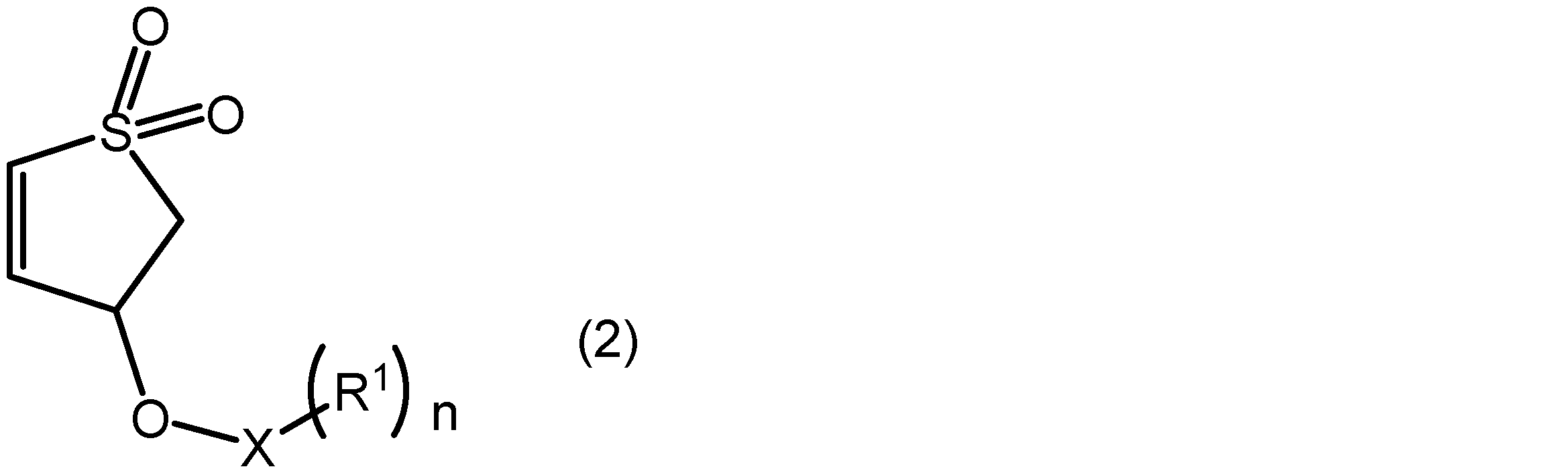
- the compound of the formula (1) may be a compound represented by the following formula (2).
- X in formula (2), R 1 and n are the X in each formula (1), and R 1 and n synonymous.
- Examples of the compound represented by the formula (2) include 4-methylsulfonyloxytetrahydrothiophene-1,1-dioxide-2-ene, 4-ethylsulfonyloxytetrahydrothiophene-1,1-dioxide-2- Ene, 4-phenylsulfonyloxytetrahydrothiophene-1,1-dioxide-2-ene, 4- (p-fluorophenyl) sulfonyloxytetrahydrothiophene-1,1-dioxide-2-ene, 4- (pentafluoro Phenyl) sulfonyloxytetrahydrothiophene-1,1-dioxide-2-ene, 4- (pentafluorophenyl) sulfonyloxytetrahydrothiophene-1,1-dioxide-2-ene, 4- (p-trifluoromethylphenyl) ) Sulfony
- the compound of the formula (1), (1 ′) or (2) is synthesized by combining ordinary reactions using available raw materials.
- a synthesis method for example, there is a method of reacting 3-hydroxy-2-sulfolene with a halide.
- the additive for non-aqueous electrolyte according to this embodiment may contain the compound represented by the formula (1) alone or may contain two or more kinds.
- the additive for non-aqueous electrolyte includes, as necessary, a negative electrode protective agent, a positive electrode protective agent, a flame retardant, an overcharge inhibitor, a cyclic carbonate compound, a nitrile compound, an isocyanate compound, and a C ⁇ C group.
- cyclic carbonate compound examples include 4-fluoro-1,3-dioxolan-2-one (FEC), trans or cis-4,5-difluoro-1,3-dioxolan-2-one (DFEC), vinylene carbonate ( VC), vinyl ethylene carbonate (VEC), 4-ethynyl-1,3-dioxolan-2-one (EEC), and the like.
- FEC 4-fluoro-1,3-dioxolan-2-one
- DFEC trans or cis-4,5-difluoro-1,3-dioxolan-2-one
- VC vinylene carbonate
- VEC vinyl ethylene carbonate
- EEC 4-ethynyl-1,3-dioxolan-2-one
- nitrile compound examples include acetonitrile, propionitrile, succinonitrile, glutaronitrile, adiponitrile, pimelonitrile, suberonitrile, and sebaconitrile.
- succinonitrile, adiponitrile, or a combination thereof may be used.
- isocyanate compound examples include methyl isocyanate, ethyl isocyanate, butyl isocyanate, phenyl isocyanate, tetramethylene diisocyanate, hexamethylene diisocyanate, octamethylene diisocyanate, 1,4-phenylene diisocyanate, 2-isocyanatoethyl acrylate, and 2-isocyanatoethyl. And methacrylate.
- Examples of the C ⁇ C group-containing compound include 2-propynyl methyl carbonate, 2-propynyl acetate, 2-propynyl formate, 2-propynyl methacrylate, 2-propynyl methanesulfonate, and 2-propynyl vinyl sulfonate.
- Examples include 2-butyne-1,4-diyldimethanesulfonate, 2-butyne-1,4-diyldiformate, and 2,4-hexadiyne-1,6-diyldimethanesulfonate.
- SO group-containing compound examples include 1,3-propane sultone (PS), 1,3-butane sultone, 2,4-butane sultone, 1,4-butane sultone, 1,3-propene sultone, 2,2-dioxide-1 , 2-oxathiolan-4-yl acetate, 5,5-dimethyl-1,2-oxathiolan-4-one 2,2-dioxide, etc., sultone, ethylene sulfite, ethylene sulfate, hexahydrobenzo [1,3 , 2] dioxathiolane-2-oxide (also referred to as 1,2-cyclohexanediol cyclic sulfite) and cyclic sulfites such as 5-vinyl-hexahydro-1,3,2-benzodioxathiol-2-oxide, Butane-2,3-diyldimethanesulfonate, butan
- Examples of the phosphorus-containing compound include trimethyl phosphate, tributyl phosphate, and trioctyl phosphate, tris (2,2,2-trifluoroethyl) phosphate, bis (2,2,2-trifluoroethyl) methyl phosphate, Bis (2,2,2-trifluoroethyl) phosphate, bis (2,2,2-trifluoroethyl) phosphate, 2,2-difluoroethyl phosphate, bis (2,2,2-trifluoroethyl phosphate) ) 2,2,3,3-tetrafluoropropyl, bis (2,2-difluoroethyl) phosphate 2,2,2-trifluoroethyl, bis (2,2,3,3-tetrafluoropropyl) phosphate 2,2,2-trifluoroethyl and phosphoric acid (2,2,2-trifluoroethyl) (2,2,3,3-tetrafluoropropyl)
- acid anhydride examples include acetic anhydride, propionic anhydride, succinic anhydride, maleic anhydride, 3-allyl succinic anhydride, glutaric anhydride, itaconic anhydride, and 3-sulfo-propionic anhydride.
- Examples of the cyclic phosphazene compound include methoxypentafluorocyclotriphosphazene, ethoxypentafluorocyclotriphosphazene, phenoxypentafluorocyclotriphosphazene, and ethoxyheptafluorocyclotetraphosphazene.
- Examples of the compound having a silicon atom include hexamethylcyclotrisiloxane, hexaethylcyclotrisiloxane, hexaphenylcyclotrisiloxane, 1,3,5-trimethyl-1,3,5-trivinylcyclotrisiloxane, octamethylcyclotrisiloxane.
- Tetrasiloxane decamethylcyclopentasiloxane, trimethylfluorosilane, triethylfluorosilane, tripropylfluorosilane, phenyldimethylfluorosilane, triphenylfluorosilane, vinyldimethylfluorosilane, vinyldiethylfluorosilane, vinyldiphenylfluorosilane, trimethoxyfluoro Silane, triethoxyfluorosilane, dimethyldifluorosilane, diethyldifluorosilane, divinyldifluorosilane, ethylvinyldiflu Borosilane, Methyltrifluorosilane, Ethyltrifluorosilane, Hexamethyldisiloxane, 1,3-Diethyltetramethyldisiloxane, Hexaethyldisiloxane, Octamethyltrisiloxane, Methoxytrimethylsi
- Examples of the compound having a boron atom include boroxine, trimethylboroxine, trimethoxyboroxine, triethylboroxine, triethoxyboroxine, triisopropylboroxine, triisopropoxyboroxine, tri-n-propylboroxine, tri-n- Examples include propoxyboroxine, tri-n-butylboroxine, tri-n-butyloxyboroxine, triphenylboroxine, triphenoxyboroxine, tricyclohexylboroxine, and tricyclohexoxyboroxine.
- the non-aqueous electrolyte according to the present embodiment contains the additive for non-aqueous electrolyte, a non-aqueous solvent, and an electrolyte.
- the content of the non-aqueous electrolyte additive (or the compound represented by the formula (1)) in the non-aqueous electrolyte is 0.005 to 10% by mass in total based on the total mass of the non-aqueous electrolyte. It may be.
- the content of the additive for non-aqueous electrolyte is 0.005% by mass or more, more excellent battery characteristics can be obtained, and when the content is 10% by mass or less, the viscosity of the non-aqueous electrolyte increases. Since it is difficult, sufficient ion mobility can be secured.
- the content of the additive for non-aqueous electrolyte (or the compound represented by formula (1)) is 0.01 to 10% by mass in total based on the total mass of the non-aqueous electrolyte. It may be a range.
- the content of the cyclic carbonate compound is 0.001 to 10% by mass based on the total mass of the non-aqueous electrolyte. May be. When the content of the cyclic carbonate compound is within this range, the SEI does not become too thick, and the stability of the SEI at a higher temperature increases.
- the content of the cyclic carbonate compound may be 0.01% by mass or more, or 0.5% by mass or more based on the total mass of the nonaqueous electrolytic solution.
- the content of the nitrile compound may be 0.001 to 10% by mass based on the total mass of the non-aqueous electrolyte. Good. When the content of the nitrile compound is within this range, the SEI does not become too thick, and the stability of the SEI at a higher temperature increases.
- the content of the nitrile compound may be 0.01% by mass or more, or 0.5% by mass or more based on the total mass of the nonaqueous electrolytic solution.
- the content of the isocyanate compound may be 0.01 to 5% by mass based on the total mass of the non-aqueous electrolyte. Good. When the content of the isocyanate compound is within this range, the SEI does not become too thick, and the stability of the SEI at higher temperatures increases.
- the content of the isocyanate compound may be 0.5% by mass or more or 3% by mass or less based on the total mass of the nonaqueous electrolytic solution.
- the content of the C ⁇ C group-containing compound is 0.01 based on the total mass of the non-aqueous electrolyte. It may be up to 5% by weight. When the content of the C ⁇ C group-containing compound is within this range, the SEI does not become too thick, and the stability of the SEI at higher temperatures increases.
- the content of the C ⁇ C group-containing compound may be 0.1% by mass or more based on the total mass of the nonaqueous electrolytic solution.
- the content of the SO group-containing compound is 0.001 to 5% by mass based on the total mass of the non-aqueous electrolyte. It may be. When the content of the SO group-containing compound is within this range, the SEI does not become too thick, and the stability of the SEI at higher temperatures increases.
- the content of the SO group-containing compound may be 0.01% by mass or more, or 0.1% by mass or more based on the total mass of the non-aqueous electrolyte.
- the content of the phosphorus-containing compound is 0.001 to 5% by mass based on the total mass of the nonaqueous electrolytic solution. May be. When the content of the phosphorus-containing compound is within this range, the SEI does not become too thick, and the stability of the SEI at higher temperatures increases.
- the content of the phosphorus-containing compound may be 0.01% by mass or more, or 0.1% by mass or more based on the total mass of the nonaqueous electrolytic solution.
- the content of the cyclic phosphazene compound is 0.001 to 5% by mass based on the total mass of the non-aqueous electrolyte. May be.
- the content of the cyclic phosphazene compound is within this range, the SEI does not become too thick, and the stability of the SEI at a higher temperature increases.
- the content of the cyclic phosphazene compound may be 0.01% by mass or more, or 0.1% by mass or more based on the total mass of the nonaqueous electrolytic solution.
- the content of the acid anhydride is 0.001 to 5% by mass based on the total mass of the non-aqueous electrolyte. May be. When the content of the acid anhydride is within this range, the SEI does not become too thick, and the stability of the SEI at higher temperatures increases.
- the content of the acid anhydride may be 0.01% by mass or more, or 0.5% by mass or more based on the total mass of the nonaqueous electrolytic solution.
- the content of the boron-containing compound is 0.001 to 5% by mass based on the total mass of the non-aqueous electrolyte. May be. In this range, the SEI does not become too thick and the stability of the SEI at higher temperatures is increased.
- the content of the boron-containing compound may be 0.01% by mass or more, or 0.1% by mass or more based on the total mass of the nonaqueous electrolytic solution.
- the content of the silicon-containing compound is 0.01 to 5% by mass based on the total mass of the non-aqueous electrolyte. May be. When the content of the silicon-containing compound is within this range, the SEI does not become too thick, and the stability of the SEI at higher temperatures increases.
- the content of the silicon-containing compound may be 0.1% by mass or more, or 0.5% by mass or more based on the total mass of the nonaqueous electrolytic solution.
- an aprotic solvent can be selected from the viewpoint of keeping the viscosity of the obtained non-aqueous electrolyte low.
- the aprotic solvent is at least one selected from the group consisting of cyclic carbonate, chain carbonate, aliphatic carboxylic acid ester, lactone, lactam, cyclic ether, chain ether, sulfone, nitrile, and halogen derivatives thereof. May be.
- a cyclic carbonate or a chain carbonate can be selected, and a combination of a cyclic carbonate and a chain carbonate can also be selected.
- Examples of the cyclic carbonate include ethylene carbonate, propylene carbonate, butylene carbonate, and FEC.
- Examples of the chain carbonate include dimethyl carbonate, diethyl carbonate, and ethyl methyl carbonate.
- Examples of the aliphatic carboxylic acid ester include methyl acetate, ethyl acetate, methyl propionate, ethyl propionate, methyl butyrate, methyl isobutyrate, and methyl trimethyl acetate.
- Examples of the lactone include ⁇ -butyrolactone.
- Examples of the lactam include ⁇ -caprolactam and N-methylpyrrolidone.
- Examples of the cyclic ether include tetrahydrofuran, 2-methyltetrahydrofuran, tetrahydropyran, 1,3-dioxolane and the like.
- Examples of the chain ether include 1,2-diethoxyethane, ethoxymethoxyethane, and the like.
- Examples of the sulfone include sulfolane.
- Examples of the nitrile include acetonitrile.
- Examples of the halogen derivative include 4-fluoro-1,3-dioxolane-2-one, 4-chloro-1,3-dioxolan-2-one, 4,5-difluoro-1,3-dioxolane-2- ON etc. are mentioned. These non-aqueous solvents may be used alone or in combination of two or more.
- the electrolyte may be a lithium salt that serves as a source of lithium ions.
- Electrolyte LiAlCl 4, LiBF 4, LiPF 6, LiClO 4, LiAsF 6 and may be at least one selected from the group consisting of LiSbF 6. From the viewpoint of having a high degree of dissociation and an ability to increase the ionic conductivity of the electrolytic solution and further suppressing the performance deterioration of the electricity storage device due to long-term use due to the oxidation-reduction characteristics, LiBF 4 and / or LiPF are used as the electrolyte. 6 may be selected. These electrolytes may be used alone or in combination of two or more.
- LiBF 4 and / or LiPF 6 When the electrolyte is LiBF 4 and / or LiPF 6 , one or more cyclic carbonates and chain carbonates may be combined as the non-aqueous solvent. In particular, LiBF 4 and / or LiPF 6 may be combined with ethylene carbonate and diethyl carbonate.
- the concentration of the electrolyte in the non-aqueous electrolyte may be 0.1 to 2.0 mol / L based on the volume of the non-aqueous electrolyte.
- concentration of the electrolyte is 0.1 mol / L or more, more excellent discharge characteristics or charge characteristics can be obtained.
- concentration of the electrolyte is 2.5 mol / L or less, the viscosity of the nonaqueous electrolytic solution is difficult to increase, so that ion mobility can be sufficiently ensured.
- the concentration of the electrolyte may be 0.3 to 2.0 mol / L, or may be 0.5 mol / L to 1.6 mol / L.
- the electrolyte (first lithium salt) and a second lithium salt different from the electrolyte may be used in combination.
- the second lithium salt include lithium difluorophosphate, lithium bisoxalatoborate (LiBOB), lithium tetrafluoro (oxalato) phosphate (LiTFOP), lithium difluorooxalatoborate (LiDFOB), and lithium difluorobisoxalatophosphate.
- LiDFOP lithium tetrafluoroborate
- lithium bisfluorosulfonylimide lithium bisfluorosulfonylimide
- lithium tetrafluoro (oxalato) phosphate lithium salt having a phosphate skeleton such as Li 2 PO 3 F
- lithium trifluoro ((methanesulfonyl) Oxy) borate lithium pentafluoro ((methanesulfonyl) oxy) phosphate, lithium methyl sulfate, lithium ethyl sulfate, lithium 2,2,
- Examples thereof include lithium salts having an S ( ⁇ O) group such as 2-trifluoroethyl sulfate and lithium fluorosulfonate.
- the second lithium salt is lithium difluorophosphate, lithium bisoxalatoborate, lithium tetrafluoro (oxalato) phosphate, lithium difluorooxalatoborate, lithium difluorobisoxalate phosphate, lithium methyl sulfate, lithium ethyl sulfate, and fluorosulfone
- One or more lithium salts selected from the group consisting of lithium acid may be included.
- the concentration of the second lithium salt in the non-aqueous electrolyte may be 0.001 to 1.0 mol / L based on the volume of the non-aqueous electrolyte.
- concentration of the second lithium salt is 0.001 mol / L or more, more excellent charge / discharge characteristics can be obtained under high temperature conditions.
- concentration of the second lithium salt is 1.0 mol / L or less, the viscosity of the non-aqueous electrolyte is difficult to increase, and thus ion mobility can be sufficiently ensured.
- the concentration of the second lithium salt may be 0.01 to 0.8 mol / L or 0.01 to 0.5 mol / L.
- an additive for a non-aqueous electrolyte containing the compound represented by the formula (1) is dissolved in an electrolyte and a general additive that is added as necessary. Prepared by adding to aqueous solvent.
- the nonaqueous electrolytic solution according to the present embodiment can be used as an electrolytic solution for an electricity storage device including a positive electrode and a negative electrode. More specifically, the non-aqueous electrolyte prepared using the non-aqueous electrolyte additive according to the present embodiment is a non-aqueous electrolyte secondary battery such as a lithium ion battery or an electric battery such as a lithium ion capacitor. When used in a power storage device such as a multilayer capacitor, battery characteristics such as initial resistance, discharge capacity retention rate, and long-term resistance increase suppression can be improved.
- the additive for non-aqueous electrolyte according to the present embodiment is stable in the non-aqueous electrolyte, it suppresses gas generation such as carbon dioxide due to decomposition on the positive electrode accompanying charging, and battery performance In addition, safety can be improved.
- the electricity storage device is mainly composed of the non-aqueous electrolyte, a positive electrode, and a negative electrode.
- Specific examples of the electricity storage device include a non-aqueous electrolyte secondary battery (such as a lithium ion battery) and an electric double layer capacitor (such as a lithium ion capacitor).
- the nonaqueous electrolytic solution according to the present embodiment is particularly useful in applications of lithium ion batteries and lithium ion capacitors.
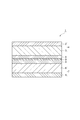
- FIG. 1 is a cross-sectional view schematically showing an example of a non-aqueous electrolyte secondary battery as an electricity storage device according to the present embodiment.
- a non-aqueous electrolyte secondary battery 1 includes a positive electrode plate 4 (positive electrode) and a negative electrode plate 7 (negative electrode), a non-aqueous electrolyte solution 8 disposed between the positive electrode plate 4 and the negative electrode plate 7, And a separator 9 provided in the nonaqueous electrolytic solution 8.
- the positive electrode plate 4 includes a positive electrode current collector 2 and a positive electrode active material layer 3 provided on the nonaqueous electrolyte solution 8 side.
- the negative electrode plate 7 includes a negative electrode current collector 5 and a negative electrode active material layer 6 provided on the nonaqueous electrolyte solution 8 side.
- the nonaqueous electrolytic solution 8 the nonaqueous electrolytic solution according to the above-described embodiment can be used.
- FIG. 1 a non-aqueous electrolyte secondary battery is shown as the electricity storage device, but the electricity storage device to which the non-aqueous electrolyte can be applied is not limited to this, and other electricity storage devices such as an electric double layer capacitor. It may be.
- the positive electrode current collector 2 and the negative electrode current collector 5 for example, a metal foil made of a metal such as aluminum, copper, nickel, and stainless steel can be used.
- the positive electrode active material layer 3 contains a positive electrode active material.
- the positive electrode active material may be a lithium-containing composite oxide.
- Examples include lithium-containing composite oxides such as LiFePO 4 .
- the negative electrode active material layer 6 contains a negative electrode active material.
- a negative electrode active material the material which can occlude and discharge
- Such materials include carbon materials such as crystalline carbon (natural graphite and artificial graphite), amorphous carbon, carbon-coated graphite and resin-coated graphite, indium oxide, silicon oxide, tin oxide, lithium titanate, oxidation Examples thereof include oxide materials such as zinc and lithium oxide, metal materials such as lithium metal, and metals that can form an alloy with lithium.
- the metal capable of forming an alloy with lithium include Cu, Sn, Si, Co, Mn, Fe, Sb, Ag, and the like. From the binary or ternary containing these metals and lithium Such an alloy can also be used as the negative electrode active material.
- These negative electrode active materials may be used alone or in combination of two or more.
- a carbon material such as graphite and a Si-based active material such as Si, Si alloy, or Si oxide may be combined as the negative electrode active material.
- graphite and a Si-based active material may be combined as the negative electrode active material.
- the ratio of the mass of the Si-based active material to the total mass of the carbon material and the Si-based active material is 0.5% by mass to 95% by mass, 1% by mass to 50% by mass, or 2 It may be not less than 40% by mass.
- the positive electrode active material layer 3 and the negative electrode active material layer 6 may further contain a binder.
- the binder include polyvinylidene fluoride (PVdF), vinylidene fluoride-hexafluoropropylene copolymer, vinylidene fluoride-tetrafluoroethylene copolymer, styrene-butadiene copolymer rubber, carboxymethyl cellulose, polytetrafluoro Examples thereof include ethylene, polypropylene, polyethylene, polyimide, polyamideimide, polyacrylic acid, polyvinyl alcohol, acrylic acid-polyacrylonitrile, polyacrylamide, polymethacrylic acid, and copolymers thereof.
- the binder may be the same or different between the positive electrode active material layer and the negative electrode active material layer.
- the positive electrode active material layer 3 and the negative electrode active material layer 6 may further include a conductive auxiliary material for the purpose of reducing resistance.
- a conductive auxiliary material include carbonaceous fine particles such as graphite, carbon black, acetylene black, and ketjen black, and carbon fibers.
- separator 9 for example, a single layer or laminated microporous film, woven fabric, or non-woven porous film made of polyethylene, polypropylene, fluororesin, or the like can be used.
- each member constituting the electricity storage device can be appropriately set by those skilled in the art.
- the configuration of the power storage device is not limited to the embodiment of FIG. 1 and can be changed as appropriate.
- Example 1 Synthesis of 4-methylsulfonyloxytetrahydrothiophene-1,1-dioxide-2-ene (Compound 1) 50 mL of water was added to a 300 mL four-necked flask equipped with a stirrer, condenser, thermometer and dropping funnel. While charging and cooling in an ice bath, 3-sulfolene (11.8 g, 100 mmol) and N-bromosuccinimide (18.0 g, 100 mmol) were added. Next, the temperature of the reaction liquid in the flask was raised to 80 ° C., and then stirred for 5 hours while maintaining the same temperature.
- LiPF 6 as an electrolyte was dissolved in the obtained mixed non-aqueous solvent so as to have a concentration of 1.0 mol / L.
- Compound 1 (4-methylsulfonyloxytetrahydrothiophene-1,1-dioxide-2-ene) was added as an additive for nonaqueous electrolyte solution to prepare a nonaqueous electrolyte solution.
- the content ratio of the additive for non-aqueous electrolyte (Compound 1) was 1.0% by mass based on the total mass of the non-aqueous electrolyte.
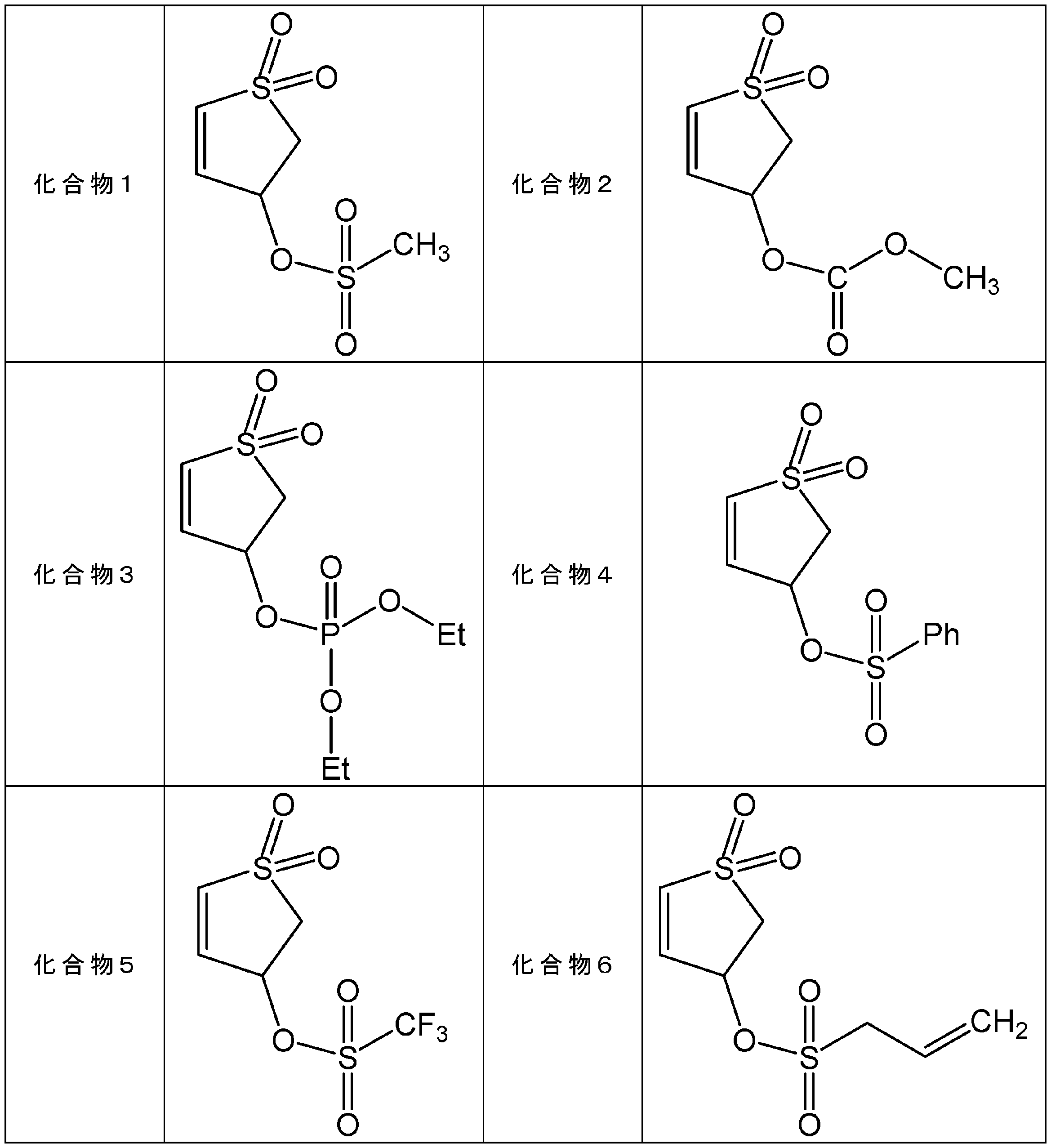
- Example 2 Synthesis of 4-methoxycarbonyloxytetrahydrothiophene-1,1-dioxide-2-ene (Compound 2) Example except that mesyl chloride in Example 1 was changed to methyl chloroformate (4.7 g, 50 mmol) The reaction was carried out in the same manner as in Example 1 to obtain Compound 2 shown in Table 1 (6.2 g, 65% yield based on 4-hydroxy-2-sulfolene). The molecular weight of the product was confirmed to be 192 by LC / MS spectrum.
- Example 2 Preparation of electrolyte 2 of Example 1 above.
- a nonaqueous electrolytic solution was prepared in the same manner as in Example 1 except that Compound 2 was used instead of Compound 1.
- Example 3 Synthesis of 4-diethoxyphosphinyloxytetrahydrothiophene-1,1-dioxide-2-ene (Compound 3) Except for changing mesyl chloride in Example 1 to diethyl phosphoryl chloride (8.6 g, 50 mmol) The reaction was conducted in the same manner as in Example 1 to obtain the compound 3 shown in Table 1 (5.7 g, 42% yield based on 4-hydroxy-2-sulfolene). The molecular weight of the product was confirmed to be 270 by LC / MS spectrum.
- Example 2 Preparation of electrolyte 2 of Example 1 above.
- a nonaqueous electrolytic solution was prepared in the same manner as in Example 1 except that Compound 3 was used instead of Compound 1.
- Example 4 Synthesis of 4-phenylsulfonyloxytetrahydrothiophene-1,1-dioxide-2-ene (Compound 4) Similarly except that mesyl chloride in Example 1 was changed to phenylsulfonyl chloride (8.8 g, 50 mmol). The reaction was carried out to obtain Compound 4 shown in Table 1 (8.0 g, yield 58% based on 4-hydroxy-2-sulfolene). The molecular weight of the product was confirmed to be 274 by LC / MS spectrum.
- Example 2 Preparation of electrolyte 2 of Example 1 above.
- a nonaqueous electrolytic solution was prepared in the same manner as in Example 1 except that Compound 4 was used instead of Compound 1.
- Example 5 Synthesis of 4-trifluoromethylsulfonyloxytetrahydrothiophene-1,1-dioxide-2-ene (Compound 5) Except that mesyl chloride in Example 1 was changed to trifluoromethanesulfonyl chloride (8.4 g, 50 mmol) The reaction was conducted in the same manner as in Example 1 to obtain the compound 5 shown in Table 1 (6.2 g, yield 65% based on 4-hydroxy-2-sulfolene). The molecular weight of the product was confirmed to be 266 by LC / MS spectrum.
- Example 2 Preparation of electrolyte 2 of Example 1 above.
- a nonaqueous electrolytic solution was prepared in the same manner as in Example 1 except that Compound 5 was used instead of Compound 1.
- Example 6 Synthesis of 1.4-allylsulfonyloxytetrahydrothiophene-1,1-dioxide-2-ene (Compound 6) Example except that mesyl chloride in Example 1 was changed to allylsulfonyl chloride (7.0 g, 50 mmol) The reaction was carried out in the same manner as in Example 1 to obtain Compound 6 shown in Table 1 (4.7 g, 40% yield based on 4-hydroxy-2-sulfolene). The molecular weight of the product was confirmed to be 236 by LC / MS spectrum.
- Example 2 Preparation of electrolyte 2 of Example 1 above.
- a nonaqueous electrolytic solution was prepared in the same manner as in Example 1 except that Compound 6 was used instead of Compound 1.
- Example 2 Example 2 above.
- a nonaqueous electrolytic solution was prepared in the same manner as in Example 1 except that Compound 1 was not used.
- Example 2 Example 2 above.
- a nonaqueous electrolytic solution was prepared in the same manner as in Example 1, except that 1,3-propane sultone (PS, manufactured by Tokyo Chemical Industry Co., Ltd.) was used instead of Compound 1.
- PS 1,3-propane sultone
- Example 3 Example 2 above.
- a nonaqueous electrolytic solution was prepared in the same manner as in Example 1 except that vinylene carbonate (VC, manufactured by Tokyo Chemical Industry Co., Ltd.) was used instead of Compound 1.
- VC vinylene carbonate
- Comparative Example 4 A nonaqueous electrolytic solution was prepared in the same manner as in Comparative Example 3 except that the content of vinylene carbonate (VC) was 2.0% by mass.
- Example 5 Example 2 above.
- a nonaqueous electrolytic solution was prepared in the same manner as in Example 1 except that fluoroethylene carbonate (FEC, manufactured by Tokyo Chemical Industry Co., Ltd.) was used instead of Compound 1.
- FEC fluoroethylene carbonate
- Comparative Example 6 A nonaqueous electrolytic solution was prepared in the same manner as in Comparative Example 5 except that the content ratio of fluoroethylene carbonate (FEC) was 2.0% by mass.
- FEC fluoroethylene carbonate
- a graphite powder as a negative electrode active material and carbon black as a conductivity imparting agent were dry mixed.
- the obtained mixture, styrene butadiene rubber (SBR) as a binder, and carboxymethyl cellulose (CMC) as a thickener were uniformly dispersed in water to prepare a slurry.
- the obtained slurry was applied to one side of a copper foil (square shape, thickness 10 ⁇ m). After removing water from the coating film by drying, the whole was pressed to obtain a negative electrode sheet having a copper foil as a negative electrode current collector and a negative electrode active material layer formed on one surface thereof.
- a negative electrode sheet, a separator made of polyethylene, a positive electrode sheet, a separator made of polyethylene, and a negative electrode sheet were laminated in this order to produce a battery element.
- This battery element was inserted into a bag formed of a laminate film having aluminum (thickness: 40 ⁇ m) and a resin layer covering both sides of the battery element so that the ends of the positive electrode sheet and the negative electrode sheet protrude from the bag.
- each nonaqueous electrolyte solution obtained in the Examples and Comparative Examples was injected into the bag.
- the bag was vacuum-sealed to obtain a sheet-like nonaqueous electrolyte secondary battery.
- a sheet-like nonaqueous electrolyte secondary battery was sandwiched between glass plates and pressurized to produce a nonaqueous electrolyte secondary battery (sheet type secondary battery).
- the AC impedance was measured at 25 ° C., and the obtained value was defined as the initial resistance ( ⁇ ).
- Table 2 shows the initial resistance ratio in each battery.
- the “initial resistance ratio” is a relative value of the resistance of each non-aqueous electrolyte secondary battery when the initial resistance ( ⁇ ) of Comparative Example 1 is 1.
- the AC impedance was measured in a 25 ° C. environment for a non-aqueous electrolyte secondary battery charged with 50% of the post-cycle capacity, and the obtained value was taken as the post-cycle resistance ( ⁇ ). It was.
- Table 2 shows the discharge capacity maintenance rate and the resistance increase rate in each battery. In Table 1, “discharge capacity maintenance ratio” is calculated by (capacity after cycle) / (initial capacity), and “resistance increase ratio” is calculated by (resistance after cycle) / (initial resistance).
- non-aqueous electrolyte secondary batteries having the same configuration including the electrolytes of Examples and Comparative Examples were prepared.
- This non-aqueous electrolyte secondary battery was charged to 4.2 V at a current corresponding to 0.2 C in an environment at 25 ° C., and then subjected to aging for 24 hours in an environment at 45 ° C. Thereafter, the battery was discharged to 3 V at a current corresponding to 0.2 C in an environment of 25 ° C.
- the battery was stabilized by performing an initial charge / discharge of 3 cycles of charging to 4.2 V with a current corresponding to 0.2 C and discharging to 3 V with a current corresponding to 0.2 C.
- the volume of the battery was measured by the Archimedes method, and this was defined as “the initial volume of the battery (cm 3 )”.
- the non-aqueous electrolyte secondary battery was charged to 4.2 V with a current corresponding to 1 C in an environment at 25 ° C., and then held in an environment at 60 ° C. for 168 hours. Then, it cooled to 25 degreeC and discharged to 3V with the electric current equivalent to 1C.
- the volume of the battery was measured by the Archimedes method, and the obtained value was made into the volume (cm ⁇ 3 >) after high temperature preservation
- Nonaqueous electrolyte secondary battery (electric storage device), 2 ... Positive electrode collector, 3 ... Positive electrode active material layer, 4 ... Positive electrode plate, 5 ... Negative electrode collector, 6 ... Negative electrode active material layer, 7 ... Negative electrode Plate, 8 ... non-aqueous electrolyte, 9 ... separator.
Landscapes
- Chemical & Material Sciences (AREA)
- Engineering & Computer Science (AREA)
- Chemical Kinetics & Catalysis (AREA)
- Electrochemistry (AREA)
- Power Engineering (AREA)
- General Chemical & Material Sciences (AREA)
- Manufacturing & Machinery (AREA)
- Inorganic Chemistry (AREA)
- Physics & Mathematics (AREA)
- General Physics & Mathematics (AREA)
- Condensed Matter Physics & Semiconductors (AREA)
- Microelectronics & Electronic Packaging (AREA)
- Materials Engineering (AREA)
- Secondary Cells (AREA)
- Electric Double-Layer Capacitors Or The Like (AREA)
- Organic Low-Molecular-Weight Compounds And Preparation Thereof (AREA)
- Primary Cells (AREA)
Abstract
Description

Xは、スルホニル基、ホスホリル基又はカルボニル基を示し、R1は、置換されていてもよい炭素数1~4のアルキル基、置換されていてもよい炭素数2~4のアルケニル基、置換されていてもよい炭素数2~4のアルキニル基、置換されていてもよいアリール基、置換されていてもよい炭素数1~4のアルコキシ基、置換されていてもよい炭素数2~4のアルケニルオキシ基、置換されていてもよい炭素数2~4のアルキニルオキシ基、又は置換されていてもよいアリールオキシ基を示し、nは1又は2を示す。


(実施例1)
1.4-メチルスルホニルオキシテトラヒドロチオフェン-1,1-ジオキサイド-2-エン(化合物1)の合成
撹拌機、冷却管、温度計及び滴下ロートを備え付けた300mLの4つ口フラスコに水50mLを仕込み、氷浴冷却下、3-スルホレン(11.8g、100mmol)およびN-ブロモスクシンイミド(18.0g、100mmol)を添加した。次いで、フラスコ内の反応液を80℃に昇温してから、同温度を維持しながら5時間攪拌した。その後、氷浴にてフラスコを冷却してからテトラヒドロフラン(THF)50mLを添加し、引き続きピリジン(11.1g,110mol)を滴下した。滴下終了後、氷浴冷却下、反応液を2時間攪拌し、析出した固体をろ別した。ろ液より溶媒を留去し、4-ヒドロキシ-2-スルホレン(6.8g、3-スルホレンに対する収率51%)を得た。生成物の分子量はLC/MSスペクトルによって134と確認した。
炭酸エチレン(EC)と炭酸ジエチル(DEC)とを、EC:DEC=30:70の体積組成比で混合して混合非水溶媒を得た。得られた混合非水溶媒に、電解質としてLiPF6を1.0mol/Lの濃度となるように溶解した。得られた溶液に、化合物1(4-メチルスルホニルオキシテトラヒドロチオフェン-1,1-ジオキサイド-2-エン)を非水電解液用添加剤として添加し、非水電解液を調製した。非水電解液用添加剤(化合物1)の含有割合は、非水電解液の全質量を基準として1.0質量%とした。
1.4-メトキシカルボニルオキシテトラヒドロチオフェン-1,1-ジオキサイド-2-エン(化合物2)の合成
実施例1におけるメシルクロリドをクロロギ酸メチル(4.7g、50mmol)に変更した以外は実施例1と同様に反応を実施し、表1に示した化合物2を得た(6.2g、4-ヒドロキシ-2-スルホレンに対する収率65%)。生成物の分子量はLC/MSスペクトルによって192と確認した。
上記実施例1の2.において、化合物1に代えて化合物2を用いたこと以外は、実施例1と同様にして非水電解液を調製した。
1.4-ジエトキシホスフィニルオキシテトラヒドロチオフェン-1,1-ジオキサイド-2-エン(化合物3)の合成
実施例1におけるメシルクロリドをジエチルホスホリルクロリド(8.6g、50mmol)に変更した以外は実施例1と同様に反応を実施し、表1に示した化合物3を得た(5.7g、4-ヒドロキシ-2-スルホレンに対する収率42%)。生成物の分子量はLC/MSスペクトルによって270と確認した。
上記実施例1の2.において、化合物1に代えて化合物3を用いたこと以外は、実施例1と同様にして非水電解液を調製した。
1.4-フェニルスルホニルオキシテトラヒドロチオフェン-1,1-ジオキサイド-2-エン(化合物4)の合成
実施例1におけるメシルクロリドをフェニルスルホニルクロリド(8.8g、50mmol)に変更した以外は同様に反応を実施し、表1に示した化合物4を得た(8.0g、4-ヒドロキシ-2-スルホレンに対する収率58%)。生成物の分子量はLC/MSスペクトルによって274と確認した。
上記実施例1の2.において、化合物1に代えて化合物4を用いたこと以外は、実施例1と同様にして非水電解液を調製した。
1.4-トリフルオロメチルスルホニルオキシテトラヒドロチオフェン-1,1-ジオキサイド-2-エン(化合物5)の合成
実施例1におけるメシルクロリドをトリフルオロメタンスルホニルクロリド(8.4g、50mmol)に変更した以外は実施例1と同様に反応を実施し、表1に示した化合物5を得た(6.2g、4-ヒドロキシ-2-スルホレンに対する収率65%)。生成物の分子量はLC/MSスペクトルによって266と確認した。
上記実施例1の2.において、化合物1に代えて化合物5を用いたこと以外は、実施例1と同様にして非水電解液を調製した。
1.4-アリルスルホニルオキシテトラヒドロチオフェン-1,1-ジオキサイド-2-エン(化合物6)の合成
実施例1におけるメシルクロリドをアリルスルホニルクロリド(7.0g、50mmol)に変更した以外は実施例1と同様に反応を実施し、表1に示した化合物6を得た(4.7g、4-ヒドロキシ-2-スルホレンに対する収率40%)。生成物の分子量はLC/MSスペクトルによって236と確認した。
上記実施例1の2.において、化合物1に代えて化合物6を用いたこと以外は、実施例1と同様にして非水電解液を調製した。
上記実施例1の2.において、化合物1を用いなかったこと以外は、実施例1と同様にして非水電解液を調製した。
上記実施例1の2.において、化合物1に代えて1,3-プロパンスルトン(PS、東京化成工業株式会社製)を用いたこと以外は、実施例1と同様にして非水電解液を調製した。
上記実施例1の2.において、化合物1に代えてビニレンカーボネート(VC、東京化成工業株式会社製)を用いたこと以外は、実施例1と同様にして非水電解液を調製した。
ビニレンカーボネート(VC)の含有割合を2.0質量%としたこと以外は、比較例3と同様にして非水電解液を調製した。
上記実施例1の2.において、化合物1に代えてフルオロエチレンカーボネート(FEC、東京化成工業株式会社製)を用いたこと以外は、実施例1と同様にして非水電解液を調製した。
フルオロエチレンカーボネート(FEC)の含有割合を2.0質量%としたこと以外は、比較例5と同様にして非水電解液を調製した。
(非水電解液二次電池の作製)
正極活物質としてのLiNi0.5Co0.2Mn0.3O2と、導電性付与剤としてのカーボンブラックを乾式混合した。得られた混合物を、バインダーとしてのポリフッ化ビニリデン(PVDF)を溶解させたN-メチル-2-ピロリドン(NMP)中に均一に分散させ、スラリーを作製した。得られたスラリーをアルミ金属箔(角型、厚さ20μm)の両面に塗布した。塗膜を乾燥させてNMPを除去した後、全体をプレスして、正極集電体としてのアルミ金属箔と、その両面上に形成された正極活物質層とを有する正極シートを作製した。得られた正極シート中の固形分比率は、質量比で、正極活物質:導電性付与剤:PVDF=92:5:3とした。
得られた各非水電解液二次電池に対して、25℃の環境下において、0.2Cに相当する電流により4.2Vまで充電を行った後、45℃の環境下で24時間保持しエージングを実施した。その後、25℃の環境下において、0.2Cに相当する電流で3Vまで放電した。続いて、0.2Cに相当する電流で4.2Vまで充電し、0.2Cに相当する電流で3Vまで放電する操作を3サイクル繰り返し、電池を安定させた。その後、1Cに相当する電流で充放電を行う初期充放電を行い、その放電容量を測定した。得られた値を「初期容量」とした。
初期充放電後の各非水電解液二次電池について、充電レートを1C、放電レートを1C、充電終止電圧を4.2V、及び放電終止電圧を3Vとして充放電サイクル試験を200サイクル行った。その後、1Cに相当する電流で充放電を行って、その放電容量を測定した。得られた値を「サイクル後容量」とした。
初期抵抗の評価、放電容量維持率及び抵抗増加率の評価に用いた電池とは別に、実施例及び比較例の各電解液を含む同様の構成の非水電解液二次電池を準備した。この非水電解液二次電池を、25℃の環境下で、0.2Cに相当する電流で4.2Vまで充電を行った後、45℃の環境下で24時間のエージングを実施した。その後、25℃の環境下で、0.2Cに相当する電流で3Vまで放電した。引き続き、0.2Cに相当する電流で4.2Vまで充電し、0.2Cに相当する電流で3Vまで放電する操作を3サイクル繰り返す初期充放電を行い、電池を安定させた。初期充放電後の非水電解液二次電池について、アルキメデス法により電池の体積を測定し、これを「電池の初期体積(cm3)」とした。

Claims (10)
- 下記式(1)で表される化合物を含む、非水電解液用添加剤。
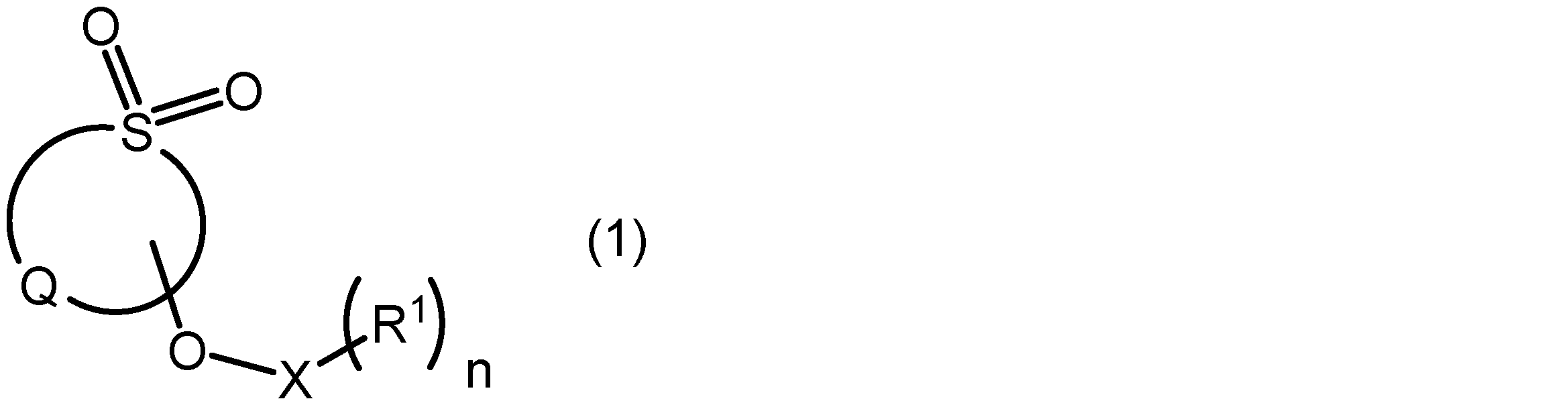
Qは、スルホニル基の硫黄原子とともに環状基を形成している、置換されていてもよい炭素数4~7のアルケニレン基を示し、
Xは、スルホニル基、ホスホリル基又はカルボニル基を示し、
R1は、置換されていてもよい炭素数1~4のアルキル基、置換されていてもよい炭素数2~4のアルケニル基、置換されていてもよい炭素数2~4のアルキニル基、置換されていてもよいアリール基、置換されていてもよい炭素数1~4のアルコキシ基、置換されていてもよい炭素数2~4のアルケニルオキシ基、置換されていてもよい炭素数2~4のアルキニルオキシ基、又は置換されていてもよいアリールオキシ基を示し、
nは1又は2を示す。] - 前記式(1)で表される化合物が、下記式(2)で表される化合物である、請求項1に記載の非水電解液用添加剤。
- Xがスルホニル基である、請求項1又は2に記載の非水電解液用添加剤。
- R1が、ハロゲン原子、アリール基若しくはハロゲン化アリール基で置換されていてもよい炭素数1~4のアルキル基、ハロゲン原子で置換されていてもよい炭素数2~4のアルケニル基、ハロゲン原子で置換されていてもよい炭素数2~4のアルキニル基、ハロゲン原子、アルキル基若しくはハロゲン化アルキル基で置換されていてもよいアリール基、ハロゲン原子、アリール基若しくはハロゲン化アリール基で置換されていてもよい炭素数1~4のアルコキシ基、ハロゲン原子で置換されていてもよい炭素数2~4のアルケニルオキシ基、ハロゲン原子で置換されていてもよい炭素数2~4のアルキニルオキシ基、又はハロゲン原子、アルキル基、ハロゲン化アルキル基若しくはアルコキシ基で置換されていてもよいアリールオキシ基である、請求項1~3のいずれか一項に記載の非水電解液用添加剤。
- 請求項1~4のいずれか一項に記載の非水電解液用添加剤、非水溶媒、及び電解質を含有する、非水電解液。
- 前記非水溶媒が環状カーボネート及び/又は鎖状カーボネートを含む、請求項5に記載の非水電解液。
- 前記電解質がリチウム塩を含む、請求項5又は6に記載の非水電解液。
- 請求項5~7のいずれか一項に記載の非水電解液と、正極及び負極と、を備える、蓄電デバイス。
- 請求項5~7のいずれか一項に記載の非水電解液と、正極及び負極と、を備える、リチウムイオン電池。
- 請求項5~7のいずれか一項に記載の非水電解液と、正極及び負極と、を備える、リチウムイオンキャパシタ。
Priority Applications (5)
| Application Number | Priority Date | Filing Date | Title |
|---|---|---|---|
| KR1020197026896A KR102535602B1 (ko) | 2017-03-07 | 2018-03-06 | 비수 전해액용 첨가제, 비수 전해액, 및 축전 디바이스 |
| CN201880016293.9A CN110383565B (zh) | 2017-03-07 | 2018-03-06 | 非水电解液用添加剂、非水电解液及蓄电装置 |
| US16/491,519 US11387490B2 (en) | 2017-03-07 | 2018-03-06 | Additive for nonaqueous electrolyte solutions, nonaqueous electrolyte solution, and electricity storage device |
| JP2019504606A JP7059250B2 (ja) | 2017-03-07 | 2018-03-06 | 非水電解液用添加剤、非水電解液、及び、蓄電デバイス |
| EP18763482.9A EP3595071A4 (en) | 2017-03-07 | 2018-03-06 | ADDITIVE FOR NON-AQUEOUS ELECTROLYTIC SOLUTIONS, NON-AQUEOUS ELECTROLYTIC SOLUTION AND ELECTRICITY STORAGE DEVICE |
Applications Claiming Priority (2)
| Application Number | Priority Date | Filing Date | Title |
|---|---|---|---|
| JP2017-043206 | 2017-03-07 | ||
| JP2017043206 | 2017-03-07 |
Publications (1)
| Publication Number | Publication Date |
|---|---|
| WO2018164124A1 true WO2018164124A1 (ja) | 2018-09-13 |
Family
ID=63448845
Family Applications (1)
| Application Number | Title | Priority Date | Filing Date |
|---|---|---|---|
| PCT/JP2018/008581 Ceased WO2018164124A1 (ja) | 2017-03-07 | 2018-03-06 | 非水電解液用添加剤、非水電解液、及び、蓄電デバイス |
Country Status (7)
| Country | Link |
|---|---|
| US (1) | US11387490B2 (ja) |
| EP (1) | EP3595071A4 (ja) |
| JP (1) | JP7059250B2 (ja) |
| KR (1) | KR102535602B1 (ja) |
| CN (1) | CN110383565B (ja) |
| TW (1) | TWI774736B (ja) |
| WO (1) | WO2018164124A1 (ja) |
Cited By (9)
| Publication number | Priority date | Publication date | Assignee | Title |
|---|---|---|---|---|
| CN110970621A (zh) * | 2018-09-30 | 2020-04-07 | 宁德时代新能源科技股份有限公司 | 一种锂离子电池 |
| CN112117490A (zh) * | 2019-06-20 | 2020-12-22 | 宁德时代新能源科技股份有限公司 | 一种锂离子电池电解液及锂离子二次电池 |
| JPWO2021065863A1 (ja) * | 2019-09-30 | 2021-04-08 | ||
| WO2022025002A1 (ja) | 2020-07-31 | 2022-02-03 | 住友精化株式会社 | 非水電解液用添加剤、非水電解液及び蓄電デバイス |
| JPWO2022054696A1 (ja) * | 2020-09-14 | 2022-03-17 | ||
| JP2022550421A (ja) * | 2019-12-24 | 2022-12-01 | 寧徳時代新能源科技股▲分▼有限公司 | 二次電池、及び該二次電池を備えた装置 |
| WO2024034522A1 (ja) * | 2022-08-08 | 2024-02-15 | 住友精化株式会社 | 非水電解液用添加剤、非水電解液及び蓄電デバイス |
| WO2025084071A1 (ja) * | 2023-10-19 | 2025-04-24 | 住友精化株式会社 | 非水電解液二次電池 |
| WO2025204269A1 (ja) * | 2024-03-29 | 2025-10-02 | 住友精化株式会社 | 二次電池用電解液、及び蓄電デバイス |
Families Citing this family (15)
| Publication number | Priority date | Publication date | Assignee | Title |
|---|---|---|---|---|
| US10978752B2 (en) * | 2018-03-19 | 2021-04-13 | Kabushiki Kaisha Toshiba | Secondary battery, battery pack, and vehicle |
| KR102722091B1 (ko) * | 2019-03-28 | 2024-10-28 | 현대자동차주식회사 | 리튬 이차전지 |
| CN111370764B (zh) * | 2020-03-05 | 2022-09-09 | 珠海市赛纬电子材料股份有限公司 | 非水电解液及含有该非水电解液的锂离子电池 |
| CN111477961B (zh) * | 2020-05-29 | 2022-10-28 | 珠海市赛纬电子材料股份有限公司 | 一种锂离子电池非水电解液及含该非水电解液的锂离子电池 |
| US20230246233A1 (en) * | 2020-06-26 | 2023-08-03 | Soulbrain Co., Ltd. | Electrolyte additive, electrolyte for batteries including electrolyte additive, and secondary battery including electrolyte |
| CN112186245A (zh) * | 2020-09-16 | 2021-01-05 | 合肥国轩高科动力能源有限公司 | 一种防过充电解液及含有该电解液的锂离子电池 |
| CN112054240A (zh) * | 2020-09-17 | 2020-12-08 | 欣旺达电动汽车电池有限公司 | 电解液和锂离子二次电池 |
| KR102680034B1 (ko) | 2020-11-03 | 2024-06-28 | 주식회사 엘지에너지솔루션 | 리튬 이차전지용 비수계 전해액 및 이를 포함하는 리튬 이차전지 |
| CN112670577B (zh) * | 2020-12-23 | 2022-07-12 | 惠州亿纬锂能股份有限公司 | 一种电解液及其制备方法和锂离子电池 |
| CN113659202A (zh) * | 2021-07-21 | 2021-11-16 | 厦门海辰新能源科技有限公司 | 一种锂电池电解液添加剂、电解液及电化学装置 |
| JP7704873B2 (ja) * | 2022-05-16 | 2025-07-08 | 香港時代新能源科技有限公司 | 二次電池とその電池モジュール、電池パック及び電力消費装置 |
| CN115275349A (zh) * | 2022-08-25 | 2022-11-01 | 珠海冠宇电池股份有限公司 | 电池电解液、电池电解液的配置方法及电池 |
| KR102919875B1 (ko) | 2022-12-08 | 2026-02-03 | 주식회사 테크늄 | 전해액 첨가제, 이를 포함하는 전해액 및 이를 포함하는 리튬 이차 전지 |
| KR102756133B1 (ko) * | 2023-08-17 | 2025-01-21 | 주식회사 엘지에너지솔루션 | 비수 전해질 및 이를 포함하는 리튬 이차전지 |
| CN119361829A (zh) * | 2024-10-23 | 2025-01-24 | 郑州比克电子有限责任公司 | 一种钠离子电解液及制备方法及钠离子电池 |
Citations (7)
| Publication number | Priority date | Publication date | Assignee | Title |
|---|---|---|---|---|
| JPS63102173A (ja) | 1986-10-16 | 1988-05-07 | Hitachi Maxell Ltd | リチウム二次電池 |
| JPH0574486A (ja) | 1991-09-10 | 1993-03-26 | Sanyo Electric Co Ltd | 非水系電解液電池 |
| JPH1050342A (ja) | 1996-08-01 | 1998-02-20 | Sony Corp | 非水電解質二次電池 |
| JP2010092698A (ja) * | 2008-10-07 | 2010-04-22 | Gs Yuasa Corporation | 非水電解質二次電池 |
| WO2015147000A1 (ja) * | 2014-03-27 | 2015-10-01 | ダイキン工業株式会社 | 電解液及び電気化学デバイス |
| JP2017208322A (ja) * | 2016-05-16 | 2017-11-24 | 宇部興産株式会社 | 非水電解液及びそれを用いた蓄電デバイス |
| WO2018016195A1 (ja) * | 2016-07-19 | 2018-01-25 | 住友精化株式会社 | 非水電解液用添加剤、非水電解液、及び、蓄電デバイス |
Family Cites Families (15)
| Publication number | Priority date | Publication date | Assignee | Title |
|---|---|---|---|---|
| US4167458A (en) | 1978-03-28 | 1979-09-11 | Union Carbide Corporation | Lithium ion-containing organic electrolyte |
| JP5037243B2 (ja) | 2007-07-06 | 2012-09-26 | 富士フイルム株式会社 | 界面結合剤、該界面結合剤を含有するレジスト組成物、及び該界面結合剤からなる層を有する磁気記録媒体形成用積層体、並びに該界面結合剤を用いた磁気記録媒体の製造方法、及び該製造方法により製造された磁気記録媒体 |
| WO2011025016A1 (ja) * | 2009-08-31 | 2011-03-03 | 三菱化学株式会社 | 非水系電解液及びそれを用いた非水系電解液電池 |
| JP5674390B2 (ja) | 2010-09-13 | 2015-02-25 | 住友精化株式会社 | スルホン化合物及びそれを用いた非水電解液 |
| CN103811815A (zh) * | 2011-01-31 | 2014-05-21 | 三菱化学株式会社 | 非水电解液及使用该非水电解液的非水电解质二次电池 |
| US9608287B2 (en) * | 2011-04-26 | 2017-03-28 | Ube Industries, Ltd. | Non-aqueous electrolytic solution, electrical storage device utilizing same, and cyclic sulfonic acid ester compound |
| WO2013145890A1 (ja) | 2012-03-29 | 2013-10-03 | 住友精化株式会社 | 電気化学デバイス用電解液、アルミニウム電解コンデンサ及び電気二重層コンデンサ |
| JP6024387B2 (ja) * | 2012-10-26 | 2016-11-16 | 三菱化学株式会社 | 非水系電解液及びそれを用いた非水系電解液電池 |
| BR112014030119A2 (pt) * | 2012-06-05 | 2017-06-27 | Nec Corp | bateria secundária de lítio |
| US9115122B2 (en) | 2012-12-20 | 2015-08-25 | University Of Maryland, Baltimore | Non-ATP dependent inhibitors of extracellular signal-regulated kinase (ERK) |
| JP6126878B2 (ja) | 2013-03-15 | 2017-05-10 | 富士フイルム株式会社 | パターン形成方法、感活性光線性又は感放射線性樹脂組成物、感活性光線性又は感放射線性膜及び電子デバイスの製造方法 |
| CN105830270B (zh) * | 2013-12-19 | 2019-04-02 | 宇部兴产株式会社 | 非水电解液、使用了其的蓄电装置及其中使用的羧酸酯化合物 |
| CN108028427B (zh) | 2015-09-09 | 2022-01-14 | 住友精化株式会社 | 非水电解液用添加剂、非水电解液以及蓄电设备 |
| KR102547064B1 (ko) * | 2016-03-18 | 2023-06-23 | 삼성에스디아이 주식회사 | 유기전해액 및 상기 전해액을 채용한 리튬 전지 |
| KR102573627B1 (ko) * | 2017-03-08 | 2023-08-31 | 스미토모 세이카 가부시키가이샤 | 비수 전해액용 첨가제, 비수 전해액 및 축전 디바이스 |
-
2018
- 2018-03-06 CN CN201880016293.9A patent/CN110383565B/zh active Active
- 2018-03-06 EP EP18763482.9A patent/EP3595071A4/en active Pending
- 2018-03-06 KR KR1020197026896A patent/KR102535602B1/ko active Active
- 2018-03-06 JP JP2019504606A patent/JP7059250B2/ja active Active
- 2018-03-06 WO PCT/JP2018/008581 patent/WO2018164124A1/ja not_active Ceased
- 2018-03-06 US US16/491,519 patent/US11387490B2/en active Active
- 2018-03-07 TW TW107107604A patent/TWI774736B/zh active
Patent Citations (7)
| Publication number | Priority date | Publication date | Assignee | Title |
|---|---|---|---|---|
| JPS63102173A (ja) | 1986-10-16 | 1988-05-07 | Hitachi Maxell Ltd | リチウム二次電池 |
| JPH0574486A (ja) | 1991-09-10 | 1993-03-26 | Sanyo Electric Co Ltd | 非水系電解液電池 |
| JPH1050342A (ja) | 1996-08-01 | 1998-02-20 | Sony Corp | 非水電解質二次電池 |
| JP2010092698A (ja) * | 2008-10-07 | 2010-04-22 | Gs Yuasa Corporation | 非水電解質二次電池 |
| WO2015147000A1 (ja) * | 2014-03-27 | 2015-10-01 | ダイキン工業株式会社 | 電解液及び電気化学デバイス |
| JP2017208322A (ja) * | 2016-05-16 | 2017-11-24 | 宇部興産株式会社 | 非水電解液及びそれを用いた蓄電デバイス |
| WO2018016195A1 (ja) * | 2016-07-19 | 2018-01-25 | 住友精化株式会社 | 非水電解液用添加剤、非水電解液、及び、蓄電デバイス |
Non-Patent Citations (1)
| Title |
|---|
| See also references of EP3595071A4 |
Cited By (14)
| Publication number | Priority date | Publication date | Assignee | Title |
|---|---|---|---|---|
| CN110970621A (zh) * | 2018-09-30 | 2020-04-07 | 宁德时代新能源科技股份有限公司 | 一种锂离子电池 |
| CN112117490A (zh) * | 2019-06-20 | 2020-12-22 | 宁德时代新能源科技股份有限公司 | 一种锂离子电池电解液及锂离子二次电池 |
| CN112117490B (zh) * | 2019-06-20 | 2021-07-23 | 宁德时代新能源科技股份有限公司 | 一种锂离子电池电解液及锂离子二次电池 |
| JPWO2021065863A1 (ja) * | 2019-09-30 | 2021-04-08 | ||
| JP7337267B2 (ja) | 2019-12-24 | 2023-09-01 | 寧徳時代新能源科技股▲分▼有限公司 | 二次電池、及び該二次電池を備えた装置 |
| JP2022550421A (ja) * | 2019-12-24 | 2022-12-01 | 寧徳時代新能源科技股▲分▼有限公司 | 二次電池、及び該二次電池を備えた装置 |
| US12191449B2 (en) | 2019-12-24 | 2025-01-07 | Contemporary Amperex Technology (Hong Kong) Limited | Secondary battery and device comprising the same |
| JPWO2022025002A1 (ja) * | 2020-07-31 | 2022-02-03 | ||
| KR20230044180A (ko) | 2020-07-31 | 2023-04-03 | 스미토모 세이카 가부시키가이샤 | 비수 전해액용 첨가제, 비수 전해액 및 축전 디바이스 |
| WO2022025002A1 (ja) | 2020-07-31 | 2022-02-03 | 住友精化株式会社 | 非水電解液用添加剤、非水電解液及び蓄電デバイス |
| JPWO2022054696A1 (ja) * | 2020-09-14 | 2022-03-17 | ||
| WO2024034522A1 (ja) * | 2022-08-08 | 2024-02-15 | 住友精化株式会社 | 非水電解液用添加剤、非水電解液及び蓄電デバイス |
| WO2025084071A1 (ja) * | 2023-10-19 | 2025-04-24 | 住友精化株式会社 | 非水電解液二次電池 |
| WO2025204269A1 (ja) * | 2024-03-29 | 2025-10-02 | 住友精化株式会社 | 二次電池用電解液、及び蓄電デバイス |
Also Published As
| Publication number | Publication date |
|---|---|
| US20190393552A1 (en) | 2019-12-26 |
| JPWO2018164124A1 (ja) | 2020-01-09 |
| CN110383565A (zh) | 2019-10-25 |
| JP7059250B2 (ja) | 2022-04-25 |
| TW201836203A (zh) | 2018-10-01 |
| KR102535602B1 (ko) | 2023-05-22 |
| EP3595071A1 (en) | 2020-01-15 |
| EP3595071A4 (en) | 2020-12-23 |
| US11387490B2 (en) | 2022-07-12 |
| CN110383565B (zh) | 2022-08-23 |
| KR20190125345A (ko) | 2019-11-06 |
| TWI774736B (zh) | 2022-08-21 |
Similar Documents
| Publication | Publication Date | Title |
|---|---|---|
| JP7059250B2 (ja) | 非水電解液用添加剤、非水電解液、及び、蓄電デバイス | |
| KR102573627B1 (ko) | 비수 전해액용 첨가제, 비수 전해액 및 축전 디바이스 | |
| JP7045240B2 (ja) | 非水電解液用添加剤、非水電解液及び蓄電デバイス | |
| US12074286B2 (en) | Additive for nonaqueous electrolyte solutions, nonaqueous electrolyte solution, and electricity storage device | |
| WO2018016195A1 (ja) | 非水電解液用添加剤、非水電解液、及び、蓄電デバイス | |
| EP4283738A1 (en) | Nonaqueous electrolyte solution, nonaqueous electrolyte battery and compound | |
| WO2018164130A1 (ja) | 非水電解液用添加剤、非水電解液、及び、蓄電デバイス | |
| US20240105992A1 (en) | Nonaqueous Electrolytic Solution, Nonaqueous Electrolytic Solution Battery, and Compound | |
| WO2022158400A1 (ja) | 非水電解液及び非水電解液電池 | |
| US20260024810A1 (en) | Additive for non-aqueous electrolytic solution, non-aqueous electrolytic solution, and power storage device | |
| WO2024034520A1 (ja) | 二次電池用非水電解液、並びに、リチウムイオン電池及びリチウムイオンキャパシタ | |
| JP2023117850A (ja) | 非水電解液用添加剤、非水電解液及び蓄電デバイス | |
| WO2022158398A1 (ja) | 非水電解液及び非水電解液電池 | |
| WO2024034521A1 (ja) | 二次電池用非水電解液、並びに、リチウムイオン電池及びリチウムイオンキャパシタ | |
| WO2025084071A1 (ja) | 非水電解液二次電池 | |
| JP2023054904A (ja) | 非水電解液用添加剤、非水電解液及び蓄電デバイス |
Legal Events
| Date | Code | Title | Description |
|---|---|---|---|
| 121 | Ep: the epo has been informed by wipo that ep was designated in this application |
Ref document number: 18763482 Country of ref document: EP Kind code of ref document: A1 |
|
| ENP | Entry into the national phase |
Ref document number: 2019504606 Country of ref document: JP Kind code of ref document: A |
|
| NENP | Non-entry into the national phase |
Ref country code: DE |
|
| ENP | Entry into the national phase |
Ref document number: 20197026896 Country of ref document: KR Kind code of ref document: A |
|
| ENP | Entry into the national phase |
Ref document number: 2018763482 Country of ref document: EP Effective date: 20191007 |