WO2018123490A1 - 石英試料の分解方法、石英試料の金属汚染分析方法および石英部材の製造方法 - Google Patents
石英試料の分解方法、石英試料の金属汚染分析方法および石英部材の製造方法 Download PDFInfo
- Publication number
- WO2018123490A1 WO2018123490A1 PCT/JP2017/043899 JP2017043899W WO2018123490A1 WO 2018123490 A1 WO2018123490 A1 WO 2018123490A1 JP 2017043899 W JP2017043899 W JP 2017043899W WO 2018123490 A1 WO2018123490 A1 WO 2018123490A1
- Authority
- WO
- WIPO (PCT)
- Prior art keywords
- quartz
- metal contamination
- sample
- decomposition
- quartz member
- Prior art date
- Legal status (The legal status is an assumption and is not a legal conclusion. Google has not performed a legal analysis and makes no representation as to the accuracy of the status listed.)
- Ceased
Links
Classifications
-
- C—CHEMISTRY; METALLURGY
- C30—CRYSTAL GROWTH
- C30B—SINGLE-CRYSTAL GROWTH; UNIDIRECTIONAL SOLIDIFICATION OF EUTECTIC MATERIAL OR UNIDIRECTIONAL DEMIXING OF EUTECTOID MATERIAL; REFINING BY ZONE-MELTING OF MATERIAL; PRODUCTION OF A HOMOGENEOUS POLYCRYSTALLINE MATERIAL WITH DEFINED STRUCTURE; SINGLE CRYSTALS OR HOMOGENEOUS POLYCRYSTALLINE MATERIAL WITH DEFINED STRUCTURE; AFTER-TREATMENT OF SINGLE CRYSTALS OR A HOMOGENEOUS POLYCRYSTALLINE MATERIAL WITH DEFINED STRUCTURE; APPARATUS THEREFOR
- C30B29/00—Single crystals or homogeneous polycrystalline material with defined structure characterised by the material or by their shape
- C30B29/02—Elements
- C30B29/06—Silicon
-
- C—CHEMISTRY; METALLURGY
- C30—CRYSTAL GROWTH
- C30B—SINGLE-CRYSTAL GROWTH; UNIDIRECTIONAL SOLIDIFICATION OF EUTECTIC MATERIAL OR UNIDIRECTIONAL DEMIXING OF EUTECTOID MATERIAL; REFINING BY ZONE-MELTING OF MATERIAL; PRODUCTION OF A HOMOGENEOUS POLYCRYSTALLINE MATERIAL WITH DEFINED STRUCTURE; SINGLE CRYSTALS OR HOMOGENEOUS POLYCRYSTALLINE MATERIAL WITH DEFINED STRUCTURE; AFTER-TREATMENT OF SINGLE CRYSTALS OR A HOMOGENEOUS POLYCRYSTALLINE MATERIAL WITH DEFINED STRUCTURE; APPARATUS THEREFOR
- C30B31/00—Diffusion or doping processes for single crystals or homogeneous polycrystalline material with defined structure; Apparatus therefor
- C30B31/06—Diffusion or doping processes for single crystals or homogeneous polycrystalline material with defined structure; Apparatus therefor by contacting with diffusion material in the gaseous state
- C30B31/10—Reaction chambers; Selection of materials therefor
-
- G—PHYSICS
- G01—MEASURING; TESTING
- G01N—INVESTIGATING OR ANALYSING MATERIALS BY DETERMINING THEIR CHEMICAL OR PHYSICAL PROPERTIES
- G01N1/00—Sampling; Preparing specimens for investigation
- G01N1/28—Preparing specimens for investigation including physical details of (bio-)chemical methods covered elsewhere, e.g. G01N33/50, C12Q
-
- G—PHYSICS
- G01—MEASURING; TESTING
- G01N—INVESTIGATING OR ANALYSING MATERIALS BY DETERMINING THEIR CHEMICAL OR PHYSICAL PROPERTIES
- G01N1/00—Sampling; Preparing specimens for investigation
- G01N1/28—Preparing specimens for investigation including physical details of (bio-)chemical methods covered elsewhere, e.g. G01N33/50, C12Q
- G01N1/40—Concentrating samples
- G01N1/4044—Concentrating samples by chemical techniques; Digestion; Chemical decomposition
-
- G—PHYSICS
- G01—MEASURING; TESTING
- G01N—INVESTIGATING OR ANALYSING MATERIALS BY DETERMINING THEIR CHEMICAL OR PHYSICAL PROPERTIES
- G01N31/00—Investigating or analysing non-biological materials by the use of the chemical methods specified in the subgroup; Apparatus specially adapted for such methods
-
- G—PHYSICS
- G01—MEASURING; TESTING
- G01N—INVESTIGATING OR ANALYSING MATERIALS BY DETERMINING THEIR CHEMICAL OR PHYSICAL PROPERTIES
- G01N33/00—Investigating or analysing materials by specific methods not covered by groups G01N1/00 - G01N31/00
- G01N33/24—Earth materials
Definitions
- the present invention relates to a quartz sample decomposition method, a quartz sample metal contamination analysis method, and a quartz member manufacturing method.
- Quartz has advantages such as high heat resistance and excellent durability. Therefore, quartz members are widely used in various fields. For example, in the field of manufacturing a silicon wafer used as a semiconductor substrate, a quartz crucible is mainly used as a crucible used for growing a silicon single crystal ingot.
- metal contamination of the semiconductor substrate can cause a reduction in device performance. Therefore, a silicon wafer used as a substrate for a semiconductor device is required to reduce metal contamination.
- the quartz crucible is contaminated with metal, the silicon single crystal ingot manufactured using the quartz crucible and further the silicon wafer manufactured by cutting out from the ingot will be contaminated with metal. Therefore, in order to provide a silicon wafer with reduced metal contamination, the metal contamination of the quartz crucible and its raw material quartz powder is analyzed, and measures for reducing the metal contamination of the quartz crucible based on the analysis result (for example, raw material) It is desirable to take a manufacturing process for manufacturing quartz powder and a process for maintaining the manufacturing process of the quartz crucible. As described above, analyzing metal contamination of a quartz sample leads to provision of a quartz member with reduced metal contamination.
- Analysis of metal contamination of a solid substance such as quartz is usually performed by preliminarily treating a decomposition product (for example, liquid) obtained by decomposing the solid substance and then introducing it into the analyzer.
- a decomposition product for example, liquid
- a solid substance to be analyzed is brought into contact with a decomposition solution and dissolved and decomposed (liquid phase decomposition method), and a solid substance to be decomposed is brought into contact with a decomposition gas and decomposed (gas phase decomposition method).
- the liquid phase decomposition method tends to have a shorter decomposition time than the gas phase decomposition method. Furthermore, with regard to shortening the decomposition time, it has been proposed to perform liquid phase decomposition under pressure in order to promote decomposition (also referred to as a pressurized acid decomposition method). However, since the pressure acid decomposition method needs to use a pressure-resistant container, there are restrictions on the container selection. Therefore, if a new decomposition method capable of decomposing a quartz sample in a short time like the pressurized acid decomposition method can be provided, the step of decomposing the quartz sample can be easily performed.
- One embodiment of the present invention provides a new decomposition method for decomposing a quartz sample in a short time.
- One embodiment of the present invention provides: Decomposing at least a portion of the quartz sample by contacting a liquid in which at least a portion of the quartz sample to be analyzed is immersed with a gas generated from a mixed acid;
- the liquid is a liquid containing at least water
- the molar fraction of hydrogen fluoride in the mixed acid is 0.27 or more.
- the liquid is hydrofluoric acid.
- the liquid is pure water.
- the decomposition is performed in a sealed container.
- the decomposition is performed without pressurizing the inside of the sealed container.
- the decomposition is performed without heating the inside of the sealed container.
- a further aspect of the invention provides: Decomposing a quartz sample by the above decomposing method; and Analyzing the metal component in the decomposition product obtained by the above decomposition, A method for analyzing metal contamination of quartz samples, including About.
- a further aspect of the invention provides: Analyzing the quartz powder collected from the quartz powder lot by the metal contamination analysis method, and When the metal contamination level is determined to be an acceptable level by the above analysis, a quartz member is produced in the quartz member manufacturing process using the quartz powder contained in the lot, A method for producing a quartz member containing About.
- a further aspect of the invention provides: Producing a quartz powder lot in the quartz powder manufacturing process; Analyzing the quartz powder collected from the prepared quartz powder lot by the metal contamination analysis method, When the metal contamination level is determined to be an unacceptable level by the analysis, the quartz powder production process is subjected to a metal contamination reduction process, and a quartz powder lot is produced in the quartz powder production process after the process, and Producing a quartz member in the quartz member manufacturing process using at least a portion of the quartz powder contained in the produced quartz powder lot; A method for producing a quartz member containing About.
- a further aspect of the invention provides: Producing a quartz member preliminary in the quartz member manufacturing process; Collecting a portion of the prepared quartz member preliminary and analyzing it by the metal contamination analysis method; and When the metal contamination level is determined to be an acceptable level by the above analysis, the quartz member preliminary body is subjected to a processing step for processing the quartz member into a quartz member, and when the metal contamination level is determined to be an unacceptable level by the above analysis, A processing step of applying a metal contamination reduction process to the quartz member manufacturing process in which the member preliminary body is manufactured, manufacturing the quartz member preliminary body in the quartz member manufacturing process after the processing, and processing the manufactured quartz member preliminary body into a quartz member To A method for producing a quartz member, About.
- the quartz member is a quartz crucible.
- the quartz crucible is a silicon single crystal ingot growing crucible.
- a quartz sample can be decomposed in a short time similar to the pressure acid decomposition.
- One aspect of the present invention includes decomposing at least a part of the quartz sample by bringing a liquid in which at least a part of the quartz sample to be analyzed is immersed into contact with a gas generated from a mixed acid.
- the present invention relates to a method for decomposing a quartz sample, which is a liquid containing at least water, wherein the mixed acid is a mixed acid of hydrogen fluoride and sulfuric acid, and the molar fraction of sulfuric acid in the mixed acid is in the range of 0.07 to 0.40.
- the quartz sample can be decomposed in a short decomposition time, for example, in a decomposition time similar to the decomposition time of the quartz sample by the conventional pressurized acid decomposition method.
- the present inventors infer the reason why it is possible to decompose a quartz sample in a short time by the above decomposition method.
- the mixed acid is a mixed acid of hydrogen fluoride and sulfuric acid.
- hydrogen fluoride gas also referred to as “hydrofluoric acid gas (HF gas)”
- HF gas hydrogen fluoride gas
- the present inventors consider that the fact that the quartz sample immersed in the liquid can be efficiently decomposed by the gas generated from the mixed acid being absorbed by the liquid contributes to the short-time decomposition of the quartz sample. ing.
- the above is an estimation of the present inventors and does not limit the present invention.
- the quartz sample to be analyzed in the above decomposition method may have any shape such as powder, lump, rod, or plate. Also, the size is not particularly limited.
- the quartz sample to be analyzed can be, for example, a sample powder obtained by collecting a part of quartz powder used as a raw material for a quartz member, a sample piece obtained by collecting a part of the produced quartz member, and the like.
- quartz refers to a solid of silicon dioxide, and the solid can be in a crystalline state, an amorphous state, or a mixed state of crystal and amorphous.
- quartz sample refers to a sample containing quartz as a main component.
- the main component means a component that occupies the largest proportion of the constituent components. For example, in a quartz sample, quartz can occupy 90 mass% to 100 mass% with respect to the entire constituent components. The same applies to “quartz powder” and “quartz member”.
- the liquid in which at least a part of the quartz sample is immersed is a liquid containing at least water. It is considered that the liquid can efficiently absorb the hydrogen fluoride gas generated from the mixed acid by containing at least water.
- the liquid may be pure water in one aspect. Pure water refers to water that has been subjected to a treatment for removing impurities, and is preferably water having a specific resistance of 1 to 10 M ⁇ ⁇ cm and / or a conductivity of 1.0 to 0.1 ⁇ S / cm. it can. In the present invention and the present specification, “pure water” includes ultrapure water. Ultrapure water refers to water having an impurity content of 0.01 ⁇ g / L or less.
- the liquid may be hydrofluoric acid (an aqueous solution of hydrogen fluoride).
- concentration of hydrogen fluoride (HF) in hydrofluoric acid can be, for example, 30 to 50% by mass.
- hydrofluoric acid it is preferable to use hydrofluoric acid marketed as high purity hydrofluoric acid. “High purity” in the present invention and the present specification means that the amount of impurities is 0.01 ⁇ g / L or less.
- the use of pure water or high purity hydrofluoric acid as the liquid is preferable from the viewpoint of reducing carry-in contamination from the liquid.
- the liquid comes into contact with the gas generated from the mixed acid with at least a part of the quartz sample to be analyzed immersed therein.
- the amount of the liquid used per 1 g of quartz sample can be set to 1 to 5 mL, for example.
- the contact with the gas only a part of the quartz sample may be immersed in the liquid, or the whole may be immersed.
- a quartz sample that has been partially immersed in the liquid at the start of contact may be entirely immersed in the liquid as decomposition proceeds.
- the part which is not immersed in the liquid of the quartz sample partially immersed in the liquid may come into contact with the gas generated from the mixed acid.
- the mixed acid that generates a gas to be brought into contact with the liquid is a mixed acid of hydrogen fluoride (HF) and sulfuric acid, and the molar fraction of sulfuric acid in this mixed acid is in the range of 0.07 to 0.40.
- HF hydrogen fluoride
- the present inventors believe that when the molar fraction of sulfuric acid is 0.07 or more, hydrogen fluoride gas can be efficiently generated from the mixed acid in a short time. From this point, the molar fraction of sulfuric acid in the mixed acid is preferably 0.10 or more, and more preferably 0.20 or more. The higher the proportion of sulfuric acid in the mixed acid, the better from the viewpoint of generating hydrogen fluoride gas in a short time.
- the proportion of sulfuric acid in the mixed acid increases as the molar fraction exceeds 0.40, the deterioration of the container due to reaction heat during the reaction between hydrogen fluoride and sulfuric acid and the deterioration of workability due to rapid gas generation Can happen.
- the molar fraction of sulfuric acid of the mixed acid used in the decomposition method is 0.40 or less, preferably 0.38 or less, and more preferably 0.35 or less.
- the molar fraction is a value obtained by dividing the total number of moles of the components contained in the mixed acid by the number of moles of the components that define the mole fraction.
- the unit of liquid amount is mL
- the unit of density is g / mL.
- the solution used for the preparation of the mixed acid may or may not be a high purity product.
- impurities in the solution are not considered.
- the molar fraction of sulfuric acid in a mixed acid obtained by mixing 700 mL of 50 mass% hydrofluoric acid (aqueous solution of hydrogen fluoride) and 200 mL of 98 mass% sulfuric acid aqueous solution is calculated as follows.
- the mixed acid contains hydrogen fluoride together with sulfuric acid.
- the molar fraction of hydrogen fluoride in the mixed acid is preferably 0.27 or more, and more preferably 0.30 or more.
- the molar fraction of hydrogen fluoride in the mixed acid is preferably 0.45 or less.
- the mixed acid is preferably an aqueous solution.
- HF hydrogen fluoride
- SO 4 sulfuric acid
- other acid components may or may not be included, and it is preferable not to include them. That is, the acid component contained in the mixed acid is preferably composed of hydrogen fluoride and sulfuric acid.
- the amount of the mixed acid used is not particularly limited, but can be, for example, about 50 to 1000 mL per 1 g of quartz sample.
- the quartz sample to be analyzed is decomposed by bringing a liquid in which at least a part of the quartz sample is immersed into contact with a gas generated from a mixed acid.
- the hydrogen fluoride gas generated from the mixed acid is absorbed by the liquid, so that the quartz sample immersed in the liquid having absorbed the hydrogen fluoride gas can be decomposed. It is done. Specific modes of such decomposition will be described below.
- a container with a lid hereinafter referred to as “outer container” and a container of a size that can be accommodated in the outer container (hereinafter referred to as “inner container”) are prepared.
- a quartz sample to be analyzed and a liquid containing at least water are placed in an inner container.
- the entire quartz sample may be immersed in the liquid in the inner container, or only a part may be immersed.
- the gas generated from the mixed acid fills the internal space of the outer container, and the gas and the liquid in the inner container come into contact with each other.
- disassembly of the said quartz sample can be advanced.
- the above embodiment is an example in which a quartz sample is decomposed in a sealed container. It is preferable to decompose the quartz sample in the sealed container in order to efficiently perform the decomposition in a shorter time.
- “sealed” is not necessarily limited to the fact that the gas in the sealed container is completely prevented from leaking out of the sealed container, and a small amount of gas that is normally possible in the field is allowed to leak. Shall be.
- the quartz sample can be decomposed in a short time without promoting the decomposition by pressurization. Therefore, the quartz sample can be decomposed in a short time without pressurizing the inside of the sealed container.
- the quartz sample can be decomposed in a short time without heating the inside of the sealed container.
- a pressure-resistant container is required for pressurization, and a heat-resistant container is required for heating. Therefore, it is preferable that pressurization and heating are not required because there are few restrictions on the container and decomposition can be performed.
- various general-purpose resin containers can be used as the outer container and the inner container.
- a stainless steel container which is a pressure resistant container, may be used, but the stainless steel container has an analysis accuracy due to disturbance from the container (mixing of metal components). May decrease.
- “decomposition without pressurizing the inside of the sealed container” means performing decomposition without increasing the pressure in the sealed container using the pressure control means. “Decomposing without heating” means performing decomposition without increasing the temperature in the sealed container using the temperature control means.
- a part or all of a quartz sample can be decomposed by the decomposition method according to one embodiment of the present invention described above.
- One embodiment of the present invention relates to a method for analyzing metal contamination of a quartz sample, including decomposing a quartz sample by the decomposition method and analyzing a metal component in a decomposition product obtained by the decomposition.
- the method for decomposing the quartz sample is as described in detail above.
- a quartz sample can be decomposed in a short time.
- a decomposition product of a quartz sample is included in the liquid.
- the liquid containing the decomposition product may be subjected to analysis of the metal component as it is, heated with a hot plate or the like to dry and then recovered with a dilute acid solution (recovered solution), and this recovered solution is analyzed for the metal component. You may attach to.
- the dilute acid solution can be used without any limitation as long as the solution has an acid concentration that can be introduced into an analyzer for analyzing a metal component.
- the diluted acid solution include hydrofluoric acid (hydrogen fluoride aqueous solution) and nitric acid aqueous solution having a concentration of several mass% or less (for example, about 0.5 to 5 mass%).
- Analytical devices for analyzing metal components include quantitative analysis of metal components such as inductively coupled plasma mass spectrometry (Inductively Coupled Plasma Mass Spectrometry; ICP-MS), atomic absorption spectroscopy (Atomic Absorption Spectrometry; AAS), and qualitative analysis / AAS.
- ICP-MS Inductively Coupled Plasma Mass Spectrometry
- AAS atomic absorption spectroscopy
- AAS Automatic Absorption Spectrometry
- a known analyzer capable of analysis can be used.
- a method for producing a quartz member containing the following (hereinafter referred to as “manufacturing method 1”).
- Producing a quartz powder lot in the quartz powder manufacturing process Analyzing the quartz powder collected from the prepared quartz powder lot by the metal contamination analysis method, When the metal contamination level is determined to be an unacceptable level by the analysis, the quartz powder production process is subjected to a metal contamination reduction process, and a quartz powder lot is produced in the quartz powder production process after the process, and Producing a quartz member in the quartz member manufacturing process using at least a portion of the quartz powder contained in the produced quartz powder lot;
- a method for producing a quartz member containing the following hereinafter referred to as “manufacturing method 2”).
- the quartz member preliminary body is subjected to a processing step for processing the quartz member into a quartz member, and when the metal contamination level is determined to be an unacceptable level by the above analysis, A processing step of applying a metal contamination reduction process to the quartz member manufacturing process in which the member preliminary body is manufactured, manufacturing the quartz member preliminary body in the quartz member manufacturing process after the processing, and processing the manufactured quartz member preliminary body into a quartz member Attached to the A method for manufacturing a quartz member (hereinafter referred to as “manufacturing method 3”).
- the quartz member can be manufactured using quartz powder.
- the manufacturing method 1 manufactures a quartz member using the quartz powder in which it was confirmed by the metal contamination analysis method according to one aspect of the present invention that metal contamination is low (at an acceptable level).
- Manufacturing method 2 uses quartz powder produced after suppressing the occurrence of metal contamination due to the quartz powder manufacturing process based on the analysis result obtained by the metal contamination analysis method according to one embodiment of the present invention. A member is manufactured.
- manufacturing method 3 regardless of whether or not quartz powder is used, based on the analysis result obtained by the metal contamination analysis method according to one aspect of the present invention, metal contamination caused by the quartz member manufacturing process as necessary.
- Reduce. Manufacturing methods 1 to 3 are all manufacturing methods that enable provision of a quartz member with reduced metal contamination by using the metal contamination analysis method according to one embodiment of the present invention. Below, the said manufacturing method is demonstrated in detail.
- the quartz powder collected from the quartz powder lot is analyzed by the metal contamination analysis method according to one embodiment of the present invention. Specifically, the quartz powder is decomposed by the decomposition method according to one embodiment of the present invention, and the metal component in the obtained decomposition product is analyzed.
- a quartz powder lot is a set of quartz powder, and each lot may be given a number, a symbol, or the like for identifying the lot.
- the amount of quartz powder collected for analysis is not particularly limited.
- the quartz powder lot may be a commercial product or may be manufactured by a known method.
- the metal contamination level is determined to be an acceptable level for the quartz powder collected from the quartz powder lot, a quartz member is produced using all or part of the quartz powder in the quartz powder lot.
- the quartz member can be manufactured using the quartz powder that has been confirmed to be less contaminated with metal, and therefore it is possible to provide a quartz member with less metal contamination.
- the allowable level for metal contamination is not particularly limited, and may be set according to the quality required for the product quartz member, the use of the product quartz member, and the like.
- the content of one or more specific metal components is not more than a predetermined value, the total amount of metal components is not more than a predetermined value, a certain metal component is not detected by an analyzer, etc.
- the metal contamination level can be determined to be an acceptable level.
- the production of the quartz member from the quartz powder can be performed by a known production method such as a method of melting the quartz powder and forming it into a predetermined shape (melting method) in the quartz member production process.
- a quartz crucible is taken as an example of a quartz member
- a quartz crucible can be produced by arc melting quartz powder in a rotating mold by a melting method.
- a quartz powder lot is produced in the quartz powder production process, and the quartz powder collected from the produced quartz powder lot is analyzed by the metal contamination analysis method according to one embodiment of the present invention.
- the quartz powder production process can be a production process for producing quartz powder by a known production method such as a gas phase method or a sol-gel method.
- the analysis of the quartz powder collected from the quartz powder lot produced in the quartz powder production process is as described for the production method 1.
- the metal contamination level of the quartz powder collected from the quartz powder lot is an acceptable level, it can be determined that there is little metal contamination due to the quartz powder manufacturing process.
- the quartz powder can be continuously produced in the quartz powder production process for producing the quartz powder lot, and a quartz member can be produced using the produced quartz powder.
- the metal contamination level of the quartz powder collected from the quartz powder lot is determined to be an unacceptable level, it can be determined that there is a lot of metal contamination due to the quartz powder manufacturing process.
- the non-permissible level for metal contamination is not particularly limited, and may be set according to the quality required for the product quartz member, the use of the product quartz member, and the like.
- the content of one or more specific metal components is a predetermined value or more
- the total amount of metal components is a predetermined value or more
- a specific metal component is detected by an analyzer, etc. Therefore, it can be determined that the metal contamination level is an unacceptable level.
- the quartz powder production process is subjected to a metal contamination reduction process.
- the metal contamination reduction treatment include replacement, cleaning, and the like of equipment, piping, and containers used in the quartz powder manufacturing process.
- the metal contamination reduction process in the present invention and the quartz powder production process in the present specification includes purification of raw materials (eg, raw material gas, raw material solution, etc.) for producing the quartz powder.
- a quartz powder lot is produced in the quartz powder production process after the metal contamination reduction process, and a quartz member is produced using all or a part of the quartz powder in the produced quartz powder lot, thereby reducing metal contamination.
- a quartz member can be provided. Note that the quartz powder collected from the quartz powder lot produced after the metal contamination reduction treatment is subjected to the metal contamination analysis method according to one aspect of the present invention to confirm that the metal contamination level is an acceptable level. Quartz members can also be produced using all or part of the quartz powder lot. That is, the manufacturing method 2 and the manufacturing method 1 can be combined. Production of the quartz member from the quartz powder in production method 2 is as described for production method 1.
- a quartz member preliminary body is produced in the quartz member manufacturing process, a part of the produced quartz member preliminary body is collected, and analyzed by the metal contamination analysis method according to one embodiment of the present invention.
- a quartz member preliminary body means what is shipped as a product quartz member by attaching
- one aspect of the quartz member manufacturing process is an aspect in which a quartz member is manufactured using quartz powder.
- the manufacturing method of the quartz member is not limited to the embodiment using the quartz powder, and may be a known manufacturing method including a method called a direct method, a soot method or the like.
- the direct method is a method in which a silicon compound such as silicon tetrachloride (SiCl 4 ) is hydrolyzed in an oxyhydrogen flame to be directly deposited and vitrified.
- the soot method is a method for producing synthetic quartz glass by the following procedure.
- a porous silica lump is synthesized by hydrolyzing a silicon compound such as silicon tetrachloride (SiCl 4 ) in an oxyhydrogen flame at a lower temperature than the direct method (eg, about 1100 ° C.). To do. The soot is heat-treated in a suitable gas such as a chlorine compound to remove moisture. Finally, the soot is pulled down while rotating at a temperature of about 1500 ° C. or higher, and the glass is vitrified by heating sequentially from the lower end.
- the quartz member can be produced by these known production methods.
- the quartz sample collected from the quartz member preparatory body for analysis can be in any shape such as powder, lump, rod or plate. Also, the size is not particularly limited.
- the quartz sample thus prepared is analyzed by the metal contamination analysis method according to one embodiment of the present invention. Specifically, the quartz sample is decomposed by the decomposition method according to one embodiment of the present invention, and the metal component in the obtained decomposition product is analyzed. When the metal contamination level is determined to be an acceptable level by such analysis, it can be determined that the quartz member preliminary body is low in metal contamination. Therefore, the quartz member preliminary body is subjected to a processing step for processing the quartz member preliminary body into a quartz member. .
- the quartz member preliminary body has a lot of metal contamination caused by the quartz member manufacturing process.
- a metal contamination reducing process is performed on the quartz member manufacturing process in which the quartz member preliminary body is manufactured, and the quartz member preliminary body is manufactured in the quartz member manufacturing process after the processing. It attaches to the processing process which processes to a quartz member.
- the quartz member preliminary body with less metal contamination can be subjected to the processing step. As a result, it is possible to provide a quartz member with less metal contamination as a product.
- the acceptable level and non-permissible level in the manufacturing method 3 may be set according to the quality required for the product quartz member, the use of the product quartz member, and the like. Details are as described for the production methods 1 and 2 above.
- examples of the metal contamination reduction process in the quartz member manufacturing process include replacement, cleaning, and the like of devices, piping, and containers used in the quartz member manufacturing process.
- the metal contamination reducing process in the present invention and the quartz member manufacturing process in the present specification includes purification of raw materials (for example, raw material powder, raw material gas, raw material solution, etc.) for manufacturing the quartz member. To do. By performing the metal contamination reduction process in this way, it is possible to suppress the occurrence of metal contamination due to the quartz member manufacturing process in the quartz member preliminary body.
- the quartz member preliminary body prepared after the metal contamination reduction treatment was collected and subjected to the metal contamination analysis method according to one aspect of the present invention, and it was confirmed that the metal contamination level was within an allowable range. It can also be subjected to a processing step for later processing into a quartz member. If it is determined that the metal contamination level is an unacceptable level, the quartz member preliminary body may be manufactured after further metal contamination reduction processing in the quartz member manufacturing process. That is, the determination in the manufacturing method 3 and the metal contamination reduction process as necessary may be repeated a plurality of times.
- the processing step for processing the quartz member preliminary body into a quartz member can be a known processing step such as cutting, annealing, polishing, and cleaning, and includes a packaging step for product shipment.
- the quartz member produced by the production methods 1 to 3 described above can be quartz members having various shapes and sizes used for various applications.
- the quartz member may be a quartz crucible.
- a quartz crucible is excellent in heat resistance and durability, and is therefore suitable for heating, melting, etc. of a substance inside.
- a quartz crucible is widely used as a crucible for growing a silicon single crystal ingot. Reducing metal contamination of a silicon single crystal ingot is desirable to provide a silicon wafer with reduced metal contamination that results in reduced device performance. For this purpose, it is preferable to suppress the occurrence of metal contamination caused by the quartz crucible in the silicon single crystal ingot. According to one embodiment of the present invention, the occurrence of metal contamination in a quartz member can be suppressed as described above, and thus a quartz crucible with reduced metal contamination can be provided.
- the inner container After putting 700 ml of 50% by mass hydrofluoric acid (aqueous solution of hydrogen fluoride) and 200 ml of 98% by mass sulfuric acid aqueous solution in this outer container, the inner container is immediately put in the outer container without a lid, and the outer container Closed the lid.
- the mixed solution (mixed acid) of hydrofluoric acid and sulfuric acid aqueous solution placed in the outer container was allowed to stand so as not to enter the inner container and left at room temperature for 16 hours.
- the molar fraction of sulfuric acid in the mixed solution (mixed acid) of hydrofluoric acid and sulfuric acid aqueous solution placed in the outer container is 0.07, and the molar fraction of hydrogen fluoride is 0.45.
- Example 1 From the quartz powder lot from which the quartz powder decomposed in Example 1 was collected, 1 g of quartz powder was weighed as a quartz sample to be decomposed, and decomposed by the pressure acid decomposition method described below. The quartz powder 1 was put into a Teflon (registered trademark) beaker. In this beaker, 3 mL of pure water, 10 mL of 50% by mass hydrofluoric acid, and 3 mL of 69.5% by mass nitric acid aqueous solution were added, and the lid was closed. After this Teflon (registered trademark) beaker was put in a stainless steel container, the cover of the stainless steel container was closed.
- Teflon registered trademark
- This stainless steel container was put into a thermostat maintained at 140 ° C.
- the stainless steel container was pressurized for 16 hours with the reaction gas from the quartz powder and the vapor generated from the hydrofluoric acid or nitric acid aqueous solution. After 16 hours, the stainless steel container lid was opened, the lid of the Teflon (registered trademark) beaker was opened and the inside of the Teflon (registered trademark) beaker was confirmed, and it was confirmed that the quartz powder was completely decomposed. It was.
- Example 1 was able to decompose the quartz sample in the same time as the pressurized acid decomposition method (Comparative Example 1).
- Table 2 shows the amount of decomposition obtained by subtracting the measured mass from the amount of quartz powder (4 g) charged into the inner container. The larger the amount of decomposition, the faster the decomposition rate of the quartz sample, which means that the decomposition progressed more.
- the mixed solution (mixed acid) of hydrofluoric acid and sulfuric acid aqueous solution placed in the outer container was allowed to stand so as not to enter the inner container and left at room temperature for 16 hours. After 16 hours, the lid of the outer container was opened, the inner container was placed on a hot plate (hot plate set temperature: 150 ° C.), and the liquid in the inner container was concentrated and dried by heating. After taking the dried solid in the inner container into a recovery liquid (2% by mass hydrofluoric acid), the recovery liquid was subjected to ICP-MS to analyze the metal components. The above operation was performed 6 times. The analysis results obtained are shown in Table 5.
- Teflon (registered trademark) beaker was charged with 3 mL of pure water, 10 mL of 50% by mass hydrofluoric acid, and 3 mL of 69.5% by mass nitric acid aqueous solution, and the lid was closed.
- the Teflon (registered trademark) beaker was placed in a stainless steel container, and then the stainless steel container lid was closed. This stainless steel container was put into a thermostat maintained at 140 ° C. The stainless steel container was pressurized for 16 hours with the reaction gas from the quartz powder and the vapor generated from the hydrofluoric acid or nitric acid aqueous solution.
- the lid of the stainless steel container is opened, the lid of the Teflon (registered trademark) beaker is opened, and the Teflon (registered trademark) beaker is placed on the hot plate (setting temperature of the hot plate: 150 ° C.).
- the liquid in the (registered trademark) beaker was concentrated and dried by heating.
- the dried solid in a Teflon (registered trademark) beaker was taken into a recovery liquid (2% by mass hydrofluoric acid), and then this recovery liquid was subjected to ICP-MS to analyze metal components. The above operation was performed 6 times. The analysis results obtained are shown in Table 5.
- Table 5 shows the analysis results of the metal components obtained in Tests 1 and 2.
- a stainless steel container which is a pressure resistant container may be used.
- the amount of metal components detected was significantly higher than in Test 1. This is considered to be caused by the mixing of metal components from the stainless steel container.
- disassembly method concerning 1 aspect of this invention can be implemented without pressurization, it can be implemented without using a stainless steel container.
- the quartz sample can be decomposed without disturbance (mixture of metal components) from the stainless steel container into the decomposition product or the liquid containing the decomposition product. This is preferable because the metal contamination analysis of the quartz sample is performed with higher sensitivity.
- One embodiment of the present invention is useful in the field of manufacturing various quartz members.
Landscapes
- Chemical & Material Sciences (AREA)
- Life Sciences & Earth Sciences (AREA)
- Health & Medical Sciences (AREA)
- Physics & Mathematics (AREA)
- Analytical Chemistry (AREA)
- Biochemistry (AREA)
- General Health & Medical Sciences (AREA)
- General Physics & Mathematics (AREA)
- Immunology (AREA)
- Pathology (AREA)
- Engineering & Computer Science (AREA)
- Materials Engineering (AREA)
- Crystallography & Structural Chemistry (AREA)
- Metallurgy (AREA)
- Organic Chemistry (AREA)
- Molecular Biology (AREA)
- Geology (AREA)
- General Life Sciences & Earth Sciences (AREA)
- Environmental & Geological Engineering (AREA)
- Remote Sensing (AREA)
- Food Science & Technology (AREA)
- Medicinal Chemistry (AREA)
- Sampling And Sample Adjustment (AREA)
- Investigating Or Analyzing Non-Biological Materials By The Use Of Chemical Means (AREA)
- Crystals, And After-Treatments Of Crystals (AREA)
Abstract
分析対象の石英試料の少なくとも一部が浸漬した液体を、混酸から発生したガスと接触させることにより、上記石英試料の少なくとも一部を分解することを含み、上記液体は少なくとも水を含む液体であり、上記混酸はフッ化水素と硫酸との混酸であり、かつこの混酸における硫酸のモル分率は0.07~0.40の範囲である石英試料の分解方法が提供される。
Description
本出願は、2016年12月27日出願の日本特願2016-254381号の優先権を主張し、その全記載は、ここに特に開示として援用される。
本発明は、石英試料の分解方法、石英試料の金属汚染分析方法および石英部材の製造方法に関する。
石英は、耐熱性が高い、耐久性に優れる等の利点を有する。そのため、石英部材は、様々な分野において広く用いられている。例えば半導体基板として使用されるシリコンウェーハの製造分野では、シリコン単結晶インゴット育成のために用いられるるつぼは、石英るつぼが主流である。
例えば半導体デバイスに関しては、半導体基板の金属汚染は、デバイス性能を低下させる原因となる。そのため半導体デバイスの基板として使用されるシリコンウェーハには、金属汚染を低減することが求められる。しかるに、石英るつぼが金属汚染されていると、石英るつぼを用いて製造されたシリコン単結晶インゴット、更にはこのインゴットから切り出して製造されるシリコンウェーハにも金属汚染が発生してしまう。したがって、金属汚染が低減されたシリコンウェーハを提供するためには、石英るつぼやその原料石英粉末の金属汚染を分析し、分析結果に基づき、石英るつぼの金属汚染を低減するための対策(例えば原料石英粉末を製造する製造工程や石英るつぼの製造工程の工程保守作業等)を取ることが望ましい。
以上のように、石英試料の金属汚染を分析することは、金属汚染が低減された石英部材の提供につながる。
以上のように、石英試料の金属汚染を分析することは、金属汚染が低減された石英部材の提供につながる。
石英のような固体物質の金属汚染の分析は、通常、固体物質を分解して得られた分解物(例えば液状)を必要に応じて前処理した後に分析装置に導入することにより行われる。分解方法としては、分析対象の固体物質を分解溶液と接触させて溶解し分解する方法(液相分解法)と分解対象の固体物質を分解ガスと接触させて分解する方法(気相分解法)とが知られている(例えば日本特許第3274020号(その全記載は、ここに特に開示として援用される)参照)。
液相分解法は、気相分解法と比べて分解時間が短い傾向がある。更に、分解時間の短縮については、分解を促進するために加圧下で液相分解を行うこと(加圧酸分解法とも呼ばれる。)も提案されている。しかし、加圧酸分解法は、耐圧性の容器を用いる必要があるため容器選択に制約がある。そのため、加圧酸分解法と同様に短時間で石英試料を分解することができる新たな分解方法を提供することができれば、石英試料を分解する工程を簡便に実施することが可能となる。
本発明の一態様は、石英試料を短時間で分解するための新たな分解方法を提供する。
本発明の一態様は、
分析対象の石英試料の少なくとも一部が浸漬した液体を、混酸から発生したガスと接触させることにより、上記石英試料の少なくとも一部を分解することを含み、
上記液体は少なくとも水を含む液体であり、
上記混酸はフッ化水素と硫酸との混酸であり、かつこの混酸における硫酸のモル分率は0.07~0.40の範囲である、石英試料の分解方法、
に関する。
分析対象の石英試料の少なくとも一部が浸漬した液体を、混酸から発生したガスと接触させることにより、上記石英試料の少なくとも一部を分解することを含み、
上記液体は少なくとも水を含む液体であり、
上記混酸はフッ化水素と硫酸との混酸であり、かつこの混酸における硫酸のモル分率は0.07~0.40の範囲である、石英試料の分解方法、
に関する。
一態様では、上記混酸におけるフッ化水素のモル分率は、0.27以上である。
一態様では、上記液体は、フッ化水素酸である。
一態様では、上記液体は、純水である。
一態様では、上記分解は、密閉容器内で行われる。
一態様では、上記分解は、上記密閉容器内を加圧することなく行われる。
一態様では、上記分解は、上記密閉容器内を加熱することなく行われる。
本発明の更なる態様は、
上記分解方法により石英試料を分解すること、および、
上記分解により得られた分解物中の金属成分を分析すること、
を含む、石英試料の金属汚染分析方法、
に関する。
上記分解方法により石英試料を分解すること、および、
上記分解により得られた分解物中の金属成分を分析すること、
を含む、石英試料の金属汚染分析方法、
に関する。
本発明の更なる態様は、
石英粉末ロットから採取した石英粉末を上記金属汚染分析方法により分析すること、および、
上記分析により金属汚染レベルが許容レベルと判定された場合、上記ロットに含まれる石英粉末を用いて石英部材製造工程において石英部材を作製すること、
を含む石英部材の製造方法、
に関する。
石英粉末ロットから採取した石英粉末を上記金属汚染分析方法により分析すること、および、
上記分析により金属汚染レベルが許容レベルと判定された場合、上記ロットに含まれる石英粉末を用いて石英部材製造工程において石英部材を作製すること、
を含む石英部材の製造方法、
に関する。
本発明の更なる態様は、
石英粉末製造工程において石英粉末ロットを作製すること、
作製された石英粉末ロットから採取した石英粉末を上記金属汚染分析方法により分析すること、
上記分析により金属汚染レベルが非許容レベルと判定された場合、上記石英粉末製造工程に金属汚染低減処理を施し、この処理後の石英粉末製造工程において石英粉末ロットを作製すること、および、
作製された石英粉末ロットに含まれる少なくとも一部の石英粉末を用いて石英部材製造工程において石英部材を作製すること、
を含む石英部材の製造方法、
に関する。
石英粉末製造工程において石英粉末ロットを作製すること、
作製された石英粉末ロットから採取した石英粉末を上記金属汚染分析方法により分析すること、
上記分析により金属汚染レベルが非許容レベルと判定された場合、上記石英粉末製造工程に金属汚染低減処理を施し、この処理後の石英粉末製造工程において石英粉末ロットを作製すること、および、
作製された石英粉末ロットに含まれる少なくとも一部の石英粉末を用いて石英部材製造工程において石英部材を作製すること、
を含む石英部材の製造方法、
に関する。
本発明の更なる態様は、
石英部材製造工程において石英部材予備体を作製すること、
作製された石英部材予備体の一部を採取して上記金属汚染分析方法により分析すること、および、
上記分析により金属汚染レベルが許容レベルと判定された場合、上記石英部材予備体を石英部材に加工する加工工程に付し、上記分析により金属汚染レベルが非許容レベルと判定された場合、上記石英部材予備体を作製した石英部材製造工程に金属汚染低減処理を施し、この処理後の石英部材製造工程において石英部材予備体を作製し、作製された石英部材予備体を石英部材に加工する加工工程に付すこと、
を含む、石英部材の製造方法、
に関する。
石英部材製造工程において石英部材予備体を作製すること、
作製された石英部材予備体の一部を採取して上記金属汚染分析方法により分析すること、および、
上記分析により金属汚染レベルが許容レベルと判定された場合、上記石英部材予備体を石英部材に加工する加工工程に付し、上記分析により金属汚染レベルが非許容レベルと判定された場合、上記石英部材予備体を作製した石英部材製造工程に金属汚染低減処理を施し、この処理後の石英部材製造工程において石英部材予備体を作製し、作製された石英部材予備体を石英部材に加工する加工工程に付すこと、
を含む、石英部材の製造方法、
に関する。
一態様では、上記石英部材は、石英るつぼである。
一態様では、上記石英るつぼは、シリコン単結晶インゴット育成用るつぼである。
本発明の一態様によれば、石英試料を、加圧酸分解と同様の短時間で分解することできる。
[石英試料の分解方法]
本発明の一態様は、分析対象の石英試料の少なくとも一部が浸漬した液体を、混酸から発生したガスと接触させることにより、上記石英試料の少なくとも一部を分解することを含み、上記液体は少なくとも水を含む液体であり、上記混酸はフッ化水素と硫酸との混酸であり、かつこの混酸における硫酸のモル分率は0.07~0.40の範囲である石英試料の分解方法に関する。
本発明の一態様は、分析対象の石英試料の少なくとも一部が浸漬した液体を、混酸から発生したガスと接触させることにより、上記石英試料の少なくとも一部を分解することを含み、上記液体は少なくとも水を含む液体であり、上記混酸はフッ化水素と硫酸との混酸であり、かつこの混酸における硫酸のモル分率は0.07~0.40の範囲である石英試料の分解方法に関する。
上記分解方法によれば、短時間の分解時間で、例えば従来の加圧酸分解法による石英試料の分解時間と同様の分解時間で、石英試料を分解することができる。上記分解方法により石英試料を短時間で分解することが可能になる理由について、本発明者らは以下のように推察している。
上記混酸は、フッ化水素と硫酸との混酸である。上記混酸は、フッ化水素中に上記範囲のモル分率で硫酸を含むことにより、フッ化水素ガス(「フッ酸ガス(HFガス)」とも呼ばれる。)を短時間で発生することができると本発明者らは推察している。更に、上記混酸から発生したガスが上記液体に吸収されることにより、上記液体に浸漬している石英試料を効率的に分解できることも、石英試料の短時間分解に寄与すると本発明者らは考えている。
ただし以上は本発明者らの推察であって、本発明を何ら限定するものではない。
上記混酸は、フッ化水素と硫酸との混酸である。上記混酸は、フッ化水素中に上記範囲のモル分率で硫酸を含むことにより、フッ化水素ガス(「フッ酸ガス(HFガス)」とも呼ばれる。)を短時間で発生することができると本発明者らは推察している。更に、上記混酸から発生したガスが上記液体に吸収されることにより、上記液体に浸漬している石英試料を効率的に分解できることも、石英試料の短時間分解に寄与すると本発明者らは考えている。
ただし以上は本発明者らの推察であって、本発明を何ら限定するものではない。
以下、上記分解方法について、更に詳細に説明する。
<石英試料>
上記分解方法における分析対象の石英試料は、粉末状、塊状、棒状、板状等のいずれの形状であってもよい。また大きさも特に限定されるものではない。分析対象の石英試料は、例えば、石英部材の原料として用いられる石英粉末の一部を採取した試料粉末、作製された石英部材の一部を採取した試料片等であることができる。
本発明および本明細書において、「石英」とは、二酸化珪素の固体をいい、固体は結晶状態、非晶質状態、または結晶と非晶質との混合状態であることができる。また、本発明および本明細書において、「石英試料」とは、石英を主成分とする試料をいう。主成分とは、構成成分の中で最も多くの割合を占める成分であることを意味する。例えば、石英試料において、構成成分全体に対して90質量%~100質量%を石英が占めることができる。以上の点については、「石英粉末」および「石英部材」についても同様とする。
上記分解方法における分析対象の石英試料は、粉末状、塊状、棒状、板状等のいずれの形状であってもよい。また大きさも特に限定されるものではない。分析対象の石英試料は、例えば、石英部材の原料として用いられる石英粉末の一部を採取した試料粉末、作製された石英部材の一部を採取した試料片等であることができる。
本発明および本明細書において、「石英」とは、二酸化珪素の固体をいい、固体は結晶状態、非晶質状態、または結晶と非晶質との混合状態であることができる。また、本発明および本明細書において、「石英試料」とは、石英を主成分とする試料をいう。主成分とは、構成成分の中で最も多くの割合を占める成分であることを意味する。例えば、石英試料において、構成成分全体に対して90質量%~100質量%を石英が占めることができる。以上の点については、「石英粉末」および「石英部材」についても同様とする。
<液体>
上記石英試料の少なくとも一部を浸漬させる液体は、少なくとも水を含む液体である。上記液体は、少なくとも水を含むことにより、混酸から発生したフッ化水素ガスを効率的に吸収することができると考えられる。上記液体は、一態様では純水であることができる。純水とは、不純物を除去するための処理が施された水をいい、好ましくは比抵抗が1~10MΩ・cmおよび/または導電率1.0~0.1μS/cmの水であることができる。なお本発明および本明細書における「純水」には、超純水も包含されるものとする。超純水とは、不純物含有量が0.01μg/L以下の水をいうものとする。
また、他の一態様では、上記液体は、フッ化水素酸(フッ化水素の水溶液)であることもできる。フッ化水素酸のフッ化水素(HF)濃度は、例えば30~50質量%であることができる。また、フッ化水素酸としては、高純度フッ化水素酸として市販されているフッ化水素酸を使用することが好ましい。本発明および本明細書における「高純度」とは、不純物量が0.01μg/L以下であることをいうものとする。
上記液体として純水または高純度フッ化水素酸を使用することは、液体からの持ち込み汚染を低減する観点から好ましい。
上記石英試料の少なくとも一部を浸漬させる液体は、少なくとも水を含む液体である。上記液体は、少なくとも水を含むことにより、混酸から発生したフッ化水素ガスを効率的に吸収することができると考えられる。上記液体は、一態様では純水であることができる。純水とは、不純物を除去するための処理が施された水をいい、好ましくは比抵抗が1~10MΩ・cmおよび/または導電率1.0~0.1μS/cmの水であることができる。なお本発明および本明細書における「純水」には、超純水も包含されるものとする。超純水とは、不純物含有量が0.01μg/L以下の水をいうものとする。
また、他の一態様では、上記液体は、フッ化水素酸(フッ化水素の水溶液)であることもできる。フッ化水素酸のフッ化水素(HF)濃度は、例えば30~50質量%であることができる。また、フッ化水素酸としては、高純度フッ化水素酸として市販されているフッ化水素酸を使用することが好ましい。本発明および本明細書における「高純度」とは、不純物量が0.01μg/L以下であることをいうものとする。
上記液体として純水または高純度フッ化水素酸を使用することは、液体からの持ち込み汚染を低減する観点から好ましい。
上記液体は、その中に分析対象の石英試料の少なくとも一部が浸漬した状態で、上記混酸から発生したガスと接触する。一例として、石英試料1gあたりの上記液体の使用量は、例えば1~5mLとすることができる。上記ガスとの接触中、上記液体に石英試料の一部のみが浸漬していてもよく全部が浸漬していてもよい。また、接触開始時には上記液体に一部のみが浸漬していた石英試料が、分解が進行することにより全部が上記液体に浸漬する場合もある。なお上記液体に一部が浸漬している石英試料の液体に浸漬していない部分が上記混酸から発生するガスに接触することもある。
<混酸>
上記液体と接触させるガスを発生させる混酸は、フッ化水素(HF)と硫酸との混酸であり、この混酸における硫酸のモル分率は0.07~0.40の範囲である。硫酸のモル分率が0.07以上であることにより、上記混酸からフッ化水素ガスを短時間で効率的に発生させることが可能になると本発明者らは考えている。この点から、上記混酸における硫酸のモル分率は、0.10以上であることが好ましく、0.20以上であることがより好ましい。上記混酸において硫酸が占める割合が多くなるほどフッ化水素ガスを短時間で発生させる観点からは好ましい。ただし、上記混酸において硫酸が占める割合が上記モル分率が0.40を超えるほど多くなると、フッ化水素と硫酸との反応時の反応熱による容器の劣化や急激なガス発生による作業性の低下が起こり得る。この点を考慮し、上記分解方法において使用する混酸の硫酸のモル分率は、0.40以下とし、0.38以下であることが好ましく、0.35以下であることがより好ましい。
上記液体と接触させるガスを発生させる混酸は、フッ化水素(HF)と硫酸との混酸であり、この混酸における硫酸のモル分率は0.07~0.40の範囲である。硫酸のモル分率が0.07以上であることにより、上記混酸からフッ化水素ガスを短時間で効率的に発生させることが可能になると本発明者らは考えている。この点から、上記混酸における硫酸のモル分率は、0.10以上であることが好ましく、0.20以上であることがより好ましい。上記混酸において硫酸が占める割合が多くなるほどフッ化水素ガスを短時間で発生させる観点からは好ましい。ただし、上記混酸において硫酸が占める割合が上記モル分率が0.40を超えるほど多くなると、フッ化水素と硫酸との反応時の反応熱による容器の劣化や急激なガス発生による作業性の低下が起こり得る。この点を考慮し、上記分解方法において使用する混酸の硫酸のモル分率は、0.40以下とし、0.38以下であることが好ましく、0.35以下であることがより好ましい。
本発明および本明細書において、モル分率とは、上記混酸に含まれる成分の総モル数で、モル分率を規定する成分のモル数を除した値として求められる値である。フッ化水素と硫酸とを、それぞれ溶液の状態で混合する場合、フッ化水素および硫酸のモル数は、それぞれモル数=液量×密度×濃度/分子量により算出できる。ここで例えば、液量の単位はmLであり、密度の単位はg/mLである。上記混酸の調製に用いる溶液は、高純度品であってもなくてもよい。また、混酸における総モル数を計算する場合、溶液中の不純物は考慮しないものとする。一例として、50質量%フッ化水素酸(フッ化水素の水溶液)700mLと98質量%硫酸水溶液200mLとを混合した混酸における硫酸のモル分率は、以下のように算出される。
フッ化水素(HF)のモル数:
液量×密度×濃度/分子量=700×1.19×0.5/19≒21.92(モル)
硫酸(H2SO4)のモル数:
液量×密度×濃度/分子量=200×1.84×0.98/98=3.68(モル)
水(フッ化水素酸中の水+硫酸水溶液中の水)のモル数:
700×1.19×0.5/18+200×1.84×0.02/18≒23.55
したがって、硫酸のモル分率は、以下のように0.07と算出される。
3.68/(21.92+3.68+23.55)≒0.07
また、上記の場合、フッ化水素のモル分率は、以下のように0.45と算出される。
21.92/(21.92+3.68+23.55)≒0.45
フッ化水素(HF)のモル数:
液量×密度×濃度/分子量=700×1.19×0.5/19≒21.92(モル)
硫酸(H2SO4)のモル数:
液量×密度×濃度/分子量=200×1.84×0.98/98=3.68(モル)
水(フッ化水素酸中の水+硫酸水溶液中の水)のモル数:
700×1.19×0.5/18+200×1.84×0.02/18≒23.55
したがって、硫酸のモル分率は、以下のように0.07と算出される。
3.68/(21.92+3.68+23.55)≒0.07
また、上記の場合、フッ化水素のモル分率は、以下のように0.45と算出される。
21.92/(21.92+3.68+23.55)≒0.45
上記混酸は、硫酸とともにフッ化水素を含む。上記混酸におけるフッ化水素のモル分率は、フッ化水素ガスをより短時間で発生させる観点からは、0.27以上であることが好ましく、0.30以上であることがより好ましい。一方、例えば作業性等を考慮すると、上記混酸におけるフッ化水素のモル分率は、0.45以下であることが好ましい。
上記混酸は、好ましくは水溶液である。また、フッ化水素(HF)、硫酸(H2SO4)に加えて他の酸成分を含まなくてもよく、含んでもよく、含まないことが好ましい。即ち、上記混酸に含まれる酸成分は、フッ化水素と硫酸からなることが好ましい。上記混酸の使用量は特に限定されるものではないが、例えば、石英試料1gあたり50~1000mL程度とすることができる。
<石英試料の分解>
分析対象の石英試料の分解は、石英試料の少なくとも一部が浸漬した液体を、混酸から発生したガスと接触させることにより行われる。先に記載したように、上記混酸から発生したフッ化水素ガスが上記液体に吸収されることにより、フッ化水素ガスを吸収した上記液体に浸漬している石英試料を分解することができると考えられる。かかる分解の具体的態様を、以下に説明する。
蓋付きの容器(以下、「外側容器」という。)と、外側容器内に収まるサイズの容器(以下、「内側容器」という。)を準備する。
分析対象の石英試料と、少なくとも水を含む液体とを、内側容器に入れる。先に記載したように、内側容器において石英試料の全部が上記液体に浸漬していてもよく、一部のみが浸漬していてもよい。
外側容器内に上記混酸を導入した後に上記内側容器を配置するか、または、上記内側容器を配置した後に内側容器内に入らないように外側容器内に上記混酸を入れ、その後、外側容器の蓋を閉じる。これにより、外側容器の内部空間に上記混酸から発生したガスが充満し、このガスと内側容器内の上記液体とが接触する。これにより、上記石英試料の分解を進行させることができる。
分析対象の石英試料の分解は、石英試料の少なくとも一部が浸漬した液体を、混酸から発生したガスと接触させることにより行われる。先に記載したように、上記混酸から発生したフッ化水素ガスが上記液体に吸収されることにより、フッ化水素ガスを吸収した上記液体に浸漬している石英試料を分解することができると考えられる。かかる分解の具体的態様を、以下に説明する。
蓋付きの容器(以下、「外側容器」という。)と、外側容器内に収まるサイズの容器(以下、「内側容器」という。)を準備する。
分析対象の石英試料と、少なくとも水を含む液体とを、内側容器に入れる。先に記載したように、内側容器において石英試料の全部が上記液体に浸漬していてもよく、一部のみが浸漬していてもよい。
外側容器内に上記混酸を導入した後に上記内側容器を配置するか、または、上記内側容器を配置した後に内側容器内に入らないように外側容器内に上記混酸を入れ、その後、外側容器の蓋を閉じる。これにより、外側容器の内部空間に上記混酸から発生したガスが充満し、このガスと内側容器内の上記液体とが接触する。これにより、上記石英試料の分解を進行させることができる。
上記態様は、密閉容器内で石英試料の分解を行う一例である。密閉容器内で石英試料の分解を行うことは、分解をより短時間で効率的に行うために好ましい。ここで「密閉」とは、密閉容器内のガスが密閉容器外へ漏出することが完全に妨げられていることに必ずしも限定されず、当分野で通常あり得る程度の微量のガスの漏出は許容されるものとする。上記分解方法では、上記混酸および上記液体の使用により効率的に石英試料の分解を進行させることができるため、加圧により分解を促進することなく、短時間で石英試料を分解することができる。したがって、密閉容器内を加圧することなく、石英試料の分解を短時間で行うことができる。また同様の理由により、密閉容器内を加熱することなく、石英試料の分解を短時間で行うことができる。加圧のためには耐圧性の容器を要し、加熱のためには耐熱性の容器を要する。したがって、加圧や加熱を要さないことは、容器についての制約が少なく分解を行うことができる点で好ましい。上記分析方法では、例えば、各種汎用の樹脂製容器を外側容器および内側容器として使用することができる。また、例えば、従来の加圧酸分解法では、耐圧性の容器であるステンレス製容器が使用されることがあるが、ステンレス製の容器は容器からの外乱(金属成分の混入)によって分析精度が低下する場合がある。これに対し、加圧を要さないならば、そのような外乱の可能性を低減ないし排除することができる。なお本発明および本明細書において、「密閉容器内を加圧することなく分解を行う」とは、圧力制御手段を用いて密閉容器内の圧力を高めずに分解を行うことをいい、密閉容器内を加熱することなく分解を行うとは、温度制御手段を用いて密閉容器内の温度を高めずに分解を行うことをいう。
以上説明した本発明の一態様にかかる分解方法によって、石英試料の一部または全部を分解することができる。
[石英試料の金属汚染分析方法]
本発明の一態様は、上記分解方法により石英試料を分解すること、および、上記分解により得られた分解物中の金属成分を分析することを含む石英試料の金属汚染分析方法に関する。
本発明の一態様は、上記分解方法により石英試料を分解すること、および、上記分解により得られた分解物中の金属成分を分析することを含む石英試料の金属汚染分析方法に関する。
上記金属汚染分析方法において、石英試料を分解する方法については、先に詳細に記載した通りである。本発明の一態様にかかる分解方法を用いることにより、石英試料を短時間で分解することができる。
本発明の一態様にかかる分解方法では、上記液体中に石英試料の分解物が含まれている。例えば、上記液体中に未分解の石英試料が残留している場合では、ろ過等の公知の分離方法によって分離することが好ましい。上記分解物を含む液体はそのまま金属成分の分析に付してもよく、ホットプレート等で加熱して乾固させた後に希薄酸溶液(回収液)で回収し、この回収液を金属成分の分析に付してもよい。後者の態様が、分析感度向上の観点から好ましい。この場合、希薄酸溶液としては、金属成分を分析する分析装置に導入可能な程度の酸濃度の溶液であれば何ら制限なく使用することができる。希薄酸溶液の具体例としては、例えば、数質量%以下(例えば0.5~5質量%程度)の濃度のフッ化水素酸(フッ化水素の水溶液)、硝酸水溶液等を挙げることができる。金属成分を分析する分析装置としては、誘導結合プラズマ質量分析装置(Inductively Coupled Plasma Mass Spectrometry;ICP-MS)、原子吸光分光装置(Atomic Absorption Spectrometry;AAS)等の金属成分の定性分析および/または定量分析が可能な公知の分析装置を用いることができる。
以上により、分析対象の石英試料の金属汚染の有無、汚染金属の種類、汚染量等の各種金属汚染に関する分析結果を得ることができる。かかる分析結果は、金属汚染が低減された金属部材の提供を可能にするために利用することができる。この点については、後述する。
[石英部材の製造方法]
本発明の一態様によれば、更に、以下の石英部材の製造方法も提供される。
本発明の一態様によれば、更に、以下の石英部材の製造方法も提供される。
石英粉末ロットから採取した石英粉末を上記金属汚染分析方法により分析すること、および、
上記分析により金属汚染レベルが許容レベルと判定された場合、上記ロットに含まれる石英粉末を用いて石英部材製造工程において石英部材を作製すること、
を含む石英部材の製造方法(以下、「製造方法1」という、)。
上記分析により金属汚染レベルが許容レベルと判定された場合、上記ロットに含まれる石英粉末を用いて石英部材製造工程において石英部材を作製すること、
を含む石英部材の製造方法(以下、「製造方法1」という、)。
石英粉末製造工程において石英粉末ロットを作製すること、
作製された石英粉末ロットから採取した石英粉末を上記金属汚染分析方法により分析すること、
上記分析により金属汚染レベルが非許容レベルと判定された場合、上記石英粉末製造工程に金属汚染低減処理を施し、この処理後の石英粉末製造工程において石英粉末ロットを作製すること、および、
作製された石英粉末ロットに含まれる少なくとも一部の石英粉末を用いて石英部材製造工程において石英部材を作製すること、
を含む石英部材の製造方法(以下、「製造方法2」という、)。
作製された石英粉末ロットから採取した石英粉末を上記金属汚染分析方法により分析すること、
上記分析により金属汚染レベルが非許容レベルと判定された場合、上記石英粉末製造工程に金属汚染低減処理を施し、この処理後の石英粉末製造工程において石英粉末ロットを作製すること、および、
作製された石英粉末ロットに含まれる少なくとも一部の石英粉末を用いて石英部材製造工程において石英部材を作製すること、
を含む石英部材の製造方法(以下、「製造方法2」という、)。
石英部材製造工程において石英部材予備体を作製すること、
作製された石英部材予備体の一部を採取して上記金属汚染分析方法により分析すること、および、
上記分析により金属汚染レベルが許容レベルと判定された場合、上記石英部材予備体を石英部材に加工する加工工程に付し、上記分析により金属汚染レベルが非許容レベルと判定された場合、上記石英部材予備体を作製した石英部材製造工程に金属汚染低減処理を施し、この処理後の石英部材製造工程において石英部材予備体を作製し、作製された石英部材予備体を石英部材に加工する加工工程に付すこと、
を含む、石英部材の製造方法(以下、「製造方法3」という、)。
作製された石英部材予備体の一部を採取して上記金属汚染分析方法により分析すること、および、
上記分析により金属汚染レベルが許容レベルと判定された場合、上記石英部材予備体を石英部材に加工する加工工程に付し、上記分析により金属汚染レベルが非許容レベルと判定された場合、上記石英部材予備体を作製した石英部材製造工程に金属汚染低減処理を施し、この処理後の石英部材製造工程において石英部材予備体を作製し、作製された石英部材予備体を石英部材に加工する加工工程に付すこと、
を含む、石英部材の製造方法(以下、「製造方法3」という、)。
石英部材は、一態様では石英粉末を用いて製造することができる。製造方法1は、本発明の一態様にかかる金属汚染分析方法によって金属汚染が少ないこと(許容レベルであること)が確認された石英粉末を用いて石英部材を製造する。製造方法2は、本発明の一態様にかかる金属汚染分析方法により得られた分析結果に基づいて、石英粉末製造工程に起因する金属汚染の発生を抑制した後に作製された石英粉末を用いて石英部材を製造する。製造方法3では、石英粉末を用いるか否かにかかわらず、本発明の一態様にかかる金属汚染分析方法により得られた分析結果に基づいて、必要に応じて石英部材製造工程に起因する金属汚染低減する。製造方法1~3は、いずれも、本発明の一態様にかかる金属汚染分析方法を用いることにより、金属汚染が低減された石英部材の提供を可能とする製造方法である。
以下に、上記製造方法について更に詳細に説明する。
以下に、上記製造方法について更に詳細に説明する。
<製造方法1>
製造方法1では、石英粉末ロットから採取した石英粉末を、本発明の一態様にかかる金属汚染分析方法により分析する。詳しくは、上記石英粉末を、本発明の一態様にかかる分解方法により分解し、得られた分解物中の金属成分を分析する。石英粉末ロットとは、石英粉末の集合であって、ロット毎に、ロットを識別するための番号、記号等が付与されている場合もある。分析のために採取する石英粉末量は、特に限定されるものではない。石英粉末ロットは、市販品であってもよく、公知の方法で製造されたものでもよい。
製造方法1では、石英粉末ロットから採取した石英粉末を、本発明の一態様にかかる金属汚染分析方法により分析する。詳しくは、上記石英粉末を、本発明の一態様にかかる分解方法により分解し、得られた分解物中の金属成分を分析する。石英粉末ロットとは、石英粉末の集合であって、ロット毎に、ロットを識別するための番号、記号等が付与されている場合もある。分析のために採取する石英粉末量は、特に限定されるものではない。石英粉末ロットは、市販品であってもよく、公知の方法で製造されたものでもよい。
上記石英粉末ロットから採取された石英粉末について、金属汚染レベルが許容レベルと判定された場合、上記石英粉末ロット中の石英粉末の全部または一部を用いて石英部材を作製する。これにより、金属汚染が少ないことが確認された石英粉末を用いて石英部材を作製することができるため、金属汚染の少ない石英部材を提供することが可能となる。ここで金属汚染についての許容レベルは、特に限定されるものではなく、製品石英部材に求められる品質、製品石英部材の用途等に応じて設定すればよい。例えば、一種または二種以上の特定の金属成分の含有量が所定値以下であること、金属成分の合計量が所定値以下であること、ある特定の金属成分が分析装置によって検出されないこと等をもって、金属汚染レベルが許容レベルと判定することができる。
石英粉末からの石英部材の作製は、石英部材製造工程において、石英粉末を熔融して所定形状に成型する方法(熔融法)等の公知の製造方法によって行うことができる。例えば、石英部材の一例として石英るつぼを例にとると、熔融法により、回転するモールドの中で石英粉末をアーク熔融することによって石英るつぼを作製することができる。
<製造方法2>
製造方法2では、石英粉末製造工程において石英粉末ロットを作製し、作製された石英粉末ロットから採取した石英粉末を本発明の一態様にかかる金属汚染分析方法により分析する。石英粉末製造工程は、気相法、ゾル-ゲル法等の公知の製造方法により石英粉末を製造する製造工程であることができる。石英粉末製造工程において作製された石英粉末ロットから採取した石英粉末の分析については、製造方法1について記載した通りである。
製造方法2では、石英粉末製造工程において石英粉末ロットを作製し、作製された石英粉末ロットから採取した石英粉末を本発明の一態様にかかる金属汚染分析方法により分析する。石英粉末製造工程は、気相法、ゾル-ゲル法等の公知の製造方法により石英粉末を製造する製造工程であることができる。石英粉末製造工程において作製された石英粉末ロットから採取した石英粉末の分析については、製造方法1について記載した通りである。
上記石英粉末ロットから採取された石英粉末について、金属汚染レベルが許容レベルと判定された場合には、上記石英粉末製造工程に起因する金属汚染が少ないと判断することができる。この場合、上記石英粉末ロットを作製した石英粉末製造工程で引き続き石英粉末を作製し、作製された石英粉末を用いて石英部材を製造することができる。一方、上記石英粉末ロットから採取された石英粉末について、金属汚染レベルが非許容レベルと判定された場合には、上記石英粉末製造工程に起因する金属汚染が多いと判断することができる。ここで金属汚染についての非許容レベルは、特に限定されるものではなく、製品石英部材に求められる品質、製品石英部材の用途等に応じて設定すればよい。例えば、一種または二種以上の特定の金属成分の含有量が所定値以上であること、金属成分の合計量が所定値以上であること、ある特定の金属成分が分析装置によって検出されたこと等をもって、金属汚染レベルが非許容レベルと判定することができる。
上記石英粉末ロットから採取された石英粉末について、金属汚染レベルが非許容レベルと判定された場合、上記石英粉末製造工程に金属汚染低減処理を施し、この処理後の石英粉末製造工程において石英粉末ロットを作製する。金属汚染低減処理とは、石英粉末製造工程において用いられる装置、配管、容器等の交換、洗浄等を挙げることができる。また本発明および本明細書における石英粉末製造工程の金属汚染低減処理には、石英粉末を製造するための原料(例えば原料ガス、原料溶液等)の高純度化も包含されるものとする。こうして金属汚染低減処理を施すことにより、石英粉末製造工程に起因する金属汚染が石英粉末に発生することを抑制することができる。したがって、金属汚染低減処理後の石英粉末製造工程において石英粉末ロットを作製し、作製された石英粉末ロット中の石英粉末の全部または一部を用いて石英部材を作製することにより、金属汚染の少ない石英部材を提供することが可能となる。なお金属汚染低減処理後に作製された石英粉末ロットから採取された石英粉末を、本発明の一態様にかかる金属汚染分析方法に付して金属汚染レベルが許容レベルであることを確認した後、この石英粉末ロットの全部または一部を用いて石英部材を作製することもできる。即ち、製造方法2と製造方法1とを組み合わせることも可能である。製造方法2における石英粉末からの石英部材の作製については、製造方法1について記載した通りである。
<製造方法3>
製造方法3では、石英部材製造工程において石英部材予備体を作製し、作製された石英部材予備体の一部を採取して、本発明の一態様にかかる金属汚染分析方法により分析する。本発明および本明細書において、石英部材予備体とは、石英部材に加工する加工工程に付されることにより製品石英部材として出荷されるものをいう。加工工程前に金属汚染レベルを判定することにより、加工工程を行う前に、金属汚染が非許容レベルであって不良品として排除すべき予備体を抽出し排除することができる。また、石英部材製造工程に起因する金属汚染を低減するための処理を石英部材製造工程に施すことにより、石英部材製造工程に起因する金属汚染が石英部材に発生することを抑制することが可能となる。
製造方法3では、石英部材製造工程において石英部材予備体を作製し、作製された石英部材予備体の一部を採取して、本発明の一態様にかかる金属汚染分析方法により分析する。本発明および本明細書において、石英部材予備体とは、石英部材に加工する加工工程に付されることにより製品石英部材として出荷されるものをいう。加工工程前に金属汚染レベルを判定することにより、加工工程を行う前に、金属汚染が非許容レベルであって不良品として排除すべき予備体を抽出し排除することができる。また、石英部材製造工程に起因する金属汚染を低減するための処理を石英部材製造工程に施すことにより、石英部材製造工程に起因する金属汚染が石英部材に発生することを抑制することが可能となる。
石英部材製造工程の一態様は、先に記載したように、石英粉末を用いて石英部材を作製する態様である。ただし石英部材の製造方法は、石英粉末を用いる態様に限定されず、直接法、スート法等と呼ばれる方法をはじめとする公知の製造方法であってもよい。直接法とは、四塩化ケイ素(SiCl4)等のケイ素化合物を酸水素火炎中で加水分解することにより直接堆積させガラス化させて合成する方法である。また、スート法とは、以下のような手順で合成石英ガラスを製造する方法である。まず、直接法よりも低温(例えば約1100℃程度)で、四塩化ケイ素(SiCl4)等のケイ素化合物を酸水素火炎中で加水分解することにより、多孔質のシリカの塊(スート)を合成する。このスートを、塩素化合物等の適当なガス中で熱処理して水分を除去する。最後に、約1500℃以上の温度で回転させながらスートを引き下げて下端から順に加熱してガラス化していく。石英部材は、これら公知の製造方法によって作製することができる。
石英部材予備体から分析のために採取する石英試料は、粉末状、塊状、棒状、板状等の任意の形状であることができる。また大きさも特に限定されるものではない。こうして準備した石英試料を、本発明の一態様にかかる金属汚染分析方法により分析する。詳しくは、上記石英試料を、本発明の一態様にかかる分解方法により分解し、得られた分解物中の金属成分を分析する。そして、かかる分析により金属汚染レベルが許容レベルと判定された場合、上記石英部材予備体は金属汚染が少ないと判断することができるため、この石英部材予備体を石英部材に加工する加工工程に付す。一方、上記分析により金属汚染レベルが非許容レベルと判定された場合、上記石英部材予備体は石英部材製造工程に起因する金属汚染が多いと判断することができる。この場合には、上記石英部材予備体を作製した石英部材製造工程に金属汚染低減処理を施し、この処理後の石英部材製造工程において石英部材予備体を作製し、作製された石英部材予備体を石英部材に加工する加工工程に付す。
以上によって、金属汚染が少ない石英部材予備体を加工工程に付すことができるため、結果的に、金属汚染が少ない石英部材を製品として提供することが可能となる。
以上によって、金属汚染が少ない石英部材予備体を加工工程に付すことができるため、結果的に、金属汚染が少ない石英部材を製品として提供することが可能となる。
製造方法3における許容レベルおよび非許容レベルは、製品石英部材に求められる品質、製品石英部材の用途等に応じて設定すればよい。詳細は、先に製造方法1、2について記載した通りである。また、石英部材製造工程の金属汚染低減処理は、石英部材製造工程において用いられる装置、配管、容器等の交換、洗浄等を挙げることができる。また本発明および本明細書における石英部材製造工程の金属汚染低減処理には、石英部材を製造するための原料(例えば原料粉末、原料ガス、原料溶液等)の高純度化も包含されるものとする。こうして金属汚染低減処理を施すことにより、石英部材製造工程に起因する金属汚染が石英部材予備体に発生することを抑制することができる。また、金属汚染低減処理後に作製された石英部材予備体の一部を採取して、本発明の一態様にかかる金属汚染分析方法に付し、金属汚染レベルが許容範囲内であることを確認した後に石英部材に加工する加工工程に付すこともできる。また、ここで金属汚染レベルが非許容レベルと判定された場合には、石英部材製造工程の金属汚染低減処理を更に行った後に石英部材予備体を作製してもよい。即ち、製造方法3における判定および必要に応じた金属汚染低減処理を、複数回繰り返してもよい。
石英部材予備体を石英部材に加工する加工工程は、切削、アニール処理、研磨、洗浄等の公知の加工工程であることができ、製品出荷のための梱包工程も包含されるものとする。
以上説明した製造方法1~3において製造される石英部材は、各種用途に用いられる各種形状およびサイズの石英部材であることができる。一例として、上記石英部材は、石英るつぼであることができる。石英るつぼは、耐熱性や耐久性に優れるため、その内部で物質を加熱、熔融等するために好適である。例えば、シリコン単結晶インゴットを育成するためのるつぼとして、石英るつぼは広く用いられている。シリコン単結晶インゴットの金属汚染を低減することは、デバイス性能低下をもたらす金属汚染が低減されたシリコンウェーハを提供するために望ましい。このためには、石英るつぼに起因する金属汚染がシリコン単結晶インゴットに発生することを抑制することが好ましい。本発明の一態様によれば、先に記載したように石英部材における金属汚染の発生を抑制することができるため、金属汚染が低減された石英るつぼを提供することができる。
以下、本発明を実施例により更に説明する。ただし本発明は実施例に示す態様に限定されるものではない。以下に記載する操作は、特記しない限り、室温および大気圧下で行われた。また、以下に記載の純水としては、超純水を使用した。
[実施例1]
分解対象の石英試料として、公知の石英粉末製造工程で得られた石英るつぼ製造用石英粉末ロットから採取した石英粉末を1g秤量し、内側容器(テフロン(登録商標)製ビーカー)に投入した。この内側容器に38質量%高純度フッ化水素酸(フッ化水素の水溶液)を1.0mL加えた。
外側容器として、ポリプロピレン製ケース(縦×横×高さ=10cm×20cm×15cm)を用意した。この外側容器内に50質量%フッ化水素酸(フッ化水素の水溶液)700mlと98質量%硫酸水溶液200mlを入れた後、直ちに上記内側容器を蓋をすることなく外側容器内に入れ、外側容器の蓋を閉めた。外側容器内に入れたフッ化水素酸と硫酸水溶液との混合溶液(混酸)が内側容器内に入らないように静置して室温のまま16時間放置した。上記外側容器内に入れたフッ化水素酸と硫酸水溶液との混合溶液(混酸)における硫酸のモル分率は0.07であり、フッ化水素のモル分率は0.45である。
16時間後に外側容器の蓋を開け、内側容器内の石英粉末を確認したところ、完全に分解し液状になっていることが確認された。即ち、容器内を加圧および加熱することなく、石英粉末が完全に分解されたことが確認された。
分解対象の石英試料として、公知の石英粉末製造工程で得られた石英るつぼ製造用石英粉末ロットから採取した石英粉末を1g秤量し、内側容器(テフロン(登録商標)製ビーカー)に投入した。この内側容器に38質量%高純度フッ化水素酸(フッ化水素の水溶液)を1.0mL加えた。
外側容器として、ポリプロピレン製ケース(縦×横×高さ=10cm×20cm×15cm)を用意した。この外側容器内に50質量%フッ化水素酸(フッ化水素の水溶液)700mlと98質量%硫酸水溶液200mlを入れた後、直ちに上記内側容器を蓋をすることなく外側容器内に入れ、外側容器の蓋を閉めた。外側容器内に入れたフッ化水素酸と硫酸水溶液との混合溶液(混酸)が内側容器内に入らないように静置して室温のまま16時間放置した。上記外側容器内に入れたフッ化水素酸と硫酸水溶液との混合溶液(混酸)における硫酸のモル分率は0.07であり、フッ化水素のモル分率は0.45である。
16時間後に外側容器の蓋を開け、内側容器内の石英粉末を確認したところ、完全に分解し液状になっていることが確認された。即ち、容器内を加圧および加熱することなく、石英粉末が完全に分解されたことが確認された。
16時間後に外側容器の蓋を開け、内側容器をホットプレート上(ホットプレートの設定温度:150℃)に載置して内側容器内の液体を加熱により濃縮および乾固した。内側容器内の乾固物を回収液(2質量%フッ化水素酸)中に取り込んだ後、この回収液をICP-MSに付して表1に示す金属成分を定量分析した。得られた分析結果を表1に示す。表1に示す結果から、各金属成分について、<10pptの高感度分析が可能であることが確認された。

[比較例1]
実施例1で分解した石英粉末を採取した石英粉末ロットから分解対象の石英試料として石英粉末を1g秤量し、以下に記載する加圧酸分解法によって分解した。
上記石英粉末1を、テフロン(登録商標)製ビーカーに投入した。このビーカーに純水3mL、50質量%フッ化水素酸10mL、69.5質量%硝酸水溶液3mLを入れて蓋を閉めた。
このテフロン(登録商標)製ビーカーをステンレス製容器に入れた後、ステンレス製容器の蓋を閉めた。このステンレス製容器を140℃に保たれた恒温器に投入した。石英粉末からの反応ガスや、フッ化水素酸、硝酸水溶液から発生する蒸気によりステンレス製容器内が加圧された状態で、16時間放置した。
16時間後、ステンレス製容器の蓋を開け、テフロン(登録商標)製ビーカーの蓋を開けてテフロン(登録商標)製ビーカー内を確認したところ、石英粉末が完全に分解されていることが確認された。
実施例1で分解した石英粉末を採取した石英粉末ロットから分解対象の石英試料として石英粉末を1g秤量し、以下に記載する加圧酸分解法によって分解した。
上記石英粉末1を、テフロン(登録商標)製ビーカーに投入した。このビーカーに純水3mL、50質量%フッ化水素酸10mL、69.5質量%硝酸水溶液3mLを入れて蓋を閉めた。
このテフロン(登録商標)製ビーカーをステンレス製容器に入れた後、ステンレス製容器の蓋を閉めた。このステンレス製容器を140℃に保たれた恒温器に投入した。石英粉末からの反応ガスや、フッ化水素酸、硝酸水溶液から発生する蒸気によりステンレス製容器内が加圧された状態で、16時間放置した。
16時間後、ステンレス製容器の蓋を開け、テフロン(登録商標)製ビーカーの蓋を開けてテフロン(登録商標)製ビーカー内を確認したところ、石英粉末が完全に分解されていることが確認された。
実施例1と比較例1との対比から、実施例1によって、加圧酸分解法(比較例1)と同様の時間で石英試料を分解できたことが確認された。
[実施例2~5、比較例2、3]
分解対象の石英試料として、公知の石英粉末製造工程で得られた石英るつぼ製造用石英粉末ロットから採取した石英粉末を4g秤量し、内側容器(テフロン(登録商標)製ビーカー)に投入した。この内側容器に38質量%高純度フッ化水素酸(フッ化水素の水溶液)を実施例2~5については表2に示す量で加えた。比較例2、3については内側容器に高純度フッ化水素酸は添加しなかった。
外側容器として、ポリプロピレン製ケース(縦×横×高さ=10cm×20cm×15cm)を用意した。この外側容器内に50質量%フッ化水素酸(フッ化水素の水溶液)700mlと表2に示す液量の98質量%硫酸水溶液を入れた後、直ちに上記内側容器を蓋をすることなく外側容器内に入れ、外側容器の蓋を閉めた。外側容器内に入れたフッ化水素酸と硫酸水溶液の混合溶液(混酸)が内側容器内に入らないように静置して室温のまま16時間放置した。
16時間後に外側容器の蓋を開け、内側容器を取り出し、内側容器内の液体をろ過して固形物(即ち未分解の石英粉末)を分離して質量を計測した。内側容器に投入した石英粉末量(4g)から計測された質量を差し引いた値を分解量として、表2に示す。分解量が多いほど、石英試料の分解速度が速く、分解がより進行したことを意味する。
分解対象の石英試料として、公知の石英粉末製造工程で得られた石英るつぼ製造用石英粉末ロットから採取した石英粉末を4g秤量し、内側容器(テフロン(登録商標)製ビーカー)に投入した。この内側容器に38質量%高純度フッ化水素酸(フッ化水素の水溶液)を実施例2~5については表2に示す量で加えた。比較例2、3については内側容器に高純度フッ化水素酸は添加しなかった。
外側容器として、ポリプロピレン製ケース(縦×横×高さ=10cm×20cm×15cm)を用意した。この外側容器内に50質量%フッ化水素酸(フッ化水素の水溶液)700mlと表2に示す液量の98質量%硫酸水溶液を入れた後、直ちに上記内側容器を蓋をすることなく外側容器内に入れ、外側容器の蓋を閉めた。外側容器内に入れたフッ化水素酸と硫酸水溶液の混合溶液(混酸)が内側容器内に入らないように静置して室温のまま16時間放置した。
16時間後に外側容器の蓋を開け、内側容器を取り出し、内側容器内の液体をろ過して固形物(即ち未分解の石英粉末)を分離して質量を計測した。内側容器に投入した石英粉末量(4g)から計測された質量を差し引いた値を分解量として、表2に示す。分解量が多いほど、石英試料の分解速度が速く、分解がより進行したことを意味する。
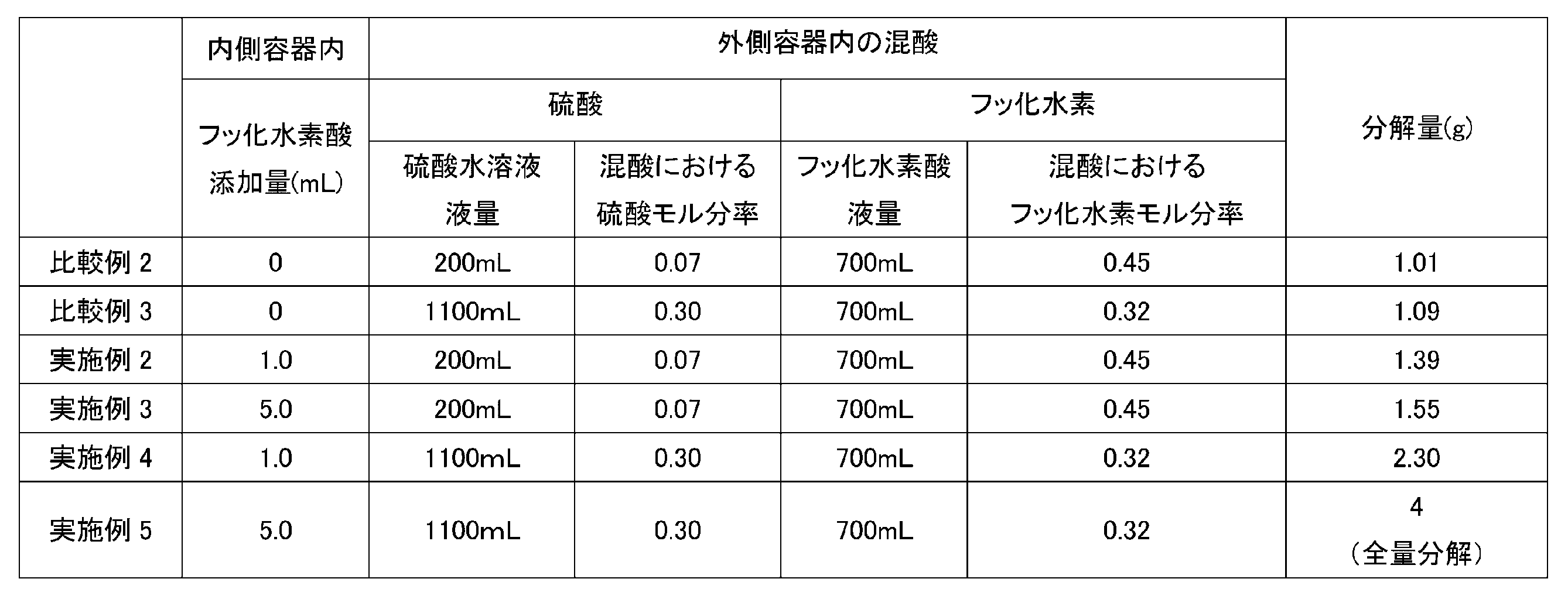
表2に示す結果から、内側容器に石英試料を液体(フッ化水素酸)とともに入れた実施例2~4では、内側容器に液体を入れなかった比較例2、3と比べて分解が促進されたこと、即ちより短時間での分解が可能であったことが確認できる。
[実施例6~9、比較例4、5]
分解対象の石英試料として、公知の石英粉末製造工程で得られた石英るつぼ製造用石英粉末ロットから採取した石英粉末を4g秤量し、内側容器(テフロン(登録商標)製ビーカー)に投入した。この内側容器に38質量%高純度フッ化水素酸(フッ化水素の水溶液)を1.0mL加えた。外側容器として、ポリプロピレン製ケース(縦×横×高さ=10cm×20cm×15cm)を用意した。この外側容器内に50質量%フッ化水素酸(フッ化水素の水溶液)700mlと表3に示す液量の98質量%硫酸水溶液を入れた後、直ちに上記内側容器を蓋をすることなく外側容器内に入れ、外側容器の蓋を閉めた。外側容器内に入れたフッ化水素酸と硫酸水溶液の混合溶液(混酸)が内側容器内に入らないように静置して室温のまま16時間放置した。
16時間後に外側容器の蓋を開け、内側容器を取り出し、内側容器内の液体をろ過して固形物(即ち未分解の石英粉末)を分離して質量を計測した。内側容器に投入した石英粉末量(4g)から計測された質量を差し引いた値を分解量として、表2に示した実施例2の結果とともに表3に示す。
分解対象の石英試料として、公知の石英粉末製造工程で得られた石英るつぼ製造用石英粉末ロットから採取した石英粉末を4g秤量し、内側容器(テフロン(登録商標)製ビーカー)に投入した。この内側容器に38質量%高純度フッ化水素酸(フッ化水素の水溶液)を1.0mL加えた。外側容器として、ポリプロピレン製ケース(縦×横×高さ=10cm×20cm×15cm)を用意した。この外側容器内に50質量%フッ化水素酸(フッ化水素の水溶液)700mlと表3に示す液量の98質量%硫酸水溶液を入れた後、直ちに上記内側容器を蓋をすることなく外側容器内に入れ、外側容器の蓋を閉めた。外側容器内に入れたフッ化水素酸と硫酸水溶液の混合溶液(混酸)が内側容器内に入らないように静置して室温のまま16時間放置した。
16時間後に外側容器の蓋を開け、内側容器を取り出し、内側容器内の液体をろ過して固形物(即ち未分解の石英粉末)を分離して質量を計測した。内側容器に投入した石英粉末量(4g)から計測された質量を差し引いた値を分解量として、表2に示した実施例2の結果とともに表3に示す。
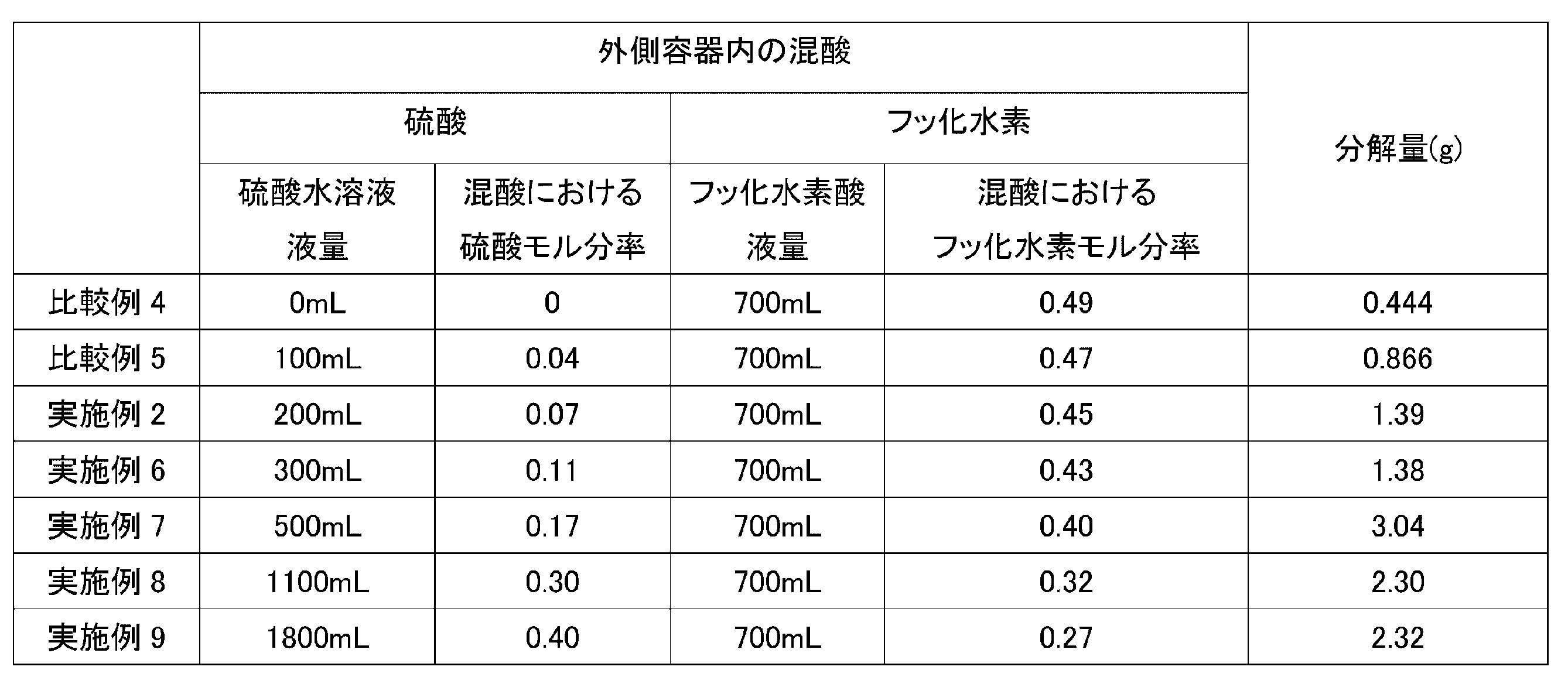
表3に示す結果から、外側容器内の混酸における硫酸のモル分率が0.07~0.40の範囲の実施例2、6~9では、外側容器内の混酸におけるモル分率が上記範囲外の比較例4、5と比べて分解が促進されたこと、即ちより短時間での分解が可能であったことが確認できる。
[実施例10~13]
分解対象の石英試料として、公知の石英粉末製造工程で得られた石英るつぼ製造用石英粉末ロットから採取した石英粉末を4g秤量し、内側容器(テフロン(登録商標)製ビーカー)に投入した。この内側容器に純水を実施例10~13については表4に示す量で加えた。
外側容器として、ポリプロピレン製ケース(縦×横×高さ=10cm×20cm×15cm)を用意した。この外側容器内に50質量%フッ化水素酸(フッ化水素の水溶液)700mlと表4に示す液量の98質量%硫酸水溶液を入れた後、直ちに上記内側容器を蓋をすることなく外側容器内に入れ、外側容器の蓋を閉めた。外側容器内に入れたフッ化水素酸と硫酸水溶液の混合溶液(混酸)が内側容器内に入らないように静置して室温のまま16時間放置した。
16時間後に外側容器の蓋を開け、内側容器を取り出し、内側容器内の液体をろ過して固形物(即ち未分解の石英粉末)を分離して質量を計測した。内側容器に投入した石英粉末量(4g)から計測された質量を差し引いた値を分解量として、比較のため比較例2、3の結果とともに、表4に示す。
分解対象の石英試料として、公知の石英粉末製造工程で得られた石英るつぼ製造用石英粉末ロットから採取した石英粉末を4g秤量し、内側容器(テフロン(登録商標)製ビーカー)に投入した。この内側容器に純水を実施例10~13については表4に示す量で加えた。
外側容器として、ポリプロピレン製ケース(縦×横×高さ=10cm×20cm×15cm)を用意した。この外側容器内に50質量%フッ化水素酸(フッ化水素の水溶液)700mlと表4に示す液量の98質量%硫酸水溶液を入れた後、直ちに上記内側容器を蓋をすることなく外側容器内に入れ、外側容器の蓋を閉めた。外側容器内に入れたフッ化水素酸と硫酸水溶液の混合溶液(混酸)が内側容器内に入らないように静置して室温のまま16時間放置した。
16時間後に外側容器の蓋を開け、内側容器を取り出し、内側容器内の液体をろ過して固形物(即ち未分解の石英粉末)を分離して質量を計測した。内側容器に投入した石英粉末量(4g)から計測された質量を差し引いた値を分解量として、比較のため比較例2、3の結果とともに、表4に示す。

表4に示す結果から、内側容器に石英試料を液体(純水)とともに入れた実施例10~13では、内側容器に液体を入れなかった比較例2、3と比べて分解が促進されたこと、即ちより短時間での分解が可能であったことが確認できる。
[分析感度の検討]
<試験1>
内側容器(テフロン(登録商標)製ビーカー)に38質量%高純度フッ化水素酸(フッ化水素の水溶液)を1.0mL加えた。内側容器には、石英試料は投入しなかった。
外側容器として、ポリプロピレン製ケース(縦×横×高さ=10cm×20cm×15cm)を用意した。この外側容器内に50質量%フッ化水素酸(フッ化水素の水溶液)700mlと98質量%硫酸水溶液200mlを入れた後、直ちに上記内側容器を蓋をすることなく外側容器内に入れ、外側容器の蓋を閉めた。外側容器内に入れたフッ化水素酸と硫酸水溶液との混合溶液(混酸)が内側容器内に入らないように静置して室温のまま16時間放置した。
16時間後に外側容器の蓋を開け、内側容器をホットプレート上(ホットプレートの設定温度:150℃)に載置し内側容器内の液体を加熱により濃縮および乾固した。内側容器内の乾固物を回収液(2質量%フッ化水素酸)中に取り込んだ後、この回収液をICP-MSに付して金属成分を分析した。
以上の操作を6回行った。得られた分析結果を表5に示す。
<試験1>
内側容器(テフロン(登録商標)製ビーカー)に38質量%高純度フッ化水素酸(フッ化水素の水溶液)を1.0mL加えた。内側容器には、石英試料は投入しなかった。
外側容器として、ポリプロピレン製ケース(縦×横×高さ=10cm×20cm×15cm)を用意した。この外側容器内に50質量%フッ化水素酸(フッ化水素の水溶液)700mlと98質量%硫酸水溶液200mlを入れた後、直ちに上記内側容器を蓋をすることなく外側容器内に入れ、外側容器の蓋を閉めた。外側容器内に入れたフッ化水素酸と硫酸水溶液との混合溶液(混酸)が内側容器内に入らないように静置して室温のまま16時間放置した。
16時間後に外側容器の蓋を開け、内側容器をホットプレート上(ホットプレートの設定温度:150℃)に載置し内側容器内の液体を加熱により濃縮および乾固した。内側容器内の乾固物を回収液(2質量%フッ化水素酸)中に取り込んだ後、この回収液をICP-MSに付して金属成分を分析した。
以上の操作を6回行った。得られた分析結果を表5に示す。
<試験2(比較試験)>
テフロン(登録商標)製ビーカーに純水3mL、50質量%フッ化水素酸10mL、69.5質量%硝酸水溶液3mLを入れて蓋を閉めた。
上記テフロン(登録商標)製ビーカーをステンレス製容器に入れた後、ステンレス製容器の蓋を閉めた。このステンレス製容器を140℃に保たれた恒温器に投入した。石英粉末からの反応ガスや、フッ化水素酸、硝酸水溶液から発生する蒸気によりステンレス製容器内が加圧された状態で、16時間放置した。
16時間後、ステンレス製容器の蓋を開け、テフロン(登録商標)製ビーカーの蓋を開けてテフロン(登録商標)製ビーカーをホットプレート上(ホットプレートの設定温度:150℃)に載置しテフロン(登録商標)製ビーカー内の液体を加熱により濃縮および乾固した。テフロン(登録商標)製ビーカー内の乾固物を回収液(2質量%フッ化水素酸)中に取り込んだ後、この回収液をICP-MSに付して金属成分を分析した。
以上の操作を6回行った。得られた分析結果を表5に示す。
テフロン(登録商標)製ビーカーに純水3mL、50質量%フッ化水素酸10mL、69.5質量%硝酸水溶液3mLを入れて蓋を閉めた。
上記テフロン(登録商標)製ビーカーをステンレス製容器に入れた後、ステンレス製容器の蓋を閉めた。このステンレス製容器を140℃に保たれた恒温器に投入した。石英粉末からの反応ガスや、フッ化水素酸、硝酸水溶液から発生する蒸気によりステンレス製容器内が加圧された状態で、16時間放置した。
16時間後、ステンレス製容器の蓋を開け、テフロン(登録商標)製ビーカーの蓋を開けてテフロン(登録商標)製ビーカーをホットプレート上(ホットプレートの設定温度:150℃)に載置しテフロン(登録商標)製ビーカー内の液体を加熱により濃縮および乾固した。テフロン(登録商標)製ビーカー内の乾固物を回収液(2質量%フッ化水素酸)中に取り込んだ後、この回収液をICP-MSに付して金属成分を分析した。
以上の操作を6回行った。得られた分析結果を表5に示す。
試験1、2で得られた金属成分の分析結果を、表5に示す。

従来の加圧酸分解法では、耐圧性の容器であるステンレス製の容器が使用されることがある。しかし、表5に示すように、ステンレス製の容器を使用した試験2では、試験1と比べて金属成分の検出量が大幅に多かった。これはステンレス製の容器からの金属成分の混入が原因になっていると考えられる。
これに対し、本発明の一態様にかかる分解方法は、加圧なしで実施することができるため、ステンレス製の容器を使用せずに実施することが可能である。これにより分解物や分解物を含む液体へのステンレス製の容器からの外乱(金属成分の混入)なく、石英試料を分解することができる。このことは、石英試料の金属汚染分析を、より高感度に実施することにつながり好ましい。
これに対し、本発明の一態様にかかる分解方法は、加圧なしで実施することができるため、ステンレス製の容器を使用せずに実施することが可能である。これにより分解物や分解物を含む液体へのステンレス製の容器からの外乱(金属成分の混入)なく、石英試料を分解することができる。このことは、石英試料の金属汚染分析を、より高感度に実施することにつながり好ましい。
本発明の一態様は、各種石英部材の製造分野において有用である。
Claims (13)
- 分析対象の石英試料の少なくとも一部が浸漬した液体を、混酸から発生したガスと接触させることにより、前記石英試料の少なくとも一部を分解することを含み、
前記液体は少なくとも水を含む液体であり、
前記混酸はフッ化水素と硫酸との混酸であり、かつ該混酸における硫酸のモル分率は0.07~0.40の範囲である、石英試料の分解方法。 - 前記混酸におけるフッ化水素のモル分率は0.27以上である、請求項1に記載の石英試料の分解方法。
- 前記液体はフッ化水素酸である、請求項1または2に記載の石英試料の分解方法。
- 前記液体は純水である、請求項1または2に記載の石英試料の分解方法。
- 前記分解を密閉容器内で行う、請求項1~4のいずれか1項に記載の石英試料の分解方法。
- 前記分解を前記密閉容器内を加圧することなく行う、請求項5に記載の石英試料の分解方法。
- 前記分解を前記密閉容器内を加熱することなく行う、請求項5または6に記載の石英試料の分解方法。
- 請求項1~7のいずれか1項に記載の方法により石英試料を分解すること、および、
前記分解により得られた分解物中の金属成分を分析すること、
を含む、石英試料の金属汚染分析方法。 - 石英粉末ロットから採取した石英粉末を請求項8に記載の方法により分析すること、および、
前記分析により金属汚染レベルが許容レベルと判定された場合、前記ロットに含まれる石英粉末を用いて石英部材製造工程において石英部材を作製すること、
を含む石英部材の製造方法。 - 石英粉末製造工程において石英粉末ロットを作製すること、
作製された石英粉末ロットから採取した石英粉末を請求項8に記載の方法により分析すること、
前記分析により金属汚染レベルが非許容レベルと判定された場合、前記石英粉末製造工程に金属汚染低減処理を施し、該処理後の石英粉末製造工程において石英粉末ロットを作製すること、および、
作製された石英粉末ロットに含まれる少なくとも一部の石英粉末を用いて石英部材製造工程において石英部材を作製すること、
を含む石英部材の製造方法。 - 石英部材製造工程において石英部材予備体を作製すること、
作製された石英部材予備体の一部を採取して請求項8に記載の方法により分析すること、および、
前記分析により金属汚染レベルが許容レベルと判定された場合、前記石英部材予備体を石英部材に加工する加工工程に付し、前記分析により金属汚染レベルが非許容レベルと判定された場合、前記石英部材予備体を作製した石英部材製造工程に金属汚染低減処理を施し、該処理後の石英部材製造工程において石英部材予備体を作製し、作製された石英部材予備体を石英部材に加工する加工工程に付すこと、
を含む、石英部材の製造方法。 - 前記石英部材は、石英るつぼである、請求項9~11のいずれか1項に記載の石英部材の製造方法。
- 前記石英るつぼは、シリコン単結晶インゴット育成用るつぼである、請求項12に記載の石英部材の製造方法。
Priority Applications (3)
| Application Number | Priority Date | Filing Date | Title |
|---|---|---|---|
| DE112017006574.7T DE112017006574T5 (de) | 2016-12-27 | 2017-12-07 | Verfahren zur Zersetzung einer Quarzprobe, Verfahren zur Analyse der Metallkontamination einer Quarzprobe, sowie Verfahren zur Herstellung eines Quarz-Elements |
| KR1020197017301A KR102227221B1 (ko) | 2016-12-27 | 2017-12-07 | 석영 시료의 분해 방법, 석영 시료의 금속 오염 분석 방법 및 석영 부재의 제조 방법 |
| US16/467,766 US11421342B2 (en) | 2016-12-27 | 2017-12-07 | Method of decomposing quartz sample, method of analyzing metal contamination of quartz sample, and method of manufacturing quartz member |
Applications Claiming Priority (2)
| Application Number | Priority Date | Filing Date | Title |
|---|---|---|---|
| JP2016254381A JP6439782B2 (ja) | 2016-12-27 | 2016-12-27 | 石英試料の分解方法、石英試料の金属汚染分析方法および石英部材の製造方法 |
| JP2016-254381 | 2016-12-27 |
Publications (1)
| Publication Number | Publication Date |
|---|---|
| WO2018123490A1 true WO2018123490A1 (ja) | 2018-07-05 |
Family
ID=62707284
Family Applications (1)
| Application Number | Title | Priority Date | Filing Date |
|---|---|---|---|
| PCT/JP2017/043899 Ceased WO2018123490A1 (ja) | 2016-12-27 | 2017-12-07 | 石英試料の分解方法、石英試料の金属汚染分析方法および石英部材の製造方法 |
Country Status (5)
| Country | Link |
|---|---|
| US (1) | US11421342B2 (ja) |
| JP (1) | JP6439782B2 (ja) |
| KR (1) | KR102227221B1 (ja) |
| DE (1) | DE112017006574T5 (ja) |
| WO (1) | WO2018123490A1 (ja) |
Citations (2)
| Publication number | Priority date | Publication date | Assignee | Title |
|---|---|---|---|---|
| JPH11183342A (ja) * | 1997-12-25 | 1999-07-09 | Toshiba Ceramics Co Ltd | 珪素質材料の不純物高精度分析のための試料処理方法及びそれに用いる処理器 |
| JP2012069855A (ja) * | 2010-09-27 | 2012-04-05 | Sumco Corp | シリコンウェーハ表層部のエッチング方法およびシリコンウェーハの金属汚染分析方法 |
Family Cites Families (9)
| Publication number | Priority date | Publication date | Assignee | Title |
|---|---|---|---|---|
| JPS6138547A (ja) * | 1984-07-31 | 1986-02-24 | Toshiba Corp | 試料分解装置及びそれを用いた試料分解方法 |
| JPH06160256A (ja) * | 1992-07-30 | 1994-06-07 | Toshiba Corp | 試料分解方法及びその装置 |
| JP3274020B2 (ja) * | 1993-06-25 | 2002-04-15 | 信越石英株式会社 | 分析方法および分析用分解・乾固装置 |
| US5968259A (en) * | 1997-08-27 | 1999-10-19 | Shin-Etsu Quartz Products Co., Ltd. | High-purity quartz glass and method for the preparation thereof |
| KR100733201B1 (ko) * | 2000-02-07 | 2007-06-27 | 동경 엘렉트론 주식회사 | 반도체 제조장치용 석영 부재, 반도체 제조장치용 석영 부재의 제조방법, 열처리 장치, 및 석영 부재중의 금속의 분석 방법 |
| JP3790160B2 (ja) * | 2001-12-28 | 2006-06-28 | 株式会社東芝 | 試料分解処理装置及びこれを用いた不純物分析方法 |
| JP4748986B2 (ja) * | 2002-11-01 | 2011-08-17 | 株式会社半導体エネルギー研究所 | 半導体装置の作製方法 |
| WO2008004582A1 (en) * | 2006-07-04 | 2008-01-10 | Ngk Insulators, Ltd. | Piezoelectric/electrostrictive film type sensor |
| JP2011157260A (ja) * | 2010-01-07 | 2011-08-18 | Mitsubishi Materials Corp | 合成非晶質シリカ粉末及びその製造方法 |
-
2016
- 2016-12-27 JP JP2016254381A patent/JP6439782B2/ja active Active
-
2017
- 2017-12-07 US US16/467,766 patent/US11421342B2/en active Active
- 2017-12-07 WO PCT/JP2017/043899 patent/WO2018123490A1/ja not_active Ceased
- 2017-12-07 KR KR1020197017301A patent/KR102227221B1/ko active Active
- 2017-12-07 DE DE112017006574.7T patent/DE112017006574T5/de active Pending
Patent Citations (2)
| Publication number | Priority date | Publication date | Assignee | Title |
|---|---|---|---|---|
| JPH11183342A (ja) * | 1997-12-25 | 1999-07-09 | Toshiba Ceramics Co Ltd | 珪素質材料の不純物高精度分析のための試料処理方法及びそれに用いる処理器 |
| JP2012069855A (ja) * | 2010-09-27 | 2012-04-05 | Sumco Corp | シリコンウェーハ表層部のエッチング方法およびシリコンウェーハの金属汚染分析方法 |
Also Published As
| Publication number | Publication date |
|---|---|
| JP2018105793A (ja) | 2018-07-05 |
| JP6439782B2 (ja) | 2018-12-19 |
| KR102227221B1 (ko) | 2021-03-11 |
| US11421342B2 (en) | 2022-08-23 |
| DE112017006574T5 (de) | 2019-10-10 |
| US20190368071A1 (en) | 2019-12-05 |
| KR20190084300A (ko) | 2019-07-16 |
Similar Documents
| Publication | Publication Date | Title |
|---|---|---|
| JP2012174964A (ja) | シリコンウェーハの金属汚染分析方法 | |
| JP6413047B1 (ja) | ポリシリコン破砕物の付着樹脂の分析方法 | |
| JP3051023B2 (ja) | 珪素質分析試料中の不純物高精度分析のための処理方法及びその装置 | |
| WO2016051761A1 (ja) | 多結晶シリコンの表面清浄度評価方法および品質保証方法 | |
| CA2935320A1 (en) | Method for determining a concentration of metal impurities contaminating a silicon product | |
| JP3473699B2 (ja) | シリコンウェーハのエッチング方法とその装置及び不純物分析方法 | |
| Shaverina et al. | A procedure of ICP-AES analysis of silicon using microwave digestion and preconcentration | |
| CN110223927A (zh) | 硅晶片的金属污染分析方法 | |
| CN103608084B (zh) | KMgF3化合物用于捕获气相或液相中氟化物和/或氟氧化物形式的金属的用途 | |
| JP6439782B2 (ja) | 石英試料の分解方法、石英試料の金属汚染分析方法および石英部材の製造方法 | |
| JP4837687B2 (ja) | クロロシラン類の化学処理方法 | |
| JP5413342B2 (ja) | シリコンウェーハ表層部のエッチング方法およびシリコンウェーハの金属汚染分析方法 | |
| JP2010008048A (ja) | シリコンウェーハ表面酸化膜のエッチング方法、酸化膜付きシリコンウェーハの金属汚染分析方法、および酸化膜付きシリコンウェーハの製造方法 | |
| JP6329920B2 (ja) | 多結晶シリコン塊の評価方法 | |
| CN109580320A (zh) | 电子级正硅酸乙酯中痕量杂质分析的前处理方法及装置 | |
| JP7281937B2 (ja) | 低炭素高純度多結晶シリコン塊とその製造方法 | |
| JP2011038843A (ja) | シリコン研磨用スラリー中および研磨後スラリー中の金属分析方法 | |
| JP6424742B2 (ja) | 半導体シリコン結晶の不純物分析のための前処理方法、及び半導体シリコン結晶の不純物分析方法 | |
| KR102111641B1 (ko) | Icp 분석을 위한 폴리실리콘 전처리방법 및 폴리실리콘의 icp 분석방법 | |
| JP6980621B2 (ja) | シリコン結晶の分析用試料の調製方法およびシリコン結晶中の微量不純物の定量方法 | |
| Bulanov et al. | Determination of Impurities in Monoisotopic Silicon Tetrafluoride. | |
| Ivanov et al. | Experimental investigation of high-temperature removal of impurities from granulated quartz | |
| CN121475824A (zh) | 一种用于二茂铁中微量杂质分析的前处理方法 | |
| Shaverina et al. | ICP-AES analysis of high-purity silicon | |
| RU2512726C2 (ru) | Способ очистки тетрафторида циркония от примесей |
Legal Events
| Date | Code | Title | Description |
|---|---|---|---|
| 121 | Ep: the epo has been informed by wipo that ep was designated in this application |
Ref document number: 17885576 Country of ref document: EP Kind code of ref document: A1 |
|
| ENP | Entry into the national phase |
Ref document number: 20197017301 Country of ref document: KR Kind code of ref document: A |
|
| 122 | Ep: pct application non-entry in european phase |
Ref document number: 17885576 Country of ref document: EP Kind code of ref document: A1 |