WO2018092414A1 - ポリエステル系熱可塑性フィルムの製造方法、ポリエステル系熱可塑性フィルム、ポリエステル系熱可塑性フィルム又はその樹脂材料の検査方法 - Google Patents
ポリエステル系熱可塑性フィルムの製造方法、ポリエステル系熱可塑性フィルム、ポリエステル系熱可塑性フィルム又はその樹脂材料の検査方法 Download PDFInfo
- Publication number
- WO2018092414A1 WO2018092414A1 PCT/JP2017/034254 JP2017034254W WO2018092414A1 WO 2018092414 A1 WO2018092414 A1 WO 2018092414A1 JP 2017034254 W JP2017034254 W JP 2017034254W WO 2018092414 A1 WO2018092414 A1 WO 2018092414A1
- Authority
- WO
- WIPO (PCT)
- Prior art keywords
- polyester
- resin
- terephthalate
- terephthalic acid
- hydroxyethyl
- Prior art date
- Legal status (The legal status is an assumption and is not a legal conclusion. Google has not performed a legal analysis and makes no representation as to the accuracy of the status listed.)
- Ceased
Links
Images



Classifications
-
- B—PERFORMING OPERATIONS; TRANSPORTING
- B29—WORKING OF PLASTICS; WORKING OF SUBSTANCES IN A PLASTIC STATE IN GENERAL
- B29C—SHAPING OR JOINING OF PLASTICS; SHAPING OF MATERIAL IN A PLASTIC STATE, NOT OTHERWISE PROVIDED FOR; AFTER-TREATMENT OF THE SHAPED PRODUCTS, e.g. REPAIRING
- B29C48/00—Extrusion moulding, i.e. expressing the moulding material through a die or nozzle which imparts the desired form; Apparatus therefor
- B29C48/022—Extrusion moulding, i.e. expressing the moulding material through a die or nozzle which imparts the desired form; Apparatus therefor characterised by the choice of material
-
- B—PERFORMING OPERATIONS; TRANSPORTING
- B29—WORKING OF PLASTICS; WORKING OF SUBSTANCES IN A PLASTIC STATE IN GENERAL
- B29C—SHAPING OR JOINING OF PLASTICS; SHAPING OF MATERIAL IN A PLASTIC STATE, NOT OTHERWISE PROVIDED FOR; AFTER-TREATMENT OF THE SHAPED PRODUCTS, e.g. REPAIRING
- B29C48/00—Extrusion moulding, i.e. expressing the moulding material through a die or nozzle which imparts the desired form; Apparatus therefor
- B29C48/03—Extrusion moulding, i.e. expressing the moulding material through a die or nozzle which imparts the desired form; Apparatus therefor characterised by the shape of the extruded material at extrusion
- B29C48/07—Flat, e.g. panels
- B29C48/08—Flat, e.g. panels flexible, e.g. films
-
- B—PERFORMING OPERATIONS; TRANSPORTING
- B29—WORKING OF PLASTICS; WORKING OF SUBSTANCES IN A PLASTIC STATE IN GENERAL
- B29C—SHAPING OR JOINING OF PLASTICS; SHAPING OF MATERIAL IN A PLASTIC STATE, NOT OTHERWISE PROVIDED FOR; AFTER-TREATMENT OF THE SHAPED PRODUCTS, e.g. REPAIRING
- B29C48/00—Extrusion moulding, i.e. expressing the moulding material through a die or nozzle which imparts the desired form; Apparatus therefor
- B29C48/25—Component parts, details or accessories; Auxiliary operations
- B29C48/30—Extrusion nozzles or dies
- B29C48/305—Extrusion nozzles or dies having a wide opening, e.g. for forming sheets
-
- B—PERFORMING OPERATIONS; TRANSPORTING
- B29—WORKING OF PLASTICS; WORKING OF SUBSTANCES IN A PLASTIC STATE IN GENERAL
- B29C—SHAPING OR JOINING OF PLASTICS; SHAPING OF MATERIAL IN A PLASTIC STATE, NOT OTHERWISE PROVIDED FOR; AFTER-TREATMENT OF THE SHAPED PRODUCTS, e.g. REPAIRING
- B29C48/00—Extrusion moulding, i.e. expressing the moulding material through a die or nozzle which imparts the desired form; Apparatus therefor
- B29C48/25—Component parts, details or accessories; Auxiliary operations
- B29C48/88—Thermal treatment of the stream of extruded material, e.g. cooling
-
- B—PERFORMING OPERATIONS; TRANSPORTING
- B29—WORKING OF PLASTICS; WORKING OF SUBSTANCES IN A PLASTIC STATE IN GENERAL
- B29C—SHAPING OR JOINING OF PLASTICS; SHAPING OF MATERIAL IN A PLASTIC STATE, NOT OTHERWISE PROVIDED FOR; AFTER-TREATMENT OF THE SHAPED PRODUCTS, e.g. REPAIRING
- B29C48/00—Extrusion moulding, i.e. expressing the moulding material through a die or nozzle which imparts the desired form; Apparatus therefor
- B29C48/25—Component parts, details or accessories; Auxiliary operations
- B29C48/88—Thermal treatment of the stream of extruded material, e.g. cooling
- B29C48/885—External treatment, e.g. by using air rings for cooling tubular films
-
- B—PERFORMING OPERATIONS; TRANSPORTING
- B29—WORKING OF PLASTICS; WORKING OF SUBSTANCES IN A PLASTIC STATE IN GENERAL
- B29C—SHAPING OR JOINING OF PLASTICS; SHAPING OF MATERIAL IN A PLASTIC STATE, NOT OTHERWISE PROVIDED FOR; AFTER-TREATMENT OF THE SHAPED PRODUCTS, e.g. REPAIRING
- B29C48/00—Extrusion moulding, i.e. expressing the moulding material through a die or nozzle which imparts the desired form; Apparatus therefor
- B29C48/25—Component parts, details or accessories; Auxiliary operations
- B29C48/92—Measuring, controlling or regulating
-
- C—CHEMISTRY; METALLURGY
- C08—ORGANIC MACROMOLECULAR COMPOUNDS; THEIR PREPARATION OR CHEMICAL WORKING-UP; COMPOSITIONS BASED THEREON
- C08G—MACROMOLECULAR COMPOUNDS OBTAINED OTHERWISE THAN BY REACTIONS ONLY INVOLVING UNSATURATED CARBON-TO-CARBON BONDS
- C08G63/00—Macromolecular compounds obtained by reactions forming a carboxylic ester link in the main chain of the macromolecule
- C08G63/02—Polyesters derived from hydroxycarboxylic acids or from polycarboxylic acids and polyhydroxy compounds
- C08G63/60—Polyesters derived from hydroxycarboxylic acids or from polycarboxylic acids and polyhydroxy compounds derived from the reaction of a mixture of hydroxy carboxylic acids, polycarboxylic acids and polyhydroxy compounds
-
- C—CHEMISTRY; METALLURGY
- C08—ORGANIC MACROMOLECULAR COMPOUNDS; THEIR PREPARATION OR CHEMICAL WORKING-UP; COMPOSITIONS BASED THEREON
- C08G—MACROMOLECULAR COMPOUNDS OBTAINED OTHERWISE THAN BY REACTIONS ONLY INVOLVING UNSATURATED CARBON-TO-CARBON BONDS
- C08G63/00—Macromolecular compounds obtained by reactions forming a carboxylic ester link in the main chain of the macromolecule
- C08G63/78—Preparation processes
- C08G63/82—Preparation processes characterised by the catalyst used
- C08G63/85—Germanium, tin, lead, arsenic, antimony, bismuth, titanium, zirconium, hafnium, vanadium, niobium, tantalum, or compounds thereof
-
- C—CHEMISTRY; METALLURGY
- C08—ORGANIC MACROMOLECULAR COMPOUNDS; THEIR PREPARATION OR CHEMICAL WORKING-UP; COMPOSITIONS BASED THEREON
- C08J—WORKING-UP; GENERAL PROCESSES OF COMPOUNDING; AFTER-TREATMENT NOT COVERED BY SUBCLASSES C08B, C08C, C08F, C08G or C08H
- C08J5/00—Manufacture of articles or shaped materials containing macromolecular substances
- C08J5/18—Manufacture of films or sheets
-
- B—PERFORMING OPERATIONS; TRANSPORTING
- B29—WORKING OF PLASTICS; WORKING OF SUBSTANCES IN A PLASTIC STATE IN GENERAL
- B29C—SHAPING OR JOINING OF PLASTICS; SHAPING OF MATERIAL IN A PLASTIC STATE, NOT OTHERWISE PROVIDED FOR; AFTER-TREATMENT OF THE SHAPED PRODUCTS, e.g. REPAIRING
- B29C2948/00—Indexing scheme relating to extrusion moulding
- B29C2948/92—Measuring, controlling or regulating
- B29C2948/92009—Measured parameter
- B29C2948/92228—Content, e.g. percentage of humidity, volatiles, contaminants or degassing
-
- C—CHEMISTRY; METALLURGY
- C08—ORGANIC MACROMOLECULAR COMPOUNDS; THEIR PREPARATION OR CHEMICAL WORKING-UP; COMPOSITIONS BASED THEREON
- C08J—WORKING-UP; GENERAL PROCESSES OF COMPOUNDING; AFTER-TREATMENT NOT COVERED BY SUBCLASSES C08B, C08C, C08F, C08G or C08H
- C08J2367/00—Characterised by the use of polyesters obtained by reactions forming a carboxylic ester link in the main chain; Derivatives of such polymers
- C08J2367/02—Polyesters derived from dicarboxylic acids and dihydroxy compounds
Definitions
- the present invention relates to a method for producing a polyester-based thermoplastic film. More specifically, the present invention relates to a method for producing a polyester thermoplastic film excellent in smoothness by a melt extrusion method. Furthermore, this invention relates to the inspection method of a polyester-type thermoplastic film, a polyester-type thermoplastic film, or its resin material.
- Patent Document 5 proposes a method of removing a sublimate generated in a die lip portion with respect to a polyester-based thermoplastic resin by a suction nozzle.
- Patent Documents 6 to 8 propose a method of suppressing mold contamination during molding by defining the amount of monomer / oligomer in the polyester-based thermoplastic resin pellet. All of these patent documents suppress the occurrence of die lines by removing or restricting the sublimates that cause die lines and the monomers / oligomers in the resin pellets during resin film molding.
- Japanese Patent No. 4292912 Japanese Patent No. 4320985 JP 2009-107180 A Japanese Patent No. 3552821 JP 2001-71370 A Japanese Patent No. 3938647 JP 2000-319373 A JP 2001-172372 A
- the increase in the die line on the surface of the resin film can be somewhat delayed.
- the resin film cannot be manufactured at the time of cleaning the dice and the productivity is deteriorated.
- the die line is generated on the surface of the resin film after several days if the production is resumed.
- the cleaning of the dies is an emergency measure, and is not a fundamental solution for the generation of die lines.
- a polyester thermoplastic film manufacturing method includes (1) a polyester thermoplastic film in which a molten resin is discharged from a die and then solidified by cooling to form a film.
- the ratio of the total amount of free terephthalic acid contained in the sublimate generated from the heat-melted resin and the total amount of free bis (2-hydroxyethyl) terephthalate is expressed by the following formula [1]. It is characterized by satisfying. 0 ⁇ terephthalic acid / bis (2-hydroxyethyl) terephthalate ⁇ 1.02 ... [1]
- any one of an antimony compound, a titanium compound, a germanium compound, or a combination thereof is used as a catalyst for the polymerization reaction of the heat-melted resin. It is preferable.
- the manufacturing method of the polyester-type thermoplastic film as described in said (2) is (3) It is preferable that at least one part of the said catalyst is deactivated.
- the manufacturing method of the polyester-type thermoplastic film concerning one Embodiment of this invention is the polyester-type heat
- the ratio of the total amount of free terephthalic acid remaining in the film and the total amount of free bis (2-hydroxyethyl) terephthalate satisfies the relationship of the following formula [3]: . 0 ⁇ terephthalic acid / bis (2-hydroxyethyl) terephthalate ⁇ 0.33 ... [3]
- the method for producing a polyester-based thermoplastic film according to any one of the above (1) to (4) preferably includes (5) 0 to 20% of isophthalic acid as a dicarboxylic acid component other than the terephthalic acid. .
- a polyester-based thermoplastic film according to an embodiment of the present invention is a ratio of the total amount of free terephthalic acid remaining in the film and the total amount of free bis (2-hydroxyethyl) terephthalate. Satisfies the relationship of the following equation [3]. 0 ⁇ terephthalic acid / bis (2-hydroxyethyl) terephthalate ⁇ 0.33 ... [3]
- the inspection method of the resin material of the polyester-type thermoplastic film concerning one Embodiment of this invention heat-melts resin, and the free terephthalic acid contained in the sublimate generated from the said resin is obtained. It is characterized by checking whether the ratio of the total amount to the total amount of free bis (2-hydroxyethyl) terephthalate (terephthalic acid / bis (2-hydroxyethyl) terephthalate) satisfies the relationship of the following formula [1] And 0 ⁇ terephthalic acid / bis (2-hydroxyethyl) terephthalate ⁇ 1.02 ... [1]
- the method for inspecting a resin material of a polyester-based thermoplastic film includes a total amount of free terephthalic acid remaining in a molded polyester-based thermoplastic resin film, It is characterized by examining whether the ratio of the total amount of bis (2-hydroxyethyl) terephthalate (terephthalic acid / bis (2-hydroxyethyl) terephthalate) satisfies the relationship of the following formula [3]. 0 ⁇ terephthalic acid / bis (2-hydroxyethyl) terephthalate ⁇ 0.33 ... [3]
- the present invention since it is possible to estimate in advance whether or not a die line is generated, it is possible to select in advance a resin pellet that is less likely to generate a die line. And mass production of a resin film can be started using this selected resin pellet. Moreover, since generation
- the method for producing a polyester-based thermoplastic film of the present embodiment is a method for producing a polyester-based thermoplastic film in which a heated molten resin is discharged from a die and then cooled and solidified to form a film. Sublimation generated from the heated molten resin The ratio of the total amount of free terephthalic acid contained in the product to the total amount of free bis (2-hydroxyethyl) terephthalate satisfies the following formula [1]. 0 ⁇ terephthalic acid / bis (2-hydroxyethyl) terephthalate ⁇ 1.02 ... [1]
- the polyester thermoplastic film refers to a film manufactured using a polyester thermoplastic resin.
- the polyester thermoplastic resin refers to an aromatic polyester resin such as polyethylene terephthalate and a copolymer polyester resin having polyethylene terephthalate as a main skeleton.
- an aromatic polyester resin containing terephthalic acid or an ester-forming derivative thereof as the dicarboxylic acid component is preferable, but is not limited thereto.
- the ratio of the terephthalic acid which occupies for all dicarboxylic acid components or its ester-forming derivative shall be 80 mol% or more.
- examples of the ester-forming derivative of terephthalic acid include esters having an alkyl group having about 1 to 4 carbon atoms.
- dicarboxylic acid components other than terephthalic acid examples include phthalic acid, isophthalic acid, phenylenedioxydicarboxylic acid, 4,4′-diphenyldicarboxylic acid, 4,4′-diphenyletherdicarboxylic acid, and 4,4′-diphenylketone.
- Aromatic dicarboxylic acids such as dicarboxylic acid, 4,4′-diphenoxyethanedicarboxylic acid, and 2,6-naphthalenedicarboxylic acid. Of these, isophthalic acid is particularly preferred from the viewpoint of mechanical properties of the resulting resin film.
- the production method of the polyester-based thermoplastic film in the present embodiment is preferably a so-called melt extrusion film-forming method in which a heated molten resin is discharged from a die and then cooled and solidified, but is not particularly limited thereto.
- a solution casting method and a calendar method are also applicable.
- a method using a die In the case of producing a resin film by a melt extrusion film forming method, a method using a die, an inflation method and the like can be mentioned. Among them, the method using a die is preferable in terms of excellent productivity and thickness accuracy. As a method using a die, generally, a resin film is manufactured through the following steps.
- the heat-melted resin material is extruded from a die installed at the tip of the extruder.
- the resin material discharged flatly from the lip gap of the die is cooled by being brought into close contact with a mirror-treated cooling roller (chilled roll).
- a resin film is continuously manufactured by the melt extrusion film-forming method using a die.
- the die used in the above method is not particularly limited, and examples thereof include known dies such as a T die and a coat hanger die.
- Examples of the material of the die include SCM steel and stainless steel such as SUS, but are not limited thereto.
- the inventors of the present invention have worked to identify the above-described die line generation mechanism when a resin film is produced by melt-extruding a polyester-based thermoplastic resin. As a result, it was found that the cause of the die line was not a monomer or oligomer contained in the conventionally proposed resin material but a low molecular weight substance produced during the production of the resin film was deposited at the tip of the die.
- a low molecular weight product (hereinafter also referred to as “low molecular weight component”) generated by thermal decomposition of the resin is a cause of die line generation at the tip of the die. This is thought to be due to deposition and sticking. That is, this low molecular weight body is gradually deposited on the tip of the die during the production of the resin film.
- deposition of a certain amount or more occurs, the surface of the resin film is affected and die lines are generated.
- the deposit itself is altered by heat, it does not dissolve in the molten resin material and the organic solvent, and does not melt at the film manufacturing temperature, so that it is difficult to analyze. Therefore, in the present embodiment, attention has been paid to TA and BHET generated together with the low molecular weight substance at the time of thermal decomposition of the resin.
- the structural formulas of TA and BHET are shown below.
- the amount of the TA and BHET is measured to estimate the ease of occurrence of the die line after the mass production of the resin film is started. be able to. Furthermore, by measuring the amount of TA and BHET in the sublimate that is generated when the resin material is heated under certain conditions without producing a resin film, it is easy to generate a die line during the production of the resin film. Can also be estimated.
- production of the die line on the surface of a resin film can be suppressed, and the resin film without the die line excellent in smoothness for a long period can be manufactured.
- the ratio of the total amount of free terephthalic acid contained in the sublimate and the total amount of free bis (2-hydroxyethyl) terephthalate satisfies the relationship of the following formula [2]. preferable. 0.20 ⁇ terephthalic acid / bis (2-hydroxyethyl) terephthalate ⁇ 0.92 (2)
- the polyester-based thermoplastic resin when the polyester-based thermoplastic resin is heated under the same conditions as in the production of the resin film, it is necessary to heat the polyester-based thermoplastic resin at a temperature equal to or higher than the melting point of the resin in an inert gas atmosphere.
- the temperature above the melting point of the resin varies depending on the composition of the polyester-based thermoplastic resin.
- a heating temperature of about 215 ° C. or higher, which is the melting point is preferable.
- the content of isophthalic acid is 0 mol%
- a heating temperature of about 255 ° C. or higher, which is the melting point is preferable.
- the inert gas a known gas such as nitrogen or argon can be used.
- the heating time is preferably 1 to 10 hours.
- this embodiment is characterized by focusing on the sublimate in the thermal decomposition behavior of the molten resin, and is simply different from simply comparing the amounts of TA and BHET contained in the resin pellet. is doing.
- the method for deactivating the catalyst varies depending on the type of catalyst.
- the catalyst can be deactivated by adding a deactivator, or the catalyst can be deactivated by hot water treatment (treatment of adding a liquid heated to a desired temperature to the catalyst).
- the catalyst is preferably one of an antimony (Sb) compound, a titanium (Ti) compound, and a germanium (Ge) compound.
- Sb antimony
- Ti titanium
- Ge germanium
- the catalyst deactivator those generally used for polyester resins are used.
- known deactivating agents such as phosphoric acid deactivating agents such as phosphoric esters such as trimethyl phosphoric acid and triethyl phosphoric acid and salts thereof as disclosed in JP-A-2007-204515 can be mentioned.
- the addition amount of the deactivator may be a normal addition amount, for example, about 0.1 to 1.0 part by mass can be added.
- thermoplastic polyester resin varies depending on the physical properties of the target resin film and the production facility of the resin film.
- die line suppression can be achieved by satisfying the above equation [1].
- the general method used for the measurement of the amount of substances in the sublimate can be used.
- the resin is heated in a nitrogen (inert gas) atmosphere, and the supplemented sublimate is collected.
- the collected sublimate is dissolved in an organic solvent such as chloroform.
- a measurement sample can be prepared using an organic solvent containing the substance to be measured, and various substances can be quantified using high performance liquid chromatography or the like.
- the total amount of free terephthalic acid contained (residual) and the total amount of free bis (2-hydroxyethyl) terephthalate contained in the resin film after manufacture is specified.
- a method of suppressing the die line will be described.
- the ratio of the total amount of free terephthalic acid contained in the polyester-based thermoplastic resin film to the total amount of free bis (2-hydroxyethyl) terephthalate satisfies the relationship of the following formula [3]. It is characterized by. 0 ⁇ terephthalic acid / bis (2-hydroxyethyl) terephthalate ⁇ 0.33 ... [3]
- the ratio of the total amount of free terephthalic acid contained in the resin film and the total amount of free bis (2-hydroxyethyl) terephthalate satisfies the relationship of the following formula [4]. preferable. 0.02 ⁇ terephthalic acid / bis (2-hydroxyethyl) terephthalate ⁇ 0.09 [4]
- a measuring method of terephthalic acid and bis (2-hydroxyethyl) terephthalate in the resin film a general method can be used.
- a measurement sample can be prepared by dissolving a resin film, and various substances can be quantified using high performance liquid chromatography or the like.
- the polyester-based thermoplastic film of this embodiment is such that the ratio of the total amount of free terephthalic acid remaining in the film and the total amount of free bis (2-hydroxyethyl) terephthalate satisfies the relationship of the following formula [3].
- the polyester-based thermoplastic film of the present embodiment when the above formula [3] is satisfied, it is more preferable to satisfy the following formula [4]. 0.02 ⁇ terephthalic acid / bis (2-hydroxyethyl) terephthalate ⁇ 0.09 [4]
- the polyester-based thermoplastic film of the present embodiment can suppress the occurrence of die lines on the surface thereof.
- the method for inspecting a resin material includes a total amount of liberated terephthalic acid contained in a sublimate generated from the resin when the resin is heated and melted before the resin film is produced.
- the main feature is to measure the ratio of the total amount of bis (2-hydroxyethyl) terephthalate (terephthalic acid / bis (2-hydroxyethyl) terephthalate). And when the ratio of the said total amount satisfy
- the ratio of the total amount of free terephthalic acid remaining in the polyester-based thermoplastic resin film to the total amount of free bis (2-hydroxyethyl) terephthalate (terephthalic acid / bis (2-hydroxyethyl) ) Terephthalate).
- the ratio of the said total quantity satisfy
- TA terephthalic acid
- IA isophthalic acid
- MHET monohydroxyethyl terephthalate
- BHET bis (2-hydroxyethyl) terephthalate
- cyclic dimer cyclic trimer
- the resin film manufacturing method of the present invention it is possible to manufacture a resin film having no die line on the surface.
- a die line was generated on the surface of the resin film.
- the method for producing a polyester-based thermoplastic film of the present invention it is possible to estimate in advance whether or not a die line is generated.
- the present invention is not limited to a single-layer resin film, and can be applied to a wide range of industries such as a multilayer resin film, a PET bottle, and a resin-coated laminate plate.
Landscapes
- Engineering & Computer Science (AREA)
- Mechanical Engineering (AREA)
- Chemical & Material Sciences (AREA)
- Manufacturing & Machinery (AREA)
- Medicinal Chemistry (AREA)
- Chemical Kinetics & Catalysis (AREA)
- Health & Medical Sciences (AREA)
- Polymers & Plastics (AREA)
- Organic Chemistry (AREA)
- Physics & Mathematics (AREA)
- Thermal Sciences (AREA)
- Materials Engineering (AREA)
- Extrusion Moulding Of Plastics Or The Like (AREA)
- Manufacture Of Macromolecular Shaped Articles (AREA)
Abstract
Description
さらに、本発明は、ポリエステル系熱可塑性フィルム、ポリエステル系熱可塑性フィルム又はその樹脂材料の検査方法に関するものである。
そのため、その後の製造において樹脂フィルム表面のダイラインを消滅させるためには、一般的には、ダイスを取外し、分解・清掃することが必要となる。
しかしながら、ダイスの清掃時は樹脂フィルムの製造をすることができず、生産性が悪化してしまうことは避けられない。
また、たとえダイスの清掃を行ってダイラインが消滅したとしても、製造を再開すればまた数日後には樹脂フィルム表面にダイラインが発生する。このようにダイスの清掃はあくまで応急処置的対応であって、ダイライン発生の根本的解決と言えるものではない。
また、ダイスを取外して分解・清掃する頻度を減少させることができるばかりか、ダイス清掃時に樹脂フィルムの製造ができない時間を減らすことができるため、大幅なコスト削減に寄与できる。
本発明者らは上記問題点に鑑み鋭意検討した結果、本発明を想到するに至った。
0<テレフタル酸/ビス(2-ヒドロキシエチル)テレフタレート<1.02・・・[1]
また、上記(2)に記載のポリエステル系熱可塑性フィルムの製造方法は、(3)前記触媒の少なくとも一部が失活処理されていることが好ましい。
0<テレフタル酸/ビス(2-ヒドロキシエチル)テレフタレート<0.33・・・[3]
0<テレフタル酸/ビス(2-ヒドロキシエチル)テレフタレート<0.33・・・[3]
0<テレフタル酸/ビス(2-ヒドロキシエチル)テレフタレート<1.02・・・[1]
0<テレフタル酸/ビス(2-ヒドロキシエチル)テレフタレート<0.33・・・[3]
以下、本実施形態にかかるポリエステル系熱可塑性フィルムの製造方法について詳細に説明する。
本実施形態のポリエステル系熱可塑性フィルムの製造方法は、ダイスより加熱溶融樹脂を吐出した後、冷却固化してフィルムを成形するポリエステル系熱可塑性フィルムの製造方法において、前記加熱溶融樹脂から発生する昇華物に含まれる遊離したテレフタル酸の総量と、遊離したビス(2-ヒドロキシエチル)テレフタレートの総量の比が、次式[1]式を満たすことを特徴とする。
0<テレフタル酸/ビス(2-ヒドロキシエチル)テレフタレート<1.02・・・[1]
なお、全ジカルボン酸成分に占めるテレフタル酸又はそのエステル形成性誘導体の割合は、80モル%以上とするのが好ましい。テレフタル酸又はそのエステル形成性誘導体のジカルボン酸成分に占める割合が前記範囲未満では、得られる樹脂フィルムとしての機械的強度が低下する傾向がある。
以下にTA及びBHETの構造式を示す。
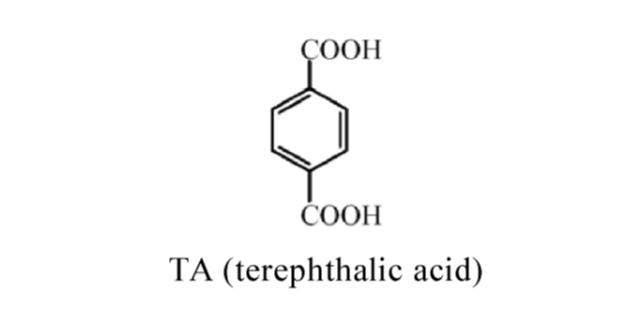

よって、ダイスより吐出した溶融樹脂から発生する昇華物中のTA及びBHETの量、あるいは製造後の樹脂フィルムに残存したTA及びBHETの量を定量することにより、樹脂フィルムを量産する段階に至る前でも、ダイラインが発生しやすいかどうかを見積もることが可能となる。
さらには、樹脂フィルムを製造することなく一定条件下で樹脂材料を加熱した場合に生じる昇華物中のTA及びBHETの量を測定すること等により、樹脂フィルムの製造時のダイラインの発生し易さを見積もることも可能である。
0<テレフタル酸/ビス(2-ヒドロキシエチル)テレフタレート<1.02・・・[1]
0.20≦テレフタル酸/ビス(2-ヒドロキシエチル)テレフタレート≦0.92・・・[2]
ここで樹脂の融点以上の温度は、ポリエステル系熱可塑性樹脂の組成により異なる。例えば、ジカルボン酸成分としてイソフタル酸を15mol%含有するポリエチレンテレフタレートの場合は、融点である約215℃以上の加熱温度が好ましい。また、イソフタル酸の含有量が0mol%の場合、融点である約255℃以上の加熱温度が好ましい。
不活性ガスとしては、窒素、アルゴン等の公知のガスを使用可能である。また、加熱時間としては、1~10時間であることが好ましい。
触媒を失活させる方法としては、触媒の種類により異なる。例えば、失活剤を添加することにより触媒を失活させる、あるいは熱水処理(所望の温度に加熱された液体を触媒に添加する処理)により触媒を失活させることが可能である。
熱水処理により触媒を失活させる方法としては、90℃~100℃の条件で1~10時間加熱することが好ましい。
触媒の失活剤としては、ポリエステル系樹脂に対して一般的に用いられるものが使用される。例えば特開2007-204515号公報に開示されるような、トリメチルリン酸、トリエチルリン酸等のリン酸エステルやこれらの塩等のリン系失活剤等、公知の失活剤が挙げられる。
また、失活剤の添加量としては、通常の添加量で良く、例えば0.1~1.0質量部程度を添加することができる。
昇華物中の物質量の測定に使用される一般的な方法を用いることができる。例えば、図1に示される昇華物補足装置を使用して、窒素(不活性ガス)雰囲気下で樹脂を加熱し、補足した昇華物を採取する。採取した昇華物をクロロホルム等の有機溶媒に溶解する。その後、被測定物質の含まれた有機溶媒を用いて測定試料を作成し、高速液体クロマトグラフィー等を用いて各種物質を定量することが可能である。
本実施形態においては、ポリエステル系熱可塑性樹脂フィルム中に含まれる遊離したテレフタル酸の総量と、遊離したビス(2-ヒドロキシエチル)テレフタレートの総量の比を、次式[3]の関係を満たすようにすることを特徴とする。
0<テレフタル酸/ビス(2-ヒドロキシエチル)テレフタレート<0.33・・・[3]
0.02≦テレフタル酸/ビス(2-ヒドロキシエチル)テレフタレート≦0.09・・・[4]
なお、樹脂フィルム中のテレフタル酸及びビス(2-ヒドロキシエチル)テレフタレートの測定方法としては、一般的な方法を使用することができる。例えば、樹脂フィルムを溶解して測定試料を作成し、高速液体クロマトグラフィー等を用いて各種物質を定量することが可能である。
本実施形態のポリエステル系熱可塑性フィルムは、フィルム中に残存する遊離したテレフタル酸の総量と、遊離したビス(2-ヒドロキシエチル)テレフタレートの総量の比が次式[3]の関係を満たすことを特徴とする。
0<テレフタル酸/ビス(2-ヒドロキシエチル)テレフタレート<0.33・・・[3]
また本実施形態のポリエステル系熱可塑性フィルムに関して、上記[3]式を満たす場合においては、さらに次式[4]を満たすことがより好ましい。
0.02≦テレフタル酸/ビス(2-ヒドロキシエチル)テレフタレート≦0.09・・・[4]
上に、本実施形態に関するポリエステル系熱可塑性フィルムの製造方法について説明した。なお、上記の内容は、樹脂フィルムの表面のダイラインの発生を抑制するために、樹脂材料を選択する際の、樹脂材料の検査方法にも応用可能である。
そして、上記総量の比が次式[1]の関係を満たすときに、後の樹脂フィルムの製造時においてダイラインの発生が抑制されると判定できる。
0<テレフタル酸/ビス(2-ヒドロキシエチル)テレフタレート<1.02・・・[1]
0.20≦テレフタル酸/ビス(2-ヒドロキシエチル)テレフタレート≦0.92・・・[2]
また、樹脂フィルム中に含まれる(残存する)遊離したテレフタル酸の総量と、遊離したビス(2-ヒドロキシエチル)テレフタレートの総量を検査することにより、樹脂フィルム製造時のダイライン発生のし易さを明らかにすることも可能である。
以下、本実施形態におけるポリエステル系熱可塑性フィルムの検査方法について説明する。
そして、上記総量の比が、次式[3]の関係を満たすときに、樹脂フィルムの表面に発生し得るダイラインが、実用可能な程度に少ないということが判定できる。
0<テレフタル酸/ビス(2-ヒドロキシエチル)テレフタレート<0.33・・・[3]
0.02≦テレフタル酸/ビス(2-ヒドロキシエチル)テレフタレート≦0.09・・・[4]
以下に、実施例を挙げて本発明についてより具体的に説明する。
樹脂ペレットを粉砕し、1.0~1.4mmサイズの粉末とした。当該粉末を1g秤量し、ステンレス製の昇華物補足装置(図1)に入れた。昇華物補足装置に1.0L/minで窒素を流し、ホットプレート表面温度280℃で4時間加熱した。昇華物を採取しクロロホルムに一晩溶解させた。クロロホルムを濃縮乾固し、得られた白色固体をジメチルホルムアミドに溶解させて測定試料とした。
樹脂フィルムを1g秤量し、ヘキサフルオロイソプロパノール/クロロホルム溶液に溶解させた。その後テトラヒドロフランにてポリエステル樹脂を再沈殿し、ろ液を濃縮乾固し、ジメチルホルムアミドに溶解させて測定試料とした。TA、IA、MHET、BHET、環状二量体、環状三量体を標本としてHPLCにて検量線を作成し、測定試料中に含まれる各種モノマー、オリゴマーを定量した。
図2に示すように、製造した樹脂フィルムに暗室中でキセノンランプを照射し、白色スクリーンに投影した画像をCCDカメラで撮影した。画像の濃淡でダイライン発生有無を評価した。
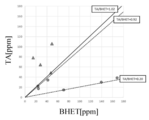
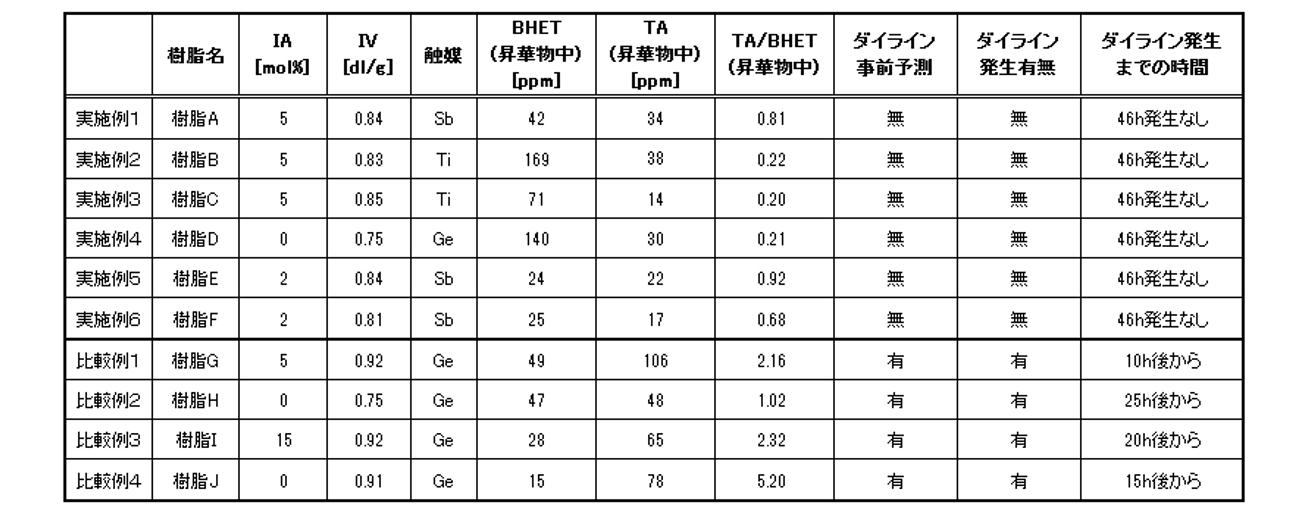
表1に示すPET樹脂A(IA=5mol%、IV=0.92dl/g、重合触媒=Sb触媒)を加熱し、昇華物中に含まれるTAとBHETの含有量を求めた。結果を表1及び図3に示す。
次いで、二軸押出し機を用いて、以下の条件で溶融押出法により樹脂フィルムを製造した。
押出し機:Φ47mm二軸押出し機、L/D=31.5、2ベント
ダイス出口幅:380mm
押出し温度:270℃~280℃
吐出量:18Kg/hr
冷却ロール引取り速度:3~4rpm
試験時間:46hr
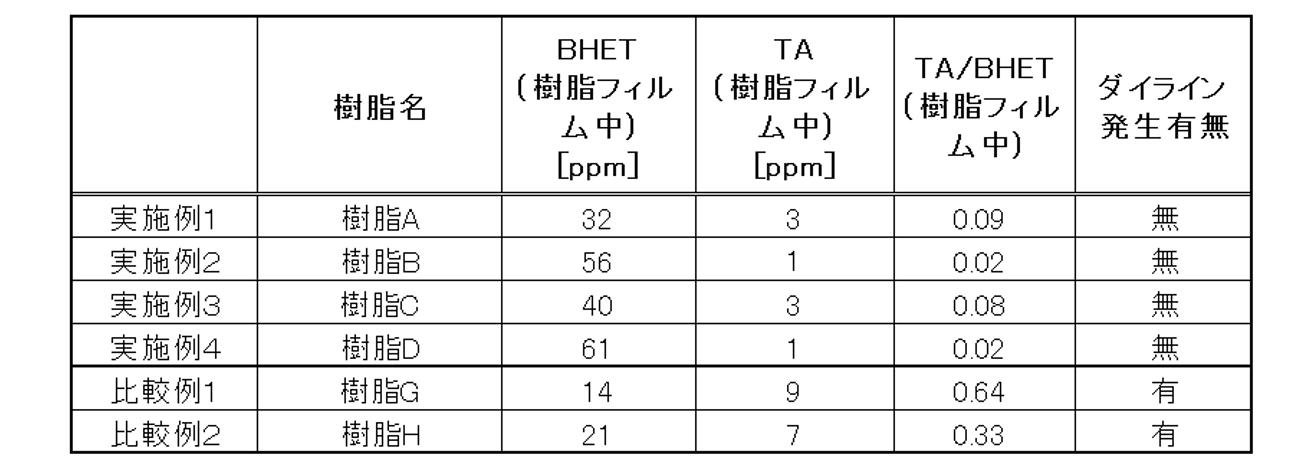
また、樹脂フィルム製造開始から46時間経過時における、得られた樹脂フィルム中のTA及びBHETの含有量を求めた。その結果を表2及び図4に示す。
使用したPET樹脂を、表1のPET樹脂B(IA=5mol%、IV=0.83dl/g、重合触媒=Ti触媒)に変更した以外は、実施例1と同様に樹脂フィルムを製造した。
使用したPET樹脂を、表1のPET樹脂C(IA=5mol%、IV=0.85dl/g、重合触媒=Ti触媒)に変更した以外は、実施例1と同様に樹脂フィルムを製造した。
使用したPET樹脂を、表1のPET樹脂D(IA=0mol%、IV=0.75dl/g、重合触媒=Ge触媒)に変更した以外は、実施例1と同様に樹脂フィルムを製造した。
使用したPET樹脂を、表1のPET樹脂E(IA=2mol%、IV=0.84dl/g、重合触媒=Sb触媒)に変更した以外は、実施例1と同様に樹脂フィルムを製造した。
使用したPET樹脂を、表1のPET樹脂F(IA=2mol%、IV=0.81dl/g、重合触媒=Sb触媒)に変更した以外は、実施例1と同様に樹脂フィルムを製造した。
使用したPET樹脂を、表1のPET樹脂G(IA=5mol%、IV=0.92dl/g、重合触媒=Ge触媒)に変更した以外は、実施例1と同様に樹脂フィルムを製造した。
使用したPET樹脂を、表1のPET樹脂H(IA=0mol%、IV=0.75dl/g、重合触媒=Ge触媒)に変更した以外は、実施例1と同様に樹脂フィルムを製造した。
使用したPET樹脂を、表1のPET樹脂I(IA=15mol%、IV=0.92dl/g、重合触媒=Ge触媒)に変更した以外は、実施例1と同様に樹脂フィルムを製造した。
使用したPET樹脂を、表1のPET樹脂J(IA=0mol%、IV=0.91dl/g、重合触媒=Ge触媒)に変更した以外は、実施例1と同様に樹脂フィルムを製造した。
20 昇華物
30 昇華物補足部
40 窒素又は空気導入管
41 窒素又は空気
50 冷却水導入管
51 冷却水
60 ホットプレート
1 排気口
Claims (8)
- ダイスより加熱溶融樹脂を吐出した後、冷却固化してフィルムを成形するポリエステル系熱可塑性フィルムの製造方法において、
前記加熱溶融樹脂から発生する昇華物に含まれる遊離したテレフタル酸の総量と、遊離したビス(2-ヒドロキシエチル)テレフタレートの総量の比が、次式[1]の関係を満たすことを特徴とする、ポリエステル系熱可塑性フィルムの製造方法。
0<テレフタル酸/ビス(2-ヒドロキシエチル)テレフタレート<1.02・・・[1] - 前記加熱溶融樹脂の重合反応の触媒として、アンチモン化合物、チタン化合物及びゲルマニウム化合物のいずれかあるいはそれらの組み合わせが用いられることを特徴とする、請求項1に記載のポリエステル系熱可塑性フィルムの製造方法。
- 前記触媒の少なくとも一部が失活処理されていることを特徴とする、請求項2に記載のポリエステル系熱可塑性フィルムの製造方法。
- ダイスより加熱溶融樹脂を吐出した後、冷却固化してフィルムを成形するポリエステル系熱可塑性フィルムの製造方法において、
前記フィルム中に残存する遊離したテレフタル酸の総量と、遊離したビス(2-ヒドロキシエチル)テレフタレートの総量の比が次式[3]の関係を満たすことを特徴とする、ポリエステル系熱可塑性フィルムの製造方法。
0<テレフタル酸/ビス(2-ヒドロキシエチル)テレフタレート<0.33・・・[3] - 前記テレフタル酸以外のジカルボン酸成分として、イソフタル酸を0~20%含有することを特徴とする、請求項1~4のいずれかに記載のポリエステル系熱可塑性フィルムの製造方法。
- フィルム中に残存する遊離したテレフタル酸の総量と、遊離したビス(2-ヒドロキシエチル)テレフタレートの総量の比が次式[3]の関係を満たすことを特徴とする、ポリエステル系熱可塑性フィルム。
0<テレフタル酸/ビス(2-ヒドロキシエチル)テレフタレート<0.33・・・[3] - 樹脂を加熱溶融し、前記樹脂から発生する昇華物に含まれる遊離したテレフタル酸の総量と、遊離したビス(2-ヒドロキシエチル)テレフタレートの総量の比(テレフタル酸/ビス(2-ヒドロキシエチル)テレフタレート)が、次式[1]の関係を満たすか否かを検査することを特徴とする、ポリエステル系熱可塑性フィルムの樹脂材料の検査方法。
0<テレフタル酸/ビス(2-ヒドロキシエチル)テレフタレート<1.02・・・[1] - 成形したポリエステル系熱可塑性樹脂フィルム中に残存する遊離したテレフタル酸の総量と、遊離したビス(2-ヒドロキシエチル)テレフタレートの総量の比(テレフタル酸/ビス(2-ヒドロキシエチル)テレフタレート)が、次式[3]の関係を満たすか否かを検査することを特徴とする、ポリエステル系熱可塑性フィルムの検査方法。
0<テレフタル酸/ビス(2-ヒドロキシエチル)テレフタレート<0.33・・・[3]
Priority Applications (2)
| Application Number | Priority Date | Filing Date | Title |
|---|---|---|---|
| JP2018551052A JP6991994B2 (ja) | 2016-11-15 | 2017-09-22 | ポリエステル系熱可塑性フィルムの製造方法、ポリエステル系熱可塑性フィルム、ポリエステル系熱可塑性フィルム又はその樹脂材料の検査方法 |
| KR1020197017005A KR102468123B1 (ko) | 2016-11-15 | 2017-09-22 | 폴리에스테르계 열가소성 필름의 제조방법, 폴리에스테르계 열가소성 필름 |
Applications Claiming Priority (2)
| Application Number | Priority Date | Filing Date | Title |
|---|---|---|---|
| JP2016222809 | 2016-11-15 | ||
| JP2016-222809 | 2016-11-15 |
Publications (1)
| Publication Number | Publication Date |
|---|---|
| WO2018092414A1 true WO2018092414A1 (ja) | 2018-05-24 |
Family
ID=62146429
Family Applications (1)
| Application Number | Title | Priority Date | Filing Date |
|---|---|---|---|
| PCT/JP2017/034254 Ceased WO2018092414A1 (ja) | 2016-11-15 | 2017-09-22 | ポリエステル系熱可塑性フィルムの製造方法、ポリエステル系熱可塑性フィルム、ポリエステル系熱可塑性フィルム又はその樹脂材料の検査方法 |
Country Status (3)
| Country | Link |
|---|---|
| JP (1) | JP6991994B2 (ja) |
| KR (1) | KR102468123B1 (ja) |
| WO (1) | WO2018092414A1 (ja) |
Citations (6)
| Publication number | Priority date | Publication date | Assignee | Title |
|---|---|---|---|---|
| JPH07207002A (ja) * | 1994-01-18 | 1995-08-08 | Kanebo Ltd | 熱可塑性ポリエステル樹脂 |
| WO1997045483A1 (en) * | 1996-05-31 | 1997-12-04 | Kanebo, Limited | Polyester resin composition and film made therefrom, polyester composite film and metal laminate made by using the same, and process for decreasing the content of low-molecular compounds present in polyester |
| JP2003306536A (ja) * | 2002-02-12 | 2003-10-31 | Toyobo Co Ltd | ポリエステル組成物並びにそれからなる中空成形体、シ−ト状物及び延伸フイルム |
| JP2003313413A (ja) * | 2002-02-21 | 2003-11-06 | Toyobo Co Ltd | ポリエステル組成物並びにそれからなる中空成形体、シ−ト状物及び延伸フイルム |
| JP2005187763A (ja) * | 2003-12-26 | 2005-07-14 | Toyobo Co Ltd | ポリエステル未延伸フイルム |
| JP2006111872A (ja) * | 2004-09-14 | 2006-04-27 | Toyobo Co Ltd | ポリエステル組成物、それからなるポリエステル成形体およびその製造方法 |
Family Cites Families (12)
| Publication number | Priority date | Publication date | Assignee | Title |
|---|---|---|---|---|
| JPS5228610A (en) | 1975-08-29 | 1977-03-03 | Nippon Denso Co Ltd | Generator |
| JPH10180844A (ja) * | 1996-11-05 | 1998-07-07 | Toray Ind Inc | ポリエステルフィルムおよびその製造方法 |
| DE19824615A1 (de) | 1998-06-02 | 1999-12-09 | Dyneon Gmbh | Verfahren zur Rückgewinnung von fluorierten Alkansäuren aus Abwässern |
| JP3938647B2 (ja) | 1999-03-05 | 2007-06-27 | カネボウ・トリニティ・ホールディングス株式会社 | ポリエステル樹脂 |
| JP2000319373A (ja) | 1999-05-12 | 2000-11-21 | Toyobo Co Ltd | ポリエステル、それからなる中空成形体、シート状物及び延伸フイルム |
| JP2001172372A (ja) | 1999-12-15 | 2001-06-26 | Nippon Ester Co Ltd | 成形品用ポリエステル樹脂とその製造方法、並びにその成形品 |
| JP4320985B2 (ja) | 2001-08-03 | 2009-08-26 | 住友ベークライト株式会社 | 熱可塑性樹脂の押出方法および熱可塑性樹脂フィルムの製造方法 |
| JP4292912B2 (ja) | 2003-08-01 | 2009-07-08 | 日本ゼオン株式会社 | 光学用フィルム |
| KR100700180B1 (ko) * | 2004-12-31 | 2007-03-27 | 엘지.필립스 엘시디 주식회사 | 예비토출부를 구비한 슬릿코터 및 이를 이용한 코팅방법 |
| US8551372B2 (en) * | 2007-10-05 | 2013-10-08 | Konica Minolta Opto, Inc. | Process for producing an optical film |
| KR100983006B1 (ko) | 2008-04-08 | 2010-09-17 | (주)이플러스텍 | 증기 기상 식각방식을 이용하여 수직으로 배열된 다량의웨이퍼를 가공하는 반도체 또는 전자소자용 증기 식각 장치 |
| WO2012077559A1 (ja) * | 2010-12-08 | 2012-06-14 | 富士フイルム株式会社 | ポリエステルフィルム及びその製造方法、太陽電池用バックシート、及び太陽電池モジュール |
-
2017
- 2017-09-22 WO PCT/JP2017/034254 patent/WO2018092414A1/ja not_active Ceased
- 2017-09-22 KR KR1020197017005A patent/KR102468123B1/ko active Active
- 2017-09-22 JP JP2018551052A patent/JP6991994B2/ja active Active
Patent Citations (6)
| Publication number | Priority date | Publication date | Assignee | Title |
|---|---|---|---|---|
| JPH07207002A (ja) * | 1994-01-18 | 1995-08-08 | Kanebo Ltd | 熱可塑性ポリエステル樹脂 |
| WO1997045483A1 (en) * | 1996-05-31 | 1997-12-04 | Kanebo, Limited | Polyester resin composition and film made therefrom, polyester composite film and metal laminate made by using the same, and process for decreasing the content of low-molecular compounds present in polyester |
| JP2003306536A (ja) * | 2002-02-12 | 2003-10-31 | Toyobo Co Ltd | ポリエステル組成物並びにそれからなる中空成形体、シ−ト状物及び延伸フイルム |
| JP2003313413A (ja) * | 2002-02-21 | 2003-11-06 | Toyobo Co Ltd | ポリエステル組成物並びにそれからなる中空成形体、シ−ト状物及び延伸フイルム |
| JP2005187763A (ja) * | 2003-12-26 | 2005-07-14 | Toyobo Co Ltd | ポリエステル未延伸フイルム |
| JP2006111872A (ja) * | 2004-09-14 | 2006-04-27 | Toyobo Co Ltd | ポリエステル組成物、それからなるポリエステル成形体およびその製造方法 |
Also Published As
| Publication number | Publication date |
|---|---|
| JP6991994B2 (ja) | 2022-02-03 |
| KR102468123B1 (ko) | 2022-11-24 |
| JPWO2018092414A1 (ja) | 2019-10-17 |
| KR20190086495A (ko) | 2019-07-22 |
Similar Documents
| Publication | Publication Date | Title |
|---|---|---|
| JP6036099B2 (ja) | Petボトル再生原料を使用した二軸配向ポリエステルフィルム | |
| JP2011202156A (ja) | 二軸延伸ポリエステルフィルム | |
| KR20120036895A (ko) | 용기의 랩어라운드 라벨용 이축배향 폴리에스테르 필름 및 용기의 랩어라운드용 라벨 | |
| JP6049648B2 (ja) | 二軸押出装置及びフィルム製造方法 | |
| CN110945059A (zh) | 熔融成形材料 | |
| WO2011065347A1 (ja) | 共重合ポリアミド樹脂、その製造方法、樹脂組成物およびそれらからなる成形品 | |
| JP7209828B2 (ja) | ポリグリコール酸製品を生産するための統合製造方法 | |
| JP4269675B2 (ja) | 芳香族液晶ポリエステルおよびそのフィルム | |
| JP5428467B2 (ja) | 太陽電池用積層ポリエステルフィルム | |
| CN100365441C (zh) | 聚对苯二甲酸丁二醇酯制成的光反射器及其制造方法 | |
| JP6991994B2 (ja) | ポリエステル系熱可塑性フィルムの製造方法、ポリエステル系熱可塑性フィルム、ポリエステル系熱可塑性フィルム又はその樹脂材料の検査方法 | |
| US20120329975A1 (en) | Method for producing liquid crystal polyester | |
| JP2007136987A (ja) | ディスプレイ用ポリエステルフィルム | |
| JP6277804B2 (ja) | ポリエチレンテレフタレート樹脂組成物及びその製造方法 | |
| JP2011235452A (ja) | 溶液製膜用コーティングダイおよび溶液製膜方法 | |
| JP2020204045A (ja) | ポリエチレンテレフタレート樹脂組成物 | |
| JPH10180844A (ja) | ポリエステルフィルムおよびその製造方法 | |
| KR101145948B1 (ko) | 폴리에스테르 수지 조성물, 그의 제조 방법 및 폴리에스테르 필름 | |
| JP6772747B2 (ja) | ポリエチレンテレフタレート樹脂組成物およびそれからなるフィルム | |
| JP2004175912A (ja) | ポリエステルフィルム及びその製造方法 | |
| JP7100407B2 (ja) | ポリエステル樹脂組成物、並びにポリエステル樹脂成形体及びその製造方法 | |
| JP4361652B2 (ja) | 耐熱性の優れた押出し成形用液晶性ポリエステル樹脂、押出し成形用材料及び押出し成形物 | |
| KR20150138255A (ko) | 결합형 중합 컴파운딩 방법 | |
| JP2005272657A (ja) | ポリエステル樹脂の製造方法ならびにそれよりなる成形品 | |
| TW202405047A (zh) | 膜之製造方法 |
Legal Events
| Date | Code | Title | Description |
|---|---|---|---|
| 121 | Ep: the epo has been informed by wipo that ep was designated in this application |
Ref document number: 17872208 Country of ref document: EP Kind code of ref document: A1 |
|
| ENP | Entry into the national phase |
Ref document number: 2018551052 Country of ref document: JP Kind code of ref document: A |
|
| NENP | Non-entry into the national phase |
Ref country code: DE |
|
| ENP | Entry into the national phase |
Ref document number: 20197017005 Country of ref document: KR Kind code of ref document: A |
|
| 122 | Ep: pct application non-entry in european phase |
Ref document number: 17872208 Country of ref document: EP Kind code of ref document: A1 |