WO2018088694A2 - 인위적으로 조작된 sc 기능 조절 시스템 - Google Patents
인위적으로 조작된 sc 기능 조절 시스템 Download PDFInfo
- Publication number
- WO2018088694A2 WO2018088694A2 PCT/KR2017/010897 KR2017010897W WO2018088694A2 WO 2018088694 A2 WO2018088694 A2 WO 2018088694A2 KR 2017010897 W KR2017010897 W KR 2017010897W WO 2018088694 A2 WO2018088694 A2 WO 2018088694A2
- Authority
- WO
- WIPO (PCT)
- Prior art keywords
- nucleic acid
- domain
- sequence
- complementary
- sequences
- Prior art date
- Legal status (The legal status is an assumption and is not a legal conclusion. Google has not performed a legal analysis and makes no representation as to the accuracy of the status listed.)
- Ceased
Links
Images


Classifications
-
- C—CHEMISTRY; METALLURGY
- C12—BIOCHEMISTRY; BEER; SPIRITS; WINE; VINEGAR; MICROBIOLOGY; ENZYMOLOGY; MUTATION OR GENETIC ENGINEERING
- C12N—MICROORGANISMS OR ENZYMES; COMPOSITIONS THEREOF; PROPAGATING, PRESERVING, OR MAINTAINING MICROORGANISMS; MUTATION OR GENETIC ENGINEERING; CULTURE MEDIA
- C12N15/00—Mutation or genetic engineering; DNA or RNA concerning genetic engineering, vectors, e.g. plasmids, or their isolation, preparation or purification; Use of hosts therefor
- C12N15/09—Recombinant DNA-technology
- C12N15/11—DNA or RNA fragments; Modified forms thereof; Non-coding nucleic acids having a biological activity
- C12N15/113—Non-coding nucleic acids modulating the expression of genes, e.g. antisense oligonucleotides; Antisense DNA or RNA; Triplex- forming oligonucleotides; Catalytic nucleic acids, e.g. ribozymes; Nucleic acids used in co-suppression or gene silencing
-
- C—CHEMISTRY; METALLURGY
- C12—BIOCHEMISTRY; BEER; SPIRITS; WINE; VINEGAR; MICROBIOLOGY; ENZYMOLOGY; MUTATION OR GENETIC ENGINEERING
- C12N—MICROORGANISMS OR ENZYMES; COMPOSITIONS THEREOF; PROPAGATING, PRESERVING, OR MAINTAINING MICROORGANISMS; MUTATION OR GENETIC ENGINEERING; CULTURE MEDIA
- C12N15/00—Mutation or genetic engineering; DNA or RNA concerning genetic engineering, vectors, e.g. plasmids, or their isolation, preparation or purification; Use of hosts therefor
- C12N15/09—Recombinant DNA-technology
- C12N15/10—Processes for the isolation, preparation or purification of DNA or RNA
- C12N15/102—Mutagenizing nucleic acids
-
- C—CHEMISTRY; METALLURGY
- C07—ORGANIC CHEMISTRY
- C07K—PEPTIDES
- C07K14/00—Peptides having more than 20 amino acids; Gastrins; Somatostatins; Melanotropins; Derivatives thereof
- C07K14/195—Peptides having more than 20 amino acids; Gastrins; Somatostatins; Melanotropins; Derivatives thereof from bacteria
- C07K14/315—Peptides having more than 20 amino acids; Gastrins; Somatostatins; Melanotropins; Derivatives thereof from bacteria from Streptococcus (G), e.g. Enterococci
-
- A—HUMAN NECESSITIES
- A61—MEDICAL OR VETERINARY SCIENCE; HYGIENE
- A61K—PREPARATIONS FOR MEDICAL, DENTAL OR TOILETRY PURPOSES
- A61K35/00—Medicinal preparations containing materials or reaction products thereof with undetermined constitution
- A61K35/12—Materials from mammals; Compositions comprising non-specified tissues or cells; Compositions comprising non-embryonic stem cells; Genetically modified cells
- A61K35/30—Nerves; Brain; Eyes; Corneal cells; Cerebrospinal fluid; Neuronal stem cells; Neuronal precursor cells; Glial cells; Oligodendrocytes; Schwann cells; Astroglia; Astrocytes; Choroid plexus; Spinal cord tissue
-
- C—CHEMISTRY; METALLURGY
- C07—ORGANIC CHEMISTRY
- C07K—PEPTIDES
- C07K14/00—Peptides having more than 20 amino acids; Gastrins; Somatostatins; Melanotropins; Derivatives thereof
- C07K14/435—Peptides having more than 20 amino acids; Gastrins; Somatostatins; Melanotropins; Derivatives thereof from animals; from humans
- C07K14/705—Receptors; Cell surface antigens; Cell surface determinants
-
- C—CHEMISTRY; METALLURGY
- C12—BIOCHEMISTRY; BEER; SPIRITS; WINE; VINEGAR; MICROBIOLOGY; ENZYMOLOGY; MUTATION OR GENETIC ENGINEERING
- C12N—MICROORGANISMS OR ENZYMES; COMPOSITIONS THEREOF; PROPAGATING, PRESERVING, OR MAINTAINING MICROORGANISMS; MUTATION OR GENETIC ENGINEERING; CULTURE MEDIA
- C12N15/00—Mutation or genetic engineering; DNA or RNA concerning genetic engineering, vectors, e.g. plasmids, or their isolation, preparation or purification; Use of hosts therefor
- C12N15/09—Recombinant DNA-technology
- C12N15/63—Introduction of foreign genetic material using vectors; Vectors; Use of hosts therefor; Regulation of expression
- C12N15/79—Vectors or expression systems specially adapted for eukaryotic hosts
- C12N15/85—Vectors or expression systems specially adapted for eukaryotic hosts for animal cells
- C12N15/86—Viral vectors
-
- C—CHEMISTRY; METALLURGY
- C12—BIOCHEMISTRY; BEER; SPIRITS; WINE; VINEGAR; MICROBIOLOGY; ENZYMOLOGY; MUTATION OR GENETIC ENGINEERING
- C12N—MICROORGANISMS OR ENZYMES; COMPOSITIONS THEREOF; PROPAGATING, PRESERVING, OR MAINTAINING MICROORGANISMS; MUTATION OR GENETIC ENGINEERING; CULTURE MEDIA
- C12N9/00—Enzymes; Proenzymes; Compositions thereof; Processes for preparing, activating, inhibiting, separating or purifying enzymes
- C12N9/14—Hydrolases (3)
- C12N9/16—Hydrolases (3) acting on ester bonds (3.1)
- C12N9/22—Ribonucleases [RNase]; Deoxyribonucleases [DNase]
- C12N9/222—Clustered regularly interspaced short palindromic repeats [CRISPR]-associated [CAS] enzymes
- C12N9/226—Class 2 CAS enzyme complex, e.g. single CAS protein
-
- C—CHEMISTRY; METALLURGY
- C12—BIOCHEMISTRY; BEER; SPIRITS; WINE; VINEGAR; MICROBIOLOGY; ENZYMOLOGY; MUTATION OR GENETIC ENGINEERING
- C12N—MICROORGANISMS OR ENZYMES; COMPOSITIONS THEREOF; PROPAGATING, PRESERVING, OR MAINTAINING MICROORGANISMS; MUTATION OR GENETIC ENGINEERING; CULTURE MEDIA
- C12N2310/00—Structure or type of the nucleic acid
- C12N2310/10—Type of nucleic acid
-
- C—CHEMISTRY; METALLURGY
- C12—BIOCHEMISTRY; BEER; SPIRITS; WINE; VINEGAR; MICROBIOLOGY; ENZYMOLOGY; MUTATION OR GENETIC ENGINEERING
- C12N—MICROORGANISMS OR ENZYMES; COMPOSITIONS THEREOF; PROPAGATING, PRESERVING, OR MAINTAINING MICROORGANISMS; MUTATION OR GENETIC ENGINEERING; CULTURE MEDIA
- C12N2310/00—Structure or type of the nucleic acid
- C12N2310/10—Type of nucleic acid
- C12N2310/20—Type of nucleic acid involving clustered regularly interspaced short palindromic repeats [CRISPR]
Definitions
- the present invention relates to artificially engineered SC function modulators and their use for the treatment or amelioration of diseases caused by SC function regulation and / or SC dysfunction. More specifically, artificially modulate SC function and / or SC dysfunction comprising artificially engineered SC function modulators and / or compositions therefor for treating or ameliorating diseases caused by SC function regulation and / or SC dysfunction.
- SC Schwann cells
- Glial cells support neurons
- the glial cells of the peripheral nervous system include satellite cells, olfactory ensheathing cells, intestinal glial cells, and glial cells in the sensory nerve endings, such as pachygini bodies.
- Schwann cells form myelin. Myelin sheaths are not continuous, each Schwann cell wraps axons by 100 ⁇ m. The gap between adjacent Schwann cells is called a langier nodule. Vertebrate nervous systems are insulated with myelin sheaths to maintain the membrane capacity of the axons. The action potential is a leap from langier nodules to nodules. This allows up to a 10-fold increase in conduction speed and energy savings without increasing the axon diameter.
- Schwann cells are analogs of oligodendrocytes that play the same role in the central nervous system. Unlike oligodendrocytes, Schwann cells form myelin only in one axon.
- the hereditary Charco-Marie-Tooth (CMT) disease is a disease in which the muscles of the hands and feet are gradually contracted by the abnormalities of Schwann cells that form myelin in the peripheral nervous system.
- CMT1A Charcot-Marie-Tooth type 1A
- Finding the genetic causes and solutions of CMT1A using information obtained from animal models There is a problem in matching because of differences in genetic information between human and animal models.
- CMT1A accounts for more than half of all CMT1 cases and about 70% of CMT1 cases, and the incidence of CMT is 1/2500.
- CMT1A is characterized by muscle weakness and loss, decreased reflexes, terminal sensory impairment, hand and foot malformations, slowed nerve conduction velocity (NCV), and hypertrophic segment demyelination and onion bulbs. It exhibits pathological properties such as remyelination.
- the present invention relates to an artificially manipulated SC function control system with improved SC function control effect. More specifically, it relates to an artificially engineered SC function modulator and thereby an SC function modulator system (also called an SC function modulator modifier system) which artificially modifies the expression of the SC function modulator and / or the expression of the SC function modulator. .
- SC function modulator system also called an SC function modulator modifier system
- the present invention provides SC function modulators that are genetically engineered or modified for specific purposes.
- the present invention seeks to provide an artificially manipulated SC function control system.
- the present invention seeks to provide, in one embodiment, an artificially engineered SC function regulatory factor modification system.
- the present invention is directed to providing artificially engineered SC function modulators and expression products thereof.
- the present invention is to provide a genetically engineered composition for the manipulation of SC function modulators and a method of using the same as an embodiment.
- the present invention provides a method of modulating SC function.
- the present invention seeks to provide a therapeutic or pharmaceutical composition for treating a disorder associated with SC dysfunction and various uses thereof.
- the present invention seeks to provide artificially engineered SC function modulators of PMP22 and / or expression products thereof.
- the present invention provides a composition for genetic manipulation for artificial manipulation of SC function regulators of PMP22.
- the present invention seeks to provide for the therapeutic use of artificially engineered SC function modulators of PMP22 and / or genetically engineered compositions for such artificial manipulation.
- the present invention seeks to provide an additional use of artificially engineered SC function modulators of PMP22 and / or genetically engineered compositions for such artificial manipulation.
- the present invention is a composition capable of artificially manipulating artificially manipulated SC function modulators and / or SC function modulators for the treatment or amelioration of SC dysfunction and / or SC dysfunction related diseases It relates to a system that can artificially adjust the SC function, including.
- the present invention provides artificially engineered SC function modulators for certain purposes.
- SC function modulator means any factor that directly participates in or indirectly affects SC function regulation.
- the element may be DNA, RNA, gene, peptide, polypeptide or protein.
- SC function regulators include not only Schwann cells, but also all factors that directly participate in or indirectly affect the regulation of glial cells and / or fibroblasts.
- it includes all of the various substances that are involved in the regulation of SC functions that are unnatural, ie artificially manipulated.
- it may be a gene or protein expressed in Schwann cells, genetically engineered or modified.
- the SC function modulator may inhibit or inhibit the growth of, or promote or increase the growth of Schwann cells, glial cells and / or fibroblasts.
- the SC function modulator may interfere with or arrest the progress of the cell cycle of Schwann cells, glial cells and / or fibroblasts, or may promote the progression of the cell cycle.
- the SC function modulator may promote or inhibit the differentiation of Schwann cells, glial cells and / or fibroblasts.
- the SC function modulator may promote or inhibit the death of Schwann cells, glial cells and / or fibroblasts.
- the SC function modulator may help or interfere with the survival of peripheral neurons.
- the SC function modulator may help or interfere with the maintenance and signal transduction of peripheral neurons.
- the SC function modulator may regulate myelin formation of neuronal axons.
- myelin formation includes all mechanisms of myelin formation and the function of myelin degeneration or myelin, including myelogenesis, myelin degeneration, myelin regeneration, maintenance of myelin and compact myelin. .
- the SC function modulator may be used to ameliorate and treat diseases caused by dysfunction or defects of Schwann cells, glial cells and / or fibroblasts.
- SC function modulator for example, it may be an artificially engineered PMP22 gene.
- the invention may comprise one or more genes artificially engineered as SC function regulators.
- the PMP22 gene can be artificially manipulated.
- the PMP22 gene having a modification in the nucleic acid sequence is provided as an artificially engineered SC function regulator.
- Modifications in the nucleic acid sequence can be artificially manipulated by, but not limited to, guide nucleic acid-editor protein complexes.
- Guide nucleic acid-editor protein complex means a complex formed through the interaction of a guide nucleic acid with an editor protein, and the nucleic acid-protein complex includes a guide nucleic acid and an editor protein.
- Guide nucleic acid-editor protein complexes can modify a subject.
- the subject may be a target nucleic acid, gene, chromosome or protein.
- the gene is an SC function regulator that is artificially manipulated by a guide nucleic acid-editor protein complex.
- It may be an artificially engineered SC function modulator, characterized in that it comprises chemical modification of one or more nucleotides in the nucleic acid sequence constituting the SC function modulator.
- the modification of the nucleic acid can occur in the promoter region of the gene.
- the modification of the nucleic acid can occur in the exon region of the gene.
- the modification of the nucleic acid can occur in the intron region of the gene.
- the modification of the nucleic acid can occur in the enhancer region of the gene.
- the PAM sequence can be, for example, one or more of the following sequences (described in the 5 'to 3' direction).
- N is A, T, C or G
- N is each independently A, T, C or G, R is A or G, and Y is C or T;
- NNAGAAW N is each independently A, T, C or G, and W is A or T;
- N are each independently A, T, C, or G;
- N is each independently A, T, C or G, R is A or G and Y is C or T);
- TTN (N is A, T, C or G).
- the editor proteins include Streptococcus pyogenes, Streptococcus thermophilus, Streptococcus sp., Staphylococcus aureus, and Nocardiopsis dasonville ), Streptomyces pristinaespiralis, Streptomyces viridochromogenes, Streptomyces viridochromogenes, Streptosporangium roseum (Streptosporangium) ), Streptosporangium roseum, AlicyclobacHlus acidocaldarius, Bacillus pseudomycoides, Bacillus selenitireductus bacilli Exiguobacterium sibiricum, lactose Lactobacillus delbrueckii, Lactobacillus salivarius, Microscilla marina, Burkholderiales bacterium, Polarolamonas naphthalenivorans naphthalenolarans ), Polaramonas sp., Crocosphaera watsoni
- Arthrospira maxima Arthrospira platensis, Arthrospira sp., Ring Lygbya sp., Microcoleus chthonoplastes, Oscillatoria sp., Petrotoga mobilis, Thermosphopho africanus or Acario It can be derived from Acaryochloris marina.
- the Cas9 protein from Streptococcus pyogenes , Campylobacter Cas9 protein derived from jejuni ), Cas9 protein derived from Streptococcus thermophilus , Streptocuccus Cas9 protein from aureus ), Neisseria meningitidis ) Cas9 protein, and Cpf1 protein may be one or more selected from the group consisting of. In one example, it may be a Cas9 protein from Streptococcus pyogenes or a Cas9 protein from Campylobacter jejuni .
- the present invention relates to chromosomal 17, 15,267,977 to 15,273,977 (regulatory resign) bases of the nucleic acid sequence of the PMP22 gene; Chromosome 17, 15,229,777 to 15,265,326 (coding resign) bases; Or a guide nucleic acid that targets a portion of a region comprising chromosome 17, 15,268,191 to 15,437,045 bases, chromosome 17, 15,239,833 to 15,258,667 bases, or chromosome 17, 15,342,770 to 15,435,639 bases (non-coding resign). .
- the nucleic acid sequence of the PMP22 gene can form a complementary binding to the target sequence of SEQ ID NO: 1 to 66, for example SEQ ID NO: 1 to 8, 14 to 29 or 41 to 53, respectively Provide guide nucleic acid.
- the guide nucleic acids may each form a complementary bond with a portion of the nucleic acid sequence of the PMP22 gene. 0 to 5, 0 to 4, 0 to 3, 0 to 2 mismatches.
- the guide nucleic acid is a nucleotide that forms a complementary bond to at least one of the target sequences of SEQ ID NOs 1 to 66, for example SEQ ID NOs 1 to 8, 14 to 29 or 41 to 53, respectively. Can be.
- one or more guide nucleic acids selected from the following groups may be provided:
- the guide nucleic acid may be, but is not limited to, 18 to 25 bp, 18 to 24 bp, 18 to 23 bp, 19 to 23 bp, 19 to 23 bp, or 20 to 23 bp. At this time, it may include 0 to 5, 0 to 4, 0 to 3, 0 to 2, or 0 to 1 mismatches (mismatches).
- the present invention provides a composition for genetic manipulation that can artificially manipulate SC function modulators.
- the composition for genetic engineering may comprise a guide nucleic acid-editor protein complex or a nucleic acid sequence encoding them.
- composition for genetic engineering is N-(2-aminoethyl)-2-aminoethyl-N-(2-aminoethyl)-2-aminoethyl-N-(2-aminoethyl)-2-aminoethyl-N-(2-aminoethyl)-2-aminoethyl-N-(2-aminoethyl)-2-aminoethyl
- composition for genetic engineering is N-(2-aminoethyl)-2-aminoethyl-N-(2-aminoethyl)-2-aminoethyl-N-(2-aminoethyl)-2-aminoethyl-N-(2-aminoethyl)-2-aminoethyl-N-(2-aminoethyl)-2-aminoethyl
- a guide nucleic acid capable of forming a complementary bond to a target sequence of SEQ ID NOs 1 to 66, eg, SEQ ID NOs 1 to 8, 14 to 29, or 41 to 53, respectively, of the nucleic acid sequence of the PMP22 gene Or a nucleic acid sequence encoding the same;
- Cas9 protein from Streptococcus pyogenes Campylobacter Cas9 protein derived from jejuni
- Cas9 protein derived from Streptococcus thermophilus Streptocuccus aureus
- Cas9 protein derived from, Neisseria meningitidis Cas9 protein derived from Neisseria meningitidis
- the guide nucleic acid may be a nucleic acid sequence forming a binding complementary to at least one of the target sequences of SEQ ID NO: 1, 3, 25, 27, 28, 41, 44, 45 and 53, respectively.
- the genetically engineered composition may comprise a viral vector system.
- the viral vector may be one or more selected from the group consisting of retrovirus, lentivirus, adenovirus, adeno-associated virus (AAV), vaccinia virus, poxvirus and herpes virus.
- the invention is directed to a cell
- It provides a method of artificially manipulating the cell, comprising the step of introducing.
- the invention is directed to a cell
- a guide nucleic acid capable of forming a complementary bond to a target sequence of SEQ ID NOs 1 to 66, eg, SEQ ID NOs 1 to 8, 14 to 29, or 41 to 53, respectively, of the nucleic acid sequence of the PMP22 gene Or a nucleic acid sequence encoding the same;
- Cas9 protein from Streptococcus pyogenes Campylobacter Cas9 protein derived from jejuni
- Cas9 protein derived from Streptococcus thermophilus Streptocuccus aureus
- Cas9 protein derived from, Neisseria meningitidis Cas9 protein derived from Neisseria meningitidis
- It provides a method of artificially manipulating the cell, comprising the step of introducing.
- the guide nucleic acid and the editor protein may be present in one or more vectors in the form of a nucleic acid sequence, or may be present in complex by combining the guide nucleic acid and the editor protein.
- the introduction step can be performed in vivo or ex vivo.
- the introduction step may be performed by one or more methods selected from electroporation, liposomes, plasmids, viral vectors, nanoparticles, and protein translocation domain (PTD) fusion protein methods.
- the viral vector may be one or more selected from the group consisting of retroviruses, lentiviruses, adenoviruses, adeno-associated viruses (AAV), vaccinia virus, poxviruses and herpes simplex virus.
- the present invention provides therapeutic and / or pharmaceutical compositions for treating SC dysfunction related disorders and / or SC dysfunction factor related disorders.
- the pharmaceutical composition may include a composition for genetic manipulation that can artificially manipulate SC function modulators.
- composition related to the composition for genetic engineering is as described above.
- a method of providing information about a sequence of a target position that is artificially manipulated in a subject by sequencing the PMP22 gene is provided.
- kit for genetic engineering comprising:
- kit for genetic engineering comprising:
- a guide nucleic acid capable of forming a complementary bond to a target sequence of SEQ ID NOs 1 to 66, eg, SEQ ID NOs 1 to 8, 14 to 29, or 41 to 53, respectively, of the nucleic acid sequence of the PMP22 gene Or a nucleic acid sequence encoding the same;
- Cas9 protein from Streptococcus pyogenes Campylobacter Cas9 protein derived from jejuni
- Cas9 protein derived from Streptococcus thermophilus Streptocuccus
- kits can be used to artificially manipulate the gene of interest.
- the invention in an embodiment, the invention
- composition for treating SC dysfunction disorder comprising a.
- the target sequence is a chromosome 17, 15,267,977 ⁇ 15,273,977 (regulatory resign) bases of the nucleic acid sequence of the PMP22 gene; Chromosome 17, 15,229,777 to 15,265,326 (coding resign) bases; Or chromosome 17, 15,268,191 to 15,437,045 bases, chromosome 17, 15,239,833 to 15,258,667 bases, or chromosome 17, 15,342,770 to 15,435,639 bases (non-coding resign).
- the target sequence may be at least one of SEQ ID NO: 1 to 66, for example, SEQ ID NO: 1 to 8, 14 to 29 or 41 to 53 of the target sequence.
- the editor protein used Cas9 protein from Campylobacter jejuni Streptococcus pyogenes .
- the SC dysfunction disorder may be an SC function modulator related disease.
- the SC function regulator related disease is Charco-Marie-Tooth disease type 1A (CMT1A), Dejerine-Sottas disease (DSS), congenital Congenital hypomyelination neuropathy (CHN) or Roussy-Levy syndrome (RLS).
- CMT1A Charco-Marie-Tooth disease type 1A
- DSS Dejerine-Sottas disease
- CHN congenital Congenital hypomyelination neuropathy
- RLS Roussy-Levy syndrome
- the present invention provides all aspects of a disease therapeutic use with artificially engineered SC function modulators or genetically engineered compositions that artificially manipulate SC function modulators for a subject.
- the subject to be treated may be a mammal including humans, primates such as monkeys, rodents such as mice, rats and the like.
- SC function modulators By artificially engineered SC function modulators and thereby artificially modified SC function modulators, effective SC dysfunction disorders such as Charcot-Marie-Tooth disease type 1A , CMT1A), Degenerine-Sottas disease (DSS), Congenital Hypomyelination Neuropathy (CHN), and Roussy-Levy syndrome (RLS) It can be used for the therapeutic use of related diseases.
- SC dysfunction disorders such as Charcot-Marie-Tooth disease type 1A , CMT1A), Degenerine-Sottas disease (DSS), Congenital Hypomyelination Neuropathy (CHN), and Roussy-Levy syndrome (RLS) It can be used for the therapeutic use of related diseases.
- Various body mechanisms involving SC function modulators can be modulated to improve the efficacy of the SC function modulator system.
- the PMP22 gene can be used.
- Figure 1 shows the indel frequency (%) due to SpCas9-sgRNA mediated genetic manipulation, the target site of the sgRNA is divided into (a) CDS, (b) TATA-box, (c) Enhancer to show the indel frequency respectively.
- Figure 2 shows the indel frequency (%) due to CjCas9-sgRNA mediated genetic manipulation, the target site of the sgRNA is divided into (a) CDS, (b) TATA-box, (c) Enhancer to show the indel frequency respectively.
- Figure 3 shows the effect of genetic manipulation with SpCas9-sgRNA targeting the regulatory elements of the human PMP22 gene in Schwann-like cells.
- Figure 4 shows the rate of frame shift mutations by SpCas9-sgRNA targeting the CDS site of the human PMP22 gene.
- 5 shows deletion of a small portion of the human PMP22 gene using dual sgRNAs.
- FIG. 6 is a graph showing the mRNA expression reduction of human PMP22 by SpCas9-sgRNA in human Schwann-like cells.
- Figure 8 is a graph showing the effective and specific decrease in expression of PMP22 via CRISPR-Cas9 targeting the TATA-box region of the human PMP22 gene in vitro
- (a) is a target sequence targeting the promoter region of the human PMP22 position
- the leftmost graph of (b) shows indel frequency measurement using target deep sequencing in human Schwann cells
- Figure 10 shows the location cut by the PMP22-TATA RNP in the human whole genome, (a) shows a Genome-wide Circos plot, (b) the off found by in silico off-target analysis The off-target position indicated by Digenome-seq among the target positions is shown, and (c) is a graph showing the indel frequency at the off-target position.
- FIG. 11 shows a schematic of a therapeutic approach using PMP22-TATA RNA therapy in C22 mice.
- FIG. 13 shows the off-target position and indel frequency of PMP22-TATA sgRNA in the mouse genome by in silico analysis, (a) shows off-target position, and (b) shows the off-target position of each off-target.
- FIG. 14 shows the relief of the phenotype of CMP1A mice through the inhibition of PMP22 expression by CRISPR / Cas9.
- the top graph in b) is a scatter plot showing the increase in g-ratio in Mawis treated with PMP22-TATA RNP, and the bottom graph shows the diameter of myelinated stocks in Mawis treated with MP22-TATA RNP. This graph shows an increase.
- Figure 16 shows the results of the migration behavior (locomotor behavior) due to the inhibition of the expression of PMP22 by CRISPR / Cas9 in CMT1A mice
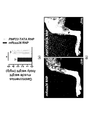
- the graph shows the gastrocnemius muscle weight / weight ratio of C22 mice treated with the mRosa26 or PMP22-TATA RNP complex
- the bottom image shows the gastrocnemius muscle of C22 mice treated with the mRosa26 or PMP22-TATA RNP complex.
- the present invention relates to an artificially manipulated SC function control system having an effect of improving or restoring schwann cells dysfunction.
- SC function modulators that have been artificially modified in expression and / or function and methods for their preparation, compositions comprising them, therapeutic uses thereof and the like.
- the mechanism may be regulated by targeting a third function in the body as well as a myelination function involving an artificially manipulated SC function regulator.
- SC function modulators that have been artificially modified in expression and / or function and methods for their preparation, compositions comprising them, and their therapeutic uses capable of ameliorating or treating diseases associated with third functions.
- One embodiment of the present invention is directed to the improvement and modification of the SC function control system.
- SC function regulation refers to the regulation of overall function of Schwann cells, glial cells and / or fibroblasts affected by the function of SC function factors, eg, the PMP22 gene.
- the function includes the overall development and growth process of the growth, differentiation, and death of Schwann cells, glial cells and / or fibroblasts, and also the survival, maintenance and axon of peripheral nerve cells of Schwann cells. This includes all functions such as myelination.
- the regulation of SC function includes the regulation of the overall function of Schwann cells, glial cells and / or fibroblasts, such as the overall development and growth process until growth, differentiation, and death of cells.
- SC function regulation includes the regulation of all mechanisms that inhibit or inhibit the growth, promote or increase the growth of Schwann cells, glial cells and / or fibroblasts.
- SC function regulation includes the regulation of all mechanisms that interfere with or arrest the progress of the cell cycle of Schwann cells, glial cells and / or fibroblasts, or promote the progression of the cell cycle.
- SC function regulation includes the regulation of all mechanisms that promote or inhibit the differentiation of Schwann cells, glial cells and / or fibroblasts.
- SC function regulation includes the regulation of all mechanisms, such as the regulation of apoptosis, such as mechanisms that promote or inhibit the death of Schwann cells, glial cells and / or fibroblasts.
- regulation of SC function includes the regulation of all mechanisms that aid or interfere with the survival of peripheral neurons.
- SC function regulation includes the regulation of all mechanisms that assist or interfere with the maintenance and signaling of peripheral neurons.
- SC function regulation involves the regulation of all mechanisms involved in the myelin formation of axons of neurons.
- myelin formation includes all mechanisms of myelin formation and the function of myelin degeneration or myelin, including myelogenesis, myelin degeneration, myelin regeneration, maintenance of myelin and compact myelin. .
- regulation of SC function includes the regulation of all mechanisms that inhibit or inhibit the growth of, or promote or increase the growth of fibroblasts or glial cells.
- SC function regulation involves the regulation of all mechanisms involved in the activity of fibroblasts or glial cells.
- modulating SC function may be involved in the treatment or amelioration of a disease caused by PMP22 duplication.
- SC function modulators such as PMP22.
- regulating SC function may be to modulate myelin formation.
- an SC function regulator such as PMP22
- overexpression of an SC function regulator is characterized by instability of the myelin sheath, which interferes with the maintenance and formation of the myelin sheath, causing neuropathy, thereby controlling the expression of the SC function regulatory factor.
- Function regulation can regulate myelin formation.
- the regulation of SC function may be to regulate the differentiation of Schwann cells.
- SC function regulators such as PMP22
- SC function regulation by controlling the expression of SC function regulators can regulate the differentiation of Schwann cells. have.
- the regulation of SC function may be to regulate signal transduction of neurons.
- SC function modulators such as PMP22
- overexpression of SC function modulators is characterized by destabilizing myelin, disrupting the maintenance and formation of myelin, thereby reducing the signaling of nerve cells, ie, the rate of conduction.
- SC function regulation by controlling the expression of factors can regulate the signaling of neurons.
- One embodiment of the invention is an artificially engineered or modified SC function modulator.
- SC function modulator means any factor that directly participates in or indirectly affects SC function regulation.
- the element may be DNA, RNA, gene, peptide, polypeptide or protein.
- it includes all of the various substances that are involved in the regulation of SC functions that are unnatural, ie artificially manipulated.
- it may be a gene or protein expressed in Schwann cells, genetically engineered or modified.
- artificially manipulated refers to a state in which an artificial modification is made, rather than the state as it occurs in nature.
- genetically engineered refers to a case where an artificial genetic modification is made to a biological or non-living material referred to in the present invention, for example, to artificially modify a genome for a specific purpose.
- Genes and / or gene products polypeptides, proteins, etc.
- the present invention provides a SC function modulator that is genetically engineered or modified for a particular purpose.
- Genes or proteins having the functions listed below may not only have one type of SC function regulation-related functions, but may have multiple types of functions. In addition, two or more functions and factors related to SC function regulation may be provided as necessary.
- SC function modulators may inhibit or inhibit the growth of, or promote or increase, the growth of Schwann cells.
- SC function modulators may interfere with or arrest the progress of the cell cycle of Schwann cells, or may promote the progression of the cell cycle.
- SC function modulators may promote or inhibit the differentiation of Schwann cells.
- SC function modulators may promote or inhibit the death of Schwann cells.
- SC function modulators may help or interfere with the survival of peripheral neurons.
- SC function modulators may help or interfere with the maintenance and signaling of peripheral neurons.
- SC function regulators can regulate myeloid formation of neuronal axons.
- myelin formation includes all mechanisms of myelin formation and the function of myelin degeneration or myelin, including myelogenesis, myelin degeneration, myelin regeneration, maintenance of myelin and compact myelin. .
- SC function modulators can be used to ameliorate and treat diseases caused by dysfunction or defects in Schwann cells.
- SC function modulators may regulate any mechanism that inhibits or inhibits the growth of, or promotes or increases the growth of fibroblasts or glial cells.
- SC function regulators can regulate all mechanisms involved in the activity of fibroblasts or glial cells.
- the SC function modulator can be PMP22.
- the SC function modulator may be PMP22.
- PMP22 peripheral myelin protein 22 gene refers to a gene (full length DNA, cDNA or mRNA) encoding protein PMP22, also referred to as GAS3 or GAS-3.
- the PMP22 gene may be one or more selected from the group consisting of, but is not limited to: human PMP22 (eg, NCBI Accession No. NP_000295.1, NP_001268384.1, NP_001268385.1, NP_001317072.1, NP_696996 .1, NP_696997.1, etc.), such as NCBI Accession No. PMP22 gene represented by NM_000304.3, NM_001281455.1, NM_001281456.1, NM_001330143.1, NM_153321.2, NM_153322.2 and the like.
- Peripheral myelin protein 22 kDa is a transmembrane glycoprotein component of myelin.
- PMP22 is expressed in Schwann cells, which form myelin of the peripheral nervous system, and plays an important role in the formation and maintenance of compact myelin. .
- the PMP22 gene maps to the human chromosome 17p11.2-p12, which encodes the production of PMP22 glycoprotein. Modification of PMP22 gene expression is associated with hereditary demyelinating peripheral neuropathy and causes abnormal synthesis and function of myelin sheaths. Increased expression of PMP22 due to PMP22 duplication is the most likely mechanism for causing disease.
- Point mutations or frameshift mutations of PMP22 cause hereditary neuropathy with liability to pressure palsy (HNPP), and dejerine. It causes various forms of CMT called congenital hypomyelinating neuropathy (CHN). In addition, Roussy-Levy syndrome (RLS) is caused by PMP22 duplication and is generally considered a phenotypic variant of CMT1A.
- the SC function modulator may be derived from a mammal, including humans, primates such as monkeys, rodents such as rats and mice.
- Gene information can be obtained from known databases such as GenBank of the National Center for Biotechnology Information (NCBI).
- an SC function modulator eg, PMP22
- the artificially engineered SC function modulator may be genetically engineered.
- Such genetic manipulation or modification can be obtained by artificially inserting, deleting, replacing, or inverting mutations in some or all regions of the genomic sequence of a wild type gene.
- the genetic manipulation or modification may also be obtained by fusing the manipulation or modification of two or more genes.
- such genetic manipulation or modification may inactivate the gene so that the protein encoded from the gene is not expressed in the form of a protein having an original function.
- such genetic manipulation or modification may further enable the gene to be expressed so that the protein encoded from the gene is expressed in the form of a protein having an improved function than the original function.
- the function of a protein encoded by a particular gene is A
- the function of the protein expressed by the engineered gene may be completely different from A or have additional functions (A + B) including A together. have.
- such genetic manipulation or modification may be such that two or more proteins are expressed in a fused form using two or more genes having different or complementary functions.
- such genetic manipulation or modification may be used to allow two or more proteins to be expressed in separate and independent forms in cells using two or more genes having different or complementary functions.
- the engineered SC function modulator may inhibit or inhibit the growth of, or promote or increase, the growth of Schwann cells.
- the engineered SC function modulator may interfere with or arrest the progress of the cell cycle of Schwann cells, or may promote the progression of the cell cycle.
- the engineered SC function modulator may promote or inhibit the differentiation of Schwann cells.
- the engineered SC function modulator may promote or inhibit the death of Schwann cells.
- the engineered SC function modulators may aid or interfere with the survival of peripheral neurons.
- the engineered SC function modulator may help or interfere with the maintenance and signaling of peripheral neurons.
- the engineered SC function modulator can regulate myeloid formation of neuronal axons.
- myelin formation includes all mechanisms of myelin formation and the function of myelin degeneration or myelin, including myelogenesis, myelin degeneration, myelin regeneration, maintenance of myelin and compact myelin. .
- the engineered SC function modulators can be used to ameliorate and treat diseases caused by dysfunction or defects of Schwann cells.
- the engineered SC function modulators can regulate all mechanisms that inhibit or inhibit the growth of, or promote or increase the growth of fibroblasts or glial cells.
- the engineered SC function modulator can regulate all mechanisms involved in the activity of fibroblasts or glial cells.
- Such manipulations include both structural or functional modifications of SC function modulators.
- Structural modifications of the SC function regulator include all modifications that are not identical to the wildtype present in nature.
- the SC function regulator is a DNA or RNA gene
- the structural modification may be the loss of one or more nucleotides.
- the structural modification may be one or more nucleotides inserted.
- the inserted nucleotide includes all of the nucleotides introduced from or outside the subject including the SC function regulator.
- the structural modification may be one or more nucleotides are substituted.
- the structural modification may be to include chemical modification of one or more nucleotides.
- chemical modification includes all additions, removals or substitutions of chemical functional groups.
- SC function modulator is a peptide, polypeptide or protein
- the structural modification may be the loss of one or more amino acids.
- the structural modification may be one or more amino acid is inserted.
- the inserted amino acid includes all of the amino acids introduced from or outside the subject including the SC function regulator.
- the structural modification may be one or more amino acid is substituted.
- the structural modification may include chemical modification of one or more amino acids.
- chemical modification includes all additions, removals or substitutions of chemical functional groups.
- the structural modification may be to which some or all of the other peptides, polypeptides or proteins are attached.
- the other peptide, polypeptide or protein may be an SC function regulator, or may be a peptide, polypeptide or protein that performs other functions.
- Functional modifications of the SC function modulator include all modifications having enhanced or degraded function as compared to the wildtype present in nature, or include all modifications having a third, different function.
- SC function modulator is a peptide, polypeptide or protein
- the functional modification may be a mutation of an SC function regulator.
- the mutation may be a mutation in which the function of the SC function regulator is enhanced or inhibited.
- the functional modification may be an addition of the function of the SC function modulator.
- the added function may be the same function or another function.
- the SC function modulator with added function may be fused with another peptide, polypeptide or protein.
- the functional modification may be an increase in function due to increased expression of SC function regulators.
- the functional modification may be a decrease in function due to decreased expression of SC function regulators.
- the functional modification may be function recovery with decreased expression of SC function regulators.
- the SC function modulator may be derived by one or more of the following:
- SC function regulatory factors ie all or some deletions in the gene of interest (hereinafter, the target gene), such as 1 bp or more nucleotides of the target gene, such as 1 to 30, 1 to 27, 1 to 25, 1 to 23 Deletions of dogs, 1-20, 1-15, 1-10, 1-5, 1-3, or 1 nucleotides,
- nucleotides of a target gene such as 1 to 30, 1 to 27, 1 to 25, 1 to 23, 1 to 20, 1 to 15, 1 to 10, 1 to 5, 1 Substitution of nucleotides of 3 to 1, or 1, nucleotides with a different nucleotide than the wild type, and
- nucleotides such as 1 to 30, 1 to 27, 1 to 25, 1 to 23, 1 to 20, 1 to 15, 1 to 10, 1 to 5, 1 to 3
- insertion of one nucleotide (each independently selected from A, T, C and G) into any position of the target gene.
- the modified portion ('target site') of the target gene is at least 1bp, at least 3bp, at least 5bp, at least 7bp, at least 10bp, at least 12bp, at least 15bp, at least 17bp, at least 20bp, for example, 1bp to 30bp, in the gene.
- it may be involved in the regulation of a third body mechanism of PMP22.
- PMP22 in tumor cells, which implies that PMP22 expression affects the proliferation-related mechanisms of tumor cells in a variety of cancer diseases.
- Inhibition or inactivation of expression of PMP22 can inhibit or inhibit cell proliferation of various tumors (for example, breast cancer, gastric cancer, pancreatic cancer, etc.). Or inhibit or inhibit the progression or metastasis of various cancer diseases by artificially engineered PMP22, or provide an improvement or treatment effect for cancer diseases.
- the artificially manipulated exemplary factors of the present invention may regulate the mechanism by targeting a third function in the body, as well as regulating SC function.
- Embodiments of the invention include such SC function modulators and methods for their preparation, artificially modified functions, compositions comprising them, and their therapeutic uses capable of ameliorating or treating diseases associated with third functions, and the like. .
- One embodiment of the present invention is an SC function control system for manipulating the SC function by artificially manipulating the SC function control factors.
- SC function control system affects the promotion, increase, inhibition, inhibition and / or restoration of normal function of SC function by altering the expression and / or alteration of artificially engineered SC function modulators.
- the term which encompasses all phenomena, includes all materials, compositions, methods, and uses that are directly or indirectly involved in such SC function control systems.
- SC function-controlling elements Each element of the SC function control system may be collectively referred to as "SC function-controlling elements.”
- the SC function modulator system includes an SC function modulator modification system that artificially manipulates SC function modulators to modulate expression and / or function.
- SC function modulator modification system refers to the transcription of an SC function modulator present or externally introduced into a subject's genome, the expression of an overall SC function modulator expressed as a protein from transcribed genetic information (eg, mRNA). Expression is collectively referred to as a process of modification, ie, a decrease in expression, an increase in expression, maintenance of expression and the like and the result thereof.
- normal SC function regulators such as expression and / or disruption of normal SC function regulators by mutation of SC function regulators, or mutant expression of SC function regulators, abnormal SC function regulators and artificially modified SCs It also includes the overall process of expression of the functional regulator and its outcomes.
- the system of the present invention as SC function-controlling elements, comprises an SC function control factor, ie, a PMP22 modification system, wherein the SC function control factor, ie, PMP22, is artificially manipulated.
- SC function modulators ie, a PMP22 modification system, wherein the SC function control factor, ie, PMP22, is artificially manipulated.
- a "PMP22 modification system” regulates, i.e. reduces expression of, the overall expression of PMP22 expressed in proteins from transcription, transcribed genetic information (e.g., mRNA) of PMP22 genes present in or external to the subject's genome. It refers to the process, such as increased expression, maintenance of expression, and the result thereof collectively.
- expression of PMP22 can be increased or promoted.
- expression of PMP22 can be inhibited or inhibited.
- artificially engineered PMP22 may inhibit expression or decrease to normal expression levels.
- the function of PMP22 may be enhanced or promoted.
- the function of PMP22 may be reduced or inhibited.
- the growth of Schwann cells may be inhibited or inhibited, or the growth may be promoted or increased.
- the progression of the cell cycle of Schwann cells may be interrupted or arrested, or the progression of the cell cycle may be promoted.
- it may promote or inhibit the differentiation of Schwann cells.
- it may promote or inhibit the killing of Schwann cells.
- it may help or interfere with the survival of peripheral neurons.
- it may aid or interfere with the maintenance and signal transduction of peripheral neurons.
- myelin formation of neuronal axons can be modulated.
- myelin formation includes all mechanisms of myelin formation and the function of myelin degeneration or myelin, including myelogenesis, myelin degeneration, myelin regeneration, maintenance of myelin and compact myelin. .
- it can be used to ameliorate and treat diseases caused by dysfunction or defects of Schwann cells.
- all mechanisms involved in the activity of fibroblasts or glial cells can be regulated.
- the mechanisms may be modulated by targeting a third function in the body in which PMP22 is involved.
- the SC function control system of the present invention is a SC function-controlling elements, comprising a composition for operating an SC function control factor.
- the SC function modulator modification system of the present invention comprises a composition for operating an SC function modulator.
- the manipulation composition may be a composition capable of artificially manipulating SC function modulators, preferably a composition for genetic manipulation.
- Manipulation or modification of the substances involved in the SC function regulator and SC function control system (including the SC function modulator modification system) of the present invention may be preferably through genetic manipulation.
- compositions and methods can be provided that target and genetically manipulate some or all of a regulatory region, a non-coding region or a coding region of an SC function modulator.
- one or more of the SC function regulatory genes involved may be engineered or modified for formation of a desired SC function regulatory system (including a SC function regulatory factor modification system). This can be done through modification of the nucleic acids that make up the gene. As a result of the operation, knock down, knock out, and knock in forms are all included.
- a regulatory region It may target the non-cryptographic area or part or all of the cryptographic area.
- a regulatory region of the nucleic acid sequences constituting the SC function regulatory gene may be a manipulation target.
- sequences may be targeted, such as a proximal promoter, an enhancer, a TATA box, and an regulator element of an initiator.
- a proximal promoter such as a promoter, an enhancer, a TATA box, and an regulator element of an initiator.
- Specific examples include Promoter, TATA Box, CAAT Box, Initiation Site, Termination Site, Donor Splice Site, Acceptor Splice Site, Poly A Site, Enhancer, 3 ′ Untranslated Region, 5 ′ UTR, Attenuator and GC Box All sequences can be targeted.
- an enhancer region eg, an EGR2-, SOX10- or TEAD1-binding site
- a remote enhancer region in the nucleic acid sequences constituting the SC function regulatory gene.
- a transcription region of a nucleic acid sequence constituting the SC function control gene may be used as an operation target.
- intron or exon sequences can be targeted.
- coding sequences such as coding regions, initial coding regions, can be targeted for alteration and knockout of expression.
- the nucleic acid modification is one or more nucleotides, such as 1 to 30 bp, 1 to 27 bp, 1 to 25 bp, 1 to 23 bp, 1 to 20 bp, 1 to 15 bp, 1 to 10 bp, 1 to 5 bp, 1 to 3 bp, or Substitution, deletion, and / or insertion of 1 bp of nucleotides.
- to knock out one or more of the SC function regulatory genes, or to eliminate one or more expressions, or to knock out one or more one, two or three alleles It may be targeted to include deletions or mutations in one or more.
- gene knockdown can be used to reduce expression of unwanted alleles or transcripts.
- a regulatory region By targeting non-coding regions or some or all of the coding regions, they can be used to alter SC function regulatory genes that affect the function of Schwann cells.
- said gene nucleic acid alteration may result in the regulation of activity, such as activation or inactivation of an SC function regulatory gene. In addition, this may lead to activation or inactivation of Schwann cell function.
- said genetic nucleic acid modification may be to inactivate the targeted gene by catalyzing single- or double-stranded cleavage, i.e., nucleic acid strand damage, of a specific site within the gene targeted by the guide nucleic acid-editor protein complex.
- nucleic acid strand breaks can be repaired through mechanisms such as homologous recombination or nonhomologous end joining (NHEJ).
- NHEJ nonhomologous end joining
- the present invention provides a composition for manipulating SC function modulators.
- the manipulation composition may be a composition capable of artificially manipulating SC function modulators, preferably a composition for genetic manipulation.
- composition may genetically engineer one or more of the SC function modulators involved therein to form a desired SC function modulator system (including a SC function modulator modification system).
- the genetic manipulation may be performed in consideration of a gene expression control process.
- RNA processing regulation RNA processing regulation
- RNA transport regulation RNA degradation regulation
- translation regulation protein modification regulation step
- RNAi RNA interference or RNA silencing
- small RNA sRNA
- sRNA small RNA
- Expression can be controlled.
- the genetic manipulation may be made through modification of the nucleic acid constituting the SC function regulator. As a result of the operation, knock down, knockout and knockin forms are all included.
- the nucleic acid modification is one or more nucleotides, such as 1 to 30 bp, 1 to 27 bp, 1 to 25 bp, 1 to 23 bp, 1 to 20 bp, 1 to 15 bp, 1 to 10 bp, 1 to 5 bp, 1 to 3 bp Or substitution, deletion, and / or insertion of 1 bp of nucleotides.
- SC function regulation it can be engineered to include deletions or mutations in one or more of the factors.
- knockdown of SC function modulators can be used to reduce expression of unwanted alleles or transcripts.
- the nucleic acid modification may be insertion of one or more nucleic acid fragments or genes.
- the nucleic acid fragment is a nucleic acid sequence consisting of one or more nucleotides
- the length of the nucleic acid fragment is 1 to 40bp, 1 to 50bp, 1 to 60bp, 1 to 70bp, 1 to 80bp, 1 to 90bp, 1 to 100bp, 1 to 500bp Or 1 to 1000 bp.
- the gene to be inserted may be one of SC function regulators or a gene that performs other functions.
- nucleic acid modifications utilize wild type or variant enzymes capable of catalyzing the hydrolysis (cleavage) of bonds between nucleic acids in a DNA or RNA molecule, preferably a DNA molecule.
- a DNA or RNA molecule preferably a DNA molecule.
- Guide nucleic acid-editor protein complexes can be used.
- At least one nuclease selected from the group consisting of meganuclease, zinc finger nuclease, CRISPR / Cas9 (Cas9 protein), CRISPR-Cpf1 (Cpf1 protein), and TALE-nuclease Genes can be manipulated using clease to control the expression of genetic information.
- non-homologous end joining or homologous recombination repair (eg, using, but not limited to, guide nucleic acid-editor protein complexes, eg, using a CRISPR / Cas system) homology-directed repair (HDR).
- NHEJ non-homologous end joining
- HDR homology-directed repair
- NHEJ NHEJ mechanism
- a change in the DNA sequence at the cleavage site is caused, thereby inactivating the gene or inhibiting expression.
- Repair via NHEJ causes substitutions, insertions, or deletions of short gene fragments and can be used to induce knockdown or knockdown of the gene in question.
- the invention may provide said genetically engineered site.
- an NHEJ-mediated alteration refers to a location within said gene that results in a reduction or elimination of the expression of an SC function regulatory gene product.
- composition for manipulating SC function modulators is
- the PMP22 gene which is an SC function regulator that affects the function of Schwann cells, can be targeted.
- target sequences for the target sites of the PMP22 gene ie, sites where genetic engineering occurs or are recognized for genetic engineering, are shown in Tables 1, 2, 3, 4, 5, 6 and 7 In summary.
- the target sequence may target one or more genes.
- the target sequence may target two or more genes simultaneously.
- two or more genes may be homologous or heterologous.
- the gene may comprise one or more target sequences.
- Genes can be targeted simultaneously to two or more target sequences.
- Genes may vary in location and number of genetically engineered objects depending on the number of target sequences.
- Genetic engineering can be designed in various ways depending on the number and location of target sequences.
- Genetic engineering can occur simultaneously on two or more target sequences.
- two or more target sequences may be present in homologous or heterologous genes.
- Genetic engineering can generate two or more genes simultaneously.
- two or more genes may be homologous or heterologous.
- the SC function control system (including SC function modulator modification system) of the present invention is a composition for operating SC function modulators, ie, PMP22, and may comprise a guide nucleic acid-editor protein complex.
- Guide nucleic acid-editor protein complex means a complex formed through the interaction of a guide nucleic acid with an editor protein, and the nucleic acid-protein complex includes a guide nucleic acid and an editor protein.
- guide nucleic acid refers to a nucleic acid capable of recognizing a target nucleic acid, gene, chromosome or protein.
- the guide nucleic acid may be in the form of DNA, RNA or DNA / RNA mixture, and may have 5 to 150 nucleic acid sequences.
- the guide nucleic acid may comprise one or more domains.
- the domain may be a guide domain, a first complementary domain, a connecting domain, a second complementary domain, a proximal domain, a tail domain, and the like, but is not limited thereto.
- the guide nucleic acid may include two or more domains, and may include the same domain repeatedly or include different domains.
- the guide nucleic acid may be one continuous nucleic acid sequence.
- one contiguous nucleic acid sequence may be (N) m , where N is A, T, C or G, or A, U, C or G, and m means an integer from 1 to 150 .
- the guide nucleic acid may be two or more consecutive nucleic acid sequences.
- two or more consecutive nucleic acid sequences may be (N) m and (N) o , where N is A, T, C or G, or A, U, C or G, and m and o are It means an integer of 1 to 150, m and o may be the same or different from each other.
- editing protein refers to a peptide, polypeptide or protein that may bind directly to, or may not interact with, a nucleic acid.
- the editor protein may be an enzyme.
- the editor protein may be a fusion protein.
- fusion protein refers to a protein produced by fusing an enzyme and an additional domain, peptide, polypeptide or protein.
- enzyme refers to a protein comprising a domain capable of cleaving a nucleic acid, gene, chromosome or protein.
- the additional domain, peptide, polypeptide or protein may be a functional domain, peptide, polypeptide or protein having the same or different function as the enzyme.
- the fusion protein is at or near the amino terminus of the enzyme; At or near the carboxy terminus; Middle part of an enzyme; Or may comprise additional domains, peptides, polypeptides or proteins in one or more of these combinations.
- the fusion protein is at or near the amino terminus of the enzyme; At or near the carboxy terminus; Middle part of an enzyme; Or one or more of these combinations may comprise a functional domain, peptide, polypeptide or protein.
- Guide nucleic acid-editor protein complexes can modify a subject.
- the subject may be a target nucleic acid, gene, chromosome or protein.
- the guide nucleic acid-editor protein complex may ultimately regulate (eg, inhibit, inhibit, decrease, increase or promote) expression of a target protein, or may remove or express a new protein.
- the guide nucleic acid-editor protein complex may ultimately regulate (eg, inhibit, inhibit, decrease, increase or promote) expression of a target protein, or may remove or express a new protein.
- the guide nucleic acid-editor protein complex may act at the DNA, RNA, gene or chromosome level.
- the guide nucleic acid-editor protein complex may act at the stage of transcription and translation of the gene.
- the guide nucleic acid-editor protein complex may act at the protein level.
- Guide nucleic acids are nucleic acids capable of recognizing target nucleic acids, genes, chromosomes or proteins, forming guide nucleic acid-protein complexes.
- the guide nucleic acid serves to recognize or target the nucleic acid, gene, chromosome or protein to which the guide nucleic acid-protein complex is targeted.
- the guide nucleic acid may be in the form of DNA, RNA or DNA / RNA mixture, and may have 5 to 150 nucleic acid sequences.
- the guide nucleic acid may be linear or circular.
- the guide nucleic acid may be one continuous nucleic acid sequence.
- one contiguous nucleic acid sequence may be (N) m , where N is A, T, C or G, or A, U, C or G, and m means an integer from 1 to 150 .
- the guide nucleic acid may be two or more consecutive nucleic acid sequences.
- two or more consecutive nucleic acid sequences may be (N) m and (N) o , where N is A, T, C or G, or A, U, C or G, and m and o are It means an integer of 1 to 150, m and o may be the same or different from each other.
- the guide nucleic acid may comprise one or more domains.
- the domain may be a guide domain, a first complementary domain, a connecting domain, a second complementary domain, a proximal domain, a tail domain, and the like, but is not limited thereto.
- the guide nucleic acid may include two or more domains, and may include the same domain repeatedly or include different domains.
- a "guide domain” is a domain that contains complementary guide sequences capable of complementary binding to a target sequence on a target gene or nucleic acid and serves for specific interaction with the target gene or nucleic acid.
- the guide sequence is a nucleic acid sequence that is complementary to the target sequence on the target gene or nucleic acid, for example at least 50%, 55%, 60%, 65%, 70%, 75%, 80%, 85%, 90% or 95 It may be at least% complementary or completely complementary nucleic acid sequence.
- the guide domain may be 5 to 50 base sequences.
- the guide domain is 5 to 50 base sequences, 10 to 50 base sequences, 15 to 50 base sequences, 20 to 50 base sequences, 25 to 50 base sequences, 30 to 50 base sequences, 35 To 50 nucleotide sequences, 40 to 50 nucleotide sequences, or 45 to 50 nucleotide sequences.
- the guide domain may include 1 to 5 base sequences, 5 to 10 base sequences, 10 to 15 base sequences, 15 to 20 base sequences, 20 to 25 base sequences, 25 to 30 base sequences, It may be 30 to 35 base sequences, 35 to 40 base sequences, 40 to 45 base sequences or 45 to 50 base sequences.
- the guide domain may comprise a guide sequence.
- the guide sequence may be a complementary base sequence capable of complementary binding to the target sequence on the target gene or nucleic acid.
- the guide sequence may be a nucleic acid sequence that is complementary to the target sequence on the target gene or nucleic acid, for example at least 70%, 75%, 80%, 85%, 90% or 95% or more complementary or completely complementary. Nucleic acid sequence.
- the guide sequence may be 5 to 50 nucleotide sequences.
- the guide domain is 5 to 50 base sequences, 10 to 50 base sequences, 15 to 50 base sequences, 20 to 50 base sequences, 25 to 50 base sequences, 30 to 50 base sequences, 35 To 50 nucleotide sequences, 40 to 50 nucleotide sequences, or 45 to 50 nucleotide sequences.
- the guide sequence is 1 to 5 base sequences, 5 to 10 base sequences, 10 to 15 base sequences, 15 to 20 base sequences, 20 to 25 base sequences, 25 to 30 base sequences, It may be 30 to 35 base sequences, 35 to 40 base sequences, 40 to 45 base sequences or 45 to 50 base sequences.
- the guide domain may include a guide sequence and an additional nucleotide sequence.
- the additional base sequence may be for improving or decreasing the function of the guide domain.
- the additional base sequence may be for improving or decreasing the function of the guide sequence.
- the additional base sequence may be 1 to 35 base sequences.
- the additional base sequence may be 5 to 35 base sequences, 10 to 35 base sequences, 15 to 35 base sequences, 20 to 35 base sequences, 25 to 35 base sequences, or 30 to 35 base sequences. Can be.
- the additional base sequence is 1 to 5 base sequences, 5 to 10 base sequences, 10 to 15 base sequences, 15 to 20 base sequences, 20 to 25 base sequences, 25 to 30 base sequences Or 30 to 35 base sequences.
- the additional base sequence may be located at the 5 'end of the guide sequence.
- the additional base sequence may be located at the 3 'end of the guide sequence.
- a "first complementary domain” is a nucleic acid sequence comprising a complementary nucleic acid sequence and a second complementary domain, and is complementary enough to form a double strand with the second complementary domain.
- the first complementary domain may be 5 to 35 base sequences.
- the first complementary domain may be 5 to 35 nucleotide sequences, 10 to 35 nucleotide sequences, 15 to 35 nucleotide sequences, 20 to 35 nucleotide sequences, 25 to 35 nucleotide sequences, or 30 to 35 nucleotide sequences. Can be.
- the first complementary domain includes 1 to 5 nucleotide sequences, 5 to 10 nucleotide sequences, 10 to 15 nucleotide sequences, 15 to 20 nucleotide sequences, 20 to 25 nucleotide sequences, 25 to 30 It can be a base sequence or 30 to 35 base sequences.
- a “linking domain” is a nucleic acid sequence that connects two or more domains, wherein the linking domain connects two or more domains that are the same or different.
- the linking domain may be covalently or non-covalently linked to two or more domains, or may connect two or more domains covalently or non-covalently.
- the linking domain may be 1 to 30 nucleotide sequences.
- the linking domain may be 1 to 5 nucleotide sequences, 5 to 10 nucleotide sequences, 10 to 15 nucleotide sequences, 15 to 20 nucleotide sequences, 20 to 25 nucleotide sequences, or 25 to 30 nucleotide sequences. Can be.
- the linking domain may include 1 to 30 base sequences, 5 to 30 base sequences, 10 to 30 base sequences, 15 to 30 base sequences, 20 to 30 base sequences, or 25 to 30 base sequences. Can be.
- a “second complementary domain” is a nucleic acid sequence comprising a complementary nucleic acid sequence with a first complementary domain, and has a complementarity enough to form a double strand with the first complementary domain.
- the second complementary domain includes a complementary base sequence with the first complementary domain and a base sequence without complementarity with the first complementary domain, eg, a base sequence that does not form a double strand with the first complementary domain.
- the base sequence may be longer than the first complementary domain.
- the second complementary domain may be 5 to 35 base sequences.
- the second complementary domain may include 1 to 35 base sequences, 5 to 35 base sequences, 10 to 35 base sequences, 15 to 35 base sequences, 20 to 35 base sequences, and 25 to 35 bases. Sequence or 30 to 35 nucleotide sequences.
- the second complementary domain includes 1 to 5 nucleotide sequences, 5 to 10 nucleotide sequences, 10 to 15 nucleotide sequences, 15 to 20 nucleotide sequences, 20 to 25 nucleotide sequences, and 25 to 30 nucleotide sequences. Base sequence or 30 to 35 base sequences.
- Proximal domain is a nucleic acid sequence located proximal to a second complementary domain.
- the proximal domain may comprise complementary nucleotide sequences within the proximal domain and may form double strands by the complementary nucleotide sequences.
- the proximal domain may be 1 to 20 nucleotide sequences.
- the proximal domain may be 1 to 20 nucleotide sequences, 5 to 20 nucleotide sequences, 10 to 20 nucleotide sequences, or 15 to 20 nucleotide sequences.
- the proximal domain may be 1 to 5 base sequences, 5 to 10 base sequences, 10 to 15 base sequences, or 15 to 20 base sequences.
- Tiil domain is a nucleic acid sequence located at one or more ends of both ends of the guide nucleic acid.
- the tail domain may comprise complementary sequences within the tail domain, and may form double strands by complementary sequences.
- the tail domain may be 1 to 50 nucleotide sequences.
- the tail domain is 5 to 50 base sequences, 10 to 50 base sequences, 15 to 50 base sequences, 20 to 50 base sequences, 25 to 50 base sequences, 30 to 50 base sequences, 35 To 50 nucleotide sequences, 40 to 50 nucleotide sequences, or 45 to 50 nucleotide sequences.
- the tail domain is 1 to 5 base sequences, 5 to 10 base sequences, 10 to 15 base sequences, 15 to 20 base sequences, 20 to 25 base sequences, 25 to 30 base sequences, It may be 30 to 35 base sequences, 35 to 40 base sequences, 40 to 45 base sequences or 45 to 50 base sequences.
- nucleic acid sequences included in the domains may include a selective or additional chemical modification. have.
- the chemical modification may be methylation, acetylation, phosphorylation, phosphorothioate linkage, locked nucleic acid (LNA), 2'-O-methyl 3'phosphorothioate (MS) or 2'-O-methyl 3'thioPACE (MSP). It is not limited.
- Guide nucleic acids include one or more domains.
- the guide nucleic acid may include a guide domain.
- the guide nucleic acid may comprise a first complementary domain.
- the guide nucleic acid may comprise a linking domain.
- the guide nucleic acid may comprise a second complementary domain.
- the guide nucleic acid may comprise a proximal domain.
- the guide nucleic acid may comprise a tail domain.
- the number of domains may be 1, 2, 3, 4, 5, 6 or more.
- the guide nucleic acid may include 1, 2, 3, 4, 5, 6 or more guide domains.
- the guide nucleic acid may comprise one, two, three, four, five, six or more first complementary domains.
- the guide nucleic acid may comprise 1, 2, 3, 4, 5, 6 or more linking domains.
- the guide nucleic acid may comprise one, two, three, four, five, six or more second complementary domains.
- the guide nucleic acid may comprise 1, 2, 3, 4, 5, 6 or more proximal domains.
- the guide nucleic acid may comprise 1, 2, 3, 4, 5, 6 or more tail domains.
- the guide nucleic acid may be included by overlapping one domain.
- the guide nucleic acid may be included without overlapping or overlapping multiple domains.
- the guide nucleic acid may include the same kind of domain, wherein the same kind of domain may have the same nucleic acid sequence or different nucleic acid sequences.
- the guide nucleic acid may include two kinds of domains, wherein the other two kinds of domains may have different nucleic acid sequences or the same nucleic acid sequences.
- the guide nucleic acid may include three kinds of domains, wherein the other three kinds of domains may have different nucleic acid sequences or the same nucleic acid sequences.
- the guide nucleic acid may include four kinds of domains, wherein the other four kinds of domains may have different nucleic acid sequences or the same nucleic acid sequences.
- the guide nucleic acid may include five kinds of domains, wherein the other five kinds of domains may have different nucleic acid sequences or the same nucleic acid sequences.
- the guide nucleic acid may include six kinds of domains, wherein the other six kinds of domains may have different nucleic acid sequences or the same nucleic acid sequences.
- the guide nucleic acid is [guide domain]-[first complementary domain]-[linking domain]-[second complementary domain]-[linking domain]-[guide domain]-[first complementary domain] -[Linking domain]-[second complementary domain], wherein the two guide domains may comprise guide sequences for different or identical targets, and the two first complementary domains Two second complementary domains may have the same nucleic acid sequence or different nucleic acid sequences.
- the guide domains contain guide sequences for different targets, the guide nucleic acids can specifically bind to two targets, where specific binding can occur simultaneously or sequentially.
- the linking domain may be cleaved by a specific enzyme, and in the presence of a specific enzyme, the guide nucleic acid may be divided into two parts or three parts.
- gRNA As an embodiment of the guide nucleic acid of the present invention, gRNA is described below.
- gRNA refers to a nucleic acid capable of specific targeting of a gRNA-CRISPR enzyme complex, ie, a CRISPR complex, to a target gene or nucleic acid.
- gRNA refers to a target gene or nucleic acid specific RNA, and can bind to the CRISPR enzyme to direct the CRISPR enzyme to the target gene or nucleic acid.
- the gRNA may comprise a plurality of domains. Each domain allows for intra- or inter-strand interaction of three-dimensional behavior or active forms of gRNAs.
- gRNAs include single stranded gRNAs (single RNA molecules); Or double gRNA (comprising more than one typically two separate RNA molecules).
- a single stranded gRNA comprises a guide domain in the 5 'to 3' direction, ie, a domain comprising a guide sequence capable of complementary binding to a target gene or nucleic acid; A first complementary domain; Connecting domains; A second complementary domain, a domain having a sequence complementary to the first complementary domain sequence and thus capable of forming a double stranded nucleic acid with the first complementary domain; Proximal domain; And optionally a tail domain.
- the dual gRNA comprises a guide domain from the 5 'to 3' direction, ie a domain comprising a guide sequence capable of complementary binding to a target gene or nucleic acid and a first complementary domain.
- the first strand and a second complementary domain, a domain having a sequence complementary to the first complementary domain sequence, capable of forming a double stranded nucleic acid with the first complementary domain, and a proximal domain; And optionally a second strand comprising a tail domain.
- the first strand may be referred to as crRNA
- the second strand may be referred to as tracrRNA.
- the crRNA may comprise a guide domain and a first complementary domain
- the tracrRNA may comprise a second complementary domain, a proximal domain and optionally a tail domain.
- the single stranded gRNA comprises a guide domain in the 3 'to 5' direction, ie, a domain comprising a guide sequence capable of complementary binding to a target gene or nucleic acid; A first complementary domain; And a second complementary domain having a sequence complementary to the first complementary domain sequence and thus capable of forming a double stranded nucleic acid with the first complementary domain.
- the guide domain comprises a complementary guide sequence capable of complementary binding to the target sequence on the target gene or nucleic acid.
- the guide sequence is a nucleic acid sequence that is complementary to the target sequence on the target gene or nucleic acid, for example at least 70%, 75%, 80%, 85%, 90% or 95% or more complementary or completely complementary nucleic acid sequence. Can be.
- the guide domain is believed to play a role in specific interactions with the target gene or nucleic acid of the gRNA-Cas complex, ie the CRISPR complex.
- the guide domain may be 5 to 50 base sequences.
- the guide domain includes 16 nucleotide sequences, 17 nucleotide sequences, 18 nucleotide sequences, 19 nucleotide sequences, 20 nucleotide sequences, 21 nucleotide sequences, 22 nucleotide sequences, 23 nucleotide sequences, and 24 nucleotide sequences. It may be a nucleotide sequence or 25 base sequences.
- the guide domain includes 16 nucleotide sequences, 17 nucleotide sequences, 18 nucleotide sequences, 19 nucleotide sequences, 20 nucleotide sequences, 21 nucleotide sequences, 22 nucleotide sequences, 23 nucleotide sequences, and 24 nucleotide sequences. It may include the base sequence or 25 base sequences.
- the guide domain may include a guide sequence.
- the guide sequence may be a complementary base sequence capable of complementary binding to the target sequence on the target gene or nucleic acid.
- the guide sequence may be a nucleic acid sequence that is complementary to the target sequence on the target gene or nucleic acid, for example at least 70%, 75%, 80%, 85%, 90% or 95% or more complementary or completely complementary. Nucleic acid sequence.
- the guide sequence may be a nucleic acid sequence that is complementary to a target gene, ie, the target sequence of the PMP22 gene, for example at least 70%, 75%, 80%, 85%, 90%, or at least 95% complementary. It can be a nucleic acid sequence that is either completely or completely complementary.
- the guide sequence may be 5 to 50 nucleotide sequences.
- the guide sequence includes 16 nucleotide sequences, 17 nucleotide sequences, 18 nucleotide sequences, 19 nucleotide sequences, 20 nucleotide sequences, 21 nucleotide sequences, 22 nucleotide sequences, 23 nucleotide sequences, and 24 nucleotide sequences. It may be a nucleotide sequence or 25 base sequences.
- the guide sequence includes 16 nucleotide sequences, 17 nucleotide sequences, 18 nucleotide sequences, 19 nucleotide sequences, 20 nucleotide sequences, 21 nucleotide sequences, 22 nucleotide sequences, 23 nucleotide sequences, and 24 nucleotide sequences. It may include the base sequence or 25 base sequences.
- the guide sequence is a nucleic acid sequence complementary to the target sequence of the PMP22 gene, 16 base sequence, 17 base sequence, 18 base sequence, 19 base sequence, 20 base sequence, 21 base sequence, It may be 22 base sequences, 23 base sequences, 24 base sequences, or 25 base sequences.
- the guide sequence is a target gene, that is, the target sequence of the PMP22 gene is described in Table 1, Table 2, Table 3, Table 4, Table 5, Table 6 and Table 7, but is not limited thereto.
- the guide domain may include a guide sequence and an additional nucleotide sequence.
- the additional base sequence may be 1 to 35 base sequences.
- the additional base sequence is 1 base sequence, 2 base sequences, 3 base sequences, 4 base sequences, 5 base sequences, 6 base sequences, 7 base sequences, 8 base sequences, It may be 9 nucleotide sequences or 10 nucleotide sequences.
- the additional base sequence may be one base sequence G (guanine), or may be two base sequences GG.
- the additional base sequence may be located at the 5 'end of the guide sequence.
- the additional base sequence may be located at the 3 'end of the guide sequence.
- some or all of the base sequences of the guide domains may include chemical modifications.
- the chemical modification may be methylation, acetylation, phosphorylation, phosphorothioate linkage, locked nucleic acid (LNA), 2'-O-methyl 3'phosphorothioate (MS) or 2'-O-methyl 3'thioPACE (MSP). It is not limited.
- the first complementary domain comprises a complementary nucleic acid sequence with a second complementary domain, and is complementary enough to form a double strand with the second complementary domain.
- the first complementary domain may be 5 to 35 base sequences.
- the first complementary domain may include 5 to 35 base sequences.
- the first complementary domain is 5 base sequence, 6 base sequence, 7 base sequence, 8 base sequence, 9 base sequence, 10 base sequence, 11 base sequence, 12 base Sequence, 13 bases, 14 bases, 15 bases, 16 bases, 17 bases, 18 bases, 19 bases, 20 bases, 21 bases, 22 bases Sequence, 23 nucleotide sequences, 24 nucleotide sequences, or 25 nucleotide sequences.
- the first complementary domain includes 5 base sequences, 6 base sequences, 7 base sequences, 8 base sequences, 9 base sequences, 10 base sequences, 11 base sequences, and 12 base sequences.
- the first complementary domain may have homology with a naturally occurring first complementary domain or may be derived from a naturally occurring first complementary domain.
- the first complementary domain may have a difference in the nucleotide sequence of the first complementary domain according to a species present in nature, may be derived from a first complementary domain including a species present in nature, or It may have some or complete homology with the first complementary domain comprising the species present in nature.
- the first complementary domain is Streptococcus pyogenes , Campylobacter jejuni ), Streptococcus thermophilus , Streptocuccus aureus or Neisseria meningitides of the first complementary domain or a derived first complementary domain 50% or more, or complete homology.
- the first complementary domain when the first complementary domain is a first complementary domain of Streptococcus pyogenes or a first complementary domain derived from Streptococcus pyogenes, the first complementary domain is 5′-GUUUUAGAGCUA-3 Or may be a sequence having at least 50% or more homology with 5′-GUUUUAGAGCUA-3 ′.
- the first complementary domain may further include (X) n , that is, 5′-GUUUUAGAGCUA (X) n ⁇ 3 ′.
- X may be selected from the group consisting of bases A, T, U, and G, wherein n is the number of base sequences, and may be an integer of 5 to 15.
- (X) n may be repeated as many as n integers of the same base sequence, or may be an integer number of n base sequences in which bases A, T, U and G are mixed.
- the first complementary domain when the first complementary domain is a first complementary domain of Campylobacter jejuni or a first complementary domain derived from Campylobacter jejuni, the first complementary domain is 5'-GUUUUAGUCCCUUUUUAAAUUUCUUU. It may be -3 ', or may be a nucleotide sequence having at least 50% or more homology with 5'-GUUUUAGUCCCUUUUUAAAUUUCUU-3'. In this case, the first complementary domain may further include (X) n , that is, 5′-GUUUUAGUCCCUUUUUAAAUUUCUU (X) n ⁇ 3 ′.
- X may be selected from the group consisting of bases A, T, U, and G, wherein n is the number of base sequences, and may be an integer of 5 to 15. In this case, (X) n may be repeated as many as n integers of the same base sequence, or may be an integer number of n base sequences in which bases A, T, U and G are mixed.
- the first complementary domain is Parcubacteria bacterium (GWC2011_GWC2_44_17), Lachnospiraceae bacterium (MC2017), Butyrivibrio proteoclasii ( Boyrivibrio proteoclasii ) , Tampere Greenwich bacterium tumefaciens (Peregrinibacteria bacterium (GW2011_GWA_33_10)), liquid Let Mino Caucus Supervisors (Acidaminococcus sp.
- BV3L6 Fort fatigue Monastir marker caviar (Porphyromonas macacae), racheu furnace Fira seae tumefaciens (Lachnospiraceae bacterium (ND2006) ), Porphyromonas crevioricanis ), Prevotella disiens , Moraxella bovoculi (237)), Smiihella sp .
- the first complementary domain is a first complementary domain of a Falcobacteria bacterium or a first complementary domain from Falcubacteria bacterium
- the first complementary domain is 5'-UUUGUAGAU-3 ' Or a nucleotide sequence having at least 50% or more homology with 5′-UUUGUAGAU-3 ′.
- the first complementary domain may further include (X) n , that is, 5 ′-(X) n UUUGUAGAU-3 ′.
- X may be selected from the group consisting of bases A, T, U and G, and n may be an integer of 1 to 5 as the number of base sequences.
- (X) n may be repeated as many as n integers of the same base sequence, or may be an integer number of n base sequences in which bases A, T, U and G are mixed.
- part or all of the base sequence of the first complementary domain may comprise a chemical modification.
- the chemical modification may be methylation, acetylation, phosphorylation, phosphorothioate linkage, locked nucleic acid (LNA), 2'-O-methyl 3'phosphorothioate (MS) or 2'-O-methyl 3'thioPACE (MSP). It is not limited.
- Linking domains are nucleic acid sequences that link two or more domains, and linking domains link two or more domains that are the same or different.
- the linking domain may be covalently or non-covalently linked to two or more domains, or may connect two or more domains covalently or non-covalently.
- the linking domain may be a nucleic acid sequence that connects the first and second complementary domains to generate a single stranded gRNA.
- the linking domain may be covalently or non-covalently bonded to the first and second complementary domains.
- the linking domain may connect the first and second complementary domains covalently or non-covalently.
- the linking domain may be 1 to 30 nucleotide sequences.
- the linking domain may include 1 to 30 nucleotide sequences.
- the linking domain may be 1 to 5 nucleotide sequences, 5 to 10 nucleotide sequences, 10 to 15 nucleotide sequences, 15 to 20 nucleotide sequences, 20 to 25 nucleotide sequences, or 25 to 30 nucleotide sequences. Can be.
- the linking domain may include 1 to 5 nucleotide sequences, 5 to 10 nucleotide sequences, 10 to 15 nucleotide sequences, 15 to 20 nucleotide sequences, 20 to 25 nucleotide sequences, or 25 to 30 nucleotide sequences. It may include.
- the linking domain is suitable for use in single-stranded gRNA molecules and can be covalently or non-covalently linked to the first and second strands of a double gRNA, or covalently or non-covalently linked to the first and second strands.
- Single stranded gRNAs can be used to generate.
- the linking domain may be used to generate single-stranded gRNAs either covalently or non-covalently with the crRNA and tracrRNA of the double gRNA, or by covalently or non-covalently linking the crRNA and tracrRNA.
- the linking domain may be homologous to or derived from a naturally occurring sequence, such as some sequences of tracrRNA.
- some or all of the base sequences of the linking domains may include chemical modifications.
- the chemical modification may be methylation, acetylation, phosphorylation, phosphorothioate linkage, locked nucleic acid (LNA), 2'-O-methyl 3'phosphorothioate (MS) or 2'-O-methyl 3'thioPACE (MSP). It is not limited.
- the second complementary domain comprises a complementary nucleic acid sequence with the first complementary domain and is complementary enough to form a double strand with the first complementary domain.
- the second complementary domain includes a complementary base sequence with the first complementary domain and a base sequence without complementarity with the first complementary domain, eg, a base sequence that does not form a double strand with the first complementary domain.
- the base sequence may be longer than the first complementary domain.
- the second complementary domain may be 5 to 35 base sequences.
- the first complementary domain may include 5 to 35 base sequences.
- the second complementary domain includes five nucleotide sequences, six nucleotide sequences, seven nucleotide sequences, eight nucleotide sequences, nine nucleotide sequences, ten nucleotide sequences, 11 nucleotide sequences, and 12 nucleotide sequences.
- nucleotide sequences 13 nucleotide sequences, 14 nucleotide sequences, 15 nucleotide sequences, 16 nucleotide sequences, 17 nucleotide sequences, 18 nucleotide sequences, 19 nucleotide sequences, 20 nucleotide sequences, 21 nucleotide sequences, 22 nucleotide sequences , 23 nucleotide sequences, 24 nucleotide sequences, or 25 nucleotide sequences.
- the second complementary domain includes five nucleotide sequences, six nucleotide sequences, seven nucleotide sequences, eight nucleotide sequences, nine nucleotide sequences, ten nucleotide sequences, 11 nucleotide sequences, and 12 nucleotide sequences.
- nucleotide sequences 13 nucleotide sequences, 14 nucleotide sequences, 15 nucleotide sequences, 16 nucleotide sequences, 17 nucleotide sequences, 18 nucleotide sequences, 19 nucleotide sequences, 20 nucleotide sequences, 21 nucleotide sequences, 22 nucleotide sequences , 23 base sequences, 24 base sequences or 25 base sequences may be included.
- the second complementary domain may have homology with a naturally occurring second complementary domain or may be derived from a naturally occurring second complementary domain.
- the second complementary domain may have a difference in the nucleotide sequence of the second complementary domain according to a species present in nature, may be derived from a second complementary domain including a species present in nature, or It may have some or complete homology with the second complementary domain, including species present in nature.
- the second complementary domain is Streptococcus pyogenes , Campylobacter jejuni ), Streptococcus thermophilus , Streptocuccus aureus or Neisseria meningitides second complementary domain or derived second complementary domain 50% or more, or complete homology.
- the second complementary domain is a second complementary domain of Streptococcus pyogenes or a second complementary domain derived from Streptococcus pyogenes
- the second complementary domain is 5′- UAGC AAGU UAAAA.
- U-3 ', or 5'- UAGC AAGU UAAAA U-3' may be a sequence having at least 50% homology with at least 50% (underlined marks to form a double strand with the first complementary domain) Sequence).
- the second complementary domain may further include (X) n or / and (X) m , that is, 5 ′-(X) n UAGC AAGU UAAAA U (X) m ⁇ 3 ′.
- the X may be selected from the group consisting of bases A, T, U and G, wherein n and m are the number of base sequences, n may be an integer of 1 to 15, and m may be 1 to 6 have.
- (X) n may be repeated as many as n integers of the same base sequence, or may be an integer number of n base sequences of the base A, T, U and G are mixed.
- (X) m may be repeated as many as m integers of the same base sequence, or may be m integer sequences of base A, T, U and G mixed.
- the second complementary domain when the first complementary domain is a second complementary domain of Campylobacter jejuni or a second complementary domain derived from Campylobacter jejuni, the second complementary domain is 5′- AAGAAAUUUAAAAAGGGACUAAAA U-3 'or 5'- AAGAAAUUUAAAAAGGGACUAAAA U-3' may be a sequence having a part, at least 50% or more homology with the U-3 '(underlined sequences forming a double strand with the first complementary domain) ).
- the second complementary domain may further comprise (X) n or / and (X) m , ie, 5 ′-(X) n AAGAAAUUUAAAAAGGGACUAAAA U (X) m ⁇ 3 ′.
- X may be selected from the group consisting of bases A, T, U and G, n may be an integer of 1 to 15, and m may be 1 to 6.
- (X) n may be repeated as many as n integers of the same base sequence, or may be an integer number of n base sequences in which bases A, T, U and G are mixed.
- (X) m may be repeated as many as m integers of the same base sequence, or may be m integer sequences of base A, T, U and G mixed.
- the first complementary domain is Parcubacteria bacterium (GWC2011_GWC2_44_17), Lachnospiraceae bacterium (MC2017), Butyrivibrio proteoclasii ( Boyrivibrio proteoclasii ) , Tampere Greenwich bacterium tumefaciens (Peregrinibacteria bacterium (GW2011_GWA_33_10)), liquid Let Mino Caucus Supervisors (Acidaminococcus sp.
- BV3L6 Fort fatigue Monastir marker caviar (Porphyromonas macacae), racheu furnace Fira seae tumefaciens (Lachnospiraceae bacterium (ND2006) ), Porphyromonas crevioricanis ), Prevotella disiens , Moraxella bovoculi (237)), Smiihella sp .
- the second complementary domain when the second complementary domain is a second complementary domain of a Falcobacteria bacterium or a second complementary domain derived from Falcubacteria bacterium, the second complementary domain is 5′-AAAUU UCUAC U-3 Or a base sequence having at least 50% homology with at least 50% homology with 5′-AAAUU UCUAC U-3 ′ (an underlined sequence forms a double strand with the first complementary domain).
- the second complementary domain may further include (X) n or / and (X) m , that is, 5 ′-(X) n AAAUU UCUAC U (X) m ⁇ 3 ′.
- the X may be selected from the group consisting of bases A, T, U and G, wherein n and m are the number of base sequences, n may be an integer of 1 to 10, and m may be 1 to 6 have.
- (X) n may be repeated as many as n integers of the same base sequence, or may be an integer number of n base sequences in which bases A, T, U and G are mixed.
- (X) m may be repeated as many as m integers of the same base sequence, or may be m integer sequences of base A, T, U and G mixed.
- some or all of the base sequences of the second complementary domain may comprise chemical modifications.
- the chemical modification may be methylation, acetylation, phosphorylation, phosphorothioate linkage, locked nucleic acid (LNA), 2'-O-methyl 3'phosphorothioate (MS) or 2'-O-methyl 3'thioPACE (MSP). It is not limited.
- the proximal domain is one to twenty nucleotide sequences located close to the second complementary domain and is located in the 3 'direction of the second complementary domain. In this case, the proximal domain may form a double-stranded bond between complementary nucleotide sequences in the proximal domain.
- the proximal domain is 5 bases, 6 bases, 7 bases, 8 bases, 8 bases, 9 bases, 10 bases, 11 bases, 12 It can be a base sequence, 13 base sequences 14 base sequences or 15 base sequences.
- the proximal domain is 5 nucleotide sequences, 6 nucleotide sequences, 7 nucleotide sequences, 8 nucleotide sequences, 8 nucleotide sequences, 9 nucleotide sequences, 10 nucleotide sequences, 11 nucleotide sequences, 12 It may include the base sequence, 13 base sequences 14 base sequences or 15 base sequences.
- proximal domain may have homology with a naturally occurring proximal domain or may be derived from a naturally occurring proximal domain.
- proximal domain may have a difference in the nucleotide sequence of the proximal domain according to the species present in nature, may be derived from the proximal domain including the species present in nature, or the proximal domain including the species present in nature It may have some or complete homology with.
- the proximal domain is Streptococcus pyogenes , Campylobacter jejuni), Streptococcus thermo-pillar's (Streptococcus thermophilus), Streptococcus aureus (Streptocuccus aureus) or Nay Serie mening gidi teeth (proximal domain or derived from a proximal domain and some, at least 50% of Neisseria meningitides), or complete It may have homology.
- the proximal domain when the proximal domain is a proximal domain of Streptococcus pyogenes or a proximal domain derived from Streptococcus pyogenes, the proximal domain may be 5'-AAGGCUAGUCCG-3 ', or 5'-AAGGCUAGUCCG-3 'And some, at least 50% homology may be a base sequence.
- the proximal domain may further include (X) n , that is, 5′-AAGGCUAGUCCG (X) n ⁇ 3 ′.
- X may be selected from the group consisting of bases A, T, U, and G, and n may be an integer of 1 to 15 as the number of base sequences.
- (X) n may be repeated as many as n integers of the same base sequence, or may be an integer number of n base sequences of the base A, T, U and G are mixed.
- the proximal domain may be 5'-AAAGAGUUUGC-3 ', or 5'-AAAGAGUUUGC And a base sequence having at least 50% homology with -3 '.
- the proximal domain may further include (X) n , that is, 5′-AAAGAGUUUGC (X) n ⁇ 3 ′.
- X may be selected from the group consisting of bases A, T, U and G, and n may be an integer of 1 to 40 as the number of base sequences.
- (X) n may be repeated as many as n integers of the same base sequence, or may be an integer number of n base sequences in which bases A, T, U and G are mixed.
- some or all of the base sequences of the proximal domain may comprise chemical modifications.
- the chemical modification may be methylation, acetylation, phosphorylation, phosphorothioate linkage, locked nucleic acid (LNA), 2'-O-methyl 3'phosphorothioate (MS) or 2'-O-methyl 3'thioPACE (MSP). It is not limited.
- the tail domain is a domain that can be optionally added to the 3 'end of a single stranded or double gRNA, the tail domain can be from 1 to 50 nucleotide sequences, or the tail domain can comprise from 1 to 50 nucleotide sequences. can do. In this case, the tail domain may form a double-stranded bond between complementary nucleotide sequences in the tail domain.
- the tail domain includes 1 to 5 nucleotide sequences, 5 to 10 nucleotide sequences, 10 to 15 nucleotide sequences, 15 to 20 nucleotide sequences, 20 to 25 nucleotide sequences, 25 to 30 nucleotide sequences, It may be 30 to 35 base sequences, 35 to 40 base sequences, 40 to 45 base sequences or 45 to 50 base sequences.
- the tail domain includes 1 to 5 nucleotide sequences, 5 to 10 nucleotide sequences, 10 to 15 nucleotide sequences, 15 to 20 nucleotide sequences, 20 to 25 nucleotide sequences, 25 to 30 nucleotide sequences, It may include 30 to 35 base sequences, 35 to 40 base sequences, 40 to 45 base sequences or 45 to 50 base sequences.
- the tail domain may have homology with a naturally occurring tail domain or may be derived from a naturally occurring tail domain.
- the tail domain may have a difference in the nucleotide sequence of the tail domain according to the species present in nature, may be derived from the tail domain including the species present in nature, or the tail domain including the species present in nature It may have some or complete homology with.
- the tail domain is Streptococcus pyogenes , Campylobacter jejuni ), Streptococcus thermophilus , Streptocuccus aureus or Neisseria meningitides , or at least 50% or more of the tail domain or derived tail domain It may have homology.
- the tail domain may be 5'-UUAUCAACUUGAAAAAGUGGCACCGAGUCGGUGC-3 ', or 5'-UUAUCAACUUGAAAAAGUGGCACCGAGUCGGUGC-3 'And some, at least 50% homology may be a base sequence.
- the tail domain may further include (X) n , that is, 5′-UUAUCAACUUGAAAAAGUGGCACCGAGUCGGUGC (X) n ⁇ 3 ′.
- X may be selected from the group consisting of bases A, T, U, and G, and n may be an integer of 1 to 15 as the number of base sequences. In this case, (X) n may be repeated as many as n integers of the same base sequence, or may be an integer number of n base sequences in which bases A, T, U and G are mixed.
- the tail domain is a Campylobacter jejuni's tail domain or a Campylobacter jejuni derived tail domain
- the tail domain can be 5'-GGGACUCUGCGGGGUUACAAUCCCCUAAAACCGCUUUU-3 ', or 5'-GGGACUCUGCGGGGUUACAAUCCCCUAUAACCG And a base sequence having at least 50% homology with -3 '.
- the tail domain may further include (X) n , that is, 5′-GGGACUCUGCGGGGUUACAAUCCCCUAAAACCGCUUUU (X) n ⁇ 3 ′.
- X may be selected from the group consisting of bases A, T, U, and G, and n may be an integer of 1 to 15 as the number of base sequences. In this case, (X) n may be repeated as many as n integers of the same base sequence, or may be an integer number of n base sequences in which bases A, T, U and G are mixed.
- the tail domain may comprise 1 to 10 nucleotide sequences at the 3 ′ end associated with in vitro or in vivo transcription methods.
- the tail domain can be any nucleotide sequence present at the 3 'end of the DNA template.
- the tail domain may be UUUUUU
- the tail domain may be UUUU
- the pol-III promoter may comprise several uracil bases or alternative bases.
- part or all of the nucleotide sequence of the tail domain may comprise a chemical modification.
- the chemical modification may be methylation, acetylation, phosphorylation, phosphorothioate linkage, locked nucleic acid (LNA), 2'-O-methyl 3'phosphorothioate (MS) or 2'-O-methyl 3'thioPACE (MSP). It is not limited.
- the gRNA may comprise a plurality of domains as described above, allowing the length of the nucleic acid sequence to be adjusted depending on the domain that the gRNA contains, with each domain within or stranding the three-dimensional behavior or active form of the gRNA Can interact with each other.
- gRNAs include single stranded gRNAs (single RNA molecules); Or double gRNA (comprising more than one typically two separate RNA molecules).
- Double gRNAs consist of a first strand and a second strand.
- the first strand may be referred to as crRNA
- the second strand may be referred to as tracrRNA.
- the guide domain comprises a complementary guide sequence capable of complementary binding to the target sequence on the target gene or nucleic acid.
- the guide sequence is a nucleic acid sequence that is complementary to the target sequence on the target gene or nucleic acid, for example at least 70%, 75%, 80%, 85%, 90% or 95% or more complementary or completely complementary nucleic acid sequence. Can be.
- the guide domain is believed to play a role in specific interactions with the target gene or nucleic acid of the gRNA-Cas complex, ie the CRISPR complex.
- the guide domain may be 5 to 50 base sequences, or may include 5 to 50 base sequences.
- the guide domain may include 16 nucleotide sequences, 17 nucleotide sequences, 18 nucleotide sequences, 19 nucleotide sequences, 20 nucleotide sequences, 21 nucleotide sequences, 22 nucleotide sequences, 23 nucleotide sequences, and 24 nucleotide sequences. Or 25 sequences, or may include the same.
- the guide domain may comprise a guide sequence.
- the guide sequence may be a complementary nucleotide sequence or a base sequence having complementarity capable of complementary binding to the target sequence on the target gene or nucleic acid, for example at least 70%, 75%, 80%, 85% At least 90% or 95% complementary or completely complementary sequences.
- the guide sequence may be a nucleic acid sequence that is complementary to a target gene, ie, the target sequence of the PMP22 gene, for example at least 70%, 75%, 80%, 85%, 90%, or at least 95% complementary. It can be a nucleic acid sequence that is either completely or completely complementary.
- the guide sequence may be 5 to 50 base sequences, or may include 5 to 50 base sequences.
- the guide sequence is 16 bases, 17 bases, 18 bases, 19 bases, 20 bases, 21 bases, 22 bases, 23 bases, 24 bases It may be a base sequence or 25 base sequences, or may include the same.
- the guide sequence is a nucleic acid sequence complementary to the target sequence of the PMP22 gene, may be 5 to 50 base sequences, or may include 5 to 50 base sequences.
- the guide sequence is 16 bases, 17 bases, 18 bases, 19 bases, 20 bases, 21 bases, 22 bases, 23 bases, 24 bases It may be a base sequence or 25 base sequences, or may include the same.
- the guide sequence is a target gene, that is, the target sequence of the PMP22 gene is described in Table 1, Table 2, Table 3, Table 4, Table 5, Table 6 and Table 7, respectively, but is not limited thereto.
- the guide domain may comprise a guide sequence and an additional base sequence.
- the additional base sequence may be 1 to 35 base sequences.
- the additional base sequence may include one nucleotide sequence, two nucleotide sequences, three nucleotide sequences, four nucleotide sequences, five nucleotide sequences, six nucleotide sequences, seven nucleotide sequences, eight nucleotide sequences, and 9 nucleotide sequences. It can be a base sequence or 10 base sequences.
- the additional base sequence may be one base sequence G (guanine), or may be two base sequences GG.
- the additional base sequence may be located at the 5 'end of the guide domain, or may be located at the 5' end of the guide sequence.
- the additional base sequence may be located at the 3 'end of the guide domain, or may be located at the 3' end of the guide sequence.
- the first complementary domain comprises a complementary nucleic acid sequence with the second complementary domain of the second strand, and is a domain having a complementary enough to form a double strand with the second complementary domain.
- the first complementary domain may be 5 to 35 nucleotide sequences, or may include 5 to 35 nucleotide sequences.
- the first complementary domain includes five nucleotide sequences, six nucleotide sequences, seven nucleotide sequences, eight nucleotide sequences, nine nucleotide sequences, ten nucleotide sequences, eleven nucleotide sequences, twelve nucleotide sequences, 13 nucleotide sequences, 14 nucleotide sequences, 15 nucleotide sequences, 16 nucleotide sequences, 17 nucleotide sequences, 18 nucleotide sequences, 19 nucleotide sequences, 20 nucleotide sequences, 21 nucleotide sequences, 22 nucleotide sequences, It may be 23 base sequences, 24 base sequences, or 25 base sequences, or may include the same.
- the first complementary domain may have homology with a naturally occurring first complementary domain or may be derived from a naturally occurring first complementary domain.
- the first complementary domain may have a difference in the nucleotide sequence of the first complementary domain according to the species present in nature, may be derived from the first complementary domain including a species present in nature, or It may have some or complete homology with the first complementary domain comprising the species present in nature.
- the first complementary domain is Streptococcus pyogenes , Campylobacter jejuni ), Streptococcus thermophilus , Streptocuccus aureus or Neisseria meningitides of the first complementary domain or a derived first complementary domain 50% or more, or complete homology.
- the first complementary domain may comprise additional sequences that do not complementarily bind to the second complementary domain of the second strand.
- the additional base sequence may be 1 to 15 base sequences.
- the additional base sequence may be 1 to 5 base sequences, 5 to 10 base sequences, or 10 to 15 base sequences.
- some or all of the base sequences of the guide domain and / or the first complementary domain may comprise chemical modifications.
- the chemical modification may be methylation, acetylation, phosphorylation, phosphorothioate linkage, locked nucleic acid (LNA), 2'-O-methyl 3'phosphorothioate (MS) or 2'-O-methyl 3'thioPACE (MSP). It is not limited.
- the first strand may be composed of 5 '-[guide domain]-[first complementary domain] -3' as described above.
- first strand may optionally include additional nucleotide sequences.
- the first strand As an example, the first strand
- the N target is a base sequence capable of complementary binding to the target sequence on the target gene or nucleic acid
- the N target is a base sequence region that can be changed according to the target sequence on the target gene or nucleic acid.
- the N target may be a nucleotide sequence capable of complementary binding to the target gene, ie, the target sequence of the PMP22 gene.
- (Q) m is a nucleotide sequence including the first complementary domain, and includes a base sequence capable of complementary binding to the second complementary domain of the second strand.
- the (Q) m may be a sequence having a part or complete homology with the first complementary domain of a species present in nature, and the base sequence of the first complementary domain may be changed according to the derived species.
- Q may be independently selected from the group consisting of A, U, C, and G, and m may be an integer of 5 to 35 as the number of base sequences.
- (Q) m May be 5'-GUUUUAGAGCUA-3 ', or may be a nucleotide sequence having at least 50% homology with 5'-GUUUUAGAGCUA-3'.
- (Q) m is 5'-GUUUUAGUCCCUUUUUAAAUUUCUU-3 'or a base sequence having at least 50% homology with 5'-GUUUUAGUCCCUUUUUAAAUUUCUU-3'.
- (Q) m May be 5'-GUUUUAGAGCUGUGUUGUUUCG-3 ', or may be a base sequence having at least 50% homology with 5'-GUUUUAGAGCUGUGUUGUUUCG-3'.
- (X) a , (X) b and (X) c is a nucleotide sequence that can be optionally added, wherein X may be independently selected from the group consisting of A, U, C and G, A, b, and c are the number of base sequences, and may be 0 or an integer of 1 to 20.
- the second strand consists of a second complementary domain and a proximal domain and may optionally further comprise a tail domain.
- the second complementary domain in the second strand comprises a complementary nucleic acid sequence with the first complementary domain of the first strand and is complementary enough to form a double strand with the first complementary domain.
- the second complementary domain includes a complementary base sequence with the first complementary domain and a base sequence without complementarity with the first complementary domain, eg, a base sequence that does not form a double strand with the first complementary domain.
- the base sequence may be longer than the first complementary domain.
- the second complementary domain may be 5 to 35 nucleotide sequences, or may include 5 to 35 nucleotide sequences.
- the second complementary domain includes 5 base sequences, 6 base sequences, 7 base sequences, 8 base sequences, 9 base sequences, 10 base sequences, 11 base sequences, and 12 base sequences.
- nucleotide sequences 13 nucleotide sequences, 14 nucleotide sequences, 15 nucleotide sequences, 16 nucleotide sequences, 17 nucleotide sequences, 18 nucleotide sequences, 19 nucleotide sequences, 20 nucleotide sequences, 21 nucleotide sequences, 22 nucleotide sequences , 23 base sequences, 24 base sequences or 25 base sequences, or may include the same.
- the second complementary domain may have homology with a naturally occurring second complementary domain or may be derived from a naturally derived second complementary domain.
- the second complementary domain may have a difference in the nucleotide sequence of the second complementary domain according to a species present in nature, may be derived from a second complementary domain including a species present in nature, or It may have some or complete homology with the second complementary domain, including species present in nature.
- the second complementary domain is Streptococcus pyogenes , Campylobacter jejuni ), Streptococcus thermophilus , Streptocuccus aureus or Neisseria meningitides second complementary domain or derived second complementary domain 50% or more, or complete homology.
- the second complementary domain may comprise additional sequences that do not complementarily bind to the first complementary domain of the first strand.
- the additional base sequence may be 1 to 25 base sequences.
- the additional base sequence may be 1 to 5 base sequences, 5 to 10 base sequences, 10 to 15 base sequences, 15 to 20 base sequences, or 20 to 25 base sequences.
- the proximal domain in the second strand is 1-20 nucleotide sequences, which is located in the 3 'direction of the second complementary domain.
- the proximal domain includes five nucleotide sequences, six nucleotide sequences, seven nucleotide sequences, eight nucleotide sequences, eight nucleotide sequences, nine nucleotide sequences, ten nucleotide sequences, eleven nucleotide sequences, and twelve nucleotide sequences. It may be a nucleotide sequence, 13 base sequences, 14 base sequences or 15 base sequences, or may include the same.
- the proximal domain may form a double-stranded bond between complementary nucleotide sequences in the proximal domain.
- proximal domain may have homology with a naturally occurring proximal domain or may be derived from a naturally occurring proximal domain.
- proximal domain may have a difference in the nucleotide sequence of the proximal domain according to the species present in nature, may be derived from the proximal domain including the species present in nature, or the proximal domain including the species present in nature It may have some or complete homology with.
- the proximal domain is Streptococcus pyogenes , Campylobacter jejuni), Streptococcus thermo-pillar's (Streptococcus thermophilus), Streptococcus aureus (Streptocuccus aureus) or Nay Serie mening gidi teeth (proximal domain or derived from a proximal domain and some, at least 50% of Neisseria meningitides), or complete It may have homology.
- the tail domain in the second strand is a domain that can be selectively added to the 3 'end of the second strand
- the tail domain can be 1 to 50 nucleotide sequences, or 1 to 50 nucleotide sequences It may include.
- the tail domain may include 1 to 5 base sequences, 5 to 10 base sequences, 10 to 15 base sequences, 15 to 20 base sequences, 20 to 25 base sequences, 25 to 30 base sequences, It may be 30 to 35 base sequences, 35 to 40 base sequences, 40 to 45 base sequences or 45 to 50 base sequences, or may include the same.
- the tail domain may form a double-stranded bond between complementary nucleotide sequences in the tail domain.
- the tail domain may have homology with a naturally occurring tail domain or may be derived from a naturally occurring tail domain.
- the tail domain may have a difference in the nucleotide sequence of the tail domain according to the species present in nature, may be derived from the tail domain including the species present in nature, or the tail domain including the species present in nature It may have some or complete homology with.
- the tail domain is Streptococcus pyogenes , Campylobacter jejuni ), Streptococcus thermophilus , Streptocuccus aureus or Neisseria meningitides , or at least 50% or more of the tail domain or derived tail domain It may have homology.
- the tail domain may comprise 1 to 10 nucleotide sequences at the 3 ′ end associated with in vitro or in vivo transcription methods.
- the tail domain can be any nucleotide sequence present at the 3 ′ end of the DNA template.
- the tail domain may be UUUUUU
- the tail domain may be UUUU
- the pol-III promoter may comprise several uracil bases or alternative bases.
- some or all of the base sequences of the second complementary domain, proximal domain, and / or tail domain may comprise chemical modifications.
- the chemical modification may be methylation, acetylation, phosphorylation, phosphorothioate linkage, locked nucleic acid (LNA), 2'-O-methyl 3'phosphorothioate (MS) or 2'-O-methyl 3'thioPACE (MSP). It is not limited.
- the second strand may be 5 '-[second complementary domain]-[proximal domain] -3' or 5 '-[second complementary domain]-[proximal domain]-[tail domain]-as described above. 3 '.
- the second strand may optionally include additional nucleotide sequences.
- the second strand is
- the second strand is
- (Z) h is a nucleotide sequence including the second complementary domain, and includes a base sequence capable of complementary binding to the first complementary domain of the first strand.
- the (Z) h may be a sequence having partial or complete homology with a second complementary domain of a species present in nature, and the base sequence of the second complementary domain may be changed according to the derived species.
- Z may be independently selected from the group consisting of A, U, C, and G, and h may be an integer of 5 to 50 as the number of base sequences.
- (Z) h May be 5'-UAGCAAGUUAAAAU-3 ', or may be a base sequence having at least 50% homology with 5'-UAGCAAGUUAAAAU-3'.
- (Z) h is 5'-AAGAAAUUUAAAAAGGGACUAAAAU-3 'or may be a base sequence having at least 50% homology with 5'-AAGAAAUUUAAAAAGGGACUAAAAU-3'.
- (Z) h May be 5'-CGAAACAACACAGCGAGUUAAAAU-3 'or may be a base sequence having at least 50% homology with 5'-CGAAACAACACAGCGAGUUAAAAU-3'.
- (P) k is a nucleotide sequence including the proximal domain, and may be a sequence having partial or complete homology with the proximal domain of a species existing in nature, and the base sequence of the proximal domain is changed according to the derived species. Can be.
- the P may be independently selected from the group consisting of A, U, C and G, and k may be an integer of 1 to 20 as the number of base sequences.
- (P) k is 5'-AAGGCUAGUCCG-3 ' Or a base sequence having at least 50% homology with 5′-AAGGCUAGUCCG-3 ′.
- (P) k may be 5′-AAAGAGUUUGC-3 ′. Or a base sequence having at least 50% homology with 5′-AAAGAGUUUGC-3 ′.
- (P) k is 5′-AAGGCUUAGUCCG-3 ′
- a base sequence having at least 50% homology with 5′-AAGGCUUAGUCCG-3 ′ is 5′-AAGGCUUAGUCCG-3 ′.
- (F) i is a nucleotide sequence including a tail domain, and may be a sequence having partial or complete homology with a tail domain of a species existing in nature, and the nucleotide sequence of the tail domain is changed according to the derived species.
- F may be independently selected from the group consisting of A, U, C, and G, and i may be an integer of 1 to 50 as the number of base sequences.
- (F) i is 5'-UUAUCAACUUGAAAAAGUGGCACCGAGUCGGUGC-3 ' Or a base sequence having at least 50% homology with 5′-UUAUCAACUUGAAAAAGUGGCACCGAGUCGGUGC-3 ′.
- (F) i is 5′-GGGACUCUGCGGGGUUACAAUCCCCUAAAACCGCUUUU-3 ′ when the tail domain has part or complete homology with the tail domain of Campylobacter jejuni or the Campylobacter jejuni derived tail domain Or a base sequence having at least 50% homology with 5′-GGGACUCUGCGGGGUUACAAUCCCCUAAAACCGCUUUU-3 ′.
- tail domain has partial or complete homology with the tail domain of Streptococcus thermophilus or the Streptococcus thermophilus derived tail domain
- (F) i is 5′-UACUCAACUUGAAAAGGUGGCACCGAUUCGGUGUUUUU-3 '
- (F) i may include 1 to 10 base sequences at the 3 'end associated with in vitro or in vivo transcription methods.
- the tail domain can be any nucleotide sequence present at the 3 'end of the DNA template.
- the tail domain may be UUUUUU
- the tail domain may be UUUU
- the pol-III promoter may comprise several uracil bases or alternative bases.
- (X) d , (X) e and (X) f is a nucleotide sequence that can be optionally added, X may be independently selected from the group consisting of A, U, C and G, The d, e and f is the number of base sequences, it may be an integer of 0 or 1 to 20.
- Single-stranded gRNAs can be divided into two types.
- first and second strands of the double gRNA there is a single-stranded gRNA connecting the first and second strands of the double gRNA with a linking domain, wherein the single-stranded gRNA is 5 '-[first strand]-[linking domain]-[second strand ] -3 '.
- the single stranded gRNA is
- Each domain except the linking domain is identical to the description for each domain of the first and second strands of the double gRNA.
- the linking domain is a domain connecting the first strand and the second strand, specifically, a nucleic acid sequence capable of connecting the first and second complementary domains to generate a single-stranded gRNA. to be.
- the linking domain may be covalently or non-covalently coupled to the first complementary domain and the second complementary domain, or may be covalently or non-covalently linked to the first complementary domain and the second complementary domain.
- the linking domain may be 1 to 30 nucleotide sequences, or may include 1 to 30 nucleotide sequences.
- the linking domain may be 1 to 5 nucleotide sequences, 5 to 10 nucleotide sequences, 10 to 15 nucleotide sequences, 15 to 20 nucleotide sequences, 20 to 25 nucleotide sequences, or 25 to 30 nucleotide sequences. It may be, or may include it.
- the linking domain is suitable for use in single-stranded gRNA molecules and can be covalently or non-covalently linked to the first and second strands of a double gRNA, or covalently or non-covalently linked to the first and second strands.
- Single stranded gRNAs can be used to generate.
- the linking domain may be used to generate single-stranded gRNAs either covalently or non-covalently with the crRNA and tracrRNA of the double gRNA, or by covalently or non-covalently linking the crRNA and tracrRNA.
- the linking domain may be homologous to or derived from a naturally occurring sequence, such as some sequences of tracrRNA.
- some or all of the base sequences of the linking domains may include chemical modifications.
- the chemical modification may be methylation, acetylation, phosphorylation, phosphorothioate linkage, locked nucleic acid (LNA), 2'-O-methyl 3'phosphorothioate (MS) or 2'-O-methyl 3'thioPACE (MSP). It is not limited.
- single-stranded gRNAs are 5 '-[guide domain]-[first complementary domain]-[linking domain]-[second complementary domain]-[proximal domain] -3' as described above. Or 5 '-[guide domain]-[first complementary domain]-[connection domain]-[second complementary domain]-[proximal domain]-[tail domain] -3'. have.
- the single-stranded gRNA may optionally include additional nucleotide sequences.
- the single stranded gRNA is
- the single-stranded gRNA is
- the N target is a base sequence capable of complementary binding to the target sequence on the target gene or nucleic acid
- the N target is a base sequence region that can be changed according to the target sequence on the target gene or nucleic acid.
- the N target may be a nucleotide sequence capable of complementary binding to the target gene, ie, the target sequence of the PMP22 gene.
- (Q) m is a nucleotide sequence including the first complementary domain, and includes a base sequence capable of complementary binding to the second complementary domain.
- the (Q) m may be a sequence having a part or complete homology with the first complementary domain of a species present in nature, and the base sequence of the first complementary domain may be changed according to the derived species.
- Q may be independently selected from the group consisting of A, U, C, and G, and m may be an integer of 5 to 35 as the number of base sequences.
- (Q) m May be 5'-GUUUUAGAGCUA-3 ', or may be a nucleotide sequence having at least 50% homology with 5'-GUUUUAGAGCUA-3'.
- (Q) m is 5'-GUUUUAGUCCCUUUUUAAAUUUCUU-3 'or a base sequence having at least 50% homology with 5'-GUUUUAGUCCCUUUUUAAAUUUCUU-3'.
- (Q) m May be 5'-GUUUUAGAGCUGUGUUGUUUCG-3 ', or may be a base sequence having at least 50% homology with 5'-GUUUUAGAGCUGUGUUGUUUCG-3'.
- (L) j is a nucleotide sequence including a linking domain, which is a base sequence that can be produced by connecting the first complementary domain and the second complementary domain to generate a single stranded gRNA.
- L may be independently selected from the group consisting of A, U, C and G, wherein j is the number of base sequences, it may be an integer of 1 to 30.
- (Z) h is a nucleotide sequence including a second complementary domain, and includes a base sequence capable of complementary binding to the first complementary domain.
- (Z) h may be a sequence having partial or complete homology with a second complementary domain of a species present in nature, and the base sequence of the second complementary domain may be changed according to the derived species.
- Z may be independently selected from the group consisting of A, U, C, and G, and h may be an integer of 5 to 50 as the number of base sequences.
- (Z) h May be 5'-UAGCAAGUUAAAAU-3 ', or may be a base sequence having at least 50% homology with 5'-UAGCAAGUUAAAAU-3'.
- (Z) h is 5'-AAGAAAUUUAAAAAGGGACUAAAAU-3 'or may be a base sequence having at least 50% homology with 5'-AAGAAAUUUAAAAAGGGACUAAAAU-3'.
- (Z) h May be 5'-CGAAACAACACAGCGAGUUAAAAU-3 'or may be a base sequence having at least 50% homology with 5'-CGAAACAACACAGCGAGUUAAAAU-3'.
- (P) k is a nucleotide sequence including the proximal domain, and may be a sequence having partial or complete homology with the proximal domain of a species existing in nature, and the base sequence of the proximal domain is changed according to the derived species. Can be.
- the P may be independently selected from the group consisting of A, U, C and G, and k may be an integer of 1 to 20 as the number of base sequences.
- (P) k is 5'-AAGGCUAGUCCG-3 ' Or a base sequence having at least 50% homology with 5′-AAGGCUAGUCCG-3 ′.
- (P) k may be 5′-AAAGAGUUUGC-3 ′. Or a base sequence having at least 50% homology with 5′-AAAGAGUUUGC-3 ′.
- (P) k is 5′-AAGGCUUAGUCCG-3 ′
- a base sequence having at least 50% homology with 5′-AAGGCUUAGUCCG-3 ′ is 5′-AAGGCUUAGUCCG-3 ′.
- (F) i is a nucleotide sequence including a tail domain, and may be a sequence having partial or complete homology with a tail domain of a species existing in nature, and the nucleotide sequence of the tail domain is changed according to the derived species.
- F may be independently selected from the group consisting of A, U, C, and G, and i may be an integer of 1 to 50 as the number of base sequences.
- (F) i is 5'-UUAUCAACUUGAAAAAGUGGCACCGAGUCGGUGC-3 ' Or a base sequence having at least 50% homology with 5′-UUAUCAACUUGAAAAAGUGGCACCGAGUCGGUGC-3 ′.
- (F) i is 5′-GGGACUCUGCGGGGUUACAAUCCCCUAAAACCGCUUUU-3 ′ when the tail domain has part or complete homology with the tail domain of Campylobacter jejuni or the Campylobacter jejuni derived tail domain Or a base sequence having at least 50% homology with 5′-GGGACUCUGCGGGGUUACAAUCCCCUAAAACCGCUUUU-3 ′.
- tail domain has partial or complete homology with the tail domain of Streptococcus thermophilus or the Streptococcus thermophilus derived tail domain
- (F) i is 5′-UACUCAACUUGAAAAGGUGGCACCGAUUCGGUGUUUUU-3 '
- (F) i may include 1 to 10 base sequences at the 3 'end associated with in vitro or in vivo transcription methods.
- the tail domain can be any nucleotide sequence present at the 3 'end of the DNA template.
- the tail domain may be UUUUUU
- the tail domain may be UUUU
- the pol-III promoter may comprise several uracil bases or alternative bases.
- the (X) a , (X) b , (X) c , (X) d , (X) e and (X) f is a nucleotide sequence that can be optionally added, wherein X is A, U, It may be selected independently from the group consisting of C and G, wherein a, b, c, d, e and f is the number of base sequences, it may be an integer of 0 or 1 to 20.
- the single stranded gRNA may then be a single stranded gRNA consisting of a guide domain, a first complementary domain and a second complementary domain,
- the single-stranded gRNA is
- the guide domain comprises a complementary guide sequence capable of complementary binding to the target sequence on the target gene or nucleic acid.
- the guide sequence is a nucleic acid sequence that is complementary to the target sequence on the target gene or nucleic acid, for example at least 70%, 75%, 80%, 85%, 90% or 95% or more complementary or completely complementary nucleic acid sequence. Can be.
- the guide domain is believed to play a role in specific interactions with the target gene or nucleic acid of the gRNA-Cas complex, ie the CRISPR complex.
- the guide domain may be 5 to 50 base sequences, or may include 5 to 50 base sequences.
- the guide domain may include 16 nucleotide sequences, 17 nucleotide sequences, 18 nucleotide sequences, 19 nucleotide sequences, 20 nucleotide sequences, 21 nucleotide sequences, 22 nucleotide sequences, 23 nucleotide sequences, and 24 nucleotide sequences. Or 25 sequences, or may include the same.
- the guide domain may comprise a guide sequence.
- the guide sequence may be a complementary nucleotide sequence or a base sequence having complementarity capable of complementary binding to the target sequence on the target gene or nucleic acid, for example at least 70%, 75%, 80%, 85% At least 90% or 95% complementary or completely complementary sequences.
- the guide sequence may be a nucleic acid sequence that is complementary to a target gene, ie, the target sequence of the PMP22 gene, for example at least 70%, 75%, 80%, 85%, 90%, or at least 95% complementary. It can be a nucleic acid sequence that is either completely or completely complementary.
- the guide sequence may be 5 to 50 base sequences, or may include 5 to 50 base sequences.
- the guide sequence is 16 bases, 17 bases, 18 bases, 19 bases, 20 bases, 21 bases, 22 bases, 23 bases, 24 bases It may be a base sequence or 25 base sequences, or may include the same.
- the guide sequence is a nucleic acid sequence complementary to the target sequence of the PMP22 gene, may be 5 to 50 base sequences, or may include 5 to 50 base sequences.
- the guide sequence is 16 bases, 17 bases, 18 bases, 19 bases, 20 bases, 21 bases, 22 bases, 23 bases, 24 bases It may be a base sequence or 25 base sequences, or may include the same.
- the guide sequence is a target gene, that is, the target sequence of the PMP22 gene is described in Table 1, Table 2, Table 3, Table 4, Table 5, Table 6 and Table 7, respectively, but is not limited thereto.
- the guide domain may comprise a guide sequence and an additional base sequence.
- the additional base sequence may be 1 to 35 base sequences.
- the additional base sequence may include one nucleotide sequence, two nucleotide sequences, three nucleotide sequences, four nucleotide sequences, five nucleotide sequences, six nucleotide sequences, seven nucleotide sequences, eight nucleotide sequences, and 9 nucleotide sequences. It can be a base sequence or 10 base sequences.
- the additional base sequence may be one base sequence G (guanine), or may be two base sequences GG.
- the additional base sequence may be located at the 5 'end of the guide domain, or may be located at the 5' end of the guide sequence.
- the additional base sequence may be located at the 3 'end of the guide domain, or may be located at the 3' end of the guide sequence.
- the first complementary domain includes a second complementary domain and a complementary nucleic acid sequence, and has a complementarity enough to form a double strand with the second complementary domain.
- the first complementary domain may be 5 to 35 nucleotide sequences, or may include 5 to 35 nucleotide sequences.
- the first complementary domain includes five nucleotide sequences, six nucleotide sequences, seven nucleotide sequences, eight nucleotide sequences, nine nucleotide sequences, ten nucleotide sequences, eleven nucleotide sequences, twelve nucleotide sequences, 13 nucleotide sequences, 14 nucleotide sequences, 15 nucleotide sequences, 16 nucleotide sequences, 17 nucleotide sequences, 18 nucleotide sequences, 19 nucleotide sequences, 20 nucleotide sequences, 21 nucleotide sequences, 22 nucleotide sequences, It may be 23 base sequences, 24 base sequences, or 25 base sequences, or may include the same.
- the first complementary domain may have homology with a naturally occurring first complementary domain or may be derived from a naturally occurring first complementary domain.
- the first complementary domain may have a difference in the nucleotide sequence of the first complementary domain according to the species present in nature, may be derived from the first complementary domain including a species present in nature, or It may have some or complete homology with the first complementary domain comprising the species present in nature.
- the first complementary domain is Parcubacteria bacterium (GWC2011_GWC2_44_17), Lachnospiraceae bacterium (MC2017), Butyrivibrio proteoclasii , Butyrivibrio proteoclasii Peregrinibacteria bacterium (GW2011_GWA_33_10), Acidaminococcus sp . (BV3L6), Porphyromonas macacae , Laznopyraceae bacterium bac , Porphyromonas crevioricanis ), Prevotella disiens , Moraxella bovoculi (237)), Smiihella sp .
- the first complementary domain may comprise additional sequences that do not complementarily bind to the second complementary domain.
- the additional base sequence may be 1 to 15 base sequences.
- the additional base sequence may be 1 to 5 base sequences, 5 to 10 base sequences, or 10 to 15 base sequences.
- the second complementary domain comprises a complementary nucleic acid sequence with the first complementary domain of the first strand and has a complementarity enough to form a double strand with the first complementary domain.
- the second complementary domain includes a complementary base sequence with the first complementary domain and a base sequence without complementarity with the first complementary domain, eg, a base sequence that does not form a double strand with the first complementary domain.
- the base sequence may be longer than the first complementary domain.
- the second complementary domain may be 5 to 35 nucleotide sequences, or may include 5 to 35 nucleotide sequences.
- the second complementary domain includes 5 base sequences, 6 base sequences, 7 base sequences, 8 base sequences, 9 base sequences, 10 base sequences, 11 base sequences, and 12 base sequences.
- nucleotide sequences 13 nucleotide sequences, 14 nucleotide sequences, 15 nucleotide sequences, 16 nucleotide sequences, 17 nucleotide sequences, 18 nucleotide sequences, 19 nucleotide sequences, 20 nucleotide sequences, 21 nucleotide sequences, 22 nucleotide sequences , 23 base sequences, 24 base sequences or 25 base sequences, or may include the same.
- the second complementary domain may have homology with a naturally occurring second complementary domain or may be derived from a naturally derived second complementary domain.
- the second complementary domain may have a difference in the nucleotide sequence of the second complementary domain according to a species present in nature, may be derived from a second complementary domain including a species present in nature, or It may have some or complete homology with the second complementary domain, including species present in nature.
- the second complementary domain is Parcubacteria bacterium (GWC2011_GWC2_44_17), Lachnospiraceae bacterium (MC2017), Butyrivibrio proteoclasii , Butyrivibrio proteoclasii .
- Peregrinibacteria bacterium (GW2011_GWA_33_10), Acidaminococcus sp . (BV3L6), Porphyromonas macacae , Laznopyraceae bacterium bac , Porphyromonas crevioricanis ), Prevotella disiens , Moraxella bovoculi (237)), Smiihella sp .
- the second complementary domain may comprise additional sequences that do not complementarily bind to the first complementary domain.
- the additional base sequence may be 1 to 15 base sequences.
- the additional base sequence may be 1 to 5 base sequences, 5 to 10 base sequences, or 10 to 15 base sequences.
- the linking domain is a nucleic acid sequence that allows the first and second complementary domains to be joined to produce a single stranded gRNA.
- the linking domain may be covalently or non-covalently coupled to the first complementary domain and the second complementary domain, or may be covalently or non-covalently linked to the first complementary domain and the second complementary domain.
- the linking domain may be 1 to 30 nucleotide sequences, or may include 1 to 30 nucleotide sequences.
- the linking domain may be 1 to 5 nucleotide sequences, 5 to 10 nucleotide sequences, 10 to 15 nucleotide sequences, 15 to 20 nucleotide sequences, 20 to 25 nucleotide sequences, or 25 to 30 nucleotide sequences. It may be, or may include it.
- some or all of the base sequences of the guide domain, the first complementary domain, the second complementary domain, and the linking domain may comprise chemical modifications.
- the chemical modification may be methylation, acetylation, phosphorylation, phosphorothioate linkage, locked nucleic acid (LNA), 2'-O-methyl 3'phosphorothioate (MS) or 2'-O-methyl 3'thioPACE (MSP). It is not limited.
- the single-stranded gRNA is 5 '-[second complementary domain]-[first complementary domain]-[guide domain] -3' or 5 '-[second complementary domain]-[ Linking domain]-[first complementary domain]-[guide domain] -3 '.
- the single-stranded gRNA may optionally include additional nucleotide sequences.
- the single stranded gRNA is
- the single-stranded gRNA is
- the N target is a base sequence capable of complementary binding to the target sequence on the target gene or nucleic acid
- the N target is a base sequence region that can be changed according to the target sequence on the target gene or nucleic acid.
- the N target may be a nucleotide sequence capable of complementary binding to the target gene, ie, the target sequence of the PMP22 gene.
- (Q) m is a nucleotide sequence including the first complementary domain, and includes a base sequence capable of complementary binding to the second complementary domain.
- the (Q) m may be a sequence having a part or complete homology with the first complementary domain of a species present in nature, and the base sequence of the first complementary domain may be changed according to the derived species.
- Q may be independently selected from the group consisting of A, U, C, and G, and m may be an integer of 5 to 35 as the number of base sequences.
- (Q) m is 5 It may be '-UUUGUAGAU-3', or may be a base sequence having at least 50% homology with 5'-UUUGUAGAU-3 '.
- (Z) h is a nucleotide sequence including a second complementary domain, and includes a base sequence capable of complementary binding to the first complementary domain.
- (Z) h may be a sequence having partial or complete homology with a second complementary domain of a species present in nature, and the base sequence of the second complementary domain may be changed according to the derived species.
- Z may be independently selected from the group consisting of A, U, C, and G, and h may be an integer of 5 to 50 as the number of base sequences.
- (Z) h is 5 It may be '-AAAUUUCUACU-3', or may be a base sequence having at least 50% homology with 5'-AAAUUUCUACU-3 '.
- (L) j is a nucleotide sequence including a linking domain, and is a nucleotide sequence connecting the first complementary domain and the second complementary domain.
- L may be independently selected from the group consisting of A, U, C and G, wherein j is the number of base sequences, it may be an integer of 1 to 30.
- (X) a , (X) b and (X) c is a nucleotide sequence that can be optionally added, wherein X may be independently selected from the group consisting of A, U, C and G, A, b, and c are the number of base sequences, and may be 0 or an integer of 1 to 20.
- Editor protein refers to a peptide, polypeptide or protein that binds directly to a nucleic acid or may not interact with it directly.
- the nucleic acid may be a nucleic acid included in a target nucleic acid, gene or chromosome.
- the nucleic acid may be a guide nucleic acid.
- the editor protein may be an enzyme.
- the editor protein may be a fusion protein.
- the fusion protein refers to a protein produced by fusing an enzyme and an additional domain, peptide, polypeptide or protein.
- the enzyme refers to a protein comprising a domain capable of cleaving a nucleic acid, gene, chromosome or protein.
- the enzyme may be a nuclease, protease or restriction enzyme.
- the additional domain, peptide, polypeptide or protein may be a functional domain, peptide, polypeptide or protein having the same or different function as the enzyme.
- the fusion protein is at or near the amino terminus of the enzyme; At or near the carboxy terminus; Middle part of an enzyme; Or may comprise additional domains, peptides, polypeptides or proteins in one or more of these combinations.
- the fusion protein is at or near the amino terminus of the enzyme; At or near the carboxy terminus; Middle part of an enzyme; Or one or more of these combinations may comprise a functional domain, peptide, polypeptide or protein.
- the functional domain, peptide, polypeptide or protein may be methylase activity, dimethylase activity, transcription activation activity, transcription repression activity, transcription release factor.
- the functional domain, peptide, polypeptide or protein may be a deminase.
- the tag includes a histidine (His) tag, a V5 tag, a FLAG tag, an influenza hemagglutinin (HA) tag, a Myc tag, a VSV-G tag, a thioredoxin (Trx) tag, and the like, and the reporter gene is glutathione.
- His histidine
- HA influenza hemagglutinin
- Trx thioredoxin
- GST horseradish peroxidase
- HRP horseradish peroxidase
- CAT chloramphenicol acetyltransferase
- GFP green fluorescent protein
- HcRed HcRed
- DsRed cyan fluorescent protein
- BFP blue fluorescent protein
- the functional domain, peptide, polypeptide or protein may be a NLS (nuclear localization sequence or signal) or NES (nuclear export sequence or signal).
- NLS is NLS of SV40 virus large T-antigen with amino acid sequence PKKKRKV; NLS from nucleoplasmin (eg, nucleoplasmin bipartite NLS having the sequence KRPAATKKAGQAKKKK); C-myc NLS having the amino acid sequence PAAKRVKLD or RQRRNELKRSP; HRNPA1 M9 NLS having the sequence NQSSNFGPMKGGNFGGRSSGPYGGGGQYFAKPRNQGGY; The sequence RMRIZFKNKGKDTAELRRRRVEVSVELRKAKKDEQILKRRNV of the IBB domain from importin-alpha; The sequences VSRKRPRP and PPKKARED of the myoma T protein; The sequence POPKKKPL of human p53; The sequence SALIKKKKKMAP of mouse c-abl IV; The sequences DRLRR and PKQKKRK of the influenza virus NS1; The sequence RKLKKKIKKL of the hepatitis virus delta anti
- the editor protein may comprise a fully active enzyme.
- the "fully active enzyme” means an enzyme having the same function as the function of the wild type (wild type) enzyme, for example, the wild type enzyme to cut the double strand of DNA is to cut all the DNA double strand Have complete enzymatic activity.
- the fully active enzyme includes an enzyme having an enhanced function than that of the wild type enzyme, for example, a specific modified or engineered form of the wild type enzyme that cleaves double strands of DNA is more complete than the wild type enzyme.
- Has enzymatic activity ie the activity of cleaving DNA double strands.
- the editor protein may comprise an incomplete or partially active enzyme.
- the "incomplete or partially active enzyme” means an enzyme having only a part of the function of the wild-type enzyme, for example, a specific modified or engineered form of the wild-type enzyme that cuts the double strand of DNA is DNA double strand Have an incomplete or partial enzymatic activity that cleaves only some, ie, single strands.
- the editor protein may comprise an inactive enzyme.
- the "inert enzyme” refers to an enzyme in which all the functions of the wild type enzyme are inactivated.
- a specific modified or engineered form of the wild type enzyme that cuts the double strand of DNA cuts all the DNA double strands. Inert to prevent
- the editor protein may be an enzyme or a fusion protein present in nature.
- the editor protein may be in a form in which a part of an enzyme or a fusion protein existing in a natural state is modified.
- the editor protein may be an artificially generated enzyme or fusion protein that does not exist in nature.
- the editor protein may be a modified form of a part of an artificially generated enzyme or fusion protein that does not exist in a natural state.
- the modification may be substitution, removal, addition, or a mixture of amino acids included in the editor protein.
- the modification may be substitution, removal, addition, or a mixture of some bases in the base sequence encoding the editor protein.
- the CRISPR enzyme is described below.
- CRISPR enzyme is a major protein component of the CRISPR-Cas system, complexed with gRNA to form the CRISPR-Cas system.
- the CRISPR enzyme is a nucleic acid or polypeptide (or protein) having a sequence encoding the CRISPR enzyme, and typically a Type II CRISPR enzyme or a Type V CRISPR enzyme is used.
- the Type II CRISPR enzyme includes Cas9, and Cas9 is Streptococcus pyogenes, Streptococcus thermophilus, Streptococcus sp., Staphylococcus aureus , Nocardiopsis rougevillei, Streptomyces pristinaespiralis, Streptomyces viridochromogenes, Streptomyces viridochromogenes Streptosporangium roseum, Streptosporangium roseum, AlicyclobacHlus acidocaldarius, Bacillus pseudomycoideles, Bacillus pseudomycoideles Bacillus selenitireducens, Exiguobacterium Exiguobacterium sibiricum, Lactobacillus delbrueckii, Lactobacillus salivarius, Microscilla marina, Burkholderiares bacterium, Paulaholderas napolea naphthalosa Poloromonas naphthalenivorans
- Cas9 is an enzyme that binds to a gRNA and cleaves or modifies a target sequence or position on a target gene or nucleic acid, which is non-complementary with an HNH domain, gRNA, capable of cleaving a nucleic acid strand to which the gRNA has a complementary binding. It may be composed of a RuvC domain capable of cleaving the binding nucleic acid strand, a target, that is, a REC domain that recognizes the target and a PI domain that recognizes the PAM. Specific structural characteristics of Cas9 are described in Hiroshi Nishimasu et al. (2014) Cell 156: 935-949.
- Type V CRISPR enzymes include Cpf1, and Cpf1 is Streptococcus, Campylobacter, Nitratifractor, Staphylococcus, Parvibaculum, Roseburia, Neisseria, Gluconacetobacter, Azospirillum, Sphaerochaeta, Lactobacillus, Eubacterium, Corbacterium, Carbacterium, Coryneter, P.
- Clostridium Lachnospiraceae, Clostridiaridium, Leptotrichia, Francisella, Legionella, Alicyclobacillus, Methanomethyophilus, Porphyromonas, Prevotella, Bacteroidetes, Helcococcus, Letospira, Desulfovibrio, Desulfonatronum, Opitutact Bacilus, M.C.
- the Cpf1 has a similar RuvC domain corresponding to the RuvC domain of Cas9, and lacks the HNH domain of Cas9, and instead includes a Nuc domain, which is a REC domain that recognizes a target, a WED domain, and a PI domain that recognizes PAM. Can be configured. Specific structural properties of Cpf1 are described in Takashi Yamano et al. (2016) Cell 165: 949-962.
- the CRISPR enzyme such as Cas9 or Cpf1 protein may be isolated from a microorganism existing in nature or may be produced unnaturally by a recombinant method or a synthetic method.
- Type II CRISPR enzymes The crystal structure of Type II CRISPR enzymes was studied for two or more naturally-occurring microbial Type II CRISPR enzyme molecules (Jinek et al., Science, 343 (6176): 1247997, 2014) and Streptococcus pyogen complexed with gRNA.
- Nes Cas9 SpCas9
- SpCas9 Nes Cas9 (SpCas9) (Nishimasu et al., Cell, 156: 935-949, 2014; and Anders et al., Nature, 2014, doi: 10.1038 / nature13579).
- Type II CRISPR enzymes comprise two lobes, namely recognition (REC) and nuclease (NUC) lobes, each lobe comprising several domains.
- the REC lobe comprises an arginine-rich bridge helix (BH), a REC1 domain and a REC2 domain.
- BH arginine-rich bridge helix
- the BH domain is then a long ⁇ -helix and arginine rich region, and the REC1 and REC2 domains play an important role in the recognition of the double strands formed within the gRNA, eg, single stranded gRNA, double gRNA or tracrRNA.
- the NUC lobe comprises a RuvC domain, an HNH domain and a PAM-interaction (PI) domain.
- the RuvC domain is used to encompass the RuvC-like domain
- the HNH domain is used to encompass the HNH-like domain.
- the RuvC domain shares structural similarity with respect to the members of the microorganism existing in the natural state including the Type II CRISPR enzyme, and complements with a single strand, for example, a non-complementary strand of a target gene or nucleic acid, that is, gRNA. Cut strands that do not bond normally.
- the RuvC domain is often referred to in the art as the RuvCI domain, RuvCII domain and RuvCIII domain, commonly referred to as RuvC I, RuvCII and RuvCIII.
- the RuvC domain is assembled from three split RuvC domains (RuvC I, RuvCII and RuvCIII) located at amino acid sequences 1-59, 718-769 and 909-1098 of SpCas9, respectively.
- the HNH domain shares structural similarity with the HNH endonuclease and cleaves a single strand, eg, the complementary strand of the target nucleic acid molecule, ie, the strand that complements the gRNA.
- the HNH domain is located between the RuvC II and III motifs. For example, for SpCas9, the HNH domain is located at amino acid sequences 775-908 of SpCas9.
- the PI domain recognizes or interacts with a specific nucleotide sequence within a target gene or nucleic acid, ie, Protospacer adjacent motif (PAM).
- PAM Protospacer adjacent motif
- the PI domain is located at amino acid sequences 1099 to 1368 of SpCas9.
- the PAM may vary depending on the origin of the Type II CRISPR enzyme.
- the CRISPR enzyme is SpCas9
- the PAM may be 5'-NGG-3 '
- the Streptococcus thermophilus Cas9 StCas9
- PAM may be 5'-NNNNGATT-3 'for Neisseria meningititis Cas9 (NmCas9)
- Type V CRISPR enzymes have a similar RuvC domain that corresponds to the RuvC domain of Type II CRISPR enzymes, which lacks the HNH domain of Type II CRISPR enzymes and instead includes a Nuc domain, a REC domain and a WED domain that recognize the target. And a PI domain that recognizes PAM.
- the structural characteristics of specific Type V CRISPR enzymes are described in Takashi Yamano et al. (2016) Cell 165: 949-962.
- Type V CRISPR enzymes can interact with gRNAs, form gRNA-CRISPR enzyme complexes, ie, CRISPR complexes, and cooperate with gRNAs to bring the guide sequence to the target sequence, including the PAM sequence.
- the ability of the Type V CRISPR enzyme to interact with a target gene or nucleic acid is dependent on the PAM sequence.
- the PAM sequence is a sequence present in a target gene or nucleic acid, and may be recognized by the PI domain of a Type V CRISPR enzyme.
- the PAM sequence may have a different sequence depending on the origin of the Type V CRISPR enzyme. That is, there is a PAM sequence that can be specifically recognized for each species.
- the PAM sequence recognized by Cpf1 may be 5'-TTN-3 '(N is A, T, C or G).
- CRISPR enzymes cleave double or single strands of target genes or nucleic acids and have nuclease activity resulting in breakage or deletion of double or single strands.
- Wild type II CRISPR enzymes or Type V CRISPR enzymes generally cleave the double strand of the target gene or nucleic acid.
- the CRISPR enzyme may be engineered or modified, and such engineered or modified CRISPR enzyme may be modified with incomplete or partially active enzymes or inactive enzymes.
- “Nickase” refers to a CRISPR enzyme that has been engineered or modified to cleave only one of the double strands of a target gene or nucleic acid, said nickase being incompatible with a single strand, eg, gRNA of a target gene or nucleic acid.
- a single strand eg, gRNA of a target gene or nucleic acid.
- the cleavage of double strands requires the nuclease activity of two kinases.
- the kinase may have nuclease activity by the RuvC domain. That is, the kinase may not include nuclease activity by the HNH domain, for which the HNH domain may be engineered or altered.
- the CRISPR enzyme is a Type II CRISPR enzyme
- the nuclease activity of the HNH domain is inactivated, so that it can be used as a kinase, and the generated kinase is RuvC. Having nuclease activity by the domain, it is possible to cleave non-complementary strands of the target gene or nucleic acid, ie, strands which do not complementaryly bind with the gRNA.
- the nuclease activity of the HNH domain is inactivated, so that it may be used as a kinase. Having nuclease activity by the RuvC domain, it is possible to cleave non-complementary strands of the target gene or nucleic acid, ie, strands which do not complementaryly bind with the gRNA.
- the kinase may have nuclease activity by the HNH domain. That is, the kinase may not include nuclease activity by the RuvC domain, for which the RuvC domain may be engineered or altered.
- the CRISPR enzyme is a Type II CRISPR enzyme
- the nuclease activity of the RuvC domain is inactivated, so that it can be used as a kinase, and the generated kinase Having nuclease activity by the HNH domain, one can cleave the complementary strand of the target gene or nucleic acid, ie, the strand complementary to the gRNA.
- the nuclease activity of the RuvC domain is inactivated, so that it may be used as a kinase.
- Has nuclease activity by the HNH domain and thus can cleave the complementary strand of the target gene or nucleic acid, ie, the strand complementary to the gRNA.
- a CRISPR enzyme whose enzyme activity is completely inactivated by modifying the CRISPR enzyme is called an inactive CRISPR enzyme.
- Inactive CRISPR enzyme refers to a CRISPR enzyme that is modified so that it cannot cleave both double strands of a target gene or nucleic acid, and the inactive CRISPR enzyme is a nuclease due to a mutation in a domain having nuclease activity of a wild type CRISPR enzyme. Inert The inactive CRISPR enzyme may be one that is inactivated nuclease activity by the RuvC domain and the HNH domain.
- the inactive CRISPR enzyme can engineer or alter the RuvC domain and the HNH domain to inactivate nuclease activity.
- the CRISPR enzyme is a Type II CRISPR enzyme
- the mutation of both the aspartic acid and the 840 histidine amino acid sequence of SpCas9 to alanine inactivates nuclease activity by the RuvC domain and the HNH domain, thereby causing a target gene or nucleic acid. It is not possible to cut all the double strands of.
- nuclease activity by the RuvC domain and HNH domain is inactivated, and thus the target gene or Not all double strands of nucleic acid can be cut.
- the CRISPR enzyme may have the ability to solve the endonuclease activity, exonuclease activity or helicase activity, ie the helix structure of the double stranded nucleic acid.
- the CRISPR enzyme may modify the CRISPR enzyme such that the endonuclease activity, exonuclease activity, or helicase activity of the CRISPR enzyme is fully active, incomplete or partially active, or inactive.
- the CRISPR enzyme may interact with the gRNA, form a gRNA-CRISPR enzyme complex, ie, a CRISPR complex, and cooperate with the gRNA to bring the guide sequence to the target sequence, including the PAM sequence.
- a gRNA-CRISPR enzyme complex ie, a CRISPR complex
- the ability of the CRISPR enzyme to interact with the target gene or nucleic acid is dependent on the PAM sequence.
- the PAM sequence is a sequence present in a target gene or nucleic acid, and may be recognized by the PI domain of the CRISPR enzyme.
- the PAM sequence may be different depending on the origin of the CRISPR enzyme. That is, there is a PAM sequence that can be specifically recognized for each species.
- the CRISPR enzyme is a Type II CRISPR enzyme
- the PAM sequence may be 5'-NGG-3 ', 5'-NAG-3' or / and 5'-NGA-3 ',
- the PAM sequence may be 5'-NNNNGATT-3 'or / and 5'-NNNGCTT-3',
- the CRISPR enzyme is a Type V CRISPR enzyme
- the PAM sequence may be 5'-TTN-3 '.
- N is A, T, G or C; Or A, U, G or C.
- CRISPR enzymes that can recognize specific PAM sequences can be manipulated or modified.
- a SpCas9 having a nuclease activity of SpCas9 and a PI domain of SpCas9 can be replaced with a PI domain of CjCas9 to recognize a CjCas9 specific PAM sequence, thereby recognizing SpCas9 which recognizes a CjCas9 specific PAM sequence.
- Can be generated. Substitution or replacement of these PI domains can alter the design of specifically recognized PAM sequences.
- the CRISPR enzyme may be mutated to enhance or inhibit various properties, such as nuclease activity, helicase activity, ability to interact with gRNAs, and proximity to target genes or nucleic acids, such as PAM recognition ability. Can be.
- the CRISPR enzyme variant forms a gRNA-CRISPR enzyme complex through interaction with the gRNA, that is, a nontarget gene or nucleic acid that forms some complementary binding to the gRNA when the CRISPR complex is formed to approximate or localize to the target gene or nucleic acid.
- modified or engineered CRISPR enzymes that enhance target specificity such that only the double or single strand of the target gene or nucleic acid is cleaved without cleaving the double or single strand of the nontarget gene or nucleic acid that does not have complementary binding. Can be.
- the effect of cleaving the non-target gene or nucleic acid which is partially complementary to the gRNA and the non-target gene or nucleic acid which is not complementary to the gRNA is called an off-target effect.
- the position or nucleotide sequence of the non-target gene or nucleic acid which is partially complementary to the gRNA and the non-target gene or nucleic acid which is not complementary to the gRNA is referred to as an off-target, wherein the number of off-targets is one It may be abnormal.
- the location or target sequence of the target gene or nucleic acid is referred to as an on-target.
- CRISPR enzyme variants are modifications of at least one or more amino acids of naturally occurring CRISPR enzymes, such as nuclease activity, helicase activity, ability to interact with gRNAs, proximity to target genes or nucleic acids as compared to unmodified CRISPR enzymes, and One or more properties of the target specificity can be modified, eg enhanced or inhibited.
- the modification may be an amino acid substitution, removal, addition or a mixture thereof.
- the modification may be a modification of one or more amino acids located in a region composed of positively charged amino acids present in a naturally occurring CRISPR enzyme.
- the modification may be performed by one or two or more amino acids having positively charged amino acids present in naturally occurring CRISPR enzymes, such as lysine (K), arginine (R) and histidine (H). It may be a variant.
- the modification may be a modification of one or more amino acids located in a region composed of non-positive amino acids present in naturally occurring CRISPR enzymes.
- the modification may be a non-positive amino acid present in naturally occurring CRISPR enzymes, namely, aspartic aicd (D), glutamic acid (E), serine (S), threonine ( Threonine (T), Asparagine (N), Glutamine (Q), Cysteine (C), Proline (P), Glysin (G), Alanine (A), Valine (Valine) , V), one or more of isoleucine (I), leucine (L), methionine (M), phenylalanine (F), tyrosine (Y) and tryptophan (W) It may be a modification of an amino acid.
- the modification is a non-charged amino acid present in naturally occurring CRISPR enzymes, namely serine (S), threonine (T), asparagine (N), and glutamine (Q).
- the modification may also be a modification of one or more amino acids of amino acids having hydrophobic residues present in naturally occurring CRISPR enzymes.
- the modification may include glycine (G), alanine (A), valine (V), isoleucine (I), leucine (Lucine, L) present in naturally occurring CRISPR enzymes. It may be a modification of one or more amino acids of Methionine (M), Phenylalanine (F), Tyrosine (Y) and Tryptophan (W).
- the modification may be a modification of one or more amino acids of amino acids having polar residues present in naturally occurring CRISPR enzymes.
- the modification may include serine (S), threonine (T), asparagine (N), glutamine (Q), cysteine (C), which are present in naturally occurring CRISPR enzymes.
- S serine
- T threonine
- N asparagine
- Q glutamine
- C cysteine
- P Proline
- K Lysine
- R Arginine
- H Histidine
- D Aspartic aicd
- E Glutamic acid It may be a modification of an amino acid.
- the modification may be a modification of one or two or more amino acids consisting of lysine (K), arginine (R) and histidine (H) present in a naturally occurring CRISPR enzyme.
- the modification may be a substitution of one or more amino acids of amino acids consisting of lysine (K), arginine (R) and histidine (H) present in naturally occurring CRISPR enzymes. have.
- the modification may be a modification of one or more amino acids of amino acids consisting of aspartic acid (D) and glutamic acid (E) present in naturally occurring CRISPR enzymes.
- the modification may be a substitution of one or two or more amino acids consisting of aspartic acid (D) and glutamic acid (E) present in a naturally occurring CRISPR enzyme.
- the modifications include serine (S), threonine (T), asparagine (N), glutamine (Q), cysteine (C) and proline (Proline) present in naturally occurring CRISPR enzymes.
- P glycine
- G alanine
- A valine
- V isoleucine
- I leucine
- M methionine
- M phenylalanine
- F a modification of one or more amino acids of amino acids consisting of Tyrosine (Y) and Tryptophan (W).
- the modification may include serine (S), threonine (T), asparagine (N), glutamine (Q), cysteine (C), which are present in naturally occurring CRISPR enzymes.
- the modification may be a modification of one, two, three, four, five, six, seven or more of the amino acids present in the naturally occurring CRISPR enzyme.
- the modification may be a modification of one or two or more amino acids of the amino acids present in the RuvC domain of the CRISPR enzyme.
- the RuvC domain may be a RuvCI, RuvCII or RuvCIII domain.
- the modification may be a modification of one or more amino acids of the amino acids present in the HNH domain of the CRISPR enzyme.
- the modification may be a modification of one or more amino acids of the amino acids present in the REC domain of the CRISPR enzyme.
- the modification may be a modification of one or more amino acids of the amino acids present in the PI domain of the CRISPR enzyme.
- the modification may be a modification of two or more amino acids of amino acids included in at least two or more domains of the REC, RuvC, HNH or PI domain of the CRISPR enzyme.
- the modification may be a modification of two or more amino acids among the amino acids included in the REC and RuvC domains of the CRISPR enzyme.
- the modification in the SpCas9 variant, may be a modification of at least two or more amino acids of A203, H277, G366, F539, I601, M763, D965 and F1038 amino acids included in the REC and RuvC domains of SpCas9.
- the modification may be a modification of two or more amino acids among the amino acids included in the REC and HNH domains of the CRISPR enzyme.
- the modification in the SpCas9 variant, may be a modification of at least two or more of the amino acids A203, H277, G366, F539, I601 and K890 contained in the REC and HNH domains of SpCas9.
- the modification may be a modification of two or more amino acids among the amino acids included in the REC and PI domains of the CRISPR enzyme.
- the modification in the SpCas9 variant, may be a modification of at least two or more amino acids of A203, H277, G366, F539, I601, T1102 and D1127 amino acids included in the REC and PI domains of SpCas9.
- the modification may be a modification of three or more amino acids among the amino acids included in the REC, RuvC and HNH domains of the CRISPR enzyme.
- the modification may be a modification of at least three or more amino acids of A203, H277, G366, F539, I601, M763, K890, D965 and F1038 amino acids included in the REC, RuvC and HNH domains of SpCas9 have.
- the modification may be a modification of three or more amino acids among the amino acids included in the REC, RuvC and PI domains of the CRISPR enzyme.
- the modification is a modification of at least three or more amino acids of A203, H277, G366, F539, I601, M763, D965, F1038, T1102 and D1127 amino acids included in the REC, RuvC and PI domains of SpCas9 Can be.
- the modification may be a modification of three or more amino acids among the amino acids included in the REC, HNH, and PI domains of the CRISPR enzyme.
- the modification may be a modification of at least three or more amino acids of A203, H277, G366, F539, I601, K890, T1102 and D1127 amino acids included in the REC, HNH and PI domains of SpCas9.
- the modification may be a modification of three or more amino acids among the amino acids included in the RuvC, HNH, and PI domains of the CRISPR enzyme.
- the modification in the SpCas9 variant, may be a modification of at least three or more amino acids of the M763, K890, D965, F1038, T1102 and D1127 amino acids included in the RuvC, HNH and PI domains of SpCas9.
- the modification may be a modification of four or more amino acids among the amino acids included in the REC, RuvC, HNH, and PI domains of the CRISPR enzyme.
- the modification is at least four of the amino acids A203, H277, G366, F539, I601, M763, K890, D965, F1038, T1102 and D1127 contained in the REC, RuvC, HNH and PI domains of SpCas9. It may be a modification of the above amino acids.
- the modification may be a modification of one or more amino acids of amino acids participating in the nuclease activity of the CRISPR enzyme.
- the modification may be one or two or more modifications of an amino acid group consisting of D10, E762, H840, N854, N863, and D986, or one or two of the corresponding amino acid groups of other Cas9 orthologs It may be a modification of the above amino acids.
- the modification may be a modification that partially inactivates the nuclease activity of the CRISPR enzyme, and such CRISPR enzyme variant may be a kinase.
- the modification may be a modification that inactivates the nuclease activity of the RuvC domain of the CRISPR enzyme, and the CRISPR enzyme variant cleaves non-complementary strands of the target gene or nucleic acid, ie, strands that do not complementally bind gRNA. Can not.
- the nuclease activity of the RuvC domain is inactivated and thus can be used as a kinase.
- the generated kinase cannot cleave non-complementary strands of the target gene or nucleic acid, ie, strands which do not complementarily bind with gRNA.
- the nuclease activity of the RuvC domain is inactivated and thus can be used as a kinase.
- the generated kinase cannot cleave non-complementary strands of the target gene or nucleic acid, ie, strands that do not complementarily bind with gRNA.
- the modification may be a modification that inactivates the nuclease activity of the HNH domain of the CRISPR enzyme, and the CRISPR enzyme variant may cleave the complementary strand of the target gene or nucleic acid, ie, the strand complementary to the gRNA. Can't.
- the nuclease activity of the HNH domain is inactivated, and thus may be used as a kinase.
- the generated kinase cannot cleave the complementary strand of the target gene or nucleic acid, ie, the strand complementary to the gRNA.
- the nuclease activity of the HNH domain is inactivated and thus may be used as a kinase.
- the generated kinase cannot cleave the complementary strand of the target gene or nucleic acid, ie, the strand complementary to the gRNA.
- the modification may be a modification that completely inactivates the nuclease activity of the CRISPR enzyme, and such CRISPR enzyme variant may be an inactive CRISPR enzyme.
- the modification may be a modification that inactivates the nuclease activity of the RuvC and HNH domains of the CRISPR enzyme, and such CRISPR enzyme variants cannot cut the double strand of the target gene or nucleic acid.
- CRISPR enzyme variants may optionally further comprise a functional domain in addition to the original properties of the CRISPR enzyme, and such CRISPR enzyme variants may have additional properties in addition to the original properties.
- the functional domain is methylase activity, dimethylase activity, transcription activation activity, transcription repression activity, transcription release factor activity, histone modification.
- the functional domain, peptide, polypeptide or protein may be a deminase.
Landscapes
- Health & Medical Sciences (AREA)
- Life Sciences & Earth Sciences (AREA)
- Genetics & Genomics (AREA)
- Chemical & Material Sciences (AREA)
- Engineering & Computer Science (AREA)
- Organic Chemistry (AREA)
- Biomedical Technology (AREA)
- Zoology (AREA)
- Bioinformatics & Cheminformatics (AREA)
- Biotechnology (AREA)
- Wood Science & Technology (AREA)
- Molecular Biology (AREA)
- General Engineering & Computer Science (AREA)
- General Health & Medical Sciences (AREA)
- Biochemistry (AREA)
- Biophysics (AREA)
- Microbiology (AREA)
- Plant Pathology (AREA)
- Physics & Mathematics (AREA)
- Medicinal Chemistry (AREA)
- Virology (AREA)
- Proteomics, Peptides & Aminoacids (AREA)
- Gastroenterology & Hepatology (AREA)
- Cell Biology (AREA)
- Immunology (AREA)
- Developmental Biology & Embryology (AREA)
- Crystallography & Structural Chemistry (AREA)
- Epidemiology (AREA)
- Toxicology (AREA)
- Pharmacology & Pharmacy (AREA)
- Veterinary Medicine (AREA)
- Public Health (AREA)
- Animal Behavior & Ethology (AREA)
- Neurology (AREA)
- Neurosurgery (AREA)
- Ophthalmology & Optometry (AREA)
- Medicines That Contain Protein Lipid Enzymes And Other Medicines (AREA)
- Medicines Containing Material From Animals Or Micro-Organisms (AREA)
- Micro-Organisms Or Cultivation Processes Thereof (AREA)
- Nitrogen And Oxygen Or Sulfur-Condensed Heterocyclic Ring Systems (AREA)
Priority Applications (9)
| Application Number | Priority Date | Filing Date | Title |
|---|---|---|---|
| CN201780083263.5A CN110248957B (zh) | 2016-11-14 | 2017-09-28 | 经人工操纵的sc功能控制系统 |
| EP21166447.9A EP3896162B1 (en) | 2016-11-14 | 2017-09-28 | Artificially engineered schwann cell (sc) function control system |
| BR112019009725-2A BR112019009725A2 (pt) | 2016-11-14 | 2017-09-28 | sistema de controle de função de sc artificialmente manipulado |
| RU2019118283A RU2768043C2 (ru) | 2016-11-14 | 2017-09-28 | Искусственно созданная система управления функцией шк |
| CA3043148A CA3043148C (en) | 2016-11-14 | 2017-09-28 | Artificially engineered sc function control system |
| JP2019524226A JP7338937B2 (ja) | 2016-11-14 | 2017-09-28 | 人工的に操作されたsc機能制御システム |
| US16/349,672 US12331086B2 (en) | 2016-11-14 | 2017-09-28 | Artificially engineered SC function control system |
| AU2017358122A AU2017358122B2 (en) | 2016-11-14 | 2017-09-28 | Artificially engineered SC function control system |
| EP17869218.2A EP3539980A4 (en) | 2016-11-14 | 2017-09-28 | ARTIFICIALLY MODIFIED SCHWANN CELL FUNCTION CONTROL (SC) SYSTEM |
Applications Claiming Priority (2)
| Application Number | Priority Date | Filing Date | Title |
|---|---|---|---|
| US201662421516P | 2016-11-14 | 2016-11-14 | |
| US62/421,516 | 2016-11-14 |
Publications (2)
| Publication Number | Publication Date |
|---|---|
| WO2018088694A2 true WO2018088694A2 (ko) | 2018-05-17 |
| WO2018088694A3 WO2018088694A3 (ko) | 2018-08-09 |
Family
ID=62109586
Family Applications (1)
| Application Number | Title | Priority Date | Filing Date |
|---|---|---|---|
| PCT/KR2017/010897 Ceased WO2018088694A2 (ko) | 2016-11-14 | 2017-09-28 | 인위적으로 조작된 sc 기능 조절 시스템 |
Country Status (9)
| Country | Link |
|---|---|
| US (1) | US12331086B2 (enExample) |
| EP (2) | EP3896162B1 (enExample) |
| JP (1) | JP7338937B2 (enExample) |
| KR (2) | KR102437228B1 (enExample) |
| CN (1) | CN110248957B (enExample) |
| AU (1) | AU2017358122B2 (enExample) |
| BR (1) | BR112019009725A2 (enExample) |
| RU (2) | RU2022105597A (enExample) |
| WO (1) | WO2018088694A2 (enExample) |
Cited By (3)
| Publication number | Priority date | Publication date | Assignee | Title |
|---|---|---|---|---|
| EP3690047A4 (en) * | 2017-09-28 | 2021-11-03 | Toolgen Incorporated | ARTIFICIAL GENOME MANIPULATION FOR GENE EXPRESSION REGULATION |
| US11572574B2 (en) | 2017-09-28 | 2023-02-07 | Toolgen Incorporated | Artificial genome manipulation for gene expression regulation |
| US12582725B2 (en) | 2019-06-03 | 2026-03-24 | The Cyprus Foundation For Muscular Dystrophy Research | AAV vectors with myelin protein zero promoter and uses thereof for treating SCHWANN cell-associated diseases like CHARCOT-MARIE-TOOTH disease |
Families Citing this family (5)
| Publication number | Priority date | Publication date | Assignee | Title |
|---|---|---|---|---|
| EP3851528A4 (en) * | 2018-09-12 | 2023-12-06 | Institute for Basic Science | COMPOSITION FOR INDUCATING DEATH OF CELLS HAVING MUTATED GENE AND METHOD FOR INDUCATING DEATH OF CELLS HAVING MODIFIED GENE USING THE COMPOSITION |
| EP3798301A1 (en) * | 2019-09-25 | 2021-03-31 | KWS SAAT SE & Co. KGaA | Promoter repression |
| WO2021184021A1 (en) * | 2020-03-13 | 2021-09-16 | Codiak Biosciences, Inc. | Extracellular vesicle-aso constructs targeting pmp22 |
| CN114621922A (zh) * | 2022-02-15 | 2022-06-14 | 中山大学附属第五医院 | 一种大鼠海绵体神经来源施旺细胞的提取纯化和培养方法 |
| WO2025079278A1 (ja) * | 2023-10-10 | 2025-04-17 | 国立大学法人 東京医科歯科大学 | シャルコー・マリー・トゥース病の処置剤 |
Family Cites Families (10)
| Publication number | Priority date | Publication date | Assignee | Title |
|---|---|---|---|---|
| KR100613038B1 (ko) * | 2004-07-07 | 2006-08-16 | 공주대학교 산학협력단 | 염색체 17p11.2-p12 지역의 중복을 제외한 유전자돌연변이를 발병 원인으로 하는 CMT 질환의 진단방법및 진단키트 |
| WO2008154644A1 (en) * | 2007-06-12 | 2008-12-18 | Case Western Reserve University | Targeted cell death |
| EP4397759A3 (en) | 2012-10-23 | 2024-10-09 | Toolgen Incorporated | Composition for cleaving a target dna comprising a guide rna specific for the target dna and cas protein-encoding nucleic acid or cas protein, and use thereof |
| SG10201707569YA (en) * | 2012-12-12 | 2017-10-30 | Broad Inst Inc | Delivery, Engineering and Optimization of Systems, Methods and Compositions for Sequence Manipulation and Therapeutic Applications |
| ES2777217T3 (es) * | 2013-06-17 | 2020-08-04 | Broad Inst Inc | Suministro, modificación y optimización de sistemas de guía en tándem, métodos y composiciones para la manipulación de secuencias |
| WO2015048577A2 (en) * | 2013-09-27 | 2015-04-02 | Editas Medicine, Inc. | Crispr-related methods and compositions |
| KR20160102056A (ko) * | 2013-12-26 | 2016-08-26 | 더 제너럴 하스피탈 코포레이션 | 멀티플렉스 가이드 rna |
| US9970001B2 (en) * | 2014-06-05 | 2018-05-15 | Sangamo Therapeutics, Inc. | Methods and compositions for nuclease design |
| WO2016021973A1 (ko) * | 2014-08-06 | 2016-02-11 | 주식회사 툴젠 | 캄필로박터 제주니 crispr/cas 시스템 유래 rgen을 이용한 유전체 교정 |
| WO2017070632A2 (en) | 2015-10-23 | 2017-04-27 | President And Fellows Of Harvard College | Nucleobase editors and uses thereof |
-
2017
- 2017-09-28 BR BR112019009725-2A patent/BR112019009725A2/pt unknown
- 2017-09-28 AU AU2017358122A patent/AU2017358122B2/en active Active
- 2017-09-28 JP JP2019524226A patent/JP7338937B2/ja active Active
- 2017-09-28 EP EP21166447.9A patent/EP3896162B1/en active Active
- 2017-09-28 RU RU2022105597A patent/RU2022105597A/ru unknown
- 2017-09-28 KR KR1020170126636A patent/KR102437228B1/ko active Active
- 2017-09-28 US US16/349,672 patent/US12331086B2/en active Active
- 2017-09-28 WO PCT/KR2017/010897 patent/WO2018088694A2/ko not_active Ceased
- 2017-09-28 EP EP17869218.2A patent/EP3539980A4/en not_active Withdrawn
- 2017-09-28 RU RU2019118283A patent/RU2768043C2/ru active
- 2017-09-28 CN CN201780083263.5A patent/CN110248957B/zh active Active
-
2022
- 2022-08-24 KR KR1020220105836A patent/KR102621539B1/ko active Active
Non-Patent Citations (7)
| Title |
|---|
| ANDERS ET AL., NATURE, 2014 |
| DAISUKE INO., J VIS EXP., vol. 115, 2016 |
| HIROSHI NISHIMASU ET AL., CELL, vol. 156, 2014, pages 935 - 949 |
| JINEK ET AL., SCIENCE, vol. 343, no. 6176, 2014, pages 1247997 |
| JINHO LEE, J BIOMED SCI., vol. 22, 2015, pages 43 |
| LEE ET AL., NANO LETT., vol. 12, 2012, pages 6322 - 6327 |
| TAKASHI YAMANO ET AL., CELL, vol. 165, 2016, pages 949 - 962 |
Cited By (5)
| Publication number | Priority date | Publication date | Assignee | Title |
|---|---|---|---|---|
| EP3690047A4 (en) * | 2017-09-28 | 2021-11-03 | Toolgen Incorporated | ARTIFICIAL GENOME MANIPULATION FOR GENE EXPRESSION REGULATION |
| AU2018339164B2 (en) * | 2017-09-28 | 2022-06-16 | Toolgen Incorporated | Artificial genome manipulation for gene expression regulation |
| US11572574B2 (en) | 2017-09-28 | 2023-02-07 | Toolgen Incorporated | Artificial genome manipulation for gene expression regulation |
| US12163149B2 (en) | 2017-09-28 | 2024-12-10 | Toolgen Incorporated | Artificial genome manipulation for gene expression regulation |
| US12582725B2 (en) | 2019-06-03 | 2026-03-24 | The Cyprus Foundation For Muscular Dystrophy Research | AAV vectors with myelin protein zero promoter and uses thereof for treating SCHWANN cell-associated diseases like CHARCOT-MARIE-TOOTH disease |
Also Published As
| Publication number | Publication date |
|---|---|
| EP3539980A4 (en) | 2020-10-07 |
| EP3539980A2 (en) | 2019-09-18 |
| KR102621539B1 (ko) | 2024-01-09 |
| BR112019009725A2 (pt) | 2019-11-19 |
| CN110248957A (zh) | 2019-09-17 |
| EP3896162A1 (en) | 2021-10-20 |
| KR102437228B1 (ko) | 2022-08-30 |
| AU2017358122A1 (en) | 2019-07-04 |
| JP7338937B2 (ja) | 2023-09-05 |
| RU2019118283A3 (enExample) | 2021-04-26 |
| US12331086B2 (en) | 2025-06-17 |
| EP3896162B1 (en) | 2025-03-05 |
| KR20180054427A (ko) | 2018-05-24 |
| RU2022105597A (ru) | 2022-04-04 |
| US20190276503A1 (en) | 2019-09-12 |
| RU2019118283A (ru) | 2020-12-14 |
| WO2018088694A3 (ko) | 2018-08-09 |
| CA3043148A1 (en) | 2018-05-17 |
| AU2017358122B2 (en) | 2022-12-22 |
| RU2768043C2 (ru) | 2022-03-23 |
| CN110248957B (zh) | 2023-12-19 |
| JP2019537446A (ja) | 2019-12-26 |
| KR20220122592A (ko) | 2022-09-02 |
Similar Documents
| Publication | Publication Date | Title |
|---|---|---|
| WO2019066490A2 (ko) | 유전자 발현 조절을 위한 인위적인 게놈 조작 | |
| WO2018034554A1 (ko) | 인위적으로 조작된 신생혈관형성 조절 시스템 | |
| WO2018231018A2 (ko) | 간에서 목적하는 단백질 발현하기 위한 플랫폼 | |
| WO2019009682A2 (ko) | 표적 특이적 crispr 변이체 | |
| WO2020022802A1 (ko) | 인위적인 유전자 조작을 통한 자가면역질환 치료 | |
| WO2022060185A1 (ko) | 표적화된 탈아미노효소 및 이를 이용한 염기 교정 | |
| WO2019066549A2 (ko) | 망막 기능장애 질환 치료를 위한 유전자 조작 | |
| WO2018208067A1 (ko) | 인위적으로 조작된 조작면역세포 | |
| KR102621539B1 (ko) | 인위적으로 조작된 sc 기능 조절 시스템 | |
| WO2018062973A1 (en) | Compositions containing protein loaded exosome and methods for preparing and delivering the same | |
| WO2022075816A1 (ko) | Crispr/cas12f1(cas14a1) 시스템 효율화를 위한 엔지니어링 된 가이드 rna 및 이의 용도 | |
| WO2014065596A1 (en) | Composition for cleaving a target dna comprising a guide rna specific for the target dna and cas protein-encoding nucleic acid or cas protein, and use thereof | |
| WO2016021973A1 (ko) | 캄필로박터 제주니 crispr/cas 시스템 유래 rgen을 이용한 유전체 교정 | |
| WO2018030874A1 (ko) | 조작된 면역조절요소 및 이에 의해 변형된 면역 활성 | |
| WO2017188797A1 (ko) | In vivo에서 rna-가이드 뉴클레아제의 활성을 고처리량 방식으로 평가하는 방법 | |
| WO2020235974A2 (ko) | 단일염기 치환 단백질 및 이를 포함하는 조성물 | |
| WO2020218657A1 (ko) | 표적 특이적 crispr 변이체 | |
| WO2018230976A1 (ko) | 반복 확장 돌연변이에 대한 게놈 편집 시스템 | |
| WO2018117377A1 (ko) | Fad2 유전자 조작된 올레인산 강화 식물체 및 이의 제조 방법 | |
| WO2020022803A1 (ko) | 항응고 인자들의 유전자 에디팅 | |
| WO2023172115A1 (ko) | Nhej 복구 경로 조절을 통해 핵산 세그먼트의 결실 효율을 증가시키기 위한 조성물 및 방법 | |
| WO2022240262A1 (ko) | Rna-guided nuclease를 이용한 lca10 치료용 조성물 및 치료방법 | |
| WO2022158898A1 (ko) | Francisella novicida cas9 모듈 기반의 역전사 효소를 사용한 유전체 치환 및 삽입 기술 | |
| WO2025075346A1 (ko) | 포화 단일염기변이 라이브러리, 이의 제조방법 및 용도 | |
| WO2021141421A1 (ko) | 조류인플루엔자 바이러스에 저항성을 갖는 유전자 편집 조류의 제조방법 |
Legal Events
| Date | Code | Title | Description |
|---|---|---|---|
| 121 | Ep: the epo has been informed by wipo that ep was designated in this application |
Ref document number: 17869218 Country of ref document: EP Kind code of ref document: A2 |
|
| ENP | Entry into the national phase |
Ref document number: 3043148 Country of ref document: CA |
|
| ENP | Entry into the national phase |
Ref document number: 2019524226 Country of ref document: JP Kind code of ref document: A |
|
| NENP | Non-entry into the national phase |
Ref country code: DE |
|
| REG | Reference to national code |
Ref country code: BR Ref legal event code: B01A Ref document number: 112019009725 Country of ref document: BR |
|
| WWE | Wipo information: entry into national phase |
Ref document number: 2017869218 Country of ref document: EP |
|
| ENP | Entry into the national phase |
Ref document number: 2017358122 Country of ref document: AU Date of ref document: 20170928 Kind code of ref document: A |
|
| REG | Reference to national code |
Ref country code: BR Ref legal event code: B01E Ref document number: 112019009725 Country of ref document: BR Free format text: 1) COM BASE NA RESOLUCAO 187 DE 27/04/2017, SOLICITA-SE QUE SEJA APRESENTADO, EM ATE 60 (SESSENTA) DIAS, NOVO CONTEUDO DE LISTAGEM DE SEQUENCIA POIS O CONTEUDO APRESENTADO NAS PETICOES NO 870190044956 DE 13/05/2019 NAO ESTA EM LINGUA VERNACULA.2) APRESENTAR, EM ATE 60 (SESSENTA) DIAS, DOCUMENTOS COMPROBATORIOS QUE EXPLIQUEM E REGULARIZEM A DIVERGENCIA NO NOME DO INVENTOR CONSTANTE NA PUBLICACAO INTERNACIONAL WO/2018/088694 DE 17/05/2018 COMO SEOKJOONG KIM E O CONSTANTE NO FORMULARIO DA PETICAO INICIAL NO 870190044956 DE 13/05/2019 COMO SEOK JOONG KIM UMA VEZ QUE NAO HOUVE ENVIO DE DOCUMENTO COMPROVANDO QUE OS NOMES CORRETOS DOS INVENTORES E O DECLARADO NA ENTRADA NACIONAL. |
|
| ENP | Entry into the national phase |
Ref document number: 112019009725 Country of ref document: BR Kind code of ref document: A2 Effective date: 20190513 |
|
| WWG | Wipo information: grant in national office |
Ref document number: 16349672 Country of ref document: US |