WO2018079084A1 - 車両用ドア装置 - Google Patents
車両用ドア装置 Download PDFInfo
- Publication number
- WO2018079084A1 WO2018079084A1 PCT/JP2017/031977 JP2017031977W WO2018079084A1 WO 2018079084 A1 WO2018079084 A1 WO 2018079084A1 JP 2017031977 W JP2017031977 W JP 2017031977W WO 2018079084 A1 WO2018079084 A1 WO 2018079084A1
- Authority
- WO
- WIPO (PCT)
- Prior art keywords
- door
- opening operation
- vehicle
- door opening
- detected
- Prior art date
- Legal status (The legal status is an assumption and is not a legal conclusion. Google has not performed a legal analysis and makes no representation as to the accuracy of the status listed.)
- Ceased
Links
Images




Classifications
-
- E—FIXED CONSTRUCTIONS
- E05—LOCKS; KEYS; WINDOW OR DOOR FITTINGS; SAFES
- E05C—BOLTS OR FASTENING DEVICES FOR WINGS, SPECIALLY FOR DOORS OR WINDOWS
- E05C17/00—Devices for holding wings open; Devices for limiting opening of wings or for holding wings open by a movable member extending between frame and wing; Braking devices, stops or buffers, combined therewith
- E05C17/003—Power-actuated devices for limiting the opening of vehicle doors
- E05C17/006—Power-actuated devices for limiting the opening of vehicle doors with means for detecting obstacles outside the doors
-
- B—PERFORMING OPERATIONS; TRANSPORTING
- B60—VEHICLES IN GENERAL
- B60J—WINDOWS, WINDSCREENS, NON-FIXED ROOFS, DOORS, OR SIMILAR DEVICES FOR VEHICLES; REMOVABLE EXTERNAL PROTECTIVE COVERINGS SPECIALLY ADAPTED FOR VEHICLES
- B60J5/00—Doors
-
- E—FIXED CONSTRUCTIONS
- E05—LOCKS; KEYS; WINDOW OR DOOR FITTINGS; SAFES
- E05F—DEVICES FOR MOVING WINGS INTO OPEN OR CLOSED POSITION; CHECKS FOR WINGS; WING FITTINGS NOT OTHERWISE PROVIDED FOR, CONCERNED WITH THE FUNCTIONING OF THE WING
- E05F15/00—Power-operated mechanisms for wings
- E05F15/70—Power-operated mechanisms for wings with automatic actuation
- E05F15/73—Power-operated mechanisms for wings with automatic actuation responsive to movement or presence of persons or objects
-
- E—FIXED CONSTRUCTIONS
- E05—LOCKS; KEYS; WINDOW OR DOOR FITTINGS; SAFES
- E05F—DEVICES FOR MOVING WINGS INTO OPEN OR CLOSED POSITION; CHECKS FOR WINGS; WING FITTINGS NOT OTHERWISE PROVIDED FOR, CONCERNED WITH THE FUNCTIONING OF THE WING
- E05F15/00—Power-operated mechanisms for wings
- E05F15/40—Safety devices, e.g. detection of obstructions or end positions
- E05F15/42—Detection using safety edges
- E05F2015/483—Detection using safety edges for detection during opening
-
- E—FIXED CONSTRUCTIONS
- E05—LOCKS; KEYS; WINDOW OR DOOR FITTINGS; SAFES
- E05F—DEVICES FOR MOVING WINGS INTO OPEN OR CLOSED POSITION; CHECKS FOR WINGS; WING FITTINGS NOT OTHERWISE PROVIDED FOR, CONCERNED WITH THE FUNCTIONING OF THE WING
- E05F15/00—Power-operated mechanisms for wings
- E05F15/70—Power-operated mechanisms for wings with automatic actuation
- E05F15/73—Power-operated mechanisms for wings with automatic actuation responsive to movement or presence of persons or objects
- E05F2015/763—Power-operated mechanisms for wings with automatic actuation responsive to movement or presence of persons or objects using acoustical sensors
-
- E—FIXED CONSTRUCTIONS
- E05—LOCKS; KEYS; WINDOW OR DOOR FITTINGS; SAFES
- E05Y—INDEXING SCHEME ASSOCIATED WITH SUBCLASSES E05D AND E05F, RELATING TO CONSTRUCTION ELEMENTS, ELECTRIC CONTROL, POWER SUPPLY, POWER SIGNAL OR TRANSMISSION, USER INTERFACES, MOUNTING OR COUPLING, DETAILS, ACCESSORIES, AUXILIARY OPERATIONS NOT OTHERWISE PROVIDED FOR, APPLICATION THEREOF
- E05Y2400/00—Electronic control; Electrical power; Power supply; Power or signal transmission; User interfaces
- E05Y2400/10—Electronic control
- E05Y2400/52—Safety arrangements associated with the wing motor
- E05Y2400/53—Wing impact prevention or reduction
- E05Y2400/532—Emergency braking or blocking
-
- E—FIXED CONSTRUCTIONS
- E05—LOCKS; KEYS; WINDOW OR DOOR FITTINGS; SAFES
- E05Y—INDEXING SCHEME ASSOCIATED WITH SUBCLASSES E05D AND E05F, RELATING TO CONSTRUCTION ELEMENTS, ELECTRIC CONTROL, POWER SUPPLY, POWER SIGNAL OR TRANSMISSION, USER INTERFACES, MOUNTING OR COUPLING, DETAILS, ACCESSORIES, AUXILIARY OPERATIONS NOT OTHERWISE PROVIDED FOR, APPLICATION THEREOF
- E05Y2400/00—Electronic control; Electrical power; Power supply; Power or signal transmission; User interfaces
- E05Y2400/80—User interfaces
- E05Y2400/81—Feedback to user, e.g. tactile
-
- E—FIXED CONSTRUCTIONS
- E05—LOCKS; KEYS; WINDOW OR DOOR FITTINGS; SAFES
- E05Y—INDEXING SCHEME ASSOCIATED WITH SUBCLASSES E05D AND E05F, RELATING TO CONSTRUCTION ELEMENTS, ELECTRIC CONTROL, POWER SUPPLY, POWER SIGNAL OR TRANSMISSION, USER INTERFACES, MOUNTING OR COUPLING, DETAILS, ACCESSORIES, AUXILIARY OPERATIONS NOT OTHERWISE PROVIDED FOR, APPLICATION THEREOF
- E05Y2400/00—Electronic control; Electrical power; Power supply; Power or signal transmission; User interfaces
- E05Y2400/80—User interfaces
- E05Y2400/81—Feedback to user, e.g. tactile
- E05Y2400/812—Acoustic
- E05Y2400/814—Sound emitters, e.g. loudspeakers
-
- E—FIXED CONSTRUCTIONS
- E05—LOCKS; KEYS; WINDOW OR DOOR FITTINGS; SAFES
- E05Y—INDEXING SCHEME ASSOCIATED WITH SUBCLASSES E05D AND E05F, RELATING TO CONSTRUCTION ELEMENTS, ELECTRIC CONTROL, POWER SUPPLY, POWER SIGNAL OR TRANSMISSION, USER INTERFACES, MOUNTING OR COUPLING, DETAILS, ACCESSORIES, AUXILIARY OPERATIONS NOT OTHERWISE PROVIDED FOR, APPLICATION THEREOF
- E05Y2400/00—Electronic control; Electrical power; Power supply; Power or signal transmission; User interfaces
- E05Y2400/80—User interfaces
- E05Y2400/81—Feedback to user, e.g. tactile
- E05Y2400/818—Visual
- E05Y2400/82—Images; Symbols
-
- E—FIXED CONSTRUCTIONS
- E05—LOCKS; KEYS; WINDOW OR DOOR FITTINGS; SAFES
- E05Y—INDEXING SCHEME ASSOCIATED WITH SUBCLASSES E05D AND E05F, RELATING TO CONSTRUCTION ELEMENTS, ELECTRIC CONTROL, POWER SUPPLY, POWER SIGNAL OR TRANSMISSION, USER INTERFACES, MOUNTING OR COUPLING, DETAILS, ACCESSORIES, AUXILIARY OPERATIONS NOT OTHERWISE PROVIDED FOR, APPLICATION THEREOF
- E05Y2900/00—Application of doors, windows, wings or fittings thereof
- E05Y2900/50—Application of doors, windows, wings or fittings thereof for vehicles
- E05Y2900/53—Type of wing
- E05Y2900/531—Doors
Definitions
- the present invention relates to a vehicle door device.
- a door device for a vehicle for example, as shown in Patent Document 1, when the surroundings of a vehicle are monitored and a moving body such as a rear vehicle or a motorcycle approaching the door of the vehicle is detected, In order to avoid contact with the moving body, there are some which limit the opening operation of the door.
- the door device described in Patent Document 2 uses two types of monitoring sensors with different detection ranges, and performs more advanced door opening operation restriction control by performing a parking position determination of the vehicle using a navigation system. Execute.
- the door device described in Patent Literature 3 indicates whether or not each user who is a vehicle occupant is a highly safety conscious person who performs safety confirmation behavior when the person opens the door from within the vehicle. Holds confidence status. This makes it possible to repeatedly imprint safety awareness on users with low safety awareness.
- An object of the present invention is to provide a vehicle door device that is more convenient while ensuring high safety.
- a vehicle door device configured to detect a moving body detecting unit configured to detect a moving body approaching a vehicle door, and to detect a door opening operation by an occupant in the vehicle.
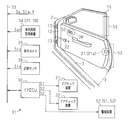
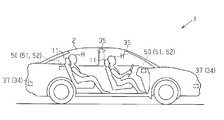
- the top view of a vehicle The schematic block diagram of the vehicle door apparatus of the vehicle of FIG.
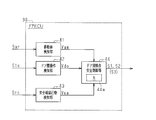
- the control block diagram of the vehicle door apparatus of FIG. The flowchart which shows the process sequence of the door opening operation
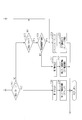
- the flowchart which shows the process sequence of door opening operation
- the vehicle 1 of this embodiment has the structure as what is called a 4-door sedan. That is, the vehicle 1 includes four doors 10 that open and close the door opening 3 provided on the side surface of the vehicle body 2. And the vehicle 1 of this embodiment is comprised so that these doors 10 may be opened and closed by the side of each seat 11 provided in the interior of the vehicle.
- each door 10 has a configuration as a swing door. That is, the front end 12 of each door 10 is supported by the vehicle body 2 via the hinge 13. Each door 10 is configured to open and close the door opening 3 at a position where the door 10 is provided by rotating around the hinge 13.
- each door 10 of the present embodiment is configured as a door lock device 21 capable of prohibiting the opening operation of the door 10 and the opening degree of the door 10, that is, a swing door.
- a door check device 22 that can control the opening operation angle ⁇ of the door 10 is provided.
- the operation of the door lock device 21 and the door check device 22 is controlled by the door ECU 30.
- the door control apparatus 31 which controls the opening / closing operation
- the door lock device 21 operates the inner door handle 32 or the outer door handle (not shown) provided on the door 10 to operate the door 10 in the fully closed position. It is possible to release the engagement state of the latch mechanism 21a that is restrained by the above.
- the door ECU 30 receives an operation input signal indicating an operation input to an operation input unit (not shown) provided on the door 10 or a portable device (electronic key) via the in-vehicle network 33. Sc is input. And door ECU30 of this embodiment controls the action
- the door lock device 21 of the present embodiment is controlled by the door ECU 30 to shift to a locked state where the engagement state of the latch mechanism 21a is not released even by an operation input to the door handle.
- the door ECU 30 is configured to shift to an unlocked state where the engagement state of the latch mechanism 21a can be released by operating the door handle.
- the door lock device 21 of the present embodiment also shifts to the locked state when a cylinder key (not shown) provided on the door 10 is operated. And it is comprised so that it may transfer to the unlocked state by operating a cylinder key in the opposite direction to the door lock operation.
- vehicle state quantities such as the vehicle speed V and the ignition signal Sig are inputted to the door ECU 30 of the present embodiment.
- the door ECU 30 of the present embodiment is configured to perform automatic control such as controlling the door lock device 21 provided in each door 10 to a locked state when the vehicle speed V exceeds a predetermined speed, for example. Has been.
- the door ECU 30 of the present embodiment includes an output signal Sar of the vehicle surrounding monitoring device 34 that monitors the surroundings of the vehicle 1, an output signal Src of the in-vehicle camera 35, and an output signal of the proximity sensor 36 provided in each door 10. Sts and the like are input.
- door ECU30 of this embodiment is comprised so that the action
- the vehicle 1 of the present embodiment is provided with a radar device 37 that monitors the front and rear of the vehicle 1 as the vehicle surrounding monitoring device 34.
- the in-vehicle camera 35 is provided on a ceiling portion in the vehicle interior.
- the vehicle 1 of the present embodiment is provided with a corner sensor 38 that can detect an object approaching the corner portion at each corner portion of the vehicle body 2 as the vehicle surrounding monitoring device 34. It has been.
- the door ECU 30 of the present embodiment detects an obstacle of the door 10 that opens, based on the output signal Sar of the vehicle surrounding monitoring device 34 and the output signal Sts of the proximity sensor 36, for example. Then, in order to avoid contact with this obstacle, the operation of the door check device 22 is controlled to limit the opening operation angle ⁇ of the door 10.
- the door ECU 30 of the present embodiment passes a moving body that approaches the door 10 of the vehicle, specifically, the side of each door 10 based on the output signal Sar of the vehicle surrounding monitoring device 34.
- the mobile body detection part 41 which detects the vehicle, motorcycle, etc. to perform is provided.
- the door ECU 30 is based on the output signal Sts of the proximity sensor 36 (see FIG. 2) provided in the vicinity of the inside door handle 32, and the occupant H in the vehicle seated on the side seat 11 (see FIG. 3). Is provided with a door opening operation detector 42 for detecting a door opening operation for opening the door 10.
- the door ECU 30 performs a safety confirmation action performed when the occupant H performs the door opening operation based on the output signal Src of the in-vehicle camera 35, specifically, a photographed image of the occupant H performing the door opening operation, for example,
- a safety confirmation action detection unit 43 is provided for detecting an operation for confirming the situation around the vehicle, such as the passenger H looking back to see the rear. Then, the door ECU 30 of the present embodiment locks the door so that the passenger H in the vehicle can safely perform the door opening operation based on the detection results Vam, Vdo, Vsa by the detection units (41 to 43).
- a door opening operation safety control unit 44 that controls the operation of the device 21, restricts the opening operation of the door 10 by the door opening operation, and permits the opening operation.
- the door opening operation safety control unit 44 of the present embodiment is based on the door opening operation by the occupant H in the vehicle when the moving body detection unit 41 detects the approach of the moving body.
- the opening operation of the door 10 is limited.
- the door opening operation safety control unit 44 as the door opening operation limiting unit outputs the door ECU 30 to the door locking device 21 so as to shift the door locking device 21 provided in the door 10 to the locked state.
- a control signal S1 is generated.
- the door control apparatus 31 of this embodiment inhibits the opening operation
- the door opening operation safety control unit 44 of the present embodiment is predetermined even in a state where a moving body approaching the door 10 is detected, that is, in a state where the opening operation of the door 10 is restricted.
- the door opening operation safety control unit 44 as the door opening operation permission unit outputs a control signal that the door ECU 30 outputs to the door locking device 21 in order to shift the door locking device 21 provided in the door 10 to the unlocked state. S1 is generated.
- the door ECU 30 including the moving body detection unit 41, the door opening operation detection unit 42, the safety confirmation action detection unit 43, and the door opening operation safety control unit 44 includes 1) one or more dedicated hardware circuits such as an ASIC, It may be configured as a circuit including 2) one or more processors operating according to a computer program (software), or 3) a combination thereof.
- the processor includes a CPU and a memory such as a RAM and a ROM, and the memory stores program codes or instructions configured to cause the CPU to execute processing.
- Memory or computer-readable media includes any available media that can be accessed by a general purpose or special purpose computer.
- the door opening operation safety control unit 44 is applied to the door 10 of the vehicle based on the detection result Vam by the moving body detection unit 41. On the other hand, it is determined whether or not the moving body is approaching (step 101). Further, the door opening operation safety control unit 44 determines whether or not the door opening operation by the occupant H in the vehicle is detected based on the detection result Vdo by the door opening operation detection unit 42 (step 102). Further, the door opening operation safety control unit 44 includes a counter 44a for measuring the number of times of detection (see FIG. 4).
- the door opening operation safety control part 44 of this embodiment determines with the moving body approaching the door 10 (step 101: YES), and the door opening operation by the passenger
- crew H in a vehicle is detected. If it is determined that the counter 44a has been determined (step 102: YES), the counter 44a is incremented (N N + 1, step 103).
- the door opening operation safety control unit 44 determines whether or not the door opening operation performed by the occupant H is “first”, that is, the number of detections N is “1” (step 104). ).
- a warning output indicating that the moving body is approaching the door 10 is executed.
- the door lock device 21 is shifted to the locked state, thereby prohibiting the opening operation of the door 10 (door lock, step 106).
- the vehicle 1 of the present embodiment is provided with a speaker 51, an indicator 52, and the like as an alarm device 50 at the front and rear of the vehicle, respectively.
- the door opening operation safety control part 44 of this embodiment produces
- step 108 YES
- door lock release step 110.
- step 108 when it is determined in step 108 that the safety confirmation action by the occupant H is not detected (step 108: NO), the door opening operation safety control unit 44 of the present embodiment performs the door opening in step 104. Similar to the case where it is determined that the operation is “first time” (step 104: YES), the processing of step 105 and step 106 is executed. Thus, the warning output is continuously executed, and the opening operation of the door 10 is restricted (prohibited).
- the door opening operation safety control unit 44 of the present embodiment detects the moving body approaching the door 10, that is, even when the opening operation of the door 10 is restricted, the detection frequency N of the door opening operation is “first”. When the predetermined number of times reaches “2 times”, the opening operation of the door 10 is permitted on the condition that the safety confirmation action by the passenger H who performs the door opening operation is detected. . That is, the door opening operation safety control unit 44 detects the safety confirmation action when the number of detections N is “first predetermined number” or more and less than “second predetermined number” (in this embodiment, “twice”).
- the door 10 is configured to be allowed to open on the condition that the door is opened. And in the door control apparatus 31 of this embodiment, while ensuring high safety
- step 107 determines in step 107 that the door opening operation detection count N is not “twice” (step 107: NO), that is, the detection count.
- N reaches “3 times” preset as “the second predetermined number of times”
- step 108 is not executed.
- step 109 and step 110 it is comprised so that the opening operation
- step 102 If the door opening operation safety control unit 44 determines in step 102 that the door opening operation by the occupant H in the vehicle has not been detected (step 102: NO), the door opening operation safety control unit 44 performs the processing after step 103. Do not execute. If it is determined in step 101 that the moving object is not approaching (step 101: NO), steps 109 and 110 are executed without executing the processes in steps 102 to 108. Is configured to do.
- the door ECU 30 includes a moving body detection unit 41 that detects a moving body that approaches the door 10 of the vehicle, and a door opening operation detection unit 42 that detects a door opening operation by an occupant H in the vehicle. Further, the door ECU 30 restricts the opening operation of the door 10 based on the door opening operation by the occupant H in the vehicle based on the detection results Vam and Vdo by the moving body detection unit 41 and the door opening operation detection unit 42. And a door opening operation safety control unit 44 that permits the opening operation.
- the door opening operation safety control unit 44 as the door opening operation restriction unit is based on the door opening operation by the occupant H in the vehicle when a moving body approaching the door 10 is detected.
- the opening operation of the door 10 is limited.
- the door opening operation safety control part 44 as a door opening operation permission part is predetermined also in the state in which the moving body which approaches the door 10 is detected, ie, the state where the opening operation of the door 10 is restricted.
- the opening operation of the door 10 based on the door opening operation by the occupant H in the vehicle is permitted.
- the door 10 can be opened smoothly by releasing the restriction on the opening operation. And thereby, the convenience of a passenger can be improved.
- the door ECU 30 includes a safety confirmation action detection unit 43 that detects a safety confirmation action by the occupant H in the vehicle.
- the door opening operation safety control unit 44 detects the approach of the moving body, that is, in a state where the opening operation of the door 10 is restricted, the number N of detections of the door opening operation by the occupant H in the vehicle is “first”.
- the opening operation of the door 10 is permitted on the condition that the safety confirmation action by the passenger H who performs the door opening operation is detected.
- the number N of detection of the door opening operation by the occupant H in the vehicle reaches “three times” which is larger than the first predetermined number (two times) set in advance as the “second predetermined number”. Permits the opening operation of the door 10 based on the door opening operation even if the safety confirmation action by the occupant H is not detected. Thereby, the convenience of the passenger
- the door control device 31 of the vehicle 1 (a so-called four-door sedan) including four swing doors as the door 10 is embodied.
- the present invention is not limited to this.
- the present invention may be applied to a vehicle having another type of door 10 such as a sliding door or a flip-up door.
- FIG. 1 the door control device 31 of the vehicle 1
- four-door sedan including four swing doors as the door 10
- the present invention is not limited to this.
- the present invention may be applied to a vehicle having another type of door 10 such as a sliding door or a flip-up door.
- the radar device 37 and the corner sensor 38 are used as the vehicle surrounding monitoring device 34 for detecting a moving body approaching the vehicle door 10.
- the present invention is not limited thereto, and the configurations of the vehicle surrounding monitoring device 34 and the moving body detection unit 41 may be arbitrarily changed, for example, by performing image analysis using a camera.
- the door opening operation by the occupant H in the vehicle is detected based on the output signal Sts of the proximity sensor 36 provided in the vicinity of the inside door handle 32.
- the present invention is not limited to this, and the configuration of the door opening operation detection unit 42 may be arbitrarily changed, for example, by performing image analysis using a camera.
- the door opening operation safety control unit 44 serving as the door opening operation restricting unit controls the door locking device 21 provided on the door 10 of the vehicle to be locked, thereby opening the door 10. It was decided to restrict (prohibit).
- the present invention is not limited thereto, and the operation of the door check device 22 may be controlled to limit the opening operation angle ⁇ of the door 10, that is, the opening degree of the door 10, thereby restricting the door opening operation.
- the door opening operation safety control unit 44 generates a control signal S3 that the door ECU 30 outputs to the door check device 22 (see FIGS. 1 and 4).
- the indicator 53 may be turned on so that an out-of-vehicle warning output directed to the outside of the vehicle 1 is executed.
- the execution method of the vehicle outside warning output to the outside of the vehicle 1 is arbitrary, for example, emitting a warning sound from an external speaker, turning on a blinker, a brake lamp, or a fog lamp, and changing its lighting pattern. You may change to As a result, the present invention can be applied to a vehicle including a door 10 of a type other than the swing door, and an out-of-vehicle warning can be output to a moving body approaching from the front of the vehicle 1.
- the warning output and opening operation of the door 10 which are the same as the case where it determines with the door opening operation being "the 1st time" It was decided to restrict (door lock).
- the present invention is not limited to this, and the content of the restriction of the opening operation of the door 10 to be executed may be changed between the first door opening operation and the second door opening operation.
- the warning output may be changed in content between the first door opening operation and the second door opening operation.
- the content of the warning output executed at the first door opening operation (step 204: YES) is set to be gentle (first warning output, step 205).
- the door lock device 21 is controlled to be locked to prohibit the door 10 from opening (first door opening operation restriction, step 206).
- the warning output executed at the time of the second door opening operation (step 208: NO) is set to a stronger warning content (second warning output, step 211).
- the operation of the door check device 22 is controlled to limit the opening degree (opening operation angle ⁇ ) of the door 10, thereby restricting the door opening operation. (Second door opening operation restriction, step 212).
- steps 101 to 104 in the flowchart of FIG. 5 showing the processing procedure of the above embodiment.
- the door opening operation safety control unit 44 serving as the door opening operation restricting unit until the door opening operation detection number N reaches a predetermined switching number (two times), that is, the detection number N is predetermined.
- the door functions as a door opening operation prohibiting unit that prohibits the opening operation of the door 10 and the number of times of detection N reaches the number of times of switching, that is, the number of times of detection.
- N is equal to or greater than the predetermined number of switching times (2 times) (second time)
- the door functions as a door opening limiter that limits the opening of the door 10.
- the detection number N of the door opening operation by the occupant H in the vehicle in a state where the moving body approaching the door 10 is detected that is, in a state where the opening operation of the door 10 is restricted
- the “first predetermined number of times” is set to “2 times”
- the “second predetermined number of times” is set to “3 times”.
- the present invention is not limited thereto, and these “first predetermined number of times” and “second predetermined number of times” may be arbitrarily changed.
- the “second predetermined number” is set to a number greater than the “first predetermined number”.
- the “number of times of switching” and the “first predetermined number of times” may be different. Good. A condition for permitting the opening operation of the door 10 that a plurality of door opening operations are detected and the safety confirmation action by the occupant H is detected regardless of the number N of detections of the door opening operations. It is good also as a structure.
- the detection of the safety confirmation action by the occupant H is not necessarily performed. Even with this configuration, it is possible to improve the convenience of the passenger H while ensuring safety.
- warning output is executed without performing detection determination of safety confirmation behavior (Step 308) may be configured to limit the opening operation of the door 10 (Step 309).
- steps 201 to 207 are the same as steps 201 to 207 (also not shown for step 203) in the flowchart of FIG. 6. It is. 7 are the same as steps 209 and 210 in the flowchart of FIG. 6.
- the warning output in step 308 is the warning output (first warning) when the door opening operation is “first time” (step 304: YES), as in the other example shown in the flowchart of FIG.
- the output is different from that in step 305) (second warning output).
- the opening operation restriction in step 309 is also the same as the opening operation restriction of the door 10 when the door opening operation is “first” (first door opening operation restriction: door lock, step 306). It is different (second door opening operation restriction: door opening restriction).
- the number N of detections of the door opening operation by the occupant H reaches a predetermined number of times (for example, the third time) corresponding to the “second predetermined number” in the above embodiment, that is, the door is opened.
- a predetermined number of times for example, the third time
- limiting (door lock) may be sufficient.
- the number N of detections of the door opening operation reaches a plurality of times (for example, the third time) corresponding to the “second predetermined number”, the opening operation of the door 10 based on the door opening operation is not performed. It is good also as a structure permitted to conditions.
- step 404 YES
- each processing after step 406 in the flowchart of FIG. 8 is the same as each processing after step 105 in the flowchart of FIG.
- step 501 when the approach of the moving body is detected, that is, when the opening operation of the door 10 is restricted (step 501: YES), the door by the occupant H in the vehicle
- step 502 YES
- each process after step 505 it is good to make it the same as each process after step 104 in the flowchart of FIG. 5 which shows the process sequence of the said embodiment, for example. 6 may be the same as each processing after step 204 in the flowchart of FIG. 6 showing the processing procedure of each other example, or each processing after step 304 in the flowchart of FIG. And you may make it the same as each process after step 404 in the flowchart of FIG.
- the opening operation restriction of the door 10 is continued.
- the passenger H who performs the door opening operation is calmed down, it can be more effectively notified that the moving body is approaching the door 10 and can be urged to pay attention to the moving body. . And thereby, higher safety can be ensured.
Landscapes
- Engineering & Computer Science (AREA)
- Mechanical Engineering (AREA)
- Lock And Its Accessories (AREA)
- Power-Operated Mechanisms For Wings (AREA)
Abstract
車両用ドア装置は、車両のドアに接近する移動体を検知するように構成された移動体検知部と、車両内の乗員によるドア開操作を検知するように構成されたドア開操作検知部と、移動体の接近が検知されている場合にドア開操作に基づくドアの開動作を制限するように構成されたドア開動作制限部と、ドアの開動作が制限される状態において、予め定められた複数回のドア開操作が検知された場合に、該ドア開操作に基づいたドアの開動作を許可するように構成されたドア開動作許可部とを備える。
Description
本発明は、車両用ドア装置に関するものである。
従来、車両用のドア装置には、例えば、特許文献1に示すように、車両の周囲を監視して、その車両のドアに接近する後方の車両やバイク等の移動体を検知した場合には、この移動体との接触を回避すべく、ドアの開動作を制限するものがある。更に、特許文献2に記載のドア装置は、検出レンジの異なる二種類の監視センサを用いるとともに、ナビゲーションシステムを用いて車両の駐車位置判定を行うことにより、より高度なドアの開動作制限制御を実行する。更に、特許文献3に記載のドア装置は、車両の乗員となる利用者毎に、その人が車両内からドアを開ける際、安全確認行動を行う安全意識の高い人であるか否かを示す信頼度ステータスを保持する。そして、これにより、安全意識の低い利用者に対して、繰り返し、安全意識を刷り込むことができるようになっている。
しかしながら、交通量の多い道路に停車した場合、そのドアの側方を絶えず車両が通過することになる。つまり、このような状態で上記のような開動作制限が実行されることにより、そのドアを開けることができないままとなる可能性が生ずる。そして、従来技術の構成では、このような場合、結局のところ、その開動作制限を無視して強引にドアを開けざるを得なくなるという問題があることから、この点において、なお改善の余地を残すものとなっていた。
本発明の目的は、高い安全性を確保しつつ、より利便性に優れた車両用ドア装置を提供することにある。
上記課題を解決する車両用ドア装置は、車両のドアに接近する移動体を検知するように構成された移動体検知部と、前記車両内の乗員によるドア開操作を検知するように構成されたドア開操作検知部と、前記移動体の接近が検知されている場合に前記ドア開操作に基づく前記ドアの開動作を制限するように構成されたドア開動作制限部と、前記ドアの開動作が制限される状態において、予め定められた複数回の前記ドア開操作が検知された場合に、該ドア開操作に基づいた前記ドアの開動作を許可するように構成されたドア開動作許可部と、を備えることが好ましい。
以下、車両用ドア装置の一実施形態を図面に従って説明する。
図1及び図2に示すように、本実施形態の車両1は、所謂4ドアセダンとしての構成を有している。即ち、この車両1は、車体2の側面に設けられたドア開口部3を開閉する4枚のドア10を備えている。そして、本実施形態の車両1は、これらの各ドア10が、その車両の室内に設けられた各座席11の側方で開閉動作するように構成されている。
図1及び図2に示すように、本実施形態の車両1は、所謂4ドアセダンとしての構成を有している。即ち、この車両1は、車体2の側面に設けられたドア開口部3を開閉する4枚のドア10を備えている。そして、本実施形態の車両1は、これらの各ドア10が、その車両の室内に設けられた各座席11の側方で開閉動作するように構成されている。
具体的には、本実施形態の車両1において、各ドア10は、スイングドアとしての構成を有している。即ち、これらの各ドア10は、その前端部12がヒンジ13を介して車体2に支持されている。そして、各ドア10は、このヒンジ13周りに回動することにより、そのドア10が設けられた位置においてドア開口部3を開閉するように構成されている。
また、図2に示すように、本実施形態の各ドア10には、そのドア10の開動作を禁止することが可能なドアロック装置21と、そのドア10の開度、即ちスイングドアとして構成された当該ドア10の開動作角度θを制御可能なドアチェック装置22が設けられている。更に、本実施形態のドア10においては、これらのドアロック装置21及びドアチェック装置22の作動がドアECU30により制御されている。そして、本実施形態では、これにより、その各ドア10の開閉動作を制御するドア制御装置31が形成されている。
詳述すると、本実施形態のドアロック装置21は、ドア10に設けられたインサイドドアハンドル32及びアウトサイドドアハンドル(図示略)の何れかが操作されることにより、そのドア10を全閉位置に拘束するラッチ機構21aの係合状態を解除することが可能になっている。また、本実施形態の車両1において、ドアECU30には、車内ネットワーク33を介して、そのドア10に設けられた図示しない操作入力部、或いは携帯機(電子キー)に対する操作入力を示す操作入力信号Scが入力される。そして、本実施形態のドアECU30は、この操作入力信号Scに基づいて、そのドアロック装置21の作動を制御する。
即ち、本実施形態のドアロック装置21は、ドアECU30に制御されることにより、ドアハンドルに対する操作入力によってもラッチ機構21aの係合状態を解除しないロック状態に移行する。そして、同じく、ドアECU30に制御されることにより、そのドアハンドルの操作によりラッチ機構21aの係合状態を解除することが可能なアンロック状態に移行するように構成されている。
尚、本実施形態のドアロック装置21は、ドア10に設けられた図示しないシリンダキーが操作されることによってもロック状態に移行する。そして、そのドアロック操作とは逆向きにシリンダキーが操作されることにより、そのアンロック状態に移行するように構成されている。
また、本実施形態のドアECU30には、車速Vやイグニッション信号Sig等の車両状態量が入力されるようになっている。そして、本実施形態のドアECU30は、例えば、車速Vが所定速度を超えた場合に、その各ドア10に設けられたドアロック装置21をロック状態に制御する等の自動制御を行うように構成されている。
更に、本実施形態のドアECU30には、車両1の周囲を監視する車両周囲監視装置34の出力信号Sar、車内カメラ35の出力信号Src、及び各ドア10に設けられた近接センサ36の出力信号Sts等が入力されるようになっている。そして、本実施形態のドアECU30は、これら各種装置の出力信号及び上記車両状態量に基づいて、そのドアロック装置21及びドアチェック装置22の作動を制御するように構成されている。
具体的には、図3に示すように、本実施形態の車両1には、車両周囲監視装置34として、車両1の前方及び後方を監視するレーダー装置37が設けられている。また、車内カメラ35は、車室内の天井部分に設けられている。そして、図1に示すように、本実施形態の車両1には、車両周囲監視装置34として、その車体2の各コーナー部に、そのコーナー部に接近した物体を検知可能なコーナーセンサ38が設けられている。
更に、本実施形態のドアECU30は、例えば、その車両周囲監視装置34の出力信号Sarや近接センサ36の出力信号Stsに基づいて、開動作するドア10の障害物を検知する。そして、この障害物との接触を避けるべく、上記ドアチェック装置22の作動を制御して、そのドア10の開動作角度θを制限するように構成されている。
(ドア開動作安全制御)
次に、本実施形態のドアECU30が実行するドア開動作安全制御について説明する。
図4に示すように、本実施形態のドアECU30は、車両周囲監視装置34の出力信号Sarに基づいて、その車両のドア10に接近する移動体、詳しくは、各ドア10の側方を通過する車両やバイク等を検知する移動体検知部41を備えている。また、ドアECU30は、インサイドドアハンドル32の近傍に設けられた近接センサ36(図2参照)の出力信号Stsに基づいて、その側方の座席11に着座する車両内の乗員H(図3参照)が行うドア10を開動作させるためのドア開操作を検知するドア開操作検知部42を備えている。更に、このドアECU30は、車内カメラ35の出力信号Src、詳しくは、そのドア開操作を行う乗員Hの撮影画像に基づいて、この乗員Hがドア開操作を行う際に行う安全確認行動、例えば、乗員Hが後方を目視するために振り返る等、車両周辺の状況を確かめる動作を検知する安全確認行動検知部43を備えている。そして、本実施形態のドアECU30は、これら各検知部(41~43)による検知結果Vam,Vdo,Vsaに基づいて、車内の乗員Hが安全にドア開操作を行うことができるよう、ドアロック装置21の作動を制御して、そのドア開操作によるドア10の開動作を制限し、及びその開動作を許可するドア開操作安全制御部44を備えている。
次に、本実施形態のドアECU30が実行するドア開動作安全制御について説明する。
図4に示すように、本実施形態のドアECU30は、車両周囲監視装置34の出力信号Sarに基づいて、その車両のドア10に接近する移動体、詳しくは、各ドア10の側方を通過する車両やバイク等を検知する移動体検知部41を備えている。また、ドアECU30は、インサイドドアハンドル32の近傍に設けられた近接センサ36(図2参照)の出力信号Stsに基づいて、その側方の座席11に着座する車両内の乗員H(図3参照)が行うドア10を開動作させるためのドア開操作を検知するドア開操作検知部42を備えている。更に、このドアECU30は、車内カメラ35の出力信号Src、詳しくは、そのドア開操作を行う乗員Hの撮影画像に基づいて、この乗員Hがドア開操作を行う際に行う安全確認行動、例えば、乗員Hが後方を目視するために振り返る等、車両周辺の状況を確かめる動作を検知する安全確認行動検知部43を備えている。そして、本実施形態のドアECU30は、これら各検知部(41~43)による検知結果Vam,Vdo,Vsaに基づいて、車内の乗員Hが安全にドア開操作を行うことができるよう、ドアロック装置21の作動を制御して、そのドア開操作によるドア10の開動作を制限し、及びその開動作を許可するドア開操作安全制御部44を備えている。
詳述すると、本実施形態のドア開操作安全制御部44は、上記移動体検知部41により移動体の接近が検知されている場合には、その車両内の乗員Hによるドア開操作に基づいたドア10の開動作を制限する。具体的には、ドア開動作制限部としてのドア開操作安全制御部44は、ドア10に設けられたドアロック装置21をロック状態に移行させるべく、そのドアECU30がドアロック装置21に出力する制御信号S1を生成する。そして、本実施形態のドア制御装置31は、これにより、そのドア10の開動作を禁止する。つまり、車両内の乗員Hがインサイドドアハンドル32を操作しても、ドア10が開動作しないようにすることで、そのドア10に接近する移動体との接触を回避するように構成されている。
また、本実施形態のドア開操作安全制御部44は、このようなドア10に接近する移動体が検知されている状態、即ちドア10の開動作が制限される状態においても、予め定められた複数回のドア開操作が検知された場合には、その車両内の乗員Hによるドア開操作に基づいたドア10の開動作を許可する。つまり、ドア開動作許可部としてのドア開操作安全制御部44は、ドア10に設けられたドアロック装置21をアンロック状態に移行させるべく、そのドアECU30がドアロック装置21に出力する制御信号S1を生成する。そして、本実施形態のドア制御装置31は、これにより、高い安全性を確保しつつ、ドア開操作を行う車両内の乗員Hが必要と考える場合には、その開動作制限を解除して、円滑にドア10を開けることが可能となっている。
上記移動体検知部41、ドア開操作検知部42、安全確認行動検知部43、及びドア開操作安全制御部44を含むドアECU30は、1)ASIC等の1つ以上の専用のハードウェア回路、2)コンピュータプログラム(ソフトウェア)に従って動作する1つ以上のプロセッサ、或いは、3)それらの組み合わせ、を含む回路として構成し得る。プロセッサは、CPU並びに、RAM及びROM等のメモリを含み、メモリは、処理をCPUに実行させるように構成されたプログラムコードまたは指令を格納している。メモリ即ちコンピュータ可読媒体は、汎用または専用のコンピュータでアクセスできるあらゆる利用可能な媒体を含む。
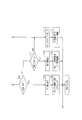
具体的には、図5のフローチャートに示すように、本実施形態のドアECU30において、ドア開操作安全制御部44は、上記移動体検知部41による検知結果Vamに基づいて、車両のドア10に対して移動体が接近しているか否かを判定する(ステップ101)。また、ドア開操作安全制御部44は、ドア開操作検知部42による検知結果Vdoに基づいて、車両内の乗員Hによるドア開操作が検知されているか否かを判定する(ステップ102)。更に、このドア開操作安全制御部44は、検知回数計測用のカウンタ44aを備えている(図4参照)。そして、本実施形態のドア開操作安全制御部44は、ドア10に対して移動体が接近していると判定し(ステップ101:YES)、且つ車両内の乗員Hによるドア開操作が検知されていると判定した場合(ステップ102:YES)に、そのカウンタ44aをインクリメントするように構成されている(N=N+1、ステップ103)。
次に、ドア開操作安全制御部44は、その乗員Hにより行われたドア開操作が「一回目」、つまり、その検知回数Nが「1回」であるか否かを判定する(ステップ104)。そして、ドア開操作の検知回数Nが「1回」である場合(N=1、ステップ104:YES)には、ドア10に対して移動体が接近している旨の警告出力を実行するとともに(ステップ105)、ドアロック装置21をロック状態に移行させることにより、そのドア10の開動作を禁止する(ドアロック、ステップ106)。
尚、図2及び図3に示すように、本実施形態の車両1には、その車両内の前部及び後部に、それぞれ、警報装置50としてのスピーカー51やインジケータ52等が設けられている。そして、本実施形態のドア開操作安全制御部44は、これらの各警報装置50にドアECU30が出力する制御信号S2を生成することにより、そのドア10の開動作を制限する場合に警告出力を行う警告出力部として機能するように構成されている。
また、図5に示すように、本実施形態のドア開操作安全制御部44は、上記ステップ104において、ドア開操作の検知回数Nが「1回」ではないと判定した場合(ステップ104:NO)、続いて、その乗員Hにより行われたドア開操作が「二回目」、つまり、その検知回数Nが「2回」であるか否かを判定する(ステップ107)。更に、ドア開操作安全制御部44は、このステップ107において、ドア開操作の検知回数Nが「2回」である場合(N=2、ステップ107:YES)には、上記安全確認行動検知部43による検知結果Vsaに基づいて、そのドア開操作を行う乗員Hによる安全確認行動が検知されているか否かを判定する(ステップ108)。そして、乗員Hによる安全確認行動が検知されていると判定した場合(ステップ108:YES)には、カウンタ44aをクリアして(N=0、ステップ109)、ドアロック装置21をアンロック状態に移行させることにより、その乗員Hによるドア開操作に基づいたドア10の開動作を許可する(ドアロック解除、ステップ110)。
一方、上記ステップ108において、乗員Hによる安全確認行動が検知されていないと判定した場合(ステップ108:NO)、本実施形態のドア開操作安全制御部44は、上記ステップ104において、そのドア開操作が「一回目」であると判定した場合(ステップ104:YES)と同じく、上記ステップ105及びステップ106の処理を実行する。そして、これにより、引き続き、警告出力を実行し、及び、そのドア10の開動作を制限(禁止)するように構成されている。
即ち、本実施形態のドア開操作安全制御部44は、ドア10に接近する移動体を検知、即ちドア10の開動作が制限される状態においても、ドア開操作の検知回数Nが「第1の所定回数」として予め設定された「2回」に達した場合には、そのドア開操作を行う乗員Hによる安全確認行動が検知されていることを条件に、ドア10の開動作を許可する。つまり、ドア開操作安全制御部44は、検知回数Nが「第1の所定回数」以上「第2の所定回数」未満であるときには(本実施形態では「2回」)、安全確認行動が検知されていることを条件にドア10の開動作を許可するように構成されている。そして、本実施形態のドア制御装置31においては、これにより、高い安全性を確保するとともに、その利便性の向上が図られている。
また、本実施形態のドア開操作安全制御部44は、上記ステップ107において、ドア開操作の検知回数Nが「2回」ではないと判定した場合(ステップ107:NO)、即ち、その検知回数Nが「第2の所定回数」として予め設定された「3回」に達した場合には、上記ステップ108を実行しない。そして、上記ステップ109及びステップ110を実行することにより、その乗員Hによるドア開操作に基づいたドア10の開動作を許可するように構成されている。つまり、ドア開操作安全制御部44は、検知回数Nが「第2の所定回数」以上であるときには(本実施形態では「3回」)、安全確認行動が検知されていなくてもドア10の開動作を許可するように構成されている。
尚、ドア開操作安全制御部44は、上記ステップ102において、車両内の乗員Hによるドア開操作が検知されていないと判定した場合(ステップ102:NO)には、上記ステップ103以降の処理を実行しない。そして、上記ステップ101において、移動体が接近していないと判定した場合(ステップ101:NO)には、上記ステップ102~ステップ108の各処理を実行することなく、上記ステップ109及びステップ110を実行するように構成されている。
以上、本実施形態によれば、以下のような効果を得ることができる。
(1)ドアECU30は、車両のドア10に接近する移動体を検知する移動体検知部41と、車両内の乗員Hによるドア開操作を検知するドア開操作検知部42と、を備える。また、ドアECU30は、これら移動体検知部41及びドア開操作検知部42による検知結果Vam,Vdoに基づいて、車両内の乗員Hによるドア開操作に基づいたドア10の開動作を制限し、及びその開動作を許可するドア開操作安全制御部44を備える。具体的には、ドア開動作制限部としてのドア開操作安全制御部44は、ドア10に接近する移動体が検知されている場合には、その車両内の乗員Hによるドア開操作に基づいたドア10の開動作を制限する。そして、ドア開動作許可部としてのドア開操作安全制御部44は、ドア10に接近する移動体が検知されている状態、即ちドア10の開動作が制限される状態においても、予め定められた複数回のドア開操作が検知された場合には、その車両内の乗員Hによるドア開操作に基づいたドア10の開動作を許可する。
(1)ドアECU30は、車両のドア10に接近する移動体を検知する移動体検知部41と、車両内の乗員Hによるドア開操作を検知するドア開操作検知部42と、を備える。また、ドアECU30は、これら移動体検知部41及びドア開操作検知部42による検知結果Vam,Vdoに基づいて、車両内の乗員Hによるドア開操作に基づいたドア10の開動作を制限し、及びその開動作を許可するドア開操作安全制御部44を備える。具体的には、ドア開動作制限部としてのドア開操作安全制御部44は、ドア10に接近する移動体が検知されている場合には、その車両内の乗員Hによるドア開操作に基づいたドア10の開動作を制限する。そして、ドア開動作許可部としてのドア開操作安全制御部44は、ドア10に接近する移動体が検知されている状態、即ちドア10の開動作が制限される状態においても、予め定められた複数回のドア開操作が検知された場合には、その車両内の乗員Hによるドア開操作に基づいたドア10の開動作を許可する。
上記構成によれば、開動作する車両のドア10と当該ドア10に接近する移動体との接触を回避して高い安全性を確保しつつ、車両内の乗員Hが必要とする場合には、容易に、その開動作制限を解除して、円滑に、そのドア10を開けることができる。そして、これにより、乗員の利便性を向上させることができる。
(2)ドアECU30は、車両内の乗員Hによる安全確認行動を検知する安全確認行動検知部43を備える。また、ドア開操作安全制御部44は、移動体の接近を検知、即ちドア10の開動作が制限される状態において、その車両内の乗員Hによるドア開操作の検知回数Nが「第1の所定回数」として予め設定された「2回」に達した場合には、そのドア開操作を行う乗員Hによる安全確認行動が検知されていることを条件に、ドア10の開動作を許可する。そして、車両内の乗員Hによるドア開操作の検知回数Nが「第2の所定回数」として予め設定された上記第1の所定回数(2回)よりも多い「3回」に達した場合には、乗員Hによる安全確認行動が検知されていなくても、そのドア開操作に基づいたドア10の開動作を許可する。これにより、高い安全性を確保しつつ、乗員Hの利便性を更に向上させることができる。
なお、上記実施形態は以下のように変更してもよい。
・上記実施形態では、ドア10として4枚のスイングドアを備える車両1(所謂4ドアセダン)のドア制御装置31に具体化した。しかし、これに限らず、例えば、スライドドアや跳ね上げ式のドア等、他の形式のドア10を有する車両に適用してもよい。また、ドア10の枚数や配置等を含め、その適用対象となる車種についてもまた、任意に変更してもよい。
・上記実施形態では、ドア10として4枚のスイングドアを備える車両1(所謂4ドアセダン)のドア制御装置31に具体化した。しかし、これに限らず、例えば、スライドドアや跳ね上げ式のドア等、他の形式のドア10を有する車両に適用してもよい。また、ドア10の枚数や配置等を含め、その適用対象となる車種についてもまた、任意に変更してもよい。
・上記実施形態では、車両のドア10に接近する移動体を検知するための車両周囲監視装置34として、レーダー装置37及びコーナーセンサ38を用いることとした。しかし、これに限らず、例えば、カメラを用いて画像解析を行う等、その車両周囲監視装置34及び移動体検知部41の構成については、任意に変更してもよい。
・また、上記実施形態では、インサイドドアハンドル32の近傍に設けられた近接センサ36の出力信号Stsに基づいて、車両内の乗員Hによるドア開操作を検知することとした。しかし、これに限らず、例えば、これについてもまた、カメラを用いて画像解析を行う等、そのドア開操作検知部42の構成については、任意に変更してもよい。
・上記実施形態では、ドア開動作制限部としてのドア開操作安全制御部44は、車両のドア10に設けられたドアロック装置21をロック状態に制御することにより、そのドア10の開動作を制限(禁止)することとした。しかし、これに限らず、ドアチェック装置22の作動を制御して、ドア10の開動作角度θ、つまりはドア10の開度を制限することにより、そのドア開動作を制限する構成としてもよい。具体的には、この場合、ドア開操作安全制御部44は、そのドアECU30がドアチェック装置22に出力する制御信号S3を生成する(図1及び図4参照)。また、この場合におけるドア10の開度制限は、そのドア10から乗員Hが降車することができない程度に設定することが望ましい。そして、これにより、上記実施形態と同様の効果を得ることができる。
・更に、図2に示すように、ドア10の後端部にインジケータ53を設けるとともに、上記のような開度(開動作角度θ)が制限された状態でドア10が開動作した場合には、このインジケータ53を点灯させることにより、その車両1の外部に向けた車外警告出力を実行する構成にするとよい。
即ち、このようなインジケータ53を点灯させることにより、車両1の後方からドア10に接近する移動体の運転者に対し、このドア10が開動作する可能性がある旨を警告することができる。そして、これにより、より高い安全性を確保することができる。また、車両1の外部に向けた車外警告出力の実行方法については、例えば、外部スピーカーから警告音を発する、ウィンカーやブレーキランプ、或いはフォグランプを点灯させる、更に、その点灯パターンを変化させる等、任意に変更してもよい。そして、これにより、スイングドア以外の型式のドア10を備える車両にも適用することができるとともに、車両1の前方から接近する移動体に対しても、その車外警告出力を行うことができる。
・また、上記実施形態では、乗員Hによる安全確認行動が検知されていないと判定した場合、そのドア開操作が「一回目」であると判定した場合と同一の警告出力及びドア10の開動作制限(ドアロック)を行うこととした。しかし、これに限らず、一回目のドア開操作時と二回目のドア開操作時とで、その実行するドア10の開動作制限の内容を変化させる構成としてもよい。そして、その警告出力についてもまた、一回目のドア開操作時と二回目のドア開操作時とで、その内容を変化させる構成としてもよい。
例えば、図6に示すように、一回目のドア開操作時(ステップ204:YES)に実行する警告出力の内容を穏やかなものに設定するとともに(第1警告出力、ステップ205)、この場合には、上記実施形態と同様、ドアロック装置21をロック状態に制御することによりドア10の開動作を禁止する(第1ドア開動作制限、ステップ206)。これに対し、二回目のドア開操作時(ステップ208:NO)に実行する警告出力については、より強く警告する内容に設定する(第2警告出力、ステップ211)。そして、この場合には、上記別例のように、ドアチェック装置22の作動を制御して、ドア10の開度(開動作角度θ)を制限することにより、そのドア開動作を制限する構成とするとよい(第2ドア開動作制限、ステップ212)。
尚、図6のフローチャートにおけるステップ201~ステップ204(ステップ203までは図示略)の各処理は、上記実施形態の処理手順を示す図5のフローチャートにおけるステップ101~ステップ104の各処理と同一である。そして、図6のフローチャートにおけるステップ207~ステップ210の各処理は、図5のフローチャートにおけるステップ107~ステップ110の各処理と同一である。
つまり、この例において、ドア開動作制限部としてのドア開操作安全制御部44は、そのドア開操作の検知回数Nが所定の切替回数(2回)に到達するまで、即ち検知回数Nが所定の切替回数(2回)未満であるときには(一回目)、ドア10の開動作を禁止するドア開動作禁止部として機能し、且つ、その検知回数Nが切替回数に到達した後、即ち検知回数Nが所定の切替回数(2回)以上であるときには(二回目)、そのドア10の開度を制限するドア開度制限部として機能する。このような構成を採用することで、より効果的に、そのドア10に移動体が接近していることを知らしめ、この移動体に注意を払うように促すことができる。そして、これにより、より高い安全性を確保することができる。
・上記実施形態では、ドア10に接近する移動体が検知されている状態、即ちドア10の開動作が制限される状態で行われた車両内の乗員Hによるドア開操作の検知回数Nについて、「第1の所定回数」を「2回」に設定し、「第2の所定回数」を「3回」に設定する。そして、その検知回数Nが「第1の所定回数」に達した場合には、そのドア開操作を行う乗員Hによる安全確認行動が検知されていることを条件にドア10の開動作を許可し、検知回数Nが「第2の所定回数」に達した場合には、乗員Hによる安全確認行動が検知されていなくても、そのドア開操作に基づいたドア10の開動作を許可することとした。
しかし、これに限らず、これら「第1の所定回数」及び「第2の所定回数」は、任意に変更してもよい。尚、この場合においても、「第2の所定回数」には、「第1の所定回数」よりも多い回数が設定される。また、上記図6のフローチャートに示す別例のように、ドア10の開動作制限の内容を切り替える構成の場合、その「切替回数」と「第1の所定回数」とが異なる構成であってもよい。そして、複数回のドア開操作が検知され、且つ乗員Hによる安全確認行動が検知されていることを、そのドア開操作の検知回数Nに関わらず、ドア10の開動作を許可するための条件とする構成としてもよい。
・また、乗員Hによる安全確認行動の検知については、必ずしも、これを実行しなくともよい。このような構成としても、安全性を確保しつつ、乗員Hの利便性を向上させることができる。
例えば、図7のフローチャートに示すように、そのドア開操作が「二回目」であると判定した場合(ステップ307:YES)、安全確認行動の検知判定を行うことなく、警告出力を実行し(ステップ308)、ドア10の開動作制限を実行する(ステップ309)構成としてもよい。
尚、図7のフローチャートにおけるステップ301~ステップ307(ステップ303までは図示略)の各処理は、図6のフローチャートにおけるステップ201~ステップ207(同じく、ステップ203までは図示略)の各処理と同一である。そして、図7のフローチャートにおけるステップ310及びステップ311の各処理は、図6のフローチャートにおけるステップ209及びステップ210の各処理と同一である。
また、この例において、ステップ308における警告出力は、上記図6のフローチャートに示す別例と同様、そのドア開操作が「一回目」である場合(ステップ304:YES)の警告出力(第1警告出力、ステップ305)とは、その内容が異なるもの(第2警告出力)となっている。そして、ステップ309における開動作制限についてもまた、そのドア開操作が「一回目」である場合のドア10の開動作制限(第1ドア開動作制限:ドアロック、ステップ306)とは、内容が異なるもの(第2ドア開動作制限:ドア開度制限)となっている。
・更に、乗員Hによるドア開操作の検知回数Nが、上記実施形態における「第2の所定回数」に相当する予め定められた複数回(例えば、三回目)に到達するまで、即ち、ドア開操作の検知回数Nが「第2の所定回数」未満であるときに、安全確認行動の検知判定を行わずに、ドア開操作が「一回目」である場合と同一の警告出力及びドア10の開動作制限(ドアロック)を行う構成であってもよい。そして、ドア開操作の検知回数Nが、その「第2の所定回数」に相当する複数回(例えば、三回目)に到達した時点において、そのドア開操作に基づいたドア10の開動作を無条件に許可する構成としてもよい。
・また、図8のフローチャートに示すように、その車両内の乗員Hによるドア開操作の検知回数Nが、「一回目」である場合(ステップ404:YES)にも、安全確認行動の検知判定を実行する(ステップ405)構成としてもよい。そして、乗員Hによる安全確認行動が検知されていると判定した場合(ステップ405:YES)には、そのドア開操作の検知回数Nが「1回」であっても、カウンタ44aをクリアして(N=0、ステップ410)、その乗員Hによるドア開操作に基づいたドア10の開動作を許可する(ステップ411)。
尚、図8のフローチャートにおけるステップ401~ステップ404(ステップ403までは図示略)の各処理は、上記実施形態の処理手順を示す図5のフローチャートにおけるステップ101~ステップ104の各処理と同一である。そして、図8のフローチャートにおけるステップ406以降の各処理は、図5のフローチャートにおけるステップ105以降の各処理と同一である。
・更に、図9のフローチャートに示すように、移動体の接近が検知されている状態、即ちドア10の開動作が制限される状態で(ステップ501:YES)、その車両内の乗員Hによるドア開操作が検知された場合(ステップ502:YES)に、前回のドア開操作を検知してから所定時間が経過しているか否かを判定する(ステップ503)。そして、前回のドア開操作を検知してから所定時間の経過後に新たなドア開操作が検知されたと判定した場合に(ステップ503:YES)、検知回数計測用のカウンタ44aをインクリメントする構成としてもよい(ステップ504)。
尚、ステップ505以降の各処理については、例えば、上記実施形態の処理手順を示す図5のフローチャートにおけるステップ104以降の各処理と同一にするとよい。また、上記各別例の処理手順を示す図6のフローチャートにおけるステップ204以降の各処理、或いは、図7のフローチャートにおけるステップ304以降の各処理と同一にしてもよい。そして、図8のフローチャートにおけるステップ404以降の各処理と同一にしてもよい。
上記構成によれば、例えば、車両内の乗員Hが急いでドア10を開けようとして、短時間に繰り返しドア開操作を行った場合にも、そのドア10の開動作制限が継続される。即ち、ドア開操作を行う乗員Hを一度落ち着かせることで、より効果的に、そのドア10に移動体が接近していることを知らしめ、この移動体に注意を払うように促すことができる。そして、これにより、より高い安全性を確保することができる。
Claims (7)
- 車両のドアに接近する移動体を検知するように構成された移動体検知部と、
前記車両内の乗員によるドア開操作を検知するように構成されたドア開操作検知部と、
前記移動体の接近が検知されている場合に前記ドア開操作に基づく前記ドアの開動作を制限するように構成されたドア開動作制限部と、
前記ドアの開動作が制限される状態において、予め定められた複数回の前記ドア開操作が検知された場合に、該ドア開操作に基づいた前記ドアの開動作を許可するように構成されたドア開動作許可部と、を備える車両用ドア装置。 - 請求項1に記載の車両用ドア装置において、
前記乗員による安全確認行動を検知するように構成された安全確認行動検知部を更に備え、
前記ドア開動作許可部は、前記安全確認行動が検知されていることを条件に前記ドアの開動作を許可するように構成されている、車両用ドア装置。 - 請求項2に記載の車両用ドア装置において、
前記ドア開動作許可部は、
前記ドア開操作の検知回数が、第1の所定回数以上であり、且つ第1の所定回数よりも多い第2の所定回数未満であるときには、前記安全確認行動が検知されていることを条件に前記ドアの開動作を許可し、
前記ドア開操作の検知回数が前記第2の所定回数以上であるときには、前記安全確認行動が検知されていなくても前記ドアの開動作を許可するように構成されている、車両用ドア装置。 - 請求項1~請求項3の何れか一項に記載の車両用ドア装置において、
前記ドア開動作制限部は、
前記ドア開操作の検知回数が所定の切替回数未満であるときに、前記ドアの開動作を禁止するように構成されたドア開動作禁止部と、
前記ドア開操作の検知回数が前記切替回数以上であるときに、前記ドアの開度を制限するように構成されたドア開度制限部と、を備える、車両用ドア装置。 - 請求項1~請求項4の何れか一項に記載の車両用ドア装置において、
前記ドア開操作の検知回数を計測するカウンタを備えるとともに、
前記カウンタは、前回の前記ドア開操作を検知してから所定時間の経過後に新たな前記ドア開操作が検知された場合に、前記検知回数をインクリメントするように構成されている、車両用ドア装置。 - 請求項1~請求項5の何れか一項に記載の車両用ドア装置において、
前記ドアの開動作が制限される状態において、前記ドア開操作を検知した場合に警告出力を実行するように構成された警告出力部を備える、車両用ドア装置。 - 請求項6に記載の車両用ドア装置において、
前記警告出力は、前記車両の外部に向けた車外警告出力を含む、車両用ドア装置。
Priority Applications (3)
| Application Number | Priority Date | Filing Date | Title |
|---|---|---|---|
| CN201780064508.XA CN109863048B (zh) | 2016-10-24 | 2017-09-05 | 车门装置 |
| DE112017005357.9T DE112017005357B4 (de) | 2016-10-24 | 2017-09-05 | Fahrzeugtürvorrichtung |
| US16/340,926 US11473353B2 (en) | 2016-10-24 | 2017-09-05 | Vehicle door apparatus to restrict opening of a door |
Applications Claiming Priority (2)
| Application Number | Priority Date | Filing Date | Title |
|---|---|---|---|
| JP2016-208124 | 2016-10-24 | ||
| JP2016208124A JP6825300B2 (ja) | 2016-10-24 | 2016-10-24 | 車両用ドア装置 |
Publications (1)
| Publication Number | Publication Date |
|---|---|
| WO2018079084A1 true WO2018079084A1 (ja) | 2018-05-03 |
Family
ID=62024141
Family Applications (1)
| Application Number | Title | Priority Date | Filing Date |
|---|---|---|---|
| PCT/JP2017/031977 Ceased WO2018079084A1 (ja) | 2016-10-24 | 2017-09-05 | 車両用ドア装置 |
Country Status (5)
| Country | Link |
|---|---|
| US (1) | US11473353B2 (ja) |
| JP (1) | JP6825300B2 (ja) |
| CN (1) | CN109863048B (ja) |
| DE (1) | DE112017005357B4 (ja) |
| WO (1) | WO2018079084A1 (ja) |
Families Citing this family (15)
| Publication number | Priority date | Publication date | Assignee | Title |
|---|---|---|---|---|
| JP6729332B2 (ja) * | 2016-12-05 | 2020-07-22 | 株式会社デンソー | 障害物検出装置 |
| US11021150B2 (en) * | 2016-12-08 | 2021-06-01 | CO-AX Technology, Inc. | Controlling a motor vehicle based upon wind |
| JP7286945B2 (ja) * | 2018-10-26 | 2023-06-06 | 株式会社アイシン | 車両用扉の障害物認識装置および車両用の障害物認識機能付扉 |
| DE102019121647A1 (de) * | 2019-06-04 | 2020-12-10 | Inventus Engineering Gmbh | Verfahren zum Steuern von Türbewegungen einer Tür eines Kraftfahrzeugs und Kraftfahrzeugkomponente |
| JP2020201881A (ja) * | 2019-06-13 | 2020-12-17 | 三菱電機株式会社 | ドア開放警告装置、ドア開放警告方法、及びドア開放警告プログラム |
| CN110588307B (zh) * | 2019-09-24 | 2022-02-01 | 奇瑞汽车股份有限公司 | 汽车的车窗与天窗的控制方法、装置及存储介质 |
| JP7339179B2 (ja) * | 2020-02-12 | 2023-09-05 | トヨタ自動車株式会社 | 車両用スロープシステム |
| JP7234966B2 (ja) | 2020-02-13 | 2023-03-08 | トヨタ自動車株式会社 | 降車支援装置 |
| JP7318626B2 (ja) * | 2020-11-19 | 2023-08-01 | トヨタ自動車株式会社 | ドア制御装置 |
| JP2022081043A (ja) * | 2020-11-19 | 2022-05-31 | トヨタ自動車株式会社 | 降車支援装置 |
| JP7435532B2 (ja) * | 2021-04-20 | 2024-02-21 | トヨタ自動車株式会社 | スロープ搭載車両 |
| US12552460B2 (en) * | 2021-12-23 | 2026-02-17 | Nissan North America, Inc. | Vehicle body structure |
| US12240482B2 (en) * | 2023-01-14 | 2025-03-04 | Ford Global Technologies, Llc | System and method for preventing interactions between vehicle and moving object |
| CN119502846A (zh) * | 2023-08-25 | 2025-02-25 | 长城汽车股份有限公司 | 车辆控制方法、装置、车辆和存储介质 |
| CN118135689A (zh) * | 2024-03-05 | 2024-06-04 | 上海核工程研究设计院股份有限公司 | 防火门运维控制方法、系统及防火门 |
Citations (3)
| Publication number | Priority date | Publication date | Assignee | Title |
|---|---|---|---|---|
| JP2009040342A (ja) * | 2007-08-10 | 2009-02-26 | Equos Research Co Ltd | 車輌ドアシステム |
| JP2009041209A (ja) * | 2007-08-07 | 2009-02-26 | Equos Research Co Ltd | 車輌ドアシステム |
| JP2010158990A (ja) * | 2009-01-08 | 2010-07-22 | Autonetworks Technologies Ltd | 警告装置 |
Family Cites Families (12)
| Publication number | Priority date | Publication date | Assignee | Title |
|---|---|---|---|---|
| JPH0462283A (ja) | 1990-06-30 | 1992-02-27 | Mazda Motor Corp | 車両のドア開閉装置 |
| JP2001246982A (ja) * | 2000-03-06 | 2001-09-11 | Keiji Kobayashi | 車両ドア開放警告灯及びそれを備えた車両 |
| US20050085972A1 (en) * | 2003-10-16 | 2005-04-21 | International Business Machines Corporation | Door opening limit control system |
| DE102008007424B3 (de) * | 2008-02-01 | 2009-10-15 | Celik, Zülfikar | Verfahren zur Signalisierung der Öffnung einer Tür eines Kraftfahrzeugs |
| JP5643129B2 (ja) * | 2011-02-07 | 2014-12-17 | 株式会社アルファ | 車両の扉体制御装置 |
| US9068390B2 (en) * | 2013-01-21 | 2015-06-30 | Magna Electronics Inc. | Vehicle hatch control system |
| US20140257630A1 (en) * | 2013-03-05 | 2014-09-11 | Xerox Corporation | Safety door interlock system for public transportation vehicles |
| JP2015209657A (ja) * | 2014-04-24 | 2015-11-24 | トヨタ車体株式会社 | 車両用ドアロック制御装置及び車両制御装置 |
| CN204210378U (zh) | 2014-10-13 | 2015-03-18 | 陈宗贤 | 开车门防止后车追撞的安全装置 |
| CN104442664A (zh) * | 2014-11-04 | 2015-03-25 | 李志飞 | 车门开启安全预警辅助系统及其控制方法 |
| US9637965B1 (en) * | 2015-11-18 | 2017-05-02 | Ankit Dilip Kothari | Proactive vehicle doors to prevent accidents |
| US11261642B2 (en) * | 2016-01-29 | 2022-03-01 | Faraday & Future Inc. | System and method for tracking moving objects to avoid interference with vehicular door operations |
-
2016
- 2016-10-24 JP JP2016208124A patent/JP6825300B2/ja active Active
-
2017
- 2017-09-05 US US16/340,926 patent/US11473353B2/en active Active
- 2017-09-05 CN CN201780064508.XA patent/CN109863048B/zh active Active
- 2017-09-05 DE DE112017005357.9T patent/DE112017005357B4/de active Active
- 2017-09-05 WO PCT/JP2017/031977 patent/WO2018079084A1/ja not_active Ceased
Patent Citations (3)
| Publication number | Priority date | Publication date | Assignee | Title |
|---|---|---|---|---|
| JP2009041209A (ja) * | 2007-08-07 | 2009-02-26 | Equos Research Co Ltd | 車輌ドアシステム |
| JP2009040342A (ja) * | 2007-08-10 | 2009-02-26 | Equos Research Co Ltd | 車輌ドアシステム |
| JP2010158990A (ja) * | 2009-01-08 | 2010-07-22 | Autonetworks Technologies Ltd | 警告装置 |
Also Published As
| Publication number | Publication date |
|---|---|
| JP2018069769A (ja) | 2018-05-10 |
| DE112017005357T5 (de) | 2019-07-04 |
| US20190284851A1 (en) | 2019-09-19 |
| CN109863048A (zh) | 2019-06-07 |
| JP6825300B2 (ja) | 2021-02-03 |
| CN109863048B (zh) | 2023-03-28 |
| US11473353B2 (en) | 2022-10-18 |
| DE112017005357B4 (de) | 2023-12-14 |
Similar Documents
| Publication | Publication Date | Title |
|---|---|---|
| JP6825300B2 (ja) | 車両用ドア装置 | |
| CN102971472B (zh) | 用于机动车的操作方法和操作设备 | |
| JP5444451B2 (ja) | 車両遠隔操作システム及び車載機 | |
| JP4561612B2 (ja) | 車両ドア制御システム | |
| JP5664751B2 (ja) | 車両遠隔操作システム及び車載機 | |
| JP7234966B2 (ja) | 降車支援装置 | |
| CN104085348A (zh) | 车门保护装置 | |
| JP2008214908A (ja) | 車両用ドアの開扉安全装置 | |
| CN107264459A (zh) | 一种汽车碰撞安全辅助控制系统及方法 | |
| JP2007077774A (ja) | 車両用施錠装置 | |
| JP2004346708A (ja) | 閉じ込め防止システム | |
| US10829127B1 (en) | Systems and methods for detecting an impending bailout from a vehicle | |
| JP6351104B2 (ja) | ドアロック制御装置 | |
| KR20230028689A (ko) | 차량 도어 제어 장치 및 방법 | |
| CN104044505A (zh) | 车门保护器 | |
| JP2007023620A (ja) | 車両スライドドア制御装置 | |
| US11292430B2 (en) | Systems and methods for securing a vehicle and its content after a bailout operation | |
| JP2017155423A (ja) | 車載機及び車両保安システム | |
| KR20190075293A (ko) | 자동차의 도어 제어 장치, 자동차의 도어와 테일 게이트의 제어 방법 및 프로그램이 기록된 컴퓨터로 판독 가능한 기록매체 | |
| JPH0462283A (ja) | 車両のドア開閉装置 | |
| JP2013043512A (ja) | 車両のセキュリティシステム | |
| Mote et al. | Intelligent Child-Safety Inhibition Framework for Preventing Accidental Vehicle Activation | |
| KR20120054821A (ko) | 차량 도어 충돌방지장치 및 그의 제어방법 | |
| KR100250238B1 (ko) | 지문인식에 따른 자동차 시프트레버 제어장치 | |
| SE1651276A1 (en) | Method and system for locking at least one door of a bus |
Legal Events
| Date | Code | Title | Description |
|---|---|---|---|
| 121 | Ep: the epo has been informed by wipo that ep was designated in this application |
Ref document number: 17864308 Country of ref document: EP Kind code of ref document: A1 |
|
| 122 | Ep: pct application non-entry in european phase |
Ref document number: 17864308 Country of ref document: EP Kind code of ref document: A1 |