WO2018078874A1 - 合わせガラスの中間膜用樹脂組成物、中間膜用フィルム材及び合わせガラスの製造方法 - Google Patents
合わせガラスの中間膜用樹脂組成物、中間膜用フィルム材及び合わせガラスの製造方法 Download PDFInfo
- Publication number
- WO2018078874A1 WO2018078874A1 PCT/JP2016/082328 JP2016082328W WO2018078874A1 WO 2018078874 A1 WO2018078874 A1 WO 2018078874A1 JP 2016082328 W JP2016082328 W JP 2016082328W WO 2018078874 A1 WO2018078874 A1 WO 2018078874A1
- Authority
- WO
- WIPO (PCT)
- Prior art keywords
- meth
- acrylate
- resin layer
- film
- resin composition
- Prior art date
- Legal status (The legal status is an assumption and is not a legal conclusion. Google has not performed a legal analysis and makes no representation as to the accuracy of the status listed.)
- Ceased
Links
Images
Classifications
-
- B—PERFORMING OPERATIONS; TRANSPORTING
- B32—LAYERED PRODUCTS
- B32B—LAYERED PRODUCTS, i.e. PRODUCTS BUILT-UP OF STRATA OF FLAT OR NON-FLAT, e.g. CELLULAR OR HONEYCOMB, FORM
- B32B17/00—Layered products essentially comprising sheet glass, or glass, slag, or like fibres
- B32B17/06—Layered products essentially comprising sheet glass, or glass, slag, or like fibres comprising glass as the main or only constituent of a layer, next to another layer of a specific material
- B32B17/10—Layered products essentially comprising sheet glass, or glass, slag, or like fibres comprising glass as the main or only constituent of a layer, next to another layer of a specific material of synthetic resin
-
- B—PERFORMING OPERATIONS; TRANSPORTING
- B32—LAYERED PRODUCTS
- B32B—LAYERED PRODUCTS, i.e. PRODUCTS BUILT-UP OF STRATA OF FLAT OR NON-FLAT, e.g. CELLULAR OR HONEYCOMB, FORM
- B32B27/00—Layered products comprising a layer of synthetic resin
-
- B—PERFORMING OPERATIONS; TRANSPORTING
- B32—LAYERED PRODUCTS
- B32B—LAYERED PRODUCTS, i.e. PRODUCTS BUILT-UP OF STRATA OF FLAT OR NON-FLAT, e.g. CELLULAR OR HONEYCOMB, FORM
- B32B27/00—Layered products comprising a layer of synthetic resin
- B32B27/30—Layered products comprising a layer of synthetic resin comprising vinyl (co)polymers; comprising acrylic (co)polymers
-
- C—CHEMISTRY; METALLURGY
- C08—ORGANIC MACROMOLECULAR COMPOUNDS; THEIR PREPARATION OR CHEMICAL WORKING-UP; COMPOSITIONS BASED THEREON
- C08F—MACROMOLECULAR COMPOUNDS OBTAINED BY REACTIONS ONLY INVOLVING CARBON-TO-CARBON UNSATURATED BONDS
- C08F290/00—Macromolecular compounds obtained by polymerising monomers on to polymers modified by introduction of aliphatic unsaturated end or side groups
- C08F290/02—Macromolecular compounds obtained by polymerising monomers on to polymers modified by introduction of aliphatic unsaturated end or side groups on to polymers modified by introduction of unsaturated end groups
- C08F290/06—Polymers provided for in subclass C08G
Definitions
- the present invention relates to a resin composition for interlayer film of laminated glass, a film material for interlayer film, and a method for producing laminated glass.
- laminated glass is widely used as glass for vehicles such as automobiles, sunroofs, interior panels, etc., because it is safe because glass fragments do not scatter even when damaged by external impact. Yes. Laminated glass is also used in windows for trains, aircraft, construction machinery, buildings, and the like.
- an interlayer film for laminated glass made of polyvinyl acetal resin such as polyvinyl butyral resin plasticized with a plasticizer is interposed between at least a pair of glass plates, and those obtained by integrating them.
- polyvinyl acetal resin such as polyvinyl butyral resin plasticized with a plasticizer
- the present invention provides a resin composition for an interlayer film of laminated glass, a film material for an interlayer film, and a method for producing the laminated glass, which can produce a laminated glass excellent in splitting resistance against an externally applied impact. With the goal.
- the present invention provides a resin composition for an interlayer film of a laminated glass of a monomer mixture containing a (meth) acryloyl compound and a silicon compound having an ethylenically unsaturated group.
- the (meth) acryloyl compound may contain alkyl (meth) acrylate and (meth) acrylate having a hydroxyl group.
- the monomer mixture may contain 50 to 90 parts by mass of alkyl (meth) acrylate, 5 to 30 parts by mass of (meth) acrylate having a hydroxyl group, and 5 to 20 parts by mass of a silicon compound having an ethylenically unsaturated group.
- the resin composition according to the present invention may further contain a thermal crosslinking agent.
- the present invention also includes a base material and a resin layer provided on the base material, and the resin layer includes two glass plates facing each other and an intermediate film sandwiched between the two glass plates.
- the haze of the resin layer may be 5% or less.
- the present invention further relates to a method for producing a laminated glass comprising two opposing glass plates and an intermediate film sandwiched between the two glass plates, the resin layer provided for the intermediate film of the laminated glass. Including a step of bonding two glass plates together to obtain a laminate, and a step of heating and pressurizing the laminate under conditions of 30 to 150 ° C. and 0.3 to 1.5 MPa. A method for producing glass is provided.
- a laminated glass resin composition for laminated glass for laminated glass, a film material, and a method for producing laminated glass, which can produce laminated glass excellent in splitting resistance against externally applied impacts.
- (meth) acrylate means at least one of “acrylate” and “methacrylate” corresponding thereto. The same applies to other similar expressions such as (meth) acryloyl.
- the resin composition for an interlayer film of laminated glass of the present embodiment contains a (meth) acryloyl compound and a silicon compound having an ethylenically unsaturated group.
- a monomer mixture copolymer contains a (meth) acryloyl compound and a silicon compound having an ethylenically unsaturated group.
- the resin composition according to the present embodiment improves adhesion to the adherend surface such as glass, and improves the toughness of the laminate to be manufactured. High splitting property of glass can be expressed.
- the copolymer according to this embodiment includes a structural unit based on a compound having a (meth) acryloyl group (however, silicon is not included as a constituent atom) and a structural unit based on a silicon compound having an ethylenically unsaturated group. Contains.
- Examples of the compound having one (meth) acryloyl group include (meth) acrylic acid, (meth) acrylamide, (meth) acrylamide derivatives, alkyl (meth) acrylate, (meth) acrylate having an alkylene glycol chain, and hydroxyl group.
- alkyl (meth) acrylate examples include methyl (meth) acrylate, ethyl (meth) acrylate, n-butyl (meth) acrylate, isobutyl (meth) acrylate, tert-butyl (meth) acrylate, and n-pentyl (meth).
- an alkyl (meth) acrylate having an alkyl group having 1 to 18 carbon atoms.
- alkyl (meth) acrylate n-butyl (meth) acrylate, isooctyl (meth) acrylate, 2-ethylhexyl (meth) acrylate and n-octyl (meth) acrylate are preferable, and 2-ethylhexyl (meth) acrylate is preferable. More preferred. Further, alkyl acrylate is more preferable than alkyl methacrylate. Alkyl (meth) acrylates may be used alone or in combination of two or more.
- Examples of the (meth) acrylate having a hydroxyl group include 2-hydroxyethyl (meth) acrylate, 1-hydroxyethyl (meth) acrylate, 2-hydroxypropyl (meth) acrylate, 3-hydroxypropyl (meth) acrylate, 1- Examples include hydroxypropyl (meth) acrylate, 4-hydroxybutyl (meth) acrylate, 3-hydroxybutyl (meth) acrylate, 2-hydroxybutyl (meth) acrylate and 1-hydroxybutyl (meth) acrylate.
- Examples of the (meth) acrylate having an alkylene glycol chain include polyethylene such as diethylene glycol mono (meth) acrylate, triethylene glycol mono (meth) acrylate, tetraethylene glycol mono (meth) acrylate, and hexaethylene glycol mono (meth) acrylate.
- Glycol mono (meth) acrylate Polypropylene glycol mono (meth) acrylate such as dipropylene glycol mono (meth) acrylate, tripropylene glycol mono (meth) acrylate, octapropylene glycol mono (meth) acrylate; Dibutylene glycol mono (meth) Polybutylene glycol mono (meth) acrylates such as acrylate and tributylene glycol mono (meth) acrylate; Triethylene glycol (meth) acrylate, methoxytetraethylene glycol (meth) acrylate, methoxyhexaethylene glycol (meth) acrylate, methoxyoctaethylene glycol (meth) acrylate, methoxynonaethylene glycol (meth) acrylate, methoxypolyethylene glycol (meth) Examples thereof include alkoxy polyalkylene glycol (meth) acrylates such as acrylate, methoxyheptapropylene glycol (me
- Examples of the (meth) acrylate having an aromatic ring include benzyl (meth) acrylate and phenoxyethyl (meth) acrylate.
- Examples of the (meth) acrylate having an alicyclic group include cyclohexyl (meth) acrylate, isobornyl (meth) acrylate, and dicyclopentanyl (meth) acrylate.
- Examples of (meth) acrylamide derivatives include N, N-dimethylaminoethyl (meth) acrylate, N, N-dimethylaminopropyl (meth) acrylamide, N, N-dimethyl (meth) acrylamide, and N-isopropyl (meth).
- Examples include acrylamide, N, N-diethyl (meth) acrylamide and N-hydroxyethyl (meth) acrylamide.
- Examples of the (meth) acrylate having an isocyanate group include 2- (2-methacryloyloxyethyloxy) ethyl isocyanate and 2- (meth) acryloyloxyethyl isocyanate.
- the copolymer according to this embodiment preferably includes a structural unit based on alkyl (meth) acrylate.
- the copolymerization ratio of the alkyl (meth) acrylate is preferably 50 to 90% by mass, and more preferably 50 to 85% by mass with respect to the total mass of the copolymer.
- the copolymerization ratio of the alkyl (meth) acrylate is within such a range, the adhesion between the resin layer and the adherend can be improved.
- Such a copolymer can be obtained by copolymerizing a monomer mixture containing alkyl (meth) acrylate in the same content ratio as the above copolymerization ratio.
- the polymerization rate is more preferably substantially close to 100% by mass.
- the copolymer according to this embodiment preferably includes a structural unit based on a (meth) acrylate having a hydroxyl group.
- the copolymerization ratio of the hydroxyl group-containing (meth) acrylate is preferably 5 to 30% by mass and more preferably 10 to 30% by mass with respect to the total mass of the copolymer.
- the copolymerization ratio of the (meth) acrylate having a hydroxyl group is within such a range, transparency with a haze of 5.0% or less can be expressed in the reliability test (heating and humidifying conditions) of the laminated glass.
- Haze is a value (%) representing turbidity.
- These are defined by JIS K 7136, and can be easily measured with a commercially available turbidimeter such as NDH-5000 manufactured by Nippon Denshoku Industries Co., Ltd.
- the (meth) acryloyl compound according to this embodiment preferably contains an alkyl (meth) acrylate and a (meth) acrylate having a hydroxyl group.
- the (meth) acryloyl compound further contains a compound having a (meth) acryloyl group and a polar group such as a morpholino group, an amino group, a carboxyl group, a cyano group, a carbonyl group, a nitro group or a group derived from an alkylene glycol. May be.
- a compound having a (meth) acryloyl group and a polar group such as a morpholino group, an amino group, a carboxyl group, a cyano group, a carbonyl group, a nitro group or a group derived from an alkylene glycol. May be.
- Examples of the silicon compound having an ethylenically unsaturated group include a group having an unsaturated bond such as a (meth) acryloyl group, a styryl group, a cinnamic acid ester group, a vinyl group, and an allyl group, and silicon as a constituent atom. If it is a compound which has this, it will not specifically limit.
- a siloxane compound or a silane compound may be sufficient, for example, the compound represented by following formula (a), (b) or (c) is mentioned.
- compounds represented by the formula (a), (b) or (c) may be used alone or in combination of two or more.
- R 1 represents a hydrogen atom or a methyl group
- R 2 , R 3 , R 4 , R 5 , R 6 and R 7 each independently represents a hydrogen atom or a methyl group
- R 8 represents a monovalent carbonization
- L 1 represents a hydrogen group
- L 1 represents a divalent hydrocarbon group or a single bond in which an oxygen atom may be interposed
- m represents an integer of 1 to 300.
- R 1 represents a hydrogen atom or a methyl group
- R 2 , R 3 , R 4 , R 5 , R 6 and R 7 each independently represents a hydrogen atom or a methyl group
- L 1 and L 2 represent each Independently represents a divalent hydrocarbon group or a single bond in which an oxygen atom may be present
- n represents an integer of 1 to 300.
- R 1 represents a hydrogen atom or a methyl group
- R 9 , R 10 and R 11 each independently represents a hydrogen atom or a monovalent hydrocarbon group
- L 3 may be an oxygen atom intervening.
- a divalent hydrocarbon group or a single bond is shown.
- Examples of the monovalent hydrocarbon group include an alkyl group having 1 to 6 carbon atoms or a phenyl group.
- Examples of the divalent hydrocarbon group include an alkylene group having 1 to 20 carbon atoms.
- the copolymerization ratio of the monomer units based on the silicon compound is preferably 5 to 20% by mass with respect to the total mass of the copolymer, and is 10 to 20% by mass. It is more preferable.
- the copolymerization ratio of the silicon compound is within such a range, the adhesion between the resin layer and the adherend is improved, and the toughness of the laminate is improved, so that the splitting property of the laminated glass is further improved. To do.
- the monomer mixture contains 50 to 90 parts by mass of alkyl (meth) acrylate, 5 to 30 parts by mass of (meth) acrylate having a hydroxyl group, It may contain 5 to 20 parts by mass of a silicon compound having a saturated group, 50 to 85 parts by mass of an alkyl (meth) acrylate, 10 to 30 parts by mass of a (meth) acrylate having a hydroxyl group, and silicon having an ethylenically unsaturated group The compound may contain 5 to 20 parts by mass.
- the monomer mixture may contain a compound having two or more (meth) acryloyl groups and a compound having a polymerizable group other than the (meth) acryloyl group as long as the effects exhibited by the present invention are not impaired.
- the compound having a polymerizable group other than the (meth) acryloyl group include acrylonitrile, styrene, vinyl acetate, ethylene, propylene, and divinylbenzene.
- the weight average molecular weight (Mw) of the copolymer is preferably 80000 to 1000000, preferably 100000 to 900000, using a standard polystyrene calibration curve by gel permeation chromatography (GPC). Is more preferable, and 200000 to 800000 is still more preferable. If the Mw of the copolymer is 80000 or more, it becomes easy to obtain a resin layer having adhesion to the adherend, and if it is 1000000 or less, the viscosity of the resin composition does not become too high and a resin layer is formed. The workability when performing is improved.
- the copolymer according to the present embodiment can be synthesized using a known polymerization method such as solution polymerization, emulsion polymerization, suspension polymerization, bulk polymerization, and the like.
- the polymerization initiator for synthesizing the copolymer a compound that generates a radical by heat can be used.
- the polymerization initiator include organic peroxides such as benzoyl peroxide and lauroyl peroxide; 2,2′-azobisisobutyronitrile, 2,2′-azobis (2-methylbutyronitrile) and the like. An azo compound is mentioned.
- the resin composition may contain various additives together with the copolymer.
- a crosslinking agent may be used in order to increase the cohesive strength of the resin composition.
- the crosslinking agent include a photocrosslinking agent and a thermal crosslinking agent.
- Examples of the photocrosslinking agent include alkylene diol di (meth) acrylate having an alkylene group having 1 to 20 carbon atoms; alkylene glycol di (meth) acrylate such as polyethylene glycol di (meth) acrylate and polypropylene glycol di (meth) acrylate.
- Bisphenol type di (meth) acrylates such as ethoxylated bisphenol A di (meth) acrylate, ethoxylated bisphenol F di (meth) acrylate, bisphenol A type epoxy (meth) acrylate; and urethane di (meth) acrylate having a urethane bond Can be mentioned.
- the urethane di (meth) acrylate having a urethane bond may have a polyalkylene glycol chain from the viewpoint of good compatibility with other components, and from the viewpoint of ensuring transparency, an alicyclic structure. You may have.
- the resin layer formed from the resin composition may become cloudy.
- the weight average molecular weight of the photocrosslinking agent is preferably 100,000 or less, more preferably 300 to 100,000, and more preferably 500 to 80,000. More preferably it is.
- the content in the case of using a photocrosslinking agent is preferably 15% by mass or less, more preferably 10% by mass or less, and preferably 7% by mass or less with respect to the total mass of the copolymer. Further preferred. Within such a range, a resin layer having sufficient adhesion can be obtained.
- limiting in particular about the minimum of content of a photocrosslinking agent From a viewpoint of making film forming favorable, it is preferable that it is 0.1 mass% or more, and it is more preferable that it is 2 mass% or more. More preferably, it is at least mass%.
- thermal crosslinking agent for example, a thermal crosslinking agent such as an isocyanate compound, a melamine compound, or an epoxy compound can be used.
- a polyfunctional thermal crosslinking agent such as trifunctional or tetrafunctional is more preferable in order to form a network structure that gently spreads in the resin layer.
- an isocyanate compound is preferable as the thermal crosslinking agent, and a polyisocyanate compound is more preferable.
- the polyisocyanate compound include a polyfunctional hexamethylene diisocyanate compound which is a reaction product of hexamethylene diisocyanate trimer, triol such as totimethylolpropane, diol or monofunctional alcohol and hexamethylene diisocyanate. .
- the content in the case of using a thermal crosslinking agent is preferably 5% by mass or less, more preferably 2% by mass or less, and more preferably 1% by mass or less with respect to the total mass of the copolymer. Further preferred. Within such a range, a resin layer having sufficient adhesion can be obtained. Although there is no restriction
- a photopolymerization initiator When either the copolymer or the crosslinking agent is a curing system using active energy rays, a photopolymerization initiator is required.
- a photoinitiator accelerates
- Active energy rays refer to ultraviolet rays, electron beams, ⁇ rays, ⁇ rays, ⁇ rays and the like.
- the photopolymerization initiator is not particularly limited, and known materials such as a benzophenone compound, an anthraquinone compound, a benzoyl compound, a sulfonium salt, a diazonium salt, and an onium salt can be used.
- photopolymerization initiator examples include benzophenone, N, N, N ′, N′-tetramethyl-4,4′-diaminobenzophenone (Michler ketone), N, N, N ′, N′-tetraethyl-4,4 ′.
- Examples of the photopolymerization initiator that does not color the resin composition include 1-hydroxycyclohexyl phenyl ketone, 2-hydroxy-2-methyl-1-phenyl-propan-1-one, and 1- [4- (2-hydroxyethoxy). ) -Phenyl] -2-hydroxy-2-methyl-1-propan-1-one and the like ⁇ -hydroxyalkylphenone compounds; bis (2,4,6-trimethylbenzoyl) -phenylphosphine oxide, bis (2,6 -Acylphosphine oxide compounds such as -dimethoxybenzoyl) -2,4,4-trimethyl-pentylphosphine oxide, 2,4,6-trimethylbenzoyl-diphenylphosphine oxide; oligo (2-hydroxy-2-methyl-1- (4 -(1-methylvinyl) phenyl) propanone) That.
- the photopolymerization initiator may be, for example, bis (2,4,6-trimethylbenzoyl) -phenylphosphine oxide, bis (2,6-dimethoxybenzoyl) -2,4,4.
- An acylphosphine oxide compound such as -trimethyl-pentylphosphine oxide and 2,4,6-trimethylbenzoyl-diphenylphosphine oxide may also be included.
- the content of the photopolymerization initiator is preferably 0.05 to 5% by mass, more preferably 0.1 to 3% by mass, and more preferably 0.1 to 0.5% by mass with respect to the total mass of the resin composition. More preferred is mass%. By setting the content to 5% by mass or less, it is possible to obtain a resin layer that has high transmittance and is not yellowish in hue and excellent in transparency.
- the resin composition may contain an additive other than the crosslinking agent, if necessary.
- an additive for example, a polymerization inhibitor such as paramethoxyphenol added for the purpose of increasing the storage stability of the resin composition, or for the purpose of increasing the heat resistance of an intermediate film obtained by photocuring the resin composition.
- An antioxidant such as triphenyl phosphite, a light stabilizer such as HALS (Hindered Amine Light Stabilizer) added for the purpose of increasing the resistance of the resin composition to light such as ultraviolet rays, and the adhesion of the resin composition to glass
- a silane coupling agent to be added may be mentioned.
- the film material for an interlayer film of laminated glass according to the present embodiment has a base material and a resin layer provided on the base material, and the resin layer is between the two glass plates facing each other and the two glass plates. It is used for forming an intermediate film of laminated glass comprising an intermediate film sandwiched between two layers.
- the said resin layer is a layer formed from the resin composition for intermediate films mentioned above.
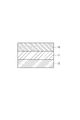
- the film material for an intermediate film includes a resin layer 11, and one base material 10 and the other base material 12 that are stacked so as to sandwich the resin layer 11. It may be.
- the base material 10 it is preferable to use a lightly peelable base material than the base material 12.
- the substrate 10 include polymer films such as polyethylene terephthalate, polypropylene, and polyethylene, and among them, a polyethylene terephthalate film (hereinafter sometimes referred to as “PET film”) is preferable.
- PET film polyethylene terephthalate film
- the thickness of the base material 10 is preferably 25 to 150 ⁇ m, more preferably 30 to 100 ⁇ m, and still more preferably 40 to 80 ⁇ m.
- the planar shape of the substrate 10 is larger than the planar shape of the resin layer 11, and the outer edge of the substrate 10 preferably projects outward from the outer edge of the resin layer 11.
- the width at which the outer edge of the substrate 10 protrudes from the outer edge of the resin layer 11 is preferably 2 to 20 mm from the viewpoint of ease of handling, ease of peeling, and reduction of adhesion of dust and the like, and preferably 4 to 10 mm. More preferably.
- the planar shape of the resin layer 11 and the base material 10 is a substantially rectangular shape such as a substantially rectangular shape
- the width at which the outer edge of the base material 10 protrudes from the outer edge of the resin layer 11 is 2 to 20 mm on at least one side. It is preferably 4 to 10 mm on at least one side, more preferably 2 to 20 mm on all sides, and particularly preferably 4 to 10 mm on all sides.
- the base material 12 it is preferable to use a base material that is more peelable than the base material 10.
- the base material 12 include polymer films such as polyethylene terephthalate, polypropylene, and polyethylene, and among them, a PET film is preferable.
- the thickness of the substrate 12 is preferably 50 to 200 ⁇ m, more preferably 60 to 150 ⁇ m, and still more preferably 70 to 130 ⁇ m from the viewpoint of workability.
- the planar shape of the substrate 12 is larger than the planar shape of the resin layer 11, and the outer edge of the substrate 12 preferably projects outward from the outer edge of the resin layer 11.
- the width at which the outer edge of the base material 12 protrudes from the outer edge of the resin layer 11 is preferably 2 to 20 mm from the viewpoint of ease of handling, ease of peeling, and reduction of adhesion of dust and the like, and preferably 4 to 10 mm. More preferably.
- the planar shape of the resin layer 11 and the base material 12 is a substantially rectangular shape such as a substantially rectangular shape
- the width at which the outer edge of the base material 12 protrudes from the outer edge of the resin layer 11 is 2 to 20 mm on at least one side. It is preferably 4 to 10 mm on at least one side, more preferably 2 to 20 mm on all sides, and particularly preferably 4 to 10 mm on all sides.
- the peel strength between the substrate 10 and the resin layer 11 is preferably lower than the peel strength between the substrate 12 and the resin layer 11. Thereby, the base material 12 becomes difficult to peel from the resin layer 11 than the base material 10.
- the peel strength can be adjusted, for example, by subjecting the base material 12 and the base material 10 to surface treatment.
- the surface treatment method for example, a release treatment of the base material with a silicone compound or a fluorine compound may be mentioned.
- the resin composition according to this embodiment is diluted with a volatile solvent such as 2-butanone, cyclohexanone, methyl ethyl ketone, ethyl acetate, and toluene to prepare a coating solution.
- a volatile solvent such as 2-butanone, cyclohexanone, methyl ethyl ketone, ethyl acetate, and toluene
- the said coating liquid is apply
- each component may be blended and then diluted with a solvent, or may be diluted in advance with a solvent before blending each component.
- a coating method for example, a known method such as a flow coating method, a roll coating method, a gravure coating method, a wire bar coating method, or a lip die coating method can be used.
- the base material 10 After forming the resin layer 11 on the base material 12, the base material 10 is laminated
- the resin layer 11 is sandwiched between the base material 10 and the base material 12.
- the resin composition may contain a surfactant such as a polydimethylsiloxane-based surfactant or a fluorine-based surfactant. Good.
- the thickness of the resin layer 11 is not particularly limited because it is appropriately adjusted depending on the intended use and method, but may be 10 to 5000 ⁇ m, 25 to 200 ⁇ m, 25 to 180 ⁇ m, or 25 to 150 ⁇ m. When used in this range, an interlayer film for laminated glass that is more excellent in splitting resistance against externally applied impacts can be obtained.
- the light transmittance of the resin layer 11 for light in the visible light region (wavelength: 380 nm to 780 nm) is preferably 80% or more, more preferably 90% or more, and still more preferably 95% or more. .
- the haze of the resin layer 11 is preferably 5% or less, more preferably 3% or less, and still more preferably 1% or less.
- the film material for an interlayer film according to this embodiment can facilitate storage and transportation without damaging the resin layer 11.
- the resin layer 11 can be, for example, a glass-to-glass, a glass-resin transparent substrate (or transparent film), or a resin-made transparent substrate (or transparent film) bonded together as an intermediate film.
- the interlayer film for laminated glass according to the present embodiment (hereinafter sometimes simply referred to as “intermediate film”) can be applied to various types of laminated glass.
- the laminated glass includes two glass plates facing each other and an intermediate film sandwiched between the two glass plates.
- the method for producing a laminated glass according to the present embodiment includes a step of bonding two glass plates through a resin layer included in the above-described interlayer film material for laminated glass to obtain a laminate, and 30 to 150 ° C. And a step of subjecting the laminate to a heat and pressure treatment under conditions of 0.3 to 1.5 MPa.
- the glass examples include float glass, air-cooled tempered glass, chemically tempered glass, and multilayer glass.
- the thickness of the glass may be, for example, 0.1 to 50 mm, 0.5 to 30 mm, 1 to 20 mm, or 2 to 10 mm.
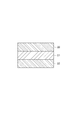
- FIG. 2 is a side sectional view schematically showing one embodiment of a laminated glass.
- the laminated glass shown in FIG. 2 the float glass 20, the intermediate film 21, and the float glass 22 are laminated
- the laminated glass shown in FIG. 2 can be manufactured by the following method, for example.
- the base material 10 in the film material for an intermediate film is peeled from the resin layer 11 to expose the surface of the resin layer 11. Subsequently, after sticking the surface of the resin layer 11 used as the intermediate film 21 on the float glass 20 which is a 1st adherend and pressing with the roller etc., the base material 12 is peeled from the resin layer 11, and the surface is exposed. . Subsequently, the surface of the resin layer 11 is attached to the float glass 22 which is the second adherend, and is heated and pressurized (autoclave treatment), and the float glass 20 and the intermediate film 21 (resin layer 11) are interposed. A laminated glass to which 21 is bonded is produced.
- adherends can be easily bonded to each other without wrinkles. Moreover, the process of heat-pressing can also be performed in a short time at a low temperature. By using the resin layer 11, the intermediate film 21 is not whitened, and the stable transparency of the laminated glass can be maintained.
- the conditions of the heat and pressure treatment are a temperature of 30 to 150 ° C. and a pressure of 0.3 to 1.5 MPa. From the viewpoint of further removing entrained bubbles, the temperature is 50 to 70 ° C. and 0.3 to 0 It may be 5 MPa. Further, the treatment time is preferably 5 to 60 minutes, more preferably 10 to 30 minutes.
- the second adherend may be a resin transparent substrate.
- the transparent substrate include transparent plastic substrates such as acrylic resin substrates, polycarbonate substrates, cycloolefin polymer substrates, and polyester substrates.
- the intermediate film according to the present embodiment may be used for combining and bonding functional layers having functionality such as an antireflection layer, an antifouling layer, a dye layer, and a hard coat layer of laminated glass.
- the antireflection layer may be a layer having antireflection properties with a visible light reflectance of 5% or less.
- a layer obtained by treating a transparent substrate such as a transparent plastic film with a known antireflection method can be used.
- the antifouling layer is intended to make the surface difficult to get dirty.
- a known layer made of a fluorine-based resin or a silicone-based resin can be used to reduce the surface tension.
- the dye layer is used to increase color purity, and is used to reduce light having an unnecessary wavelength that is transmitted through the laminated glass.
- the dye layer can be obtained by dissolving a dye that absorbs light having an unnecessary wavelength in a resin and forming or laminating it on a base film such as a polyethylene film or a polyester film.
- the hard coat layer is used to increase the surface hardness.
- a hard-coat layer what formed or laminated
- a hard coat layer formed or laminated on a transparent protective plate such as glass, acrylic resin, or polycarbonate can be used.
- the resin layer 11 can be laminated using a roll laminate, a vacuum bonding machine, or a single wafer bonding machine.
- the weight average molecular weight (Mw) of the copolymer produced in the production example was measured using a standard polystyrene calibration curve according to the GPC method and using the following GPC measurement apparatus and measurement conditions.
- RI detector L-3350 (Hitachi, Ltd., product name)
- Eluent THF
- Production Example 4 In a reaction vessel, 55.0 g of 2-ethylhexyl acrylate, 25.0 g of 2-hydroxyethyl acrylate, 20.0 g of methacryloyl-modified polysiloxane compound with one terminal (ethylenically unsaturated group equivalent: 12000 g / mol) and 145.0 g of ethyl acetate were added. A solution of copolymer A-4 (Mw 700,000) with a solid content concentration of 40% was obtained in the same manner as in Production Example 1 except for the addition.
- Production Example 5 In a reaction vessel, 80.0 g of 2-ethylhexyl acrylate, 10.0 g of 2-hydroxyethyl acrylate, methacryloyl-modified polysiloxane compound at both ends (Shin-Etsu Chemical Co., Ltd., product name “X-22-164E”, ethylenically unsaturated group) (Equivalent: 7800 g / mol) A solution of copolymer A-5 (Mw 700000) with a solid content of 40% was obtained in the same manner as in Production Example 1 except that 10.0 g and 145.0 g of ethyl acetate were added. .
- Production Example 6 The same operation as in Production Example 1 was conducted except that 80.0 g of 2-ethylhexyl acrylate, 10.0 g of 2-hydroxyethyl acrylate, 10.0 g of 3-acryloxypropyltrimethoxysilane and 145.0 g of ethyl acetate were added to the reaction vessel. As a result, a solution of copolymer A-6 (Mw 700000) having a solid content concentration of 40% was obtained.
- Production Example 7 In a reaction vessel, 80.0 g of 2-ethylhexyl acrylate, 10.0 g of 4-hydroxybutyl acrylate, 10.0 g of one-end methacryloyl-modified polysiloxane compound (ethylenically unsaturated group equivalent: 7800 g / mol) and 145.0 g of ethyl acetate were added.
- a solution of copolymer A-7 (Mw 700000) with a solids concentration of 40% was obtained in the same manner as in Production Example 1 except for the addition.
- Production Example 8 Copolymer A-8 (solid content concentration: 40%) was prepared in the same manner as in Production Example 1 except that 90.0 g of 2-ethylhexyl acrylate, 10.0 g of 2-hydroxyethyl acrylate and 145.0 g of ethyl acetate were added. Mw 700,000) was obtained.
- Example 1 0.2 parts by mass of a polyisocyanate compound (Tosoh Corporation, product name “Coronate HL”) is used as a thermal crosslinking agent with respect to 100 parts by mass of the copolymer of the copolymer A-1 solution obtained in Production Example 1.
- a coating liquid of the resin composition was prepared.
- a coating liquid of the resin composition was applied to a PET film (base material 12) having a thickness of 75 ⁇ m on the surface using a bar coater so that the thickness after drying was 100 ⁇ m.
- the resin layer was formed by heating and drying for a minute.
- a PET film (base material 10) having a thickness of 75 ⁇ m that had been subjected to a mold release treatment was placed on the resin layer, and was adhered by a 1.0 kgf hand roller to produce an intermediate film material.
- Example 2 A resin composition coating solution and a film material were obtained in the same manner as in Example 1 except that the solution of copolymer A-2 obtained in Production Example 2 was used.
- Example 3 A resin composition coating solution and a film material were obtained in the same manner as in Example 1 except that the solution of copolymer A-3 obtained in Production Example 3 was used.
- Example 4 A resin composition coating solution and a film material were obtained in the same manner as in Example 1 except that the solution of copolymer A-4 obtained in Production Example 4 was used.
- Example 5 A resin composition coating solution and a film material were obtained in the same manner as in Example 1 except that the solution of copolymer A-5 obtained in Production Example 5 was used.
- Example 6 A resin composition coating solution and a film material were obtained in the same manner as in Example 1 except that the copolymer polymer A-6 obtained in Production Example 6 was used.
- Example 7 A resin composition coating solution and a film material were obtained in the same manner as in Example 1 except that the solution of copolymer A-7 obtained in Production Example 7 was used.
- Comparative Example 1 A resin composition coating solution and a film material were obtained in the same manner as in Example 1, except that the solution of copolymer A-8 obtained in Production Example 8 was used.
- the film material for an interlayer film of Example and Comparative Example 1 was cut into a size of 50 mm ⁇ 50 mm, allowed to stand for 24 hours under conditions of 85 ° C. and 85% RH, then taken out, and the substrate 10 was peeled off. After exposing the surface of the resin layer, the surface of the resin layer was attached to float glass having a length of 50 mm, a width of 50 mm, and a thickness of 2.7 mm, and pressed with a roller.
- the substrate 12 is peeled off from the resin layer to expose the surface of the resin layer, and the surface of the resin layer is made into a float glass having a length of 50 mm, a width of 50 mm, and a thickness of 2.7 mm in a vacuum state using a vacuum laminator.
- the laminated body was produced by pasting. Thereafter, the laminate was subjected to heat and pressure treatment (autoclave treatment) under the conditions of a temperature of 50 ° C., a pressure of 0.5 MPa, and a holding time of 30 minutes to obtain a laminated glass.
- the resin film was cut into a size of 50 mm ⁇ 50 mm, left for 24 hours under conditions of 85 ° C.
- Example and Comparative Example 1 After the base material 10 was peeled from the produced film material for interlayer film to expose the surface of the resin layer, the surface of the resin layer was 110 mm long, 110 mm wide, and thickness 2 Affixed to a 7 mm float glass and pressed with a roller. Next, the base material 12 is peeled off from the resin layer to expose the surface of the resin layer, and the surface of the resin layer is attached to a float glass having a length of 110 mm, a width of 110 mm and a thickness of 2.7 mm in a vacuum state using a vacuum laminator. Thus, a laminate was produced.
- the laminate was subjected to heat and pressure treatment (autoclave treatment) under the conditions of a temperature of 50 ° C., a pressure of 0.5 MPa, and a holding time of 30 minutes to obtain a laminated glass.
- heat and pressure treatment autoclave treatment
- the resin film was sandwiched between float glasses, and autoclaved under conditions of a temperature of 135 ° C., a pressure of 118 N / cm 2 MPa, and a holding time of 20 minutes to obtain a laminated glass.
- Impact resistance test Steel balls with a mass of about 1040g and a diameter of 63.5mm are placed in the order of 5cm to 100cm in 5cm increments at a position within 25mm from the center point of the produced 110mm long and 110mm wide laminated glass (peripheral support). The height when the glass broke was recorded. Six laminated glasses made of each interlayer film were tested, the average height was calculated, and the larger the value, the higher the splitting glass.
Landscapes
- Chemical & Material Sciences (AREA)
- Health & Medical Sciences (AREA)
- Chemical Kinetics & Catalysis (AREA)
- Medicinal Chemistry (AREA)
- Polymers & Plastics (AREA)
- Organic Chemistry (AREA)
- Laminated Bodies (AREA)
- Macromonomer-Based Addition Polymer (AREA)
- Joining Of Glass To Other Materials (AREA)
- Addition Polymer Or Copolymer, Post-Treatments, Or Chemical Modifications (AREA)
Abstract
本発明は、(メタ)アクリロイル化合物と、エチレン性不飽和基を有するケイ素化合物と、を含有するモノマー混合物の共重合体を含む、合わせガラスの中間膜用の樹脂組成物に関する。
Description
本発明は、合わせガラスの中間膜用樹脂組成物、中間膜用フィルム材及び合わせガラスの製造方法に関する。
現在、自動車のような車輌の窓、サンルーフ、内装パネル等のガラスとしては、外部衝撃を受けて破損してもガラスの破片が飛散することが少なく安全であるため、合わせガラスが広く用いられている。合わせガラスは、電車、航空機、建設機械、建築物等の窓にも用いられている。
合わせガラスの一例として、少なくとも一対のガラス板間に、可塑剤により可塑化されたポリビニルブチラール樹脂等のポリビニルアセタール樹脂からなる合わせガラス用中間膜を介在させ、一体化させて得られるものが挙げられる(例えば、特許文献1~3参照)。
従来の合わせガラスの多くは、同等の厚みのガラスに比べて同等程度の防割性を有しているが、外部から加えられた衝撃に対して、より割れ難く、防割性の高い合わせガラスが求められている。
本発明は、外部から加えられた衝撃に対して、防割性に優れる合わせガラスを作製できる、合わせガラスの中間膜用樹脂組成物、中間膜用フィルム材及び合わせガラスの製造方法を提供することを目的とする。
本発明は、(メタ)アクリロイル化合物と、エチレン性不飽和基を有するケイ素化合物と、を含有するモノマー混合物の合わせガラスの中間膜用樹脂組成物を提供する。
上記(メタ)アクリロイル化合物は、アルキル(メタ)アクリレートと、水酸基を有する(メタ)アクリレートとを含有してもよい。
上記モノマー混合物は、アルキル(メタ)アクリレート50~90質量部、水酸基を有する(メタ)アクリレート5~30質量部及びエチレン性不飽和基を有するケイ素化合物5~20質量部を含有してもよい。
本発明に係る樹脂組成物は、熱架橋剤を更に含んでもよい。
本発明はまた、基材と、基材上に設けられた樹脂層と、を有し、樹脂層が、対向する2枚のガラス板と前記2枚のガラス板の間に挟まれた中間膜とを備える合わせガラスの前記中間膜を形成するために用いられる、合わせガラスの中間膜用フィルム材であって、樹脂層が、上記中間膜用樹脂組成物から形成された層である、中間膜用フィルム材を提供する。
上記樹脂層のヘーズは、5%以下であってもよい。
本発明はさらに、対向する2枚のガラス板と、前記2枚のガラス板の間に挟まれた中間膜と、を備える合わせガラスの製造方法であって、上記合わせガラスの中間膜用が備える樹脂層を介して、2枚のガラス板を貼り合せて積層体を得る工程と、30~150℃及び0.3~1.5MPaの条件で、積層体を加熱加圧処理する工程とを含む、合わせガラスの製造方法を提供する。
本発明によれば、外部から加えられた衝撃に対して、防割性に優れる合わせガラスを作製できる、合わせガラスの中間膜用樹脂組成物、フィルム材及び合わせガラスの製造方法を提供できる。
以下、場合により図面を参照しつつ本発明の好適な実施形態について説明をするが、本発明は以下の実施形態に何ら限定されるものではない。
本明細書において「(メタ)アクリレート」とは、「アクリレート」及びそれに対応する「メタクリレート」の少なくとも一方を意味する。(メタ)アクリロイル等の他の類似表現についても同様である。
<合わせガラスの中間膜用樹脂組成物>
本実施形態の合わせガラスの中間膜用樹脂組成物(以下、単に「樹脂組成物」という場合がある。)は、(メタ)アクリロイル化合物と、エチレン性不飽和基を有するケイ素化合物と、を含有するモノマー混合物の共重合体を含んでいる。
本実施形態の合わせガラスの中間膜用樹脂組成物(以下、単に「樹脂組成物」という場合がある。)は、(メタ)アクリロイル化合物と、エチレン性不飽和基を有するケイ素化合物と、を含有するモノマー混合物の共重合体を含んでいる。
本実施形態に係る樹脂組成物は、特定の共重合体を含むことにより、ガラス等の被着体表面への密着性が向上し、作製される積層体の強靭性が向上することで、合わせガラスの高い防割性を発現することができる。
(共重合体)
本実施形態に係る共重合体は、(メタ)アクリロイル基を有する化合物(但し、構成原子としてケイ素を有しない。)に基づく構造単位と、エチレン性不飽和基を有するケイ素化合物に基づく構造単位を含んでいる。
本実施形態に係る共重合体は、(メタ)アクリロイル基を有する化合物(但し、構成原子としてケイ素を有しない。)に基づく構造単位と、エチレン性不飽和基を有するケイ素化合物に基づく構造単位を含んでいる。
(メタ)アクリロイル基を1つ有する化合物としては、例えば、(メタ)アクリル酸、(メタ)アクリルアミド、(メタ)アクリルアミド誘導体、アルキル(メタ)アクリレート、アルキレングリコール鎖を有する(メタ)アクリレート、水酸基を有する(メタ)アクリレート、芳香環を有する(メタ)アクリレート、脂環式基を有する(メタ)アクリレート、(メタ)アクリロイルモルホリン、テトラヒドロフルフリル(メタ)アクリレート及びイソシアネート基を有する(メタ)アクリレートが挙げられる。
アルキル(メタ)アクリレートとしては、例えば、メチル(メタ)アクリレート、エチル(メタ)アクリレート、n-ブチル(メタ)アクリレート、イソブチル(メタ)アクリレート、tert-ブチル(メタ)アクリレート、n-ペンチル(メタ)アクリレート、n-ヘキシル(メタ)アクリレート、n-オクチル(メタ)アクリレート、イソオクチル(メタ)アクリレート、2-エチルヘキシル(メタ)アクリレート、イソデシル(メタ)アクリレート、ドデシル(メタ)アクリレート及びステアリル(メタ)アクリレート等の炭素数1~18のアルキル基を有するアルキル(メタ)アクリレートが挙げられる。中でも、アルキル(メタ)アクリレートとしては、n-ブチル(メタ)アクリレート、イソオクチル(メタ)アクリレート、2-エチルヘキシル(メタ)アクリレート及びn-オクチル(メタ)アクリレートが好ましく、2-エチルヘキシル(メタ)アクリレートがより好ましい。また、アルキルメタクリレートよりもアルキルアクリレートの方が好ましい。アルキル(メタ)アクリレートは、単独で又は2種類以上を組み合わせて使用してもよい。
水酸基を有する(メタ)アクリレートとしては、例えば、2-ヒドロキシエチル(メタ)アクリレート、1-ヒドロキシエチル(メタ)アクリレート、2-ヒドロキシプロピル(メタ)アクリレート、3-ヒドロキシプロピル(メタ)アクリレート、1-ヒドロキシプロピル(メタ)アクリレート、4-ヒドロキシブチル(メタ)アクリレート、3-ヒドロキシブチル(メタ)アクリレート、2-ヒドロキシブチル(メタ)アクリレート及び1-ヒドロキシブチル(メタ)アクリレートが挙げられる。
アルキレングリコール鎖を有する(メタ)アクリレートとしては、例えば、ジエチレングリコールモノ(メタ)アクリレート、トリエチレングリコールモノ(メタ)アクリレート、テトラエチレングリコールモノ(メタ)アクリレート、ヘキサエチレングリコールモノ(メタ)アクリレート等のポリエチレングリコールモノ(メタ)アクリレート;ジプロピレングリコールモノ(メタ)アクリレート、トリプロピレングリコールモノ(メタ)アクリレート、オクタプロピレングリコールモノ(メタ)アクリレート等のポリプロピレングリコールモノ(メタ)アクリレート;ジブチレングリコールモノ(メタ)アクリレート、トリブチレングリコールモノ(メタ)アクリレート等のポリブチレングリコールモノ(メタ)アクリレート;メトキシトリエチレングリコール(メタ)アクリレート、メトキシテトラエチレングリコール(メタ)アクリレート、メトキシヘキサエチレングリコール(メタ)アクリレート、メトキシオクタエチレングリコール(メタ)アクリレート、メトキシノナエチレングリコール(メタ)アクリレート、メトキシポリエチレングリコール(メタ)アクリレート、メトキシヘプタプロピレングリコール(メタ)アクリレート、エトキシテトラエチレングリコール(メタ)アクリレート、ブトキシエチレングリコール(メタ)アクリレート、ブトキシジエチレングリコール(メタ)アクリレート等のアルコキシポリアルキレングリコール(メタ)アクリレートが挙げられる。また、これらのアルキレングリコール鎖含有(メタ)アクリレートは、単独で又は2種類以上を組み合わせて使用してもよい。
芳香環を有する(メタ)アクリレートとしては、例えば、ベンジル(メタ)アクリレート及びフェノキシエチル(メタ)アクリレートが挙げられる。脂環式基を有する(メタ)アクリレートとしては、例えば、シクロヘキシル(メタ)アクリレート、イソボルニル(メタ)アクリレート及びジシクロペンタニル(メタ)アクリレートが挙げられる。(メタ)アクリルアミド誘導体としては、例えば、N,N-ジメチルアミノエチル(メタ)アクリレート、N,N-ジメチルアミノプロピル(メタ)アクリルアミド、N,N-ジメチル(メタ)アクリルアミド、N-イソプロピル(メタ)アクリルアミド、N,N-ジエチル(メタ)アクリルアミド及びN-ヒドロキシエチル(メタ)アクリルアミドが挙げられる。イソシアネート基を有する(メタ)アクリレートとしては、例えば、2-(2-メタクリロイルオキシエチルオキシ)エチルイソシアネート及び2-(メタ)アクリロイルオキシエチルイソシアネートが挙げられる。
本実施形態に係る共重合体は、アルキル(メタ)アクリレートに基づく構造単位を含むことが好ましい。アルキル(メタ)アクリレートの共重合割合は、共重合体の全質量に対して、50~90質量%であることが好ましく、50~85質量%であることがより好ましい。アルキル(メタ)アクリレートの共重合割合がこのような範囲であると、樹脂層と被着体との密着性が向上することができる。このような共重合体は、アルキル(メタ)アクリレートを上記共重合割合と同じ含有割合で含有するモノマー混合物を共重合させることで得ることができる。また、重合率は、実質的に100質量%に近づくようにすることがより好ましい。
本実施形態に係る共重合体は、水酸基を有する(メタ)アクリレートに基づく構造単位を含むことが好ましい。水酸基を有する(メタ)アクリレートの共重合割合は、共重合体の全質量に対して、5~30質量%であることが好ましく、10~30質量%であることがより好ましい。水酸基を有する(メタ)アクリレートの共重合割合がこのような範囲であると、合わせガラスの信頼性試験(加熱加湿条件)において、ヘーズが5.0%以下の透明性を発現することができる。
ヘーズ(Haze)とは、濁度を表わす値(%)であり、ランプにより照射され、試料中を透過した光の全透過率Ttと、試料中で拡散され散乱した光の透過率Tdより、(Td/Tt)×100として求められる。これらはJIS K 7136により規定されており、市販の濁度計、例えば、日本電色工業株式会社製NDH-5000により容易に測定可能である。
本実施形態に係る(メタ)アクリロイル化合物は、アルキル(メタ)アクリレートと、水酸基を有する(メタ)アクリレートとを含有することが好ましい。
(メタ)アクリロイル化合物は、(メタ)アクリロイル基と、モルホリノ基、アミノ基、カルボキシル基、シアノ基、カルボニル基、ニトロ基、アルキレングリコール由来の基等の極性基と、を有する化合物を更に含有してもよい。極性基を有する(メタ)アクリレートを含有することによって、樹脂層と被着体との密着性が向上し易くなる。
エチレン性不飽和基を有するケイ素化合物としては、(メタ)アクリロイル基、スチリル基、ケイ皮酸エステル基、ビニル基、アリル基等の不飽和結合を有する基を有し、かつ、構成原子としてケイ素を有する化合物であれば、特に限定されない。本実施形態に係るケイ素化合物としては、シロキサン化合物又はシラン化合物であってもよく、例えば、下記式(a)、(b)又は(c)に表される化合物が挙げられる。ケイ素化合物は、式(a)、(b)又は(c)で表される化合物を単独で又は2種類以上を組み合わせて使用してもよい。



1価の炭化水素基としては、例えば、炭素数1~6のアルキル基又はフェニル基が挙がられる。2価の炭化水素基としては、例えば、炭素数1~20のアルキレン基が挙がられる。
本実施形態に係る共重合体において、ケイ素化合物に基づくモノマー単位の共重合割合は、共重合体の全質量に対して、5~20質量%であることが好ましく、10~20質量%であることがより好ましい。ケイ素化合物の共重合割合がこのような範囲であると、樹脂層と被着体との密着性が向上し、積層体の強靭性が向上することで、合わせガラスの防割性がより一層向上する。
合わせガラスの防割性及び中間膜の透明性を更に向上する観点から、モノマー混合物は、アルキル(メタ)アクリレート50~90質量部、水酸基を有する(メタ)アクリレート5~30質量部及びエチレン性不飽和基を有するケイ素化合物5~20質量部を含有してもよく、アルキル(メタ)アクリレート50~85質量部、水酸基を有する(メタ)アクリレート10~30質量部及びエチレン性不飽和基を有するケイ素化合物5~20質量部を含有してもよい。
モノマー混合物は、本発明の奏する効果を損なわない範囲であれば、(メタ)アクリロイル基を2以上有する化合物、(メタ)アクリロイル基以外の重合性基を有する化合物を含有してもよい。(メタ)アクリロイル基以外の重合性基を有する化合物としては、例えば、アクリロニトリル、スチレン、酢酸ビニル、エチレン、プロピレン及びジビニルベンゼンが挙げられる。
共重合体の重量平均分子量(Mw)は、ゲルパーミエーションクロマトグラフィー(GPC)法により標準ポリスチレンの検量線を用いて換算した値が、80000~1000000であることが好ましく、100000~900000であることがより好ましく、200000~800000であることが更に好ましい。共重合体のMwが80000以上であると、被着体に対して密着性を有する樹脂層を得易くなり、1000000以下であると、樹脂組成物の粘度が高くなり過ぎず、樹脂層を形成する際の加工性が良好になる。
本実施形態に係る共重合体は、例えば、溶液重合、乳化重合、懸濁重合、塊状重合等の既知の重合方法を用いて合成することができる。
共重合体を合成する際の重合開始剤として、熱によりラジカルを発生する化合物を用いることができる。重合開始剤としては、例えば、過酸化ベンゾイル、ラウロイルパーオキシド等の有機過酸化物;2,2’-アゾビスイソブチロニトリル、2,2’-アゾビス(2-メチルブチロニトリル)等のアゾ系化合物が挙げられる。
(その他添加剤)
樹脂組成物には必要に応じて、上記共重合体と共に、各種添加剤を含有させてもよい。
樹脂組成物には必要に応じて、上記共重合体と共に、各種添加剤を含有させてもよい。
添加剤として、例えば、樹脂組成物の凝集力を高めるために、架橋剤を用いてもよい。架橋剤の具体例としては、光架橋剤及び熱架橋剤が挙げられる。
光架橋剤としては、例えば、炭素数1~20のアルキレン基を有するアルキレンジオールジ(メタ)アクリレート;ポリエチレングリコールジ(メタ)アクリレート、ポリプロピレングリコールジ(メタ)アクリレート等のアルキレングリコールジ(メタ)アクリレート;エトキシ化ビスフェノールAジ(メタ)アクリレート、エトキシ化ビスフェノールFジ(メタ)アクリレート、ビスフェノールA型エポキシ(メタ)アクリレート等のビスフェノール型ジ(メタ)アクリレート;及びウレタン結合を有するウレタンジ(メタ)アクリレートが挙げられる。
ウレタン結合を有するウレタンジ(メタ)アクリレートは、他の成分との相溶性が良好である観点から、ポリアルキレングリコール鎖を有していてもよく、透明性を確保する観点から、脂環式構造を有していてもよい。光架橋剤と、共重合体との相溶性が低い場合、樹脂組成物から形成される樹脂層が白濁する可能性がある。
高温又は高温高湿下における気泡及び剥がれの発生をより抑制できる観点から、光架橋剤の重量平均分子量は、100000以下であることが好ましく、300~100000であることがより好ましく、500~80000であることが更に好ましい。
光架橋剤を用いる場合の含有量は、共重合体の全質量に対して、15質量%以下であることが好ましく、10質量%以下であることがより好ましく、7質量%以下であることが更に好ましい。このような範囲であると、十分な密着性を有する樹脂層を得ることができる。光架橋剤の含有量の下限については特に制限はないが、フィルム形成性を良好にする観点から、0.1質量%以上であることが好ましく、2質量%以上であることがより好ましく、3質量%以上であることが更に好ましい。
熱架橋剤としては、例えば、イソシアネート化合物、メラミン化合物、エポキシ化合物等の熱架橋剤を用いることができる。熱架橋剤としては、樹脂層中に緩やかに広がった網目状構造を形成するために、3官能、4官能といった多官能の熱架橋剤がより好ましい。
反応性の観点から、熱架橋剤として、イソシアネート化合物が好ましく、ポリイソシアネート化合物がより好ましい。ポリイソシアネート化合物としては、例えば、ヘキサメチレンジイソシアネートの三量体、トチメチロールプロパン等のトリオール、ジオール又は単官能アルコールと、ヘキサメチレンジイソシアネートとの反応生成物である多官能性ヘキサメチレンジイソシアネート化合物が挙げられる。
熱架橋剤を用いる場合の含有量は、共重合体の全質量に対して、5質量%以下であることが好ましく、2質量%以下であることがより好ましく、1質量%以下であることが更に好ましい。このような範囲であると、十分な密着性を有する樹脂層を得ることができる。熱架橋剤の含有量の下限については特に制限はないが、フィルム形成性を良好にする観点から、0.01質量%以上であることが好ましい。
共重合体又は架橋剤のいずれかが活性エネルギー線による硬化系である場合、光重合開始剤が必要となる。光重合開始剤は、活性エネルギー線の照射により硬化反応を促進させるものである。活性エネルギー線とは、紫外線、電子線、α線、β線、γ線等をいう。
光重合開始剤としては、特に限定されるものではなく、ベンゾフェノン化合物、アントラキノン化合物、ベンゾイル化合物、スルホニウム塩、ジアゾニウム塩、オニウム塩等の公知の材料を使用することが可能である。
光重合開始剤として、例えば、ベンゾフェノン、N,N,N’,N’-テトラメチル-4,4’-ジアミノベンゾフェノン(ミヒラーケトン)、N,N,N’,N’-テトラエチル-4,4’-ジアミノベンゾフェノン、4-メトキシ-4’-ジメチルアミノベンゾフェノン、α-ヒドロキシイソブチルフェノン、2-エチルアントラキノン、t-ブチルアントラキノン、1,4-ジメチルアントラキノン、1-クロロアントラキノン、2,3-ジクロロアントラキノン、3-クロロ-2-メチルアントラキノン、1,2-ベンゾアントラキノン、2-フェニルアントラキノン、1,4-ナフトキノン、9,10-フェナントラキノン、チオキサントン、2-クロロチオキサントン、1-ヒドロキシシクロヘキシルフェニルケトン、2,2-ジメトキシ-1,2-ジフェニルエタン-1-オン、2-ヒドロキシ-2-メチル-1-フェニルプロパン-1-オン、2,2-ジエトキシアセトフェノン等の芳香族ケトン化合物;ベンゾイン、メチルベンゾイン、エチルベンゾイン等のベンゾイン化合物;ベンゾインメチルエーテル、ベンゾインエチルエーテル、ベンゾインイソブチルエーテル、ベンゾインフェニルエーテル等のベンゾインエーテル化合物;ベンジル、ベンジルジメチルケタール等のベンジル化合物;β-(アクリジン-9-イル)(メタ)アクリル酸等のエステル化合物;9-フェニルアクリジン、9-ピリジルアクリジン、1,7-ジアクリジノヘプタン等のアクリジン化合物;2-(o-クロロフェニル)-4,5-ジフェニルイミダゾール二量体、2-(o-クロロフェニル)-4,5-ジ(m-メトキシフェニル)イミダゾール二量体、2-(o-フルオロフェニル)-4,5-ジフェニルイミダゾール二量体、2-(o-メトキシフェニル)-4,5-ジフェニルイミダゾール二量体、2-(p-メトキシフェニル)-4,5-ジフェニルイミダゾール二量体、2,4-ジ(p-メトキシフェニル)5-フェニルイミダゾール二量体、2-(2,4-ジメトキシフェニル)-4,5-ジフェニルイミダゾール二量体、2-(p-メチルメルカプトフェニル)-4,5-ジフェニルイミダゾール二量体等の2,4,5-トリアリールイミダゾール二量体;2-ベンジル-2-ジメチルアミノ-1-(4-モリホリノフェニル)-1-ブタノン;2-メチル-1-[4-(メチルチオ)フェニル]-2-モルホリノ-1-プロパン;ビス(2,4,6-トリメチルベンゾイル)-フェニルホスフィンオキサイド;オリゴ(2-ヒドロキシ-2-メチル-1-(4-(1-メチルビニル)フェニル)プロパノン)が挙げられる。これらの化合物は複数を組み合わせて使用してもよい。
樹脂組成物を着色させない光重合開始剤としては、例えば、1-ヒドロキシシクロヘキシルフェニルケトン、2-ヒドロキシ-2-メチル-1-フェニル-プロパン-1-オン、1-[4-(2-ヒドロキシエトキシ)-フェニル]-2-ヒドロキシ-2-メチル-1-プロパン-1-オン等のα-ヒドロキシアルキルフェノン化合物;ビス(2,4,6-トリメチルベンゾイル)-フェニルホスフィンオキサイド、ビス(2,6-ジメトキシベンゾイル)-2,4,4-トリメチル-ペンチルホスフィンオキサイド、2,4,6-トリメチルベンゾイル-ジフェニルホスフィンオキサイド等のアシルホスフィンオキサイド化合物;オリゴ(2-ヒドロキシ-2-メチル-1-(4-(1-メチルビニル)フェニル)プロパノン)が挙げられる。
特に厚い樹脂層を形成するためには、光重合開始剤は、例えば、ビス(2,4,6-トリメチルベンゾイル)-フェニルホスフィンオキサイド、ビス(2,6-ジメトキシベンゾイル)-2,4,4-トリメチル-ペンチルホスフィンオキサイド、2,4,6-トリメチルベンゾイル-ジフェニルホスフィンオキサイド等のアシルホスフィンオキサイド化合物を含んでもよい。
光重合開始剤の含有量は、樹脂組成物の全質量に対して、0.05~5質量%であることが好ましく、0.1~3質量%がより好ましく、0.1~0.5質量%が更に好ましい。含有量を5質量%以下とすることで、透過率が高く、また色相も黄味を帯びることがなく、透明性に優れる樹脂層を得ることができる。
樹脂組成物には、必要に応じて、架橋剤とは別の添加剤を含有させてもよい。添加剤としては、例えば、樹脂組成物の保存安定性を高める目的で添加するパラメトキシフェノール等の重合禁止剤、樹脂組成物を光硬化させて得られる中間膜の耐熱性を高める目的で添加するトリフェニルホスファイト等の酸化防止剤、紫外線等の光に対する樹脂組成物の耐性を高める目的で添加するHALS(Hindered Amine Light Stabilizer)等の光安定化剤、ガラスに対する樹脂組成物の密着性を高めるために添加するシランカップリング剤が挙げられる。
<合わせガラスの中間膜用フィルム材>
本実施形態に係る合わせガラスの中間膜用フィルム材は、基材と、基材上に設けられた樹脂層とを有し、樹脂層が、対向する2枚のガラス板と2枚のガラス板の間に挟まれた中間膜とを備える合わせガラスの中間膜を形成するために用いられる。当該樹脂層は、上述した中間膜用樹脂組成物から形成された層である。
本実施形態に係る合わせガラスの中間膜用フィルム材は、基材と、基材上に設けられた樹脂層とを有し、樹脂層が、対向する2枚のガラス板と2枚のガラス板の間に挟まれた中間膜とを備える合わせガラスの中間膜を形成するために用いられる。当該樹脂層は、上述した中間膜用樹脂組成物から形成された層である。
図1に示されるように、本実施形態に係る中間膜用フィルム材は、樹脂層11と、樹脂層11を挟むように積層された一方の基材10及び他方の基材12と、を備えていてもよい。
基材10としては、基材12よりも軽剥離性の基材を用いることが好ましい。基材10としては、例えば、ポリエチレンテレフタレート、ポリプロピレン、ポリエチレン等の重合体フィルムが挙げられ、中でも、ポリエチレンテレフタレートフィルム(以下、「PETフィルム」という場合もある)が好ましい。基材10の厚みは、作業性の観点から、25~150μmであることが好ましく、30~100μmであることがより好ましく、40~80μmであることが更に好ましい。
基材10の平面形状は、樹脂層11の平面形状よりも大きく、基材10の外縁は樹脂層11の外縁よりも外側に張り出していることが好ましい。基材10の外縁が樹脂層11の外縁よりも張り出す幅は、取り扱い易さ、剥がし易さ、埃等の付着をより低減できる観点から、2~20mmであることが好ましく、4~10mmであることがより好ましい。樹脂層11及び基材10の平面形状が略長方形等の略矩形状である場合には、基材10の外縁が樹脂層11の外縁よりも張り出す幅は、少なくとも1つの辺において2~20mmであることが好ましく、少なくとも1つの辺において4~10mmであることがより好ましく、全ての辺において2~20mmであることが更に好ましく、全ての辺において4~10mmであることが特に好ましい。
基材12としては、基材10よりも重剥離性の基材を用いることが好ましい。基材12としては、例えば、ポリエチレンテレフタレート、ポリプロピレン、ポリエチレン等の重合体フィルムが挙げられ、中でも、PETフィルムが好ましい。基材12の厚みは、作業性の観点から、50~200μmであることが好ましく、60~150μmであることがより好ましく、70~130μmであることが更に好ましい。
基材12の平面形状は、樹脂層11の平面形状よりも大きく、基材12の外縁は樹脂層11の外縁よりも外側に張り出していることが好ましい。基材12の外縁が樹脂層11の外縁よりも張り出す幅は、取り扱い易さ、剥がし易さ、埃等の付着をより低減できる観点から、2~20mmであることが好ましく、4~10mmであることがより好ましい。樹脂層11及び基材12の平面形状が略長方形等の略矩形状である場合には、基材12の外縁が樹脂層11の外縁よりも張り出す幅は、少なくとも1つの辺において2~20mmであることが好ましく、少なくとも1つの辺において4~10mmであることがより好ましく、全ての辺において2~20mmであることが更に好ましく、全ての辺において4~10mmであることが特に好ましい。
基材10と樹脂層11との間の剥離強度は、基材12と樹脂層11との間の剥離強度よりも低いことが好ましい。これにより、基材12は基材10よりも樹脂層11から剥離し難くなる。剥離強度は、例えば、基材12及び基材10の表面処理を施すことによって調整することができる。表面処理方法としては、例えば、シリコーン系化合物又はフッ素系化合物で、基材を離型処理することが挙げられる。
樹脂層11を形成する方法としては、公知の技術を使用することができる。例えば、まず、本実施形態に係る樹脂組成物を、2-ブタノン、シクロヘキサノン、メチルエチルケトン、酢酸エチル、トルエン等の揮発性溶剤で希釈して塗液を調製する。次いで、上記塗液を、基材12上に塗布し、溶剤を乾燥することにより除去して、任意の厚みを有する樹脂層を形成することができる。上記塗液の調製に際しては、各成分を配合した後に溶剤で希釈してもよく、各成分の配合前に予め溶剤で希釈しておいてもよい。塗布方法としては、例えば、フローコート法、ロールコート法、グラビアコート法、ワイヤーバーコート法、リップダイコート法等の公知の方法を用いることができる。
基材12上に樹脂層11を形成した後、樹脂層11上に基材10を積層することで、本実施形態に係る中間膜用フィルム材が作製される。樹脂層11は基材10及び基材12で挟まれる構成となる。樹脂層11と、基材10及び基材12との剥離性を制御するために、樹脂組成物に、ポリジメチルシロキサン系界面活性剤、フッ素系界面活性剤等の界面活性剤を含有させてもよい。
樹脂層11の厚みは、使用用途及び方法により適宜調整されるため特に限定されないが、10~5000μm、25~200μm、25~180μm、又は、25~150μmであってもよい。この範囲で使用した場合、外部から加えられた衝撃に対して、防割性により一層優れる合わせガラス用中間膜が得られる。
樹脂層11の可視光領域(波長:380nm~780nm)の光線に対する光透過率は、80%以上であることが好ましく、90%以上であることがより好ましく、95%以上であることが更に好ましい。
樹脂層11のヘーズは、5%以下であることが好ましく、3%以下であることがより好ましく、1%以下であることが更に好ましい。
本実施形態に係る中間膜用フィルム材によれば、樹脂層11を傷つけることなく、保管及び運搬を容易にすることができる。
樹脂層11は、中間膜として、例えば、ガラス同士、ガラスと樹脂製の透明基板(又は透明フィルム)、又は、樹脂製の透明基板(又は透明フィルム)同士を貼り合わせることが可能である。
<合わせガラス>
本実施形態に係る合わせガラス用中間膜(以下、単に「中間膜」という場合がある)は、各種合わせガラスに適用することができる。合わせガラスは、対向する2枚のガラス板と、2枚のガラス板の間に挟まれた中間膜と、を備えている。本実施形態に係る合わせガラスの製造方法は、上述した合わせガラスの中間膜用フィルム材が備える樹脂層を介して、2枚のガラス板を貼り合せて積層体を得る工程と、30~150℃及び0.3~1.5MPaの条件で、上記積層体を加熱加圧処理する工程とを含む。
本実施形態に係る合わせガラス用中間膜(以下、単に「中間膜」という場合がある)は、各種合わせガラスに適用することができる。合わせガラスは、対向する2枚のガラス板と、2枚のガラス板の間に挟まれた中間膜と、を備えている。本実施形態に係る合わせガラスの製造方法は、上述した合わせガラスの中間膜用フィルム材が備える樹脂層を介して、2枚のガラス板を貼り合せて積層体を得る工程と、30~150℃及び0.3~1.5MPaの条件で、上記積層体を加熱加圧処理する工程とを含む。
ガラスとしては、例えば、フロートガラス、風冷強化ガラス、化学強化ガラス及び複層ガラスが挙げられる。
ガラスの厚みは、例えば、0.1~50mm、0.5~30mm、1~20mm、又は2~10mmであってもよい。
図2は、合わせガラスの一実施形態を模式的に示す側面断面図である。図2に示す合わせガラスは、フロートガラス20、中間膜21、フロートガラス22がこの順で積層されている。図2に示す合わせガラスは、例えば、下記の方法により製造することができる。
まず、中間膜用フィルム材における基材10を樹脂層11から剥離して樹脂層11の表面を露出させる。次いで、中間膜21となる樹脂層11の表面を第1の被着体であるフロートガラス20に貼り付け、ローラー等で押し付けた後、基材12を樹脂層11から剥離して表面を露出させる。続いて、樹脂層11の表面を第2の被着体であるフロートガラス22に貼り付け、加熱加圧処理(オートクレーブ処理)して、中間膜21(樹脂層11)を介してフロートガラス20及び21を貼り合わせた合わせガラスが作製される。
樹脂層11を用いることにより、シワがなく容易に被着体同士を貼り合せることができる。また、加熱加圧処理する工程を、低温短時間で行うこともできる。樹脂層11を用いることにより、中間膜21が白化することなく、合わせガラスの安定した透明性を維持することができる。
加熱加圧処理の条件は、温度が30~150℃であり、圧力が0.3~1.5MPaであるが、巻き込み気泡をより除去できる観点から、50~70℃で、0.3~0.5MPaであってもよい。また、処理時間は、5~60分間が好ましく、10~30分間であることがより好ましい。
なお、上記では、第2の被着体としてガラスを用いているが、第2の被着体は、樹脂製の透明基板であってもよい。透明基板としては、例えば、アクリル樹脂基板、ポリカーボネート基板、シクロオレフィンポリマー基板、ポリエステル基板等の透明プラスチック基板が挙げられる。
本実施形態に係る中間膜は、合わせガラスの反射防止層、防汚層、色素層、ハードコート層等の機能性を有する機能層を組み合わせて貼り合わせるために使用してもよい。
反射防止層は、可視光反射率が5%以下となる反射防止性を有している層であればよい。反射防止層としては、透明なプラスチックフィルム等の透明基材に既知の反射防止方法で処理された層を用いることができる。
防汚層は、表面に汚れがつきにくくするためのものである。防汚層としては、表面張力を下げるためにフッ素系樹脂又はシリコーン系樹脂等で構成される既知の層を用いることができる。
色素層は、色純度を高めるために使用されるものであり、合わせガラスで透過する不要な波長の光を低減するために使用される。色素層は、不要な波長の光を吸収する色素を樹脂に溶解させ、ポリエチレンフィルム、ポリエステルフィルム等の基材フィルムに製膜又は積層して得ることができる。
ハードコート層は、表面硬度を高くするために使用される。ハードコート層としては、例えば、ウレタンアクリレート、エポキシアクリレート等のアクリル樹脂;エポキシ樹脂などをポリエチレンフィルム等の基材フィルムに製膜又は積層したものを使用することができる。同様に表面硬度を高めるために、ガラス、アクリル樹脂、ポリカーボネート等の透明保護板に製膜又は積層したハードコート層を使用することもできる。
このような積層体とする場合、樹脂層11は、ロールラミネート、真空貼合機又は枚葉貼合機を用いて積層することができる。
本実施形態に係る合わせガラスの製造方法により、外部から加えられた衝撃に対して、防割性に優れる合わせガラスを作製することができる。
以下、実施例により本発明の説明をする。なお、本発明は以下の実施例に限定されるものではない。
製造例で作製する共重合体の重量平均分子量(Mw)は、GPC法に従って標準ポリスチレンによる検量線を使用し、下記のGPC測定装置及び測定条件を用いて測定した。
RI検出器:L-3350(株式会社日立製作所、製品名)
溶離液:THF
カラム:Gelpac GL-R420+R430+R440(日立化成株式会社、製品名)
カラム温度:40℃
流量:2.0mL/分
RI検出器:L-3350(株式会社日立製作所、製品名)
溶離液:THF
カラム:Gelpac GL-R420+R430+R440(日立化成株式会社、製品名)
カラム温度:40℃
流量:2.0mL/分
製造例1
冷却管、温度計、攪拌装置、滴下漏斗及び窒素導入管の付いた反応容器に、2-エチルヘキシルアクリレート85.0g、2-ヒドロキシエチルアクリレート10.0g、片末端メタクリロイル変性ポリシロキサン化合物(信越化学工業株式会社、製品名「X-22-2426」、エチレン性不飽和基当量:12000g/mol)5.0g及び酢酸エチル145.0gを加え、100mL/分の風量で窒素置換しながら、15分間で常温(25℃)から65℃まで加熱した。次いで、65℃に保ちながら、酢酸エチル5.0gにラウロイルパーオキシド0.1gを溶解した溶液を投入し、8時間反応させて、固形分濃度40%の共重合体A-1(Mw700000)の溶液を得た。
冷却管、温度計、攪拌装置、滴下漏斗及び窒素導入管の付いた反応容器に、2-エチルヘキシルアクリレート85.0g、2-ヒドロキシエチルアクリレート10.0g、片末端メタクリロイル変性ポリシロキサン化合物(信越化学工業株式会社、製品名「X-22-2426」、エチレン性不飽和基当量:12000g/mol)5.0g及び酢酸エチル145.0gを加え、100mL/分の風量で窒素置換しながら、15分間で常温(25℃)から65℃まで加熱した。次いで、65℃に保ちながら、酢酸エチル5.0gにラウロイルパーオキシド0.1gを溶解した溶液を投入し、8時間反応させて、固形分濃度40%の共重合体A-1(Mw700000)の溶液を得た。
製造例2
反応容器に、2-エチルヘキシルアクリレート80.0g、2-ヒドロキシエチルアクリレート10.0g、片末端メタクリロイル変性ポリシロキサン化合物(エチレン性不飽和基当量:12000g/mol)10.0g及び酢酸エチル145.0gを加えた以外は製造例1と同様に操作して、固形分濃度40%の共重合体A-2(Mw700000)の溶液を得た。
反応容器に、2-エチルヘキシルアクリレート80.0g、2-ヒドロキシエチルアクリレート10.0g、片末端メタクリロイル変性ポリシロキサン化合物(エチレン性不飽和基当量:12000g/mol)10.0g及び酢酸エチル145.0gを加えた以外は製造例1と同様に操作して、固形分濃度40%の共重合体A-2(Mw700000)の溶液を得た。
製造例3
反応容器に、2-エチルヘキシルアクリレート70.0g、2-ヒドロキシエチルアクリレート10.0g、片末端メタクリロイル変性ポリシロキサン化合物(エチレン性不飽和基当量:12000g/mol)20.0g及び酢酸エチル145.0gを加えた以外は製造例1と同様に操作して、固形分濃度40%の共重合樹脂(Mw700000)(共重合体A-3)の溶液を得た。
反応容器に、2-エチルヘキシルアクリレート70.0g、2-ヒドロキシエチルアクリレート10.0g、片末端メタクリロイル変性ポリシロキサン化合物(エチレン性不飽和基当量:12000g/mol)20.0g及び酢酸エチル145.0gを加えた以外は製造例1と同様に操作して、固形分濃度40%の共重合樹脂(Mw700000)(共重合体A-3)の溶液を得た。
製造例4
反応容器に、2-エチルヘキシルアクリレート55.0g、2-ヒドロキシエチルアクリレート25.0g、片末端メタクリロイル変性ポリシロキサン化合物(エチレン性不飽和基当量:12000g/mol)20.0g及び酢酸エチル145.0gを加えた以外は製造例1と同様に操作して、固形分濃度40%の共重合体A-4(Mw700000)の溶液を得た。
反応容器に、2-エチルヘキシルアクリレート55.0g、2-ヒドロキシエチルアクリレート25.0g、片末端メタクリロイル変性ポリシロキサン化合物(エチレン性不飽和基当量:12000g/mol)20.0g及び酢酸エチル145.0gを加えた以外は製造例1と同様に操作して、固形分濃度40%の共重合体A-4(Mw700000)の溶液を得た。
製造例5
反応容器に、2-エチルヘキシルアクリレート80.0g、2-ヒドロキシエチルアクリレート10.0g、両末端メタクリロイル変性ポリシロキサン化合物(信越化学工業株式会社、製品名「X-22-164E」、エチレン性不飽和基当量:7800g/mol)10.0g及び酢酸エチル145.0gを加えた以外は製造例1と同様に操作して、固形分濃度40%の共重合体A-5(Mw700000)の溶液を得た。
反応容器に、2-エチルヘキシルアクリレート80.0g、2-ヒドロキシエチルアクリレート10.0g、両末端メタクリロイル変性ポリシロキサン化合物(信越化学工業株式会社、製品名「X-22-164E」、エチレン性不飽和基当量:7800g/mol)10.0g及び酢酸エチル145.0gを加えた以外は製造例1と同様に操作して、固形分濃度40%の共重合体A-5(Mw700000)の溶液を得た。
製造例6
反応容器に、2-エチルヘキシルアクリレート80.0g、2-ヒドロキシエチルアクリレート10.0g、3-アクリロキシプロピルトリメトキシシラン10.0g及び酢酸エチル145.0gを加えた以外は製造例1と同様に操作して、固形分濃度40%の共重合体A-6(Mw700000)の溶液を得た。
反応容器に、2-エチルヘキシルアクリレート80.0g、2-ヒドロキシエチルアクリレート10.0g、3-アクリロキシプロピルトリメトキシシラン10.0g及び酢酸エチル145.0gを加えた以外は製造例1と同様に操作して、固形分濃度40%の共重合体A-6(Mw700000)の溶液を得た。
製造例7
反応容器に、2-エチルヘキシルアクリレート80.0g、4-ヒドロキシブチルアクリレート10.0g、片末端メタクリロイル変性ポリシロキサン化合物(エチレン性不飽和基当量:7800g/mol)10.0g及び酢酸エチル145.0gを加えた以外は製造例1と同様に操作して、固形分濃度40%の共重合体A-7(Mw700000)の溶液を得た。
反応容器に、2-エチルヘキシルアクリレート80.0g、4-ヒドロキシブチルアクリレート10.0g、片末端メタクリロイル変性ポリシロキサン化合物(エチレン性不飽和基当量:7800g/mol)10.0g及び酢酸エチル145.0gを加えた以外は製造例1と同様に操作して、固形分濃度40%の共重合体A-7(Mw700000)の溶液を得た。
製造例8
2-エチルヘキシルアクリレート90.0g、2-ヒドロキシエチルアクリレート10.0g及び酢酸エチル145.0gを加えた以外は製造例1と同様に操作して、固形分濃度40%の共重合体A-8(Mw700000)の溶液を得た。
2-エチルヘキシルアクリレート90.0g、2-ヒドロキシエチルアクリレート10.0g及び酢酸エチル145.0gを加えた以外は製造例1と同様に操作して、固形分濃度40%の共重合体A-8(Mw700000)の溶液を得た。
<中間膜用樹脂組成物の調製及び中間膜用フィルム材の作製>
実施例1
製造例1で得られた共重合体A-1溶液の共重合体100質量部に対して、熱架橋剤としてポリイソシアネート化合物(東ソー株式会社、製品名「コロネートHL」)0.2質量部を混合して、樹脂組成物の塗液を調製した。
次いで、表面に離型処理した厚み75μmのPETフィルム(基材12)に、上記樹脂組成物の塗液を乾燥後の厚みが100μmとなるようにバーコーターを用いて塗布し、100℃で10分間加熱乾燥して、樹脂層を形成した。その後、樹脂層上に、離型処理した厚み75μmのPETフィルム(基材10)を被せ、1.0kgfのハンドローラーにて貼り付け、中間膜用フィルム材を作製した。
実施例1
製造例1で得られた共重合体A-1溶液の共重合体100質量部に対して、熱架橋剤としてポリイソシアネート化合物(東ソー株式会社、製品名「コロネートHL」)0.2質量部を混合して、樹脂組成物の塗液を調製した。
次いで、表面に離型処理した厚み75μmのPETフィルム(基材12)に、上記樹脂組成物の塗液を乾燥後の厚みが100μmとなるようにバーコーターを用いて塗布し、100℃で10分間加熱乾燥して、樹脂層を形成した。その後、樹脂層上に、離型処理した厚み75μmのPETフィルム(基材10)を被せ、1.0kgfのハンドローラーにて貼り付け、中間膜用フィルム材を作製した。
実施例2
製造例2で得られた共重合体A-2の溶液を用いた以外は、実施例1と同様にして樹脂組成物の塗液及びフィルム材を得た。
製造例2で得られた共重合体A-2の溶液を用いた以外は、実施例1と同様にして樹脂組成物の塗液及びフィルム材を得た。
実施例3
製造例3で得られた共重合体A-3の溶液を用いた以外は、実施例1と同様にして樹脂組成物の塗液及びフィルム材を得た。
製造例3で得られた共重合体A-3の溶液を用いた以外は、実施例1と同様にして樹脂組成物の塗液及びフィルム材を得た。
実施例4
製造例4で得られた共重合体A-4の溶液を用いた以外は、実施例1と同様にして樹脂組成物の塗液及びフィルム材を得た。
製造例4で得られた共重合体A-4の溶液を用いた以外は、実施例1と同様にして樹脂組成物の塗液及びフィルム材を得た。
実施例5
製造例5で得られた共重合体A-5の溶液を用いた以外は、実施例1と同様にして樹脂組成物の塗液及びフィルム材を得た。
製造例5で得られた共重合体A-5の溶液を用いた以外は、実施例1と同様にして樹脂組成物の塗液及びフィルム材を得た。
実施例6
製造例6で得られた共重合体ポリマA-6としたこと以外は、実施例1と同様にして樹脂組成物の塗液及びフィルム材を得た。
製造例6で得られた共重合体ポリマA-6としたこと以外は、実施例1と同様にして樹脂組成物の塗液及びフィルム材を得た。
実施例7
製造例7で得られた共重合体A-7の溶液を用いた以外は、実施例1と同様にして樹脂組成物の塗液及びフィルム材を得た。
製造例7で得られた共重合体A-7の溶液を用いた以外は、実施例1と同様にして樹脂組成物の塗液及びフィルム材を得た。
比較例1
製造例8で得られた共重合体A-8の溶液を用いた以外は、実施例1と同様にして樹脂組成物の塗液及びフィルム材を得た。
製造例8で得られた共重合体A-8の溶液を用いた以外は、実施例1と同様にして樹脂組成物の塗液及びフィルム材を得た。
比較例2
赤外吸収スペクトルを測定したときに得られる水酸基に対応するピークの半値幅が245cm-1であるポリビニルブチラール樹脂(アセタール化度68.0モル%、ビニルアセテート成分の割合0.6モル%)100質量部と、可塑剤としてトリエチレングリコールビス(2-エチルヘキサノエート)38質量部とを混合し、ミキシングロールで充分に溶融混練した後、プレス成形機で150℃、30分間プレス成形して、厚み380μmの樹脂膜を得、これを合わせガラス用中間膜とした。
赤外吸収スペクトルを測定したときに得られる水酸基に対応するピークの半値幅が245cm-1であるポリビニルブチラール樹脂(アセタール化度68.0モル%、ビニルアセテート成分の割合0.6モル%)100質量部と、可塑剤としてトリエチレングリコールビス(2-エチルヘキサノエート)38質量部とを混合し、ミキシングロールで充分に溶融混練した後、プレス成形機で150℃、30分間プレス成形して、厚み380μmの樹脂膜を得、これを合わせガラス用中間膜とした。
<評価>
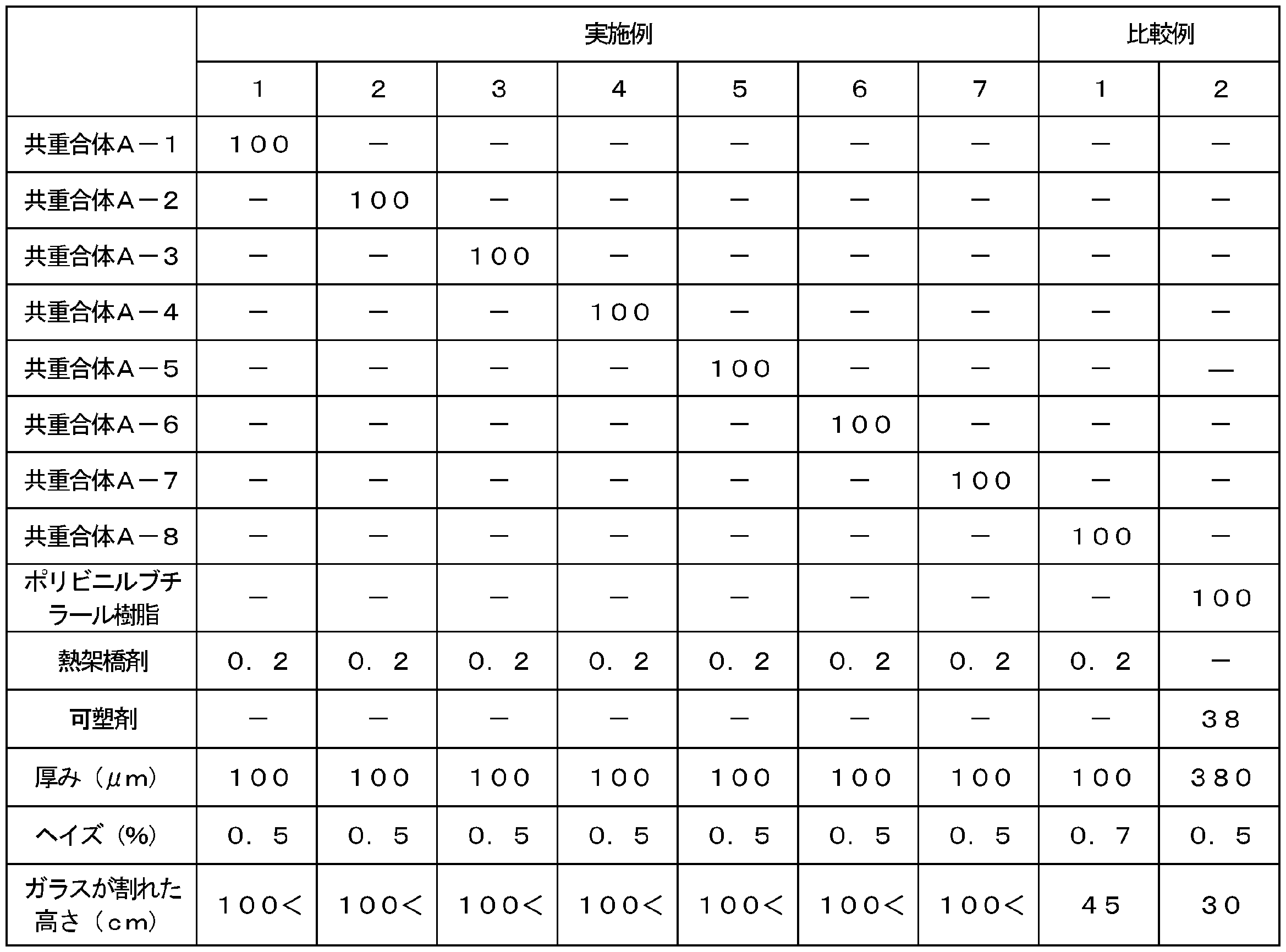
各実施例及び比較例で得られた中間膜用フィルム材又は樹脂膜について、以下の方法により評価を行った。結果を表1に示す。
各実施例及び比較例で得られた中間膜用フィルム材又は樹脂膜について、以下の方法により評価を行った。結果を表1に示す。
1.ヘーズの測定
実施例及び比較例1の中間膜用フィルム材を50mm×50mmのサイズに切り出し、85℃、85%RHの条件下で24時間放置した後、取り出して、基材10を剥離して樹脂層の表面を露出させた後、樹脂層の表面を縦50mm、横50mm、厚み2.7mmのフロートガラスに貼り付け、ローラーで押し付けた。次いで、基材12を樹脂層から剥離して樹脂層の表面を露出させ、真空積層機を用いて、真空状態で樹脂層の表面を、縦50mm、横50mm、厚み2.7mmのフロートガラスに貼り付けて積層体を作製した。その後、積層体を、温度50℃、圧力0.5MPa、30分間保持の条件で加熱加圧処理(オートクレーブ処理)し、合わせガラスを得た。また、比較例2では、樹脂膜を50mm×50mmのサイズに切り出し、85℃、85%RHの条件下で24時間放置した後、取り出して、上記フロートガラスで挟み込み、温度135℃、圧力118N/cm2MPa、20分間の条件でオートクレーブ処理し、合わせガラスを得た。
得られた合わせガラスを、濁度計(日本電色工業株式会社製、NDH-5000)を用いてヘーズを測定した。
実施例及び比較例1の中間膜用フィルム材を50mm×50mmのサイズに切り出し、85℃、85%RHの条件下で24時間放置した後、取り出して、基材10を剥離して樹脂層の表面を露出させた後、樹脂層の表面を縦50mm、横50mm、厚み2.7mmのフロートガラスに貼り付け、ローラーで押し付けた。次いで、基材12を樹脂層から剥離して樹脂層の表面を露出させ、真空積層機を用いて、真空状態で樹脂層の表面を、縦50mm、横50mm、厚み2.7mmのフロートガラスに貼り付けて積層体を作製した。その後、積層体を、温度50℃、圧力0.5MPa、30分間保持の条件で加熱加圧処理(オートクレーブ処理)し、合わせガラスを得た。また、比較例2では、樹脂膜を50mm×50mmのサイズに切り出し、85℃、85%RHの条件下で24時間放置した後、取り出して、上記フロートガラスで挟み込み、温度135℃、圧力118N/cm2MPa、20分間の条件でオートクレーブ処理し、合わせガラスを得た。
得られた合わせガラスを、濁度計(日本電色工業株式会社製、NDH-5000)を用いてヘーズを測定した。
2.合わせガラスの作製
実施例及び比較例1では、作製した中間膜用フィルム材から基材10を剥離して樹脂層の表面を露出させた後、樹脂層の表面を縦110mm、横110mm、厚み2.7mmのフロートガラスに貼り付け、ローラーで押し付けた。次いで、基材12を樹脂層から剥離して樹脂層の表面を露出させ、真空積層機を用いて、真空状態で樹脂層の表面を縦110mm、横110mm、厚み2.7mmのフロートガラスに貼り付けて積層体を作製した。その後、積層体を、温度50℃、圧力0.5MPa、30分間保持の条件で加熱加圧処理(オートクレーブ処理)し、合わせガラスを得た。
また、比較例2では、樹脂膜をフロートガラスで挟み込み、温度135℃、圧力118N/cm2MPa、20分間保持の条件でオートクレーブ処理し、合わせガラスを得た。
実施例及び比較例1では、作製した中間膜用フィルム材から基材10を剥離して樹脂層の表面を露出させた後、樹脂層の表面を縦110mm、横110mm、厚み2.7mmのフロートガラスに貼り付け、ローラーで押し付けた。次いで、基材12を樹脂層から剥離して樹脂層の表面を露出させ、真空積層機を用いて、真空状態で樹脂層の表面を縦110mm、横110mm、厚み2.7mmのフロートガラスに貼り付けて積層体を作製した。その後、積層体を、温度50℃、圧力0.5MPa、30分間保持の条件で加熱加圧処理(オートクレーブ処理)し、合わせガラスを得た。
また、比較例2では、樹脂膜をフロートガラスで挟み込み、温度135℃、圧力118N/cm2MPa、20分間保持の条件でオートクレーブ処理し、合わせガラスを得た。
3.耐衝撃試験
作製した縦110mm、横110mm角の合わせガラス(周辺支持)の中心点から25mm以内の位置に質量約1040g、直径63.5mmの鋼球を5cm~100cmで5cm刻みの高さから順次落下させ、ガラスが割れたときの高さを記録した。それぞれの中間膜からなる合わせガラスを6枚試験し、その平均高さを算出し、値が大きいほど防割性の高い合わせガラスとした。
作製した縦110mm、横110mm角の合わせガラス(周辺支持)の中心点から25mm以内の位置に質量約1040g、直径63.5mmの鋼球を5cm~100cmで5cm刻みの高さから順次落下させ、ガラスが割れたときの高さを記録した。それぞれの中間膜からなる合わせガラスを6枚試験し、その平均高さを算出し、値が大きいほど防割性の高い合わせガラスとした。
10,12…基材、11…樹脂層、20,22…フロートガラス、21…中間膜。
Claims (7)
- (メタ)アクリロイル化合物と、エチレン性不飽和基を有するケイ素化合物と、を含有するモノマー混合物の共重合体を含む、合わせガラスの中間膜用樹脂組成物。
- 前記(メタ)アクリロイル化合物が、アルキル(メタ)アクリレートと、水酸基を有する(メタ)アクリレートとを含有する、請求項1に記載の中間膜用樹脂組成物。
- 前記モノマー混合物が、前記アルキル(メタ)アクリレート50~90質量部、前記水酸基を有する(メタ)アクリレート5~30質量部及び前記エチレン性不飽和基を有するケイ素化合物5~20質量部を含有する、請求項2に記載の中間膜用樹脂組成物。
- 熱架橋剤を更に含む、請求項1~3のいずれか一項に記載の中間膜用樹脂組成物。
- 基材と、前記基材上に設けられた樹脂層と、を有し、前記樹脂層が、対向する2枚のガラス板と前記2枚のガラス板の間に挟まれた中間膜とを備える合わせガラスの前記中間膜を形成するために用いられる、合わせガラスの中間膜用フィルム材であって、
前記樹脂層が、請求項1~4のいずれか一項に記載の中間膜用樹脂組成物から形成された層である、中間膜用フィルム材。 - 前記樹脂層のヘーズが5%以下である、請求項5に記載の中間膜用フィルム材。
- 対向する2枚のガラス板と、前記2枚のガラス板の間に挟まれた中間膜と、を備える合わせガラスの製造方法であって、
請求項5又は6に記載の中間膜用フィルム材が備える前記樹脂層を介して、前記2枚のガラス板を貼り合せて積層体を得る工程と、
30~150℃及び0.3~1.5MPaの条件で、前記積層体を加熱加圧処理する工程と、
を含む、合わせガラスの製造方法。
Priority Applications (4)
| Application Number | Priority Date | Filing Date | Title |
|---|---|---|---|
| PCT/JP2016/082328 WO2018078874A1 (ja) | 2016-10-31 | 2016-10-31 | 合わせガラスの中間膜用樹脂組成物、中間膜用フィルム材及び合わせガラスの製造方法 |
| PCT/JP2017/024065 WO2018078952A1 (ja) | 2016-10-31 | 2017-06-30 | 合わせガラスの中間膜用樹脂組成物、中間膜用フィルム材及び合わせガラスの製造方法 |
| TW106121902A TW201908267A (zh) | 2016-10-31 | 2017-06-30 | 夾層玻璃的中間膜用樹脂組合物、中間膜用膜材料和夾層玻璃的製造方法 |
| JP2018547114A JPWO2018078952A1 (ja) | 2016-10-31 | 2017-06-30 | 合わせガラスの中間膜用樹脂組成物、中間膜用フィルム材及び合わせガラスの製造方法 |
Applications Claiming Priority (1)
| Application Number | Priority Date | Filing Date | Title |
|---|---|---|---|
| PCT/JP2016/082328 WO2018078874A1 (ja) | 2016-10-31 | 2016-10-31 | 合わせガラスの中間膜用樹脂組成物、中間膜用フィルム材及び合わせガラスの製造方法 |
Publications (1)
| Publication Number | Publication Date |
|---|---|
| WO2018078874A1 true WO2018078874A1 (ja) | 2018-05-03 |
Family
ID=62024628
Family Applications (2)
| Application Number | Title | Priority Date | Filing Date |
|---|---|---|---|
| PCT/JP2016/082328 Ceased WO2018078874A1 (ja) | 2016-10-31 | 2016-10-31 | 合わせガラスの中間膜用樹脂組成物、中間膜用フィルム材及び合わせガラスの製造方法 |
| PCT/JP2017/024065 Ceased WO2018078952A1 (ja) | 2016-10-31 | 2017-06-30 | 合わせガラスの中間膜用樹脂組成物、中間膜用フィルム材及び合わせガラスの製造方法 |
Family Applications After (1)
| Application Number | Title | Priority Date | Filing Date |
|---|---|---|---|
| PCT/JP2017/024065 Ceased WO2018078952A1 (ja) | 2016-10-31 | 2017-06-30 | 合わせガラスの中間膜用樹脂組成物、中間膜用フィルム材及び合わせガラスの製造方法 |
Country Status (3)
| Country | Link |
|---|---|
| JP (1) | JPWO2018078952A1 (ja) |
| TW (1) | TW201908267A (ja) |
| WO (2) | WO2018078874A1 (ja) |
Families Citing this family (5)
| Publication number | Priority date | Publication date | Assignee | Title |
|---|---|---|---|---|
| WO2019045479A1 (ko) * | 2017-08-31 | 2019-03-07 | 삼성에스디아이 주식회사 | 점착필름 및 이를 포함하는 광학 부재 |
| CN111094483A (zh) | 2017-08-31 | 2020-05-01 | 三星Sdi株式会社 | 接着膜及包括其的光学构件 |
| TWI745721B (zh) * | 2019-07-23 | 2021-11-11 | 凌巨科技股份有限公司 | 減少基板翹曲的方法 |
| KR102430601B1 (ko) | 2020-03-03 | 2022-08-08 | 삼성에스디아이 주식회사 | 점착 필름, 이를 포함하는 광학 부재 및 이를 포함하는 광학표시장치 |
| KR102527459B1 (ko) | 2020-05-29 | 2023-04-28 | 삼성에스디아이 주식회사 | 점착성 보호 필름, 이를 포함하는 광학 부재 및 이를 포함하는 광학표시장치 |
Citations (2)
| Publication number | Priority date | Publication date | Assignee | Title |
|---|---|---|---|---|
| JP2011073943A (ja) * | 2009-09-30 | 2011-04-14 | Dainippon Printing Co Ltd | 合わせガラスの製造方法 |
| JP2016169299A (ja) * | 2015-03-12 | 2016-09-23 | 昭和電工株式会社 | 組成物、白色熱硬化性組成物、遮光用加飾印刷インキ、画像表示装置およびタッチパネルの製造方法 |
Family Cites Families (3)
| Publication number | Priority date | Publication date | Assignee | Title |
|---|---|---|---|---|
| JPH09123354A (ja) * | 1995-10-30 | 1997-05-13 | Namariichi:Kk | 複合パネル及びその製造方法 |
| JP2002080808A (ja) * | 2000-06-30 | 2002-03-22 | Kuraray Co Ltd | 接着剤 |
| WO2013042750A1 (ja) * | 2011-09-22 | 2013-03-28 | 日立化成株式会社 | 積層体、積層板、多層積層板、プリント配線板及び積層板の製造方法 |
-
2016
- 2016-10-31 WO PCT/JP2016/082328 patent/WO2018078874A1/ja not_active Ceased
-
2017
- 2017-06-30 WO PCT/JP2017/024065 patent/WO2018078952A1/ja not_active Ceased
- 2017-06-30 JP JP2018547114A patent/JPWO2018078952A1/ja active Pending
- 2017-06-30 TW TW106121902A patent/TW201908267A/zh unknown
Patent Citations (2)
| Publication number | Priority date | Publication date | Assignee | Title |
|---|---|---|---|---|
| JP2011073943A (ja) * | 2009-09-30 | 2011-04-14 | Dainippon Printing Co Ltd | 合わせガラスの製造方法 |
| JP2016169299A (ja) * | 2015-03-12 | 2016-09-23 | 昭和電工株式会社 | 組成物、白色熱硬化性組成物、遮光用加飾印刷インキ、画像表示装置およびタッチパネルの製造方法 |
Also Published As
| Publication number | Publication date |
|---|---|
| WO2018078952A1 (ja) | 2018-05-03 |
| TW201908267A (zh) | 2019-03-01 |
| JPWO2018078952A1 (ja) | 2019-09-12 |
Similar Documents
| Publication | Publication Date | Title |
|---|---|---|
| JP6065002B2 (ja) | 画像表示装置用粘着シート、画像表示装置の製造方法及び画像表示装置 | |
| JP6265907B2 (ja) | 画像表示装置用粘着シート、画像表示装置の製造方法及び画像表示装置 | |
| JP6246469B2 (ja) | 画像表示装置用粘着シート、画像表示装置の製造方法及び画像表示装置 | |
| WO2018078952A1 (ja) | 合わせガラスの中間膜用樹脂組成物、中間膜用フィルム材及び合わせガラスの製造方法 | |
| JP2014125524A (ja) | 画像表示装置用粘着シート、画像表示装置の製造方法及び画像表示装置 | |
| JP6733740B2 (ja) | 中間膜用樹脂組成物、中間膜用フィルム材及び合わせガラスの製造方法 | |
| WO2017209013A1 (ja) | 合わせガラスの中間膜用光硬化性樹脂組成物、合わせガラスの中間膜用フィルム材及び合わせガラスの製造方法 | |
| JP5991531B2 (ja) | 画像表示装置用粘着シートの製造方法 | |
| JP2021055101A (ja) | 透明両面粘着シート | |
| WO2016148208A1 (ja) | 画像表示装置用粘着シート、画像表示装置用粘着積層体及び画像表示装置 | |
| JP2014094977A (ja) | 画像表示装置用粘着シート、画像表示装置の製造方法及び画像表示装置 | |
| WO2015140900A1 (ja) | 画像表示装置用粘着シート、それを用いた画像表示装置の製造方法及び画像表示装置 | |
| JP2019108247A (ja) | 合わせガラス及びその製造方法 | |
| JP7006420B2 (ja) | 画像表示装置、共重合体溶液、及びフィルム材 | |
| WO2015132876A1 (ja) | 画像表示装置用粘着シート、それを用いた画像表示装置の製造方法及び画像表示装置 | |
| JP2019011222A (ja) | 合わせガラス、合わせガラスの中間膜用フィルム材及び合わせガラスの製造方法 | |
| JP2015229687A (ja) | 画像表示装置用粘着シート、画像表示装置の製造方法及び画像表示装置 | |
| JP2019064878A (ja) | 合わせガラスの中間膜に用いられる樹脂膜、中間膜用フィルム材及び合わせガラスの製造方法 | |
| JP2019196284A (ja) | 合わせガラス中間膜用の樹脂組成物とフィルム及び合わせガラスとその製造方法 | |
| WO2018079720A1 (ja) | 合わせガラス及びその製造方法、並びに、合わせガラスの中間膜用光硬化性樹脂組成物 | |
| WO2019069373A1 (ja) | 合わせガラスの中間膜に用いられる樹脂膜、合わせガラスの中間膜用フィルム材、合わせガラス及び合わせガラスの製造方法 | |
| JP2021050108A (ja) | 中間膜用樹脂組成物、中間膜用フィルム材、合わせガラス及びその製造方法、並びに画像表示装置 | |
| JP2019164294A (ja) | 画像表示装置、光硬化性樹脂組成物、及びフィルム材 | |
| JP2019131411A (ja) | 合わせガラス中間膜用光硬化性樹脂組成物、それを用いたカバーフィルム付合わせガラス用中間膜及び合わせガラスの製造方法 | |
| JP2018115084A (ja) | 合わせガラス中間膜用光硬化性樹脂組成物、カバーフィルム付合わせガラス用中間膜、合わせガラス及び合わせガラスの製造方法 |
Legal Events
| Date | Code | Title | Description |
|---|---|---|---|
| 121 | Ep: the epo has been informed by wipo that ep was designated in this application |
Ref document number: 16919992 Country of ref document: EP Kind code of ref document: A1 |
|
| NENP | Non-entry into the national phase |
Ref country code: DE |
|
| 122 | Ep: pct application non-entry in european phase |
Ref document number: 16919992 Country of ref document: EP Kind code of ref document: A1 |
|
| NENP | Non-entry into the national phase |
Ref country code: JP |