WO2018074003A1 - 高強度ばね、およびその製造方法、ならびに高強度ばね用鋼、およびその製造方法 - Google Patents
高強度ばね、およびその製造方法、ならびに高強度ばね用鋼、およびその製造方法 Download PDFInfo
- Publication number
- WO2018074003A1 WO2018074003A1 PCT/JP2017/020501 JP2017020501W WO2018074003A1 WO 2018074003 A1 WO2018074003 A1 WO 2018074003A1 JP 2017020501 W JP2017020501 W JP 2017020501W WO 2018074003 A1 WO2018074003 A1 WO 2018074003A1
- Authority
- WO
- WIPO (PCT)
- Prior art keywords
- steel
- compound
- less
- strength
- spring
- Prior art date
- Legal status (The legal status is an assumption and is not a legal conclusion. Google has not performed a legal analysis and makes no representation as to the accuracy of the status listed.)
- Ceased
Links
Images


Classifications
-
- C—CHEMISTRY; METALLURGY
- C22—METALLURGY; FERROUS OR NON-FERROUS ALLOYS; TREATMENT OF ALLOYS OR NON-FERROUS METALS
- C22C—ALLOYS
- C22C38/00—Ferrous alloys, e.g. steel alloys
- C22C38/18—Ferrous alloys, e.g. steel alloys containing chromium
- C22C38/40—Ferrous alloys, e.g. steel alloys containing chromium with nickel
- C22C38/56—Ferrous alloys, e.g. steel alloys containing chromium with nickel with more than 1.7% by weight of carbon
-
- C—CHEMISTRY; METALLURGY
- C21—METALLURGY OF IRON
- C21D—MODIFYING THE PHYSICAL STRUCTURE OF FERROUS METALS; GENERAL DEVICES FOR HEAT TREATMENT OF FERROUS OR NON-FERROUS METALS OR ALLOYS; MAKING METAL MALLEABLE, e.g. BY DECARBURISATION OR TEMPERING
- C21D1/00—General methods or devices for heat treatment, e.g. annealing, hardening, quenching or tempering
- C21D1/18—Hardening; Quenching with or without subsequent tempering
-
- C—CHEMISTRY; METALLURGY
- C21—METALLURGY OF IRON
- C21D—MODIFYING THE PHYSICAL STRUCTURE OF FERROUS METALS; GENERAL DEVICES FOR HEAT TREATMENT OF FERROUS OR NON-FERROUS METALS OR ALLOYS; MAKING METAL MALLEABLE, e.g. BY DECARBURISATION OR TEMPERING
- C21D1/00—General methods or devices for heat treatment, e.g. annealing, hardening, quenching or tempering
- C21D1/18—Hardening; Quenching with or without subsequent tempering
- C21D1/25—Hardening, combined with annealing between 300 degrees Celsius and 600 degrees Celsius, i.e. heat refining ("Vergüten")
-
- C—CHEMISTRY; METALLURGY
- C21—METALLURGY OF IRON
- C21D—MODIFYING THE PHYSICAL STRUCTURE OF FERROUS METALS; GENERAL DEVICES FOR HEAT TREATMENT OF FERROUS OR NON-FERROUS METALS OR ALLOYS; MAKING METAL MALLEABLE, e.g. BY DECARBURISATION OR TEMPERING
- C21D9/00—Heat treatment, e.g. annealing, hardening, quenching or tempering, adapted for particular articles; Furnaces therefor
- C21D9/02—Heat treatment, e.g. annealing, hardening, quenching or tempering, adapted for particular articles; Furnaces therefor for springs
-
- C—CHEMISTRY; METALLURGY
- C22—METALLURGY; FERROUS OR NON-FERROUS ALLOYS; TREATMENT OF ALLOYS OR NON-FERROUS METALS
- C22C—ALLOYS
- C22C38/00—Ferrous alloys, e.g. steel alloys
- C22C38/001—Ferrous alloys, e.g. steel alloys containing N
-
- C—CHEMISTRY; METALLURGY
- C22—METALLURGY; FERROUS OR NON-FERROUS ALLOYS; TREATMENT OF ALLOYS OR NON-FERROUS METALS
- C22C—ALLOYS
- C22C38/00—Ferrous alloys, e.g. steel alloys
- C22C38/02—Ferrous alloys, e.g. steel alloys containing silicon
-
- C—CHEMISTRY; METALLURGY
- C22—METALLURGY; FERROUS OR NON-FERROUS ALLOYS; TREATMENT OF ALLOYS OR NON-FERROUS METALS
- C22C—ALLOYS
- C22C38/00—Ferrous alloys, e.g. steel alloys
- C22C38/04—Ferrous alloys, e.g. steel alloys containing manganese
-
- C—CHEMISTRY; METALLURGY
- C22—METALLURGY; FERROUS OR NON-FERROUS ALLOYS; TREATMENT OF ALLOYS OR NON-FERROUS METALS
- C22C—ALLOYS
- C22C38/00—Ferrous alloys, e.g. steel alloys
- C22C38/06—Ferrous alloys, e.g. steel alloys containing aluminium
-
- C—CHEMISTRY; METALLURGY
- C22—METALLURGY; FERROUS OR NON-FERROUS ALLOYS; TREATMENT OF ALLOYS OR NON-FERROUS METALS
- C22C—ALLOYS
- C22C38/00—Ferrous alloys, e.g. steel alloys
- C22C38/18—Ferrous alloys, e.g. steel alloys containing chromium
- C22C38/40—Ferrous alloys, e.g. steel alloys containing chromium with nickel
- C22C38/42—Ferrous alloys, e.g. steel alloys containing chromium with nickel with copper
-
- C—CHEMISTRY; METALLURGY
- C22—METALLURGY; FERROUS OR NON-FERROUS ALLOYS; TREATMENT OF ALLOYS OR NON-FERROUS METALS
- C22C—ALLOYS
- C22C38/00—Ferrous alloys, e.g. steel alloys
- C22C38/18—Ferrous alloys, e.g. steel alloys containing chromium
- C22C38/40—Ferrous alloys, e.g. steel alloys containing chromium with nickel
- C22C38/44—Ferrous alloys, e.g. steel alloys containing chromium with nickel with molybdenum or tungsten
-
- C—CHEMISTRY; METALLURGY
- C22—METALLURGY; FERROUS OR NON-FERROUS ALLOYS; TREATMENT OF ALLOYS OR NON-FERROUS METALS
- C22C—ALLOYS
- C22C38/00—Ferrous alloys, e.g. steel alloys
- C22C38/18—Ferrous alloys, e.g. steel alloys containing chromium
- C22C38/40—Ferrous alloys, e.g. steel alloys containing chromium with nickel
- C22C38/46—Ferrous alloys, e.g. steel alloys containing chromium with nickel with vanadium
-
- C—CHEMISTRY; METALLURGY
- C22—METALLURGY; FERROUS OR NON-FERROUS ALLOYS; TREATMENT OF ALLOYS OR NON-FERROUS METALS
- C22C—ALLOYS
- C22C38/00—Ferrous alloys, e.g. steel alloys
- C22C38/18—Ferrous alloys, e.g. steel alloys containing chromium
- C22C38/40—Ferrous alloys, e.g. steel alloys containing chromium with nickel
- C22C38/48—Ferrous alloys, e.g. steel alloys containing chromium with nickel with niobium or tantalum
-
- C—CHEMISTRY; METALLURGY
- C21—METALLURGY OF IRON
- C21D—MODIFYING THE PHYSICAL STRUCTURE OF FERROUS METALS; GENERAL DEVICES FOR HEAT TREATMENT OF FERROUS OR NON-FERROUS METALS OR ALLOYS; MAKING METAL MALLEABLE, e.g. BY DECARBURISATION OR TEMPERING
- C21D2211/00—Microstructure comprising significant phases
- C21D2211/004—Dispersions; Precipitations
Definitions
- the present invention relates to a high-strength spring, a manufacturing method thereof, a steel for a high-strength spring, and a manufacturing method thereof.
- High strength springs are used for automobiles. Since the high strength spring has high strength, it can be formed with a thin wire rod, and can contribute to the weight reduction of the automobile and the improvement of the fuel consumption of the automobile. However, when the spring strength is increased, fatigue strength, hydrogen embrittlement resistance, delayed fracture resistance, and the like in a corrosive environment decrease.
- the spring steel described in Patent Document 1 captures hydrogen entering the steel from the external environment by a hydrogen trap site made of precipitates containing V and the like, and suppresses hydrogen diffusion in the steel. ing.
- the precipitate contains V and the like.
- tempering treatment at low temperature is effective, but when the N content is large, low temperature temper embrittlement occurs. As a result, the toughness is lowered, so that the delayed fracture resistance is lowered.
- the present invention has been made in view of the above problems, and its main object is to provide a high-strength spring excellent in hydrogen embrittlement resistance, corrosion durability, and delayed fracture resistance.
- C 0.40 to 0.50%, Si: 1.00 to 3.00%, Mn: 0.30 to 1.20%, Ni: 0.05 to 0.50%, Cr: 0.35-1.50%, Mo: 0.03-0.50%, Cu: 0.05-0.50%, Al: 0.005-0.100%, V: 0.05-0.
- Nb 0.005 to 0.150%
- P 0.015% or less
- S 0.010% or less
- An Nb compound comprising at least one of Nb carbide, Nb nitride, and Nb carbonitride
- a high-strength spring is provided.
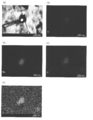
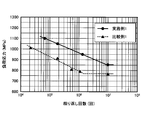
- Example 2 is a SEM photograph of a part of the cross section of the steel after tempering according to Example 1; 4 is a SEM photograph of another part of the cross section of the steel after the tempering process according to Example 1. It is a figure which shows the result of the rotation bending fatigue test of Example 1 and Comparative Example 1. It is a figure which shows the result of the endurance test of Example 3 and Comparative Example 2.
- High strength springs are used as suspension springs for automobiles, for example.
- high strength means that the tensile strength is 1800 MPa or more.
- the shape of the test piece used for the measurement of tensile strength conforms to the shape of the No. 4 test piece described in Japanese Industrial Standard (JIS Z2241).
- the high-strength spring may be a coil spring.
- the coil spring is manufactured by hot spring molding or cold spring molding.
- hot spring forming a wire is heat-formed into a coil shape, and then subjected to quenching and tempering.
- cold spring forming after the wire is quenched and tempered, the wire is cold formed into a coil.
- the high-strength spring is a coil spring in this embodiment, but may be a leaf spring or the like.
- the form of the high strength spring is not particularly limited. Further, the use of the high-strength spring is not limited to the automobile suspension system.
- the high-strength spring is made of high-strength spring steel.
- High-strength spring steel has been subjected to quenching and tempering and has a martensite structure obtained by quenching.
- the pearlite structure is dominant before the quenching process
- the austenite structure is dominant at the quenching temperature
- the martensite structure is dominant after the quenching process.
- the high-strength spring steel is not particularly limited as long as it is subjected to quenching or tempering.
- the high-strength spring steel may have a spring shape (for example, a coil shape).
- the steel for high-strength springs may have a spring shape, or may have a shape (for example, a rod shape) before being processed into the spring shape.
- High-strength spring steel is, by mass, C: 0.40 to 0.50%, Si: 1.00 to 3.00%, Mn: 0.30 to 1.20%, Ni: 0.05 to 0.50%, Cr: 0.35 to 1.50%, Mo: 0.03 to 0.50%, Cu: 0.05 to 0.50%, Al: 0.005 to 0.100%, V : 0.05 to 0.50%, Nb: 0.005 to 0.150%, N: 0.0100 to 0.0200%, P: 0.015% or less, S: 0.010% or less The remainder consists of Fe and inevitable impurities.
- each component will be described. In the description of each component, “%” means mass%.
- C is an element effective for increasing the strength of steel.
- the C content is 0.40 to 0.50%. If the C content is less than 0.40%, the necessary strength as a spring cannot be obtained. On the other hand, if the C content exceeds 0.50%, the corrosion durability decreases.
- Si is an element effective for improving the strength of steel by dissolving in ferrite.
- the Si content is 1.00 to 3.00%. If the Si content is less than 1.00%, the necessary strength as a spring cannot be obtained. On the other hand, when the Si content exceeds 3.00%, when the spring is hot-formed, decarburization of the surface is likely to occur, and the durability of the spring is lowered.
- Mn is an element effective for improving the hardenability of steel.
- the Mn content is 0.30 to 1.20%. If the Mn content is less than 0.30%, the effect of improving the hardenability cannot be sufficiently obtained. On the other hand, if the Mn content exceeds 1.20%, the toughness deteriorates.
- Ni is an element necessary for increasing the corrosion durability of steel.
- the Ni content is 0.05 to 0.50%. If the Ni content is less than 0.05%, the effect of increasing the corrosion durability of the steel cannot be expected sufficiently. Since Ni is expensive, the upper limit of the Ni content is 0.50%.
- Cr is an element effective for increasing the strength of steel.
- the Cr content is 0.35 to 1.50%. If the Cr content is less than 0.35%, the effect of increasing the strength of the steel cannot be expected sufficiently. On the other hand, if the Cr content exceeds 1.50%, the toughness tends to deteriorate.
- Mo is an element that ensures the hardenability of the steel and increases the strength and toughness of the steel.
- the Mo content is 0.03 to 0.50%. If the Mo content is less than 0.03%, the effect of adding Mo cannot be expected sufficiently. On the other hand, if the Mo content exceeds 0.50%, the effect of adding Mo is saturated.
- Cu is a component that increases corrosion durability.
- the Cu content is 0.05 to 0.50%. If the Cu content is less than 0.05%, the effect of increasing the corrosion durability is not sufficiently exhibited. On the other hand, if the Cu content exceeds 0.50%, problems such as cracking occur during hot rolling.
- Al is an element necessary for adjusting the deoxidizer and austenite grain size of steel.
- the Al content is 0.005 to 0.100%. If the Al content is less than 0.005%, the crystal grains cannot be refined. On the other hand, if the Al content exceeds 0.100%, the castability tends to decrease.
- V is an element effective in increasing the strength of steel and suppressing hydrogen embrittlement.
- the V content is 0.05 to 0.50%. If the V content is less than 0.05%, the effect of adding V cannot be expected sufficiently. On the other hand, if the V content exceeds 0.50%, carbides that are not dissolved in austenite increase, and the spring characteristics deteriorate.
- Nb is an element that increases the strength and toughness of steel by refining crystal grains and precipitating fine carbides. Nb is also an element that contributes to fine dispersion of a V compound containing at least one of V carbide and V carbonitride (hereinafter simply referred to as V compound) and increases hydrogen embrittlement resistance.
- V compound V compound containing at least one of V carbide and V carbonitride
- the Nb content is 0.005 to 0.150%. If the Nb content is less than 0.005%, the effect of adding Nb cannot be expected sufficiently. On the other hand, if the Nb content exceeds 0.150%, carbides that are not dissolved in austenite increase, and the spring characteristics deteriorate.
- N is an element that combines with Al or Nb to form AlN or NbN, and is effective in reducing the austenite crystal grain size.
- the toughness is improved by the refinement.
- the N content is 0.0100 to 0.0200%. If the N content is 0.0100% or more, the effect of improving toughness is sufficiently exhibited. On the other hand, excessive addition of N causes generation of bubbles on the surface of the steel ingot during solidification and deterioration of the castability of the steel, so the upper limit of the N content is 0.0200%.
- P is a factor that lowers the impact value by precipitation at the austenite grain boundaries and embrittlement of the grain boundaries. In order to suppress this problem, the P content is limited to 0.015% or less.
- S is present as an inclusion of MnS in steel, and is a factor that reduces fatigue life and corrosion durability. Inclusions refer to those already made in a molten state of steel. In order to reduce inclusions, the S content is limited to 0.010% or less, preferably 0.005% or less.
- High strength spring steel finely disperses the V compound as a hydrogen trap site, so that the V compound is dissolved in iron at the quenching temperature, and then the V compound is precipitated around the Nb compound that is finely dispersed in the steel.
- the high-strength spring steel includes an Nb compound and a V compound that precipitates around the Nb compound.
- the V compound may be deposited adjacent to the Nb compound, and may not completely surround the Nb compound, but may completely surround it.
- the Nb compound may be present inside the V compound.
- the Nb compound is a precipitate that precipitates in iron while the molten steel is solidified.
- the Nb compound includes at least one of Nb nitride, Nb carbide, and Nb carbonitride.
- the Nb compound is finely dispersed in the steel before the quenching treatment, and does not dissolve in iron at the quenching temperature, but becomes a starting point for precipitation of the V compound by rapid cooling from the quenching temperature or tempering treatment.
- Nb nitride that is finely dispersed than Nb carbide and Nb carbonitride is preferably used.
- the V compound exists as a coarse precipitate in the steel before the quenching treatment, it is dissolved in iron at the quenching temperature, and then precipitated from the Nb compound. Since the Nb compound is finely dispersed, the V compound precipitated from the Nb compound can be finely dispersed.
- the number of the V compounds can be increased by making the V compound finer, and a high strength spring steel excellent in hydrogen embrittlement resistance can be obtained.
- the quenching temperature is set to 950 ° C. or higher and 1000 ° C. or lower so that the V compound is dissolved in iron at the quenching temperature.
- the quenching temperature is higher than the solid solution temperature at which the V compound is dissolved in iron and the V content is 0.50% or less as described above, the V compound is completely dissolved in the iron in the calculation of the solubility product.
- the quenching temperature is high, an appropriate amount of Nb, Al, N or the like is added in order to suppress coarsening of crystal grains. Thereby, the fall of toughness can be suppressed and the fall of delayed fracture resistance can be suppressed. Therefore, a high-strength spring steel excellent in delayed fracture resistance can be obtained.
- a composite precipitate is formed by the Nb compound and the V compound precipitated around the Nb compound.
- the average particle size of the composite precipitate may be 0.01 ⁇ m or more and 1 ⁇ m or less.
- the number of composite precipitates per unit area may be 100 / mm 2 or more and 100,000 / mm 2 or less.
- the average particle diameter and the number per unit area are measured using, for example, an SEM (Scanning Electron Microscope).
- the average particle diameter is obtained as an average value of the measured values by measuring the equivalent area diameter (diameter) of each of the 100 composite precipitates.
- the number per unit area is determined by measuring the number of composite precipitates present in a region having a total area of 15 mm 2 and dividing the number by the total area.
- High-strength spring steel has a C content limited to 0.5% or less in order to suppress a decrease in corrosion durability, and ensures the strength of the steel in a range where the C content is 0.5% or less. Therefore, the tempering temperature is limited to less than 390 ° C. Therefore, a high strength spring steel having excellent corrosion durability and strength can be obtained.
- the lower limit of the tempering temperature is 250 ° C., more preferably 300 ° C., so that the effect of improving the toughness by the tempering treatment can be sufficiently obtained.
- High strength spring steel contains 0.0100 to 0.0200% N in order to sufficiently disperse nitrides.
- high strength spring steel contains an appropriate amount of Nb and Al, and N is made harmless by precipitating NbN and AlN instead of N. Thereby, the fall of toughness can be suppressed and the fall of delayed fracture resistance can be suppressed. Therefore, a high-strength spring steel excellent in delayed fracture resistance can be obtained.
- Example 1 In Example 1, a steel having the following composition was quenched and tempered, and a rotating bending fatigue test piece and a hydrogen embrittlement test piece were produced by machining.
- the quenching temperature was 950 ° C. and the holding time was 30 minutes.
- the cooling from the quenching temperature was oil cooling.
- the tempering temperature was 360 ° C. and the holding time was 1 hour. Cooling from the tempering temperature was air cooling.
- the Vickers hardness of the steel after the tempering treatment was 590 Hv.
- FIG. 1 is a SEM photograph of a part of the cross section of the steel after the tempering treatment according to Example 1
- FIG. 2 is a SEM photograph of another part of the steel after the tempering treatment according to Example 1.
- 1A and FIG. 2A are backscattered electron images
- FIG. 1B and FIG. 2B are Nb characteristic X-ray maps
- FIG. 1C and FIG. 2C are N characteristics.
- 1 (d) and 2 (d) are V characteristic X-ray maps
- FIGS. 1 (e) and 2 (e) are C characteristic X-ray maps.
- FIGS. 1 (e) and 2 (e) are C characteristic X-ray maps.
- the white portion of the reflected electron image indicates the Nb compound, and the black portion around the white indicates the V compound.
- the brightness of the color represents the amount of the element, and the lighter the color (white), the more the element Large amount.
- the reflected electron images in FIGS. 1A and 2A are reflected electron images in which the electron beam bounces in the vicinity of the cross section of the steel, and thus represent almost the same size that can be seen on the test surface.
- 2B to 2E are images of characteristic X-rays generated when an electron beam enters the inside of the steel from a cross section of the steel. Further, a threshold is provided for the intensity of the characteristic X-ray to be detected. Therefore, the image of the characteristic X-ray map is different from the size seen on the test surface.
- test piece conformed to the shape of the No. 1 test piece described in Japanese Industrial Standard (JIS Z2274).
- This test piece has a constricted portion called a parallel portion at the center of the round bar.
- the rotating bending fatigue test piece had a diameter of 15 mm at both ends, a diameter of the parallel part of 8 mm, and a length of the parallel part of 20 mm.
- the hydrogen embrittlement test piece had a diameter of 10 mm at both ends, a diameter of the parallel part of 4 mm, and a length of the parallel part of 15 mm.
- Comparative Example 1 In Comparative Example 1, a steel having the following composition was quenched and tempered, and a rotating bending fatigue test piece and a hydrogen embrittlement test piece were produced by machining.
- the quenching temperature was 900 ° C. and the holding time was 30 minutes.
- the cooling from the quenching temperature was oil cooling.
- the tempering temperature was 420 ° C. and the holding time was 1 hour. Cooling from the tempering temperature was air cooling.
- the Vickers hardness of the steel after tempering was 570 Hv.
- the shape of the test piece was the same as the shape of the test piece of Example 1.
- FIG. 3 shows the results of the rotating bending fatigue test of Example 1 and Comparative Example 1.
- the solid line represents the result of the rotational bending fatigue test of Example 1
- the broken line represents the result of the rotational bending fatigue test of Comparative Example 1.
- Example 1 was superior in bending fatigue strength to the steel of Comparative Example 1.
- the unbreaking stress of the test piece of Example 1 was 325 MPa, whereas the unbreaking stress of the test piece of Comparative Example 1 was 240 MPa. Therefore, it was confirmed that the steel of Example 1 was excellent in hydrogen embrittlement resistance, corrosion durability, and delayed fracture resistance compared to the steel of Comparative Example 1.
- the amount of diffusible hydrogen contained in the test piece was measured.
- the amount of diffusible hydrogen is obtained from a profile obtained by continuously measuring the amount of hydrogen released from the test piece by gas chromatography while heating the test piece at a constant rate.
- Hydrogen released at a temperature below 300 ° C. is diffusible hydrogen, and hydrogen released at a temperature of 300 ° C. or higher is non-diffusible hydrogen. Release of diffusible hydrogen is almost completed before the temperature of the test piece reaches 220 ° C, and non-diffusible hydrogen starts to be released when the temperature of the test piece exceeds 400 ° C. Hydrogen trapped at the hydrogen trap site is not released at temperatures below 300 ° C.
- the diffusible hydrogen content of the test piece of Example 1 was 0.36 mass ppm, whereas the diffusible hydrogen content of the test piece of Comparative Example 1 was 1.87 mass ppm. Therefore, it was confirmed that the steel of Example 1 had more hydrogen trap sites and excellent resistance to hydrogen embrittlement than the steel of Comparative Example 1.
- Example 2 the steel having the same composition as the steel of Example 1 was subjected to quenching treatment and tempering treatment, a tensile strength test piece was produced by machining, and a tensile test was performed.
- the quenching temperature was 950 ° C. and the holding time was 30 minutes.
- the cooling from the quenching temperature was oil cooling.
- the tempering temperature was 380 ° C. or 350 ° C., and the holding time was 1 hour. Cooling from the tempering temperature was air cooling.
- JIS Z2241 Japanese Industrial Standard
- Table 1 shows the tempering temperature, the results of the tensile test, and the Vickers hardness.
- Example 3 steel having the same composition as that of Example 1 and Example 2 was heat-formed into a coil shape. Thereafter, the obtained molded product was subjected to quenching treatment, tempering treatment, shot peening, and setting to produce a coil spring. Then, the durability test of the obtained coil spring was done.
- the quenching temperature was 990 ° C. and the holding time was 20 minutes.
- the cooling from the quenching temperature was oil cooling.
- the tempering temperature was 360 ° C., and the holding time was 1 hour. Cooling from the tempering temperature was air cooling.
- the Vickers hardness of the coil spring after the tempering treatment was 580 Hv.
- Comparative Example 2 steel having the same composition as the steel of Comparative Example 1 was heat-formed into a coil shape in the same manner as in Example 3 to obtain a molded product having the same shape as in Example 3. Thereafter, the obtained molded product was subjected to quenching treatment, tempering treatment, shot peening and setting, and a coil spring having the same shape as that of Example 3 was produced. Then, the durability test of the obtained coil spring was done.
- the quenching temperature was 940 ° C. and the holding time was 20 minutes.
- the cooling from the quenching temperature was oil cooling.
- the tempering temperature was 420 ° C., and the holding time was 1 hour. Cooling from the tempering temperature was air cooling.
- the Vickers hardness of the coil spring after the tempering treatment was 560 Hv.
- the stress amplitude was set to 735 MPa ⁇ 525 MPa (maximum stress: 1260 MPa, minimum stress: 210 MPa) and 735 MPa ⁇ 500 MPa (maximum stress: 1235 MPa, minimum stress: 235 MPa).
- FIG. 4 shows the results of durability tests of Example 3 and Comparative Example 2.
- the solid line represents the result of the durability test of Example 3
- the broken line represents the result of the durability test of Comparative Example 2.
Landscapes
- Chemical & Material Sciences (AREA)
- Engineering & Computer Science (AREA)
- Materials Engineering (AREA)
- Mechanical Engineering (AREA)
- Metallurgy (AREA)
- Organic Chemistry (AREA)
- Physics & Mathematics (AREA)
- Thermal Sciences (AREA)
- Crystallography & Structural Chemistry (AREA)
- Heat Treatment Of Articles (AREA)
Priority Applications (11)
| Application Number | Priority Date | Filing Date | Title |
|---|---|---|---|
| PH1/2018/500359A PH12018500359B1 (en) | 2016-10-19 | 2017-06-01 | High strength spring, method of manufacturing the same, steel for high strength spring, and method of manufacturing the same |
| CA2995427A CA2995427C (en) | 2016-10-19 | 2017-06-01 | High strength spring, method of manufacturing the same, steel for high strength spring, and method of manufacturing the same |
| BR112018003077-5A BR112018003077B1 (pt) | 2016-10-19 | 2017-06-01 | Mola de alta resistência, método de fabricação da mesma, aço para mola de alta resistência e método de fabricação do mesmo |
| CN202210849340.6A CN115125455A (zh) | 2016-10-19 | 2017-06-01 | 高强度弹簧及其制造方法和高强度弹簧用钢及其制造方法 |
| ES17835988T ES2805091T3 (es) | 2016-10-19 | 2017-06-01 | Resorte de alta resistencia, procedimiento de producción del mismo, acero para resorte de alta resistencia, y procedimiento de producción del mismo |
| KR1020187005976A KR101947973B1 (ko) | 2016-10-19 | 2017-06-01 | 고강도 스프링 및 그 제조방법, 고강도 스프링용 스틸 및 그 제조방법 |
| EP17835988.1A EP3336214B1 (en) | 2016-10-19 | 2017-06-01 | High-strength spring, method for producing same, steel for high-strength spring, and method for producing same |
| US15/749,959 US10752971B2 (en) | 2016-10-19 | 2017-06-01 | High strength spring, method of manufacturing the same, steel for high strength spring, and method of manufacturing the same |
| CN201780002753.8A CN108368580A (zh) | 2016-10-19 | 2017-06-01 | 高强度弹簧及其制造方法和高强度弹簧用钢及其制造方法 |
| RU2018106084A RU2679288C1 (ru) | 2016-10-19 | 2017-06-01 | Высокопрочная пружина, способ ее изготовления, сталь для высокопрочной пружины и способ ее изготовления |
| MX2018001995A MX2018001995A (es) | 2016-10-19 | 2017-06-01 | Muelle de alta resistencia, procedimiento de fabricacion del mismo, acero para muelle de alta resistencia y procedimiento de fabricacion del mismo. |
Applications Claiming Priority (6)
| Application Number | Priority Date | Filing Date | Title |
|---|---|---|---|
| JP2016-205535 | 2016-10-19 | ||
| JP2016205535 | 2016-10-19 | ||
| JP2017-061981 | 2017-03-27 | ||
| JP2017061981 | 2017-03-27 | ||
| JP2017-095054 | 2017-05-11 | ||
| JP2017095054A JP6356309B1 (ja) | 2016-10-19 | 2017-05-11 | 高強度ばね、およびその製造方法、ならびに高強度ばね用鋼、およびその製造方法 |
Publications (1)
| Publication Number | Publication Date |
|---|---|
| WO2018074003A1 true WO2018074003A1 (ja) | 2018-04-26 |
Family
ID=62019104
Family Applications (1)
| Application Number | Title | Priority Date | Filing Date |
|---|---|---|---|
| PCT/JP2017/020501 Ceased WO2018074003A1 (ja) | 2016-10-19 | 2017-06-01 | 高強度ばね、およびその製造方法、ならびに高強度ばね用鋼、およびその製造方法 |
Country Status (5)
| Country | Link |
|---|---|
| EP (1) | EP3336214B1 (https=) |
| KR (1) | KR101947973B1 (https=) |
| CN (1) | CN115125455A (https=) |
| BR (1) | BR112018003077B1 (https=) |
| WO (1) | WO2018074003A1 (https=) |
Cited By (1)
| Publication number | Priority date | Publication date | Assignee | Title |
|---|---|---|---|---|
| TWI747610B (zh) * | 2020-11-13 | 2021-11-21 | 中國鋼鐵股份有限公司 | 料倉秤重系統之檢測方法 |
Citations (5)
| Publication number | Priority date | Publication date | Assignee | Title |
|---|---|---|---|---|
| JPH05320827A (ja) * | 1992-05-26 | 1993-12-07 | Kobe Steel Ltd | 疲労特性の優れたばね用鋼及びばね用鋼線並びにばね |
| JP2001131699A (ja) * | 1999-10-29 | 2001-05-15 | Mitsubishi Seiko Muroran Tokushuko Kk | 高強度ばね用鋼 |
| JP2001288539A (ja) | 2000-04-05 | 2001-10-19 | Nippon Steel Corp | 耐水素疲労特性の優れたばね用鋼、およびその製造方法 |
| WO2006022009A1 (ja) * | 2004-08-26 | 2006-03-02 | Daido Tokushuko Kabushiki Kaisha | 高強度ばね用鋼、並びに高強度ばね及びその製造方法 |
| JP2016125119A (ja) * | 2015-01-07 | 2016-07-11 | 株式会社神戸製鋼所 | ばね用中空シームレス鋼管 |
Family Cites Families (5)
| Publication number | Priority date | Publication date | Assignee | Title |
|---|---|---|---|---|
| US5776267A (en) * | 1995-10-27 | 1998-07-07 | Kabushiki Kaisha Kobe Seiko Sho | Spring steel with excellent resistance to hydrogen embrittlement and fatigue |
| JP3474373B2 (ja) * | 1995-10-27 | 2003-12-08 | 株式会社神戸製鋼所 | 耐水素脆性および疲労特性に優れたばね鋼 |
| JP4008391B2 (ja) * | 2003-07-11 | 2007-11-14 | 株式会社神戸製鋼所 | 耐水素脆化特性に優れた高強度鋼およびその製造方法 |
| JP5064060B2 (ja) * | 2007-02-22 | 2012-10-31 | 新日本製鐵株式会社 | 高強度ばね用鋼線及び高強度ばね並びにそれらの製造方法 |
| JP5146063B2 (ja) * | 2007-04-12 | 2013-02-20 | 新日鐵住金株式会社 | 耐内部疲労損傷特性に優れた高強度鋼及びその製造方法 |
-
2017
- 2017-06-01 EP EP17835988.1A patent/EP3336214B1/en active Active
- 2017-06-01 WO PCT/JP2017/020501 patent/WO2018074003A1/ja not_active Ceased
- 2017-06-01 BR BR112018003077-5A patent/BR112018003077B1/pt active IP Right Grant
- 2017-06-01 CN CN202210849340.6A patent/CN115125455A/zh active Pending
- 2017-06-01 KR KR1020187005976A patent/KR101947973B1/ko active Active
Patent Citations (5)
| Publication number | Priority date | Publication date | Assignee | Title |
|---|---|---|---|---|
| JPH05320827A (ja) * | 1992-05-26 | 1993-12-07 | Kobe Steel Ltd | 疲労特性の優れたばね用鋼及びばね用鋼線並びにばね |
| JP2001131699A (ja) * | 1999-10-29 | 2001-05-15 | Mitsubishi Seiko Muroran Tokushuko Kk | 高強度ばね用鋼 |
| JP2001288539A (ja) | 2000-04-05 | 2001-10-19 | Nippon Steel Corp | 耐水素疲労特性の優れたばね用鋼、およびその製造方法 |
| WO2006022009A1 (ja) * | 2004-08-26 | 2006-03-02 | Daido Tokushuko Kabushiki Kaisha | 高強度ばね用鋼、並びに高強度ばね及びその製造方法 |
| JP2016125119A (ja) * | 2015-01-07 | 2016-07-11 | 株式会社神戸製鋼所 | ばね用中空シームレス鋼管 |
Non-Patent Citations (1)
| Title |
|---|
| See also references of EP3336214A4 |
Cited By (1)
| Publication number | Priority date | Publication date | Assignee | Title |
|---|---|---|---|---|
| TWI747610B (zh) * | 2020-11-13 | 2021-11-21 | 中國鋼鐵股份有限公司 | 料倉秤重系統之檢測方法 |
Also Published As
| Publication number | Publication date |
|---|---|
| EP3336214A4 (en) | 2018-09-26 |
| KR20180050305A (ko) | 2018-05-14 |
| EP3336214A1 (en) | 2018-06-20 |
| EP3336214B1 (en) | 2020-05-13 |
| BR112018003077A2 (https=) | 2018-10-02 |
| KR101947973B1 (ko) | 2019-02-13 |
| CN115125455A (zh) | 2022-09-30 |
| BR112018003077B1 (pt) | 2023-01-17 |
Similar Documents
| Publication | Publication Date | Title |
|---|---|---|
| JP6461360B2 (ja) | ばね用鋼線およびばね | |
| JP6447799B1 (ja) | ばね鋼用圧延線材 | |
| JP5591130B2 (ja) | 高強度ばね用鋼線 | |
| JP4423254B2 (ja) | コイリング性と耐水素脆化特性に優れた高強度ばね鋼線 | |
| JP4555768B2 (ja) | 高強度ばね用鋼線 | |
| JP3764715B2 (ja) | 高強度冷間成形ばね用鋼線とその製造方法 | |
| CN101321885B (zh) | 高强度弹簧用热处理钢 | |
| WO2011078165A1 (ja) | 高強度ばね用鋼 | |
| JP5353161B2 (ja) | 耐遅れ破壊特性に優れた高強度ばね用鋼およびその製造方法 | |
| CN108474086A (zh) | 弹簧钢 | |
| CN109790602B (zh) | 钢 | |
| JP6356309B1 (ja) | 高強度ばね、およびその製造方法、ならびに高強度ばね用鋼、およびその製造方法 | |
| JPWO2018211779A1 (ja) | オイルテンパー線 | |
| JP4478072B2 (ja) | 高強度ばね用鋼 | |
| JP2007302950A (ja) | 耐へたり性に優れた高強度ばね用鋼線 | |
| JP4994932B2 (ja) | オイルテンパー線及びオイルテンパー線の製造方法 | |
| WO2016186033A1 (ja) | ばね鋼 | |
| JP4657128B2 (ja) | 耐水素脆化特性および靭延性に優れた高強度構造用鋼とその製造方法 | |
| WO2018074003A1 (ja) | 高強度ばね、およびその製造方法、ならびに高強度ばね用鋼、およびその製造方法 | |
| JP2002180199A (ja) | 耐へたり性に優れたばね用鋼およびばね用鋼線並びにばね | |
| JP4515347B2 (ja) | ばね用鋼線材およびばね用鋼線の耐疲労性の判定方法 | |
| JP2011214118A (ja) | 耐久性及び耐へたり性に優れたバネ用鋼線及びこれを用いたバネ |
Legal Events
| Date | Code | Title | Description |
|---|---|---|---|
| WWE | Wipo information: entry into national phase |
Ref document number: 12018500359 Country of ref document: PH |
|
| WWE | Wipo information: entry into national phase |
Ref document number: MX/A/2018/001995 Country of ref document: MX |
|
| WWE | Wipo information: entry into national phase |
Ref document number: 2018106084 Country of ref document: RU |
|
| ENP | Entry into the national phase |
Ref document number: 20187005976 Country of ref document: KR Kind code of ref document: A |
|
| WWE | Wipo information: entry into national phase |
Ref document number: 2017835988 Country of ref document: EP |
|
| ENP | Entry into the national phase |
Ref document number: 2995427 Country of ref document: CA Kind code of ref document: A |
|
| REG | Reference to national code |
Ref country code: BR Ref legal event code: B01A Ref document number: 112018003077 Country of ref document: BR |
|
| 121 | Ep: the epo has been informed by wipo that ep was designated in this application |
Ref document number: 17835988 Country of ref document: EP Kind code of ref document: A1 |
|
| ENP | Entry into the national phase |
Ref document number: 112018003077 Country of ref document: BR Kind code of ref document: A2 Effective date: 20180216 |
|
| NENP | Non-entry into the national phase |
Ref country code: DE |