WO2018037987A1 - 油中水型乳化物 - Google Patents
油中水型乳化物 Download PDFInfo
- Publication number
- WO2018037987A1 WO2018037987A1 PCT/JP2017/029519 JP2017029519W WO2018037987A1 WO 2018037987 A1 WO2018037987 A1 WO 2018037987A1 JP 2017029519 W JP2017029519 W JP 2017029519W WO 2018037987 A1 WO2018037987 A1 WO 2018037987A1
- Authority
- WO
- WIPO (PCT)
- Prior art keywords
- chocolate
- water
- oil
- mass
- xox
- Prior art date
- Legal status (The legal status is an assumption and is not a legal conclusion. Google has not performed a legal analysis and makes no representation as to the accuracy of the status listed.)
- Ceased
Links
Classifications
-
- A—HUMAN NECESSITIES
- A23—FOODS OR FOODSTUFFS; TREATMENT THEREOF, NOT COVERED BY OTHER CLASSES
- A23D—EDIBLE OILS OR FATS, e.g. MARGARINES, SHORTENINGS OR COOKING OILS
- A23D7/00—Edible oil or fat compositions containing an aqueous phase, e.g. margarines
-
- A—HUMAN NECESSITIES
- A23—FOODS OR FOODSTUFFS; TREATMENT THEREOF, NOT COVERED BY OTHER CLASSES
- A23G—COCOA; COCOA PRODUCTS, e.g. CHOCOLATE; SUBSTITUTES FOR COCOA OR COCOA PRODUCTS; CONFECTIONERY; CHEWING GUM; ICE-CREAM; PREPARATION THEREOF
- A23G1/00—Cocoa; Cocoa products, e.g. chocolate; Substitutes therefor
-
- A—HUMAN NECESSITIES
- A23—FOODS OR FOODSTUFFS; TREATMENT THEREOF, NOT COVERED BY OTHER CLASSES
- A23G—COCOA; COCOA PRODUCTS, e.g. CHOCOLATE; SUBSTITUTES FOR COCOA OR COCOA PRODUCTS; CONFECTIONERY; CHEWING GUM; ICE-CREAM; PREPARATION THEREOF
- A23G1/00—Cocoa; Cocoa products, e.g. chocolate; Substitutes therefor
- A23G1/30—Cocoa products, e.g. chocolate; Substitutes therefor
Definitions
- the present invention relates to a water-in-oil emulsion and a method for producing heat-resistant chocolate using the water-in-oil emulsion.
- chocolate-eating culture has developed in a cool climate in Europe and is now spreading to all countries and regions around the world.
- chocolate contains cocoa butter contained in cacao beans as a main fat and oil. Since the heat-resistant temperature of cocoa butter is about 31 ° C., it melts in a hot environment and the quality of chocolate is impaired. Accordingly, there is a need for heat-resistant chocolate (hereinafter referred to as “heat-resistant chocolate”) in hot regions such as the vicinity of the equator.
- An object of the present invention is to provide a method by which a heat-resistant chocolate that forms a sugar skeleton can be easily produced.
- the present inventors have conducted intensive research to solve the above problems. As a result, by using a specific water-in-oil emulsion having ⁇ -type XOX crystals, an increase in the viscosity of the melted chocolate dough was suppressed even when water was added and tempered at the same time. Thereby, the heat resistant chocolate which has sugar skeleton more easily was manufactured. Thus, the present invention has been completed.
- the present invention provides the following water-in-oil emulsion and a method for producing heat-resistant chocolate using the water-in-oil emulsion.
- X, O, and XOX mean the following.
- X saturated fatty acid having 16 or more carbon atoms
- O oleic acid
- XOX triacylglycerol having X bonded to the 1st and 3rd positions of glycerol and O bonded to the 2nd position (2) having the ⁇ -type XOX crystal
- U, XU2, and U3 mean the following.
- U Unsaturated fatty acid having 16 or more carbon atoms
- XU2 Triacylglycerol
- U3 Triacylglycerol
- U3 3 molecules of U bound to glycerol
- U3 Triacylglycerol
- poly The water-in-oil emulsion according to (1) or (2), comprising a glycerin condensed ricinoleic acid ester.
- (4) The water-in-oil emulsion according to any one of (1) to (3), which contains a thickening polysaccharide.
- X saturated fatty acid having 16 or more carbon atoms
- O oleic acid
- XOX triacylglycerol in which X is bonded to the 1st and 3rd positions of glycerol and O is bonded to the 2nd position (7)
- StOSt means the following.
- StOSt 1,3-distearoyl-2-oleoylglycerol (8)
- the temperature of the melted chocolate dough to which the water-in-oil emulsion is added is 32 to 40 ° C. (6) or (7 ) Heat-resistant chocolate production method.
- a water-in-oil emulsion suitable for the production of heat-resistant chocolate can be provided.
- the simple heat-resistant chocolate manufacturing method which uses the said water-in-oil emulsion can be provided.
- the water-in-oil emulsion of the present invention contains 50 to 80% by mass of water and fats and oils having ⁇ -type XOX crystals.
- X, O, and XOX mean the following.
- X is a saturated fatty acid having 16 or more carbon atoms, preferably a linear saturated fatty acid having 18 to 22 carbon atoms.
- O is oleic acid.
- XOX is triacylglycerol in which X is bonded to the 1st and 3rd positions of glycerol and O is bonded to the 2nd position.
- the water-in-oil emulsion of the present invention imparts heat resistance to chocolate by containing water.
- the water-in-oil emulsion of the present invention effectively functions as a chocolate seed (seed crystal) by containing ⁇ -type XOX crystals.
- the content of water contained in the water-in-oil emulsion of the present invention is preferably 60 to 80% by mass, more preferably 65 to 75% by mass.
- the content of XOX in the fats and oils contained in the water-in-oil emulsion of the present invention is preferably 20 to 60% by mass, more preferably 25 to 55% by mass, and further preferably 30 to 50% by mass. % By mass.
- the water-in-oil emulsion effectively functions as a heat resistance imparting agent and a seed agent for chocolate.
- XOX of ⁇ -type XOX crystals contained in the water-in-oil emulsion of the present invention is preferably StOSt (1,3-distearoyl- 2-oleoylglycerol) or BOB (1,3-dibehenyl-2-oleoylglycerol).
- the content of StOSt or BOB contained in the XOX is preferably 70% by mass or more.
- the XOX preferably contains 70% by mass or more of StOSt.
- StOSt When 70% by mass or more of XOX is StOSt, StOSt can be supplied from abundant oils and fats (hereinafter also referred to as StOSt oils and fats) containing StOSt.
- the content of StOSt contained in the StOSt fat is preferably 40% by mass or more, more preferably 55% by mass or more.
- StOSt fats and oils include, for example, raw fats and oils for cocoa butter substitutes such as monkey fat, shea fat, moller fat, mango kernel oil, alan bracchia fat and pentadesma fat, and high or middle melting point parts obtained by separating these fats and oils. Is mentioned.
- StOSt fats and oils are obtained by subjecting a mixture of high oleic sunflower oil and ethyl stearate to a transesterification reaction using a 1,3-position selective lipase preparation, and then distilling the reaction product from the reaction product. It may be an oil and fat obtained by removing fatty acid ethyl, or a high melting point portion or an intermediate melting point portion obtained by fractionating the fat and oil.
- BOB can be supplied from abundant oils and fats (hereinafter also referred to as BOB oils and fats) containing BOB.
- the content of BOB contained in the BOB oil is preferably 40% by mass or more, more preferably 55% by mass or more.
- BOB fats and oils can be obtained, for example, by subjecting a mixture of high oleic sunflower oil and ethyl behenate to a transesterification reaction using a 1,3-position selective lipase preparation, and then distilling the reaction product from the reaction product. It may be an oil and fat obtained by removing fatty acid ethyl, or a high melting point portion or an intermediate melting point portion obtained by fractionating the fat and oil.
- XOX contained in the water-in-oil emulsion of the present invention is a ⁇ -type crystal is determined based on a diffraction peak obtained by X-ray diffraction measurement. That is, in the range where 2 ⁇ is 17 to 26 degrees, the short face distance of the fat and oil crystals is measured by X-ray diffraction. For example, a strong diffraction peak corresponding to a surface interval of 4.5 to 4.7 mm is detected, and a diffraction peak corresponding to a surface interval of 4.1 to 4.3 mm and a surface interval of 3.8 to 3.9 mm is detected.
- the oil-and-fat crystal is determined to be a ⁇ -type crystal.
- the ⁇ -type XOX crystal has a three-chain structure. That is, the distance between the long faces of the fat and oil crystals is measured in a range of 2 ⁇ of 0 to 8 degrees.
- the StOSt crystal shows a strong diffraction peak corresponding to 60 to 65%
- the BOB crystal shows a strong diffraction peak corresponding to 70 to 75%.
- the oil / fat contained in the water-in-oil emulsion of the present invention preferably contains XU2 and U3.
- U, XU2, and U3 mean the following.
- U is an unsaturated fatty acid having 16 or more carbon atoms, preferably a linear unsaturated fatty acid having 16 to 18 carbon atoms.
- XU2 is triacylglycerol in which one molecule of X and two molecules of U are bound to glycerol.
- U3 is triacylglycerol in which 3 molecules of U are bound to glycerol.
- the total content of XU2 and U3 in the fat and oil contained in the water-in-oil emulsion of the present invention is preferably 40 to 80% by mass, more preferably 40 to 75% by mass, and further preferably 45 to 70% by mass.
- ⁇ -type XOX crystals are likely to be finely and uniformly dispersed in the oil / fat.
- fats and oils with high XU2 and U3 content may be used.
- the total content of XU2 and U3 contained in the XU2 + U3-containing fat is preferably 40% by mass or more, more preferably 55% by mass or more.
- the melting point of the XU2 + U3-containing fat is preferably less than 30 ° C.
- the XU2 + U3-containing fats and oils one or more of the fats and oils exemplified below may be used.
- Palm oil and fat means palm oil or its fractionated oil, and processed oils thereof. Specifically, (1) Palm olein and palm stearin, which are one-stage fractionated oils of palm oil, (2) Palm olein (two-stage fractionated oil) obtained by fractionating palm olein, Palm super olein) and palm mid fraction, and (3) palm olein (soft palm) and palm stearin (hard stearin), which are fractionated oils obtained by fractionating palm stearin (two-stage fractionated oil).
- Examples of the XU2 + U3-containing oil and fat include palm super olein having an iodine value of 62 to 72, more preferably palm super olein having an iodine value of 64 to 70, among palm oils and fats.
- vegetable fats and oils that are liquid at normal temperature (25 ° C.) can be mentioned.
- specific examples include soybean oil, rapeseed oil, corn oil, sunflower oil, safflower oil, sesame oil, cottonseed oil, rice oil, olive oil, peanut oil, and linseed oil, and a plurality of mixed oils containing them.
- processing oils such as hydrogenated oils of these single oils and mixed oils, transesterified oils, and fractionated oils are also included.
- more preferable oils and fats are oils and fats that are liquid at 5 ° C. and have transparency.
- a transesterified oil of a mixed oil containing the palm oil and the vegetable oil which is liquid at normal temperature (25 ° C.) may be mentioned.
- the mixing ratio (mass ratio) of the palm-based fat and liquid vegetable oil contained in this mixed oil is preferably 10:90 to 90:10, more preferably 20:80 to 80:20.
- the method for transesterification is not particularly limited. Conventional transesterification methods can be applied. For example, both methods of chemical transesterification using a catalyst such as sodium methoxide and enzymatic transesterification catalyzed by lipase can be applied. In particular, enzymatic transesterification using a lipase having 1,3-position selectivity as a catalyst is preferable.
- the StOSt oil / BOB oil / fat and the XU2 + U3-containing oil / fat are used, and the XOX content contained in the oil / fat is 20 to 60 mass. And fats and oils adjusted to be%.
- the mixing ratio of the StOSt oil or BOB oil and fat and the XU2 + U3-containing oil and fat is preferably 15:85 to 95: 5, more preferably 20:80 to 80:20, and still more preferably 30: 70-60: 40.
- the water-in-oil emulsion of the present invention may contain an emulsifier.
- the emulsifier that can be used in the water-in-oil emulsion of the present invention is not particularly limited. Examples include polyglycerin fatty acid esters, sucrose fatty acid esters, sorbitan fatty acid esters, polyoxyethylene sorbitan fatty acid esters, polyglycerin condensed ricinoleic acid esters, glycerin fatty acid esters, glycerin organic acid fatty acid esters, and propylene glycol fatty acid esters. Can be mentioned.
- emulsifiers that are not synthetic emulsifiers such as lecithin (soy lecithin, egg yolk lecithin, etc.), lysolecithin (soy lysolecithin, egg yolk lysolecithin, etc.), enzyme-treated egg yolk, saponin, plant sterols, milk fat globule membrane and the like can also be mentioned. Two or more of these emulsifiers may be used in combination.
- the content of the emulsifier contained in the water-in-oil emulsion of the present invention is preferably 0.1 to 10% by mass, more preferably 0.5 to 8% by mass.
- the emulsifier preferably comprises a polyglycerol condensed ricinoleic acid ester.
- polyglycerol condensed ricinoleate By including polyglycerin-condensed ricinoleate, the emulsion stability of the water-in-oil emulsion and the effect of suppressing the increase in dough viscosity when the water-in-oil emulsion is used in a melted chocolate dough , You can expect.
- the water-in-oil emulsion of the present invention may contain a thickening polysaccharide.
- the thickening polysaccharide that can be used in the water-in-oil emulsion of the present invention is not particularly limited. Examples include carrageenan, locust bean gum, pectin, tamarind seed gum, guar gum, tragacanth gum, capro bean gum, gellan gum, xanthan gum, farsellan, agar, and alginic acid. Two or more of these thickening polysaccharides may be used in combination.
- the content of the thickening polysaccharide contained in the water-in-oil emulsion of the present invention is preferably 0.01 to 1% by mass, more preferably 0.05 to 0.5% by mass.
- the thickening polysaccharide is preferably one or more selected from gellan gum, xanthan gum, and guar gum.
- the water-in-oil emulsion of the present invention is converted into an emulsion in a plastic state by the same method as that for ordinary water-in-oil emulsions such as margarine, except that the water content is adjusted to 50 to 80% by mass. it can.
- an oil phase containing an oil and fat containing XOX and, if necessary, an oil-soluble component is prepared.
- an aqueous phase in which water-soluble components are dissolved or dispersed in water is prepared.
- a mixture is obtained by mixing the water phase with the oil phase.
- a water-in-oil emulsion is obtained by applying emulsification to the mixture.
- the sterilization method may be either a batch type in a tank or a continuous type using a plate type heat exchanger or a scraping type heat exchanger.
- the emulsion is cooled and crystallized.
- the emulsion is preferably cooled and plasticized by kneading.
- the cooling condition is preferably ⁇ 0.5 ° C./min or more, more preferably ⁇ 5 ° C./min or more. At this time, the cooling is preferably quicker than the slow cooling.
- Examples of the equipment to be cooled include a closed continuous tube cooler, for example, a rapid kneader such as a botator, a compinator, and a perfector.
- the above-mentioned emulsion in the plastic state is preferably conditioned at 28 to 44 ° C. for 12 to 240 hours, more preferably at 30 to 40 ° C. for 24 to 120 hours.
- the XOX crystal can be easily transferred to the ⁇ -type.
- the transition to ⁇ -type can be confirmed by the above-mentioned X-ray diffraction measurement.
- the content of XOX in the fat and oil contained in the water-in-oil emulsion is defined as the content of the ⁇ -type XOX crystal in the fat and oil. .
- chocolate is not limited to chocolates stipulated in fair competition rules (National Chocolate Industry Fair Trade Council) or laws and regulations concerning the display of chocolates.
- the chocolate in the present invention uses edible fats and sugars as main ingredients.
- a cacao component cocoa mass, cocoa powder, etc.
- a dairy product a fragrance, or an emulsifier is added to the main raw material as necessary.
- Such chocolate is manufactured through chocolate manufacturing steps (all or part of the mixing step, atomization step, scouring step, molding step, cooling step, etc.).
- the chocolate in this invention contains white chocolate and color chocolate other than dark chocolate and milk chocolate.
- fat and fat contained in chocolate includes not only fats and oils such as cocoa butter but also fats and oils contained in chocolate raw materials such as cacao mass, cocoa powder, and whole milk powder.
- the content of fat (cocoa butter) contained in cacao mass is 55% by mass (oil content 0.55)
- the content of fat (cocoa butter) contained in cocoa powder is 11% by mass ( The oil content is 0.11)
- the content of oil (milk fat) contained in the whole milk powder is 25% by mass (oil content 0.25). Therefore, the fat content contained in the chocolate is the sum of values obtained by multiplying the blending amount (% by mass) in the chocolate of each raw material by the oil content.
- the content of fats and oils contained in the chocolate in the present invention is preferably 30 to 46% by mass, more preferably 31 to 42% by mass, and further preferably 32 to 38% by mass from the viewpoint of workability and flavor. It is.
- the chocolate of the present invention is cacao mass, cocoa powder, saccharides, dairy products (milk solids, etc.), emulsifiers, fragrances, pigments, starches, gums, thermocoagulable proteins, which are usually used in chocolate, in addition to fats and oils. Further, food modifying materials such as various powders may be included. By the addition of water, the above saccharides form a sugar skeleton in the chocolate dough.
- sugars examples include sugar (sucrose), lactose, glucose, maltose, oligosaccharides, fructooligosaccharides, soybean oligosaccharides, galactooligosaccharides, dairy oligosaccharides, palatinose oligosaccharides, enzymatically saccharified starch syrup, reduced starch saccharified products, and isomerization.
- liquid sugar examples thereof include liquid sugar, sucrose-linked starch syrup, honey, reducing sugar polydextrose, raffinose, lactulose, reducing lactose, sorbitol, xylose, xylitol, maltitol, erythritol, mannitol, trehalose and the like.
- the sugar may be a sugar alcohol.
- the content of the saccharide contained in the chocolate of the present invention is preferably 10 to 70% by mass, more preferably 20 to 65% by mass, and further preferably 30 to 60% by mass.
- the “chocolate dough” of the present invention is a liquid chocolate obtained by applying grinding or conching to chocolate raw materials. That is, it is a liquid chocolate in the previous stage which is solidified by cooling and finally becomes a solid chocolate.
- the chocolate dough may be prepared by heating the cooled and solidified chocolate.
- the “melted liquid” chocolate dough of the present invention refers to a chocolate dough containing melted fats and oils.
- whether or not the chocolate dough is melted can be determined by confirming that the chocolate dough is out of shape after cooling and solidifying the chocolate dough. That is, when the cooled and solidified chocolate dough is not released from the mold (specifically, when the mold release rate of the chocolate dough from the mold is less than 70%), it is determined that the chocolate dough is melted. To do.
- the chocolate dough of the present invention can be produced according to a conventional method. That is, it can be produced by mixing raw materials, atomizing by roll refining, etc., and performing a conching treatment if necessary.
- a chocolate dough containing completely melted fat and oil crystals obtained by heating performed in a conching treatment or the like can be used as the melted chocolate dough of the present invention.
- the heating performed in the conching treatment is preferably 40 to 60 ° C. so as not to impair the chocolate flavor.
- the melted chocolate dough before the water-in-oil emulsion of the present invention is added is preferably a temper type. That is, the fat and oil contained in the chocolate dough preferably contains SOS.
- S is a saturated fatty acid having 16 or more carbon atoms, preferably a linear saturated fatty acid having 16 to 20 carbon atoms.
- SOS is triacylglycerol in which S is bonded to the 1st and 3rd positions of the glycerol skeleton and O (oleic acid) is bonded to the 2nd position.
- the content of SOS contained in the fat and oil of the melted chocolate dough is preferably 40 to 90% by mass, more preferably 50 to 90% by mass, More preferably, it is 60 to 90% by mass.
- the SOS of the fats and oils contained in the melted chocolate dough before the water-in-oil emulsion of the present invention is added,
- StOSt (1,3-distearoyl-2-oleoylglycerol) is contained.
- the StOSt content of the fat contained in the melted chocolate dough before addition of the water-in-oil emulsion of the present invention is preferably 24 to 70% by mass, more preferably 26 to 70% by mass, and still more preferably Is 27 to 60% by mass, most preferably 30 to 55% by mass. If the StOSt content is within the above range, heat resistance sufficient for the chocolate obtained after cooling and solidifying the dough (suppression of sticky feel when the chocolate is picked up) and bloom without impairing the mouth of the chocolate Tolerance is obtained.
- the above-described StOSt fats and oils may be used for adjustment.
- the production process of the chocolate of the present invention includes a process in which the water-in-oil emulsion of the present invention is added to the melted chocolate dough. Addition of the water-in-oil emulsion of the present invention to the melted chocolate dough corresponds to so-called seeding. Seeding is a process that replaces tempering. That is, it is a process for forming a crystal nucleus of a stable crystal in a chocolate dough in a melt state by adding a seeding agent that functions as a crystal nucleus of the stable crystal. By applying seeding, the fat and oil contained in the chocolate dough solidifies as V-shaped stable crystals after cooling.
- the stable crystals contained in the seeding agent act as crystal nuclei, and promote the formation and growth of the fat and oil stable crystals contained in the chocolate dough.
- the water-in-oil emulsion of the present invention functions as a temper type chocolate seeding agent.
- the dough temperature of the melted chocolate dough in the step of adding the water-in-oil emulsion is preferably 32 to 40 ° C.
- This dough temperature is higher than the dough temperature (about 30 ° C.) of chocolate which is usually seeded, and is equal to or lower than the melting point of ⁇ -type XOX crystal.
- the dough temperature of the chocolate dough to which the water-in-oil emulsion is added is preferably 34 to 39 ° C, more preferably 35 to 39 ° C, and further preferably 36 to 39 ° C.
- said dough temperature to which water-in-oil emulsion is added refers to the temperature at the time of adding water-in-oil emulsion to chocolate dough.
- the amount of ⁇ -type XOX crystals to be added is preferably 0.1 to 10% by mass, more preferably 0.2 to 8% by mass with respect to 100% by mass of the fat and oil contained in the melted chocolate dough.
- the water-in-oil emulsion is added.
- the ⁇ -type XOX crystal is a ⁇ -type StOSt crystal
- the ⁇ -type added to the fats and oils contained in the chocolate dough The amount of StOSt crystals is preferably 0.1 to 5.0% by mass, more preferably 0.2 to 3.0% by mass, and still more preferably 0.2 to 1.0% by mass.
- the amount of the ⁇ -type BOB crystal added is preferably 2.0 to 10% by mass with respect to 100% by mass of the fat and oil contained in the chocolate dough.
- the content is preferably 4.0 to 8.0% by mass.
- the amount of water added is preferably 0.1 to 5.0% by mass, more preferably 0.5 to 3.0% by mass, and still more preferably 100% by mass of the melted chocolate dough.
- the water-in-oil emulsion is added so as to be 0.7 to 2.0% by mass. That is, the addition amount of the water-in-oil emulsion includes the addition amount of ⁇ -type XOX crystals with respect to 100% by mass of fat and oil contained in the melted chocolate dough and the addition amount of water with respect to 100% by mass of the melted chocolate dough. , And may be adjusted to satisfy the above range.
- the water-in-oil emulsion may be uniformly dispersed in the chocolate dough by stirring or the like.
- the temperature of the melted chocolate dough after addition of the water-in-oil emulsion is 32 to 40 ° C, preferably 34 to 39 ° C, more preferably 35 to 39 ° C, most preferably. May be held at 36-39 ° C. for 10 minutes or longer.
- the water temperature of the water-in-oil emulsion dispersed in the chocolate is increased, the affinity of water for sugar, lactose and the like dispersed in the chocolate is increased, Formation is promoted.
- the shape retention of the chocolate is improved while effectively increasing the viscosity of the chocolate dough.
- the holding time at 32 to 40 ° C. is preferably 0.25 to 24 hours, more preferably 0.5 to 12 hours, and further preferably 1 to 8 hours. If the holding time is within the above range, the dough viscosity after the addition is 1. of the dough viscosity at the completion of the addition while the seeding effect and the water addition effect by the addition of the water-in-oil emulsion are maintained. It can be maintained at 20 times or less (more preferably 1.15 times or less). Therefore, when the chocolate dough is coated on food using an enrober or the like, handling of the chocolate dough becomes easy.
- the dough viscosity after addition of the water-in-oil emulsion and the dough viscosity in the holding step can be measured and compared under the same temperature conditions.
- the viscosity of the chocolate dough of the present invention can be measured using a BH viscometer which is a rotary viscometer.
- the measurement temperature is No. It can be measured as the plastic viscosity obtained by rotating the rotor No. 6 at 4 rpm and multiplying the reading value after the third rotation by the device coefficient.
- the chocolate dough to which the water-in-oil emulsion is added may be cooled and solidified. By this cooling and solidifying step, chocolate can be efficiently produced from the chocolate dough.
- the cooling and solidification method is not particularly limited. What is necessary is just to select suitably according to chocolate products, such as a molding chocolate and the covering chocolate to foodstuffs.
- the melted chocolate can be cooled and solidified by, for example, spraying cold air in a cooling tunnel (cooling tunnel) or contacting with a cooling plate.
- the cooling and solidification conditions are not particularly limited as long as the melted chocolate is solidified.
- the cooling temperature is preferably 0 to 20 ° C., more preferably 0 to 10 ° C.
- the cooling time is preferably 5 to 90 minutes, more preferably 10 to 60 minutes.
- a heat retaining step in which the chocolate after cooling and solidification is further heat treated.
- the heat retention treatment means that the chocolate after cooling and solidification is preferably 24 to 36 ° C., more preferably 26 to 34 ° C., still more preferably 28 to 32 ° C., preferably 1 to 14 days, more preferably 6 hours.
- the treatment is performed for 10 to 10 days, more preferably 6 to 8 days, and most preferably 12 to 4 days.
- the chocolate after cooling and solidification which is the subject of the heat treatment, is preferably 16 to 24 ° C., more preferably 18 to 22 ° C., preferably 6 hours to 14 days, after cooling and solidification, and more preferably 6 hours to 14 days. May be pre-aged for 6 hours to 10 days, more preferably 12 hours to 4 days. Further, the chocolate after the heat retaining step may be aged at 16 to 24 ° C., more preferably 18 to 22 ° C., preferably for 2 to 20 days, more preferably for 4 to 14 days.
- the heat resistance of the chocolate obtained by the chocolate production process of the present invention can be evaluated according to the method of the following examples. Whether or not the sugar skeleton is formed in the chocolate can be confirmed by an immersion test in n-hexane shown in the following examples. That is, it can be confirmed that the shape of the chocolate is maintained for at least 20 minutes after being immersed in n-hexane. Regarding the n-hexane immersion test, the chocolate of the present invention preferably maintains its shape for 2 hours or more, more preferably 12 hours or more, and even more preferably 24 hours or more.
- the chocolate obtained by the production method of the present invention can be eaten as it is as a die-cut chocolate after passing through each of the above steps.
- the chocolate obtained by the production method of the present invention is mixed with a coating material, a filling material, or a dough of a confectionery bakery product (for example, bread, cake, confectionery, baked confectionery, donut, shoe confectionery, etc.).
- a coating material for example, bread, cake, confectionery, baked confectionery, donut, shoe confectionery, etc.
- a dough of a confectionery bakery product for example, bread, cake, confectionery, baked confectionery, donut, shoe confectionery, etc.
- each triacylglycerol content in fats and oils was measured with the following method.
- Triacylglycerol content Each triacylglycerol content was measured by gas chromatography. The symmetry of triacylglycerol was measured by silver ion column chromatography.
- Viscosity of chocolate dough For the viscosity of the chocolate dough, a BH viscometer (manufactured by Toki Sangyo Co., Ltd.) was used. The value was obtained by multiplying the reading value after 3 rotations by the device coefficient (2500) under the condition that the rotor of 6 was rotated at 4 rpm.
- Load bearing stress of chocolate The load bearing stress of the chocolate whose product temperature was adjusted to 34 ° C. was measured using a rheometer. That is, the load-bearing stress (unit: g) of chocolate is a condition of using a rheometer CR-500DX (manufactured by San Kagaku Co., Ltd.) with a table moving speed of 20 mm / min, a constant depth of 3.0 mm, and a plunger diameter of 3 mm. Measured in It shows that the network formation by sugar is formed more firmly, so that the numerical value of load bearing stress is large.
- the second low melting point portion was removed from the obtained low melting point portion by acetone fractionation to obtain a middle melting point portion.
- the obtained intermediate melting point portion was subjected to acetone removal, decolorization, and deodorization treatment by a conventional method to obtain StOSt oil (StOSt-1) having a StOSt content of 73.7% by mass.
- StOSt oil StOSt-1
- High oleic sunflower oil XU2 + U3 content 95.5% by mass
- Palm super olein iodine value 65, XU2 + U3 content 65.0 mass%) was set to XU2 + U3-2.
- water-in-oil emulsion of the present invention can also be used for the formation of a sugar skeleton of non-tempered chocolate.
Landscapes
- Chemical & Material Sciences (AREA)
- Life Sciences & Earth Sciences (AREA)
- Engineering & Computer Science (AREA)
- Food Science & Technology (AREA)
- Polymers & Plastics (AREA)
- Oil, Petroleum & Natural Gas (AREA)
- Confectionery (AREA)
- Edible Oils And Fats (AREA)
Abstract
本発明の課題は、糖骨格を形成する耐熱性チョコレートを簡便に製造できる方法を提供することである。 本発明は、50~80質量%の水、および、β型XOX結晶を有する油脂、を含有する油中水型乳化物である。 ただし、X、OおよびXOXは、以下を意味する。
X:炭素数が16以上の飽和脂肪酸
O:オレイン酸
XOX:グリセロールの1位および3位にXが結合し、2位にOが結合した、トリアシルグリセロール 本発明はまた、前記β型XOX結晶を有する油脂に占める、XOXの含有量が20~60質量%であり、XU2およびU3の合計含有量が40~80質量%である油中水型乳化物である。 ただし、U、XU2およびU3は、以下を意味する。
U:炭素数が16以上の不飽和脂肪酸
XU2:グリセロールに1分子のXと2分子のUが結合した、トリアシルグリセロール
U3:グリセロールに3分子のUが結合した、トリアシルグリセロール
Description
本発明は、油中水型乳化物および当該油中水型乳化物を使用した耐熱性チョコレートの製造方法に関する。
チョコレートを食する文化は、冷涼な気候のヨーロッパにおいて発展し、今や世界中のあらゆる国及び地域に広がっている。本来、チョコレートは、カカオ豆に含まれるココアバターを主な油脂分として含む。ココアバターの耐熱温度は31℃程度であるため、暑熱環境下では融けて、チョコレートの品質は損なわれる。従って、赤道付近等の暑い地域では、耐熱性を備えるチョコレート(以下、「耐熱性チョコレート」という)に対するニーズがある。
チョコレートに耐熱性を付与する方法として、チョコレート生地に少量の水を混ぜることによって糖骨格を形成する方法が挙げられる。糖骨格の形成によって、チョコレートの耐熱性及び保形性が向上する。しかし、成型前の融液状のチョコレート生地に水を添加すると、チョコレート生地の粘度が急激に上昇する。そのため、チョコレートの成形工程のハンドリング性が著しく低下する。
上記の問題を解消するために、各種の方法が提案されている。例えば、乳化剤を使用してチョコレート生地の粘度上昇を遅延させる方法、卵白メレンゲを使用して粘度上昇を遅延させる方法(欧州特許出願公開第0297054号明細書)、粘度の高いチョコレート生地を加圧押し込み器で強制的に成形する方法(国際公開第2013/083641号パンフレット)等が挙げられる。
しかし、従来の方法では、成型前の融液状のチョコレートの生地を、製造に適した粘度レベルに維持することは困難であった。特に、テンパー型チョコレートの場合、融液状のチョコレート生地には、水が添加されるだけではなく、テンパリングも行われる。そのため、チョコレート生地の粘度調整は、さらに困難であった。
本発明の課題は、糖骨格を形成する耐熱性チョコレートを簡便に製造できる方法を提供することである。
本発明者らは、上記課題を解決するために鋭意研究を行った。その結果、β型XOX結晶を有する特定の油中水型乳化物を使用することにより、水の添加とテンパリングとを同時に行っても、融液状のチョコレート生地の粘度上昇が抑えられた。これにより、より簡便に糖骨格を有する耐熱性チョコレートが製造できた。よって、本発明は完成された。
より具体的には、本発明は以下の油中水型乳化物および該油中水型乳化物を用いた耐熱性チョコレートの製造方法を提供する。
(1)50~80質量%の水、および、β型XOX結晶を有する油脂、を含有する油中水型乳化物。
ただし、X、OおよびXOXは、以下を意味する。
X:炭素数が16以上の飽和脂肪酸
O:オレイン酸
XOX:グリセロールの1位および3位にXが結合し、2位にOが結合した、トリアシルグリセロール
(2)前記β型XOX結晶を有する油脂に占める、XOXの含有量が20~60質量%であり、XU2およびU3の合計含有量が40~80質量%である、(1)の油中水型乳化物。
ただし、U、XU2およびU3は、以下を意味する。
U:炭素数が16以上の不飽和脂肪酸
XU2:グリセロールに1分子のXと2分子のUが結合した、トリアシルグリセロール
U3:グリセロールに3分子のUが結合した、トリアシルグリセロール
(3)ポリグリセリン縮合リシノレイン酸エステルを含有する、(1)または(2)の油中水型乳化物。
(4)増粘多糖類を含有する、(1)~(3)の何れか一つの油中水型乳化物。
(5)水とXOXを含有する油脂とを油中水型に乳化する工程、および、得られた乳化物を調温する工程、を含む、(1)~(4)の何れか一つの油中水型乳化物の製造方法。
(6)融液状のチョコレート生地に、β型XOX結晶を有する油中水型乳化物を添加する工程を含む、耐熱性チョコレートの製造方法。
ただし、X、OおよびXOXは、以下を意味する。
X:炭素数が16以上の飽和脂肪酸
O:オレイン酸
XOX:グリセロールの1位および3位にXが結合し、2位にOが結合した、トリアシルグリセロール
(7)前記融液状のチョコレート生地に含まれる油脂のStOSt含有量が24~70質量%である、(6)の耐熱性チョコレートの製造方法。
ただし、StOStは、以下を意味する。
StOSt:1,3-ジステアロイル-2-オレオイルグリセロール
(8)前記油中水型乳化物が添加される、前記融液状チョコレート生地の温度が32~40℃である、(6)または(7)の耐熱性チョコレートの製造方法。
(9)前記油中水型乳化物が添加される工程の後、前記チョコレート生地の生地温度が10分以上32~40℃に保持される保持工程をさらに含む、(6)~(8)の何れか一つの耐熱性チョコレートの製造方法。
(10)前記油中水型乳化物が添加される工程の後、チョコレートを得るために、前記チョコレート生地が冷却固化される工程をさらに含む、(6)~(9)の何れか一つの耐熱性チョコレートの製造方法。
(11)前記冷却固化工程後、前記チョコレートが保温処理される保温工程をさらに含む、(10)の耐熱性チョコレートの製造方法。
(1)50~80質量%の水、および、β型XOX結晶を有する油脂、を含有する油中水型乳化物。
ただし、X、OおよびXOXは、以下を意味する。
X:炭素数が16以上の飽和脂肪酸
O:オレイン酸
XOX:グリセロールの1位および3位にXが結合し、2位にOが結合した、トリアシルグリセロール
(2)前記β型XOX結晶を有する油脂に占める、XOXの含有量が20~60質量%であり、XU2およびU3の合計含有量が40~80質量%である、(1)の油中水型乳化物。
ただし、U、XU2およびU3は、以下を意味する。
U:炭素数が16以上の不飽和脂肪酸
XU2:グリセロールに1分子のXと2分子のUが結合した、トリアシルグリセロール
U3:グリセロールに3分子のUが結合した、トリアシルグリセロール
(3)ポリグリセリン縮合リシノレイン酸エステルを含有する、(1)または(2)の油中水型乳化物。
(4)増粘多糖類を含有する、(1)~(3)の何れか一つの油中水型乳化物。
(5)水とXOXを含有する油脂とを油中水型に乳化する工程、および、得られた乳化物を調温する工程、を含む、(1)~(4)の何れか一つの油中水型乳化物の製造方法。
(6)融液状のチョコレート生地に、β型XOX結晶を有する油中水型乳化物を添加する工程を含む、耐熱性チョコレートの製造方法。
ただし、X、OおよびXOXは、以下を意味する。
X:炭素数が16以上の飽和脂肪酸
O:オレイン酸
XOX:グリセロールの1位および3位にXが結合し、2位にOが結合した、トリアシルグリセロール
(7)前記融液状のチョコレート生地に含まれる油脂のStOSt含有量が24~70質量%である、(6)の耐熱性チョコレートの製造方法。
ただし、StOStは、以下を意味する。
StOSt:1,3-ジステアロイル-2-オレオイルグリセロール
(8)前記油中水型乳化物が添加される、前記融液状チョコレート生地の温度が32~40℃である、(6)または(7)の耐熱性チョコレートの製造方法。
(9)前記油中水型乳化物が添加される工程の後、前記チョコレート生地の生地温度が10分以上32~40℃に保持される保持工程をさらに含む、(6)~(8)の何れか一つの耐熱性チョコレートの製造方法。
(10)前記油中水型乳化物が添加される工程の後、チョコレートを得るために、前記チョコレート生地が冷却固化される工程をさらに含む、(6)~(9)の何れか一つの耐熱性チョコレートの製造方法。
(11)前記冷却固化工程後、前記チョコレートが保温処理される保温工程をさらに含む、(10)の耐熱性チョコレートの製造方法。
本発明によれば、耐熱性チョコレートの製造に適した油中水型乳化物を提供できる。また、本発明によれば、当該油中水型乳化物を使用した、簡便な耐熱性チョコレート製造方法を提供できる。
以下、本発明の実施形態について詳細に説明する。なお、本発明は以下の実施形態に限定されない。
<油中水型乳化物>
本発明の油中水型乳化物は、50~80質量%の水、および、β型XOX結晶を有する油脂、を含有する。ここで、X、O、およびXOXは、次を意味する。Xは、炭素数が16以上の飽和脂肪酸であり、好ましくは炭素数18~22の直鎖飽和脂肪酸である。Oは、オレイン酸である。XOXは、グリセロールの1位および3位にXが結合し、2位にOが結合した、トリアシルグリセロールである。本発明の油中水型乳化物は、水を含有することにより、チョコレートに耐熱性を付与する。また、本発明の油中水型乳化物は、β型のXOX結晶を含有することにより、チョコレートのシード(種結晶)として有効に機能する。
本発明の油中水型乳化物は、50~80質量%の水、および、β型XOX結晶を有する油脂、を含有する。ここで、X、O、およびXOXは、次を意味する。Xは、炭素数が16以上の飽和脂肪酸であり、好ましくは炭素数18~22の直鎖飽和脂肪酸である。Oは、オレイン酸である。XOXは、グリセロールの1位および3位にXが結合し、2位にOが結合した、トリアシルグリセロールである。本発明の油中水型乳化物は、水を含有することにより、チョコレートに耐熱性を付与する。また、本発明の油中水型乳化物は、β型のXOX結晶を含有することにより、チョコレートのシード(種結晶)として有効に機能する。
本発明の油中水型乳化物に含まれる水の含有量は、好ましくは60~80質量%であり、より好ましくは65~75質量%である。また、本発明の油中水型乳化物に含まれる油脂に占めるXOXの含有量は、好ましくは20~60質量%であり、より好ましくは25~55質量%であり、さらに好ましくは30~50質量%である。水および油脂に含まれるXOX、の含有量が、上記範囲内にあると、油中水型乳化物は、チョコレートの耐熱性付与剤およびシード剤として有効に機能する。
本発明の効果を得やすく、工業的に利用しやすいという観点から、本発明の油中水型乳化物に含まれるβ型XOX結晶のXOXは、好ましくは、StOSt(1,3-ジステアロイル-2-オレオイルグリセロール)、もしくは、BOB(1,3-ジベヘニル-2-オレオイルグリセロール)である。前記XOXに含まれるStOStもしくはBOBの含有量は、好ましくは70質量%以上である。前記XOXは、より好ましくは70質量%以上のStOStを含有する。
XOXの70質量%以上がStOStである場合、StOStは、豊富にStOStを含有する油脂(以下、StOSt油脂ともいう)から供給できる。StOSt油脂に含まれるStOStの含有量は、好ましくは40質量%以上、より好ましくは55質量%以上である。StOSt油脂として、例えば、サル脂、シア脂、モーラー脂、マンゴー核油、アランブラッキア脂、ペンタデスマ脂などのココアバター代用脂の原料油脂、及びそれらの油脂を分別した高融点部もしくは中融点部が挙げられる。また、StOSt油脂は、既知の方法に基づいて、ハイオレイックヒマワリ油及びステアリン酸エチルの混合物を、1,3位選択性リパーゼ製剤を用いてエステル交換反応を行った後、蒸留により反応物から脂肪酸エチルを除去することにより得られた油脂、又は、前記油脂を分別することにより得られた高融点部もしくは中融点部、であってもよい。
XOXの70質量%以上がBOBである場合、BOBは、豊富にBOBを含有する油脂(以下、BOB油脂ともいう)から供給できる。BOB油脂に含まれるBOBの含有量は、好ましくは40質量%以上、より好ましくは55質量%以上である。BOB油脂は、例えば、既知の方法に基づいて、ハイオレイックヒマワリ油及びベヘン酸エチルの混合物を、1,3位選択性リパーゼ製剤を用いてエステル交換反応を行った後、蒸留により反応物から脂肪酸エチルを除去することにより得られた油脂、又は、前記油脂を分別することにより得られた高融点部もしくは中融点部、であってもよい。
本発明の油中水型乳化物に含まれるXOXがβ型の結晶であるかどうかは、X線回折の測定により得られた回折ピークに基づいて判定される。すなわち、2θが17~26度となる範囲で、油脂結晶の短面問隔を、X線回折により測定する。例えば、4.5~4.7Åの面間隔に対応する強い回折ピークが検出され、かつ、4.1~4.3Åの面間隔及び3.8~3.9Åの面間隔に対応する回折ピークが検出されない、あるいは、検出されたとしても微小な回折ピークである場合、その油脂結晶はβ型結晶であると判定される。また、β型XOX結晶は、3鎖長構造である。すなわち、油脂結晶の長面間隔を、2θが0~8度の範囲で測定する。例えば、3鎖長構造であれば、StOStの結晶は、60~65Åに相当する強い回折ピークを示し、BOBの結晶は、70~75Åに相当する強い回折ピークを示す。
本発明の油中水型乳化物に含まれるβ型XOX結晶の、20℃以下(好ましくは0~20℃、より好ましくは10℃)で実施されるX線回折によって得られる、4.1~4.3Åの面間隔に対応する回折ピークG’の回折強度と、4.5~4.7Åの面間隔に対応する回折ピークGの回折強度との強度比(ピークG’強度/ピークG強度)は、好ましくは0~0.3、より好ましくは0~0.2、さらに好ましくは0~0.1である。X線回折ピークの強度比が上記範囲内にあると、β型XOX結晶がシーディング剤として有効に機能できる。
本発明の油中水型乳化物に含まれる油脂は、好ましくはXU2およびU3を含有する。ここで、U、XU2、およびU3は、次を意味する。Uは、炭素数が16以上の不飽和脂肪酸であり、好ましくは炭素数16~18の直鎖不飽和脂肪酸である。XU2は、グリセロールに1分子のXと2分子のUが結合した、トリアシルグリセロールである。U3は、グリセロールに3分子のUが結合した、トリアシルグリセロールである。本発明の油中水型乳化物に含まれる油脂に占めるXU2およびU3の合計含有量は、好ましくは40~80質量%であり、より好ましくは40~75質量%であり、さらに好ましくは45~70質量%である。本発明の油中水型乳化物に含まれる油脂に占めるXU2およびU3の合計含有量が上記範囲内にあると、油脂中にβ型XOX結晶が微細で均一に分散しやすい。
上記XU2およびU3の由来としては、XU2およびU3の含有量が高い油脂(以下、XU2+U3含有油脂ともいう)を使用してもよい。XU2+U3含有油脂に含まれるXU2とU3との合計含有量は、好ましくは40質量%以上、より好ましくは55質量%以上である。また、XU2+U3含有油脂の融点は、好ましくは30℃未満である。XU2+U3含有油脂は、以下に例示する油脂を、1種または2種以上使用してもよい。
上記XU2+U3含有油脂の好ましい例として、パーム系油脂が挙げられる。パーム系油脂とは、パーム油あるいはその分別油、及びそれらの加工油を意味する。具体的には、(1)パーム油の1段分別油である、パームオレイン及びパームステアリン、(2)パームオレインを分別することにより得られる分別油(2段分別油)である、パームオレイン(パームスーパーオレイン)及びパームミッドフラクション、(3)パームステアリンを分別することにより得られる分別油(2段分別油)である、パームオレイン(ソフトパーム)及びパームステアリン(ハードステアリン)、が挙げられる。上記XU2+U3含有油脂の例として、パーム系油脂の中でも、好ましくは沃素価62~72のパームスーパーオレイン、より好ましくは沃素価64~70のパームスーパーオレイン、が挙げられる。
また、上記XU2+U3含有油脂の好ましい例として、常温(25℃)で液状である植物油脂が挙げられる。具体的には、大豆油、菜種油、コーン油、ひまわり油、紅花油、胡麻油、綿実油、米油、オリーブ油、落花生油、および亜麻仁油等、並びに、それら含有する複数混合油、が挙げられる。さらに、これら単独の油および複数混合油の水素添加油、エステル交換油、および分別油などの加工油も挙げられる。かかる液状植物油脂の中でも、より好ましい油脂は、5℃で液状であって、かつ、透明性を有する油脂である。
また、上記XU2+U3含有油脂の好ましい例として、上記パーム系油脂と上記常温(25℃)で液状である植物油とを含む混合油のエステル交換油が挙げられる。この混合油に含まれる上記パーム系油脂と液状植物油との混合比(質量比)は、好ましくは10:90~90:10、より好ましくは20:80~80:20である。エステル交換の方法は、特に制限されない。通常のエステル交換方法を適用できる。例えば、ナトリウムメトキシド等の触媒を使用した化学的エステル交換、およびリパーゼを触媒とした酵素的エステル交換、のどちらの方法も適用できる。特に、1,3位選択性を有するリパーゼを触媒とした酵素的エステル交換が好ましい。
本発明の油中水型乳化物に含まれる油脂の好ましい実施の態様として、上記StOSt油脂もしくはBOB油脂と、上記XU2+U3含有油脂とを使用して、油脂に含まれるXOX含有量が20~60質量%となるように調整された油脂が挙げられる。StOSt油脂もしくはBOB油脂と、XU2+U3含有油脂との混合割合は、質量比で、好ましくは15:85~95:5であり、より好ましくは20:80~80:20であり、さらに好ましくは30:70~60:40である。
本発明の油中水型乳化物は、乳化剤を含有してもよい。本発明の油中水型乳化物に使用できる乳化剤は、特に限定されない。例として、ポリグリセリン脂肪酸エステル、ショ糖脂肪酸エステル、ソルビタン脂肪酸エステル、ポリオキシエチレンソルビタン脂肪酸エステル、ポリグリセリン縮合リシノレイン酸エステル、グリセリン脂肪酸エステル、グリセリン有機酸脂肪酸エステル、プロピレングリコール脂肪酸エステルなどの合成乳化剤が挙げられる。また、レシチン(大豆レシチン、卵黄レシチン等)、リゾレシチン(大豆リゾレシチン、卵黄リゾレシチン等)、酵素処理卵黄、サポニン、植物ステロール類、乳脂肪球皮膜などの合成乳化剤でない乳化剤も挙げられる。乳化剤は、これらの2種以上を併用してもよい。本発明の油中水型乳化物に含まれる乳化剤の含有量は、好ましくは0.1~10質量%であり、より好ましくは0.5~8質量%である。乳化剤は、好ましくはポリグリセリン縮合リシノレイン酸エステルを含む。ポリグリセリン縮合リシノレイン酸エステルを含むことにより、油中水型乳化物の乳化安定性、及び、該油中水型乳化物が融液状態のチョコレート生地に用いられた際の生地粘度上昇の抑制効果、が期待できる。
本発明の油中水型乳化物は、増粘多糖類を含んでもよい。本発明の油中水型乳化物に使用できる増粘多糖類は、特に限定されない。例として、カラギーナン、ローカストビーンガム、ペクチン、タマリンドシードガム、グアーガム、トラガントガム、カプロビーンガム、ジェランガム、キサンタンガム、ファーセルラン、寒天、およびアルギン酸など、が挙げられる。増粘多糖類は、これらの2種以上を併用してもよい。本発明の油中水型乳化物に含まれる増粘多糖類の含有量は、好ましくは0.01~1質量%であり、より好ましくは0.05~0.5質量%である。増粘多糖類は、好ましくは、ジェランガム、キサンタンガム、及びグアーガムから選ばれる1種以上を使用する。増粘多糖類を含むことにより、油中水型乳化物が添加されたチョコレートには、より強固な糖骨格の形成が期待できる。
<油中水型乳化物の製造方法>
本発明の油中水型乳化物は、水の含有量を50~80質量%に調整する以外に、マーガリンなどの通常の油中水型乳化物と同様の方法で、可塑性状態の乳化物にできる。例えば、XOXを含む油脂と必要に応じて油溶性成分とを含む油相を調製する。次に、水に水溶性成分を溶解もしくは分散させた水相を調製する。前記油相に前記水相が混合されることにより混合物を得る。当該混合物に乳化を適用することにより油中水型乳化物を得る。次に、好ましくは前記乳化物に殺菌処理を適用する。殺菌方法は、タンクでのバッチ式でも、プレート型熱交換機や掻き取り式熱交換機を用いた連続式でもどちらでもよい。次に、当該乳化物は冷却され、結晶化される。さらに、当該乳化物は、好ましくは冷却され、混捏することにより可塑化させる。冷却条件は、好ましくは-0.5℃/分以上、さらに好ましくは-5℃/分以上である。この際、好ましくは、徐冷却より急冷却である。冷却する機器として、密閉型連続式チューブ冷却機、例えば、ボテーター、コンピネーター及びパーフェクターなどの急冷混捏機が挙げられる。
本発明の油中水型乳化物は、水の含有量を50~80質量%に調整する以外に、マーガリンなどの通常の油中水型乳化物と同様の方法で、可塑性状態の乳化物にできる。例えば、XOXを含む油脂と必要に応じて油溶性成分とを含む油相を調製する。次に、水に水溶性成分を溶解もしくは分散させた水相を調製する。前記油相に前記水相が混合されることにより混合物を得る。当該混合物に乳化を適用することにより油中水型乳化物を得る。次に、好ましくは前記乳化物に殺菌処理を適用する。殺菌方法は、タンクでのバッチ式でも、プレート型熱交換機や掻き取り式熱交換機を用いた連続式でもどちらでもよい。次に、当該乳化物は冷却され、結晶化される。さらに、当該乳化物は、好ましくは冷却され、混捏することにより可塑化させる。冷却条件は、好ましくは-0.5℃/分以上、さらに好ましくは-5℃/分以上である。この際、好ましくは、徐冷却より急冷却である。冷却する機器として、密閉型連続式チューブ冷却機、例えば、ボテーター、コンピネーター及びパーフェクターなどの急冷混捏機が挙げられる。
上記可塑性状態の乳化物は、好ましくは28~44℃で、12~240時間調温され、より好ましくは30~40℃で、24~120時間調温される。調温により、XOX結晶は容易にβ型へ転移できる。β型への転移は、上述のX線回折の測定により確認できる。X線回折の測定結果からβ型結晶であると判断される場合、油中水型乳化物に含まれる油脂に占めるXOXの含有量が、油脂に占めるβ型XOX結晶の含有量として定義される。
<チョコレートの製造方法>
本発明においてチョコレートとは、チョコレート類の表示に関する公正競争規約(全国チョコレート業公正取引協議会)乃至法規に規定されているチョコレートに限定されない。本発明におけるチョコレートは、食用油脂および糖類を主原料とする。主原料には、必要に応じてカカオ成分(カカオマス、ココアパウダー等)、乳製品、香料、または乳化剤等を加える。かかるチョコレートは、チョコレート製造の工程(混合工程、微粒化工程、精練工程、成形工程、及び、冷却工程等の全部乃至一部)を経て製造される。また、本発明におけるチョコレートは、ダークチョコレート及びミルクチョコレートの他に、ホワイトチョコレート及びカラーチョコレートも含む。
本発明においてチョコレートとは、チョコレート類の表示に関する公正競争規約(全国チョコレート業公正取引協議会)乃至法規に規定されているチョコレートに限定されない。本発明におけるチョコレートは、食用油脂および糖類を主原料とする。主原料には、必要に応じてカカオ成分(カカオマス、ココアパウダー等)、乳製品、香料、または乳化剤等を加える。かかるチョコレートは、チョコレート製造の工程(混合工程、微粒化工程、精練工程、成形工程、及び、冷却工程等の全部乃至一部)を経て製造される。また、本発明におけるチョコレートは、ダークチョコレート及びミルクチョコレートの他に、ホワイトチョコレート及びカラーチョコレートも含む。
本発明における「チョコレートに含まれる油脂」とは、ココアバター等の油脂のみではなく、カカオマス、ココアパウダー、全脂粉乳等のチョコレートの原材料に含まれる油脂も全て合計される。例えば、一般的に、カカオマスに含まれる油脂(ココアバター)の含有量は55質量%(含油率0.55)であり、ココアパウダーに含まれる油脂(ココアバター)の含有量は11質量%(含油率0.11)であり、全脂粉乳に含まれる油脂(乳脂)の含有量は25質量%(含油率0.25)である。よって、チョコレートに含まれる油脂含有量は、各原材料のチョコレート中の配合量(質量%)に含油率を掛け合わせた値の合計となる。本発明におけるチョコレートに含まれる油脂の含有量は、作業性や風味の点から、好ましくは30~46質量%であり、より好ましくは31~42質量%であり、さらに好ましくは32~38質量%である。
本発明のチョコレートは、油脂のほかに、通常チョコレートに使用される、カカオマス、ココアパウダー、糖類、乳製品(乳固形類等)、乳化剤、香料、色素、澱粉類、ガム類、熱凝固性タンパク、各種粉末類等の食品改質材が含まれてもよい。水の添加により、上記の糖類はチョコレート生地中に糖骨格を形成する。糖類として、例えば、砂糖(ショ糖)、乳糖、ブドウ糖、麦芽糖、オリゴ糖、フラクトオリゴ糖、大豆オリゴ糖、ガラクトオリゴ糖、乳果オリゴ糖、パラチノースオリゴ糖、酵素糖化水飴、還元澱粉糖化物、異性化液糖、ショ糖結合水飴、はちみつ、還元糖ポリデキストロース、ラフィノース、ラクチュロース、還元乳糖、ソルビトール、キシロース、キシリトール、マルチトール、エリスリトール、マンニトール、トレハロース等が挙げられる。糖類は、糖アルコールであってもよい。本発明のチョコレートに含まれる糖類の含有量は、好ましくは10~70質量%であり、より好ましくは20~65質量%であり、さらに好ましくは30~60質量%である。
本発明の「チョコレート生地」は、チョコレート原材料に粉砕やコンチングを適用することにより得られた液状のチョコレートである。すなわち、冷却固化されて最終的に固形のチョコレートとなる前段階の液状のチョコレートである。チョコレート生地は、冷却固化されたチョコレートを加熱することにより、調製されてもよい。
本発明の「融液状」のチョコレート生地とは、融解された油脂を含むチョコレート生地を指す。テンパー型チョコレートの場合、チョコレート生地が融液状であるかどうかは、該チョコレート生地を冷却固化した後の、チョコレート生地の型抜けを確認することで判断できる。つまり、冷却固化されたチョコレート生地が成形型から型抜けしない場合(具体的には、成形型からのチョコレート生地の離型率が70%未満である場合)、チョコレート生地が融液状であると判断する。
本発明のチョコレート生地は、常法に従い製造できる。すなわち、原材料の混合、ロールリファイニング等による微粒化、必要に応じてコンチング処理等を行うことにより製造できる。コンチング処理等で行われる加熱により得られる、完全に融解した油脂結晶を含むチョコレート生地は、本発明の融液状のチョコレート生地として使用できる。チョコレートの風味を損なわないように、コンチング処理で行われる加熱は、好ましくは40~60℃である。
本発明の油中水型乳化物の添加効果を効率良く得るために、本発明の油中水型乳化物が添加される前の融液状のチョコレート生地は、好ましくはテンパー型である。すなわち、チョコレート生地に含まれる油脂に、好ましくはSOSが含まれる。ここで、Sは炭素数16以上の飽和脂肪酸であり、好ましくは炭素数16~20の直鎖飽和脂肪酸である。また、SOSは、グリセロール骨格の1位と3位にSが、2位にO(オレイン酸)が結合したトリアシルグリセロールである。本発明の油中水型乳化物添加前の、融液状のチョコレート生地の油脂に含まれるSOSの含有量は、好ましくは40~90質量%であり、より好ましくは50~90質量%であり、さらに好ましくは60~90質量%である。
油中水型乳化物の効果をより効率良く得るために、本発明の油中水型乳化物が添加される前の融液状のチョコレート生地に含まれる油脂のSOSは、一部又は全部として、好ましくはStOSt(1,3-ジステアロイル-2-オレオイルグリセロール)を含む。本発明の油中水型乳化物添加前の融液状のチョコレート生地に含まれる油脂のStOSt含有量は、好ましくは24~70質量%であり、より好ましくは26~70質量%であり、さらに好ましくは27~60質量%であり、最も好ましくは30~55質量%である。StOSt含有量が上記範囲内にあると、チョコレートの口どけを損なうことなく、生地の冷却固化後に得られるチョコレートに十分な耐熱性(チョコレートを手に取ったときのベタベタした触感の抑制)とブルーム耐性が得られる。
上記のチョコレート生地に含まれる油脂のStOSt含有量が24~70質量%であるチョコレート生地を得るために、すでに述べたStOSt油脂を使用して、調整してもよい。
本発明のチョコレートの製造工程は、本発明の油中水型乳化物が、融液状のチョコレート生地に添加される工程を含む。融液状のチョコレート生地への本発明の油中水型乳化物の添加は、いわゆるシーディングに相当する。シーディングとはテンパリングを代替する処理である。すなわち、安定結晶の結晶核として機能するシーディング剤を添加することで、融液状態にあるチョコレート生地に、安定結晶の結晶核を形成させる処理である。シーディングを適用することにより、チョコレート生地に含まれる油脂は、冷却後、V型の安定結晶として固化する。すなわち、シーディング剤に含まれる安定結晶は、結晶核として働き、チョコレート生地に含まれる油脂の安定結晶の形成と成長を促進する。本発明の油中水型乳化物は、テンパー型チョコレートのシーディング剤として機能する。
上記油中水型乳化物の添加工程での、融液状のチョコレート生地の生地温度は、好ましくは32~40℃である。この生地温度は、通常シーディングが行われているチョコレートの生地温度(約30℃)より高く、β型XOX結晶の融点と同等又はそれ以下である。チョコレート生地の生地温度を32~40℃に保持することにより、チョコレート生地の粘度の増加を抑制できる。さらに、油中水型乳化物に含まれるβ型XOX結晶以外の低融点の油脂成分(XU2など)が融解するので、β型XOX結晶がチョコレート生地中に均一に分散される。その結果、安定したシーディングの効果が得られる。油中水型乳化物が添加されるチョコレート生地の生地温度は、好ましくは34~39℃であり、より好ましくは35~39℃であり、さらに好ましくは36~39℃である。なお、油中水型乳化物が添加される上記の生地温度は、油中水型乳化物をチョコレート生地に添加する時点の温度を指す。
融液状のチョコレート生地に含まれる油脂100質量%に対して、添加するβ型XOX結晶の量が、好ましくは0.1~10質量%、より好ましくは0.2~8質量%となるように、上記油中水型乳化物は添加される。特に、融液状のチョコレート生地の温度が高く(例えば、32~40℃)、かつ、β型XOX結晶がβ型StOSt結晶である場合、チョコレート生地に含まれる油脂に対して、添加されるβ型StOSt結晶の量は、好ましくは0.1~5.0質量%であり、より好ましくは0.2~3.0質量%であり、さらに好ましくは0.2~1.0質量%である。β型XOX結晶がβ型BOB結晶である場合、チョコレート生地に含まれる油脂100質量%に対して、添加されるβ型BOB結晶の量は、好ましくは2.0~10質量%であり、より好ましくは4.0~8.0質量%である。
また、融液状のチョコレート生地100質量%に対して、添加される水の量が、好ましくは0.1~5.0質量%、より好ましくは0.5~3.0質量%、さらに好ましくは0.7~2.0質量%となるように、上記油中水型乳化物は添加される。すなわち、油中水型乳化物の添加量は、融液状のチョコレート生地に含まれる油脂100質量%に対するβ型XOX結晶の添加量と、融液状のチョコレート生地100質量%に対する水の添加量とが、上述の範囲を満たすように調整されてもよい。
上記油中水型乳化物の添加工程に関する好ましい実施の態様の1つとして、融液状のチョコレート生地100質量%に対して、60~80質量%の水および7~17質量%のβ型XOX結晶を有する油中水型乳化物を、0.5~2.5質量%添加する態様が挙げられる。
油中水型乳化物がチョコレート生地に添加された後、撹拌等により油中水型乳化物はチョコレート生地中に均一に分散されてもよい。
本発明のチョコレートの製造工程において、油中水型乳化物の添加後、融液状のチョコレート生地の温度は、32~40℃、好ましくは34~39℃、さらに好ましくは35~39℃、最も好ましくは36~39℃の状態で、10分以上、保持されてもよい。この保持工程により、チョコレート中に分散された油中水型乳化物の水の温度が高められ、チョコレート中に分散されている砂糖や乳糖等への水の親和性が高められて、糖骨格の形成が促進される。その結果、チョコレート生地の粘度上昇が効果的に抑制されつつ、チョコレートの保形性が向上する。また、チョコレート中に分散された油中水型乳化物のβ型XOX結晶以外の低融点の油脂成分(XU2など)が融解するので、β型XOX結晶がチョコレート生地中に均一に分散される。その結果、安定したシーディングの効果が得られる。
上記保持工程における、32~40℃に保持する時間は、好ましくは0.25~24時間であり、より好ましくは0.5~12時間であり、さらに好ましくは1~8時間である。保持時間が上記の範囲内にあると、油中水型乳化物の添加によるシーディング効果及び水添加効果が維持された状態で、添加後の生地粘度を、添加完了時の生地粘度の1.20倍以下(より好ましくは1.15倍以下)に維持できる。したがって、エンローバー等を使用してチョコレート生地を食品に被覆等する際に、チョコレート生地の取り扱いが容易となる。なお、油中水型乳化物添加後の生地粘度と、保持工程の生地粘度とは、同一の温度条件で測定して比較できる。
本発明のチョコレート生地の粘度は、回転型粘度計であるBH型粘度計を用いて測定できる。例えば、測定温度にてNo.6のローターを4rpmで回転させ、3回転後の読み取り数値に装置係数を乗じて求める塑性粘度として計測できる。
油中水型乳化物が添加されたチョコレート生地は、冷却固化してもよい。この冷却固化工程により、チョコレート生地からチョコレートを効率的に製造できる。
冷却固化の方法は特に限定されない。モールド成形チョコレートや食品への被覆チョコレートなど、チョコレート製品に応じて、適宜選択すればよい。融液状態のチョコレートは、例えば、冷却トンネル(クーリングトンネル)での冷風吹付、冷却プレートとの接触、により冷却固化できる。
冷却固化の条件は、融液状態のチョコレートが固化する限り特に限定されない。例えば、冷却温度は、好ましくは0~20℃、より好ましくは0~10℃である。冷却時間は、好ましくは5~90分間、より好ましくは10~60分間である。
本発明のチョコレートの製造工程に、上記冷却固化後のチョコレートが、さらに保温処理される、保温工程を設けてもよい。保温処理とは、冷却固化後のチョコレートを、好ましくは24~36℃、より好ましくは26℃~34℃、さらに好ましくは28~32℃において、好ましくは1時間~14日間、より好ましくは6時間~10日間、さらに好ましくは6時間~8日間、最も好ましくは12時間~4日間、保温する処理である。保温処理により、チョコレート中に形成された糖骨格をより強固にできる。また、保温処理の対象である冷却固化後のチョコレートは、冷却固化後、保温処理前に、好ましくは16~24℃、より好ましくは18~22℃において、好ましくは6時間~14日間、より好ましくは6時間~10日間、さらに好ましくは12時間~4日間、プレエージング処理されてもよい。また、保温工程後のチョコレートは、好ましくは16~24℃、より好ましくは18~22℃において、好ましくは2日間~20日間、より好ましくは4日間~14日間、エージング処理されてもよい。
本発明のチョコレートの製造工程により得られたチョコレートの耐熱性は、下記実施例の方法に従って評価できる。また、チョコレートに糖骨格が形成されているかどうかは、下記実施例に示されたn-ヘキサンへの浸漬テストで確認できる。すなわち、n-ヘキサンへの浸漬後、少なくとも20分間、チョコレートの形状が維持されることで確認できる。n-ヘキサンの浸漬テストについて、本発明のチョコレートは、好ましくは2時間以上、より好ましくは12時間以上、さらに好ましくは24時間以上形状が維持される。
本発明の製造方法により得られたチョコレートは、上記の各工程を経た後、型抜きされたチョコレートとして、そのまま食することができる。また、本発明の製造方法により得られたチョコレートは、製菓製パン製品(例えば、パン、ケーキ、洋菓子、焼き菓子、ドーナツ、シュー菓子等)の、コーティング材料、フィリング材料、または、生地へ混ぜ込むチップ材料として、使用できる。これにより、多彩なチョコレート複合食品(チョコレートを原料の一部に含む食品)が得られる。
以下に、実施例を提示することにより、本発明をさらに具体的に説明する。
なお、油脂中の各トリアシルグリセロール含有量、油脂のX線回折、各温度のチョコレート生地の粘度、およびチョコレートの耐荷重応力は、以下の方法により測定された。
なお、油脂中の各トリアシルグリセロール含有量、油脂のX線回折、各温度のチョコレート生地の粘度、およびチョコレートの耐荷重応力は、以下の方法により測定された。
(トリアシルグリセロール含有量)
各トリアシルグリセロール含有量は、ガスクロマトグラフィー法により測定された。トリアシルグリセロールの対称性は、銀イオンカラムクロマトグラフィー法により測定された。
各トリアシルグリセロール含有量は、ガスクロマトグラフィー法により測定された。トリアシルグリセロールの対称性は、銀イオンカラムクロマトグラフィー法により測定された。
(X線回折の測定)
油脂のX線回折は、X線回折装置UltimaIV(株式会社リガク社製)を用いて、CuKα(λ=1.542Å)を線源とし、Cu用フィルタ使用、出力1.6kW、操作角0.96~30.0°、測定速度2°/分の条件で、測定された。
油脂のX線回折は、X線回折装置UltimaIV(株式会社リガク社製)を用いて、CuKα(λ=1.542Å)を線源とし、Cu用フィルタ使用、出力1.6kW、操作角0.96~30.0°、測定速度2°/分の条件で、測定された。
(チョコレート生地の粘度)
チョコレート生地の粘度は、BH型粘度計(東機産業社製)を使用し、No.6のローターを4rpmで回転させる条件で、3回転後の読み取り数値に装置係数(2500)を乗じて求められた。
チョコレート生地の粘度は、BH型粘度計(東機産業社製)を使用し、No.6のローターを4rpmで回転させる条件で、3回転後の読み取り数値に装置係数(2500)を乗じて求められた。
(チョコレートの耐荷重応力)
品温が34℃に調整されたチョコレートの耐荷重応力は、レオメーターを用いて測定された。すなわち、チョコレートの耐荷重応力(単位:g)は、レオメーターCR-500DX(株式会社サン科学製)を使用して、テーブル移動速度20mm/min、定深度3.0mm、プランジャー直径3mmの条件で測定された。耐荷重応力の数値が大きいほど、糖によるネットワーク形成がより強固に形成されていることを示す。
品温が34℃に調整されたチョコレートの耐荷重応力は、レオメーターを用いて測定された。すなわち、チョコレートの耐荷重応力(単位:g)は、レオメーターCR-500DX(株式会社サン科学製)を使用して、テーブル移動速度20mm/min、定深度3.0mm、プランジャー直径3mmの条件で測定された。耐荷重応力の数値が大きいほど、糖によるネットワーク形成がより強固に形成されていることを示す。
[油脂の調製]
(StOSt油脂)
既知の方法に従って、40質量部のハイオレイックヒマワリ油に、60質量部のステアリン酸エチルが混合された。当該混合物に、1,3位選択性リパーゼ製剤が添加されることによりエステル交換反応が行なわれた。エステル交換反応後、ろ過処理によりリパーゼ製剤が除去された。得られた反応物が薄膜蒸留にかけられ、反応物から脂肪酸エチルが除去されて蒸留残渣が得られた。得られた蒸留残渣から乾式分別により高融点部が除去され、低融点部が得られた。得られた低融点部からアセトン分別により2段目の低融点部が除去されて中融点部が得られた。得られた中融点部は常法により、アセトンの除去及び脱色、脱臭処理され、StOSt含有量が73.7質量%であるStOSt油脂(StOSt-1)が得られた。
(XU2+U3含有油脂)
ハイオレイックヒマワリ油(XU2+U3含有量95.5質量%)はXU2+U3-1とされた。
パームスーパーオレイン(ヨウ素価65、XU2+U3含有量65.0質量%)はXU2+U3-2とされた。
(StOSt油脂)
既知の方法に従って、40質量部のハイオレイックヒマワリ油に、60質量部のステアリン酸エチルが混合された。当該混合物に、1,3位選択性リパーゼ製剤が添加されることによりエステル交換反応が行なわれた。エステル交換反応後、ろ過処理によりリパーゼ製剤が除去された。得られた反応物が薄膜蒸留にかけられ、反応物から脂肪酸エチルが除去されて蒸留残渣が得られた。得られた蒸留残渣から乾式分別により高融点部が除去され、低融点部が得られた。得られた低融点部からアセトン分別により2段目の低融点部が除去されて中融点部が得られた。得られた中融点部は常法により、アセトンの除去及び脱色、脱臭処理され、StOSt含有量が73.7質量%であるStOSt油脂(StOSt-1)が得られた。
(XU2+U3含有油脂)
ハイオレイックヒマワリ油(XU2+U3含有量95.5質量%)はXU2+U3-1とされた。
パームスーパーオレイン(ヨウ素価65、XU2+U3含有量65.0質量%)はXU2+U3-2とされた。
[油中水型乳化物の調製]
表1の配合に従って、比較例1および実施例1~4の油中水型乳化物は、常法に従って製造された。すなわち、油相と水相はそれぞれ調製された後、油相に水相が混合された。混合物は、乳化された後、急冷混捏されることにより可塑化された。前記工程により得られた可塑性状態の油中水型乳化物は34℃で9日間調温された。得られた比較例1および実施例1~4の油中水型乳化物の各種分析値は、表1に示された。
表1の配合に従って、比較例1および実施例1~4の油中水型乳化物は、常法に従って製造された。すなわち、油相と水相はそれぞれ調製された後、油相に水相が混合された。混合物は、乳化された後、急冷混捏されることにより可塑化された。前記工程により得られた可塑性状態の油中水型乳化物は34℃で9日間調温された。得られた比較例1および実施例1~4の油中水型乳化物の各種分析値は、表1に示された。

*2:トリアシルグリセロール
*3:4.1~4.3Åの面間隔に対応する回折ピークG’の回折強度と、
4.5~4.7Åの面間隔に対応する回折ピークGの回折強度との
強度比(ピークG’強度/ピークG強度)
[チョコレートの製造1]
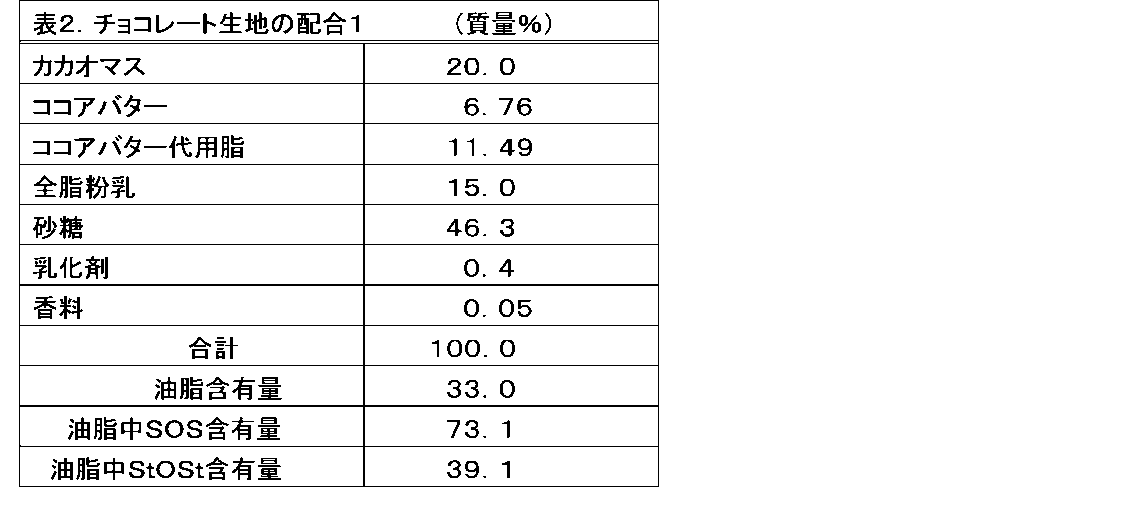
表2の配合に従って、原材料が混合された後、常法に従って、ロールリファイニング、コンチングが行われ、生地温度が37℃である融液状のチョコレート生地(生地の油脂含有量33質量%)が調製された。該生地に対して、比較例1および実施例1~4の油中水型乳化物が、それぞれ1.4質量%添加され、37℃で10分間撹拌分散された。その後、チョコレート生地は成形型に充填された。10℃で15分間冷却固化後、チョコレートが成形型より剥離された。得られた厚さ7mmのチョコレートは、それぞれ20℃で2日間プレエージングされた後、28℃で6日間保温工程が行われた。保温工程後、引き続き20℃で7日間エージングが行われ、比較例2および実施例5~8のチョコレートが得られた。
表2の配合に従って、原材料が混合された後、常法に従って、ロールリファイニング、コンチングが行われ、生地温度が37℃である融液状のチョコレート生地(生地の油脂含有量33質量%)が調製された。該生地に対して、比較例1および実施例1~4の油中水型乳化物が、それぞれ1.4質量%添加され、37℃で10分間撹拌分散された。その後、チョコレート生地は成形型に充填された。10℃で15分間冷却固化後、チョコレートが成形型より剥離された。得られた厚さ7mmのチョコレートは、それぞれ20℃で2日間プレエージングされた後、28℃で6日間保温工程が行われた。保温工程後、引き続き20℃で7日間エージングが行われ、比較例2および実施例5~8のチョコレートが得られた。
[チョコレートの評価1]
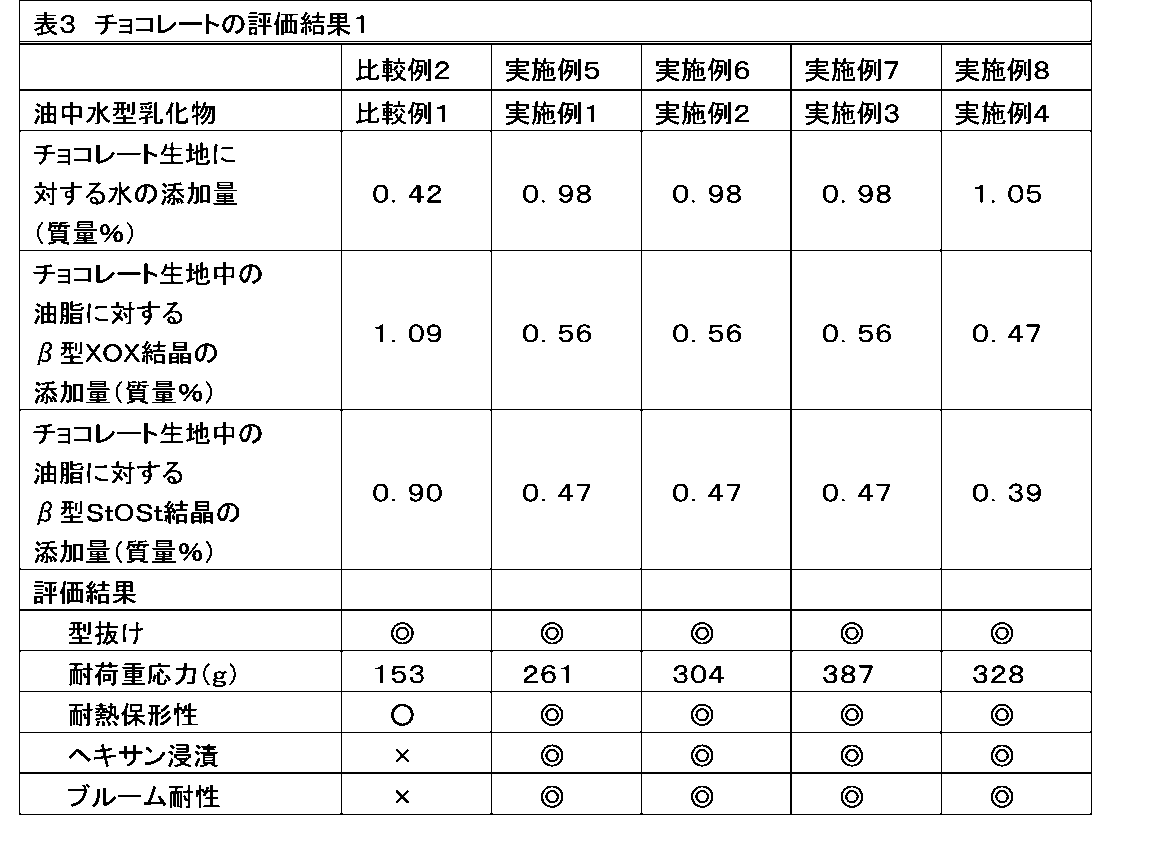
冷却固化後のチョコレートの、成形型からの型抜けの評価は、以下の基準に従って行われた。また、調温(プレエージング、保温工程、およびエージング)後のチョコレートの耐荷重応力が測定された。さらに調温後のチョコレートの、耐熱保形性評価、n-ヘキサンへの浸漬テスト、および耐ブルームテストは、以下の基準に従って行われた。結果は表3に示された。
冷却固化後のチョコレートの、成形型からの型抜けの評価は、以下の基準に従って行われた。また、調温(プレエージング、保温工程、およびエージング)後のチョコレートの耐荷重応力が測定された。さらに調温後のチョコレートの、耐熱保形性評価、n-ヘキサンへの浸漬テスト、および耐ブルームテストは、以下の基準に従って行われた。結果は表3に示された。
(型抜け評価)
15分間10℃で冷却後の離型率(成形型から抜けるチョコレートの割合)は、以下の基準に基づいて評価された。
◎ 非常に良好 (離型率=90%以上)
○ 良好 (離型率=70%以上90%未満)
△ 一部剥がれない部分あり(離型率=0%超70%未満)
× 不可 (離型率=0%)
15分間10℃で冷却後の離型率(成形型から抜けるチョコレートの割合)は、以下の基準に基づいて評価された。
◎ 非常に良好 (離型率=90%以上)
○ 良好 (離型率=70%以上90%未満)
△ 一部剥がれない部分あり(離型率=0%超70%未満)
× 不可 (離型率=0%)
(耐熱保形性評価)
調温後のチョコレートの外観は、50℃で2時間静置された後、以下の基準に基づいて評価された。
◎ 変形がなく、非常に良好
○ ほぼ変形がなく、良好
× 変形が明確に認められる
調温後のチョコレートの外観は、50℃で2時間静置された後、以下の基準に基づいて評価された。
◎ 変形がなく、非常に良好
○ ほぼ変形がなく、良好
× 変形が明確に認められる
(n-ヘキサンへの浸漬テスト)
長間隔16mm、短間隔8mmで60°と120°で交差する菱形のステンレスネット上にチョコレートが載せられ、20℃でn-ヘキサン中に浸漬された。48時間後にネットの上に残存するチョコレートの外観が、以下の基準に基づいて評価された。チョコレートの形状が保持されているほど、糖によるネットワーク形成がより強固にできていることが示される。
◎ 元の形状が完全に残っている
○ 一部崩れているが元の形状が残っている
△ ネット上に残渣が残っているが、形状が崩れている
× ネット上から残渣が完全に落下し、形状が完全に崩れている
長間隔16mm、短間隔8mmで60°と120°で交差する菱形のステンレスネット上にチョコレートが載せられ、20℃でn-ヘキサン中に浸漬された。48時間後にネットの上に残存するチョコレートの外観が、以下の基準に基づいて評価された。チョコレートの形状が保持されているほど、糖によるネットワーク形成がより強固にできていることが示される。
◎ 元の形状が完全に残っている
○ 一部崩れているが元の形状が残っている
△ ネット上に残渣が残っているが、形状が崩れている
× ネット上から残渣が完全に落下し、形状が完全に崩れている
(ブルーム耐性テスト)
32℃12時間と20℃12時間を1サイクルとして、20サイクル温度処理された後のチョコレートの外観は、以下の基準に基づいて評価された。
◎ 艶があり良好
○ ブルームがなく良好
△ 一部にブルームが発生
× 全体にブルームが発生
32℃12時間と20℃12時間を1サイクルとして、20サイクル温度処理された後のチョコレートの外観は、以下の基準に基づいて評価された。
◎ 艶があり良好
○ ブルームがなく良好
△ 一部にブルームが発生
× 全体にブルームが発生
[チョコレートの製造および評価2]
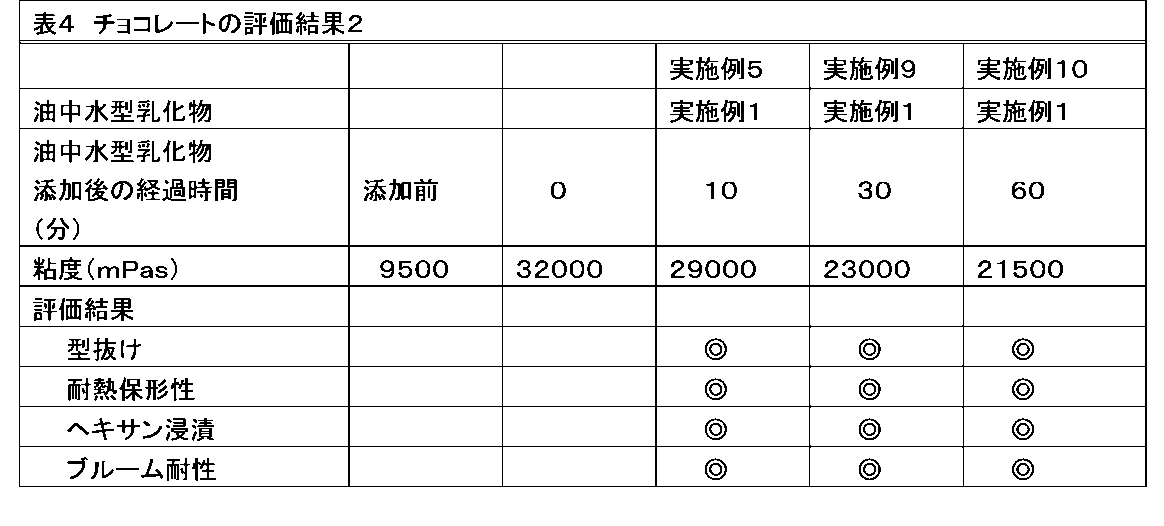
実施例1の油中水型乳化物が添加された実施例5のチョコレート生地の粘度は、油中水型乳化物の添加前、および添加後37℃で、0分、10分、30分、60分保持後、測定された。10分、30分、および60分保持後のチョコレート生地は、それぞれ成形型に充填された。10℃で15分間冷却固化後、チョコレートは成形型より剥離された。得られた厚さ7mmのチョコレートは、それぞれ20℃で2日間プレエージングされた後、28℃で6日間保温工程が行われた。保温工程後、引き続き20℃で7日間エージングが行われ、実施例5、9および10のチョコレートが得られた。
冷却固化後のチョコレートの成形型からの型抜けの評価は、[チョコレートの評価1]と同じ基準に従って行われた。また、調温(プレエージング、保温工程、およびエージング)後のチョコレートの耐熱保形性評価、n-ヘキサンへの浸漬テスト、および耐ブルームテストは、[チョコレートの評価1]と同じ基準に従って行われた。結果は表4に示された。
実施例1の油中水型乳化物が添加された実施例5のチョコレート生地の粘度は、油中水型乳化物の添加前、および添加後37℃で、0分、10分、30分、60分保持後、測定された。10分、30分、および60分保持後のチョコレート生地は、それぞれ成形型に充填された。10℃で15分間冷却固化後、チョコレートは成形型より剥離された。得られた厚さ7mmのチョコレートは、それぞれ20℃で2日間プレエージングされた後、28℃で6日間保温工程が行われた。保温工程後、引き続き20℃で7日間エージングが行われ、実施例5、9および10のチョコレートが得られた。
冷却固化後のチョコレートの成形型からの型抜けの評価は、[チョコレートの評価1]と同じ基準に従って行われた。また、調温(プレエージング、保温工程、およびエージング)後のチョコレートの耐熱保形性評価、n-ヘキサンへの浸漬テスト、および耐ブルームテストは、[チョコレートの評価1]と同じ基準に従って行われた。結果は表4に示された。
[チョコレートの製造および評価3]
(参考例1)
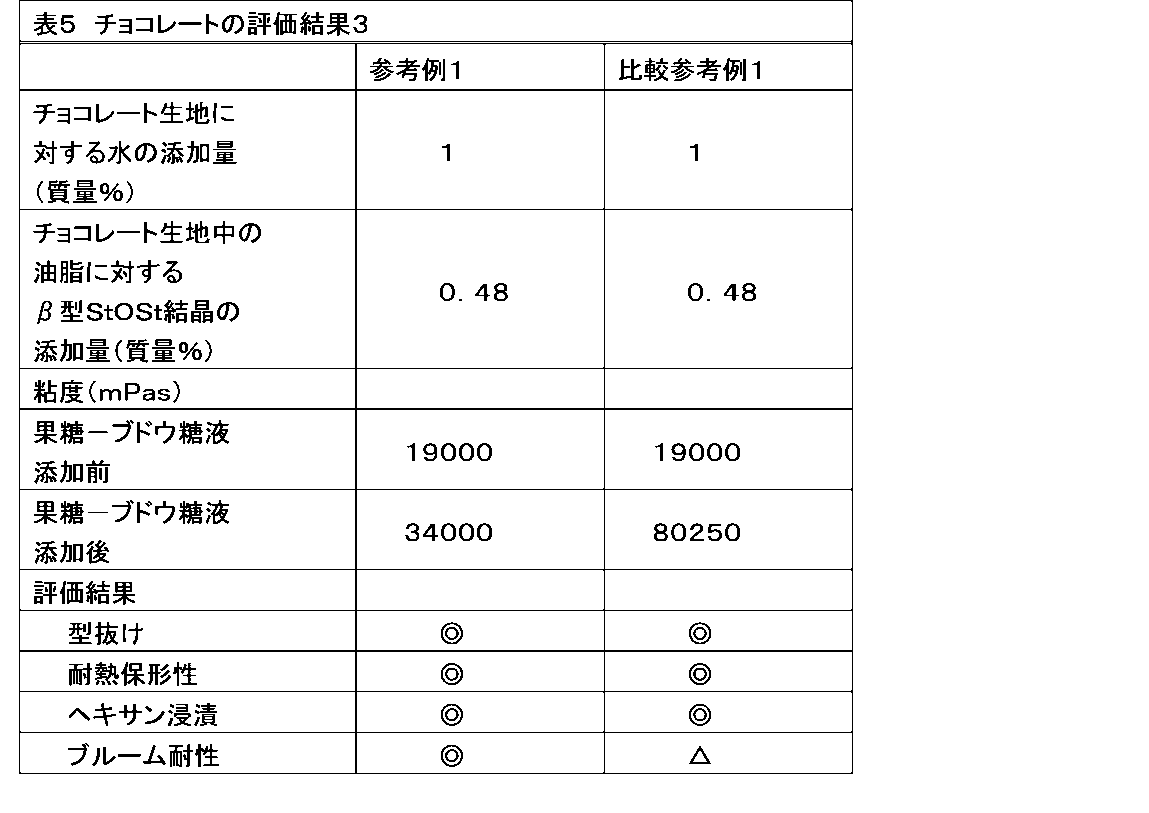
表2の配合に従って、原材料が混合された後、常法に従って、ロールリファイニング、コンチングが行われ、生地温度が37℃である融液状のチョコレート生地(生地の油脂含有量33質量%)が調製された。該生地に対して、果糖-ブドウ糖液(水分25質量%)が対生地4質量%(水として対生地1質量%)添加され、攪拌分散された。その後、油脂のみからなるシーディング剤(日清オイリオグループ株式会社社内製)が対生地0.45質量%(β型StOSt結晶として融液状チョコレート生地中の油脂に対して0.48質量%)添加され、37℃で10分間撹拌分散された。その後、チョコレート生地は成形型に充填された。10℃で15分間冷却固化後、チョコレートは成形型より剥離された。得られた厚さ7mmのチョコレートは、それぞれ20℃で2日間プレエージングされた後、28℃で6日間保温工程が行われた。保温工程後、引き続き20℃で7日間エージングが行われ、参考例1のチョコレートが得られた。
(参考例1)
表2の配合に従って、原材料が混合された後、常法に従って、ロールリファイニング、コンチングが行われ、生地温度が37℃である融液状のチョコレート生地(生地の油脂含有量33質量%)が調製された。該生地に対して、果糖-ブドウ糖液(水分25質量%)が対生地4質量%(水として対生地1質量%)添加され、攪拌分散された。その後、油脂のみからなるシーディング剤(日清オイリオグループ株式会社社内製)が対生地0.45質量%(β型StOSt結晶として融液状チョコレート生地中の油脂に対して0.48質量%)添加され、37℃で10分間撹拌分散された。その後、チョコレート生地は成形型に充填された。10℃で15分間冷却固化後、チョコレートは成形型より剥離された。得られた厚さ7mmのチョコレートは、それぞれ20℃で2日間プレエージングされた後、28℃で6日間保温工程が行われた。保温工程後、引き続き20℃で7日間エージングが行われ、参考例1のチョコレートが得られた。
(比較参考例1)
表2の配合に従って、原材料が混合された後、常法に従って、ロールリファイニング、コンチングが行われ、生地温度が37℃である融液状のチョコレート生地(生地の油脂含有量33質量%)が調製された。該生地に対して、果糖-ブドウ糖液(水分25質量%)が対生地4質量%(水として対生地1質量%)と、油脂のみからなるシーディング剤(日清オイリオグループ株式会社社内製)が対生地0.45質量%(β型StOSt結晶として融液状チョコレート生地中の油脂に対して0.48質量%)と、を同時に添加され、37℃で10分間撹拌分散された。その後、チョコレート生地は成形型に充填された。10℃で15分間冷却固化後、チョコレートは成形型より剥離された。得られた厚さ7mmのチョコレートは、それぞれ20℃で2日間プレエージングされた後、28℃で6日間保温工程が行われた。保温工程後、引き続き20℃で7日間エージングが行われ、比較参考例1のチョコレートが得られた。
表2の配合に従って、原材料が混合された後、常法に従って、ロールリファイニング、コンチングが行われ、生地温度が37℃である融液状のチョコレート生地(生地の油脂含有量33質量%)が調製された。該生地に対して、果糖-ブドウ糖液(水分25質量%)が対生地4質量%(水として対生地1質量%)と、油脂のみからなるシーディング剤(日清オイリオグループ株式会社社内製)が対生地0.45質量%(β型StOSt結晶として融液状チョコレート生地中の油脂に対して0.48質量%)と、を同時に添加され、37℃で10分間撹拌分散された。その後、チョコレート生地は成形型に充填された。10℃で15分間冷却固化後、チョコレートは成形型より剥離された。得られた厚さ7mmのチョコレートは、それぞれ20℃で2日間プレエージングされた後、28℃で6日間保温工程が行われた。保温工程後、引き続き20℃で7日間エージングが行われ、比較参考例1のチョコレートが得られた。
果糖-ブドウ糖液添加前後のチョコレート生地の粘度が測定された。また、冷却固化後のチョコレートの成形型からの型抜けの評価は、[チョコレートの評価1]と同じ基準に従って行われた。また、調温(プレエージング、保温工程、およびエージング)後のチョコレートの耐熱保形性評価、n-ヘキサンへの浸漬テスト、および耐ブルームテストは、[チョコレートの評価1]と同じ基準に従って行われた。結果は表5に示された。
[ノーテンパー型チョコレートの製造および評価4]
表6の配合に従って、原材料が混合された後、常法に従って、ロールリファイニング、コンチングが行われ、生地温度が40℃である融液状のチョコレート生地(生地の油脂含有量33質量%)が調製された。該生地に対して、実施例1の油中水型乳化物が、1.4質量%添加され、40℃で20分間撹拌分散された。その後、チョコレート生地は成形型に充填された。10℃で15分間冷却固化後、チョコレートは成形型より剥離された。得られた厚さ7mmのチョコレートは、20℃で7日間エージングされ、実施例11のチョコレートが得られた。
冷却固化後のチョコレートの成形型からの型抜けの評価は、[チョコレートの評価1]と同じ基準に従って行われた。また、エージング後のチョコレートのn-ヘキサンへの浸漬テストは[チョコレートの評価1]と同じ基準に従って行われた。結果は表7に示された。
表6の配合に従って、原材料が混合された後、常法に従って、ロールリファイニング、コンチングが行われ、生地温度が40℃である融液状のチョコレート生地(生地の油脂含有量33質量%)が調製された。該生地に対して、実施例1の油中水型乳化物が、1.4質量%添加され、40℃で20分間撹拌分散された。その後、チョコレート生地は成形型に充填された。10℃で15分間冷却固化後、チョコレートは成形型より剥離された。得られた厚さ7mmのチョコレートは、20℃で7日間エージングされ、実施例11のチョコレートが得られた。
冷却固化後のチョコレートの成形型からの型抜けの評価は、[チョコレートの評価1]と同じ基準に従って行われた。また、エージング後のチョコレートのn-ヘキサンへの浸漬テストは[チョコレートの評価1]と同じ基準に従って行われた。結果は表7に示された。


本発明の油中水型乳化物は、ノーテンパー型チョコレートの糖骨格形成にも使用できることが確認された。
Claims (11)
- 50~80質量%の水、および、β型XOX結晶を有する油脂、を含有する油中水型乳化物。
ただし、X、OおよびXOXは、以下を意味する。
X:炭素数が16以上の飽和脂肪酸
O:オレイン酸
XOX:グリセロールの1位および3位にXが結合し、2位にOが結合した、トリアシルグリセロール - 前記β型XOX結晶を有する油脂に占める、XOXの含有量が20~60質量%であり、XU2およびU3の合計含有量が40~80質量%である、請求項1に記載の油中水型乳化物。
ただし、U、XU2およびU3は、以下を意味する。
U:炭素数が16以上の不飽和脂肪酸
XU2:グリセロールに1分子のXと2分子のUが結合した、トリアシルグリセロール
U3:グリセロールに3分子のUが結合した、トリアシルグリセロール - ポリグリセリン縮合リシノレイン酸エステルを含有する、請求項1または2に記載の油中水型乳化物。
- 増粘多糖類を含有する、請求項1~3の何れか一項に記載の油中水型乳化物。
- 水とXOXを含有する油脂とを油中水型に乳化する工程、および、得られた乳化物を調温する工程、を含む、請求項1~4の何れか一項に記載された油中水型乳化物の製造方法。
- 融液状のチョコレート生地に、β型XOX結晶を有する油中水型乳化物を添加する工程を含む、耐熱性チョコレートの製造方法。
ただし、X、OおよびXOXは、以下を意味する。
X:炭素数が16以上の飽和脂肪酸
O:オレイン酸
XOX:グリセロールの1位および3位にXが結合し、2位にOが結合した、トリアシルグリセロール - 前記融液状のチョコレート生地に含まれる油脂のStOSt含有量が24~70質量%である、請求項6に記載の耐熱性チョコレートの製造方法。
ただし、StOStは、以下を意味する。
StOSt:1,3-ジステアロイル-2-オレオイルグリセロール - 前記油中水型乳化物が添加される、前記融液状チョコレート生地の温度が32~40℃である、請求項6または7に記載の耐熱性チョコレートの製造方法。
- 前記油中水型乳化物が添加される工程の後、前記チョコレート生地の生地温度が10分以上32~40℃に保持される保持工程をさらに含む、請求項6~8の何れか一項に記載の耐熱性チョコレートの製造方法。
- 前記油中水型乳化物が添加される工程の後、チョコレートを得るために、前記チョコレート生地が冷却固化される工程をさらに含む、請求項6~9の何れか一項に記載の耐熱性チョコレートの製造方法。
- 前記冷却固化工程後、前記チョコレートが保温処理される保温工程をさらに含む、請求項10に記載の耐熱性チョコレートの製造方法。
Priority Applications (2)
| Application Number | Priority Date | Filing Date | Title |
|---|---|---|---|
| JP2017564941A JP6359211B1 (ja) | 2016-08-22 | 2017-08-17 | 油中水型乳化物 |
| CN201780050485.7A CN109640678B (zh) | 2016-08-22 | 2017-08-17 | 油包水型乳化物 |
Applications Claiming Priority (2)
| Application Number | Priority Date | Filing Date | Title |
|---|---|---|---|
| JP2016162135 | 2016-08-22 | ||
| JP2016-162135 | 2016-08-22 |
Publications (1)
| Publication Number | Publication Date |
|---|---|
| WO2018037987A1 true WO2018037987A1 (ja) | 2018-03-01 |
Family
ID=61245804
Family Applications (1)
| Application Number | Title | Priority Date | Filing Date |
|---|---|---|---|
| PCT/JP2017/029519 Ceased WO2018037987A1 (ja) | 2016-08-22 | 2017-08-17 | 油中水型乳化物 |
Country Status (4)
| Country | Link |
|---|---|
| JP (2) | JP6359211B1 (ja) |
| CN (1) | CN109640678B (ja) |
| MY (1) | MY173497A (ja) |
| WO (1) | WO2018037987A1 (ja) |
Cited By (1)
| Publication number | Priority date | Publication date | Assignee | Title |
|---|---|---|---|---|
| WO2020031539A1 (ja) * | 2018-08-10 | 2020-02-13 | 不二製油グループ本社株式会社 | チョコレート類及びその製造方法 |
Families Citing this family (1)
| Publication number | Priority date | Publication date | Assignee | Title |
|---|---|---|---|---|
| WO2021256285A1 (ja) * | 2020-06-19 | 2021-12-23 | 日清オイリオグループ株式会社 | 耐熱性チョコレート及びその製造方法 |
Citations (3)
| Publication number | Priority date | Publication date | Assignee | Title |
|---|---|---|---|---|
| JP2514711B2 (ja) * | 1989-04-15 | 1996-07-10 | 株式会社ロッテ | 耐熱性チョコレ―トおよびその製造方法 |
| JP2009505669A (ja) * | 2005-08-31 | 2009-02-12 | ネステク ソシエテ アノニム | 製菓用途のエマルション |
| JP2015133954A (ja) * | 2013-12-19 | 2015-07-27 | 日清オイリオグループ株式会社 | 油脂 |
Family Cites Families (3)
| Publication number | Priority date | Publication date | Assignee | Title |
|---|---|---|---|---|
| DE3161338D1 (en) * | 1980-01-30 | 1983-12-15 | Battelle Memorial Institute | A chocolate composition for the preparation of heat-resistant chocolate articles, a process for its manufacture and its working into foodstuff articles |
| WO2014003079A1 (ja) * | 2012-06-27 | 2014-01-03 | 日清オイリオグループ株式会社 | チョコレート及び該チョコレートが被覆されたチョコレート被覆食品の製造方法、ならびにチョコレート生地の粘度上昇抑制方法 |
| JP5952988B1 (ja) * | 2014-09-24 | 2016-07-13 | 日清オイリオグループ株式会社 | 耐熱性チョコレート及びその製造方法 |
-
2017
- 2017-08-17 WO PCT/JP2017/029519 patent/WO2018037987A1/ja not_active Ceased
- 2017-08-17 JP JP2017564941A patent/JP6359211B1/ja active Active
- 2017-08-17 MY MYPI2019000848A patent/MY173497A/en unknown
- 2017-08-17 CN CN201780050485.7A patent/CN109640678B/zh active Active
-
2018
- 2018-05-23 JP JP2018098381A patent/JP2018126165A/ja active Pending
Patent Citations (3)
| Publication number | Priority date | Publication date | Assignee | Title |
|---|---|---|---|---|
| JP2514711B2 (ja) * | 1989-04-15 | 1996-07-10 | 株式会社ロッテ | 耐熱性チョコレ―トおよびその製造方法 |
| JP2009505669A (ja) * | 2005-08-31 | 2009-02-12 | ネステク ソシエテ アノニム | 製菓用途のエマルション |
| JP2015133954A (ja) * | 2013-12-19 | 2015-07-27 | 日清オイリオグループ株式会社 | 油脂 |
Cited By (5)
| Publication number | Priority date | Publication date | Assignee | Title |
|---|---|---|---|---|
| WO2020031539A1 (ja) * | 2018-08-10 | 2020-02-13 | 不二製油グループ本社株式会社 | チョコレート類及びその製造方法 |
| JP2020025489A (ja) * | 2018-08-10 | 2020-02-20 | 不二製油株式会社 | チョコレート類及びその製造方法 |
| CN112566501A (zh) * | 2018-08-10 | 2021-03-26 | 不二制油集团控股株式会社 | 巧克力类及其制造方法 |
| JP7006536B2 (ja) | 2018-08-10 | 2022-01-24 | 不二製油株式会社 | チョコレート類及びその製造方法 |
| TWI770408B (zh) * | 2018-08-10 | 2022-07-11 | 日商不二製油集團控股股份有限公司 | 巧克力類及其製造方法 |
Also Published As
| Publication number | Publication date |
|---|---|
| CN109640678B (zh) | 2022-07-29 |
| MY173497A (en) | 2020-01-29 |
| JP6359211B1 (ja) | 2018-07-18 |
| JP2018126165A (ja) | 2018-08-16 |
| CN109640678A (zh) | 2019-04-16 |
| JPWO2018037987A1 (ja) | 2018-08-23 |
Similar Documents
| Publication | Publication Date | Title |
|---|---|---|
| CN105848491B (zh) | 巧克力及其制法、酱胚粘度上升抑制法、糖骨架形成法 | |
| JP5634264B2 (ja) | 油脂組成物及び可塑性油脂組成物 | |
| JP5756074B2 (ja) | 耐熱性チョコレート及び耐熱性チョコレートの製造方法 | |
| JP6225296B1 (ja) | 焼成チョコレート | |
| JP6395747B2 (ja) | 油脂 | |
| JP6130981B1 (ja) | チョコレート | |
| JP5952988B1 (ja) | 耐熱性チョコレート及びその製造方法 | |
| JP2018174943A (ja) | チョコレート | |
| JP2008228641A (ja) | ソフトチョコレート用油脂組成物 | |
| CN108135197B (zh) | 油性食品 | |
| JP6171115B2 (ja) | 油性食品 | |
| JP6359211B1 (ja) | 油中水型乳化物 | |
| JP6441443B2 (ja) | チョコレート及びハードバター | |
| TWI848078B (zh) | 月桂系硬脂組成物、含有其的巧克力類食品及巧克力類食品的耐表面起白性的提高方法 | |
| EP4736660A1 (en) | Oil or fat for chocolates | |
| JP2023019597A (ja) | 油性菓子製造用の含水組成物、油性菓子の製造方法、油性菓子生地、及び油性菓子 |
Legal Events
| Date | Code | Title | Description |
|---|---|---|---|
| WWE | Wipo information: entry into national phase |
Ref document number: 2017564941 Country of ref document: JP |
|
| 121 | Ep: the epo has been informed by wipo that ep was designated in this application |
Ref document number: 17843469 Country of ref document: EP Kind code of ref document: A1 |
|
| NENP | Non-entry into the national phase |
Ref country code: DE |
|
| 122 | Ep: pct application non-entry in european phase |
Ref document number: 17843469 Country of ref document: EP Kind code of ref document: A1 |