WO2018030006A1 - 表面処理組成物およびこれを用いた表面処理方法 - Google Patents
表面処理組成物およびこれを用いた表面処理方法 Download PDFInfo
- Publication number
- WO2018030006A1 WO2018030006A1 PCT/JP2017/023409 JP2017023409W WO2018030006A1 WO 2018030006 A1 WO2018030006 A1 WO 2018030006A1 JP 2017023409 W JP2017023409 W JP 2017023409W WO 2018030006 A1 WO2018030006 A1 WO 2018030006A1
- Authority
- WO
- WIPO (PCT)
- Prior art keywords
- surface treatment
- polishing
- polished
- acid
- treatment composition
- Prior art date
- Legal status (The legal status is an assumption and is not a legal conclusion. Google has not performed a legal analysis and makes no representation as to the accuracy of the status listed.)
- Ceased
Links
Classifications
-
- C—CHEMISTRY; METALLURGY
- C11—ANIMAL OR VEGETABLE OILS, FATS, FATTY SUBSTANCES OR WAXES; FATTY ACIDS THEREFROM; DETERGENTS; CANDLES
- C11D—DETERGENT COMPOSITIONS; USE OF SINGLE SUBSTANCES AS DETERGENTS; SOAP OR SOAP-MAKING; RESIN SOAPS; RECOVERY OF GLYCEROL
- C11D3/00—Other compounding ingredients of detergent compositions covered in group C11D1/00
- C11D3/16—Organic compounds
- C11D3/37—Polymers
- C11D3/3746—Macromolecular compounds obtained by reactions only involving carbon-to-carbon unsaturated bonds
- C11D3/3757—(Co)polymerised carboxylic acids, -anhydrides, -esters in solid and liquid compositions
-
- C—CHEMISTRY; METALLURGY
- C11—ANIMAL OR VEGETABLE OILS, FATS, FATTY SUBSTANCES OR WAXES; FATTY ACIDS THEREFROM; DETERGENTS; CANDLES
- C11D—DETERGENT COMPOSITIONS; USE OF SINGLE SUBSTANCES AS DETERGENTS; SOAP OR SOAP-MAKING; RESIN SOAPS; RECOVERY OF GLYCEROL
- C11D1/00—Detergent compositions based essentially on surface-active compounds; Use of these compounds as a detergent
- C11D1/02—Anionic compounds
- C11D1/34—Derivatives of acids of phosphorus
- C11D1/345—Phosphates or phosphites
-
- C—CHEMISTRY; METALLURGY
- C11—ANIMAL OR VEGETABLE OILS, FATS, FATTY SUBSTANCES OR WAXES; FATTY ACIDS THEREFROM; DETERGENTS; CANDLES
- C11D—DETERGENT COMPOSITIONS; USE OF SINGLE SUBSTANCES AS DETERGENTS; SOAP OR SOAP-MAKING; RESIN SOAPS; RECOVERY OF GLYCEROL
- C11D1/00—Detergent compositions based essentially on surface-active compounds; Use of these compounds as a detergent
- C11D1/02—Anionic compounds
- C11D1/34—Derivatives of acids of phosphorus
-
- C—CHEMISTRY; METALLURGY
- C11—ANIMAL OR VEGETABLE OILS, FATS, FATTY SUBSTANCES OR WAXES; FATTY ACIDS THEREFROM; DETERGENTS; CANDLES
- C11D—DETERGENT COMPOSITIONS; USE OF SINGLE SUBSTANCES AS DETERGENTS; SOAP OR SOAP-MAKING; RESIN SOAPS; RECOVERY OF GLYCEROL
- C11D3/00—Other compounding ingredients of detergent compositions covered in group C11D1/00
- C11D3/16—Organic compounds
- C11D3/37—Polymers
-
- C—CHEMISTRY; METALLURGY
- C11—ANIMAL OR VEGETABLE OILS, FATS, FATTY SUBSTANCES OR WAXES; FATTY ACIDS THEREFROM; DETERGENTS; CANDLES
- C11D—DETERGENT COMPOSITIONS; USE OF SINGLE SUBSTANCES AS DETERGENTS; SOAP OR SOAP-MAKING; RESIN SOAPS; RECOVERY OF GLYCEROL
- C11D3/00—Other compounding ingredients of detergent compositions covered in group C11D1/00
- C11D3/16—Organic compounds
- C11D3/37—Polymers
- C11D3/3746—Macromolecular compounds obtained by reactions only involving carbon-to-carbon unsaturated bonds
- C11D3/3784—(Co)polymerised monomers containing phosphorus
-
- H—ELECTRICITY
- H10—SEMICONDUCTOR DEVICES; ELECTRIC SOLID-STATE DEVICES NOT OTHERWISE PROVIDED FOR
- H10P—GENERIC PROCESSES OR APPARATUS FOR THE MANUFACTURE OR TREATMENT OF DEVICES COVERED BY CLASS H10
- H10P52/00—Grinding, lapping or polishing of wafers, substrates or parts of devices
-
- H—ELECTRICITY
- H10—SEMICONDUCTOR DEVICES; ELECTRIC SOLID-STATE DEVICES NOT OTHERWISE PROVIDED FOR
- H10P—GENERIC PROCESSES OR APPARATUS FOR THE MANUFACTURE OR TREATMENT OF DEVICES COVERED BY CLASS H10
- H10P52/00—Grinding, lapping or polishing of wafers, substrates or parts of devices
- H10P52/40—Chemomechanical polishing [CMP]
- H10P52/402—Chemomechanical polishing [CMP] of semiconductor materials
-
- H—ELECTRICITY
- H10—SEMICONDUCTOR DEVICES; ELECTRIC SOLID-STATE DEVICES NOT OTHERWISE PROVIDED FOR
- H10P—GENERIC PROCESSES OR APPARATUS FOR THE MANUFACTURE OR TREATMENT OF DEVICES COVERED BY CLASS H10
- H10P70/00—Cleaning of wafers, substrates or parts of devices
- H10P70/20—Cleaning during device manufacture
-
- H—ELECTRICITY
- H10—SEMICONDUCTOR DEVICES; ELECTRIC SOLID-STATE DEVICES NOT OTHERWISE PROVIDED FOR
- H10P—GENERIC PROCESSES OR APPARATUS FOR THE MANUFACTURE OR TREATMENT OF DEVICES COVERED BY CLASS H10
- H10P70/00—Cleaning of wafers, substrates or parts of devices
- H10P70/20—Cleaning during device manufacture
- H10P70/23—Cleaning during device manufacture during, before or after processing of insulating materials
- H10P70/237—Cleaning during device manufacture during, before or after processing of insulating materials the processing being a planarisation of insulating layers
-
- C—CHEMISTRY; METALLURGY
- C11—ANIMAL OR VEGETABLE OILS, FATS, FATTY SUBSTANCES OR WAXES; FATTY ACIDS THEREFROM; DETERGENTS; CANDLES
- C11D—DETERGENT COMPOSITIONS; USE OF SINGLE SUBSTANCES AS DETERGENTS; SOAP OR SOAP-MAKING; RESIN SOAPS; RECOVERY OF GLYCEROL
- C11D2111/00—Cleaning compositions characterised by the objects to be cleaned; Cleaning compositions characterised by non-standard cleaning or washing processes
- C11D2111/10—Objects to be cleaned
- C11D2111/14—Hard surfaces
- C11D2111/22—Electronic devices, e.g. PCBs or semiconductors
Definitions
- the present invention relates to a surface treatment composition and a surface treatment method using the same.
- CMP chemical mechanical polishing
- Impurities are produced by polishing abrasive grains derived from the polishing composition used in CMP, organic substances such as metals, anticorrosives, and surfactants, silicon-containing materials that are objects to be polished, metal wiring, plugs, etc.
- silicon-containing materials, metals, and organic substances such as pad scraps generated from various pads are included.
- the surface of the semiconductor substrate is contaminated with these impurities, it may adversely affect the electrical characteristics of the semiconductor and reduce the reliability of the device. Therefore, it is desirable to introduce a cleaning process after the CMP process to remove these impurities from the surface of the semiconductor substrate.
- Japanese Patent Application Laid-Open No. 2012-74678 (corresponding to US Patent Application Publication No. 2013/174867) includes polycarboxylic acid or hydroxycarboxylic acid and A cleaning composition for a semiconductor substrate, which contains a sulfonic acid type anionic surfactant, a carboxylic acid type anionic surfactant, and water is disclosed. And it is disclosed that the cleaning composition can remove foreign substances without corroding the substrate surface.
- the present invention has been made in view of the above problems, and an object thereof is to provide means for sufficiently removing foreign matters remaining on the surface of a polished object to be polished.
- the present inventor has intensively studied in view of the above problems. As a result, it has been found that the use of a polymer compound containing a structural unit having a specific structure having a phosphonic acid (salt) group at a certain ratio or more significantly improves the effect of removing foreign substances, and the present invention has been completed. It was.
- the content of the structural unit A in all the structural units constituting the (co) polymer is more than 50 mol%.
- a surface treatment composition for a polished polishing object is more than 50 mol%.
- X to Y indicating a range means “X or more and Y or less”.
- measurement of operation and physical properties is performed under the conditions of room temperature (20 to 25 ° C.) / Relative humidity 40 to 50% RH.
- the surface treatment composition according to the present invention is used to reduce foreign matters remaining on the surface of a polished object to be polished (hereinafter also referred to as “cleaning object”).
- the surface treatment composition according to the present invention has a high removal effect regardless of the type of foreign matter, but exhibits a very high removal effect particularly on residues derived from organic substances (organic foreign matter).
- an organic foreign material represents the component which consists of organic substances, organic salts, etc., such as an organic low molecular weight compound and a high molecular compound, among the foreign materials adhering to the cleaning target surface.
- Examples of the organic foreign matter adhering to the object to be cleaned include pad scraps generated from the pad or components derived from additives contained in the polishing composition used in the polishing step. Therefore, the surface treatment composition according to the present invention is particularly preferably used as an organic foreign matter reducing agent for selectively removing organic foreign matters.
- the residue and residue derived from metal (metal foreign matter) or the residue derived from inorganic matter (inorganic foreign matter) and the organic foreign matter are greatly different in color and shape. From this, it can be visually judged by SEM observation whether a foreign material is an organic foreign material. Note that elemental analysis by an energy dispersive X-ray analyzer (EDX) may be used for the determination as necessary.
- EDX energy dispersive X-ray analyzer
- the polished polishing object means a polishing object after being polished in the polishing step. Although it does not restrict
- the polished object to be polished is preferably a polished substrate, more preferably a polished semiconductor substrate, and further preferably a semiconductor substrate after CMP.
- the foreign matter can cause a decrease in performance of the semiconductor device. Therefore, when the polished object is a polished semiconductor substrate, it is desirable to reduce foreign matter as much as possible in the semiconductor substrate cleaning process. Since the surface treatment composition according to the present invention has a sufficient effect of removing foreign substances, it can be suitably used for surface treatment (cleaning or the like) of such a polished semiconductor substrate.
- the surface treatment composition according to one embodiment of the present invention is not particularly limited, it exhibits a particularly high removal effect on foreign matters, and therefore, it is applied to a polished polishing object containing silicon nitride, silicon oxide, or polysilicon. Is preferred. From the same viewpoint, the surface treatment composition according to the present invention is more preferably applied to a polished polishing object containing silicon nitride or silicon oxide, and is applied to a polished polishing object containing silicon nitride. Is more preferable.
- Examples of the polished polishing object containing silicon nitride, silicon oxide, or polysilicon include, for example, a polished polishing object made of silicon nitride, silicon oxide, and polysilicon, and silicon nitride, silicon oxide, or polysilicon. Examples thereof include a polished polishing object in which a material other than these is exposed on the surface.
- examples of the former include a silicon nitride substrate, a silicon oxide substrate, or a polysilicon substrate that is a semiconductor substrate, and a substrate having a silicon nitride film, a silicon oxide film, or a polysilicon film formed on the outermost surface.
- materials other than silicon nitride, silicon oxide, or polysilicon are not particularly limited, and examples thereof include tungsten.
- Specific examples of such polished objects include a polished semiconductor substrate having a structure in which a silicon nitride film or a silicon oxide film is formed on tungsten, a tungsten portion, a silicon nitride film, and a silicon oxide film.
- a polished semiconductor substrate having an exposed structure may be used.
- TEOS TEOS type silicon oxide film
- HDP film a TEOS type silicon oxide film
- USG film generated using tetraethyl orthosilicate as a precursor.
- the polished polishing object is a rinse polishing composition other than the surface treatment composition of the present invention. It is preferable that it is after having been rinsed and used.
- One embodiment of the present invention includes a (co) polymer or a salt thereof containing the structural unit A having a phosphonic acid group and a divalent (poly) oxyhydrocarbon group, and water, and the (co) polymer.
- the content rate of the structural unit A which occupies in all the structural units which comprise is a surface treatment composition of the grinding
- ADVANTAGE OF THE INVENTION According to this invention, the means which can fully remove the foreign material which remains on the surface of a grinding
- surface treatment is a concept including, for example, a cleaning process and a rinsing process for a polished polishing object, as will be described in detail below. Therefore, the surface treatment composition according to one embodiment of the present invention is used as a cleaning composition or a rinse polishing composition.
- the inventor presumes the mechanism by which the above-mentioned problems are solved by the present invention as follows.
- the anionized phosphonic acid (salt) group in the structural unit A exhibits hydrophilicity, and the phosphonic acid (salt) in the (co) polymer.
- a portion other than the group, for example, a hydrocarbon group such as an alkyl group or an alkylene group shows hydrophobicity as a hydrophobic site.
- the (co) polymer containing the structural unit A has a part of the anionized phosphonic acid (salt) group electrostatically adsorbed to the foreign matter against the positively charged foreign matter. Envelop the surface of the foreign material.
- the (co) polymer containing the structural unit A is different from a foreign substance that is not charged with a positive charge. Envelops the surface of foreign matter by making hydrophobic interactions with.
- the (co) polymer containing the foreign matter and the structural unit A is an anionized phosphonic acid (hydrophilic group) containing the (co) polymer containing the structural unit A on the outside and the foreign matter inside. Salt) groups are formed outwards (side with water) to form micelles.
- the (co) polymer containing the structural unit A is electrostatically adsorbed to the object to be cleaned through a part of the anionized phosphonic acid (salt) group.
- the surface of the object to be cleaned is covered with a (co) polymer containing the structural unit A, and is anionized as a hydrophilic group, facing the surface opposite to the surface of the object to be cleaned (the side with water). It will be covered with phosphonic acid (salt) groups.
- the anionized phosphonic acid (salt) group directed to the outside (side with water) of the micelle and the anionized phosphonic acid directed to the side opposite to the surface of the object to be cleaned (side with water)
- An electrostatic repulsion occurs between the (salt) group.
- electrostatic repulsion increases, so that the foreign matter attached to the cleaning target is removed from the surface of the cleaning target. Will disperse in water. Further, when such electrostatic repulsion occurs, the foreign matter once removed from the surface of the cleaning target is prevented from being reattached to the surface of the cleaning target.
- the foreign matter is removed by a mechanism different from that of the cleaning target charged with a positive charge.
- the surface of a foreign object or object to be cleaned that is not positively charged is hydrophobic. Hydrophobic interaction is likely to occur between such a foreign object and the surface of the object to be cleaned, and the foreign object is likely to adhere to the surface of the object to be cleaned.
- the foreign matter once removed from the surface of the object to be cleaned by the mechanical action in the surface treatment is reattached to the surface of the object to be cleaned. Therefore, in the conventional cleaning composition and rinse polishing composition, the surface treatment is performed. In some cases, the foreign matter may not be sufficiently removed from the surface of the object to be cleaned.
- the (co) polymer containing the structural unit A can have a strong hydrophobic interaction particularly with respect to a hydrophobic object to be cleaned.
- the surface of the object to be cleaned is covered with a (co) polymer containing the structural unit A, and is anionized as a hydrophilic group, facing the surface opposite to the surface of the object to be cleaned (the side with water). It will be covered with phosphonic acid (salt) groups.
- phosphonic acid (salt) groups As a result, the foreign matter that is hydrophobic cannot be adsorbed by the hydrophobic interaction on the surface of the object to be cleaned, and reattachment to the surface of the object to be cleaned is prevented.
- the (co) polymer containing the structural unit A is easily removed after the surface treatment step (for example, the washing step), it itself does not cause a foreign matter.
- One embodiment of the present invention is a (co) polymer including a structural unit A having a phosphonic acid group (—P ( ⁇ O) (OH) 2 ) and a divalent (poly) oxyhydrocarbon group, or a salt thereof (hereinafter referred to as “a”).
- a phosphonic acid-based (co) polymer
- the structural unit A includes a phosphonic acid (salt) group and a divalent (poly) oxyhydrocarbon group.
- the “phosphonic acid (salt) group” represents a phosphonic acid group (—P ( ⁇ O) (OH) 2 ) or a salt thereof.
- “having a phosphonic acid (salt) group” means that the compound has a partial structure represented as a phosphonic acid group (—P ( ⁇ O) (OH) 2 ) or a salt thereof.
- the phosphonic acid (salt) group may exist in the form of a phosphoric acid (salt) group (phosphoric acid group (—O—P ( ⁇ O) (OH) 2 ) or a salt thereof). Shall be included.
- the “divalent (poly) oxy hydrocarbon group” is represented by (—O—R—) or (—R—O—) (where R represents a divalent hydrocarbon group). Or a divalent polyoxyhydrocarbon group in which two or more divalent hydrocarbon groups are linked by an ether bond.
- the structural unit A preferably has a phosphonic acid (salt) group in the form of a phosphoric acid (salt) group, and the phosphoric acid (salt) group and 2 It is more preferable to have a structure in which a valent (poly) oxyhydrocarbon group is directly bonded, and it is more preferable that the structural unit A is represented by the following general formula (1).
- the divalent hydrocarbon group in the “divalent (poly) oxy hydrocarbon group” has 1 to 18 carbon atoms from the viewpoint of obtaining higher removal of foreign matters.
- a hydrocarbon group is preferred, a hydrocarbon group having 1 to 12 carbon atoms is more preferred, a hydrocarbon group having 1 to 10 carbon atoms is more preferred, a hydrocarbon group having 1 to 6 carbon atoms is particularly preferred, and a carbon group having 2 carbon atoms is preferred.
- a hydrogen group is most preferred.
- the divalent hydrocarbon group in the “divalent (poly) oxy hydrocarbon group” may be a linear structure, a branched structure, or a cyclic structure, and is an alkylene group, an alkenylene group, a phenylene group, or a cycloalkylene group. Are preferable, and an alkylene group is more preferable.
- R 1 is a hydrogen atom or an alkyl group having 1 to 4 carbon atoms
- R 2 is a hydrocarbon group having 1 to 18 carbon atoms
- n is 1 to 10
- R 1 in formula (1) is preferably a hydrogen atom or an alkyl group having 1 to 3 carbon atoms, more preferably a hydrogen atom, a methyl group, or an ethyl group, from the viewpoint of obtaining higher removal of foreign matters.
- a hydrogen atom or a methyl group is more preferable, and a methyl group is particularly preferable.
- R 2 in the formula (1) is preferably a hydrocarbon group having 1 to 12 carbon atoms, more preferably a hydrocarbon group having 1 to 10 carbon atoms, still more preferably a hydrocarbon group having 1 to 6 carbon atoms, and a carbon number of 2
- the hydrocarbon group is particularly preferred.
- the type of the hydrocarbon group represented by R 2 may be a linear structure, a branched chain structure, or a cyclic structure, and is preferably an alkylene group, an alkenylene group, a phenylene group, or a cycloalkylene group, and more preferably an alkylene group.
- both ends of the main chain are hydrogen atoms.
- the monomer that provides the structural unit A represented by the formula (1) include methacryloyloxymethyl phosphoric acid, methacryloyloxyethyl phosphoric acid, methacryloyloxypropyl phosphoric acid, methacryloyloxybutyl phosphoric acid, methacryloyloxy Pentyl phosphoric acid, methacryloyloxyhexyl phosphoric acid, methacryloyloxyoctyl phosphoric acid, methacryloyloxydecyl phosphoric acid, methacryloyloxylauryl phosphoric acid, methacryloyloxystearyl phosphoric acid, methacryloyloxy-1,4-dimethylcyclohexyl phosphoric acid, etc.
- methacryloyloxymethyl phosphoric acid methacryloyloxyethyl phosphoric acid, methacryloyloxypropyl phosphoric acid, or a salt thereof is more preferable, and methacryloyloxyethyl phosphoric acid or a salt thereof, from the viewpoint of obtaining higher removal of foreign substances. Is more preferable.
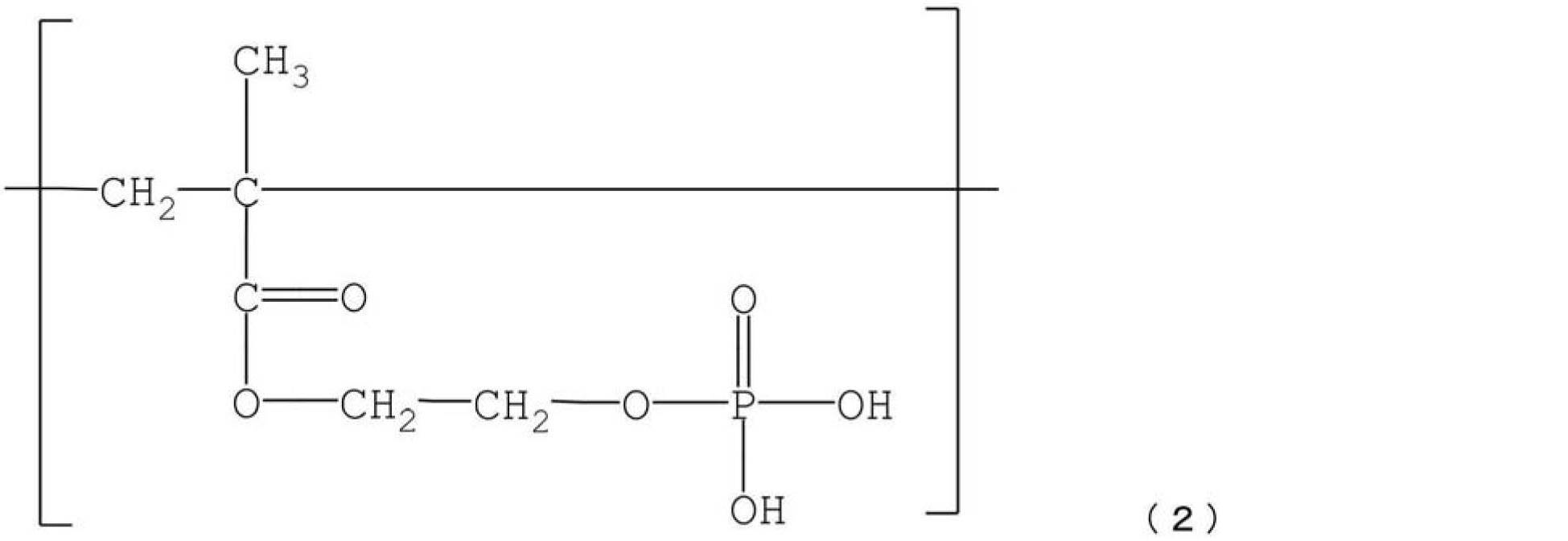
- methacryloyloxyethyl phosphoric acid provides a structural unit having a structure represented by the following formula (2).
- any of an acid form, a salt form, or a form in which a part of the acid is a salt (partial salt form) can be used.
- the phosphonic acid-based (co) polymer is a salt, even if the phosphonic acid group contained in the structural unit A forms a salt, these other structural units described later form a salt. Both may form a salt.
- the phosphonic acid (co) polymer salt it is preferable that at least the phosphonic acid group contained in the structural unit A forms a salt.
- the salt may be in a form (partial salt) in which a part of the phosphonic acid (salt) group is a salt of the phosphonic acid group.
- All may be a salt of a phosphonic acid group, but a partial salt is more preferable.
- the type of salt of the phosphonic acid group is not particularly limited, and examples thereof include metal salts, ammonium salts, and amine salts. In addition, the kind of salt can be used individually or in combination of 2 or more.
- the counter ion constituting the metal salt belongs to the periodic table (long period) Group 1, Group 11, Group 12, Group 3, Group 13, Group 4, Group 6, Group 7 or Group 8. A metal is mentioned.
- Examples of the counter ion constituting the amine salt include tetramethylammonium, tetraethylammonium, tetrabutylammonium and the like. Among these types of salts, ammonium salts or amine salts are more preferable, and amine salts are more preferable from the viewpoint of obtaining higher foreign substance removability.
- the structural unit A can be used alone or in combination of two or more.
- the content of the structural unit A in the total structural units constituting the phosphonic acid-based (co) polymer according to the present invention is more than 50 mol%. Moreover, it is preferable that the content rate of the structural unit A is 60 mol% or more. When the content of the structural unit A is 60 mol% or more, the effect of removing foreign matters is further improved. The reason for this is presumed that the existence of a sufficient amount of the structural unit A facilitates electrostatic adsorption to foreign matters and polished objects to be polished, and adsorption by hydrophobic interaction.
- it is more preferably 70 mol% or more, further preferably 80 mol% or more, and still more preferably 90 mol% or more.
- the phosphonic acid-based (co) polymer is most preferably a homopolymer having only the structural unit A as a structural unit (upper limit of 100 moles). %).
- the phosphonic acid-based (co) polymer may contain other structural units as long as the content of the structural unit A satisfies the above range.
- the monomer that provides the other structural unit is not particularly limited, and examples thereof include hydroxy group- or glycidyl group-containing vinyl monomers, unsaturated carboxylic acids or salts thereof, unsaturated carboxylic acid esters, unsaturated amides, Examples thereof include unsaturated amines or salts thereof, and aromatic mono- or divinyl compounds having no ionic group.
- the ionic group represents a group in which a part of the hydrophilic group is dissociated in water and separated into an anion (anion) portion and a cation (cation) portion.
- another structural unit can be used individually or in combination of 2 or more.
- hydroxy group or glycidyl group-containing vinyl monomer examples include, for example, hydroxyethyl acrylate, hydroxyethyl methacrylate, glycidyl acrylate, glycidyl methacrylate, ethylene glycol diacrylate, ethylene glycol dimethacrylate, polyethylene glycol monoacrylate, polyethylene Examples include glycol monomethacrylate.
- Examples of the unsaturated carboxylic acid or a salt thereof include (meth) acrylic acid, itaconic acid, maleic acid, fumaric acid, crotonic acid, and salts thereof.
- Examples of the unsaturated carboxylic acid ester include methyl methacrylate, ethyl methacrylate, butyl methacrylate, hexyl methacrylate, octyl methacrylate, ethyl hexyl methacrylate, decyl methacrylate, lauryl methacrylate (LMA), palmityl methacrylate, methacrylic acid.
- the unsaturated carboxylic acid ester does not include the above-mentioned hydroxy group- or glycidyl group-containing vinyl monomer.
- Examples of the unsaturated amide include acrylamide, methacrylamide, N-methylol acrylamide, N-methylol methacrylamide, N-diacetone acrylamide and the like.
- unsaturated amines or salts thereof include aminoethyl acrylate, aminoethyl methacrylate, N, N-dimethylaminoethyl acrylate, N, N-dimethylaminoethyl methacrylate, N, N-diethylaminoethyl acrylate, N, N-diethylamino
- examples include ethyl methacrylate, N, N, N-trimethylaminoethyl acrylate, N, N, N-trimethylaminoethyl methacrylate and the like.
- aromatic mono- or divinyl compound having no ionic group examples include styrene compounds such as styrene, ⁇ -methylstyrene, chlorostyrene, and alkylstyrene, and divinylbenzene.
- an unsaturated carboxylic acid or a salt thereof, an unsaturated carboxylic acid ester, or an aromatic mono- or divinyl compound having no ionic group is preferable.
- the constitutional unit provided by these monomers is advantageous in that it maintains the removability of foreign substances derived from the constitutional unit A and the removability after the surface treatment step (for example, the washing step), while maintaining good removability. It is because it can maintain favorable and can give a desired characteristic to a surface treatment composition.
- the component provided by these monomers mainly functions as a hydrophobic site, and when there is a hydrophobic site composed of other structural units as a component of the phosphonic acid (co) polymer, the hydrophobic site Adsorption due to the hydrophobic interaction between the particles and foreign matters (particularly organic foreign matters) is further promoted. Therefore, the action of controlling the charged state (surface potential) on the surface of the foreign material to the same charged state (surface potential) as that of the polished polishing object is strengthened, and the removal of the foreign material is further promoted by increasing the electrostatic repulsion force. It is considered possible.
- an unsaturated carboxylic acid or a salt thereof or an aromatic monovinyl compound having no ionic group is more preferable, and an unsaturated carboxylic acid or a salt thereof or a styrene compound is more preferable.
- Acrylic acid or styrene is more preferred, methacrylic acid or styrene is particularly preferred, and styrene is most preferred.
- the salt may be a partial salt or a form in which all of the groups capable of forming a salt are a salt.
- the kind of the salt and the kind of the counter ion constituting the salt are not particularly limited, and may be, for example, those mentioned for the salt of the phosphonic acid group.
- the content of other structural units in the total structural units constituting the phosphonic acid-based (co) polymer according to the present invention is less than 50 mol%. Moreover, it is preferable that the content rate of another structural unit is 40 mol% or less. When the content of other structural units is 40 mol% or less, the effect of removing foreign matters is further improved. The reason for this is presumed that the existence of a sufficient amount of the structural unit A facilitates electrostatic adsorption to foreign matters and polished objects to be polished, and adsorption by hydrophobic interaction.
- the phosphonic acid-based (co) polymer is a homopolymer having only the structural unit A as a structural unit (lower limit 0 mol%).
- each structural unit of the phosphonic acid-based (co) polymer may be random, block, or graft.
- the weight average molecular weight of the phosphonic acid (co) polymer is preferably 1000 or more.
- the effect of removing foreign matters is further improved. This is because the phosphonic acid-based (co) polymer has a better covering property when covering the polished polishing object or foreign matter, and the action of removing foreign matter from the polished polishing object surface or the polished polishing object surface. This is presumed to be because the effect of preventing the reattachment of foreign matter to the skin is further improved.
- the weight average molecular weight is more preferably more than 3000, and even more preferably 10,000 or more.
- the upper limit of the weight average molecular weight of the phosphonic acid-based (co) polymer is not particularly limited, but is preferably 2000000 or less.
- the weight average molecular weight can be determined by gel permeation chromatography (GPC) in terms of polyethylene glycol using a GPC apparatus (manufactured by Shimadzu Corporation, model: Prominence + ELSD detector (ELSD-LTII)).
- the method for producing the phosphonic acid (co) polymer is not particularly limited, and examples thereof include a monomer copolymerization method.
- a known polymerization method such as bulk polymerization or solution polymerization can be used.
- the polymerization solvent preferably has a water solubility (20 ° C.) of 10% by mass or more.
- the polymerization solvent include water, alcohols, ketones, and ethers.
- a polymerization solvent can be used individually or in combination of 2 or more.
- the polymerization initiator a known radical initiator is used.
- a known chain transfer agent is used as necessary.
- solution polymerization of the raw material compound is carried out by refluxing the solvent at 40 to 300 ° C. in a nitrogen gas stream, and the like. Coalescence can be obtained.
- the phosphonic acid-based (co) polymer is preferably water-soluble.
- phosphonic acid-based (co) polymer commercially available products may be used.
- polyphosmer series M-101, MH-301 manufactured by DAP Corporation may be used.
- the content of the phosphonic acid (co) polymer is preferably 0.01% by mass or more with respect to the total mass of the surface treatment composition.
- the content of the phosphonic acid (co) polymer is 0.01% by mass or more, the effect of removing foreign matters is further improved. This is presumed to be because the phosphonic acid-based (co) polymer is coated in a larger area when it covers the polished object and foreign matter.
- the content of the phosphonic acid (co) polymer is more preferably 0.03% by mass or more, and 0.05% by mass or more with respect to the total mass of the surface treatment composition. Is more preferable, and 0.09% by mass or more is particularly preferable.
- group (co) polymer is 10 mass% or less with respect to the total mass of a surface treatment composition.
- the content of the phosphonic acid (co) polymer is 10% by mass or less, the effect of removing foreign matters is further improved. This reason is presumed to be because the removability of the phosphonic acid-based (co) polymer after the surface treatment step (for example, the washing step) becomes better.
- the content of the phosphonic acid (co) polymer is more preferably 5% by mass or less, and further preferably 1% by mass or less, with respect to the total mass of the surface treatment composition. And 0.5% by mass or less is particularly preferable.
- the content of the phosphonic acid (co) polymer is preferably more than 20% by mass with respect to the total mass of the polymer compound contained in the surface treatment composition (upper limit of 100% by mass).
- the content of the phosphonic acid (co) polymer is more than 20% by mass with respect to the total mass of the polymer compound, the effect of removing foreign substances is further improved. This reason is presumed to be because the amount of the polymer compound other than the phosphonic acid-based (co) polymer that can cause foreign matters after the surface treatment step (for example, the cleaning step) is reduced.
- the phosphonic acid (co) polymer is reduced in that the coating is hindered by a polymer compound other than the phosphonic acid (co) polymer when the polished object and foreign matter are coated. It is assumed that it is because it is done. Furthermore, the reason is that it is reduced that the electrostatic adsorption effect or repulsion effect by the phosphonic acid (co) polymer is hindered by a polymer compound other than the phosphonic acid (co) polymer. It is estimated that.
- the content of the phosphonic acid-based (co) polymer is more preferably more than 50% by mass, further preferably more than 90% by mass, based on the total mass of the polymer compound, It is particularly preferable that the content exceeds 100% by mass, and most preferable that the content is 100% by mass. In particular, when the content of the phosphonic acid (co) polymer is more than 95% by mass with respect to the total mass of the polymer compound, the effect of removing foreign matters is remarkably improved.
- the polymer compound other than the phosphonic acid (co) polymer include polymer compounds used as other additives described later.
- the surface treatment composition according to one embodiment of the present invention preferably further contains an acid.
- the phosphonic acid-based (co) polymer is treated as different from the acid as the additive described here.
- the acid is added mainly for the purpose of adjusting the pH of the surface treatment composition.
- the polished object to be polished contains silicon nitride or silicon oxide, the acid is presumed to play a role of charging the surface of the polished object to be polished or the surface of the foreign object with a positive charge.
- the surface treatment composition when used for a foreign substance having a property capable of being charged to a positive charge or a polished object to be polished, by adding an acid, the electrostatic repulsion effect is further promoted, and the surface treatment composition The effect of removing foreign matters by objects is further improved.
- an inorganic acid either an inorganic acid or an organic acid may be used.
- the inorganic acid is not particularly limited, and examples thereof include sulfuric acid, nitric acid, boric acid, carbonic acid, hypophosphorous acid, phosphorous acid and phosphoric acid.
- the organic acid is not particularly limited.
- formic acid acetic acid, propionic acid, butyric acid, valeric acid, 2-methylbutyric acid, n-hexanoic acid, 3,3-dimethylbutyric acid, 2-ethylbutyric acid, 4-methylpentane Acid, n-heptanoic acid, 2-methylhexanoic acid, n-octanoic acid, 2-ethylhexanoic acid, benzoic acid, glycolic acid, salicylic acid, glyceric acid, oxalic acid, malonic acid, succinic acid, glutaric acid, adipic acid, Examples include carboxylic acids such as pimelic acid, maleic acid, phthalic acid, malic acid, tartaric acid, citric acid and lactic acid, and methanesulfonic acid, ethanesulfonic acid and isethionic acid.
- carboxylic acids such as pimelic acid, maleic acid, phthalic acid, malic acid, tartaric acid
- the surface treatment composition when used for a foreign matter having a property capable of being charged to a positive charge or a polished polishing target, the surface of the polished polishing target and the surface of the foreign matter are charged with a positive charge.
- maleic acid or nitric acid is more preferable, and maleic acid is further preferable.
- an acid can be used individually or in combination of 2 or more types.
- the acid content is preferably 0.01% by mass or more based on the total mass of the surface treatment composition.
- the acid content is 0.01% by mass or more, the effect of removing foreign matters is further improved.
- the surface treatment composition is used for a foreign matter having a property of being positively charged or a polished polishing object, the surface of the polished polishing object and the surface of the foreign object are charged with a positive charge. This is presumed to be better.
- the acid content is more preferably 0.05% by mass or more, further preferably 0.1% by mass or more, based on the total mass of the surface treatment composition. It is particularly preferably 15% by mass or more.
- content of an acid is 5 mass% or less with respect to the total mass of a surface treatment composition.
- the acid content is more preferably 3% by mass or less, further preferably 1% by mass or less, and more preferably 0.30% by mass or less, based on the total mass of the surface treatment composition. It is particularly preferred that
- the surface treatment composition according to an embodiment of the present invention may contain other additives in any proportion as necessary within a range not inhibiting the effects of the present invention.
- components other than the essential components of the surface treatment composition according to one embodiment of the present invention are not added as much as possible because they may cause foreign matters. Therefore, the components other than the essential components are preferably as little as possible, and more preferably not contained.
- other additives include abrasive grains, alkalis, anticorrosives, dissolved gases, reducing agents, oxidizing agents, and alkanolamines.
- a surface treatment composition does not contain an abrasive grain substantially for the further improvement of the foreign material removal effect.
- substantially free of abrasive grains refers to a case where the content of abrasive grains is 0.01% by mass or less with respect to the total mass of the surface treatment composition.
- the surface treatment composition according to one embodiment of the present invention contains water as a dispersion medium (solvent).
- the dispersion medium has a function of dispersing or dissolving each component.
- the dispersion medium is not particularly limited as long as it contains water, and may be only water.
- the dispersion medium may be a mixed solvent of water and an organic solvent for dispersing or dissolving each component.
- examples of the organic solvent used include acetone, acetonitrile, ethanol, methanol, isopropanol, glycerin, ethylene glycol, and propylene glycol, which are organic solvents miscible with water.
- organic solvents may be used without being mixed with water, and each component may be dispersed or dissolved and then mixed with water.
- These organic solvents can be used alone or in combination of two or more. Among these, it is preferable that a dispersion medium is only water.
- Water is preferably water containing as little impurities as possible from the viewpoint of inhibiting contamination of the polished object and the action of other components.
- water having a total content of transition metal ions of 100 ppb or less is preferable.
- the purity of water can be increased by operations such as removal of impurity ions using an ion exchange resin, removal of foreign matters by a filter, distillation, and the like.
- the water for example, deionized water (ion exchange water), pure water, ultrapure water, distilled water, or the like is preferably used.
- the pH value of the surface treatment composition according to one embodiment of the present invention is preferably less than 7.
- the pH value is more sure. Can be charged with a positive charge.
- the pH value is more preferably less than 4, more preferably 3 or less, still more preferably less than 3, and particularly preferably 2.5 or less.
- the pH value is preferably 1 or more. When the pH value is 1 or more, the cost can be further reduced.
- the pH value of the surface treatment composition can be confirmed with a pH meter (product name: LAQUA (registered trademark) manufactured by Horiba, Ltd.).
- the surface treatment composition is preferably prepared with only the phosphonic acid-based (co) polymer or with the phosphonic acid-based (co) polymer and the acid.
- the surface treatment composition may be adjusted using other additives such as an alkali that can be optionally added within the range not impairing the effects of the present invention. .
- the surface treatment composition according to one embodiment of the present invention is more preferable as the effect of removing foreign matters on the surface of the polished object is higher. That is, it is preferable that the number of foreign matters remaining on the surface is smaller after the surface treatment of the polished object to be polished using the surface treatment composition.
- the number of foreign matters is preferably 2500 or less after the surface treatment of the polished polishing object using the surface treatment composition, and 2500 pieces. Or less, more preferably 2000 or less, even more preferably 1500 or less, particularly preferably 1000 or less, and most preferably 500 or less.
- the number of foreign matters is preferably 800 or less, and 500 or less after surface-treating the polished polishing object using the surface treatment composition. More preferably, it is 450 or less, more preferably 400 or less, particularly preferably 350 or less, and most preferably 300 or less. On the other hand, the smaller the number of foreign substances, the better. Therefore, the lower limit is not particularly limited, but is substantially zero.
- the surface treatment composition according to one embodiment of the present invention has a high removal effect regardless of the type of foreign matter, but exhibits an extremely high removal effect particularly on organic foreign matters.
- the organic foreign matter removing effect specifically, in the case of a polished polishing object containing silicon nitride, the number of foreign matters is 1000 or less after the surface of the polished polishing object is surface-treated using the surface treatment composition. Preferably, it is 600 or less, more preferably 500 or less, even more preferably 480 or less, particularly preferably 300 or less, and most preferably 100 or less. .
- the number of foreign matters is preferably 300 or less, and 200 or less after the surface of the polished polishing object is surface-treated with the surface treatment composition. More preferably, it is 160 or less, more preferably 120 or less, particularly preferably 100 or less, and most preferably 90 or less. On the other hand, the smaller the number of foreign substances, the better. Therefore, the lower limit is not particularly limited, but is substantially zero.
- the value measured by the method as described in an Example is employ
- Another aspect of the present invention includes mixing a (co) polymer containing a structural unit A having a phosphonic acid group and a divalent (poly) oxyhydrocarbon group or a salt thereof with water.
- the content rate of the structural unit A which occupies in all the structural units which comprise the said (co) polymer is a manufacturing method of the surface treatment composition which is more than 50 mol%.
- the kind of phosphonic acid (co) polymer, the amount added, etc. are as described above.
- the above-described acid, abrasive grains, other additives, a dispersion medium other than water, and the like may be further mixed. These types, addition amounts, etc. are as described above.
- the mixing method such as the mixing conditions and the mixing order is not particularly limited, and known ones can be used.
- ⁇ Surface treatment method> Another aspect of the present invention is a surface treatment method including surface-treating a polished polishing object using the surface treatment composition.
- the surface treatment method refers to a method of reducing foreign matter on the surface of a polished object to be polished, and is a method of performing broad cleaning.
- the surface treatment method according to one embodiment of the present invention can sufficiently remove the remaining foreign matter. That is, according to another aspect of the present invention, there is provided a foreign matter reducing method on the surface of a polished polishing object, wherein the polished polishing object is surface-treated using the surface treatment composition.
- the surface treatment method according to an embodiment of the present invention is performed by a method in which the surface treatment composition is directly brought into contact with a polished object to be polished.
- the surface treatment method mainly, (I) a method by rinsing and (II) a method by cleaning treatment may be mentioned. That is, the surface treatment according to one embodiment of the present invention is preferably performed by rinsing or cleaning. The rinse polishing process and the cleaning process are performed in order to remove foreign matters (particles, metal contamination, organic residue, pad scraps, etc.) on the surface of the polished object and obtain a clean surface.
- the above (I) and (II) will be described below.
- the surface treatment composition according to one embodiment of the present invention is suitably used in a rinse polishing treatment. That is, the surface treatment composition according to one embodiment of the present invention can be preferably used as a rinse polishing composition.
- the rinse polishing treatment is performed on a polishing platen (platen) to which a polishing pad is attached for the purpose of removing foreign matters on the surface of the polishing object after performing final polishing (finish polishing) on the polishing object. .
- the rinse treatment is performed by bringing the surface treatment composition into direct contact with the polished object.
- the foreign matter on the surface of the polished polishing object is removed by the frictional force (physical action) by the polishing pad and the chemical action by the rinse polishing composition.
- particles and organic residue are particularly easily removed by physical action. Therefore, in the rinsing polishing process, particles and organic residue can be effectively removed by utilizing friction with the polishing pad on the polishing surface plate (platen).
- the surface of the polished polishing object after the polishing process is placed on a polishing platen (platen) of a polishing apparatus, and the polishing pad and the polished polishing object are brought into contact with each other. This can be done by relatively sliding the polished polishing object and the polishing pad while supplying the surface treatment composition to the part.
- the rinse polishing treatment can be performed using either a single-side polishing apparatus or a double-side polishing apparatus.
- the polishing apparatus preferably includes a discharge nozzle for the surface treatment composition in addition to the discharge nozzle for the polishing composition.
- the operating conditions during the rinsing process of the polishing apparatus are not particularly limited, and can be set as appropriate by those skilled in the art.
- the surface treatment composition according to one embodiment of the present invention is suitably used in the cleaning treatment. That is, the surface treatment composition according to one embodiment of the present invention can be preferably used as a cleaning composition.
- the cleaning process can be performed for the purpose of removing foreign matters on the surface of the polishing object after the final polishing (finish polishing) is performed on the polishing object or after the rinse polishing process is performed.
- the cleaning process and the rinsing process are classified according to the place where these processes are performed, and the cleaning process is a surface process that is performed after the polished polishing object is removed from the polishing platen (platen).
- the surface treatment composition can be directly brought into contact with the polished polishing object to remove foreign matters on the surface of the object.
- a method for performing the cleaning treatment for example, (i) in a state where the polished polishing object is held, the cleaning brush is brought into contact with one or both surfaces of the polished polishing object, and the surface treatment composition is brought into contact with the contact portion.
- a method of rubbing the surface of a polished polishing object with a cleaning brush while supplying a powder (ii) a method of immersing a polished polishing object in a surface treatment composition, and performing ultrasonic treatment or stirring (dip type)can be mentioned.
- the foreign matter on the surface of the object to be polished is removed by a frictional force by a cleaning brush or a mechanical force generated by ultrasonic treatment or stirring, and a chemical action by the surface treatment composition.
- the method of contacting the surface treatment composition with the polished polishing object is not particularly limited.
- the surface treatment composition is polished while flowing the surface treatment composition from the nozzle onto the polished polishing object.
- examples thereof include a spin type that rotates a polishing object at a high speed, and a spray type that sprays and cleans a surface treatment composition on a polished polishing object.
- a spin method or a spray method it is preferable to employ a spin method or a spray method, and more preferably a spin method.
- a batch type cleaning apparatus for simultaneously surface-treating a plurality of polished polishing objects accommodated in a cassette, and mounting one polished polishing object on a holder And a single wafer cleaning device for surface treatment.
- a method using a single wafer cleaning apparatus is preferable.
- a polishing apparatus including a cleaning facility for removing a polished polishing object from a polishing platen (platen) and rubbing the object with a cleaning brush. It is done. By using such a polishing apparatus, it is possible to more efficiently perform the cleaning process on the polished object to be polished.
- a polishing apparatus As such a polishing apparatus, a general polishing apparatus having a holder for holding a polished object to be polished, a motor capable of changing the rotation speed, a cleaning brush, and the like can be used. As the polishing apparatus, either a single-side polishing apparatus or a double-side polishing apparatus may be used. In the case where a rinse polishing step is performed after the CMP step, it is more efficient and preferable that the cleaning treatment is performed using an apparatus similar to the polishing apparatus used in the rinse polishing step.
- the cleaning brush is not particularly limited, but a resin brush is preferably used.
- the material of the resin brush is not particularly limited, but for example, PVA (polyvinyl alcohol) is preferably used. And as a washing brush, it is especially preferable to use the sponge made from PVA.
- the cleaning conditions are not particularly limited, and can be appropriately set according to the type of the polished object to be polished and the type and amount of the foreign object to be removed.
- the rotation speed of the cleaning brush is preferably 10 rpm to 200 rpm
- the rotation speed of the polished polishing object is 10 rpm to 100 rpm
- the pressure (polishing pressure) applied to the polished polishing object is preferably 0.5 psi to 10 psi.
- the method for supplying the surface treatment composition to the polishing pad is not particularly limited, and for example, a method of continuously supplying with a pump or the like (flowing) may be employed.
- polishing target object is always covered with the surface treatment composition, and it is preferable that they are 10 mL / min or more and 5000 mL / min or less.
- the cleaning time is not particularly limited, the step using the surface treatment composition according to one embodiment of the present invention is preferably 5 seconds or more and 180 seconds or less. If it is such a range, it is possible to remove a foreign material more effectively.
- the temperature of the surface treatment composition at the time of cleaning is not particularly limited, and may usually be room temperature. However, the process using the surface treatment composition according to one embodiment of the present invention is performed at 40 ° C. within a range not impairing the performance. You may heat above about 70 degreeC or less.
- the conditions of the cleaning method by immersion are not particularly limited, and a known method can be used.
- Washing with water may be performed before, after, or both of performing the washing treatment by the above methods (i) and (ii).
- the polished polished object after washing is dried by removing water droplets adhering to the surface with a spin dryer or the like. Further, the surface of the polished object to be polished may be dried by air blow drying.
- the polished object to be polished is preferably after being rinsed.
- the surface treatment method according to one embodiment of the present invention is suitably applicable when the polished object is a polished substrate (preferably a polished semiconductor substrate or a semiconductor substrate after CMP). That is, according to still another aspect of the present invention, the polished polishing object is a polished semiconductor substrate, and the semiconductor includes surface treatment of the polished semiconductor substrate with the surface treatment composition. A method for manufacturing a substrate is also provided.
- a method for manufacturing a semiconductor substrate is not particularly limited as long as it includes a step (surface treatment step) of performing a surface treatment on the surface of a polished semiconductor substrate using the surface treatment composition according to one embodiment of the present invention.
- Examples of such a manufacturing method include a method having a polishing step and a cleaning step for forming a polished semiconductor substrate.
- Another example is a method having a rinse polishing step between the polishing step and the cleaning step in addition to the polishing step and the cleaning step.
- the polishing step that can be included in the method for manufacturing a semiconductor substrate is a step of polishing the semiconductor substrate to form a polished semiconductor substrate.
- the polishing step is not particularly limited as long as it is a step for polishing a semiconductor substrate, but is preferably a chemical mechanical polishing (CMP) step.
- the polishing step may be a polishing step consisting of a single step or a polishing step consisting of a plurality of steps.
- a polishing process consisting of a plurality of processes for example, a process of performing a final polishing process after a preliminary polishing process (rough polishing process), a secondary polishing process of one or more times after a primary polishing process, The process etc. which perform a final polishing process after that are mentioned.
- the surface treatment step using the surface treatment composition according to one embodiment of the present invention is preferably performed after the finish polishing step.
- polishing composition a known polishing composition can be appropriately used according to the characteristics of the semiconductor substrate. Although it does not restrict
- a polishing apparatus As a polishing apparatus, a general polishing apparatus having a polishing surface plate on which a holder for holding an object to be polished and a motor capable of changing the number of rotations is attached and a polishing pad (polishing cloth) can be attached is used. can do. As the polishing apparatus, either a single-side polishing apparatus or a double-side polishing apparatus may be used.
- polishing pad a general nonwoven fabric, polyurethane, porous fluororesin, or the like can be used without particular limitation. It is preferable that the polishing pad is grooved so that the polishing composition accumulates.
- the polishing conditions are not particularly limited, and for example, the rotation speed of the polishing surface plate and the rotation speed of the head (carrier) are preferably 10 rpm or more and 100 rpm or less.
- the pressure applied to the object to be polished (polishing pressure) is preferably 0.5 psi to 10 psi.
- the method of supplying the polishing composition to the polishing pad is not particularly limited, and for example, a method of continuously supplying (pouring) with a pump or the like is employed. Although there is no restriction
- the polishing time is not particularly limited, it is preferably 5 seconds or more and 180 seconds or less for the step using the polishing composition.
- the surface treatment step refers to a step of reducing foreign matter on the surface of the polished object using the surface treatment composition according to one embodiment of the present invention.
- a cleaning process as a surface treatment process may be performed, or only the rinsing process or only the cleaning process may be performed.
- a cleaning step as a surface treatment step is performed after the rinse polishing step.
- the rinse polishing step may be provided between the polishing step and the cleaning step in the method for manufacturing a semiconductor substrate.
- the rinse polishing step may be a step of reducing foreign matter on the surface of the polished object (polished semiconductor substrate) by the surface treatment method (rinse polishing method) according to one embodiment of the present invention.
- a known rinse polishing composition may be used as appropriate depending on the type of the polished semiconductor substrate and the type and amount of foreign matter to be removed.
- a composition containing a water-soluble polymer, a dispersion medium and an acid can be used as the rinse polishing composition.
- a rinse polishing composition containing polyvinyl alcohol, water and nitric acid is used. Also good.
- the same apparatus and conditions as those in the above polishing step can be applied except that the rinse polishing composition is supplied instead of supplying the polishing composition. .
- the details of the rinse polishing method used in the rinse polishing step are as described in the explanation relating to the rinse polishing process.
- the cleaning step may be provided after the polishing step or after the rinse polishing step in the method of manufacturing a semiconductor substrate.
- the cleaning step is a step of reducing foreign matter on the surface of the polished object to be polished (polished semiconductor substrate) by the surface treatment method (cleaning method) according to one embodiment of the present invention.
- Preparation of surface treatment composition A-1 By mixing 0.6 parts by weight of an aqueous maleic acid solution of 30% by weight as an organic acid, 1 part by weight of polyphosmer M-101 manufactured by DAP Co., Ltd. as a dispersant, and 98.4 parts by weight of water (deionized water) A surface treatment composition A-1 was prepared.
- Surface treatment composition C-1 was prepared by mixing 0.6 parts by weight of a 30% by weight maleic acid aqueous solution and 99.4 parts by weight of water (deionized water) as an organic acid.
- C-3 polyacrylic acid ammonium salt (weight average molecular weight 6000), solid content concentration 40 mass% aqueous solution: Aron (registered trademark) A-30SL manufactured by Toagosei Co., Ltd.
- C-5 Methacryloyloxyethyl phosphoric acid-methacrylic acid copolymer (20 mol% of the structural unit provided by methacryloyloxyethyl phosphoric acid in all the structural units) , 80 mol% of structural units provided from methacrylic acid)
- C-6 methacryloyloxyethyl phosphoric acid-methacrylic acid copolymer (constituent unit 50 mol% provided by methacryloyloxyethyl phosphoric acid, constituent unit 50 provided by methacrylic acid in the total constituent units Mol%), -Used for C-7: methacryloyloxyethyl phosphoric acid-st
- each surface treatment composition The characteristics of each surface treatment composition are shown in Table 1 and Table 2 below.
- the structural unit A (mol%) in the table represents the content (mol%) of the structural unit A in all the structural units.
- “-” in the column of the dispersant indicates that the corresponding component was not used.
- polishing composition M composition: sulfonic acid-modified colloidal silica (“Sulphonic acid-functionalized silicon oxidative of thiol group”), Chem. 4% by mass, ammonium sulfate 1% by mass, 30% by mass maleic acid aqueous solution 0.018% by mass, solvent: water
- Polishing was performed under the following conditions.
- a 300 mm wafer was used for the silicon nitride substrate and the TEOS substrate.
- Polishing device FREX300E manufactured by Ebara Corporation Polishing pad: Hard polyurethane pad IC1010 manufactured by Nitta Haas Co., Ltd. Polishing pressure: 1.0 psi Polishing platen rotation speed: 60rpm Head rotation speed: 60rpm Polishing composition supply: pouring Polishing composition supply amount: 300 mL / min Polishing time: 60 seconds.
- the number of foreign matters (pieces) of 0.09 ⁇ m or more was measured.
- SP-2 manufactured by KLA TENCOR was used for the measurement of the number of foreign substances. Measurement is performed on the remaining surface of one side of the cleaned substrate excluding the portion within the range of 5 mm from the outer peripheral edge (the portion from 0 mm to 5 mm wide when the outer peripheral edge is 0 mm). went.
- Table 1 shows the evaluation results for the polished silicon nitride substrate
- Table 2 shows the evaluation results for the polished TEOS substrate.
- the number of organic foreign matters after the polished substrate was cleaned under the cleaning conditions shown above was measured by SEM observation using a Review SEM RS6000 manufactured by Hitachi, Ltd. First, in SEM observation, on one side of the cleaned substrate, the remaining portion excluding a portion within a width of 5 mm from the outer peripheral end portion (a portion from 0 mm width to 5 mm width when the outer peripheral end portion is 0 mm) is excluded. 100 defects present in the part were sampled. Next, organic foreign matters were visually discriminated from 100 sampled defects by SEM observation, and the number of the organic foreign matters in the defects was calculated by confirming the number.
- the surface treatment composition according to an aspect of the present invention is a polished polishing object containing silicon nitride by comparing Examples 1 to 4 and Comparative Examples 1 to 8. It was confirmed that the removal effect of the high foreign material on the surface of this was shown.
- the surface treatment composition according to one embodiment of the present invention was found on the surface of the polished polishing object containing silicon oxide by comparing Examples 5 to 8 and Comparative Examples 9 to 13. It was confirmed that a high foreign matter removal effect was exhibited.
- the surface treatment method according to one embodiment of the present invention has a particularly high effect of removing organic foreign matters.
Landscapes
- Chemical & Material Sciences (AREA)
- Life Sciences & Earth Sciences (AREA)
- Engineering & Computer Science (AREA)
- Chemical Kinetics & Catalysis (AREA)
- Oil, Petroleum & Natural Gas (AREA)
- Wood Science & Technology (AREA)
- Organic Chemistry (AREA)
- Cleaning Or Drying Semiconductors (AREA)
- Detergent Compositions (AREA)
- Mechanical Treatment Of Semiconductor (AREA)
Abstract
本発明は、研磨済研磨対象物の表面に残留する異物を十分に除去させうる手段を提供するものである。本発明は、ホスホン酸基および2価の(ポリ)オキシ炭化水素基を有する構成単位Aを含む(共)重合体またはその塩と、水と、を含み、前記(共)重合体を構成する全構成単位中に占める、構成単位Aの含有率は、50モル%超である、研磨済研磨対象物の表面処理組成物に関する。
Description
本発明は表面処理組成物およびこれを用いた表面処理方法に関する。
近年、半導体基板表面の多層配線化に伴い、デバイスを製造する際に、物理的に半導体基板を研磨して平坦化する、いわゆる、化学的機械的研磨(Chemical Mechanical Polishing;CMP)技術が利用されている。CMPは、シリカやアルミナ、セリア等の砥粒、防食剤、界面活性剤などを含む研磨用組成物(スラリー)を用いて、半導体基板等の研磨対象物(被研磨物)の表面を平坦化する方法であり、研磨対象物(被研磨物)は、シリコン、ポリシリコン、酸化珪素、窒化珪素や、金属等からなる配線、プラグなどである。
CMP工程後の半導体基板表面には、不純物(異物)が多量に残留している。不純物としては、CMPで使用された研磨用組成物由来の砥粒、金属、防食剤、界面活性剤等の有機物、研磨対象物であるシリコン含有材料、金属配線やプラグ等を研磨することによって生じたシリコン含有材料や金属、更には各種パッド等から生じるパッド屑等の有機物などが含まれる。
半導体基板表面がこれらの不純物により汚染されると、半導体の電気特性に悪影響を与え、デバイスの信頼性が低下する可能性がある。したがって、CMP工程後に洗浄工程を導入し、半導体基板表面からこれらの不純物を除去することが望ましい。
かような洗浄工程に用いられる洗浄液(洗浄用組成物)として、特開2012-74678号公報(米国特許出願公開第2013/174867号明細書に相当)には、ポリカルボン酸またはヒドロキシカルボン酸と、スルホン酸型アニオン性界面活性剤と、カルボン酸型アニオン性界面活性剤と、水とを含有する、半導体基板用の洗浄用組成物が開示されている。そして、当該洗浄用組成物によって、基板表面を腐食することなく、異物を除去しうることが開示されている。
しかしながら、特開2012-74678号公報(米国特許出願公開第2013/174867号明細書に相当)に開示された洗浄用組成物を以ってしても、研磨済研磨対象物の洗浄において、異物を十分に除去できないという問題があった。
本発明は、上記課題を鑑みてなされたものであり、研磨済研磨対象物の表面に残留する異物を十分に除去する手段を提供することを目的とする。
本発明者は、上記課題に鑑み、鋭意検討を進めた。その結果、ホスホン酸(塩)基を有する特定構造の構成単位を一定以上の割合で含む高分子化合物を使用することにより、異物を除去する効果が著しく向上することを見出し、本発明を完成させた。
すなわち、本発明の上記課題は、以下の手段により解決される。
ホスホン酸基および2価の(ポリ)オキシ炭化水素基を有する構成単位Aを含む(共)重合体またはその塩と、水と、を含み、
前記(共)重合体を構成する全構成単位中に占める、構成単位Aの含有率は、50モル%超である、
研磨済研磨対象物の表面処理組成物。
前記(共)重合体を構成する全構成単位中に占める、構成単位Aの含有率は、50モル%超である、
研磨済研磨対象物の表面処理組成物。
以下、本発明を説明する。なお、本発明は、以下の実施の形態のみには限定されない。
本明細書において、範囲を示す「X~Y」は「X以上Y以下」を意味する。また、本明細書において、特記しない限り、操作および物性等の測定は室温(20~25℃)/相対湿度40~50%RHの条件で行う。
なお、本明細書において、化合物の具体名における表記「(メタ)アクリル」は「アクリル」および「メタクリル」を、「(メタ)アクリレート」は「アクリレート」および「メタクリレート」を表すものとする。
<異物>
本発明に係る表面処理組成物は、研磨済研磨対象物(以下、「洗浄対象物」とも称する)の表面に残留する異物を低減するのに用いられるものである。
本発明に係る表面処理組成物は、研磨済研磨対象物(以下、「洗浄対象物」とも称する)の表面に残留する異物を低減するのに用いられるものである。
本発明に係る表面処理組成物は、異物の種類に関わらず高い除去効果を有するものであるが、特に有機物由来の残渣(有機異物)に対して極めて高い除去効果を示す。なお、有機異物とは、洗浄対象物表面に付着した異物のうち、有機低分子化合物や高分子化合物等の有機物や有機塩等からなる成分を表す。洗浄対象物に付着する有機異物は、例えば、パッドから発生するパッド屑、または研磨工程において用いられる研磨用組成物等に含まれる添加剤に由来する成分等が挙げられる。したがって、本発明に係る表面処理組成物は、有機異物を選択的に除去するための有機異物低減剤として用いることが特に好ましい。
異物の中でも金属由来の残渣(金属異物)や無機物由来の残渣(無機異物)と、有機異物とは、色および形状が大きく異なる。これより、異物が有機異物であるか否かの判断は、SEM観察によって目視にて行うことができる。なお、当該判断には、必要に応じて、エネルギー分散型X線分析装置(EDX)による元素分析を用いてもよい。
<研磨済研磨対象物>
本明細書において、研磨済研磨対象物とは、研磨工程において研磨された後の研磨対象物を意味する。研磨工程としては、特に制限されないが、CMP工程であることが好ましい。
本明細書において、研磨済研磨対象物とは、研磨工程において研磨された後の研磨対象物を意味する。研磨工程としては、特に制限されないが、CMP工程であることが好ましい。
研磨済研磨対象物は、研磨済基板であることが好ましく、研磨済半導体基板であることがより好ましく、CMP後の半導体基板であることがさらに好ましい。ここで、異物は半導体デバイスの性能低下の原因となりうる。したがって、研磨済研磨対象物が研磨済半導体基板である場合は、半導体基板の洗浄工程において、異物をできる限り低減することが望まれる。本発明に係る表面処理組成物は、異物を除去する効果を十分に有するため、かような研磨済半導体基板の表面処理(洗浄等)に好適に用いることができる。
本発明の一形態に係る表面処理組成物は、特に制限されないが、異物に対して特に高い除去効果を示すことから、窒化珪素、酸化珪素またはポリシリコンを含む研磨済研磨対象物に適用することが好ましい。そして、同様の観点から、本発明に係る表面処理組成物は、窒化珪素または酸化珪素を含む研磨済研磨対象物に適用することがより好ましく、窒化珪素を含む研磨済研磨対象物に適用することがさらに好ましい。
窒化珪素、酸化珪素またはポリシリコンを含む研磨済研磨対象物としては、例えば、窒化珪素、酸化珪素およびポリシリコンのそれぞれ単体からなる研磨済研磨対象物や、窒化珪素、酸化珪素またはポリシリコンに加え、これら以外の材料が表面に露出している状態の研磨済研磨対象物等が挙げられる。ここで、前者としては、例えば、半導体基板である窒化珪素基板、酸化珪素基板またはポリシリコン基板や、最表面に窒化珪素膜、酸化珪素膜またはポリシリコン膜が形成された基板等が挙げられる。また、後者については、窒化珪素、酸化珪素またはポリシリコン以外の材料は、特に制限されないが、例えば、タングステン等が挙げられる。かかる研磨済研磨対象物の具体例としては、タングステン上に窒化珪素膜または酸化珪素膜が形成された構造を有する研磨済半導体基板や、タングステン部分と、窒化珪素膜と、酸化珪素膜とが全て露出した構造を有する研磨済半導体基板等が挙げられる。
なお、酸化珪素を含む研磨済研磨対象物としては、例えば、オルトケイ酸テトラエチルを前駆体として使用して生成されるTEOSタイプ酸化ケイ素膜(以下、単に「TEOS」とも称する)、HDP膜、USG膜、PSG膜、BPSG膜、RTO膜等が挙げられる。
本発明の一形態に係る表面処理組成物を用いて表面処理(例えば、洗浄処理)を行う際には、研磨済研磨対象物は、本発明の表面処理組成物以外のリンス研磨処理組成物を用いてリンス研磨処理をされた後のものであることが好ましい。
<表面処理組成物>
本発明の一形態は、ホスホン酸基および2価の(ポリ)オキシ炭化水素基を有する構成単位Aを含む(共)重合体またはその塩と、水と、を含み、前記(共)重合体を構成する全構成単位中に占める、構成単位Aの含有率は、50モル%超である、研磨済研磨対象物の表面処理組成物である。本発明によれば、研磨済研磨対象物の表面に残留する異物を十分に除去させうる手段が提供される。
本発明の一形態は、ホスホン酸基および2価の(ポリ)オキシ炭化水素基を有する構成単位Aを含む(共)重合体またはその塩と、水と、を含み、前記(共)重合体を構成する全構成単位中に占める、構成単位Aの含有率は、50モル%超である、研磨済研磨対象物の表面処理組成物である。本発明によれば、研磨済研磨対象物の表面に残留する異物を十分に除去させうる手段が提供される。
なお、本明細書において、「表面処理」とは、以下で詳説するように、例えば、研磨済研磨対象物に対する洗浄処理およびリンス研磨処理を含む概念である。したがって、本発明の一形態に係る表面処理組成物は、洗浄用組成物やリンス研磨用組成物として用いられる。
本発明者は、本発明によって上記課題が解決されるメカニズムを以下のように推定している。
まず、洗浄対象物が正電荷に帯電している場合について考える。表面処理組成物中の構成単位Aを含む(共)重合体は、構成単位A中のアニオン化したホスホン酸(塩)基が親水性を示し、(共)重合体中のホスホン酸(塩)基以外の部分、例えば、アルキル基またはアルキレン基等の炭化水素基等が疎水性部位として疎水性を示す。そして、構成単位Aを含む(共)重合体は、正電荷に帯電している異物に対して、その一部のアニオン化したホスホン酸(塩)基が異物に静電的に吸着することによって、異物の表面を包み込む。また、通常、正電荷に帯電していない異物の表面は疎水性を示すことから、正電荷に帯電しない異物に対して、構成単位Aを含む(共)重合体は、その疎水性部位が異物と疎水性相互作用をすることによって、異物の表面を包み込む。その結果、異物と構成単位Aを含む(共)重合体とは、外側に構成単位Aを含む(共)重合体を、内側に異物をそれぞれ含み、親水性基であるアニオン化したホスホン酸(塩)基を外側(水のある側)へと向けた、ミセルを形成する。一方、構成単位Aを含む(共)重合体は、その一部のアニオン化したホスホン酸(塩)基を介して洗浄対象物に静電的に吸着する。そして、洗浄対象物の表面は、構成単位Aを含む(共)重合体で覆われ、洗浄対象物の表面とは反対側(水のある側)へ向いた、親水性基であるアニオン化したホスホン酸(塩)基に覆われることとなる。その結果、前記ミセルの外側(水のある側)へ向いたアニオン化したホスホン酸(塩)基と、洗浄対象物の表面とは反対側(水のある側)へ向いたアニオン化したホスホン酸(塩)基との間とで、静電的な反発が生じることとなる。そして、異物と構成単位Aを含む(共)重合体との間のミセルの形成に伴い、静電的な反発が大きくなるため、洗浄対象物に付着した異物は洗浄対象物の表面から除去されて、水中に分散することとなる。また、かような静電的な反発が発生することによって、一度洗浄対象物表面から除去された異物は、洗浄対象物の表面への再付着が抑制されることとなる。
また、洗浄対象物の表面が正電荷に帯電していない場合、異物は、正電荷に帯電している洗浄対象物とは異なるメカニズムによって除去される。通常、正電荷に帯電していない異物や洗浄対象物の表面は疎水性を示す。かような異物と洗浄対象物の表面との間では、疎水性相互作用が生じ易く、異物は洗浄対象物の表面に付着し易い状態にある。このとき、表面処理における機械的作用によって洗浄対象物の表面から一度除去された異物は、洗浄対象物の表面に再付着することから、従来の洗浄用組成物やリンス研磨用組成物では表面処理を行っても異物は洗浄対象物の表面から十分に除去されない場合がある。しかしながら、構成単位Aを含む(共)重合体は、特に疎水性の洗浄対象物に対して強く疎水性相互作用をすることができる。そして、洗浄対象物の表面は、構成単位Aを含む(共)重合体で覆われ、洗浄対象物の表面とは反対側(水のある側)へ向いた、親水性基であるアニオン化したホスホン酸(塩)基に覆われることとなる。この結果、疎水性である異物は、洗浄対象物の表面に対して疎水性相互作用による吸着をすることができなくなり、洗浄対象物表面への再付着が妨げられることとなる。
また、構成単位Aを含む(共)重合体は、表面処理工程(例えば、洗浄工程)後に容易に除去されるため、これ自身が異物の原因となることはない。
なお、上記メカニズムは推測に基づくものであり、その正誤が本発明の技術的範囲に影響を及ぼすものではない。
以下、表面処理組成物に含まれる各成分について説明する。
[ホスホン酸基および2価の(ポリ)オキシ炭化水素基を有する構成単位Aを含む(共)重合体またはその塩]
本発明の一形態は、ホスホン酸基(-P(=O)(OH)2)および2価の(ポリ)オキシ炭化水素基を有する構成単位Aを含む(共)重合体またはその塩(以下、「ホスホン酸系(共)重合体」とも称する)を含む。すなわち、構成単位Aはホスホン酸(塩)基および2価の(ポリ)オキシ炭化水素基を含む。
本発明の一形態は、ホスホン酸基(-P(=O)(OH)2)および2価の(ポリ)オキシ炭化水素基を有する構成単位Aを含む(共)重合体またはその塩(以下、「ホスホン酸系(共)重合体」とも称する)を含む。すなわち、構成単位Aはホスホン酸(塩)基および2価の(ポリ)オキシ炭化水素基を含む。
本明細書において、「ホスホン酸(塩)基」とは、ホスホン酸基(-P(=O)(OH)2)またはその塩を表す。なお、本明細書において、「ホスホン酸(塩)基を有する」とは、化合物がホスホン酸基(-P(=O)(OH)2)またはその塩として表される部分構造を有していればよく、例えば、ホスホン酸(塩)基がリン酸(塩)基(リン酸基(-O-P(=O)(OH)2)またはその塩)の形態で存在している場合も含むものとする。また、「2価の(ポリ)オキシ炭化水素基」とは、(-O-R-)または(-R-O-)(ここで、Rは2価の炭化水素基を表す)で表される2価のオキシ炭化水素基、および2以上の2価の炭化水素基がエーテル結合で連結した2価のポリオキシ炭化水素基の少なくとも一方を意味する。
本発明の一形態に係る表面処理組成物は、構成単位Aが、ホスホン酸(塩)基をリン酸(塩)基の形態で有していることが好ましく、リン酸(塩)基と2価の(ポリ)オキシ炭化水素基とが直接結合している構造を有していることがより好ましく、構成単位Aが、下記一般式(1)で表されることがさらに好ましい。なお、これらの構成単位Aにおいて、「2価の(ポリ)オキシ炭化水素基」中の2価の炭化水素基は、より高い異物の除去性を得るとの観点から、炭素数1~18の炭化水素基が好ましく、炭素数1~12の炭化水素基がより好ましく、炭素数1~10の炭化水素基がさらに好ましく、炭素数1~6の炭化水素基が特に好ましく、炭素数2の炭化水素基が最も好ましい。また、「2価の(ポリ)オキシ炭化水素基」中の2価の炭化水素基は、直鎖構造でも分岐鎖構造でも環状構造でもよく、アルキレン基、アルケニレン基、フェニレン基、またはシクロアルキレン基が好ましく、アルキレン基がより好ましい。
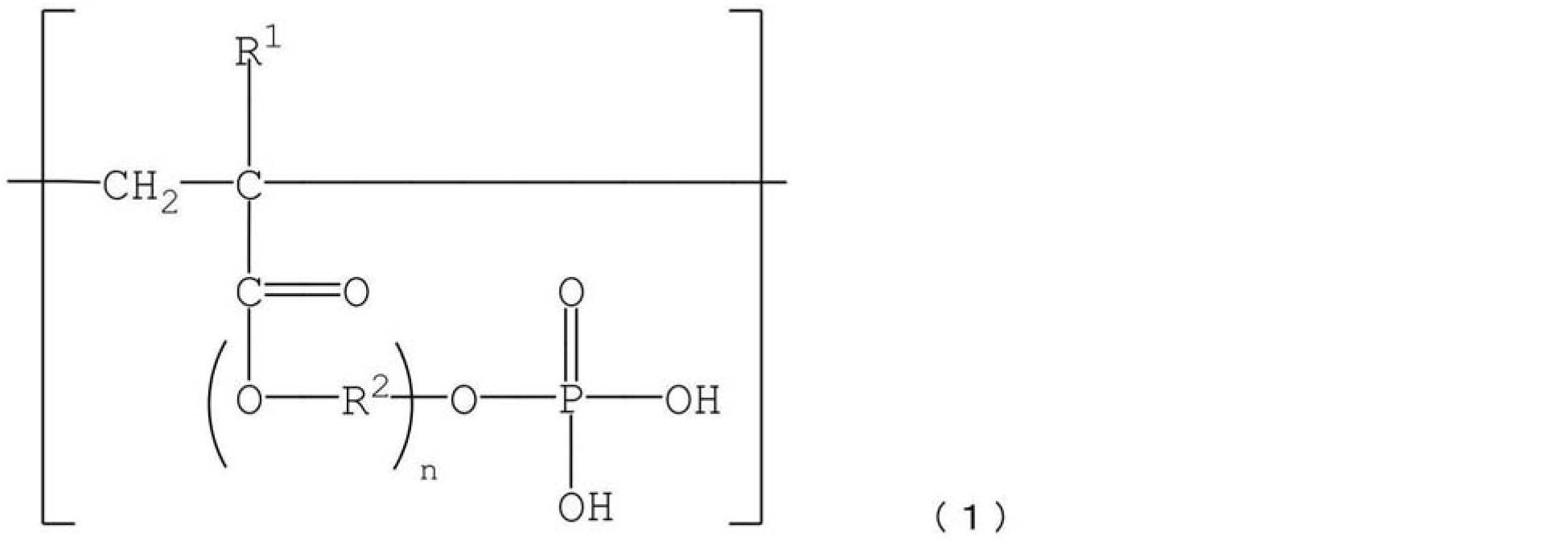
(式(1)中、R1は水素原子または炭素数1~4のアルキル基であり、R2は、炭素数1~18の炭化水素基であり、nは1~10である)。
式(1)中のR1は、より高い異物の除去性を得るとの観点から、水素原子または炭素数1~3のアルキル基が好ましく、水素原子、メチル基、またはエチル基がより好ましく、水素原子またはメチル基がさらに好ましく、メチル基が特に好ましい。
式(1)のR2は、炭素数1~12の炭化水素基が好ましく、炭素数1~10の炭化水素基がより好ましく、炭素数1~6の炭化水素基がさらに好ましく、炭素数2の炭化水素基が特に好ましい。また、R2である炭化水素基の種類としては、直鎖構造でも分岐鎖構造でも環状構造でもよく、アルキレン基、アルケニレン基、フェニレン基、またはシクロアルキレン基が好ましく、アルキレン基がより好ましい。
なお、ホスホン酸系(共)重合体は、主鎖の両末端が水素原子であることが好ましい。
式(1)で表される構成単位Aを提供する単量体の好ましい具体例としては、メタクリロイルオキシメチルリン酸、メタクリロイルオキシエチルリン酸、メタクリロイルオキシプロピルリン酸、メタクリロイルオキシブチルリン酸、メタクリロイルオキシペンチルリン酸、メタクリロイルオキシヘキシルリン酸、メタクリロイルオキシオクチルリン酸、メタクリロイルオキシデシルリン酸、メタクリロイルオキシラウリルリン酸、メタクリロイルオキシステアリルリン酸、メタクリロイルオキシ-1,4-ジメチルシクロヘキシルリン酸等およびこれらの塩等が挙げられる。これらの中でも、より高い異物の除去性を得るとの観点から、メタクリロイルオキシメチルリン酸、メタクリロイルオキシエチルリン酸、メタクリロイルオキシプロピルリン酸またはこれらの塩がより好ましく、メタクリロイルオキシエチルリン酸またはその塩がさらに好ましい。なお、メタクリロイルオキシエチルリン酸は下記式(2)に示す構造を有する構成単位を提供する。
ホスホン酸系(共)重合体としては、酸の形態、塩の形態、または酸の一部が塩となっている形態(部分塩の形態)のいずれでも使用可能である。ホスホン酸系(共)重合体が塩である場合は、構成単位Aに含まれるホスホン酸基が塩を形成していても、後述する他の構成単位が塩を形成していても、これらの両方が塩を形成していてもよい。ホスホン酸系(共)重合体の塩としては、少なくとも構成単位Aに含まれるホスホン酸基が塩を形成していることが好ましい。
構成単位Aに含まれるホスホン酸基が塩を形成している場合、塩としては、ホスホン酸(塩)基の一部がホスホン酸基の塩となっている形態(部分塩)であっても、全てがホスホン酸基の塩となっている形態であってもよいが、部分塩であることがより好ましい。
ホスホン酸基の塩の種類としては、特に限定されず、例えば、金属塩、アンモニウム塩、アミン塩等が挙げられる。なお、塩の種類は、単独で、または2以上を組み合わせて用いることができる。金属塩を構成する対イオンとしては、例えば、周期律表(長周期)1族、11族、2族、12族、3族、13族、4族、6族、7族または8族に属する金属が挙げられる。アミン塩を構成する対イオンとしては、例えば、テトラメチルアンモニウム、テトラエチルアンモニウム、テトラブチルアンモニウム等が挙げられる。これらの塩の種類の中では、より高い異物の除去性を得るとの観点から、アンモニウム塩またはアミン塩であることがより好ましく、アミン塩であることがさらに好ましい。
なお、構成単位Aは、単独で、または2以上を組み合わせて用いることができる。
本発明に係るホスホン酸系(共)重合体を構成する全構成単位中に占める、構成単位Aの含有率は、50モル%超である。また、構成単位Aの含有率は、60モル%以上であることが好ましい。構成単位Aの含有率が60モル%以上であると、異物の除去効果がより向上する。かかる理由は、構成単位Aが十分な量で存在することで、異物や研磨済研磨対象物への静電的な吸着や、疎水性相互作用による吸着がより容易になるからであると推測される。同様の観点から、70モル%以上であることがより好ましく、80モル%以上であることがさらに好ましく、90モル%以上であることがよりさらに好ましく。95モル%以上であることが特に好ましく、100モル%であること、すなわちホスホン酸系(共)重合体が構成単位として構成単位Aのみを有する単重合体であることが最も好ましい(上限100モル%)。
ホスホン酸系(共)重合体は、構成単位Aの含有率が上記範囲を満たす限り、他の構成単位を含んでいてもよい。他の構成単位を提供する単量体としては、特に制限されないが、例えば、ヒドロキシ基またはグリシジル基含有ビニル系単量体、不飽和カルボン酸またはその塩、不飽和カルボン酸エステル、不飽和アミド、不飽和アミンまたはその塩、イオン性基を有しない芳香族モノまたはジビニル化合物等が挙げられる。ここで、イオン性基とは、親水性基のうち水の中で基の一部が解離してアニオン(陰イオン)部とカチオン(陽イオン)部に分かれる基を表す。なお、他の構成単位は、単独で、または2以上を組み合わせて用いることができる。
ヒドロキシ基またはグリシジル基含有ビニル系単量体としては、例えば、アクリル酸ヒドロキシエチル、メタクリル酸ヒドロキシエチル、アクリル酸グリシジル、メタクリル酸グリシジル、エチレングリコールジアクリレート、エチレングリコールジメタクリレート、ポリエチレングリコールモノアクリレート、ポリエチレングリコールモノメタクリレート等が挙げられる。
不飽和カルボン酸またはその塩としては、例えば、(メタ)アクリル酸、イタコン酸、マレイン酸、フマル酸、クロトン酸またはこれらの塩等が挙げられる。
不飽和カルボン酸エステルとしては、例えば、メタクリル酸メチル、メタクリル酸エチル、メタクリル酸ブチル、メタクリル酸ヘキシル、メタクリル酸オクチル、メタクリル酸エチルヘキシル、メタクリル酸デシル、メタクリル酸ラウリル(LMA)、メタクリル酸パルミチル、メタクリル酸セチル、メタクリル酸ステアリル(SMA)、メタクリル酸イソステアリル(ISMA)、メタクリル酸ベヘニル(BMA)、メタクリル酸フェニル、メタクリル酸ベンジル(BzMA)、メタクリル酸シクロヘキシル、アクリル酸メチル、アクリル酸エチル、アクリル酸ブチル、アクリル酸ヘキシル、アクリル酸オクチル、アクリル酸エチルヘキシル、アクリル酸デシル、アクリル酸ラウリル、アクリル酸パルミチル、アクリル酸セチル、アクリル酸ステアリル、アクリル酸イソステアリル、アクリル酸ベヘニル、アクリル酸フェニル、アクリル酸ベンジル、アクリル酸シクロヘキシル等が挙げられる。なお、不飽和カルボン酸エステルには、前述のヒドロキシ基またはグリシジル基含有ビニル系単量体は含まれないものとする。
不飽和アミドとしては、例えば、アクリルアミド、メタクリルアミド、N-メチロールアクリルアミド、N-メチロールメタクリルアミド、N-ダイアセトンアクリルアミド等が挙げられる。
不飽和アミンまたはその塩としては、例えば、アミノエチルアクリレート、アミノエチルメタクリレート、N,N-ジメチルアミノエチルアクリレート、N,N-ジメチルアミノエチルメタクリレート、N,N-ジエチルアミノエチルアクリレート、N,N-ジエチルアミノエチルメタクリレート、N,N,N-トリメチルアミノエチルアクリレート、N,N,N-トリメチルアミノエチルメタクリレート等が挙げられる。
イオン性基を有しない芳香族モノまたはジビニル化合物としては、例えば、スチレン、α-メチルスチレン、クロロスチレン、アルキルスチレン等のスチレン系化合物、ジビニルベンゼン等が挙げられる。
これらの中でも、不飽和カルボン酸またはその塩、不飽和カルボン酸エステルまたはイオン性基を有しない芳香族モノまたはジビニル化合物であることが好ましい。これらの単量体から提供される構成単位は、構成単位Aに由来する異物の除去性および表面処理工程(例えば、洗浄工程)後の自身の除去性を良好に維持しつつ、本発明の効果を良好に維持し、表面処理組成物に所望の特性を付与することができるからである。これらの単量体から提供される構成成分は主に疎水性部位として機能し、ホスホン酸系(共)重合体の構成成分として他の構成単位よりなる疎水性部位が存在する場合、疎水性部位と異物(特に、有機異物)との疎水性相互作用による吸着がより促進される。そのため異物表面の帯電状態(表面電位)を研磨済研磨対象物と同じ帯電状態(表面電位)に制御する作用も強くなり、静電的な反発力を高めることで、異物の除去をより促進することができると考えられる。同様の観点から、不飽和カルボン酸もしくはその塩またはイオン性基を有しない芳香族モノビニル化合物であることがより好ましく、不飽和カルボン酸もしくはその塩またはスチレン系化合物であることがさらに好ましく、(メタ)アクリル酸またはスチレンであることがよりさらに好ましく、メタクリル酸またはスチレンであることが特に好ましく、スチレンであることが最も好ましい。
他の構成単位が塩である場合、塩としては、部分塩であっても、塩を形成しうる基の全てが塩となっている形態であってもよい。ここで、塩の種類、塩を構成する対イオンの種類は、特に制限されず、例えば、上記ホスホン酸基の塩で挙げたものであってもよい。
本発明に係るホスホン酸系(共)重合体を構成する全構成単位中に占める、他の構成単位の含有率は、50モル%未満である。また、他の構成単位の含有率は、40モル%以下であることが好ましい。他の構成単位の含有率が40モル%以下であると、異物の除去効果がより向上する。かかる理由は、構成単位Aが十分な量で存在することで、異物や研磨済研磨対象物への静電的な吸着や、疎水性相互作用による吸着がより容易になるからであると推測される。同様の観点から、30モル%以下であることがより好ましく、20モル%以下であることがさらに好ましく、10モル%以下であることがよりさらに好ましく、5モル%以下であることが特に好ましく、0モル%であること、すなわちホスホン酸系(共)重合体が構成単位として構成単位Aのみを有する単重合体であることが最も好ましい(下限0モル%)。
ホスホン酸系(共)重合体の各構成単位の配列は、ランダム、ブロック、またはグラフトのいずれであってもよい。
ホスホン酸系(共)重合体の重量平均分子量は、1000以上であることが好ましい。重量平均分子量が1000以上であると、異物の除去効果がより向上する。かかる理由は、ホスホン酸系(共)重合体が研磨済研磨対象物や異物を覆う際の被覆性がより良好となり、研磨済研磨対象物表面からの異物の除去作用または研磨済研磨対象物表面への異物の再付着抑止作用がより向上するからであると推測される。同様の観点から、重量平均分子量は、3000超であることがより好ましく、より10000以上がさらに好ましい。また、ホスホン酸系(共)重合体の重量平均分子量の上限値は、特に制限されないが、2000000以下であることが好ましい。重量平均分子量は、ゲルパーミーエーションクロマトグラフィー(GPC)によって、GPC装置(株式会社島津製作所製 型式:Prominence + ELSD検出器(ELSD-LTII))などを用いてポリエチレングリコール換算によって求めることができる。
ホスホン酸系(共)重合体の製造方法は、特に制限されないが、例えば、モノマーの共重合法が挙げられる。モノマーの共重合法は、公知の塊状重合、溶液重合等の重合法を用いることができる。この際、重合溶媒は、水に対する溶解度(20℃)が10質量%以上であることが好ましい。重合溶媒の例としては、例えば、水、アルコール系、ケトン系、エーテル系等が挙げられる。重合溶媒は、単独で、または2以上を組み合わせて用いることができる。重合開始剤の例としては、公知のラジカル開始剤が用いられる。重合に際しては、必要に応じて公知の連鎖移動剤を使用し、例えば、窒素ガス気流下、40~300℃で溶剤還流させて原料化合物の溶液重合を行う等で、ホスホン酸系(共)重合体を得ることができる。
ホスホン酸系(共)重合体は、水溶性であることが好ましい。
ホスホン酸系(共)重合体としては、市販品を用いていてもよく、例えば、DAP株式会社製のポリホスマーシリーズ M-101、MH-301等を用いることができる。
ホスホン酸系(共)重合体の含有量は、表面処理組成物の総質量に対して、0.01質量%以上であることが好ましい。ホスホン酸系(共)重合体の含有量が0.01質量%以上であると、異物の除去効果がより向上する。かかる理由は、ホスホン酸系(共)重合体が、研磨済研磨対象物および異物を被覆する際に、より多くの面積で被覆がなされるからであると推測される。同様の観点から、ホスホン酸系(共)重合体の含有量は、表面処理組成物の総質量に対して、0.03質量%以上であることがより好ましく、0.05質量%以上であることがさらに好ましく、0.09質量%以上であることが特に好ましい。また、ホスホン酸系(共)重合体の含有量は、表面処理組成物の総質量に対して、10質量%以下であることが好ましい。ホスホン酸系(共)重合体の含有量が10質量%以下であると、異物の除去効果がより向上する。かかる理由は、表面処理工程(例えば、洗浄工程)後のホスホン酸系(共)重合体の除去性がより良好となるからであると推測される。同様の観点から、ホスホン酸系(共)重合体の含有量は、表面処理組成物の総質量に対して、5質量%以下であることがより好ましく、1質量%以下であることがさらに好ましく、0.5質量%以下であることが特に好ましい。
また、ホスホン酸系(共)重合体の含有量は、表面処理組成物に含まれる高分子化合物の総質量に対して20質量%超であることが好ましい(上限100質量%)。ホスホン酸系(共)重合体の含有量が高分子化合物の総質量に対して20質量%超であると、異物の除去効果がより向上する。かかる理由は、表面処理工程(例えば、洗浄工程)後における異物の原因となりうるホスホン酸系(共)重合体以外の高分子化合物の量が低減するからであると推測される。また、かかる理由は、ホスホン酸系(共)重合体が、研磨済研磨対象物および異物を被覆する際に、ホスホン酸系(共)重合体以外の高分子化合物によって被覆が妨げられることが低減されるからであると推測される。さらに、かかる理由は、ホスホン酸系(共)重合体による静電的な吸着効果または反発効果の発現が、ホスホン酸系(共)重合体以外の高分子化合物によって妨げられることが低減されるからであると推測される。同様の観点から、ホスホン酸系(共)重合体の含有量は、高分子化合物の総質量に対して50質量%超であることがより好ましく、90質量%超であることがさらに好ましく、95質量%超であることが特に好ましく、100質量%であることが最も好ましい。特に、ホスホン酸系(共)重合体の含有量は、高分子化合物の総質量に対して95質量%超とした場合に、異物の除去効果は著しく向上する。なお、ホスホン酸系(共)重合体以外の高分子化合物としては、後述の他の添加剤として用いられる高分子化合物等が挙げられる。
[酸]
本発明の一形態に係る表面処理組成物は、さらに酸を含むことが好ましい。なお、本明細書において、ホスホン酸系(共)重合体はここで述べる添加剤としての酸とは異なるものとして取り扱う。酸は、主として表面処理組成物のpHを調整する目的で添加される。また、酸は、研磨済研磨対象物が窒化珪素または酸化珪素を含む場合、当該研磨済研磨対象物の表面や、異物の表面を正電荷で帯電させる役割を担うと推測される。したがって、表面処理組成物を正電荷に帯電しうる性質を有する異物や研磨済研磨対象物に対して用いる場合、酸を添加することにより、静電的な反発効果がより促進され、表面処理組成物による異物の除去効果がより向上する。
本発明の一形態に係る表面処理組成物は、さらに酸を含むことが好ましい。なお、本明細書において、ホスホン酸系(共)重合体はここで述べる添加剤としての酸とは異なるものとして取り扱う。酸は、主として表面処理組成物のpHを調整する目的で添加される。また、酸は、研磨済研磨対象物が窒化珪素または酸化珪素を含む場合、当該研磨済研磨対象物の表面や、異物の表面を正電荷で帯電させる役割を担うと推測される。したがって、表面処理組成物を正電荷に帯電しうる性質を有する異物や研磨済研磨対象物に対して用いる場合、酸を添加することにより、静電的な反発効果がより促進され、表面処理組成物による異物の除去効果がより向上する。
酸としては、無機酸または有機酸のいずれを用いてもよい。無機酸としては、特に制限されないが、例えば、硫酸、硝酸、ホウ酸、炭酸、次亜リン酸、亜リン酸およびリン酸等が挙げられる。有機酸としては、特に制限されないが、例えば、ギ酸、酢酸、プロピオン酸、酪酸、吉草酸、2-メチル酪酸、n-ヘキサン酸、3,3-ジメチル酪酸、2-エチル酪酸、4-メチルペンタン酸、n-ヘプタン酸、2-メチルヘキサン酸、n-オクタン酸、2-エチルヘキサン酸、安息香酸、グリコール酸、サリチル酸、グリセリン酸、シュウ酸、マロン酸、コハク酸、グルタル酸、アジピン酸、ピメリン酸、マレイン酸、フタル酸、リンゴ酸、酒石酸、クエン酸および乳酸などのカルボン酸、ならびにメタンスルホン酸、エタンスルホン酸およびイセチオン酸等が挙げられる。
これらの中でも、表面処理組成物を正電荷に帯電しうる性質を有する異物や研磨済研磨対象物に対して用いる場合、研磨済研磨対象物の表面および異物の表面を正電荷で帯電させる効果がより良好となるとの観点から、マレイン酸または硝酸であることがより好ましく、マレイン酸であることがさらに好ましい。
なお、酸は、単独でもまたは2種以上組み合わせても用いることができる。
酸の含有量は、表面処理組成物の総質量に対して、0.01質量%以上であることが好ましい。酸の含有量が0.01質量%以上であると、異物の除去効果がより向上する。かかる理由は、表面処理組成物を正電荷に帯電しうる性質を有する異物や研磨済研磨対象物に対して用いる場合、研磨済研磨対象物の表面および異物の表面を正電荷で帯電させる効果がより良好となるからであると推測される。同様の観点から、酸の含有量は、表面処理組成物の総質量に対して、0.05質量%以上であることがより好ましく、0.1質量%以上であることがさらに好ましく、0.15質量%以上であることが特に好ましい。また、酸の含有量は、表面処理組成物の総質量に対して、5質量%以下であることが好ましい。酸の含有量が5質量%以下であると、よりコストを削減することができる。同様の観点から、酸の含有量は、表面処理組成物の総質量に対して、3質量%以下であることがより好ましく、1質量%以下であることがさらに好ましく、0.30質量%以下であることが特に好ましい。
[他の添加剤]
本発明の一形態に係る表面処理組成物は、本発明の効果を阻害しない範囲内において、必要に応じて、他の添加剤を任意の割合で含有していてもよい。ただし、本発明の一形態に係る表面処理組成物の必須成分以外の成分は、異物の原因となりうるためできる限り添加しないことが望ましい。よって、必須成分以外の成分は、その含有量はできる限り少ないことが好ましく、含まないことがより好ましい。他の添加剤としては、例えば、砥粒、アルカリ、防食剤、溶存ガス、還元剤、酸化剤およびアルカノールアミン類等が挙げられる。なかでも、異物除去効果のさらなる向上のため、表面処理組成物は、砥粒を実質的に含有しないことが好ましい。ここで、「砥粒を実質的に含有しない」とは、表面処理組成物の総質量に対する砥粒の含有量が0.01質量%以下である場合をいう。
本発明の一形態に係る表面処理組成物は、本発明の効果を阻害しない範囲内において、必要に応じて、他の添加剤を任意の割合で含有していてもよい。ただし、本発明の一形態に係る表面処理組成物の必須成分以外の成分は、異物の原因となりうるためできる限り添加しないことが望ましい。よって、必須成分以外の成分は、その含有量はできる限り少ないことが好ましく、含まないことがより好ましい。他の添加剤としては、例えば、砥粒、アルカリ、防食剤、溶存ガス、還元剤、酸化剤およびアルカノールアミン類等が挙げられる。なかでも、異物除去効果のさらなる向上のため、表面処理組成物は、砥粒を実質的に含有しないことが好ましい。ここで、「砥粒を実質的に含有しない」とは、表面処理組成物の総質量に対する砥粒の含有量が0.01質量%以下である場合をいう。
[分散媒]
本発明の一形態に係る表面処理組成物は、分散媒(溶媒)として水を含む。分散媒は、各成分を分散または溶解させる機能を有する。分散媒は、水を含むものであれば特に制限されず、水のみであってもよい。また、分散媒は、各成分の分散または溶解のために、水と有機溶媒との混合溶媒であってもよい。この場合、用いられる有機溶媒としては、例えば、水と混和する有機溶媒であるアセトン、アセトニトリル、エタノール、メタノール、イソプロパノール、グリセリン、エチレングリコール、プロピレングリコール等が挙げられる。また、これらの有機溶媒を水と混合せずに用いて、各成分を分散または溶解した後に、水と混合してもよい。これら有機溶媒は、単独でもまたは2種以上組み合わせても用いることができる。これらの中でも、分散媒は、水のみであることが好ましい。
本発明の一形態に係る表面処理組成物は、分散媒(溶媒)として水を含む。分散媒は、各成分を分散または溶解させる機能を有する。分散媒は、水を含むものであれば特に制限されず、水のみであってもよい。また、分散媒は、各成分の分散または溶解のために、水と有機溶媒との混合溶媒であってもよい。この場合、用いられる有機溶媒としては、例えば、水と混和する有機溶媒であるアセトン、アセトニトリル、エタノール、メタノール、イソプロパノール、グリセリン、エチレングリコール、プロピレングリコール等が挙げられる。また、これらの有機溶媒を水と混合せずに用いて、各成分を分散または溶解した後に、水と混合してもよい。これら有機溶媒は、単独でもまたは2種以上組み合わせても用いることができる。これらの中でも、分散媒は、水のみであることが好ましい。
水は、研磨済研磨対象物の汚染や他の成分の作用を阻害するという観点から、不純物をできる限り含有しない水が好ましい。例えば、遷移金属イオンの合計含有量が100ppb以下である水が好ましい。ここで、水の純度は、例えば、イオン交換樹脂を用いる不純物イオンの除去、フィルタによる異物の除去、蒸留等の操作によって高めることができる。具体的には、水としては、例えば、脱イオン水(イオン交換水)、純水、超純水、蒸留水などを用いることが好ましい。
[pH値]
本発明の一形態に係る表面処理組成物のpH値は、7未満であることが好ましい。pH値が7未満であると、表面処理組成物を正電荷に帯電しうる性質を有する異物や研磨済研磨対象物に対して用いる場合、研磨済研磨対象物の表面または異物の表面をより確実に正電荷で帯電させることができる。そしてその結果、静電的な反発により、より高い異物の除去効果が得ることができる。同様の観点から、pH値が4未満であることがより好ましく、3以下であることがさら好ましく、3未満であることがよりさらに好ましく、2.5以下であることが特に好ましい。また、pH値は、1以上であることが好ましい。pH値が1以上であると、よりコストを削減することができる。
本発明の一形態に係る表面処理組成物のpH値は、7未満であることが好ましい。pH値が7未満であると、表面処理組成物を正電荷に帯電しうる性質を有する異物や研磨済研磨対象物に対して用いる場合、研磨済研磨対象物の表面または異物の表面をより確実に正電荷で帯電させることができる。そしてその結果、静電的な反発により、より高い異物の除去効果が得ることができる。同様の観点から、pH値が4未満であることがより好ましく、3以下であることがさら好ましく、3未満であることがよりさらに好ましく、2.5以下であることが特に好ましい。また、pH値は、1以上であることが好ましい。pH値が1以上であると、よりコストを削減することができる。
なお、表面処理組成物のpH値は、pHメータ(株式会社堀場製作所製 製品名:LAQUA(登録商標))により確認することができる。
pH値を調整する際、本発明の一形態に係る表面処理組成物以外の成分は、異物の原因となりうるためできる限り添加しないことが望ましい。よって、表面処理組成物は、上記ホスホン酸系(共)重合体のみか、または上記ホスホン酸系(共)重合体および上記酸で調製することが好ましい。しかしながら、これらのみによって所望のpH値を得ることが困難である場合は、本発明の効果を阻害しない範囲内において、任意に添加されうるアルカリ等の他の添加剤を用いて調整してもよい。
[異物除去効果]
本発明の一形態に係る表面処理組成物は、研磨済研磨対象物の表面上の異物を除去する効果が高いほど好ましい。すなわち、表面処理組成物を用いて研磨済研磨対象物の表面処理を行った後に、表面に残存する異物の数が少ないほど好ましい。具体的には、窒化珪素を含む研磨済研磨対象物の場合は、表面処理組成物を用いて研磨済研磨対象物を表面処理した後に、異物の数が2700個以下であると好ましく、2500個以下であるとより好ましく、2000個以下であるとさらに好ましく、1500個以下であるとよりさらに好ましく、1000個以下であると特に好ましく、500個以下であると最も好ましい。また、酸化珪素を含む研磨済研磨対象物の場合は、表面処理組成物を用いて研磨済研磨対象物を表面処理した後に、異物の数が800個以下であると好ましく、500個以下であるとより好ましく、450個以下であるとさらに好ましく、400個以下であるとよりさらに好ましく、350個以下であると特に好ましく、300個以下であると最も好ましい。一方、上記異物の数は少ないほど好ましいため、その下限は特に制限されないが、実質的には、0個である。
本発明の一形態に係る表面処理組成物は、研磨済研磨対象物の表面上の異物を除去する効果が高いほど好ましい。すなわち、表面処理組成物を用いて研磨済研磨対象物の表面処理を行った後に、表面に残存する異物の数が少ないほど好ましい。具体的には、窒化珪素を含む研磨済研磨対象物の場合は、表面処理組成物を用いて研磨済研磨対象物を表面処理した後に、異物の数が2700個以下であると好ましく、2500個以下であるとより好ましく、2000個以下であるとさらに好ましく、1500個以下であるとよりさらに好ましく、1000個以下であると特に好ましく、500個以下であると最も好ましい。また、酸化珪素を含む研磨済研磨対象物の場合は、表面処理組成物を用いて研磨済研磨対象物を表面処理した後に、異物の数が800個以下であると好ましく、500個以下であるとより好ましく、450個以下であるとさらに好ましく、400個以下であるとよりさらに好ましく、350個以下であると特に好ましく、300個以下であると最も好ましい。一方、上記異物の数は少ないほど好ましいため、その下限は特に制限されないが、実質的には、0個である。
また、前述のように、本発明の一形態に係る表面処理組成物は、異物の種類に関わらず高い除去効果を有するものであるが、特に有機異物に対して極めて高い除去効果を示す。有機異物除去効果としては、具体的には、窒化珪素を含む研磨済研磨対象物の場合は、表面処理組成物を用いて研磨済研磨対象物を表面処理した後に、異物の数が1000個以下であると好ましく、600個以下であるとより好ましく、500個以下であるとさらに好ましく、480個以下であるとよりさらに好ましく、300個以下であると特に好ましく、100個以下であると最も好ましい。また、酸化珪素を含む研磨済研磨対象物の場合は、表面処理組成物を用いて研磨済研磨対象物を表面処理した後に、異物の数が300個以下であると好ましく、200個以下であるとより好ましく、160個以下であるとさらに好ましく、120個以下であるとよりさらに好ましく、100個以下であると特に好ましく、90個以下であると最も好ましい。一方、上記異物の数は少ないほど好ましいため、その下限は特に制限されないが、実質的には、0個である。
なお、上記異物の数および上記有機異物の数は、実施例に記載の方法により測定された値を採用する。
<表面処理組成物の製造方法>
本発明の他の一形態は、ホスホン酸基および2価の(ポリ)オキシ炭化水素基を有する構成単位Aを含む(共)重合体またはその塩と、水と、を混合することを含み、前記(共)重合体を構成する全構成単位中に占める、構成単位Aの含有率は、50モル%超である、表面処理組成物の製造方法である。ホスホン酸系(共)重合体の種類、添加量等は、前述のとおりである。本発明の一形態に係る表面処理組成物の製造方法においては、上記した酸、砥粒、他の添加剤または水以外の分散媒等をさらに混合してもよい。これらの種類、添加量等は前述のとおりである。これらの混合条件、混合順序等の混合方法は、特に制限されず、公知のものを用いることができる。
本発明の他の一形態は、ホスホン酸基および2価の(ポリ)オキシ炭化水素基を有する構成単位Aを含む(共)重合体またはその塩と、水と、を混合することを含み、前記(共)重合体を構成する全構成単位中に占める、構成単位Aの含有率は、50モル%超である、表面処理組成物の製造方法である。ホスホン酸系(共)重合体の種類、添加量等は、前述のとおりである。本発明の一形態に係る表面処理組成物の製造方法においては、上記した酸、砥粒、他の添加剤または水以外の分散媒等をさらに混合してもよい。これらの種類、添加量等は前述のとおりである。これらの混合条件、混合順序等の混合方法は、特に制限されず、公知のものを用いることができる。
<表面処理方法>
本発明のその他の一形態は、上記表面処理組成物を用いて研磨済研磨対象物を表面処理することを含む、表面処理方法である。本明細書において、表面処理方法とは、研磨済研磨対象物の表面における異物を低減する方法をいい、広義の洗浄を行う方法である。
本発明のその他の一形態は、上記表面処理組成物を用いて研磨済研磨対象物を表面処理することを含む、表面処理方法である。本明細書において、表面処理方法とは、研磨済研磨対象物の表面における異物を低減する方法をいい、広義の洗浄を行う方法である。
本発明の一形態に係る表面処理方法によれば、残留する異物を十分に除去することができる。すなわち、本発明の他の一形態によれば、上記表面処理組成物を用いて研磨済研磨対象物を表面処理する、研磨済研磨対象物の表面における異物低減方法が提供される。
本発明の一形態に係る表面処理方法は、上記表面処理組成物を研磨済研磨対象物に直接接触させる方法により行われる。
表面処理方法としては、主として、(I)リンス研磨処理による方法、(II)洗浄処理による方法が挙げられる。すなわち、本発明の一形態に係る表面処理は、リンス研磨または洗浄によって行われると好ましい。リンス研磨処理および洗浄処理は、研磨済研磨対象物の表面上の異物(パーティクル、金属汚染、有機物残渣、パッド屑など)を除去し、清浄な表面を得るために実施される。上記(I)および(II)について、以下、説明する。
(I)リンス研磨処理
本発明の一形態に係る表面処理組成物は、リンス研磨処理において好適に用いられる。すなわち、本発明の一形態に係る表面処理組成物は、リンス研磨用組成物として好ましく用いることができる。リンス研磨処理は、研磨対象物について最終研磨(仕上げ研磨)を行った後、研磨対象物の表面上の異物の除去を目的として、研磨パッドが取り付けられた研磨定盤(プラテン)上で行われる。このとき、表面処理組成物を研磨済研磨対象物に直接接触させることにより、リンス研磨処理が行われる。その結果、研磨済研磨対象物表面の異物は、研磨パッドによる摩擦力(物理的作用)およびリンス研磨用組成物による化学的作用によって除去される。異物のなかでも、特にパーティクルや有機物残渣は、物理的な作用により除去されやすい。したがって、リンス研磨処理では、研磨定盤(プラテン)上で研磨パッドとの摩擦を利用することで、パーティクルや有機物残渣を効果的に除去することができる。
本発明の一形態に係る表面処理組成物は、リンス研磨処理において好適に用いられる。すなわち、本発明の一形態に係る表面処理組成物は、リンス研磨用組成物として好ましく用いることができる。リンス研磨処理は、研磨対象物について最終研磨(仕上げ研磨)を行った後、研磨対象物の表面上の異物の除去を目的として、研磨パッドが取り付けられた研磨定盤(プラテン)上で行われる。このとき、表面処理組成物を研磨済研磨対象物に直接接触させることにより、リンス研磨処理が行われる。その結果、研磨済研磨対象物表面の異物は、研磨パッドによる摩擦力(物理的作用)およびリンス研磨用組成物による化学的作用によって除去される。異物のなかでも、特にパーティクルや有機物残渣は、物理的な作用により除去されやすい。したがって、リンス研磨処理では、研磨定盤(プラテン)上で研磨パッドとの摩擦を利用することで、パーティクルや有機物残渣を効果的に除去することができる。
具体的には、リンス研磨処理は、研磨工程後の研磨済研磨対象物表面を研磨装置の研磨定盤(プラテン)に設置し、研磨パッドと研磨済研磨対象物とを接触させて、その接触部分に表面処理組成物を供給しながら研磨済研磨対象物と研磨パッドとを相対摺動させることにより行うことができる。
リンス研磨処理は、片面研磨装置、両面研磨装置のいずれを用いても行うことができる。また、上記研磨装置は、研磨用組成物の吐出ノズルに加え、表面処理組成物の吐出ノズルを備えていると好ましい。研磨装置のリンス研磨処理時の稼働条件は特に制限されず、当業者であれば適宜設定可能である。
(II)洗浄処理
本発明の一形態に係る表面処理組成物は、洗浄処理において好適に用いられる。すなわち、本発明の一形態に係る表面処理組成物は、洗浄用組成物として好ましく用いることができる。洗浄処理は、研磨対象物について最終研磨(仕上げ研磨)を行った後、または、上記リンス研磨処理を行った後、研磨対象物の表面上の異物の除去を目的として行われうる。なお、洗浄処理と、上記リンス研磨処理とは、これらの処理を行う場所によって分類され、洗浄処理は、研磨済研磨対象物を研磨定盤(プラテン)上から取り外した後に行われる表面処理である。洗浄処理においても、表面処理組成物を研磨済研磨対象物に直接接触させて、当該対象物の表面上の異物を除去することができる。
本発明の一形態に係る表面処理組成物は、洗浄処理において好適に用いられる。すなわち、本発明の一形態に係る表面処理組成物は、洗浄用組成物として好ましく用いることができる。洗浄処理は、研磨対象物について最終研磨(仕上げ研磨)を行った後、または、上記リンス研磨処理を行った後、研磨対象物の表面上の異物の除去を目的として行われうる。なお、洗浄処理と、上記リンス研磨処理とは、これらの処理を行う場所によって分類され、洗浄処理は、研磨済研磨対象物を研磨定盤(プラテン)上から取り外した後に行われる表面処理である。洗浄処理においても、表面処理組成物を研磨済研磨対象物に直接接触させて、当該対象物の表面上の異物を除去することができる。
洗浄処理を行う方法としては、例えば、(i)研磨済研磨対象物を保持した状態で、洗浄ブラシを研磨済研磨対象物の片面または両面とを接触させて、その接触部分に表面処理組成物を供給しながら研磨済研磨対象物の表面を洗浄ブラシで擦る方法、(ii)研磨済研磨対象物を表面処理組成物中に浸漬させ、超音波処理や撹拌を行う方法(ディップ式)等が挙げられる。かかる方法において、研磨対象物表面の異物は、洗浄ブラシによる摩擦力または超音波処理や撹拌によって発生する機械的力、および表面処理組成物による化学的作用によって除去される。
上記(i)の方法において、表面処理組成物の研磨済研磨対象物への接触方法としては、特に限定されないが、例えば、ノズルから研磨済研磨対象物上に表面処理組成物を流しながら研磨済研磨対象物を高速回転させるスピン式、研磨済研磨対象物に表面処理組成物を噴霧して洗浄するスプレー式等が挙げられる。
短時間でより効率的な汚染除去ができる点からは、洗浄処理は、スピン式やスプレー式を採用することが好ましく、スピン式であることがより好ましい。
このような洗浄処理を行うための装置としては、例えば、カセットに収容された複数枚の研磨済研磨対象物を同時に表面処理するバッチ式洗浄装置、1枚の研磨済研磨対象物をホルダーに装着して表面処理する枚葉式洗浄装置等が挙げられる。これらの中でも、洗浄時間の短縮等の観点から、枚葉式洗浄装置を用いる方法が好ましい。
さらに、洗浄処理を行うための装置としては、例えば、研磨定盤(プラテン)から研磨済研磨対象物を取り外した後、当該対象物を洗浄ブラシで擦る洗浄用設備を備えている研磨装置が挙げられる。このような研磨装置を用いることにより、研磨済研磨対象物の洗浄処理を、より効率よく行うことができる。
かような研磨装置としては、研磨済研磨対象物を保持するホルダー、回転数を変更可能なモータ、洗浄ブラシ等を有する一般的な研磨装置を使用することができる。研磨装置としては、片面研磨装置または両面研磨装置のいずれを用いてもよい。なお、CMP工程の後、リンス研磨工程を行う場合、当該洗浄処理は、リンス研磨工程にて用いた研磨装置と同様の装置を用いて行うことが、より効率的であり好ましい。
洗浄ブラシとしては、特に制限されないが、好ましくは、樹脂製ブラシを使用する。樹脂製ブラシの材質は、特に制限されないが、例えば、PVA(ポリビニルアルコール)を使用するのが好ましい。そして、洗浄ブラシとしては、PVA製スポンジを用いることが特に好ましい。
洗浄条件にも特に制限はなく、研磨済研磨対象物の種類、ならびに除去対象とする異物の種類および量に応じて、適宜設定することができる。例えば、洗浄ブラシの回転数は10rpm以上200rpm以下、研磨済研磨対象物の回転数は、10rpm以上100rpm以下、研磨済研磨対象物にかける圧力(研磨圧力)は、0.5psi以上10psi以下が好ましい。研磨パッドに表面処理組成物を供給する方法も特に制限されず、例えば、ポンプ等で連続的に供給する方法(掛け流し)が採用されうる。この供給量に制限はないが、洗浄ブラシおよび研磨済研磨対象物の表面が常に表面処理組成物で覆われていることが好ましく、10mL/分以上5000mL/分以下であることが好ましい。洗浄時間も特に制限されないが、本発明の一形態に係る表面処理組成物を用いる工程については5秒間以上180秒間以下であることが好ましい。このような範囲であれば、異物をより効果的に除去することが可能である。
洗浄の際の表面処理組成物の温度は、特に制限されず、通常は室温でよいが、本発明の一形態に係る表面処理組成物を用いる工程については、性能を損なわない範囲で、40℃以上70℃以下程度に加温してもよい。
上記(ii)の方法において、浸漬による洗浄方法の条件については、特に制限されず、公知の手法を用いることができる。
上記(i)、(ii)の方法による洗浄処理を行う前、後またはその両方において、水による洗浄を行ってもよい。
また、洗浄後の研磨済研磨対象物は、スピンドライヤ等により表面に付着した水滴を払い落として乾燥させることが好ましい。また、エアブロー乾燥により研磨済研磨対象物の表面を乾燥させてもよい。
本発明の一形態に係る表面処理組成物を用いて洗浄処理を行う際には、研磨済研磨対象物は、リンス研磨処理をされた後のものであることが好ましい。
<表面処理済基板の製造方法>
本発明の一形態に係る表面処理方法は、研磨済研磨対象物が研磨済基板(好ましくは研磨済半導体基板、CMP後の半導体基板)であるとき、好適に適用可能である。すなわち、本発明のさらなる他の一形態によれば、研磨済研磨対象物が研磨済半導体基板であり、当該研磨済半導体基板を、上記表面処理組成物を用いて表面処理することを含む、半導体基板の製造方法もまた提供される。
本発明の一形態に係る表面処理方法は、研磨済研磨対象物が研磨済基板(好ましくは研磨済半導体基板、CMP後の半導体基板)であるとき、好適に適用可能である。すなわち、本発明のさらなる他の一形態によれば、研磨済研磨対象物が研磨済半導体基板であり、当該研磨済半導体基板を、上記表面処理組成物を用いて表面処理することを含む、半導体基板の製造方法もまた提供される。
かかる製造方法が適用されうる半導体基板の詳細については、上記表面処理組成物によって表面処理される研磨済研磨対象物の説明に記載した通りである。
また、半導体基板の製造方法としては、研磨済半導体基板の表面を、本発明の一形態に係る表面処理組成物を用いて表面処理する工程(表面処理工程)を含むものであれば特に制限されない。かかる製造方法として、例えば、研磨済半導体基板を形成するための研磨工程および洗浄工程を有する方法が挙げられる。また、他の一例としては、研磨工程および洗浄工程に加え、研磨工程および洗浄工程の間に、リンス研磨工程を有する方法が挙げられる。以下、これらの各工程について説明する。
[研磨工程]
半導体基板の製造方法に含まれうる研磨工程は、半導体基板を研磨して、研磨済半導体基板を形成する工程である。
半導体基板の製造方法に含まれうる研磨工程は、半導体基板を研磨して、研磨済半導体基板を形成する工程である。
研磨工程は、半導体基板を研磨する工程であれば特に制限されないが、化学的機械的研磨(Chemical Mechanical Polishing;CMP)工程であることが好ましい。また、研磨工程は、単一の工程からなる研磨工程であっても複数の工程からなる研磨工程であってもよい。複数の工程からなる研磨工程としては、例えば、予備研磨工程(粗研磨工程)の後に仕上げ研磨工程を行う工程や、1次研磨工程の後に1回または2回以上の2次研磨工程を行い、その後に仕上げ研磨工程を行う工程等が挙げられる。本発明の一形態に係る表面処理組成物を用いた表面処理工程は、上記仕上げ研磨工程後に行われると好ましい。
研磨用組成物としては、半導体基板の特性に応じて、公知の研磨用組成物を適宜使用することができる。研磨用組成物としては、特に制限されないが、例えば、砥粒、酸塩、分散媒、および酸を含むもの等を好ましく用いることができる。かかる研磨用組成物の具体例としては、スルホン酸修飾コロイダルシリカ、硫酸アンモニウム、水およびマレイン酸を含む研磨用組成物等が挙げられる。
研磨装置としては、研磨対象物を保持するホルダーと回転数を変更可能なモータ等とが取り付けてあり、研磨パッド(研磨布)を貼り付け可能な研磨定盤を有する一般的な研磨装置を使用することができる。研磨装置としては、片面研磨装置または両面研磨装置のいずれを用いてもよい。
研磨パッドとしては、一般的な不織布、ポリウレタン、および多孔質フッ素樹脂等を特に制限なく使用することができる。研磨パッドには、研磨用組成物が溜まるような溝加工が施されていることが好ましい。
研磨条件にも特に制限はなく、例えば、研磨定盤の回転数、ヘッド(キャリア)回転数は、10rpm以上100rpm以下が好ましい。また、研磨対象物にかける圧力(研磨圧力)は、0.5psi以上10psi以下が好ましい。研磨パッドに研磨用組成物を供給する方法も特に制限されず、例えば、ポンプ等で連続的に供給する方法(掛け流し)が採用される。この供給量に制限はないが、研磨パッドの表面が常に研磨用組成物で覆われていることが好ましく、10mL/分以上5000mL/分以下であることが好ましい。研磨時間も特に制限されないが、研磨用組成物を用いる工程については5秒間以上180秒間以下であることが好ましい。
[表面処理工程]
表面処理工程とは、本発明の一形態に係る表面処理組成物を用いて研磨済研磨対象物の表面における異物を低減する工程をいう。半導体基板の製造方法において、リンス研磨工程の後、表面処理工程としての洗浄工程が行われてもよいし、リンス研磨工程のみ、または洗浄工程のみが行われてもよい。これらの中でも、半導体基板の製造方法において、リンス研磨工程の後、表面処理工程としての洗浄工程が行われることが好ましい。
表面処理工程とは、本発明の一形態に係る表面処理組成物を用いて研磨済研磨対象物の表面における異物を低減する工程をいう。半導体基板の製造方法において、リンス研磨工程の後、表面処理工程としての洗浄工程が行われてもよいし、リンス研磨工程のみ、または洗浄工程のみが行われてもよい。これらの中でも、半導体基板の製造方法において、リンス研磨工程の後、表面処理工程としての洗浄工程が行われることが好ましい。
(リンス研磨工程)
リンス研磨工程は、半導体基板の製造方法において、研磨工程および洗浄工程の間に設けられてもよい。リンス研磨工程は、本発明の一形態に係る表面処理方法(リンス研磨処理方法)によって、研磨済研磨対象物(研磨済半導体基板)の表面における異物を低減する工程であってもよい。
リンス研磨工程は、半導体基板の製造方法において、研磨工程および洗浄工程の間に設けられてもよい。リンス研磨工程は、本発明の一形態に係る表面処理方法(リンス研磨処理方法)によって、研磨済研磨対象物(研磨済半導体基板)の表面における異物を低減する工程であってもよい。
また、リンス研磨用組成物としては、研磨済半導体基板の種類、ならびに除去対象とする異物の種類および量に応じて、公知のリンス研磨用組成物を適宜使用してもよい。リンス研磨用組成物としては、例えば、水溶性ポリマー、分散媒および酸を含むもの等を用いることができ、具体的には、ポリビニルアルコール、水および硝酸を含むリンス研磨用組成物等を用いてもよい。
研磨装置および研磨パッド等の装置、ならびに研磨条件については、研磨用組成物を供給する代わりにリンス研磨用組成物を供給する以外は、上記研磨工程と同様の装置および条件を適用することができる。
リンス研磨工程で用いられるリンス研磨方法の詳細は、上記リンス研磨処理に係る説明に記載の通りである。
(洗浄工程)
洗浄工程は、半導体基板の製造方法において、研磨工程の後に設けられてもよいし、リンス研磨工程の後に設けられてもよい。洗浄工程は、本発明の一形態に係る表面処理方法(洗浄方法)によって、研磨済研磨対象物(研磨済半導体基板)の表面における異物を低減する工程である。
洗浄工程は、半導体基板の製造方法において、研磨工程の後に設けられてもよいし、リンス研磨工程の後に設けられてもよい。洗浄工程は、本発明の一形態に係る表面処理方法(洗浄方法)によって、研磨済研磨対象物(研磨済半導体基板)の表面における異物を低減する工程である。
洗浄工程で用いられる洗浄方法の詳細は、上記洗浄方法に係る説明に記載の通りである。
本発明を、以下の実施例および比較例を用いてさらに詳細に説明する。ただし、本発明の技術的範囲が以下の実施例のみに制限されるわけではない。なお、特記しない限り、「%」および「部」は、それぞれ、「質量%」および「質量部」を意味する。
<表面処理組成物の調製>
[表面処理組成物A-1の調製]
有機酸として濃度30質量%マレイン酸水溶液を0.6質量部、分散剤としてDAP株式会社製ポリホスマーM-101を1質量部、および水(脱イオン水)98.4質量部を混合することにより、表面処理組成物A-1を調製した。
[表面処理組成物A-1の調製]
有機酸として濃度30質量%マレイン酸水溶液を0.6質量部、分散剤としてDAP株式会社製ポリホスマーM-101を1質量部、および水(脱イオン水)98.4質量部を混合することにより、表面処理組成物A-1を調製した。
[表面処理組成物A-2の調製]
表面処理組成物A-1の調製において、DAP株式会社製ポリホスマーM-101を、DAP株式会社製ポリホスマーMH-301へと変更した以外は同様にして、表面処理組成物A-2を調製した。
表面処理組成物A-1の調製において、DAP株式会社製ポリホスマーM-101を、DAP株式会社製ポリホスマーMH-301へと変更した以外は同様にして、表面処理組成物A-2を調製した。
[表面処理組成物A-3、A-4、C-2およびC-4~C-7の調製]
有機酸として濃度30質量%マレイン酸水溶液を0.6質量部、下記に示す種類の各分散剤を0.1質量部、および水(脱イオン水)99.3質量部を混合することにより、表面処理組成物A-3、A-4およびC-2~C-7を調製した。
有機酸として濃度30質量%マレイン酸水溶液を0.6質量部、下記に示す種類の各分散剤を0.1質量部、および水(脱イオン水)99.3質量部を混合することにより、表面処理組成物A-3、A-4およびC-2~C-7を調製した。
[表面処理組成物C-1の調製]
有機酸として濃度30質量%マレイン酸水溶液を0.6質量部、および水(脱イオン水)99.4質量部を混合することにより、表面処理組成物C-1を調製した。
有機酸として濃度30質量%マレイン酸水溶液を0.6質量部、および水(脱イオン水)99.4質量部を混合することにより、表面処理組成物C-1を調製した。
[表面処理組成物C-3の調製]
有機酸として濃度30質量%マレイン酸水溶液を0.6質量部、東亞合成株式会社製アロン(登録商標)A-30SLを0.25質量部、および水(脱イオン水)99.15質量部を混合することにより、表面処理組成物C-3を調製した。
有機酸として濃度30質量%マレイン酸水溶液を0.6質量部、東亞合成株式会社製アロン(登録商標)A-30SLを0.25質量部、および水(脱イオン水)99.15質量部を混合することにより、表面処理組成物C-3を調製した。
各表面処理組成物の調製に用いた分散剤の詳細を以下に示す;
・A-1に使用:ポリメタクリロイルオキシエチルリン酸10質量%と、イソプロピルアルコール75質量%と、水15質量%との混合物:DAP株式会社製ポリホスマーM-101、
・A-2に使用:メタクリロイルオキシエチルリン酸の部分アミン塩重合体10質量%と、イソプロピルアルコールと、水との混合物:DAP株式会社製ポリホスマーMH-301、
・A-3に使用:メタクリロイルオキシエチルリン酸-メタクリル酸共重合体(全構成単位中に占める、メタクリロイルオキシエチルリン酸から提供される構成単位80モル%、メタクリル酸から提供される構成単位20モル%)、
・A-4に使用:メタクリロイルオキシエチルリン酸-スチレン共重合体(全構成単位中に占める、メタクリロイルオキシエチルリン酸から提供される構成単位90モル%、スチレンから提供される構成単位10モル%)、
・C-2に使用:エチレンオキサイド基含有変性ポリビニルアルコール(重量平均分子量10000):日本合成化学工業株式会社製ゴーセネックス(登録商標)WO320N
・C-3に使用:ポリアクリル酸アンモニウム塩(重量平均分子量6000)、固形分濃度40質量%水溶液:東亞合成株式会社製アロン(登録商標)A-30SL、
・C-4に使用:ポリメタクリル酸
・C-5に使用:メタクリロイルオキシエチルリン酸-メタクリル酸共重合体(全構成単位中に占める、メタクリロイルオキシエチルリン酸から提供される構成単位20モル%、メタクリル酸から提供される構成単位80モル%)、
・C-6に使用:メタクリロイルオキシエチルリン酸-メタクリル酸共重合体(全構成単位中に占める、メタクリロイルオキシエチルリン酸から提供される構成単位50モル%、メタクリル酸から提供される構成単位50モル%)、
・C-7に使用:メタクリロイルオキシエチルリン酸-スチレン共重合体(全構成単位中に占める、メタクリロイルオキシエチルリン酸から提供される構成単位50モル%、スチレンから提供される構成単位50モル%)。
・A-1に使用:ポリメタクリロイルオキシエチルリン酸10質量%と、イソプロピルアルコール75質量%と、水15質量%との混合物:DAP株式会社製ポリホスマーM-101、
・A-2に使用:メタクリロイルオキシエチルリン酸の部分アミン塩重合体10質量%と、イソプロピルアルコールと、水との混合物:DAP株式会社製ポリホスマーMH-301、
・A-3に使用:メタクリロイルオキシエチルリン酸-メタクリル酸共重合体(全構成単位中に占める、メタクリロイルオキシエチルリン酸から提供される構成単位80モル%、メタクリル酸から提供される構成単位20モル%)、
・A-4に使用:メタクリロイルオキシエチルリン酸-スチレン共重合体(全構成単位中に占める、メタクリロイルオキシエチルリン酸から提供される構成単位90モル%、スチレンから提供される構成単位10モル%)、
・C-2に使用:エチレンオキサイド基含有変性ポリビニルアルコール(重量平均分子量10000):日本合成化学工業株式会社製ゴーセネックス(登録商標)WO320N
・C-3に使用:ポリアクリル酸アンモニウム塩(重量平均分子量6000)、固形分濃度40質量%水溶液:東亞合成株式会社製アロン(登録商標)A-30SL、
・C-4に使用:ポリメタクリル酸
・C-5に使用:メタクリロイルオキシエチルリン酸-メタクリル酸共重合体(全構成単位中に占める、メタクリロイルオキシエチルリン酸から提供される構成単位20モル%、メタクリル酸から提供される構成単位80モル%)、
・C-6に使用:メタクリロイルオキシエチルリン酸-メタクリル酸共重合体(全構成単位中に占める、メタクリロイルオキシエチルリン酸から提供される構成単位50モル%、メタクリル酸から提供される構成単位50モル%)、
・C-7に使用:メタクリロイルオキシエチルリン酸-スチレン共重合体(全構成単位中に占める、メタクリロイルオキシエチルリン酸から提供される構成単位50モル%、スチレンから提供される構成単位50モル%)。
[pH値の測定]
各表面処理組成物(液温:25℃)のpH値は、pHメータ(株式会社堀場製作所製 型番:LAQUA(登録商標))により確認した。
各表面処理組成物(液温:25℃)のpH値は、pHメータ(株式会社堀場製作所製 型番:LAQUA(登録商標))により確認した。
各表面処理組成物の特徴を下記表1および表2に示す。ここで、表中の構成単位A(モル%)は、全構成単位中における構成単位Aの含有率(モル%)を示す。また、表中の分散剤の欄における「-」は該当する成分を用いなかったことを示す。
<評価>
[異物数の評価]
(研磨済研磨対象物(洗浄対象物)の準備)
下記化学的機械的研磨(CMP)工程によって研磨され、次いで下記リンス研磨工程によってリンス研磨された後の、研磨済窒化珪素基板および研磨済TEOS基板を、研磨済研磨対象物(洗浄対象物、研磨済基板とも称する)として準備した。
[異物数の評価]
(研磨済研磨対象物(洗浄対象物)の準備)
下記化学的機械的研磨(CMP)工程によって研磨され、次いで下記リンス研磨工程によってリンス研磨された後の、研磨済窒化珪素基板および研磨済TEOS基板を、研磨済研磨対象物(洗浄対象物、研磨済基板とも称する)として準備した。
≪CMP工程≫
半導体基板である窒化珪素基板およびTEOS基板について、研磨用組成物M(組成;スルホン酸修飾コロイダルシリカ(“Sulfonic acid-functionalized silica through quantitative oxidation of thiol groups”,Chem.Commun.246-247(2003)に記載の方法で作製、一次粒子径30nm、二次粒子径60nm)4質量%、硫酸アンモニウム1質量%、濃度30質量%のマレイン酸水溶液0.018質量%、溶媒:水)を使用し、それぞれ下記の条件にて研磨を行った。ここで、窒化珪素基板およびTEOS基板は、300mmウエハを使用した。
半導体基板である窒化珪素基板およびTEOS基板について、研磨用組成物M(組成;スルホン酸修飾コロイダルシリカ(“Sulfonic acid-functionalized silica through quantitative oxidation of thiol groups”,Chem.Commun.246-247(2003)に記載の方法で作製、一次粒子径30nm、二次粒子径60nm)4質量%、硫酸アンモニウム1質量%、濃度30質量%のマレイン酸水溶液0.018質量%、溶媒:水)を使用し、それぞれ下記の条件にて研磨を行った。ここで、窒化珪素基板およびTEOS基板は、300mmウエハを使用した。
-研磨装置および研磨条件-
研磨装置:荏原製作所社製 FREX300E
研磨パッド:ニッタ・ハース株式会社製 硬質ポリウレタンパッド IC1010
研磨圧力:2.0psi(1psi=6894.76Pa、以下同様)
研磨定盤回転数:60rpm
ヘッド回転数:60rpm
研磨用組成物の供給:掛け流し
研磨用組成物供給量:300mL/分
研磨時間:60秒間。
研磨装置:荏原製作所社製 FREX300E
研磨パッド:ニッタ・ハース株式会社製 硬質ポリウレタンパッド IC1010
研磨圧力:2.0psi(1psi=6894.76Pa、以下同様)
研磨定盤回転数:60rpm
ヘッド回転数:60rpm
研磨用組成物の供給:掛け流し
研磨用組成物供給量:300mL/分
研磨時間:60秒間。
≪リンス研磨工程≫
上記CMP工程によってウエハ表面を研磨した後、研磨済窒化珪素基板および研磨済TEOS基板について、同じ研磨装置内で、リンス研磨用組成物R(組成;ポリビニルアルコール(重量平均分子量10,000)0.1質量%、溶媒;水、硝酸でpH=2に調整)を使用し、下記の条件にてリンス研磨を行った。
上記CMP工程によってウエハ表面を研磨した後、研磨済窒化珪素基板および研磨済TEOS基板について、同じ研磨装置内で、リンス研磨用組成物R(組成;ポリビニルアルコール(重量平均分子量10,000)0.1質量%、溶媒;水、硝酸でpH=2に調整)を使用し、下記の条件にてリンス研磨を行った。
-リンス用研磨装置およびリンス研磨条件-
研磨装置:荏原製作所社製 FREX300E
研磨パッド:ニッタ・ハース株式会社製 硬質ポリウレタンパッド IC1010
研磨圧力:1.0psi
研磨定盤回転数:60rpm
ヘッド回転数:60rpm
研磨用組成物の供給:掛け流し
研磨用組成物供給量:300mL/分
研磨時間:60秒間。
研磨装置:荏原製作所社製 FREX300E
研磨パッド:ニッタ・ハース株式会社製 硬質ポリウレタンパッド IC1010
研磨圧力:1.0psi
研磨定盤回転数:60rpm
ヘッド回転数:60rpm
研磨用組成物の供給:掛け流し
研磨用組成物供給量:300mL/分
研磨時間:60秒間。
≪表面処理工程(洗浄工程)≫
上記リンス研磨工程にてウエハ表面をリンス研磨した後、当該ウエハを研磨定盤(プラテン)上から取り外した。続いて、同じ研磨装置内で、前記調製した各表面処理組成物または水(脱イオン水)を用いて、洗浄ブラシであるポリビニルアルコール(PVA)製スポンジで上下からウエハを挟み、圧力をかけながら下記条件で各研磨済基板をこする洗浄方法によって、各研磨済基板を洗浄した。水を用いた結果は比較例1および比較例9に示す。なお、水のpH値は前記表面処理組成物と同様の方法で測定した。
上記リンス研磨工程にてウエハ表面をリンス研磨した後、当該ウエハを研磨定盤(プラテン)上から取り外した。続いて、同じ研磨装置内で、前記調製した各表面処理組成物または水(脱イオン水)を用いて、洗浄ブラシであるポリビニルアルコール(PVA)製スポンジで上下からウエハを挟み、圧力をかけながら下記条件で各研磨済基板をこする洗浄方法によって、各研磨済基板を洗浄した。水を用いた結果は比較例1および比較例9に示す。なお、水のpH値は前記表面処理組成物と同様の方法で測定した。
-洗浄装置および洗浄条件-
装置:荏原製作所社製 FREX300E
洗浄ブラシ回転数:100rpm
洗浄対象物(研磨済基板)回転数:50rpm
洗浄液の流量:1000mL/分
洗浄時間:60秒間。
装置:荏原製作所社製 FREX300E
洗浄ブラシ回転数:100rpm
洗浄対象物(研磨済基板)回転数:50rpm
洗浄液の流量:1000mL/分
洗浄時間:60秒間。
≪異物数の測定≫
上記洗浄工程によって洗浄された後の各洗浄済基板(各表面処理済基板)について、以下の手順によって異物数を測定した。研磨済窒化珪素基板についての評価結果を表1に、研磨済TEOS基板についての評価結果を表2にそれぞれ示す。
上記洗浄工程によって洗浄された後の各洗浄済基板(各表面処理済基板)について、以下の手順によって異物数を測定した。研磨済窒化珪素基板についての評価結果を表1に、研磨済TEOS基板についての評価結果を表2にそれぞれ示す。
各表面処理組成物を用いて、上記に示す洗浄条件で研磨済基板を洗浄した後の、0.09μm以上の異物数(個)を測定した。異物数の測定にはKLA TENCOR社製SP-2を使用した。測定は、洗浄済基板の片面について、外周端部から幅5mm以内の範囲の部分(外周端部を0mmとしたときに、幅0mmから幅5mmまでの部分)を除外した残りの部分について測定を行った。
≪有機異物数の測定≫
上記洗浄工程によって洗浄された後の各洗浄済基板について、以下の手順によって異物数を測定した。研磨済窒化珪素基板についての評価結果を表1に、研磨済TEOS基板についての評価結果を表2にそれぞれ示す。
上記洗浄工程によって洗浄された後の各洗浄済基板について、以下の手順によって異物数を測定した。研磨済窒化珪素基板についての評価結果を表1に、研磨済TEOS基板についての評価結果を表2にそれぞれ示す。
各表面処理組成物を用いて、上記に示す洗浄条件で研磨済基板を洗浄した後の、有機異物の数を、株式会社日立製作所製Review SEM RS6000を使用し、SEM観察によって測定した。まず、SEM観察にて、洗浄済基板の片面について、外周端部から幅5mm以内の範囲の部分(外周端部を0mmとしたときに、幅0mmから幅5mmまでの部分)を除外した残りの部分に存在するディフェクトを100個サンプリングした。次いで、サンプリングした100個のディフェクトの中からSEM観察にて目視にて有機異物を判別し、その個数を確認することで、ディフェクト中の有機異物の割合(%)を算出した。そして、上述のディフェクト数の評価にてKLA TENCOR社製SP-2を用いて測定した0.09μm以上の異物数(個)と、前記SEM観察結果より算出した異物中の有機異物の割合(%)との積を、有機異物数(個)として算出した。
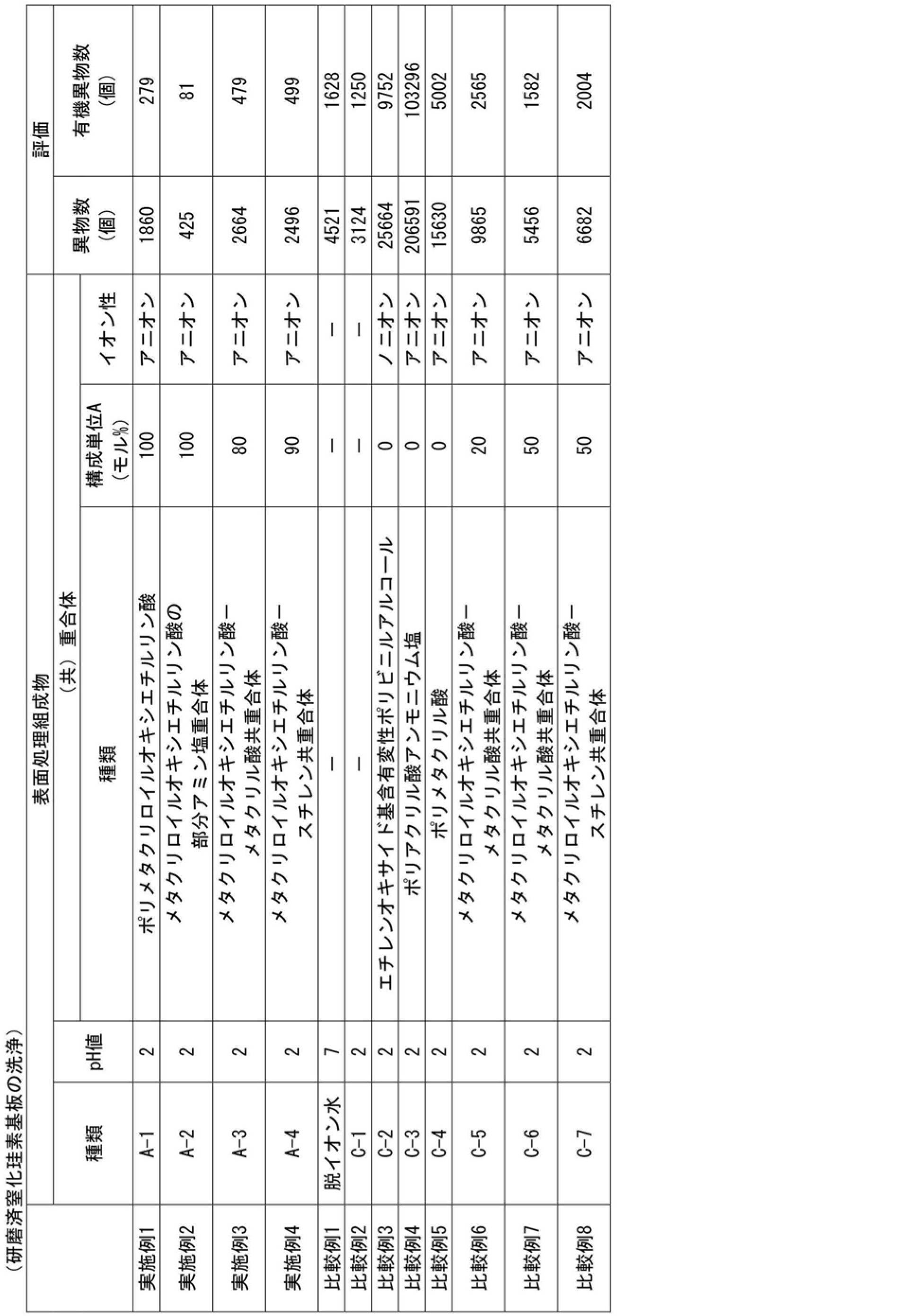
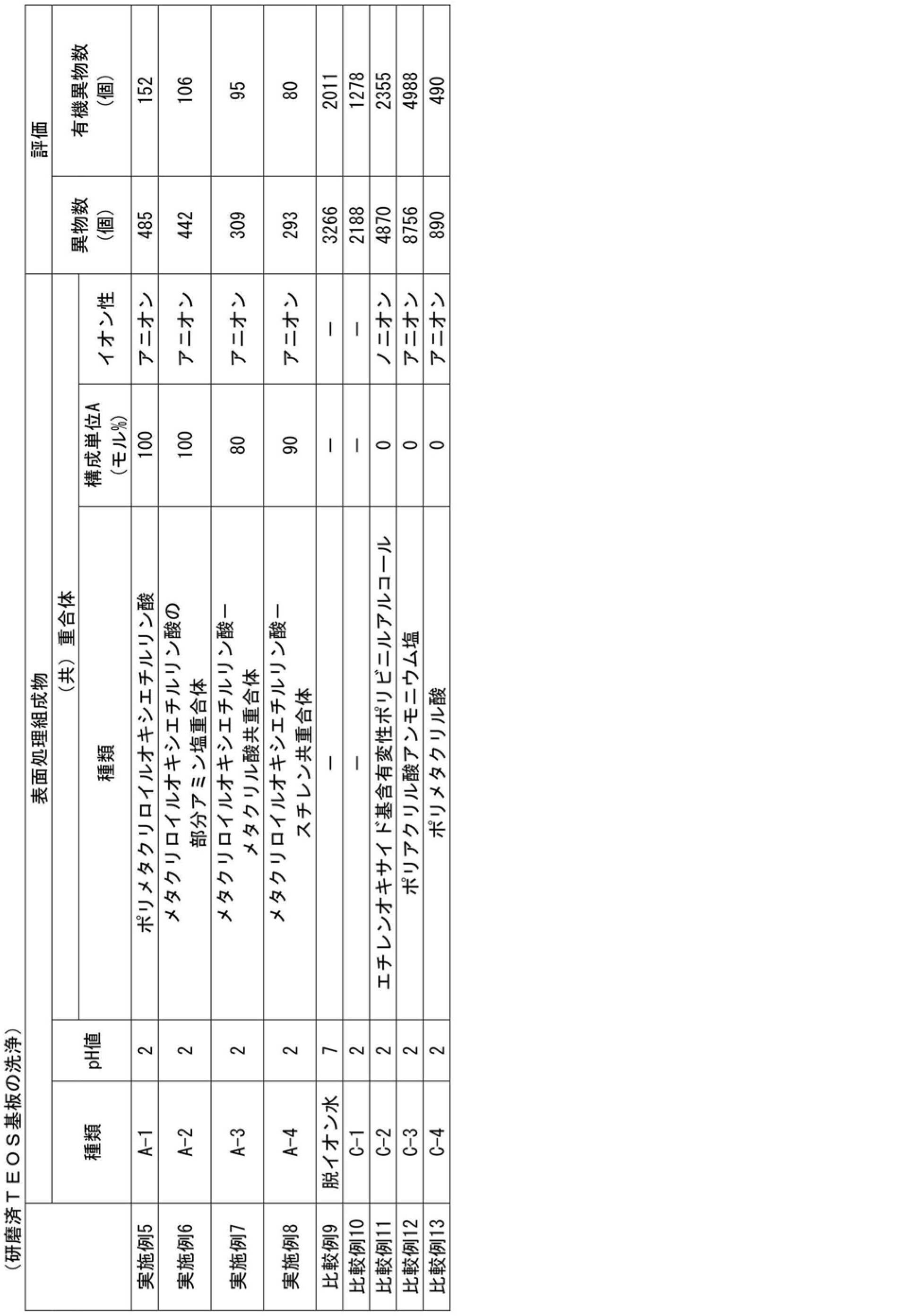
以上の結果から、本発明の一形態に係る表面処理方法を採用することで、研磨済研磨対象物の表面に残留する異物を十分に除去することができることが確認された。
より詳細には、表1に示すように、実施例1~4と比較例1~8との比較によって、本発明の一形態に係る表面処理組成物は、窒化珪素を含む研磨済研磨対象物の表面における高い異物の除去効果を示すことが確認された。
また、表2に示すように、実施例5~8と比較例9~13との比較によって、本発明の一形態に係る表面処理組成物は、酸化珪素を含む研磨済研磨対象物の表面における高い異物の除去効果を示すことが確認された。
また、表1および表2から、本発明の一形態に係る表面処理方法は、有機異物の除去効果が特に高いことが確認された。
本出願は、2016年8月9日に出願された日本特許出願番号2016-156625号に基づいており、その開示内容は、参照により全体として組み入れられている。
Claims (9)
- ホスホン酸基および2価の(ポリ)オキシ炭化水素基を有する構成単位Aを含む(共)重合体またはその塩と、水と、を含み、
前記(共)重合体を構成する全構成単位中に占める、構成単位Aの含有率は、50モル%超である、
研磨済研磨対象物の表面処理組成物。 - 前記構成単位Aは、下記一般式(1)で表される、請求項1に記載の表面処理組成物;

- pHが7未満である、請求項1または2のいずれか1項に記載の表面処理組成物。
- 酸を含む、請求項1~3のいずれか1項に記載の表面処理組成物。
- 砥粒を実質的に含有しない、請求項1~4のいずれか1項に記載の表面処理組成物。
- 前記研磨済研磨対象物は、窒化珪素または酸化珪素を含む研磨済研磨対象物である、請求項1~5のいずれか1項に記載の表面処理組成物。
- 請求項1~6のいずれか1項に記載の表面処理組成物を用いて研磨済研磨対象物を表面処理することを含む、表面処理方法。
- 前記表面処理は、リンス研磨または洗浄によって行われる、請求項7に記載の表面処理方法。
- ホスホン酸基および2価の(ポリ)オキシ炭化水素基を有する構成単位Aを含む(共)重合体またはその塩と、水と、を混合することを含み、
前記(共)重合体を構成する全構成単位中に占める、構成単位Aの含有率は、50モル%超である、
請求項1~6のいずれか1項に記載の表面処理組成物の製造方法。
Priority Applications (2)
| Application Number | Priority Date | Filing Date | Title |
|---|---|---|---|
| US16/324,090 US10876073B2 (en) | 2016-08-09 | 2017-06-26 | Composition for surface treatment, and method for surface treatment using the same |
| KR1020197002565A KR102340520B1 (ko) | 2016-08-09 | 2017-06-26 | 표면 처리 조성물 및 이것을 사용한 표면 처리 방법 |
Applications Claiming Priority (2)
| Application Number | Priority Date | Filing Date | Title |
|---|---|---|---|
| JP2016-156625 | 2016-08-09 | ||
| JP2016156625A JP6791680B2 (ja) | 2016-08-09 | 2016-08-09 | 表面処理組成物およびこれを用いた洗浄方法 |
Publications (1)
| Publication Number | Publication Date |
|---|---|
| WO2018030006A1 true WO2018030006A1 (ja) | 2018-02-15 |
Family
ID=61161877
Family Applications (1)
| Application Number | Title | Priority Date | Filing Date |
|---|---|---|---|
| PCT/JP2017/023409 Ceased WO2018030006A1 (ja) | 2016-08-09 | 2017-06-26 | 表面処理組成物およびこれを用いた表面処理方法 |
Country Status (5)
| Country | Link |
|---|---|
| US (1) | US10876073B2 (ja) |
| JP (1) | JP6791680B2 (ja) |
| KR (1) | KR102340520B1 (ja) |
| TW (1) | TWI756242B (ja) |
| WO (1) | WO2018030006A1 (ja) |
Cited By (3)
| Publication number | Priority date | Publication date | Assignee | Title |
|---|---|---|---|---|
| WO2020209965A1 (en) * | 2019-04-12 | 2020-10-15 | Applied Materials, Inc. | Anionic polishing pads formed by printing processes |
| WO2023248878A1 (ja) | 2022-06-20 | 2023-12-28 | 富士フイルム株式会社 | パターン形成方法、電子デバイスの製造方法 |
| WO2024219290A1 (ja) | 2023-04-19 | 2024-10-24 | 富士フイルム株式会社 | 処理液、被処理物の処理方法 |
Families Citing this family (19)
| Publication number | Priority date | Publication date | Assignee | Title |
|---|---|---|---|---|
| US9873180B2 (en) | 2014-10-17 | 2018-01-23 | Applied Materials, Inc. | CMP pad construction with composite material properties using additive manufacturing processes |
| US10875153B2 (en) | 2014-10-17 | 2020-12-29 | Applied Materials, Inc. | Advanced polishing pad materials and formulations |
| KR20240015167A (ko) | 2014-10-17 | 2024-02-02 | 어플라이드 머티어리얼스, 인코포레이티드 | 애디티브 제조 프로세스들을 이용한 복합 재료 특성들을 갖는 cmp 패드 구성 |
| US11745302B2 (en) | 2014-10-17 | 2023-09-05 | Applied Materials, Inc. | Methods and precursor formulations for forming advanced polishing pads by use of an additive manufacturing process |
| US9776361B2 (en) | 2014-10-17 | 2017-10-03 | Applied Materials, Inc. | Polishing articles and integrated system and methods for manufacturing chemical mechanical polishing articles |
| JP6940495B2 (ja) | 2015-10-30 | 2021-09-29 | アプライド マテリアルズ インコーポレイテッドApplied Materials,Incorporated | 所望のゼータ電位を有する研磨用物品を形成するための装置及び方法 |
| US10593574B2 (en) | 2015-11-06 | 2020-03-17 | Applied Materials, Inc. | Techniques for combining CMP process tracking data with 3D printed CMP consumables |
| US10391605B2 (en) | 2016-01-19 | 2019-08-27 | Applied Materials, Inc. | Method and apparatus for forming porous advanced polishing pads using an additive manufacturing process |
| JP7140745B2 (ja) * | 2017-03-08 | 2022-09-21 | 株式会社フジミインコーポレーテッド | 表面処理組成物及びその製造方法、表面処理方法、並びに半導体基板の製造方法 |
| US11471999B2 (en) | 2017-07-26 | 2022-10-18 | Applied Materials, Inc. | Integrated abrasive polishing pads and manufacturing methods |
| WO2019032286A1 (en) | 2017-08-07 | 2019-02-14 | Applied Materials, Inc. | ABRASIVE DISTRIBUTION POLISHING PADS AND METHODS OF MAKING SAME |
| JP7021014B2 (ja) * | 2018-06-27 | 2022-02-16 | 花王株式会社 | 半導体デバイス用基板用の洗浄剤組成物 |
| WO2020050932A1 (en) | 2018-09-04 | 2020-03-12 | Applied Materials, Inc. | Formulations for advanced polishing pads |
| JP7316113B2 (ja) * | 2019-06-25 | 2023-07-27 | 花王株式会社 | 半導体デバイス用基板に用いる洗浄剤組成物 |
| JP7316112B2 (ja) * | 2019-06-25 | 2023-07-27 | 花王株式会社 | 基板の洗浄方法 |
| KR102358801B1 (ko) * | 2019-12-27 | 2022-02-08 | 주식회사 케이씨텍 | 표면 처리 조성물 및 이를 이용한 표면 처리 방법 |
| US11878389B2 (en) | 2021-02-10 | 2024-01-23 | Applied Materials, Inc. | Structures formed using an additive manufacturing process for regenerating surface texture in situ |
| US12403500B2 (en) | 2021-03-19 | 2025-09-02 | SCREEN Holdings Co., Ltd. | Substrate processing with polymer-containing liquid |
| KR102689637B1 (ko) * | 2021-11-16 | 2024-07-30 | 이근수 | 공중합체, 그 제조 방법, 공중합체를 포함하는 린스 조성물 및 응용 |
Citations (8)
| Publication number | Priority date | Publication date | Assignee | Title |
|---|---|---|---|---|
| JP2000208467A (ja) * | 1999-01-14 | 2000-07-28 | Mitsubishi Gas Chem Co Inc | 半導体基板洗浄液およびそれを用いた半導体基板の洗浄方法 |
| JP2010138271A (ja) * | 2008-12-11 | 2010-06-24 | Sanyo Chem Ind Ltd | 電子材料用洗浄剤 |
| JP2012072267A (ja) * | 2010-09-28 | 2012-04-12 | Sanyo Chem Ind Ltd | 電子材料用洗浄剤 |
| WO2013162020A1 (ja) * | 2012-04-27 | 2013-10-31 | 和光純薬工業株式会社 | 半導体基板用洗浄剤および半導体基板表面の処理方法 |
| CN103865400A (zh) * | 2012-12-10 | 2014-06-18 | 安集微电子(上海)有限公司 | 一种磷酸酯表面活性剂在自停止抛光中的应用 |
| CN103866326A (zh) * | 2012-12-10 | 2014-06-18 | 安集微电子(上海)有限公司 | 一种金属化学机械抛光浆料及其应用 |
| JP2014141669A (ja) * | 2012-12-27 | 2014-08-07 | Sanyo Chem Ind Ltd | 電子材料用洗浄剤 |
| WO2015068823A1 (ja) * | 2013-11-08 | 2015-05-14 | 和光純薬工業株式会社 | 半導体基板用洗浄剤および半導体基板表面の処理方法 |
Family Cites Families (7)
| Publication number | Priority date | Publication date | Assignee | Title |
|---|---|---|---|---|
| JP5324242B2 (ja) * | 2008-01-31 | 2013-10-23 | 三洋化成工業株式会社 | 電子材料用洗浄剤及び洗浄方法 |
| EP2365389B1 (en) * | 2010-03-08 | 2013-01-16 | Fujifilm Corporation | Positive-working lithographic printing plate precursor for infrared laser and process for making lithographic printing plate |
| JP5948758B2 (ja) | 2010-08-31 | 2016-07-06 | 三菱化学株式会社 | 半導体デバイス用基板洗浄液及び洗浄方法 |
| JP6008685B2 (ja) * | 2012-10-12 | 2016-10-19 | イー インク コーポレイション | 表示用粒子分散液、表示媒体、及び表示装置 |
| JP6301971B2 (ja) * | 2014-02-04 | 2018-03-28 | 富士フイルム株式会社 | 平版印刷版原版及びその製造方法、平版印刷版の製版方法、並びに、印刷方法 |
| WO2016047309A1 (ja) * | 2014-09-26 | 2016-03-31 | 富士フイルム株式会社 | 平版印刷版原版、その製造方法、及びそれを用いる印刷方法 |
| WO2016136655A1 (ja) * | 2015-02-27 | 2016-09-01 | 富士フイルム株式会社 | 平版印刷版原版、平版印刷版の製版方法、及び、印刷方法 |
-
2016
- 2016-08-09 JP JP2016156625A patent/JP6791680B2/ja active Active
-
2017
- 2017-06-26 WO PCT/JP2017/023409 patent/WO2018030006A1/ja not_active Ceased
- 2017-06-26 KR KR1020197002565A patent/KR102340520B1/ko active Active
- 2017-06-26 US US16/324,090 patent/US10876073B2/en active Active
- 2017-07-18 TW TW106123952A patent/TWI756242B/zh active
Patent Citations (8)
| Publication number | Priority date | Publication date | Assignee | Title |
|---|---|---|---|---|
| JP2000208467A (ja) * | 1999-01-14 | 2000-07-28 | Mitsubishi Gas Chem Co Inc | 半導体基板洗浄液およびそれを用いた半導体基板の洗浄方法 |
| JP2010138271A (ja) * | 2008-12-11 | 2010-06-24 | Sanyo Chem Ind Ltd | 電子材料用洗浄剤 |
| JP2012072267A (ja) * | 2010-09-28 | 2012-04-12 | Sanyo Chem Ind Ltd | 電子材料用洗浄剤 |
| WO2013162020A1 (ja) * | 2012-04-27 | 2013-10-31 | 和光純薬工業株式会社 | 半導体基板用洗浄剤および半導体基板表面の処理方法 |
| CN103865400A (zh) * | 2012-12-10 | 2014-06-18 | 安集微电子(上海)有限公司 | 一种磷酸酯表面活性剂在自停止抛光中的应用 |
| CN103866326A (zh) * | 2012-12-10 | 2014-06-18 | 安集微电子(上海)有限公司 | 一种金属化学机械抛光浆料及其应用 |
| JP2014141669A (ja) * | 2012-12-27 | 2014-08-07 | Sanyo Chem Ind Ltd | 電子材料用洗浄剤 |
| WO2015068823A1 (ja) * | 2013-11-08 | 2015-05-14 | 和光純薬工業株式会社 | 半導体基板用洗浄剤および半導体基板表面の処理方法 |
Cited By (4)
| Publication number | Priority date | Publication date | Assignee | Title |
|---|---|---|---|---|
| WO2020209965A1 (en) * | 2019-04-12 | 2020-10-15 | Applied Materials, Inc. | Anionic polishing pads formed by printing processes |
| US11851570B2 (en) | 2019-04-12 | 2023-12-26 | Applied Materials, Inc. | Anionic polishing pads formed by printing processes |
| WO2023248878A1 (ja) | 2022-06-20 | 2023-12-28 | 富士フイルム株式会社 | パターン形成方法、電子デバイスの製造方法 |
| WO2024219290A1 (ja) | 2023-04-19 | 2024-10-24 | 富士フイルム株式会社 | 処理液、被処理物の処理方法 |
Also Published As
| Publication number | Publication date |
|---|---|
| TW201829758A (zh) | 2018-08-16 |
| JP2018024745A (ja) | 2018-02-15 |
| US20190177656A1 (en) | 2019-06-13 |
| KR20190039096A (ko) | 2019-04-10 |
| JP6791680B2 (ja) | 2020-11-25 |
| US10876073B2 (en) | 2020-12-29 |
| TWI756242B (zh) | 2022-03-01 |
| KR102340520B1 (ko) | 2021-12-20 |
Similar Documents
| Publication | Publication Date | Title |
|---|---|---|
| KR102340520B1 (ko) | 표면 처리 조성물 및 이것을 사용한 표면 처리 방법 | |
| JP7495283B2 (ja) | 表面処理組成物、表面処理組成物の製造方法、表面処理方法、および半導体基板の製造方法 | |
| JP6832341B2 (ja) | 表面処理組成物、表面処理組成物の製造方法、表面処理方法および半導体基板の製造方法 | |
| JP7216478B2 (ja) | 表面処理組成物、表面処理組成物の製造方法、表面処理方法、および半導体基板の製造方法 | |
| JP7495317B2 (ja) | 表面処理組成物、表面処理組成物の製造方法、表面処理方法、および半導体基板の製造方法 | |
| WO2018020878A1 (ja) | 表面処理組成物およびこれを用いた表面処理方法 | |
| JP7060573B2 (ja) | 表面処理組成物、およびその製造方法、ならびに表面処理組成物を用いた表面処理方法および半導体基板の製造方法 | |
| JP6849564B2 (ja) | 表面処理組成物およびこれを用いた表面処理方法 | |
| WO2018163617A1 (ja) | 表面処理組成物及びその製造方法、表面処理方法、並びに半導体基板の製造方法 | |
| TWI806852B (zh) | 表面處理組成物、其製造方法、使用表面處理組成物的表面處理方法及半導體基板的製造方法 | |
| CN112457930A (zh) | 表面处理组合物、表面处理组合物的制造方法、表面处理方法和半导体基板的制造方法 |
Legal Events
| Date | Code | Title | Description |
|---|---|---|---|
| 121 | Ep: the epo has been informed by wipo that ep was designated in this application |
Ref document number: 17839080 Country of ref document: EP Kind code of ref document: A1 |
|
| ENP | Entry into the national phase |
Ref document number: 20197002565 Country of ref document: KR Kind code of ref document: A |
|
| NENP | Non-entry into the national phase |
Ref country code: DE |
|
| 122 | Ep: pct application non-entry in european phase |
Ref document number: 17839080 Country of ref document: EP Kind code of ref document: A1 |