WO2018021118A1 - ゴム組成物 - Google Patents
ゴム組成物 Download PDFInfo
- Publication number
- WO2018021118A1 WO2018021118A1 PCT/JP2017/026145 JP2017026145W WO2018021118A1 WO 2018021118 A1 WO2018021118 A1 WO 2018021118A1 JP 2017026145 W JP2017026145 W JP 2017026145W WO 2018021118 A1 WO2018021118 A1 WO 2018021118A1
- Authority
- WO
- WIPO (PCT)
- Prior art keywords
- rubber composition
- road roller
- rubber
- mass
- parts
- Prior art date
- Legal status (The legal status is an assumption and is not a legal conclusion. Google has not performed a legal analysis and makes no representation as to the accuracy of the status listed.)
- Ceased
Links
Classifications
-
- B—PERFORMING OPERATIONS; TRANSPORTING
- B60—VEHICLES IN GENERAL
- B60C—VEHICLE TYRES; TYRE INFLATION; TYRE CHANGING; CONNECTING VALVES TO INFLATABLE ELASTIC BODIES IN GENERAL; DEVICES OR ARRANGEMENTS RELATED TO TYRES
- B60C1/00—Tyres characterised by the chemical composition or the physical arrangement or mixture of the composition
-
- C—CHEMISTRY; METALLURGY
- C08—ORGANIC MACROMOLECULAR COMPOUNDS; THEIR PREPARATION OR CHEMICAL WORKING-UP; COMPOSITIONS BASED THEREON
- C08K—Use of inorganic or non-macromolecular organic substances as compounding ingredients
- C08K3/00—Use of inorganic substances as compounding ingredients
- C08K3/02—Elements
- C08K3/04—Carbon
-
- C—CHEMISTRY; METALLURGY
- C08—ORGANIC MACROMOLECULAR COMPOUNDS; THEIR PREPARATION OR CHEMICAL WORKING-UP; COMPOSITIONS BASED THEREON
- C08K—Use of inorganic or non-macromolecular organic substances as compounding ingredients
- C08K3/00—Use of inorganic substances as compounding ingredients
- C08K3/30—Sulfur-, selenium- or tellurium-containing compounds
-
- C—CHEMISTRY; METALLURGY
- C08—ORGANIC MACROMOLECULAR COMPOUNDS; THEIR PREPARATION OR CHEMICAL WORKING-UP; COMPOSITIONS BASED THEREON
- C08K—Use of inorganic or non-macromolecular organic substances as compounding ingredients
- C08K3/00—Use of inorganic substances as compounding ingredients
- C08K3/34—Silicon-containing compounds
- C08K3/36—Silica
-
- C—CHEMISTRY; METALLURGY
- C08—ORGANIC MACROMOLECULAR COMPOUNDS; THEIR PREPARATION OR CHEMICAL WORKING-UP; COMPOSITIONS BASED THEREON
- C08L—COMPOSITIONS OF MACROMOLECULAR COMPOUNDS
- C08L7/00—Compositions of natural rubber
-
- C—CHEMISTRY; METALLURGY
- C08—ORGANIC MACROMOLECULAR COMPOUNDS; THEIR PREPARATION OR CHEMICAL WORKING-UP; COMPOSITIONS BASED THEREON
- C08L—COMPOSITIONS OF MACROMOLECULAR COMPOUNDS
- C08L9/00—Compositions of homopolymers or copolymers of conjugated diene hydrocarbons
Definitions
- the present invention relates to a rubber composition for road roller tires which has both swelling resistance and crack resistance and is excellent in wear resistance, cut resistance and heat resistance.
- the road roller tire is used for asphalt rolling in road construction. Since it is exposed to high temperature heating during asphalt pavement, further crack resistance is required particularly in the tread portion.
- Patent Document 1 a rubber composition comprising 30 to 70 parts by mass of a softening agent per 100 parts by mass of a rubber component containing a styrene-acrylonitrile-butadiene terpolymer produced by an emulsion polymerization method.
- a road roller tire using at least a cap tread is disclosed.
- rubber with improved characteristics is a prototype, is not a general-purpose product available as a commercial product, and is not a rubber composition that can be used in common in the tread part and side part. is there.
- the present invention resides in the following (1) to (19).
- a rubber composition for road roller tires comprising silica, 100 parts by mass of a rubber component, and 3 parts by mass or more of sulfur.
- Rubber composition (9) The road roller tire according to any one of (1) to (8), wherein the silica content of the rubber composition is 15 parts by mass or more with respect to 100 parts by mass of the rubber component. Rubber composition. (10) The rubber composition for a road roller tire according to any one of (1) to (9), wherein the rubber composition contains carbon black. (11) The rubber composition for road roller tires according to any one of (1) to (10), wherein the rubber composition has a carbon black content higher than a silica content. (12) The rubber composition for road roller tires according to any one of (1) to (11), wherein the rubber composition satisfies a content of carbon black / a content of silica ⁇ 3. .
- a rubber composition for road roller tires excellent in crack resistance and swelling resistance can be obtained by (1) to (3).
- a rubber composition for road roller tires having improved crack resistance, wear resistance, cut resistance and low heat build-up can be obtained.
- a rubber composition for road roller tires having further improved crack resistance and swelling resistance can be obtained.
- a rubber composition for road roller tires having further improved crack resistance and low heat build-up can be obtained.
- a rubber composition for road roller tires with improved cut resistance is obtained.
- (15) to (17) a rubber composition for road roller tires having improved crack resistance, swelling resistance, abrasion resistance, and cut resistance can be obtained.
- a road roller tire using the rubber composition of the resin layer according to the method of the present invention is obtained.
- the rubber composition for road roller tires of the present invention can be used without particular limitation as long as it is a rubber component conventionally used for road roller tires.
- styrene-butadiene rubber SBR may be mentioned, but other rubber components may be included, more than styrene-butadiene rubber may be included, and further, no styrene-butadiene rubber may be included. Good.
- Other rubber components include natural rubber: NR, modified natural rubber that has been subjected to various treatments, synthetic rubbers such as diene, polyisoprene; IR, polybutadiene; BR, chloroprene; CR, butyl rubber; IIR, acrylonitrile -At least one rubber selected from butadiene rubber; NBR, ethylene-propylene-diene rubber; EPDM can be used, and natural rubber or diene-based synthetic rubber is preferably used, and natural rubber or polyisoprene rubber can be used. It is more preferable to use natural rubber.
- natural rubber such as diene, polyisoprene; IR, polybutadiene; BR, chloroprene; CR, butyl rubber; IIR, acrylonitrile -At least one rubber selected from butadiene rubber; NBR, ethylene-propylene-diene rubber; EPDM can be used, and natural rubber or diene-based synthetic rubber is preferably used, and natural rubber
- natural rubber When using natural rubber, it is preferably 20 parts by mass or more, more preferably 50 parts by mass or more, and particularly preferably 70 parts by mass or more with respect to 100 parts by mass of the entire rubber component.
- the styrene content is preferably 45% or less, more preferably 40% or less.
- the styrene-butadiene rubber has a low glass transition temperature; Tg. Specifically, Tg is preferably ⁇ 20 ° C. or lower, and particularly preferably ⁇ 30 ° C. or lower. Tg contributes to crack resistance as well as improved swelling resistance.
- the names of compounding ingredients and the abbreviations such as NR and SBR of the defined compounding ingredients may be expressed as the number of parts by mass of the compounding ingredients in equations and inequalities.
- Natural rubber NR and styrene-butadiene rubber; preferably satisfies the relationship of NR / SBR> 2 of SBR, and more preferably has a value of NR / SBR greater than 2 and 9 or less. By setting it as the said range, it is excellent in crack progress resistance, and it becomes possible to make crack progress resistance and swelling property compatible with high order.
- the rubber composition for road roller tires of the present invention is characterized by compounding and vulcanizing 3 parts by mass or more of sulfur with respect to 100 parts by mass of the rubber component.
- Sulfur for vulcanization can be appropriately selected and mixed from normal sulfur, insoluble sulfur, sulfur white, deoxidized sulfur, powdered sulfur, precipitated sulfur, colloidal sulfur, and rubbery sulfur.
- ordinary sulfur or insoluble sulfur is used.
- the amount of sulfur is 3 parts by mass, so the amount of sulfur is not so much increased.
- a rubber composition excellent in swelling property is obtained.
- the content of sulfur is preferably 3.5 to 4 parts by mass. Further, when the sulfur content is less than 3 parts by mass, various performances cannot be obtained sufficiently.
- the rubber composition for road roller tires of the present invention is characterized by containing silica.
- silica is a filler that is often used to improve grip properties, mainly wet grip properties.
- grip properties mainly wet grip properties.
- the performance is required for the purpose of use or the environment such as a road roller tire.
- the rubber composition blended with silica is used in road roller tires where it is exposed to high temperatures in asphalt pavement and while applying oil such as light oil and release agent.
- oil such as light oil and release agent.
- the present inventors have found that it is suitable for the improvement of crack resistance and the swelling resistance that is inherently required for road roller tires in a special use environment.
- blend there is no restriction
- any commercially available product can be used, among which wet silica, dry silica, and colloidal silica are preferably used, and wet silica is particularly preferably used.
- the nitrogen adsorption non-surface area of silica measured according to ISO 5794/1; N 2 SA is preferably 40 to 350 m 2 / g. Silica having N 2 SA in this range has an advantage that both rubber reinforcement and dispersibility in the rubber component can be achieved.
- silica having N 2 SA in the range of 80 to 350 m 2 / g is more preferable, silica in the range of 120 to 350 m 2 / g is more preferable, and 150 to 220 m 2 / g is particularly preferable.
- the above silica may be used individually by 1 type, and may be used in combination of 2 or more type.
- Silica is usually compounded for the purpose of improving grip properties as described above, but since silica is a reinforcing filler in the first place, it is blended for the purpose of improving mechanical properties. It makes sense.
- the compounding effect of silica is fully expressed, it is preferable to mix 10 parts by mass or more, and particularly preferably 15 parts by mass or more with respect to 100 parts by mass of the rubber component.
- the upper limit is preferably less than 30 parts by mass, particularly preferably 25 parts by mass or less.
- the carbon black is not particularly limited as long as it is a carbon black that can be used in an ordinary rubber composition, but it is preferable to select carbon black having a small particle size in consideration of low heat buildup. Specifically, grades of carbon black such as HAF, IISAF, ISAF, and SAF are preferable, and HAF is particularly preferable. Nitrogen adsorption specific surface area measured in accordance with JIS K 6217-2: 2001; N 2 SA is preferably 30 to 250 m 2 / g.
- the carbon black may be used alone or in combination of two or more. Of course, it also serves as a reinforcing filler and contributes to the improvement of crack resistance, wear resistance, and cut resistance.
- carbon black When blending carbon black, it is preferable to blend more parts by mass than silica. In addition, carbon black / silica ⁇ 3 is preferable, and 2.5 or less is more preferable. Abrasion resistance can be made into the favorable range by satisfy
- the number of carbon black is preferably less than 60 parts by mass with respect to 100 parts by mass of the rubber component. Moreover, it is preferable that a compounding part number shall be 20 mass parts or more. If the amounts of silica and carbon black and the respective relationships are as described above, it is possible to obtain a rubber composition excellent in balance with low heat build-up as well as crack resistance.
- silane coupling agent it is preferable to suppress it to 5% by mass or less of silica as compared with the compounding ratio of the silane coupling agent to normal silica. It is more preferably 3% by mass or less, and particularly preferably 1% by mass or less. If blending is not necessary, it is more preferable not to include a silane coupling agent. If it is the said range, cut resistance can be improved.
- the silane coupling agent that can be used is preferably a compound selected from the group consisting of compounds represented by the following general formulas (I) to (III).
- general formulas (I) to (III) will be described in order.
- R 1 s when there are a plurality of R 1 s , they may be the same or different, and each of them may be a linear, cyclic or branched alkyl group having 1 to 8 carbon atoms, a linear or branched alkoxy group having 2 to 8 carbon atoms.
- a substituent selected from an alkyl group and a silanol group and when there are a plurality of R 2 s , they may be the same or different and each is a linear, cyclic or branched alkyl group having 1 to 8 carbon atoms; 3 may be the same or different when there is a plurality, and each is a straight-chain or branched alkanediyl group having 1 to 8 carbon atoms.
- p and r are not both 3 and may be the same or different, and each has an average value of 0 to 3.
- the sulfur number a of the sulfide chain is 2 to 6 on average.
- silane coupling agent represented by the general formula (I) include bis (3-triethoxysilylpropyl) tetrasulfide, bis (3-trimethoxysilylpropyl) tetrasulfide, and bis (3-methyldimethoxysilylpropyl).
- Tetrasulfide bis (2-triethoxysilylethyl) tetrasulfide, bis (3-triethoxysilylpropyl) disulfide, bis (3-trimethoxysilylpropyl) disulfide, bis (3-methyldimethoxysilylpropyl) disulfide, bis (2-triethoxysilylethyl) disulfide, bis (3-triethoxysilylpropyl) trisulfide, bis (3-trimethoxysilylpropyl) trisulfide, bis (3-methyldimethoxysilylpropyl) trisulfide Bis (2-triethoxysilylethyl) trisulfide, bis (3-monoethoxydimethylsilylpropyl) tetrasulfide, bis (3-monoethoxydimethylsilylpropyl) trisulfide, bis (3-monoethoxydimethylsilylpropyl
- R 4 represents a chlorine atom, a bromine atom, a hydrogen atom, or R 9 O— substituted with a monovalent hydrocarbon group having 1 to 18 carbon atoms; an alkoxy group, R 9 C ( ⁇ O) O—; carboxyl Group, R 9 R 10 C ⁇ NO—; oxymato group, R 9 R 10 CNO—, NR 9 R 10 ⁇ ; amino group, and polysiloxy group having a siloxy chain length of 2 to 5— (OSiR 9 R 10 ) h (OSiR 9 R 10 R 11 ).
- R 9 , R 10 and R 11 are each a hydrogen atom or a monovalent hydrocarbon group having 1 to 18 carbon atoms, and h is an average value of 1 to 4.
- R 5 is R 9 , a hydrogen atom or a monovalent hydrocarbon group having 1 to 18 carbon atoms
- R 6 is R 4 , R 5 , a hydrogen atom or — [O (R 12 O) j ] 1/2 ⁇ It is a group.
- R 12 is an alkanediyl group having 1 to 18 carbon atoms, and j is an integer of 1 to 4.
- R 7 is a divalent hydrocarbon group having 1 to 18 carbon atoms
- R 8 is a monovalent hydrocarbon group having 1 to 18 carbon atoms.
- R 8 , R 9 , R 10 and R 11 may be the same or different and are preferably each a linear, cyclic or branched alkyl group or alkenyl group having 1 to 18 carbon atoms. And a group selected from the group consisting of an aryl group and an arylalkyl group.
- R 5 is a monovalent hydrocarbon group having 1 to 18 carbon atoms, a group selected from the group consisting of a linear, cyclic or branched alkyl group, alkenyl group, aryl group and arylalkyl group
- R 12 is preferably a linear, cyclic or branched alkanediyl group, and particularly preferably a linear one.
- R 7 has, for example, a linear or branched alkanediyl group having 1 to 18 carbon atoms, an alkenediyl group having 2 to 18 carbon atoms, or a substituent such as a lower alkyl group on the ring. And a cycloalkanediyl group having 5 to 18 carbon atoms, a cycloalkylalkanediyl group having 6 to 18 carbon atoms, an arenediyl group having 6 to 18 carbon atoms, and an arylalkanediyl group having 7 to 18 carbon atoms. Can do.
- R 7 is preferably an alkanediyl group having 1 to 6 carbon atoms, and particularly preferably a linear alkanediyl group such as a methanediyl group, an ethanediyl group, a propanediyl group, a butanediyl group, a pentanediyl group, or a hexanediyl group.
- a linear alkanediyl group such as a methanediyl group, an ethanediyl group, a propanediyl group, a butanediyl group, a pentanediyl group, or a hexanediyl group.
- Specific examples of the monovalent hydrocarbon group having 1 to 18 carbon atoms of R 5 , R 8 , R 9 , R 10 and R 11 in the general formula (II) include a methyl group, an ethyl group, and a 1-propyl group.
- R 12 in the general formula (II) examples include a methanediyl group, an ethanediyl group, a propanediyl group, a butanediyl group, a pentanediyl group, a hexanediyl group, an octanediyl group, a decandiyl group, and a dodecandiyl group.
- silane coupling agent represented by the general formula (II) include 3-hexanoylthiopropyltriethoxysilane, 3-octanoylthiopropyltriethoxysilane, 3-decanoylthiopropyltriethoxysilane, 3-lauroylthiopropyltriethoxysilane, 2-hexanoylthioethyltriethoxysilane, 2-octanoylthioethyltriethoxysilane, 2-decanoylthioethyltriethoxysilane, 2-lauroylthioethyltriethoxysilane, 3- Hexanoylthiopropyltrimethoxysilane, 3-octanoylthiopropyltrimethoxysilane, 3-decanoylthiopropyltrimethoxysilane, 3-decanoylthiopropyltrimethoxysilane,
- R 13 s when there are a plurality of R 13 s , they may be the same or different, and each of them may be a linear, cyclic or branched alkyl group having 1 to 8 carbon atoms, a linear or branched alkoxy group having 2 to 8 carbon atoms.
- a substituent selected from an alkyl group and a silanol group and when there are a plurality of R 14 s , they may be the same or different and each is a linear, cyclic or branched alkyl group having 1 to 8 carbon atoms;
- 15 When there are a plurality, 15 may be the same or different, and each is a linear or branched alkanediyl group having 1 to 8 carbon atoms.
- R 16 is selected from general formulas (—S—R 17 —S—), (—R 18 —S m1 —R 19 —) and (—R 20 —S m2 —R 21 —S m3 —R 22 —).
- Divalent groups (R 17 to R 22 are each selected from a divalent hydrocarbon group having 1 to 20 carbon atoms, a divalent aromatic group, and a divalent organic group containing a hetero element other than sulfur and oxygen.
- Each of m1, m2 and m3 is an average value of 1 or more and less than 4, and a plurality of k may be the same or different, and each of the average values is 1 to 6 , S, and t are average values of 0 to 3, respectively. However, both s and t are not 3.
- silane coupling agent represented by the general formula (III) are all represented by an average composition formula, (C 2 H 5 O) 3 SiC 3 H 6 S 2 C 6 H 12 S 2 C 3 H 6 Si (OC 2 H 5) 3, (C 2 H 5 O) 3 SiC 3 H 6 S 2 C 10 H 20 S 2 C 3 H 6 Si (OC 2 H 5) 3, (C 2 H 5 O) 3 SiC 3 H 6 S 3 C 6 H 12 S 3 C 3 H 6 Si (OC 2 H 5) 3, (C 2 H 5 O) 3 SiC 3 H 6 S 4 C 6 H 12 S 4 C 3 H 6 Si (OC 2 H 5) 3, (C 2 H 5 O) 3 SiC 3 H 6 SC 6 H 12 S 2 C 6 H 12 SC 3 H 6 Si (OC 2 H 5) 3, (C 2 H 5 O) 3 SiC 3 H 6 SC 6 H 12 S 2 C 6 H 12 SC 3 H 6 Si (OC 2 H 5) 3, (C 2 H 5 O) 3 SiC 3 H 6 SC 6 H 12 S 2.5 C 6 H 12 SC 3 H 6 Si (OC
- C 2 H 4 (CH 2 ) 2
- C 3 H 6 (CH 2 ) 3
- C 6 H 12 (CH 2 ) 6
- C 10 H 20 (CH 2 ) 10 , respectively
- the average composition means that the sulfur chain length varies and the number of sulfur is averaged.
- the silane coupling agent represented by the general formula (III) can be produced, for example, by the method described in JP-A-2006-167919. In addition, commercially available products can be widely used.
- rubber composition of the present invention In addition to the rubber composition of the present invention, other commonly used rubber chemicals such as zinc oxide, stearic acid, aromatic oil, wax, thermoplastic resin, vulcanization accelerator, and anti-aging agent may be blended.
- other commonly used rubber chemicals such as zinc oxide, stearic acid, aromatic oil, wax, thermoplastic resin, vulcanization accelerator, and anti-aging agent may be blended.
- M 2-mercaptobenzothiazole
- DM dibenzothiazolyl disulfide
- CZ N-cyclohexyl-2-benzothiazolylsulfenamide
- thiazole vulcanization accelerator TT; tetramethylthiuram
- examples include sulfide, TBzTD; tetrabenzylthiuram disulfide; TOT; thiuram vulcanization accelerator such as tetrakis (2-ethylhexyl) thiuram disulfide, and DPG; guanidine vulcanization accelerator such as diphenylguanidine.
- the content of the vulcanization accelerator is 0.1 to 10 parts by weight, preferably 0.5 to 5.0 parts by weight, and more preferably 0.8 to 2.5 parts by weight with respect to 100 parts by weight of the rubber component. It is desirable to be a part.
- Zinc oxide is used to adjust the effect of the vulcanization accelerator, but it is preferable to blend 5 parts by mass or more with respect to 100 parts by mass of the rubber component. When the blending amount of zinc oxide is within the above range, both crack resistance and swelling resistance are improved.
- the rubber composition obtained by blending the various components as described above preferably has an elastic modulus after vulcanization crosslinking according to JIS K 7244; E ′ is 6 to 15 MPa.
- the present invention is a rubber composition for road roller tires, as a natural application, it is necessary to have rigidity necessary for rolling and pressing the asphalt with the weight of the vehicle body during asphalt paving. Relative to the pursuit of ride comfort, the rigidity is more advantageous because of sufficient crack resistance that can withstand use even on rough and undeveloped rough roads. If it is 6 MPa or more, it can be said that the elastic modulus is suitable for the intended use. Of course, since the increase in rigidity is brittle, if the upper limit is 15 MPa or less, the elastic modulus is such that cracks do not occur in an unexpected situation.
- the elastic modulus is more preferably 6 to 12 MPa, and particularly preferably 8 to 11 MPa.
- Elastic modulus: 300% modulus: M300 in addition to E ′ is a physical property that should be within an appropriate range as the rubber composition for road roller tires of the present invention.
- 300% modulus; M300 is preferably 11 to 15 MPa, and has excellent swelling resistance.
- 300% modulus; M300 is more preferably in the range of 11 to 13 MPa, and crack resistance is also improved.
- the rubber composition components as described above are kneaded by a kneader such as a Banbury mixer or a kneader, and are molded together with other members as a tread member or a side member to obtain a green tire, which is vulcanized and crosslinked.
- a road roller tire having a rim diameter of 15 inches or more can be mainly manufactured. Even in the case of kneading or extrusion molding, the rubber composition of the present invention is excellent in processability.
- Cut resistance was evaluated by hitting a steel blade from an arbitrary height with a pendulum type impact cut tester and measuring the depth of the scratch. The reciprocal of the obtained value was taken, and an index was displayed with the value of Comparative Example 5 in the following Table 1 as 100. It shows that it is excellent in cut resistance, so that a numerical value is large.
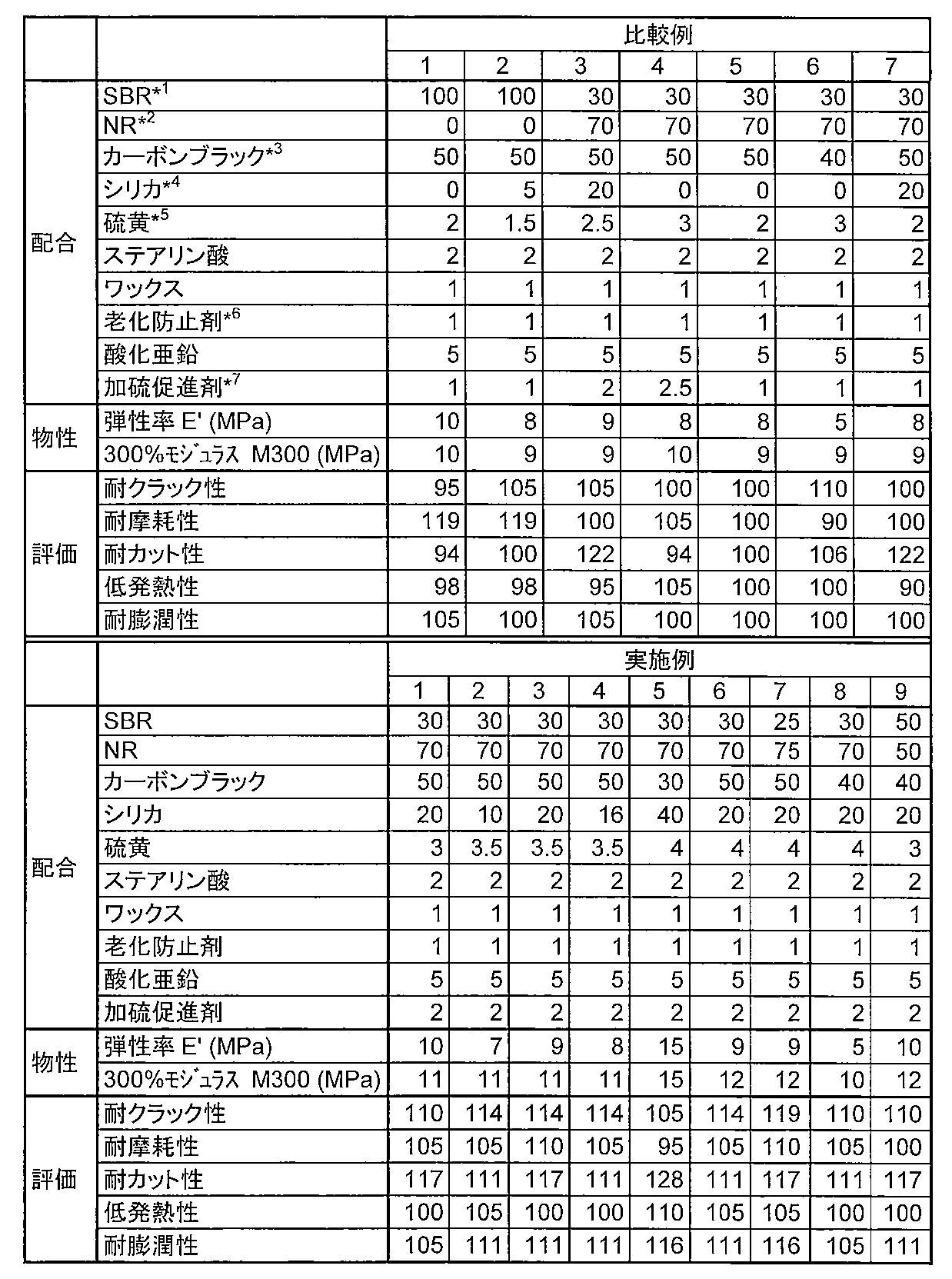
- the examples satisfying the above conditions are swelling resistance, crack resistance, wear resistance, cut resistance, low heat generation. It is clear that the swelling resistance is particularly improved while balancing the five performance characteristics. If it sees individually, the improvement of Example 1 which satisfy
- Examples 2 to 4 were improved in a balanced manner. From the comparison between Examples 3 and 4, it is better to evaluate the relationship between the blending amounts of silica and carbon black in a preferable relationship. Compared with Examples 6 and 7, it can be said that the balance of improvement is better when the main component is natural rubber.
- the present invention even when exposed to high temperatures during rough road surfaces and asphalt pavement work, it has excellent crack resistance, so it can withstand use under harsh conditions. Even in the operation while spraying the release agent, since it is excellent in swelling resistance, it is possible to obtain a road roller tire in which workability does not deteriorate due to swelling deformation.
Landscapes
- Chemical & Material Sciences (AREA)
- Health & Medical Sciences (AREA)
- Chemical Kinetics & Catalysis (AREA)
- Medicinal Chemistry (AREA)
- Polymers & Plastics (AREA)
- Organic Chemistry (AREA)
- Engineering & Computer Science (AREA)
- Mechanical Engineering (AREA)
- Compositions Of Macromolecular Compounds (AREA)
- Tires In General (AREA)
Abstract
シリカ、ゴム成分100質量部、及び3質量部以上の硫黄を配合することを特徴とする、耐クラック性と耐膨潤性に優れた、トレッド部及びサイド部に共通して使用できる、ロードローラタイヤ用ゴム組成物を提供する。
Description
本発明は、耐膨潤性と耐クラック性が両立し、さらに耐摩耗性、耐カット性、耐発熱性にも優れたロードローラタイヤ用ゴム組成物に関する。
ロードローラタイヤは道路工事において、アスファルト転圧用に使用される。アスファルト舗装時には高温加熱に曝されるため、特に、トレッド部において、更なる耐クラック性が要求される。
また、アスファルト舗装時にはロードローラタイヤへのアスファルト付着防止のため、タイヤ全体に軽油や離型剤が散布されている。軽油や離型剤の散布によってタイヤのトレッド部及びサイド部が油膨潤し、作業困難化の要因である、転圧不均一が生じる場合がある。よって、ロードローラタイヤには上記、更なる耐クラック性に加え、耐膨潤性も両立することが求められる。加えて、耐摩耗性、耐カット性といった広くタイヤ全般に要求される耐久性や、特に高温にも曝される使用環境であるので、更なる耐発熱性も求められる。
例えば、特許文献1では、乳化重合法により製造されるスチレン-アクリロニトリル-ブタジエン三元共重合体を含む、ゴム成分100質量部に対し、軟化剤を30~70質量部配合してなるゴム組成物を少なくともキャップトレッドに用いたロードローラタイヤが開示されている。いずれも、改良された特性を持つゴムは、試作されたものであり、市販品として入手できる汎用品ではなく、また、トレッド部やサイド部に共通して使用できるとは限らないゴム組成物である。
汎用性のあるゴム部材と充填材から配合され、トレッド部やサイド部を問わず用いることができ、耐クラック性、耐膨潤性が両立し、耐摩耗性、耐カット性、耐発熱性といった性能をバランスよく発揮できる、ロードローラタイヤ用ゴム組成物が望まれている。
従来、ロードローラタイヤ用のゴム組成物の成分としては、積極的に配合が検討されて来なかった、シリカを含むロードローラタイヤ用ゴム組成物を提供する。
すなわち、本発明は次の(1)~(19)に存する。
(1) シリカ、ゴム成分100質量部、及び3質量部以上の硫黄を含有することを特徴とするロードローラタイヤ用ゴム組成物。
(2) 前記ゴム組成物の弾性率;E'が6~15MPaであることを特徴とする(1)に記載のロードローラタイヤ用ゴム組成物。
(3) 前記ゴム組成物のJIS K 6251:1993に基づく300%モジュラス;M300が11~15MPaであることを特徴とする(1)又は(2)に記載のロードローラタイヤ用ゴム組成物。
(4) 前記ゴム組成物が天然ゴムを含有することを特徴とする(1)~(3)のいずれか1つに記載のロードローラタイヤ用ゴム組成物。
(5) 前記ゴム組成物の天然ゴムの含有量がゴム成分100質量部に対して50質量部以上であることを特徴とする(1)~(4)のいずれか1つに記載のロードローラタイヤ用ゴム組成物。
(6) 前記ゴム組成物がスチレン-ブタジエンゴムを含有することを特徴とする(1)~(5)のいずれか1つに記載のロードローラタイヤ用ゴム組成物。
(7) 前記ゴム組成物において、天然ゴムの含有量/スチレン-ブタジエンゴムの含有量>2を満たすことを特徴とする(1)~(6)のいずれか1つに記載のロードローラタイヤ用ゴム組成物。
(8) 前記ゴム組成物のシリカ含有量がゴム成分100質量部に対し、30質量部未満であることを特徴とする(1)~(7)のいずれか1つに記載のロードローラタイヤ用ゴム組成物。
(9) 前記ゴム組成物のシリカ含有量がゴム成分100質量部に対し、15質量部以上であることを特徴とする(1)~(8)のいずれか1つに記載のロードローラタイヤ用ゴム組成物。
(10) 前記ゴム組成物がカーボンブラックを含有することを特徴とする(1)~(9)のいずれか1つに記載のロードローラタイヤ用ゴム組成物。
(11) 前記ゴム組成物において、カーボンブラック含有量がシリカ含有量より多いことを特徴とする(1)~(10)のいずれか1つに記載のロードローラタイヤ用ゴム組成物。
(12) 前記ゴム組成物において、カーボンブラックの含有量/シリカの含有量<3を満たすことを特徴とする(1)~(11)のいずれか1つに記載のロードローラタイヤ用ゴム組成物。
(13) 前記ゴム組成物において、シランカップリング剤をシリカの1質量%以下で含むことを特徴とする(1)~(12)のいずれか1つに記載のロードローラタイヤ用ゴム組成物。
(14) 前記ゴム組成物において、シランカップリング剤を含まないことを特徴とする(1)~(12)のいずれか1つに記載のロードローラタイヤ用ゴム組成物。
(15) 前記ゴム組成物がゴム成分100質量部に対して5質量部以上の酸化亜鉛を含むことを特徴とする(1)~(14)のいずれか1つに記載のロードローラタイヤ用ゴム組成物。
(16) 前記シリカの窒素吸着比表面積が150~220m2/gであることを特徴とする(1)~(15)のいずれか1つに記載のロードローラタイヤ用ゴム組成物。
(17) 前記カーボンブラックがHAFグレードであることを特徴とする(1)~(16)のいずれか1つに記載のロードローラタイヤ用ゴム組成物。
(18) (1)~(17)のいずれか1つに記載のゴム組成物を用いたロードローラタイヤ。
(19) (1)~(17)のいずれか1つに記載のゴム組成物をトレッド部に用いたロードローラタイヤ。
(1) シリカ、ゴム成分100質量部、及び3質量部以上の硫黄を含有することを特徴とするロードローラタイヤ用ゴム組成物。
(2) 前記ゴム組成物の弾性率;E'が6~15MPaであることを特徴とする(1)に記載のロードローラタイヤ用ゴム組成物。
(3) 前記ゴム組成物のJIS K 6251:1993に基づく300%モジュラス;M300が11~15MPaであることを特徴とする(1)又は(2)に記載のロードローラタイヤ用ゴム組成物。
(4) 前記ゴム組成物が天然ゴムを含有することを特徴とする(1)~(3)のいずれか1つに記載のロードローラタイヤ用ゴム組成物。
(5) 前記ゴム組成物の天然ゴムの含有量がゴム成分100質量部に対して50質量部以上であることを特徴とする(1)~(4)のいずれか1つに記載のロードローラタイヤ用ゴム組成物。
(6) 前記ゴム組成物がスチレン-ブタジエンゴムを含有することを特徴とする(1)~(5)のいずれか1つに記載のロードローラタイヤ用ゴム組成物。
(7) 前記ゴム組成物において、天然ゴムの含有量/スチレン-ブタジエンゴムの含有量>2を満たすことを特徴とする(1)~(6)のいずれか1つに記載のロードローラタイヤ用ゴム組成物。
(8) 前記ゴム組成物のシリカ含有量がゴム成分100質量部に対し、30質量部未満であることを特徴とする(1)~(7)のいずれか1つに記載のロードローラタイヤ用ゴム組成物。
(9) 前記ゴム組成物のシリカ含有量がゴム成分100質量部に対し、15質量部以上であることを特徴とする(1)~(8)のいずれか1つに記載のロードローラタイヤ用ゴム組成物。
(10) 前記ゴム組成物がカーボンブラックを含有することを特徴とする(1)~(9)のいずれか1つに記載のロードローラタイヤ用ゴム組成物。
(11) 前記ゴム組成物において、カーボンブラック含有量がシリカ含有量より多いことを特徴とする(1)~(10)のいずれか1つに記載のロードローラタイヤ用ゴム組成物。
(12) 前記ゴム組成物において、カーボンブラックの含有量/シリカの含有量<3を満たすことを特徴とする(1)~(11)のいずれか1つに記載のロードローラタイヤ用ゴム組成物。
(13) 前記ゴム組成物において、シランカップリング剤をシリカの1質量%以下で含むことを特徴とする(1)~(12)のいずれか1つに記載のロードローラタイヤ用ゴム組成物。
(14) 前記ゴム組成物において、シランカップリング剤を含まないことを特徴とする(1)~(12)のいずれか1つに記載のロードローラタイヤ用ゴム組成物。
(15) 前記ゴム組成物がゴム成分100質量部に対して5質量部以上の酸化亜鉛を含むことを特徴とする(1)~(14)のいずれか1つに記載のロードローラタイヤ用ゴム組成物。
(16) 前記シリカの窒素吸着比表面積が150~220m2/gであることを特徴とする(1)~(15)のいずれか1つに記載のロードローラタイヤ用ゴム組成物。
(17) 前記カーボンブラックがHAFグレードであることを特徴とする(1)~(16)のいずれか1つに記載のロードローラタイヤ用ゴム組成物。
(18) (1)~(17)のいずれか1つに記載のゴム組成物を用いたロードローラタイヤ。
(19) (1)~(17)のいずれか1つに記載のゴム組成物をトレッド部に用いたロードローラタイヤ。
(1)~(3)により耐クラック性と耐膨潤性に優れた、ロードローラタイヤ用ゴム組成物が得られる。
(4)~(7)、及び(16)により、さらに耐クラック性、耐摩耗性、耐カット性、低発熱性が向上した、ロードローラタイヤ用ゴム組成物が得られる。
(8)~(9)により、さらに耐クラック性、耐膨潤性が向上した、ロードローラタイヤ用ゴム組成物が得られる。
(10)~(12)により、さらに耐クラック性、低発熱性が向上した、ロードローラタイヤ用ゴム組成物が得られる。
(13)、(14)により、耐カット性が向上した、ロードローラタイヤ用ゴム組成物が得られる。
(15)~(17)により、さらに耐クラック性、耐膨潤性、耐摩耗性、耐カット性が向上した、ロードローラタイヤ用ゴム組成物が得られる。
(18)、(19)により、本発明の方法による樹脂層のゴム組成物を利用した、ロードローラタイヤが得られる。
(4)~(7)、及び(16)により、さらに耐クラック性、耐摩耗性、耐カット性、低発熱性が向上した、ロードローラタイヤ用ゴム組成物が得られる。
(8)~(9)により、さらに耐クラック性、耐膨潤性が向上した、ロードローラタイヤ用ゴム組成物が得られる。
(10)~(12)により、さらに耐クラック性、低発熱性が向上した、ロードローラタイヤ用ゴム組成物が得られる。
(13)、(14)により、耐カット性が向上した、ロードローラタイヤ用ゴム組成物が得られる。
(15)~(17)により、さらに耐クラック性、耐膨潤性、耐摩耗性、耐カット性が向上した、ロードローラタイヤ用ゴム組成物が得られる。
(18)、(19)により、本発明の方法による樹脂層のゴム組成物を利用した、ロードローラタイヤが得られる。
本発明のロードローラタイヤ用ゴム組成物には、従来、ロードローラタイヤに用いられてきたゴム成分であれば、特に制限されることなく用いることができる。例えば、スチレン-ブタジエンゴム;SBRが挙げられるが、それ以外のゴム成分を含んでもよく、また、スチレン-ブタジエンゴムより多く含んでもいてもよく、さらにはスチレン-ブタジエンゴムを含んでいなくてもよい。他のゴム成分としては、天然ゴム;NRや、各種処理を施した変性天然ゴム、ジエン系をはじめとする合成ゴムとして、ポリイソプレン;IR、ポリブタジエン;BR、クロロプレン;CR、ブチルゴム;IIR、アクリロニトリル-ブタジエンゴム;NBR、エチレン-プロピレン-ジエンゴム;EPDM、から選ばれる少なくとも1種以上のゴムを用いることができ、天然ゴムやジエン系合成ゴムを使用することが好ましく、天然ゴムやポリイソプレンゴムを使用することがより好ましく、天然ゴムを使用することが特に好ましい。
天然ゴムを用いる場合、ゴム成分全体100質量部に対して、20質量部以上が好ましく、50質量部以上がより好ましく、70質量部以上が特に好ましい。
また、合成ゴムの中では汎用性が高い、スチレン-ブタジエンゴムを用いる場合は、スチレンの含有量は45%以下が好ましく、40%以下がさらに好ましい。
さらに、上記スチレン-ブタジエンゴムのガラス転移温度;Tgが低いことが好ましい。具体的にはTgが、-20℃以下が好ましく、-30℃以下が特に好ましい。Tgは、耐膨潤性の向上をはじめ耐クラック性にも寄与する。
以下において、配合成分名や、定義した配合成分のNR、SBRといった略号を、等式や不等式において、該配合成分の配合質量部数として表す場合がある。
天然ゴム;NRとスチレン-ブタジエンゴム;SBRのNR/SBR>2の関係を満たすことが好ましく、さらにNR/SBRの値が2より大きく9以下であることが好ましい。上記範囲とすることで、耐亀裂進展性に優れ、高次に耐亀裂進展性と膨潤性の両立が可能となる。
本発明のロードローラタイヤ用ゴム組成物は、ゴム成分100質量部に対し3質量部以上の硫黄を配合して加硫することを特徴とする。
加硫の為の硫黄は、普通硫黄、不溶性硫黄、硫黄華、脱酸硫黄、粉末硫黄、沈降硫黄、コロイド硫黄、ゴム状硫黄から、適宜選んで配合することができる。本発明では普通硫黄や不溶性硫黄が用いられる。
通常に比べて、3質量部でも多いといえる、硫黄の配合量であるので、それほどさらに増量するわけではないが、5質量部までは配合でき、適切に架橋されることで耐クラック性、耐膨潤性に優れたゴム組成物が得られる。硫黄の含有量は3.5~4質量部が好ましい。また、硫黄の含有量が3質量部未満では、十分に諸性能が得られない。
本発明のロードローラタイヤ用ゴム組成物はシリカを含むことを特徴とする。
タイヤにおいてシリカは、主にウエットグリップ性をはじめとする、グリップ性を向上させるために用いられることが多い充填材である。しかしながら、滑りやすい路面を高速走行するといったこともないので、ロードローラタイヤのような、使用目的や環境において求められる性能とはいえないことから、通常なら、配合することは検討されない成分である。
一方で、本発明においては、シリカを配合したゴム組成物が、ロードローラタイヤにおける、アスファルト舗装での高温に曝されるような用途及び、軽油や離型剤のようなオイルを塗布しながら作業するという、特殊な使用環境において、耐クラック性の向上と、生来ロードローラタイヤに要求される耐膨潤性との両立に適していることを見出した。
配合するシリカとしては、特に制限はなく、従来ゴムの補強用充填剤として慣用されているものの中から任意に選択して用いることができる。用いることができるシリカとしては、あらゆる市販利用可能な製品が使用でき、中でも湿式シリカ、乾式シリカ、コロイダルシリカを用いるのが好ましく、湿式シリカを用いるのが特に好ましい。ISO 5794/1に準拠して測定したシリカの窒素吸着非表面積;N2SAは、40~350m2/gであるのが好ましい。N2SAが該範囲であるシリカは、ゴム補強性とゴム成分中への分散性とを両立できるという利点がある。前記利点の観点から、N2SAが80~350m2/gの範囲にあるシリカがより好ましく、120~350m2/gの範囲にあるシリカが更に好ましく、150~220m2/gが特に好ましい。このようなシリカとしては、N2SA=220m2/gである東ソーシリカ社製、商品名「ニプシルAQ」、「ニプシルKQ」、N2SA=175m2/gであるデグッサ社製商品名「ウルトラジルVN3」といった市販利用可能品を用いることができる。以上のシリカは1種を単独で用いてもよく、2種以上を組み合わせて用いてもよい。
シリカは、通常グリップ性の向上を目的として配合されることが多いのは、上記に述べた通りであるが、そもそもシリカは補強性充填材であるから、機械的特性を向上させる目的で配合するのは理にかなっている。
シリカの配合効果が十分に発現されるには、ゴム成分100質量部に対し、10質量部以上配合することが好ましく、15質量部以上が特に好ましい。一方上限は30質量部未満が好ましく、25質量部以下が特に好ましい。
シリカのみならず、より一般的な補強性充填材である、カーボンブラックも配合することができる。カーボンブラックとしては、通常のゴム組成物に用いることができる、カーボンブラックであれば特に限定はされないが、低発熱性を重視して、粒径が小さいカーボンブラックを選ぶことが好ましい。具体的には、HAF、IISAF、ISAF、SAFといったグレードのカーボンブラックが好ましく、HAFが特に好ましい。JIS K 6217-2:2001に準拠して測定した窒素吸着比表面積;N2SAが30~250m2/gであることが好ましい。該カーボンブラックは1種を単独で用いてもよく、2種以上を組み合わせて用いてもよい。もちろん、補強性充填材としての役割もあり、耐クラック性、耐摩耗性、耐カット性の向上に寄与する。
カーボンブラックを配合する場合、シリカよりは多い質量部数を配合することが好ましい。その上で、カーボンブラック/シリカ<3とすることが好ましく、さらに2.5以下がより好ましい。前記配合比を満たすことで、耐摩耗性を良好な範囲とすることができる。またカーボンブラックの配合部数として、ゴム成分100質量部に対して、60質量部未満とするのが好ましい。また配合部数を20質量部以上とすることが好ましい。シリカとカーボンブラックの量、及びそれぞれの関係が上記であれば、耐クラック性が向上するのはもちろん、低発熱性とのバランスにも優れたゴム組成物が得られる。
シランカップリング剤を添加する場合、通常のシリカに対するシランカップリング剤の配合比に比べて、小さく抑えてシリカの5質量%以下とすることが好ましい。3質量%以下とすることがより好ましく、1質量%以下とすることが特に好ましい。配合せずに済むなら、シランカップリング剤を含まないことがさらに好ましい。上記範囲であれば耐カット性を向上できる。
用いることができるシランカップリング剤としては、下記一般式(I)~(III)で表わされる化合物からなる群から、少なくとも1種選択される化合物であることが好ましい。
以下、下記一般式(I)~(III)を順に説明する。
以下、下記一般式(I)~(III)を順に説明する。

式中、R1は複数ある場合には同一でも異なっていてもよく、各々炭素数1~8の直鎖、環状又は分枝のアルキル基、炭素数2~8の直鎖又は分枝のアルコキシアルキル基及びシラノール基から選ばれる置換基であり、R2は複数ある場合には同一でも異なっていてもよく、各々炭素数1~8の直鎖、環状又は分枝のアルキル基であり、R3は複数ある場合には同一でも異なっていてもよく、各々炭素数1~8の直鎖又は分枝のアルカンジイル基である。p及びrは共に3である場合はなく、同一でも異なっていてもよく、各々平均値として0~3である。スルフィド鎖の硫黄数aは平均値として2~6である。
上記一般式(I)で表わされるシランカップリング剤の具体例として、ビス(3-トリエトキシシリルプロピル)テトラスルフィド、ビス(3-トリメトキシシリルプロピル)テトラスルフィド、ビス(3-メチルジメトキシシリルプロピル)テトラスルフィド、ビス(2-トリエトキシシリルエチル)テトラスルフィド、ビス(3-トリエトキシシリルプロピル)ジスルフィド、ビス(3-トリメトキシシリルプロピル)ジスルフィド、ビス(3-メチルジメトキシシリルプロピル)ジスルフィド、ビス(2-トリエトキシシリルエチル)ジスルフィド、ビス(3-トリエトキシシリルプロピル)トリスルフィド、ビス(3-トリメトキシシリルプロピル)トリスルフィド、ビス(3-メチルジメトキシシリルプロピル)トリスルフィド、ビス(2-トリエトキシシリルエチル)トリスルフィド、ビス(3-モノエトキシジメチルシリルプロピル)テトラスルフィド、ビス(3-モノエトキシジメチルシリルプロピル)トリスルフィド、ビス(3-モノエトキシジメチルシリルプロピル)ジスルフィド、ビス(3-モノメトキシジメチルシリルプロピル)テトラスルフィド、ビス(3-モノメトキシジメチルシリルプロピル)トリスルフィド、ビス(3-モノメトキシジメチルシリルプロピル)ジスルフィド、ビス(2-モノエトキシジメチルシリルエチル)テトラスルフィド、ビス(2-モノエトキシジメチルシリルエチル)トリスルフィド、ビス(2-モノエトキシジメチルシリルエチル)ジスルフィドといった化合物が挙げられる。
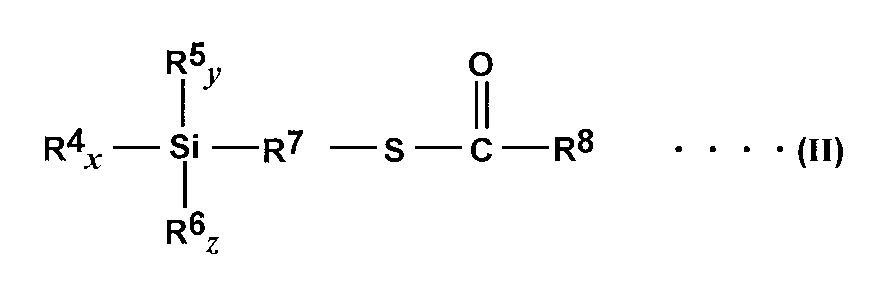
式中、R4は塩素原子、臭素原子、水素原子又は炭素数1~18の一価の炭化水素基で置換されたR9O-;アルコキシ基、R9C(=O)O-;カルボキシル基、R9R10C=NO-;オキシマト基、R9R10CNO-、NR9R10-;アミノ基、及びシロキシ鎖長2~5のポリシロキシ基-(OSiR9R10)h(OSiR9R10R11)から選択される一価の基である。以上において、R9、R10及びR11は各々水素原子又は炭素数1~18の一価の炭化水素基であり、hは平均値として1~4である。R5はR9、水素原子又は炭素数1~18の一価の炭化水素基であり、R6はR4、R5、水素原子又は-[O(R12O)j]1/2-基である。なお、R12は炭素数1~18のアルカンジイル基、jは1~4の整数である。R7は炭素数1~18の二価の炭化水素基であり、R8は炭素数1~18の一価の炭化水素基である。x、y及びzは、x+y+2z=3、0≦x≦3、0≦y≦2、0≦z≦1の関係を満たす数である。
上記一般式(II)において、R8、R9、R10及びR11は同一でも異なっていてもよく、好ましくは各々炭素数1~18の直鎖、環状もしくは分枝のアルキル基、アルケニル基、アリール基及びアリールアルキル基からなる群から選択される基であることが好ましい。また、R5が炭素数1~18の一価の炭化水素基である場合は、直鎖、環状もしくは分枝のアルキル基、アルケニル基、アリール基及びアリールアルキル基からなる群から選択される基であることが好ましい。R12は直鎖、環状又は分枝のアルカンジイル基であることが好ましく、特に直鎖状のものが好ましい。R7は例えば直鎖状、枝分かれ状のいずれであっても良い炭素数1~18のアルカンジイル基、炭素数2~18のアルケンジイル基、環上に低級アルキル基のような置換基を有していてもよい、炭素数5~18のシクロアルカンジイル基、炭素数6~18のシクロアルキルアルカンジイル基、炭素数6~18のアレーンジイル基、炭素数7~18のアリールアルカンジイル基を挙げることができる。このR7としては、炭素数1~6のアルカンジイル基が好ましく、特に直鎖状アルカンジイル基、例えばメタンジイル基、エタンジイル基、プロパンジイル基、ブタンジイル基、ペンタンジイル基、ヘキサンジイル基を好ましく挙げることができる。
上記一般式(II)におけるR5、R8、R9、R10及びR11の炭素数1~18の一価の炭化水素基の具体例としては、メチル基、エチル基、1-プロピル基、2-プロピル基、1-ブチル基、2-メチル-1-プロピル基、2-ブチル基、2-メチル-2-プロピル基、ペンチル基、ヘキシル基、オクチル基、デシル基、ドデシル基、シクロペンチル基、シクロヘキシル基、ビニル基、プロぺニル基、アリル基、ヘキセニル基、オクテニル基、シクロペンテニル基、シクロヘキセニル基、フェニル基、トリル基、キシリル基、ナフチル基、ベンジル基、フェネチル基、ナフチルメチル基が挙げられる。
上記一般式(II)におけるR12の例としては、メタンジイル基、エタンジイル基、プロパンジイル基、ブタンジイル基、ペンタンジイル基、ヘキサンジイル基、オクタンジイル基、デカンジイル基、ドデカンジイル基が挙げられる。
上記一般式(II)におけるR12の例としては、メタンジイル基、エタンジイル基、プロパンジイル基、ブタンジイル基、ペンタンジイル基、ヘキサンジイル基、オクタンジイル基、デカンジイル基、ドデカンジイル基が挙げられる。
前記一般式(II)で表されるシランカップリング剤の具体例としては、3-ヘキサノイルチオプロピルトリエトキシシラン、3-オクタノイルチオプロピルトリエトキシシラン、3-デカノイルチオプロピルトリエトキシシラン、3-ラウロイルチオプロピルトリエトキシシラン、2-ヘキサノイルチオエチルトリエトキシシラン、2-オクタノイルチオエチルトリエトキシシラン、2-デカノイルチオエチルトリエトキシシラン、2-ラウロイルチオエチルトリエトキシシラン、3-ヘキサノイルチオプロピルトリメトキシシラン、3-オクタノイルチオプロピルトリメトキシシラン、3-デカノイルチオプロピルトリメトキシシラン、3-ラウロイルチオプロピルトリメトキシシラン、2-ヘキサノイルチオエチルトリメトキシシラン、2-オクタノイルチオエチルトリメトキシシラン、2-デカノイルチオエチルトリメトキシシラン、2-ラウロイルチオエチルトリメトキシシランを挙げることができる。該具体例の内、3-オクタノイルチオプロピルトリエトキシシラン(Momentive Performance Materials社製、商標「NXTシラン」)が特に好ましい。
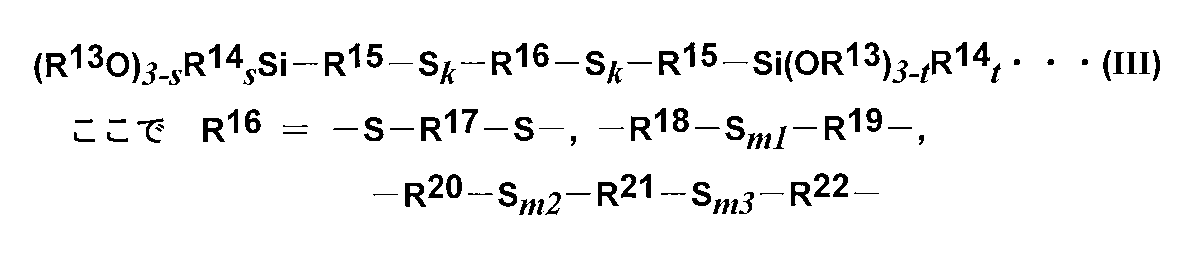
式中、R13は複数ある場合には同一でも異なっていてもよく、各々炭素数1~8の直鎖、環状又は分枝のアルキル基、炭素数2~8の直鎖又は分枝のアルコキシアルキル基及びシラノール基から選ばれる置換基であり、R14は複数ある場合には同一でも異なっていてもよく、各々炭素数1~8の直鎖、環状又は分枝のアルキル基であり、R15は複数ある場合には同一でも異なっていてもよく、各々炭素数1~8の直鎖又は分枝のアルカンジイル基である。R16は一般式(-S-R17-S-)、(-R18-Sm1-R19-)及び(-R20-Sm2-R21-Sm3-R22-)から選ばれる二価の基(R17~R22は各々炭素数1~20の二価の炭化水素基、二価の芳香族基、並びに硫黄及び酸素以外のヘテロ元素を含む二価の有機基から選ばれる二価の置換基であり、m1、m2及びm3は各々平均値として1以上4未満である。)であり、複数あるkは同一でも異なっていてもよく、各々平均値として1~6であり、s及びtは各々平均値として0~3である。但しs及びtの双方が3であることはない。
上記一般式(III)で表わされるシランカップリング剤の具体例は、いずれも平均組成式で表すものとして、
(C2H5O)3SiC3H6S2C6H12S2C3H6Si(OC2H5)3、
(C2H5O)3SiC3H6S2C10H20S2C3H6Si(OC2H5)3、
(C2H5O)3SiC3H6S3C6H12S3C3H6Si(OC2H5)3、
(C2H5O)3SiC3H6S4C6H12S4C3H6Si(OC2H5)3、
(C2H5O)3SiC3H6SC6H12S2C6H12SC3H6Si(OC2H5)3、
(C2H5O)3SiC3H6SC6H12S2.5C6H12SC3H6Si(OC2H5)3、
(C2H5O)3SiC3H6SC6H12S3C6H12SC3H6Si(OC2H5)3、
(C2H5O)3SiC3H6SC6H12S4C6H12SC3H6Si(OC2H5)3、
(C2H5O)3SiC3H6SC10H20S2C10H20SC3H6Si(OC2H5)3、
(C2H5O)3SiC3H6S4C2H4S4C6H12S4C3H6Si(OC2H5)3、
(C2H5O)3SiC3H6S2C6H12S2C6H12S2C3H6Si(OC2H5)3、
(C2H5O)3SiC3H6SC6H12S2C6H12S2C6H12SC3H6Si(OC2H5)3で表される化合物が好適に挙げられる。ここで、C2H4=(CH2)2、C3H6=(CH2)3、C6H12=(CH2)6、C10H20=(CH2)10であり、それぞれ、炭素数2、3、6、10の直鎖アルカンの両末端から水素を1つずつ除いてなる直鎖アルカンジイル基である。なお、平均組成であるとは、硫黄鎖長にばらつきがあり、硫黄数が平均化されていることをさす。
なお、上記一般式(III)で表わされるシランカップリング剤は、例えば特開2006-167919号公報に記載された方法で製造できる。また、市販品が広く利用できる。
(C2H5O)3SiC3H6S2C6H12S2C3H6Si(OC2H5)3、
(C2H5O)3SiC3H6S2C10H20S2C3H6Si(OC2H5)3、
(C2H5O)3SiC3H6S3C6H12S3C3H6Si(OC2H5)3、
(C2H5O)3SiC3H6S4C6H12S4C3H6Si(OC2H5)3、
(C2H5O)3SiC3H6SC6H12S2C6H12SC3H6Si(OC2H5)3、
(C2H5O)3SiC3H6SC6H12S2.5C6H12SC3H6Si(OC2H5)3、
(C2H5O)3SiC3H6SC6H12S3C6H12SC3H6Si(OC2H5)3、
(C2H5O)3SiC3H6SC6H12S4C6H12SC3H6Si(OC2H5)3、
(C2H5O)3SiC3H6SC10H20S2C10H20SC3H6Si(OC2H5)3、
(C2H5O)3SiC3H6S4C2H4S4C6H12S4C3H6Si(OC2H5)3、
(C2H5O)3SiC3H6S2C6H12S2C6H12S2C3H6Si(OC2H5)3、
(C2H5O)3SiC3H6SC6H12S2C6H12S2C6H12SC3H6Si(OC2H5)3で表される化合物が好適に挙げられる。ここで、C2H4=(CH2)2、C3H6=(CH2)3、C6H12=(CH2)6、C10H20=(CH2)10であり、それぞれ、炭素数2、3、6、10の直鎖アルカンの両末端から水素を1つずつ除いてなる直鎖アルカンジイル基である。なお、平均組成であるとは、硫黄鎖長にばらつきがあり、硫黄数が平均化されていることをさす。
なお、上記一般式(III)で表わされるシランカップリング剤は、例えば特開2006-167919号公報に記載された方法で製造できる。また、市販品が広く利用できる。
本発明のゴム組成物には、その他、酸化亜鉛、ステアリン酸、アロマティックオイル、ワックス、熱可塑性樹脂、加硫促進剤、老化防止剤といった、通常用いられるゴム薬品を配合してもよい。
加硫促進剤として、M;2-メルカプトベンゾチアゾール、DM;ジベンゾチアゾリルジスルフィド、及びCZ;N-シクロヘキシル-2-ベンゾチアゾリルスルフェンアミドといったチアゾール系加硫促進剤、TT;テトラメチルチウラムスルフィド、TBzTD;テトラベンジルチウラムジスルフィド;TOT;テトラキス(2-エチルヘキシル)チウラムジスルフィドといったチウラム系加硫促進剤、並びにDPG;ジフェニルグアニジンといったグアニジン系の加硫促進剤を挙げることができる。ロードローラタイヤは大型タイヤであるので、加硫促進剤を効果的に用いて均一な加硫を行う。加硫促進剤の含有量は、ゴム成分100質量部に対し、0.1~10質量部、好ましくは、0.5~5.0質量部、更に好ましくは、0.8~2.5質量部とすることが望ましい。
加硫促進剤の効果を調節するために酸化亜鉛を用いるが、ゴム成分100質量部に対して5質量部以上を配合することが好ましい。酸化亜鉛の配合量が上記の範囲内であれば、耐クラック性、耐膨潤性、共に向上する。
上記のような各種成分を配合して成るゴム組成物について、JIS K 7244に基づく、加硫架橋後の弾性率;E’は6~15MPaであることが好ましい。
本発明はロードローラタイヤ用のゴム組成物であるから、当然の用途として、アスファルト舗装の際に、アスファルトを車体重量で転圧して、圧接させるのに必要な剛性が必要とされる。用途の性質上、乗り心地が追求されるよりは、頑丈で未整備の悪路でも使用に耐え得る十分な耐クラック性のために、剛性は大きい方が有利である。6MPa以上であれば、使用目的にあった弾性率といえる。もちろん剛性の増大は脆くなるという面もあるため、上限として15MPa以下であれば、不測の事態で割れが生じない程度の弾性率となる。弾性率が6~12MPaがさらに好ましく、8~11MPaが特に好ましい。
弾性率;E’に加え、300%モジュラス;M300も、本発明のロードローラタイヤ用ゴム組成物として適正な範囲にされるべき物性である。300%モジュラス;M300が11~15MPaであることが好ましく、耐膨潤性に優れる。300%モジュラス;M300が11~13MPaの範囲であれば、さらに好ましく、耐クラック性も向上する。
以上のような、ゴム組成物成分を例えば、バンバリーミキサー、ニーダーといった混練機によって混練し、トレッド部材やサイド部材として、他の部材と合わせて成型加工してグリーンタイヤを得て、加硫架橋することにより、主としてリム径15インチ以上のロードローラタイヤを製造することができる。混練や押出し成型加工する場合においても、本発明のゴム組成物は加工性に優れる。
次に、実施例、比較例により、本発明を更に詳細に説明するが、本発明は実施例に制約されるものではない。
[ゴム組成物の調製]
また、表1のゴム組成物を使用したロードローラタイヤのトレッド部及びサイド部に適用してサイズ750-15のタイヤを試作し、長さ50mm、幅5mm、厚み2mmのゴムシートを切り出し評価を行った。
また、表1のゴム組成物を使用したロードローラタイヤのトレッド部及びサイド部に適用してサイズ750-15のタイヤを試作し、長さ50mm、幅5mm、厚み2mmのゴムシートを切り出し評価を行った。
[弾性率;E’の測定]
上島製作所(株)製スペクトロメーターを用い、チャック間距離10mm、初期歪み200μm、動的歪1%、周波数52Hz、測定温度25℃の条件で、弾性率;E'を測定した。
上島製作所(株)製スペクトロメーターを用い、チャック間距離10mm、初期歪み200μm、動的歪1%、周波数52Hz、測定温度25℃の条件で、弾性率;E'を測定した。
[300%モジュラス;M300の測定]
JIS K 6251:1993に準拠して引張試験を行い、300%伸長時の引張応力;M300を測定した。
JIS K 6251:1993に準拠して引張試験を行い、300%伸長時の引張応力;M300を測定した。
[耐クラック性の評価]
JIS K 7126:1999に準拠して、小平製作所社製、屈曲疲労試験機を用いて破断に達するまでに要した屈曲回数を測定した。この屈曲回数を比較例5の値を100として、指数表示した。数値が大きい程、耐クラック性に優れていることを示す。
JIS K 7126:1999に準拠して、小平製作所社製、屈曲疲労試験機を用いて破断に達するまでに要した屈曲回数を測定した。この屈曲回数を比較例5の値を100として、指数表示した。数値が大きい程、耐クラック性に優れていることを示す。
[耐摩耗性の評価]
ランボーン型摩耗試験機を用い、室温におけるスリップ率が25%の摩耗量を測定し、比較例5の摩耗量の逆数を100として指数表示した。
ランボーン型摩耗試験機を用い、室温におけるスリップ率が25%の摩耗量を測定し、比較例5の摩耗量の逆数を100として指数表示した。
[耐カット性の評価]
耐カット性は振り子式衝撃カット試験機にて、任意の高さから鋼鉄製の刃を打ちつけて傷を付け、その傷の深さを測定することにより評価した。得られた値の逆数を取り、下記表1の比較例5の値を100とした指数表示した。数値が大きい程、耐カット性に優れていることを示す。
耐カット性は振り子式衝撃カット試験機にて、任意の高さから鋼鉄製の刃を打ちつけて傷を付け、その傷の深さを測定することにより評価した。得られた値の逆数を取り、下記表1の比較例5の値を100とした指数表示した。数値が大きい程、耐カット性に優れていることを示す。
[低発熱性の評価]
上島製作所(株)製スペクトロメーターを用い、チャック間距離10mm、初期歪み200μm、動的歪1%、周波数52Hz、測定温度25℃の条件で、粘弾性を測定し、tanδについて比較例5の値を100とする指数で比較した。指数値が大きいほど、発熱性に優れており、すなわち低発熱性であることを示している。
上島製作所(株)製スペクトロメーターを用い、チャック間距離10mm、初期歪み200μm、動的歪1%、周波数52Hz、測定温度25℃の条件で、粘弾性を測定し、tanδについて比較例5の値を100とする指数で比較した。指数値が大きいほど、発熱性に優れており、すなわち低発熱性であることを示している。
[耐膨潤性の評価]
試験片を軽油中に24時間浸漬して膨潤した後の体積変化率=(膨潤後体積-膨潤前体積)/膨潤前体積とし、比較例5の体積変化率の逆数を100として、各々の体積変化率の逆数を指数化した。数値が大きいほど、耐膨潤性に優れていることを示している。
試験片を軽油中に24時間浸漬して膨潤した後の体積変化率=(膨潤後体積-膨潤前体積)/膨潤前体積とし、比較例5の体積変化率の逆数を100として、各々の体積変化率の逆数を指数化した。数値が大きいほど、耐膨潤性に優れていることを示している。
*1:スチレン-ブタジエンゴム、JSR社製、#1500
*2:天然ゴム、RSS #3
*3:カーボンブラック、Cabot社製、N330
*4:シリカ、東ソー・シリカ社製、Nipsil AQ
*5:硫黄、フレキシス社製、CRYSTEX HS OT-20
*6:老化防止剤、大内新興化学工業社製、ノクラック6C、N-フェニル-N’-(1,3-ジメチルブチル)-p-フェニレンジアミン
*7:加硫促進剤、大内新興化学工業社製、ノクセラーCZ、N-シクロヘキシル-2-ベンゾチアゾリルスルフェンアミド
*2:天然ゴム、RSS #3
*3:カーボンブラック、Cabot社製、N330
*4:シリカ、東ソー・シリカ社製、Nipsil AQ
*5:硫黄、フレキシス社製、CRYSTEX HS OT-20
*6:老化防止剤、大内新興化学工業社製、ノクラック6C、N-フェニル-N’-(1,3-ジメチルブチル)-p-フェニレンジアミン
*7:加硫促進剤、大内新興化学工業社製、ノクセラーCZ、N-シクロヘキシル-2-ベンゾチアゾリルスルフェンアミド
シリカの配合及び/又は硫黄3質量部以上の配合を満たしていない比較例に対し、該条件を満たしている実施例は、耐膨潤性、耐クラック性、耐摩耗性、耐カット性、低発熱性の5つの性能のバランスを取りつつ、特に耐膨潤性が向上していることが明らかである。個々に見れば、比較例7に対し硫黄の条件を満たした、実施例1はバランスよく向上が見られた。また、比較例6に対しシリカが配合されることによっても、実施例1はバランスよく向上が見られた。特に、弾性率や300%モジュラスという点で、両立した改善が達成され、各評価でも良好な改善に至っている。更に硫黄の増量や、シリカの配合量の調整で、実施例2~4は、バランスよく向上が見られた。また、実施例3と4の比較から、シリカとカーボンブラックの配合量の関係が、好ましい関係にある方が評価がよい。実施例6と7の比較より、天然ゴム主体の方が向上のバランスは良いといえる。
本発明を利用すれば、整備途上の荒れた路面やアスファルト舗装作業時に高温に曝されても、耐クラック性に優れているので、過酷な条件での使用に耐えることができ、また、軽油や離型剤を散布しながらの作業でも、耐膨潤性に優れているので、膨潤変形のために作業性が低下することのない、ロードローラタイヤが得られる。
Claims (19)
- シリカ、ゴム成分100質量部、及び3質量部以上の硫黄を含有することを特徴とするロードローラタイヤ用ゴム組成物。
- 前記ゴム組成物の弾性率;E'が6~15MPaであることを特徴とする請求項1に記載のロードローラタイヤ用ゴム組成物。
- 前記ゴム組成物のJIS K 6251:1993に基づく300%モジュラス;M300が11~15MPaであることを特徴とする請求項1又は2に記載のロードローラタイヤ用ゴム組成物。
- 前記ゴム組成物が天然ゴムを含有することを特徴とする請求項1~3のいずれか1項に記載のロードローラタイヤ用ゴム組成物。
- 前記ゴム組成物の天然ゴムの含有量がゴム成分100質量部に対して50質量部以上であることを特徴とする請求項1~4のいずれか1項に記載のロードローラタイヤ用ゴム組成物。
- 前記ゴム組成物がスチレン-ブタジエンゴムを含有することを特徴とする請求項1~5のいずれか1項に記載のロードローラタイヤ用ゴム組成物。
- 前記ゴム組成物において、天然ゴムの含有量/スチレン-ブタジエンゴムの含有量>2を満たすことを特徴とする請求項1~6のいずれか1項に記載のロードローラタイヤ用ゴム組成物。
- 前記ゴム組成物のシリカ含有量がゴム成分100質量部に対し、30質量部未満であることを特徴とする請求項1~7のいずれか1項に記載のロードローラタイヤ用ゴム組成物。
- 前記ゴム組成物のシリカ含有量がゴム成分100質量部に対し、15質量部以上であることを特徴とする請求項1~8のいずれか1項に記載のロードローラタイヤ用ゴム組成物。
- 前記ゴム組成物がカーボンブラックを含有することを特徴とする請求項1~9のいずれか1項に記載のロードローラタイヤ用ゴム組成物。
- 前記ゴム組成物において、カーボンブラック含有量がシリカ含有量より多いことを特徴とする請求項1~10のいずれか1項に記載のロードローラタイヤ用ゴム組成物。
- 前記ゴム組成物において、カーボンブラックの含有量/シリカの含有量<3を満たすことを特徴とする請求項1~11のいずれか1項に記載のロードローラタイヤ用ゴム組成物。
- 前記ゴム組成物において、シランカップリング剤をシリカの1質量%以下で含むことを特徴とする請求項1~12のいずれか1項に記載のロードローラタイヤ用ゴム組成物。
- 前記ゴム組成物において、シランカップリング剤を含まないことを特徴とする請求項1~12のいずれか1項に記載のロードローラタイヤ用ゴム組成物。
- 前記ゴム組成物がゴム成分100質量部に対して5質量部以上の酸化亜鉛を含むことを特徴とする請求項1~14のいずれか1項に記載のロードローラタイヤ用ゴム組成物。
- 前記シリカの窒素吸着比表面積が150~220m2/gであることを特徴とする請求項1~15のいずれか1項に記載のロードローラタイヤ用ゴム組成物。
- 前記カーボンブラックがHAFグレードであることを特徴とする請求項1~16のいずれか1項に記載のロードローラタイヤ用ゴム組成物。
- 請求項1~17のいずれか1項に記載のゴム組成物を用いたロードローラタイヤ。
- 請求項1~17のいずれか1項に記載のゴム組成物をトレッド部に用いたロードローラタイヤ。
Priority Applications (1)
| Application Number | Priority Date | Filing Date | Title |
|---|---|---|---|
| JP2018529810A JPWO2018021118A1 (ja) | 2016-07-29 | 2017-07-19 | ゴム組成物 |
Applications Claiming Priority (4)
| Application Number | Priority Date | Filing Date | Title |
|---|---|---|---|
| JP2016-149842 | 2016-07-29 | ||
| JP2016149842 | 2016-07-29 | ||
| JP2016149843 | 2016-07-29 | ||
| JP2016-149843 | 2016-07-29 |
Publications (1)
| Publication Number | Publication Date |
|---|---|
| WO2018021118A1 true WO2018021118A1 (ja) | 2018-02-01 |
Family
ID=61016055
Family Applications (1)
| Application Number | Title | Priority Date | Filing Date |
|---|---|---|---|
| PCT/JP2017/026145 Ceased WO2018021118A1 (ja) | 2016-07-29 | 2017-07-19 | ゴム組成物 |
Country Status (2)
| Country | Link |
|---|---|
| JP (1) | JPWO2018021118A1 (ja) |
| WO (1) | WO2018021118A1 (ja) |
Citations (4)
| Publication number | Priority date | Publication date | Assignee | Title |
|---|---|---|---|---|
| JPH02242835A (ja) * | 1989-03-16 | 1990-09-27 | Bridgestone Corp | ロードローラー用タイヤ |
| JPH0782417A (ja) * | 1993-09-10 | 1995-03-28 | Sumitomo Rubber Ind Ltd | タイヤローラー用トレッドゴム |
| JP2000118202A (ja) * | 1998-10-19 | 2000-04-25 | Bridgestone Corp | ロードローラー用タイヤ |
| CN103642077A (zh) * | 2013-11-28 | 2014-03-19 | 山东永泰化工有限公司 | 一种压路机用斜交轮胎胎侧胶 |
-
2017
- 2017-07-19 JP JP2018529810A patent/JPWO2018021118A1/ja active Pending
- 2017-07-19 WO PCT/JP2017/026145 patent/WO2018021118A1/ja not_active Ceased
Patent Citations (4)
| Publication number | Priority date | Publication date | Assignee | Title |
|---|---|---|---|---|
| JPH02242835A (ja) * | 1989-03-16 | 1990-09-27 | Bridgestone Corp | ロードローラー用タイヤ |
| JPH0782417A (ja) * | 1993-09-10 | 1995-03-28 | Sumitomo Rubber Ind Ltd | タイヤローラー用トレッドゴム |
| JP2000118202A (ja) * | 1998-10-19 | 2000-04-25 | Bridgestone Corp | ロードローラー用タイヤ |
| CN103642077A (zh) * | 2013-11-28 | 2014-03-19 | 山东永泰化工有限公司 | 一种压路机用斜交轮胎胎侧胶 |
Also Published As
| Publication number | Publication date |
|---|---|
| JPWO2018021118A1 (ja) | 2019-06-13 |
Similar Documents
| Publication | Publication Date | Title |
|---|---|---|
| KR101748671B1 (ko) | 타이어용 고무 조성물 | |
| JP4783356B2 (ja) | ゴム組成物 | |
| JP5495153B2 (ja) | ゴム組成物およびそれを用いた空気入りタイヤ | |
| JP5418141B2 (ja) | ゴム組成物 | |
| JP4606807B2 (ja) | タイヤトレッド用ゴム組成物 | |
| CN102958990A (zh) | 轮胎用橡胶组合物和充气轮胎 | |
| JP4823846B2 (ja) | ゴム組成物およびそれを用いたトレッド、サイドウォールを有するタイヤ | |
| JPH0551484A (ja) | ゴム組成物 | |
| JP2015209540A (ja) | タイヤトレッド用ゴム組成物 | |
| CN105026481A (zh) | 重负荷轮胎用橡胶组合物及充气轮胎 | |
| JPWO2018128141A1 (ja) | 加硫後ゴム組成物及び空気入りタイヤ | |
| JP6729371B2 (ja) | タイヤ用ゴム組成物 | |
| JP5507825B2 (ja) | ゴム組成物及びタイヤ | |
| JP5414182B2 (ja) | ゴム組成物及びそれを用いたタイヤ | |
| WO2018079258A1 (ja) | タイヤ用ゴム組成物及び空気入りタイヤ | |
| JP5245302B2 (ja) | ジエン系ゴム組成物 | |
| JP4453769B2 (ja) | ゴム組成物及びそれを用いた空気入りタイヤ | |
| JP2016030789A (ja) | 空気入りタイヤ | |
| JP2016030815A (ja) | タイヤ用ゴム組成物 | |
| JP2018172639A (ja) | ゴム組成物およびタイヤ | |
| JP4433073B2 (ja) | ゴム組成物 | |
| JP2011225651A (ja) | ゴム組成物用マスターバッチ、およびマスターバッチを用いたゴム組成物 | |
| JP5463734B2 (ja) | タイヤ用ゴム組成物 | |
| JP4090114B2 (ja) | ゴム組成物、その製造方法及びタイヤ | |
| WO2018021118A1 (ja) | ゴム組成物 |
Legal Events
| Date | Code | Title | Description |
|---|---|---|---|
| 121 | Ep: the epo has been informed by wipo that ep was designated in this application |
Ref document number: 17834126 Country of ref document: EP Kind code of ref document: A1 |
|
| ENP | Entry into the national phase |
Ref document number: 2018529810 Country of ref document: JP Kind code of ref document: A |
|
| NENP | Non-entry into the national phase |
Ref country code: DE |
|
| 122 | Ep: pct application non-entry in european phase |
Ref document number: 17834126 Country of ref document: EP Kind code of ref document: A1 |