WO2018016297A1 - 研削液 - Google Patents
研削液 Download PDFInfo
- Publication number
- WO2018016297A1 WO2018016297A1 PCT/JP2017/024172 JP2017024172W WO2018016297A1 WO 2018016297 A1 WO2018016297 A1 WO 2018016297A1 JP 2017024172 W JP2017024172 W JP 2017024172W WO 2018016297 A1 WO2018016297 A1 WO 2018016297A1
- Authority
- WO
- WIPO (PCT)
- Prior art keywords
- grinding
- solvent
- grinding fluid
- abrasive grains
- viscosity
- Prior art date
- Legal status (The legal status is an assumption and is not a legal conclusion. Google has not performed a legal analysis and makes no representation as to the accuracy of the status listed.)
- Ceased
Links
Images


Classifications
-
- C—CHEMISTRY; METALLURGY
- C09—DYES; PAINTS; POLISHES; NATURAL RESINS; ADHESIVES; COMPOSITIONS NOT OTHERWISE PROVIDED FOR; APPLICATIONS OF MATERIALS NOT OTHERWISE PROVIDED FOR
- C09K—MATERIALS FOR MISCELLANEOUS APPLICATIONS, NOT PROVIDED FOR ELSEWHERE
- C09K3/00—Materials not provided for elsewhere
- C09K3/14—Anti-slip materials; Abrasives
-
- H—ELECTRICITY
- H10—SEMICONDUCTOR DEVICES; ELECTRIC SOLID-STATE DEVICES NOT OTHERWISE PROVIDED FOR
- H10P—GENERIC PROCESSES OR APPARATUS FOR THE MANUFACTURE OR TREATMENT OF DEVICES COVERED BY CLASS H10
- H10P52/00—Grinding, lapping or polishing of wafers, substrates or parts of devices
Definitions
- the present invention relates to a grinding fluid.
- a fixed abrasive polishing pad For polishing such difficult-to-process substrates, a fixed abrasive polishing pad is generally used.
- the processing using the fixed abrasive polishing pad can be performed using, for example, a commercially available double-side polishing machine. Specifically, the substrate held by the carrier is sandwiched between the upper and lower surface plates to which the polishing pad is fixed, and the substrate and the upper and lower surface plates are relatively moved to simultaneously grind both surfaces of the substrate. At this time, the grinding liquid is supplied to both surfaces of the substrate in order to cool the processed surface of the substrate or to accelerate the processing.
- a slurry-like grinding fluid containing abrasive grains such as alumina particles and silica particles is known.
- abrasive grains such as alumina particles and silica particles.
- the abrasive grains must be in a dispersed state in the grinding liquid.
- alcohol solvents such as ethylene glycol are generally used as the solvent for the grinding fluid.
- the above grinding fluid is reused to reduce manufacturing costs and environmental impact.
- grinding waste is generated from the substrate and mixed into the grinding fluid. Therefore, when the grinding fluid is reused, the amount of grinding waste contained in the grinding fluid increases. When the amount of grinding waste contained in the grinding liquid increases in this way, the substrate grinding efficiency decreases and the substrate is easily damaged. Therefore, in order to reuse the grinding fluid, it is necessary to separate and collect grinding scraps from the used grinding fluid.
- the separation / recovery method include centrifugation, separation with a filter, and washing / separation with a strong acid or strong alkali. Among these, separation by a filter requires a high-performance filter, so the cost of the filter is high. In addition, in the washing and separation using strong acid or strong alkali, the waste liquid treatment cost and environmental load are large. For this reason, centrifugal separation is generally used for separating the grinding waste.
- the present invention has been made in view of these disadvantages, and an object of the present invention is to provide a grinding liquid that has a relatively high recovery efficiency by centrifugation while suppressing a decrease in dispersibility in the case of containing abrasive grains. It is to be.
- the present inventors have added a predetermined amount of an ether solvent to the alcohol solvent as a solvent for the grinding fluid.
- the present inventors have found that the following small grinding scraps can also be collected and completed the present invention.
- the invention made to solve the above problems is a grinding liquid used for grinding a substrate material, which contains an alcohol solvent and an ether solvent, and the alcohol solvent and ether in the whole solvent of the grinding liquid.
- the total content of the system solvent is 95% by mass or more and 100% by mass or less, and the mass ratio of the ether solvent to the alcohol solvent is 1 to 5 times.
- the grinding fluid contains an alcohol solvent and an ether solvent, the total content of the alcohol solvent and the ether solvent in the entire solvent of the grinding fluid is within the above range, and the alcohol solvent of the ether solvent.
- the ratio of the mass to is within the above range.
- the grinding liquid can increase the density difference between the solvent and the grinding scrap by reducing the density of the solvent as described above.
- the grinding fluid can be easily separated by centrifugation even if it is a relatively light substance, that is, grinding waste having a relatively small particle size. Therefore, the recovery efficiency by centrifugation can be made relatively high while suppressing a decrease in dispersibility when the abrasive is contained by the grinding liquid.
- the viscosity of the ether solvent at 25 ° C. is lower than that of the alcohol solvent, and the viscosity difference between the ether solvent and the alcohol solvent is preferably 15 mPa ⁇ s or more and 20 mPa ⁇ s or less.
- the ease of centrifugation is improved when the viscosity of the solvent is lowered, but when the viscosity of the solvent is lowered, it is difficult to ensure the dispersibility of the abrasive grains when the abrasive liquid contains the abrasive grains.
- Dispersion of abrasive grains by mixing an ether solvent having a relatively high abrasive dispersibility with an ether solvent having a lower viscosity than this, and setting the difference in viscosity between the ether solvent and the alcohol solvent within the above range.
- ether refers to an organic compound having a structure (—O—) in which two organic groups are connected by an oxygen atom.
- Alcohol refers to a compound in which a hydrogen atom of an aliphatic hydrocarbon is substituted with a hydroxyl group (—OH), excluding a compound belonging to ether.
- the grinding fluid of the present invention can increase the recovery efficiency by centrifugation while suppressing a decrease in dispersibility when abrasive grains are contained.
- the grinding liquid according to one embodiment of the present invention is used for grinding a substrate material, for example, a surface grinding process of a fixed abrasive system.
- the grinding fluid contains an alcohol solvent and an ether solvent.
- the said grinding liquid has an abrasive grain disperse
- alcohol solvent Although it does not specifically limit as said alcohol solvent, for example, ethylene glycol, propylene glycol, butylene glycol, oleyl alcohol etc. can be mentioned. Among these, ethylene glycol is preferable because it has a relatively low viscosity and easily ensures dispersibility of the abrasive grains. Although the said alcohol solvent may be used independently, you may mix and use 2 or more types.
- the ether solvent is not particularly limited, but methyl glycol, methyl diglycol, methyl triglycol, isopropyl glycol, isopropyl diglycol, butyl glycol, butyl diglycol, butyl triglycol, isobutyl glycol, isobutyl diglycol, hexyl Glycol, hexyl diglycol, 2-ethylhexyl glycol, 2-ethylhexyl diglycol, allyl glycol, phenyl glycol, phenyl diglycol, benzyl glycol, methylpropylene glycol, methylpropylene diglycol, methylpropylene triglycol, propylpropylene glycol, propylpropylene Diglycol, butyl propylene glycol, butyl propylene diglycol, pheny Propylene glycol, and the like.
- isobutyl diglycol which easily increases the recovery efficiency of the
- the lower limit of the total content of the alcohol solvent and the ether solvent in the entire solvent of the grinding fluid is 95% by mass, and more preferably 97% by mass. If the total content is less than the lower limit, it may be difficult to centrifuge grinding scraps having a small particle size. On the other hand, the upper limit of the total content is 100% by mass.
- the lower limit of the mass ratio of the ether solvent to the alcohol solvent is 1 and preferably 2 times.
- the upper limit of the mass ratio is 5 times, more preferably 4 times. If the mass ratio is less than the lower limit, it may be difficult to collect grinding scraps having a small particle diameter by centrifugation. Conversely, if the mass ratio exceeds the upper limit, the dispersibility of the abrasive grains may be insufficient.
- the ease of centrifugation can be expressed by the sedimentation coefficient s [s] shown in the following formula (1).
- d [cm] is the diameter of the particle to be separated
- ⁇ [g / cm 3 ] is the particle density
- ⁇ [g / cm 3 ] is the solvent density
- ⁇ [g / cm ⁇ s. ] Represents the viscosity of the solvent.
- the density ⁇ of the grinding scrap is considered to be almost constant regardless of the particle size, for example, it is difficult to collect the grinding scrap having a small particle size when using a grinding fluid using ethylene glycol as a solvent. It can be understood from 1) that d is small.
- the sedimentation coefficient s can be increased by increasing the density of the solvent.
- the sedimentation coefficient s can also be increased by reducing the viscosity of the solvent. Thus, it turns out that it becomes easy to collect
- the present inventors have found that a predetermined amount of an ether solvent may be added to an alcohol solvent as a solvent for the grinding fluid.
- the alcohol solvent and the ether solvent have a relatively high viscosity compared to the density (the viscosity / density value is relatively large)
- the total content of the alcohol solvent and the ether solvent is determined as follows. The present inventors have found that by setting the amount to 50% by mass or more of the whole solvent, the sedimentation coefficient s can be increased while suppressing a decrease in the viscosity of the solvent.
- the present inventors considered the ratio of the mass of the ether solvent to the alcohol solvent, when the mass ratio is less than 1, it is difficult to collect grinding waste having a small particle diameter by centrifugation, and the mass described above. It has been found that when the ratio exceeds 5 times, it is difficult to disperse the abrasive grains in the solvent. From the above results, the present inventors can achieve both grinding scrap recovery and grinding fluid processing acceleration by setting the mass ratio of the ether solvent to the alcohol solvent to be 1 to 5 times. I knew.
- the lower limit of the viscosity of the alcohol solvent at 25 ° C. is preferably 15 mPa ⁇ s, more preferably 20 mPa ⁇ s.
- the upper limit of the viscosity of the alcohol solvent is preferably 30 mPa ⁇ s, more preferably 25 mPa ⁇ s. If the viscosity of the alcohol solvent is less than the lower limit, the dispersibility of the abrasive grains may be insufficient. On the contrary, when the viscosity of the alcohol solvent exceeds the upper limit, the sedimentation coefficient s is not sufficiently increased, and it may be difficult to collect grinding scraps having a small particle diameter.
- the lower limit of the viscosity of the ether solvent at 25 ° C. is preferably 3 mPa ⁇ s, and more preferably 4 mPa ⁇ s.
- the upper limit of the viscosity of the ether solvent is preferably 10 mPa ⁇ s, more preferably 7 mPa ⁇ s. If the viscosity of the ether solvent is less than the above lower limit, the ether solvent tends to lower the viscosity of the entire solvent, which may make it difficult to ensure the dispersibility of the abrasive grains. On the other hand, when the viscosity of the ether solvent exceeds the upper limit, the sedimentation coefficient s is not sufficiently increased by the ether solvent, and it may be difficult to collect grinding scraps having a small particle diameter.
- the lower limit of the viscosity of the entire solvent at 25 ° C. is preferably 7 mPa ⁇ s, more preferably 8 mPa ⁇ s.
- the upper limit of the viscosity of the whole solvent is preferably 15 mPa ⁇ s, and more preferably 12 mPa ⁇ s.
- the viscosity of the ether solvent at 25 ° C. is lower than the viscosity of the alcohol solvent.
- an ether solvent having a viscosity lower than that of an alcohol solvent to an alcohol solvent having a relatively high abrasive dispersibility, the abrasive particles are recovered by centrifugation while ensuring the dispersibility of the abrasive grains. And the recovery efficiency of the grinding fluid can be increased.
- the lower limit of the difference in viscosity between the ether solvent and the alcohol solvent at 25 ° C. is preferably 15 mPa ⁇ s, and more preferably 17 mPa ⁇ s.
- the upper limit of the viscosity difference is preferably 20 mPa ⁇ s, and more preferably 19 mPa ⁇ s. If the viscosity difference is less than the lower limit, the settling coefficient s cannot be sufficiently increased by the ether solvent, and it may be difficult to collect grinding scraps having a small particle size.
- the “viscosity difference between the ether solvent and the alcohol solvent” is an ether averaged according to the mass ratio, respectively. It means the difference between the viscosity of the system solvent and the viscosity of the alcohol solvent.
- the upper limit of the density of the alcohol-based solvent in 20 ° C. preferably from 1.3g / cm 3, 1.2g / cm 3 is more preferable.
- the density of the alcohol solvent exceeds the upper limit, the sedimentation coefficient s is not sufficiently increased even if an ether solvent is added, and it may be difficult to collect grinding scraps having a small particle diameter.
- the lower limit of the density of the alcohol solvent is not particularly limited, but is usually about 0.7 g / cm 3 .
- the upper limit of the density of the ether solvent at 20 ° C. preferably from 1.1 g / cm 3, more preferably 1 g / cm 3, more preferably 0.95 g / cm 3. If the density of the ether solvent exceeds the upper limit, the sedimentation coefficient s is not sufficiently increased by the ether solvent, and it may be difficult to collect grinding scraps having a small particle size.
- the lower limit of the density of the ether solvent is not particularly limited, but is usually about 0.7 g / cm 3 .
- the density of the whole solvent at 20 ° C. As an upper limit of the density of the whole solvent at 20 ° C., 1.2 g / cm 3 is preferable, and 1.1 g / cm 3 is more preferable. When the density of the whole solvent exceeds the upper limit, the sedimentation coefficient s is not sufficiently increased, and it may be difficult to collect grinding scraps having a small particle size.
- the lower limit of the density of the whole solvent is not particularly limited, but is usually about 0.7 g / cm 3 .
- the lower limit of the boiling point of the alcohol solvent is preferably 150 ° C., more preferably 180 ° C.
- the upper limit of the boiling point of the alcohol solvent is preferably 300 ° C, more preferably 250 ° C.
- the lower limit of the boiling point of the ether solvent is preferably 150 ° C, more preferably 180 ° C.
- the upper limit of the boiling point of the ether solvent is preferably 300 ° C, more preferably 250 ° C.
- the solvent evaporates due to frictional heat generated by polishing, and the composition of the grinding fluid may change.
- the boiling point of the ether solvent exceeds the upper limit, the viscosity of the solvent becomes too high, and it may be difficult to collect grinding scraps having a small particle size.
- the upper limit of the absolute value of the difference between the boiling point of the alcohol solvent and the boiling point of the ether solvent is preferably 60 ° C, more preferably 30 ° C. If the absolute value of the difference between the boiling points exceeds the upper limit, the difference in the amount of the solvent evaporated by the frictional heat generated by polishing becomes significant between the alcohol solvent and the ether solvent. For this reason, the ratio of the mass of the ether solvent to the alcohol solvent changes during polishing, which may reduce the dispersibility of the abrasive grains and the recovery efficiency of the grinding fluid.
- the lower limit of the absolute value of the difference between the boiling points is not particularly limited, and may be 0 ° C.
- the abrasive grains contained in the grinding fluid are not particularly limited, and examples thereof include various abrasive grains such as alumina abrasive grains, silica abrasive grains, ceria abrasive grains, and silicon carbide abrasive grains.
- the lower limit of the average particle size of the abrasive grains is preferably 1 ⁇ m and more preferably 3 ⁇ m.
- the upper limit of the average particle diameter is preferably 20 ⁇ m, and more preferably 15 ⁇ m. If the average particle diameter of the abrasive grains is less than the lower limit, the processing promoting effect by the abrasive grains may not be sufficiently obtained. Conversely, if the average particle diameter of the abrasive grains exceeds the upper limit, the substrate material may be damaged during processing.
- the “average particle size” means a 50% value (50% particle size, D50) of a volume-based cumulative particle size distribution curve measured by a laser diffraction method or the like.
- the lower limit of the content of the abrasive grains in the grinding fluid is preferably 2.5% by mass, and more preferably 5% by mass.
- the upper limit of the content of the abrasive is preferably 50% by mass, and more preferably 30% by mass. If the content of the abrasive grains is less than the lower limit, the processing acceleration effect by the abrasive grains may not be sufficiently obtained. Conversely, if the content of the abrasive grains exceeds the upper limit, the life of the polishing pad may be reduced, the substrate material may be damaged during processing, and the abrasive grains may be difficult to disperse.
- the grinding fluid may contain various additives as necessary.
- the additive include a dispersant that increases the dispersibility of abrasive grains, a polishing rate improver that improves the polishing rate, a leveling agent that reduces unevenness on the surface to be polished, a pH adjuster that adjusts pH to a desired value, pH PH buffering agent etc. which suppress change of the above can be mentioned. These may be used alone or in combination of two or more additives. Further, the content of the additive in the grinding fluid is not particularly limited, but can be, for example, 0.0001 mass% or more and 5 mass% or less.
- the grinding fluid may contain other solvent such as water as necessary, but the total content of the alcohol solvent and ether solvent in the whole solvent is 100% by mass, that is, other solvent is added. It is preferable to use a grinding fluid that does not contain.
- the grinding fluid contains another solvent, the polishing performance may be lowered due to the decrease in the dispersibility of the slurry abrasive grains, and the recovery efficiency of the grinding fluid by centrifugation may be lowered.
- the grinding method of the substrate material using the grinding fluid includes a substrate material placement step S1, a substrate material grinding step S2, a grinding fluid storage step S3, a grinding scrap removal step S4, and a grinding fluid re-treatment. It mainly includes a supply step S5.
- the grinding method can be performed by a known grinding apparatus, for example, a grinding apparatus mainly including a storage tank 1, a polishing machine 2, a recovery tank 3, and a centrifuge 4 as shown in FIG.
- the storage tank 1 is configured to store the grinding liquid and supply the grinding liquid to the substrate material disposed in the polishing machine 2.
- the polishing machine 2 is a polishing machine for polishing a substrate material, and a known polishing machine such as a single-side polishing machine or a double-side polishing machine can be used.
- the recovery tank 3 is configured to recover the grinding liquid used in polishing the substrate material of the polishing machine 2.
- the centrifuge 4 is configured to be able to centrifuge the grinding liquid collected in the collection tank 3.
- the centrifuge 4 is also configured to be able to send the grinding fluid after centrifugation to the storage tank 1.
- the substrate material to be polished is arranged in the polishing machine 2.
- a polishing pad is fixed to the upper and lower surface plates of the polishing machine 2, and the substrate material held by the carrier is sandwiched between the upper and lower surface plates.
- the substrate material is not particularly limited, and examples thereof include glass, sapphire, GaN, SiC, and other compound semiconductors.
- the shape of the substrate material is not particularly limited as long as it can be fixed to the polishing machine 2, but may be, for example, a plate shape.
- the substrate material is ground by rotation of the polishing pad while supplying a grinding liquid.
- the grinding liquid stored in the storage tank 1 is supplied to the substrate material to be polished by the polishing machine 2, the surface plate on which the polishing pad is fixed is rotated so that the substrate material and the polishing pad are relative to each other.
- the substrate material is ground by moving to.
- the above-mentioned grinding liquid enters between the polishing pad and the substrate material, cools the processed surface of the substrate material, and accelerates the processing with the contained abrasive grains.
- the amount of the grinding fluid supplied is appropriately determined depending on the type and size of the substrate material, and can be, for example, 10 ml / min or more and 50 ml / min or less.
- the grinding fluid used in the substrate material grinding step S2 is stored in the collection tank 3.
- This grinding liquid contains grinding scraps by grinding the substrate material.
- the grinding fluid stored in the recovery tank 3 is normally stirred so that the abrasive grains contained in the grinding fluid do not precipitate or aggregate.
- the grinding waste removal step S4 the grinding waste is removed from the stored grinding liquid by centrifugation. Specifically, the grinding fluid stored in the recovery tank 3 is periodically or continuously sent to the centrifuge 4 to collect and remove grinding debris from the grinding fluid.
- the centrifuge 4 is not particularly limited, but is selected according to the amount of grinding fluid to be processed. Among these, a decanter type centrifuge capable of performing a separation process stably for a long time is preferable.
- the lower limit of the centrifugal force of the centrifugation in the grinding dust removal step S4 is preferably 1500G, and more preferably 2000G. If the centrifugal force is less than the lower limit, grinding scraps having a particularly small particle size may not be sufficiently separated.
- the upper limit of the centrifugal force is not particularly limited, but can be, for example, 5000G. When the centrifugal force exceeds the above upper limit, the centrifuge 4 becomes expensive and the production equipment cost may increase.
- the centrifugation time in the grinding dust removal step S4 depends on the capacity and the processing amount of the centrifuge 4, but the lower limit of the centrifugation time is preferably 3 minutes, and more preferably 5 minutes. On the other hand, the upper limit of the centrifugation time is preferably 30 minutes, and more preferably 20 minutes. If the centrifugation time is less than the lower limit, grinding scraps having a particularly small particle size may not be sufficiently separated. On the contrary, when the time of the centrifugation exceeds the upper limit, the processing efficiency for reusing the grinding fluid may be reduced.
- the above-mentioned grinding liquid is used as the grinding liquid, grinding scraps having a small particle diameter can be recovered by centrifugation. For this reason, in the above grinding method, it is not necessary to collect the grinding waste having a small particle diameter by a method other than centrifugal separation such as membrane separation. Therefore, in the above grinding method, the grinding liquid from which the grinding debris has been removed by centrifugation can be reused as it is.
- the abrasive grains may be added to the grinding fluid as necessary. New abrasive grains may be used, but the abrasive grains and grinding scraps collected in the grinding scrap removal step S4 may be further centrifuged to collect abrasive grains and reuse them.
- the grinding fluid after the grinding dust removal step S4 is resupplied to the substrate material.
- the grinding liquid after the grinding scrap removing step S4 is supplied to the storage tank 1.
- the grinding liquid supplied to the storage tank 1 is mixed with the grinding liquid stored in the storage tank 1 to adjust the abrasive grain content and the like, and then supplied again to the substrate material in the substrate material grinding step S2.
- a substrate can be manufactured by grinding a substrate material using the above grinding method.
- a substrate can be manufactured from a substrate material by surface grinding by a fixed abrasive method using a polishing pad and a grinding liquid by the above grinding method.
- substrate Compound substrates, such as a glass substrate, a sapphire substrate, GaN, SiC, etc. can be mentioned.
- the grinding fluid contains an alcohol solvent and an ether solvent, and the total content of the alcohol solvent and the ether solvent in the entire solvent of the grinding fluid is 95% by mass to 100% by mass, and the ether solvent.
- the mass ratio with respect to the alcohol solvent is 1 to 5 times.
- the grinding liquid can increase the density difference between the solvent and the grinding scrap by reducing the density of the solvent as described above.
- the grinding fluid can be easily separated by centrifugation even if it is a relatively light substance, that is, grinding waste having a relatively small particle size. Therefore, the recovery efficiency by centrifugation can be made relatively high while suppressing a decrease in dispersibility when the abrasive is contained by the grinding liquid.
- the substrate manufacturing method using the grinding method has a relatively low substrate manufacturing cost.
- the present invention is not limited to the above-described embodiment, and can be implemented in a mode in which various changes and improvements are made in addition to the above-described mode.
- the present invention includes a grinding fluid that does not contain abrasive grains. Even in a grinding liquid that does not contain abrasive grains, grinding scraps having a small particle diameter can be recovered by centrifugation, so that the grinding liquid has a relatively high recovery efficiency.
- the method of re-feeding the grinding liquid to the substrate material via the storage tank has been described as the grinding method. However, it is not essential to pass through the storage tank. For example, the grinding liquid is directly re-supplied to the substrate material. May be.
- Example 1 Ethylene glycol (EG) as an alcohol solvent and isobutyl diglycol (isoBDG) as an ether solvent are prepared, and the content of the entire solvent is 50% by mass, that is, an alcohol solvent of an ether solvent.
- the mixture was mixed so that the mass ratio to the solvent was 1.
- alumina abrasive grains white alumina WA # 1000, average particle size 12 ⁇ m were mixed so that the content in the grinding fluid was 5 mass%, and the grinding fluid of Example 1 was obtained.
- Examples 5 to 7 Implemented except that the ether solvents were butyl diglycol (BDG), isopropyl diglycol (isoPDG), and methyl triglycol (MTG), respectively, and mixed so that the mass ratio of the ether solvent to the alcohol solvent was 3.
- BDG butyl diglycol
- isoPDG isopropyl diglycol
- MTG methyl triglycol
- the sapphire substrate was polished using the grinding fluids of Examples 1 to 7 and Comparative Examples 1 to 4.
- As the sapphire substrate three sapphire substrates having a diameter of 2 inches, a specific gravity of 3.97, and a c-plane were used.
- a known double-side polishing machine was used for the polishing.
- the carrier of the double-side polishing machine was a glass epoxy plate, and the average thickness was 0.4 mm. Polishing was performed for 10 minutes under the conditions of an upper surface plate rotation speed of 25 rpm, a lower surface plate rotation speed of 50 rpm, and a SUN gear rotation speed of 8 rpm.
- the polishing pressure was 200 g / cm 2 . At that time, the grinding fluids of Examples 1 to 7 and Comparative Examples 1 to 4 were supplied at 30 ml / min.
- Viscosity measurement> For Examples 1 to 7 and Comparative Examples 1 to 4, the viscosity at 25 ° C. of each grinding fluid before use was measured. The viscosity was measured with respect to the solvent before mixing the abrasive grains. For the measurement, a vibration type viscometer (“VISCOMATE VM-100A” manufactured by Yamaichi Electronics Co., Ltd.) was used.
- FIG. 3 shows photographs of the grinding fluid before and after centrifugation of the grinding fluid of Comparative Example 1.
- (1) is the grinding fluid before centrifugation
- (2) is 10 minutes with a centrifugal force of 210 G
- (3) is 10 minutes with a centrifugal force of 2280 G
- (4) is a centrifugal force of 2280 G.
- the recovery efficiency by centrifugation tends to improve as the centrifugal force increases and the time for centrifugation increases.
- the evaluation of grinding liquid recovery takes into account the performance and processing efficiency of the centrifuge. Then, centrifugation was performed at a centrifugal force of 1500 G for 10 minutes, 20 minutes, and 50 minutes for evaluation.
- the recoverability of the grinding fluid was evaluated based on the following judgment criteria by visually confirming the transparency of the grinding fluid after removing grinding debris. In addition, the case where there was transparency of 10 cm or more was judged to be high in transparency. For example, in FIG. 3, in the cases (3) and (4), it is determined that the transparency is high.
- B A highly transparent grinding fluid is obtained by centrifugation for more than 10 minutes and not more than 30 minutes, and the recoverability is good.
- C A highly transparent grinding liquid cannot be obtained even after centrifugation for more than 30 minutes, and the recoverability is poor.
- the grinding fluids of Examples 1 to 7 have the same dispersibility and excellent recoverability compared to the grinding fluids of Comparative Examples 1 and 2. Further, the grinding fluids of Examples 1 to 7 have the same recoverability and excellent dispersibility as compared with the grinding fluids of Comparative Examples 3 and 4.
- the grinding fluids of Comparative Examples 1 and 2 are considered to have a high viscosity of the whole solvent and poor recoverability because the mass ratio of the alcohol solvent alone or the ether solvent to the alcohol solvent is less than 1. It is done.
- the mass ratio of the grinding fluids of Comparative Examples 3 and 4 is an ether solvent alone or an ether solvent to an alcohol solvent is more than 5, the viscosity of the whole solvent is low and the dispersibility is considered to be poor.
- the grinding fluid has a recovery ratio by centrifugation while suppressing a decrease in the dispersibility of the abrasive grains by setting the mass ratio of the ether solvent to the alcohol solvent to be 1 to 5 times. It can be seen that
- the grinding fluids of Examples 2 and 3 have the same dispersibility as the grinding fluid of Example 1, and the recoverability is high. Excellent. Further, the grinding fluids of Examples 2 and 3 have the same recoverability and excellent dispersibility as compared with the grinding fluid of Example 4. From this, it can be understood that the dispersibility and the recoverability of the grinding fluid are further improved by setting the mass ratio of the ether solvent to the alcohol solvent to be 2 times or more and 4 times or less.
- Example 8 ⁇ Evaluation of average particle size dependency and content dependency of abrasive grains> [Example 8]
- the alumina abrasive grains added to the mixed solvent were alumina abrasive grains having an average particle diameter of 7 ⁇ m (white alumina WA # 2000).
- a grinding liquid of Example 8 was obtained.
- Example 9 to 11 In order to evaluate the influence of the content of the abrasive grains on the dispersibility and recoverability, the content of the alumina abrasive grains added to the mixed solvent was changed to the content shown in Table 3, and the same examples as in Example 2 9 to 11 grinding fluids were obtained.
- the grinding fluid has an abrasive solvent dispersibility of 1 to 5 times the mass ratio of the ether solvent to the alcohol solvent. It can be seen that the recovery efficiency by centrifugation can be increased while suppressing the decrease in the pressure.
- the grinding fluid of the present invention can increase the recovery efficiency by centrifugation while suppressing a decrease in dispersibility when abrasive grains are contained.
Landscapes
- Chemical & Material Sciences (AREA)
- Engineering & Computer Science (AREA)
- Materials Engineering (AREA)
- Organic Chemistry (AREA)
- Mechanical Treatment Of Semiconductor (AREA)
- Grinding-Machine Dressing And Accessory Apparatuses (AREA)
Abstract
本発明の目的は、砥粒を含有させる場合の分散性の低下を抑止しつつ、遠心分離による回収効率が比較的高い研削液を提供することである。本発明の研削液は、研削液の溶媒全体におけるアルコール系溶媒及びエーテル系溶媒の合計含有量が95質量%以上100質量%以下であり、上記エーテル系溶媒の上記アルコール系溶媒に対する質量の比が1倍以上5倍以下である。25℃における上記エーテル系溶媒の粘度が上記アルコール系溶媒の粘度よりも低く、上記エーテル系溶媒と上記アルコール系溶媒との粘度差としては、15mPa・s以上20mPa・s以下が好ましい。
Description
本発明は、研削液に関する。
近年、ハードディスク等の精密電子機器、LED、パワーデバイス等の基板として、ガラス、サファイア、炭化ケイ素といった難加工基板の需要が増加している。
このような難加工基板の研磨には、一般に固定砥粒の研磨パッドが使用される。この固定砥粒の研磨パッドを用いた加工は、例えば市販の両面研磨機を用いて行うことができる。具体的には、研磨パッドを固定した上下定盤の間にキャリアにより保持した基板を挟み、基板と上下定盤とを相対的に移動させることにより、基板の両面を同時に研削する。この際、基板の加工面を冷却したり、加工を促進したりするために基板の両面に研削液が供給される。
上記研削液としては、例えばアルミナ粒子やシリカ粒子等の砥粒を含有するスラリー状の研削液が知られている。上記砥粒が研削時に研磨に効果的に寄与するためには、砥粒が研削液中で分散状態にあることが必要である。このため、研削液の溶媒としては、この砥粒の分散性の観点から、一般にエチレングリコール等のアルコール系溶媒が用いられる。
上記研削液は製造コスト低減や環境負荷低減のため、再利用される。上述の研磨においては、基板から研削屑が発生し、研削液に混入するため、研削液の再利用を繰り返すと、研削液に含まれる研削屑の量が増加する。このように研削液に含まれる研削屑の量が増えると、基板の研削効率の低下や基板への傷付きが発生し易くなる。従って、研削液の再利用のためには、使用後の研削液から研削屑を分離回収する必要がある。この分離回収方法としては、遠心分離、フィルターによる分離、強酸や強アルカリによる洗浄分離等の方法を挙げることができる。これらのうち、フィルターによる分離では高性能なフィルターを必要とするためフィルターのコストが高い。また、強酸や強アルカリを使用する洗浄分離では、排液の処理コスト及び環境負荷が大きい。このため、研削屑の分離には、一般に遠心分離が用いられる。
上記アルコール系溶媒の研削液を遠心分離する場合、特に粒径100nm以下の小さい研削屑を回収することが困難であり、研削液の回収効率が低下し易い。この回収効率を高める方法としては、例えば遠心分離を行った後にさらに膜分離により粒径の小さい研削屑を回収する方法がある(特開2010-221337号公報参照)。しかしながら、このように回収効率を高めるために遠心分離以外の分離工程を加えると、製造設備コストの増大や研削液再利用のための工数の増大が生じる。このため、遠心分離による研削液の回収効率を高めることが求められている。
本発明はこれらの不都合に鑑みてなされたものであり、本発明の目的は、砥粒を含有させる場合の分散性の低下を抑止しつつ、遠心分離による回収効率が比較的高い研削液を提供することである。
本発明者らが、遠心分離による研削液の回収効率について鋭意検討を行った結果、研削液の溶媒としてアルコール系溶媒にエーテル系溶媒を所定量加えることで、遠心分離により研削液から粒径100nm以下の小さい研削屑をも回収できることを見出し、本発明を完成させた。
すなわち、上記課題を解決するためになされた発明は、基板材料の研削加工に用いる研削液であって、アルコール系溶媒及びエーテル系溶媒を含有し、研削液の溶媒全体における上記アルコール系溶媒及びエーテル系溶媒の合計含有量が95質量%以上100質量%以下であり、上記エーテル系溶媒の上記アルコール系溶媒に対する質量の比が1倍以上5倍以下である。
当該研削液は、アルコール系溶媒及びエーテル系溶媒を含有し、研削液の溶媒全体における上記アルコール系溶媒及びエーテル系溶媒の合計含有量を上記範囲内とし、かつ上記エーテル系溶媒の上記アルコール系溶媒に対する質量の比を上記範囲内とする。このようにアルコール系溶媒にエーテル系溶媒を所定量加えた溶媒とすることで、当該研削液は溶媒全体の粘度の低下を抑止しつつ、溶媒の密度を下げることができる。この溶媒の粘度低下の抑止により、当該研削液は、砥粒を含有させる場合であっても砥粒の分散性が確保できる。また、研削屑の密度は一般に溶媒の密度よりも大きいので、当該研削液は、上述のように溶媒の密度を下げることで、溶媒と研削屑との密度差を大きくすることができる。当該研削液は、このように溶媒と研削屑との密度差を大きくすることで、比較的軽い物質、すなわち粒径の比較的小さい研削屑であっても遠心分離により分離し易くできる。従って、当該研削液により、砥粒を含有させる場合の分散性の低下を抑止しつつ、遠心分離による回収効率を比較的高くすることができる。
25℃における上記エーテル系溶媒の粘度が上記アルコール系溶媒の粘度よりも低く、上記エーテル系溶媒と上記アルコール系溶媒との粘度差としては、15mPa・s以上20mPa・s以下が好ましい。遠心分離のし易さは溶媒の粘度が下がると向上するが、溶媒の粘度が下がると研削液に砥粒を含有させる場合の砥粒の分散性が確保し難くなる。砥粒の分散性が比較的高いアルコール系溶媒に、これより粘度の低いエーテル系溶媒を混合し、エーテル系溶媒とアルコール系溶媒との粘度差を上記範囲内とすることで、砥粒の分散性を確保しつつ、研削屑の遠心分離による回収をさらに促進でき、研削液の回収効率を高められる。
ここで、「エーテル」とは2個の有機基が酸素原子によってつながれた構造(-O-)を有する有機化合物を指す。また、「アルコール」とは、脂肪族炭化水素の水素原子をヒドロキシル基(-OH)で置換した化合物のうち、エーテルに属する化合物を除いたものを指す。
以上説明したように、本発明の研削液は、砥粒を含有させる場合の分散性の低下を抑止しつつ、遠心分離による回収効率を高めることができる。
以下、本発明の実施の形態を詳説する。
<研削液>
本発明の一実施形態の研削液は、基板材料の研削加工、例えば固定砥粒方式の平面研削加工に用いられる。当該研削液は、アルコール系溶媒及びエーテル系溶媒を含有する。また、当該研削液は、上記溶媒に分散される砥粒を有する。
本発明の一実施形態の研削液は、基板材料の研削加工、例えば固定砥粒方式の平面研削加工に用いられる。当該研削液は、アルコール系溶媒及びエーテル系溶媒を含有する。また、当該研削液は、上記溶媒に分散される砥粒を有する。
(溶媒)
上記アルコール系溶媒としては、特に限定されないが、例えばエチレングリコール、プロピレングリコール、ブチレングリコール、オレイルアルコール等を挙げることができる。中でも粘度が比較的低く、かつ砥粒の分散性が確保し易いエチレングリコールが好ましい。上記アルコール系溶媒は、単独で用いてもよいが、2種類以上を混合して用いてもよい。
上記アルコール系溶媒としては、特に限定されないが、例えばエチレングリコール、プロピレングリコール、ブチレングリコール、オレイルアルコール等を挙げることができる。中でも粘度が比較的低く、かつ砥粒の分散性が確保し易いエチレングリコールが好ましい。上記アルコール系溶媒は、単独で用いてもよいが、2種類以上を混合して用いてもよい。
上記エーテル系溶媒としては、特に限定されないが、メチルグリコール、メチルジグリコール、メチルトリグリコール、イソプロピルグリコール、イソプロピルジグリコール、ブチルグリコール、ブチルジグリコール、ブチルトリグリコール、イソブチルグリコール、イソブチルジグリコール、へキシルグリコール、ヘキシルジグリコール、2-エチルヘキシルグリコール、2-エチルヘキシルジグリコール、アリルグリコール、フェニルグリコール、フェニルジグリコール、ベンジルグリコール、メチルプロピレングリコール、メチルプロピレンジグリコール、メチルプロピレントリグリコール、プロピルプロピレングリコール、プロピルプロピレンジグリコール、ブチルプロピレングリコール、ブチルプロピレンジグリコール、フェニルプロピレングリコール等を挙げることができる。中でも研削液の回収効率を高め易いイソブチルジグリコールが好ましい。上記エーテル系溶媒は、単独で用いてもよいが、2種類以上を混合して用いてもよい。
当該研削液の溶媒全体における上記アルコール系溶媒及びエーテル系溶媒の合計含有量の下限としては、95質量%であり、97質量%がより好ましい。上記合計含有量が上記下限未満であると、粒径の小さい研削屑の遠心分離が困難となるおそれがある。一方、上記合計含有量の上限は、100質量%である。
上記エーテル系溶媒の上記アルコール系溶媒に対する質量の比の下限としては、1倍であり、2倍がより好ましい。一方、上記質量比の上限としては、5倍であり、4倍がより好ましい。上記質量比が上記下限未満であると、遠心分離による粒径の小さい研削屑の回収が困難となるおそれがある。逆に、上記質量比が上記上限を超えると、砥粒の分散性が不足するおそれがある。
ここで、研削液にアルコール系溶媒及びエーテル系溶媒を含有させることで、砥粒の分散性を確保しつつ、遠心分離により粒径の小さい研削屑をも回収できる理由について考察する。遠心分離のし易さは、下記式(1)に示す沈降係数s[s]で表すことができる。

上記式(1)で、d[cm]は分離すべき粒子の直径、σ[g/cm3]は粒子の密度、ρ[g/cm3]は溶媒の密度、η[g/cm・s]は溶媒の粘度を表す。
研削屑の密度σは粒径によらずほぼ一定と考えられるので、例えばエチレングリコールを溶媒とした研削液を用いた場合に粒径の小さい研削屑の回収が困難となるのは、この式(1)からdが小さいためであると分かる。また、この沈降係数sは溶媒の密度を高めると高められる。また、上記沈降係数sは溶媒の粘度を下げることでも高められる。このように上記式(1)から、溶媒の密度又は粘度を調整することで、粒径の小さい研削屑の回収がし易くなることが分かる。ところが、溶媒の粘度を下げると砥粒の分散性が低下するため、研削液の加工促進性が低下する。そこで、研削屑の回収性と研削液の加工促進性とを両立すべく鋭意検討した結果、本発明者らは研削液の溶媒としてアルコール系溶媒にエーテル系溶媒を所定量加えるとよいことを知得した。すなわち、表1に示すようにアルコール系溶媒及びエーテル系溶媒は密度に比し粘度が比較的高い(粘度/密度の値が比較的大きい)ため、アルコール系溶媒及びエーテル系溶媒の合計含有量を溶媒全体の50質量%以上とすることで、溶媒の粘度の低下を抑止しつつ、沈降係数sを高められることを本発明者らは知得した。
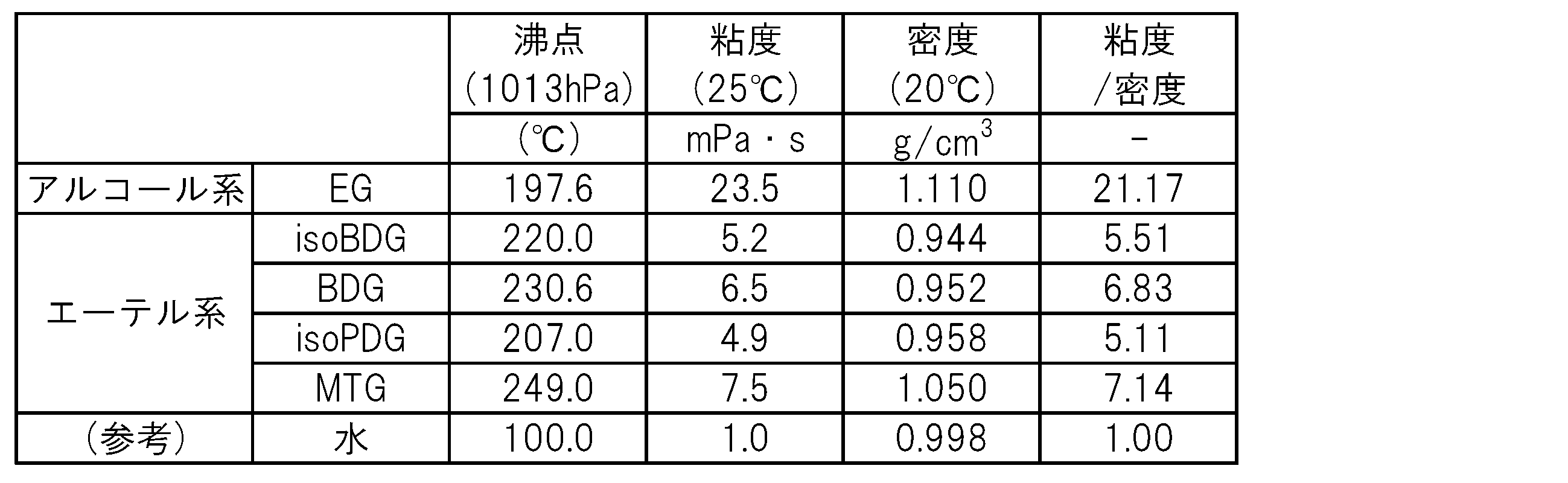
さらに、エーテル系溶媒のアルコール系溶媒に対する質量の比について本発明者らが考察したところ、上記質量比が1倍未満では粒径の小さい研削屑を遠心分離により回収することが困難となり、上記質量比が5倍超では砥粒を溶媒中に分散させることが困難となることが分かった。以上の結果から、本発明者らはエーテル系溶媒の上記アルコール系溶媒に対する質量の比を1倍以上5倍以下とすることで、研削屑の回収性と研削液の加工促進性とを両立できることを知得した。
25℃における上記アルコール系溶媒の粘度の下限としては、15mPa・sが好ましく、20mPa・sがより好ましい。一方、上記アルコール系溶媒の粘度の上限としては、30mPa・sが好ましく、25mPa・sがより好ましい。上記アルコール系溶媒の粘度が上記下限未満であると、砥粒の分散性が不十分となるおそれがある。逆に、上記アルコール系溶媒の粘度が上記上限を超えると、沈降係数sが十分に高められず、粒径の小さい研削屑の回収が困難となるおそれがある。
25℃における上記エーテル系溶媒の粘度の下限としては、3mPa・sが好ましく、4mPa・sがより好ましい。一方、上記エーテル系溶媒の粘度の上限としては、10mPa・sが好ましく、7mPa・sがより好ましい。上記エーテル系溶媒の粘度が上記下限未満であると、エーテル系溶媒により溶媒全体の粘度が下がり易くなるため、砥粒の分散性を確保することが困難となるおそれがある。逆に、上記エーテル系溶媒の粘度が上記上限を超えると、エーテル系溶媒により沈降係数sが十分に高められず、粒径の小さい研削屑の回収が困難となるおそれがある。
25℃における溶媒全体の粘度の下限としては、7mPa・sが好ましく、8mPa・sがより好ましい。一方、上記溶媒全体の粘度の上限としては、15mPa・sが好ましく、12mPa・sがより好ましい。上記溶媒全体の粘度が上記下限未満であると、砥粒の分散性が不十分となるおそれがある。逆に、上記溶媒全体の粘度が上記上限を超えると、沈降係数sが十分に高められず、粒径の小さい研削屑の回収が困難となるおそれがある。
25℃における上記エーテル系溶媒の粘度は、上記アルコール系溶媒の粘度よりも低い。このようにアルコール系溶媒よりも粘度が低いエーテル系溶媒を、砥粒の分散性が比較的高いアルコール系溶媒に加えることで、砥粒の分散性を確保しつつ、研削屑の遠心分離による回収をさらに促進でき、研削液の回収効率が高められる。
25℃における上記エーテル系溶媒と上記アルコール系溶媒との粘度差の下限としては、15mPa・sが好ましく、17mPa・sがより好ましい。一方、上記粘度差の上限としては、20mPa・sが好ましく、19mPa・sがより好ましい。上記粘度差が上記下限未満であると、エーテル系溶媒により沈降係数sが十分に高められず、粒径の小さい研削屑の回収が困難となるおそれがある。逆に、上記粘度差が上記上限を超えると、エーテル系溶媒により溶媒全体の粘度が下がり易くなるため、砥粒の分散性を確保しつつ、沈降係数sを高めることが困難となるおそれがある。なお、上記エーテル系溶媒又はアルコール系溶媒として複数種の溶媒を混合したものを用いる場合、上記「エーテル系溶媒とアルコール系溶媒との粘度差」とは、それぞれ質量比に応じて平均化したエーテル系溶媒の粘度とアルコール系溶媒の粘度との差を意味する。
20℃における上記アルコール系溶媒の密度の上限としては、1.3g/cm3が好ましく、1.2g/cm3がより好ましい。上記アルコール系溶媒の密度が上記上限を超えると、エーテル系溶媒を加えても沈降係数sが十分に高められず、粒径の小さい研削屑の回収が困難となるおそれがある。一方、上記アルコール系溶媒の密度の下限は特に限定されないが、通常0.7g/cm3程度である。
20℃における上記エーテル系溶媒の密度の上限としては、1.1g/cm3が好ましく、1g/cm3がより好ましく、0.95g/cm3がさらに好ましい。上記エーテル系溶媒の密度が上記上限を超えると、エーテル系溶媒により沈降係数sが十分に高められず、粒径の小さい研削屑の回収が困難となるおそれがある。一方、上記エーテル系溶媒の密度の下限は特に限定されないが、通常0.7g/cm3程度である。
20℃における上記溶媒全体の密度の上限としては、1.2g/cm3が好ましく、1.1g/cm3がより好ましい。上記溶媒全体の密度が上記上限を超えると、沈降係数sが十分に高められず、粒径の小さい研削屑の回収が困難となるおそれがある。一方、上記溶媒全体の密度の下限は特に限定されないが、通常0.7g/cm3程度である。
上記アルコール系溶媒の沸点の下限としては、150℃が好ましく、180℃がより好ましい。一方、上記アルコール系溶媒の沸点の上限としては、300℃が好ましく、250℃がより好ましい。上記アルコール系溶媒の沸点が上記下限未満であると、研磨により発生する摩擦熱により溶媒が蒸発し、研削液の組成が変化するおそれがある。逆に、上記アルコール系溶媒の沸点が上記上限を超えると、溶媒の粘度が高くなり過ぎ、粒径の小さい研削屑の回収が困難となるおそれがある。
上記エーテル系溶媒の沸点の下限としては、150℃が好ましく、180℃がより好ましい。一方、上記エーテル系溶媒の沸点の上限としては、300℃が好ましく、250℃がより好ましい。上記エーテル系溶媒の沸点が上記下限未満であると、研磨により発生する摩擦熱により溶媒が蒸発し、研削液の組成が変化するおそれがある。逆に、上記エーテル系溶媒の沸点が上記上限を超えると、溶媒の粘度が高くなり過ぎ、粒径の小さい研削屑の回収が困難となるおそれがある。
上記アルコール系溶媒の沸点とエーテル系溶媒の沸点との差の絶対値の上限としては、60℃が好ましく、30℃がより好ましい。上記沸点の差の絶対値が上記上限を超えると、研磨により発生する摩擦熱により蒸発する溶媒の量の差がアルコール系溶媒とエーテル系溶媒とで顕著となる。このため、研磨中にエーテル系溶媒のアルコール系溶媒に対する質量の比が変化し、砥粒の分散性や研削液の回収効率が低下するおそれがある。一方、上記沸点の差の絶対値の下限は、特に限定されず、0℃であってもよい。
(砥粒)
当該研削液に含まれる砥粒としては、特に限定されず、アルミナ砥粒、シリカ砥粒、セリア砥粒、炭化ケイ素砥粒等の各種砥粒を挙げることができる。
当該研削液に含まれる砥粒としては、特に限定されず、アルミナ砥粒、シリカ砥粒、セリア砥粒、炭化ケイ素砥粒等の各種砥粒を挙げることができる。
上記砥粒の平均粒子径の下限としては、1μmが好ましく、3μmがより好ましい。一方、上記平均粒子径の上限としては、20μmが好ましく、15μmがより好ましい。上記砥粒の平均粒子径が上記下限未満であると、砥粒による加工促進効果が十分に得られないおそれがある。逆に、上記砥粒の平均粒子径が上記上限を超えると、加工時に基板材料が傷付くおそれがある。なお、「平均粒子径」とは、レーザー回折法等により測定された体積基準の累積粒度分布曲線の50%値(50%粒子径、D50)をいう。
当該研削液における上記砥粒の含有量の下限としては、2.5質量%が好ましく、5質量%がより好ましい。一方、上記砥粒の含有量の上限としては、50質量%が好ましく、30質量%がより好ましい。上記砥粒の含有量が上記下限未満であると、砥粒による加工促進効果が十分に得られないおそれがある。逆に、上記砥粒の含有量が上記上限を超えると、研磨パッドの寿命が低下するおそれや、加工時に基板材料が傷付くおそれや、砥粒の分散が困難となるおそれがある。
(その他の成分)
当該研削液には、必要に応じて各種添加剤を含有させてもよい。上記添加剤としては、砥粒の分散性を高める分散剤、研磨速度を向上させる研磨速度向上剤、被研磨面の凹凸を減らす平坦化剤、pHを所望の値に調整するpH調整剤、pHの変化を抑制するpH緩衝剤等を挙げることができる。これらは、単独で用いてもよく、2種以上の添加剤を組み合わせて用いてもよい。また、当該研削液における上記添加剤の含有量は、特に限定されないが、例えば0.0001質量%以上5質量%以下とできる。
当該研削液には、必要に応じて各種添加剤を含有させてもよい。上記添加剤としては、砥粒の分散性を高める分散剤、研磨速度を向上させる研磨速度向上剤、被研磨面の凹凸を減らす平坦化剤、pHを所望の値に調整するpH調整剤、pHの変化を抑制するpH緩衝剤等を挙げることができる。これらは、単独で用いてもよく、2種以上の添加剤を組み合わせて用いてもよい。また、当該研削液における上記添加剤の含有量は、特に限定されないが、例えば0.0001質量%以上5質量%以下とできる。
また、当該研削液は、必要に応じて水等の他の溶媒を含有してもよいが、溶媒全体における上記アルコール系溶媒及びエーテル系溶媒の合計含有量を100質量%、すなわち他の溶媒を含有しない研削液とすることが好ましい。当該研削液が他の溶媒を含有すると、スラリー砥粒の分散性の低下により研磨性能が低下するおそれや、遠心分離による研削液の回収効率が低下するおそれがある。
<基板材料の研削方法>
当該研削液を用いた基板材料の研削方法は、図1に示すように基板材料配置工程S1と、基板材料研削工程S2と、研削液貯留工程S3と、研削屑除去工程S4と、研削液再供給工程S5とを主に備える。
当該研削液を用いた基板材料の研削方法は、図1に示すように基板材料配置工程S1と、基板材料研削工程S2と、研削液貯留工程S3と、研削屑除去工程S4と、研削液再供給工程S5とを主に備える。
(研削装置)
上記研削方法は、公知の研削装置、例えば図2に示すような貯留槽1、研磨機2、回収槽3、及び遠心分離機4を主に備える研削装置により行うことができる。上記貯留槽1は、研削液を蓄え、研磨機2に配置された基板材料へ研削液を供給できるように構成される。上記研磨機2は、基板材料を研磨する研磨機であり、片面研磨機や両面研磨機等の公知の研磨機を用いることができる。上記回収槽3は、上記研磨機2の基板材料の研磨で使用された研削液を回収できるように構成されている。上記遠心分離機4は、上記回収槽3に回収された研削液を遠心分離できるように構成されている。また、上記遠心分離機4は、遠心分離後の研削液を貯留槽1へ送ることができるようにも構成されている。
上記研削方法は、公知の研削装置、例えば図2に示すような貯留槽1、研磨機2、回収槽3、及び遠心分離機4を主に備える研削装置により行うことができる。上記貯留槽1は、研削液を蓄え、研磨機2に配置された基板材料へ研削液を供給できるように構成される。上記研磨機2は、基板材料を研磨する研磨機であり、片面研磨機や両面研磨機等の公知の研磨機を用いることができる。上記回収槽3は、上記研磨機2の基板材料の研磨で使用された研削液を回収できるように構成されている。上記遠心分離機4は、上記回収槽3に回収された研削液を遠心分離できるように構成されている。また、上記遠心分離機4は、遠心分離後の研削液を貯留槽1へ送ることができるようにも構成されている。
(基板材料配置工程)
基板材料配置工程S1では、研磨すべき基板材料を研磨機2に配置する。例えば、両面研磨機であれば、研磨機2の上下定盤に研磨パッドを固定し、上記上下定盤の間にキャリアにより保持した基板材料を挟み込む。
基板材料配置工程S1では、研磨すべき基板材料を研磨機2に配置する。例えば、両面研磨機であれば、研磨機2の上下定盤に研磨パッドを固定し、上記上下定盤の間にキャリアにより保持した基板材料を挟み込む。
上記基板材料としては、特に限定されないが、ガラス、サファイア、GaN、SiC等の化合物半導体などを挙げることができる。上記基板材料の形状としては、研磨機2に固定できる限り特に限定されないが、例えば板状とできる。
(基板材料研削工程)
基板材料研削工程S2では、研削液を供給しつつ上記基板材料を上記研磨パッドの回転により研削する。具体的には、貯留槽1に貯留されている研削液を研磨機2で研磨される基板材料へ供給しつつ、研磨パッドを固定した定盤を回転させ、基板材料と研磨パッドとを相対的に移動させることにより、基板材料を研削する。
基板材料研削工程S2では、研削液を供給しつつ上記基板材料を上記研磨パッドの回転により研削する。具体的には、貯留槽1に貯留されている研削液を研磨機2で研磨される基板材料へ供給しつつ、研磨パッドを固定した定盤を回転させ、基板材料と研磨パッドとを相対的に移動させることにより、基板材料を研削する。
上記研削液は、研磨パッドと基板材料との間に入り込み、基板材料の加工面を冷却したり、含有する砥粒により加工を促進したりする。上記研削液の供給量は、基板材料の種類や大きさにより適宜決定されるが、例えば10ml/min以上50ml/min以下とできる。
(研削液貯留工程)
研削液貯留工程S3では、上記基板材料研削工程S2で使用された研削液を回収槽3に貯留する。この研削液は、基板材料を研削したことにより研削屑を含有する。また、この回収槽3内に貯留される研削液は、研削液が含有する砥粒等が沈殿や凝集しないよう通常撹拌する。
研削液貯留工程S3では、上記基板材料研削工程S2で使用された研削液を回収槽3に貯留する。この研削液は、基板材料を研削したことにより研削屑を含有する。また、この回収槽3内に貯留される研削液は、研削液が含有する砥粒等が沈殿や凝集しないよう通常撹拌する。
(研削屑除去工程)
研削屑除去工程S4では、貯留した上記研削液から遠心分離により研削屑を除去する。具体的には、上記回収槽3に貯留された研削液を定期的に又は連続的に遠心分離機4に送り、上記研削液から研削屑を回収除去する。
研削屑除去工程S4では、貯留した上記研削液から遠心分離により研削屑を除去する。具体的には、上記回収槽3に貯留された研削液を定期的に又は連続的に遠心分離機4に送り、上記研削液から研削屑を回収除去する。
上記遠心分離機4は、特に限定されないが、処理する研削液の量等によって選択される。中でも、安定して長時間に渡って分離処理できるデカンタ型の遠心分離機が好ましい。
上記研削屑除去工程S4における遠心分離の遠心力の下限としては、1500Gが好ましく、2000Gがより好ましい。上記遠心力が上記下限未満であると、特に粒径の小さい研削屑が十分に分離できないおそれがある。一方、上記遠心力の上限としては、特に限定されないが、例えば5000Gとできる。上記遠心力が上記上限を超える場合、遠心分離機4が高価となり、製造設備コストが増大するおそれがある。
上記研削屑除去工程S4における遠心分離の時間は、遠心分離機4の容量や処理量にも依存するが、上記遠心分離の時間の下限としては、3分が好ましく、5分がより好ましい。一方、上記遠心分離の時間の上限としては、30分が好ましく、20分がより好ましい。上記遠心分離の時間が上記下限未満であると、特に粒径の小さい研削屑が十分に分離できないおそれがある。逆に、上記遠心分離の時間が上記上限を超えると、研削液を再利用するための処理効率が低下するおそれがある。
上記研削方法では、研削液として上述の研削液を用いるので、遠心分離により粒径の小さい研削屑をも回収できる。このため、上記研削方法では、膜分離等の遠心分離以外の方法で粒径の小さい研削屑の回収を行わなくともよい。従って、上記研削方法では、遠心分離により研削屑の除去された研削液をそのまま再利用することができる。
研削屑除去工程S4で研削屑と共に砥粒も除去されるので、必要に応じて上記研削液に砥粒を加えてもよい。上記砥粒は新しいものを用いてもよいが、研削屑除去工程S4で回収された砥粒及び研削屑をさらに遠心分離して砥粒を回収し、再利用してもよい。
(研削液再供給工程)
研削液再供給工程S5では、研削屑除去工程S4後の上記研削液を上記基板材料へ再供給する。具体的には、研削屑除去工程S4後の上記研削液を上記貯留槽1へ供給する。貯留槽1へ供給された研削液は、貯留槽1内に貯留されている研削液と混合され砥粒含有量等を調製された後、基板材料研削工程S2で基板材料へ再供給される。
研削液再供給工程S5では、研削屑除去工程S4後の上記研削液を上記基板材料へ再供給する。具体的には、研削屑除去工程S4後の上記研削液を上記貯留槽1へ供給する。貯留槽1へ供給された研削液は、貯留槽1内に貯留されている研削液と混合され砥粒含有量等を調製された後、基板材料研削工程S2で基板材料へ再供給される。
<基板の製造方法>
上記研削方法を用いて、基板材料の研削により基板を製造することができる。具体的には、上記研削方法により、研磨パッドと研削液とを用い、固定砥粒方式による平面研削で基板材料から基板を製造することができる。上記基板の製造方法により製造される基板としては、特に限定されないが、ガラス基板、サファイア基板、GaN、SiC等の化合物半導体基板などを挙げることができる。
上記研削方法を用いて、基板材料の研削により基板を製造することができる。具体的には、上記研削方法により、研磨パッドと研削液とを用い、固定砥粒方式による平面研削で基板材料から基板を製造することができる。上記基板の製造方法により製造される基板としては、特に限定されないが、ガラス基板、サファイア基板、GaN、SiC等の化合物半導体基板などを挙げることができる。
<利点>
当該研削液は、アルコール系溶媒及びエーテル系溶媒を含有し、研削液の溶媒全体における上記アルコール系溶媒及びエーテル系溶媒の合計含有量を95質量%以上100質量%以下とし、かつ上記エーテル系溶媒の上記アルコール系溶媒に対する質量の比を1倍以上5倍以下とする。このようにアルコール系溶媒にエーテル系溶媒を所定量加えた溶媒とすることで、当該研削液は溶媒全体の粘度の低下を抑止しつつ、溶媒の密度を下げることができる。この溶媒の粘度低下の抑止により、当該研削液は、砥粒を含有させる場合であっても砥粒の分散性が確保できる。また、研削屑の密度は一般に溶媒の密度よりも大きいので、当該研削液は、上述のように溶媒の密度を下げることで、溶媒と研削屑との密度差を大きくすることができる。当該研削液は、このように溶媒と研削屑との密度差を大きくすることで、比較的軽い物質、すなわち粒径の比較的小さい研削屑であっても遠心分離により分離し易くできる。従って、当該研削液により、砥粒を含有させる場合の分散性の低下を抑止しつつ、遠心分離による回収効率を比較的高くすることができる。
当該研削液は、アルコール系溶媒及びエーテル系溶媒を含有し、研削液の溶媒全体における上記アルコール系溶媒及びエーテル系溶媒の合計含有量を95質量%以上100質量%以下とし、かつ上記エーテル系溶媒の上記アルコール系溶媒に対する質量の比を1倍以上5倍以下とする。このようにアルコール系溶媒にエーテル系溶媒を所定量加えた溶媒とすることで、当該研削液は溶媒全体の粘度の低下を抑止しつつ、溶媒の密度を下げることができる。この溶媒の粘度低下の抑止により、当該研削液は、砥粒を含有させる場合であっても砥粒の分散性が確保できる。また、研削屑の密度は一般に溶媒の密度よりも大きいので、当該研削液は、上述のように溶媒の密度を下げることで、溶媒と研削屑との密度差を大きくすることができる。当該研削液は、このように溶媒と研削屑との密度差を大きくすることで、比較的軽い物質、すなわち粒径の比較的小さい研削屑であっても遠心分離により分離し易くできる。従って、当該研削液により、砥粒を含有させる場合の分散性の低下を抑止しつつ、遠心分離による回収効率を比較的高くすることができる。
また、上記研削方法では、上記研削液を用いることで、粒径の小さい研削屑であっても遠心分離により分離できる。このため、上記研削方法を用いることで、溶媒を再利用するための製造設備コストや工数の増加を抑止しつつ、研削液の回収効率を比較的高くすることができる。従って、上記研削方法を用いた基板の製造方法は、基板の製造コストが比較的低い。
[その他の実施形態]
本発明は上記実施形態に限定されるものではなく、上記態様の他、種々の変更、改良を施した態様で実施することができる。
本発明は上記実施形態に限定されるものではなく、上記態様の他、種々の変更、改良を施した態様で実施することができる。
上記実施形態では、砥粒を含有する研削液の場合を説明したが、本発明は、砥粒を含有しない研削液を含む。砥粒を含有しない研削液においても、遠心分離により粒径の小さい研削屑を回収できるので、当該研削液は回収効率が比較的高い。
上記実施形態では、研削方法として、貯留槽を介して研削液を基板材料へ再供給する方法を説明したが、貯留槽を介することは必須ではなく、例えば研削液を直接基板材料へ再供給してもよい。
以下、実施例及び比較例を挙げて本発明をさらに詳細に説明するが、当該発明は以下の実施例に限定されるものではない。
[実施例1]
アルコール系溶媒としてのエチレングリコ-ル(EG)及びエーテル系溶媒としてのイソブチルジグリコール(isoBDG)を用意し、溶媒全体における含有量が50質量%ずつとなるように、すなわちエーテル系溶媒のアルコール系溶媒に対する質量比が1となるように混合した。この混合溶媒に、アルミナ砥粒(白色アルミナWA#1000、平均粒子径12μm)を、研削液における含有量が5質量%となるように混合し、実施例1の研削液を得た。
アルコール系溶媒としてのエチレングリコ-ル(EG)及びエーテル系溶媒としてのイソブチルジグリコール(isoBDG)を用意し、溶媒全体における含有量が50質量%ずつとなるように、すなわちエーテル系溶媒のアルコール系溶媒に対する質量比が1となるように混合した。この混合溶媒に、アルミナ砥粒(白色アルミナWA#1000、平均粒子径12μm)を、研削液における含有量が5質量%となるように混合し、実施例1の研削液を得た。
[実施例2~4、比較例1~4]
EGとisoBDGとの含有量を変化させ、エーテル系溶媒のアルコール系溶媒に対する質量比が表2に示す値となるように混合した以外は、実施例1と同様にして、実施例2~4及び比較例1~4の研削液を得た。
EGとisoBDGとの含有量を変化させ、エーテル系溶媒のアルコール系溶媒に対する質量比が表2に示す値となるように混合した以外は、実施例1と同様にして、実施例2~4及び比較例1~4の研削液を得た。
[実施例5~7]
エーテル系溶媒を、それぞれブチルジグリコール(BDG)、イソプロピルジグリコール(isoPDG)、及びメチルトリグリコール(MTG)とし、エーテル系溶媒のアルコール系溶媒に対する質量比が3となるように混合した以外は実施例1と同様にして、実施例5~7の研削液を得た。
エーテル系溶媒を、それぞれブチルジグリコール(BDG)、イソプロピルジグリコール(isoPDG)、及びメチルトリグリコール(MTG)とし、エーテル系溶媒のアルコール系溶媒に対する質量比が3となるように混合した以外は実施例1と同様にして、実施例5~7の研削液を得た。
[研削条件]
上記実施例1~7及び比較例1~4の研削液を用い、サファイア基板の研磨を行った。上記サファイア基板には、直径2インチ、比重3.97、c面の3枚のサファイア基板を用いた。
上記実施例1~7及び比較例1~4の研削液を用い、サファイア基板の研磨を行った。上記サファイア基板には、直径2インチ、比重3.97、c面の3枚のサファイア基板を用いた。
上記研磨には、公知の両面研磨機を用いた。両面研磨機のキャリアは、ガラスエポキシ板とし、その平均厚さは0.4mmとした。研磨は、上定盤回転数25rpm、下定盤回転数50rpm及びSUNギア回転数8rpmの条件で10分間行った。研磨圧力は、200g/cm2とした。その際、上記実施例1~7及び比較例1~4の研削液を30ml/min供給した。
[評価方法]
上記実施例1~7及び比較例1~4の研削液の一部又は全部について、研削液の粘度の測定、サファイア基板を研磨した際の分散性の評価、及び上記研磨後の研削液の回収性の評価を行った。結果を表2に示す。
上記実施例1~7及び比較例1~4の研削液の一部又は全部について、研削液の粘度の測定、サファイア基板を研磨した際の分散性の評価、及び上記研磨後の研削液の回収性の評価を行った。結果を表2に示す。
<粘度測定>
上記実施例1~7及び比較例1~4について、使用前の各研削液の25℃における粘度を測定した。この粘度の測定は、砥粒を混合する前の溶媒に対して行った。なお、測定には、振動式粘度計(山一電機株式会社の「VISCOMATE VM-100A」)を用いた。
上記実施例1~7及び比較例1~4について、使用前の各研削液の25℃における粘度を測定した。この粘度の測定は、砥粒を混合する前の溶媒に対して行った。なお、測定には、振動式粘度計(山一電機株式会社の「VISCOMATE VM-100A」)を用いた。
<研削液の分散性評価>
研削液の分散性評価は、上記研磨中に研削液を供給する配管チューブ内の状態を目視により確認し、以下の判断基準で評価した。
(分散性評価の判断基準)
A:チューブ内に砥粒溜まりが認められず、砥粒の分散性が優れる。
B:チューブ内にわずかに砥粒溜まりが認められるが、砥粒の分散性が良い。
C:チューブ内に砥粒溜まりが認められ、砥粒の分散性が劣る。
研削液の分散性評価は、上記研磨中に研削液を供給する配管チューブ内の状態を目視により確認し、以下の判断基準で評価した。
(分散性評価の判断基準)
A:チューブ内に砥粒溜まりが認められず、砥粒の分散性が優れる。
B:チューブ内にわずかに砥粒溜まりが認められるが、砥粒の分散性が良い。
C:チューブ内に砥粒溜まりが認められ、砥粒の分散性が劣る。
<研削液の回収性評価>
研磨に使用した各研削液から遠心分離により研削屑を分離回収し、研削屑の除去された研削液を得た。上記遠心分離は、テーブルトップ多本架遠心機(株式会社久保田製作所の「8420」)を用いて行った。
研磨に使用した各研削液から遠心分離により研削屑を分離回収し、研削屑の除去された研削液を得た。上記遠心分離は、テーブルトップ多本架遠心機(株式会社久保田製作所の「8420」)を用いて行った。
図3に比較例1の研削液の遠心分離前及び遠心分離した後の研削液の写真を示す。図3において、(1)は、遠心分離前の研削液であり、(2)は210Gの遠心力で10分間、(3)は2280Gの遠心力で10分間、(4)は2280Gの遠心力で20分間の遠心分離を行った後の研削液である。このように遠心分離による回収効率は遠心力が大きいほど、また遠心分離する時間が大きいほど向上する傾向にあるが、研削液の回収性評価では、遠心分離機の性能と処理効率とを加味して、1500Gの遠心力で10分、20分、50分の遠心分離を行い評価した。
研削液の回収性は、研削屑を除去した後の研削液の透明度を目視により確認し、以下の判断基準で評価した。なお、10cm以上の透明度がある場合を透明度が高いと判断した。例えば図3では(3)及び(4)の場合、透明度が高いと判断される。
(回収性評価の判断基準)
A:10分以下の遠心分離で透明度の高い研削液が得られ、回収性が優れる。
B:10分超30分以下の遠心分離で透明度の高い研削液が得られ、回収性が良い。
C:30分超の遠心分離でも透明度の高い研削液が得られず、回収性が劣る。
(回収性評価の判断基準)
A:10分以下の遠心分離で透明度の高い研削液が得られ、回収性が優れる。
B:10分超30分以下の遠心分離で透明度の高い研削液が得られ、回収性が良い。
C:30分超の遠心分離でも透明度の高い研削液が得られず、回収性が劣る。

表2中で、「アルコール/エーテル」欄の質量比中の「-」は、アルコール系溶媒又はエーテル系溶媒のいずれか一方が0であるため、定義されないことを意味する。
表2より、実施例1~7の研削液は、比較例1、2の研削液と比べると、分散性が同等で回収性に優れる。また、実施例1~7の研削液は、比較例3、4の研削液と比べると、回収性が同等で、分散性に優れる。これに対し、比較例1、2の研削液は、アルコール系溶媒のみ、又はエーテル系溶媒のアルコール系溶媒に対する質量比が1未満であるため、溶媒全体の粘度が高く、回収性に劣ると考えられる。また、比較例3、4の研削液は、エーテル系溶媒のみ、又はエーテル系溶媒のアルコール系溶媒に対する質量比が5超であるため、溶媒全体の粘度が低く、分散性に劣ると考えられる。
このことから、当該研削液は、エーテル系溶媒の上記アルコール系溶媒に対する質量の比を1倍以上5倍以下とすることで、砥粒の分散性の低下を抑止しつつ、遠心分離による回収効率を高められることが分かる。
さらに詳細に見ると、エーテル系溶媒がisoBDGである実施例1~4の比較から、実施例2、3の研削液は、実施例1の研削液に比べると分散性が同等で、回収性に優れる。また、実施例2、3の研削液は、実施例4の研削液に比べると回収性が同等で、分散性に優れる。このことから、当該研削液は、エーテル系溶媒の上記アルコール系溶媒に対する質量の比を2倍以上4倍以下とすることで、さらに分散性及び回収性が高められることが分かる。
<砥粒の平均粒子径依存性及び含有量依存性の評価>
[実施例8]
砥粒の平均粒子径が分散性及び回収性に与える影響を評価するため、混合溶媒に加えるアルミナ砥粒を平均粒子径7μmのアルミナ砥粒(白色アルミナWA#2000)とした以外は、実施例2と同様にして実施例8の研削液を得た。
[実施例8]
砥粒の平均粒子径が分散性及び回収性に与える影響を評価するため、混合溶媒に加えるアルミナ砥粒を平均粒子径7μmのアルミナ砥粒(白色アルミナWA#2000)とした以外は、実施例2と同様にして実施例8の研削液を得た。
[実施例9~11]
砥粒の含有量が分散性及び回収性に与える影響を評価するため、混合溶媒に加えるアルミナ砥粒の含有量を表3に示す含有量とした以外は、実施例2と同様にして実施例9~11の研削液を得た。
砥粒の含有量が分散性及び回収性に与える影響を評価するため、混合溶媒に加えるアルミナ砥粒の含有量を表3に示す含有量とした以外は、実施例2と同様にして実施例9~11の研削液を得た。
[評価]
実施例8~11について、研削液の分散性及び回収性を評価した。結果を表3に示す。
実施例8~11について、研削液の分散性及び回収性を評価した。結果を表3に示す。
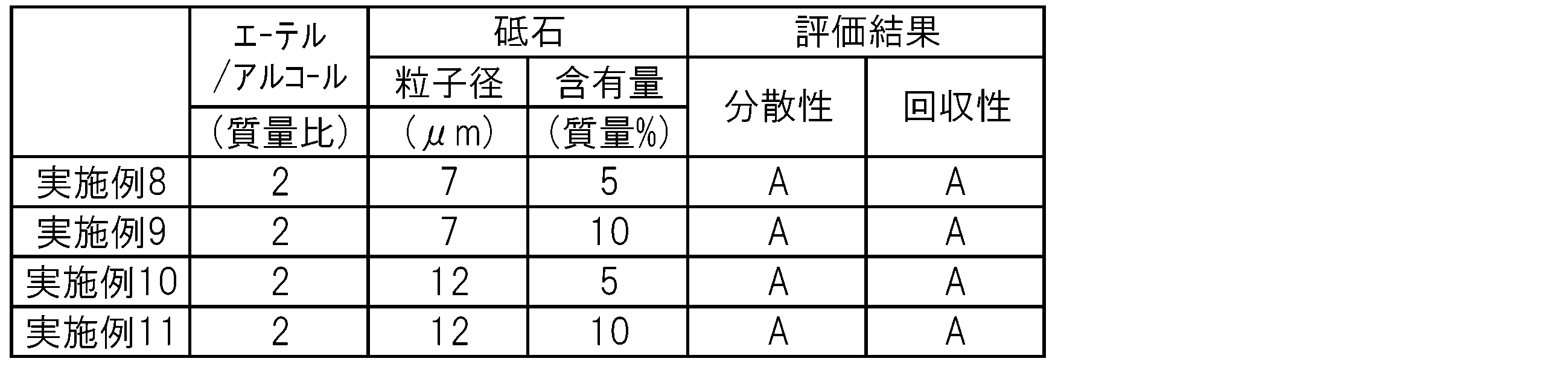
表3の結果から、砥粒の平均粒子径及び含有量を変化させても、分散性及び回収性に与える影響は小さく、実施例8~11の分散性及び回収性は実施例2と同等である。このことから、砥粒の平均粒子径及び含有量を問わず、当該研削液はエーテル系溶媒の上記アルコール系溶媒に対する質量の比を1倍以上5倍以下とすることで、砥粒の分散性の低下を抑止しつつ、遠心分離による回収効率を高められることが分かる。
以上説明したように、本発明の研削液は、砥粒を含有させる場合の分散性の低下を抑止しつつ、遠心分離による回収効率を高めることができる。
1 貯留槽
2 研磨機
3 回収槽
4 遠心分離機
2 研磨機
3 回収槽
4 遠心分離機
Claims (2)
- 基板材料の研削加工に用いる研削液であって、
アルコール系溶媒及びエーテル系溶媒を含有し、
研削液の溶媒全体における上記アルコール系溶媒及びエーテル系溶媒の合計含有量が95質量%以上100質量%以下であり、
上記エーテル系溶媒の上記アルコール系溶媒に対する質量の比が1倍以上5倍以下である研削液。 - 25℃における上記エーテル系溶媒の粘度が上記アルコール系溶媒の粘度よりも低く、
上記エーテル系溶媒と上記アルコール系溶媒との25℃における粘度差が15mPa・s以上20mPa・s以下である請求項1に記載の研削液。
Priority Applications (1)
| Application Number | Priority Date | Filing Date | Title |
|---|---|---|---|
| CN201780033332.1A CN109312212B (zh) | 2016-07-22 | 2017-06-30 | 研削液 |
Applications Claiming Priority (2)
| Application Number | Priority Date | Filing Date | Title |
|---|---|---|---|
| JP2016144915A JP2018012821A (ja) | 2016-07-22 | 2016-07-22 | 研削液 |
| JP2016-144915 | 2016-07-22 |
Publications (1)
| Publication Number | Publication Date |
|---|---|
| WO2018016297A1 true WO2018016297A1 (ja) | 2018-01-25 |
Family
ID=60992210
Family Applications (1)
| Application Number | Title | Priority Date | Filing Date |
|---|---|---|---|
| PCT/JP2017/024172 Ceased WO2018016297A1 (ja) | 2016-07-22 | 2017-06-30 | 研削液 |
Country Status (4)
| Country | Link |
|---|---|
| JP (1) | JP2018012821A (ja) |
| CN (1) | CN109312212B (ja) |
| TW (1) | TWI737773B (ja) |
| WO (1) | WO2018016297A1 (ja) |
Citations (4)
| Publication number | Priority date | Publication date | Assignee | Title |
|---|---|---|---|---|
| JP2000198995A (ja) * | 1998-12-28 | 2000-07-18 | Fujimi Inc | 切断用加工液 |
| JP2006111728A (ja) * | 2004-10-14 | 2006-04-27 | Palace Chemical Co Ltd | ワイヤソー用切削油剤 |
| JP2010221337A (ja) * | 2009-03-24 | 2010-10-07 | Ngk Insulators Ltd | 使用済み研削液の再利用方法 |
| US20110275286A1 (en) * | 2010-05-06 | 2011-11-10 | Lawrence Livermore National Security, Llc | Method and System for Polishing Materials Using a Nonaqueous Magnetorheological Fluid |
Family Cites Families (3)
| Publication number | Priority date | Publication date | Assignee | Title |
|---|---|---|---|---|
| CN102234595A (zh) * | 2010-04-28 | 2011-11-09 | 云南中科鑫圆晶体材料有限公司 | 一种精密抛光晶片用有机物清洗液 |
| US20120053276A1 (en) * | 2010-08-31 | 2012-03-01 | Brilliant Coatings, Inc. | Surface polish and wear coating |
| JP5943073B2 (ja) * | 2012-05-22 | 2016-06-29 | 日立化成株式会社 | スラリー、研磨液セット、研磨液及び基体の研磨方法 |
-
2016
- 2016-07-22 JP JP2016144915A patent/JP2018012821A/ja active Pending
-
2017
- 2017-06-30 WO PCT/JP2017/024172 patent/WO2018016297A1/ja not_active Ceased
- 2017-06-30 CN CN201780033332.1A patent/CN109312212B/zh not_active Expired - Fee Related
- 2017-07-17 TW TW106123775A patent/TWI737773B/zh not_active IP Right Cessation
Patent Citations (4)
| Publication number | Priority date | Publication date | Assignee | Title |
|---|---|---|---|---|
| JP2000198995A (ja) * | 1998-12-28 | 2000-07-18 | Fujimi Inc | 切断用加工液 |
| JP2006111728A (ja) * | 2004-10-14 | 2006-04-27 | Palace Chemical Co Ltd | ワイヤソー用切削油剤 |
| JP2010221337A (ja) * | 2009-03-24 | 2010-10-07 | Ngk Insulators Ltd | 使用済み研削液の再利用方法 |
| US20110275286A1 (en) * | 2010-05-06 | 2011-11-10 | Lawrence Livermore National Security, Llc | Method and System for Polishing Materials Using a Nonaqueous Magnetorheological Fluid |
Also Published As
| Publication number | Publication date |
|---|---|
| TWI737773B (zh) | 2021-09-01 |
| CN109312212B (zh) | 2022-01-04 |
| CN109312212A (zh) | 2019-02-05 |
| TW201803953A (zh) | 2018-02-01 |
| JP2018012821A (ja) | 2018-01-25 |
Similar Documents
| Publication | Publication Date | Title |
|---|---|---|
| JP6421887B2 (ja) | セリウム塩の製造方法、酸化セリウム及びセリウム系研磨剤 | |
| US8940174B2 (en) | Method for treating spent abrasive slurry | |
| JP5599547B2 (ja) | 硬質結晶基板研磨方法及び油性研磨スラリー | |
| CN1200796C (zh) | 浆液循环方法 | |
| US20100170495A1 (en) | Method and system for manufacturing wafer-like slices from a substrate material | |
| CN102559361A (zh) | 硅切削废液的处理方法 | |
| WO2007108308A1 (ja) | シリコン含有材料の回収方法 | |
| KR100625283B1 (ko) | 반도체 웨이퍼 제조시 발생하는 폐슬러지의 재생 장치 및방법 | |
| JP5109012B2 (ja) | 超臨界二酸化炭素を用いた比重差分離による固液混合物質の固液分離方法及びその装置 | |
| WO2018016297A1 (ja) | 研削液 | |
| JP2005349507A (ja) | クーラント再生装置及び廃スラリー再生システム、並びに、廃クーラントの再生方法及び廃スラリーの再生方法 | |
| JP5256832B2 (ja) | 研磨剤及びその製造方法 | |
| CN106241794B (zh) | 一种从蓝宝石研磨废料浆中回收金刚石的方法及产品 | |
| KR102380782B1 (ko) | 반도체 기판의 연마 방법 | |
| WO2007119308A1 (ja) | シリコン含有材料の回収方法 | |
| CN106829953B (zh) | 一种金刚石回收及再利用的方法及产品 | |
| KR100636335B1 (ko) | 반도체 웨이퍼 제조시 발생하는 폐슬러지의 재생 장치 | |
| TWI547552B (zh) | 硏光加工用硏磨材及使用此之基板的製造方法 | |
| JP4414364B2 (ja) | シリコン含有材料の回収方法 | |
| JP2017119781A (ja) | 遊離砥粒用分散液 | |
| KR101346105B1 (ko) | 폐슬러리에 포함된 고형분 및 오일 분리방법 | |
| JPH1158235A (ja) | 使用済み切断用組成物の再生方法 | |
| JP2005320475A (ja) | 研磨組成物 | |
| TW201312638A (zh) | 矽晶圓切割廢料之處理方法 | |
| TW201446316A (zh) | 自矽泥中回收切割液的方法及其回收系統 |
Legal Events
| Date | Code | Title | Description |
|---|---|---|---|
| 121 | Ep: the epo has been informed by wipo that ep was designated in this application |
Ref document number: 17830817 Country of ref document: EP Kind code of ref document: A1 |
|
| NENP | Non-entry into the national phase |
Ref country code: DE |
|
| 32PN | Ep: public notification in the ep bulletin as address of the adressee cannot be established |
Free format text: NOTING OF LOSS OF RIGHTS PURSUANT TO RULE 112(1) EPC (EPO FORM 1205A DATED 26.06.2019) |
|
| 122 | Ep: pct application non-entry in european phase |
Ref document number: 17830817 Country of ref document: EP Kind code of ref document: A1 |