WO2018015998A1 - ポリアミドイミド樹脂組成物及び塗料 - Google Patents
ポリアミドイミド樹脂組成物及び塗料 Download PDFInfo
- Publication number
- WO2018015998A1 WO2018015998A1 PCT/JP2016/071151 JP2016071151W WO2018015998A1 WO 2018015998 A1 WO2018015998 A1 WO 2018015998A1 JP 2016071151 W JP2016071151 W JP 2016071151W WO 2018015998 A1 WO2018015998 A1 WO 2018015998A1
- Authority
- WO
- WIPO (PCT)
- Prior art keywords
- polyamideimide resin
- resin composition
- mass
- resin
- paint
- Prior art date
- Legal status (The legal status is an assumption and is not a legal conclusion. Google has not performed a legal analysis and makes no representation as to the accuracy of the status listed.)
- Ceased
Links
Classifications
-
- C—CHEMISTRY; METALLURGY
- C08—ORGANIC MACROMOLECULAR COMPOUNDS; THEIR PREPARATION OR CHEMICAL WORKING-UP; COMPOSITIONS BASED THEREON
- C08G—MACROMOLECULAR COMPOUNDS OBTAINED OTHERWISE THAN BY REACTIONS ONLY INVOLVING UNSATURATED CARBON-TO-CARBON BONDS
- C08G59/00—Polycondensates containing more than one epoxy group per molecule; Macromolecules obtained by polymerising compounds containing more than one epoxy group per molecule using curing agents or catalysts which react with the epoxy groups
- C08G59/18—Macromolecules obtained by polymerising compounds containing more than one epoxy group per molecule using curing agents or catalysts which react with the epoxy groups ; e.g. general methods of curing
-
- C—CHEMISTRY; METALLURGY
- C08—ORGANIC MACROMOLECULAR COMPOUNDS; THEIR PREPARATION OR CHEMICAL WORKING-UP; COMPOSITIONS BASED THEREON
- C08G—MACROMOLECULAR COMPOUNDS OBTAINED OTHERWISE THAN BY REACTIONS ONLY INVOLVING UNSATURATED CARBON-TO-CARBON BONDS
- C08G59/00—Polycondensates containing more than one epoxy group per molecule; Macromolecules obtained by polymerising compounds containing more than one epoxy group per molecule using curing agents or catalysts which react with the epoxy groups
- C08G59/18—Macromolecules obtained by polymerising compounds containing more than one epoxy group per molecule using curing agents or catalysts which react with the epoxy groups ; e.g. general methods of curing
- C08G59/20—Macromolecules obtained by polymerising compounds containing more than one epoxy group per molecule using curing agents or catalysts which react with the epoxy groups ; e.g. general methods of curing characterised by the epoxy compounds used
- C08G59/32—Epoxy compounds containing three or more epoxy groups
-
- C—CHEMISTRY; METALLURGY
- C08—ORGANIC MACROMOLECULAR COMPOUNDS; THEIR PREPARATION OR CHEMICAL WORKING-UP; COMPOSITIONS BASED THEREON
- C08G—MACROMOLECULAR COMPOUNDS OBTAINED OTHERWISE THAN BY REACTIONS ONLY INVOLVING UNSATURATED CARBON-TO-CARBON BONDS
- C08G59/00—Polycondensates containing more than one epoxy group per molecule; Macromolecules obtained by polymerising compounds containing more than one epoxy group per molecule using curing agents or catalysts which react with the epoxy groups
- C08G59/18—Macromolecules obtained by polymerising compounds containing more than one epoxy group per molecule using curing agents or catalysts which react with the epoxy groups ; e.g. general methods of curing
- C08G59/40—Macromolecules obtained by polymerising compounds containing more than one epoxy group per molecule using curing agents or catalysts which react with the epoxy groups ; e.g. general methods of curing characterised by the curing agents used
- C08G59/44—Amides
-
- C—CHEMISTRY; METALLURGY
- C08—ORGANIC MACROMOLECULAR COMPOUNDS; THEIR PREPARATION OR CHEMICAL WORKING-UP; COMPOSITIONS BASED THEREON
- C08L—COMPOSITIONS OF MACROMOLECULAR COMPOUNDS
- C08L79/00—Compositions of macromolecular compounds obtained by reactions forming in the main chain of the macromolecule a linkage containing nitrogen with or without oxygen or carbon only, not provided for in groups C08L61/00 - C08L77/00
- C08L79/04—Polycondensates having nitrogen-containing heterocyclic rings in the main chain; Polyhydrazides; Polyamide acids or similar polyimide precursors
- C08L79/08—Polyimides; Polyester-imides; Polyamide-imides; Polyamide acids or similar polyimide precursors
Definitions
- Embodiments of the present invention relate to a polyamide-imide resin composition, and a paint, a cured film, a sliding member, and the like using the resin composition.
- Polyamideimide resin is widely used as a coating agent for various substrates because it is excellent in heat resistance, chemical resistance and solvent resistance. For example, it is used as a varnish for enameled wire, a heat resistant paint, and the like.
- a polar solvent such as N-methyl-2-pyrrolidone, ⁇ -butyrolactone, dimethylacetamide or dimethylformamide is used for the polymerization of polyamideimide resin, and in particular, to perform the amidimidization reaction at a high temperature in a short time.
- High boiling solvents such as N-methyl-2-pyrrolidone have been preferably used.
- this polymerization solvent was used as it is as a solvent for paints using this polyamideimide resin.
- the inventors of the present invention have studied by paying attention to a novel use of polyamide-imide resin as a sliding member.
- a coating film having a high elastic modulus and a high hardness is required, but sufficient characteristics cannot be obtained in the prior art.
- an object of an embodiment of the present invention is to provide a polyamide-imide resin composition capable of forming a cured film having a high elastic modulus and a high hardness, and a paint, a cured film, and the like using the composition.
- One embodiment of the present invention includes a heterocyclic compound having a symmetrical molecular structure and polarity, a polyamide-imide resin, and a tetrafunctional epoxy resin, and the content of the heterocyclic compound is 40 mass in the composition.
- Another embodiment includes a heterocyclic compound having a symmetrical polarity, a polyamide-imide resin, and a tetrafunctional epoxy resin, and the content of the heterocyclic compound is 40% by mass or more in the composition.
- the present invention relates to a polyamideimide resin composition.
- Another embodiment of the present invention relates to a paint containing the polyamideimide resin composition of the above embodiment.
- Another embodiment of the present invention is a cured film obtained using the polyamideimide resin composition of the above embodiment or the paint of the above embodiment, or the polyamideimide resin composition of the above embodiment or the paint of the above embodiment. It is related with the cured film for sliding members obtained by using.
- Another embodiment of the present invention relates to a sliding member comprising a cured film obtained using the polyamideimide resin composition of the above embodiment or the paint of the above embodiment.
- Another embodiment of the present invention relates to the use of the polyamideimide resin composition of the above embodiment or the paint of the above embodiment on the sliding surface of a sliding member.
- the polyamideimide resin composition of the present embodiment can form a cured film having high elasticity and high hardness. Therefore, the cured film which comprises the sliding surface of a sliding member can be preferably provided using this polyamideimide resin composition.
- the polyamideimide resin composition of this embodiment is a composition comprising at least a polyamideimide resin, a polar solvent capable of dissolving or dispersing the polyamideimide resin, and a tetrafunctional epoxy resin.
- the polyamide-imide resin is a resin obtained by reacting a diisocyanate compound and / or a diamine compound with a tribasic acid anhydride or a tribasic acid halide as an acid component.
- each raw material compound may be used in combination of any plural kinds.
- a polyamideimide resin containing a structural unit represented by the following general formula can be used.
- X is a residue excluding an acid anhydride group (or acid halide group) and a carboxyl group of an acid-base acid anhydride
- R is an isocyanate group of diisocyanate or an amino group of diamine. Indicates residue.
- the diisocyanate compound is not particularly limited, but 4,4′-diphenylmethane diisocyanate, xylylene diisocyanate, 3,3′-diphenylmethane diisocyanate, 3,3′-dimethyl-4,4′-diisocyanatobiphenyl, 3,3 Examples include '-dimethoxybiphenyl-4,4'-diisocyanate, paraphenylene diisocyanate, hexamethylene diisocyanate, tolylene diisocyanate, and naphthalene diisocyanate.
- diamine compound examples include 4,4′-diaminodiphenylmethane, 4,4′-diaminodiphenyl ether, 4,4′-diaminodiphenylsulfone, 3,3′-diaminodiphenylsulfone, xylylenediamine, phenylenediamine, and the like. It is done.
- a diisocyanate compound is used.
- 3,3′-dimethyl-4,4′-diisocyanatobiphenyl is preferably used from the viewpoint of increasing the elastic modulus of the obtained cured film, and 4 4 is preferable from the viewpoint of material cost and reactivity.
- 4,4′-diphenylmethane diisocyanate is preferably used.
- the tribasic acid anhydride is not particularly limited, but preferably includes trimellitic anhydride, and the tribasic acid halide is also not particularly limited, but tribasic acid chloride is preferable, and trimellitic anhydride chloride (anhydrous anhydride). Trimellitic acid chloride) and the like. From the viewpoint of reducing the environmental load, it is preferable to use trimellitic anhydride or the like.
- the acid component in addition to the above-mentioned tribasic acid anhydride (or tribasic acid halide), saturated or unsaturated polybasic acids such as dicarboxylic acid and tetracarboxylic dianhydride are used, and the properties of the polyamideimide resin are impaired. It can be used in a range that does not exist. Although it does not specifically limit as dicarboxylic acid, A terephthalic acid, isophthalic acid, adipic acid, sebacic acid, etc. are mentioned.
- the tetracarboxylic dianhydride is not particularly limited, and examples thereof include pyromellitic dianhydride, benzophenone tetracarboxylic dianhydride, and biphenyltetracarboxylic dianhydride. These may be used alone or in any combination of a plurality of types.
- the total amount of carboxylic acids other than tribasic acids is preferably used in the range of 0 to 30 mol% in the total carboxylic acid from the viewpoint of maintaining the properties of the polyamideimide resin.
- the polyamideimide resin has a structural unit represented by the following general formula (II).
- R 3 represents a residue excluding the isocyanate group of diisocyanate or the amino group of diamine.
- Use ratio of diisocyanate and / or diamine and acid component is the polyamide produced From the viewpoint of the molecular weight of the imide resin and the degree of crosslinking, the diisocyanate compound and / or diamine compound is preferably used in an amount of 0.8 to 1.1 mol, based on a total amount of 1.0 mol of the acid component, and 0.95 to 1. The amount is more preferably 08 mol, and particularly preferably 1.0 to 1.08 mol.
- the conditions for synthesizing the polyamide-imide resin are various and cannot be generally specified, but the most typical method for reacting diisocyanate and tribasic acid anhydride is exemplified in, for example, JP-A-4-39323. . A more detailed manufacturing method will be described later.
- the polyamide-imide resin may be blocked at the ends as necessary, thereby improving the viscosity stability of the resin composition.
- the blocking agent is not particularly limited, and examples thereof include alcohols such as methanol, ethanol, and propanol, primary amines, aldehyde group-containing compounds, and lactams such as ⁇ -caprolactam.
- the number average molecular weight of the polyamide-imide resin is preferably 10,000 or more, more preferably 15,000 or more, from the viewpoint of ensuring the strength of the coating film.
- the number average molecular weight is preferably 50,000 or less, more preferably 30,000 or less, in order to facilitate the formation of a paint when used as a paint or the like and to obtain a viscosity suitable for application. More preferably, it is 25,000 or less.
- the number average molecular weight of the polyamide-imide resin is sampled during resin synthesis and measured using an analytical instrument such as a gel permeation chromatograph (GPC) (in the case of GPC, it is measured using a standard polystyrene calibration curve).
- GPC gel permeation chromatograph
- the polyamideimide resin preferably has an acid value of 5 to 40 mgKOH / g in which the carboxyl group in the resin and the carboxyl group obtained by ring opening of the acid anhydride group are combined.
- the acid value is 5 mgKOH / g or more
- the resin tends to be easily dissolved or dispersed in the solvent, and the order of 10 mgKOH / g, 15 mgKOH / g, and 20 mgKOH / g or more is in this order. And more preferable.
- the acid value is 40 mgKOH / g or less, the polyamideimide resin composition finally obtained tends to be difficult to gel with the passage of time.
- the acid value can be obtained by the following method. First, about 0.5 g of polyamideimide resin composition was sampled, about 0.15 g of 1,4-diazabicyclo [2,2,2] octane was added thereto, and ion exchange with about 60 g of N-methyl-2-pyrrolidone was performed. Add about 1 ml of water and stir until the polyamideimide resin is completely dissolved. This was titrated with a potentiometric titrator using a 0.05 mol / L ethanolic potassium hydroxide solution, and the carboxyl groups in the polyamide-imide resin that had ring-opened carboxyl groups and acid anhydride groups were combined. Get the acid value.
- Polyamideimide resin composition is a polar solvent that dissolves or disperses polyamideimide resin, a heterocyclic compound having a symmetrical molecular structure, that is, a heterocyclic compound having a symmetrical molecular structure and having a polarity, or a symmetrical polarity.
- a heterocyclic compound (hereinafter, also simply referred to as “heterocyclic compound”).
- the resin composition may contain a plurality of these heterocyclic compounds.
- that the molecular structure is symmetric means that it has a plane of symmetry (mirror surface), and that having polarity means that there is an electrical bias in the bond in the molecule (in polar molecules). Mean).
- the polarity is indicated by the dipole moment.
- the solvent in this composition from the polymerization solvent (after-mentioned) used at the time of a polyamideimide resin synthesis
- combination it may be described as a storage solvent.
- This heterocyclic compound preferably contains nitrogen and / or oxygen as a hetero atom constituting the heterocyclic ring, particularly preferably a nitrogen-containing heterocyclic compound containing nitrogen, and further contains a nitrogen-containing heterocyclic compound containing two nitrogens.
- a ring compound is preferred.
- the ring may or may not have an unsaturated bond, and the number of members of the ring is preferably a 5-membered ring or a 6-membered ring.
- the heterocyclic ring is preferably a monocyclic structure, but may be a condensed heterocyclic structure. Of these, an imidazolidine ring, a pyrimidine ring, a hexahydropyrimidine ring, and the like are preferable, but are not limited thereto.
- the heterocyclic ring may contain a substituent as long as the symmetry of the molecule is not impaired, and preferably contains a substituent that stabilizes the heterocyclic structure.
- substituents include an alkyl group having 1 to 4 carbon atoms, and the substituent may be bonded to a hetero atom of the heterocyclic ring or bonded to a carbon atom.
- heterocyclic compounds which are derivatives of urea are most preferable, and specific examples include ethylene urea (2-imidazolidinone) and propylene urea.
- These nitrogen atoms are alkyl groups, preferably having 1 carbon atom. It may be substituted by an alkyl group having 4 to 4, more preferably an alkyl group having 1 or 2 carbon atoms.
- Examples of urea derivatives having an alkyl group on the nitrogen atom include 1,3-dimethyl-2-imidazolidinone (DMI), 1,3-diethyl-2-imidazolidinone, and N, N′-dimethylpropyleneurea (DMPU). , And N, N′-diethylpropyleneurea, but are not limited thereto.
- the heterocyclic compound as a solvent preferably has a boiling point lower than 270 ° C., preferably lower than 250 ° C., in order to enable the formation of a coating film at a low temperature.
- the kind of solvent also affects the curing reactivity of the polyamideimide resin
- the most preferred heterocyclic compound is DMI.
- the heterocyclic compound having the above-described molecular structure that is bilaterally symmetric and polar, or the heterocyclic compound that is bilaterally symmetric in polarity is included in the polyamideimide resin composition. It is preferable that it is contained by mass% or more. Although there is no restriction
- the polyamide-imide resin composition may contain one or more storage solvents other than the above heterocyclic compounds.
- a polar solvent other than the above heterocyclic compound or a nonpolar solvent can be used.
- the polyamideimide resin is preferably produced using a heterocyclic compound having a symmetrical molecular structure and a polarity, or a heterocyclic compound having a symmetrical right and left polarity as a polymerization solvent.
- the ring compound can be used as it is as a storage solvent for the resin composition. That is, at least a part of the heterocyclic compound as a storage solvent in the composition is preferably a polymerization solvent for polyamideimide resin, and the polyamideimide resin solution obtained by synthesis of the polyamideimide resin is used as it is. Can do. In this case, it is preferable to dilute the polyamideimide resin solution as appropriate using one or more storage solvents as described above and adjust the resin composition to an appropriate viscosity.
- the amount of the solvent in the composition is not particularly limited, and depending on the purpose of use, for example, if it is a paint, depending on the coating method, it is diluted with a solvent so as to have an appropriate viscosity, and the resin concentration is adjusted. Good.
- the solvent is preferably 80 to 200 parts by mass, more preferably 100 parts by mass to 150 parts by mass with respect to 100 parts by mass of the polyamideimide resin.
- the polyamideimide resin composition contains a tetrafunctional epoxy resin as a curing agent in addition to the above polyamideimide resin and solvent. By blending the tetrafunctional epoxy resin, the thermal, mechanical and electrical properties of the polyamideimide resin can be further improved. Note that an epoxy resin other than the tetrafunctional epoxy resin, a phenol resin, a melamine resin, a blocked isocyanate, or the like may be appropriately combined as an arbitrary curing agent.
- the tetrafunctional epoxy resin is not particularly limited.
- a naphthalene type tetrafunctional epoxy resin containing a dinaphthalene skeleton a glycidylamine type tetrafunctional epoxy resin (N, N, N ′, N′-tetraglycidyldiaminodiphenylmethane type) Epoxy resin, N, N, N ′, N′-tetraglycidylmetaxylenediamine type epoxy resin, etc.), and tetrakishydroxyphenylethane type epoxy resin.
- a combination of a plurality of these tetrafunctional epoxy resins may be used.
- the tetrafunctional epoxy resin may be added alone and reacted with the polyamide-imide resin, but added together with an epoxy resin curing agent or curing accelerator so that unreacted epoxy resin will not remain after curing. May be.
- the blending ratio of the tetrafunctional epoxy resin is preferably in the range of 1 to 100 parts by mass, more preferably 5 to 50 parts by mass with respect to 100 parts by mass of the polyamideimide resin.
- the polyamideimide resin composition may further contain other optional components depending on the purpose of use.
- this resin composition can be preferably used as a coating material, when used as a coating material, any of pigments, fillers, antifoaming agents, preservatives, lubricants, surfactants, and the like can be used as necessary as described later. Ingredients may be added.
- Paint The paint of this embodiment is a paint containing the said polyamideimide resin composition.
- the polyamide-imide resin is a coating film forming component of the paint, and a plurality of types of the polyamide-imide resins may be used in combination.
- the polyamide-imide resin is preferably contained in the paint in an amount of 10 to 50% by mass in order to sufficiently exert its function.
- a polyethersulfone resin, a polyimide resin, a polyamide resin, an epoxy compound, an isocyanate compound, a melamine compound, a fluororesin, or the like can be used alone or in combination as necessary.
- an epoxy compound, an isocyanate compound, and a melamine compound can improve the adhesiveness of a coating film more, it is preferable.
- epoxy compound for example, triglycidyl isocyanurate and the like can be used in addition to the epoxy resin that can be blended in the above-described resin composition, and these may be used alone or in combination.
- isocyanate compound examples include polyisocyanate of hexamethylene diisocyanate such as duranate, polyisocyanate synthesized from 4,4′-diphenylmethane diisocyanate, and the like.
- the mass average molecular weight of these polyisocyanates is preferably 500 to 9000, more preferably 1000 to 5000.
- the melamine compound is not particularly limited, and examples thereof include a methylol group-containing compound obtained by reacting melamine with formaldehyde, paraformaldehyde or the like.
- the methylol group is preferably etherified with an alcohol having 1 to 6 carbon atoms.
- Each compounding amount of the epoxy compound, the isocyanate compound, and the melamine compound added to the paint is 100% by mass of the polyamideimide resin, while ensuring the adhesion improving effect by blending them, respectively. From the viewpoint of sufficiently exhibiting the characteristics, it is preferably 1 to 40 parts by weight, for example, and more preferably 5 to 30 parts by weight.
- the paint preferably contains a surfactant as required.
- the surfactant is not particularly limited, but the components for forming the coating film are uniformly mixed and do not separate until the coating film is dried (no separation occurs), and many after baking. Those in which no residue remains are preferred.
- the content of the surfactant is not particularly limited, but is preferably 0.01% by mass or more in the coating material and 0.5% by mass or more in order to maintain a uniform mixed state. More preferred. On the other hand, the content of the surfactant is preferably 10% by mass or less in the paint so that a large amount of carbon remains during baking of the coating film and does not adversely affect the film forming property. It is more preferable that
- the paint preferably contains a filler as necessary in order to improve the water resistance of the coating film.
- the type of filler can be selected according to the application of the coating film in consideration of its water resistance, chemical resistance, etc., and is preferably one that does not dissolve in water.
- metal powder metal oxide (aluminum oxide, zinc oxide, tin oxide, titanium oxide, etc.), metal sulfide (molybdenum sulfide, tungsten sulfide, etc.), glass beads, glass flakes, glass Examples thereof include particles, ceramics, silicon carbide, silicon oxide, calcium fluoride, carbon black, graphite, mica, and barium sulfate. These may be used alone or in combination of two or more.
- the paint can appropriately contain known additives generally added to the paint, such as pigments, antioxidants, and UV absorbers.
- the coating method of the paint is not particularly limited, and known coating methods such as dipping coating, spray coating, and brush coating can be employed. It is preferable to dilute to an appropriate concentration by appropriately adjusting the amount of solvent according to the coating method.
- the coating film is formed by drying (preliminary drying) and curing (firing).
- the conditions for drying and curing are not particularly limited, and a coating film can be formed at a low temperature according to the heat resistance characteristics of the substrate used.
- the heating is preferably performed in the range of 120 ° C. or more and less than 270 ° C., and more preferably in the range of 150 ° C. to 250 ° C.
- the above-mentioned polyamideimide resin composition and paint (coating agent) can be used for various applications.
- it is preferably used for forming a coating film on a member such as a film that requires heat resistance or a member such as a film that requires slipperiness, and can be preferably used as a heat-resistant paint, a sliding part coating paint, or the like.
- the coating material of this embodiment can be cured at low temperature, it can be preferably used as an insulating film on an aluminum substrate.
- it can also be preferably used for molded products such as an annular belt used as an intermediate transfer belt of a copying machine, which is molded into a belt shape.
- the coating material of this embodiment is excellent in coating film formability at low temperatures, and can form a good coating film with excellent adhesion to various substrates.
- the aluminum base material is concerned about deformation of the base material during firing at a temperature higher than 250 ° C.
- the coating material of this embodiment can form a low temperature coating film, By curing at 250 ° C. or less, for example, about 200 ° C. to 230 ° C., the coating film can be sufficiently cured to form a coating film having excellent hardness and adhesion. Therefore, this coating material is preferably used for non-adhesive applications such as formation of an insulating film on an aluminum base material and protective coating.
- the polyamideimide resin composition or paint of this embodiment is preferable for the sliding surface of the sliding member because it can form a cured film having a high elastic modulus and high hardness. Can be used. In that case, it is preferable that the coating material contains a lubricant for improving slipping and improving wear resistance as an optional component.
- a solid lubricant typified by graphite (graphite), mica, fluororesin and the like can be used, and it is more preferable to use in combination with a dispersant (surfactant, polymer dispersant, etc.).
- the graphite may be either natural graphite or artificial graphite.
- As the fluororesin polytetrafluoroethylene or the like can be used, but is not limited thereto.
- Cured film The cured film of the present embodiment is obtained using the polyamide-imide resin composition or the paint of the above-described embodiment.
- Polyamideimide resins generally have an aromatic ring and can form a cured film having excellent heat resistance, chemical resistance and solvent resistance.
- the glass transition temperature of the cured film is 250 ° C. or higher, more preferably 260 ° C. or higher from the viewpoint of heat resistance.
- the glass transition temperature can be obtained from a measurement chart obtained by a linear expansion coefficient measurement method according to JIS K7197: 1991 using a TMA apparatus.
- the tensile elastic modulus of the cured film is 2.7 GPa or more, more preferably 3 GPa or more, and further preferably 3.5 GPa or more.
- the tensile elastic modulus can be measured using a tensile tester according to JIS K 7161: 1994.
- the pencil hardness of the cured film is 2H or more, and more preferably 3H or more.
- the pencil hardness can be measured according to the old JIS K5400 (pencil scratch test). More preferably, the cured film has all of the preferable glass transition temperature, preferable tensile elastic modulus, and preferable pencil hardness.
- the cured film is a cured film for a sliding member used on the sliding surface of the sliding member.
- the cured film can be used on at least a part of the sliding surface, or may be used on the entire sliding surface.
- the cured film for a sliding member preferably has one or more of the properties of the glass transition temperature, the tensile modulus, and the pencil hardness. The sliding member will be described later.
- the sliding member cured film is preferably manufactured using a coating material containing a metal sulfide such as carbon black, graphite, molybdenum disulfide (MoS 2 ) or tungsten disulfide (WS 2 ), or a fluorine resin. it can.
- the thickness of the cured film can be appropriately determined according to the application and is not particularly limited, but is preferably about 15 to 50 ⁇ m.
- the sliding member of this embodiment is provided with the cured film obtained using the said embodiment polyamideimide resin composition or a coating material.
- the cured film is preferably formed on at least a part of the sliding surface of the sliding member.
- the sliding member is a member having a sliding surface that moves while sliding.
- the sliding member is not particularly limited, but typically includes a piston of an engine, a seal ring of a mechanical seal, a bearing sliding portion (bearing) of a pump, OA. Examples thereof include a conveyance belt, a hard disk, etc. of a conveyance system product having a conveyance unit such as an apparatus (such as a copying machine).
- the rubbing sliding surfaces are required to have wear resistance and sliding characteristics.
- the cured film of the above embodiment has high hardness and high elastic modulus and excellent wear resistance. It is particularly suitable for parts.
- the production method of polyamide-imide resin of the present embodiment comprises a diisocyanate compound and / or a diamine compound, a tribasic acid anhydride and / or a tribasic acid halide, and the molecular structure is symmetrical. It includes a step of reacting in a solvent containing a heterocyclic compound having polarity or a heterocyclic compound having a symmetrical polarity. About the raw material compound to be used, it is as having demonstrated in the term of the said polyamide-imide resin composition.
- the heterocyclic compound as the polymerization solvent is also as described as the storage solvent in the section of the polyamideimide resin composition.
- a polyamideimide resin is generally synthesized by using a polar solvent such as N-methylpyrrolidone. It has been found that the properties of the cured resin film can be changed. In other words, this is considered to be caused by the difference in the molecular structure of the synthesized polyamideimide resin polymer.
- the heterocyclic compound having a molecular structure that is symmetrical and polar the polarity is naturally symmetrical, and the polarity of the solvent is symmetrical. It is considered that regularity occurs in the polymerization reaction, the amideimide structure is regularly formed, and a linear polymer with less branching is obtained, and as a result, a cured film can be obtained with high hardness. It was also found that the elastic modulus of was high.
- a non-symmetrical solvent such as N-methylpyrrolidone
- structural units such as amide-amide and imide-imide are easily generated. As a result, it becomes a polymer having many branches when cured, and the resulting cured film is bulky and it is considered difficult to obtain sufficient hardness.
- a diisocyanate compound and a tribasic acid anhydride and / or a tribasic acid halide are a heterocyclic compound having a symmetrical molecular structure and having polarity, or It includes a step of reacting in a solvent containing a heterocyclic compound having polar symmetry.
- the polymerization solvent may be composed only of a heterocyclic compound having a symmetric polarity in the molecular structure, a heterocyclic compound having a symmetric polarity, or a mixed solvent containing a solvent other than the heterocyclic compound. May be.
- the heterocyclic compound is preferably contained in the polymerization solvent in an amount of 80% by mass or more, more preferably 85% by mass or more, and further preferably 90% by mass or more.
- polymerization solvent examples include N-methyl-2-pyrrolidone, N-ethyl-2-pyrrolidone, N, N-dimethylformamide, N, N-dimethylacetamide, 4-morpholinecarbaldehyde and the like as polar solvents.
- Aromatic hydrocarbons such as xylene and toluene; ketones such as methyl ethyl ketone, methyl isobutyl ketone, ⁇ -butyrolactone and ⁇ -valerolactone can be used, and one or more of these are preferably combined as appropriate.
- a solvent containing an aldehyde group it is preferable not to apply a temperature during the synthesis because it may react with the raw material compound.
- the reaction temperature is not particularly limited, and may be appropriately set according to the boiling point of the polymerization solvent to be used.
- DMI is used as part or all of the polymerization solvent as a heterocyclic compound, it is preferable to react at a temperature of 90 to 150 ° C.
- the polymerization reaction is preferably performed in an atmosphere such as nitrogen in order to reduce the influence of moisture in the air.
- Polyamideimide resin can be manufactured, for example, by the following procedure. (1) A method in which an acid component, a diisocyanate component and / or a diamine component are used at a time and reacted to synthesize a polyamideimide resin. (2) After reacting an acid component with an excess amount of a diisocyanate component and / or a diamine component to synthesize an amide-imide oligomer having an isocyanate group or amino group at the terminal, an acid component is added to the terminal isocyanate group. And / or a method of synthesizing a polyamideimide resin by reacting with an amino group.
- the diisocyanate component and / or diamine component After reacting the excess amount of the acid component with the diisocyanate component and / or diamine component to synthesize an amideimide oligomer having an acid or acid anhydride group at the terminal, the diisocyanate component and / or diamine component is added. And reacting with the terminal acid or acid anhydride group to synthesize a polyamideimide resin.
- the blocking agent When blocking the end of the polyamideimide resin, the blocking agent may be reacted during the synthesis of the resin or may be reacted after the synthesis of the resin. When the blocking agent is reacted during the synthesis of the resin, it may be used as a part of the polymerization solvent depending on the type of the blocking agent. Although the usage-amount of a blocking agent is not specifically limited, In order to fully acquire the effect of the blocking, 0.01 mol or more of blocking agents can be used with respect to 1 mol of polyamide-imide resins.
- Polyamideimide resin The polyamideimide resin of the present embodiment comprises a diisocyanate compound and / or a diamine compound, a tribasic acid anhydride and / or a tribasic acid halide, a heterocyclic compound having a symmetrical molecular structure and a polarity. Or obtained by reacting in a solvent containing a heterocyclic compound having polar symmetry. Reaction conditions and the like are not particularly limited, and conditions well known to those skilled in the art may be applied.
- the polyamideimide resin obtained is produced using a specific polymerization solvent, thereby forming a cured film having a high hardness and a high elastic modulus as compared with the case of using a polymerization solvent whose molecular polarity is non-target. It can be speculated that it may be based on the amide-imide bond having a regularly repeated molecular structure.
- the polyamideimide resin comprises a diisocyanate compound and a tribasic acid anhydride and / or tribasic acid halide, a heterocyclic compound having a symmetric polarity in the molecular structure, or a complex in which the polarity is symmetric. It is obtained by reacting in a solvent containing a ring compound.
- the number average molecular weight of the polyamideimide resin was measured under the following conditions.
- GPC model Hitachi L6000 Detector: Hitachi L4000 type UV Wavelength: 270nm
- Data processor ATT 8
- Solvent: DMF / THF 1/1 (liter) + phosphoric acid 0.06M + lithium bromide 0.06M
- Injection volume 5 ⁇ l Pressure: 49 kgf / cm 2 (4.8 ⁇ 10 6 Pa)
- Flow rate 1.0 ml / min
- An amine type tetrafunctional epoxy resin (“YH-434” manufactured by Nippon Steel & Sumikin Chemical Co., Ltd.) is added in an amount of 7 parts by mass with respect to 100 parts by mass of the polyamideimide resin, and stirred for 3 hours with a lab stirrer.
- Xylene and DMI were added as diluent solvents, and the non-volatile content (200 ° C./2 hours, measured value) was 27.0% by mass, and the total concentration (calculated value) of polyamideimide resin and tetrafunctional epoxy resin was 26% by mass.
- a test paint was obtained.
- Example 2 4,4′-diphenylmethane diisocyanate (MDI) 100.2 g (0.4 mol), 3,3′-dimethyl-4,4′-diisocyanatobiphenyl (TODI) 158.6 g (0.6 mol), anhydrous
- MDI 4,4′-diphenylmethane diisocyanate
- TODI 3,3′-dimethyl-4,4′-diisocyanatobiphenyl
- TMAC trimellitic acid
- DMI 1,3-dimethylimidazolidinone
- the non-volatile content (measured value) was 27.2% by mass, and the total concentration (calculated value) of the polyamideimide resin and the tetrafunctional epoxy resin was 26.
- a mass% test paint was obtained.
- Example 3 Using 250.2 g (1 mol) of 4,4′-diphenylmethane diisocyanate (MDI), 192.1 g (1.0 mol) of trimellitic anhydride, and 663.5 g of 1,3-dimethylimidazolidinone (DMI) Then, the reaction was conducted in the same manner as in Example 1 to obtain a polyamideimide resin solution having a number average molecular weight of 18700 (solid content concentration: about 38% by mass).
- MDI 4,4′-diphenylmethane diisocyanate
- trimellitic anhydride 192.1 g (1.0 mol) of trimellitic anhydride
- DI 1,3-dimethylimidazolidinone
- the non-volatile content (measured value) was 27.5% by mass, and the total concentration (calculated value) of the polyamideimide resin and the tetrafunctional epoxy resin was 26.
- a mass% test paint was obtained.
- bifunctional epoxy resin “Epomic R-140” manufactured by Mitsui Chemicals, Inc .; diglycidyl etherified product of 2,2-bis (4-hydroxyphenyl) propane with epichlorohydrin), 100 mass of the obtained polyamideimide resin solution
- the non-volatile content is 31.5% by mass in the same manner as in Example 1 above, and the total concentration of polyamideimide resin and bifunctional epoxy resin (calculated value) ) Gave a 26 wt% test paint.
- ⁇ Comparative example 2> The same raw material as in Example 2 was used, and the polymerization solvent was replaced with 676.4 g of N-methylpyrrolidone (NMP) to obtain a polyamideimide resin solution having a number average molecular weight of 18400 (solid content concentration: about 40% by mass).
- NMP N-methylpyrrolidone
- a bifunctional epoxy resin (“Epomic R-140”) in an amount of 12 parts by mass was added to 100 parts by mass of the obtained polyamideimide resin solution, and the non-volatile content (measured value) was 30.
- Mending tape # 810 (manufactured by 3M Co., Ltd.) was pressed firmly on the cross section, and the tape was slowly peeled off. The state of the cross section was observed, and the number of remaining cells in 100 squares was indicated by%. . The peel test was performed 5 times, and the number of cells was counted each time to obtain an average value.
- ⁇ Pencil hardness> Using the cured coating film (thickness 20 ⁇ 5 ⁇ m) obtained by applying each of the above-mentioned test paints on a glass plate and curing at 230 ° C. for 30 minutes, the pencil hardness was measured according to the pencil scratch test of the former JIS K5400. . That is, using Mitsubishi Uni-Pencils 6B-9H, the sharpened tip is applied to the coating surface at 45 degrees and pressed against the coating surface as hard as possible so that the core does not break. The coating surface was scratched by extruding about 1 cm at a speed (about 1 cm / s). Each time it was scratched, the pencil lead was sharpened and repeated 5 times, and the density of the pencil hardness one step below which the coating film was torn or cut twice or more in 5 tests was recorded.
- ⁇ Tensile modulus> Each of the above-mentioned test paints was applied on a glass plate, heated and cured at 230 ° C. for 30 minutes, and then peeled to produce a coating film having a thickness of about 20 ⁇ m, a width of 10 mm, and a length of 60 mm.
- As the tensile tester “Autograph AGS-5kNG” manufactured by Shimadzu Corporation was used, and a tensile test was performed under conditions of a length between chucks of 20 mm and a tensile speed of 5 mm / min to obtain a tensile elastic modulus. The results are shown in Table 1.
- the test paint of the example was able to obtain a cured film having excellent adhesion and high hardness and high elasticity.
Landscapes
- Chemical & Material Sciences (AREA)
- Health & Medical Sciences (AREA)
- Chemical Kinetics & Catalysis (AREA)
- Medicinal Chemistry (AREA)
- Polymers & Plastics (AREA)
- Organic Chemistry (AREA)
- Epoxy Resins (AREA)
- Paints Or Removers (AREA)
- Macromolecular Compounds Obtained By Forming Nitrogen-Containing Linkages In General (AREA)
Abstract
分子構造が左右対称であって極性を有する複素環化合物、ポリアミドイミド樹脂、及び4官能エポキシ樹脂を含み、該複素環化合物の含有量は、組成物中に40質量%以上である、ポリアミドイミド樹脂組成物。
Description
本発明の実施形態は、ポリアミドイミド樹脂組成物、及び該樹脂組成物を用いた塗料、硬化膜、及び摺動部材等に関する。
ポリアミドイミド樹脂は、耐熱性、耐薬品性及び耐溶剤性に優れているため、各種の基材のコート剤として広く使用される。例えば、エナメル線用ワニス、耐熱塗料等として使用されている。
従来、ポリアミドイミド樹脂の重合には、N-メチル-2-ピロリドン、γ-ブチロラクトン、ジメチルアセトアミド又はジメチルホルムアミド等の極性溶媒が用いられ、なかでも、アミドイミド化反応を高温で短時間に行うために、N-メチル-2-ピロリドン等の高沸点溶媒が好ましく用いられていた。そして、この重合溶媒はそのまま、このポリアミドイミド樹脂を用いた塗料等の溶媒として用いられていた。
本発明者らは、ポリアミドイミド樹脂を摺動部材に用いるとの新規な用途に着目し、検討を行った。摺動部材においては、高弾性率且つ高硬度の塗膜が求められるが、従来技術においては充分な特性を得ることができなかった。
そこで、本発明の実施形態は、高弾性率且つ高硬度な硬化膜を形成可能なポリアミドイミド樹脂組成物と、該組成物を用いた塗料、硬化膜等を提供することを課題とする。
本発明の一実施形態は、分子構造が左右対称であって極性を有する複素環化合物、ポリアミドイミド樹脂、及び4官能エポキシ樹脂を含み、該複素環化合物の含有量は、組成物中に40質量%以上である、ポリアミドイミド樹脂組成物に関する。
また、別の実施形態は、極性が左右対称である複素環化合物、ポリアミドイミド樹脂、及び4官能エポキシ樹脂を含み、該複素環化合物の含有量は、組成物中に40質量%以上である、ポリアミドイミド樹脂組成物に関する。
また、別の実施形態は、極性が左右対称である複素環化合物、ポリアミドイミド樹脂、及び4官能エポキシ樹脂を含み、該複素環化合物の含有量は、組成物中に40質量%以上である、ポリアミドイミド樹脂組成物に関する。
本発明の別の実施形態は、上記実施形態のポリアミドイミド樹脂組成物を含有する塗料に関する。
本発明の別の実施形態は、上記実施形態のポリアミドイミド樹脂組成物又は上記実施形態の塗料を用いて得られる硬化膜、又は、上記実施形態のポリアミドイミド樹脂組成物又は上記実施形態の塗料を用いて得られる、摺動部材用硬化膜に関する。
本発明の別の実施形態は、上記実施形態のポリアミドイミド樹脂組成物又は上記実施形態の塗料を用いて得られる硬化膜を備える、摺動部材に関する。
本発明の別の実施形態は、上記実施形態のポリアミドイミド樹脂組成物又は上記実施形態の塗料の、摺動部材の摺動面への使用に関する。
本実施形態のポリアミドイミド樹脂組成物は、高弾性であり且つ高硬度の硬化膜を形成することができる。したがって、このポリアミドイミド樹脂組成物を用いて、摺動部材の摺動面を構成する硬化膜を好ましく提供することができる。
以下に、本発明の好ましい実施形態について説明する。
1.ポリアミドイミド樹脂組成物
本実施形態のポリアミドイミド樹脂組成物は、ポリアミドイミド樹脂、該ポリアミドイミド樹脂を溶解又は分散させ得る極性溶媒、及び4官能エポキシ樹脂を、少なくとも含む組成物である。
1.ポリアミドイミド樹脂組成物
本実施形態のポリアミドイミド樹脂組成物は、ポリアミドイミド樹脂、該ポリアミドイミド樹脂を溶解又は分散させ得る極性溶媒、及び4官能エポキシ樹脂を、少なくとも含む組成物である。
<ポリアミドイミド樹脂>
ポリアミドイミド樹脂は、ジイソシアネート化合物及び/又はジアミン化合物と、酸成分としての三塩基酸無水物又は三塩基酸ハライドとを反応させて得られる樹脂である。ここで、各原料化合物は、各々、任意に複数種を組み合わせて使用してもよい。
ポリアミドイミド樹脂は、ジイソシアネート化合物及び/又はジアミン化合物と、酸成分としての三塩基酸無水物又は三塩基酸ハライドとを反応させて得られる樹脂である。ここで、各原料化合物は、各々、任意に複数種を組み合わせて使用してもよい。
例えば、以下の一般式で示される構造単位を含むポリアミドイミド樹脂を用いることができる。

一般式(I)中、Xは、酸塩基酸無水物の酸無水物基(又は酸ハライド基)及びカルボキシル基を除いた残基、Rは、ジイソシアネートのイソシアネート基又はジアミンのアミノ基を除いた残基を示す。
ジイソシアネート化合物としては、特に限定されないが、4,4’-ジフェニルメタンジイソシアネート、キシリレンジイソシアネート、3,3’-ジフェニルメタンジイソシアネート、3,3’-ジメチル-4,4’-ジイソシアナトビフェニル、3,3’-ジメトキシビフェニル-4,4’-ジイソシアネート、パラフェニレンジイソシアネート、ヘキサメチレンジイソシアネート、トリレンジイソシアネート、ナフタレンジイソシアネート等が挙げられる。
また、ジアミン化合物としては、4,4’-ジアミノジフェニルメタン、4,4’-ジアミノジフェニルエーテル、4,4’-ジアミノジフェニルスルホン、3,3’-ジアミノジフェニルスルホン、キシリレンジアミン、フェニレンジアミン等が挙げられる。
また、ジアミン化合物としては、4,4’-ジアミノジフェニルメタン、4,4’-ジアミノジフェニルエーテル、4,4’-ジアミノジフェニルスルホン、3,3’-ジアミノジフェニルスルホン、キシリレンジアミン、フェニレンジアミン等が挙げられる。
好ましい実施形態においては、ジイソシアネート化合物が用いられる。
さらには、得られる硬化膜の弾性率を高める観点から、3,3’-ジメチル-4,4’-ジイソシアナトビフェニルを用いることが好ましく、また、材料コスト及び反応性の観点からは、4,4’-ジフェニルメタンジイソシアネートを用いることが好ましい。
さらには、得られる硬化膜の弾性率を高める観点から、3,3’-ジメチル-4,4’-ジイソシアナトビフェニルを用いることが好ましく、また、材料コスト及び反応性の観点からは、4,4’-ジフェニルメタンジイソシアネートを用いることが好ましい。
三塩基酸無水物としては、特に限定されないが、好ましくはトリメリット酸無水物が挙げられ、三塩基酸ハライドも特に限定はされないが、三塩基酸クロライドが好ましく、トリメリット酸無水物クロライド(無水トリメリット酸クロリド)等が挙げられる。環境への負荷を軽減させる観点から、トリメリット酸無水物等を用いることが好ましい。
酸成分としては、上記の三塩基酸無水物(又は三塩基酸ハライド)の他に、ジカルボン酸、テトラカルボン酸二無水物等の飽和又は不飽和多塩基酸を、ポリアミドイミド樹脂の特性を損なわない範囲で用いることができる。
ジカルボン酸としては、特に限定されないが、テレフタル酸、イソフタル酸、アジピン酸、及びセバシン酸等が挙げられる。テトラカルボン酸二無水物としては、特に限定されないが、ピロメリット酸二無水物、ベンゾフェノンテトラカルボン酸二無水物、及びビフェニルテトラカルボン酸二無水物等が挙げられる。これらは、単独で用いられるほか、複数種を任意の組み合わせで使用してもよい。
三塩基酸以外のカルボン酸(ジカルボン酸とテトラカルボン酸)の総量は、ポリアミドイミド樹脂の特性を保つ観点から、全カルボン酸中に0~30モル%の範囲で使用されるのが好ましい。
ジカルボン酸としては、特に限定されないが、テレフタル酸、イソフタル酸、アジピン酸、及びセバシン酸等が挙げられる。テトラカルボン酸二無水物としては、特に限定されないが、ピロメリット酸二無水物、ベンゾフェノンテトラカルボン酸二無水物、及びビフェニルテトラカルボン酸二無水物等が挙げられる。これらは、単独で用いられるほか、複数種を任意の組み合わせで使用してもよい。
三塩基酸以外のカルボン酸(ジカルボン酸とテトラカルボン酸)の総量は、ポリアミドイミド樹脂の特性を保つ観点から、全カルボン酸中に0~30モル%の範囲で使用されるのが好ましい。
好ましい一実施形態において、ポリアミドイミド樹脂は、次の一般式(II)に示される構造単位を有する。
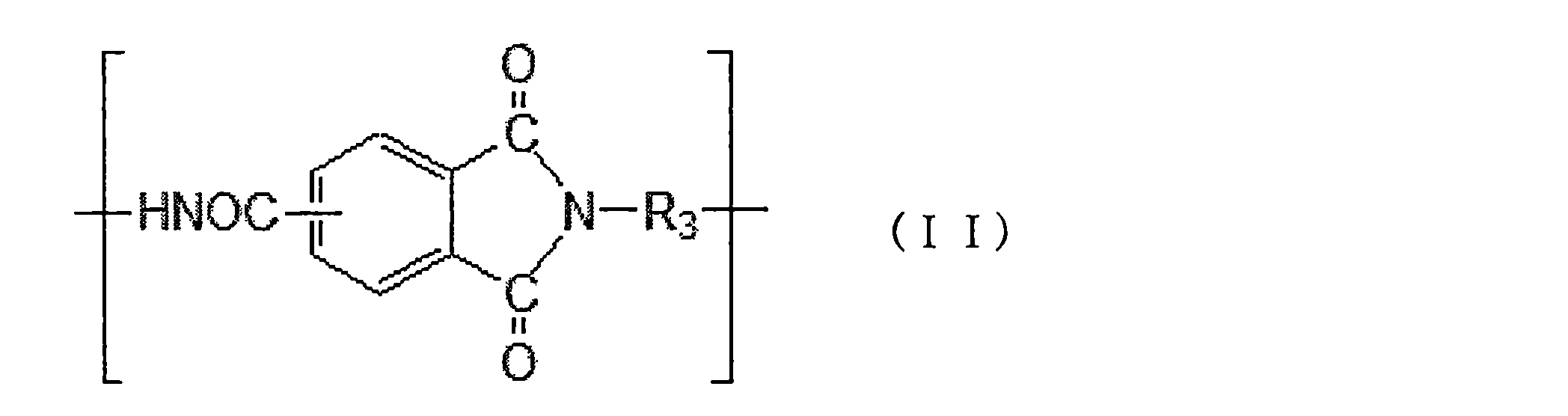
一般式(II)中、R3は、ジイソシアネートのイソシアネート基又はジアミンのアミノ基を除いた残基を示す。
一般式(II)中、R3は、ジイソシアネートのイソシアネート基又はジアミンのアミノ基を除いた残基を示す。
ジイソシアネート及び/又はジアミンと酸成分(三塩基酸無水物又は三塩基酸無水物ハライドと必要に応じて使用するジカルボン酸及びテトラカルボン酸二無水物の合計量)の使用比率は、生成されるポリアミドイミド樹脂の分子量及び架橋度の観点から、酸成分の総量1.0モルに対してジイソシアネート化合物及び/又はジアミン化合物を0.8~1.1モルとすることが好ましく、0.95~1.08モルとすることがより好ましく、特に、1.0~1.08モルとすることが一層好ましい。
ポリアミドイミド樹脂の合成条件は多様であり、一概に特定できないが、ジイソシアネートと三塩基酸無水物を反応させる最も代表的な方法については、例えば、特開平4-39323号公報などに例示されている。より詳細な製造方法は、後述する。
ポリアミドイミド樹脂は必要に応じて、末端がブロックされていてもよく、それにより樹脂組成物の粘度安定性を向上させることができる。ブロック剤としては、特に限定はされないが、メタノール、エタノール、プロパノール等のアルコール、一級アミン、アルデヒド基含有化合物、ε-カプロラクタム等のラクタム、などが挙げられる。
ポリアミドイミド樹脂の数平均分子量は、塗膜の強度を確保する観点から10,000以上であることが好ましく、15,000以上であることがより好ましい。一方、塗料等として用いる際の塗料化を容易にし且つ塗布に適した粘度とするために、その数平均分子量は50,000以下であることが好ましく、30,000以下であることがより好ましく、25,000以下であることが一層好ましい。
ポリアミドイミド樹脂の数平均分子量は、樹脂合成時にサンプルリングして、ゲルパーミエーションクロマトグラフ(GPC)等の分析機器を用いて測定し(GPCの場合は標準ポリスチレンの検量線を用いて測定する)、目的とする数平均分子量になるまで合成を継続することにより、上記範囲に管理することができる。
ポリアミドイミド樹脂は、樹脂中のカルボキシル基と酸無水物基を開環させたカルボキシル基を合わせた酸価が5~40mgKOH/gであることが好ましい。この酸価が5mgKOH/g以上であると、溶媒への樹脂の溶解又は分散が容易になる傾向にあり、10mgKOH/g以上、15mgKOH/g以上、及び20mgKOH/g以上であることが、この順でより好ましい。また、酸価が40mgKOH/g以下であると、最終的に得られるポリアミドイミド樹脂組成物が、経日によりゲル化しにくくなる傾向にある。
上記酸価は、以下の方法で得ることができる。まず、ポリアミドイミド樹脂組成物を約0.5g採取し、これに1,4-ジアザビシクロ[2,2,2]オクタンを約0.15g加え、さらにN-メチル-2-ピロリドン約60gとイオン交換水約1mlを加え、ポリアミドイミド樹脂が完全に溶解するまで攪拌する。これを、0.05モル/Lのエタノール性水酸化カリウム溶液を使用して電位差滴定装置で滴定し、ポリアミドイミド樹脂中の、カルボキシル基及び酸無水物基を開環させたカルボキシル基を合わせた酸価を得る。
<溶媒>
ポリアミドイミド樹脂組成物は、ポリアミドイミド樹脂を溶解又は分散させる極性溶媒として、分子構造が左右対称の複素環化合物、すなわち分子構造が左右対称であって極性を有する複素環化合物、又は極性が左右対称である複素環化合物(以下、単に「複素環化合物」とも記す。)を含む。樹脂組成物は、この複素環化合物を複数種含んでいてもよい。本明細書において、分子構造が左右対称であるとは、対称面(鏡面)を有することを意味しており、極性を有するとは分子内の結合に電気的な偏りがあること(極性分子であること)を意味する。極性は、双極子モーメントで示される。なお、この組成物中の溶媒を、ポリアミドイミド樹脂合成時に用いる重合溶媒(後述)と区別するために、貯蔵溶媒と記す場合がある。
ポリアミドイミド樹脂組成物は、ポリアミドイミド樹脂を溶解又は分散させる極性溶媒として、分子構造が左右対称の複素環化合物、すなわち分子構造が左右対称であって極性を有する複素環化合物、又は極性が左右対称である複素環化合物(以下、単に「複素環化合物」とも記す。)を含む。樹脂組成物は、この複素環化合物を複数種含んでいてもよい。本明細書において、分子構造が左右対称であるとは、対称面(鏡面)を有することを意味しており、極性を有するとは分子内の結合に電気的な偏りがあること(極性分子であること)を意味する。極性は、双極子モーメントで示される。なお、この組成物中の溶媒を、ポリアミドイミド樹脂合成時に用いる重合溶媒(後述)と区別するために、貯蔵溶媒と記す場合がある。
この複素環化合物は、複素環を構成する異種原子として窒素及び/又は酸素を含むことが好ましく、特に窒素を含む含窒素複素環化合物であることが好ましく、さらに2個の窒素を含む含窒素複素環化合物であることが好ましい。環は不飽和結合を有していても、いなくても良く、環の員数は、5員環又は6員環であることが好ましい。複素環は単環構造であることが好ましいが、縮合複素環構造であってもよい。なかでも、イミダゾリジン環、ピリミジン環、ヘキサヒドロピリミジン環等が好ましいが、これらに限定されることはない。
複素環は、分子の対称性を損なわない限りにおいて置換基を含んでいてもよく、複素環構造を安定させる置換基を含むことが好ましい。置換基としては例えば、炭素数が1~4個のアルキル基が挙げられ、置換基は、複素環の異種原子に結合していても炭素原子に結合していても、どちらでも良い。
なかでも、尿素の誘導体である複素環化合物が最も好ましく、具体的には、エチレン尿素(2-イミダゾリジノン)、及びプロピレン尿素が挙げられ、これらの窒素原子はアルキル基、好ましくは炭素数1~4のアルキル基、より好ましくは炭素数が1又は2のアルキル基により置換されていてもよい。窒素原子にアルキル基を有する尿素誘導体としては、1,3-ジメチル-2-イミダゾリジノン(DMI)、1,3-ジエチル-2-イミダゾリジノン、N,N’-ジメチルプロピレン尿素(DMPU)、及びN,N’-ジエチルプロピレン尿素が挙げられるが、これらに限定されることはない。
ポリアミドイミド樹脂組成物から硬化塗膜を形成するためには、高温で溶媒を揮発させて塗膜形成(硬化)させる必要があるため、その高温に耐えうる基材を選択することが必要となる。基材の選択の幅を拡げ、かつ、生産性向上の観点からも、低温での使用が望まれている。ここで、低温とは270℃以下程度であることを意味する。したがって、溶媒である複素環化合物は、低温での塗膜形成を可能とするために、270℃よりも低い沸点、好ましくは250℃よりも低い沸点を有するものであることが好ましい。また、溶媒の種類はポリアミドイミド樹脂の硬化反応性にも影響を及ぼすため、適切な反応性を与える複素環化合物を選択することが好ましい。
以上のポリアミドイミド樹脂の硬化温度、及び硬化反応性に鑑み、最も好ましい複素環化合物は、DMIである。
以上のポリアミドイミド樹脂の硬化温度、及び硬化反応性に鑑み、最も好ましい複素環化合物は、DMIである。
上記の分子構造が左右対称で極性を有する複素環化合物、又は極性が左右対称である複素環化合物は、液体である樹脂組成物の粘度を安定化させる観点から、ポリアミドイミド樹脂組成物中に40質量%以上含まれていることが好ましい。その上限値については特に制限はないが、ポリアミドイミド樹脂の含有量を適正量とするために、85質量%以下であることが好ましく、75質量%以下であることがより好ましく、65質量%以下であることが一層好ましい。
ポリアミドイミド樹脂組成物は、上記の複素環化合物以外の一種以上の貯蔵溶媒を含んでいてもよい。この貯蔵溶媒としては、上記複素環化合物以外の極性溶媒、又は非極性溶媒を用いることができる。具体的には、N-メチル-2-ピロリドン、N-エチル-2-ピロリドン、N,N-ジメチルホルムアミド、N,N-ジメチルアセトアミド、4-モルホリンカルボアルデヒド;キシレン、トルエン等の芳香族炭化水素;メチルエチルケトン、メチルイソブチルケトン、γ-ブチロラクトン、δ-バレロラクトン等のケトン類;ジメチルエタノールアミン、トリエチルアミン等の液状アミン;水などが挙げられる。
後述するように、ポリアミドイミド樹脂は、分子構造が左右対称で極性を有する複素環化合物、又は極性が左右対称である複素環化合物を重合溶媒として製造されることが好ましく、この重合溶媒としての複素環化合物をそのまま、樹脂組成物の貯蔵溶媒として用いることができる。つまり、組成物中の貯蔵溶媒である上記複素環化合物の少なくとも一部は、ポリアミドイミド樹脂の重合溶媒であることが好ましく、ポリアミドイミド樹脂の合成により得られたポリアミドイミド樹脂溶液をそのまま使用することができる。この場合において、上記の一種以上の貯蔵溶媒を用いて、適宜、ポリアミドイミド樹脂溶液を希釈して、樹脂組成物を適当な粘度に調整して用いることが好ましい。
組成物中の溶媒の量は、特に限定されず、使用目的に応じ、例えば塗料であれば塗装方法に応じて、適切な粘度となるように溶媒で希釈して、樹脂濃度の調整をすればよい。例えば、ポリアミドイミド樹脂100質量部に対し、溶媒が80~200質量部であることが好ましく、100質量部~150質量部であることがより好ましい。
<4官能エポキシ樹脂>
ポリアミドイミド樹脂組成物は、上記のポリアミドイミド樹脂と溶媒に加え、さらに硬化剤として4官能エポキシ樹脂を含む。4官能エポキシ樹脂を配合することにより、ポリアミドイミド樹脂の熱的、機械的、電気的特性をより向上させることができる。なお、4官能エポキシ樹脂以外のエポキシ樹脂、フェノール樹脂、メラミン樹脂、ブロックイソシアネートなどを、任意の硬化剤として適宜組み合わせて用いてもよい。
ポリアミドイミド樹脂組成物は、上記のポリアミドイミド樹脂と溶媒に加え、さらに硬化剤として4官能エポキシ樹脂を含む。4官能エポキシ樹脂を配合することにより、ポリアミドイミド樹脂の熱的、機械的、電気的特性をより向上させることができる。なお、4官能エポキシ樹脂以外のエポキシ樹脂、フェノール樹脂、メラミン樹脂、ブロックイソシアネートなどを、任意の硬化剤として適宜組み合わせて用いてもよい。
4官能エポキシ樹脂としては、特に限定はされないが、例えば、ジナフタレン骨格含有のナフタレン型4官能エポキシ樹脂、グリシジルアミン型4官能エポキシ樹脂(N,N,N´,N´-テトラグリシジルジアミノジフェニルメタン型エポキシ樹脂、N,N,N´,N´-テトラグリシジルメタキシレンジアミン型エポキシ樹脂等)、及びテトラキスヒドロキシフェニルエタン型エポキシ樹脂などが挙げられる。これらの4官能エポキシ樹脂の複数種を組み合わせて用いても良い。
4官能エポキシ樹脂は、単独で添加してポリアミドイミド樹脂と反応させてもよいが、硬化後にエポキシ樹脂の未反応物が残留しにくいように、エポキシ樹脂の硬化剤又は硬化促進剤等と共に添加してもよい。
4官能エポキシ樹脂の配合割合は、ポリアミドイミド樹脂100質量部に対して、1質量部~100質量部の範囲とすることが好ましく、5質量部~50質量部とすることがより好ましい。
<その他の成分>
ポリアミドイミド樹脂組成物は、その使用目的等に応じて、さらにその他の任意の成分を含んでいてもよい。例えば、この樹脂組成物は塗料として好ましく使用できるため、塗料として使用するときには、後述のとおり必要に応じて、顔料、充填材、消泡剤、防腐剤、潤滑剤、及び界面活性剤等の任意成分を添加してもよい。
ポリアミドイミド樹脂組成物は、その使用目的等に応じて、さらにその他の任意の成分を含んでいてもよい。例えば、この樹脂組成物は塗料として好ましく使用できるため、塗料として使用するときには、後述のとおり必要に応じて、顔料、充填材、消泡剤、防腐剤、潤滑剤、及び界面活性剤等の任意成分を添加してもよい。
2.塗料
本実施形態の塗料は、上記ポリアミドイミド樹脂組成物を含有する塗料である。
ポリアミドイミド樹脂は、塗料の塗膜形成成分となるものであり、複数種の上記ポリアミドイミド樹脂を組み合わせて使用してもよい。
ポリアミドイミド樹脂は、その機能を十分に発揮させるために、塗料中に10~50質量%含まれることが好ましい。
本実施形態の塗料は、上記ポリアミドイミド樹脂組成物を含有する塗料である。
ポリアミドイミド樹脂は、塗料の塗膜形成成分となるものであり、複数種の上記ポリアミドイミド樹脂を組み合わせて使用してもよい。
ポリアミドイミド樹脂は、その機能を十分に発揮させるために、塗料中に10~50質量%含まれることが好ましい。
塗料には、必要に応じて、ポリエーテルスルホン樹脂、ポリイミド樹脂、ポリアミド樹脂、エポキシ化合物、イソシアネート化合物、メラミン化合物、フッ素樹脂等を、単独で、又は混合して用いることができる。なかでも、エポキシ化合物、イソシアネート化合物、及びメラミン化合物は、塗膜の密着性をより向上させることができるために好ましい。
エポキシ化合物としては、例えば、上記した樹脂組成物に配合できるエポキシ樹脂のほか、トリグリシジルイソシアヌレート等を用いることができ、これらを単独で使用してもよいし、複数種を組み合わせてもよい。
イソシアネート化合物としては、デュラネート等のヘキサメチレンジイソシアネートのポリイソシアネート、4,4′-ジフェニルメタンジイソシアネートから合成されるポリイソシアネート等が挙げられる。これらのポリイソシアネートの質量平均分子量は500~9000であることが好ましく、より好ましくは1000~5000である。
メラミン化合物としては、特に制限はないが、例えば、メラミンにホルムアルデヒド、パラホルムアルデヒド等を反応させたメチロール基含有化合物等が挙げられる。このメチロール基は、炭素原子数1~6個のアルコールによりエーテル化されているものが好ましい。
塗料に添加されるエポキシ化合物、イソシアネート化合物、及びメラミン化合物の各配合量は、ポリアミドイミド樹脂100質量部に対して、それぞれ、それらを配合することによる密着性向上効果を確保しつつポリアミドイミド樹脂の特性も十分に発揮させる観点から、例えば1~40質量部であることが好ましく、5~30質量部とすることがより好ましい。
塗料は、必要に応じて界面活性剤を含有していることが好ましい。界面活性剤としては、特に制限されるものではないが、塗膜を形成するための成分が均一に混合して、塗膜が乾燥するまで分離せず(分層を起こさず)、焼付け後に多くの残留物が残らないものが好ましい。
界面活性剤の含有量は、特に制限されるものではないが、均一な混合状態を保つために塗料中に0.01質量%以上であることが好ましく、0.5質量%以上であることがより好ましい。一方、塗膜の焼付け時に炭化分が多く残留して成膜性に悪影響を与えることがないよう、界面活性剤の含有量は塗料中に10質量%以下であることが好ましく、5質量%以下であることがより好ましい。
塗料は、塗膜の耐水性等を向上させるために、必要に応じて充填材を含有することが好ましい。
充填材の種類は、その耐水性や耐薬品性等を考慮し、塗膜の用途に応じて選択することができ、水に溶解しないものであることが好ましい。具体的には、充填材としては、金属粉、金属酸化物(酸化アルミウム、酸化亜鉛、酸化スズ、酸化チタン等)、金属硫化物(硫化モリブデン、硫化タングステン等)、ガラスビーズ、ガラスフレーク、ガラス粒子、セラミックス、炭化珪素、酸化珪素、弗化カルシウム、カーボンブラック、グラファイト、マイカ、及び硫酸バリウム等を挙げることができる。これらは、各々が単独で用いられるほか、複数種を組み合わせて使用してもよい。
充填材の種類は、その耐水性や耐薬品性等を考慮し、塗膜の用途に応じて選択することができ、水に溶解しないものであることが好ましい。具体的には、充填材としては、金属粉、金属酸化物(酸化アルミウム、酸化亜鉛、酸化スズ、酸化チタン等)、金属硫化物(硫化モリブデン、硫化タングステン等)、ガラスビーズ、ガラスフレーク、ガラス粒子、セラミックス、炭化珪素、酸化珪素、弗化カルシウム、カーボンブラック、グラファイト、マイカ、及び硫酸バリウム等を挙げることができる。これらは、各々が単独で用いられるほか、複数種を組み合わせて使用してもよい。
さらに塗料は、顔料、酸化防止剤、紫外線吸収剤等の、一般的に塗料に添加される公知の添加剤を、適宜含むことができる。
塗料の塗装方法は特に限定されず、公知の塗装方法、例えばディッピング塗装、スプレー塗装、及び刷毛塗り等を採用できる。塗装方法に応じて、溶媒の量を適宜調節して、適切な濃度に希釈することが好ましい。
塗料を塗布した後は、乾燥(予備乾燥)及び硬化(焼成)させて塗膜を形成する。乾燥及び硬化の条件は、特に限定されず、使用する基材の耐熱特性に応じ、低温での塗膜形成を行うことができる。例えば、120℃以上270℃未満の範囲で加熱することが好ましく、150℃~250℃の範囲がより好ましい。
上記のポリアミドイミド樹脂組成物及び塗料(コーティング剤)は、様々な用途に用いることができる。例えば、耐熱性が求められるフィルム等の部材、又はすべり性が求められるフィルム等の部材への塗膜形成に用いることが好ましく、耐熱性塗料、摺動部コーティング塗料等として好ましく使用できる。また、本実施形態の塗料は、低温硬化が可能であるため、アルミニウム基材への絶縁皮膜としても好ましく使用できる。また、複写機の中間転写ベルト等として利用される環状のベルト等の、ベルト状に成型する成型品用途にも好ましく用いることができる。これらはいずれも、非粘着用途である。
本実施形態の塗料は、低温下の塗膜形成性に優れており、様々な基材に対し、密着性に優れた良好な塗膜を形成することができるので、塗布する基材は特に限定されない。なかでも、アルミニウム基材は、250℃よりも高温での焼成中に基材の変形が懸念されるが、本実施形態の塗料は低温塗膜形成が可能であるので、アルミニウム基材に対し、250℃以下、例えば200℃~230℃程度の焼成で塗膜の硬化を充分に進行させて、硬度及び密着性等に優れた塗膜を形成することができる。したがって、この塗料は、アルミニウム基材への絶縁皮膜形成、保護コートなどの非粘着用途に好ましく用いられる。
3.ポリアミドイミド樹脂組成物又は塗料の使用
本実施形態のポリアミドイミド樹脂組成物又は塗料は、高弾性率であり且つ高硬度の硬化膜を形成することができるので、摺動部材の摺動面に好ましく用いることができる。
その場合、塗料は任意成分として、滑りを良くして摩耗耐性を向上させるための潤滑剤を含むことが好ましい。潤滑剤としては、グラファイト(黒鉛)、雲母、フッ素樹脂などに代表される固体潤滑剤を用いることができ、分散剤(界面活性剤、高分子分散剤等)と組み合わせて使用することがより好ましい。グラファイトは、天然黒鉛、人造黒鉛のどちらでも良い。フッ素樹脂としては、ポリテトラフルオロエチレン等を用いることができるが、これに限定されることはない。
本実施形態のポリアミドイミド樹脂組成物又は塗料は、高弾性率であり且つ高硬度の硬化膜を形成することができるので、摺動部材の摺動面に好ましく用いることができる。
その場合、塗料は任意成分として、滑りを良くして摩耗耐性を向上させるための潤滑剤を含むことが好ましい。潤滑剤としては、グラファイト(黒鉛)、雲母、フッ素樹脂などに代表される固体潤滑剤を用いることができ、分散剤(界面活性剤、高分子分散剤等)と組み合わせて使用することがより好ましい。グラファイトは、天然黒鉛、人造黒鉛のどちらでも良い。フッ素樹脂としては、ポリテトラフルオロエチレン等を用いることができるが、これに限定されることはない。
4.硬化膜
本実施形態の硬化膜は、上記実施形態のポリアミドイミド樹脂組成物、又は塗料を用いて得られるものである。ポリアミドイミド樹脂は、一般的に芳香族環を有しており、耐熱性、耐薬品性及び耐溶剤性に優れた硬化膜を形成することができる。
本実施形態の硬化膜は、上記実施形態のポリアミドイミド樹脂組成物、又は塗料を用いて得られるものである。ポリアミドイミド樹脂は、一般的に芳香族環を有しており、耐熱性、耐薬品性及び耐溶剤性に優れた硬化膜を形成することができる。
好ましい実施形態において、硬化膜のガラス転移温度は、耐熱性の観点から250℃以上であり、より好ましくは260℃以上である。ガラス転移温度は、TMA装置を用い、JIS K 7197:1991に準じて、線膨張率測定法による測定チャートから得ることができる。
別の好ましい実施形態において、硬化膜の引張弾性率は2.7GPa以上であり、3GPa以上であることがより好ましく、さらに好ましくは3.5GPa以上である。引張弾性率は、JIS K 7161:1994に準じて、引張試験機を用いて測定することができる。
別の好ましい実施形態において、硬化膜の鉛筆硬度は2H以上であり、3H以上であることがより好ましい。鉛筆硬度は、旧JIS K5400(鉛筆引っかき試験)に準じて測定することができる。
硬化膜は、上記の好ましいガラス転移温度、好ましい引張弾性率、及び好ましい鉛筆硬度の全てを兼ね備えていることがより好ましい。
硬化膜は、上記の好ましいガラス転移温度、好ましい引張弾性率、及び好ましい鉛筆硬度の全てを兼ね備えていることがより好ましい。
さらに好ましい実施形態において、硬化膜は摺動部材の摺動面に用いられる、摺動部材用硬化膜である。ここで、硬化膜は摺動面の少なくとも一部に用いることができ、摺動面の全面に用いてもよい。この摺動部材用硬化膜は、上記のガラス転移温度、引張弾性率、及び鉛筆硬度のいずれか1以上の特性を有していることが好ましい。摺動部材については後述する。摺動部材用硬化膜は、カーボンブラック、グラファイト、二硫化モリブデン(MoS2)又は二硫化タングステン(WS2)等の金属硫化物、フッ素系樹脂などを添加した塗料を用いて好ましく製造することができる。
硬化膜の厚みは、その用途に応じて適宜定めることができ、特に限定はされないが、15~50μm程度であることが好ましい。
5.摺動部材
本実施形態の摺動部材は、上記実施形態ポリアミドイミド樹脂組成物、又は塗料を用いて得られる硬化膜を備えるものである。硬化膜は、摺動部材の摺動面の少なくとも一部に形成されていることが好ましい。
摺動部材は、滑らせながら動かす摺動面を有する部材であり、特に限定はされないが代表的には、エンジン等のピストン、メカニカルシールのシールリング、ポンプの軸受摺動部(ベアリング)、OA機器(複写機等)等の搬送部を有する搬送システム製品の搬送ベルト、ハードディスク等が例示できる。それらのこすれあう摺動面には、耐摩耗性と摺動特性が求められるところ、上記実施形態の硬化膜は高硬度及び高弾性率であって、優れた耐摩耗性を有するため、摺動部材用として特に適している。
本実施形態の摺動部材は、上記実施形態ポリアミドイミド樹脂組成物、又は塗料を用いて得られる硬化膜を備えるものである。硬化膜は、摺動部材の摺動面の少なくとも一部に形成されていることが好ましい。
摺動部材は、滑らせながら動かす摺動面を有する部材であり、特に限定はされないが代表的には、エンジン等のピストン、メカニカルシールのシールリング、ポンプの軸受摺動部(ベアリング)、OA機器(複写機等)等の搬送部を有する搬送システム製品の搬送ベルト、ハードディスク等が例示できる。それらのこすれあう摺動面には、耐摩耗性と摺動特性が求められるところ、上記実施形態の硬化膜は高硬度及び高弾性率であって、優れた耐摩耗性を有するため、摺動部材用として特に適している。
6.ポリアミドイミド樹脂の製造方法
本実施形態のポリアミドイミド樹脂の製造方法は、ジイソシアネート化合物及び/又はジアミン化合物と、三塩基酸無水物及び/又は三塩基酸ハライドとを、分子構造が左右対称であって極性を有する複素環化合物、又は極性が左右対称である複素環化合物を含む溶媒中で反応させる工程を含むことを特徴とする。
使用する原料化合物については、上記ポリアミドイミド樹脂組成物の項において説明したとおりである。重合溶媒としての複素環化合物についても、上記ポリアミドイミド樹脂組成物の項において、貯蔵溶媒として説明したとおりである。
本実施形態のポリアミドイミド樹脂の製造方法は、ジイソシアネート化合物及び/又はジアミン化合物と、三塩基酸無水物及び/又は三塩基酸ハライドとを、分子構造が左右対称であって極性を有する複素環化合物、又は極性が左右対称である複素環化合物を含む溶媒中で反応させる工程を含むことを特徴とする。
使用する原料化合物については、上記ポリアミドイミド樹脂組成物の項において説明したとおりである。重合溶媒としての複素環化合物についても、上記ポリアミドイミド樹脂組成物の項において、貯蔵溶媒として説明したとおりである。
従来技術においては、ポリアミドイミド樹脂は一般的に、N-メチルピロリドン等の極性溶媒を用いて合成されることが知られているが、本発明者は、この重合溶媒を変えることにより、ポリアミドイミド樹脂の硬化膜の特性を変化させることができることを見いだした。これはつまり、合成されるポリアミドイミド樹脂ポリマーの分子構造が異なることに起因すると考えられる。
すなわち、推論ではあるが、分子構造が左右対称であって極性を有する複素環化合物においては、当然のことながらその極性も左右対称となっており、溶媒の極性が左右対称であるので、モノマーの重合反応に規則性が生じ、アミドイミド構造が規則的に形成されて、枝分かれの少ない直鎖状のポリマーが得られ、その結果、硬度が高く硬化膜が得られると考えられ、さらには該硬化膜の弾性率も高いことが見いだされた。一方、N-メチルピロリドン等の極性が左右対称ではない溶媒を用いた場合は、アミド-イミドの規則的な構造単位のほかに、アミド-アミド、イミド-イミドのような構造単位も生成されやすくなり、その結果、硬化する際に分岐の多いポリマーとなって、得られる硬化膜は嵩高く、充分な硬度を得ることが困難になると考えられる。
本発明者の検討によると、上記の重合溶媒と得られるポリアミドイミド樹脂の分子構造の規則性との関係は、酸成分と反応させるのがジイソシアネート化合物であるときに顕著に示される。したがって、より好ましい実施形態のポリアミドイミド樹脂の製造方法は、ジイソシアネート化合物と、三塩基酸無水物及び/又は三塩基酸ハライドとを、分子構造が左右対称であって極性を有する複素環化合物、又は極性が左右対称である複素環化合物を含む溶媒中で反応させる工程を含むものである。
重合溶媒は、分子構造が左右対称の極性を有する複素環化合物、又は極性が左右対称である複素環化合物のみから構成されていても良いし、該複素環化合物以外の溶媒を含む混合溶媒であってもよい。混合溶媒の場合、複素環化合物は、重合溶媒中に80質量%以上含まれることが好ましく、85質量%以上であることがより好ましく、90質量%以上であることが一層好ましい。
併用できる重合溶媒としては、極性溶媒としてN-メチル-2-ピロリドン、N-エチル-2-ピロリドン、N,N-ジメチルホルムアミド、N,N-ジメチルアセトアミド、4-モルホリンカルボアルデヒド等が挙げられ、キシレン、トルエン等の芳香族炭化水素;メチルエチルケトン、メチルイソブチルケトン、γ-ブチロラクトン、δ-バレロラクトン等のケトン類を用いることもでき、これらの一種以上を適宜組み合わせることが好ましい。ただし、アルデヒド基を含有する溶媒を使用する場合は、原料化合物と反応する可能性があるため、合成時に温度をかけないようにすることが好ましい。
反応温度は、特に限定されず、使用する重合溶媒の沸点に応じて適宜設定すればよい。例えば、複素環化合物としてDMIを重合溶媒の一部又は全部として用いる場合、90~150℃の温度で反応させることが好ましい。重合反応は、空気中の水分の影響を低減するため、窒素等の雰囲気下で行うことが好ましい。
ポリアミドイミド樹脂は、例えば次の手順で製造することができる。
(1)酸成分、及びジイソシアネート成分及び/又はジアミン成分を一度に使用し、反応させてポリアミドイミド樹脂を合成する方法。
(2)酸成分と、ジイソシアネート成分及び/又はジアミン成分の過剰量とを反応させて、末端にイソシアネート基又はアミノ基を有するアミドイミドオリゴマーを合成した後、酸成分を追加して末端のイソシアネート基及び/又はアミノ基と反応させてポリアミドイミド樹脂を合成する方法。
(3)酸成分の過剰量と、ジイソシアネート成分及び/又はジアミン成分を反応させて、末端に酸又は酸無水物基を有するアミドイミドオリゴマーを合成した後、ジイソシアネート成分及び/又はジアミン成分を追加して末端の酸又は酸無水物基と反応させてポリアミドイミド樹脂を合成する方法。
(1)酸成分、及びジイソシアネート成分及び/又はジアミン成分を一度に使用し、反応させてポリアミドイミド樹脂を合成する方法。
(2)酸成分と、ジイソシアネート成分及び/又はジアミン成分の過剰量とを反応させて、末端にイソシアネート基又はアミノ基を有するアミドイミドオリゴマーを合成した後、酸成分を追加して末端のイソシアネート基及び/又はアミノ基と反応させてポリアミドイミド樹脂を合成する方法。
(3)酸成分の過剰量と、ジイソシアネート成分及び/又はジアミン成分を反応させて、末端に酸又は酸無水物基を有するアミドイミドオリゴマーを合成した後、ジイソシアネート成分及び/又はジアミン成分を追加して末端の酸又は酸無水物基と反応させてポリアミドイミド樹脂を合成する方法。
ポリアミドイミド樹脂の末端をブロックする場合は、ブロック剤を樹脂の合成中に反応させてもよいし、樹脂の合成後に反応させてもよい。ブロック剤を樹脂の合成中に反応させるときは、ブロック剤の種類によっては、重合溶媒の一部として用いるようにしてもよい。ブロック剤の使用量は、特に限定はされないが、そのブロック化の効果を充分に得るために、ポリアミドイミド樹脂1モルに対し0.01モル以上のブロック剤を用いることができる。
7.ポリアミドイミド樹脂
本実施形態のポリアミドイミド樹脂は、ジイソシアネート化合物及び/又はジアミン化合物と、三塩基酸無水物及び/又は三塩基酸ハライドとを、分子構造が左右対称であって極性を有する複素環化合物、又は極性が左右対称である複素環化合物を含む溶媒中で反応させて得られるものである。反応条件等は、特に限定されず、当業者に周知の条件を適用すればよい。上述のとおり、得られるポリアミドイミド樹脂は、特定の重合溶媒を用いて製造することにより、分子極性が非対象である重合溶媒を用いた場合に比べ、高硬度かつ高弾性率の硬化膜を形成できるものであり、それはアミド-イミド結合が規則的に繰り返された分子構造を有することに基づくのであろうと推測できる。
本実施形態のポリアミドイミド樹脂は、ジイソシアネート化合物及び/又はジアミン化合物と、三塩基酸無水物及び/又は三塩基酸ハライドとを、分子構造が左右対称であって極性を有する複素環化合物、又は極性が左右対称である複素環化合物を含む溶媒中で反応させて得られるものである。反応条件等は、特に限定されず、当業者に周知の条件を適用すればよい。上述のとおり、得られるポリアミドイミド樹脂は、特定の重合溶媒を用いて製造することにより、分子極性が非対象である重合溶媒を用いた場合に比べ、高硬度かつ高弾性率の硬化膜を形成できるものであり、それはアミド-イミド結合が規則的に繰り返された分子構造を有することに基づくのであろうと推測できる。
より好ましい実施形態のポリアミドイミド樹脂は、ジイソシアネート化合物と、三塩基酸無水物及び/又は三塩基酸ハライドとを、分子構造が左右対称の極性を有する複素環化合物、又は極性が左右対称である複素環化合物を含む溶媒中で反応させて得られるものである。
以下、本発明を実施例によりさらに詳しく説明するが、本発明はこれらに制限されるものではない。
<実施例1>
4,4′-ジフェニルメタンジイソシアネート(MDI)50.1g(0.2モル)、3,3'-ジメチル-4,4'-ジイソシアナトビフェニル(TODI)211.4g(0.8モル)、無水トリメリット酸(TMAC)192.1g(1.0モル)、及び1,3-ジメチルイミダゾリジノン(DMI)842.4gを、温度計、攪拌機、及び冷却管を備えた2リットルのフラスコに仕込み、乾燥させた窒素気流中で撹拌しながら約2時間かけて135℃まで昇温し、この温度を保持して9時間反応させて、数平均分子量21500のポリアミドイミド樹脂溶液(固形分濃度:約33質量%)を得た。
4,4′-ジフェニルメタンジイソシアネート(MDI)50.1g(0.2モル)、3,3'-ジメチル-4,4'-ジイソシアナトビフェニル(TODI)211.4g(0.8モル)、無水トリメリット酸(TMAC)192.1g(1.0モル)、及び1,3-ジメチルイミダゾリジノン(DMI)842.4gを、温度計、攪拌機、及び冷却管を備えた2リットルのフラスコに仕込み、乾燥させた窒素気流中で撹拌しながら約2時間かけて135℃まで昇温し、この温度を保持して9時間反応させて、数平均分子量21500のポリアミドイミド樹脂溶液(固形分濃度:約33質量%)を得た。
ポリアミドイミド樹脂の数平均分子量は、次の条件で測定した。
GPC機種:日立 L6000
検出器:日立 L4000型UV
波長:270nm
データ処理機:ATT 8
カラム:Gelpack GL-S300MDT-5×2
カラムサイズ:8mmφ×300mm
溶媒:DMF/THF=1/1(リットル)+リン酸0.06M+臭化リチウム0.06M
試料濃度:5mg/1ml
注入量:5μl
圧力:49kgf/cm2(4.8×106Pa)
流量:1.0ml/min
GPC機種:日立 L6000
検出器:日立 L4000型UV
波長:270nm
データ処理機:ATT 8
カラム:Gelpack GL-S300MDT-5×2
カラムサイズ:8mmφ×300mm
溶媒:DMF/THF=1/1(リットル)+リン酸0.06M+臭化リチウム0.06M
試料濃度:5mg/1ml
注入量:5μl
圧力:49kgf/cm2(4.8×106Pa)
流量:1.0ml/min
アミン型の4官能エポキシ樹脂(新日鉄住金化学株式会社製「YH-434」)を、ポリアミドイミド樹脂100質量部に対し7質量部となる量で添加し、ラボスターラーで3時間攪拌して、さらに希釈溶剤としてキシレンとDMIを追加して、不揮発分(200℃/2時間、測定値)が27.0質量%、ポリアミドイミド樹脂と4官能エポキシ樹脂の合計濃度(計算値)が26質量%の試験塗料を得た。
<実施例2>
4,4′-ジフェニルメタンジイソシアネート(MDI)100.2g(0.4モル)、3,3'-ジメチル-4,4'-ジイソシアナトビフェニル(TODI)158.6g(0.6モル)、無水トリメリット酸(TMAC)192.1g(1.0モル)、及び1,3-ジメチルイミダゾリジノン(DMI)676.4gを用いて、上記実施例1と同様に反応させて、数平均分子量20900のポリアミドイミド樹脂溶液(固形分濃度:約38質量%)を得た。
得られたポリアミドイミド樹脂溶液を用いて、上記実施例1と同様にして、不揮発分(測定値)が27.2質量%、ポリアミドイミド樹脂と4官能エポキシ樹脂の合計濃度(計算値)が26質量%の試験塗料を得た。
4,4′-ジフェニルメタンジイソシアネート(MDI)100.2g(0.4モル)、3,3'-ジメチル-4,4'-ジイソシアナトビフェニル(TODI)158.6g(0.6モル)、無水トリメリット酸(TMAC)192.1g(1.0モル)、及び1,3-ジメチルイミダゾリジノン(DMI)676.4gを用いて、上記実施例1と同様に反応させて、数平均分子量20900のポリアミドイミド樹脂溶液(固形分濃度:約38質量%)を得た。
得られたポリアミドイミド樹脂溶液を用いて、上記実施例1と同様にして、不揮発分(測定値)が27.2質量%、ポリアミドイミド樹脂と4官能エポキシ樹脂の合計濃度(計算値)が26質量%の試験塗料を得た。
<実施例3>
4,4′-ジフェニルメタンジイソシアネート(MDI)250.2g(1モル)、無水トリメリット酸192.1g(1.0モル)、及び1,3-ジメチルイミダゾリジノン(DMI)663.5gを用いて、上記実施例1と同様に反応させて、数平均分子量18700のポリアミドイミド樹脂溶液(固形分濃度:約38質量%)を得た。
得られたポリアミドイミド樹脂溶液を用いて、上記実施例1と同様にして、不揮発分(測定値)が27.5質量%、ポリアミドイミド樹脂と4官能エポキシ樹脂の合計濃度(計算値)が26質量%の試験塗料を得た。
4,4′-ジフェニルメタンジイソシアネート(MDI)250.2g(1モル)、無水トリメリット酸192.1g(1.0モル)、及び1,3-ジメチルイミダゾリジノン(DMI)663.5gを用いて、上記実施例1と同様に反応させて、数平均分子量18700のポリアミドイミド樹脂溶液(固形分濃度:約38質量%)を得た。
得られたポリアミドイミド樹脂溶液を用いて、上記実施例1と同様にして、不揮発分(測定値)が27.5質量%、ポリアミドイミド樹脂と4官能エポキシ樹脂の合計濃度(計算値)が26質量%の試験塗料を得た。
<比較例1>
上記実施例3と同じ原材料を用い、重合溶媒をN-メチルピロリドン(NMP)663.5gに代えて、数平均分子量19700のポリアミドイミド樹脂溶液(固形分濃度:約38質量%)を得た。
2官能エポキシ樹脂として、三井化学(株)製「エポミックR-140」;2,2-ビス(4-ヒドロキシフェニル)プロパンのエピクロルヒドリンによるジグリシジルエーテル化物)を、得られたポリアミドイミド樹脂溶液100質量部に対し、12質量部となる量で加えて、上記実施例1と同様にして、不揮発分(測定値)が31.5質量%、ポリアミドイミド樹脂と2官能エポキシ樹脂の合計濃度(計算値)が26質量%の試験塗料を得た。
上記実施例3と同じ原材料を用い、重合溶媒をN-メチルピロリドン(NMP)663.5gに代えて、数平均分子量19700のポリアミドイミド樹脂溶液(固形分濃度:約38質量%)を得た。
2官能エポキシ樹脂として、三井化学(株)製「エポミックR-140」;2,2-ビス(4-ヒドロキシフェニル)プロパンのエピクロルヒドリンによるジグリシジルエーテル化物)を、得られたポリアミドイミド樹脂溶液100質量部に対し、12質量部となる量で加えて、上記実施例1と同様にして、不揮発分(測定値)が31.5質量%、ポリアミドイミド樹脂と2官能エポキシ樹脂の合計濃度(計算値)が26質量%の試験塗料を得た。
<比較例2>
上記実施例2と同じ原材料を用い、重合溶媒をN-メチルピロリドン(NMP)676.4gに代えて、数平均分子量18400のポリアミドイミド樹脂溶液(固形分濃度:約40質量%)を得た。
得られたポリアミドイミド樹脂溶液100質量部に対し、12質量部となる量の2官能エポキシ樹脂(上記「エポミックR-140」)を加えて、同様にして、不揮発分(測定値)が30.2質量%、ポリアミドイミド樹脂と2官能エポキシ樹脂の合計濃度(計算値)が26質量%の試験塗料を得た。
上記実施例2と同じ原材料を用い、重合溶媒をN-メチルピロリドン(NMP)676.4gに代えて、数平均分子量18400のポリアミドイミド樹脂溶液(固形分濃度:約40質量%)を得た。
得られたポリアミドイミド樹脂溶液100質量部に対し、12質量部となる量の2官能エポキシ樹脂(上記「エポミックR-140」)を加えて、同様にして、不揮発分(測定値)が30.2質量%、ポリアミドイミド樹脂と2官能エポキシ樹脂の合計濃度(計算値)が26質量%の試験塗料を得た。
<密着性(クロスカット試験)>
上記実施例及び比較例の各試験塗料を、基材(アルミニウム板、A1050P、厚み1mm、未研摩)に塗布した後、80℃/30分間(ホットプレート)、及び230℃/30分間(乾燥機中)で硬化させて、膜厚約20μmの塗膜板を作製し、初期の密着性を測定した。
密着性は、旧JIS K 5400に準じて測定した(%、クロスカット残率)。すなわち、試験面にカッターナイフを用いて、1×1mm四方の碁盤目の切り傷を入れ、100個の碁盤目を形成した。碁盤目部分にメンディングテープ#810(スリーエム(株)製)を強く圧着させ、テープをゆっくりと引き剥がした後、碁盤目の状態を観察し、100マス中の残マス数を%で示した。剥離試験は5回行って、各回毎にマス目数を数えて、平均値を得た。
上記実施例及び比較例の各試験塗料を、基材(アルミニウム板、A1050P、厚み1mm、未研摩)に塗布した後、80℃/30分間(ホットプレート)、及び230℃/30分間(乾燥機中)で硬化させて、膜厚約20μmの塗膜板を作製し、初期の密着性を測定した。
密着性は、旧JIS K 5400に準じて測定した(%、クロスカット残率)。すなわち、試験面にカッターナイフを用いて、1×1mm四方の碁盤目の切り傷を入れ、100個の碁盤目を形成した。碁盤目部分にメンディングテープ#810(スリーエム(株)製)を強く圧着させ、テープをゆっくりと引き剥がした後、碁盤目の状態を観察し、100マス中の残マス数を%で示した。剥離試験は5回行って、各回毎にマス目数を数えて、平均値を得た。
<密着性(エリクセン試験)>
クロスカットを行った場所を、エリクセン試験機で8mm押し出し、セロハンテ-プで密着性の試験を行った。すなわち、エリクセン試験機(東洋精機製作所製)を用い、クロスカットした部分を8mm押し出し、押し出した後、押し出し部にセロハンテ-プを圧着させ、引き剥がして残存した個数を数えた。
以上の試験を2回行って、残存した個数の平均値を得た。
クロスカットを行った場所を、エリクセン試験機で8mm押し出し、セロハンテ-プで密着性の試験を行った。すなわち、エリクセン試験機(東洋精機製作所製)を用い、クロスカットした部分を8mm押し出し、押し出した後、押し出し部にセロハンテ-プを圧着させ、引き剥がして残存した個数を数えた。
以上の試験を2回行って、残存した個数の平均値を得た。
<鉛筆硬度>
上記各試験塗料をガラス板上に塗布し、230℃で30分間硬化させて得られた硬化塗膜(厚み20±5μm)を用い、旧JIS K5400の鉛筆引っかき試験に準じて鉛筆硬度を測定した。すなわち、 三菱ユニ鉛筆6B~9Hを用い、研いだ芯先を塗膜面に対して45度に当て、芯が折れない程度に出来る限り強く塗膜面に押し付けながら、試験者の前方に均一な速さ(約1cm/s)で約1cm押し出して塗膜面を引っ掻いた。1回引っ掻くごとに鉛筆の芯を研いで5回繰り返し、塗膜の破れ又は切り傷が、5回の試験で2回以上になる鉛筆の硬さの一段下の濃度を記録した。
上記各試験塗料をガラス板上に塗布し、230℃で30分間硬化させて得られた硬化塗膜(厚み20±5μm)を用い、旧JIS K5400の鉛筆引っかき試験に準じて鉛筆硬度を測定した。すなわち、 三菱ユニ鉛筆6B~9Hを用い、研いだ芯先を塗膜面に対して45度に当て、芯が折れない程度に出来る限り強く塗膜面に押し付けながら、試験者の前方に均一な速さ(約1cm/s)で約1cm押し出して塗膜面を引っ掻いた。1回引っ掻くごとに鉛筆の芯を研いで5回繰り返し、塗膜の破れ又は切り傷が、5回の試験で2回以上になる鉛筆の硬さの一段下の濃度を記録した。
<引張弾性率>
ガラス板上に上記各試験塗料を塗布し、230℃で30分加熱硬化した後、剥離して、膜厚約20μm、幅10mm、長さ60mmの塗膜を作製した。
引張試験機は、(株)島津製作所製「オートグラフAGS-5kNG」を用い、チャック間長さ20mm、引張速度5mm/分の条件で引張試験を行って、引張弾性率を求めた。
以上の結果を、表1に示す。
ガラス板上に上記各試験塗料を塗布し、230℃で30分加熱硬化した後、剥離して、膜厚約20μm、幅10mm、長さ60mmの塗膜を作製した。
引張試験機は、(株)島津製作所製「オートグラフAGS-5kNG」を用い、チャック間長さ20mm、引張速度5mm/分の条件で引張試験を行って、引張弾性率を求めた。
以上の結果を、表1に示す。
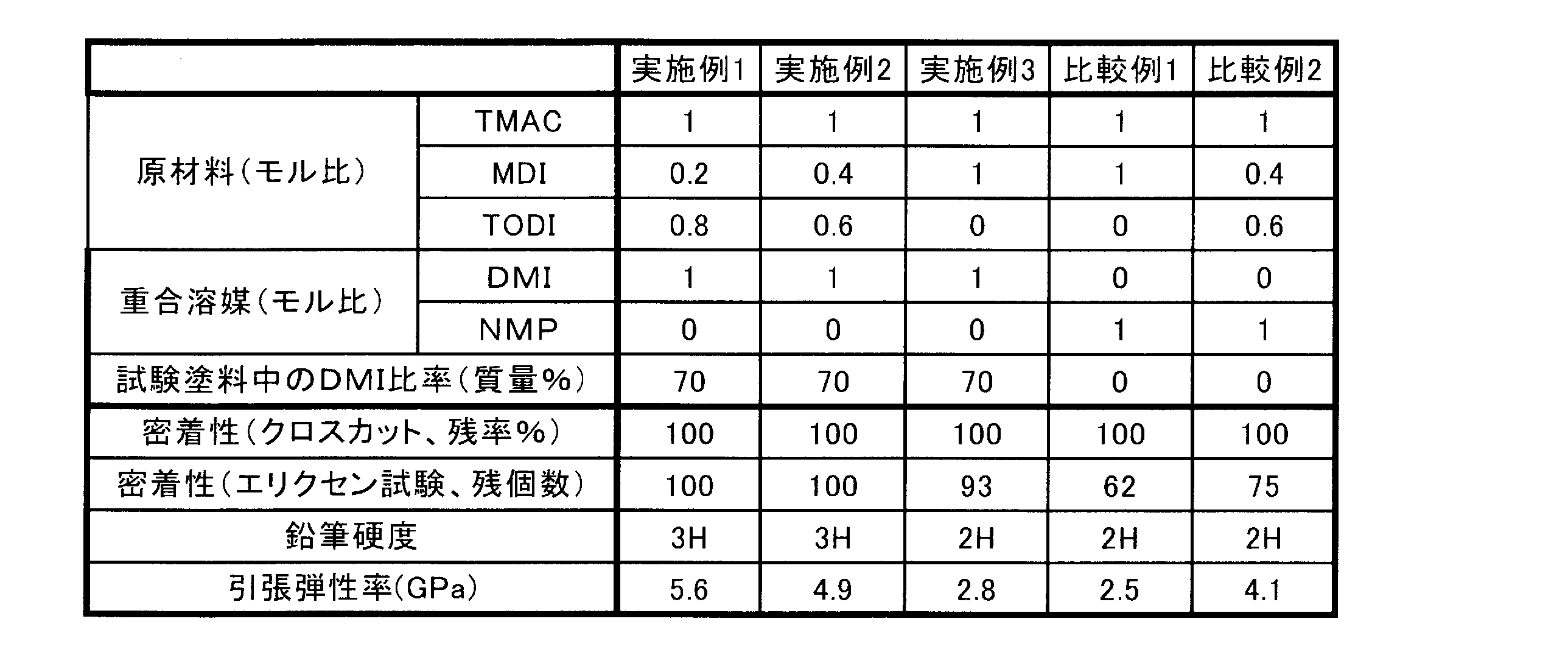
比較例に対し、実施例の試験塗料からは、密着性に優れ、高硬度且つ高弾性の硬化膜を得ることができた。
既に述べられたもの以外に、本発明の新規かつ有利な特徴から外れることなく、上記の実施形態に様々な修正や変更を加えてもよいことに注意すべきである。したがって、そのような全ての修正や変更は、添付の請求の範囲に含まれることが意図されている。
Claims (7)
- 分子構造が左右対称であって極性を有する複素環化合物、ポリアミドイミド樹脂、及び4官能エポキシ樹脂を含み、該複素環化合物の含有量は、組成物中に40質量%以上である、ポリアミドイミド樹脂組成物。
- 極性が左右対称である複素環化合物、ポリアミドイミド樹脂、及び4官能エポキシ樹脂を含み、該複素環化合物の含有量は、組成物中に40質量%以上である、ポリアミドイミド樹脂組成物。
- 請求項1又は2記載のポリアミドイミド樹脂組成物を含有する塗料。
- 請求項1又は2記載のポリアミドイミド樹脂組成物、又は請求項3記載の塗料を用いて得られる硬化膜。
- 請求項1又は2記載のポリアミドイミド樹脂組成物、又は請求項3記載の塗料を用いて得られる、摺動部材用硬化膜。
- 請求項1又は2記載のポリアミドイミド樹脂組成物、又は請求項3記載の塗料を用いて得られる硬化膜を備える、摺動部材。
- 請求項1又は2記載のポリアミドイミド樹脂組成物、又は請求項3記載の塗料の、摺動部材の摺動面への使用。
Priority Applications (2)
| Application Number | Priority Date | Filing Date | Title |
|---|---|---|---|
| JP2018528120A JP7107838B2 (ja) | 2016-07-19 | 2016-07-19 | ポリアミドイミド樹脂組成物及び塗料 |
| PCT/JP2016/071151 WO2018015998A1 (ja) | 2016-07-19 | 2016-07-19 | ポリアミドイミド樹脂組成物及び塗料 |
Applications Claiming Priority (1)
| Application Number | Priority Date | Filing Date | Title |
|---|---|---|---|
| PCT/JP2016/071151 WO2018015998A1 (ja) | 2016-07-19 | 2016-07-19 | ポリアミドイミド樹脂組成物及び塗料 |
Publications (1)
| Publication Number | Publication Date |
|---|---|
| WO2018015998A1 true WO2018015998A1 (ja) | 2018-01-25 |
Family
ID=60992371
Family Applications (1)
| Application Number | Title | Priority Date | Filing Date |
|---|---|---|---|
| PCT/JP2016/071151 Ceased WO2018015998A1 (ja) | 2016-07-19 | 2016-07-19 | ポリアミドイミド樹脂組成物及び塗料 |
Country Status (2)
| Country | Link |
|---|---|
| JP (1) | JP7107838B2 (ja) |
| WO (1) | WO2018015998A1 (ja) |
Citations (7)
| Publication number | Priority date | Publication date | Assignee | Title |
|---|---|---|---|---|
| JPH03166260A (ja) * | 1989-11-24 | 1991-07-18 | Hitachi Chem Co Ltd | 金属板塗装用耐熱性樹脂組成物および耐熱性樹脂塗装金属板 |
| JP2008208295A (ja) * | 2007-02-28 | 2008-09-11 | Toyobo Co Ltd | 改質ポリアミドイミド樹脂、これを用いた接着剤およびプリント回路基板 |
| JP2008285660A (ja) * | 2007-04-16 | 2008-11-27 | Hitachi Chem Co Ltd | ポリアミドイミド樹脂、ポリアミドイミド樹脂組成物及び塗料組成物 |
| WO2010038644A1 (ja) * | 2008-10-01 | 2010-04-08 | 東洋紡績株式会社 | ポリアミドイミド樹脂、該樹脂組成物、難燃性接着剤組成物並びに該組成物からなる接着剤シート、カバーレイフィルム及びプリント配線板 |
| JP2013004371A (ja) * | 2011-06-17 | 2013-01-07 | Ube Ind Ltd | 電極用バインダー樹脂組成物、電極合剤ペースト、及び電極 |
| JP2013209960A (ja) * | 2012-03-30 | 2013-10-10 | Sumico Lubricant Co Ltd | 潤滑被膜形成用樹脂組成物 |
| JP2014205827A (ja) * | 2013-03-21 | 2014-10-30 | 東洋紡株式会社 | 透明ポリエステルイミド樹脂フィルム、並びにこれに用いる樹脂および樹脂組成物 |
Family Cites Families (5)
| Publication number | Priority date | Publication date | Assignee | Title |
|---|---|---|---|---|
| JP2014031420A (ja) * | 2012-08-02 | 2014-02-20 | Hitachi Chemical Co Ltd | ポリアミドイミド樹脂の合成方法、ポリアミドイミド樹脂およびポリアミドイミド樹脂組成物 |
| EP2880110B1 (en) * | 2012-08-02 | 2016-06-08 | Dow Corning Toray Co., Ltd. | Coating composition containing polyamide-imide resin |
| JP6015551B2 (ja) * | 2012-08-30 | 2016-10-26 | 東洋紡株式会社 | 潤滑塗料用ポリアミドイミド樹脂組成物 |
| CN104530947A (zh) * | 2014-12-12 | 2015-04-22 | 安庆昊业树脂材料科技有限公司 | 一种新型水性聚酰胺基聚氨酯木器涂料及其制备方法 |
| US20170349762A1 (en) * | 2014-12-15 | 2017-12-07 | Dow Corning Toray Co., Ltd. | Water-based coating agent composition, water-based lubricating film paint composition comprising same, and member |
-
2016
- 2016-07-19 WO PCT/JP2016/071151 patent/WO2018015998A1/ja not_active Ceased
- 2016-07-19 JP JP2018528120A patent/JP7107838B2/ja active Active
Patent Citations (7)
| Publication number | Priority date | Publication date | Assignee | Title |
|---|---|---|---|---|
| JPH03166260A (ja) * | 1989-11-24 | 1991-07-18 | Hitachi Chem Co Ltd | 金属板塗装用耐熱性樹脂組成物および耐熱性樹脂塗装金属板 |
| JP2008208295A (ja) * | 2007-02-28 | 2008-09-11 | Toyobo Co Ltd | 改質ポリアミドイミド樹脂、これを用いた接着剤およびプリント回路基板 |
| JP2008285660A (ja) * | 2007-04-16 | 2008-11-27 | Hitachi Chem Co Ltd | ポリアミドイミド樹脂、ポリアミドイミド樹脂組成物及び塗料組成物 |
| WO2010038644A1 (ja) * | 2008-10-01 | 2010-04-08 | 東洋紡績株式会社 | ポリアミドイミド樹脂、該樹脂組成物、難燃性接着剤組成物並びに該組成物からなる接着剤シート、カバーレイフィルム及びプリント配線板 |
| JP2013004371A (ja) * | 2011-06-17 | 2013-01-07 | Ube Ind Ltd | 電極用バインダー樹脂組成物、電極合剤ペースト、及び電極 |
| JP2013209960A (ja) * | 2012-03-30 | 2013-10-10 | Sumico Lubricant Co Ltd | 潤滑被膜形成用樹脂組成物 |
| JP2014205827A (ja) * | 2013-03-21 | 2014-10-30 | 東洋紡株式会社 | 透明ポリエステルイミド樹脂フィルム、並びにこれに用いる樹脂および樹脂組成物 |
Also Published As
| Publication number | Publication date |
|---|---|
| JP7107838B2 (ja) | 2022-07-27 |
| JPWO2018015998A1 (ja) | 2019-05-09 |
Similar Documents
| Publication | Publication Date | Title |
|---|---|---|
| JP6476764B2 (ja) | 水系耐熱性樹脂組成物及び基材 | |
| US11674039B2 (en) | Polyamideimide resin composition and flourine-based coating material | |
| JP5252370B2 (ja) | ポリアミドイミド樹脂組成物及び塗料組成物 | |
| WO2017099030A1 (ja) | ポリアミドイミド樹脂組成物及びフッ素塗料 | |
| JP2017101197A (ja) | ポリアミドイミド樹脂組成物及び塗料 | |
| JP2008133410A (ja) | ポリアミドイミド樹脂溶液とその製造方法、樹脂組成物及び塗料組成物 | |
| JP2016017084A (ja) | 耐熱性樹脂組成物及び塗料 | |
| JP7021084B2 (ja) | ポリアミドイミド樹脂組成物及び塗料 | |
| JP7107838B2 (ja) | ポリアミドイミド樹脂組成物及び塗料 | |
| JP2012153821A (ja) | ポリアミドイミド樹脂組成物及びこれを用い硬化させた硬化物、塗料、摺動用部品 | |
| JP6789499B2 (ja) | ポリアミドイミド樹脂及びその利用 | |
| JP6915433B2 (ja) | ポリアミドイミド樹脂液及びその製造方法 | |
| JP2011236385A (ja) | 耐熱性樹脂組成物及び塗料 | |
| JP6822416B2 (ja) | ポリアミドイミド樹脂及び塗料 | |
| JP5176071B2 (ja) | 耐熱性樹脂組成物及び塗料 | |
| JP2016166336A (ja) | ジヒドロフラン誘導体組成物、ポリイミド前駆体組成物およびポリイミド樹脂の製造方法 | |
| JP2012172130A (ja) | 耐熱性樹脂組成物及び塗料 | |
| WO2020230330A1 (ja) | ポリアミドイミド樹脂組成物及びポリアミドイミド樹脂の製造方法 | |
| JPWO2019026838A1 (ja) | ポリアミドイミド樹脂組成物及びフッ素塗料 | |
| US20260062560A1 (en) | Thermal spray powder coating | |
| JP2016017102A (ja) | 耐熱性樹脂組成物 | |
| JP2011012220A (ja) | 低温硬化低弾性率ポリアミドイミド樹脂、ポリアミドイミド樹脂組成物、塗料及び摺動部コーティング塗料 | |
| JP2025074996A (ja) | 電線被覆用絶縁塗料、絶縁電線、コイル及び電気・電子機器 | |
| JP2015143201A (ja) | ジヒドロピラン誘導体組成物、ポリイミド前駆体組成物およびポリイミド樹脂の製造方法 | |
| JP2003342470A (ja) | 耐熱性樹脂組成物および塗料 |
Legal Events
| Date | Code | Title | Description |
|---|---|---|---|
| WWE | Wipo information: entry into national phase |
Ref document number: 2018528120 Country of ref document: JP |
|
| 121 | Ep: the epo has been informed by wipo that ep was designated in this application |
Ref document number: 16909473 Country of ref document: EP Kind code of ref document: A1 |
|
| NENP | Non-entry into the national phase |
Ref country code: DE |
|
| 122 | Ep: pct application non-entry in european phase |
Ref document number: 16909473 Country of ref document: EP Kind code of ref document: A1 |