WO2018003389A1 - 触媒の製造方法 - Google Patents
触媒の製造方法 Download PDFInfo
- Publication number
- WO2018003389A1 WO2018003389A1 PCT/JP2017/020307 JP2017020307W WO2018003389A1 WO 2018003389 A1 WO2018003389 A1 WO 2018003389A1 JP 2017020307 W JP2017020307 W JP 2017020307W WO 2018003389 A1 WO2018003389 A1 WO 2018003389A1
- Authority
- WO
- WIPO (PCT)
- Prior art keywords
- group
- formula
- catalyst
- bond
- compound represented
- Prior art date
- Legal status (The legal status is an assumption and is not a legal conclusion. Google has not performed a legal analysis and makes no representation as to the accuracy of the status listed.)
- Ceased
Links
Classifications
-
- B—PERFORMING OPERATIONS; TRANSPORTING
- B01—PHYSICAL OR CHEMICAL PROCESSES OR APPARATUS IN GENERAL
- B01J—CHEMICAL OR PHYSICAL PROCESSES, e.g. CATALYSIS OR COLLOID CHEMISTRY; THEIR RELEVANT APPARATUS
- B01J31/00—Catalysts comprising hydrides, coordination complexes or organic compounds
- B01J31/16—Catalysts comprising hydrides, coordination complexes or organic compounds containing coordination complexes
- B01J31/1616—Coordination complexes, e.g. organometallic complexes, immobilised on an inorganic support, e.g. ship-in-a-bottle type catalysts
-
- B—PERFORMING OPERATIONS; TRANSPORTING
- B01—PHYSICAL OR CHEMICAL PROCESSES OR APPARATUS IN GENERAL
- B01J—CHEMICAL OR PHYSICAL PROCESSES, e.g. CATALYSIS OR COLLOID CHEMISTRY; THEIR RELEVANT APPARATUS
- B01J31/00—Catalysts comprising hydrides, coordination complexes or organic compounds
- B01J31/16—Catalysts comprising hydrides, coordination complexes or organic compounds containing coordination complexes
- B01J31/1616—Coordination complexes, e.g. organometallic complexes, immobilised on an inorganic support, e.g. ship-in-a-bottle type catalysts
- B01J31/1625—Coordination complexes, e.g. organometallic complexes, immobilised on an inorganic support, e.g. ship-in-a-bottle type catalysts immobilised by covalent linkages, i.e. pendant complexes with optional linking groups
- B01J31/1633—Coordination complexes, e.g. organometallic complexes, immobilised on an inorganic support, e.g. ship-in-a-bottle type catalysts immobilised by covalent linkages, i.e. pendant complexes with optional linking groups covalent linkages via silicon containing groups
-
- C—CHEMISTRY; METALLURGY
- C07—ORGANIC CHEMISTRY
- C07F—ACYCLIC, CARBOCYCLIC OR HETEROCYCLIC COMPOUNDS CONTAINING ELEMENTS OTHER THAN CARBON, HYDROGEN, HALOGEN, OXYGEN, NITROGEN, SULFUR, SELENIUM OR TELLURIUM
- C07F17/00—Metallocenes
-
- C—CHEMISTRY; METALLURGY
- C07—ORGANIC CHEMISTRY
- C07F—ACYCLIC, CARBOCYCLIC OR HETEROCYCLIC COMPOUNDS CONTAINING ELEMENTS OTHER THAN CARBON, HYDROGEN, HALOGEN, OXYGEN, NITROGEN, SULFUR, SELENIUM OR TELLURIUM
- C07F7/00—Compounds containing elements of Groups 4 or 14 of the Periodic Table
-
- C—CHEMISTRY; METALLURGY
- C07—ORGANIC CHEMISTRY
- C07F—ACYCLIC, CARBOCYCLIC OR HETEROCYCLIC COMPOUNDS CONTAINING ELEMENTS OTHER THAN CARBON, HYDROGEN, HALOGEN, OXYGEN, NITROGEN, SULFUR, SELENIUM OR TELLURIUM
- C07F7/00—Compounds containing elements of Groups 4 or 14 of the Periodic Table
- C07F7/003—Compounds containing elements of Groups 4 or 14 of the Periodic Table without C-Metal linkages
-
- C—CHEMISTRY; METALLURGY
- C07—ORGANIC CHEMISTRY
- C07F—ACYCLIC, CARBOCYCLIC OR HETEROCYCLIC COMPOUNDS CONTAINING ELEMENTS OTHER THAN CARBON, HYDROGEN, HALOGEN, OXYGEN, NITROGEN, SULFUR, SELENIUM OR TELLURIUM
- C07F7/00—Compounds containing elements of Groups 4 or 14 of the Periodic Table
- C07F7/28—Titanium compounds
-
- C—CHEMISTRY; METALLURGY
- C08—ORGANIC MACROMOLECULAR COMPOUNDS; THEIR PREPARATION OR CHEMICAL WORKING-UP; COMPOSITIONS BASED THEREON
- C08F—MACROMOLECULAR COMPOUNDS OBTAINED BY REACTIONS ONLY INVOLVING CARBON-TO-CARBON UNSATURATED BONDS
- C08F10/00—Homopolymers and copolymers of unsaturated aliphatic hydrocarbons having only one carbon-to-carbon double bond
-
- C—CHEMISTRY; METALLURGY
- C08—ORGANIC MACROMOLECULAR COMPOUNDS; THEIR PREPARATION OR CHEMICAL WORKING-UP; COMPOSITIONS BASED THEREON
- C08F—MACROMOLECULAR COMPOUNDS OBTAINED BY REACTIONS ONLY INVOLVING CARBON-TO-CARBON UNSATURATED BONDS
- C08F210/00—Copolymers of unsaturated aliphatic hydrocarbons having only one carbon-to-carbon double bond
- C08F210/16—Copolymers of ethene with alpha-alkenes, e.g. EP rubbers
-
- C—CHEMISTRY; METALLURGY
- C08—ORGANIC MACROMOLECULAR COMPOUNDS; THEIR PREPARATION OR CHEMICAL WORKING-UP; COMPOSITIONS BASED THEREON
- C08F—MACROMOLECULAR COMPOUNDS OBTAINED BY REACTIONS ONLY INVOLVING CARBON-TO-CARBON UNSATURATED BONDS
- C08F4/00—Polymerisation catalysts
- C08F4/42—Metals; Metal hydrides; Metallo-organic compounds; Use thereof as catalyst precursors
- C08F4/44—Metals; Metal hydrides; Metallo-organic compounds; Use thereof as catalyst precursors selected from light metals, zinc, cadmium, mercury, copper, silver, gold, boron, gallium, indium, thallium, rare earths or actinides
- C08F4/60—Metals; Metal hydrides; Metallo-organic compounds; Use thereof as catalyst precursors selected from light metals, zinc, cadmium, mercury, copper, silver, gold, boron, gallium, indium, thallium, rare earths or actinides together with refractory metals, iron group metals, platinum group metals, manganese, rhenium technetium or compounds thereof
- C08F4/62—Refractory metals or compounds thereof
- C08F4/64—Titanium, zirconium, hafnium or compounds thereof
- C08F4/659—Component covered by group C08F4/64 containing a transition metal-carbon bond
-
- C—CHEMISTRY; METALLURGY
- C08—ORGANIC MACROMOLECULAR COMPOUNDS; THEIR PREPARATION OR CHEMICAL WORKING-UP; COMPOSITIONS BASED THEREON
- C08F—MACROMOLECULAR COMPOUNDS OBTAINED BY REACTIONS ONLY INVOLVING CARBON-TO-CARBON UNSATURATED BONDS
- C08F4/00—Polymerisation catalysts
- C08F4/42—Metals; Metal hydrides; Metallo-organic compounds; Use thereof as catalyst precursors
- C08F4/44—Metals; Metal hydrides; Metallo-organic compounds; Use thereof as catalyst precursors selected from light metals, zinc, cadmium, mercury, copper, silver, gold, boron, gallium, indium, thallium, rare earths or actinides
- C08F4/60—Metals; Metal hydrides; Metallo-organic compounds; Use thereof as catalyst precursors selected from light metals, zinc, cadmium, mercury, copper, silver, gold, boron, gallium, indium, thallium, rare earths or actinides together with refractory metals, iron group metals, platinum group metals, manganese, rhenium technetium or compounds thereof
- C08F4/62—Refractory metals or compounds thereof
- C08F4/64—Titanium, zirconium, hafnium or compounds thereof
- C08F4/659—Component covered by group C08F4/64 containing a transition metal-carbon bond
- C08F4/65912—Component covered by group C08F4/64 containing a transition metal-carbon bond in combination with an organoaluminium compound
-
- C—CHEMISTRY; METALLURGY
- C08—ORGANIC MACROMOLECULAR COMPOUNDS; THEIR PREPARATION OR CHEMICAL WORKING-UP; COMPOSITIONS BASED THEREON
- C08F—MACROMOLECULAR COMPOUNDS OBTAINED BY REACTIONS ONLY INVOLVING CARBON-TO-CARBON UNSATURATED BONDS
- C08F4/00—Polymerisation catalysts
- C08F4/42—Metals; Metal hydrides; Metallo-organic compounds; Use thereof as catalyst precursors
- C08F4/44—Metals; Metal hydrides; Metallo-organic compounds; Use thereof as catalyst precursors selected from light metals, zinc, cadmium, mercury, copper, silver, gold, boron, gallium, indium, thallium, rare earths or actinides
- C08F4/60—Metals; Metal hydrides; Metallo-organic compounds; Use thereof as catalyst precursors selected from light metals, zinc, cadmium, mercury, copper, silver, gold, boron, gallium, indium, thallium, rare earths or actinides together with refractory metals, iron group metals, platinum group metals, manganese, rhenium technetium or compounds thereof
- C08F4/62—Refractory metals or compounds thereof
- C08F4/64—Titanium, zirconium, hafnium or compounds thereof
- C08F4/659—Component covered by group C08F4/64 containing a transition metal-carbon bond
- C08F4/6592—Component covered by group C08F4/64 containing a transition metal-carbon bond containing at least one cyclopentadienyl ring, condensed or not, e.g. an indenyl or a fluorenyl ring
-
- B—PERFORMING OPERATIONS; TRANSPORTING
- B01—PHYSICAL OR CHEMICAL PROCESSES OR APPARATUS IN GENERAL
- B01J—CHEMICAL OR PHYSICAL PROCESSES, e.g. CATALYSIS OR COLLOID CHEMISTRY; THEIR RELEVANT APPARATUS
- B01J2531/00—Additional information regarding catalytic systems classified in B01J31/00
- B01J2531/02—Compositional aspects of complexes used, e.g. polynuclearity
- B01J2531/0202—Polynuclearity
- B01J2531/0205—Bi- or polynuclear complexes, i.e. comprising two or more metal coordination centres, without metal-metal bonds, e.g. Cp(Lx)Zr-imidazole-Zr(Lx)Cp
-
- B—PERFORMING OPERATIONS; TRANSPORTING
- B01—PHYSICAL OR CHEMICAL PROCESSES OR APPARATUS IN GENERAL
- B01J—CHEMICAL OR PHYSICAL PROCESSES, e.g. CATALYSIS OR COLLOID CHEMISTRY; THEIR RELEVANT APPARATUS
- B01J2531/00—Additional information regarding catalytic systems classified in B01J31/00
- B01J2531/40—Complexes comprising metals of Group IV (IVA or IVB) as the central metal
- B01J2531/46—Titanium
-
- B—PERFORMING OPERATIONS; TRANSPORTING
- B01—PHYSICAL OR CHEMICAL PROCESSES OR APPARATUS IN GENERAL
- B01J—CHEMICAL OR PHYSICAL PROCESSES, e.g. CATALYSIS OR COLLOID CHEMISTRY; THEIR RELEVANT APPARATUS
- B01J2531/00—Additional information regarding catalytic systems classified in B01J31/00
- B01J2531/40—Complexes comprising metals of Group IV (IVA or IVB) as the central metal
- B01J2531/48—Zirconium
-
- B—PERFORMING OPERATIONS; TRANSPORTING
- B01—PHYSICAL OR CHEMICAL PROCESSES OR APPARATUS IN GENERAL
- B01J—CHEMICAL OR PHYSICAL PROCESSES, e.g. CATALYSIS OR COLLOID CHEMISTRY; THEIR RELEVANT APPARATUS
- B01J2531/00—Additional information regarding catalytic systems classified in B01J31/00
- B01J2531/40—Complexes comprising metals of Group IV (IVA or IVB) as the central metal
- B01J2531/49—Hafnium
-
- C—CHEMISTRY; METALLURGY
- C07—ORGANIC CHEMISTRY
- C07F—ACYCLIC, CARBOCYCLIC OR HETEROCYCLIC COMPOUNDS CONTAINING ELEMENTS OTHER THAN CARBON, HYDROGEN, HALOGEN, OXYGEN, NITROGEN, SULFUR, SELENIUM OR TELLURIUM
- C07F19/00—Metal compounds according to more than one of main groups C07F1/00 - C07F17/00
-
- C—CHEMISTRY; METALLURGY
- C08—ORGANIC MACROMOLECULAR COMPOUNDS; THEIR PREPARATION OR CHEMICAL WORKING-UP; COMPOSITIONS BASED THEREON
- C08F—MACROMOLECULAR COMPOUNDS OBTAINED BY REACTIONS ONLY INVOLVING CARBON-TO-CARBON UNSATURATED BONDS
- C08F2500/00—Characteristics or properties of obtained polyolefins; Use thereof
- C08F2500/03—Narrow molecular weight distribution, i.e. Mw/Mn < 3
Definitions
- the present invention relates to a method for producing a catalyst.
- a catalyst having the following structure is known as a catalyst that favorably promotes the copolymerization of ⁇ -olefin-norbornene (see Non-Patent Document 1).
- Non-Patent Document 1 includes a plurality of complexes having different hapto numbers and different coordination forms of Ti and fluorene ligand depending on the equilibrium, as shown below. Can be included.
- the hapto number ranges from 1 to 5.
- an equilibrium is shown between a complex having a hapto number of 5 ( ⁇ 5 ), a complex having a hapto number of 3 ( ⁇ 3 ), and a complex having a hapto number of 1 ( ⁇ 1 ).
- the metallocene catalyst When the sigma ligand of the central metal atom is an alkyl or aryl group, the metallocene catalyst usually has the following steps: 1) Production of a metallocene dihalide (usually metallocene dichloride) by reacting a suitable ligand with MX 4 [X is halogen, usually TiCl 4 or ZrCl 4 ], 2) Corresponding to the metallocene dihalide obtained in step 1) by substituting the halogen bonded to the metal atom with the desired alkyl or aryl group with an alkylating agent (eg alkyllithium, dialkylmagnesium or the corresponding Grignard reagent). Conversion to dialkyl or diaryl complexes (See Patent Document 1).
- a metallocene dihalide usually metallocene dichloride
- MX is halogen, usually TiCl 4 or ZrCl 4
- an alkylating agent eg alkyllithium, dialkylmagnesium or
- Non-Patent Document 1 When the catalyst having the above structure described in Non-Patent Document 1 is produced according to the method of Patent Document 1, a methylated alkali metal compound such as methyllithium or methylmagnesium with respect to a ligand having the following structure (ligand): After reacting at least 4 molar equivalents of a Grignard reagent having a methyl group such as bromide, the product of such a reaction is subsequently reacted with a metal compound such as TiCl 4 .
- Patent Document 1 describes a general formula including a ligand having the following structure.
- Patent Document 1 4 molar equivalent which is the lower limit of the amount of methyllithium or methylmagnesium bromide used is the minimum stoichiometrically required when a catalyst having the above structure is produced using a ligand having the following structure. Is the amount. Moreover, in patent document 1, manufacture of a catalyst is implemented by operation in one pot.
- Patent Document 1 is certainly a method that can produce a metallocene catalyst in a high yield.
- the method described in Patent Document 1 does not necessarily have a good yield and high purity.
- the catalyst cannot be produced.
- Non-Patent Document 2 discloses a method for producing a catalyst having the structure described in Non-Patent Document 1 by reacting 5.3 molar equivalents of methyllithium with a ligand and then reacting TiCl 4. Are listed.
- the specific method described in Non-Patent Document 2 is included in the method described in Patent Document 1.
- the present invention has been made in view of the above problems, and uses a ligand having a specific structure containing a fluorene skeleton to produce a catalyst that is a metallocene compound with high purity and high yield. It aims to provide a method.
- the inventors of the present invention have a specific amount and a specific structure of an organolithium compound reacted with a specific structure of a ligand containing a fluorene skeleton, respectively.
- R 1 , R 2 , R 3 and R 4 are each independently a hydrocarbon group having 1 to 20 carbon atoms which may contain a hetero atom, and R 1 and R 2 is bonded to a silicon atom by a C—Si bond, an O—Si bond, a Si—Si bond, or an N—Si bond, respectively, and R 3 is a CN bond, an OH bond, a Si—N bond, or Bonded to a nitrogen atom by an NN bond, R 4 is bonded to a metal atom M by a CM bond, and R 5 and R 6 each independently has 1 to 20 of the organic substituent or an inorganic substituent, m and n are each independently an integer of 0 to 4, R 5 and R 6 are a plurality each of the plurality of R 5 and R 6 are different May be a group, two of a plurality of R 5 , or 2 of a plurality of R 6 When two groups are bonded to adjacent positions
- step (I) Reacting with a compound represented by:
- step (I) when R 4 and R 7 are the same, the amount of the organolithium compound used is 2.0 molar equivalents or more with respect to the ligand,
- step (I) when R 4 and R 7 are not the same, the amount of the organolithium compound used is 1.8 to 2.2 molar equivalents relative to the ligand,
- step (II) a compound selected from the group consisting of the compound represented by formula (1c), the compound represented by formula (1d), and the compound represented by (1e) is included in these compounds.
- the method for producing a catalyst, wherein the number of moles of the group R 4 to be used is used in such an amount that it is at least twice the number of moles of the ligand.
- the ligand is represented by the following formula (1a-1):
- the method for producing a catalyst according to (1) which is a compound represented by the formula:
- step (II) The method for producing a catalyst according to (1) or (2), wherein in step (II), the product obtained in step (I) is reacted with the compound represented by formula (1c).
- Step (I) which is a step of reacting a ligand represented by the formula (1a) and an organolithium compound represented by the formula (1b), respectively
- Step (II) which is a step of reacting the product obtained in Step (I) with one or more selected from the group consisting of Mg compound, Zn compound, and Al compound each having a predetermined structure
- Step (III) which is a step of reacting the product obtained in Step (II) with a metal compound represented by Formula (1f) described later in an amount of 1 molar equivalent or more with respect to the ligand.
- the compound obtained by making two types of organometallic compounds used by process (I) and process (II) act on a ligand is made into metal halide etc. in process (III).
- a side reaction is suppressed, As a result, a highly purified catalyst can be obtained with a high yield.
- the catalyst, step (I), step (II), step (III), and other steps will be described.
- R 1 , R 2 , R 3 and R 4 are each independently a hydrocarbon group having 1 to 20 carbon atoms which may contain a hetero atom.
- R 1 and R 2 are each bonded to a silicon atom by a C—Si bond, an O—Si bond, a Si—Si bond, or an N—Si bond.
- R 3 is bonded to the nitrogen atom by a C—N bond, an O—N bond, a Si—N bond, or an NN bond.
- R 4 is bonded to the metal atom M by a CM bond.
- R 5 and R 6 are each independently an organic or inorganic substituent having 1 to 20 carbon atoms which may contain a hetero atom, and m and n are each independently an integer of 0 to 4 It is.
- R 5 and R 6 are a plurality each of the plurality of R 5 and R 6 may be different groups.
- M is Ti, Zr, or Hf.
- the metal atom M in the formula (1) can take any coordination form with a ligand having a fluorene skeleton in the range of 1 to 5 hapto atoms.
- R 1 , R 2 , R 3 and R 4 are each independently a hydrocarbon group having 1 to 20 carbon atoms which may contain a hetero atom.
- a hydrocarbon group contains a hetero atom
- the kind of hetero atom is not specifically limited in the range which does not inhibit the objective of this invention.
- Specific examples of the hetero atom include an oxygen atom, a nitrogen atom, a sulfur atom, a phosphorus atom, a silicon atom, a selenium atom, and a halogen atom.
- the number of hetero atoms is not particularly limited.
- the total of the number of carbon atoms and the number of hetero atoms is preferably 30 or less, more preferably 25 or less, and particularly preferably 20 or less.
- the number of hetero atoms is preferably 10 or less, more preferably 5 or less, and particularly preferably 3 or less.
- Examples of the bond containing a hetero atom that the hydrocarbon group may contain include —O—, —C ( ⁇ O) —, —C ( ⁇ O) —O—, —C ( ⁇ O) —O—.
- R 1 and R 2 are each bonded to a silicon atom by a C—Si bond, an O—Si bond, a Si—Si bond, or an N—Si bond.
- Preferable examples of R 1 and R 2 bonded to the silicon atom by an O—Si bond include a group represented by —OR and —O—C ( ⁇ O) —R.
- Preferred examples of R 1 and R 2 bonded to a silicon atom by a Si—Si bond include —SiR 3 , —Si (OR) R 2 , —Si (OR) 2 R, and —Si (OR) 3 .
- Preferable examples of R 1 and R 2 bonded to a silicon atom by an N—Si bond include a group represented by —NHR and —NR 2 .
- each of the above R is a hydrocarbon group.
- R 3 is bonded to the nitrogen atom by a CN bond, an ON bond, an Si—N bond, or an NN bond.
- Preferable examples of R 3 bonded to a nitrogen atom by an O—N bond include a group represented by —OR and —O—C ( ⁇ O) —R.
- Preferable examples of R 3 bonded to a nitrogen atom by a Si—N bond are represented by —SiR 3 , —Si (OR) R 2 , —Si (OR) 2 R, and —Si (OR) 3. Groups.
- Preferable examples of R 3 bonded to a nitrogen atom by an NN bond include groups represented by —NHR and —NR 2 .
- each of the above R is a hydrocarbon group.
- R 1 and R 2 are preferably the same group because preparation and availability of the compound used as the ligand are easy.
- a hydrocarbon group that does not contain a hetero atom is preferable because of excellent chemical stability.
- the hydrocarbon group include a linear or branched alkyl group, a linear or branched unsaturated aliphatic hydrocarbon group which may have a double bond and / or a triple bond, and cycloalkyl.
- Group, cycloalkylalkyl group, aromatic hydrocarbon group, and aralkyl group are preferred.
- linear or branched alkyl group examples include methyl group, ethyl group, n-propyl group, isopropyl group, n-butyl group, isobutyl group, sec-butyl group, tert-butyl group, n- Pentyl group, isopentyl group, tert-pentyl group, n-hexyl group, n-heptyl group, n-octyl group, 2-ethylhexyl group, n-nonyl group, n-decyl group, n-undecyl group, n-dodecyl group N-tridecyl group, n-tetradecyl group, n-pentadecyl group, n-hexadecyl group, n-heptadecyl group, n-octadecyl group, n-nonadecyl group,
- linear or branched unsaturated aliphatic hydrocarbon group which may have a double bond and / or a triple bond
- examples of the linear or branched alkyl group include specific examples of the linear or branched alkyl group.
- one or more single bonds are replaced with double bonds and / or triple bonds.
- More preferred are vinyl group, allyl group, 1-propenyl group, 3-butenyl group, 2-butenyl group, 1-butenyl group, ethenyl group, and propargyl group.
- cycloalkyl group examples include cyclopropyl group, cyclobutyl group, cyclopentyl group, cyclohexyl group, cycloheptyl group, cyclooctyl group, cyclononyl group, cyclodecyl group, cycloundecyl group, cyclododecyl group, cyclotridecyl group, Examples include a cyclotetradecyl group, a cyclopentadecyl group, a cyclohexadecyl group, a cycloheptadecyl group, a cyclooctadecyl group, a cyclononadecyl group, and a cycloicosyl group.
- cycloalkylalkyl group examples include a cyclopropylmethyl group, a cyclobutylmethyl group, a cyclopentylmethyl group, a cyclohexylmethyl group, a cycloheptylmethyl group, a cyclooctylmethyl group, a cyclononylmethyl group, a cyclodecylmethyl group, a cyclounone group.
- Decylmethyl group cyclododecylmethyl group, cyclotridecylmethyl group, cyclotetradecylmethyl group, cyclopentadecylmethyl group, cyclohexadecylmethyl group, cycloheptadecylmethyl group, cyclooctadecylmethyl group, cyclononadecylmethyl group, 2-cyclopropylethyl group, 2-cyclobutylethyl group, 2-cyclopentylethyl group, 2-cyclohexylethyl group, 2-cycloheptylethyl group, 2-cyclooctylethyl group, 2-cyclononylethyl group, 2 Cyclodecylethyl group, 2-cycloundecylethyl group, 2-cyclododecylethyl group, 2-cyclotridecylethyl group, 2-cyclotetradecylethyl group, 2-cyclopen
- aromatic hydrocarbon group examples include phenyl group, o-tolyl group, m-tolyl group, p-tolyl group, 2,3-dimethylphenyl group, 2,4-dimethylphenyl group, 2,5-dimethyl group.
- aralkyl group examples include benzyl group, phenethyl group, 1-phenylethyl group, 3-phenylpropyl group, 2-phenylpropyl group, 1-phenylpropyl group, 2-phenyl-1-methylethyl group, 1- Phenyl-1-methylethyl group (cumyl group), 4-phenylbutyl group, 3-phenylbutyl group, 2-phenylbutyl group, 1-phenylbutyl group, 3-phenyl-2-methylpropyl group, 3-phenyl- 1-methylpropyl group, 2-phenyl-1-methylpropyl group, 2-methyl-1-phenylpropyl group, 2-phenyl-1,1-dimethylethyl group, 2-phenyl-2,2, -dimethylethyl group ⁇ -naphthylmethyl group, ⁇ -naphthylmethyl group, 2- ⁇ -naphthylethyl group, 2- ⁇ -
- R 1 and R 2 are preferably an alkyl group having 1 to 20 carbon atoms and an aromatic hydrocarbon group having 6 to 20 carbon atoms, and an alkyl group having 1 to 10 carbon atoms.
- an aromatic hydrocarbon group having 6 to 10 carbon atoms is more preferable, an alkyl group having 1 to 6 carbon atoms and a phenyl group are more preferable, and an alkyl group having 1 to 4 carbon atoms is particularly preferable.
- R 3 includes an alkyl group having 1 to 20 carbon atoms, a cycloalkyl group having 3 to 20 carbon atoms, an aromatic hydrocarbon group having 6 to 20 carbon atoms, and an aralkyl group having 7 to 20 carbon atoms. preferable.
- R 4 includes an alkyl group having 1 to 20 carbon atoms, an alkenyl group having 2 to 20 carbon atoms, a cycloalkyl group having 3 to 20 carbon atoms, an aromatic hydrocarbon group having 6 to 20 carbon atoms, and Aralkyl groups having 7 to 20 carbon atoms are preferred.
- R 5 and R 6 are each independently an organic or inorganic substituent having 1 to 20 carbon atoms which may contain a hetero atom, and m and n are each independently Is an integer from 0 to 4.
- R 5 and R 6 are a plurality each of the plurality of R 5 and R 6 may be different groups.
- the organic substituent is not particularly limited as long as it is an organic group that is conventionally known to be substituted on the aromatic ring and does not inhibit the catalyst formation reaction represented by the above formula (1).
- Examples of such an organic group include a group having 1 to 20 carbon atoms which may contain a heteroatom, and which does not inhibit the reaction for producing the catalyst represented by the above formula (1).
- the type of heteroatom is not particularly limited as long as the object of the present invention is not impaired.
- the hetero atom include an oxygen atom, a nitrogen atom, a sulfur atom, a phosphorus atom, a silicon atom, a selenium atom, and a halogen atom.
- the number of hetero atoms is not particularly limited.
- the total of the number of carbon atoms and the number of hetero atoms is preferably 30 or less, more preferably 25 or less, and particularly preferably 20 or less.
- the number of hetero atoms is preferably 10 or less, more preferably 5 or less, and particularly preferably 3 or less. Examples of the bond containing a hetero atom that may be contained in the hydrocarbon group include the bonds described for R 1 to R 4 .
- Examples of the organic substituent include an alkyl group having 1 to 20 carbon atoms, an alkoxy group having 1 to 20 carbon atoms, a cycloalkyl group having 3 to 20 carbon atoms, and an aliphatic acyl group having 2 to 20 carbon atoms.
- alkyl groups having 1 to 6 carbon atoms alkoxy groups having 1 to 6 carbon atoms, cycloalkyl groups having 3 to 8 carbon atoms, and aliphatic acyls having 2 to 6 carbon atoms.
- alkyl groups having 1 to 6 carbon atoms alkoxy groups having 1 to 6 carbon atoms, cycloalkyl groups having 3 to 8 carbon atoms, and aliphatic acyls having 2 to 6 carbon atoms.
- benzoyl group, phenyl group, benzyl group, and phenethyl group are preferred.
- An isopropyloxy group, an n-butyloxy group, an isobutyloxy group, a sec-butyloxy group, a tert-butyloxy group, an acetyl group, a propionyl group, a butanoyl group, and a phenyl group are more preferable.
- the inorganic substituent is not particularly limited as long as it is an inorganic group that is conventionally known to be substituted on the aromatic ring and does not inhibit the catalyst formation reaction represented by the above formula (1).
- Specific examples of the inorganic group include a halogen atom, a nitro group, and a cyano group.
- Such a ring is a condensed ring that is condensed with an aromatic ring contained in the fluorene skeleton in the formula (1).
- the condensed ring may be an aromatic ring, an aliphatic ring or an aliphatic ring.
- the condensed ring may have a hetero atom such as an oxygen atom, a nitrogen atom, and a sulfur atom in the ring.
- fluorene skeleton having a condensed ring formed by two R 5 and / or two R 6 include the following skeleton.
- M is Ti, Zr, or Hf, and Ti is preferable.
- catalysts having the following structure are preferable examples of the catalyst represented by the formula (1) described above.
- the structure of the ligand represented by the formula (1a) is appropriately selected according to the structure of the catalyst to be produced.
- the ligand represented by the following formula (1a-1) is preferable from the viewpoint of good reactivity, easy synthesis and availability, and low cost. .
- the group R 4 of the Mg compound, Zn compound, or Al compound represented by the formula (1c), the formula (1d), or the formula (1e) used in the step (II) described later is formed.
- the lithium compound represented by the formula (1b) of 2.0 molar equivalents or more is reacted with the ligand represented by the formula (1a).
- the group R 4 of the Mg compound, Zn compound, or Al compound represented by the formula (1c), formula (1d), or formula (1e) used in the step (II) described later is an organolithium compound.
- the group R 4 of the Mg compound, Zn compound, or Al compound represented by the formula (1c), formula (1d), or formula (1e) used in the step (II) described later is an organolithium compound.
- the lower limit of the amount of the compound represented by formula (1b) in step (I) is preferably 2 molar equivalents, for example.
- the group R 4 of the Mg compound, Zn compound, or Al compound represented by the formula (1c), formula (1d), or formula (1e) used in the step (II) described later is an organolithium compound.
- the amount of the compound represented by formula (1b) used in step (I) is more preferably 1.9 molar equivalents or more and 2.1 molar equivalents or less.
- R 7 is the same as R 1 , R 2 , R 3 , and R 4 described above. However, R 7 is bonded to a lithium atom by a C—Li bond.
- R 7 includes an alkyl group having 1 to 20 carbon atoms, a trialkylsilylalkyl group having 4 to 20 carbon atoms, an alkenyl group having 2 to 20 carbon atoms, a cycloalkyl group having 3 to 20 carbon atoms, carbon An aromatic hydrocarbon group having 6 to 20 atoms and an aralkyl group having 7 to 20 carbon atoms are preferable.
- organic lithium compound represented by the formula (1b) examples include methyl lithium, ethyl lithium, n-propyl lithium, isopropyl lithium, n-butyl lithium, isobutyl lithium, sec-butyl lithium, and tert-butyl lithium.
- a solvent is usually used.
- the kind of solvent is not particularly limited as long as the object of the present invention is not impaired.
- an aprotic solvent is used.
- the type of aprotic solvent is not particularly limited as long as the object of the present invention is not impaired.
- the aprotic solvent may be a polar solvent or a nonpolar solvent.
- Preferred aprotic solvents include ether solvents and hydrocarbon solvents.
- Suitable aprotic solvents include ether solvents such as diethyl ether, di-n-propyl ether, diisopropyl ether, di-n-butyl ether, tetrahydrofuran, and dioxane, pentane, hexane, heptane, and octane. And aliphatic hydrocarbon solvents such as benzene, toluene, and xylene. Particularly preferably, an aprotic solvent containing diethyl ether is used.
- Diethyl ether may be used in combination with an ether solvent other than diethyl ether, may be used in combination with an aliphatic hydrocarbon solvent, or may be used in combination with an aromatic hydrocarbon solvent. It is also preferable to use an aprotic solvent other than diethyl ether as long as the desired reaction proceeds satisfactorily.
- the solvent may be a mixed solvent.
- the mixed solvent is a combination of an ether solvent other than diethyl ether and an aliphatic hydrocarbon solvent, a combination of an ether solvent other than diethyl ether and an aromatic hydrocarbon solvent, and an aliphatic hydrocarbon solvent and an aromatic solvent. Any combination with a hydrocarbon solvent may be used.
- the amount of solvent used is not particularly limited as long as the object of the present invention is not impaired.
- the amount of the solvent used is typically preferably such that the molar concentration of the ligand is 0.001 to 2 mol / L, more preferably 0.01 to 1 mol / L, and more preferably 0.05 to An amount of 0.5 mol / L is particularly preferred.
- the temperature at which the ligand represented by the formula (1a) and the organolithium compound represented by the formula (1b) are reacted is not particularly limited as long as the object of the present invention is not impaired. Typically, ⁇ 78 to 60 ° C. is preferable, 0 to 50 ° C. is more preferable, and 10 to 40 ° C. is particularly preferable.
- the reaction temperature may exceed the boiling point of the solvent. When the reaction temperature exceeds the boiling point of the solvent, the reaction may be carried out using a pressure-resistant container that can be sealed.
- the atmosphere at the time of making the ligand represented by Formula (1a) and the organolithium compound represented by Formula (1b) react is not specifically limited.
- An inert gas atmosphere is preferable because side reactions are easily suppressed.
- Examples of the inert gas include nitrogen and argon.
- step (I) the time for reacting the ligand represented by the formula (1a) with the organolithium compound represented by the formula (1b) is not particularly limited.
- the reaction time in the step (I) varies depending on the amount of the organic lithium compound represented by the formula (1b), the amount of the solvent used, the reaction temperature, and the like.
- the reaction time is typically 1 to 24 hours, preferably 2 to 4 hours.
- step (II) The reaction product of the ligand represented by formula (1a) and the organolithium compound represented by formula (1b) obtained by the method described above is subjected to step (II).
- a reaction product is provided to process (II) as a reaction liquid of process (I).
- the reaction solution may be concentrated or diluted as necessary before being subjected to step (II).
- step (I) and step (II) are the same container without transferring the reaction solution of step (I) to another reaction vessel. It may be done within.
- the reagent solution required in the step (II) is charged into a container different from the container used in the step (I), and the reaction solution in the step (I) is added to the other container, so that the step (II) You may perform reaction of.
- step (II) the product obtained in step (I) is converted to a compound represented by the following formula (1c), a compound represented by the following formula (1d), and a compound represented by the following (1e): (R 4 ) p MgX (2-p) (1c) (R 4 ) q ZnX (2-q) (1d) (R 4 ) r AlX (3-r) (1e) (In the formulas (1c), (1d), and (1e), R 4 is as described above, X is a halogen atom, p is 1 or 2, q is 1 or 2, and r is 1 It is an integer of ⁇ 3.) Reaction with one or more selected from the group consisting of
- the amount used is such that the number of moles of the group R 4 contained in the compound is at least twice the number of moles of the ligand.
- the amount of the Mg compound, Zn compound and Al compound used is preferably such that the number of moles of the group R 4 contained in these compounds is at least twice the number of moles of the ligand, 2.2 times.
- the amount which is above is more preferable, and the amount which is 2.5 times or more is particularly preferable.
- the amount of the Mg compound, Zn compound, and Al compound used is preferably such that the number of moles of the group R 4 contained in these compounds is not more than 4.5 times the number of moles of the ligand.
- the amount which is below is more preferable, and the amount which is 3.5 times or less is particularly preferable.
- the synthesis and acquisition are easy, and the desired reaction Is preferable, the Mg compound represented by the formula (1c) is preferable.
- R 4 represents an alkyl group having 1 to 20 carbon atoms, 2 to A alkenyl group having 20 carbon atoms, a cycloalkyl group having 3 to 20 carbon atoms, an aromatic hydrocarbon group having 6 to 20 carbon atoms, and an aralkyl group having 7 to 20 carbon atoms are preferable.
- Mg compound represented by the formula (1c) examples include methyl magnesium bromide, ethyl magnesium bromide, isopropyl magnesium bromide, n-butyl magnesium bromide, isobutyl magnesium bromide, sec-butyl magnesium bromide, tert-butyl magnesium.
- Zn compound represented by the formula (1d) examples include methyl zinc bromide, ethyl zinc bromide, isopropyl zinc bromide, n-butyl zinc bromide, isobutyl zinc bromide, sec-butyl zinc bromide, tert-butyl zinc.
- Al compound represented by the formula (1e) include methyl aluminum dibromide, ethyl aluminum dibromide, isopropyl aluminum dibromide, n-butyl aluminum dibromide, isobutyl aluminum dibromide, sec-butyl aluminum di Bromide, tert-butylaluminum dibromide, n-pentylaluminum dibromide, n-hexylaluminum dibromide, trimethylsilylmethylaluminum dibromide, phenylaluminum dibromide, p-tolylaluminum dibromide, m-tolylaluminum dibromide, o- Triryl aluminum dibromide, benzyl aluminum dibromide, vinyl aluminum dibromide, allyl aluminum dib Mido, methyl aluminum dichloride, ethyl aluminum dichloride, isopropyl aluminum dichloride, n-butyl aluminum dichloride
- step (II) the preferred solvent type and the preferred range of the amount used are the same as in step (I).
- the reaction temperature in the step (II) is not particularly limited as long as the object of the present invention is not impaired. Typically, 60 ° C. or lower is preferable.
- the reaction temperature may exceed the boiling point of the solvent. When the reaction temperature exceeds the boiling point of the solvent, the reaction may be carried out using a pressure-resistant container that can be sealed.
- the atmosphere for carrying out the reaction is not particularly limited.
- An inert gas atmosphere is preferable because side reactions are easily suppressed.
- the inert gas include nitrogen and argon.
- the reaction time in the step (II) is not particularly limited as long as the catalyst can be produced with a desired purity and yield.
- the reaction time in step (II) is not particularly limited as long as the object of the present invention is not impaired.
- the reaction time varies depending on the amount of Mg compound, Zn compound, and Al compound used, the amount of solvent used, the reaction temperature, and the like.
- the reaction time is typically a short time such as 15 minutes or less or 20 minutes or less.
- the reaction time in step (II) may be a long time. It is preferably 24 hours or less from the viewpoint of production efficiency.
- step (III) The reaction product of step (II) obtained by the method described above is subjected to step (III).
- a reaction product is provided to process (III) as a reaction liquid of process (II).
- the reaction solution may be concentrated or diluted as necessary before being subjected to step (III).
- the step (II) and step (III) are carried out in the same container without transferring the reaction solution of step (II) to another reaction vessel. It may be done within.
- the reagent solution required in the step (III) is charged into a container different from the container used in the step (II), and the reaction solution in the step (II) is added to the other container, so that the step (III) You may perform reaction of.
- the product obtained in the step (II) is represented by the following formula (1f) of 1 molar equivalent or more with respect to the above-mentioned ligand: MR 8 4 (1f)
- M is as described above
- R 8 is a halogen atom or a group represented by —OR 9
- R 9 is the number of carbon atoms that may have a hetero atom. 1 to 20 hydrocarbon groups, and R 9 is bonded to an oxygen atom by a C—O bond.) It is made to react with the compound represented by these.
- step (III) the intermediate represented by the formula (1g) contained in the product of step (II) and the Mg compound represented by formula (1c) contained in the reaction solution of step (II)
- a compound selected from the group consisting of a Zn compound represented by formula (1d) and an Al compound represented by (1e) reacts with a compound represented by formula (1f) above, ) Is produced.
- R 8 in the compound represented by the formula (1f) is a halogen atom
- the halogen atom is not particularly limited as long as a desired reaction proceeds.
- a halogen atom a chlorine atom or a bromine atom is preferable.
- R 9 is a hydrocarbon group having 1 to 20 carbon atoms which may have a hetero atom, and is bonded to an oxygen atom through a C—O bond.
- the hydrocarbon group having 1 to 20 carbon atoms which may have a heteroatom is bonded to an oxygen atom by a C—O bond. It is.
- R 9 is preferably a hydrocarbon group containing no hetero atom, and is preferably an alkyl group, an aralkyl group, or an aromatic hydrocarbon group.
- Preferred examples of —OR 9 include methoxy group, ethoxy group, n-propyloxy group, isopropyloxy group, n-butyloxy group, isobutyloxy group, sec-butyloxy group, tert-butyloxy group, phenoxy group, and benzyl. An oxy group is mentioned.
- TiCl 4, ZrCl 4, HfCl 4, TiBr 4, ZrBr 4, and HfBr 4 is preferred from such that reactivity is good, TiCl 4, ZrCl 4, HfCl 4 is more preferable, and TiCl 4 is particularly preferable.
- the compound represented by the formula (1f) is used in an amount of 1 molar equivalent or more based on the amount of the ligand used in the step (I). By using the compound represented by the formula (1f) in such an amount, side reactions are suppressed, and as a result, the purity and yield of the catalyst finally obtained are good.
- the compound represented by the formula (1f) may be used as it is, or may be used in a state suspended or dissolved in a solvent.
- the compound represented by the formula (1f) is preferably used as a solution from the viewpoint of easily suppressing the side reaction in the step (III).
- the kind of solvent in which formula (1f) is dissolved is not particularly limited. As the solvent, an aprotic solvent is preferable.
- the solvent demonstrated about process (I) can be used preferably.
- the upper limit of the amount of the compound represented by formula (1f) is not particularly limited as long as the object of the present invention is not impaired.
- the upper limit of the amount of the compound represented by formula (1f) is preferably 1.5 molar equivalents, more preferably 1.25 molar equivalents, and particularly preferably 1 molar equivalent.
- the catalyst can be produced even when the compound represented by the formula (1f) is used in an amount exceeding 1.5 molar equivalents. However, the effect of improving the yield and / or purity of the catalyst corresponding to the increase in cost is not achieved, and the purification of the catalyst may be somewhat difficult, and the compound represented by the formula (1f) is 1. There is no particular need to use more than 5 molar equivalents.
- step (III) the type of solvent and the preferred range of the amount used are the same as those in the step (I).
- the temperature is not particularly limited as long as the object of the present invention is not impaired. Typically, ⁇ 78 to 60 ° C. is preferable.
- the reaction temperature may exceed the boiling point of the solvent. When the reaction temperature exceeds the boiling point of the solvent, the reaction may be carried out using a pressure-resistant container that can be sealed.
- the atmosphere at the time of carrying out the reaction carried out in step (III) is not particularly limited.
- the atmosphere is preferably an inert gas atmosphere because side reactions are easily suppressed.
- the inert gas include nitrogen and argon.
- the time for the reaction carried out in the step (III) is not particularly limited.
- the reaction time in step (III) is typically 1 to 24 hours. From the viewpoint of preventing decomposition of the product, the reaction time is preferably not excessively long.
- the catalyst having the structure represented by the formula (1) produced by the method including the step (I), the step (II) and the step (III) described above is purified or reacted as necessary. After being separated and recovered from the liquid, it is used as a catalyst for the polymerization reaction. Since the catalyst produced through the step (I), the step (II), and the step (III) usually contains impurities such as a salt, for example, after being purified through other steps described later, the polymerization reaction It is preferable to be used for.
- step (I), step (II), and step (III) described above the synthesized catalyst is recovered from the reaction solution of step (III) by performing other steps. Can do.
- step (III) After extracting the catalyst with an organic solvent from the residue obtained by concentrating the reaction solution in step (III), the insoluble by-product in the residue is separated from the extract containing insoluble matter by a method such as filtration, Next, a purified catalyst is obtained by precipitating the catalyst from the extract containing the catalyst. Such an operation of removing insoluble impurities may be repeated.
- the reaction liquid obtained in step (III) is concentrated to obtain crude crystals of the catalyst.
- the catalyst crystals thus obtained may be used in the polymerization reaction as they are.
- a catalyst purified to a desired purity is preferably used for the polymerization reaction.
- the method for purifying the catalyst to a desired purity is not particularly limited. Typically, recrystallization with an organic solvent is preferred.
- the recrystallization solvent a solvent that can be used in step (I) to step (III) can be used.
- the method for precipitating crystals during recrystallization is not particularly limited, and examples thereof include methods such as cooling and concentration.
- a purified catalyst is obtained by collecting the precipitated crystals by a method such as filtration or decantation.
- the yield determined by the internal standard method by NMR (based on ethylbenzene) of the catalyst obtained through the above steps is preferably 40% or more, more preferably 45% or more, based on the amount of ligand used.
- the purity of the catalyst at the end of the step (III) determined by the internal standard method by NMR (ethylbenzene standard) is preferably 90% or more, and particularly preferably 95% or more. In addition, since it is the purity defined by the internal standard method by NMR, purity may exceed 100%.
- Step (III) A two-necked flask was charged with 0.58 mL (5.29 mmol) of TiCl 4 and 50 mL of hexane.
- the reaction solution in step (II) was added dropwise to the TiCl 4 solution in the flask, and then the contents of the flask were stirred at room temperature for 15 hours. In this way, a black reaction solution containing a catalyst having the following structure was obtained.
- the yield of the obtained catalyst determined by the internal standard method by NMR (based on ethylbenzene) relative to the amount of ligand used is 70%, and the purity of the catalyst is also determined by the internal standard method by NMR (based on ethylbenzene). Was 95%.
- the NMR analysis was performed by 1 H-NMR using a Bruker spectrometer AVANCE III 400 and deuterated toluene.
- a J-YOUNG NMR sample tube was used as a measurement sample tube.
- Quantitative analysis by NMR uses ethylbenzene having a purity of 99% or more as an internal standard substance, the amount used, the peak of 2.44 ppm (triple line, 2H) of ethylbenzene, and 7.71 ppm (double line, 2H of catalyst). ) And calculating the integration ratio with the peak.
- Example 2 A solid catalyst was obtained in the same manner as in Example 1 except that methyl lithium was changed to n-butyl lithium (1.6 M hexane solution). The yield of the obtained catalyst determined by the internal standard method by NMR (based on ethylbenzene) relative to the amount of ligand used is 63%, and the purity of the catalyst is also determined by the internal standard method by NMR (based on ethylbenzene). Was 98%.
- the obtained black powder was suspended in 20 mL of toluene, and the reaction product was extracted in toluene. Insoluble components were removed from the suspension through a glass filter. For the insoluble matter removed from the suspension, the same extraction operation was further repeated three times using 20 mL of toluene. The obtained filtrate (extract) was dried under reduced pressure to obtain 1.90 g of a reaction product.
- reaction product obtained using TiCl 4 and 45 mL of toluene were added to the flask, and the reaction product was dissolved in toluene.
- 9.4 mL of methyl lithium in diethyl ether (1.12 M, methyl lithium content: 10.5 mmol (2.0 molar equivalents (to ligand)) was added to the reaction product solution, The reaction product and methyllithium were reacted at room temperature for 12 hours to form a catalyst.
- the obtained filtrate (catalyst extract) was dried under reduced pressure to obtain 933 mg of catalyst.
- the yield of the obtained catalyst determined by the internal standard method by NMR (based on ethylbenzene) relative to the amount of ligand used is 38%, and the purity of the catalyst is also determined by the internal standard method by NMR (based on ethylbenzene). Was 81%.
- the obtained black powder was suspended in 40 mL of hexane, and the reaction product was extracted into hexane. Insoluble components were removed from the suspension through a glass filter. The same extraction operation was further repeated once using 40 mL of hexane and twice using 20 mL of hexane for the insoluble matter removed from the suspension. The obtained filtrate (extract) was dried under reduced pressure to obtain a reaction product.
Landscapes
- Chemical & Material Sciences (AREA)
- Organic Chemistry (AREA)
- Chemical Kinetics & Catalysis (AREA)
- Engineering & Computer Science (AREA)
- Materials Engineering (AREA)
- Medicinal Chemistry (AREA)
- Health & Medical Sciences (AREA)
- Polymers & Plastics (AREA)
- Crystallography & Structural Chemistry (AREA)
- Inorganic Chemistry (AREA)
- Transition And Organic Metals Composition Catalysts For Addition Polymerization (AREA)
- Catalysts (AREA)
- Organic Low-Molecular-Weight Compounds And Preparation Thereof (AREA)
Abstract
フルオレン骨格を含む特定の構造の配位子を用いて、メタロセン化合物である触媒を、高純度且つ高収率で製造できる触媒の製造方法を提供すること。 フルオレン骨格を含む特定の構造の配位子に対して、特定量且つ特定の構造の有機リチウム化合物を反応させる工程(I)と、工程(I)の生成物に、それぞれ所定の構造のMg化合物、Zn化合物、及びAl化合物からなる群より選択される1種以上を反応させる工程(II)と、工程(II)の生成物に、ハロゲン原子等を有するTi化合物、Zr化合物、又はHf化合物を、配位子に対して1モル当量以上反応させる工程(II)と、を含む方法により触媒を製造する。
Description
本発明は、触媒の製造方法に関する。
従来より、種々の配位子を金属に配位させた所謂メタロセン触媒が、不飽和二重結合を有する単量体化合物の重合用の触媒として広く使用されている。具体的には、例えば、α-オレフィン-ノルボルネンの共重合を良好に進行させる触媒として、下記構造の触媒が知られている(非特許文献1を参照)。
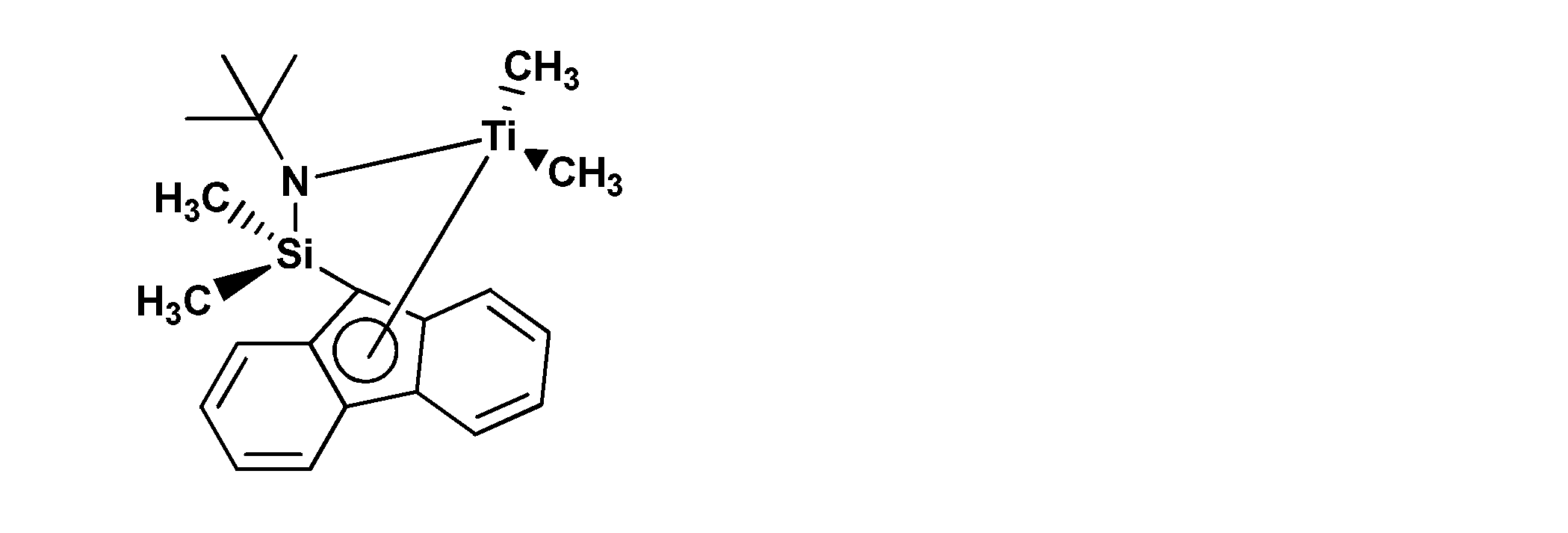
なお、非特許文献1に記載される上記構造の触媒は、以下に示されるように、平衡によって、ハプト数が互いに異なり、Tiとフルオレン配位子との配位の形態が異なる、複数の錯体を含み得る。ここで、フルオレン配位子を用いる場合、ハプト数の範囲は1~5である。
以下では、ハプト数5(η5)である錯体と、ハプト数3(η3)である錯体と、ハプト数1(η1)である錯体との間での平衡を示している。
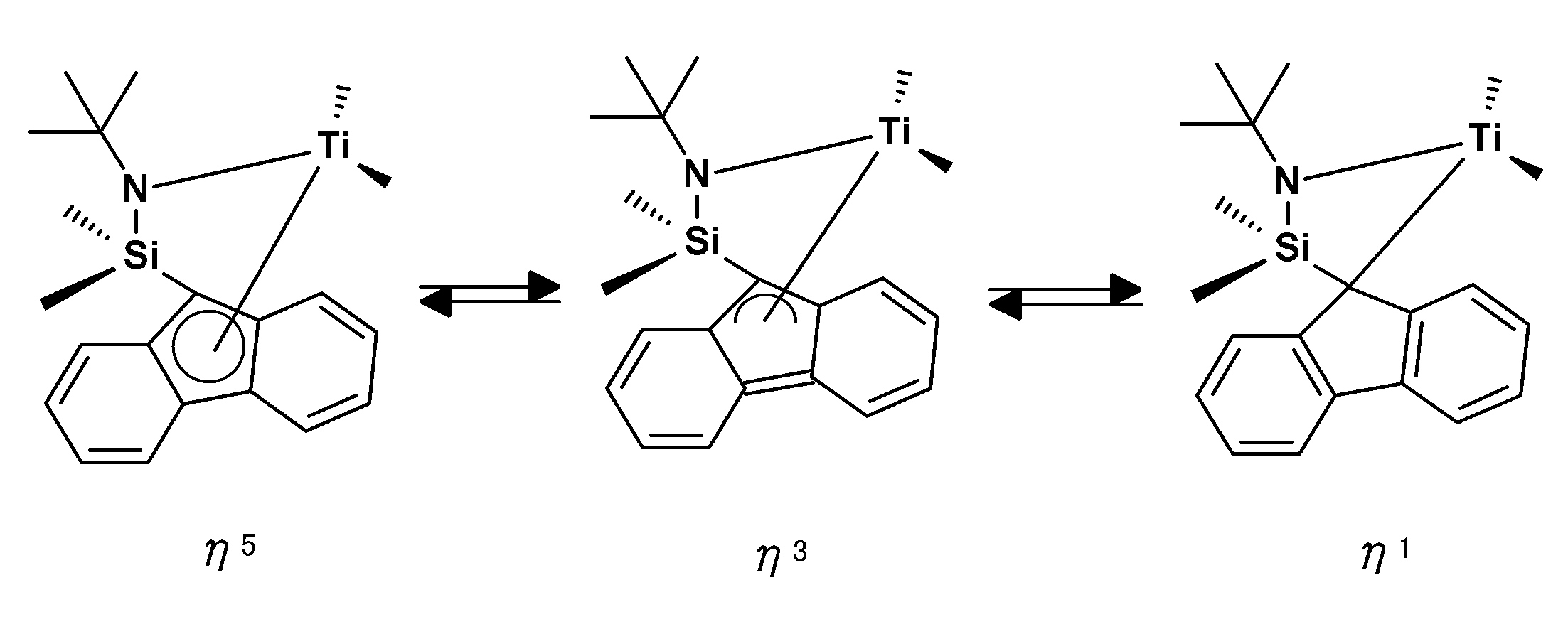
以下では、ハプト数5(η5)である錯体と、ハプト数3(η3)である錯体と、ハプト数1(η1)である錯体との間での平衡を示している。
中心の金属原子のシグマリガンドがアルキル又はアリール基である際に、メタロセン触媒は、通常以下の工程:
1)適切なリガンドをMX4[Xはハロゲン、通常TiCl4又はZrCl4]と反応させることによるメタロセンジハライド(通常メタロセンジクロライド)の製造、
2)アルキル化剤(例えばアルキルリチウム、ジアルキルマグネシウム又は相当するグリニャール試薬)で金属原子に結合したハロゲンを所望のアルキル又はアリール基で置換することによる、工程1)で得られたメタロセンジハライドの相当するジアルキル又はジアリール錯体への転化、
からなる方法にしたがって得られる(特許文献1を参照)。
それにもかかわらず、上記のメタロセンは、特許文献1に開示されるような周知の方法論では簡便に合成できない。実際、従来技術の方法は、後で目的生成物に変換されるメタロセンジハライドの合成を常に含んでいる。このため、従来技術の方法は、全体的な収率が不十分であり、少なくとも2つの方法工程を要する。
1)適切なリガンドをMX4[Xはハロゲン、通常TiCl4又はZrCl4]と反応させることによるメタロセンジハライド(通常メタロセンジクロライド)の製造、
2)アルキル化剤(例えばアルキルリチウム、ジアルキルマグネシウム又は相当するグリニャール試薬)で金属原子に結合したハロゲンを所望のアルキル又はアリール基で置換することによる、工程1)で得られたメタロセンジハライドの相当するジアルキル又はジアリール錯体への転化、
からなる方法にしたがって得られる(特許文献1を参照)。
それにもかかわらず、上記のメタロセンは、特許文献1に開示されるような周知の方法論では簡便に合成できない。実際、従来技術の方法は、後で目的生成物に変換されるメタロセンジハライドの合成を常に含んでいる。このため、従来技術の方法は、全体的な収率が不十分であり、少なくとも2つの方法工程を要する。
非特許文献1に記載の上記構造の触媒を特許文献1の方法に従って製造する場合、下記構造のリガンド(配位子)に対して、メチルリチウム等のメチル化されたアルカリ金属化合物、又はメチルマグネシウムブロマイドのようなメチル基を有するグリニャール試薬を4モル当量以上反応させた後、かかる反応の生成物を引き続きTiCl4のような金属化合物と反応させる。特許文献1には、下記構造のリガンドを含む一般式が記載されている。
なお、特許文献1において、メチルリチウムやメチルマグネシウムブロマイドの使用量の下限である4モル当量とは、下記構造のリガンドを用いて上記構造の触媒を製造する場合の化学量論的に必要な最少の量である。また、特許文献1において、触媒の製造は、ワンポットでの操作により実施される。
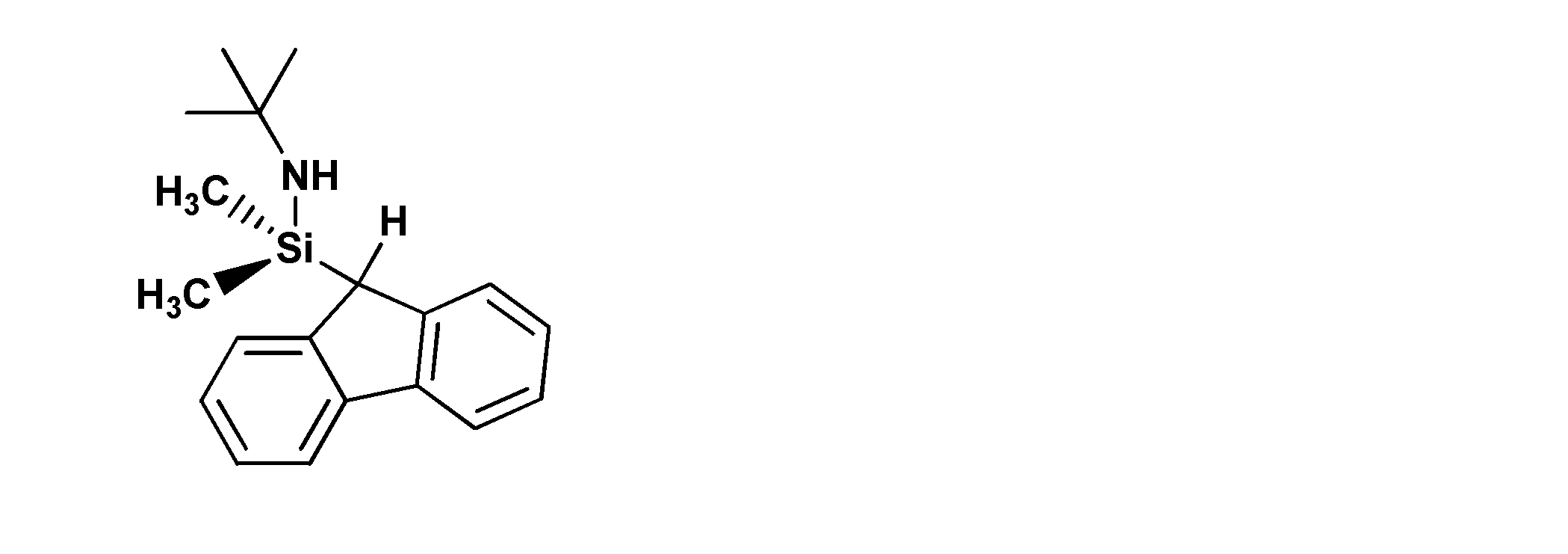
なお、特許文献1において、メチルリチウムやメチルマグネシウムブロマイドの使用量の下限である4モル当量とは、下記構造のリガンドを用いて上記構造の触媒を製造する場合の化学量論的に必要な最少の量である。また、特許文献1において、触媒の製造は、ワンポットでの操作により実施される。
Living polymerization of olefins with ansa-dimethylsilylene(fluorenyl)(amido)dimethyltitanium-based catalystsTakeshi ShionoPolymer Journal,2011,43,p.331-351
Stereospecific polymerization of propylene with group 4 ansa-fluorenylamidodimethyl complexesTakeshi Shiono et al.Journal of Organometallic Chemistry,2006,vol.691,p.193-201
特許文献1に記載の方法は、確かにメタロセン触媒を高収率で製造し得る方法である。しかし、非特許文献1に記載される上記構造の触媒や、当該触媒に類似する構造の触媒を製造する場合には、特許文献1に記載の方法では、必ずしも良好な収率で、高純度の触媒を製造することができない。
また、非特許文献2には、リガンドに対して5.3モル当量のメチルリチウムを反応させ、次いでTiCl4を反応させて、非特許文献1に記載される上記構造の触媒を製造する方法が記載されている。しかし、非特許文献2に記載される方法でも、高純度の触媒を高収率で製造することは困難である。なお、非特許文献2に記載の具体的な方法は、特許文献1に記載の方法に包含される。
また、非特許文献2には、リガンドに対して5.3モル当量のメチルリチウムを反応させ、次いでTiCl4を反応させて、非特許文献1に記載される上記構造の触媒を製造する方法が記載されている。しかし、非特許文献2に記載される方法でも、高純度の触媒を高収率で製造することは困難である。なお、非特許文献2に記載の具体的な方法は、特許文献1に記載の方法に包含される。
本発明は、上記の課題に鑑みなされたものであって、フルオレン骨格を含む特定の構造の配位子を用いて、メタロセン化合物である触媒を、高純度且つ高収率で製造できる触媒の製造方法を提供することを目的とする。
本発明者らは、フルオレン骨格を含む特定の構造の配位子に対して、特定量且つ特定の構造の有機リチウム化合物を反応させる工程(I)と、工程(I)の生成物に、それぞれ所定の構造のMg化合物、Zn化合物、及びAl化合物からなる群より選択される1種以上を反応させる工程(II)と、工程(II)の生成物に、ハロゲン原子等を有するTi化合物、Zr化合物、又はHf化合物を、配位子に対して1モル当量以上反応させる工程(III)と、を含む方法により上記の課題を解決できることを見出し、本発明を完成するに至った。
より具体的には、本発明は以下のものを提供する。
より具体的には、本発明は以下のものを提供する。
(1) 下記式(1):
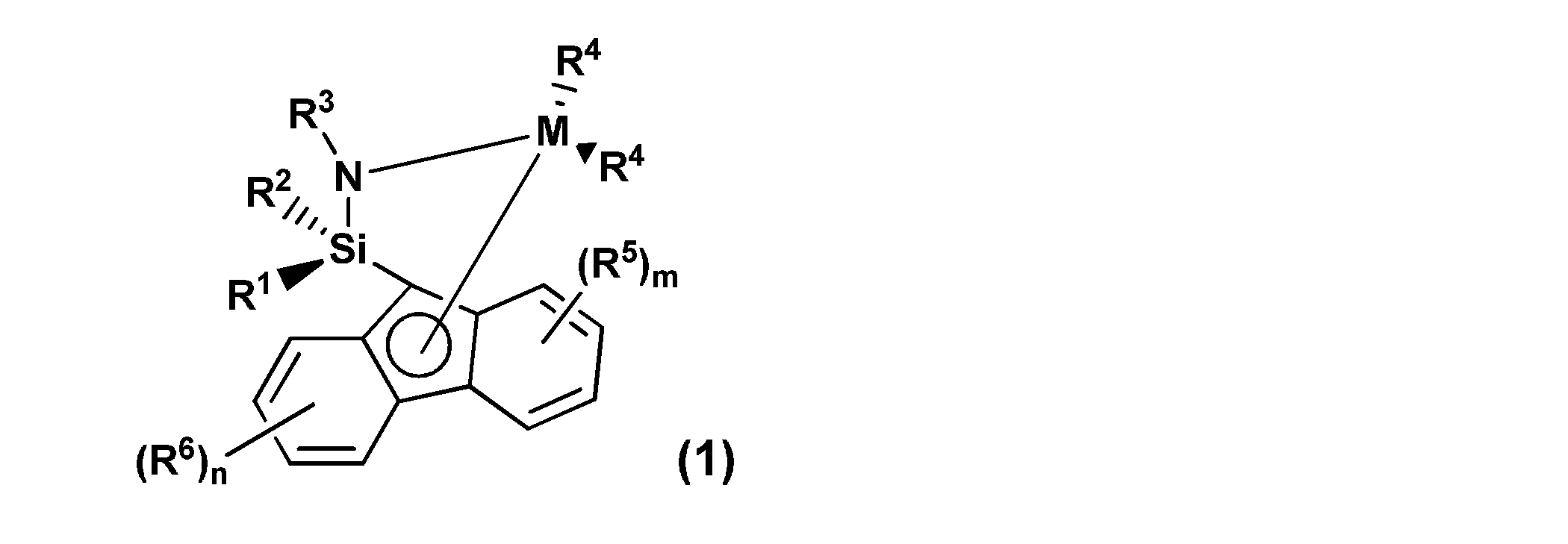
(式(1)中、R1、R2、R3、及びR4は、それぞれ独立に、ヘテロ原子を含んでいてもよい炭素原子数1~20の炭化水素基であり、R1及びR2は、それぞれC-Si結合、O-Si結合、Si-Si結合、又はN-Si結合によりケイ素原子に結合し、R3はC-N結合、O-N結合、Si-N結合、又はN-N結合により窒素原子に結合し、R4はC-M結合により金属原子Mに結合し、R5及びR6は、それぞれ独立に、ヘテロ原子を含んでいてもよい炭素原子数1~20の有機置換基、又は無機置換基であり、m及びnは、それぞれ独立に0~4の整数であり、R5及びR6がそれぞれ複数である場合、複数のR5及びR6は異なる基であってもよく、複数のR5のうちの2つの基、又は複数のR6のうちの2つの基が芳香環上の隣接する位置に結合する場合、当該2つの基が相互に結合して環を形成してもよく、Mは、Ti、Zr、又はHfである。)
で表される触媒の製造方法であって、
(I)下記式(1a):

(式(1a)中、R1、R2、R3、R5、R6、m、及びnについて、前述の通り。)
で表される配位子を、下記式(1b):
LiR7・・・(1b)
(式(1b)中、R7は、ヘテロ原子を含んでいてもよい炭素原子数1~20の炭化水素基であり、C-Li結合によりリチウム原子に結合する。)
で表される有機リチウム化合物と反応させる工程と、
(II)工程(I)で得られる生成物を、下記式(1c)で表される化合物、下記式(1d)で表される化合物、及び下記式(1e)で表される化合物:
(R4)pMgX(2-p)・・・(1c)
(R4)qZnX(2-q)・・・(1d)
(R4)rAlX(3-r)・・・(1e)
(式(1c)、(1d)、及び(1e)中、R4は前述の通りであり、Xはハロゲン原子でありpは1又は2であり、qは1又は2であり、rは1~3の整数である。)
からなる群より選択される1種以上と反応させる工程と、
(III)工程(II)で得られる生成物を、配位子に対して1モル当量以上の下記式(1f):
MR8 4・・・(1f)
(式(1f)中、Mは、前述の通りであり、R8は、ハロゲン原子、又は-OR9で表される基であり、R9は、ヘテロ原子を有してもよい炭素原子数1~20の炭化水素基であり、R9はC-O結合により酸素原子に結合する。)
で表される化合物と反応させる工程と、を含み、
工程(I)において、R4とR7とが同一である場合には、有機リチウム化合物の使用量が配位子に対して2.0モル当量以上であり、
工程(I)において、R4とR7とが同一でない場合には、有機リチウム化合物の使用量が配位子に対して1.8モル当量以上2.2モル当量以下であり、
工程(II)において、式(1c)で表される化合物、式(1d)で表される化合物、及び(1e)で表される化合物からなる群より選択される化合物は、これらの化合物に含まれる基R4のモル数が、配位子のモル数の2倍以上であるような量使用される、触媒の製造方法。
で表される触媒の製造方法であって、
(I)下記式(1a):
で表される配位子を、下記式(1b):
LiR7・・・(1b)
(式(1b)中、R7は、ヘテロ原子を含んでいてもよい炭素原子数1~20の炭化水素基であり、C-Li結合によりリチウム原子に結合する。)
で表される有機リチウム化合物と反応させる工程と、
(II)工程(I)で得られる生成物を、下記式(1c)で表される化合物、下記式(1d)で表される化合物、及び下記式(1e)で表される化合物:
(R4)pMgX(2-p)・・・(1c)
(R4)qZnX(2-q)・・・(1d)
(R4)rAlX(3-r)・・・(1e)
(式(1c)、(1d)、及び(1e)中、R4は前述の通りであり、Xはハロゲン原子でありpは1又は2であり、qは1又は2であり、rは1~3の整数である。)
からなる群より選択される1種以上と反応させる工程と、
(III)工程(II)で得られる生成物を、配位子に対して1モル当量以上の下記式(1f):
MR8 4・・・(1f)
(式(1f)中、Mは、前述の通りであり、R8は、ハロゲン原子、又は-OR9で表される基であり、R9は、ヘテロ原子を有してもよい炭素原子数1~20の炭化水素基であり、R9はC-O結合により酸素原子に結合する。)
で表される化合物と反応させる工程と、を含み、
工程(I)において、R4とR7とが同一である場合には、有機リチウム化合物の使用量が配位子に対して2.0モル当量以上であり、
工程(I)において、R4とR7とが同一でない場合には、有機リチウム化合物の使用量が配位子に対して1.8モル当量以上2.2モル当量以下であり、
工程(II)において、式(1c)で表される化合物、式(1d)で表される化合物、及び(1e)で表される化合物からなる群より選択される化合物は、これらの化合物に含まれる基R4のモル数が、配位子のモル数の2倍以上であるような量使用される、触媒の製造方法。
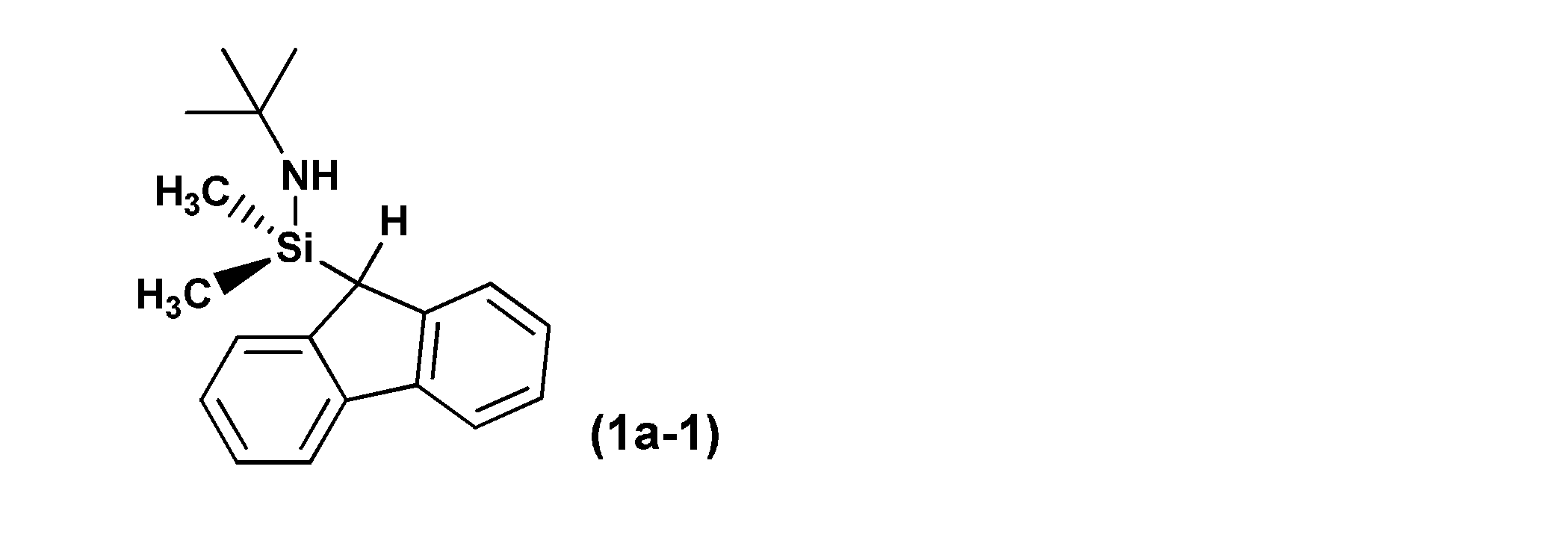
(2) 配位子が、下記式(1a-1):
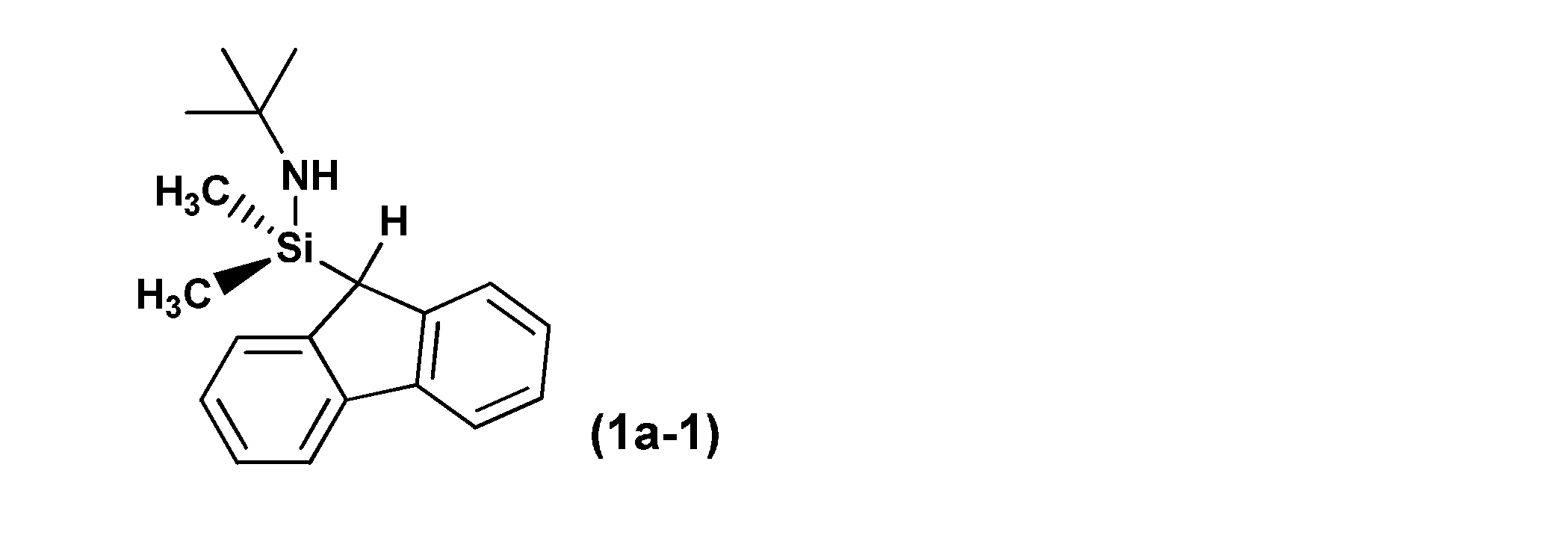
で表される化合物である、(1)に記載の触媒の製造方法。
(3) 工程(II)において、工程(I)で得られる生成物を、式(1c)で表される化合物と反応させる、(1)又は(2)に記載の触媒の製造方法。
(4) 式(1f)で表される化合物がTiCl4である、(1)~(3)のいずれか1つに記載の触媒の製造方法。
本発明によれば、フルオレン骨格を含む特定の構造の配位子を用いて、メタロセン化合物である触媒を、高純度且つ高収率で製造できる触媒の製造方法を提供することができる。
≪触媒の製造方法≫
本発明にかかる触媒の製造方法では、以下に説明する式(1)で表される構造の触媒を製造する。
また、本発明にかかる触媒の製造方法は、
それぞれ後述する、式(1a)で表される配位子と、式(1b)で表される有機リチウム化合物とを反応させる工程である工程(I)と、
工程(I)で得られる生成物を、それぞれ所定の構造のMg化合物、Zn化合物、及びAl化合物からなる群より選択される1種以上と反応させる工程である工程(II)と、
工程(II)で得られる生成物を、配位子に対して1モル当量以上の後述する式(1f)で表される金属化合物と反応させる工程である工程(III)とを含む。
上記方法によれば、工程(I)、工程(II)で用いられる2種類の有機金属化合物を配位子に対して作用させて得られた化合物を、工程(III)において金属ハロゲン化物等と反応させることで、副反応を抑制し、その結果高純度の触媒を高収率で得ることができる。
以下、触媒と、工程(I)、工程(II)、及び工程(III)と、その他の工程とについて説明する。
本発明にかかる触媒の製造方法では、以下に説明する式(1)で表される構造の触媒を製造する。
また、本発明にかかる触媒の製造方法は、
それぞれ後述する、式(1a)で表される配位子と、式(1b)で表される有機リチウム化合物とを反応させる工程である工程(I)と、
工程(I)で得られる生成物を、それぞれ所定の構造のMg化合物、Zn化合物、及びAl化合物からなる群より選択される1種以上と反応させる工程である工程(II)と、
工程(II)で得られる生成物を、配位子に対して1モル当量以上の後述する式(1f)で表される金属化合物と反応させる工程である工程(III)とを含む。
上記方法によれば、工程(I)、工程(II)で用いられる2種類の有機金属化合物を配位子に対して作用させて得られた化合物を、工程(III)において金属ハロゲン化物等と反応させることで、副反応を抑制し、その結果高純度の触媒を高収率で得ることができる。
以下、触媒と、工程(I)、工程(II)、及び工程(III)と、その他の工程とについて説明する。
<触媒>
まず、本発明の方法により製造される触媒について説明する。本発明の方法により製造されるのは、フルオレン骨格を有する配位子を含む下記式(1)で表される構造の触媒である。
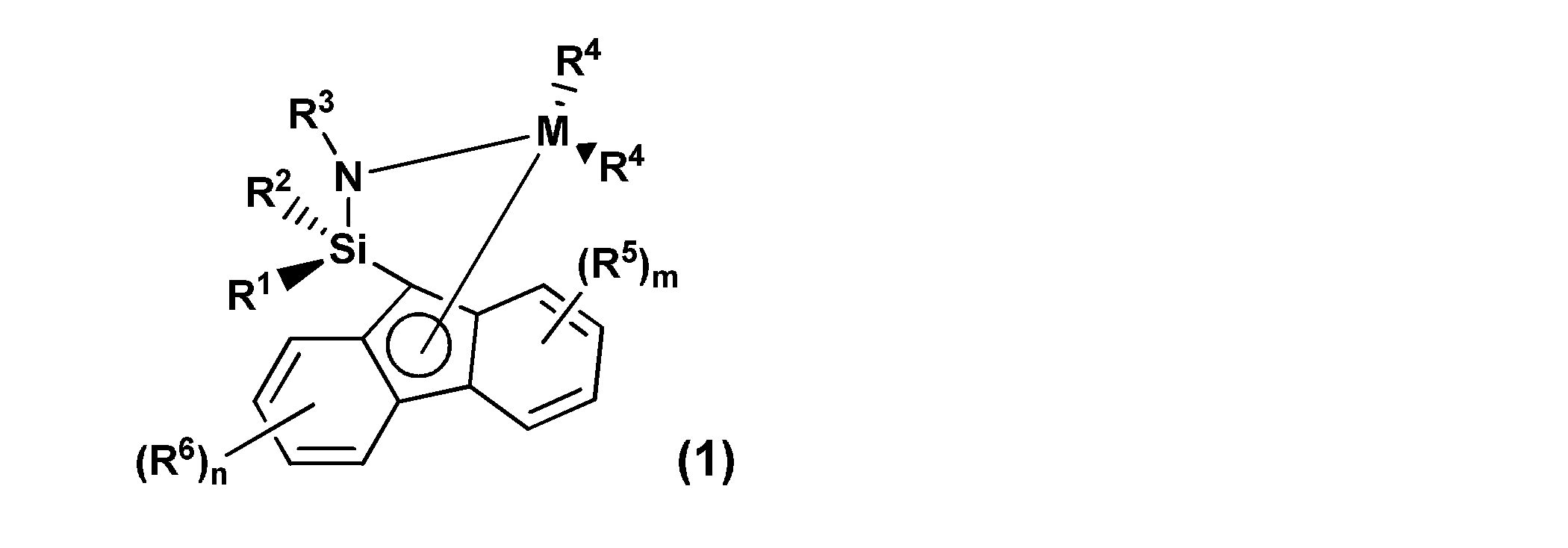
まず、本発明の方法により製造される触媒について説明する。本発明の方法により製造されるのは、フルオレン骨格を有する配位子を含む下記式(1)で表される構造の触媒である。
式(1)中、R1、R2、R3、及びR4は、それぞれ独立に、ヘテロ原子を含んでいてもよい炭素原子数1~20の炭化水素基である。
R1及びR2は、それぞれC-Si結合、O-Si結合、Si-Si結合、又はN-Si結合によりケイ素原子に結合する。
R3はC-N結合、O-N結合、Si-N結合、又はN-N結合により窒素原子に結合する。
R4はC-M結合により金属原子Mに結合する。
R5及びR6は、それぞれ独立に、ヘテロ原子を含んでいてもよい炭素原子数1~20の有機置換基、又は無機置換基であり、m及びnは、それぞれ独立に0~4の整数である。
R5及びR6がそれぞれ複数である場合、複数のR5及びR6は異なる基であってもよい。
複数のR5のうちの2つの基、又は複数のR6のうちの2つの基が芳香環上の隣接する位置に結合する場合、当該2つの基が相互に結合して環を形成してもよい。
Mは、Ti、Zr、又はHfである。
R1及びR2は、それぞれC-Si結合、O-Si結合、Si-Si結合、又はN-Si結合によりケイ素原子に結合する。
R3はC-N結合、O-N結合、Si-N結合、又はN-N結合により窒素原子に結合する。
R4はC-M結合により金属原子Mに結合する。
R5及びR6は、それぞれ独立に、ヘテロ原子を含んでいてもよい炭素原子数1~20の有機置換基、又は無機置換基であり、m及びnは、それぞれ独立に0~4の整数である。
R5及びR6がそれぞれ複数である場合、複数のR5及びR6は異なる基であってもよい。
複数のR5のうちの2つの基、又は複数のR6のうちの2つの基が芳香環上の隣接する位置に結合する場合、当該2つの基が相互に結合して環を形成してもよい。
Mは、Ti、Zr、又はHfである。
なお、式(1)中の金属原子Mは、ハプト数1~5の範囲において、フルオレン骨格を有する配位子と、任意の配位形式をとることができる。
R1、R2、R3、及びR4は、それぞれ独立に、ヘテロ原子を含んでいてもよい炭素原子数1~20の炭化水素基である。
炭化水素基がヘテロ原子を含む場合、ヘテロ原子の種類は本発明の目的を阻害しない範囲で特に限定されない。ヘテロ原子の具体例としては、酸素原子、窒素原子、硫黄原子、リン原子、ケイ素原子、セレン原子、及びハロゲン原子等が挙げられる。
炭化水素基がヘテロ原子を含む場合、ヘテロ原子の種類は本発明の目的を阻害しない範囲で特に限定されない。ヘテロ原子の具体例としては、酸素原子、窒素原子、硫黄原子、リン原子、ケイ素原子、セレン原子、及びハロゲン原子等が挙げられる。
炭化水素基がヘテロ原子を含む場合、ヘテロ原子の数は特に限定されない。
炭化水素基がヘテロ原子を含む場合、炭素原子数と、ヘテロ原子数との合計は30以下が好ましく、25以下がより好ましく、20以下が特に好ましい。
炭化水素基がヘテロ原子を含む場合、ヘテロ原子の数は10以下が好ましく、5以下がより好ましく、3以下が特に好ましい。
炭化水素基がヘテロ原子を含む場合、炭素原子数と、ヘテロ原子数との合計は30以下が好ましく、25以下がより好ましく、20以下が特に好ましい。
炭化水素基がヘテロ原子を含む場合、ヘテロ原子の数は10以下が好ましく、5以下がより好ましく、3以下が特に好ましい。
炭化水素基が含んでいてもよいヘテロ原子を含む結合としては、例えば、-O-、-C(=O)-、-C(=O)-O-、-C(=O)-O-C(=O)-、-O-C(=O)-O-、-C(=O)-N<、>N-C(=O)-N<、-S-、-S(=O)-、-S(=O)2-、-S-S-、-C(=O)-S-、-C(=S)-O-、-C(=S)-S-、-C(=S)-N<、-N=、-N<、-N=N-、=N-O-、=N-S-、=N-N<、=N-Se-、-S(=O)2-N<、-C=N-O-、-P<、-P(=O)<、-Se-、-Se(=O)-、>Si<、及びシロキサン結合が挙げられる。
炭化水素基は、これらのヘテロ原子を含む結合を単独で含んでいてもよく、2種以上を組み合わせて含んでいてもよい。
炭化水素基は、これらのヘテロ原子を含む結合を単独で含んでいてもよく、2種以上を組み合わせて含んでいてもよい。
R1及びR2は、それぞれC-Si結合、O-Si結合、Si-Si結合、又はN-Si結合によりケイ素原子に結合する。
O-Si結合によりケイ素原子に結合するR1及びR2の好適な例としては、-OR、及び-O-C(=O)-Rで表される基が挙げられる。
Si-Si結合によりケイ素原子に結合するR1及びR2の好適な例としては、-SiR3、-Si(OR)R2、-Si(OR)2R、及び-Si(OR)3で表される基が挙げられる。
N-Si結合によりケイ素原子に結合するR1及びR2の好適な例としては、-NHR、及び-NR2で表される基が挙げられる。
ここで、上記のRはいずれも炭化水素基である。
O-Si結合によりケイ素原子に結合するR1及びR2の好適な例としては、-OR、及び-O-C(=O)-Rで表される基が挙げられる。
Si-Si結合によりケイ素原子に結合するR1及びR2の好適な例としては、-SiR3、-Si(OR)R2、-Si(OR)2R、及び-Si(OR)3で表される基が挙げられる。
N-Si結合によりケイ素原子に結合するR1及びR2の好適な例としては、-NHR、及び-NR2で表される基が挙げられる。
ここで、上記のRはいずれも炭化水素基である。
R3は、C-N結合、O-N結合、Si-N結合、又はN-N結合により窒素原子に結合する。
O-N結合により窒素原子に結合するR3の好適な例としては、-OR、及び-O-C(=O)-Rで表される基が挙げられる。
Si-N結合により窒素原子に結合するR3の好適な例としては、-SiR3、-Si(OR)R2、-Si(OR)2R、及び-Si(OR)3で表される基が挙げられる。
N-N結合により窒素原子に結合するR3の好適な例としては、-NHR、及び-NR2で表される基が挙げられる。
ここで、上記のRはいずれも炭化水素基である。
O-N結合により窒素原子に結合するR3の好適な例としては、-OR、及び-O-C(=O)-Rで表される基が挙げられる。
Si-N結合により窒素原子に結合するR3の好適な例としては、-SiR3、-Si(OR)R2、-Si(OR)2R、及び-Si(OR)3で表される基が挙げられる。
N-N結合により窒素原子に結合するR3の好適な例としては、-NHR、及び-NR2で表される基が挙げられる。
ここで、上記のRはいずれも炭化水素基である。
配位子として使用する化合物の調製や入手が容易であることから、R1とR2とは同一の基であるのが好ましい。
R1、R2、R3、及びR4としては、化学的な安定性に優れることから、ヘテロ原子を含まない炭化水素基が好ましい。
かかる炭化水素基としては、直鎖状又は分岐鎖状のアルキル基、二重結合及び/又は三重結合を有してもよい直鎖状又は分岐鎖状の不飽和脂肪族炭化水素基、シクロアルキル基、シクロアルキルアルキル基、芳香族炭化水素基、及びアラルキル基が好ましい。
かかる炭化水素基としては、直鎖状又は分岐鎖状のアルキル基、二重結合及び/又は三重結合を有してもよい直鎖状又は分岐鎖状の不飽和脂肪族炭化水素基、シクロアルキル基、シクロアルキルアルキル基、芳香族炭化水素基、及びアラルキル基が好ましい。
直鎖状又は分岐鎖状のアルキル基の具体例としては、メチル基、エチル基、n-プロピル基、イソプロピル基、n-ブチル基、イソブチル基、sec-ブチル基、tert-ブチル基、n-ペンチル基、イソペンチル基、tert-ペンチル基、n-ヘキシル基、n-ヘプチル基、n-オクチル基、2-エチルヘキシル基、n-ノニル基、n-デシル基、n-ウンデシル基、n-ドデシル基、n-トリデシル基、n-テトラデシル基、n-ペンタデシル基、n-ヘキサデシル基、n-ヘプタデシル基、n-オクタデシル基、n-ノナデシル基、及びn-イコシル基が挙げられる。
二重結合及び/又は三重結合を有してもよい直鎖状又は分岐鎖状の不飽和脂肪族炭化水素基の好ましい例としては、直鎖状又は分岐鎖状のアルキル基の具体例として挙げた基において、1以上の単結合を二重結合及び/又は三重結合に置き換えた基が挙げられる。
より好ましくは、ビニル基、アリル基、1-プロペニル基、3-ブテニル基、2-ブテニル基、1-ブテニル基、エテニル基、及びプロパルギル基が挙げられる。
より好ましくは、ビニル基、アリル基、1-プロペニル基、3-ブテニル基、2-ブテニル基、1-ブテニル基、エテニル基、及びプロパルギル基が挙げられる。
シクロアルキル基の具体例としては、シクロプロピル基、シクロブチル基、シクロペンチル基、シクロヘキシル基、シクロヘプチル基、シクロオクチル基、シクロノニル基、シクロデシル基、シクロウンデシル基、シクロドデシル基、シクロトリデシル基、シクロテトラデシル基、シクロペンタデシル基、シクロヘキサデシル基、シクロヘプタデシル基、シクロオクタデシル基、シクロノナデシル基、及びシクロイコシル基が挙げられる。
シクロアルキルアルキル基の具体例としては、シクロプロピルメチル基、シクロブチルメチル基、シクロペンチルメチル基、シクロヘキシルメチル基、シクロへプチルメチル基、シクロオクチルメチル基、シクロノニルメチル基、シクロデシルメチル基、シクロウンデシルメチル基、シクロドデシルメチル基、シクロトリデシルメチル基、シクロテトラデシルメチル基、シクロペンタデシルメチル基、シクロヘキサデシルメチル基、シクロヘプタデシルメチル基、シクロオクタデシルメチル基、シクロノナデシルメチル基、2-シクロプロピルエチル基、2-シクロブチルエチル基、2-シクロペンチルエチル基、2-シクロヘキシルエチル基、2-シクロへプチルエチル基、2-シクロオクチルエチル基、2-シクロノニルエチル基、2-シクロデシルエチル基、2-シクロウンデシルエチル基、2-シクロドデシルエチル基、2-シクロトリデシルエチル基、2-シクロテトラデシルエチル基、2-シクロペンタデシルエチル基、2-シクロヘキサデシルエチル基、2-シクロヘプタデシルエチル基、2-シクロオクタデシルエチル基、3-シクロプロピルプロピル基、3-シクロブチルプロピル基、3-シクロペンチルプロピル基、3-シクロヘキシルプロピル基、3-シクロへプチルプロピル基、3-シクロオクチルプロピル基、3-シクロノニルプロピル基、3-シクロデシルプロピル基、3-シクロウンデシルプロピル基、3-シクロドデシルプロピル基、3-シクロトリデシルプロピル基、3-シクロテトラデシルプロピル基、3-シクロペンタデシルプロピル基、3-シクロヘキサデシルプロピル基、3-シクロヘプタデシルプロピル基、4-シクロプロピルブチル基、4-シクロブチルブチル基、4-シクロペンチルブチル基、4-シクロヘキシルブチル基、4-シクロヘプチルブチル基、4-シクロオクチルブチル基、4-シクロノニルブチル基、4-シクロデシルブチル基、4-シクロドデシルブチル基、4-シクロトリデシルブチル基、4-シクロテトラデシルブチル基、4-シクロペンタデシルブチル基、及び4-シクロヘキサデシルブチル基が挙げられる。
芳香族炭化水素基の具体例としては、フェニル基、o-トリル基、m-トリル基、p-トリル基、2,3-ジメチルフェニル基、2,4-ジメチルフェニル基、2,5-ジメチルフェニル基、2,6-ジメチルフェニル基、3,4-ジメチルフェニル基、3,5-ジメチルフェニル基、2,3,4-トリメチルフェニル基、2,3,5-トリメチルフェニル基、2,3,6-トリメチルフェニル基、2,4,5-トリメチルフェニル基、2,4,6-トリメチルフェニル基、3,4,5-トリメチルフェニル基、o-エチルフェニル基、m-エチルフェニル基、p-エチルフェニル基、o-イソプロピルフェニル基、m-イソプロピルフェニル基、p-イソプロピルフェニル基、o-tert-ブチルフェニル基、2,3-ジイソプロピルフェニル基、2,4-ジイソプロピルフェニル基、2,5-ジイソプロピルフェニル基、2,6-ジイソプロピルフェニル基、3,4-ジイソプロピルフェニル基、3,5-ジイソプロピルフェニル基、2,6-ジ-tert-ブチルフェニル基、2,6-ジ-tert-ブチル-4-メチルフェニル基、α-ナフチル基、β-ナフチル基、ビフェニル-4-イル基、ビフェニル-3-イル基、ビフェニル-2-イル基、アントラセン-1-イル基、アントラセン-2-イル基、アントラセン-9-イル基、フェナントレン-1-イル基、フェナントレン-2-イル基、フェナントレン-3-イル基、フェナントレン-4-イル基、フェナントレン-9-イル基、ピレン-1-イル基、ピレン-2-イル基、ピレン-3-イル基、及びピレン-4-イル基が挙げられる。
アラルキル基の具体例としては、ベンジル基、フェネチル基、1-フェニルエチル基、3-フェニルプロピル基、2-フェニルプロピル基、1-フェニルプロピル基、2-フェニル-1-メチルエチル基、1-フェニル-1-メチルエチル基(クミル基)、4-フェニルブチル基、3-フェニルブチル基、2-フェニルブチル基、1-フェニルブチル基、3-フェニル-2-メチルプロピル基、3-フェニル-1-メチルプロピル基、2-フェニル-1-メチルプロピル基、2-メチル-1-フェニルプロピル基、2-フェニル-1,1-ジメチルエチル基、2-フェニル-2,2,-ジメチルエチル基、α-ナフチルメチル基、β-ナフチルメチル基、2-α-ナフチルエチル基、2-β-ナフチルエチル基、1-α-ナフチルエチル基、及び1-β-ナフチルエチル基が挙げられる。
以上説明した基の中でも、R1、及びR2としては、炭素原子数1~20のアルキル基及び炭素原子数6~20の芳香族炭化水素基が好ましく、炭素原子数1~10のアルキル基及び炭素原子数6~10の芳香族炭化水素基がより好ましく、炭素原子数1~6のアルキル基及びフェニル基がさらに好ましく、炭素原子数1~4のアルキル基が特に好ましい。
R3としては、炭素原子数1~20のアルキル基、炭素原子数3~20のシクロアルキル基、炭素原子数6~20の芳香族炭化水素基、及び炭素原子数7~20のアラルキル基が好ましい。
R4としては、炭素原子数1~20のアルキル基、炭素原子数2~20のアルケニル基、炭素原子数3~20のシクロアルキル基、炭素原子数6~20の芳香族炭化水素基、及び炭素原子数7~20のアラルキル基が好ましい。
式(1)中、R5及びR6は、それぞれ独立に、ヘテロ原子を含んでいてもよい炭素原子数1~20の有機置換基、又は無機置換基であり、m及びnは、それぞれ独立に0~4の整数である。
R5及びR6がそれぞれ複数である場合、複数のR5及びR6は異なる基であってもよい。
R5及びR6がそれぞれ複数である場合、複数のR5及びR6は異なる基であってもよい。
有機置換基としては、従来芳香環上に置換し得ることが知られている有機基であって、上記式(1)で表される触媒の生成反応を阻害しない基であれば特に限定されない。
かかる有機基としては、ヘテロ原子を含んでいてもよい炭素原子数1~20の炭化水素基であって、上記式(1)で表される触媒の生成反応を阻害しない基が挙げられる。
かかる有機基としては、ヘテロ原子を含んでいてもよい炭素原子数1~20の炭化水素基であって、上記式(1)で表される触媒の生成反応を阻害しない基が挙げられる。
炭化水素基がヘテロ原子を含む場合、ヘテロ原子の種類は本発明の目的を阻害しない範囲で特に限定されない。ヘテロ原子の具体例としては、酸素原子、窒素原子、硫黄原子、リン原子、ケイ素原子、セレン原子、及びハロゲン原子等が挙げられる。
炭化水素基がヘテロ原子を含む場合、ヘテロ原子の数は特に限定されない。
炭化水素基がヘテロ原子を含む場合、炭素原子数と、ヘテロ原子数との合計は30以下が好ましく、25以下がより好ましく、20以下が特に好ましい。
炭化水素基がヘテロ原子を含む場合、ヘテロ原子の数は10以下が好ましく、5以下がより好ましく、3以下が特に好ましい。
炭化水素基が含んでいてもよいヘテロ原子を含む結合としては、R1~R4について説明した結合が挙げられる。
炭化水素基がヘテロ原子を含む場合、炭素原子数と、ヘテロ原子数との合計は30以下が好ましく、25以下がより好ましく、20以下が特に好ましい。
炭化水素基がヘテロ原子を含む場合、ヘテロ原子の数は10以下が好ましく、5以下がより好ましく、3以下が特に好ましい。
炭化水素基が含んでいてもよいヘテロ原子を含む結合としては、R1~R4について説明した結合が挙げられる。
有機置換基としては、例えば、炭素原子数1~20のアルキル基、炭素原子数1~20のアルコキシ基、炭素原子数3~20のシクロアルキル基、炭素原子数2~20の脂肪族アシル基、ベンゾイル基、α-ナフチルカルボニル基、β-ナフチルカルボニル基、炭素原子数6~20の芳香族炭化水素基、及び炭素原子数7~20のアラルキル基が挙げられる。
これらの有機置換基の中では、炭素原子数1~6のアルキル基、炭素原子数1~6のアルコキシ基、炭素原子数3~8のシクロアルキル基、炭素原子数2~6の脂肪族アシル基、ベンゾイル基、フェニル基、ベンジル基、及びフェネチル基が好ましい。
有機置換基の中では、メチル基、エチル基、n-プロピル基、イソプロピル基、n-ブチル基、イソブチル基、sec-ブチル基、tert-ブチル基、メトキシ基、エトキシ基、n-プロピルオキシ基、イソプロピルオキシ基、n-ブチルオキシ基、イソブチルオキシ基、sec-ブチルオキシ基、tert-ブチルオキシ基、アセチル基、プロピオニル基、ブタノイル基、及びフェニル基がより好ましい。
これらの有機置換基の中では、炭素原子数1~6のアルキル基、炭素原子数1~6のアルコキシ基、炭素原子数3~8のシクロアルキル基、炭素原子数2~6の脂肪族アシル基、ベンゾイル基、フェニル基、ベンジル基、及びフェネチル基が好ましい。
有機置換基の中では、メチル基、エチル基、n-プロピル基、イソプロピル基、n-ブチル基、イソブチル基、sec-ブチル基、tert-ブチル基、メトキシ基、エトキシ基、n-プロピルオキシ基、イソプロピルオキシ基、n-ブチルオキシ基、イソブチルオキシ基、sec-ブチルオキシ基、tert-ブチルオキシ基、アセチル基、プロピオニル基、ブタノイル基、及びフェニル基がより好ましい。
無機置換基としては、従来芳香環上に置換し得ることが知られている無機基であって、上記式(1)で表される触媒の生成反応を阻害しない基であれば特に限定されない。
無機基の具体例としては、ハロゲン原子、ニトロ基、及びシアノ基等が挙げられる。
無機基の具体例としては、ハロゲン原子、ニトロ基、及びシアノ基等が挙げられる。
複数のR5のうちの2つの基、又は複数のR6のうちの2つの基が芳香環上の隣接する位置に結合する場合、当該2つの基が相互に結合して環を形成してもよい。かかる環は、式(1)中のフルオレン骨格に含まれる芳香環と縮合する、縮合環である。縮合環は、芳香環でもよく、脂肪族環でもよく、脂肪族環が好ましい。縮合環は、酸素原子、窒素原子、及び硫黄原子等のヘテロ原子を環中に有していてもよい。
2つのR5及び/又は2つのR6により形成された縮合環を備えるフルオレン骨格の具体例は、下式の骨格が挙げられる。

式(1)中、Mは、Ti、Zr、又はHfであり、Tiが好ましい。
以上説明した式(1)で表される触媒の好適な例としては、以下の構造の触媒が挙げられる。

<工程(I)>
式(1)で表される触媒を製造するために、まず工程(I)において、下記式(1a):

(式(1a)中、R1、R2、R3、R5、R6、m、及びnについて、前述の通り。)
で表される配位子を、下記式(1b):
LiR7・・・(1b)
(式(1b)中、R7は、ヘテロ原子を含んでいてもよい炭素原子数1~20の炭化水素基であり、C-Li結合によりリチウム原子に結合する。)
で表される化合物と反応させる。
式(1)で表される触媒を製造するために、まず工程(I)において、下記式(1a):
で表される配位子を、下記式(1b):
LiR7・・・(1b)
(式(1b)中、R7は、ヘテロ原子を含んでいてもよい炭素原子数1~20の炭化水素基であり、C-Li結合によりリチウム原子に結合する。)
で表される化合物と反応させる。
工程(I)において進行する反応により、下記式(1g)で表される中間体が生成する。

(式(1g)中、R1、R2、R3、R5、R6、m、及びnについて、前述の通り。)
式(1a)で表される配位子の構造は、製造すべき触媒の構造に応じて適宜選択される。式(1a)で表される配位子の中では、良好な反応性や、合成や入手が容易で安価である点等から、下記式(1a-1)で表される配位子が好ましい。
工程(I)では、後述する工程(II)で使用される式(1c)、式(1d)又は式(1e)で表される、Mg化合物、Zn化合物、又はAl化合物が有する基R4が、有機リチウム化合物中のR7と同一である場合には、式(1a)で表される配位子に対して、2.0モル当量以上の式(1b)で表されるリチウム化合物を反応させる。
また、後述する工程(II)で使用される式(1c)、式(1d)又は式(1e)で表される、Mg化合物、Zn化合物、又はAl化合物が有する基R4が、有機リチウム化合物中のR7と同一でない場合には、式(1a)で表される配位子に対して1.8モル当量以上2.2モル当量以下の式(1b)で表される有機リチウム化合物を反応させる。
かかる範囲の量の有機リチウム化合物を、式(1a)で表される配位子に対して反応させることにより、最終的に、高純度の触媒を高収率で製造することができる。
また、後述する工程(II)で使用される式(1c)、式(1d)又は式(1e)で表される、Mg化合物、Zn化合物、又はAl化合物が有する基R4が、有機リチウム化合物中のR7と同一でない場合には、式(1a)で表される配位子に対して1.8モル当量以上2.2モル当量以下の式(1b)で表される有機リチウム化合物を反応させる。
かかる範囲の量の有機リチウム化合物を、式(1a)で表される配位子に対して反応させることにより、最終的に、高純度の触媒を高収率で製造することができる。
後述する工程(II)で使用される式(1c)、式(1d)又は式(1e)で表される、Mg化合物、Zn化合物、又はAl化合物が有する基R4が、有機リチウム化合物中のR7と同一である場合には、工程(I)での式(1b)で表される化合物の使用量の下限は、例えば、2モル当量が好ましい。
後述する工程(II)で使用される式(1c)、式(1d)又は式(1e)で表される、Mg化合物、Zn化合物、又はAl化合物が有する基R4が、有機リチウム化合物中のR7と同一でない場合には、工程(I)での式(1b)で表される化合物の使用量は、1.9モル当量以上2.1モル当量以下がより好ましい。
後述する工程(II)で使用される式(1c)、式(1d)又は式(1e)で表される、Mg化合物、Zn化合物、又はAl化合物が有する基R4が、有機リチウム化合物中のR7と同一でない場合には、工程(I)での式(1b)で表される化合物の使用量は、1.9モル当量以上2.1モル当量以下がより好ましい。
式(1b)で表される有機リチウム化合物について、R7は、前述のR1、R2、R3、及びR4と同様である。ただし、R7は、C-Li結合によりリチウム原子に結合する。
R7としては、炭素原子数1~20のアルキル基、炭素原子数4~20のトリアルキルシリルアルキル基、炭素原子数2~20のアルケニル基、炭素原子数3~20のシクロアルキル基、炭素原子数6~20の芳香族炭化水素基、及び炭素原子数7~20のアラルキル基が好ましい。
R7としては、炭素原子数1~20のアルキル基、炭素原子数4~20のトリアルキルシリルアルキル基、炭素原子数2~20のアルケニル基、炭素原子数3~20のシクロアルキル基、炭素原子数6~20の芳香族炭化水素基、及び炭素原子数7~20のアラルキル基が好ましい。
式(1b)で表される有機リチウム化合物の好適な具体例としては、メチルリチウム、エチルリチウム、n-プロピルリチウム、イソプロピルリチウム、n-ブチルリチウム、イソブチルリチウム、sec-ブチルリチウム、tert-ブチルリチウム、n-ペンチルリチウム、n-ヘキシルリチウム、トリメチルシリルメチルリチウム、フェニルリチウム、p-トリルリチウム、m-トリルリチウム、o-トリルリチウム、ベンジルリチウム、ビニルリチウム、及びアリルリチウム等が挙げられる。
工程(I)では、通常、溶媒が使用される。溶媒の種類は、本発明の目的を阻害しない範囲で特に限定されない。典型的には、非プロトン性溶媒が使用される。
非プロトン性溶媒の種類は、本発明の目的を阻害しない範囲で特に限定されない。非プロトン性溶媒は、極性溶媒であっても、非極性溶媒であってもよい。好ましい非プロトン性溶媒としては、エーテル系溶媒と、炭化水素系溶媒とが挙げられる。
非プロトン性溶媒の好適な具体例としては、ジエチルエーテル、ジ-n-プロピルエーテル、ジイソプロピルエーテル、ジ-n-ブチルエーテル、テトラヒドロフラン、及びジオキサン等のエーテル系溶媒、ペンタン、ヘキサン、ヘプタン、及びオクタン等の脂肪族炭化水素溶媒、ベンゼン、トルエン、及びキシレン等の芳香族炭化水素溶媒が挙げられる。
特に好ましくは、ジエチルエーテルを含有する非プロトン性溶媒が使用される。
ジエチルエーテルは、ジエチルエーテル以外のエーテル系溶媒と組み合わせて用いられてもよく、脂肪族炭化水素溶媒と組み合わせて用いられてもよく、芳香族炭化水素溶媒と組み合わせて用いられてもよい。
また、所望する反応が良好に進行する限りにおいて、ジエチルエーテル以外の非プロトン性溶媒を用いるのも好ましい。
また、溶媒は、混合溶媒であってもよい。この場合、混合溶媒は、ジエチルエーテル以外のエーテル系溶媒と脂肪族炭化水素溶媒との組み合わせ、ジエチルエーテル以外のエーテル系溶媒と芳香族炭化水素溶媒との組み合わせ、及び脂肪族炭化水素溶媒と芳香族炭化水素溶媒との組み合わせのいずれであってもよい。
非プロトン性溶媒の種類は、本発明の目的を阻害しない範囲で特に限定されない。非プロトン性溶媒は、極性溶媒であっても、非極性溶媒であってもよい。好ましい非プロトン性溶媒としては、エーテル系溶媒と、炭化水素系溶媒とが挙げられる。
非プロトン性溶媒の好適な具体例としては、ジエチルエーテル、ジ-n-プロピルエーテル、ジイソプロピルエーテル、ジ-n-ブチルエーテル、テトラヒドロフラン、及びジオキサン等のエーテル系溶媒、ペンタン、ヘキサン、ヘプタン、及びオクタン等の脂肪族炭化水素溶媒、ベンゼン、トルエン、及びキシレン等の芳香族炭化水素溶媒が挙げられる。
特に好ましくは、ジエチルエーテルを含有する非プロトン性溶媒が使用される。
ジエチルエーテルは、ジエチルエーテル以外のエーテル系溶媒と組み合わせて用いられてもよく、脂肪族炭化水素溶媒と組み合わせて用いられてもよく、芳香族炭化水素溶媒と組み合わせて用いられてもよい。
また、所望する反応が良好に進行する限りにおいて、ジエチルエーテル以外の非プロトン性溶媒を用いるのも好ましい。
また、溶媒は、混合溶媒であってもよい。この場合、混合溶媒は、ジエチルエーテル以外のエーテル系溶媒と脂肪族炭化水素溶媒との組み合わせ、ジエチルエーテル以外のエーテル系溶媒と芳香族炭化水素溶媒との組み合わせ、及び脂肪族炭化水素溶媒と芳香族炭化水素溶媒との組み合わせのいずれであってもよい。
溶媒の使用量は、本発明の目的を阻害しない範囲で特に限定されない。溶媒の使用量は、典型的には、配位子のモル濃度が、0.001~2mol/Lである量が好ましく、0.01~1mol/Lである量がより好ましく、0.05~0.5mol/Lである量が特に好ましい。
式(1a)で表される配位子と、式(1b)で表される有機リチウム化合物を反応させる温度は、本発明の目的を阻害しない範囲で特に限定されない。
典型的には、-78~60℃が好ましく、0~50℃がより好ましく、10~40℃が特に好ましい。
反応温度は溶媒の沸点を超えてもよい。反応温度が溶媒の沸点を超える場合、密閉可能な耐圧容器を用いて反応を行えばよい。
典型的には、-78~60℃が好ましく、0~50℃がより好ましく、10~40℃が特に好ましい。
反応温度は溶媒の沸点を超えてもよい。反応温度が溶媒の沸点を超える場合、密閉可能な耐圧容器を用いて反応を行えばよい。
式(1a)で表される配位子と、式(1b)で表される有機リチウム化合物とを反応させる際の雰囲気は特に限定されない。副反応を抑制しやすいことから、不活性ガス雰囲気が好ましい。
不活性ガスとしては、窒素、アルゴン等が挙げられる。
不活性ガスとしては、窒素、アルゴン等が挙げられる。
工程(I)において、式(1a)で表される配位子と、式(1b)で表される有機リチウム化合物とを反応させる時間は特に限定されない。
工程(I)での反応時間は、式(1b)で表される有機リチウム化合物の使用量、溶媒の使用量、反応温度等により変化する。反応時間は、典型的には、1~24時間であり、2~4時間が好ましい。
工程(I)での反応時間は、式(1b)で表される有機リチウム化合物の使用量、溶媒の使用量、反応温度等により変化する。反応時間は、典型的には、1~24時間であり、2~4時間が好ましい。
以上説明した方法により得られる、式(1a)で表される配位子と、式(1b)で表される有機リチウム化合物との反応生成物は、工程(II)に供される。
なお、反応生成物は、工程(I)の反応液として工程(II)に供される。
また、反応液は、工程(II)に供される前に、必要に応じて、濃縮されても、希釈されてもよい。
工程(I)の反応液を工程(II)で用いる場合には、工程(I)の反応液を他の反応容器に移送することなく、工程(I)と工程(II)とを同一の容器内で行ってもよい。また、工程(II)で必要な試薬の溶液を、工程(I)で用いた容器とは別の容器に仕込み、当該別の容器に工程(I)の反応液を加えて、工程(II)の反応を行ってもよい。
なお、反応生成物は、工程(I)の反応液として工程(II)に供される。
また、反応液は、工程(II)に供される前に、必要に応じて、濃縮されても、希釈されてもよい。
工程(I)の反応液を工程(II)で用いる場合には、工程(I)の反応液を他の反応容器に移送することなく、工程(I)と工程(II)とを同一の容器内で行ってもよい。また、工程(II)で必要な試薬の溶液を、工程(I)で用いた容器とは別の容器に仕込み、当該別の容器に工程(I)の反応液を加えて、工程(II)の反応を行ってもよい。
<工程(II)>
工程(II)では、工程(I)で得られる生成物を、下記式(1c)で表される化合物、下記式(1d)で表される化合物、及び下記(1e)で表される化合物:
(R4)pMgX(2-p)・・・(1c)
(R4)qZnX(2-q)・・・(1d)
(R4)rAlX(3-r)・・・(1e)
(式(1c)、(1d)、及び(1e)中、R4は前述の通りであり、Xはハロゲン原子でありpは1又は2であり、qは1又は2であり、rは1~3の整数である。)
からなる群より選択される1種以上と反応させる。
工程(II)では、工程(I)で得られる生成物を、下記式(1c)で表される化合物、下記式(1d)で表される化合物、及び下記(1e)で表される化合物:
(R4)pMgX(2-p)・・・(1c)
(R4)qZnX(2-q)・・・(1d)
(R4)rAlX(3-r)・・・(1e)
(式(1c)、(1d)、及び(1e)中、R4は前述の通りであり、Xはハロゲン原子でありpは1又は2であり、qは1又は2であり、rは1~3の整数である。)
からなる群より選択される1種以上と反応させる。
工程(II)において、式(1c)で表されるMg化合物、式(1d)で表されるZn化合物、及び(1e)で表されるAl化合物からなる群より選択される化合物は、これらの化合物に含まれる基R4のモル数が、配位子のモル数の2倍以上であるような量使用される。
上記のMg化合物、Zn化合物、及びAl化合物を、かかる範囲の量用いることで、高純度の触媒を良好な収率で得ることができる。
上記のMg化合物、Zn化合物、及びAl化合物の使用量は、これらの化合物に含まれる基R4のモル数が、配位子のモル数の2倍以上である量が好ましく、2.2倍以上である量がより好ましく、2.5倍以上である量が特に好ましい。
上記のMg化合物、Zn化合物、及びAl化合物の使用量は、これらの化合物に含まれる基R4のモル数が、配位子のモル数の4.5倍以下である量が好ましく、4倍以下である量がより好ましく、3.5倍以下である量が特に好ましい。
上記のMg化合物、Zn化合物、及びAl化合物を、かかる範囲の量用いることで、高純度の触媒を良好な収率で得ることができる。
上記のMg化合物、Zn化合物、及びAl化合物の使用量は、これらの化合物に含まれる基R4のモル数が、配位子のモル数の2倍以上である量が好ましく、2.2倍以上である量がより好ましく、2.5倍以上である量が特に好ましい。
上記のMg化合物、Zn化合物、及びAl化合物の使用量は、これらの化合物に含まれる基R4のモル数が、配位子のモル数の4.5倍以下である量が好ましく、4倍以下である量がより好ましく、3.5倍以下である量が特に好ましい。
式(1c)で表されるMg化合物、式(1d)で表されるZn化合物、及び式(1e)で表されるAl化合物の中では、合成や入手が容易であり、且つ、所望する反応を良好に進行させることができることから、式(1c)で表されるMg化合物が好ましい。
式(1c)、式(1d)又は式(1e)で表される、Mg化合物、Zn化合物、又はAl化合物において、R4としては、炭素原子数1~20のアルキル基、炭素原子数2~20のアルケニル基、炭素原子数3~20のシクロアルキル基、炭素原子数6~20の芳香族炭化水素基、及び炭素原子数7~20のアラルキル基が好ましい。
式(1c)で表されるMg化合物の好適な具体例としては、メチルマグネシウムブロマイド、エチルマグネシウムブロマイド、イソプロピルマグネシウムブロマイド、n-ブチルマグネシウムブロマイド、イソブチルマグネシウムブロマイド、sec-ブチルマグネシウムブロマイド、tert-ブチルマグネシウムブロマイド、n-ペンチルマグネシウムブロマイド、n-ヘキシルマグネシウムブロマイド、トリメチルシリルメチルマグネシウムブロマイド、フェニルマグネシウムブロマイド、p-トリルマグネシウムブロマイド、m-トリルマグネシウムブロマイド、o-トリルマグネシウムブロマイド、ベンジルマグネシウムブロマイド、ビニルマグネシウムブロマイド、アリルマグネシウムブロマイド、メチルマグネシウムクロライド、エチルマグネシウムクロライド、イソプロピルマグネシウムクロライド、n-ブチルマグネシウムクロライド、イソブチルマグネシウムクロライド、sec-ブチルマグネシウムクロライド、tert-ブチルマグネシウムクロライド、n-ペンチルマグネシウムクロライド、n-ヘキシルマグネシウムクロライド、トリメチルシリルメチルマグネシウムクロライド、フェニルマグネシウムクロライド、p-トリルマグネシウムクロライド、m-トリルマグネシウムクロライド、o-トリルマグネシウムクロライド、ベンジルマグネシウムクロライド、ビニルマグネシウムクロライド、アリルマグネシウムクロライド、メチルマグネシウムヨージド、エチルマグネシウムヨージド、イソプロピルマグネシウムヨージド、n-ブチルマグネシウムヨージド、イソブチルマグネシウムヨージド、sec-ブチルマグネシウムヨージド、tert-ブチルマグネシウムヨージド、n-ペンチルマグネシウムヨージド、n-ヘキシルマグネシウムヨージド、トリメチルシリルメチルマグネシウムヨージド、フェニルマグネシウムヨージド、p-トリルマグネシウムヨージド、m-トリルマグネシウムヨージド、o-トリルマグネシウムヨージド、ベンジルマグネシウムヨージド、ビニルマグネシウムヨージド、アリルマグネシウムヨージド、ジメチルマグネシウム、ジエチルマグネシウム、ジイソプロピルマグネシウム、ジ-n-ブチルマグネシウム、ジイソブチルマグネシウム、ジ-sec-ブチルマグネシウム、ジ-tert-ブチルマグネシウム、ジ-n-ペンチルマグネシウム、ジ-n-ヘキシルマグネシウム、ビス(トリメチルシリルメチル)マグネシウム、ジフェニルマグネシウム、ジ-p-トリルマグネシウム、ジ-m-トリルマグネシウム、ジ-o-トリルマグネシウム、ジベンジルマグネシウム、ジビニルマグネシウム、及びジアリルマグネシウム等が挙げられる。
式(1d)で表されるZn化合物の好適な具体例としては、メチルジンクブロマイド、エチルジンクブロマイド、イソプロピルジンクブロマイド、n-ブチルジンクブロマイド、イソブチルジンクブロマイド、sec-ブチルジンクブロマイド、tert-ブチルジンクブロマイド、n-ペンチルジンクブロマイド、n-ヘキシルジンクブロマイド、トリメチルシリルメチルジンクブロマイド、フェニルジンクブロマイド、p-トリルジンクブロマイド、m-トリルジンクブロマイド、o-トリルジンクブロマイド、ベンジルジンクブロマイド、ビニルジンクブロマイド、アリルジンクブロマイド、メチルジンククロライド、エチルジンククロライド、イソプロピルジンククロライド、n-ブチルジンククロライド、イソブチルジンククロライド、sec-ブチルジンククロライド、tert-ブチルジンククロライド、n-ペンチルジンククロライド、n-ヘキシルジンククロライド、トリメチルシリルメチルジンククロライド、フェニルジンククロライド、p-トリルジンククロライド、m-トリルジンククロライド、o-トリルジンククロライド、ベンジルジンククロライド、ビニルジンククロライド、アリルジンククロライド、メチルジンクヨージド、エチルジンクヨージド、イソプロピルジンクヨージド、n-ブチルジンクヨージド、イソブチルジンクヨージド、sec-ブチルジンクヨージド、tert-ブチルジンクヨージド、n-ペンチルジンクヨージド、n-ヘキシルジンクヨージド、トリメチルシリルメチルジンクヨージド、フェニルジンクヨージド、p-トリルジンクヨージド、m-トリルジンクヨージド、o-トリルジンクヨージド、ベンジルジンクヨージド、ビニルジンクヨージド、アリルジンクヨージド、ジメチルジンク、ジエチルジンク、ジイソプロピルジンク、ジ-n-ブチルジンク、ジイソブチルジンク、ジ-sec-ブチルジンク、ジ-tert-ブチルジンク、ジ-n-ペンチルジンク、ジ-n-ヘキシルジンク、ビス(トリメチルシリルメチル)ジンク、ジフェニルジンク、ジ-p-トリルジンク、ジ-m-トリルジンク、ジ-o-トリルジンク、ジベンジルジンク、ジビニルジンク、及びジアリルジンク等が挙げられる。
式(1e)で表されるAl化合物の好適な具体例としては、メチルアルミニウムジブロマイド、エチルアルミニウムジブロマイド、イソプロピルアルミニウムジブロマイド、n-ブチルアルミニウムジブロマイド、イソブチルアルミニウムジブロマイド、sec-ブチルアルミニウムジブロマイド、tert-ブチルアルミニウムジブロマイド、n-ペンチルアルミニウムジブロマイド、n-ヘキシルアルミニウムジブロマイド、トリメチルシリルメチルアルミニウムジブロマイド、フェニルアルミニウムジブロマイド、p-トリルアルミニウムジブロマイド、m-トリルアルミニウムジブロマイド、o-トリルアルミニウムジブロマイド、ベンジルアルミニウムジブロマイド、ビニルアルミニウムジブロマイド、アリルアルミニウムジブロマイド、メチルアルミニウムジクロライド、エチルアルミニウムジクロライド、イソプロピルアルミニウムジクロライド、n-ブチルアルミニウムジクロライド、イソブチルアルミニウムジクロライド、sec-ブチルアルミニウムジクロライド、tert-ブチルアルミニウムジクロライド、n-ペンチルアルミニウムジクロライド、n-ヘキシルアルミニウムジクロライド、トリメチルシリルメチルアルミニウムジクロライド、フェニルアルミニウムジクロライド、p-トリルアルミニウムジクロライド、m-トリルアルミニウムジクロライド、o-トリルアルミニウムジクロライド、ベンジルアルミニウムジクロライド、ビニルアルミニウムジクロライド、アリルアルミニウムジクロライド、メチルアルミニウムジヨージド、エチルアルミニウムジヨージド、イソプロピルアルミニウムジヨージド、n-ブチルアルミニウムジヨージド、イソブチルアルミニウムジヨージド、sec-ブチルアルミニウムジヨージド、tert-ブチルアルミニウムジヨージド、n-ペンチルアルミニウムジヨージド、n-ヘキシルアルミニウムジヨージド、トリメチルシリルメチルアルミニウムジヨージド、フェニルアルミニウムジヨージド、p-トリルアルミニウムジヨージド、m-トリルアルミニウムジヨージド、o-トリルアルミニウムジヨージド、ベンジルアルミニウムジヨージド、ビニルアルミニウムジヨージド、アリルアルミニウムジヨージド、ジメチルアルミニウムブロマイド、ジエチルアルミニウムブロマイド、ジイソプロピルアルミニウムブロマイド、ジ-n-ブチルアルミニウムブロマイド、ジイソブチルアルミニウムブロマイド、ジ-sec-ブチルアルミニウムブロマイド、ジ-tert-ブチルアルミニウムブロマイド、ジ-n-ペンチルアルミニウムブロマイド、ジ-n-ヘキシルアルミニウムブロマイド、ビス(トリメチルシリルメチル)アルミニウムブロマイド、ジフェニルアルミニウムブロマイド、ジ-p-トリルアルミニウムブロマイド、ジ-m-トリルアルミニウムブロマイド、ジ-o-トリルアルミニウムブロマイド、ジベンジルアルミニウムブロマイド、ジビニルアルミニウムブロマイド、ジアリルアルミニウムブロマイド、ジメチルアルミニウムクロライド、ジエチルアルミニウムクロライド、ジイソプロピルアルミニウムクロライド、ジ-n-ブチルアルミニウムクロライド、ジイソブチルアルミニウムクロライド、ジ-sec-ブチルアルミニウムクロライド、ジ-tert-ブチルアルミニウムクロライド、ジ-n-ペンチルアルミニウムクロライド、ジ-n-ヘキシルアルミニウムクロライド、ビス(トリメチルシリルメチル)アルミニウムクロライド、ジフェニルアルミニウムクロライド、ジ-p-トリルアルミニウムクロライド、ジ-m-トリルアルミニウムクロライド、ジ-o-トリルアルミニウムクロライド、ジベンジルアルミニウムクロライド、ジビニルアルミニウムクロライド、ジアリルアルミニウムクロライド、ジメチルアルミニウムヨージド、ジエチルアルミニウムヨージド、ジイソプロピルアルミニウムヨージド、ジ-n-ブチルアルミニウムヨージド、ジイソブチルアルミニウムヨージド、ジ-sec-ブチルアルミニウムヨージド、ジ-tert-ブチルアルミニウムヨージド、ジ-n-ペンチルアルミニウムヨージド、ジ-n-ヘキシルアルミニウムヨージド、ビス(トリメチルシリルメチル)アルミニウムヨージド、ジフェニルアルミニウムヨージド、ジ-p-トリルアルミニウムヨージド、ジ-m-トリルアルミニウムヨージド、ジ-o-トリルアルミニウムヨージド、ジベンジルアルミニウムヨージド、ジビニルアルミニウムヨージド、ジアリルアルミニウムヨージド、トリメチルアルミニウム、トリエチルアルミニウム、トリイソプロピルアルミニウム、トリ-n-ブチルアルミニウム、トリイソブチルアルミニウム、トリ-sec-ブチルアルミニウム、トリ-tert-ブチルアルミニウム、トリ-n-ペンチルアルミニウム、トリ-n-ヘキシルアルミニウム、トリス(トリメチルシリルメチル)アルミニウム、トリフェニルアルミニウム、トリ-p-トリルアルミニウム、トリ-m-トリルアルミニウム、トリ-o-トリルアルミニウム、トリベンジルアルミニウム、及びトリビニルアルミニウム、及びトリアリルアルミニウム等が挙げられる。
工程(II)で使用される溶媒について、好適な溶媒の種類、及び、使用量の好適な範囲は、工程(I)と同様である。
工程(II)における反応温度は、本発明の目的を阻害しない範囲で特に限定されない。
典型的には、60℃以下が好ましい。
反応温度は溶媒の沸点を超えてもよい。反応温度が溶媒の沸点を超える場合、密閉可能な耐圧容器を用いて反応を行えばよい。
典型的には、60℃以下が好ましい。
反応温度は溶媒の沸点を超えてもよい。反応温度が溶媒の沸点を超える場合、密閉可能な耐圧容器を用いて反応を行えばよい。
工程(II)において、反応を実施する際の雰囲気は特に限定されない。副反応を抑制しやすいことから、不活性ガス雰囲気が好ましい。
不活性ガスとしては、窒素、アルゴン等が挙げられる。
不活性ガスとしては、窒素、アルゴン等が挙げられる。
工程(II)における反応時間は、触媒を所望する純度及び収率で製造できる限り特に限定されない。
工程(II)での反応時間は、本発明の目的を阻害しない範囲で特に限定されない。反応時間は、Mg化合物、Zn化合物、及びAl化合物の使用量、溶媒の使用量、反応温度等により変化する。反応時間は、典型的には、15分以下や20分以下のような短時間でよい。また、工程(II)での反応時間は長時間であってもよい。製造効率の点で24時間以下であるのが好ましい。
工程(II)での反応時間は、本発明の目的を阻害しない範囲で特に限定されない。反応時間は、Mg化合物、Zn化合物、及びAl化合物の使用量、溶媒の使用量、反応温度等により変化する。反応時間は、典型的には、15分以下や20分以下のような短時間でよい。また、工程(II)での反応時間は長時間であってもよい。製造効率の点で24時間以下であるのが好ましい。
以上説明した方法により得られる、工程(II)の反応生成物は、工程(III)に供される。
なお、反応生成物は、工程(II)の反応液として工程(III)に供される。
また、反応液は、工程(III)に供される前に、必要に応じて、濃縮されても、希釈されてもよい。
工程(II)の反応液を工程(III)で用いる場合には、工程(II)の反応液を他の反応容器に移送することなく、工程(II)と工程(III)とを同一の容器内で行ってもよい。また、工程(III)で必要な試薬の溶液を、工程(II)で用いた容器とは別の容器に仕込み、当該別の容器に工程(II)の反応液を加えて、工程(III)の反応を行ってもよい。
なお、反応生成物は、工程(II)の反応液として工程(III)に供される。
また、反応液は、工程(III)に供される前に、必要に応じて、濃縮されても、希釈されてもよい。
工程(II)の反応液を工程(III)で用いる場合には、工程(II)の反応液を他の反応容器に移送することなく、工程(II)と工程(III)とを同一の容器内で行ってもよい。また、工程(III)で必要な試薬の溶液を、工程(II)で用いた容器とは別の容器に仕込み、当該別の容器に工程(II)の反応液を加えて、工程(III)の反応を行ってもよい。
<工程(III)>
工程(III)では、工程(II)で得られる生成物を、前述の配位子に対して1モル当量以上の下記式(1f):
MR8 4・・・(1f)
(式(1f)中、Mは、前述の通りであり、R8は、ハロゲン原子、又は-OR9で表される基であり、R9は、ヘテロ原子を有してもよい炭素原子数1~20の炭化水素基であり、R9はC-O結合により酸素原子に結合する。)
で表される化合物と反応させる。
工程(III)では、工程(II)で得られる生成物を、前述の配位子に対して1モル当量以上の下記式(1f):
MR8 4・・・(1f)
(式(1f)中、Mは、前述の通りであり、R8は、ハロゲン原子、又は-OR9で表される基であり、R9は、ヘテロ原子を有してもよい炭素原子数1~20の炭化水素基であり、R9はC-O結合により酸素原子に結合する。)
で表される化合物と反応させる。
工程(III)では、工程(II)の生成物に含まれる前述の式(1g)で表される中間体と、工程(II)の反応液に含まれる式(1c)で表されるMg化合物、式(1d)で表されるZn化合物、及び(1e)で表されるAl化合物からなる群より選択される化合物とが、上記式(1f)で表される化合物と反応し、式(1)で表される構造の触媒が生成する。
式(1f)で表される化合物におけるR8がハロゲン原子である場合、ハロゲン原子は、所望する反応が進行する限り特に限定されない。ハロゲン原子としては、塩素原子又は臭素原子が好ましい。
R8が-OR9である場合、R9はヘテロ原子を有してもよい炭素原子数1~20の炭化水素基であって、C-O結合により酸素原子に結合する。
ヘテロ原子を有してもよい炭素原子数1~20の炭化水素基について、C-O結合により酸素原子に結合するという制限を除いて、式(1)におけるR1~R4について説明した通りである。
R9としては、ヘテロ原子を含まない炭化水素基が好ましく、アルキル基、アラルキル基、又は芳香族炭化水素基が好ましい。
-OR9の好ましい具体例としては、メトキシ基、エトキシ基、n-プロピルオキシ基、イソプロピルオキシ基、n-ブチルオキシ基、イソブチルオキシ基、sec-ブチルオキシ基、tert-ブチルオキシ基、フェノキシ基、及びベンジルオキシ基が挙げられる。
R8が-OR9である場合、R9はヘテロ原子を有してもよい炭素原子数1~20の炭化水素基であって、C-O結合により酸素原子に結合する。
ヘテロ原子を有してもよい炭素原子数1~20の炭化水素基について、C-O結合により酸素原子に結合するという制限を除いて、式(1)におけるR1~R4について説明した通りである。
R9としては、ヘテロ原子を含まない炭化水素基が好ましく、アルキル基、アラルキル基、又は芳香族炭化水素基が好ましい。
-OR9の好ましい具体例としては、メトキシ基、エトキシ基、n-プロピルオキシ基、イソプロピルオキシ基、n-ブチルオキシ基、イソブチルオキシ基、sec-ブチルオキシ基、tert-ブチルオキシ基、フェノキシ基、及びベンジルオキシ基が挙げられる。
式(1f)で表される化合物の好適な具体例としては、TiCl4、ZrCl4、HfCl4、TiBr4、ZrBr4、HfBr4、Ti(OMe)4、Zr(OMe)4、Hf(OMe)4、Ti(OEt)4、Zr(OEt)4、Hf(OEt)4、Ti(On-Pr)4、Zr(On-Pr)4、Hf(On-Pr)4、Ti(Oi-Pr)4、Zr(Oi-Pr)4、Hf(Oi-Pr)4、Ti(OPh)4、Zr(OPh)4、Hf(OPh)4、Ti(On-Bu)4、Zr(On-Bu)4、Hf(On-Bu)4、Ti(OBn)4、Zr(OBn)4、及びHf(OBn)4が挙げられる。
これらの中では、入手が容易である点や、反応性が良好であること等からTiCl4、ZrCl4、HfCl4、TiBr4、ZrBr4、及びHfBr4が好ましく、TiCl4、ZrCl4、HfCl4がより好ましく、TiCl4が特に好ましい。
これらの中では、入手が容易である点や、反応性が良好であること等からTiCl4、ZrCl4、HfCl4、TiBr4、ZrBr4、及びHfBr4が好ましく、TiCl4、ZrCl4、HfCl4がより好ましく、TiCl4が特に好ましい。
式(1f)で表される化合物は、工程(I)で使用された配位子の量に対して1モル当量以上使用される。式(1f)で表される化合物を、かかる範囲の量用いることにより、副反応が抑制され、その結果、最終的に得られる触媒の純度及び収率が良好である。
式(1f)で表される化合物は、そのまま用いられてもよく、溶媒に懸濁又は溶解した状態で用いられてもよい。工程(III)での副反応を抑制しやすい点から、式(1f)で表される化合物は溶液として使用されるのが好ましい。式(1f)を溶解させる溶媒の種類は特に限定されない。溶媒としては、非プロトン性溶媒が好ましい。非プロトン性溶媒としては、工程(I)について説明した溶媒を好ましく使用できる。
式(1f)で表される化合物の使用量の上限は、本発明の目的を阻害しない範囲で特に限定されない。式(1f)で表される化合物の使用量の上限は、1.5モル当量が好ましく、1.25モル当量がより好ましく、1モル当量が特に好ましい。
式(1f)で表される化合物を1.5モル当量超用いても触媒の製造は可能である。しかし、コスト増に見合う触媒の収率及び/又は純度向上の効果が奏されるわけではなく、また触媒の精製が若干困難になる場合があり、式(1f)で表される化合物を1.5モル当量超用いる必要性は特段無い。
式(1f)で表される化合物は、そのまま用いられてもよく、溶媒に懸濁又は溶解した状態で用いられてもよい。工程(III)での副反応を抑制しやすい点から、式(1f)で表される化合物は溶液として使用されるのが好ましい。式(1f)を溶解させる溶媒の種類は特に限定されない。溶媒としては、非プロトン性溶媒が好ましい。非プロトン性溶媒としては、工程(I)について説明した溶媒を好ましく使用できる。
式(1f)で表される化合物の使用量の上限は、本発明の目的を阻害しない範囲で特に限定されない。式(1f)で表される化合物の使用量の上限は、1.5モル当量が好ましく、1.25モル当量がより好ましく、1モル当量が特に好ましい。
式(1f)で表される化合物を1.5モル当量超用いても触媒の製造は可能である。しかし、コスト増に見合う触媒の収率及び/又は純度向上の効果が奏されるわけではなく、また触媒の精製が若干困難になる場合があり、式(1f)で表される化合物を1.5モル当量超用いる必要性は特段無い。
工程(III)における、溶媒の種類、及び使用量の好適な範囲は、工程(I)と同様である。
工程(III)で実施される反応について、温度は、本発明の目的を阻害しない範囲で特に限定されない。
典型的には、-78~60℃が好ましい。
反応温度は溶媒の沸点を超えてもよい。反応温度が溶媒の沸点を超える場合、密閉可能な耐圧容器を用いて反応を行えばよい。
典型的には、-78~60℃が好ましい。
反応温度は溶媒の沸点を超えてもよい。反応温度が溶媒の沸点を超える場合、密閉可能な耐圧容器を用いて反応を行えばよい。
工程(III)で実施される反応を行う際の雰囲気は特に限定されない。雰囲気は、副反応を抑制しやすいことから、不活性ガス雰囲気が好ましい。
不活性ガスとしては、窒素、アルゴン等が挙げられる。
不活性ガスとしては、窒素、アルゴン等が挙げられる。
工程(III)において実施される反応の時間は特に限定されない。工程(III)での反応時間は、典型的には、1~24時間である。生成物の分解を防ぐ点から、反応時間は過度に長くないのが好ましい。
以上説明した、工程(I)、工程(II)、及び工程(III)を含む方法により製造される、式(1)で表される構造の触媒は、必要に応じて、精製されたり、反応液から分離回収されたりした後、重合反応用の触媒として使用される。
工程(I)、工程(II)、及び工程(III)を経て生成した触媒は、通常、塩等の不純物を含んでいるため、例えば、後述するその他の工程を経て精製された後に、重合反応に用いられるのが好ましい。
工程(I)、工程(II)、及び工程(III)を経て生成した触媒は、通常、塩等の不純物を含んでいるため、例えば、後述するその他の工程を経て精製された後に、重合反応に用いられるのが好ましい。
<その他の工程>
以上説明した、工程(I)、工程(II)、及び工程(III)に加えて、さらにその他の工程を実施することで、工程(III)の反応液から、合成された触媒を回収することができる。
以上説明した、工程(I)、工程(II)、及び工程(III)に加えて、さらにその他の工程を実施することで、工程(III)の反応液から、合成された触媒を回収することができる。
例えば、工程(III)の反応液を濃縮して得られる残渣から有機溶媒により触媒を抽出した後、不溶物を含む抽出液から、濾過等の方法により残渣中の不溶な副生物を分離し、次いで、触媒を含む抽出液から触媒を析出させることにより、精製された触媒が得られる。
かかる不溶性の不純物の除去操作は、繰り返し行われてもよい。
かかる不溶性の不純物の除去操作は、繰り返し行われてもよい。
上述の通り、工程(III)で得られた反応液を濃縮して、触媒の粗結晶が得られる。
このようにして得られる触媒の結晶を、そのまま重合反応に用いてもよい。所望の純度まで精製された触媒を重合反応に用いるのが好ましい。
触媒を所望の純度に精製する方法は、特に限定されない。典型的には有機溶媒による再結晶が好ましい。
再結晶溶媒としては、工程(I)~工程(III)で使用可能な溶媒を用いることができる。再結晶時に結晶を析出させる方法は特に限定されず、冷却、濃縮等の方法が挙げられる。再結晶後、濾過やデカンテーション等の方法により析出した結晶を回収することで、精製された触媒が得られる。
このようにして得られる触媒の結晶を、そのまま重合反応に用いてもよい。所望の純度まで精製された触媒を重合反応に用いるのが好ましい。
触媒を所望の純度に精製する方法は、特に限定されない。典型的には有機溶媒による再結晶が好ましい。
再結晶溶媒としては、工程(I)~工程(III)で使用可能な溶媒を用いることができる。再結晶時に結晶を析出させる方法は特に限定されず、冷却、濃縮等の方法が挙げられる。再結晶後、濾過やデカンテーション等の方法により析出した結晶を回収することで、精製された触媒が得られる。
上記の工程を経て得られる触媒の、NMRによる内部標準法(エチルベンゼン基準)により定められる収率は、配位子の使用量に対して40%以上が好ましく、45%以上がより好ましい。
また、NMRによる内部標準法(エチルベンゼン基準)により定められる、工程(III)終了段階での触媒の純度は、90%以上が好ましく、95%以上が特に好ましい。なお、NMRによる内部標準法により定められる純度であるため、純度が100%を超える場合がある。
また、NMRによる内部標準法(エチルベンゼン基準)により定められる、工程(III)終了段階での触媒の純度は、90%以上が好ましく、95%以上が特に好ましい。なお、NMRによる内部標準法により定められる純度であるため、純度が100%を超える場合がある。
以下、実施例により本発明をさらに詳しく説明するが、本発明はこれらに限定されるものではない。
〔実施例1〕
(工程(I))
乾燥された窒素雰囲気に置換されたグローブボックス内で、シュレンクフラスコに、ジエチルエーテル50mLと、下記構造の配位子1.56g(5.28mmol)とを加えた。配位子をジエチルエーテルに溶解させた後、シュレンクフラスコに、メチルリチウムのジエチルエーテル溶液10.1mL(1.06M、メチルリチウム含有量:10.7mmol(2.0モル当量(対配位子)))を加えた後、配位子とメチルリチウムとを室温で2.5時間反応させた。

(工程(I))
乾燥された窒素雰囲気に置換されたグローブボックス内で、シュレンクフラスコに、ジエチルエーテル50mLと、下記構造の配位子1.56g(5.28mmol)とを加えた。配位子をジエチルエーテルに溶解させた後、シュレンクフラスコに、メチルリチウムのジエチルエーテル溶液10.1mL(1.06M、メチルリチウム含有量:10.7mmol(2.0モル当量(対配位子)))を加えた後、配位子とメチルリチウムとを室温で2.5時間反応させた。
(工程(II))
工程(I)で得られた反応液に、CH3MgBrのジエチルエーテル溶液5.3mL(3.0M、CH3MgBr含有量:15.9mmol(3.0モル当量(対配位子)))を滴下した。滴下終了後の液を、工程(II)の反応液として得た。
工程(I)で得られた反応液に、CH3MgBrのジエチルエーテル溶液5.3mL(3.0M、CH3MgBr含有量:15.9mmol(3.0モル当量(対配位子)))を滴下した。滴下終了後の液を、工程(II)の反応液として得た。
(工程(III))
2口フラスコに、TiCl40.58mL(5.29mmol)と、ヘキサン50mLとを仕込んだ。工程(II)の反応液を、フラスコ内のTiCl4溶液に滴下した後、フラスコの内容物を室温で15時間撹拌した。このようにして、下式の構造の触媒を含む黒色の反応液が得られた。
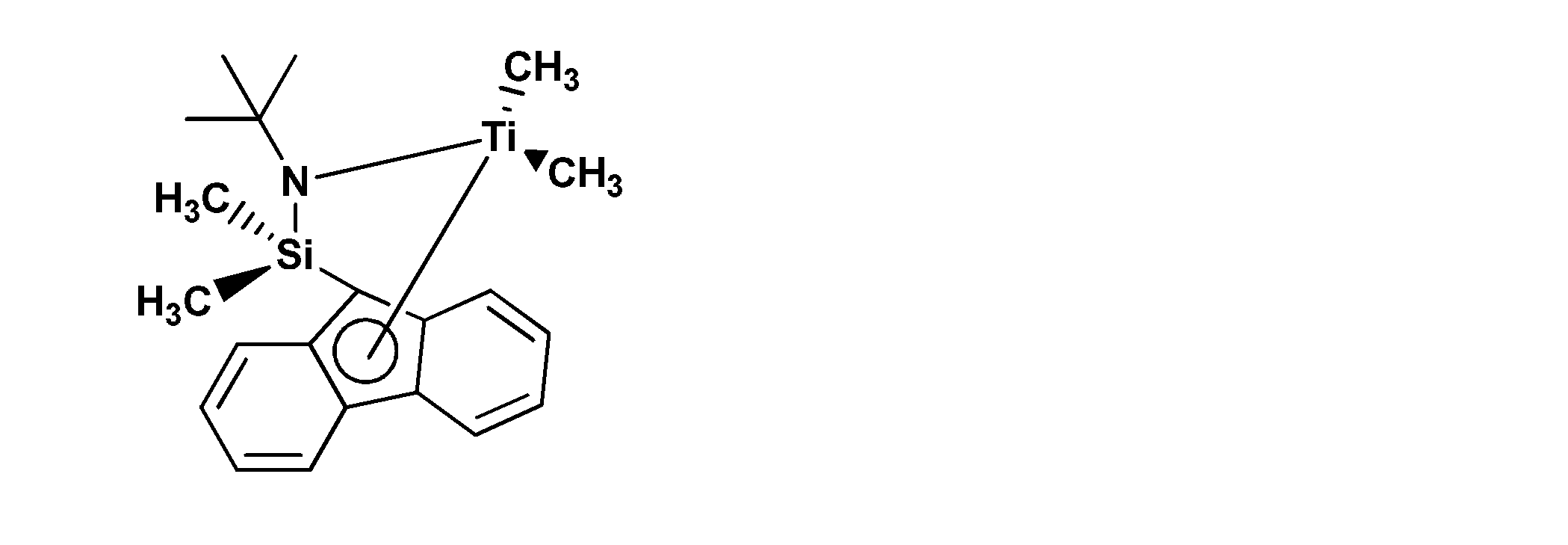
2口フラスコに、TiCl40.58mL(5.29mmol)と、ヘキサン50mLとを仕込んだ。工程(II)の反応液を、フラスコ内のTiCl4溶液に滴下した後、フラスコの内容物を室温で15時間撹拌した。このようにして、下式の構造の触媒を含む黒色の反応液が得られた。
(その他の工程)
フラスコの内容物から、溶媒を減圧留去して黒色粉末として残渣を得た。得られた黒色粉末をヘキサン40mLに懸濁し、ヘキサン中に触媒を抽出した。ガラスフィルターを通して、懸濁液から不溶成分を取り除いた。懸濁液から除かれた不溶成分に対して、同様の抽出操作をさらにヘキサン40mLを使用して1回、ヘキサン20mLを使用して2回繰り返した。得られた濾液(触媒の抽出液)を、減圧下で乾燥し、触媒1.44gを得た。
得られた触媒の、NMRによる内部標準法(エチルベンゼン基準)により定められる、配位子の使用量に対する収率は70%であり、同じくNMRによる内部標準法(エチルベンゼン基準)により定められる触媒の純度は95%であった。
フラスコの内容物から、溶媒を減圧留去して黒色粉末として残渣を得た。得られた黒色粉末をヘキサン40mLに懸濁し、ヘキサン中に触媒を抽出した。ガラスフィルターを通して、懸濁液から不溶成分を取り除いた。懸濁液から除かれた不溶成分に対して、同様の抽出操作をさらにヘキサン40mLを使用して1回、ヘキサン20mLを使用して2回繰り返した。得られた濾液(触媒の抽出液)を、減圧下で乾燥し、触媒1.44gを得た。
得られた触媒の、NMRによる内部標準法(エチルベンゼン基準)により定められる、配位子の使用量に対する収率は70%であり、同じくNMRによる内部標準法(エチルベンゼン基準)により定められる触媒の純度は95%であった。
なおNMR分析は、ブルカー(Bruker)分光計AVANCE III 400を使用し、重トルエンを用いた1H-NMRにより行った。
測定用サンプル管は、J-YOUNG NMRサンプル管を使用した。
NMRによる定量分析は、内部標準物質として純度99%以上のエチルベンゼンを使用し、使用量と、エチルベンゼンの2.44ppm(三重線、2H)のピークと、触媒の7.71ppm(二重線、2H)のピークとの積分比を算出して行った。
測定用サンプル管は、J-YOUNG NMRサンプル管を使用した。
NMRによる定量分析は、内部標準物質として純度99%以上のエチルベンゼンを使用し、使用量と、エチルベンゼンの2.44ppm(三重線、2H)のピークと、触媒の7.71ppm(二重線、2H)のピークとの積分比を算出して行った。
〔実施例2〕
メチルリチウムをn-ブチルリチウム(1.6Mヘキサン溶液)に変更することの他は、実施例1と同様にして固体状の触媒を得た。
得られた触媒の、NMRによる内部標準法(エチルベンゼン基準)により定められる、配位子の使用量に対する収率は63%であり、同じくNMRによる内部標準法(エチルベンゼン基準)により定められる触媒の純度は98%であった。
メチルリチウムをn-ブチルリチウム(1.6Mヘキサン溶液)に変更することの他は、実施例1と同様にして固体状の触媒を得た。
得られた触媒の、NMRによる内部標準法(エチルベンゼン基準)により定められる、配位子の使用量に対する収率は63%であり、同じくNMRによる内部標準法(エチルベンゼン基準)により定められる触媒の純度は98%であった。
〔比較例1〕
乾燥された窒素雰囲気に置換されたグローブボックス内で、シュレンクフラスコに、ジエチルエーテル50mLと、実施例1と同じ配位子1.56g(5.28mmol)とを加えた。配位子をジエチルエーテルに溶解させた後、シュレンクフラスコに、メチルリチウムのジエチルエーテル溶液9.4mL(1.12M、メチルリチウム含有量:10.5mmol(2.0モル当量(対配位子)))を加えた。その後、配位子とメチルリチウムとを室温で2.5時間反応させて、配位子とメチルリチウムとの反応液を得た。
乾燥された窒素雰囲気に置換されたグローブボックス内で、シュレンクフラスコに、ジエチルエーテル50mLと、実施例1と同じ配位子1.56g(5.28mmol)とを加えた。配位子をジエチルエーテルに溶解させた後、シュレンクフラスコに、メチルリチウムのジエチルエーテル溶液9.4mL(1.12M、メチルリチウム含有量:10.5mmol(2.0モル当量(対配位子)))を加えた。その後、配位子とメチルリチウムとを室温で2.5時間反応させて、配位子とメチルリチウムとの反応液を得た。
窒素雰囲気に置換された2口フラスコに、ヘキサン50mLと、TiCl40.58mL(5.29mmol(1.0モル当量(対配位子)))を加えた。
次いで、配位子とメチルリチウムとの反応液を、キャニュラーを用いて2口フラスコ内に滴下した。滴下後、2口フラスコの内容物を室温にて17時間撹拌して、配位子とメチルリチウムとの反応生成物と、TiCl4とを反応させた。反応により、濃褐色の反応液が得られた。
得られた反応液から、溶媒を留去して黒色粉末を残渣として得た。得られた黒色粉末をトルエン20mLに懸濁し、トルエン中に反応生成物を抽出した。ガラスフィルターを通して、懸濁液から不溶成分を取り除いた。懸濁液から除かれた不溶性分に対して、同様の抽出操作をさらにトルエン20mLを使用して3回繰り返した。得られた濾液(抽出液)を、減圧下で乾燥し、反応生成物1.90gを得た。
次いで、配位子とメチルリチウムとの反応液を、キャニュラーを用いて2口フラスコ内に滴下した。滴下後、2口フラスコの内容物を室温にて17時間撹拌して、配位子とメチルリチウムとの反応生成物と、TiCl4とを反応させた。反応により、濃褐色の反応液が得られた。
得られた反応液から、溶媒を留去して黒色粉末を残渣として得た。得られた黒色粉末をトルエン20mLに懸濁し、トルエン中に反応生成物を抽出した。ガラスフィルターを通して、懸濁液から不溶成分を取り除いた。懸濁液から除かれた不溶性分に対して、同様の抽出操作をさらにトルエン20mLを使用して3回繰り返した。得られた濾液(抽出液)を、減圧下で乾燥し、反応生成物1.90gを得た。
フラスコに、TiCl4を用いて得た反応生成物とトルエン45mLとを加えて、反応生成物をトルエンに溶解させた。
次いで、反応生成物の溶液に、メチルリチウムのジエチルエーテル溶液9.4mL(1.12M、メチルリチウム含有量:10.5mmol(2.0モル当量(対配位子)))を加えた後、反応生成物と、メチルリチウムとを室温で12時間反応させて、触媒を生成させた。
次いで、反応生成物の溶液に、メチルリチウムのジエチルエーテル溶液9.4mL(1.12M、メチルリチウム含有量:10.5mmol(2.0モル当量(対配位子)))を加えた後、反応生成物と、メチルリチウムとを室温で12時間反応させて、触媒を生成させた。
フラスコ内の触媒を含む反応液に、MeMgBr3mL(濃度3M、9mmol)のジエチルエーテル溶液を加えた。次いで、フラスコの内容物を室温で1時間撹拌した。
フラスコの内容物から、溶媒を減圧留去して黒色粉末として残渣を得た。得られた黒色粉末をヘキサン40mLに懸濁し、ヘキサン中に触媒を抽出した。ガラスフィルターを通して、懸濁液から不溶成分を取り除いた。懸濁液から除かれた不溶成分に対して、同様の抽出操作をさらにヘキサン40mLを使用して1回、ヘキサン20mLを使用して2回繰り返した。得られた濾液(触媒の抽出液)を、減圧下で乾燥し、触媒933mgを得た。
得られた触媒の、NMRによる内部標準法(エチルベンゼン基準)により定められる、配位子の使用量に対する収率は38%であり、同じくNMRによる内部標準法(エチルベンゼン基準)により定められる触媒の純度は81%であった。
フラスコの内容物から、溶媒を減圧留去して黒色粉末として残渣を得た。得られた黒色粉末をヘキサン40mLに懸濁し、ヘキサン中に触媒を抽出した。ガラスフィルターを通して、懸濁液から不溶成分を取り除いた。懸濁液から除かれた不溶成分に対して、同様の抽出操作をさらにヘキサン40mLを使用して1回、ヘキサン20mLを使用して2回繰り返した。得られた濾液(触媒の抽出液)を、減圧下で乾燥し、触媒933mgを得た。
得られた触媒の、NMRによる内部標準法(エチルベンゼン基準)により定められる、配位子の使用量に対する収率は38%であり、同じくNMRによる内部標準法(エチルベンゼン基準)により定められる触媒の純度は81%であった。
比較例1からは、最初に配位子と反応させるメチルリチウムの量が、配位子に対して2.0モル当量では、配位子に対して合計4.0モル当量のメチルリチウムを反応させても、純度に優れる触媒を高収率で得られないことが分かる。
〔比較例2〕
メチルリチウムの使用量を28.0mmol(5.3モル当量(対配位子))に変更することの他は、比較例1と同様にして、配位子とメチルリチウムとの反応液を得た。
メチルリチウムの使用量を28.0mmol(5.3モル当量(対配位子))に変更することの他は、比較例1と同様にして、配位子とメチルリチウムとの反応液を得た。
窒素雰囲気に置換された2口フラスコに、ヘキサン50mLと、TiCl40.58mL(5.29mmol(1.0モル当量(対配位子)))を加えた。
次いで、配位子とメチルリチウムとの反応液を、キャニュラーを用いて2口フラスコ内に滴下した。滴下後、2口フラスコの内容物を室温にて22時間撹拌して、配位子とメチルリチウムとの反応生成物と、TiCl4とを反応させた。反応により、濃褐色の反応液が得られた。
得られた反応液から、溶媒を留去して黒色粉末を残渣として得た。得られた黒色粉末をヘキサン40mLに懸濁し、ヘキサン中に反応生成物を抽出した。ガラスフィルターを通して、懸濁液から不溶成分を取り除いた。懸濁液から除かれた不溶性分に対して、同様の抽出操作をさらにヘキサン40mLを使用して1回、ヘキサン20mLを使用して2回繰り返した。得られた濾液(抽出液)を、減圧下で乾燥し、反応生成物を得た。
次いで、配位子とメチルリチウムとの反応液を、キャニュラーを用いて2口フラスコ内に滴下した。滴下後、2口フラスコの内容物を室温にて22時間撹拌して、配位子とメチルリチウムとの反応生成物と、TiCl4とを反応させた。反応により、濃褐色の反応液が得られた。
得られた反応液から、溶媒を留去して黒色粉末を残渣として得た。得られた黒色粉末をヘキサン40mLに懸濁し、ヘキサン中に反応生成物を抽出した。ガラスフィルターを通して、懸濁液から不溶成分を取り除いた。懸濁液から除かれた不溶性分に対して、同様の抽出操作をさらにヘキサン40mLを使用して1回、ヘキサン20mLを使用して2回繰り返した。得られた濾液(抽出液)を、減圧下で乾燥し、反応生成物を得た。
得られた反応生成物にヘキサン120mLと、MeMgBr3mL(濃度3M、9mmol)のジエチルエーテル溶液を加えた後、室温で5時間撹拌を行った。
撹拌後の溶液から、溶媒を減圧留去して黒色粉末として残渣を得た。得られた黒色粉末をヘキサン40mLに懸濁し、ヘキサン中に触媒を抽出した。ガラスフィルターを通して、懸濁液から不溶成分を取り除いた。懸濁液から除かれた不溶成分に対して、同様の抽出操作をさらにヘキサン40mLを使用して1回、20mLを使用して2回繰り返した。得られた濾液(触媒の抽出液)を、減圧下で乾燥し、触媒958mgを得た。
得られた触媒の、NMRによる内部標準法(エチルベンゼン基準)により定められる、配位子の使用量に対する収率は39%であり、同じくNMRによる内部標準法(エチルベンゼン基準)により定められる触媒の純度は80%であった。
なお、比較例2は、非特許文献2に記載される方法に相当する。
撹拌後の溶液から、溶媒を減圧留去して黒色粉末として残渣を得た。得られた黒色粉末をヘキサン40mLに懸濁し、ヘキサン中に触媒を抽出した。ガラスフィルターを通して、懸濁液から不溶成分を取り除いた。懸濁液から除かれた不溶成分に対して、同様の抽出操作をさらにヘキサン40mLを使用して1回、20mLを使用して2回繰り返した。得られた濾液(触媒の抽出液)を、減圧下で乾燥し、触媒958mgを得た。
得られた触媒の、NMRによる内部標準法(エチルベンゼン基準)により定められる、配位子の使用量に対する収率は39%であり、同じくNMRによる内部標準法(エチルベンゼン基準)により定められる触媒の純度は80%であった。
なお、比較例2は、非特許文献2に記載される方法に相当する。
比較例2によれば、配位子に対して、所望する構造の触媒を得るための化学量論的な最少量である4.0モル当量を超える5.3モル当量のメチルリチウムを反応させた後に、TiCl4を反応させても、純度に優れる触媒を高収率で得られないことが分かる。
Claims (4)
- 下記式(1):

で表される触媒の製造方法であって、
(I)下記式(1a):
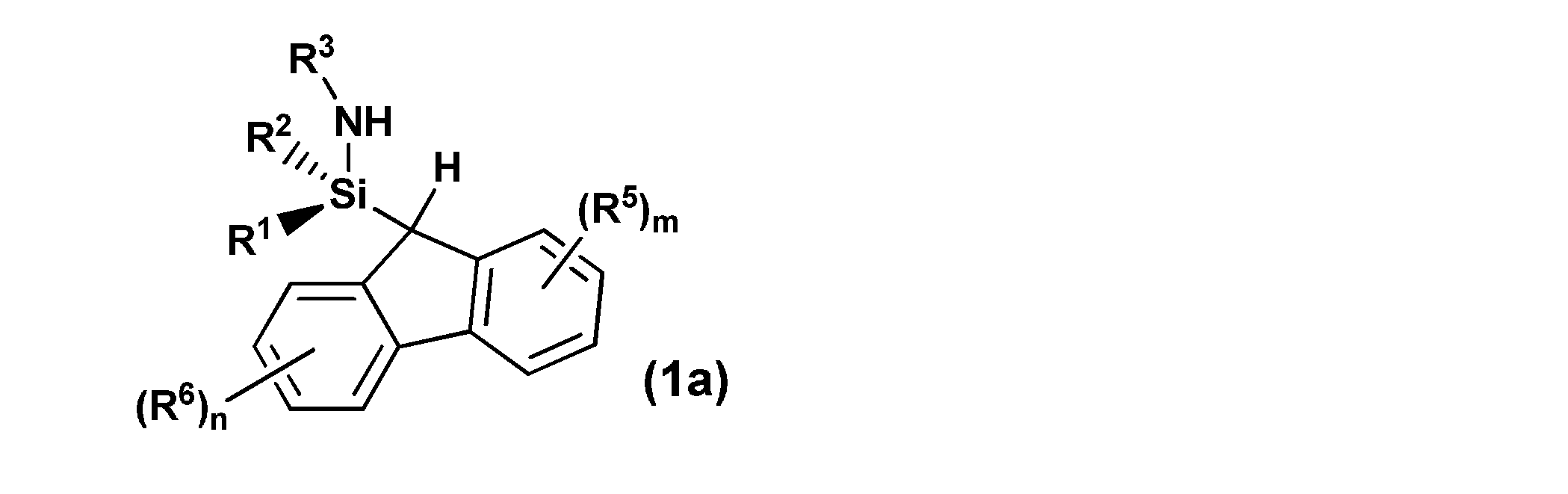
で表される配位子を、下記式(1b):
LiR7・・・(1b)
(式(1b)中、R7は、ヘテロ原子を含んでいてもよい炭素原子数1~20の炭化水素基であり、C-Li結合によりリチウム原子に結合する。)
で表される有機リチウム化合物と反応させる工程と、
(II)前記工程(I)で得られる生成物を、下記式(1c)で表される化合物、下記式(1d)で表される化合物、及び下記(1e)で表される化合物:
(R4)pMgX(2-p)・・・(1c)
(R4)qZnX(2-q)・・・(1d)
(R4)rAlX(3-r)・・・(1e)
(式(1c)、(1d)、及び(1e)中、R4は前記の通りであり、Xはハロゲン原子でありpは1又は2であり、qは1又は2であり、rは1~3の整数である。)
からなる群より選択される1種以上と反応させる工程と、
(III)前記工程(II)で得られる生成物を、前記配位子に対して1モル当量以上の下記式(1f):
MR8 4・・・(1f)
(式(1f)中、Mは、前記の通りであり、R8は、ハロゲン原子、又は-OR9で表される基であり、R9は、ヘテロ原子を有してもよい炭素原子数1~20の炭化水素基であり、R9はC-O結合により酸素原子に結合する。)
で表される化合物と反応させる工程と、を含み、
前記工程(I)において、前記R4と前記R7とが同一である場合には、前記有機リチウム化合物の使用量が前記配位子に対して2.0モル当量以上であり、
前記工程(I)において、前記R4と前記R7とが同一でない場合には、前記有機リチウム化合物の使用量が前記配位子に対して1.8モル当量以上2.2モル当量以下であり、
前記工程(II)において、前記式(1c)で表される化合物、前記式(1d)で表される化合物、及び前記式(1e)で表される化合物からなる群より選択される化合物は、これらの化合物に含まれる基R4のモル数が、前記配位子のモル数の2倍以上であるような量使用される、触媒の製造方法。 - 前記配位子が、下記式(1a-1):

- 前記工程(II)において、前記工程(I)で得られる生成物を、前記式(1c)で表される化合物と反応させる、請求項1又は2に記載の触媒の製造方法。
- 前記式(1f)で表される化合物がTiCl4である、請求項1~3のいずれか1項に記載の触媒の製造方法。
Priority Applications (4)
| Application Number | Priority Date | Filing Date | Title |
|---|---|---|---|
| KR1020197000259A KR102025262B1 (ko) | 2016-06-29 | 2017-05-31 | 촉매의 제조방법 |
| CN201780039638.8A CN109328199B (zh) | 2016-06-29 | 2017-05-31 | 催化剂的制造方法 |
| US16/310,959 US20200179914A1 (en) | 2016-06-29 | 2017-05-31 | Method for producing catalyst |
| DE112017003262.8T DE112017003262B4 (de) | 2016-06-29 | 2017-05-31 | Verfahren zur Herstellung eines Katalysators |
Applications Claiming Priority (2)
| Application Number | Priority Date | Filing Date | Title |
|---|---|---|---|
| JP2016-129025 | 2016-06-29 | ||
| JP2016129025A JP6038375B1 (ja) | 2016-06-29 | 2016-06-29 | 触媒の製造方法 |
Publications (1)
| Publication Number | Publication Date |
|---|---|
| WO2018003389A1 true WO2018003389A1 (ja) | 2018-01-04 |
Family
ID=57483097
Family Applications (1)
| Application Number | Title | Priority Date | Filing Date |
|---|---|---|---|
| PCT/JP2017/020307 Ceased WO2018003389A1 (ja) | 2016-06-29 | 2017-05-31 | 触媒の製造方法 |
Country Status (6)
| Country | Link |
|---|---|
| US (1) | US20200179914A1 (ja) |
| JP (1) | JP6038375B1 (ja) |
| KR (1) | KR102025262B1 (ja) |
| CN (1) | CN109328199B (ja) |
| DE (1) | DE112017003262B4 (ja) |
| WO (1) | WO2018003389A1 (ja) |
Citations (4)
| Publication number | Priority date | Publication date | Assignee | Title |
|---|---|---|---|---|
| JPH05194641A (ja) * | 1991-06-24 | 1993-08-03 | Dow Chem Co:The | ルイス酸での引抜きによる均質オレフィン重合触媒 |
| JP2001516367A (ja) * | 1998-01-14 | 2001-09-25 | モンテル テクノロジー カンパニー ビーブイ | メタロセン化合物の製造方法 |
| JP2008081674A (ja) * | 2006-09-28 | 2008-04-10 | Hiroshima Univ | 環状オレフィン/スチレン類共重合体の製造方法 |
| JP2011174018A (ja) * | 2010-02-25 | 2011-09-08 | Tosoh Finechem Corp | α−オレフィン/スチレン類共重合体およびその製造方法 |
Family Cites Families (1)
| Publication number | Priority date | Publication date | Assignee | Title |
|---|---|---|---|---|
| KR101637982B1 (ko) | 2014-11-07 | 2016-07-11 | 주식회사 엘지화학 | 리간드 화합물, 전이금속 화합물 및 이를 포함하는 촉매 조성물 |
-
2016
- 2016-06-29 JP JP2016129025A patent/JP6038375B1/ja active Active
-
2017
- 2017-05-31 KR KR1020197000259A patent/KR102025262B1/ko active Active
- 2017-05-31 WO PCT/JP2017/020307 patent/WO2018003389A1/ja not_active Ceased
- 2017-05-31 DE DE112017003262.8T patent/DE112017003262B4/de active Active
- 2017-05-31 US US16/310,959 patent/US20200179914A1/en not_active Abandoned
- 2017-05-31 CN CN201780039638.8A patent/CN109328199B/zh active Active
Patent Citations (4)
| Publication number | Priority date | Publication date | Assignee | Title |
|---|---|---|---|---|
| JPH05194641A (ja) * | 1991-06-24 | 1993-08-03 | Dow Chem Co:The | ルイス酸での引抜きによる均質オレフィン重合触媒 |
| JP2001516367A (ja) * | 1998-01-14 | 2001-09-25 | モンテル テクノロジー カンパニー ビーブイ | メタロセン化合物の製造方法 |
| JP2008081674A (ja) * | 2006-09-28 | 2008-04-10 | Hiroshima Univ | 環状オレフィン/スチレン類共重合体の製造方法 |
| JP2011174018A (ja) * | 2010-02-25 | 2011-09-08 | Tosoh Finechem Corp | α−オレフィン/スチレン類共重合体およびその製造方法 |
Non-Patent Citations (1)
| Title |
|---|
| TAKESHI SHIONO, POLYMER JOURNAL, vol. 43, 2011, pages 331 - 351 * |
Also Published As
| Publication number | Publication date |
|---|---|
| KR102025262B1 (ko) | 2019-09-25 |
| CN109328199B (zh) | 2019-10-18 |
| DE112017003262T5 (de) | 2019-03-14 |
| DE112017003262B4 (de) | 2022-12-22 |
| CN109328199A (zh) | 2019-02-12 |
| JP6038375B1 (ja) | 2016-12-07 |
| KR20190007518A (ko) | 2019-01-22 |
| US20200179914A1 (en) | 2020-06-11 |
| JP2018002804A (ja) | 2018-01-11 |
Similar Documents
| Publication | Publication Date | Title |
|---|---|---|
| Luo et al. | Rare earth metal bis (amide) complexes bearing amidinate ancillary ligands: Synthesis, characterization, and performance as catalyst precursors for cis-1, 4 selective polymerization of isoprene | |
| CA2144607C (en) | Process for the synthesis of monomethylmetallocenes and dimethylmetallocenes and their solutions specifically for use in the polymerization of olefins | |
| EP0582114B1 (en) | Process for preparing metallocenes | |
| EP2650300B1 (en) | Process for production of racemic-form and racemic-form metallocene complexes | |
| JP6038375B1 (ja) | 触媒の製造方法 | |
| JPS6123798B2 (ja) | ||
| JP6722525B2 (ja) | 触媒の製造方法 | |
| TWI537283B (zh) | 純化粗製pnpnh化合物之方法 | |
| JP6745151B2 (ja) | 触媒の製造方法 | |
| JP2006503911A (ja) | rac−ジオルガノシリルビス(2−メチルベンゾ[e]インデニル)ジルコニウム化合物のラセモ選択的合成法 | |
| CA2324352A1 (en) | Constrained geometry metallocene catalyst complexes | |
| EP2800752B1 (en) | Method for preparing di-organo-dialkoxysilanes | |
| RU2382045C2 (ru) | Способ получения оптически активного комплекса циклопентадиенил-1-неоментил-4,5,6,7-тетрагидроинденилцирконий диметила | |
| Havlík et al. | Highly substituted zirconium and hafnium cyclopentadienyl bifunctional β-diketiminate complexes–Synthesis, structure, and catalytic activity towards ethylene polymerization | |
| TW202325717A (zh) | 製備有機鈦化合物之方法 | |
| JP3661825B2 (ja) | 有機インジウム化合物の製造方法 | |
| JP3584174B2 (ja) | 有機ホウ素化合物の製造法 | |
| CA2614509A1 (en) | Synthesis of benzyl-metal compounds | |
| US6465668B2 (en) | Method for producing fluoroaryl metal compound | |
| US20020065425A1 (en) | Method for purifying fluoroaryl metal compound | |
| RU2478642C1 (ru) | Способ совместного получения 1-хлор-3-алкилалюминациклогептанов и 1-хлор-3-алкилалюминациклононанов | |
| EP3917938A1 (en) | Process for producing metallocenes | |
| US20210163510A1 (en) | Method for producing cationic silicon(ii) compounds | |
| ITMI981845A1 (it) | Processo per la preparazione di composti arilici fluorurati del boro | |
| JP2006062978A (ja) | ホスフィン酸エステルの製造方法 |
Legal Events
| Date | Code | Title | Description |
|---|---|---|---|
| 121 | Ep: the epo has been informed by wipo that ep was designated in this application |
Ref document number: 17819755 Country of ref document: EP Kind code of ref document: A1 |
|
| ENP | Entry into the national phase |
Ref document number: 20197000259 Country of ref document: KR Kind code of ref document: A |
|
| 122 | Ep: pct application non-entry in european phase |
Ref document number: 17819755 Country of ref document: EP Kind code of ref document: A1 |